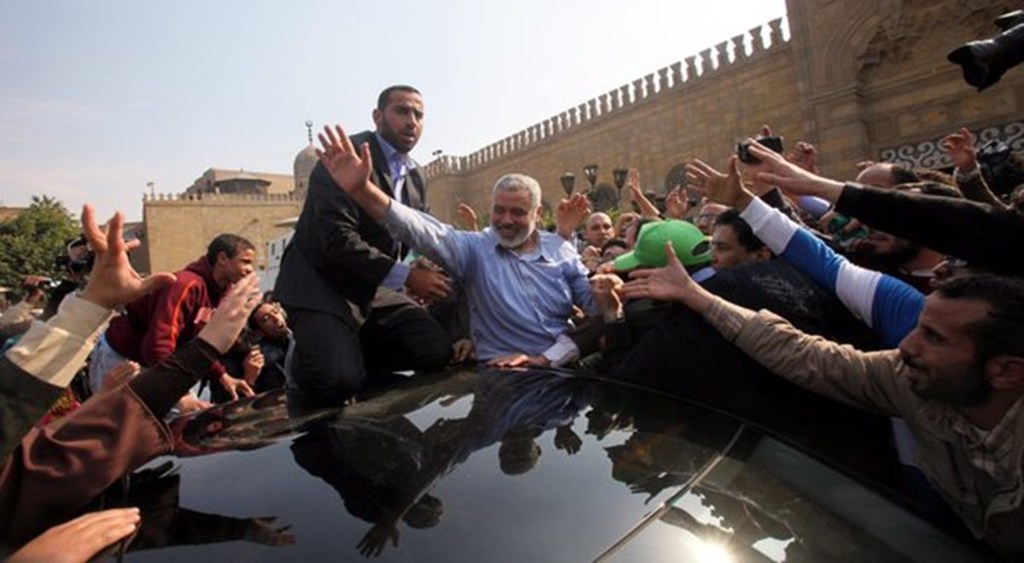
Hamas prime minister in Gaza, Ismail Haniya, greets supporters after Friday Prayer, where he spoke out against President Bashar al-Assad
By Michael Karadjis
March 7, 2012 – Links International Journal of Socialist Renewal http://links.org.au/node/2766 — The declaration by Hamas leader Ismail Haniyeh, the elected prime minister of Palestine but ruling only in Gaza, that his movement was backing the popular uprising in Syria against the brutal regime of Bashar al-Assad (http://www.nytimes.com/2012/02/25/world/middleeast/hamas-leader-supports-syrian-opposition.html), was widely reported, as was the more general significance of his statement to worshipers at Cairo’s Al Azhar mosque. Hamas, while ruling the Gaza Strip, has had its exile leadership based in Syria in recent years (previous to that it was based in Jordan); now Haniyeh is betting on a new strategic relationship with post-Mubarak Egypt, in the midst of that country’s April Spring revolution. Haniyeh saluted “the heroic Syrian people, who are striving for freedom, democracy and reform”.
Haniyeh’s strong statements in support of the Syrian people were not the only statements from Hamas. Another senior Hamas official in Gaza, Mahmud Zahar, said Hamas was not taking sides in the Syrian conflict. “We cannot take one side, with half a million Palestinians living in complete freedom in Syria having to (face the consequences) of this position … We do not seek to get involved in internal or regional Arab conflicts. Our fundamental struggle is directed against the Israeli occupation of Palestine.” He did “advise” the Syrian regime “to give more freedom to the Syrian people, in order to strengthen Syria so that it would be able to free the occupied Golan territory and support the resistance (against Israel)”.
Given the presence of so many Palestinians in Syria, he has a point. Palestinians have their own problems, to say the least; the last thing they need is to be on the “wrong” side in Syria when one or the other side wins, and have to face the consequences.
And while Hamas’ obvious sympathies are, as Haniyeh made clear, with the Syrian people who are fighting for freedom, the consequences of being on the “wrong” side in the event of Assad retaining power could well be dire, given the simple fact that no other Arab state except Jordan has as much Palestinian blood on its hands as has the Syrian regime under the 42-year Assad dynasty.
In fact, Zahar’s statement about Palestinians living in “freedom” in Syria was made before the full extent of the regime’s bloody crackdown and ongoing starvation siege and bombing of the Palestinian Yarmouk camp became evident (https://www.alaraby.co.uk/english/politics/2015/4/7/assad-and-the-palestinians-from-tal-al-zaatar-to-yarmouk); soon after the events reported here, no-one would speak of Palestinian freedom in Syria, where hundreds of Palestinians have been tortured to death in regime dungeons alongside tens of thousands of Syrians (https://en.zamanalwsl.net/news/9393.html), and their camps reduced to the same Guernica style situation as the rest of Syria by Assad’s regime.
That should be the starting point for any supporter of the Palestinian people: recognition that their first priority is to their struggle and the defence of their people, in particular to the highly vulnerable refugees, not to gaining nods of approval from Western leftists and some of their more peculiar views.
Hamas had been based in Damascus not out of love for Assad, but due to having few alternatives. As long as Mubarak ruled Egypt, that country was an active collaborator with the Zionist occupation of Palestine, especially the criminal siege of Gaza. Hamas had been based in Jordan until King Hussein kicked it out in the late 1990s.
The deal was, “we [Syria] give you offices, but you make sure to never use Syrian territory for any operations against Israel, even symbolic”. The Syrian border with Israel on the Israeli-occupied Golan Heights was as quiet as that of Egypt for 40 years, enforced by the “anti-imperialist” Assad. If the regime was never going to move even symbolically on its own occupied territory, it sure as hell was not going to allow Palestinians to. The idea of a “resistance” regime is make-believe, in its entirety.
After Mubarak
But with the fall of Mubarak things have changed. Certainly, the current Egyptian rulers, who include old-guard generals, are not exactly enthusiastic supporters of the Palestinian struggle, but under the influence of the revolution, their public posturing of the Egyptian government has shifted since Mubarak; certainly over the last year a number of events on the Egypt-Israel borders have shifted the number one most sealed border from Egypt to Syria.
Then in March 2012, the lower house of the Egyptian parliament unanimously declared that Israel is the number one enemy of Egypt, declaring “Revolutionary Egypt will never be a friend, partner or ally of the Zionist entity, which we consider to be the number one enemy of Egypt and the Arab nation … It will deal with that entity as an enemy, and the Egyptian government is hereby called upon to review all its relations and accords with that enemy” (http://presstv.com/detail/231376.html). Soon after, a $2.5 billion export deal signed in 2005, under which Israel received around 40 percent of its gas supply from Egypt at an extremely low price, was annulled (http://www.scoop.co.nz/stories/HL1205/S00007/egypt-just-annulled-mubarak…).
Hamas naturally sought to take advantage of this new situation – especially given the proximity of Egypt to Gaza. By making his announcement at Friday prayers in Egypt, Haniyeh manoevured to push forward the positive momentum in Egypt. The fact that the Muslim Brotherhood is now the strongest party in Egypt, and that Hamas was originally the Palestinian wing of the Muslim Brotherhood, is hardly insignificant either; and the Brotherhood is, of course, for better or worse, a prominent part of the Syrian opposition based among the Sunni majority there. Hamas and the Brotherhood are also strongly connected to Turkey’s ruling Justice and Development Party (AKP), which has been a prominent backer of the Syrian uprising; Turkish leader Erdogan’s comment that Israel is committing “state terror” in Gaza (http://www.haaretz.com/news/diplomacy-defense/turkey-s-erdogan-israel-mu…), gives us a further idea of the context in which Israel has tended to stick with Assad throughout the uprising.
Assad dictatorship: a non-rejectionist, anti-Palestinian regime
Assad’s father, Hafez al-Assad, seized power in 1970 from the more left-wing Baath Party government that had been ruling in the 1960s. The context of Assad’s coup was the ‘Black September’ massacre of thousands of Palestinian resistance fighters by King Hussein of Jordan, where the Palestinian resistance had been building its forces since Israel’s conquest of the West Bank in 1967. As the leftist Syrian regime moved to support the Palestinian fighters, Assad, as head of the air force, launched his coup to prevent this move against Hussein.
The previous Baath regime had rejected UN Resolution 242, which called for Israel’s withdrawal from the 1967 occupied territories but only regarded Palestinians to be a refugee problem. There was nothing about Palestinian self-determination. Till then, only Egypt and Jordan had accepted Resolution 242, but the new Assad regime wasted no time accepting the resolution in 1971.
This Resolution 242 was rejected by the so-called “rejectionist” Arab states (e.g., the Iraqi Baathists, Libya, Algeria, South Yemen) and by the PLO, including by Yassir Arafat’s Al Fatah faction. Fatah was sometimes called the “right wing of the PLO”, but as a national liberation movement was always fundamentally to the left of the treacherous Assad clique (the current Fatah leadership is, of course, a different issue, in a different context). In any case, while Fatah was through the 1970s and 1980s thus a “rejectionist” force, Assad’s regime manifestly was not, whatever one’s opinions on the issue.
Assad’s Tal al-Zaatar massacre of Palestinians
Moreover, Assad did more than just support a compromising resolution; unlike most reactionary Arab regimes far from the conflict, Assad – like King Hussein of Jordan – was willing to put words into action by actively slaughtering Palestinians. After being expelled from Jordan, thousands of Palestinian fighters re-assembled in Lebanon. In 1976, the Syrian army invaded Lebanon, where the Palestinians had been allied to a Muslim and leftist coalition fighting for equal rights against the reactionary Phalange Party, which aimed to maintain the sectarian dominance of the Christian minority, which had been foisted onto Lebanon by retreating French colonialism in 1943.
The Syrian army took the side of the Phalange and participated in their siege of the Palestinian-Muslim-leftist coalition in Tel-al-Zaatar Palestinian refugee camp, a monstrous siege leaving 2000-3000 Palestinians dead or wounded.
Assad’s aim in all this – both in crushing Palestinian fighters and in fighting Lebanese leftist forces – was to do what Egypt’s Sadat had just done. Sadat had betrayed the Palestinians by signing the Camp David “peace” accords with Israel in order to get back the Israeli-occupied Sinai. Assad aimed to show the US and Israel how useful his regime could be to them, in order to try to get Israel to likewise return the occupied Golan Heights. But having returned the Sinai and pacified its southern border, Israel felt no need to return any more land.
What’s more, for all Assad’s efforts, Israel formally annexed the Golan Heights in 1981, an act of outright international piracy. With this slap in the face, Assad was unwillingly forced into the “rejectionist” camp in a rhetorical sense.
Syria and Israel attack Palestinians in Lebanon
In 1982, Israel launched a mass-murderous 3-month attack on Lebanon, in particular focusing on destroying Beirut to try to destroy the PLO and kill Yassir Arafat. After months of slaughter, the PLO agreed to withdraw, undefeated, for the sake of Lebanon. Shortly after their withdrawal from Beirut, occupying Israeli forces facilitated entry into the Palestinian refugee camps of Sabra and Shatilla to the Phalangist death-squads, who went on a rampage murdering some 3000 defenceless refugees. Yet despite this PLO withdrawal and this bloodthirsty massacre, the PLO remained throughout Palestinian communities in the rest of Lebanon.
This was considered a major problem by the US, Israel and Assad’s Syrian regime, who now took over from Israel as the anti-PLO vanguard.
In 1983, Assad’s Syria and Gaddafi’s Libya encouraged a rebellion within Fatah among its cadres in Lebanon when Arafat was exploring various diplomatic manoevures. Yes, these were in fact hard-line “rejectionist” cadres of Fatah, who felt – rightly or wrongly – that Arafat’s diplomacy was too compromising; as such they were the opposite of the pro-242 Assad regime hypocritically sponsoring them. Assad’s real objectives were to weaken and take over the independent PLO, in order to better try to do a deal with Israel over the occupied Syrian Golan Heights; he only used the rejectionist rebellion for his own opposite purposes. And whatever compromises Arafat was making, they did not include recognising Resolution 242.
The more rejectionist parties in the PLO – e.g., the Popular front for the Liberation of Palestine (PFLP) and the Democratic Front for the Liberation of Palestine (DFLP) – had many of the same criticisms of Arafat that the Fatah rebels had, but rejected this Syrian bid to take over the PLO and attempted to mend the feud. They said reform must come from within, and understood that if they let differences with Arafat lead to violent schism, it would only benefit the enemies of the Palestinian struggle.
Israel was well aware of what was at stake, and despite the “rejectionist” position of the Fatah rebels, it is a well-documented fact that Israel openly expressed its support for Syria taking control of the PLO. According to a senior Israeli government minister close to prime minister, Yitzak Shamir:
“Direct Syrian control of the PLO will be beneficial to us for a number of reasons. … our experience has shown that Syria can keep a firm hand on the Palestinian terrorists if it is in their interests to do so. Despite the fierce rhetoric from Damascus, there has been no attack against us from the Golan Heights for 10 years” (Christopher Walker, ‘Israel welcomes prospect of Syrian-controlled PLO’, The Australian, November 11, 1983).
Syrian-Israeli double siege of PLO in Tripoli
In any case, Assad soon abandoned the initial Fatah rejectionists (who, though discredited due to Syrian interference on their side, may at least be considered to have been initially principled) and instead took hold of a grotesque Palestinian splinter group which had originally been a split from the PFLP, called the PFLP-General Command (PFLP-GC), led by Ahmed Jibril, who was willing to be a puppet.
In late 1983, Syrian troops in Lebanon and their PFLP-GC stooges launched a monstrous tank, artillery and rocket attack on Palestinian refugee camps in Tripoli in northern Lebanon, killing hundreds of Palestinians. Again, the aim was to drive Arafat and the PLO from Lebanon. According to Arafat, Syria had amassed 25,000 men, 170 tanks and 180 artillery pieces around Baddawi and Nahr el Barad refugee camps, which housed 5000 to 8000 loyal Arafat soldiers among 45,000 to 60,000 refugees (http://archives.chicagotribune.com/1983/11/06/page/1/article/arafat-base-under-siege/index.html).
Consistent with its openly expressed support for the ejection of Arafat, the Israeli navy joined in the same siege and bombardment from the sea (http://archives.chicagotribune.com/1983/11/06/page/1/article/arafat-base-under-siege/index.html, https://www.washingtonpost.com/archive/politics/1983/12/20/5-ships-arrive-for-plo-evacuation-after-israelis-shell-lebanese-harbor/e85eb466-e180-4045-b237-93e1589b89e5/). While the alleged “compromiser” Arafat was there with his people defending them against this murderous double siege (just as he had been in Beirut the year before defending them against the murderous Israeli siege), the allegedly “rejectionist” PFLP-GC and Syria were bombing Palestinian refugees in direct coordination with Israel.
In relation to the second expulsion of Arafat’s forces from Lebanon, this time by Syria, an Israeli official declared that:
“From our point of view, there is nothing bad about Arafat leaving the scene. … I would say with pride that we started the process last year [ie, with the invasion of Lebanon the previous year] … What is happening now is one of the indirect consequences of our action last year” (Norman Kempster, ‘Israel won’t shed a tear for Arafat’, The Age, November 11, 1983).
As Israel continued to furiously bomb Arafat’s forces even after they had agreed to the Syrian demand that evacuate Tripoli, some theories arose to explain this:
“There had been widespread speculation that Israel was trying to force Arafat to make a deal with Syria in which the 4,000 guerrillas would be evacuated overland through Syria, with Arafat having to yield considerable influence in the PLO to the Syrians in exchange. Such a departure also would have denied Arafat the kind of dramatic withdrawal he and his guerrillas made from Beirut last year” (https://www.washingtonpost.com/archive/politics/1983/12/20/5-ships-arrive-for-plo-evacuation-after-israelis-shell-lebanese-harbor/e85eb466-e180-4045-b237-93e1589b89e5/).
Given the importance of the Yarmouk Palestinian refugee camp to the struggle in Syria today, it is notable that Assad’s attacks on Yarmouk were also a feature of those times:
“The trouble spread Saturday to Syria, where sources said Syrian security forces opened fire on hundreds of Arafat supporters in the Yarmouk refugee camp outside Damascus. Six demonstrators were killed and 17 wounded, sources said. The demonstrators chanted pro-Arafat slogans and denounced (leader of the pro-Syrian Palestinian defectors, Abu) Mousa and his mutineers during a 20-minute protest march” (‘Arafat base under siege’, Chicago Tribune, November 6, 1983, pp. 1, 5, http://archives.chicagotribune.com/1983/11/06/page/1/article/arafat-base-under-siege/index.html).
[Fast-forward: this same PFLP-GC, which some western propagandists for Assad have held up as evidence of Assad’s support by “the Palestinians”, has played the same role during the current uprising as a para-state security force against Syrian Palestinians: in mid-2011, its thugs even opened machine gun fire against protesting Palestinians, once again, in Yarmouk, https://www.opendemocracy.net/arab-awakening/c%C3%A9line-cantat/palestinians-in-syria-struggle-for-bread-and-agency].
Syria-Amal war on Palestinian camps
Nevertheless, no number of military defeats by Israel and the Assad regime could keep the PLO out of Lebanon. The simple reality of a Lebanon with hundreds of thousands of Palestinian refugees ensures a large PLO presence. And, as with most Palestinians elsewhere, the vast majority remained loyal to Arafat; if anything, the maniacal drive by Israel and Syria to destroy Arafat – as the representative of an independent Palestinian voice – greatly increased Arafat’s standing. By the middle of the decade, countless reports speak of the Arafat wing of the PLO playing a major part in the growing resistance to the Israeli occupation of almost half of Lebanon. The city and refugee camps in Saida in particular became a Fatah stronghold.
In 1985-86, Assad launched the Lebanese Shiite sectarian militia Amal against the Sabra, Shatilla and Bourj a-Barajneh Palestinian refugee camps, in the famous year-long “war of the camps” in which thousands of Palestinians were killed by these pro-Assad goon squads. Anyone visiting these camps decades later can see thousands of bullet holes from Amal’s criminal siege.
Once again the Israeli air-force bombed Palestinian camps and bases in the Beqa Valley and around Saida. This became too much even for the charlatan “anti-imperialist” Gaddafi. Libya reoriented towards an alliance with Fatah, and sent military aid to Fatah to defend the camps. Hezbollah, the pro-Iranian splinter from Amal, also vigorously condemned its Amal co-religionists over these attacks, despite Assad’s alliance with the Iranian theocracy. In 1987, Syrian troops in Lebanon slaughtered 23 Hezbollah militants to demonstrate who was boss.
In 1988, the entire PLO, including Fatah, the PFLP and the DFLP, and all the smaller principled “rejectionist parties,” reunited in Algiers. Only groups entirely under Assad’s control, like the PFLP-GC, stayed out. Later that year, Arafat declared the state of Palestine, and declared that the PLO was ready to negotiate on the basis of the original UN partition in 1947 (which only gave Palestine 45 percent of the land, but at least that was a lot more than the 22 percent being offered as a Palestinian state in the occupied territories in the most generous of offers, and even this is actively rejected by Israel and the US). Perhaps this is what the wsws means by Arafat “recognised Israel”, but that year has no relation to what the wsws says also happened, which apparently refers to the events of the previous five years described above.
Assad and US wars
In 1990, Assad’s Syria and Saudi Arabia jointly sponsored a new religiously sectarian – but less-so – constitution in Lebanon; the two countries effectively controlled the new state apparatus. This brought together many of the sectarian players from both sides, including Amal and the Phalange. Those standing outside were sidelined. One of the more grotesque ‘players’ in the new regime was the pro-Assad wing of the now split ‘Lebanese Forces’ (a paramilitary wing of the Phalange); its leader, Elie Hobeika, the very perpetrator of the Sabra-Shatilla massacre of thousands of Palestinians in 1982, was foisted by Assad to be Minister of the Displaced in the new government! Hobeika has remained a close ally of Assad ever since.
The Lebanon deal was followed by Assad sending the Syrian army to fight on the US side during its attack on Iraq in the 1991 Gulf war, yet another of the long list of Assad’s policies which do not sit easily with the “anti-imperialist” image foisted onto the regime by overseas admirers on the left” and far-right.
This pattern continued after Hafez al-Assad bequeathed his crown to his son, Bashar Assad, in 2000. Assad’s Syria became one of the key destinations to where the US sent Islamist suspects to be tortured in the “renditions” program. Indeed, as Mehdi Hasan writes, “Syria was one of the “most common” destinations for rendered suspects. Or, in the chilling words of former CIA agent Robert Baer, in 2004: ‘If you want a serious interrogation, you send a prisoner to Jordan. If you want them to be tortured, you send them to Syria’” (https://www.theguardian.com/commentisfree/2012/feb/19/syria-us-ally-human-rights).
Assad and Israel
For its efforts, Assad still got nothing from Israel on the Golan Heights. As a result, today Syria is still “anti-Israel” for the simple reason that Israel still occupies its land. And Israel still occupies because it has never felt the slightest bit of “resistance” – military, diplomatic or symbolic – from the regime of Assad.
But no other government in Syria, no matter who comes to power, would agree to give up the Golan. Indeed, the fact that Assad has kept the border quiet for so long means that many Israeli leaders have clearly expressed their preference for Assad remaining in power (https://mkaradjis.wordpress.com/2014/01/03/israel-and-the-syrian-war/). Israel has good reason to believe that any replacement of Assad may be less accommodating and have less control over the “border.”
Palestinians join uprising – and pay the price
In any case, solidarity with the Palestinian people does not require them to fall in with whatever grotesque schema sections of the Western left may have thought up. The unfolding Syrian drama is extremely complex, and while the people are right to revolt against a tyrant, the outcome remains utterly unclear. Those Palestinians who thus initially tried to keep out of it were well within their rights, but whatever the outcome, there is little point in denying the tyrannical nature of the Assad regime, and the fact that its actions – slaughtering peaceful protesters in huge numbers – is what has led to the situation as is.
However, it is important to note that thousands of other Palestinians in Syria did not keep out of it; young Palestinian people in particular took part in the democratic uprising from the outset alongside their Syrian brothers and sisters, with the same yearnings for freedom. In any case, even most who initially tried to remain neutral got drawn into the struggle due to the simple fact that their neighbours and in many cases family were those Syrians protesting for elementary rights and getting slaughtered by the regime. As Palestinians gave shelter to Syrian friends and family out of elementary human solidarity (http://english.dohainstitute.org/file/get/42bbd969-e593-45be-a4ff-cc55113be56c.pdf), the brutal regime siege of Yarmouk and other camps, which has left thousands of Palestinians killed, and the kidnapping and torture to death of hundreds of Palestinians inside Assad’s dungeons followed as night follows day.
It is only natural that, seeing the opportunities in revolutionary post-Mubarak Egypt, the Palestinians would want to identify with the Syrian people engaged in a struggle with many parallels to their own, and to break with a regime that not only kills its people, but whose entire history has meant the shedding of massive quantities of Palestinian blood.
 Their Anti-imperialism and Ours