Syrian rebels overwhelmingly condemn US bombing as an attack on revolution: September 2014

By Michael Karadjis

In extraordinary developments, the United States, Saudi Arabia, the United Arab Emirates, Qatar and Jordan have launched a joint air war, on Syrian territory, with the full support of the Syrian tyranny of Bashar al-Assad, on the Islamic State of Iraq and Sham (ISIS).

There are plenty of good reasons to oppose any US war in any circumstances; and in this case, a war that is targeting only the Sunni-sectarian ISIS, yet sparing the viciously anti-Sunni Assad regime, indeed collaborating with the regime, which is responsible for a hundred times more massacre and destruction than ISIS, with which it has long collaborated in any case, is likely to boost support for ISIS among a large section of the poverty-stricken, dispossessed Sunni majority.
However, ISIS is so reviled that it was just possible a very well-targeted war on ISIS may have won some hearts and minds. Certainly, even for those of us solidly anti-war, there should be no talk of “defending” ISIS, whatever that may mean. Likewise, if last year’s proposed (in my view imaginary) US attack on the Assad regime had become reality, it would have been necessary to oppose the war without giving a skerrick of “defense” to the genocidal regime that had just gassed hundreds of sleeping children to death with sarin.

The US launches war on Jabhat al-Nusra

However, the US is not only attacking ISIS – which the Free Syrian Army (FSA) and the united rebel alliance has been at war with for the last year – but from the outset has also attacked Jabhat al-Nusra (JaN). Despite also being a sectarian organisation which the FSA will have to deal with in the future in its own time, based on its own decision-making, JaN has for the most part been fighting on the side of the FSA and the other rebels against both the Assad regime and ISIS.
There have also been unconfirmed reports that the US has attacked Ahrar al-Sham in Aleppo – AaS is what might be called the most “jihadist” wing of the Syrian rebels other than JaN, which, however, unlike JaN, is not associated with al-Qaida. AaS has been operationally allied to the Free Syrian Army (FSA) and, along with the FSA, has been at war with both the regime and with ISIS. US officials seemed unconcerned by the possibility – one explained “we’re characterizing our targets as Khorasan and [ISIS] but it’s possible others were there. It is a toxic soup of terrorists” (http://www.buzzfeed.com/mikegiglio/us-goes-to-war-with-jabhat-al-nusra#39p8mlr).

In other words, the US and its allies have taken advantage of the revulsion against the clerical-fascist ISIS barbarians to launch an attack on the Syrian revolution on behalf of the secular-fascist Assad regime.

According to early reports from the Syrian Observatory for Human Rights, US air strikes killed 50 Al-Nusra militants and eight civilians, including children, in northern Syria on Tuesday (http://www.dailystar.com.lb/News/Middle-East/2014/Sep-23/271641-eight-civilians-30-fighters-killed-in-us-led-strikes-on-nusra-front-in-syria-activists.ashx#ixzz3E8z2uYK4). “Northern Syria” here refers to Idlib and Aleppo.

For the record, there is no ISIS whatsoever in Idlib – ISIS was driven out root and branch by the FSA’s Syrian Revolutionaries Front (SRF) in January, probably the most successful anti-ISIS operation carried out by any of the forces at one time or another fighting ISIS, whether the Syrian Army, the Iraqi Army or the Kurdish forces.

Yet while ISIS is comprehensively absent, the US air force launched a series of air strikes on the Kafr Dariyan region of Idlib, killing dozens of al-Nusra militants, while the civilian death toll shot up considerably compared to the initial reports (https://www.facebook.com/RadioFreeSyria/posts/706573779427832). Here’s also video footage of this terror: https://www.youtube.com/watch?v=dnQMgCo0Z2I. According to Nusra, their weapons factory near Sarmada in rural Idlib – where they produce weapons to fight the regime and ISIS – was targeted by US airstrikes (https://twitter.com/JihadNews2/status/514264176060301312).

In particular, given the grave situation in Aleppo, where the revolutionary forces are being jointly besieged from the south and the north-east by Assad and ISIS, the fact that the first US attacks were on JaN inside Aleppo – where JaN is playing an important role in the epic defense of the rebel-held, working—class, half of that city, alongside the FSA and other Islamist groups – is perhaps the most blatant attack on the revolution possible.

Perhaps once the revolutionary forces have been crushed in Aleppo, Assad and ISIS may fight: the former will then present the world with a fait accompli, it’s my regime or ISIS, while the latter will present the impoverished, Assad-hating Sunni masses with precisely the opposite dilemma.

That is why the defense of Aleppo now is all important. And at precisely that moment, dozens of Nusra fighters have been slaughtered by US bombers right there, in Aleppo. According to Nusra, “US airstrikes (with the help of Qatar, KSA, Jordan, UAE) hit positions of Jabhat an Nusra in Rural Muhandiseen Aleppo” (https://twitter.com/JihadNews2/status/514264771060072449) and scores of fighters were martyted in Jabhat al-Nusra headquarters in Urm al-Sogra, Aleppo (https://pbs.twimg.com/media/ByM2AKsCcAEO31v.jpg:large).

Oddly, US warplanes have also bombed positions in Jabal Sha’er in Homs countryside, killing some Bedouins (https://twitter.com/SN4HR/status/514407392801718272). It is unclear what the intended targets were.
Seniorj Jabhat al-Nusra leader, Muhsin al Fadhli, was martyred by the US bombing (https://pbs.twimg.com/media/ByNu9kqCcAAjfSE.jpg:large), as was Abū Yusuf at-Turkī, Nusra’s no.1 sniper, in US air strikes on Idlib.
The Assad regime must be very pleased with having acquired for itself a new airforce.

Some background

These developments are remarkable not for the fact they happened – this was basically my exact prognosis in June (www.links.org.au/node/3928) based on class analysis – but rather in its sheer brazenness and rapidity. That a US attack “on ISIS’ in Syria will become an attack on the revolution, via the device of attacking al-Nusra. Despite the jihadist Nusra leadership, much of its ranks are decent revolutionaries, often former FSA cadre just going where the money and arms are; and despite some its recent provocations (caused by the impact of ISIS’ victory in Mosul on the more jihadist part of the ranks), it still mostly fights the regime and ISIS. Attacking JaN is a way of attacking the revolution, just as the US has been trying to turn the FSA into a Sawha against JaN (not only against ISIS) since 2012 (http://www.thenational.ae/…/americas-hidden-agenda-in…). The FSA has always rejected this imperialist “advice.” According to FSA Colonel Akaidi last year, the US wants to turn the FSA “into the Sahwa,” but “if they [the US] help us so that we kill each other, then we don’t want their help” (http://www.ft.com/…/71e492d0-acdd-11e2-9454…). Then we had the recent UN resolution against ISIS that just happened to also be against JaN as well, nicely slipped in by Obama.

Assad regime hails US attacks

Furthermore, all this is in the context of the open collaboration between the US (and its Saudi, UAE etc allies) and the Assad regime, which the US informed of the attacks, with which the US is sharing intelligence, and which has expressed strong support for the US attacks on its own country.

Ali Haidar, Syrian minister for national reconciliation, told Reuters:

“As for the raids in Syria, I say that what has happened so far is proceeding in the right direction in terms of informing the Syrian government and by not targeting Syrian military installations and not targeting civilians” (http://www.reuters.com/article/2014/09/24/us-syria-crisis-minister-idUSKCN0HJ19S20140924?utm_source=twitter).
The US strikes have of course killed some dozens of civilians, but that is hardly a concern of a regime that has killed so many tens of thousands of civilians, as a grand underestimate.

Meanwhile, the pro-government news network Damascus Now hailed the strikes as a historic moment, in which “happiness was etched on the faces of the majority of Syrians, because they found international support towards eradicating a cancer which has been rooted in the diseased Syrian body,” referring to the rebels (http://syriadirect.org/rss/1580-syria-direct-news-update-9-24-14), and the regime’s Al-Watan newspaper declared “the US coalition and the Syrian Arab Army are on the same front against terrorism” (https://twitter.com/MousaAlomar/status/514789879180701697/photo/1).

Mass revulsion against US strikes

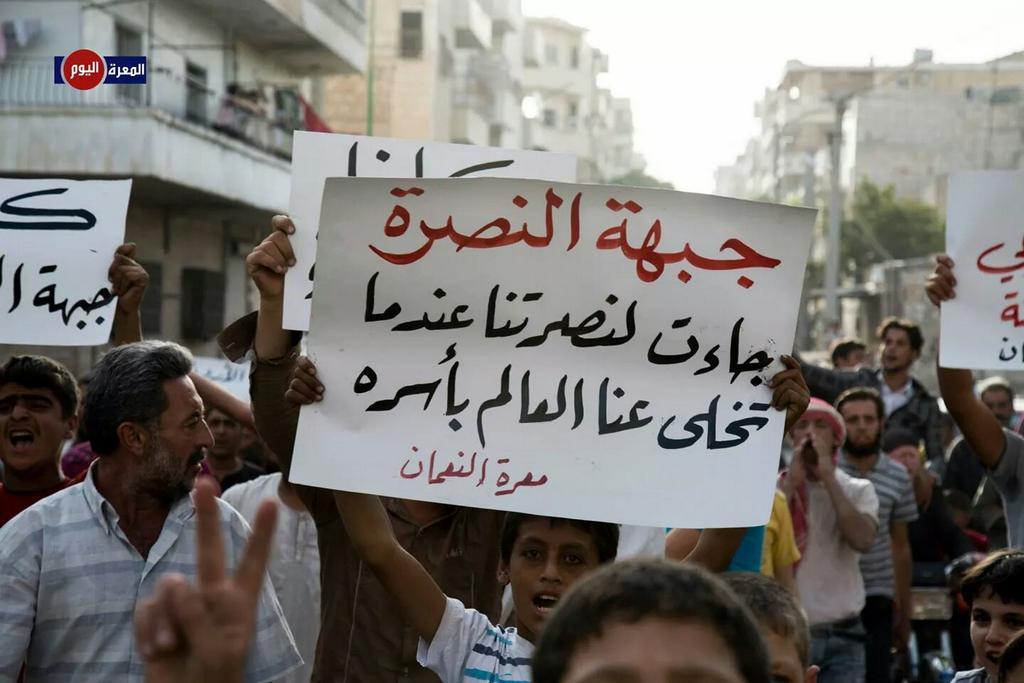
Revulsion has erupted right across Syria. In mass demonstrations throughout Aleppo (https://pbs.twimg.com/media/ByTcYjYCcAEeOnA.jpg:large), Idlib (https://www.youtube.com/watch?v=Ww2LT-Wcpcc&feature=youtu.be) and Homs, demonstrators chant “We are all Nusra” or “Jabhat al-Nusra came to support us when the world abandoned us” (https://pbs.twimg.com/media/ByTtNQkIYAETWtU.jpg:large).

Now, as stated above, I certainly don’t love Nusra. But these chants mean the people identify with those getting bombed by Assad’s newly acquired airforce. For those who want to emphasise the reactionary nature of the Nusra leadership (which I would distinguish from its ranks), this development underlines the fact that creating counterrevolution works in differing ways: one way is to directly militarily attack a militia, like Nusra, that *at this point* is on the side of the revolutionary forces; another is to put extra pressure on the more pro-Western elements within the FSA to take the US side against Nusra, thus weakening and splitting their forces on the ground; and a third way is precisely allowing Nusra to denounce anyone who doesn’t support it now as a US agent, thus exactly strengthening Nusra, the most jihadist pole, within the anti-Assad, anti-ISIS front.

Though this is by no means straightforward. The “we are all Nusra” chants may simply be identifying with those under US attack rather than expressing political support for Nusra; thus these demonstrations could equally be seen as a new, clearer anti-imperialist grounding of the revolution. It may take some time to work through what this dilemma means.

But worse is the fact that by allowing its attack on ISIS – who everyone hates – to become an attack on Nusra, and a collaboration with the regime, which all rebel forces and most of the impoverished, dispossessed Sunni masses see as their main enemy, the attacks have also led to a surge in support for ISIS in some quarters. To see mass demonstrations in support not only of Nusra, but also of ISIS, in areas as far west as Homs (https://www.youtube.com/watch?v=AlsxciMWxQQ&feature=youtu.be), and Idlib, underlines the multiple ways in which imperialist attack promotes counterrevolution: a mass demonstration supporting ISIS even occurred in Kafranbel in Idlib (https://www.youtube.com/watch?v=o2WegUb7Omc&feature=youtu.be, https://www.youtube.com/embed/V3-BRbeGmTI?feature=player_detailpage), the very heart and soul of the revolution!

The reactions of the FSA and other rebels

In any case, it is the reactions from the FSA and other rebels which are most remarkable.

One of the first statements condemning the US attacks came from Harakat Hazm, a 7000-strong secular FSA militia operating mostly in Hama. Hazm stated (23/9/2014):

“The Hazem Movement rejects the external intervention of the US Coalition, which launched its first airstrikes on Tuesday in the governorates of Deir el Zour, Raqqa, al Hasaka, Aleppo, Idlib and Homs, with 11 civilians killed in rural Idlib province and five others in rural Homs province, as well as fighters from Jabhat al Nusra and the ISIS.

“These air attacks amount to *an attack on national sovereignty* and work to *undermine the Syrian revolution* and demonstrate the international community’s continuing ignorance of the demands of the Syrian revolution and failure to provide unconditional military aid to the FSA is simply an indication of massive failure and a harbinger of further catastrophes that will harm the entire region.

“We of the Hazem Movement hereby reaffirm our full commitment to the principles of the revolution, and emphasize that *our actions are guided solely by revolutionary principles and national interest, not by the demands of the international coalition.*

“We also affirm that the international community’s unilateral decisions taken in an effort to win public support globally will not succeed in combating extremism, but will actively promote its growth. The only way to achieve the peace in the nation and region will come through fulfilling the aspirations of the people of Syria at the hands of Syrians.

“The only beneficiaries from the US coalition’s military intervention will be the Assad regime, in the light of an absence of any real strategy to oust it, and the regime will spare no efforts in its attacks on civilians in its attempt to rehabilitate itself internationally.

“We pray for mercy for our martyrs, healing for our wounded, and freedom for the detainees imprisoned in Syria, and life and freedom for our beloved people” (https://pbs.twimg.com/media/ByPSsxMIYAQy2Wt.jpg).

One of the extraordinary things about this statement is that, after all the years of “leftists” falsely asserting that the US was arming the FSA, when in fact it never sent them a bullet, is that Hazm is precisely one of the very few FSA units that *did* receive a handful of US anti-tank weapons beginning in April 2014. It was never very many, but Hazm could possibly have expected more if it palyed ball. This magnificent declaration indicates that while the US might be able to buy some dozens of puppets here and there, it is very difficult to buy an army of 7000 fighters to be your puppets.

Meanwhile, Jaish al-Mujadeen, a markedly soft-Islamist coalition that was set up last December and which then played a major role, alongside the FSA and important components of the Islamic Front (of which it is not a member), in driving ISIS out of Aleppo in January, also condemned the US attacks and said their aim was to put down the rebellion (https://www.youtube.com/watch?v=9ClRaIMESbk&feature=youtu.be).

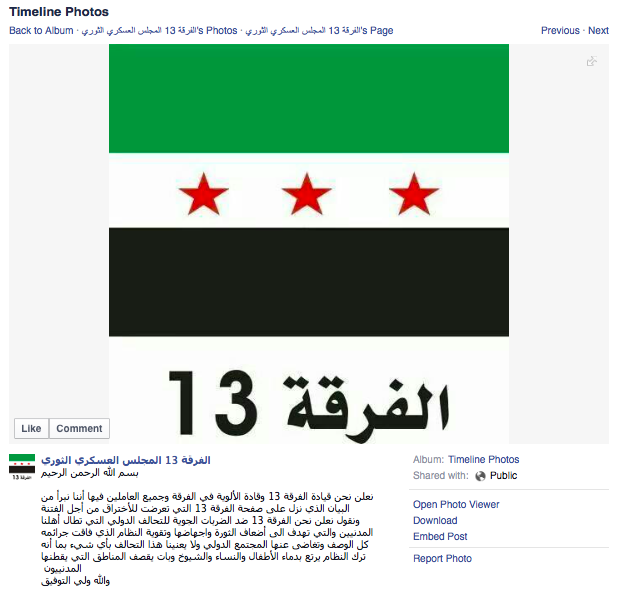
Abu Ratib, head of the Sufi-led Al-Haq Brigade, part of the Islamic Front, termed the intervention “a total war against Muslims” (http://syriadirect.org/rss/1580-syria-direct-news-update-9-24-14); Suqour al-Sham, the main Islamic Front unit in Idlib, condemned the airstrikes and said they “will breed more extremism and terrorism” (https://twitter.com/zaidbenjamin/status/514831422675513344/photo/1); the Army of islam, the IF unit in Damascus, which drove ISIS out of the Damascus region several months ago, also condemned the strikes; the secularist FSA Forqat 13 issued a statement condemning US-led airstrikes as “aimed at weakening the revolution” in Syria (https://pbs.twimg.com/media/ByTaFn8IEAAANl3.png:large).

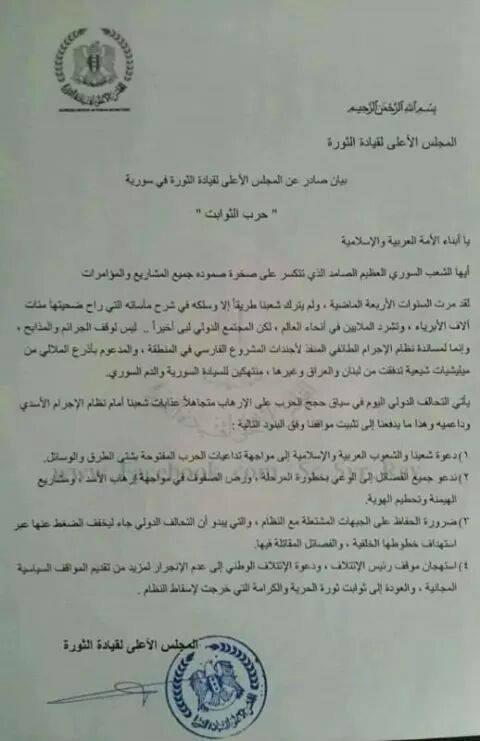
Then in a joint statement, the Syrian Revolutionaries Front (SRF – the major secular FSA coalition in the north-west, which single-handedly drove ISIS out of Idlib in January), Jaish al-Mujahidin, Al Zinki, Hazm and others condemned the US airstrikes, declaring “you help Bashar” (https://pbs.twimg.com/media/ByUiHcTIMAAmTDF.jpg).

So while we haven’t yet accessed statements from every group, it is clear all the major groups have declared solidly against the US air war.

In similar vein, Syria’s Muslim Brotherhood spokesman Zuhair Salem declared “A new killer joins the band of the Syrian people killers. The war on Da’ash is an American pretext to continue the war on the Syrian revolution. We won’t wait for long to watch how the American war is eating revolutionary forces. We condemn the American crime of the aggression on Syrian territories” (https://twitter.com/zaidbenjamin). Earlier, a statement by the Syrian Islamic Council, close to the Muslim Brotherhood, rejected intervention in Syria by Western countries and their allies in the region. It condemned “the silence of the international community, Governments and organizations, at the daily massacres against the Syrians, with all kinds of internationally proscribed weapons, by the Assad regime,” describing the US move against ISIS in this context as a double standard (https://twitter.com/troublejee/status/510618525736894464). The MB itself rejected any collaboration with the US attack on ISIS unless the first bomb lands “on Assad’s head.”

Finally, the founder and former leader of the FSA, Colonel Riad al-Asaad, who still has significant influence, declared “The Coalition kills the remaining children that the Syrian regime couldn’t kill” (https://pbs.twimg.com/media/ByO1CbHIIAABquB.jpg:large). Earlier, he had already declared that the FSA will not collaborate with the US in the war against ISIS, claiming the US is working to destroy the FSA, noting that since 2011 the Americans promised aid that never materialised, and meanwhile they worked to split the rebels and to help al-Assad.

Asaad claimed that the real target of the strikes would not be ISIS, but rather “the Syrian revolution will be eliminated under this pretext.” He also called on moderate rebels to make efforts for more unity to revive the Syrian revolution after having been hijacked by radical Islamist groups and West-backed agendas. “We are looking for rebel commanders who share us the national concern” (https://www.zamanalwsl.net/en/news/6704.html).

The Local Coordination Committees of Syria (LCCs), a grassroots network that coordinates civil disobedience and other non-violent campaigns, was a little more ambivalent, but have been documenting the civilian and other deaths from US air strikes. The LCC declared that “an end to the Islamic State needs to happen concurrently with an end to the equal terrorist threat represented by Bashar al-Assad’s regime,” and note that they “are herewith confirming their previous stances considering Assad’s regime the foremost enemy of the Syrian people and assuring that extremism and terrorism were the products of the regime’s crimes.”

LCC also emphasised the following:

1- Assad’s regime is holding the sole responsibility of this violation of the Syrian State’s sovereignty since it was the first to do that bringing the sectarian death militias from Iran, Iraq and Lebanon.
2- Assad’s regime and ISIS are alike when it comes to terrorism and crimes violating the Syrian people dignity and decent lives.
3- The necessity of coordinating with the political and military forces of the Syrian revolution so they can regain control of the positions under ISIS conquer as well as helping these forces with their continuous battles against Assad’s regime till it is toppled.
4- Taking intense precautions that these air strikes do not give any form of political or military benefits to Assad’s regime.
5- Taking extra care of the civilians’ lives and their properties in the targeted areas.
6- The United Nations must take its responsibility towards the civilians by immediately responding to their humanitarian basic needs.
7- The Syrians salvation from ISIS should be synchronized with their liberty of the tyrant Assad’s regime and its terrorism against them.
Local Coordination Committees (23/ 9/ 2014, from https://www.facebook.com/RadioFreeSyria/photos/a.382885705129976.91927.363889943696219/706708506081026/?type=1&fref=nf).

The only more or less clear support for the intervention came from the pro-West and Gulf leadership of the exile-based Syrian Opposition Coalition (SOC) and its associated Supreme Military Command, supposedly of the FSA but in reality largely representing itself. The SMC declared support to “all earnest national forces and free international forces” who are trying to “fight terrorism,” but stressed that this should start with “the Assad gangs and Shabiha” and “ending with their new creation, ie, ISIS” (https://pbs.twimg.com/media/ByPX7XDIAAA7RNW.png).

The only other apparent support to the US coalition’s actions came from, somewhat understandably, the Kurdish PYD. PYD leader salih Moslem declared that the US attacks were a positive step for the fight against ISIS (http://civiroglu.net/2014/09/23/pyd_airstrikes/). Considering ISIS’ current genocidal attacks on the Syrian Kurds around Kobane which have driven some 150,000 Kurds acrosss the Turkish border (Turkey already holds 1.5 million Syrian refugees), the PYD’s position is understandable. It is unclear at this point, however, how much the US has targeted the ISIS units doing the besieging of Kobane – at the outset, at least, the US seems to have been too busy bombing ISIS in Raqqa (from where most ISIS militants had already been evacuated) and non-ISIS targets over in western Syria, to simply bomb the ISIS advancing front line around Kobane (just as the Assad regime, while good at bombing bakeries in Raqqa and killing dozens of civilians, also couldn’t seem to target the ISIS siege).

Where does this leave the US Sawha plans?

This rather solid opposition to the US air campaign from the bulk of the FSA and their allies on the ground raises serious issues regarding the US intention to arm and train a small puppet segment of the FSA as a Sawha to fight ISIS, and premably Nusra, but not the regime. It seems likely there will be relatively few takers. Of course many may officially agree in order to get the arms, and then hope to do as they please and direct their energies at the regime; but the current united stand against the US shows not only that the FSA are not puppets, but moreover has rubbbed this fact in the US’ face. Hazm seems to have performed this trick earlier this year to get some US anti-tank weapons; it now releases the most solidly anti-imperialist declaration.

It is worthwhile looking at the full text of the resolution in Congress to provide “training, equipment, supplies, and sustainment” some 5000 “vetted” rebels (https://www.govtrack.us/congress/bills/113/hjres124/text). Anyone in doubt that the aim is for them to fight ISIS but not the regime only needs to read the opening, which states the purpose is firstly, for “defending the Syrian people from attacks by the Islamic State of Iraq and the Levant (ISIL), and securing territory controlled by the Syrian opposition,” secondly, “protecting the United States, its friends and allies, and the Syrian people from the threats posed by terrorists in Syria, and thirdly, the bit that refers to the regime, “promoting the conditions for a negotiated settlement to end the conflict in Syria.” So, smash ISIS (and Nusra), and negotiate with the regime.

More interesting is the section on what “vetted” means:

“The term appropriately vetted means, with respect to elements of the Syrian opposition and other Syrian groups and individuals, at a minimum, assessments of such elements, groups, and individuals for associations with terrorist groups, Shia militias aligned with or supporting the Government of Syria, and groups associated with the Government of Iran. Such groups include, but are not limited to, the Islamic State of Iraq and the Levant (ISIL), Jabhat al Nusrah, Ahrar al Sham, other al-Qaeda related groups, and Hezbollah.”

Now of course, the references to Shia groups associated with Iran, Hezbollah etc are just fluff, since this is a resolution on “vetting” members of the Syrian opposition. Hezbollah is works for the regime, so is irrelevant to this resolution. But if “vetting” is to check if any “elements, groups, individuals” have any “associations” not only with ISIS, but also with Jabhat al-Nusra, and even Ahrar al-Sham, then the resolution effectively wipes out 90 percent, if not more of the FSA and of the Syrian opposition as a whole. Since they all actively cooperate with Jabhat al-Nusra on the ground against both the regime and ISIS, and even more so with Ahrar al-Sham, whose leadership was just wiped out by a regime- or ISIS-bombing.

By ruling out any “group” that has had any “association” with JaN and even with AaS, the US ensures its Sawha operation will remain with a very small group (perhaps even the proposed 5000, out of some 60,000 FSA fighters alone, cannot be reached) – always the intention anyway – so people should not confuse this with “training the FSA” and they should not confuse the US term “vetted” or the US use of the term “moderate” with “secular’ and “non-Islamist” as a whole – these few thousand will be secular/non-Islamist, but they will also be the most subservient – basically those who agree to fight only ISIS and leave the war on the regime till the future: the exact opposite of the priorities of the 95% that won’t be trained for Sawha.

Former US ambassador Robert Ford explained this more clearly than usual recently: “One prominent American observer says it is folly to think that we can aid the moderate armed fighters to topple al-Assad. But toppling wasn’t our goal before and shouldn’t be now.” Certainly, extra arms can help the opposition “put pressure” on Assad to form a “new” expanded government, like just happened in Iraq, whose first aim would be to expel ISIS from Syria, so therefore “as we boost aid to the moderate armed rebels, we must condition that help on their reaching out to disaffected regime supporters and developing with them a common political stance for a new, negotiated national unity government, **with or without al-Assad**” (my emphasis) (http://us.cnn.com/2014/08/26/opinion/ford-isis-syria/index.html?sr=sharebar_twitter).

In other words, while Obama long ago called on Assad to “step down” (this is the sole basis on which leftists imagine Obama called for “regime change”) in order to preserve his regime and state in a “Yemeni solution,” Ford is here making clear that if it could be negotiated, a “national unity government” would be fine even *with* Assad.

But who can replace ISIS? Assad can’t.

However, the US knows that it can not simply be Assad’s airforce. The US aim now seems to be to further eviscerate the revolution, in a number of different ways as explained. However, the question of who will replace ISIS on the ground if the US really wants to wipe it out – let alone if it also wants to wipe out Nusra – remains. Quite simply, in neither Syria nor in Iraq can ISIS be replaced by non-Sunni forces, still less by muderously anti-Sunni regimes. Some kind of Sunni forces will be necessary, just as the US needed to arm the Iraqi Sunni tribes in their “Sawha” against al-Qaida in Iraq in 2007-8.

The Kurds have been valiant fighters against ISIS, but in defending their own Kurdish turf; only Sunni Arabs can replace ISIS on the ground among their Sunni base that they now control.

The act of replacing the descredited Shiite chauvinist Maliki in Iraq before beginning to bomb ISIS was necessary façade; yet Maliki has been replaced by another member of his own party, only slighly less sectarian, with the hope that this may win over some Sunnis. So far, there has been little success; and fighting ISIS with Shiite sectarian militias simply consolidates Sunnis behind ISIS, including those who previously fought it.

What hope is there then in Syria, where the Assad regime has been far more murderous than Maliki, has wiped entire Sunni towns and cities off the map and sent millions into exile? While the US now acts as Assad’s airforce to help smash the revolution, a stabilisation of the situation will eventually require the long-term US aim of doing some deal that encourages Assad and a narrow circle around him to “step down” in order to save the Baathist regime and its military-security apparatus, and to “widen” it by allowing in some select conservative opponents into the regime. The so-called ‘Yemeni solution.’ The difficulty being that the Assad ruling family and mega-capitalist clique is so much more completely associated with the state than a mere Saleh or Mubarak ever was.

Is an attempt to crush the revolution for the regime a prelude to a plan with regime insiders and international factors to gently push Assad aside when it’s over to gain a modicum of Sunni support to replace ISIS on the ground? Like everything else, this remains to be seen, but is one of the possibilities – as is the possibility that the crushing of the revolution simply means the current regime becomes the “factor of stability” in the region.

Shameless Cooke knifes Syrian people’s resistance to Assad-ISIS fascism

On August 10, the writer Shamus Cooke penned an article, “How ISIS finally became Obama’s enemy” (http://www.commondreams.org/views/2014/08/10/how-isis-finally-became-obamas-enemy).

Cooke writes: “Suddenly the Islamic State of Iraq and Syria (ISIS) has become a threat worthy of American missiles. For almost two years President Obama completely ignored the biggest and most brutal terror group in the Middle East, allowing it to balloon into a regional power. No matter how many heads it severed or how much territory it conquered, ISIS just couldn’t draw Obama’s attention.” Claiming that as the ISIS threat grew, “Obama ignored it, and so did the U.S. media,” concentrating instead on the Ukraine and Gaza.

At times it is difficult to work out what all this “ignoring” and “allowing” means. It could be interpreted from a number of perspectives. It could mean, perhaps, that unlike George Bush, who had the army in Iraq fighting ISIS’s predecessor, Al-Qaida in Iraq, Obama has withdrawn, chickened out, thus “allowing” ISIS to do all this. About time he started bombing Iraq again.

Or it could mean that till now, the US did not see ISIS as an enemy, it perhaps even saw it as an ally of sorts, but circumstances have changed, and when US interests are threatened, we often see a rapid change of heart among US leaders. That may or may not be, as we will discuss below, but that ought not be confused with either “ignoring” or “allowing.”

I don’t know what Cooke has been reading, but I have seen so many articles about the threat of jihadists, mainly Jabhat al-Nusra in Syria and ISIS in both Syria and Iraq, in the US and western media that it has been clear for quite some time that they are seen as the main enemy of the US in the region. I don’t have time to do a list (which in any case would be prohibitively long), though I have plenty of references in some of my articles, such as here https://mkaradjis.wordpress.com/2014/06/25/iraq-and-syria-the-struggle-against-the-multi-sided-counterrevolution/ and here https://mkaradjis.wordpress.com/2013/12/04/the-us-iran-russia-syria-and-the-geopolitical-shift-anything-for-the-regions-oppressed/ for example. And that’s not just the media, because these media reports are full of statements by US politicians.

So if it is entirely untrue that either Obama or the US media “completely ignored” ISIS, does Cooke simply mean that Obama hadn’t bombed ISIS till now? OK, this is true. But we assume Cooke, as a good anti-imperialist, opposes US bombing ISIS. So he is not necessarily criticising the US for not bombing ISIS, he is just saying that the lack of bombing, till now, is evidence that the US did not see ISIS as a problem, despite what US leaders and media were screaming about – because if they really did see ISIS as a problem, they would have bombed it long ago. I hope I have that right.

In that case, we can apply the same to the regime of Assad in Syria, right? Despite occasional rhetoric, the US and western powers have “completely ignored” the genocide that the Assad regime has been imposing on Syria the last 3 years, has “allowed” it all to happen, as a regime levelled every city in the country, turned the country into a giant moonscape, killed upwards of 100,000 people, turned 9 million people into refugees, gassed hundreds of sleeping children with chemical weapons, barrel-bombed Aleppo into oblivion, turned Homs into Hiroshima, tortured tens of thousands to death. None of this was worth a single air strike, evidence that Obama and his ruling class have completely ignored this situation and allowed it to happen.

Actually, that statement would be more correct than what Cooke says about ISIS. But even if one disagrees, since for Cooke the measure is whether or not you get bombed, then presumably he would now agree that, since the US is bombing ISIS but not Assad, the US sees ISIS as a far more serious threat or enemy than its sees Assad.

OK, so now we’re getting somewhere. Or are we?

As we read on, we see that we aren’t. Cooke then writes:

“For well over two years ISIS and other al-Qaeda-style groups have been the main driving force in the Syrian war that has claimed over 170,000 lives, with millions made refugees.”

Shameless Cooke is scabbing on the Syrian people and their 3-year uprising with this statement of breathtaking ignorance. Well, it would be ignorance if I believed that Cooke didn’t know better. It is the fact that he almost certainly does know better that is the problem with such extraordinarily dishonest statements.

Anyone who actually knows anything about Syria knows that the Free Syrian Army, a variety of moderate Islamist militias, the Islamic Front and even Jabhat al-Nusra, the Syrian al-Qaida, have been at war with ISIS for at least a year. No supporters of the Syrian revolution view ISIS as having anything to do with their uprising against Assad’s tyranny; all of them regard ISIS as the other enemy alongside the regime.

Actually, most believe either that the regime and ISIS actively collaborate, or even that they are secretly allied; whether or not this is true, it is certainly true that the regime and ISIS have barely fired a shot at each other for the past year, and the only force in the region, apart from the Syrian Kurds, who have actually been fighting ISIS have been the FSA and its allies.

These are the same forces that have led and continue to lead the mass uprising against Assad’s fascist tyranny. They have been the “driving force” in the revolt against the regime, not ISIS. In the entire southern front, there is virtually no ISIS. In the Homs, Hama, Idlib northwest front there is virtually no ISIS. In Aleppo city there is no ISIS. ISIS has focused on conquering already liberated zones from the Syrian resistance, and has had most success in the northeast, along the Iraqi border, and some of the northern countryside of Aleppo province.

By late 2013, ISIS had conquered more regions of Aleppo and Idlib, but in January this year, as everyone who actually reads knows very well, the FSA (which had already declared war on ISIS last August) was joined by a moderate Islamist coalition, the Mujahideen Army, and by the Islamic Front (which groups together some moderate to harder Islamist groups), and, a little later, Jabhat al-Nusra, in a nation-wide coordinated attack on ISIS, which drove it completely out of Idlib and Hama and large sections of Aleppo province, Deir-Azour, Raqqa and elsewhere. ISIS made a comeback in Raqqa despite furious resistance, and since then has been laying siege to Deir-Azour.

In the weeks leading up to ISIS’ seizure of Mosul, the Syrian rebel alliance waged a furious resistance attempting to keep hold of Deir-Azour, the only non-ISIS or non-Kurdish controlled part of the northeast, against a sustained ISIS siege. While the rebels fought ISIS, Assad helped ISIS by terror bombing the city (http://syriadirect.org/main/36-interviews/1448-isis-regime-close-in-on-deir-e-zor-rebels), in effect, a joint siege; and after ISIS murdered 3 FSA commanders in Deir-Azour in June, regime warplanes bombed the FSA mourning tent, killing 16 people (http://english.alarabiya.net/en/News/2014/06/21/ISIS-executes-three-Syrian-rebel-officers.html).
The rebels put out a call to the world for arms, or otherwise they would have to abandon the city. As with the last 3 years, they were ignored and got nothing from the US or the West; ISIS took the city. Since then, there has already been another uprising in Deir-Azour against ISIS, which the latter suppressed.

If Cooke was pointing out that this blatant betrayal of the Syrian rebels as they resisted ISIS was evidence of US acquiescence with ISIS, he would be right in this sense. As against the forces of the Syrian revolution, yes, the US acquiesces with ISIS just as the Assad regime does. That is because in relation to revolution, the US, the Assad regime and ISIS are all on the side of counterrevolution, regardless of whether or not they love each other otherwise.

But Cooke is not saying that at all. On the contrary, by identifying ISIS with the Syrian uprising against Assad, by calling it the “driving force” in the Syrian war against the regime, Cooke is not just echoing Assadist propaganda, he is also slandering the entire cast of Syrian rebel organisations, all of whom have shed rivers of blood to drive ISIS out of as much of Syria as possible, to ensure the liberation from one form of tyranny does not bequeath another, all the time being bombed from the skies by the fascist regime while doing so.

It is interesting that in falsely claiming ISIS was the “driving force” of the revolution, he notes that this war “has claimed over 170,000 lives, with millions made refugees.” While he doesn’t say who is mostly responsible for these 170,000 lives and 9 million refugees, his implication is that it is those who have “spearheaded” the revolt, whether ISIS or all the actual anti-Assad rebels who he pretends are the same thing. So apparently it is not a regime that has bombed the whole country to bits with a vast array of conventional weapons of mass destruction that killed all those people, it is the people with few arms trying to overthrow the regime that are responsible.

Cooke of course rightly supports the Palestinian people in their struggle against the Zionist regime’s savage occupation and constant mass murder, yet if he applied the same standards he should be blaming the lightly-armed Palestinian resistance for destroying Gaza rather than the regime that actually does the destroying.

It is strange that Cooke quotes a number of people, including Patrick Cockburn, claiming that the US and West showed little alarm even after ISIS took Mosul, the New York Times claiming that “the president expressed no enthusiasm for American military action,” with Cooke adding “or any action for that matter.”

Right, so just because every western politician and media source jumped on the conquest of Mosul and made it a top international issue, and the US immediately moved the aircraft carrier USS George H.W. Bush, its air wing, the cruiser USS Philippine Sea and destroyer USS Truxton towards the Gulf, and on June 20 Obama announced that 300 “special forces members” would be sent to Iraq to “train and advise the Iraqi security forces” (on top of 160 troops which were already in Iraq, including 50 marines and more than 100 soldiers) and threatened “targeted” air strikes against the Sunni militia (http://www.theaustralian.com.au/news/world/obama-flags-targeted-action-in-iraq/story-fnb64oi6-1226960737639?from=public_rss), all this is doing “nothing at all” because Obama didn’t immediately launch massive air strikes on ISIS.

Anyone would think that after invading Iraq, destroying the country, being humiliated by the level of failure, finally withdrawing with the overwhelming majority of Americans and people around the world opposed to the US intervention and glad they were finally out, that it is hardly surprising that Obama didn’t order full-scale massive US intervention the day after Mosul was taken. That moving warships and special forces into Iraq might already be a big deal in the circumstances. That launching air strikes inside Iraq within 2 months of the latest crisis breaking out is in fact relatively rapid.

Not for Cooke – massive air strikes the next day, anything less proves Obama is doing nothing and even “allowing” ISIS to do all this!

OK, so let’s do a comparison. ISIS takes Mosul in June 2014, and Obama launches air strikes in August. The Assad regime begins slaughtering peaceful protestors en-masse in March 2011, for months and months until they finally take up arms, then by late 2011-early 2012 Assad is already destroying Homs with massive quantities of sophisticated weaponry and by mid-2012 the regime is basically using its air force, long-range missiles, barrel-bombs etc on a daily basis, and after 3.5 years Obama hasn’t launched a sausage at the regime.

I’ll let Cooke draw his conclusions from that.

Oh, but no, he doesn’t; it just gets worse:

“For example, after Obama publicly targeted the Syrian government for destruction he had no qualms about using ISIS and the other al-Qaeda-linked groups as proxies in the fight.”

Really? Firstly, the claim that Obama “targeted the Syrian regime for destruction” is just so much waffle. The Syrian people rose against the regime; Assad slaughtered them; after months and months of this Obama started trying to get Assad to exit via a “Yemeni” solution that saved the regime via a cosmetic change at the very top. If the US had targeted the regime for destruction, it would have actually done something about it, not simply mouthed platitudes about how terrible the regime was, which anyone with a brain could see.

Oh, but Cooke says the US did that – it used ISIS and other al-Qaida groups as proxies to fight Assad. Of course, the US did nothing of the sort. Cooke offers not a shred of evidence for this outlandish claim, and nor would he find any if he tried. It seems that when you write Assadista crap, you don’t need to, but Cooke is hardly alone in this.

The US never sent any arms to the secular FSA, or the moderate Islamists, or Islamic Front, or Jabhat al-Nusra, or ISIS. The only way we can say the US encouraged ISIS was precisely by not arming the FSA, because ISIS could get plenty of money and arms across the Iraq border anyway, so in comparison with the FSA, which mainly relied on weapons captured or made in back-yards, ISIS was much better armed.

Cooke claims that:

“These terror groups were encouraged to grow exponentially in their fight against al-Assad, with Obama knowing full well that Saudi Arabia and other U.S. allied Gulf States were sending mountains of money, guns, and fighters to the jihadists.”

Lies. But why do I have to prove what Cooke doesn’t even attempt to show? He will find no evidence of such nonsense. Saudi Arabia and the al-Qaida franchises regard each other to be arch-enemies, as anyone with a clue about the Middle East knows. That is aside from the fact that even if the Saudis and Gulf had been arming them, that would not prove much about the US; anyone looking would see the very constant US pressure on the Gulf to not arm any Islamists in Syria, no matter how moderate, in fact even to not arm the FSA. Here is some information: https://mkaradjis.wordpress.com/2014/06/03/the-gulf-and-islamism-in-syria-myths-and-misconceptions/

Cooke goes on:

“There was simply was no one else effectively fighting al-Assad, a dynamic that has artificially lengthened a war that would have ended years ago, while creating the environment that ISIS thrived in.”

Lies. It was every other group, rather than ISIS, that was fighting Assad. Then they had to fight ISIS too. If western or Gulf arming of the rebels “artificially lengthened a war that would have ended years ago” then indeed it would have ended years ago, given the large amount of nothing very much the rebels have received, especially in relation to the gigantic arsenal of heavy weaponry possessed by the regime. Actually ISIS and Jabhat al-Nusra became “more effective” precisely due to the lack of arms in the hands of the FSA. Funny how “leftists” think uprisings against dictatorships should properly be “ended” unless someone outside is allegedly arming them; apparently the peace of the grave is the preferred situation for the likes of Cooke.

But it gets worse:

“Much of the money and guns that Obama shipped to the “moderate” Islamists rebels of course found its way into the hands of the jihadists, since thousands of moderates have since joined ISIS.”

First, which “guns” did Obama ship to “moderate Islamist rebels”? I know of none. In fact I know of virtually none even to moderate secular rebels, let alone “moderate Islamists” that Cooke assumes to be everyone who is not al-Qaida. There have been a few US weapons this year since April, in the hands of one single, smallish, very secular rebel group, Hazm Hazara, a new group. Certainly none of its small handful of US arms have gone to the jihadists, despite the confident “of course” by Cooke. You see Cooke knows – you can’t trust these Arabs – give a gun to an Arab moderate, he’ll give it to a jihadist. Of course. Evidence is superfluous. Hazm’s US arms are so few they are not enough for Hazm; and apart from the fact that Hazm is part of the joint rebel war on ISIS, it is also the group least likely to collaborate operationally even with Jabhat al-Nusra – indeed, precisely the reason the US decided to slip it a few arms, in its long-term search for some section of the FSA to become a Sawha movement to fight the jihadists rather than Assad. A quest which to date has been unsuccessful.

Let’s just compare Cooke’s evidence-free assertions about US arms to Syrian rebels and US-backed Saudi arms to ISIS to what he says about US arms to the Maliki regime in Iraq:

“When ISIS invaded Iraq from Syria, Obama barely batted an eyelash, making excuse after excuse about why the U.S. couldn’t send the Iraqi government military equipment to fight ISIS.”

Now, leaving aside the actual intervention with warships and special forces noted above, isn’t it strange that Cooke has managed to not notice that “since January, the Pentagon has been expediting sales of Hellfire air-to-ground missiles, anti-tank rounds, small arms and ammunition, under the Foreign Military Sales program. Approximately 800 Hellfire missiles, which can be loaded onto the small Beechcraft and Cessna planes the Iraqi security forces possess, have been delivered since January, with 5,000 of them authorized for sale” (http://www.theguardian.com/world/2014/aug/12/iraq-us-arms-weapons-isis-new-government), not to mention all the tanks, Humvees, helicopters etc previously delivered – everyone and their dog has noted the heavy weapons windfall gained by ISIS when it took Mosul from the Iraqi army – only Cooke doesn’t know that these weapons were from the US. This is all open, above board, no secret – but all this arming of the sectarian regime in Iraq was not enough for Cooke, if the US didn’t provide it with nuclear weapons that proves the US supported ISIS, whereas all the imaginary weaponry that the US was in his opinion supplying Syrian rebels was too much, even if in fact it was only radios, night goggles, water filters and ready-meals.

Cooke finishes: “Gazans are allowed to be slaughtered, Syrian’s massacred, and half of Iraq torn to shreds while Obama has busied himself with making threats to Russia.”

The note about US and western hypocrisy is of course something we all agree on, especially in relation to the US total and absolute support for the savage Zionist entity occupying Palestine. Yet there is something deeply ironic about his statement that Syrians can be “massacred” without the US giving a stuff – because it is absolutely true. The US, like Cooke and many other leftists, are quite happy to watch the regime of Bashar Assad slaughter Syrians for years. The US, and Israel, know very well that the Syrian and Palestinian Intifadas are one, that a victory against a fascist tyranny in an Arab country is a victory for the peoples of the region, which can only boost the struggle of the Palestinians.

But that’s if you understand class, and not some abstract, meaningless, purely rhetorical, without-substance “anti-imperialism” so popular in parts of the left these days – a quality they mistakenly identify with a regime in Damascus that has collaborated with imperialism right through its career

Iraq and Syria: The struggle against the multi-sided counterrevolution

by Michael Karadjis

As a coalition of Sunni-based forces, including the Islamic State of Iraq and Sham (ISIS), took the major northern Iraqi city of Mosul and then most of the Sunni heartland in the north and west of Iraq, regional and western capitals went into crisis mode: the entire post-US occupation stabilisation had collapsed in a heap.

And the coalition leading this revolt consists of none other than the same forces which led the Iraqi resistance to US occupation throughout the middle years of the last decade. Yes, once again the arch-reactionary ISIS itself has revealed its brutality, with reported mass killing of captured soldiers, a crime against humanity; in the same way that monstrous acts, such as bombing work queues and Shiite mosques, were carried out during the anti-US resistance by al-Qaida in Iraq (ie, what became ISIS); horrific repression is partly to blame for breeding horrific reactions. In both cases however, this most violent and irrational element does not define the movement, still less explain its strength.

These events involve both Syria and Iraq, with their long, relatively open, border occupied on both sides by ISIS. The rise of ISIS can be connected to two momentous events: the American Guernica on Iraq 2003-2008, and the vast multi-sided Iraqi resistance to that invasion and occupation; and the vast popular revolution in Syria, and the Assad regime’s Guernica to suppress it over 2011-2014. In both cases, the victims have been overwhelmingly Iraqi and Syrian Sunni Arabs – the vast Sunni majority in Syria, and the significant Sunni minority in Iraq.

It is in the context of this overwhelming disaster faced by the Sunni masses of Syria and Iraq, and mass resistance to it, that ISIS has been able to grow, representing the most extreme and most sectarian reaction to this dual blitzkrieg.

Iraq and Syria: the forces ranged against both regimes and ISIS

It is important to understand, however, that in neither Syria nor Iraq is ISIS the only opposition, among the disenfranchised Sunni masses, and the popular masses more generally, to the sectarian-based capitalist regimes in power. While the media focus has been about “regime(s) versus ISIS,” in reality, in both countries, there are three main forces in contention:

1. The Bashar al-Assad and Nuri al-Maliki regimes. Both are sectarian-based regimes: the Assad regime is a “secular” totalitarian regime heavily based among the elite of the Alawite religious minority; the Maliki regime is a sectarian, semi-theocratic, Shiite regime closely aligned with both the former US occupier, that facilitated its rise to power, and with the Shiite theocracy in neighbouring Iran.

2. The Islamic State of Iraq and Sham (ISIS), the most extreme Sunni sectarian and theocratic movement in the region, which has set up its own semi-state over parts of Syria and Iraq. A descendant of al-Qaida in Iraq, ISIS was disowned by al-Qaida last year for being unnecessarily and embarrassingly barbaric (though in fact the disagreement went back as far as 2005). It represents an “opposing counterrevolution,” formed partially from within the ranks of the uprisings.

3. In between, a vast opposition to the regimes which is also distinct from ISIS, in open war with it in Syria, and on and off at war with it in Iraq:

In Iraq, this consists of a range of “Sunni tribes” and other Sunni militias which have, over the last year or so, alternatively been fighting the regime alongside ISIS, or fighting against ISIS. This includes Sunni militia that were part of the Iraqi resistance to US occupation, whether pro-Saddam Baathist, Islamist or otherwise nationalist; and Sunni groups that were mobilised by the US and Saudi Arabia into the “Sawha” (Awakening) movement that helped defeat al-Qaida in 2007-8, but have since become disenchanted with the Shiite sectarian regime they had been drawn into propping up.

In Syria, this consists of all the armed manifestations of the Syrian revolution, from the secular Free Syrian Army (FSA, based heavily among the Sunni but not entirely, including some Alawite and Christian brigades and officers), moderate Islamist groups like the Mujahideen Army in the north and the al-Ajnad Union in the south, the Islamic Front, a loose coalition ranging from moderate to hard-line Islamists, and Jabhat al-Nusra (JaN), the official wing of al-Qaida in Syria, which however is markedly less hard-line than ISIS since their split in May 2013. While a favourite western media discourse is “rebel in-fighting,” in reality this does not exist at all; rather, all these forces act in unison in their war against both the Assad regime and ISIS; it is the war of all of them against ISIS that wrongly gets labelled this way.

These two struggles are related but different. The Syrian struggle began as a multi—sect democratic uprising which however has tended to become more Sunni in composition largely due to the class realities in Syrian society; the Iraqi struggle is explicitly Sunni against an explicitly Shiite-sectarian regime, and evolved out of a nationalist resistance to US occupation. The more advanced sectors of the Syrian revolution still hope to win non-Sunni support for a rising against then regime, no matter how unlikely that may now be; by contrast, the Iraqi revolt only aims to liberate Sunni regions – the ISIS-led attempt to conquer Shiite-dominated Baghdad or any other Shiite region would by definition by a reactionary and sectarian action.

What accounts for strength of ISIS?

What then accounts for the particular strength of ISIS, given that most accounts do not credit ISIS with superior numbers of troops to other resistance movements (indeed in Syria at least ISIS is vastly outnumbered, perhaps 10 to 1, yet in the second half of 2013 had taken control over much rebel-held territory before being expelled in January 2014)?

One simple explanation is that the extraordinary level of barbarism of the Syrian regime, and of the previous US occupation of Iraq, alongside the growing sectarianism and brutality of the current Iraqi regime, will naturally produce an extremist and sectarian mirror within the opposition. This is certainly valid, yet does not entirely explain why the most brutal and extremist force appears so visibly powerful.

Another important factor is the simple fact that it controls regions of both countries that straddle their long border – when weakened on one side, it can retreat to the other side. When it builds up semi-state infrastructure when strong on one side, this can be used on the other side of the border. This gives ISIS simple practical strength.

Why ISIS just happens to control these regions would seem to be related to them being relatively economically backward, sparsely populated and partly “tribal” regions, in northeast Syria and northwest Iraq, where its unifying presence has brought a degree of security and some social services to otherwise forgotten regions. In contrast, the allied forces of the Syrian revolution, in one form or another, control liberated regions in the more developed and populous south, north-west and scattered parts of the centre, with their base among the peasantry and the urban poor in impoverished regional towns and ringed around major cities.

Importantly, however, these backward regions ISIS controls do have resources, including oil, which has greatly boosted ISIS funds, partly via oil deals with the Assad regime.

Then there is the question of funding. As the descendant of al-Qaida in Iraq, ISIS has been the recipient of significant funding from sections of the Gulf bourgeoisie long sympathetic to al-Qaida. Not the Gulf regimes, as is often brandished about with no evidence (supporters of the Syrian and Iranian regimes tend to use “Saudi Arabia” as a form of demonology and thus falsely attribute Saudi support to whoever they dislike); on the contrary, al-Qaida views the Gulf regimes as arch-apostates and seeks their overthrow. However, the anti-regime Gulf bourgeoisie is very powerful – they oppose these narrow monarchical regimes which “lock out” the majority of the bourgeoisie from political power; the US backing of these regimes, and the regimes’ subservience to US imperialism, has produced a fierce anti-imperialism among this oppositional bourgeoisie, no matter how regressive the form it takes. In this sense, the question of why ISIS is particularly powerful is no more or less complicated than why al-Qaida became powerful enough to attack New York.

Then there’s the role of the Syrian and Iraqi Baath, in quite different ways. The Alawi-led, “secular” Syrian tyranny may appear to be an obvious enemy of ISIS’ theocratic semi-state; however, they have a common interest in crushing the Syrian revolution, which is a threat to both due to its liberatory message; and its forces also happen to control regions geographically in between Assad- and ISIS-controlled regions, so there is a practical aspect to Assad-ISIS collaboration. Speculation about this underhanded collaboration between the two centres of reaction in Syria is therefore widespread, the oil deals being only the most pragmatic part.

At the very least, the Assad regime’s past collaboration of with Iraqi jihadists is well-established. Initially after 9/11, the Assad regime collaborated with the CIA in “renditioning” and torturing “terror” suspects for the US as part of the US ‘war on terror” from 2001 to 2003. However, when the crazed Bush regime refused to reciprocate, by the mid-2000s Assad was encouraging Syrian jihadists to go to Iraq to help (or help undermine) the Iraqi resistance, partly to get them off his back in Syria, while placing obstacles in the path of the more crazed wing of US neocons who fantasised about taking their “success” in Iraq into Syria (http://www.lrb.co.uk/v36/n07/peter-neumann/suspects-into-collaborators). This policy was later reversed again after 2007 and Syria returned to the US “rendition” program between 2008 and 2011 after Obama came to power and US-Syrian relations improved. At this point, prominent Syrian jihadist and former key link to al-Qaida in Iraq, Abu al-Qaqaa, “was shot dead in mysterious circumstances” and “his funeral was attended by members of the Syrian parliament along with thousands of Islamists” (ibid).

However, after the outbreak of revolution in 2011, Assad again changed course, this time not related to Iraq however. The regime released hundreds of jihadists just as it was arresting thousands of democratic oppositionists – a clear ploy to undercut the democratic revolution and “sectarianise” the struggle. The fact that the Assad regime, and ISIS in Syria, hardly fight each other, but both fight the rebel coalition, is well-established: the regime can bomb schools, market-places, hospitals, refugee camps, entire cities to rubble; but ISIS headquarters in Raqqa stood proudly untouched by regime warplanes right up to a few days ago, looking like this: http://imgur.com/r/syriancivilwar/ZfTLX0G. The governor of Iraq’s Ninevah province, Ethyl Najafi, even claimed the Syrian regime had helped ISIS take over Mosul (http://www.middleeasteye.net/news/iraqs-nineveh-governor-syria-helped-isil-seize-mosul/1700451185).

The role of the Iraqi Baath is different; unlike its Syrian counterpart, it is on the same “Sunni” side of the “sectarian” divide. Some of ISIS’s (ie, al-Qaida in Iraq’s) initial core came from the “Islamification” of some of Saddam Hussein’s former military officer corps during the resistance to US occupation; three of six top ISIS leaders were such “converts” (http://english.alarabiya.net/en/News/2014/02/13/Exclusive-Top-ISIS-leaders-revealed.html). This layer of former Baathists brought with them arms, skills, intelligence etc, a formidable backbone to the new jihadist group. Importantly however, this should be distinguished from the Baathist influence among some of the non-ISIS Sunni forces fighting today in Iraq, which have collaborated with ISIS to defeat Maliki but are already coming into conflict with it.

A Sunni uprising against a sectarian regime

It has become increasingly clear that the initial reports of an ISIS takeover of Mosul and the north were far too simplistic, though ISIS may be taking the lead role in places. It is now clear that the other Sunni-based militia throughout the region had had a gutful of Maliki’s sectarian repression and decided to temporarily throw their lot in with ISIS to drive the “Iraqi army,” which they viewed as an occupation army, out of the Sunni majority regions. While the purpose of this article is not to detail this, this reality has been widely exposed; crucial background on Maliki’s sectarian repression and Sunni resistance can be found here for example: http://mideastafrica.foreignpolicy.com/posts/2014/01/15/maliki_s_anbar_blunder. Indeed, regarding Mosul in particular, it is a stunning fact that the Maliki regime placed a known Shiite torturer and war criminal, General Mahdi Al Gharawi, in charge of this largest of Sunni cities; his actions were so brutal that even the US occupation regime and the Iraqi courts themselves had tried to prosecute him last decade
(http://www.thedailybeast.com/articles/2014/06/19/iraq-put-a-death-squad-commander-and-torturer-in-charge-of-mosul-no-wonder-isis-is-winning.html).

Other Sunni-based movements involved in the uprising alongside ISIS include the Sufi-Baathist Army of the Men of the Naqshbandi Order (JRTN), which includes many former officers of Saddam Hussein’s army; a variety of other Islamist or nationalist militias, including the Muslim Scholars Association/1920 Revolution Brigades, the Islamic Army (apparently MB-connected), the Rashidin Army, the Iraqi Hamas, the Mujahidin Shura Council, and the al-Qaeda-originated Ansar al-Islam; various Sunni tribal councils, including those such as the Anbar Tribal Council which had been part of the US-backed “Sawha” movement but have since become disaffected due to Maliki’s sectarian rule; and new groups emerging from the protest movement of the last year or so who have taken up arms to defend their movement against the regime’s repression. Some of these forces have formed various shifting coalitions.

On the one hand, many who initially fled Mosul have returned, and have expressed a preference for even ISIS over the Maliki regime (http://www.nytimes.com/2014/06/13/world/middleeast/iraqis-fled-mosul-for-home-after-militant-group-swarmed-the-city.html?_r=2). Many claimed their initial flight was due to fear of being bombed by the regime, as it had previously copied the US occupiers by again bombing Falluja. In contrast to its barbarity in Syria, where ISIS is in many ways seen as a foreign invasion, some reports suggested that ISIS in Iraq, where it has a real local base, was acting in a more mild way towards its Sunni constituents (http://www.theatlantic.com/international/archive/2014/06/the-isis-guide-to-building-an-islamic-state/372769); in any case, as its current drive against the regime depends on preserving, at least for the moment, its support among Sunni and its alliance with non-ISIS forces, it is likely to temper its repression for the moment. On the other hand, the breathtaking barbarity shown in the apparent mass slaughter of regime soldiers indicates that ISIS is still ISIS, and those forces in a temporary bloc with ISIS will have to confront it quite soon to avoid simply falling into a sectarian quagmire.

This dual process led to understandable speculation about the rapid collapse of Maliki’s “Iraqi Army” in Mosul. The relative openness of the Assad-ISIS collaboration, the concurrent ability of Assad, Maliki and Iran to use the bogey of ISIS to demonise all opposition to the two sectarian regimes, and the continual refrain of US and other western leaders for years that they couldn’t send even a bullet to the Syrian liberation struggle because such arms might get into the hands of al-Qaida, and the growing US chorus for military action against al-Qaida in Syria, led to an understandable conspiracy theory: Maliki had ordered his army to run away and leave Mosul to the tender mercies of ISIS, in order to goad the US into launching air strikes “against ISIS” in Iraq and Syria, ie, against the Sunni-based uprisings as a whole. Scot Lucas more or less implies this here: http://eaworldview.com/2014/06/iraq-special-al-maliki-government-abandon-mosul.

While not every conspiracy theory is always false, it appears most likely that reality was far more simple: the part of Maliki’s armed forces that were sectarian-based knew it would be pointless putting up any fight against the united Sunni insurgency in the overwhelmingly Sunni regions in the north; and to the extent that conscripts were Sunni, they downed arms and joined their brothers and sisters.

This temporary Sunni coalition is unlikely to last; tensions have been there from the start, and as ISIS tries to impose its medievalist theocratic repression on its current supporters, these tensions are bound to spread. Former General Muzhir al Qaisi, from “the General Military Council of the Iraqi Revolutionaries” – apparently one of the coalitions – which entered Mosul alongside ISIS, told the BBC’s Jim Muir that they were bigger than ISIS, and that, moreover, he considered ISIS to be “barbarians” (http://www.bbc.com/news/world-middle-east-27853362). Violent clashes have already broken out in some regions in the north between ISIS and the Baathist Naqshbandis (http://iswiraq.blogspot.com.au/2014/06/iraq-situation-report-june-21st-2014.html), while in other areas, local Sunni forces liberated themselves from Maliki regime occupation without ISIS and have declared they will fight off anyone from outside, including ISIS, trying to take over.

US-Iranian intervention?

Both the US and Iran have threatened intervention to shore up Maliki’s tottering regime and beat back the Sunni uprising, under the guise of defeating ISIS terror. Iran has already sent in units of the Qods Force, a wing of the Revolutionary Guards, under its veteran commander Qassem Suleimani; there are reports of up to 500 of these militia in Iraq, and even possibly of 1500 paramilitary Basij militiamen arriving (http://www.theguardian.com/world/2014/jun/14/iran-iraq-isis-fight-militants-nouri-maliki). Meanwhile, the US has moved the aircraft carrier USS George H.W. Bush, its air wing, the cruiser USS Philippine Sea and destroyer USS Truxton towards the Gulf, while on June 20 Obama announced that 300 “special forces members” would be sent to Iraq to “train and advise the Iraqi security forces” (on top of 160 troops which are already in Iraq, including 50 marines and more than 100 soldiers) and threatened “targeted” air strikes against the Sunni militia (http://www.theaustralian.com.au/news/world/obama-flags-targeted-action-in-iraq/story-fnb64oi6-1226960737639?from=public_rss).
Despite their poor relations with one another, both the US and Iran have expressed the view that they need to cooperate against a common foe here. Last week, Obama said Iran can play a constructive role in Iraq (http://news.yahoo.com/obama-says-iran-play-constructive-role-iraq-181433736.html?utm_source=twitterfeed&utm_medium=twitter), and US and Iranian officials met on the sidelines of nuclear talks to discuss Iraq. Iranian president Hassan Rouhani likewise said that Iran would “not rule out” working with the US on Iraq, while his deputy, Hamid Aboutalebi, said “Iran and the US are the only countries who can manage the Iraq crisis” (http://www.nytimes.com/2014/06/16/world/middleeast/republicans-press-obama-to-move-swiftly-to-halt-extremists-advances-in-iraq.html?hp&_r=0).

Iranian deputy foreign minister Hossein Amir Abdollahian even went so far as to claim the US “lacks serious will for confronting terrorism in Iraq and the region” due to the US “delay” in fighting terrorism and Obama’s remarks which only promised hundreds of advisors rather than immediate air strikes (http://news.yahoo.com/iran-says-obama-remarks-show-us-not-serious-173636523.html?utm_source=twitterfeed&utm_medium=twitter).

In reality, this is not as new as it sounds, certainly not in Iraq and not even in Syria. From late last year, more and more US leaders and former leaders began deluging the media with hints that Assad remaining was preferable to the alternative, and that Iran could play a positive role in Syria – in both cases focusing on the threat posed by the Sunni jihadists (I documented some of this process, and the geopolitical turn in US policy it entailed, here: https://mkaradjis.wordpress.com/2013/12/04/the-us-iran-russia-syria-and-the-geopolitical-shift-anything-for-the-regions-oppressed/).

Not surprisingly, the Syrian regime has also expressed solidarity with Maliki and offered to jointly fight ISIS. Then on June 15, the Syrian regime launched its most major strikes on ISIS in Syria for many months, if not ever, the regime even destroying ISIS headquarters in Hasakah. As if they didn’t know it was there before. Clearly, for Assad, it is time to try to cash in; ISIS has been a useful ally against the Syrian revolution, but as with Maliki and Iran, Assad also sees the value in using the horror at ISIS’s brutality to encourage the US’ geopolitical turn to continue, to hopefully again accepting Assad as a partner in the “war in terror” – as all local counterrevolutionary forces use ISIS as the bogeyman to taint the popular insurgency in both countries.

Assad has also spoken of what he sees as a shift in US policy, claiming “the United States and the West have started to send signs of change. Terrorism is now on their soil,” and therefore “current and former US officials are trying to get in touch with us, but they do not dare to because of the powerful lobbies that are pressuring them” (http://www.i24news.tv/en/news/international/middle-east/140611-assad-says-west-is-changing-position-on-syria-war?utm_campaign=NEWS+ISRAEL&utm_source=twitterfeed&utm_medium=twitter). Assad even praised the US for being “more rational than the French” regarding Syria (http://eaworldview.com/2014/06/syria-interview-assad-praises-rational-us-celebrates-victory), a clear note of thanks for the US towering betrayal of those it claims to support.

A US “war on ISIS”: a war on the Sunni uprising

The complication is that ISIS is itself a counterrevolutionary force; in theory, if the US struck very narrowly at ISIS itself, it could boost the non-ISIS forces among the resistance in both countries. And indeed, given that the Syrian rebel alliance of the FSA and Islamist rebels that has been the only force in the region actually fighting ISIS, it might be expected that the US may decide to finally, after 3.5 years, begin providing some serious weapons to the Syrian rebels to help them defeat ISIS. Yet this appears the furthest thing from the aims of US leaders in both countries.

This is very obvious in the case of Iraq. The US has provided the Maliki regime millions of dollars worth of heavy military equipment, including Humvees (armoured vehicles), tanks, helicopters and so on. Rather than try to build bridges with the Sunni population, the regime has used its weaponry to further alienate them by launching a brutal counterinsurgency, which led directly to their current bloc with ISIS. In this context, what does the prospect of US intervention “against ISIS” in Iraq mean in practice? To examine this, it will be useful to look back at the US invasion and the rise of al-Qaida in the resistance.

Many analysts have claimed the US deliberately stoked sectarianism in Iraq after its 2003 invasion in order to divide and rule. However, while divide and rule is certainly a well-tested imperialist device, this analysis is too simplistic. It depends on the tactical needs of the moment. Sectarian division, after all, was hardly absent in Iraq under Saddam Hussein, which was based narrowly around a small section of the Sunni minority; the tyrannical regime had carried out large scale massacres of Shia, especially after the mass Shia uprising in 1991.
It is true, of course, that this sectarian division was not so strong on the ground, and that indeed, many tribes were mixed Sunni and Shia; there was nothing of the kind of sectarian warfare that characterised the period after the US invasion had destroyed the social fabric of the country.

However, the US relied precisely on the hatred the Shia majority felt for the regime as a factor that would ease its invasion to depose Hussein, and this cannot be ignored when analysing what happened next. Was it necessary for the US to stoke even more sectarianism after its invasion? Soon after the invasion, the mass resistance to US occupation centred among the Sunni population, partly because it had been a Sunni-led regime evicted from power by an imperialist invasion, and if the Hussein regime had had any base left, it would only have been among the Sunni minority. Arguably, therefore, the immediate US interest would have been to win over a section of the Sunni, and therefore to discourage sectarianism among its Shiite partners in the occupation regime.

But things went horribly wrong. First, occupation tends to create new enemies; so if the Shiite ruling bourgeois stooges were working with the occupation, happy to step in as the US evicted Hussein’s regime, the Shiite masses, especially in the slims of Sadr City in Baghdad, felt the brunt of occupiers’ everyday repression. The rise of the anti-imperialist Mahdi Army, led by Al-Sadr, represented this new popular resistance.

Second, the US occupation carried out a radical change of plan. For 12 years, the CIA and other US strategists had stressed the need to maintain the core of the Baathist regime, without Saddam and his immediate circle, as an imperialist imposed regime would still need the actually existing state apparatus of the Iraqi capitalist class to re-impose and re-stabilise capitalist rule. Yet in 2004, the US colonial proconsul ruling Iraq, Paul Bremmer, dissolved the Baathist police and armed forces and carried out a radical “de-Baathification” of the entire state apparatus.

It is hard to determine whether this was caused by a deliberate ploy to stoke further sectarianism; or by the neoconservative regime running the US getting caught up in its own “spread democracy” part of its rhetoric to the detriment of realist-based imperialist interests; or was simply due to inevitable class alignments, which then had unintended consequences.

I would argue that it was not the first of these. It is true that the de-Baathification program drove mostly Sunni out of work and onto the streets, thus intensifying Sunni opposition; and as it was a Shiite-dominated regime that carried it out, this would have boosted anti-Shia sectarianism among the Sunni. In fact, the first post-invasion job of current leader Maliki was assistant to the director of the de-Baathification program!

However, the dissolution of the Iraqi armed forces hit both Sunni and Shia working class Iraqis, thus massively boosting support for the anti-occupation Mahdi Army. As US forces imposed a Guernica-style terror on the Sunni city Falluja, al-Sadr led the Shiite poor of Badr City out on the streets in anti-sectarian solidarity with the Sunni, a stunningly opposite approach to the main pro-Iranian faction then backing the US-imposed regime, the Badr Brigades, and a challenge the occupiers were least expecting.

But whether these moves were only about crazed and unrealistic neoconservatives running amock is unclear, though it may be part of the picture. While the CIA line was theoretically perfect from a class point of view, there was a major practical problem: the simple size of the Shia majority (50-60%) compared to the Sunni minority around which the regime was based (25-30%). Those behind Bremmer’s move may have made a very logical calculation, despite the risks involved in the massive instability it would temporarily lead to: capitalist class rule would never be re-stabilised unless the capitalist class from the majority Shia population get to rule; the regime and state apparatus left over from Hussein’s eviction was far too narrow and narrowly Sunni to ever be useful.

Whatever the cause, facing the threat of a non-sectarian joint Sunni-Shia anti-occupation movement, it now may well have suited US interests to stoke sectarianism, to ensure Sunni and Shia focused on killing each other rather than targeting the occupiers. While the idea that the US would have deliberately encouraged al-Qaida in Iraq for this purpose is most likely a conspiracy theory as baseless as most, it could be said that, just temporarily, al-Qaida’s criminal sectarian attacks on Shiite mosques and holy places played directly into the hands of the US occupation regime and the most sectarian wing of the Shia elite. The US responded in like manner, arming the most bloodthirsty sectarian forces among the Shia to go after the Sunni, massacre them just as al-Qaida was doing to Shia, and ethnically cleanse them from significant regions, including most of Baghdad. While doing this, the US cracked down on the Mahdi Army. However, after some time the sectarian atmosphere also neutralised the Mahdi Army as a threat as it too got drawn into the mutual slaughter.

Significantly, al-Qaida outside of Iraq could see the disaster that al-Qaida in Iraq, led by Abu Musab al-Zarqawi, was causing. Al-Qaida head Ayman al- Zawahiri warned that the focus must be kept on defeating the US, and argued against targeting Shiite holy places and non-combatants, and against the grisly hostage killings (https://www.fas.org/irp/news/2005/10/dni101105.html). Zarqawi rejected this advice, and this difference, going back to 2005, is important in understanding the differences today between ISIS, the extremely sectarian and brutal descendant of al-Qaida in Iraq, and Jabhat al-Nusra in Syria, the official wing of al-Qaida. Some might view it as odd that the actual al-Qaida is significantly more moderate in its behaviour than the dissident ISIS but the logic is simple: Zarqawi then and ISIS now aim to build a “state” of Iraq and the Levant; their main enemy are the opposing sects, mostly Shia, that are necessarily not part of their state-building project. Al-Qaida (including al-Nusra in Syria) is by contrast still more focused on the big picture and so has a dimmer view of counterproductive sectarian bloodletting which plays into the hands of the enemy.

While Assad’s aims in facilitating the entry of Syrian jihadists into Iraq after 2003 can be explained as a mixture of keeping them off his back in Syria, and bogging down the US enough to discourage the nuttier wing of the neo-con fanatics who wanted to take their great “success” of regime change into Syria, it seems logical that the Syrian regime would have had the same use of a rise of sectarianism in Iraq at this juncture. After all, a narrow Alawi regime ruling over a vast disenchanted Sunni majority might have also seen the prospect of a joint non-sectarian Sunni-Shia struggle in Iraq as an existential threat at home.

But after a couple of years of sectarian slaughter had caused enough damage, the imperative to win a section of the Sunni away from al-Qaida in order to re-stabilise an Iraqi capitalist regime returned. In 2007, the US and Saudi Arabia, exploiting the exasperation increasingly felt by the Sunni with al-Qaida’s excessive violence, armed Sunni tribes in Anbar province into the “Sawha” (Awakening) movement, which helped defeat al-Qaida throughout most of the region, and brought a new section of Sunni leadership into supporting the Shiite-led regime. It probably helped that around this time, the Syrian regime also returned to the policy of “renditioning” jihadists for the US “war on terror.”

As has been widely reported, the current Sunni uprising, and the fact that the bulk of the Sunni population is currently in league with al-Qaida’s successor, ISIS, is due to the Maliki regime’s betrayal of the promises made to the Sawha Sunnis, their intensified exclusion from power, and the brutal repression unleashed against those who attempted to protest this situation. As such, one might say that Maliki has also let down the US master in this regard. Certainly, there have been rumblings from US leaders and media about the need for Maliki to be more “inclusive” and so on.

Ultimately, however, imperialism has what exists on the ground. In Iraq, the Shia are the majority. Therefore, it will be the Shia bourgeoisie that will rule. And capitalist politics is sectarian, nationalist, exclusivist, chauvinist – anything other than “non-exclusive” – a proletarian concept – almost by definition. And therefore, whatever complaints the US might make, if the US launches air strikes “against ISIS,” in the *current context* – before the rest of the Sunni coalition turns against ISIS of its own accord – these will be strikes against the Iraqi Sunni uprising as a whole, that will bolster Maliki’s sectarian regime and its entire sectarian dynamic – if only because the US does not have an alternative ruling class regime to work through.

If US were to take “war on ISIS” into Syria …

But is this likely to be different in Syria, where there is no Iraq-style coalition with ISIS, but on the contrary, a magnificent resistance of all anti-Assad resistance forces against ISIS? In other words, with the US threatening possible intervention to stop ISIS, are we likely to see the US finally, after 3.5 years, come through with some serious military aid to the FSA to help it fight ISIS in Syria?

Since the beginning of the Syrian revolution, the US has refused to provide arms to the secular Free Syrian Army (FSA), using the excuse that such arms might find their way to various Islamists or jihadists, especially the al-Qaida-linked forces such as ISIS.

Yet the irony is that while the US has still to provide a bullet to the FSA (other than a few weapons to one single, small, newly formed militia earlier this year), it is precisely the FSA and their Islamist rebel allies that have been the only force in the region actually fighting ISIS. The FSA and ISIS declared war on each other in August last year, and have been constantly at war since; then beginning in January this year, the rebel alliance of FSA/Mujahideen Army/ Islamic Front/Jabhat al-Nusra have been waging a sustained war to drive ISIS out of as much of the liberated territory as they can.

To understand why this is not likely to lead to any change in US policy towards the FSA, we need to look at a bit of background on US policy towards the FSA and the Syrian jihadists.

For the last year and a half, the major US aim of US policy has been to try to bludgeon a small section of “vetted” FSA into turning themselves into a “Sawha” (Awakening) movement to fight al-Qaida in Syria (named after the movement the US and Saudi Arabia armed to defeat al-Qaida in Iraq in 2007-8), mainly Jabhat al-Nusra (JaN, now the official wing of al-Qaida, since a-Qaida disowned ISIS); overwhelmingly, the main condition on which the US has offered to perhaps send a few guns to some select FSA units has always been that whoever receives them must be willing to launch a full frontal war on the jihadist forces.

From the first time FSA fighters were told by US agents that if they wanted arms they would need to turn them against Jabhat al-Nusra, back in late 2012, it was clear the US wanted the FSA to take on al-Nusra now, before defeating Assad – regardless of the blood-drenched division that would cause between two opponents of such a powerful and bloody dictatorship (and of course confusion, blood and division among the mainstream Islamist elements in between). When the FSA members said that unity against Assad’s more powerful forces was paramount at present, the US officer replied “We’d prefer you fight Al Nusra now, and then fight Assad’s army.” (http://www.thenational.ae/news/world/middle-east/americas-hidden-agenda-in-syrias-war).

It is difficult to conceive of this as anything other than a plan for mutual destruction; as usual, it is a question of class: whether the media claims US and Syrian “like” each other or not, there is nothing worse from the imperialist point of view than a revolution led by workers and peasants overthrowing an entrenched capitalist regime. The US would like a face-saving modification and rearrangement of the regime (the ‘Yemeni solution’, similar to the CIA’s original plan for Iraq), but that is an entirely different thing. In fact the aim of that is precisely to calm down the revolutionary fever. Short of that, the US wants it extinguished, and mutual suicide appears a good method.

Likewise, the communique from the G8 meeting last June called for a transitional authority (consisting of elements of regime and opposition) which would “preserve or restore” the Syrian state apparatus, stressing that “this includes the military forces and security services”, and called on both the regime and opposition forces to “destroy and expel from Syria all organisations and individuals affiliated to al Qaida and any other non-state actors linked to terrorism.” And on June 23, French president Francois Hollande demanded Syrian rebels expel “extremist” groups from areas they control as a condition for getting any French arms (http://www.dailystar.com.lb/News/Middle-East/2013/Jun-23/221321-hollande-urges-syria-rebels-to-retake-extremist-held-zones.ashx#axzz2X5dwF4Mo).

The FSA has always rejected this imperialist “advice.” According to FSA Colonel Akaidi, a military defector then heading the Aleppo military council, the US wants to turn the FSA “into the Sahwa,” but “if they [the US] help us so that we kill each other, then we don’t want their help” (http://www.ft.com/cms/s/0/71e492d0-acdd-11e2-9454-00144feabdc0.html#axzz2UPVgOFXt).

However, for its own reasons, the FSA spent much of the first half of 2013 clashing with JaN, as it took up the fight to defend the Syrian masses against JaN’s sporadic attempts to impose a new “Islamist” dictatorship, or to defend itself from JaN attacks. As such, the FSA was simply defending its own agenda, not that of the US. The FSA fought with its own aims, when it chose, the way it chose. And once it had imposed several defeats on JaN; and JaN even went so far as to offer some apologies; and once all the most violently reactionary elements, and nearly all the foreign, non-Syrian, elements of JaN split and formed ISIS mid-2013, there were no further clashes between JaN and the FSA that I am aware of; both focused on fighting the regime, alongside other Islamist fighters in between.
And while still undoubtedly a sectarian organisation that the FSA and other Syrian revolutionaries will have to deal with in the future, JaN markedly moderated its behaviour, feeling the pressure of its own Syrian base; indeed, JaN includes a significant base of former secular FSA fighters who only switched to JaN because it had better weapons.

In contrast, the whole of the second half of 2013 was an open war between the FSA and ISIS, as the FSA, representing the Syrian masses, took up the fight to defend the masses in liberated zones as ISIS tried to replace Assad’s secular-sectarian-fascist state with an Islamo-fascist state. And in January 2014, the Islamic Front and even JaN itself joined the FSA in this full-frontal war on ISIS.

While western imperialist observers, and most leftists, tend to put JaN and ISIS together into the same “al-Qaida” box, it is very important to understand the very crucial distinction that all Syrian revolutionaries make between the two. One may find it distasteful, but in the context of fight to the death against the sensational brutality of both the Assad and ISIS regimes, few Syrian revolutionaries will be in the mood to pay much attention to western sensibilities.

Yet despite this war on ISIS, the US has still refused to arm the FSA. One might assume that the FSA was doing what US imperialism had been telling them to do since late 2012, ie, fight al-Qaida. Even though the FSA is fighting with their own agenda and not that of the US, one might assume that imperialism should have been happy that it just happened to coincide with their interests, regardless of intent.

However, this was not good enough for the US.

First, US imperialism has made it clear all along that fighting ISIS is not enough – the US sees JaN as just as bad,* if not worse, than ISIS* in terms of US interests, precisely because JaN actually seems to be interested, in its own regressive way, in fighting the Assad regime, Israel and US imperialism, whereas ISIS’ rhetoric about all this means little more than capturing already liberated zones and imposing theocratic repression against Syrians – both Assad and the US can live with that as long as it is restricted to the far north and east of Syria (and, until recently, remote northern regions of Iraq). But as JaN is currently on side, the FSA and all the rest of the Syrian rebel alliance are resolutely opposed to this US diktat and to splitting the anti-Assad (and anti-ISIS) resistance.

The US attitude to this joint rebel war on ISIS was summarised by Ben Hubbard in the New York Times, who wrote in in January that “neither of the two sides in the rebel fighting presents a particularly attractive face to Western policy makers … Further complicating the rebel landscape is the Nusra Front, one of Syria’s most powerful rebel groups, which has also declared allegiance to Al Qaeda but whose fighters have fought alongside other rebel groups against the Islamic State of Iraq and Syria in recent days” (http://www.nytimes.com/2014/01/09/world/middleeast/syrian-rebels-said-to-oust-qaeda-linked-group-from-its-aleppo-headquarters.html?_r=0).

Clarifying the US stand further, in late January, James Clapper, the US director of national intelligence, told the Senate intelligence committee that Jabhat al-Nusra “does have aspirations for attacks on the homeland (ie, on the US),” and claimed that some 26,000 of Syria’s rebels were jihadist extremists (http://www.theguardian.com/world/2014/jan/29/al-qaida-syria-nusra-front-intelligence-threat). Similarly, CIA director John Brennan claimed that JaN aimed “to recruit individuals and develop the capability to be able not just to carry out attacks inside of Syria, but also to use Syria as a launching pad.” Around the same time, an Israeli intelligence official put the number at 30,000 and claimed that after toppling Assad “or strengthening their foothold in Syria they are going to move and deflect their effort and attack Israel” (http://www.telegraph.co.uk/news/worldnews/middleeast/syria/10596723/Over-30000-al-Qaeda-linked-fighters-in-Syria-Israeli-official-claims.html). Quoting such absurd numbers revealed that the US and Israel were not only talking about ISIS; in fact they were not even only talking about ISIS and JaN, but other non-al-Qaida groups as well.

The second reason that fighting ISIS is not good enough for the US is that it is all very well if the FSA fights ISIS, but the US has apparently offered to give some fighters some guns as long as they *only* use them to fight ISIS and *do not use them to fight Assad,* according to some rebels to whom this offer was made (who apparently are a split-off from the northwestern FSA coalition, the Syrian Revolutionaries Front, SRF): https://www.youtube.com/watch?feature=player_detailpage&v=9Cb3OURdl3g#t=469.

It appears that the SRF itself may also have been offered arms if it took up the fight against JaN as well as ISIS, because here is their commander rejecting this US diktat: “I am not fighting against al-Qa’ida… it’s not our problem” (http://www.independent.co.uk/news/world/middle-east/i-am-not-fighting-againstalqaida-itsnot-our-problem-says-wests-last-hope-in-syria-9233424.html). By “al-Qaida” he clearly means JaN, because it was precisely the SRF that has led the attack on ISIS since January. Clearly, this was not good enough for the US. Incidentally, this is a totally secular commander and totally secular coalition – rejecting an imperialist diktat to fight al-Nusra jihadists, but who has led the war on the worse ISIS jihadists. Yet the kind of “leftist” who believes facts are irrelevant to analysis will no doubt call him a “US-backed jihadist.”

Even US hawks who advocate US intervention in Syria, such as John McCain, reveal their real aims often enough. Last year, McCain called for an “international force” to enter Syria to secure stocks of chemical weapons because “these chemical weapons … cannot fall into the hands of the jihadists” (http://www.theglobeandmail.com/news/world/article11595592.ece). His colleague in advocacy of hawkish intervention, Lindsey Graham, favours direct US drone strikes into Syria targeting the jihadists (http://www.thedailybeast.com/articles/2014/02/03/senators-kerry-admits-obama-s-syria-policy-is-failing.html); not surprisingly, Graham has also come out in favour of drone strikes in Iraq in the current crisis.

What all this means seems clear enough: if the US were to launch strikes “against ISIS,” and if such strikes spread from Iraq into Syria, it is highly likely that the US would also attack JaN, despite the JaN’s prominent role in the war on ISIS, especially in Deir-Azor in the east. And whatever one may think of JaN, at the present conjuncture, an attack on JaN would be a massive attack on the strength of the anti-Assad *and anti-ISIS* resistance in Syria and would be a tremendous boost to the regime.

Furious Syrian rebel assault on ISIS does not gain US support

In recent weeks leading up to the seizure of Mosul, the Syrian rebel alliance has been engaged in furious battle attempting to keep hold of the east Syrian city Deir-Azour against a sustained ISIS siege. While they fought ISIS, Assad helped ISIS by terror bombing the city (http://syriadirect.org/main/36-interviews/1448-isis-regime-close-in-on-deir-e-zor-rebels), in effect, a joint siege; and after ISIS murdered 3 FSA commanders in Deir-Azour last week, regime warplanes bombed the mourning tent on June 21, killing 16 people (http://english.alarabiya.net/en/News/2014/06/21/ISIS-executes-three-Syrian-rebel-officers.html). And in comparison with the fight put up by the Syrian rebels, Maliki’s troops in Iraq just ran away from ISIS.

And here is the crowning irony of the US line that “arms to the Syrian rebels might end up in al-Qaida hands” – somehow the same logic was not applied to the sectarian Iraqi regime, which was loaded with US arms, and so as the Iraqi army ran away from Mosul, a whole lot of heavy weaponry actually did fall into the hands of ISIS! And now ISIS is taking that weaponry back into Syria to continue its war against the Syrian revolution (http://news.yahoo.com/equipped-humvees-isil-clashes-rivals-syria-200653571.html).

Even more sensationally, precisely now that this heroic resistance to ISIS in Deir-Azour might be expected to be utilised by the US for its own reasons, the US has moved even further away from taking such a course. On June 22, while visiting Assad’s fellow recently-“elected” dictator Abdel-Fattah el-Sissi in Cairo, US Secretary of State John Kerry, announced he was “discouraging Arab nations from sending financial support to even moderate opposition Sunni groups in Syria” because such aid “could be used to help the growing insurgency in Iraq.” Kerry said he planned to deliver the same message to leaders of other Arab states in the following days (http://www.ablxboston.com/national/63241-john-kerry-urges-arab-nations-to-not-fund-groups-behind-isis-militants.html).

Very difficult for the FSA to win. If it fights together with al-Nusra against the Assad regime, any arms it receives might reach al-Nusra jihadists. If it fights against ISIS, any arms it receives might reach ISIS jihadists. It would require an extraordinary imagination to not see that US imperialism would prefer the FSA and the Syrian uprising to disappear from the face of the Earth.

Obama clarifies: No to revolution led by farmers and workers

And the reasons for this were given by none other than the chief executive officer of US imperialism on almost the same day Kerry made his remarks. Replying to a question from Norah O’Donnell on ‘CBS This Morning’, about whether arming the “moderate forces” (presumably meaning the secular FSA revolutionaries) would have prevented the rise of ISIS, Obama claimed that despite having allegedly “spent a lot of time trying to work with a moderate opposition in Syria,” there was no chance that sending them arms would have helped, because

“when you get farmers, dentists and folks who have never fought before going up against a ruthless opposition in Assad, the notion that they were in a position to suddenly overturn not only Assad but also ruthless, highly trained jihadists if we just sent a few arms is a fantasy.”

Now, we can note that the “lot of time” never included a bullet; and the fact that the FSA were not up against the jihadists until long after the revolution had started and after Assad had already slaughtered tens of thousands; and the fact that the farmers and “dentists” were joined by lots of other workers and above all by tens of thousands of deserters from the Syrian Arab Army who did indeed have military experience; some good refutations of Obama’s logic here http://ammarabdulhamid.com/2014/06/21/the-lies-obama-tells-about-syria and here http://claysbeach.blogspot.com.au/2014/06/odonnells-good-question-and-obamas-bad.html.

But aside from all this, I just want to note that Obama has done us a great favour.

Here we see, in plain black and white, the hostility of the head of US imperialism to the very idea of a revolution led by mere farmers and workers against a regime of mega-capitalists. Imagine if arming workers and peasants did help them overthrow an oligarchy. Imagine how the example might spread. Imagine the horror of the US ruling class at the very thought. Obama just told us in plain English.

The rise of ISIS is of course an enormous threat to this workers’ and farmers’ uprising in Syria, and the just struggle in Iraq which it is temporarily attached to, due to the intense sectarian division it fosters between Arab working people of differing religious sect. Much has been said about ISIS abolishing the borders established by imperialism at Sykes-Pilot. This of course is a good thing, but only if done on the basis of unity of the Arabic working peoples as they abolish these imposed borders. ISIS by contrast abolishes those borders while setting up new ones, across sect lines. This indicates the fact that ISIS’s anti-Shia “radicalism” is in fact a fundamentally conservative state-building project which is less threatening to imperialism and local ruling classes than the mainstream al-Qaida’s continuing focus on imperialism and the local reactionary regimes, and certainly less than genuine popular revolution.

For the popular revolutionary wave to progress it will need to decisively defeat ISIS and its project for sectarian division. While sectarianism has grown as a negative factor in the Syrian struggle as a whole, the momentum of the united rebel fight against ISIS’ extreme theocratism and sectarianism is a positive on in this regard; while in Iraq the Sunni will need to feel secure enough from Maliki’s repression before throwing off the yolk of ISIS.

However, if ISIS brutality provides the cover for imperialism to intervene, the effect will only be counterrevolutionary – by also hitting at JaN in Syria and thereby weakening the Syrian revolutionary forces, and by solidifying Iraqi Sunni behind ISIS and entrenching the sectarian divide.

The Gulf and Islamism in Syria: Myths and Misconceptions

By Michael Karadjis

Over the last year, the sectarian (mainly Sunni versus Alawite) element of the Syrian conflict has markedly grown, within an uprising that began as a multi-sectarian popular democratic uprising against Syria’s tyrannical regime of Bashar al-Assad. The hold of Sunni sectarianism is by no means universal among the insurgent Syrian masses and their myriad of civil and armed resistance organisations; on the contrary, despite persistent myths, the revolution still contains a powerful secular wing (both within the civil uprising and the Free Syrian Army), and even the largest parts of the clearly political-Islamist wings are not specifically sectarian; and many are markedly moderate Islamists. However, there is no denying that a dangerous level of Sunni sectarianism has grown, especially among the more extreme ‘jihadist’ fringe affiliated to al-Qaida, and that this is an entirely negative and reactionary development.

As I explained in a recent article (links.org.au/node/3714), the Assad regime bears the main responsibility for the exacerbation of sectarianism in the Syrian conflict, on both sides. Though the regime is purportedly “secular,” it is heavily dominated by members of the Alawite religious minority to which Assad and his ruling family belong, especially the military-security apparatus, and this fact combined with the level of slaughter conducted against the mostly Sunni insurgent peasantry and urban poor has facilitated a sectarian mirror among parts of the opposition seeking the overthrow of Assad’s rule.

“Main responsibility” does not mean the Islamic extremists are not also responsible for their own actions; it simply means that overwhelming responsibility rests with the regime which uses its massive superiority in advanced weaponry to extraordinarily barbaric effect against the people who are justifiably in revolt against the tyranny, and it is this context of a Syria dominated by such a regime, by such an awesomely armed capitalist state apparatus, that leads to similar kinds of barbarism, whether in thought or in practice, among parts of the opposition.

In the past I put the blame on other regional states, mostly Saudi Arabia, Qatar and other Sunni-based Gulf monarchies, for deliberately fuelling the Sunni-sectarian Islamist parts of the opposition, in order to help Assad divide the Syrian masses on religious lines, thereby undermining the initial democratic character of the uprising.

For example, in my article ‘The Geopolitics of the Syrian Uprising’ (http://links.org.au/node/2991) in 2012 I wrote:

“…the Saudis and Qataris are pushing their own very ambitious regional realignment, using parts of the Muslim Brotherhood as a proxy, for their own reasons, while the AKP regime in Turkey is doing much the same for similar reasons as well as other specific reasons related to Kurdistan … the Saudi-Qatari need to derail the Syrian revolution coalesced with the regional rivalry with Iran to form a policy of promoting the Sunni fundamentalist forces active within the Syrian opposition in a bid to not only try to take control of the uprising – as elsewhere – but also to foment Sunni-Alawite sectarian conflict, to turn popular revolution into sectarian bloodletting, killing two birds with the one stone. Given the fact that there is a large Shia minority in Saudi Arabia in the eastern oilfields region, where rebellion is centred, and that the Shia majority led the uprising in Bahrain against the minority Sunni sectarian monarchy, this fomenting of sectarianism regionally also allows these monarchies to demonise the uprisings in their countries as nothing but Iranian subversion. There seems little doubt that the Saudi-Qatari aim is the destruction of Assad’s regime and the conquest of power by a Brotherhood-led regime, effecting a victory in the regional rivalry with Iran and a sectarian victory over their own Shia minorities/majorities.”

In early 2013, in ‘Is there a US war on Syria? The Syrian Uprising, the US and Israel’ (http://links.org.au/node/3344), I referred to this “Gulf intervention” as a second “counterrevolution” alongside the Assad regime’s bloody counterrevolution:

“… these two relatively powerful states are engaged in an aggressive regional “sub-imperialist” project, with the dual aims of rivaling Iranian influence in the region, and turning the democratic impulse of the Arab Spring, including its Syrian chapter, into a Sunni-Shia sectarian war. The democratic impulse was and is a mortal danger to their absolute monarchies just as much as to regime’s like that of Assad, as Saudi Arabia’s suppression of the uprising in Bahrain shows. Their intervention is thus a counterrevolution trying to hijack a revolution.”

In both articles, I stressed that Israel held the complete opposite point of view to the Gulf states, that in fact it saw Assad as the lesser evil to any of the forces, democratic-secular, Islamist or jihadist, trying to overthrow it; and that the Saudi-Qatari position should not be confused with the US position (pushing for a cosmetic ‘Yemeni solution’ rearrangement within the regime to defuse the revolution), as these states are acting on their own interests and are not US puppets. While in this article I will show why my earlier view on the Saudi-Qatari role was wrong, to the extent there was any truth in the claim they support Islamists in Syria, then the clear distinction I made to US and Israeli views and interests remains.

The view I will demonstrate to be true here does not deny the dangerous level of sectarianism among parts of the opposition, nor that this is a deadly danger to the revolution that must be fought tooth and nail; indeed it has the same effect in reverse of solidifying the sectarianism, or even merely the fear, of some of the regime’s base of support among minorities. This fits in with my discussion about ceasefire, of there being no military solution and so on, points I have continuously made, and the view expressed in my original article that therefore “all the non-sectarian parts of the resistance need to wage a relentless struggle against the influence of this destructive, reactionary sectarianism within its ranks.”

Indeed, it is still correct to refer to the more extreme sectarian and reactionary elements as a second, mirror-image, counterrevolution. However, this side of the counterrevolution is led unambiguously by the formerly al-Qaida affiliated Islamic State of Iraq and Sham (ISIS), an organisation which is at war with all other parts of the resistance (secular, Islamist and even the more moderate al-Qaida affiliated Jabhat al-Nusra); which is widely suspected of being in cahoots with the regime; and which certainly has no connection with the Saudi and Gulf monarchies who rightly view al-Qaida as their mortal enemy.
The issue therefore is the relative role of Saudi Arabia and the Gulf states in the promotion of sectarianism on the anti-Assad side. While they may have played some role, as I noted in my previous article, “a hard look at the reality forces me to say that this factor has been greatly exaggerated and misunderstood” (including by myself).

I have no special desire to want to admit that I was (partially) wrong in these cases. I have no political/emotional attachment to not attacking reactionary and tyrannical regimes like those in Saudi Arabia and the Gulf, and therefore blaming them, along with the regime, for the sectarian carnage. In fact, this discourse is very neat and comforting to me, and to other leftists, including many who probably found my earlier articles commendable for exactly this reason. And the rationale appears to be excellent.

However, there is one problem with this entire scenario: it only bears a very minimal connection to facts, if any. Even if you look back at the articles where I wrote these things, it would not be difficult to notice the lack of concrete evidence I presented. My “hard look at reality” can be summed up quite simply: I read more.

The Gulf and Syrian Islamism: States or private networks?

In their excellent article “Empowering the Democratic Resistance in Syria” (www.arab-reform.net/empowering-democratic-resistance-syria/), Bassma Kodmani and Felix Legrand note that the widely-discussed funding of the rebellion from “the Gulf” by no means refers to funding by Gulf regimes:

“In the Middle East, funding is overwhelmingly from Islamic sources and brings with it a conservative agenda. Money circulates through complex channels, some of which are controlled by governments but many of which are managed through private business and religious networks. These networks were first established in the late 1970s and early 1980s to support the Islamic resistance in Afghanistan against Soviet occupation, and have been re-activated during conflicts in the Balkans, Algeria, Yemen and Iraq over the last three decades. While some of the funds are channeled with the blessing of the governments of Gulf countries, thus making them directly responsible for the Islamization of the resistance, these networks are often richly endowed with private resources and are in some cases too powerful for governments to confront, even if they chose to.”

In fact, in the case of Syria in particular, we find that general, sweeping statements such as this are often of little use. But even this general statement makes it clear that only “some” of this “Islamic” funding is state-connected; overwhelmingly this funding and arming of “Islamist” groups comes from non-government “Islamist” networks – of which, more below.

Moreover, we need to connect this discussion back to the main problem: the alleged weakness of the secular Free Syrian Army (FSA) vis-a-vis Islamist militias. This is usually explained as being caused by better armed and funded Islamist groups attracting more fighters, compared to the lack of arms in the hands of secular groups. As has been very well-documented, in most cases these fighters have no interest in the Islamist or jihadist ideologies of the groups they join – more important is being able to fight effectively and/or to help provide for their impoverished families while they fight. This is normally explained by the fact that the “secular” western imperialist powers provide zero arms to the secular FSA, while “the Gulf” heavily supplies the Islamist groups. The first part of this equation is absolutely true; the second part is true in as much as we mean non-state Islamist networks in the Gulf, rather than the regimes.

Above all, what the study by Kodmani and Legrand makes abundantly clear right throughout is that it is the jihadist groups, particularly the two al-Qaida franchises (Jabhat al-Nusra and ISIS), that are better armed than both the secular FSA and the moderate Islamists, and that above all it is these groups recruiting on the basis of better arms and funding; many moderate Islamist groups are little better armed and funded than the FSA. Yet while the report notes that the Gulf regimes have funded some moderate Islamist militias – more on that below – no-one who is remotely informed about the Syrian situation suggests the Gulf regimes have armed or funded these anti-Gulf regime jihadist groups.

Initial Gulf reaction to uprising: Support Assad

My response will consist of five parts. First, the initial reaction of the Gulf to the Syrian uprising, which was support for the regime, and what this means in terms of the theory. Second, who Qatar and Saudi Arabia began backing when they finally turned against the regime. Third, my opinion on why this occurred. Fourth, the sharp Saudi turn from mid-2012 towards the bourgeois-secularist leaderships and the reasons for this. Five, a look at some other problems with the theory.

First, whether or not we judge that the Gulf later decided to use sectarianism against the revolution, that was not their first response. Indeed, the first response of the three regional powers who later emerge as the key backers of the Syrian resistance – Saudi Arabia, Qatar and Turkey – was to use Assad against the revolution.

For example, on 3 April 2011, Qatari Emir Hamad bin Khalifa Al Thani sent a letter to Assad declaring Qatar’s support for Syria amid “attempts at destabilization” (https://now.mmedia.me/lb/en/nownews/qatari_emir_voices_qatars_support_for_syria). In late March, United Arab Emirates President Sheikh Khalifa bin Zayed bin Sultan al-Nahayan likewise called Assad to reaffirm that the UAE stands by Damascus (https://now.mmedia.me/lb/en/latestnews/uae_reaffirms_support_for_syria). Qatar’s close ally, Erdogan’s AKP regime in Turkey, likewise offered Damascus support, only with the mild proviso that Assad carry out some of the “reform” that he had promised.

The Saudi Arabian monarchy made similar robust declarations of support to the regime; on 28th March 2011, “Al-Assad received a call from Saudi King Abdullah, whereby the latter expressed the Kingdom’s support in what is targeting us from the conspiracy to hit its security and stability” clarifying that “the Saudi Kingdom stands by Syria’s leadership and people to put down this conspiracy” (http://syria-news.com/readnews.php?sy_seq=130662). Indeed, even as late as July, just as Qatar was finally suspending relations with Damascus, Saudi Arabia stepped in with a long-term 375 million riyal (US100 million) loan to Damascus (http://www.atimes.com/atimes/Middle_East/MH11Ak02.html), while Kuwait threw in another 30 million Dinars (http://www.dp-news.com/pages/detail.aspx?articleid=90956); this rivalry between Saudi Arabia and Qatar, we will see, played as much a role as the later antipathy either felt towards Damascus.

Even when the Gulf Cooperation Council did finally urge an end to “bloodshed” in Syria and called for major reforms on August 6, expressing their “sorrow” about the situation, they still stressed their support for “preserving the security, stability, and unity of Syria” (http://english.alarabiya.net/articles/2011/08/06/161072.html).

Notably, this was no different to US policy; responding to questions in Congress regarding the different US reaction to events in Libya, where NATO was then intervening, and Syria, Hillary Clinton responded: “There is a different leader in Syria now [meaning Bashar, as opposed to his father]. Many of the members of Congress of both parties who have gone to Syria in recent months have said they believe he’s a reformer” (http://www.cbsnews.com/htdocs/pdf/FTN_032711.pdf). Even after months of NATO bombing Libya, and Assad slaughtering protesters in Syria, the US was still urging “dialogue” between regime and opposition in Syria (http://www.guardian.co.uk/world/2011/jun/30/syria-plan-reform-bashar-al-assad).

Of course this initial strong support to Damascus can be explained simply as “class trumps sectarianism” when revolution threatens all, before new tactics had to be considered. However, a look at the situation on the eve of the revolts also shows clearly that the allegedly strong “sectarian” motivations for backing Sunni “Islamists” in Syria by these powers was absent; even if it were true that this came as an afterthought later, as a new strategy for deflecting the revolution as many have suggested, then there was nothing necessary about this particular course of counterrevolution being chosen.

Strong Gulf connections to regime

In fact, Qatar and Turkey had been the closest allies of the Assad regime in the region; the Assad, al-Thani and Erdogan families even had Black Sea holidays together. This is connected to the fact that, despite common misperceptions nowadays, the Sunni Muslim Brotherhood, which Qatar was sponsoring, and which is related to the ruling AKP in Turkey, was not particularly sectarian towards Shia; in fact Turkey also had excellent relations with Iran at the time, and in the Lebanon disputes, where Saudi Arabia had backed the Sunni Future Movement against Hezbollah and other groups connected to Syria, Qatar in fact had been pro-Hezbollah – probably, if for no other reason, to spite its Saudi rival. The close relationship between Hamas (the Palestinian wing of the MB) and Hezbollah was another example.

More generally, as has been widely analysed, this alliance was not just about leaders liking each other, or about lack of sectarianism: it was also about the fact that Assad Junior’s neo-liberal reforms had brought loads of foreign capital into Syria, much of it from the Gulf, and the star in that show was none other than Qatari capital.

Despite Qatar and Turkey, however, it may be argued that Saudi Arabia and Iran already saw themselves as geopolitical rivals, and thus promoting sectarianism, or at least using existing sectarian alignments in the region to bolster one’s geopolitical position against the other, was logical. As noted above, this logic had manifested itself around the middle of the last decade over Lebanon, when rival March 8 and March 14 coalitions of Lebanese sectarian parties lined up with Saudi Arabia on one side and Syria and Iran on the other; though even there, ti should be noted, that the rightist Sunni forces the Saudis were backing (alongside rigthist Christian allies) were not in any sense Sunni Islamist radicals, but a secular rightist party based in the Sunni community.

Moreover, this blimp in Saudi-Syrian relations masks the fact that a Saudi-Syrian alliance had been the guarantor of rule by a coalition of sectarian parties, representing the rival wings of the Lebanese oligarchy, from the Taiff agreement in 1990 right up until 2005.

Not surprisingly, therefore, the 2005 shakedown was basically a rearrangement to prepare a new deal for Lebanese capitalist stability. In late 2010, Assad and Saudi King Abdullah met in Damascus and exchanged “senior Orders of Merit,” in preparation for their trip to Beirut, where they were photographed holding hands, to hammer out an agreement between Future Movement head Hariri and Hezbollah head Nasrallah, known as the Syrian-Saudi Initiative, to revive the 1990-2005 order in a new package. In fact, claiming the road to stability in Beirut ran through Damascus, Abdullah even instructed Hariri “to grant Hezbollah all the key government posts it was seeking for itself and allies in the March 8 alliance, and to issue a cabinet policy statement that pledged to “protect and embrace” the arms of Hezbollah” – indicating just how completely removed Saudi policy was from some kind of fundamentalist “anti-Shiite” sectarianism at the time of the outbreak of the Syrian uprising (http://www.atimes.com/atimes/Middle_East/MH11Ak02.html).

Qatar, Turkey and the Muslim Brotherhood

Qatar finally suspended relations with Damascus months later, on July 17, after pro-regime protesters in Syria, angry at (Qatar-funded) Al Jazeera’s coverage of the Syrian uprising, pelted the Qatari embassy in Damascus with eggs, rocks and vegetables. Saudi Arabia eventually followed suit and broke relations in August. The fundamental reason was that the Assad regime’s spectacularly, and surprisingly (even for such a regime) brutal repression had vastly expanded the uprising, and by July-August, while still overwhelmingly a civil uprising facing machine guns to the chest, some parts of the revolution had begun to fight back with arms. Recognising there was no chance of Assad crushing the revolt, Saudi Arabia, Qatar, Turkey and the US slowly moved to a new strategy: the Yemeni solution, aiming to maintain the core of the capitalist regime, especially its military-security apparatus, in power, but for Assad and his immediate henchmen to step down, and bring some leading bourgeois oppositionists into the regime, to defuse the revolution.

There is no great body of evidence that the Gulf states and Turkey immediately chose to direct all support to Sunni Islamists (let alone hard-line Salafis) and none to the secular FSA; however, to the extent that there is some evidence of connections to Islamist militias in this early period, ironically it is religiously moderate, and less-sectarian, Qatar that seemed to play this role rather than the Saudi regime with its extremist internal religious regime and well-developed anti-Shia discourse.

Turkey hosted the Syrian National Council, the first exile-based opposition body, which was led by veteran Communist George Sabra, but was largely dominated by exile-based Muslim Brotherhood cadres. Qatar had already adopted the MB as its horse throughout the region (in Egypt, Libya, Tunisia and now Syria), and as a soft-Islamist party, the AKP was closely connected. However, as an exile-based group, it initially had little connection with the Free Syrian Army as it emerged on the ground in Syria, largely led by defecting Syrian officers, with a strong secular and Syrian nationalist background.

In March 2012, a new coordinating body was set up between the SNC and the FSA, with Saudi Arabia, Qatar and Turkey agreeing to direct funds via the FSA external command, also based in Turkey. However, to what extent this aid got to the FSA on the ground, and the politics of which FSA groups got it and which didn’t, and even the relations between the exile based FSA leadership and the FSA on the ground, are all issues around which there is little clarity even today.

It wasn’t until early to mid-2012 that specifically Islamist armed militias began to form in Syria. By all accounts, the growth of a moderate Islamist section of the revolution, alongside its more secular component, was a home-grown, “organic” development, based among the more socially conservative Sunni peasantry, and the urban poor in the new sub-urban shantytowns, who had been ravaged by Assad junior’s neo-liberal reforms, and who had traditionally been much less impacted by the official “secularism” of the regime and its bourgeois and urban upper middle class base. In addition, compared to the south of Syria, the north has tended to be more conservative as a whole (https://now.mmedia.me/lb/en/commentaryanalysis/the-southern-front).

Working via its Turkish ally to the north, some Qatari and MB funding thus began to go to a number moderate Islamist formations in the north, some with tenuous MB connections. These included the Suquor al-Sham brigade in Idlib, formed in early 2012, the Liwa al-Tawhid brigade in Aleppo, formed in mid-2012, and the nation-wide network Ahfad al-Rasoul, which also originated in Idlib. However, these groups all considered themselves to be part of the FSA, and the MB itself mainly works through non-Islamist-specific channels such as the Syrian National Council and on the ground with the FSA, so the extent to which Qatari state funding went specifically to Islamist as opposed to secular FSA bodies is much less certain than often assumed.

Like the MB itself, these soft Islamist militias claimed to support democracy and to want to work for a more “Islamist” order gradually via democratic means. The report by Kodmani and Legrand (see above) notes that these “moderate or mainstream Islamists, who should be clearly distinguished from the extremist and Jihadi groups, reflect the moderate Islam, which Syrians like to call social Islam traditionally prevalent among the Sunni community in Syria and therefore are part of the social fabric of the country.” It further notes that “the political leadership of the Muslim Brotherhood is committed to a democratic and pluralistic agenda for post-Assad Syria. This is clearly stated in the political platform of the Muslim Brotherhood published in 2004 and re-confirmed in a document published in 2012.”

Far from promoting sectarianism, the strikingly moderate Liwa al-Tawhid is well-known for protecting local Christians in Aleppo against jihadist threats (http://www.dailystar.com.lb/News/Middle-East/2013/Sep-21/232025-christian-hostel-in-aleppo-has-own-view-of-jihadist-rebels.ashx#axzz2gfb4z1J2); while Suquor al-Sham leader, Ahmed Issa, though seen as marginally more hard-line as an Islamist, does not push sectarianism, declaring he “welcomes an alliance with any movement or sect, including the Alawite sect, in order to achieve our goal which is to overthrow this regime” (https://www.academia.edu/5825228/Syrian_Jihadism).

It could thus be claimed that to the extent that Qatar and the MB did eventually promote a number of moderate Sunni Islamist forces, which was part of the opposition becoming more “Sunni” in a general sense, none had any relation to “jihadism,” and none were even remotely connected to conceptions of “sectarian war” against the Alawi or Shia. Moreover, as members of the various and changing coalitions of military forces under the general title of “FSA,” these forces were officially fighting for a government program that only talked about democratic republic and so on; despite the MB’s role in the SNC, it had no “Islamist” program whatsoever.

Saudi Arabia’s early Islamist influence

The role of Saudi Arabia was much less prominent at this early stage, but it was only at this stage that we can talk about a Saudi relationship with Islamist forces at all. Due to its hostility to the MB, and rivalry with Qatar, Saudi Arabia initially avoided specifically Islamist groups, and to the extent that it may have tried to push a more “Islamist” framework, it chose to do this through influence within the mainstream FSA, led by military defector Riad Mousa al-Asaad; its strategy was always more aligned with attempting to co-opt “power secularists,” particularly with military connections (more on this below).

The Saudis’ main connection to Sunni Islamism at this early stage seems to have been via an influential “televangelist” Saudi-based Syrian preacher, Adnan al-Ar’ur. He had been known for years using his radio show to debate Shia preachers and was clearly sectarian in his outlook. His fervent support for the uprising gained him much support in Syria, but there is much less evidence that his sectarian ideas were influential as such. Staying within the framework of the FSA, the regime was able to use his sermons to slander the FSA, and even dub him the “voice of the FSA” in order to taint it with the brush of sectarianism, an assertion the FSA vigorously denied.

His most infamous quote was one where he said that those Alawites supporting the regime and who “violated sanctities” (presumed to mean who raped women) would be chopped up and fed to dogs after the victory. While this statement was obviously barbaric and grist in the regime’s propaganda mill, in the same speech he also said that “no harm would be done to those (Alawites) who remained neutral” and “as for those supporting the revolution, they will be with us” (Thomas Pierret, 2013, Religion and State in Syria, Cambridge Middle East Studies), while also endorsing an open letter by the Muslim Brotherhood and the League of Syrian Ulama to the Syrian religious community stressing that “none would be condemned on the basis of his communal identity” after the revolution. Reassuring? Perhaps not. But the issues here are, firstly, that apparent Saudi support for someone like Ar’ur was somewhat anomalous (as we will see below); secondly, that his role was temporary, before the Saudis brought him to order and then his role and influence disappeared; and finally, the question of chicken and egg in this connection.

Chicken and egg: The Gulf and Syrian Islamism

The question here regarding this Qatari support for moderate Islamist militias, and this Saudi connection to Ar’ur, is that of cause and effect. It is my view now that both the growing “Islamism” and the growing Sunni sectarianism – two factors that, while related, should not be confused – were essentially home-grown (the first related to the class divide the characterised the revolution, the second related more specifically to the terror unleashed by the Alawi regime), and it was this dynamic, together with the breathtaking level that the terror and repression against the Sunni peasantry reached, that tended to draw in the Gulf states, pressured them to live up to their claims to be protectors of Sunni Islam in a situation where the regime is creating a new Palestinian-style diaspora, rather than the other way around; though of course in any situation this complex, the chicken and egg will get confused throughout the course of events.
Syria expert Thomas Pierret explains it this way:

“A more accurate characterization is that the Syrian conflict’s internal dynamics have reshuffled regional alignments alongside unprecedentedly clear-cut sectarian dividing lines and that this has often occurred against the preferences of regional state actors − including Saudi Arabia and Iran. This is not to deny that regional actors sometimes contributed to deepening the sectarian character of the Syrian conflict. When they did so, however, it was generally as a by-product of expedient policies that followed sectarian patterns for lack of alternatives, but were not part of a deliberately sectarian agenda. In fact, outside of Syria, wholehearted exploitation of sectarian sentiments in relation to the conflict has often been the preserve of private actors that are not constrained by raison d’etre, in particular transnational Sunni (Salafi) and Shia networks” (http://www.usip.org/sites/default/files/PB162.pdf).

Thus the role of the Gulf regimes, especially Saudi Arabia, has been greatly exaggerated and misunderstood; when they did come in to aid Sunni forces, it was more reactive, following the situation, rather than causal
.
The case of the Saudi-based preacher for example. As shown above, the Saudi regime waited till mid-August 2011 to condemn the Assad regime, and as late as July gave Assad a massive loan; yet Ar’ur had been making fiery sermons supporting the uprising from the earliest repression of the Deraa protests in March. Such preaching had erupted all over the Gulf and throughout the region before either Saudi or Qatari moves against the regime; the existing sectarian dynamic in Syria led to widespread identification among the Sunni masses of the region with the new “Syrian Sunni Palestinians”; the Islamist and jihadist leaning sections of the bourgeoisie of the region sought to monopolise the sentiment; and the preachers gave them the ideology to “lead” it with. A good case example of this process is the following description of the situation in Kuwait by Elizabeth Dickinson:

“For the last two years, (former) MPs like (Hamad al-) Matar (apparently close to the Brotherhood – MK), as well as Kuwaiti charities, tribes, and citizens have raised money – possibly hundreds of millions of dollars – for armed groups fighting the Syrian regime. In many ways, the financing is highly organized. Smartly aligned to a given theme, battle, or season, campaigns are broadcast on social media and advertised with signage and elegant prose.

“But Matar’s account offers a glimpse of just how uncontrollable — even random — this support has become. In Kuwait, private financing came into political vogue in Sunni circles, bringing aboard legions of public figures seeking to associate themselves with support for the Syrian rebels. That broad base of popular support among Sunnis has rendered the phenomenon nearly unstoppable for the Kuwaiti government.

“Suddenly, everyone in Kuwait knew which diwaniyas and charities had funded a brigade. And that visibility attracted a new cohort of donors. Kuwait’s large Sunni tribes held massive fundraisers, in one case reportedly raising $14 million in just five days. They became competitions: Could the Ajman tribe outbid the Shammar? Social pressure increased the take — and made participation a necessity for many of Kuwait’s most prominent politicians” (http://mideastafrica.foreignpolicy.com/posts/2013/12/04/shaping_the_syrian_conflict_from_kuwait).

The Gulf rulers, who initially wanted to support Assad, were carried by this wave, and had to appear to lead it in order to coopt it, prevent their enemies (the jihadists) from doing so, and thus protect their thrones (while Saudi Arabia and Qatar also tried to ensure leadership vis a vis each other).

Private Gulf funding associated with opposition to Gulf regimes.

Chris Slee, in a comment on my recent article where he defends the view I used to support, notes that, “to complicate the picture, it should be noted that not all Sunni-sectarian groups are backed by the US and the Gulf states. Some groups, such as ISIS, are backed by sectors of the bourgeoisie and clergy in the Gulf states that are opposed to the existing Gulf regimes. These sectors of the ruling classes oppose the Gulf regimes’ subservience to the US, but do so from a reactionary ideological position.” Chris particularly suggests that ISIS “could be a problem for the US in the future” as it “could be an obstacle” to the kind of Yemeni solution outcome the US aims to achieve.

This is all a monumental understatement. First of all, it is not only ISIS that is already (not “could in the future”) a massive problem for the US and Gulf ruling classes; this is true of all the hard-line Salafist groups and even the bulk of mainstream Islamist groups, all of which are relentlessly anti-imperialist, all of which reject any kind of solution that includes elements of the regime, and none of which the US has ever had anything to do with.

Second, it is not only “groups such as ISIS” which are backed by the Gulf opposition bourgeoisie rather than the regimes. When the early literature about Gulf support to Sunni Islamist rebels is looked back at more carefully, virtually all of it – at least that which offers any concrete evidence – is precisely about these private networks in the Gulf, the religious charities, the Salafist preachers, the oppositionist wings of the bourgeoisie backing the Syrian Islamists – not the regimes. The fact that they are based among wings of the opposition bourgeoisie is very crucial to this analysis. And it was this element of the preachers, funders and armers that dominated the wave of “Sunni solidarity” from the very outset in the latter part of 2011.

The source above describing the situation in Kuwait notes about the forces involved in this upsurge:

“Since 2009, a coalition of Islamist, tribal, and youth groups have banded together to demand government and social reforms, among them an end to perceived government favoritism toward the mostly-Shiite merchant class. Now, Syria’s struggle seemed to fit into a narrative of Shiite repression of the Sunni common man.
“Many of the constituencies most active in fundraising have also been the most vocal opposition to the government. Dozens of Islamist and Salafist MPs boycotted the last two elections, but their ability to draw people to the streets is still a looming reality in Kuwaiti politics.

“”The government cannot do anything because if they move against such activities, the Islamist parties will start shouting loudly against the government,” Bashar AlSayegh, the editor of Kuwait’s Al Jareeda newspaper, explained” (http://mideastafrica.foreignpolicy.com/posts/2013/12/04/shaping_the_syrian_conflict_from_kuwait).

The rise of Syrian al-Qaida

This giddy activity of the Gulf oppositionist bourgeoisie, preachers and Islamic charities fed into various wings of Islamist fighters in Syria, including, not surprisingly, al-Qaida, which appeared in Syria in early 2012.

At this time, around the end of 2011 and early 2012, the particular conjuncture had produced a mixture of factors that, when jumbled together with little analysis, could easily create the conspiracy theory that has dominated red-brown pro-Assad propaganda ever since. The escalating repression had by then generalised the armed component of the opposition (whether secular or Islamist), a natural political-social process; Saudi Arabia and Qatar were now firmly pro-opposition and to one extent or another had some vague links with some Islamist forces; preachers from the Gulf were launching anti-Assad propaganda that was also increasingly sectarian; Jabhat al-Nusra, the Syrian wing of al-Qaida, announced its formation in January 2012; and a number of terrorist bombings hit civilian targets in Damascus. Jumbled together, the UFOish theory of “US-Gulf-Jihadist wicked conspiracy to destroy Syria” had been hatched.

In reality, however, the entrance of al-Qaida into the conflict demonstrated just how far out of the hands of the Gulf monarchies (let alone the US) the Syrian uprising had gone. The ravings the conspiracists have continually made for several years now about “Saudi Arabia arming the jihadists” or even of “the US and al-Qaida” being on the same side are so breathtakingly absurd that it is difficult to know where to start.

A good place might be to remind people that it was al-Qaida that bombed the World Trade Centre and the Pentagon with hijacked American passenger planes, that most of the 21 terrorists were originally from Saudi Arabia, and that al-Qaida represented a wing of the Saudi bourgeoisie that was fed up with the narrow rule of the Saudi and Gulf monarchies, which both excluded the majority of their class from political power, and which kept their nation in subservience to US imperialism.

Anyone who thinks the Saudi nationality of most 9/11 attackers and the Saudi origin of al-Qaida means that the Saudi monarchy attacked the US in 2001 is welcome to their deluded world-view; such people also probably think that the Saudi monarchy is arming al-Qaida in Syria.

And the importance of this from the point of view of the launching of “sectarian war” in Syria is that it is overwhelmingly the al-Qaida franchises, Jabhat al-Nusra, and especially ISIS, that have forcefully inserted a violent sectarian discourse, and a run of actual sectarian crimes, into the Syrian rebellion, not the overwhelming majority of mainstream Islamist groups. And it was Jabhat al-Nusra in particular that took responsibility for some of those terrorist attacks in Damascus at the turn of 2011-2012, though not for all (and there is also evidence that the regime stage-managed at least some of them, see for example defector general Ahmed Tlass’s account: http://www.noria-research.com/2014/04/28/syria-testimony-of-general-ahmed-tlass-on-the-regime-and-the-repression/).

Furthermore, when getting back to trying to understand the issue here – why many Islamist forces are better armed than secular FSA forces – the biggest contrast is not in fact secular fighters versus Islamists, but the majority (secular and mainstream Islamists) versus the jihadist/al-Qaida forces. And the reason the latter are better armed than most has absolutely nothing to do with the fantasy of arms from their arch-enemies in the Gulf monarchies. Rather, their key strength is that the flow of arms and money to these jihadists from the anti-monarchial Gulf bourgeois opposition is facilitated by al-Qaida in Syria being an extension of al-Qaida in Iraq, which exists just across the open Syria-Iraq border in Iraq’s Sunni Anbar province. Thus with arms, organisation, infrastructure, cadres etc directly flowing between Iraq and Syria, we can say that the most clearly and violently sectarian part of the Islamist opposition is also the section which arose the least organically within Syria, but is also the section which is the least associated with the Gulf monarchies.

Saudi reaction to MB and jihadists: Turn secular!

The Saudi monarchy was now thus at a curious juncture. Opposed to the democratic revolution, it originally supported Assad, unconcerned with sectarian issues or even its rivalry with Iran. As the Sunni solidarity wave swept the region, the monarchy was drawn in to “support” it in order to not lose it; which coincided with the need to undermine the democratic thrust of the uprising by giving it a Sunni coloration, even if the regime didn’t initiate it; and as Iran was also drawn in, on the other side, this thus reignited regional rivalry with Iran and made it more of a zero-sum game for the Saudis geopolitically.

However, the radicalisation of that Sunni wave had now given rise to a third and fourth Saudi enemy (after democratic revolution and Shiite/Iranian sectarian/geopolitical opponent): the MB-linked militias backed by Qatar, and now the rise of these anti-Saudi jihadist groups, including Jabhat al-Nusra – the whole of Syria looked like a mass mobilisation, on all sides, of mortal enemies of the House of Saud.

Hemmed in by the wrong kinds of Sunni Islamists, it may be surmised that the Saudis would find some “national”, non-al-Qaida-linked, Salafists to support as a wedge between the moderate Brotherhood and the radical jihadists, without the “international revolutionary” pretensions of either. An obvious choice could be the “national-jihadist” Ahrar al-Sham (AaS), set up in early 2012. Yet evidence for any Saudi support for AaS is remarkably thin. The fact is that AaS is one of the militias whose major funders are well-known, as Pierret explains, “it has been funded from the onset by the politicized wing of the Kuwaiti Salafi movement” whose leading ideologue Hakim al-Mutayri “holds views that are particularly abhorrent to Saudi rulers, namely a curious mixture of political liberalism, Jihadi-like anti-Westernism, and hostility to Gulf regimes” (http://mideastafrica.foreignpolicy.com/posts/2013/08/09/external_support_and_the_syrian_insurgency), and so unlikely to be of much use to the Saudis. Even less so given that, despite AaS’s vocal criticism of JaN for its links to al-Qaida, this has never stopped it from engaging in very active collaboration with JaN, and for a time even ISIS, on the ground.

What all this meant is that, from around July 2012, Saudi Arabia, while cracking down on Salafist networks in the kingdom that were finding the Syrian opposition, and pulling back on whatever support it may have been providing some small Islamist groups, swung right over to directing all support through the official opposition secular military and political bodies. From December 2012 this meant all military support was to go through the Supreme Military Command (SMC) of the FSA and all political support directed to the Syrian Opposition Coalition (SOC), when they were both set up with strong Saudi support; and this support came in via Jordan in the south as opposed to Qatar’s northern base in Turkey.

While it may sound surprising that the Saudis were backing the secular leadership, it is fully in tune with the massive Saudi support for the al-Sisi’s Egyptian “secular” coup against Morsi’s MB regime in mid-2013. As Pierret explains: “Saudi Arabia does not only despise the Muslim Brothers, but political Islamic movements and mass politics in general, which it sees as a threat to its model of absolute patrimonial monarchy. Saudi policies are not driven by religious doctrines, as is too often assumed, but by concerns for the stability of the kingdom, which translate into support for political forces that are inherently conservative or hostile to Islamist movements” (http://mideastafrica.foreignpolicy.com/posts/2013/08/09/external_support_and_the_syrian_insurgency). The reason Saudi Arabia cannot support al-Sisi’s equivalent in Syria, ie Assad, is only due to sectarian reasons, so it therefore it aims to achieve the same via co-opting defected former Baathist, secular Sunni, military officers that head the SMC (Ironically for the Saudis, al-Sisi, their man in Egypt, soon became a major backer of Assad!).

Regarding the jihadists, Pierret rightly notes that “the idea that Gulf monarchs may support the franchise of an organization – i.e. al Qaeda – that brands them as apostates and waged an armed insurgency on Saudi soil a decade ago does not make sense,” and similarly, a decade earlier, the early 1990s, saw the Sawha (Awakening) insurgency against the Saudi rulers led by allies of the MB (not to be confused with the unrelated US- and Saudi-backed Sunni movement in Iraq using this same name that confronted al-Qaida late last decade).

This is all the more important when one takes the time to look at a map, and note the closeness of the Saudi, Jordanian, Iraqi and Syrian borders. Like Saudi Arabia, Jordan is a monarchy, but one so far little affected by the Arab uprisings; as a fellow monarchy next door, Saudi Arabia wants to keep it that way. And the Jordanian monarchy’s main opposition is the Muslim Brotherhood, and so would be threatened by a new Syrian regime involving the Brotherhood or related Islamists, let alone by jihadist victories, a contagion whose next stop would likely be Saudi Arabia.

Talk of past Saudi promotion of Sunni sectarianism and “Wahhabism” at other times and in other places, for example support for the Taliban in distant, non-Arab Afghanistan, or perhaps in Chechnya, is thus irrelevant to the issue at hand.

So who exactly has Saudi Arabia been supporting in Syria since about mid-2012? A curious mixture, all of which have one thing in common: none are political Islamists. This includes:

1. Small brigades of “apolitical” or “quietist” Salafis aligned with the Saudi religious establishment, such as the Ahl al-Athar Battalions (which Pierret says is funded from Kuwait by the quietist Heritage Association) and the Nur al-Din Zanki Battalions (which apparently passed through other Islamist groups such as Tawhid until the Saudis were able to split them away). This means Salafis who have no political pretensions whatsoever, and who only push their ideology in the social field; they believe the world of politics is for non-religious bodies, in other words their ideology replicates precisely the Saudi model. This means that they work within the FSA, and their Saudi-backed coalition, the Front for Authenticity and Development (FAD), whose political platform is “strikingly unambitious and presents no distinctly Islamist feature” (http://mideast.foreignpolicy.com/posts/2013/08/09/external_support_and_the_syrian_insurgency), and also incorporated some early defector officers and tribal groups aligned with the Saudis. All in all however, the FAD likely has several thousand troops, one of the smaller bodies among the Syrian rebels.

2. An idiosyncratic coalition the Saudis supported within the exile-based Syrian Opposition Coalition (SOC) against the Qatar- and MB-backed forces, including the liberal-secular Christian and long-term dissident Michael Kilo; Ahmed Jarba, also a secular figure from the Shummar tribal group (which stretches into Saudi Arabia), and member of the Revolutionary Council of Syrian Tribes; and liberal Islamist Ahmad Tomeh. Saudi Arabia backed such people taking a more prominent role in the opposition political leadership after the SOC was launched in December 2012, to expand political leadership beyond the SNC, which was seen as dominated by the Qatari-backed MB. The Saudis appear to have no ideological connection with such people, and only see them as a bulwark against their rivals. While Qatar got its Brotherhood-aligned Ghassan Hitto up as prime minister of the SNC, the Saudis eventually managed to depose him and replace him with Jarba and Tomeh. The alliance with Jarba may have a tribal connection, his tribe stretching from Syria across parts of Jordan into Saudi Arabia.

3. The Saudis began moving their main support among the military opposition to various defected ex-Baathist military officers, ie, what we might call “power secularists,” both the secular leaders of the exile-based SMC and various other officer-defectors, as Pierret notes, “among the least religious component of the rebel leadership.” Pierret notes the early Saudi courting of defector officers such as Abd al-Razzaq Tlass, and explains that “Riyadh has been the driving force behind several initiatives aimed at organizing the insurgency under the aegis of defector officers rather than of the civilian volunteers that run most Islamist groups: General Mustafa al-Sheikh’s Revolutionary Military Council, General Hussein al-Hajj Ali’s Syrian National Army, the Joint Command of the Military Councils, and General Salim Idriss’s Headquarters of the Free Syrian Army” (ie, the SMC) (http://mideast.foreignpolicy.com/posts/2013/08/09/external_support_and_the_syrian_insurgency).

It is also interesting to note what happened to Adnan al-Ar’ur with this Saudi turn. Apparently, from preacher he did begin to run his own “mini-insurgency,” and many rebels complained about “the havoc these militants were causing.” Now however, he “was prevailed upon to give up his own war and publicly back an initiative to incorporate the main FSA blocs under a single, joint command” (ie the SMC) (https://now.mmedia.me/lb/en/commentaryanalysis/the-southern-front). Yet since that time, little has been heard of him.

Implications of Saudi support to secular opposition

There are a number of interesting implications of the Saudi support to the secular Syrian opposition.

First, since most western leftists rightly want to emphasise support to the “democratic, secular” wing of the opposition as opposed to “Islamist” forces, the idea that a tyrannical monarchy with an ultra-puritanical internal Islamist social policy could be on the same side may feel uncomfortable; that’s why it is more comforting to believe the Saudis back elements that they do not.

However, the problem here is not viewing these issues in class terms. Certainly it is correct, in general, to express support for those forces advocating a democratic, secular outcome (as long as this is not done in secular-chauvinist style that views all Syrian Islamists as the same thing, a view that snubs the peasant and poor working class base of the Islamist groups). But while moderate Islamism can rightly be seen as a bourgeois or petty bourgeois ideology, let’s be clear: so is the secular Arab nationalist ideology of the defector officers and main political opposition. The class division between regime and resistance is abundantly clear; but there is no working class or socialist leadership in Syria. The Saudis thus aim to do something not terribly original: “support” the secular wing of the resistance via the bourgeois leaderships of it, in the hope of co-opting the leadership, just as progressives can support the same movement from the complete opposite point of view.

In fact, not only does this correspond to Saudi support to the secular Mubarak and secular Sisi against the MB, but to Saudi policy more generally. Especially relevant in Syria’s case is the fact that the Saudis’ key allies in Lebanon next door are the secular Sunni-based ‘Future’ movement of the Hariris, which is allied with the right-wing Christian-based Lebanese Forces – not the kind of allies that would look happily at too much Sunni jihadism next door in Syria. In fact, when the jihadist Palestinian group Fatah al-Islam appeared in Lebanon back in 2007, the “Sunni” Hariri regime waged a vicious war to crush it, to the point of acting the same way as Assad is currently acting towards Palestinian camps in Syria: Hariri pummelled the Tripoli Palestinian camp where FaI had embedded itself (as an aside: Hezbollah at the time, quite rightly, condemned this state terror, a sharp contrast to its current attitude to Syria).

Of course, one might say that Mubarak, Sisi and Hariri are well-established reactionary secular leaders, whereas here we are talking about a popular uprising. In that case, more relevantly, Saudi policy in Syria corresponds to Saudi support for the right-wing secular al-Fatah leadership of the PLO against the MB-linked Hamas within the Palestinian liberation movement. In my view, this does not make the whole organisation of historic nationalist Fatah a Saudi pawn – far from it – but the Saudis have co-opted the right-wing PA leaders who are now dominant over some of the more leftist and nationalist forces within Fatah.

The second issue is that, if Saudi Arabia is not promoting sectarian war in Syria, then where does this leave the role of Saudi-Iranian rivalry in Syria? Doesn’t Saudi Arabia still want to win a geopolitical victory against Iran in Syria (given the rivalry also manifests itself in Iraq, Yemen and Lebanon), and wouldn’t this necessitate some kind of “Sunni” victory? The simple answer is that some kind of “Sunni” victory or at least strengthening of position can be achieved without “sectarian war” and support for Sunni extremists. After all, in Lebanon, the Saudi card is the secular Sunni ‘Future’ Movement of the Hariris, not some group of radical Salafis. Given Sunnis are the Syrian majority and that any rearrangement of the regime, even the US-preferred conservative rearrangement, would necessitate greater Sunni input, and Saudi Arabia could present this as a victory.

Indeed, the Saudi mouthpiece al-Arabiya explained earlier this year that a Sunni prime minister with real power – even with Assad remaining in some capacity – would suit Saudi interests, a strikingly non-radical proposal. The article claimed the US and the Saudis “see that Syrian President al-Assad is not going to capitulate anytime soon” so “the Saudis see Assad ultimately becoming the Queen of England while the prime minister, whoever that will be—most likely a Sunni—will hold real power; a scenario the Saudi’s were originally seeking in the first place.” Notably, it also stressed that the first project of this new “type of confessional state” would be “to eradicate al-Qaeda completely” (http://english.alarabiya.net/en/2014/02/23/Saudi-Arabia-offers-U-S-solutions-over-Syria.html).

The final implication of Saudi policy of support for secularists is related to the original issue, the claim that the secular FSA is losing out to Islamists because the alter get plenty of arms from the Gulf states, while the FSA doesn’t. If in fact Saudi Arabia has been arming the secular defector officers, then why doesn’t this allow the secular forces to be stronger vis-à-vis the Islamists?

This can be answered in three ways. First, the fact that actual Saudi and Qatari support to any wing of the insurgency has been much less than is often assumed; second, the secular US has blocked as much as possible the arming of the secular opposition by the Saudis; and finally, the secular wing of the FSA is by no means as dead as the imperialist media and the pro-Assad conspiracists have been telling us for years.

First, the abundance of reports from the ground, where fighters report getting none of the weapons that various states have allegedly sent, or only getting them in dribs and drabs, applies to both moderate Islamist militias as well as secular ones. The fact that the Saudis mostly fund secular forces doesn’t mean they get very much. In general, it is mostly the jihadists that reportedly have better weapons. What’s more, as has been widely reported elsewhere, the Saudi-Qatari rivalry has tended to make the organisation of getting arms to various rebel groups ineffective and chaotic. Further, the way analysts talk about Gulf states, or others, getting weapons to either secular or Islamist militias inside the country, often sounds as if Saudi or Qatari officials can simply cross the Syrian border and find the address of the militia they like. The reality is that funds and arms have to be directed to outside bodies, such as the SMC, based in Jordan or Turkey, and then arms get in via a number of arms dealers. While a funding state may direct the dealer to a particular group, a great deal happens in between, including corruption, theft, the preferences of these dealers, being killed or captured etc. Small wonder the rebels on the ground report getting little.

For example, in an article reporting that some 3500 tons of military equipment had allegedly been brought to Turkish and Jordanian bases by Qatari and Saudi planes, we read from the ground:

“Still, rebel commanders have criticized the shipments as insufficient, saying the quantities of weapons they receive are too small and the types too light to fight Mr. Assad’s military effectively. They also accused those distributing the weapons of being parsimonious or corrupt. “The outside countries give us weapons and bullets little by little,” said Abdel Rahman Ayachi, a commander in Soquor al-Sham, an Islamist fighting group in northern Syria. He made a gesture as if switching on and off a tap. “They open and they close the way to the bullets like water,” he said.” Two other commanders, Hassan Aboud of Soquor al-Sham and Abu Ayman of Ahrar al-Sham, another Islamist group, said that whoever was vetting which groups receive the weapons was doing an inadequate job. “There are fake Free Syrian Army brigades claiming to be revolutionaries, and when they get the weapons they sell them in trade,” Mr. Aboud said” (http://www.nytimes.com/2013/03/25/world/middleeast/arms-airlift-to-syrian-rebels-expands-with-cia-aid.html?_r=0&adxnnl=1&pagewanted=all&adxnnlx=1399633250-rNCneHJq7CNq0W7aulE6SA).

Second, one reason this Saudi shift did little to help the fortunes of the secular fighters was the fact, ironic as it may sound, that the “secular” US applied massive pressure on the “fundamentalist’ Saudis to restrict any support to any section of the resistance, even the most secular. Last July, the reporter Joanna Paraszczuk explained that a US-Saudi conflict has been going on for some time:

“While Saudi Arabia has built up large stockpiles of arms and ammunition (in Jordan) for the Free Syrian Army, the US blocked shipments until last Thursday. The US and the Saudis are involved in a multilateral effort to support the insurgency from Jordanian bases. But, according to the sources, Washington had not only failed to supply “a single rifle or bullet to the FSA in Daraa” but had actively prevented deliveries, apparently because of concerns over which factions would receive the weapons. The situation also appears to be complicated by Jordan’s fears that arms might find their way back into the Kingdom and contribute to instability there. The sources said the Saudi-backed weapons and ammunition are in warehouses in Jordan, and insurgents in Daraa and Damascus could be supplied “within hours” with anti-tank rockets and ammunition. The Saudis also have more weapons ready for airlift into Jordan, but US representatives are preventing this” (http://eaworldview.com/2013/06/23/syria-special-the-us-saudi-conflict-over-arms-to-insurgents).

What is behind this US pressure we will look at in the second part of this series, when dealing specifically with the US role.

Third, while the thesis that secular militias have been weakened by relative lack of arms compared to jihadist militias, and that the Islamist wing of the resistance as a whole has eclipsed the size of the purely secular FSA, is true, this should not be confused with the imperialist and left-conspiracist lie that the secular FSA is dead or tiny. There are many tens of thousands of basically secular FSA forces, as I have documented, based on a variety of sources, elsewhere (eg, https://mkaradjis.wordpress.com/2013/09/24/report-on-relative-strength-of-armed-rebels-in-syria/).

The two parts of the country where the secular FSA is at its strongest are the south – the region from the Jordanian border, through Daraa, where the revolution began, to the working class “suburbs” of outer Damascus – and the northwest, the Idlib-Hama region. And it is in these two regions that the Saudis are well-known to be supporting the FSA. Of course, as shown above, this support is restricted; and it is certainly not only the Saudi factor that has allowed the FSA to maintain strength in those regions. However, to the extent that the Saudis have been able to defy the US, the weapons they have got across the border have certainly helped. For example, in early 2013 the Saudis got some Croatian weapons though to the SMC-allied forces in the south; while out-of-date and limited in number, it did help improve the fortunes of the secular forces on the southern front, which on the whole have remained consistently better than in the north and east; indeed here they still strongly outnumber the Islamist forces as a whole.

In Idlib in the northwest, it has been widely reported that the Syrian Martyrs’ Brigade (SMB), one of the largest secular FSA militias in the country, is Saudi-funded; and in Idlib, the balance between the SMB and the mainstream Islamist Suquor al-Sham (with possible Qatari-MB connections) has been maintained throughout the war. In fact, the SMB was one of the major components of the new Syrian Revolutionaries Front (SRF), a kind of north-western sub-FSA coalition set up late last year, with probably over 20,000 troops, which played a leading role in the joint rebel attack on ISIS beginning in January 2014.

Gulf crackdown on Islamist fighters headed for Syria

A final point exploding the myth of Gulf state support for radical Islamists in Syria is the continuous crack-down on these fighters in these states.

Saudi Arabia has led the way. In March, a Saudi court sentenced 13 men to up to 14 years in prison “for security offences including material support to wanted Islamist militants, aiding terrorism and helping young men go to Iraq, Syria and Afghanistan to fight,” the article noting that Saudi Arabia “has sentenced thousands of its citizens to prison terms for similar offences over the past decade” (http://www.reuters.com/article/2014/03/20/saudi-militants-idUSL6N0MH1K720140320?utm_source=Sailthru&utm_medium=email&utm_term=*Mideast%20Brief&utm_campaign=Mideast%20Brief%203-20-14). Since then, the kingdom officially added the Muslim Brotherhood to al-Qaida and Hezbollah as “terrorist” organisations banned in the country; “moral or material support for such groups would incur prison terms of five to 30 years, while travelling overseas to fight would be punishable by sentences of three to 20 years.” The Saudi regime even threatened Qatar with a land, sea and air blockade for its support for the MB, and alongside Bahrain and the UAE, suspended diplomatic relations with Qatar.

The Saudi crack-down on the MB has also pressured other Gulf states to do the same, especially Kuwait with its generally more liberal internal atmosphere (http://www.al-monitor.com/pulse/originals/2014/03/muslim-brotherhood-kuwait-saudi-terror.html?utm_source=Sailthru&utm_medium=email&utm_term=*Mideast%20Brief&utm_campaign=Mideast%20Brief%203-12-14#). Already in 2013, Kuwait had issued new laws criminalising “terrorist financing,” whereby “banks will be required to note down the personal details of all their clients as well as anyone making an international transfer of more than 3,000 KD ($10,500). To help track and investigate misdeeds, the Central Bank will build a new Financial Intelligence Unit with the help of experts at the IMF” (http://mideastafrica.foreignpolicy.com/posts/2013/12/04/shaping_the_syrian_conflict_from_kuwait).

Despite these new laws, in April, “in a remarkably undiplomatic statement that officials said had been cleared at senior levels, (US) Treasury Undersecretary David S. Cohen called Kuwait “the epicenter of fundraising for terrorist groups in Syria”,” underscoring how relatively unregulated the situation is in Kuwait compared to the tighter control of financial flows in other Gulf monarchies – and the level of US hostility to any Gulf support to Syrian Islamists (http://www.washingtonpost.com/world/national-security/kuwait-top-ally-on-syria-is-also-the-leading-funder-of-extremist-rebels/2014/04/25/10142b9a-ca48-11e3-a75e-463587891b57_story.html).

Also in April, the Jordanian parliament passed a bill granting authorities “greater powers to detain without trial people suspected of affiliation with terrorist groups” while also criminalising “the intent or act of joining, recruiting, funding or arming terrorist organizations inside or outside Jordan.” The bill was clearly aimed at Jordanian Islamists who slip across the border to fight in Syria, “whom officials deem a major national security threat.” Since December, 120 suspected fighters have been arrested as foreign enemy combatants in the military-run state security court, and more than 40 have been convicted. “Right now, any Jordanian who goes to fight in Syria is arrested upon his return to the country and sent to the court,” said government spokesman Mohammed Momani (http://www.washingtonpost.com/world/middle_east/worried-about-terror-attacks-at-home-jordan-steps-up-arrests-of-suspected-syria-jihadists/2014/04/25/6c18fa00-c96d-11e3-95f7-7ecdde72d2ea_story.html?wprss=rss_middle-east).

The US position: They should all kill each other

A second part of this article will give an update on the US role in all this. While this would be a useful enough issue in itself, the connection here is the possible contention that not only the Gulf monarchies, but the US itself, may also secretly support the Islamists over the secular opposition in order to detract the revolution from its democratic impulse and divide the masses. However, as I have shown that, however logical it may sound, this has not been the role of the Gulf monarchies overall, then there can be no question of the US supporting the Gulf on this. However, even to the extent that the Gulf monarchies have partially funded moderate Islamist movements at different times, and are at least partially amenable to trying to co-opt and control them, the US has always remained relentlessly opposed – indeed the big public spat between the US and Saudi Arabia in the second half of 2013 had much to do with the refusal of the US to arm anyone – secular or Islamist. However, to the extent that the US has offered to perhaps send a few arms to some highly vetted “moderate” rebels it has always been precisely on the basis that they use such arms to launch an all-out war on the jihadists – the US strategy being to let all wings of the anti-Assad resistance kill each other.
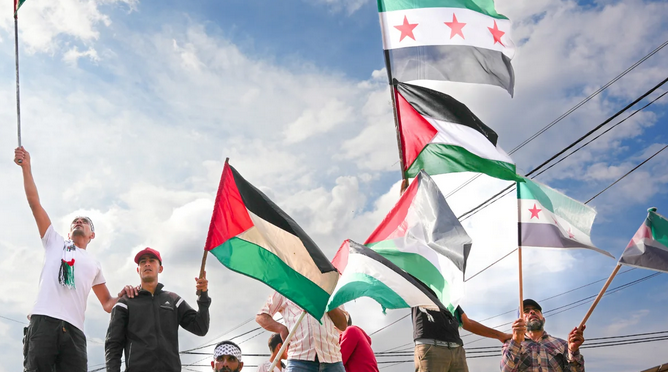
The sectarian regime is the cause of sectarianism among the opposition – 2014

Much of the criticism of the Syrian resistance to the Assad regime is of the fact that Sunni sectarianism has become an important element within it, in particular sectarianism against the Alawites, ie, the sect to which Assad belongs. This criticism is justified, especially with reference to the extreme jihadist elements, but is also greatly exaggerated and generalised to unjustly cover all the resistance, which is also anti-sectarian in large part.

Nevertheless, it cannot be denied that there has been a gradual drift further towards sectarian discourse even among non-jihadist parts of the resistance. Often this is merely verbal, on the part of such groups, and (unlike the jihadist-sectarians) does not correspond to any propensity to engage in armed sectarian attacks. But this very fact, of groups that seemingly have no history of or ideological dedication to sectarianism adopting sectarian language, raises the question of what is driving the sectarian dynamic of the struggle – a struggle that began in 2011 as an anti-sectarian democratic struggle to overthrow a tyranny.

One of the answers most commonly given is that it has been driven by the sponsorship of parts of the resistance by Saudi Arabia, Qatar and other Gulf states, who are supposedly driven to divert the democratic struggle into a sectarian Sunni-Shia conflict in order that the democratic spirit of the Arab Spring does not reach their own tyrannical regimes. This is certainly a factor, but a hard look at the reality forces me to say that this factor has been greatly exaggerated and misunderstood (including in some pieces I have written, eg, https://mkaradjis.wordpress.com/2013/09/24/the-geopolitics-of-the-syrian-uprisinginsurgency).

One factor that has received not nearly enough discussion has been the role of the regime itself as the chief cause of sectarianism. As Gilbert Achcar wrote in a recent piece:

“Let us take Syria for example. It is obvious that the transformation of the armed forces by Hafez el-Assad into a Praetorian guard of the regime, based on minority religious sectarianism, was likely to feed sectarian rancours within the majority. Let us imagine that the Egyptian president were Coptic Christian, that his family dominated the economy of the country, that three-quarters of the officers of the Egyptian army were also Coptic and that the elite corps of the Egyptian army were close to one hundred per cent Coptic. Would one be astonished to see “Muslim extremism” thriving in Egypt? Yet the proportion of Alawites in Syria is comparable with that of Copts in Egypt, that is to say approximately one tenth of the population” (http://internationalviewpoint.org/spip.php?article3279).

Recently, in some discussion, Assad apologists have tried to tell me that the sectarian nature of the regime has been exaggerated, or is merely a reference to the religion of Assad himself. They point to the fact that there are a number of top positions occupied by Sunni (eg, Vice-President, Foreign Minister). For anyone in doubt, you ought to take a look at this map of the regime:

http://www.washingtoninstitute.org/uploads/Maps/Syria-Regime-Chart-20130826_2

All the dark green are positions held by Alawites, light green Sunni, and yellow “Others.” First, don’t be confused by most of the yellow – nearly all of this is only yellow because it refers to businesses connected to the regime and so is only “other” in the sense that they are not individuals, and therefore cannot be given a sect. The only regime individuals I can see which are “other” (presumably Christian, Druze or Shia?) are four positions.

For the same reason, we can for the moment omit several dark green and light green squares which refer to regime-connected Alawite or Sunni businessmen, but who are not in the regime as such.

Counting just the regime individuals, we find there are 23 Alawites, 5 Sunni and 4 Others. That is, Alawites, some 10-15 percent of the population, occupy some 72 percent of the regime. Sunni, some 75-80 percent of the population, occupy under 16 percent of the regime. The “others”, with 4 positions, about 12 percent, would be slightly, but not enormously, over-represented (though given the regime discourse that it is the protector of “minorities,” we could thus say that “minorities” make up 20-25 percent of the population but 84 percent of the regime, and the vast Sunni majority only 16 percent of the regime).

Then we need to look at other aspects.

First, a large part of the Alawite regime people are connected to Assad by family, so the regime is both sectarian and family-run.

Second, Alawite elements are absolutely dominant within the military and security elements of the regime – including head of the Republican Guard, chief of staff of the Armed Forces, head of Military Intelligence, head of Air Force Intelligence, director of National Security Bureau, head of Presidential Security etc. What this means is that the appointment of a few loyal Sunnis to the officially top positions – Defence Minister and Interior Minister – takes on the nature of being largely cosmetic, ceremonial.

Third, looking now at all the yellow-coloured regime-connected businesses. These are of course the Syrian bourgeoisie – the big bourgeoisie, who absolutely dominate the economy. They are connected via two main branches. First, all the top right of the chart shows large companies (eg oil, banking, telecom etc) connected via Alawite, and Assad-family-connected, members of the regime. This includes Assad’s cousins, the Makhlouf family, who reportedly control some 40-60 percent of the Syrian economy.

But of course, if the regime is absolutely Alawite-dominated, where it can claim to be a little more “multi-cultural” in relation to the capitalist class – you wouldn’t want to exclude traditionally dominant big Sunni capital. So the whole bottom-right of the chart shows big businesses connected via the “Sunni business elite” who are in turn connected by marriage to Maher al-Assad, the president’s brother and head of the Republican Guard (wow, talk about the state as the “bodies of armed men” defending the capitalist class – hard to get it more open that that).

So to the extent that the regime isn’t entirely Alawite, it is the Sunni mega-capitalist class that is its chief non-Alawite support base.

So now let’s further summarise, the regime is:

1. Alawite sectarian
2. Assad family-run
3. The executive committee par-excellence of the Syrian mega-capitalist class.

So when an Alawite-sectarian regime that has ruled for decades launches unlimited war against its population who rise up for democratic rights, and the majority of the rising population (though by no means all of it) just happen to be Sunni, then Achcar is right that this “was likely to feed sectarian rancours within the majority.”
And it works the other way as well. As Thomas Pierret explains:

“The kin-based/sectarian nature of the military is what allows the regime to be not merely “repressive”, but to be able to wage a full-fledged war against its own population. Not against a neighboring state, an occupied people or a separatist minority, but against the majority of the population, including the inhabitants of the metropolitan area (i.e. Damascus and its suburbs). There are very few of such cases in modern history … No military that is reasonably representative of the population could do what the Syrian army did over the last two years, i.e. destroying most of the country’s major cities, including large parts of the capital. You need a sectarian or ethnic divide that separates the core of the military from the target population. Algeria went through a nasty civil war in the 1990s, and Algerian generals are ruthless people, but I do not think that the Algerian military ever used heavy artillery against one of the country’s large cities” (http://angryarab.blogspot.com.au/2013/04/angry-arab-interviews-thomas-pierret-on.html).

But it is not only the presence of a totally sectarian regime waging war against its people that promotes a sectarian dynamic. It is also the fact that the regime early on set up sectarian Alawite militias (the Shabiha) to terrorise specifically Sunni populations, including through mass murder of hundreds of people at a time (the list is well-known: Houla, Tremseh, Bayda and Banyas etc), and ethnic cleansing, not to mention the wholesale destruction of districts and cities where Sunni live. To again quote Pierret:

“The problem is that many people do not even recognize the sectarian character of these atrocities, claiming that repression targets opponents from all sects, including Alawites. In fact ordinary repression does target opponents from all sects, but collective punishments (large-scale massacres, destruction of entire cities) are reserved for Sunnis, just like they were reserved for Iraqi Shiites and Kurds under Saddam Hussein.”

A sectarian, anti-Alawite response is thus to be expected as much as we find anti-Jewish responses among many Palestinians (and check Hamas’ virulently anti-Jewish founding charter if you don’t believe me, largely based on the Protocols). I believe Hamas has moved on a great deal since its founding charter, and I don’t think this characterises its politics today. However, such discourse understandably remains a factor among many Palestinians, and the address for those responsible for this is in Tel Aviv.

That of course does not make it alright. But the point of this contribution is not to justify real sectarian politics among some sections of the opposition, but to analyse its cause. A number of points can be made.

First, the fact that sectarian views have been rising among sections of the opposition, and that this had led to a number of actual sectarian attacks and crimes, and even at least one large-scale sectarian crime – the monstrous ISIS-led attack on Alawite villages in Lattakia in August 2013, when nearly 200 were massacred (http://www.hrw.org/reports/2013/10/11/you-can-still-see-their-blood) – is evidence that the regime’s crimes are the major factor making life insecure for the Alawite masses, in the same way as the crimes of the Zionist regime occupying Palestine are the main factor making life insecure for the Jewish masses.

Second, the massacre just referred to is the only one on that scale, ie, on a similar scale to the kinds of massacres of Sunni that regime militias regularly carry out. That does not mean that smaller scale ones are OK. What it means is that, by and large, most sectarian attacks on Alawites by opposition forces have been opportunist attacks by undisciplined elements, not part of a strategy of any of the leading groups other than ISIS, and cannot be compared to the massacres organised by the regime.

It is also important to be aware of fake “sectarian massacre” stories spread by the regime, such as the alleged massacre of Shia villagers in Hatla in June 2013 (see http://blog.you-ng.it/2013/06/17/hatla-fabrication-of-a-massacre), the more recent faked “Adra massacre” (see http://www.interpretermag.com/the-massacre-in-syria-that-wasnt/ and especially http://lopforum.tumblr.com/post/70411153632/alleged-adra-massacre-collated-media), the alleged large scale massacre of Kurds by jihadists last August (where the jihadists did carry out crimes in their war against the Kurds, but not of this nature or scale, seehttp://claysbeach.blogspot.com.au/2013/08/breaking-news-assad-iran-you-lie-on.html), among others.

As for Lattakia itself, ISIS is of course widely reviled by the rest of the opposition, who see it as either a front for the regime or a dictatorship which must also be fought, and since early January 2014 all the other resistance forces have been engaged in a frontal war on ISIS.

Third, therefore, it is wrong to call the entire war a sectarian conflict or to call the entire anti-Assad uprising a sectarian uprising. In such a wide-ranging revolt against the murderous regime, there is a huge spectrum of opinions on everything. The task of supporters of the Syrian revolution is to do our best to support the best, anti-sectarian elements. To take one example, the contrast between the ISIS-led massacre of Alawites last August, and this appeal by the local FSA Battalions and Committees of the Sahel (Coast) in solidarity with Alawites in Lattakia who were waging their own struggle against the regime (http://darthnader.net/2012/10/13/and-then-there-was-hope/), speaks volumes about the differences between elements of the opposition. This is also the case with many Islamist groups outside the jihadist-sectarian fringe; for example, Liwa al-Tawhid, the large moderate-Islamist militia that dominates Aleppo, makes a point of protecting Christians (http://www.dailystar.com.lb/News/Middle-East/2013/Sep-21/232025-christian-hostel-in-aleppo-has-own-view-of-jihadist-rebels.ashx#axzz2gfb4z1J2). Indeed there are Alawite, Christian and Druze units of the FSA; here is an important article about anti-Assad Alawites: http://freehalab.wordpress.com/2013/06/04/the-free-alawite-front/.

Fourth, however, the fact of this sectarian aspect, even if only from part of the resistance, makes it all the more difficult for the Alawite masses – which, if we take out the those in the ruling elite, are, like most Sunnis, often poor rural folk – to break with the regime and join the ranks of the revolution. Even many of those who despise the regime. Of course this is a Catch-22 however – because to the extent that Alawites are seen to be blocking with a sectarian regime that it slaughtering the majority, anti-Alawite sectarianism will increase, whereas if a powerful anti-Assad group of Alawites did emerge, it would nullify such a trend. Which adds weight to the view that a purely “military situation” is impossible, and that if some kind of ceasefire could be forced out of the regime, which allowed for the civil struggle to resume, it could be a good thing for the revolution if such space were used right.

Finally, however, the fact that this sectarianism has been created, driven, perpetuated by the regime, also means that purely “diplomatic solutions,” that aim to save the regime with some cosmetic changes, will also not work – the chief cause of the cancer cannot be the “shield” against it, as some imagine. Both diplomacy and military struggle, like civil struggle, are tactics, parts of an overall “revolutionary solution,” which removes the regime. Even to get to a ceasefire that aids the struggle – ie, the opposite of one that merely allows the regime to go on killing behind a façade after the revolutionary forces have demobilised – will require not nice talk to a regime that has waged all-out, unlimited war for three years, but real military pressure on it via the opposition being able to get real arms in relevant quantities.

And if we have to accept that at this stage, part of the resistance has become sectarian due to the regime’s sectarianism, and that little can be done about it until the regime is removed, by the same token all the non-sectarian parts of the resistance need to wage a relentless struggle against the influence of this destructive, reactionary sectarianism within its ranks – the war currently being launched against ISIS scum by the rest of the resistance being a very positive step in that direction.

Israel and the Syrian War 2014

By Michael Karadjis

This is not an article, but a collection of links. Among those leftists defending the Assad dictatorship and its brutal war on its people, many claim the opposition does not consist only of proxies of Saudi Arabia, Qatar, other Gulf states and Turkey, but also proxies of Israel. This is odd, given Israel’s well-documented preference for a victory of a weakened Assad over any of the available alternatives. Assad, after all, has not only maintained total peace – without even symbolic moves – on the border of the Israeli-annexed Syrian Golan Heights for 40 years, a policy which Israel quite rightly does not trust any of the Syrian opposition to continue, but has also led countless attacks on Palestinians, their refugee camps, their organisations and their militants, including major aggression in 1976, 1983 and 1985-86 – and now, in countless criminal bombings and starvation sieges of Palestinian camps in Syria. See my article on this sordid history here: https://mkaradjis.wordpress.com/2013/09/24/syria-and-the-palestinians-almost-no-other-arab-state-has-as-much-palestinian-blood-on-its-hands

Yet the occasional Israeli leader holds a dissident view. Israel, after all, is a “democracy,” as long as you are White and Jewish. So when retired Israeli ambassador to the US, Michael Oren, recently asserted that Israel’s interest was in a victory of the bad guys not connected to Iran (ie, the Syrian rebels) over the bad guys connected to Iran (ie, the Assad regime), the pro-Assad left spread it round their websites like wildfire – finally they had found the unique voice of an Israeli leader that validated their assertions. Alas, the reason for this wildfire was precisely that it was so unique. How do the views of one retired ambassador compare in weight to the mass of views expressed in this resource below by so many top Israeli political leaders, IDF leaders, Mossad and other intelligence officials, top strategists and academics?

1. “The Israeli Position toward the Events in Syria” looks at varying views among different sections of the Zionist ruling class and weighs them up, rather than assuming there is “an Israeli view.” This article covered the view above – regarding Syria as the link between Iran and Hezbollah – but also other concerns, particularly that the Assad dynasty has maintained its border with the Israel-occupied Golan Heights meticulously quiet for 40 years, which may not be the case if it is overthrown – and came to the conclusion that, overall, for the Zionist rulers, the dangers of the overthrow of Assad outweigh the possible benefits, despite differing views. In particular, given this paper was written in May 2011, just a few months into the uprising and long before it descended into armed conflict, the author’s conclusions are fascinating:

i. Israel would prefer that the Syrian regime not be peacefully overthrown;
ii. Israel would prefer not to respond to the Syrian people’s demand for freedom and democracy
iii. Israel hopes that the Syrian regime will resort to repressive and bloody responses to the intifada instead of entering into negotiations with the various shades of opposition, and reaching political solutions that ensure real and comprehensive reforms
iv. Israel prefers the continuation of a Syrian regime founded on tyranny and corruption in its mode of governance, as evidenced by various Israeli statements to this effect
v. Israel would prefer that Syria descends into a state of sectarian conflict that would continue as long as possible, rather than a Syrian transformation from situation of struggle to one of freedom and democracy

Clearly, Assad played the Israeli card perfectly (http://english.dohainstitute.org/release/284e36f8-7bd1-4d84-89a6-a1e9ee1b835a).

2. Israel’s intelligence chief, Major General Aviv Kochavi, “warned that “radical Islam” was gaining ground in Syria, saying the country was undergoing a process of “Iraqisation”, with militant and tribal factions controlling different sectors of the country”, and claiming there was “an ongoing flow of Al-Qaeda and global jihad activists into Syria”. Making clear that his fears were about Assad losing, he said that with the Assad regime weakening, “the Golan Heights could become an arena of activity against Israel, similar to the situation in Sinai, as a result of growing jihad movement in Syria” (http://www.dailystar.com.lb/News/Middle-East/2012/Jul-17/180917-assad-moving-troops-from-golan-to-damascus-israel.ashx#axzz20t8QAeyJ).

3. In a similar vein, Yoav Zitun, writing for Israeli newsagency Ynet, reported that, “The IDF is preparing for the possibility that global Jihad terrorists will launch attacks from Syria in case President Bashar Assad’s regime will fall … Army officials are not ruling a situation whereby terrorists will take advantage of the chaos that may follow a regime change in Damascus to seize control of the border region, as was the case in the Sinai Peninsula after Egyptian President Hosni Mubarak was overthrown.” The army was “gearing for a number of possible scenarios, including a cross-border attack by global jihad, which is operating in Syria against Assad’s regime”. Brigadier-General Tamir Haiman warned of possible attacks “launched without prior warning from army intelligence – as was the case in the attack in Ein Netafim a year ago, which originated in Sinai” (http://www.ynetnews.com/articles/0,7340,L-4248954,00.html).

4. According to Khaled Amayreh in Al-Ahram, Israel was “dismayed” by the election victory of Muslim Brotherhood chief Mursi in Egypt. He claimed a major “pillar” of Israeli policy “was courting and neutralising Arab dictators who proved highly effective in pacifying their own masses” but now Israel “is beginning to lose” this pillar. He quotes Ron Ben-Yishai, editor-in-chief of the Israeli website Ynet, not only warning of the “danger posed by the ascendancy of the Muslim Brotherhood to the helm of power in the most important and populous Arab country”, but also that “Egypt’s Islamicisation constitutes a very negative harbinger for secular regimes that rely on the army, not only in Lebanon and Syria, but also in Jordan and the Palestinian Authority”. Israel’s defence minister Ehud Barak stated “The moment Assad starts to fall we will conduct intelligence monitoring and will liaise with other agencies” regarding such intervention (http://weekly.ahram.org.eg/2012/1104/eg7.htm).

5. Straight after the bombing of military facilities near Damascus on May 5, Israel sought to persuade Assad that the air strikes “did not aim to weaken him in the face of a more than two-year-old rebellion… Officials say Israel is reluctant to take sides in Syria’s civil war for fear its actions would boost Islamists who are even more hostile to Israel than the Assad family, which has maintained a stable stand off with the Jewish state for decades”. According to veteran Israeli politician Tzachi Hanegbi, a confidant of Prime Minister Benjamin Netanyahu, the government “aimed to avoid an increase in tension with Syria by making clear that if there is activity, it is only against Hezbollah, not against the Syrian regime” (http://worldnews.nbcnews.com/_news/2013/05/06/18079587-israel-to-syrias-assad-airstrikes-not-aimed-at-helping-rebels?lite).

6. As Yuval Steinitz, Israeli Minister of Intelligence and Strategic Affairs, explained, the “only scenario” for Israeli military action in Syria would be to “prevent the delivering of arms, chemical weapons and other kinds of weapons into the hands of terrorists” and noted that Netanyahu had made clear that “if there will be no threat to Israel, we won’t interfere.” Steinitz emphasized that Israel was not urging the U.S. to take any military action “whatsoever” in Syria at this stage” (http://www.cbsnews.com/8301-505263_162-57582025/syrian-rebels-to-get-1st-direct-u.s-support-as-$8m-in-medical-supplies-rations-set-for-delivery/).

7. In a meeting with British prime minster Cameron, Netanyahu, who was visiting London for Thatcher’s funeral, again warned of the danger of western arms reaching Jihadists rebels that could be used later against Israel and western targets. (http://www.haaretz.com/misc/article-print-page/britain-less-eager-to-arm-syrian-rebels-following-intel-on-al-qaida-links.premium-1.518235).

8. In an interview with BBC TV, Netanyahu called the Syrian rebel groups among “the worst Islamist radicals in the world … So obviously we are concerned that weapons that are ground-breaking, that can change the balance of power in the Middle East, would fall into the hands of these terrorists,” he said (http://www.timesofisrael.com/israel-wary-quiet-on-syrian-front-may-soon-end).

9. Israel also “worries that whoever comes out on top in the civil war will be a much more dangerous adversary” than Assad has ever been, specifically in relation to the Golan Heights. “The military predicts all that (the 40-year peaceful border) will soon change as it prepares for the worst.” The region near the occupied Golan has become “a huge ungoverned area and inside an ungoverned area many, many players want to be inside and want to play their own role and to work for their own interests,” said Gal Hirsch, a reserve Israeli brigadier general, claiming Syria has now become “a big threat to Israel” over the last two years. The military’s deployment on the Golan is its most robust since 1973, “and its most obvious manifestation is the brand new border fence, 6 meters (20 feet) tall, topped with barbed wire and bristling with sophisticated anti-infiltration devices” (http://www.timesofisrael.com/israel-wary-quiet-on-syrian-front-may-soon-end).

10. “Israel could launch a pre-emptive strike to stop Syria’s chemical weapons from reaching Lebanon’s Hezbollah or al-Qaida inspired groups … Israel has long expressed concerns that Syrian President Bashar Assad, clinging to power during a 22-month civil war, could lose control over his chemical weapons”
(http://news.yahoo.com/israel-warns-attack-syrian-chemical-weapons-181427470.html).

11. The Syrian government has withdrawn large numbers of troops from the Golan Heights … Rebel groups have moved into the vacuum, the report said, and Israel fears that jihadists will use the area as a staging ground for attacks on Israeli territory” (http://world.einnews.com/article/145179407/uEIDkYaz8DaA9cYH?afid=777&utm_source=MailingList&utm_medium=email&utm_campaign=Breaking+News%3A+world348-monday).

12. “Israel’s military chief of staff has warned that some of the rebel forces trying to topple Syrian President Bashar al-Assad may soon turn their attention southward and attack Israeli settlements in the Golan Heights.” ”We see terror organisations that are increasingly gaining footholds in the territory and they are fighting against Assad,”
Lieutenant-General Benny Gantz said at a conference in Herzliya, north of Tel Aviv. “Guess what? We’ll be next in line” (http://www.smh.com.au/world/syria-rebels-a-threat-to-golan-20130312-2fylt.html?skin=text-only).

13. “Prime Minister Binyamin Netanyahu on Sunday said Israel would erect a new security fence along its armistice line with Syria in order to protect the Jewish state from “infiltration and terrorism. “We know that on the other side of our border with Syria today, the Syrian army has moved away, and global jihad forces have moved in,” he said. “We must therefore protect this border from infiltrations and terror, as we have successfully been doing along the Sinai border” (http://www.israelnationalnews.com/News/News.aspx/163906).

14. “Despite Netanyahu’s weekly warnings on Iran, Syria is more imminent danger. The IDF views Iran as a problem for the ‘international community,’ but worries that the Syrian Golan could became a new version of the Gaza Strip. The main danger is brewing in Syria, where the 40 years of quiet that began in the wake of the Yom Kippur War have come to an end. Bashar Assad is still in his palace, but the post-Assad era has already started. The worrisome scenario in the north is that after Assad is gone Israel will be attacked, and the Syrian Golan will turn into a new version of the Gaza Strip, with southern Lebanon serving as a base for launching rockets and missiles. This is what is concerning the IDF’s top brass. Assad’s control of the Golan is disintegrating as his forces are being drawn into the decisive battles around Damascus and the fight for the city’s international airport (http://www.haaretz.com/misc/article-print-page/despite-netanyahu-s-weekly-warnings-on-iran-syria-is-more-imminent-danger.premium-1.515547).

15. Defence ministry strategist Amos Gilad stressed that while “Israel has long made clear it is prepared to resort to force to prevent advanced Syrian weapons reaching Hezbollah or jihadi rebels”, Israel was not interested in attacking Syria’s chemical weapons because “the good news is that this is under full control (of the
Syrian government)” (http://www.reuters.com/article/2013/05/04/us-syria-crisis-chemical-israel-idUSBRE94309720130504).

16. According to Aaron Klein and Karl Vick writing in Time in February, “Hizballah is not Israel’s only concern – or perhaps even the most worrying. Details of the Israeli strikes make clear the risk posed by fundamentalist militants sprinkled among the variegated rebel forces fighting to depose Assad … jihadist groups are less vulnerable to the same levers that have proved effective against Syria and other states – such as threats to its territory — or even the frank interests of an organization like Hizballah, which as a political party plays a major role in Lebanon’s government” (http://world.time.com/2013/02/01/the-fallout-from-the-air-raid-on-syria-why-israel-is-concerned).

17. “Israel prefers the regime of President Bashar Assad in Syria to continue than see a takeover of the country by rebel Islamist militants,” The Times of London reported in May 2013, quoting an Israeli intelligence official. “Better the devil we know than the demons we can only imagine if Syria falls into chaos, and the extremists from across the Arab world gain a foothold there,” the official said, according to the report. According to the Times, the senior intelligence officer in the north of Israel said a weakened but stable Syria under Assad is not only better for Israel but for the region as a whole (http://www.haaretz.com/news/diplomacy-defense/israeli-official-assad-preferable-to-extremist-rebels-the-times-of-london-reports-1.524605).

18. ‘Israel’s Man in Damascus – Why Jerusalem Doesn’t Want the Assad Regime to Fall’ – heading in Foreign Affairs (May 10, 2013), article by Efraim Halevy, who served as chief of the Mossad from 1998 to 2002:

“Israel’s most significant strategic goal with respect to Syria has always been a stable peace, and that is not something that the current civil war has changed. Israel will intervene in Syria when it deems it necessary; last week’s attacks testify to that resolve. But it is no accident that those strikes were focused solely on the destruction of weapons depots, and that Israel has given no indication of wanting to intervene any further. Jerusalem, ultimately, has little interest in actively hastening the fall of Bashar al-Assad.

“Israel knows one important thing about the Assads: for the past 40 years, they have managed to preserve some form of calm along the border. Technically, the two countries have always been at war — Syria has yet to officially recognize Israel — but Israel has been able to count on the governments of Hafez and Bashar Assad to enforce the Separation of Forces Agreement from 1974, in which both sides agreed to a cease-fire in the Golan Heights, the disputed vantage point along their shared border. Indeed, even when Israeli and Syrian forces were briefly locked in fierce fighting in 1982 during Lebanon’s civil war, the border remained quiet. Israel does not feel as confident, though, about the parties to the current conflict, and with good reason.

“Last week’s attacks were a case in point. Israel did not hesitate to order air strikes when it had intelligence that arms were going to be funneled from Syria to Hezbollah. Although Israel took care not to assume official responsibility for the specific attack, Minister of Defense Moshe Yaalon publicly stated that Israel’s policy was to prevent the passage of strategic weaponry from Syria to Lebanon. But parallel with that messaging, Israel also made overt and covert efforts to communicate to Assad that Jerusalem was determined to remain neutral in Syria’s civil war (http://www.foreignaffairs.com/articles/139373/efraim-halevy/israels-man-in-damascus).

19. “Israel would prefer that Bashar Assad hold onto the presidency in Syria, rather than leave a power vacuum that could be filled by Islamic radicals, according to former IDF chief of staff Dan Halutz.
“The regime in Syria kills its citizens every day, but we must acknowledge that the opposition in Syria is composed of Muslim extremists like al-Qaeda,” he said at a fundraising event for Israel’s Tel Hashomer hospital in Moscow on Monday, according to the daily Maariv. “The question ‘what is better for Israel?’ is an important question because we must ask ourselves if we want to trade the bad regime we know for the very bad regime that we don’t know, and this is something that requires serious consideration.”

“At the moment it looks like even in the rest of the world, they understand that they cannot replace the Assad regime as long as they don’t know who will take its place,” he added. “Right now it looks like the alternative is forces that will endanger the stability of the region.

Meanwhile, many feared that anarchy would ensue if Assad were to fall, and Muslim extremist groups such as al-Qaeda would be free to flourish and even rule the country, which would have left them in control of Syria’s considerable chemical weapons stockpile (http://www.timesofisrael.com/ex-idf-chief-israel-prefers-that-assad-stay-in-power/).

20. Israel and the Syrian War: An Interview With Professor Eyal Zisser (December 6, 2013), of Tel Aviv University, one of Israel’s best-known academic experts on Syria and Lebanon and the former director of the Moshe Dayan Center for Middle Eastern and African Studies.

Q. Could you describe the evolution of Israeli policy on Syria since 2011?
A. At first, Israel wanted Syrian President Bashar al-Assad to stay in power, thinking it was “the devil we know” and fearing the spread of chaos along the border. Then Israeli leaders came to the conclusion that Assad is finished. But then they became aware of the presence of al-Qaeda elements in Syria, like the rebel Nusra Front. So now the real position-not the official one-is that we wish both sides good luck and that it is in the interest of Israel that they continue fighting. Essentially, we want Assad to stay in power. We want him to be strong enough to keep the border quiet but weak enough so he will not present any real threat to Israel.

Q. What is the chance of Israel being dragged into war in Lebanon or with Syria?
A. Very low. Only if Israel is attacked by Assad-but why should he do such a stupid thing? However, Israel could find itself engaged in some local conflicts with Islamic extremists along the border or in a limited conflict with Assad if he decides to retaliate the next time Israel attacks targets in Syria. But clearly, everyone in Israel understands that Israel must not get involved in the war in Syria (http://carnegie-mec.org/syriaincrisis/?fa=53831)

21. Interview with Seymour Hersch, December 9, 2013, Democracy Now:

AMY GOODMAN: That’s David Shedd, the deputy director of the U.S. Defense Intelligence Agency, the DIA, speaking in July. The significance of what Shedd said, and what he also couldn’t say, Seymour Hersh?

SEYMOUR HERSH: I don’t know what he could or could not say. I’m not in—I can’t get into his mindset. I just know that by then he had received one major report, and also the ops order was being conducted. And Shedd, by—Shedd’s been around a long time. He was in the CIA. And I haven’t talked to him, and I didn’t discuss this with him. But he’s a fine intelligence officer. And I—he’s reflecting on what—look, by the time he’s talking, inside the community, for the last year, it’s been known that the only game in town, whether you like it or don’t like it, was Bashar, because otherwise the—what we call the secular anti—the opposition to Bashar, the legitimate, non-radical, if you will, dissenters, people from within the army, people—civilians who didn’t like the lack of more social progress, etc., etc., they were overrun, even by—we know that beginning in early in the year. We knew they were being overrun by jihadists. And so, the only solution, it seemed to me, for—it seems for the government at the time, the people I know—and I’ve talked to people about this for years; it’s been more than a year of talk—is, the only solution for stability was Bashar. You have to just like it or don’t like it.

Israel, which—don’t forget, Damascus is, what, 40 miles, 45 miles from the Golan Heights and 130 miles south of—north of—northeast of Tel Aviv, easily within range of any missiles. The Israelis are not going to tolerate a jihadist government inside Syria, or even any area that the jihadists will claim as an area of sharia law. They’ll hit it. The only potential for stability was to keep Bashar there, or at least to get him in a position where maybe he’d be willing to negotiate some sort of collaborative government, which seems to be the only sensible theme right now (http://www.democracynow.org/2013/12/9/seymour_hersh_obama_cherry_picked_intelligence).

22. Netanyahu and Putin agree that Assad and Sisi are better than alternatives (20 December 2013)
Putin, believes Netanyahu, has an interest in Middle East stability and the confrontation of the threats posed by ‘extremist Islam’. It has been reported that Israel’s prime minister and Russia’s President Putin agree that having Bashar Al-Assad in Syria and Abdel Fattah Al-Sisi in Egypt is better than the current alternatives of “extremists” and the Muslim Brotherhood. Maariv newspaper added that Benjamin Netanyahu has also been promised by Putin that he will block any conference proposed to discuss nuclear disarmament in the Middle East (https://www.middleeastmonitor.com/news/middle-east/8908-netanyahu-and-putin-agree-that-assad-and-sisi-are-better-than-alternatives).

23. Jihadist tsunami on Israel’s borders: IDF barely ready for 2014

In the national security area, alongside “old” and known challenges, the security forces will be dealing with some new challenges in the coming year. The IDF and intelligence community must prepare an intelligence and operational infrastructure and develop fighting methods which will allow them to deal with a “jihadist tsunami” piling up on Israel’s borders, mainly in Syria.

We are talking about fanatic Salafi Sunnis operating as part of al-Qaeda or inspired by al-Qaeda, who are succeeding in laying their hands on huge amounts of modern weapons from the depositories of the Syrian army which Jabhat al-Nusra and the Islamic fronts have taken control of, and on Libyan weapons which keep flowing into the hands of Salafi groups operating in Sinai and Gaza.

The Israeli intelligence community is mainly concerned about Jabhat al-Nusra, which is active in Syria and includes some 10,000 motivated and experienced fighters, including about 1,000 foreigners from Europe and Asia. This is the biggest fighting system directly affiliated with al-Qaeda. If and when its people take over Syria, for example, they will direct their full fanatic passion and the weapons they have accumulated against us, in a way which will make us long for Hezbollah. The Americans, and mainly the Europeans, are also concerned about the al-Qaeda base which has taken its place on their doorstep (http://www.ynetnews.com/articles/0,7340,L-4472027,00.html).

……………………………………………….

And finally, though this is not specifically about Syria, this article shows that the claims about a great US-Israeli rift over the US rapproachment with Iran are exaggerated at best; indeed, Syria is one area of broad agreement:

24. The great US-Israel rift that isn’t
http://www.latimes.com/opinion/commentary/la-oe-1223-saban-u-s–israel-ties-20131224,0,2594785.story#axzz2p0kkGydX
Commentators point to discord on the Iran deal, but the two nations have an identical goal, by Haim Saban, December 24, 2013

In recent weeks, the media have had a field day reporting on a so-called rift in the U.S.-Israel relationship over the nuclear negotiations with Iran. The story makes for great headlines, but it’s poor analysis. Despite the heated rhetoric, the pillars that have anchored America’s most important alliance in the Middle East for more than six decades are just as firmly rooted today as they have ever been.

These fears come from a focus on form over substance. In statement after statement, President Obama and Netanyahu continue to articulate an identical goal: Iran must not have nuclear weapons.
For example, Israel recently hosted U.S. forces for “Blue Flag,” a major joint military exercise involving dozens of fighter jets. This is a perfect example of how Israel and the United States can put aside their differences on one issue and continue to work closely together to advance their shared interests: fighting terrorism, ending the war in Syria, promoting global development and stabilizing the Middle East.

Senior national security officials of both countries say that the U.S. and Israel have never enjoyed closer military and intelligence cooperation, with both countries, and countless others, safer as a result. With U.S. support, Israel has developed a cutting-edge missile defense system that one day may be used to guard America, just as Israeli technology protects the vehicles that U.S. soldiers drive in Afghanistan.

Haim Saban is a private equity investor, the chairman of the Spanish-language media company Univision and founder of the Saban Center for Middle East Policy at the Brookings Institution
http://www.latimes.com/opinion/commentary/la-oe-1223-saban-u-s–israel-ties-20131224,0,2594785.story#ixzz2p0lUiA77

Share this:

Customize buttons

Related

The Syrian war, Israel, Hezbollah and the US-Iran romance: Is Israel changing its view on the war?February 24, 2015Liked by 1 person

Is there a ‘US war on Syria’? The Syrian uprising, the Assad regime, the US and IsraelSeptember 24, 2013

The geopolitics of the Syrian uprising/insurgencySeptember 24, 2013With 2 comments

Edit

Post navigation

Comments on Syria early 2014

US: No arms to FSA while fighting ISIS because ISIS might get the arms!

15 thoughts on “Israel and the Syrian War”

  1. Joseph Maizlish

January 5, 2014 at 3:54 pm Edit

Something additional about Haim Saban: As a child with his parents he left Egypt for Israel shortly following the “Lavon Affair,” the uncovering of an Israeli government plot which used some Egyptian Jews as participants in bombings at British properties in Egypt, apparently in hopes of alienating the British/U.S./etc. from the newly installed Egyptian government headed by Gamal Nasser. Among the results of the uncovering of the plot (some of whose bombings were carried out) was pressure against the Jewish communities in Egypt and the exit of many Jews from Egypt.

So we have the tragedy and irony of someone who both suffered from the counter-reaction against the violent overreaching of the Israeli government and found refuge from that counter-reaction in that government’s territory being now and having been for many years an adherent and advocate for that very government while it continues its violent overreaching.

Not a unique turn in human affairs, but a tragic one nonetheless, and in many ways.

Iran discussion 2013: Imperialist, sub-imperialist, anti-imperialist, capitalist even, revolutionary?

The following comment and reply was related to my article ‘The US, Iran, Russia-Syria and the geopolitical shift (December 2013): Anything for the region’s oppressed?’ when I first published that article on my Syrian Revolution: Commentary and Analysis blog. Tim Dobson posted a comment on Facebook criticising my article, but the substance of his criticism was about Iran, rather than about Syria as such. I put it up as a comment on my blog article and then replied there. However, with this new site, I am putting it up here as a stand-alone, because I believe there was much valuable discussion on the issue of Iran itself:

……………………………………………………………….

Tim Dobson posted the following comment on Facebook. As I see little point in getting into big discussions on a single person’s facebook account, I ahve taken the liberty to post his comment here so that I can reply. This is Tim’s comment:

Tim Dobson’s comment:

I disagree with Michael Karadjis on Syria but since this article is just as much about Iran (which know more about), I’ll just comment on that and how it has led some people astray on Syria (referring to Iranian imperialism, their ‘sectarian’ politics etc etc)

Mike writes ‘The US overtures to Iran and positive Iranian response have to be understood as part of a long-term process of bringing the relatively powerful Iranian bourgeoisie back into the fold – militarily, diplomatically and economically where it always belonged. While it may have been useful in the post Cold War era for the US and Israel to use Iran, as part of using “Islamic fundamentalism” (whether Shiite or Sunni or both) as a scarecrow to replace “communism” in order to maintain a permanent war threat in the region, sell lots of weapons, feed the masses with bullshit etc, the fact remains that there hasn’t been anything fundamentally antagonistic towards imperialism about the Iranian bourgeoisie for decades since its very bloody suppression of the revolution there in the 1980s.’

I think there are a number of things wrong here. Firstly, what powerful Iranian bourgeoise exists inside Iran? There isn’t one. The most powerful Iranian bourgeiouse live in Los Angeles and aren’t welcome back in Tehran. Why? Because the most powerful force during the 1979 revolution was the petty bourgeiouse (the Bazaari people) and that remains the case today. This may be peculiar but nonetheless true. This explains why politically they broke with imperialism but haven’t been able to break the back of imperialist domination economically (hence why the sanctions were so damaging). Its why the bazaari people and Sepah play such a big role politically and economically. Therefore, this process that Mike describing isn’t actually occurring. There has been little to no internal shifts within Iran economically during the last period (which surely such a process would bring about)

This idea of an Iranian bourgiousie being reintegrated also leads Mike to the strange conclusion that there hasn’t been anything ‘fundamentally antagonistic’ between Iran and imperialism. This may seem strange to people and that’s because it is. Firstly, Iran has never been that heavily demonised for its fundamentalism by imperialists, (mostly this has only be done by liberals), it has always been demonised for its antagonism towards imperilaist interests, however. Whether it is Palestine, Lebanon, Syria, Bahrain etc the sanctions were imposed because of its threat to Israel, not because of its fundementalism.

After the revolution in ’79, Saudi Arabia funded and armed a wave of Wahhabists to try and roll back the revolutionary spirit from Iran spreading, which has never been charctisced by its religious stance but by its anti-imperialism.

Since the revolution of 1979, we’ve seen a ten year war waged against Iran by Iraq funded by US imperialism, using chemical weapons which killed millions of people. We’ve seen Iran become the biggest financial and military backer of Hamas, which has resisted multiple Israeli invasions, they are the biggest financial and military backers of Hezbollah who inflicted Israel possibly its greatest defeat in 2006. We’ve seen some of the harshest sanctions ever implemented on Iran, we’ve seen terrorist attacks occur in Iran itself and we’ve had at least 7 years of Israel trying to drum up a war against Iran.

What was this about if there was no fundamental antagonistism between Iran and imperialism? What is it all about? If that is not fundamental, then what is?

Instead, Mike reduces it to tactics and probably most extraordinarily as no different to US imperialism relationship with Saudi Arabia! (I must have missed the ten year war waged against it by US imperialism)

Over the past 35 years, it would be hard to find a country which has lost more people due to US imperialism, yet Mike has turned Iran into a sub-imperialist country engaged in Shiite sectarian politics (funding that well known Shiite group Hamas) and made it seem that US was engaged in anti-Sunni politics (Maliki was never popular with the states, nor was Saudi Arabia, Qatar, Turkey, UAE affected by this anti-sunni politics. Bahrain, a mostly Shiite country, didn’t seem to benefit much either.)

I know Syria is the topic of the day for the left (Poor Iran had its day of focus in 2009) and Iran is the comfortable bogeyman in that context but to try and argue that Iran is an imperialist force requires such a re-writing of history and of contemporary reality, not to mention a denial of the lived experience of the Iranian people, that it becomes seriously offensive.

My reply to Tim Dobson on Iran:

When writing this article that Tim is replying to (his comment was first put on his facebook account: https://www.facebook.com/tim.dobson.376/posts/10152117708801514), I thought it possible that I might be treading on the holy grail that many leftists have made of the blood-drenched Iranian theocracy, which some still consider to be, curiously enough, the imperfect embodiment of the revolution that took place way back 35 years ago. But I was a bit taken aback by the extent of Tim’s illusions in the regime.

I certainly concede that some of the ways I expressed myself in the article were rather sweeping, and if Tim looks now he will see I have adjusted and clarified some of my language. I thank Tim for his comment for facilitating these improvements to my article.

That said, I remain convinced of the fundamental (oops, that word again) correctness of my article. I think one of the key problems is perhaps a different understanding of the word “fundamental.” For me, in saying there is no “fundamental” reason for US-Iran antagonism, I simply mean that there is no fundamental reason for ongoing conflict between a capitalist state and imperialism. Many capitalist states have of course had significant conflicts with imperialism, even long-term, but I see such conflict as less fundamental than the conflict between the US and Cuba for example.

Thus not “fundamentally” different does not mean quantitatively similar. Certainly, the expanding capital emanating from the Gulf is far more powerful than that from Iran; certainly, the US has had close relations with the Gulf monarchies, whatever their differences, that are in sharp contrast to US relations with Iran for the last few decades. But whether the difference is “fundamental” or not depends on how we define that term.

Incidentally, the fact that Gulf capital is more powerful than Iranian capital is not necessarily a reason for the US to be always and only linked closely to the former. On the contrary, the very fact of the projection of power by the Gulf in recent years can be one reason, among a number, for the current US partial geopolitical shift, to help balance powerful Gulf interests which are not always in exact accord with overall US and other imperialist interests.

Yet the fact that, as Marxists, we understand that a capitalist regime can have considerable conflict with imperialism without it being of a “fundamental” nature has led Tim, not to deny this understanding, but to deny that a powerful bourgeoisie exists in Iran, meaning all I write is based on an illusion. Tim writes:

“Firstly, what powerful Iranian bourgeoisie exists inside Iran? There isn’t one. The most powerful Iranian bourgeoisie live in Los Angeles and aren’t welcome back in Tehran. Why? Because the most powerful force during the 1979 revolution was the petty bourgeoisie (the Bazaari people) and that remains the case today. This may be peculiar but nonetheless true … Therefore, this process that Mike describing isn’t actually occurring.”

With all due respect to Tim who clearly understands a lot about Iran, I find this extraordinary. Tim is essentially offering up Iran as an example of a permanent “petty-bourgeois state.” Yes it is well-known that the petty-bourgeois bazaari merchants, strongly connected to the mullahs, played a prominent role in the Iranian revolution (another revolution, like the Syrian, with a massive religious “Islamic” component, with the difference that the Islamic hierarchy were the overwhelmingly leading force in Iran in 1979, whereas in Syria the various stripes of Islamists have been one component alongside the strong secular component of the uprising). And so a large part of the existing Iranian big bourgeoisie under the Shah fled to the US after 1979, as Tim explains.

I’m not sure if Tim still sees the theocratic dictatorship as an embodiment of the revolution as some leftists do. For the record, I personally abandoned that view about 30 years ago, so what I wrote here was entirely consistent, and not simply opportunistically related to Syria. That is, once the mullah regime was able to smash all opposition, crush organised labour, organise a bloody cultural counterrevolution on the universities, start lining up literally hundreds of leftists at a time to be publicly shot or hung, once it had killed tens of thousands of leftists, many already in its dungeons, including those who had held grotesque illusions in the mullocracy for the longest (eg, Tudeh), launched a bloody war on Kurdistan, turned the legal value of women into half of that of men and other such triumphs, my view was that the only way to keep speaking of the “revolution” and to say it hadn’t been extinguished was when speaking of the continued ability of those opposed to the regime to resist it, but absolutely not in terms of the regime itself.

I’ve never seen any evidence that this assessment was wrong. But more importantly, what was this all about? Surely it was the reconsolidation of a capitalist state in order for the capitalist class to reconsolidate power. Not necessarily to invite back the old guard bourgeoisie who had fled, the Shah’s narrowly “secular” big bourgeoisie (like Assad’s equivalent), but rather for the more broadly-based, in the real Iran, traditionalist petty-bourgeoisie and smaller bourgeoisie, especially from semi-rural and regional towns, to develop into the new capitalist ruling class and grab the same kind of wealth once held by a narrower, less representative clique – the same process behind “Islamist” leaderships in Egypt, Turkey and Syria and their conflicts with the narrow “secular” capitalist cliques they have replaced or aim to replace.

And, despite Tim, the evidence points to the development of a huge “Islamic” bourgeoisie having developed since 1979, as would be expected in a capitalist society under a petty-bourgeois leadership. The article “Millionaire mullahs” from 2007 (http://www.forbes.com/global/2003/0721/024.html) seems a good place to start, detailing the super-wealth of the new Iranian capitalist class and how it has emerged from the very structures of the petty-bourgeois clerical establishment:

“The 1979 revolution transformed the Rafsanjani clan into commercial pashas. One brother headed the country’s largest copper mine; another took control of the state-owned TV network; a brother-in-law became governor of Kerman province, while a cousin runs an outfit that dominates Iran’s $400 million pistachio export business; a nephew and one of Rafsanjani’s sons took key positions in the Ministry of Oil; another son heads the Tehran Metro construction project (an estimated $700 million spent so far). Today,
operating through various foundations and front companies, the family is also believed to control one of Iran’s biggest oil engineering companies, a plant assembling Daewoo automobiles, and Iran’s best private airline … Rafsanjani’s youngest son, Yaser, owns a 30-acre horse farm in the superfashionable Lavasan neighborhood of north Tehran, where land goes for over $4 million an acre. Just where did Yaser get his money? A Belgian-educated businessman, he runs a large export-import firm that includes baby food, bottled water and industrial machinery.”
Some other useful articles on the development of an Iranian mega-capitalism, including its extension beyond its borders: http://mondediplo.com/2009/06/02iran,
http://www.marxist.com/iran-clumsy-fraud-provokes-two.htm, http://www.csmonitor.com/2009/0806/p06s07-wome.html
The Rafsanjani family is named in this article as a well-known example of the new hyper-capitalists; not surprisingly, his regime (fresh from killing off thousands of leftists in the regime’s dungeons around 1990) launched the new liberalisation and privatization drive, which was continued with gusto under both the alleged “reformist” Khatami regime and the alleged “populist” Ahmedinejad regime. Not surprisingly, therefore, the connection between super-wealth and the prospect of a renewed alliance with US imperialism was expressed well in a recent article fittingly entitled “Revolutionary Pragmatists: Why Iran’s Military Won’t Spoil Détente with the US”:

“Although the Guards were founded as an ideological organization, they have become vastly more pragmatic as they’ve acquired more power in the Iranian establishment. The Revolutionary Guards are no longer simply a military institution. They are among the country’s most important economic actors, controlling an estimated ten percent of the economy, directly and through various subsidiaries. And those economic interests
increasingly trump other concerns. And, although the force can corner a greater share of the domestic market under the sanctions regime imposed by the United States because the private sector has a chronic shortage of funds, many Guardsmen are aware that they stand to gain much more if Iran strengthens its ties to the rest of the world. Companies controlled by the Guards would likely win a lion’s share of new foreign investment. In a speech on October 16, Major Hassan Firouzabadi, chief of staff of the armed forces, was even more explicit. He called on the United States to take advantage of the “historic opportunity” to cooperate with the Islamic Republic in combating extremist groups such
as al Qaeda and in providing stability in the Middle East”
(http://www.foreignaffairs.com/articles/140253/akbar-ganji/revolutionary-pragmatists?cid=soc-twitter-in-snapshots-revolutionary_pragmatists-111113&utm_source=Sailthru&utm_medium=email&utm_term=%2AMideast%20Brief&utm_campaign=Mideast%20Brief%2011-12-2013).

In fact, it seems to me ironic that Tim has missed what has precisely been a major “gain” of the revolution, one which I admit I did not envisage back in the 1980s (and neither did most leftists – many of those talking about an ongoing forever “deepening and broadening” of the “revolution” were imagining the socialist revolution on the horizon): the massive, rapid development of capitalism! As Babrak Zahraie, in an article which by and large is probably closer to Tim’s framework on Iran than my own, explains (http://babakzahraie.blogspot.com/2009/06/whither-iran.html):

“The Iranian revolution of 1979, due to special circumstances of its development, became the spring board for something that was most unexpected: the greatest development of capitalism in the country’s history. This came as a shock to the gang of royalists and the segment of capitalists and landlords that were thrown out of Iran. As far as capitalist development, Iran was cruising, and in their absence it was cruising faster than ever in its history.”

In and of itself, this was actually progressive compared to the rule by the relatively narrow state-led elite in the Shah’s time. In fact, just like the massive, rapid development of capitalism in China, this had many positive effects in terms of overall modernisation, despite the extreme backwardness of clerical rule in the social field. While somewhat unnecessarily romanticised, the following gives a reasonable overview:

“Peasants were transformed into farmers. Villages gained electricity, bathhouses, libraries, and access to healthcare. Roads and travel by automobile expanded. Internal air travel became a common option. Magazines and books appeared in the languages of national minorities. Ordinary folks would travel in the region regularly for religious duties or tours. Schools and universities multiplied. Women came to represent 62% of university students. Farsi became the fourth most utilized language on the Internet for bloggers.”

Though he also emphasises the limits to this “Further capitalist development was not able to address the key tasks of industrialization and agriculture. In a country that needs development in every conceivable area of health, education, urban and rural development, industry, agriculture and defense, the Iranian state advocated policies that revived the old capitalist state apparatus after the revolution”

Yet, he stresses, perhaps in a way that “permanent revolutionists” never quite got, that while this actual progress can take place, this nevertheless remains capitalism, the regime of our class enemy:

“We must not misunderstand: the greatest cycle of capitalist development meant more people than ever before in the history of Iran were getting rich – even super rich. These occurrences became a source of envy for the entire model of semi-colonial capitalism throughout the region. The rich in the region all envied Iran’s ‘model’ for the quick acquisition of wealth through land and other speculations. Meanwhile, the profits amassed by the rich in Iran created an increasing gap between the rich and the poor.”

Interestingly, all this sounds remarkably similar to developments in Turkey under the AKP: a terrific expansion of capitalism as the productive forces of the Anatolian regions were liberated from the strictures of the elite “secular” Kemalist state; a rapid development of infrastructure, poverty reduction, real gains for the masses; yet despite this, a growing gap between rich and poor as the new bourgeoisie goes on a neo-liberal craze.

In Babrak’s opinion, how did the US view this massive independent development of capitalism:

“Iranian capitalist development and the extension of capitalist relations, which received a major boost after the Iraq war, became a demon to imperialism. Washington would look to Iran and see its own face, as if it was waking up each morning and looking with hatred at itself in the mirror”

And thus tried to be rid of this new capitalist kid on the block. But ultimately, this is a strategy that will need to change, as Washington needs to catch up with the other imperialist powers who never (until the 2009 round of sanctions) stopped dealing with Iranian capitalism, and reincorporate Iranian capitalism into its system of capitalist relations:

“Iran’s progress, thanks to its mighty revolution and its increasing strength in the Middle East and South Asia region, has forced Washington to come up with a new approach … The US policy of cultivating an overt threat of war, imposing sanctions and labeling Iran as ‘axis of evil’ has given way to a more sober realization of the need for diplomacy. The plan of diplomacy requires recognizing the Iranian revolution of 1979 through acknowledging the gains and leaderships resulting from it, rescinding all sanctions, and freeing blocked Iranian assets in the US”

But he notes that the current regime, in 2009, was still not ready for this necessity. However, what if it is now?

And what does all this “the greatest development of capitalism in the country’s history” mean in terms of capitalist expansion outside of Iran’s borders? Why would it act any differently to any other capitalism? Well, it hasn’t: Iranian “Islamic” capitalist investment abroad has been ongoing since the 1980s. It has reached a stage – with significant influence in Iraq, Afghanistan, Armenia, Azerbaijan, Syria, Lebanon etc to be referred to, loosely, as a case of “sub-imperialism” in rivalry with other (albeit more powerful “sub-imperialisms”, such as in the GCC).

This article on Iranian economic influence in Iraq (http://www.nytimes.com/2007/03/17/world/middleeast/17iran.html) and this one on Afghanistan – if we can ignore the obvious propaganda and just focus on Iranian economic penetration (http://news.bbc.co.uk/2/hi/south_asia/6741095.stm) are good examples of this entirely natural process.

Let’s just clarify that for a moment: at one point Tim accuses me of arguing that “Iran is an imperialist force.” I do nothing of the sort. However, the term “sub-imperialism” has always seemed useful to me, even though banned under orthodox Trotskyism, to describe the very normal process of medium-sized capitalist, non-imperialist, countries, expanding economically beyond their borders, and the subsequent rivalries, geopolitical maneuvering etc that goes with this, which can at times be useful as partners to imperialism and at other times be seen as dangerously independent by imperialism. The five famous ‘BRICS’ fall into this category, and it seems to me the GCC, Iran and Turkey fit the bill as well. If you want to think of it as more “descriptive” than “scientific”, then that’s OK with me.

Strangely, not only does Tim think that Iran is not “sub-imperialist” in this sense, or even properly capitalist, but also that Iranian policy is virtually consistent in its “anti-imperialism,” and certainly not sectarian. Indeed, imperialism has apparently never either demonised, nor penalised, Iran for Islamism, but only for “anti-imperialism.”

First, imperialism definitely has demonised Iran for “Islamic fundamentalism,” hypocrisy aside. It has been a very large part of the post-Cold War propaganda; and also a genuine fear of the potential for “Islamic”-led revolt, a la Iran, in neighbouring Muslim states: regardless of whether the outcome may be progressive or reactionary, the US didn’t want these regimes destabilised.

Where I agree is that of course imperialism doesn’t penalise states for having reactionary-Islamist theocratic governments, otherwise Saudi Arabia would have been penalised more than Iran. I’ve given my overall analysis above of why I think the US has been largely hostile to Iran since the revolution, and yes the degree of independence of the new, assertive Iranian mega-capitalist class is part of this, for good or for bad.

You can of course call that “anti-imperialism” if you want (and in some cases it is), but to see it as consistent, or as consistently non-sectarian, is entirely wrong and rests on massive illusions in the anti-imperialist consistency of a marauding, mass-murdering capitalist elite.

That of course doesn’t mean Iranian foreign policy is always bad (let alone as monstrous as it is in Syria). Iran’s support for Hezbollah’s struggle against Israeli occupation of Lebanon should certainly be hailed, and as Tim knows I wrote extensively supporting Hezbollah in 2006.

Indeed, getting back to my opposition to bullshit-style “anti-imperialism,” you might remember that my conflict with this kind of politics actually originated in the 1990s with my defense of Bosnia against Serbian fascism; many of these types fantasised that “the West” had ganged up on Serbia and so, though the West was in fact doing nothing but imposing a criminal military blockade on besieged Bosnia, they still thought they had to support Serbian aggression and anti-Muslim genocide in Bosnia. I still have no idea why. But in any case, Iran, for its own geopolitical reasons, became the chief supplier of the Bosnian army, doing its best to evade the imperialist-enforced arms embargo. What was hilarious was watching the “anti-imperialists” of the day find clear evidence of “US intervention” when, two-thirds of the way into the war, the US announced it would stop enforcing the imperialist arms embargo (while UK and France continued to enforce it), thus refusing to continue to actively prevent Iranian arms deliveries! Rotten imperialists refusing to militarily prevent Iran from carrying out its activity half a world away from the US borders!

So, in that case, I also hailed Iran. Whether Iran’s activities could still be called “anti-imperialist” after the US stopped enforcing the embargo though really depends on how people choose to fit facts into their “neat” categories. Indeed, despite Tim, and despite the current “anti-imperialist” support for Iran due to its bolstering of Assad’s tyranny, another “anti-imperialist” mantra I have often heard is along the lines that “Iran has collaborated with US imperialism in three major conflicts, in Bosnia, Afghanistan and Iraq, proving how phoney it is.” For me, this is merely the reverse nonsense of the same mechanical “anti-imperialist” line.

Yet, how consistent is Iran? Isn’t it true that Iran effectively collaborated with the US in both the invasions of Afghanistan and Iraq, because it was in sectarian and geopolitical conflict with the regimes that the US deposed? What of the role of the Iran-based Badr Brigades during and after the US invasion of Iraq? Are you sure it was consistent anti-imperialism (not to mention anything even remotely progressive)? Or its support for Karzai and the Northern Alliance? What of its long-term excellent relations with the Turkish regime, especially under the AKP, on an anti-Kurdish basis?

Iran’s support for Hezbollah and, until recently, Hamas, was to be welcomed, but Iran’s economic and geostrategic intervention into the Arab world necessitated breaking from the Shah’s pro-Israeli legacy (in the same way that Erdogan and the AKP have had to the same re the Turkish generals’ pro-Israeli legacy). Being far away from Palestine makes this easy: note that the verbally “rejectionist” states have always been distant from the action (Iran, Saddam’s Iraq, Gaddafi’s Libya, Algeria, the old South Yemen). Iran’s actions such as these are aimed at some kind of deal recognising its role in the region.

Of course Tim is correct to note that Hamas is Sunni; so, I might add, were the Bosnian Muslims, and most of the Afghan Northern Alliance. Sectarianism as policy is not consistent, because by definition it is only a tool of a capitalist ruling class in its geopolitical rivalry. After all, Saudi Arabia’s on-again, off-again relationship with the “Alawite” Assad regime in Syria over the decades is another example, including full-scale Saudi support to the Syrian invasion of Lebanon at a time when the majority of Lebanese Muslims aligned to the Palestinian-leftist coalition, crushed by Assad, were Sunni; the Saudi-Syrian accord of 1991 held Lebanon together the next 15 years. And the Saudis just backed the overthrow of the Sunni Muslim Brotherhood regime in Egypt, bringing to power Mubarakist generals who … see themselves in brotherly solidarity with the “Alawite” Assad regime!

Don’t try to make too much sense of it. However, sectarianism is one of the weapons. Tim forgets to tell us that, after the Assad regime had slaughtered a certain proportion of the Syrian (Sunni Muslim) population via high-tech savagery, Hamas could no longer bear the “neutrality” and declared support for its brothers and sisters in their uprising for the same kind of human dignity the Palestinians have long been fighting for, against the same kind of barbarism. Not the mention the fact that Palestinians in Syria are part of the uprising and that the regime has barbarously besieged and starved Palestinian camps there, and tortured and murdered Palestinian militants. And after that point, Iran, in sectarian, or geopolitical, or whatever you call it, solidarity with Assad, cut off its support for Hamas: its solidarity with some tyrant slaughtering his people was far more important than its solidarity with the Palestinian struggle.

Indeed, prodding Hezbollah into its suicidal adventure in Lebanon may have been one sectarian step too far.

Furthermore, if its about consistency, what can one say about Iran and Hezbollah having the complete opposite view on Syria and Libya? Surely, if it is “anti-imperialism,” then the 10,000 NATO bombs on Libya would be more significant than the handful of flack jacks, night goggles, “ready-meals”, and other such rubbish, but not a single gun or bullet, that the US has supplied the FSA in 3 years?

Yet both Iran and Hezbollah supported the rebellion against Gaddafi right to the end, and even celebrated when he was sodomised to death with a knife after being captured in a tunnel due to a NATO bombing raid. The difference: the sectarian need to relate to the Lebanese Shia community, which still remembers that Musa Sadr went missing in Libya 35 years ago.

Finally, Tim says that

“Since the revolution of 1979, we’ve seen a ten year war waged against Iran by Iraq funded by US imperialism, using chemical weapons which killed millions of people … We’ve seen some of the harshest sanctions ever implemented on Iran, we’ve seen terrorist attacks occur in Iran itself and we’ve had at least 7 years of Israel trying to drum up a war against Iran … Over the past 35 years, it would be hard to find a country which has lost more people due to US imperialism”

… so that to even question the left narrative about the allegedly continuing Iranian “revolution” (often coming from people who don’t recognise a revolution in their face in Syria today), “it becomes seriously offensive.”

I’ll tell you who got “the harshest sanctions ever implemented,” significantly hasher than Iran has had just for the last 4 years: Saddam Hussein’s Iraq, for a period four times as long, during which time anywhere upwards of 500,000 people died as a direct result. The sanctions on Iran since 2009 certainly have been harsh, and criminal, and of course I welcomed their very partial end at the beginning of my article, but they don’t compare to the Iraqi genocide, and as for the 3 decades prior to the 2009 tightening of sanctions on Iran, the US’s Iran sanctions didn’t even come close to the Iraqi sanctions-genocide.

What should we decide from this? That Hussein’s bloodthirsty, ultra-repressive capitalist tyranny was some “anti-imperialist fighter” state that still imperfectly represented the continuity of the 1958 revolution? If you say similar stuff about Iran, why not?

Tim says that few have lost more people to US imperialism than Iran has, but most of it seems to be the Iran-Iraq war, where Tim seems to say that Hussein’s chemical war “killed millions.” Of course it did nothing of the sort, but all in all it is estimated that over a million Iranians and Iraqis were killed in that war, and Tim is right that Iraq holds the main responsibility for launching the war, and for using chemicals much later in the war. He is also right that the US bears responsibility for its initial encouragement of Hussein into this catastrophe.

But after this encouragement, the US basically left Iraq in the lurch; the US view was well-expressed by Kissinger in the 1980s: the US interest was for them to bleed each other, to fight on, to “both lose.” Most of Iraq’s weapons throughout the war came from France and the Soviet Union, hardly any, if any, from the US; more US and British weapons actually found their way to Iran, and not only via the famous Iran-hostage-contra dealing between the US and “anti-imperialist” Iran. Israel in particular openly advocated an Iranian victory, seeing Hussein as its worst enemy at the time (Iraq was closer, and Arab); Israel openly provided weapons to Iran. US intervention against Iran came mostly in the last year of war, with Iran on the offensive, and mostly in the form of protecting “re-flagged” Kuwaiti oil tankers.

And this was the Iraq that the US then turned around and destroyed in 1991 (with implicit Iranian support and direct participation of Assad’s Syrian regime), and then imposed 12 years of history’s worst sanctions on before invading, killing a million people and destroying the country – the actions of this Iraq allows you to say that “imperialism” has killed “millions” of Iranians. And yet this extraordinary imperialist treatment of Iraq does not for one moment make me turn around and declare the Hussein tyranny “anti-imperialist.”

To see the whole million or so killed on both sides of the Iran-Iraq war as all the fault of Iraq, or even all the fault of US imperialism, is just pro-mullah delusion; it avoids the inconvenient fact that after Iranian forces drove Iraq right out of every inch of Iran by mid-1982, two years into the war; and Hussein began suing for peace on the basis of the international border which he had repudiated (while his invasion was reactionary, this repudiation was just: the mullah regime maintained the new border that the Shah had created by invading part of Iraq); that the only reason the war continued for the next 6 years – ie, an entire three-quarters of the war and the killings of hundreds of thousands of Iranian and Iraqi workers – was due to the mullah regime crossing this international border, invading actual Iraq, occupying Iraqi territory, and declaring it would not end its invasion until it forcibly overthrew Hussein’s regime, a prospect most Iraqis considered terrifying.

I know these facts might not be popular on the left, but they nevertheless are true. Millions were killed by the regime. I still find it breathtaking 30 years later that much of the left believed Iranian workers should have to continue to slaughter Iraqi workers, and get slaughtered, on the altar of Khomeini\s entirely reactionary war to decimate and subjugate Iran’s bourgeois rival, based on the sensationally fertile imagination that this would result in the “extension of the revolution.”

The US, Iran, Russia-Syria and the geopolitical shift (December 2013): Anything for the region’s oppressed?

In recent weeks and months, a pronounced geopolitical shift in US policy related to the Middle East has been widely discussed. This shift consists mainly of the US-Russia deal with Syria’s Assad regime to get rid of its chemical arsenal, in exchange for the US dropping its brief threat of air strikes over Assad’s chemical attack on August 21; and the high-level US-Iran negotiations over its nuclear arsenal, which led to a new agreement, involving a slight reduction on imperialist sanctions on Iran in exchange for Iranian concessions on its civilian nuclear program.   

 In a very general sense, it is a good thing to reduce tensions. In the Syrian case, if it headed off potentially catastrophic US “punishment strikes” on Syria, it can be called the lesser evil at that particular moment, but at that moment only; in the Iranian case, if it reduces (and eventually leads to the abolition of) imperialist sanctions on Iran, which cripple the ordinary people but do little to hit the theocracy, then that is certainly a good thing.

 It is even more a good thing if it moves the region further away from the possibility of a US or Israeli attack on Iran over their bogus claim of an Iranian nuclear weapons program; it would even be better if both the Syrian and Iranian processes exposed Israel as the only state in the region with a massive nuclear weapons’ arsenal and made it more difficult for Israel to maintain it, an unlikely outcome at this stage however. Finally, to the extent that regional tensions of a sectarian nature are reduced (if this were to be the effect, which is doubtful), then that should also be welcome.

At the same time we ought to remember that the US isn’t reducing tensions to please the international left and progressive and anti-war movements, still less as a concession to the oppressed in the region, but for the sake of imperialist stability, something badly disrupted by the Arab Spring and the ensuing genuine people’s revolutionary movements, not only by the sectarian and geopolitical tensions which often overlay this.

 Before looking at this, it is first worthwhile understanding how genuine these moves are. Three recent revelations underline this.

 First, the revelation that the US and Iran, whatever the public displays, had been secretly engaged in these negotiations for many months before they became public, and the US had not only not shared this information with the Saudis, but also not even with Israel, the local white racist outpost that expects the US to only do things in consultation with it. These talks were going on during the period since early 2013 when Iran was drastically stepping up its military support to the Assad regime’s savage war against its people: http://www.haaretz.com/news/middle-east/.premium-1.559788

 Second, the revelation that the US government had been well aware that the Assad regime had used small amounts of chemical weapons over the last year and “had watched the regime carry out about a dozen small-scale chemical attacks before the big one,” the whole time suppressing the information, seeing it as essentially routine, while also denying opposition requests for provision of gas masks. In addition, US and Israeli intelligence had intercepted Assad regime communications from three days before the massive August 21 attack, but “had not yet translated them,” but officials claimed that even if they had been translated, “they likely wouldn’t have acted because there were no indications it would be out of the ordinary”:

http://online.wsj.com/news/articles/SB10001424052702303914304579194203188283242

Third, perhaps the most surprising, though hardly after the last two were revealed: the UK has been mediating indirect secret talks between US and Hezbollah over a number of months, reportedly dealing with “the fight against al-Qaida, regional stability and other Lebanese political issues” and “are aimed at keeping tabs on the changes in the region and the world, and prepare for the upcoming return of Iran to the
international community” (http://www.jpost.com/Middle-East/Report-London-is-mediating-indirect-secret-talks-between-US-and-Hezbollah-333245).

On the other hand, understanding how genuine these geopolitical moves are should not be understood to mean the US is doing a complete shift and is about to dump its traditional allies, such as the Gulf monarchies, let alone Israel. Rather, the US is simply doing what it does best: looking after its strategic interests, not subservient to anyone. It will maintain its geopolitical alliances, and adopt new ones as it sees fit; if older allies complain, tough. 

 The US overtures to Iran and positive Iranian response have to be understood as part of a long-term process of bringing the relatively powerful Iranian bourgeoisie back into the fold – militarily, diplomatically and economically (http://eaworldview.com/2013/11/iran-spotlight-western-oil-companies-tehran-ready-make-deals) – where it always belonged. It has clearly been useful in the post Cold War era for the US and Israel to use Iran, as part of using “Islamic fundamentalism” (whether Shia or Sunni or both) as a scarecrow to replace “communism” in order to maintain a permanent war threat in the region, sell lots of weapons, feed the masses with irrational fear of an “enemy” and so on. Despite this, the fact remains that Iran is a very capitalist state, and as such, there has been nothing about the Iranian bourgeoisie for decades, since its very bloody suppression of the revolution there in the 1980s, that necessarily stands in fundamental conflict with imperialism.

Certainly, Iran’s relationship with imperialism has been of an antagonistic nature to an extent that appears qualitatively greater than conflicts such as those, for example, that have pit Saudi Arabia and its GCC allies against imperialism, such as the 1973 Arab oil embargo, or Saudi anger with Washington today. I would argue, however, that the difference is quantitative, even if the “quantity” is significant. To some extent there is the grandstanding of a powerful and growing Iranian national bourgeoisie, which can have its own tactical conflicts with greater imperialist interests; and specifically, the interests of this rising bourgeoisie often clashes with the interests of more powerful rival regional bourgeoisies, particularly those of the Gulf, which have had Washington’s favour for a protracted period. However, the greater power of the Gulf bourgeoisie, and Washington’s long-term relationship with it, does not necessarily mean that Washington must always favour this bloc as if such an alliance is as fundamental as its alliance with Israel. It is not. In fact, when the Gulf bourgeoisie throws its weight around too much, that might be precisely the point at which the US looks to balance this by bringing in a lesser, but rising, Iranian rival.

In fact, it is not just over Syria that the US and Saudi Arabia have blown apart (despite the fantasies of a lot of the left that they are allied over Syria); they have also long had a different perspective over Iraq, given that it was the US that essentially brought the Shia-led Maliki regime to power, which the Saudis viewed as facilitating an Iranian regional victory, while the Saudis actively back rival Sunni-led forces there. Indeed, since the Saudis played such a prominent role in mobilizing Sunni forces into the ‘Sawha’ (Awakening) militias to defeat Al-Qaida in Iraq, they expected a better deal from Washington. This article looks at how active this conflict still is:
http://www.eurasiareview.com/25022013-saudi-arabia-and-qatar-ratcheting-up-sectarian-and-ethnic-tensions-in-iraq-oped

It is in US interests to shift the balance of power around between such regional heavy-weight bourgeoisies with their clashing regional projects. The assertions sometimes made in tabloid-left analyses that there exists a solid, long-term US “pro-Sunni” bias are superficial to put it mildly. If anything it was distinctively “anti-Sunni” for a time after 9/11; and Iranian and US interests partially coincided over the US invasions of both Afghanistan and Iraq. However, precisely the subsequent Iranian/”Shiite” advances in Iraq and Afghanistan along with Hezbollah’s moment of glory in 2006 may have shifted the US tilt back to “Sunni” powers after that.

We need to understand such “Sunni” and “Shia” blocs as representing the attempts by powerful regional “sub-imperialist” forces to project their geopolitical interests in the region under these ideological covers; at the same time we also need to understand that there is nothing absolute about them, and that there are vast differences within each alleged “bloc.” For example, the “Sunni” bloc consists of a Qatar/Turkey/Muslim Brotherhood bloc, a Saudi/GCC (except Qatar) monarchial bloc, and an Al-Qaida bloc (largely privately funded by sections of the Gulf bourgeoisie opposed to the narrow monarchial regimes), and all are mutually hostile, in addition to other secular regimes in Sunni-majority states outside any of these frameworks, eg Gaddafi’s Libya. The “Shia” bloc is also divided; while currently the “Alawite”-led regime in Syria is conveniently classed as “Shia” to ideologically justify the Iranian and Hezbollah alliance, before the Arab Spring, the Assad regime’s closes allies in the region were Qatar and Turkey (and both, along with Saudi Arabia, initially came out strongly in support of Assad when the Syrian uprising began), while different Shia blocs inside Iraq have differing perspectives on regional issues.

But the Arab Spring – the revolutionary uprising of the Arab masses – has been overwhelmingly a Sunni-based affair; and at a similarly fundamental level, the Palestinian population are overwhelmingly Sunni. That obviously does not mean the US wants to shift all support to an Iranian/Shia bloc; that would be entirely counterproductive from the point of view of quelling the Sunni-based uprisings. But it does perhaps mean it is time for more balance of power, especially given the situation in Syria.

The Syrian situation is perhaps the most widely misunderstood in this regard. Both the Saudis and Iranians see it in sectarian/geopolitical terms; the US sees it as requiring the victory of counterrevolution. Of course the Saudis and Iranians also want counterrevolution, naturally enough, but it matters to each how it happens. The US preference for either continuing bloodshed to weaken all sides, or a restabilisation involving the core of the current Assad regime (perhaps without Assad himself) but broadened to include some bourgeois opposition figures, both represent outcomes based on balance. In fact, most likely the first followed by the second.

And both these US preferences represent the Israeli interest, that is, the interest of the US’s main ally in the region that has no love for either Muslim-based project getting too powerful. For Israel, and thus for the US, if Sunni and Shia jihadists are fighting it out and bleeding each other in Syria, and sucking in the energies of Iran and the Arab states, then that’s OK for Israel.

But ultimately even for Israel, as for the US, restabilisation is necessary. And this can only occur with the core of the current regime in one way or another maintaining power. And the irony of the current situation is that, while on a regional level Israel’s saber-rattling has long been directed against distant Iran and the pretence that it has nuclear weapons which threaten Israel (something they know is a lie), on the more local level Israeli and Iranian interests partly coincide in Syria, much more so than either do with Saudi/Gulf interests. I know that this is disputed (and certain individual Israeli leaders have said different), but at a fundamental level it is true – they both prefer the Assad regime, or some modification of it, over a victory EITHER of secular, democratic revolution OR Saudi-aligned Sunni Islamists OR Sunni jihadists a la Al-Qaida, OR any combination of these, especially if any of those alternatives were to come anywhere near the Israeli-stolen Syrian Golan Heights – which the Assad regime has protected without a shot being fired in 40 years, a policy Israel does not trust any of the alternatives to continue with.

 It may be objected that the growing dependence of Assad on Hezbollah, Iraqi Shia gangs and Iranian Revolutionary Guards in 2013 now equalizes the two sides in Syria from the point of view of Israeli interests. To some extent this is true. But as long as Hezbollah is bloodily wasting its cadres and resources in Syria rather than in Lebanon or anywhere near the borders of Israel, then that suits Israel very well. Israel’s occasional attacks have very clearly been directed against shipments of advanced Iranian weapons from Syrian territory to Hezbollah in Lebanon, never against Hezbollah using its weaponry to kill Arabs in Syria. This factor merely means Israeli preference for both sides fighting on and bleeding each other is enhanced. But it in no way changes the Israeli preference, stated repeatedly over the last three years, for at least the main core of the Assad regime to remain in power to prevent a victory of any combination of opposition forces. 

 This was explained recently by Professor Eyal Zisser of Tel Aviv University, one of Israel’s best-known academic experts on Syria and Lebanon and the former director of the Moshe Dayan Center for Middle Eastern and African Studies:

“At first, Israel wanted Syrian President Bashar al-Assad to stay in power, thinking it was “the devil we know” and fearing the spread of chaos along the border. Then Israeli leaders came to the conclusion that Assad is finished. But then they became aware of the presence of al-Qaeda elements in Syria, like the rebel Nusra Front. So now the real position—not the official one—is that we wish both sides good luck and that it is in the interest of Israel that they continue fighting. Essentially, we want Assad to stay in power. We want him to be strong enough to keep the border quiet but weak enough so he will not present any real threat to Israel” (http://carnegie-mec.org/syriaincrisis/?fa=53831).

This highlights an important difference between current Israeli and Saudi opposition to Washington’s current strategy, involving the nuclear dealing with Iran and the chemical dealing with Assad and Russia. Saudi Arabia views Iran through the prism of Syria (and other regional conflicts where Saudi-Iranian rivalry are played out, such as Iraq and Bahrain, but principally Syria at the moment); whereas Israel, on the odd occasions when it puts on its hawkish rather than dovish face over Syria, is viewing Syria through the prism of Iran.

 That is, for Saudi Arabia, the US-Russia deal over Syria, essentially aimed at bolstering Assad, after the Saudis had invested so much in publicly helping the Syrian opposition (indeed the secular opposition, the SMC and SNC, which they had actually helped much more than Washington had wanted them to), made them feel they were being laughed at in the face by Washington; the Saudis were thus already furious about this before the onset of US dealing with Iran consolidated the idea that Washington was presenting Iran with a regional victory. Thus Saudi Arabia has reacted by “going its own way” in Syria. On the actual nuclear deal with Iran, as opposed to the geopolitical shift behind it, the Saudis are not so concerned; indeed, the official statement by Saudi Arabia and other Gulf states gave it cautious support as the beginnings of comprehensive solution for Iran’s nuclear program; moreover, both Saudi Arabia (http://english.alarabiya.net/en/News/middle-east/2013/11/25/Riyadh-Solution-on-Iran-needs-goodwill-.html) and Qatar (http://english.alarabiya.net/en/News/middle-east/2013/11/25/Qatar-Kuwait-welcome-Iran-s-nuclear-deal-with-world-powers.html) stressed this could lead to, in the words of Saudi Minister of Culture and Information Abdulaziz bin Mohieddin Khoja, “the “removal of all weapons of mass destruction, especially nuclear, from the Middle East and the Gulf” – an obvious reference to Israel’s massive nuclear arsenal.

For Israel it is the complete opposite. Israeli leaders put out mixed reactions to the US-Russia dealing over Syria; reactions in general though were cautiously positive. In fact, what Israeli leaders had continually stressed was that the “worst possible outcome” in Syria, and, as Yuval Steinitz, Israeli Minister of Intelligence and Strategic Affairs, explained, the only reason Israel would ever intervene was if Sunni jihadists got their hands on Assad’s chemical weapons in the case that the regime should collapse (http://www.cbsnews.com/8301-505263_162-57582025/syrian-rebels-to-get-1st-direct-u.s-support-as-$8m-in-medical-supplies-rations-set-for-delivery/); whereas, as Defense Ministry strategist Amos Gilad explained in May, Israel was not currently interested in attacking Syria’s chemical weapons’ stock because “the good news is that this is under full control (of the Syrian government)” (http://www.reuters.com/article/2013/05/04/us-syria-crisis-chemical-israel-idUSBRE94309720130504). Thus the chemical deal basically addresses this Israeli concern; in fact, the Saudi-backed leader of the Syrian National Coalition, Ahmad Jarba, described the US deal with Assad on chemicals as the adoption of the Israeli interest.

 To the extent that Israel was somewhat cautious in its support however was entirely related to the Iranian issue; when the US did not go ahead with threatened strikes on Syria over a “red line” on a form of WMD that the US had drawn, Israel’s concern was what this would mean for the US-Israeli red-line on Iran over nuclear weapons. So when the subsequent negotiations with Iran opened soon after, Israel’s opposition was very much within this context. How can you use the Iranian nuclear “threat” to keep the whole region, and the Israeli public, on a permanent war footing, in a permanent state of crisis, if the US takes away the imaginary pretext.

 For these reasons, and others, the fantasies of Israeli-Saudi alliances being pushed by the conspiracist wing of the left and the tabloid wing of imperialist journalism are impossible. The LondonDaily Mail’s claim that Israel and Saudi Arabia had agreed to jointly attack Iran in reaction to the deal is inconceivably insane. Saudi Arabia’s reaction to this article, that it is fiction and that it has “no relations or contact with Israel of any kind at any level” (http://world.einnews.com/article/177082808/-XymoaCc3o3Ar1OJ?afid=777&utm_source=MailingList&utm_medium=email&utm_campaign=Breaking+News%3A+world540-Tuesday), is in fact highly believable. From a purely pragmatic point of view, if Israel did attack Iran (which is also very unlikely), it would bolster Iran’s standing among Muslims – Sunni and Shia alike – in the region, just at the moment when Iran’s and Hezbollah’s standing has dropped so low among the vast masses of Sunni Arabs due to Syria. If Saudi   Arabia participated in such an attack, it could lead to the overthrow of the Saudi monarchy by both the Shia masses in the east and the Sunni jihadists, even if both then slaughtered each other.

 Little wonder, therefore, that in 2012 Saudi Arabia had threatened to shoot down any Israeli aircraft over its airspace en route to Iran (http://www.informationclearinghouse.info/article32129.htm); similarly, Qatari Foreign Minister Hamad Al Thani had declared “we will not accept any aggressive action against Iran from Qatar” (http://www.jpost.com/Headlines/Article.aspx?id=263818).

 (As an aside, a Sunday Times story several months ago, that alleged a military agreement between Israel, Saudi Arabia, Jordan, the UAE and Turkey to cooperate against Iran (http://www.thesundaytimes.co.uk/sto/news/world_news/Middle_East/article1255088.ec)was angrily denied not only by Saudi Arabia, but by Turkey, which described it as “manipulative reports which have nothing to do with the reality” (http://www.hurriyetdailynews.com/turkish-foreign-ministry-dismisses-report-on-regional-cooperation-against-iran.aspx?pageID=238&nID=46250&NewsCatID=338). The inclusion of Turkey, if anything, made it more of a joke; Turkey’s relations with Israel have been bad for years, and while relations deteriorated with Iran over Syria, Turkey has opposed any US or Israeli aggression against Iran, explicitly giving strong support to Iran’s nuclear program (http://www.payvand.com/news/12/mar/1271.html); and anyone interested in the geopolitics of Mediterranean gas will be well aware of the rapprochement between Israel and Greece and Cyprus on an anti-Turkish basis).

 Furthermore, the Saudi monarchy, whose legitimacy is based on protecting Mecca and Medina, cannot simply “go into alliance” with a regime illegally occupying Jerusalem of all places (on top of a regime illegally occupying any Arab or “Muslim” territory) and survive. Just because the monarchy is reactionary and would probably be happy for the entire Palestinian people to disappear, this doesn’t alter the fact that they have not disappeared and the occupation is a fact; it is not coincidental at all that two major Arab-wide peace initiatives, the 1982 Fahd Plan and the 2003 Saudi Plan, were launched by Saudi Arabia; both had the support of virtually all Arab states (only Libya dissented in 1982, and no-one in 2003); in 1982 had the support of the PLO and in 2003 the support of both Fatah and Hamas; and both demanded the complete withdrawal of Israel from all Palestinian and Syrian territories occupied or annexed by Israel since 1967 and the right of Palestinians to set up their independent state over the entire part of Palestine occupied in 1967. This would the minimum for a Saudi-Israeli “alliance,” and it is clear that this has never been the plan of any wing of the Zionist leadership, including most “doves.”

 When discussing the effect of the US dealing with Iran perhaps moving the US away from Israel, these fundamental facts have to be taken into consideration. How likely is it that the US will now turn around and demand Israel accept and act on international law and withdraw from the occupied territories, when for years the US hasn’t even objected to the continual and massive increase of Israeli “settlement” of the West Bank? In other words, while the new regional dealing is bad news for the Syrian oppressed, is it possible that it may have spin-offs for other sections of the oppressed in the region due to geopolitical coincidence? I suggest, highly unlikely. So far, there is not a scrap of evidence that the super-oppressed Palestinians will be among those benefiting; if anything, with Israel demagogically screaming blue murder about the Iranian deal, the most likely US response will be to allow Israel to get away with more settlement building, more ethnic cleansing, and more murder.  Indeed, as Ali Abunimah suggests, Israel may already be “reaping rewards from Iran deal at Palestinian expense” (http://electronicintifada.net/blogs/ali-abunimah/israel-already-reaping-rewards-iran-deal-palestinian-expense?utm_source=twitterfeed&utm_medium=twitter).

 The one section of the region’s oppressed who stand to gain are the Iranian masses, to the extent it brings some mild relief from imperialist sanctions. This is certainly not unimportant. At the same time, this should not be exaggerated: while Rouhani has been projecting “moderate” image to the West, that is a desire to work with imperialism, back home there has been a surge of executions – some 500 for the year, but 200 since Rouhani came to power in August. This includes political opponents, disproportionately Kurds.

 In fact, while all deals involve a certain amount of compromise, at least cosmetically, on both sides, the revelation that the UK has been organising secret negotiations between the US and Hezbollah over a number of months (http://www.jpost.com/Middle-East/Report-London-is-mediating-indirect-secret-talks-between-US-and-Hezbollah-333245) suggests the likely direction of the pressure that will be exerted. Iran’s support for Hezbollah and the latter’s alleged “threat” to Israel is a major US-Iranian difference; but the negotiations suggest attempts to ensure Iran’s interests in Lebanon while presumably trying to keep Hezbollah tamed. The fact the negotiations include the topic if “fighting Al-Qaida” suggests a very different western view of Hezbollah’s involvement in Syria than that publicly projected (And the fact that the CIA warned Lebanese officials last week that al Qaida-linked groups are planning to bomb Beirut’s Hezbollah-dominated southern suburbs, “with the understanding that it would be passed to Hezbollah,” and which Hezbollah acknowledged (http://www.mcclatchydc.com/2013/07/15/196755/lebanese-officials-say-cia-warned.html#.Ug6CQLzgKCQ) suggests this orientation is already being acted upon).

What is often forgotten is that Hezbollah’s success in driving the Israeli occupation out of Lebanon – ie the reason it was seen as the “resistance” – is over a decade old, and even the 2006 moment is a long time ago. Hezbollah has not fired a shot at Israel since then, the Lebanese people have no appetite to undergo such slaughter again, only the relatively tiny Shaaba Farms remain in Israeli hands to give “resistance” any clear meaning, and the link with Hamas in Palestine which was an important aspect of the “resistance” back then has been broken over Hezbollah’s support for Assad. It is therefore not hard to imagine a deal that allows Hezbollah to continue with a certain amount of bluster but in fact continue to do what it has been doing, with a “new Iran” guaranteeing this situation.  

 All that said, will current US geopolitical dealing with Russia, Iran and the Assad regime in Syria simply mean an out and out support for victory of the latter? Or might Iran’s role with the Syrian solution, while reactionary to boot, perhaps be to help edge Assad aside and allow a ‘Yemeni solution’, an ‘Assad regime without Assad’, that the US and other imperialist powers have long believed was the only way to bring the revolution to a grinding halt and end the destabilization that is boosting the anti-imperialist jihadist fringe?

 The answer to that of course remains to be seen. It is possible however to sketch some possible scenarios and examine some hints.  

First, in the short-term, the outcome has been a victory for Assad’s regime of bloody counterrevolution. Assad successfully tested the US “red-line,” and now, under the guise of cooperating with the US and Russia to get rid of its chemical weapons, Assad has been assured a year or so of unfettered – indeed stepped up – use of his massive arsenal of conventional WMD with which he has done nearly all his killing anyway; to this has been added a series of horrific starvation sieges on various towns around Damascus and Homs. The US has essentially moved into alliance with the regime; indeed, the Assad plan of cleansing the region from Damascus to the Alawite heartland on the coast is being justified as necessary to secure the path for vehicles removing the chemicals to ports. In October, even the minimalist non-lethal US aid to the FSA in the north was officially halted (http://www.hurriyetdailynews.com/us-halts-aid-to-syrian-rebels.aspx?pageID=238&nID=56624&NewsCatID=358). As Iran and Hezbollah continue to play a significant role in the slaughter – indeed Hezbollah has been heavily involved in the regime’s recent bloody offensives around Damascus – the distinctly counterrevolutionary nature of the US-Syrian and US-Iranian understanding is clear.

Recent articles in the mainstream media have clarified this further. Former senior US diplomats Daniel Kurtzer and Thomas Pickering and former Iranian Ambassador Seyyed Hossein Mousavian wrote this week for Al-Monitor that “timely implementation [of the joint plan of action] will not only build trust and credibility, but will also significantly improve the atmosphere and prospects for a full agreement within the next six months. Such a trend would facilitate further constructive cooperation between Iran and the world powers on other crises in the Middle East such as Syria, Afghanistan and Iraq. The interim agreement — and its faithful implementation — is a significant opportunity which should not be missed or it will constitute a failure of unimaginable proportions” (http://www.al-monitor.com/pulse/originals/2013/12/syria-emirate-fears-iran-nuclear-deal-week-in-review.html#).

More specifically regarding the Assad regime, the December 3 New York Times reported:

“Some analysts and American officials say the chaos there could force the Obama administration to take a more active role to stave off potential threats among the opposition groups fighting against the government of President Bashar al-Assad. But striking at jihadist groups in Syria would pose formidable political, military and legal obstacles, and could come at the cost of some kind of accommodation — even if only temporary or tactical — with Mr. Assad’s brutal but secular government, analysts say.
“We need to start talking to the Assad regime again” about counterterrorism and other issues of shared concern, said Ryan C. Crocker, a veteran diplomat who has served in Syria, Iraq and Afghanistan. “It will have to be done very, very quietly. But bad as Assad is, he is not as bad as the jihadis who would take over in his absence” (http://www.nytimes.com/2013/12/04/world/middleeast/jihadist-groups-gain-in-turmoil-across-middle-east.html?partner=rss&emc=rss&smid=tw-nytimesworld&pagewanted=all&_r=1&).

These views have been bolstered by almost daily rhetoric in the mainstream media about the jihadist threat in Syria, and by almost daily statements by ruling class figures that an Assad victory is currently the most preferable outcome: Michael Hayden, retired US Air Force general and CIA head till 2009, and former chief of staff of the Israeli Defense Forces, Dan Halutz, have said as much in recent days (http://www.dailystar.com.lb/News/Middle-East/2013/Dec-13/240934-assad-win-may-be-syrias-best-option-ex-cia-chief.ashx#axzz2nKspUd4f, http://www.timesofisrael.com/ex-idf-chief-israel-prefers-that-assad-stay-in-power).

More long-term, however, the US will still have the problem of restabilising Syria, and unless the unlikely scenario of a total crushing of the revolt by Assad comes to pass, ultimately the same issues will remain. Certainly, the leeway being given to Assad currently to smash the revolution will significantly weaken it, thus forcing the opposition to agree to a worse bargain than they may have otherwise hoped for, and this is undoubtedly the imperialist plan. But most likely, opposition in parts of the country will remain; and the simple demographics of a country where 70 percent of the population are (mostly poor) Sunnis under an Alawi-dominated ruling clique strongly suggests that some broadening of power in the central regime, while maintaining it military-security-bureaucratic core, giving the dictatorship a cosmetic facelift, will be essential to winning a significant enough section of the bourgeois opposition leadership over to the perspective of some kind of ceasefire. Given regional dynamics, this would also be the minimum concession necessary for Saudi/GCC agreement to a settlement.

 While in theory, a broadening of the regime to include some bourgeois oppositionist and Sunni figures may be possible with Assad still in some kind of role, in practice he is seen as the key symbol of the regime that has waged ferocious war on the people for 3 years and no section of the opposition so far has said it will even consider an agreement that does not involve Assad stepping down. Indeed, much of the opposition refuses to even attend the Geneva talks, scheduled for late January, if Assad is present. Under massive American pressure, the main exile-based Syrian opposition leadership, the Syrian National Coalition (SNC), has agreed to drop this condition and will attend Geneva, alongside the Assad regime and some other smaller forces. But the SNC still insists it will not agree to anything that leaves him in power; they see leaving the regime in power as compromise enough, while Assad has insisted there is no way he won’t stay in power.

 It may be that Iran’s role will be to try to edge Assad out, secure some safe place for him and ensure the interests of the Alawite and Shia factors in the make-up of the regime’s new face. There are a number of indications of Iran’s flexibility on this question. The chemical attack itself strained Assad’ relations with both Iran and Hezbollah, especially given Iran’s own history of suffering chemical attack by the Iraqi Baath regime in the 1980s; some Iranian leaders explicitly blamed Assad for the attack (I guess they weren’t reading “Global Research”). Leading Iraqi Shiite Ayatollah Sistani recently called on Assad, and Iraq’s Shiite leader Maliki, to step down; Iran and Turkey, a country prominently backing the Syrian opposition, recently made a joint call on government and opposition to stop fighting and declare a ceasefire even before Geneva, to ensure Geneva proceeds (http://eaworldview.com/2013/11/iran-forecast-turkey-tehran-proclaim-reconciliation/); the two states also called for reconciliation and a joint approach to the region’s problems. And on a tour of the Gulf, Iranian Foreign Minister Mohammad Javad Zarif called on Saudi Arabia to cooperate with Tehran on “achieving regional stability” (http://www.dailystar.com.lb/News/Middle-East/2013/Dec-02/239605-irans-zarif-urges-saudi-to-work-jointly-for-stability.ashx#axzz2mQ3jab6V).

 Finally, some Iranian revolutionary guards have expressed criticism of the Syrian military, whether on the one hand, due to oppressive practices towards the people, or on the other, due to the fact that many ordinary Syrian soldiers, quite rightly, have little interest in fighting (http://www.albawaba.com/news/syria-iran-military-536246), unlike these foreign mercenaries. The recent abandonment of Hezbollah ‘true-believers’ by Assad’s army south of Damascus during an opposition counterattack, leaving them to face the music, may have also opened a few eyes there.

   On the other hand, what even this regional and pan-Syrian agreement from the top can achieve is dubious. While the SNC has accepted going to Geneva, on the ground none of the fighting forces have: not only the jihadist groups, but also the mainstream Islamic groups gathered in the new Islamic Front, and even the secular exile-based Supreme Military Command (SMC) of the FSA have all refused to attend; indeed, the SMC/FSA has insisted it will not even announce a ceasefire during talks, putting it at odds with its SNC partners (http://www.reuters.com/article/2013/11/26/us-syria-crisis-talks-rebels-idusbre9ap0bb20131126?utm_source=sailthru&utm_medium=email&utm_term=%2amideast%20brief&utm_campaign=mideast%20brief%2011-26-2013). Just what can be achieved without fighters represented is unclear. Even among the political opposition, a major section of the Syrian National Coalition, the Syrian National Council (the first exile-based opposition group) has rejected attendance at Geneva (http://english.alarabiya.net/en/News/middle-east/2013/10/13/Key-Syrian-opposition-group-rejects-peace-talks-.html).

 Arguably a ceasefire achieved via a political solution at Geneva, however transitory, would be a positive step compared to the ongoing war with its catastrophic bloodshed, absolute military superiority of the regime, and political inability of the opposition to win certain sectors of the population (particularly minorities). While the proposed set-ups, featuring the maintenance of the core of the regime, are far from ideal, whether it is positive or negative depends a lot on the detail, and on the relationship of forces. For US imperialism and its current allies, the aim would be to stabilise Syria’s capitalist state and contain the revolution enough to be able to crush any recalcitrant elements; however, given the alternative being a continuation of the current bloody stalemate, for the Syrian revolution the aim would be to take advantage of any such opening to deepen and broaden the revolutionary struggle by allowing a return to mass civil struggle and allowing the people some relief from the impossible situation.

 However, this is just the analysis of a writer from afar. If things are seen by those on the ground differently to how it may look to us from afar, it is best to try to understand why, especially given the fact that in rejecting attendance at Geneva, they are standing up to massive imperialist pressure to take part. Aside from the question of Assad’s attendance at the conference, the broader question is the relationship of forces. The FSA leadership did not reject negotiations in principle, but stressed the conditions are not right; they clearly see they are being railroaded into a potential agreement in conditions when they have been starved of weaponry by the same imperialist powers who insist they attend, thus attending at a moment when they are in a weakened bargaining position. Their gamble is that fighting on may either reverse this before future negotiations, or lead to uprising within the centres of regime control. From afar, such scenarios seem highly unlikely. But the unanimity among fighting forces on the ground, from the most secular through to the jihadists suggests they may know things we don’t.

More recently, there have been contradictory indications from the SMC, some suggesting they would attend Geneva after all despite Assad’s presence, with the very strict condition that Geneva must lead to Assad’s departure; yet at the very moment that such flexibility has been expressed, imperialist states have apparently seen it as a sign of weakness, with a December 18 report claiming “Western nations have indicated to the Syrian opposition that peace next month talks may not lead to the removal of President Bashar al-Assad and that his Alawite minority will remain key in any transitional administration,” because “because they think chaos and an Islamist militant takeover would ensue” (http://in.news.yahoo.com/exclusive-west-signals-syrian-opposition-assad-may-stay-193919109.html). Where exactly this would leave SMC or even SNC participation remains to be seen.

 Whether this plan by virtually the entire armed opposition to fight on will work any more than the US-Russia-Turkey-Iran plan to stabilise a modified regime remains to be seen. But as someone recently posted to the FSA website, there remains another scenario: the regime and main opposition leadership attend Geneva; they are forced into agreement, which is imposed on Syria; the US then declares all those on the ground opposed to the “international” agreement to be “terrorists,” with whatever punishment that flows from that … .  

For a Civil, Secular State: 106 Groups Unite in the Union of Free Syrians: 2013

Introduction by Michael Karadjis

The article below reports an extremely important development in Syria. Within days of the announcement of the formation of the “Islamic Front” by six major Islamist (non-jihadist) groups (some of which are themselves coalitions, like the Islamic Army, which includes one major and 40 minor militias), we have this formation of what is basically its secular equivalent, a bloc of 106 revolutionary military and civil groups with an explicitly secular, democratic program.

As the Islamic Front itself is made up mostly of groups that have a good working relationship with the secular FSA, and are hostile to the main global-jihadist group (ISIS), these two new large coalitions should not be seen so much as rivals but as allies, who however have ideological differences. Arguably this clearer coalescence around two large clearly defined allied formations will be a strength for the revolution.

This formation, with the impressive list below, clearly makes minced meat out of the imperialist propaganda, first spread by the New York Times back in April (but then lapped up and spread further by pro-Assad leftists who thought they were being anti-imperialist), that there were no secular armed groups in Syria, only varying shades of Islamists. I have already dealt with the issue of the FSA and secular armed resistance a number of times (eg, https://mkaradjis.wordpress.com/2013/09/26/empowering-the-democratic-resistance-in-syria or https://mkaradjis.wordpress.com/2013/09/24/report-on-relative-strength-of-armed-rebels-in-syria), while this development spells the facts out yet again.

 That is not to say that the secular armed resistance hasn’t weakened in relation to the mild Islamist resistance and the hard-line jihadist groups. This has occurred, largely due to the better funding of Islamist groups, whether from governments or wealthy private individuals from the Gulf, whereas to date, “the West,” which claims to support “moderates,” has supplied the FSA with some night goggles, some flak jaks, ancient radios, and some inedible “ready meals,” and a few tents. As none of these are very useful against either the massive heavy weaponry and high tech slaughter by the regime, or even against the middle-range weaponry of ISIS which spends most of its energy attacking the FSA in the back rather than fighting the regime (and vice versa), there has naturally been a trend, rooted in material reality, for fighters to join better equipped and resourced middle Islamist outfits.

 Vast amounts of evidence suggests that this does not, for the most part, indicate a change in the basic motivations of the fighters, rooted mostly in poor peasant and poor working class families, whose aims remain fighting for the original democratic goals of the revolution. There will of course be contradictions in many cases between such goals and the goals of some of the leaders, but more so in the more clearly jihadist fringe. But it is wrong to judge every “Islamist” outfit in an Islamic country as crazed fundamentalists, terrorists and sectarians in full Orientalist fashion; at this stage of the revolution, they largely represent the more traditionalist urban and rural poor who never really took part in the secular project of the bourgeois nationalist regime, and even less so in its neo-liberal period since 2000.

 All that said, however, it remains important to know that he more explicitly secular resistance, both civil and armed, remains a major factor in Syria and is now trying to organise on the ground better.    


For a Civil, Secular State: 100+ Groups Unite in the   Union of Free Syrians

by Not George Sabra

[Translation by Ahmed El-Khatib and Sam Charles Hamad.]

http://notgeorgesabra.wordpress.com/2013/11/25/for-a-civil-secular-state-100-groups-unite-in-the-union-of-free-syrians/

On October 13, 2013, about 106 military, media, and civil formations have assembled at Anatolia café in Elrihania city on the Syrian-Turkish border to form a conglomerate that is considered the biggest of its kind- according to some participants – to form what is called (Ahrar Syrian Union [Free Syrian Union]). The thing that is so special about this union is that it includes military units, civilian organizations, media people, and rescue squads, so it includes all aspects of revolutionary work. The members of the union say that they acknowledge the revolution’s flag that the protesters held in the beginning of the revolution. They believe that the 1950 constitution is the suitable one for the new Syria and they will do their best to adhere to the laws and international treaties after the breakdown of the regime. They also talked about the separation of legislative, executive, juridical authorities.

Oh free sons of Syria:

We announce the formation of our union (Ahrar Syrian Union) that is the fruit of recent continuous efforts amongst many of our politicians, media people, revolutionists, and military fighting formations in the struggle. The summary of our deep discussion concerning the revolution and the current situation was that they all shared a common vision to announce a new formation to contribute with other revolutionary forces to achieve the revolution’s objectives: to end the criminal regime of al-Assad; to work on building a nation of dignity, freedom, law, fair, and justice among its all people based on a modern constitution that grants the freedom and justice to all Syrian people regardless of their national affiliation or religion; to establish the separation of the legislative, executive, and juridical powers; to create a Syria that is dedicated to ensuring civil peace and security to all citizens; to develop Syria economically, scientifically, and culturally; and to keep regional and international peace.

Members announced that the union was born due to difficult circumstances and the necessity of having a new formation that contributes with other formations to all aspects of the revolution toward the break down of the regime.

The heads of the conference have agreed to a statement called “The Founding Statement for the Free Syrian Union”:

Oh free sons and daughters of Syria:

Our national revolution was launched under the flag of peace to build a state of justice and equality. The al-Assad criminal gang insisted on standing against the nation’s will and used inhuman tools to stop everything. The result so far has been hundreds of thousands of martyrs, detainees, and injured people and more than seven million became homeless and refugees.

It was very clear to all countries of the world that the ruling terrorist gang is practicing genocide against our people, relying on external allied forces to break the nation’s will and attack the revolution in spite of all the Arabic and national attempts and efforts and the insistent will of the Syrian peaceful to find a peaceful solution that achieves the revolution’s goals and saves Syria from the international interference that will destroy the remaining building blocks of the country.

The commitment to all international agreements and treaties is not opposition to national sovereignty. In the current situation we believe that our commitment to the revolutionary force that raised the independence flag that is it is acceptable to rely on the 1950 constitution until the preparation of a new constitution that reflects the whole of Syrian society.

Oh free Syrian people, oh revolutionists in the battle field:

We swear to Allah and promise you that we are committed to the revolution and honor our pure martyrs’ blood. We urge you to work together for the sake of our union with all means and powers through widening the political, media, military, and revolutionary base and the submission of all forms of support to achieve our revolution’s goals of freedom and respect.

Mercy to the souls of our martyrs.

Freedom to the arrested and the recovery of the injured.

For the return of our sons to their families and homes.

Victory to our people and its blessed revolution.

In a private meeting with media activist Khalid Abo Elfida – one of the participants in the union – said:

“Thank Allah we have just finished uniting 106 brigades all from the inside of different Syrian cities. Where they are agreed to be one hand and hold one line working for the breakdown of the criminal regime in Syria and building the new independent Syria. And a founding statement has been declared that explains the principles that unites all revolutionary figures. We hope Allah guides us regarding the goal we are all agreed upon.”

He added: “some of the most important forces that participated in this union are:

  • Division 77 — Northern Region
  • Third Division — Qalamoun
  • Brigade Lightning Victory — Rural Idlib, Hama
  • Brigade 90 — west of Damascus
  • Brigade Dawn — Gota Bank
  • Brigade Saif al-Sham — Gota Bank
  • Brigade Umayyad — Damascus and its countryside
  • Brigade Martyrs Badia — Idlib
  • Brigade Peace in the Levant — Idlib
  • Brigade Soldiers Rahman Idlib and Abu Aldhor
  • Brigade Raya — Abou Aldhor
  • The Banner of Jesus Christ — Damascus
  • Brigade Omar Mukhtar — Idlib countryside and mount corner
  • Brigade Beloved Prophet; Brigade Billah –Idlib
  • Brigade Abu Bakr — Aleppo
  • brigade Hussein Harmoush — Lattakia
  • Brigade Sincere Promise — Lattakia
  • Brigade The Martyrs of Islam and the Al-Sham — Aleppo and Homs fronts (one of which was destroyed at Wadi Barada)
  • Unity and Liberaton Front including six brigades in al-Raqqa and Deir ez-Zor and EZ
  • Brigade Muawiyah — Rastan
  • Brigade Martyrs of Islam — Qalamoun to Oaabdal Sham destroyed and Wadi Barada
  • Brigade Hamzah — BaradaValley
  • Brigade Martyrs of Dignity — BaradaValley
  • Brigade Martyr Samir Aldhak — Rastan
  • Brigade Eagles
  • Brigade بيارق Islam
  • Brigade Saifullah Maslool
  • Brigade Dawn of the Mujahideen
  • Brigade Hittin
  • Brigade Flag — Khanasser
  • Brigade Soldiers Rahman — Aleppo countryside
  • Brigade Martyr Mazen Missile Defence
  • Brigade Martyrs Secretariat — Hama
  • Brigade Martyrs Dignity — Khan Shaikhoun
  • Brigade Victory in God — Khan Shaikhoun
  • Brigade 533 Commando — Hama Northern
  • Brigade 633 Infantry — Khan Shaikhoun
  • Brigade Caliph — Ma’arrat Nu’man
  • BrigadeHawksMountain — MountHhacbo
  • Battalion Hill Pottery — Aleppo countryside
  • Battalion Tasks — Damascus Madaya
  • Brigades Punishment — Qalamun
  • Brigade Rebels — Khan Shaikhoun
  • Regiment 465 Martyrs — Khan Shaikhoun
  • Brigade Martyrs — Mount Hermon
  • The Banner of Free Rural Western Brigades, Revolutionary Military Council — Damascus”

The original Arabic statement below was taken from All for Syria.

How many have died in Syria?

By Michael Karadjis

[This article was written in late 2013. Of course, the regime’s mass murder policy intensified vastly after this; in January 2016, the UN released data showing 400,000 had been killed as a direct result of war (ie, shooting,, bombing etc) and at least another 70,000 from the impacts of war (starvation, not being able to access medical care due to destroyed health facilities etc), no doubt a vast underestimate. Hence this figure of some 470,000 has tended to stick – as if no-one had been killed since January 2016! The numbers now are more likely around the 700-800,000 mark – and this leaves aside the numbers wounded, crippled for life, and the plurality of the population which has been uprooted. As such, while some claim the term ‘genocide’ is technically incorrect because the people getting massacred – Syrians – are the same people as the regime perpetrating it, and hence some term like ‘politicide’ is preferable, the point remains the same: we are not simply dealing with any old ‘authoritarian’ regime carrying out regulation ‘repression’, but something on a scale with only a few parallels in recent history]

The Syrian Observatory for Human Rights (one of many bodies attempting to report death tolls in Syria), has released a report that claims that some 115,000 have been killed in Syria since the beginning of the war (http://www.mcclatchydc.com/2013/10/03/204186/syrian-observatory-says-115000.html#storylink=cpy). Among other things, the summary by Mark Seibel for McClatchy notes that “pro-Assad forces continue to make up the largest group of the dead – around 41 percent, followed by civilians, who may be on either side, or neither. Rebel forces make up the smallest fraction of the dead, just under 21 percent. It is simply incorrect when Western officials imply that the Syrian government has killed more than 100,000 of its own people.”

It certainly would be unusual if in any war all deaths were directly caused by the regime in power. I doubt that ever happened. It is not usually the way one judges overall responsibility for deaths in war. But there is far more to delve into in relation to these figures.

First, let’s assume we take the report by the Syrian Observatory at face value, and accept that some 40 percent of the dead are either regular Syrian troops or pro-regime paramilitaries. It’s a sad fact to contemplate, but it is true that when a regime wages war against its people and they fight back, regime troops get killed. I know that may sound quite remarkable, but in fact Syria is not the first time that ever happened. Rather a lot of South Vietnamese troops were killed during that war for example (indeed, lots of army and police were already being killed in the late 1950s by NLF …. “terrorism,” long before the mass intervention of either the US or the northern Vietnamese regular forces.

As for calling the regime troops “pro-Assad forces,” or even more, the heading of the Observatory’s June report – that 43 percent of the dead were “Assad-backers” (http://www.mcclatchydc.com/2013/06/03/192881/assad-backers-reportedly-make.html) – that seems an entirely unwarranted way to describe regular army troops that haven’t yet deserted. Unfortunately, in such wars, many of those killed are on the front lines still “doing their job,” for reasons such as to earn their daily bread, for example.

Second, again if we accept this report, that some 40,000 non-combatant civilians have been killed: who are most of these? To simply claim that civilians “may be on either side” seems to obscure the issue. Is it likely that most might be people massacred by long-range missiles, being bombed from the sky by military aircraft and helicopter gunships, tanks, cluster bombs, long range artillery, and the various enormous massacres from Houla last year to Banyas in May this year? Or are most likely to be the victims of the smaller number of smaller scale massacres committed by Al Qaida or rogue rebel elements using light arms?

The answer is obvious; indeed, the qualitative difference in scale between the systematic crimes of a massively-armed, entrenched state apparatus, and the non-systematic crimes of rogue elements of a guerilla army, is kind of the whole point of the distinction some of us among the left are drawing in this case – as in every other case I’ve ever been aware of. The fact that some on the left don’t make this distinction only in the case of Syria is the curious issue.

What did we say, for example, when during the Second Intifada the kill counts continually showed a Palestinian majority of dead (just as here there is a “Sunni” or “anti-Assad” majority in these figures), but Israeli deaths still hovered around a quarter of the total, nearly 1000 of 4000 killed in 2000-2004 (http://news.bbc.co.uk/2/hi/middle_east/3694350.stm)? And indeed, in contrast to the Assad side here, the majority of these Israeli deaths were of civilians (about 650 civilians and about 300 “security” personnel)? Did we say therefore that “both sides commit atrocities, they’re both bad?” Or does this kind of liberalism apply uniquely to Syria?

But in any case, we also need to examine the organisation itself and the fact that other reporting organisations exist, including the UN which has its own people on the ground. The well-known fact is that the Observatory is, as the New York Times explained, “virtually a one-man band” run by Rami Abdul Rahman, who fled Syria 13 years ago and who “operates out of a semidetached red-brick house on an ordinary residential street in this drab industrial city, using the simplest, cheapest Internet technology available” (http://www.nytimes.com/2013/04/10/world/middleeast/the-man-behind-the-casualty-figures-in-syria.html?pagewanted=all&_r=0). He claims to rely on some 200 personal informants on the ground in Syria. I don’t say this to disparage the obviously dedicated work of the Abdul Rahman, but 200 in a population of 24 million is in fact thin, and even he has reportedly said that the real figures could well be double.

Indeed, when his June report claimed 96,000 deaths (with the UN claiming 93,000), the Observatory noted the real figure could be around 130,000, and the UN said its figures excluded some 38 000 reported killings “because records – which require the victim’s full name and date and location of death – were incomplete”

(http://www.sabc.co.za/news/a/cb267a804ffa543cbd33bffa0a2af236/UN-says-93-000-killed-in-Syrian-conflict-20131306).

The Syrian Observatory is not the only centre collecting death statistics. For example, the Syrian Network for Human Rights (http://www.syrianhr.org) currently documents 83,598 deaths, of which 75,992 were civilians and 7,606 were rebel fighters (while not attempting to collect figures for regime casualties). These figures are slightly higher than those of the Violations Documentation Centre in Syria (http://www.vdc-sy.info), which has documented 55,786 civilians and 18,889 rebel fighters, along with 11,400 regime military deaths.

Now I don’t know which body is more accurate, and I reckon no-one knows that. But the big discrepancy is that both these reports show a much higher number, and proportion, of civilians killed than the Observatory, and the Observatory shows a much higher proportion of regime troops.

However, the Observatory’s very high figure for regime troops is also at odds with the Observatory itself.

In April, the Observatory released its report for the end of March (http://www.sabc.co.za/news/a/c4d437804f1ad8e8b978bb1e5d06aea0/Last-month-deadliest-in-Syria-conflict:-NGO-20130104). According to this report, at that point 62,594 people had been killed in the conflict (the UN figure at that time was 70,000), and this included “at least 30,782 civilians, 15,283 troops, and 14,302 rebels.”

Thus, about 50 percent civilians, and 25 percent each for rebels and regime troops, a ratio of 2:1:1 civilians:rebels:regime troops.

The proportions of the 6005 actually killed in March were 2080 civilians, 2074 rebels and 1464 regime troops (with 387 “whose identities were impossible to verify”), thus the proportion of regime troops was even less than in the total figures. The ratio for the month was thus about 4:4:3 civilians:rebels:regime troops.

Yet in its report released in June, the Observatory’s figures had jumped to 96,431 (http://www.mcclatchydc.com/2013/06/03/192881/assad-backers-reportedly-make.html), including 35,479 civilians, 16,699 rebels and 41,793 regime troops and militia (the latter covering 24,617 troops and 17,031 militia, plus 145 Hezbollah). All of a sudden, the ratio had completely changed to around 7:3:8 civilians:rebels:regime troops.

The current report (http://www.mcclatchydc.com/2013/10/03/204186/syrian-observatory-says-115000.html#storylink=cpy) essentially continues that latest ratio, showing 40,146 civilian deaths, 23,707 rebel deaths and 47,206 (28804/18228/174) regime deaths, a ratio of around 8:5:9.

The increases between June and September were nearly 5000 civilians, 7000 rebels and 5500 regime troops, or a ratio of close to 1:1:1, especially if we exclude foreign fighters from rebel figures and Hezbollah from regime figures. Thus, this returns to figures similar to the monthly toll in the April report, and the total toll until then (the biggest increase since June was in rebel deaths and the smallest was in regime “militia” deaths).

Therefore, the single gigantic anomaly, in sharp contrast to all other total and monthly figures, was the alleged spike in regime deaths, from 15,283 in the April report to 41,793 in the June report.

Is this logical? It was during this period that the Assad army conquered Qusayr, and went on an offensive around the country, retaking a few other minor parts, in an operation that many observers imagined meant “Assad was winning.” It is possible that more troops died in that period. But most reports spoke of the increased role of the “militia” and the specific role of Hezbollah in Qusayr, usually noting the Assad preferred not to use his army too much due to concerns about loyalty. And in any case, civilians and rebels also suffered massively during these offensives, which can thus hardly explain such a spike.

The Observatory itself claims the new regime figures “were drawn up after it received thousands of names it hadn’t previously recorded from areas controlled by the Syrian government.” These new informants were allegedly in Latakia, among Alawite friends Rahman had known from school days, who had contact with people in the military, where Alawites have a large influence at the officer level. The regime itself doesn’t publish figures, but these informants allegedly had access to regime figures. No explanation has ever been given about how this anomalous group of figures were collected.

The reporter David Enders for McClatchy noted that in his trip to Damascus last year, “speaking to witnesses in the neighborhoods involved (ie, regime-controlled) required avoiding police and army checkpoints and an ever-present risk of raids by militia or government troops. The Syrian government has granted reporters some access to the country and has allowed video and photography of military funerals, but reporting without a government minder remains difficult.”

All in all, therefore, the VDC reports and figures seem the most likely to me, and their ratios in any case are not that different to those of the Observatory if we subtract the one highly anomalous spike in regime figures which contradict all other monthly and total reports by the organisation itself.