by Michael Karadjis
Indeed, due to this original sin, the Palestinians have no right to ever demand a return to this original partition or one closer to 50/50 (if the preferable one-state solution continues to evade them).
Logical right? Why don’t we try some other examples?
Russia has conquered and annexed about 20% of Ukraine. Not surprisingly, Ukraine does not agree and fights back, just like the Palestinians in 1948 rejected losing more than half of their country. So therefore, due to Ukraine’s rudeness in not accepting that might equals right, now Russia should annex 50% of Ukraine, and it will be Ukraine’s own fault.
In 1974, Turkey conquered 38% of Cyprus (ethnic Turkish Cypriots were 18% of the population, scattered throughout the island), and later declared this a ‘Turkish Republic of Northern Cyprus. Cyprus rejected this partition and continues to, so therefore Turkey has the right to annex about 60% of Cyprus as punishment for this affront.
After centuries of colonialism, Britain partitioned Ireland in 1922, generously allowing the Irish to have a full 5/6ths of their country, only keeping one sixth for the Empire. The Republic of Ireland never accepted this and in the 1960s through 1990s the nationalist population in the north fought to end the partition. Therefore, Britain certainly has the right to now conquer at least one third of Ireland as recompense for this rejection of British goodwill.
And if that is the correct punishment for merely rejecting the violent partition of one’s homeland, surely this principle should apply double or triple when a country outright invades or takes over another country? Iraq invaded Iran in 1980, so therefore Iran is surely entitled to about half of Iraq’s territory as compensation, right? France occupied Algeria, Italy occupied Libya and so on, therefore Algeria is entitled to half of France, and Libya is entitled to half of Italy, and so on and so forth, though we start getting confused about which side is the one that should get the compensation, maybe Algeria should be punished for rejecting the humane offer of French rule by having to pay France for independence; hang on, that’s exactly what happened to the people of Haiti after all.
Of course there is no point continuing with this absurdity; so why is it so commonly accepted that only the first case is not absurd?
The data and timeline are well-known. By 1947, about one third of the population of Palestine consisted of Jews, overwhelmingly those who had immigrated as part of the Zionist program in recent decades (but including a small number of Indigenous Jews), while two-thirds were Palestinian Arabs. What is wrong with a partition being imposed on the Indigenous Palestinians by foreign imperialist and other powers? One can easily think of three objections:
1.It was not the decision of the people who lived there; the principle of self-determination says that massive life-changing ‘solutions’ should not be imposed on people by outside powerful states;
2. It is normal for people to reject having their own country partitioned, no matter what the percentages, above all because the Palestinian people lived scattered all over Palestine, so a large part of their population would find themselves either ethnically cleansed or living under the rule of the proposed ‘Jewish state’; for the same reasons, partition was an unacceptable solution in countries like Cyprus and Bosnia, where the populations (Greek and Turkish Cypriots; Bosnian Serbs, Croats, Bosniaks [Muslims] and ‘Yugoslavs’ [mixed Bosnians]) lived scattered all over those lands.
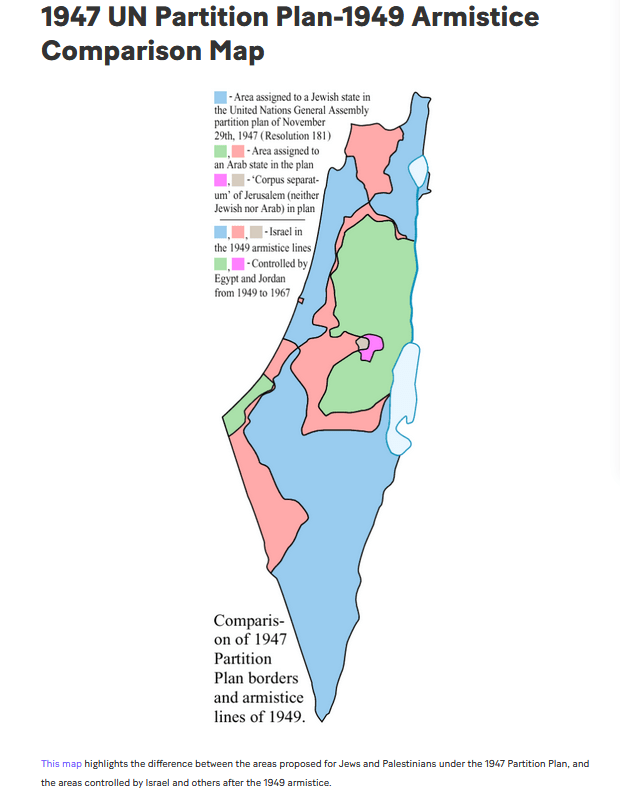
3. Even if they had accepted the (bad) principle of partition, why would the Palestinians accept such an unfair partition, in which the one third Jewish population were awarded 56% of the land and the two thirds Palestinian population only 43% (with one percent the city of Jerusalem)? In which Palestinians would have been a majority of the population even in the ‘Jewish state’, ie a state they would have no rights in (much the same situation likewise existed for Greek Cypriots in the ‘Turkish’ Republic of Northern Cyprus and Bosnian Muslims in the ‘Serb’ Republic in Bosnia).
What is not widely known is that in 1946 the Arab governments had proposed an alternative plan to partition: a united democratic state where “all citizens would be represented in the guarantee of civil and political rights” where Jews would have a “permanent and secure position in the country with full participation in its political life on a footing of absolute equality with the Arabs.” The Zionist movement and its imperialist and Soviet backers rejected this in favour of a brutal and unequal partition, yet it is the Palestinians that should be punished by losing even more land.
The Nakbah that Israel launched following (and preceding) the Palestinian rejection of partition of their land involved massive ethnic cleansing, a string of some 70 horrific massacres and and the destruction of 530 towns and villages, killing 15,000 Palestinians; the 750,000 Palestinians ethnically cleansed were never allowed to return, despite UN Resolution 194 of 1948 which demands it; they and their descendants now number nearly 10 times that figure.
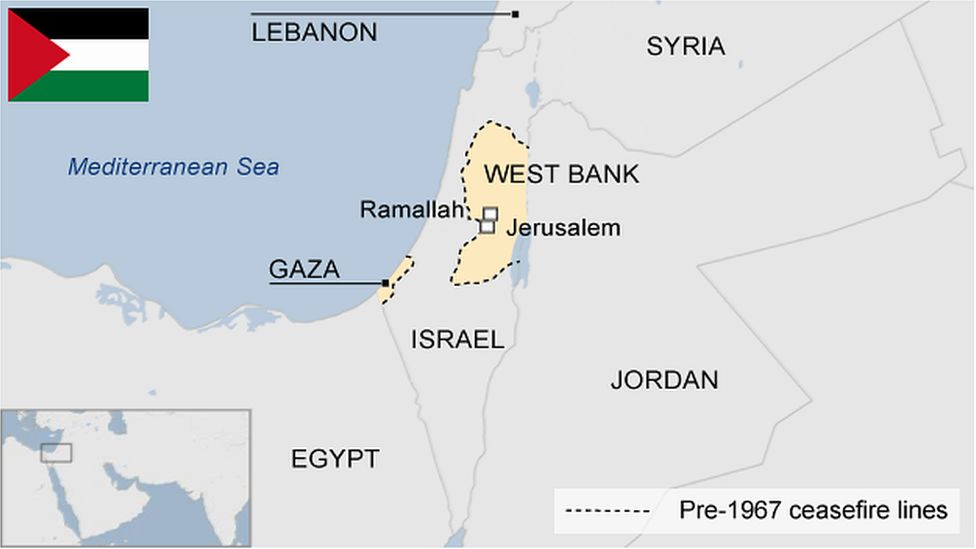
In response to the Nakbah, a number of semi-feudal Arab states made a weak attempt to protect the ‘Arab state’ by sending in troops; the Zionist assertions that the Nakbah was ‘in response’ to this ‘Arab invasion’ are belied by simply chronology: take the most well-known event in the Nakbah, the Zionist massacre of Deir Yassin in Jerusalem (in which estimates from 107 to 254 Palestinian civilians were slaughtered) as a key example; the date was April 9, 1948; the state of Israel was declared on May 14, 1948, and only after that did the Arab armies enter to the UN-assigned ‘Arab state’. That is when Israel conquered half of that ‘Arab state’ and expanded its rule to 78 percent of Palestine (while of the remaining 22 percent, the West Bank – including East Jerusalem – went under Jordanian control and Gaza under Egyptian control, both conquered by Israel in 1967).
While the only logical solution is a democratic state for all who live there, Jews, Christians, Muslims, Israelis, Palestinians, one person one vote, together with right of return of Palestinian refugees, the PLO program since 1948, it is the ‘two-state’ solution, whereby Israel keeps its 78% and a state of Palestine is established on the 22% ‘occupied territories’, that has international support (except the US and Israel). Since there are around 7.1 million Israeli Jews and 7.4 million Palestinians now living between the river and the sea (not including the Palestinian refugees), this ‘two-state solution’ is manifestly unjust, yet despite this it is Israel that has always rejected it, and the Palestinian leadership which has accepted it (if combined with return of refugees to the 78% ‘Israel’ with equal rights there) since the late 1970s (as I have documented here).
But in reality, given the roughly equal population numbers, if there were to be a two-state rather than one-state solution (if the latter is impossible to achieve in the short-term), surely a roughly 50/50 split – something closer to the 1947 plan but improved – would be manifestly fairer. Yet the completely just and logical Palestinian rejection of partition in 1947 is today cited as a Palestinian ‘original sin’ that can never be returned to as Israel naturally had the ‘right’ to violate UN Resolution 181 by seizing 78% of Palestine with gruesome violence and terrorism. Think about – where is the logic?
 Their Anti-imperialism and Ours