by Michael Karadjis
Note the date:
“HUWARA, West Bank, Oct 6 (Reuters) – A Jewish settler killed a 19-year-old Palestinian during a settler attack on the occupied West Bank town of Huwara on Friday, the Palestinian Health Ministry said. Residents said a group of settlers had erected a tent in Huwara, held prayers and later marched through the town. Some of them were carrying arms and began vandalising shops and cars, they said. One of the settlers shot university student Labib Dumaidi, who later died of his wounds in hospital, the residents said.”
As this settler murder was a rather run-of-the mill event in occupied Palestine, clearly there was no “ceasefire” for Palestinians on October 6.
What they mean is that there was a ceasefire for Israelis on October 6, and before. Of course there has been no ceasefire for Palestinians since 1948, when they were ethnically cleansed from their homes and land to create a Jewish state on their land, at a cost of 15,000 Palestinians killed by Zionist terror gangs, something, understandably enough, they have never accepted; the process then continued after 1967 in complete international illegality (despite the lack of any international sanctions) in the West Bank, Jerusalem and Gaza; and has been ongoing ever since. And since these territories conquered in 1967 are recognised by international law to be under illegal occupation, then resistance, including armed resistance, of the occupied Palestinian people is recognised as their legal right; clearly, if another country is illegally occupying yours, there is by definition no “ceasefire.”
But since that begins a long way back, and is such a sweeping picture that many simply refuse to accept the reality that dispossession, occupation, ongoing land theft, apartheid and complete Israeli impunity over Palestinian life is no “ceasefire” and leads naturally to armed and civil resistance, let’s begin a little closer to the date, the last 20 years for example.
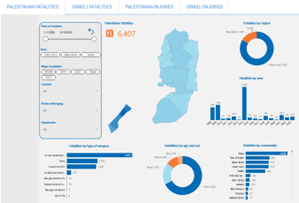
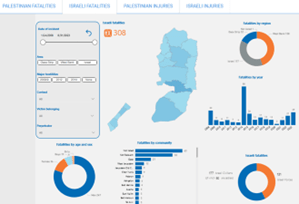
In the last 20 years, the number of Palestinian civilians killed (4331) is over 22 times the number of Israeli civilians (195) within this just war of resistance against occupation (much the same for total casualties, 6936 Palestinians versus 330 Israelis or 21 times); thus even if we make the caveat that the right of armed resistance does not give that resistance the right to target civilians, then Israel is 22 times more guilty than the Palestinian resistance of such violations, and needless to say killing thousands of Palestinian civilians does not make the period a “ceasefire” for them. Even during the Hamas suicide attacks in the early 2000s, the numbers of Palestinians killed was double, triple or quadruple the numbers of Israelis; and starting from 2004 when these attacks declined then ended completely in 2005, and thereafter, as the number of Israeli casualties reduced to close to zero, the number of Palestinians killed increased dramatically, as the first chart below shows:
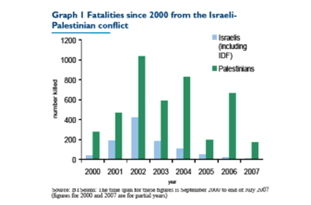
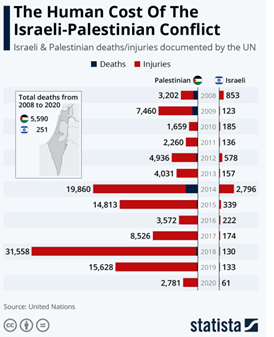
Source: https://www.un.org/unispal/document/auto-insert-208380/; the situation is even worse when we look at injuries, which demonstrate even more the ongoing, daily abuse of Palestinians, Source: http://web.archive.org/web/20240105033037/https://www.statista.com/chart/16516/israeli-palestinian-casualties-by-in-gaza-and-the-west-bank/
These killings include such major Israeli atrocities in Gaza as Operation Cast Lead in 2008-2009, when Israel killed some 1400 Palestinians, 82 percent of whom were civilians, and as usual massively attacked human infrastructure, with egregious crimes including the killing of entire families, attacks on schools, use of white phosphorous, and killing of civilians carrying white flags; Operation Pillar of Defense in November 2012, which killed 167 Palestinians, “including at least 87 who did not take part in the hostilities, 32 of whom were minors;” Operation Protective Edge in 2014, when Israel killed 2250 Palestinians, two-thirds civilians, including 551 children, and injured 11,231, including 3,540 women and 3,436 children, mostly civilians, while in addition “118 UNRWA installations were damaged, including 83 schools and 10 health centres,” and “over 12,600 housing units were totally destroyed and almost 6,500 sustained severe damage,” while another 150,000 were rendered inhabitable, and 500,000 were internally displaced; Israel also massively attacked Gaza’s water and power infrastructure, with long-term consequences as the blockade made repairs almost impossible; the Great March of Return in 2018-19, when thousands of Palestinians daily rallied peacefully next to the Israel-Gaza fence and Israel’s response was to shoot to kill and maim, with 266 Palestinians massacred, including 50 children, while over 30,000 were wounded, including 3000 children, with special focus on the knees leading to a spike in amputations; 2021, which killed 261 people, including 67 children, wounded over 2,200, destroyed or damaged over 1770 housing units, while 290 water infrastructure “objects” were damaged, leading to “untreated sewage flowed into the streets, lakes, and sea.” And this is all in the context of the Israeli air-land-sea blockade of Gaza, the impact of which on Palestinians’ access to food, water, medical care and the ability to have any kind of economy has been widely documented, the UN describing Gaza under its impact as “unliveable.”
None of this suggests any “ceasefire” in the last 20 years before October 7. But once again, some may still find this too large a sweep to accept that the reality for Palestinians was anything but ceasefire. So, once again, let’s narrow the picture further, to just 2023.
Before October 7, 2023, 234 Palestinians had been killed by Israeli forces in the West Bank since the beginning of that year, and another none were killed by “settlers,” including 41 children. By the end of 2023, this figure had doubled to 507, including 81 children, making it “the deadliest year for Palestinians since the United Nations Office for the Coordination of Humanitarian Affairs (OCHA) began recording casualties in 2005.” This was up from 155 killed in 2022, already the highest figure since 2005. By August, the number of Palestinians injured with live ammunition in the West Bank stood at 683, more than double the 2012 figure of 307. There were an average of 95 monthly settler attacks on Palestinians in 2023, up from 71 in 2022.
Let’s look at some major cases of non-ceasefire from 2023.
On January 15, the IOF shot 14-year old Omar Khaled Lutfi Khmour in the head, killing him, in a pre-dawn raid on Dheisheh refugee camp in Bethlehem, the fourth child, and 14th Palestinian, to be killed already in the first two weeks of the year.
On January 26, the IOF invaded Jenin refugee camp, killing 10 Palestinians, including a 61-year old woman, and wounding another 20. Bottom of Form
An ambulance driver attempting to get to the wounded was shot at and prevented from approaching.
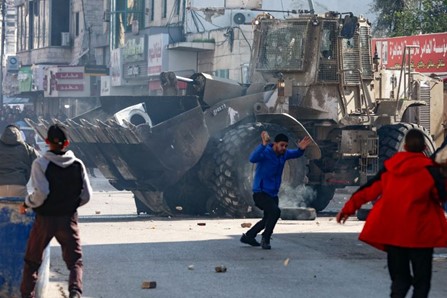
Ceasefire? Israeli forces raided the Jenin camp, January 2023 [Zain Jaafar/AFP]
On February 23, the IOF raided an apartment block in Nablus, killing 11 people, including a 72-year old, and wounding over one hundred civilians with gunshots, the IOF claiming to be hunting three resistance fighters. Video shows IOF killers shooting an unarmed man running away, and an Israeli military vehicle plowing into a crowd.
On March 2, the IOF raided Nablus city centre, killing 6 resistance fighters, and 4 civilians, including a 16-year old boy.
On March 16, the IOF killed 2 men and a 16-year old boy in Jenin by firing on their car; the three had been prisoners in occupation jails who were recently released, while another 14-year old boy who had been shot days earlier also died.
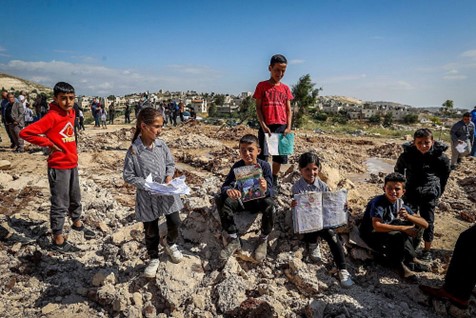
On May 7, the IOF demolished the Palestinian primary school in Jib al-Dib, an “unrecognized village” near illegal Israeli “settlements” in Area C of the occupied West Bank. The school was attended by 40 children aged 6-10. Before the school was built, children in Jib al-Dib had to walk an hour each way to school. The school was constructed by the Palestinian Authority without the permission of the illegal occupation authorities, who reject around 99 percent of such requests in Area C. The EU, which had funded the project, condemned the demolition and said it was “appalled,” empty words Palestinians are used to hearing.
On May 9, the IOF attacked Gaza in a firefight with Palestinian resistance fighters; of the 33 killed, 13 were civilians, including “four girls, three boys, four women and two men,” according to the UN, while 6 were known to be fighters, the status of the remainder unconfirmed. Al Mezan, a Gaza-based human rights organisation, said the IOF had Israel “destroyed nearly 60 residential units, displacing almost 375 people, around a third of them children.” Israel also banned fuel for Gaza’s powerplant, forcing the closure of water treatment plants which caused 120,000 cubic meters of untreated wastewater to be discharged into the sea, while medical facilities and schools were also damaged by the strikes.

On May 22, extreme right-wing Minister of National Security Itamar Ben-Gvir stormed the al-Aqsa mosque in Jerusalem with dozens of Israeli settlers, guarded by Israeli cops, who also restricted entry to Palestinians. In early June Ben-Gvir called on illegal settlers to take over the territory and kill dozens, hundreds or thousands of Palestinians, as necessary.
On June 19, Israel again invaded the Jenin refugee camp, backed by air strikes from helicopter gunships for the first time in 20 years in the West Bank, killing 5 and injuring 91 Palestinians. Once again ambulances were attacked as they came to the rescue.
On July 3, the IDF again invaded the Jenin camp, with over 1,000 troops “backed up by Shin Bet intelligence agents, Magav border police, armed drones, helicopter gunships, armoured personnel carriers and armoured bulldozers,” killing 13 Palestinians and wounding over 100.
On August 4, these near-daily Israeli atrocities were becoming so blatant that even the US State Department used the terms “terror attack” and “violent extremism” to describe the murder of 19-year old Palestinian Qusai Jamal Maatan, near Ramallah, by settler fanatics who stormed his village.
According to the UN, “On 10 August, an Israeli undercover unit raided Nablus city, where an exchange of fire with Palestinians ensued, killing a 23-year-old Palestinian man. On 11 August, Israeli forces raided the Tulkarm Refugee Camp and shot and killed a 25-year-old Palestinian. At least three others were also injured, including two by live ammunition. According to a human rights organization, the man killed was not involved in the exchange of fire between Israeli forces and Palestinians. On 15 August, Israeli forces shot and killed two Palestinians including one 16-year-old child, during a search-and-arrest operation in Aqabet Jaber Camp Refugee Camp (Jericho).”
In the same report, the UN reported that “on 21 August, Palestinians demonstrated along Israel’s perimeter fence marking the 54th anniversary of burning Al-Aqsa Mosque. Palestinians burnt tires and threw stones and explosive devices towards the Israeli fence. Israeli forces shot live ammunition, rubber bullets and teargas canisters, injuring 19 Palestinians, including 12 children.”
On September 24, two Palestinians were killed when the IOF attacked Nour Shams Refugee Camp near Tulkarem in the northern West Bank.
And so on. These are just the killings – it would be difficult to document all the land seizures, destruction of housing and infrastructure, arbitrary arrests, home raids, endless harassment at checkpoints that have all been part of Palestinians’ daily lives for decades but which have increased sharply in 2023. In August 2023, the Norwegian Refugee Council produced a report on the forced displacement of Palestinians from their land which stated that “entire Palestinian communities [are] being wiped off the map.”
Obviously, none of this sounds much like “ceasefire.” And if even this picture of the whole of 2023 is still not convincing, let’s return to the beginning, to October 6:
“HUWARA, West Bank, Oct 6 (Reuters) – A Jewish settler killed a 19-year-old Palestinian during a settler attack on the occupied West Bank town of Huwara on Friday, the Palestinian Health Ministry said. Residents said a group of settlers had erected a tent in Huwara, held prayers and later marched through the town. Some of them were carrying arms and began vandalising shops and cars, they said. One of the settlers shot university student Labib Dumaidi, who later died of his wounds in hospital, the residents said.”
Obviously, both armed and civil resistance are justified against violent occupation, and when the occupier is killing you every day to facilitate ongoing land theft, you have every right to fire back. Far from October 7 breaking a “ceasefire,” it is clear from this brief summary that it was merely a continuation.
One might say that the right to armed resistance against a brutal, murderous occupation regime does not justify the likewise brutal large-scale slaughter of Israeli civilians as occurred on October 7, and most would agree [and it is a secondary question whether that was the intent of the al-Aqsa Flood operation on October 7, which goes against the evidence I am aware of, or rather was an unintended consequence as hundreds of brutalised-from-birth Palestinians broke out of the cage they were locked in all their lives and turned brutaliser]. But if we agree that civilians should not be killed in military operations, surely that applies over 20 times as much to the Israeli occupation regime for the two decades (at least) prior to October 7, given the data above? And given that Israel’s so-called “response” has killed 40-50 times as many Palestinians since October as Israelis who were killed on that day, let alone the deliberate destruction of everything necessary for human life in Gaza and Israel’s policy of deliberate starvation, then it should also apply dozens of times more to Israel?
October 7 was not the end of a ceasefire, it was a continuation of decades of anything other.
 Their Anti-imperialism and Ours