By Michael Karadjis
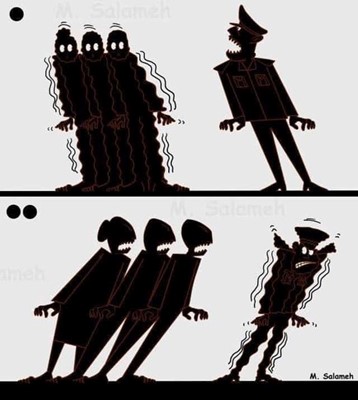
“We’re not asking for much, just the fall of the regime.”
This is one of the slogans being raised in the wave of mass protests currently rocking Syria, in a stunning rebuke to the narrative that the 2011 revolution has been extinguished.
As Syrian activist Leila al-Shami puts it:
“These courageous women and men across the country have shown that the regime cannot bomb, starve, torture, gas and rape the Syrian people into submission. Despite everything they have been through, and in the absence of meaningful solidarity with their struggle, the dream of a free Syria is alive.”
From mid-August, from its epicentre in the southern Suwaida province, dominated by the Druze religious minority, the demonstrations have spread, first to neighbouring Daraa, where the 2011 revolution began, to Damascus towns and suburbs, to 55 locations in the south, and then to regime-held Aleppo in the north. The upsurge has even spread to the traditionally pro-Assad province of Latakia, heartland of the Alawite religious minority; leading to solidarity demonstrations in opposition-held Aleppo, Idlib, Azaz, al-Bab, Raqqa, Hassakah and Deir Ezzor.
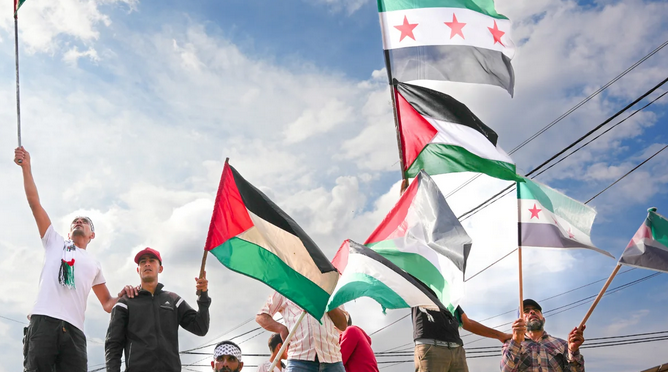
Protestors hold high the 3-star flag of the Syrian revolution (Syria’s independence flag). Regime and Baath Party buildings have been attacked; on September 4, protestors in Suweida destroyed and trampled on a statue of Syrian dictator Bashar al-Assad. Both Suwaida and Daraa have been hit by general strikes since August 20, forcing government offices to shut, blocking every road to Damascus while demanding the fall of Assad’s regime.
The tradition of mass Friday protests, which began in 2011, has returned, with August 25 Friday protests throughout the country demanding “Accountability for Assad” and “We want the detainees!”, referring to the 130,000 people detained in Assad’s torture chambers or “disappeared,” often since 2011 or even longer. The next Friday, September 1, saw protests grow from hundreds to thousands. “Come on, leave Bashar!” thousands chanted in central Suwaida.
While the regime so far has avoided massive repression of the kind that it met the 2011 upsurge with, nevertheless there have been clashes and regime killings, particularly in the Damascus suburbs, Daraa and Aleppo. Following protests in the Daraa town of Nawa on August 21, when roads were blocked with burning tyres, the regime used gunfire and mortar shelling against protestors and local neighbourhoods. By the end of August, 57 civilians had been arrested just in Daraa, according to the Syrian Network for Human Rights.
Meanwhile, the regime and Russia continue to bomb opposition-controlled Idlib and regions of Aleppo in the northwest. On August 23, civilians were killed by Russian airstrikes which targeted a water station near the village of Arri; three days later, two schools were bombed.
The immediate trigger for the uprising was the regime’s drastic cuts to fuel subsidies which more than doubled the cost of fuel. Over 90 percent of the population already lives in poverty, and the continued rise in the cost of basic goods stands in sharp contrast to the obvious wealth of regime-linked cronies and capitalists. Rising fuel costs and the collapse of the Syrian currency make the cost of everyday goods and transport impossible. One sign held by a demonstrator read “a hungry people does not eat rocks, it eats its rulers.”
The protestors have no doubts about who is responsible: the regime which destroyed the country, its cities, its housing, hospitals, schools, water plants and other basic infrastructure, while refusing to reconcile with the peoples of the two regions outside its control, in the northwest and northeast, the latter including significant resources.
Does the current uprising have the potential to lead to a new chapter in the Syrian revolution which began in 2011? In fact, this is a continuation of that same revolution, and a rejection of the narrative that the regime crushed it.
Off course the regime largely defeated the military aspect of the revolution via massive bombing of population centres with cluster bombs, barrel bombs and missiles, widespread use of chlorine gas and even sarin, targeting of hospitals, schools, markets, bakeries, apartment buildings and refugee camps, turning Syrian cities into moonscapes, and the truly extraordinary scale of incarceration, torture and disappearance. With the aid of Russian bombing, Iranian-backed militia and US facilitation, the regime eventually recaptured most of the regions that had been taken by the armed opposition.
However, revolution was never synonymous with armed struggle. In the first six months of 2011, the upsurge was like now – mass peaceful demonstrations calling for the overthrow of the regime. From the first days they were met with massive repression, and this large-scale killing of protestors, and torture of those detained, drove the revolution forward. But this inevitably forced the movement to arm itself in self-defence, and the Free Syrian Army (FSA) arose, forcing the civil movement into the background.
Forcing the opposition to take up arms was a strategic decision for the regime, knowing the rebels could never match the regime’s killing machine.
Assad’s other weapon was sectarianism. Throughout 2012, the regime unleashed sectarian militia known as ‘shabiha’, based among Assad’s Alawite community, against Sunni Muslim towns and villages, where they would massacre dozens or hundreds of people, inflaming a sectarian response among part of the opposition, leading to the rise of specifically Islamist militias alongside the FSA. Later these included hard jihadist militia such as Jabhat al-Nusra, which was until 2016 affiliated to al-Qaida.
This allowed the regime to intensify repression by claiming the mantle of the US-led “war on terror,” and also allowed it to claim to be the protector of religious minorities – Christians, the Alawite population of the coast, and the Druze – against “jihadi terrorism,” a label it used for the entire opposition.
The entry of the Islamic State (ISIS) into Syria from Iraq with its barbaric reign of terror allowed the regime to further consolidate this discourse, even though both the regime and ISIS spent most of their energy fighting the FSA and other rebels rather than each other.
Nevertheless, any time there was a temporary ceasefire, the liberated regions witnessed people pouring into the streets with the same slogans as in 2011, against the regime but also against jihadist forces like HTS. This was the clue that the revolution lived on.
So can Assad use his two key weapons – massive repression, and sectarianism – to save his regime this time?
It may seem surprising that the regime has not so far fired into the crowds as in 2011 and beyond. Partly, the regime may simply hope for some steam to be let off before the movement subsides; knows from experience that extreme repression may be counterproductive.
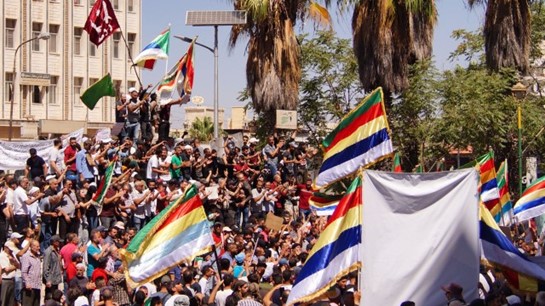
But there is a specific aspect to this uprising that makes direct repression more risky for the regime: the fact that its epicentre is in the minority Druze region of Suweida. The Druze flag today flies next to the flag of the revolution. According to Leia al-Shami, the revolution flag was raised at the tomb of Sultan Prasha Al Atrash, a Druze hero of the anti-colonial struggle against France.
Not that Suweida was ever quiet or pro-regime. It witnessed many anti-regime outbreaks, but they were not aimed at overthrowing the regime. They broke out in opposition to moves by the regime to violate Suweida’s declared neutrality, by trying to recruit from the region or make the Druze fight the rebels. Druze leaders called on soldiers to desert the army, and opposed deployment of Assad’s military to Suweida, insisting only local troops protect the region from possible jihadist attack. Protests also erupted in 2015, when Wahid al-Balous, a leader the anti-Assad Sheiks for Dignity, was killed in a car bomb, which locals blamed on the regime.
On July 25, 2018, ISIS entered Suweida and carried out a horrific massacre of 273 Druze civilians. The night before, the checkpoints of the Syrian army around Suweida had been withdrawn, and electricity and telephone services cut off. This came just after Druze leaders rejected pressure to join the Russian-led 5th Corp in the region.
While the regime’s complicity only led to more hate for it, the very danger of ISIS played into the regime narrative of the Sunni extremist danger to minorities.
Therefore, now that the Druze are leading the uprising, the basis of the regime’s narrative is dust. And it will be even more so if the regime employed the kind of terror it used for years against the mostly Sunni-based uprising.
While Suwaida and (largely Sunni) Daraa have always had good relations, there is good reason for tension with Idlib in the northwest, currently ruled by the Salvation Front (HTS), a hard-Islamist coalition led by the what was once Jabhat al-Nusra, because Nusra harshly oppresses the small local Druze population there.
The revolution, however, is not HTS. Demonstrations in Idlib and rural Aleppo towns like Atareb raised the cry, “We say to Suweidah, we are with you to the death, to Daraa, we are with you to the death!” This was met with a loud response from Suwaida: solidarity with Idlib “until we die.”
“One, one, one, the Syrian people are one,” is a leading chant throughout the country, sending the message that the people will not let the regime (or the likes of HTS) divide them again.
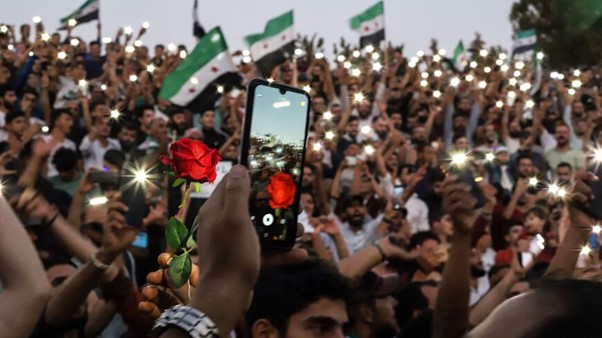
The powerful show of two-way solidarity between the peoples of Suwaida and Idlib has the potential to pressure HTS to end its oppression of the Druze. In Idlib and neighbouring Atarib, Druze and Kurdish flags have been raised alongside the revolution flag.
The Druze are also a powerful minority in Lebanon, which has largely stood in solidarity with the anti-Assad uprising; this may limit the ability of the regime to use Lebanon’s Hezbollah against the Syrian Druze.
The largely Druze population in the Israeli-occupied Golan have also come out in the streets demanding the overthrow of Assad. “Oh Houran, we are with you until death,” chanted the people of the town Majdal Shams. The Golan Druze have never been reconciled with Israeli occupation, but have been divided between pro-Assad and pro-opposition sections of the population. So the Druze leadership of the Syrian uprising has the potential to link up with the anti-occupation movement there.
The Druze minority in Israel itself has traditionally been pro-Israel, but has become markedly more alienated since Netanyahu passed the 2018 law declaring Israeli the “nation-state” of the Jews. The anti-sectarian nature of the current uprising therefore has regional implications.
This also means that Assad cannot rely on even the Alawite heartland. Reportedly, 22 people have been arrested in Latakia following calls from within the Alawite community for Assad’s fall. One of them is Ayman Fares, who released a viral video blaming the regime for the disastrous economic situation, even accusing Assad and his wife Asma of stealing aid sent to earthquake victims. He was arrested trying to flee to Suwaida.
According to Robin Yassin-Kassab, “the regime tried to organise a pro-regime rally in Alawi-majority Tartus, but it didn’t work out. There were almost no volunteers, only a few rich kids in nice cars.”
Leaders of the other large minority, the Kurds, have also declared solidarity with the uprising. Both the Syrian Democratic Council (MSD) – which runs the Autonomous Administration of North Syria, outside regime control, affiliated with the Syrian Democratic Forces (SDF) – and the rival Kurdistan National Council, issued statements supporting the uprising. “The government in Damascus produces no solutions in the face of this dangerous situation at a time of widespread poverty, corruption, and economic crisis,” declared the MSD.
In 2011, Arabs and Kurds across the north joined together in the anti-Assad uprising. However, the Democratic Union Party (PYD), which dominate the MSD, took a similar neutral stance to the Suwaida Druze leadership, while carving out their own Kurdish space in the northeast. Once ISIS invaded, its main concern was defending themselves, entering a long-term alliance with the US air war on ISIS.
The common stance of the two Kurdish bodies again shows neutrality is not an option. In the case of the MSD, however, this has been complicated by an uprising of the Arab population of Deir Ezzor, an Arabic region under the control of the largely Kurdish SDF. The causes are complex, but the Deir Ezzor Arabs are very anti-Assad, suggesting the regime will not be able to exploit the situation.
This upsurge also features a striking presence of women playing leading roles. This is again reminiscent of 2011, but years of regime massacre, rape, torture and disappearance, and the descent into armed conflict, drove women from the frontlines – though, as Syrian activist Leila Nachawati notes, women remained “a fundamental part of the resistance, and they have continued to be in other elements of life since the civil disobedience movement of 2011.” Pointing to the prominent role of women, of the villages, and of local Bedouins, Suwaida writer Hafez Karkout states the current upsurge has “brought in new segments—all parts of society have gotten involved.”
All these factors point to a potentially even broader movement than in 2011, and one with the hindsight to avoid past mistakes. This makes it harder for the regime to crush with weaponry or sectarianism. But can it lead to the regime’s overthrow?
We have no crystal ball, and pessimism must be avoided at the moment when thousands are potentially putting their lives on the line. At the same time, it is important to note objective difficulties as well as the strengths.
In the view of the pro-opposition Syria TV, “the ongoing protests may continue and even intensify, but it’s unlikely they will culminate in a revolution like the one in 2011. The current Syrian population is burdened with profound pain, hunger, and loss.” While the outbreak has been sparked precisely by the regime’s economic measures driving the population further into poverty, nevertheless, a situation of near-destitution, combined with defeat and unimaginable trauma, are often not the best conditions for successful revolution; daily struggle for survival dominates.
The site adds, “a revolution typically requires the involvement of a middle class to lead it effectively, yet Assad systematically eliminated emerging leaders and depleted Syria of its potential future leaders.” Indeed the systematic destruction of the intelligentsia, activist leaders, teachers and anyone raising their head was deliberate regime policy; thousands more fled abroad. At the same time, new leaders can arise from movements such as this.
Swiss-Syrian researcher Joseph Daher claims that while “you have forms of solidarity from other cities,” the movement would only threaten the regime if “there were collaboration between (protesters in) different cities.” This again points to the need for coordination, difficult in conditions of harsh dictatorship and where so much of the previous leadership has been eliminated.
The working class and semi-proletarian suburbs and outskirts of the two major cities – centres of the revolution – have been devastated by years of regime bombing. Meanwhile, the more formal sectors of the working class are under totalitarian control and surveillance: while the regime has not yet met the protests with terror bombing, Syrians know what it means to be arrested, jailed or ‘disappeared’.
These are genuine obstacles; but the movement provides hope. Success and failure will also greatly depend on, and in turn impact, the region-wide movement for liberation that began in early 2011.
 Their Anti-imperialism and Ours