By Michael Karadjis
Contents
Introduction
A reality check on who is “winning” and “losing” – based on Israel’s actual aims
Israel’s genocidal war: Zionist ‘victory through ceasefire camp’ versus Zionist extermination camp
Palestinian unity gathering in Beijing
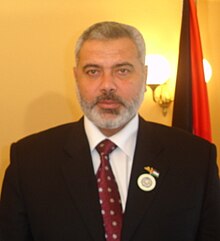
Who is Haniyeh and why assassinate him?
Haniyeh and the Syrian revolution
Will Iran retaliate?
So was that Hezbollah’s retaliation? Israel and Hezbollah both claim victory!
Did the “resistance axis” inadvertently encourage Hamas into disaster, and did Hamas act on this basis?
*********************************************************************************************************
Introduction
On July 31, Ismail Haniyeh, the political leader of Hamas, was assassinated while in Tehran for the inauguration of new Iranian president Masoud Pezeshkian, which was also attended by some 70 delegations including from regional heavyweights Turkey, Egypt, Saudi Arabia and Qatar, as well as representatives from the European Union, China and Russia.
The brazen nature of the act, the violation of Iran’s sovereignty at such an important occasion, and the stature of Haniyeh in the region – as we will see, a voice of strategic moderation within Hamas with a long diplomatic presence in the region – led the 57-nation Organisation of the Islamic Conference (OIC), meeting in the Saudi capital Jeddah on August 7, condemned the attack, to declare it “holds Israel, the illegal occupying power, fully responsible for the heinous attack.” Saudi Arabia a declared it a “blatant violation of Iran’s sovereignty;” Qatar, where Haniyeh lived and Hamas headquarters are based, condemned the “heinous crime” and “shameful assassination;” Turkey’s President Erdogan condemned the “perfidious assassination” of his “brother” Haniyeh, who regularly visited Turkey, the state declaring a day of mourning.
Given the need for high security around a figure such as Haniyeh, he was sleeping in the most secure compound, where only a number of officials from the Iranian Revolutionary Guard were also located. Despite this, the assassins – presumed to be the Israeli secret police agency Mossad – were able to place an explosive in the room some months before, then set it off remotely once it was confirmed to them that Haniyeh was indeed there.
Such a feat is a severe humiliation to the Iranian regime, and has, not surprisingly, led to conspiracy theories that some part of the Iranian state apparatus conspired with Israel to kill Haniyeh; either due to nefarious collusion between the reactionary, semi-theocratic regional projects of Israel and the Iranian regime, who, from differing perspectives, benefit from keeping the region boiling as long as the necessary retaliation and counter-retaliation can be kept within certain limits; or due to hard-liners with the Iranian regime aiming to embarrass and disrupt the plans of the new ‘reformist’ Pezeshkian, whose stated aim was to try to re-open to the West and explore restoration of the Iran nuclear agreement which was scrapped by Trump in 2018. Interestingly, this would correspond to an Israeli aim, because “Israel prefers hardline leaders to maintain a monolithic view of the enemy,” its assassination in Tehran forcing the reformist Pezeshkian “into a corner.”
More likely, as with most events that lend themselves to such theories (eg the alleged attempted assassination of Trump), incompetence within the Iranian intelligence regime is the simple explanation, alongside the extraordinary skills of Israeli intelligence – skills, ironically enough, which apparently were comprehensively absent on October 7, to name another such event …
The killing of Haniyeh came just a day after Israel had killed Hezbollah’s top military commander in Lebanon, Fuad Shukr, in a residential building in a heavily populated south Beirut suburb, a bombing attack that also killed three women and two children, while 80 people were injured.
Israel hypocritically claimed that the Lebanon attack was in revenge for the rocket that killed 8 Syrian Druze children and teenagers in the Israeli-occupied Syrian Golan Heights on July 27, accusing Hezbollah of firing the rocket; Hezbollah denies this, and instead claims they were killed by Israeli anti-missile interceptors. The jury is still out on that (and either way, clearly killing Druze children was not the aim but a misfire), but given that most of this Druze community (including all the affected families) have all rejected Israel’s “offer” of citizenship for 57 years now, and they abused and insulted Netanyahu and his fascist finance minister Smotrich when they attempted to turn up and give ‘condolences’, and they made explicit they do not want to be part of anyone’s games and especially that no other children should die on their account, Israel’s alleged excuse for the attack is razor-thin.
While the circumstances were quite different – Israel gave no excuse for killing Haniyeh, indeed has not even formally admitted it, but considers the killing of any Hamas operative a matter of course – the timing of one straight after the other has led to a regional stand-off, with both Iran and Hezbollah declaring the need for some kind of face-saving retaliation, which many worry could spiral out of control into a regional conflict.
**********************
I will go on record here – like every other time similar headlines have dominated the news-world in recent decades – to say that a regional blow-out is extremely unlikely, as will be explained below; the more theatrical ‘threat of World War Three’ I consider too fantastic to warrant any serious commentary, except to suggest that those spouting this cliche of doom every time tensions increase in the region might do better to remember that it already is a world war for the Palestinian people, and these constant suggestions that it is really about all of us under threat from a “world war” mainly serves to belittle what is actually going on.
***********************
A reality check on who is “winning” and “losing” – based on Israel’s actual aims
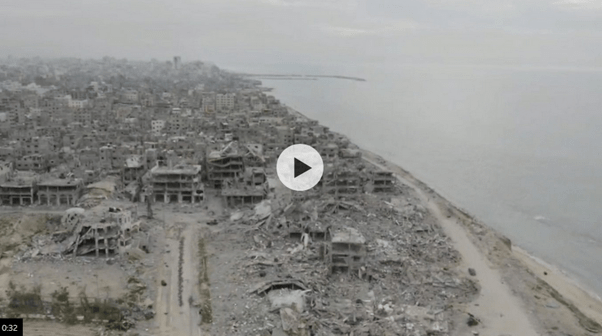
The context of course is Israel’s 10-month genocidal operation in Gaza, which aims to make Gaza uninhabitable, kill or drive out as much of the population as possible, ensure that whoever remains will find life impossible, re-occupy the territory or at least part of it, while also annexing more and more of the occupied West Bank.
The stated aim of “destroying Hamas” is an absurd smokescreen: like them or not, resistance organisations like Hamas exist due to decades of brutal occupation. Given Israel’s apocalyptic slaughter since last October, ordinary Gazans join Hamas and other resistance groups simply for self-defence, simply to resist the genocidal invasion; the fact that polls at the same time show Hamas drastically losing political support in Gaza (and in 1948 Palestine, yet gaining it in the West Bank and among Palestinian refugees in Lebanon) demonstrates that it is precisely continuing invasion and occupation that necessitates Hamas as a fighting force, whereas a permanent ceasefire would open political space for ordinary Gazans to challenge its rule.
Therefore, since Hamas only exists because of the horrifically oppressed and terrorised population it exists within, “destroying Hamas” effectively means continuing the war until the Gazan population is destroyed, but of course that is precisely the point: this is the actual aim.
While many analysts – from quite different, even opposing, perspectives – have continually claimed that “Israel is losing the war” or “Palestine is winning” because of the fact that Israel has not succeeded in destroying Hamas, they are therefore missing the point entirely: that is not its aim. If the killing of up to 186,000 people – 8 percent of Gaza’s population population (or perhaps even 300,000, 13 percent of the population) – the flight of at least 115,000 Gazans into Egypt – 5 percent of Gaza’s population – the displacement, often many times over, of 90 percent of the population, the destruction of two thirds of all buildings in Gaza, of almost all hospitals, of all universities, of water, power and sewage systems, the creation of 42 million tonnes of rubble that would take decades to remove, the mass spread of disease, including 40,000 cases of Hepatitis A, and now polio, the deliberate creation of famine, with child malnutrition rising 300 percent only between May and July, and WHO predicting more to die from these overall conditions than from bombs, represent “Israel losing,” then I sure would not like to see it winning.
Of course, Israel’s victory is not complete, because it has not been able to push 2 million Gazans into Egypt, the ultimate aim. This is due to both extraordinary Palestinian resistance, and to the fact that the Egyptian al-Sisi dictatorship rejects this Nakbah for its own reasons: namely, it does not want Palestinians in Egypt because it hates them as much as Israel does. If one wants to describe a, let’s say, 80 percent Israeli victory – the total obliteration of Gaza, setting it back decades, making it uninhabitable – as a Palestinian “victory” and Israeli “defeat” because Palestinian resistance has prevented a 100 percent Israeli victory, so be it; that’s a question of one’s criteria. If the intention is to validate the Palestinian resistance, then I believe it is overwhelmingly validated anyway by its prevention of the worst, by its prevention of total Israeli victory.
But that does not alter the fact that compared to the pre-October 7 situation, the Palestinian situation in both Gaza and the West Bank, and inside Israel, has been set back so drastically it is difficult to fathom. If we look at who are the net winners and losers since October 7, it defies logic to claim that Palestine’s situation today represents a net victory. If a ceasefire today led to negotiations on some kind of settlement, the Palestinian bargaining position, from the ruins of Gaza, is drastically weaker. The pre-war blockade of Gaza would continue, probably with a vengeance, and in addition Israel would almost certainly retain some degree of direct occupation of Gaza, especially in the emptied north, a strip across the centre and perhaps even in a ‘buffer zone’.
Both the preferred one-state democratic solution, and any half-decent version of the two-state solution, as well as refugee return, are further away than ever. Yes, the global pro-Palestine movement is extraordinary (though it has also plateaued) and is contributing to a change of consciousness in the West which may have future impacts, but this is a reaction to Israel’s decision to carry out genocide; it was not brought about by October 7, but on the contrary, came about despite it. October itself led to a wave of sympathy to Israel which has sustained the wave of Zionist McCarthyism in the West and the steadfast support for Israel among western governments for 11 months, and to the most complete reactionary consolidation within Israel itself ever.
Israel’s genocidal war: Zionist ‘victory through ceasefire camp’ versus Zionist extermination camp
That said, Israeli society is also in a sustained crisis. Israel’s acute economic crisis, business bankruptcy (especially in tourism and hospitality), the emigration of large numbers of middle class specialists to live out the war in the Greek islands and elsewhere, including many essential for Israel’s high-tech industries, the lack of Palestinian labour upon which so labouring work relies, a small yet important number of BDS successes, a crisis within the armed forces with exhaustion of troops and difficulty replenishing them, and Israel’s gradual loss of international legitimacy (though very few governments have broken relations with it), especially with the ICJ and ICC rulings, are causes for enormous concern among the Zionist mainstream; and of much excitement among pro-Palestinian, anti-Zionist movements worldwide. These are the very real factors cited by many mainstream Zionists opposed to Netanyahu’s extremism on the one hand, and many pro-Palestinian voices unwilling to criticise the dominant Palestinian narrative on the impact of October 7 (and even more so, acolytes of the so-called “axis of resistance”) on the other.
Without wanting to downplay any of this real crisis Israel is in, overwhelmingly its causes stem from Israel’s ongoing genocidal war of choice itself. And the longer it continues, the more these crisis factors will be accentuated, the more the Israeli regime threatens to turn its victory in obliterating Gaza into the kind of ‘defeat’ being warned of, but a self-imposed one.
Therefore, precisely because Israel has been in fact the net winner to date, a varied bloc of Zionist leaders more rational than Netanyahu and his neonazi coalition partners Ben-Gvir and Smotrich believe that Israel’s victory would be better consolidated by agreeing to the US plan for a ceasefire (ie, the Biden ceasefire plan announced in May, laughably called ‘Israel’s ceasefire plan’ by Biden, which was accepted by Hamas but reject by Israel), rather than pushing on with the most extreme and probably fantastic plans to complete the ethnic cleansing of Gaza (with the alleged fantastic aim of “destroying Hamas”) and thereby making Israel even more of a regional and international pariah, accentuating the economic and other societal crises and thus suffering losses medium to longer-term.
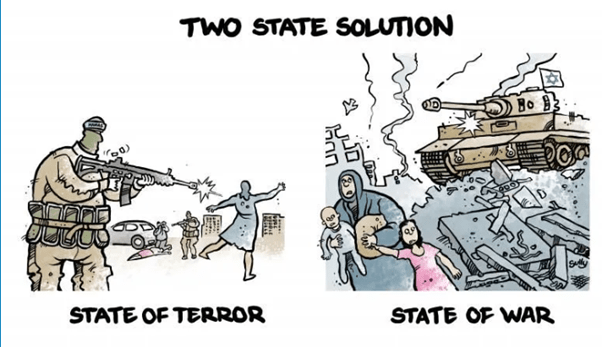
The US goal of bringing about a ceasefire – while refusing to put any pressure on its Israeli client to agree to one – is not to undermine Israel or aid Palestine. Rather, in recognition of how difficult and destabilisingly murderous it would be to complete the Netanyahu-Smotrich-Ben-Gvir strategy, and how the hatred of the Arab masses for their rulers for doing nothing to prevent it could lead to new revolutionary uprisings and completely alienate even these regimes from the US, the Biden administration calls for the revival of an extremely limited version of what it disingenuously calls a ‘two-state solution’, to provide some kind of limited self-rule for remaining Palestinians in a series of reservations.
This has nothing to do with the actual two-state ‘solution’ on the table since the late 1970s, which has for many decades now been accepted by the Palestinian leadership, all Arab governments, most governments of the Global South and eastern Europe, and officially the European Union, rejected only by the US and Israel. That is, for a sovereign Palestinian state in the illegally occupied West Bank and Gaza, with illegally occupied East Jerusalem as its capital, and some solution for the Palestinian refugee population. This ‘solution’ only gives a Palestinian state 22 percent of Palestine while leaving 78 percent for Israel – obviously, anything but a fair arrangement – yet the PLO and all Arab states officially accepted it in 1982 at the Fez Summit (and unofficially even earlier), and have continually reaffirmed it (eg, at the PLO Congress in Algiers in 1988, the fateful acceptance of Oslo in 1994 based only on never-fulfilled Israeli promises, in the Arab Peace Plan in 2002 etc) in the hope that it could be a transition to something better via refugee return to Israel and democratisation of Israel itself.
When Biden however talks of a ‘two-state solution’, he means not including Jerusalem, the natural geographic and economic centre of the West Bank, which the Trump regime recognised as Israel’s “capital” in 2017 (a decision not rescinded by Biden), and not including most of the illegal Israeli “settlements” in the West Bank, which physically divide up the territory, and probably without the usual features of sovereignty, such as the right to its own armed forces, and with the right of Israel to veto virtually any decision made within such a Palestinian ‘state’; a Palestinian ‘state’ governed by “a matrix of surveillance, separation and control.”
But the US and ‘centrist’ Israeli supporters figure that, given Israel’s complete destruction of Palestinian society and all that is necessary to sustain human life in Gaza since October 7, the Palestinians will have little bargaining power, and hence the return of some kind of stability, the ability to live without hell raining on their heads at every moment, together with some kind of limited self-rule, may be accepted, even as a reprieve, by enough Palestinians for it to get the blessing – and participation – of the reactionary Arab rulers; while ceasefire would allow the return of Israeli captives and of a semblance of normality in Israeli society.
For example, former Israeli prime minister Ehud Olmert argued in May:
“After more than six months of hybrid warfare – in the air, on land and underground – it’s possible to conclude that the bulk of Hamas’ military power has been dismantled. Most of its rockets and launch sites have been destroyed and there has hardly been any rocket fire from the Gaza Strip for over four months … A considerable portion of Hamas fighters has been killed, an accomplishment that is highly significant. These are not just its frontline combatants, but also members of its command level.
“However, there is one goal we have not achieved yet – releasing the hostages. This goal was not at the center of Netanyahu’s attention from the start, and he has apparently thwarted several opportunities to expand understandings brokered between Israel and Hamas and proceed to a comprehensive deal that would release all the hostages. Rafah is not a crucial objective that would decide the outcome of the fighting between Israel and Hamas.
“Taking Rafah has no strategic significance as far as Israel’s vital interests are concerned. Netanyahu understands this, as do some senior military officers and retired officers. Destroying four additional Hamas battalions might have been the correct move had it been disconnected from the wider context of events. But such a manoeuvre would take months and involve many fatalities among our soldiers, kill thousands of uninvolved Palestinians and crush what remains of Israel’s international reputation.”
This is quite a good summary of the position of more rational ‘centrist’ Zionist leaders, including much of the military high command; Olmert is no dove, indeed his 2006 war against Lebanon, and then Operation Cast Lead in Gaza in 2008-9, give him good standing as a Zionist war criminal, but one with a strategic sense of how far to go, which more or less coincides with the position of Biden and the mainstream of US imperialism (a Trump regime in the US may be an altogether different thing).
In August, US officials concluded that Israel had “achieved all that it can militarily in Gaza,” that it “had severely set back Hamas but would never be able to completely eliminate the group,” that it had “done far more damage against Hamas than U.S. officials had predicted when the war began in October.” Continuing the war would only kill more civilians with no significant further setback to Hamas, while the other alleged Israeli objective – the return of hostages – could only be achieved via ceasefire, not militarily. “Hamas is largely depleted but not wiped out, and the Israelis may never achieve the total annihilation of Hamas,” according to former senior C.I.A. official Ralph Goff.
Needless to say, the Netanyahu regime rejects these conclusions, because its objectives are the obliteration and emptying of Gaza, the re-occupation and perhaps even settlement of Gaza, while continuing the war on Gaza also acts as a smokescreen for the more important Zionist objective, the ethnic cleansing and annexation of much or all of the West Bank, aside from Netanyahu’s personal reasons for continuing the war to avoid going to prison.
Palestinian unity gathering in Beijing
Meanwhile, on July 23, 14 Palestinian resistance organisations, including Fatah, Hamas, the Popular and Democratic Fronts for the Liberation of Palestine, Palestinian Islamic Jihad and others, gathered in Beijing and signed an agreement to end their schisms and form an interim national unity government for the Palestinian territories. The Beijing Declaration states that the Palestinian organisations agree to forge “a comprehensive Palestinian national unity that includes all Palestinian factions under the PLO framework, and to commit to the establishment of an independent Palestinian state with Jerusalem as its capital … with the help of Egypt, Algeria, China and Russia.”
China has long had very good relations with Israel, and is its second largest trading partner, but since the onset of the Gaza genocide relations have frayed, as China, like Russia, seeks to maintain and increase its influence in the region, exploiting deep alienation from the US’s total and unconditional support for Israel. To that end, China seeks an opening for a role in the negotiation process, not so much for a ceasefire, but for the post-conflict arrangement. By bringing all the major Palestinian factions together under its aegis, based on the moderate and UN-consensus proposition of a Palestinian state next to Israel, and getting Hamas to place itself within “the PLO framework,” China establishes itself as an important player, while still maintaining its relations with Israel.
A look at the list of countries who attended the China-Palestine conference and allegedly took part in some fashion – Egypt, Algeria, Saudi Arabia, Qatar, Jordan, Syria, Lebanon, Russia and Turkey – shows a rather obvious omission of a major state: Iran.
A common misconception in much pop geopolitics has been that there is a ‘Russia-China-Iran’ alliance against ‘the West’ (and even more fantastic version is an imaginary ‘Russia-China-Iran-Hamas alliance’!), and that their ‘alliance’ with Iran is the reason Russia and China have taken some distance from Israeli actions since October, despite their very close relations with Israel before that. In reality, both are doing something quite different: aligning themselves with the Arab and Muslim mainstream, conservative regimes of the regional capitalist classes who oppose the destabilising impacts of Zionist extremism while also aiming for some kind of regional deal that secures their thrones and allows for a ‘peace process’ with Israel. The two-state solution has always been their chief policy weapon.
For example, in December 2022, Chinese President Xi Jinping received a lavish welcome in the Saudi capital Riyadh from Saudi ruler Mohammed bin Salman, where he also met other leaders of the Gulf Cooperation Council (GCC) countries, signing a joint declaration which, on one hand, supported the joint Arab position on a Palestinian state next to Israel, and on the other, also supported the joint Arab position that the three islands the Shah of Iran seized from the UAE in 1971 were occupied Emirati territory, leading to Iran summoning the Chinese ambassador to protest. In July 2023, Russia signed a similar declaration with the GCC supporting the UAE’s claims, likewise earning Iranian rebuke, and in December 2023 the Russian envoy was once again summoned for a “strong protest” by the Iranian regime when Russia again signed a joint declaration with Arab states in support of the UAE. As a notable aside, Russia’s Syrian satrapy, the Assad regime, despite also been quasi-allied to Iran, also signed the Arab League Summit declaration which affirmed the sovereignty of its close UAE ally over the islands, earning a harsh lashing in the Iranian media.
Thus, far from the Russian and Chinese position on Gaza being due to some ‘Iranian alliance’, on the contrary, Iran’s total isolation from the West means they can take it for granted. Like Russian and Chinese imperialism, the mainstream Arab states have little use for the shrill, while hollow, rhetoric emanating from the Iranian theocracy, which aims to use such rhetoric, from a safe geographic distance, as a means of rivalry for regional influence with these other states, though their relations have improved markedly over the last few years. Indeed, previous to the Beijing gathering, China had earlier scored a major regional diplomatic victory by bringing together rivals Saudi Arabia and Iran to restore relations in Beijing in March 2023.
Meanwhile, the other state obviously left out of Beijing was Israel, which vigorously denounced the declaration. With the US on one side, supported by the EU, attempting to align with a more rational Zionist bloc to pressure Netanyahu on a ceasefire and hostage release agreement, and the Beijing-led Palestinian factions, together with the Arab and Muslim regional mainstream, heading up the opposing negotiating position, two states, or at least parts of the regimes of two states, had an interest in messing with the arrangement: the Netanyahu-Smotrich-Ben Gvir regime in Israel, and the Iranian regime, or at least parts of it oppose to Pezeshkian.
Who is Haniyeh and why assassinate him?
When Haniyeh was killed, prime minister Mohammed bin Abdulrahman Al-Thani of Qatar – where Haniyeh lived and the Hamas political leadership is based – made the obvious point, “How can mediation succeed when one party assassinates the negotiator on other side?” Qatar, along with Egypt, has been a key mediator in the talks involving Israel, Hamas and the US for ceasefire and hostage release.
Of course, al-Thani’s question provides the answer: that was precisely one of Israel’s key aims in assassinating Haniyeh. No ceasefire, Israel continues to obliterate Gaza and exterminate its people. But it wasn’t just the fact that Haniyeh was the key negotiator for Hamas in these talks; it is also related more broadly to who Haniyeh was: the face of relative political moderation and strategic sense within Hamas, precisely what Israel sees as a threat.
Israeli leaders hated Haniyeh so much they have also murdered a dozen or so members of Haniyeh’s family, including his three sons, grandchildren, and his sister by deliberately bombing their homes in Al-Shati refugee camp in Gaza. Cambodia’s infamous Khmer Rouge made this feudal idea of murdering entire families of people they didn’t like like famous, so it is fitting that a Pol Potist Israeli regime follows up.
While Israel might claim it killed a “terrorist” responsible for October 7 atrocities in Tehran, it is well-known that neither Haniyeh, nor anyone in the external, political leadership of Hamas, had any prior information about October 7. The internal military leadership in Gaza kept the operation top secret – for obvious reasons – among a very small group of people, and the head of Hamas in Gaza, widely held to be the key leader behind October 7, was Yahya Sinwar – who Hamas has appointed as political leader to replace Haniyeh! This is a decision Israel will be very pleased with, as we will discuss below, but first let’s look a little more at Haniyeh and why Israel would want him dead.
Haniyeh was born in 1963 in Gaza’s al-Shati refugee camp, to where his family had fled during the 1948 Nakbah, when Zionist forces destroyed their village, Al-Jura (in Ashkelon in today’s ‘Gaza pocket’ in Israel). He joined the Islamic Resistance Movement (Hamas) in Gaza in 1988, and in 1993 became dean of the Islamic University of Gaza. By the early 2000s he had emerged as a key leader of Hamas in Gaza, particularly after Israel’s assassination of both Hamas founder Sheikh Ahmed Yassin and his successor, Abdel-Aziz al-Rantissi a few weeks later, in 2004. In 2006 Haniyeh led the Hamas ticket in elections to the Palestinian Authority, which emerged victorious over rival Fatah, and Haniyeh became Palestinian prime minister, as well as overall leader of Hamas in Gaza.
In these years of the mid-2000s, Haniyeh was associated with a marked moderation in Hamas’ official positions, a maturing that moved it away from the more extreme aspects of its ideology and practice. Despite originating as a religious-sectarian militia whose 1987 charter was full of antisemitic prejudice, as an organisation first and foremost dedicated to the liberation of the Palestinian people, the realities of Palestinian society eventually had an impact on the movement. This was all the more so in the 1990s as Hamas became the key vehicle to which militant Palestinians – not necessarily attracted to political Islam as such – drifted towards following the Fatah leadership’s Oslo capitulation in 1994 (the collapse of the Soviet bloc had also severely impacted the attraction of the Palestinian left). While Hamas retained a modified version of its rightwing Islamist ideology and certainly remained distant from leftist or socialist thinking, from the mid-2000s at least it became more useful to analyse it as a bourgeois-nationalist, national-liberation movement, rather than primarily as a religious-sectarian outfit. Indeed, the 2006 Hamas election ticket included women and even Christians.
Hamas first renounced its horrific suicide bombing strategy in 2003, briefly resumed it when Israel’s killings shot up unabated, then ended it completely in 2005. While the famous ‘Hudna’, or ceasefire, proposal, had already been put forward by Sheikh Yassin in the late 1990s, it was under Haniyeh at this time that it took on more of a public life. Basically the Hudna is the same as the two-state proposal, but with long-term ceasefire replacing full peace with recognition. Hamas stated that the armed struggle was necessary to liberate the West Bank and Gaza, but if a Palestinian mini-state were established there with Jerusalem as its capital, Hamas would institute a 10-year ceasefire with Israel which could be extended to decades if Israel kept the peace, during which time civil struggle would continue for Palestinian freedom (including return) in Israel. This went hand in hand with statements by Haniyeh, his ally and head of the Hamas political bureau Khaled Mashal, and other Hamas leaders that their struggle was against Zionism and occupation, not against Jews, who they did not want to “drive into the sea,” and this was later instituted into their new political program. Even the question of recognising Israel was declared “a decision for the Palestinian people” in Hamas’ 2006 draft government program.
If Israel wanted ‘peace’ and a ‘moderate’ Hamas, it had it; but that was precisely the problem for Israeli leaders; Hamas was only useful for Israel as an ‘extremist’ pole which could justify continued Israeli rejectionism; Israel was so terrified of peace that it assassinated Hamas mediator Ahmed Jabari in 2012 just after he received the draft of a permanent truce agreement with Israel, which he had been negotiating with Israeli mediator Gershon Baskin. Israel’s reaction was to lock up Gaza, where Hamas dominated, in a 16-year land, sea and air blockade, which reduced Gaza to conditions the UN described as “unliveable,” while regularly bombing the extremely densely packed sealed ghetto to ash and killing thousands of civilians. All this aimed, among other things, at the political regression of Hamas to what extremist Israeli leaders preferred as a ‘war partner’; and maintaining the division of 1967 Palestine between Gaza ruled by Hamas and the West Bank ruled by the pathetic PA.
While the October 7 attack may suggest Israel had succeeded in its aim of leading Hamas back to ‘extremism’ on the ground in Gaza by 2023, at the political level the new Hamas charter noted above, instituted by the Haniyeh-Mashal leadership, was published in 2017, many years into the blockade. Even on the ground in Gaza, the attempt to march peacefully against blockade and for return in the great ‘March of Return’ in 2018-19 indicated Hamas was still open to political struggle; this was met with mass Israeli killings of hundreds of Gazans, including dozens of children, while over 30,000 were wounded, including 3000 children; perhaps this was one of the points of no return.
While I cannot pretend to be any expert on likely differences within the Hamas leadership, it is enough that Haniyeh was widely known for his ‘moderate’ political acumen, whereas Sinwar – whether rightly or wrongly – has been demonised by Israel as an uncompromising “terrorist” who wants nothing but the “destruction” of Israel. It is unlikely that even Sinwar planned for his fighters and others to commit atrocities on October 7 – in secret correspondence obtained by the Wall Street Journal, Sinwar allegedly claimed that “things went out of control … People got caught up in this, and that should not have happened.” But that does not matter; the picture created by Israel is what counts.
This was enough reason for Israel to want Haniyeh dead – basically an announcement that Israel had no use for a ‘peace partner’ – and to be ecstatic about Hamas’ decision to appoint Sinwar as new Hamas leader. For Israel, this appointment allows it to claim that there is no point in any ceasefire or negotiations, as Hamas can only be a ‘war partner’ with Sinwar at its head, justifying its continued genocide operation full throttle.
That may suggest Hamas made a serious mistake in choosing Sinwar. A non-Palestinian writer in a faraway land is not someone to be making such judgements about a Palestinian organisation, rather, it is interesting to consider possible reasons for this choice. There may be two aspects. First, while it gives Israel carte blanche, it is not unreasonable for Hamas, indeed most Palestinians, to conclude that Israel has already shown over 10 months that it has no intention of negotiating for a ceasefire honestly anyway; choosing Sinwar may be intended as a statement recognising this Israeli deception, a statement of defiance. Secondly, while Haniyeh is widely respected for his negotiating role, within Gaza there is reportedly much unease with Hamas leaders who live comfortably in Qatar while Palestinians in Gaza live through hell, as a result of Hamas actions on October 7. While this can be considered unfair on a number of grounds – it was not Haniyeh or the Qatar-based leaders responsible for October 7, and it is essential for any military force to have a political and negotiating team – nevertheless in the circumstances a choice was made of a leader living in Gaza.
Sinwar’s first statements since taking over do not reject negotiations; while refusing to turn up to the umpteenth US-led “negotiations” with Israel as it slaughters greater and greater numbers of civilians, Sinwar’s leadership instead demanded that Biden’s July ceasefire plan, which Hamas had accepted but Israel rejected, be enforced. This implies continuity. On the other hand, the apparent suicide bombing in Tel Aviv on August 18 (which only killed the attacker), and Hamas’ claim of responsibility, could indicate that a Sinwar-led Hamas has given up on the necessary political side of the struggle, but so far this has not been repeated.
Haniyeh and the Syrian revolution
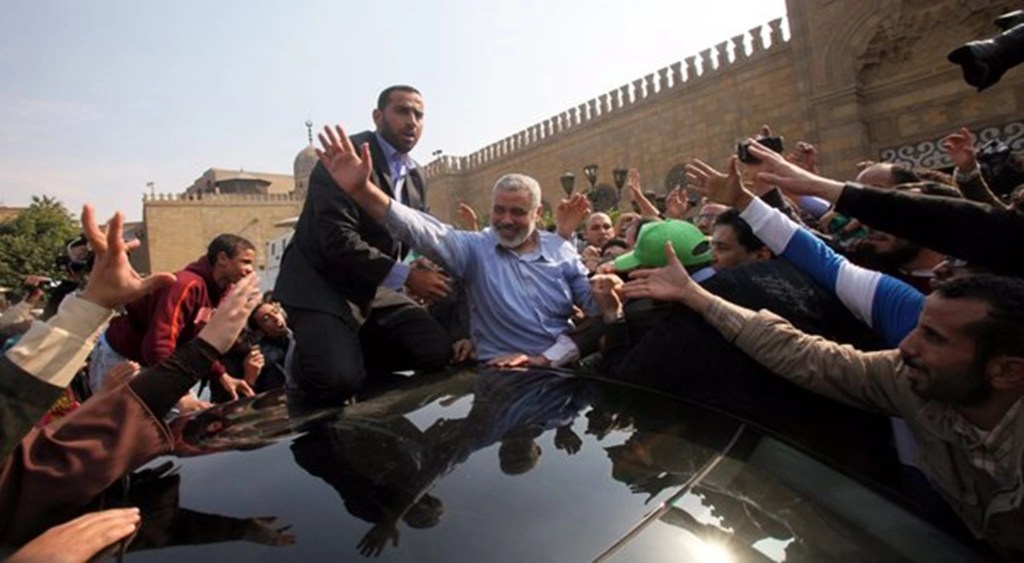
Finally, there is the widespread suggestion within amateur mass-media Hamas Byzantinology that Sinwar is “close to Iran.” Haniyeh, by contrast, along with Meshaal and other key Hamas leaders in 2011 showed independence and defied Iran by taking the side of the Syrian people’s revolutionary uprising against the Assad tyranny. In Cairo’s al-Azhar mosque after the Arab Spring revolution in Egypt, Haniyeh said “I salute the Syrian people who seek freedom, democracy and reform,” the worshipers responding “God is great” and “Syria! Syria!” Hamas quit Syria, where it had been based, its offices were ransacked by the Syrian regime, and it moved to Qatar, its leaders sharing much of their time between Qatar and its geopolitical ally Turkey, the two chief supporters of the Syrian uprising. Iran reduced support to Hamas by half, though Deputy Chairman of Hamas’ political bureau, Musa Abu Marzouk, claimed in 2016 that “since 2009, we have not received anything from them [Iran] and everything they say is a lie, they didn’t contribute anything to us.” While Hamas attempted to maintain relations with Hezbollah, it demanded Hezbollah “withdraw its forces from Syria,” and direct its weapons “only at the Zionist enemy.” In 2016, Hamas first “congratulate[d] the steadfast Syrian people and its fighting and fastening factions on the breaking of the siege of the liberated areas in Aleppo the Venerable,” and then when Assad reconquered and destroyed that city, Hamas released a statement declaring “We are following with great pain … the horrific massacres, murders and genocide its [Aleppo’s] people are going through, and condemn it entirely.” There were even reports of Hamas training some Syrian rebel groups, from both regime and rebel sources, though Hamas denied it; fighters in the Palestinian Yarmouk camp connected to Hamas, Aknaf Beit al-Maqdis, fought on the side of the rebels.
With the crushing of the Syrian people by the end of last decade, Hamas and the Assad regime both came under massive pressure from Iran to restore formal relations with each other, Hamas probably given some vague promise of “uniting the fronts” in the event it come into serious conflict with Israel (which has not materialised). For both, it was a “cold” restoration; for Hamas, since it already had formal relations with other regimes that despise it, such as Egypt and Saudi Arabia, non-relations with Syria was an exception, so restoration was treated as a formality rather than an alliance; Assad was more resentful, accusing Hamas in August 2023 – 10 months after restoring relations – of “treachery and hypocrisy”, falsely asserting that Hamas “waved the flag of the French occupation of Syria” (Assad meant the flag of the Syrian revolution, Syria’s independence flag). Unlike Iran, Assad would have made no false promises to Hamas in this exchange, and in contrast to the at least symbolically ‘hot’ Israeli-Lebanese border, Syria’s ‘border’ with its Israeli-occupied Golan territory has remained quiet as always – as Netanyahu and countless other Israeli leaders have praised Assad for (by contrast, rebel-held regions have been continually demonstrating in solidarity with Gaza).
Incidentally, Haniyeh had background on the question of Assad and his history of collaboration with Israel. “As a student at the Islamic University of Gaza in late 1983, Haniyeh led a demonstration in support of PLO chairman Yasser Arafat while the latter was under siege” by the Syrian military, Syrian-backed Palestinian mutineers and the Israeli navy in Tripoli in northern Lebanon.
Clearly, while relations with Iran had been fully restored, Haniyeh represented an independent-minded Hamas leadership, which had defied Iran to support the Syrian people, and which could balance necessary relations with Iran with strong relations with Turkey and Qatar, and in later years even Egypt, and other forces in the region; while also being a leadership with political acumen on the Palestinian issue, something not needed by Iran. Sinwar by contrast is typically pictured as a “hard man” focused narrowly on the military confrontation with less interest in political strategy. While this may not be an accurate picture, to the extent it may be it could mean he is more focused on the Iran alliance due to illusions or at least hopes that Iran’s loud empty rhetoric and false promises may some day materialise as actual support; and he may be more useful to Iran in that sense, since its interest in Palestine has always been about regional influence, certainly not about Palestine winning. But I’d emphasise that this is largely speculative.
Will Iran retaliate?
The two issues – the ceasefire negotiations, and the threat of retaliation by Iran and Hezbollah for the Israeli killings on July 30-31 – have now come together, because Hezbollah will end the tit-for-tat with Israel if a ceasefire is signed, while Iran – in a quandry regarding how to retaliate – has implied that it may refrain from retaliating if a Gaza ceasefire goes into effect, its UN representative Amir Saeid Iravani asserting that, despite the need to retaliate, ceasefire and Israeli withdrawal from Gaza were Iran’s “top priorities.” This could act as a face-saver, even allow Iran claim ‘credit’ for facilitating a ceasefire; Iran’s UN mission stated “Iran will meticulously calibrate its response to prevent any potential negative consequences that could affect a possible ceasefire.”
Whether and how Iran may retaliate remains an open question, the regime remaining tight-lipped. Former CIA director and US CENTCOM Commander David Petraeus aptly sums up the situation, that a big blow-out is unlikely because neither Iran nor Israel really want a war and its catastrophic consequences: “I think [the Iranians] have to respond … this is an enormous blow to Iran’s honor … But I don’t think that Iran wants to get into a real direct back and forth war with Israel… And frankly, I don’t think Israel wants to get in a real full-on war with Hezbollah or with Iran.” The Israel-Iran ‘conflict’, after all, has always largely been symbolic and theatrical, mediated by safe geographic distance.
However, there are two problems. The first is that Iran arguably exhausted the possibilities of theatrical retaliation in April; and the second is that, while Petraeus is right that Israel does not want a war with Iran for itself, it may well want to provoke a conflict that could draw the US into war with Iran.
Although Israel had struck Iranian assets in Syria many times for years with zero Iranian retaliation, the bombing of its diplomatic compound in April was deliberately aimed at making it impossible for Iran to not retaliate. Israel’s aim was not, of course, to get itself into a two- or three-sided war that would weaken its main objective of destroying Gaza; rather, if massive Iranian retaliation forced the US into the conflict to ‘protect’ Israel, Israel could then subject Gaza to even greater barbarity in an attempt to complete the ethnic cleansing under the cover of a greater ‘regional conflagration’.
However, as neither Iran nor the US had any interest in playing Netanyahu’s game, Iran carried out a highly choreographed drone and missile attack with 72 hours warning to enable the US and others to help Israel shoot them all down; the US then told Israel to “take the win” and not retaliate hard, and Israel likewise carried out a theatrical response, while over the same weekend it killed another 160 Palestinians in Gaza while the world was distracted by theatre in the skies. The US, Israel and Iran all emerged with faces saved, Palestine covered with extra blood.
Following this, Iran declared that its action was entirely about self-defence, and that “the matter can be deemed concluded,” a message to any hopeful Palestinians as much as to Israel.
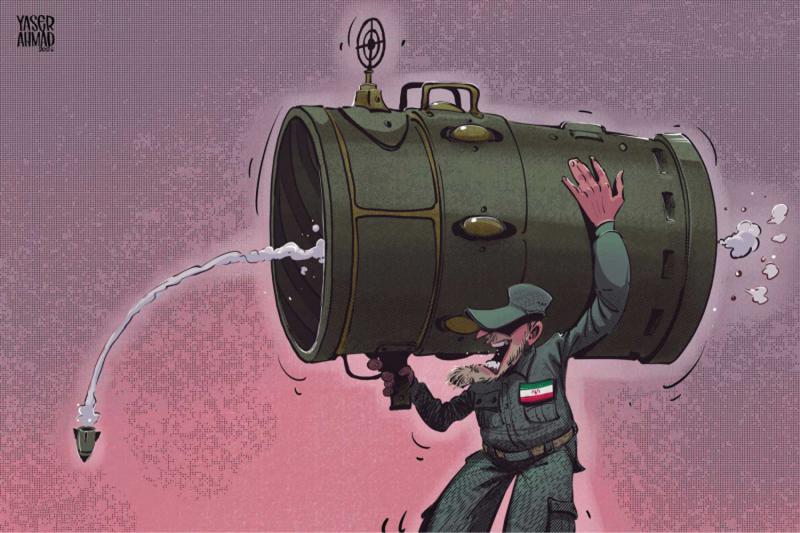
But Netanyahu is playing the same game, again carrying out an action – killing a guest at the president’s inauguration – that no state can fail to retaliate to. Former Israeli prime minister Olmert claims “The Ben Gvirs and the Smotrichs” are “yearning” for an Iranian response, as massive as possible, that will lead to a regional war they could use for ethnic cleansing, to “force out all the Palestinians from the territories.”
This puts Iran in a quandry; doing the same as last time, now that Israel has upped the ante, would be a climb-down showing Iran is out of options; yet doing something too big risks precisely playing Israel’s game and risks a US response. Trying to find a fine line in between while still saving face is a challenge. To make matters clear, the US has moved the aircraft carrier USS Abraham Lincoln, with its F-35C fighter jets, into the region, as well as a number of other warships and an additional squadron of Air Force F-22 fighter jets. The US does not want to play Netanyahu’s game, but if there were a large-scale Iranian attack, it would be compelled to defend its only real ally in the region.
According to one report, Iran’s new ‘reformist’ president Pezeshkian pleaded with Supreme Leader Ali Khamenei to not launch a direct attack on Israel, citing its disastrous impact on his presidency and the threat of escalation; from another perspective, the conservative Iranian Khorasan Daily argued that while a missile attack was appropriate in April, the circumstances are different this time; as this was an attack from inside Iran, Iran should respond via creating insecurity in Tel Aviv via one of its proxies, not from Iranian territory. Some western officials believe Iran may be reconsidering retaliation, both due to US pressure but also due to the nature of the attack – ie, via a concealed bomb – “perhaps prompting a different response.” From another angle, the long wait for Iranian retaliation has imposed a psychological cost on Israeli society; according to right-wing Israeli oppositionist Avigdor Lieberman, this itself is an achievement for Iran. Now Supreme Leader Khameini – who had initially ordered a direct attack on Israel as a response – has given his official blessing to Pezeshkian re-opening talks on a renewed nuclear treaty with the US, which would almost certainly mean any response has been shelved.
On August 5, Russian president Putin sent top advisor Sergei Shoigu to Iran allegedly to advise a “restrained” response and to avoid civilian casualties, but other sources claimed he brought a letter directly from Putin asking Iran to refrain from retaliating against Israel altogether, to allow Russia to mediate between the two countries. However, it is unclear what Russian mediation could achieve in the circumstances. Rather, there may be a different deal in the offing; while Iran has asked Russia to sell it Su-35 fighters, and received no response, the August 5 New York Times claimed Russia was sending air defense systems to Iran. Iran has been demanding Russia supply it the advanced S-400 air defence system (Russia only supplied Iran the older S-300 system in 2016, despite supplying S-400s to Turkey and offering them to Saudi Arabia and Egypt). Russia may be aiming to prevent Iranian retaliation with such a sweetener. If so, Putin may expect some Israeli favour in return, though since Israel has to date rejected US pressure to provide any weaponry to Ukraine for two and a half years, it is unclear how much more he can ask for. Meanwhile, Russian foreign minister Lavrov accused Israel of trying to provoke Iran, but declared that “Tehran would not succumb to such provocations”!
********************
Full circle “resistance”:
- Iran to liberate Jerusalem!
- Well, OK, no, we didn’t really mean that, but Iran will respond to Israel’s provocative killing of our guest in a way that will make Israel sorry!
- Ah, no, we meant we will continue our resistance by not falling for such provocations, by not responding, as per Lavrov’s orders!
********************
Meanwhile, according to the Times of Israel, US officials have also warned Israel to not respond too strongly if and when the Iranian retaliation comes. “Don’t push it. Think carefully before you attack in return. The goal at the end of the day is not to lead to an all-out war,” was the alleged US message to Israel. Given that Israel only wants escalation if it brings the US in, the distinct desire of the US – as well as Iran – to avoid such an outcome likely means Israel’s planned escalation will fizzle out. Yet on the other hand, the US aim of pushing Israel into a ceasefire (while promising another $20 billion in weaponry!), with its new urgency dictated both the aim of heading off an Iranian response as well as the approach of US elections, is also likely to be frustrated, with Israeli rulers likely to use Sinwar’s rise or any other convenient event to justify continuation of the genocide.
So was that Hezbollah’s retaliation? Israel and Hezbollah both claim victory!
To complicate matters further, the killing of Shukr gave Hezbollah its own reasons to launch a face-saving retaliation bigger than the daily tit-for-tat; initial suggestions included carrying this out in conjunction with Iran’s retaliation, retaliating even if Iran doesn’t, or more fancifully, a coordinated attack on Israel by Iran, Hezbollah and the Houthis (the latter risking going beyond that fine line and bringing in the US). As usual, media frenzy led by cold warriors and Zionists and acolytes of some “resistance axis” alike a out “regional war” turned into much the same anti-climax as any time over the last few decades.
Could the almost simultaneous heightened attacks by Israel and Hezbollah on August 25 – when Israel allegedly pre-empted a massive Hezbollah attack by destroying hundreds of Hezbollah rocket launchers while Hezbollah fired 300 Katyusha rockets at 11 Israeli military sites – be Hezbollah’s face-saving retaliation for Shukr, with Israel saving face at the same moment, and thus both avoiding the problem of how to respond again to save face and so on and so on? While it would be conspiratorial to suggest collusion, it was almost too perfect. Both claimed hits, and both denied the hits claimed by the other. If Israel’s claim is true that it destroyed hundreds of rocket launchers and pre-empted more massive strikes, it can claim a big victory – it claimed Hezbollah suffered a “crushing blow” – yet Hezbollah claimed Israel hit “empty valleys.” Both said that’s all for now, and according to Reuters, “exchanged messages that neither wants to escalate further,” but both said there may be more at some unspecified time. Both claimed success. According to Nasrallah, “If the result is satisfactory, we will consider that the response process has been completed, and if the result is not sufficient, we will reserve the right to respond at a later time,” but since the operation was completed “as planned,” this means the former. He even told the 100,000 Lebanese “Let everyone relax. He who wants to go home, go home.”
And if Hezbollah’s retaliation is “completed,” could that be it for Iran as well, ie, Iran
has responded “through Hezbollah” rather than directly? Perhaps. If Iran’s response was “through Hezbollah,” it would indeed want it to be measured, as it did turn out. If its retaliation “through Hezbollah” had been massive, Iran could be accused of sacrificing hundreds of Lebanese lives while remaining unscathed. More importantly, a large enough Hezbollah response could elicit a massive Israeli attack on Hezbollah’s missile stocks, which Iran has built up as a form of ‘forward defence’ in the case of an Israeli attack on Iranian nuclear facilities; Iran has no interest in getting them wasted on behalf of a dead Hamas chief, or of Hamas or Palestine in general. Of course, neither does Israel really desire such a war, because Hezbollah’s thousands of advanced rockets raining on Israel would lead to enormous destruction and killing on both sides, unless it brought about US intervention.
Did the “resistance axis” inadvertently encourage Hamas into disaster, and did Hamas act on this basis?
As Palestinian professor Rashid Khalidi states, in response to Hamas’ likely expectation that Hezbollah would open up a second front, and that other Iran-backed militia, and perhaps Iran itself, may join the fight:
“Hamas was wrong to expect it. … It’s a perfect example of how little they understand of the world. For all their acumen in other respects, the leaders who organized this assault have what I would call tunnel vision. … But while it [the Lebanon-Israel border] may still explode into a full-scale war, so far it’s been tit for tat, very measured and controlled. This is a function of what anybody with eyes to see could have told the boys in the tunnels, which is that Iran did not invest in building up Hezbollah’s capabilities for the sake of Hamas. It did so in order to create a deterrent to protect Iran against Israel; that’s the only reason. The idea that Hezbollah and the Iranians would shoot every arrow in their quivers to support Hamas, in a war it started without warning its allies—it beggars belief that anybody could think that that would be the case. Iran is a nation state that has national interests, which are restricted to regime preservation, self-defence and raison d’état. You can talk about Islam, ideology and the ‘axis of resistance’ until you’re blue in the face. I will tell you: raison d’état, regime
protection—that’s what they care about, and that’s why they backed the build-up of Hezbollah’s capacity. And they’re not going to shoot that bolt. There was no possibility under any circumstances of their doing that to support Hamas.”
“Regime preservation,” “national interests” – in a word, Iran, like all the other regimes of the region, is a capitalist state run in the interests of its ruthlessly oppressive ruling class. States that bloodily repress their own working classes do not give a dime about the oppressed elsewhere, no matter what they proclaim. Yes, capitalist states can be rivals – though Iran-Israel “rivalry” has never had any substance (except arguably in Shiite southern Lebanon during Israel’s occupation till 2000), but rather has always been about ideological mobilisation of the base on both sides, to bolster their nationalist-theocratic projects, mediated by safe distance.
Khalidi is correct that Hamas gave Iran and Hezbollah no warning of its October 7 operation; they simply had nothing to do with it; after all, the Gaza-based Hamas military leadership did not even tell the outside-based Hamas political leadership; even the actual fighters who took part only learned the specifics some hours earlier. Indeed, Khameini’s excuse for not coming to Gaza’s aid was to tell Haniyeh in November that Hamas “gave us no warning, we will not enter the war on your behalf,” and some of the pro-Iran Iraqi Shiite militia allegedly made the same complaint. However, it appears likely that in the well-known meetings between Hamas, Hezbollah and Iranian Revolutionary Guard leaders earlier in 2023, Iran gave some kind of vague promise about “uniting the fronts” in the event of a conflict with Israel; Hamas apparently expected more from them. Hamas’ military commander Mohammed Deif’s October 7 call to “Our brothers in the Islamic resistance in Lebanon, Iran, Yemen, Iraq and Syria, this is the day when your resistance unites with your people in Palestine,” certainly suggests this.
If Hamas acted on the basis of this expectation, it was an error of catastrophic proportions. And if the Iran-led forces did give such deceitful assurances, then all the so-called “axis of resistance” has brought the Palestinian people is a facilitation of Zionist genocide, tens or perhaps hundreds of thousands of murdered Palestinians and the complete obliteration of Gaza, perhaps followed by the West Bank, while Iran is unscathed, and some symbolic actions of some Iranian allies have boosted Iran’s “axis of resistance” myth. As Khalidi once again puts it:
“Looking back over the past eight and a half months – at the cruel slaughter of civilians, the millions of people made homeless, the mass famine and disease induced by Israel – it is clear that this marks a new abyss into which the struggle over Palestine has sunk. While this phase reflects the underlying lineaments of previous ones in this hundred years’ war, its intensity is unique, and it has created deep, new traumas. There is no end to this carnage in sight, and there seems to be no viable path towards a lasting, sustainable resolution in Palestine.”
I think Khalidi is correct. Even Hamas’s al-Aqsa Brigades, in a message to the Muslim world speaking of its abandonment, shows a more realistic face than what we often hear, asking them “are you waiting for it to be said that Gaza has been destroyed and Islam has been extirpated from it? For indeed if the war continues for a long time, it will result- perhaps by God- in the vanishing of the creed and disappearance of the religion from a noble territory of the land of the Muslims.”
Of course, that does not mean that Israel’s smashing victory is cost-free for itself and its future – whether talking about its economic crisis, the crashing of its global legitimacy, or its lack of clear perspective of what to do with the Palestinians who stubbornly remain and their governance – nor does it mean it is complete, and nor does it mean that this situation is permanent. Indeed, Khalidi notes that “in spite of their overwhelming power, they [also] have put themselves in a hopeless strategic situation.” Still less does it mean that the noble Palestinian resistance inside Gaza is futile; no matter how obliterated Gaza is, it still makes a difference that the Palestinians have not been driven out, their continued existence among the ruins does represent potential hope for the future – even if their bargaining position in the short- to medium-term has been smashed – whereas full Nakbah could have meant the end of Palestine.
But to cite Khalidi yet again:
“ … ultimately, war is an extension of politics by other means, and they [Hamas] have not projected a clear, strategic, unified Palestinian political vision to the world. I don’t think people are saying these kinds of things, hard as they are to say. But they should be.”
 Their Anti-imperialism and Ours
