The global media unanimously and lazily claims that Hezbollah initiated “attacks on northern Israel” on October 8 (in response to Israel beginning its genocidal attack on Gaza), which Israel “responded” to. Yet strictly speaking, this is not correct.
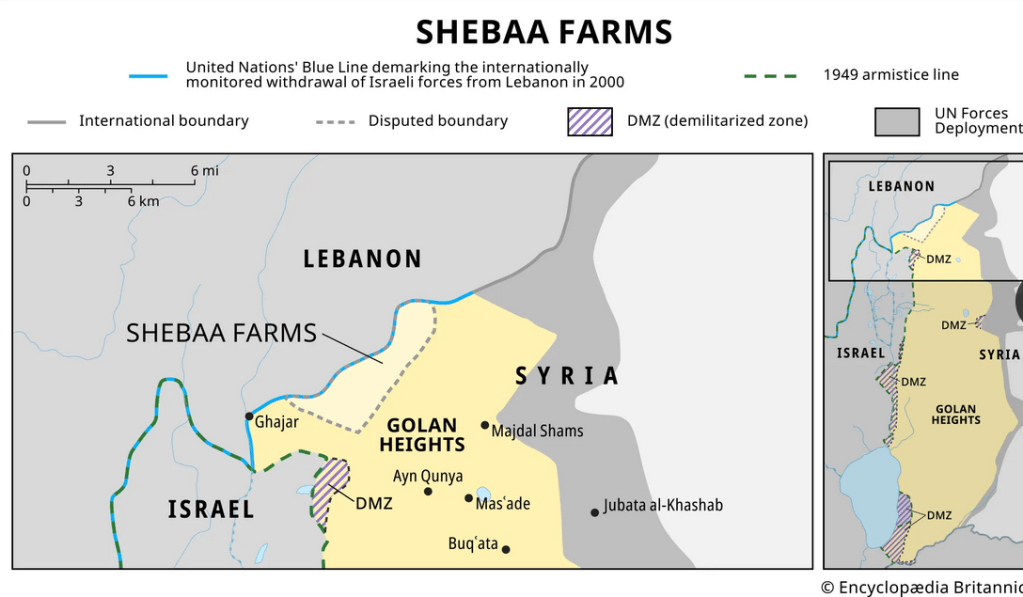
On October 8, Hezbollah attacked Israeli military facilities in the Shebaa Farms, a piece of territory claimed by Lebanon under illegal Israeli occupation since 1967, not recognised as “Israel” by the UN or almost any country internationally (Israel’s claim, which the UN agrees with, that it is part of the illegally occupied Syrian Golan rather than of Lebanon hardly justifies Israel’s position!). Resistance to occupation is legal in international law. Indeed, alongside solidarity with the Palestinian resistance, Hezbollah also declared its operation was “On the path to liberate the remaining part of our occupied Lebanese land.” Hezbollah in other words did not attack Israel on October 8! Israel responded with attacks into Lebanon, thus Israel was the first to attack the other country’s sovereign territory, not Hezbollah.
The next day, October 9, Palestinian militants – not Hezbollah – based in southern Lebanon slipped across the Israeli border and killed an Israeli soldier, wounding several others; Hezbollah had no involvement. There are some half a million Palestinian refugees in southern Lebanon, who aim to return to their country; they will join a battle involving Palestine whether Hezbollah does or not (for example, as they did earlier, in April 2023, when Israel attacked the al-Aqsa mosque). Israel retaliated with a helicopter-gunship attack on Lebanon which killed three Hezbollah militants; Hezbollah then responded to these killings later that day with guided missiles aimed at Israeli command centres in northern Israel, the first actual attack by Hezbollah into Israeli territory, only after two Israeli attacks on Lebanon.
Following this, Hezbollah “calibrated its attacks in a way that [has] kept the violence largely contained to a narrow strip of territory at the border,” and initially at least, Israel did likewise. In December 2023, Andrea Tenenti, from the United Nations Interim Force in Lebanon (UNIFIL), said both Israel and Hezbollah “unfailingly accepted messages passed through UNIFIL in procedures designed to deescalate potentially dangerous misunderstandings.”
But if it was Israel that in fact struck first – twice – then on what basis can the claim be made that Israel had to “defend itself” against Hezbollah, which just wouldn’t stop its attacks over the border, by blowing up the whole of Lebanon? Who was responding to whom?
OK, one might say, that was the beginning, but Hezbollah has insisted since that it would keep up some level of attacks over the border until Israel agreed to a ceasefire in Gaza.
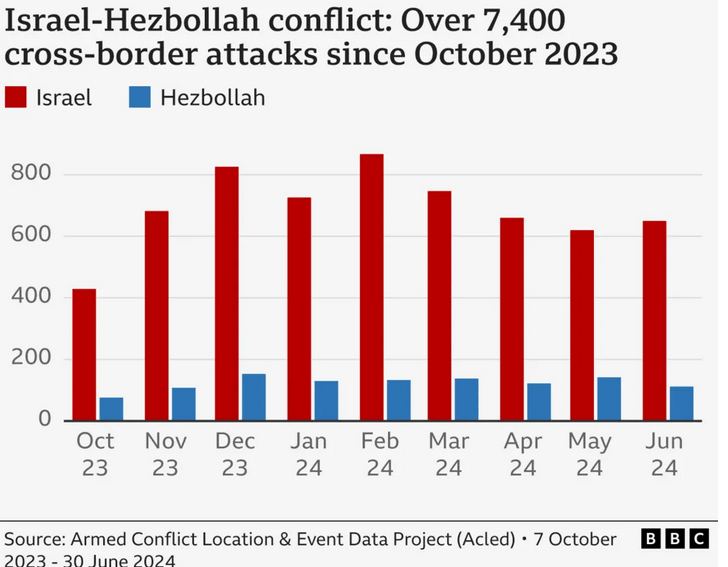
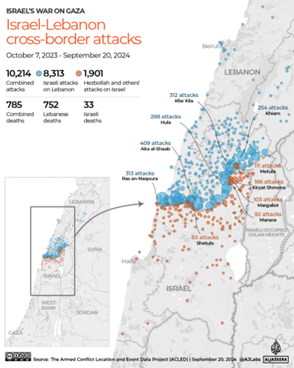
However, Israel’s responses became far bloodier over time: not only vastly disproportionate in sheer number, but also far more targeted at civilians; until September, Israel had launched 8313 attacks on Lebanon, to Hezbollah’s 1901 attacks on Israel; Israeli attacks had killed 752 Lebanese, including hundreds of civilians, to only 33 Israeli deaths, overwhelmingly military – a ratio of 23 to one! Israeli attacks had already displaced 90,000 Lebanese before the current massacre began in late September. In July, the BBC reported that over 60 percent of Lebanese border communities had suffered “some kind of damage as a result of Israeli air and artillery strikes,” and 3,200 buildings had been damaged; Human Rights Watch verified that Israel has used white phosphorus in its attacks on some parts of southern Lebanon.
So if you consider this data, the notion that it was Hezbollah insisting on attack while Israel merely defended itself makes little sense in practice – if Israel has been attacking Lebanon at a rate of over 4 times that of Hezbollah attacks on Israel (and with 23 times the numbers of deaths, indicating that Hezbollah mostly fired to make a statement and avoid casualties), then when was the moment that Hezbollah could have paused or stopped firing anyway if there is simply so much more Israeli firing at them all the time? The bare numbers suggest it was Hezbollah responding, not Israel.
Despite occasional flare-ups – in early January, in June and in August – when Hezbollah briefly responded more forcefully following Israel’s killing of top Hezbollah commanders – this pattern of low level tit-for-tat, with Israel’s attacks far more murderous and escalatory, continued through till late September.
OK, again, but perhaps Hezbollah could have agreed to a ceasefire, to end the attacks and discuss UN Resolution 1701 and so on at the last moment, in order to avoid being decapitated, and to help prevent Lebanese civilians being massacred by Israel’s savagery since last September.
Again, however, it appears that Nasrallah did agree to a “complete ceasefire” just hours before he was killed. There is no dishonour in recognising limitations, in recognising that the blood paid by innocent Lebanese civilians and children is just too high, that you have attempted to do what you can (and the reality is that Israel has essentially completed its genocidal goals in Gaza, with nothing Hezbollah has done making any difference).
But if Nasrallah agreed to it, why did Israel still proceed to kill him? Even if it “just had to” kill him as a war trophy, why continue the horrific war against the Lebanese people after that? Why continue the mass killing after the new Hezbollah leader, Naim Qassem, also said on October 8 that the organisation was supportive of the Lebanese government’s moves to reach such a ceasefire? If that’s what Israel wanted, wouldn’t it have paused to see what came of such negotiations?
In other words, Hezbollah’s alleged “refusal” to end its side of the conflict was never the issue – neither at the outset, as outlined above, nor during the year, given the reality of who was attacking who in practice, nor at the end, when these concessions are ignored and Israel continues to bomb, kill and invade. There was simply never a chance.
Think what you want of Hezbollah politically – the above is all separate to the question of whether or not Hezbollah was doing the “right” thing, whatever that may mean in the context of Israel’s holocaust against the Palestinian population of Gaza. Many argue that, regardless of who shot first, keeping up some level of fire at Israel in solidarity with Gaza was an honourable thing to do; many others, especially many Lebanese who may hate Israel but not like Hezbollah, argue that Hezbollah did not have the right to put Lebanese civilians in danger of the horrific Israeli “retaliation” now taking place; still others may argue that Hezbollah’s attacks were too symbolic, and that it should have attacks on a level that could have actually helped Gaza; others that it could not do this, as neither the Lebanese people, nor Hezbollah’s Iranian paymaster, wanted such escalation; some may argue that Hezbollah had already burnt too many bridges with non-Shia communities in Lebanon to be able to act, and be accepted, as a vanguard for Lebanon (or that it had committed vastly more crimes in Syria to be accepted by the Arab world more generally); while some might say that was precisely why it had to do something, symbolic or otherwise, to rescue its credibility, and whether it had successfully done so or not would also be debated.
More generally, some things are probably undeniable: that Hezbollah greatly overestimated its own strength, underestimated Israel’s immense power, technological advantage and ability to “do Gaza” on another country while still in Gaza itself, and overestimated the likelihood of its Iranian sponsor doing anything at all to defend it in its hour of need.
All of this is a valid discussion, which needs to be had, but is outside the question here. Right now, Hezbollah cadres on the ground – and others allied to it that have never been its political allies – is resisting Israel’s new invasion of southern Lebanon in its own country, while Israeli state terror has killed over 1200 Lebanese civilians; over 2000 Lebanese have been killed by Israeli attacks over the last year, 60 percent of them in the last week of September and first week of October 2024, and this includes 127 children, and, for good measure, by the beginning of October, 96 Syrian refugees, while it attacked and killed 24 in the Christian town Aitou in northern Lebanon far from the border, and has even bombed a town council and killed the local mayor. Some 1.2 million Lebanese have been forced to flee their homes – given that Lebanon’s population is only about 4 million, with up to 2 million Palestinian and Syrian refugees, this is around a quarter of the population.
What is the end-game? It appears that, intoxicated after having been able to essentially destroy Hezbollah’s communication networks, much of its launching capacity, and most of its command structure and leadership, all within about a week, Israel’s sights may be set on re-occupying, perhaps effectively annexing, Lebanon south of the Litani, until just recently only an idea entertained on the far-right fringes.
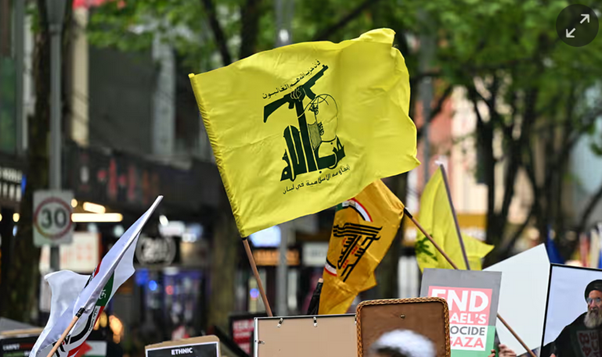
The Australian government, like a number of other western governments, lists Hezbollah as a “proscribed terrorist organisation.” This led to a great deal of hysteria among Australian politicians of both major right-wing parties and among talking heads throughout the monochrome Australian media after Hezbollah flags and photos of its dead leader, Hassan Nasrallah, were displayed by some of the crowd at last Sunday’s weekly rally against Israel’s Gaza genocide. The display of such symbols, aside from being illegal, allegedly causes great “distress” among Jewish-Australians, who do not feel “safe”, and all “antisemitism” must be rejected and so on and so forth.
Just as an aside on that rally: it is worth noting that from the beginning last October, organisers of the weekly rallies asked marchers not to bring symbols associated with proscribed “terrorist” organisations, for legal reasons, to prevent the rallies being closed down, while not making judgements on the politics of these organisations. However, it was to be expected that with emotions high just after Israel had killed about 1200 Lebanese people in around a week, sent over a million fleeing, and also killed Nasrallah, that some members of the Lebanese community who supported Hezbollah might bring Hezbollah symbols, and it would have been difficult for rally organisers to prevent this in the circumstances. However, it was not their choosing, and many at the rally, who were happy to rally for the Lebanese people as well as the Palestinians, were not so happy with the focus of part of the rally being turned to Nasrallah. But let’s get back to the point.
I hold no brief for Hezbollah, at all, as I will explain below, and much less for its reactionary Iranian paymaster. However, at this moment it is the Israeli state, backed by the Australian government and other western governments, that has carried out a virtual holocaust in Gaza over the last year, is actively stealing land and killing with impunity in the Palestinian West Bank while the world looks away, and has just carried out a devastatingly murderous attack on the neighbouring sovereign state of Lebanon, bombing entire city blocks in the capital Beirut with 2000 pound bombs in the process of killing a handful of Hezbollah leaders. If “terrorism” means killing civilians as part of a political action, then the Israeli regime is one of today’s arch-terrorists. However, let’s put that aside for the moment and classify that as “state terrorism,” and focus instead on the “terrorism” of non-state actors.
In that case, Hezbollah is not a “terrorist” organisation in any conventional sense. It is unclear why its flag should create “distress” among Jewish Australians. When has Hezbollah ever planted bombs in cafes or on buses, when has it shot up civilians in shopping malls, when has it specifically targeted Jews as Jews? This is quite simply not how Hezbollah has ever operated. The “terrorist” label therefore is simply driven by the political views of the US and Israeli states; it is worth looking at where it comes from.
The source of the bogus “terrorist” label: legitimate national resistance
The first source of the “terrorist” labeling was the US itself rather than Israel. Following the end of Israel’s horrific 1982 invasion of Lebanon, when it killed 20-30,000 Lebanese and Palestinians in an unprovoked 3-month Blitzkrieg, the entire time with the full support of the US government of Ronald Reagan, an agreement was signed for a Multi-National Force (MNF) consisting of US, French and Italian troops to move in and supervise the forced withdrawal of the Palestine Liberation Organisation (PLO), the goal of Israel’s war.
Given the total US support for Israel, much of Lebanon’s Muslim population viewed the “peace-keeping force” as occupiers. As soon as the PLO withdrew, Israel facilitated the slaughter of 2-3000 defenceless Palestinian civilians in the Sabra and Shatilla refugee camps by the right-wing Lebanese Christian Phalange/Lebanese Forces militia. In such conditions, the election, in an unfair sectarian system, of Phalangist leaders Bashir, then Amin, Gemayel to the presidency was rejected by Sunni, Shiite and Druze communities. Yet as civil war soon re-erupted around Beirut, the supposedly neutral US forces bombed Muslim and Druze forces in the nearby Shouf mountains. It was in these conditions that Iranian-inspired Shiite suicide bombers bombed the barracks of the MNF in October 1983, killing 241 U.S. and 58 French military personnel.
This killing of so many US troops is the origin of the particular US hatred of Hezbollah and its “terrorist” labelling. However, even if we exclude all the context above, there are two problems. First, regardless of one’s view of such an action as a method of struggle, “terrorism” refers to the targeting of civilians, not of military personnel, however one views their mission. Secondly, Hezbollah was not officially formed until 1985, and it is little more than conjecture that the shadowy pro-Iranian ‘Islamic Jihad’ (not to be confused with today’s Palestinian Islamic Jihad) group which claimed responsibility was a precursor of Hezbollah. Even according to Reagan’s Defence Secretary Caspar Weinberger, speaking in 2001, “we still do not have the actual knowledge of who did the bombing of the Marine barracks at the Beirut Airport, and we certainly didn’t then.”
The second source of the “terrorist” labeling is even more dishonest, stemming merely from Hezbollah’s leadership of the Lebanese national resistance against the Israeli military occupation of southern Lebanon, an entirely legitimate struggle. Following its 1982, Israel remained in occupation of southern Lebanon all the way up to Beirut, and so a national resistance movement began fighting to drive them out. By 1985, they had been driven from Beirut and much of the south, but remained in a significant swathe of territory closer to the Israeli border. While the resistance included a range of political forces, including leftists, nationalists and Islamists, from both Sunni and Shiite communities, ultimately the south is largely Shiite populated, and the Iran-backed Shiite Hezbollah became the dominant force. There were no Israel civilians in southern Lebanon; and Hezbollah never bombed Israeli civilians across the border. Israel merely regards legitimate resistance against its brutal military occupation to be “terrorism” in Lebanon just as it does in occupied Palestine.
Israel was driven from Lebanon by the resistance in 2000. However, it remained in a 25-square kilometre piece of land called the Shebaa Farms, which Lebanon claims but Israel says is part of the illegally-occupied Syrian Golan (as if that justifies the Israeli position!), and this is part of its justification for remaining a “resistance” militia separate to the Lebanese Armed Forces after 2000. When Hezbollah kidnapped some Israeli troops on the border in 2006 aimed at freeing several Lebanese prisoners in Israeli prisons and liberating this final piece of land, Israel unleashed massive bombing against Lebanon, killing 1500 people and devastating the country again. Nasrallah admitted its actions had been an error, and Hezbollah’s position looked very weak politically; then Israeli arrogance trumped common sense when it attempted a ground invasion, allowing Hezbollah to route the invaders as an on-the-ground resistance again, not only saving but boosting Hezbollah’s resistance credentials.
More generally, since the 1990s, Hezbollah has engaged in parliamentary elections and been part of coalition governments with parties representing other sectarian interests. That’s why even some countries that call the military wing of Hezbollah “terrorist” do not classify the political organisation as such. Far from challenging the sectarian system, Hezbollah has largely bought into it, and despite rhetoric about “the dispossessed,” has emerged as a key party of the Shiite bourgeoisie. Soon after its 2006 triumph, Hezbollah showed itself to be little different to any of the other sectarian militias in Lebanon, when it invaded mainly Sunni-populated West Beirut in 2008 and seized control from the Sunni Future Movement. And in 2019, when Lebanese from all backgrounds rose up against the sectarian system as a whole, targeting all historic sectarian leaders and warlords, Hezbollah came to the defence of the system by helping violently crush the movement.
Hezbollah becomes a state-terrorist partner of the Assad regime
Despite its close relationship to the Iranian dictatorship, Hezbollah had its own origins as a legitimate national resistance movement in a Lebanese context and cannot be viewed as a mere proxy. However, ultimately, Iran is its paymaster, and this side of the organisation came upfront following the outbreak of the April Spring uprisings in 2011. Its opposite views on Libya and Syria is instructive.
When the Libyan revolution began, both Iran and Hezbollah hailed the revolt against Gaddafi’s oppressive rule; despite the image of Iran and Libya being both anti-Israel “rejectionist” states (in both cases reflecting safe geographic distance from Israel, allowing lots of loud rhetoric from afar), there is a dispute going back decades, when Musa al-Sadr, the leader of the Lebanese Shiite movement Amal, disappeared while on a trip to Libya. Lebanon in 2011 was on the UN Security Council, and its vote in support of the UN resolution to dispatch a NATO operation against Gaddafi was decisive, a vote that Hezbollah had to give its support to. Following the 6-month NATO intervention, the rebellion triumphed, and when Gaddafi was killed, celebrations were organised in Iran and in Hezbollah-controlled Lebanese communities.
In contrast, when the people’s uprising began against the tyrannical Assad dictatorship in Syria, Iran sent forces in to support the regime, both its own ‘Revolutionary’ Guard forces, and Iranian-backed Iraqi, Afghan and Pakistani Shiite sectarian militia. This was necessitated by the defection of a large part of the Syrian army to the uprising, forming the Free Syrian Army (FSA). While the Assad regime’s own sectarian ‘Shabia’ death squads were the most notoriously bloody militia taking part in Assad’s sensationally brutal and bloody repression of the Syrian people, the Iranian-backed militia were not far behind.
There seems some evidence that Hezbollah was initially hesitant about Iran’s demand that it enter Syria. During the 2006 war, Syrians took in thousands of Hezbollah supporters and Lebanese Shiite refugees, seeing them as heroes. One of the places this occurred was in the town of Qaysar near the border, which was now in rebel hands. When Hezbollah decided to enter the war as an Iranian proxy, the first place it helped the regime smash the rebellion was in Qaysar.
The irony of supporting the uprising against Gaddafi, despite it being backed by a direct US and NATO armed intervention, while taking part in crushing the anti-Assad uprising, where there was never any US intervention against Assad (indeed the US actively blocked the rebels from receiving essential anti-aircraft weaponry from neighbouring states), is surely too great, when Hezbollah and Iran and their western “anti-imperialist” flunkeys justify their support for Assad’s perennially anti-Palestinian regime on the basis of … “anti-imperialism.”
If Hezbollah had merely taken a back-seat role out of necessity due to its Iranian paymaster, it would have been bad enough, but perhaps understandable. However, once in, it went in with a vengeance. Particularly in southwestern Syria, Hezbollah played a prominent role in the Assad regime’s starvation sieges of various rebel-held towns, especially in Madaya and Zabadani, as well in Aleppo in the north. According to al-Jazeera, “Zabadani and Madaya, both located near the capital Damascus, are besieged by the army of Syrian President Bashar al-Assad and allied fighters from Hezbollah, the Lebanese Shia group.” They even took part in the regime’s siege of the Palestinian Yarmouk camp south of Damascus. The largely Sunni and anti-Assad populations of these towns were eventually forced out and dispatched to a region of northern Syria still under rebel control.
According to an Amnesty report: “The Syrian government and allied militias destroyed local food supplies by burning agricultural fields in Daraya and Madaya. Amnesty International’s analysis of satellite imagery shows the massive decrease in agriculture over the years and an obvious dead zone around Daraya. ‘The government and Hezbollah forces burned the agricultural fields, just as a form of punishment, even though we couldn’t access them’, a former teacher in Madaya told Amnesty International.”
Therefore, while Hezbollah is no “terrorist” organisation in the manner meant by hypocritical western governments, it certainly was responsible for large-scale killing and starving of civilians in Syria (along with its Iranian paymaster). However, it did so in the service of the Syrian state machine; in other words, like Israel, and the Assad regime itself, Hezbollah engaged in state terrorism. But that is not what the West and Israel care about. Indeed, when Biden congratulated Netanyahu for killing Nasrallah, he claimed it was justice for Hezbollah’s “many victims, including thousands of Americans, Israelis, and Lebanese civilians,” whatever that may even mean (mostly US and Israeli occupation troops). He managed to not mention any victims from Syria, the country with the vast majority of its civilian victims!
The Assad regime is the most similar to Israel in the region in the degree of mass murder and devastation it uses against its population, with some 700,000 killed in the conflict, including at least 300,000 civilians, overwhelmingly victims of the regime, most cities destroyed by regime and Russian bombing, and an industrial-scale torture gulag. Hezbollah and Iran are so widely hated for their role in backing the regime that, despite Syrians in rebel-held zones demonstrating against Israel in support of Gaza for the entire year since October, there were expressions of joy when their former killers were killed. They did not thank Israel, but they viewed it as a conflict between two of their enemies, two occupiers of Syria, wishing ‘good luck’ to both. For Syrians, Hezbollah and Iran acted as the IDF in their towns.
One does not have to share this perspective to understand it. For Lebanese living under Israel’s terror bombing and massive devastation now, their reality is that, whether or not they love Hezbollah, at this moment most Lebanese are united against the Zionist killing machine. Moreover, for southern Shia, Hezbollah is the organisation that led the 18-year struggle for freedom from brutal Israeli occupation. From afar, we need to be able to understand both perspectives.
So, where is the “terrorism”? On the border?
Returning to now, the point is that “terrorism” is a meaningless label in the case of Hezbollah to justify massive Israeli state terrorism and the support to it given by our government. When asked if Lebanon had the same right to “defend itself” as he claimed Israel does, prime minister Anthony Albanese immediately responded “of course we regard Hezbollah to be a terrorist organisation.” This sleight of hand allows him and other leaders to simply avoid the issue of Israel’s massacres and its blatant violation of Lebanese sovereignty. “Terrorism” justifies all. It has extraordinarily sweeping use. “What else can Israel do?” when confronted by a “terrorist organisation” on its border?
Yet the border itself belies this labeling. In sharp contrast to its massacre of civilians in Syria when engaged in the regime’s state terror, Hezbollah’s cross-border attacks since October 8 have been meticulously aimed at Israeli military facilities. No-one can seriously deny that, and the data speaks for itself. In contrast, Israel’s attacks over Lebanon’s border (ie, before the flare-up in the last 2 weeks) have not only been vastly disproportionate in terms of sheer number, but also far more targeted at civilians; until September, Israel had launched 8313 attacks on Lebanon, to Hezbollah’s 1901 attacks on Israel; Israeli attacks had killed 752 Lebanese, including hundreds of civilians, to only 33 Israeli deaths, overwhelmingly military.
Think what you want of Hezbollah politically – but right now it is resisting Israel’s new invasion of southern Lebanon in its own country, while Israeli state terror has killed hundreds of Lebanese civilians; some 2000 Lebanese have been killed by Israeli attacks over the last year, 60 percent of them over the last two weeks, and this includes 127 children, and, for good measure, by the beginning of October, Israel had already killed 96 Syrian refugees (including 36 children) who are only in Lebanon in the first place to escape the atrocities of the Assad regime, which was aided by Hezbollah! Over 100,000 refugees have fled into Syria, both Lebanese and Syrian refugees – and the Syrian regime has already begun arrests. Christian and Sunni towns in the south have been bombed alongside the Shiite civilian population; mostly Sunni regions of Beirut are being devastated alongside the Shiite regions which are Hezbollah’s base. Israel did want to decapitate the Hezbollah leadership, to re-establish its “deterrent” power, but it is also waging a war on Lebanon and the Lebanese people.
To cite Syrian writer Robin Yassin-Kassab: “I oppose Hizbullah absolutely when it is murdering and expelling Syrians on Iran’s orders. And I support absolutely its legitimate resistance to genocidal Zionist fascism.”
 Their Anti-imperialism and Ours