by Michael Karadjis
Global media:
2005: “Israel and Saudi Arabia are approaching the establishment of diplomatic relations to counter Iran.”
2010: “Israel and Saudi Arabia are approaching the establishment of diplomatic relations to counter Iran.”
2012: “Israel and Saudi Arabia are approaching the establishment of diplomatic relations to counter Iran.”
2015: “Israel and Saudi Arabia are approaching the establishment of diplomatic relations to counter Iran.”
2017: “Israel and Saudi Arabia are approaching the establishment of diplomatic relations to counter Iran.”
2020: “Israel and Saudi Arabia are approaching the establishment of diplomatic relations to counter Iran.”
2022: “Israel and Saudi Arabia are approaching the establishment of diplomatic relations to counter Iran.”
And then …
March 2023: Saudi Arabia and Iran restore diplomatic relations, under Chinese auspices (still no sign of these famous Saudi-Israel relations)
After this: Ongoing Saudi-Israel normalisation discussions via the US: while Israel ruled by the most right-wing regime ever which would never even consider a Palestinian state, this is Saudi Arabia’s absolute condition for normalisation:
June 13, 2023: Saudi Arabia: Normalisation with Israel based on 2002 Arab Plan for full Israeli withdrawal to 1967 borders and establishment of Palestinian state “still on the table”:
Fahad Nazer, chief spokesman of the Saudi Embassy in Washington: “Saudi Arabia’s position on the Israeli-Palestinian conflict has been clear and has been consistent for many years. In fact, it was the late King Abdullah, who, way back in 2002, introduced what is now known as the Arab Peace Initiative at the Arab League Summit in Beirut in that year. And the proposal, the initiative, does offer Israel normalization with all members of the Arab states in return for a just and comprehensive peace with the Palestinians based on a two-state solution … that offer really still remains on the table,” the core issue of Palestinian rights is still a must before normalization can truly continue.
August 14, 2023: Saudi Arabia appoints ambassador to State of Palestine and attempts to put office in East Jerusalem (which is prevented by Israel):
Saudi Arabia has given its ambassador to Jordan, Nayef al-Sudairi, an extra portfolio of ambassador to Palestine in East Jerusalem. “He presented his credentials to Majid al-Khalidi, an adviser to Palestinian President Mahmoud Abbas. The Saudis did not coordinate this appointment with the Israelis … The Saudis may have hoped to open a consulate in East Jerusalem, but the current extremist government of Prime Minister Binyamin Netanyahu truculently batted away any such prospect, saying that al-Sudairi may meet as he pleases with officials of the Palestinian Authority, but he may not have an office in East Jerusalem.
Yes, with occasional vague statements meant such as MBS’ September 20 statement that “Every day, we get closer” to an agreement with Israel, as long as we “solve” the Palestinian issue in a way that “will ease the life of the Palestinians,” which has been widely cited to mean the above conditions were dropped. No doubt aimed at ‘testing the waters’ for betrayal. Yet same conditions re-stated firmly within days:
September 26, 2023: Saudi Arabia: 2002 Arab Peace Initiative for Palestinian state fundamental pillar of any agreement with Israel
Saudi ambassador to Jordan and Palestine, Nayef Al-Sudairi, told reporters in Ramallah his visit “reaffirms that the Palestinian cause and Palestine and the people of Palestine are of high and important status and that in the coming days there will be a chance for a bigger cooperation between Saudi Arabia and the state of Palestine. … the Arab initiative, which Saudi Arabia presented in 2002, is a fundamental pillar of any upcoming agreement.”
All the above was before October 7, 2023, which much fanfare has claimed hardened the Saudi position and prevented an alleged “imminent” Saudi-Israel normalisation. Statements afterwards may appear harder, but are fundamentally similar to those before; the idea of “imminence” seems highly questionable:
February 6, 2024: Saudi Arabia: No diplomatic relations with Israel without Palestinian state on 1967 borders with East Jerusalem as its capital:
Blinken: To normalise with Israel, Saudi Arabia requires “a clear, credible, time-bound path to the establishment of a Palestinian state.” Saudi Ministry of Foreign Affairs: There has been a “clear, credible, time-bound path to the establishment of a Palestinian state” for the past 30 years, called the Oslo Accords, which however has gone nowhere. “The Kingdom has communicated its firm position to the U.S. administration that there will be no diplomatic relations with Israel unless an independent Palestinian state is recognised on the 1967 borders with East Jerusalem as its capital.”
March 3 2024: Saudi Arabia Refuses to Allow US Fighter Jets Airspace Access to strike Iran-backed Houthis in Yemen
May 7, 2024: Saudi Ministry of Foreign Affairs renews “the Kingdom’s demand for the international community to intervene immediately to stop the genocide being carried out by the occupation forces against defenceless civilians in the occupied Palestinian territories.”
September 27 2024: Saudi Arabia announces new global coalition to establish Palestinian state:
Saudi Crown Prince Mohammed bin Salman: “The Kingdom will not stop its tireless work towards the establishment of an independent Palestinian state with East Jerusalem as its capital, and we affirm that the Kingdom will not establish diplomatic relations with Israel without that.”
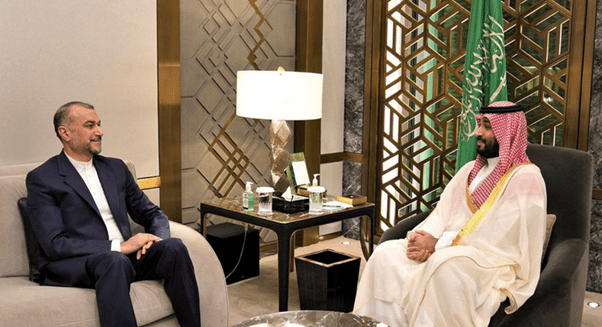
16 October, 2024: Saudi Arabia wants to permanently close chapter on differences with Iran:
Iranian President Masoud Pezeshkian: Islamic countries, including Saudi Arabia are “our brothers.” Saudi Foreign Minister Faisal bin Farhan: Saudi Arabia seeks to “permanently close the chapter on our differences [with Iran] and focus on resolving issues, developing relations as two friendly and brotherly countries”
October 19-20: Joint Saudi-Iranian naval exercises
“The Royal Saudi Naval Forces had recently concluded a joint naval exercise with the Iranian Naval Forces alongside other countries in the Sea of Oman,” said Brigadier General Turki al-Malki, spokesperson for the Saudi defence ministry (the other countries included Russia, Oman, India, Thailand, Pakistan, Qatar, and Bangladesh), and the two countries are planning to hold their own joint exercise in the Red Sea region.
October 26, 2024: Saudi Arabia condemns Israel’s attack on Iran as a “violation of its sovereignty” and international laws
October 31, 2024: Saudi Arabia’s foreign minister: No normalization with Israel without Palestinian state.
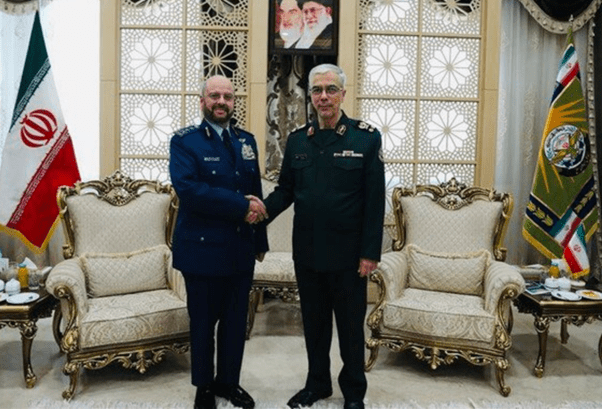
November 10 2024: Fayyad al-Ruwaili, chief of staff of the Saudi armed forces, met his Iranian counterpart General Mohammad Bagheri at the Iranian Armed Forces General Staff Headquarters in Tehran to increase ‘security cooperation.
November 11, 2024: Saudi Arabia denounces ‘genocide’ committed by Israel at Arab League and the Organisation of Islamic Conference which it organised:
Saudi Arabia’s crown prince Mohammed bin Salman at joint summit of the Arab League and the Organisation of Islamic Conference in Riyadh: “The kingdom reiterates its denunciation of the genocide perpetrated by Israel against the brotherly Palestinian people, which resulted in more than 150,000 martyrs, wounded and missing, the majority of whom are women and children … and the extension of aggressions on the brotherly Republic of Lebanon.”
November 11, 2024: Saudi Crown Prince Mohammed bin Salman at same summit: the international community should oblige Israel “to respect the sovereignty of the sisterly Islamic Republic of Iran and not to violate its lands”.
But what does all this mean?
A point of clarification: in outlining the plain facts of the matter above, I am not even remotely trying to put a good face on the uber-repressive Saudi monarchy, and still less the ‘modernising’ tyrant Crown Prince Mohammed bin Salman (MBS), who, as anyone who understands his politics knows, would probably sell his mother for any dirty deal with anyone if he thought he could get away with it. Principles simply don’t come into it with MBS. There are even rumours – denied by the Saudis – that MBS secretly met Netanyahu with American officials in Saudi Arabia in 2020, though nothing came of it.
In any case, since I am pointing to the growing Saudi-Iranian convergence, one might say that is not much better. The Iranian regime, for example, played a key role alongside Russian imperialism in drowning Syria in the blood of hundreds of thousands to keep the Assad family dictatorship in power, uprooting half the Syrian population; almost a third of Syrians remain in exile in the world’s largest ‘Nakbah’. But then, even that point falls flat because the Saudi monarchy is hardly better with its own multi-year barbaric air war in Yemen which has likewise led to hundreds of thousands of deaths; Saudi Arabia and Iran – both highly repressive, theocratic and misogynist regimes – suit each other, and suit Israel – so to be clear, we are talking here about interests, not principles or who is ‘better’.
In other words, good they are not warring with each other, but nothing to celebrate either: the Saudi-Iran convergence is a new counterrevolutionary alliance formed on the grave of the Arab Spring revolutions, which they both actively participated in drowning in blood.
Likewise, speaking of interests, I am not doubting that the Saudi ruling class can see great benefits of normalising with Israel, the wealthiest, most technologically advanced capitalist state in the region. The Saudis’ massive ‘Vision 2020’ modernising project can greatly benefit from Israeli trade and technology; and likewise the Saudi repressive forces can benefit from Israeli weapons technology, surveillance equipment and so on – which Arab ruling classes wouldn’t? And one widely touted impetus, the proposed India– Middle East–Europe Corridor’ (IMEC) – would bring significant infrastructure development to Saudi Arabia, yet virtually implies Saudi-Israeli normalisation, at least de facto.
Abraham Accords: Why not Saudis?
However, there are good reasons why some Arab ruling classes have normalised with Israel – Egypt in 1978, Jordan in 1994, then UAE, Bahrain, Sudan and Morocco in the Abraham Accords of 2010, and, effectively, Oman – while the majority, including Saudi Arabia, Qatar, Kuwait, Yemen, Iraq, Syria, Lebanon, Libya and Algeria – have not. Despite the fact that those who have normalised are more or less ‘Saudi allies’ in a loose sense, Saudi Arabia did not join the Abraham Accords. These accords gave Israel recognition from these states while the Palestinians got nothing in return. Why can’t Saudi Arabia do the same?
Principally, because Saudi Arabia is not just any Arab country, but the Custodian of the Two Holy Mosques of Mecca & Medina, and a state which projects itself as head of the entire Sunni Muslim world – these two related facts are central to the very legitimacy of the Saudi state. It would be no small thing for this state to recognise Israel while Jerusalem of all places, where the third Holy Mosque is located, remains under Israeli occupation; in fact the two things are virtually irreconcilable. Additionally, the 2002 Arab Peace Initiative for a sovereign Palestinian state with Jerusalem as its capital was precisely a Saudi initiative, signed in Riyadh; it is known interchangeably as the Saudi Peace Plan and so betrayal would in effect be a blow to its own prestige.
And this Saudi raison d’etre goes well beyond the autocratic regime. According to a report in The Atlantic, MBS told US State Secretary Blinken back in January that he “personally doesn’t care” about Palestine, but his people do – indeed, 96 percent of Saudis are opposed to normalising with Israel and believe those Arab states that have established ties should sever them. MBS was not kidding when he said that he does not want to end up like Jordanian King Abdullah I, assassinated in 1951, or Egyptian president Anwar Sadat, assassinated in 1981, in both cases for betrayal of Palestine.
The point here is not that Saudi Arabia is about to put up any active “resistance” to Israel’s ongoing occupation and genocide, but rather that official symbolism can be as necessary for regime survival as it is meaningless in practice. After all, the Iranian regime, which preaches “death to Israel” rhetoric, has offered no more “resistance” in practice to the Gaza genocide than have the Saudis; indeed the Iranian regime didn’t even lift a finger to assist its own proxy, Hezbollah, when it came under existential Israeli attack in October. So pointing out that a Saudi-Israeli deal is mostly in the realm of fantasy has nothing to do with illusions that the Saudi regime might actually do something to help Palestine.
The differing bases of Saudi-Iranian and Israeli-Iranian conflict
Meanwhile, the motivations for Saudi Arabia to push on with its detente with Iran are just as compelling as are those for detente with Israel, but currently without the same dangers. Indeed, if regional stability is essential for MBS’ Vision 2030 transformation project, then establishing relative peace with Iran is just as important as with Israel. Indeed, at this particular juncture, it is not hard to see that Israel’s actions are vastly more destabilising to the region than are Iran’s, which may have been different a decade ago. Moreover, despite the potential benefits of IMEC, the project may take decades to complete, and meanwhile Saudi Arabia can also see benefits of economic expansion into the Iran-Iraq-Syria space.
Far from being a US ‘proxy’ as sometimes depicted, the sub-imperial Saudi regime has built powerful political and economic relations with both Russia and China. Its partnership with Russia in OPEC+ goes back to 2016, as the two major oil exporters have coordinated on global supply and price issues; and just before this, Saudi Arabia’s flooding of the world oil market to force down prices is widely viewed as being aimed at US shale oil, as the US now joined these states as a major oil exporter and hence competitor for the first time; the Saudis again attacked US shale oil with an engineered price collapse in 2020. In contrast, following Russia’s invasion of Ukraine and US attempts to sanction Russia, the Saudis have snubbed Washington’s entreaties to increase supply; continual Saudi-Russian agreements to reduce supply, thus keeping prices high, have helped bankroll the Russian war. Meanwhile, following Chinese leader Xi’s lavish welcome in Riyadh in late 2022, where the two countries signed a “comprehensive strategic partnership agreement” and Chinese and Saudi firms signed 34 investment deals, Saudi-Chinese economic relations have boomed; these agreements partially align Saudi Arabia’s Vision 2030 with China’s Belt and Road Initiative. The Saudis have even agreed to trade oil to China in renminbi rather than the dollar – a potential future hole in the historic ‘petrodollar’ hegemony – although this has not proceeded very far yet. Saudi Arabia’s main ‘ally’ in terms of arms provision remains the US, of course, but it clearly has no interest in being boxed in by one potential future project, still less one imaginary ‘camp’; ‘proxy’ it definitely is not.
The ironic thing about the Israel-Iran tension escalating while the Saudi-Iran tension eases is that it is precisely the Saudi-Iran tension that had a real material reality, based on actual rivalry for domination of the Arab-Muslim region between these two sub-imperial giants. Their geopolitical/sectarian-coloured rivalry, which took on an active form in Iraq, Syria, Lebanon and Yemen in particular, was aimed at gaining a larger sphere of influence within the region for one or the other, which potentially meant more trade, more investment, more goods sold, more economic deals and links, more profit. Erdogan’s Turkey, using the Sunni Muslim Brotherhood as his tool, was the third sub-imperial rival of both. In addition, Saudi Arabia and Iran are both major oil exporters, and therefore rivals in this sphere as well – and rivals of both the US and Russia. As such, historic US sanctions on Iran, regardless of motivation, have benefited Saudi Arabia – and Russia.
The Israel-Iran hostility, by contrast, has no such basis, as Israel has zero potential for either popular legitimacy or even any serious economic penetration in that region (as I have explained in detail here); while high-tech Israeli capitalism is spread far and wide throughout the rest of the world, it is effectively locked out of this region, widely hated by the people, with very little trade taking place even with countries like Egypt and Jordan that normalised with it decades ago. It is not an oil competitor with Iran or Saudi Arabia, and neither country sells it anything (Israel’s oil mostly comes from Azerbaijan, Kazakhistan and Russia). But state regimes also have to maintain support of their own populations, or at least consensus to rule; and this is achieved through hegemonic ideologies which can be based on ‘nation’, ‘race’, religion or other ideologies, which can take on a life of their own and not always correspond neatly to economic interests abroad.
As such, the more symbolic Israel-Iran ‘conflict’ is rooted in hegemonic mobilisation: the Zionist and Iranian ethno-theocratic projects both need the “great enemy” of each other to justify themselves. The Iranian “threat” to Israel – whether in its “liberatory” face projected by the Iran-led so-called “resistance axis,” or its expansionist-genocidal face projected by Israel – is an entirely manufactured promise/threat, but the need for such a major “threat” is crucial to the ideological foundations of the late Zionist state, as it is likewise to the ‘Islamic Republic’ state, especially for influence in the mostly Sunni Arab region where it is somewhat of an outlier as a Persian-based and Shiite regime. Importantly, this great ideological ‘enmity’ is mediated by safe geographic distance.
Saudi motivations for Iran detente: Mutual exhaustion in rivalry
The reason for the Saudi-Iranian détente derives from the same material reality as did their regional rivalry; it reflects mutual exhaustion and the desire to now get on with peaceful capitalist expansion within the spheres of influence their decade of rivalry has defined. On Syria, Saudi Arabia effectively gave up its attempt to influence the anti-Assad uprising soon after it launched its bloody intervention in Yemen in 2015, and Russia likewise launched its bloody intervention to save Assad the same year, which Saudi leader MBS silently supported; the Saudis had been motivated more by rivalry with Iran, which backed Assad, and also with the Qatar-Turkey-Muslim Brotherhood axis, which backed the anti-Assad uprising, than genuine opposition to Assad, so Russia’s intervention to save Assad was seen as a means to getting an Assad regime less dominated by Iran – MBS’ secret support to Russian intervention thus coincided with the open support given to it by Israel, Egypt, the UAE, Jordan and Bahrain.
While the centre of their ‘hot’ rivalry then turned to Yemen, by 2022, both the 7-year Houthi attempt to conquer southern and eastern Yemen, and the Saudi attempt to reconquer northwest Yemen from the Houthis, had come to nothing, as the different governing bodies held on where they had their bases of support. This led to the ceasefire which has held from early 2022 to the present, and the Saudis have no interest in reigniting the war.
As for Iraq, there we have a regime dominated by Iranian-allied parties, where the Iranian-backed Shiite militia under the Popular Mobilisation Units (PMU) umbrella are part of the Iraqi armed forces, yet which withdrew its ambassador from Iran, and filed a complaint with the UN Security Council, when Iran attacked the Iraqi Kurdish region in January 2024, which just signed a defence pact with Saudi Arabia, and which still has US occupation troops on its soil and is an official out-of-area ‘NATO-partner’! A true joint-venture state! And since Iranian rivalry was the only real problem the Saudis had with Assad, patching it up with Iran also allowed them to join their Abraham Accords allies – who had re-established relations with Assad at much the same time they did with Israel – in re-establishing relations with the Assad regime and inviting Assad to the 2024 Arab League summit. Also worth noting is that the Arab League, led by Saudi Arabia, dropped its characterisation of Hezbollah as a “terrorist” entity in 2024.
It is interesting that their ‘hot’ rivalry coincided with the ‘hot’ period of the Arab Spring revolutionary uprisings. While Iran played the key role in smashing it in Syria and Iraq, Saudi Arabia the main role in Bahrain and Egypt, and both played awful roles in Yemen and Sudan (yet both, ironically, supported the overthrow of Gaddafi in Libya), they also both used the ferment to attempt to co-opt forces inimical to the other and compete in arming fellow tyrants to bend to their side in their rivalry. One may expect that the crushing of Spring would exacerbate rivalries, because what they had in common – hatred of popular revolt – had been put down. Yet in fact, the crushing of Spring also coincided with both the mutual exhaustion of their rivalry, and hence a counterrevolutionary convergence could be formed over the graves of hundreds of thousands of Arabs they buried.
This Saudi-Iranian détente may involve other areas of convergence, given the rise of new sub-imperial rivals, above all the Saudis’ erstwhile UAE ‘allies’ who have now become important rivals, who for example back a south Yemeni secessionist movement against the Saudi-backed Yemeni government! Likewise, Saudi-UAE rivalry has also peaked in the Sudanese civil war where they have emerged on opposite sides. Iran has begun supplying arms to the repressive Sudanese military regime, engulfed in horrific conflict with its former ally, the paramilitary RSF, which is engaged in the genocidal subjugation of Darfur. While the UAE has been arming the RSF (in alliance with Russia and its Wagner mercenary force), its erstwhile Saudi and Egyptian allies, like Iran, support the regime. Now Iranian planes bringing arms to Sudan fly through Saudi airspace! To throw even further earth into the grave of ‘campist’ analysis, the Sudanese regime – before the split between military and RSF – was also a signatory to the Abraham Accords with Israel!
To be clear: Saudi Arabia’s dedication to its new convergence with Iran does not in itself reduce its motivation to normalise with Israel, if Israel were ever to concede on the Palestinian state; on the contrary, creating ‘peace’ with both would seen by the Saudi rulers as the ultimate measure of their regional power. Yet this is precisely where Israel’s more symbolic, ideological mobilizational conflict with Iran becomes more intense: the idea that there can be peaceful coexistence with Iran, depicted as some kind of ‘Fourth Reich’ by Israel, cuts directly across this ideological picture. Furthermore, even though Israel cannot hope for any major economic penetration into the region as explained above, by drumming up the Iranian “threat,” Israel’s major military and “security” industries aim to profit via cooperation with the military and repressive forces of the Gulf regimes, including Saudi Arabia; Saudi/Gulf détente with Iran is not good for Israeli business.
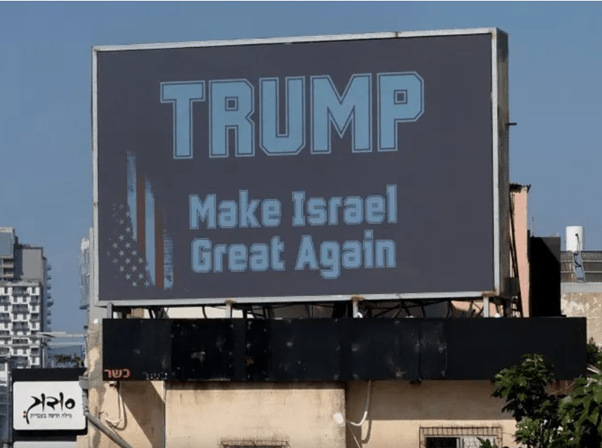
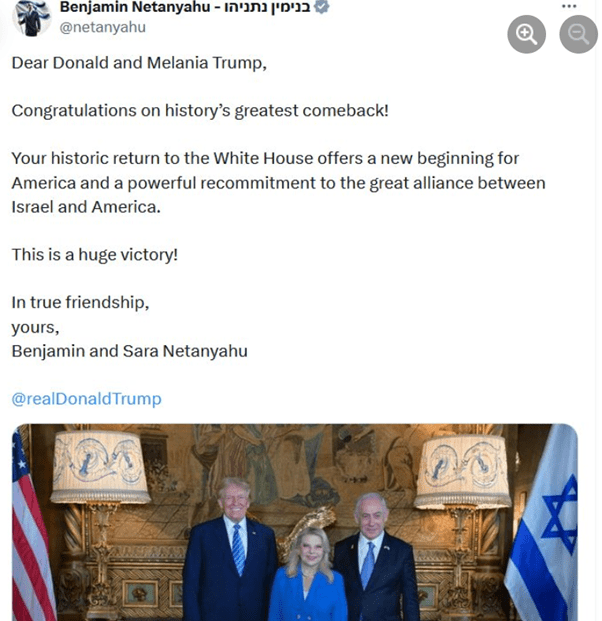
Will this change with Trump?
All that said, it is not out of the question for things to change again – much speculation concerns the difference the newly elected Trump regime in the US will make. It has been pointed out that MBS was on better terms with Trump than with Biden, who in the beginning aimed to ‘shun’ Saudi Arabia’s viciously anti-democratic rulers, whereas Trump never made any pretences over ‘human rights’ concerns; and that the Abraham Accords were Trump’s legacy, so he may try to continue them with a vengeance.
However, Biden dropped all that ‘shunning’ stuff once he decided that extending the Abraham Accords to Saudi Arabia would become his legacy. And what conditioned his failure – an extremist Israeli government officially opposed to any concept of Palestinian state, combined with such a state being the key Saudi condition – remains the same under Trump. Even more, in fact, given that the Trump regime is essentially ideologically identical to the Netanyahu regime on the question of Israeli annexation of the West Bank – Biden at least made nods towards the ‘two-state’ concept. How would the Saudis reconcile recognising Israel with the politics of Trump’s Christian fundamentalist-messianic Zionist ambassador to Israel, Mike Huckabee – who believes there is no such thing as a Palestinian, and no such things as the West Bank – not to mention the rest of Trump’s assemblage of the most pro-Zionist administration in US history?
So Trump would have a job on his hands trying to push Saudi Arabia into the Abraham Accords, no matter how chummy he may be with MBS. Could he perhaps bribe MBS with enough money and weapons and promises of a ‘US security pact’ to convince him to recognise Israel with no Palestinian state and put his regime and life at risk? Could his radical anti-Iranian position perhaps get the Saudis to change tack, drop the Iranian détente and join a US attack on Iran in the hope of getting in a ‘knock-out punch’ against Iran that overcomes the mutual exhaustion that led to détente, to instead achieve more complete Saudi hegemony?
Perhaps; I don’t claim to be a seer. But there are good reasons to doubt such unlikely outcomes. In addition to the points above, there is also the fact that when push came to shove, Trump did not come to the party last round. In 2019, a massive Iranian attack (laughably attributed to the Houthis) on the Saudi oil industry put half of it offline, cut 5 percent of world crude production and led to the biggest spike in oil prices for decades; Trump’s response was, first, to declare the US was “locked and loaded” to respond, but the next day, that “I’m somebody that would like not to have war.” Nothing happened. So the same hawkish Trump who ripped up the JCPOA in deference to Israel, imposed “maximum pressure” sanctions on Iran and assassinated head of the Iranian Revolutionary Guard Corp, Qasem Soleimani, in Baghdad, now turned on his dovish face when it came to defending its Saudi ally. The Saudis, therefore, have every reason to consider him a bad investment.
Besides, it is unclear that is even the direction the highly unpredictable Trump regime will go. While giving 100 percent support to Israel for its maximal goals in Palestine appears a given, it should not be assumed that Trump will necessarily be as accommodating with regard to issues of a fundamentally secondary nature to Israel; and we should be clear that Iran is in this class, a symbolic, diversionary, mobilisational ‘issue’ for Israel rather than anything fundamental. In fact, these Iranian and Israeli attacks on each others’ soil this year have been about ‘demonstrating deterrence’ but had essentially nothing to do with Palestine.
So, on the one hand, the Wall Street Journal reports that Trump “plans to drastically increase sanctions on Iran and throttle its oil sales as part of an aggressive strategy to undercut Tehran’s support of violent Mideast proxies and its nuclear program,” and, when Biden pressured Israel to not hit Iran’s nuclear facilities in its October 26 air attack, Trump retorted “that’s the thing you want to hit right?”; while on the other, Trump has also said he aims to be “friendly” with Iran and opposed to any US involvement in ‘regime change’, his billionaire advisor Elon Musk met Iran’s UN ambassador in New York to discuss how to defuse tensions, and Trump said that the US “has to make a deal” with Iran, “because the consequences are impossible” – just a deal that Trump can somehow pass off as “better for the US” than the one he ripped up. His vice-president, JD Vance, was even more explicit, stating following Israel’s October 26 Iran strike that while this was a case of Israel legitimately defending itself, “sometimes we’re going to have overlapping interests, and sometimes we’re going to have distinct interests. And our interest very much is in not going to war with Iran.”
Even more intriguing is that Ron Dermer, a Netanyahu aide, told Trump and his Zionist nut-job son-in-law Jared Kushner that Israel aims to deliver a ceasefire in Lebanon in order to “gift something to Trump,” which strongly implies that Israel has been continuing its seemingly aimless and endless murderous rampage in Lebanon, long after calling Hezbollah’s bluff and wiping out most of its leadership, only to first embarrass Biden and help him lose the election, and then further so that a ceasefire coincides with Trump assuming the presidency as a “gift.” Though that may depend on whether or not the highly intoxicated Zionist regime decides that southern Lebanon is in fact ‘Israel’, and whether or not Trump will go that far or draw a line.
So perhaps Trump won’t even attempt to challenge the Saudi-Iranian relationship. And perhaps Israel, Saudi Arabia and Iran will all emerge victorious in their own right under a Trump regime, with only the Palestinians losing out. I‘m not putting money on it: Trump may well decide an attempt to destroy Iran will be his ‘legacy’, though I wouldn’t put money on that either. Even then it is highly doubtful the Saudis would be drawn into it, or into relations with Israel without at least a Palestinian mini-state to show for it.
 Their Anti-imperialism and Ours