by Michael Karadjis
In Myth 7, I already dealt with the claim that Ukraine was “forced” by an alleged Boris Johnston statement to abandon peace talks, and demonstrated that Ukraine never abandoned the path of negotiations.
However, the more general idea that the war continues because the US (before Trump) and European leaders want it to, to grind down Russia, and they therefore use their sway over Ukraine to push it to take uncompromising positions which prolongs the war, remains widespread within a certain “left” discourse. According to this version, most Ukrainians would happily give up some or all of the Ukrainian territory that Russia has conquered in exchange for peace, but their leaders, puppets of the US, UK and EU, keep forcing them into the “meat grinder” over this little bit of borderland.
Before we get onto the main issues, it is worth just noting that if western powers were using Ukraine to grind down Russia by keeping the war going – ie continuing to fund Ukraine’s defence against illegal aggression and occupation – then surely Russia, if it did not want to be “ground down” like this, could withdraw from the illegally occupied territory, and end the war? But yes, simple logic like that is not as much fun as blaming the victim.
For the record, of course it is a legitimate argument that the war has gone on too long, that too many are getting killed, and that this can no longer be justified by the need to regain territory, and therefore Ukraine may be forced to make a compromise that is against its interests, due to Russia’s overwhelming military superiority. Liberation movements have many times been forced into such rotten compromises when the odds are overwhelmingly stacked against them. And if and when they do, supporters in the West would be completely out of order to “condemn” the victim for “capitulating;” in our solidarity, we would continue to condemn the aggressor as the cause of the rotten compromise, the imperial theft, but recognise the right of the oppressed nation, in this case Ukraine, to make its own decision.
And yes, some of the people I might partly disagree with do simply advocate this; they believe there is no alternative; Ukraine’s case is hopeless; being forced to give up territory is unjust, but a necessary pragmatic decision because the number of Ukrainian troops dying cannot be justified by keeping the territory. They don’t necessarily put the blame on Ukraine, the condemn the Russan invasion, but they think if Ukraine does make the rotten compromise now, it will only have to do so later, after countless more have been killed. And this article does not argue against these comrades; that is a valid position.
But when Ukraine has not made such a decision, surely it is just as out of order for people in the West to be “condemning” Ukraine for not making a rotten compromise, for not capitulating, for not agreeing to trade away its occupied territory, and the Ukrainian populations who live or use to live there, while making every excuse under the sun for Russia’s right to aggression, occupation and annexation. When it is not simply a pragmatic argument, like in the previous paragraph, but one that puts the blame on the occupied nation for the war continuing. Yet that is the view of a substantial part of the western left.
Let’s be clear on what kind of compromise Ukraine is being asked to make: Russia has annexed five Ukrainian oblasts – Crimea, Donetsk, Luhansk, Kerson and Zaporizhzhia. Crimea was annexed in 2014, Donetsk and Luhansk were invaded in 2014 but less than half occupied by 2022, while Kerson and Zaporizhzhia were not invaded until after the 2022 war began. Only later in 2022 did Russia formally annex these four oblasts, despite still not controlling all of Donetsk, Kherson or Zaporizhzhia.
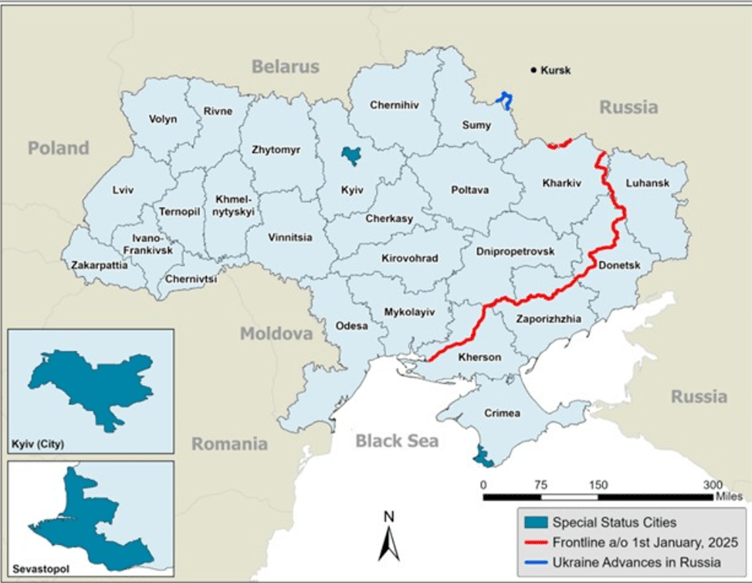
The question is whether Ukraine should give up these 5 oblasts in their entirety, or all the sections of them currently under Russian control, or whatever was under Russian control in February 2022, in exchange for an end to the war. The five oblasts constitute about 20 percent of Ukraine’s sovereign territory. Look at the map: it almost completely cuts Ukraine off from the Black Sea, which, after all, is precisely one of the strategic aims of Russia’s imperialist war of conquest.
We should also be clear that Russia demands formal recognition of all these annexations, made by brute, illegal, military conquest, not simply long-term ceasefire. Take for example the Syrian Golan. Israel conquered the Golan in 1967, Syria made an attempt to regain it in 1973, and then in 1974, recognising the overwhelming odds, signed a long-term demarcation of forces agreement, whereby Israel remains in occupation of the Golan – which it later illegally annexed – and Syrian and Israeli troops were separated by a UN force, and Syria never again attempted to recover its territory – but neither the Assad regime nor the current post-Assad government recognise the annexation; every year, a UN Resolution reaffirms Syrian sovereignty.
To be clear: this kind of pragmatic arrangement is not on offer to Ukraine. In fact, for all those saying Ukraine should just negotiate over territory, and blaming it for not doing so, remember that from Russia’s viewpoint, there is nothing to negotiate: Putin’s regime demands recognition of Russia’s annexation of all five oblasts as a prior condition for negotiations to even begin!
So what do Ukrainians think of territorial compromise?
What the is the truth about the opinions of Ukrainians? Are they being forced by a Zelensky government acting as western “proxy” to fight rather than surrender territory? The easiest way to check is to do 5 minutes of research.
In 2022-23, a full 87 percent of Ukrainians rejected any territorial compromise. But after years of war, surely the figure has gone down? Yes, it has, but not by as much as might be expected.
According to a Gallup poll conducted in late 2024, around 52% of Ukrainians “would like to see their country negotiate an end to the war as soon as possible,” while only 38% “believe their country should keep fighting until victory.” Ten percent didn’t know or didn’t answer. This is a big change compared to previous years.
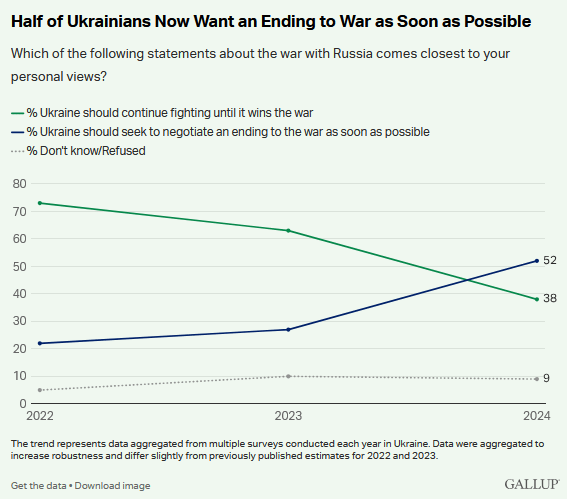
However, only 52% of this 52% agreed that “Ukraine should be open to making some territorial concessions as a part of a peace deal to end the war.” That is, only 27% of the population agree to even “some” territorial compromise.
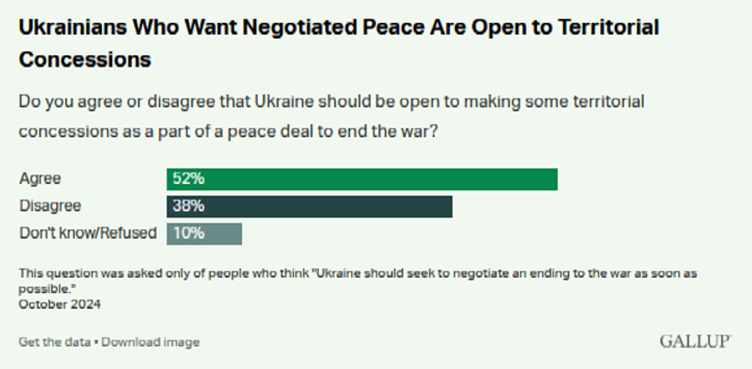
Of the 38% who believe in “fighting till victory,” only 19% would agree to some territorial compromise (as the bar chart shows, 81% reject any territorial compromise); that is, only 7% of the population:
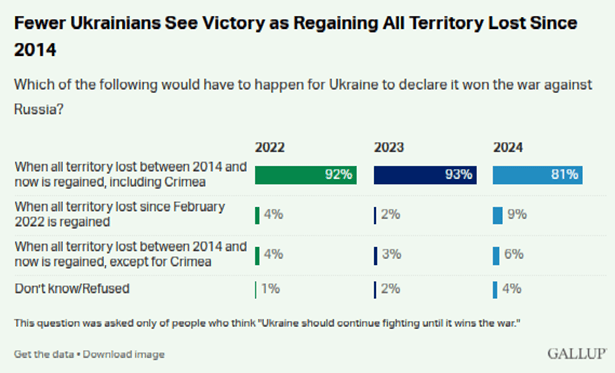
Add this to the 27% from the first group, and 34% of Ukrainians are now in favour of “some” territorial compromise. In contrast, around 51% of the population reject any territorial compromise.
These figures tie in well with another survey, by the Kyiv International Institute of Sociology (KIIS), from mid-2024, which found that 32% of Ukrainians were in favour of some territorial concessions, while 55% reject any compromise.
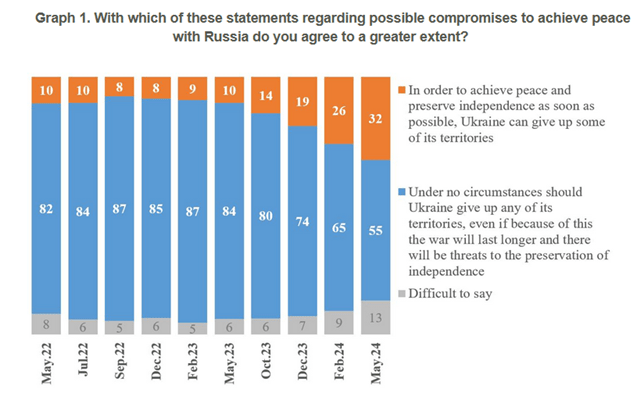
Now, while both surveys show a majority rejecting all territorial concessions, the majority is razor thin, even if the pro-concession group is considerably smaller. However, the devil here is in the details.
In the Gallup poll, as can be seen in the chart above, while 81% of Ukrainians wanting to “fight till victory” believe all territory must be recovered for this “victory, a full 96% believe that Ukraine must regain a substantial amount of territory: 9% want to regain all territory lost since the Russian invasion of 2022 (ie, all of Kherson and Zaporizhzhia and most of Luhansk), about half the occupied territory, while another 6% want to regain all four eastern oblasts but would be prepared to give up only Crimea.
If we were to add these people to those rejecting capitulation to Russia’s territorial demands, the number goes up to 56%, while those in favour drops to 29%.
But as the poll does not give similar breakdown data for the first group, ie the majority wanting a negotiated settlement, who agree to “some” territorial concessions, it is likely to also be the case that many of those who agree to “some” would reject ceding all territory. As such, the numbers rejecting the Russian demand to recognise all annexed territory as Russia’s is likely to rise to some two thirds; the number accepting to be a quarter at most.
Clearly, the vast majority are opposed to ceding all territory to Russia, so it is fiction that the Ukraine government does not represent the popular will. However, it is clear that the majority is declining, and the numbers supporting “some” territorial concession, while still a minority, are now substantial enough to suggest that some kind of compromise is possible for the sake of ending the war. But the problem remains that Russia’s starting point for beginning negotiations is Ukraine’s prior recognition of its annexation of all five oblasts, even the parts it does not control. This makes condemning the Ukrainian government or people for wanting endless war, seeing them as the party that needs to be pressured, is somewhat absurd.
NATO, security guarantees, and Trump
It is also important that Ukrainians in various polls (especially the KIIS poll) see security guarantees as just as an important an issue; if forced to make territorial concessions for peace, they do not want Russia to re-invade again in a few years. And most see NATO membership as the most certain form of security – it is rather obvious to them that Russia invaded a NATO non-member, while Sweden and Finland, the latter with a long border with Russia, have never been touched or threatened since joining NATO.
Yet for all this – and all the non-sequitirs from much of the left about prospective Ukrainian NATO membership being what “provoked” Russia’s invasion, the reality is that NATO membership was never on the cards for Ukraine, and Zelensky was always ready to trade that away – this was offered to Putin before his invasion, and he rejected it, since his aim was territorial conquest, not the NATO bogey; Ukraine again offered it in a formal peace plan a month into the war, to which Russia responded with the Bucha massacre and the complete obliteration of Mariupol (see Myth 7). If there is no NATO membership, Ukraine has been willing to accept other forms of tight security guarantees all along. But the NATO discussion will the topic of Myth 9.
A final note related to what Ukraine may have to compromise on: the problem with Trump’s blatant dealing with Putin over Ukraine’s head about Ukraine is not some pragmatic recognition that the war is a quagmire and requires negotiations and bad compromises; nor that the US wants to get out of Europe, focus elsewhere, and leave European problems to Europe. It is hilarious watching parts of the left cheer Trump – the guy who wants to expel two million Palestinians from Gaza – as a peacemaker!
Because if Trump simply wanted to launch a negotiation, he might have included Ukraine and Russia on equal terms rather than engaging in such blatant imperial carve-up; and he would not have given everything to Moscow in advance, he and his ministers declaring in advance of negotiations both that Ukraine will not recover its territory and that it will not join NATO and that the US will not be involved in any other security guarantees; Trump told Zelensky that he had “no cards,” as he had given all of Ukraine’s cards away to Russia before any negotiations begin. If that is not a blatantly pro-Putin action, I don’t know what is. And if he wanted the US out of Europe, it is strange that he invited Zelensky to the White House to get Ukraine to sign a colonial deal to hand over its mineral wealth to the US; Ukraine is in Europe.
It is no accident that Zelensky’s popularity in Ukraine shot up following the Trump-Vance ambush where he left without signing the colonial deal; because whatever else may be wrong with the Zelensky government – a neoliberal government that socialists would take issue with on many fronts – the stance of defending Ukraine’s self-determination against Russian imperialism remains one with significant majority support.
 Their Anti-imperialism and Ours