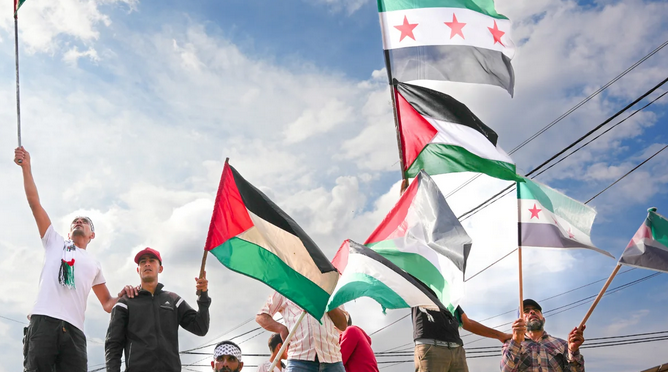
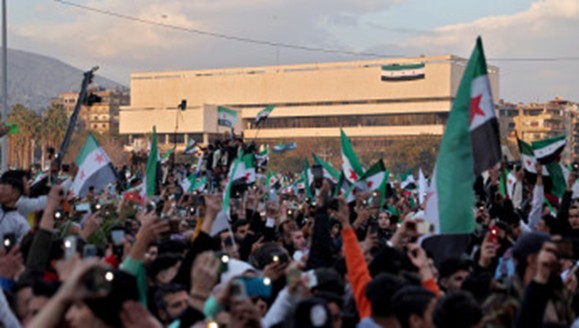
Above: Syrians celebrate news of the lifting of US sanctions, New Arab
By Michael Karadjis
Trump’s proclamation that the US will lift the sanctions on Syria is a tremendous gain for the Syrian people. Everywhere in Syria were scenes of wild celebration. While much can be said about Trump’s motivations or about what concessions may be forced from Syria, the first thing is celebrate with the Syrian people.
Following the announcement, the Syrian pound appreciated 30 percent against the dollar almost immediately, a sign of things to come. The lifting of sanctions allows for normal economic activity, investment and economic development; currently 90 percent of Syrians live in poverty, Syria ranking as the fourth most food-insecure nation on Earth. Large parts of Syria, entire towns and cities or sections of cities, were reduced to rubble by years of regime and Russian bombing; much of Syria is the closest thing to Gaza in the mideast. Half of Syria’s water systems are destroyed. A 2017 World Bank report estimated that nearly a third of the housing stock and half of medical and education facilities had been damaged or destroyed by regime bombing; two and a half million children are now out of school (among Syrian refugees in the region, half are under 18 and one third of them do not have access to education). One third of the population are out of the country, and even inside the country, some two million internal refugees live in tents. While tens of thousands were released from Assad’s torture gulag in December, some 130,000 remain unaccounted for, slowly being dug out of mass graves, a fraction of the 700,000 killed in the genocidal war; the enormous process of excavation and identification, so essential for the Syrian people to recover, requires technical skill, equipment and a lot of money. Currently there is electricity for a few hours a day, if lucky, food and fuel are absurdly expensive due to being in very short supply, and wages abysmal, the state bankrupt – so bankrupt that Qatar and Saudi Arabia paid off a mere $15 million in debt to the IMF and World Bank that the government could not afford. With the central bank sanctioned, virtually no banks around the world have been able to make financial transactions with Syria; not even remittances could get through much of the time. Even a Qatari attempt from January to pay public sector salaries for a few months was held up by US sanctions until May, when special permission was finally given by the US (except for military and security salaries). Clearly, no reconstruction can occur without the lifting of sanctions.
Already, major French, Chinese, Turkish, Qatari, Saudi and Emirati projects have been launched, focused on Syria’s crucial infrastructure and energy sectors. While renewed capitalist investment and economic activity are obviously no panacea and will introduce their own problems, it would currently be a luxury to worry about that in the context of zero money for investment, development and reconstruction; there was certainly no lack of capitalism under Assad, where his family and cronies owned great chunks of the economy, but Assad’s kleptocratic crony capitalism was little more than a regime of plunder; its collapse has left nothingness in its place.
One thing the Assad regime did leave, however, was some fabulously wealthy individuals, and these Assad-connected capitalists may well be the very people grabbing new investment opportunities. As Syrian writer Mahmoud Bitar notes, “Russia and Iran are not standing aside. Their economic arms, state-linked contractors, businessmen, and cronies are still embedded in Syria’s reconstruction, energy, and infrastructure sectors. … The likes of Mohamad Hamsho, who controls hard currency flows, and Fuad al-Assi, who runs the country’s largest money transfer network, remain central players … Lifting sanctions could make them stronger tomorrow.” Likewise, as Syrian writer Joseph Daher stresses, an economic free for all without clear targets will not lift the country out of its misery, especially given the government’s neo-liberal orientation; he also stresses the necessary political dimension of democratic inclusion and revival of civil activism to assuring the gains are not all made by big capital.
These are critical issues moving forward, but right now Syria does need this massive investment, and so far it has been the most crucial sectors targeted. And for those of us interested in seeing a working-class movement develop, or even for the revolution go beyond capitalism at some stage, there is no short cut without renewed capitalist investment and reconstruction, in the absence of a global socialist development fund: class struggle starts with the very existence of a powerful working class in crucial industries up and moving; it does not happen among a dispossessed people struggling for daily survival.
It is simply impossible to overestimate how important this is for the Syrian people, and their right to recover after the Assadist genocide.
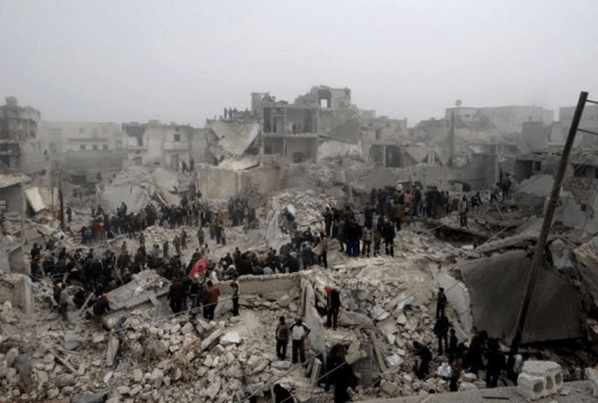
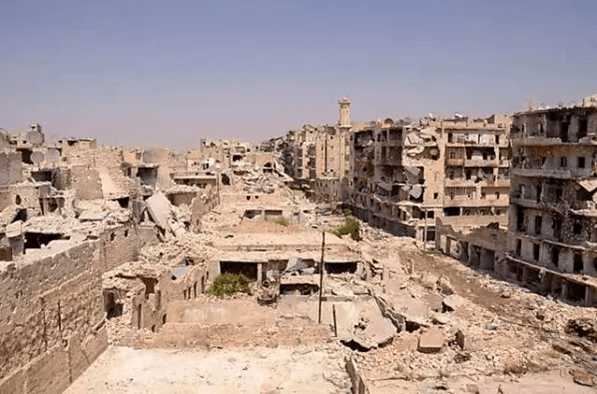
Syria’s reconstruction needs are estimated to range from $400 to $600 billion.
No gift: Continuation of sanctions after Assad was a crime
It should be understood that this is not a gift to Syria, rather, the maintenance of the sanctions placed on the Assad regime for 6 months after the end of that regime was a criminal act in itself that made no logical or legal sense and was an act of violence and pressure against the Syrian people and the new government. For example, the number one condition for the end of the Caesar sanctions imposed on the Assad regime was the release of the tens of thousands of political prisoners in Assad’s gigantic torture gulag; everyone saw the scenes of the mass releases of tortured and emaciated and insane prisoners, many there for decades, in December. Another was creating conditions for the return of the 6.7 million Syrian refugees abroad; 482,000 have already returned to Syria, on top of 1.2 million internal refugees who have returned to their homes, and the main thing continuing to hold up return of both groups is precisely now the sanctions, because no-one has any money in Syria and there is no capacity to begin reconstruction of the half of Syria destroyed by the previous regime – including homes of these millions. Another was to end the bombing of hospitals and medical infrastructure etc – yes, the new government has not been bombing its cities and schools and hospitals and bakeries and markets. So why did the sanctions continue?
Some background on Syria sanctions and US-Assad relations
Before continuing, we will digress a little to look at the historical context of US sanctions.
There were already layers of sanctions before the 2019 Caesar sanctions, for example in 1979 the US imposed hypocritical “sponsor of terrorism” sanctions on Syria, meaning simply that Syria refused to capitulate to Israel, and there were further sanctions in 2004, and then in 2011 following the onset of Assad’s massive crackdown. However, their impact was less severe than the Caesar sanctions; when the US imposed these sanctions, they affected US trade and investment, which, when you look at a map, you could understand would be miniscule for Syria. Nor did they prevent large-scale US-Assad dealing, such as when the Bush administration was sending Islamist suspects during the “war on terror” to Syria to be tortured.
However, the 2019 Caesar sanctions imposed a secondary sanctions regime, whereby the US sanctioned anyone else doing business with the regime. This had a more devastating effect, because as the UAE, Bahrain, Jordan, Egypt and later Saudi Arabia all restored relations with Assad and were determined to invest their money there, they could do little of that without being sanctioned themselves. Sanctions on Syria’s central bank made loans and investment almost impossible. The Caesar sanctions, named after ‘Caesar’, a former Syrian prison photographer who released tens of thousands of photos of tortured prisoners, were therefore a double-edged sword – on the one hand, being a result of years of Syrian human rights activists campaigning, their key demands were absolutely supportable; on the other hand, their draconian nature had a devastating impact on ordinary Syrian people, while the cronies of the Assad regime continued to amass enormous wealth; that everyday struggle for survival also had a negative impact on the ability of Syrians to maintain any kind of anti-regime struggle.
It is mistaken to assume that all anti-Assad Syrians and supporters internationally supported the sanctions in this form, although some kind of more targeted sanctions against such a horrific regime were certainly justified (just as we support sanctions on the genocidal regime in Tel Aviv). But it is also arguable that lifting them under Assad would have made little difference with a regime that was stealing from the population on such a scale; and for the millions abroad, and displaced within Syria, some kind of pressure was the only way they could ever return; they are Syrians too. And lifting sanctions to allow reconstruction – of the millions of homes and entire cities destroyed by the same regime – could also have had criminal consequences, as the regime was passing laws to dispossess the original owners who did not return (and most could not return because they did not want to see their sons and daughters “disappear” into the gulag); therefore, the regime was building new accommodation for new “owners,” including luxury accommodation for cronies.
In addition, their impact was partially buffered by Syria’s two main allies – Russia and Iran – being among the world’s largest oil producers, and as victims of US sanctions themselves, there was no impediment on them supplying oil to Syria, while the US-backed Syrian Democratic Forces (SDF) in northeast Syria, which controlled most of Syria’s oil, also traded oil with the regime, with US consent; then there was Assad’s huge Captagon empire, a lucrative trade to enrich some of his support base. All of this ended with the collapse of the regime, although the SDF re-started its small-scale delivery after agreements with the new government this year. Even basic humanitarian aid to Syria via the UN, which has largely been supplied by the US and EU over the years, fell since the overthrow of Assad, because the period corresponded with the Trump administration’s foreign aid freeze; the 9th international donors’ conference on Syria in March raised 5.8 billion Euro, down from 7.5 billion in 2024, due to the US absence.
Why did the US impose these drastic sanctions when it did? On one hand, as it came after years of Syrian activism, pressure took time to build up on the US Congress. On the other, the sanctions were imposed in 2019 only after the revolution had been safely crushed by the regime, facilitated in doing so by both the Obama and Trump US administrations. Trump in particular began his rule by ending whatever remained of the limited Obama-era US support to a number of “vetted” Free Syrian Army rebel factions; even in Obama’s time, that aid was mainly aimed at co-opting these factions into the US war on ISIS, and the US vigorously enforced a ban on any country attempting to supply anti-aircraft weaponry to the rebels, in what was primarily an air war (what a contrast to Ukraine!). Trump also ended all Obama-era aid to hundreds of community councils in opposition-held territory, which ran schools, health clinics and other essentials, regardless of the US aiming at NGO-style co-optation. In 2017, Trump bombed an Idlib mosque which he accused of being a headquarters of Jabhat al-Nusra (the predecessor of Syrian president al-Sharaa’s HTS organisation), killing 57 worshippers; under both Obama and Trump, hundreds of Nusra and HTS cadre were killed in US attacks. In 2018, Trump, Putin and Netanyahu coordinated to facilitate Assad’s reconquest of the south from rebel control, right up to the occupied Golan.
US leaders feared the destabilising effects of successful revolution on US control of the middle east more than their distaste for Assad. Once this threat of revolution was crushed by 2018, the US now felt free to sanction the regime whose destruction of its entire country and creation of the world’s most gigantic refugee population was also deeply destabilising to the region; the US aimed to “change Assad’s behaviour” without the danger of revolution. And the deeply demobilising nature of sanctions ensured that continued. While the complete hollowness of the regime led to its collapse with a relatively slight military push in November 2024, the Syrian masses only came out into the streets in response to these victories; the demobilised and demoralised population were unable to play a decisive role in bringing down the regime themselves.
But whatever the case, there was no basis for continuing these sanctions after December 8, yet the Caesar sanctions were extended another four years by Congress in late December!
Of course, one might say, there is good reason to not trust the new government to be all democratic and so on either; but how is that different to countless other governments in the region and the world? Why are western governments the world’s police, and if they are, why don’t they sanction so many repressive regimes that are their allies, not to mention Israel? To not give a new government, that had opened up Assad’s gulag and dissolved the repressive apparatus, at least a breathing space was not only illegal and illogical but also immoral, because it has meant six months of excruciating poverty, inability to begin reconstruction, and was a huge obstacle to the government doing many of the things expected of it precisely by western governments, such as attempting to close the post-revolution security vacuum, because it has so little money to pay its security forces. After all, western governments could always “snap back” sanctions if they decided things went badly. The EU and UK did drastically lighten (though not repeal) their own sanctions, while emphasising it was no ‘blank cheque’ and that sanctions could return if the al-Sharaa government violated human rights or went in an anti-democratic direction; but the US rigidly maintained its sanctions regime, which, with its control of global banking and secondary sanctions, were much more fundamental.
Israel and other sources of US hostility
The hostile US stance was partly related to Israel’s relentless hostility to the new Syrian government – Israel had always preferred Assad – as well as the deeply anti-HTS stance of a number of key White House Islamophobes and “anti-terrorism” tsars in MAGA circles, including Trump’s senior director for counterterrorism Sebastain Gorka (who has “never seen a jihadi leader become a democrat”), Director of National Intelligence Tulsi Gabbard (who visited Assad in 2017), and Israel-connected National Security Advisor Mike Waltz (whose abrupt removal “cut off a chunk of the White House’s ‘wall of resistance’ on Syria”); while VP Vance, Elon Musk, and other MAGA acolytes outside the government like Tucker Carlson were on the same wavelength. Just days before Trump’s announcement, Gorka had called the Syrian government “salafi-jihadist” and praised Israel’s aggression. As Syria watcher Charles Lister writes, “For 5 months, the entirety of President Trump’s national security apparatus — from the National Security Council, to the State Department and intelligence community — has voiced varying degrees of hostility, skepticism and/or indifference to Syria’s post-Assad transitional government.”
In April, the US changed its description of Syria’s UN mission to “the mission of a country the US doesn’t recognise,” with US leaders emphasising that it “does not recognise any Syrian entity as a government.” In February, of 23 European and Arab countries assembled at the Paris Conference on Syria to support Syria’s “transitional phase,” only the US did not sign the final declaration (due to the “reservations the US has on HTS”). In an April 10 UN Security Council session amid Israel’s ongoing aggression against Syria, only the US took Israel’s side, stating that “Israel has an inherent right of self-defense, including against terrorist groups operating close to its border.”
More generally, both the US and Israel understood the danger of a revolution overthrowing an Arab dictatorship, regardless of the particular leadership, and thus Israel’s months of bombing and occupation following December 8, combined with US sanctions, aimed at forcing as many concessions as they could from the new government, and in practice further entrenched its economic and security dependence on conservative regional states, greatly limiting the ‘demonstration effect’ of a successful revolution elsewhere in the region (in particular Jordan and Egypt). Israel was more hostile than the US: the latter would be satisfied with a weakened and humbled Syrian government, whereas Israel openly declares its aim is to partition Syria into cantons and keep it weak forever. For Israel, the possibility of the new Syrian government succeeding in uniting the country even on a quasi-democratic basis was anathema; such a government would be in a position to push for its rights, such as on the occupied Golan. As for the particular leadership, Israel understands that, despite Sharaa’s outward pragmatism, the Islamist movement he comes out of is deeply connected across the region to fellow Islamist movements that consider Palestine a holy cause, so forcing it into a besieged corner also contains such connections.
Harsh US conditions for mere sanctions ‘relief’
Some six weeks ago, the US presented Syria with 8 demands it would need to meet for mere “sanctions relief,” but not abolition. While some were things the government had no problem with, such as cooperating with international anti-chemical weapons inspections, cooperation against ISIS and help with finding a number of American citizens who had disappeared in Syria, others were for the right of the US to bomb “terrorists” in Syria whenever it saw fit, the expulsion of all Palestinian groups from Syria, and that no foreign fighters hold any positions in Syrian governance or security structures. The government responded that some were easy to agree with, but expressed reservations about others which infringed national sovereignty.
Despite much social media misinformation, there was no US requirement for Syria to join the Abraham Accords. It was not in any of the published lists of conditions, and it was explicitly denied by Syrian foreign minister Shaibani. And nor did the al-Sharaa government make any statement about being interested in joining the Abraham Accords, despite a huge amount of misreporting based on second-hand hearsay and embellishment by two American Congressmen (who have Syrian constituencies) who had visited Syria; moreover, the Syrian foreign ministry noted the idea was a non-starter because the accords were signed by states that “do not have occupied lands under Israeli control.” Obviously, the Syrian leadership saw the visit of US policy-makers as a chance to push for the end of US sanctions, and so fudged their questions about the Accords; even their own reports that al-Sharaa allegedly said “in the right conditions” can mean whatever one prefers, eg, the “right conditions” could mean not only Israel’s withdrawal from Golan but also its acceptance of the 2002 Arab Peace Initiative (ie, a sovereign Palestinian state in all of ’67 with Jerusalem as its capital). Another anonymous leak alleged Sharaa said that only when Israel withdraws from Syrian territory can we “talk about” an agreement; there is a big difference between “talking about” an unspecified “agreement”, and agreeing to normalise with Israel – which Assad explicitly committed himself to. The government is “playing the game a little bit here by saying the most that they can say to please their audience without pushing the boat too far and suggesting that they’re about to do something which they’re not,” as Syria watcher Charles Lister explains.
I recommend trying to avoid the avalanche of misinformation flooding social media. The government did, quite sensibly, continually stress that it was not a “threat” to any neighbouring state “including Israel,” that the Syrian people were exhausted and did not want conflict. After all, the Assad regime had kept the quiet on the ‘border’ of Israeli-occupied Golan for 51 years, and was widely appreciated by Israel for this, and that’s when it had a huge military arsenal, all of which was destroyed by Israel in the weeks immediately after Assad fell; any stupid move by the weak, disarmed new government would have resulted in Israel turning Damascus into south Beirut.
Nevertheless, the pressure was on. Reportedly, the eight conditions became twelve in recent weeks. Just several days before Trump’s current trip to the Gulf, on May 11, he reported to Congress that the Syrian “national emergency” sanctions would be extended another year. In justifying the extension, Trump explained that “structural weakness in governance inside Syria, and the government’s inability to control the use of chemical weapons or confront terrorist organizations, continues to pose a direct threat to U.S. interests.”
According to three sources speaking to the New Arab, “the administration has increasingly been viewing relations with Damascus from a perspective of counterterrorism … US officials conveyed to [Syrian foreign minister] Shaibani that Washington found steps taken by Damascus to be insufficient, particularly on the US demand to remove foreign fighters from senior posts in the army and expel as many of them as possible.”
To top it off, Democratic Senator Jeanne Shaheen stated in the Senate that she had become aware that some foreign policy circles of the Trump administration had suggested assassinating al-Sharaa, but Trump had been persuaded against the idea by the King of Jordan, because it could lead to civil war!
So, what changed?
What then changed in a few days for Trump to suddenly announce the end of “all” sanctions, apart from Trump as an individual’s tendency for abrupt and erratic changes based on his temperament? There are several aspects here.
Firstly, while Sharaa was not able to satisfy all US demands, he decided to appeal to Trump on two grounds known to move his instincts: money and flattery. Several days ago the Syrian government offered US companies access to Syrian oil, gas and minerals. Chinese companies have been strongly courting Syria (and at the UN, Syrian Foreign minister Shaibani, meeting his Chinese counterparts, said China and Syria would establish a “strategic partnership”), and in early May, Syria signed a 30-year contract with French shipping giant CMA CGM to develop and run the port of Latakia (followed by Sharaa’s visit to France); however, Syria still needed the end of US sanctions. Offering US companies a special place was aimed at getting these sanctions lifted; it obviously does not mean that French, Chinese or other countries’ business will be turned away. On the contrary, US sanctions hold up these other countries from doing deals in Syria.
In making this offer, Sharaa was following Iran’s similar offer to Trump several weeks ago, that US companies could bid on Iran’s nuclear projects meaning “tens of billions of dollars in potential contracts are up for grabs” if sanctions were removed; more recently, Iran allegedly again proposed a joint nuclear-enrichment venture, involving Arab countries and American investment. Both of course base these offers on the “Ukraine minerals deal” model.
Then more symbolically, yet cringingly, al-Sharaa offered to build a ‘Trump Tower’ in the middle of Damascus if he lifted sanctions, using the weapon of flattery that reportedly works well with Trump. While many Syrians, given the alternatives, may see this as distasteful but symbolic enough to accept if sanctions are lifted, it is hard to imagine an uglier, in all respects, addition to the beautiful Damascus skyline.
Trump’s Gulf extravaganza and growing Saudi-Israeli divergence
It is hard to know how much the economic offer and the Trump Tower impacted Trump’s decision-making, but the other thing of course was Trump’s Gulf trip itself. Trump’s trip to Saudi Arabia, Qatar and the United Arab Emirates was all about money. The three countries have offered to invest trillions in the US economy; the Saudis agreed to $142 billion in arms purchases from the US; Qatar signed over $200 billion dollars worth of deals, including the purchase of 210 Boeing jets. Meanwhile, the Trump family business itself also has huge ventures in these countries.
Trump sees a number of powerful sub-imperial states running the region in their spheres of influence as the US gradually shifts more of its attention to confronting China in east Asia. Saudi Arabia, the UAE and Turkey are key states in this equation; meanwhile Trump sees a new Iran nuclear deal as a way of bringing Iran into the regional system, or at least neutralising another powerful state in its own now reduced sphere; and of him perhaps getting a Nobel Prize. These aims, and the enormous, glittering wealth behind them, somewhat conflict with the priorities of the US’s main regional ally, the Israeli regime currently carrying out a devastating genocide in Gaza, which was in full swing during Trump’s trip.
While Israel was starving Gaza to death and launching horrific attacks on hospitals, these Arab leaders feted the US leader supplying Israel with all its killing equipment, and barely a word was said about Gaza the whole time, yet another stunning indictment on those Arab states who actually have some power to do something if they wished.
But the fact that these rulers don’t care about the Palestinians is a given. When it comes to interests though, they increasingly diverge from the particular priorities of Israel, and especially of this regime. While years of commentary has claimed Saudi Arabia was about to sign onto the Abraham Accords with Israel, and that Trump’s big goal is to get a Saudi-Israeli normalisation happening, in reality the Saudis have stood steadfast on the condition for normalisation: a sovereign Palestinian state in all the territory occupied by Israel in 1967 with Jerusalem as its capital, as per the 2002 Arab Peace Initiative. They are particularly uninterested in even discussing normalisation as long as Netanyahu continues the genocide. In fact, the Saudis made it a condition of Trump’s visit that the idea not even be mentioned. They care nothing for Palestinians; however, they also increasingly care little for the globally isolated genocidal entity as they revel in their own power.
In this context, Trump’s view of US interests in the region also partially diverges from Israel’s extremist regime in a number of ways. If the Saudis and Israel can’t agree, he will deal with each separately. Rather than ‘normalisation’, the Israel issue is now ‘de-coupled’ from other issues in the region. Therefore, what we have seen in recent days and weeks has included:
- Trump’s deal with the Houthis in Yemen, to stop bombing them if they stop hitting US vessels in the Red Sea (which in any case they have not been doing for months). The agreement did not include any US reaction to ongoing Houthi attacks on, or attempts to attack, Israel; Israel was not consulted, and was said to be “blindsided.” The Saudis, despite bombing the Houthis for seven years (2015-22), pressured the US to make the deal, determined that the three-year Yemen ceasefire, and two-year Saudi-Iranian normalisation, continue. On the Houthis, Trump said “You could say there was a lot of bravery there,” noting that he “honours their word” on ceasing attacks.
- Trump’s decision to begin direct negotiations with Iran to get a new nuclear deal was sprung on Netanyahu at an April press conference in the US; again Netanyahu was blindsided. Israel is determined to attack Iran’s nuclear facilities, and expected US support if not participation; Trump instead wants a deal he can dress up as “better” than Obama’s one he ripped up. Trump sacked his National Security Advisor Mike Waltz, for allegedly going behind his back and planning an attack on Iran with Netanyahu. Again, Saudi Arabia strongly supports US-Iran negotiations and has facilitated them (in stark contrast to last time round) – leading Saudi and Iranian officials have visited each other in recent days and weeks to facilitate the deal; during his meeting with Iranian supreme leader Ayatollah Khameini in April, Saudi Defense Minister Prince Khalid bin Salman called Iran and Saudi Arabia “two main pillars of the region.”
- On Saudi Arabia itself, Trump has said he is going to do a Saudi deal “without Israel.” While it is unclear exactly what this means, since “deal” till now meant normalisation with Israel, he has certainly done a massive Saudi deal! It is generally understood that the Saudis want American support to develop their nuclear industry, but until now the US tied this to the Saudis recognising Israel. Trump may now aim to support it without such recognition, though this has not come up during his visit, possibly because it is tied to the question of the Iran deal and how this impacts that country’s nuclear industry.
- The US negotiated directly with Hamas to get the hostage US citizen Edan Alexander released, again going behind Israel’s back, which is opposed to direct negotiations with Hamas. So is the US normally, but this was about a US citizen.
- So finally, Trump’s abrupt and unexpected declaration that he was lifting “all” US sanctions on Syria must be seen in the same context – as Trump himself admitted, both Saudi Crown Prince Mohammed bin Salman and Turkish leader Erdogan strongly appealed to Trump personally to lift the sanctions; “the things I do for the Crown Prince,” Trump exclaimed, when announcing the lifting of sanctions. Both see this as in their interests, from both common but also somewhat rival perspectives, and a stable Syria is an important economic link between the Gulf and Turkey. By contrast, Israel had appealed to the US to not lift Syria sanctions. Again, Trump went with his Saudi and Qatari hosts, and the Turkish leader, over Israel.
Decision a shock to US leaders; Trump has killed their conditions … or has he?
And really, there is not much more to it. By all accounts, the decision came as a complete shock to senior officials in the US government. “The White House had issued no memorandum or directive to State or Treasury sanctions officials to prepare for the unwinding and didn’t alert them that the president’s announcement was imminent, one senior U.S. official told Reuters. The sudden removal of the sanctions appeared to be a classic Trump move – a sudden decision, a dramatic announcement and a shock not just for allies but also some of the very officials who implement the policy change.”
The importance of this is that, if Trump follows through on this decision to scrap – not reduce – “all” sanctions, this will mean his personal, abrupt, immediate-context driven decision-making will render all the ghastly “conditions” the White House and State Department and NSC have been working to impose on Syria to get sanctions lifted irrelevant! It renders irrelevant his own comments just days earlier. State Department spokesperson Michael Mitchell confirmed that the US “did not request any guarantees from the Sharaa government” before lifting sanctions, that “Trump’s decision came unconditionally.” If this is the case, this is a far, far better outcome than the ongoing strangulation of Syria until it capitulates even on basic national principles.
However, that remains a big “if.” The problem is that while some sanctions can be lifted by presidential order, others, especially the crucial Caesar sanctions, have been voted into law and therefore require Congressional approval, while the “terrorism” label on al-Sharaa would have to be removed by the UN Security Council, and this prevents the US from supporting World Bank loans. “Removing sanctions is rarely straightforward, often requiring close coordination between multiple different agencies and Congress. … Edward Fishman, a former U.S. official, said the unwinding of Syria sanctions, which were imposed under a mix of executive orders and statutes, could take months to ease.”
However, there are provisions in the Caesar Act allowing the president to issue a ‘general license’ to suspend sanctions for a period of time. If Trump wanted to act, he would need to suspend them for at least two years for this to have any effect in terms of giving banks and businesses some confidence to deal with Syria. At this stage they have been suspended for 180 days.
And all this is the catch. If the White House, or Congress, or Trump himself, decide they want to continue the pressure on Syria, they could drag out the process and make it be known to the Syrian government that, if it wants Trump’s order expedited, the conditions in effect still exist. Secretary of State Marco Rubio stated, on the one hand, that US sanctions “relief” was not contingent on Syria immediately acting on US “concerns” such as ISIS resurgence, human rights protections, and the presence of foreign militant groups; but on the other, ominously, that “If Syria makes progress, we will ask Congress to permanently lift sanctions” – suggesting that if no “progress,” they won’t. “We’re not there yet,” he said. “That’s premature.” The next day Rubio went even further, stating that sanctions relief “does have to be conditioned on them [the Syrian government] continuing to live by the commitments” made verbally, i.e., combatting “extremism,” not launching attacks on Israel, and forming a government that “represents, includes and protects” ethnic and religious diversity.
Rubio’s caution reflects a middle position within ruling Republican Party circles between Trump’s sudden conversion on one side, and those like Gorka who are no doubt reeling in shock (saving face, Gorka asserts the lifting of sanctions is “not unconditional … we have made those stipulations very clearly”). Warning that Syria could explode into civil war and partition, Rubio explained that “the transitional authority figures, they didn’t pass their background check with the FBI,” but “if we engage them, it may work out, it may not work out. If we did not engage them, it was guaranteed to not work out.” Clearly, Rubio means that if it does “not work out,” Trump’s announcement is hot air. Another sitting on the fence, Senator Lindsay Graham, stated “waiving congressionally passed sanctions … has to be done in a coordinated fashion with our allies,” which presumably includes a hostile Israel. Graham said that Syria’s designation as a state sponsor of terrorism could “hopefully eventually” be rescinded.” Eventually …
It is deeply ironic and troubling that possibly the best we can hope for is that Trump’s very public and very unconditional statement on lifting “all” sanctions may mean he will feel compelled to honour his word, especially made as it was in front of his Saudi friends.
After the Saudi extravaganza at which he made his declaration about lifting sanctions, Trump met briefly with al-Sharaa and Saudi leader MBS, with Erdogan on call. While there is no recording of the meeting, it is understood that Trump put five points to Sharaa; State Department spokesperson Michael Mitchell stressed that these are “expectations” and are not actual conditions for the removal of sanctions. Trump urged Syria:
- to join the Abraham Accords
- to expel all “foreign terrorists” (ie Islamist fighters from other countries who helped Sharaa’s struggle)
- to “deport Palestinian terrorists”
- to help prevent a resurgence of ISIS
- to take on “responsibility for ISIS detention centers in Northeast Syria”
In his artful response, al-Sharaa allegedly:
- thanked Trump, MBS and Erdogan for arranging the meeting,
- noted shared U.S.-Syrian interests in countering terrorism and eliminating chemical weapons (thus avoiding anything specific about points 2,3,4 and 5 – we already know he has no problem with points 4 and 5 on combating ISIS)
- reiterated that Syria supports maintenance of the 1974 ceasefire lines with Israel on the Golan, which Assad maintained for 51 years and which a destroyed and disarmed Syria can obviously do nothing about at this stage; this can be considered his response to the first point.
- expressed his hope for Syria to “serve as a critical link in facilitating trade between east and west, and invited American companies to invest in Syrian oil and gas”
- “Shared Syria’s stance on current conflicts in Ukraine and Gaza, emphasising the need for international accountability,” with no more specific information.
On the Abraham Accords, even Trump seemed to understand that Syria would not be joining any time soon, responding to a question alter about whether he thinks Syria will join them: “Yeah, but I think they have to get themselves straightened out. I told him, I hope you’re going to join once you’re straightened out & he said yes. But they have a lot of work to do.”
Indeed, it will take many years for Syria to get “straightened out.” And in any case, since neither his Saudi nor Qatari hosts, both strong supporters of Syria, have signed or intend to sign the Abraham Accords, Sharaa has plenty to hide behind. And as Shaibani, his foreign minister has stated, only states who do not have territory under Israeli occupation have signed the accords, so we can only “talk” about an agreement when that ends; Israel, of course, never intends to withdraw from the Golan. Another wall to hide behind.
Nevertheless, nothing is certain. Officials in the White House and Congress may put their foot down. If under unbearable pressure Syria’s future capitulation cannot be ruled out; if that happened, it should be condemned as a betrayal of the Palestinian people, while recognising the pressure it was put under. However, the current anti-Sharaa social media circus on this question is condemning something that has not happened, that Syria has been resisting, and that no Syrian leader has ever suggested doing; those involved see their fact-challenged soundbites as more important than this hugely important victory is for the Syrian people.
Sharaa’s response back in Syria
In his first speech back in Syria, Sharaa thanked or mentioned every country in the region, as well as Trump and European governments that have engaged with Syria in recent months. The only relevant countries not mentioned were Israel, Iran and Russia. But despite his special appeal to US companies in the lead-up to Trump’s visit, there was no mention of this; on the contrary, he “welcome[d] all investors — Syrians at home and abroad, as well as Arab, Turkish, and international partners — to seize the opportunities available across various sectors.” He emphasised that Syria would no longer represent one bloc against another, that there are no special privileges.
While thanking various leaders, he also attributed the lifting of sanctions to coordinated diplomatic engagement and “the unity of Syrians at home and abroad,” noting “the interaction of Syrian communities around the world helped convince international actors that it was time to end Syria’s isolation.” Just days before Trump’s trip, 55 Syrian and International NGOs called on Trump to ease Syria sanctions.
Sharaa also declared that “Syria is for all Syrians, regardless of sect or ethnicity … coexistence is our heritage, and the division has always been caused by external interventions. We reject these divisions today.” Good – but now that sanctions are being lifted, it is important that “all Syrians, regardless of sect and ethnicity,” do get to be included in the new power structures and the government ceases its tendency towards an overwhelmingly Sunni-led state, with real accountability for crimes, such as against the Alawite population in March. Otherwise, such words will mean nothing, and division, exploited by foreign parties, will indeed continue.
As Sharaa spoke, Israeli warplanes conducted flights over Daraa and Quneitra provinces, and since then, Israel’s attacks in southern Syria have continued unabated.
Syrian relief, but ongoing Gaza catastrophe
The Syrian people need jobs, food, water, electricity, housing, reconstruction. Celebrating with them at this moment is the most important reaction, all caution considered. Syria is not a normal state capable of making free decisions. It is a state where much of the country is rubble, just emerging from 54 years of tyranny and 14 years of genocidal war, under attack and occupation by Israel in the south, while Russia, Turkey and the US also occupy parts of the country, over half of whose population is either in exile or uprooted inside the country, while well over 100,000 have still not been recovered from mass graves, with an economy crushed by massive theft by the former regime on top of devastating sanctions. It is not Gaza 2025 – a genocidal crime of an almost unique level of evil – but much of Syria is the closest thing to Gaza in the region. Try to imagine the kinds of “conditions” that will be placed on a future Palestinian state to allow it to breathe.
Touring around Trump while Israel’s holocaust in Gaza escalates to unimaginable levels, with weapons supplied by Trump, was a disgusting spectacle by Gulf rulers, even if, as demonstrated above, these regimes currently have different interests to Israel and Trump has been bending their way. But that’s not Syria’s fault; it lives in the world as is, with horrible choices, of which it had to choose the lesser evil of shaking Trump’s hand at this show.
It would be good to think that Trump’s divergence from Israel’s priorities on Yemen, Iran, Syria, Saudi normalisation and even direct negotiations with Hamas would translate into a Trump break with Israel on its Gaza genocide. Even if nothing more could be hoped for from Trump in terms of long-term justice for Palestine, right now just stopping the genocide is so important that, if he were impelled to do so by the Gulf extravaganza, it would justify the show. Whether the Gulf rulers cared to pressure Trump on this or not, or whether he listened or not, what we know at this moment is that nothing has happened, except for some words like “awful war.” Most likely Trump’s ‘de-coupling’ from Israel’s regional priorities elsewhere will not be repeated for Israel’s own key priority, ie, occupied Palestine, and Greater Israel will continue to be a key US ally alongside the other powerful regimes in the region. I sincerely hope to be proven wrong. It is a sad situation whereby at this particular moment, this seems the best one can hope for.
 Their Anti-imperialism and Ours