The question of arming the rebels

This article was originally published by the Campaign for Peace and Democracy (CPD) as part of its Roundtable on the Syrian Crisis in July 2013, at cpdweb.org/news/Syria-Karadjis.shtml. The other articles as part of this Roundtable can be accessed at cpdweb.org/news/Syria-intro.shtml.

The question of arming the rebels

By Michael Karadjis

The general outline of what initially occurred in Syria is largely agreed upon, even by those who subsequently turned hostile to the revolution: a peaceful mass movement for democracy began in cities and towns across Syria in early 2011 against the dictatorship of President Assad II, and the regime met these protests with ruthless state violence.

It is also largely agreed that this situation continued for some eight months, protesters baring their chests to Assad’s machine guns, tanks and heavy artillery, alongside targeted torture and killings of key activists.

When the masses could no longer bear this situation, they began taking up arms in self-defence, while rank and file soldiers and officers refused to fire on their brothers and sisters, and defected (a good description of this process can be read here. Out of these defected troops and armed citizens arose the Free Syrian Army (FSA).

Once arms are taken up, however, those holding a vastly different view of what is occurring in Syria begin to raise their heads and to gain a greater influence over leftist opinion. This view states that, whatever the initial situation, the armed struggle has now degenerated into a foreign (imperialist and Gulf-state) orchestrated brutal insurgency aimed at destroying Syria, led by reactionary Islamist elements, including Al-Qaida.

They point to some of the more obviously terroristic actions, such as bombings that targeted civilians in Damascus, as evidence that it has become a war against the Syrian people, as well as a Sunni sectarian war against minorities, and a fundamentalist war against secularism, rather than a war by the Syrian people against the regime.

Even many who have always opposed the Assad regime and well-knew how phony its alleged “anti-imperialist” credentials were turned either to a tactical defence of the regime as a “shield” against something worse, or to a “plague on both your houses” view—both sides are reactionary, both commit atrocities against the people.

What it misses is the fundamental difference on the ground, regardless of geopolitical struggles among regional powers: the Syrian revolution, the democratic revolt against the dictatorship, is still the fundamental fact.

Countless reports from liberated towns about the nature of this democratic process, under attack from the dictatorship, for example in Taftanaz, Saraqeb, Qusayr, the Damascus suburb Duma and elsewhere, are examples which deal with the real world difficulties of revolutionary democratic governance from below, but nevertheless reveal some semblance of popular structures that deserve defending against the dictatorship and its tanks, Scuds and torture chambers, and which do not show evidence of imposition of sharia law or sectarian cleansing of minorities

However, armed conflict, whatever its origins, does have the potential to corrupt a movement, whether via revenge war-crimes, an over-reliance on military means, the enhancement of existing sectarian dynamics, the boost it may give to irrational ideologies (e.g. jihadism), and the avenues it gives to foreign interference.

Such negatives cannot negate a democratic revolution as such, unless we live in a dream world (see “Syria or elsewhere there are no pure revolutions just revolutions”for this point. Indeed, massive regime violence is likely to have its reflection, to some extent, among the anti-regime forces. However, if they reach a certain level and are combined, the conflict could simply become a civil war between two equally undemocratic forces.

While all these factors exist at serious levels and should not be underestimated, it would be extremely premature to make this conclusion.

The formal leaderships of the Syrian opposition, based in exile, have little or no control over the grassroots political and military opposition inside Syria. On the positive side, this means they will not be very effective tools as the US tries to hijack the movement via these leaderships; but the negative side of this is that wayward elements that commit war crimes are also difficult to control and punish. Nevertheless, it is important that the rebel leaderships have continually and vigorously condemned all such violations, for example their condemnation of the well-publicised bite at the heart of a dead regime soldier by a rebel enraged at the soldier’s videos of his rape and murder of a mother and her daughters. The code of conduct, drawn up by the main grassroots leadership, the Local Coordination Committees (LCCs), and signed by dozens of FSA battalions, shows the lengths to which revolutionary forces have gone to try to rein in such activity.

There is however clearly a minority of truly reactionary forces which do threaten an anti-democratic religious dictatorship. The recent murder of a 15-year old in Aleppo for “blasphemy” is an example of this. This murder was vigorously condemned by the opposition Syrian Coalition, which called for punishment of the killers and described it as a “crime against humanity”. While clearly growing stronger, there is no evidence that this trend has come to dominate the movement.

Throwing the whole Syrian uprising into the “jihadi” camp undermines the very forces within the revolution that confront this reactionary trend on a daily basis (see for examples of popular demonstrations, slogans, declarations etc. against these currents and their actions here, here, here, here, here and elsewhere). The recent assassination of an FSA leader by Al-Qaida in Syria, and the FSA’s declaration that this meant “war” with these forces, further highlights this situation).

In a nutshell, the situation on the side of the revolution is still fluid, there is still struggle, the reactionary forces by no means dominate. In this context, their right to access arms from abroad should hardly be in question, confronted as they are by such a powerfully armed state machine, which bombs its own towns and cities with scud missiles, fighter planes and helicopters and the whole array of state power, reducing much of Syria to moonscapes (see for example Syria Witness). Even more so considering that most arms flowing into Syria are in fact Russian and Iranian arms further bolstering the regime.

However, since the countries furnishing some arms to the rebels at present (reactionary Gulf monarchies like Saudi Arabia and Qatar), and the countries likely to provide any arms in future (the US or other imperialist states), have reactionary agendas, it may be argued that they will inevitably bend the Syrian revolutionary struggle to their ends if the Syrians accept their arms.

These states’ agendas are primarily to hijack the revolution and/or divert it along a path that better serves their interests than democratic revolution. Some in the Gulf prefer pushing reactionary Sunni jihadism and sectarianism; in contrast, the US tends to see these hard Islamist elements as a worse alternative to Assad, and aims to control a section of the exile leadership and push it into a deal with elements of the Assad regime, especially its security apparatus, to create a so-called “Yemeni solution”. In fact, to get them to prove their worth, the US is pushing mainstream rebels to prematurely launch war on the jihadists.

But not many movements in the real world, confronted by massive state violence, have much choice about who to get arms from, even though they come with a price. Merely receiving arms from someone has never been the final determinant of the nature of the movement on the ground, whether it was secular Bosnian Muslims in the 1990s getting arms from Iran, Iraqi Kurds in the 1970s from the CIA and the Shah of Iran, Ho Chi Minh negotiating for US support in 1945 or the Irish uprising in 1916 getting support from Germany. What is fundamental is the actual nature of the movement on the ground and degree to which it continues to represent the legitimate aspirations of the masses for democratic change.

Ironically, it is the extreme reluctance of Western states to provide arms to the Syrian opposition that has allowed the Gulf states to provide arms to reactionary Islamist forces. Islamist fighters are better armed than mainstream secular rebels; reports show some FSA rebels crossing over to Al-Nusra for this reason. Despite much talk about arms going to Syrian rebels, most reports show them starved for arms, and those arms that do reach them are light arms, little threat to the massive heavy military equipment Assad is throwing at them.

The US uses the strength of these Islamist forces as its key argument for refusing to arm the rebels, claiming any arms it sends to “friendly” rebels may end up with radical Islamists. This is then countered by the argument that it must start sending some arms to vetted rebels precisely in order to bolster the non-Islamist rebels. Yet in reality we still see hardly any US arms getting to the rebels. Indeed, the main US intervention has been stationing CIA units in Turkey and Jordan to prevent weapons from the Gulf reaching the rebels), especially weapons that would actually be useful, such as anti-aircraft weapons. (See here and here.)

The reason for this is that the US is not only concerned with radical Islamists; it is also aware that the exile FSA leaders that it has relations with have almost no control over the revolutionary forces inside Syria.

Thus while the left worries that Western arms will allow imperialism to hijack the movement, the US has refused to arm the rebels for over two years because it believes it cannot successfully hijack it. Ironically, while Syrian revolutionaries are continually confronting the reactionary Islamists, as shown above, when the US tried to prematurely push them against these forces, the same Syrians came out into the streets to denounce US interference for trying to split the anti-Assad forces; they’ll confront the Islamists on their own terms, but won’t let the US tell them what to do.

Nonetheless, despite Syrian rebels having the right to get whatever weapons they need, there may be legitimate questions about the effectiveness of receiving extra arms. Given the sheer horror of continuing war for all, and the regime’s enormous military superiority, extra arms may make little real difference to the actual battle, but instead may merely prolong the fighting, or even escalate it, as it will in turn encourage Russia, Iran and Hezbollah to supply even more weapons and fighters to the regime.

It is true that more arms in themselves will not win the revolution. In the big cities, Damascus and Aleppo, military stalemate has long ago been reached, with significant sections of the middle class sticking to the regime against the largely rural-based insurgency which has only won over the poorer areas of the cities; while important minorities, particularly most Alawites, Assad’s own sect, and many Christians, have stuck to the regime. War crimes, undemocratic actions and the rise of the Sunni jihadist section of the movement have led these sectors to grudgingly stick with the regime or at least remain neutral. They will need to be politically won over, and the important problems with the parts of the rebel leadership and ranks currently prevent this.

It is therefore in the interests of most Syrians, and particularly of the revolution, for some kind of ceasefire to allow a breathing space for the mass civil movement to revive. Pouring in the kinds of advanced weapons that would allow the rebels to take Damascus and Aleppo whole, despite popular reluctance, would be no democratic solution (and still less would a “Libyan solution” of achieving this via imperialist bombing). However, it is important to remember that no one, least of all the imperialist powers, is proposing anything like this.

It is somewhat ironic that the receipt of limited numbers of small arms by the rebels is put forward as a cause of prolonging the war, rather than the massive use of heavy weaponry by the regime. The logical conclusion of this argument is that they should allow themselves to be crushed and achieve the “peace of the grave”. Even if the rebels got the main weapons they demand, but which the US blocks—portable anti-aircraft guns—this would only allow the rebels to defend themselves and their mass base more effectively; these are not offensive weapons that would allow them to march on Damascus.

What such weapons might allow, however, is for supporters of the revolution to gain more confidence, win back supporters pessimistic about confronting the regime, and actually put pressure on the regime to come to some kind of ceasefire; it is the regime’s overwhelming military superiority that allows it to push its military solution.

Given the enormous military superiority the regime already holds, it is difficult to see how even more Russian and Iranian arms to the regime would make that much difference, and the lack of Western arms has not held them back in any case.

Socialists have no business demanding our imperialist governments send arms or do anything in particular, as we know their agendas; but neither should we protest if they do send some arms (as opposed to more direct intervention which we must strongly resist). In fact, by demanding a complete US exit from the region, the CIA operatives currently preventing better arms from getting to the rebels would be out of a job.

It should be stressed, however, that a change in imperialist strategy is not out of the question, if Western leaders decide the situation continuing as at present is simply too destabilising. While unlikely, if the US and other imperialist powers decide to desperately throw themselves in with an array of no-fly zones, aerial bombings and so on, the current situation would become even more catastrophic, both inside Syria and regionally. While it is clearly not the Israeli strategy—Israel has continually made it clear it sees Assad, who has kept the peace on the occupied Golan border for 40 years and continually made war on the Palestinians, as the lesser evil to any of the Syrian rebel forces—Israel would likely move to take advantage of such a conflagration to carry out its own aggression against Iran, or even to forcibly expel a new wave of Palestinians.

Opposing imperialism should not mean being apologists for Assad’s butchery. But it is important to remember that opposing this butchery should in no circumstances mean losing our critical faculties and forgetting the kind of Armageddon a real imperialist war would entail.

Issues in the current stage of the Syrian revolution – July 2013

By Michael Karadjis

July 9, 2013 – Links International Journal of Socialist Renewal — Recent weeks saw seemingly contradictory developments regarding imperialist plans for Syria. First, on June 14, the US government announced it had finally agreed to provide some small arms directly to “vetted” sections of the Syrian armed opposition, following alleged US “confirmation” that Syria’s Assad regime had used chemical weapons. Then on June 18, the G8 meeting between the US, Russia and six other major imperialist powers issued a joint declaration calling for all parties to the Syrian conflict to attend the Geneva peace summit, declaring the need for a political solution.

In reality, the combination of these two developments was almost identical to what likewise occurred in the same week in early May: lots of hard talk about the possible provision of arms to the rebels due to the possible use of chemicals by the Syrian regime of Bashir Assad, and the initial US-Russian meeting to discuss Geneva and lots of talk about how both sides agree only a political solution is possible.

It may take some time to be able to properly assess the full implications of these moves. At the outset, however, two points can be stressed.

The first is that while the direct provision of an as yet unspecified amount of US arms to the Syrian rebels allows increased US leverage with both the Syrian opposition and the Assad regime, no serious commentators are suggesting this will make a great deal of difference on the ground. The US is only pledging to provide light weapons and ammunition, which are already being supplied by countries such as Saudi Arabia and Qatar. While this may add to the volume of such weapons, or even allow the Gulf states to provide certain kinds of US weapons that until now they were not allowed to, the US explicitly rules out providing the main form of weaponry the rebels call for, namely, portable anti-aircraft weapons for self-defence against Assad’s massive and massively used air power.

The second is that the initial declaration of the G8, announcing that the participants are “committed to achieving a political solution to the crisis based on a vision for a united, inclusive and democratic Syria” and calling for peace talks to begin “as soon as possible”, made no mention of the Assad regime at all (some of the opposition were demanding agreement that Assad step down as a pre-condition), called for “a transitional governing body with full executive powers, formed by mutual consent”, calls for Syria’s public services to be “preserved or restored”, stressing, very importantly, that “this includes the military forces and security services”, expressed their deep concern with “the growing threat from terrorism and extremism in Syria” and called on both the regime and opposition forces to “destroy and expel from Syria all organisations and individuals affiliated to al Qaida and any other non state actors linked to terrorism”.

This explicit naming of Al-Qaida (meaning the Al-Nusra front, which fights the Assad regime but is not part of any of the opposition coalitions and often clashes with them as well), with no explicit mention of Hezbollah, and the call for both regime and opposition to take the war to Al-Nusra, combined with the stress on preservation of the core of the regime, including its military, really gives an idea of what this “transitional authority” will be about, and the fundamental strategy of imperialism in Syria.

UK prime minister David Cameron was not kidding when he explained several weeks ago that the US, Russia and UK “share the same aim: to find a solution to the conflict that ends the killing and prevents violent extremism taking hold, with a transitional government with full executive powers, established with the consent of both sides, that preserves the integrity of the Syrian state and its institutions (http://www.itv.com/news/update/2013-05-17/cameron-and-putin-hold-syria-talks).

At this stage, the opposition Syrian National Coalition has rejected the G8’s cynical call for it to fight Al-Nusra, declaring “the Assad regime is the only source of terrorism in Syria.”

This so-called “Yemeni solution”, involving some largely cosmetic changes of the top guard, while preserving the state apparatus and the core of the regime, but adding enough vetted members of the opposition to allow stabilisation, has been the imperialist project from the time it became clear that Assad would be unable to simply crush the revolt, and that his brutality would only lead to permanent instability and the continued strengthening of reactionary anti-imperialist sections of the radical Islamist forces, such as the Al-Nusra front, which is strongly connected to Al-Qaida.

It is important to understand this at the outset: that the “Libyan model”, whereby full-scale imperialist intervention tries to militarily bring the Syrian opposition to power in Damascus, has never even come close to being the preferred imperialist strategy in the US, UK, France or elsewhere; actually it has never been an option.

Understanding this allows us to understand that the combination of “tough talk” and ending arms embargoes with peace talks are two sides of the same coin: The US knows very well that increasing the number of small arms won’t even significantly affect the battlefield, but allows a form of pressure on the Assad regime in the context of Assad’s recent victories via use of massive anti-personnel weapons and Hezbollah invaders. If unchallenged, this could lead to Assad refusing to attend Geneva or putting up too many conditions, while also driving the poorly armed Syrian rebels further into the arms of the relatively well-armed Al-Nusra.

By the same token, the long delay after the last round to tough talk some 6-7 weeks earlier (when the media were full of “the US is about to”, or “may think about”, allowing arms to be provided to “vetted” Syrian rebel groups), and the fact that hardly any arms reached the rebels in that period, and that every time Obama opened his mouth since it has seemed less likely than ever, was also timed to help Assad go on the offensive to mop up a little before the proposed international conference, allowing pressure on the rebels to agree to participate at Geneva without their precondition of Assad agreeing to step down. The blatantly obvious withholding of arms from rebels in southern Syria (see below) and then in the crucial battle of Qusayr makes this rather clear, as does the fact that the US has now finally moved on the question of arms as Assad and Hezbollah get carried away and head north to Aleppo.

The Syrian revolution continues – the forces involved

I will first clarify what I think is going on generally. The Syrian revolution, which broke out in February 2011 as a democratic mass revolt against the dictatorship, is still the fundamental fact. The fact that after eight months of slaughter by the regime revolt was forced to take up arms by late 2011 does not change that.

Countless reports from liberated towns about the nature of this democratic process, under attack from the dictatorship, for example in Taftanaz (http://harpers.org/archive/2012/08/welcome-to-free-syria), Saraqeb (http://world.time.com/2012/07/24/a-dispatch-from-free-syria-how-to-run-a-liberated-town/), Qusayr (http://middleeastvoices.voanews.com/2013/03/syria-witness-running-the-town-of-qusayr-without-assad-81450/#ixzz2NdfWSbWK), the Damscus outer suburb Duma (http://www.internationalviewpoint.org/spip.php?article2840), Sarmada (http://syriasurvey.blogspot.com.au/2013/01/local-governance-in-sarmada.html), Idlib
(http://syriasurvey.blogspot.com.au/2012/12/what-to-do-with-idlibs-islamists.html), Azaz (http://www.washingtonpost.com/world/middle_east/syrian-rebels-tackle-local-government/2013/04/30/3f2181d8-b1b9-11e2-baf7-5bc2a9dc6f44_story.html), parts of Aleppo (http://www.csmonitor.com/World/Middle-East/2012/1103/In-rebel-held-Aleppo-Syrian-civilians-try-to-impose-law-through-courts-not-guns) and elsewhere, are examples which deal with the real-world difficulties of revolutionary democratic governance from below, but nevertheless reveal some semblance of popular structures that surely deserve defending against the dictatorship and its tanks, scud missiles and torture chambers, and which on the whole do not show evidence of imposition of sharia law or sectarian cleansing of minorities.

While a complete run-down of the various forces and organisations involved in Syria would require another article, for the sake of clarity it is worth noting that the liberated towns and networks of activists throughout Syria are connected via the Local Coordination Committees (LCC), the main opposition force on the ground in Syria. It does not have a “political line” as it represents the spectrum of people’s opinions involved in the revolution. Since the armed struggle began to dominate, the LCCs still organise all manner of demonstrations and other non-military actions.

Some units of the Syrian army refused to murder civilians and thus defected to the revolt; these armed groups all over Syria are called the Free Syrian Army (FSA), which likewise has no central chain of command or overriding “political” view as it is basically the armed wing of the LCC. Thus when leftists slander the FSA as a whole, either as dupes for imperialism (usually based on statements by some exile leader) or as jihadi extremists or criminals (based on actions of some rogue faction), they are in fact slandering the entire movement on the ground, as the overwhelming bulk of the armed forces are nothing other than these “council regimes” with arms to defend themselves, not under the effective control of exile-based leadership bodies, and not responsible for actions of any rogue group.

The neo-pacifist critique that some of the Western left have newly taken up, that says no matter how much you get slaughtered you should still turn the other cheek, can be countered by the following rather typical description of how the civil uprising became the armed uprising in the northern liberated town Taftanaz (http://harpers.org/archive/2012/08/welcome-to-free-syria/):

By April 2011, demonstrations were popping up all across the country. The Syrian army tried to cut them down, firing on and killing scores of civilians, only to inspire further protests. The mukhabarat, meanwhile, targeted the core activists in each town

… But the conscript army started to buckle, and some soldiers found they could not fire on their countrymen. I had met one of them in Turkey, a twenty-seven-year-old named Abdullah Awdeh. He was serving in the elite 11th Armored Division, which put down protests around the country, when one day he was directed to confront demonstrators near Homs. Their commander said that the protesters were armed terrorists, but when Awdeh arrived he saw only men and women with their families: boys perched atop their fathers’ shoulders, girls with their faces painted in the colors of the Syrian flag, mothers waving banners. He decided to desert.

By June 2011, there were hundreds like him; nearly every day, another uniformed soldier faced a camera, held up his military identity card, and professed support for the revolution for the entire world to see on YouTube. These deserters joined what came to be known as the Free Syrian Army. Awdeh, with his aviator sunglasses and Dolce & Gabbana jeans, assumed command of a group of nearly a hundred fighters.

Many activists worried about the militarization of the conflict, which pulled peaceful protesters into a confrontation with a powerful army that they could not defeat. But in small towns like Taftanaz, where government soldiers had repeatedly put down demonstrations with gunfire and thrown activists in prison, desperation trumped long-term strategy. Abu Malek likened the actions of the rebels to those of a mother: ‘She may seem innocent, but try to take away her children and how will she act? Like a criminal animal. That’s what we are being reduced to, in order to defend our families and our villages.

In Taftanaz, fighters from the FSA started protecting demonstrations, quietly standing in the back and watching for mukhabarat. For the first time, the balance of power shifted in favor of the revolution, so much so that government forces could no longer operate openly. Party officials and secret agents vanished, leaving the town to govern itself.

Let’s be completely clear: these grassroots FSA fighters are what a section of the left has come to routinely slander as an imaginary “US-Saudi intervention allied with Al-Qaida making war on Syria”. Should Assad’s “anti-imperialist” scuds bomb them to bits to “defeat imperialism”? This is a concrete question. As is the question of why much of the neo-pacifist left believe these fighters should be denied better arms from wherever they can get them from.

Part of the issue many have is that many of the militias that fall under the broad umbrella of the FSA are Islamist militias. For example, the Farouk Brigades are partly associated with the Muslim Brotherhood (which has broad support in Syrian society, and which is regarded to be relatively “moderate” in Islamist terms and not classed as “salafist” or “jihadi”), but also contain secular fighters. Meanwhile, other militias within the FSA, which cannot be called “Islamist” in any political sense, adopt Islamic-sounding names, unsurprising in a Muslim country. This simply reflects the political broadness of Syrian society.

However, assertions that all fighting groups in Syria are Islamist (a claim, made for example by the New York Times and repeated ad nauseum in pro-Assad left websites) are simply untrue; anyone can, for example, look at the list of names of FSA militias that signed the LCC code of conduct that will be discussed below (http://razanghazzawi.org/2012/08/15/lcc-new-fsa-battalions-sign-the-code-of-conduct/) to see a mixture of religious, non-religious and neutral names, for example “Falcons of the Land Brigade in Hama”; or the many that are just called after the name of their town, such as “Revolutionary Military Council in Deir Ezzor” or at the list of secular Syrian nationalist names associated with the National Unity Brigades of the FSA (http://darthnader.net/2012/10/17/interview-with-member-of-the-national-unity-brigades-of-the-fsa), such as the Abdel Rahman Al Shabandar Brigade (named after a Syrian Arab nationalist who organised the Iron Hand society against French rule); or for that matter the first fully Christian FSA brigade (http://www.thenorthstar.info/?p=2528) or the FSA brigade headed by a defecting female Alawite officer (http://www.aljazeera.com/indepth/features/2012/10/20121022105057794364.html), hardly a symbol of Salafism.

Meanwhile, both the LCCs and the FSA should be distinguished from the exile leaderships, the Turkey-based Syrian National Congress (SNC) and the broader group that incorporates the SNC but is more representative, the National Coalition for Syrian Revolutionary and Opposition Forces (often shortened to “Syrian Coalition”), and the exile military leadership, the Supreme Military Council (SMC), which officially “leads” the FSA but in practice has no control over it on the ground.

All of these internal and external organisations should be further distinguished from the hard-line “salafist” militias outside of both the FSA and these political structures, which either belong to their own umbrella armed organisations, such as the Syrian Islamic Front to which the hard-line fundamentalist Ahrar al-Sham belongs, or Al-Nusra, which acts entirely on its own, of which more below.

The intellectually lazy amalgam made by the pro-Assad and neo-pacifist left between imperialism, exile opposition leaderships, the FSA, the LCCs, the jihadists, Al-Qaida and military struggle as a tactic – i.e., everything they don’t like – gets them into serious problems with reality. If it is thus assumed that these imperialist-influenced exile leaderships have driven the innocent internal uprising to militarisation in order to “make war on Syria”, then the discussion between the grassroots military brigades in the town Taftanaz referred to above and the exile leadership makes for difficult reading:

Had it been wise for the guerrillas to try to defend Taftanaz rather than retreat, as they had in other towns? It was a question that Malek said Riad al-Asaad, leader of the Free Syrian Army, had put to him at their headquarters in a Turkish border camp. “I shouted at him, ‘Who are you to ask me anything?’ ” Malek recalled. “‘You sit here and eat and sleep and talk to the media! We’re inside, we aren’t cowards like you.’”

Had it been wise for the guerrillas to try to defend Taftanaz rather than retreat, as they had in other towns? It was a question that Malek said Riad al-Asaad, leader of the Free Syrian Army, had put to him at their headquarters in a Turkish border camp. “I shouted at him, ‘Who are you to ask me anything?’ ” Malek recalled. “ ‘You sit here and eat and sleep and talk to the media! We’re inside, we aren’t cowards like you.’”

When I asked Ibrahim Matar’s commander in Taftanaz about the FSA leadership, he answered, “If I ever see those dogs here I’ll shoot them myself.” The Turkey-based commanders exert no control over armed rebel groups on the inside; each of the hundreds of insurgent battalions operate autonomously, although they often coordinate their activities.

Thus the Turkey-based “FSA” leadership, those who “sit and eat and sleep and talk to the media” and are most exposed to the imaginary imperialist conspiracy, who questioned the local FSA’s decision to defend themselves with arms, and they responded with contempt to the suggestion that they should not try to defend our families.

Dangers to the Syrian revolution

However, armed conflict does have the potential to corrupt a movement in many ways, whether via the growth of revenge war crimes, an over reliance on military means, the enhancement of already existing sectarian dynamics, the tendency towards harsher and less rational ideologies (e.g. jihadism) and the avenues it gives to foreign interference.

Not all these negatives can negate a democratic revolution as such, unless we live in a dream world (see the excellent article “Syria or elsewhere there are no pure revolutions just revolutions” http://syriafreedomforever.wordpress.com/2013/06/07/syriaor-elsewhere-there-are-no-pure-revolutions-just-revolutions for this point). However, if such factors reach a certain level, and they are combined, this could lead to a situation which is simply civil war between two equally undemocratic forces, as quantity becomes quality.

In my view, while all these factors exist at reasonably serious levels and should not be underestimated, it would be extremely premature to make this conclusion. Let’s look at these factors one by one briefly.

First, like in all revolutions, the sheer brutality of the regime often results in brutality by the armed opposition forces (e.g., examples of killing captives etc). While criminal and indefensible, these actions take place within the context of the regime’s extreme violence, and occur at a level dramatically more minor than the regime’s systematic crimes. The LCC’s code of conduct (http://razanghazzawi.org/2012/08/15/lcc-new-fsa-battalions-sign-the-code-of-conduct), signed by dozens of FSA battalions, shows the lengths to which revolutionary forces have gone to try to rein in such activity, and such ongoing debate and condemnation by revolutionary forces is evidence that this alone cannot be used to equate the revolution with the regime, quite aside from the enormous difference in scale. While much was made by the mainstream media, pro-Assad leftists, rightists and Islamphobes the world over about the apparent bite into the heart of a dead regime soldier, shot in battle, less prominence was given to the energetic condemnation of this act by the FSA leadership and by the leadership of his particular brigade.

Indeed, the sheer hypocrisy of this focus on this single act can be highlighted by the reason the man, Abu Sakkar, claims to have been driven to this. By no account was this an attack on an innocent person or ordinary soldier, still less a sectarian attack on an Alawite as some claimed; after having had so many of his family killed by Assad’s stormtroopers, it was when Sakkar found video on the phone of the soldier showing him raping and murdering a mother and her two daughters, that he was driven to his crazed act (see http://www.bbc.co.uk/news/magazine-23190533). The minor cannibalism was symbolic, not the reason for killing the thug, which occurred in battle; yet for leftist and rightist moral hypocrites the world over, raising the heart of a dead man in uniform, who was also a murderer, to ones mouth is far worse than raping and killing live people and recording it for your kicks. Sakkar ran his own militia, Omar al-Farouq, and thus was not under the discipline, even formally, of the higher FSA structures, which, while condemning his act, were not in a position to expel him from anything.

Second, while taking up arms for self-defence was inevitable and eminently justifiable, it is certainly true that an over-reliance on military struggle can seriously distort a struggle. That is particularly the case if military struggle goes beyond defence on to a strategy to take the state militarily, if it is in the context that the masses in certain regime-controlled regions are not also mobilising and/or remain grudgingly beholden to the regime. In other words, a military offensive strategy can only really work, indeed only really be democratic, if it is strategically guided by the movement on the ground.

The FSA’s military thrust into both Damascus and Aleppo contained grave dangers in this respect. The dangers have been limited to some extent by the fact that the FSA was simply unable to go beyond the parts of either city where it did have clear support among the masses, largely working-class areas containing a large proportion of recent migrants from the impoverished countryside, where the opposition is primarily based. It should be understood that there is a class basis to this division, something the pro-Assad leftists try not to dwell on: the FSA’s roots are in the countryside and impoverished new urban areas around cities due to the Assad regime’s turn to neoliberalism, which devastated the peasantry; the Sunni “business classes” in Damascus and Aleppo are one of the core supports to the regime (indeed, are organically attached to the regime). However, behind the bourgeoisie stands a large section of (Sunni and Christian) urban petty-bourgeoisie with little love for the regime, but with an understandable fear of the chaos an invading rural-based movement, especially one with an Islamist component, may bring to their lives if the revolutionary forces are not disciplined.

Thus, on the one hand, we see a flowering revolutionary-democratic council running the Damascus suburb of Douma (http://www.internationalviewpoint.org/spip.php?article2840), and also similar attempts in Aleppo (http://www.csmonitor.com/World/Middle-East/2012/1103/In-rebel-held-Aleppo-Syrian-civilians-try-to-impose-law-through-courts-not-guns). However, the much more difficult situation in Aleppo also saw how the evolution of the struggle into a military clash along a divide, with constant regime bombing and shelling and a lack of resources for the rebel side to even run a police force, could cover for outright criminality (above all looting) by elements among the rebel forces, towards the very people in the areas that had supported them.

The outcome of this is even more complex: the Islamist militias, including the hard-line Ahrar Al-Sham and Al-Nusra, later expelled the mainstream FSA militias from much of the liberated territory, and in the process were welcomed by much of the population, because whatever else is wrong with them, the consensus appeared to be that the Islamist hard-liners don’t loot, and that they deal harshly with rebel criminality (a good description at http://www.reuters.com/article/2013/06/19/us-syria-rebels-islamists-specialreport-idUSBRE95I0BC20130619). However, many others then chafe under the new reactionary Islamist laws, and now there is active fightback by revolutionary forces against both the Islamist repression and the thuggery of FSA elements (http://syriafreedomforever.wordpress.com/2013/07/08/syria-the-people-will-not-kneel-and-will-accept-no-injustice). In the meantime, the section of Aleppo under regime control is hardly encouraged to rise in order to replace Assad’s regime of terror with either criminal militias or Islamist repression.

This brings us to the third danger, that of “salafist” forces, with an anti-democratic agenda, coming to dominate the movement and hence expunge its democratic content. Incidentally, the fact that in Aleppo this danger apparently grew stronger precisely as a reaction against indisciplined and criminal actions of some of the mainstream rebels indicates how wrong it is to conflate all these different issues. Nevertheless, it is true that the very ferocity of military struggle and regime terror can naturally increase the trend towards more extremist ideologies among the opposition.

While clearly growing stronger, there is no evidence that this trend has come to dominate the movement (see discussion above on the variety of militias within the FSA). There is however clearly a minority of truly reactionary forces that do threaten to impose an anti-democratic religious dictatorship. The recent murder of a 15-year old in Aleppo for “blasphemy” is an example of this. This murder was vigorously condemned by the Syrian Coalition, which called for punishment of the killers and described it as a “crime against humanity” (http://www.facebook.com/SyrianNationalCoalition.en#!/photo.php?fbid=478723065546817&set=a.437287806357010.1073741828.436337196452071&type=1&theater).

Throwing the whole Syrian uprising into the “jihadi” camp and then washing one’s clean distant Western hands of the atrocities on both sides may be convenient, but what it does is undermine the very forces within the revolution that confront this reactionary trend on a daily basis (for examples of popular demonstrations against these currents and their actions, see http://syriafreedomforever.wordpress.com, for countless photos of demonstrations with anti-sectarian slogans see http://syriafreedomforever.wordpress.com, other anti-sectarian actions, declarations, struggles etc., see http://darthnader.net, http://www.aljazeera.com and http://www.jadaliyya.co, and http://syriafreedomforever.wordpress.com/2013/07/08/syria-the-people-will-not-kneel-and-will-accept-no-injustice).

It is important to distinguish the anti-democratic nature of “salafism” as such from the fourth danger, that of the revolution degenerating into a sectarian war between largely Sunnis and Alawites. While extremist salafist groups are also likely sectarian (Al-Nusra explicitly is), whether the dynamic of open sectarian slaughter comes to pass is a different question. Islamic extremism is just as dangerous to secular Sunnis (and part of the reason for the reticence of sections of urban Sunni Damascus and Aleppo). Meanwhile, the sheer brutality of an Alawite-dominated regime could also make non-religious FSA fighters from the Sunni community turn anti-Alawite.

While either full-scale religious dictatorship or full-scale sectarian war would be totally reactionary outcomes, events in recent history, especially since the Iranian revolution, have shown that a democratic mass movement can often contain reactionary religious elements without them necessarily coming to dominate early on – the extent to which they do is largely determined by the power of the movement, as thousands of people do not come out in struggle for dictatorship, but for democracy; the anti-democratic forces rely on demobilisation or repression to assert themselves more forcefully, and their ultimate victory is not a given; and in any case we need to be careful of deeming every expression of Islam as “Islamic extremism.”

In this context, a recent Reuters special series on Syria (and http://www.reuters.com/article/2013/06/20/us-syria-rebels-governance-specialreport-idUSBRE95J05R20130620) indicates the complexity of this issue of Islamism and revolution. The town of Raqqa is in rural east Syria, the region dominated by salafist forces such as Al-Nusra and Ahrar Al-Sham (which opposes Al-Nusra’s alliance with Al-Qaida and works more cooperatively with the FSA, but nevertheless also remains outside the FSA and any of the opposition political coalitions), while Aleppo is a major urban centre, where the mainstream FSA militias were initially in charge. Yet reading the series, one is struck by an apparently more open situation in Raqqa than currently in Aleppo.

Allowing of course for problems related to the reporters’ perhaps limited and impressionistic research, the difference appears to be that, since Raqqa was taken outright by the armed opposition, and is far enough away from the centre of things for the regime to not focus its massive firepower on it, this has allowed the non-salafist revolutionary forces and other people such as women’s groups in Raqqa, empowered by their outright victory, to openly oppose the salafists’ attempts to impose reactionary religious rules on them (other reports back up this assessment, for example, http://www.newyorker.com/online/blogs/newsdesk/2013/04/the-black-flag-of-raqqa.html, or this women’s demonstration against the salafists in Raqqa: https://www.youtube.com/watch?feature=player_embedded&v=9hOsyH7zasw). By contrast, Aleppo was only half-seized, via terrible conflict, and is in ongoing conflict with the regime; this state of siege has had opposite results, as described above.

Full-scale sectarian war, however, would be a more clear-cut reactionary situation from the outset, as it pits one section of the popular masses directly against the other, making revolution impossible.

The energetic support for elements among the Syrian rebels by the reactionary, anti-democratic monarchies of Saudi Arabia and Qatar from early on (compared to the extreme hesitance of the US) can only be explained by their terror of a democratic revolution, and hence their aim to hijack it and turn it into a Sunni-Shia sectarian conflict to destroy the revolution from within, while also connected to their regional rivalry with Iran (and indeed with each other). Other elements of the powerful Gulf bourgeoisie which are vigorously opposed t the ruling monarchies have also been active (possibly more active) funders of various Sunni Islamist forces.

There certainly has been a strengthening of the hard-line Islamist forces, such as Al-Qaida connected Jabhat al-Nusra, or the equally fundamentalist, but non-Qaida, Ahrar Al-Sham. This is largely due to them being much better armed than the mainstream and more secular opposition, whether by Saudi Arabia and Qatar, or in Al-Nusra’s case by private bourgeois individuals from Saudi Arabia and the Gulf and other regional Islamist networks (generally, bourgeois opponents of the monarchies), including via the open Iraqi border where Al-Nusra “becomes” Al-Qaida of Iraq. Al-Nusra itself not only advocates religious dictatorship but is unashamedly sectarian towards Alawites and Shiites.

After much consideration, however, my conclusion is that the sectarian element has been exaggerated, though it certainly is present and serious. In fact, while there clearly have been sectarian attacks on non-Sunni people (Alawites, Shia and Christians) and even some massacres, by radical Sunni elements of the opposition (as opposed to general war crimes), they have not been either of the number or the scale necessary to characterise the conflict as, overall, a “sectarian war” on both sides, as is often lazily done. In particular, the crimes, while real, do not compare to the horrific sectarian massacres and ethnic cleansing of Sunni towns by the regime.

Nevertheless, sectarian crimes and massacres have certainly occurred, for example, Al-Nusra’s massacre of 60 Shiite villagers in the far eastern Syrian town of Hatla in early June 2013 (see http://www.dailystar.com.lb/News/Middle-East/2013/Jun-16/220541-qaeda-linked-militants-blow-up-shiite-hall-in-syria-activists.ashx#axzz2WQuWjkI3). Even in this case, the massacre was allegedly in response to an attack on a rebel base by regime militia from that town, which happened to be Shiite, so it is possible that the initial motivation may not have been specifically sectarian as opposed to revenge, but it clearly was a massacre of civilians and thus sectarian in effect anyway.

Moreover, the simple fact of the leadership of a movement to replace the current regime being taken over by Sunni extremist groups, if that were to eventuate, would tend to have the required sectarian effect even without massacres. Alawites and Christians initially pro-revolution would tend to baulk at being ruled by such forces, and if not rejoin the regime, at least desert the revolution or remain neutral, in the same way as continual massacres of Sunnis by an Alawite-dominated regime tends to drive them to the opposition and possibly to more extreme elements of it.

The massive intervention of the Lebanese Shiite militia Hezbollah to aid the Assad regime’s conquest of the Sunni town of Qusayr has given an enormous boost to this sectarian dynamic. To the extent that the movement heads in this direction, it is far more the fault of the regime itself; whatever its reactionary aims, the Gulf intervention has not had the level of success it aimed for, or at least could not have if not for the regime’s sectarian crimes. Indeed, the number of anti-minority sectarian attacks appears to have taken a clear upturn directly in response to Hezbollah’s reactionary and short-sighted intervention, the Hatla massacre itself an early example.

Saudi-Qatari adventure hits the rocks of rivalry and blow-back

The Saudi and Qatari strategy in any case does not necessarily rely on full-scale sectarian war; if their particular Sunni Islamist supporters can distort the revolution enough for a Sunni Islamist-led or -influenced regime to be “their” chess piece against Iran and against each other, and to discourage democratic revolution (especially in places such as Shiite-majority Bahrain chafing under the Saudi-backed repression of the Sunni-minority princes), their purposes are largely served.

In any case, as an aside, an important snag in their strategy has been that Saudi Arabia and Qatar appear to hate each other as much as Iran and Syria and their backing of different Islamists has been quietly destructive inside the opposition.

Tiny Qatar has been “punching above its size” throughout the Arab Spring using the moderate Islamist Muslim Brotherhood to impose an Islamist dampener on the process (in Egypt, Libya, Tunisia, Syria and Palestine via Hamas), without openly confronting its democratic impulse. The Brotherhood (similar to the Turkish AKP, which has emerged as its ally) believes incremental Islamism can work with bourgeois democracy. The Brotherhood on the whole has also been less concerned with anti-Shia sectarianism; witness Egyptian Brotherhood leader Morsi’s overtures to Iran for example, and Qatar’s formerly good relations with Hezbollah.

Saudi Arabia, however, hates the Muslim Brotherhood, due to its strongly republican impulses and bourgeois-democratic field of operation, which threaten the Saudi monarchial tyranny (aside from the fact that the Saudi version of fundamentalist Islam is starkly more extreme and repressive). Of course, Qatar is also a monarchy, but with such a small population with so much oil and thus such high per capita GDP it does not feel as threatened by revolution. This article on Saudi Arabia’s welcome to the coup against the Muslim Brotherhood in Egypt (http://www.al-monitor.com/pulse/originals/2013/07/saudi-arabia-glad-to-see-morsi-go.html) explains this well (and of course the Saudis backed the “secular” Mubarak dictatorship).

Therefore, Saudi Arabia initially tended to back more extremist Salafist groups, such as Ahrar al-Sham, to rival Qatar’s support for the Brotherhood. However, that turned out to be a very narrow field of operation, because as this encouraged an atmosphere that led to the rise of Al-Nusra as the leading Salafist force, the Saudis got burnt fingers and withdrew, as Al-Qaida’s raison d’être is the overthrow of the Saudi monarchy and its replacement by an open clerical dictatorship, viewing the Saudi tyrants as tools of the West despite their identical religious ideologies.

Most analyses agree that by around September 2012, after having been the most enthusiastic backer of the Islamist wing of the uprising, Saudi support dried up. Its new drive to send arms (partially stifled by the US) from early 2013 took place from Jordan (whereas Qatari intervention tended to take place from Turkey in the north), now more directly aligned with the US strategy of finding one mainstream exile rebel leaderships that could be hijacked. The Jordan angle is important for the Saudis: Jordan borders both Syria and Saudi Arabia and is ruled by a monarchy whose main internal opponent is the Muslim Brotherhood.

Why the US and EU have not armed the opposition

With the current change of tack by the US in agreeing to send arms to the opposition, it is important to clarify why imperialism has been so hesitant about arming the Syrian opposition to date, why it took two years, before getting to the specific issues.

None of the pro-Assad left really explains why the US and EU have not been providing arms to the Syrian rebels all this time if they had really wanted to. Apparently arming every other reactionary tyrant or contra movement they choose to is easy, but when it comes to providing a few arms to a movement against a tyrannical regime that is using every possible means to crush it, apparently imperialists have to struggle for years with all kinds of legal restrictions. The idea that maybe they have neither intervened, nor even provided arms, because they don’t want to is apparently too radical a proposal.

The general answer is that the US is opposed to the Syrian revolution; but since it exists (which never had anything to do with the US), it must try to hijack it; but to do that, it needs a “partner” that the US can control and which can control the ranks of fighters on the ground in Syria, i.e., control the revolutionary process and put it in the necessary straightjacket. But this is the key problem; the US does not have a partner, neither the Assad regime with its Hezbollah links; nor the reactionary Islamist forces such as Al-Nusra, to which it genuinely does not want any arms it may send to “vetted” sections of the FSA to seep to; nor the genuinely democratic-revolutionary forces on the ground in Syria who are not controllable by pliant exile leaderships.

This is why, despite all the talk about the need to arm non-jihadi FSA forces in order to reduce the jihadi influence, the US still took two years to do so. About the only leaders the US seems to have in its pockets are a few of the exile leadership, such as General Salem Idriss of the Supreme Military Command (SMC), a body set up by exile elements of the FSA leadership, which simply has no way of controlling the FSA as a whole and which has no central chain of command.

Before continuing, it is also important to understand what the Syrian rebels are up against when we hear lazy talk of the trickle of light weapons from abroad representing some great “war on Syria.”

The Syrian regime possesses:


•Nearly 5000 tanks; 2500 infantry fighting vehicles; 2500 self-propelled or towed artillery units
•325 tactical aircraft; 143 helicopters
•Nearly 2000 air defence pieces.

It has used all this massive equipment, all this military air power, scud missiles, cluster bombs and virtually anything against its own people and its own cities for more than 18 months, leaving 100,000 people dead, 2 million refugees across its borders and much of Syria covered in moonscapes (such as in these photos: http://syriawitness.middleeastvoices.com). This is the reality of what the Syrian people are up against.

Massive quantities of arms to rebels … or rebels starved of arms?

What of the arms situation before this latest US turn? Many opposed to the Syrian revolution claim that, even if the US hasn’t been directly sending arms until now, it has approved Saudi Arabia and Qatar supplying arms, and that these allegedly large quantities of arms “escalate” the conflict and encourage the rebels to go for a military solution, and this is part of the “imperialist war on Syria.” However, almost every article about alleged massive arms provision by these states, when read right through, show that the rebels on the ground have got next to nothing. First some examples will be given, followed by some analysis of this glaring contradiction.

The May 21 Washington Post carried an article (http://articles.washingtonpost.com/2013-05-21/opinions/39412628_1_geneva-idriss-weapons) that claimed Saudi Arabia had recently sent 35 tons of weapons to the SMC leadership in Jordan. In the same article, SMC commander General Salim Idriss is reported as saying these weapons “aren’t advanced enough to combat Assad’s tanks and planes in Qusayr”. He said the only way there could be any “military balance” before the Geneva talks would be if the rebels could get “modern anti-tank and anti-aircraft weapons”. He also claimed the rebel forces “are chronically short of ammunition”.

Perhaps Idriss is just angling for more. But even more important than his assertions was the reality on the ground at the time: this was during the Assad-Hezbollah siege of the Sunni city of Qusayr. The question is whether any of those 35 tons of weaponry in Jordan ever reached the FSA forces defending Qusayr; countless reports on the ground suggested the defenders had precious little to defend their town with, certainly not against the vast array of heavy weaponry Assad was using.

Moreover, Qusayr is not near Jordan; yet as was widely reported the previous week, Assad’s forces were able to re-take Khirbet Ghazaleh, a strategic town in the south, right near the Jordanian border, where the FSA had control of the border, and the SMC exile leadership (being trained and minded by 200 US troops based in Jordan) made sure the rebel defenders didn’t get a rifle, which “raised resentment among opposition fighters over what they saw as a lack of Jordanian support for their efforts to defeat Assad’s forces in the region, according to rebel commanders and activists in the area” (http://news.yahoo.com/assads-forces-capture-strategic-town-southern-syria-034605544.html). If arms from Jordan couldn’t even get across a nearby border, how likely is it they got to Qusayr?

For another example, a recent Financial Times article (http://www.ft.com/cms/s/2/f2d9bbc8-bdbc-11e2-890a-00144feab7de.html#axzz2TeyItOcb) made the unsubstantiated claim that Qatar has provided $3 billion to the opposition in one form or another (presumably including arms, buying loyalty of individuals, aid to refugees etc.).

Yet the same article, noting the “erratic and limited nature of weapons shipments”, quoted Mahmoud Marrouch, a young fighter from Liwaa al-Tawhid, a rural Aleppo group believed to be a major recipient of Qatari arms, saying that Qatar does a lot of promising but not delivering weapons. What the fighters have, he says, was seized from regime bases or purchased on the black market. “The Qataris and the Saudis need a green light from America to help us”, implying it is often not given.

An article on the role of the CIA in Turkey ((http://www.nytimes.com/2013/03/25/world/middleeast/arms-airlift-to-syrian-rebels-expands-with-cia-aid.html?pagewanted=all&_r=0) likewise claimed the arms airlift from the Gulf “has grown to include more than 160 military cargo flights by Jordanian, Saudi and Qatari military-style cargo planes” landing in Turkey or Jordan since early 2012, estimated to be 3500 tons of military equipment.

Yet once again, on the ground:

“Still, rebel commanders have criticized the shipments as insufficient, saying the quantities of weapons they receive are too small and the types too light to fight Mr. Assad’s military effectively … “The outside countries give us weapons and bullets little by little”, said Abdel Rahman Ayachi, a commander in Soquor al-Sham, an Islamist fighting group in northern Syria. He made a gesture as if switching on and off a tap. “They open and they close the way to the bullets like water”, he said.”

Thus rhetoric about “massive” quantities of arms going to the rebels from the Gulf and “escalating the war” needs to be taken with entire silos full of salt. What then is behind this apparent contradiction?

CIA coordination of weapons shipments?

An article “Arms Airlift to Syria Rebels Expands, With Aid From C.I.A.” (http://www.nytimes.com/2013/03/25/world/middleeast/arms-airlift-to-syrian-rebels-expands-with-cia-aid.html?pagewanted=all&_r=0) from the March 24 New York Times, has often been quoted by those who want to show that the US is already involved. And the article does show this. But what it also shows about the US is far from what those highlighting this often want to show. Indeed, one may ask, does the CIA’s role in this operation have anything to do with the contradiction noted? To answer, one need go not further than the article itself, which describes the CIA’s specific role in the following terms:

“The C.I.A. role in facilitating the shipments, he said, gave the United States a degree of influence over the process, including trying to steer weapons away from Islamist groups and persuading donors to withhold portable antiaircraft missiles that might be used in future terrorist attacks on civilian aircraft. “These countries were going to do it one way or another”, the former official said. “They weren’t asking for a ‘Mother, may I?’ from us.”

“But the rebels were clamoring for even more weapons, continuing to assert that they lacked the firepower to fight a military armed with tanks, artillery, multiple rocket launchers and aircraft. Many were also complaining, saying they were hearing from arms donors that the Obama administration was limiting their supplies and blocking the distribution of the antiaircraft and anti-armor weapons they most sought.”

To summarise: the arming of the Syrian rebels was a Saudi-Qatari initiative, who were not asking US permission; the US steps in to help “coordinate” it by “limiting supplies”, “steering weapons away” from groups they don’t like and making sure that none of the weapons the rebels actually needed to fight Assad’s heavy weaponry, e.g. anti-aircraft missiles, got through to the rebels.

Another report by Nour Malas in the Wall Street Journal (http://online.wsj.com/article/SB10000872396390443684104578062842929673074.html) was even more explicit, pointing out that “the Pentagon and CIA ramped up their presence on Turkey’s southern border” precisely after more weapons began to flow in to the rebels in mid-2012, especially small numbers of portable anti-aircraft weapons (Manpads), some from Libya, “smuggled into the country through the Turkish border”, others “supplied by militant Palestinian factions now supporting the Syrian uprising and smuggled in through the Lebanese border”, or some even bought from regime forces.

“In July, the U.S. effectively halted the delivery of at least 18 Manpads sourced from Libya, even as the rebels pleaded for more effective antiaircraft missiles to counter regime airstrikes in Aleppo, people familiar with that delivery said.”

Finally, the reporter Joanna Paraszczuk explained that a US-Saudi conflict has been going on for some time:

“While Saudi Arabia has built up large stockpiles of arms and ammunition for the Free Syrian Army, the US blocked shipments until last Thursday. The US and the Saudis are involved in a multilateral effort to support the insurgency from Jordanian bases. But, according to the sources, Washington had not only failed to supply “a single rifle or bullet to the FSA in Daraa” but had actively prevented deliveries, apparently because of concerns over which factions would receive the weapons. The situation also appears to be complicated by Jordan’s fears that arms might find their way back into the Kingdom and contribute to instability there. The sources said the Saudi-backed weapons and ammunition are in warehouses in Jordan, and insurgents in Daraa and Damascus could be supplied “within hours” with anti-tank rockets and ammunition. The Saudis also have more weapons ready for airlift into Jordan, but US representatives are preventing this at the moment” (http://eaworldview.com/2013/06/23/syria-special-the-us-saudi-conflict-over-arms-to-insurgents).

Some comments can be made here. First, this report strongly confirms the US role has been the exact source of the contradiction between alleged “massive arms supplies” and the rebels having nothing much on the ground. Second, the report makes clear that the failure to supply weapons to the rebels in the strategic south Syrian town, noted above, was directly due to US pressure. Third, the concern about who gets the weapons is probably particularly strong in that region for two main reasons. First, the report notes concern about weapons going back into Jordan and creating “instability”. This refers to the fact that Jordan’s concern has never been Assad, but on the contrary, the danger that a Muslim Brotherhood-influenced regime could lead the powerful Jordanian section of the Brotherhood, the main Jordanian opposition, to overthrow the monarchy. Second, southern Syria is near the border of the Israeli-occupied Golan, and Israel has made it continually clear that it prefers Assad’s army on the border, which it has protected for 40 years, to any of the Syrian rebels.

All those demanding the withdrawal of the US from the Middle East in all forms, including ending its interference in Syria, need to reckon with the fact that this would mean the lesser powers involved in supporting the Syrian opposition would have been far more free to send any arms they wanted, especially anti-aircraft missiles, to whoever they wanted without the CIA preventing them.

US wants to use FSA to strike Al-Nusra to prove loyalty?

What else does the US role involve? And was the US demanding anything else of the SMC/FSA leadership that might explain the extreme reluctance to provide it with arms for so long?

What is a good way to prove you are willing to be a compliant group of puppets? How about agreeing to become a strike force for the US against Al-Nusra and other “jihadis”?

According to a May 9 article by Phil Sands (http://www.thenational.ae/news/world/middle-east/americas-hidden-agenda-in-syrias-war), Syrian rebel commanders met US intelligence officers in Jordan six months earlier to discuss the possibility of the US supplying arms. “But according to one of the commanders present at the meeting, the Americans were more interested in talking about Jabhat Al-Nusra”, especially about “the locations of their bases”.“Then, by the rebel commander’s account, the discussion took an unexpected turn. The Americans began discussing the possibility of drone strikes on Al-Nusra camps inside Syria and tried to enlist the rebels to fight their fellow insurgent”, offering to train 30 FSA fighters a month to fight Al-Nusra.

When the Syrians at the meeting protested that opposition forces, at this stage at least, need to unite against Assad’s far more powerful army rather than war among themselves, a US intelligence officer replied: “I’m not going to lie to you. We’d prefer you fight Al-Nusra now, and then fight Assad’s army. You should kill these Nusra people. We’ll do it if you don’t.”

This is not the only indication of such a role being demanded of the rebels as the price for support. A recent Financial Times article (http://www.ft.com/cms/s/0/71e492d0-acdd-11e2-9454-00144feabdc0.html#axzz2UPVgOFXt) claims that at the recent “Friends of Syria” conference, the National Coalition “issued principles that pleased western foreign ministers but for now at least, had no particular relevance to people inside Syria”, including the declaration’s denunciation of “radical/extremist elements in Syria which follow an agenda of their own” (i.e. Al-Nusra).

The article then quotes Colonel Akaidi, the military defector now heading the Aleppo military council, who claims “the US wants to turn people like him into the Sahwa, the tribal groups in Iraq that were enlisted by the US to fight al-Qaeda”, but his view is that “if they [the US] help us so that we kill each other, then we don’t want their help”.

France has also been explicit about this. On June 23, France’s president, Francois Hollande, told Syrian rebels to “retake control of these areas” that have fallen in to the hands of extremist Islamist groups “and push these groups out” so that they don’t “benefit from the chaos in the future” (http://www.dailystar.com.lb/News/Middle-East/2013/Jun-23/221321-hollande-urges-syria-rebels-to-retake-extremist-held-zones.ashx#axzz2X5dwF4Mo); this was a necessary condition for the lifting of the EU arms embargo being translated into any actual French arms getting to the rebels.

Curiously, despite this furious hostility of imperialism towards Al-Nusra, the European Union’s recent lifting of the embargo on Syrian oil seems to have benefited Al-Nusra, as most of this oil is in the north-eastern region mostly controlled by Al-Nusra.

This appears to be most likely a miscalculation, especially given that the UN Security Council had just subjected Al-Nusra to sanctions and a global asset freeze, at the initiative of Britain and France (https://now.mmedia.me/lb/en/nowsyrialatestnews/syrian-islamists-to-be-added-to-un-sanctions-list-diplomats-say), meaning the group won’t be in much of a position to sell its assets.

Or, if not a miscalculation, was this move aimed precisely at goading the SMC/FSA exile leadership into this imperialist-preferred war with Al-Nusra? According to the May 19 Guardian (http://www.guardian.co.uk/world/2013/may/19/jihadists-control-syrian-oilfields):

“The impact is immediately visible. With a new independent source of funding, the jihadists holding the oilfields between al-Raqqa and Deir Ezzor are much better equipped than their Sunni rivals, reinforcing the advantage originally provided by Qatari backing. They have been able to provide bread and other essentials to the people in the areas under their control, securing an enduring popular base.”

“This serves to marginalise the western-backed rebels, the National Coalition and the Supreme Military Council (SMC), even further. The blustering claim by the SMC commander, Salim Idriss, that he was going to muster a 30,000 force to retake the oilfields served only to undermine his credibility.”

Idris’s alleged claim that he would send 30,000 fighters to re-take the oilfields sounds exactly like the kind of war “to kill each other” the FSA colonel in Aleppo was complaining about above.

Interestingly, not all the oil is in the region under Al-Nusra control – part of it is in the region under the control of Syria’s Kurdish minority, which, given the recent peace agreement between Turkey and the PKK and Turkey’s current rapprochement with Iraqi Kurds against the Iraqi Shiite regime, could perhaps benefit Turkey.

Imperialist-orchestrated jihadi uprising?

In light of all the above facts about the US and EU desire for the Syrian rebels to take the fight to Al-Nusra and other “extremists”, it is worthwhile, as an aside, returning to the cartoonish schema drawn up by the pro-Assad left, that the Syrian conflict is an imperialist war on Syria where imperialism, via its Saudi and Gulf allies, is using Islamic extremists and jihadists, including Al-Qaida, to destroy the country.

Considering most supporters of the Syrian revolution oppose both imperialist intervention and reactionary Islamists such as Al-Nusra, it may suit our purposes well to half-support this kind of discourse, and say, “yes, the US supports reactionary Islamists with the aim of diverting the genuine uprising into a sectarian war and undermining the revolution”. Indeed, I think Saudi Arabia and Qatar have tried to do this, but I see neither as mere imperialist tools. However, there is a slight problem: reality. It is preferable to not use obvious nonsense to back one’s view.

The world is more complicated than all reactionaries simply lining up on the same side (even cartoons are better than cartoonish-left analysis). Just as it is possible for both the Assad regime and the US to be reactionary, so likewise it is possible for Al-Nusra to be reactionary yet still hate and be hated by both the US and Assad.

And as for the Syrian revolution, the fact that Syrians went out into the streets to denounce the US when it labelled Al-Nusra a terrorist organisation ((http://www.dailystar.com.lb/News/Middle-East/2012/Dec-14/198527-syrian-protesters-slam-us-blacklisting-of-jihadist-group.ashx#axzz2F62w5Yns), chanting “there is no terrorism in Syria except Assad”, makes the allegation that they are US puppets as absurd as the idea that the US is backing Al-Nusra. If that then suggests they support Al-Nusra and its reactionary politics, and the revolution is just an Islamist one, then one would have to read the countless links I point to above with protests, demonstrations, declarations, clashes etc. against the hard-line Islamists. It is just that they didn’t want the US telling them what to do, and that they wanted to focus on the main enemy first and not have the anti-Assad ranks clashing.

Imagine: a revolutionary movement that refuses to take orders from imperialism, when imperialism tells them to fight the Islamists, but also refuses to bow to reactionary Islamists; to some that is a movement that is but a tool for imperialist-backed Islamists. Better get used to the idea that the world is more complicated than that.

Attitude to Syrian rebels getting arms and ‘our’ governments sending them

Given the balance of military forces, between a massively armed regime, which uses enormous quantities of mass-murdering firepower against largely defenceless civilians, and rebel forces, most arising directly from the revolution, with short supplies of light arms, the Syrian revolutionary forces have the right to get quality arms, including anti-aircraft weapons, to defend themselves from whoever wants to supply them. It is not up to socialists within imperialist countries to demand our governments not provide arms just because we understand our governments aims are different to ours and such arming demands a political price from the rebels.

In any case, those terribly frightened about the prospect of a trickle of arms reaching the rebels from the wrong people should console themselves with the fact that the main role of the US and other imperialist powers has been to deny arms to the rebels and even intervene to prevent them receiving arms of decent quality or quantity.

However, given this general situation, the question arises: should supporters of the Syrian revolution therefore be advocating our “own” imperialist rulers send massive quantities of arms to the rebels? And if so, would this be equivalent to calling for deeper imperialist intervention, or even effectively for war on the Syrian regime?

In brief, my answers are no, but also no and no.

If imperialist states, after 2.5 years of watching the slaughter, finally do provide some arms to Syrian fighters, who do all the fighting themselves, with their own aims, for their own revolution which they have made and shed blood for, it is wrong to call this “intervention” in any meaningful sense.

Apparently, US blocking arms all this time (while the regime with overwhelming military superiority continues to be further massively and openly armed by Russia and Iran), and the EU embargo on arms, was not intervention, but ending such embargoes is. On the contrary, I regard the EU arms embargo on the besieged revolutionary people to have been an act of intervention, and its lapsing an act of non-intervention. Whether or not one sees an actual move by the Britain and France to send arms to be intervention or not, at this point both governments have declared they have no plans to do so, and the EU as a whole immediately made a joint declaration that it would not proceed to deliver any military equipment.

In any case, the aim of the new type of “intervention” is to attempt to sway sections of the rebel leadership, to try to hijack the revolution, not to launch the revolution against Assad which has been entirely Syrian-made and never had anything to do with US or imperialist support. And there is very little guarantee such attempts to hijack will be successful, given the lack of control the exile leadership has over the rebel ranks. The premise that a genuine locally based movement is turned into an imperialist stooge merely by the receipt of arms has never been a logical one, neither in this case nor in any other.
In that case, why shouldn’t we call on “our” imperialist governments to send arms, if we support the right of these people to get them?

We should not call on our governments to do anything whatsoever in the Middle East, other than to completely evacuate all troops, military bases, warships, embargoes and so on entirely from the region, and cut off all aid, military or otherwise, to Israel, Saudi Arabia and other Gulf monarchies, and any other repressive regime.

Imperialism’s overall role in the region has always been reactionary by definition, so we cannot demand our governments do anything, because we understand that any bolstering of their position in the region can only give it a stronger position to carry out its overall counterrevolutionary role, regardless of whatever small tactical concessions it may sometimes make to the side of liberation. The very fact that over these two years of massacre the US has refused to provide arms, has vetted and restricted the arms others supply, has ensured no heavier weapons get to the opposition, has encouraged the FSA to attack Al-Nusra, all point to the counterrevolutionary nature of US involvement with Syria, and therefore we should not be giving the US advice to do anything that would inevitably be in its interests, rather than those of the Syrian masses.

However, if the US or other imperialist states did decide for their own reasons to provide some arms, we should also not protest against it, robotic style. Any leftists choosing to stand on a street corner to protest against some US arms getting to people who are currently massively outgunned by a murderous regime, allowing them to protect themselves just a little better than now, open themselves to justified parody. Neither “demand” they do nor “demand” they don’t!

It is curious that many have argued that the end of the EU arms embargo, and the recent US announcement that it may provide some light arms, amounts to a “massive escalation of the war”. Apparently, two years of Assad’s scorched earth, the slaughter of 100,000 people, the creation of millions of refugees, including 2 million in neighbouring countries, the reduction of much of the country to a moonscape, the murderous sieges of towns such as Qusayr recently, Homs yet again now, the horrific sectarian cleansing of Bayda and Baniyas several weeks ago, the ongoing massacres of all kinds of popular protest, even the massacre of dozens of students inside campus buildings by aerial attack, all the time with massive Russian and Iranian arms provision, do not constitute that much of a problem compared to a situation in which the outgunned populace may get a few more light weapons to just slightly better protect themselves with – only the latter is “escalation”. I believe no comment is necessary.

At the same time, while the Syrian opposition should in principle be able to get as many arms as it can from anywhere it can, it could be argued that just at the moment, it may be tactically wise to not emphasise this point (except if arms could get directly to those defending besieged places such as Qusayr yesterday or Homs today), in order to give maximum chances to the possibility of a ceasefire arising out of the US-Russian Geneva process.

That is not to have any great illusions in the aims of either the US or Russia or others involved in trying to bang heads together and bring about a Yemeni solution; they do this for their own reasons. However, given the deep divisions within Syrian society, deepened by the civil war and the rise of sectarianism on both sides, there is no “military solution” in Syria in the sense of a victorious armed rebel movement, as now constituted, marching to power in Damascus. The long-term stalemates in both Damascus and Aleppo, as well as the hardening of an Alawite-dominated coastal region and an Al-Nusra-dominated east, are evidence enough of that. Therefore, any ceasefire that may be gained from the Geneva process, or a different process, would be a necessary breathing space for the movement, to allow popular mobilisation to revive. Especially given the sheer horror of the continuing war and its effects on all Syrians.

Therefore, to be focusing on demanding more arms in general at this moment could impact negatively on the possibilities of a ceasefire. I want to stress however that this is only a tactical consideration – we must remember that it is the regime imposing the military solution, and it is thoroughly shameful that people on the left, who traditionally solidarised with the oppressed and supported their right to resist bloody repression, now blame the victims for fighting back and call it “escalation”.

But what if …?

The fact of the Geneva process and the long-term imperialist preference for the Yemini solution makes it extremely unlikely that the quantities of arms delivered to the rebels under the “new policy” will have any decisive effect, though it may lead to small tactical reverses to Assad’s forces. None have been in evidence so far.

And arguing here against a military solution is also not an argument against the imperialist powers, as if they are pushing such a solution; for their own reasons, they are not. Indeed, given the relationship of forces, the only possible military solution would be if the US or NATO carried out the “Libyan solution” and brought the opposition to power riding a massive imperialist onslaught – something that has never been on the cards.

However, this does not mean a deeper level of imperialist intervention is impossible or even unlikely. There is the slippery slope argument; once the US does begin to send more serious arms, there will be pressure to protect supply routes, to set up no-fly zones in border areas of Syria controlled by US warplanes, leading to pressure to ground the Syrian air-force. While so far the Obama administration has ruled this out and these have largely been opportunistic calls from right-wingers out of power, there is the possibility of one thing slipping into another and imperialist intervention sliding out of control.

Then there is the “just got to do something” argument: given the continuation of massive instability in Syria, which is not in long-term imperialist interests (though short term it can be useful for Sunni and Shiite Islamists, including Al-Nusrah and Hezbollah, to kill each other), and given precisely the lack of any clear “partners” in Syria, there is the slight possibility of imperialist leaders deciding they really need their own forces to take control of the situation, even if no obvious solution is at hand. If there were to be an imperialist intervention, it would be this kind, involving the most imperialist control of the process. That is most preferable to Israel, which otherwise is far more comfortable with the Assad regime (preferably under less Hezbollah influence than currently) than with any of the Syrian opposition groups with which the US might otherwise try to use.

While unlikely, if intervention were to eventuate, there should be no illusions that this would offer anything positive to the Syrian people. I make this point because I know there are sections of the pro-Syrian revolution left that have tended to suggest some kind of imperialist intervention may not be an entirely bad thing if it doesn’t involve imperialist troops overrunning the country and the initiative remains with the forces on the ground. Some at the North Star Network – with whom I have substantial agreement on the Syrian revolution in general and I much appreciate their solid analysis – have hinted this way before, though I don’t think it has been spelt out clearly for some time and hopefully there has been some rethinking.

In any case, below is a list of solid reasons why this is a very wrong-headed idea – these are the likely outcomes of a direct imperialist escalation:


•A huge increase in killing on all sides – an actual escalation – would be first immediate effect, not only of countless civilians inevitably killed as imperialist missiles and fighter jets match those of Assad in unconventional butchery, but also a likely “rush” by Assad and his regime to grab what they can from the chaos (the fact that the onset of NATO bombing of Serbia in 1999 led to an immediate dramatic, indeed qualitative, increase in the level of butchery meted out by Milosevic’s racist regime against the Kosovar Albanians);
•The bolstering of Assad’s entirely fake Arab nationalist “credentials” as a result of being bombed (and is it coincidental entirely that Assad’s recent battlefield ascendancy occurred almost entirely since the day of the Israeli airstrikes on Hezbollah-bound missiles in Damascus in early May);
•The further evaporation of the non-military aspect of the movement and the further entrenching of the power of military commanders, not necessarily even those favoured by imperialism but as an inevitable outcome of such militarisation, with the anti-democratic flow-on effects later (see the power of the “militias” in Libya, disconnected from the real movement, still causing much trouble);
•A likely orgy of revenge on both sides as the idea of “finality outside our control” approaches as death is rained from the sky on both sides;
•The fact that imperialism has only ever had the “Yemeni solution” in mind in any case meaning that this kind of catastrophe would only serve to oust Assad and a narrow clique while keeping most of his political, bureaucratic, security and military apparatus intact (is that worth it?);
•Or if the logic of the situation forced imperialism to move from a Yemeni to a Libyan solution, such a forced defeat, by a foreign imperialist power, of the sections of the Syrian masses still attached to Assad, however grudgingly, will be rightly viewed by them as a foreign conquest, and the effects would be virulently undemocratic;
•Such a move could also result in imperialism engaging in orgies of irrational destruction as occurred in Libya – regardless of years of disinterest in confronting Assad, wars once decided on have their own logic. For example, in early 2011, the US was still doing great deals with Gaddafi, and he was happily torturing Islamist suspects for the US; yet after he fell in August, the US bombed his hold-out town of Sirte for another two months, as Libyan “rebels” besieged from the ground, with results like this: http://www.informationclearinghouse.info/article29405.htm, which look so much like the results Assad has achieved throughout Syria (e.g., http://syriawitness.middleeastvoices.com).
•As a result of this, the development of an entirely reactionary consciousness on both sides, with the defeated pro-Assad sections of the masses tying support for the tyrant to a false “anti-imperialism”, while those believing imperialism “liberated” them would tend to adopt a cravenly pro-imperialist viewpoint (again one of the outcome of the NATO war in Kosova);
•A country emerging more wrecked even than Assad has left it, even more dependent on imperialism and on international loan sharks for recovery;
•An imperialist presence on the border of Israeli-occupied Golan, which would be every bit as loyal to preserving the Zionist peace-of-the-conquest as the Assad regime has been for 40 years, even more loyal in fact, whereas among the revolutionary forces fighting Assad are those who would be much more likely to challenge this status quo, as Israel well knows and has therefore continually expressed its preference for Assad;
•A more solidly entrenched imperialist position in the region, against the interests of the Palestinians and Iran against Israeli or US attack. Critics will rightly say that this would be the fault of Assad’s terror allowing an opportunistic imperialist intervention to strengthen its hand; the Syrian masses shouldn’t be forced to sacrifice their lives forever and what occurs elsewhere cannot really be blamed on them seeking liberation from the regime. I agree entirely.

Given all the above points, it seems clear enough that no great liberation for the Syrian masses would come of this, and so could hardly be considered a worthwhile gain given the loss to imperialism throughout the region. This is a partial list which many could add to.

Whatever the case, this is not the current situation, and should not be used to argue in support of the Assad regime which is now the one carrying out this unconventional slaughter and destruction of its country, not the future possibility of the US or NATO doing it.

Rather than demagogically denounce every new rifle that gets to a desperate Syrian oppositionist as evidence of a “war on Syria”, we need to keep our focus on the actual war on Syria being waged by the regime and continue declare: “Solidarity with the heroic Syrian people’s uprising!”
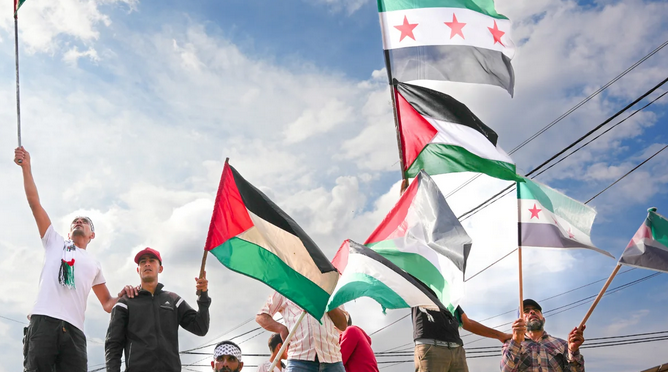
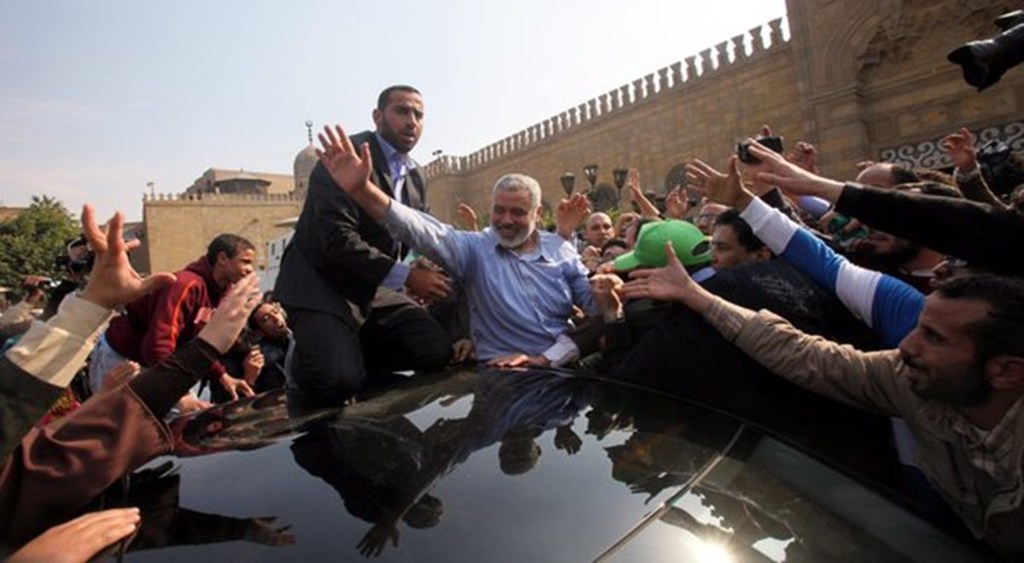
Is there a ‘US war on Syria’? The Syrian uprising, the Assad regime, the US and Israel – May 2013

By Michael Karadjis

May 11, 2013 – Links International Journal of Socialist Renewal — In the wake of two Israeli airstrikes on targets in Syria on the May 4-5 weekend, the second causing massive explosions close to Damascus and killing at least several dozen Syrian troops, discussion rages about the aims of this aggression and the relationship it has to the ongoing mass uprising and civil war in Syria.

Israel claimed both attacks were aimed at Iranian long-range rockets, or the military depots where they were housed, that were in transit via Syria to Hezbollah in Lebanon. As the Zionist regime has continually indicated that its “red line” was the transfer of any significant “game-changing” weaponry to either Hezbollah in Lebanon (which is currently aligned to Syria’s besieged Assad regime) or to the Sunni Islamist rebels fighting to overthrow that regime, this explanation seems plausible.

In fact, Israel also bombed a convoy of rockets in western Syria destined for Hezbollah at the end of January, and according to some reports, also a biological weapons research centre near Damascus, which “was reportedly flattened out of concern that it might fall into the hands of Islamist extremists fighting to topple the government of Syrian president Bashar Assad”, according to Aaron Klein and Karl Vick writing in Time magazine.

Indeed, after the latest bombings, Israel’s leaders went on to stress that these attacks were not aimed at the Assad regime, still less to support the armed opposition, as will be discussed further below.

But of course such aggression must also be seen in a wider context. Clearly the situation in Syria is falling apart and the war daily is getting more vicious and criminal (on both sides, but above all on the side of the regime), without any end in sight. Clearly at some point there may well be some form of more direct imperialist intervention than at present, even if only to try to stamp its mark, in whatever way possible, on an almost impossible situation. The myths about “recent gains by the Syrian regime” is just bravado to talk up the latest rounds of horrific massacres in the north coastal region, which promise no more stability than the last two years of brutal massacres.

Mass terror

Therefore, in such a context, with Israel everyday lamenting the “lost peace” on the northern border of occupied Golan (i.e., the peace it has enjoyed for 40 years as the Assad regime never challenged the Zionist occupation and annexation of its Golan territory), Israel is also announcing loud and clear to all sides in Syria, and to the Syrian masses, that “Israel is here, and this is what we can do”. The overall aim, in other words, is mass terror.

Yet while the situation may inexorably drive towards some kind of imperialist intervention, the outstanding fact to date has been the reluctance of imperialist states – and above all Israel – to lend any concrete support (or in Israel’s case, even verbal support) to the opposition trying to overthrow Assad’s tyrannical capitalist dictatorship.

And while a simple comparison with the extremely rapid intervention in Libya (within a few weeks of the beginning of the uprising in early 2011) might ignore practical differences for intervention in the two cases, any analysis of statements and actions of the US and especially Israel over these two years make clear that both have fundamental political objections to the nature of the opposition. These even extend to prospect of the overthrow of the regime itself, unless it can occur under a very strong degree of imperialist control, which is a very unlikely prospect.

No secular fighters?

Iit’s worth looking at a recent article in the New York Times which, like a great many articles, over-emphasise the significance of the radical Islamist element in the armed uprising. In this case, the NYT made the case more absolute:

“Nowhere in rebel-controlled Syria is there a secular fighting force to speak of”.

Curiously, for a number of those on the left convinced that the US is hell bent on backing the Syrian rebellion against the regime of Bashar Assad, or who even claim the US is explicitly backing these “Islamist” forces within it, or even that the whole Syrian rebellion is a “US war on Syria”, this statement was greeted as a sign that “even the US” is coming to understand how bad the rebels “that it supports” are.

This is a very odd argument for a number of reasons. But before analysing the reasons for the NYT’s statement, it is worth looking at the evidence. It is certainly true that there is a strong “Islamist” element within the armed opposition, and that as Assad’s brutality grows, so does the “radical” nature of the ideology of many of the rebel groups, and also the reverse brutality of some of the armed rebels (whether secular or Islamist). It is also true that part of the Islamist opposition is backed by Saudi Arabia and Qatar as part of a reactionary-sectarian regional game (see below). And it is further true that some Islamist groups, such as Al-Nusra, are allegedly linked to Al-Qaeda.

However, there are also a vast number of articles, interviews, documents, photos, videos and other evidence of opposition, both armed and unarmed, and opposition-controlled towns, that remain secular, or at least religious only in a formal sense without any “sharia law”, or that are opposed to the Islamicisation of the movement. While this article is not aimed at proving this, here are some useful links that demonstrate the point:

“The Syrian revolution has changed me as a writer”,

http://www.guardian.co.uk/books/2013/may/03/samar-yazbek-syrian-revolution-writing?CMP=twt_gu

“Welcome to Free Syria Meeting the rebel government of an embattled country”,
http://harpers.org/archive/2012/08/welcome-to-free-syria/

“How should Idlib’s Islamists be handled?”,
http://syriasurvey.blogspot.com.au/2012/12/what-to-do-with-idlibs-islamists.html

“Syrian rebels tackle local government”,

http://www.washingtonpost.com/world/middle_east/syrian-rebels-tackle-local-government/2013/04/30/3f2181d8-b1b9-11e2-baf7-5bc2a9dc6f44_story.html

“Syria: the ‘no secular fighters’ myth”,

http://www.enduringamerica.com/home/2013/4/30/syria-audio-analysis-the-no-secular-fighters-myth-scott-luca.html

“Jihadists and secular activists clash in Syria”,
http://www.nytimes.com/2013/01/27/world/…/syria-war-developments.html

“Some rebels worry about extremists but Assad comes first”,
http://www.truthdig.com/report/item/some_rebels_worry_about_extremists_but_assad_comes_first_20120822/

“Syria rebels see future fight with foreign radicals”,

http://www.dailystar.com.lb/News/Middle-East/2012/Aug-08/183858-syria-rebels-see-future-fight-with-foreign-radicals.ashx#axzz22zO6OH7J

“First Christian unit of FSA forms”,

http://www.thenorthstar.info/?p=2528

“The battle to name Syria’s Friday protests”,

http://www.aljazeera.com/indepth/features/2012/04/201241314026709762.html

A similar list could of course be made of all kinds of brutal, reactionary and religious-sectarian actions by parts of the anti-Assad revolt. But that is not what is in question in such a variegated, bottom-up, mass uprising. The evidence above makes clear that the sectarian element can by no means be declared in complete control.

‘US war on Syria’ … means what exactly?

So, given the evidence, why did the NYT make this ridiculous, sweeping, clearly false statement? An obvious explanation might be precisely that the NYT, which tends to closely reflect US ruling-class thinking, is simply pushing this line precisely in order to justify US policy, consistently over the last two years, of not supporting the Syrian uprising.

Overwhelmingly, the reason continually being stressed by the US government for its lack of support to the rebels is its hostility to the growing “Islamist” part of the rebellion, especially, but not only, the Al-Nusra organisation, which the US has officially listed as a “terrorist organisation”. The Islamist forces are generally hostile to US imperialism, and very hostile to Israel, which has even in stronger terms expressed its opposition to these forces coming anywhere near power in Syria (see below). The CIA has even made contingency plans for drone strikes on the radical Islamist rebels.

The idea that the US wants to support these Islamists, and is just pretending not to, is a fantasy indulged in by parts of the left who have decided to throw their lot in with the reactionary dictatorship of Assad. Since the Islamists are doing a significant amount of the fighting, and the extreme fringe of Islamists (e.g. al-Nusra) have taken responsibility for the actions that can most correctly be called “war like” (e.g., terrorist bombings in Damascus etc.), the best way to claim the uprising is a “US war on Syria” is to make the inherently unlikely claim that the US is supporting and arming these Islamists, despite the US and other imperialist governments stressing nearly every day that these Islamists are the primary reason they are not supporting and arming the uprising.

Just to clarify: this claim by the US and Israel that they are hostile to the Islamist element in the uprising, especially the more radical elements, is not simply rhetoric; it is clearly true. However, both the US and Israel are relentlessly hostile to the democratic element of the Syrian uprising as well. A genuine people’s revolution would challenge the reactionary US-backed dictatorships in the region, and would be much more likely than Assad’s pliant dictatorship to challenge Israel’s 46-year occupation of its Golan territory. But it is not smart politics to say the latter very loudly. So by pretending the entire anti-Assad movement is Islamic fundamentalist, the US has sought to justify not giving concrete support to any element of the uprising.

Oh, but the US is sending arms to the Syrian rebellion, isn’t it? But simply making that statement for years does not prove that it’s true. A CBS report on May 1 noted, “The first shipment of U.S. aid to the armed Syrian rebels was being delivered Tuesday to the opposition Supreme Military Council (SMC). It includes $8 million in medical supplies and ready-to-eat military food rations”.

You read it right. After nearly two and a half years of the Syrian uprising, about two thirds of that time in the form of armed rebellion, the first US shipment of aid to the rebels occurred in May 2013 in the form of “medical equipment and food rations”.

In reality, what we see most of the time is the US expressing extreme reservations about any kind of intervention in the Syrian civil war, not just about the outlandish suggestions by Republican Party hawks like John McCain for air strikes, but even for arming the armed opposition. In February, the US did authorise a US$60 million package for “non-lethal aid” for the SMC, once it had decided that the SMC leadership could be controlled and could control the flow of whatever equipment it got. Of that $60 million, it is only this $8 million in food and medicines that has yet seen the light of day.

More recently, hints were made that the package could include things like body armour and night-vision goggles. On May 1, the Washington Post reported anonymous US officials saying, “they are moving toward the shipment of arms” beginning at some unspecified time in the next few months, “but emphasized that they are still pursuing political negotiation”, with US President Barack Obama pursuing further talks with Russia to try to find agreement.

These talks with Russia have now begun, with US state secretary John Kerry visiting Russian foreign minister Sergei Lavrov to try to hold an international conference, attended by both members of the Assad regime and the opposition, aiming to set up a “transition” government in Syria which would include both some Assad regime ministers and opposition figures, thus keeping the core of the regime intact. The role of Assad himself appears to be a key sticking point.

Indeed, with all the hoo-ha about the Syrian military allegedly using chemical weapons, and leftist claims that this was the parallel of the “WMD” excuse to invade Iraq, one might have expected the US to take advantage of this to order some kind of aggressive action. In reality, Obama’s reaction was to re-define his “red line” he had made of any use of chemical weapons to mean any “systematic use”, which no one claims to have occurred.

In sharp contrast to the emphatic lies about Iraqi WMD peddled in order to justify an invasion, in this case Obama has reacted to allegations of use of chemical weapons by stressing the evidence “was still preliminary” and thus he was in no rush to intervene, stressing he needs to “make sure I’ve got the facts… If we end up rushing to judgment without hard, effective evidence, we can find ourselves in a position where we can’t mobilize the international community to support”.

Therefore, most analysis suggests the US is very unlikely to sharply change course. US defence secretary Chuck Hagel stressed that “no international or regional consensus on supporting armed intervention now exists”, while “NATO chief Anders Fogh Rasmussen has ruled out Western military intervention and U.S. Admiral James Stavridis, NATO’s supreme allied commander, cautioned last month that the alliance would need agreement in the region and among NATO members as well as a U.N. Security Council resolution” (ibid).

Likewise, the until-now more hawkish British government is now “exercising more caution in its attempts to arm the rebels fighting the Bashar Assad regime in Syria, following intelligence reports and warnings by other governments that the major part of the rebel movement has been taken over by Jihadist groups with links to Al-Qaida”, and the recently hawkish French government has in the last week swung strongly towards advocating a political solution. Germany for its part has remained steadfastly opposed to recent Anglo-French attempts to end the European Union arms embargo on the Syrian rebels.

There are of course the much more hawkish calls from Republicans such as John McCain and Lindsay Graham for US air strikes on Syria’s chemical weapons sites. Notably, McCain was not concerned about whether Assad’s forces had used chemical weapons or not – even if they hadn’t, he said the US should still “use Patriot [missile] batteries and cruise missiles” and ready an “international force” to enter Syria to secure stocks of chemical weapons.

Clearly enough, these are more aggressive imperialists even than Obama. Yet still not that useful for Assad fans as an argument – McCain’s reason for this is that “these chemical weapons … cannot fall into the hands of the jihadists”.

Others also pushing hard to arm a vetted section of the rebel leadership also do so mainly to counter the growing strength of the radical Islamist forces. For example, on May 7, top Republican on the Senate Foreign Relations Committee, Bob Corker, claimed the US will “shortly” start arming some “moderate” rebels to boost them over the al-Qaida-affiliated al-Nusra front. He said the “moderate opposition groups that we support are not as good at fighting, they’re not as good as delivering humanitarian aid, and we need to change the balance” because “a nightmare would be al-Nusra, if you will, gaining control of Syria. That’s worse than Assad being there”.

Notably, legislation introduced the previous day by Senate Foreign Relations Committee chair Bob Menendez to “greenlight the flow of arms” from the US to rebel groups “that have gone through a thorough vetting process” would not include the transfer of shoulder-fired surface-to-air missiles (ibid), i.e., the arms that rebels would need to even come close to dealing with Assad’s massive air power. In other words, the bill mainly deals with small weapons that the US can use for leverage over the rebels and with Assad, rather than being of any effective concrete assistance.

Thus while two years of fighting the Assad regime did not qualify the Free Syrian Army to receive US or EU arms, now that radical Islamist forces appear to be getting an upper hand in the anti-Assad rebellion, they may qualify in order to fight the Islamists. The imperialist dilemma is that by the US refusing to send arms, and the EU imposing an arms embargo (which favours the massively armed Assad regime, which in any case gets loads of arms from Russia and Iran), more and more anti-Assad rebels will turn to the Islamists, as they receive arms from Saudi Arabia and Qatar and regional Islamist networks. The argument is that arms need to be sent to non-Islamist fighters to balance those received by the Islamists; the counter-arguments is that many of the arms may end up with the Islamists anyway.

In any case, the US is only dealing with exile rebel leaderships in Jordan and Turkey, such as the unrepresentative Syrian National Council (SNC) and the Supreme Military Command, the high command of the Free Syrian Army (SFA), which liaises with the SNC. They have minimal control over what the locally organised FSA and the Local Coordinating Committees do all over Syria, and it is precisely this lack of control over the largely self-organised revolutionary ranks – not only for Islamists – that makes the imperialist powers so hesitant to arm anyone.

While much was made of 200 US troops being sent to Jordan to help coordinate aid to the rebel leadership, it was astounding that the leadership was unable to get any arms to the FSA in southern Syria, near the Jordanian border, when it just lost the strategic town of Khirbet Ghazaleh. A very strange “US war on Syria”.

Aside from arming the rebels, other “possible military choices range from limited one-off missile strikes from ships … to bolder operations like carving out no-fly safe zones”, or the creation of “humanitarian safe areas that would also be no-fly zones off limits to the Syrian air force”. However, US officials have warned that “once you set up a military no-fly zone or safe zone, you’re on a slippery slope, mission creep and before you know it, you have boots on the ground”, said Bruce Riedel, a former CIA analyst and Middle East expert at the Brookings Institution (ibid).

Of course, despite all this there may well come a time when the US decides that the level of ongoing instability is simply too great to be allowed to continue, or that its so-called “credibility” is at stake if it doesn’t do something, or that if it is all going to fall apart anyway, so the US needs to choose those who it wants to take over, despite the difficulties of enforcing such a choice. Imperialism cannot be trusted to act “rationally”, even from its own point of view, at all times, and a catastrophic – for all involved – US intervention cannot be ruled out.

Nevertheless, if the kind of action that people like McCain are urging came to pass, that would be a marked shift – to claim it gave credence to the idea that the last two years of uprising and rebellion was all a “US war on Syria” would be too illogical to warrant comment.

Saudi-Qatari intervention: promoting sectarian counterrevolution

Many of the assertions about US aid to the Syrian uprising, when examined for evidence, are nothing but reiterations of the well-known fact that the reactionary Gulf monarchies, Saudi Arabia and Qatar, have been providing a moderate stream of arms for specific rebel groups. The fact that these two states are pro-US is twisted in discussion to mean they are mere puppets of the US, as if they cannot have their own policies.

In fact, these two relatively powerful states are engaged in an aggressive regional “sub-imperialist” project, with the dual aims of countering Iranian influence in the region, and turning the democratic impulse of the Arab Spring, including its Syrian chapter, into a Sunni-Shia sectarian war. The democratic impulse was and is a mortal danger to the absolute monarchies just as much as to regimes like that of Assad, as Saudi Arabia’s suppression of the uprising in Bahrain shows. Saudi and Qatari intervention is thus a counterrevolution trying to hijack a revolution.
However, while the US may also see some benefit in diverting a democratic movement in a sectarian direction up to a point, it is very wary of this strategy, principally because the only available “shock troops” for this Saudi strategy are hard-line Sunni Islamists and “jihadists” who are more anti-US and especially anti-Israel than Iran itself, and much more so than the Assad regime, which does not have an “anti-imperialist” history at all.

Just to make things clear: just because these Saudi-backed forces are “anti-imperialist” and imperialism and Israel are hostile to them, does not make them “good”. To suggest that would be falling into the same trap as those who wrongly think Assad is “anti-imperialist” and that this makes his regime “good”. The Saudi-backed forces are the most reactionary in the Syrian context, especially given the sectarian dimension, and the reactionary strategy of the US (see below) would even be slightly better than an outright jihadist victory – except that such an outright jihadist victory is almost impossible, as there remains a real democratic anti-Assad movement on the ground that is hostile to the jihadists.

Israel: ‘Terrorists’ the main enemy

The strangeness of the argument that the US “must” be behind the anti-Assad rebellion if some of its Arab allies are behind parts of it, is that the key US ally in the region, Israel, remains steadfastly opposed to this Saudi-led project, viewing a victory of a Syrian uprising with a strong Islamist component as a nightmare. While Israel wants to weaken the Assad regime in order to disrupt the passage of arms between Iran and Hezbollah via Syria, it is also aware that the Assad regime has both kept the border with the Israeli-occupied Syrian Golan completely quiet for 40 years, and that the same regime has continually waged war on the Palestinians (for more detail, see links.org.au/node/2766).

Therefore, Israel’s stand has been the polar opposite of the Saudi-Qatari stand.

That is not to say Israel won’t launch aggression – as it has clearly just done – but that such aggression, for its own reasons, is not aimed at helping the Syrian opposition overthrow Assad. Straight after the bombing of military facilities near Damascus on May 5, Israel sought to persuade Assad that the air strikes “did not aim to weaken him in the face of a more than two-year-old rebellion… Officials say Israel is reluctant to take sides in Syria’s civil war for fear its actions would boost Islamists who are even more hostile to
Israel than the Assad family, which has maintained a stable stand off with the Jewish state for decades”. According to veteran Israeli politician Tzachi Hanegbi, a confidant of Prime Minister Benjamin Netanyahu, the government “aimed to avoid an increase in tension with Syria by making clear that if there is activity, it is only against Hezbollah, not against the Syrian regime”.
In a similar vein, defence ministry strategist Amos Gilad stressed that while “Israel has long made clear it is prepared to resort to force to prevent advanced Syrian weapons reaching Hezbollah or jihadi rebels”, Israel was not interested in attacking Syria’s chemical weapons because “the good news is that this is under full control (of the
Syrian government)”.

Israel’s overall stance was explained recently by Yuval Steinitz, Israel’s minister of intelligence and strategic affairs, who stressed the “only scenario” for Israeli military action in Syria would be to “prevent the delivering of arms, chemical weapons and other kinds of weapons into the hands of terrorists”. He noted that Netanyahu had made clear that “if there will be no threat to Israel, we won’t interfere”. Steinitz emphasised that Israel was not urging the US to take any military action “whatsoever” in Syria at this stage”.

In an interview with BBC TV, Netanyahu called the Syrian rebel groups among “the worst Islamist radicals in the world … So obviously we are concerned that weapons that are ground-breaking, that can change the balance of power in the Middle East, would fall into the hands of these terrorists”, he said. In a recent meeting with British Prime Minster David Cameron, Netanyahu, who was visiting London for Margaret Thatcher’s funeral, again warned of the danger of Western arms reaching jihadist rebels that could be used later against Israel and Western targets.

In particular, Israel “worries that whoever comes out on top in the civil war will be a much more dangerous adversary” than Assad has ever been, specifically in relation to the Golan Heights. “The military predicts all that (the 40-year peaceful border) will soon change as it prepares for the worst”.

According to Israel’s Lieutenant-General Benny Gantz in March, “we see terror organisations that are increasingly gaining footholds in the territory and they are fighting against Assad. Guess what? We’ll be next in line”, while Major General Aviv Kochavi, warning that “radical Islam” was gaining ground in Syria, compared the region near the Golan with “the situation in Sinai, as a result of growing jihad movement in Syria”.

Clarifying that it is the fall of Assad that worries Israel, Aluf Benn wrote in Haaretz that “the worrisome scenario in the north is that after Assad is gone Israel will be attacked, and the Syrian Golan will turn into a new version of the Gaza Strip, with southern Lebanon serving as a base for launching rockets and missiles. This is what is concerning the IDF’s top brass. Assad’s control of the Golan is disintegrating as his forces are being drawn into the decisive battles around Damascus and the fight for the city’s international airport”.

Thus while Hezbollah is seen as a mortal enemy, the anti-Assad Islamist fighters are seen as in some ways even less predictable. According to Aaron Klein and Karl Vick writing in Time in February, “Hizballah is not Israel’s only concern – or perhaps even the most worrying. Details of the Israeli strikes make clear the risk posed by fundamentalist militants sprinkled among the variegated rebel forces fighting to depose Assad … jihadist groups are less vulnerable to the same levers that have proved effective against Syria and other states – such as threats to its territory — or even the frank interests of an organization like Hizballah, which as a political party plays a major role in Lebanon’s government”.

Of course, outside the actual contest between Assad and opposition, Israel’s bigger project is to build up for an attack on Iran. In this sense, the bombings can also be seen as a warning to Iran, and even a test run. As Assad has been both asset and thorn for Israel, it prefers his regime to remain, if weakened, and to try to either attack Iran, or decimate Hezbollah, as its way of breaking the Iran-Syria-Hezbollah Shia nexus. In contrast, the governments doing the most to intervene against Assad’s regime – Saudi Arabia, Qatar and Turkey – are all horrified at the prospect of an Israeli attack on Iran, as it would tend to swing their own populations into “Islamic solidarity” with Iran (some evidence of this at links.org.au/node/2991). They prefer to try to break the nexus via destroying Assad and bringing to power a Sunni Islamist regime in Damascus – Israel’s nightmare.

The only reason Syria is in the “nexus” in the first place is due to Israel’s illegal annexation of the Golan. Syria uses Hezbollah as a form of indirect pressure via Lebanon, while keeping its own Israeli Golan border quiet. With its bombing and Israel’s frank words afterwards, Israel is also sending a message to Assad that if he wants Israel’s help, he has to break the nexus with Hezbollah. Naturally, Assad has no reason to trust the Zionist regime, and still less as Israel is not offering the return of the Golan in exchange. With Syria weakened, Israel has the bargaining power.

A final thought on Israel’s intentions is that, given the fears expressed about south Syria becoming a “new Gaza” if Assad falls, some Israeli strategists may even be considering invading to set up a new “buffer zone” between its occupied Golan and victorious Islamists and/or Hezbollah infiltration into the region. Thus current aggression may be a prelude to a larger operation, if the Zionist regime sees it as necessary and feasible, but this would be a very high-risk move.

Let ‘terrorists’ kill each other?

One interesting angle to all this, however, is that as both the US and Israel view both Hezbollah and the anti-Assad Sunni jihadis as enemies, would it not be in their interests for them to kill each other in Syria? While Israel opposes weapons getting to Hezbollah in Lebanon, it may look differently at Hezbollah foolishly wasting its resources, energies and cadres in Syria fighting other Islamists, and focused away from Israel. This strategy was advocated by neo-con extremist Daniel Pipes, who asserted that “continued fighting does less damage to Western interests than their taking power. There are worse prospects than Sunni and Shiite Islamists mixing it up, than Hamas jihadis killing Hezbollah jihadis, and vice versa… This keeps them focused locally, and it prevents either one from emerging victorious and thereby posing a greater danger. Western powers should guide enemies to a stalemate by helping whichever side is losing, so as to prolong their conflict”. As he believes Assad is currently losing, the US should support Assad.
The snag in that would be, of course, if Assad falls, Hezbollah would be in a similar position inside Syria to the Sunni Islamists in being able to grab access to Assad’s weaponry. All the more reason, from Israel’s point of view, for the regime to survive as the “least worst scenario”. They also cannot necessarily be relied on to keep fighting once Assad is gone; jointly turning their attention to liberating Golan is not out of the question. And the strategy also means the continuation of massive instability in Syria for the foreseeable future, precisely what most imperialist interests see as the problem.

Heading where?

The Assad regime, in its current form at least, is finished, if not now, then soon; it has at least a majority of its population fighting it, and even if it can hang on, it can never defeat the opposition. As long as the regime hangs on, the region will be in a state of permanent instability, wracked by massive war and terrible bloodshed. The figure of 70,000 killed to date may end up being dwarfed. Those interpreting the US verbal support for the regime’s replacement as some fundamental hostility are simply refusing to see that the US now wants Assad out because he cannot win and his presence guarantees continued instability, as well as the further rise of the radical Islamist element. But what does it want to replace the regime with?

The US interest is to balance between the mutually hostile Israeli and Saudi projects for the region, while at all cost trying to preserve some sense of “order” in the (inevitable) Syrian transition. The US therefore prefers a deal that would include significant parts of Assad’s regime, to preserve a “stable” core, joined with some defector generals from the regime, “liberal” oppositionists in the foreign-based Syrian National Council (which is unrepresentative of the Syrian movement on the ground) and more moderate members of the Muslim Brotherhood. This strategy is at variance with the Saudi strategy, and aimed at both stemming the reactionary Islamist tide, but also ensuring no genuine “people’s power” can arise from below.

The current US attempt to find a “negotiated solution” together with Moscow fits this strategy; Kerry was not wrong when he said that the US and Russia have similar interests in Syria.

While the Syrian opposition has not rejected this course, it has reacted coolly. Moaz al-Khatib, the recently resigned head of the opposition umbrella National Opposition Coalition (NOC), warned Syrians to “be careful of squandering your revolution in international conference halls”. Its “red line” would be any role for Assad himself in any “transitional government”, which would inevitably involve some members of his regime.

This is an understandable and valid reaction to any attempt by powerful outside states to derail the people’s will.

Cease-fire

However, the growing role of a reactionary-Sunni sectarian element among the armed opposition, backed by the tyrannies of the Gulf, and the fact that this sectarianism frightens the bulk of the minority populations, at least Alawis and Christians and probably some Druze and even secular Sunni, into grudgingly backing the regime or remaining neutral, and the fact that endless war with no victory of either side in sight is simply catastrophic to all, means that a “military victory” over Assad is highly unlikely. Also, any “military solution” in the current sectarian circumstances may be anything but the most democratic outcome.

Military struggle is by no means synonymous with Islamist or sectarian politics as is often thought; at the outset, the masses picked up arms to defend themselves from Assad’s slaughter, and a good part of the Free Syrian Army is still simply the armed people. But armed struggle, due to the very nature of bloodshed, in particular without a left-wing and consciously anti-sectarian leadership, can help bolster an existing sectarian potential. A ceasefire would arguably create the best conditions for the democratic element of the mass movement to gain some breathing space and revive the mass struggle.

Whether or not the current US-Russia talks can bring a ceasefire about is uncertain, but even if they can, whether or not such a cease-fire and transitional government can really give any breathing space to the masses also depends a great deal on whether such an unbroken “Assad state without Assad” allows such a breathing space, or simply continues its repression and terror with a new face.

Arms

In the meantime, it is important to stress that it is the regime that is imposing a “military solution” on a massive scale; in such circumstances the FSA has the right to get arms for self-defence from whoever it wants. Blaming whatever tiny trickle of arms the FSA gets for continuing military conflict is simply stating that the FSA should commit suicide in order to achieve the peace of the graveyard. To begin to ever-so-slightly equalising the fire power of the two sides – with the regime still absolutely dominant[1] – does not mean advocating a military solution. It just means people have the right to protect themselves against getting blasted to bits. It may even strengthen the possibilities for a negotiated solution, which at present Assad has no reason to consider.

If on the other hand the current talks break down, and the US and other imperialist powers, or even Israel, decide to desperately throw themselves in, and the McCain strategy comes to pass, the current situation would become even more catastrophic. While it is clearly not the Israeli strategy – yet another case where extremely pro-Zionist US neo-conservatives are not aligned with Israel’s strategy – Israel would likely move to take advantage of such a conflagration to carry out its own aggression against Iran, or even to forcibly expel a new wave of Palestinians.

Opposing imperialism should obviously not mean being apologists for Assad’s butchery. But it is important to remember that opposing this butchery should in no circumstances mean losing our critical faculties and forgetting the kind of armageddon a real imperialist war would entail.

Notes

[1] To discuss this would require another article, however, a good look at Syria’s massive military equipment is at http://www.revolutionobserver.com/2012/11/syrias-military-capability.html#!/2012/11/syrias-military-capability.html. It is beyond ridiculous to talk about a few small arms getting to the FSA coming anywhere near this massive array of tanks, APCs, attack helicopters, combat planes, scud and other missiles etc

The geopolitics of the Syrian uprising – August 2012

By Michael Karadjis

August 13, 2012 – Links International Journal of Socialist Renewal — The continuing mass uprising against Syria’s Bashar Assad dictatorship on the one hand, and the growing intervention by the reactionary Gulf monarchies of Saudi Arabia and Qatar, along with Turkey, on the side of the growing armed insurgency on the other, has led to a situation where many on the left are sharply divided over who to “support”.

Some claim the Saudi-led covert intervention requires support for Assad’s bloody regime as a lesser evil “secular” alternative to what they believe is an inevitable “jihadi” regime, given the rise of a vicious Sunni sectarian aspect to the civil war and the Saudi-led backing of such forces. Also, given the largely verbal (until recently) support given to the Gulf states’ intervention by the US and other imperialist states, support for Assad against this allegedly “imperialist-backed” assault on Syria is necessary to prevent the destruction of the Syrian state, which they allege imperialism desires due to Assad’s alleged anti-imperialist credentials (which even most of these writers, however, admit is very tenuous at best).

As an aside, it should be emphasised that these two potentially reactionary aspects – the extent to which the opposition has become a “jihadi” Sunni sectarian force, and the extent of imperialist intervention, are not one and the same thing; as will be shown below, while there is some overlap, they also somewhat operate at cross-purposes.

Meanwhile, others erect virtual soap boxes from which they piously denounce anyone even raising these valid issues of the extent of the Saudi/reactionary intervention as sycophants for Assad and as “counter-revolutionaries”. While partially correct that the Saudi-led counterrevolution has probably not utterly extinguished the genuine uprising, they tend to exaggerate in the other direction, refusing to see the extent of reactionary and sectarian counterrevolutionary intervention; some go so far as to denounce opposition to imperialist intervention as … counterrevolutionary.

Syrian masses have the right to rise

This article does not propose a “solution” to this problem, as much of this heat appears to stem from lack of clear information over exactly what is occurring and the relative weight of genuine uprising (including elements of armed self-defence) vis a vis reactionary terror; the only thing that appears clear is that both exist. This is not an argument for neutrality. Rather, we should have no hesitation in saying the Syrian masses have the right to rise against a vicious dictatorship, and where a population is defending itself against the regime’s armed forces, including by arming themselves, our sympathies ought to be with them; yet we should also have no hesitation in sympathising with minorities under vicious attack, including sectarian ethnic cleansing, from armed reactionary elements that certainly do exist and have been increasingly carrying out such attacks.

To“know” which is the more dominant element seems to be largely a matter of opinion, with relatively few attempts at in-depth analysis of this question.Richard Seymour made one such solid attempt on his Lenin’s Tomb blog: while one may not agree with it all – I thought it was excellent but did somewhat underestimate the degree of sectarian degeneration – it is such solid analyses that are worth much more than the kind of feverish declarations of“support” and denunciation of opponents as traitors that much discussion has descended into.

This article will rather focus on the geopolitics of the situation. Often, some of the feverish views are accompanied by declarations that this is all an imperialist plot, as a way of showing opposing views to be beyond the pale. In reality, there is no one “imperialist” view, let alone an agreement of views between imperialism, Israel and the reactionary Arab monarchies.

Israel’s view: Assad the lesser evil

One view tries to emphasise an alleged Israeli role in the crisis. Sometimes this is motivated by a desire to show how reactionary Assad’s opponents must be if backed by such a reactionary regime as that of colonial-settler Israel and how this proves the imperialist hand. In other cases, it is meant to show that Israel (and perhaps the Jews) run the world, including the US government. The reason such arguments are appearing is to counter the embarrassing (for apologists for the Syrian Baath Party regime) reality of Israel’s very obvious silence for at least a year after the uprising began until very recently.

For example, James Petras writes that the insurgency is an attack on Syria by the “Triple Alliance” of the US, the Gulf Cooperation Council (i.e., the Saudi, Qatari and other reactionary oil monarchies of the Gulf) and Israel. More recently, Mimi Al Laham (aka “Syrian Girl”) and Lizzie Phelan penned a piece entitled, “How leftist anti-Zionists are allied with Israel against Syria”.As the title suggests, the authors claim that Israel has been a key proponent of regime change in Damascus, and that anyone disagreeing with their analysis is therefore “allied” to Israel in this alleged quest to topple Assad.

Much of the article is spurious – the authors give examples of statements by US leaders advocating the end of Assad or support to the insurgents, and say that because the US is Israel’s main ally, that is evidence of Israel’s view. At one point they even argue that the open Saudi-Qatari support for the rebels is evidence of Israel’s view, since these Arab states, like Israel, are US allies.

Talk about circular reasoning; and as if Israel and Saudi Arabia/Qatar agree on everything. The Saudi and Qatari leaders don’t even agree with each other on everything.

Al Laham and Phelan do give a few examples of Israeli leaders calling for support for overthrowing Assad. However, it is notable that even they admit these are very recent statements: such statements from Israeli leaders have mostly happened as Assad’s situation has become more untenable whatever anyone may do to help him. But even then, as we will see below, there are just as many, if not more, examples even from the recent period which reveal great Israeli trepidation over Assad’s likely fall.

The most serious argument, however, concerns the question of Iran. Al Laham and Phelan state:

Syria is a member of the Axis of Resistance, which is the only effective military resistance to Israel left. It is made up of Syria, Iran and the resistance inside Lebanon with Hizbullah at the helm… Israeli Intelligence Minister, Dan Meridor, was quoted on Israeli radiopointing out what was obvious all along: Regime change in Syria would break the Iran-Syria mutual defence pact thereby isolating Iran and cutting the supply of arms to Hezbollah … those cheerleaders who maintain that Assad is good for Israel have been unable to reconcile then why Israel relentlessly beats the war drums against one of Syria’s most important allies, Iran.

While this is the most serious argument, the reality is far more complex and contradictory. But before going into specifics, it is first necessary to deal with some of the simplistic thinking exemplified in this article.

It is first important to avoid the idea that there is “an imperialist position”, “a US position” or “an Israeli position”, let alone a “position”necessarily held by the US and all its allies together. “Imperialism” does not think and thus “have a position”; there are lots of different spokespeople and ideologues, who often have markedly different views on what is best for their class.

One very good article about Israeli views on Syria is, “The Israeli Position toward the Events in Syria”,because it looks at varying views among different sections of the Zionist ruling class and weighs them up, rather than assuming there is “an Israeli view”.This article covered the view above – regarding Syria as the link between Iran and Hezbollah – but also other concerns, particularly that the Assad dynasty has maintained its border with the Israel-occupied Golan Heights meticulously quiet for 40 years, which may not be the case if it is overthrown – and came to the conclusion that, overall, for the Zionist rulers, the dangers of the overthrow of Assad outweigh the possible benefits, despite differing views.

Meanwhile, Israel’s intelligence chief, Major General Aviv Kochavi, “warned that “radical Islam” was gaining ground in Syria, saying the country was undergoing a process of “Iraqisation”, with militant and tribal factions controlling different sectors of the country”, and claiming there was “an ongoing flow of Al-Qaeda and global jihad activists into Syria”. Making clear that his fears were about Assad losing, he said that with the Assad regime weakening, “the Golan Heights could become an arena of activity against Israel, similar to the situation in Sinai, as a result of growing jihad movement in Syria” (http://www.dailystar.com.lb/News/Middle-East/2012/Jul-17/180917-assad-moving-troops-from-golan-to-damascus-israel.ashx#axzz20t8QAeyJ).

In a similar vein, Yoav Zitun, writing forIsraeli newsagency Ynet, reportedthat, “The IDF is preparing for the possibility that global Jihad terrorists will launch attacks from Syria in case President Bashar Assad’s regime will fall … Army officials are not ruling a situation whereby terrorists will take advantage of the chaos that may follow a regime change in Damascus to seize control of the border region, as was the case in the Sinai Peninsula after Egyptian President Hosni Mubarak was overthrown.” The army was “gearing for a number of possible scenarios, including a cross-border attack by global jihad, which is operating in Syria against Assad’s regime”. Brigadier-General Tamir Haiman warned of possible attacks “launched without prior warning from army intelligence – as was the case in the attack in Ein Netafim a year ago, which originated in Sinai”.

The analogy being made in both excerpts above to the fall of Mubarak and the resulting “instability” on the Egyptian border highlights precisely one of Israel’s key geopolitical concerns about the Arab Spring.

According to Khaled Amayreh in Al-Ahram, Israel was “dismayed” by the election victory of Muslim Brotherhood chief Mursi in Egypt. He claimed a major “pillar” of Israeli policy “was courting and neutralising Arab dictators who proved highly effective in pacifying their own masses” but now Israel“is beginning to lose” this pillar. He quotes Ron Ben-Yishai, editor-in-chief of the Israeli website Ynet, not only warning of the “danger posed by the ascendancy of the Muslim Brotherhood to the helm of power in the most important and populous Arab country”, but also that “Egypt’s Islamicisation constitutes a very negative harbinger for secular regimes that rely on the army, not only in Lebanon and Syria, but also in Jordan and the Palestinian Authority”.

Thus, while the idea that Israel may desire the fall of Assad derives from the idea that it aims to break the strategic connection between Iran, Iranian-influenced Iraq, Syria and Hezbollah in Lebanon (the so-called “Shia crescent”) – above all Syria’s role as the link between Iran and Hezbollah –Israel is in fact more concerned about a new rising “crescent” of Sunni regimes strongly influenced by the Sunni Islamist Muslim Brotherhood – the new Egypt, Hamas in Gaza, Turkey led by the soft-Islamist AKP, which has come into serious conflict with Israel under this regime, and now the possibility of forces linked to, or led by, the Muslim Brotherhood taking power in Syria.

And since Assad has kept the Golan border meticulously quiet for 40 years – just as did Hosni Mubarak in Egypt – Israel fears this turn of events would lead to similar disquiet on the Syrian Golan border as has occurred on the Egyptian Sinai border.

While it might seem odd that both combinations of states and movements are regarded as a threat by Israel, it is not really: being a colonial-settler state and imperialist outpost in a region dominated by the nation you have ethnically cleansed en masse does tend to lead to everyone in the region – Sunni and Shia Muslims, and Christans, Druze, atheists etc. – hating you. But the idea of the new “Sunni crescent” completely surrounding Israel, and including an actual Palestinian component (Hamas), is actually more threatening than the less-connected“Shia crescent”, even if the latter includes Hezbollah.

It is thus no surprise that nearly every statement in recent days from Israeli leaders threatening to intervene in Syria under the guise of the risk of chemical weapons has been worded to the effect that such intervention would be reacting to the threat posed by the fall of the Assad regime, which might allegedly lead to “terrorists” – whether Hezbollah or anti-Assad Sunni “jihadis” – getting these weapons. As Israel’s defence minister Ehud Barak stated, “The moment Assad starts to fall we will conduct intelligence monitoring and will liaise with other agencies” regarding such intervention.

More generally, the idea that the Assad regime has been one of the “resistance”forces to Zionism and imperialism is so far from reality that one wonders why it is often believed. Israel has annexed Syrian territory – thus any Syrian regime, whether Assad or a regime which overthrows him – will never “make peace” without getting Syrian land back. Syrian backing of Hezbollah in Lebanon is the regime’s way of putting indirect pressure on Israel without confronting Israel itself; yet in the past, the regime has not been averse to slaughtering Hezbollah militants.

Yet while no shot has been fired on the Golan since 1973, the Assad dynasty has more Palestinian blood on its hands than any other Arab state except Jordan, with events in 1976, 1985 and 1985-6 standing out (see full analysis at http://links.org.au/node/2766), as the regime tried to show Israel how good a Camp David style partner it was willing to be if only it handed back the Golan; Israel, however, with a regime like that next door, figured it could have its cake and eat it too.

Some claim, contrawise, that the secret “Israeli position” has always been the “Lebanonisation” – fragmentation – of all Arab states, to weaken them, and allow Israel to run roughshod over them. As above, this has historically been “one” Israeli view rather than “the” Israeli view. It may have been correct about Israel’s view of Iraq, given that country’s size; and thus with the US destruction of Iraq, Israel began viewing Iran as its main enemy. But with Iraq already in pieces, there is little need for it in smaller Syria, especially given the dangers involved and Assad’s pliant behaviour.

Moreover, there is a serious problem in this argument, however good it sounds. The argument is that Israel would prefer Syria to be the same mess as Lebanon. Yet Syria’s main crime in the recent past, from Israel’s point of view, has been its semi-backing of Hezbollah (more on this below), the only Arab force to deliver a defeat to Israel.

Hezbollah, however, is in “Lebanonised” Lebanon, not in Syria.

The Saudi-Qatari-Turkish-led counterrevolution: Region-wide sectarian struggle

So since there is not even one single Israeli view, there can hardly be a US-Israeli view; and even though the dominant Israeli view has been largely pro-Assad, this does not at all mean this is the US view (aside from the differences within US ruling elite itself), because Israel is not a puppet of the US, and still less is the US a puppet of Israel, as more fanciful views claim. And for the same reasons, it is also very wrong to claim that the hard line pushed by Saudi Arabia, Qatar and the Gulf sheikdoms, or Turkey, is the same as the US view, or is due to them being puppets of imperialism.

On the contrary, the Saudis and Qataris are pushing their own very ambitious regional realignment, using parts of the Muslim Brotherhood as a proxy, for their own reasons, while the AKP regime in Turkey is doing much the same for similar reasons, as well as other specific reasons related to Kurdistan. Israel is extremely uncomfortable about this (as some of the views expressed in that article showed). US President Barack Obama’s regime in the US stands somewhere uncomfortably in between.

What then are the key interests of Saudi Arabia, Qatar and Turkey in this?

On the one hand, while Saudi Arabia and Qatar have been the most active in pushing for Assad’s ouster via arming the opposition, it ought to be understood that the potential in 2011 for a popular uprising to oust the Assad dictatorship was a mortal threat to these tyrannical monarchies. If people can overthrow dictatorships in Egypt, Tunisia and then also Syria, and neighbouring Yemen and Bahrain can be openly threatened, then why not Saudi Arabia and Qatar? In fact, there has been a popular upsurge in eastern parts of Saudi Arabia, which has been brutally crushed, as was the uprising in Bahrain.

On the other hand, despite their horror at the prospect of popular revolution, these states are also engaged in regional rivalry with Iran, and a key ideological prop of this rivalry is the division between Sunni and Shia Islam. Saudi Arabia projects its power via support for various extremist Sunni fundamentalist groups (“Salafis”), while Qatar is headquarters of the somewhat more moderate Sunni fundamentalist Muslim Brotherhood. While the whole Arab Spring was a mortal threat to these tyrannies, they used their grotesque wealth to fund such Islamist currents within these movements in Egypt, Libya and Tunisia in order to try to take control of them.

Meanwhile, Iran funds Shiite fundamentalist forces, in Iraq and in Lebanon. With the majority Shia in Iraq emerging much more powerful since the ouster of Saddam Hussein, and with Hezbollah emerging powerful in Lebanon due to its role in defeating Israel’s occupation there, the Saudi-led states see Iran’s position becoming more powerful.

Where does Syria come into this? In fact, Syria had a long-term good relationship to the Saudis and Gulf states, but maintained a strategic alliance with Iran. While very secular, the Assad regime is heavily based among the minority Alawite sect, a branch of Shia Islam, and as such is widely detested by the Sunni majority there who feel disenfranchised by this unofficial reality. In the 1980s, Assad senior brutally crushed a popular uprising that was largely led by the Muslim Brotherhood, and so the regime saw Iran as a more reliable long-term ally against its sectarian rivals.

While Syria’s Western-backed invasion of Lebanon in 1976 was initially in support of the right-wing Christian forces and involved crushing the Palestinian-Muslim-leftist alliance, over time Syria’s role settled into being the key supporter of the disenfranchised Shiite element of the population. And with Israel refusing to hand back Syria’s Golan Heights, which it stole in 1967 and even annexed – an act of pure international piracy –in 1981, Assad allowed his country to be the link between Iran and Hezbollah in Lebanon, allowing Hezbollah to put pressure on Israel while Assad kept the Syrian border on the Golan utterly quiet.

As such, the Saudi-Qatar need to derail the Syrian revolution coalesced with the regional rivalry with Iran to form a policy of promoting the Sunni fundamentalist forces active within the Syrian opposition in a bid to not only try to take control of the uprising – as elsewhere – but also to foment Sunni-Alawite sectarian conflict, to turn popular revolution into sectarian bloodletting, killing two birds with the one stone.

Given the fact that there is a large Shia minority in Saudi Arabia in the eastern oilfields region, where rebellion is centred, and that the Shia majority led the uprising in Bahrain against the minority Sunni sectarian monarchy, this fomenting of sectarianism regionally also allows these monarchies to demonise the uprisings in their countries as nothing but “Iranian subversion”. There seems little doubt that the Saudi-Qatar aim is the destruction of Assad’s regime and the conquest of power by a Muslim Brotherhood-led regime, effecting a victory in the regional rivalry with Iran and a sectarian victory over their own Shia minorities/majorities.

It would be a serious mistake to believe that just because Saudi Arabia is a reactionary pro-imperialist state that Israel would be fine with forces backed by this state surrounding Israel. On the contrary, these Sunni Islamist forces are a double-edged sword, and are largely just as hostile to Israel as are Shia Islamists like Hezbollah – Hamas is an obvious example –and a lot more so than Assad’s purely conjunctural position: Assad has to be officially “anti-Israel” since Israel occupies Syrian land, but no regime coming to power in Syria will be willing to give up the Golan to Israel.

In the case of Turkey, the AKP regime has also laid claim to regional leadership, and over the last few years has even projected a “neo-Ottomanism”, meaning Turkish leadership within the regions once ruled by the Ottoman empire. However, although the AKP, as a “soft” Sunni Islamist party, can be seen as related to the Muslim Brotherhood, the AKP’s neo-Ottoman strategy did not involve promoting sectarianism. On the contrary, it involved good relations with Iran and Syria as well as with the Sunni-led states as part of Prime Minister Erdogan’s quest for “statesman-like”leadership in resolving regional disputes within the Muslim world. At the same time, this “eastern turn” involved increasingly distancing Turkey from its long-term alliance with Israel, which had been cornerstone of policy when the anti-Islamist generals ruled Turkey. Turkey has clashed with Israel in cases such as the Mavi Marmara, and built links with anti-Israel Islamist groups like Hamas and Hezbollah.

At the outset of the Syrian and Libyan uprisings, Turkey reacted cautiously, initially opposing Western intervention in Libya, but as Erdogan saw the writing on the wall, suddenly jumped in to use the AKP’s Islamist credentials to support the same forces Qatar was supporting. In the case of Syria, however, this has a more specific significance. Syria, like Turkey, Iraq and Iran, is home to a large Kurdish minority. Part of Erdogan’s growing alliance with Syria and Iran had been anti-Kurdish solidarity. Assad abandoned his earlier opportunistic support for the Kurdish Workers Party (PKK) in Turkey and policed Turkey’s border. However, the Syrian uprising threatened to pull all this apart, especially if Syria’s Kurds took part. Turkey has therefore actively intervened to try to ensure – through its “Islamist” connections and more generally hosting opposition Syrian National Council (SNC) leaders – that whoever eventually takes power will be in debt to Turkey and thus maintain an anti-Kurdish position.

In addition, the Israel-Turkey conflict has recently taken on a new dimension, with the discovery of natural gas fields in the east Mediterranean Sea. In a minor diplomatic revolution, Greece and Cyprus have developed a new strategic alliance with Israel to co-develop these fields and thus limit Turkey’s role there. Turkey for its part is trying to stop Cyprus exploiting these fields around the northern part of Cyprus still under long-term Turkish occupation. Israel’s energy minister Uzi Landau recently vowed, “Israel can support and secure the rigs that we are going to have in the Mediterranean”, after Turkey declared its plan to boost naval patrols in the eastern Mediterranean in a deepening diplomatic feud. Meanwhile, Lebanon has accused Israel of breaking international law by exploring for gas without an agreement on the maritime border between the two countries (http://www.haaretz.com/news/diplomacy-defence/israel-vows-to-defend-gas-after-turkey-threatens-to-boost-navy-patrols-in-mediterranean-1.383820).

It is thus fairly obvious that Israel also has no interest in Turkey extending its influence into Syria.

Opposite views on dealing with Iran-Syria-Hezbollah link

What then of the fact that Assad’s Syria is Iran’s ally and that Israel has for months now been hell-bent on a ferocious display of aggression towards Iran, ever-threatening to attack the country to hit Iran’s civilian nuclear facilities? Why wouldn’t that make Israel the most anti-Assad of regional pro-US states? How does that fit with the obvious reality that it has been the least?

It is actually very interesting that of all these players, it is the state that has had the most pro-Assad position that is precisely the state that is most aggressively hell-bent on taking out Iran; and that contrawise, those most aggressive against Assad — Saudi Arabia, Qatar and Turkey — are also vociferously opposed to an Israeli attack on Iran and terrified of its consequences.

For example, in March, Qatar’s foreign minister Hamad Al Thani declared, “We will not accept any aggressive action against Iran from Qatar”, despite the presence of a US base on its soil (http://www.jpost.com/Headlines/Article.aspx?id=263818). On August 10, the Israel newspaper Yedioth Ahronoth reported that Saudi Arabia had threatened to shoot down any Israeli aircraft over its airspace en route to or from Iran (http://www.informationclearinghouse.info/article32129.htm). On March 29, Erdogan, on a state visit to Iran, declared, “Turkey has always clearly supported the nuclear positions of Iran, and will continue to firmly follow the same policy in the future”, stressing that “no one should be allowed to harm the friendly ties between Iran and Turkey” (http://www.payvand.com/news/12/mar/1271.html).

It is clear that the Gulf monarchies see an Israeli attack on Iran as enormously destabilising, risking to swing their Sunni Muslim populations strongly behind Iran and against any regime seen as collaborating with the US or Israel in such a venture, undercutting their drive to forge a sectarian divide in the region.

In this connection, Alistair Crooke penned a very interesting articlethat argues precisely that for many, regime change in Syria to break the “nexus” between Iran and Hezbollah is precisely being pushed as an alternative to a catastrophic Israeli attack on Iran. He quotes former Mossad head Efraim Halevy, who holds this minority view in Israel, that “ending Iran’s presence in [in Syria] poses less of a risk to international commerce and security than harsher sanctions, or war [on Iran would pose]”, and continues in reference to the aggressive campaign by Benjamin Netanyahu and his supporters in the US Republican Party for war on Iran that: “It is against this background that ‘regime change’ in Syria becomes so important. Both in Israel and America, there are serious constituencies which argue that a direct military strike on Iran would provoke a terrible disaster. To answer this, the combination of financial siege on the Iranian people, in combination with the overthrow of Assad — in favor of an anti-Iranian, Sunni successor — is crafted precisely to assuage those hawks demanding military action.”

This argument closely fits the Saudi-Qatari-Turkish view — for them breaking Iran’s regional power and its connection to Hezbollah through Syria by overthrowing Assad is much better than an Israeli attack on Iran, while also giving them their proxies in power — an alternative Israel is not happy at all with. Israel, by contrast, prefers to solve the same“problem” via an attack on Iran while leaving a known dictatorship in power in Syria.

The US view: balance opposing views but maintain state structure in Syria

US imperialism dominates the Middle East partially via two key regional props, two “abnormal” formations that don’t exist elsewhere in the world: the Israeli Zionist settler state and the oil monarchies of the Gulf. In this particular conflict they appear to have opposing views and interests. Where then does the US stand?

Verbally at least, the US has appeared to stand closer to the Saudi alliance, especially with some of the aggressive – and sensationally and sickeningly hypocritical – rhetoric coming from Hillary Clinton and other leaders. There has also been a very recent shift to more active support to the anti-Assad forces.

For example, the July 20, 2012, New York Times claimed President Obama is “increasing aid to the rebels and redoubling efforts to rally a coalition of like-minded countries to forcibly bring down the [Syrian] government”. It reported that CIA operatives have been based in southern Turkey “for several weeks” while the US and Turkey are working on putting together a post-Assad “provisional government”in Syria. The US reportedly issued a “secret order” authorising “non-lethal” covert support to the Free Syrain Army (FSA), i.e. training, logistics, communications assistance. Not to be outdone, British former SAS soldiers are reportedly training Syrian rebels at a base inside the Iraqi border.

In comparison to the Saudi and Gulf tyrants, however, the US has been markedly slow to swing clearly this way, and even now that it has, it still emphasises that it will not arm the FSA, while now officially supporting the Gulf arms channel.

Even more clearly, in the very same period that the US has been moving more clearly to authorise some degree of support for the FSA, the US media and various leaders have also began expressing alarm over the rise of “Islamist” forces within the armed opposition, whether Saudi-backed “Salafist” groups or al Qaeda. For example, theNYT article, “As Syrian war drags on jihadists take bigger role” ,reported that “a central reason cited by the Obama administration for limiting support to the resistance to things like communications equipment is that it did not want arms flowing to Islamic radicals. More ominously for the US, articles such as “Al Qaida turns tide for rebels in battle for eastern Syria”report on “fighters who have left the Free Syrian Army for the discipline and ideology of global jihad”.

This is all the more reason why the US has been attempting to influence certain forces within the opposition: “The C.I.A. effort is aimed in part to help keep weapons out of the hands of fighters allied with Al Qaeda or other terrorist groups, one senior American official said. By helping to vet rebel groups, American intelligence operatives in Turkey also hope to learn more about a growing, changing opposition network inside of Syria and to establish new ties to fighters who may be the country’s leaders one day” (http://www.informationclearinghouse.info/article31958.htm).

But it is precisely in this way that the US interest somewhat diverges from the Saudi interest. This is not only in the sense that the Saudis back the most sectarian forces as part of their regional game, whereas US leaders have been emphasising the need for a post-Assad regime to be inclusive of Alawites, Christians an other minorities. More importantly, while the Saudi-led offensive aims to destroy the regime, the US has made abundantly clear that it aims for a“Yemen solution”, that is, one where Assad goes but his regime is preserved, with some of the opposition –screened by the US– joining in.

For example, as David Ignatius reports in the Washington Post,Obama “is seeking a ‘managed transition’ in Syria with the twin goals of removing President Bashar al-Assad as soon as possible and doing so without the evaporation of the authority of the Syrian state”.On July 30, US defence secretary Leon Panetta stressed the importance of“preserving stability” when Assad leaves: “The best way to preserve that kind of stability is to maintain as much of the military and police as you can, along with security forces, and hope that they will transition to a democratic form of government” (www.reuters.com/…/us-syria-crisis-usa-idUSBRE86T1KP20120730).

This need for “stability” reflects imperialist concern to maintain control vis a vis either a (increasingly unlikely) genuine popular quest for power, or a seizure of power by Islamist forces. “If the Assad regime did fall, this would provide more Islamist militants with a potential opportunity to establish a new foothold in the heart of the Middle East”, according to Charles Lister from Jane’s Terrorism and Insurgency Center.“The temporary lack of state structures would also afford aspirant militant Islamists with a safe area for training” (http://www.informationclearinghouse.info/article31958.htm). Expressing concern over “extremists” getting their hands on Assad’s chemical weapons, Panetta noted that “particularly when it comes to things like the chemical sites, they (the Assad regime) do a pretty good job of securing those sites”.

John Bolton, US neo-con and fanatical supporter of Israel’s  Likud Party – who has been calling for a US-Israeli attack on Iran for years – summed up these fears even more clearly, writing that, “There will undoubtedly be an imminent risk of humanitarian disaster if Assad falls, including a bloodbath against his supporters or massive flows of refugees and displaced persons”, but to prevent even greater disaster “we must not permit terrorists like Al Qaeda or Hezbollah in next-door Lebanon, rogue states or a radical Syrian successor regime to acquire these capabilities” (http://www.foxnews.com/opinion/2012/07/24/america-and-its-allies-must-prepare-to-secure-syria-weapons-mass-destruction).

As such, while US rhetoric often sounds closer to the view of the Saudi axis on this issue, actual US policy contains many of the same fears as those of Israel, and in many ways straddling the fence almost exactly.

Turkey and the Kurds: Islamists yes, Syrian break-up no

Interestingly, while Turkey’s forthright role in backing Syria’s armed opposition and promotion of Islamists places it in alliance with the Saudi/Gulf axis, Turkey itself also shares US and Israeli concerns over total collapse of the regime, precisely because any disintegration of the Syrian state opens the way for an autonomous or independent Kurdish entity in the north, which could join Iraq’s autonomous Kurdish entity and threaten to involve the millions of Kurds in Turkey and Iran.

Indeed, this is already happening. Until the uprising began, Ankara and Damascus were strongly allied in crushing their respective Kurdish populations. But with Turkey supporting the FSA, Assad decided on a maneuvre by releasing jailed Kurdish Workers Party (PKK – the Kurdish group fighting Turkey with a presence in northern Syria) from prisons, to cause annoyance to Turkey and to strengthen the PKK against the Kurdish forces there loyal to corrupt Iraqi Kurdish leader Massoud Barzani, who, due to geopolitical reasons, was currently allied to Turkey and in opposition to the Shia regime in Iraq, currently allied to Syria.

In late July, this went further than Assad had bargained for, with the local Democratic Union Party (PYD), a Kurdish independence group allied to the PKK, taking control of a number of northern Syrian provinces with Kurdish majorities. To complicate things further, when Turkey then tried to use Barzani to intervene with his PDK (Kurdish Democratic Party) forces against the PYD-PKK, Barzani did something he has almost never done before – he joined forces with his fellow Kurds against all local regimes! Indeed, in the background, the Hawler Agreement had been signed on July 9-10, 2012, uniting all Syrian Kurdish groups in a Supreme Kurdish Council (ENSK).

Turkey’s collaboration with Syrian Islamists and the SNC aims to ensure that, as successors to Assad, they maintain Assad’s opposition to Kurdish autonomy (and this has been successful judging by the position of the SNC). However, whether total control can be gained by the SNC and Islamist forces is in doubt, and while an extended inter-sectarian blood-letting may suit the Saudi Arabian project as long as “its guys” have the upper hand, fragmentation of the Syrian state would clearly not suit Turkey.

According to analysis from Asia Times Online: “Erdogan’s best hope is that the Turkish intelligence could orchestrate some sort of ‘palace coup’ in Damascus… What suits Ankara will be to have Assad replaced by a transitional structure that retains elements of the existing Ba’athist state structure, which could facilitate an orderly transfer of power to a new administration… But Erdogan is unsure whether Turkey can swing an Egypt-like coup in Damascus. His dash to Moscow July 18 aimed at sounding out Russia if a new and stable transitional structure could be put together in Damascus through some kind of international cooperation. (Obama lent his weight to Erdogan’s mission by telephoning Russian President Vladimir Putin the next day to discuss Syria.)”

US-Russia stand-off?

Often when geopolitics is discussed, it is immediately assumed that a modern version of the US-Russia Cold War rivalry is the main issue. While rivalry does exist, it appears to not be the central issue in Syria, though the crisis itself exacerbates tensions.

The fact that Russia maintains a naval base in Syria and the regime has been a long-term ally is undoubtedly a factor in Russia’s strong support for the regime. It is much less certain, however, that the US aim is to remove Assad in a geopolitical struggle against Moscow. On the contrary, the US knows that Assad senior sent troops in the first US war against Iraq in 1991, and was engaged in torture “renditions” of “Islamist” suspects on behalf of the US“war on terror”.

As such, Assad was seen as useful, if not loved, by both Moscow and Washington, and even after the uprising broke out, the US for quite some time kept a low profile and emphasised “reform” rather than regime change.

In fact, to the degree that the US favours a maintenance of the regime with a cosmetic change at the top, this is not so distant from Russia’s view. As noted above, Turkish leader Erdogan tried to get such an agreement from Moscow, and Obama lent support. The main snag is that so far Russia refuses to budge even on Assad himself. Countless statements from Moscow seem to indicate, however, that Russia is not bonded to Assad, and indeed it has at times strongly criticised the regime’s excessive violence. However, in as much as US leaders are using the crisis to up war-like rhetoric – however divorced from their actual view – this pushes Russia into a corner and thus it refuses to make such a concession under apparent duress.

Israel Shamir is the name of a Jewish anti-Semite, almost neo-Nazi, who writes prolifically on the Middle East. Recently, he claimed to have a leaked report from a Netanyahu-Lieberman-Putin meeting during Vladimir Putin’s recent visit to Israel. Shamir asserts in the article that Israel’s goal is the complete “Somalisation” of Syria and that it is very much behind the Islamist opposition to Assad. While normally, the writings of such a reactionary ought to be ignored, the interesting thing here is that if his evidence of the leaked report has any truth, it in fact shows the complete opposite of what he asserts.

Shamir claims Netanyahu asked Putin to facilitate Assad’s departure, and to “appoint his successor, and we shall not object”. The only alleged condition put by Netanyahu was that “the successor must break with Iran”. Putin replied that he didn’t have a “successor” to appoint. The point, however, is that if such a leaked document exists, it once again shows that Israel, like the US, aims to maintain the regime intact, and that it has no problem even with Syria remaining in the Russian sphere, as long as it breaks with Iran. Quite the opposite of “Somalisation.”

Conclusion

It is clear that there are any number of aims and strategies being pushed by various imperialist powers and regional “sub-imperialisms”, in many cases completely contradictory with one another. The left’s sympathies ought to remain with the Syrian people confronting a vicious regime. However, given that the Saudi-Gulf counterrevolution is also active in trying to hijack the revolution, and that this includes a rising tide of viciousness often directed against non-Sunni communities – and that a significant part of these communities is sticking to Assad precisely because of this increasing sectarian threat – there seems little one can do from the outside to give concrete “support” to whoever is under attack at any time, or even really figure out exactly the relationship of forces between revolution and concurrent counterrevolution.

Syria and the Palestinians: No other Arab state has as much Palestinian blood on its hands

Hamas prime minister in Gaza, Ismail Haniya, greets supporters after Friday Prayer, where he spoke out against President Bashar al-Assad

By Michael Karadjis

March 7, 2012 – Links International Journal of Socialist Renewal http://links.org.au/node/2766 — The declaration by Hamas leader Ismail Haniyeh, the elected prime minister of Palestine but ruling only in Gaza, that his movement was backing the popular uprising in Syria against the brutal regime of Bashar al-Assad (http://www.nytimes.com/2012/02/25/world/middleeast/hamas-leader-supports-syrian-opposition.html), was widely reported, as was the more general significance of his statement to worshipers at Cairo’s Al Azhar mosque. Hamas, while ruling the Gaza Strip, has had its exile leadership based in Syria in recent years (previous to that it was based in Jordan); now Haniyeh is betting on a new strategic relationship with post-Mubarak Egypt, in the midst of that country’s April Spring revolution. Haniyeh saluted “the heroic Syrian people, who are striving for freedom, democracy and reform”.

Haniyeh’s strong statements in support of the Syrian people were not the only statements from Hamas. Another senior Hamas official in Gaza, Mahmud Zahar, said Hamas was not taking sides in the Syrian conflict. “We cannot take one side, with half a million Palestinians living in complete freedom in Syria having to (face the consequences) of this position … We do not seek to get involved in internal or regional Arab conflicts. Our fundamental struggle is directed against the Israeli occupation of Palestine.” He did “advise” the Syrian regime “to give more freedom to the Syrian people, in order to strengthen Syria so that it would be able to free the occupied Golan territory and support the resistance (against Israel)”.

Given the presence of so many Palestinians in Syria, he has a point. Palestinians have their own problems, to say the least; the last thing they need is to be on the “wrong” side in Syria when one or the other side wins, and have to face the consequences.

And while Hamas’ obvious sympathies are, as Haniyeh made clear, with the Syrian people who are fighting for freedom, the consequences of being on the “wrong” side in the event of Assad retaining power could well be dire, given the simple fact that no other Arab state except Jordan has as much Palestinian blood on its hands as has the Syrian regime under the 42-year Assad dynasty.

In fact, Zahar’s statement about Palestinians living in “freedom” in Syria was made before the full extent of the regime’s bloody crackdown and ongoing starvation siege and bombing of the Palestinian Yarmouk camp became evident (https://www.alaraby.co.uk/english/politics/2015/4/7/assad-and-the-palestinians-from-tal-al-zaatar-to-yarmouk); soon after the events reported here, no-one would speak of Palestinian freedom in Syria, where hundreds of Palestinians have been tortured to death in regime dungeons alongside tens of thousands of Syrians (https://en.zamanalwsl.net/news/9393.html), and their camps reduced to the same Guernica style situation as the rest of Syria by Assad’s regime.

That should be the starting point for any supporter of the Palestinian people: recognition that their first priority is to their struggle and the defence of their people, in particular to the highly vulnerable refugees, not to gaining nods of approval from Western leftists and some of their more peculiar views.

Hamas had been based in Damascus not out of love for Assad, but due to having few alternatives. As long as Mubarak ruled Egypt, that country was an active collaborator with the Zionist occupation of Palestine, especially the criminal siege of Gaza. Hamas had been based in Jordan until King Hussein kicked it out in the late 1990s.

The deal was, “we [Syria] give you offices, but you make sure to never use Syrian territory for any operations against Israel, even symbolic”. The Syrian border with Israel on the Israeli-occupied Golan Heights was as quiet as that of Egypt for 40 years, enforced by the “anti-imperialist” Assad. If the regime was never going to move even symbolically on its own occupied territory, it sure as hell was not going to allow Palestinians to. The idea of a “resistance” regime is make-believe, in its entirety.

After Mubarak

But with the fall of Mubarak things have changed. Certainly, the current Egyptian rulers, who include old-guard generals, are not exactly enthusiastic supporters of the Palestinian struggle, but under the influence of the revolution, their public posturing of the Egyptian government has shifted since Mubarak; certainly over the last year a number of events on the Egypt-Israel borders have shifted the number one most sealed border from Egypt to Syria.

Then in March 2012, the lower house of the Egyptian parliament unanimously declared that Israel is the number one enemy of Egypt, declaring “Revolutionary Egypt will never be a friend, partner or ally of the Zionist entity, which we consider to be the number one enemy of Egypt and the Arab nation … It will deal with that entity as an enemy, and the Egyptian government is hereby called upon to review all its relations and accords with that enemy” (http://presstv.com/detail/231376.html). Soon after, a $2.5 billion export deal signed in 2005, under which Israel received around 40 percent of its gas supply from Egypt at an extremely low price, was annulled (http://www.scoop.co.nz/stories/HL1205/S00007/egypt-just-annulled-mubarak…).

Hamas naturally sought to take advantage of this new situation – especially given the proximity of Egypt to Gaza. By making his announcement at Friday prayers in Egypt, Haniyeh manoevured to push forward the positive momentum in Egypt. The fact that the Muslim Brotherhood is now the strongest party in Egypt, and that Hamas was originally the Palestinian wing of the Muslim Brotherhood, is hardly insignificant either; and the Brotherhood is, of course, for better or worse, a prominent part of the Syrian opposition based among the Sunni majority there. Hamas and the Brotherhood are also strongly connected to Turkey’s ruling Justice and Development Party (AKP), which has been a prominent backer of the Syrian uprising; Turkish leader Erdogan’s comment that Israel is committing “state terror” in Gaza (http://www.haaretz.com/news/diplomacy-defense/turkey-s-erdogan-israel-mu…), gives us a further idea of the context in which Israel has tended to stick with Assad throughout the uprising.

Assad dictatorship: a non-rejectionist, anti-Palestinian regime

Assad’s father, Hafez al-Assad, seized power in 1970 from the more left-wing Baath Party government that had been ruling in the 1960s. The context of Assad’s coup was the ‘Black September’ massacre of thousands of Palestinian resistance fighters by King Hussein of Jordan, where the Palestinian resistance had been building its forces since Israel’s conquest of the West Bank in 1967. As the leftist Syrian regime moved to support the Palestinian fighters, Assad, as head of the air force, launched his coup to prevent this move against Hussein.

The previous Baath regime had rejected UN Resolution 242, which called for Israel’s withdrawal from the 1967 occupied territories but only regarded Palestinians to be a refugee problem. There was nothing about Palestinian self-determination. Till then, only Egypt and Jordan had accepted Resolution 242, but the new Assad regime wasted no time accepting the resolution in 1971.

This Resolution 242 was rejected by the so-called “rejectionist” Arab states (e.g., the Iraqi Baathists, Libya, Algeria, South Yemen) and by the PLO, including by Yassir Arafat’s Al Fatah faction. Fatah was sometimes called the “right wing of the PLO”, but as a national liberation movement was always fundamentally to the left of the treacherous Assad clique (the current Fatah leadership is, of course, a different issue, in a different context). In any case, while Fatah was through the 1970s and 1980s thus a “rejectionist” force, Assad’s regime manifestly was not, whatever one’s opinions on the issue.

Assad’s Tal al-Zaatar massacre of Palestinians

Moreover, Assad did more than just support a compromising resolution; unlike most reactionary Arab regimes far from the conflict, Assad – like King Hussein of Jordan – was willing to put words into action by actively slaughtering Palestinians. After being expelled from Jordan, thousands of Palestinian fighters re-assembled in Lebanon. In 1976, the Syrian army invaded Lebanon, where the Palestinians had been allied to a Muslim and leftist coalition fighting for equal rights against the reactionary Phalange Party, which aimed to maintain the sectarian dominance of the Christian minority, which had been foisted onto Lebanon by retreating French colonialism in 1943.

The Syrian army took the side of the Phalange and participated in their siege of the Palestinian-Muslim-leftist coalition in Tel-al-Zaatar Palestinian refugee camp, a monstrous siege leaving 2000-3000 Palestinians dead or wounded.

Assad’s aim in all this – both in crushing Palestinian fighters and in fighting Lebanese leftist forces – was to do what Egypt’s Sadat had just done. Sadat had betrayed the Palestinians by signing the Camp David “peace” accords with Israel in order to get back the Israeli-occupied Sinai. Assad aimed to show the US and Israel how useful his regime could be to them, in order to try to get Israel to likewise return the occupied Golan Heights. But having returned the Sinai and pacified its southern border, Israel felt no need to return any more land.

What’s more, for all Assad’s efforts, Israel formally annexed the Golan Heights in 1981, an act of outright international piracy. With this slap in the face, Assad was unwillingly forced into the “rejectionist” camp in a rhetorical sense.

Syria and Israel attack Palestinians in Lebanon

In 1982, Israel launched a mass-murderous 3-month attack on Lebanon, in particular focusing on destroying Beirut to try to destroy the PLO and kill Yassir Arafat. After months of slaughter, the PLO agreed to withdraw, undefeated, for the sake of Lebanon. Shortly after their withdrawal from Beirut, occupying Israeli forces facilitated entry into the Palestinian refugee camps of Sabra and Shatilla to the Phalangist death-squads, who went on a rampage murdering some 3000 defenceless refugees. Yet despite this PLO withdrawal and this bloodthirsty massacre, the PLO remained throughout Palestinian communities in the rest of Lebanon.

This was considered a major problem by the US, Israel and Assad’s Syrian regime, who now took over from Israel as the anti-PLO vanguard.

In 1983, Assad’s Syria and Gaddafi’s Libya encouraged a rebellion within Fatah among its cadres in Lebanon when Arafat was exploring various diplomatic manoevures. Yes, these were in fact hard-line “rejectionist” cadres of Fatah, who felt – rightly or wrongly – that Arafat’s diplomacy was too compromising; as such they were the opposite of the pro-242 Assad regime hypocritically sponsoring them. Assad’s real objectives were to weaken and take over the independent PLO, in order to better try to do a deal with Israel over the occupied Syrian Golan Heights; he only used the rejectionist rebellion for his own opposite purposes. And whatever compromises Arafat was making, they did not include recognising Resolution 242.

The more rejectionist parties in the PLO – e.g., the Popular front for the Liberation of Palestine (PFLP) and the Democratic Front for the Liberation of Palestine (DFLP) – had many of the same criticisms of Arafat that the Fatah rebels had, but rejected this Syrian bid to take over the PLO and attempted to mend the feud. They said reform must come from within, and understood that if they let differences with Arafat lead to violent schism, it would only benefit the enemies of the Palestinian struggle.

Israel was well aware of what was at stake, and despite the “rejectionist” position of the Fatah rebels, it is a well-documented fact that Israel openly expressed its support for Syria taking control of the PLO. According to a senior Israeli government minister close to prime minister, Yitzak Shamir:

“Direct Syrian control of the PLO will be beneficial to us for a number of reasons. … our experience has shown that Syria can keep a firm hand on the Palestinian terrorists if it is in their interests to do so. Despite the fierce rhetoric from Damascus, there has been no attack against us from the Golan Heights for 10 years” (Christopher Walker, ‘Israel welcomes prospect of Syrian-controlled PLO’, The Australian, November 11, 1983).

Syrian-Israeli double siege of PLO in Tripoli

In any case, Assad soon abandoned the initial Fatah rejectionists (who, though discredited due to Syrian interference on their side, may at least be considered to have been initially principled) and instead took hold of a grotesque Palestinian splinter group which had originally been a split from the PFLP, called the PFLP-General Command (PFLP-GC), led by Ahmed Jibril, who was willing to be a puppet.

In late 1983, Syrian troops in Lebanon and their PFLP-GC stooges launched a monstrous tank, artillery and rocket attack on Palestinian refugee camps in Tripoli in northern Lebanon, killing hundreds of Palestinians. Again, the aim was to drive Arafat and the PLO from Lebanon. According to Arafat, Syria had amassed 25,000 men, 170 tanks and 180 artillery pieces around Baddawi and Nahr el Barad refugee camps, which housed 5000 to 8000 loyal Arafat soldiers among 45,000 to 60,000 refugees (http://archives.chicagotribune.com/1983/11/06/page/1/article/arafat-base-under-siege/index.html).

Consistent with its openly expressed support for the ejection of Arafat, the Israeli navy joined in the same siege and bombardment from the sea (http://archives.chicagotribune.com/1983/11/06/page/1/article/arafat-base-under-siege/index.html, https://www.washingtonpost.com/archive/politics/1983/12/20/5-ships-arrive-for-plo-evacuation-after-israelis-shell-lebanese-harbor/e85eb466-e180-4045-b237-93e1589b89e5/). While the alleged “compromiser” Arafat was there with his people defending them against this murderous double siege (just as he had been in Beirut the year before defending them against the murderous Israeli siege), the allegedly “rejectionist” PFLP-GC and Syria were bombing Palestinian refugees in direct coordination with Israel.

In relation to the second expulsion of Arafat’s forces from Lebanon, this time by Syria, an Israeli official declared that:

“From our point of view, there is nothing bad about Arafat leaving the scene. … I would say with pride that we started the process last year [ie, with the invasion of Lebanon the previous year] … What is happening now is one of the indirect consequences of our action last year” (Norman Kempster, ‘Israel won’t shed a tear for Arafat’, The Age, November 11, 1983).

As Israel continued to furiously bomb Arafat’s forces even after they had agreed to the Syrian demand that evacuate Tripoli, some theories arose to explain this:

“There had been widespread speculation that Israel was trying to force Arafat to make a deal with Syria in which the 4,000 guerrillas would be evacuated overland through Syria, with Arafat having to yield considerable influence in the PLO to the Syrians in exchange. Such a departure also would have denied Arafat the kind of dramatic withdrawal he and his guerrillas made from Beirut last year” (https://www.washingtonpost.com/archive/politics/1983/12/20/5-ships-arrive-for-plo-evacuation-after-israelis-shell-lebanese-harbor/e85eb466-e180-4045-b237-93e1589b89e5/).

Given the importance of the Yarmouk Palestinian refugee camp to the struggle in Syria today, it is notable that Assad’s attacks on Yarmouk were also a feature of those times:

“The trouble spread Saturday to Syria, where sources said Syrian security forces opened fire on hundreds of Arafat supporters in the Yarmouk refugee camp outside Damascus. Six demonstrators were killed and 17 wounded, sources said. The demonstrators chanted pro-Arafat slogans and denounced (leader of the pro-Syrian Palestinian defectors, Abu) Mousa and his mutineers during a 20-minute protest march” (‘Arafat base under siege’, Chicago Tribune, November 6, 1983, pp. 1, 5, http://archives.chicagotribune.com/1983/11/06/page/1/article/arafat-base-under-siege/index.html).

[Fast-forward: this same PFLP-GC, which some western propagandists for Assad have held up as evidence of Assad’s support by “the Palestinians”, has played the same role during the current uprising as a para-state security force against Syrian Palestinians: in mid-2011, its thugs even opened machine gun fire against protesting Palestinians, once again, in Yarmouk, https://www.opendemocracy.net/arab-awakening/c%C3%A9line-cantat/palestinians-in-syria-struggle-for-bread-and-agency].

Syria-Amal war on Palestinian camps

Nevertheless, no number of military defeats by Israel and the Assad regime could keep the PLO out of Lebanon. The simple reality of a Lebanon with hundreds of thousands of Palestinian refugees ensures a large PLO presence. And, as with most Palestinians elsewhere, the vast majority remained loyal to Arafat; if anything, the maniacal drive by Israel and Syria to destroy Arafat – as the representative of an independent Palestinian voice – greatly increased Arafat’s standing. By the middle of the decade, countless reports speak of the Arafat wing of the PLO playing a major part in the growing resistance to the Israeli occupation of almost half of Lebanon. The city and refugee camps in Saida in particular became a Fatah stronghold.

In 1985-86, Assad launched the Lebanese Shiite sectarian militia Amal against the Sabra, Shatilla and Bourj a-Barajneh Palestinian refugee camps, in the famous year-long “war of the camps” in which thousands of Palestinians were killed by these pro-Assad goon squads. Anyone visiting these camps decades later can see thousands of bullet holes from Amal’s criminal siege.

Once again the Israeli air-force bombed Palestinian camps and bases in the Beqa Valley and around Saida. This became too much even for the charlatan “anti-imperialist” Gaddafi. Libya reoriented towards an alliance with Fatah, and sent military aid to Fatah to defend the camps. Hezbollah, the pro-Iranian splinter from Amal, also vigorously condemned its Amal co-religionists over these attacks, despite Assad’s alliance with the Iranian theocracy. In 1987, Syrian troops in Lebanon slaughtered 23 Hezbollah militants to demonstrate who was boss.

In 1988, the entire PLO, including Fatah, the PFLP and the DFLP, and all the smaller principled “rejectionist parties,” reunited in Algiers. Only groups entirely under Assad’s control, like the PFLP-GC, stayed out. Later that year, Arafat declared the state of Palestine, and declared that the PLO was ready to negotiate on the basis of the original UN partition in 1947 (which only gave Palestine 45 percent of the land, but at least that was a lot more than the 22 percent being offered as a Palestinian state in the occupied territories in the most generous of offers, and even this is actively rejected by Israel and the US). Perhaps this is what the wsws means by Arafat “recognised Israel”, but that year has no relation to what the wsws says also happened, which apparently refers to the events of the previous five years described above.

Assad and US wars

In 1990, Assad’s Syria and Saudi Arabia jointly sponsored a new religiously sectarian – but less-so – constitution in Lebanon; the two countries effectively controlled the new state apparatus. This brought together many of the sectarian players from both sides, including Amal and the Phalange. Those standing outside were sidelined. One of the more grotesque ‘players’ in the new regime was the pro-Assad wing of the now split ‘Lebanese Forces’ (a paramilitary wing of the Phalange); its leader, Elie Hobeika, the very perpetrator of the Sabra-Shatilla massacre of thousands of Palestinians in 1982, was foisted by Assad to be Minister of the Displaced in the new government! Hobeika has remained a close ally of Assad ever since.

The Lebanon deal was followed by Assad sending the Syrian army to fight on the US side during its attack on Iraq in the 1991 Gulf war, yet another of the long list of Assad’s policies which do not sit easily with the “anti-imperialist” image foisted onto the regime by overseas admirers on the left” and far-right.

This pattern continued after Hafez al-Assad bequeathed his crown to his son, Bashar Assad, in 2000. Assad’s Syria became one of the key destinations to where the US sent Islamist suspects to be tortured in the “renditions” program. Indeed, as Mehdi Hasan writes, “Syria was one of the “most common” destinations for rendered suspects. Or, in the chilling words of former CIA agent Robert Baer, in 2004: ‘If you want a serious interrogation, you send a prisoner to Jordan. If you want them to be tortured, you send them to Syria’” (https://www.theguardian.com/commentisfree/2012/feb/19/syria-us-ally-human-rights).

Assad and Israel

For its efforts, Assad still got nothing from Israel on the Golan Heights. As a result, today Syria is still “anti-Israel” for the simple reason that Israel still occupies its land. And Israel still occupies because it has never felt the slightest bit of “resistance” – military, diplomatic or symbolic – from the regime of Assad.

But no other government in Syria, no matter who comes to power, would agree to give up the Golan. Indeed, the fact that Assad has kept the border quiet for so long means that many Israeli leaders have clearly expressed their preference for Assad remaining in power (https://mkaradjis.wordpress.com/2014/01/03/israel-and-the-syrian-war/). Israel has good reason to believe that any replacement of Assad may be less accommodating and have less control over the “border.”

Palestinians join uprising – and pay the price

In any case, solidarity with the Palestinian people does not require them to fall in with whatever grotesque schema sections of the Western left may have thought up. The unfolding Syrian drama is extremely complex, and while the people are right to revolt against a tyrant, the outcome remains utterly unclear. Those Palestinians who thus initially tried to keep out of it were well within their rights, but whatever the outcome, there is little point in denying the tyrannical nature of the Assad regime, and the fact that its actions – slaughtering peaceful protesters in huge numbers – is what has led to the situation as is.

However, it is important to note that thousands of other Palestinians in Syria did not keep out of it; young Palestinian people in particular took part in the democratic uprising from the outset alongside their Syrian brothers and sisters, with the same yearnings for freedom. In any case, even most who initially tried to remain neutral got drawn into the struggle due to the simple fact that their neighbours and in many cases family were those Syrians protesting for elementary rights and getting slaughtered by the regime. As Palestinians gave shelter to Syrian friends and family out of elementary human solidarity (http://english.dohainstitute.org/file/get/42bbd969-e593-45be-a4ff-cc55113be56c.pdf), the brutal regime siege of Yarmouk and other camps, which has left thousands of Palestinians killed, and the kidnapping and torture to death of hundreds of Palestinians inside Assad’s dungeons followed as night follows day.

It is only natural that, seeing the opportunities in revolutionary post-Mubarak Egypt, the Palestinians would want to identify with the Syrian people engaged in a struggle with many parallels to their own, and to break with a regime that not only kills its people, but whose entire history has meant the shedding of massive quantities of Palestinian blood.

Serbia and Kosovo go to Jerusalem Passing Trump circus or profound geopolitical shakeup?

Serbian president Aleksander Vucic meets the master.

First published in LeftEast journal at  https://lefteast.org/serbia-kosovo-trump-jerusalem-israel-palestine/  

By Michael Karadjis

October 02, 2020

A bizarre Trumpist ceremony in the White House on September 4 saw the leaders of Serbia and Kosovo apparently signing two separate documents with the United States involving American-funded economic agreements between the two estranged countries.

Bizarre in so many way – not least with Trump claiming that he had ended “hundreds of years” of “mass killings” between Serbia and Kosovo because he said “fellas, let’s get together.” Of course, apart from a two-day outbreak in 2003, there have been no “mass killings” since 1999. In contrast, his equally right-wing Balkan envoy, Richard Grenell,

thought the Kosovo war was merely a “perceived conflict, which in some ways is a conflict.” Believing that Serbia and Kosovo are fighting over the name of the Gazivoda/Ujmani lake which borders the two countries, he suggested calling it “Trump Lake” as a solution.

But leaving aside this truly abysmal state of the US political leadership presiding over the deal, the strangest thing about these “agreements” was the added extras that had nothing to do with the issues between Serbia and Kosovo.

One example is the clause whereby the two countries agree to prohibit the use of 5G equipment “supplied by untrusted vendors.” Apparently, reconciliation between Serbia and Kosovo involves getting stuck in the middle of the global conflict between Chinese and US imperialism.

Even stranger was that these deals included a signed commitment by Serbia to move its embassy in Israel from Tel Aviv to illegally occupied Jerusalem by July 2021 (and to open a Ministry of State Affairs in Jerusalem immediately), and that “Kosovo (Pristina) and Israel agree to mutually recognise each other.” While not explicitly on the signed document, it has been widely reported that the condition for Kosovo to gain Israel’s recognition is that it also places its eventual embassy in Jerusalem, which it later promised to do.

Since, apart from the US itself, only some quisling regime in Guatemala has violated this article of international law by moving its Israeli embassy to illegally occupied Palestinian territory, if Serbia does move its embassy it will be the first European country to do so. Meanwhile, ideologically separating Kosovo from its European reality, Trump has disingenuously presented Israel’s reluctant recognition of Kosovo as a case of another ‘Muslim’ state recognising Israel, following in the footsteps of the recent, also Trump-sponsored, recognition by the United Arab Emirates and Bahrain.

Not surprisingly, Israeli Prime Minister Benjamin Netanyahu thanked “my friend the president of Serbia” for the Jerusalem decision, while Palestine’s ambassador to Belgrade Mohammed Nabhan declared it “contrary to international law.” Meanwhile, Turkey, a strong supporter of Palestine which was also one of the first countries to recognise Kosovo, said Kosovo’s Jerusalem promise was disappointing and urged it “to refrain from such steps that would undermine the historical and legal status of Jerusalem.”

Observers would be correct in wondering what Israel and Jerusalem have to do with the Serbia-Kosovo dispute. It is not difficult to see what’s in it for Trump: by attempting to “Middle Easternise” the Balkan dispute, the Trump regime seeks to present – in a flagrantly dishonest way – another Trump victory on behalf of Israel to the US electorate, especially the ultra-Zionist Christian fundamentalist part of it.

In addition, as we will see below, if Serbia and Kosovo do make these Jerusalem moves they may jeopardise their plans to join the European Union, which does not recognise Jerusalem as Israel’s capital and which, until recently, has been the main body presiding over Serbia-Kosovo negotiations within the EU accession framework. With this move – and the background process, detailed below, involving a US-pushed move to partition Kosovo – the US is making inroads into the EU’s “backyard.” Ironically, in doing so, it is also competing with Russia on similar terms, virtually stealing its thunder, as both Trump and Putin see a partner in Serbia’s ambitious right-wing president, Aleksander Vucic.

Decades-long alliance between Israel and Serbian nationalism

However, what do Serbia and Kosovo get out of this? And what can one make of this Israel connection to the agreement from their perspective? On the one hand, Israel and Serbian nationalism have had something like a 3-decade long strategic alliance. The former Yugoslavia severed relations with Israel after Israel’s conquests of 1967, and as a leader of the Non-Aligned Movement, it was historically allied to Arab leaders such as Egypt’s Gamal Nasser, and was a strong supporter of the Palestinian struggle.

However, with the rise of anti-Yugoslav Serbian nationalism in the late 1980s and 1990s, led by Serbian president Slobodan Milosevic, a new special understanding was reached with Israel, whereby both saw themselves resisting “Islamic extremism”, which Israel identified with the Palestinian quest for liberation, and right-wing Serbian nationalism identified with the Bosnian Muslims, who it wanted to eliminate, and the Kosovar Albanians, over whom it imposed a regime not unlike that imposed by Israel on the Palestinian West Bank. According to some sources, Henry Kissinger helped facilitate this alliance. This alliance was consecrated with a major deal Israel made to sell arms to Serbia in October 1991, when its army was razing the Croatian city of Vukovar to the ground. When the former Yugoslavia was dissolved and a ‘New Yugoslavia’ established by Milosevic’s Serbia and Montenegro in 1992, relations were established with Israel, and a delegation from the Israeli defence ministry arrived in Belgrade to do another deal to sell Serbia large numbers of shells

Throughout the war in Bosnia from 1992 to 1995, Israel was identified as one of the countries, along with Greece and Ukraine, violating the UN arms embargo on “all of Yugoslavia” by arming the Bosnian Serb ‘republic’ (Republika Srpska), led by Chetnik genocidist Radovan Karadzic, as it seized 70 percent of Bosnia and ethnically cleansed these regions of their Bosnian Muslim (‘Bosniak’) majority. Bosnian Serb general Mladic, also convicted of genocide, refers to these arms in his diary; and according to Israeli professor Yair Auron, it was almost certainly Israeli-made shells used by Serbian Chetnik forces in the Markale market massacre in August 1994, which killed 68 people and wounded 142. In 2016, Israel’s Supreme Court rejected a petition calling for details of Israel’s arms exports to Serbian forces during the Bosnian war be revealed.

Not surprisingly, therefore, the Bosnian Serb ethno-statelet in half of Bosnia, that was consecrated by the US-orchestrated Dayton peace agreement in 1995, has long been one of the strongest supporters of Israel in Europe, continually stymying Bosnian government policy. For example, when the UN voted on recognition of Palestine in 2011, the Bosniak and Croat representatives in the tripartite Bosnian government were in favour, but the Serb delegates vetoed it, resulting in Bosnia being forced to abstain. Then three years ago, in a vote on a UN resolution to get the US to drop its recognition of Jerusalem as Israel’s capital, Bosnia was forced to abstain rather than vote against like virtually all other Muslim-majority countries, due once again to the veto of the pro-Israel Serb representatives in the government.

When Israel’s US sponsor led NATO into its air war against Serbia in 1999, and Milosevic attempted to physically empty Kosovo of its Albanian majority, Israeli defence minister and famous Sabra-Shatilla butcher, Ariel Sharon, declared his solidarity with Serbia:

“Israel should not legitimise NATO’s aggression, led by the United States…Israel could be the next victim of the sort of action now going on in Kosovo… imagine if one fine day the Arabs declared autonomy for the Galilee and links with the Palestinian Authority.”

This alliance has included Israel refusing to recognise Kosovo for 12 years after it was recognised by the US, its biggest, most unconditional ally. As such, if Serbia really has decided to move its embassy to Jerusalem, this rather makes sense – if seen in isolation.

But then … why the Jerusalem move if Israel recognises Kosovo?

However, there is a context; and the context is … Israel ending that long period of non-recognition of Kosovo. Which would seem a somewhat strange moment for Serbia decide to reward Israel by promising to move its embassy to Jerusalem, in isolation from the rest of the world, and in particular, from the European Union, as we will explain below. So, how can this decision be explained in this context?

On the one hand, it is possible that Serbian president Aleksander Vucic did not even know that he had agreed to move its embassy to Jerusalem. This video of the ‘agreement’ makes Serbian president Vucic appear surprised when Trump announces Vucic’s decision on this.

However, Vucic’s signature is on the document immediately below the explicit statement regarding Jerusalem, so unless Vucic is a dill, it is not credible that he did not read it; and several months ago Vučić had already announced that Serbia’s Chamber of Commerce and Industry would open in Jerusalem, and that a substantial package of Israeli arms was to be purchased. And the more general strategic alliance continues to play out: the day after the Trump show, Milorad Dodik, president of ‘Republika Srpska’ and Serb member of Bosnia’s tripartite presidency, demanded that Bosnia move its embassy in Israel to Jerusalem. He was overruled by the Bosniak and Croat leaderships.

So, if we assume that Serbia has in fact agreed to the Jerusalem move, despite Israel’s recognition of Kosovo, what might this mean is happening behind the scenes?

A Serbia-dominated south Balkan economic zone?

One possibility is that Serbia figures the economic agreements will be so much in its favour that the economic rewards outweigh Israeli recognition of Kosovo; so Serbia is rewarding Trump (rather than its ally Israel as such) with Jerusalem. This reasoning is based on solid ground. Serbia, after all, is already in a vastly superior situation compared to Kosovo. With 7 times Kosovo’s GDP and double its per capita GDP, and half the poverty and unemployment figures of Kosovo, Serbia manufactures and exports products such as automobiles, iron and steel, machinery, pharmaceuticals, electrical appliances and weapons; by contrast, Kosovo is heavily dependent on mining, base metals, foodstuffs and beverages and textiles.

Despite the “economic normalisation” hype about this agreement, Serbia and Kosovo have never stopped trading, and ever since 1999, the far more powerful Serbian economy has commanded a massive trade surplus over Kosovo; indeed while Kosovo exports very little to Serbia, Serbia is the Kosovo’s major source of imports; the value of imports from Serbia is twice as big as that of Albania.

Serbia may therefore believe that this inevitable domination of economic rewards will mean the ability to further economically dominate Kosovo; and extending this thinking, that such economic dominance may allow Serbia to impose political costs on Kosovo down the road.

From this perspective, the statement by the Kosovar opposition Vetevendosje (Self-Determination) movement condemning the agreement, where its states that “the construction of these internal corridors [ie, US-funded road and rail corridors] for Serbia in Kosovo create the ground for a dangerous project, such as the territorial division of the northern part of the country,” may well be the thinking of Serbian leaders. For Serbia, these major road and rail projects from Serbia into Kosovo, and in particular, cutting across the north of Kosovo through Albania to the Adriatic sea, are indeed huge – landlocked Serbia essentially gains a sea port funded by the US International Development Finance Corporation.

Another point made by Vetevendosje and other critics is that Kosovo has agreed to join the ‘Mini-Schengen’ agreement between Serbia, North Macedonia and Albania in 2019, involving the free movement of people, capital, goods and services between these countries of the southern Balkans. Montenegro and Bosnia have also been invited to join. But all Kosovar political parties had been opposed to joining a bloc; Kosovo Prime Minister Avdullah Hoti claims he was pushed by the White House to accept it. As Vetevendosje explains, the Mini-Schengen “is a space that would be easily hegemonized by Serbia, due to military, demographic and economic inequality between it and other countries” – a logical statement, given the economic data noted above.

Indeed, Serbia commands very large trade surpluses not only with Kosovo but also with Bosnia, Montenegro, Albania and Macedonia; is the third biggest foreign investor in Bosnia and Montenegro; and the Serbian dinar rules in northern Kosovo and Republika Srpska. Thus, alongside the recent change in government in Montenegro – elections won by a Russian-backed, trenchantly pro-Serbia coalition which aims to revive the lapsed federation with Serbia – and continual threats by Republika Srspka – itself heavily dominated by Serbia’s economy – to secede from Bosnia, it is clear that Mini-Schengen can well serve as a vehicle for the hegemony of Serbian capital throughout the southern Balkans.

Furthermore, some of the economic agreements do arguably touch on sovereignty issues, in particular the clause which commits the two parties to “work with the US Department of Energy on a feasibility study for the purposes of sharing Gazivode/Ujmani Lake, as a reliable water and energy source.” The importance of this can hardly be underestimated; this lake supplies drinking water to one third of Kosovo’s population, and cooling water for two coal plants that produce 95 percent of Kosovo’s electricity; yet the power infrastructure is owned by a Serbian power company, and it is situated within the province of Zubin Potok, an ethnically Serb province in northern Kosovo bordering on Serbia which in practice has little to do with Kosovo’s government. Therefore, talk about “sharing” a strategic resource that Kosovo considers it sovereign territory comes on top of a situation in which most Kosovar politicians consider the region far too “shared” already.

According to Vetevendosje, by agreeing to this point, Kosovo prime minister Hoti “has allowed Serbia to intervene in Kosovo’s energy sovereignty, security, production and market,” further claiming “this also harms Kosovo’s position vis-à-vis the European network of operators who made Kosovo’s energy transmission operator independent from Serbia.” Notably, alongside the opposition Vetevendosje, even the Alliance for the Future of Kosovo (AAK) party, a member of the current governing coalition, has threatened to withdraw from the government over this clause.

While certain other aspects of the agreements could be considered political concessions to Serbia, these are minor. Certainly the “protection of religious sites and implementation of judicial decisions pertaining to the Serbian orthodox Church” are relevant to Serbia (and highly justified), but only refer to long-term agreements giving special status to the church in Kosovo that Kosovo has not objected to.

There is also the fact that the original agreement included the ‘Republic of Kosovo’ but upon Serbian objections, the agreement called the two entities simply ‘Serbia (Belgrade)’ and ‘Kosovo (Pristina)’, thus highlighting Kosovo’s limited status; but this in itself is simply continuation of the status quo. Kosovo also agreed to suspend its campaign to gain recognition from other countries, but only for a year.

Vetevendosje may be stretching things when claiming the road and rail links could facilitate the territorial division of northern Kosovo – ie, the long term Serb nationalist project – but there is no doubt that these economic agreements as a whole – the road and rail networks connecting Serbia to the Adriatic cutting across northern Kosovo, the sharing of Kosovo’s major energy resource located in the north, all within a US-funded, Serbia-dominated, south Balkan mini-Schengen zone – will further entrench Serbia’s regional domination, arguably thereby reducing an internationally unrecognised Kosovo’s effective status.

Some background: EU negotiates Serb autonomy in Kosovo

Nevertheless, while this scenario arguably describes a comprehensive US-financed boon for Serbia, economically lording it over a hobbled Kosovo, this still represents a retreat from a more formal partitionist scenario that has been on the recent agenda. The big issue the last few years and earlier this year was a US-facilitated discussion on the possibility of ‘border correction’. While this has apparently disappeared in this agreement, it has never been given a burial; does Serbia perhaps think that is still somewhere in the sub-text, or something that its economic superiority may still be able to push in practice?

To put this question in context, it is worth going over these developments, which requires some background. Despite recognition by the US and EU and some 100 countries after 2008, Kosovo’s development has remained frozen due to crucial countries inside both the EU and the UN Security Council, which veto EU and UN membership. For the EU, unfreezing the conflict is an essential step in integrating the remainder of the southern Balkans.

In the 2013 Brussels Agreement, Serbia and Kosovo, under EU auspices, agreed that an autonomous Community of Serbian Municipalities (ZSO) would be set up inside Kosovo. This was a more explicit and detailed variation of Serb autonomy clauses already in Kosovo’s constitution as outlined in the Ahtisaari Plan which prepared it for recognition in 2008. The ZSO was thus seen as a landmark agreement with the potential to unfreeze the conflict.

The revolt of the Kosovar Albanian majority for independence from Serbian rule in the 1990s had, after all, begun in 1989-90 when Serbian nationalist warlord Slobodan Milosevic had suppressed Kosovo’s status of high-level autonomy, which it had enjoyed in Communist Yugoslavia under the rule of Broz Tito. Given that Milosevic had attempted to physically “cleanse” the entire region of Albanians in 1999 while NATO rained down bombs to “protect” the Albanians – protection which plainly didn’t happen – it was hardly surprising that the autonomous Kosovo emerging from that war, led by hardened Albanian nationalists, with a vengeful population, in chaotic post-war conditions, would in turn act oppressively towards the Serbs. After all, unlike the multi-ethnic Bosnian society which Serbian nationalism had destroyed, there was never any such thing in Kosovo, an outright Serbian colony, and now the tables were turned.

Therefore, the ZSO – Kosovar Serbs getting the autonomous rights in Kosovo that Kosovar Albanians had once had in Serbia – would seem a highly appropriate solution.

However, Kosovo has dragged its feet in implementing this agreement, which tends to be opposed by whichever Kosovar Albanian parties are in opposition at any time, a convenient nationalist target; and given that Serbia says it will never recognise Kosovo regardless, Kosovar leaders do not feel obliged to move in that direction with no bargain.

Meanwhile, while the ZSO would be of great benefit to smaller Serb communities scattered around Kosovo, the northern part of Kosovo – the four provinces of Zubin Potok, Leposevac, Zvecan and northern Mitrovica  – has remained effectively independent of Kosovo, and linked directly to Serbia, ever since 1999; the Serbian dinar is the currency. Much of the Serbian elite therefore has little more interest in the ZSO than the Kosovo Albanian elite, as it is more interested in keeping the north, with its economic resources, than an agreement that, if implemented, would reduce its argument for non-recognition.

Therefore, as Kosovo did not implement the agreement, Serbia went on a campaign to convince countries that had recognised Kosovo to withdraw recognition, a campaign which has led to some 15 countries doing so. This campaign gave Kosovo more excuses to not implement the ZSO, and in retaliation, in 2018 it imposed 100 percent tariffs on Serbian products.

US-backed drive for partition of Kosovo

Both the US and the EU tried to push Serbia to end its de-recognition campaign, and for Kosovo to scrap its 100 percent tariffs. But while the EU sees the solution as returning to the ZSO framework, in 2018 the Trump regime adopted a new tack. Led by Trump’s Balkan envoy Richard Grenell, the US got to work with a pair of ambitious and somewhat idiosyncratic leaders – Serbian president Aleksander Vucic, whose Serbian Progressive Party is a pragmatic split from the Chetnik-fascist Serbian Radical Party of war-criminal Vojislav Seselj, and Kosovo president Hashim Thaci, of the People’s Democratic Party (PDK), one of the parties to emerge from the Kosovo Liberation Army (KLA). Together these leaders jointly proposed the territorial exchange of Serb-majority northern Kosovo for the Albanian-majority Presevo region of southeast Serbia.

This proposal was strongly rejected by most EU leaders, especially Germany; any ethnic-based border changes pose the question of the Albanian minority in Macedonia, or of the Bosnian Croat demand for third republic status in Bosnia, or the Bosnian Serb campaign for secession from Bosnia, and are thus considered highly  destabilising.

In contrast, for the Trump regime, pushing this expedient and iconoclastic solution probably involved little more than an attempt to add a great “peace agreement” – like that between Israel and the UAE – to its resume, while gaining a special US foothold in the EU’s backyard, competing with Russia for the same turf. At another level, however, this course tapped into the views of a section of the US right who had never been comfortable with US support for Kosovar independence, which they associate with the Clinton legacy and ‘liberal internationalism’.

In particular, while then National Security Advisor John Bolton explained pragmatically that “if the parties themselves felt that as part of an overall solution that adjustments to territory made sense, that the United States would support that,” in reality he has long condemned successive US governments for alleged “anti-Serbian policy since the break-up of Yugoslavia,” and issued a joint declaration with other US leaders in 2007 opposing recognition of Kosovo. Grenell has indicated that Bolton was his inspiration for pursuing this course. Meanwhile, voices on the hard-right and Christian-right among Trump’s support base are even more committed to an anti-Albanian position. Grenell, who was spokesman for Bolton when he served as anti-UN UN Ambassador for the Bush regime, is a rather controversial figure himself; arriving as new US Ambassador to Germany in 2018, he gave an interview with the far-right Breitbart where he declared the US would “empower” right-wing forces in Europe.

For Vucic, enthusiasm for this partition proposal is a no-brainer. While the proposal takes the form of an exchange of territory of similar size (both approximately 1000 square kilometres), there is no equivalence. For pragmatic Serb nationalists, giving away one percent of Serbian territory populated by Albanians, with no special significance, is small change for gaining ten percent of symbolically invaluable Kosovo – especially the resource-rich north with the massive Trepca mining and metallurgy complex, and Gazidvoda/Ujmani lake – indeed, the entire worry about “sharing” the lake with Serbia in the agreements would be irrelevant if this partition took place.

As for Kosovo, this proposal was only supported by president Thaci and his PDK, which was part of the governing coalition. While Thaci assumed this would lead to Serbian recognition of Kosovo and therefore an end to the deadlock, he may also see it in broader nationalist terms – last year he proposed the unification of Kosovo with Albania, a course consistent both with gaining Albanian-populated Presevo and dispensing with Serb-populated northern Kosovo.

All other parties in Kosovo – both those in opposition (Vetevendosje, and the Democratic League of Kosovo – LDK – the old party of Kosovo civil opposition leader Ibrahim Rugova), and the AAK (the other party that arose from the old KLA), which was part of the governing coalition and whose leader, Ramush Haradinaj, was Thaci’s prime minister – strongly opposed this partitionist scenario.

To digress, while such a partition would allow Serbia to keep the north’s economic assets, it would be the worst outcome for Kosovar Serbs, only 40 percent of whom live in the north. The secession of the wealthy north would abandon the majority of Serbs, living in smaller, more vulnerable enclaves surrounded by the Albanian majority throughout the rest of Kosovo, and they would lose the city of northern Mitrovica as their major Serb centre (with university, hospital and so on) inside Kosovo.

Therefore, many Kosovo Serb leaders oppose partition; Rada Trajkovic, president of Kosovo’s Serbian National Council, proposes instead “the Cyprus model,” meaning the UN’s Annan plan for reunification based on a Greek Cypriot entity and a Turkish Cypriot entity forming a bi-zonal, bi-communal federation. Such a scenario for Kosovo – more than mere Serb autonomy, less than full partition – would indeed represent the Kosovo reality, like the Cypriot reality – both involving parts of two external nations fated to living in the same geographic space.

Did the partition drive lead to the US overthrow of Kosovo’s elected government?

The Vucic-Thaci-Trump drive received a significant set-back with the shock election victory of Vetevendosje (‘Self-Determination’) in October 2019, a party furiously opposed to partition. Noting its opposition to partition was not a stance against the Serb community, the party’s leader, Albin Kurti, declared “I am ready to discuss the needs of the communities, rights of the citizens but not territorial exchange.”

Vetevendosje emerged after Kosovo gained its freedom from Serbian rule among a radical wing of Kosovar civil society, led by youthful radical Albin Kurti, a former political prisoner in Serbia and advisor of historic Kosovar Albanian leader Adem Demaci, who had spent 28 years in Serbian prisons. Radically opposed to any Serbian-state interference in Kosovo affairs (while, however, rejecting anti-Serb chauvinism at a popular level), Vetevendosje also opposed the entire structure of UN and EU institutions ruling Kosovo over the next decade, denying it independence; and then after independence in 2008, it opposed the “supervised” strictures imposed on it. Some analysts have called it Kosovo’s “anti-colonial movement.” Also campaigning against entrenched corruption among Kosovar political parties, big on street campaigns and radical direct action stunts, Vetevendosje is seen as a huge factor of instability by the incipient Kosovar Albanian bourgeoisie and all wings of the traditional political elite.

Despite this, needing a coalition partner, Vetevendosje managed to stitch together an unstable coalition agreement with the LDK, which received the second largest number of votes. However, while Thaci’s party was now out of office, he remained president and continued to push partition via heavily executive decision-making.

From its inception, the Vetevendosje-led government was confronted by a US-orchestrated campaign involving both its LDK partner and the now-opposition PDK. Vetevendosje indicated its readiness to drop the 100 percent tariffs on Serbian goods, but aimed to drive a bargain involving Serbia reciprocating by removing non-tariff barriers and ending its lobbying against recognition of Kosovo. Despite this, it was confronted by a sudden holier than thou campaign by parties inside and outside of government (including those who introduced thee tariffs) denouncing it for not scrapping the tariffs immediately, in order to remain in America’s good books!

They were joined, or possibly ordered, by the US government, which froze $50 million in development aid to Kosovo because of Kurti’s refusal to immediately and unconditionally lift the tariffs, while the US embassy informed Kurti the US was considering withdrawing its peacekeeping forces from Kosovo. As part of this campaign, Vucic dropped into Washington in late March for photo shoots with Grenell, Kushner and national security advisor Robert O’Brien, and announced Serbia’s rejection of Kurti’s conditional lifting of tariffs – a stance explicitly supported by Grenell, and also by both Thaci’s PDK and by the LDK coalition partner! Other Republicans and Trump cronies joined in the assault.

When the LDK moved a no-confidence motion against Vetevendosje in late March, all the other parties supported the move, in what has been described as a US-inspired soft coup against the just-elected government; in the face of this, angry Pristina residents, unable to protest in the streets due to the Covid-19 lockdown, banged pots and pans from their balconies in protest. Kurti himself accused the US of orchestrating his overthrow, stating “my government was not overthrown for anything else but simply because Ambassador Grenell was in a hurry to sign an agreement with Serbia.”

Just before Vucic and Thaci were to arrive for a summit in the US on June 27, where big announcements were expected, the EU-run Kosovo Specialist Chamber (set up in 2015 to investigate war crimes in Kosovo) indicted Thaci and nine others for some 100 killings during the war in 1999 – timing widely considered fortuitous to the EU. This put the deal on the back-burner, as new prime minister Avdullah Hoti of the LDK took Thaci’s place in negotiations.

While the parties were all united against the radical Vetevendosje on one side, the LDK, AAK and other small parties were also united against the partitionist agenda of Thaci’s PDK on the other. Thus the new government formed by a coalition between the LDK and the AAK had neither the mandate nor the interest in furthering the partition deal; the lack of any such deal in the Trump-Vucic-Hoti agreement may well represent the death of these scenarios.

The fact that Vucic is clearly pleased with the deal, however, may indicate that Serbia, and perhaps some in the Trump regime, perhaps see this as a mere setback, and believe that the weakness of the current Kosovo coalition and the continuous political instability in Kosovo, combined with Serbian economic domination, may give way to political concessions in the future. But even without that, it is not difficult to understand the huge advantages Serbia sees in this agreement in terms of its regional economic position, as described above, regardless of the formalities of Kosovo statehood.

Israel and ‘Muslim’ Kosovo

Returning to the question of the connection of Israel and Jerusalem to all this, an additional question is: why would Israel recognise Kosovo if it had rejected doing so for so long? On the one hand, clearly Netanyahu simply did it for Trump, to give his ally a propaganda victory for his upcoming election, allowing him to push the dishonest discourse of another ‘Muslim’ state recognising Israel, and as bait for Kosovo to accept a deal otherwise not very favourable to it.

However, we need to consider that this is part of a deal involving Vucic and Serbia; and that the reasons Israel had rejected recognising Kosovo were twofold, namely, due to its alliance with Serbia (and huge economic relationship – Israeli companies have invested more than a billion euros in Serbia and tourism has risen by hundreds of percentage points), and due to fear that it sets a precedent for recognition of Palestine. Which raises the questions of whether Serbia has given Israel the go-ahead, and whether Israel no longer fears the precedent.

For its part, Vucic denies giving any go-ahead to Israel; in a seemingly rational reaction, Serbia has indicated that while Israel may have some form of “diplomatic relations” with Kosovo, if it actually recognises Kosovo as an independent state, Serbia will renege on moving its embassy to Jerusalem. Yet even this message offers a way out; in situations where symbolism is everything, the fact that the document refers to ‘Kosovo (Pristina)’ rather than the Republic of Kosovo – as explained above – may turn out to be significant.

Alternatively, if there was actually a cryptic OK from Serbia to help stitch the whole deal together, this may mean that Serbia believes, as described above, that the agreement will allow for its regional dominance to effectively control a weak, unofficially dismembered, Kosovo; and if this is the case, then that kind of precedent for Israel/Palestine that would be acceptable to Israel as well. All of this is of course conjecture at present. But it is worth recalling that Serbia recognised Palestine back in 2011 – ironically enough at the same UN vote where the Bosnian Serb republic blocked Bosnia’s recognition – yet this had no effect on the increasingly blooming Israeli-Serbian relationship in the decade since. If Israel knows it can handle an ally recognising a dismembered, dominated semi-state, then perhaps Serbia can as well.

Trump’s tweet that framed Israel finally recognising Kosovo as a case of another “Muslim-majority” country recognising Israel which will lead to “more Islamic and Arab nations” doing so, thereby helping peace in the “Middle East” is absurd on multiple levels; and Netanyahu used the same discourse, declaring that Kosovo will be the “first country with a Muslim majority” with its embassy in Jerusalem.

Neither of them did Kosovo any favours by Middle-Easternising the Kosovo issue in this way. Kosovo is in Europe, not the Middle East, is not an Arabic country, and while the majority of Albanians are Muslim and a minority Catholic (with an Orthodox Serb minority who hold positions in all state institutions), it is in no way an “Islamic” nation, but is rather intensely secular and western-oriented.

Since Serbia framed its repression of Kosovar Albanians as a case of fighting “Islamic terrorism,” while an obvious bald-faced lie, this same framing by Trump and Netanyahu is seen as rationalising Serbian discourse. Further, Kosovar Albanians understand the effect such ‘Islamic’ framing has in the West, which they therefore deeply resent, especially at a time when the EU is “led mainly by conservative parties and with ideologies that see “Christian values” at the core of European identity” and where “public opinion … is increasingly influenced by right-wing, anti-Muslim, rhetoric.”

As a consequence, Kosovar Albanian leaders tend to bend the stick in the opposite direction, to rather an excessive degree, following an intensely ‘French-style’ secularism virtually hostile to the Muslim religion, which does not prevent them constructing an enormous new Catholic cathedral in the centre of Pristina, and erecting statues to (Catholic) Mother Theresa in towns all over Kosovo, vainly seeing this as the road to Europe.

Mother Theresa’s statues can compete only with those of the likes of Bill Clinton and Tony Blair, as a result of seeing the United States as their saviour in 1999. Kosovo in fact is the number one most pro-American country on Earth. Hence, far from ‘Muslim’ Kosovo finally deciding to recognise Israel as Trump implies, Kosovo has craved recognition by Israel forever, no matter how much Israel treated it with disdain, for the simple reason that Israel is known as the closest US ally in the Middle East. It is nothing to do with Israel as such; really, if the US were a supporter of Palestine, the Kosovar leaders would be the biggest backers of Palestine on Earth.

Thus, while Israel continually stressed its refusal to recognise Kosovo and its great friendship with Serbia, we get the spectacle of Hashim Thaci in 2007, just before the declaration of independence, declaring “I love Israel. What a great country. Kosovo is a friend of Israel … I met so many great leaders when I was there – Netanyahu, Sharon — I really admire them.” It is quite an extraordinary case of cognitive dissonance – not to mention political cringe – for Thaci to refer to Sharon, who openly cheered on Milosevic’s version of al-Nakbah on the Kosovar Albanians in 1999 – as a “great man.” The fact that it is also demonstrates an intense lack of awareness of the most elementary principles of solidarity among the oppressed is less of a surprise – unfortunately bourgeois nationalist leaders the world over rarely ever care about such inconvenient details.

By way of further conjecture, there may be another element at work in this puzzle. As noted above, the Bosnian Serb republic – dubbed by the Jerusalem PostIsrael’s best friend in Europe’ – demanded Bosnia also move its embassy to Jerusalem but was blocked by the Bosniak and Croat members of the tripartite presidency. The Bosnian Serb leadership has continually claimed that if Kosovo is internationally recognised, then ‘Republika Srpska’ – a pure product of ethnic cleansing whose particular size and shape has no geographic, historic, ethnic or cultural validity – will also secede from Bosnia. Is it just possible that the RS leaders, and perhaps even Serbian leaders, may see in Israeli recognition of Kosovo a potential spin-off, and may believe, rightly or wrongly, that Israel may see RS similarly? Bosnian Serb leader Dodik’s visit to Croatia straight after the Trump circus may well be pat of further geopolitical manoeuvring, given the decades-long strategic alliance of “friendly enemies” – Bosnian Serb and Croat nationalists – against the very existence of Bosnia.

Path to the EU or to Trump?

One explanation of the absurdity of the whole charade may well be simply that both Serbian and Kosovar leaders decided to try to get what they could out of an idiosyncratic Trump regime while it lasts, while realising they may not have to do any of it if Trump is out of power in a couple of months. And this applies particularly to the strange Jerusalem issue.

After all, both Serbia and Kosovo aim to join the European Union; Serbia signed its Stabilisation and Association Agreement (SAA) in 2007 and became a full candidate in 2013, while Kosovo signed its SAA in 2016. Kosovo’s candidacy is currently blocked by the refusal of five EU member states to recognise Kosovo, while the EU has told both Serbia and Kosovo that membership is dependent on the two countries working out their dispute.

But moving your embassy to Jerusalem (Serbia) or promising the new embassy will be there (Kosovo) does not make sense from that perspective, because the EU does not recognise Jerusalem to be Israel’s capital, rejecting any unilateral moves on “final status” issues.

In a press conference shortly after the Trump circus, the European Commission spokesman, Peter Stano, stressed that

“ .. there is no EU member state with an embassy in Jerusalem. The EU delegation is not in Jerusalem. This is in line with the UN Security Council resolution nr.748, from 1980. The EU has repeatedly reaffirmed our commitment to the negotiated and viable two-state solution … A way must be found through negotiations to resolve the status of Jerusalem as the future capital of both states, Israel and Palestine. …

“Since Kosovo and Serbia identified EU accession as their strategic priority, the EU expects both to act in line with this commitment.”

So why would both risk their EU accession plans? On possibility is precisely that the frozen nature of the process of EU accession has led both to try to get a better deal from the US; or at least to show the EU that they have other options. But this also means neither is likely to be in Jerusalem if the EU itself manages to break the deadlock and move accession forward; and if Trump is voted out shortly, a Biden administration, while shamefully ruling out leaving Jerusalem, would be unlikely to pressure European countries into conflict with the EU over the issue.

As such, it is hardly surprising that Serbia’s proposed move is for July 2021, allowing plenty of time to see which way the wind is blowing; as for Kosovo, so far mutual recognition with Israel has consisted of little more substantial than tweets. Keeping doors open, the EU is moving forward on its own next round of negotiations with the two countries, and as part of this, Hoti visited Brussels on September 10 and pledged to implement the Association of Serb Municipalities agreement.

Therefore, despite Trumps’ bluster, and the idiosyncratic and contradictory moves and statements by current Serbian and Kosovar leaders, the possibilities arising from this photo op range from a very significant shake-up of the geopolitics of the region to a mere hiccup within the ongoing status quo.

Let the masses eat nationalist poison

The emergent bourgeois leaders throughout the region have been attempting to bridge the long-term ‘national’ issues – in a way suiting their own nation – in order to stabilise the wider region for investment and ‘growth”; thus, alongside the Serbia-Kosovo issue, we have the recent Greece-Macedonia accords, and the ongoing wrangling inside Bosnia, often involving both Serbia and Croatia. Needless to say, however, this “growth” feeds the bourgeoisie far more than the working classes of the region, and therefore the status quo referred to above also sees these same bourgeois leaders concurrently continue their decades-long game of feeding the masses with the circus of nationalism.

Even before Covid-19 hit, the Balkan region has long been characterised by very high unemployment rates relative to the rest of Europe. It is significant that Serbia’s unemployment rate of around 10 percent – no small figure – is the lowest in the region, which ranges up via Bosnia’s 15 percent to Kosovo’s rate of 25 percent, the region’s highest. Clearly Kosovo’s situation is the most dramatic, being also the country with the lowest per capita GDP in Europe after Moldova, and some 17 percent of the population living below the poverty line, double Serbia’s figure. However, Serbia’s relative success, in being hailed in 2019 as the world champion of foreign investment, hides deep problems with precisely such a growth model: in 2017, the richest 20 percent of Serbs earned 9.4 times more than the poorest 20 percent, the highest level of inequality within the EU and candidate countries.

Enormous mass protest movements in Serbia in 2018-19, in Macedonia in 2016, in Bosnia in 2014, amongst others, have shaken the local ruling classes, alerting them that the free reign of post-Cold War neoliberalism under corrupt and semi-authoritarian governments is continually under challenge. In particular, in the Bosnian and Macedonian cases, a tendency to bridge the ethnic divide was a prominent feature of the mass movements, if less so in the Serbia case.

If we go back to 1987-88 when 2000 strikes involving workers of all Yugoslav nations united challenged the Yugoslav regime’s IMF-pushed austerity, the virulent nationalism of Milosevic, and later Tudjman, was the answer put up by the ruling classes to stupefy, divert, divide and break the movement – with the results now history. This choice of resorting to nationalism will not be given up lightly.

Yugoslavia and the National Question Following Break-Up: Croatia, Bosnia, Kosova

National Self-Determination in the Balkans and the Middle East: What About When More Than One Nation Inhabits the Same Spot?

By Michael Karadjis

August 26, 2005

Contents:

1. Right to Self-Determination, the Asia-Minor Catastrophe, Cyprus and Palestine
2. Titoist Yugoslavia and the Bosnian ‘Post-Capitalist Nation’
3. Alleged Different Interpretations of the Right to Self-Determination in the Break-Up of Yugoslavia
4. Croatia and the right to self-determination
5. Reactionary ethnic dismemberment of multi-ethnic Bosnia
6. Imperialist Intervention Against Bosnia
7. The Right of Return in Bosnia and Croatia
8. Kosova – The Right of Return and the Right to Self-Determination

This essay arose out of a discussion on the Green Left Discussion list (http://groups.yahoo.com/group/GreenLeft_discussion/) about issues related to the national question in the break-up of the former Yugoslavia. In particular, given my recognition (in common with most of the left) of the right of the Kosovar Albanians to self-determination, the question arose of to what extent the Serb minorities in Croatia and Bosnia, and the Croat minority in Bosnia, should have the same right, in which case the Serbian nationalists in Croatia and Bosnia and Croatian nationalists in Bosnia were fighting for ‘national liberation’. In my response below, I show that this ignores the difference between oppressor and oppressed, ignores the ethnically mixed nature of the regions in question, and is at odds with the actual realities in these conflicts. As an introduction to the question, I will look at Marxist attitudes to certain other historical conflicts where the populations were ethnically mixed.

1. Right to Self-Determination, the Asia-Minor Catastrophe, Cyprus and Palestine


Despite the Luxemburgian tendency among sections of the left today to dismiss the Leninist view on the right of nations to self-determination as being no longer relevant, this paper will not aim to get into these polemics. On the contrary, I start from the standpoint that the right of nations to self-determination is not only fundamental to Leninist and socialist politics, but also simple common sense.

Trying to militarily suppress peoples who inhabit largely contiguous areas to prevent them from their right to exercise their statehood is unlikely to succeed, violates fundamental norms of proletarian internationalism, and can only lead to catastrophe to all concerned, regardless of the allegedly “progressive” nature that some may grant the oppressor regime or the “reactionary” nature that they imbue to the oppressed. Attempts for a quarter, a half or a full century to suppress struggles of Palestinians, Kurds, Kosovar Albanians, Kashmiris, Eritreans, Timorese, Tamils, Irish, Basques, Chechens, Moros etc are strong enough evidence of that. The worry that the issue may give an opening to imperialist countries to intervene not only does not alter this, but strengthens its importance – it is precisely violations of the rights of oppressed nations that give these openings.

One of the problems, however, is how to apply these general principles in cases where populations are mixed, as in Palestine, Bosnia, Cyprus etc. In an ideal world, we would advocate that they remain mixed, live together in peace, working class unity! The realities of capitalism, however, tend to pull peoples apart. In some cases there is clearly an oppressor nation, while in other cases there is not, but in all cases if a socialist movement is not powerful enough to fight bourgeois nationalist tendencies, then catastrophe, ethnic cleansing and partition results, as we have seen between Greece and Turkey in 1922, India and Pakistan, in Cyprus, Bosnia etc.

With the break-up of the Ottoman Empire in the early twentieth century, for example, there were many Greek communities in what is now Turkey and Turkish communities in what is now Greece, while in the remaining Ottoman-held parts of the Balkans, a great mixture of nationalities coexisted. The Balkan socialist parties informed the eighth congress of the Second International in 1910 that ‘a free federation of all the Balkan republics’ was the only proletarian solution, and at the Belgrade conference, the Serbian, Croatian, Bosnian, Turkish and Romanian Social Democratic parties agreed on this view. It was accepted by the Second International in 1911 and endorsed by Lenin, and a Balkan Socialist Federation was founded at an illegal conference in Bucharest during World War I.

However, while this was a correct proletarian ideal, the reality was that the Turkish national bourgeois state was consolidating itself out of the ruins of the Ottoman empire, first under the ‘Young Turks’ and then under Kemal Ataturk after 1919, and the Greek national bourgeois state, which originally formed from a revolt against the same Ottoman empire, was consolidating in its main ethnic areas and ready to lash out in expansionist schemes for the ‘Megali Idea’, ie the ‘Big Idea’ of a ‘Greater Greece’.

At the same time, new small bourgeois states in the Balkans like Bulgaria and Serbia had similar expansionist aims. Allying with Greece, the three countries attacked Ottoman remnants in Europe in 1912-13 (Macedonia, Thrace, Kosova etc) and subjugated non-Greek, non-Serb and non-Bulgarian peoples (particularly Macedonians and Albanians) to violent repression, forced assimilation and ethnic cleansing. These conquests were blessed by the imperialist powers with whom they were allied in World War I. In 1918, the first ‘Yugoslavia’ was set up as a ruthlessly Serbian-dominated capitalist state, when the expanded Serbia of 1913 joined together with Croatia and Slovenia which had been freed from the defunct Austro-Hungarian empire.

Following Ataturk’s revolution that overthrew the Ottoman Empire and established modern Turkey in 1919, the new regime was confronted with imperialist hostility and a campaign to divide it amongst the various imperialist powers. With open British encouragement, the Greek nationalist regime of Venizelos attacked deep into Turkey, attempting to establish the ‘Megali Idea’ via claiming to defend the rights of the Greek minority. However, the invasion went far beyond minority areas and even came close to Ankara.

The attitude of Greek Communists of the early 3rd International was to oppose adventure into Asia Minor, and advocate a socialist federation of the Balkans including Turkey, with full rights for all minorities and the rights of ethnically compact regions to join ‘motherlands’. However, to the extent that a socialist federation of equal peoples was not about to happen in reality, they proposed that all ethnically disputed or mixed regions have the right to a referendum on whether to join the Greek, Turkish or other states (‘The Anti-War Conference of Thessaloniki in 1918’, in ‘Without Borders: Anti-War Pages’, Anti-War Anti-Nationalist League, Athens, 1993). While no solution is perfect, this was the best internationalist position in the circumstances. Of course, that is not what happened as capitalist barbarism triumphed with the expulsion of 1.5 million Greeks from Turkey and 500,000 Turks from Greece and the consolidation of two bourgeois national states, both of which maintain ruthlessly chauvinistic regimes and dominant ideologies to this day.

A much later expansion of this catastrophe was the failure of the Communist slogan ‘Greek and Turkish workers unite’ in Cyprus and the attempt to create an independent multi-ethnic republic there, with the Greek colonels coup and Turkish invasion of 1974 leading to complete ethnic partition along lines which did not previously exist. While then issue is far too complex to deal with here, again there was a conflict between bourgeois nationalist and proletarian orientations. When the struggle against British colonialism broke out in the 1950s, the Greek nationalist leadership of the majority Greek population fought not for independence, but for ‘Enosis’, or union, with Greece. This was supported by the US, trying to break up the British empire, and seeing the strongly right-wing Greek regime as a dependable client. This naturally was opposed by the Turkish minority, and the Turkish nationalist leadership, with support from Britain and Turkey, instead put forward the slogan of ‘Taksim’ or partition. Only the slogan of independence for a multi-ethnic Cyprus could have avoided the catastrophe, and this was the only way the two peoples could exercise self-determination in a democratic rather than catastrophist way. The Communist Party (AKEL) had this orientation, but very inconsistently; when independence resulted anyway, it was soon torn apart by the bourgeois chauvinist forces.

Today in the Middle East, Israel has been carved out as a colonial-settler state which now serves as a national state for the Israelis, a nation that did not previously exist, but was formed by migrating people of the Jewish faith from various nations. Where they formed their nation in 1947-8 was not empty, they had to ethnically cleanse the majority of the Palestinian population to create a ‘Jewish’ state. Quite a separate issue from the post-1967 occupation of the Palestinian West Bank and Gaza, which had been left out in 1948, is that the ‘Jewish’ character of this ‘1948 Israeli’ state can only exist as long as the Palestinian refugees are denied the elementary democratic right to return to their homes, and the Palestinian minority remaining are denied equal rights.

Therefore, we cannot support a ‘right to self-determination’ for the colonial settler stratum of Israelis (and any other Jew in the world under the ‘Law of Return’) where this ‘right’ is expressed as the right to displace other people. If Palestinian refugees returned there would be as many or more non-Jews than Jews and therefore if normal bourgeois-democratic rules apply, there would be no ‘Jewish state’. That is why nearly all of the organised left, with the curious exception of Workers’ Liberty, has long supported the original program of the PLO of a ‘democratic, secular Palestine’ where Jews, Christians and Muslims (and for that matter atheists and whoever) live together with equal rights, including rights to develop their cultures etc. The transitional stage of supporting a Palestinian mini-state, as envisioned by the PLO, does not negate this, because this call is together with continually calling for the right to return of refugees to ‘Israel proper’ as well.

In other words, the reality on the ground does not allow for a territorial division into two ethnic states without recognition of ethnic cleansing. Aside from the peculiar situation of Palestine, where the oppressor nation was formed in this particular way, there are other situations where the only democratic alternative, and certainly the only alternative that could be supported by socialists, was similarly a democratic, secular, multi-ethic state, aiming at maintaining and strengthening whatever unity the working classes had achieved via their living together. One of the most obvious of such places was in the former Yugoslav Republic of Bosnia.

2. Titoist Yugoslavia and the Bosnian ‘Post-Capitalist Nation’

Tito’s Communist post-1945 Yugoslavia was an attempt – bungled and bureaucratic to be sure – to bring different nations together in the form of a federation and under the ideological slogan of proletarian ‘Brotherhood and Unity’. This included the right of each national group – except the Albanians in Kosova – to have its own republic within the federation, with a right to self-determination including secession if it chose.

There were two main anomalies, both in regions with large Muslim populations. One was Kosova, where Albanians – though the third largest nationality in the federation – were denied a republic and instead were granted mere autonomy within the Serb republic. Even this autonomy did not amount to much in the first 30 years, but after Tito’s new 1974 constitution autonomy was upgraded, though they were still denied the formal equality of a republic. This was combined with the economic level in Kosova being around a quarter of the Yugoslav average. As Tito’s Yugoslavia made enormous socio-economic advances, becoming a highly industrialised country by the 1960s with living standards approaching the west, Kosova remained unambiguously part of the 3rd world. All this was combined with the fact that the Albanians, who had been ruthlessly conquered in 1913 by bourgeois Serbia with Anglo-French backing, had never accepted incorporation into either this first Serb-dominated capitalist ‘Yugoslavia’ or the second, Communist Yugoslavia. Thus in every respect, Kosova was unambiguously an oppressed nation within Yugoslavia, for which we support the right to self-determination, including either independence or union with Albania, as the people choose. And as the bulk of Albanians, whether in Albania, Kosova, or as minorities in north-west Macedonia, south-east Serbia or parts of Montenegro, live in largely compact majorities over a contiguous region, this right to form an Albanian state covering all these peoples, if they wished this themselves, was feasible and supportable, regardless of whether we thought it was the best solution to the Albanian problem.

The second anomaly was in Bosnia, where Orthodox Serbs, Catholic Croats, and Bosnian Muslims – all speaking the same language but divided by religion, culture and national identity – lived either in mixed communities in many cities or in mixed localities, or in localities with a dominant group but which were interspersed among others dominated by another group. Thus this republic had no one dominant nation, and was officially a republic of all three nations. This was possibly the best proletarian solution in the circumstances.

However, as industry developed and an urban working class grew, the “three nations” in Bosnia living next to each other in the same blocks of units, working together in the same factories, producing for the same economy, intermarrying and producing mixed children, were becoming “one nation”: Bosnian, or ‘Yugoslav’. There was a category called ‘Yugoslavs’ in the census, but was not encouraged, possibly due to below the surface Serbian and Croatian nationalist sentiments, who both had a claim on Bosnia. A large percentage of ‘Yugoslavs’ in earlier surveys were Muslims, before Tito recognised their own ‘nation’ in the 1970s, but it also included mixed Bosnians and Serbs and Croats who associated more with the Yugoslav ideal.

In my opinion, the Bosnian nation was a kind of ‘post-capitalist’ nation formed via the real unity of the working class in the region where they were most inter-mixed. While the ‘Yugoslavist’ ideal did not succeed throughout Yugoslavia, it came closest to success in the Bosnian working classes in Sarajevo, Tuzla, Zenica etc, the big industrial cities of the central Bosnian region.
This fact, plus the very ethnic mix throughout the country, was a crucial aspect in how Marxists viewed the national question as Yugoslavia broke up and Bosnian independence was posed. But before that, we need to briefly look at the national question as it had unfolded before that in the break-up of Yugoslavia.

3. Alleged Different Interpretations of the Right to Self-Determination in the Break-Up of Yugoslavia

One alleged difference of interpretation of the right to self-determination of Yugoslav nations was over whether this right applied to the constituent republics in their present borders, or to the constituent peoples, hence implying a change of borders. It is alleged that the Serbian nationalist leadership under Milosevic advocated the right of ‘peoples’ rather than that of the republics, in order to claim Serb minority populations in Croatia and Bosnia for part of a greater Serbia which would keep the name ‘Yugoslavia’, if republics like Croatia and Bosnia exercised their right of self-determination and seceded. Therefore these other republics should be partitioned between their Serb populations and others, based on the alleged principle of the right of the constituent ‘peoples’ rather than republics.

This may sound very democratic, but there were a number of problems and inconsistencies. The medievalist, reactionary Serb nationalist movement headed by Milosevic, Draskovic, Seseljand others was in fact applying the exact opposite principle everywhere else that it could – and it could due to the overwhelming domination of the central apparatus and military high command by Serbs, and thus the use of the Yugoslav military for nationalist Serb aims. When the autonomy of Vojvodina – a multi-ethnic province within Serbia (which, like Kosova, had federal representation) – was crushed in 1988, merely being incorporated into ‘Serbia proper’, there were no allowances made for the right of northern half of the province, which was dominated by its Hungarian, Croat and Slovak minorities, to form another republic or maintain its own autonomy.

More seriously, Kosovar autonomy itself was crushed in the blood of dozens of striking Albanian miners in early 1989. Clearly, if it was the ‘peoples’ principle that was to apply, Milosevic and co would have shed northern Vojvodina and almost all of Kosova (aside from the fact that Kosova should have been a republic anyway, so would have had both ‘rights’, of majority people and of republic). The Kosovar Albanians organised their own unrecognised referendum in 1990, and 99 percent of Albanians, the great majority in the province, voted not for a return to some “autonomy” nonsense under Milosevic’s jackboots but for independence. All imperialist powers comprehensively ignored this declaration of independence by the Kosovars, and the apartheid Milosevic imposed on them, for the next decade, and continue to oppose their universal demand for independence.

It is curious that many on the left, due to some strange nostalgia for what they think was only Serb Partisan resistance to the Nazis in World War II (in fact all nationalities included both Partisans and collaborators), oppose this right of self-determination for the absolute Albanian majority in Kosova, yet call for the right of Serbs in Croatia and Bosnia to have their own states or unite with Serbia. This is inconsistent to say the least, and so the question I am here answering in reverse should in reality be for them to explain.

But furthermore, these same leftists almost never refer to the autonomy referendums among the Muslim minority in the Sanjak region of Serbia and Montenegro in 1991, and that of the Albanian minority in the Presevo valley of south-east Serbia in 1992. Both these referendums were comprehensively ignored by Milosevic and the “international community”, as well as by the pro-Serbian wing of the left, despite their heavy focus on referendums among minority Serbs in Croatia and Bosnia.

Surely, if “the Serbs” (which many confused leftists apparently think is the name of a territorial region rather than a scattered ethnic group) in Croatia and Bosnia had the right to split from their republics and join Serbia, then they should also grant this right to Albanians where they live as a compact majority in the Presevo valley in south Serbia, contiguous with Kosova, to unite with Kosova (and Albania if they choose)? And they should also recognise the same rights for the Sanjak Muslims, where they live as a majority community in a region which would almost cut Serbia off from Montenegro, to autonomy, independence or union with Bosnia, as they might choose? And of the Vojvodina Hungarians to autonomy or unity with Hungary, or the Vojvodina Croats and Hungarians to autonomy or unity with Croatia. In fact, they say nothing about whether they support the right of these minorities to dismember the Serbian republic, in the same way as they advocate the dismembering of the Croatian and Bosnian republics, or in some cases openly oppose this same right for non-Serbs as they demand for Serbs.

4. Croatia and the right to self-determination

Getting back to self-determination for republics rather than ‘peoples’, what of the right of Slovenia and Croatia to self-determination? The Serb nationalist movement had no problem with Slovenia, as there was no Serb minority there. In fact, they also had no problem with Croatia, as long as they could seize regions from Croatia for Serbia, on the basis, allegedly, of self-determination for ‘peoples’, while supporting the idea of Croatia doing the same with Croat minorities in Bosnia. Alleged enemies Milosevic and Tudjman met in April 1991 to organise the partition of Bosnia between Serbia and Croatia. However, many in the western left – an entirely different group to the far-right Serb nationalist movement which some of them tailed – believed Croatia did not have this right, because they believe that Croats are genetically wicked people due to their confusion between nations and political currents in World War II half a century earlier.

First of all, despite this odd “left” position, let us affirm that, in principle, Croats have the same rights as everyone else, to self-determination up to independence. The fact that Croatia was not an oppressed nation like Kosova is not relevant here. Croatia and Serbia were both highly industrialised sections of former Yugoslavia, both with highly modernised agricultural sectors in the most fertile parts of the country.

It is true that many Croats saw themselves as oppressed, because of the overwhelming domination of the central Yugoslav apparatus and military hierarchy by Serbs, the extensive domination even of the Croatian League of Communists by the Serb minority (in a country where this was the only legal party and party membership was the route to jobs in officialdom), the domination of the Croatian republic police force by the Serb minority etc. On the one hand, Yugoslavia did have many of these Serb-dominated aspects; on the other hand, the institutional set-up under Titoism was based on theoretical equality. There was an active tension between the two.

Was Croatia thus oppressed, and Serbia an oppressor nation? I would not put it that way. Serbs, like Croats and Muslims, were mostly workers and agricultural proletariat, and there was no Serbian national bourgeoisie. However, this Serb domination of the bureaucracy in an era when the bureaucracy was in the process, as elsewhere in E. Europe, of transforming itself into a capitalist class, must be taken into account

With the unravelling of Yugoslavia and the ongoing destruction of the Yugoslav federal set-up by Milosevic and his reactionary, violently anti-Titoist nationalist movement, including sacking the governments of Montenegro, Vojvodina and Kosova, control of the central state and of the massive military machine could have been turned into the creation of a state, like bourgeois Yugoslavia in 1918-41, where the Serbs became the oppressor nation. Other nations had the right to escape from this if they found no other solution (and if no multi-ethnic, proletarian alternative was able to resist Milosevic).

(One participant in the discussion, named Jim Yarker, tries to make Serbs the oppressed by bringing up ancient history: “The agrarian reforms undertaken in the 1st Yugoslavia (ie in 1918) in fact distributed land from a mostly Muslim landed gentry in Bosnia to Serb sharecroppers.” This is the same kind of irrelevancy as pointing out that the British in Sri Lanka long ago favoured the Tamil minority to help rule over the Sinhala majority, as if to say therefore the Tamils should be damned for ever after, though they were clearly the oppressed in post-independence Sri Lanka. The same participant also brought up the fact of the Kurds being used by the Ottomans in the Armenian genocide as somehow relevant to the debate on Kurdistan in the 21st century. For some on the left, the Serbs’ “600 year struggle against the Ottoman empire,” where the latter takes the form of living Bosnian Muslims and Albanians, is the centre of modern Balkan politics, mimicking the right-wing Chetnik-inspired Serb nationalist ideology).

Nevertheless, if Croatia had the right to self-determination, then surely I must also answer whether the Serb minority in Croatia had the same right as the Croat majority to independence, whether the left should have supported their right to set up the Serb Krajina republic, and Serb republics in Western and Eastern Slavonia, three regions of Croatia taken over by the Yugoslav army and massively armed Croatian Serb rebels in 1991.

Firstly, I believe Serbs had a right to autonomy or independence in the Krajina region, on the simple basis that it had a Serb majority – based on the same principles that I put at the beginning about the Asia Minor catastrophe. This is despite the fact that Serbs were a majority of only 69 percent – much smaller than the majority status of Albanians in Kosova – and the far-right SDS (Serb Democratic Party) leaders ethnically cleansed the Croat minority of 60-70,000 people from the Krajina, an abominable act that we must oppose despite supporting a general right to self-determination. The SDS was the Chetnik-inspired party set up by Milosevic cronies in Croatia and Bosnia to steal minority Serb support away from the Croat and Bosnian Communist Parties, which had had the support of all nationalities, including Serbs, based on their opposition to national chauvinism.

As for the small enclave of western Slavonia, the region taken over was overwhelmingly Croat in composition, resulting in the ethnic cleansing of another 100,000 or so Croats. There was not one region in all western Slavonia with a Serb majority, so the SDS had no right to conquer it as a ‘Serb state’. However, one problem was that the part of this region with more Serbs was further away from the border of the Bosnian Serb ‘republic’ it was carving out around Banja Luka in northern Bosnia. So late in the 1991 war, the Serboslav army (the ‘Yugoslav army’ was by now completely Serb at both the officer level and among the ranks) ordered the withdrawal of its troops from the northern sector of Western Slavonia, where there were more Serbs, allowing the ethnic cleansing of 70,000 Serbs by the Croatian armed forces, while keeping the southern part, where Serbs had not formed a majority in any one of the eleven municipalities. Meanwhile, even those expelled Serbs were not re-settled in the southern part of Western Slavonia, but sent to another region, Eastern Slavonia, where they needed more Serbs because they were also in a minority there, but was more strategically important because this was the only of the three reasons bordering Serbia. Confused? No doubt. But clearly enough, ‘self-determination’ had nothing to do with it.

As for Eastern Slavonia, the population of the whole region originally conquered in 1991 was only 14 percent Serb, and making this region a ‘Serb state’ meant the ethnic cleansing of hundreds of thousands of Croats. Late in 1991, Croatian armed forces and nationalist militia managed to take some of this back and drive out the Serb minority, but at the end of the war, the ‘Serb state’ still covered a region that was only 30-35 percent Serb, so some 100,000 Croats and tens of thousands of other non-Serbs remained expelled.

Thus the carving out of a ‘Serb republic’ in Croatia meant the expulsion of some half a million Croats, the big majority of the population of the three regions altogether, and even as Croatian forces retook some of it by late 1991, there remained at least 250,000 Croats ethnically cleansed. It is astonishing that the great majority of the left, even the better sections of the left who later sympathised with Bosnia’s Muslims and have no sympathies for Serbian reaction, almost never make mention of the right to return of hundreds of thousands of Croats brutally expelled by the ‘Serboslav’ army and its SDS creation from various parts of their own country, including Croat-majority regions, in 1991. This is despite the fact that they almost always, when talking about the Balkans, correctly condemn Croatia’s ethnic cleansing of 150,000 Serbs when it retook the region four years later, as if this later terror was not directly connected to the former. Croats are simply not politically correct.

The importance of Croat-majority Eastern Slavonia is that here is where the bulk of the Serbo-Croatian war of 1991 took place, as it was strategically on the Serbian border but inconveniently populated by the wrong people. The famous 3-month siege and destruction of the historic multi-ethnic, Croat-majority city of Vukovar was in Eastern Slavonia, as was the systematic destruction of Croat Osijek, later recaptured by the Croatian forces. Vukovar, with its Croat majority, became part of the ‘Serb republic’. Was this ‘self-determination for the Serbs’? Did the Croat majority have the right of return to Vukovar? Why did ‘self-determination’ for Serbs involve destroying the largest industries, where Serb and Croat workers had led militant multi-ethnic strikes and demonstrations against IMF-Milosevic austerity drives? In reality, it was such symbols of proletarian multi-ethnic unity that was exactly what Serbian reaction aimed to destroy. As for the similarly massive Serboslav army bombardment of historic Dubrovnik on the Dalmatian coast, its population was about 2 percent Serb.

THIS was the war – Vukovar, Osijek, Dubrovnik etc. Harping on about Krajina misses the point that this was not a major area of war in 1991, except where the Serb nationalist forces there actually lashed out to conquer many other Croat-majority regions within Krajina, such as Kijevo, which they more or less completely destroyed. This ethnic cleansing was not only of villages inside Serb-majority areas, which would have been more or less inevitable, but also of entire Croat-majority regions inconveniently situated so as to prevent all of “Krajina” being in one solid piece.

To be sure, after the SDS had expelled the one third Croat minority from Krajina, and the two-thirds Croat majority from Slavonia, these expelless became a force which the Croatian regime and Croatian chauvinist militia could also mobilise, which led to terrorist acts like the brutal massacre of Serbs at Gospic on the outskirts of the Krajina in late October 1991, following 3-4 months of massive slaughter and large scale ethnic cleansing of Croats by the Serboslav army. However, there was no concerted Croatian attempt to re-take Krajina during that war, it had effective autonomy; it was guarded by the major military/police/security formation dominating Croatia – not the lightly armed Croat territorial defence forces, but the massively armed Serboslav army.


The fact that most of the war was actually where the Serboslav army and SDS were conquering Croat-majority regions but not where Serbs lived as a majority in Krajina tells us about the real relationship of forces and who was oppressing who in practice.

However, Serbs, to be sure, had good reason to revolt against Tudjman’s reactionary chauvinist regime, which was more or less a carbon copy of that of Milosevic, except appearing on the scene three years later. Tudjman’s blatant chauvinism, combined with the return of some symbolism which reminded Serbs of the genocidal Utsashe regime of World War II (even though Tudjman had been a Croatian Partisan) and the links the regime was creating with various far-right Croat exile leaders, naturally propelled a certain sector of Serbs in the direction of Milosevic and SDS chauvinism, likewise derived from reactionary World War II Chetnik antecedents.


What both Milosevic and Tudjman represented was the rising pro-capitalist forces within the national bureaucracies, expressing themselves in the language of bourgeois nationalism as they attempted to divide Yugoslavia between them. Just as Serbian chauvinism was first and foremost anti-Albanian and anti-Muslim, Croatian chauvinism was initially anti-Serb, soon taking on the same anti-Muslim nature as its Serbian cousin as they joined forces in Bosnia.

Therefore, the fact that regions with overwhelming Serb majority wanted autonomy or independence or the right to join Serbia was understandable and justified (and the same right should have applied to regions of Vojvodina that wanted to join Croatia, though Croatia did not have the same power to push its will), as there was little room for multi-ethnicity crushed between two national chauvinist giants, in the same way that the Asia Minor catastrophe and the Cyprus catastrophe resulted from being crushed between Greek and Turkish nationalism. However, was it the best road for Croatian Serbs?

Supporting the RIGHT of Krajina Serbs (obviously not Slavonia) to separate does not make it a good idea. Krajina could not join Serbia because it was the furthest point within Croatia from the Serbian border, inconveniently separated from the fatherland by the entire republic of Bosnia. It was an economic wasteland on the Dinaric ranges, of no more than 150,000 Serbs, so had little basis as an independent state without good relations with Croatia surrounding it. It contained only one quarter of Croatia’s Serbs, and all three conquered zones contained only 45 percent of Croatia’s Serbs. Most Serbs lived in cities like Zagreb, working and living with Croats. The conquest of a third of Croatia weakened Croatia’s remaining Serb minority against Tudjman’s chauvinist regime, by cutting out its major concentrations. There was a large Croatian Serb constituency opposed to both the chauvinism of Tudjman AND of Milosevic and who furiously condemned the attack on Croatia and ethnic cleansing and conquest. This working class Serb constituency, which found a natural ally in Croat opponents of Tudjman, like the former Communist, now Social Democratic, Party, was gravely weakened by the triumph of reactionary separatism led by the far-right SDS, which consolidated the reactionary chauvinism of the Tudjman regime.

Even where Serbs were a major concentration in the Krajina, they were only part of a cynical game. The fact that Milosevic allowed Tudjman to overrun this region in 1995, without putting up even the pretence of a fight (despite the Krajina Serb leadership being massively armed with napalm and cluster bombs which they had liberally used against Bosnian Muslims), as part of a greater Milosevic-Tudjman-US deal to partition Bosnia and the region in a ‘neater’ way, is evidence that Milosevic and co. had cynically set up the Krajina Serbs for this later catastrophe, being merely a bargaining chip in the meantime – they were simply in the wrong area to be really of interest as part of greater Serbia.

But getting back to 1991, as Croat forces went on the offensive attempting to re-take some lost ground late in the year, the confrontation lines inside Croatia were frozen in favour of Serbia and its clients by US intervention in the form of the Vance Plan in early 1992, named after former US Secretary of State Cyrus Vance.

This US intervention against Croatia reflected US policy. Till the outbreak of war in July 1991, all imperialist governments, including Germany, insisted absolutely on maintaining the unity of Yugoslavia “at all cost”. IMF policy dictated strengthening the central government against the republics in order to better suck out the massive debt and drive through an austerity and economic liberalisation program, being driven by Milosevic. Despite common left perceptions, as Germany was the largest investor throughout all Yugoslavia, its interests were strongly opposed to break-up of its zone, civil war, economic turmoil and new borders cutting free economic activity across the region. However, the US, UK and France feared the newly united Germany and gave strong support to Milosevic and the centralisers, partly, in my opinion, to consolidate a greater Serb ‘Yugoslavia’ bloc to stem the German advance.

In June 1991 on the eve of the massive Serbian attack on Croatian cities, Bush’s Secretary of State George Baker had been in Belgrade, where he publicly demanded that Yugoslavia stay together “at all cost” and condemned the “illegal” independence referendums in Croatia and Slovenia, a green light to Milosevic. A couple of months later, UK Tory Foreign Minister Douglas Hurd visited Milosevic and recommended Yugoslavia put a motion for an arms embargo on itself to the UN, a motion strongly supported by the UK, the US and France. As Yugoslavia was the fourth largest military power in Europe, this prevented Slovenia, Croatia and later Bosnia from getting arms to balance the equation.

Germany was more realistic and began to see that the large-scale slaughter taking place had buried Yugoslavia, so began advocating recognition of Croatia and Slovenia to consolidate its share in the north. France and Germany advocated an EU peace-keeping force to stand between their respective allies, but this was vetoed by the UK which opposed European security arrangements independent of NATO. Germany recognised Croatia and Slovenia in late December 1991, as the war was coming to an end. Much talk about ‘early’ German recognition provoking the war is inconceivable nonsense – this recognition was 6 months after the Croatian and Slovene referendums overwhelmingly endorsed independence, and followed 6 months of Europe’s largest war and slaughter since 1945. Whatever illusions western leftists may have had, Croats were not about to rejoin a state that had just massacred 10,000 of their people. Moreover, German recognition was only 3 weeks ahead of EU and Russian recognition of the two states in January 1992 (though of course they were recognising a Croatia which had lost one third of its territory). However, the US insisted on recognising “only one government in the region of Yugoslavia” (ie Serbia) for months after EU and Russian recognition.

5. Reactionary ethnic dismemberment of multi-ethnic Bosnia

With the end of the Croatia war, Milosevic and Tudjman and their right-wing nationalist proxies in Bosnia turned to active cooperation, drawing up a plan for the partition of Bosnia, which was sandwiched between them. In early 1992, the European Union put forward this Serbo-Croatian plan as the Carrington-Cultheiro Plan for the ethnic dismemberment of multi-ethnic Bosnia.
Of this appalling imperialist plan to dismember a small country, Jim Yarker makes glowing references, demanding to know “Did you support the Cutilheiro Plan which would’ve averted war in Bosnia and which honoured the principle of self-determination equally for all its nationalities and which was initially supported by all the sides, and also Milosevic, and which was dashed when Izetbegovic reneged on it with U.S. encouragement?” The answer is I certainly did not support this outrageous imperialist intervention into Bosnia’s internal affairs.

Lord Carrington, representing the very pro-Serbian British Foreign Office, was on the Board of Henry Kissinger Associates, Kissinger’s multinational security consultancy which directed a lot of investment into Yugoslavia, particularly Serbia. When Bosnian leader Izetbegovic decided not to support this legalised imperialist destruction of his country, Carrington, the old English aristocrat, retorted that Izetbegovic was “a terrible little man.” Both Carrington and Kissinger were in full agreement with the view of a part of the left that the war was all Germany’s fault.

What of the amazing assertion that this imperialist plan “honoured the principle of self-determination equally for all its nationalities”?


This plan partitioned Bosnia into three ethnic-based “constituent units”, ie a Serb, Croat and Muslim state within a state. This was in conflict with the Bosnian reality described above – there were few contiguous areas with clear ethnic majorities, and in addition about a quarter of the population was ethnically mixed. In the 1990 elections, 28 percent of the population had voted for non-ethnic-based communist or social-democratic parties, regardless of whether they were Serb, Croat, Muslim or ethnically mixed, they wanted to live in a multi-ethnic, secular Bosnia. This plan thus disenfranchised 28 percent of Bosnians. The number of Bosnia’s districts with no ethnic majority was 25 percent of the total, with a population also about 25 percent of Bosnia. These populations were strongest within the working class and industrial centres. The ethnic partition thus cut up these mixed regions between ethnic states, a recipe for massive ethnic cleansing. Above all, this imperialist partition plan aimed at smashing up the Tito-era working class ‘Brotherhood and Unity’ where it was at its strongest and realest, in its Bosnian heartlands.

Aside from the mixed districts, even many districts with ethnic majorities were very tenuous. Yarker even comes close to admitting this, claiming Serbs “formed a demographic plurality over 60+% of Bosnian territory immediately before the civil war.” While this is a gross exaggeration, even the fact that he says “plurality” rather than “majority” (as Serb fascist leader Karadzic and his imperialist supporters like Britain’s Lord Owen or America’s General Charles Boyd liked to claim), indicates he is a bit more honest. Serb “plurality” means that there was also a non-Serb “plurality” in 60 percent of Bosnia, according to these figures. He does not explain why all these non-Serbs should be shoved into a ‘Serb’ state.

This concept of ‘plurality’ is also often described as ‘relative majority’. These terms are used to describe a MINORITY, but the largest of a number of minorities. Thus, if in a given region, Serbs make up 35 percent of the population, Croats 30 percent, Muslims 30 percent and mixed/other/Yugoslavs 5 percent, this is declared as having a ‘relative Serb majority’ or ‘Serb plurality’, and even though the MAJORITY of the population might be non-Serb, it becomes part of a ‘Serb republic’ in this schema. Of course there is a problem here – since Muslims made up 44 percent of Bosnia’s population, and were thus by far the largest minority, and are hence a ‘relative majority’, then according to this logic, all of Bosnia could be made a ‘Muslim state’, something no-one advocated.

Yarker kindly sent a map of Bosnia to the list showing ‘relative majorities’ in three colours, representing Serbs, Croats and Muslims. Such a map is quite useless. If all the areas with no ethnic majority were put onto the map in a fourth colour, the map would look different – about 25 percent of it would be this fourth colour.

Based on exactly the same 1991 census that his map was based on, but analysing the figures, we see that Muslims, 44 percent of Bosnia’s population, formed a majority (which simply means over 50 percent) in 31 of Bosnia’s 100 districts, Serbs (31 percent of the population), were a majority in another 31 districts, and Croats (18 percent of the population) were a majority in 13 districts. That leaves 25 districts with no majority, and in most cases so-called ‘relative majorities’ were very tenuous (eg Mostar was more or less evenly divided into three). A good article describing more of this detail overlooked in amoeba-type views of Bosnia, including the census details, is ‘How Not to Divide the Indivisable’ by Stjepko and Thomas Golubic and Susan Campbell, in Rabia Ali and Lufschultz, L (eds), ‘Why Bosnia? Writings on the Balkan War’, The Pamphleteers Press, Connecticut, 1993.

In the imperialist Carrington-Cultheiro partition plan, Muslims would form a majority of 56 percent in “their” canton, Serbs 61 percent in “theirs” and Croats 65 percent in “theirs,” leaving around two-fifths of the population in all three cantons minorities. The “Muslim” canton would contain only 64 percent of all Muslims in Bosnia, the “Serb” canton 48 percent of all Serbs and the “Croat” canton only 41 percent of all Croats. Yet we are assured that this recipe for disaster offered ‘self-determination” to all three nations and would have ensured peace! It is obvious that the massive ethnic cleansing that ensued was aimed precisely at carrying out this partition by the massively armed Serb nationalists and their by now relatively well-armed Croat nationalist allies.

What of the assertion that Serbs “formed clear majorities over large and contiguous areas of Croatian and Bosnian territory.” This all depends what you mean by “large” and “contiguous”. The main three regions of Serb-majority in Bosnia were Eastern Herzogovina in the south-east, the Banja Luka region in the north-west and the Bosnia Krajina region in the far west on the Croatian border. The only large region of clear Croat majority was Western Herzogovina, in the south west, situated between Serb-majority Eastern Herzogovina and Serb-majority Bosnia Krajina. These two Serb regions and one Croat region were situated along the west, on the Croatian border, on the backward and infertile Dinaric range.

Croat-majority Western Herzogovina was contiguous with Croatia, but the only Serb-majority region contiguous with Serbia-Montenegro was Eastern Herzogovina (plus a small tip of north-east Bosnia around Bijelina, with one third Muslims). It was in no way contiguous with the other two Serb-majority regions, and these two regions were nowhere near Serbia. In fact, the western Bosnia Krajina was the part of Bosnia furthest from Serbia, separated from it by the whole Bosnian republic; it was contiguous with the Krajina region in Croatia, with which it could have united; and while western Bosnia Krajina and the Banja Luka region to its north were joined, it was only by a very tenuous neck, almost cut by Muslim-majority and mixed regions (the neck is much narrower than in the map sent to the list when mixed regions are mapped separately). Moreover, Banja Luka itself, the “capital” of the “Serb” region, was in reality more mixed than “Serb” – its Serb majority was only 54 percent, and it seems to me that socialists in such an area would emphasise multi-ethnic solidarity rather than ‘self-determination’ for 54 percent of an urban population via expelling the 46 percent, a highly reactionary solution.

Given these realities, it should not be difficult for Marxists to see that maintaining maximum proletarian, multi-ethnic unity would have been the optimum outcome in Bosnia, and even if some clearly mono-ethnic parts broke away, maintaining a multi-ethnic Bosnia should have been possible over most of the republic. The opposite road was the bourgeois-nationalist road, the road of catastrophe as in Asia Minor, Cyprus, the Indian subcontinent, Croatia etc. Bosnia was squeezed between the two bourgeois-nationalist regimes in Serbia and Croatia aiming to eat it up, similar to Greece and Turkey in Cyprus, or Serbia and Croatia in Krajina and Slavonia. However, there were two differences. Firstly, there was also the third major ethnicity, the Muslims, who fitted into neither camp and had no ‘fatherland’; secondly, while average Greek and Turkish Cypriots lived together OK, they did not intermarry – Cyprus was still a more traditional society where different religions excluded this, whereas Communist Yugoslavia and Bosnia created a high level of secularisation in the working class heartlands and hence intermarriage was a significant factor. This meant there were greater chances of avoiding the catastrophist road advocated for Bosnia by Milosevic, Tudjman, imperialism, and a wing of the western left.

While we (meaning the internationalist left) specifically defended the Muslim population who were subsequently subject to genocide by both Serb and Croat chauvinist forces, our orientation was never to support any kind of ‘Muslim’ republic, but to defend multi-ethnic Bosnia. Bosnia was run by a multi-ethnic government, with a Presidency consisting of 2 Muslims, 2 Serbs, 2 Croats and a Yugoslav; the military high command consisted of one Muslim, one Serb and one Croat – the general leading the defence of Sarajevo for three and a half years against Serb chauvinist assault was himself an ethnic Serb. In major cities like Sarajevo and Tuzla, large numbers of Serbs and Croats remained and took part in the defence of multi-ethnic Bosnia against Serbo-Croatian chauvinists throughout the war; the multi-ethnic Trade Union council in Tuzla was prominent in the defence of the city and of Bosnia. Prior to the full outbreak of war, the government consisted of all the major ethnic and non-ethnic parties; when the Serb Democratic Party (SDS) pulled out of the government in April 1992 in order to commence destroying the country it had till then been a partner in governing, their ministers were replaced by other Serbs from non-ethnic based parties.

It is thus important to emphasise that the three sides fighting were not “Serbs, Croats and Muslims” as the western media endlessly parroted and as “leftist” apologists for Serbian reaction parrot as well; the three sides were the Serb and Croat chauvinist militias with the expressed aim of creating ethnically pure Serb and Croat states attached to the fatherlands, and the internationally recognised, multi-ethnic Bosnian government with an expressed aim of maintaining a multi-ethnic republic.


It may be objected that, while weaker, the Bosnian bureaucracy was also on the capitalist path and the leading Muslim-based party, Izetbegovic’s Party of Democratic Action (SDA), was as bourgeois as the Serb Democratic Party and Croat Democratic Union. This is true, but without a ‘fatherland’, with a scattered population, and not being a majority (being only 44 percent of the population), the aspiring Muslim bourgeoisie simply could not have a viable ethnic-chauvinist plan. Simple bourgeois self-determination for Muslims coincided with the need to preserve a multi-ethnic Bosnia, coinciding with the proletarian need. There was simply no possibility of creating a ‘Greater Bosnia’ project. On the contrary, to the extent that a wing of the SDA did eventually accommodate a more ‘Muslim nationalist’ wing, it could only mean a ‘smaller Bosnia’, which played into the hands of the more powerful Serb and Croat chauvinists, because it meant accepting a degree of ethnic cleansing of Muslims, and being shoved into a little Muslim mini-state between Greater Serbia and Croatia. This is precisely the ‘solution’ the Bosnian government, the SDA most of the time, the non-ethnic based opposition, the trade unions and supporters of multi-ethnic Bosnia fought against.

However, to the extent the proletarian, multi-ethnic road may not have been possible everywhere, or that left and progressive Bosnian forces may not have been strong enough to convince all Serbs and Croats of this course, was there a case for self-determination for those unconvinced in regions of clear ethnic majority? Was there a case for supporting the right of Bosnia’s Croats and Serbs to either form fully autonomous statelets, independent states or to unite with Serbia or Croatia?

As with the Croatian case, it depends – we need to specifically look at the regions. In general, I support the right in principle where ethnic groups were in a very clear majority, although I am rather concerned about “majorities” of just over 50 percent, as in Banja Luka. Where Serbs had the clearest majorities, in Eastern Herzogovina, they could feasibly have joined Serbia (or more likely Montenegro), and next door, the Croat majority in Western Herzogovina could have joined Croatia. On the other side of Bosnia, however, in western Bosnia Krajina, the Serbs could only have joined Croatian Krajina, in a new Serb state consisting of a mere 200,000 people along a rugged infertile mountain range separated from Serbia by the entire republic of Bosnia; they could not have joined Serbia in any practical sense, so probably some form of autonomy would have been preferable. Still, if they could in no way be convinced, yes I still support their right to independence in principle, because not supporting it would mean supporting the right of someone else to overrun it by force.


The problem is, none of this has anything whatsoever to do with the actual war that took place in Bosnia. There was no fighting at any stage of the war within Eastern Herzogovina, or Western Herzogovina, or the western Bosnia Krajina region. There was never any attempt by the Bosnian government’s forces to seize any of these regions from the Serb and Croat chauvinist militias that ran them with the aid of their two powerful fatherlands. The question in fact is a complete furphy.


The war consisted of the massively armed Serb chauvinist forces – with the entire weaponry of the former Yugoslav army at their disposal – and their Croatian chauvinist allies striking out well beyond these regions to seize much of Bosnia – Muslim-dominated or ethnically mixed – for their ethnic chauvinist states, by carrying out massive ethnic cleansing/genocide against the Muslim population, as well as against Serb and Croat populations in the ‘wrong’ zones. THIS was the war.

The Serb chauvinist state, called ‘Republika Srpska’ (RS), seized 70 percent of Bosnia, and the Croat chauvinist state, Herzeg-Bosna, seized some 10-15 percent, leaving the Muslim and mixed majority of the population squeezed into 10-15 of the country, or fleeing overseas. The refugee population reached nearly 3 million people.

Let’s look at what the actual war entailed. In the Banja Luka region, where Serb ‘majority’ status was most tenuous but which had already been seized by the Serboslav army the previous year (1991), long before the ‘official’ beginning of the war, the fighting consisted of subjugating Muslim and mixed regions around its outskirts, doubling the size of the ‘canton’, and carrying out massive ethnic cleansing of hundreds of thousands of Muslims and Croats, putting them into death camps like the famous Omarska etc. Thus this region was forcibly united along a wide area with the western Krajina region to its south-west, though still disconnected from Serbia. Muslim populations were pushed into the town of Bihac in the far north west where they experienced a three year brutal siege.


Secondly, almost the whole of eastern Bosnia, north of eastern Herzogovina, was overwhelmingly populated by Muslims with clear majorities. This was the region along the Serbian border, the west bank of the Drina. So since to create a greater Serbia, they would want it connected to the fatherland, and since most of the region was inconveniently populated by the “wrong” people, a major part of the war was the conquest and massive ethnic cleansing of eastern Bosnia. Hundreds of thousands of Muslims were driven from their homes in the east, to the central region or to one of three small towns within the east that managed to hold out under three years of relentless siege and bombardment by surrounding Serbian chauvinist forces – Srebrenica, Zepa and Goazde.


Even with conquering and cleansing the whole of eastern Bosnia and hence the land adjoining Serbia, this was still not connected to the Banja Luka region. So the third major part of the war was the offensive to create a “northern corridor” through the Brcko and Posavina regions, north of proudly multi-ethnic, government-held Tuzla. The problem was that this region was inconveniently populated overwhelmingly by Muslims and Croats, who therefore had to be ethnically cleansed and put in horrendous death camps like that in Brcko.
The fourth part of the war was the offensive by the Croat chauvinist state in Western Herzogovina into ethnically mixed central Bosnia, rapidly doubling its size and ruthlessly ethnically cleansing the Muslim half of the population. Here the Serb chauvinists came to the aid of their Croat allies, as they both spent many months jointly besieging Muslim-dominated Zenica, Travnik, Vitez etc.


The fifth part of the war was, even after having conquered most of Bosnia, the Serb chauvinist forces continually laid siege for three and a half years to Sarajevo, Tuzla, Zenica, Srebrenica, Zepa, Gorazde, Bihac and a host of other government-controlled urban centres with Muslim or mixed populations, firing massive doses of artillery into them on a daily basis, killing civilians on an enormous scale, to force a surrender.

None of this had anything whatsoever to do with defending the main Serb or Croat majority regions which they had conquered and cleansed at the outset of the war, or in fact over the six months before the official start of the war.

This should caution those who, due to understandable confusion or ignorance of the complexities of the region, prefer the intellectually dishonest cop-out of “three ethnic groups fighting each other”, the “Balkans are like that” and other essentially racist views, which dominated the bourgeois media and much “left” discussion through the war.

However, some may still not feel satisfied with this, feeling that it does not clearly prove there was oppressed and oppressor in this war. In that case, what needs to be asked is why the Serbian chauvinist forces were able to take over so much of the country, where they were not the majority. The answer shows that this was not a war between three equal ethnic militias. If that had been the case, there still may have been war, but it would have taken more the form of skirmishes over borders, and we would have been correct to be neutral.

6. Imperialist Intervention Against Bosnia

The absolute superiority of the Serb nationalist forces was due to the fact that the Serbian republic (still called ‘Yugoslavia’) inherited the entire military arsenal of the former Yugoslav army, and this, as well as Serbian troops, were put at the disposal of the Bosnian Serb chauvinists, who therefore were not merely another militia. More interesting is why Serbia got control of the entire Yugoslav army arsenal, which had, after all, been the property of all Yugoslav workers, all of who had paid taxes for it.

The key here goes back to the famous Vance Plan, which ended the Serbo-Croatian war in late 1991. Cyrus Vance, former US Secretary of State, was closely connected to the pro-Yugoslav ‘mafia’ that ran George Bush I’s administration, including Eaglebuger, Scowcroft and Kissinger. Vance was on the Board of General Dynamics, which at the time had a multi-billion dollar contract with the Yugoslav Army to develop the Super Galeb fighter aircraft.

The Vance Plan demanded that all the heavy weaponry of the Yugoslav army that Milosevic had deployed in Croatia was to be returned to ‘Yugoslavia’ under the control of the ‘Yugoslav army’, even though at that time, Croatia and Slovenia were no longer part of that state, and the Yugoslav army had lost all its non-Serb soldiery and officers, ie, it had become the army of the Serb republic. Croatia protested that the weaponry should be put temporarily under international control to be divided between the republics, but in reply claimed to have received “threats and ultimatums from Vance and others” insisting that the ‘Yugoslav’ army now be able to take all its massive heavy weaponry into Bosnia, which was still considered part of ‘Yugoslavia’. Croatia correctly suggested that the Serboslav army would use this weaponry on Sarajevo and other Bosnian cities in the same way they had used it on Vukovar and Dubrovnik. Yet this transfer of hundreds of tanks and fighter planes and thousands of artillery pieces and hundreds of thousands of pieces of weaponry into Bosnia went ahead, even though prominent SDS leaders like Karadzic had made it abundantly clear they intended to make the Muslims “disappear from the face of the Earth.”

Vance and the US government, like Carrington and the UK government at the same time, knew perfectly well what they were doing. But even worse was the fact that throughout the next three and a half years of war in Bosnia, this overwhelming military superiority of the Serbian nationalist forces – who were supplied, armed, financed and whose officers were paid by the Serbian (“Yugoslav”) government in Belgrade – was cemented by the criminal arms embargo imperialism imposed on the region, which in practice meant imposed on the Bosnia defenders.


The result, of course, was the ethnic cleansing, massive killing and cultural genocide of Bosnia’s Muslims by allied Serb and Croat chauvinist forces. Aside from the arms embargo, the other major western policy throughout these years was to try to impose one ethnic partition plan after another down the throat of Bosnia – the Carrington-Cultheiro plan, the Vance-Owen Plan, the Owen-Stoltenberg Plan, the Contact Group Plan and finally the US-imposed Dayton Plan.

It is true of course that US leaders, in a sudden 180 degree turnaround in March 1992, encouraged Izetbegovic to reject the imperialist Carrington partition plan. In my opinion, this was one of the opening shots of the post-Cold War EU-US conflict, particularly given the emergence of a Franco-German alliance which in early 1992 announced the setting up of a new security force to rival NATO, the ‘EuroCorps’. France being a traditional sponsor of Serbia and Germany of Croatia could further express their unity via supporting the joint Serbo-Croatian plans to partition Bosnia. By the same token, however, as the leaders of Europe, they were also concerned about the possible rise of Muslim radicalism if the Muslims were squeezed into too much of a corner, if the plans led to Gaza in Europe; hence Germany also put pressure on Croatia to ease its war on Bosnia, while France wavered between pro-Serb initiatives and strongly supporting the arms embargo, and at other times rather strong assertions of French military power to pressure Serbia.


Britain’s Tories were so fanatically pro-Serbian and anti-Muslim that it appears UK imperialism, as head of the UN committee negotiating the Yugoslav conflict at the time, attempted to grab the initiative to create a more powerful UK-Russia-Greece alliance via a dominant Serbia in the Balkans as a means of undermining the Franco-German bloc; in particular, the UK was concerned to prevent the Franco-German bloc from forming an economic and military alliance with Russia to dominate the continent. Britain was the most ardent defender of the arms embargo, of the most vile partition plans, and the most ardent opponent of any military intervention, including by its US ally, even though in the same years the UK took active part in ongoing US aggression in Iraq. Britain’s Lord Carrington, Lord Owen, Foreign Secretaries Douglas Hurd and Malcolm Rifkind, Prime Minister John Major and General Rose were all among the most energetic collaborators with Serbian chauvinism and its actions throughout the war.

The US began adopting the complete opposite position from the UK in undermining the Franco-German balance in Europe, suddenly from around May 1992 beginning to engage in a lot of aggressive sounding anti-Serb rhetoric, to reassert the importance of the US as head of NATO to the ‘security’ of Europe, though the contrast between the aggressiveness of the rhetoric and the outright US opposition to any action was as stark as could possibly be.

Izetbegovic of course hardly needed much encouragement to reject the Carrington plan to dismember his country. The US, while encouraging this rejection for its own imperial reasons, had no intention of coming to Bosnia’s aid in the ensuing Serbian blitzkrieg, but to merely use ‘principled’ opposition to scuttle EU partition plans to grab the initiative from the EU. When it did, it imposed its own worse partition plan after three and a half years of slaughter. Since Jim Yarker applauds the EU partition plan of 1992 which gave the ‘Serb republic’ 44 percent of Bosnia, he should be even more grateful to the US for later granting the ‘Serb republic’ 49 percent of Bosnia in a much more contiguous region.

Meanwhile, throughout the war, Bosnia was occupied by the UN, meaning British and French imperialist troops, setting aside six towns and cities as “safe” areas, where hundreds of thousands of dispossessed Muslims flooded into, creating giant ghettoes. They were supposedly “safe” because the Serb-Croatian chauvinists were not supposed to attack the civilian populations inside them, but nevertheless they did, on a daily basis, for years, so they were not “safe” at all. However, the imperialist occupiers tried to make them safe for the besieging chauvinist forces by further disarming the Muslim or mixed populations in these cities, while making sure no further arms got in, as they were part, alongside their Adriatic fleets, of policing the criminal arms embargo. Izetbegovic several times demanded the imperialist UN occupation get out, lift the arms embargo, and if some difficult to defend Muslim pockets still needed protection, the Islamic Conference Organisation offered to send their own forces, but of course such a threat of greater Islamist influence in Europe was exactly what the imperialists most feared.

In other words, imperialist forces occupied Bosnia and the Adriatic, enforcing an arms embargo that put Bosnia at massive disadvantage with respect to the chauvinist forces, in order to try to force the Bosnians to accept the partition of their country as demanded by Milosevic and Tudjman! One would think that anti-imperialists should be opposed to such blatant imperialist occupation, colonialism and classic UK-style partition politics, but instead we had a section of the left go completely off the rails in support of Serbian chauvinism and Islamophobia.

At the height of this imperialist offensive against Bosnia, Lord Owen, representing the UK Foreign Office, and his EU colleague Stoltenberg, invited Milosevic, Tudjman, and their two quisling chauvinist paramilitary leaders in Bosnia, Karadzic and Boban, to jointly draw up the Owen-Stoltenberg partition plan in mid-1993, awarding 52 percent of Bosnia to a “Serb Republic” and 18 percent to a Croat one. Yet IZETBEGOVIC – head of the legally recognised Bosnian government – WAS NOT INVITED TO ANY OF THESE MEETINGS. Was this not the most arrogant imperialist intervention? Meanwhile, Owen also paid off the Muslim puppet Abdic in western Bihac to collaborate with the partition of Bosnia and attack fellow Muslim forces in the region (the following year he was routed by Bosnia’s historic 5th Corps).

This UK policy was so aggressively anti-Bosnian that some 50 percent of delegates at an EU conference in Autumn 1993 voted to condemn British policy. Meanwhile, France and Germany, though sponsors of the Serbo-Croatian partitionists, recognised that regional stability within “their” Europe would be threatened by the UK’s extreme anti-Bosnian policy, so they modified the plan by releasing their own version of it, expanding the ‘Muslim state’ to 33 percent within same the partition plan, while offering to release sanctions on Serbia if it could pressure its SDS Bosnian tools to agree to cede a little of the conquests to the Muslims.

Fortunately, Bosnian forces gradually built up a supply of light arms from capturing them and from Iranian circumvention of the imperialist arms embargo, and by the end of 1993 had smashed the Croatian chauvinist forces in the south. To prevent the Bosnians, in the glory of victory, from bringing in greater numbers of Muslim forces or arms from the Middle East to turn on the Serb republic next, Washington drew up a new partition strategy. Against the opposite inclinations of both the multi-ethnic Bosnian forces and the Croat chauvinists, Washington in April 1994 hammered them together in a ‘Muslim-Croat federation’ in the regions controlled by these forces. The aim of setting up this was to abolish multi-ethnic Bosnia – by definition a ‘Muslim-Croat federation’, despite the 200,000 loyal Serbs still living in government-controlled regions, must recognise the Serb Republic carved out by the far-right SDS forces of Karadzic. This new US plan also avoided the problem of a potential small, landlocked, unstable ‘Muslim state’ which the UK-sponsored partition plans, in their aim of giving maximum away to Serbia and Croatia, unwittingly led to, squashed between the ‘Serb’ and ‘Croat’ states.

From April 1994 onward, the conflict became one of drawing exact border lines for these two states partitioning Bosnia. Washington arrived at the figure of a 51:49 percent split between the M-C federation and Republika Srpska (RS), which was a deal dramatically in favour of the latter, half the country being offered to less than one third of the population (in fact less than a quarter were living there at the time). Milosevic and Tudjman both immediately supported this deal, but Izetbegovic needed much greater pressure to reluctantly comply. However, Karadzic and the Serbian fascistic Right under Seselj’s Serbian Radical Party broke with Milosevic on this and rejected any compromise, even though it was in their favour. They figured why should they withdraw from the 70 percent of Bosnia they had conquered, due to overwhelming military superiority, and go down to 49 percent, when on the ground the lightly armed Bosnian army still gave them no challenge.

Therefore, the US began to turn a blind eye to a stream of Iranian weapons passing through Croatia to the Croat and Bosnian forces in Bosnia, with the aim of exerting pressure on RS to pull back to stable partition lines. This was the famous US circumvention of the imperialist arms embargo. The problem is, who gave the US the right in the first place to control whether, and how much, any weaponry gets through to besieged Bosnia? It was imperialist forces imposing the arms embargo; without their armed forces occupying the region, there would be no embargo. Without the embargo, masses of weaponry would have flooded in from Iran and other Muslim countries to the Bosnian government, and of course there was nothing the imperialist powers, whatever their differing tactical approaches, wanted less than this. Before 1994 there were plentiful examples of not only British and French, but also US forces actively preventing shiploads of Iranian arms from reaching the Bosnians. THIS is intervention.

The fact that in the later part of the war the US partly circumvented the imperialist embargo is not so much intervention, but rather partially stopping its own intervention – unless anyone thinks the US had the right to be there checking what arms get in. Intervention in fact continued, consisting of the fact that the US did not allow these Iranian arms and fighters to freely reach the Bosnians in the quantities chosen by the Bosnians or Iranians. The reason was that, without an embargo, the Bosnians may have chosen their own solution, rejecting partition outright, or at least regaining a larger part of former Muslim and mixed regions from RS. But the US solution was the 51:49 percent partition, which they saw as a guarantee of regional stability. Therefore, by attempting to control the quantity of Iranian arms going through Croatia – which had the same partitionist aims as the US and Milosevic – it allowed Croatia to take the best arms and only leave the Bosnians with enough to pressure RS but not enough to impose a Bosnian solution.

Incidentally, this went hand in hand with continuous arms supplies to Serbia from US allies Israel and Greece, the latter the main NATO imperialist power in the region. “Mossad was especially active and concluded a deal with the Bosnian Serbs at Pale involving a substantial supply of artillery shells and mortar bombs”, the Sarajevo population being “perplexed to find that unexploded mortar bombs landing in Sarajevo sometimes had Hebrew markings,” according to the Dutch report into Srebrenica. Neither Israel nor Greece was warned about this by the US, presumably seeing them as an indirect conduit to the Serbian ruling elite. Meanwhile, even while skimming off these Iranian arms directed to their alleged Bosnian allies, the Bosnian Croat chauvinists continued to sell oil and arms to the Serbian chauvinist forces.

The main problem with the partition maps was that they were still not very “neat” – there were too many Muslims or Croats too close to Serbia and too many Serbs close to or inside Croatia, in regions distant from both the fatherlands and the regions of Bosnia planned for partition. To solve this problem, extra ethnic cleansing on both sides was needed. Tudjman’s famous map he drew for Paddy Ashdown in March 1995, with an ‘S’ through Bosnia divided into Serb and Croat halves, was to be the basis of a future stable partition of the region between Croatia and Serbia. Such an equal partition between the two dominant powers was in imperialism’s interests of stabilising the region. Both the Bosnian aim of a multi-ethnic whole Bosnia, or at least regaining larger non-Serb majority regions for a ‘fairer’ partition, and the extreme Serbian Right’s aim of keeping 70 percent of Bosnia and one-third of Croatia, were considered threatening to a stable partition.

In eastern Bosnia, the ‘neatness’ strategy meant allowing Serbian chauvinist forces to eliminate Srebrenica and Zepa, islands of Muslim refugees within an otherwise ‘cleansed’ region. So Serbian forces eliminated these enclaves in June 1995, ethnically cleansing another 70,000 Muslims for eastern Bosnia, and in the process cold-bloodedly murdering 7-8000 Muslim men and boys who had been captured, the most horrific massacre in Europe since 1945. These were both UN “safe” areas where the UN had disarmed local fighters and was supposed to “protect” the Muslims.

At the other end of the region, Serbo-Croatian regional partition meant allowing Tudjman to eliminate the Krajina region controlled by Serbian nationalists, ethnically cleansing the 150,000 strong Serb population (he had 3 months earlier taken back Western Slavonia, driving out its 15,000 Serbs). Tudjman continued the advance into western Bosnia, taking the western-most Bosnian Krajina region from the Serbian chauvinists, handing to the Croat chauvinists, even through this region was overwhelmingly Serb. Some 50,000 Serbs were driven out of this region, so that Croatia and the Bosnian Croat state could have a solid block of contiguous territory, like that Serbia and RS had established over north and east Bosnia.

All this extra ethnic cleansing allowed the US-Milosevic-Tudjman Dayton partition plan to be signed in October 1995, ending the war. However, before that, the Bosnian government nearly threw a spanner into the works.

As Croatian forces advanced, the Bosnian Muslim forces of the Bosnian 5th Corps were able to break out of Bihac where they had been permanently besieged for over 3 years by both the Bosnian and Croatian Serb ‘Krajina’ forces (including with napalm and cluster bombs). Now they began advancing and regaining formerly Muslim majority and mixed regions in north-western Bosnia.

At this point, the US intervened to smash up the massive RS military machine which had been besieging Sarajevo and other cities for years. It is important to note that this decisive US intervention occurred after Serb chauvinist forces were already being pushed back.

Izetbegovic released his own plan for a united multi-ethnic Bosnia with autonomous regions, rather than full republics, where ethnic majorities existed, such as for Serbs in the Banja Luka region. His plan did not allow Serbian chauvinists to keep ethnically cleansed eastern Bosnia or the northern corridor, hence violating the Dayton partition understanding. More seriously, the Bosnian 3rd Corps also advanced from Tuzla into the northern corridor, aiming to retake this formerly overwhelmingly Muslim and Croat region from RS. For RS, this cleansed region was all that territorially united its eastern and northern conquests. If Bosnian forces could retake this region, as they were justified in ethnic terms doing, it would have meant there could be no real Serb ‘republic’, but more likely autonomy for regions like Banja Luka cut off from Serbia.


At this point, Croatia, which had now seized Muslim majority Jacje in central Bosnia, cutting Bosnian forces in Sarajevo off from those in Bihac, quit the offensive in order to not give any more aid to the advancing Bosnian forces, as this would upset the soup Tudjman had made with Milosevic and Holbrooke. The US intervention at this point – an intervention that could easily have occurred any time within the last three and a half years – was designed precisely to show who was boss. The US and UN continually demanded the Bosnian army halt its advance, which threatened to go beyond the magic 51 percent allowable to the M-C federation, but Bosnia refused, over and over. The US finally announced that whoever was threatening the ceasefire would be subject to attack, meaning now the Bosnian army. The Bosnians thus saw decisive western intervention for the first time in the war only as they were for the first time advancing – and it cut off their advance.

Republika Srpska was legalised by the US-imposed Dayton partition plan. US intervention legalised this ethnic-based state which was built on the expulsion of a million non-Serbs from the region it covers. By recognising RS, the US Dayton plan legitimised genocide.
Jim Yarker claims that “these entities (ie the Serb ‘republics) born of an obvious Serb expression of self-determination were targeted for destruction by Western imperialism” in “the spectacularly successful Nato-backed offensives which drove Serbs by the 100’s of 1000’s out of the Krajina and other parts of Bosnia and Croatia, helping make Serbs displaced from these regions. What a tribute to the Serbs’ “massive military superiority”.

This is completely disingenuous. Firstly, there is no disagreement that the Croatian army’s reconquest of the Krajina and the western Bosnian Krajina in late 1995 were acts of ethnic cleansing by a chauvinist regime in regions of Serb-majority, and they drove 200,000 Serbs from their homes (plus another 15,000 driven from former Croat-majority Western Slavonia a few months earlier).

However, what much of the left refuse to recognise, or simply hide from, is the fact that these reconquests also allowed some 150,000 Croats to return to their homes from which they had been driven in these regions – and in fact even with these reconquests, around another 100,000 Croats were still not able to return to their homes in Eastern Slavonia. Unfortunately, for some of the left, this need not matter because they view Croats to be mere human filth, but to other internationalist-minded leftists, the fate of previously displaced would have some relevance. That does not of course justify the actions of the Croatian regime, but it points to the fact that previous ethnic cleansing may well beget reverse ethnic cleansing as others return when they find the strength. Marxists justify neither but point to the original destruction of class solidarity as the key problem leading to later similar acts.


Secondly, this ethnic cleansing of 215,000 Croatian and Bosnian Serbs was an exact swap for the 200,000 Croats ethnically cleansed from Republika Srpska, principally from the Banja Luka region and the northern ‘corridor’. In fact many of these Bosnian Croats are now in the houses of the Krajina Serbs. They cannot return to an ethnic Serb state run by the same army that carried out the genocide, and this then hilds up the return of Serbs to Krajina.

Moreover, this swap was clearly the plan of both Milosevic and Tudjman, and was “imperialist-backed” precisely to the extent it fitted into the overall regional partition scenario dictated by the US at Dayton. However, while the training of the Croatian army by private US military contractors is a well-established fact, I do not see the rapidity of the Croatian advance as having a lot to do with it. Even very lightly armed Croats and Muslims in Bosnia and Croatia had held out longer when they fought to keep their land. The fact that the Krajina Serb Chetnik leadership, which had only very recently fired napalm and cluster bombs on Bosnian Muslims in Bihac and also cluster bombs at Zagreb and a number of Croatian cities, did not manage to fire a shot at the Croatian forces to defend a piece of territory where they were the majority, was the result of the Milosevic-Tudjman deal. Krajina and the western part of Bosnian Krajina were distant from Serbia and thus strategically and economically worthless to it, but were strategic to Croatia; the northern ‘corridor’ from where large numbers of Bosnian Croats were cleansed from was unimportant to Croatia but vitally strategic to Republika Srpska. All this should be obvious to anyone that looks at a map.

The Dayton partition plan ending the war not only allowed the Croatian chauvinist militia, as part of the ‘Muslim-Croat federation’, to keep the western part of Bosnia Krajina, which had been overwhelmingly Serb, it also allowed Republika Srpska to keep the just-cleansed and slaughtered Muslim Srebrenica and Zepa regions, along with the rest of already ethnically cleansed Muslim eastern Bosnia, and allowed RS to expand the northern ‘corridor’, previously Croat and Muslim. Moreover, by allowing a fully fledged Serb republic in half of Bosnia, it marked the Serb nationalists as clear victors, as this had been their strategic aim; by contrast, the Croat nationalists, who had also wanted a ‘Croat republic’ were denied one, while the Bosnian government forces, who wanted a multi-ethnic Bosnia, had it smashed, and if some Muslim nationalists had wanted a Muslim republic, they were also denied one. While Serbia got a fully fledged satellite in half of Bosnia, Croatia had to be satisfied with an unofficial hegemony over the other half, and Croat nationalists with unofficially keeping control of the regions within the federation they wanted for their ‘state’.


Dayton allowed not only Croatia to consolidate control over most of “its” own territory, but also allowed Serbia to maintain control over Kosova. The attempts by the Kosovar political leadership, which had waged a peaceful struggle for a decade, to be represented at Dayton were rebuffed by the US; for a new generation of Kosovar Albanians growing up in the despair of Serbian occupation, they could see that using enormous violence and committing genocide were very successful for Bosnian Serbs, gaining them a republic with virtually independent powers within Bosnia, whereas their peaceful struggle had gained them nothing. The rise of the KLA was inevitable. Of course we don’t even have to mention the continuing refusal to acknowledge the repression and ignoring of referendums of the Presevo Albanians, the Sanjak Muslims and the Vojvodina Croats and Hungarians – that was all “Serbian” territory to imperialism and Milosevic.

7. The Right of Return


Jim Yarker suggests it makes no difference that the exercise of ‘Serb self-determination’ was carried out via massive ethnic cleansing, “It shouldn’t matter an iota in this whether there were forced population transfers by Serb militias or gangsters. After all, any serious reckoning shows that that was true of the other nationalities and of their leaderships (including the KLA)” and continuing with this same thread, “There is no *logic* and no *principle* for calling for the “right of return” for non-Serbs to the territory Republika Srpska *unless* one is also calling for the right of return for Serbs expelled from the territory of the other 51% of Bosnia, in the Bosniac-Croat federation, and *also* for the right of return for non-Albanians to Kosovo and the right of return for Croatian (and particularly Krajina) Serbs. There’s no logic or principle to delegitimizing a political entity because there’s been ethnic cleansing on its territory unless you’re prepared to do so for all the others in the Yugoslav space, like independent Croatia, achieved over its current territory by substantial ethnic cleansing, like the Bosniac-Croat federation – same deal, like Kosovo, same deal.”

Of course I am in favour of the right to return of not only non-Serbs to Republika Srpska but also Serbs to the other half of Bosnia, to Krajina and to Kosova. The point is, however, if some 900,000 non-Serbs returned to Republika Srpska, their population would come close to equalling the total current Serb population of RS, and so it would not be a “Serb republic”, just as the return of Palestinians to ‘Israel’ would eliminate the basis of a “Jewish state” or for that matter the return of Greek Cypriots to the “Turkish Republic of Northern Cyprus” would mean there was no longer a “Turkish republic.” This is the problem of explicitly ethnic-based states formed via ethnic cleansing.

The return of Serbs to the other half of Bosnia, the ‘Muslim-Croat federation’ may not automatically have this same result, simply because RS had from the start taken over all Serb majority regions, all Serb ‘plurality’ regions, not to mention large numbers of Serb-minority regions, so there are not a really high percentage of Serbs to return. Moreover, a large body of Serbs always remained in the M-C federation, especially in the big cities, and have formed parties like the Serb Civic Council which represent their interests and support multi-ethnic Bosnia. There has also been a far greater percentage of Serbs returning to the M-C federation than non-Serbs returning to RS – several years ago, the difference was ten to one, and according to recent reports, the only big movements have been of Serbs, to western Bosnia Krajina districts like Glamoc and Grahavo.

Moreover, I am opposed to the ‘Muslim-Croat federation’ in principle, as were most within the multi-ethnic Bosnian camp – this was imposed by the US precisely in order to recognise RS as representing “Serbs”. That of course is why the proposal by the Serb Civic Council and other non-Serb allies that it be represented in international negotiations, rather than only Karadzic’s Serb fascists, and that the Serbs become the third recognised nation within the federation (ie that it become a Serb-Croat-Muslim federation), was rejected by the US and its allied Bosnian leaders, as these proposals would undermine RS and partition.

In other words, if all Serbs, Croats and Muslims returned to their homes in both RS and the M-C federation, and the racist structures of Dayton were eliminated in favour of democracy, then there would be no RS and no M-C federation, but merely two halves of multi-ethnic Bosnia, which may therefore soon find being in two halves rather pointless. In similar fashion, if Palestinians set up a democratic, secular mini-state in the West Bank and Gaza, and Israel (via some miracle) allowed the right of return of several million Palestinians, and racist structures were abolished in favour of democratic ones, we would have two democratic, secular states next to each other, which would soon find being in two states pointless.

Of course, if Krajina Serbs returned, it could threaten Croatia’s borders, which I have no attachment to, but you would need to remember that it would be 150,000 people in a wasteland distant from Serbia, so I reckon they may prefer some sort of autonomy, having had enough of a couple of decades of Serbian chauvinist cynicism which led them to their apocalypse. BTW, of 300,000 Serbs who were expelled or left Croatia over the years (over two-thirds expelled and the rest left due to chauvinistic pressures in the war atmosphere etc), some 100,000 have returned according to latest estimates. Also, it ought to be borne in mind that the return of the Croatian Serbs and of their properties is the number one demand placed on Croatia by the EU before accession to the EU can be considered. Finally, it is notable that the returned HDZ party (ie Tudjman’s party), which defeated the Social Democrats in 2003, has formed a government coalition with the Serb minority party on the basis of fully reintegrating Croatian Serbs – hence junking Tudjman’s program and carrying out the Social Democrat program that the latter never had the guts to do. This is not to laud them, it is simple bourgeois pragmatism – that is what the EU demands. Which should caution us from a lot of left nonsense about imperialism ‘supporting’ the Tudjman program.

8. Kosova – Right of Return and of Self-Determination

And of course I am also in favour of Serbs returning to Kosova, but again this is a red herring. By definition, Republika Srpska would not exist if non-Serbs returned, but if Serbs – one tenth of Kosova’s pre-war population – all returned, it would not abolish the right of the overwhelming majority of Kosovars (Albanians) to self-determination, including either independence or union with Albania. Some regions with Serb majority may want autonomy or union with Serbia, that is their right. What most ‘anti-imperialist’ apologists for Serbian nationalism fail to note is that it is the ongoing imperialist occupation that denies Kosova, like Iraq, Afghanistan and Palestine, self-determination, and the main excuse used by NATO for staying forever, is the need to protect the Serb minority from Albanian revenge and chauvinism.

Indeed, the main reason for the imperialist war in 1999 was to prevent the emergence of an independent Kosova. The actions of the Serbian regime were not only failing miserably to do this, but were having the opposite effect, boosting the KLA from a tiny group to a massive army of desperate people with nothing to lose of some 40,000 fighters by mid-1998. This large-scale instability around NATO’s southern flank, threatening the ‘nightmare scenario’ in the southern Balkans and even war between NATO allies Greece and Turkey, meant NATO could no longer ignore Serbian repression there as it had done for the last decade. Only imperialist troops entering Kosova would succeed in disarming rather than boosting the KLA and prevent the emergence of an independent Kosova, but as the idea of western troops within “its” Kosova came into conflict with Serbian nationalist ideology, Serbia had to be ‘taught a lesson’ by imperialism about who was boss. Teaching such a lesson via some “shock and awe” terror against Serb civilians also helped the US lay the groundwork for a new interventionist role for NATO, which was having its very symbolic 50th birthday in April 1999. Of course NATO did nothing to help the Albanians who then came under massive Serbian attack – NATO only hit 13 Serbian tanks in Kosova during the whole war, but plenty of civilian trains and bridges in Serbia.

Of course I oppose Albanian revenge and chauvinism, but as with the Krajina, it was more or less inevitable with no revolutionary parties to lead the struggle – following a century of oppression, a decade of intense repression and apartheid, and finally the ethnic cleansing of 850,000 Albanians and destruction of 100,000 homes by the Serboslav army in 1999, which used NATO’s air terror as a cover to terrorise someone else, it was to be expected that many returning Albanians would attack the Serb minority. Foolishly claiming that NATO’s actions led to the reverse ethnic cleansing of Serbs is the same as saying that ethnically cleansed Albanians had no right to return. The actions of many returnees were of course is reprehensible, though it must be pointed out that these actions are carried out by individuals or groups rather than by an organised state apparatus, as the Albanians are not allowed by imperialism to set up such a thing and the KLA was forcibly dissolved and disarmed; and as with Krajina, while both cleansings must be condemned, it is the original massive violation of proletarian ethnic solidarity by the Serbian oppressor regime that led to the later actions in response.

It is also not often noted that it was the NATO occupation forces that drew a line across northern Kosova, through Mitrovica, north of which Albanians could not return, in order to allow a region where Serbs could safely congregate. Under the circumstances, this is understandable, and Albanian chauvinists have themselves to blame; however, the rapidity of the NATO cordon-line, the choice of region to protect – the most economically valuable region – and the fact that NATO couldn’t care less about human rights, suggests this was the already understood partition strategy. This allows the Serb minority, effectively Serbia, to keep control of the Trepca complex, the most valuable mining and metallurgy complex in the Balkans.

If Kosova chooses independence, this northern region may choose to join Serbia, though the Serbian regime is also angling for another four regions, which it is currently discussing with the EU, though none would have Serb majorities without ethnic cleansing. The regions claimed by the Serbian regime cover some 30 percent of Kosova. However, then Kosova may put the question of Albanian majority regions in the Presevo valley in south-east Serbia.
“But this goes back to an old discussion and your comic book rendition of the Yugoslav conflicts in which only one side is doing the cleansing, firing the guns, etc.” I of course have no such comic book rendition of this war any more than any other war. “Both” or “all” sides fire guns in the Balkans, as they do in Palestine, in Iraq, in all theatres of Kurdistan, in Kashmir, in Mindanao, in Sri Lanka, in East Timor and elsewhere. The difference is the ability to distinguish the massive and systematic violence of the oppressor from the violence of the oppressed, even when aspects of the latter takes the form of “terrorism”, of attacking civilians etc. I condemn all such “terrorist” attacks when used by the oppressed, in all theatres, but I never put it in the same category as the systematic crimes of the oppressor.

Putting the crimes committed by Srebrenica Muslim leader Naser Oric against surrounding Serb villages, or of the Muslim 7th Brigade in central Bosnia against Croat villagers, on the same level as the massive crimes and ethnic cleansing carried out by the Serbian and Croatian war machines, that in the first place drove tens of thousands of vengeful Muslim refugees into holes like Srebrenica and Zenica, from where they later struck out, is the same as putting terrorist acts by Palestinians coming out of various holes they’ve been driven into or trapped in like Jenin or Gaza or Shatilla on the same level as the massive crimes of the Zionist state which drove them into these holes.

Nevertheless, reverse ethnic cleansing and reverse chauvinism from among the oppressed and terrorised when they get the upper hand here and there is also reprehensible and it goes without saying that it is anti-proletarian politics. All of this represents the limitations of the bourgeois nationalism that arose on the corpse of ex-socialist Yugoslavia. Only a new socialist working class unity can eliminate these chauvinist inheritances throughout the region. Such unity however can only be a unity among equals, meaning an unambiguous right of self-determination for the Kosovars, and the right of return of all peoples, meaning the abolition of the chauvinist Dayton partition of Bosnia, and the withdrawal of imperialist occupation troops from both countries. It is true that there is little hope of any of this for the time being, but the time to defend proletarian multi-ethnic unity was precisely when the major multi-ethnic working class concentrations were under attack in Bosnia in 1992-95, something some of the left did with honour and others lost their bearings and ended up peculiarly waving the flag for reaction.

Kosovo Memory Book resolves the morbid “body count” debates

By Michael Karadjis

December 18, 2014

This is a brief article – these days, I am flat out following, and writing on, the Syrian revolution and apocalypse at http://mkaradjis.wordpress.com.

Nevertheless, given the previous prominence of the morbid “body counts” debates about how many Kosovar Albanians were slaughtered by Milosevic’s racist and fascist ethnic cleansers in 1999 – with the favourite recycled article by the “anti-imperialist” left and the Islamophobic ultra-right being the one that answered either “very few” or “not enough” – I thought it was significant to note the final publication of the Kosovo Memory Book. I have copied an article about this below, with a link to the Memory Book.

This is the full list of the roughly 13,000 victims who were killed between 1998 and the end of 2000, including the 11 weeks of the NATO-Milosevic-KLA war in March-June 1999, the KLA uprising and brutal Serbian counterinsurgency of the year leading up this (1998-99), and the often brutal revenge against remaining Serb communities in the year or more afterwards.

As we always insisted at the time, the figure of approximately 10,000 Albanians killed, the most common figure cited at the time, was approximately correct – according to the article linked below, “the list includes 10,415 Albanians, 2,197 Serbs, 528 Roma, Bosniaks and other non-Albanians.”

Of course, the 2197 Serbs killed is also a significant proportion, given that Serbs accounted for some 10% of the Kosovo population. Such figures have often been cited to suggest that the killings between Serb and Albanian forces was roughly proportional. This idea sits uncomfortably with known facts – eg, the fact that the “Serbian” massacre of Albanians was carried out by the Serbian state apparatus, the 4th largest military force in Europe, with overwhelming military superiority in advanced weaponry, whereas the Albanians were a guerrilla force lightly armed with AK-47’s; and the fact that the mass killings of Albanians by this fascistic state corresponded the to the Nakbah-like expulsion of 850,000 Albanians – some half their entire population – from their homeland.

This contradiction is resolved when we understand that the 2197 Serb victims do not merely mean those Serbs killed in Kosovo by Albanian guerrillas during the war. Importantly, the figure also includes Serbs killed by NATO bombing within Serbia itself (as well as Kosovo); includes both military and civilian casualties; and includes Serbs killed in attacks by Albanians after the war ended until the end of 2000, in attacks motivated either by blood-lust revenge, opportunistic crime or a race-hate reflecting that of the oppressor they had just been freed from.

Saying this is in no way intended to diminish the importance of Serb civilians killed by NATO (really, how did bombing Serb civilians in Belgrade and Ljubijana, hundreds of kilometres north of Kosovo, help protect Kosovar Albanians from the Serbian armed forces in Kosovo – NATO only hit 13 Serbian tanks in the whole war, most in the last 10 days), still less of those killed in the period of post-war revenge and anarchy, innocent Serbs forced to pay for the crimes of the Serbian military and Chetnik bands who were safely back in Serbia following their rape and pillage of Kosovo.

However, what it does is underline that the war itself (on the ground, as opposed to NATO’s air war), was absolutely a war of disproportionate slaughter and ethnic cleansing carried out by a massive military machine against a civilian population defended by lightly armed guerrillas, and the relative numbers do indeed represent this fact, because between the NATO bombing and the post-war revenge, virtually the entirety of the 2000 killed Serbs can be accounted for.

Michael Karadjis

List of Kosovo War Victims Published
http://www.balkaninsight.com/en/article/kosovo-war-victims-list-published

Balkan Insight
10 December 2014

A wide-ranging list of more than 13,000 people of all nationalities who died or disappeared during the Kosovo conflict was published online to mark Human Rights Day.

Milka Domanovic | BIRN | Belgrade

[PHOTO}: The Kosovo Memory Book website.

The list of 13,517 people who were killed or went missing between January 1998 and December 31, 2000, including civilians and members of armed forces, was published on Wednesday on a website called the Kosovo Memory Book <http://www.kosovomemorybook.org>.

The list includes 10,415 Albanians, 2,197 Serbs, 528 Roma, Bosniaks and other non-Albanians. It was created by the Belgrade-based Humanitarian Law Centre and the Humanitarian Law Centre Kosovo and was last updated on November 7.

The database says that 8,661 Kosovo Albanian civilians were killed or disappeared, as well as 1,797 Serbs and 447 Roma, Bosniaks and other non-Albanians. The rest of those registered were fighters.

“It is a result of years of research, which is based on the statements of witnesses and family members given to researchers from the Humanitarian Law Centre and Humanitarian Law Centre Kosovo, as well as on data from court documents, forensic reports, armed forces records, NGOs and media reports, war diaries and other documents,” the Humanitarian Law Centre said in a statement.

[PHOTO]: Women in Black human rights protest in Belgrade.

Meanwhile at a press conference to mark Human Rights Day, several Serbian NGOs warned that the Serbian government was failing to tackle rights issues.

Sonja Biserko from the Heksinki Committee for Human Rights said that the situation in Serbia was worse than 10 years ago, arguing that “Serbia is a divided society, primarily on ethnic grounds”.

“The unwillingness of Serbia to overcome the legacy of the recent past and distancing itself creates tensions in regional affairs, as it was recently the case with the return of [war crimes defendant] Vojislav Seselj,” Biserko said.

Marijana Toma from the Humanitarian Law Centre also spoke at the press conference, saying that Serbia was not issuing enough indictments for war crimes and that only low-ranking perpetrators were being prosecuted, while “the responsibility of middle- and high-ranking police and army officials is almost completely neglected”.

Serbian peace group Women in Black also gathered in Belgrade on Wednesday to mark Human Rights Day with a protest action entitled ‘Enough Terror’.

Activists held up placards listing human-rights problems and banners that read “I will always be an activist” and “I will not live in fear”.

Stasa Zajovic from Women in Black said that it was impossible to speak about progress in the field of human rights.

“What’s done [by the authorities] is done on a declarative level, and we want this action to point out to the difference between the real situation and promises,” she said.

Human Rights Day is marked annually on December 10 to honour the Universal Declaration of Human Rights, which the United Nations General Assembly adopted on December 10, 1948.

Kosova: For an independent bi-national federation

April 07, 2010

By Michael Karadjis

Introduction to 2008 article in 2010:

The following article was written in early 2008, shortly after Kosova declared independence. Over two years later, the deadlock the article describes remains almost unchanged. The article explains that Kosova consists of parts of two nations – the Serb and Albanian nations – inextricably linked due to geography, but deeply divided due to a history of oppression and the rise of national chauvinism and its reflection among the oppressed. This makes Kosova similar to Cyprus, where parts of two nations – the Greek and Turkish nations – are also linked but deeply divided. In both cases, full ethnic partition along an international border is impossible. The article therefore proposes a plan for Kosova similar to the UN Annan Plan which was proposed for Cyprus (but as yet rejected) – that plan calls for a bi-zonal, bi-communal Cyprus federation consisting of a Greek Cypriot and a Turkish Cypriot entity, rather than mere “autonomy” for the Turks. Such a plan is much better suited to Kosova’s realities than the current Ahtisaari Plan, despite the vast autonomy it offers the Kosovar Serbs. I am putting it up now because I consider it to be just as timely as it was then.
…………………………………………………………………………………………….

Since Kosova declared independence on February 17, it has been recognised by around 30 countries, though every country in the 57-member Islamic Conference Organisation also signed a statement welcoming the event. Another 20-30 have declared they will not recognise, while most are “waiting and watching” the situation, wanting more information, waiting for more concrete steps by Kosova regarding implementation of the minority rights’ provisions of the Ahtisaari Plan, or otherwise in no hurry.

With Russia and China and most non-permanent members of the UN Security Council opposed, there is no UN recognition, meaning that officially the UNSC Resolution 1244, adopted in June 1999 at the end of NATO’s devastating war on Serbia, which calls Kosova part of Serbia, remains the officially “legal” situation.

Meanwhile, both imperialist blocs with a presence in Kosova, NATO and the incoming EU supervisory bodies, consist of countries which are deeply divided on the issue, and thus have no consensus on how to act. Spain, Greece, Cyprus, Rumania and Slovakia, members of both organisations, are leaders of the anti-recognition camp, even if the most powerful countries in the two blocs have recognised the new state.

As such, NATO has announced that its mandate remains the same, that is, under Resolution 1244, which recognises Serbian sovereignty, with a role to maintain “a safe and secure environment” for “all peoples,” but that it “is not a police force or a lead political body in Kosovo.”

The EU police and justice mission (EULEX), however, and the proposed EU-appointed International Civilian Representative (ICR, to replace the high representative of the outgoing UN authority UNMIK), are on shakier ground. The original mission of EULEX was to supervise the implementation of the Ahtisaari Plan, particularly the aspects concerned with the high degree of minority rights.

The aim was to reassure Kosovar Serbs and other minorities that such legislation would be implemented and institutions built as the Albanian-led Kosova government declared independence, as it had long announced that it would do unilaterally if no UN resolution could be agreed on.

While there was sharp disagreement within the EU over recognition, there was unanimity in supporting the mission. This is because although the Ahtisaari Plan calls for recognition of an imperialist “supervised independence” for Kosova, those EU countries rejecting any independence nevertheless support the plan’s provisions for minorities, support the “supervision.” Therefore, there is consensus in the EU for EULEX only to implement the internal provisions of the plan, not to aid “independence.”

However, as EULEX, unlike NATO, has no mandate under 1244, as Serbia demanded a new UN resolution if it was to be accepted. Serbia’s aim was for such a resolution to reaffirm Serbian sovereignty. Otherwise it would oppose EULEX’s entry. However, if such a resolution had been passed by the UNSC, the Kosova government would have blocked EULEX entry, as they see it as a concession they are making to minorities and not something they need so much themselves. Thus, if no independence, no EULEX – which also worked vice versa, hence the late decision by a number of major EU countries, particularly Germany, to accept recognition as the price to be in a position to control it.

This means the EULEX mission has arrived “illegally” according to international law, and has no mandate. And this is even more the case given that many of the EU states represented in EULEX have now recognised Kosovar independence, in violation of 1244.

But what should socialists and supporters of the oppressed say about these “legal” issues which make it “illegal” for an oppressed people such as the Kosovars, long trapped by force within borders they did not consent to, to declare their independence? Even more, how does this play out when major imperialist powers, which have their troops and missions in Kosova, are not only recognising this “illegal” independence but also “supervising” it and rendering it, in fact, much less than independence?

One side of this is that socialists certainly do support the right of oppressed nations, such as the Kosovar Albanians, to self-determination, including independence. There can be little substance to a “legality” that prevents independence for a people who have struggled for it for many decades just because one or two members of the elite 5-member Security Council club – in this case Russia – blocks it in the same way that the US blocks recognition of Palestine’s 1988 unilateral declaration of independence.

After Bangladesh’s war of independence from Pakistan in 1974, and the intervention of the Indian army to promote its independence, China also vetoed Security Council recognition for 3 years, making Bangladesh “illegal.”

We certainly object to the imperialist troops and “supervision” that are greatly limiting Kosovar independence, but our attitude is to call for these imperialist forces to withdraw, which would allow Kosovars to achieve full self-determination.

At the same time, we need to understand that nearly all the “conditions” set by the EU and Ahtisaari for “independence,” which are to be “supervised,” are concerned with the rights of the minorities, especially Serbs, and more generally with nullifying any “Albanian” content to an officially multi-ethnic state, even though Albanians constitute 90 percent of the population.

This includes autonomy and links to Belgrade for Serb-majority regions, protective areas around Serb Orthodox monasteries, dual citizenship for Serbs, a large degree of representation for Serbs and minorities at all levels of government and state, including significant veto powers, the enforcing of a new flag with no Albanian colours or symbols, an independence declaration vetted by the imperialists to make sure there was no mention of the Albanian people, and banning of union with Albania, while the major role of imperialist troops and police is protection of Serb and minority communities and cultural monuments.

While opposing the restrictions on independence, it is difficult to argue that these actual policies are not good in a country where the massive crimes against the Albanian people by the previous Serbian occupation led to pogroms against Serbs by vengeful or chauvinist Albanians once the Serbian army had been driven out. The smashing of basic working class solidarity between the two peoples is a factor that cannot be ignored.

Nevertheless, despite the very high level of minority rights and protection under supervised independence, most Kosovar Serbs remain opposed and fearful of any independence, precisely because of these realities on the ground. Since the Serb oppressor regime was expelled, Albanians have run the state, Serbs effectively turned into an oppressed minority, whatever the legal standing. But then their opposition to the democratic right of the majority of Kosovars to exercise self-determination further deepens the inter-ethnic hostility. This plays into the hands of Belgrade, which aims to maintain Kosova as its “sovereign” land in some form, but their interests are not necessarily identical.

What is happening on the ground therefore is the consolidation of a partition of Kosova. This partition – mostly across the north – was first established when NATO troops arrived in June 1999 and aided Serb militia dividing the northern city of Mitrovica across the Ibar river, maintaining the entire north of this natural border up to the Serbia border as a Serb zone – some15 percent of Kosova – a zone that just happens to have the richest resources of Kosova.

Moreover, while we reject the argument that “international law” has any moral authority over oppressed peoples changing oppressive “legal” borders, the reality in this case is that recognition of Kosova by some but not by others, or by the Security Council, has entrenched and given a legal character to this partition.

That is because the Serbian state is still effectively in control of north Kosova – indeed has been since 1999 – so while its “legal” arguments have no practical effect in the south, they form the reality in the north. Serbian legal control over the north is consistent with UN resolution 1244. And at present, the UN authority (UNMIK) which has ruled Kosova since 1999 on the basis of alleged Serbian sovereignty remains in place.

Thus, forced to comment on Serbia’s opposition to EULEX, UN Secretary General Ban Ki Moon had to publicly deny EULEX mission chief Peter Feith’s claim that the transfer of jurisdiction from UNMIK to EULEX has begun, and stressed that UNMIK will continue in Kosovo until UN Security Council decides otherwise.

Recognising this reality, and the mass Serb boycott of the incoming EU “supervisory” institutions, EULEX on February 24 packed up and left northern Kosova. In contrast, Serbs in the north said they welcomed the continuing presence of UNMIK and NATO.

As such, the new international border is the Ibar River. Moreover, this has extended, more tenuously, to the smaller Serb minority enclaves in the Albanian-dominated south. Throughout the whole country, almost all Serb police officers have either quit, or refused to turn up for work for the Kosova Police Service (KPS), where they form 10 percent of officers – one of the more successful multi-ethnic institutions. The Serbian Orthodox church announced it had severed all contact with Kosova authorities and EULEX. Meanwhile, Kosovo Albanians employed by UNMIK’s civilian institutions are also leaving the northern Kosova, Albanian police have withdrawn from the north and even Albanian inmates from a northern jail have been withdrawn.

Of course quitting the KPS in the south could be shooting themselves in the foot, as Serb communities in the south are more vulnerable to Albanian hostility and having their own police is to their advantage. However, Serb police leaders say that while they will no longer work for the KPS now that it is part of an independent state, they will continue working if they can report directly to UNMIK. Negotiations are now underway, but this signals a further legal basis for partition extending beyond the north.

EU officials acknowledge the risk of a split between a Serb “UNMIK-land” north of the Ibar from which the EU is barred and a “EULEX-land” Albanian Kosovo elsewhere. This is the substance of the latest proposal put by Serbia’s Kosovo Minister, Slobodan Samardzic, to the UN, for the “functional separation” of Serb and Albanian communities, with the Serb community still under the Serbian government. UNMIK deputy head, US diplomat Larry Rossin, stated this “could be the basis for talks between Belgrade and UNMIK.”

NATO officials say Serbia’s attempt to force a partition presents a difficult challenge. “Our mandate is to ensure a safe and secure environment and to assure the freedom of movement throughout all of Kosovo,” said James Appathurai, a NATO spokesman. “But NATO is not a police force or the lead political body in Kosovo, so let’s not ask of NATO what it cannot do.” Many senior European Union officials also admit privately that there is little the European Union could do to prevent partition. Thus the provocation by UNMIK police on March 17 – when they raided the courthouse in northern Mitrovica to end its occupation by Serbian legal workers demanding a separate court system, provoking a Serb backlash – appears a test of the waters that badly backfired.

To partition or not to partition has been a long term debate among imperialist powers. One of the first US ideologists to advocate Kosovar independence, Charles Kupchan in a Foreign Affairs article in 2005, in fact advocated it in combination with partition – a position he has now restated. Britain’s former Balkan envoy Lord Owen, New York Times columnist Thomas Friedman, British general Mike Jackson – the first head of NATO in occupied Kosova – Britain’s Daily Telegraph, the Dutch government and many others have advocated partition as the answer. The French Le Figaro recently called for a new international conference to “finally determine” borders throughout the Balkans based on ethnic criteria. From one point of view, partition is the ideal solution: only by officially dividing peoples whose cohabitation can only lead to conflict, they reason, can a new stability be founded in the region. One theory even claims the rapid imperialist recognition of “illegal” independence was meant to lead to deadlock, in order to make partition the only solution.

But of course this internal partition already exists. What the current majority in the imperialist camp believe is that if this translates into open partition along an international border, this will be more destabilizing than Kosova independence in itself – which they always opposed because they believe there may be a “precedent effect” of encouraging other oppressed peoples to declare independence – as it would even more clearly pose the ethnic principle as a basis for border changes. At least if it can be declared “multi-ethnic,” this precedent effect could be dampened

More concretely, if the north remains part of Serbia, this may encourage the Albanian-dominated south to join Albania, which would then have a destructive flow-on effect in Macedonia, where a quarter of the population are Albanian. This could lead to a blow-out of the ‘Macedonian question’ and threaten the cohesion of NATO’s “southern flank.” Blocking a ‘greater Albania’ has long been considered a central priority in imperialist strategy. Therefore the western powers want an officially united, multi-ethnic Kosova, as enshrined in the Ahtisaari Plan, which they believe will be the least destabilizing alternative.

Both the secession of the north to Serbia proper and the right of the rest to join Albania and create an ethnic Albanian state can be viewed as the right of both communities to self-determination, blocked by imperialist ‘stability’ concerns. And both should have the right to do this, and not be blocked by imperialism, if they so desire.

However, it is arguably the worst outcome for the Kosovar Serbs: the simple fact is that only 40 percent of Kosovar Serbs live in their already very secure northern stronghold, so its secession would abandon the majority of Serbs who live in smaller and more vulnerable enclaves surrounded by the Albanian majority throughout the south. All the famous Serbian Orthodox monasteries are also in the south. An international border at the Ibar will effectively leave these Serbs a much smaller minority in a fully Albanian Kosova, with what is now their major centre cut out. At least some kind of Serb-Albanian partnership to run an independent state still therefore appears the best overall outcome, if it were possible.

Thus the partitionist push by a section of the northern Serbs and elements of the Belgrade regime may be in Serbian interests – getting rid of the hostile, fast-breeding Albanian majority while keeping hold of the vast resources of the north – but represents the opposite of the interests of most Kosovar Serbs.

Thus many Serb leaders from outside the north are highly critical of partition at the Ibar precisely because it would leave them out. This view is continually expressed for example by Rada Trajkovic, the president of the executive council of the Serbian National Council in Kosovo. Likewise, head of the Serbian List for Kosovo, Oliver Ivanovic, denounced on March 25 “jingoism” in the north, where it is easy to be jingoistic and “score cheap points, but the price will be high for the Serbs in the central part of Kosovo, because, in the event of a partition, they don’t see themselves staying in Kosovo at all.” He accused Samardžić of trying to gain cheap points in Kosovo for his election campaign.
Trajkovic also stresses that it is in the interests of Serb communities to accept EULEX. She therefore proposes the legal problem be fudged by UNMIK remaining and for Serbs to have contact with EULEX via UNMIK. Thus while she opposes full partition, this proposal still fits into a growing internal legal partition. In fact, Trajkovic called for a “soft” partition of Kosova “according to the Cyprus model,” that is the Annan Plan for Cyprus reunification based on a Greek Cypriot entity and a Turkish Cypriot entity forming a bi-zonal, bi-communal federation. In similar vein, Ivanovic, while rejecting partition and calling on Serb police not to quit the KPS, claimed the Serb regions of Kosovo will in the coming period have a status “similar to that of the Republic of Srpska in Bosnia,” and this “will last not for months, but for years.”
In pointing to something beyond the autonomy and very significant rights guaranteed to Serbs in the Ahtisaari package in an otherwise united Kosova, but something less than outright international partition at the Ibar, these Kosovar Serbs are not only offering a way out of the current constitutional deadlock, but are also offering a solution that accords with the reality of this society very deeply divided between two nations, that was never multi-ethnic even in better times.

While many Serb leaders have stated that they prefer supervised independence – with the vast rights and autonomy within Kosova in the Ahtisaari Plan, guaranteed by the imperialist “supervisory” bodies and troops – to full partition, nevertheless this vast autonomy cannot satisfy them. The reality of Kosova – unlike Bosnia before it was violently ripped apart by Serbian and Croatian chauvinism and EU ethnic partition plans – is that it was never in any sense a multi-ethnic society, but a straight out Serbian colony.

This means the divisions between the two peoples – who also unlike in Bosnia do not speak the same language – are long term and deep. There has never been intermarriage for example. What this also means is that once the Serbian colonial regime was driven out, Albanians now run the state and Serbs are effectively an oppressed minority. This is not in a legal sense, where Serbs – even before the Ahtisaari Plan – have vast official rights and representation. However, the reality on the ground, with proletarian solidarity having long been smashed to pieces, is that whatever the formalities, the overwhelming majority will rule, and minorities will tend to pick up the crumbs.

What we have therefore in Kosova – like in Cyprus – is parts of two nations that have no common consciousness as “Kosovars.” A Cyprus-style plan thus represents this reality better than the Ahtisaari Plan, but also better than open partition. The advantage for the scattered Serbs in the south compared to full partition is that northern Mitrovica, by remaining in Kosova, would continue to form their educational, health, cultural and partly political centre, a centre with a Serb university and major hospital. It is much easier to incorporate scattered enclaves into the same Serb entity if it is part of a Kosova federation than if it was in a separate country.

However, there are also advantages for Kosovar Albanians. Now, in order to attempt to incorporate the Serbs and prevent Kosova becoming part of an Albanian state, the new EU-run state is enforcing an official multi-ethnicity that denies Albanians genuine self-determination. This is not only because of the international presence and supervision of this plan. It is also because this goes well beyond the rights, representation and autonomy for Serbs, to denying the Albanian majority any official recognition as the key people in the state, after a century of struggle and thousands of martyrs. After tens of thousands waved the Albanian red and black eagle flag, representing their actual ethnic consciousness and the rights they had under Tito, it is difficult to not see the new blue and white flag as a gross imperialist imposition, along with the fact that the Albanian people are mentioned nowhere in the independence declaration, and most likely will not be mentioned in the constitution.

By contrast, a bi-national federation will not only allow both Albanians and Serbs to run their own affairs, but also to represent themselves with whatever symbols from their history and culture that they choose. It has the further advantage to the Albanians that the rationale for denying them full independence – that their treatment of the Serb minority requires the imperialist “supervisory” bodies to ensure protection of minority rights and official multi-ethnicity – would have much less credence if Serbs run their own entity.

In fact they could argue against having any “supervision” of their independence – Kosova has only accepted “supervision” on the basis that otherwise the imperialist states would not support their independence. But if such a set-up brought the Serb community on board, there would be less need to accede to these demands, as it would be more difficult to accuse it of “unilateralism.” At this stage, the declaration of independence, even with all the provisions for minorities, is essentially a statement by the Albanian majority community rather than the whole society.

This is why a solution based more on the Cyprus Annan Plan than either the Ahtisaari Plan or open partition appears the most realistic alternative.

There is also the possibility that Serbia itself may see this as enough of a “compromise” to accept Kosovar independence as such a federated state, enabling a UN Security Council resolution to pass. There is of course no guarantee of this, but certainly the pressure within Serbian society from both Kosovar Serbs and anti-chauvinist Serbs in Serbia proper would gain momentum at the expense of the far right which now dominates and stirs up chauvinist poison as a matter of political survival on the backs of real lives in Kosova.

It is also just possible that imperialist states have such a solution as a ‘Plan B’ tucked away somewhere. The current logjam has led to a section of the imperialist leadership now essentially espousing this solution, probably a card long there which no-one wanted to play too early. Swedish Foreign minister, Carl Bildt, while “ruling out Kosovo’s partition along ethnic lines,” said “the division was a fact and would require a large degree of self-government for the Serbs.” His meetings with the local Serbs “testified that the partition was present in their lives: “these are two societies, two communities. We have tried for many years of the UN presence to overcome this, but with no significant success.”

At one point Belgrade and Priština will have to return to the negotiation table, “but it will not change the status of Kosovo,” meaning the internal arrangement will need to change to better accommodate the Serbs, whose situation “is worrying, but little is said about it. It should be reiterated that they are also Serbian citizens, since they have the right to dual citizenship.” Italian foreign minister Massimo D’Alema has now joined in, declaring “I hope that they (Belgrade and Pristina) will soon pick up the dialogue that was interrupted. Kosovo has not achieved full independence, lives under an international protectorate and it doesn’t seem probable to me that it will become a UN member state before an agreement with Serbia has been reached.”

He also said UNMIK will have to stay in Kosovo indefinitely to act as a buffer between nations that recognize Kosova and those that do not – the vast majority. Many states not (or not yet) recognising, have good reason. For our socialist friends in power in Cuba, Venezuela and Bolivia, the fear that the formal “violation of international law” by imperialist powers might act as a precedent for them to use dissatisfaction in their borders to intervene and set up a bogus state is something they are right to consider.

While we should give an unofficial, and cautious, socialist ‘welcome’ to the only partial fruition of the Kosovar people’s legitimate aspirations for self-determination – our message of solidarity with these aspirations – the question of recognition by states is more complex. The Australian government recognised Kosova; we did not campaign for them to do so, though obviously neither do we campaign against. This stance derives especially from the continuing imperialist presence and control limiting these aspirations, but also given that the real partition on the ground is likely to lead to further changes that may unlock the deadlock.

As a statement by Greek socialists maintains, “a real just solution for Kosovo comes through the restoration of multinational co-existence.” This should not be seen as a condition for independence; on the contrary, independence is a necessary step towards this goal, but an insufficient one. But there can be no real independence without the restoration of shattered working class solidarity between the two communities. Whatever the maneuvers of imperialist powers and nationalists on both sides, if a pragmatic end result accords with what is best in the circumstances for approaching this goal, then it should be welcomed

Imperialism’s Long-Term Opposition to Kosovar Independence

Kosova Independence Series Part III:

March 18, 2010

By Michael Karadjis

The second part of this series (http://mihalisk.blogspot.com/2008_03_30_archive.html) showed that the basis for Kosova’s right to self-determination is real, and that there has been a genuine, mass-based striving for it all century. Yet some on the left have argued that its recent declaration of independence is merely an initiative of the imperialist powers, who allegedly had a long term aim to create an “independent” Kosova state under their control.

This third part will show that the imperialist powers have long opposed Kosova’s right to independence, and explain the reasons for this. As such, their belated recognition of it is an acceptance of the inevitable – unless they wanted to fight a counterinsurgency war inside Europe against 2 million Albanians – and given this, an attempt to control, “supervise” and limit Kosova’s independence. A key focus will be the war in 1999, showing how even as NATO bombed Serbia, it acted not to promote independence, but to derail it.

……………………………………………………………………………………………..

Post-war Yugoslavia had a “special relationship” with the west, due to Tito’s break with Stalin. Even within the Non-Aligned Movement, it was part of its pro-western wing – the western countries strongly backed Yugoslavia to head the movement in 1979 against the rival Cuban candidacy.

Yugoslavia was a “de facto member of NATO,” with military obligations in the event of war.[1] The US supplied Yugoslavia with $1 billion in weapons from 1950 to 1991, according to the Pentagon’s Security Cooperation Agency, including 15 F-84G Lockheed Thunderstreak fighters, 60 M-47 tanks, hundreds of artillery pieces and anti-aircraft guns, a mine countermeasure ship and millions of dollars worth of sophisticated electronic equipment.[2]

Western support increased after Tito’s death in 1980, as de-Titoisation removed many of the genuinely progressive aspects of Titoism. In the 1980s, Yugoslavia had more political prisoners than any country in eastern Europe, and the bulk were Albanians. In the 1980s, the US sold Yugoslavia $193 million worth of air-to-surface missiles and air defense radar systems. After Milosevic seized power in 1987, the US supplied $96 million in arms and training to 1991, including fighter aircraft, tanks and artillery.[3] Officers of the Yugoslav Peoples Army (JNA) were trained by the US until 1991.[4]

The US ignored the massive human rights violations in Kosova due to Yugoslavia’s role in the Cold War as a bulwark against the Warsaw Pact: “(while) human rights in Kosovo has been the subject of US concern, its relative importance was reduced by many other factors; the USA saw Yugoslavia as a symbol of differences within the communist world. Its human rights policy seemed liberal in comparison with the countries of the Warsaw Pact, while its foreign policy was one of non-alignment.”[5]

Yugoslavia’s “market socialism” also allowed deeper economic relations with imperialist countries than elsewhere in east Europe. The “Belgrade mafia” – George Bush’s assistant secretary of state Lawrence Eagleburger, his national security adviser Brent Scowcroft, and “permanent adviser” Henry Kissinger – who had significant economic interests in Yugoslavia – was in charge of the Bush government during Yugoslavia’s collapse. Eagleburger and Scowcroft were instrumental in the “Friends of Yugoslavia” which continually lobbied for further loans and debt rescheduling to Belgrade,[6] the former flying from his Belgrade embassy to Washington in 1981 to campaign in Congress against condemnations of human rights abuses in Kosova, during the murderous crackdown that year.

Not surprisingly, the US media in the 1980s parroted the Deep South style racist horror stories about a lawless Albanian mob running Kosova, the story spread by their Serbian nationalist friends. A good example is an oft-quoted NYT article, which parroted the Serbian nationalist charges about an Albanian plot to rape Serb women and the like, and also asserted the rise of Milosevic was a “rare opportunity for Yugoslavia to take radical political and economic steps. Efforts are underway to strengthen central authority through amendments to the constitution. The hope is that something will be done then to exert the rule of law in Kosovo.”[7]

The federal president during the rise of Milosevic, Ante Markovic, was described by the BBC correspondent as “Washington’s best ally in Yugoslavia.”[8] Markovic sent the federal Yugoslav army into Kosova in early 1989, at Serbia’s behest, to crush the Kosovars’ struggle to defend their constitutional autonomy. When Milosevic completed the task, via killing 24 miners and surrounding Kosova assembly with tanks and helicopters, Markovic congratulated him on this destruction of the federal order and of the Yugoslav constitution that he and the army were supposed to represent.

It became hard to avoid the worst human rights situation in Europe, but the US tried. A letter supposedly signed by Bush during his election campaign in 1988, expressing personal concern about human rights in Kosovo, was denied by the State Department, which reported it was a forgery, a somewhat different response to the loud US policy on “human rights” in eastern Europe.[9]

The only concern was about the effects that resistance by Kosovars might have. The alienation of the Albanians might cause damage to the “territorial integrity and stability of Yugoslavia” (which the US “has a strong interest in”), if the Albanians “increase the pressure for a change in the political and territorial status quo in Yugoslavia, either by forceful or peaceful means.”[10]

Serbia’s smashing of the Yugoslav constitution in Kosova, its imposition of economic sanctions on Slovenia in October 1990, its new 1990 bourgeois constitution declaring its “right” to intervene in other republics, and finally its refusal to accept the Croat Stipe Mesic’s legal turn as Yugoslav president, led to overwhelming majorities of Croats and Slovenes voting for independence in mid 1991. While remaining unrecognised by any country, the Yugoslav army then smashed Croatia to pieces in 6 months of massive bombing, smashing anything that remained of the concept of Yugoslavia in the eyes of the masses. At the end of this, in late 1991 the European Union launched the Badinter Commission to assess the claims of Yugoslavia’s republics for independence. Because Kosova was not officially a republic, its independence declaration was ignored, leaving Kosova in limbo under apartheid throughout the 1990s. Arguably, its legal pre-1989 status as constituent unit of Yugoslavia entitled it to self-determination like the republics the West belatedly recognised.

The abolition of Kosova’s autonomy and years of repression and apartheid in the 1990s drew little reaction from western circles, and never calls to reinstitute autonomy. The EC Declaration on Bosnia and Herzegovina in May 1992[11] outlined policy towards the successor states of Yugoslavia. Regarding Serbia, it called for “respect for the rights of minorities and national or ethnic groups, including Kosovo,” making no mention of autonomy or special status, not to mention restoration of is legal status as constituent unit of Yugoslavia. By contrast, in Croatia it called for “special status for Krajina,” the Serb region torn out of Croatia by the Yugoslav army. For Bosnia, a “political solution can only be based on” partition into “three (territorial) constituent units,” as outlined by the EC in February 1992, despite no internal borders existing and the complete intermingling of the three populations.

When Milosevic finally abolished the Socialist Federal Republic of Yugoslavia in 1992, setting up the new Federal Republic of Yugoslavia between Serbia and Montenegro, Kosova had no say in the matter, thus its inclusion was constitutionally invalid.

While western powers accepted Serbian rule, no UN resolution recognised the new state’s borders, as its insistence on occupying the seat of former Yugoslavia was rejected by other successor states. Therefore, the talk about international “legality” being violated by Kosova’s recent independence declaration has an ironic underpinning: the first time the Security Council recognised Kosova as part of new Yugoslavia was in June 1999 in Resolution 1244, the result of the NATO intervention!

In the US-imposed Dayton Plan ending the Bosnian war in 1995, Bosnia was partitioned into two ethnic-based republics. Even if this had become necessary due to the destruction of the mixed Bosnian population and proletarian solidarity by the war itself, the Serb 30 percent of the population would have been entitled to only this share of the territory, yet the US plan gave the Serb Republic 49 percent of Bosnia, recognising ethnic cleansing.

Yet when Kosovar leader Ibrahim Rugova, leading a peaceful “Gandhian” resistance, appealed to be invited to Dayton to put the plight of the Kosovars on the table, he was ignored. Kosova, despite its Albanian majority, was left on a lower footing than ‘Republika Srpska’, though the latter had not had a Serb majority before its expulsion of non-Serbs. Kosova in Serbia was part of Dayton’s Serbo-Croatian regional balance.

A KLA commander explained, “we feel a deep, deep sense of betrayal. We mounted a peaceful, civilised protest. We did not go down the road of nationalist hatred, always respecting Serbian churches and monasteries. The result is that we were ignored.” Dayton “taught us a painful truth: those who want freedom must fight for it.”[12] This is crucial for understanding the decision of this radical group to give up the peaceful road.

The west greatly feared this threat of an armed uprising. Western leaders believed independence for Kosova may be a precedent for other peoples, such as Turkey’s Kurds or Spain’s Basques, to also fight for independence. Further, while the Bosnia disaster was contained within former Yugoslavia, and was dealt with via Serbo-Croatian partition, an outbreak in Kosova, either large numbers of Albanian refugees being driven across borders, or Albanian armed resistance, would pose a threat to the stability of fragile bourgeois regimes in Albania, Macedonia and the southern Balkans. A large influx of Albanians into Macedonia would alter the precarious ethnic balance, radicalising the large Albanian minority there, which may join a struggle for a united Albania.

Kosova’s union with Albania was considered even more dangerous. As Foreign Affairs wrote during the 1999 war: “With most ethnic Albanians concentrated in homogenous areas bordering Albania, the drive to extend Albania’s borders remains feasible. That drive is not only a wider threat to European stability to also to Albanian moderation. Many KLA commanders tout themselves as a ‘liberation army for all Albanians’ – precisely what frightens the NATO alliance most.”[13] These homogenous regions include Kosova, a large part of Macedonia, and parts of Montenegro and south Serbia.

This could in turn lead Macedonia, truncated to its ethnic core, looking to closer ties with its oppressed ethnic kin in Greece and Bulgaria, resulting in a wider conflict involving Albania, Bulgaria, Greece and Turkey, the latter two NATO allies on opposite sides, threatening NATO’s “southern flank.”[14] This was called the “nightmare scenario.”

For these reasons, Washington long feared instability in Kosova more than elsewhere. During the darkest days of the Bosnian genocide, in November 1992, Eagleburger warned that ethnic cleansing in Kosova would be “qualitatively different” from Bosnia and would require US intervention, which Bosnia did not.[15]

The West advocated improving human rights to dampen Albanian resistance while insisting Kosova remain in Yugoslavia. France and Germany, pushing Milosevic and Rugova towards some educational reforms for Albanians in late 1997, offered to reward such mild concessions by fully normalising EU-Yugoslav relations.[16]

However, for the Serbian ruling class, the aim was less clear. Kosova’s population were completely alienated from Serbian rule and set up their “parallel” institutions; many forms of protest intensified. Though victorious at Dayton, how could Greater Serbia, effectively controlling half of Bosnia on an ethnic basis, continue to rule an area 90 percent Albanian? This was a source of permanent instability. Stabilising an ethnic state may require shedding this troublesome population. In 1998, Serbian voices were raised for partition of Kosova, in particular by Dobrica Cosic, the “father” of Serb nationalism.

Voices in the imperialist camp also pushed this solution. “Kosovo is to Serbs what Jerusalem and the West Bank are to Israelis – a sacred ancestral homeland now inhabited largely by Muslims. The Kosovo issue may have to be settled by some sort of partition,” according to Warren Zimmerman, former US ambassador to Yugoslavia.[17] David Owen, Britain’s negotiator in the Bosnian war, proposed partition, with every square mile “lost” to Serbia and “given” to its Albanian population compensated by the same amount of territory in Republika Srpska joining Serbia. This was taken up by Thomas Friedman of the New York Times[18] and other western policy makers.[19] Given permanent conflict, they believed formalising the separation of peoples was essential to stabilise the region.

However, this could also pose great risks for western policy. The independence or union with Albania of even part of Kosova could have even worse destabilising effects than independence for the whole, as it would even more clearly pose the ethnic principle as a basis for border changes; if an autonomous Kosova could be called multi-ethnic, the precedent effect could be dampened. Therefore, any internal partition would have to avoid the Albanian part formally breaking away. Further, Serbs were a far smaller section of the population in Kosova than in Bosnia, so a much greater proportion of Albanians would need to be cleansed for a partition that would satisfy Serbia, which would overwhelm the southern Balkans.

Thus both actions by Serbia (driving out hundreds of thousands) and by the Kosovars (armed struggle for independence) were threats. The latter case was more of a threat if carried out by an armed liberation movement outside of imperialist control. The only thing that began to change the rhetorical attitude of western leaders in 1998 was the sudden rise of the KLA as an independent armed force.

The KLA’s sudden rise in late 1997 was due to the liberation of hundreds of thousands of weapons in Albania during the revolutionary uprising that year, which found their way across the border and were eagerly snatched up by Kosovar villagers living under brutal repression. This coalesced with increasing Kosovar frustration with the failure of the peaceful resistance road of Rugova. Volunteers, arms and money came from the 600,000 Albanians working in Europe, while Albanian former officers of the JNA and Kosovar Territorial Defence Forces provided military experience.

At this time the US began supplying its first arms shipments to Serbia since 1991, “in the name of the War on Drugs.”[20] Given the widespread demonising propaganda from the US and western imperialist media, that the Kosovar Albanians are leaders in heroin trading, this arming of Serbia may have aimed at helping its crackdown on the Kosovars.

The US reacted with hostility to the KLA’s appearance, giving the green light for Milosevic to crack down following attacks on Serbian police in early 1998. US envoy Robert Gelbard, speaking in Pristina, congratulated Milosevic for a “constructive” policy in Bosnia, then stated “the KLA is, without any question, a terrorist organisation.”[21]

“Moslem aid for Albanians” was “a threat to peace” according to US advisers, and could turn the KLA into “a more dangerous military force.” US envoy Richard Holbrooke briefed Milosevic in May “on US intelligence assessments which demonstrate the growing strength of the KLA and how it poses the threat of a large-scale regional conflict.”[22]

Some who believe the US later bombed because Milosevic was a “socialist” holdout in east Europe assert the west may have wanted to undermine Milosevic by “encouraging” the KLA. In fact, Milosevic had launched a sweeping privatisation program in 1997, giving vast opportunities to western firms. Half of Serbian Telecom was sold to Greek and Italian investors, a French firm was buying the Beocin cement industry, Kosova was all up for sale and French and Greek firms already had interests in the giant Trepca mining and metallurgy complex. It was the underground Kosova parliament which in January 1998 denounced such “flagrant violations of the rights of Kosovar workers and citizens” and warned foreign capitalists investing in Kosova that “the Albanian people will treat them as neo-colonialists and demand reparations,”[23] given the decade-long lock-out of the entire Albanian working class from the state industries being flogged off.

The uprising in Kosova drove the Serbian elite to the right; in March 1998 Seselj and his fascistic Serbian Radical Party (SRS) was brought back into the ruling coalition for the first time since 1993. The SRS advocated solving the Kosova problem by expelling the Albanian population.

Within weeks of Gelbard’s speech, villages in Kosova were in flames, dozens of civilians killed and thousands driven from their homes, their villages attacked by helicopter gunships, providing thousands of recruits to the KLA, uprooted people with nothing to lose. As the pattern continued, the KLA blossomed into an organisation of 20,000 guerrillas, based in villages throughout the country.[24]

In this new reality, regional branches of Rugova’s Democratic League, of Demaqi’s Parliamentary Party and Qosja’s Democratic Union – the major political groups of the peaceful struggle – became local KLA village guards. Under massive military attack, the movement responded by taking up arms, rather than setting up a new “parallel school.” “There is no doubt that these groups have the full support of the local population.”[25]

The KLA thus became the armed force of the Kosovar population, containing vastly different political currents, from its Maoist core to left, right and liberal currents, to those more or less in favour of accommodation with imperialism, from former human rights fighters in the peaceful struggle to traditional clan leaders, advocates of independence and of union with Albania, from Albanian anti-Serb chauvinists to strong defenders of the rights of the Serb minority. While demonisers of the KLA often focus on more negative traits among some elements and attempt to roll them together and depict the KLA as a uniformly Serb-hating, mafia-led tool of the CIA, in reality its political breadth reflected its emergence as a real national movement.

Thus the strategy of the new Serbian government had the opposite effect to that intended. Gelbard’s speech indicated US support for a counterinsurgency war against the KLA, but the US also noticed Rugova after a decade of ignoring him. In May, US envoy Richard Holbrooke visited Belgrade, and pressured Milosevic and Rugova to negotiate the return of some limited autonomy in order to head off the growth of the KLA.

The first western intervention was an arms embargo on massively armed Yugoslavia. NATO pushed for its forces to be employed along Albania’s and Macedonia’s borders with Kosova, to prevent arms getting to the KLA.[26] Albania agreed to a hundred international police to train Albanian forces to block arms crossing the border.

With far superior weaponry, the Serbian forces drove the KLA back from much of the central region. Western rhetoric went up and down, but the Economist reported that “the operations by the Serb security forces that began in central Kosovo in late July were quietly condoned by western governments.”[27]

Holbrooke negotiated a ceasefire with Milosevic in October. Serbia withdrew its special units, while keeping 20,000 troops there. The US presented a plan for limited autonomy, falling short of the level Kosova had enjoyed under Tito: Kosova would have only municipal police but no armed forces, there would be no central bank, and it would not have the federal representation it once had. Minorities would be able to block legislation deemed against Kosova’s “vital interests”[28] – outlawing any independence push.

The KLA rejected the plan as “not even worth dealing with”[29] appalled at being asked “to negotiate about rights and institutions which the citizens of Kosova once enjoyed and which were then abolished unlawfully.[30] The “autonomy” offered not only less than what Milosevic took away in 1989, but even “less than what he was ready to give us back.”[31]

But none of this stabilised the situation. As people were not fleeing across borders, the scenario of mass refugee exodus was avoided; but the 250,000 uprooted Kosovars inside Kosova provided a huge base of recruits to the KLA. “Western diplomats in Yugoslavia thought the KLA had been destroyed in last summer’s fierce Serbian offensive,” wrote Chris Bird in the Guardian. They “then tried to ignore the KLA in political talks.” But while Serbian forces had captured the main towns, in the villages “as soon as you head off the main roads, held by sullen Serbian police, you encounter officious KLA guerrillas manning sandbagged checkpoints.”[32]

A situation of permanent instability developed, which did not only affect Kosova, but Yugoslavia, Albania and Macedonia. Milosevic’s ambitious privatisation plans dried up, as few wanted to invest in a war zone; the same occurred in Albania.[33]

The main problem with Milosevic’s brutal tactics were not their success, but lack of success. The Guardian, a key pro-war Blairite mouthpiece, pointed to the dilemmas. Doing nothing, or even a “limited bombing campaign,” could lead to a drastic attempt by Milosevic to “wipe out the KLA,” which might include “large scale evacuation of villages,” but “all this might be done quite quickly and the casualties might not be huge.” The Guardian implied this would be an enviable outcome, but “even if that were the case, the situation would be absolutely unstable. Kosovars would never be reconciled to it, nor would their kin in Albania. Sooner or later the war would resume.”[34]

A further fear was that the KLA “will swiftly become utterly disenchanted with the west and turn to Islamic radicals. There are already signs contacts have been established,” according to Chris Hedges in Foreign Affairs,[35] claiming to have seen “mujahideen, who do not look Albanian,” wandering around Albania.”

The growing chorus for intervention by early 1999 did not result from dramatic new Serbian offensives. Milosevic’s new operations in January were well below the scale of mid-1998. In January, Serbian forces massacred 45 civilians in Racak. Yet while blown up in the media, it was not the catalyst for the NATO war, as is often claimed by both propagandists for the war, and left opponents of the war, who call Racak a “hoax.”

Western politicians more and more gave the actions of the KLA as a major concern. UK Foreign Secretary Robin Cook claimed the KLA had been responsible for more deaths since the ceasefire than the Serbian forces,[36] not mentioning that most of these were of military forces. The KLA’s alleged sin was to re-occupy the regions Serbian special forces had withdrawn from under the ceasefire.[37] The head of the Kosovo Verification Mission (KVM), the international monitors of the ceasefire, claimed “the irresponsible actions of the KLA are the main reason for the significant increase of tension,”[38] yet the KLA insisted that not only did it stick to the ceasefire, but did so despite increased Albanian suffering,[39] as the KVM prevented it from aiding its people under attack.[40]

Almost every outburst in January-February stressed both sides were at fault and faced air strikes. Following Racak, NATO’s General Klaus Naumann, warning of air strikes, said that “both sides must be made to understand that they’ve reached the limit.”[41] NATO head Solana declared “We rule out no option to ensure full respect by both sides in Kosovo for the requirements of the international community.”[42]

However, as the US News and World Report (‘Bomb ‘em Both’) explained, it would be easy to destroy “the heavy weapons, command centres, and air defence batteries belonging to the Serb forces in Kosovo. The Albanian rebels, however, are a guerrilla force with few assets visible from above.” Thus strikes on Serbian weaponry would benefit the KLA, meaning “renting our air force out to the Albanians.”[43] US analyst Jim Hoagland explained that air power requires the aid of ground forces, but the KLA is a “ground force” US leaders “distrust and disparage,” hence “there is neither appetite nor convincing logic for bombing raids,” because, “whatever Washington’s intentions, bombing will have the effect of bringing Kosovar independence closer.”[44] The Guardian warned that “Bombing, especially attacks directed specifically against Serbian units operating in Kosovo, would encourage the KLA to take advantage of the altered odds.”[45] Solana insisted NATO “cannot be the KLA’s air force.” If air strikes reduced Serbia’s military capacity it “might hand the Albanians independence – which the West fears would see the Kosovo crisis spreading into neighbouring countries.”[46] NATO leaders in Brussels oposed action which aided the KLA, as “KLA fanaticism is as frightening as Milosevic’s ruthlessness.”[47]

Thus air strikes would need to be supplemented by western troops to prevent the KLA taking advantage. Hoagland continues, “Britain, France and now Germany have formally told the United States that they will commit ground troops to a NATO force in Kosovo if a small number of US troops join that force. They are opposed to air raids alone.”[48] The Guardian claimed that even with air strikes the two sides “will fight unless a substantial third force, armed and determined, stands between them.”[49] Imperialism decided it needed its own troops in Kosova to disarm the KLA, having lost confidence in Serbia’s brutality to be anything but counterproductive.

In early 1999, the US put its autonomy plan in negotiations in Rambouillet. Till now, NATO had ignored the KLA, but now the it was invited along with the two other Kosovar political blocs. NATO had to include the KLA because by then the bulk of Kosovars were supporting the KLA, so any deal without its consent would be unenforceable – the same process that led Israel ultimately to negotiate with the PLO.

In this autonomy, the KLA would be disarmed, and a purely local police force would be set up, with less powers than most police in the world.[50] Most Serbian forces would withdraw, but 2500 Yugoslav troops would patrol a 5-kilometre border zone inside Kosova, and 2500 dreaded Serbian Interior Ministry police would remain the first year.

Given the Albanians’ disbelief they could feel secure within Serbia, the US offered a NATO “peace-keeping force” to police the deal. As Austrian diplomat Wolfgang Petritsch explained, the mediators believed an international force was essential to disarm the KLA, as the Yugoslav army had “already tried to disarm the KLA and had failed.”[51]

In the first Rambouillet round in February, the KLA refused to capitulate to autonomy and Serbia refused to allow a NATO security force. Petritsch however claimed the Serbian delegation “significantly contributed to achievement of the compromise on the future political and legal system in Kosovo” (ie, autonomy), and even expressed a willingness to discuss the “scope and character of an international presence,” meaning it was open to further discussion on this aspect.[52]

Of the three Kosovar Albanian delegations, only the KLA held out. To get the KLA to sign on, the US pressured a section of its leadership under Hashim Thaci to surrender its independence demand, capitulating on March 15. Veteran Kosovar independence fighter Adem Demaqi, who had led the KLA politically over the 6 months until Rambouillet, denounced this attempt to “convince Albanians to accept capitulation, by launching illusions and empty promises,”[53] quitting the leadership.

By this time, the aim of getting in to control the Albanian movement had coalesced with a broader US aim of establishing a new strategic doctrine for NATO’s post-Cold War existence and for imperialist intervention: executing “out of area” actions with “humanitarian” aims. This tendency wanted a victory for NATO force to crown the alliance’s upcoming 50th birthday in April.

Between the first and second Rambouillet meetings, an annex was inserted into the agreement allowing NATO troops in Kosova to roam all over Serbia and not be bound by Serbian law. It is widely believed that this was inserted to guarantee a Serbian rejection, as NATO was now determined to bomb. Milosevic’s ‘No’ to NATO troops allowed imperialism to turn his government into a convenient “rogue regime” target as a trophy for NATO’s birthday, made easier by the real crimes it had committed.

Serbia’s rejection led on March 24 to NATO’s air war. Did the actual war, whatever the previous motivations, now constitute an imperialist intervention on behalf of the KLA, for Kosova independence?

The bombing imposed a terrible toll on Serbian working people and infrastructure. Use of cluster bombs and depleted uranium was indicative of how anti-humanitarian this “humanitarian” war was; destroying the bridges across the Danube, hundreds of miles north of Kosova, also indicated aims beyond “defending Kosovar Albanians.” The Serbian government claimed a death toll of some 2000 civilians and 600 troops, though some estimates of both are higher.

Neither did this anti-humanitarian war have any humanitarian effects for the Albanians. Belgrade had been tied down with its “Vietnam” in Kosova. Parents all over the country demonstrated with the message: “Bring our sons back from Kosovo.”[54] When nationalist parties attempted in February 1999 to organise rallies outside parliament to demand rejection of Rambouillet, a few dozen turned up. Passers by took no notice;[55] few in Belgrade had any interest in volunteering to go and fight in Kosova. With 2 million Serbs out of work and pensioners owed 7 months pension, Serbia was close to social rebellion.

Then the bombing gave the regime the political cover it hadn’t had previously to carry out its most radical plan: emptying Kosova of its Albanians. Within a couple of weeks of the bombing beginning, the Serbian armed forces had driven some 850,000 Albanians – half their population – from their country into gigantic camps in Albania and Macedonia. Some 10,000 Albanians were killed, and 100,000 houses and 215 mosques destroyed.

What then was NATO’s aim? Many claim NATO had aimed to get Milosevic’s rapid capitulation, which they believed required “a few days bombing” to give him the political cover to do so, but “blundered.”[56] In the first two weeks, bombing was fairly light, initially concentrating on scattered air defence targets and command and control facilities far from major cities. The US aircraft carrier in the region was moved out of the Mediterranean to the Persian Gulf just 8 days before the bombing began![57]

However, a “few days” is unrealistic. When NATO bombed the Bosnian Serb armoury in late 1995, even though the Dayton partition was what Karadzic had been fighting for, and Milosevic was already signed on and pressuring Karadzic, it still took two weeks of bombing for Karadzic to feel politically able to sign Dayton. It was scarcely likely to take less time over Kosova. While NATO had not expected an 11-week war, its anticipated “few day” campaign should be translated as “a few weeks.”

Did NATO expect Milosevic to play dead during those few weeks? Western leaders were surprised by the attempt to empty Kosova, but did expect an all out attempt to smash the KLA. “All the alliance’s secret services had the same hypothesis: (Milosevic) was about to clear away the two or three main centres of the KLA as soon as the bombardments began. Nobody imagined the deportations.”[58] Wesley Clarke said “we thought the Serbs were preparing for a spring offensive that would target KLA strongholds, but we never expected them to push ahead with the wholesale deportation of the entire Albanian population.”[59] Was getting Belgrade to soften up the KLA actually western strategy?

The desire for to bomb as a NATO trophy dovetailed with an understanding that a peaceful entry of NATO into Kosova, even if approved by the KLA leadership, would not make it easy to disarm the KLA. Michael Mandelbaum of the US Council on Foreign Relations claimed that if both sides accepted Rambouillet, “NATO forces would enter Kosovo” but “are not guaranteed a peaceful stay. NATO’s plan envisages keeping Kosovo as part of Yugoslavia indefinitely. The Kosovars are unlikely to accept this, nor is the KLA likely to surrender its arms. (NATO’s) forces might well become KLA targets.”[60] Hedges claimed it was “wildly unlikely” the KLA would disarm. “Villages have formed ad hoc militias that, while they identify as KLA, act independently.”[61]

Guerrilla armies are based on such a village structure. It was in NATO’s interests for Serbian forces to destroy the KLA’s real village social base, rendering it less able to resist NATO’s disarmament later.

As Turkish journalist Isa Blumi suggests, while the bombing “was initially intended only to be a face-saving gesture, to allow Milosevic to return to the table, the paucity of the first few weeks of night bombing was also meant to allow Serb forces to eliminate the KLA … Serb daytime operations inside Kosova were not immediately threatened by NATO’s night-time bombing.”[62]

Where NATO did miscalculate was that Milosevic would use this crackdown to further the more radical aim of emptying Kosova of its Albanians. These massive refugee camps in neighbouring countries were the kind of regional destabilisation NATO wanted to avoid; even worse for NATO credibility, it had occurred as a result of its actions.

It was then, in later phases of the war, the bombing escalated into a horrific attack on civilian infrastructure, as NATO sought to force Serbia to quit and allow the refugees to return. This sequence also discredits the theory that NATO aimed to destroy Serbia’s economy, which was hit later in the war as a by-product of this unintended escalation.

What of the claim that NATO aimed to destroy the Serbian military? This is related to the claim that NATO aided the KLA. In fact, Solana’s statement that NATO cannot be the KLA’s airforce was stuck to during the war; the Serb military was largely untouched.

In the first two weeks – when nearly all the Kosovars were driven out – not a single Serbian tank was hit in Kosova. Even when NATO later stepped up its bombing, hitting bridges, factories and civilian infrastructure in Serbia, it did little to attack the Serb military in Kosova. Forty percent of total damage to the Serb military occurred in the last week of the 11-week war, and 80 percent in the last two-and-a-half weeks.[63]

By the end of the war, NATO had destroyed only 13 of the 300 tanks Serbia had in Kosova. As Serbian troops marched out, “at least 250 tanks were counted out, as well as 450 armoured personnel carriers and 600 artillery and mortar pieces.”[64] “All NATO’s powers have anti-tank helicopters, but no country offered to send them into Kosovo.”[65]

This meant zero NATO action to support the KLA. “It is all very well to blast bridges and oil refineries in Novi Sad, but our struggle to shield Albanian villages would be more effective if NATO focused on hitting Serb forces in Kosova,”[66] KLA fighters were quoted. KLA officer Shrem Dragobia claimed “when we signed Rambouillet, we were led to believe NATO will help the Albanians. So we stopped arming and mobilising ourselves. The KLA was not to take advantage of any NATO action to embark on an offensive.” The KLA kept its word, but “NATO has failed to keep its part of the besa.”[67]

During a visit to a rugged corridor which the KLA was desperately holding against a Serb offensive, Jonathon Landay claimed “there was no sign of any NATO support, even though American and British military officials visited the area last week. Yugoslav tanks, troops and artillery opposing the rebels are untouched by NATO’s bombs, as are watchtowers along the border from which Serbian artillery spotters direct fire.” KLA fighter ‘Guri’ told him “NATO has basically done nothing against the Serbian ground troops. At least we have not seen anything in the vicinity of the fighting.”[68]

The KLA “has not persuaded western governments to lift an arms embargo that has blocked its access to the Swedish-made BILL-2 anti-tank missile, the Carl Gustav M2 missile, Western-made heavy artillery and other sophisticated weaponry.”[69] The Albanian government appealed to the West to arm the KLA, but State Department spokesman James Rubin stated the US continued to oppose arming or training them.[70]

Despite all this, much ink has been spilt on claims the west backed the KLA. Chossudovsky compares the demonisation of Milosevic to his straw dummy of the KLA being “upheld as a self-respecting nationalist movement struggling for the rights of ethnic Albanians.”[71] The Washington Post claimed “NATO is seeking to maintain its distance from the KLA, declining to supply it with weapons, or endorse the goal of independent Kosovo. It remains an object of suspicion. There is concern about their role in a post-conflict Kosovo.”[72] The London Times claimed “there is a concern within NATO that once its troops are inside Kosovo, the KLA could be part of the problem. Thus they have not been supplied with ammunition.”[73] The KLA remained on Germany’s list of terrorist organisations, and the government banned their fund-raising and confiscated funds.[74]

Chossudovsky alleged the CIA funded the KLA, providing two sources: Belgrade, and “intelligence analyst” John Whitley. Whitley, a “right wing conspiracy nut,” also claims the war was planned by the Bilderbergers, and that Clinton was conspiring to facilitate a “planned Russian and Chinese imposition of a Marxist New World Order on America.”[75]

However, there is ample evidence that the US had made contact with the KLA several months before the war, providing small-scale assistance. Given the refusal to arm the KLA or give it air cover, it is worth looking at what US aims may have been.

All the pro-Milosevic left and right has come up with are a couple of articles in the mainstream media, notably one Times article where US agents admit they had infiltrated the OSCE ceasefire monitors’ mission in the months before the war, developing links with the KLA, giving them “American military training manuals and field advice.”[76]

US agents had also made early contact with less-known KLA figure Hashim Thaci, who emerged at Rambouillet as new number one. Given US hostility to the KLA’s goals, the aim of this small-scale “training” and “advice” was to win influence and mould a pro-imperialist current around Thaci, in order to moderate its aims, to drop the independence demand, allowing Thaci to sign Rambouillet which only allowed for “autonomy.” This also allowed the CIA to “gather intelligence on the KLA’s arms and leadership.”[77]

Meanwhile, when the OSCE mission left before the bombing, “many of its satellite telephones and global positioning systems were secretly handed to the KLA” by these agents, “ensuring guerrilla commanders could stay in touch with NATO.”[78] These KLA spotters relayed intelligence on Serbian positions, to help NATO targeting. Yet as shown above, NATO rarely used it to give cover to the KLA; aiding a struggle for independence remained distant from NATO’s objectives even when “coordinating” with it.

NATO even reminded the KLA who was boss. On May 21, US planes bombed a key KLA base, held for six weeks, though “for more than a month, regular reports on who controlled which small parts of this mountain were fed back to NATO on a satellite fax link from rebels.” A reporter visiting two days earlier “was told by KLA officers that they frequently sent NATO targeting information on Serb units opposing them.”[79]

Certain facts are unassailable. Firstly, if the US was sending all the aid to the KLA that many imagined, it was strange that they were hardly able to defend any villages once the war began. A million were driven from their country because the KLA had so few arms.

Secondly, the only arms ever seen in possession of the KLA were the AK-47’s looted from Albanian armouries. If they got a few more as an influence-buying gesture, they were clearly not aimed at helping their struggle.

Thirdly, even if imperialist states had supplied some small arms to the KLA, engaged in its life and death struggle to defend Kosovars, this itself cannot transform the entire KLA from a liberation movement to a tool of NATO. While both fighting Serbia, they had opposite aims. The KLA was fighting for independence; any influence buying by NATO was aimed at derailing this struggle.

For example, Clinton made a widely touted tough speech in mid-April, warning Serbs to expect more civilian casualties. Yet he sounded less “tough” when warning Serbia that Albanians, given all they were suffering, now have a right to … autonomy within Serbia.

NATO’s goals were spelt out in the US ruling class journal Foreign Affairs, which claimed NATO “is working feverishly – even as it bombs the Serbs – to blunt the momentum toward a war of independence. The allies want NATO troops to separate the warring factions. The underlying idea behind creating a theoretically temporary, NATO-enforced military protectorate is to buy time for a three-year transition period in which Albanians will be allowed to elect a parliament and other governing bodies – meeting enough of their aspirations, it is hoped, to keep Kosovo from seceding.”[80]

If NATO had armed sections of the KLA, the aim would have been to use them as an auxiliary, and then be in a position to cut them off before the KLA could use the arms to achieve its goals. This would have required only minimal arms going to the KLA. If the Kosovars had sufficient arms to defend themselves they would not have needed NATO.

It must be remembered that, aside from NATO’s criminal bombing of Serbia, there was concurrently a just war being waged by the Kosovar people to defend their lives and villages. According to the Independent, the KLA was “defending 250,000 civilians in the Lapski and Shalja region in the north” from a fierce Serbian offensive.[81] In such a struggle, did the KLA not have the right to defend those villages, which would otherwise be ethnically cleansed? Was expelling the population necessary for “anti-imperialist resistance”? Of course, the KLA leadership is also to be condemned for supporting NATO bombing of Serb working people. But the KLA as a whole was simply the only armed force the Kosovars had to defend themselves. Socialists cannot call on an entire people to commit “revolutionary” suicide because they have a bad leadership, yet that is what much of the left did by opposing the Kosovars’ just struggle.

Much of the “NATO supported the KLA” claims rely on events near the end of the war, when the Serbian military was hit, due to NATO’s increasing desperation to force a surrender. The risky strategy of finally giving air cover to some controlled KLA attacks from Albania into the border region, to flush out Yugoslav troops and hit them, was employed only in the last ten days of the war. By hitting the military, NATO brought the war to an end within days, quickly enough to bring the KLA back to heel.

In early June, just before the peace agreement, Operation Arrow, “involving up to 4,000 KLA guerrillas, was launched to drive into Kosovo from across its south western border with Albania,” where they “received their first known NATO air support.”[82]

However, there remained “uncertainty” in the west “about the extent to which the KLA, designated a terrorist organisation by the US, should be supported.”[83] Despite the KLA’s earlier capture of territory near the Albanian border, “armed only with light weapons, it has been unable to break through Serbian armour since NATO started bombing,” revealing how little support the it had received till then. “NATO commanders are reluctant to enter into a formal relationship with the KLA. They have not, for example, provided secure communications channels.”

A NATO source explained: “We are acutely conscious that at some point, in enforcing a peace agreement, we may have to disarm the KLA and even fight them.”[84]

The peace agreement, signed in early June, mandated Kosova remain under Serbian “sovereignty,” while putting it under a UN authority (UNMIK) and an occupation by thousands of mostly NATO troops (KFOR). Given NATO’s smashing victory; if it had desired a move towards independence, it could have set the ball rolling; it clearly did not.

To trick the KLA into signing Rambouillet, a clause had said the future of Kosova would be determined by a conference in three years, taking into account “the will of the people.” However, it would also be based on “opinions of relevant authorities, each party’s efforts regarding the implementation of this Agreement, and the Helsinki Final Act,”[85]- the latter ruling out border changes. Petritsch maintained the mediators “expressly included this provision to ensure Kosovo would remain in Yugoslavia.”[86]

Nevertheless, with the overwhelming NATO victory in June, even this vague suggestion about the “will of the people” was removed. One NATO promise that was kept, however, was the disarmament and dissolution of the KLA, achieving what Milosevic could not.

From the outset, everyone from Bernard Kouchner (the first UNMIK proconsul to rule Kosova) to US, UN and EU leaders insisted there would be no independence.[87] On September 23, NATO chief Solana insisted that “one outcome will not be independence for Kosovo.”[88] UN interim governor, Sergio Vieira de Mello, declared “we will determine on a case to case basis” whether the KLA mayors who had sprung up were performing according to western dictates. If they are not, “You sack them, absolutely.”[89]

In December 1999, Kouchner forced the Kosova provisional government, which UNMIK had refused to recognise, to dissolve into his new ‘Interim Administrative Agency’ of Kosova, consisting of 4 members of UNMIK, 3 Albanians and 1 Serb, and giving Kouchner final say – the 90 percent majority got 37.5 percent of the power, in a structure dominated by anti-independence forces. Despite Thaci taking part, other factions of the KLA condemned this body which made Kouchner “the King of Kosova.”[90]

…………………………………………………………………………………………….

As Kosova set in for nine years of limbo under a colonial authority, the threat of being returned in any form to the state which had tried to annihilate them weighed heavily over the heads of its people. Total opposition to independence, whatever the “behaviour” of Kosovars, remained official imperialist policy through the first half of the next decade. This imperialist view contrasts sharply with the century-long struggle by Kosovar Albanians for independence, and the overwhelming nature of this aspiration among Kosovar Albanians, as demonstrated in the previous part of this series. These facts illustrate how incorrect is the view that Kosova’s recent declaration of independence is an imperialist, not Kosovar, initiative. However, given the imperialist states have now accepted a form of so-called “supervised” (by them) independence, the next part of this series will discuss how and why imperialist states finally changed their view, and their broader geo-political objectives.

[1] Anton Bebler, “US Strategy and Yugoslavia’s Security,” Yugoslav and American Views on the 1990s, Simic, Richey and Stojcevic Eds, Institute of International Politics and Economics, Belgrade, 1990.

[2] Abel, D, “US Arms, Training Aided Milosevic,” The Boston Globe, July 4, 1999.

[3] ibid.

[4] Janes Defence Weekly, July 20, 1991.

[5] Congressional Research Service Report for Congress, Washington, November 2, 1989, p19.

[6] Lampe, op cit, pp319-320.

[7] Binder, D, “In Yugoslavia, Rising Ethnic Strife Brings Fears of Worse, NYT, November 1, 1987.

[8] Glenny, M, “The Massacre of Yugoslavia,” New York Review of Books, January 30, 1992, p34.

[9] The New York Times, December 28, 1988, pB7.

[10] Woehrel, S, “Yugoslavia’s Kosovo Crisis: Ethnic Conflict Between Albanians and Serbs,” Congressional Research Service Report for Congress, November 2, 1989, p19..”

[11] EC Declaration on Bosnia and Herzegovina on May 11, 1992.

[12] Hedges, C, “Kosovo’s Next Masters,” Foreign Affairs, May-June 1999.

10 ibid.

[14] This scenario was widely discussed. See for example articles “Catastrophic Kosovo,” “The Fire is Being Rekindled,” “The Next Domino?” The Economist, March 7, 1998.

[15] Broder, J, “US Warns of Broad War Over Kosovo,” Sydney Morning Herald, November 30, 1992.

[16] Minxhozi, S, “Why Did Kinkel Visit Tirana,” Alternative Information Mreza, February 12, 1998.

[17] Zimmerman, op cit, p13, 130.

[18] Friedman, T, “Redo Dayton on Bosnia, and Do a Deal on Kosovo,” International Herald Tribune, February 8, 1999; ‘Op-Ed – Foreign Affairs,” New York Times, September 15, 1999.

[19] Mearsheimer,J, and Van Evera, S, “Redraw the Map, Stop the Killing,” NYT, April 19, 1999.

[20] Wayne Madsen, ‘Mercenaries in Kosovo: The US connection to the KLA’, The Progressive, August 1999, http://findarticles.com/p/articles/mi_m1295/is_8_6/ai_55309049/pg_1. “In the aftermath of the Dayton Accords, the Clinton Administration viewed Milosevic as an ally against America’s other great enemy: international drug dealing.” Testifying before Congress on May 1, 1997, Clinton’s drug czar General Barry McCaffrey requested national interest waivers “to ship weapons to various nations, including some with questionable human rights records,” including Serbia, “which the president granted.” The panel was headed by Republican Dennis Hastert, who was “very supportive” of weapons to Serbia.

[21] ‘Washington ready to reward Belgrade for “good will”: envoy’, AFP, February 23, 1998.

[22] Kitney, G, “Muslim Aid For Albanians a Threat to Peace,” Sydney Morning Herald, May 16, 1998.

[23] Commission for Economy and Finances/Commission for Industry, Power Industry and natural Resources, Parliament of the Republic of Kosova, Pronouncement, January 7, 1998.

[24] After the war the International Organization for Migration (IOM) registered 25,723 ex-combatants, but this may include “non-combatants looking for assistance,” Human Rights Watch, ‘Structure and Strategy of the KLA’, Under Orders – War Crimes in Kosovo, October 2001, http://www.hrw.org/reports/2001/kosovo

[25] Rexhepi, F, “Unproclaimed Curfew,” Alternative Information Mreza, Pristina, February 24, 1999.

[26] Newman, R, “One Possibility: Bomb ‘em Both,” US News and World Report, July 20, 1998.

[27] “Kosovo in Peril,” The Economist, August 8, 1998.

[28] Perlez, J, “Kosovo Talks Offering Limited Autonomy,” New York Times, February 8, 1999.

[29] Kosova Liberation Army, General Headquarters, “20th Political declaration,” December 9, 1998.

[30] Krasniqui, A, “Negotiations, Despite Everything?” September 21, 1998; and Inic, S, “Kosovo: Municipality or State Within a State,” both from Alternative Information Mreza.

[31] Interview with Pleurat Sejdiiu by Christopher Ford and David Black, Hobgoblin, London, May 6, 1999.

[32] Bird, C, “People Will Come and Force Us Apart,” Guardian Weekly, January 24, 1999.

[33] Stefani, A, “Shooting in Kosovo Prevents Investments in Albania,” Alternative Information Network, Tirana, June 20, 1998.

[34] Editorial, “Kosovo Requires a Forceful Response,” The Guardian Weekly, March 28, 1999, p14.

[35] Hedges, Foreign Affairs, op cit.

[36] Cornwell, R, “Serbs Goad Impotent West,” The Independent International, January 20-26, 1999.

[37] Bird, op cit; Guardian Weekly editorial January 24, 1999.

[38] Schwarm, P, “Drama of Eight Soldiers,” Alternative Information Mreza (AIM), January 13, 1999.

[39] Rexhepi, F, “With massacre Against Dialogue,” AIM, January 17, 1999.

[40] Smakaj, L, “Kosovo on the Verge of Controlled Chaos,” AIM, Podgorica, January 11, 1999.

[41] Kitney, G, “New Atrocity Throws Talks Bid Into Doubt,” Sydney Morning Herald, January 27, 1999.

[42] Kempster, N, “Fire at Will, NATO Orders,” Sydney Morning Herald, February 1, 1999.

[43] Newman, op cit.

[44] Hoagland, J, “Time to Call Up GI Joe,” Washington Post, in Guardian Weekly, February 7, 1999, p16.

[45] Editorial, “Kosovo Requires a Forceful Response,” The Guardian Weekly, March 28, 1999, p14.

[46] Cornwell, R, “Serbs Goad Impotent West,” The Independent International, January 20-26, 1999.

[47] Kitney, G, ‘View to a Kill’, SMH, January 23, 1999.

[48] Hoagland, op cit.

[49] Editorial, “Stopping War in Kosovo,” Guardian Weekly, January 24, 1999; Mary Kaldor, “We Must Send in Troops to Stop the Killing in Kosovo,” Independent International, January 20-26, 1999.

[50] Interim Agreement for Peace and Self-Government in Kosovo, “Chapter 2: Police and Civil Public Security,” February 23, 1999.

[51] Mirko Klarin, ‘Petritsch sheds light on Rambouillet’, IWPR – Tribunal Report, No. 273, 1-6 July, 2002, http://iwpr.net/index.php?apc_state=hen&s=o&o=p=tri&s=f&o=164862

[52] Ibid.

[53] Adem Demaqi in Pristina daily Sot, February 27, 1999.

[54] Putnik, M, ‘Vojvodina Against the War’, Alternative Information Mreza, Belgrade, June 21, 1998.

[55] Hofnung, T, ‘Make or Break for Serb Regime’, Le Monde Diplomatique, April 1999.

[56] Macintyre, B, ‘Kosovo Blows Up n Albright’s Face’, The Australian, April 9, 1999; Luttwak, E, ‘NATO Started Bombing to Help Milosevic,’ Sunday Telegraph, London, April 25, 1999. Luttwak is a member of the National Security Study group of the US Defence Department.

[57] ‘Admiral: Could have Slowed Slaughter’, UPI, October 14, 1999.

[58] Jauvert, V, “Nothing Went According to Plan,” Le Nouvel Observateur, Paris, July 1, 1999.

[59] Smith, R, and Drozdiak, W, “The Anatomy of a Purge,” Washington Post, April 11, 1999.

[60] Mandelbaum, M, “Washington in a Bind as Talks Resume,” Sydney Morning Herald, March 13, 1998.

[61] Hedges, Foreign Affairs, op cit.

[62] Isa Blumi, ‘A Story of Mitigated Ambitions: Kosova’s Torturous Path to its Postwar Future’, Alternatives, Turkish Journal of International Relations, Vol. 1, No. 4, Winter 2002, http://www.alternativesjournal.net/volume1/number4/blumipdf.pdf

[63] Daalder, I, and O’Hanlon, M, “Unlearning the Lessons of Kosovo,” Foreign policy, Fall 1999, p131.

[64] Evans, M, The Times, London, June 24, 1999

[65] Luttwak, E, “Give War a Chance,” Foreign Affairs, July-August 1999, p41.

[66] Heinrich, M, “NATO Urged to Focus on Serb Forces,” Sydney Morning Herald, April 20, 1999.

[67] Meaning “sworn vow,” Nazi, F, “KLA Commander’s Talk of NATO Betrayal,” IWPR, April 2, 1999.

[68] Landay, J, “Despite Shortfalls, KLA Shows Muscle,” Christian Science Monitor, April 27, 1999.

[69] Smith, J, “Training, Arms, Allies Bolster KLA Prospects,” Washington Post, May 26, 1999.

[70] Finn, P and Smith, J, “Rebels With a Crippled Cause,” Washington Post Foreign service, April 23, 1999.

[71] Chossudovsky, M, “Freedom Fighters Financed by Organised Crime,” International Viewpoint, London, April 1999. I responded in Green Left Weekly, May 12, 1999, http://www.greenleft.org.au/1999/360/18863

[72] Finn, P and Smith, J, “Rebels With a Crippled Cause,” Washington Post Foreign service, April 23, 1999.

[73] Lloyd, A, “Balkans War,” Times, London, April 20, 1999. The Washington Times alleged members of the KLA, “which has financed its war effort through the sale of heroin, were trained in terrorist camps run by Osama bin Laden,” Jerry Seper, ‘KLA rebels train in terrorist camps’, 5/4/99.

[74] Liebknecht, R, “Inside the KLA,” International Viewpoint,” London, May 1999.

[75] Beyer-Arnesen, H, “The Balkan War and the Leftist Apologetics for the Milosevic Regime,” A-Info News Service, http://www.ainfos.ca, Oslo, May 11, 1999. Another example of nonsense was ‘Germany’s role in the secession of Kosovo’ (M. Kreickenbaum, http://www.wsws.org/articles/2008/feb2008/koso-f26.shtml). It claimed the German Information Service gave “logistical assistance” to the Armed Forces of the Republic of Kosovo (FARK), which in 1998 “was integrated into the KLA.” Even if this unreferenced tale were true, in fact FARK entered as an enemy of the KLA, which violently wiped it out!

[76] Tom Walker, Aidan Laverty, ‘CIA aided Kosovo guerrilla army’, The Sunday Times, March 12, 2000.

[77] Ibid.

[78] Ibid.

[79] The Scotsman 24 May 1999.

[80] Hedges, Foreign Affairs, op cit.

[81] Boggan, S and Nazi, F, “War in the Balkans – ‘Arm Us or Invade’, KLA Tells NATO,” Independent, London, April 21, 1999.

[82] Dana Priest, Peter Finn, ‘NATO Gives Air Support To Kosovo Guerrillas’, Washington Post, 2 June 1999.

[83] ‘America in secret moves to aid KLA’ The Sunday Times, 16 May 1999.

[84] Ibid..

[85] Interim Agreement for Peace and Self-Government in Kosovo, “Chapter 8: Amendment, Comprehensive Assessment, and Final Clauses,” op cit.

[86] Mirko Klarin, ‘Petritsch sheds light on Rambouillet’, IWPR – Tribunal Report, No. 273, 1-6 July, 2002, http://iwpr.net/index.php?apc_state=hen&s=o&o=p=tri&s=f&o=164862

[87] Kouchner Says He is to Prepare Kosmet Autonomy Within Yugoslavia,” Serb Info News, July 11, 1999; Gray, A, “UN Not Preparing Kosovo For Independence – Annan,” Reuters, October 14, 1999; “US Reaffirms Opposition to Kosovo Independence,” AFP, September 30, 1999.

[88] “Solana: Kosovo Must Not Be Independent,” UPI, September 23, 1999.

[89] “UN Threatens KLA Mayors With Removal,” Associated Press, July 30, 1999.

[90] Kosovapress, December 20, December 21, 1999