By Michael Karadjis
Between February 13-15, a very strange Syrian delegation attended the Munich Security Conference – along with Syrian Foreign Minister Asaad al-Shaibani were Commander-in-Chief of the Kurdish-led Syrian Democratic Forces (SDF) Mazloum Abdi, and co-chair of the Kurdish-led Democratic Autonomous Administration of North and East Syria (DAANES), Ilham Ahmad. The joint delegation met with European and American leaders, including U.S. Secretary of State Marco Rubio, while the two Kurdish leaders also had their own meetings with French, German and other European leaders, and with a US Congressional delegation led by right-wing senator Lindsay Graham, author of the ‘Save the Kurds’ Act in Congress. Reportedly, Rubio had told Shaibani that there would be no meeting at all unless the SDF representatives were present as well.
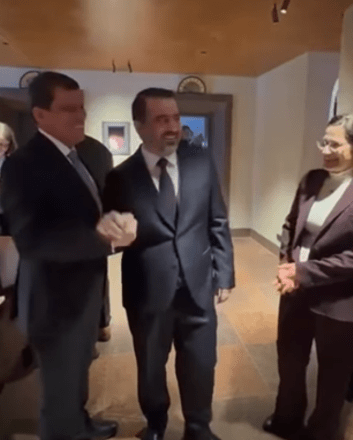
Video of Syria’s delegation to the Munich Security Conference: SDF and DAANES leaders Mazloum Abdi and Ilham Ahmad with Syrian Foreign Minister Asaad Shaibani.
Now, the Munich Security Conference is an imperialist ‘security’ fest that offers security to only a select few powerful states, and certainly not to people like Palestinians, or to Iranians right now being bombed to bits by the government of this very Rubio. But for small and struggling nations who are invited, bereft of good choices in today’s awful world, it is a forum where they can attempt to push their diplomatic needs between the varying interests of the “great” powers.
The presence of Mazloum Abdi and Ilhan Ahmed at this high-level event presents a radically different picture to wild stories of the Kurds being subjected to “genocide” or grotesque lies about “thousands” of Kurds killed in the January conflict between the Syrian government and the SDF. In fact, almost all the reduction in size of the outsized Kurdish-led DAANES (‘Rojava’) statelet was due to an uprising of the 2 million Arabs it ruled over uninvited in Raqqa, Deir Ezzor and southern Hasakah.
While at a certain point, it did look possible that a Syrian regime drunk on such easy victory might then try to overrun the Kurdish heartlands, this did not happen; instead, the January 30 integration agreement is widely seen as, in the circumstances, a just, if imperfect, compromise, that includes an SDF leader appointed governor of Hasakah, an SDF commander appointed assistant Defence Minister, alongside a number of other high positions (there is even speculation about Ilhan Ahmed in the foreign ministry), a new military division set up for the SDF, Kurds running their own security and other aspects. This reality, and the video and images above, present a difficult image to supporters of both sides who had insisted the other side were either “jihadi terrorists” (or “ISIS regime”) or “PKK terrorists,” both borrowing from the lexicon of the US “war on terror;” are jihadi and PKK “terrorists” now good mates, and are “PKK terrorists” now taking up positions in an “ISIS regime”?
By recognising the futility of holding onto the Arab regions while mobilising regional Kurdish populations to defend their own regions, leading to an effective partnership, the team around Abdi and Ahmed have bolstered their stature on the world stage, despite the shrinkage of their statelet. While much commentary speaks of western states “changing their position” to mean “abandoning” the Kurds, in an interview after Munich Abdi used the phrase “changing their position” to mean the exact opposite: this is the first time they have been invited to a high level conference in Europe as political leaders, rather than just meeting US military leaders in the field fighting ISIS. Indeed, Turkey’s foreign and defence ministers skipped the conference in objection to the inclusion of the SDF representatives.
Introduction
Until mid-January 2026, some 30 percent of Syrian territory was controlled by the Democratic Autonomous Administration of North and East Syria (DAANES), popularly called ‘Rojava’, whose army was the Kurdish-led Syrian Democratic Forces (SDF). Roughly two-thirds of its area and population – the governates of Raqqa and Deir Ezzor and southern Hasakah – was populated by Syrian Arabs; the other two parts of the statelet were the northern and eastern parts of Hasakah governate, where regions of Kurdish majority combined with mixed regions of Kurds, Arabs, Assyrians and others, and the Kurdish town of Kobani (iconic for its resistance to the genocidal ISIS onslaught in 2014), part of Aleppo province situated north of Raqqa.
The entire project outside these Kurdish or mixed heartlands collapsed in 24-48 hours in mid-January, and with it, much of the Rojava mythos, though it maintains significant support in these heartland regions.
Two opposing roads had been posed for ending this unsustainable division of Syrian territory: either the process of negotiated integration ongoing since the March 10 agreement between the government and the SDF, or a ‘military solution’ whereby the Syrian army, possibly backed by Turkey, would reconquer the territory, a ‘solution’ long rejected by the Syrian government, one which would have resulted in great bloodshed and long-term hatred.
In the event, however, the collapse of the negotiated integration process led not to ‘military solution’ as such (except the original move into two armed Kurdish enclaves in Aleppo city); yes, the Syrian army began to nudge its way into DAANES territory to test the waters, but the minute it did so it led to an uprising of the vast Arab majority of the Raqqa, Deir Ezzor and southern Hasakah regions deciding simply to shrug off a decade of rule by a Kurdish-led party and army, which they had experienced as an oppressive foreign occupation. While the issue of Kurdish self-determination has long been a key issue in the region, the occupation of non-Kurdish territory by a Kurdish-led party flipped the script: what just took place was the assertion of self-determination by the Arab population.
Whatever the claims of Rojava supporters – some of them certainly valid and others highly questionable – that their revolutionary project was politically more advanced than the revolution elsewhere in Syria, it is clear that it failed outright to impact the lives or political consciousness of the Arab majority, despite the claims of its leadership to be implementing multi-ethnic ‘democratic confederalism’ and to have gone beyond a purely Kurdish struggle for autonomy. Supporters of the Rojava project need to do some hard analysis.
That does not necessarily mean the ‘Rojava revolution’ failed as a whole; leaving aside romanticised hype, it appears by all accounts to have more reality in the Kurdish-majority and some mixed regions, and defending its gains, and more generally, the rights of the Syrian Kurdish population to a degree of self-rule, remains a valid and important struggle.
The loss of most of its territory to the Arab uprising returned the issue from defence of an expanded imaginary ‘multi-ethnic Rojava’ to defending the Kurdish heartlands. While the threat of these regions being overrun in a bloody ‘military solution’ was avoided, the issue then became the degree of Kurdish self-rule that could be negotiated within the framework of integration into the Syrian state. Many criticise the lack of an officially ‘autonomous’ or ‘federal’ unit within the January 30 agreement. However, once the issue of Kurdish self-rule returns to the fore, a ‘new old’ problem arises: how to define ‘autonomy’ or ‘self-determination’ given the demographic reality of ‘Syrian Kurdistan’: despite much popular imagination, “the Kurds” is not the name of a geographic region, but rather an ethnic group which occupies no contiguous territory in Syria; Kurds are scattered in three small unconnected concentrations, living interspersed with other Syrians, as I have analysed here.
This long essay takes a comprehensive look at the developments in January and February; it is well-titled so sections can be read separately:
- It begins with background to the issues;
- looks at the integration agreement and discussions throughout 2025;
- goes into the three stages of the January conflict – the initial Aleppo conflict, the SDF’s loss of its vast Arab possessions, and the threat that the Syrian army may enter the Kurdish regions and how that was averted;
- analyses the January 30 agreement, notes a number of positive and negative developments in its wake, and discusses a number of main issues still to be negotiated;
- and ends up with four broader thematic issues around these developments – the rise of pan-Kurdish solidarity, the question of whether the DAANES project was a radical democracy or a police state, and why the Arabs revolted, the discourse of “US betrayal of the Kurds,” and what this means for the ongoing Israeli aggression and occupation in the south and the Golan.
Background and lead-up to the conflict
a. Background: Kurds, Rojava project, PYD, YPG, SDF
The three ‘Rojava’ (West Kurdistan) cantons of Afrin, Kobani and Jazeera (northern and eastern Hasakah) arose in 2012 in the context of the revolution against the Assad regime, its genocidal counterrevolutionary war, and subsequent division of Syrian territory as various rebel formations defended territory liberated from the regime. Not surprisingly, the long-oppressed Kurdish minority began to assert itself in this context. Throughout 2011-2012, Kurds across the north took part in joint demonstrations against Assad alongside their Arab neighbours. Many of these Kurds supported the pro-revolution Syrian National Council (ENKS), consisting of eleven Kurdish organisations. However, the three ‘Rojava’ cantons were established by the Kurdish Peoples Protection Units (YPG), the armed wing of the Democratic Union Party (PYD, the Syrian branch of the Turkey-based Kurdish Workers Party, PKK), which was not part of ENKS and was either ambivalent, if not hostile, towards the uprising, declaring itself a third force allied with neither regime nor opposition.
Setting up these cantons arguably cut the Kurds off from the joint democratic struggle, and this often involved well-documented PYD violence against Kurdish anti-Assad demonstrators. On the other hand however, the drift towards armed separation must also factor in a hostile Turkish influence on parts of the Syrian opposition, and the rise of jihadist groups like Jabhat al-Nusra which launched armed attacks on the Kurdish cantons. It is a complex issue, and while the PYD does not represent all Syrian Kurds, it does represent a significant portion of them; and as long as these three armed cantons roughly corresponded to the three Kurdish regions, they were not doing much drastically different to rebel formations running their own armed regions to defend their peoples against the regime.
However, as the US airforce adopted the YPG (which later became the leading force in the SDF coalition along with several non-Kurdish allies) as its preferred partner to fight ISIS in northeastern Syria from September 2014 onwards, things began to change. The US/SDF victories smashed ISIS in Syria between 2014 and 2019. In 2017, they took the ISIS ‘capital’ Raqqa (the claims by Assadists that the Assad regime and its backers defeated ISIS are laughable ‘parallel universe’ nonsense); though in doing so, the US airforce completely destroyed Raqqa. The SDF then found itself overextended, in occupation of a vast region that was not Kurdish and had not chosen to be part of their project.
In an era when the only alternatives to SDF rule in eastern Syria (the theatre of the SDF-ISIS war) were the Assad regime and ISIS, accepting SDF rule by these Arabs was a no-brainer. But this changed once the regime was overthrown. The SDF should have recognised reality and began a serious process of negotiated handover of Raqqa and Deir Ezzor; and even before this, it should have handed over serious authority to the local Arab populations within their statelet. Negotiating in 2025 as if this 30 percent of Syria (which happened to include most of Syria’s oil wealth) was all “theirs” was a huge error of judgement.
b. No military solutions to Syria’s disunity – and the question of who is ‘legitimate’
A negotiated integration process between the Syrian government and the SDF was the only possible way forward to solve this massive division of Syrian territory. This is also the case with the smaller division with Druze-dominated Suweida in the south, which like DAANES has its own autonomous armed forces derived from Druze ‘armed neutrality’ during the revolution years, and the effective division with alienated Alawites on the coast, who have no armed forces since they were the backbone of the military-security apparatus of the collapsed regime, which allowed no other.
Which particular governments, autonomous entities, military formations or political currents represent these different components of Syrian society is not neat, but rather, is a very messy inheritance from the Assadist catastrophe, and therefore cannot be judged on purely ‘formal’ categories. For example, many government supporters say the Sharaa government is ‘legitimate’ because it has global recognition, so minorities should simply bow down, accept centralised rule by this government on the basis of one-person one-vote, and all will be fine; many opponents claim it has no legitimacy because it has not yet faced elections, or that it is nothing but “an assemblage of terrorists;” then government supporters respond that many Kurds oppose the SDF so it has no legitimacy to speak on behalf of Kurds, and so on.
In reality, the current Damascus government and its army does appear to have wide legitimacy (as opposed to enthusiastic support) among the majority of Syrians, and therefore can be considered legitimate in that sense. Its legitimacy derives from the enormous act of overthrowing the genocidal regime which destroyed the country; its global recognition derives from the fact that there is currently no possible alternative (unlike in Egypt after the 2011 revolution, for example, the military-security apparatus of the ancient regime in Syria were smashed, so no ‘al-Sisi coup’ is currently possible).
However, it does not adequately represent all components in Syria; rather, its main legitimacy derives from the Sunni Arab majority in Syria. This component is represented, ‘for better or worse’, by the government and its Sunni-dominated armed forces which emanated from what was left of the largely Sunni-based rebel movement after much of it had been earlier destroyed by Assad – whether one views that as the government’s ‘intention’ or rather an inheritance to be overcome. It is largely an inheritance from the Baathist catastrophe – under Baathist rule, control of the military-security apparatus was solidly in the hands of the Alawite minority, constructing a powerful sectarian dynamic, and a major dimension of its violent counterrevolution after 2011 was a war of sectarian genocide against the Sunni majority which formed the main – but not exclusive – base of the revolution. This utterly destroyed the social fabric of Syrian society, and parts of these Sunni-dominated armed forces today naturally reflect impacts of this regime-sponsored sectarianism. Some claim the new government is making slow attempts to overcome this; others claim the new ruling elite seeks to utilise Sunni sectarianism as its ideological prop in the reestablishment of a soft-authoritarian capitalist rule. While this issue cannot be dealt with here, the widely-noted ‘one-colour’ nature of the state, despite some improvement throughout the year, means that it requires maximum democratic change to become a genuinely inclusive polity.
Therefore, Syria’s unity can only come about via real negotiations and accommodations between the various Syrian components to bring about democratic integration, for other components to also see the government as legitimate. Once again, ‘for better or worse’, a large part of the Kurdish component is represented at present by the SDF; not all of it, to be sure, as the Kurdish National Council also represents significant Syrian Kurds, but given the SDF’s monopoly on arms in most Kurdish majority regions, specific political advances in those regions which the Kurds are proud of, and understandable mistrust of government armed forces in a post-revolution situation where people’s security is fundamental, the SDF and DAANES must play a key role in any negotiated integration.
Likewise Alawite and Druze components need to represent themselves, with whatever leaderships, again ‘for better or worse’, they actually have, in any process of reconciliation and integration. In both cases, actions by government-led forces had catastrophic results in 2025, though the cases were different. The March 6 attempt by Assadist holdouts on the Alawite-dominated coast to impose their military solution via a murderous insurgency that ambushed and killed hundreds of public security and Sunni civilians led to the government necessarily confronting it, but in the process massively losing control to revenge-seeking and hateful sectarian forces – both in and out of uniform – who massacred over 1000 Alawite civilians. While trials have just begun for some of the 298 charged as perpetrators (something that never happened in Assad’s time!), the basic structural problems remain; above all, the glaring need to get local Alawites into the security forces to patrol their regions, and to be recruited to local military divisions, has only just begun towards the end of 2025. This has been partly due to the government’s centralising tendencies, which till recently was not responsive to ideas of balance via local decentralised governance, but specifically due to mistrust of Alawites in uniform due to the Assadist past.
If the Alawite disaster was provoked by the Assadist insurgency, the government was more directly responsible for the Druze disaster in July, and not only because it was the second time, it had not been preceded by an insurgency, and the Druze till then had been pro-revolution and the majority of its leadership – except a specific sheikh – had been pro-government and pro-integration. While there was a conflict between Druze and Bedouin which the government claimed to be trying to stop when it intervened, in reality this was a botched attempt by the government to impose a military solution on Suweida, frustrated by the ongoing negotiations over the degree of administrative and security decentralisation Suweida should be allowed while reintegrating into new Syria. In practice government forces took the side of the aggrieved Bedouin, leading to a gruesome massacre of hundreds of Druze by undisciplined, sectarian elements of the government’s armed forces and Bedouin militia, a smaller-scale massacre of local Bedouin by extremist Druze, Israel bombing Damascus to “protect the Druze,” and the effective loss of Suweida for now.
The Suweida disaster weighed heavily over how the government approached the SDF integration issue in the later part of the year. On one hand, its centralising tendencies were often apparent in contrast to the ‘federalist’ position of the SDF/DAANES; on the other hand, its chastening due to Suweida was apparent in large concessions it was ready to make (see below), though its powerful neighbour Turkey tended to push the former tendency. While much western commentary tends to analyse the January conflict as a victory for the government’s centralising tendencies, the outcome is in fact a clear compromise, and the chain of events far more complex than such analysis is useful for.
c. Background to the Aleppo ‘SDF’
The easy and dramatic collapse of DAANES in its vast Arab-populated regions tended to take the spotlight away from how the January conflict began, which was not in Arab Raqqa and Deir Ezzor, but rather in two Kurdish-populated suburbs inside Aleppo city, Ashrafieh and Sheikh Maqsud. Before describing this conflict, it is important to look at the background to these suburbs, as it is markedly different to that of the rest of the SDF/DAANES region.
These two suburbs had long been controlled by the YPG (which in Aleppo was simply renamed SDF when the SDF was set up in the northeast) since 2013 as armed camps completely surrounded on all sides by the rest of Aleppo, which was controlled either by the Assad regime or the armed opposition, with no connection to the main DAANES region of the northeast. Only the YPG-controlled Afrin region further west was somewhat close, but there was still no geographic link. While the Assad regime crushed the Aleppo rebels in 2016, it allowed the YPG to maintain control of these neighbourhoods, due to reasons specific to Aleppo
While in the Kobani region, the YPG found allies in the Free Syrian Army’s 11th Brigade, the Raqqa Revolutionaries Front, and other non- or anti-regime forces, in their confrontation with ISIS in the east, the Aleppo situation was different – ISIS had been driven out of the entire northwest by a massive joint rebel offensive in 2014, and the region was largely dominated by a wide array of rebel groups. In this situation, the YPG’s neutrality between regime and rebels was seen as betrayal by the rebels, and a potential asset by the regime (however opportunistically, since Assad always promised to crush Kurdish autonomy when he regained control). Combined with this was a new aggressiveness of the YPG – its confidence buoyed by the US intervention from 2014 onwards on their behalf – aiming to conquer an irredendist ‘Rojava’ state across the entire north of Syria, joining Afrin to Kobani, regardless of the vast Arab and Turkmen majority in between. It was rebel-controlled (not Assad- or ISIS-controlled) regions in their way.
The onset of Russia’s horrific air war in support of the Assad regime in September 2015 was welcomed by the YPG and was to be their tool. The Afrin and Sheikh Maqsud YPG launched a large-scale attack on the rebel-held, Arab majority Tel Rifaat and surrounding region north of Aleppo in January 2016, backed by heavy bombing by the Russian airforce. Seizing the region uprooted some 100,000 Arabs and Turkmen, who ended up in camps in Aziz on the Turkish border. Meanwhile, the AKP-PKK negotiations track in Turkey, which had been proceeding for a number of years, and which had corresponded with attempts to bridge the gap between rebels and YPG, collapsed in late 2015, leading to a shift by Turkish-backed rebel groups in the region to a more anti-YPG stance; in April 2016, a number of pro-Turkey groups launched murderous attacks on Sheikh Maqsud. While the YPG’s aim was to advance its irredentist project rather than to aid Assad as such, this put its Aleppo wing in alliance with Assad – made clearer when they actually aided Assad’s reconquest of rebel-held eastern Aleppo later in 2016.
When the Assad regime was overthrown in December 2024, the new authorities also allowed the SDF to maintain control of these two suburbs. Despite the history of bad blood in Aleppo itself, al-Sharaa’s HTS had begun to build bridges with the Kurds and the SDF, due to HTS’s own tensions with Turkey and the Turkish-backed Syrian National Army (SNA), at one point even proposing a joint civilian administration between HTS and the SDF if HTS could gain control of areas currently held by the SNA! HTS had also intervened in Afrin at times in defence of local Kurds against the SNA, which it continued to do after December 8. The SDF officially welcomed the overthrow of Assad, and HTS issued a statement stressing that its fight was against Assad, not the SDF, promising to ensure the safety of Aleppo’s Kurds, and describing the Kurds as “an integral part of the diverse Syrian identity” who “have full rights to live in dignity and freedom,” calling on them to remain in Aleppo Therefore, there was a degree of convergence, even though the SNA, backed by Turkey, launched an offensive to seize (Arab-majority) Tel Rifaat and Manbij from the SDF.
With Assad gone, and with the SDF nationally announcing its support for a process of gradual integration into the new Syria, it was clear that the Aleppo situation would not last. Two aspects were very specific about the Aleppo SDF compared with the much larger issue in northeast Syria: first, the particularly bad blood between the rebels and the Aleppo SDF as discussed above; and secondly, while control over significant territory in the east could be considered some basis for autonomy discussions, an armed presence outside the state in suburbs inside a city, with no geographic connection to the rest of DAANES, was a much less sustainable situation – and especially given Aleppo’s status as northern Syria’s commercial capital, such armed division could not last.
The bad blood was not helped by the tendency of SDF fighters there to fire on Aleppo security forces or civilians; according to the Syrian Network for Human Rights, sniping from these neighbourhoods killed 65 Aleppo residents just in December 2024-January 2025. Presumably this was a suicidally deluded form of pressure to get as good a deal as possible in the bigger integration negotiations; it is also possible that some of this was carried out by ex-regime forces who took refuge there. The SDF rejects this data, and, with some logic, claims it would not be in the interests of a surrounded group to act this way; nevertheless, reports of such acts throughout 2025 are legion, and have been expressed by a wide range of ordinary Syrians and pro-revolution activists, including many hostile to the new government.
There have also been claims that the local ‘SDF’ leadership in Aleppo were out of synch with the more pragmatic national leadership around Mazloum Abdi; Syrian activist Safi Ghazal claims “the elements in Sheikh Maqsoud today do not directly follow Qasad [SDF], and they were not present when Qasad was formed in the east of Al-Furat (Euphrates) … they are the most extreme element and do not declare their affiliation either to Syria or even to the SDF.” This makes some sense, given the particular history of this group. It also makes sense, jumping forward, given that after the national SDF agreed to peacefully withdraw from the two suburbs towards DAANES territory early in the January 2026 conflict to avoid bloodshed, a hard-line grouping within the Aleppo Asayish leadership rejected this decision and decided to “fight to the death.”
d. The March 10 and April 1 integration agreements
Whatever the case, the March 10 agreement between the Syrian government and the SDF signed by al-Sharaa and Mazloum Abdi formalised the process of integration, to take place via negotiation throughout 2025, with a view to completion by the end of the year. There is much to suggest a genuineness about this by both the government and the SDF, and actual warmth between the two leaders, Sharaa and Abdi, who despite opposing ideologies, had fought for years for their people. It is generally understood that Turkey, on one side, was not thrilled, preferring a military solution, but nevertheless went along with it, often pressuring the Syrian government to take harder stances; that Israel was not thrilled, from the completely opposite perspective, as its strategic outlook is for Syria to be partitioned and it preferred a Kurdish-led entity to remain in perpetuity; while the US supported the process (indeed Abdi arrived in Damascus in a US military helicopter), partly ending up with a better position than either Israel or Turkey by default, by playing the middle ground between their opposing positions, but also due to Trump’s aim of withdrawing from Syria: to do so, the US wanted to leave its war on ISIS in the hands of a unified bloc, not two forces in conflict with each other. In addition the US position reflects the Gulf’s desire to invest and make money in Syria, which requires some kind of integration, rather than a huge split down the middle that could erupt at any time.
Given Aleppo’s peculiar situation, the first step forward was made there with the separate April 1 agreement. In this agreement, the SDF military was to withdraw from the two suburbs, and leave behind only its internal security forces, the Asayish, which would be complemented by the entry of Syrian government internal security, and joint patrols would be established. The state would extend services, but the local Kurds would continue to run their municipalities. Prisoners were also exchanged. Initially, this was seen as a model for how a decentralised approach to integration might work.
It is unclear from afar how this hopeful model collapsed. Syrian government supporters claim that the SDF never fully left, but left behind some cadres and weaponry. Moreover, even if it was mainly Asayish, there never seems to have been any entry of state internal security to partner with them as agreed, but the reasons are unclear. They also charge that the remaining SDF or Asayish continued to snipe on Aleppo security or civilians. Rojava supporters reject this, claiming there was no SDF remaining, and instead charge that the Syrian government imposed a blockade on the two suburbs for many months before January. There is good reason to accept parts of both stories. For example, following the Suweida crisis in July, despite government troops withdrawing, and allowing in aid convoys, the government cut off electricity and internet from the region; and carried out a similar siege on Kobani in January, for weeks after the government and SDF had signed a ceasefire agreement. Thus using collective punishment as a pressure tactic has undeniably been used by this government. Meanwhile, the death of Asayish commander Ziyad Halab in the January 2026 conflict highlighted the opacity of the line between SDF and Asayish, since until then he had been known as an SDF commander.
Getting back to the bigger picture, despite some flare-ups between the two sides in Aleppo, negotiations got back on track in October, with US mediation. The main stumbling block had been that the government wanted the SDF to integrate into the Syrian army “in an ‘individual’ capacity,” as opposed to “as a bloc” as the SDF insisted. Integrating “as a bloc” was important so that the SDF, as part of the Syrian army, would still be placed primarily in Kurdish regions, where they have the people’s confidence; however, it also assumed a continuation of an autonomous SDF command structure. In October, the government and SDF agreed on a compromise whereby the Defence Ministry would set up three new divisions and two new brigades in the northeast for the SDF units to join. While it could still officially be called “individual” integration (SDF cadre would have to join the new divisions, rather than the SDF units simply changing their names), they would remain together in their region, thus more “collective” than either purely “individual” or “bloc” integration. One of the two ‘brigades’ (smaller units than ‘divisions’) was to be for the SDF’s Women’s Protection Units (YPJ), the other a specialised anti-ISIS brigade. High political and military positions were offered to SDF personnel, with rumours of Abdi being appointed Chief of Staff of the defence forces.
This extraordinarily arrangement indicated that neither the SDF nor even the Syrian government yet realised how shaky was the SDF’s hold on the Arab regions. The three divisions were assumed to mean one for each of Raqqa, Deir Ezzor and Hasakah governates, as if the current Arab SDF troops in Raqqa and Deir Ezzor would remain loyal to the project. Despite this, it seems the SDF still tragically refused to sign on, instead making more unrealistic demands; for example, the SDF allegedly demanded that Defence Ministry personnel not be allowed to enter the northeast (the whole DAANES, not only the Kurdish regions) without permission from the future ex-SDF military divisions! This extraordinary demand showed that they still imagined this was somehow all “theirs.”
Proposals that the SDF give up Arab-populated Deir Ezzor to the government – especially important given its oil and gas wealth which are the property of Syria as a whole, and the history of uprisings against SDF rule there – as a goodwill gesture, as a concession to build trust, were resisted by the SDF.
Nonetheless, when the end of year deadline had passed and the government and SDF again met on January 4, with the presence of US mediators, they came close to agreement; all these October proposals were still on the table. What happened next is largely based on conjecture or anonymous “sources,” and it is unclear whether the SDF persisted in its unreasonable demands. According to a common story, while positions were edging closer, Syrian foreign minister Shaibani entered the negotiations room at some point and declared the discussion over. According to SDF spokespeople, this was due to “international intervention,” meaning Turkish pressure. Perhaps Turkey demanded from the Syrian government that the Aleppo situation be resolved as an example, to demonstrate to the SDF what they were potentially bargaining with. Whatever the case, the government then decided to apply the ‘military solution’ to the very specific, troublesome case of the isolated Aleppo enclaves.
The three stages of the January conflict
a. Stage 1 – The Aleppo conflict
Despite the Aleppo YPG leadership’s history of collaboration with Assad and the untenable situation, nevertheless the government’s decision in early January to launch a military solution to the two Aleppo neighbourhoods in principle still violated the necessary process of negotiated integration; that is, by most accounts, the YPG had legitimacy among the Kurdish populations in the two neighbourhoods, and had good reasons to fear for their safety if overrun militarily by the Syrian army (even more so given the coast and Suweida events).
The shelling of the al-Midan neighbourhood in Aleppo on January 6, which killed three civilians, was blamed by the government on the SDF/Asayish – who denied responsibility – and used as the pretext to begin the offensive.
It is true, on the one hand, that nothing even remotely similar happened in the Aleppo conflict as what took place on the coast and Suweida; first, the government created humanitarian exits which allowed 148,000 residents (the vast majority) to escape before military action was taken; these residents were sheltered and provided food and services elsewhere in Aleppo or in Afrin by government and non-government agencies, schools and mosques; and following the end of the conflict, the vast majority have returned, facilitated by public security forces, and ‘reenge’ attacks have been avoided. There were even some defections from the SDF, but not that many. The January 15 announcement of the graduation of 130 new Aleppo public security officers, 20 percent of them Kurds, suggests government security forces replacing the Asayish can be largely Kurdish (in addition to those who defected). Compared to the coast and Suweida, this was a highly professional operation.
However, the fact that the kinds of mass atrocities of the coast and Suweida did not take place is an excessively low bar; that should simply be considered normal, rather than laudable. Despite the humanitarian corridors, not all could escape; according to Human Rights Watch, some residents said “the passages were attacked by snipers and affected by shelling from both sides” and “one resident said that the Asayish and SDF blocked people from using the humanitarian corridor due to renewed fighting.” The nature of the military action itself – tanks and artillery against built-up areas – still led to 47 civilian casualties, according to SDF data (and 23 civilians in government-held Aleppo), among those who did not or could not leave; many civilians returned to destroyed homes or other civilian infrastructure; and while there were no massacres, there were violations of dead bodies (including the widely seen throwing of the corpse of a female fighter from a balcony), and sectarian insults used against captured groups of Kurds. If the April 1 agreement included entry of government security forces to work alongside the Asayish, why didn’t the government push to make that happen? As Syrian revolution activist Taha Bali states, the answer to “the question of an alternative solution to military work” is “negotiations and more negotiations.” Military action deepens division, destroys trust.
b. Stage 2 – East Aleppo, Raqqa, Deir Ezzor: The Arab revolt
But then something completely different happened. After the SDF sent drones against targets in Aleppo (including a municipal government building) from a strip of Arab-populated, SDF-ruled land in rural eastern Aleppo (around the town of Deir Haffer), the government demanded they leave that region as well. This was considered easy, not only because it was Arab populated, but because it is a small strip on the west bank of the Euphrates River (all the rest of the SDF/AANES statelet was east of the river) which the SDF had only taken after the fall of Assad; it was not long-term part of ‘their’ territory. Seeing this reality, the SDF agreed to withdraw to the east of the Euphrates. To the Americans, the SDF’s long-term backers, the idea of consolidating behind a more defensible line east of the Euphrates also made sense.
But when the SDF withdrew, the Syrian army was confronted with scenes of wild jubilation as they entered. The Arab population there understandably viewed this as liberation. But suddenly this indicated that the entire DAANES statelet was built on sand, since the vast majority of the population of Raqqa and Deir Ezzor governates, and even the southern part of Hasakah governate, were Syrian Arabs. The SDF/Rojava mythos was that their project was not simply about Kurdish rights and autonomy, but about building a new multi-ethnic model called “democratic confederalism,” based on ideas developed by PKK leader Abdullah Ocalan when he rejected his previous nationalist quest for an independent Kurdish state. And in my frank opinion, these are very valid ideas that deserve study in relation to the national question, especially where populations live interspersed. But if these ideas had become a reality in the 8-9 years the SDF ruled over them, and the Rojava political project had proven its democratic and emancipatory credentials, then the Arab majority of the region could have fought to remain in Rojava’s superior political set-up which they would be invested in as equals.
Instead the Arabs reacted like any peoples throwing off an oppressor regime. So, while the Euphrates worked as a physical boundary, it was no ethnic or political boundary. The Arab masses basically threw off SDF rule themselves, and the 50,000-strong Arab SDF force made no attempt to fight, instead defecting in its entirety. The mass celebrations as the Syrian army entered these regions are unmistakable (and here and here and so many more); actually what we saw was an uprising,
Heading north along the river into Raqqa governate, the town of Tabqa fell like another domino, and once again the Syrian army was greeted with wild celebrations. Meanwhile, further east in Deir Ezzor, Arab ‘tribes’ (using media language) rose up against the SDF; they have previously done so on several occasions. They rapidly liberated vast tracts of the countryside with zero Syrian troops involved. Soon they took over the Conoco gasfield. One after another the major ‘tribal’ federations which had been officially loyal to the SDF declared their loyalty to the Syrian government. The first were the Shaitit in Deir Ezzor, who had fiercely resisted the ISIS conquest in 2014, resulting in ISIS slaughtering 900 Shaitit.
Back to Raqqa governate, all the Syrian army had to do was nudge forward across the Euphrates, and the city of Raqqa itself was liberated, the SDF fleeing without a fight, once again to wild celebrations, and to viral scenes of opening the doors of a women’s prison, with jubilant women and children streaming out. While some SDF supporters claimed the Syrian army was thereby releasing ‘ISIS’ prisoners, this report cites released woman, Haja Umm Mahmoud, who “had spent over a year and a half in SDF detention for communicating with her sons, who were part of the Syrian opposition forces, and for receiving money transfers from them. Umm Mahmoud revealed that the prison housed a large number of women and children with various charges—some criminal, others linked to the work of relatives or children of the detainees within the Syrian opposition forces. Some detentions were reportedly based on false reports or participation in celebrations marking the fall of the ousted regime. Regarding the children, she explained that some women were detained with their children because they had no caretaker outside the prison. Some of these children spent years in detention centers without sufficient care or education.”
Arthur Quesnay, writing in OrientXXI, describes the “intifada” that took place in Raqqa:
“However, the whole of this device collapses on the night of January 17 to 18 when the Syrian army takes the city of Tabqa, south of the Euphrates, and says it is ready to advance on Raqqa. … the Kurdish authorities of the AANES had to face a popular uprising that began on the morning of January 18 and that amplified as the Syrian army deployed. … In Raqqa, for example, civilians took to the streets in 8 a.m. The rallies were initially hesitant because of the shootings by snipers that left 22 dead and about 100 wounded, according to the city’s hospitals. However, as early as noon, Kurdish forces retreated in the face of a massive mobilization. The Syrian army’s entry around 5 p.m. was more a security operation to protect civilians from the latest snipers still active.”
Raqqa had been the first city liberated from Assad in 2013, but it was later conquered by ISIS, then later liberated by the SDF (if ‘liberation’ can properly describe the total destruction of the city by the US airforce), but then kept imprisoned by the same SDF – for the people of Raqqa this was a return to their own revolution. It is important to remember this when much lazy discourse describes the collapse of SDF rule over Arab regions as due to ‘tribal defections from one ruler to another’ – yes, as described, there was actions by ‘tribes’, but this was only one aspect of the liberation – the city populations of Raqqa and Tabqa are not ‘tribes’. Even in Deir Ezzor, the reason we now saw tribal action was because the city population of Deir Ezzor – again with its own history of liberating the city from both Assad and ISIS before that latter reconquered the city in July 2014 with the aid of the Assad regime – had already rejected SDF rule straight after the ouster of Assad, and the SDF had been sensible enough to defer to their wishes to join the new government then.
Indeed, Quesnay stresses that “the driving force behind the revolt lies not in tribal networks, but in former Free Syrian Army fighters or local executives who took refuge in Idlib during the civil war. Numerous interviews reveal that they were the ones who formed the first groups of insurgents on the night of January 17 to 18, 2026.”
c. Stage 3: Potential attack on Kurdish regions
The point about the above is that, after the relatively small-scale Aleppo events, the massive loss of SDF/DAANES territory that followed was not an “attack on the Kurds” or on “Kurdish autonomy” or even on “Rojava” in the original and more correct meaning of the term (“western Kurdistan”, ie, regions where Kurds live in Syria). Rather, it was a completely justified uprising of the two million plus Arab population in Raqqa, Deir Ezzor and southern and western Hasakah against decade-long, uninvited, oppressive rule over them by a Kurdish party and army. It does not require any support for or illusions in the current Syrian government to recognise that. It was an act of Arab self-determination. And given that most of Syria’s sovereign oil wealth was in that (Arab-majority) region, the government also had every right to gain control of it from the perspective of Syrian sovereignty and self-determination.
However, while most supporters of Rojava were shocked and simply not willing to admit this, nevertheless their discourse about this being an attack on the Kurds or on Rojava was not without foundation, in the sense that they saw it as a stepping stone by the government to militarily assert control over the actual Kurdish-majority regions, the original Rojava heartland, which was all that remained of the DAANES state – Kobani, nestled between Aleppo and Raqqa governates, and the northern and eastern part of Hasakah governate, the main Kurdish region in Syria (though itself very ethnically mixed). As it turns out, these regions were never overrun; the red-line of forcible violation of Kurdish self-determination was not crossed; but momentarily this appeared to be a danger.
So let’s be clear: based on the same principle that the Arab populations have experienced a liberation by feeing themselves from imposed Kurdish-led SDF (actually PYD) oppression, if the Syrian army had got drunk on victory and pressed into the Kurdish regions, this would have been an act of violation of the right of the Kurdish people (and perhaps other non-Arab peoples in the mixed region) to self-determination, and, given the given the actual nature of the various armed forces in post-Assad Syria as discussed above, this would almost certainly have resulted in widespread violations and massacres in practice. Once again, it does not require any support for or illusions in the SDF/DAANES leadership to recognise that. Nor does it require one to accept that “the Kurds” – a dispersed group of people in Syria rather than the name of a geographic region – could express their self-determination by remaining perpetually outside the Syrian state, just that integration can only take a negotiated approach based on genuine partnership.
Following the collapse of SDF rule over the Arab-populated two-thirds of its territory in mid-January, a ceasefire agreement was signed on January 18 between the two sides. But the defeats suffered by the SDF meant that negotiations were now on an entirely new basis, where the SDF’s bargaining position had now crashed, and this was reflected in the agreement’s terms.
This agreement called for the complete handover, “administratively and militarily,” of Arab-majority Raqqa and Deir Ezzor governates to the Syrian government, the handover of border posts and oil and gas fields, and expulsion of non-Syrian PKK members from Syria.
More positively, the agreement called for the SDF to nominate a list of commanders to “occupy senior military, security and civil positions in the framework of the central state, thereby ensuring national partnership” (this was understood to include deputy defence minister and governor of Hasakah), facilitating the return of uprooted Kurdish civilians to Afrin and Sheikh Maqsud in Aleppo, and support for Sharaa’s decree on Kurdish rights.
However, there were also some vague items. Hasakah governate was treated separately, lacking the “complete handover” language, but calling for “merging all civil institutions in Hasakah province within the Syrian state’s institutions and their administrative frameworks.” This could either meant the same thing – abolition of ‘Rojava’s’ institutions – or the softer language and reference elsewhere in the agreement to “the special needs of Kurdish regions” could mean room for negotiation whereby formal integration into state institutions could preserve much of their own structure.
Similarly, it called for appointing “a candidate to become governor of Hasakah, as a guarantee for political participation and local representation.” While this could mean nothing remarkable, it became apparent that Mazloum Abdi was seen as the likely candidate.
While calling for Kobani to be “emptied of all heavy weaponry,” it said that “a security force is to be formed from the town’s inhabitants, together with the preservation of a local police force affiliated administratively with the Syrian Interior Ministry.” This means the SDF-linked Asayish internal security would integrate into state structures, with Kurds running their own security. Left unsaid, on one hand, were the administrative structures in Kobani, and on the other, why similar language about security was not used for Hasakah.
Even the clearest defeat for the SDF position in the agreement – that the basis for SDF integration into the Syrian military would be “individual” – nevertheless, the absence of any reference to new divisions as previously proposed did not necessarily rule it out; they would still have to “individually” integrate into some military division, so it seemed rational that at least one new division could be set up for Hasakah for Kurdish SDF personnel to join.
These vague points suggested room for negotiation about how “integration” proceeded, leaving open the possibility of aspects of Kurdish or ‘Rojavan’ autonomy being preserved.
However, when Abdi met Sharaa the next day (January 19), Sharaa had adopted the most uncompromising interpretation of all these issues possible, demanding the complete and immediate handover of Hasakah governate, the complete dissolution of the SDF and autonomous administration at the outset, with “individual” integration coming after, and he gave Abdi only a few hours to consult and make a decision. When Abdi rejected this ultimatum, both sides mobilised to continue the battle. Syrian government troops approached both Kobani and Hasakah; for a moment it appeared that the Syrian government had decided on a ‘military solution’ and a bloody showdown by invading Kurdish majority regions and the Rojava heartland.
d. How the danger of war and bloody showdown was averted
Yet on January 20 the news was different – instead of four hours, the SDF was given four days to consult and to come up with a detailed plan for a practical mechanism of how they would integrate the civil institutions and the SDF. The entire tone had changed. Military integration of the SDF also required more “discussions on the detailed integration mechanism.” The SDF was asked to propose a candidate for deputy minister of defence, for governor of Hasakah, and names of representatives for the Syrian People’s Council from Hasakah and Kobani, whose places had remained vacant after the 2025 indirect ‘election’.
This ceasefire was then extended to 15 days on January 24, with US officials stating that the ceasefire must continue and “escalation” avoided no matter what. The Syrian government stressed it would not enter Hasakah or Qamishli city centres as long as agreement could be reached – though this ominously suggested they would if agreement were not reached – and stressed that no government forces would enter Kurdish villages, that only security forces consisting of local people would be present.
This was followed by a series of meetings between the Syrian government, SDF and DAANES leaders, US and French officials, the Iraqi Kurdish leadership (which hosted meetings in Erbil), with input also from PKK leader Ocalan, and from the non-PYD Syrian Kurdish parties gathered in the Syrian National Council (ENKS), which hashed out precisely the unclear issues in the initial ceasefire agreement. Following a meeting between Mazloum Abdi and US envoy Tom Barrack in Erbil, a Rudaw report claimed a “new framework” for SDF integration had been discussed, which indicated flexibility on these issues.
This led to the January 29 agreement, a comprehensive agreement that replaced that of January 18, and that included a permanent ceasefire, and which brought this “new framework” into being. Before going into its terms and what it means for the future, let’s first look at the factors that led to the rather dramatic change of tone between Sharaa’s uncompromising ultimatum on January 19, with the drift to war, and the new truce on January 20 leading to the January 29 agreement which all sides are now committed to. I think there are a number of factors:
- First, the tremendous mobilisation of Kurdish communities inside these regions in Syria, in neighbouring Iraq, Turkey and Iran (“south, north and east Kurdistan”), and around the world. Regardless of one’s view of the politics involved, the global ‘save Rojava’ campaign, together with the arming of the population in the Rojava heartlands and the entry of Kurdish forces from Iraq were all crucial in raising the potential political and military price for the Syrian government if it were to launch an invasion. In fact, the threat brought about an enormous demonstration of cross-border Kurdish unity, precisely the things that all four regional governments would probably have wanted to avoid.
- Second, the US red-line. Despite the discourse of “US betrayal” (to be discussed below) as the Arab masses shrugged of SDF rule, it was clear that the US saw the Kurdish-majority regions as a red-line. US officials were heavily involved in the ceasefire and getting better terms for the Kurds and SDF. Right-wing senator Lindsay Graham, closely tied to Israel, continued a strong campaign in support of the SDF which he began while in Israel when the Aleppo offensive began; at this point – January 18 – he promised that sanctions would be re-imposed and made “even more bone-crushing” than previously, warning that there was huge interest in Congress. On January 19, Trump phoned Sharaa and told him to “halt government army advances” and “to be more flexible” in the negotiations. Then as intermittent clashes continued and negotiations for an agreement proceeded, Graham’s January 27 ‘Save the Kurds Act’ threatened devastating sanctions on Syria and anyone supporting Syria, and on the same day Trump again called Sharaa and told him that the US “has interests in the Middle East and that this war does not align with their interests” and the offensive must end. Of course, this was all influenced by the first point.
- Third, the pragmatic instincts of the same Sharaa government which has also shown itself capable of quite opposite instincts – these two sides of the government’s inclinations have been in conflict throughout the last year, in a government still finding its bearings. It is unlikely that Sharaa really wanted a bloody showdown, which his government had pledged to avoid all year, especially after the Suweida debacle (Suweida after all remains beyond government control, despite hundreds of government troops killed in battle by Druze militia). It seems likely that Sharaa’s intransigent position and the military moves towards the Kurdish regions on January 19 were intended as a form of pressure on the SDF, combined perhaps with a theatrical show for Turkish regime consumption; having shown teeth, he then returned to a more rational position. Once again of course, this was also influenced by both points above.
- Finally, a specific point intervened: the process of the US moving 7000 ISIS prisoners from Syria to Iraq demanded calm conditions, and the US would have demanded a longer ceasefire if for this reason alone. It appears that the Sharaa government saw this as a convenient rationale for pulling back from its intransigent speech, a face-saver for in fact moving back to a more rational position. Arguably, this US operation signalled another thing: a US vote of no-confidence in the Syrian government’s ability to control the ISIS prisons, especially given the killing of US miliary personnel by a jihadist soldier in the Syrian army several weeks earlier.
The January 29 ceasefire and integration agreement
a. Analysis of the January 29 agreement
The January 29 agreement between the Syrian government and the SDF brings about the integration of the SDF and DAANES into the Syrian state’s institutions, but also includes aspects which allow a degree of continued self-rule in the Kurdish regions:
- On the main issue which had divided the two sides since the March 10 agreement – whether the SDF military would integrate into the Syrian army on an “individual” basis or as a “bloc” – the outcome comes closer to the latter even if formally the former, in that a new army division, consisting of three brigades, will be created for the SDF to collectively ‘integrate into’ in Hasakah governate, and a new brigade added to the Aleppo military division for the SDF in Kobani.
- The Kurdish Asayish internal security forces will be re-badged as part of Syrian public security, and continue to patrol Kobani and Kurdish regions in Hasakah.
- The Syrian army will not enter any “Kurdish areas,” or any “cities and towns”.
- The SDF is to appoint the governor of Hasakah governate, the deputy Defence Minister and a number of other high posts, as well as select representatives from Hasakah and Kobani for the People’s Assembly, which had been left vacant last year. The SDF’s candidate for Hasakah governor, long-time SDF leader Nour al-Din Ahmad, has been formally accepted by the Syrian government and has begun his duties; the SDF has put forward another 10 names for other high positions.
While the civilian institutions of DAANES will be integrated into Syrian institutions, a number of provisions also imply some degree of ‘re-badging’ with the possibility of maintaining some essential aspects of the ‘autonomous administration’:
- “settlement and certification of all school, university, and institute certificates issued by the Autonomous Administration”
- “licensing of all local and cultural organizations and media institutions” (in accordance with relevant laws)
- “working with the Ministry of Education to discuss the educational pathway of the Kurdish community and to take educational particularities into account.”
Together with references to “protecting the particular character of Kurdish areas” in the earlier January 18 agreement, these items suggest that the degree of effective local decision-making, including the retention of the more progressive aspects of the Rojava project, could be questions of interpretation and negotiation, rather than a flat suppression as more negative readings could suggest.
This more positive interpretation is being given by leading SDF and AANES figures such as Mazloum Abdi, who claims “the institutions that the Autonomous Administration was managing will remain as they are,” Ilham Ahmed, who claims the co-chair system will remain, that the YPJ will be included in the new brigades formed for the SDF, and that “education will be reorganized in a way that preserves Kurdish as an official language of instruction,” Fawza Youssef adding that “educational institutions will retain their specific character, with joint committees to be formed to discuss the continuity of the educational process, including curricula and languages of instruction,” while Sipan Hemo claims that “everything—from command structure to deployment centers—has been determined by us,” and that not only the Hasakah governor, but all district governors in Hasakah will be appointed by the SDF.
The agreement also calls for facilitating the return of all displaced Kurds to Afrin and Sere Kaniye (Ras al-Ain). While a positive statement, this is currently made difficult in Afrin, and impossible in Sere Kaniye, by the presence of re-badged former Syrian National Army (SNA) brigades who committed atrocities against Kurds and plundered their properties when they took part in the Turkish invasions of 2018 and 2019 respectively (when hundreds of thousands of Kurds were driven out), as well as some remaining Turkish troops.
While Afrin Kurds still suffer harassment by ex-SNA brigades, the situation has improved significantly since the new government came to power and began pushing these brigades aside and working towards restitution of the Kurds’ property; some 70,000 Kurds returned to Afrin in the first months after the revolution, though many more still languish elsewhere in camps, and while return has begun, clearly the Turkish and SNA presence needs to be resolved. Meanwhile, all three Afrin positions for the People’s Council were won by Kurds, “including Dr. Rankin Abdo, a female doctor and activist whose public views on Ahmed al-Sharaa are far from positive.” And on February 13, the Afrin district government announced the appointment of 19 mayors for the region’s main towns, and “most if not all of these appointees are local Kurds.”
To all this must be added the January 16 presidential decree on Kurdish rights, which declared the Kurds an essential component of Syria, declared Kurdish to be a “national language” that can be taught in public and private schools where Kurds form a significant part of the population, made the Kurdish Newroz festival a national holiday, banned hate-speech against Kurds, and annulled the results of the botched 1962 census which had stripped some 20 percent of Syrian Kurds of their citizenship; hundreds of thousands of Kurds were at a stroke granted citizenship. While arguably some parts could be strengthened and will be subject to negotiation and elaboration, and as many Kurds have argued, this should be in the constitution rather than just a decree (Sharaa has now stressed his commitment to guaranteeing Kurdish rights within the constitution), this was clearly a huge and sweeping reform, leading to Kurdish celebrations in Damascus and Afrin among other places.
Meanwhile, at the Damascus International Book Fair, which took place February 5-16, Kurdish books were available for the first time; see this short video. Many Kurdish writers, unable to present their books previously, were present for the first time, for example well-known Syrian Kurdish novelist Jan Dost, who returned to Syria for the event for the first time in 26 years. “I am at the Damascus Book Fair for books, writing, Kurdish culture, and the Kurdish struggle. … for 26 years I was deprived of the land and people of Kurdistan. Now I am seeing my readers up close and we are having discussions.” He did not hold back his desire to see a united Kurdistan at some time.
Taken as a whole, all the above represents a picture that is so comprehensively superior to anything during the 60-year Baathist dictatorship or before regarding the Syrian Kurdish issue that it is simply night and day. This at least should be conceded by critics before moving on; getting this far is an accomplishment that would have been impossible without the Syrian revolution, in the broadest sense of the term.
b. Developments since the agreement – positive and negative
In the aftermath of the agreement, most developments have been strikingly positive in terms of the spirit of the agreement, of creating a new partnership whereby, on the one hand, the Syrian state has sovereign control over its territory with ‘one government, one army’, while on the other hand, Kurdish and SDF leaders become partners in the state and a significant degree of self-rule applies in the Kurdish regions. Here are a number of developments:
- The government accepted the SDF’s nomination of long-time SDF leader Nour al-Din Ahmad as Governor of Hasakah governate; for the significance of this, it is important to remember that Hasakah is only 30 percent Kurdish. Originally jailed by the Assad regime for early anti-Assad activity, he also had a son killed fighting for the SDF against ISIS. He has played an important political role in the DAANES. When he first returned from Damascus after being accepted, the SDF welcomed him with a sea of Kurdish flags and no Syrian flags, which may have been reassuring for Kurds but not for the Arab majority of Hasakah. This was reversed in his subsequent inauguration in the presence of the government-appointed Hasakah internal security chief; the SDF has also appointed the deputy head of security for the governate, Asayish commander Mahmoud Khalil (Siyamend Afrin).
- More recently, the government accepted the SDF’s nomination of long-time SDF (and before that YPG) commander, Sipan Hamo, as Assistant to the Minister of Defence for the eastern region.
- The SDF has put forward another 10 names for positions, as noted above, there is speculation about Ilhan Ahmed gaining a position in the foreign ministry. The SDF will also nominate people to represent Hasakah and Kobani in the People’s Assembly (places were left vacant during the ‘election’ process).
- On February 4 Sharaa met with a delegation from the (non-PYD) Kurdish National Council in Syria (ENKS) in Damascus, thus broadening the engagement with Kurdish political leaders beyond the SDF.
- On the same day, the Deputy Governor of Aleppo, Ali Hanura, hosted Arab and Kurdish civil society figures from Kobani to discuss service priorities, following Sharaa’s own meeting with 15 intellectual and influential community Kurdish figures from Kobane, both SDF and non-SDF.
- When Colonel Mohammad Abdul Ghani, commander of Internal Security in Aleppo Governorate, visited Kobani to prepare for the entry of security forces to begin integrating the SDF’s Asayish forces, who will continue to be the (re-badged) local security force, he used the name “Kobani” rather than its Arabic name, Ain al-Arab.
- The entry of internal security into Hasakah and Qamishli for the same purposes proceeded smoothly; the joint statement by the Asayish and MoI leaderships, led off by a female YPJ cadre, has a genuine feeling to it; Interior Ministry spokesperson Nour al-Din al-Baba thanked the local Kurds for their “warm welcome” and “love and gratitude.” Both the Syrian army and SDF had moved away from the cities, as agreed.
- The first 400 families of Kurds displaced in northwest Syria have begun their return to Afrin, with hundreds more families expected to return in coming weeks, based on agreement between the SDF and the government in which the latter ledged to ensure their safety. According to the pro-SDF ANF site on February 16, “the issue of displaced citizens will be addressed in the coming days, and preparations for their safe return will begin. In the event that no problems arise and a joint plan is established, around 450,000 people displaced from Afrin, Shehba, Aleppo, Girê Spî (Tal Abyad), and Serêkaniyê (Ras al-Ain) will be able to return to their homes.” Very importantly, a joint internal security team including Asayish personnel, led by Asayish commander Mahmoud Khalil (Siyamend Afrin), visited Afrin to assess the necessary arrangements for the return of displaced residents, here he is paying homage to his homeland he had been displaced from. Following this, he and the joint team then visited Sheikh Maqsud and Ashrafieh.
- More recently, it was reported that Turkish civil administrators have begun leaving Sere Kaniye (Ras al‑Ain), a Turkish coordination office in the city has been closed, some SNA military factions have started withdrawing from the area, and Asayish forces are likely to enter.
- The Ministry of Local Administration and the Environment issued a formal decree on February 15 formalizing administrative decentralization in Syria based on the pre-existing Law 107, by delegating significant authorities and ministerial powers to Governors, as well as some extra powers to mayors. Given that Sharaa has regularly stated that Kurdish, Alawite and Druze calls for decentralisation or federalism “do[es] not differ in substance from the local administration framework in force in Syria, particularly Law No. 107 issued more than ten years ago, which in practice already incorporates many of the concepts being proposed today, with the possibility of introducing amendments to it,” this seems a positive step in relation to SDF and Kurdish calls for self-rule within the integrated framework.
- On this, Abdi stated on February 17, on his return from the Munich conference, that “the main Kurdish demand in northeastern Syria is “decentralized local governance under any name” and as such the disagreement with the Syrian government is only terminological rather than of political substance. This was in response to Syrian Foreign Minister Shibani’s denial that the Kurds are demanding autonomy – Abdi stated that the term “autonomy” is not a condition of the Kurdish proposal, but rather, the goal is to empower residents of northeastern Syria to manage their administrative, service, and security affairs themselves, in a way that preserves the region’s ethnic and social particularities.
- On February 18, Abdi announced a general amnesty for all prisoners, declaring that the phase of war has ended. The SDF released an initial 51 detainees, on the same day that Sharaa also declared a partial amnesty for prisoners who had not committed “grave crimes.” On March 10, Damascus released the first 100 SDF prisoners.
- Oil and gas facilities, the Qamishli airport and border crossings have returned to government control, as seems appropriate; only the Semalka border crossing into Iraqi Kurdistan required some negotiation, but it is understood that official government control will be combined with the same Kurdish staff continuing to work there.
Not all developments have been positive, however:
- Despite these agreements and meetings, the government has maintained an effective siege of Kobani for weeks afterwards, which appears to be a means of collective pressure – even though this seems to make little sense in the circumstances. The food, water, power, fuel and medical needs of Kobani are further exacerbated by the presence of tens of thousands of Kurds displaced from elsewhere in recent weeks. While a number of large aid convoys have gone into Kobani, the main problem was that electricity was cut off to the region, which also meant water pumps couldn’t run. The government denied that it was blocking electricity, claiming instead that damage to the network during the fighting had caused the cut-off; if so, there seemed to be little urgency about fixing it. Power was finally restored to Kobani (intermittent as in most of Syria) on February 9, leading to water being pumped. However, while this is slowly improving, the conditions for normal trade of goods in and out of Kobani – as opposed to protected aid convoys – remains severely hampered by the presence of SNA or other “dangerous factions that are most likely not committed to the agreement” – according to the Kurdish Red Crescent – on the outskirts of this isolated enclave. A number of deaths have been reported due to siege conditions. This is simply criminal and the government is fully responsible and needs to act to end this situation immediately.
- Despite the overall positive atmosphere of the meetings as internal security entered Hasakah and Qamishli, they were marred by the SDF arresting dozens of Hasakah locals for coming out to welcome the entry of state security forces, a reminder of the authoritarian practices behind the ‘radical democracy’ of Rojava.
- A recent report claimed that residents of Arab-majority neighborhoods in Hasakah reported increasingly harsh ‘security’ measures by the SDF including security raids, street sweeps, temporary checkpoints, phone searches and so on. Meanwhile, leaders of virtually all the Arab ‘tribal’ groups of northeast Syria issued a joint statement on February 15 calling on Damascus to restore full state authority in the region, deployment of the Syrian army and security across the governate, and dismantling of the Autonomous Administration, accusing the SDF of entering Arab areas, imposing restrictions on local security forces, and of carrying out arrests and raids. The issue here appears to be some unclarity in the agreement: while it was agreed that the SDF’s Asayish internal security would be re-badged to continue patrolling Kurdish regions, the Asayish had previously deployed all over Hasakah; naturally the Arab majority do not want re-badged Kurdish Asayish patrolling them (though this fear seems unfounded). This coincides with demonstrations by Arab communities previously ruled by the SDF in Raqqa, Deir Ezzor and Hasakah condemning SDF “violations” and calling for release of prisoners.
- In mirror image to these protests, there have been demonstrations in Kurdish towns demanding the release of Kurdish and/or SDF detainees being held by the Syrian government; up to 1000 are reportedly unaccounted for.
- The escape of significant numbers of ISIS cadre, or families, during the handover, which both blame each other for, has likely led to some of them joining up with ISIS which has now launched a number of new attacks on Syrian government forces. By contrast, arguably the escape of many women and children represents the end of a decade-long injustice, of people incarcerated with no charges or trials or prospects, including children born there.
c. Main ongoing issues for negotiation
There are a number of key issues – either Kurdish-specific or Rojava-policy – still to be resolved in the ongoing process of negotiation over the implementation of the agreement.
- First, the very important question of Kurdish education. While Sharaa’s decree on Kurdish rights included the hugely important clause that Kurdish was considered a national language that can be taught in public and private schools, this is also one of its weak points. Because the initial understanding is that Kurdish will be taught two periods a week as an elective course; while this may be very good in some areas, for regions that are predominantly Kurdish and where Kurdish is mother-tongue, the issue raised is Kurdish as the language of instruction, rather than a mere elective. As cited above, Ilham Ahmed claims that “education will be reorganized in a way that preserves Kurdish as an official language of instruction,” and Fawza Youssef likewise claims that Kurdish schools “will retain their specific character” and that joint committees will be formed to discuss the continuity of the educational process “including curricula and languages of instruction.” It remains unclear whether these are their opinions or there have been understandings with the government on this. Of course, the agreement explicitly states that “all school, university, and institute certificates issued by the Autonomous Administration” will be certified, implying the continuation of these institutions taught in the Kurdish language; but that could be interpreted as “up until now.” The agreement also states that in discussing the “educational pathway of the Kurdish community, the Education Ministry must take into account their “educational particularities.”
- Second, there is the more general question of how much of the legislative framework of the former Rojava will continue in Kurdish regions, or for that matter in non-Kurdish regions, within the parameters of the administrative decentralisation that, as shown above, the government now appears to recognise; as noted above, Abdi claims the institutions of the Autonomous Administration” will basically remain as they are. This above all concerns the radically more progressive gender equality policy framework of Rojava; if this was rolled back, this would indeed represent societal regression. Of course, since the agreement states that all DAANES employees would continue in their jobs as the administration is integrated, this of course includes the high levels of gender equality in employment and management, but the question is how much control decentralisation will give them over the policy framework that promotes this. One example is the Co-Chair system, which as cited above, Ilham Ahmed claims will continue. But this concerns more general issues as well, for example the institution of civil marriage and other significant reforms. The agreement calls for the “licensing of all local and cultural organizations and media institutions,” which would therefore include a range of ‘Rojava’ civil society initiatives that are not present elsewhere.
- Third, there is the question of the Women’s Protection Units (YPJ). In both the October and December 4 proposals, one of the new brigades (separate from the three new divisions) would be specifically for the YPJ; yet once the balance of forces turned decisively in its favour, the government dropped this from the January 18 and January 29 agreements. As cited above, Ilham Ahmed claimed that the YPJ will be included in the new brigades formed for the SDF, though elsewhere she has stated the issue is still being negotiated. According to Ibrahim Hamidi writing in Al-Majalla, a Defence Ministry official stated that each of the four new SDF-based brigades “includes a battalion of the Women’s Protection Units.” For their part, YPJ spokespeople insist there is no way they are disarming. While no other brigades of the Syrian army include women, one important development was the November 2025 announcement that the Interior Ministry’s internal security and police forces would be open to women; in March, the first Women’s Police Institute was inaugurated in Damascus. It has also allowed female Asayish members to integrate on the same terms as their male counterparts.
- Fourth, in relation to the military integration, an issue has arisen regarding troop sizes of the new division and new brigades. Following the more or less total defection of the SDF’s Arab components, it is estimated there are some 25-30,000 SDF troops. The well-informed Al-Majallah, citing an official “closely acquainted with the talks,” the new Hasakah division would comprise 16,000 troops, plus 6000 for the Kobani brigade, this encompassing most current fighters; yet another official speaking to the same Al-Majalla suggested much smaller numbers, “between one thousand and 1300 fighters per brigade,” meaning the new Hasakah division (consisting of three new brigades) would only have some 4000 troops, and the Kobani brigade only 1300. Therefore, it is unclear what is actually on the table. However, this may become an issue simply because, according to research by the Institute for the Study of War, the 23 divisions in the current Syrian army each have an average of only 2400-3600 troops, an average brigade size in other countries, meaning the higher figure above would be much larger than average.
- Next there is the question of return of displaced Kurds to Afrin, Sere Kaniye and elsewhere, as specified in the agreement, and which has begun. But Abdi added “any solutions applied in Qamishli and Kobani should also include those regions.” This raises the larger question of who provides security in Kurdish regions like Afrin and Sheikh Maqsud in Aleppo, and those with large Kurdish minorities like Sere Kaniye. By “solutions” does Abdi only mean return, or similar administrative decentralisation given the “special needs of the Kurdish areas,” and that Kurdish security and police from the local populations should patrol these areas? Obviously this would be logical, but as there has been no Asayish in Afrin or Sere Kaniye for many years, and they were forced out of Sheikh Maqsud in January, these Kurds will not be re-badged Asayish. Since Afrin and the Sere Kaniye region were invaded by Turkey in 2018 and 2019, the main security forces have been violently anti-Kurdish militia, previously part of the Turkish-backed Syrian National Army (SNA), and though things have improved somewhat since the new government took over more functions in Afrin at least, the ongoing presence of the SNA and even Turkish troops needs to be resolved. While the excuse for Turkish troops to remain is now diminished since the excuse of the “threat” of the SDF has gone (and Turkish troops have withdrawn from Afrin city), well-informed Syria watcher Charles Lister claims that former SNA fighters in Ras al-Ayn and Afrin “will be replaced by other MOD units.” But these MOD units (ie military) and security will need a large injection of local Kurds; the January 15 announcement of the graduation of 130 new Aleppo public security officers, 20 percent of them Kurds, is obviously positive news in this respect.
Four more general questions
This long essay will wind up with four general issues of interest which did not fit neatly into the largely chronological frame of the piece without blowing out certain sections. They are all essential for a rounded understanding of the issues.
a. The rise of pan-Kurdish solidarity.
Despite historical bad blood, the PYD/YPG/SDF current which has run DAANES, and the other major Kurdish grouping, the Kurdish National Council (ENKS), consisting of some eleven Kurdish parties, including the Kurdish Democratic Party-Syria (KDP-S), have drawn closer over the last year. Last April, the Kurdish Unity Conference took place, involving all main Kurdish groups, and came up with a joint platform for the transition. Demands such as for education in the Kurdish language are common to all Kurdish parties; likewise, ENKS has demanded lifting the siege of SDF-run Kobani. Now that the three quarters of the DAANES state that were Arab colonies have broken away, and it became a question of defending the actual Kurdish regions and some degree of Kurdish autonomy, the SDF leadership itself is currently giving more emphasis to Kurdish rights and pan-Kurdish solidarity than to its previous emphasis on being a ‘multi-ethnic’ statelet with better politics than elsewhere in Syria. While it may still reference multi-ethnic policies in its Kurdish-majority heartlands, it became clear that it needs the rest of the Kurdish nation now. The fact that the Barzani family and Kurdish Democratic Party (aligned to the KDP-S) running the Iraqi Kurdish autonomous statelet – that is, a political force traditionally hostile to the PKK – became a major backer of the SDF’s position in the negotiations that led to the final agreement, and allowed Kurdish militia to cross the border, further strengthened this dynamic. Meanwhile, the fact that from a different angle, Ocalan also played an important firm but pragmatic role in the settlement – emphasising that the municipal decentralisation in ‘democratic confederalism’ “has nothing to do with federal autonomy” – also strengthened this convergence.
The irony of the SDF previously downplayed Kurdish nationalism while attempting to defend an autonomous territorial unit on the basis of a multi-ethnic project, while the ENKS were always more accommodating with the new Syrian government, is that it is in fact ENKS – like the Iraqi Kurdish KDP – that advocates a specifically ethnic Kurdish autonomy. And the huge pan-Kurdish mobilisation from all four parts of Kurdistan and in the diaspora to defend Rojava has a dynamic more in tune with the traditional Kurdish nationalism of the KDP than with Ocalan thought. On the positive side, this demonstrated that Kurdish unity could be a powerful factor in regional politics which can be mobilised against any of the four governments when Kurdish rights are threatened. On the other, long-time ‘Rojava’ supporter Matt Broomfield, while noting that “both the new flag of the Syrian Arab Republic and the DAANES’ complex, multilingual insignia are being eschewed in favour of the tricolor Kurdish nationalist flag,” points to the other side of this dynamic, claiming that “few Kurds [now] have a good word to say for the “brotherhood of peoples”, instead chanting “long live the unity of the Kurdish people” at funerals and marches.”
Barzani’s statement that the Iraqi Kurdish experience cannot be replicated in Syria was not a repudiation of this, but rather a recognition of the reality of Kurdish demography in Syria, as I have explored here. Through a different route this is also now a point of convergence with what Ocalan is saying as cited above. Ultimately, there can only be locally-based ‘autonomy’ for a dispersed population like the Syrian Kurds, which fits well with ‘administrative decentralisation’, which in turn will hopefully allow the SDF forces to protect not only enhanced Kurdish rights, but also progressive ‘Rojavan’ policies which are not specifically Kurdish, such as gender equality.
One issue raised by some Kurds opposed to the PYD, however, is that the agreement at state level between the government and SDF may privilege the PYD-led tendency over other Kurdish forces, and leave unresolved the issue of the democratic rights of Kurdish oppositionists in the SDF-controlled region; ‘Rojava’ authorities have regularly engaged in repression against Kurdish political opponents. Hopefully the amnesty announced by Abdi and the new climate of cooperation will resolve these issues.
b. Radical grassroots democracy or authoritarian police-state? Why the Arabs threw of Kurdish rule and rejected the DAANES project.
If many Kurdish oppositionists faced repression at times in the DAANES statelet, for the vast Arab majority that recently threw of Kurdish rule, things were worse: they felt np connection to the project. Yet both ideas – that the SDF ran an authoritarian regime, and that their state was Kurdish-run and oppressed non-Kurds – totally contradict the entire Rojava mythos, according to which this was a semi-anarchist authority based on radical grassroots democracy, and that Kurdish nationalism had been jettisoned in favour of a ‘democratic confederalist’ entity involving the radical cooperation of Kurds, Arabs, Assyrians and other minorities in the region. While supporters an opponent of the project tended to be highly polarised, with extreme romanticisation and uncritical adulation on one hand, versus outright demonisation on the other, as in many cases, the reality may be a lot more complex.
There is much literature on democratic procedures at the local level, which in ethnically mixed regions involve equal participation of people of different ethnicities and not only Kurds. But what is abundantly clear is that, whatever may have happened in municipalities, real power remained concentrated in an effective one-party state, that one party being the Democratic Union Party (PYD), the Syrian branch of the PKK, and its militia the Peoples Protection Units (YPG), the main component of the SDF. All major decisions were made by leading cadres of this Kurdish party. One does not necessarily completely negate the other. That one party may push a progressive social platform, and where it has a real base among the population, it may bring much of this about; yet they may do this while still cracking down on dissent, not allowing genuine opposition parties and media, and not holding elections.
Looking back at much of the literature extolling the Rojava revolution from its early days, it is striking that most of comes from the Kurdish heartlands, and from some of the very mixed regions in the Hasakah heartland, where smaller ethnic groups (Assyrians/Syriacs, Armenians) participated. This long-time ethnic coexistence as perhaps easily translatable into a democratic confederalist polity. In contrast, the fact that the revolution completely failed to have any impact or gain any support in the vast Arab-populated lands of Raqqa, Deir Ezzor or even southern Hasakah – essentially the Arab colonies – was demonstrated without any doubt by the way they shrugged off SDF rule in a day or so.
Some embittered ‘Rojava’ supporters turned to a primitive and very ‘non-Rojavan’ explanation, claiming the Arabs just were not prepared to accept progressive ideas like gender equality that DAANES was so generously offering so they threw off its rule so they could keep oppressing women. As if Kurdish society were innately progressive. Or just that “tribes” are fickly like that, as if the whole Arab population of one third of Syria were just “tribes.”
The reality is much more straightforward: if the presence of the dominant party behind the scenes was a problem for real democracy in general, even for Kurds, it was even more of a problem when that party – the PYD/YPG – was an explicitly Kurdish party ruling over a vast Arab majority. Revolutionary transformation can only arise from the people themselves, it cannot be imposed from above. Therefore, it is not surprising that the regions where the ‘Rojava revolution’ mythos appears to have some solid roots is in the Kurdish regions, because it is only among Kurds that a specifically Kurdish party would have a real base. The fact that an Arab city like Raqqa was covered by posters of Ocalan, a Kurdish leader who is not even Syrian, showed the extent to which the PYD leadership was out of touch; in the uprising, people ripped them all down.
It is one thing to rule another people as an emergency measure – the SDF initially gained these Arab regions by driving ISIS out of them with the aid of the US airforce – and another to stay there a decade without ceding any real authority to the people there. In fact Arab-based organisations aligned with the SDF against ISIS, such as the Free Syrian Army’s (FSA’s) 11th division, the Raqqa Revolutionaries Front, were eventually shoved aside by the PYD. No matter how liberatory one considers their ideology to be, once the elementary basics of the right to self-determination are violated, ‘liberation’ is cancelled. There is a wealth of good first hand material about the Arab residents feeling like fourth-class civilians, about the SDF’s actual authoritarianism despite the anarchist cloak, which especially intensified in the year following the overthrow of Assad, with the SDF banning celebrations of Assad’s overthrow, imprisoning people just for raising revolution flags or even singing pro-revolution songs and so on. Of course, until 2024, the Arab masses saw the only alternatives to the SDF being the Assad regime or ISIS – naturally, the choice of SDF rule wins hands-down. But once Assad was gone, everything changed.
Even in its mixed heartlands in Hasakah, it is unclear just how deep was the attachment of the smaller ethnic groups to the Kurdish-run project; there are Syriac parties which are very much PYD allies, which have strongly participated in the democratic confederalist project, and others very much opponents. Of course they were on the same side against ISIS, and share minority fears of an over-centralised Syrian regime dominated by the Sunni Arab component. But much evidence suggests many also feel dominated by the Kurdish-led regime, and accuse it of rights violations; “SDF inclusivity and pluralism were proclaimed but never practiced,” according to one such group. DAANES’ attempts to force the Assyrian community to use the SDF curriculum rather than the Syrian government curriculum last year alienated one of its key non-Kurdish components. Now some Assyrian organisations see Sharaa’s Kurdish charter of rights making them a privileged minority, and demand the same for themselves. Fortunately, despite the rise of Kurdish nationalism, the Syrian Democratic Council (the SDF’s political wing) released a statement calling for a national charter to include explicit constitutional inclusion of all minorities and protection of their cultural and linguistic rights, alongside full political participation of women and other important policies. The decentralised framework the SDF are now pushing in the context of the January 29 integration agreement would mean Assyrian and other communities could largely run their own affairs as well, whether they see eye to eye with the Kurdish leadership or not; Abdi in particular has stressed that “all communities in Hasakah Governorate, including the Syriac-Assyrian, would jointly manage the governorate under the new structure.”
c. The discourse of ‘US betrayal’
“US betrayal of the Kurds” has been a dominant theme in discussion of these events. For over 11 years, the US and the SDF were battlefield allies; then suddenly, the story goes, the US allied itself with the Sharaa government’s goal of uniting Syria and “betrayed” its allies. By not militarily intervening in a civil conflict on one side?
It is certainly valid to make a number of general points – that the US is not the kind of power that anyone should rely on, that it looks after its own interests, that allies can become expendable and so on – general points that apply to many powerful states. It is also true that the Trump-lite real-estate agent cosplaying US envoy to Syria, Tom Barrack, who understands “deals” rather than politics, can be very blunt: declaring, in the midst of the battle, that the SDF’s role in fighting ISIS “had largely expired,” now that Syria has taken over much of the northeast and joined the International Coalition to Defeat ISIS, wins no points for diplomatic flair. Barrack is perceived to be close to Erdogan, with business interests in Turkey, and is widely reviled by Israeli leaders and pro-Israel American commentators and neocons for this reason, even a Wall Street Journal editorial weighed in, and expired neocon John Bolton came out of the political grave to join the chorus.
However, these truisms tell us little. If the DAANES/Rojava project was really so dependent on a continuing US military presence and guarantee, that would not be a strong basis for a progressive revolution as heartland Rojava claims to be. But still less would it be a just basis in any sense for the SDF’s decade-long occupation of vast Arab regions where it was uninvited and unwanted. In fact, the long-term US alliance with the SDF was a factor in keeping these regions imprisoned, as the peoples there saw the US military as allied to their occupiers. It is ironic that some western supporters of Rojava oppose US intervention anywhere on Earth at all times, including in the past Syria to protect peoples being genocided by Assad, but only in northeast Syria believe the US should stay forever in order to not betray the Kurds or the Rojava project.
While much has been claimed about the US giving a “green light” to the onset of the Syrian government’s Aleppo offensive, a close look will find nothing of any substance to back this up. Even this unabashed pro-Rojava piece by Turkish-American leftist Cihan Tugal admits “The available sources do not suggest that the US directly gave the green light to Damascus’s subsequent military escalation.” But it adds “neither did it stand in the way,” which is the most that can be said when the government began putting an end to the unsustainable situation of two armed suburbs inside a city. Yet even Barrack, calling for an end to escalation on January 8, two days after the Aleppo clashes began, was clearly unhappy with the turn of events, lamenting that “just this past week, we stood on the threshold of successfully concluding the March 10, 2025integration agreement … an accord that would significantly advance security coordination, shared governance and national unity.” Likewise, Trump demanded the conflict in Aleppo be “stopped” on January 10.
In fact, when the Syrian army approached the Euphrates, the US drew a clear red-line. US CENTCOM commander Brad Cooper (ie, commander of US-led war against ISIS in Syria) clearly blamed the Syrian government for the “escalation,” demanding the army “cease any offensive actions between Aleppo and al-Tabqa,” and return to “partnership” to jointly fight ISIS. US vice president Vance called Syrian president Sharaa and told him to “work out his problems with the Kurds” or face the possibility of renewed sanctions. Right-wing, very pro-Israel US Senator Lindsey Graham launched a series of statements demanding the offensive end, warning “the Syrian government and Turkey – choose wisely.” Despite the discourse of “US betrayal,” the US message was clear.
But what happened next – when the Arab revolt in Raqqa, Deir Ezzor and southern Hasakah simply threw off SDF rule – could not really have been predicted by the US, the government or the SDF; what was the US to do in order to “not betray”? Use its military against the Arab masses of Raqqa and Deir Ezzor to ensure they remained under Kurdish rule? It would require a very brave “anti-imperialist” to want that!
Now, let’s say the Syrian army had continued, forced its way into the Kurdish regions of Hasakah and Kobani, and a huge massacre of the coast/Suweida type had been imposed on the Kurds, and the US did nothing to prevent it or to protect the Kurds– yes, that would certainly be a betrayal, after years of SDF partnership. But that is exactly what did not happen, at last partly thanks to the US red-line. It seems clear, from all sources, that the US played a key role in the mediation that led not only to ceasefire but to the SDF getting a reasonable deal.
The well-informed Amberin Zaman, writing in al-Monitor, claims that “in a Jan. 19 telephone call with the Syrian leader, Trump urged him to halt government army advances” and “to be more flexible” in the negotiations. According to Rubio, “Trump engaged personally, not once but twice, with al-Sharaa,” and told him ‘Stop the fighting so that we can move the ISIS prisoners that are there… so that we have more time to work on this reintegration.’” The threat was averted with the January 20 ceasefire, though intermittent clashes continued. The second call took place on January 27; according to SDF official Farhad Shami, “the secret to halting the attacks on the Western Kurdistan (Rojava)” was when Trump contacted Sharaa and “told him that the United States has interests in the Middle East and that this war does not align with their interests,” demanding the offensive end, and “exhorting the Syrian leader to grant the SDF more flexible terms. Lindsay Graham was reportedly in the room with Trump when he made the call.
In addition, a host of US Congresspeople spoke up, led by Graham; his January 27 ‘Save the Kurds Act’ threatened devastating sanctions on Syria and anyone supporting Syria, stressing they would be “even more bone-crushing” than previously. Even Martin Schutzman, a US Congressman who visited Syria before Trump lifted sanctions and strongly pressed for their lifting, now expressed deep scepticism and stressed that sanctions can return. Former Trump State Secretary and hard neocon Mike Pompeo and other neocons like Rick Santorum weighed in with similar warnings against the US “abandoning our allies” (the SDF) as it would be “setting the stage for disaster.”
Of course, the regional and global Kurdish mobilisation was an additional pressure on the US position, but the US had many good reasons of its own to draw the red-line here. Even just on the “betrayal” allegation it is doubtful the US government wanted that kind of public relations disaster. But there is far more involved than saving face.
Ever since the first Trump regime completely ended the small-scale Obama-era aid to anti-Assad civil projects and “vetted” rebels at the beginning of 2017, he has insisted the only reason for the ongoing US presence is to defeat ISIS. Therefore, the US obviously wants to avoid bloody conflict between two forces in Syria which are both engaged in war on ISIS. In fact, despite Barack’s bluntness, there is a rational essence to his statement cited above: ISIS operates throughout Syria, but especially in the central region which is now under the Syrian government; therefore the Syrian army is in fact the main force positioned to fight ISIS now.
However, where his statement goes too far is that it contradicts what many other US officials, especially military officials involved in the anti-ISIS fight, say: they want some kind of integration precisely because they have has spent a decade building the SDF and therefore they want them in the Syrian army continuing the fight against ISIS. As John Hannah, a senior fellow at the hard-right US think-tank Jewish Institute for National Security of America (JINSA) put it, “The SDF have been America’s most reliable and effective partner in fighting ISIS for more than a decade. The logic of incorporating those SDF units wholesale into al-Sharaa’s army and then unleashing them with U.S. backing on the ungoverned spaces of Syria’s central desert where ISIS has found real sanctuary is compelling.” They understand that they would not be able to continue this fight if facing a war of survival against the Syrian government, and would have little enthusiasm about it if ‘integrated’ in the form of a humiliating defeat.
Having worked closely with SDF leaders for a decade, the Pentagon sees their integration into the Syrian military as a buy-in to the regime whose Islamist credentials it remains suspicious of. Indeed, Hannah’s statement above occurred just after a wayward jihadist within the Syrian army broke ranks and killed several US troops late last year. And the fact that the US began sending 7000 ISIS captives to Iraq as soon as the Syrian army took over control of the main prison camps from the SDF is clearly an expression of lack of confidence. The fact that the new US Defence budget allocated $130 million to the anti-ISIS fight in Syria, mostly to the SDF, in November, is a strong indication that the disappearance of the SDF had not been anticipated or desired, still less “green-lighted,” by the US.
Now that the integration agreement has been made and is proceeding with many important steps, the US position on the internal discussion likewise appears conducive to the SDF interpretations. Rubio reportedly advised flexibility in the Munich discussions with the joint Syrian delegation, and Reuters cited a US official that “the American advice is to avoid taking a hard line as a gesture of goodwill, and that “a degree of autonomy for the Kurds is desirable as long as it does not threaten the basic need for a central authority in Damascus.”
Further, the US understands that a bloody showdown would also not result in Syrian “unity” in practice, but rather an aggrieved population possibly leading to an armed Kurdish resistance in northeast Syria: such a situation would hardly be conducive to the main reason the US – unlike Israel – has supported a gradual Syrian unity: to create a positive climate for US or especially Gulf and Turkish investment, the main way it believes the post-revolution atmosphere can be ‘tamed’.
One other point is important to make about the “betrayal” concept. If “betrayal” does not mean US acquiescence in the slaughter of Kurds – which the above shows the contrary – but merely that the US did not continue to defend the eternal presence of an entity separate from Syria, then the US never promised any such thing. In 2022, Zehra Bell, Director for Iraq and Syria at the US National Security Council, made it clear that the US “does not promote, support, or endorse autonomy in any part of Syria. The United States of America is deeply committed to the territorial integrity of Syria,” she stated.
Trump can better be accused of betrayal as far back as 2019, when he acquiesced with Turkey invading the northeast and driving some 200,000 Kurds from the Tal Abyad-Rais Al-Ayn strip, though after Bolton, Pompeo, Graham and many in Congress furiously objected, and Defence Secretary Mark Esper openly declared Turkey to not be an ally, Trump then turned around and threatened to “devastate Turkey economically” if it did not stop; actually, when the SDF felt compelled to allow entry of Assad regime forces as a counterweight to Turkey – though Turkey was happy with this decision, as Erdogan preferred Assad to the SDF controlling the region – Trump hailed this decision, and also the deal that brought Russian and Turkish troops to the border. The rights of Kurds to self-rule was never a factor, just deals, balance of power, geopolitics, and being reminded that there was oil in the region.
Finally, in light of these developments, the US first announced its withdrawal from the al-Tanf base on the Jordanian border, then the al-Shaddadi base in southern Hasakah, and has now announced full withdrawal from Syria in the next month; at the same time, while Russia is currently keeping its air and naval bases on the Syrian coast, it also carried out a full withdrawal from the Qamishli airbase before the entry of Syrian internal security. Following the expulsion of Iranian and Iran-backed troops in December 2024, we now have the exit of US troops, the partial exit of Russian troops, and the growing exit of Turkish troops from both Afrin and Sere Kaniye – and with SDF integration, Turkey will have no excuses to remain. Surely, these are excellent developments. It seems odd that the focus has been on a non-existent massacre of Kurds, while surely Syria gradually getting rid of US and other foreign occupations – without this leaving Kurds to be massacred – should be something to be welcomed.
d. What this means for Israel’s ongoing violent occupation in the south
These growing withdrawals put the spotlight more on the occupation that is not only not ending but instead advancing – the Israeli occupation of the Golan Heights and the extra occupation beyond the 1974 UN disengagement lines since December 2024. If the US position was for a soft integration within a unified Syrian state, for the reasons described above – reflecting Gulf and Turkish positions – Israel holds the opposite view: it has remained relentlessly hostile to the new Syrian government since its first day, its ministers have continually called the new government terrorist, jihadist, extremist, it has launched over 1000 air strikes and over 500 land-based attacks, and raids towns and villages, seizes civilians, destroys crop-land, seizes water resources, and recently sprayed toxic chemicals over agricultural land in Quneitra and Daraa and shelled a cemetery. It has been described as a growing “West Bank-style military administration” in parts of Quneitra governate.
Put simply – Israel sees a unified Syrian state as a threat, especially under this government, and aims to break it up into ethno-sectarian cantons. It sees the Druze, Alawites and Kurds as its means to this goal, hypocritically proclaiming its concern for minority rights. The horrific crimes carried out by government-backed troops and militia in Suweida in July enabled Israel’s attack on the Syrian capital, but this was only a more spectacular case of what Israel has been doing throughout.
At the outset of the Aleppo crisis, Israeli foreign minister Gideon Saar condemned the operation and “systematic and murderous repression of Syria’s various minorities” and declared the world “owes a debt of honor to the Kurds who fought bravely and successfully against ISIS … Silence on the part of the international community will lead to an escalation of the violence by the Syrian regime.” Other ministers, such as diaspora minister Amachai Chikli stated that Sharaa should be eliminated “like Nasrallah and Sinwar,” and declared “full solidarity with the Kurdish freedom fighters fighting ISIS Jolani’s rapists and killers, backed by the “sultan” Erdoğan Free Kurdistan.”
Unlike the case of the Druze, however, the geographic reality precludes the same kind of Israeli intervention (just as it didn’t intervene against Turkey’s anti-Kurdish invasions in 2018-19, despite vociferous condemnation); northeast Syria is in ‘Turkey’s zone’ geographically, and in any case the US is present there, so Israel can hardly step on US toes there; clearly the US told Israel to keep out. Barrack in fact was cited as telling Abdi that the US “will not allow an Israel-Turkey war in the northeast for you,” implying that was a possibility. Israeli leaders have continually campaigned against Turkey’s influence in new Syria; at a security conference in early 2025, Israeli leaders accused Turkey of “neo-Ottomanism,” asserting that a Syria run by Sunni Islamists allied to Erdogan could pose a greater problem for Israel than the Iran axis, especially now that Iran is weaker, a view recently repeated by Israeli leaders.
It is hardly surprising that Lindsay Graham was in Israel when the events began in Syria and his pro-SDF, anti-Sharaa campaign began, his stance strongly aligned with the anti-Syria position of the Israeli government. Lacking the ability to militarily intervene, Israel in a sense acted via its closer allies in the US Congress. That is not to say Israel did nothing – the claims that even Israel “greenlighted” the Syrian government operation due to the meaningless “de-escalation” agreement forced on Syria and Israel by Trump in early January are demonstrably false. Israel has not de-escalated but continued a steady stream of daily attacks in Quneitra and Daraa throughout the first two months, which are however less newsworthy than these large events – indeed the spraying of toxic chemicals took place in this period.
For Israel’s plans to partition Syria to have had any chance of success, the SDF’s control of 30 percent of Syria would have been required to continue. While Suweida remains out of government control – where Israel arms the local Druze militia and pays monthly salaries to several thousand militia – that can only aid Israel’s southern strategy, not partition of the whole country; it cannot replace something as large as the division of the country along the Euphrates. The end of such a major division of Syria is a huge defeat for Israel’s strategic position. The growing unification of Syrian territory – especially carried out in a way that has led to some kind of partnership with the Kurds – and growing withdrawal of foreign troops, will eventually mean only the Golan remains for Syrian unification to be complete.
In this context, Mohammed Taha al-Ahmed, Assistant Foreign Minister for Arab Affairs, rejecting claims that the laughable de-escalation agreement included any concessions to Israel, repeated the government’s line continually expressed over the last year, that “Syria will not give up territory, we didn’t agree with Israel to hand over any inch of Syrian land, we will recover every inch of Syria.”
In similar vein, on January 30, Syria’s UN representative, Ibrahim al-Albi, made Syria’s constant position very clear:
“The ceasefire line and the separation zone established by the 1974 agreement constitute a geographical area that separates the Syrian homeland, the Syrian mother, from the occupied Syrian Golan. This is not a border with Israel. The question of the occupied Syrian Golan is clear. It is not a disputed area. There is no Israeli sovereignty over this territory. Israel can think whatever it wants about the borders by building barriers or military checkpoints, but … there are questions that are not subject to negotiation. We will continue to negotiate, but that does not mean that we are abandoning the rights of the Syrian people. If that is what Israel thinks, then Israel is mistaken.”
 Their Anti-imperialism and Ours