By Michael Karadjis
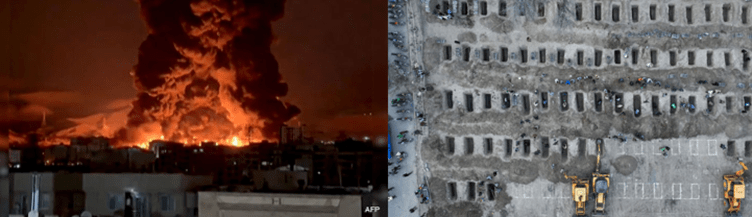
The wanton criminality of this war – Left: Scene from Israel’s attack on Iranian oil storage depots; Right, some of the graves of 165 schoolgirls killed in US bombing of elementary school.
After a week of the unprovoked, brutal, illegal US-Israeli aggression against Iran, killing over 1300 people, including ‘Supreme Leader’ Ayatollah Khamenei and a host of other top leaders, and a couple of hundred schoolgirls at two girls’ schools, the entire west Asian region is in chaos.
Iran has effectively closed the Straits of Hormuz, through which 20 percent of global oil passes; Iran has sent missiles and drones to attack Israel, all the Gulf Arab states – who opposed this war but host US bases on their soil – Jordan, Iraqi Kurdistan, while Iran has denied involvement in strikes on the British base Akrotiri in Cyprus, Azerbaijan, the Saudi Aramco oil refinery, and missiles aimed at Turkey; thousands of Shia in Pakistan, Iraq, Bahrain and elsewhere have demonstrated or rioted against the killing of Khamenei – a Shiite spiritual leader as well as head of state – and Hezbollah also felt compelled, despite its drastically weakened state, to protest with rockets aimed at Israel, leading to Israel’s new horrific bombing of that country, and an order for the entire south of the Litani to evacuate, to be seized for Greater Israel; a six-party Iranian Kurdish alliance has been formed, which the US and Israel are encouraging to open a front in the ethnically Kurdish region of northwest Iran, though to date the Kurdish leadership has refused to become a tool of this imperialist assault – yet Iran has stepped up bombing their forces in Iraqi Kurdistan, and the US and Israel have been bombing Iranian Revolutionary Guard forces inside Iranian Kurdistan.
About the only thing we’re not seeing is any evidence of Iran’s majestic people’s movement against the dictatorship, not only because thousands were slaughtered by the dictatorship earlier this year, but also because people trying to survive bombs are too busy to be running around organising against a violent regime, let alone one bolstered by the ‘rally around the flag’ effect of such horrific foreign aggression, and the enhanced role of state ‘security’ forces in war conditions. Yes, there were certainly many scenes of genuine public celebration by Iranians at the news that Khamenei had been killed, and their understandable jubilation should not be dismissed; however, we should not confuse that with either the ability to organise a successful uprising, or necessarily with any joy about the US-Israeli aggression; what real people do and feel does not always fall into the neat boxes imagined by either our warmongering politicians and media on one side, or an important, but brain-dead, part of the western “anti-imperialist” left. Meanwhile, there were also many scenes of mass mourning of Khamenei as well as celebration; and in any case, thousands of Iranians are daily mourning those being slaughtered right now, like the families of hundreds of schoolgirls.
Israel’s aim: Region-wide conflagration
It is this kind of regional conflagration that Israeli leaders were angling for over the last two years (indeed, for decades) as a cover behind which to complete their destruction of Gaza and the West Bank, and possibly to advance their ‘Greater Israel’ project that some leaders have been unable to resist openly proclaiming in recent days and months. Netanyahu declared last year that he was attached to the idea of Greater Israel; his fascistic Finance Minister Smotrich has regularly stated that Israel’s borders ought to end in Damascus and northern Saudi Arabia. The US ambassador, Mike Huckabee, recently stated that he thought it was no problem for Israel to advance to ‘Biblical’ borders, and when questioned, the very ‘centrist’ – by Israeli standards – Israeli opposition leader Yair Lapid said that he too thought all this was a good idea.
That is why, despite Iran trying its absolute hardest to keep out of the battle as Israel carried out its Gaza genocide, Israel continually provoked it to bring it in; Iran was not provoked no matter how many of its Revolutionary Guard leaders in Syria were killed (indeed, despite much popular imagination, Iran virtually never responded to hundreds of Israeli attacks on its forces from Syria over the years, and never once initiated), but when Israel bombed its diplomatic mission there, it was compelled to respond; as it was some months after Israel killed Hamas leader Ismael Haniyeh while attending a meeting in Tehran. In both cases of Iranian retaliation, however, Iran responded in a measured and highly telegraphed way, that did not bring in the US, and thus the regional catastrophe Israel desired was avoided.
Israel’s aim in unleashing regional chaos would appear to be to destroy Iran as a state, for chaos, insurgency, state fragmentation, refugee flows, and regionally, for Iranian-Arab and Sunni-Shia divides to explode, as is threatened by Iran’s retaliatory attacks around the region and the impact of killing Khamenei.
Israel’s endgame is the “total destruction of this regime, of the pillars of this regime, of everything that holds it together: the IRGC, the Basij [grassroots militia], its strategic capabilities”, according to Danny Citrinowicz, senior researcher at Tel Aviv’s Institute for National Security Studies. Just how it would achieve that is unclear, but he explains that “If we can have a coup, great. If we can have people on the streets, great. If we can have a civil war, great. Israel couldn’t care less about the future . . . [or] the stability of Iran, also noting “that is a point of difference between us and the US. I think [Washington is] more concerned about nation-building and threats to their regional partners.”
The debate on whether the US or Israel leads – in general, and in this case
This last sentence indicates that Israel’s aims are not necessarily the same as those of Trump and an important part of the US ruling class. If Israel wants total destruction of the Iranian state, and couldn’t care less about “stability,” with the aim of facilitating the even more destabilising Greater Israel project, the US needs to consider the broader interests of capitalist rule in the region. Looked at this way, the course of the war so far looks much more like one waged to further Israel’s regional interests rather than what is known about US interests or Trump’s particular proclivities.
This is not an argument that, in general, uncritical US support for Israel, and actions such as this war, are caused mainly by the powerful Israeli lobby rather than US interests; in fact I have argued that on a larger structural level the opposite is the case: that Israel is a pivotal tool for US imperialist interests, and ultimately the US is in control. For the most part, the tail does not wag the dog.
However, this view should not be treated as a straightjacket either; the US ruling class and the Israeli ruling class have in some ways become effectively ‘fused’ over the years, especially in industries such as arms, security, intelligence, IT – and within both ruling classes there are a range of tactical differences regarding what to do in particular situations; within this context, Israeli leaders, think-tanks, lobbies and very Israel-connected parts of the US ruling class can indeed push particular policies, tactical decisions, timing and so on that are more amenable to greater Israeli rather than greater US interests in the region.
Interestingly, Inderjeet Parmar and Bamo Nouri, in an article in The Amargi, the main argument of which is that Israel is the proxy rather than the puppet-master, that “the overall balance of power remains decisively in Washington’s hands [as] the US holds the veto on major escalations, commands the overwhelming share of military resources, and defines the strategic calculus,” nevertheless offer this important nuance:
“Of course, subordinate allies can exert pull on a stronger patron, especially influencing timing, framing, or intensity through intelligence sharing, lobbying, or exploiting mutual threat perceptions. In the US-Israel case, deep coordination allows Israel to shape operational aspects, nudge escalations, or create faits accomplis that complicate US calculations. The pro-Israel network undeniably influences discourse, funds politics, and polices boundaries of debate.”
And the way this particular attack was carried out is in my view a clear example of this.
Again, this is also not an argument for US or Trumpian innocence in launching this attack. The US ruling class has its own historic reasons to want to humiliate Iran going back to the hostage crisis of 1979-80, the Lebanon barracks of 1983 and other early events; while “a long time ago,” and while Iranian capitalism has not for decades represented any fundamental “threat” to US imperial interests, these deeply political motives to avenge past “humiliation” cannot be underestimated – especially when a narcissist like Trump sees the opportunity to be “the only one” who “finally” does this; the US military-security industry benefits from harnessing a medium-sized ‘enemy’ state in the region, and given Iran became one in those early days, it is convenient to keep the same one, for now; Iran presents a useful test-case for the US to demonstrate that it can wage war with no restraints, as his off-leash War Secretary Pete Hegseth put it, be “no stupid rules of engagement … no politically correct wars;” and taking hold of, or at least “taming,” such a strategic territorial link between east and west within China’s ‘Belt and Road Initiative’ may also be a motivation.
At the same time, for over 40 years, US relations with Iran have in reality swung between this known hostility and engagement, from the ‘Iran-Contra’ affair of the mid-1980s, the cooperation of the most Iran-connected part of the Iraqi Shiite hierarchy with the US occupation of that country after 2003, until the Iran nuclear agreement of 2015, which had the support of large sections of US capital, some of which were ready to jump into the Iranian market following this opening, until Trump abruptly shut it off for purely ideological and militaristic reasons in 2018. There is thus more than one “US ruling class” view and there are very good reasons to see that opening as very much in the interests of US capital. As such, I’m not convinced by arguments that the US has to attack Iran because it resists “US hegemony;” there are very few actual “puppets” in today’s world, and the relative sharpness of Iran’s “anti-imperialist” rhetoric is precisely a reaction to this shutting out rather than the reason for it.
It is clear Trump and his advisors made a very conscious decision now to once again launch an enormous war on Iran in the midst of ‘negotiations’ theatre. According to a New York Times report, the decision to begin the attack when they did was prompted by a “remarkable intelligence coup” when the CIA learned Khamenei was to be at his residential compound in Tehran on Saturday with senior Iranian leaders, so the US and Israel decided on decapitation strike. It is inconceivable that someone like Trump would not jump at the chance to be the US leader to take out Khamenei. No-one had to lead him into that.
In fact Trump is so evil and degenerate that, even if it were completely the case that he were ‘led into’ this disaster by a sneaky Netanyahu, I’m sure he would still be prepared to kill 10 or 20 times more people if that were necessary just to get some result that allowed him to save face and dig himself out of the hole he dug himself into.
Trump’s search for an ‘internal’ strategy – not irrational, but blown to bits
All that said, if we look at the way dominant US and Israeli perspectives have tactically differed in the region in recent times, this regional chaos is likely not what Trump was aiming for. We should not take seriously Trump’s meaningless call on the Iranian people to “take over” or still less his earlier talk, in January, of the US being there to help the then uprising. The last thing the US or Israel want is a people’s revolution, which would also destabilise the region, in a different way that neither wants. In fact, heading off, diverting, saddling, controlling whatever weakened people’s movement continues to exist is one of the undeclared aims of the aggression.
But for all the ferociousness of the aggression and all the chaos it is causing, and all the blood-lust emanating from the mouths of the likes of Hegseth, what the dominant wings of the US ruling class, in this case with Trump fully in tune, is by contrast a relatively conservative transition that keeps the reactionary state apparatus intact – centred on some ‘reformed’ wing of the IRGC – the ‘Revolutionary’ Guard. Because, unless Trump violates his main foreign policy promise – not sending US troops into prolonged occupations abroad – there is no other way to stabilise the situation and keep some kind of bourgeois order and the Iranian state together.
Trump, in other words, in launching this war, envisaged a bloodier, more stretched out version of his Venezuela coup: “Venezuela was so incredible because we did the attack and we kept the government totally intact. … We have the whole chain of command. … We paid for the war many times over, and we’re going to be running the oil.” That does not so easily fit Iran, yet some version of it will eventually have to – unless Israel gets its way.
In a March 6 interview, Trump makes clear that democracy is not his aim and that he is open to a “religious leader,” which in context means a different leader from the Islamic Republic hierarchy. Asked whether Iran had to be a democracy, Trump responded with a clear “No,” but the new leader has to be “fair and just” and “treat the United States and Israel well.”
From the start, Trump has been appealing to the IRGC. First he promised immunity to members of “the Islamic Revolutionary Guard, the armed forces and all of the police” if they “lay down” their arms, promising “you will be treated fairly with total immunity,” though otherwise they would face “certain death.” Of course, this was kind of nuts. To whom were they going to surrender their arms, since they have control of Iran; and “certain death” to hundreds of thousands of troops is a large threat. The next day he said “Hopefully, the IRGC and Police will peacefully merge with the Iranian Patriots, and work together as a unit to bring back the Country to the Greatness it deserves.” It is unclear who “the Iranian Patriots” are, but he is clearly calling on the repressive state apparatus to work with whoever he thinks should be in power.
One might assume this is just Trump raving. In fact, this script has been handed him by people who actually understand stuff. According to a New York Times report that detailed the lead-up to the war, a February 18 war-planning meeting where Trump met with Vance, Rubio and several other top officials who actually know stuff, looked at the likely outcome of the decapitation of Iran’s leadership. They thought a popular uprising was unlikely, as the opposition was too weak, and Khameini could be replaced by a more hard-line cleric.
But some officials “seized on a third scenario: that a faction of the Islamic Revolutionary Guard Corps more pragmatic than the hard-line clerics might take power. Even though a cleric was likely to still be nominally in charge, that group of I.R.G.C. leaders would actually lead the country. … the C.I.A. analysis suggested that as long as the United States did not interfere with the economic activities of this faction, such as its influence in the oil industry, a group of officers might be conciliatory toward the United States. They might even give up Iran’s nuclear program or prevent Iran’s proxy forces from attacking the United States.”
On Day 2, Trump claimed that he had “three very good choices” for who could lead Iran, but “I won’t be revealing them now.” Did he mean Reza Pahlavi, son of the former Shah of Iran? Seems not, because he said that while Pahlavi “seems like a nice person,” he would prefer “somebody from within … that’s currently popular, if there’s such a person — but we have people like that.” However, he then went on to say that “Most of the people we had in mind are dead. And now we have another group. They may be dead also, based on reports.” This seems odd – why would you kill the people you had in mind? Unless he means they were targeted by Israel, which is not on board with Trump’s “inside” strategy. Citing a source in the US Central Command, Reuters claimed “the Israeli military was going through its target list faster than planned … Israel was also accelerating its campaign out of concern that Washington might agree with Iran’s surviving leaders to stop before Israel’s objectives were realised.” Israel’s defence minister, Israel Katz, assured that “every leader appointed by the Iranian terror regime . . . will be an unequivocal target for elimination,” something the US has notably not said.
This piece lists six figures who have not been targeted and claims they will be the core of a new leadership that will eventually come to terms with the US, while Ali Larijani, till now Khamenei’s top advisor and now running the country, seen as a “pragmatic conservative,” is described as a “bridge between the old and the new.” Five of the six are from the IRGC, the sixth being the son of one of them. There was already wide suspicion of one of the six, Ismail Qaani, Commander of the IRGC’s Quds Force, responsible for foreign operations, which may be the reason he had to then be symbolically targeted (and survived).
Trump’s list of aims of his operation on February 28 were to “destroy their missiles and raze their missile industry to the ground,” “annihilate their navy,” ensure their “terrorist proxies can no longer destabilise the region” and “ensure that Iran does not obtain a nuclear weapon.” “It is a very simple message,” said Trump. No regime change there. On March 3, Defence Secretary Hegseth reduced this by one and said US objectives were “to destroy Iran’s missile stocks and its capacity to produce them, destroy its navy and security infrastructure, and prevent it from developing nuclear weapons.” He specifically rejected “nation-building” declaring in Trumpian tones that there would be “no nation-building quagmire, no democracy-building exercise” and stressed “this is not a so-called regime-change war.”
This gives Trump an easy “out” if he needs it with a battered Islamist regime still standing – he can say the US destroyed Iran’s ballistic missile capacity and its navy, while whatever extra hits the nuclear industry takes can be added to last year’s bombing which Trump had claimed “completely obliterated” it. As conservative Washington Post columnist Jason Willick puts it, “Under that conception of the war, Trump ought to be able to declare victory at the time of his choosing.”
Trump’s attempt to find an “internal” solution is entirely rational. The main difference with the 2003 regime-change invasion of Iraq is that that was accompanied by the deployment of hundreds of thousands of US troops, whereas Trump wants no boots on the ground (though his dilemma is highlighted by him now not ruling it out). So who will be the boots on the ground? There are 250-300,000 armed Revolutionary Guard (IRGC) and Baseej, and if we include their reserves, this takes the figure up to about a million; they are heavily ideologically trained and run a huge economic empire. There is no old army waiting in the wings to launch a coup (eg like in 1953 in Iran, or more recently the al-Sisi coup in 2013 in Egypt); the old armed forces were destroyed and replaced in 1979.
Let’s say the US and Israel try to place Reza Pahlavi in power. That’s no ‘democracy’, of course, the Shah’s son represents another dictatorship. Except – even then he will not be able to exert his dictatorship in the absence of US troops. Not because “the people” will have power, but because power – which flows out of the barrel of a gun – remains in the hands of the Khomeiniite armed forces. Will the IRGC and Baseej agree to serve Pahlavi? This is clearly out of the question. Will they agree to serve a genuinely democratic government if, to let imaginations fly, one was imposed by the US? Even less likely. Or will they instead launch years of Iraq-style insurgency? And if Pahlavi were placed in power (somehow), many of the oppressed nations inside Iran will likely form their own militia and break away, because as the son of the Shah, he is even more committed to Persian chauvinism than the mullahs are. In fact, in response to the announcement of a 5-party (now 6-party) Iranian Kurdish alliance, he has already threatened to use “the full force of the Iranian army” against them – whose army though? Is he threatening them with the IRGC?
That’s why from Day 2 Trump was already stating – as if nothing had happened! – that he was now ready to ‘negotiate’ with a new team running Iran. “They want to talk, and I have agreed to talk,” said Trump in his fantasy world. Which Larijani, the effective leader following the death of Khamenei – had no choice but to reject – for now. Apparently Trump thought he could just suddenly start bombing Iran in the middle of negotiations, carry out massive killing and destruction, kill Khamenei and decapitate the country’s leadership, and then Iran would just slide back into ‘negotiations’!
Larijani’s rejection, and Iran’s ‘guerilla strategy’ of firing all over the region, has thus completely upended Trump’s calculations. Perhaps at some stage the IRGC and new Iranian leaders will agree to come to some kind of understanding with Trump, which both can call a victory, but the very actions of Israel and the US from the start, the way the attack was unleashed, the nature and timing of the attack, make it politically impossible right now for them to negotiate anything with Trump.
That is why the US, the Trump regime, appears the very picture of incoherence now. Trump’s flailing all over the place, from calling for working with a new leadership of the IRGC, to the war ending in a few days or a few weeks or a few months, to claiming there were a number of people in the Iranian leadership he was ready to talk to but then they had been killed, not ruling out troops which he claimed he would never do, to “agreeing” to negotiate one day, then saying “it’s too late” the next, to calling for regime change one day and dropping it the next, to saying he would be happy if Iran was left with an autocratic, religious leader, to demanding Iran’s “total surrender,” whatever that even means, but then proclaiming “we’ve already won,” playing with arming the Kurds or with “special forces,” his hiding from the media (and the virtual disappearance of his VP JD Vance) – highlights the fact that the US is bereft of strategy, or that any strategy the Trump thought he had is in tatters. Even his demand that he “have a say” in deciding who the next ruler is, despite its absurdity, remains within the “inside” strategy – he was talking about Iran’s choice of a new ‘Supreme Leader’, not about some “nice person” like Pahlavi.
Trump’s aim to find some kind of inside deal to keep the country together is rational from the perspective of US imperialism, which, unlike the fanatical settler regime in Israel, needs to take into account the broader interests of capitalist rule in the region, beyond Israel. Those broader interests prefer some kind of stability for capitalist investment, for oil and gas supplies, for trade and so on. With Trump’s aim to partially leave the region and to focus either on confronting its key rival, China, in the east Asia theatre, or to focus on dominating the American hemisphere, consistent with the Trump-tinged Monroe Doctrine in the National Defence Strategy recently released, other regions need to be left in the hands of regional powers. Trump’s blatantly pro-Putin line on Ukraine is one example; he is happy with Russia having its own ‘Monroe Doctrine’.
But to leave that role only to the Greater Israel fanatics in the Mideast region is a recipe not only for permanent instability, but also for drawing the US even more into the region, rather than partially leaving, because Greater Israel cannot be achieved by little Israel alone. Therefore, the US ruling class – and not only Trump – believe that other powerful states, such as Saudi Arabia and Turkey at minimum, need some stake as guardians of the region, which goes directly against Greater Israel.
Israel – why now? Are its aims region-wide?
In contrast, Israel’s apparent commitment to “regime change” and, apparently to the Pahlavi fantasy, makes sense in that the likely results would be exactly what Israel wants – chaos and destruction, a weak regime either with no armed forces, or the armed forces of an American occupation, facing large-scale insurgency from the hundreds of thousands of IRGC, Baseej etc, Iran fragmenting as a state along ethnic lines, falling to bits, national, ethnic and sectarian conflict throughout the region between Arab and Persian, Sunni and Shia, massive refugee flows in various directions, a region where no-one – not just an already drastically weakened Iran – can challenge Israel’s hegemony, and instead Israel’s role as the region’s saviour for western imperialism amid chaos and destruction enhanced.
Indeed, given that Iran was already drastically weakened, having been battered by the Israel and the US in last year’s 12-day war, with Hezbollah largely crippled in Lebanon, much of its leadership and missiles destroyed, and forced to move north from the Israeli border, with the collapse of the Assad regime as a conduit, what was so necessary about destroying Iran now? Perhaps it could simply be explained that it can finish off Iran precisely because it is now weak. But that only seems to make sense if it could be done relatively easily. I would argue that in trying to destroy Iran as a state and create region-wide chaos, Israel’s aims are region-wide rather than Iran-specific.
With an Iran drastically weakened, Israel loses one of its key propaganda devices – the forever “threat” of a powerful and perhaps nuclear Iran. Eventually a new one would be needed. Meanwhile, for Saudi Arabia and other Gulf states, a weakened Iran is seen as far less of a problem than a greatly emboldened Israel. In their quest for security for business across the region, a radical extremist Israel, destroying Gaza and the West Bank, extinguishing the possibility of a Palestinian mini-state, continually attacking both Lebanon since the ceasefire and Syria since the overthrow of Israel’s preferred leader, and lashing out all over the region, looked more and more the greater destabiliser. Even more so following Israel’s brazen attack on Hamas officials in Qatar last year.
The geopolitical angle – two regional axes in formation and why Israel wanted to blow this situation apart
It is useful to review the recent geopolitical situation in the region to fully understand Israel’s aims in launching this war. Two blocs of regional states have loosely been formed with drastically different aims. On one side is a tight alliance of Israel with the United Arab Emirates (UAE) and Ethiopia, linked to Greece and Cyprus at one end, and Modi’s Hindutva India at the other; on the other, the traditional alliance between Turkey and Qatar has now been joined, crucially, by Saudi Arabia, which has made a formal defence treaty with nuclear-armed Pakistan, and this alliance includes the new Syria as a key link between the Gulf and Turkey. Egypt, with its long-time relations with Israel, has traditionally been closer to the Israel-UAE bloc but is now in conflict with the UAE in the African theatre and is now closer to the Saudi-Turkey bloc.
Israeli leaders have long considered the Turkey-Qatar alliance, which is connected regionally to the Muslim Brotherhood in Egypt, Jordan, Syria and Palestine (Hamas), as its second main enemy after the Iran-led bloc. The weakening of Iran and the enhanced power of Turkey’s Islamist-oriented Erdogan regime following the overthrow of Assad is leading to Israeli leaders continually hinting that Turkey is the next “enemy,” however difficult that may be to action given Turkey’s NATO membership. At a security conference in early 2025, Israeli leaders accused Turkey of “neo-Ottomanism,” asserting that a Syria run by Sunni Islamists allied to Erdogan could pose a greater problem for Israel than the Iran axis, and especially now that Iran is weaker, This view has been continually repeated, for example, by diaspora affairs and combating antisemitism minister Amichai Chikli in mid-January, who stated that Turkey wants to create a “neo-Ottoman empire oriented toward Hamas and the Muslim Brotherhood,” and that “there is a direct link between the weakness of Iran and the dominance of Erdogan;” and then by former prime minister Naftali Bennet in mid-February, who stated that “Turkey is the new Iran,” also complaining that “Turkey is trying to flip Saudi Arabia against us and establish a hostile Sunni axis that includes nuclear-armed Pakistan.”
The decisive state here is Saudi Arabia, given its size, power and wealth. For many years it was closer to the UAE-Egypt bloc, hostile to Turkey, Qatar and the Muslim Brotherhood, and viewed a powerful Iran as its main danger – especially given the significant Shiite population in eastern Saudi Arabia. But it significantly did not sign the Abraham Accords with Israel in 2020, when the UAE, Bahrain and Morocco did; it was not such a simple matter for the informal head of the Sunni world, and guardian of the holy mosques of Mecca and Medina, to normalise with Israel while it remains in occupation of the third holy mosque in Jerusalem. Despite years of media-driven discourse, Saudi leaders have never stopped repeating that they would only normalise with Israel upon the establishment of a sovereign Palestinian state in all territories occupied by Israel in 1967, with Jerusalem as its capital. That is, the Arab Peace Plan, signed in Saudi capital Riadh in 2002. This is its minimum requirement. The Saudi’s new alliance with Turkey-Qatar has been furiously condemned in Zionist circles.
In fact, with the main Saudi-Iranian conflict, in Yemen, leading to quagmire, a ceasefire was signed in 2022 and has held ever since; then in March 2023, rather than normalise with Israel, Saudi Arabia instead normalised with Iran in Beijing, and relations have continued to improve. Israel’s genocide in Gaza made this Saudi stance against normalisation stronger, and then with the huge weakening of Iran due to Israeli blows on the country and on Hezbollah, the Iranian “threat” receded even further, replaced by the threat to regional stability by the revisionist regime in Israel. Hence its new link-up with the Turkey-Qatar bloc and its growing divergence from the UAE.
In fact, the Saudi-UAE split in Yemen is rather old. While both entered the war against the Iran-backed Houthis in 2015, the UAE focused much energy on a large-scale assassination campaign against the Yemeni Muslim Brotherhood, killing some 160 cadres. Though the Saudis were also anti-MB, the Yemeni MB was part of the alliance defending parts of Yemen against the Houthis. The in 2017, the UAE set up the Southern Transitional Council (STC), advocating for secession of the old South Yemen, thus in revolt against the Saudi-backed Yemeni government. This conflict blew out into the open in late 2025, when the STC launched military attacks on the Yemeni government, and the Saudis launched their first bombing in Yemen for years – against the UAE supply of weapons to the STC. There was even a report of a Saudi-Houthi agreement to deploy a Houthi force along the Saudi border to fill the vacuum after the STC’s withdrawal. In September, the STC stated that an independent south Yemen would recognise Israel and join the Abraham Accords.
At around the same time, Israel became the first country to recognise Somaliland, a breakaway region of Somalia, which in turn recognised Israel. While the UAE did not officially follow, it has interests in Somaliland, having made extensive use of its port. Meanwhile, Ethiopia – which also has strong relations with Israel – has also effectively recognised Somaliland by signing a separate agreement with it giving Ethiopia access to its ports. Saudi Arabia, Turkey and Egypt all re-emphasised their recognition of the territorial integrity of Somalia.
Then again, it was recently revealed that the UAE was using a training camp in Ethiopia to train the genocidal RSF rebel army in Sudan, at war with the Sudanese military since 2023. While the UAE (and for a time Russia) is the main country actively backing the RSF, Saudi Arabia, Turkey, Egypt and Iran are backing the Sudanese regime. Israeli voices continually call the Sudanese regime “terrorist” or “Muslim Brotherhood aligned.” Iranian planes carrying weapons fly to Sudan across Saudi airspace. The RSF is also linked to the east Libyan rebel government led by reactionary general Haftar, of both Gaddafi regime and CIA fame, and Haftar has been backed by the UAE, Egypt, Russia, Israel and the former Assad regime, while the Libyan government is backed by Turkey, Qatar and Iran. But the Egypt-UAE alliance here and elsewhere has come undone in Africa, as Egypt has long-term strong links with the Sudanese military, and also because Ethiopia’s ‘Renaissance Dam’ project on the upper Nile threatens water security for both Egypt and Sudan. Hence its reorientation towards Somalia, Turkey and the emerging Saudi position.
Israel has also aimed, ever since the overthrow of Iran-backed, but also Egypt-UAE-backed, Assad regime, to undermine the new Syrian government – which it routinely calls “terrorist,” “jihadist” or “extremist” – and fragment Syria along ethnic lines; an Israeli conference in 2025 advocated breaking it up into ethno-sectarian cantons. By contrast, Saudi Arabia, Qatar and Turkey want a unified Syrian state so that they can invest in a stable environment, and also as a bridge between the Gulf and the Mediterranean that avoids Israel.
A recent example of the latter was Saudi Arabia’s declaration that it wanted a to replace Israel with Syria as the transit country for a fibre-optic cable, the East to Med Data Corridor (EMC) signed between Greece and the Saudis in 2022, designed to connect the kingdom to Greece through the Mediterranean Sea. The Saudis also envision a High Voltage Direct Current (HVDC) cable project with Greece bypassing Israel in favour of Syria. AS Israel and Syria are the two main exits to the Mediterranean, it is not hard to see how the overthrow of Assad and the promise of a unified Syria is a strategic disaster for Israel.
What do all these conflicts have in common? Israel and the UAE are breaking up, or trying to break up, countries throughout the region, including Yemen, Somalia, Sudan, Libya and Syria; the Saudi-Qatar-Turkey bloc is trying to prevent states form fragmenting. For Israel, fragmenting the region is part of the plan for Greater Israel, and keeping every other state, every other potential hegemon, weak; for the UAE, it is part of an ambitious, outsized plan to construct an empire bridging its interests around the Red Sea into Africa, so it dovetails with Israel’s strategy. For Saudi Arabia, most Gulf states and Turkey, keeping states in one piece is about stability for investment and oil flows, and preventing a Greater Israel from riding roughshod over their own regional hegemonic ambitions.
And, while the US under Trump has a powerful dedication to allowing Israel to destroy Palestine root and branch – and his ‘Board of Peace’, far from being an alternative to that is precisely its consecration – on the other hand broader US interests are better served by the Saudi-Turkey position of keeping states together in the region. While Trump’s personal bonding with he lies of Saudi ruler Mohammed bin Salman (MBS) and Turkish leader Erdogan are part of this, they do not fully explain the US position; broader US interests are in fact served by supporting a number of hegemons rather than only an out-of-control Israel.
Maintaining some form of regional stability for the Saudi-Turkey bloc meant campaigning against a US-Israel attack on Iran. Turkey and all Gulf states – and on this issue, including the UAE – strongly lobbied Trump against an attack, and supported Oman’s attempts to negotiate (the Saudis categorically denied a Washington Post disinformation piece claiming Saudi Arabia, despite its public stance, had lobbied Trump to strike Iran!). All Gulf states – again, including the UAE – stressed that their territory was not available to be used by the US for an attack on Iran. They knew there would be nothing worse for regional stability than this aggression that has come to pass. Why even the UAE split from its Israeli ally on this issue is easy to see now that the war has begun! In any case, the UAE has long managed to reconcile maintaining strong relations with both Israel and Iran, and in fact is Iran’s second-largest trading partner, after China, as well as having long been a major conduit for Iranian sanctions-busting. It has always seen its main regional enemy as the Muslim Brotherhood rather than Iran.
Israel blows the region apart – but is Iran’s reaction playing into its hands?
For Israel – especially the Greater Israel fanatics running it – this situation of having a number of alternative hegemons, especially Arab states who reject the Abraham Accords (Saudi Arabia, Qatar) and states connected to regional Sunni Islamist politics (Turkey, Qatar), was intolerable. Launching an enormously destabilising war against Iran, guaranteed to regional create chaos as described above, was a solution to break out of this dilemma. Such chaos inside Iran would not be restricted to Iran but directly impact the states bordering it – including the rival regional hegemons Saudi Arabia and Turkey, alongside Iraq and the Gulf more generally. A region is in chaos complements Israel’s attempts to fragment states throughout the region, so only ‘civilised’ Israel can be the ‘light on the hill’ for western imperialism in the region; and to play that role, a continued US presence in the region would be necessary, as little Israel cannot do it alone; and if the region looks like this, Israel has the “right” to expand for “security” purposes, and then stay forever: the conditions are created to forge Greater Israel.
This is already happening in Lebanon. While Hezbollah’s decision to launch rockets at Israel may be motivated by solidarity – almost incongruous considering that when Hezbollah was under existential attack by Israel around September-October 2024, Iran did nothing – it will have to explain, and be judged by, the Lebanese people if the result is that southern Lebanon becomes the first major conquest for Greater Israel. Israel has already killed up to 700 Lebanese, uprooted 800,000, carried out devastating bombings of south Beirut, and ordered the entire population evacuate from the region south of the Litani River, south Beirut, and parts of the Bekaa Valley!
Of course, the first expansion of Greater Israel in recent times was its seizure of parts of southern Syria outside the already occupied (since 1967) Golan Heights, after the Assad regime was overthrown in December 2024. It has kept up a steady stream of air strikes, land-based attacks on villages and towns, arrests, destruction of farmlands, seizure of water sources and other attacks since then, and states that it will never withdraw.
Meanwhile, since the attack on Iran began, the blockade of Gaza, only ever very partially lifted, has been fully resumed, with all border crossings closed, while the West Bank is being “strangled” as the world’s attention is focused elsewhere. We will need to watch Palestine as Israel most certainly plans to use this regional crisis to further extinguish it.
However, this raises an interesting question: does Iran’s reaction play into Israel’s hands? When attacked, Iran immediately struck US military bases in the small Gulf states the UAE, Bahrain, Qatar and Kuwait, and while this led to protests by those states, in reality they would have expected US miliary facilities to be hit. While they seem to have lived up to their promises to not let their territory be used to attack Iran, military bases inevitably play a role in logistics and intelligence that aid the US war effort. Iran has also attacked air defence radars, and more generally its missile barrages are aimed at wearing down the number of anti-missile interceptors in the region.
But very soon after, Iran expanded its attacks to civilian infrastructure throughout these countries – ports, airports, office towers, hotels, oil and gas infrastructure – as well as expanding the attacks on US facilities and/or civilian infrastructure to Saudi Arabia, Jordan, Oman – the country which had been mediating between the US and Iran – Iraqi Kurdistan and elsewhere. Of course, Iran has also launched attacks on Israel, but Israel is after all the aggressor – the fact that Iran has launched more attacks just on the UAE than on Israel is striking. Since then, Iran has effectively blocked the Straits of Hormuz, blocking oil shipments from the Gulf to the world, that is, some 20 percent of world oil flows.
But if it is in Iran’s immediate interests to create massive regional instability, doesn’t this coincide with Israel’s interests in doing the same?
Consider that all these regimes actively lobbied Trump against attacking Iran and banned the use of their territory for the attack; consider all the above regarding recent geopolitics, the Saudi-Iranian détente, the Saudi-UAE conflict, Qatar’s long-term outreach to Iran, Oman’s key negotiating role, the UAE’s strong economic relations, Saudi resistance to the Abraham Accords, their growing tendency to see an emboldened Israel as the main factor of instability rather than an already weakened Iran, the Saudi defence pact with Pakistan and its strong reconciliation with Turkey – what of all this now?
Surely, pushing the Gulf, especially the Saudis, into conflict with Iran is one of Israel’s key goals, and Iran has unleashed it. Saudi Arabia and the UAE have, for the moment, joined forces. The Saudi-Iranian détente is in trouble. The GCC convened an emergency meeting condemning the “heinous” attacks as a “serious violation of these countries’ sovereignty, good neighbourly principles, and a clear breach of international law and the UN Charter,” stressing they “will take all necessary measures to defend their security and stability.”
Seeing Iran’s ability to unleash such attacks on their countries will also likely drive the Gulf states further under the US military umbrella, and hence reduce their ability to act relatively independently of Washington. Former Qatari Foreign Minister Hamad bin Jassim Al Thani warned the attacks will push Gulf states to lean more on outside powers for security, while Anwar Gargash, adviser to the UAE’s Mohamed bin Zayed (MBZ) said Iran’s actions isolates the country and reinforce the US accusation that its missiles are a danger to the region. And given Washington’s Israel alliance, this may reduce their manoeuvrability vis a vis Israel and Palestine. Former Obama and Biden administration official, Amb. Dan Shapiro, claims the situation highlights the value for the Gulf of “being part of a regional air defense network that includes the United States, but also includes Israel.”
Hussein Mansour, a fellow at the Jewish Institute for National Security of America, said that Iran “catastrophically” miscalculated, its actions destroyed “every diplomatic off-ramp it had spent years cultivating … Last June, during the 12-day war, Qatar called Iran ‘the sisterly Islamic Republic’” and all Gulf states vigorously condemned Israel’s war. “Nine months later, Qatar is shooting down Iranian jets. Saudi Arabia has authorized retaliation and offered to place ‘all its capabilities’ at the region’s disposal. The UAE has shuttered its embassy in Tehran.” Alexander Gray, a former National Security Council chief of staff under Trump agreed that Iran’s actions are an “extraordinary strategic miscalculation,” claiming Iran “has encircled itself far more effectively than any American diplomacy could have accomplished.”
What are Iran’s aims in lashing out at the region?
If Iran’s actions are arguably playing into Israel’s hands, why then has it adopted this strategy? There are a number of aspects to this.
First, if this is an existential battle for the regime as Israel and the US relentlessly blow up Iran, then these considerations above are less important than survival, and as such, Iran has decided that it will blow up the regional economy – based on oil and gas, tourism, data centres and so on – and massively disrupt the world economy. “Unable to match US and Israeli military power symmetrically, Iran has adopted a strategy designed to stretch the conflict in time and space. … Tehran is not only seeking damage, it is seeking friction: forcing its adversaries to defend multiple fronts, testing the resilience of regional politics and gradually raising the economic and psychological cost of staying the course.” Indeed, as oil and gas prices rise dramatically and hit much of the MAGA base, Trump’s electoral chances – already weak and further diminished by this war enjoying the lowest level of popular support in the US of any US war – will be further smashed if he does not stop soon.
Second, the reason Iran is attacking at least some of these civilian targets is because its intelligence agencies believe they house US or Israeli intelligence and defence companies or personnel. The UAE has been targeted a truly disproportionate number of times compared to all other Gulf states; of 680 missiles shot at the Gulf, 261 have been directed just at UAE, and 1,440 of the 2,081 drones shot at the Gulf were fired at UAE; in contrast, only 2 confirmed missiles and 13 drones have been fired at Saudi Arabia, plus about 5 drones at Oman. Moreover, while non-military targets have been hit in all countries, overwhelmingly the targets in Qatar, Bahrain and Kuwait remain the (very important) bases, while the UAE has experienced far more attacks on civilian infrastructure compared to any country, while its extensive network of US military bases have of course also been heavily targeted. While it might be assumed that is because it is the closest state to Israel, that has not translated into a hostile stance towards Iran. However, its Israeli connection meant that “the UAE is host to a lot of Israeli intelligence companies, arms companies … The UAE government has allowed Israelis to basically have an unofficial base in different parts of UAE.” Not unreasonably, Iran considers these to be no less legitimate targets than military bases. The UAE’s greater network of US bases makes it the key regional logistics and intelligence hub for the US overall, so the difference between military and civilian purposes is not always clear.
Iranian Missiles and Drones by Gulf State
| Country | Ballistic Missiles | Cruise Missiles | Drones (UAVs) | Total projectiles |
| UAE | ~253 | 8 | ~1,440 | ~1,701 |
| Kuwait | ~178 | – | ~384 | ~562 |
| Bahrain | ~105 | – | ~176 | ~281 |
| Qatar | ~127 | 7 | ~63 | ~197 |
| Saudi Arabia | ~2 | – | ~13 | ~15 |
| Oman | – | – | ~5 | ~5 |
Partially based on Al-Monitor data and updated.
Third, it is not always clear whether attacks are directed by the Iranian government. Iranian foreign minister Abbas Araghchi seemed to apologise when drones hit Oman, saying that “we have already told our Armed Forces to be careful about the targets that they choose,” while noting that “our military units are now, in fact, independent and somehow isolated, and they are acting based on general instructions given to them in advance.” In other words, with the head cut off when Khamenei was killed, many IRGC units are acting autonomously. His reference to “general instructions in advance” refers to a “target bank” of “potential strikes” drawn up after the 12-day war, but now without any specific guidance. An Iranian official likewise told Drop Site news that prior planning for possible decapitation strikes included “delegating authority further down the command structure.” Ali Ahmadi, a fellow at the Geneva Center for Security Policy, explained “This mosaic of different Iranian military commands around the country operate independently … You have different military sectors in different parts of the country with predetermined strike packages … a very decentralized network of ideological, security, economic organizations, all of whom are loyal to the founding principles of the Islamic Republic.”
On 7 March, President Pezeshkian apologised to the Gulf states, and announced that Iran would end attacks on their territory, unless it is used by the US in its war on Iran. Yet hours later, Iranian drones struck a US air combat centre at the Al Dhafra Air Base in the UAE. At one level, no contradiction here – it is hard to argue that a US air combat centre in the context of this war is not a legitimate target. Moreover, soon after Pezeshkian’s statement, the US bombed a desalination plant in Iran; Iran responded by attacking the US base in Bahrain, claiming the attack on the desalination plant was launched from there. From there, attacks more generally resumed, indicating once again that the IRGC is acting autonomously.
Finally, there is also an opposite logic to that which sees Iran’s strikes playing into Israel’s hands: Iran is gambling that they may have the exact opposite effect, ie, to lead them to question the US ‘security umbrella’. These states host US bases, and have invested billions into the US economy, yet this US protection racket has meant little as their ports, airports and skyscrapers are getting blasted. It is worth remembering that the road to Saudi-Iranian détente did not begin with Iran’s weakening; that came later and entrenched it. Rather, it began in 2019 when Iran bombed the Saudi oil industry and put 50 percent of out of service, and Trump’s fierce anti-Iran rhetoric came to nothing. Iran gambles that this could be the same, on a larger scale: its message is that hosting US bases makes them targets, rather than making them safe. This is combined with Gulf anger over the US putting them into this predicament by listening to Israel rather than to their advice.
Former Saudi intelligence chief Prince Turki al-Faisal put it bluntly: “This is Netanyahu’s war.” “No one in the region chose to go to war with Iran,” said Mohammed Baharoon, director of the Dubai Public Policy Research Center. “We’re directly joined at the hip by geography [to Iran]. Once the war is over and US ships go home, we will have to deal with Iran.” “This isn’t the Gulf’s war and we shouldn’t fall for the Israeli bait the way the US did,” said Bader Al-Saif, an assistant professor at Kuwait University. “Lack of US reliability is not the surprise here.” David Robert at King’s College London, who has worked in Qatar, notes the irony that the six countries who pledged to invest over a trillion dollars in the US last year told Washington not to attack Iran, while Israel, to which the US provides billions each year, advocated war. “It’s not the first time Gulf states feel they’ve come second to Israel,” he said, claiming “The fundamental Gulf strategy has failed. Entrusting, investing in the US relationship … was all designed to prevent this exact conflagration.” Gulf states have also accused the US of “stonewalling” requests to replenish their air defence interceptors, or accuse the US of focusing its resources on defending Israel while ignoring their needs.
Prominent Emirati oligarch close to the regime, Khalaf Ahmad Al Habtoor, wrote an open letter to Trump, asking him “Who gave you the authority to drag our region into a war with Iran? … And did you consider that the first to suffer from this escalation will be the countries of the region! … Was this your decision alone? Or did it come as a result of pressure from Netanyahu and his government? You have placed the countries of the Gulf Cooperation Council and the Arab countries at the heart of a danger they did not choose.”
Gulf states are also discussing withdrawing from future investment commitments in the US as a result of the economic impact of the war on their “hydrocarbon, shipping, tourism, and aviation revenues, as well as a huge increase in defence spending.”
The US is attempting to push the Gulf states into joining the attack on Iran in response to the attacks in their countries. Unhinged right-wing senator Lindsay Graham, who strongly pushed Trump into this war, lashed out at Saudi Arabia for “refus[ing] to use their capable military as a part of an effort to end the barbaric and terrorist Iranian regime who has terrorized the region and killed 7 Americans,” and threatened that if the Gulf states don’t take part, “consequences will follow.”
But, while the Gulf states have issued warnings to Iran that they “reserve the right” to defend themselves, to date they have tended to move in the opposite direction. The Emirati tycoon cited above responded to Graham: “We know full well why we are under attack, and we also know who dragged the entire region into this dangerous escalation without consulting those he calls his allies,” and pledged, “we will not enter this war to serve the interests of others.”
Hamad bin Jassim, the former prime minister of Qatar, declared that “The Gulf states must not be drawn into a direct confrontation with Iran even though Iran violated their sovereignty and initiated the attacks on our countries. There are powers that want a direct conflict between the Gulf and Iran, knowing that the war between the U.S. and Israel and Iran will end, whereas direct conflict between the Gulf and Iran will sap the resources of both sides and allow other powers to control us.” Even the UAE, according to Jamal Al Musharakh, the UAE’s UN ambassador, reiterated that the UAE “will not partake in any attacks against Iran from our territory, we will not be involved in such a conflict.”
More generally, the joint GCC statement cited above stresses that they “have always advocated for dialogue, negotiations, and the resolution of all issues with the Islamic Republic of Iran” and this is “the sole path to overcome the current crisis,” warning that “escalation would undermine regional security and drag the region toward dangerous trajectories with catastrophic consequences for international peace and security.” Several sources have reported that Saudi Arabia has intensified its engagement with Iran to try to de-escalate, and that Qatar and the UAE “are privately lobbying allies to help them persuade President Donald Trump to reach for an off-ramp that would keep US military operations against Iran short.”
This while Israel’s aim is to push the Gulf states into conflict with Iran, and further under the US security umbrella, Iran’s aim to push the Gulf states precisely to question the value of this this US security (alongside its broader aims of disrupting the global economy). Whether this Iranian or the Israeli “logic of chaos” wins out remains to be seen – there are indications that these states will emerge with deeply tense relations with both the US and Iran.
How soon will the war end? Who will be the victors?
With no crystal ball, this concluding remark is probably pointless, and may be proved completely wrong an hour after it is written! But what we can see is that Trump is desperate to extricate himself and the US from this quagmire, he tells us the war will be over “very soon,” as the US objectives in the war are “very complete, pretty much,” on the same day as his maniac War Minister Hegseth claims it has only just begun. But if Iran closes the Straits of Hormuz the US will hot Iran 10 times harder than ever, and so on and so forth.
For the US this has turned into a disaster, and with massively rising oil prices hitting his MAGA base, who are already deeply nervous about being dragged into a longer term foreign war, his own political demise is at issue. However, in order to quit, he has to be able to dress it up as a victory. As has been quipped, while it took the US 20 years to replace the Taliban with the Taliban in Afghanistan, this time it only took 10 days to replace Supreme Leader Khamenei with his son.
Of course, Trump can claim that he has destroyed Iran’s ballistic missiles, launchers and production sites and sunk its navy, thus “defanging” it, but this will only be a partial truth. Iran, for its part, does not want to let Trump get away with this grave crime and claim a political victory; therefore it continues to show that it has plenty more missiles and drones and that short of an unconditional halt in US and Israeli attacks, an unceremonial end to their aggression, Iran will just keep firing them – meaning in effect a victory for Iran, and a significant revival of its standing in the region – even many opposed to Iran will have to recognise that it stood up to this disgraceful, unprovoked act of illegal aggression and mass murder.
The other victory, however, is likely to be Israel: it knows very well there has never been an “Iranian threat” and, unlike Trump, Netanyahu has the almost full support for the Israeli public for this aggression, and, more significantly, it has enabled a new advance for Greater Israel with a likely seizure of a chunk of Lebanon – and significantly, Netanyahu has asserted that his Lebanon massacre will continue after any early end to the war on Iran. That, of course, is a whole new topic.
And the Iranian people’s movement?
Readers who despise Iran’s theocratic dictatorship may be disappointed that there is little mention of the people’s movement to overthrow the brutal regime in this piece. As I noted in the introduction, war and slaughter do not help promote people’s uprisings and revolutions but just the opposite; in fact I cannot think of a single good example in history.
While some may cite the 2011 Libya intervention, there is no parallel: regardless of what one thinks of the US intervention, or what one thinks of the nature of the revolution and its outcome – this is surely not the place to discuss! – in that case the movement against Gaddafi had already armed and was in control of a significant section of the country; the US intervention aided one side in an armed civil conflict. Moreover, this armed conflict already existed with a mass base before US intervention; the intervention did not spur it into being. Clearly, this has no relation to the situation in Iran today.
However, what if, in six months time, the presumed weakening of the regime’s repressive forces by the US-Israel attacks (itself a big presumption), allows the people’s movement to rise again through the cracks and overthrow the regime? If that were to occur, the people would have very right to do so and be rid of the regime which just mowed down some 7000 protestors in January, and has murdered and tortured the people for decades as billionaire mullahs and “revolutionary” guards amass wealth and spout slogans; any demonisation of them by western leftists from the computer screens would come from the same kind of imperial arrogance as that of our leaders, regardless of how powerless it is by comparison.
That would not make the current war any less illegal and horrifically murderous; nor would it make our opposition to it any less just; and indeed, regardless of my class hatred of the regime, I am glad it seems to be giving the aggressors a hard fight. No, it just means there are contradictions in reality that don’t fit into neat boxes imagined by either our warmongering politicians and media on one side, or an important, but brain-dead, part of the western “anti-imperialist” left on the other.
Down with US-Israeli aggression, and down with dictatorship, both murderers of the Iranian people!




 Their Anti-imperialism and Ours