Israel’s massive attack on free Syria: Background and motivations

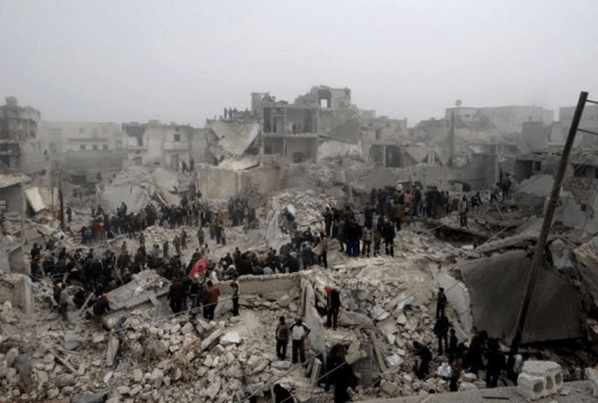
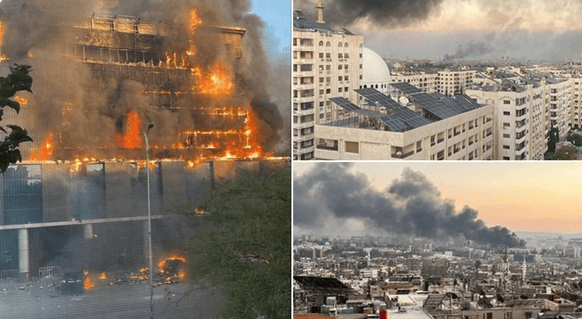
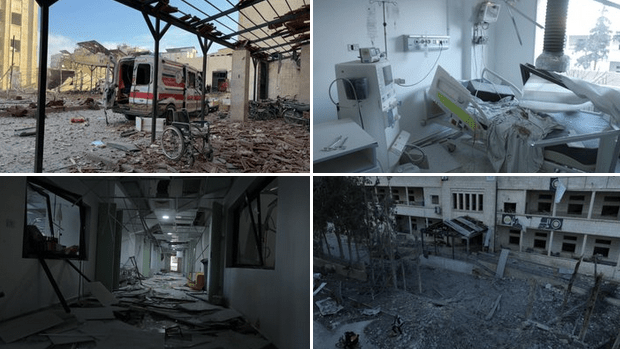
Air bases, weapons and defense systems, and intelligence and military buildings belonging to the former Syrian regime being destroyed.

by Michael Karadjis

It didn’t take long: from the moment the Assad regime collapsed and the rebels entered Damascus, Israel’s massive land and air attack began. As long as all these arms depots, military airports, intelligence centres, scientific research centres, air bases, air defence systems, ammunition manufacturing facilities, “small stockpiles of chemical weapons,” and Syria’s entire naval force were safely in the hands of the Assad regime, Israel never touched them. As Syrian revolutionary commentator Rami puts it, Israel has “known their location the whole time but felt safe knowing that they were in Assad’s hands, who uses them exclusively on Syrians,” and certainly never against Israel. “Now that Free Syrians are in control Israel panics and starts bombing them all,” in order to prevent, as countless Israeli leaders have declared, these weapons falling into the hands of the former rebels, who Israeli leaders have described as a “hostile entity.”

According to Ben Caspit writing for al-Monitor, since the rebels took control of Syria, “Israel says it has attacked some 500 regime targets, dropped 1,800 precision bombs, destroyed about half of Assad’s air force, much of the regime’s tanks and missile launch capabilities, 80% of its air defense systems, all its explosive UAVs and 90% of its radar systems as well as the chemical weapons still held in Syria.” The open source intelligence monitor OSINTdefender claims the IDF has eliminated some 70-80 percent of Syria’s military capacity, the locations including “anti-aircraft batteries, Syrian Air Force airfields, naval bases, and dozens of weapons production sites in Damascus, Homs, Tartus, Latakia, and Palmyra,” resulting in the destruction of “Scud Tactical-Ballistic Missiles, Cruise Missiles, Surface-to-Sea, Sea-to-Sea, Surface-to-Air and Surface-to-Surface Missiles, UAVs, Fighter Jets, Attack Helicopters, Ships, Radars, Tanks, Hangars, and more.”

Israeli warplanes bombed the intelligence and customs buildings in the Syrian capital, Damascus.” The intelligence buildings? Wonder what deals between Israel and the Assad regime they did not want anyone to find there? The Golan sale, perhaps? The dealings between Israel and the Assad regime over Israel’s bombing of Iranian and Hezbollah targets? Indeed, it is feared that Israel may be destroying evidence against Assad that could be used by the new authorities to place charges against him in the International Criminal Court.

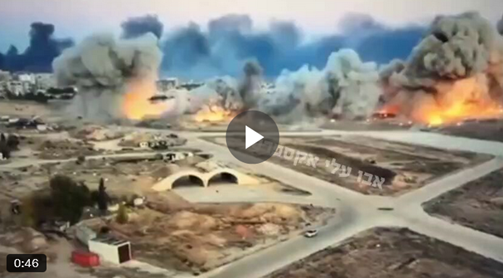
Israeli airstrikes destroying the Mezzeh Air Base in Syria (video)

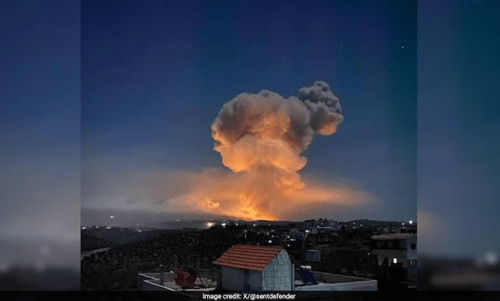
Israel then went right on to completely destroy Syria’s naval fleet, under the nose of Russia’s still present air and naval bases in Tartous and Latakia. The massive strikes Israel launched on Tartous on December 15 were described by the Syrian Observatory for Human Rights the “most violent strikes” in the region since 2012. A gigantic mushroom cloud fireball blew up over the region, “the explosion was so powerful that it was measured as a 3.1 magnitude earthquake on the seismic sensor.”

Mushroom cloud from massive Israeli bombardment of Tartous December 15.

Israel expands into the Golan

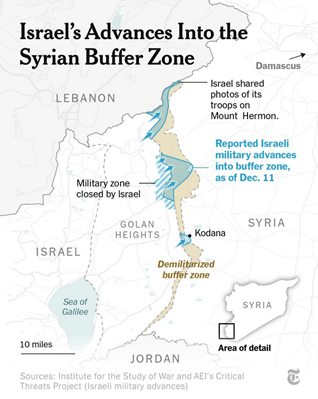
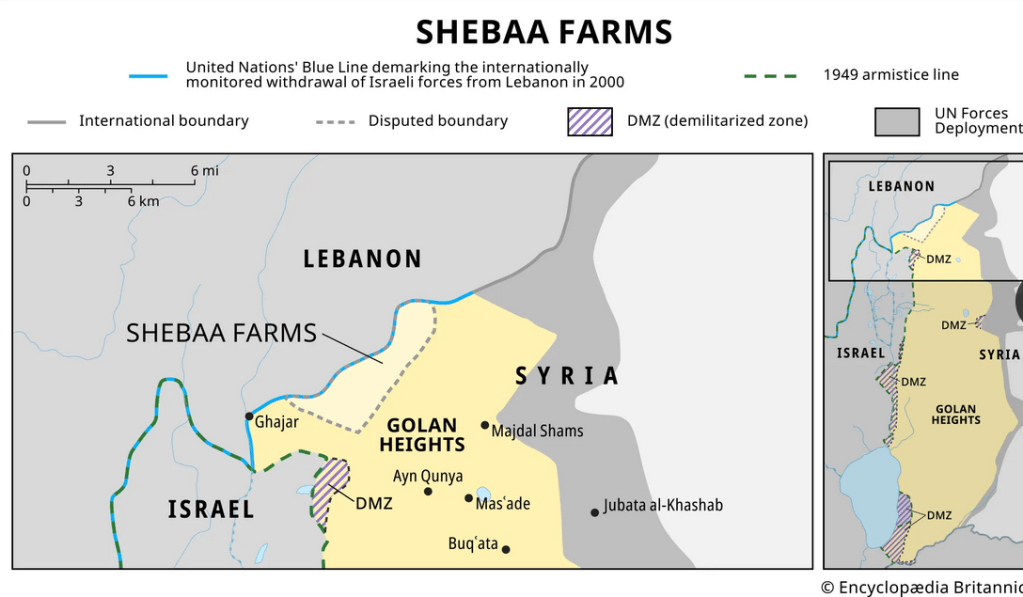
Israel has also invaded further into the Syrian-controlled side of the Golan to create a “buffer zone” (for its already Golan “buffer zone” 57-year occupation) against the Syrian rebel forces. While it is unclear exactly how much territory has been seized, this map from The New York Times shows the territory held by the IDF as of December 13.

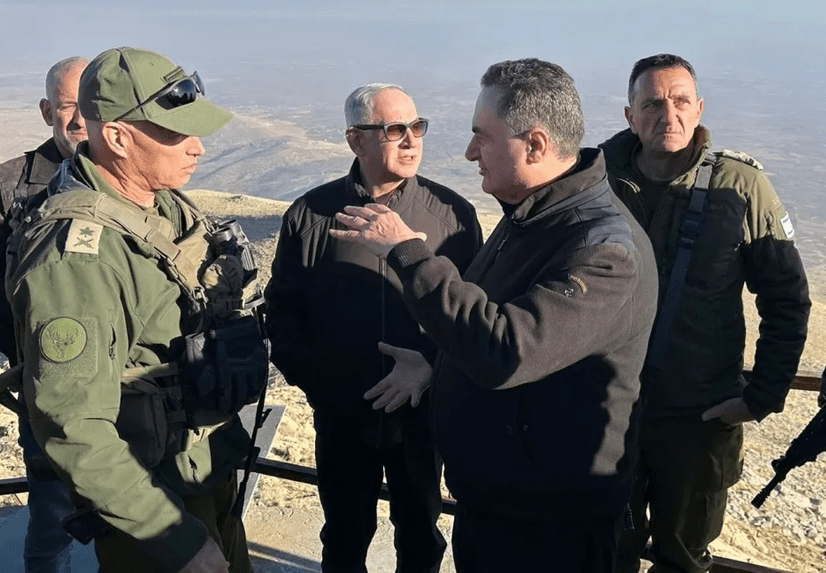
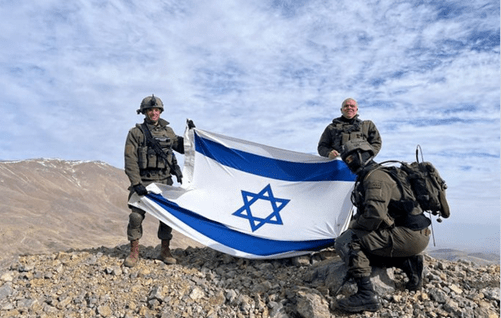
It is clear Israel intends to keep much of the new territory it has conquered. Defense Minister Israel Katz said the IDF would stay on “the Syrian side” of Mount Hermon “during the coming winter months as Israel aims to prevent the border region from falling into the wrong hands.” For Israel, a “temporary” stay has traditionally meant forever, as with the main part of Syria’s Golan Heights which Israel conquered in 1967 and illegally annexed in 1981. According to Ben Caspit writing for al-Monitor, a senior Israeli military source said that Israeli troops “will not retreat until the threat to Israel’s border is removed, which could take “between four days and four years.”

According to Al Jazeera’s Muntasir Abou Nabout, Israeli Defence Forces (IDF) have also destroyed roads, power lines, and water networks in Quneitra province (the Syrian-controlled side of the Golan) when people refused to evacuate. “Israeli tanks are now stationed in towns and villages in Syria’s southwest as the Israeli military expanded its occupation of the Syrian Golan Heights.”

In the villages of the al-Rafid region of Quneitra, Israel cut water and electricity to pressure the people to leave, but they refused, and demanded all weapons be handed over. According to one local interviewed by Aymenn Jawad Al-Tamimi, “no one knows what their aim is, but for sure they have created a new enemy in the future for themselves.” The local also claimed “they [the IDF] removed the people of the village of Rasm al-Rawadhi under threats, and they prevented those who left the village of al-Hamidiya from returning.”

The IDF also invaded Daraa province, troops deploying in Ma’aryah village in Al-Yarmouk Basin, “patrolling and searching some residents.” They also attempted to enter Abdeen village, “but the residents confronted them and prevented them from entering the village.”

Meanwhile, the Israeli government “unanimously approved” a plan to double the 31,000 Israeli settler population in the Golan Heights itself. When Israel seized the territory in 1967, some 130,000 Syrians were expelled, but some 20,000 Syrian Druze still remain amidst the settlers and steadfastly refuse Israeli citizenship. Yet now Israel is attempting to stir up separatism among the Syrian Druze in the Hader region of the Golan, claiming they want to join Israel out of fear of the new Syrian authorities, despite the strong participation of the Druze in their main region of Suweida and their leaderships in the revolution.

IDF troops occupy Mount Hermon

Arab League condemns, US supports Israel; Russia hands over posts to Israel

On December 13, the Arab League strongly condemned this Israeli aggression, and separately Turkey, Qatar, Saudi Arabia Egypt and the UAE have issued strong statements.

Not surprisingly, the US has supported Israel’s aggression, National Security Adviser Sullivan claiming “what Israel is doing is trying to identify potential threats, both conventional and weapons of mass destruction, that could threaten Israel and, frankly, threaten others as well, and neutralize those threats,” as Israel destroys virtually the entire Syrian arsenal with its US-supplied weaponry. The US also supported Israel’s expansion into the Syrian Golan, US State Department spokesperson Matthew Miller explaining the collapse of the Assad regime “created a potential vacuum that could’ve been filled by terror organizations that threaten Israel.” Sure, he stressed that Israel’s stay should be “temporary,” but the world knows that US words mean nothing in relation to Israel’s actions – indeed Israel’s occupation of the rest of the Golan in 1967 was also supposed to be temporary.

Meanwhile, it was reported on December 9, just as the Israeli attack was mounting, that Russia, as it withdrew from the south, handed over to Israel two facilities in Daraa, and an observatory on Mount Tel Al-Hara. As Russian forces have been based in the Golan region since 2018 under a Putin-Trump-Netanyahu-Assad agreement to keep both Syrian rebels and Iran-backed forces away – to protect both the Assad regime and the Israeli occupation concurrently – this story rings likely.

Israeli leaders explain their aggression

As the revolution took Damascus and Assad fled early on December 8, IDF Chief Herzi Halevi announced that “combat operations” in Syria were to begin, stating that Israel was now fighting on a “fourth front” in Syria in addition to Gaza, West Bank and Lebanon. Israel’s massive attack on Syria had begun. On December 9, Israeli Defense Minister Yisrael Katz “announced that he had directed the army to establish a “safe zone” on the Syrian side, free of weapons and “terrorist” infrastructure, as he put it,.

Most memes did not go past Israeli propaganda such as Netanyahu’s claim that these events are a “direct result” of Israel’s military campaign against Iran and Hezbollah and his assertion that “this is a historic day in the history of the Middle East.” Sure, who wouldn’t want to feign happiness and try to take credit for the collapse of such a monstrous regime. More important however was what Netanyahu also said: “We gave the Israeli army the order to take over these positions to ensure that no hostile force embeds itself right next to the border of Israel.” On December 15, Netanyahu followed this up claiming that Israel’s actions in Syria were intended to “thwart the potential threats from Syria and to prevent the takeover of terrorist elements near our border”.

Katz also doubled down, declaring on December 15 that “The immediate risks to the country have not disappeared and the recent developments in Syria are increasing the intensity of the threat, despite the rebel leaders seeking to present a semblance of moderation.” On December 18, Israel’s deputy foreign minister Sharren Haskel described HTS as “wolves in sheep’s clothing” and stated “we are not going to be fooled by nice talk,” claiming “these rebel groups are in fact terrorist groups” and went on to remind about Jolani’s past al-Qaeda links.

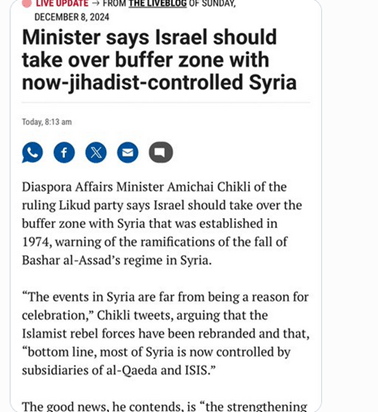
Likudist Diaspora Affairs Minister Amachai Chikli made the case more openly, stating that “the events in Syria are far from being a cause for celebration. Despite the rebranding of Hayat Tahrir al-Sham and its leader Ahmed al-Shara, the bottom line is that most of Syria is now under the control of affiliates of al-Qaeda and Daesh. The good news is the strengthening of the Kurds and the expansion of their control in the north-east of the country (Deir ez-Zor area). Operatively, Israel must renew its control at the height of the Hermon …  we must not allow jihadists to establish themselves near our settlements.”

The Israeli calculus in the days before the fall

All of this was already discussed in the uncertain days between the first offensive that took Aleppo and the collapse of the regime ten days later. As we will see, Israeli leaders were not exactly “delighted,” as a somewhat unfortunate piece by Juan Cole claimed.  

Israel has always supported the Assad regime against the opposition (see next section); this put it on the same side as its Iranian enemy, with the difference that it preferred the regime without Iran – hence Israel’s strong decade-long partnership with Russia starting with its 2015 intervention to save Assad; since then, the Israel-Russia agreement has allowed Israel to bomb Iranian and Hezbollah targets anywhere in Syria at will, and the world-class Russian S-400 air defence system will not touch them. But Israel always left the Assadist war machine intact.

During Israel’s devastating war against Hezbollah in Lebanon, the Assad regime did nothing to come to the aid of its ally at its moment of existential need, indeed it closed Hezbollah recruitment offices, banned Syrian citizens from fighting abroad, prohibited the traditionally Iran-connected Fourth Division from transferring weapons or providing accommodation to Hezbollah or Iranian forces, confiscated Hezbollah ammunition depots in rural Damascus. The regime even took 48 hours to comment on Israel’s murder of Nasrallah. From the beginning of the Gaza genocide, the Assad regime refused to open a front on the Golan like Hezbollah did in southern Lebanon, as has been widely noted in many reports; the Syrian regime, according to the Lebanese al-Modon, instructed its forces in the Golan “not to engage in any hostilities, including firing bullets or shells toward Israel.” Palestinians were arrested for attempting to hold rallies in solidarity with Gaza.

Since Israel had just come through a war with Hezbollah, it could see the opportunity presented by Assad’s treachery to pressure Assad for more, ie, to completely cut the Iranian weapons transfers to Lebanon. During his November visit to Moscow, Netanyahu’s Strategic Affairs Minister Ron Dermer told his Russian hosts that Israel would propose to the US to lift or freeze sanctions on the Assad regime in exchange for any such efforts to prevent the flow of weapons to Hezbollah (indeed this demonstrates how outside of reality are the conspiracy theories that claim, with zero evidence, that Israel was somehow “behind” the HTS offensive that led to fall of Assad, whatever that even means).

As such, taken by surprise, like everyone else, by the rapid successes of the Syrian revolution, Israel tended to adopt a plague on both your houses view, ie, withholding support for Assad in order to pressure his regime for more in its moment of weakness, while warning of the dangers from the other side. Israeli foreign minister Gideon Saar’s view expressed on December 3 that “Israel doesn’t take sides” as “there is no good side there” was probably closest to the mainstream Israeli view. Saar also said that Israel should “explore ways to increase cooperation” with the Kurds, “we need to focus on their interests.”

On November 29, Netanyahu held a security consultation with “defence” chiefs. He was told that Hezbollah’s forces will now likely shift to Syria, “in order to defend the Assad regime,” which they assessed would “bolster the likelihood of the Israel-Lebanon ceasefire holding,” making these developments “appear to be positive” in the short-term, but “the collapse of the Assad regime would likely create chaos in which military threats against Israel would develop.” The first point, that the blows suffered by the Assad regime “forces all members of the axis to focus on another theater that is not Israel,” is likewise considered “a net positive for Israel” by Nadav Pollak, a former Israeli intelligence official at Reichman University in Israel. In other words, both sources suggest that Israel saw Iran and Hezbollah being in Syria, fighting for Assad, as a “positive” because they are thereby not focused on Israel.

Regarding the second point, the “military threats” which may arise, Channel 12, reporting that the meeting also raised concerns that “strategic capabilities” of the Assad regime, including “the remnants of [its] chemical weapons,” could fall into the jihadists’ hands, so the IDF “is said to be preparing for a scenario where Israel would be required to act,” ie to destroy this weaponry before it falls into rebel hands, which of course is exactly what has come to pass.

A number of prominent right-wing Israeli spokespeople or security spooks made the case for supporting Assad more forcefully. For example, on November 29, Dr. Yaron Friedman at the University of Haifa penned an article in Maariv claiming that HTS “controls internal terrorism over the entire province of Idlib” and “like Hamas,” receives the support of Turkey and Qatar. He notes that “the opposition consists mostly of Sunni fanatics from the Salafi Jihadi stream” who “look like Hamas terrorists.” He stressed that while “Assad is far from being Israel’s friend … he is the old and familiar enemy” under whom “Syria has not waged a war against Israel for more than fifty years,” while “Bashar al-Assad has not lifted a finger in favor of Hamas or Hezbollah since the beginning of the war in Gaza.” Therefore, “the Islamic opposition that aims to turn Syria into a center of global jihad is a much more dangerous enemy. The option of Syria under the rule of Assad under the auspices of Russia is still the least bad from Israel’s point of view.”

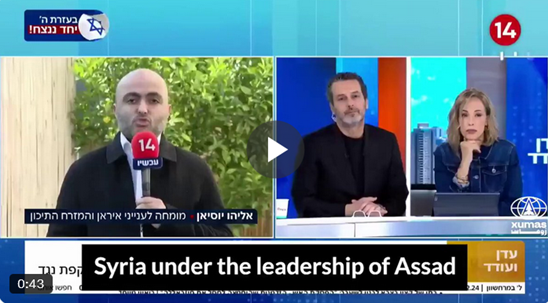
Eliyahu Yosian, former intelligence officer from Israel’s notorious Unit 8200 – suspected of being behind Israel’s massive cyber-terrorist attack on Hezbollah members pagers which blew off people’s faces and hands – explained on December 5, “Personally, I support Assad’s rule, because he is a weak enemy and a weak enemy serves our interests. No-ne can guarantee who will come after Assad’s fall.” He noted that Israel can attack in Syria “every so often in coordination with Russia and without any threat.” Therefore “We must support Assad’s existence.”

Eliyahu Yosian explaining why Israel must support Assad

One possibility discussed was for Israel to invade and establish a “buffer zone” in southern Syria if the regime collapsed or was close to collapsing.

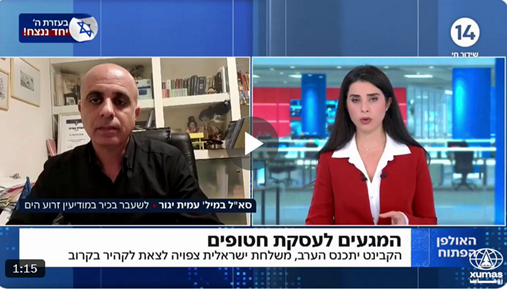
This view was put forcefully by Lt.-Col. Amit Yagur, another former senior intelligence officer (who had earlier called for Israel to “drive Iran out of Syria”). On December 6, he claimed that what the rebels had achieved constituted “a tectonic collapse of the Sykes-Pilot agreement, a major collapse of the foundations of the old order,” and therefore “we need to ensure there is a buffer zone between us and the Sunnis.” This buffer zone “could be fully secured by IDF officers,” which however was “less realistic,” or “guarded by forces of Assad’s regime,” which presumably he thought was more realistic, “so that we don’t end up with a shared border with these guys,” making reference to October 7.

Amit Yagur, Israel must support Assad running a buffer zone “between us and the Sunnis.”

Not all Zionist commentators held these views. Eyal Zisser of Tel Aviv University, explained that there are voices now challenging the “the traditional Israeli approach of preferring Assad — the devil we know,” with a view of delivering a blow to Iran by getting rid of the Assad regime. In fact, one of the problems for Israel was the same problem for Russia and Iran – if the despot you have relied on for decades to service your varied and even opposing interests can no longer maintain that “stability,” but on the contrary, his house collapses like a pack of cards, then continued support would not just be a bad investment, but be utterly pointless.

In this light, what is striking about all these views expressed above – even just days before the regime’s collapse – is how extraordinarily unrealistic they were; they all seemed to imagine that Assad still had a chance! Such blindness at such a late date suggests wilfulness, ie, Israel was so invested in the regime’s survival that it impossible to imagine it not being there, even if only running the buffer zone! Indeed, even Zisser notes of the move among some Zionists towards accepting Assad’s downfall as a defeat for Iran, “for the moment at least, the Israeli leadership is not considering such a possibility.”

Background: Israel and the Syrian revolution 2011-2018

Anyone confused about this should not be. If you have been exposed to either mainstream media or tankie propaganda depicting Israel and the Assad regime to be enemies, this documentation below will demonstrate that throughout the Syrian conflict, Israeli leaders (political, military and intelligence) and think tanks continually expressed their preference for the Assad regime prevailing against its opponents, and were especially appreciative of Assad’s decades of non-resistance on the occupied Golan frontier.

Of course that does make them friends, but the “conflict” between Israel and Syria is quite simple: Israel seized Syria’s Golan in 1967 and has steadfastly refused to ever negotiate it back. That is not an Assad issue; it is a Syrian issue, the opposition has made continual statements on Syria’s right to use all legitimate means to regain the Golan. When asked if he would follow his close Arab allies – Egypt, UAE, Bahrain, Jordan – in establishing relations with Israel, Assad’s response noted only the Golan, avoiding mention of ‘resistance’ or Palestine: “Our position has been very clear since the beginning of the peace talks in the 1990s … We can establish normal relations with Israel only when we regain our land … Therefore, it is possible when Israel is ready, but it is not and it was never ready …  Therefore, theoretically yes, but practically, so far the answer is no.” Assad, in other words, wanted to be Sadat, but Israel didn’t let him.

From 2012:

Israel’s intelligence chief, Major General Aviv Kochavi, “warned that “radical Islam” was gaining ground in Syria, saying the country was undergoing a process of “Iraqisation”, with militant and tribal factions controlling different sectors of the country”, and claiming there was “an ongoing flow of Al-Qaeda and global jihad activists into Syria”. He said that with the Assad regime weakening, “the Golan Heights could become an arena of activity against Israel, similar to the situation in Sinai, as a result of growing jihad movement in Syria.”

From 2013:

“Prime Minister Binyamin Netanyahu said Israel would erect a new security fence along its armistice line with Syria because “We know that on the other side of our border with Syria today, the Syrian army has moved away, and global jihad forces have moved in.” “We must therefore protect this border from infiltrations and terror, as we have successfully been doing along the Sinai border.”

In an interview with BBC TV, Netanyahu called the Syrian rebel groups among “the worst Islamist radicals in the world… So obviously we are concerned that weapons that are ground-breaking, that can change the balance of power in the Middle East, would fall into the hands of these terrorists,” he said.

“Israel’s military chief of staff has warned that some of the rebel forces trying to topple Syrian President Bashar al-Assad may soon turn their attention southward and attack Israeli settlements in the Golan Heights. We see terror organisations that are increasingly gaining footholds in the territory and they are fighting against Assad,” Lieutenant-General Benny Gantz said at a conference in Herzliya, north of Tel Aviv. “Guess what? We’ll be next in line.”

Israel also “worries that whoever comes out on top in the civil war will be a much more dangerous adversary” than Assad has ever been. “The military predicts all that (the 40-year peaceful border) will soon change as it prepares for the worst.” The region near the occupied Golan has become “a huge ungoverned area and inside an ungoverned area many, many players want to be inside and want to play their own role and to work for their own interests,” said Gal Hirsch, a reserve Israeli brigadier general, claiming Syria has now become “a big threat to Israel” over the last two years.

Israel’s Man in Damascus – Why Jerusalem Doesn’t Want the Assad Regime to Fall’ – heading in Foreign Affairs (May 10, 2013), article by Efraim Halevy, who served as chief of the Mossad from 1998 to 2002.

Israeli defence ministry strategist Amos Gilad stressed that while Israel “is prepared to resort to force to prevent advanced Syrian weapons reaching Hezbollah or jihadi rebels”, Israel was not interested in attacking Syria’s chemical weapons at present because “the good news is that this is under full control (of the Syrian government).”

[comment: as we can see, the Israeli view that chemical weapons were no problem in Assad’s hands but must be destroyed if he falls, being enacted now, goes way back]

From early 2015:

Dan Halutz, former Chief of Staff of the IDF, claimed that Assad was the least harmful choice in Syria, so western powers and Israel “should strengthen the Syrian regime’s steadfastness in the face of its opponents.” Allowing Assad to fall would be “the most egregious mistake.”

From 2015 (shortly before the Russian intervention to save Assad which Israel supported):

IDF spokesperson Alon Ben-David stated that “The Israeli military intelligence confirms that the Lebanese Hezbollah and the Iranian Revolutionary Guard’s ability to protect the Syrian regime has dramatically declined, making the Israeli military command more cautious of a sudden fall of the Syrian regime which will let battle-hardened jihadist groups rule near the Israeli border;” as a result, military intelligence services are “working on the **preparation of a list of targets** that are likely to be struck inside Syria, **after a possible fall of the Assad regime**.”

[two points: first, clearly, that “list of targets” has come in handy now that “the fall of the Assad regime” has come about; second, this also suggests that Israel was not against Iran and Hezbollah being in Syria as long as they were only defending Assad, rather than delivering missiles to Lebanon]

From 2015 (after onset of Russian intervention):

At the time when Israel is getting ready for the first coordination meeting with Russia over their joint intervention in Syria, Israeli military sources have confirmed the existence of consensus within Tel Aviv’s decision making circles over the importance of the continuation of the Assad regime. Military affairs commentator Alon Ben-David quoted a source within the Israeli Joint Chiefs of Staff as saying “the best option for Israel would be for the Assad regime to remain and for the internal fighting to continue for as long as possible.” In an article published in Maariv newspaper, the military source pointed out that the continuation of the Assad regime, which enjoys international recognition, relieves Israel of the burden of direct intervention and of deep involvement in the ongoing war. He noted that Israel agrees with both Russia and Iran on this matter.

Israel will provide Russia with intelligence information about opposition sites in Syria to facilitate Moscow’s military operations, Channel 2TV reported, noting that a delegation of Russian army officials will arrive in Israel to coordinate the military cooperation.

From 2017:

The ‘Begin-Sadat Centre’ think tank published an article claiming that as Israel is “surrounded by enemies,” it “needs those enemies to be led by strong, stable rulers who will control their armies and prevent both the firing on, and infiltrations into, Israeli territory,” noting that both Assads had always performed this role. The fact that “Syria is no longer able to function as a sovereign state … is bad for Israel” and therefore a strong Syrian president with firm control over the state is a vital interest for Israel. Given the Islamist alternatives to his rule, Syria’s neighbours, including Israel, may well come to miss him as Syria is rapidly Lebanonised.”

From 2018 (as Assad regime re-took the south all the way to the Golan “border” with Israel from the rebels, with the support of Trump, Putin and Netanyahu):

Israel’s National Security Adviser, Meir Ben Shabat, declared in early June that Israel has no problem with Assad remaining in power as long as the Iranians leave; Knesset member Eyal Ben Reuven stressed that the stability of the Assad regime was “pure Israeli interest.” Another Israeli politician told Al-Hurra TV that “There’s no animosity nor disagreement between us and Bashar al-Assad … he protects Israel’s interests … We now will return to the situation as it was before the revolution.”

Not to be outdone, Netanyahu declared “We haven’t had a problem with the Assad regime, for 40 years not a single bullet was fired on the Golan Heights.”

In case this was not yet clear enough, at a July meeting with his US counterpart, Israeli Chief of Staff Lt. Gen. Gadi Eisenkot stressed that Israel will allow “only” Assad regime forces to occupy the Golan “border”.

After noting that “the Syrian front will be calmer with the return of the Assad rule,” the fascistic Lieberman stressed  that “Israel prefers to see Syria returning to the situation before the civil war, with the central rule under Assad leadership.” Further, he noted that “we are not ruling anything out” regarding the possibility of Israel and the Assad regime establishing “some kind of relationship.”

It is clear from this summary that Israel’s attack today as soon as Assad was overthrown has been planned for years for precisely such a time precisely because Israel wanted his rule to continue.

Syria’s condemnation of Israel to UN Security Council – and demands that Syria “fight Israel”

In a joint letter to the UN Security Council and the UN General Assembly dated December 9, the new Syrian government stated that it “condemns in the strongest terms this Israeli aggression, which represents a serious violation of the 1974 Disengagement Agreement … It also constitutes a violation of the sovereignty of the Syrian Arab Republic, the unity and integrity of its territories, and contradicts the principles and Charter of the United Nations, the provisions of international law, and Security Council Resolutions 242, 338, and 497.” The letter then “renews its call on the United Nations and the Security Council to assume their responsibilities and take firm measures to compel Israel to immediately cease its ongoing attacks on Syrian territory, ensure that they are not repeated, and withdraw immediately.”

Much has been made of the fact that, while condemning the Israeli aggression in the UN, the new government has not been very vocal otherwise. There are also literal mountains of disinformation around in social media, in mindless memes and photoshop cut-up jobs, claiming the new government wants to “make peace” with Israel and so on (some useful rebuttals here). Many Assad-loving keyboard warriors are condemning the new government for not “fighting” the Israeli attack.

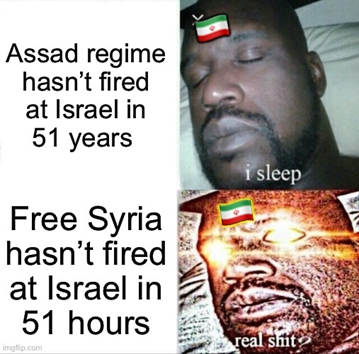
After 50 years of the Assad regime never firing a shot across the Golan demarcation line, these heroes now condemn a government for not “fighting Israel” in 10 days in power.

One might have noticed that the first thing Israel did was to destroy Syria’s entire military arsenal before it could do anything at all, a military arsenal that Assad never once used against the occupation regime. Presumably they expect Syria to fight the neighbouring genocidal military powerhouse, its warplanes and missiles, with sticks and stones.

As Jolani put it, quite logically, “the general exhaustion in Syria after years of war and conflict does not allow us to enter new conflicts.” That is not a call for a “peace” treaty with the occupation, but a statement of fact. The Syrian people have just come through a 14-year war against their own genocidal regime, the regime of Sednaya-Auschwitz, but these western keyboard heroes now believe that the only way the new Syrian government can show its mettle to them (since this is what is important) is by plunging into war with another genocidal regime.

What they might also consider is that while it is Russia that has been bombing the Syrian people for a decade, the new leadership came to an agreement with Russia that it could keep its naval base in Tartous for now, committing itself to not allowing it to be attacked! That’s because they don’t want conflict with that nuclear-armed genocidal power either. This follows HTS’s overtures to Russia earlier in the offensive, when it declared “the Syrian revolution has never been against any state or people, including Russia, calling on Russia “not to tie [its] interests to the Assad regime or the persona of Bashar, but rather with the Syrian people in its history, civilisation and future” as “ we consider [Russia] a potential partner in building a bright future for free Syria.” The government has also made direct contact with Iran, pledging to protect Shiite shrines, but also giving safe passage to exiting Iranian forces, despite their years of crimes in Syria.

If anything, Jolani’s statement that Syria is in no state to enter a new conflict just now due to exhaustion could well be interpreted by Israel as a medium-term threat. The statements by Israeli leaders justifying their aggression suggest that’s how they view it. Right now, the important thing is for Israeli aggression, destruction and occupation to end, and shooting your mouth off with jihadist slogans, where Israeli leaders and many world leaders and media keep reminding everyone of HTS’s distant past “al-Qaeda” links, would be extremely foolish. No doubt Israel would prefer they did, so it could then bomb Damascus and receive congratulations from its uncritical US backer.

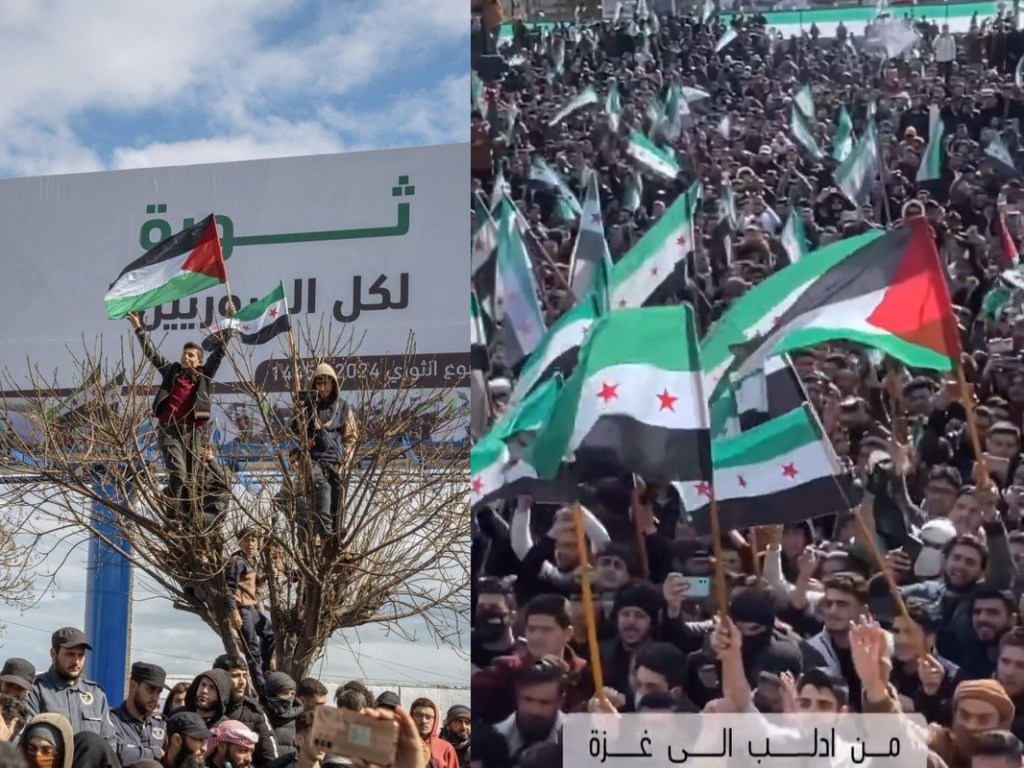
For the entire year since October 7, the Assad regime and Russia had bombed the liberated enclave of Idlib where HTS was ruling, under the cover of Gaza. The entire time, people in Idlib and other opposition-controlled regions were out demonstrating their support for Gaza, while being bombed. The charges against HTS in particular make even less sense, given its strong support for Hamas and for October 7, for better or worse. Jolani has also been filmed boasting that “after Damascus comes Jerusalem,” but of course this kind of rhetoric, so reminiscent of similar Iranian rhetoric, should be taken metaphorically. Yes, any new regime can sell out – there are no guarantees about anything – but if it did, it would face a Syrian population overwhelmingly pro-Palestinian, and there is little point in idle speculation now.

Rather, when Jolani says the focus right now is on stabilising the situation in Syria, this is completely logical. A fractured Syria, getting even more destroyed by foolishness, would have no ability to help Palestinians or to revive its place in the Arab world. More importantly, this is a very critical and dangerous time for the Syrian revolution, when putting a step wrong can have devastating consequences.

With Russia cutting off wheat supplies, Syria is looking for food; the search for literally hundreds of thousands missing is still going on, with the most horrific discoveries turning up in slaughterhouses like Sednaya; people are having to face the grim reality that the majority will not be found alive, as enormous mass graves are being discovered; hundreds of the released have lost their memories and their minds; basic services have had to be restored; the rush is on to preserve as much intelligence information as possible, before being stolen by looters or destroyed by Israeli bombs; the mass return of millions of Syrians has begun. This is what is important; this is what Israel is trying to disrupt with its aggression.

The way in which the Sunni-majority led revolution has made overtures to Christians, Shiites, Alawites, Druze and Kurds has to date been exceptional and has been key to the success of the revolution. The main fault line at present is in the northeast, largely controlled by the Kurdish-led Syrian Democratic Forces (SDF). Two things are happening. On the one hand, some of the Arab-majority regions within the SDF-run autonomous statelet have revolted against the SDF and joined the main body of Syrian governance, particularly in Deir Ezzor and Raqqa. On the other hand, Turkey, via its proxy SNA, is also attacking Kurdish regions aiming to destroy Kurdish self-rule; while Manbij, which they took from the SDF via a US-negotiated agreement, is a majority Arab city, they are now threatening to move on iconic Kurdish Kobani. To date, HTS has had a much better approach to the Kurdish question and to relations with the SDF than Turkey and the SNA have, but the future is uncertain.

This Turkey-Kurdish question cannot be dealt with in this essay, but how the government deals with it is crucial to the revolution. Israel sees division as a means of entry, Israeli propaganda projecting the Druze and Kurds as Israel’s natural allies. As seen in some of the statements above from Israeli leaders such as Amachai Chikli and Gideon Saar, supporting “the Kurds” is promoted as a key Israeli geopolitical interest; meanwhile, Israel is trying to get the Druze in the Golan to join Israel. There are even fantastic ideas of a ‘Druze state’ in southern Suweida, and a Kurdish state in the east, forming a bridge to Iraqi Kurdistan, with an oil pipeline joining them to Israel; “by leveraging ties with the Syrian Druze and fostering collaboration with Israel’s Kurdish allies, the foundation for this corridor can begin to take shape,” claims the Jerusalem Post. Both the main Druze leadership in Suweida – a key part of the revolution – and the Druze spiritual leadership in Hader itself, along with the Kurdish SDF leadership, completely reject such ideas. But this demonstrates how an increased Turkish-SNA attack on the Kurds, or any step wrong by HTS on religious minorities such as the Druze, could be exploited by Syria’s enemies. 

Israel’s interests

This example suggests one important Israeli interest – using the instability and moment of weakness of a revolution to make a land grab – no need to explain why the permanent ‘Greater Israel’ project would want to do that – and extending its hegemony into a chunk of the Arab region via “minorities.” However, this exploitation of minority issues is not only about fostering its influence, but also a means to undermine the revolution. There is no mystery about Israel wanting to do this: genocidal colonial settler-regimes like Israel – like other imperialist states – hate popular revolutions, especially in the Arab world. Not only did Israel have a good working relationship with the Assad regime as demonstrated above, but more generally the mutual existence of apartheid Israel and Arab dictatorships has always been symbiotic.

Many “left” Assad apologists, who are embarrassed that Israel has only attacked after the downfall of Assad, are trying to save face by saying “see, Assad’s fall makes Syria weak and Israel can do what it wants.” Think of that for a moment: it is an argument that people should not overthrow dictators, even genocidal ones, because when you make a revolution you get attacked by imperialist powers or other powerful reactionary states. Perhaps Russians should not have made a revolution because Russia first temporarily lost a great chunk of territory to the invading German army at Brest-Litovsk, and then had to face another 20 or so western armies of invasion. The argument is ludicrous, and counterrevolutionary.

Let’s look at three aspects that make Israel terrified of the Syrian revolution.

  • Concern about ‘jihadists’ and ‘terrorists’

The first, the most superficial, is the one that Israeli leaders promote, and is most useful for mass consumption: as seen in so many of the quotes above, Israel does not want “terrorists” or “jihadists” to get their hands on weapons that were previously safely in the hands of the Assad regime, because they might use them to launch attacks “on Israel” (or more likely, the occupied Golan). This cannot be dismissed out of hand. At an immediate level, Israel would have such a fear, especially in times of “chaos,” when a new government does not have clear control of all armed forces and so on.

But any such attacks would do nothing to help Syria, let alone Palestine, whatever the illusions in certain quarters. On the contrary, it would simply be grist in the mill of Zionist propaganda about being “under attack by terrorists” and allow Israel to destroy the whole of Syria, with full US support. Whatever the past rhetoric of HTS, the fact that it has pledged not to do that is entirely logical, especially in current circumstances, and politically defangs Israel’s arguments.

  • Threat of spread of uprising via regional Sunni Islamist populism

The second aspect is the regional Sunni ‘Islamist’ aspect, not meaning fanatical ‘jihadism’ but more the populist Muslim Brotherhood-type connections between these activists in Sunni majority countries Syria, Jordan, Egypt, Palestine and the Gulf. HTS’s marked ‘softening’ puts it more in this camp than anything related to its distant past al-Qaeda connections. The support given by Hamas – the Palestinian MB – to the Syrian revolution both in 2011-2018 and now flows quite organicially from these connections, as does the support given to Gaza by HTS and other Syrian rebel groups and a year of demonstrations in Idlib and northern Aleppo. The MB has been a major opposition force in Jordan, Egypt and elsewhere, and in Jordan in particular it has played a major role in mobilising against the Jordanian regime’s collaboration with Israel.

Put simply, a popular revolution in one Arab country may be just too good an example for people suffering under other Arab dictators whose relationships with Israel are more out in the open than the one it had with Assad, and these religious-political connections may facilitate this. The fact that the ‘Abrahams Accord’ countries (in its broadest sense, all who had relations with Israel) and the ‘Assad Accord’ countries were the same – Egypt, UAE, Bahrain, Jordan etc, with Saudi Arabia supportive but more reticent on both – can be best understood as both an alliance for counterrevolution generally, and an anti-MB alliance in particular. The overthrow of the Jordanian or Egyptian regimes in particular would be a huge boost to the Palestinian struggle.

In this light, we read that Israel’s Security Agency (Shin Bet) Director Ronen Bar and IDF Military Intelligence Directorate chief Maj. Gen. Shlomi Binder visited Jordan on December 13 to meet Maj. Gen. Ahmad Husni, director of Jordan’s General Intelligence Department, “amid concerns the unrest in Syria could spill over to the Hashemite Kingdom.” According to the Jewish News Syndicate, “Jerusalem is worried that the overthrow of the Assad regime by Syrian rebel factions including terrorist elements led by the Sunni Islamist group Hay’at Tahrir al-Sham could destabilize Jordan … The talks come against the backdrop of fears in Jerusalem that extremist groups in Jordan could try to replicate the swift ouster of Bashar Assad by attempting to remove King Abdullah II from power.”

According to the Jerusalem Post, “Arab diplomats have also expressed alarm over a potential “domino effect” in the region. … An Arab diplomat from the region said this week that authorities in Egypt, Jordan, and neighboring states are monitoring Syria closely. There is growing apprehension that the Syrian rebellion could inspire Islamist movements elsewhere.” Meanwhile, Anwar Gargash, an adviser to the UAE president, has stated that “the nature of the new forces, the affiliation with the [Muslim] Brotherhood, the affiliation with Al-Qaeda, I think these are all indicators that are quite worrying.”

In this light, the Biden administration has just asked Israel to approve U.S. military assistance to the Palestinian Authority’s security forces for a major operation they are conducting to regain control of Jenin in the West Bank. According to Axios, the PA “launched the operation out of fear that Islamist militants — emboldened after armed rebels took control of Syria — could try to overthrow the Palestinian Authority.” One Palestinian official said “It was a Syria effect. Abbas and his team were concerned that what happened in Aleppo and Damascus will inspire Palestinian Islamist groups,” also claiming that Egypt, Jordan and Saudi Arabia support the operation in Jenin to prevent “a Muslim-brotherhood style or an Iranian-funded takeover” of the PA.

At this stage it is unclear to what extent such ‘fears’ will eventuate, but these moves, visits, talks and statements suggest there is concern within the local ruling classes.

  • More dangerous threat of democratic, non-sectarian revolution to Zionist project

The third and most fundamental aspect is, once again, related to the spread of revolution, but not specifically the Sunni ‘Islamist’ connection. On the contrary, the extent to which the Syrian revolution can maintain its current popular, democratic and non-sectarian potential could have a dramatic impact on the region – including Israel. It was counterintuitive that a former Sunni jihadist organisation like HTS would lead with the outreach to Christians, Shiites, Alawites, Druze and Kurds, yet it happened. And while the complete hollowness of the regime was the main secret to the rapid success of the revolution, the other crucial ingredient was precisely this non-sectarian element; the descent into sectarianism, deliberately fostered by the Assad regime, was a crucial cause of the failure last time.

Israel’s bluster about being “the only democracy in the region,” while an obvious nonsense in relation to its subjected Palestinian population, holds some truth regarding the Israeli population. By being able to point at ugly dictatorships in the Arab and neighbouring Muslim world, Israeli leaders promote the idea that their anti-Israel agendas are the work of evil tyrants who want to drive out Jews. The fact that many are also run on a sectarian basis – including those are democratic such as Lebanon – further mirrors and is used to further justify Israel’s own racist, sectarian system.

The Arab Spring was the first region-wide attempt at democratic revolution, which however was largely destroyed. In 2019 there was a second round, in Iraq, Lebanon, Sudan and Algeria. What was very pronounced in the first three in particular was their specifically anti-sectarian content. In both Iraq and Lebanon, the movements against sectarian rule were put down, in Iraq brutally crushed by the ‘axis of resistance’ Shiite militia at a cost of hundreds of lives, while in Lebanon Hezbollah also used violence against the movement, thereby saving the rule of all the sectarian elites; in Sudan the democratic opening was overthrown by the military; a few years later, we also saw the Iranian regime crush its own ‘Women, Life, Freedom’ movement. All of this made the region safer for Israel’s own racist, sectarian project.

By contrast, the victory of democratic, non-sectarian forces in Lebanon, Iraq, Iran, Sudan and elsewhere would have represented a far larger political challenge to Zionism than harsh but hollow words from ugly regimes, which only facilitate Zionist siege ideology.

It may well be a struggle for the Syrian revolution to maintain the course; the mobilised Syrian revolutionary population will need to fight all attempts to restrict democratic space or to stir sectarianism tooth and nail. But if their struggle does succeed, a democratic, non-sectarian Syria could likewise have an electrifying regional impact.

Israel is trying its hardest to make sure it does not succeed. 

The Syrian revolution returns with a bang: Extraordinary collapse of the genocidal regime

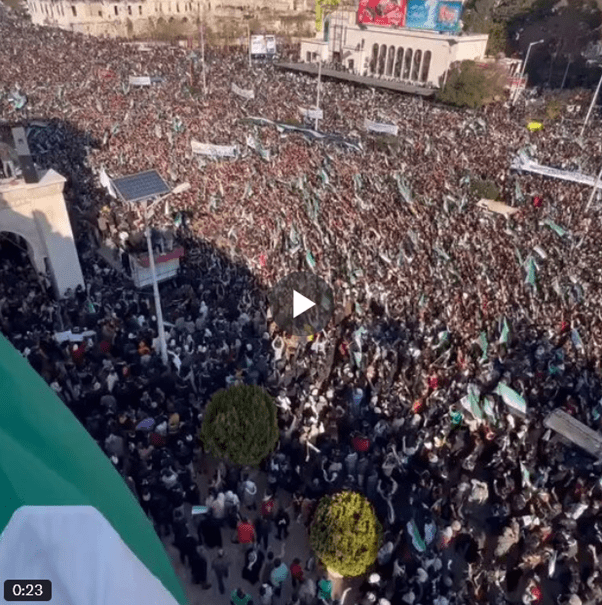
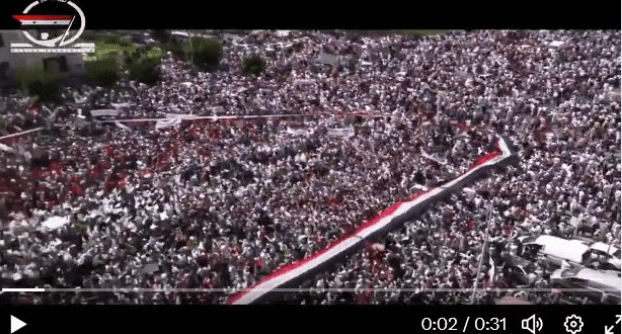
Video: Damascus first Friday after the revolution

by Michael Karadjis

The lightning victories of the Syrian rebel coalition over the Assad regime forces in northwest Syria over a vast area – followed in quick succession by equally rapid victories first in Hama and Homs in central Syria, then the uprisings in southern Daraa and Suweida and the collapse of the regime in Damascus itself – all within ten days – demonstrates the complete hollowness of the regime, based as it is on little more than naked military and police violence. The subsequent revelation to the world of the real level of horror in the Sednaya ‘slaughterhouse’ demonstrates the breathtaking reality of this; one is reminded of Tuol Sleng and Auschwitz. Regime defences simply collapsed everywhere, the rebels facing neither popular nor military resistance.

The Aleppo offensive

Within a day or so of the offensive launched on November 27, the rebels had not only taken vast areas of rural eastern and southern Idlib and western and southern Aleppo, but most of Aleppo city as well; even in the 2012-2016 period, the rebels only ever controlled half the city. By contrast, it had taken large-scale regime, Russian and Iranian offensives, with airpower, missiles and overwhelming military power, several years to conquer the half-city from the rebels. They then advanced south into northern Hama province, where it is now contesting the regime for Hama city.

Syrian social media accounts are full of scenes of joy as political prisoners are released, as people return to their towns and homes they were expelled from. As former mayor of East Aleppo Hagi Hassan writes, stressing the humanitarian aspects of the liberation, “The city’s liberation is allowing tens of thousands of families to return home after years of forced exile. These families, who lived in camps without essential needs, can now find a more stable and dignified life. … Hundreds of thousands of Syrians are still trapped in the regime’s jails, suffering unimaginable atrocities. The release of Aleppo has allowed the release of hundreds of prisoners, including women and children, marking an important step towards justice.” Fadel Abdul Ghany, of the Syrian Network of Human Rights, claimed that among the detainees and forcibly disappeared people who have been released were some who have been detained for 13 years, “and in one case a detainee that had spent 33 years in prison.”

Lebanese man Ali Hassan Ali, who was arrested when he was 16 years old, in 1985, was released from the Hama prison after 39 years!

According to Hassan Hassan and Michael Weiss, “events so far suggest HTS [the leading rebel faction] is behaving pragmatically. Its militants were dispatched right away to safeguard banks from looting. On the first night of its occupation, HTS turned off the electricity for factories, thereby affording civilian residences 16 hours of uninterrupted power, something they haven’t enjoyed since 2012. Similarly, Kareem Shaheen writes of “fascinating messages from Christian family/friends in Aleppo about the restoration of electricity and water, garbage collection (apparently the rebels are paying garbage collectors a 1.5 million SYP wage), bread everywhere, active market.”

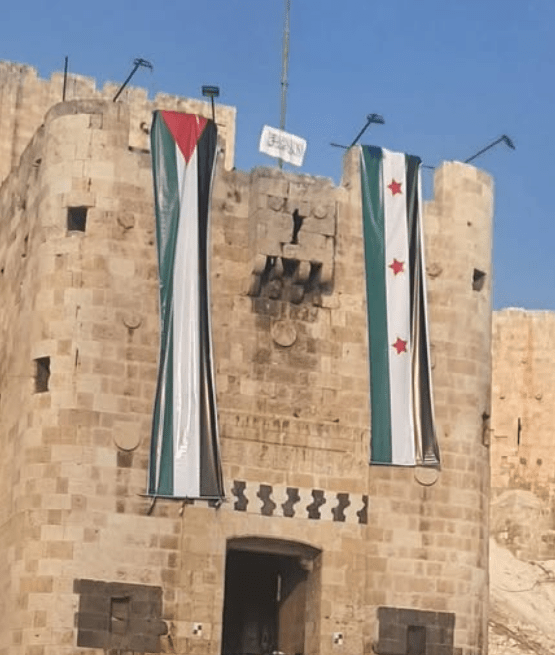
Aleppo citadel after liberation

Hagi Hassan also claims that “for the first time in years, the city knows some security. Infrastructure has been preserved, public institutions are functioning, and no civil rights violations have been reported since liberation,” stressing that “the military forces that have entered Aleppo have not committed any violations against civilians,” but rather, “they ensured their safety.” Another Syrian reporting from Aleppo, Marcelle Shehwaro, claims there have been violations, though “despite extensive networking around this issue, I’ve only been able to document three violations,” one an infamous Christmas tree incident, though she reports more serious violations between another rebel coalition, the Turkish-backed Syrian National Army (SNA), and the Kurdish-led Syrian Democratic Forces (SDF).

More seriously, Shehwaro noted that, apart from fear of regime and Russian airstrikes, the main fear at present is gun-related chaos, caused by the release of criminal prisoners in the rush to open jails to release political prisoners. However, she reports that “a complaints hotline was activated, and it appears the operations management room is taking this seriously so far. But this is far from a utopia.”

Importantly, she stresses regarding the head-scarf, given the radical Islamist ideology of some of the groups involved, “there are incidents happening related to being told, “Put a scarf on your head.” However, the scale is still very limited (compared to what might be expected). Wearing a hijab hasn’t yet become customary (and may God strengthen the women of Aleppo so it doesn’t become the norm). For now, women are still walking in the streets without hijabs—not as isolated acts of courage or rebellion, but simply because that’s how they dress.” However, she also stresses there should be no complacency on this.

She emphasises that both “alarmist narratives” and “reassuring narratives” should be avoided. This is sensible nuance for any such situation. Revolutions are typically depicted as unmitigated bloodbaths, or as heroic, romanticised utopias. No revolution in history has been one or the other. And from all the above, and more below, what I want to stress here is precisely that this is a revolution, a revival of the Syrian revolution which many considered crushed, warts and all, not simply a “military conquest by Islamists” as some have depicted.

Hagi Hassan notes that “Yes, Hayat Tahrir al-Cham [HTS] is present, but the true liberators of the city are its inhabitants, its youth who, exiled children, returned today as adults to liberate their city from the yoke of oppression.” Shehwaro also stresses the role of ordinary people:

The grassroots Syrian effort is remarkable. Aleppo is boiling, inside and out. From bread to communications, burial initiatives, pressing the military to take responsibility for every issue that impacts civilians, supporting organizations, bolstering the Civil Defense’s presence in Aleppo, and tracking the conditions of children—there is extraordinary grassroots effort.”

On December 1, an example of such a popular initiative was the Initiative “People of Aleppo for the sake of the Homeland,” which congratulated the Syrian people for being freed from the regime, but made a list of people’s requests including advising “the brothers in military factions to fully discipline the instructions” of their leaders “not to engage in any violation,” recommending “the brothers in military factions to adhere to military fronts, cord holes, military barracks, and complete ban of any armed appearance among civilians,” while calling for “forming a civil administration from Aleppo’s competencies as a transition stage in preparation for the elections.”

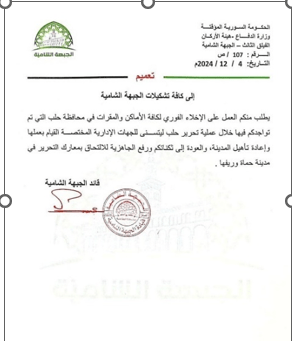
As if on cue, on December 4 HTS commander Abu Mohammed al-Jolani stated that “the city will be administered by a transitional body. All armed fighters, including HTS members, will be directed to leave civilian areas in the coming weeks, and government employees will be invited to resume their work.” Here is the order:

Jolani even suggested that that HTS may dissolve itself “in order to enable the full consolidation of civilian and military structures in new institutions that reflect the breadth of Syrian society.”

The rebel operations room also announced a total amnesty for Syrian regime troops, police and security forces in Aleppo, calling on them to submit their paperwork to receive their official clemency and identification cards.

And the surprise is that, after years of brutal suppression of the revolution, after the regime’s genocidal bloodbath of hundreds of thousands of people and its destruction of its own country with its airforce, after the degree of cooption of the popular uprising – either by the Turkish regime or by the hard-Islamist HTS now leading this operation – that such repression inevitably led to, we might have expected the results of a new offensive to be more retrograde, with more violations, more bloody, more divisive, than in the past. Yet so far, we can say that there were far, far more violations by rebel groups in Aleppo in the past compared to what is ensuing at present.

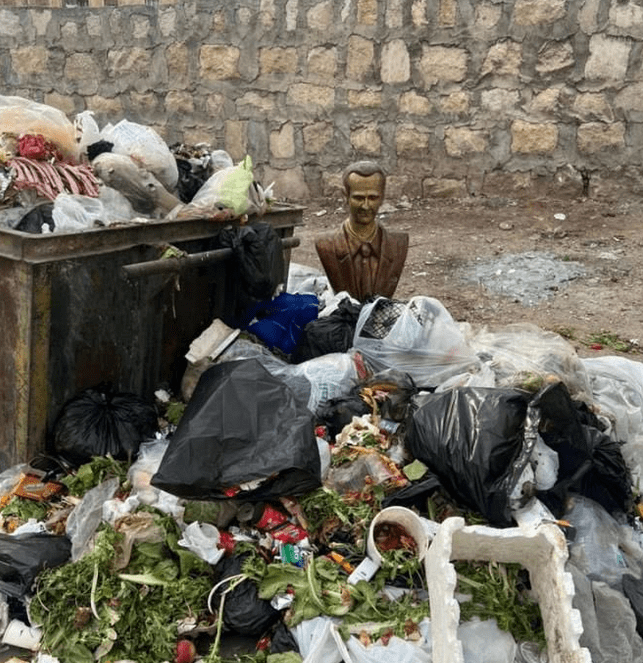
Garbage disposal in Aleppo, two examples.

An aside: The question of return

Before going on to look at the rebel forces involved, and then the wider geopolitical framework, it is worth looking at the question of “return” of thousands, and perhaps soon hundreds of thousands, to their homes, which was touched on above.

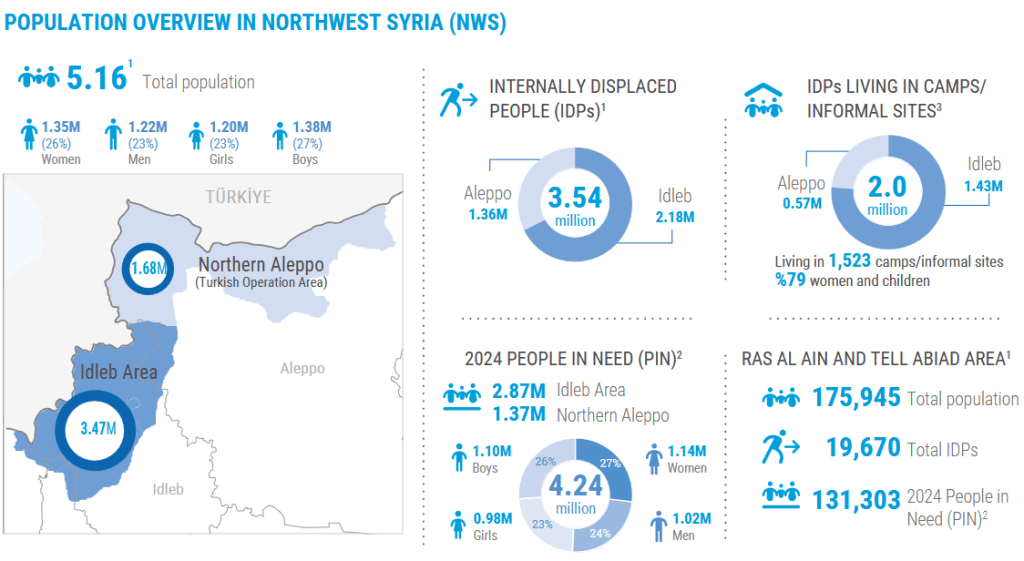
The population in the opposition-controlled northwest consists of 5.1 million people, of whom 3.6 million have been displaced from other parts of Syria, including 2 million living in camps This is in addition to at least 6.5 million Syrian refugees in exile – almost one third of Syria’s pre-war population – of whom 3.7 million are just across the border in Turkey. Without being solved, this massive Syrian refugee population promises to become an ongoing geopolitical issue as surely as its Palestinian refugee counterpart is. 

If we just consider the 7 million plus displaced Syrians in northwest Syria or Turkey (and not even the millions in Lebanon and Jordan), they come from all parts of Syria, including from a string of Sunni-majority towns around Damascus in the south that were ethnically cleansed via starvation sieges in 2015-17, but also from these very regions now being liberated in Idlib and Aleppo provinces, especially after the regime and Russia reconquered about half of these provinces from the opposition in 2018-2020, leading the population to flee. Now, as a result of this current offensive, all the historic revolutionary towns of the region – Saraqib, Maraat Al-Nouman, Khan Sheikun, KafrNabl – which were captured by the regime in this final stage, have been liberated.

Even for those most cynical of the current HTS leadership of the offensive, what we need to recognise is that this has the potential to be a Gigantic March of Return!

United Nations Office for the Coordination of Humanitarian Affairs, Factsheet November 6, 2024

Who was involved

The offensive beginning on November 27 is being carried out by a wide coalition of rebel groups under the Military Operations Command, which arose from the Fath al-Mubeen Operations Room in Idlib. The leading force is the hard-line Islamist Hayat Tahrir al-Sham (HTS), while the other two major components are the National Front for Liberation (NFL) and Jaish al-Izzeh, both of which are independent ‘secular-nationalist’ Free Syrian Army (FSA) brigades, while the Islamist factions Ahrar al-Sham and Jabhat al-Shamiya also joined the offensive.

According to the New Arab, “participation of fighters from the secular nationalist Syrian National Army (SNA) factions, which is closely aligned with Turkey,” has been confirmed, but “while the SNA has supported the operation rhetorically, it has not officially confirmed its participation, which is likely due to the influence of Turkey.” That was written before the SNA did step in on November 30 with its own ‘Dawn of Freedom’ operations room (of which, more below), which at the outset was aimed more at the Kurdish-led SDF forces in northern Aleppo than at the regime.

Very broadly, we may divide the rebel groups in this region into three broad categories: HTS itself, which has become the dominant force in Idlib, and which dominates the Syrian Salvation Government (SSG); the factions of the SNA closest to Turkey, including both secular-nationalist and Islamist factions, which is dominant in parts of northern Aleppo province near the Turkish border, and which dominates the Syrian Interim Government (SIG); and organisations like Jaysh al-Izza which are independent, while the NFL, Ahrar al-Sham and Jabhat al-Shamiya have operated both as allies to the HTS-led command and as loose members or allies of the SNA, while maintaining operational independence.

Overwhelmingly, people join these groups not due to some ideological affiliation, which is more an obsession of western leftists, but to defend their liberated towns and regions from encroachment by the genocidal dictatorship. Who they join depends more on who is dominant in a certain region and thus can better effectively defend that region, who has money to pay wages and for better weaponry and so on. These people are mostly fighting in support of the original aims of the revolution, ie the overthrow of the dictatorship and the institution of a democratic Syria for all. What this means in practice is that, while the politics of the leaderships are not irrelevant, they are also not set in stone; to an extent they reflect the ideals and pressures of their fighting base.

And in a revolutionary situation such as this, many of these divisions break down again, are reconstituted along different lines; leaderships will try to dominate, but their need to keep leadership in a revolutionary struggle also means they will be carried by it. As seen above, popular initiatives play a big role. Even the question of government may end up having little to do with the two ‘governments’ discussed above which have ruled so long in their besieged de-facto statelets.

For example, one resident returning to the northern Aleppo town Tel Rifaat after “a forced absence of around 3205 days” was asked whether the town now will be run by the SSG or the SIG, after being liberated by “many of the Free Army’s factions.” He responded that “the people of the town of Tel Refaat have prior administrative experience, and they elect their council through a general commission composed of all the town’s families. This council administers the town’s affairs, whatever its affiliation.”

On the nature of HTS

Many observers are understandably nervous about both HTS, an authoritarian Islamist group which many years ago was affiliated with al-Qaida, and the SNA, given its control by Turkey and Turkey’s anti-Kurdish policy. There is no question that as a result of being bombed for years, driven into a corner, overwhelmed with displaced from all over Syria, and with virtually no support from anywhere in the world, the civil and military formations of the Syrian revolution have been heavily co-opted for years now, especially since the heavy defeats from 2018 onwards. In fact, all the famous revolution-held towns run by popular councils that continually resisted encroachment by HTS, such as Maraat al-Nuuman, Saraqeb, Karanbel, Atareb and others, were overrun by Assad in the final 2019-2020 offensives, removing important strength from the more independent sectors of the revolution.

People need to survive; and they need protection from the regime. Fighters need wages to feed their families. Western leftists often discuss these issues as if it were a market for different socialist and anarchist ideas on a western campus; it couldn’t be more different. In fact, there is much evidence that many of the fighters in HTS’s ranks today were previously fighters in FSA brigades that its predecessor, Jabhat al-Nusra, crushed at various times – they may not like it, but they still need to fight to regime. Nusra’s forces never constituted any more than 10 percent of the rebels’ armed forces; yet now HTS is overwhelmingly dominant, meaning the bulk of HTS fighters had no past in Nusra or al-Qaida.

HTS’s own rule in Idlib has been mixed to say the least. The leading cadre of HTS are mostly derived from the former Jabhat al-Nusra, which in 2012-2016 was affiliated to al-Qaida, a relationship it severed that year, before moving on to form HTS as a coalition with a number of other Islamist groups. On the whole, its rule is seen as repressive, if effective, but in practice this has gone back and forth. It has adopted a number of pragmatic positions, both in theory and in practice (eg in relation to social restrictions) since leaving the jihadist cloak behind. Part of this is simply due to the needs to running technocratic government effectively. On the whole HTS has tended not to use repression against popular protest, but it has been quite repressive against political opposition, probably more so than any other rebel group.

According to a recent report on Syria by the UN Human Rights Council:

“Starting in February [2024], unprecedentedly large protests, led by civilian activists and supported by military and religious figures, spread across HTS areas. Protestors called for the release of political and security detainees, for governance and socioeconomic reforms and for the removal of HTS leader Abu Mohammad Al-Julani. Demonstrations were triggered by reports of torture and ill-treatment of detainees by the HTS general security service, following months of arrest campaigns by HTS targeting their own members, as well as members of other armed groups and political parties, such as Hizb al-Tahrir.”

It notes that Jolani acknowledged the use of “prohibited and severe means of pressure on the detainees” and “pledged to investigate and to hold those responsible accountable.” It also noted that while demonstrations mostly proceeded without HTS state violence used against them, later HTS did begin using force against them.

Despite repressive rule and co-optation by both governments, the populations have engaged in mass popular demonstrations both against Turkey and against HTS at different times, suggesting that, while militarily defeated, the revolutionary masses still believe they have something to fight for and remain committed to the ideals which they rose up for in 2011. Indeed, while some of the demonstrations against HTS were simply against its attempt to impose its rule over areas it does not control, or against its repressive actions, others were against HTS attempting to open a trade connection with the regime; and similarly, the demonstrations against Turkey were against the growing convergence between Erdogan and Assad as they move to ‘bury the hatchet’. And now, just as repression and siege can lead to such co-optation, new revolutionary advances can again liberate popular energies.

It may well be that one of the secondary reasons for the offensive was indeed for HTS to attempt to break out of this increasing unpopularity. If so, there can be no doubt that the offensive has been massively popular, above all by allowing hundreds of thousands to return to their homes.

HTS overtures to Christians, Druze, Shiites, Alawites and Kurds

With this hardline past, it might therefore come as a surprise that HTS has actually come out with some very positive overtures towards the populations in the regions it is advancing into, and towards minority groups in particular, towards religious minorities – Christians, Druze, Shiites and even Alawites – and the ethnic Kurdish minority, despite previously bad relations with all five.

As the rebels advanced towards Aleppo, Jolani addressed his troops:

“We urge you to show mercy, kindness and gentleness towards the people in the city of Aleppo. Let your top priority be the preservation of their properties and lives, as well as ensuring the security of the city. Do not cut down trees, frighten children, or instil fear in our people of all sects [emphasis added]. Aleppo has always been – and continues to be – a crossroads of civilisations and cultures, with a long history of cultural and religious diversity. It is the heritage and present of all Syrians. Today is a day of compassion; whoever enters their home, closes their door, and refrains from hostility is safe. Whoever declares their defection from the criminal regime, lays down their weapon, and surrenders to the revolutionaries is also safe.”

This sounds nothing like the old Nusra, or like any kind of ‘Sunni jihadist’ organisation. Neither does the following declaration from Bashir Ali, Head of the Directorate of Minority Affairs, Department of Political Affairs, of the Syrian Salvation Government (SSG), made as the rebels advanced:

“As many regions are liberated from the criminal regime, I want to assure all minorities, including Christians, that their lives, property, places of worship and freedoms will be protected. … This is your city too, and you are free to stay and live here in freedom and dignity, knowing that your safety and rights are a priority to us just as all other Syrians.”

The Department issued another statement aimed specifically at two Shiite villages of Nubl and al-Zahara, to the north of Aleppo city:

“Out of faith on our part in the principles of the Syrian revolution that are based on justice and dignity, we affirm the necessity of protecting civilians and guarding their property and lives. In this context, we emphasise that the people of the localities of Nubl and al-Zahara’, like other Syrian civilians, must not be targeted or threatened in any way on the basis of sect or ethnic affiliation. We also call on the people of Nubl and al-Zahara’, and all the Syrian regions, not to stand alongside the criminal regime and aid it in killing the Syrian people and deepening its humanitarian suffering.”

Traditionally, Sunni jihadists like Nusra saw other Muslim sects like Shiites and Alawites as worse than Christians and Jews, as they were considered apostates in Islam; this statement was therefore very significant. Given the extreme divisions from the past (caused by both sides) however, it appears that many of the Shia in these two towns decided to leave,  but those that have stayed are reporting that there has been no looting or revenge attacks by the rebels.

Perhaps even more stunning for a formation arising from a Sunni jihadist background, on December 5 HTS issued a statement proclaiming the Alawites to be an indispensable part of Syrian society, calling on them to abandon the Assad regime which it claims “hijacked” the Alawites to conduct a sectarian battle against the opposition:

An as the rebel offensive was approaching victory, Alawite leaders responded in kind:

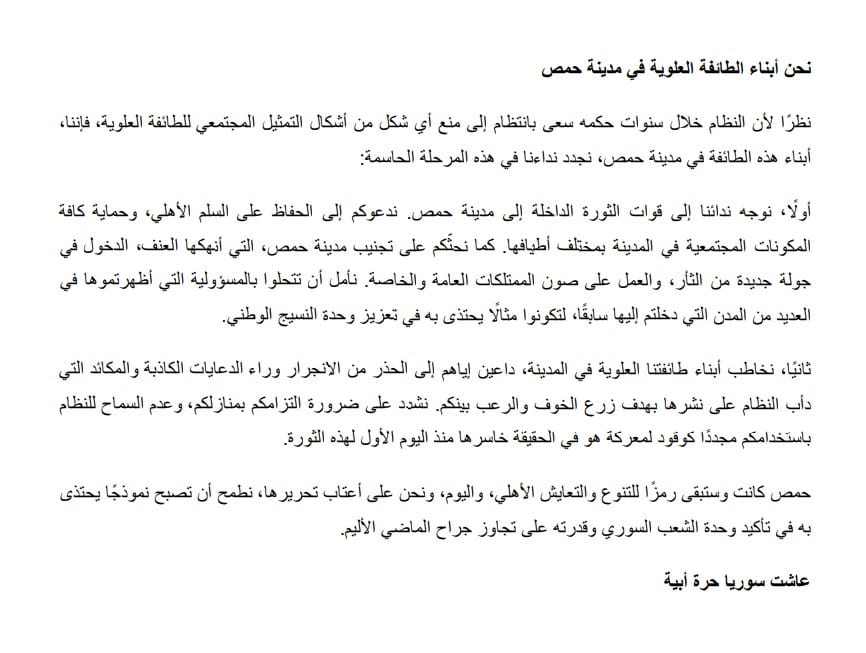
“Given that the regime, during its years of rule, has regularly sought to prevent any form of societal representation of the Alawite sect, we, the sons of this sect in the city of Homs, renew our call at this critical stage:

“First, we address our call to the revolutionary forces entering the city of Homs. We call on you to maintain civil peace and protect all societal components in the city with all their different spectra. We also urge you to spare the city of Homs, which has been exhausted by violence, from entering a new round of revenge, and to work to preserve public and private property. We hope that you will show the responsibility that you have shown in many cities that you have previously entered, to be an example to be followed in strengthening the unity of the national fabric.

“Secondly, we address our Alawite sect in the city, calling on them to beware of being drawn into the false propaganda and plots that the regime has been spreading with the aim of sowing fear and terror among you. We stress the need for you to stay in your homes, and not to allow the regime to use you again as fuel for a battle that it has in fact been losing since the first day of this revolution.

“Homs was and will remain a symbol of diversity and civil coexistence, and today, as we are on the verge of its liberation, we aspire for it to become a model to be emulated in affirming the unity of the Syrian people and their ability to overcome the wounds of the painful past.

“Long live a free and proud Syria.’ December 6, 2024 – Homs Media Center”

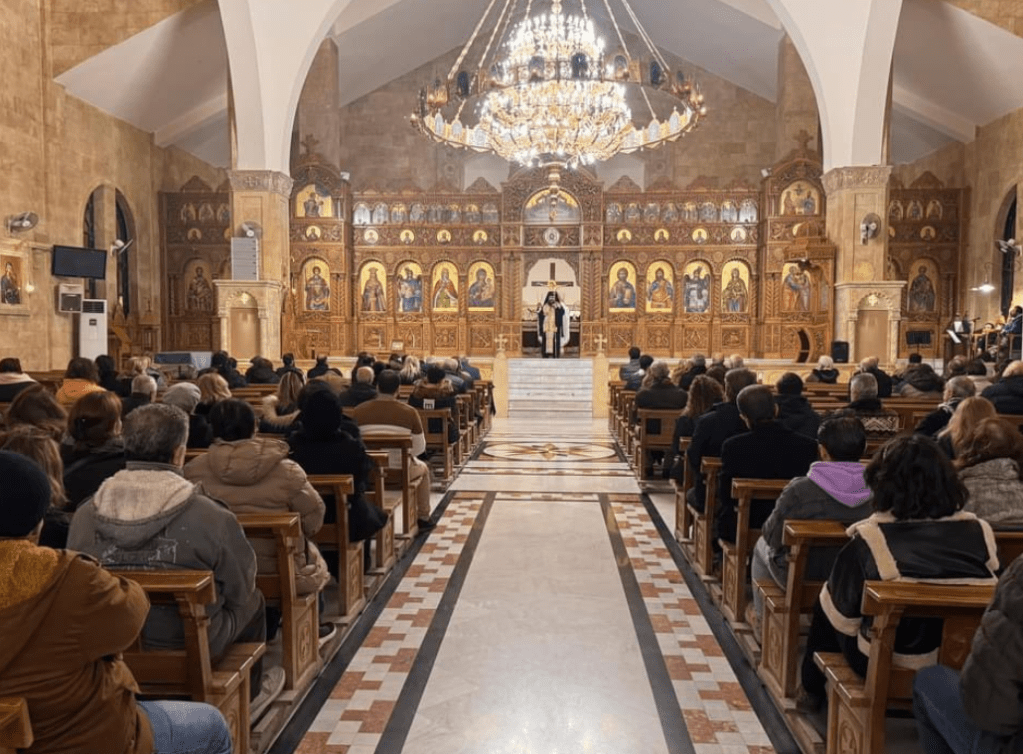
So far, reports from the ground suggest there have been very few violations, though of course some are inevitable in any war. Aleppo’s churches have continued their services and celebrations as normal this past week. Here is the first Sunday mass in Aleppo under Syrian rebels/HTS rule, for example:

However, as Syrian Christian Fadi Hallisso returning to Aleppo notes regarding the fears of many Christians, the assurances that the Islamic dress code will not be imposed on them and that there is no threat to their churches are “not helping at all,” because he claims, these are not the main concerns of Christians, but rather the fear of becoming second-class citizens in a new “Ottoman millet” system. Interestingly, Hallisso states that “the only way to reassure Christians in these circumstances is for Aleppo to be run by a civilian administration of the city’s notables after all armed groups retreat from the city” – ie, precisely what has just been announced by the rebel leadership.

The Arab-Kurdish issue in the current conflict

Marcelle Shehwaro claims that “the Arab-Kurdish situation is catastrophic” and that “the polarization is costing lives, displacement, and a lack of any civil structure with even a minimal level of mutual trust.” She blames both “sniper fire from the SDF that claims civilian lives daily,” and “displacement, abuse, and violations [of Kurds] by the National Army [SNA].” It is very important here to distinguish the SNA from HTS.

As the HTS-led coalition approached Aleppo, Turkiye initially ordered the SNA not to take part. This is likely because if Turkiye gave any green light to the offensive (see below), the aim was for a limited operation in the Idlib/Aleppo countryside to pressure Assad; by all accounts, Turkiye was as blindsided as everyone by the speed of the fall of the city. But when the city did fall to the rebels, the SDF moved into some eastern and northern parts of Aleppo that the regime had fled from, which then linked up Aleppo to the SDF-controlled Rojava statelet in northeast Syria, obviously not Turkiye’s plan.

Therefore, Turkiye the next day sent in the SNA with its own ‘Dawn of Freedom’ operation, which began seizing territory from the SDF – it is important to underline that this was an SNA, not an HTS, action, and should not be confused with the main rebel operation. This demonstrated Turkiye’s anti-Kurdish priorities (though the SNA has also since taken former Assadist territory).

However, even with the SNA’s anti-Kurdish policy, it is not as simple as “Turkey-SNA attacking the Kurds,” as much media, and the SDF, suggest, although there clearly have been violations. The problem is that the main areas of northern Aleppo province that the SNA first seized from the SDF – around the Tel Rifaat region – were not Kurdish regions at all, but Arab-majority regions which the SDF had dishonourably conquered from the rebels in early 2016 with Russian airforce backing, uprooting 100,000 people who have been living in tents in Azaz to the north ever since! For the tens of thousands of expelled residents, this is now a homecoming. However again, even this reality is altered by the fact that two years later, in 2018, Turkiye conquered Kurdish Afrin, northwest of Aleppo, so much of the Kurdish population there fled to these now empty homes in Tel Rifaat, and it is now these people having to flee again.

It is striking that HTS – a former jihadist group which, when its core was Nusra, tended to engage in conflict with the SDF more than any other rebel group – is now engaged in “back-channel dialogue and negotiations with the SDF” which are “far more constructive and effective than with the SNA itself.”

According to a Syria Weekly special edition, “reports continue to emerge that HTS personnel are intervening against SNA abuses — detaining SNA fighters and taking over local security, at the request of community notables.” Then on December 3, the SNA condemned HTS for their “aggressive behaviour” against SNA members, while HTS has accused SNA fighters of looting.

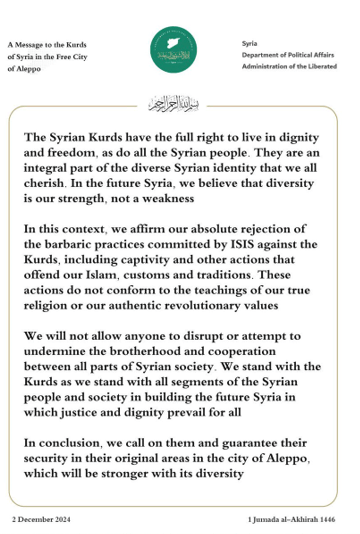
On December 1, HTS issued a statement telling the SDF that HTS’ fight was against the Syrian regime, not the SDF, promising to ensure the safety of Aleppo’s Kurds, and describing the Kurds as “an integral part of the diverse Syrian identity” who “have full rights to live in dignity and freedom,” calling on them to remain in Aleppo; notably also is HTS’s condemnation of “the barbaric practices committed by ISIS against the Kurds:”

HTS then called on the SDF to withdraw from Aleppo, promising to take care of civilians in the Kurdish-held neighborhoods, and offering safe passage to the SDF fighters, possibly to avert an SNA-SDF clash; and the SDF quietly withdrew from the parts of Aleppo it had taken, while remaining in the actual Kurdish-populated regions it had long controlled in Aleppo city, Sheikh Maqsoud and Ashrafiyeh, where they have the support of the population. Any attempt to drive them from here would be a massive violation. At the time of writing, the SDF still controls these two neighbourhoods, and much of the population has also remained.

Background: the evolution of HTS on minority issues

I don’t include all these quotes in order to suggest HTS will necessarily live up to all this, the future simply cannot be known; and the concerns that many Syrians have, including many who are ecstatic about the fall of the regime, are absolutely justified [indeed, some point precisely to what happened after the Iranian revolution of 1979]. Rather, the fact that HTS found it necessary to issue these statements is evidence at least of understanding what a revolutionary situation requires of it. The fact that so far it has been living up to this in practice is a very encouraging sign. Rather than declare in advance either that HTS will throw off all this “re-badging” once it has power and return to its dark past, or that it will surely lead a democratic utopia, it is better to cautiously watch and hope that the spread of the revolution continues to dilute HTS power and older HTS ideology; the broader it is, the more difficult it would be for a militia to put popular power back into a box.

However, the discourse stating that HTS is only saying all these things now to “re-badge” for western consumption to be taken off western “terrorism” lists and so on has the problem that very significant changes in relation to minorities have been taking place for a number of years now in Idlib. The oppression of the Druze minority under Nusra rule for example was particularly appalling; they were basically subjected a program of forced Sunnification, one of the ugliest features of Nusra rule.

However, as well-informed Syria-watcher Gregory Waters explains:

“ … the SSG has spent more than six years engaging with both the Christian and Druze communities in Idlib. An independent, region-wide administrative body was created to serve as a focal point for all communities, including those of minorities. Gradually, this body worked to address complaints and return the homes and farmland that had been seized by a variety of opposition groups in past years. This author has met with some of these community leaders, who told him that, while slow, significant progress has been made for their community in relation to security, property rights, economy, and religious discourse.”

This stepped up in 2022, when Jolani visited the Druze centre, Jabal al-Summaq, after which  HTS began returning homes and land earlier seized; and visited Christian residents of Quniya, Yaqoubiya, and Jadida, which was followed by the reopening of the St. Anne Church in Yaqoubiya village, for the first time since the rebels entered Idlib in 2015, attended by dozens of people, and then another large mass at the Armenian Apostolic Church, a decade after it was closed.

Just as surprising has been HTS’s outreach to the Kurdish community. After taking over the Kurdish region of Afrin in 2022 from the SNA, HTS declared that it “confirms that the Arab and Kurdish people… or the displaced are the subject of our attention and appreciation, and we warn them against listening to the factional interests… We specifically mention the Kurdish brothers; they are the people of those areas and it is our duty to protect them and provide services to them.”

While this may sound like rhetoric, in March 2023, HTS confronted the SNA after five Kurdish civilians were killed by members of a Turkish-backed faction during a Nowruz celebration in the town of Jenderes. Jolani met with the residents and HTS forces deployed in the town and seized control of headquarters of the military police and the SNA’s Eastern Army, which was accused of the killings.  

This outreach has even proceeded to discussions with the Kurdish-led Syrian Democratic Forces (SDF), HTS hosting several delegations from Hassakeh in 2023. An agreement for the SDF to supply oil to HTS-controlled refineries was reached (the SDF already has a large-scale agreement of this kind with the regime). Intriguingly, HTS also proposed participating in the SDF’s anti-ISIS fight, and for the establishment of a joint civilian administration between HTS and the SDF if HTS could gain control of areas currently held by the SNA!

Apart from the needs of technocratic government getting the better of ideology, the evolution of HTS’s Kurdish policy was also partly driven by its rivalry and clash of perspectives with the Turkish-backed SNA. As Turkey’s priorities turned more to confronting the SDF in Syria, it held back the rebels it controlled from confronting the Assad regime, and continually made overtures to the regime for a joint war against the SDF as a basis for restoring relations. HTS however, whatever its past clashes with the SDF, and also the more independent FSA militia groups, continued to see the conflict with the regime as having priority, and were furious with Turkiye’s attempts to reconcile with the regime. This created a cautious, low-level convergence between HTS and SDF priorities.

Why now? ‘Deterring’ regime’s year-long ‘aggression’ waited for Lebanon ceasefire

This offensive did not come out of the blue; by all accounts, the rebels have been planning this for up to a year. However, there was little expectation their offensive would be so successful; the name of the offensive – Operation Deter the Aggression – instead informs us of the original aim: to push back against over a year of renewed aggression, mostly by regime and Russian bombing, against the opposition-controlled regions of Idlib and Aleppo provinces in the northwest.

However, surprised by the rapidity of regime collapse, the aims then widened, to liberating as much territory from the regime as possible.

From the onset of Israel’s genocidal war in Gaza, the Assad regime, while maintaining complete quiet on its southern frontier with the Israeli-occupied Golan, used the cover of Gaza to step up the slaughter of opposition-controlled Idlib right from the start, a stunning example of this part of the ‘Axis of Resistance’ lacking a compass. According to the Syria Response Coordinators, “266 educational facilities in northwestern Syria have been put out of service over the past three years,” with attacks on schools sharply increasing over the last year, with 43 attacks between September 2023 and November 2024.

All this time, people in opposition-controlled Idlib and Aleppo have continually demonstrated in support of Gaza, with ongoing protests, seminars, donation drives etc Gaza (while the Assad regime bans pro-Palestine demonstrations). Assadist “resistance” to the Zionist onslaught was apparently carried out against this extremely pro-Palestine population of the northwest, demonstrating one of numerous examples of the use of phoney “resistance” language by repressive and reactionary regimes who in reality have no interest whatsoever in “resisting” Israel’s genocidal campaign.

People in Idlib have continually demonstrated in solidarity with Gaza, despite being under regime and Russian bombing themselves.

This Assad-Putin war against the northwest actually escalated at precisely the time Israel turned northwards and began smashing up Hezbollah and Lebanon. In early October, Russian airstrikes on Idlib killed ten people. Then on October 11, “regime forces targeted the town of Afes, east of Idlib, with heavy artillery, following a similar barrage on Darat Izzah in the western Aleppo countryside,” with 122 attacks recorded only between October 14 and October 17, including with the use of vacuum missiles, which is the most intense military escalation in over three months.

These attacks continued on a daily basis, systematically targeting villages, civilian infrastructure and agricultural zones, impacting some 55,000 families. This has led to new waves of displacement as people fled their homes to escape the bombardment; in late October, the Syrian Response Coordinators “recorded the forced displacement of over 1,843 people from 37 towns and villages in just 48 hours.” According to Ibrahim Al-Sayed speaking to the New Arab, about three-quarters of the residents of Sarmin have fled the town, which is “the largest displacement the city has experienced since the ceasefire agreement was signed in March 2020,” due to “daily artillery and missile shelling.”

It has been widely pointed out that Assad’s Iranian and Hezbollah backers have been weakened due to defeat in Lebanon by Israel. In reality, this makes little sense, and hardly explains the complete rout that the Assadist armed forces have undergone, the fact that virtually no Syrian soldier in the whole country considered it worth laying down his life to save the genocidal dictatorship. No amount of extra Iranian or Hezbollah reinforcement would have made any difference.

In reality, the connection is somewhat different: it is precisely the fact that Hezbollah had to stop being a counterrevolutionary force in Syria but rather return to its resistance origins in its own country Lebanon – ie, return to standing on the side of the region’s peoples resisting oppression – that allowed for similar developments in Syria, ie, the Syrian peoples’ offensive against the Assad regime. Hezbollah is, after all, a Lebanese organisation, and its raison d’etre is supposedly defence of southern Lebanon. It was not Hezbollah’s defeat in Lebanon, but rather its resistance in Lebanon, that meant it couldn’t protect Assad’s tyranny. If anything, its defeat ad the signing of a ceasefire could have freed it to send forces back to Syria, had it chosen to.  Yes, Israel destroyed a lot of Hezbollah’s capacity in Lebanon, but that was rockets aimed at Israel; they were never used in Syria to defend Assad in the past, why would they be now? Hezbollah’s role in protecting Assad was essentially manpower. Even Israel’s destruction of a lot of Iranian capacity in Syria means largely the infrastructure involved in delivering weapons across Syria to Hezbollah.

Much has also been made of the fact that the rebel offensive began at almost the same time as the Lebanon ceasefire came into effect, as if the defeat of Hezbollah in southern Lebanon was the signal for the rebels to launch the attack, even leading to conspiracy theories that Israel greenlighted the attack. However, as demonstrated above, it is the regime that has been attacking the rebels for the past year rather than using its forces to open a front on the Golan to aid Palestine or even to aid its ally Hezbollah, while the rebels were trying to ‘deter’ this aggression. The question is rather why the rebels waited so long to deter regime aggression.

In fact, the rebels purposefully waited until the Lebanon ceasefire precisely so as not to be seen breaking any transit of arms between Iran and Lebanon across Syria while the war lasted. While the regime’s ongoing offensive made the necessity of their operation more and more acute, they were reluctant to wage it as long as the conflict continued. As Aaron Y. Zelin, senior fellow at The Washington Institute, explained, HTS waited for a ceasefire “because they did not want anything to do with Israel … HTS is against Israel, it has praised the October 7 attacks, it is for the Palestinian cause, Israel has nothing to do with what HTS is doing.”

According to Hadi al-Bahra, head of the exile-based opposition leadership, the Syrian National Coalition (SNC), plans for the offensive were a year old, but “the war on Gaza … then the war in Lebanon delayed it” because “it wouldn’t look good having the war in Lebanon at the same time they were fighting in Syria,” and therefore waited till the ceasefire. While the SNC itself has no control over the fighters (especially HTS, which is not part of the SNC), the article further notes that “Rebel commanders have separately said they feared if they had started their assault earlier, it might have looked like they were helping Israel, who was also battling Hezbollah.”

This also raises an interesting question about Hezbollah and Iranian intentions now. Hezbollah played a significant role in Assad’s counterrevolutionary genocide, acting as a proxy for the Iranian regime. Yet when it was in its existential struggle in Lebanon against Israel, the Assad regime did not lift a finger to help. The regime’s silence was stunning, it took it 48 hours to even issue a statement about the killing of Nasrallah. Meanwhile, the regime has been closing Hezbollah recruitment centres. Even in its statements on Lebanon it mostly didn’t mention Hezbollah.

Assad’s message to Hezbollah was: thanks for the help back then, was nice knowing you.

How likely then is it that Hezbollah or even Iran will send its own battered troops back to save Assad’s arse again? Hezbollah has already stated, diplomatically enough, that it has no plans to do so “at this stage,” while a Hezbollah spokesperson told Newsweek, comically enough, that “The Syrian Army does not need fighters. It can defend its land.” And this was probably an added incentive for any Hezbollah cadre who did happen to still be in Syria, and even other Iran-backed forces, to flee with the rest rather than stand and fight; and on the whole, there has been surprisingly little action by these Iran-led forces over the last week.

The other “why now” question relates to Russia. While Russian warplanes did bomb the advancing rebels, this was not at a very decisive level. Bombing civilians all year while the population remained largely passive was easy enough for a ramshackle bully state like Russia, but is less effective against an advancing revolution when not used in full force. Of course, some of this is due to Putin’s catastrophic invasion of Ukraine, where most of the Russian airforce is needed to bomb Ukraine in order to maintain its illegal conquest of one fifth of that country, while Putin had thought that Syria was pacified. But, as with the Iranians, there has not been much to show for even the Russian air capacity that is present in Syria, apart from stepping up barbaric attacks on the civilian infrastructure in Idlib, such as the bombing of five hospitals, including a maternity hospital and the university hospital.

Aftermath of the Russian bombardment on several hospitals in Idlib.

But the relatively low profile of both Russian and Iranian backers in the defence of the regime also has two other causes: firstly, the collapse of regime defences itself means it is not just difficult but pointless to fight for a regime which will not fight for itself, indeed, as Mehdi Rahmati, a prominent Iranian analyst who advises officials on regional strategy put it, “Iran is starting to evacuate its forces and military personnel because we cannot fight as an advisory and support force if Syria’s army itself does not want to fight;” and secondly, it may also be related to frustration with the Assad regime itself, which in turn relates to their long-term work with Turkey on the Astana process.


The role of Turkiye

While Turkiye was a major backer of the rebels in the early years, by around 2016 it began prioritising its conflict with the SDF in Syria over support for the uprising. Its series of agreements with Russia and Iran under the Astana process between 2017-2020 to freeze the frontlines in the northwest can be seen in this context. While Turkiye guaranteed rebel compliance, Russia supposedly guaranteed regime compliance. With the frontline quiet – well, quite on the rebel side – Turkiye invaded northeast Syria in October 2019 to drive the SDF from the border region, with the acquiescence of Trump and Putin; the reliance of the rebels on Turkish protection of their remaining enclave allowed Turkiye to coopt some in the SNA to take part in this invasion. The invasion in turn forced the SDF to allow the regime to send troops into part of the ‘Rojava’ region they controlled, especially the border region, thus extending regime control in Syria.

But the reason Turkiye could not simply betray the rebels outright and allow full Assadist reconquest of the northwest in exchange for alliance with Assad against the SDF is because Turkiye already has 3.6 million Syrian refugees within its borders, the largest refugee population on Earth; allowing Assad to completely take all of Idlib and Aleppo provinces would lead to another few million refugees pouring in, at a time when Turkiye actually wants to try to send as many as possible back to Syria. Refugees will not return to regime-ruled Syria as long as Assad remains in power. Therefore, Turkiye has to maintain support a certain amount of territory remaining under opposition control, and has to continue to push Assad to open a dialogue with the opposition under the terms of the Astana process and of UN Resolution 2254, which calls for a Syrian-led ‘political solution’ process, because such a political process, based on compromise, could also open avenues for safe refugee return.

However, while Russia and Turkey, together with Iran, had agreed to certain frontlines in 2017 under the Astana dialogue, between 2018 and 2020 the regime launched several gigantic offensives which cut the region controlled by the opposition in half, losing all of western Aleppo province, southern Idlib province and the parts of northern Hama and Latakia it had controlled. This added an extra 1.4 million displaced people to the 2.2 million already under opposition control, now squeezed into half the area. While Turkish action finally put a stop to the Assadist offensive in early 2020, this could not be satisfactory for Turkey: how could it begin sending refugees back into Syria when the liberated region was smaller than before with even more displaced?

Despite this, the Erdogan regime has continued to push for normalisation with Assad for several years now, with proposals for launching a joint offensive against the SDF in the east, despite US forces stationed there who work with the SDF against any re-emergence of ISIS. Both Erdogan’s ultra-rightist ally, the Nationalist Movement Party (MHP), and the opposition Kemalist CHP, have been strongly pushing for normalisation with Assad, a joint war with Assad against the SDF, and expulsion of Syrian refugees, on the absurd grounds that peace with Assad would allow refugees to return! [Interestingly, a number of European countries, led by Italy’s far-right Meloni government and Austria’s FPO, have been pushing much the same line, that refugee return requires reconciliation with Assad, with Italy recently sending an envoy back to the Assad regime].

Erdogan better understands the contradiction between those two stands: that refugees cannot be sent back if there is no opposition-held territory, that the only way to send them back to Assad would be violently, causing enormous upheaval, and that either expanding opposition territory, or reaching the compromise ‘political solution’, or both, are essential requirements for sending back refugees. Yet Assad, while open to normalising with Turkiye, demands withdrawal of Turkish forces as a precondition – which would likely mean Assadist reconquest – and resists all pressure to engage with the political process of UN Res 2254.

This is why much speculation has it that Turkiye gave the green-light to the offensive, to pressure Assad on these issues.

However, on November 25, just days before the rebel offensive began, Turkish foreign minister Hakan Fidan stated that the withdrawal of Turkish troops was no longer conditional on either the regime reaching an agreement with the opposition, or the opening of the ‘political process’; seemingly, Turkiye was still making concessions to get the normalisation process happening. The fact that the offensive was led by HTS, rather than the SNA which Turkey initially held back, also suggests that Turkiye had nothing to do with the operation.

Others note however that several days after that statement, Fidan stated that Assad is clearly not interested in peace in Syria, so perhaps exasperation did lead to Turkey giving a green light to a “limited operation.” Either way, once the operation began, Turkiye could see its value in terms of pressuring Assad on the issues dividing them and returning non-regime territory to 2017 lines.

Since then, Turkish statements have been cautious. Erdogan has said nothing, while Fidan said that Turkiye had no involvement, declaring pointedly that “We will not initiate any action that could trigger a new wave of migration [from Syria to Turkiye],” and telling US Secretary of State Antony Blinken that Turkiye was “against any development that would increase instability in the region.” On November 29, the Turkish Ministry of Foreign Affairs issued a statement saying that “the clashes experienced in recent days have caused an undesirable increase in tension in the region. It is of great importance for Turkey not to cause new and greater instabilities and not to harm the civilian population.”

One might think, OK, this was not Turkiye’s plan, but if the offensive does lead to the overthrow of Assad, then refugees would be able to return, and Turkish influence extended all over Syria. However, Turkiye has no control over HTS, nor will it be able to control a Syria after a successful revolution. With its main goal still to “leverage[e] the situation to push Damascus and its allies toward negotiations” via pressure from Russia and Iran, and to jointly fight the SDF, the Turkish regime would prefer a more controlled situation. On December 2, Erdogan stressed “the Syrian regime must engage in a real political process to prevent the situation from getting worse,” and that unity, stability and territorial integrity of Syria are important for Turkey.

For HTS, on the other hand, the very threat of a Turkish agreement with Assad, Russia and Iran in which it would be sacrificed was probably another reason to launch the offensive, and the independence it has gained by going so well beyond Turkey’s limited plan will be jealously guarded.

Furthermore, there is also the possibility that Assad, with Russian and Iranian support, may launch a furious counteroffensive if the rebel advance does not stop; Russia has vital strategic interests on the Syrian coastal region, and Iran in parts of the centre and south, and it is unlikely they would give them up without a massive fight beyond a certain line. And if that happened, it could lead to a further refugee outflow into Turkey.

Both Russia and Iran appear to be bending towards the Turkish position, and indeed, frustration with Assad’s intransigence, which led to this explosion, could well be a reason for the lack of Russian and Iranian response. On December 1, Russia emphasised the importance of “coordinated efforts within the framework of the Astana Format with the involvement of Turkey.” On the same day Iran’s foreign minister Abbas Araqchi “held a joint press conference with his Turkish counterpart Hakan Fidan in Ankara, where both agreed that foreign ministers of Iran, Turkey and Russia should meet soon.” Both are rational enough to see that if they don’t try to salvage something through a political process, they may end up with nothing [update: somewhat comically, as Daraa and Suweida and Homs were falling, and hours before Assad and family fled and Damascus fell, and the whole of Syria was celebrating, that Astana meeting did place, with Russia, Turkiye and Iran demanding “an end to hostile activities” in Syria!].

An interesting side-point here is HTS’s unexpected November 29 appeal to Russia, aiming to neutralise support for the regime. While condemning Russia’s bombing, the Political Affairs Administration of the SSG affirmed that “the Syrian revolution has never been against any state or people, including Russia, and it is likewise not a party to what is happening in the Russia-Ukraine war, but rather it is a revolution that was started to liberate the Syrian people from … the criminal regime,” calling on Russia “not to tie [its] interests to the Assad regime or the persona of Bashar, but rather with the Syrian people in its history, civilisation and future” as “we consider [Russia] a potential partner in building a bright future for free Syria.”

Egypt, UAE, Jordan, Iraq: Go Assad!

As is well-known, three of the ‘Abraham Accords’ states – UAE, Bahrain and Sudan – restored relations with the Assad regime during much the same time period as they established relations with Israel, while Egypt, which has had relations with Israel for decades, also established strong relations with the Assad regime following the bloody military coup of al-Sisi in 2013.

Not surprisingly therefore, Egyptian Foreign Minister Badr Abdelatty reiterated Egypt’s support for “Syrian national institutions” to his Syrian counterpart, stressing “Syria’s vital role in fostering regional stability and combating terrorism.” Similarly, UAE President Sheikh Mohamed bin Zayed (MBZ) told al-Assad that his country “stands with the Syrian state and supports it in combating terrorism, extending its sovereignty, unifying its territories, and achieving stability.” MBZ also recently put forward the idea to US officials of lifting US sanctions on the Assad regime if it cut off Iran’s weapons routes to Lebanon (an idea also put forward by Netanyahu’s Strategic Affairs Minister Ron Dermer during his early November discussions with Russian leaders in Moscow). Jordanian King Abdullah II similarly said that “Jordan stands by the brothers in Syria and its territorial integrity, sovereignty and stability.” Prime Minister Mohammed Shia’ al-Sudani of the US-Iran joint-venture Iraqi regime also stressed that “Syria’s security and stability are closely linked to Iraq’s national security,” while a number of pro-Iranian Iraqi militia groups declared they are sending forces to Syria to bolster the regime – curiously after not having sent forces to aid their Hezbollah co-thinkers in Lebanon when under existential attack by Israel.

Juan Cole runs the often very useful ‘Informed Comment’ site, but like everyone, he has his areas of expertise … and not. One of the problems with Syria is the tendency of people who know little about it to make up for its alleged “complexity” by making sweeping statements and buying to crass stereotypes that they normally wouldn’t. In his first piece on this uprising, while correctly discussing the alliance of states like Egypt and UAE with Assad, he then proceeds, based on nothing at all, to claim “these anti-Iran forces include Israel, Saudi Arabia, Bahrain and Azerbaijan, and, outside the region, the United States. All are delighted at the news.” He then goes on to warn them that in reality, this may not be good news for them – as if they don’t already know, since they do not hold the view he so groundlessly ascribed to them!

Saudi Arabia was slower than its main allies (Egypt, UAE, Bahrain, Jordan) in restoring relations with Assad, just as it was with Israel. Despite constant media declarations that Saudi Arabia was about to normalise with Israel, it still hasn’t, but in the meantime it fully normalised with the Assad regime, and even with its great rival Iran, and it played the key role in getting Assad back into the Arab League in 2023. On December 2, Saudi leader MBS met with UAE leader MBZ, for the first time in years – their alliance has been replaced by rivalry – to discuss the Syria situation. There is little doubt MBS shares his partner’s concerns. As for Bahrain, it was one of the first Arab states to normalise with the Assad regime, just after UAE in late 2018, and like Egypt, UAE, Jordan and Israel, Bahrain welcomed the Russian intervention in 2015 to save Assad, as did Saudi Arabia secretly. Cole’s confident speculations are clearly baseless.

“In general, GCC states are supportive of the Assad regime and are firmly against it being challenged or indeed replaced by a coalition of Islamist and jihadi factions formerly associated with al-Qaeda,” according to Neil Quilliam, an associate fellow with Chatham House, while Andreas Krieg, of the defense studies department of King’s College London, stressed the angle of them protecting growing Gulf, especially Emirati, investment in Syria.

USA – rebels “terrorists”

As for the US, on November 30, National Security Council spokesperson Sean Savett released the following statement:

“… The Assad regime’s ongoing refusal to engage in the political process outlined in UNSCR 2254, and its reliance on Russia and Iran, created the conditions now unfolding, including the collapse of Assad regime lines in northwest Syria. At the same time, the United States has nothing to do with this offensive, which is led by Hay’at Tahrir al-Sham (HTS), a designated terrorist organization. [emphasis added]. The United States, together with its partners and allies, urge de-escalation, protection of civilians and minority groups, and a serious and credible political process that can end this civil war once and for all with a political settlement consistent with UNSCR 2254. We will also continue to fully defend and protect U.S. personnel and U.S. military positions, which remain essential to ensuring that ISIS can never again resurge in Syria.”

So, the opposition is terrorist, and we want de-escalation at a time it is winning. Doesn’t sound “delighted” to me. On December 2, the US, France, Germany and the UK released a joint statement urging “de-escalation,” claiming the current “escalation” underlines the need to return to the “political solution” outlined in UNSC Res 2254.

Israel: Collapse of Assad regime could lead to military threats

Israel has always supported the Assad regime against the opposition; throughout the Syrian conflict, Israeli leaders (political, military and intelligence) and think tanks continually expressed their preference for the Assad regime prevailing against its opponents, and were especially appreciative of Assad’s decades of non-resistance on the occupied Golan frontier. This put it on the same side as its Iranian enemy, with the difference that it prefers the regime without Iran – hence Israel’s strong decade-long partnership with Russia starting with its 2015 intervention to save Assad; since then, the Israel-Russia agreement has allowed Israel to bomb Iranian and Hezbollah targets anywhere in Syria at will, and the world-class Russian S-400 air defence system will not touch them.

But since Israel has just come through a successful war against Hezbollah in Lebanon, and the Assad regime betrayed its ally, Israel can see the opportunity to put even more pressure on Assad, to completely cut the Iranian lines into Lebanon. As such, Israeli foreign minister Gideon Saar’s view that “Israel doesn’t take sides” as “there is no good side there” is probably closest to the mainstream at present. Saar also said that Israel should “explore ways to increase cooperation” with the Kurds, “we need to focus on their interests,” which also seems to be a common view in Israel.

On November 29, Netanyahu held a security consultation with “defence” chiefs. He was told that Hezbollah’s forces will now be shifted to Syria, “in order to defend the Assad regime,” which will bolster the likelihood of the Israel-Lebanon ceasefire holding, meaning that these developments “appear to be positive” in the short-term, but “the collapse of the Assad regime would likely create chaos in which military threats against Israel would develop.” Channel 12, reporting on the meeting, also claimed concerns were raised that “strategic capabilities” of the Assad regime, including “the remnants of [its] chemical weapons,” could fall into the jihadists’ hands, so the IDF “is said to be preparing for a scenario where Israel would be required to act,” ie to destroy this weaponry before it falls into rebel hands.

So, not exactly “delighted.” This raises the question of why Israel apparently has no problem with these chemical weapons currently being in the hands of the regime! As far back as 2013, Israeli defence ministry strategist Amos Gilad stressed that while Israel “is prepared to resort to force to prevent advanced Syrian weapons reaching Hezbollah or jihadi rebels”, Israel was not interested in attacking Syria’s chemical weapons at present because “the good news is that this is under full control (of the Syrian government).”

It is interesting that the first point, that the blows suffered by the Assad regime “forces all members of the axis to focus on another theater that is not Israel,” is likewise considered “a net positive for Israel” by Nadav Pollak, a former Israeli intelligence official at Reichman University in Israel. In other words, Iran and Hezbollah being in Syria, fighting for Assad, is no problem for Israel, as long as they are not focused on Israel. This corresponds to the times when Israel’s support to the Assad regime against the uprising was something stated openly by Israeli political, military and security chiefs, except for the Iranian factor – yet at times it was even let slip that Israel supported Iranian and Hezbollah actions as long as it was focused on support for Assad.

For example, in 2015, IDF spokesperson Alon Ben-David stated that “The Israeli military intelligence confirms that the Lebanese Hezbollah and the Iranian Revolutionary Guard’s ability to protect the Syrian regime has dramatically declined, making the Israeli military command more cautious of a sudden fall of the Syrian regime which will let battle-hardened jihadist groups rule near the Israeli border;” as a result, military intelligence services are “working on the preparation of a list of targets that are likely to be struck inside Syria, after a possible fall of the Assad regime” [clearly, that “list of targets” has come in handy now that “the fall of the Assad regime” has come about].

Other prominent spokespeople in the Israeli media include Dr. Yaron Friedman at the University of Haifa, who penned an article in Maariv which claimed that HTS “controls internal terrorism over the entire province of Idlib” and “like Hamas,” receives the support of Turkey and Qatar. He notes that “the opposition consists mostly of Sunni fanatics from the Salafi Jihadi stream” who “look like Hamas terrorists.” He stressed that while “Assad is far from being Israel’s friend … he is the old and familiar enemy” under whom “Syria has not waged a war against Israel for more than fifty years,” while “Bashar al-Assad has not lifted a finger in favor of Hamas or Hezbollah since the beginning of the war in Gaza.” Therefore, “the Islamic opposition that aims to turn Syria into a center of global jihad is a much more dangerous enemy. The option of Syria under the rule of Assad under the auspices of Russia is still the least bad from Israel’s point of view.”

“The collapse of the regime in Damascus would pose a threat to the whole region, including Israel,” according to Yehuda Balanga, at the Department of Middle Eastern Studies at Bar-Ilan University. Nevertheless, Eyal Zisser of Tel Aviv University, while largely agreeing, thinks there are voices now challenging the “the traditional Israeli approach of preferring Assad — the devil we know,” with a view of delivering a blow to Iran by getting rid of the Assad regime, but, “for the moment at least, the Israeli leadership is not considering such a possibility.”

One of the problems for Israel is the same as the problem for Russia and Iran – if the despot you have relied on for decades to service your varied and even opposing interests can no longer maintain that “stability,” but on the contrary, his house collapses like a pack of cards, then continued support would not just be be a bad investment, but be utterly pointless.

On possibility discussed is for Israel to invade and establish a “buffer zone” in southern Syria if the rebels take Homs. Apparently the Golan Heights is not enough of a “buffer” for Israel [update: this has come to be in a big way!]

Hama, Homs, Daraa, Suweida, Tartous, Latakia, Damascus: 3 days!

Videos: enthusiastic welcome to rebels in Hama; statue of Hafez Assad, the ‘butcher of Hama’, getting toppled.

With events moving rapidly, the rebels walked into Hama, again the regime simply melting away, with massive scenes of celebratory welcome by the population. Hama was where Hafez Assad slaughtered 40,000 people and bombed the city to suppress another uprising back in 1982, a dress rehearsal for the slaughter of hundreds of thousands and the bombing and destruction of all Syrian cities by the regime airforce during the 2011-2018 round.

For those who don’t know the significance of Hama falling to the rebels, this video is from Hama in 2011, when millions rose against Assad. As Syrian revolutionary Rami Jarrah says, “they were quickly silenced by Assad’s killing machine, these are the people who have just been liberated and this marks the end of the Assad regime.”

Video: Hama 2011

The rebels then moved onto Homs and again took it at lightning speed. Just as with Hama, we were warned that the rebels’ victory streak would finally meet resistance because, unlike the north, this is part of regime core areas, and there are more minority (Christian, Alawite and Ismaeli) populations in the region. Aaron Y. Zelin, senior fellow at The Washington Institute, claimed “we will see more hardened lines in the core areas where the regime is strongest,” referring to Tartous, Lattakia, Homs, Hama and Damascus. Even Exile-based Syrian opposition leader, Hadi al-Bahra, declared he was ready to start negotiations with Assad on December 4 [postscript: talk about being out of touch with the people he claims to be a leader of!].

No such luck for the regime. Homs had been a very important centre of the 2011 revolution, in fact was called the ‘cradle of the revolution’, though it is true that there was sectarian division, which however was deliberately created by the regime. The regime bombed the city to the ground, as we see here:

Here is what the regime had done to Homs by 2013. Really, a regime ‘core’ area? The regime popular here?

Meanwhile, former rebels in the southern province of Daraa launched a new front called the Houran Free Gathering, which stormed police stations and local intelligence headquarters, disarmed regime checkpoints, seized weapons, and launched attacks on regime troops.” On December 6, the Free Syrian Army (FSA) took control of the Nassib border crossing with Jordan for the first time since 2018, leading Jordan to close the border, and the same day, these FSA fighting groups announced the establishment of a Southern Operations Room for the south of the country. By December 7, the whole of Daraa had fallen.

Daraa had been the birthplace of the revolution in March 2011; here is some footage from Daraa then showing peaceful protest and massacre. The movement was galvanised in April following the regime kidnap, murder and mutilation of 13-year old Daraa child Hamza al-Khatib and torture of other children for writing anti-Assad graffiti. For several years, Daraa was controlled by the democratic-secular FSA Southern Front, containing some 35,000 troops at its height, in over 50 brigades, but as Assad’s forces rolled in in 2018, as part of a Trump-Putin-Netanyahu agreement, many fighting units underwent forced ‘reconciliation’ with the regime under Russian auspices. These fighters have now reemerged, thrown off their ‘reconciled’ uniforms and were joined by other people rising against the regime.

The neighbouring Druze province of Suweida was something of a prequel of the new revolution when the people rose against the dictatorship back in August 2023, which at the time also echoed around the country; now again people took to the streets and demanded the fall of the regime. On November 28, the ‘Local Forces in Suweida’ issued a statement supporting the “battles to regain the lands in northern Syria against the regime.” On December 1, the spiritual leader of the Druze community in Syria, Sheikh Hikmat Al-Hajri, declared that Syrians were “at a historic turning point to end the conflict and stop the killing machine of Syrians and those who caused their displacement and migration over the years,” vowing support for the “the right of the owners of the land to return to their lands” mentioning Aleppo, Idlib and parts of Hama.” Meanwhile, a Druze militia called the Syrian Brigade Party issued a statement calling on Druze soldiers to defect and return home to Suweida, and soon police station and governent buildings were seized. In coordination with neighbouring Daraa, Suweida was also under the control of the revolution by December 7.

In the east, the Arab-led Deir ez-Zour Military Council in the SDF launched the ‘Battle of Return’ and captured seven villages on the eastern side of the Euphrates from which regime militias had been launching daily attacks on the SDF. According to the SDF, this offensive was in “response to the appeals of local residents amid escalating threats from ISIS, which seeks to exploit the unfolding events in the western part of the country.” Now the SDF has taken control of the west side of Deir ez-Zour city from the regime and Iranian forces (it already controlled the east side).

By early December 8, the combined southern forces from Daraa and Suweida had entered Damascus. All the previously revolution-held towns of the southern and eastern Damascus – Darayya, Moademiya, Madaya, Rabadani, Ghouta and so on – once again fell to revolution, despite the expulsion of their populations to the northwest when they were defeated in 2016-18, and their repopulation by the regime with supporters, including many Iraqi and Pakistani Shia, in a sectarian engineering program, which clearly did not save the regime. Then Damascus itself fell to the southern revolutionaries.

“Our hearts are dancing with joy” – Damascus celebrates.

That still left Tartous and Latakia, the two provinces of ‘the Alawite coast’, which were considered very unlikely to fall to the revolution, both due to it allegedly being the strongest base of the regime (some 80 percent of military and security officers were Alawite) but also because this is where Russia would most likely put its foot down to defend its naval bases and airbases. Nevertheless, they collapsed, and as Assad statues came down in Tartous and Latakia, the revolution declared “The city of Tartous has been liberated, we are here with our people from all sects, Christians, Alawites, Sunnis, Druze and Ismailis, the Syrian people are one, to our people in Tartous, work with us to build our country, we will present a model to be proud of”. As one Alawite who was previously in a pro-regime Alawite militia appealed:

“Do not blame us and do not resent us. We were deceived for 14 years. Our awful life was under the delusion that if he [Assad] lost authority, we would be massacred and slaughtered. Our life was filled with great fear about the prospect of our being subject to genocide if he left. No one ever told us that you [the insurgents] would enter in such a peaceful way and without bloodshed. By God we have never treated anyone on a sectarian basis, but rather with all humanity and love. We lost martyrs, and you lost martyrs. God have mercy on all the martyrs. And let’s work together to build a new, free Syria: one hand and one people in all its sects and religions. To the dustbins of history, oh traitor [Assad]!”

Video: Latakia December 11, “Assad regime heartland.”

The regime disappeared into history in 10 days. The speed of collapse demonstrates that the regime’s base even in what were considered its core areas had disappeared, that no-one is willing to fight for a genocidal and uber-corrupt hereditary monarchy any longer, and the markedly positive attitude of the rebel leadership towards minorities – supposedly one of Assad’s bases – has removed the fear that the acceptance of the dictatorship rested upon. There will be many struggles ahead, but today is the day for Syrians and people fighting oppression the world over to celebrate one of the most decisive and popular revolutions ever.

The Lebanese ceasefire: An assessment

The Israel-Lebanon ceasefire agreement, Al Jazeera

By Michael Karadjis

The Lebanese people can feel some relief now that Israeli bombing has stopped – well, mostly, despite ongoing violations – and they can move back to their wrecked towns and homes. It is a good thing Hezbollah agreed to the ceasefire because there is no more to be gained against such a violent enemy.

However, there should be no doubt that Israel has just won a smashing victory in Lebanon with its wanton brutality, despite the heroism of the fighters in the south that kept its ground invasion forces at bay.

Many observers claim this is a partial “victory” for Hezbollah and partial defeat for Israel; if these tracts merely aim at morale boosting, that is understandable, but this is not useful for cold analysis, which is badly required at this time. On the other hand, there have also been statements from Israeli leaders, not only on the far-right but even in the centre,and frm many ordinary Israelis interviewed, that this was a “defeat” for Israel and that Netanyahu gave up a chance to “destroy” Hezbollah. These statements are not only the opportunist words of oppositionists, but also an indictment of current Israeli society at large, which remains united to an unusually large degree around insatiable lust for war and killing, around the idea that any war that doesn’t result in total holocaust for the enemy is a defeat for Israel.

Let’s look at the outcome. The ceasefire is based on UN Resolution 1701 of 2006, ie the Lebanese army will move in Lebanon south of the Litani river to replace Hezbollah, which has remained there since 2006 in defiance of the resolution; implementation of this has been demanded by Israel since then; clearly a victory for the Israeli position.

Worse, now there is a direct US (and French) role, alongside the long-term UN role, in the implementation. Pretty obvious whose interests this serves.

Further, in a special US letter to Israel that is attached to this agreement, the US has given Israel an on-paper guarantee of its right to attack targets inside Lebanon for “defensive” reasons, and as we know, for Israel, everything is “defence.” While the Lebanese government and Hezbollah are obviously not signatories to this letter, they obviously know of it as it is the basis on which Israel agreed to sign.

Next, this also means the end of the so-called “unity of arenas”, meaning Hezbollah’s earlier assertion that it would only agree to a ceasefire if there were a ceasefire for Gaza also. Of course, this “unity” was in fact limited to Hezbollah on the south Lebanon border, and the Houthis’ Red Sea blockade, and had no real echo in the actions of the Iranian regime, let alone the Iraqi or Syrian regimes, or the Iraqi Shiite militia. But now even that largely symbolic solidarity – with a heavy price in Lebanese blood – on the Israel-Lebanon border “arena” has ended.

Hezbollah itself has had its communications network, much of its capacity and nearly all of its leadership and command destroyed, while Lebanon has once again been laid to waste, with some 4000 killed and a quarter of the population uprooted.

So, in what senses can it be claimed that it was also at least a partial Israeli defeat or Hezbollah victory?

First, if we think that Israel’s aim was to re-occupy or annex Lebanon south of Litani (or that it in effect became its aim as it became intoxicated with its rapid victory), then Hezbollah’s defeat of the invading forces can certainly be considered a victory. The sacrifice of the south Lebanese resistance was in any case heroic and effective. However, this was never spelt out as Israel’s aim, it even explicitly denied it at times; the idea was just dangled by the some of the Israeli uber-right, either as an ambit claim to be easy to withdraw from, or to be ‘oppositional’ in some cases. Hezbollah’s actual victory over Israeli occupation in 2000 still sets the terms, and I see no reason for Israel to want to return there. Israel sent in troops to aid in its destruction of Hezbollah assets rather than to occupy, in other words, if the conflict was not already there, I don’t think there would have been an invasion (the border was quiet for 17 years).

Second, some say the fact that Hezbollah is still standing is a victory, because Israeli leaders claimed they wanted to “destroy” Hezbollah. But like with the mythical “destruction of Hamas,” these leaders know themselves when they say it that they are talking nonsense, and that a guerilla force rooted in the population cannot be “destroyed,” merely weakened – and no-one seriously denies how much Hezbollah has been drastically weakened (or Gaza has been genocided). These fantastic aims are merely a cover to keep killing and destroying (this being the actual aim in Gaza).

Third, some Lebanese argue that Israel had aimed to divide and rule, by widespread killing and destruction, hoping to put the non-Shia Lebanese (Sunnis and especially Christians) against the Shia, who live in the south facing Israel and form the base of Hezbollah. It is fair to say that Israel failed to do this at a community level; in any case, recklessly murdering people en-masse was never going to gain Israel any friends, no matter what they thought of each other. Acts of solidarity across communities on the ground were very important.

However, I think Hezbollah has a hard job ahead explaining to Lebanese what exactly they achieved in any sphere, from their decision to begin strikes in solidarity with Gaza on October 8 last year, that warranted thousands killed and the country again turned to rubble. While solidarity itself is good, do most Lebanese people believe it was Hezbollah’s decision to make? What will they say? That they beat back an invasion that was not happening before the border was activated? How do they explain resisting 1701 for 17 years then suddenly signing on? How do they explain no ceasefire without Gaza then dropping this?

Of course, they were right to drop these conditions and sign on, because they correctly recognised the sacrifice of Lebanese blood was too great. But many will question then why they didn’t make their concession on these two fundamental points loud and clear weeks ago, when Israel suddenly turned on Lebanon in full force?

We also have the harsh reality that a year of largely symbolic attacks on military targets across the Israeli border – which from the outset were met by much more murderous Israeli attacks – made no difference to the genocide in Gaza. Sure, it kept some troops stationed in the north to bomb Lebanon, though it is doubtful they would have removed them in any case. But the Gaza genocide has hardly relied on troop numbers, but rather on massive destruction of virtually everything in Gaza using warplanes and missiles. So, while the Palestinians no doubt appreciated the solidarity, there is nothing concrete in Gaza to show for it. I’m not happy to say that, but it is what it is.

It is very important also that Israel has not let up in Gaza at all while it escalated in Lebanon, on the contrary, it has pretty much carried out the Generals Plan for the ethnic cleansing of northern Gaza to completion in the most barbaric fashion while the world was looking away at Lebanon. Whether we like it or not, this really does demonstrate the military power of Israel and belie the illusions many have had about the ability to militarily defeat it. So, on one hand, almost a year of small-scale Hezbollah attacks in the north of Israel made zero difference to the genocide in Gaza; then when Israel decided that it had decimated both Gaza, and Hamas, adequately to look elsewhere, it simply turned around and smashed Hezbollah’s capacity and leadership in about 10 days, then just kept wanton killing there more or less aimlessly because it could, yet all the while actually escalating its genocidal brutality in Gaza at the same time!

For the record, I don’t think destroying Lebanon or Hezbollah was ever a fundamental aim of Israel in this war (and still less is the Iran issue, which is essentially a spectacle/sideshow for the Zionist regime – and vice versa). I think Israeli leaders figured their state had to show its “deterrence” capabilities, with Hezbollah on its back for a year, so they turned around and demonstrated it with flying colours.

After all, what is Israel’s use to world imperialism if it cannot demonstrate “deterrence” to someone rudely firing on it, even if at a symbolic level? And while slaughtering in Lebanon a militia it claims is run by a brutal Iranian regime as “the head of the snake,” and global media can echo this nonsense, the real Israeli aims of completing the genocide in Gaza, total ethnic cleansing and annexation of the north of Gaza, and annexation of much of the West Bank, could go ahead with less coverage.

Incidentally, we heard for years that Hezbollah had “150,000 rockets aimed at Israel,” so it will not be a pushover like Hamas (actually, while I reject the idea that “the Palestinian fighters are winning” in a holocaust, I would say they have actually been much less of a pushover than Hezbollah ultimately). What happened to them? We’ve seen a few thousand. We’ve seen nothing remotely like capacity. I’m not condemning them for this, or saying they should or shouldn’t have used them fully. Maybe there are good arguments to not use them, to avoid “escalation”, though eventually that was not avoided. But if the … “axis resistance” concept was supposed to have something to do with Palestine, then wouldn’t full-scale genocide be precisely the time to use them? If not, when? What are they for? And if not for Palestine, then surely when Lebanon itself is under attack, and Hezbollah itself is being decapitated, would the time, right? So if not, what are they for? And whose decision would it have been to use them, or to not use them? Would it have been a sovereign decision of Hezbollah in Lebanon, or was it instead a decision to be made by the Iranian regime which sent them?

But Iran did not send them to Lebanon for the sake of Palestine, and apparently, not even for Lebanon or even Hezbollah. Oh, that’s right, the 150,000 missiles are just Iran’s forward defence, in case of an Israeli attack on its nuclear facilities, placed in someone else’s backyard, where those people cop it sweet from Israel. Let’s be clear: there was no way Iran was never going to waste these rockets on Palestine, which has purely a symbolic value for the mullahs, or on Hamas, which had defied it by correctly siding with the Syrian uprising, and which did not warn Iran of October 7, and apparently, there was no way they were going to waste them even on Hezbollah itself.

As the Israeli attack was rapidly escalating, leading to Nasrallah’s assassination, Iranian president Pezeshkian, speaking at the UN in New York, responded “We don’t want war [with Israel]… We want to live in peace.” Nasrallah was told “the timing isn’t right” for Iran to come to Hezbollah’s aid, which raises the somewhat obvious question of “when is”, for a regime forever parading its “resistance” credentials. Iranian foreign minister Abbas Araghchi claimed, laughably, that “Hezbollah is fully capable of defending itself independently” at the moment when its communications network, its launching capacity and most of its historic leadership were being destroyed.

Of course, the Assad regime in Syria never lifted a finger for Palestine – that has never happened historically, and so was not expected – but notably also didn’t lift a finger for Hezbollah just across the border, despite Hezbollah – in sharp contrast to Hamas – having come to the regime’s aid as it was brutally suppressing its people in another genocide. Assad waited three days to even make a statement about the killing of Nasrallah, and meanwhile the regime closed Hezbollah recruitment offices, while turning a blind eye to Israeli expansion inside the Syrian-controlled part of Golan to link up to its war in southern Lebanon. While Israeli-Russian meetings, in both Israel and Russia, have discussed a mechanism whereby the Assad regime prevents Iranian arms crossing to Lebanon for Hezbollah. Of course, Russia has no relation to any “axis of resistance” so cannot be accused of “betrayal,” while the Assad regime is also not a real “member” of the “axis” but rather a kind of semi-partner which kept one foot in (due to Israel refusing to negotiate on the occupied Syrian Golan), however, one with zero “resistance” credentials and with solid alliances also with the most pro-Israel Arab regimes (Egypt, UAE, Bahrain). Iran, however, is supposed to be the real thing, the head of the “axis.”

Let the reality sink in. Hezbollah fighters sacrificed on the ground, the Lebanese people paid with rivers of blood, but the alleged “axis” behind them was always a myth, and a catastrophic one. Even more catastrophic for the Palestinians, whose leadership apparently formed illusions, after reconciling with Iran the last few years, that someone was going to come to their aid in a decisive way, even despite Iran and Hezbollah telling them, honestly enough if indirectly, “now is not the right time” (ie, forget it). Perhaps Hamas imagined they would be shamed into action.

The worst defeat for Palestine since 1948 is not the “end of Palestine.” Palestinian people still live and so will find another means of struggle against the colonial, apartheid reality between the river and the sea. But this round is done, this ‘paradigm’ is done, and hopefully the illusions with it. No repressive capitalist states, whether labelled “resistant” or otherwise, are ever going to give a fig about the Palestinians while they brutally oppress their own peoples. Their relationship to Israel is symbiotic. Towards the new liberation struggle.

The tale of a Saudi-Israeli normalisation and the reality of the Saudi-Iranian rapprochement

Chief of staff of Saudi Arabia’s armed forces Fayyad Al-Ruwaili meets his Iranian counterpart Mohammad Bagheri in Tehran to discuss defence ties, November 10.

by Michael Karadjis

Global media:

2005: “Israel and Saudi Arabia are approaching the establishment of diplomatic relations to counter Iran.”

2010: “Israel and Saudi Arabia are approaching the establishment of diplomatic relations to counter Iran.”

2012: “Israel and Saudi Arabia are approaching the establishment of diplomatic relations to counter Iran.”

2015: “Israel and Saudi Arabia are approaching the establishment of diplomatic relations to counter Iran.”

2017: “Israel and Saudi Arabia are approaching the establishment of diplomatic relations to counter Iran.”

2020: “Israel and Saudi Arabia are approaching the establishment of diplomatic relations to counter Iran.”

2022: “Israel and Saudi Arabia are approaching the establishment of diplomatic relations to counter Iran.”

And then …

March 2023: Saudi Arabia and Iran restore diplomatic relations, under Chinese auspices (still no sign of these famous Saudi-Israel relations)

After this: Ongoing Saudi-Israel normalisation discussions via the US: while Israel ruled by the most right-wing regime ever which would never even consider a Palestinian state, this is Saudi Arabia’s absolute condition for normalisation:

June 13, 2023: Saudi Arabia: Normalisation with Israel based on 2002 Arab Plan for full Israeli withdrawal to 1967 borders and establishment of Palestinian state “still on the table”:

Fahad Nazer, chief spokesman of the Saudi Embassy in Washington: “Saudi Arabia’s position on the Israeli-Palestinian conflict has been clear and has been consistent for many years. In fact, it was the late King Abdullah, who, way back in 2002, introduced what is now known as the Arab Peace Initiative at the Arab League Summit in Beirut in that year. And the proposal, the initiative, does offer Israel normalization with all members of the Arab states in return for a just and comprehensive peace with the Palestinians based on a two-state solution … that offer really still remains on the table,” the core issue of Palestinian rights is still a must before normalization can truly continue.

August 14, 2023: Saudi Arabia appoints ambassador to State of Palestine and attempts to put office in East Jerusalem (which is prevented by Israel):

Saudi Arabia has given its ambassador to Jordan, Nayef al-Sudairi, an extra portfolio of ambassador to Palestine in East Jerusalem. “He presented his credentials to Majid al-Khalidi, an adviser to Palestinian President Mahmoud Abbas. The Saudis did not coordinate this appointment with the Israelis … The Saudis may have hoped to open a consulate in East Jerusalem, but the current extremist government of Prime Minister Binyamin Netanyahu truculently batted away any such prospect, saying that al-Sudairi may meet as he pleases with officials of the Palestinian Authority, but he may not have an office in East Jerusalem.

Yes, with occasional vague statements meant such as MBS’ September 20 statement that “Every day, we get closer” to an agreement with Israel, as long as we “solve” the Palestinian issue in a way that “will ease the life of the Palestinians,” which has been widely cited to mean the above conditions were dropped. No doubt aimed at ‘testing the waters’ for betrayal. Yet same conditions re-stated firmly within days:

September 26, 2023: Saudi Arabia: 2002 Arab Peace Initiative for Palestinian state fundamental pillar of any agreement with Israel

Saudi ambassador to Jordan and Palestine, Nayef Al-Sudairi, told reporters in Ramallah his visit “reaffirms that the Palestinian cause and Palestine and the people of Palestine are of high and important status and that in the coming days there will be a chance for a bigger cooperation between Saudi Arabia and the state of Palestine. … the Arab initiative, which Saudi Arabia presented in 2002, is a fundamental pillar of any upcoming agreement.”

All the above was before October 7, 2023, which much fanfare has claimed hardened the Saudi position and prevented an alleged “imminent” Saudi-Israel normalisation. Statements afterwards may appear harder, but are fundamentally similar to those before; the idea of “imminence” seems highly questionable:

February 6, 2024: Saudi Arabia: No diplomatic relations with Israel without Palestinian state on 1967 borders with East Jerusalem as its capital:

Blinken: To normalise with Israel, Saudi Arabia requires “a clear, credible, time-bound path to the establishment of a Palestinian state.” Saudi Ministry of Foreign Affairs: There has been a “clear, credible, time-bound path to the establishment of a Palestinian state” for the past 30 years, called the Oslo Accords, which however has gone nowhere. “The Kingdom has communicated its firm position to the U.S. administration that there will be no diplomatic relations with Israel unless an independent Palestinian state is recognised on the 1967 borders with East Jerusalem as its capital.”

March 3 2024: Saudi Arabia Refuses to Allow US Fighter Jets Airspace Access to strike Iran-backed Houthis in Yemen

May 7, 2024: Saudi Ministry of Foreign Affairs renews “the Kingdom’s demand for the international community to intervene immediately to stop the genocide being carried out by the occupation forces against defenceless civilians in the occupied Palestinian territories.”

September 27 2024: Saudi Arabia announces new global coalition to establish Palestinian state:

Saudi Crown Prince Mohammed bin Salman: “The Kingdom will not stop its tireless work towards the establishment of an independent Palestinian state with East Jerusalem as its capital, and we affirm that the Kingdom will not establish diplomatic relations with Israel without that.”

16 October, 2024: Saudi Arabia wants to permanently close chapter on differences with Iran:

Iranian President Masoud Pezeshkian: Islamic countries, including Saudi Arabia are “our brothers.” Saudi Foreign Minister Faisal bin Farhan: Saudi Arabia seeks to “permanently close the chapter on our differences [with Iran] and focus on resolving issues, developing relations as two friendly and brotherly countries”

October 19-20: Joint Saudi-Iranian naval exercises

“The Royal Saudi Naval Forces had recently concluded a joint naval exercise with the Iranian Naval Forces alongside other countries in the Sea of Oman,” said Brigadier General Turki al-Malki, spokesperson for the Saudi defence ministry (the other countries included Russia, Oman, India, Thailand, Pakistan, Qatar, and Bangladesh), and the two countries are planning to hold their own joint exercise in the Red Sea region.

October 26, 2024: Saudi Arabia condemns Israel’s attack on Iran as a “violation of its sovereignty” and international laws

October 31, 2024: Saudi Arabia’s foreign minister: No normalization with Israel without Palestinian state.

November 10 2024: Fayyad al-Ruwaili, chief of staff of the Saudi armed forces, met his Iranian counterpart General Mohammad Bagheri at the Iranian Armed Forces General Staff Headquarters in Tehran to increase ‘security cooperation.

November 11, 2024: Saudi Arabia denounces ‘genocide’ committed by Israel at Arab League and the Organisation of Islamic Conference which it organised:

Saudi Arabia’s crown prince Mohammed bin Salman at joint summit of the Arab League and the Organisation of Islamic Conference in Riyadh: “The kingdom reiterates its denunciation of the genocide perpetrated by Israel against the brotherly Palestinian people, which resulted in more than 150,000 martyrs, wounded and missing, the majority of whom are women and children … and the extension of aggressions on the brotherly Republic of Lebanon.”

November 11, 2024: Saudi Crown Prince Mohammed bin Salman at same summit: the international community should oblige Israel “to respect the sovereignty of the sisterly Islamic Republic of Iran and not to violate its lands”.

Saudi Crown Prince Mohammed bin Salman meets with Iranian Foreign Minister Hossein Amir-Abdollahian in Jeddah, Saudi Arabia, Aug. 18, 2023.

But what does all this mean?

A point of clarification: in outlining the plain facts of the matter above, I am not even remotely trying to put a good face on the uber-repressive Saudi monarchy, and still less the ‘modernising’ tyrant Crown Prince Mohammed bin Salman (MBS), who, as anyone who understands his politics knows, would probably sell his mother for any dirty deal with anyone if he thought he could get away with it. Principles simply don’t come into it with MBS. There are even rumours – denied by the Saudis – that MBS secretly met Netanyahu with American officials in Saudi Arabia in 2020, though nothing came of it.

In any case, since I am pointing to the growing Saudi-Iranian convergence, one might say that is not much better. The Iranian regime, for example, played a key role alongside Russian imperialism in drowning Syria in the blood of hundreds of thousands to keep the Assad family dictatorship in power, uprooting half the Syrian population; almost a third of Syrians remain in exile in the world’s largest ‘Nakbah’. But then, even that point falls flat because the Saudi monarchy is hardly better with its own multi-year barbaric air war in Yemen which has likewise led to hundreds of thousands of deaths; Saudi Arabia and Iran – both highly repressive, theocratic and misogynist regimes – suit each other, and suit Israel – so to be clear, we are talking here about interests, not principles or who is ‘better’.

In other words, good they are not warring with each other, but nothing to celebrate either: the Saudi-Iran convergence is a new counterrevolutionary alliance formed on the grave of the Arab Spring revolutions, which they both actively participated in drowning in blood.

Likewise, speaking of interests, I am not doubting that the Saudi ruling class can see great benefits of normalising with Israel, the wealthiest, most technologically advanced capitalist state in the region. The Saudis’ massive ‘Vision 2020’ modernising project can greatly benefit from Israeli trade and technology; and likewise the Saudi repressive forces can benefit from Israeli weapons technology, surveillance equipment and so on – which Arab ruling classes wouldn’t? And one widely touted impetus, the proposed India– Middle East–Europe Corridor’ (IMEC) – would bring significant infrastructure development to Saudi Arabia, yet virtually implies Saudi-Israeli normalisation, at least de facto.

Abraham Accords: Why not Saudis?

However, there are good reasons why some Arab ruling classes have normalised with Israel – Egypt in 1978, Jordan in 1994, then UAE, Bahrain, Sudan and Morocco in the Abraham Accords of 2010, and, effectively, Oman – while the majority, including Saudi Arabia, Qatar, Kuwait, Yemen, Iraq, Syria, Lebanon, Libya and Algeria – have not. Despite the fact that those who have normalised are more or less ‘Saudi allies’ in a loose sense, Saudi Arabia did not join the Abraham Accords. These accords gave Israel recognition from these states while the Palestinians got nothing in return. Why can’t Saudi Arabia do the same?

Principally, because Saudi Arabia is not just any Arab country, but the Custodian of the Two Holy Mosques of Mecca & Medina, and a state which projects itself as head of the entire Sunni Muslim world – these two related facts are central to the very legitimacy of the Saudi state. It would be no small thing for this state to recognise Israel while Jerusalem of all places, where the third Holy Mosque is located, remains under Israeli occupation; in fact the two things are virtually irreconcilable. Additionally, the 2002 Arab Peace Initiative for a sovereign Palestinian state with Jerusalem as its capital was precisely a Saudi initiative, signed in Riyadh; it is known interchangeably as the Saudi Peace Plan and so betrayal would in effect be a blow to its own prestige.

And this Saudi raison d’etre goes well beyond the autocratic regime. According to a report in The Atlantic, MBS told US State Secretary Blinken back in January that he “personally doesn’t care” about Palestine, but his people do – indeed, 96 percent of Saudis are opposed to normalising with Israel and believe those Arab states that have established ties should sever them. MBS was not kidding when he said that he does not want to end up like Jordanian King Abdullah I, assassinated in 1951, or Egyptian president Anwar Sadat, assassinated in 1981, in both cases for betrayal of Palestine.

The point here is not that Saudi Arabia is about to put up any active “resistance” to Israel’s ongoing occupation and genocide, but rather that official symbolism can be as necessary for regime survival as it is meaningless in practice. After all, the Iranian regime, which preaches “death to Israel” rhetoric, has offered no more “resistance” in practice to the Gaza genocide than have the Saudis; indeed the Iranian regime didn’t even lift a finger to assist its own proxy, Hezbollah, when it came under existential Israeli attack in October. So pointing out that a Saudi-Israeli deal is mostly in the realm of fantasy has nothing to do with illusions that the Saudi regime might actually do something to help Palestine. 

The differing bases of Saudi-Iranian and Israeli-Iranian conflict

Meanwhile, the motivations for Saudi Arabia to push on with its detente with Iran are just as compelling as are those for detente with Israel, but currently without the same dangers. Indeed, if regional stability is essential for MBS’ Vision 2030 transformation project, then establishing relative peace with Iran is just as important as with Israel. Indeed, at this particular juncture, it is not hard to see that Israel’s actions are vastly more destabilising to the region than are Iran’s, which may have been different a decade ago. Moreover, despite the potential benefits of IMEC, the project may take decades to complete, and meanwhile Saudi Arabia can also see benefits of economic expansion into the Iran-Iraq-Syria space.

Far from being a US ‘proxy’ as sometimes depicted, the sub-imperial Saudi regime has built powerful political and economic relations with both Russia and China. Its partnership with Russia in OPEC+ goes back to 2016, as the two major oil exporters have coordinated on global supply and price issues; and just before this, Saudi Arabia’s flooding of the world oil market to force down prices is widely viewed as being aimed at US shale oil, as the US now joined these states as a major oil exporter and hence competitor for the first time; the Saudis again attacked US shale oil with an engineered price collapse in 2020. In contrast, following Russia’s invasion of Ukraine and US attempts to sanction Russia, the Saudis have snubbed Washington’s entreaties to increase supply; continual Saudi-Russian agreements to reduce supply, thus keeping prices high, have helped bankroll the Russian war. Meanwhile, following Chinese leader Xi’s lavish welcome in Riyadh in late 2022, where the two countries signed a “comprehensive strategic partnership agreement” and Chinese and Saudi firms signed 34 investment deals, Saudi-Chinese economic relations have boomed; these agreements partially align Saudi Arabia’s Vision 2030 with China’s Belt and Road Initiative. The Saudis have even agreed to trade oil to China in renminbi rather than the dollar – a potential future hole in the historic ‘petrodollar’ hegemony – although this has not proceeded very far yet. Saudi Arabia’s main ‘ally’ in terms of arms provision remains the US, of course, but it clearly has no interest in being boxed in by one potential future project, still less one imaginary ‘camp’; ‘proxy’ it definitely is not.

The ironic thing about the Israel-Iran tension escalating while the Saudi-Iran tension eases is that it is precisely the Saudi-Iran tension that had a real material reality, based on actual rivalry for domination of the Arab-Muslim region between these two sub-imperial giants. Their geopolitical/sectarian-coloured rivalry, which took on an active form in Iraq, Syria, Lebanon and Yemen in particular, was aimed at gaining a larger sphere of influence within the region for one or the other, which potentially meant more trade, more investment, more goods sold, more economic deals and links, more profit. Erdogan’s Turkey, using the Sunni Muslim Brotherhood as his tool, was the third sub-imperial rival of both. In addition, Saudi Arabia and Iran are both major oil exporters, and therefore rivals in this sphere as well – and rivals of both the US and Russia. As such, historic US sanctions on Iran, regardless of motivation, have benefited Saudi Arabia – and Russia.

The Israel-Iran hostility, by contrast, has no such basis, as Israel has zero potential for either popular legitimacy or even any serious economic penetration in that region (as I have explained in detail here); while high-tech Israeli capitalism is spread far and wide throughout the rest of the world, it is effectively locked out of this region, widely hated by the people, with very little trade taking place even with countries like Egypt and Jordan that normalised with it decades ago. It is not an oil competitor with Iran or Saudi Arabia, and neither country sells it anything (Israel’s oil mostly comes from Azerbaijan, Kazakhistan and Russia). But state regimes also have to maintain support of their own populations, or at least consensus to rule; and this is achieved through hegemonic ideologies which can be based on ‘nation’, ‘race’, religion or other ideologies, which can take on a life of their own and not always correspond neatly to economic interests abroad.

As such, the more symbolic Israel-Iran ‘conflict’ is rooted in hegemonic mobilisation: the Zionist and Iranian ethno-theocratic projects both need the “great enemy” of each other to justify themselves. The Iranian “threat” to Israel – whether in its “liberatory” face projected by the Iran-led so-called “resistance axis,” or its expansionist-genocidal face projected by Israel – is an entirely manufactured promise/threat, but the need for such a major “threat” is crucial to the ideological foundations of the late Zionist state, as it is likewise to the ‘Islamic Republic’ state, especially for influence in the mostly Sunni Arab region where it is somewhat of an outlier as a Persian-based and Shiite regime. Importantly, this great ideological ‘enmity’ is mediated by safe geographic distance.

Saudi motivations for Iran detente: Mutual exhaustion in rivalry

The reason for the Saudi-Iranian détente derives from the same material reality as did their regional rivalry; it reflects mutual exhaustion and the desire to now get on with peaceful capitalist expansion within the spheres of influence their decade of rivalry has defined. On Syria, Saudi Arabia effectively gave up its attempt to influence the anti-Assad uprising soon after it launched its bloody intervention in Yemen in 2015, and Russia likewise launched its  bloody intervention to save Assad the same year, which Saudi leader MBS silently supported; the Saudis had been motivated more by rivalry with Iran, which backed Assad, and also with the Qatar-Turkey-Muslim Brotherhood axis, which backed the anti-Assad uprising, than genuine opposition to Assad, so Russia’s intervention to save Assad was seen as a means to getting an Assad regime less dominated by Iran – MBS’ secret support to Russian intervention thus coincided with the open support given to it by Israel, Egypt, the UAE, Jordan and Bahrain.

While the centre of their ‘hot’ rivalry then turned to Yemen, by 2022, both the 7-year Houthi attempt to conquer southern and eastern Yemen, and the Saudi attempt to reconquer northwest Yemen from the Houthis, had come to nothing, as the different governing bodies held on where they had their bases of support. This led to the ceasefire which has held from early 2022 to the present, and the Saudis have no interest in reigniting the war.

As for Iraq, there we have a regime dominated by Iranian-allied parties, where the Iranian-backed Shiite militia under the Popular Mobilisation Units (PMU) umbrella are part of the Iraqi armed forces, yet which withdrew its ambassador from Iran, and filed a complaint with the UN Security Council, when Iran attacked the Iraqi Kurdish region in January 2024, which just signed a defence pact with Saudi Arabia, and which still has US occupation troops on its soil and is an official out-of-area ‘NATO-partner’! A true joint-venture state! And since Iranian rivalry was the only real problem the Saudis had with Assad, patching it up with Iran also allowed them to join their Abraham Accords allies – who had re-established relations with Assad at much the same time they did with Israel – in re-establishing relations with the Assad regime and inviting Assad to the 2024 Arab League summit. Also worth noting is that the Arab League, led by Saudi Arabia, dropped its characterisation of Hezbollah as a “terrorist” entity in 2024.

It is interesting that their ‘hot’ rivalry coincided with the ‘hot’ period of the Arab Spring revolutionary uprisings. While Iran played the key role in smashing it in Syria and Iraq, Saudi Arabia the main role in Bahrain and Egypt, and both played awful roles in Yemen and Sudan (yet both, ironically, supported the overthrow of Gaddafi in Libya), they also both used the ferment to attempt to co-opt forces inimical to the other and compete in arming fellow tyrants to bend to their side in their rivalry. One may expect that the crushing of Spring would exacerbate rivalries, because what they had in common – hatred of popular revolt – had been put down. Yet in fact, the crushing of Spring also coincided with both the mutual exhaustion of their rivalry, and hence a counterrevolutionary convergence could be formed over the graves of hundreds of thousands of Arabs they buried.

This Saudi-Iranian détente may involve other areas of convergence, given the rise of new sub-imperial rivals, above all the Saudis’ erstwhile UAE ‘allies’ who have now become important rivals, who for example back a south Yemeni secessionist movement against the Saudi-backed Yemeni government! Likewise, Saudi-UAE rivalry has also peaked in the Sudanese civil war where they have emerged on opposite sides. Iran has begun supplying arms to the repressive Sudanese military regime, engulfed in horrific conflict with its former ally, the paramilitary RSF, which is engaged in the genocidal subjugation of Darfur. While the UAE has been arming the RSF (in alliance with Russia and its Wagner mercenary force), its erstwhile Saudi and Egyptian allies, like Iran, support the regime. Now Iranian planes bringing arms to Sudan fly through Saudi airspace! To throw even further earth into the grave of ‘campist’ analysis, the Sudanese regime – before the split between military and RSF – was also a signatory to the Abraham Accords with Israel!

To be clear: Saudi Arabia’s dedication to its new convergence with Iran does not in itself reduce its motivation to normalise with Israel, if Israel were ever to concede on the Palestinian state; on the contrary, creating ‘peace’ with both would seen by the Saudi rulers as the ultimate measure of their regional power. Yet this is precisely where Israel’s more symbolic, ideological mobilizational conflict with Iran becomes more intense: the idea that there can be peaceful coexistence with Iran, depicted as some kind of ‘Fourth Reich’ by Israel, cuts directly across this ideological picture. Furthermore, even though Israel cannot hope for any major economic penetration into the region as explained above, by drumming up the Iranian “threat,” Israel’s major military and “security” industries aim to profit via cooperation with the military and repressive forces of the Gulf regimes, including Saudi Arabia; Saudi/Gulf détente with Iran is not good for Israeli business.

Will this change with Trump?

All that said, it is not out of the question for things to change again – much speculation concerns the difference the newly elected Trump regime in the US will make. It has been pointed out that MBS was on better terms with Trump than with Biden, who in the beginning aimed to ‘shun’ Saudi Arabia’s viciously anti-democratic rulers, whereas Trump never made any pretences over ‘human rights’ concerns; and that the Abraham Accords were Trump’s legacy, so he may try to continue them with a vengeance.

However, Biden dropped all that ‘shunning’ stuff once he decided that extending the Abraham Accords to Saudi Arabia would become his legacy. And what conditioned his failure – an extremist Israeli government officially opposed to any concept of Palestinian state, combined with such a state being the key Saudi condition – remains the same under Trump. Even more, in fact, given that the Trump regime is essentially ideologically identical to the Netanyahu regime on the question of Israeli annexation of the West Bank – Biden at least made nods towards the ‘two-state’ concept. How would the Saudis reconcile recognising Israel with the politics of Trump’s Christian fundamentalist-messianic Zionist ambassador to Israel, Mike Huckabee – who believes there is no such thing as a Palestinian, and no such things as the West Bank – not to mention the rest of Trump’s assemblage of the most pro-Zionist administration in US history?  

So Trump would have a job on his hands trying to push Saudi Arabia into the Abraham Accords, no matter how chummy he may be with MBS. Could he perhaps bribe MBS with enough money and weapons and promises of a ‘US security pact’ to convince him to recognise Israel with no Palestinian state and put his regime and life at risk? Could his radical anti-Iranian position perhaps get the Saudis to change tack, drop the Iranian détente and join a US attack on Iran in the hope of getting in a ‘knock-out punch’ against Iran that overcomes the mutual exhaustion that led to détente, to instead achieve more complete Saudi hegemony?

Perhaps; I don’t claim to be a seer. But there are good reasons to doubt such unlikely outcomes. In addition to the points above, there is also the fact that when push came to shove, Trump did not come to the party last round. In 2019, a massive Iranian attack (laughably attributed to the Houthis) on the Saudi oil industry put half of it offline, cut 5 percent of world crude production and led to the biggest spike in oil prices for decades; Trump’s response was, first, to declare the US was “locked and loaded” to respond, but the next day, that “I’m somebody that would like not to have war.” Nothing happened. So the same hawkish Trump who ripped up the JCPOA in deference to Israel, imposed “maximum pressure” sanctions on Iran and assassinated head of the Iranian Revolutionary Guard Corp, Qasem Soleimani, in Baghdad, now turned on his dovish face when it came to defending its Saudi ally. The Saudis, therefore, have every reason to consider him a bad investment.

Besides, it is unclear that is even the direction the highly unpredictable Trump regime will go. While giving 100 percent support to Israel for its maximal goals in Palestine appears a given, it should not be assumed that Trump will necessarily be as accommodating with regard to issues of a fundamentally secondary nature to Israel; and we should be clear that Iran is in this class, a symbolic, diversionary, mobilisational ‘issue’ for Israel rather than anything fundamental. In fact, these Iranian and Israeli attacks on each others’ soil this year have been about ‘demonstrating deterrence’ but had essentially nothing to do with Palestine.

So, on the one hand, the Wall Street Journal reports that Trump “plans to drastically increase sanctions on Iran and throttle its oil sales as part of an aggressive strategy to undercut Tehran’s support of violent Mideast proxies and its nuclear program,” and, when Biden pressured Israel to not hit Iran’s nuclear facilities in its October 26 air attack, Trump retorted “that’s the thing you want to hit right?”; while on the other, Trump has also said he aims to be “friendly” with Iran and opposed to any US involvement in ‘regime change’, his billionaire advisor Elon Musk met Iran’s UN ambassador in New York to discuss how to defuse tensions, and Trump said that the US “has to make a deal” with Iran, “because the consequences are impossible” – just a deal that Trump can somehow pass off as “better for the US” than the one he ripped up. His vice-president, JD Vance, was even more explicit, stating following Israel’s October 26 Iran strike that while this was a case of Israel legitimately defending itself, “sometimes we’re going to have overlapping interests, and sometimes we’re going to have distinct interests. And our interest very much is in not going to war with Iran.”

Even more intriguing is that Ron Dermer, a Netanyahu aide, told Trump and his Zionist nut-job son-in-law Jared Kushner that Israel aims to deliver a ceasefire in Lebanon in order to “gift something to Trump,” which strongly implies that Israel has been continuing its seemingly aimless and endless murderous rampage in Lebanon, long after calling Hezbollah’s bluff and wiping out most of its leadership, only to first embarrass Biden and help him lose the election, and then further so that a ceasefire coincides with Trump assuming the presidency as a “gift.” Though that may depend on whether or not the highly intoxicated Zionist regime decides that southern Lebanon is in fact ‘Israel’, and whether or not Trump will go that far or draw a line.

So perhaps Trump won’t even attempt to challenge the Saudi-Iranian relationship. And perhaps Israel, Saudi Arabia and Iran will all emerge victorious in their own right under a Trump regime, with only the Palestinians losing out. I‘m not putting money on it: Trump may well decide an attempt to destroy Iran will be his ‘legacy’, though I wouldn’t put money on that either. Even then it is highly doubtful the Saudis would be drawn into it, or into relations with Israel without at least a Palestinian mini-state to show for it.

Saudi and Iranian flags

Trump as Gaza genocide enabler v Trump as ‘peace-maker’: Squaring the circle of deceit

Netanyahu welcomed Trump’s re-election

By Michael Karadjis

There may seem an obvious contradiction between Trump’s calls for Israel to be allowed to “finish the job” in Gaza, and his statements that he wants Israel “end the war quickly,” both of which he has made over the last year or so. The easiest way to explain it is simply that he is a liar, simply says what his audience wants to hear, and is smart enough to word these statements vaguely enough so that they are open to interpretation. In that sense, the circle is easy to square: Trump wants to allow Israel to go even harder, as hard as humanly possible, in order to “finish the job” (ie genocide), and that way, he can “end the war quickly.” “Peace through strength” and all that.

However, there is another way of looking at this. Israel has already won the war in Gaza, we must regretfully admit, notwithstanding many illusions to the contrary. A recent UN report showed that Gaza had been set back 7 decades, while another claimed that it would take 350 years to rebuild to what was there before. It would take at least 14 years just to clear the 42 million tonnes of rubble. Everything necessary for human existence has been destroyed. Probably several hundred thousand over time, “by hook or by crook,” have crossed over into Egypt, and from there “to some other corner of the world,” according to Professor Norman Finkelstein, and can never return; the numbers of dead are estimated to be many times the official 43,000 count. Sure, Netanyahu has not been able to drive all 2.3 million Palestinians into Egypt as initially hoped because the Egyptian al-Sisi dictatorship hates Palestinians as much as Israel does, and so shows … “resistance” to the new Nakbah. And sure, the second plan, the currently under-implementation ‘Generals’ Plan’, to push everyone remaining in northern Gaza into the absurdly crowded south, across the Netzarim Corridor which cuts across the middle of Gaza that will remain occupied by Israeli troops, and hence annex the norther half, is not complete, but has been in operation for the last 6 weeks and there are only estimated to be 75-95,000 Palestinians remaining in the north, and they are under immediate threat of mass starvation; Israel now admits it will not allow anyone to return.

Just to clarify, we often hear that Israel has not achieved any of its “stated aims,” namely to “destroy Hamas” and get the hostages home, “all it has achieved is genocide.” Genocide, however, has been precisely Israel’s aim all along; the “stated aims” are just smokescreens. It never had anything to do with the absurd idea of “destroying Hamas”, because everyone, especially Israeli leaders, knows that a resistance movement cannot be “destroyed” as long as people are under brutal occupation; one might claim therefore that Israel is removing the people themselves in order to destroy the resistance movement based among them, but even that is putting things in reverse: the aim is to remove the people, and having a “stated aim” that is absurd and unachievable allows Israel to just keep on carrying out the actual aim. Though of course a resistance movement like Hamas can be drastically weakened, and this has been achieved, alongside its leadership being wiped out. As for the hostages, if returning them alive was the goal, Israel would have agreed to a ceasefire and hostage exchange long ago; no rational person thinks this can be achieved via genocidal bombing, which has already killed plenty of Israeli hostages.

Why then has Netanyahu resisted calls by a host of Israeli political leaders of the Zionist “centre” (who would not be “centre” anywhere else in the world, eg, hard war criminals like former prime minister Ehud Olmert), and, toothlessly, by Biden, to wind up the war – as Olmert assessed back in May that “we have seen a genuine, impressive and unprecedented victory” – and do a deal to get Israeli hostages back? Seems to me it has a lot to do with Netanyahu wanting to get Trump back into power. Keep the war and killing going, know that Biden/Harris will do nothing except issue statements of concern, Trump returns. Indeed, Trump even asked Netanyahu to not sign any ceasefire/hostage exchange deal before the US elections as it might ruin his election chances.

So, now that Trump has returned, well, kill a while longer, especially to complete the Generals Plan in northern Gaza, so by the time Trump assumes full office in late January, he will be able to say “OK Bibi, that’s enough for now,” and Bibi will (perhaps) be in a position to finally sign on to a ceasefire as he has “finished the job,” and Americans and the world see that Trump “ends the war”.

OK, but in that case, if Israel has indeed finished the job, why would it need to continue it just to help get Trump elected, because in that case, why would it even need Trump? Since Biden/Harris already quite happily let Israel “finish the job” as Trump requested of them, without even needing his requests?

Yes, absolutely, but Gaza is not the prize. For Israel, the prize is the West Bank, which is about 17 times the size of Gaza, despite having an almost similar number of people. Gaza needed to be destroyed, because it is a giant refugee camp from 1948 Israel; a living embodiment of the first Nakbah. In itself though, its value is limited, though of course Trump’s son-in-law, Jared Kushner, has stated that once the population is removed from Gaza by driving them into Egypt or the desert, it will be prime real estate as its “waterfront property could be very valuable.” But the West Bank is the real deal.

Last time in office, the Trump government reversed long term official US policy by declaring it no longer considered Israeli “settlements” in the West Bank to be in violation of international law, in violation of countless UN resolutions according to which “settling” (ie colonising) occupied territory is considered a war crime. While the Biden government, outrageously, did not reverse some of Trump’s illegal moves, such as the recognition of Israeli annexation of East Jerusalem and moving the US embassy there, it did reverse this particular ruling and restore the view that the settlements are illegal, and even imposed sanctions on some settlers it deems “violent”, as if the entire settlement program were not violent land theft by definition.

Netanyahu therefore has good reason to believe that Trump and his far-right team (and on the issue of Israel/Palestine, there is no difference between the Trumpist/nativist far-right and the neoconservative far-right in the Republican Party) will allow Israel to outright annex the West Bank, or at least annex about half of it, where the Israeli “settlers” and their settler-only highways, cutting up the Palestinian population centres, are located. Indeed, as soon as Trump’s election victory was announced, Netanyahu appointed an extreme right-wing supporter of West Bank “settlement,” Yechiel Leiter, as new Israeli ambassador to the US. Leiter has called for Israeli ‘sovereignty’ over the West Bank, and is a former member of the extreme right-wing Jewish Defense League, founded by Rabbi Meir Kahane, which was designated a terrorist organisation by the US and even by Israel in the 1990s; now Itamar Ben-Gvir, another Kahanist, is Netanyahu’s Minister of National Security.

Outright annexation of the West Bank, or the parts colonised by Israel, would leave the major Palestinian population centres as mere reservations, towns with no economy and no land, to rot, its people merely cheap labour at best for Israeli bosses. Of course, that is already the de facto situation, but if Netanyahu were to formally annex the region and Trump were to recognise it, then perhaps Trump and even Netanyahu may be happy to call these disconnected towns a “Palestinian state” and demand Palestinians accept this as the “deal of the century” if they really want “peace.”

Not that Biden, Harris and the Democrats would have done a thing to stop Netanyahu if his regime did go ahead an annex all or half the West Bank; but it is very unlikely that they would give it formal recognition. Throughout the past year, even while continuing to arm the genocide and allow Israel to cross every ‘red line’, Biden and his ministers have continually said that after Israel was done “defending itself,” there would need to be a settlement based on the “two-state solution,” that Palestinians also have some rights and so on. Of course, Biden’s “two-state solution” is not the international consensus two states, ie, based on a Palestinian state in all of the territory occupied by Israel in 1967 with Jerusalem as its capital; but nevertheless, any idea of “two states” with at least enough basis for the reactionary Arab states to sign on to is still based on the international legality of UN resolutions, rather than by formalising the violation of them as Netanyahu and Trump prefer. Even on Gaza, while allowing Israel to do everything, the Biden government has still said there can be no annexation or re-settlement of Gaza or part of it.

So, while it would do nothing if Israel formally annexed the West Bank, and would probably continue to arm Israel to the teeth anyway, a Harris-led government would however express a lot of “concern” about the move, declare that it does not help the “peace process,” tut-tut a lot about it, keep talking about the need for a half-baked “two state solution,” talk about “diplomacy” and “international law,” refuse to give it formal recognition. With Trump, Netanyahu doesn’t need to listen to such sermons; he gets full recognition of the annexation of the West Bank, and then everyone can blame the Palestinians for rejecting “the best ever offer.”  

Did Hezbollah really “begin firing into Israel” on October 8 last year?

The occupied Shebaa Farms – quite clearly, Hezbollah did not “attack Israel” on October 8.

The global media unanimously and lazily claims that Hezbollah initiated “attacks on northern Israel” on October 8 (in response to Israel beginning its genocidal attack on Gaza), which Israel “responded” to. Yet strictly speaking, this is not correct.

On October 8, Hezbollah attacked Israeli military facilities in the Shebaa Farms, a piece of territory claimed by Lebanon under illegal Israeli occupation since 1967, not recognised as “Israel” by the UN or almost any country internationally (Israel’s claim, which the UN agrees with, that it is part of the illegally occupied Syrian Golan rather than of Lebanon hardly justifies Israel’s position!). Resistance to occupation is legal in international law. Indeed, alongside solidarity with the Palestinian resistance, Hezbollah also declared its operation was “On the path to liberate the remaining part of our occupied Lebanese land.” Hezbollah in other words did not attack Israel on October 8! Israel responded with attacks into Lebanon, thus Israel was the first to attack the other country’s sovereign territory, not Hezbollah.

The next day, October 9, Palestinian militants – not Hezbollah – based in southern Lebanon slipped across the Israeli border and killed an Israeli soldier, wounding several others; Hezbollah had no involvement. There are some half a million Palestinian refugees in southern Lebanon, who aim to return to their country; they will join a battle involving Palestine whether Hezbollah does or not (for example, as they did earlier, in April 2023, when Israel attacked the al-Aqsa mosque). Israel retaliated with a helicopter-gunship attack on Lebanon which killed three Hezbollah militants; Hezbollah then responded to these killings later that day with guided missiles aimed at Israeli command centres in northern Israel, the first actual attack by Hezbollah into Israeli territory, only after two Israeli attacks on Lebanon.

Following this, Hezbollah “calibrated its attacks in a way that [has] kept the violence largely contained to a narrow strip of territory at the border,” and initially at least, Israel did likewise. In December 2023, Andrea Tenenti, from the United Nations Interim Force in Lebanon (UNIFIL), said both Israel and Hezbollah “unfailingly accepted messages passed through UNIFIL in procedures designed to deescalate potentially dangerous misunderstandings.”

But if it was Israel that in fact struck first – twice – then on what basis can the claim be made that Israel had to “defend itself” against Hezbollah, which just wouldn’t stop its attacks over the border, by blowing up the whole of Lebanon? Who was responding to whom?

OK, one might say, that was the beginning, but Hezbollah has insisted since that it would keep up some level of attacks over the border until Israel agreed to a ceasefire in Gaza.

However, Israel’s responses became far bloodier over time: not only vastly disproportionate in sheer number, but also far more targeted at civilians; until September, Israel had launched 8313 attacks on Lebanon, to Hezbollah’s 1901 attacks on Israel; Israeli attacks had killed 752 Lebanese, including hundreds of civilians, to only 33 Israeli deaths, overwhelmingly military – a ratio of 23 to one! Israeli attacks had already displaced 90,000 Lebanese before the current massacre began in late September. In July, the BBC reported that over 60 percent of Lebanese border communities had suffered “some kind of damage as a result of Israeli air and artillery strikes,” and 3,200 buildings had been damaged; Human Rights Watch verified that Israel has used white phosphorus in its attacks on some parts of southern Lebanon.

Who was “responding” to whom?

So if you consider this data, the notion that it was Hezbollah insisting on attack while Israel merely defended itself makes little sense in practice – if Israel has been attacking Lebanon at a rate of over 4 times that of Hezbollah attacks on Israel (and with 23 times the numbers of deaths, indicating that Hezbollah mostly fired to make a statement and avoid casualties), then when was the moment that Hezbollah could have paused or stopped firing anyway if there is simply so much more Israeli firing at them all the time? The bare numbers suggest it was Hezbollah responding, not Israel.

Despite occasional flare-ups – in early January, in June and in August – when Hezbollah briefly responded more forcefully following Israel’s killing of top Hezbollah commanders – this pattern of low level tit-for-tat, with Israel’s attacks far more murderous and escalatory, continued through till late September.

OK, again, but perhaps Hezbollah could have agreed to a ceasefire, to end the attacks and discuss UN Resolution 1701 and so on at the last moment, in order to avoid being decapitated, and to help prevent Lebanese civilians being massacred by Israel’s savagery since last September.

Again, however, it appears that Nasrallah did agree to a “complete ceasefire” just hours before he was killed. There is no dishonour in recognising limitations, in recognising that the blood paid by innocent Lebanese civilians and children is just too high, that you have attempted to do what you can (and the reality is that Israel has essentially completed its genocidal goals in Gaza, with nothing Hezbollah has done making any difference).

But if Nasrallah agreed to it, why did Israel still proceed to kill him? Even if it “just had to” kill him as a war trophy, why continue the horrific war against the Lebanese people after that? Why continue the mass killing after the new Hezbollah leader, Naim Qassem, also said on October 8 that the organisation was supportive of the Lebanese government’s moves to reach such a ceasefire? If that’s what Israel wanted, wouldn’t it have paused to see what came of such negotiations?

In other words, Hezbollah’s alleged “refusal” to end its side of the conflict was never the issue – neither at the outset, as outlined above, nor during the year, given the reality of who was attacking who in practice, nor at the end, when these concessions are ignored and Israel continues to bomb, kill and invade. There was simply never a chance.

Think what you want of Hezbollah politically – the above is all separate to the question of whether or not Hezbollah was doing the “right” thing, whatever that may mean in the context of Israel’s holocaust against the Palestinian population of Gaza. Many argue that, regardless of who shot first, keeping up some level of fire at Israel in solidarity with Gaza was an honourable thing to do; many others, especially many Lebanese who may hate Israel but not like Hezbollah, argue that Hezbollah did not have the right to put Lebanese civilians in danger of the horrific Israeli “retaliation” now taking place; still others may argue that Hezbollah’s attacks were too symbolic, and that it should have attacks on a level that could have actually helped Gaza; others that it could not do this, as neither the Lebanese people, nor Hezbollah’s Iranian paymaster, wanted such escalation; some may argue that Hezbollah had already burnt too many bridges with non-Shia communities in Lebanon to be able to act, and be accepted, as a vanguard for Lebanon (or that it had committed vastly more crimes in Syria to be accepted by the Arab world more generally); while some might say that was precisely why it had to do something, symbolic or otherwise, to rescue its credibility, and whether it had successfully done so or not would also be debated.

More generally, some things are probably undeniable: that Hezbollah greatly overestimated its own strength, underestimated Israel’s immense power, technological advantage and ability to “do Gaza” on another country while still in Gaza itself, and overestimated the likelihood of its Iranian sponsor doing anything at all to defend it in its hour of need.

All of this is a valid discussion, which needs to be had, but is outside the question here. Right now, Hezbollah cadres on the ground – and others allied to it that have never been its political allies – is resisting Israel’s new invasion of southern Lebanon in its own country, while Israeli state terror has killed over 1200 Lebanese civilians; over 2000 Lebanese have been killed by Israeli attacks over the last year, 60 percent of them in the last week of September and first week of October 2024, and this includes 127 children, and, for good measure, by the beginning of October, 96 Syrian refugees, while it attacked and killed 24 in the Christian town Aitou in northern Lebanon far from the border, and has even bombed a town council and killed the local mayor. Some 1.2 million Lebanese have been forced to flee their homes – given that Lebanon’s population is only about 4 million, with up to 2 million Palestinian and Syrian refugees, this is around a quarter of the population.
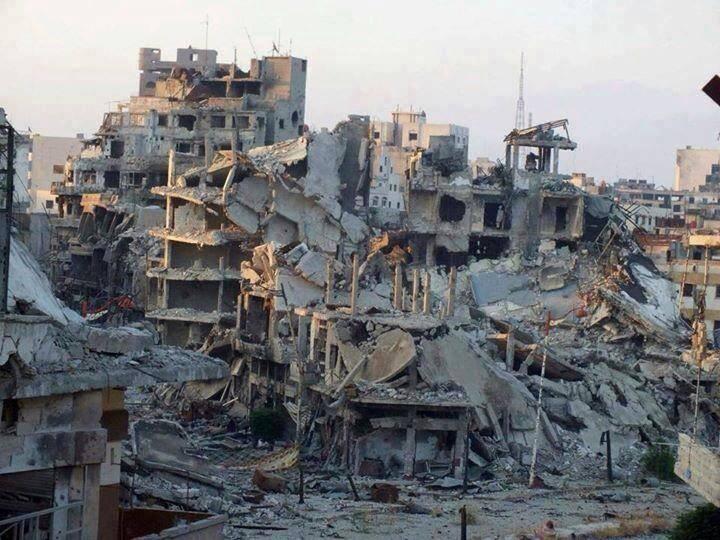
What is the end-game? It appears that, intoxicated after having been able to essentially destroy Hezbollah’s communication networks, much of its launching capacity, and most of its command structure and leadership, all within about a week, Israel’s sights may be set on re-occupying, perhaps effectively annexing, Lebanon south of the Litani, until just recently only an idea entertained on the far-right fringes.

What is behind the bogus “terrorist” labeling of Hezbollah?

By Michael Karadjis

The Australian government, like a number of other western governments, lists Hezbollah as a “proscribed terrorist organisation.” This led to a great deal of hysteria among Australian politicians of both major right-wing parties and among talking heads throughout the monochrome Australian media after Hezbollah flags and photos of its dead leader, Hassan Nasrallah, were displayed by some of the crowd at last Sunday’s weekly rally against Israel’s Gaza genocide. The display of such symbols, aside from being illegal, allegedly causes great “distress” among Jewish-Australians, who do not feel “safe”, and all “antisemitism” must be rejected and so on and so forth.

Just as an aside on that rally: it is worth noting that from the beginning last October, organisers of the weekly rallies asked marchers not to bring symbols associated with proscribed “terrorist” organisations, for legal reasons, to prevent the rallies being closed down, while not making judgements on the politics of these organisations. However, it was to be expected that with emotions high just after Israel had killed about 1200 Lebanese people in around a week, sent over a million fleeing, and also killed Nasrallah, that some members of the Lebanese community who supported Hezbollah might bring Hezbollah symbols, and it would have been difficult for rally organisers to prevent this in the circumstances. However, it was not their choosing, and many at the rally, who were happy to rally for the Lebanese people as well as the Palestinians, were not so happy with the focus of part of the rally being turned to Nasrallah. But let’s get back to the point.

Hezbollah flag at Palestine rally in Melbourne

I hold no brief for Hezbollah, at all, as I will explain below, and much less for its reactionary Iranian paymaster. However, at this moment it is the Israeli state, backed by the Australian government and other western governments, that has carried out a virtual holocaust in Gaza over the last year, is actively stealing land and killing with impunity in the Palestinian West Bank while the world looks away, and has just carried out a devastatingly murderous attack on the neighbouring sovereign state of Lebanon, bombing entire city blocks in the capital Beirut with 2000 pound bombs in the process of killing a handful of Hezbollah leaders. If “terrorism” means killing civilians as part of a political action, then the Israeli regime is one of today’s arch-terrorists. However, let’s put that aside for the moment and classify that as “state terrorism,” and focus instead on the “terrorism” of non-state actors.
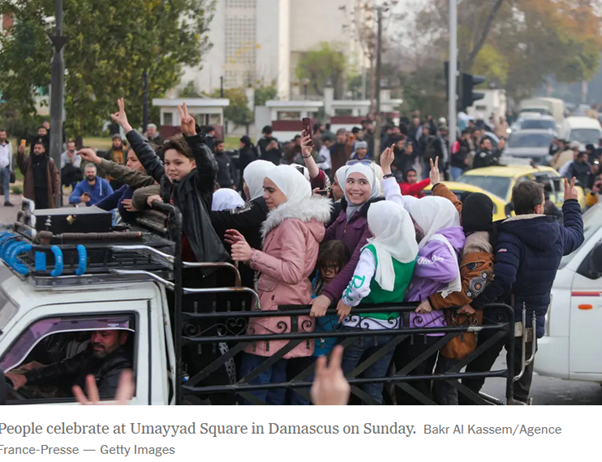
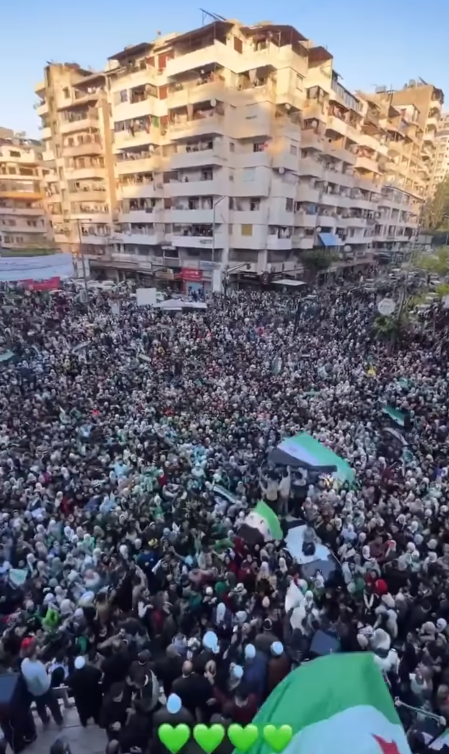
In that case, Hezbollah is not a “terrorist” organisation in any conventional sense. It is unclear why its flag should create “distress” among Jewish Australians. When has Hezbollah ever planted bombs in cafes or on buses, when has it shot up civilians in shopping malls, when has it specifically targeted Jews as Jews? This is quite simply not how Hezbollah has ever operated. The “terrorist” label therefore is simply driven by the political views of the US and Israeli states; it is worth looking at where it comes from.

The source of the bogus “terrorist” label: legitimate national resistance

The first source of the “terrorist” labeling was the US itself rather than Israel. Following the end of Israel’s horrific 1982 invasion of Lebanon, when it killed 20-30,000 Lebanese and Palestinians in an unprovoked 3-month Blitzkrieg, the entire time with the full support of the US government of Ronald Reagan, an agreement was signed for a Multi-National Force (MNF) consisting of US, French and Italian troops to move in and supervise the forced withdrawal of the Palestine Liberation Organisation (PLO), the goal of Israel’s war.

Given the total US support for Israel, much of Lebanon’s Muslim population viewed the “peace-keeping force” as occupiers. As soon as the PLO withdrew, Israel facilitated the slaughter of 2-3000 defenceless Palestinian civilians in the Sabra and Shatilla refugee camps by the right-wing Lebanese Christian Phalange/Lebanese Forces militia. In such conditions, the election, in an unfair sectarian system, of Phalangist leaders Bashir, then Amin, Gemayel to the presidency was rejected by Sunni, Shiite and Druze communities. Yet as civil war soon re-erupted around Beirut, the supposedly neutral US forces bombed Muslim and Druze forces in the nearby Shouf mountains. It was in these conditions that Iranian-inspired Shiite suicide bombers bombed the barracks of the MNF in October 1983, killing 241 U.S. and 58 French military personnel.

This killing of so many US troops is the origin of the particular US hatred of Hezbollah and its “terrorist” labelling. However, even if we exclude all the context above, there are two problems. First, regardless of one’s view of such an action as a method of struggle, “terrorism” refers to the targeting of civilians, not of military personnel, however one views their mission. Secondly, Hezbollah was not officially formed until 1985, and it is little more than conjecture that the shadowy pro-Iranian ‘Islamic Jihad’ (not to be confused with today’s Palestinian Islamic Jihad) group which claimed responsibility was a precursor of Hezbollah. Even according to Reagan’s Defence Secretary Caspar Weinberger, speaking in 2001, “we still do not have the actual knowledge of who did the bombing of the Marine barracks at the Beirut Airport, and we certainly didn’t then.”

The second source of the “terrorist” labeling is even more dishonest, stemming merely from Hezbollah’s leadership of the Lebanese national resistance against the Israeli military occupation of southern Lebanon, an entirely legitimate struggle. Following its 1982, Israel remained in occupation of southern Lebanon all the way up to Beirut, and so a national resistance movement began fighting to drive them out. By 1985, they had been driven from Beirut and much of the south, but remained in a significant swathe of territory closer to the Israeli border. While the resistance included a range of political forces, including leftists, nationalists and Islamists, from both Sunni and Shiite communities, ultimately the south is largely Shiite populated, and the Iran-backed Shiite Hezbollah became the dominant force. There were no Israel civilians in southern Lebanon; and Hezbollah never bombed Israeli civilians across the border. Israel merely regards legitimate resistance against its brutal military occupation to be “terrorism” in Lebanon just as it does in occupied Palestine.

Israeli occupation troops in southern Lebanon 1996

Israel was driven from Lebanon by the resistance in 2000. However, it remained in a 25-square kilometre piece of land called the Shebaa Farms, which Lebanon claims but Israel says is part of the illegally-occupied Syrian Golan (as if that justifies the Israeli position!), and this is part of its justification for remaining a “resistance” militia separate to the Lebanese Armed Forces after 2000. When Hezbollah kidnapped some Israeli troops on the border in 2006 aimed at freeing several Lebanese prisoners in Israeli prisons and liberating this final piece of land, Israel unleashed massive bombing against Lebanon, killing 1500 people and devastating the country again. Nasrallah admitted its actions had been an error, and Hezbollah’s position looked very weak politically; then Israeli arrogance trumped common sense when it attempted a ground invasion, allowing Hezbollah to route the invaders as an on-the-ground resistance again, not only saving but boosting Hezbollah’s resistance credentials.

More generally, since the 1990s, Hezbollah has engaged in parliamentary elections and been part of coalition governments with parties representing other sectarian interests. That’s why even some countries that call the military wing of Hezbollah “terrorist” do not classify the political organisation as such. Far from challenging the sectarian system, Hezbollah has largely bought into it, and despite rhetoric about “the dispossessed,” has emerged as a key party of the Shiite bourgeoisie. Soon after its 2006 triumph, Hezbollah showed itself to be little different to any of the other sectarian militias in Lebanon, when it invaded mainly Sunni-populated West Beirut in 2008 and seized control from the Sunni Future Movement. And in 2019, when Lebanese from all backgrounds rose up against the sectarian system as a whole, targeting all historic sectarian leaders and warlords, Hezbollah came to the defence of the system by helping violently crush the movement.

Hezbollah becomes a state-terrorist partner of the Assad regime

Despite its close relationship to the Iranian dictatorship, Hezbollah had its own origins as a legitimate national resistance movement in a Lebanese context and cannot be viewed as a mere proxy. However, ultimately, Iran is its paymaster, and this side of the organisation came upfront following the outbreak of the April Spring uprisings in 2011. Its opposite views on Libya and Syria is instructive.

When the Libyan revolution began, both Iran and Hezbollah hailed the revolt against Gaddafi’s oppressive rule; despite the image of Iran and Libya being both anti-Israel “rejectionist” states (in both cases reflecting safe geographic distance from Israel, allowing lots of loud rhetoric from afar), there is a dispute going back decades, when Musa al-Sadr, the leader of the Lebanese Shiite movement Amal, disappeared while on a trip to Libya. Lebanon in 2011 was on the UN Security Council, and its vote in support of the UN resolution to dispatch a NATO operation against Gaddafi was decisive, a vote that Hezbollah had to give its support to. Following the 6-month NATO intervention, the rebellion triumphed, and when Gaddafi was killed, celebrations were organised in Iran and in Hezbollah-controlled Lebanese communities.

In contrast, when the people’s uprising began against the tyrannical Assad dictatorship in Syria, Iran sent forces in to support the regime, both its own ‘Revolutionary’ Guard forces, and Iranian-backed Iraqi, Afghan and Pakistani Shiite sectarian militia. This was necessitated by the defection of a large part of the Syrian army to the uprising, forming the Free Syrian Army (FSA). While the Assad regime’s own sectarian ‘Shabia’ death squads were the most notoriously bloody militia taking part in Assad’s sensationally brutal and bloody repression of the Syrian people, the Iranian-backed militia were not far behind.

There seems some evidence that Hezbollah was initially hesitant about Iran’s demand that it enter Syria. During the 2006 war, Syrians took in thousands of Hezbollah supporters and Lebanese Shiite refugees, seeing them as heroes. One of the places this occurred was in the town of Qaysar near the border, which was now in rebel hands. When Hezbollah decided to enter the war as an Iranian proxy, the first place it helped the regime smash the rebellion was in Qaysar.

The irony of supporting the uprising against Gaddafi, despite it being backed by a direct US and NATO armed intervention, while taking part in crushing the anti-Assad uprising, where there was never any US intervention against Assad (indeed the US actively blocked the rebels from receiving essential anti-aircraft weaponry from neighbouring states), is surely too great, when Hezbollah and Iran and their western “anti-imperialist” flunkeys justify their support for Assad’s perennially anti-Palestinian regime on the basis of … “anti-imperialism.”

If Hezbollah had merely taken a back-seat role out of necessity due to its Iranian paymaster, it would have been bad enough, but perhaps understandable. However, once in, it went in with a vengeance. Particularly in southwestern Syria, Hezbollah played a prominent role in the Assad regime’s starvation sieges of various rebel-held towns, especially in Madaya and Zabadani, as well in Aleppo in the north. According to al-Jazeera, “Zabadani and Madaya, both located near the capital Damascus, are besieged by the army of Syrian President Bashar al-Assad and allied fighters from Hezbollah, the Lebanese Shia group.” They even took part in the regime’s siege of the Palestinian Yarmouk camp south of Damascus. The largely Sunni and anti-Assad populations of these towns were eventually forced out and dispatched to a region of northern Syria still under rebel control.

According to an Amnesty report: “The Syrian government and allied militias destroyed local food supplies by burning agricultural fields in Daraya and Madaya. Amnesty International’s analysis of satellite imagery shows the massive decrease in agriculture over the years and an obvious dead zone around Daraya. ‘The government and Hezbollah forces burned the agricultural fields, just as a form of punishment, even though we couldn’t access them’, a former teacher in Madaya told Amnesty International.”

Therefore, while Hezbollah is no “terrorist” organisation in the manner meant by hypocritical western governments, it certainly was responsible for large-scale killing and starving of civilians in Syria (along with its Iranian paymaster). However, it did so in the service of the Syrian state machine; in other words, like Israel, and the Assad regime itself, Hezbollah engaged in state terrorism. But that is not what the West and Israel care about. Indeed, when Biden congratulated Netanyahu for killing Nasrallah, he claimed it was justice for Hezbollah’s “many victims, including thousands of Americans, Israelis, and Lebanese civilians,” whatever that may even mean (mostly US and Israeli occupation troops). He managed to not mention any victims from Syria, the country with the vast majority of its civilian victims!

As for Israel, throughout the Syrian conflict, Israeli leaders (political, military and intelligence) and think tanks continually expressed their preference for the Assad regime prevailing against its opponents, and were especially appreciative of Assad’s decades of non-resistance on the occupied Golan frontier, in other words, it was essentially on the same side as Iran and Hezbollah (which at times was openly acknowledged), just that it didn’t like them being the backers; this is why Israel welcomed the onset of the massive Russian aerial war against the Syrian people to protect Assad in 2005, seeing a Russian-dominated regime as preferable to an Iranian-dominated one. Indeed, just as Israel justifies its slaughter of the Palestinian and Lebanese people by calling them all “terrorists” and “Islamic extremists,” the Assad regime and its supporters likewise justified the slaughter of the Syrian people by calling them all “terrorists” and “Islamic extremists,” echoed in this case by various oddball western “leftist” hypocrites.

The Assad regime is the most similar to Israel in the region in the degree of mass murder and devastation it uses against its population, with some 700,000 killed in the conflict, including at least 300,000 civilians, overwhelmingly victims of the regime, most cities destroyed by regime and Russian bombing, and an industrial-scale torture gulag. Hezbollah and Iran are so widely hated for their role in backing the regime that, despite Syrians in rebel-held zones demonstrating against Israel in support of Gaza for the entire year since October, there were expressions of joy when their former killers were killed. They did not thank Israel, but they viewed it as a conflict between two of their enemies, two occupiers of Syria, wishing ‘good luck’ to both. For Syrians, Hezbollah and Iran acted as the IDF in their towns.

One does not have to share this perspective to understand it. For Lebanese living under Israel’s terror bombing and massive devastation now, their reality is that, whether or not they love Hezbollah, at this moment most Lebanese are united against the Zionist killing machine. Moreover, for southern Shia, Hezbollah is the organisation that led the 18-year struggle for freedom from brutal Israeli occupation. From afar, we need to be able to understand both perspectives.

So, where is the “terrorism”? On the border?

Returning to now, the point is that “terrorism” is a meaningless label in the case of Hezbollah to justify massive Israeli state terrorism and the support to it given by our government. When asked if Lebanon had the same right to “defend itself” as he claimed Israel does, prime minister Anthony Albanese immediately responded “of course we regard Hezbollah to be a terrorist organisation.” This sleight of hand allows him and other leaders to simply avoid the issue of Israel’s massacres and its blatant violation of Lebanese sovereignty. “Terrorism” justifies all. It has extraordinarily sweeping use. “What else can Israel do?” when confronted by a “terrorist organisation” on its border?

Israel-Lebanon cross-border attacks October 8, 2023-September 20, 2024

Yet the border itself belies this labeling. In sharp contrast to its massacre of civilians in Syria when engaged in the regime’s state terror, Hezbollah’s cross-border attacks since October 8 have been meticulously aimed at Israeli military facilities. No-one can seriously deny that, and the data speaks for itself. In contrast, Israel’s attacks over Lebanon’s border (ie, before the flare-up in the last 2 weeks) have not only been vastly disproportionate in terms of sheer number, but also far more targeted at civilians; until September, Israel had launched 8313 attacks on Lebanon, to Hezbollah’s 1901 attacks on Israel; Israeli attacks had killed 752 Lebanese, including hundreds of civilians, to only 33 Israeli deaths, overwhelmingly military.

Think what you want of Hezbollah politically – but right now it is resisting Israel’s new invasion of southern Lebanon in its own country, while Israeli state terror has killed hundreds of Lebanese civilians; some 2000 Lebanese have been killed by Israeli attacks over the last year, 60 percent of them over the last two weeks, and this includes 127 children, and, for good measure, by the beginning of October, Israel had already killed 96 Syrian refugees (including 36 children) who are only in Lebanon in the first place to escape the atrocities of the Assad regime, which was aided by Hezbollah! Over 100,000 refugees have fled into Syria, both Lebanese and Syrian refugees – and the Syrian regime has already begun arrests. Christian and Sunni towns in the south have been bombed alongside the Shiite civilian population; mostly Sunni regions of Beirut are being devastated alongside the Shiite regions which are Hezbollah’s base. Israel did want to decapitate the Hezbollah leadership, to re-establish its “deterrent” power, but it is also waging a war on Lebanon and the Lebanese people.

To cite Syrian writer Robin Yassin-Kassab: “I oppose Hizbullah absolutely when it is murdering and expelling Syrians on Iran’s orders. And I support absolutely its legitimate resistance to genocidal Zionist fascism.”

Israeli terror bombing of Beirut neighbourhoods

The Israel-Iran theater show–a distraction from Gaza genocide 

by Michael Karadjis

Michael Karadjis explains how the recent interchange of missiles between Israel and Iran was an episode of theater distracting from the ongoing genocide in Gaza and leaving Israel more powerful.

Iranian missiles above Israel. Photo: Wikimedia Commons.

How many Palestinians have Israel shot, bombed, and starved in the last week or so? Not a lot of it has been in the news, because we’ve been distractedby “bigger” theatre: a “regional” conflict may be brewing. Let’s observe and analyze this bigger picture, while remembering that the ongoing genocide in Gaza is the real issue here, not Israeli and Iranian fireworks.

At least 43 more Palestinians were killed and 62 others injured on April 13 in four Israeli massacres in Gaza. The next day another five Palestinians were killed “when the Israeli army shelled hundreds of displaced Palestinians trying to return to their homes in the northern Gaza Strip.” Meanwhile, as Al-Jazeera reported, in the West Bank in the same period, while drones flew overhead, mobs of Israeli settlers, backed by troops, spearheaded a large-scale attack on the village of al-Mughayyir, where they killed one Palestinian man and injured 25 others. Since then, settlers have attacked more towns and villages near Ramallah including Bukra, Deir Dubwan, and Kfar Malik.

This is the ongoing reality behind the theatrical scenes we have witnessed over the last week. While the world witnessed the performative deployment of great military hardware on both sides, as both proclaimed self-defense, there was no power to knock out Israeli planes bombing Palestinians; no discussion of Palestine’s right to defend itself.

The U.S. has been pleased that decades of Iranian-regime “anti-Zionist” bluster (aimed at internal and regional homogenization rather than at being taken seriously) amounted to nothing at all as Israel committed genocide in Gaza for six months. Despite Iranian leaders initially promising to back Palestinian resistance “until the liberation of Palestine and Al-Quds,” with one leader claiming an Israeli ground invasion of Gaza would “open that gates of hell,” in reality “the chasm between Iran’s bellicose rhetoric and relatively restrained action is even sharper in the current Gaza war” than in previous wars. Iranian supreme leader Ali Khamenei famously told Hamas chief Ismael Haniyeh in Tehran, that since Hamas “gave us no warning, we will not enter the war on your behalf,” allegedly demanding that Haniyeh silence Palestinian voices calling on Iran or Hezbollah to join the battle. In November, the U.S. allowed Iraq to transfer $10 billion it owed Iran in electricity payments in a sanctions waiver. According to The Economist, this was a reward to Iran for holding back its proxies after October 7.

However, Israeli leaders were less pleased. They were probably pleased in the first month or two, allowing them time to get on with the genocide. Yoav Gallant, Israel’s defense minister, boasted that “no one has come to [Hamas’s] aid – neither the Iranians nor Hizbullah.” But after that, Israeli leaders, or at least Netanyahu’s gang, appeared to want to escalate. For example, while the attacks and counter-attacks between Israel and Hezbollah on the Lebanese border were initially well-calibrated on both sides, restricted to a few kilometers, Israel soon upped the ante: While some twenty troops and civilians have been killed on the Israeli side, about 240 Hezbollah and other fighting cadre and forty Lebanese civilians had been killed by increasingly violent and reckless Israeli bombing by March. By late in 2023, Israel was escalating with targeted killings of leading Hezbollah cadre and Iranian Revolutionary Guards in Lebanon and Syria, which appeared to be aimed at getting a response.

For years, Israel has bombed Iranian and Hezbollah targets in Syria, but mostly they targeted weapons shipments, warehouses, and the like where Iran was transferring missiles to Hezbollah. These Israeli bombings were carried out with the facilitation of Syria’s Russian-controlled air defenses, an arrangement made through countless high-level meetings between then-best-friends Putin and Netanyahu, who over a decade met together more than any other two world leaders. Israel supported the Assad regime remaining in power, but without Iranian backing, and therefore welcomed Russia’s intervention on Assad’s behalf as an alternative. Russia and Iran jointly saved Assad, but then became rivals over domination of the Assadist corpse.

Yet over all these years of attacks, none of them were ever carried out in response to any imaginary Iranian or Hezbollah attacks on “Israel” (i.e., the Israeli-occupied Syrian Golan); the Israeli and Western propaganda that Israel attacks Iranian forces because they pose a “threat” to Israel was very theoretical indeed. In fact, only twice, in my close reading, was there even retaliation (once by Iran, in May 2018, once by Hezbollah, in January 2015), as against hundreds of Israeli attacks.

But only in the last six months has Israel progressed to these targeted killings of significant numbers of important Iranian or Hezbollah figures, but no matter how many were killed, even leading Revolutionary Guards, still there was zero retaliation from Iran. Following a series of suspiciously precise Israeli strikes killing around a dozen leading Iranian Revolutionary Guards in Syria in December and January, Iran’s response was to pull back the Guards from Syria to avoid getting pulled into the conflict.

How is Israel supposed to maintain a 30-year propaganda campaign, that it faces not just the brutally oppressed Palestinians, but behind them a large evil power bent on wiping out Israel and Jews (sometimes referred to as “the Fourth Reich”) allegedly dedicated to Israel’s destruction, when, for years, that power never does anything, not even as a response? And continues the same, no matter how much Israel has turned up the dial in recent months. Israel cultivates this propaganda not because it fears Iran – a laughable proposition for a nuclear-armed military and economic superpower – but because of its utility as a key ideological prop for the Zionist enterprise. In the same way, Iran plays the same propaganda game in relation to Israel. Just as Israel used this propaganda to justify the brutal oppression of Palestine, Iran used the same to mobilize supporters and death squads against opponents – mostly Sunni Muslims – in Iraq and Syria as it built its sub-imperial arc from Iran to the Mediterranean Sea.

While the world witnessed the performative deployment of great military hardware on both sides, as both proclaimed self-defense, there was no power to knock out Israeli planes bombing Palestinians; no discussion of Palestine’s right to defend itself.

But now in the context of its Gaza genocide and the mass global opposition that was confronting it, an Iranian response became especially important for Israel, because if Iran’s response were harsh enough, it may force the U.S. to enter the battle directly against Iran, and under the cover of such a region-wide conflagration, Israel could carry out its genocide in Gaza–and the West Bank–to completion. Israel’s crimes would become a mere sideshow compared to this “bigger picture,” and the world could be convinced that “poor little Israel” faces powerful enemies attacking it. So, it finally made the decision to hit the Iranian consulate in Syria, knowing Iran would now have no choice but to respond at some level or lose face completely.

At first, Iran said it held the U.S. responsible, a hint that the response might simply be that its Iraqi Shiite militia proxies go back to hitting U.S. bases in Iraq or Syria, something they stopped completely months ago (under Iranian regime pressure). Then the U.S. stressed that it was not “involved in any way whatsoever,” that it had received no advance warning from Israel (and was not happy about that), so Iran had better not hit U.S. forces. This was a hint that Iran should instead hit Israeli interests, somewhere. Then Iran hinted that its response would not be of an escalatory nature, and U.S. sources initially agreed that the response would be minor. But then we began to read in the media exactly what its response would be–a drone and missile attack on Israel from Iranian territory–somewhat more significant than initially expected. But the reason we could read about it was that Iran gave the U.S. 72 hours’ notice via various intermediaries–Oman, Iraq, Turkey, Saudi Arabia, the UAE, and Switzerland have all been mentioned–so that the U.S. and Israel would know exactly what was coming, giving them plenty of time to prepare. In real-time theatre, discussions were essentially going on in the media between the U.S. and Iran through these intermediaries over what was deemed to be within reasonable limits to avoid escalation and so on. The U.S. made it clear that if Iran hit Israel, U.S. support for Israel’s defense is “ironclad.”

Of course, this well-choreographed retaliation gave time for Israel, the U.S., the U.K., France, and even Jordan to be well-positioned to shoot down 99 percent of the 350 drones and missiles that Iran sent against Israel. Reportedly, some drones even had their lights on! Iran’s attack was aimed at an Israeli military base, not at civilians, as U.S. leaders confirmed. Iran then declared that the matter was “concluded”. Meanwhile, since the U.S.’s “ironclad” defense of Israel had indeed been successfully put into action, the U.S. therefore, did not need to do any more. Biden commended Israel on the success of its amazing air defense system–even though this may not have been the case if the U.S. and others had not helped–telling Israel, “You got a win. Take the win” and move on; Biden stressed that the U.S. would not support or participate in any offensive Israeli operations against Iran in retaliation.

Two men stand in a pile of rubble.Damage in Gaza, October 2023. Photo: Wikimedia Commons.

The U.K., France, Germany, and other Western countries all likewise called on Israel to avoid retaliating. Russia and China neither supported nor condemned Iran’s attack (just as the U.S., U.K., and France had refused to condemn Israel’s attack on the Iranian consulate in the UN) but expressed alarm about escalation and called for calm.

So, who won, lost, or came out even in this?

Iran and the U.S., for their own reasons, want to avoid escalation. Israel, for reasons explained above, wants to escalate, but not to fight Iran itself, but rather focus on smashing Gaza. For Israel, escalation means that the U.S. gets sucked into a war of non-choice with Iran while Israel gets on with killing the Palestinians, its real, not phantom, enemies. The U.S. has given Israel 100 percent of its support – despite occasional toothless hand-wringing – to Israel’s war of genocide in Gaza but has no interest in getting sucked into Netanyahu’s escalatory games. This reluctance is not out of pacifism; it’s just that it has much bigger issues with Russia in Ukraine and China in the South China Sea, and, as Obama’s Iran nuclear accord showed, the Democrats at least have a more rational understanding that Iranian capitalism merely wants a recognized place in the region and that the bluster, is, well, bluster.

From that perspective, Israel did gain a lot. Above all, the whole episode created a theatrical distraction from Gaza; it allowed Israel to get on with mass murder while the world’s attention was elsewhere; it covered  Israel scuttling the latest negotiations of ceasefire and hostage release; and it demonstrated how efficient its defenses were. The fact that Iran chose a full frontal attack on Israel, rather than an equivalent act such as hitting an Israeli embassy somewhere, allows Israel to again play-act that it is up against a powerful “evil” regime that wants to destroy it. The episode assembled a collection of Western powers and even Jordan as a “defend Israel” coalition. The escalating criticisms of its monstrous war coming from various Western powers, even to some extent from Biden and the U.S. government, have now been blunted. Massive new arms deals with Israel and sanctions on Iran are the word from the U.S. and Western allies.

On the other hand, this is not quite enough for Netanyahu; it is not quite a regional conflagration. The limitations, and above all the choreography, of Iran’s harmless attack do nothing to bring in the U.S. to wage war on Iran; on the contrary, it allows the U.S. to preach restraint.

Iran also gained: It could say, we retaliated for the violation of our consulate, but we also acted responsibly. If Iran had not planned for all its drones and missiles to be shot down, then this would be a severe humiliation. But since that was precisely the plan, Iran simultaneously gained credibility and showed “responsibility.” It also demonstrated that it had had the potential to do damage if it had not given extensive warning, and clear notice to Israel that it no longer accepted the previous rules. It was also a useful exercise for Iran to “test out” Israeli air defense weaponry, though of course, Israel benefits in the same way.

Above all, the whole episode created a theatrical distraction from Gaza; it allowed Israel to get on with mass murder while the world’s attention was elsewhere; it covered Israel scuttling the latest negotiations of ceasefire and hostage release; and it demonstrated how efficient its defenses were.

But again, on the other hand, it can also be argued that Iran fell into Israel’s trap by retaliating, though it had little choice. While the planned results of its attack show restraint, just the fact that it chose a full-frontal attack from its territory as its method of retaliation has allowed the West to denounce “Iranian aggression” and step up support for Israel.

Arguably, the U.S. gained the most by being in a position to jointly choreograph, with Iran, the latter’s response through intermediaries and then play the decisive role in helping Israel shoot down all the Iranian hardware, it placed itself in a strong position. If its aim was to show it could defend Israel while avoiding escalation, it came out on top. While the U.S. tells Israel it should be happy to see how well its defenses performed, Israel knows its dependence on the U.S. has been displayed; this arguably puts the U.S. in a strong position to moderate Israel’s next steps.

Of course, the U.S. has continually criticized some aspects of Israel’s war while at every stage supplying Israel with the weapons to carry out its genocide, so no one should wager too much on the idea that the U.S. will not buckle if Israel were to choose a hard escalatory response. However, it appears that this has been avoided with yet another piece of elaborate theatre, this time by Israel.

Following Iran’s attack, Israel immediately announced that it had to respond and would “decide for itself” in a pointed snub to U.S. advice. As expected, the U.S. began to come around, U.S. leaders now claiming to understand that Israel “had to respond” in some way. So, the U.S. advised Israel to keep it non-escalatory. But if Israel’s response to Iran’s response was not proportionate or bigger, that would not be good for Israel’s credibility. Some Israeli leaders wanted to wage a massive attack on Iran. To prevent that, it appears that the U.S. came up with a deal to save Israel, Iran, and the region from escalation at the expense of the Palestinians.

According to Egyptian officials cited by The Times of Israel on Thursday, “The American administration showed acceptance of the plan previously presented by the occupation government regarding the military operation in Rafah, in exchange for not carrying out a large-scale attack against Iran” [emphasis added]. In other words, no retaliation has been replaced with no “large-scale” retaliation. This is all Israel has to promise in order for the U.S. to give its assent – thus far not clearly given – for Israel to launch its heralded attack on Rafah, where 1.5 million Palestinians have been driven, up against the border of Egypt, into which Israel would like to expel them.

On Friday, April 19, Israel launched its retaliation. Explosions were heard in the Iranian city of Isfahan. Israel did not explicitly report anything; Iran said the explosions were not missiles but the actions of its air defenses knocking out several drones; Iran said the event was so small that it is uncertain where the drones came from and speculated that it may have been an internal attack by “infiltrators” and indicated that it therefore had no plans to retaliate.

Before proclaiming this as a victory for Iran and a climb-down by Israel, by targeting Isfahan, where Iran has major sites of its nuclear program, without hitting them, Israel has shown that it can target them if it chooses to. Therefore, despite the small size of the action, it is an important implicit threat.

Iran wins; Israel wins; escalation is avoided (for now); the U.S. wins. But if the terms of the alleged deal are true, Palestine loses. Following Iran’s retaliatory attack, its UN mission declared it had been conducted “in response to the Zionist regime’s aggression against our diplomatic premises in Damascus” based on Article 51 of the UN Charter “pertaining to legitimate defense,” and therefore the matter can be deemed concluded.” This was not only a message to Israel, but also to Palestine; if, as expected, Israel now goes ahead with a savage attack on Rafah, backed by the U.S., Palestine is on its own.

Ruthlessly repressive capitalist dictatorships like Iran, Saudi Arabia, Egypt, Syria, the UAE, and so on have nothing to offer the Palestinian people and never have had – regardless of their rhetoric and whether they use hollow phrases like “resistance” in their titles or not. On one hand, none have ever done anything to aid Palestine; on the other, given their nature as active enemies of human emancipation, even if they did make bumbling attempts to live up to their rhetoric, it would tend to be counterproductive.

The entirely theatrical nature of the past week’s events merely highlights this fact graphically. Only the oppressed peoples of the region, when they next rise against their oppressors, can be real allies of Palestine. In the meantime, all solidarity with the Palestinian resistance in Rafah and throughout Gaza is essential to prevent Israel from using the past week’s events to further its genocidal project.

Featured image credit: https://en.wikipedia.org/wiki/File:F-15I_vs_Iranian_strikes_on_Israel_02.jpg; modified by Tempest.

Opinions expressed in signed articles do not necessarily represent the views of the editors or the Tempest Collective. For more information, see “About Tempest Collective.”

Dumb things Zionists say: 1. Gaza was no longer occupied; Israel left it to govern itself in 2005 and it responded by firing rockets at Israel

by Michael Karadjis

Israel “withdrew” from 6% of internationally-recognised Palestine, or 1.2% of historic Palestine; so small it is hard to see on a map, yet are expected to not resist the occupation of the rest of their country?

There are a number of problems with this. The first is widely noted by pro-Palestine advocates: that Israeli “withdrawal” was accompanied by placing Gaza under a land, sea and air blockade which prevented most goods and people form getting in or out, while Israel regularly bombed the territory, every few years in major near-genocidal operations, bombed its water and power plants, left the people undernourished and with access to only unclean water, shot at Palestinian fishing boats and so on; when a country has no control over its borders because it is blockaded by its “former” occupier, it remains occupied according to international law, not to mention common sense. And of course the devastating impacts of this blockade have been widely reported, with the United Nations reporting that Gaza was “unliveable” – imagine, that is before this current holocaust.

But there is a more fundamental reason why this is a stupid argument: Gaza is not a nation, or country or state. The nation is Palestine; the state, as recognised by the UN General Assembly and the vast majority of nations on Earth since the 1970s, covers the Palestinian territory occupied by Israel in 1967, namely West Bank and Gaza with its capital in East Jerusalem, one fifth of historic Palestine (for argument’s sake let’s leave aside for now the definition of Palestine as, well, all of Palestine, and the fact that 75 percent of ‘Gazans’ are actually refugees ethnically cleansed from ‘Israel’).  

Now, the West Bank is 5655 square kilometres; Gaza is 365 square kilometres, meaning the internationally recognised state of Palestine is 6020 square kilometres; Gaza is therefore only around 6 percent of the Palestinian state (even though there are almost 3 million living in the West Bank and 2.3 million squeezed into Gaza). Again, let’s leave aside for now that since Israel itself is 22,770 square kilometres, Gaza is therefore only 1.2 percent of historic Palestine.

In other words, even if we leave aside the blockade and accept the Zionist premise that Israel withdrew from Gaza in 2005, it therefore “withdrew” from only 6 percent of the occupied state of Palestine (or 1.2 percent of historic Palestine). So, what would we expect a people to do when the colonial occupier leaves only 6 percent of their country? Would they just say, OK, sweet, let’s just get on with it, or would they use this space to continue to resist the ongoing occupation of the rest of their country?

Let’s imagine – in the 1950s, France had withdrawn from the town of Oran on the north Algerian coastline, and a tiny area around it, but maintained its occupation of 94 percent of Algeria. So, would the Algerians in Oran set up an independent ‘Republic of Oran’ and say stuff the rest of Algeria? Or would it have been a base for the independence struggle of the rest of Algeria? The answer is obvious. The idea that the allegedly ‘free’ Gazans would have just sat pretty while Israel continued to occupy, colonise, steal land and murder in the West Bank and Jerusalem is absurd, and offensive.

Israel “withdrew” from Gaza, if we ignore the blockade that made life unliveable, it did not withdraw from Palestine.

Take Ukraine. Russia is currently occupying around 20 percent of Ukraine. That means it is not occupying 80 percent of Ukraine. Putin expects Ukraine to just cop that, to sign a peace treaty allowing Russia to annex 20 percent of its land. Most people see that as self-evidently absurd and unjust. So Ukraine continues to resist. Why is it considered normal for Ukraine, 80 percent of which is unoccupied, to continue to resist Russian occupation of the 20 percent, but it is not considered normal for Palestine, in the 6 percent that was theoretically ‘unoccupied’, to continue to resist Israeli occupation of the 94 percent of Palestine?

There is actually a third thing wrong with the statement, since it implies that Hamas simply “fired rockets” willy nilly at Israel as if Israel was doing nothing wrong; and for argument’s sake, let’s leave aside both the blockade, and the continuing occupation 94 percent of the Palestinian state, both of which mean Palestinians in Gaza have the internationally recognised right to armed resistance. What it ignores is that after “withdrawal,” Israel continued to bomb Gaza whenever it felt like it. Now, it might be a standard Zionist argument, repeated inevitably in western media, that Israel only launched such bombs “in response” to Hamas rockets, leaving aside the fact that these Israeli bombings always killed far greater numbers of Palestinian civilians than the little home-made Hamas ‘rockets’ did Israelis (they mostly killed no-one). But anyone who believes that is simply a starry-eyed victim of propaganda. Do the research – just as often it was the other way around – Israel launches some targeted assassination and kills a dozen civilian “collateral” victims, Hamas responds with rockets.

Or, reflecting the unity of all of Palestine as noted above, Israel carries out some atrocity in the West Bank, or for example invades the al-Aqsa mosque in Jerusalem, so Hamas exercises its right to resist by launching some rockets from Gaza. Were these rockets effective, or always a good idea – perhaps not, tactics can be discussed, but when you live in a sealed-off prison you have few other options – but the idea that it was mostly Israel “responding” rather than the other way around is bald fiction.