What is behind the bogus “terrorist” labeling of Hezbollah?

By Michael Karadjis

The Australian government, like a number of other western governments, lists Hezbollah as a “proscribed terrorist organisation.” This led to a great deal of hysteria among Australian politicians of both major right-wing parties and among talking heads throughout the monochrome Australian media after Hezbollah flags and photos of its dead leader, Hassan Nasrallah, were displayed by some of the crowd at last Sunday’s weekly rally against Israel’s Gaza genocide. The display of such symbols, aside from being illegal, allegedly causes great “distress” among Jewish-Australians, who do not feel “safe”, and all “antisemitism” must be rejected and so on and so forth.

Just as an aside on that rally: it is worth noting that from the beginning last October, organisers of the weekly rallies asked marchers not to bring symbols associated with proscribed “terrorist” organisations, for legal reasons, to prevent the rallies being closed down, while not making judgements on the politics of these organisations. However, it was to be expected that with emotions high just after Israel had killed about 1200 Lebanese people in around a week, sent over a million fleeing, and also killed Nasrallah, that some members of the Lebanese community who supported Hezbollah might bring Hezbollah symbols, and it would have been difficult for rally organisers to prevent this in the circumstances. However, it was not their choosing, and many at the rally, who were happy to rally for the Lebanese people as well as the Palestinians, were not so happy with the focus of part of the rally being turned to Nasrallah. But let’s get back to the point.
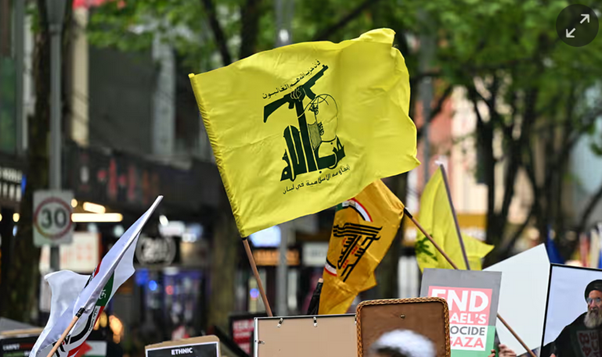
Hezbollah flag at Palestine rally in Melbourne

I hold no brief for Hezbollah, at all, as I will explain below, and much less for its reactionary Iranian paymaster. However, at this moment it is the Israeli state, backed by the Australian government and other western governments, that has carried out a virtual holocaust in Gaza over the last year, is actively stealing land and killing with impunity in the Palestinian West Bank while the world looks away, and has just carried out a devastatingly murderous attack on the neighbouring sovereign state of Lebanon, bombing entire city blocks in the capital Beirut with 2000 pound bombs in the process of killing a handful of Hezbollah leaders. If “terrorism” means killing civilians as part of a political action, then the Israeli regime is one of today’s arch-terrorists. However, let’s put that aside for the moment and classify that as “state terrorism,” and focus instead on the “terrorism” of non-state actors.

In that case, Hezbollah is not a “terrorist” organisation in any conventional sense. It is unclear why its flag should create “distress” among Jewish Australians. When has Hezbollah ever planted bombs in cafes or on buses, when has it shot up civilians in shopping malls, when has it specifically targeted Jews as Jews? This is quite simply not how Hezbollah has ever operated. The “terrorist” label therefore is simply driven by the political views of the US and Israeli states; it is worth looking at where it comes from.

The source of the bogus “terrorist” label: legitimate national resistance

The first source of the “terrorist” labeling was the US itself rather than Israel. Following the end of Israel’s horrific 1982 invasion of Lebanon, when it killed 20-30,000 Lebanese and Palestinians in an unprovoked 3-month Blitzkrieg, the entire time with the full support of the US government of Ronald Reagan, an agreement was signed for a Multi-National Force (MNF) consisting of US, French and Italian troops to move in and supervise the forced withdrawal of the Palestine Liberation Organisation (PLO), the goal of Israel’s war.

Given the total US support for Israel, much of Lebanon’s Muslim population viewed the “peace-keeping force” as occupiers. As soon as the PLO withdrew, Israel facilitated the slaughter of 2-3000 defenceless Palestinian civilians in the Sabra and Shatilla refugee camps by the right-wing Lebanese Christian Phalange/Lebanese Forces militia. In such conditions, the election, in an unfair sectarian system, of Phalangist leaders Bashir, then Amin, Gemayel to the presidency was rejected by Sunni, Shiite and Druze communities. Yet as civil war soon re-erupted around Beirut, the supposedly neutral US forces bombed Muslim and Druze forces in the nearby Shouf mountains. It was in these conditions that Iranian-inspired Shiite suicide bombers bombed the barracks of the MNF in October 1983, killing 241 U.S. and 58 French military personnel.

This killing of so many US troops is the origin of the particular US hatred of Hezbollah and its “terrorist” labelling. However, even if we exclude all the context above, there are two problems. First, regardless of one’s view of such an action as a method of struggle, “terrorism” refers to the targeting of civilians, not of military personnel, however one views their mission. Secondly, Hezbollah was not officially formed until 1985, and it is little more than conjecture that the shadowy pro-Iranian ‘Islamic Jihad’ (not to be confused with today’s Palestinian Islamic Jihad) group which claimed responsibility was a precursor of Hezbollah. Even according to Reagan’s Defence Secretary Caspar Weinberger, speaking in 2001, “we still do not have the actual knowledge of who did the bombing of the Marine barracks at the Beirut Airport, and we certainly didn’t then.”

The second source of the “terrorist” labeling is even more dishonest, stemming merely from Hezbollah’s leadership of the Lebanese national resistance against the Israeli military occupation of southern Lebanon, an entirely legitimate struggle. Following its 1982, Israel remained in occupation of southern Lebanon all the way up to Beirut, and so a national resistance movement began fighting to drive them out. By 1985, they had been driven from Beirut and much of the south, but remained in a significant swathe of territory closer to the Israeli border. While the resistance included a range of political forces, including leftists, nationalists and Islamists, from both Sunni and Shiite communities, ultimately the south is largely Shiite populated, and the Iran-backed Shiite Hezbollah became the dominant force. There were no Israel civilians in southern Lebanon; and Hezbollah never bombed Israeli civilians across the border. Israel merely regards legitimate resistance against its brutal military occupation to be “terrorism” in Lebanon just as it does in occupied Palestine.
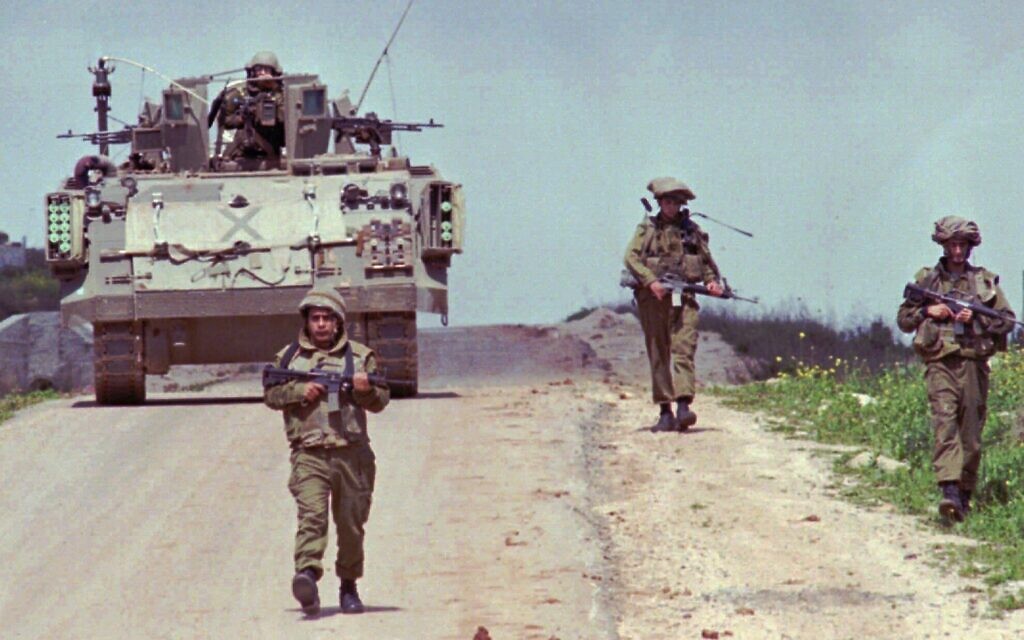
Israeli occupation troops in southern Lebanon 1996

Israel was driven from Lebanon by the resistance in 2000. However, it remained in a 25-square kilometre piece of land called the Shebaa Farms, which Lebanon claims but Israel says is part of the illegally-occupied Syrian Golan (as if that justifies the Israeli position!), and this is part of its justification for remaining a “resistance” militia separate to the Lebanese Armed Forces after 2000. When Hezbollah kidnapped some Israeli troops on the border in 2006 aimed at freeing several Lebanese prisoners in Israeli prisons and liberating this final piece of land, Israel unleashed massive bombing against Lebanon, killing 1500 people and devastating the country again. Nasrallah admitted its actions had been an error, and Hezbollah’s position looked very weak politically; then Israeli arrogance trumped common sense when it attempted a ground invasion, allowing Hezbollah to route the invaders as an on-the-ground resistance again, not only saving but boosting Hezbollah’s resistance credentials.

More generally, since the 1990s, Hezbollah has engaged in parliamentary elections and been part of coalition governments with parties representing other sectarian interests. That’s why even some countries that call the military wing of Hezbollah “terrorist” do not classify the political organisation as such. Far from challenging the sectarian system, Hezbollah has largely bought into it, and despite rhetoric about “the dispossessed,” has emerged as a key party of the Shiite bourgeoisie. Soon after its 2006 triumph, Hezbollah showed itself to be little different to any of the other sectarian militias in Lebanon, when it invaded mainly Sunni-populated West Beirut in 2008 and seized control from the Sunni Future Movement. And in 2019, when Lebanese from all backgrounds rose up against the sectarian system as a whole, targeting all historic sectarian leaders and warlords, Hezbollah came to the defence of the system by helping violently crush the movement.

Hezbollah becomes a state-terrorist partner of the Assad regime

Despite its close relationship to the Iranian dictatorship, Hezbollah had its own origins as a legitimate national resistance movement in a Lebanese context and cannot be viewed as a mere proxy. However, ultimately, Iran is its paymaster, and this side of the organisation came upfront following the outbreak of the April Spring uprisings in 2011. Its opposite views on Libya and Syria is instructive.

When the Libyan revolution began, both Iran and Hezbollah hailed the revolt against Gaddafi’s oppressive rule; despite the image of Iran and Libya being both anti-Israel “rejectionist” states (in both cases reflecting safe geographic distance from Israel, allowing lots of loud rhetoric from afar), there is a dispute going back decades, when Musa al-Sadr, the leader of the Lebanese Shiite movement Amal, disappeared while on a trip to Libya. Lebanon in 2011 was on the UN Security Council, and its vote in support of the UN resolution to dispatch a NATO operation against Gaddafi was decisive, a vote that Hezbollah had to give its support to. Following the 6-month NATO intervention, the rebellion triumphed, and when Gaddafi was killed, celebrations were organised in Iran and in Hezbollah-controlled Lebanese communities.

In contrast, when the people’s uprising began against the tyrannical Assad dictatorship in Syria, Iran sent forces in to support the regime, both its own ‘Revolutionary’ Guard forces, and Iranian-backed Iraqi, Afghan and Pakistani Shiite sectarian militia. This was necessitated by the defection of a large part of the Syrian army to the uprising, forming the Free Syrian Army (FSA). While the Assad regime’s own sectarian ‘Shabia’ death squads were the most notoriously bloody militia taking part in Assad’s sensationally brutal and bloody repression of the Syrian people, the Iranian-backed militia were not far behind.

There seems some evidence that Hezbollah was initially hesitant about Iran’s demand that it enter Syria. During the 2006 war, Syrians took in thousands of Hezbollah supporters and Lebanese Shiite refugees, seeing them as heroes. One of the places this occurred was in the town of Qaysar near the border, which was now in rebel hands. When Hezbollah decided to enter the war as an Iranian proxy, the first place it helped the regime smash the rebellion was in Qaysar.

The irony of supporting the uprising against Gaddafi, despite it being backed by a direct US and NATO armed intervention, while taking part in crushing the anti-Assad uprising, where there was never any US intervention against Assad (indeed the US actively blocked the rebels from receiving essential anti-aircraft weaponry from neighbouring states), is surely too great, when Hezbollah and Iran and their western “anti-imperialist” flunkeys justify their support for Assad’s perennially anti-Palestinian regime on the basis of … “anti-imperialism.”

If Hezbollah had merely taken a back-seat role out of necessity due to its Iranian paymaster, it would have been bad enough, but perhaps understandable. However, once in, it went in with a vengeance. Particularly in southwestern Syria, Hezbollah played a prominent role in the Assad regime’s starvation sieges of various rebel-held towns, especially in Madaya and Zabadani, as well in Aleppo in the north. According to al-Jazeera, “Zabadani and Madaya, both located near the capital Damascus, are besieged by the army of Syrian President Bashar al-Assad and allied fighters from Hezbollah, the Lebanese Shia group.” They even took part in the regime’s siege of the Palestinian Yarmouk camp south of Damascus. The largely Sunni and anti-Assad populations of these towns were eventually forced out and dispatched to a region of northern Syria still under rebel control.

According to an Amnesty report: “The Syrian government and allied militias destroyed local food supplies by burning agricultural fields in Daraya and Madaya. Amnesty International’s analysis of satellite imagery shows the massive decrease in agriculture over the years and an obvious dead zone around Daraya. ‘The government and Hezbollah forces burned the agricultural fields, just as a form of punishment, even though we couldn’t access them’, a former teacher in Madaya told Amnesty International.”

Therefore, while Hezbollah is no “terrorist” organisation in the manner meant by hypocritical western governments, it certainly was responsible for large-scale killing and starving of civilians in Syria (along with its Iranian paymaster). However, it did so in the service of the Syrian state machine; in other words, like Israel, and the Assad regime itself, Hezbollah engaged in state terrorism. But that is not what the West and Israel care about. Indeed, when Biden congratulated Netanyahu for killing Nasrallah, he claimed it was justice for Hezbollah’s “many victims, including thousands of Americans, Israelis, and Lebanese civilians,” whatever that may even mean (mostly US and Israeli occupation troops). He managed to not mention any victims from Syria, the country with the vast majority of its civilian victims!

As for Israel, throughout the Syrian conflict, Israeli leaders (political, military and intelligence) and think tanks continually expressed their preference for the Assad regime prevailing against its opponents, and were especially appreciative of Assad’s decades of non-resistance on the occupied Golan frontier, in other words, it was essentially on the same side as Iran and Hezbollah (which at times was openly acknowledged), just that it didn’t like them being the backers; this is why Israel welcomed the onset of the massive Russian aerial war against the Syrian people to protect Assad in 2005, seeing a Russian-dominated regime as preferable to an Iranian-dominated one. Indeed, just as Israel justifies its slaughter of the Palestinian and Lebanese people by calling them all “terrorists” and “Islamic extremists,” the Assad regime and its supporters likewise justified the slaughter of the Syrian people by calling them all “terrorists” and “Islamic extremists,” echoed in this case by various oddball western “leftist” hypocrites.

The Assad regime is the most similar to Israel in the region in the degree of mass murder and devastation it uses against its population, with some 700,000 killed in the conflict, including at least 300,000 civilians, overwhelmingly victims of the regime, most cities destroyed by regime and Russian bombing, and an industrial-scale torture gulag. Hezbollah and Iran are so widely hated for their role in backing the regime that, despite Syrians in rebel-held zones demonstrating against Israel in support of Gaza for the entire year since October, there were expressions of joy when their former killers were killed. They did not thank Israel, but they viewed it as a conflict between two of their enemies, two occupiers of Syria, wishing ‘good luck’ to both. For Syrians, Hezbollah and Iran acted as the IDF in their towns.

One does not have to share this perspective to understand it. For Lebanese living under Israel’s terror bombing and massive devastation now, their reality is that, whether or not they love Hezbollah, at this moment most Lebanese are united against the Zionist killing machine. Moreover, for southern Shia, Hezbollah is the organisation that led the 18-year struggle for freedom from brutal Israeli occupation. From afar, we need to be able to understand both perspectives.

So, where is the “terrorism”? On the border?

Returning to now, the point is that “terrorism” is a meaningless label in the case of Hezbollah to justify massive Israeli state terrorism and the support to it given by our government. When asked if Lebanon had the same right to “defend itself” as he claimed Israel does, prime minister Anthony Albanese immediately responded “of course we regard Hezbollah to be a terrorist organisation.” This sleight of hand allows him and other leaders to simply avoid the issue of Israel’s massacres and its blatant violation of Lebanese sovereignty. “Terrorism” justifies all. It has extraordinarily sweeping use. “What else can Israel do?” when confronted by a “terrorist organisation” on its border?
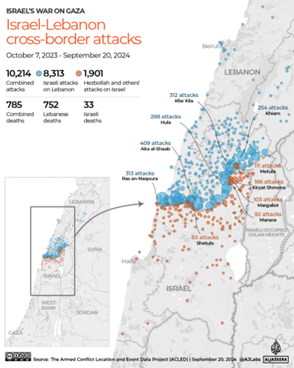
Israel-Lebanon cross-border attacks October 8, 2023-September 20, 2024

Yet the border itself belies this labeling. In sharp contrast to its massacre of civilians in Syria when engaged in the regime’s state terror, Hezbollah’s cross-border attacks since October 8 have been meticulously aimed at Israeli military facilities. No-one can seriously deny that, and the data speaks for itself. In contrast, Israel’s attacks over Lebanon’s border (ie, before the flare-up in the last 2 weeks) have not only been vastly disproportionate in terms of sheer number, but also far more targeted at civilians; until September, Israel had launched 8313 attacks on Lebanon, to Hezbollah’s 1901 attacks on Israel; Israeli attacks had killed 752 Lebanese, including hundreds of civilians, to only 33 Israeli deaths, overwhelmingly military.

Think what you want of Hezbollah politically – but right now it is resisting Israel’s new invasion of southern Lebanon in its own country, while Israeli state terror has killed hundreds of Lebanese civilians; some 2000 Lebanese have been killed by Israeli attacks over the last year, 60 percent of them over the last two weeks, and this includes 127 children, and, for good measure, by the beginning of October, Israel had already killed 96 Syrian refugees (including 36 children) who are only in Lebanon in the first place to escape the atrocities of the Assad regime, which was aided by Hezbollah! Over 100,000 refugees have fled into Syria, both Lebanese and Syrian refugees – and the Syrian regime has already begun arrests. Christian and Sunni towns in the south have been bombed alongside the Shiite civilian population; mostly Sunni regions of Beirut are being devastated alongside the Shiite regions which are Hezbollah’s base. Israel did want to decapitate the Hezbollah leadership, to re-establish its “deterrent” power, but it is also waging a war on Lebanon and the Lebanese people.

To cite Syrian writer Robin Yassin-Kassab: “I oppose Hizbullah absolutely when it is murdering and expelling Syrians on Iran’s orders. And I support absolutely its legitimate resistance to genocidal Zionist fascism.”
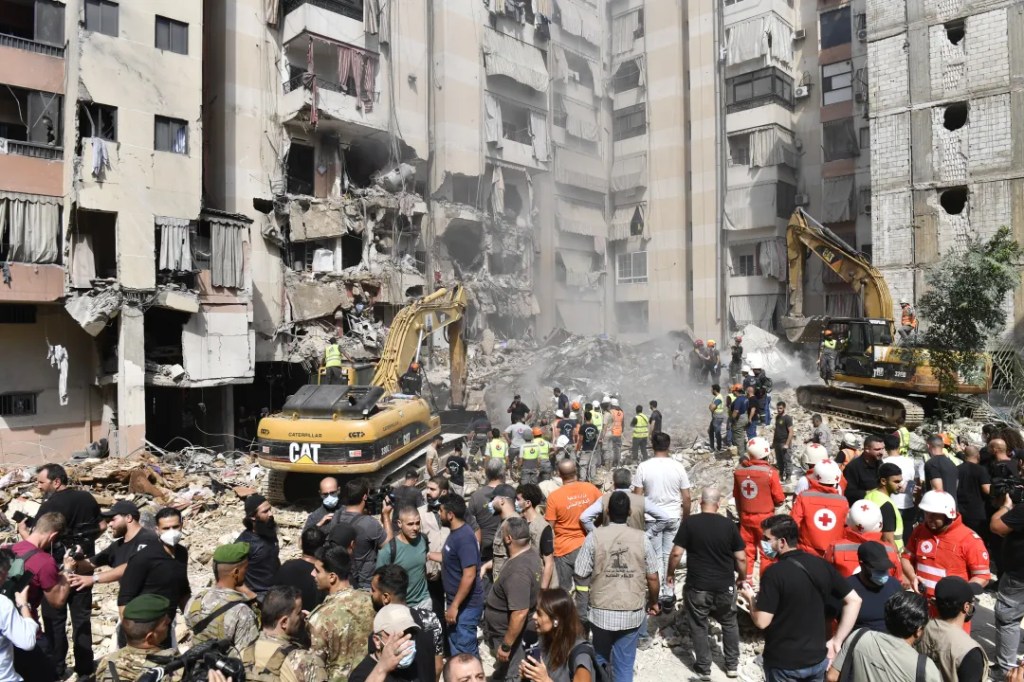
Israeli terror bombing of Beirut neighbourhoods

The Israel-Iran theater show–a distraction from Gaza genocide 

by Michael Karadjis

Michael Karadjis explains how the recent interchange of missiles between Israel and Iran was an episode of theater distracting from the ongoing genocide in Gaza and leaving Israel more powerful.

Iranian missiles above Israel. Photo: Wikimedia Commons.

How many Palestinians have Israel shot, bombed, and starved in the last week or so? Not a lot of it has been in the news, because we’ve been distractedby “bigger” theatre: a “regional” conflict may be brewing. Let’s observe and analyze this bigger picture, while remembering that the ongoing genocide in Gaza is the real issue here, not Israeli and Iranian fireworks.

At least 43 more Palestinians were killed and 62 others injured on April 13 in four Israeli massacres in Gaza. The next day another five Palestinians were killed “when the Israeli army shelled hundreds of displaced Palestinians trying to return to their homes in the northern Gaza Strip.” Meanwhile, as Al-Jazeera reported, in the West Bank in the same period, while drones flew overhead, mobs of Israeli settlers, backed by troops, spearheaded a large-scale attack on the village of al-Mughayyir, where they killed one Palestinian man and injured 25 others. Since then, settlers have attacked more towns and villages near Ramallah including Bukra, Deir Dubwan, and Kfar Malik.

This is the ongoing reality behind the theatrical scenes we have witnessed over the last week. While the world witnessed the performative deployment of great military hardware on both sides, as both proclaimed self-defense, there was no power to knock out Israeli planes bombing Palestinians; no discussion of Palestine’s right to defend itself.

The U.S. has been pleased that decades of Iranian-regime “anti-Zionist” bluster (aimed at internal and regional homogenization rather than at being taken seriously) amounted to nothing at all as Israel committed genocide in Gaza for six months. Despite Iranian leaders initially promising to back Palestinian resistance “until the liberation of Palestine and Al-Quds,” with one leader claiming an Israeli ground invasion of Gaza would “open that gates of hell,” in reality “the chasm between Iran’s bellicose rhetoric and relatively restrained action is even sharper in the current Gaza war” than in previous wars. Iranian supreme leader Ali Khamenei famously told Hamas chief Ismael Haniyeh in Tehran, that since Hamas “gave us no warning, we will not enter the war on your behalf,” allegedly demanding that Haniyeh silence Palestinian voices calling on Iran or Hezbollah to join the battle. In November, the U.S. allowed Iraq to transfer $10 billion it owed Iran in electricity payments in a sanctions waiver. According to The Economist, this was a reward to Iran for holding back its proxies after October 7.

However, Israeli leaders were less pleased. They were probably pleased in the first month or two, allowing them time to get on with the genocide. Yoav Gallant, Israel’s defense minister, boasted that “no one has come to [Hamas’s] aid – neither the Iranians nor Hizbullah.” But after that, Israeli leaders, or at least Netanyahu’s gang, appeared to want to escalate. For example, while the attacks and counter-attacks between Israel and Hezbollah on the Lebanese border were initially well-calibrated on both sides, restricted to a few kilometers, Israel soon upped the ante: While some twenty troops and civilians have been killed on the Israeli side, about 240 Hezbollah and other fighting cadre and forty Lebanese civilians had been killed by increasingly violent and reckless Israeli bombing by March. By late in 2023, Israel was escalating with targeted killings of leading Hezbollah cadre and Iranian Revolutionary Guards in Lebanon and Syria, which appeared to be aimed at getting a response.

For years, Israel has bombed Iranian and Hezbollah targets in Syria, but mostly they targeted weapons shipments, warehouses, and the like where Iran was transferring missiles to Hezbollah. These Israeli bombings were carried out with the facilitation of Syria’s Russian-controlled air defenses, an arrangement made through countless high-level meetings between then-best-friends Putin and Netanyahu, who over a decade met together more than any other two world leaders. Israel supported the Assad regime remaining in power, but without Iranian backing, and therefore welcomed Russia’s intervention on Assad’s behalf as an alternative. Russia and Iran jointly saved Assad, but then became rivals over domination of the Assadist corpse.

Yet over all these years of attacks, none of them were ever carried out in response to any imaginary Iranian or Hezbollah attacks on “Israel” (i.e., the Israeli-occupied Syrian Golan); the Israeli and Western propaganda that Israel attacks Iranian forces because they pose a “threat” to Israel was very theoretical indeed. In fact, only twice, in my close reading, was there even retaliation (once by Iran, in May 2018, once by Hezbollah, in January 2015), as against hundreds of Israeli attacks.

But only in the last six months has Israel progressed to these targeted killings of significant numbers of important Iranian or Hezbollah figures, but no matter how many were killed, even leading Revolutionary Guards, still there was zero retaliation from Iran. Following a series of suspiciously precise Israeli strikes killing around a dozen leading Iranian Revolutionary Guards in Syria in December and January, Iran’s response was to pull back the Guards from Syria to avoid getting pulled into the conflict.

How is Israel supposed to maintain a 30-year propaganda campaign, that it faces not just the brutally oppressed Palestinians, but behind them a large evil power bent on wiping out Israel and Jews (sometimes referred to as “the Fourth Reich”) allegedly dedicated to Israel’s destruction, when, for years, that power never does anything, not even as a response? And continues the same, no matter how much Israel has turned up the dial in recent months. Israel cultivates this propaganda not because it fears Iran – a laughable proposition for a nuclear-armed military and economic superpower – but because of its utility as a key ideological prop for the Zionist enterprise. In the same way, Iran plays the same propaganda game in relation to Israel. Just as Israel used this propaganda to justify the brutal oppression of Palestine, Iran used the same to mobilize supporters and death squads against opponents – mostly Sunni Muslims – in Iraq and Syria as it built its sub-imperial arc from Iran to the Mediterranean Sea.

While the world witnessed the performative deployment of great military hardware on both sides, as both proclaimed self-defense, there was no power to knock out Israeli planes bombing Palestinians; no discussion of Palestine’s right to defend itself.

But now in the context of its Gaza genocide and the mass global opposition that was confronting it, an Iranian response became especially important for Israel, because if Iran’s response were harsh enough, it may force the U.S. to enter the battle directly against Iran, and under the cover of such a region-wide conflagration, Israel could carry out its genocide in Gaza–and the West Bank–to completion. Israel’s crimes would become a mere sideshow compared to this “bigger picture,” and the world could be convinced that “poor little Israel” faces powerful enemies attacking it. So, it finally made the decision to hit the Iranian consulate in Syria, knowing Iran would now have no choice but to respond at some level or lose face completely.

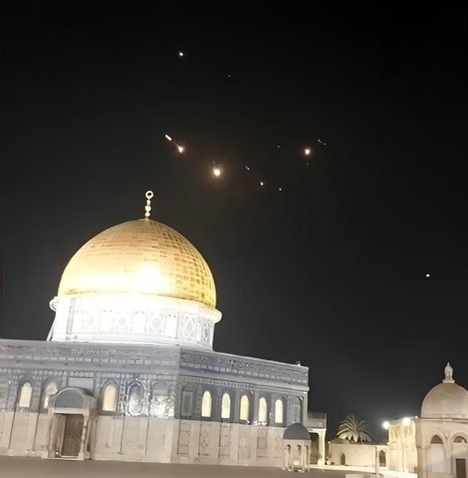
At first, Iran said it held the U.S. responsible, a hint that the response might simply be that its Iraqi Shiite militia proxies go back to hitting U.S. bases in Iraq or Syria, something they stopped completely months ago (under Iranian regime pressure). Then the U.S. stressed that it was not “involved in any way whatsoever,” that it had received no advance warning from Israel (and was not happy about that), so Iran had better not hit U.S. forces. This was a hint that Iran should instead hit Israeli interests, somewhere. Then Iran hinted that its response would not be of an escalatory nature, and U.S. sources initially agreed that the response would be minor. But then we began to read in the media exactly what its response would be–a drone and missile attack on Israel from Iranian territory–somewhat more significant than initially expected. But the reason we could read about it was that Iran gave the U.S. 72 hours’ notice via various intermediaries–Oman, Iraq, Turkey, Saudi Arabia, the UAE, and Switzerland have all been mentioned–so that the U.S. and Israel would know exactly what was coming, giving them plenty of time to prepare. In real-time theatre, discussions were essentially going on in the media between the U.S. and Iran through these intermediaries over what was deemed to be within reasonable limits to avoid escalation and so on. The U.S. made it clear that if Iran hit Israel, U.S. support for Israel’s defense is “ironclad.”

Of course, this well-choreographed retaliation gave time for Israel, the U.S., the U.K., France, and even Jordan to be well-positioned to shoot down 99 percent of the 350 drones and missiles that Iran sent against Israel. Reportedly, some drones even had their lights on! Iran’s attack was aimed at an Israeli military base, not at civilians, as U.S. leaders confirmed. Iran then declared that the matter was “concluded”. Meanwhile, since the U.S.’s “ironclad” defense of Israel had indeed been successfully put into action, the U.S. therefore, did not need to do any more. Biden commended Israel on the success of its amazing air defense system–even though this may not have been the case if the U.S. and others had not helped–telling Israel, “You got a win. Take the win” and move on; Biden stressed that the U.S. would not support or participate in any offensive Israeli operations against Iran in retaliation.

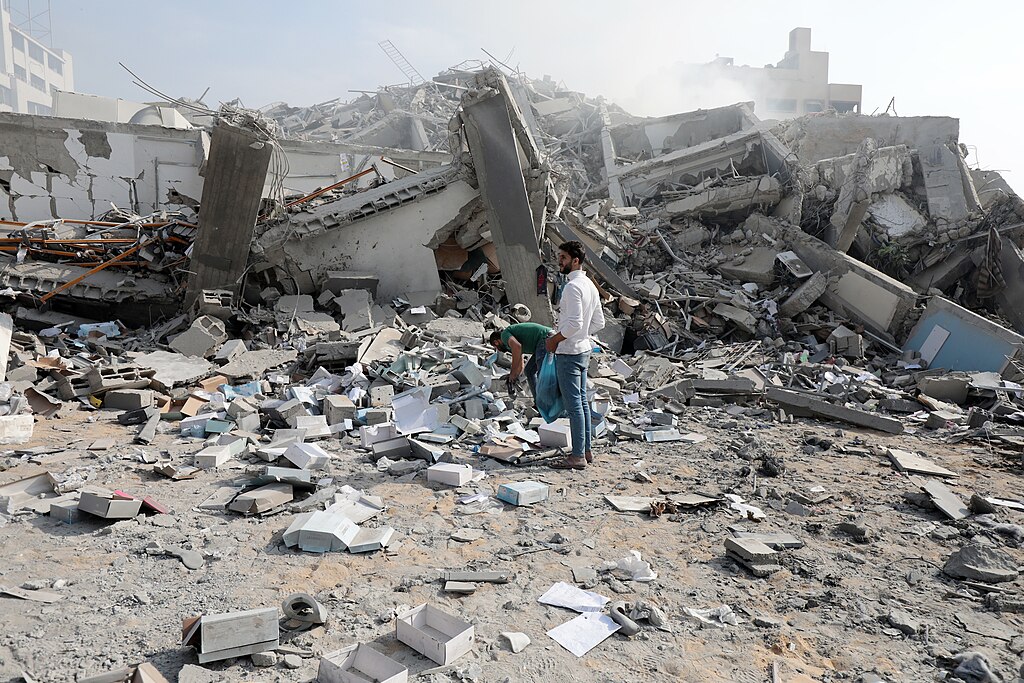
Two men stand in a pile of rubble.Damage in Gaza, October 2023. Photo: Wikimedia Commons.

The U.K., France, Germany, and other Western countries all likewise called on Israel to avoid retaliating. Russia and China neither supported nor condemned Iran’s attack (just as the U.S., U.K., and France had refused to condemn Israel’s attack on the Iranian consulate in the UN) but expressed alarm about escalation and called for calm.

So, who won, lost, or came out even in this?

Iran and the U.S., for their own reasons, want to avoid escalation. Israel, for reasons explained above, wants to escalate, but not to fight Iran itself, but rather focus on smashing Gaza. For Israel, escalation means that the U.S. gets sucked into a war of non-choice with Iran while Israel gets on with killing the Palestinians, its real, not phantom, enemies. The U.S. has given Israel 100 percent of its support – despite occasional toothless hand-wringing – to Israel’s war of genocide in Gaza but has no interest in getting sucked into Netanyahu’s escalatory games. This reluctance is not out of pacifism; it’s just that it has much bigger issues with Russia in Ukraine and China in the South China Sea, and, as Obama’s Iran nuclear accord showed, the Democrats at least have a more rational understanding that Iranian capitalism merely wants a recognized place in the region and that the bluster, is, well, bluster.

From that perspective, Israel did gain a lot. Above all, the whole episode created a theatrical distraction from Gaza; it allowed Israel to get on with mass murder while the world’s attention was elsewhere; it covered  Israel scuttling the latest negotiations of ceasefire and hostage release; and it demonstrated how efficient its defenses were. The fact that Iran chose a full frontal attack on Israel, rather than an equivalent act such as hitting an Israeli embassy somewhere, allows Israel to again play-act that it is up against a powerful “evil” regime that wants to destroy it. The episode assembled a collection of Western powers and even Jordan as a “defend Israel” coalition. The escalating criticisms of its monstrous war coming from various Western powers, even to some extent from Biden and the U.S. government, have now been blunted. Massive new arms deals with Israel and sanctions on Iran are the word from the U.S. and Western allies.

On the other hand, this is not quite enough for Netanyahu; it is not quite a regional conflagration. The limitations, and above all the choreography, of Iran’s harmless attack do nothing to bring in the U.S. to wage war on Iran; on the contrary, it allows the U.S. to preach restraint.

Iran also gained: It could say, we retaliated for the violation of our consulate, but we also acted responsibly. If Iran had not planned for all its drones and missiles to be shot down, then this would be a severe humiliation. But since that was precisely the plan, Iran simultaneously gained credibility and showed “responsibility.” It also demonstrated that it had had the potential to do damage if it had not given extensive warning, and clear notice to Israel that it no longer accepted the previous rules. It was also a useful exercise for Iran to “test out” Israeli air defense weaponry, though of course, Israel benefits in the same way.

Above all, the whole episode created a theatrical distraction from Gaza; it allowed Israel to get on with mass murder while the world’s attention was elsewhere; it covered Israel scuttling the latest negotiations of ceasefire and hostage release; and it demonstrated how efficient its defenses were.

But again, on the other hand, it can also be argued that Iran fell into Israel’s trap by retaliating, though it had little choice. While the planned results of its attack show restraint, just the fact that it chose a full-frontal attack from its territory as its method of retaliation has allowed the West to denounce “Iranian aggression” and step up support for Israel.

Arguably, the U.S. gained the most by being in a position to jointly choreograph, with Iran, the latter’s response through intermediaries and then play the decisive role in helping Israel shoot down all the Iranian hardware, it placed itself in a strong position. If its aim was to show it could defend Israel while avoiding escalation, it came out on top. While the U.S. tells Israel it should be happy to see how well its defenses performed, Israel knows its dependence on the U.S. has been displayed; this arguably puts the U.S. in a strong position to moderate Israel’s next steps.

Of course, the U.S. has continually criticized some aspects of Israel’s war while at every stage supplying Israel with the weapons to carry out its genocide, so no one should wager too much on the idea that the U.S. will not buckle if Israel were to choose a hard escalatory response. However, it appears that this has been avoided with yet another piece of elaborate theatre, this time by Israel.

Following Iran’s attack, Israel immediately announced that it had to respond and would “decide for itself” in a pointed snub to U.S. advice. As expected, the U.S. began to come around, U.S. leaders now claiming to understand that Israel “had to respond” in some way. So, the U.S. advised Israel to keep it non-escalatory. But if Israel’s response to Iran’s response was not proportionate or bigger, that would not be good for Israel’s credibility. Some Israeli leaders wanted to wage a massive attack on Iran. To prevent that, it appears that the U.S. came up with a deal to save Israel, Iran, and the region from escalation at the expense of the Palestinians.

According to Egyptian officials cited by The Times of Israel on Thursday, “The American administration showed acceptance of the plan previously presented by the occupation government regarding the military operation in Rafah, in exchange for not carrying out a large-scale attack against Iran” [emphasis added]. In other words, no retaliation has been replaced with no “large-scale” retaliation. This is all Israel has to promise in order for the U.S. to give its assent – thus far not clearly given – for Israel to launch its heralded attack on Rafah, where 1.5 million Palestinians have been driven, up against the border of Egypt, into which Israel would like to expel them.

On Friday, April 19, Israel launched its retaliation. Explosions were heard in the Iranian city of Isfahan. Israel did not explicitly report anything; Iran said the explosions were not missiles but the actions of its air defenses knocking out several drones; Iran said the event was so small that it is uncertain where the drones came from and speculated that it may have been an internal attack by “infiltrators” and indicated that it therefore had no plans to retaliate.

Before proclaiming this as a victory for Iran and a climb-down by Israel, by targeting Isfahan, where Iran has major sites of its nuclear program, without hitting them, Israel has shown that it can target them if it chooses to. Therefore, despite the small size of the action, it is an important implicit threat.

Iran wins; Israel wins; escalation is avoided (for now); the U.S. wins. But if the terms of the alleged deal are true, Palestine loses. Following Iran’s retaliatory attack, its UN mission declared it had been conducted “in response to the Zionist regime’s aggression against our diplomatic premises in Damascus” based on Article 51 of the UN Charter “pertaining to legitimate defense,” and therefore the matter can be deemed concluded.” This was not only a message to Israel, but also to Palestine; if, as expected, Israel now goes ahead with a savage attack on Rafah, backed by the U.S., Palestine is on its own.

Ruthlessly repressive capitalist dictatorships like Iran, Saudi Arabia, Egypt, Syria, the UAE, and so on have nothing to offer the Palestinian people and never have had – regardless of their rhetoric and whether they use hollow phrases like “resistance” in their titles or not. On one hand, none have ever done anything to aid Palestine; on the other, given their nature as active enemies of human emancipation, even if they did make bumbling attempts to live up to their rhetoric, it would tend to be counterproductive.

The entirely theatrical nature of the past week’s events merely highlights this fact graphically. Only the oppressed peoples of the region, when they next rise against their oppressors, can be real allies of Palestine. In the meantime, all solidarity with the Palestinian resistance in Rafah and throughout Gaza is essential to prevent Israel from using the past week’s events to further its genocidal project.

Featured image credit: https://en.wikipedia.org/wiki/File:F-15I_vs_Iranian_strikes_on_Israel_02.jpg; modified by Tempest.

Opinions expressed in signed articles do not necessarily represent the views of the editors or the Tempest Collective. For more information, see “About Tempest Collective.”

Dumb things Zionists say: 1. Gaza was no longer occupied; Israel left it to govern itself in 2005 and it responded by firing rockets at Israel

by Michael Karadjis

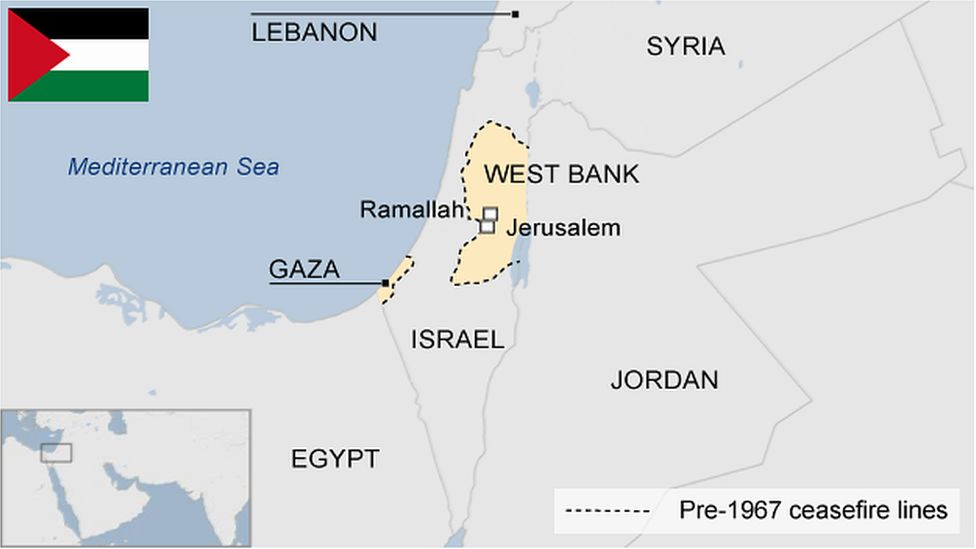
Israel “withdrew” from 6% of internationally-recognised Palestine, or 1.2% of historic Palestine; so small it is hard to see on a map, yet are expected to not resist the occupation of the rest of their country?

There are a number of problems with this. The first is widely noted by pro-Palestine advocates: that Israeli “withdrawal” was accompanied by placing Gaza under a land, sea and air blockade which prevented most goods and people form getting in or out, while Israel regularly bombed the territory, every few years in major near-genocidal operations, bombed its water and power plants, left the people undernourished and with access to only unclean water, shot at Palestinian fishing boats and so on; when a country has no control over its borders because it is blockaded by its “former” occupier, it remains occupied according to international law, not to mention common sense. And of course the devastating impacts of this blockade have been widely reported, with the United Nations reporting that Gaza was “unliveable” – imagine, that is before this current holocaust.

But there is a more fundamental reason why this is a stupid argument: Gaza is not a nation, or country or state. The nation is Palestine; the state, as recognised by the UN General Assembly and the vast majority of nations on Earth since the 1970s, covers the Palestinian territory occupied by Israel in 1967, namely West Bank and Gaza with its capital in East Jerusalem, one fifth of historic Palestine (for argument’s sake let’s leave aside for now the definition of Palestine as, well, all of Palestine, and the fact that 75 percent of ‘Gazans’ are actually refugees ethnically cleansed from ‘Israel’).  

Now, the West Bank is 5655 square kilometres; Gaza is 365 square kilometres, meaning the internationally recognised state of Palestine is 6020 square kilometres; Gaza is therefore only around 6 percent of the Palestinian state (even though there are almost 3 million living in the West Bank and 2.3 million squeezed into Gaza). Again, let’s leave aside for now that since Israel itself is 22,770 square kilometres, Gaza is therefore only 1.2 percent of historic Palestine.

In other words, even if we leave aside the blockade and accept the Zionist premise that Israel withdrew from Gaza in 2005, it therefore “withdrew” from only 6 percent of the occupied state of Palestine (or 1.2 percent of historic Palestine). So, what would we expect a people to do when the colonial occupier leaves only 6 percent of their country? Would they just say, OK, sweet, let’s just get on with it, or would they use this space to continue to resist the ongoing occupation of the rest of their country?

Let’s imagine – in the 1950s, France had withdrawn from the town of Oran on the north Algerian coastline, and a tiny area around it, but maintained its occupation of 94 percent of Algeria. So, would the Algerians in Oran set up an independent ‘Republic of Oran’ and say stuff the rest of Algeria? Or would it have been a base for the independence struggle of the rest of Algeria? The answer is obvious. The idea that the allegedly ‘free’ Gazans would have just sat pretty while Israel continued to occupy, colonise, steal land and murder in the West Bank and Jerusalem is absurd, and offensive.

Israel “withdrew” from Gaza, if we ignore the blockade that made life unliveable, it did not withdraw from Palestine.

Take Ukraine. Russia is currently occupying around 20 percent of Ukraine. That means it is not occupying 80 percent of Ukraine. Putin expects Ukraine to just cop that, to sign a peace treaty allowing Russia to annex 20 percent of its land. Most people see that as self-evidently absurd and unjust. So Ukraine continues to resist. Why is it considered normal for Ukraine, 80 percent of which is unoccupied, to continue to resist Russian occupation of the 20 percent, but it is not considered normal for Palestine, in the 6 percent that was theoretically ‘unoccupied’, to continue to resist Israeli occupation of the 94 percent of Palestine?

There is actually a third thing wrong with the statement, since it implies that Hamas simply “fired rockets” willy nilly at Israel as if Israel was doing nothing wrong; and for argument’s sake, let’s leave aside both the blockade, and the continuing occupation 94 percent of the Palestinian state, both of which mean Palestinians in Gaza have the internationally recognised right to armed resistance. What it ignores is that after “withdrawal,” Israel continued to bomb Gaza whenever it felt like it. Now, it might be a standard Zionist argument, repeated inevitably in western media, that Israel only launched such bombs “in response” to Hamas rockets, leaving aside the fact that these Israeli bombings always killed far greater numbers of Palestinian civilians than the little home-made Hamas ‘rockets’ did Israelis (they mostly killed no-one). But anyone who believes that is simply a starry-eyed victim of propaganda. Do the research – just as often it was the other way around – Israel launches some targeted assassination and kills a dozen civilian “collateral” victims, Hamas responds with rockets.

Or, reflecting the unity of all of Palestine as noted above, Israel carries out some atrocity in the West Bank, or for example invades the al-Aqsa mosque in Jerusalem, so Hamas exercises its right to resist by launching some rockets from Gaza. Were these rockets effective, or always a good idea – perhaps not, tactics can be discussed, but when you live in a sealed-off prison you have few other options – but the idea that it was mostly Israel “responding” rather than the other way around is bald fiction.