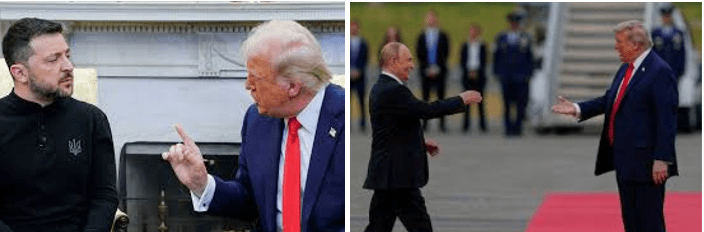
I wrote this back in 2022 during the first year of Russia’s invasion of Ukraine, but never put it up here; it was published in the Oakland Socialist blog. Therefore, its details are a little out of date in a number of ways (eg, references to the Assad regime, Yemeni civil war, Libyan civil war etc) but while details have changed, the overall reality has not: this is an argument that the widely spoken-of geopolitical ‘camps’ or ‘blocs’ are comprehensively non-existent – this ‘campist’ politics is not only anti-Marxist, anti-working-class and morally abhorrent, but also based on entirely false premises. While an update may be useful, looking at the Ukraine issue today, with Trump – the head of US imperialism – offering Putin literally everything on a plate and publicly ridiculing Ukrainian leader Zelensky for his reluctance on that score, and the US and Israel both voting against a UN motion to condemn the Russian invasion of Ukraine while China and Iran at least only abstained, anyone should be able to see the sheer pointlessness of the very notion of ‘camps’.
Trump berating Zelensky for not capitulating to Trump’s demands for total surrender to Putin; Trump lays out red carpet for meeting old friend Putin.
[Useful introduction by Oaklandsocialist who re-published this article at https://oaklandsocialist.com/2022/04/27/the-grand-chessboard-its-not-as-simple-as-you-think/:The following article is by Australian Marxist Michael Karadjis. He uses a couple of terms that may be unfamiliar to some. “Tankies” refers to those on the “left” who support bringing out the tanks to crush a workers’ uprising if those lefts oppose the goals of those workers. For example, when Polish workers rose up against the bureaucratic dictatorship there in 1980 and were crushed militarily. The “campists” often take a similar position, but what that term refers to is how some on the left only see struggles within a country in terms of how it affects rival imperialist blocs; they don’t see what is happening in the class struggle within that country. They almost always feel compelled to find an excuse to oppose whatever side the US is on. In effect, they ignore the working class. What Karadjis shows is that who is in which camp is never as simple as it might seem].
Leftwing ‘campists’ base their “principles” upon some Grand Chessboard geopolitical-economic perspective – just as their erstwhile liberal “opponents” in support of western imperialism likewise do. While doing such analysis is considered by some as being a bit “edgy”, nothing could be further from the truth – it represents the comprehensive absence of class politics.
It is useful that we refute the campists on their own terrain. That is, quite apart from the fact that tankie/campist/counter-hegemonist politics is reactionary, giving political cover to rival imperialist powers such as Russia, or brutal anti-working-class dictatorships such as that of Assad, or reactionary nationalist ethnic cleansers such as Milosevic, it is also based on assumptions about the actual existence of various geopolitical ‘camps’ or ‘blocs’ which in fact are largely a figment of the imagination, a product of the wishes of a political tendency.
Nearly all these campist assumptions arise from the condition of various Old Left activists still apparently living 50 years or more in the past, now supplemented by the odd phenomenon of tough-guy, tankie neo-Stalinism among a section of radical millennials.
Arab Countries and Russia Take Yemen for example. The point has been made that while the US and western imperialism are condemning Russia’s invasion, they do not have the same attitude to years of Saudi terror-bombing Yemen. But while that is a very good point to make about western hypocrisy, a geopolitical analysis won’t help the campists usually trying to make it.
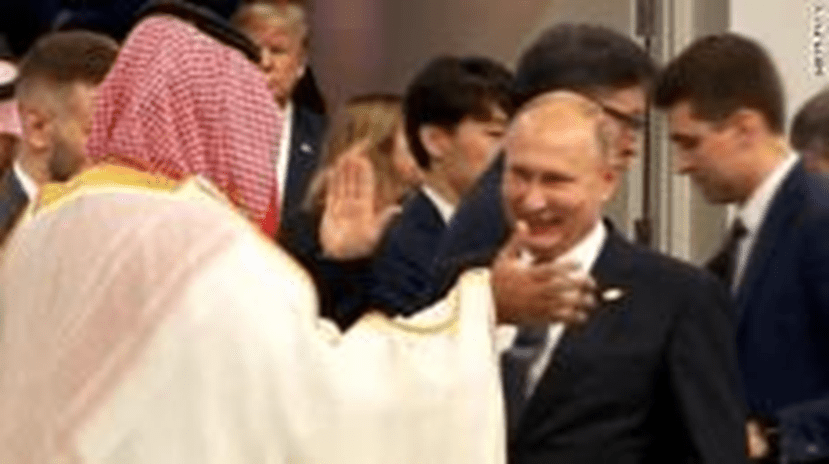
Putin high-fives Saudi Prince bin Salman. Which “camp” is Saudi Arabia in?
The alliance between Saudi Arabia, the United Arab Emirates and Egypt with Russia, is now so solid that, despite these countries depending on US weaponry, they abstained in the UN General Assembly on condemning the Russian invasion of Ukraine, the UAE abstained on the Security Council (joining India and China), both Saudi and UAE leaders have allegedly been refusing to take Biden’s phone calls, and they are steadfastly refusing US requests that they pump out more oil to make up for the shortfall caused by sanctions on Russia. The Saudis in particular argue they are loyal to their oil agreements with Russia. The UAE has declared a “strategic alliance” with Russia, while last year Saudi Arabia signed a military cooperation agreement with Russia, and is still considering purchasing the Russian S-400 air defence system. Egypt meanwhile has been buying masses of Russian arms, and Russia began work on Egypt’s first nuclear plant. Finally, neither Egypt, Saudi Arabia, the UAE, Turkey or Israel have imposed western sanctions on Russia.
Yes, it is a US-backed Saudi war in Yemen, but the Yemeni government that the Saudis are defending (in such a monstrous way) against the Iran-backed Houthi Islamist militia is the internationally-recognised government, which means the one continually voted as such by the UN Security Council, ie by Russia and China, not only the US. Meanwhile, despite the apparent Saudi-UAE alliance, the UAE has been playing its own sub-imperial game against the Saudi-backed Yemeni government by supporting a South Yemeni separatist movement, the logic of which is, yes, also opposed to the northern-based Houthis, but at the same time amenable to a division of Yemen with them. Which are the pro- and anti-imperialists in this?
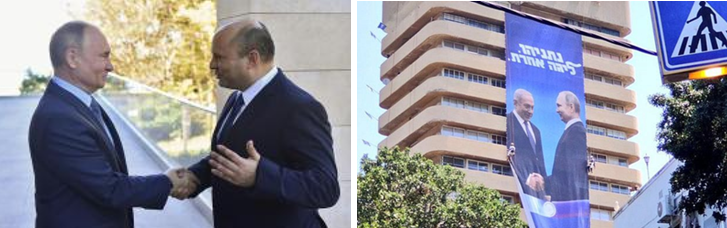
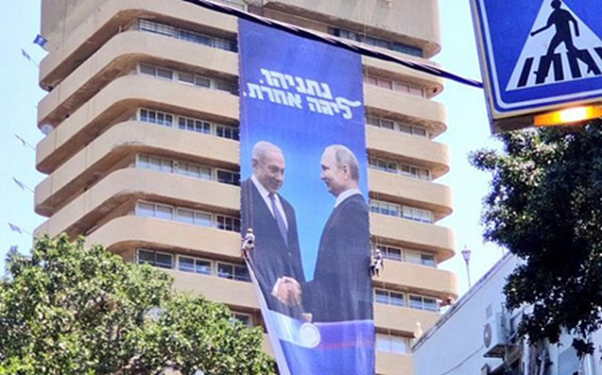
Israeli PM Bennet and Putin; Netanyahu election poster showing off his special relationship with Putin. Which “camp” is Israel in?
Israel In the case of Israel the famous alliance between Putin and Netanyahu is too well-known to warrant much space here, just to say that it continues with current Israeli Prime Minister, Naftali Bennet, the first “world leader” to make a high profile visit to Putin following the invasion, and while Israeli Foreign Affairs Minister Yair Lapid has generally gone along with the US pressure to say something, the far-right Bennet steadfastly refuses to mention Russia and banned his ministers from doing so; meanwhile the Netanyahu opposition condemns the government for even buckling to US pressure at all by saying anything at all.
It is notable that the entire world media has explained, as if common knowledge, that Israel and Russia cooperate in Syria, where Russia allows Israel to bomb Iranian positions by not activating its air-defence system there, as long as Israel doesn’t bomb the Assad regime (which it has no interest in doing). Useful info in case anyone thought that Russia and Iran were both in some imaginary anti-American “camp.” But while all true, the fuller explanation is that Israel always preferred an Assad victory over the rebels, just that it prefers Russia rather than Iran to be the main benefactor of that victory.
Two years ago, Russia, Egypt, the UAE, Saudi Arabia, Israel, Syria’s Assad regime and French imperialism formed a coalition in support of the right-wing warlord Hafter in eastern Libya who was waging war on the Libyan government, which was backed by Turkey and Qatar, and also Iran. Try doing dumb campist politics with that! Which is the “US-backed” and “anti-US” side?
Turkey, Syria & NATO When Turkey invaded Syria to attack the US-backed, leftist Kurdish-led SDF in 2019, this was furiously condemned by Israel, Egypt, Saudi Arabia and the UAE. The Assad regime also condemned it, but at the same time made clear that it aimed to do the same as Turkey was doing to the SDF; basically it was angry that someone else was doing its job, but not too angry. Palestinian Hamas declared its support for its Turkish ally against the SDF, whose core group is the Syrian branch of the PKK, once an “anti-imperialist” favorite. So does that mean the SDF is in the pro-US imperialist camp and Hamas in the anti-US imperialist camp? But hang on, Turkey, where lots of Hamas leaders live, is in NATO, while Israel/Egypt/Saudi/UAE are not …
Incidentally, if Turkey attacks the SDF, the key US ally in Syria since 2014, while being a NATO member, and NATO-leader US’s key ally in Syria is the Syrian wing of the PKK, Turkey’s arch nemesis, this might also raise questions as to the effectiveness of NATO in ever acting as a united vehicle in some kind of offensive capacity against Russia, as much left-magical theory suggests (even perhaps aimed at “Balkanising Russia”, according to some truly out-there left-conspiracist fantasy). As we might remember, the loudest voices against the US invasion of Iraq came from NATO France and Germany, while NATO Turkey refused to allow the US to stage its invasion from Turkey. Four NATO members still refuse to recognise Kosovo, despite the Kosovo war having been virtually the only ever united NATO action, and even now NATO member Hungary rejects sanctions on Russia or arms to Ukraine.
In recent years, the UAE, Bahrain, Sudan, Morocco and effectively Oman have re-established relations with Israel (joining Egypt and Jordan which long ago did), allegedly with the somewhat more reserved backing of Saudi Arabia, which is reluctant to commit. In the very same recent years, the UAE, Bahrain, Jordan, Egypt, Sudan and Oman have re-established relations with the Assad regime, with the somewhat more reserved backing of Saudi Arabia, which is reluctant to commit (it finally joined them in 2023). Tell me again, which “camps” are these countries in?
Russia and Syria When Russia launched its war of aggression against the Syrian people in 2015 on behalf of the genocidal tyrant Assad, the UAE, Egypt and Jordan released a statement welcoming the invasion, while Netanyahu’s already existing bromance with Putin began its true blossoming. When the US launched its war against ISIS in Syria in 2014, it was welcomed by the Assad regime.
In other words, the entire edifice of imaginary ‘camps’ in the Middle East simply does not exist, not at all, nothing, zilch, nada, but many leftists (and liberals for that matter) still imagine they are living in 1969 or something.
Conclusion: Get back to basics! But if this summary shows that conventional geopolitical assumptions are purely imaginary, what explanation can we make of this apparent geopolitical mess? How can we “geopolitically” analyse this mess? Seems to me we need to get back to the basics about class, revolution and counterrevolution, and combine this with recognition that powerful sub-imperial rivalries can at times ‘play’ with these class dynamics, try to ride them, coopt them, exploit them to their advantage against rivals, at closer range than larger imperialist powers, producing at times confusing alliances, but at all times the main dynamic is fundamental alliance against revolution and in defence of the the ancien regime system throughout the region, where the ruling classes of all these reactionary regimes were threatened by [the Arab] Spring.
A few years ago in reply to a friend I wrote this piece on the question [in relation to Syria], and though of course much has changed since, once again most of the basics are solid.
In Myth 7, I already dealt with the claim that Ukraine was “forced” by an alleged Boris Johnston statement to abandon peace talks, and demonstrated that Ukraine never abandoned the path of negotiations.
However, the more general idea that the war continues because the US (before Trump) and European leaders want it to, to grind down Russia, and they therefore use their sway over Ukraine to push it to take uncompromising positions which prolongs the war, remains widespread within a certain “left” discourse. According to this version, most Ukrainians would happily give up some or all of the Ukrainian territory that Russia has conquered in exchange for peace, but their leaders, puppets of the US, UK and EU, keep forcing them into the “meat grinder” over this little bit of borderland.
Before we get onto the main issues, it is worth just noting that if western powers were using Ukraine to grind down Russia by keeping the war going – ie continuing to fund Ukraine’s defence against illegal aggression and occupation – then surely Russia, if it did not want to be “ground down” like this, could withdraw from the illegally occupied territory, and end the war? But yes, simple logic like that is not as much fun as blaming the victim.
For the record, of course it is a legitimate argument that the war has gone on too long, that too many are getting killed, and that this can no longer be justified by the need to regain territory, and therefore Ukraine may be forced to make a compromise that is against its interests, due to Russia’s overwhelming military superiority. Liberation movements have many times been forced into such rotten compromises when the odds are overwhelmingly stacked against them. And if and when they do, supporters in the West would be completely out of order to “condemn” the victim for “capitulating;” in our solidarity, we would continue to condemn the aggressor as the cause of the rotten compromise, the imperial theft, but recognise the right of the oppressed nation, in this case Ukraine, to make its own decision.
And yes, some of the people I might partly disagree with do simply advocate this; they believe there is no alternative; Ukraine’s case is hopeless; being forced to give up territory is unjust, but a necessary pragmatic decision because the number of Ukrainian troops dying cannot be justified by keeping the territory. They don’t necessarily put the blame on Ukraine, the condemn the Russan invasion, but they think if Ukraine does make the rotten compromise now, it will only have to do so later, after countless more have been killed. And this article does not argue against these comrades; that is a valid position.
But when Ukraine has not made such a decision, surely it is just as out of order for people in the West to be “condemning” Ukraine for not making a rotten compromise, for not capitulating, for not agreeing to trade away its occupied territory, and the Ukrainian populations who live or use to live there, while making every excuse under the sun for Russia’s right to aggression, occupation and annexation. When it is not simply a pragmatic argument, like in the previous paragraph, but one that puts the blame on the occupied nation for the war continuing. Yet that is the view of a substantial part of the western left.
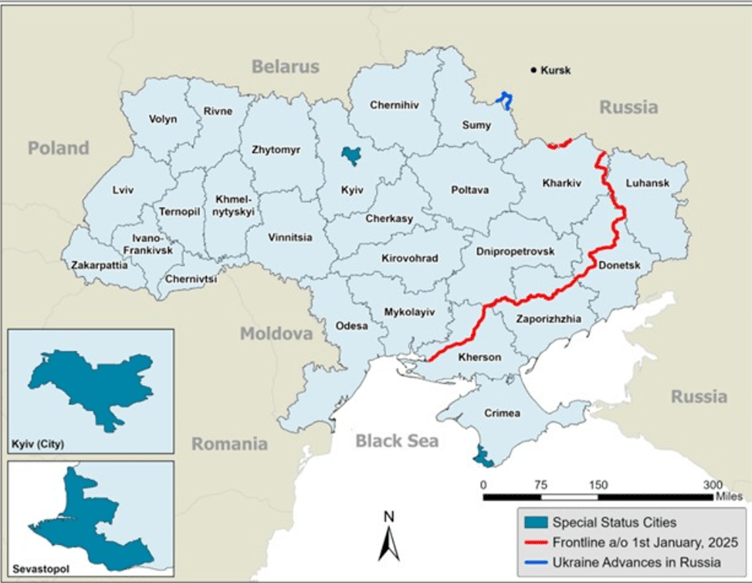
Let’s be clear on what kind of compromise Ukraine is being asked to make: Russia has annexed five Ukrainian oblasts – Crimea, Donetsk, Luhansk, Kerson and Zaporizhzhia. Crimea was annexed in 2014, Donetsk and Luhansk were invaded in 2014 but less than half occupied by 2022, while Kerson and Zaporizhzhia were not invaded until after the 2022 war began. Only later in 2022 did Russia formally annex these four oblasts, despite still not controlling all of Donetsk, Kherson or Zaporizhzhia.
Map shows how much of the five oblasts Russian troops currently occupy (red line shows the extent of Russian occupation)
The question is whether Ukraine should give up these 5 oblasts in their entirety, or all the sections of them currently under Russian control, or whatever was under Russian control in February 2022, in exchange for an end to the war. The five oblasts constitute about 20 percent of Ukraine’s sovereign territory. Look at the map: it almost completely cuts Ukraine off from the Black Sea, which, after all, is precisely one of the strategic aims of Russia’s imperialist war of conquest.
We should also be clear that Russia demands formal recognition of all these annexations, made by brute, illegal, military conquest, not simply long-term ceasefire. Take for example the Syrian Golan. Israel conquered the Golan in 1967, Syria made an attempt to regain it in 1973, and then in 1974, recognising the overwhelming odds, signed a long-term demarcation of forces agreement, whereby Israel remains in occupation of the Golan – which it later illegally annexed – and Syrian and Israeli troops were separated by a UN force, and Syria never again attempted to recover its territory – but neither the Assad regime nor the current post-Assad government recognise the annexation; every year, a UN Resolution reaffirms Syrian sovereignty.
To be clear: this kind of pragmatic arrangement is not on offer to Ukraine. In fact, for all those saying Ukraine should just negotiate over territory, and blaming it for not doing so, remember that from Russia’s viewpoint, there is nothing to negotiate: Putin’s regime demands recognition of Russia’s annexation of all five oblasts as a prior condition for negotiations to even begin!
So what do Ukrainians think of territorial compromise?
What the is the truth about the opinions of Ukrainians? Are they being forced by a Zelensky government acting as western “proxy” to fight rather than surrender territory? The easiest way to check is to do 5 minutes of research.
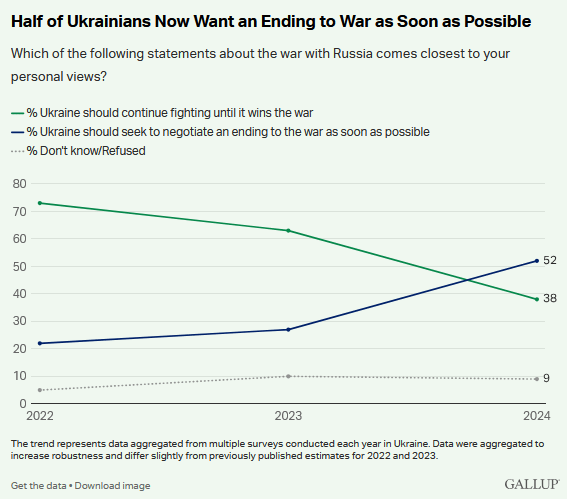
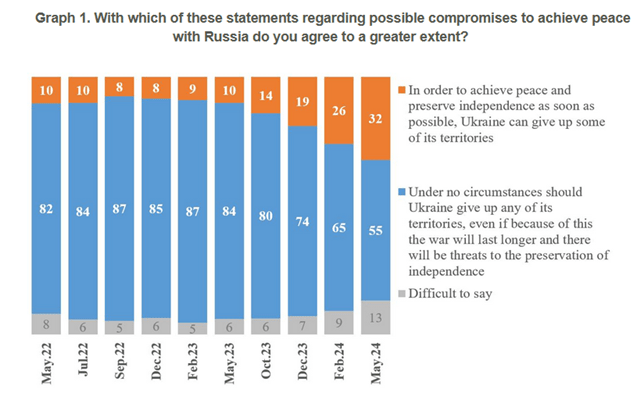
In 2022-23, a full 87 percent of Ukrainians rejected any territorial compromise. But after years of war, surely the figure has gone down? Yes, it has, but not by as much as might be expected.
According to a Gallup poll conducted in late 2024, around 52% of Ukrainians “would like to see their country negotiate an end to the war as soon as possible,” while only 38% “believe their country should keep fighting until victory.” Ten percent didn’t know or didn’t answer. This is a big change compared to previous years.
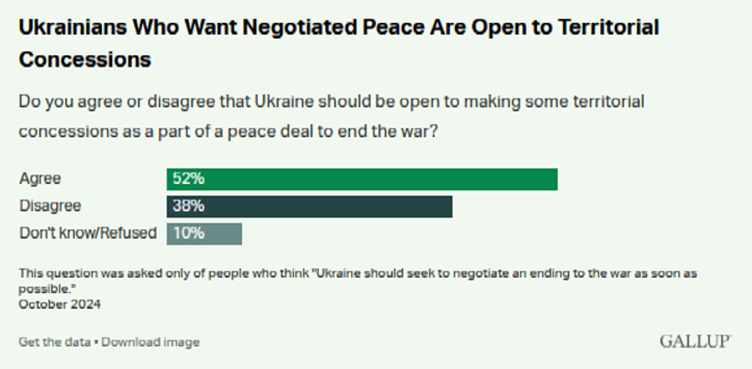
However, only 52% of this 52% agreed that “Ukraine should be open to making some territorial concessions as a part of a peace deal to end the war.” That is, only 27% of the population agree to even “some” territorial compromise.
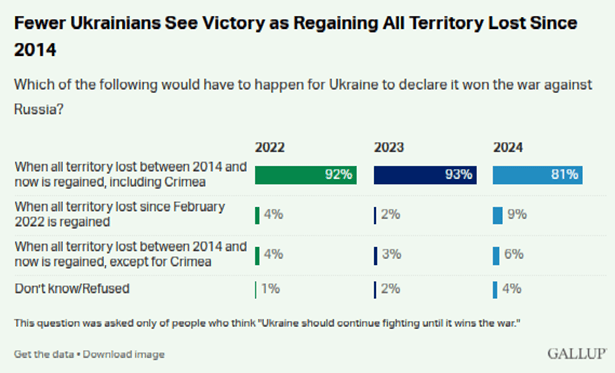
Of the 38% who believe in “fighting till victory,” only 19% would agree to some territorial compromise (as the bar chart shows, 81% reject any territorial compromise); that is, only 7% of the population:
Add this to the 27% from the first group, and 34% of Ukrainians are now in favour of “some” territorial compromise. In contrast, around 51% of the population reject any territorial compromise.
These figures tie in well with another survey, by the Kyiv International Institute of Sociology (KIIS), from mid-2024, which found that 32% of Ukrainians were in favour of some territorial concessions, while 55% reject any compromise.
Now, while both surveys show a majority rejecting all territorial concessions, the majority is razor thin, even if the pro-concession group is considerably smaller. However, the devil here is in the details.
In the Gallup poll, as can be seen in the chart above, while 81% of Ukrainians wanting to “fight till victory” believe all territory must be recovered for this “victory, a full 96% believe that Ukraine must regain a substantial amount of territory: 9% want to regain all territory lost since the Russian invasion of 2022 (ie, all of Kherson and Zaporizhzhia and most of Luhansk), about half the occupied territory, while another 6% want to regain all four eastern oblasts but would be prepared to give up only Crimea.
If we were to add these people to those rejecting capitulation to Russia’s territorial demands, the number goes up to 56%, while those in favour drops to 29%.
But as the poll does not give similar breakdown data for the first group, ie the majority wanting a negotiated settlement, who agree to “some” territorial concessions, it is likely to also be the case that many of those who agree to “some” would reject ceding all territory. As such, the numbers rejecting the Russian demand to recognise all annexed territory as Russia’s is likely to rise to some two thirds; the number accepting to be a quarter at most.
Clearly, the vast majority are opposed to ceding all territory to Russia, so it is fiction that the Ukraine government does not represent the popular will. However, it is clear that the majority is declining, and the numbers supporting “some” territorial concession, while still a minority, are now substantial enough to suggest that some kind of compromise is possible for the sake of ending the war. But the problem remains that Russia’s starting point for beginning negotiations is Ukraine’s prior recognition of its annexation of all five oblasts, even the parts it does not control. This makes condemning the Ukrainian government or people for wanting endless war, seeing them as the party that needs to be pressured, is somewhat absurd.
NATO, security guarantees, and Trump
It is also important that Ukrainians in various polls (especially the KIIS poll) see security guarantees as just as an important an issue; if forced to make territorial concessions for peace, they do not want Russia to re-invade again in a few years. And most see NATO membership as the most certain form of security – it is rather obvious to them that Russia invaded a NATO non-member, while Sweden and Finland, the latter with a long border with Russia, have never been touched or threatened since joining NATO.
Yet for all this – and all the non-sequitirs from much of the left about prospective Ukrainian NATO membership being what “provoked” Russia’s invasion, the reality is that NATO membership was never on the cards for Ukraine, and Zelensky was always ready to trade that away – this was offered to Putin before his invasion, and he rejected it, since his aim was territorial conquest, not the NATO bogey; Ukraine again offered it in a formal peace plan a month into the war, to which Russia responded with the Bucha massacre and the complete obliteration of Mariupol (see Myth 7). If there is no NATO membership, Ukraine has been willing to accept other forms of tight security guarantees all along. But the NATO discussion will the topic of Myth 9.
A final note related to what Ukraine may have to compromise on: the problem with Trump’s blatant dealing with Putin over Ukraine’s head about Ukraine is not some pragmatic recognition that the war is a quagmire and requires negotiations and bad compromises; nor that the US wants to get out of Europe, focus elsewhere, and leave European problems to Europe. It is hilarious watching parts of the left cheer Trump – the guy who wants to expel two million Palestinians from Gaza – as a peacemaker!
Because if Trump simply wanted to launch a negotiation, he might have included Ukraine and Russia on equal terms rather than engaging in such blatant imperial carve-up; and he would not have given everything to Moscow in advance, he and his ministers declaring in advance of negotiations both that Ukraine will not recover its territory and that it will not join NATO and that the US will not be involved in any other security guarantees; Trump told Zelensky that he had “no cards,” as he had given all of Ukraine’s cards away to Russia before any negotiations begin. If that is not a blatantly pro-Putin action, I don’t know what is. And if he wanted the US out of Europe, it is strange that he invited Zelensky to the White House to get Ukraine to sign a colonial deal to hand over its mineral wealth to the US; Ukraine is in Europe.
It is no accident that Zelensky’s popularity in Ukraine shot up following the Trump-Vance ambush where he left without signing the colonial deal; because whatever else may be wrong with the Zelensky government – a neoliberal government that socialists would take issue with on many fronts – the stance of defending Ukraine’s self-determination against Russian imperialism remains one with significant majority support.
It is well-known that Israel’s Gaza genocide is principally enabled by the constant supply of tens of billions of dollars of killing equipment by the United States, making it the principle accomplice in the genocide, with Germany coming in a close second.
An important secondary question, however, is that of who continues to supply most of the state’s oil and coal (Israel has its own Mediterranean gas supplies) that keep the Israeli economy and war machine running. It may surprise some that the main culprits have been publicly critical of Israel’s actions, including BRICS members Russia, Brazil, Egypt and China, as well as some who have condemned Israel most furiously, such as BRICS member South Africa and, indirectly, Turkey.
According to S&P Global in late October 2023:
“With almost no domestic crude or condensate production, Israel has been importing around 300,000 b/d of crude this year to process at its two refineries in Haifa and Ashdod. Israel’s biggest source of oil is the Kazakh-sourced CPC Blend crude exported via Russia’s Black Sea port of Novorossiisk and Azeri Light which is shipped from Turkey’s Mediterranean port of Ceyhan. Together they accounted for over half of Israel’s crude imports this year” [emphasis added].
Map showing the routes of the BTC pipeline (red), through which Azeri oil reaches Israel via the Turkish port of Ceyhan, and the CPC pipeline (green), through which Kazak and Russian oil reaches Israel via the Russian Black Sea port of Novorossiysk
It is worth breaking this down a little more. First, even with regards to fuel, the US is also a supplier, mainly of refined JP-8 Jet Fuel for Israel’s killer jets, as part of US military aid to Israel; three tankers of jet fuel have arrived since October. Before the war, the only other form of refined fuel Israel imported was from BRICS member and rabid Israel-ally India, which supplied diesel, but this has fallen off, not due to good intentions, but rather due to the Red Sea blockade by AnsarAllah authorities in north Yemen. Regarding India, it is worth adding that an Indian-Israeli joint-venture has been producing Hermes 900 UAV attack drones and providing them to Israel; India has also been providing large numbers of rockets and explosives to Israel. Indian leader Modi is, of course, a close ally of his “dear friend” Vladimir Putin as he described him in his recent trip to Moscow.
Besides refined fuel, “Israel’s military requires significant quantities of diesel and gasoline for tanks and other military vehicles” which “is supplied by Israel’s refineries” in Ashdod and Haifa, which rely on imported crude oil. This is where Azeri, Russian-Kazak, Brazilian and Egyptian crude comes in, alongside growing supplies from Gabon/Nigeria.
Azerbaijan has been a major supplier of oil to Israel for many years, as part of a two-way arrangement in which Israel supplies Azerbaijan with guns. The basis of this cozy arrangement is Azerbaijan’s fraught relationship with neighbouring Iran; Azerbaijan’s three-decade autocrat Aliev runs a secular dictatorship, but as Azerbaijanis are largely Shiite, he fears the influence of Iran’s fundamentalist Shiism; while Iran itself includes a very large Azeri minority, and Iran in turn fears Azerbaijan’s potential influence there. Though this has not prevented some growing Iran-Azerbaijan cooperation, particularly on the International North-South Transport Corridor running from Russia, via Azerbaijan into Iran and out into the Indian Ocean to the Indian city Mumbai, nevertheless this arms for oil Israel-Azerbaijan arrangement has stood the test of time.
Israeli arms played a decisive role in facilitating Azerbaijan’s reconquest of the Armenian-populated Ngorno-Karabakh region in 2023, which led to the flight of 90 percent of the population.
The problem is that for landlocked Azerbaijan to get its oil to the Mediterranean Sea, it must go through Turkey via the BTC (Baku-Tsibilisi-Ceyhan) pipeline; while long ago a reliable ally of Israel under the Kemalist military, Erdogan’s Islamist AKP regime turned markedly anti-Israel and pro-Palestine since coming to power in 2003. But this did not prevent long-established, large-scale Turkish-Israeli trade from flourishing, indeed Turkey had been Israel’s fifth largest trading partner; and above all Azerbaijani oil has continued to flow through Turkey to Israel.
Erdogan’s regime finally put its money where its mouth is in May 2024, cutting off all Turkish trade with Israel. However, given the international agreements involved with Azeri oil and the BTC pipeline (BP is the major shareholder along with Equinor, Eni, Total, Exxon and the Azeri oil company, while the Turkish oil company TPAO only holds a 6.5 percent stake), Turkey would find it very difficult to prevent Azeri oil going through to Israel, without forcing a legal showdown and by all accounts this oil continues to flow to Israel.
As such, while Erdogan tells a gigantic state-organised march that Hamas is a “national liberation movement”, calls for a genocide trial for Netanyahu and claims there is “no difference between Netanyahu and Hitler,” while Turkey was the first country to formally join South Africa’s genocide case against Israel in the International Court of Justice (ICJ), and while finally ending trade relations, Azeri oil traversing Turkey still accounts for some 40 percent of Israel’s crude imports.
Kazakhistan, Russia and the CPC pipeline
The other major source of Israel’s crude imports has been from Kazakhistan, which, like Azerbaijan, is landlocked; in this case Russia takes the place of Turkey, with Kazakh oil entering the Black Sea at Russia’s port of Novorossiysk via the Caspian Pipeline Consortium (CPC). Israel also exports drones, precision rockets, radar systems and communications equipment to Kazakhistan, as well as the spyware technology of the NSO Group, with which the autocratic Kazakh regime infects the phones of dissidents. Kazakhistan is a close Russian ally and a member of the Shanghai Cooperation Organisation (SCO).
Notably, in contrast to Turkey, Russia is not merely a transit territory but the major investor and minor supplier itself. Some 44 percent of CPC shares are owned by Russian companies, above all the state-controlled, joint-stock company Transneft, the largest oil company in the world which alone owns a quarter of CPC, alongside Lukoil (12.5 percent) and Rosneft (7.5 percent); other shareholders include Chevron, Exxon, Shell, Eni and Kazakh oil companies (20 percent). Likewise, “CPC oil is a blend made up of oil from major fields in and around both the Kazakh and the Russian sections of the Caspian Sea, as well as smaller onshore fields in southern Russia. The majority is Kazakh, and cargoes are given either a Kazakh or a Russian certificate of origin in overall proportion to the amounts of oil that are shipped through the system from each country.”
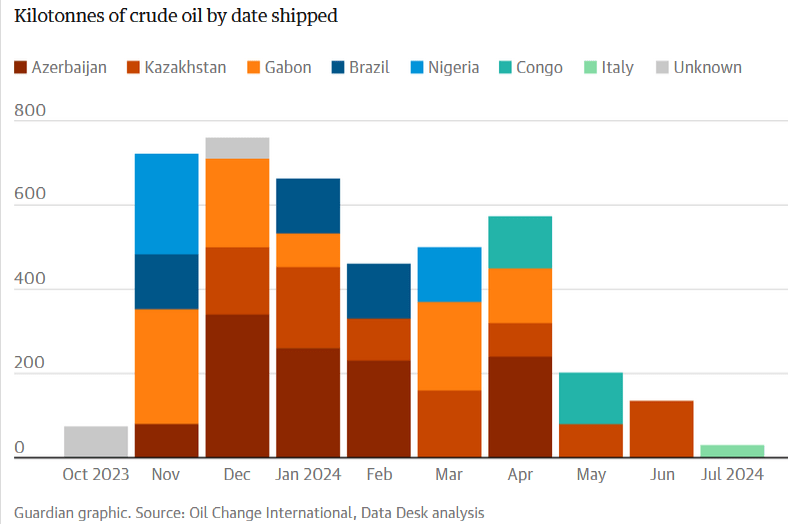
As we see in the chart above, in July-September 2023, CPC supplied some 40 percent of Israel’s oil imports; while it has fluctuated since, in January 2024 it still accounted for some 40 percent of the total. The data shows that at least 600kt of Kazakh/Russian crude has been shipped to Israel since October via the CPC. This later chart based on data from Oil Change International, shows this has continued through 2024, the CPC supplying some 40 percent of Israel’s oil in March and 100 percent in June:
Despite Russia’s verbal criticism of Israel’s actions, the only unlikely danger to the CPC supply would be not Russian government policy but western sanctions on Russia over Ukraine (sanctions which Israel does not take part in), but “the importance of Caspian Sea oil and gas to US firms ExxonMobil and Chevron — and the lack of viable alternative export routes — has so far saved the CPC system from Western sanctions, and there is no reason to suspect that this will change in the near future.”
In addition, Russia also exports ‘dirty’ petroleum products to Israel, notably VGO fuel oil, which is upgraded into jet fuel (!) and diesel, and “this flow does not seem to have been affected by recent events, with four cargoes having reportedly arrived since 13 October 2023,” carrying 120 kt. Russian VGO has been impacted by EU sanctions, probably making the Israeli market for VGO even more important today.
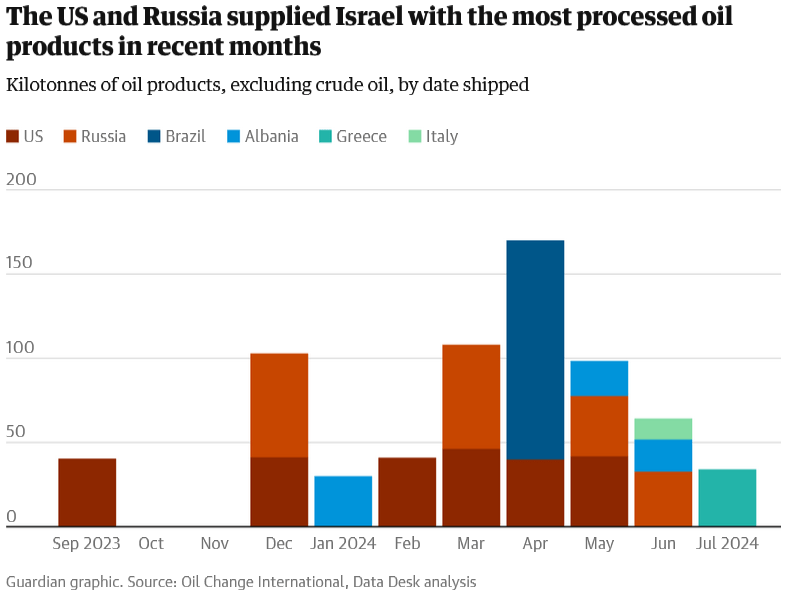
Russia and the US have also been the main suppliers of processed oil products to Israel over the last year, on some months Russia ahead of the US, though both were surpassed by BRICS member Brazil in April:
Finally, Russia is also an important supplier of coal to Israel, exporting 247,500 mt to Israel in the first half of 2014, second only to Colombia, which in June banned coal exports; more on this below.
Interestingly, both Turkish and Russian trade with Israel was jointly highlighted on June 9 when the Turkish cargo vessel Yaf Horizon caught on fire in Haifa harbour. It was somewhat embarrassing because this was after Turkey’s trade ban, indicating that some Turkish companies have attempted to get around the ban (indeed some circumvent it by re-routing through Greece, which is currently strongly allied to Israel on an anti-Turkey platform). The vessel had first docked at Russia’s Novorossiysk port, where it picked up Russian iron or steel for export to Israel.
Where does Israel-Russia collaboration stand at present?
Of course, there ought to be nothing surprising about Russia supplying, and facilitating the supply of, oil to Israel, given the long-term close relationship between the two countries. During Israel’s ‘Operation Protective Edge’ Gaza blitzkrieg in 2014, which killed 2500 Palestinians, Putin declared “I support the struggle of Israel,” while Israel refused to join its western allies in condemning the 2014 Russian annexation of Crimea, abstaining in the UN and rejecting sanctions.
It was hardly surprising that Netanyahu’s equally ultra-rightist successor, and former ally, then prime minister Naftali Bennett, was the first ‘world leader’ to make a high level visit to Moscow to meet Putin after his invasion of Ukraine. Bennett’s first statement following Russia’s invasion merely affirmed Ukraine’s right to sovereignty, but made no mention of Russia. Following US pressure, foreign minister and ‘moderate’ Zionist Yair Lapid issued the official, half-hearted condemnation. Bennett then issued a demand that his ministers say nothing; rejected Ukraine’s calls for arms, blocked any attempt by third parties to send Israeli-made arms to Ukraine, and blocked the US from providing Israeli ‘iron dome’ missile shield technology to Ukraine. Despite two and a half years of pressure from Israel’s main ally, the US, Israel has still not sent a gun to Ukraine. Even in January 2024, Israel rejected US requests for it to supply some very old (supplied to Israel in the 1960s) anti-aircraft weaponry to the US for it to give to Ukraine. Not long before October 7, Russia announced the opening of its consular offices in West Jerusalem, which it had recognised as Israel’s capital several years earlier, despite that city’s illegal incorporation of East Jerusalem.
Following the onset of the Gaza genocide in October 2023 however, these powerful Russian-Israeli relations began to fray. The above demonstrates that this was not because of any problem with Israel as such, but rather was related to Russian-American rivalry. For nearly two years, the US, for its own imperial reasons, had led support for Ukraine’s legitimate struggle for self-determination against Russia’s illegal and barbaric war of aggression. Now it was Russia’s chance to turn the tables, criticising the US for its 100 percent support for Israel’s absolutely apocalyptic actions, showcasing Russia’s more “balanced” view of the Mideast crisis, blaming the US for not having brought about the ‘two-state solution’. While Putin’s target is the US rather than Israel as such, this discourse by definition means criticism of Israel, resulting in damage to Israeli-Russian relations.
While much analysis suggests this is due to the growing relationship between Russia and Iran (eg with Iranian provision of killer-drones for Moscow’s war in Ukraine), in reality Russia (and China) merely place themselves in the exact ‘Arab mainstream’ on these issues alongside their BRICS allies Egypt, Saudi Arabia, the UAE etc – recognition of Israel, calls for ‘two-state solution’, supporting UN ceasefire resolutions, condemnation of the October 7 attack as an “absolutely unacceptable terrorist attack against Israel,” demanding the unconditional release of all Israeli hostages, strong support for the collaborationist Palestinian Authority, refusal to join South Africa’s ICJ case against Israel and so on. Russia’s mild change of stance has not led to even one Israeli warplane being shot down by Russian-controlled air defence while attacking pro-Iran targets in Syria. Meanwhile, in contrast to the active Israel-Lebanon border, the Syria-Israel Golan demarcation line “remains conspicuously calm,” the Syrian regime having instructed its forces in the Golan “not to engage in any hostilities, including firing bullets or shells toward Israel.” To keep it that way, Russia has beefed up its forces along the Golan occupation line to ensure no stray Palestinian or Iran-backed forces cause any trouble.
Of course, the shallowness of Russia’s public criticism of Israel can be gleaned from some of the more serious Russian commentary, such as Foreign Minister Sergey Lavrov’s December 28 interview, in which he directly compared Russia’s and Israel’s campaigns in Ukraine and Gaza by using Russia’s Orwellian terms to describe its own invasion: “Prime Minister Benjamin Netanyahu announced that Hamas must be destroyed as a whole and as a military force. It sounds like demilitarisation. He also said that extremism must be eliminated in Gaza. It sounds like denazification.” He then went on to commend Netanyahu for not criticising Russia’s war in Ukraine.
In this light, Russia’s provision and facilitation of a major part of Israel’s oil and coal supplies should not be any surprise, but in case anyone were taken in by its newly critical position towards Israel, these material facts are a reminder of reality.
Iraq, Egypt and Brazil
Until April 2023, Iraq’s Kurdistan Regional Government was also an important oil exporter to Israel, again traversing Turkish territory to Ceyhan, but a legal dispute between the KRG and the Iraqi government halted this flow. The main sources making up for this loss have been Gabon and Nigeria, Brazil and Egypt.
BRICS member Brazil is another important supplier of crude to Israel, with two shipments totalling 260 kilotonnes delivered to Israel in December 2023, and February 2024. This crude was supplied from oil fields owned by Shell, TotalEnergies and Brazil’s Petrobras. This is despite the Lula government’s sharp criticism of Israeli actions, leading to the withdrawal of Brazil’s ambassador to Israel in late May and expression of support to South Africa’s genocide case against Israel in the International Court of Justice (ICJ), at one point Lula even calling the Israeli military campaign ‘genocide’.
Finally, Israel imports a small but regular amount of oil from its BRICS neighbour Egypt, via Sidi Kerir, near Alexandria, the terminus of the SUMED pipeline. Oil from BRICS members United Arab Emirates and Saudi Arabia, as well as Iraq, also feeds into this pipeline. Many might say, this is no surprise, Egypt being the first Arab state to recognise Israel, the irony being that many ‘anti-imperialist’ critics believe BRICS to be the answer to US imperialism – yet BRICS members Russia, China, India, Brazil, South Africa, United Arab Emirates and Ethiopia, like Egypt, all have long-term relations with Israel; only Saudi Arabia and Iran do not. Words are good, but oil profits are another thing.
Of course, it is certainly true that the al-Sisi dictatorship has collaborated with the Israeli blockade of Gaza for years, and now blocks Palestinians fleeing from Gaza not to prevent the new Nakbah, but because the regime hates Palestinians as much as Israel does. But alarmed by the impact Israel’s genocide on its borders was having on its own population, Egypt announced in May it was formally joining South Africa’s genocide case against Israel in the ICJ, alongside Turkey and Colombia. But of course, like the others, Egypt still draws the line at actually taking any concrete action.
Coal: Russia, China, South Africa to the rescue
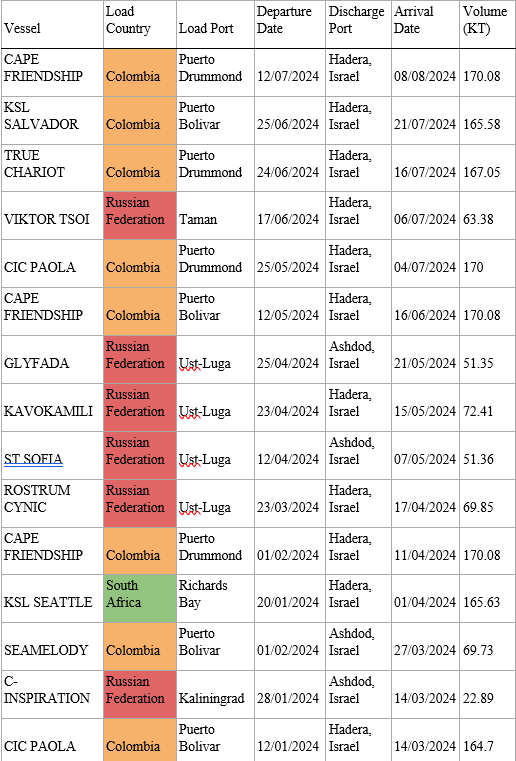
On June 8, Colombia’s President Gustavo Petro announced that his country would suspend coal exports to Israel – Colombia had on average supplied about 50-60 percent of Israel’s coal. Israel had imported 1.4 million metric tons (mt) of thermal coal in 2024 to date, of which Colombia supplied 855,700 mt, or 60 percent of Israel’s coal imports.
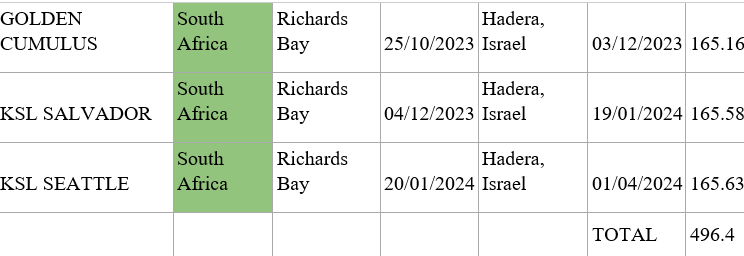
But according to S&P Global Global Commodities at Sea data, Russia was next, exporting 247,500 mt to Israel in that period, fellow BRICS member South Africa next at 169,200 mt, then the US at 86,100 mt and BRICS member China with 53,000 mt. LSEG Data and Analytics shows slightly different but similarly revealing data, showing that Russia had exported nearly double that amount, some 512,000 mt, to Israel since October 7, South Africa 496,000 mt, while not revealing any Chinese coal exports:
This data from LSEG Data and Analytics, showing coal shipments to Israel in 2024, reveals the large role of Russian coal in sustaining Israel’s regime; unfortunately seems to show that Colombia’s boycott has not been put into practice as of July; does not show Chinese shipments as claimed by S&P Global, Source: https://docs.google.com/document/d/1rKdD_nWe5o4YQ3YYXUGkSsXQT4JO0DQ5cAxJ5OYyzeU/edit
As discussed above, there is nothing out of the ordinary in Russia’s case, but an intriguing incident may cast some light on what more may be happening below the surface. On June 12, the Houthis launched a small watercraft, drone and missile attack on the Greek-owned, Liberian-flagged vessel M.V Tutor, sinking it. The Tutor was, or had been, carrying 80,000 mt of Russian coal, loaded at Ust-Luga, near Saint Petersburg; it was on its way to India after traversing the Suez Canal. While the Houthis have not exactly been precise in their choice of attacks – they claim to only attack vessels trading with Israel, yet hits have included ships carrying grain to their ally, Iran, twice, and a Chinese ship carrying Russian oil to India – it is likely that even such hits are based on erroneous assumptions. What may have caused an attack on such a large shipment of Russian coal?
On this, Patrick Bond from the University of Johannesburg speculates that “This may be because MV Tutor had apparently stopped at Jordan’s Aqaba New Port, where it seems that coal can be quickly unloaded and transported, either up the Jordanian highway seven hours distant to cement factories where it serves as a fuel, OR perhaps across the nearby Israeli border at the Rabin Crossing, from where around four hours away by truck, the coal can be sent to storage depots next to the Rutenberg coal-fired power plant, which normally served by ships unloading directly at Ashdod. Next door, Ashkelon’s port has been closed because it’s just 4km from Jabalia in Gaza.”
South Africa, however, was widely commended for its genocide case against Israel at the International Court of Justice, but till now has also had extensive trade relations with Israel, exporting $350.9 million to Israel in 2022, of which 40 percent was coal, and as shown below, nearly 500,000 mt of coal since October:
To date there are no indications of steps being taken to end these coal supplies to Israel, and with the new governing coalition between the ANC and the pro-Zionist Democratic Alliance, this seems even less likely to change. This urgent appeal to South Africa to halt all coal exports to Israel issued by the Global Energy Embargo Coalitionprovides a great deal more information on this trading relationship with South Africa and Israel.
Thus despite its ICJ case, for South Africa, along with fellow applicants Egypt and Turkey (led by alleged anti-Israel zealot Erdogan), and more lukewarm critics of Israel’s current actions in Russia, China and Brazil (and of course pro-Israel India), the logic of capitalist commerce and profit-making speaks much louder than words – it is BRICS, after all, that we’re talking about.
US the primary facilitator of genocide, but what of BDS?
Of course, none of the above reduces the absolutely central role of US imperialism in the arming of Israel with billions of dollars worth of weaponry as genocide unfolds, indeed without the continual re-supply of ammunition and a vast array of weaponry the Zionist regime would have had to stop by now. The US supplies $3.8 billion dollars in weaponry to Israel every year, but since the Gaza war began vastly greater quantities of tank and artillery ammunition, bombs, rockets, and small arms have been sent. In February, the Senate approved another $14.5 billion in weaponry to Israel, then in April, Congress approved a further $26 billion in general aid to Israel, and in June Congress approved another $18 billion arms transfer to Israel to purchase dozens of Boeing Co. F-15 aircraft. Meanwhile, in March it was revealed that the US had sent over 100 “secret” weapons shipments to Israel, consisting of “precision-guided munitions, small diameter bombs, bunker busters, small arms (like firearms), and more,” which it could get away with as they fell just below the dollar value that requires Congressional approval. The head spins as all this US-supplied weaponry is used to slaughter tens of thousands of people and make Gaza unliveable by destroying everything necessary for human life.
The US, in other words, is as much involved in the genocide as Israel itself is; in the same way as it is Russia that is responsible for destroying Ukraine and for the Assad regime’s destruction of Syria, or again the US that was responsible for destroying Iraq, and so on.
That said, the Israeli economy is in crisis as a result of the war, and enormous pressure for it to stop could be exerted if major economies ended their trade relations with Israel, especially the trade that fuels its economy and war machine. Throughout much of the world, supporters of Palestine have pushed the campaign for Boycott, Disinvestment and Sanctions (BDS) on Israel, not just because of the current apocalypse, but against the apartheid regime and the illegal occupation more generally. How ironic that among these western pro-Palestine activists are some who push illusions in rival imperialisms such as Russia and China or who see BRICS more generally as some kind of alternative to US imperialism, yet all these states continue to supply oil and coal, as well as an array of other products, to the regime as it commits genocide, alongside major western oil companies involved in the CPC and BTC like BP, Chevron, ExxonMobil, Shell, Eni and TotalEnergies. If they all ended this trade, it could make a significant difference.
The fact that they have not, and show no signs of it, further accentuates the point that there are no geopolitical ‘camps’, ‘blocs’ or ‘axes’, as mainstream media and popular geopolitics writers, on both the right and left, are so fond of. Rather, all we have is global capitalism, the pigsty of global profit-making, where at times, all may be against all in their rivalry, with no relevance of any imaginary ‘camps’, and at other times, all are in it together.





 Their Anti-imperialism and Ours