The global media unanimously and lazily claims that Hezbollah initiated “attacks on northern Israel” on October 8 (in response to Israel beginning its genocidal attack on Gaza), which Israel “responded” to. Yet strictly speaking, this is not correct.
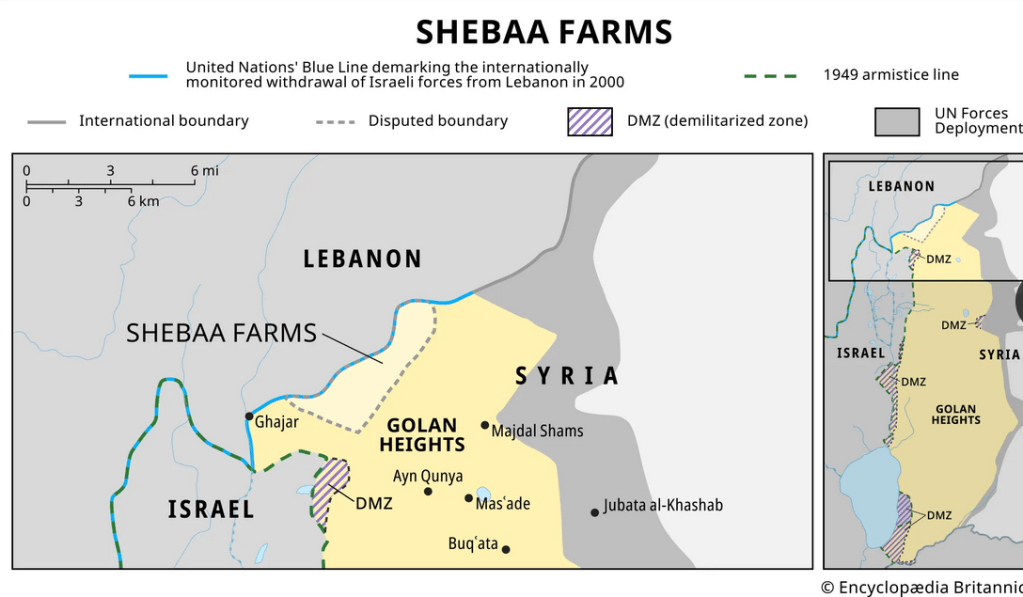
On October 8, Hezbollah attacked Israeli military facilities in the Shebaa Farms, a piece of territory claimed by Lebanon under illegal Israeli occupation since 1967, not recognised as “Israel” by the UN or almost any country internationally (Israel’s claim, which the UN agrees with, that it is part of the illegally occupied Syrian Golan rather than of Lebanon hardly justifies Israel’s position!). Resistance to occupation is legal in international law. Indeed, alongside solidarity with the Palestinian resistance, Hezbollah also declared its operation was “On the path to liberate the remaining part of our occupied Lebanese land.” Hezbollah in other words did not attack Israel on October 8! Israel responded with attacks into Lebanon, thus Israel was the first to attack the other country’s sovereign territory, not Hezbollah.
The next day, October 9, Palestinian militants – not Hezbollah – based in southern Lebanon slipped across the Israeli border and killed an Israeli soldier, wounding several others; Hezbollah had no involvement. There are some half a million Palestinian refugees in southern Lebanon, who aim to return to their country; they will join a battle involving Palestine whether Hezbollah does or not (for example, as they did earlier, in April 2023, when Israel attacked the al-Aqsa mosque). Israel retaliated with a helicopter-gunship attack on Lebanon which killed three Hezbollah militants; Hezbollah then responded to these killings later that day with guided missiles aimed at Israeli command centres in northern Israel, the first actual attack by Hezbollah into Israeli territory, only after two Israeli attacks on Lebanon.
Following this, Hezbollah “calibrated its attacks in a way that [has] kept the violence largely contained to a narrow strip of territory at the border,” and initially at least, Israel did likewise. In December 2023, Andrea Tenenti, from the United Nations Interim Force in Lebanon (UNIFIL), said both Israel and Hezbollah “unfailingly accepted messages passed through UNIFIL in procedures designed to deescalate potentially dangerous misunderstandings.”
But if it was Israel that in fact struck first – twice – then on what basis can the claim be made that Israel had to “defend itself” against Hezbollah, which just wouldn’t stop its attacks over the border, by blowing up the whole of Lebanon? Who was responding to whom?
OK, one might say, that was the beginning, but Hezbollah has insisted since that it would keep up some level of attacks over the border until Israel agreed to a ceasefire in Gaza.
However, Israel’s responses became far bloodier over time: not only vastly disproportionate in sheer number, but also far more targeted at civilians; until September, Israel had launched 8313 attacks on Lebanon, to Hezbollah’s 1901 attacks on Israel; Israeli attacks had killed 752 Lebanese, including hundreds of civilians, to only 33 Israeli deaths, overwhelmingly military – a ratio of 23 to one! Israeli attacks had already displaced 90,000 Lebanese before the current massacre began in late September. In July, the BBC reported that over 60 percent of Lebanese border communities had suffered “some kind of damage as a result of Israeli air and artillery strikes,” and 3,200 buildings had been damaged; Human Rights Watch verified that Israel has used white phosphorus in its attacks on some parts of southern Lebanon.
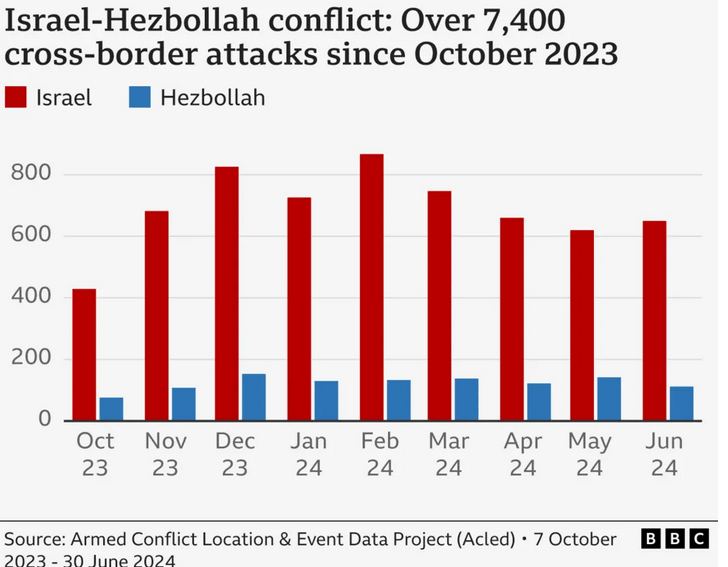
So if you consider this data, the notion that it was Hezbollah insisting on attack while Israel merely defended itself makes little sense in practice – if Israel has been attacking Lebanon at a rate of over 4 times that of Hezbollah attacks on Israel (and with 23 times the numbers of deaths, indicating that Hezbollah mostly fired to make a statement and avoid casualties), then when was the moment that Hezbollah could have paused or stopped firing anyway if there is simply so much more Israeli firing at them all the time? The bare numbers suggest it was Hezbollah responding, not Israel.
Despite occasional flare-ups – in early January, in June and in August – when Hezbollah briefly responded more forcefully following Israel’s killing of top Hezbollah commanders – this pattern of low level tit-for-tat, with Israel’s attacks far more murderous and escalatory, continued through till late September.
OK, again, but perhaps Hezbollah could have agreed to a ceasefire, to end the attacks and discuss UN Resolution 1701 and so on at the last moment, in order to avoid being decapitated, and to help prevent Lebanese civilians being massacred by Israel’s savagery since last September.
Again, however, it appears that Nasrallah did agree to a “complete ceasefire” just hours before he was killed. There is no dishonour in recognising limitations, in recognising that the blood paid by innocent Lebanese civilians and children is just too high, that you have attempted to do what you can (and the reality is that Israel has essentially completed its genocidal goals in Gaza, with nothing Hezbollah has done making any difference).
But if Nasrallah agreed to it, why did Israel still proceed to kill him? Even if it “just had to” kill him as a war trophy, why continue the horrific war against the Lebanese people after that? Why continue the mass killing after the new Hezbollah leader, Naim Qassem, also said on October 8 that the organisation was supportive of the Lebanese government’s moves to reach such a ceasefire? If that’s what Israel wanted, wouldn’t it have paused to see what came of such negotiations?
In other words, Hezbollah’s alleged “refusal” to end its side of the conflict was never the issue – neither at the outset, as outlined above, nor during the year, given the reality of who was attacking who in practice, nor at the end, when these concessions are ignored and Israel continues to bomb, kill and invade. There was simply never a chance.
Think what you want of Hezbollah politically – the above is all separate to the question of whether or not Hezbollah was doing the “right” thing, whatever that may mean in the context of Israel’s holocaust against the Palestinian population of Gaza. Many argue that, regardless of who shot first, keeping up some level of fire at Israel in solidarity with Gaza was an honourable thing to do; many others, especially many Lebanese who may hate Israel but not like Hezbollah, argue that Hezbollah did not have the right to put Lebanese civilians in danger of the horrific Israeli “retaliation” now taking place; still others may argue that Hezbollah’s attacks were too symbolic, and that it should have attacks on a level that could have actually helped Gaza; others that it could not do this, as neither the Lebanese people, nor Hezbollah’s Iranian paymaster, wanted such escalation; some may argue that Hezbollah had already burnt too many bridges with non-Shia communities in Lebanon to be able to act, and be accepted, as a vanguard for Lebanon (or that it had committed vastly more crimes in Syria to be accepted by the Arab world more generally); while some might say that was precisely why it had to do something, symbolic or otherwise, to rescue its credibility, and whether it had successfully done so or not would also be debated.
More generally, some things are probably undeniable: that Hezbollah greatly overestimated its own strength, underestimated Israel’s immense power, technological advantage and ability to “do Gaza” on another country while still in Gaza itself, and overestimated the likelihood of its Iranian sponsor doing anything at all to defend it in its hour of need.
All of this is a valid discussion, which needs to be had, but is outside the question here. Right now, Hezbollah cadres on the ground – and others allied to it that have never been its political allies – is resisting Israel’s new invasion of southern Lebanon in its own country, while Israeli state terror has killed over 1200 Lebanese civilians; over 2000 Lebanese have been killed by Israeli attacks over the last year, 60 percent of them in the last week of September and first week of October 2024, and this includes 127 children, and, for good measure, by the beginning of October, 96 Syrian refugees, while it attacked and killed 24 in the Christian town Aitou in northern Lebanon far from the border, and has even bombed a town council and killed the local mayor. Some 1.2 million Lebanese have been forced to flee their homes – given that Lebanon’s population is only about 4 million, with up to 2 million Palestinian and Syrian refugees, this is around a quarter of the population.
What is the end-game? It appears that, intoxicated after having been able to essentially destroy Hezbollah’s communication networks, much of its launching capacity, and most of its command structure and leadership, all within about a week, Israel’s sights may be set on re-occupying, perhaps effectively annexing, Lebanon south of the Litani, until just recently only an idea entertained on the far-right fringes.
 Their Anti-imperialism and Ours