The US-Israel-Lebanon ‘Framework’ Agreement – A Challenge to Iran’s regional influence

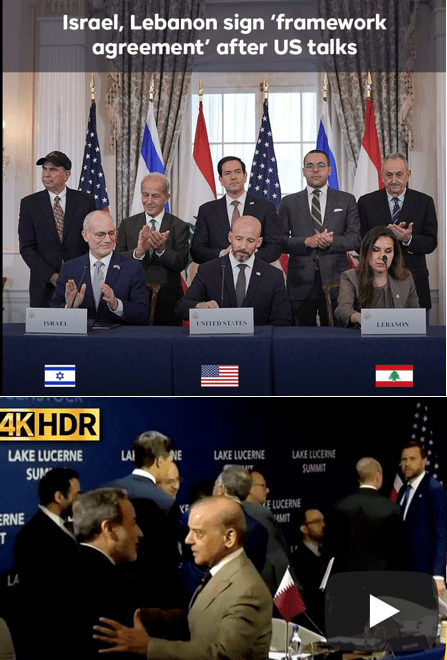
Top: US State Secretary Marco Rubio presides over Israel-Lebanon agreement; bottom, US Vice-president JD Vance in same room as Iranian foreign minister Abbas Araghchi for the US-Iran MOU signing, before Araghchi leaves the room.

By Michael Karadjis

The US-mediated Israel-Lebanon ‘framework agreement’ signed by the two countries on June 26 represents a direct challenge to Iran’s attempt to use its new power over the Strait of Hormuz to help achieve a victory for its ally Hezbollah and the south Lebanese Shiite community, a million of whom have been uprooted by Israel’s current occupation of up to one-third of that country.

A victory achieved this way would be a boost to Iran’s regional influence. And if achieved this way via the US-Iranian Memorandum of Understanding (MOU) to end the Gulf conflict, it would mean a US role in enhancing Iran’s regional influence at the expense of Israel, as a direct result of Trump’s fateful decision to launch his monstrous war on Iran, which would be unfathomable to Israel – and to the Trump regime.

So, if and Israeli withdrawal from Lebanon and an end to Lebanon’s suffering at Israel’s hands were instead achieved via the new Israel-Lebanon agreement and a negotiated settlement, then surely that is a good thing, isn’t it? Why does Iran get a say in the decisions of the Lebanese government via Hezbollah, the only non-government militia allowed to keep weapons since the end of the Lebanese civil war 35 years ago?

Especially since, so far, Hezbollah’s March 2 decision to join the war in order to avenge Israel’s killing of Iranian Supreme Leader Khamenei has only resulted in Israel’s killing of 4000 Lebanese, the uprooting of over a million people from the south and a new Israeli occupation of 10-20 percent of Lebanon, an occupation not there before March.

That at least is the argument put forward by many Lebanese who support this agreement, who say whatever the downsides, Lebanon has suffered enough, an Iranian-backed militia should not have a veto over the national decision, and so this is the only way forward. As Lebanese president, Joseph Aoun says, if you reject the agreement, offer an alternative.

For supporters of Palestine, the fact that the agreement includes clauses about the two countries’ “shared goals to establish stable and peaceful relations” and they declare their intent not only “to conclusively end the [current] conflict” but “to therewith formally conclude any state of war between them,” reads a lot like a normalisation agreement, of the Camp David or Abraham Accords type. The Israeli-Lebanese border has already been long established by the 1949 Armistice, but this did not require full relations, which as with most Arab states, are withheld until Israel agrees to a just resolution of the Palestinian issue.

However, if many Lebanese people decide that having their country destroyed and thousands of their people killed every few years by Israel – which in addition has not led to justice for Palestine – can be ended by signing such an agreement, it is difficult as a non-Lebanese from afar to criticise this desire. And we should not underestimate the degree of support the agreement has from a large section of the population.

But will the agreement lead to Israeli withdrawal?

The problem with this argument is that the agreement does not commit Israel to fully withdrawing its forces. Not only does the agreement stipulate that Hezbollah must be fully disarmed – by the Lebanese government and army – before Israel has to commit to anything, the language remains vague even then.

Israel will carry out “phased withdrawals” from specific “pilot zones” once the Lebanese army has disarmed Hezbollah in those zones, and once complete, new pilot zones can be added. It is unclear how long this process may take, and in the meantime there is nothing preventing Israeli occupation forces continuing to fire on Hezbollah – and for the most part, Lebanese civilians – outside these zones.

In the agreement, Israel states it “has no territorial ambitions in Lebanon” and that disarming Hezbollah and other non-state armed groups, plus “additional security arrangements to be agreed upon,” would “eliminate any future need” for Israeli military action or presence. Needless to say, this is no clear commitment to withdraw from Lebanon. For anyone who has spent even a little time studying the region’s politics, such non-committal language virtually ensures a continual Israeli presence for a substantial period of time, continually dragged out, if not forever.

For example, until recent years, Israel also claimed to have no “territorial ambitions” in the West Bank or Gaza, rather, these were just security-driven “occupations” that just happen to last for decades, due to Palestinian “terrorism,” ie, Palestinian resistance to these occupations. Israel’s continual colonisation and effective annexation of large parts of the West Bank takes place despite having no “territorial ambitions.” From 1978-1990, Israel had not “territorial ambitions’ in Lebanon, but remained in the south until forced out by Lebanese armed resistance in 2000. From 1967 to 1981, Israel allegedly had no “territorial ambitions” in the Syrian Golan Heights, but then it did, and it annexed it. Now Israel does not formally have any “territorial ambitions” in southern Syria outside occupied Golan, but it has occupied a further chunk of Quneitra and Daraa provinces since December 2024; despite the Trump regime supposedly recognising Syria’s territorial integrity, it has not once demanded Israel withdraw to the 1974 UN demarcation lines.

Moreover, two days before the agreement, Netanyahu stated that Israeli occupation forces are actively establishing a fortified military buffer zone across southern Lebanon, which Israel would not withdraw from. The next day, Israeli defence minister Israel Katz repeated his earlier statement that Israeli forces “will remain in the security zones in Lebanon, Syria and Gaza indefinitely.”    

Gaza precedent

Just look at the progress of the ‘Gaza ceasefire’, crowned by Trump’s appointed ‘Board of Peace’ colonial administration. The initial agreement required Israel to gradually withdraw from the 52 percent of Gaza it occupied at the time, to be replaced by an ‘International Stabilisation Force’ which would separate the forces and make way for a Palestinian technical governing authority to replace it, while Hamas agreed to warehouse longer-range weapons but for its full disarmament to take place as part of a pathway towards establishment of a Palestinian state.

The reality is quite different. Apart from continuing to kill Palestinians – over 1000 since the “ceasefire” was established – and continuing to block most desperately needed aid getting into Gaza, Israel first increased its occupation to 58 percent, and has now declared it aims to occupy 70 percent of Gaza, while almost the entire Gaza Palestinian population is pushed into the remaining 30 percent, living on air and desperation. In that majority zone it occupies behind the ‘yellow line’, Israel “has completely bulldozed and razed the area … Israel has built and fortified 38 military bases in eastern Gaza, paved roads leading to the bases, and erected 25 kilometers of massive earth berms to physically divide Gaza.” That is, Israel plans to stay forever.

Rather than insist on Israeli withdrawal, or even allowing in the required amount of humanitarian aid, the Board insists only on complete Hamas disarmament before Israel has to do anything, or before any reconstruction can take place, a complete violation of the terms of the agreement. The Trump regime has left Gaza to its appointed cronies who rule entirely for Israel, with zero pushback or even interest from the US government.

Hezbollah disarmament before Israeli withdrawal

What the Gaza BOD process and this Lebanon framework agreement have in common is that the main armed resistance forces in each arena are required to completely disarm before the occupying power has any obligation to end its occupation of their countries. Yet the occupation is the main reason for the existence of armed resistance movements in the first place. Demanding they disarm before Israeli withdrawal leaves future withdrawal to trust in some imaginary Israeli goodwill. On the basis of experience, this is a big ask to say the least.

The Lebanon agreement thus legitimises Israeli occupation in the south; Israeli forces have a right to be there for Israel’s “security,” despite the security of the Lebanese people being violated by Israel’s atrocious crimes and its meticulous wiping of dozens of towns of villages off the map by dynamiting and bulldozing every home and building, actions which suggest a long-term occupation rather than an emergency security operation. The only enemy in the agreement is deemed to be Hezbollah, the militia resisting this occupation.

Moreover, since Hezbollah takes the opposite view – that disarmament should only proceed once Israeli occupation completely and finally ends – it leaves the situation in deadlock. To put the entire blame on Hezbollah for this is not only to ignore the facts above about Israel’s history of occupations, but also Lebanon’s most recent history. Even after the November 2024 ceasefire, when Hezbollah signed the ceasefire agreement to withdraw north of the Litani and be replaced by the Lebanese army, Israeli forces continued to occupy five small regions across the border, and to launch attacks every day, despite a complete absence of Hezbollah fire throughout that period. And now – regardless of one’s view of Hezbollah’s actions on March 2 or more generally – Hezbollah’s refusal to disarm without Israeli withdrawal cannot be separated from the fact that the million or so uprooted from the south are largely Lebanese Shiites, its communal base, who have no reason to trust Israeli goodwill which it is not even committing to.

But even if many Lebanese disregard this because they believe the alternative is worse, and believe that Hezbollah should disarm in order to strip Israel of excuses to occupy and bomb their country, the fact that it refuses to do so means that eventual disarmament – which most Lebanese see as a valid goal – can only proceed via a process of integration into the Lebanese army as part of an overall political process within Lebanon involving all its components.

By contrast, what this agreement demands is that the Lebanese army forcibly disarms Hezbollah. This can only really mean two things.

In the first scenario, the Lebanese army may not do so beyond declarations, because it knows it is virtually impossible, or instead may attempt a limited operation which is unsuccessful, and in any case, many troops will not want to fight other Lebanese, especially if perceived to be on behalf of the occupation. In this case, the Lebanese government has signed on to the Israeli occupation lasting forever. It will be up to the Lebanese army to prove itself an effective local police force for Israel, and as long as it cannot do so, but keeps attempting on a low level, it becomes a collaborationist ‘Palestinian Authority’ kind of regime in the south, a situation continuing in perpetuity.

Indeed, the parallel to the 1993 Oslo agreement and its decades-long aftermath is unmistakeable – even the concept of “pilot zones” and gradual withdrawal from more of them as ‘security” improves is remarkably similar to the “Gaza and Jericho first” concept in Oslo, which gradually added more Palestinian population centres as Israel annexed everything in between.

In fact, a semi-secret ‘security annex’ of the agreement gives Israel “freedom of military action” within the area still occupied, and even “grants Israel the legal right to re-enter areas at will if it determines that the Lebanese army has failed in its disarmament task,” according to analyst Qassem Qasir. Israel and Lebanon will also establish a Military Coordination Group for Lebanon, “tasked with the mission to operate 24/7, managing deconfliction, verification, and overall implementation,” essentially becoming allies against another Lebanese component.

In the second scenario, the Lebanese army does begin a large-scale military attack on Hezbollah, leading to a renewal of civil war in Lebanon; and given sectarian allegiances, and especially given Israel’s massive dispossession of the Shia, who have nowhere else to turn but to Hezbollah in the circumstances, this means sectarian war. And even then, it is very unlikely that it would be successful. With such massive “instability” and “terrorism” racking its northern neighbour, Israel again has excuses to stay forever in a “security buffer.”

In the final analysis, this is the main problem with the agreement – the requirement to turn the Lebanese army against part of its population on behalf of the enemy. Only if those Lebanese people who understandably support the agreement are asked whether they would be prepared to take part in such an operation, can the real gravity of this agreement be understood.

It is far from inconceivable that creating fratricide in Lebanon is the very aim of Israeli and US leaders. When the host at Channel 13 comments that “It seems we’re leading Lebanon to a civil war. Maybe it’s not so bad for us, let the Lebanese government fight Hezbollah,” the channel’s senior defence correspondent, Alon Ben-David responds “That’s been the goal from the start,” even though he adds “I’m not sure right now, in the current situation, if it has the power to do so. So today, two more signals, let’s call them that, another strike on infrastructure bridges over the Litani River.” Only a television conversation, but rather real: we want the Lebanese army to make war on Hezbollah even though it doesn’t have the power to win, this pointless fratricide allowing us to continue to “send signals.”
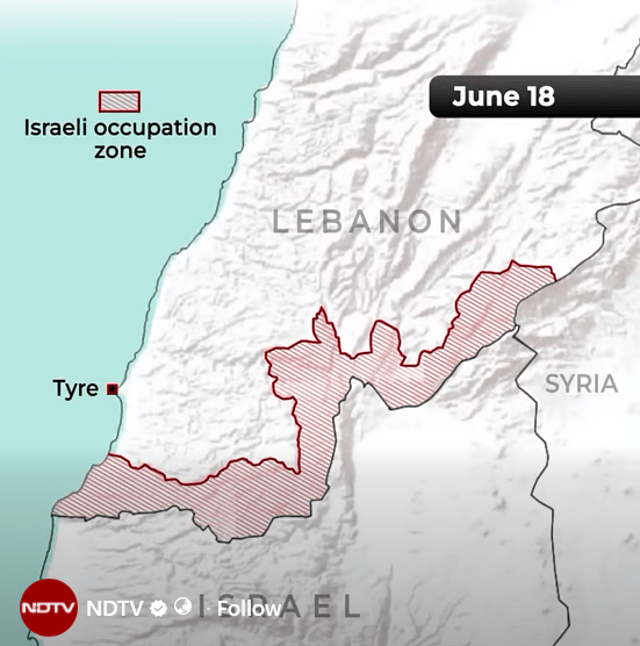
Israel’s occupation of southern Lebanon, as of June 18.

Challenge to US-Iran MOU?

This US-mediated agreement represents a direct challenge to the kind of regional power Iran has been attempting to project via the MOU with the US over that war. Before agreeing to lift its closure of the Strait of Hormuz following the April 7 ceasefire, Iran insisted the ceasefire include Lebanon. This was initially rejected by the US. Israel reacted by terror-bombing Beirut. When the US prevailed upon Israel to cool it, and then actually agree to a ceasefire formality, Iran finally opened the Strait ten days later (it then closed it again when the US refused to reciprocate and maintained its blockade of Iranian ports). This showed that Iran could use its new-found power over the Strait to make an impact on the broader region.

Such an outcome was viewed negatively by the US and Israel. However, in reality, the ceasefire favoured Israel, because it left it in occupation of 10 percent of Lebanon, which it had not been in before Hezbollah had launched its strikes on Israel on March 2. Thus, while Iran’s ability to force a change was a political victory for Iran, the actual situation on the ground was a victory for Israel. And it became even more so, because Israel barely adhered to the “ceasefire” for a day and continued killing at an alarming rate, while meticulously destroying everything standing in Lebanese towns and villages it occupied.

This reality was alarming for Iran’s own credibility. So it again insisted on “linkage,” that is, that its MOU with the US specifically include a ceasefire in Lebanon. Given that Israel’s continual actions since then have been on a relatively much lower level than during the first farcical “ceasefire,” this again could be seen as a victory for Iran. Even more, Iran insisted on including recognition of Lebanon’s “territorial integrity” in the language this time, somewhat strengthening it.

However, there is no commitment to Israeli withdrawal from Lebanon in the US-Iran MOU any more than there is in the Israel-Lebanon agreement, and in fact Israeli occupation forces occupy a substantially larger region now than at the outset of the April 17 Lebanon ceasefire. The language of “territorial integrity” is not different in substance from the language in this agreement that Israel has no “territorial ambitions” and that both sides support “full Lebanese state sovereignty” and so on. All are similarly vague with no commitment to withdrawal.

So those claiming that Iran had put Israeli withdrawal into the agreement are kidding themselves; of course, in the course of the 60 days of negotiations, Iran may insist on that as part of a final agreement; or it may not, depending on what else is on offer. However, that is not really point – the point remains that the MOU text, signed by the US, formally gives Iran, but not Israel, a say in what happens in Lebanon.

Even worse, the two mediator countries, Pakistan and Qatar, issued a declaration a few days later stating that “a de-confliction cell” would be created involving Iran, the US, Lebanon and the two mediators, “to ensure the adherence of the termination of military operations in Lebanon as per the MoU.” Thus Iran, but not Israel, was given a say in Lebanon!

To say the least, this was a huge affront to Israel, not necessarily because Israeli leaders are worried they may be pushed to withdraw, given no such language exists in the MOU. Rather, because Iran is now promoted as regional actor, and Israel not included on an issue in its “backyard.” This was also unacceptable to Trump and the US government more broadly. Yes, they needed the MOU. They will not scrap it over Lebanon having just signed it with Lebanon. But that doesn’t stop the US pursuing another track.

According to Netanyahu, the new agreement means that “Israel, Lebanon and the United States are essentially telling Iran: ‘This is none of your business. You have no status here, no involvement and no role. Not you, not Hezbollah, not any terrorist organization’.”

Netanyahu is correct. While we will have to wait and see, at first sight this represents quite a coup for Israel, and for the US bargaining position with Iran. If Iran did plan to push full Israeli withdrawal from Lebanon as part of its final deal, it is far more difficult now that the Lebanese government has signed its own agreement with Israel on a process that supposedly leads to Israeli withdrawal on its own timetable. It is one thing for Iran to negotiate on behalf of Hezbollah. It is another to try to dictate policy to the Lebanese government.

That said, that may even be an ‘escape valve’ for Iran if needed.

What Lebanon wants, what Iran wants – Is the Iranian element blameless?

In fact, one of Lebanese president’s key arguments has been that Iran has no right to dictate what Lebanon can do, an argument which, at face value, has merit; even more, he accuses Iran of seeking to use Lebanese sovereignty as a “bargaining chip” in its negotiations with the US. Given the content and context of the agreement as described above, this may seem rich coming from a government which has arguably signed away Lebanese sovereignty. But what of the argument itself?

Much as Iran has been arguing for inclusion of Lebanon in any deal, is Aoun’s implication that Iran could trade this away for better terms on other issues possible? It may be unlikely, but not out of the question. The fact that Iran’s insistence on Lebanese ceasefire (but not Israeli withdrawal) in the first April ceasefire meant nothing in practice and that Israel continued its killing and expanded its occupation over the next two months is evidence that it is possible.

That is not necessarily even a criticism. A country that has suffered such a violent attack, such massive destruction, after years of maximum pressure sanctions, cannot be expected to hold the line for other peoples’ struggles. That is just a reality. If Iran is offered a very good package in other respects and drops Israeli withdrawal from its conditions this cannot be called “betrayal” (except that Hezbollah’s action on March 2 was in solidarity with Iran … but that is part of the problem …). [To digress, the charge by some activists that Iran has “betrayed” Palestine by not including Gaza in the MOU is even more misleading, simply highlighting their illusions that Palestine has anything to do with Iran in the first place].

But in that sense, Aoun’s claim that Iran’s heavy involvement in Lebanon via Hezbollah may just be a bargaining chip is not necessarily wrong in the abstract. It is quite possible to be highly critical of the Israel-Lebanon agreement – as a possible road to continued Israeli occupation, a south Lebanese ‘Oslo’ or even to civil war – without being uncritical of the Iranian regime’s own power projection in the region.

Like any medium-sized capitalist power, Iran aims to increase its power and influence in the region. There is a great deal to criticise, or vigorously condemn, about the way it has done so, especially in Syria and Iraq, but this is not the space to cover such ground. Two anecdotes suffice for now: in 2015, when Iran was at the zenith of its regional power, Iranian MP Ali Reza Zakani claimed that Iran now controls four Arab capitals, Baghdad, Beirut, Damascus and Sanaa; while Ali Younisi, adviser to Iranian president Hassan Rouhani, stated that Iran now formed an empire, and that Baghdad was its “capital.”

Hezbollah was different, because it arose as a genuine expression of the resistance of south Lebanon’s Shiite population against the two-decade Israeli occupation. This gave Iran’s “resistance” ideology, otherwise hot air from a safe distance, some actual substance, given the Shiite religious connection and thus its reception to Khomeiniite ideology.

But once Israel was driven out in 2000, the right of Hezbollah to maintain arms due to “resistance” – while the militias of all other Lebanese communities dissolved at the end of the civil war in 1990 – came into question. Other than a short, but terrible, war in 2006, the Israel-Lebanon border was silent from 2000 to 2023. While an “axis of resistance” was talked about, none of the big Israeli wars on Gaza – 2008-9, 2012, 2014, 2019, 2021 – led to any reaction from across the Lebanese border, until the onset of the Gaza genocide (and even this reaction seems to have been a Hezbollah decision – driven by its south Lebanon context – rather than Iranian decision).

Why then did Iran want to maintain an armed Hezbollah in Lebanon? Surely it could have just as well maintained its influence, including significant economic penetration by Iranian capital, within the Lebanese Shiite community anyway. Israel, however, began campaigning from the early 1990s against an “Iranian bomb” that was often allegedly just “weeks away” from being built. As we have seen, this had an ideological function for the uncompromising, expansionist Zionist regime to justify everything. “Resistance” ideology played a similar role in the mobilizational needs of the Iranian regime.

But Iran also had reason to believe that Israel’s threats could someday become a reality. In past decades, Israel had bombed civilian nuclear facilities in both Iraq and Syria, and it had also killed Iranian scientists. Having an armed presence next door to Israel was a kind of forward security policy for Iran. As Palestinian writer Rashid Khalidi – author of ‘The 100 Years War on Palestine’ – put it, “I never believed there was such a thing as an axis of resistance. There was an axis for protection of Iran.”

Whether one agrees with this or not, Hezbollah’s fateful March 2 dispatch of rockets on northern Israel to avenge the death of an Iranian leader certainly supports Khalidi’s claim. Israel’s flagrant aggression against Iran means it is obviously no innocent here, to state the obvious, and its crocodile tears over northern Israeli communities sits uncomfortably with its vaporisation of countless Iranians at that very moment; and an act in solidarity with a foreign state under attack might sound admirable. But such a decision should be made by the Lebanese people as a whole, not by one organisation representing one part of one of its sectarian components, because the result – killing and destruction on an enormous scale and a new occupation – impacts all of Lebanon.

Hezbollah justified its action on the basis that Israel was still occupying five small regions near the border in violation of the November 2024 ceasefire, and this is true. But these were essentially five hilltop forts with a total area of some hectares, while now Israel is in occupation of up to a fifth of the country. Moreover, that had been the case all along; the March action was undeniably to avenge Khamenei.

That of course is not up to a non-Lebanese writer from far away, but up to the Lebanese people to sort out. But that is kind of the point.

Now – Lebanese Shiites have the right to resist occupation and dispossession

All that said, the situation has changed. All of Lebanon is impacted; but it is largely a million Shiites uprooted from the region under Israel’s occupation, the region being destroyed Gaza-style. And Hezbollah once again is their only organ to resist this occupation.

Israel’s gigantically “disproportionate” response – if it is even possible to use such terms – has given Hezbollah a new lease on life as a vehicle of resistance. Anyone would think this was Israel’s aim.

I am not so conspiratorial. But perhaps the point is that Israel’s aims have changed and that “disproportionate response” is now no longer a useful description, and not only because of the astronomical degree of the “disproportionality.”

When leader after leader states either that Israel plans to stay forever, or that Israel’s new borders should be the Litani (a view that is deeply held within Israeli society), or that a Greater Israel as allegedly depicted in biblical texts is a valid goal, we start to get the idea: West Bank, Gaza and Golan are not the limits of the expansionist state.

If the goal now actually is Greater Israel with new borders (for now?) on the Litani, then Hezbollah’s brief changes back to what it was in 1980s and 1990s, as opposed to the 2000-2023 period. And that puts real pressure on Iran not to trade it away; while not out of the question, an Iranian “betrayal” in the context of a long-term Israeli goal for new borders at the expense of the Shiites really would be a massive setback for the Iranian regime. As opposed to regimes or forces that Iran may have established transactional relations with at times, it is no accident that the only solid allies (whether considered “proxies” or otherwise) that Iran has in the region to use to project power and influence are among the Shiite populations in Iraq, Lebanon and Yemen. It may be able to give up Hezbollah’s armed forward defence role (especially now that Iran has broken the psychological barrier of directly hitting back at Israel), but it will not want to lose its influence among 40 percent of the Lebanese population.   But we will have to wait and see whether either the US-Iran agreement or the US-Israel-Lebanon agreement get Israel out of its new conquest. My long-time prognosis remains: a relative Iranian victory in the Gulf, and a relative Israeli victory in its own vicinity. If Israel still sees this as a defeat it is because it rejects sharing the region with any second hegemon.
Behind the Israel-Iran flare-up

By Michael Karadjis

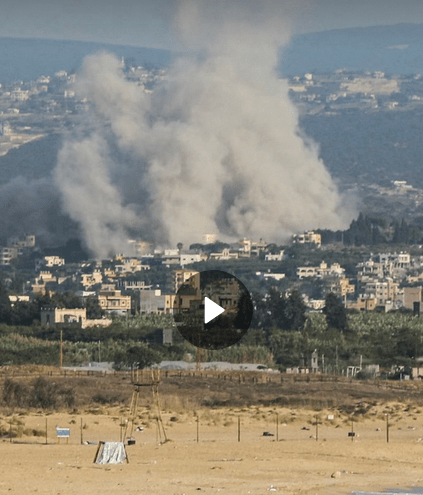
Israel continues to bomb southern Lebanon after the Israel-Iran clashes ended (Al-Jazeera).

After a flare-up, both Israel and Iran have declared that their strikes are over, for now, though Israel went right back to bombing southern Lebanon. Will this flare-up derail US-Iran negotiations? While it is obviously a hiccup, it seems more likely that this was an episode in “negotiations with missiles,” drawing lines, assessing each other’s strengths and maintaining credibility.

Since the Israel-Lebanon “ceasefire” on April 17, which Iran demanded as a condition for its separate ceasefire with the US, Israel has bombed Lebanon as heavily as before the “ceasefire” without a break, killing 1023 and injuring 3062 Lebanese since that date, and meticulously destroying entire villages. While Iran was right to make the demand, the ensuing reality can only be deeply humiliating to the Iranian regime, and it faced rising criticism internally. It has again, quite rightly, demanded that a ceasefire in Lebanon be part of any comprehensive deal with the US, though since the previous “ceasefire” is still officially in place, this would need some kind of assurance this time. Especially as even if there were a real ceasefire as part of the deal, that would leave Israel in control of 10 percent of Lebanese territory, depopulated and destroyed.

Several days ago, Trump told Netanyahu not to attack south Beirut; bombing southern Lebanon is OK, but not the capital; he is concerned about his dealing with Iran as he wants out of the humiliating quagmire he landed himself and the US in. As it became clear that Israel intended to do so anyway and Trump would forget what he’d said the day before, Iran felt the need to draw a line which its credibility rested on: if Israel attacks south Beirut, Iran will directly attack Israel.

Israel of course wants to scuttle the US-Iran negotiations, above all because it wants the Litani river in southern Lebanon as its new border, and therefore is against any ‘linkage’ between a US-Iran ceasefire and its Lebanon front, and in any case, ongoing regional crisis and war is the theatre needed behind which to continue advancing Greater Israel.

So Israel attacked south Beirut, and then Iran attacked Israel (all missiles were intercepted). Trump told Iran “You’ve shot your missiles, that’s enough, get back to the table and make a deal,” and said he was going to call Netanyahu and also tell him not to retaliate against Iran, saying “each of them had their fun, Israel had its strike and Iran had its strike, and we don’t need another one.” He also stressed that Netanyahu “won’t have any choice” but to accept whatever deal he comes up with with Iran, as “I call the shots, he doesn’t call the shots,” making clear who is ultimately boss.

But while it’s true that the US “calls the shots” and is not an Israeli puppet as often thought, neither is Israel a US puppet, as others believe. Just as Trump is facing mid-terms and is currently one of the most unpopular presidents ever, especially due to this war, Netanyahu is facing elections later in the year as well. To not retaliate to a direct Iranian hit, because Trump ordered him not to, would be a huge blow to his own credibility.

Israel retaliated hard against Iran, hitting a major petrochemical complex. Iran then also retaliated against Israel, attacking a similar plant in Haifa (which was also intercepted), and this time was joined by the Houthis in norther Yemen also sending a few rockets at Israel, and Israel then claimed to have then attacked and dismantled Iranian air defence systems. Trump demanded “Israel and Iran must immediately stop shooting” and claimed, implausibly, that “Both sides, Israel and Iran, are looking to do an immediate CEASEFIRE!

In response to Trump’s demand, or because they both felt their point had been made, both Israel and Iran made statements that they would end this rond of fire, for now. Israel then went back to bombing southern Lebanon, “the strikes hit multiple towns and villages in the Tyre, Zahrani, and Bint Jbeil districts, including al-Samaiyya, Burj al-Shamali, Kfarhouna, Khirbet Dweir, al-Khiraib, and Qalawiyah,” according to Dropsite News.

Trump is now one of the most unpopular presidents ever, and his war on Iran is rejected by the vast majority of Americans. With mid-term elections later this year and a global economy crippled by this war and the dual blockade of the Strait, he is desperate for a deal with Iran to extricate the US from the war, but it is even more important that the deal is one he can sell as a “victory.” While I have mentioned both Iranian and Israeli “credibility” above, in Trump’s case the issue is of ten-fold importance; his alleged “credibility” is shot. The continual statements that a deal “is just about to be signed” over weeks and weeks now is entirely about how to thread the needle so that a deal – whose broad outlines are well-known – can be politically saleable by both the US and Iranian leaderships as a “victory,” especially by the US.

One major sticking point is what to do with Iran’s 440 kilograms of highly enriched uranium, which Iran has continually offered to dilute under international supervision (in negotiations before the June war last year, in negotiations before the war this war, and in ongoing negotiations now), but Trump has continually insisted be sent to the US. Russia, China and Pakistan have all offered to take the uranium and dilute it in their countries; in Obama’s JCPOA (Iran nuclear agreement) in 2015, a similar stockpile was sent to Russia. Trump has not been willing to do this. But in a recent tweet, he seemed to bend, stating that one option was for it to be “destroyed on site in Iran.” It is not really an issue.

One very big issue for Iran is that at least some of its tens of billions of assets frozen abroad need to be unfrozen and made available to Iran for reconstruction at the beginning of a negotiated settlement. This should not be controversial; they are Iranian assets, they legally and morally belong to Iran. Unfreezing them is “giving” Iran nothing. Moreover, doing so would allow the US to in effect respond to Iran’s demand for reconstruction funding from the aggressors on the cheap, giving Iran some space to drop that demand. But when Obama unfroze 1.7 billion in Iranian assets in the JCPOA, Trump and other Republican reactionaries condemned him for “giving billions to the terrorist regime.” And this is Trump’s Achilles Heel – whatever comes out of the US-Iran negotiations will almost certainly be similar to the JCPOA. Yet Trump has to try to justify ripping up that agreement which Iran was abiding by, therefore leading to Iran accumulating another 440 kilos of enriched uranium after having got rid of its previous stockpile, and justify months of devastating war, including murdering hundreds of schoolgirls, and bringing massive crisis to the world economy while facilitating Iran’s control of the Strait of Hormuz, by claiming he got a much better deal than Obama got. This is literally impossible; but somehow it must be dressed up that way.

That is why every time we are “close” to an agreement, Trump gets cold feet, and “goes hard.” And this may have also been background to the latest flare-up. Given how important the unfreezing of Iranian assets is to Iran, the statement several days ago by US Treasury secretary Scott Bessent that the US is considering using Iranian assets to pay for reconstruction of Gulf countries hit by Iranian retaliation was a step too far, and may have been a factor in Iran’s decision to act over Israel/Lebanon. If you’re really giving us nothing, we’ll help the war continue.

Trump’s statement in his latest tweet that the naval blockade of Iran will remain in force until a full agreement is reached is another example of total irrationality given his aim is to reach a deal; because if the US blockade continues, Iran will not lift its own semi-closure of the Strait (it lifted it completely on April 17 after the ceasefire, but only closed it again when the US refused to reciprocate, and has since continually offered a dual end to the closure before getting onto substantive issues; only US rejection keeps the Strait closed). Nuts? Yes. But without something to sell as a “victory,” looking “tough” is the next best thing.

And of course Lebanon is part of the process. Iran needs a Lebanese ceasefire as part of the deal. If it cannot at least get that – especially given that Israel would still remain in occupation of the south – then, aside from its right to defend its own country, what is the “resistance” slogan all about? Every respectable sub-imperial power projecting influence in the region must have some red lines that show it is willing to defend vital interests. Palestine of course was never that, just a slogan, to beat from a safe distance; the fact that it receives virtually zero mention in all this is not accidental. Hezbollah is an entirely different matter – it is no coincidence that the Iranian regime’s only actual ‘proxies’ or ‘real allies’ are other Shiite forces in the region – Hezbollah in Lebanon, Shiite militia in Iraq, and the Houthis; the basis of the Iranian regime’s direct regional influence remains sectarian.

It just happens however, even if by an accident of geography, that southern Lebanon is Shiite-populated. For two decades (1978-2000), Israel occupied the south; the resistance to it naturally enough was led by Shia, and Hezbollah eventually came to lead it. Regional Iranian power projection came up against a direct Israeli occupation. However, for the following two decades, after Israel was driven from Lebanon in 2000, there were zero events on the border, except the brief but devastating 2006 war; most considered Israel’s defeat in southern Lebanon to be final and that it would make no attempt to return. The Israel-Iran “conflict” was entirely theoretical, basically for internal or regional mobilizational purposes on both sides. However, with the current extremist regime in power in Israel, the concept of Greater Israel has again raised its head; a border at the Litani river in southern Lebanon means the permanent expulsion of a million Shia from the region, Hezbollah’s base. That recreates an actual conflict between the two countries.

In the meantime, Israel has just announced a complete closure of the borders of Gaza; has announced plans to extend its control in Gaza from 58% to 70%; has announced 34 new settlements in the West Bank, and new major settlement blocs in the Jordan Valley and a new wall separating the valley from the rest of the West Bank; and is killing daily in both Gaza and the West Bank with zero international attention. Palestine simply has nothing to do with this war – except in Israel being able to get away with eviscerating it under the cover of the war. Israel is also continuing and stepping up its daily attacks and occupation of southern Syria beyond the occupied Golan. In Lebanon itself it is pushing beyond the Litani to the next river north, the Zahrani. The Israeli opposition agrees with all these policies, and only condemns Netanyhu for not achieving all the goals they all support soon enough or for buckling to Trump and holding back. Tell me again how this is all gong so “badly” for Israel.

The Lebanese ceasefire: An assessment

The Israel-Lebanon ceasefire agreement, Al Jazeera

By Michael Karadjis

The Lebanese people can feel some relief now that Israeli bombing has stopped – well, mostly, despite ongoing violations – and they can move back to their wrecked towns and homes. It is a good thing Hezbollah agreed to the ceasefire because there is no more to be gained against such a violent enemy.

However, there should be no doubt that Israel has just won a smashing victory in Lebanon with its wanton brutality, despite the heroism of the fighters in the south that kept its ground invasion forces at bay.

Many observers claim this is a partial “victory” for Hezbollah and partial defeat for Israel; if these tracts merely aim at morale boosting, that is understandable, but this is not useful for cold analysis, which is badly required at this time. On the other hand, there have also been statements from Israeli leaders, not only on the far-right but even in the centre,and frm many ordinary Israelis interviewed, that this was a “defeat” for Israel and that Netanyahu gave up a chance to “destroy” Hezbollah. These statements are not only the opportunist words of oppositionists, but also an indictment of current Israeli society at large, which remains united to an unusually large degree around insatiable lust for war and killing, around the idea that any war that doesn’t result in total holocaust for the enemy is a defeat for Israel.

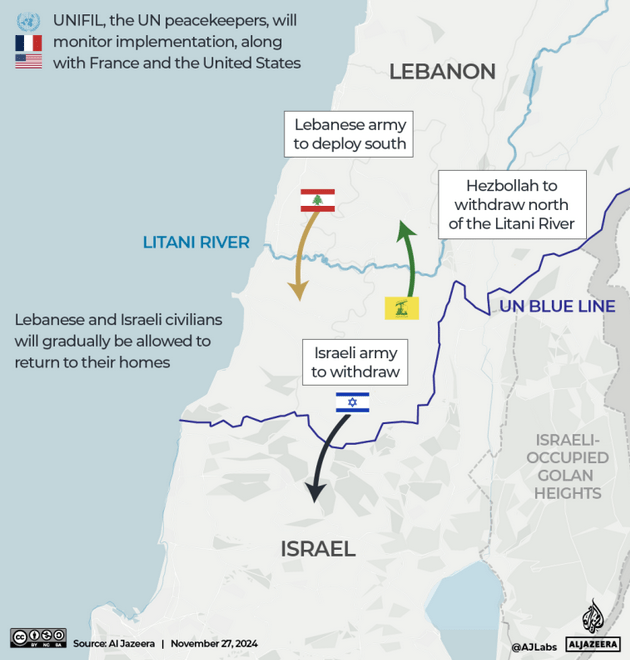
Let’s look at the outcome. The ceasefire is based on UN Resolution 1701 of 2006, ie the Lebanese army will move in Lebanon south of the Litani river to replace Hezbollah, which has remained there since 2006 in defiance of the resolution; implementation of this has been demanded by Israel since then; clearly a victory for the Israeli position.

Worse, now there is a direct US (and French) role, alongside the long-term UN role, in the implementation. Pretty obvious whose interests this serves.

Further, in a special US letter to Israel that is attached to this agreement, the US has given Israel an on-paper guarantee of its right to attack targets inside Lebanon for “defensive” reasons, and as we know, for Israel, everything is “defence.” While the Lebanese government and Hezbollah are obviously not signatories to this letter, they obviously know of it as it is the basis on which Israel agreed to sign.

Next, this also means the end of the so-called “unity of arenas”, meaning Hezbollah’s earlier assertion that it would only agree to a ceasefire if there were a ceasefire for Gaza also. Of course, this “unity” was in fact limited to Hezbollah on the south Lebanon border, and the Houthis’ Red Sea blockade, and had no real echo in the actions of the Iranian regime, let alone the Iraqi or Syrian regimes, or the Iraqi Shiite militia. But now even that largely symbolic solidarity – with a heavy price in Lebanese blood – on the Israel-Lebanon border “arena” has ended.

Hezbollah itself has had its communications network, much of its capacity and nearly all of its leadership and command destroyed, while Lebanon has once again been laid to waste, with some 4000 killed and a quarter of the population uprooted.

So, in what senses can it be claimed that it was also at least a partial Israeli defeat or Hezbollah victory?

First, if we think that Israel’s aim was to re-occupy or annex Lebanon south of Litani (or that it in effect became its aim as it became intoxicated with its rapid victory), then Hezbollah’s defeat of the invading forces can certainly be considered a victory. The sacrifice of the south Lebanese resistance was in any case heroic and effective. However, this was never spelt out as Israel’s aim, it even explicitly denied it at times; the idea was just dangled by the some of the Israeli uber-right, either as an ambit claim to be easy to withdraw from, or to be ‘oppositional’ in some cases. Hezbollah’s actual victory over Israeli occupation in 2000 still sets the terms, and I see no reason for Israel to want to return there. Israel sent in troops to aid in its destruction of Hezbollah assets rather than to occupy, in other words, if the conflict was not already there, I don’t think there would have been an invasion (the border was quiet for 17 years).

Second, some say the fact that Hezbollah is still standing is a victory, because Israeli leaders claimed they wanted to “destroy” Hezbollah. But like with the mythical “destruction of Hamas,” these leaders know themselves when they say it that they are talking nonsense, and that a guerilla force rooted in the population cannot be “destroyed,” merely weakened – and no-one seriously denies how much Hezbollah has been drastically weakened (or Gaza has been genocided). These fantastic aims are merely a cover to keep killing and destroying (this being the actual aim in Gaza).

Third, some Lebanese argue that Israel had aimed to divide and rule, by widespread killing and destruction, hoping to put the non-Shia Lebanese (Sunnis and especially Christians) against the Shia, who live in the south facing Israel and form the base of Hezbollah. It is fair to say that Israel failed to do this at a community level; in any case, recklessly murdering people en-masse was never going to gain Israel any friends, no matter what they thought of each other. Acts of solidarity across communities on the ground were very important.

However, I think Hezbollah has a hard job ahead explaining to Lebanese what exactly they achieved in any sphere, from their decision to begin strikes in solidarity with Gaza on October 8 last year, that warranted thousands killed and the country again turned to rubble. While solidarity itself is good, do most Lebanese people believe it was Hezbollah’s decision to make? What will they say? That they beat back an invasion that was not happening before the border was activated? How do they explain resisting 1701 for 17 years then suddenly signing on? How do they explain no ceasefire without Gaza then dropping this?

Of course, they were right to drop these conditions and sign on, because they correctly recognised the sacrifice of Lebanese blood was too great. But many will question then why they didn’t make their concession on these two fundamental points loud and clear weeks ago, when Israel suddenly turned on Lebanon in full force?

We also have the harsh reality that a year of largely symbolic attacks on military targets across the Israeli border – which from the outset were met by much more murderous Israeli attacks – made no difference to the genocide in Gaza. Sure, it kept some troops stationed in the north to bomb Lebanon, though it is doubtful they would have removed them in any case. But the Gaza genocide has hardly relied on troop numbers, but rather on massive destruction of virtually everything in Gaza using warplanes and missiles. So, while the Palestinians no doubt appreciated the solidarity, there is nothing concrete in Gaza to show for it. I’m not happy to say that, but it is what it is.

It is very important also that Israel has not let up in Gaza at all while it escalated in Lebanon, on the contrary, it has pretty much carried out the Generals Plan for the ethnic cleansing of northern Gaza to completion in the most barbaric fashion while the world was looking away at Lebanon. Whether we like it or not, this really does demonstrate the military power of Israel and belie the illusions many have had about the ability to militarily defeat it. So, on one hand, almost a year of small-scale Hezbollah attacks in the north of Israel made zero difference to the genocide in Gaza; then when Israel decided that it had decimated both Gaza, and Hamas, adequately to look elsewhere, it simply turned around and smashed Hezbollah’s capacity and leadership in about 10 days, then just kept wanton killing there more or less aimlessly because it could, yet all the while actually escalating its genocidal brutality in Gaza at the same time!

For the record, I don’t think destroying Lebanon or Hezbollah was ever a fundamental aim of Israel in this war (and still less is the Iran issue, which is essentially a spectacle/sideshow for the Zionist regime – and vice versa). I think Israeli leaders figured their state had to show its “deterrence” capabilities, with Hezbollah on its back for a year, so they turned around and demonstrated it with flying colours.

After all, what is Israel’s use to world imperialism if it cannot demonstrate “deterrence” to someone rudely firing on it, even if at a symbolic level? And while slaughtering in Lebanon a militia it claims is run by a brutal Iranian regime as “the head of the snake,” and global media can echo this nonsense, the real Israeli aims of completing the genocide in Gaza, total ethnic cleansing and annexation of the north of Gaza, and annexation of much of the West Bank, could go ahead with less coverage.

Incidentally, we heard for years that Hezbollah had “150,000 rockets aimed at Israel,” so it will not be a pushover like Hamas (actually, while I reject the idea that “the Palestinian fighters are winning” in a holocaust, I would say they have actually been much less of a pushover than Hezbollah ultimately). What happened to them? We’ve seen a few thousand. We’ve seen nothing remotely like capacity. I’m not condemning them for this, or saying they should or shouldn’t have used them fully. Maybe there are good arguments to not use them, to avoid “escalation”, though eventually that was not avoided. But if the … “axis resistance” concept was supposed to have something to do with Palestine, then wouldn’t full-scale genocide be precisely the time to use them? If not, when? What are they for? And if not for Palestine, then surely when Lebanon itself is under attack, and Hezbollah itself is being decapitated, would the time, right? So if not, what are they for? And whose decision would it have been to use them, or to not use them? Would it have been a sovereign decision of Hezbollah in Lebanon, or was it instead a decision to be made by the Iranian regime which sent them?

But Iran did not send them to Lebanon for the sake of Palestine, and apparently, not even for Lebanon or even Hezbollah. Oh, that’s right, the 150,000 missiles are just Iran’s forward defence, in case of an Israeli attack on its nuclear facilities, placed in someone else’s backyard, where those people cop it sweet from Israel. Let’s be clear: there was no way Iran was never going to waste these rockets on Palestine, which has purely a symbolic value for the mullahs, or on Hamas, which had defied it by correctly siding with the Syrian uprising, and which did not warn Iran of October 7, and apparently, there was no way they were going to waste them even on Hezbollah itself.

As the Israeli attack was rapidly escalating, leading to Nasrallah’s assassination, Iranian president Pezeshkian, speaking at the UN in New York, responded “We don’t want war [with Israel]… We want to live in peace.” Nasrallah was told “the timing isn’t right” for Iran to come to Hezbollah’s aid, which raises the somewhat obvious question of “when is”, for a regime forever parading its “resistance” credentials. Iranian foreign minister Abbas Araghchi claimed, laughably, that “Hezbollah is fully capable of defending itself independently” at the moment when its communications network, its launching capacity and most of its historic leadership were being destroyed.

Of course, the Assad regime in Syria never lifted a finger for Palestine – that has never happened historically, and so was not expected – but notably also didn’t lift a finger for Hezbollah just across the border, despite Hezbollah – in sharp contrast to Hamas – having come to the regime’s aid as it was brutally suppressing its people in another genocide. Assad waited three days to even make a statement about the killing of Nasrallah, and meanwhile the regime closed Hezbollah recruitment offices, while turning a blind eye to Israeli expansion inside the Syrian-controlled part of Golan to link up to its war in southern Lebanon. While Israeli-Russian meetings, in both Israel and Russia, have discussed a mechanism whereby the Assad regime prevents Iranian arms crossing to Lebanon for Hezbollah. Of course, Russia has no relation to any “axis of resistance” so cannot be accused of “betrayal,” while the Assad regime is also not a real “member” of the “axis” but rather a kind of semi-partner which kept one foot in (due to Israel refusing to negotiate on the occupied Syrian Golan), however, one with zero “resistance” credentials and with solid alliances also with the most pro-Israel Arab regimes (Egypt, UAE, Bahrain). Iran, however, is supposed to be the real thing, the head of the “axis.”

Let the reality sink in. Hezbollah fighters sacrificed on the ground, the Lebanese people paid with rivers of blood, but the alleged “axis” behind them was always a myth, and a catastrophic one. Even more catastrophic for the Palestinians, whose leadership apparently formed illusions, after reconciling with Iran the last few years, that someone was going to come to their aid in a decisive way, even despite Iran and Hezbollah telling them, honestly enough if indirectly, “now is not the right time” (ie, forget it). Perhaps Hamas imagined they would be shamed into action.

The worst defeat for Palestine since 1948 is not the “end of Palestine.” Palestinian people still live and so will find another means of struggle against the colonial, apartheid reality between the river and the sea. But this round is done, this ‘paradigm’ is done, and hopefully the illusions with it. No repressive capitalist states, whether labelled “resistant” or otherwise, are ever going to give a fig about the Palestinians while they brutally oppress their own peoples. Their relationship to Israel is symbiotic. Towards the new liberation struggle.

Did Hezbollah really “begin firing into Israel” on October 8 last year?

The occupied Shebaa Farms – quite clearly, Hezbollah did not “attack Israel” on October 8.

The global media unanimously and lazily claims that Hezbollah initiated “attacks on northern Israel” on October 8 (in response to Israel beginning its genocidal attack on Gaza), which Israel “responded” to. Yet strictly speaking, this is not correct.

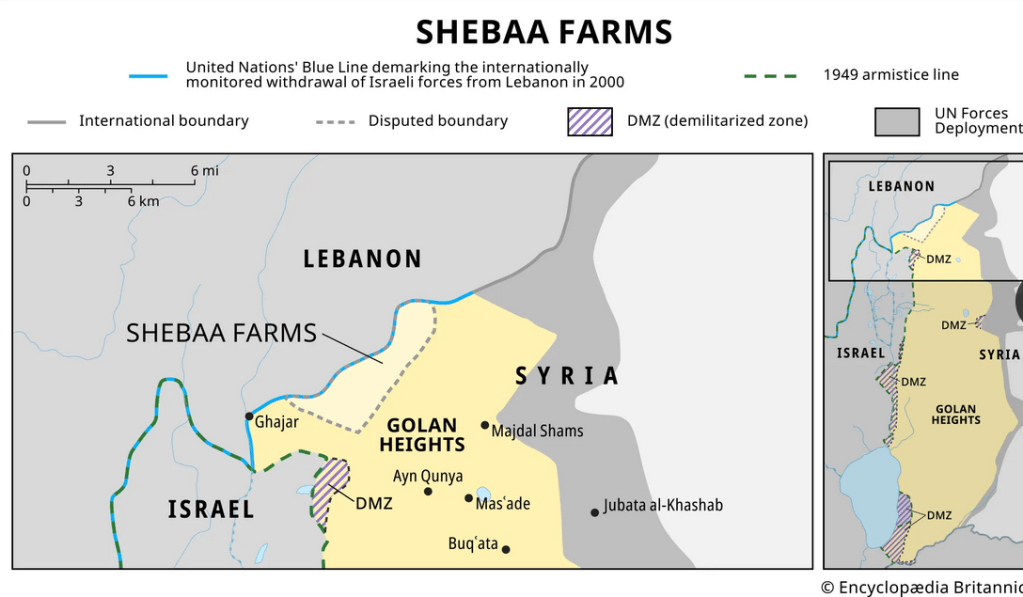
On October 8, Hezbollah attacked Israeli military facilities in the Shebaa Farms, a piece of territory claimed by Lebanon under illegal Israeli occupation since 1967, not recognised as “Israel” by the UN or almost any country internationally (Israel’s claim, which the UN agrees with, that it is part of the illegally occupied Syrian Golan rather than of Lebanon hardly justifies Israel’s position!). Resistance to occupation is legal in international law. Indeed, alongside solidarity with the Palestinian resistance, Hezbollah also declared its operation was “On the path to liberate the remaining part of our occupied Lebanese land.” Hezbollah in other words did not attack Israel on October 8! Israel responded with attacks into Lebanon, thus Israel was the first to attack the other country’s sovereign territory, not Hezbollah.

The next day, October 9, Palestinian militants – not Hezbollah – based in southern Lebanon slipped across the Israeli border and killed an Israeli soldier, wounding several others; Hezbollah had no involvement. There are some half a million Palestinian refugees in southern Lebanon, who aim to return to their country; they will join a battle involving Palestine whether Hezbollah does or not (for example, as they did earlier, in April 2023, when Israel attacked the al-Aqsa mosque). Israel retaliated with a helicopter-gunship attack on Lebanon which killed three Hezbollah militants; Hezbollah then responded to these killings later that day with guided missiles aimed at Israeli command centres in northern Israel, the first actual attack by Hezbollah into Israeli territory, only after two Israeli attacks on Lebanon.

Following this, Hezbollah “calibrated its attacks in a way that [has] kept the violence largely contained to a narrow strip of territory at the border,” and initially at least, Israel did likewise. In December 2023, Andrea Tenenti, from the United Nations Interim Force in Lebanon (UNIFIL), said both Israel and Hezbollah “unfailingly accepted messages passed through UNIFIL in procedures designed to deescalate potentially dangerous misunderstandings.”

But if it was Israel that in fact struck first – twice – then on what basis can the claim be made that Israel had to “defend itself” against Hezbollah, which just wouldn’t stop its attacks over the border, by blowing up the whole of Lebanon? Who was responding to whom?

OK, one might say, that was the beginning, but Hezbollah has insisted since that it would keep up some level of attacks over the border until Israel agreed to a ceasefire in Gaza.

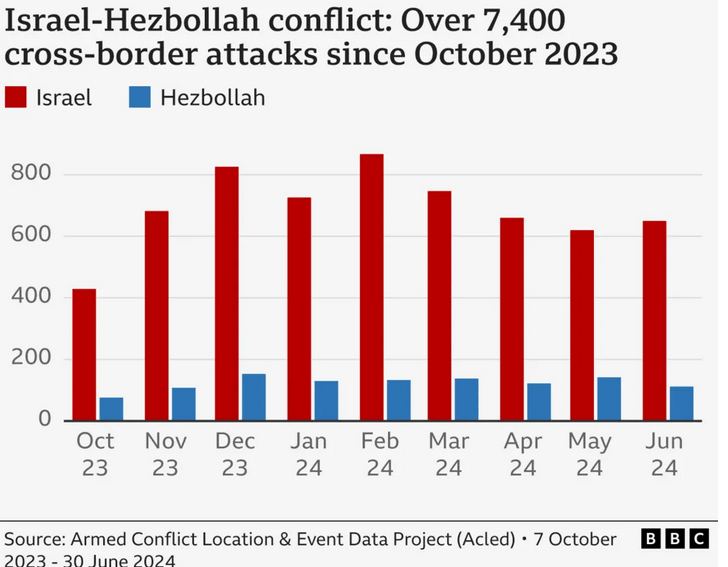
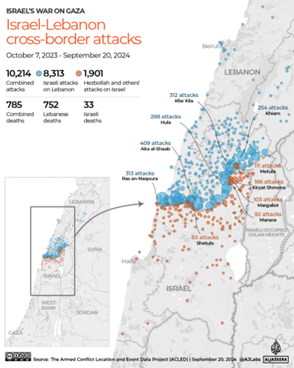
However, Israel’s responses became far bloodier over time: not only vastly disproportionate in sheer number, but also far more targeted at civilians; until September, Israel had launched 8313 attacks on Lebanon, to Hezbollah’s 1901 attacks on Israel; Israeli attacks had killed 752 Lebanese, including hundreds of civilians, to only 33 Israeli deaths, overwhelmingly military – a ratio of 23 to one! Israeli attacks had already displaced 90,000 Lebanese before the current massacre began in late September. In July, the BBC reported that over 60 percent of Lebanese border communities had suffered “some kind of damage as a result of Israeli air and artillery strikes,” and 3,200 buildings had been damaged; Human Rights Watch verified that Israel has used white phosphorus in its attacks on some parts of southern Lebanon.

Who was “responding” to whom?

So if you consider this data, the notion that it was Hezbollah insisting on attack while Israel merely defended itself makes little sense in practice – if Israel has been attacking Lebanon at a rate of over 4 times that of Hezbollah attacks on Israel (and with 23 times the numbers of deaths, indicating that Hezbollah mostly fired to make a statement and avoid casualties), then when was the moment that Hezbollah could have paused or stopped firing anyway if there is simply so much more Israeli firing at them all the time? The bare numbers suggest it was Hezbollah responding, not Israel.

Despite occasional flare-ups – in early January, in June and in August – when Hezbollah briefly responded more forcefully following Israel’s killing of top Hezbollah commanders – this pattern of low level tit-for-tat, with Israel’s attacks far more murderous and escalatory, continued through till late September.

OK, again, but perhaps Hezbollah could have agreed to a ceasefire, to end the attacks and discuss UN Resolution 1701 and so on at the last moment, in order to avoid being decapitated, and to help prevent Lebanese civilians being massacred by Israel’s savagery since last September.

Again, however, it appears that Nasrallah did agree to a “complete ceasefire” just hours before he was killed. There is no dishonour in recognising limitations, in recognising that the blood paid by innocent Lebanese civilians and children is just too high, that you have attempted to do what you can (and the reality is that Israel has essentially completed its genocidal goals in Gaza, with nothing Hezbollah has done making any difference).

But if Nasrallah agreed to it, why did Israel still proceed to kill him? Even if it “just had to” kill him as a war trophy, why continue the horrific war against the Lebanese people after that? Why continue the mass killing after the new Hezbollah leader, Naim Qassem, also said on October 8 that the organisation was supportive of the Lebanese government’s moves to reach such a ceasefire? If that’s what Israel wanted, wouldn’t it have paused to see what came of such negotiations?

In other words, Hezbollah’s alleged “refusal” to end its side of the conflict was never the issue – neither at the outset, as outlined above, nor during the year, given the reality of who was attacking who in practice, nor at the end, when these concessions are ignored and Israel continues to bomb, kill and invade. There was simply never a chance.

Think what you want of Hezbollah politically – the above is all separate to the question of whether or not Hezbollah was doing the “right” thing, whatever that may mean in the context of Israel’s holocaust against the Palestinian population of Gaza. Many argue that, regardless of who shot first, keeping up some level of fire at Israel in solidarity with Gaza was an honourable thing to do; many others, especially many Lebanese who may hate Israel but not like Hezbollah, argue that Hezbollah did not have the right to put Lebanese civilians in danger of the horrific Israeli “retaliation” now taking place; still others may argue that Hezbollah’s attacks were too symbolic, and that it should have attacks on a level that could have actually helped Gaza; others that it could not do this, as neither the Lebanese people, nor Hezbollah’s Iranian paymaster, wanted such escalation; some may argue that Hezbollah had already burnt too many bridges with non-Shia communities in Lebanon to be able to act, and be accepted, as a vanguard for Lebanon (or that it had committed vastly more crimes in Syria to be accepted by the Arab world more generally); while some might say that was precisely why it had to do something, symbolic or otherwise, to rescue its credibility, and whether it had successfully done so or not would also be debated.

More generally, some things are probably undeniable: that Hezbollah greatly overestimated its own strength, underestimated Israel’s immense power, technological advantage and ability to “do Gaza” on another country while still in Gaza itself, and overestimated the likelihood of its Iranian sponsor doing anything at all to defend it in its hour of need.

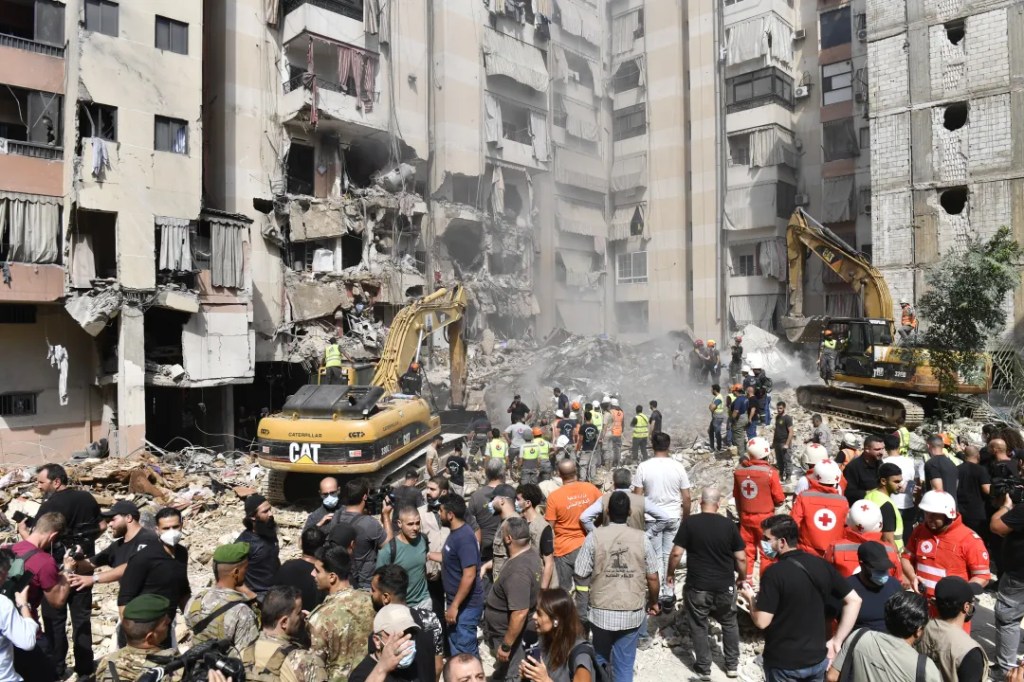
All of this is a valid discussion, which needs to be had, but is outside the question here. Right now, Hezbollah cadres on the ground – and others allied to it that have never been its political allies – is resisting Israel’s new invasion of southern Lebanon in its own country, while Israeli state terror has killed over 1200 Lebanese civilians; over 2000 Lebanese have been killed by Israeli attacks over the last year, 60 percent of them in the last week of September and first week of October 2024, and this includes 127 children, and, for good measure, by the beginning of October, 96 Syrian refugees, while it attacked and killed 24 in the Christian town Aitou in northern Lebanon far from the border, and has even bombed a town council and killed the local mayor. Some 1.2 million Lebanese have been forced to flee their homes – given that Lebanon’s population is only about 4 million, with up to 2 million Palestinian and Syrian refugees, this is around a quarter of the population.

What is the end-game? It appears that, intoxicated after having been able to essentially destroy Hezbollah’s communication networks, much of its launching capacity, and most of its command structure and leadership, all within about a week, Israel’s sights may be set on re-occupying, perhaps effectively annexing, Lebanon south of the Litani, until just recently only an idea entertained on the far-right fringes.

What is behind the bogus “terrorist” labeling of Hezbollah?

By Michael Karadjis

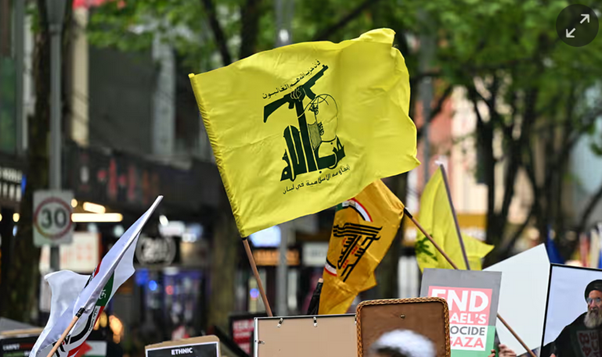
The Australian government, like a number of other western governments, lists Hezbollah as a “proscribed terrorist organisation.” This led to a great deal of hysteria among Australian politicians of both major right-wing parties and among talking heads throughout the monochrome Australian media after Hezbollah flags and photos of its dead leader, Hassan Nasrallah, were displayed by some of the crowd at last Sunday’s weekly rally against Israel’s Gaza genocide. The display of such symbols, aside from being illegal, allegedly causes great “distress” among Jewish-Australians, who do not feel “safe”, and all “antisemitism” must be rejected and so on and so forth.

Just as an aside on that rally: it is worth noting that from the beginning last October, organisers of the weekly rallies asked marchers not to bring symbols associated with proscribed “terrorist” organisations, for legal reasons, to prevent the rallies being closed down, while not making judgements on the politics of these organisations. However, it was to be expected that with emotions high just after Israel had killed about 1200 Lebanese people in around a week, sent over a million fleeing, and also killed Nasrallah, that some members of the Lebanese community who supported Hezbollah might bring Hezbollah symbols, and it would have been difficult for rally organisers to prevent this in the circumstances. However, it was not their choosing, and many at the rally, who were happy to rally for the Lebanese people as well as the Palestinians, were not so happy with the focus of part of the rally being turned to Nasrallah. But let’s get back to the point.

Hezbollah flag at Palestine rally in Melbourne

I hold no brief for Hezbollah, at all, as I will explain below, and much less for its reactionary Iranian paymaster. However, at this moment it is the Israeli state, backed by the Australian government and other western governments, that has carried out a virtual holocaust in Gaza over the last year, is actively stealing land and killing with impunity in the Palestinian West Bank while the world looks away, and has just carried out a devastatingly murderous attack on the neighbouring sovereign state of Lebanon, bombing entire city blocks in the capital Beirut with 2000 pound bombs in the process of killing a handful of Hezbollah leaders. If “terrorism” means killing civilians as part of a political action, then the Israeli regime is one of today’s arch-terrorists. However, let’s put that aside for the moment and classify that as “state terrorism,” and focus instead on the “terrorism” of non-state actors.

In that case, Hezbollah is not a “terrorist” organisation in any conventional sense. It is unclear why its flag should create “distress” among Jewish Australians. When has Hezbollah ever planted bombs in cafes or on buses, when has it shot up civilians in shopping malls, when has it specifically targeted Jews as Jews? This is quite simply not how Hezbollah has ever operated. The “terrorist” label therefore is simply driven by the political views of the US and Israeli states; it is worth looking at where it comes from.

The source of the bogus “terrorist” label: legitimate national resistance

The first source of the “terrorist” labeling was the US itself rather than Israel. Following the end of Israel’s horrific 1982 invasion of Lebanon, when it killed 20-30,000 Lebanese and Palestinians in an unprovoked 3-month Blitzkrieg, the entire time with the full support of the US government of Ronald Reagan, an agreement was signed for a Multi-National Force (MNF) consisting of US, French and Italian troops to move in and supervise the forced withdrawal of the Palestine Liberation Organisation (PLO), the goal of Israel’s war.

Given the total US support for Israel, much of Lebanon’s Muslim population viewed the “peace-keeping force” as occupiers. As soon as the PLO withdrew, Israel facilitated the slaughter of 2-3000 defenceless Palestinian civilians in the Sabra and Shatilla refugee camps by the right-wing Lebanese Christian Phalange/Lebanese Forces militia. In such conditions, the election, in an unfair sectarian system, of Phalangist leaders Bashir, then Amin, Gemayel to the presidency was rejected by Sunni, Shiite and Druze communities. Yet as civil war soon re-erupted around Beirut, the supposedly neutral US forces bombed Muslim and Druze forces in the nearby Shouf mountains. It was in these conditions that Iranian-inspired Shiite suicide bombers bombed the barracks of the MNF in October 1983, killing 241 U.S. and 58 French military personnel.

This killing of so many US troops is the origin of the particular US hatred of Hezbollah and its “terrorist” labelling. However, even if we exclude all the context above, there are two problems. First, regardless of one’s view of such an action as a method of struggle, “terrorism” refers to the targeting of civilians, not of military personnel, however one views their mission. Secondly, Hezbollah was not officially formed until 1985, and it is little more than conjecture that the shadowy pro-Iranian ‘Islamic Jihad’ (not to be confused with today’s Palestinian Islamic Jihad) group which claimed responsibility was a precursor of Hezbollah. Even according to Reagan’s Defence Secretary Caspar Weinberger, speaking in 2001, “we still do not have the actual knowledge of who did the bombing of the Marine barracks at the Beirut Airport, and we certainly didn’t then.”

The second source of the “terrorist” labeling is even more dishonest, stemming merely from Hezbollah’s leadership of the Lebanese national resistance against the Israeli military occupation of southern Lebanon, an entirely legitimate struggle. Following its 1982, Israel remained in occupation of southern Lebanon all the way up to Beirut, and so a national resistance movement began fighting to drive them out. By 1985, they had been driven from Beirut and much of the south, but remained in a significant swathe of territory closer to the Israeli border. While the resistance included a range of political forces, including leftists, nationalists and Islamists, from both Sunni and Shiite communities, ultimately the south is largely Shiite populated, and the Iran-backed Shiite Hezbollah became the dominant force. There were no Israel civilians in southern Lebanon; and Hezbollah never bombed Israeli civilians across the border. Israel merely regards legitimate resistance against its brutal military occupation to be “terrorism” in Lebanon just as it does in occupied Palestine.

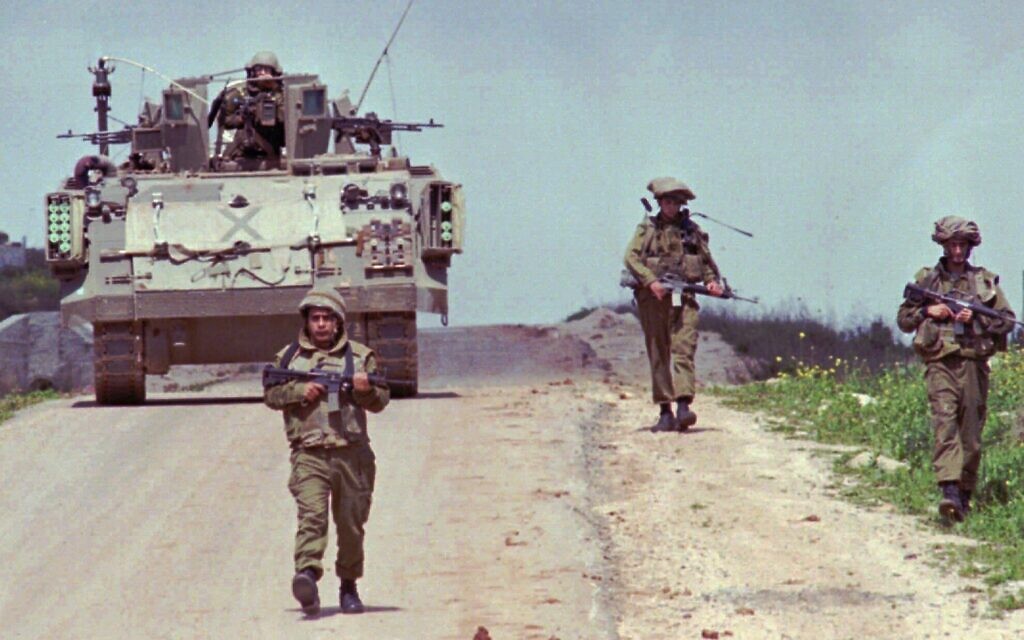
Israeli occupation troops in southern Lebanon 1996

Israel was driven from Lebanon by the resistance in 2000. However, it remained in a 25-square kilometre piece of land called the Shebaa Farms, which Lebanon claims but Israel says is part of the illegally-occupied Syrian Golan (as if that justifies the Israeli position!), and this is part of its justification for remaining a “resistance” militia separate to the Lebanese Armed Forces after 2000. When Hezbollah kidnapped some Israeli troops on the border in 2006 aimed at freeing several Lebanese prisoners in Israeli prisons and liberating this final piece of land, Israel unleashed massive bombing against Lebanon, killing 1500 people and devastating the country again. Nasrallah admitted its actions had been an error, and Hezbollah’s position looked very weak politically; then Israeli arrogance trumped common sense when it attempted a ground invasion, allowing Hezbollah to route the invaders as an on-the-ground resistance again, not only saving but boosting Hezbollah’s resistance credentials.

More generally, since the 1990s, Hezbollah has engaged in parliamentary elections and been part of coalition governments with parties representing other sectarian interests. That’s why even some countries that call the military wing of Hezbollah “terrorist” do not classify the political organisation as such. Far from challenging the sectarian system, Hezbollah has largely bought into it, and despite rhetoric about “the dispossessed,” has emerged as a key party of the Shiite bourgeoisie. Soon after its 2006 triumph, Hezbollah showed itself to be little different to any of the other sectarian militias in Lebanon, when it invaded mainly Sunni-populated West Beirut in 2008 and seized control from the Sunni Future Movement. And in 2019, when Lebanese from all backgrounds rose up against the sectarian system as a whole, targeting all historic sectarian leaders and warlords, Hezbollah came to the defence of the system by helping violently crush the movement.

Hezbollah becomes a state-terrorist partner of the Assad regime

Despite its close relationship to the Iranian dictatorship, Hezbollah had its own origins as a legitimate national resistance movement in a Lebanese context and cannot be viewed as a mere proxy. However, ultimately, Iran is its paymaster, and this side of the organisation came upfront following the outbreak of the April Spring uprisings in 2011. Its opposite views on Libya and Syria is instructive.

When the Libyan revolution began, both Iran and Hezbollah hailed the revolt against Gaddafi’s oppressive rule; despite the image of Iran and Libya being both anti-Israel “rejectionist” states (in both cases reflecting safe geographic distance from Israel, allowing lots of loud rhetoric from afar), there is a dispute going back decades, when Musa al-Sadr, the leader of the Lebanese Shiite movement Amal, disappeared while on a trip to Libya. Lebanon in 2011 was on the UN Security Council, and its vote in support of the UN resolution to dispatch a NATO operation against Gaddafi was decisive, a vote that Hezbollah had to give its support to. Following the 6-month NATO intervention, the rebellion triumphed, and when Gaddafi was killed, celebrations were organised in Iran and in Hezbollah-controlled Lebanese communities.

In contrast, when the people’s uprising began against the tyrannical Assad dictatorship in Syria, Iran sent forces in to support the regime, both its own ‘Revolutionary’ Guard forces, and Iranian-backed Iraqi, Afghan and Pakistani Shiite sectarian militia. This was necessitated by the defection of a large part of the Syrian army to the uprising, forming the Free Syrian Army (FSA). While the Assad regime’s own sectarian ‘Shabia’ death squads were the most notoriously bloody militia taking part in Assad’s sensationally brutal and bloody repression of the Syrian people, the Iranian-backed militia were not far behind.

There seems some evidence that Hezbollah was initially hesitant about Iran’s demand that it enter Syria. During the 2006 war, Syrians took in thousands of Hezbollah supporters and Lebanese Shiite refugees, seeing them as heroes. One of the places this occurred was in the town of Qaysar near the border, which was now in rebel hands. When Hezbollah decided to enter the war as an Iranian proxy, the first place it helped the regime smash the rebellion was in Qaysar.

The irony of supporting the uprising against Gaddafi, despite it being backed by a direct US and NATO armed intervention, while taking part in crushing the anti-Assad uprising, where there was never any US intervention against Assad (indeed the US actively blocked the rebels from receiving essential anti-aircraft weaponry from neighbouring states), is surely too great, when Hezbollah and Iran and their western “anti-imperialist” flunkeys justify their support for Assad’s perennially anti-Palestinian regime on the basis of … “anti-imperialism.”

If Hezbollah had merely taken a back-seat role out of necessity due to its Iranian paymaster, it would have been bad enough, but perhaps understandable. However, once in, it went in with a vengeance. Particularly in southwestern Syria, Hezbollah played a prominent role in the Assad regime’s starvation sieges of various rebel-held towns, especially in Madaya and Zabadani, as well in Aleppo in the north. According to al-Jazeera, “Zabadani and Madaya, both located near the capital Damascus, are besieged by the army of Syrian President Bashar al-Assad and allied fighters from Hezbollah, the Lebanese Shia group.” They even took part in the regime’s siege of the Palestinian Yarmouk camp south of Damascus. The largely Sunni and anti-Assad populations of these towns were eventually forced out and dispatched to a region of northern Syria still under rebel control.

According to an Amnesty report: “The Syrian government and allied militias destroyed local food supplies by burning agricultural fields in Daraya and Madaya. Amnesty International’s analysis of satellite imagery shows the massive decrease in agriculture over the years and an obvious dead zone around Daraya. ‘The government and Hezbollah forces burned the agricultural fields, just as a form of punishment, even though we couldn’t access them’, a former teacher in Madaya told Amnesty International.”

Therefore, while Hezbollah is no “terrorist” organisation in the manner meant by hypocritical western governments, it certainly was responsible for large-scale killing and starving of civilians in Syria (along with its Iranian paymaster). However, it did so in the service of the Syrian state machine; in other words, like Israel, and the Assad regime itself, Hezbollah engaged in state terrorism. But that is not what the West and Israel care about. Indeed, when Biden congratulated Netanyahu for killing Nasrallah, he claimed it was justice for Hezbollah’s “many victims, including thousands of Americans, Israelis, and Lebanese civilians,” whatever that may even mean (mostly US and Israeli occupation troops). He managed to not mention any victims from Syria, the country with the vast majority of its civilian victims!

As for Israel, throughout the Syrian conflict, Israeli leaders (political, military and intelligence) and think tanks continually expressed their preference for the Assad regime prevailing against its opponents, and were especially appreciative of Assad’s decades of non-resistance on the occupied Golan frontier, in other words, it was essentially on the same side as Iran and Hezbollah (which at times was openly acknowledged), just that it didn’t like them being the backers; this is why Israel welcomed the onset of the massive Russian aerial war against the Syrian people to protect Assad in 2005, seeing a Russian-dominated regime as preferable to an Iranian-dominated one. Indeed, just as Israel justifies its slaughter of the Palestinian and Lebanese people by calling them all “terrorists” and “Islamic extremists,” the Assad regime and its supporters likewise justified the slaughter of the Syrian people by calling them all “terrorists” and “Islamic extremists,” echoed in this case by various oddball western “leftist” hypocrites.

The Assad regime is the most similar to Israel in the region in the degree of mass murder and devastation it uses against its population, with some 700,000 killed in the conflict, including at least 300,000 civilians, overwhelmingly victims of the regime, most cities destroyed by regime and Russian bombing, and an industrial-scale torture gulag. Hezbollah and Iran are so widely hated for their role in backing the regime that, despite Syrians in rebel-held zones demonstrating against Israel in support of Gaza for the entire year since October, there were expressions of joy when their former killers were killed. They did not thank Israel, but they viewed it as a conflict between two of their enemies, two occupiers of Syria, wishing ‘good luck’ to both. For Syrians, Hezbollah and Iran acted as the IDF in their towns.

One does not have to share this perspective to understand it. For Lebanese living under Israel’s terror bombing and massive devastation now, their reality is that, whether or not they love Hezbollah, at this moment most Lebanese are united against the Zionist killing machine. Moreover, for southern Shia, Hezbollah is the organisation that led the 18-year struggle for freedom from brutal Israeli occupation. From afar, we need to be able to understand both perspectives.

So, where is the “terrorism”? On the border?

Returning to now, the point is that “terrorism” is a meaningless label in the case of Hezbollah to justify massive Israeli state terrorism and the support to it given by our government. When asked if Lebanon had the same right to “defend itself” as he claimed Israel does, prime minister Anthony Albanese immediately responded “of course we regard Hezbollah to be a terrorist organisation.” This sleight of hand allows him and other leaders to simply avoid the issue of Israel’s massacres and its blatant violation of Lebanese sovereignty. “Terrorism” justifies all. It has extraordinarily sweeping use. “What else can Israel do?” when confronted by a “terrorist organisation” on its border?

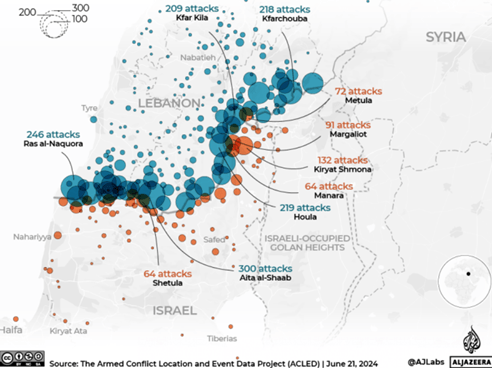
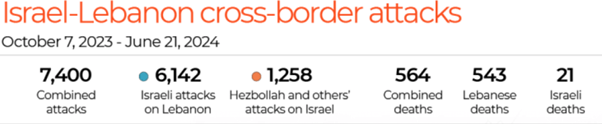
Israel-Lebanon cross-border attacks October 8, 2023-September 20, 2024

Yet the border itself belies this labeling. In sharp contrast to its massacre of civilians in Syria when engaged in the regime’s state terror, Hezbollah’s cross-border attacks since October 8 have been meticulously aimed at Israeli military facilities. No-one can seriously deny that, and the data speaks for itself. In contrast, Israel’s attacks over Lebanon’s border (ie, before the flare-up in the last 2 weeks) have not only been vastly disproportionate in terms of sheer number, but also far more targeted at civilians; until September, Israel had launched 8313 attacks on Lebanon, to Hezbollah’s 1901 attacks on Israel; Israeli attacks had killed 752 Lebanese, including hundreds of civilians, to only 33 Israeli deaths, overwhelmingly military.

Think what you want of Hezbollah politically – but right now it is resisting Israel’s new invasion of southern Lebanon in its own country, while Israeli state terror has killed hundreds of Lebanese civilians; some 2000 Lebanese have been killed by Israeli attacks over the last year, 60 percent of them over the last two weeks, and this includes 127 children, and, for good measure, by the beginning of October, Israel had already killed 96 Syrian refugees (including 36 children) who are only in Lebanon in the first place to escape the atrocities of the Assad regime, which was aided by Hezbollah! Over 100,000 refugees have fled into Syria, both Lebanese and Syrian refugees – and the Syrian regime has already begun arrests. Christian and Sunni towns in the south have been bombed alongside the Shiite civilian population; mostly Sunni regions of Beirut are being devastated alongside the Shiite regions which are Hezbollah’s base. Israel did want to decapitate the Hezbollah leadership, to re-establish its “deterrent” power, but it is also waging a war on Lebanon and the Lebanese people.

To cite Syrian writer Robin Yassin-Kassab: “I oppose Hizbullah absolutely when it is murdering and expelling Syrians on Iran’s orders. And I support absolutely its legitimate resistance to genocidal Zionist fascism.”

Israeli terror bombing of Beirut neighbourhoods

Will Israel use the tragic events in occupied Golan to launch a new war?

Map showing the Israel-Lebanon border conflict, and the Israeli-occupied Golan to the east, source: https://www.aljazeera.com/news/2024/6/27/mapping-7400-cross-border-attacks-between-israel-and-lebanon

By Michael Karadjis

In horrible news on July 27, 12 young Druze, mostly children, in the Israeli-occupied Syrian Golan Heights were killed by rocket fire, while playing football in a sports ground. The first thing to say of course is, regardless of who turns out to be responsible, that this is horrific, and our thoughts are first with the children and their families and community. Children like these, and like the 15,000 children that Israel has massacred in Gaza over the last 10 months, should not have to be killed in wars.

Second, while Israel has blamed Hezbollah firing from southern Lebanon, and Hezbollah has categorically denied this, and instead blamed Israeli interceptor fire gone wrong, at this stage we just don’t know for sure. But whichever it turns out to be, one thing is certain: either way it was a mistake. The occupied Golan has not been a theatre in the conflict between Israel and a number of Lebanese and Palestinian groups in southern Lebanon, led by Hezbollah, over the last 10 months. That conflict has been restricted to the southern Lebanese border with northern Israel. The Israeli-occupied Golan is nearby, to the east of this area, but has not been part of the hostilities.

Therefore, given Hezbollah’s emphatic denials, and Israel’s well-known penchant for lying, Israel’s accusation that it was Hezbollah has to be taken with bucket-loads of salt until we get better information; and even if it does turn out to have been a misfired Hezbollah rocket, Israeli leaders’ current use of such a tragic mistake to threaten a far bigger tragedy by launching full-scale war on Lebanon and turning it “into Gaza” as these leaders so charmingly offer, has to be fought against tooth and nail.

All wings of the Israeli regime – from open neo-Nazis Ben-Gvir and Smotrich, through Netanyahu’s genocidal clique to alleged “centrist” but equally war-crazed Benny Gantz, have called for war on Lebanon. Israel has already attacked a number of towns throughout southern Lebanon as of July 28, but so far nothing out of the ordinary. Of course there has been a border conflict for 10 months now, but it has been largely well-contained on both sides, restricted to a small border region – though it must be said that while some 21 Israelis, mostly troops, have been killed in 1258 attacks on Israel, over 25 times that number, some 543 Lebanese, including about 100 civilians, have been killed in 6142 Israeli attacks on Lebanon, so it is rather obvious who is trying to escalate.

Source: https://www.aljazeera.com/news/2024/6/27/mapping-7400-cross-border-attacks-between-israel-and-lebanon

What are the Druze saying?

The Druze, a religiously defined community that are neither Muslim, Christian or Jewish, are the majority in the occupied Golan, and a minority population in Israel, Syria and Lebanon. It is important to first note what they are saying. The overwhelming message appears to be for everyone to leave them alone to their grief; according to Suweida24, a voice from the Syrian Druze community, “The families of the victims in Majdal Shams, in a frank position during the funeral ceremonies, rejected any political exploitation of their tragedy.”

Ghalib Saif, head of the Druze Initiative for Al-Risala, blamed Israel, claiming that “the missiles that fall on the Druze villages in the Golan and Galilee are Israeli interceptor missiles, and they always cause great damage to places and lives. We see every day the Iron Dome missiles miss their target and fall on us.” Lebanese Druze leader, Walid Jumblatt, condemned the targeting of civilians as unacceptable, whether in occupied Palestine, the occupied Golan Heights, or southern Lebanon; though an opponent of Hezbollah in Lebanese politics, in light of Hezbollah’s denials, he warned people in Lebanon and occupied Golan to be vigilant against “any slippage or incitement within the enemy’s [Israel’s] destructive project, calling for support to “the resistance and all resistance fighters” against any resurfacing “Israeli project,” ie, any attempt by Israel to re-occupy southern Lebanon. Notably, when Israeli government ministers, including the fascist-extremist Finance minister Smotrich, defied the community’s express requests that they keep away from the funeral and showed up anyway, they were jeered and sworn at, and Smotrich told frankly “Get out of here, you criminal. We don’t want you in the Golan.” Yasser Gadban, chairman of the Forum of Druze and Circassian Authorities, when demanding in writing they do not turn up, also requested “that you not turn a massacre event into a political event.” The following day Netanyahu also turned up uninvited, and was greeted with signs saying “War criminal” and “Down with the killing of children” and chants of “Killer! Killer!” and “You’re not welcome here!”

This total rejection of Israeli authorities should not be misconstrued as indicating support for Hezbollah. Sheikh Hikmat Salman Al-Hijri, of the United Druze Muslims sect in Syria, strongly condemned “the heinous crime perpetrated against the innocents and children in the peaceful village of Majdal Shams,” demanding “the prosecution of the criminal party” through international law, whoever it is found to be. Implicitly taking aim at both sides, he stated that “our children are neither training sites nor testing sites, our skies are not battlefields for anyone, nor the fulfillment of anyone’s goals through the blood of our children.” According to Suweida24, the position of the victims’ families and community is “is one of sadness, mourning and reverence, and we condemn the targeting of civilians everywhere, at all times and from any side.” Another resident they spoke to stated that “The two sides [Hezbollah and Israel] are in a war that has been raging since last year, and its rules and regulations are drawn in the blood of innocents in this wretched Middle East; the strong message regarding the threat to escalate the war in their name is “Leave us to grieve for our children, and we do not want the death of other children anywhere in this world.

The Israel-Lebanon border conflict

While I certainly hold no brief for Hezbollah, at all, whose intervention in Syria as a tool of the Iranian theocracy’s support for Assad’s genocide regime in Syria was outrageous, where despite acting largely an Iranian tool, they played quite a generous role of their own in some of the regime-led slaughter of Syrian civilians as agents of this counterrevolution, and who also played a decisive role in saving all the sectarian Lebanese elites by using violence against Lebanon’s own anti-sectarian uprising in 2019, nevertheless, the conflict on the Israel-Lebanon border has its own dynamic which is very distinct from these two events.

Firstly, southern Lebanon was under direct Israeli occupation from 1978 to 2000, and though Israel withdrew then, the border has not been finally demarcated; Lebanon disputes certain areas, particularly the Shebaa Farms region. The fact that Israel and Lebanon (under a government including Hezbollah) just recently demarcated their sea borders (and hence borders of gas fields), in an agreement backed by Iran, demonstrates that there are potential ‘national’ issues involved here. Secondly, the hundreds of thousands of Palestinian refugees in southern Lebanon – refugees from 1948 Palestine (Israel) who cannot return – are a permanent factor in southern Lebanese politics, who would have taken action even if Hezbollah hadn’t (for example, in April 2023, Palestinian fighters in southern Lebanon had fired rockets at Israel in retaliation against Israel’s attack on the al-Aqsa mosque in Jerusalem, while Hezbollah remained quiet; Israel retaliated only against the Palestinians). In fact, southern Lebanon basically merges into northern Palestine. While the resistance to Israel’s long occupation in the south had involved an array of different parties and militias, it is not surprising that Hezbollah emerged as the leading party, given the overwhelmingly Shiite population of the region.

All these factors give the southern Lebanon-northern Israel region a specific character; thus while Hezbollah is the leading force in the current border skirmishes, this should not be seen as an essentially ‘Iranian-inspired’ conflict (if anything, Iran has tended to attempt to restrain Hezbollah). The battles against Israel have also involved the anti-Hezbollah al-Fajr Forces, of the Sunni organisation Jamaa al-Islamiya, which had supported the Syrian uprising, but sees the battle against Israel and in support of Gaza as primary, as well as Palestinian forces (including Hamas, who also fought against the Assad regime in Syria and thus were on the opposite side to Hezbollah there).

And in this conflict, as opposed to other, unrelated, conflicts, the Hezbollah-led side has not been targeting civilians, but rather Israeli military forces; this is a simple observation of the data. So there is no reason whatsoever for Hezbollah to suddenly decide to kill a dozen Syrian Druze children in a region that is not part of their conflict; in contrast to southern Lebanon, the Assad regime has kept the Golan ‘border’ dead silent (indeed, Israeli leaders’ and strategists’ continually-expressed preference for Assad to defeat the uprising was in part due to their trust in Assad keeping the ‘border’ that way; as Netanyahu stated as he, Trump and Putin connived to facilitate Assad’s reconquest of southern Syria in 2018, “We haven’t had a problem with the Assad regime, for 40 years not a single bullet was fired on the Golan Heights”).

There is even less reason for Hezbollah to want to kill Syrian Druze given that they are for the most part anti-Israel; indeed in June last year there were major anti-occupation disturbances involving thousands of Druze, with Israeli forces using tear gas, bullets and water cannon against them. Indeed the same Smotrich, who tried to turn up to the funeral, at the time released a statement welcoming the police attacks on the Druze, stressing there would be no “giving in to violence” by the occupation authorities.

Of course, none of this makes it impossible that the terrible mistake was made by Hezbollah rather than Israeli rocket fire.

Golan Heights: Sovereign Syrian land

Israeli leaders assertions that Hezbollah has just killed a dozen “Israeli” children are both incredibly hypocritical and bald-faced lies. Firstly, this occurred a day after Israel just killed another 30 civilians, mostly children, in an attack on a UN school in Gaza; this is the eighth time since 6 July that a school had been hit, leaving a total of more than 100 people dead. A genocidal regime which has killed 15,000 Palestinian children in Gaza – just one almost inconceivable fact within its Gaza holocaust – does not care about children’s lives, to state the obvious.

But just as importantly, these are not “Israeli” children. The Golan Heights is sovereign Syrian territory that was conquered in 1967 during Israel’s unprovoked aggression against all its neighbours, when it also conquered the Egyptian Sinai, and the Palestinian West Bank, Gaza and East Jerusalem. Some 130,000 people lived in the part of Golan conquered by Israel at the time, the vast majority Sunni Muslims, in 139 towns and villages; following Israeli conquest, nearly all were expelled or fled into Syria, and are still unable to return, leaving only 6396 people, mostly Druze, in four remaining villages. The now 20,000 Druze share the territory with some 25,000 Israeli colonists (“settlers”) in 30 illegal settlements. In 1981, Israel formally annexed the Golan (and East Jerusalem), ie, declared it simply part of Israel, in much the same way as Russia annexed Crimea, and later four eastern Ukrainian oblasts. Israeli rule in Golan is rejected by the UN and by every country in the world (and, for that matter, by the Syrian anti-Assad opposition as well as regime), with the sole exception of Donald Trump’s rogue US regime which recognised Israeli “sovereignty” while last in power (and the Biden regime has shamefully not reversed this).

The Golan Druze population have overwhelmingly remained loyal to their Syrian citizenship. While there has been incremental growth in recent years of some Druze accepting Israeli citizenship for very practical purposes (eg, otherwise they have no passports etc), still only 20 percent have done so; 80 percent still see themselves as Syrian citizens, as of 2022 data. This ratio is the same in this town, Majdam Shams, where this tragedy took place. And if some take Israeli citizenship for practical purposes, even this does not mean loyalty to Zionism or the Israeli occupation; for example, in local elections in Majdam Shams in 2018, of 12,000 residents, only 282 voted in local elections. Incidentally, loyalty to Syria has nothing to do with loyalty to the Syrian regime (the article linked in this paragraph seems to suggest this, though it may merely journalistic laziness); opinions among Golan Druze are divided between Syrian regime and opposition; indeed, during large-scale Druze-led protests against the Assad regime in 2020 in southern Syrian province Suweida, there were demonstrations among Golan Druze in support of their brothers and sisters on the other side of the Israeli-occupation boundary, and this occurred again during the Druze-led uprising against Assad in Suweida in mid-2023.

Source: https://www.shomrim.news/eng/druze-gloan

Green light from Trump?

Finally there is the question of whether this was an Israeli “false flag” operation to justify war on Lebanon. This is probably unlikely; the fact is that convenient errors can occur. But it is awfully convenient. For months, Netanyahu, Smotrich and Ben-Gvir have been threatening to escalate the border conflict with Hezbollah into a full-scale war. While it may seem mad that they would want a two-front war (when to date Hezbollah’s actions have been largely symbolic and had no effect on Israel’s ability to carry out genocide in Gaza whatsoever) – and indeed it is quite likely that even this time it will once again blow over after some harsh rhetoric and mild escalation – there are other factors at play.

One is simply Netanyahu’s own stake in ongoing war – he knows that if the Gaza war winds down due to pressure for a ceasefire and hostage exchange, he is finished, and the high-level corruption charges against him may land him in jail, so ongoing war is a temporary saviour. More broadly, Israel’s already escalatory actions in Lebanon are widely seen as aiming to create a larger regional conflagration, to bring in both Iran and the US, so that the US, it hopes, could do its job for it keeping Lebanon, and perhaps Iran, busy, and Israel could then get on with and perhaps complete the genocide in Gaza under the cover of this much larger regional apocalypse; in other words, it is not that Israel wants to fight Hezbollah (and still less Iran), rather it wants the US to do that as a sideshow – Israel’s actual war remains the extermination of Palestine. To date, the Biden administration has shown no interest in being involved in this game, and has been working feverishly to bring about a new Israel-Lebanon borer agreement in which both sides could save face; even after Majdal Shams, the first statements by Blinken have been calling for restraint.

But it seems no coincidence that this new wave of loud Israeli aggressiveness towards Lebanon is taking place just after Netanyahu’s meeting with Trump, and after his speech to Congress was received with rapturous applause from US leaders on both sides, but especially from the fanatical Republican side. While some have mistakenly seen Trump’s ‘muscular realism’ as ‘isolationism’, this is both an error in general, but above all total myopia with regard to the Israel-Palestine conflict, where Trumpism and traditional ‘Reaganite’ or ‘neoconservative’ Republicanism are in total agreement in support of Israeli extremism. Consider Trump’s record in office: recognition of Israel’s annexation of East Jerusalem and Golan, moving the US embassy to East Jerusalem, declaring that the US no longer sees the occupied Palestinian territories as occupied, the ‘deal of the century’ which proposed to bring ‘peace’ to the region by giving Israel everything and Palestine nothing, cutting off funding for UNWRA etc.

Trump and co almost certainly gave Netanyahu to go-ahead for an invasion of, or at least a bigger attack on, of Lebanon. Of course, they are not in power, but creating a crisis for Biden-Harris before the US elections would be an added bonus, for Trump, and for Netanyahu who wants another Trump regime. While false flags and conspiracies are generally the least likely possibilities, this tragedy in the Golan has come at an incredibly fortuitous time for Netanyahu’s thugs.