By Michael Karadjis
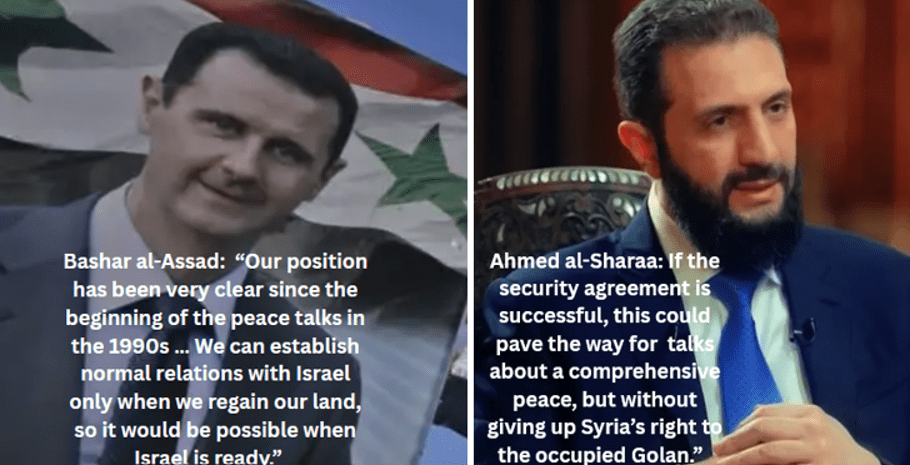
In a recent interview in al-Jazeera, Syrian president Ahmed al-Sharaa repeated the statement made many times that Syria seeks a “security agreement” with Israel, which it is trying to reach by “involving a large group of countries to put pressure on Israel to adopt a balanced policy towards Syria.” He then continued:
“If the security agreement is successful and Israel commits to the security side, and Syria does as well, along with all the conditions of the agreement that may be concluded later, then this could pave the way for a second phase of talks about a comprehensive peace, but without giving up Syria’s right to the occupied Golan.”
When asked if there were “any linkage to the Palestinian issue or a Palestinian state in these future visions, he replied “of course, Syria supported the establishment of a Palestinian state and voted last year with the campaign led by the Kingdom of Saudi Arabia. So Syria is on this path, alongside the Arab path and with the binding global agreements for establishing Palestine.” [18.16-18.30 of linked longer interview]
In 2020, when Assad was asked if it were likely that Syria “will establish diplomatic relations with Israel in the future, as several Arab countries have done recently,” referring to the Assad regime’s best friends in the Arab world (Egypt, UAE, Bahrain etc), which had re-established relations with both his regime and Israel at much the same time, he replied:
“Our position has been very clear since the beginning of the peace talks in the 1990s … We can establish normal relations with Israel only when we regain our land … So, it would be possible when Israel is ready, but it is not … Therefore, theoretically yes, but practically, so far, the answer is no.”
Clearly, the statements are fundamentally similar, yet many see Sharaa’s statements as a break with the past rather than continuity. This is even odder when you look at the statements more carefully: it is actually Assad, not Sharaa, who is being unambiguous that he was ready to normalise with Israel; Sharaa’s more ambiguous formulations only offer “talks” about it.
New Syria: What to support, what to criticise
Before breaking this down, it should be stated clearly: supporting the Syrian people’s glorious revolution that overthrew the half-century of tyrannical rule by the Assad family in no way requires us to give support to the new government led by Ahmed al-Sharaa – in the same way as supporting the 1979 Iranian revolution that overthrew the tyrant Shah did not mean giving support to the new mullah regime, or supporting the overthrow of Philippines dictator Marcos in 1986 did not mean support for the Aquino regime that followed, and supporting the Egyptian revolution against Mubarak at the beginning of the Arab Spring did not require us to give support to Morsi’s Muslim Brotherhood-led government that arose, to list just a few examples of what ought to be obvious, what should go without saying.
Rather, in all these cases, removing an entrenched dictatorship opens up the possibilities, gives a degree of democratic space for the people to organise for their rights and freedoms, and gives them a chance to take these revolutions in more radical directions. Al-Sharaa’s Syrian government can be criticised on a great range of matters, indeed condemned outright for certain actions; but there are constant protests, strikes, popular actions all over the country around a huge range of issues, and while the government does sometimes use repressive moves, including a number of very opaque arrests of individual activists which should be condemned outright, overwhelmingly these protest actions take place without participants ending up spending decades in Assad’s Sednaya Torture Inc, or disappeared into a mass grave alongside 180,000 still not found, or having protesting cities bombed by the airforce into oblivion. Not understanding that the situation today is infinitely better than under Assad for the great majority is not a serious basis for discussion.
Foreign policy: Necessary compromise or capitulation?
Whatever the case domestically, foreign policy presents a different range of issues – a country emerging from an apocalypse, like Syria yesterday, or Gaza tomorrow, has reconstruction of the country and of peoples’ basic needs as first priority; just think of two million of the 14 million displaced still living in tents in the north due to the sheer volume of housing stock destroyed by Assad, or 2.5 million children unable to attend school, or five (of the seven) million still unable to return from exile, among myriad similar issues. I wonder how many realise the sheer extent of the devastation of Syria by a decade of Assad and Putin destroying entire Syrian cities with their airforces, barrel-bombs and cluster bombs, long-range missiles, chemical weapons and the like. It is not quite Gaza post-2023, but it is the closest thing in the region. And given where money for such reconstruction and economic revival exists in today’s world, compromise with harsh realities is necessary, and those sitting in comfort on computers in the West need to check their privilege before being too critical.
When you inherit a country from a regime which destroyed it, it is your responsibility to reconstruct it – people’s everyday lives, jobs, housing, schools, hospitals, infrastructure depend on it. If you are given a message that the US will end sanctions on your economy and facilitate reconstruction aid, loans and investment if you sell out your own territory in the Golan and sign an unequal peace with Israel, you are at least required to diplomatically play along as best you can, to reject but pretend to engage; surely, the fact that the Syrian government has not carried out this demanded capitulation ought to earn it respect in the circumstances.
That said, principle still matters. But the problem is not that new Syria’s foreign policy cannot also be subject to criticism. The problem is that a huge amount of the criticism it has been subjected to by a strong section of the privileged western left is both based on extraordinary ignorance, and motivated by malice – by an attempt to show that the revolution delivered Syria from a supposedly “anti-imperialist and anti-Zionist resistance” stance under Assad to a stance of “capitulation” under Sharaa.
Yet nothing could be further from the truth.
Those who think this is the reality seize on social media-generated headlines about statements made by Syrian leaders such as the above. A context-free headline that says “Sharaa wants a security deal with Israel” or some such concoction is followed, on social media, by dozens or hundreds of screwballs writing “Mossad agent,” “al-Qaeda works for Israel,” “that’s why they put him in power,” “I’m missing Assad now” and similar statements of sheer brilliance (for a lettuce, that is).
I even saw one, under an article that merely stated that Sharaa wants the “security agreement” with Israel, who wrote that such a headline several years ago would have seemed like parallel universe! The sheer irony of that particular gem was that “several years ago” we were living through the fifth decade of Assad’s security agreement with Israel that Sharaa merely wants to return to.
Yet when you look at the statements above by Assad and Sharaa, you see they are fundamentally similar. Tankies don’t know that, because their attention spans are inherently limited, but even countless more discerning leftists may not know either due to the way both mainstream media and even much alternative media present these issues.
In fact, there is a difference between what Assad says here (and both father and son continually said and did) and what Sharaa has continually said, but it is the opposite of what dim tankies and embittered Assadists want it to be. Let’s break it down.
The “security agreement”
First, Sharaa says he wants to reach a “security agreement” with Israel. So what does it mean? In 1974, following the October war the previous year, Israel and Assad senior, through the good offices of war criminal Henry Kissinger, signed a security agreement in which Israeli and Syrian forces “disengaged” along the frontier of the Israeli-occupied Syrian Golan, with UN forces in a buffer zone in between – but without Syria ever recognising the Israeli theft of the Golan. Israel and both Assad regimes maintained this security agreement, this disengagement accord, for the next 50 years without a hiccup. Israeli leaders lauded Assad for never firing a shot; for example, in 2018, as Assad’s forces reconquered southern Syria from the rebels, with the facilitation of Trump, Putin and Israel, Netanyahu declared “We haven’t had a problem with the Assad regime for 40 years, not a single bullet was fired on the Golan Heights,” while his Chief of Staff Lt. Gen. Gadi Eisenkot stressed that Israel will allow “only” Assad regime forces to occupy the Golan “border”.
However, the very morning Assad was overthrown on December 8 2024, IDF Chief Herzi Halevi announced that “combat operations” in Syria were to begin, stating that Israel was now fighting on a “fourth front” in Syria in addition to Gaza, West Bank and Lebanon. Israel began a massive air attack on new Syria – till then, Israel’s biggest ever air war – destroying 90 percent of Syria’s strategic weaponry that it had never had a problem with as long as it was safely in Assad’s hands, who they knew would only ever use it against the Syrian people; in fact, Israeli leaders had long promised to do exactly what they now did if Assad were ever overthrown, to prevent the rebels from getting their hands on the weaponry. Israeli leaders all declared relentless hostility to the new Syrian government, calling it “terrorist,” “jihadist,” “extremist” or “al-Qaeda” (sounding much like the tankie ‘left’).
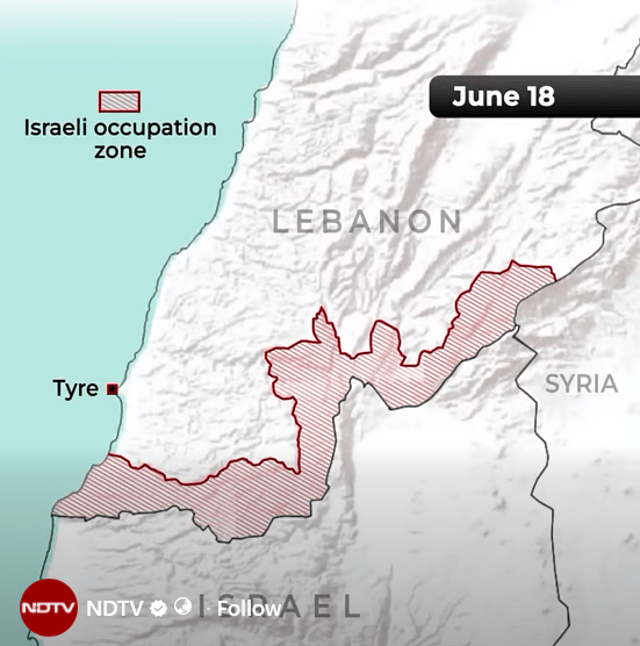
At the same time, Israel ripped up the security agreement it had maintained with Assad for 50 years on the Golan, invading southern Syria beyond the Golan occupation, occupying a new section of Quneitra province and launching continual ground attacks, home invasions, arrests, attacks on agricultural lands, seizure of water supplies and sometimes further airstrikes in southern Syria. This keeps not only that region but the entire country destabilised, a threat to the necessary investment for economic recovery. Interestingly, Israel’s invasion beyond the Golan had began, to a more limited extent, in the last two years under Assad; the difference is that the Assad regime denied it was happening (ie, was complicit), even “order[ing] paramilitary units to withdraw from areas close to Israeli forces,” (as did Russian forces), while the Sharaa government vigorously condemns it daily, right up to the UN, demanding Israel’s withdrawal.
Therefore, by calling for a new “security agreement,” which Syria uncompromisingly conditions on total Israeli withdrawal from all new territory seized since December 2024, Sharaa is merely calling for a return to the situation that existed under the Assads from 1974 to 2024. Israel, by contrast, demands Syria sign a security agreement allowing IDF forces to remain in parts of the newly occupied territories.
One may criticise Syria for not going beyond that and attempting to militarily take back the whole Golan. Most rational observers know that is impossible and suicidal in Syria’s current condition (especially following Israel’s destruction of Syria’s entire arsenal), and would only lead to Israel returning to and intensifying the Assad-Putin destruction of Syria. Nevertheless, if a brave western keyboard warrior insists they must do that, to be consistent they also need to condemn the Assads far more vociferously for never attempting to take back the Golan for 50 years, even at the height of Syria’s military power. Strangely, that often tends to not be the case.
‘Normalisation’ with Israel – what does Assad say? And what did the Assads do?
Next let’s go beyond the Assad/Sharaa security agreements with Israel to the question of establishing full “peace” with Israel involving establishing diplomatic relations (“normalisation”). It is clear in all statements by both Assad and Sharaa that this is impossible without Israel returning the Golan Heights. That is a necessary condition, but is it sufficient? What about the Arab consensus view that this cannot happen without Israeli withdrawal also from the West Bank, Gaza and East Jerusalem and the establishment of a sovereign Palestinian state?
What does Assad say? He says Syria “can establish normal relations with Israel” if the Golan is recovered. There is nothing ambiguous there. There is no mention of Palestine or “resistance.” Moreover, there is no question that “normal relations” means normalisation, because the question asked specifically about establishing “diplomatic relations.”
And the context was Assad’s increasingly close alliance with the most Israel-aligned Arab states (UAE, Bahrain, Egypt) on a counterrevolutionary and anti-Muslim Brotherhood basis; given these states normalised with Assad and Israel at the same time (2018-2020 for UAE and Bahrain, Egypt earlier), an Assad-Israel normalisation was a logical step – if only Israel were ever prepared to hand back the Golan. Assad aimed to be Sadat, but Israel wouldn’t let him. By contrast, the Arab states most supportive of the anti-Assad rebels – principally Qatar and to an extent Saudi Arabia – were those who rejected normalisation with Israel without a Palestinian state, plus Turkey, whose older normal relations with Israel were now frozen and hostile under the AKP regime.
Furthermore, under Assad father and son, Syria and Israel had already engaged in normalisation talks in 1993-96, 1999-2000 and 2008-2011. There was no ambiguity; these talks were about the famous “land for peace” formula – return of the Golan in exchange for Syrian recognition of and diplomatic relations with Israel. None of this was ever conditioned on Palestine.
During the first phase of direct negotiations between Israel and Syria in 1993-96, Assad senior told US President Clinton that Syria had made a “strategic choice for peace” and was ready for “normal, peaceful relations” with Israel in exchange for full withdrawal, and had accepted no linkage with Palestine. Direct negotiations picked up again in 1999-2000 as Clinton brought together Israeli prime minister Ehud Barak and Syrian Foreign Minister Farouk al-Shara. Following Assad senior’s death in 2000, negotiations paused due to events such as the Second Intifada and the new US Bush regime’s extremist foreign policy having little room for such negotiations, though this did not prevent the Assad regime obliging Bush’s “war on terror” by taking Islamist “terror” suspects sent by the US for torture.
Assad junior and Israeli prime minister Olmert returned to indirect talks in 2008, and both sides confirmed they were drawing up an agenda for direct talks, Assad declaring himself ready to meet Olmert, but this was interrupted by Israel’s brutal Gaza Operation Cast Lead in 2008-9. However, they returned to US-mediated talks in 2010. Dennis Ross—an ultra-Zionist in the Obama administration if ever there was one—was convinced that “Syria is ready to move away from Iran and reduce relations with Hezbollah and Hamas, and work with the US in the fight against terrorism,” while Senator John Kerry, soon to be Obama’s Defence Minister—who dined with Assad in Damascus in 2009—said he was “a believer for some period of time that we could make progress in that relationship” [with the Assad regime] “as it embraces a legitimate relationship with the United States and the West.” US mediator Frederic Hof claims to have had an agreement that “went further than any previous document,” which included a pledge by Assad to sever “military ties” with Iran and Hezbollah in exchange the return of the Golan.
In this case, the outbreak of the Syrian uprising in early 2011 cut this off, but Assad’s 2020 statement cited above indicates the regime maintained the same consistent policy; and this background shows that Assad’s statement then was no anomaly.
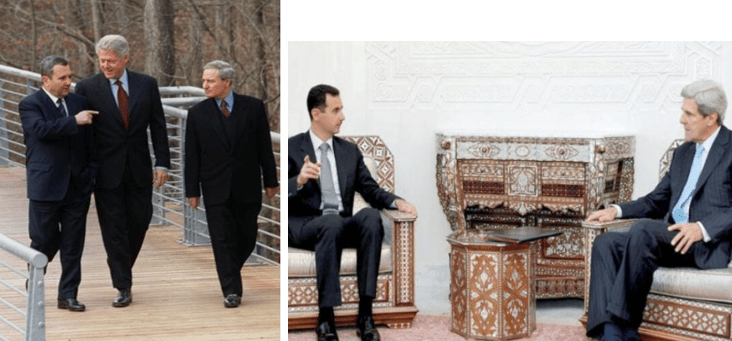
Now, one might claim that Sharaa wants to do the same – normalise with Israel in exchange for the Golan and forget Palestine – but even if you did think that, surely this would be continuity with Assad, not a contrast. But what does Sharaa actually say?
‘Normalisation’ with Israel – what does Sharaa say?
Let’s look again. He says that if the security agreement is successful, this “could pave the way for a second phase of talks about a comprehensive peace, but without giving up Syria’s right to the occupied Golan,” then when asked whether the latter would involve any “linkage” to the Palestine issue, he responds “of course, Syria supports the establishment of a Palestinian state.”
But what does any of this mean? In contrast to Assad’s unambiguous yes we can normalise with Israel if the Golan is returned, Sharaa’s statement is completely ambiguous, and in fact promises nothing. It does not say there will be a comprehensive peace – it only offers the possibility of “talks” about it. On the other side, the additional “of course” following the question does not necessarily mean that Palestine will be linked to the outcome, it could simply be that, separate to the Israel “peace” discussion, he also supports a Palestinian state; but it could mean it is linked. Sharaa’s ambiguity is deliberate – he is addressing different audiences about a completely hypothetical situation, knowing full well that Israel has pledged to never withdraw from the Golan.
OK, one might say this is just the interpretation, the translation, his particular wording at that moment and so on. However, if we look at any reference made by Sharaa or foreign minister Shaibani or other leaders to the issue of normalisation, the same ambiguity always exists. For example:
- In July 2025, A Syrian foreign ministry spokesperson told al-Hal newspaper (reported in the Syrian Observer) that Syria’s foremost condition for any “peace process” to begin is a “complete Israeli withdrawal from the occupied Golan Heights.” A “peace process” is not a peace agreement; it is, once again, “talks” about one. There is no promise to normalise.
- The same month, Levant 24 reported that Syrian officials reiterated that “Damascus will not consider any diplomatic initiative that falls short of restoring Syrian sovereignty over all occupied territory, including the entirety of the Golan Heights.” Thus the most promised in exchange for full Israeli withdrawal is a “diplomatic initiative,” ie, talks.
- Earlier, in April, after two visiting US Congressmen claimed that Sharaa would be willing to sign the Abraham Accords if “the right conditions were met,” Shaibani responded “in fact, the word normalisation was not mentioned, and I was present during this meeting. What was discussed was that we want Syria to live in security and stability. The Israeli incidents that they talk about are a matter of Israeli threats … The Abraham Accords and normalisation were not mentioned.”
- Earlier still, when asked during a February interview with The Economist whether he was ready to normalise with Israel, Sharaa replied “we want peace with all parties,” but as long as Israel occupied the Golan, any agreement would be premature.”
- When in the US in September for the UN General Assembly, Sharaa was asked about the Abraham Accord by retired US general David Petraeus. Sharaa replied that “those countries that are part of the Abraham Accords are not Israel’s neighbours,” whereas “Syria, as a neighbour, has been subjected to over 1,000 Israeli raids, strikes, and Israeli incursions into Syria from the Golan Heights – many were killed. So what applies to those who are part of the Abraham Accord does not apply to Syria.” Speaking of the need for calm, stressing that it is Syria’s, rather than Israel’s security under threat, he continued “If we succeed in calming the situation, we can discuss the situation of the Golan Heights and other issues. There is also huge anger over what’s going on in Gaza, not only in Syria but in the entire world, and of course this impacts our position on Israel. We just had our revolution. We are trying to be the voice of the [Syrian] people.” Once again, just hinting at some Palestine conditionality.
- Asked by Syrian journalist Ibrahim Hamidi in Al-Majalla last August about the Abraham Accords, Sharaa replied: “These accords were concluded between Israel and countries with which it has no direct disputes and that do not share borders with it. Syria’s reality is entirely different. For us, the Golan Heights remain occupied territory.”
What is clear from all these statements is that there is not a single instance in which Sharaa or any Syrian leader states that they are willing to normalise with Israel, to sign something like the Abraham Accords, even if Israel returned the Golan. Every statement is either ambiguous, or only offers talks, or a “process,” or is stated in the negative – ie, “there can be no discussion of normalisation as long as Israel occupies the Golan,” but never “yes we can normalise if Israel withdraws from the Golan” – only Assad ever said the latter. In my view, this is because Syria has no interest in normalising with Israel, Golan or otherwise, but the Golan gives Syria cover for rejecting ‘normalisation’ which it does not want in any case.
These are thus all guarded and ambiguous statements; they are not directed at Israel: Israel knows exactly what it is doing (trying to partition Syria and destroy this government) and Syria knows that Israel knows what it is doing; rather, the statements are aimed at keeping the US engaged. Why? Two reasons. First, it is the US that has sanctions hanging over Syria’s head – no other government can end US sanctions except the US! Second, it is only the US that Syria can have any hope for applying some pressure on Israel to desist, at least a little; not that the US has done so, but certainly Israel will listen to no-one else.
And that is precisely the context of Sharaa’s latest statement about the security agreement and the future possibility of “talks about” a comprehensive peace. The US lifted most Syria sanctions last year, and that itself was a struggle that required this kind of deftness from the leadership. But the US government maintains the Syria as a “state sponsor of terrorism” designation. And this still has a significant impact on potential investment in Syria. On the sidelines of the recent NATO summit in Turkiye, Trump stated that he would lift this designation (much to the fury of the Zionist lobby). But now there is 45 days of discussion in Congress on this. Right now, Sharaa must be careful to not put a foot wrong, especially given his continual rejection of Trump’s continual crackpot suggestions that Syria enter Lebanon to fight Hezbollah (Sharaa once again firmly rejected this in this interview).
Of course, one might say, these are all just statements – as they were under Assad. Statements do not preclude Syria sometime capitulating under pressure. But you cannot accuse Syria of wanting to sell the Golan and normalise with Israel, and then confronted with evidence that the current Syrian government continually says the complete opposite, retort “these are only statements.” In reality, weaker states have always compromised under massive pressure in highly unequal conflicts. Consider the Palestinian leadership since the late 1970s, when it began moving from the demand for a democratic, secular state in all Palestine to acceptance of a state in the territories occupied in 1967, ie, of sovereignty over only one-fifth of historic Palestine (combined, of course, with the right of refugees to return to anywhere in Palestine with equal rights). Or look at Ukraine currently, where the entire tankie-inspired left not only accepts that Ukraine will have to give up a fifth of its territory for peace, to end the Russian invasion, but in fact demands that it does (as does US president Trump!). No doubt the same people would be castigating the current Syrian government as “traitors” if they were forced to do the same as what they demand of Ukraine – forced, so that Syrian people can eat, can go to school, can return to rebuilt housing and so on. While I don’t expect this to happen, if it does, surely the blame lies with those who destroyed the country so thoroughly that it had no other choice, no bargaining power – the Assad regime and its allies. Yes, bombing all your own cities and towns into a moonscape is indeed the supreme act of treachery.
Ongoing Israeli attacks
Whatever the case, one thing is clear: Israel itself remains relentlessly hostile to new Syria, regardless of what tankie leftists think about Syria being run by “Mossad” or “capitulating” and so on. A report by SARI Global documented 897 “incidents attributed to Israeli activity in southern Syria.” This included 123 in March 2026 alone, compared to 91 incidents in January and 97 in February. Three times in January, Israeli aircraft sprayed large areas of Quneitra with herbicides, “killing crops, devastating farmers and damaging trees.” Just in the last two weeks of July, Israel has targeted civilians and agricultural targets in a total of 23 artillery and heavy-machine gun incidents, along with 24 ground incursions and 5 arrests; in fact, the week of July 15-22 saw the highest number of Israeli artillery strikes on Syria in 9 months.
Addendum: New Syria – the Golan Heights is Syrian!
It is clear enough from the above that Syria sees the Golan Heights as occupied territory that must be returned, from the continual statements that there can be no “peace talks” or “peace process” that does not involve return of the Golan. Oddly though, the tankosphere is full of claims that new Syria is “giving away the Golan” and the like, unlike “resistant” Assad, ie, the regime that kept the peace on the Golan for 50 years. Whatever. I thought a little addendum with some additional statements by Syrian leaders on the Golan itself, separate from the issue of “peace talks,” could be useful as an antidote:
- On January 17 2025, Syria’s UN ambassador Koussay Aldahhak, in a UN session condemning Israel’s aggression into the ‘buffer zone’, also “reaffirm[ed] Syria’s inalienable right to recover the occupied Syrian Golan in full.”
- At another UN session on April 10 2025, Aldahhak demanded implementation of UN resolutions 242, 338 and 497 and “the end of the Israeli occupation of the occupied Syrian Golan.”
- When Shaibani attended the Munich Security Conference with European and Middle Eastern leaders in February 2025, he stated that the “Golan Heights are Syrian land and no one has the right to give it to anyone.”
- In April 2025, while condemning ongoing Israeli aggression, he again stressed that “the Golan Heights continue to be considered occupied territory, in clear violation of the UN Charter.”
- In his interview in Al-Majalla last August 2025, Sharaa declared that Israel’s occupation of the Golan enjoys no “Arab, regional or international legitimacy.”
- At the 24 October, 2025 Security Council session on the Middle East, Syria’s new Permanent Representative to the UN, Ibrahim Olabi, said Israel must be compelled to withdraw their forces from Syrian territory, including the occupied Golan Heights.
- In his October 2025 interview with CBS, Sharaa stressed that Syria “seeks a peaceful solution that guarantees Syria’s territorial integrity and its right to the occupied Golan, which the international community still recognizes as Syrian land.”
- When Trump boasted, last September, that he had “recognized Israeli sovereignty over the Golan Heights,” Syria’s Foreign Ministry responded by reminding the world of UN Security Council Resolution 497 (1981) which rejected Israeli annexation.
- At the January 31, 2026 UN Security Council session on Israeli violations in southern Syria, Syria’s UN representative Ibrahim Olabi stated: “Let us be clear, Mr. President. The ceasefire line and the separation zone established by the 1974 agreement constitute a geographical area that separates the Syrian homeland, the Syrian mother from the occupied Syrian Golan. This is not a border with Israel. The question of the occupied Syrian Golan is clear. It is not a disputed area. There is no Israeli sovereignty over this territory. Israel can think whatever it wants about the borders by building barriers or military checkpoints, but that is not realistic from a geographical or political point of view. We will continue to negotiate, but that does not mean that we are abandoning the rights of the Syrian people. If that is what Israel thinks, then Israel is mistaken.
- In late January 2026, assistant foreign minister Mohammed Taha al-Ahmed, rejecting rumours about Syrian territorial concessions at a January US-mediated meeting, stated “we didn’t agree with Israel to hand over any inch of Syrian land, we will recover every inch of Syria.”
- At the Antalya Conference in April 2026, Sharaa stated that “any state’s recognition of Israel’s claim over the occupied Syrian Golan – as happened when president Trump recognised the occupied Golan as Israeli – is invalid, because this is a right belonging to the Syrian people,” also noting that just last November, 134 countries “affirmed that the Golan is Syrian land and is occupied by Israel.”
- On August 11, 2026, the Syrian Foreign Ministry issued a statement that “strongly condemns the statement issued by the Ministry of Foreign Affairs of the Republic of Colombia on August 10, 2026, which included recognizing what it called “Israeli sovereignty” over the occupied Syrian Golan … affirming that the Golan is an inseparable part of its territory. It also views the statement by the Colombian government as a blatant violation of the UN Charter, and the statements by the UN Secretary-General, Mr. Antonio Guterres, who confirmed that the Golan is Syrian territory and that the United Nations recognizes it without reservation as part of Syria, as well as the principle of non-occupation by force, and the UN Security Council resolution No. 497 of 1981. Syria also expresses its appreciation for the increasing international support for its legitimate rights in the occupied Syrian Golan. The number of countries supporting the UN General Assembly resolution known as “Syrian Golan” has increased from 97 countries in 2024 to 123 countries in 2025, reflecting the continued international support for Syria’s right to reclaim its occupied territories and reject the occupation or recognition of its decisions.”