By Michael Karadjis
You can tell how bad things have become in the Mideast when it was an Arab government, Lebanon, begging for direct negotiations with Israel, and Israel rejecting the idea for weeks, until apparently pressured into it by the US. ‘Bad, you say? But it looks like Iran has defeated the US’. While I think that is simplistic and I wouldn’t paint a devastated Iran as exactly a victor, I’d agree it has humiliated US imperial power. While there are no absolute winners and losers in this war, or in war, it is quite possible for the US to be one of the relative losers and Israel one of the relative winners, at least for now.
For decades, Arab governments rejected direct negotiations, let alone peace agreements, with Israel due to the Palestine issue; solve that, or, at least, withdraw to the 1967 borders and allow a sovereign Palestinian mini-state, and then we can talk about peace. Those who stepped out of line, namely Egypt under Sadat with Camp David in 1979, were ostracised by the rest of the Arab world; those who did so more recently – United Arab Emirates (UAE), Bahrain, Morocco – with the 2020 Abraham Accords were no longer ostracised, but neither did anyone else join them. Israel was always the one that wanted direct “peace” talks with Arab states to normalise its occupation of Palestine, while Arab states rejected this.
Why then has this been now reversed in Lebanon? For Lebanon, quite simply, it is question of survival; the Israeli aggression is simply of an extraordinarily brutal level, as we saw with the killing of some 350 people in 10 minutes with over 100 strikes on Beirut on ‘Black Wednesday’, and the full-scale destruction of entire border towns and villages in the south to depopulate the entire region. Lebanon cannot fight this with its ramshackle armed forces. For Israel, on the other hand, any brokered agreement with Lebanon, even with direct negotiations, and even if they result in agreement to fully disarm Hezbollah, is now a problem: because this would entail withdrawal to the international border. However, Israel’s aim today is Greater Israel, including a new border at the Litani River. So the traditional pattern is reversed; direct negotiations or peace agreements imply recognition of Lebanon’s borders.
Officially, Israel demands the Lebanese government disarm Hezbollah; yet ever since the ceasefire in late 2024 following the Israel-Hezbollah war in that year, which required Israeli withdrawal from Lebanon and Hezbollah’s withdrawal north of the Litani, and its eventual disarmament, Israel has continued to occupy five small regions and to bomb Lebanon every day in violation of the “ceasefire.” Hezbollah logically responded that it will not disarm until Israel fully ends its occupation and its attacks; and the Lebanese government has great difficulty arguing with that logic.
Even though the Lebanese government has declared its aim of disarming Hezbollah anyway (presumably believing that this would have removed Israel’s excuses for its aggression), it knows that it is not physically able to disarm Hezbollah by force, and any attempt to do so risks throwing Lebanon into civil war. Therefore, this can only happen in a negotiated way, whereby Hezbollah agrees to integrate its forces into the Lebanese army. But Hezbollah cannot agree to that without the end of Israeli occupation, aggression and ethnic cleansing, because this takes place in the south, which is populated mostly by Lebanese Shia, Hezbollah’s constituency.
After Hezbollah launched rockets at Israel following the US-Israel attack on Iran and the killing of Khamenei, Israel launched its current full-scale war of aggression, slaughter and dispossession. Naturally, this makes it even less possible for Lebanon to do anything about integrating Hezbollah, let alone trying to forcibly disarm them at present, which would amount to national treachery. Yet Israel demands this. Israeli leaders do not demand this of Lebanon because they naively believe it is possible; they know very well it is not. But if they could push and cajole the Lebanese government to attempt this, the result – violently ripping Lebanon apart – would be a desirable outcome for Israel. Perfect conditions to consolidate the occupation and unofficial annexation of the region south of the Litani.
It is now clear that Israel was pressured by the US to accept the first round of direct negotiations between Lebanon and Israel in decades, because Iran was insisting that Lebanon be part of the ceasefire before it attended the first ceasefire talks with the US in Pakistan, and Pakistani leaders also stressed that Lebanon was part of the deal. However, this talk of US pressure is slightly confusing, because both Trump and Vance initially took Israel’s position, and just flat out lied that Lebanon was not part of the agreement and had nothing to do with US-Iran ceasefire talks, and that Israel could continue to wage war there. In fact, on this, Iran simply capitulated – the first round of US-Iran talks began while Israel was still bombing.
However, once talks began, Israel went further and launched its genocidal 10 minutes on Beirut – clearly aimed at destroying the entire ceasefire process, because Israel wants nothing less than a ‘legitimising’ meeting of the US vice-president with the regime Israel needs to project as the ‘Great Satan’ to justify Zionist expansionism. This was the highest-level US-Iran meeting in half a century, more than anything under Obama even when he signed the Iran nuclear agreement (the JCPOA). It seems Trump and Vance told Israel to “tone it down” for appearance’s sake at least until the negotiations get going, and to agree to negotiations with Lebanon with US mediation, and Israel yielded.
Lebanon insisted that Israel at least cease fire before the talks start, but once again, it simply capitulated on this and went to talks anyway. The talks, of course, produced nothing tangible; Israel is still warring on Lebanon, Lebanon again insisted it wanted to disarm Hezbollah, but all sides know that is impossible to do via a declaration, and it cannot be done while Israel wages war.
Despite the US “pressure” on Israel to tone it down to allow the ceasefire talks, it seems Trump decided he was not ready to do a deal with Iran with only one round of talks, that might look too much like a US defeat, he still needed more theatrics. Netanyahu rang Vance during the US-Iran negotiations, and Vance actually picked up the phone – I mean, who the hell is Netanyahu for the US vice-president to answer to during a high-level negotiation with another country – and no doubt told Vance he didn’t like what was happening. According to Iranian negotiators, talks were going quite well until then, but after this everything became about Israel and its “security,” and Vance collapsed the talks with a ridiculously ‘take-it-or-leave-it’ statement demanding full Iranian capitulation to US terms, a very different tone to how he began the talks.
But now indications are strong that there will be a second US-Iran round in Pakistan shortly. For what it’s worth – and with Trump, that’s obviously not much – Trump is playing it up, claiming “I think you’re going to be watching an amazing two days ahead … They really do have a different regime now. No matter what, we took out the radicals,” and so on, while Vance now claims last round didn’t succeed because Trump wants to do a “grand bargain” with Iran.
We’ll see about that of course. It was obvious that Trump’s blockade of the Iranian blockade of the Strait was just a negotiation tactic, but it is not out of the question that he still may try some stunt like seizing Kharg Island, or sending in commandos to extract the enriched uranium stockpiles, a completely insane idea, but since they tried that some weeks ago and flopped completely (the “soldier rescue” story) this seems unlikely.
Other than Israel and it seems its UAE ally, the world wants this to stop. Europe still insists it will do nothing about the Strait unless the war ends. China has been actively pushing for an agreement, FM Wang Yi “held 26 phone calls with his counterparts in Iran, Israel, Russia and Gulf countries” to get the first ceasefire and is continuing, in close alignment with its Pakistani ally. Pakistan’s leader specifically thanked China, Saudi Arabia and Turkey for their “invaluable support” over the ceasefire. Saudi Arabia is pressuring Trump to end his blockade and return to negotiations. Pakistan’s military chief made a high-level visit to the Iranian leadership, while the president is in Saudi Arabia. Much is in motion, all towards ending this disaster.
While Trump showing he is a genocidal maniac who has no problem with rivers of blood has handily exposed all the nonsense, which also came from many leftists, that he was something more of a pacifist or “isolationist” than other US leaders, that he was the relative “peace candidate” in the last elections, that does not mean this entirely defines his “brand.” He still likes to see himself as a “peace-maker”, with the meaning that he goes all out for “American interests,” shows he is not restrained by “woke values” such as any semblance of international human rights law or international law in any sense, he is ready to bomb a people to “the Stone Ages” because that’s “where they belong,” but then after demonstrating this “peace through strength” he still likes to see himself at some grand “peace” conference with a former enemy that he alone was able to bring about by not holding back. In other words, he’d still like to preside over a deal with the mullahs; his continual insistence that he has carried out “regime change” and the new rulers are so “reasonable” and the like is not all for nothing.
We’ll see about that – with Trump it seems pointless to make many predictions. But what that will mean for Lebanon is unclear. Both Trump and US imperialism more generally remain totally committed to Israel. However, US imperialism has wider interests in stabilising capitalism and other reactionary regimes in the region, and most of this does not sit well with the highly destabilising Greater Israel project. Trump’s own proclivities are extremely pro-Israel, but he also maintains strong personal relations with leaders of other regimes (eg MBS in Saudi Arabia, Erdogan in Turkey) who are at odds with the Greater Israel project and who want the war to end. While Trump has offered Israel everything within its “own sphere,” he sometimes goes against Israel’s preferences in the wider region, if only half-heartedly.
No doubt Trump would prefer to see more Israel-Lebanon talks leading to “normalisation” and to Lebanon joining the failed Abraham Accords with a peace treaty with Israel crowned by Trump the Great Peacemaker. But for Israel, that would actually be a harder choice than many assume, because it would mean permanently giving up on its new border at the Litani. In contrast, Lebanon would prefer Israel to withdraw from its country without necessarily going as far as a full peace treaty, because many Lebanese – not only Hezbollah supporters by any means – would reject a peace treaty with the genocidal entity without some solution on Palestine. But if Israel is not to at least get the spectacle of a full-blown Abraham Accords agreement with Lebanon, demonstrating the normalisation of its Palestine genocide, then Greater Israel wins hands down against some half-peace agreement with Lebanon.
But in any case there can be any agreement, let alone peace treaty, without the issue of Hezbollah’s disarmament being dealt with. And that’s where we get back to the dilemma of how this can be done. For Lebanon, it can only be done following full Israeli withdrawal and end of aggression, guaranteed by the US and perhaps France, via a political process that gradually integrates Hezbollah. But Israel will not end its aggression, and its excuse is the existence of an armed Hezbollah. And I say “excuse” quite deliberately. Israel knows well that as long as it occupies the south and launches attacks, Hezbollah will exist to resist it.
And while it is good to see Hezbollah giving back Israel some of what it deserves, the presence of an armed militia based on only one of Lebanon’s confessional groups within Lebanon’s sectarian system is not a long-term solution. In my opinion, it can mainly hold Israel up and ensure its aggression does not have full impunity – and it is indeed holding Israel up, making its attempt to take the south much more difficult than it had envisaged – but a divided Lebanon, Lebanon a mess, very much suits Israel, or at least the current crop of Greater Israel extremists.
Heading towards the possible second round of US-Iran talks in Pakistan, Iran again demanded that ceasefire apply to Lebanon as well. For whatever reason, this time Trump put his foot down harder, and on April 16 “announced” a 10-day Israel-Lebanon ceasefire, which still allowed some Israeli bombing if allegedly in “self-defence.” But the next day he went harder: “Israel will not be bombing Lebanon any longer. They are PROHIBITED from doing so by the U.S.A. Enough is enough!!!”
This makes it seem that Trump is extremely serious about the next round of negotiations with Iran. However, when Iran responded by reopening the Strait, Trump stated that the US blockade of Iranian oil ships outside the Strait would continue, which would suggest he aimed to destroy the negotiations.
Whatever the case, the fact that Iran insisted on a Lebanon ceasefire to get the talks going again and that Trump then ordered it has been interpreted as a great victory for Iranian diplomacy, and above all for Hezbollah’s resistance. While both are valid points within limits, some of the exaggerated optimism is entirely misplaced. First of all it is worth remembering that even as Israel ceases fire, it remains in occupation of an area in southern Lebanon approximately the size of Gaza, which it did not have before this war began. At this point, that is not a victory against Israel.
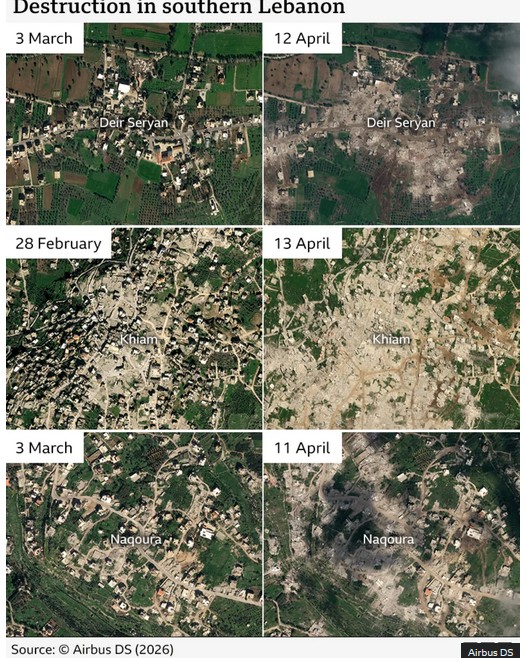
Yes, Hezbollah’s resistance to date has surprised Israel, and just how Hezbollah has rearmed (or perhaps had maintained more than was assumed) is an interesting story in itself. But one difference between now and when Hezbollah-led resistance drove out the 22-year Israeli occupation in 2000, or when Hezbollah defeated Israeli occupation forces briefly attempting a comeback in 2006, is that in those cases, Israel confronted a ground-based people’s resistance. Now Israel is using the Gaza method – completely destroy and depopulate the region before you move in your troops. Some 1.2 million people have been uprooted, one fifth of Lebanon’s population, including 820,000 from the south (south of the Zahrani), a region of around a million people. It would be good to think Hezbollah is able to again impose a defeat in its stronghold in Bint J’Beil and other regions not yet taken and force Israel to retreat. But it will be more difficult as time goes on with an empty region and completely destroyed towns, as these images show:
If it ultimately can’t defeat Israel in the south, then resistance will remain only rockets from afar, which Israel then uses to justify staying forever. Sure, that’s contradictory for Israel, plenty of Catch-22’s all round, but if the goal is Greater Israel, it may just have to wear it for a while. Meanwhile, a whole other dynamic opens if the US decided to bring in Iran from the cold, as Obama once tried (and dozens of US capitalists were ready to jump into the Iranian market before Trump ripped it up) – at a certain point, that would mean Iran no longer needs an armed Hezbollah, which after all was, from Iran’s perspective, a tool of forward defence.
In Lebanon its aim is a new border at the Litani River. In Syria it is beyond the already occupied Golan, in Mount Hermon and a chunk of Quneitra governate. In Gaza still occupying 58 percent of the strip, based on Trump’s ‘peace plan’. In the West Bank, Israel has just announced 34 new settlements, said to be “the biggest land grab ever,” and at the same time it is building a new wall along the entire length of the Jordan valley in the east, to cut the West Bank off from Jordan and its people off from the main agricultural land. All this happening amidst the regional conflagration so desired by Israel for so long.
While it will be a balancing act for Trump regionally, I won’t be holding my breath for the “peacemaker” to put pressure on Israel over any of these expansionist projects. Who knows, maybe retaking the Sinai an controlling the Suez Canal may not be too far from the minds of the crazed maniacs now running Israel.

