By Michael Karadjis
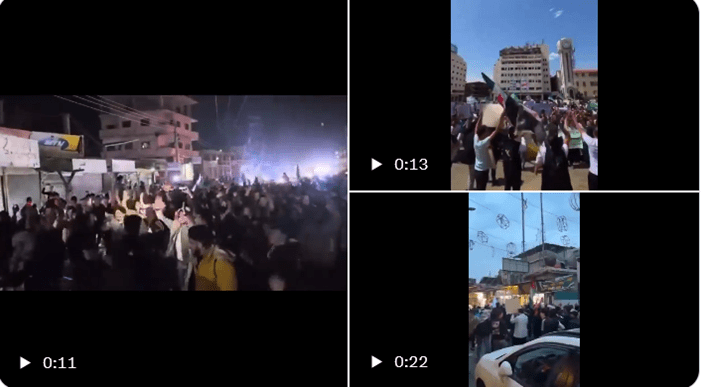
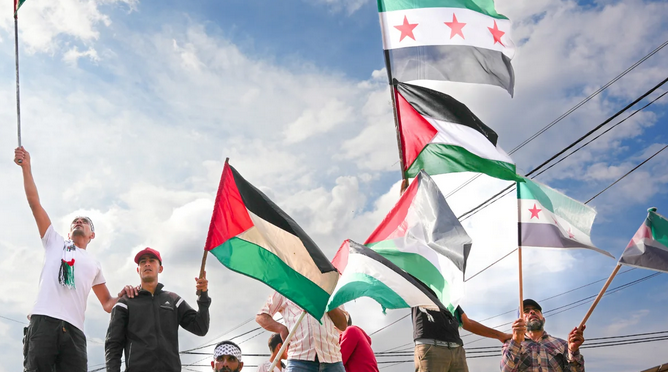
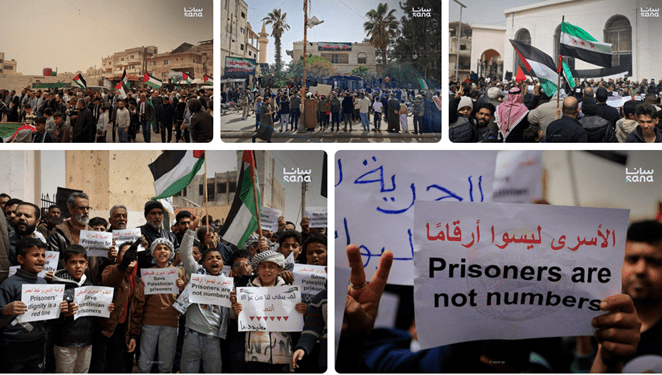
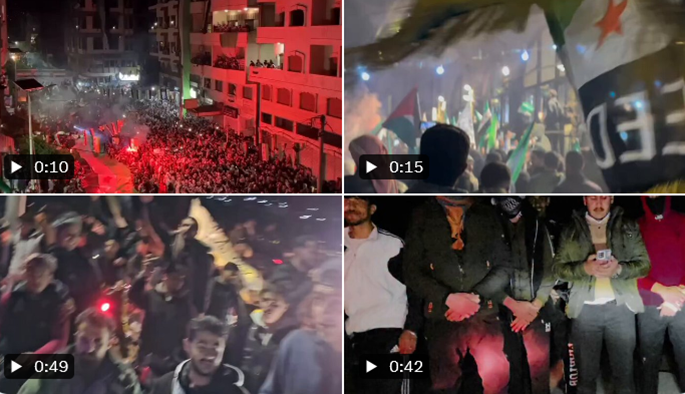
In early April, thousands of Syrians across the country took to the streets expressing solidarity with Palestine, condemning the new Israeli apartheid law to execute Palestinian prisoners/hostages and the ongoing closure of the Al-Aqsa mosque in Jerusalem. The law does not apply to Jews, but is a direct threat to the lives of over 10,000 Palestinian detainees in illegal prisons in the occupied West Bank, where military “courts” have a 96 percent “conviction” rate. Demonstrations have erupted in Damascus, Homs, Hama, Aleppo, Daraa, Quneitra, Latakia, Idlib and in the Palestinian Yarmouk camp. Look at videos of these two extraordinary demonstrations:
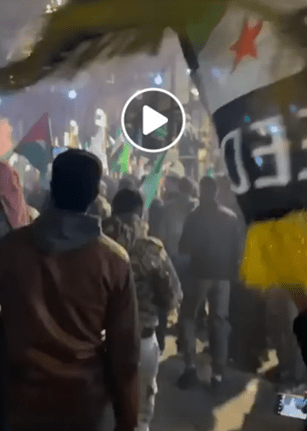
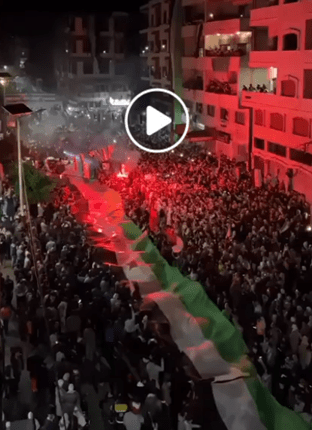
Long time Egyptian activist in solidarity with the Syrian people, Omar Sabbour, wrote:
“I don’t think there’s been any mass mobilisation in support of Palestine as geographically diverse in the region [and without exaggeration, possibly the world? Italy comes to mind] in recent history as what’s happened the last few days in Syria. Dar’a, Damascus, Aleppo, Idlib, Homs, Daraya and countless other towns and villages. Such an honour to have witnessed it.”
Around the country
At the University of Aleppo, thousands of students raised Palestinian and Syrian flags and banners reading, “Palestinian prisoners are not numbers” and “Executing prisoners is a crime against humanity,” chanting “With our souls, with our blood, we will redeem you, Palestine.” Video:
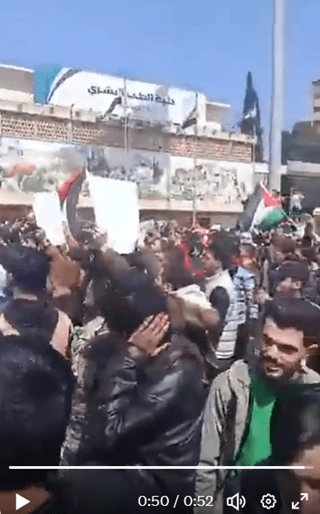
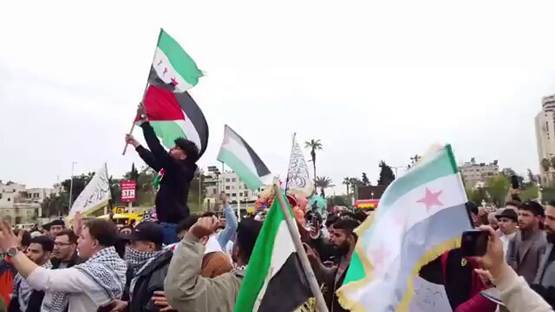
Protesters in Saadallah al-Jabiri Square in Aleppo burned the Israeli flag:
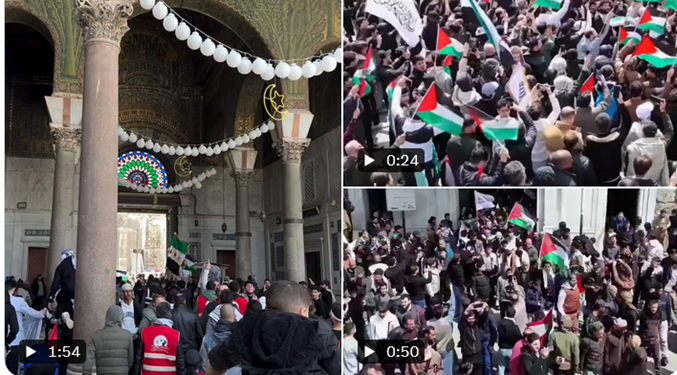
In Damascus, people gathered at the historic Umayyad Mosque after Friday prayers to protest Israel’s new apartheid execution law. Carrying Palestinian and Syrian revolution flags, protestors called for the liberation of al‑Aqsa and displayed solidarity with Palestinian detainees. Video:
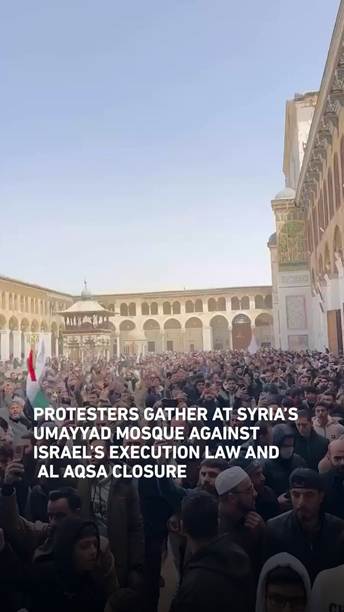
More videos from the protest at the Umayyad Mosque in Damascus:
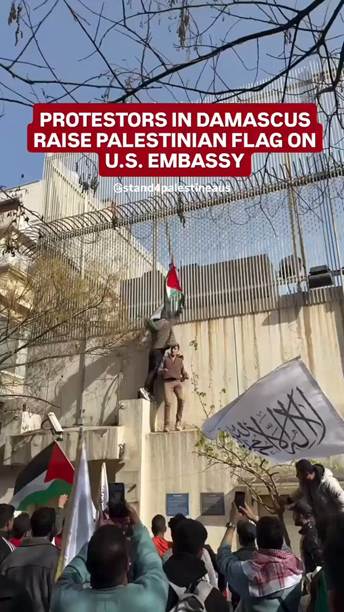
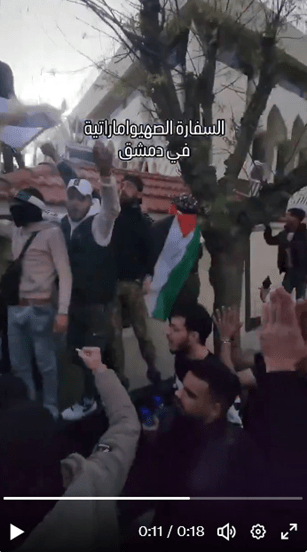
The (empty) US embassy building in Damascus was adorned with the Palestinian flag, video:
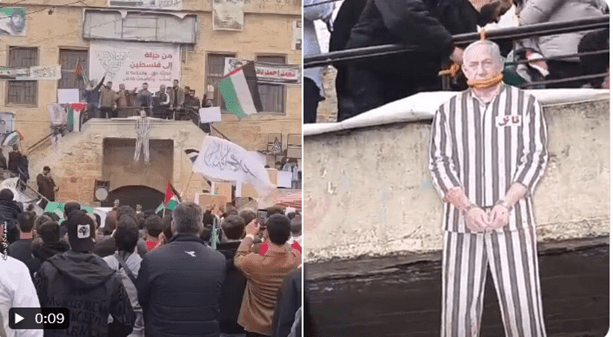
In Jableh in Latakia province, Netanyahu was hung (see video):
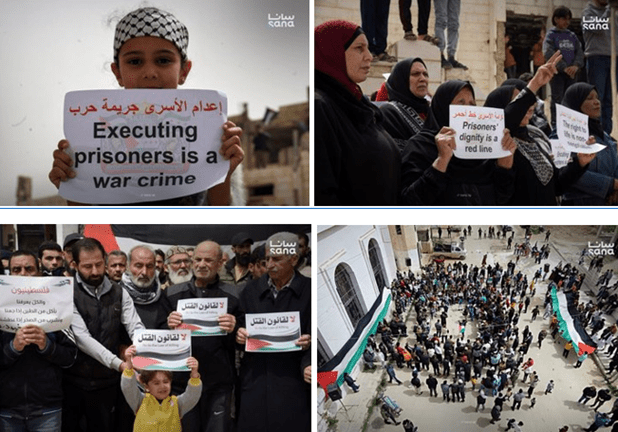
Protests also took place in the Palestinian refugee camp in Daraa city:
In the south: Connected to Israeli occupation
In the south, especially Daraa and Quneitra, this solidarity with Palestine was combined with anger over Israel’s ongoing occupation of part of Quneitra beyond the already occupied Golan Heights, and Israel’s incessant attacks on these two provinces, including attacks on farmland, seizure of water sources, raids on towns and villages, kidnapping of ‘suspects’ and airstrikes, which has continued since the overthrow of Assad, Israel’s preferred leader, in December 2024, which brought to power a government Israel sees as an enemy.
In the video below from Daraa, demonstrators say “We will sacrifice our blood for them these are our Palestinian brothers,” “we stand with Palestine, the hostages and the Palestinian cause,” “with Gaza to the death,” demonstrators condemned the new Israeli law. They reached the “border” with Syria’s Israeli-occupied territories.
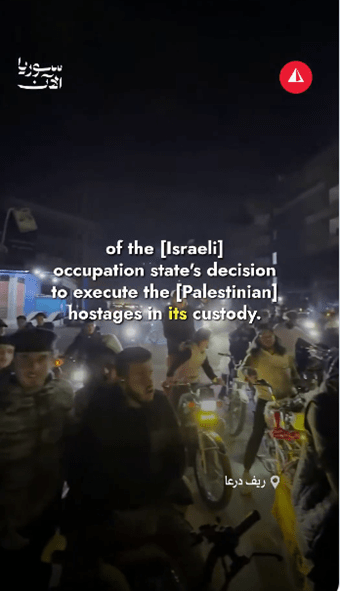
Also from Daraa, “Our blood and souls are a sacrifice for you, Gaza.”
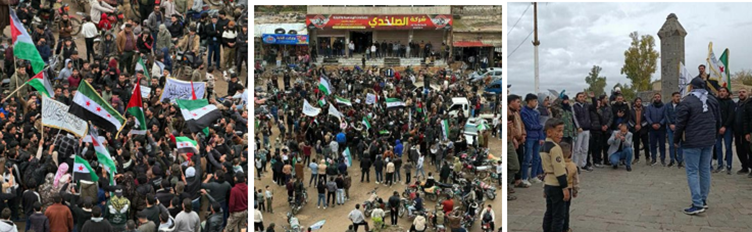
More photos from Daraa, from the towns Busra al Sham and Tafas:
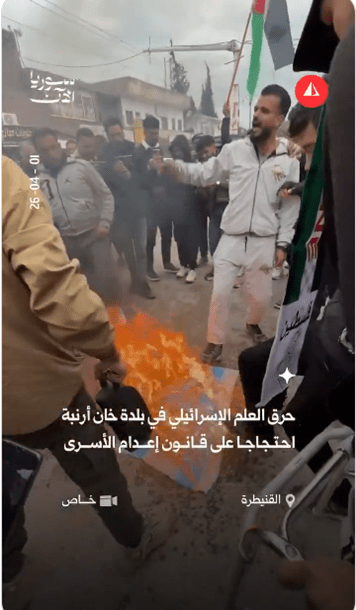
In this video below in Quneitra, protestors burn the Israeli flag:
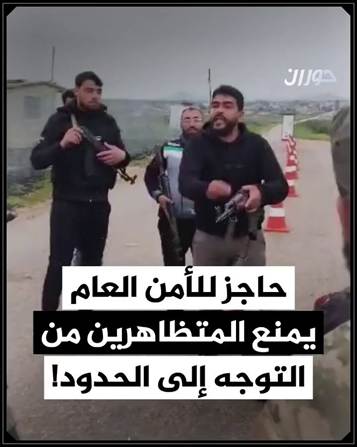
Some marchers in Quneitra attempted to cross the Israeli occupation lines in the Golan. Security forces had little choice but to prevent them from getting slaughtered; as we see in the video, one security member says “I hate Israel as much as you do, but are you going to fight them with your flip-flops? You don’t even have a gun.”
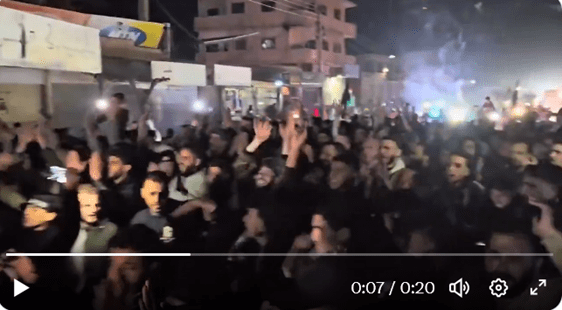
Rallies outside United Arab Emirates embassy
Some pro-Palestine demonstrators broke off from a main rally in Damascus to protest outside the embassy of the UAE. Protestors chanted “Zionist embassy” and hung Palestinian flags on it, expressing their rejection of the UAE’s close relations with Israel.
A separate but related protest took place outside the same embassy, chanting “Damn your soul, Bin Zayed” (referring to UAE President Mohammed bin Zayed, MBZ), protesting the detention of former rebel commander, then Syrian Arab Army commander after the revolution, Issam Bouidani for more than a year after he visited relatives in the UAE. Indeed, his arrest was apparently a deliberate affront to Syrian president Sharaa, as it took place just as he was leaving the UAE after his first state visit.
However, some protesters attempted to break into the embassy, but were prevented by Syrian public security. The Syrian government stressed its “firm and unwavering stance” against attacks on any embassies, while reiterating that this in no way impinges on the right to protest.
The UAE condemned alleged “riots, acts of vandalism, and assaults” outside its embassy and demanded Syrian authorities “protect diplomatic missions, investigate the incident, and hold those responsible accountable.” Meanwhile, unofficial UAE spokespeople were harsher, for example “Abraham Accords enthusiast” Loay Alshareef, who warned that “the Syrian president must understand that what happened today will not go unpunished, and that sanctions on Syria are not fully lifted, and they shouldn’t. If Syria wants to be another Hamas, it should face the fate of Hamas.”
There is background here. Apart from Egypt’s al-Sisi regime which declared support for Assad straight after his (UAE-backed) coup against April Spring president Morsi in 2013, the UAE was the first Arab state to restore full diplomatic relations with the Assad regime in 2018, followed closely by its close ally Bahrain. These were also the first two states (again, apart from Egypt) to restore relations with Israel in 2020 in the Abraham Accords. The common thread for MBZ’s consistently counterrevolutionary regime is extreme hostility to the Muslim Brotherhood and political Islam more generally, as well as anything related to the Arab Spring. Even as Assad’s regime was collapsing, the UAE (and Egypt) continued to declare its strong support for the regime, and many former regime members are in exile in the UAE. While the UAE, after some hesitation, eventually took a pragmatic position towards the new government, because it could see no alternative, it remains suspicious and these protests reflect what many Syrian people think of its relations with both Assad and Israel.
Palestine rallies: Pro-revolution – but why now? What is government’s attitude?
Some commentators (including some pro-revolution Syrians living abroad, but also some enemies of the revolution) claimed these rallies were being pushed by shadowy pro-Iranian or pro-Hezbollah forces, aimed at embarrassing the Syrian government or pushing it into premature, suicidal armed confrontation with the Israeli occupation. But there is zero evidence for this, and almost zero of any residual pro-Iranian forces anywhere in Syria.
Rather, though the protests were not explicitly government-sponsored, they were explicitly pro-revolution, indeed we may say, part and parcel of the revolution. Slogans such as “We brought down Assad — now it’s Israel’s turn” (or “we brought down the rule of the barrel bombs, and now it’s Israel’s turn”) were common; everywhere, they waved Palestinian and Syrian revolution flags together; state media reported favourably on the actions; and public security or troops from the new Syrian army took part in the protests in some areas.
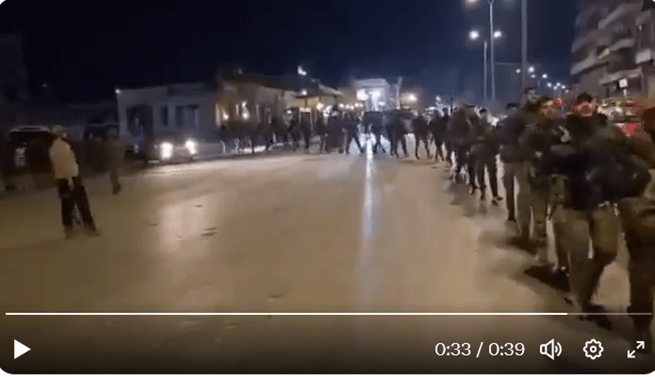
For example, in Aleppo, the 60th Division of the Syrian Arab Army – closely tied to the Syrian leadership – carried out their own march chanting “Gaza, Gaza… Gaza is our motto We are coming for you, O enemy, we are coming.” See video here.
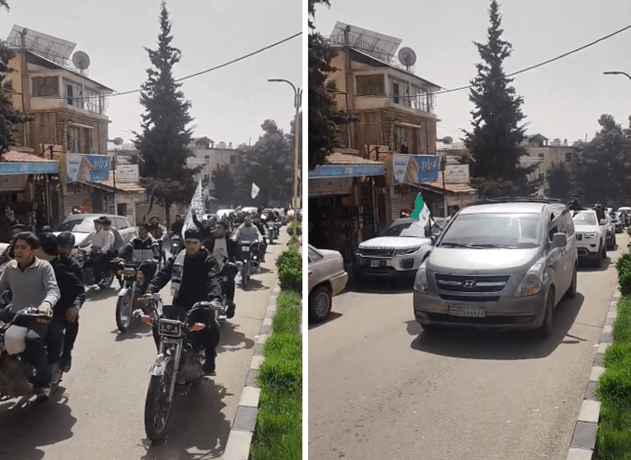
Likewise, in the historic revolution town Al-Zabadani in Rif Damascus, joint demonstrations took place between the local residents and the internal security forces:
In Daraa, a group of spokespeople for the movement stated “We, the people of Daraa province, we renew our loyalty to our brother, the Syrian President Ahmad al-Sharaa” and go on to say “We say to the aggressive British-Zionist settler entity that is expanding daily toward our lands that we will not remain silent, and we will resist with full force.”
Still, some might ask, “why now?” In fact, there have been pro-Palestine rallies Syria throughout the last year since the revolution, and there was even another country-wide wave exactly one year ago, likewise with the same pro-revolution flavour and reported on favourably by state media; but none quite as wide-reaching as this wave.
More importantly, the Syrian revolution has always had a strong connection to Palestine. In the first year of the Gaza genocide, before Assad’s overthrow, people in towns throughout rebel-controlled Idlib and Aleppo continually demonstrated in support of Gaza, with ongoing rallies, seminars, donation drives and the like. The campaign ‘Gaza and Idlib: One Wound’, was launched by the HTS-led Syrian Salvation Government soon after October 2023 with an international tele-conference broadcast out if Idlib. In November 2023, this campaign raised $350,000 for Gaza in eight days, a remarkable achievement for a poor rural province under constant Assadist siege. April 2024 saw the opening of ‘Gaza Square’ in the middle of Idlib. One year of genocide in Gaza was marked with actions throughout the region declaring ‘Our hearts are with Gaza.’
It is important to note that these were the only pro-Palestine demonstrations in Syria at the time, because they were banned in regions controlled by the Assad regime; Palestinians were arrested for attempting to hold rallies in solidarity with Gaza under Assad. Moreover, this current wave also exposes the rest of the region; the site ‘Warfare Analysis’ cited “an Arab from another country commenting on protests across Syria in support of Palestinian captives: “Lucky them, they can express themselves,” to which “a Syrian replied: “This did not come easily, we sacrificed everything for it.” Such pro-Palestine rallies are banned in many, if not most, Arab countries, as they were under Assad; whatever one’s view on the current Syrian government, it is important to remember that the Syrian revolution is not about a government, but about democratic rights and freedoms, which are greatly expanded now, despite many issues remaining.
Some claim that while the Syrian government’s toleration of these rallies reflects the more democratic atmosphere post-Assad, it is privately not happy, as it is concerned these rallies may embarrass it as it strives to gain US and other international funding for reconstruction. This seems misplaced, given favourable media reports, the long-term record of the leadership as described above, and the sheer massiveness of the rallies and their obvious pro-revolution character. The government’s relatively hands-off approach does reflect its completely correct focus on relations with other governments due to Syria’s extremely dire reconstruction needs following the Assadist apocalypse; this does not mean opposition to the movement, but rather different roles.
Indeed still others claim the opposite, that the government is behind the rallies, in order to demonstrate to Israel that it can mobilise if it needs to, as a ‘weapon’ for whenever the next round of US-mediated talks take place, aimed (on Syria’s side) at getting Israel to withdraw from the territory it has taken since December 2024, back to the 1974 disengagement lines which Assad and Israel stuck to for 50 years (the Syrian government also continually demands the full return of the Golan Heights, occupied since 1967, but after 50 years of complete passivity under Assad, dealing with that will have to wait for some recovery of the Syrian nation). But it may be an exaggeration to imply the government is consciously leading the movement; more likely, it is being led by elements closely connected to the ruling group among broader Syria revolution circles, and the government is happy to allow it to play this role.
It is also probably no coincidence that this takes place as Israel is confronting both Iran and Hezbollah; for the Syrian people, both sides are enemies; they find it hard to sympathise with Iran and Hezbollah after they actively participated in Assad’s genocidal war against the Syrian people for a decade, up to taking lead roles in starvation sieges of revolution-held towns. But Israel also backed the Assad regime (one thing Israel and Iran ironically converged on), and has been the main enemy of the new Syria since December 2024 and is the occupier of their land. By strongly raising the issue of Palestine in the context of this war, Syria demonstrates its hostility to Israel without speaking in defence of Iran and Hezbollah (though Syria has strongly condemned Israel’s attack on Lebanon).
Notably, Palestine is an issue which has been overshadowed by this war – while Iran rightly insisted that ceasefire should not be separated from the issue of Israel’s terror in Lebanon, there has been not a peek regarding the ongoing genocide in Gaza and the radically stepped up settler terrorism and massive land grabs in the West Bank under the cover of this war. In this sense, the Syrian uprising for Palestine has played a small but important role of bringing the issue back to light, even if that was not the conscious aim.
Still others claim it is not pro-Iranian forces trying to embarrass the government and push it into a suicidal clash with the occupation, but hard-line Sunni jihadist forces opposed to al-Sharaa’s outward pragmatism. While there is no more solid evidence for this than the former claim, at least this touches on a reality inside Syria at the fringes. However, it is more likely that actions such as the attempts to cross the Golan occupation line were simply genuine Syrian anger, rather than reflecting such fringes.
Where the jihadi fringe did raise its head, however, was the presence of some chants of a distinctly anti-Jewish character in some demonstrations. For example, in this video from Idlib, we see protestors undoubtedly angry about the law allowing execution of Palestinian captives, chanting “’Khaybar, Khaybar, oh Jews! The army of Muhammad will return!” This is a historical reference to a 7th century battle against a Jewish region in Medina (which has also been used at times in some Hamas actions).
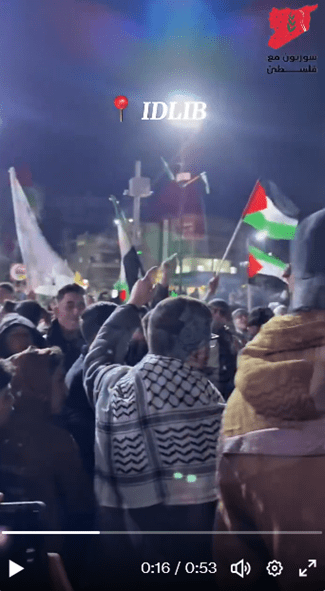
Israel’s genocidal outrages in Palestine are obviously one of the sparks of antisemitism, which of course does not justify it. This reflects prejudices within some of the harder jihadist elements which were a support base of the current former HTS rulers.
However, while such ideas must be fought, it would be wrong to tarnish the entire movement with such phenomena; the movement as a whole has been focused on Israel’s crimes and solidarity with Palestine which runs deep.
Some chant for Hamas
While most protestors chanted for Palestine or Gaza or Al-Aqsa generally, some specifically chanted in support of Hamas, like in this video below from Daraa. Chants included:
“O Abu Ubaida, we have pledged allegiance to you openly”
“They said Hamas is terrorist — all of Syria is Hamas”
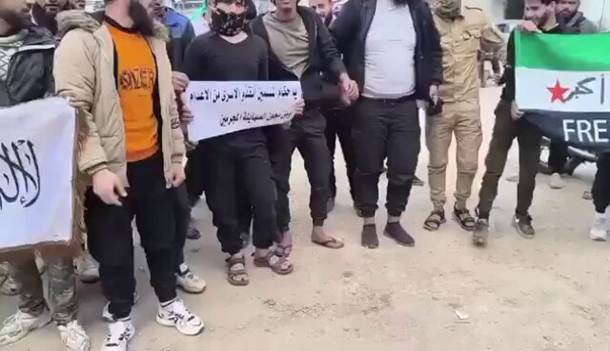
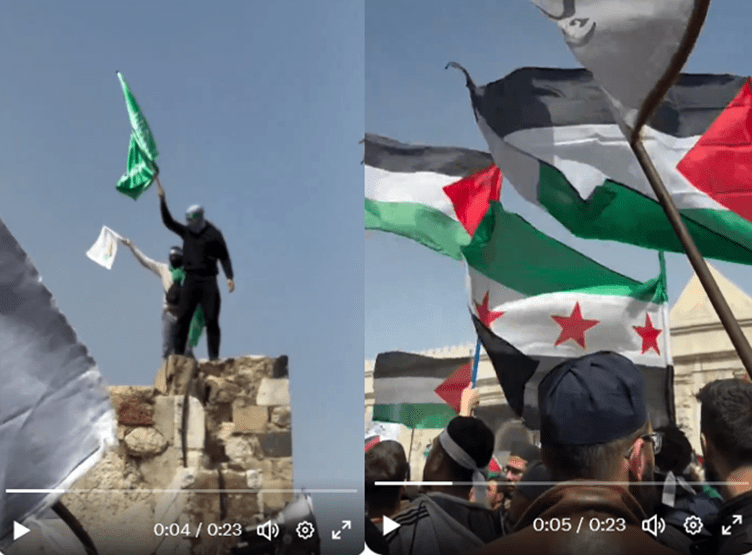
In the video below we see a Hamas flag raised on top of the Umayyad Mosque in Damascus, even while the rally below is a sea of Palestinian (and some Syrian revolution) flags.
During Israel’s bloody attack on the southern Damascus town of Beit Jinn in late November, the IOF killed 13 civilians, after the townspeople had resisted and injured six troops. Israel had alternatively accused those who resisted of being Hamas, Palestinian Islamic Jihad, Jamaat al-Islamiya (a Lebanon-based Sunni Islamist militia) and cadres of “Jolani’s regime” (ie, the Sharaa government). When Syria researcher Aymenn Jawad al-Tamimi interviewed locals about this, one response was “We are honoured to be among Hamas’ soldiers.”
There is a specific context for this. Assad Senior had suppressed all independent Palestinian organisations in Syria the 1980s, extending its war on the Palestine Liberation Organisation (PLO) into Lebanon. Therefore, most of the allowed Palestinian organisations existing when the revolution arrived in 2011 – such as the misnamed Popular Front for the Liberation of Palestine – General Command (PFLP-GC – not to be confused with the actual PFLP) were regime stooges who policed the Palestinian camps for the regime, which included sending Palestinians to Sednaya and other Baathist torture gulags and death camps. Thousands of Palestinians were murdered and disappeared by the regime, often brought in by these snoops. In 2011, PFLP-GC militia even shot dead Palestinian protestors in Yarmouk.
However, in its attempt to subvert the main Palestinian organisation, al-Fatah, the regime had taken in Hamas in the late 1990s. Whatever one thought of Hamas, its independence is not in question. Once the revolution broke out, Hamas gave support to the people against the regime (and to similar Arab Spring uprisings in the region), and as a result they left Syria and their offices were ransacked by regime thugs. When Sednaya was opened in December 2024, it was confirmed the Assad regime had executed 94 imprisoned Hamas activists, while 67 surviving Hamas cadres were released by the new authorities. Countless thousands of other Palestinians, estimated to be equivalent to 5.6% of the total Palestinians in Syria – were also killed or disappeared in the regime’s gulag. Hamas hailed the overthrow of the regime.
Response from Gaza
Abu Obaida, spokesperson for the Al-Qassam Brigades, the military wing of Hamas in Gaza, responded on April 2: “From Gaza and from Jerusalem, we salute the noble people of Syria, and their masses who came out chanting for the resistance and in support of Al-Aqsa and the prisoners. We say to them: We have heard your voice, and we are proud of you.” [The well-known Abu Obaida was killed in Gaza last year, but his replacement took the same nom de guerre].
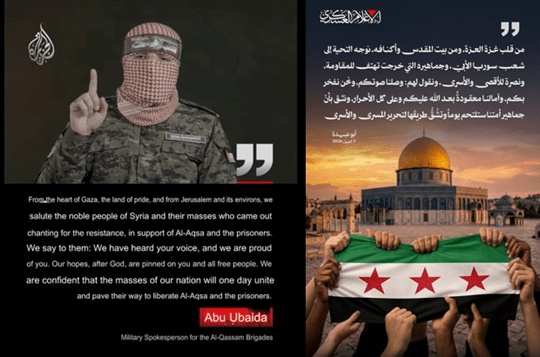
Other prominent Palestinians in Gaza made similar tributes. Gaza-based journalist Motasem A Dalloul posted in his X account that “Syria is our real depth.”
Ongoing Israeli attacks
In the midst of these protests, the Israeli Occupation Forces (IOF) attacked a car in Quneitra region, killing a teenager. The Syrian foreign ministry condemned this “flagrant violation of international humanitarian law” and demanded international action against Israel’s repeated attacks.
However, this was only one of the daily attacks Syria has been subjected to ever since the overthrow of Assad. Even though engaged in two gigantic wars against Iran and Lebanon, Israel has still managed time for its smaller scale bombing and other attacks on Syria! On March 20, Israel attacked Syrian army sites, weapons depots and military infrastructure in Daraa, including a building associated with the 40th Division in Izraa; according to the IOF, the strikes targeted a command center and weapons located in military compounds belonging to the Syrian government; local sources reported air raids hitting the Syrian army’s 12th Brigade near Izraa and explosions in the vicinity of the 89th Regiment headquarters.
A report by SARI Global documented 897 “incidents attributed to Israeli activity in southern Syria.” This included 123 in March 2026 alone, compared to 91 incidents in January and 97 in February. Three times in January, Israeli aircraft sprayed large areas of Quneitra with herbicides, “killing crops, devastating farmers and damaging trees.”
Israel clearly remains committed to maintaining its new “borders” in Syria and its project of destroying new Syria, its government, and if possible the Syrian state as a whole. The recent demonstrations of solidarity with Palestine by Syrians reinforce for Israeli leaders their relentless hostility to post-revolution Syria.
Other photos and videos
I’ll finish off with an array of other photos and videos:
https://twitter.com/Levant_24_/status/2040064336689786890:
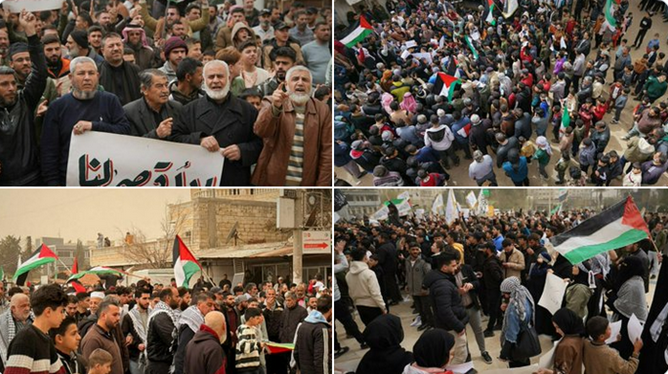
https://sana.sy/en/politics/2307561/:
Videos https://x.com/warfareanalysis/status/2039169539515072773
Videos https://x.com/Levant_24_/status/2039418947062186079