US & Iran edge towards agreement, Trump humiliated, Israel expands war and conquest, ‘third force’ rejects Abraham Accords

Deranged maniac Donald Trump threatening to "blow up" conservative Sultanate of Oman; looking on, Rubio thinks, "no, I said Cuba, not Iran, you idiot," even Armageddonist Hegseth looks concerned for his master's health, but probably only because he wants to blow up a lot more than just one country.

Deranged maniac Donald Trump threatening to “blow up” conservative Sultanate of Oman; looking on, State Secretary Rubio thinks, “no, I said Cuba, not Iran, you idiot,” even Armageddonist War Minister Hegseth looks concerned for his master’s health, but probably only because he wants to blow up a lot more than just one country.

By Michael Karadjis

It seems close to certain that the US and Iran will agree to the Memorandum of Understanding to lift their dual closures of the Strait of Hormuz and embark on a 30 or 60-day period of negotiations over the key issues. If this happens – unless the humiliated Trump regime suddenly decides to lash out with one last bout of desperate bombing to look tough, or makes some hair-brained attempt to “seize Iran’s enriched uranium” out of sheer desperation – then this is a complete defeat for the US war.

The US did bomb the southern Iranian port city of Bandar Abbas in “self-defence” while a high-level Iranian delegation was in Qatar busy trying to negotiate the deal, but at this stage these one-off’s appear to be face-saving stalling tactics – Iran knows not to trust the US at all, but probably also knows Trump is exhausted and knows that a return to war would likely only increase his humiliation.

However the claim that this is also a defeat for Israel is in my view wildly overstated – but the fact that the US was forced to shove aside Netanyahu’s pleas for more war in favour of Gulf Arab pleas to desist and stick with the negotiation track may be indicative a longer-term trend that will be problematic for Israel.

Let’s recap. The Strait was open when Trump and Netanyahu launched their aggression on February 28. Following the April 7 ceasefire, Iran fully opened the Strait on April 17 (waiting for the Israel-Lebanon “ceasefire” declaration), and, acknowledging this, Trump declared it to be “a great and brilliant day for the world.” Naturally, Iran expected that the US would reciprocate by ending its recently imposed blockade from outside the Strait, in the Oman Gulf and the Arabian Sea. Instead, Trump continued his unilateral blockade. So, 24 hours later, Iran reimposed its closure.

Therefore, ever since then, calls by Trump on Europe or China or anyone to help force Iran to “open the Strait,” and western media or government commentary about how to deal with the problem of Iran’s hold on the Strait, have been inconceivable nonsense – the way to get Iran to release its closure was simply for the US to end its own.

Then on April 27, Iran again put forward a proposal for both countries to reopen the Strait and end the war, and put the discussion on substantive issues off to a second stage of negotiations. Trump responded that Iran had “offered a lot but not enough,” and again rejected the offer.

Thus the Strait has remained closed since April 17 – one and a half months – due to the US alone. Period. So if the US agrees to this now, all the ongoing massive damage to the world economy has been due to the US position, with absolutely nothing to show for it – a total defeat for the US.

In fact it seems a little worse than that, because while from what we can glean from the various reports, Iran has agreed that the number of ships and tankers passing through the Strait will be restored to its pre-war level, it still insists that it “manage” this traffic through the Strait; if the US accepts this, it will be accepting a stronger Iranian position than it could have had on April 17 or April 27. It remains unclear whether this is just a bargaining position for Iran. In fact, it has been setting up its proposed “toll” mechanism and a number of countries have began paying it, but has apparently said it will temporarily lift the toll until fully ready – which may be a way of saying it is a bargaining position.

Of course, in the upcoming negotiations over the real issues, Trump might be able to claim some relative “victories” – in the end it is all in the wording and the interpretation, we’ll see – but even if he does, there’s no way of knowing such gains could not have been made if the blockade had been lifted on April 17.

The substantive issues

Of these other issues, the major one is Iran’s stockpile of 440 kilograms of highly enriched uranium. In the Iran nuclear agreement (the JCPOA) signed by the Obama administration in 2015, Iran sent its then stockpile to Russia. Trump of course tore up that agreement in 2019, despite Iran sticking to the low enrichment levels of the agreement only suited to civil nuclear energy, which is the reason that Iran began enriching to 60 percent again, as a means of pressure. During the Oman negotiations in February before being interrupted by Trump’s surprise aggression, Iran agreed to dilute this uranium to the 3.67 percent civil power level, under international supervision, and is ready to do that again. In addition, Russia, China and Pakistan have all offered to take the enriched uranium (presumably to dilute it in their country and send back the low-level uranium), but at this point Iran is insisting it remain in Iran and Trump is insisting it goes to the US. Possibly, both are ambit claims pending other issues.

On enrichment itself, Iran absolutely insists that it has the right in principle to enrich uranium at the level for civil energy and had already agreed in February to inspections, while the US has been insisting, this year and last, on zero enrichment in Iran; that Iran can import nuclear fuel for its civil program. It seems likely that the US will concede on this, or there will simply be no deal; but if it does, it is once again a total US defeat. To accept the deal, the US has demanded a 20-year Iranian moratorium on enrichment; Iran has offered 5 years. Possibly an agreement somewhere in between will be reached. As there was no such temporary moratorium under Obama’s JCPOA, perhaps Trump can claim some victory if Iran agrees to something like 10 years – but nothing to exactly justify the hell of the last three months to anyone with a brain.

Iran wants all of its frozen assets released and for the end of all US sanctions as part of any deal. Whether the US will agree to lift all sanctions in one go is questionable, but Iran will certainly, and rightly, draw a red line under the release of its illegally frozen assets. Iran also rightly demands compensation for the enormous war damage caused by the illegal US-Israel aggression, but it is notoriously difficult to force powerful states to compensate their victims. It is possible that the release of its frozen assets and the end of sanctions – especially on its oil – may be enough for Iran to accept that there will be no reparations; once again, the more fully sanctions are released the less Iran is likely demand reparations – the unfrozen assets can be used to begin reconstruction. This is also tied in with Iran’s tollgate system on the Strait – Iran has justified charging a toll as a way to get raise funds for reconstruction.

It seems very difficult for the US to come out of this a victor – but perhaps not impossible to spin whatever the outcome is. It will need very good spin. When Trump ripped up Obama’s JCPOA, there was no logic behind it. If the aim was limiting Iran’s nuclear ambitions, the JCPOA did a stirling job. If it was about the interests of the US ruling class, destroying the JCPOA was in direct defiance of this; US mega-corporations were ready to jump into the Iranian market in large numbers until cut off by Trump. There really was little more than being a tool of the wing of the US ruling class most connected to Israeli interests, perhaps the US military industry, and his own desire to show that an Obama policy could only be bad. But by doing this, Trump trapped himself – whatever comes out of the current disaster he has to show it is “better” for the US than the JCPOA, which is very difficult, as well as being “better” than terms agreed to in June 2025 and February 2026, before being bombed mid-negotiation both times. And to show that the degree of “betterness” can justify massive killing and the destruction of the world and US economy.

Greater Israel and the war in Lebanon

Finally, Iran demands an end to the war “on all fronts,” meaning Lebanon. Last time, the ceasefire went ahead on April 7, but Iran did not open the Strait until April 17, demanding the ceasefire be applied to Lebanon as well first. However, the “ceasefire” there has made no difference – Israel has killed over 600 Lebanese in the last 6 weeks of “ceasefire” in daily attacks, and it hangs onto some 10 percent of southern Lebanon, where it has been meticulously destroying towns and villages in their entirety, while displacing one fifth of Lebanon’s population northward. While it is facing fiercer than expected resistance from Hezbollah, it seems clear that, for Israel, this expansion of Greater Israel northwards is very much an unstated goal of setting the region on fire on February 28.

It therefore seems unlikely, based on this record, that the application of another statement about ending the war in Lebanon will make any difference. Even in the unlikely event that Israel did completely cease fire, unless the agreement forced it to withdraw from Lebanon, the war remains a net gain for Greater Israel. Put simply, before the war, Israel remained in occupation, in defiance of the late 2024 ceasefire, of five small spots along the border, but these were basically fortified hilltops of perhaps 5-10 square kilometres in total; now it controls some 10 percent of the country’s area. Meanwhile, under the cover of war, Israel has also stepped up its aggression in southern Syria, has greatly increased its land grab in the West Bank, and remains in possession of 58 percent of Gaza while the Gazan population remains cut off from the world in a devastated land.

Now, as the news suggests the US and Iran have reached agreement on the memorandum (bearing in mind such an announcement has been made countless times before), Israel has dramatically upped the ante: on the same day, Netanyahu casually announced that Israel’s military control of Gaza would be increased from 58% to 70% of the tiny strip, cramming 2 million Palestinians into an even smaller area of total devastation; and evacuation orders were given to all Lebanese residents south of the Zahrani River, some 20 miles north of the Litani which was Israel’s declared goal until now, and greatly expanded its military offensive.

I therefore think that claims that this is a defeat for Israel miss the point. “Israel aimed to overthrow the Iranian regime and destroy its nuclear and ballistic missile programs and none of this has been achieved.” Really. Israel aimed to blow up the region to advance the cause of Greater Israel. “Regime change” was always a crock. Sure, Israel would like to impose Reza Pahlavi, the Shah’s son, in order to light up a gigantic IRGC-Basej insurgency to create even more chaos throughout the region, but to even get him into power would require a million or two US ground troops at the outset, so this was never going to happen. It was recently revealed that the hair-brained scheme was not to bring Pahlavi to power, but former hard-line Iranian president Ahmediejad – again, presumably because he is such a divisive figure among the Iranian mullocracy and IRGC that they imagined it would lead to civil war and effective collapse of the state. And of course the last thing Israel – or the US – ever wanted was a democratic revolution in Iran.

Nuclear? If all this goes ahead, the Iranian nuclear program will be contained – just as it was by Obama’s JCPOA, which Israel vigorously campaigned against until they got their Trump tool to rip it up. So it is clear that Israel is not in the least motivated by fear of a non-existent Iranian nuclear weapons program. Rather, that is useful propaganda for preventing the normalisation of the Iranian regime, which would remove it as Israel’s key ideological bogeyman to justify its own extremism for over three decades; indeed, that is another reason I doubt Israel really aimed to bring in Pahlavi – Israel still needs Iran for these purposes, but one weakened by Israeli military action is even better value politically. Ballistic missiles – the CIA estimated Iran still had 70 percent of its pre-war stock; destroying 30 percent may be what Israel will have to live with. It knows very well that Iran has never used them against Israel except in response to Israeli attack.

In other words – I don’t believe a word of it. It looks to me more like a double victory, of Greater Israel in its region, and Iran in the Gulf.

At the same time, if Trump goes ahead, it means that in contrast to February 28, he is now ignoring Israel’s advice (ie, restart the war, do lots more bombing and killing as great cover for its own plans) and instead listening to the advice of Saudi Arabia and Gulf Arab states. Trump’s claim that he was about to restart bombing Iran on Tuesday, May 19 – a move that had strong Israeli backing – but held off at the urging of Gulf Arab states Qatar, Saudi Arabia and the United Arab Emirates (UAE) who Trump claimed “believe a deal “will be made, which will be very acceptable to the United States of America, as well as all Countries in the Middle East, and beyond” (though some Gulf officials were not aware of the imminent plan to attack Iran …), makes this point clear. While Saudi Arabia and Qatar are known to have been opposed to the war and certainly to it restarting, Trump’s inclusion of the UAE, if true, is odd given its trenchant alliance with Israel and its markedly more hawkish position on Iran and the war following large-scale Iranian strikes on the UAE, but this may signify a lack of faith in anything Trump can do even to this craven regime.

This is not great for Israel’s overall regional hegemonic ambitions. “Sharing” the region with a number of sub-imperial projects like those of Saudi Arabia, Turkey and indeed Iran might sound very Trumpian, especially given a medium-term Trump preference to withdraw from the region and thus leave it to a number of marshals, but is anathema to Israel; Israel needs to ensure it remains number one regional power in US eyes. Why should the US continue to forever deliver massive quantities of dollars and weaponry to Israel while it pushes the most extremist agenda if this extremist agenda is not demonstrating its ability to completely dominate the region, if Israel is just one of a number of powerful regional deputies? The push for Greater Israel is driven by both internal Zionist logic and by this need to demonstrate absolute regional hegemony, but this overextension in its immediate vicinity may not improve its ability to dominate further afield, without a continued large-scale US presence; and as the war has shown, even this US presence in a most aggressive form has proven inadequate.

The emergent geopolitical ‘third force’ and Trump’s comedic Abrahamic moment   

This raises a bigger question of the regional geopolitics going on behind the scenes, which is too big to be covered here (but watch this space). Essentially, despite the war, and despite the US and Israeli ambitions in launching it, the already existing major regional split between a Saudi-Qatari-Turkey-Pakistan regional bloc and an emerging “hexagonal” alliance between Israel and the UAE (like  Israel, a regional revisionist power shooting well above weight), India, Greece/Cyprus and Ethiopia was not healed by the war against Iran and the expected (and planned for) Iranian counter-attacks against the Gulf states, but rather, continued barely abated.

This geopolitical angle was brought into sharp, and comic, relief, just before this final MOU push when Trump, out of leftfield, demanded that Saudi Arabia, Qatar, Pakistan etc join the Abraham Accords as part of a prospective peace deal with Iran. While it is not exactly news that Trump has lost his mind over being humiliated by Iran in his stupid, illegal and barbaric war, this is really at another level. Trump still seems to imagine that he has any cards with which to mandate that others go right out of their way to serve the US, and Israel, for the great service they have done!

According to his tweet, “it should be mandatory that all of these Countries [ie, those involved in negotiations between the US and Iran], at a minimum, simultaneously, sign onto the Abraham Accords. Those Countries discussed are Saudi Arabia, The United Arab Emirates (already a Member!), Qatar, Pakistan, Türkiye, Egypt, Jordan, and Bahrain (already a Member!).” Trump stressed this was compulsory, that he was “mandatorily requesting that all Countries immediately sign the Abraham Accords,” and that “If they don’t, they should not be part of this Deal [ie, the prospective Iran deal] in that it shows bad intention.” Not to be outdone by himself, Trump also suggested that these “Great Leaders … would be honored, as soon as our Document is signed, to have the Islamic Republic of Iran as part of the Abraham Accords.”

Trump raised the demand during a phone call involving these leaders to discuss the US-Iran negotiations mediated by Pakistan, and the reaction was silence; Trump had to ask if anybody was still there. Imagine, they thought they were there to discuss how to end the war that Trump and Israel had plunged the region into, and here he is telling them to normalise with that same Israel, after the genocide in Gaza, the growing annexation of the West Bank, the terror and occupation in Lebanon and the ongoing attacks and occupation in southern Syria. Like, why? Why would they?

Trump ought to be thinking about how to save his arse and get out with some kind of deal that does not leave him completely humiliated. Of course, as shown above, the problem is that that is very difficult. He is already being attacked from the right by the Wall Street Journal and some very pro-Israel Republicans, like Lindsey Graham and Ted Cruz, who want no concessions and just want endless war and killing, while the vast majority of Americans who were against the war from the beginning will be further vindicated, so Trump thinks he can put some icing on the rancid cake by getting a bunch of countries who have never shown any interest in normalising with Israel to suddenly do so, because a defeated, humiliated US with no cards tells them to!

Saudi Arabia reacted predictably with a version of the statement it has been making for years (around a hundred times), that any peace agreement with Israel is contingent on an “irreversible pathway” to the establishment of a Palestinian state with Jerusalem as its capital. Despite fantasies from both many western leaders and media, and also from many pro-Iranian ‘Axist’ voices, there are reasons that Saudi Arabia has not moved an inch towards the Abraham Accords in a full six years since they were signed by the UAE, Bahrain, Morocco and Sudan. It has nothing to do with how “reactionary” a state is; that is just a balderdash kind of “anti-imperialist” analysis for dummies. If being “reactionary” were the yardstick for wanting to normalise with Israel, then Iran itself, and the Taliban regime next door in Afghanistan, would be leading the rush to normalise along with the Saudis. Quite simply, the unofficial head of the Sunni Muslim world and the Guardian of the two Holy Mosques in Mecca and Medina is not going to normalise with the regime in occupation of the Holy Mosque in Al-Quds, lest the Saudi royal family be overthrown. Saudi ruler Mohammed bin-Salman (MBS) is an utterly ruthless tyrant (something he shares with the rulers of Iran), but also a modernising nationalist leader who has transformed his state and makes decisions based on Saudi interest, and being an Israeli appendage is not one of them. No, it has nothing to do with any actual sympathy for Palestine (indeed, MBS openly says as much).

Qatar has said nothing, probably just too bemused, but no, the state where the Hamas headquarters is situated, that hosts al-Jazeera, is the unofficial leadership of the regional Muslim Brotherhood, and that was bombed by Israel last year, is even less likely to suddenly sign up. Pakistan rejected the demand, stating “Pakistan is under no compulsion to adhere to any such demand,” stressing the Abraham Accords have no relation to the deal it is trying to mediate between the US and Iran. Khawaja Muhammad Asif, Pakistan Defence Minister, was even blunter, stating “Personally, I don’t think we should join any such accord that clashes with our fundamental ideologies. How will you sit down with those people whose word cannot be trusted even for a single day?”

These reactions led to further comic relief when batshit-crazy warmonger Senator Lindsey Graham was deluded enough to imagine he had cards with which to threaten these states. “If you refuse to go down this path as suggested by President Trump, it will have severe repercussions for our future relationships and make this peace proposal unacceptable. Further, it would be seen by history as a major miscalculation.”

The China connection and its long-term significance

In fact, it was this ‘third force’ in between Israel and Iran that got the peace – Pakistan’s role as mediator was actively backed by the Saudi-Qatari-Turkey bloc, and Oman. And even more significantly, behind this bloc was the US’s key global rival, China. China is commonly referred to as Iran’s ally. That it is, kind of. But it is also Pakistan’s ally – 80 percent of Pakistan’s weaponry comes from China, while China buys far more of its oil from Saudi Arabia and other Gulf states than from Iran, sells them weapons (including during this war), is involved in major economic projects throughout the Gulf, while the Saudis and others have also began selling some of their oil in Chinese Yuan – and China agrees with the Gulf rather than Iran on the question of the Strait. Meanwhile, the Saudi-Pakistan defence treaty has now brought major Chinese weapons systems into Saudi Arabia via the Pakistani ‘back-door’ – weapons the US has banned the Saudis from buying themselves as a condition for Saudi participation in the F-35 fighter jet program.

During the war, China became the silent and unofficial head of this bloc of powerful regional capitalist states who seek a position independent of both Israel and Iran – and even after being hit by Iran during this war, they tend to see Greater Israel as the greater threat to regional stability, while their own sub-imperial projects see a two-state “solution” to the Palestinian issue as infinitely preferable for regional capitalist stability than a Greater Israel expanding into Lebanon, Syria, the West Bank and eviscerating Gaza. And in this position, China was seen to be behind the scenes promoting a negotiated settlement while the US showed that its approach led to turmoil and destruction, while its bases in the Arab Gulf states made them targets rather than offering them protection. In the longer term, this US defeat may be even more significant, as an important landmark in the rise of Chinese imperial power at the expense of a decadent US empire. 
Syria rejects alleged US push for intervention in Lebanon, while Israel continues its aggression in southern Syria

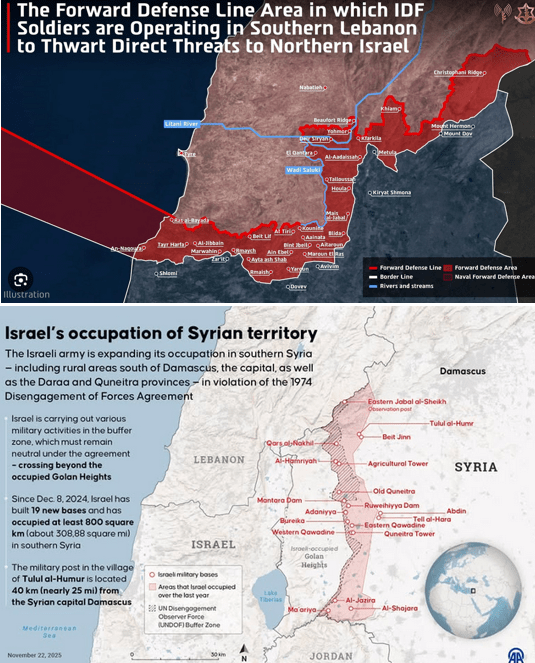
Israeli Defence Forces map of the region of southern Lebanon it is occupying since the onset of the current war, and the region of southern Syria, beyond the occupied Golan Heights, it has newly occupied since December 2024. Both part of the new borders of Greater Israel.

By Michael Karadjis

Asked about Syria’s view of the current war against Iran at the recent Antalya Diplomacy Forum, president Ahmed al-Sharaa began that for Syria this is a somewhat complex question, because

“Syria has had a negative experience with Iranian aggression over the past 14 years and its involvement in supporting the former regime in its confrontation with the Syrian people. However, despite all these past circumstances, we were not a party to any conflict against Iran during the current war … we were pushing for this war not to break out in the first place, because Iran is a country with a population of 85 million people, and any harm that befalls Iran from within could affect the whole region. We are pushing for a stable region and for its problems to be resolved with dialogue and diplomacy.”

Syria’s extremely negative experience with Iran is a simple empirical fact, but what the current government does with this fact is the issue. The feelings of many ordinary Syrians – much more than the current government – leave Syria open to pressure by the US to take part in some kind of action, whether against Iran or Hezbollah in Lebanon, with the reward of being granted more legitimacy, diplomatic support or funding and investment by the US.

Sharaa’s clear statement here against the war, despite past experience, plus Syria’s clear condemnation of Israel’s attack on Lebanon despite its negative experience with Hezbollah, Sharaa’s statement in London during his recent visit that “we do not have a problem with Iran in Tehran, we had a problem with Iran in Damascus,” but now we aim for reconstruction and economic development and “we have been patient in regard to the relationship with Iran,” whereas as soon as Assad was overthrown, “Israel dealt with Syria negatively by bombing locations, making incursions into Syrian territories, and violating the 1974 agreement,” all point to the fact that the Syrian government resolutely rejects the kind of role some US and Israeli circles might like Syria to play.

This Syrian stance is only partly motivated by the fact that Syria, and Syrians, also have an extremely negative experience of Israel, widely view it as an enemy that occupies their land, and are very strongly supportive of Palestine, as the recent massive pro-Palestine protest wave demonstrated. Just as importantly, having just emerged from the 14-year Assadist apocalypse, during which, again according to Sharaa in London, “Syria suffered from the same thing that the Gazan people have suffered from,” Syria now can only focus on reconstruction, on the recovery of the Syrian people. “The Syrian people empathize with the people of Gaza and are affected by the bombing there,” said Sharaa, but Syria is too exhausted to enter into any new conflicts – hence it has refused to allow 17 months of Israeli aggression in southern Syria provoke it into a major fightback which would lead to Israel flattening Damascus; and for exactly the same reason, it refuses to be drawn into US or Zionist schemes to go to war with Hezbollah – an invitation that they know well is aimed at encouraging fratricide among Israel’s enemies to exhaust them both and leave them open to Greater Israel’s aim of establishing new borders in both countries.

Did US or Israeli circles encourage Syria to attack Hezbollah in Lebanon?

Shortly after the onset of the current US-Israel aggression against Iran, the war spread to Lebanon, with Hezbollah firing rockets into Israel to avenge the killing of Khamenei and Israel launching its massive attack which has uprooted over a million people and looks like resulting in Israel’s effective annexation of the region south of the Litani. One of Israel’s key aims in launching this war on Iran was to create a regional conflagration under the cover of which the borders of Greater Israel could be expanded, while the strangulation of Gaza and the West Bank could be intensified.

Soon after, rumours began to circulate that the US (or in some versions, “the US and Israel”) were pressuring the new Syrian government led by Ahmed al-Sharaa to send troops into Lebanon to “help disarm Hezbollah.” A Reuters report on March 17 launched the speculation, citing alleged “anonymous sources.” These rumours are far from confirmed, but from the outset the Syrian government completely rejected any such action.

First, did it even happen? Tom Barrack, the US ambassador to Turkey who doubles as envoy to Syria and has played an outsized role in US political interventions in the region, claimed “reporting regarding the United States encouraging Syria to send forces into Lebanon is false and inaccurate.” Close Syria watcher Gregory Waters notes that “Reuters [which spread the story] has struggled with framing a lot of things they hear from peripheral sources when it comes to Syria which has resulted in not outright lies but misrepresentation.” Similarly, Syria watcher Charles Lister claims to have been “told by multiple sources that this story is false & no such messages have been conveyed to Syria. It makes no sense anyway, and runs against everything else the USG has invested in stabilizing Syria over the past year+.” The excellent Verify Syria platform also showed that “reports” of such a statement attributed to the US president were false.

Indeed, given Barrack’s large role in US moves in the Turkey-Syria-Lebanon region, the rumour seems unlikely given his known views, which have enraged Israeli leaders. According to Barrack, “We need a path with Hezbollah, and the path has to be not killing Hezbollah.” While the US and Israel have pressured the Lebanese government to disarm Hezbollah by force and have criticised it for not doing so, Barrack by contrast said the troops in the Lebanese Armed Forces “are not going to go shoot their cousins.” He also claimed that he always gets in trouble “because Hezbollah, in American parlance, and most of the West, is a Foreign Terrorist Organization,” but “Hezbollah, in Lebanon, is also a political organization.” He also questioned the current ceasefire, because he claimed “both sides” (ie, Israel and Hezbollah) were “equally untrustworthy,” stating “It says we have a cease-fire except if we, Israel, in our own determination, think we’re being attacked. Is that a cease-fire?” This did not make him popular with a lot of US Republicans. “Everybody is in atrophy over this idiotic war,” he said. That is, the idiotic war launched by his government and Israel.

That said, as Barrack is a loose cannon, it is not out of the question that some other US government agency may have attempted to use the Syrian government against Hezbollah, to try to force the Syrian government to show its “anti-terrorist” value to the US, beyond fighting ISIS and al-Qaeda remnants in Syria; though given the US has tended to reject Israel’s preference for Syria exploding and being partitioned along sectarian lines, and instead has been closer to the Saudi-Turkish position of wanting to unify and stabilise Syria for investment, it seems unlikely that it would encourage such a destabilising move. As for Israel, no doubt it would be happy for the Syrian government and Hezbollah to plunge into sectarian conflict while it seizes territory from both, but as it has no relations with Syria and treats the government with extreme hostility it also seems unlikely it would have done any formal “encouragement.”

Syria: Categorical rejection

Whatever the case, however, the main issue is that Syria rejected the ideas floating around from the outset; even the loosest anonymous “reports” at least conceded that Syria was “reluctant to embark on such a ​mission for fear of being sucked into the war in the Middle East and inflaming sectarian tensions,” or reacting with “caution,” being “unwilling to be drawn into a neighbouring conflict, prioritising internal stabilisation over regional entanglement,” a posture of “defensive restraint.” This report noted that while Sharaa had given “rhetorical support” to the Lebanese government’s aim eventually disarming Hezbollah, “Syrian officials recognise that Hezbollah’s deep entrenchment within Lebanon makes any forced disarmament a perilous undertaking.” 

Rumours began when, following the onset of the war, Syria moved troops to its borders with Lebanon and Iraq and south close to the Israeli-occupied Golan Heights. On March 6, Syrian president Ahmed al-Sharaa called Lebanese Prime Minister Nawaf Salam to express “his support for the Lebanese people in these difficult times” and to assure him that Syria’s military deployments were purely defensive and “only intended to ensure control of the borders and to preserve Syria’s internal security”. In fact, Israel condemned the movement of Syrian troops in the direction of the Israeli occupation; amidst “intensified flights of Israeli warplanes and helicopters over southern Syria, the ‘Ultra Syria’ site reported that “officials in the occupation army’s Northern Command claimed the movements violate what they describe as long-standing ‘security understandings’ governing force levels and permitted weaponry in the buffer zone adjacent to the occupied Golan.” Israel has unilaterally declared a “buffer zone,” demanding Syrian troops keep out of the south, and as such is only referring to its own “understandings,” not common ones with Syria.

In his remarks to the UN session on the war on March 11, Syria’s UN representative, Ibrahim Olabi, condemned Israel’s aggression against Lebanon, condemned the policy of “displacing people under the threat of bombing and destruction,” and linked Israel’s actions to its ongoing attacks on Syria. Far from suggesting that Syria would intervene to disarm Hezbollah, he said that Israel’s attack “hinders” the Lebanese government’s aim of disarming Hezbollah – ie, it cannot be done precisely because Israel is attacking the country.

Another report in L’Orient-Le Jour also noted that “Syrian authorities rejected these demands, with backing from Saudi Arabia, Qatar, Egypt and Turkey, all of which encouraged Damascus to hold its ground. These countries also intervened with Washington to ease the pressure on Syrian President Ahmad al-Sharaa, who made it clear he does not want to get involved in Lebanon or repeat past experiences,” referring to the long-term military involvement in Lebanon by the two Assad regimes, beginning in 1976 when Hafez al-Assad, backed by the US and Israel, invaded Lebanon in support of the right-wing Christian Phalange and played a key role in the large-scale massacre of Palestinians at Tel al-Zataar.

According to a March 16 report in Al-Modon, Sharaa’s message to Lebanon’s president Aoun “was unequivocal: Syria is committed to Lebanon’s security and stability.” The report says that coordination with Turkey, Qatar and Saudi Arabia is ongoing, aimed at “reassuring the Lebanese public” and strengthening “security cooperation” between Syria and Lebanon. The central objective is that “Syria remains in Syria and Lebanon remains in Lebanon, each sovereign and non-interfering. This is especially vital amid ongoing Israeli attempts to provoke internal strife, whether between the Lebanese state and Hezbollah or among Lebanon’s communities. The aim is to remain vigilant against any Israeli maneuver designed to ignite a localised, destructive conflict between Lebanon and Syria.” This report further claims Sharaa has been pushing a kind of renewed ‘pan-Arab’ position, as “regardless of whether Iran endures or Israel imposes its terms, only a unified Arab position can prevent states form being isolated and targeted one by one.”

All of this could not be further from any Syrian intention to intervene in Lebanon against Hezbollah, let alone when under attack by Israel. Obviously, the Syrian government’s position should be open to criticism like that of any government. The Syrian position of standing against both the Israeli and Iranian regional hegemonic projects is completely justified, but in the concrete circumstances of it being the US and Israel launching this gigantic criminal aggression against Iran, one might prefer a more forthright defence of Iran in the circumstances. However, if we are to judge Syria on the basis of its own experience – where the Iranian regime participated on the ground on a massive scale in the Assad regime’s genocidal violence against Syrians for a decade that left some 700,000 people dead, entire cities and chunks of the country destroyed, and more than half the country’s population uprooted – then the fact that it sees Israel as an equal enemy is a rather strong sign of its anti-Zionist position.

Of course, Israel occupies Syrian territory and launched a massive bombing campaign against Syria from December 8, 2024, from the moment when its preferred leader was deposed (it is a curious geopolitical fact that Israel and Iran converged in support of the Assad regime). On the ground, popular hatred of both Israel and Iran is ubiquitous in Syria, and the Syrian population is considerably more anti-Iranian than the government as a result of their horrific experiences. When discussing Israel-Iran conflict, a common Syrian reaction is to cite a popular Islamic expression, “destroy the oppressors with the oppressors,” referring to both sides. Indeed, Syria researcher Aymenn al-Tamimi cites a Syrian X account which at one moment celebrates the killing of Khamenei and the next celebrates the Iranian missiles hitting Tel Aviv, “Praise be to God, Tel Aviv is burning.” Regardless of how privileged western leftists from thousands of miles away who have not suffered under Syria’s genocidal apocalypse may view this, it is clearly a rejection by definition of any aid to Israel’s campaign in Lebanon.

Embittered Assadists

Returning to the point, despite all these clear and unequivocal reports of Syria’s rejection to of any such suggestion, the hyper-world of embittered tankies and antidelluvian Assadists filled the comments section of any article or social media post the alleged US push with 787,657,479,325 “comments” along the lines of “see, Mossad government,” “al-Qaeda to the rescue of Israel” and similar pieces of sheer brilliance, brilliant, that is, if you happen to have the brain of a jellyfish.

The point is not that the Syrian government of al-Sharaa should not be criticised for any range of issues. It most definitely can and should be. The point is that the tendency to condemn the government for things that it hasn’t done, is not doing or completely rejects doing at the drop of a hat has nothing to do with rightfully subjecting all governments to the fiercest of criticism when necessary – rather these are embittered nostalgists of the genocidal tyranny of Bashar al-Assad, embittered that the Syrian people rose up and destroyed his regime of mass murder and torture on an epic scale, as well as mechanistic western “anti-imperialists” who imagine a regime that tortured Islamist suspects for US president George Bush’s “war on terror” had some “anti-imperialist” credentials, and that the regime that Israel preferred in power and which had solid anti-Palestinian credentials for decades was a “resistance” regime, despite Netanyahu and countless Israeli leaders praising it precisely for decades of non-resistance on the Golan; these tankies for their own reasons attached themselves to it like flies to shit.

Ongoing Israeli aggression on Syria amidst wider war

Meanwhile, even though engaged in two gigantic wars against Iran and Lebanon, Israel has still managed time for its smaller scale bombing and other attacks on Syria! On March 20, Israel attacked Syrian army sites, weapons depots and military infrastructure in Daraa, including a building associated with the 40th Division in Izraa; according to the IDF, the strikes targeted a command center and weapons located in military compounds belonging to the Syrian government; local sources reported air raids hitting the Syrian army’s 12th Brigade near Izraa and explosions in the vicinity of the 89th Regiment headquarters near Jabab.

Israel claimed to be “protecting Druze citizens in Suweida.” This referred to a military clash on the Suweida-Daraa border the previous day where the government claims to have foiled an attempt to smuggle weapons by members of the pro-Israel Suweida National Guard. The National Guard, by contrast, claim Syrian forces had carried out attacks against civilians. Israeli Defense Minister Israel Katz stated “we will not allow the Syrian regime to exploit our war against Iran and Hezbollah to harm the Druze. If necessary, we will attack with greater force.” Turkey, Saudi Arabia, Qatar, the Arab League condemned the attacks as a “blatant violation” of Syria’s sovereignty aimed at dragging the region into broader confrontation.

Syrian Defense Ministry sources told Asharq Al-Awsat that Israel “is seeking to widen the regional war and pull Syria into it,” pointing to a “disinformation campaign” about Syria’s ground advance in the south and reports of rockets launched from Syrian territory toward the occupied Golan. In fact, a number of attacks have been carried out against IDF occupation forces over the last month.

Apart from this major attack, Israel has kept up a series of smaller-scale attacks throughout this period. The well-documented Syria Weekly report lists the IDF attacks in southern Syria just in the March 17-24 period when this attack occurred alone:

  • Israeli military forces fired at least two artillery shells into agricultural areas outside Tel Ahmar al-Sharqi in southern Quneitra on March 20, causing no casualties.
  • Israeli military forces launched a ground incursion towards the al-Mantara Dam in Quneitra on March 20.
  • Israeli military forces launched a ground incursion into the Wadi al-Raqad in western rural Daraa on March 20.
  • Israeli military forces launched ground two simultaneous incursions into the Tel Kroum and into an area located between the villages of al-Samdaniya al-Sharqiya and Khan Arnabeh in Quneitra on March 21.
  • Israeli military forces launched a ground incursion towards the al-Ruwayhina Dam in Quneitra on March 23. Later that day, 3 young men were detained by Israeli forces during an incursion near the al-Mantara Dam in Quneitra; while another incursion was launched into the Wadi al-Ruqad area in western Daraa. Late that night, Israeli forces launched a ground incursion towards Beit Jinn in Rif Dimashq, establishing a pop-up checkpoint near the Druze village of Harfah.
  • Israeli military forces launched a ground incursion into the Jubata al-Khashab area of northern Quneitra on March 24.

This week is chosen randomly; each subsequent weekly report has a similar catalogue, and this has also been the case every week since December 2024, except in some weeks much worse, involving large scale air strikes. The Syrian government has no interest in helping the occupation regime to its south in any way whatsoever.

Meanwhile, on April 17, Israel announced plans to fund 3000 new settler families to colonise the occupied Golan to create the region’s “first city,” which Human Rights Watch has described as a “war crime;” while al-Sharaa at the Antalya conference yet again reiterates what he, the Syrian foreign ministry, Syria’s UN ambassador Ibrahim al-Olabi have continually stressed since overthrowing Assad, that the Golan is Syrian and must be returned: “any state’s recognition of Israel’s claim over the occupied Syrian Golan – as happened when president Trump recognised the occupied Golan as Israeli – is invalid, because this is a right belonging to the Syrian people,” also noting that just last November, 134 countries “affirmed that the Golan is Syrian land and is occupied by Israel.”

Below is perhaps one of the clearest enunciations of what appears to be both the Syrian government view and the majority Syrian popular view, by a Syrian member of parliament in Homs and former rebel fighter in the Ahrar al-Sham movement:

I fought Hezbollah in Homs. Seeking revenge in Lebanon is wrong

By Kinan al-Nahhas, Member of Parliament for the city of Homs

19. March 2026

https://www.syriaintransition.com/en/home/opinion/i-fought-hezbollah-in-homs-seeking-revenge-in-lebanon-is-wrong?fbclid=IwY2xjawQrHGBleHRuA2FlbQIxMABicmlkETExeUxLNjBNSFJEdWpnczRpc3J0YwZhcHBfaWQQMjIyMDM5MTc4ODIwMDg5MgABHkDzBL-8tCuUBmIjnSzpkT0NvM2u2RitFSh4jWWpzlitZAQrzo5-p7_Eohie_aem_gZmlbyhLhHtKu-uzR-7jBg

Scarred by the siege of Homs and mindful of the regional war, Syria faces a dangerous temptation: to settle old scores in Lebanon. But intervention now risks entangling a fragile state in Israel’s war.

The fiercest battles I witnessed came in late 2013, when we – rebels besieged in Homs – faced the advancing forces of Lebanon’s Hezbollah. By then, the militia had already seized al-Qusayr and its surroundings, emptying the southwestern countryside of Homs of its Sunni inhabitants. The fighting intensified in the Qusour district of the city, where we, under siege, clashed with regime forces spearheaded by Hezbollah’s elite units.

The defining confrontation unfolded in a residential complex we came to call the “Nahhas block”. There, our fighters killed dozens from Hezbollah’s Radwan Force, even as many of Homs’ own sons fell as martyrs. Despite the ferocity and duration of the battle, neither Hezbollah nor the Syrian army managed to advance.

This was not the Lebanese group’s first intervention in Syria, but it was among the most brutal. It would be followed by the deployment to Syria of more than 70,000 Shia militiamen from across the region – forces tied to Iran’s Revolutionary Guard Corps and coordinated with Hezbollah’s leadership.

Deep scars

To grasp the scale of Hezbollah’s betrayal of Syrians, one need only compare the Syrian response to Hezbollah in 2006 with Hezbollah’s conduct during the revolution. Syrians opened their homes to displaced Lebanese. In return, after 2011 Hezbollah’s fighters turned their guns on Syrian civilians. Among the first were snipers sent to dominate roads and shoot demonstrators in Homs and other rebellious cities.

This, then, is the neat version of events: Syrian hospitality repaid with violence and complicity in tyranny, ending – at least in theory – with victory unmarred by sectarian revenge. 

The truth is more complicated. The wounds run deep, and while many Syrians have taken grim solace in seeing Hezbollah’s leadership fall and its supporters displaced, justice has been neither clean nor complete. Innocents, as ever, have paid the price.

Among the most harrowing episodes that I witnessed was the massacre in the orchards of Haswiya in early 2013. More than a hundred civilians – women, children and men – were slaughtered, many with knives, some of their bodies burned. It was violence steeped in sectarian revenge.

History does not write the future

Now, reports circulate that the Syrian army may enter Lebanon. The justification? To hold Hezbollah accountable for its crimes and eliminate the threat it poses to Syria. Some go further, suggesting such a move would defend Lebanon’s Sunnis.

Despite everything recounted above, this must be firmly rejected.

No Syrian should endorse military intervention in Lebanon under the banner of retribution or moral duty – whether framed as “justice for crimes” or “protection of Sunnis”. Lofty slogans often conceal darker motives, and decisions that seem righteous in one moment can prove catastrophic in another.

Lebanon’s own memory of Syrian intervention in the 1970s and 1980s is instructive. It was not a noble endeavour but a functional one: to serve regional and international interests. It helped neutralise Palestinian armed groups seen as a threat to Israel, while simultaneously entrenching Hafez al-Assad’s rule at home and projecting his power abroad.

Nor does the argument for justice withstand scrutiny. Syria has yet to hold its own perpetrators accountable, let alone foreign militias or occupying powers. How, then, can it plausibly pursue justice beyond its borders when it has not begun to deliver it within them?

Betrayal of the Palestinians

Timing, too, is critical. Syria, still fragile and only beginning to recover, cannot afford entanglement in a wider regional confrontation – particularly one intertwined with the Palestinian question.

As this crisis unfolds, Al-Aqsa Mosque has been closed to worshippers during the holiest month, under the guise of “temporary security measures”. Many see this as part of a broader, more troubling trajectory within Netanyahu’s government, influenced by religious extremists who view the present moment as an opportunity to reshape Jerusalem irrevocably. Meanwhile, fringe Jewish groups affiliated with the so-called Temple movement openly speak of rebuilding Solomon’s Temple and ending the Palestinian cause.

In this context, weakening Hezbollah today may inadvertently serve Israeli ambitions to dominate the region, which is a prospect openly entertained by some Israeli and American politicians. The old maxim rings true: the most effective weapon against an enemy is another enemy. Netanyahu himself has suggested as much: when adversaries fight, one should weaken both.

Syria has no stake in choosing sides in such a struggle. It would be folly to intervene at a moment when two adversaries are already engaged, particularly when one continues to oppress Palestinians and destabilise the region.

Between fate and caution

Hezbollah has not escaped what many Syrians see as the curse of Homs. Its leaders have been killed, its ranks shattered. Some see this as divine justice for its role in Syria.

But caution must guide what comes next. Syrians must ensure they do not, in turn, become the authors of injustice. They must not invite the curse of the oppressed – least of all Palestinians, who, even now, find hope in the setbacks suffered by their own occupiers. Nor should Syria’s revolution, so vast in its promise, be reduced to yet another “functional state”: a pawn serving the interests of regional and global powers