By Michael Karadjis
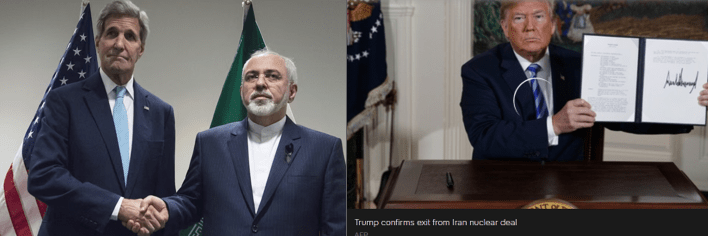
Obama’s then secretary of state John Kerry meets with Iranian foreign minister Mohammad Javad Zarif at the United Nations in New York for the JCPOA nuclear deal with Iran, 2015; Trump confirms exit from JCPOA in 2018. His continual crazed threats to start bombing again “right on their heads” or to kill the Iranian negotiators show how embarrassed he is to be preparing to sign much the same years later.
One of the more remarkable clauses of the US-Iranian Memorandum of Understanding (MOU) for 60 days of negotiations to end the war is where the US “undertakes with regional partners to develop a definitive, fully agreed plan with at least $300 billion for the reconstruction and economic development of the Islamic Republic of Iran.” Many analyses immediately jumped at this to claim the US had agreed to Iran’s earlier (and just) demand for war reparations of hundreds of billions of dollars to be footed by US taxpayers, a seemingly incredible Iranian victory.
While on the whole this is a US defeat and humiliation in terms of everything Trump had aimed for, and compared to everything he had rejected, or ripped up (eg, Obama’s JCPOA) in the past, the scale of Iran’s relative victory should not be exaggerated, as it is a country that has just suffered an unfathomable amount of destruction. And reading this clause to mean US reparations is an example of such exaggeration that goes to the heart of the problem.
Rather, as a Reuters report explained it, “The new fund is a private investment vehicle, not a reconstruction or reparations programme and will not include any government money or grants … companies based in the U.S., the Gulf Arab states, Asia, South America and Africa have agreed to commit financing. Investments pledged span energy, logistics, manufacturing and transport.” Some half this money has already been committed, and “companies from South Korea, Japan, Singapore, Malaysia and the U.S.” were “among those that had made commitments.”
The report noted that the fund “is designed to give both sides an economic incentive to conclude a final deal to end the war,” that is, Iran will be in desperate need of funds from anywhere it can get them to reconstruct what has been destroyed, while global capital has the incentive of making profit from a devastated country.
Far from the US government contributing a cent, its role, according to the MOU, will be to grant “all required licenses, waivers, and permissions needed for the relevant financial transactions,” because, after all, the only reason there isn’t already such global capitalist investment in Iran is that US sanctions prevents it, not because Iranian government policy ever prevented it.
Of course, it is not only global capital that will benefit. The key incentives for Iran are that US sanctions are lifted and that the billions of dollars of Iranian assets frozen abroad are unfrozen. This is the right of the Iranian people and nation as a whole, not only of Iranian capital, and is entirely just. But that does not mean everyone will benefit equally, because in capitalist countries, that doesn’t happen.
In an article describing the reaction of some ideologically hard-line elements of the Iranian regime and supporters who condemn this MOU as Iranian capitulation to the US and Israel, Murtaza Hussain and Reza Sayah describe the social base of the wing of the regime most supportive of the deal (which, by the way, is not led mostly be the so-called ‘reformists’ but by ‘pragmatic conservatives’ and IRGC security types):
“The Iranian economy is dominated by a network of semi-governmental institutions with ties to the security establishment. These firms largely control the flow of imports, exports, and energy resources, and are also tasked with navigating the complex web of sanctions the country faces when trading abroad and repatriating funds from the sale of oil and gas. … these powerful business conglomerates are seen as the forces pressing the government hardest to move forward. Known in Persian as “khusulati”—a blend of the words for “private” and “government”—these firms stand to regain access to billions of dollars of frozen funds, as well as new business opportunities in Iran’s oligarchical economy.”
“It is likely they were behind the scenes pushing for an agreement because their trade and business interests had been jeopardized, especially in the UAE. We know that in the first weeks of the war, the UAE had confiscated their money and shut off access to their bank accounts. They are the ones who wanted this deal so their business returns to normal, and authorities listen to them because they have power in the economy.”
In other words, while this clause is normally interpreted to be, like most clauses, evidence that the MOU greatly favours Iranian positions, the fundamental misunderstanding here misses the whole point: the idea here is for a ‘win-win’ as global capital partners with Iranian capital to bring the 90 million-strong Iranian market back where it belongs as part of the capitalist world-system, from which it has been excluded entirely due to the ideological needs of Israel and powerful sectors of US imperialism, rather than due to any aversion to this system by the Iranian regime and ‘millionaire mullah’ social base.
Who was ready to invest in Iran during Obama’s JCPOA 2015-2018?
To underline this point, it is worth looking at the opening provided by Obama’s nuclear deal with Iran, the Joint Comprehensive Plan of Action (JCPOA), signed in 2015, which lifted secondary sanctions on Iran in exchange for Iran agreeing to limit uranium enrichment to 3.67% for civil nuclear power, to IAEA inspections and to sending its stockpile of highly enriched uranium to Russia.
There was a long list of large US and other western companies who had drawn up plans for major investment and trade projects in the Iranian economy as soon as US sanctions were lifted. This includes Boeing, Airbus, Total, Renault, Siemens, General Electric, Daimler (Mercedes-Benz), PSA Peugeot Citroën, Hellenic Petroleum, Herrenknecht, India’sNational Aluminium Company, Turkcell, Zurich Insurance and more. A virtual list of the finest representatives of global capitalism.
Renault for example inked a €660-million joint-venture deal to establish a plant to produce 150,000 vehicles a year, on top of already existing Renault production capacity (established in Iran since 2003), plus an extra venture to produce 150,000 engines per year. Boeing struck a deal with IranAir to produce 80 aircraft for some $17 billion, plus another $3 billion 30-airplane deal with Iran’s Aseman Airlines, while Airbus signed a similar deal IranAir to sell it 100 airplanes for around $19 billion. French oil company Total SA signed a $5 billion, 20-year agreement with Iran, while a Chinese oil company struck a deal to develop Itan’s South Pars natural gas field. The French PSA Peugeot Citroen reached a deal to open a plant producing 200,000 vehicles annually in Iran, and the German Daimler signed letters of intent with two Iranian joint venture partners to locally produce Mercedes-Benz trucks and powertrain components.
These are hardly small-scale ventures. This was potential bonanza time. Then Trump came along and scrapped the deal in 2018, imposing new draconian “maximum pressure” sanctions, even though Iran had been abiding by the restrictions on uranium enrichment, and all these US and western mega-companies had to forgo these profit-making opportunities.
Why would Trump do that? If we try to answer this by talking about the needs of American capitalism, or Iran’s alleged “resistance” to it, it will not make sense. US and global capital were clearly interested in investing in Iran, and Iran was clearly interested in having them invest. The needs of American capitalism were met by the JCPOA, to state the obvious.

Global capital ready to rush into Iranian market 2025-2018, clockwise from top left: Boeing, Siemens, General Electric; Iran Khodro Industrial Group and German Daimler company sign MOU, January 2016; French Renault signs deal with Iranian companies Industrial Development and Renovation Organization of Iran (IDRO) and Negrin Group, August 2017; French Total signs offshore gas field agreement with Iranian Petropars Groups and China National Petroleum Corporation, July 2017.
The Obama Doctrine: A clear-sighted representative of US imperialism
In fact, Obama was very clear-sighted about what he considered the longer-term interests of global capitalism in the region. In major interviews conducted with Thomas Friedman and Jeffrey Goldberg in 2015-16, what became known as ‘the Obama Doctrine’ was laid out. According to Obama, even though Iran “has been an enemy of the United States, and has engaged in state-sponsored terrorism, is a genuine threat to Israel and many of our allies, and engages in all kinds of destructive behavior,” it is a country with the potential to change. Obama was looking at a nation (and market) of 90 million people, with a relatively youthful population mostly born long after the revolution, an educated population, which had undergone rapid modernisation despite the mullahs’ reactionary social restrictions, a population eager for global integration and a government with zero aversion to capitalism.
Waxing lyrical about “the incredible talents and ingenuity and entrepreneurship of the Iranian people,” Obama stated that “the election of [President Hassan] Rouhani indicated that there was an appetite among the Iranian people for a rejoining with the international community, an emphasis on the economics and the desire to link up with a global economy. And so what we’ve seen over the last several years, I think, is the opportunity for those forces within Iran that want to break out of the rigid framework that they have been in for a long time to move in a different direction.”
“If, as a consequence of a deal on their nuclear program those voices and trends inside of Iran are strengthened, and their economy becomes more integrated into the international community, and there’s more travel and greater openness, even if that takes a decade or 15 years or 20 years, then that’s very much an outcome we should desire.”
In contrast, while “our Sunni Arab allies, like Saudi Arabia,” have some very real external threats, it is their “internal threats” they should be most concerned about: “populations that, in some cases, are alienated, youth that are underemployed, an ideology that is destructive and nihilistic, and in some cases, just a belief that there are no legitimate political outlets for grievances … I think the biggest threats that they face may not be coming from Iran invading. It’s going to be from dissatisfaction inside their own countries.”
The great rivalry between Iran and its Sunni Arab neighbours such as Saudi Arabia at that time had reached a destructive point and fed “proxy wars and chaos in Syria and Iraq and Yemen,” so now we “say to our friends as well as to the Iranians that they need to find an effective way to share the neighborhood and institute some sort of cold peace.”
This contrast he saw between a modernising Iran’s potential to shake off the absolute hold of its reactionary mullocracy if the US enabled its integration into global capitalism, and the failure of Saudi and Gulf societies to shake off their similarly reactionary political structures despite global integration, along with his virtual equalisation of Saudi/Gulf and Iranian fanning of regional sectarian conflicts, was greeted with great anger in the Gulf.
Yet a decade later, we have seen two things. First, while the reactionary political structures have survived in the Gulf, there has been significant capitalist modernisation and transformation in these countries (which many western observers, especially on the ‘anti-imperialist’ left, have not caught up with), especially in Saudi Arabia, which, under repressive moderniser Mohammed bin Salman (MBS), has essentially turned into a ‘normal’ country. Secondly, while the Saudis initially welcomed Trump’s anti-Iran stand and his scrapping of the JCPOA, starting in 2020 all the Gulf, led by the Saudis, entered precisely into a process of détente with Iran, which puts their views today in sharp contrast with the extreme pro-Israel policy of the second Trump administration. The Yemen ceasefire of 2022 and the Saudi-Iranian normalisation in Beijing in 2023 have indeed transformed regional geopolitics in the way Obama recommended.
So why did Trump destroy this opening?
Ideology, narcissism, and Israel, largely. But that is a flippant answer. Ideology represents real interests.
Israel was vociferously opposed to the JCPOA and did everything it could to destroy it. Why? Surely if the problem was a threat of an Iranian nuclear bomb, Israel should have been the most supportive of a deal that effectively restricted Iranian nuclear activity. But from the time the US crushed Iraq in 1991, Israel had declared Iran its new number one “threat” (before that Israel had actually armed Iran with hundreds of millions of dollars in weaponry to fight against Iraq throughout the 1980s). And this cultivation of a big, scary Iranian “threat,” a kind of “Fourth Reich” that allegedly wanted to “wipe Israel off the map” has been central to Israel’s ideological rationale for maintaining and advancing the occupation of the West Bank and Gaza, its crushing responses to Palestinian resistance, and its further encroachments in the region; the alleged “terrorist threat” posed by the brutally crushed Palestinians on their own had worn very thin and need a crazed powerful state seeking nuclear weapons behind them the justify the endless oppression.
Legitimising the Iranian regime by making it a normal partner within global capitalism was anathema to the entire ideological edifice Israel had built over decades. Not that Iran had ever attacked Israel; but its loud rhetoric, from a safe distance, which played a similar role for that regime’s ideological mobilizational purposes, lent itself well to Israel’s ideological needs.
We hear a lot about the Israel lobby influencing US policy. And it is a real thing. But it would be a mistake to view this as simply a matter of a lobby bribing US politicians, even if that goes on. Yes, Trump’s scrapping of the JCPOA was an act in support of the Israeli position, and reflected his broader extreme pro-Israel stances (eg recognising Israel’s annexation of Jerusalem and the Golan), and he has received some big Zionist money. And the narcissistic Trump was also obsessed with undoing Obama’s work, and demonstrating that through harsh pressure on Iran he could get a “better” deal.
But in a broader sense, the “lobby” can be seen as a wing of US capitalism more directly connected to Israeli interests. One of the key areas where US and Israeli capitalist interests are not just connected but tied at the hip is in the military/security/high tech field. Due to Israel’s militarized existence, the military/high tech industries have come to play a dominant role there only seen elsewhere in the US itself, and so its large-scale, symbiotic relationship with the US military-industrial complex, in research and development as well as weapons’ sales, is hardly surprising. Israel is one of the largest suppliers of high-tech military hardware to the United States, and is the seventh largest arms exporter in the world.
Israeli and US companies are involved in many defence, security and high-tech joint ventures, joint-development programs, subsidiary arrangements and so on. R2S for example is a joint venture between the US Raytheon and the Israeli Rafael Advanced Defense Systems to build the Iron Dome system’s interceptor and the SkyHunter Interceptor (US variant) in the United States. “The venture will build the Iron Dome interceptor and launchers capable of intercepting cruise missiles, unmanned aircraft, rockets, artillery, mortars and other threats. With thousands of operational intercepts at a high success rate, it is the world’s most-used battle proven system in its class.”

Raytheon-Raphael US-Israel joint-venture contract win, November 2025. Who would want to pass up this kind of money? Surely, this requires war, the threat (real or concocted) or atmosphere of war.
The infamous Israeli defence/electronics company Elbit Systems is a different kind of example – chosen by the US Department of Homeland Security (DHS) as a member of the winning consortium for the Secure Border Initiative (SBI) on the US-Mexican border in 2005, “to supply technology to identify threats, to deter and prevent crossings, and to apprehend intruders,” its US subsidiary more recently secured multi-billion dollar follow-on contracts to deploy and maintain Integrated Fixed Towers (IFT) and Mobile Surveillance Systems for US Customs and Border Protection. Elbit of course has years of experience in “border protection.”
And there is nothing so good as a war for such industries, or at least the permanent threat or atmosphere of war – something not well-served by Obama’s attempt to remove the Iranian bogeyman which had served this purpose so well since 1979. In this sense, the US military/security sector has similar interests to Israel, even if it were not as directly connected to Israeli big capital as it is.
Moreover, all this also serves an ideological purpose for the US broadly similar to what it serves for Israel – US global dominance over emerging European or Chinese rivals is facilitated by US military dominance, especially of vital regions for global capitalism like the Middle East with its massive oil and gas supplies. In a sense, while specific US and Israeli interests often differ, their convergence on this heavily militaristic stance towards dominating the region reflect their differing kinds of ‘outsider’ status: Israel, as a colonial-settler state, is a population imposed over the Palestinian people from outside the region, placing it in perpetual conflict with the region’s Arab populations, while on a grander scale, the US is a western hemisphere power attempting to maintain its hegemony over ‘Eurasia’ in competition with its rivals who exist within Eurasia.
And the grave dangers to the US allegedly posed by a “terrorist” regime in Iran since the iconic seizure of the US embassy in Tehran in 1979 has served the purpose of rationalising this massive military presence superbly. Trump represented those who thought this was not the time to trade in such a useful ideological asset.
So, did Obama or Trump better represent the needs of US capital? The needs of US imperialism, it seems, do not always agree with the needs of US imperialism!
Trump becomes Obama – but with a destroyed Iran
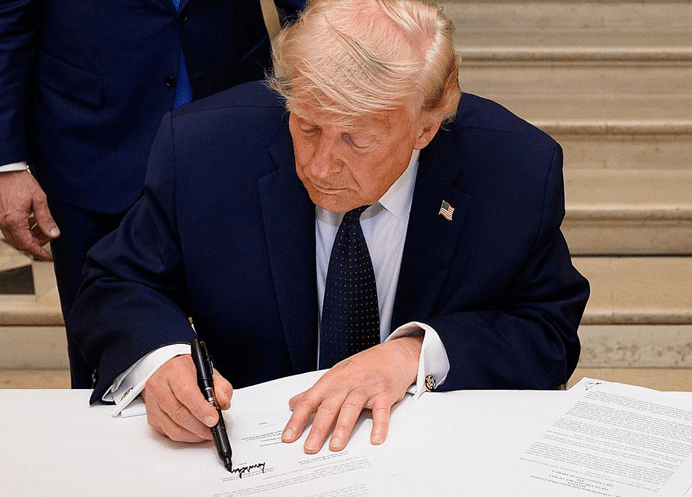
Trump signs MOU to advance his new version of the JCPOA, June 17, 2026
This brings us back to the fallout from Trump’s catastrophic decision to launch an unprovoked, pointless war against Iran along with Israel. Given that Iran was already widely perceived to have been greatly weakened by the smashing of Hezbollah in 2024, the US-Israeli attack on its nuclear industry in June 2025 and Israel’s previous attack in late 2025 which wiped out its air defence, the loss of the Assad regime and so on, the idea that either was confronting an Iranian “threat” in February 2026 is just nakedly untrue, especially as the war was launched in the midst of negotiations in which Iran had already agreed to significant restrictions on its nuclear program.
Israel thus had no special need to further destroy Iran at that point, unless it aimed at expanding its borders into southern Lebanon up to the Litani, which would require the expulsion of a million Lebanese Shiites and a new war with Hezbollah, which Iran may feel compelled to respond to, given this is one of the few parts of the region where the Iranian regime had a solid base of influence. But if that was one of the aims, as I believe to be the case, then launching a war to create regional turmoil and chaos would in itself be the perfect atmosphere in which to expand into Lebanon, while consolidating the results of genocide in Gaza, and further annexing the West Bank and southern Syria. The Greater Israel agenda.
But with Trump’s strong outreach to regional Arab and Muslim leaders who oppose this Israeli extremism, and the broader interests of US imperialism to create a stable investment climate in the region guaranteed by US “security” cover, it seems difficult to see this war as launched in US interests. Netanyahu had mobilised Trump’s narcissism when demonstrating to him that he could kill off a significant chunk of the Iranian leadership in one strike; and this went together with extraordinary delusions that such an act could repeat the rapid Venezuelan outcome he had so spectacularly performed.
Assertions that the US went to war to consolidate US hegemony over the region frankly make no sense. There was no specific or approaching threat to such hegemony, and the war has actually eroded it.
The war having blown up in Trump’s face, he is now forced to make a peace deal because he can see that further escalation will achieve nothing, and will more likely increase his humiliation. But the problem is political – how to justify months of killing and destruction, at an astronomical cost, with its major impact on the world economy, and its facilitation of Iran’s seizure of the Strait of Hormuz, if all he can get at the end of it is a deal no “better” for the US than Obama’s JCPOA which he ripped up eight years ago
In fact, this will be very difficult. With the US defeat, Trump is now Obama. All the reasons for ripping up the JCPOA – ideology, militarism, narcissism, Israel – have now no meaning in this context.
Despite much talk about some grand decisive US-Israel split, this is extremely unlikely, and in fact goes against news in the background about steps towards the further integration of the US and Israeli military machines. However, Israel cannot be allowed to mess with US needs in the Gulf. Trump’s assertions that Israel will do what he tells it to are a stark reminder of who is ultimately boss. The difficult point however is Lebanon. While the US wants Israel to rein itself in a little, not to bomb Beirut when he is trying to negotiate a deal, there has been no US demand for Israel to exit Lebanon, merely to cease fire. At the MOU stage, that is enough for Iran as well. If Iran puts it foot down and demands Israeli withdrawal as part of the final deal – and that itself is a big “if” – we will then see whether, firstly, the US attempts to force this on Israel, or lets the Iran deal collapse, and, secondly, whether Israel submits to or resists such US pressure.
We read much about how all Israeli leaders – government and opposition – view this MOU as a grave defeat for Israel’s interests. If it forced an Israeli withdrawal, it would be. If it didn’t, then Greater Israel would now be in control of territory it was not before. Frankly, my prediction is the second is the more likely outcome. And that is not a defeat.
But Israeli opposition to the deal needs to be seen in the broader context. We now have the US vice-president sitting in the same room as top Iranian leaders, gearing up to sign a deal, if it is made, in the UN Security Council. JD Vance, representing the most pro-deal wing of the MAGA coalition, even stated that if Iran is “willing to give up nuclear weapons ambitions for the long term, then the United States is willing to fundamentally transform our relationship with that country.” Just as with Obama’s JCPOA, the legitimisation of the Iranian regime at such a high level by Israel’s main ally, as a step towards the reintegration of Iranian capitalism into the capitalist world-system, would represent a huge set-back to Israel’s decades-long key ideological prop.
This is combined with the emergence of a new coherent ‘Sunni bloc’ which, while having its own issues with Iran, was against this war, opposes the Abraham Accords and sees Israel as just as big, or bigger, a threat to regional stability than Iran, played the key role in mediating the peace, and did so in tandem with a behind-the-scenes role of China, the US’s chief imperial rival. This bloc consists of nuclear-armed Pakistan, Saudi Arabia and Qatar in the Gulf, and Turkey, which countless Israeli leaders have been posing as the “new Iran” for future Israeli mobilizational purposes.
This bloc are traditional US allies, but all with expanding relations with both Russia and China. Their ability to balance in this climate of growing imperial rivalry poses a dilemma for US geo-strategy. On the one hand, the current Trump strategy (the Obama strategy) of bringing Iran in from the cold coalesces with the views of this regional bloc and allows the US to ‘lead’ this peace strategy – which the ‘Sunni bloc’ designed – as their partner, all the better to compete with China in the region. But the victory of this strategy was also a victory for China and its behind-the-scenes role; Pakistan, after all, is just as much an ally of China as it is of the US, if not more so. In a sense, the US must be seen to lead this process in order to prevent a more in-your-face Chinese diplomatic victory. On the other hand, any move towards a region less dominated by overt Israeli and US militarism and manufactured “security” concerns will tend to level the playing field with US imperial rivals in China and Europe (and to a smaller extent even with the similarly militaristic and revisionist Putin regime in Russia), in the longer term. China in particular poses a major threat in new ways now – not only because the Gulf has seen that US ‘security cover’ makes them targets without really offering security and so they are now ‘diversifying’, but also because the closure of the Strait has highlighted the insecurity of relying on fossil-fuel supplies, while China is now the world’s number one manufacturer and exporter of solar cells, batteries, electric cars etc.
Trump’s continual threats to Iran to “drop bombs right on their heads” or even kill the negotiators, while representing the delusions and humiliations of a deranged sociopath, also represent being perpetually torn between the Obama and neocon positions on this question, and the actual contradictions of the needs of US imperialism.
So does a US-controlled 300 billion investment fund help – if it comes?
If the US really does “undertake(s) with regional partners to develop a definitive, fully agreed plan with at least $300 billion for the reconstruction and economic development” of Iran – that is, if the US actually leads the way with this – while it surely represents Trump becoming Obama big time, it also implies a degree of US control over this “private investment fund” involving “companies based in the U.S., the Gulf Arab states, Asia, South America and Africa.” If the plan is for Iran to open to global capital, the US wants to be in control.
While the apparent terms of any nuclear agreement with Iran seem unlikely to be anything “better” than the JCPOA, and thus represent a political defeat for the US and a political victory for Iran, we should also be aware of the changed circumstances. In 2015, Iran was at the zenith of its power in the region. For those who think this was all about “resistance” (despite all “conflict” with Israel being in the realm of hot air for decades, unlike the very real genocidal war Iran helped Assad wage against the Syrian people), Iranian MP Ali Reza Zakani’s claim in 2015 that Iran now controls four Arab capitals, Baghdad, Beirut, Damascus and Sanaa, reveals the real nature of the times; while Ali Younisi, adviser to Iranian president Hassan Rouhani who signed the JCPOA, stated that Iran now formed an empire, and that Baghdad was its “capital.”
It is a starkly different reality today, despite the understandable fanfare about Iran’s humiliation of the murderous skunk Trump. Iran’s economy is in crisis, with hyperinflation (400% on some items), suffering from an estimated $270 billion worth of war damage, “nearly equal to its GDP,” while the IMF is predicting a 6.1% contraction of its economy this year, and the UN says 4.1 million more Iranians could drop below the international poverty line.
Moreover, according to Iran analyst at the International Crisis Group Naysan Rafati, simply comparing the terms of the JCPOA to whatever comes out of this round misses the point that “now we are in a different place.” Last June, the US dropped its bunker buster bombs on the regime’s nuclear facilities. “Right now, Iran is not enriching. As far as we know, based on publicly available information, statements from the US government and the International Atomic Energy Agency [IAEA], Iran is at zero enrichment involuntarily and has been since last June.” This bombing also buried much of Iran’s enriched uranium that is so much in dispute now; it would be a huge job to get to it, and even if it did, it cannot be used without significant repair to its nuclear facilities.
The actual terms of the final agreement will therefore be imposed on a situation in which Iran’s economy and nuclear potential are smashed, a point Vance made in defending the outcome. Asked about comparisons with the JCPOA, Vance said that “in 2015 Iran had built a sophisticated nuclear weapons program with a nuclear weapon stockpile, so the perspective that we came at as the United States was, you already have a really nice nuclear program; we’re going to bribe you with American money in order to stop it. Our perspective, and where we’re coming at it, is we already destroyed your nuclear program,” and so good things will come your way “if you promise and show verifiable pathways to not rebuild it.” Two weeks later he doubled down, “If we don’t make the final deal, their nuclear program is still destroyed. They’re still much weaker as a country, so … America wins either way.”
Therefore, Iran’s desperate economic situation means that if that $300 billion of private investment, or any part of it, does arrive, it will not be Iranian society that has the upper hand in this arrangement. The US, in a sense, could still “win” via the back door.
How all this will work out is another matter. A proposal for a $300 billion private investment fund does not make that investment magically appear, that will depend on how profit-worthy private capital judges the situation, and situations of massive instability do not inspire investor confidence. Moreover, even if the US aims to control whatever investment does go in, there is no guarantee that it will succeed. There may well be companies from Japan, South Korea and Singapore, but it will be difficult to create barriers to Chinese companies entering the market. No matter how many US companies invest and partner with Iranian ‘khusulati’ companies, it will take a lot for the Iranian bourgeoisie to start loving America after recent horrors. It is widely expected that much investment capital will come from the Gulf. One potential example is a multi-billion dollar mining joint venture between US investment firm Burkhan World and Saudi Arabia’s Grand Mines, which is “shifting its focus to Iran’s reconstruction,” accessing mineral supplies from Kazakhstan and Pakistan for that purpose, according to Burkhan CEO Shahal Khan. The deal “completely changed into something much larger because of the war,” he said, noting that the Saudi government “wants to give Iran the ability to fully function outside of sanctions and be able to rebuild its economy.” But it is also possible that Iran may end up seeing little of all this.
Who is the new Iranian leadership?
As an addendum, it is worth looking at who the new ruling clique is in Iran who seem set to carry through this significant change in US-Iranian relations, if this all happens.
From the start of the war, Trump began appealing to the IRGC. First he promised immunity to members of “the Islamic Revolutionary Guard, the armed forces and all of the police” if they “lay down” their arms, promising “you will be treated fairly with total immunity,” then he said “hopefully, the IRGC and Police will peacefully merge with the Iranian Patriots, and work together as a unit to bring back the Country to the Greatness it deserves.” Regardless of what some of this means in Trump’s head, this was his way of saying the US wants to keep the bourgeois state together, and the only cohesive armed force capable of doing that is the IRGC. But more than this, apparently the idea was that once the top clerical leadership were removed, the IRGC – despite their record of repression – might be more ‘pragmatic’ in the interests of its business empire. A more extended and bloodier version of Venezuela was envisaged.
While many viewed these ideas as just “Trump ravings,” according to a New York Times report, a February 18 war-planning meeting of top US leaders and strategists looked at the likely outcome of the decapitation of Iran’s leadership. They thought a popular uprising was unlikely, and Khameini could be replaced by a more hard-line cleric. But some officials “seized on a third scenario: that a faction of the Islamic Revolutionary Guard Corps more pragmatic than the hard-line clerics might take power. Even though a cleric was likely to still be nominally in charge, that group of I.R.G.C. leaders would actually lead the country. … the C.I.A. analysis suggested that as long as the United States did not interfere with the economic activities of this faction, such as its influence in the oil industry, a group of officers might be conciliatory toward the United States. They might even give up Iran’s nuclear program or prevent Iran’s proxy forces from attacking the United States.”
Many political scientists are analysing the new order as a substantially new Islamic Republic; according to Professor Afshin Matin-Asgari, author of the book ‘Iran and the Axis of Empire’, “what has emerged from this war so far is a different Islamic Republic that functions quite effectively under tremendous pressure and even after the elimination of its top military and political leadership. The Revolutionary Guards manage the war and seem to be running the country efficiently, though with an iron fist, with the help of surviving leaders of the old political establishment. But the regime emerging from the war is not the Islamic Republic we used to know. Already, the role of clerics and Islam is less pronounced, while a nationalistic military-technocratic elite, perhaps more competent but no less repressive than the Khamenei regime, seems to be in control.”
More substantially, in Foreign Affairs, Iran experts Narges Bajoghli and Vali Nasr argue that “a new generation of IRGC commanders and civilian security officials who came of age after the 1979 revolution” now hold key decision-making positions, “and their nationalistic outlook on statecraft and security is redefining the Islamic Republic.” This “officer class of the armed forces and the IRGC, along with their affiliated security institutions,” confronted by the US-Israeli war, have “adopted a structured, technocratic culture and a strategic outlook built around national defense, not revolutionary ideology.” This new generation “neither espouses revolutionary grandiosity nor advocates revolutionary activism,” but rather are “establishment actors: pragmatic, hardened nationalists operating with a clear-eyed assessment of Iran’s capabilities and vulnerabilities.” At one point they liken this new regime to “the military-led nationalist states of the twentieth century—Turkey under the later Kemalists, Egypt under Gamal Abdel Nasser—in which ideology persisted but was subordinated to national interest and the imperatives of state power,” and elsewhere they claim the new Islamic Republic “looks less like a theocracy and more like a right-wing nationalist authoritarian state,” stressing that this new “nationalist-technocratic bargain,” whose “terms are national, not Islamic,” should not be confused with liberalisation.
Interestingly, they document this transition taking place over the eight months from the end of last June’s 12-day war until the onset of aggression this year, rather than as a result of the decapitation of the old leadership. The point here is that if 86-year old Khamenei had been allowed to die naturally, an orderly transition may have resulted in the “technocratic-nationalist” regime adopting the kind of pragmatic relations with the US that Trump fantasised about or that Obama realised, without that meaning subservience or national humiliation. A “nationalistic military-technocratic elite” may not much like the US, but they may well know the importance of making money and thus understand the importance of partnering with US capital to do so. “As long as the United States did not interfere with the economic activities of this faction, such as its influence in the oil industry.” Indeed, especially as the IRGC dominates the ‘khusulati’ state/private companies spoken of above, which “stand to regain access to billions of dollars of frozen funds, as well as new business opportunities in Iran’s oligarchical economy.”
Trump’s idea that a body tasked with national defence and security may feel “conciliatory” or “more reasonable” towards the US or Israel after these historic enemies of Iran had so kindly “decapitated” their leadership amid an illegal attack on their country was deluded in the extreme (as the next months proved); there was every reason for a leadership more inspired by nationalism than religion, as the authors assert, to resist even more, and to do so more effectively. Nevertheless, a longer-term understanding of the class forces at play suggests there may have had a kernel of rationality in all this, that even Trump managed to get some inkling of. Trump’s insistence that the decapitation of the old leadership was the “regime change” and that those in charge now are “less radical and more reasonable” people may sound self-serving and absurd – yet not entirely absurd.
The fact that this new “nationalistic military-technocratic” leadership has been engaged in an orgy of hanging oppositionists under cover of the war – mostly young people involved in the mass protests crushed in January – demonstrates that “no less repressive” than the Khamenei regime may be an understatement, but it is abundantly clear that this has not been the slightest concern to Trump from the very beginning, despite his hypocritical declaration that he was with the Iranian people as they faced the mass repression in January. War is the worst outcome always, and the end of it, along with Trump’s humiliation, should be celebrated, but there need not be any illusions about the class nature of the peace.