By Michael Karadjis
What caused the breakdown of the US-Iran MOU and the restart of hostilities between the US and Iran? It seems that both the US and Iran decided that the MOU was not perfect enough for their respective needs – especially regarding domestic credibility – and so decided to test it, to push the boundaries, to ‘bargain with fire’.
The US bombings of Iran are so vastly disproportionate in relation to the initial Iranian attacks on oil tankers that it has to be concluded that Trump was just itching for a little more war; the US hit Iran hundreds of times, for thirteen consecutive nights, compared to Iranian hits on only 7 oil tankers or container ships. It is not difficult to understand why Trump might want another chance to look tough, given that the MOU has been widely seen as a defeat and humiliation for the US. Trump aims to get a better deal with some bombing, even though it did not really approach the level of the earlier war. Initially, the US targeted Iranian military targets, but later expanded bombing to clearly civilian targets, including desalination plants. But it is a high risk strategy for Trump, as he is likely to achieve nothing, resulting in even more humiliation. Compared to Iran, the US has the upper hand economically, and it would be more logical to work through the MOU process to push US imperial interests, but logic does not get much of a hearing with Trump.
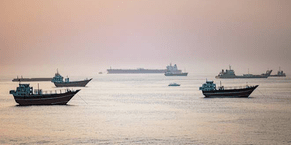
That said, it is the Iranian regime that sparked the conflict by initiating the first attacks on civilian shipping, for the evidently unjustifiable position that they must not be allowed to sail through sovereign Omani territorial waters. And that is somewhat more difficult to understand.
Iran’s retaliation for these extensive US bombings has been to continually hit US bases mainly in Bahrain, Kuwait and Jordan, though the UAE, Qatar and Oman have also been hit occasionally. While these states condemn the attacks on their soil, nonetheless this time round Iran initially restricted its attacks to US military bases on their soil. The simple fact is that these states cannot host US bases and not expect them to be attacked when the US attacks Iran, even if they don’t allow those bases to be directly used in attacks. They are US military assets, assets of the state attacking Iran, and provide logistical and intelligence roles in the US war whatever the case. Later, however, Iran also began once again expanding to civilian targets, including reportedly a desalination plant in Kuwait.
Saudi Arabia has not been touched this time, but the initial Iranian attacks on shipping were on a Saudi and a Qatari vessel sailing in Omani waters. Yet these three countries – Saudi Arabia, Qatar and Oman – have been the most conciliatory towards Iran and are key components of the Pakistan-led ‘mediation camp’ (as opposed to the more hawkish UAE-Bahrain-Kuwait group), and an emerging regional ‘third force’. So why do this?
Especially since Iranian FM Araghchi had just been in Oman attempting to negotiate some kind of joint arrangement for ships in the Strait of Hormuz. Oman had even stated that it was open to some kind of fee arrangement, if not a formal toll (Iran has proposed insurance, environmental, navigation or security fees, after the end of the 60 days of negotiations in the MOU). Likewise, in late June, the Qatari PM visited Oman to initiate negotiations involving Iran, Iraq and Gulf Arab states on the Strait of Hormuz, to implement a provision of the MOU calling for Iran to hold talks with Oman, other Gulf states and Iraq on the future management of the strait. Separately, Saudi Arabia announced plans for regional reconciliation talks in Riyadh between Iran, Gulf Arab states and other regional countries.
Meanwhile, Saudi Arabia just sent a high-level delegation to Khamenei’s funeral in Iran, as did Qatar, Oman and other members of the new regional ‘third force’ (Turkey, Pakistan). In fact Pakistan, which Saudi Arabia has a formal defence treaty with, was one of the only countries to send its head of state, as well as head of its armed forces.
So Iran’s initial maritime attacks seem to make little sense.
Spokespeople for Iran, for example, on Al-Jazeera, have not really put forward a convincing case. They argue that by sailing through Omani waters, rather than Iranian waters, these ships are violating Point 5 of the MOU.
To clarify, the Strait runs between Iran and Oman, so both countries hold territorial waters on either side, plus there is a small strip of international waters in between, which however has been heavily mined by Iran. In the discussions about whether Iran has the right to charge some kind of tolls or fees for passage through the Strait, this can only really apply to ships choosing to pass through Iranian waters; it is up to Oman whether or not it chooses to do the same; and there is no law that says ships must pass through Iranian waters. Hence the push for some kind of joint Gulf-state buy-in, or at very least, an Iran-Oman agreement.
So, here is Point 5 of the MOU:
“Upon the signing of this MoU, the Islamic Republic of Iran will make arrangements using its best efforts for the safe passage of commercial vessels, with no charge for 60 days only, from the Persian Gulf to the Sea of Oman, and vice versa. The traffic of commercial vessels will immediately start, and considering the need for removing the technical and military obstacles, and de-mining by the Islamic Republic of Iran, will be instated within 30 days. The Islamic Republic of Iran will conduct dialogue with the Sultanate of Oman, to define the future administration and maritime services in the Strait of Hormuz, in discussions with other Persian Gulf Littoral States, in line with applicable international law and the sovereign rights of coastal states of the Strait of Hormuz.”
Only a very slanted interpretation of the wording would say ships are in violation if they use Oman’s territorial waters. Yes, it says Iran will make arrangements for safe passage of ships through the Strait, but it doesn’t say that ships must pass through the Iranian side to be so “arranged,” in fact by firing on vessels otherwise sailing safely through the Strait, Iran is violating the MOU’s wording about “safe passage.” It says Iran, Oman and other Gulf states will conduct dialogue about the future, but not that ships must choose a particular route now.
Iran argues that the US navy has deliberately opened up this passage through Omani waters so that ships can avoid the Iranian side, even though Iran is not currently charging any fees. The US aim is to establish a precedent whereby, whatever Iran decides to do in the future, ships can simply avoid the Iranian side. Therefore, Iran’s bargaining power is gone.
This may well be the US aim. But sailing through Omani waters has always been an option. The US did not create this option. That is a built-in reality; the wording of the MOU would have needed to be far more explicit for this to be a violation.
And if they require the US navy to escort them through Omani waters for their safety, surely the only thing threatening their safety is Iranian drones or missiles? So this becomes a circular argument – if Iran does not want the US navy there, it would make it clear that ships can sail through Omani waters without being attacked.
So, if the arguments do not make sense, why is Iran doing this?
I think there are a number of factors.
First is precisely this catch that the MOU’s vague wording does not in fact cover Iran’s need to hold its leverage via the Strait. Given the enormously destructive, totally illegal, and treacherous aggression that Iran was subjected to by the US and Israel – twice in the middle of negotiations – Iran has every right to whatever leverage it can use. Its discovery that it could use the Strait of Hormuz to block the oil trade and disrupt the global economy is a weapon it will understandably not want to give up, at least until there is a final settlement. This is not so much about whether or not fees will ultimately happen (for Iran, fees can help with the massive reconstruction cost, but it may waive this idea if solid reconstruction money, release of frozen funds etc takes place in the final agreement), as about Iranian control. If ships can just choose the Omani side, Iran loses much of its leverage.
That does not mean Oman or the countries owning these ships are doing anything in violation of the MOU or that Iran’s arguments make sense. They do not. But in the context, Iran’s view is understandable. Of course, it would be much better for Iran to get an agreement with Oman and other Gulf states. They view Iran attacking their ships in Omani waters while they are in the midst of these very discussions to be treacherous. However, Iran views the very act of taking Omani waters, turning off signals and gaining US naval protection while these discussions are taking place as treacherous itself, aimed at killing Iran’s leverage.
Secondly, pro-Iran spokespeople argue the question of violating the MOU must be seen in the broader context, because the US and Israel have violated it from the first day. Interestingly, this is almost a confession that it is Iran violating the MOU by attacking ships, but that it is justified as retaliation for US and Israeli violations. For example, Point 1 of the MOU says that upon signing the deal the US and Iran “undertake from now on … to refrain from the *threat* or use of force against each other.” Yet from the very first days of the MOU, Trump was already threatening to drop bombs “right on their heads” if he didn’t get the deal he wants, and even to kill the Iranian negotiators, all long before these Iranian attacks on ships.
Of course, Trump’s deranged threats were then and hardly explain Iran’s reaction some weeks later, but Point 1 of the MOU also declares “the immediate and permanent termination of military operations on all fronts, including in Lebanon” – clearly, Israeli military operations have not been terminated in Lebanon. Soon after the MOU, the US arranged the separate Israel-Lebanon agreement, which allows Israeli forces to stay in Lebanon until such a time that the Lebanese army is able to disarm Hezbollah bit by bit in different pockets, an Oslo-type recipe for forever occupation – but not only that, outside of these proposed zones, Israel is able to just keep up bombing Lebanese targets where Hezbollah operates (or supposedly does). Dozens of Lebanese civilians have been killed since the MOU, and since this separate agreement, while the IDF also continues to meticulously destroy entire towns and villages to prevent return.
These ongoing Israeli actions (as well as the separate agreement itself) are a direct threat to Iran’s credibility. While I doubt Iran will ever get Israel to withdraw from Lebanon, the ongoing killing directly violates the MOU and politically Iran has to react. A million Lebanese Shiites have been uprooted by Israel from the south; the Iran regime’s only solid regional influence (as opposed to transactional relations it has with many states) is among Shiite communities, and political forces, in Lebanon, Iraq and Yemen, so not putting halt to Israel turning south Lebanon into Gaza risks losing a major part of this influence. Likely the attacks are Iran’s indirect way of objecting to the violation of the Lebanon part of the MOU.
Finally, there are the divisions within the Iranian elite and among the Iranian people. While the MOU is widely interpreted as a relative victory to Iran and a defeat for the US, a vocal minority within the Iranian regime and its key institutions sees it as capitulation to the US. Sixty-two members of the powerful Assembly of Experts (nearly three-quarters of them), signed a statement calling the reopening of the Strait a strategic mistake – and the opening of the Omani channel precisely made them look right! Demonstrations have been held by the hard-line Paydari Front denouncing the MOU as betrayal.
While in normal times, these voices could perhaps be brushed aside – it is almost certain that the majority of Iranians prefer peace with some degree of compromise – these events cannot be separated from the context of the mass, week-long, country-wide funeral events for murdered Supreme Leader Ali Khamenei, involving millions of people (while some of the figures claiming tens of millions are obvious nonsense, there clearly were millions throughout the country). Many called for vengeance; a prominent call was ‘Kill Trump’. Many slogans denounced signing any agreement with the killer of Khamenei. In some cases, the figures most associated with the MOU framework – Ghalibaf, Araghchi, Pezeshkian – were publicly attacked. While some of this was likely orchestrated by the reactionary right, it seems likely this atmosphere was another factor prompting the Iranian leadership to angle for a stronger deal, at least on Hormuz.
The problem is that with both the US and Iranian regimes motivated to a large degree by issues of domestic political credibility in these renewed clashes (which is also the case in a different way with the Israeli leadership), reaching a deal they can both call a win, in order to return to the MOU process, is even harder than before. It seems unlikely that either side wants a return to full-scale war (although Trump’s threats to start bombing bridges and power plants suggest it is possible). These are battles within the context of an overall negotiations process, drawing out red lines, trying to gain better bargaining positions. While Trump now relishes the chance to look tough again, to spout ugly, hateful, blood-curdling rhetoric again, lest anyone dare call the MOU a US defeat or humiliation, he will be aware that a full escalation risks not achieving any more than last round, while the economic fall-out could have a severe impact on the upcoming mid-term elections.
Trump, in other words, still needs a deal. But it is Trump, after all, so it is not out of the question that he decides the mid-terms will be lost anyway, and therefore he may as well go for broke and risk all to “crush the enemy.” But apart from crazed neocons like the late Lindsay Graham, it seems unlikely that saner voices of US imperialism see that as a good idea.
But this course is also very risky for Iran. The Iranian regime risks overplaying its hand as a result of the view that it has defeated the US, and the view that control of the Strait is some kind of Iranian nuclear weapon. Both ideas need bucket-loads of nuance. Yes it imposed a political defeat on the US, but it is a devastated country with a wrecked economy. It needs hundreds of billions for reconstruction. The people are exhausted. Despite the size of the funerals, Iranians are deeply divided; there were countless scenes of cheering when Khamenei was killed also, but there is nothing like a foreign power slaughtering thousands of civilians to swing much of the population behind even an unpopular regime resisting such savage foreign aggression. Meanwhile, the regime fosters further divisions by using the cover of war to go on a hanging spree against young people involved in January’s mass protest movement.
Relying on the Strait as a weapon may have a short shelf-life. Saudi Arabia, for example, was able to almost keep up the same level of oil exports by using its pipeline to its Red Sea ports – and even though the volume was slightly reduced, it actually made more money due to high oil prices due to the closure of the Strait! It can also build a further branch of the pipeline to pass south through Yemen or Oman directly into the Indian Ocean. No wonder it kept largely quiet. The UAE also has a pipeline to the Indian Ocean running through Oman, through which it could still export some 80 percent of its oil, and is building another through part of its own territory outside the Gulf. Iran could block Iraqi exports, but during the war it made an exception for “brotherly Iraq.” Is it wise to turn an ally into an enemy? In any case, Iraq could start selling more to Europe via pipelines through Turkey and Syria. That leaves Kuwaiti oil and Qatari gas (Bahrain has little of anything). Kuwait could build a pipeline to join the Saudi pipeline. Qatar and Iran actually share a major gasfield!
And all of that is before we even consider future decline of demand for hydrocarbons, which this war and the blockage of the Strait will likely accelerate. With China now the world’s biggest producer of solar panels, batteries, electric cars, wind turbines and so on, it stands to sweep the region in the future as the US petrodollar declines, yet the same process will make the Strait less strategic.
In this sense, Iran is better off trying to mend bridges with its Arab Gulf neighbours, especially the ‘mediation bloc’, rather than widening them via attacks on oil tankers. The Qatari-led talks between Gulf states, Iran and Iraq on finding a joint plan for management of the Strait, the Iran-Oman talks, and the Saudi plan for reconciliation talks in Riyadh were all positives that probably alarmed the US and Israel, and wrecking such initiatives may have been one motivation for Trump angling for more war. But that is what precisely makes it difficult to understand Iran’s actions which have given Trump the pretext.
Iran’s position that it alone controls the Strait is not supported by any of the Gulf states, and crucially, nor is it supported by China, the only other force powerful enough to put some brake on the US (of less relevance is the fact that Iran’s position is also not supported by Russia). Every statement from China has demanded free passage through the Strait, starting with the China-Pakistan joint statement early in the war. China has good relations with Iran, but it also has good relations with all states in the region, and in fact only 20 percent of its oil imports from the Gulf come from Iran, the largest portion comes from Saudi Arabia. If the Iranian regime remains intransigent on this issue, it risks losing the ‘mediation bloc’ if they decide their own security requires them to go all in with the US.
Of course, to re-state: Iran’s position is understandable in the context that the Strait is one of its only strong pieces of leverage against a ruthless superpower like the US that has demonstrated that it can launch a murderous attack in the midst of negotiations. But attacking commercial shipping for the ‘crime’ of using another country’s territorial waters it is a blunt instrument to say the least; ugly regimes like that of the hangmen of Tehran often rely on such blunt instruments because their inability to win the region’s peoples politically is simply an inherent reality, but even this instrument may have a short shelf-life.

