By Michael Karadjis
On August 25, Syrian Democratic Forces (SDF) commander Mazloum Abdi declared the formal dissolution of the SDF and of the Kurdish-led Autonomous Administration of North and East Syria (AANES), and the full integration of both into the political and military structures of the Syrian state. This is the culmination of the process of integration declared by Abdi and Syrian president Ahmed al-Sharaa in March 2025.
While there remain a number of important issues still awaiting full resolution, SDF leaders recently declared that “99 percent” of the integration process had been completed. The Democratic Union Party (PYD, the Syrian wing of the Turkey-based Kurdish Workers Party PKK), which politically led the SDF, welcomed the completion of the integration process, while stressing that Kurdish rights must be enshrined in the constitution.
Abdi declared that “We will carry with us the memory of our martyrs and cherish their sacrifices in our hearts, for they did not fight for war, but for peace. A day will come when Syrians will no longer need to fight. We want that day to mark the beginning of a true transition from battlefields to construction sites, from an era of weapons to an era of peace, and from the stage of defending Syria to the stage of building Syria.”
The announcement was followed by Sharaa’s appointment of Abdi as a special advisor to the president on Kurdish issues, and of AANES co-chair Ilhan Ahmed to a special seat in the People’s Assembly, with a focus on the development of the constitution, which will give her key input into the kinds of pro-Kurdish (and other) constitutional changes the SDF desires.
Ahmed’s new seat in parliament sees her replacing former Sharaa appointee, Mudar Hamdan, who is under review over ties to the former Assad regime. This followed a petition signed by hundreds of Damascus University students and alumni, who revealed Hamdan’s past role.
While there are plenty of valid critiques of the limitations of the outcome, especially coming from Kurds who were used to the more explicit autonomous rule they had achieved while outside the structures of the uber-repressive and Arab-chauvinist Assad regime over the last 12 years, the SDF leadership had declared its intention to integrate into new Syria after Assad was deposed. It was clear to them that there was little basis to maintain a separate state once the extraordinary conditions were over. Unlike in neighbouring states, “the Kurds” is not the name of a compact geographic region in Syria. As SDF Kobani commander Mahmoud Barkhadian put it, “to suggest, for example, that Kobani would become and independent state is sheer madness that defies logic.”
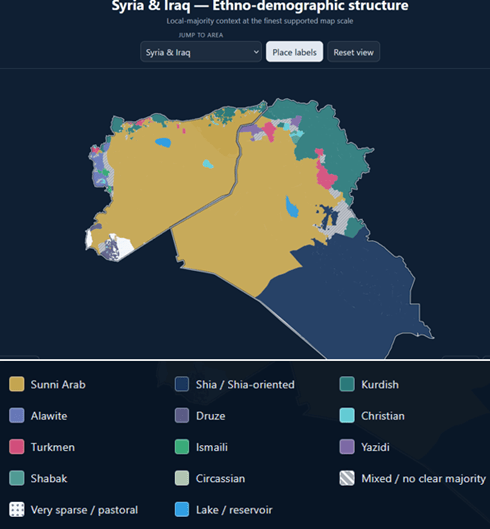
This map below demonstrates the difference between the demographic-geographic realities in Syria and Iraq – the olive green are the Kurdish populations, which in Iraq form a compact geographic region, the basis of the autonomous Kurdish statelet there, whereas in Syria we have scattered, disconnected small enclaves:
It is important to remember that the SDF, and its PYD leadership, never advocated Kurdish independence, and its concept of autonomy was officially democratic-multi-ethnic rather than Kurdish (despite the never-resolved contradiction of it being run by a Kurdish party), called ‘democratic confederalism’. Therefore, some kind of negotiated integration into a post-Assad Syria more or less inevitably flowed from their program.
Ironically, while the SDF’s main Kurdish rival – the parties grouped under the Kurdish National Council (KNC) – were traditionally closer to the anti-Assad opposition than the SDF was, their more purely ‘Kurdish’ conception of autonomy would have made the integrated arrangement more difficult.
It is unfortunate that a brief military clash intervened in January, before this integration process were agreed to on January 30, and both sides bear some responsibility. The key problem was the SDF’s slowness (or unwillingness) to move out of the Arab-majority governates of Raqqa and Deir Ezzor, where the populations did not feel part of ‘democratic confederalism’ but rather second-class Arab subjects of unwanted Kurdish rule. As the Syrian army began to nudge forward, the Arab masses just shrugged off SDF rule. The Syrian forces advance stopped outside the major Kurdish population concentrations in the northeast Hasakeh region and in Kobani, where the SDF and AANES continued to govern till now.
While violations occurred on both sides, if we ignore the extraordinary volume of fake news generated, these were relatively minimal and a very sharp contrast to the horrific massacres of Alawites in March 2025 and Druze in July, neither of which the new Syrian polity has recovered from and it is unlikely to without radical change in the near future.
This SDF rule over non-Kurdish regions – around two-thirds the area of the previous AANES ‘Rojava’ statelet – was a product of recent war history. Raqqa had become the capital of the monstrous ISIS ‘Caliphate’, and the SDF had emerged as the ground partner of the US airforce in its war on ISIS; together the US-SDF alliance smashed ISIS in Syria (try to ignore laughably anti-factual claims that the Assad regime and its allies defeated ISIS). While the anti-Assad rebels, and the Assad-rebel conflict, were concentrated in more populous western Syria (from where the rebels had driven out ISIS root and branch in 2014 with no help from any airforce), in the northeast, by contrast, the US-backed SDF liberators were the only regional alternative to ISIS barbarism or the equally horrific return of Assad’s ‘Sednaya’ regime. Choosing the SDF was therefore a no-brainer for the Arab masses, but this deal changed the moment Assad was gone.
The discourse of ‘US betrayal’ of the SDF implies that the US should have militarily intervened to forcibly maintain Kurdish-led SDF rule over more than two million Arabs. A betrayal would have entailed a US green-light for the Syrian regime to storm the Kurdish regions of northern Hasakeh and Kobani, but there was only a stern red-light from the US, one of the key factors preventing this; the other two were the regional and global mobilisation of the Kurds to defend their region, and the likelihood that the rather pragmatic Sharaa regime had no intention of doing so anyway.
Regarding the situation now, an editorial in the pro-SDF ‘The Amargi’ stated:
“The formal dissolution of the Syrian Democratic Forces (SDF) does not necessarily mark the end of Kurdish self-rule in Syria. It marks the end of one particular form of it: an autonomous, heavily armed, US-backed political and military order that emerged from the Syrian civil war. What comes next is more ambiguous. Kurdish power is being folded back into the Syrian state, but it has not disappeared. The key question is whether the Kurds can turn the military leverage they accumulated during the war into lasting political, constitutional, and local power.”
Moreover, given the SDF’s radical democratic program – regardless of one’s assessment of how this worked in practice – especially their highly progressive program on women’s emancipation, this integration can add an important democratic progressive bloc within the Syrian polity as it moves towards a new constitution and eventually to elections. As Syrian writer and politician Ghassan Mifleh put it, “The challenges before us concern all of us as Syrians. Without a democratic system, Syria will not survive. This requires all efforts to come together to form a historic bloc capable of exerting pressure on all parties to establish a state governed by the rule of law, a democratic system, a political parties law, and constitutional foundations for public and individual freedoms,” assessing that “The SDF and what it represents are extremely important in establishing the state we aspire to.”
As we will see below, however, there remain some unresolved issues, and the major one – that of the right to educational instruction in the Kurdish language (as opposed to mere Kurdish language classes) – threatens to undo the process if handled wrongly.
Finally, this relatively successful integration process – an overwhelming contrast to last year’s horrific government approach to such issues in Druze-majority Suweida – in ending the 70/30 division of Syria, is a strategic blow to Israel’s strategy of partitioning Syria.
Kurdish rights and power in Syria today: Day and night compared to the Baathist nightmare
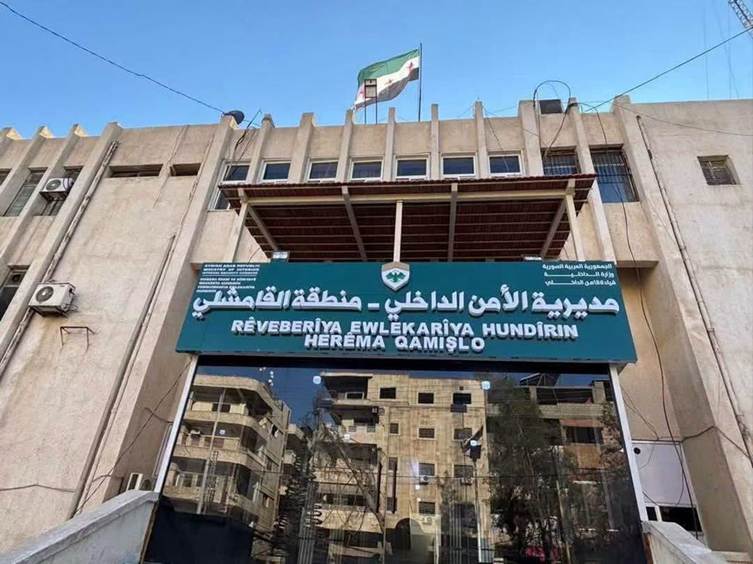
Following the January 29 agreement between the Syrian government and the SDF, and Sharaa’s January 16 presidential decree on Kurdish rights – which declared the Kurds an “essential component” of Syria – the situation of Kurdish rights and empowerment in Syria is historically unprecedented within a united Syria, despite it being a climbdown compared to Kurds running their own statelet. Under the Baathist regime, Kurds were not recognised, thousands were stripped of their citizenship, and language and cultural rights were suppressed. Here are the major aspects of the new reality:
- Four new Kurdish brigades, led by former SDF commanders, have been formed – three forming Division 60 in the Hasakeh governate, the main concentration of Kurds in Syria, and another in Kurdish-majority Kobani, tied to the Aleppo-based military division. Thus the SDF more or less ‘remains in place’ in the Kurdish regions. The possibility of a fifth brigade being formed in Kurdish-majority Afrin in the northwest is also under consideration. SDF commander Sipan Hemo claimed that “everything—from command structure to deployment centers—has been determined by us.”
- The Kurdish Asayish internal security forces have likewise been re-badged as part of Syria’s Public Security forces under the Interior Ministry (MOI) and continue to patrol Kobani and Kurdish regions in Hasakah. There are also talks taking place regarding recruitment of local Kurds (ie former Asayish members) from Afrin, Aleppo (ie Sheikh Maqsud) and al-Shahba (northern Aleppo countryside) into the Public Security in those regions. This is very important for people to feel secure – something sorely lacking in the Alawite heartlands on the coast, for example.
- The SDF’s nomination of long-time SDF and AANES leader, Nour al-Din Ahmad, was accepted by the Syrian government for Governor of Hasakah governate, despite Hasakeh being only 30 percent Kurdish in population. While the head of security in Hasakeh (also apparently of part-Kurdish background) was appointed from former Syrian rebel ranks, the deputy security chief was also appointed from the SDF.
- Likewise, the government accepted the SDF’s nomination of long time SDF and PKK commander, Sipan Hamo, as Assistant to the Minister of Defence for the eastern region, encompassing not only where Kurds predominate but the entire region formerly run by the SDF.
- These appointments are in addition to the high-level appointments of Mazloum Abdi and Ilham Ahmed noted above.
- There are now 13 seats in the interim People’s Assembly held by Kurds – mostly members and supporters of the Kurdish National Council (KNC) rather than the SDF, accounting for 6.2 percent of the assembly seats. While historically unprecedented in Syria, this still falls short of the Kurdish 10 percent of the population.
- The civilian institutions of AANES are also being integrated into Syrian institutions, and though what this means longer term remains unclear (see below), at this stage all employees have kept their jobs in the administration. The government appointed civil executive office in Hasakah has “a roughly 6:4 ratio favouring SDF-linked appointees over Damascus appointees.”
- All school, university, and institute certificates issued by AANES (under its full-Kurdish education system) have been recognised, while the January 30 agreement also noted AANES was “working with the Ministry of Education to discuss the educational pathway of the Kurdish community and to take educational particularities into account.” The January 16 presidential decree declared, for the first time ever, Kurdish to be a “national language” that can be taught in public and private schools where Kurds form a significant part of the population. What this means in practice however remains a critical unresolved issue (see below).
- The January 30 agreement also issued the “licensing of all local and cultural organizations and media institutions” of the AANES.
- The January 16 presidential decree annulled the results of the botched 1962 census which had stripped some 20 percent of Syrian Kurds of their citizenship, remaining in that non-status for the next 60 years; therefore, hundreds of thousands of Kurds were at a stroke granted citizenship.
- The January 16 presidential decree made the Kurdish Newroz festival a national holiday.
- At the Damascus International Book Fair on February 5-16, Kurdish books were available for the first time; see this short video. Many Kurdish writers were present for the first time, for example well-known Syrian Kurdish novelist Jan Dost, who returned to Syria for the event for the first time in 26 years.
- The agreement called for the return of displaced Kurds to Afrin and Sere Kaniye (Ras al-Ain), previously run by re-badged former Turkish-backed Syrian National Army (SNA) brigades who took part in the Turkish invasions of 2018 and 2019 respectively (when hundreds of thousands of Kurds were driven out). The situation in Afrin had already improved significantly since the new government came to power and began pushing these brigades aside and restoring Kurdish property; some 70,000 Kurds returned to Afrin in the first months after the revolution. The first 400 families of Kurds displaced in northeast Syria began their return to Afrin in March, and on July 16 the ninth and final convoy returned, after which Afrin IDP Council announced its termination after the return of 11,000 families (ie tens of thousands of individuals). In contrast to Afrin, Kurdish return to Sere Kaniye (Ras al‑Ain) has been held up, and the first recent attempt by some Kurds to return was met with violence. However, during August, the first 1000 families returned; another 12,000 families are to follow.
- All three Afrin positions for the People’s Council were won by Kurds, and on February 13, the Afrin district government announced the appointment of 19 mayors for the region’s main towns, and “most if not all of these appointees are local Kurds.”
- The Ministry of Local Administration and the Environment issued a decree on February 15 formalizing administrative decentralization in Syria based on the pre-existing Law 107, delegating significant authorities and ministerial powers to Governors and extra powers to mayors. Sharaa had regularly stated that calls for decentralisation or federalism “do[es] not differ in substance from the local administration framework in force in Syria, particularly Law No. 107 issued more than ten years ago, which in practice already incorporates many of the concepts being proposed today, with the possibility of introducing amendments to it.” This seems a positive step in relation to SDF and Kurdish attempts to maintain elements of self-rule within the integrated framework. On February 17 Abdi stated that “the main Kurdish demand in northeastern Syria is “decentralized local governance under any name” and as such the disagreement with the Syrian government is only terminological; the goal is to empower people of the region to manage their own administrative, service, and security affairs, in a way that preserves the region’s ethnic and social particularities.
Taken as a whole, all this represents a picture that is so comprehensively superior to anything during the 60-year Baathist dictatorship or before regarding the Syrian Kurdish issue that it is simply night and day. This at least should be conceded by critics before moving on; getting this far is an accomplishment that would have been impossible without the Syrian revolution, in the broadest sense of the term. While some Kurdish political opponents of the PKK/PYD are having a field day accusing Abdi and the SDF leadership of “betrayal” and the like, a realistic appraisal needs to take into account this tremendous advance while continuing the fight for better. None of this would ever have been possible under a totalitarian dictatorship, let alone one ideologically committed to an Arab supremacist internal regime (notwithstanding the Syrian Baath’s failures or betrayals of Arab nationalism regionally).
Mazloum Abdi reflects from his past: “Imagine that under Assad rule, when I was still a little boy going to middle school, I was imprisoned by the regime for carrying a book in the Kurdish language. Today’s Syria is incomparable with the one that existed before 2011. Our spirit remains unbroken. Forging consensus peacefully, through dialogue, without compromising our dignity, our distinct Kurdish identity — that is our path. The Kurds of Syria are a reality that can no longer be ignored.”
Ongoing unresolved issues
There are a number of major issues that are either partially resolved, still unresolved, or remain serious problems for the success of integration if it is to be based on principles of equality and self-determination. While all the above can be broadly linked to the emancipatory dynamic of the Syrian revolution, the unresolved issues below by contrast highlight the conservative and centralising tendencies of the Sharaa government. Nevertheless, this struggle goes on openly, politically, without those resisting these tendences ending up in a death camp, and this is due to the continuing political openness of the post-Assad political order.
The first issue is that of the YPJ, the Women’s Protection Units, which played a prominent role in the war on ISIS. They aimed to be included alongside their YPG comrades in being integrated into the Syrian Army, perhaps with a brigade of their own; but the Syrian government has remained fixed in a very conservative conception of a male-only military common in the region, though even conservative within the region – it is somewhat embarrassing that in the arch-reactionary but ‘secular’ UAE, some 2-4 percent of those in combat roles in the military are women, and even in Saudi Arabia women are now allowed to enlist, though, as with most states in the region, the numbers are a symbolic 1-2 percent, and overwhelmingly not in combat roles. By not allowing any women in the army, new Syria is on a par only with Iran on this issue.
However, the government instead offered the YPJ integration into the internal security forces alongside their female Asayish comrades, initially envisaging administrative and similar roles. The YPJ held its ground and insisted that if it is to join the security forces, it will do so playing a combat role as a “distinct and organised” counter-terrorism force; and it appears that the government has accepted this outcome. If so, this would be a relatively positive outcome in the circumstances, given the YPJ’s history and experience.
The second and biggest and potentially most divisive issue is that of Kurdish-language education. While the presidential decree making Kurdish a “national language” was a huge step forward compared to the Baathist past, it is not an “official” language, and the difference is playing out in this area. The decree allows Kurdish to be taught in schools in regions with significant Kurdish population, but that doesn’t resolve the issue of Kurdish-language instruction; under the Baath, there was no Kurdish taught in schools, but under the AANES, Kurdish was the language of instruction. SDF leaders for months have prioritised this issue, and had indicated they had the ear of Syrian leaders; in his statement dissolving the SDF, Abdi stated: “The right to education in the Kurdish language is one of the most important rights that our Kurdish people have sought for decades. The President has declared on several occasions his commitment to upholding this right. We have also witnessed his open stance regarding the right to education in one’s mother tongue and the development of the current decision in the future. We will work to implement this decision this year so that we can build upon it in the near future.”
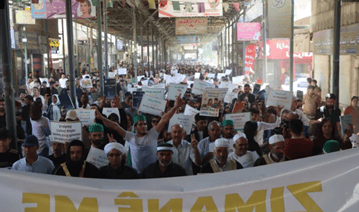
Yet just two days later, the Education Ministry issued its decree of teaching Kurdish in schools, which came as a huge slap in the face. The decree mandates three classes of Kurdish language per week, “at all levels of study,” in regions with significant Kurdish populations (in addition to Arabic and English), plus another class of “activities” related to the Kurdish language; in addition, students can study social studies, history, geography or philosophy in Kurdish, but only for the coming year as a “transitional” measure. This removes Kurdish as a language of instruction for most subjects, and implies its removal from all subjects after a year, except for the Kurdish language classes themselves. This was immediately met by protests by teachers, students, communities and in universities across Hasakeh, spreading to Kobani, and into parliament. It is to be hoped that some positive resolution can come of this – the protest statements all acknowledge the huge step forward that any Kurdish in schools represents compared to the Baathist past, but emphasise that 12 years of Kurdish instruction under AANES makes this a very practical issue, constituting a serious reversal.
Once again, as with the YPJ, this relates to the limitations of the Sharaa government’s bourgeois conceptions of democracy and ethnic equality – the idea that being integrated into the state with equal rights completes the issue; mother-tongue instruction in schools looks too much like “separatism” in this narrow mindset.
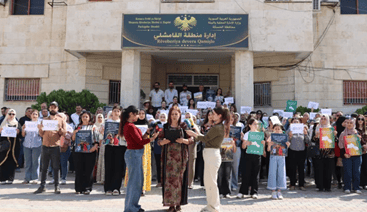
The third unresolved issue is what integration means more generally in practice regarding the former autonomous administration where its practice differed from that of the Syrian state, not specifically on Kurdish issues. This is particularly relevant in areas such as the position of women, laws such as civil marriage and so on. References to “protecting the particular character of Kurdish areas” in earlier agreements suggested that the degree of effective local decision-making on such issues could be questions of interpretation and negotiation. Abdi, for example, claimed that “the institutions that the Autonomous Administration was managing will remain as they are,” while Ahmed suggested the system of male and female ‘co-chairs’ at every level of governance – would remain. This remains to be seen. However, government policies such as the decree formalizing administrative decentralization noted above, the fact that SDF Kurds predominate in the civil state apparatus, and that all employees of the administration have kept their jobs, suggest there are possibilities to maintain much of the former system in practice.
Finally, as SDF and PYD leaders and many Kurds have argued, these rights of Kurds established by presidential decree, and the position of Kurds as an “essential component” of Syria, need to be enshrined in the constitution; otherwise many fear this could in future be taken away. Sharaa has stressed his commitment to guaranteeing Kurdish rights within the constitution. But this is a process – the constitution is something to be developed over the next few years. The important positions of many Kurds – both SDF and KNC – in the new Syrian state and governmental apparatus arguably put them in a favourable position to influence this process positively.
Moreover, former SDF leaders are positioning themselves as advocates for a constitution that not only benefits Kurds, but all components of Syrian society. For example, Mahmoud Barkhadian, commander of the SDF’s Kobani Brigade, while declaring that “we will build the new Syria hand in hand, within the framework of one army, one state, one flag and a shared homeland,” was clear on what type of Syria this must be: “This is not a matter for Kurds alone. A national framework must account for Turkmen, Arabs, Assyrians, Yazidis, Armenians, Druze and Alawites. The Baath era has ended, and its mindset must be eliminated entirely.”
Blueprint for Coast and Suweida?
This is crucial. The relative success, the relatively ‘democratic’ process of the integration of the SDF/AANES/Kurdish component of Syria stands in such contrast to the situations on the Alawite-majority coast and Druze-majority Suweida that it is hard to recognise as being in the same state. For the vast majority of Syrians – both Sunni Arabs and Sunni Kurds, as well as Christians and smaller minorities – the situation in new Syria is so astronomically superior to the Baathist regime that it defies logic to think otherwise; yet to the majority of Alawites and Druze, their own experience is the complete opposite (and in the case of the Druze, this is ironic given that, unlike most Alawites, most Druze were on the side of the revolution).
These two disasters – the coastal and Suweida events of March and July 2025 – were very different in manifold ways, which we can only very briefly elaborate on here. The crisis on the coast was touched off by a counterrevolutionary armed Assadist insurgency on March 6, when some 250 Syrian public security personnel (along with dozens of Sunni civilians) were ambushed and slaughtered, and chunks of the coast in Tartous and Latakia seized. The new Syrian government naturally had to confront this murderous insurgency, and sent in its ramshackle newly cobbled together ‘army’, while thousands of armed civilians also swept onto the coast. Within this context, a number of military brigades and armed civilian groups went ‘off-track’ and engaged in several days of horrific slaughter of the Alawite citizenry, whether driven by irrational collective ‘revenge’, sectarian hatred or pure criminality. The government got most of the undisciplined mob out of the region within two days, and now has 295 people on charges, mostly members of the military or security forces.
By contrast, though it is doubtful that the Syrian government planned a slaughter in Suweida, it bears more direct responsibility for this outcome than it did on the coast. Other than the SDF, the Druze militia – which had played a role independent of both the Assad regime and the anti-Assad rebels during the conflict, in basically defending Druze-majority Suweida – was the only other armed force remaining independent of the new Syrian regime army and security forces. Like the SDF and many Kurds in the northeast, the Druze aimed to integrate into the new Syria, but with a high degree of autonomy, especially for its security forces. Some Druze leaders were more accommodating towards Damascus, while others were more intransigent and expressed interest in Israel’s rhetoric about “protecting” them. However, the government also held a relatively intransigent, centralising, position, and months of negotiations were at a standstill – though far from exhausted. In July, the Sharaa government decided to use a local conflict between the Druze majority and Bedouin minority in Suweida to enter the province, ostensibly to separate the forces, but in fact to use the aggrieved Bedouin as a tool with which to attempt to impose a ‘military solution’ on the political problem. The resulting several days of similarly horrific slaughter, then Israeli bombing of the regime forces and of Damascus, has left Suweida essentially outside the Syrian polity.
Despite the differences, what they have in common is that these two Syrian components, the Alawites and Druze, are completely alienated from new Syria. The most optimistic prognosis would be that the current integration of the Kurdish component could provide a blueprint for better policies regarding the future integration of these components as well – though it would need to be combined with a very serious approach to accountability for those in the military who engaged in war crimes. Without this, new Syria will never be complete. Barkhadian’s statement represents hope for a better Syria via this current integration.
Turkish withdrawal and removal of SNA commanders
The integration of the SDF into the Syrian army and the appointments of leading cadre such as Sipan Hemo has coincided with the gradual withdrawal of regular Turkish forces from the parts of northern Syria they had been in occupation of, and even more importantly, the timely sidelining of a number of powerful former Turkish-backed SNA commanders with blood on their hands.
One of the most difficult aspects of the ‘new Syria’ order for the SDF and Kurds more generally, indeed for anyone supporting the spirit of a revolution for justice and dignity, was the presence of three SNA warlords in powerful positions: Division 62 commander Muhammad al-Jasim (aka Abu ‘Amshah, formerly head of the Sultan Suleiman Shah Brigade); Division 76 commander Brig. Gen. Saif al-Din Polat (aka Saif Abu Bakr, formerly head of the Hamza Brigade); and Division 86 commander Ahmad al-Hayes (aka Abu Hatim Shaqra, formerly of the Ahrar al-Sharqiyah brigade). All three are under US and EU sanctions for atrocities committed against Kurds during or after Turkey’s invasions of Afrin and northeast Syria in 2018-19, and all three brigades were among the most commonly named as responsible for mass killings of Alawite civilians while the government was attempting to put down the Assadist uprising in March 2025.
Their appointments as commanders of brigades in ‘new Syria’ was thus appalling, and even more continuing to hold those positions after the coastal massacre. It was almost certainly a question of expediency at the time – despite Sharaa having immensely more popularity and authority than any of these leaders, his own military base among the former HTS was in no position to confront these entrenched warlords at a time when the new military was just being cobbled together; it would likely have led to further violent fragmentation of Syria. According to some sources, their removal now followed a request by the SDF.
On July 25, Hayes was removed as commander of Division 86 and reassigned to an administrative position in the First Corps, while Division 86 was folded into Division 72, now led by a former HTS loyalist. In 2021, the US Treasure Department, imposing sanctions, “referenced his oversight of a detention facility where hundreds of summary executions were allegedly carried out, alongside accusations of human trafficking involving Yazidi women and children and the recruitment of former ISIS members.” It also noted his faction’s involvement in the roadside murder of female Kurdish politician, Hevrin Khalaf, head of the Kurdish Future party, during the 2019 Turkish invasion of the northeast. That he even remains in any role, other than prison, is of course shameful, but that’s within the larger problem of the snail’s pace of transitional justice in Syria, where close to no-one even from the previous regime has yet faced justice. His demotion is therefore welcome.
Then in early August, Saif Abu Bakr was removed as commander of Division 76, but then resigned, rejecting his placement in an administrative role. Meanwhile, Muhammad al-Jasim was also removed as commander of Division 62, but curiously, given the role of deputy commander of the army’s Central Corps. Yet as Syria researcher Alexander McKeever noted, “while this could potentially be viewed as a promotion … the move separates al-Jasim from what remains of his former factions, diminishing his independent power base in the Hama countryside.” Both brigades have a long history of war crimes and other violations, including abduction, extortion, torture, rape and murder, especially in Afrin, where al-Hamza ran an illegal women’s detention facility.
Much earlier than all this, the process of sidelining the regular SNA brigades in Afrin had begun. Following the first Sharaa-Abdi integration agreement in March 2025, most SNA checkpoints were removed in Afrin, replaced by Syrian public security, and SNA brigades began to withdraw. By April 30, “70 or 80 percent of SNA factions ha[ve] left Afrin,” according to Ahmad Misto, a Kurdish activist from Afrin, cited in Syria Direct.
By mid-2026, Turkish forces had withdrawn from their major base in the Idlib village of Mastuma. Al-Araby Al-Jadeed reported that this was “part of a broader series of steps that included the departure of Turkish forces from most of the bases and military outposts scattered throughout the Jabal al-Zawiya region in southern Idlib province, in addition to other locations in Jabal Shashabo, the vicinity of Saraqib, and the western hills overlooking Maaret al-Numan, towards areas in northern Syria.” Then in July the Turkish army withdrew from a number of Afrin villages, such as Çiyê/al-Jabaliyah and Basilê/Basilhaya, in such cases allowing Kurdish residents to return for the first time since 2018, though they remain in some other areas. Turkish civil administrators have also begun leaving Sere Kaniye, a Turkish coordination office in the city has been closed, and some SNA military factions have started withdrawing from the area.
Incidentally, while these Turkish and SNA withdrawals (and sidelining of war criminals) have been important for the Kurds, this should not be confused with the Turkmen minority in Syria. While the Turkmen have been closely aligned with the dominant Sunni Arab population and part and parcel of the anti-Assad movement, the removal of Assad and the the dissolution of both the SNA and SDF has tended to draw the Kurdish and Turkmen minorities together given similar issues. In June 2026, the Syrian Turkmen Assembly brought together representatives of the Kurdish, Syriac, Assyrian, Circassian, Ismaili and Christian communities in a Damascus conference to discuss minority rights; Kurdish representatives were from both the KNC and the PYD. Notably, both Turkmen and Assyrian spokespeople have noted that they do not have the same of ‘bill of rights’ that Sharaa gave the Kurds.
Of particular note is that while Kurds are (justly) protesting being restricted to three Kurdish language classes per week, the Sharaa government has removed optional Turkmen language classes which previously existed as a second language in schools under the rebel Syrian Interim Government in the north, replacing it with … French, leading to protest by Turkmen organisations. This is part of the government’s attempt to fully integrate former SNA-controlled areas, imposing, however, a top-down approach.
The context of deepening alliance with Turkey, the Turkey-PKK parallel process, and deepening Israeli aggression
Despite these Turkish and SNA withdrawals, it has also been reported that Turkish forces have remained or even beefed up their presence at places such as the Taftanaz and Menagh airbases in the northern Aleppo region. What this indicates is that the process of integrating the SDF into the Syrian state, the recognition of the Kurds as genuine component of Syria and Sharaa’s ‘bill of Kurdish rights’, the Turkish withdrawals from certain areas to facilitate Kurdish return, and especially the sidelining of formerly Turkish-backed SNA commanders with an atrocious record, do not indicate a rift between the Syrian and Turkish governments; on the contrary, while their alliance is not unproblematic, the larger geopolitical and economic realities are if anything drawing them closer together.
After all, the Syrian process runs parallel to the renewed process of reconciliation within Turkey itself, between the Erdogan government and the PKK, highlighted by the PKK’s May 2025 decision to dissolve itself after 43 years of existence, declaring the ongoing fight for Kurdish rights will take place strictly as peaceful political struggle. Moreover, Ocalan himself has not only been central to the process in Turkey – he called for this disarmament in February 2025 – but was also a strong influence on the PYD/SDF leadership, and on Mazloum Abdi in particular, in driving the integration agreement in Syria.
At the same time, the contours of the process appear more limited in Turkey; to date, it seems unlikely that the Kurds and/or the former PKK will be given the kind of stature they now have in Syria. There are decades of war between the Turkish state and the PKK, thus far more to overcome. However, during the first 12 years of Erdogan’s soft-Islamist AKP regime (2003-2015), Kurds were granted recognition and important rights which, while limited, were a huge advance compared with the previous 80 years under the Turkish-nationalist Kemalist military-dominated regimes. Just as with the Sharaa regime in Syria, Islamist ideologies can more easily cater to ethnic difference (especially given that Turks, Arabs and Kurds are all largely Muslim) than exclusivist ethno-supremacist ideologies like Kemalism and Baathism.
That said, it is also easy for such ‘Islamist’ leaderships to slip back into a comfortable ‘religious-nationalist synthesis’ when challenged. The breakdown in Erdogan’s opening to the PKK in 2015 coincided with the AKP’s election loss, forcing it into coalition with the right-wing Turko-nationalist MHP, which till then had condemned the AKP on its Kurdish policy; for the next decade, Erdogan’s anti-Kurdish politics were indistinguishable from that which he had replaced. The new opening over the last two years – initiated, ironically enough, by MHP leader Bahceli with his October 2024 handshake with DEM deputies in parliament – has been mainly interpreted as an attempt to regain lost Kurdish votes for the next election; before 2015, Kurds had formed a major voting bloc for the AKP.
While this is no doubt true, there is also a wider geopolitical angle – Israel’s increasingly aggressive stance towards both Turkey and new Syria. Israel’s relentless hostility to new Syria – it launched a massive attack to destroy nearly all of Syria’s strategic weaponry beginning the morning its preferred leader was overthrown on December, 2024, and has continued to launch attacks and occupy a southern region ever since – has also increased its hostility towards Turkey, new Syria’s main backer. During the same period, Turkey cut of all trade with Israel over the Gaza genocide.
At a security conference in early 2025, Israeli leaders accused Turkey of “neo-Ottomanism,” asserting that a Syria run by Sunni Islamists allied to Erdogan could pose a greater problem for Israel than the Iran axis, warning Israel must prepare for war with Turkey. Israel also declared it wants to break up Syria into cantons, with Druze, Kurdish and Alawite statelets. Finance minister and fascist Smotrich has stated that conflict with Syria will end only when Syria is “partitioned.” Just as Assad was falling, Israeli foreign minister Gideon Saar said that Israel should “explore ways to increase cooperation” with the Kurds, “we need to focus on their interests.” This is not because Israel cares about minorities, but Israel sees region-based minorities as geopolitical opportunity to keep Syria weak and disunited; a convergence of minorities from the region was held in Israel in October.
Israel’s justified its attack on the north Syrian former airbase of Abu Al-Duhur near the Turkish border in late July by claiming that Turkish forces were embedding there and planning to instal Turkish air defence equipment, something denied by both the Turkish and Syrian governments, which claimed the role of Turkish forces was training the Syrian military. However, while Israel has drawn a red line against any Turkish air defence capability in Syria (eg, Israel bombed the T4 airbase in central Syria in March 2025 to prevent Turkish radars and drone equipment being installed), training the Syrian military may be just as bad, as Israel does not want a strong, united Syrian army.
The Israeli news site Walla recently reported a senior Israeli security official describing al-Sharaa “as a dangerous figure and accusing him of retaining a hostile ideological outlook towards Israel despite his diplomatic engagement with the United States,” and claiming Sharaa is trying to “rebuild a regular Syrian army with assistance from several states, particularly Turkiye,” and this “could constrain Israeli military operations.” The August 19 Jerusalem Post similarly cited Jonathan Hessen, a senior fellow at the Jerusalem Institute for Strategy and Security, who claimed that the threat from Syria was not limited to Ankara’s presence alone. Hessen claimed it was strange for such a newly established regime to be “armed to the teeth” and to have built up its military so rapidly. “It is investing heavily in its military buildup, despite the fact that many people within its military are clearly still maintaining their jihadist pasts in both vocal form as well as indicating their unruliness in areas of friction with minorities and other aspects,” he said.
In this context, preventing Israel from using its ‘Kurdish card’ became an important consideration for Ankara, and found a ready partner in Ocalan. While Israel’s Kurdish connection has traditionally been the Barzani Kurdish Democratic Party (KDP) leadership in Iraqi Kurdistan rather than the PKK, in recent times some voices from PKK-world, whether in the Iraqi Qandil headquarters, Iranian Kurdistan or within the SDF in Syria had expressed some openness towards Israel. Ocalan however remained firmly attached to the historical anti-imperialist tradition of the PKK. In his February 2025 call on the PKK to dissolve, Ocalan stated that Turks and Kurds must “remain in this voluntary alliance to maintain their existence and survive against hegemonic powers,” apparently a reference to Israel.
Ocalan claims that “Israel today needs a Kurdish state as a geopolitical pillar for lasting dominance in the Middle East” but he sees the future of the Kurds tied to the peoples around them; in June 2025, rejecting Israeli dominance through the Kurds, he claimed to be the person who could prevent the SDF from falling under Israeli influence; his messages to the SDF were strongly pro-integration. Former SDF leader and now assistant Syrian defence minister Sipan Hemo has similarly warned that “certain regional actors,” explicitly naming Israel, aim to undermine the emerging political environment and stir fresh divisions. He linked success against such threats to the ability to build a shared Syrian future, praising both Damascus and Ankara for approaching integration with “courage and sincerity.” The Turkish government removed Hemo from its terrorist ‘Red List’.
While the Sharaa government’s catastrophic and murderous venture into Suweida fell perfectly into Israel’s hands, allowing it to bomb Syria and gain a solid base of support among Suweida Druze (the main Suweida leadership of Sheikh Hikmet al-Hijri now calls the region ‘Bashan’, reflecting an idiosyncratic Zionist terminology, and recently declared Suweida “an inseparable part of Israel”), Suweida is small, and the Druze only some 2 percent of Syrians. The real partition Israel hoped to maintain and augment was of course the division whereby 30 percent of Syria was controlled by the SDF. The polar opposite approach taken by the government to the Kurds and the northeast, and the resulting relatively democratic integration process, therefore represents a strategic defeat for Israel.
Conclusion
While this is my overall assessment now, my aim here is not to predict the future, nor to cast illusions. It seems to me that in the given context – the dire circumstances for the Syrian people as a whole, given the catastrophic state of the nation inherited from past regime’s apocalypse, the democratic spirit of the revolution, the national importance of removing the American and other foreign military presences – there were 10 US bases in December 24, and now there are none, a significant achievement of the revolution – despite the level of protection they offered to the (massively oversized) Kurdish-led entity, the Kurdish/SDF leadership’s sober assessment that some kind of integration into new Syria was the only realistic course, the process in Turkey and the role of Ocalan, and the incessant threat from Greater Israel – the current integration process involving the Kurds, the SDF/AANES and the northeast of the country has to be judged a relative success, at this stage.
However, any betrayal of any element of this agreement by the government if, for example, the centralising tendencies of the Sharaa government reassert themselves and take advantage of the dissolution of the SDF, would be catastrophic for the Syrian revolution project as a whole. Right now, the major issue remains the conflict over Kurdish language as the medium of instruction in schools – Kurdish teachers, students and parents in the northeast are in no mood to accept its abolition, given the practice over the last 12 years in AANES, regardless of how superior three Kurdish language classes a week is to anything during the Baathist night. The ongoing struggle of the Kurds on this issue is a continuation of the spirit of the Syrian revolution, and it is to be hoped that under this pressure the authorities at least see the pragmatic sense of compromise.

