What caused the breakdown of the US-Iran MOU and the restart of hostilities between the US and Iran? It seems that both the US and Iran decided that the MOU was not perfect enough for their respective needs – especially regarding domestic credibility – and so decided to test it, to push the boundaries, to ‘bargain with fire’.
The US bombings of Iran are so vastly disproportionate in relation to the initial Iranian attacks on oil tankers that it has to be concluded that Trump was just itching for a little more war; the US hit Iran hundreds of times, for thirteen consecutive nights, compared to Iranian hits on only 7 oil tankers or container ships. It is not difficult to understand why Trump might want another chance to look tough, given that the MOU has been widely seen as a defeat and humiliation for the US. Trump aims to get a better deal with some bombing, even though it did not really approach the level of the earlier war. Initially, the US targeted Iranian military targets, but later expanded bombing to clearly civilian targets, including desalination plants. But it is a high risk strategy for Trump, as he is likely to achieve nothing, resulting in even more humiliation. Compared to Iran, the US has the upper hand economically, and it would be more logical to work through the MOU process to push US imperial interests, but logic does not get much of a hearing with Trump.
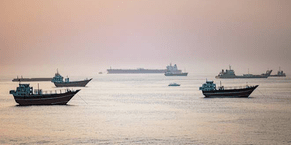
That said, it is the Iranian regime that sparked the conflict by initiating the first attacks on civilian shipping, for the evidently unjustifiable position that they must not be allowed to sail through sovereign Omani territorial waters. And that is somewhat more difficult to understand.
Iran’s retaliation for these extensive US bombings has been to continually hit US bases mainly in Bahrain, Kuwait and Jordan, though the UAE, Qatar and Oman have also been hit occasionally. While these states condemn the attacks on their soil, nonetheless this time round Iran initially restricted its attacks to US military bases on their soil. The simple fact is that these states cannot host US bases and not expect them to be attacked when the US attacks Iran, even if they don’t allow those bases to be directly used in attacks. They are US military assets, assets of the state attacking Iran, and provide logistical and intelligence roles in the US war whatever the case. Later, however, Iran also began once again expanding to civilian targets, including reportedly a desalination plant in Kuwait.
Saudi Arabia has not been touched this time, but the initial Iranian attacks on shipping were on a Saudi and a Qatari vessel sailing in Omani waters. Yet these three countries – Saudi Arabia, Qatar and Oman – have been the most conciliatory towards Iran and are key components of the Pakistan-led ‘mediation camp’ (as opposed to the more hawkish UAE-Bahrain-Kuwait group), and an emerging regional ‘third force’. So why do this?
Especially since Iranian FM Araghchi had just been in Oman attempting to negotiate some kind of joint arrangement for ships in the Strait of Hormuz. Oman had even stated that it was open to some kind of fee arrangement, if not a formal toll (Iran has proposed insurance, environmental, navigation or security fees, after the end of the 60 days of negotiations in the MOU). Likewise, in late June, the Qatari PM visited Oman to initiate negotiations involving Iran, Iraq and Gulf Arab states on the Strait of Hormuz, to implement a provision of the MOU calling for Iran to hold talks with Oman, other Gulf states and Iraq on the future management of the strait. Separately, Saudi Arabia announced plans for regional reconciliation talks in Riyadh between Iran, Gulf Arab states and other regional countries.
Meanwhile, Saudi Arabia just sent a high-level delegation to Khamenei’s funeral in Iran, as did Qatar, Oman and other members of the new regional ‘third force’ (Turkey, Pakistan). In fact Pakistan, which Saudi Arabia has a formal defence treaty with, was one of the only countries to send its head of state, as well as head of its armed forces.
So Iran’s initial maritime attacks seem to make little sense.
Spokespeople for Iran, for example, on Al-Jazeera, have not really put forward a convincing case. They argue that by sailing through Omani waters, rather than Iranian waters, these ships are violating Point 5 of the MOU.
To clarify, the Strait runs between Iran and Oman, so both countries hold territorial waters on either side, plus there is a small strip of international waters in between, which however has been heavily mined by Iran. In the discussions about whether Iran has the right to charge some kind of tolls or fees for passage through the Strait, this can only really apply to ships choosing to pass through Iranian waters; it is up to Oman whether or not it chooses to do the same; and there is no law that says ships must pass through Iranian waters. Hence the push for some kind of joint Gulf-state buy-in, or at very least, an Iran-Oman agreement.
So, here is Point 5 of the MOU:
“Upon the signing of this MoU, the Islamic Republic of Iran will make arrangements using its best efforts for the safe passage of commercial vessels, with no charge for 60 days only, from the Persian Gulf to the Sea of Oman, and vice versa. The traffic of commercial vessels will immediately start, and considering the need for removing the technical and military obstacles, and de-mining by the Islamic Republic of Iran, will be instated within 30 days. The Islamic Republic of Iran will conduct dialogue with the Sultanate of Oman, to define the future administration and maritime services in the Strait of Hormuz, in discussions with other Persian Gulf Littoral States, in line with applicable international law and the sovereign rights of coastal states of the Strait of Hormuz.”
Only a very slanted interpretation of the wording would say ships are in violation if they use Oman’s territorial waters. Yes, it says Iran will make arrangements for safe passage of ships through the Strait, but it doesn’t say that ships must pass through the Iranian side to be so “arranged,” in fact by firing on vessels otherwise sailing safely through the Strait, Iran is violating the MOU’s wording about “safe passage.” It says Iran, Oman and other Gulf states will conduct dialogue about the future, but not that ships must choose a particular route now.
Iran argues that the US navy has deliberately opened up this passage through Omani waters so that ships can avoid the Iranian side, even though Iran is not currently charging any fees. The US aim is to establish a precedent whereby, whatever Iran decides to do in the future, ships can simply avoid the Iranian side. Therefore, Iran’s bargaining power is gone.
This may well be the US aim. But sailing through Omani waters has always been an option. The US did not create this option. That is a built-in reality; the wording of the MOU would have needed to be far more explicit for this to be a violation.
And if they require the US navy to escort them through Omani waters for their safety, surely the only thing threatening their safety is Iranian drones or missiles? So this becomes a circular argument – if Iran does not want the US navy there, it would make it clear that ships can sail through Omani waters without being attacked.
So, if the arguments do not make sense, why is Iran doing this?
I think there are a number of factors.
First is precisely this catch that the MOU’s vague wording does not in fact cover Iran’s need to hold its leverage via the Strait. Given the enormously destructive, totally illegal, and treacherous aggression that Iran was subjected to by the US and Israel – twice in the middle of negotiations – Iran has every right to whatever leverage it can use. Its discovery that it could use the Strait of Hormuz to block the oil trade and disrupt the global economy is a weapon it will understandably not want to give up, at least until there is a final settlement. This is not so much about whether or not fees will ultimately happen (for Iran, fees can help with the massive reconstruction cost, but it may waive this idea if solid reconstruction money, release of frozen funds etc takes place in the final agreement), as about Iranian control. If ships can just choose the Omani side, Iran loses much of its leverage.
That does not mean Oman or the countries owning these ships are doing anything in violation of the MOU or that Iran’s arguments make sense. They do not. But in the context, Iran’s view is understandable. Of course, it would be much better for Iran to get an agreement with Oman and other Gulf states. They view Iran attacking their ships in Omani waters while they are in the midst of these very discussions to be treacherous. However, Iran views the very act of taking Omani waters, turning off signals and gaining US naval protection while these discussions are taking place as treacherous itself, aimed at killing Iran’s leverage.
Secondly, pro-Iran spokespeople argue the question of violating the MOU must be seen in the broader context, because the US and Israel have violated it from the first day. Interestingly, this is almost a confession that it is Iran violating the MOU by attacking ships, but that it is justified as retaliation for US and Israeli violations. For example, Point 1 of the MOU says that upon signing the deal the US and Iran “undertake from now on … to refrain from the *threat* or use of force against each other.” Yet from the very first days of the MOU, Trump was already threatening to drop bombs “right on their heads” if he didn’t get the deal he wants, and even to kill the Iranian negotiators, all long before these Iranian attacks on ships.
Of course, Trump’s deranged threats were then and hardly explain Iran’s reaction some weeks later, but Point 1 of the MOU also declares “the immediate and permanent termination of military operations on all fronts, including in Lebanon” – clearly, Israeli military operations have not been terminated in Lebanon. Soon after the MOU, the US arranged the separate Israel-Lebanon agreement, which allows Israeli forces to stay in Lebanon until such a time that the Lebanese army is able to disarm Hezbollah bit by bit in different pockets, an Oslo-type recipe for forever occupation – but not only that, outside of these proposed zones, Israel is able to just keep up bombing Lebanese targets where Hezbollah operates (or supposedly does). Dozens of Lebanese civilians have been killed since the MOU, and since this separate agreement, while the IDF also continues to meticulously destroy entire towns and villages to prevent return.
These ongoing Israeli actions (as well as the separate agreement itself) are a direct threat to Iran’s credibility. While I doubt Iran will ever get Israel to withdraw from Lebanon, the ongoing killing directly violates the MOU and politically Iran has to react. A million Lebanese Shiites have been uprooted by Israel from the south; the Iran regime’s only solid regional influence (as opposed to transactional relations it has with many states) is among Shiite communities, and political forces, in Lebanon, Iraq and Yemen, so not putting halt to Israel turning south Lebanon into Gaza risks losing a major part of this influence. Likely the attacks are Iran’s indirect way of objecting to the violation of the Lebanon part of the MOU.
Finally, there are the divisions within the Iranian elite and among the Iranian people. While the MOU is widely interpreted as a relative victory to Iran and a defeat for the US, a vocal minority within the Iranian regime and its key institutions sees it as capitulation to the US. Sixty-two members of the powerful Assembly of Experts (nearly three-quarters of them), signed a statement calling the reopening of the Strait a strategic mistake – and the opening of the Omani channel precisely made them look right! Demonstrations have been held by the hard-line Paydari Front denouncing the MOU as betrayal.
While in normal times, these voices could perhaps be brushed aside – it is almost certain that the majority of Iranians prefer peace with some degree of compromise – these events cannot be separated from the context of the mass, week-long, country-wide funeral events for murdered Supreme Leader Ali Khamenei, involving millions of people (while some of the figures claiming tens of millions are obvious nonsense, there clearly were millions throughout the country). Many called for vengeance; a prominent call was ‘Kill Trump’. Many slogans denounced signing any agreement with the killer of Khamenei. In some cases, the figures most associated with the MOU framework – Ghalibaf, Araghchi, Pezeshkian – were publicly attacked. While some of this was likely orchestrated by the reactionary right, it seems likely this atmosphere was another factor prompting the Iranian leadership to angle for a stronger deal, at least on Hormuz.
The problem is that with both the US and Iranian regimes motivated to a large degree by issues of domestic political credibility in these renewed clashes (which is also the case in a different way with the Israeli leadership), reaching a deal they can both call a win, in order to return to the MOU process, is even harder than before. It seems unlikely that either side wants a return to full-scale war (although Trump’s threats to start bombing bridges and power plants suggest it is possible). These are battles within the context of an overall negotiations process, drawing out red lines, trying to gain better bargaining positions. While Trump now relishes the chance to look tough again, to spout ugly, hateful, blood-curdling rhetoric again, lest anyone dare call the MOU a US defeat or humiliation, he will be aware that a full escalation risks not achieving any more than last round, while the economic fall-out could have a severe impact on the upcoming mid-term elections.
Trump, in other words, still needs a deal. But it is Trump, after all, so it is not out of the question that he decides the mid-terms will be lost anyway, and therefore he may as well go for broke and risk all to “crush the enemy.” But apart from crazed neocons like the late Lindsay Graham, it seems unlikely that saner voices of US imperialism see that as a good idea.
But this course is also very risky for Iran. The Iranian regime risks overplaying its hand as a result of the view that it has defeated the US, and the view that control of the Strait is some kind of Iranian nuclear weapon. Both ideas need bucket-loads of nuance. Yes it imposed a political defeat on the US, but it is a devastated country with a wrecked economy. It needs hundreds of billions for reconstruction. The people are exhausted. Despite the size of the funerals, Iranians are deeply divided; there were countless scenes of cheering when Khamenei was killed also, but there is nothing like a foreign power slaughtering thousands of civilians to swing much of the population behind even an unpopular regime resisting such savage foreign aggression. Meanwhile, the regime fosters further divisions by using the cover of war to go on a hanging spree against young people involved in January’s mass protest movement.
Relying on the Strait as a weapon may have a short shelf-life. Saudi Arabia, for example, was able to almost keep up the same level of oil exports by using its pipeline to its Red Sea ports – and even though the volume was slightly reduced, it actually made more money due to high oil prices due to the closure of the Strait! It can also build a further branch of the pipeline to pass south through Yemen or Oman directly into the Indian Ocean. No wonder it kept largely quiet. The UAE also has a pipeline to the Indian Ocean running through Oman, through which it could still export some 80 percent of its oil, and is building another through part of its own territory outside the Gulf. Iran could block Iraqi exports, but during the war it made an exception for “brotherly Iraq.” Is it wise to turn an ally into an enemy? In any case, Iraq could start selling more to Europe via pipelines through Turkey and Syria. That leaves Kuwaiti oil and Qatari gas (Bahrain has little of anything). Kuwait could build a pipeline to join the Saudi pipeline. Qatar and Iran actually share a major gasfield!
And all of that is before we even consider future decline of demand for hydrocarbons, which this war and the blockage of the Strait will likely accelerate. With China now the world’s biggest producer of solar panels, batteries, electric cars, wind turbines and so on, it stands to sweep the region in the future as the US petrodollar declines, yet the same process will make the Strait less strategic.
In this sense, Iran is better off trying to mend bridges with its Arab Gulf neighbours, especially the ‘mediation bloc’, rather than widening them via attacks on oil tankers. The Qatari-led talks between Gulf states, Iran and Iraq on finding a joint plan for management of the Strait, the Iran-Oman talks, and the Saudi plan for reconciliation talks in Riyadh were all positives that probably alarmed the US and Israel, and wrecking such initiatives may have been one motivation for Trump angling for more war. But that is what precisely makes it difficult to understand Iran’s actions which have given Trump the pretext.
Iran’s position that it alone controls the Strait is not supported by any of the Gulf states, and crucially, nor is it supported by China, the only other force powerful enough to put some brake on the US (of less relevance is the fact that Iran’s position is also not supported by Russia). Every statement from China has demanded free passage through the Strait, starting with the China-Pakistan joint statement early in the war. China has good relations with Iran, but it also has good relations with all states in the region, and in fact only 20 percent of its oil imports from the Gulf come from Iran, the largest portion comes from Saudi Arabia. If the Iranian regime remains intransigent on this issue, it risks losing the ‘mediation bloc’ if they decide their own security requires them to go all in with the US.
Of course, to re-state: Iran’s position is understandable in the context that the Strait is one of its only strong pieces of leverage against a ruthless superpower like the US that has demonstrated that it can launch a murderous attack in the midst of negotiations. But attacking commercial shipping for the ‘crime’ of using another country’s territorial waters it is a blunt instrument to say the least; ugly regimes like that of the hangmen of Tehran often rely on such blunt instruments because their inability to win the region’s peoples politically is simply an inherent reality, but even this instrument may have a short shelf-life.
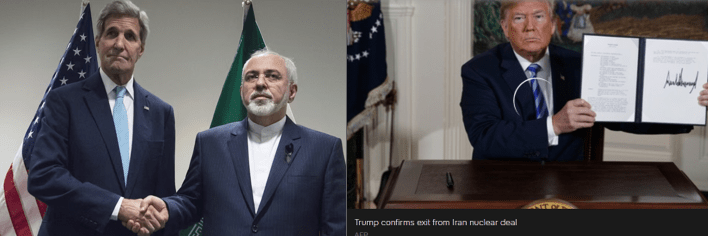
Obama’s then secretary of state John Kerry meets with Iranian foreign minister Mohammad Javad Zarif at the United Nations in New York for the JCPOA nuclear deal with Iran, 2015; Trump confirms exit from JCPOA in 2018. His continual crazed threats to start bombing again “right on their heads” or to kill the Iranian negotiators show how embarrassed he is to be preparing to sign much the same years later.
One of the more remarkable clauses of the US-Iranian Memorandum of Understanding (MOU) for 60 days of negotiations to end the war is where the US “undertakes with regional partners to develop a definitive, fully agreed plan with at least $300 billion for the reconstruction and economic development of the Islamic Republic of Iran.” Many analyses immediately jumped at this to claim the US had agreed to Iran’s earlier (and just) demand for war reparations of hundreds of billions of dollars to be footed by US taxpayers, a seemingly incredible Iranian victory.
While on the whole this is a US defeat and humiliation in terms of everything Trump had aimed for, and compared to everything he had rejected, or ripped up (eg, Obama’s JCPOA) in the past, the scale of Iran’s relative victory should not be exaggerated, as it is a country that has just suffered an unfathomable amount of destruction. And reading this clause to mean US reparations is an example of such exaggeration that goes to the heart of the problem.
Rather, as a Reuters report explained it, “The new fund is a private investment vehicle, not a reconstruction or reparations programme and will not include any government money or grants … companies based in the U.S., the Gulf Arab states, Asia, South America and Africa have agreed to commit financing. Investments pledged span energy, logistics, manufacturing and transport.” Some half this money has already been committed, and “companies from South Korea, Japan, Singapore, Malaysia and the U.S.” were “among those that had made commitments.”
The report noted that the fund “is designed to give both sides an economic incentive to conclude a final deal to end the war,” that is, Iran will be in desperate need of funds from anywhere it can get them to reconstruct what has been destroyed, while global capital has the incentive of making profit from a devastated country.
Far from the US government contributing a cent, its role, according to the MOU, will be to grant “all required licenses, waivers, and permissions needed for the relevant financial transactions,” because, after all, the only reason there isn’t already such global capitalist investment in Iran is that US sanctions prevents it, not because Iranian government policy ever prevented it.
Of course, it is not only global capital that will benefit. The key incentives for Iran are that US sanctions are lifted and that the billions of dollars of Iranian assets frozen abroad are unfrozen. This is the right of the Iranian people and nation as a whole, not only of Iranian capital, and is entirely just. But that does not mean everyone will benefit equally, because in capitalist countries, that doesn’t happen.
In an article describing the reaction of some ideologically hard-line elements of the Iranian regime and supporters who condemn this MOU as Iranian capitulation to the US and Israel, Murtaza Hussain and Reza Sayah describe the social base of the wing of the regime most supportive of the deal (which, by the way, is not led mostly be the so-called ‘reformists’ but by ‘pragmatic conservatives’ and IRGC security types):
“The Iranian economy is dominated by a network of semi-governmental institutions with ties to the security establishment. These firms largely control the flow of imports, exports, and energy resources, and are also tasked with navigating the complex web of sanctions the country faces when trading abroad and repatriating funds from the sale of oil and gas. … these powerful business conglomerates are seen as the forces pressing the government hardest to move forward. Known in Persian as “khusulati”—a blend of the words for “private” and “government”—these firms stand to regain access to billions of dollars of frozen funds, as well as new business opportunities in Iran’s oligarchical economy.”
“It is likely they were behind the scenes pushing for an agreement because their trade and business interests had been jeopardized, especially in the UAE. We know that in the first weeks of the war, the UAE had confiscated their money and shut off access to their bank accounts. They are the ones who wanted this deal so their business returns to normal, and authorities listen to them because they have power in the economy.”
In other words, while this clause is normally interpreted to be, like most clauses, evidence that the MOU greatly favours Iranian positions, the fundamental misunderstanding here misses the whole point: the idea here is for a ‘win-win’ as global capital partners with Iranian capital to bring the 90 million-strong Iranian market back where it belongs as part of the capitalist world-system, from which it has been excluded entirely due to the ideological needs of Israel and powerful sectors of US imperialism, rather than due to any aversion to this system by the Iranian regime and ‘millionaire mullah’ social base.
Who was ready to invest in Iran during Obama’s JCPOA 2015-2018?
To underline this point, it is worth looking at the opening provided by Obama’s nuclear deal with Iran, the Joint Comprehensive Plan of Action (JCPOA), signed in 2015, which lifted secondary sanctions on Iran in exchange for Iran agreeing to limit uranium enrichment to 3.67% for civil nuclear power, to IAEA inspections and to sending its stockpile of highly enriched uranium to Russia.
There was a long list of large US and other western companies who had drawn up plans for major investment and trade projects in the Iranian economy as soon as US sanctions were lifted. This includes Boeing, Airbus, Total, Renault, Siemens, General Electric, Daimler (Mercedes-Benz), PSA Peugeot Citroën, Hellenic Petroleum, Herrenknecht, India’sNational Aluminium Company, Turkcell, Zurich Insurance and more. A virtual list of the finest representatives of global capitalism.
These are hardly small-scale ventures. This was potential bonanza time. Then Trump came along and scrapped the deal in 2018, imposing new draconian “maximum pressure” sanctions, even though Iran had been abiding by the restrictions on uranium enrichment, and all these US and western mega-companies had to forgo these profit-making opportunities.
Why would Trump do that? If we try to answer this by talking about the needs of American capitalism, or Iran’s alleged “resistance” to it, it will not make sense. US and global capital were clearly interested in investing in Iran, and Iran was clearly interested in having them invest. The needs of American capitalism were met by the JCPOA, to state the obvious.
Global capital ready to rush into Iranian market 2025-2018, clockwise from top left: Boeing, Siemens, General Electric; Iran Khodro Industrial Group and German Daimler company sign MOU, January 2016; French Renault signs deal with Iranian companies Industrial Development and Renovation Organization of Iran (IDRO) and Negrin Group, August 2017; French Total signs offshore gas field agreement with Iranian Petropars Groups and China National Petroleum Corporation, July 2017.
The Obama Doctrine: A clear-sighted representative of US imperialism
In fact, Obama was very clear-sighted about what he considered the longer-term interests of global capitalism in the region. In major interviews conducted with Thomas Friedman and Jeffrey Goldberg in 2015-16, what became known as ‘the Obama Doctrine’ was laid out. According to Obama, even though Iran “has been an enemy of the United States, and has engaged in state-sponsored terrorism, is a genuine threat to Israel and many of our allies, and engages in all kinds of destructive behavior,” it is a country with the potential to change. Obama was looking at a nation (and market) of 90 million people, with a relatively youthful population mostly born long after the revolution, an educated population, which had undergone rapid modernisation despite the mullahs’ reactionary social restrictions, a population eager for global integration and a government with zero aversion to capitalism.
Waxing lyrical about “the incredible talents and ingenuity and entrepreneurship of the Iranian people,” Obama stated that “the election of [President Hassan] Rouhani indicated that there was an appetite among the Iranian people for a rejoining with the international community, an emphasis on the economics and the desire to link up with a global economy. And so what we’ve seen over the last several years, I think, is the opportunity for those forces within Iran that want to break out of the rigid framework that they have been in for a long time to move in a different direction.”
“If, as a consequence of a deal on their nuclear program those voices and trends inside of Iran are strengthened, and their economy becomes more integrated into the international community, and there’s more travel and greater openness, even if that takes a decade or 15 years or 20 years, then that’s very much an outcome we should desire.”
In contrast, while “our Sunni Arab allies, like Saudi Arabia,” have some very real external threats, it is their “internal threats” they should be most concerned about: “populations that, in some cases, are alienated, youth that are underemployed, an ideology that is destructive and nihilistic, and in some cases, just a belief that there are no legitimate political outlets for grievances … I think the biggest threats that they face may not be coming from Iran invading. It’s going to be from dissatisfaction inside their own countries.”
The great rivalry between Iran and its Sunni Arab neighbours such as Saudi Arabia at that time had reached a destructive point and fed “proxy wars and chaos in Syria and Iraq and Yemen,” so now we “say to our friends as well as to the Iranians that they need to find an effective way to share the neighborhood and institute some sort of cold peace.”
This contrast he saw between a modernising Iran’s potential to shake off the absolute hold of its reactionary mullocracy if the US enabled its integration into global capitalism, and the failure of Saudi and Gulf societies to shake off their similarly reactionary political structures despite global integration, along with his virtual equalisation of Saudi/Gulf and Iranian fanning of regional sectarian conflicts, was greeted with great anger in the Gulf.
Yet a decade later, we have seen two things. First, while the reactionary political structures have survived in the Gulf, there has been significant capitalist modernisation and transformation in these countries (which many western observers, especially on the ‘anti-imperialist’ left, have not caught up with), especially in Saudi Arabia, which, under repressive moderniser Mohammed bin Salman (MBS), has essentially turned into a ‘normal’ country. Secondly, while the Saudis initially welcomed Trump’s anti-Iran stand and his scrapping of the JCPOA, starting in 2020 all the Gulf, led by the Saudis, entered precisely into a process of détente with Iran, which puts their views today in sharp contrast with the extreme pro-Israel policy of the second Trump administration. The Yemen ceasefire of 2022 and the Saudi-Iranian normalisation in Beijing in 2023 have indeed transformed regional geopolitics in the way Obama recommended.
So why did Trump destroy this opening?
Ideology, narcissism, and Israel, largely. But that is a flippant answer. Ideology represents real interests.
Israel was vociferously opposed to the JCPOA and did everything it could to destroy it. Why? Surely if the problem was a threat of an Iranian nuclear bomb, Israel should have been the most supportive of a deal that effectively restricted Iranian nuclear activity. But from the time the US crushed Iraq in 1991, Israel had declared Iran its new number one “threat” (before that Israel had actually armed Iran with hundreds of millions of dollars in weaponry to fight against Iraq throughout the 1980s). And this cultivation of a big, scary Iranian “threat,” a kind of “Fourth Reich” that allegedly wanted to “wipe Israel off the map” has been central to Israel’s ideological rationale for maintaining and advancing the occupation of the West Bank and Gaza, its crushing responses to Palestinian resistance, and its further encroachments in the region; the alleged “terrorist threat” posed by the brutally crushed Palestinians on their own had worn very thin and need a crazed powerful state seeking nuclear weapons behind them the justify the endless oppression.
Legitimising the Iranian regime by making it a normal partner within global capitalism was anathema to the entire ideological edifice Israel had built over decades. Not that Iran had ever attacked Israel; but its loud rhetoric, from a safe distance, which played a similar role for that regime’s ideological mobilizational purposes, lent itself well to Israel’s ideological needs.
We hear a lot about the Israel lobby influencing US policy. And it is a real thing. But it would be a mistake to view this as simply a matter of a lobby bribing US politicians, even if that goes on. Yes, Trump’s scrapping of the JCPOA was an act in support of the Israeli position, and reflected his broader extreme pro-Israel stances (eg recognising Israel’s annexation of Jerusalem and the Golan), and he has received some big Zionist money. And the narcissistic Trump was also obsessed with undoing Obama’s work, and demonstrating that through harsh pressure on Iran he could get a “better” deal.
But in a broader sense, the “lobby” can be seen as a wing of US capitalism more directly connected to Israeli interests. One of the key areas where US and Israeli capitalist interests are not just connected but tied at the hip is in the military/security/high tech field. Due to Israel’s militarized existence, the military/high tech industries have come to play a dominant role there only seen elsewhere in the US itself, and so its large-scale, symbiotic relationship with the US military-industrial complex, in research and development as well as weapons’ sales, is hardly surprising. Israel is one of the largest suppliers of high-tech military hardware to the United States, and is the seventh largest arms exporter in the world.
Israeli and US companies are involved in many defence, security and high-tech joint ventures, joint-development programs, subsidiary arrangements and so on. R2S for example is a joint venture between the US Raytheon and the Israeli Rafael Advanced Defense Systems to build the Iron Dome system’s interceptor and the SkyHunter Interceptor (US variant) in the United States. “The venture will build the Iron Dome interceptor and launchers capable of intercepting cruise missiles, unmanned aircraft, rockets, artillery, mortars and other threats. With thousands of operational intercepts at a high success rate, it is the world’s most-used battle proven system in its class.”
The infamous Israeli defence/electronics company Elbit Systems is a different kind of example – chosen by the US Department of Homeland Security (DHS) as a member of the winning consortium for the Secure Border Initiative (SBI) on the US-Mexican border in 2005, “to supply technology to identify threats, to deter and prevent crossings, and to apprehend intruders,” its US subsidiary more recently secured multi-billion dollar follow-on contracts to deploy and maintain Integrated Fixed Towers (IFT) and Mobile Surveillance Systems for US Customs and Border Protection. Elbit of course has years of experience in “border protection.”
And there is nothing so good as a war for such industries, or at least the permanent threat or atmosphere of war – something not well-served by Obama’s attempt to remove the Iranian bogeyman which had served this purpose so well since 1979. In this sense, the US military/security sector has similar interests to Israel, even if it were not as directly connected to Israeli big capital as it is.
Moreover, all this also serves an ideological purpose for the US broadly similar to what it serves for Israel – US global dominance over emerging European or Chinese rivals is facilitated by US military dominance, especially of vital regions for global capitalism like the Middle East with its massive oil and gas supplies. In a sense, while specific US and Israeli interests often differ, their convergence on this heavily militaristic stance towards dominating the region reflect their differing kinds of ‘outsider’ status: Israel, as a colonial-settler state, is a population imposed over the Palestinian people from outside the region, placing it in perpetual conflict with the region’s Arab populations, while on a grander scale, the US is a western hemisphere power attempting to maintain its hegemony over ‘Eurasia’ in competition with its rivals who exist within Eurasia.
And the grave dangers to the US allegedly posed by a “terrorist” regime in Iran since the iconic seizure of the US embassy in Tehran in 1979 has served the purpose of rationalising this massive military presence superbly. Trump represented those who thought this was not the time to trade in such a useful ideological asset.
So, did Obama or Trump better represent the needs of US capital? The needs of US imperialism, it seems, do not always agree with the needs of US imperialism!
Trump becomes Obama – but with a destroyed Iran
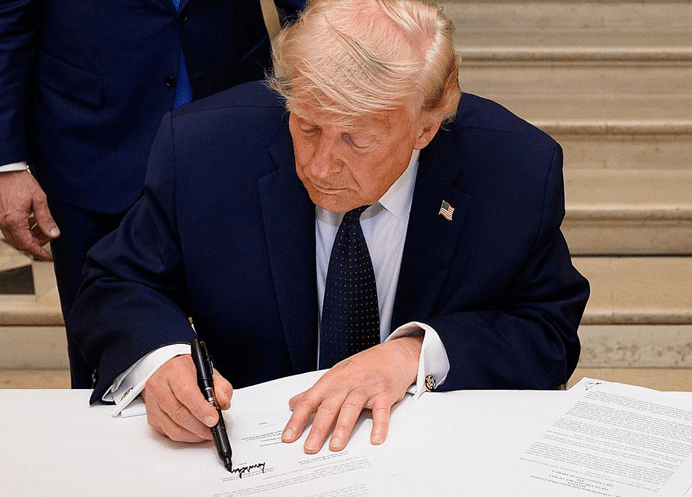
Trump signs MOU to advance his new version of the JCPOA, June 17, 2026
This brings us back to the fallout from Trump’s catastrophic decision to launch an unprovoked, pointless war against Iran along with Israel. Given that Iran was already widely perceived to have been greatly weakened by the smashing of Hezbollah in 2024, the US-Israeli attack on its nuclear industry in June 2025 and Israel’s previous attack in late 2025 which wiped out its air defence, the loss of the Assad regime and so on, the idea that either was confronting an Iranian “threat” in February 2026 is just nakedly untrue, especially as the war was launched in the midst of negotiations in which Iran had already agreed to significant restrictions on its nuclear program.
Israel thus had no special need to further destroy Iran at that point, unless it aimed at expanding its borders into southern Lebanon up to the Litani, which would require the expulsion of a million Lebanese Shiites and a new war with Hezbollah, which Iran may feel compelled to respond to, given this is one of the few parts of the region where the Iranian regime had a solid base of influence. But if that was one of the aims, as I believe to be the case, then launching a war to create regional turmoil and chaos would in itself be the perfect atmosphere in which to expand into Lebanon, while consolidating the results of genocide in Gaza, and further annexing the West Bank and southern Syria. The Greater Israel agenda.
But with Trump’s strong outreach to regional Arab and Muslim leaders who oppose this Israeli extremism, and the broader interests of US imperialism to create a stable investment climate in the region guaranteed by US “security” cover, it seems difficult to see this war as launched in US interests. Netanyahu had mobilised Trump’s narcissism when demonstrating to him that he could kill off a significant chunk of the Iranian leadership in one strike; and this went together with extraordinary delusions that such an act could repeat the rapid Venezuelan outcome he had so spectacularly performed.
Assertions that the US went to war to consolidate US hegemony over the region frankly make no sense. There was no specific or approaching threat to such hegemony, and the war has actually eroded it.
The war having blown up in Trump’s face, he is now forced to make a peace deal because he can see that further escalation will achieve nothing, and will more likely increase his humiliation. But the problem is political – how to justify months of killing and destruction, at an astronomical cost, with its major impact on the world economy, and its facilitation of Iran’s seizure of the Strait of Hormuz, if all he can get at the end of it is a deal no “better” for the US than Obama’s JCPOA which he ripped up eight years ago
In fact, this will be very difficult. With the US defeat, Trump is now Obama. All the reasons for ripping up the JCPOA – ideology, militarism, narcissism, Israel – have now no meaning in this context.
Despite much talk about some grand decisive US-Israel split, this is extremely unlikely, and in fact goes against news in the background about steps towards the further integration of the US and Israeli military machines. However, Israel cannot be allowed to mess with US needs in the Gulf. Trump’s assertions that Israel will do what he tells it to are a stark reminder of who is ultimately boss. The difficult point however is Lebanon. While the US wants Israel to rein itself in a little, not to bomb Beirut when he is trying to negotiate a deal, there has been no US demand for Israel to exit Lebanon, merely to cease fire. At the MOU stage, that is enough for Iran as well. If Iran puts it foot down and demands Israeli withdrawal as part of the final deal – and that itself is a big “if” – we will then see whether, firstly, the US attempts to force this on Israel, or lets the Iran deal collapse, and, secondly, whether Israel submits to or resists such US pressure.
We read much about how all Israeli leaders – government and opposition – view this MOU as a grave defeat for Israel’s interests. If it forced an Israeli withdrawal, it would be. If it didn’t, then Greater Israel would now be in control of territory it was not before. Frankly, my prediction is the second is the more likely outcome. And that is not a defeat.
But Israeli opposition to the deal needs to be seen in the broader context. We now have the US vice-president sitting in the same room as top Iranian leaders, gearing up to sign a deal, if it is made, in the UN Security Council. JD Vance, representing the most pro-deal wing of the MAGA coalition, even stated that if Iran is “willing to give up nuclear weapons ambitions for the long term, then the United States is willing to fundamentally transform our relationship with that country.” Just as with Obama’s JCPOA, the legitimisation of the Iranian regime at such a high level by Israel’s main ally, as a step towards the reintegration of Iranian capitalism into the capitalist world-system, would represent a huge set-back to Israel’s decades-long key ideological prop.
This is combined with the emergence of a new coherent ‘Sunni bloc’ which, while having its own issues with Iran, was against this war, opposes the Abraham Accords and sees Israel as just as big, or bigger, a threat to regional stability than Iran, played the key role in mediating the peace, and did so in tandem with a behind-the-scenes role of China, the US’s chief imperial rival. This bloc consists of nuclear-armed Pakistan, Saudi Arabia and Qatar in the Gulf, and Turkey, which countless Israeli leaders have been posing as the “new Iran” for future Israeli mobilizational purposes.
This bloc are traditional US allies, but all with expanding relations with both Russia and China. Their ability to balance in this climate of growing imperial rivalry poses a dilemma for US geo-strategy. On the one hand, the current Trump strategy (the Obama strategy) of bringing Iran in from the cold coalesces with the views of this regional bloc and allows the US to ‘lead’ this peace strategy – which the ‘Sunni bloc’ designed – as their partner, all the better to compete with China in the region. But the victory of this strategy was also a victory for China and its behind-the-scenes role; Pakistan, after all, is just as much an ally of China as it is of the US, if not more so. In a sense, the US must be seen to lead this process in order to prevent a more in-your-face Chinese diplomatic victory. On the other hand, any move towards a region less dominated by overt Israeli and US militarism and manufactured “security” concerns will tend to level the playing field with US imperial rivals in China and Europe (and to a smaller extent even with the similarly militaristic and revisionist Putin regime in Russia), in the longer term. China in particular poses a major threat in new ways now – not only because the Gulf has seen that US ‘security cover’ makes them targets without really offering security and so they are now ‘diversifying’, but also because the closure of the Strait has highlighted the insecurity of relying on fossil-fuel supplies, while China is now the world’s number one manufacturer and exporter of solar cells, batteries, electric cars etc.
Trump’s continual threats to Iran to “drop bombs right on their heads” or even kill the negotiators, while representing the delusions and humiliations of a deranged sociopath, also represent being perpetually torn between the Obama and neocon positions on this question, and the actual contradictions of the needs of US imperialism.
So does a US-controlled 300 billion investment fund help – if it comes?
If the US really does “undertake(s) with regional partners to develop a definitive, fully agreed plan with at least $300 billion for the reconstruction and economic development” of Iran – that is, if the US actually leads the way with this – while it surely represents Trump becoming Obama big time, it also implies a degree of US control over this “private investment fund” involving “companies based in the U.S., the Gulf Arab states, Asia, South America and Africa.” If the plan is for Iran to open to global capital, the US wants to be in control.
While the apparent terms of any nuclear agreement with Iran seem unlikely to be anything “better” than the JCPOA, and thus represent a political defeat for the US and a political victory for Iran, we should also be aware of the changed circumstances. In 2015, Iran was at the zenith of its power in the region. For those who think this was all about “resistance” (despite all “conflict” with Israel being in the realm of hot air for decades, unlike the very real genocidal war Iran helped Assad wage against the Syrian people), Iranian MP Ali Reza Zakani’s claim in 2015 that Iran now controls four Arab capitals, Baghdad, Beirut, Damascus and Sanaa, reveals the real nature of the times; while Ali Younisi, adviser to Iranian president Hassan Rouhani who signed the JCPOA, stated that Iran now formed an empire, and that Baghdad was its “capital.”
It is a starkly different reality today, despite the understandable fanfare about Iran’s humiliation of the murderous skunk Trump. Iran’s economy is in crisis, with hyperinflation (400% on some items), suffering from an estimated $270 billion worth of war damage, “nearly equal to its GDP,” while the IMF is predicting a 6.1% contraction of its economy this year, and the UN says 4.1 million more Iranians could drop below the international poverty line.
Moreover, according to Iran analyst at the International Crisis Group Naysan Rafati, simply comparing the terms of the JCPOA to whatever comes out of this round misses the point that “now we are in a different place.” Last June, the US dropped its bunker buster bombs on the regime’s nuclear facilities. “Right now, Iran is not enriching. As far as we know, based on publicly available information, statements from the US government and the International Atomic Energy Agency [IAEA], Iran is at zero enrichment involuntarily and has been since last June.” This bombing also buried much of Iran’s enriched uranium that is so much in dispute now; it would be a huge job to get to it, and even if it did, it cannot be used without significant repair to its nuclear facilities.
The actual terms of the final agreement will therefore be imposed on a situation in which Iran’s economy and nuclear potential are smashed, a point Vance made in defending the outcome. Asked about comparisons with the JCPOA, Vance said that “in 2015 Iran had built a sophisticated nuclear weapons program with a nuclear weapon stockpile, so the perspective that we came at as the United States was, you already have a really nice nuclear program; we’re going to bribe you with American money in order to stop it. Our perspective, and where we’re coming at it, is we already destroyed your nuclear program,” and so good things will come your way “if you promise and show verifiable pathways to not rebuild it.” Two weeks later he doubled down, “If we don’t make the final deal, their nuclear program is still destroyed. They’re still much weaker as a country, so … America wins either way.”
Therefore, Iran’s desperate economic situation means that if that $300 billion of private investment, or any part of it, does arrive, it will not be Iranian society that has the upper hand in this arrangement. The US, in a sense, could still “win” via the back door.
How all this will work out is another matter. A proposal for a $300 billion private investment fund does not make that investment magically appear, that will depend on how profit-worthy private capital judges the situation, and situations of massive instability do not inspire investor confidence. Moreover, even if the US aims to control whatever investment does go in, there is no guarantee that it will succeed. There may well be companies from Japan, South Korea and Singapore, but it will be difficult to create barriers to Chinese companies entering the market. No matter how many US companies invest and partner with Iranian ‘khusulati’ companies, it will take a lot for the Iranian bourgeoisie to start loving America after recent horrors. It is widely expected that much investment capital will come from the Gulf. One potential example is a multi-billion dollar mining joint venture between US investment firm Burkhan World and Saudi Arabia’s Grand Mines, which is “shifting its focus to Iran’s reconstruction,” accessing mineral supplies from Kazakhstan and Pakistan for that purpose, according to Burkhan CEO Shahal Khan. The deal “completely changed into something much larger because of the war,” he said, noting that the Saudi government “wants to give Iran the ability to fully function outside of sanctions and be able to rebuild its economy.” But it is also possible that Iran may end up seeing little of all this.
Who is the new Iranian leadership?
As an addendum, it is worth looking at who the new ruling clique is in Iran who seem set to carry through this significant change in US-Iranian relations, if this all happens.
From the start of the war, Trump began appealing to the IRGC. First he promised immunity to members of “the Islamic Revolutionary Guard, the armed forces and all of the police” if they “lay down” their arms, promising “you will be treated fairly with total immunity,” then he said “hopefully, the IRGC and Police will peacefully merge with the Iranian Patriots, and work together as a unit to bring back the Country to the Greatness it deserves.” Regardless of what some of this means in Trump’s head, this was his way of saying the US wants to keep the bourgeois state together, and the only cohesive armed force capable of doing that is the IRGC. But more than this, apparently the idea was that once the top clerical leadership were removed, the IRGC – despite their record of repression – might be more ‘pragmatic’ in the interests of its business empire. A more extended and bloodier version of Venezuela was envisaged.
While many viewed these ideas as just “Trump ravings,” according to a New York Times report, a February 18 war-planning meeting of top US leaders and strategists looked at the likely outcome of the decapitation of Iran’s leadership. They thought a popular uprising was unlikely, and Khameini could be replaced by a more hard-line cleric. But some officials “seized on a third scenario: that a faction of the Islamic Revolutionary Guard Corps more pragmatic than the hard-line clerics might take power. Even though a cleric was likely to still be nominally in charge, that group of I.R.G.C. leaders would actually lead the country. … the C.I.A. analysis suggested that as long as the United States did not interfere with the economic activities of this faction, such as its influence in the oil industry, a group of officers might be conciliatory toward the United States. They might even give up Iran’s nuclear program or prevent Iran’s proxy forces from attacking the United States.”
Many political scientists are analysing the new order as a substantially new Islamic Republic; according to Professor Afshin Matin-Asgari, author of the book ‘Iran and the Axis of Empire’, “what has emerged from this war so far is a different Islamic Republic that functions quite effectively under tremendous pressure and even after the elimination of its top military and political leadership. The Revolutionary Guards manage the war and seem to be running the country efficiently, though with an iron fist, with the help of surviving leaders of the old political establishment. But the regime emerging from the war is not the Islamic Republic we used to know. Already, the role of clerics and Islam is less pronounced, while a nationalistic military-technocratic elite, perhaps more competent but no less repressive than the Khamenei regime, seems to be in control.”
More substantially, in Foreign Affairs, Iran experts Narges Bajoghli and Vali Nasr argue that “a new generation of IRGC commanders and civilian security officials who came of age after the 1979 revolution” now hold key decision-making positions, “and their nationalistic outlook on statecraft and security is redefining the Islamic Republic.” This “officer class of the armed forces and the IRGC, along with their affiliated security institutions,” confronted by the US-Israeli war, have “adopted a structured, technocratic culture and a strategic outlook built around national defense, not revolutionary ideology.” This new generation “neither espouses revolutionary grandiosity nor advocates revolutionary activism,” but rather are “establishment actors: pragmatic, hardened nationalists operating with a clear-eyed assessment of Iran’s capabilities and vulnerabilities.” At one point they liken this new regime to “the military-led nationalist states of the twentieth century—Turkey under the later Kemalists, Egypt under Gamal Abdel Nasser—in which ideology persisted but was subordinated to national interest and the imperatives of state power,” and elsewhere they claim the new Islamic Republic “looks less like a theocracy and more like a right-wing nationalist authoritarian state,” stressing that this new “nationalist-technocratic bargain,” whose “terms are national, not Islamic,” should not be confused with liberalisation.
Interestingly, they document this transition taking place over the eight months from the end of last June’s 12-day war until the onset of aggression this year, rather than as a result of the decapitation of the old leadership. The point here is that if 86-year old Khamenei had been allowed to die naturally, an orderly transition may have resulted in the “technocratic-nationalist” regime adopting the kind of pragmatic relations with the US that Trump fantasised about or that Obama realised, without that meaning subservience or national humiliation. A “nationalistic military-technocratic elite” may not much like the US, but they may well know the importance of making money and thus understand the importance of partnering with US capital to do so. “As long as the United States did not interfere with the economic activities of this faction, such as its influence in the oil industry.” Indeed, especially as the IRGC dominates the ‘khusulati’ state/private companies spoken of above, which “stand to regain access to billions of dollars of frozen funds, as well as new business opportunities in Iran’s oligarchical economy.”
Trump’s idea that a body tasked with national defence and security may feel “conciliatory” or “more reasonable” towards the US or Israel after these historic enemies of Iran had so kindly “decapitated” their leadership amid an illegal attack on their country was deluded in the extreme (as the next months proved); there was every reason for a leadership more inspired by nationalism than religion, as the authors assert, to resist even more, and to do so more effectively. Nevertheless, a longer-term understanding of the class forces at play suggests there may have had a kernel of rationality in all this, that even Trump managed to get some inkling of. Trump’s insistence that the decapitation of the old leadership was the “regime change” and that those in charge now are “less radical and more reasonable” people may sound self-serving and absurd – yet not entirely absurd.
The fact that this new “nationalistic military-technocratic” leadership has been engaged in an orgy of hanging oppositionists under cover of the war – mostly young people involved in the mass protests crushed in January – demonstrates that “no less repressive” than the Khamenei regime may be an understatement, but it is abundantly clear that this has not been the slightest concern to Trump from the very beginning, despite his hypocritical declaration that he was with the Iranian people as they faced the mass repression in January. War is the worst outcome always, and the end of it, along with Trump’s humiliation, should be celebrated, but there need not be any illusions about the class nature of the peace.
Deranged maniac Donald Trump threatening to “blow up” conservative Sultanate of Oman; looking on, State Secretary Rubio thinks, “no, I said Cuba, not Iran, you idiot,” even Armageddonist War Minister Hegseth looks concerned for his master’s health, but probably only because he wants to blow up a lot more than just one country.
By Michael Karadjis
It seems close to certain that the US and Iran will agree to the Memorandum of Understanding to lift their dual closures of the Strait of Hormuz and embark on a 30 or 60-day period of negotiations over the key issues. If this happens – unless the humiliated Trump regime suddenly decides to lash out with one last bout of desperate bombing to look tough, or makes some hair-brained attempt to “seize Iran’s enriched uranium” out of sheer desperation – then this is a complete defeat for the US war.
The US did bomb the southern Iranian port city of Bandar Abbas in “self-defence” while a high-level Iranian delegation was in Qatar busy trying to negotiate the deal, but at this stage these one-off’s appear to be face-saving stalling tactics – Iran knows not to trust the US at all, but probably also knows Trump is exhausted and knows that a return to war would likely only increase his humiliation.
However the claim that this is also a defeat for Israel is in my view wildly overstated – but the fact that the US was forced to shove aside Netanyahu’s pleas for more war in favour of Gulf Arab pleas to desist and stick with the negotiation track may be indicative a longer-term trend that will be problematic for Israel.
Let’s recap. The Strait was open when Trump and Netanyahu launched their aggression on February 28. Following the April 7 ceasefire, Iran fully opened the Strait on April 17 (waiting for the Israel-Lebanon “ceasefire” declaration), and, acknowledging this, Trump declared it to be “a great and brilliant day for the world.” Naturally, Iran expected that the US would reciprocate by ending its recently imposed blockade from outside the Strait, in the Oman Gulf and the Arabian Sea. Instead, Trump continued his unilateral blockade. So, 24 hours later, Iran reimposed its closure.
Therefore, ever since then, calls by Trump on Europe or China or anyone to help force Iran to “open the Strait,” and western media or government commentary about how to deal with the problem of Iran’s hold on the Strait, have been inconceivable nonsense – the way to get Iran to release its closure was simply for the US to end its own.
Then on April 27, Iran again put forward a proposal for both countries to reopen the Strait and end the war, and put the discussion on substantive issues off to a second stage of negotiations. Trump responded that Iran had “offered a lot but not enough,” and again rejected the offer.
Thus the Strait has remained closed since April 17 – one and a half months – due to the US alone. Period. So if the US agrees to this now, all the ongoing massive damage to the world economy has been due to the US position, with absolutely nothing to show for it – a total defeat for the US.
In fact it seems a little worse than that, because while from what we can glean from the various reports, Iran has agreed that the number of ships and tankers passing through the Strait will be restored to its pre-war level, it still insists that it “manage” this traffic through the Strait; if the US accepts this, it will be accepting a stronger Iranian position than it could have had on April 17 or April 27. It remains unclear whether this is just a bargaining position for Iran. In fact, it has been setting up its proposed “toll” mechanism and a number of countries have began paying it, but has apparently said it will temporarily lift the toll until fully ready – which may be a way of saying it is a bargaining position.
Of course, in the upcoming negotiations over the real issues, Trump might be able to claim some relative “victories” – in the end it is all in the wording and the interpretation, we’ll see – but even if he does, there’s no way of knowing such gains could not have been made if the blockade had been lifted on April 17.
The substantive issues
Of these other issues, the major one is Iran’s stockpile of 440 kilograms of highly enriched uranium. In the Iran nuclear agreement (the JCPOA) signed by the Obama administration in 2015, Iran sent its then stockpile to Russia. Trump of course tore up that agreement in 2019, despite Iran sticking to the low enrichment levels of the agreement only suited to civil nuclear energy, which is the reason that Iran began enriching to 60 percent again, as a means of pressure. During the Oman negotiations in February before being interrupted by Trump’s surprise aggression, Iran agreed to dilute this uranium to the 3.67 percent civil power level, under international supervision, and is ready to do that again. In addition, Russia, China and Pakistan have all offered to take the enriched uranium (presumably to dilute it in their country and send back the low-level uranium), but at this point Iran is insisting it remain in Iran and Trump is insisting it goes to the US. Possibly, both are ambit claims pending other issues.
On enrichment itself, Iran absolutely insists that it has the right in principle to enrich uranium at the level for civil energy and had already agreed in February to inspections, while the US has been insisting, this year and last, on zero enrichment in Iran; that Iran can import nuclear fuel for its civil program. It seems likely that the US will concede on this, or there will simply be no deal; but if it does, it is once again a total US defeat. To accept the deal, the US has demanded a 20-year Iranian moratorium on enrichment; Iran has offered 5 years. Possibly an agreement somewhere in between will be reached. As there was no such temporary moratorium under Obama’s JCPOA, perhaps Trump can claim some victory if Iran agrees to something like 10 years – but nothing to exactly justify the hell of the last three months to anyone with a brain.
Iran wants all of its frozen assets released and for the end of all US sanctions as part of any deal. Whether the US will agree to lift all sanctions in one go is questionable, but Iran will certainly, and rightly, draw a red line under the release of its illegally frozen assets. Iran also rightly demands compensation for the enormous war damage caused by the illegal US-Israel aggression, but it is notoriously difficult to force powerful states to compensate their victims. It is possible that the release of its frozen assets and the end of sanctions – especially on its oil – may be enough for Iran to accept that there will be no reparations; once again, the more fully sanctions are released the less Iran is likely demand reparations – the unfrozen assets can be used to begin reconstruction. This is also tied in with Iran’s tollgate system on the Strait – Iran has justified charging a toll as a way to get raise funds for reconstruction.
It seems very difficult for the US to come out of this a victor – but perhaps not impossible to spin whatever the outcome is. It will need very good spin. When Trump ripped up Obama’s JCPOA, there was no logic behind it. If the aim was limiting Iran’s nuclear ambitions, the JCPOA did a stirling job. If it was about the interests of the US ruling class, destroying the JCPOA was in direct defiance of this; US mega-corporations were ready to jump into the Iranian market in large numbers until cut off by Trump. There really was little more than being a tool of the wing of the US ruling class most connected to Israeli interests, perhaps the US military industry, and his own desire to show that an Obama policy could only be bad. But by doing this, Trump trapped himself – whatever comes out of the current disaster he has to show it is “better” for the US than the JCPOA, which is very difficult, as well as being “better” than terms agreed to in June 2025 and February 2026, before being bombed mid-negotiation both times. And to show that the degree of “betterness” can justify massive killing and the destruction of the world and US economy.
Greater Israel and the war in Lebanon
Finally, Iran demands an end to the war “on all fronts,” meaning Lebanon. Last time, the ceasefire went ahead on April 7, but Iran did not open the Strait until April 17, demanding the ceasefire be applied to Lebanon as well first. However, the “ceasefire” there has made no difference – Israel has killed over 600 Lebanese in the last 6 weeks of “ceasefire” in daily attacks, and it hangs onto some 10 percent of southern Lebanon, where it has been meticulously destroying towns and villages in their entirety, while displacing one fifth of Lebanon’s population northward. While it is facing fiercer than expected resistance from Hezbollah, it seems clear that, for Israel, this expansion of Greater Israel northwards is very much an unstated goal of setting the region on fire on February 28.
It therefore seems unlikely, based on this record, that the application of another statement about ending the war in Lebanon will make any difference. Even in the unlikely event that Israel did completely cease fire, unless the agreement forced it to withdraw from Lebanon, the war remains a net gain for Greater Israel. Put simply, before the war, Israel remained in occupation, in defiance of the late 2024 ceasefire, of five small spots along the border, but these were basically fortified hilltops of perhaps 5-10 square kilometres in total; now it controls some 10 percent of the country’s area. Meanwhile, under the cover of war, Israel has also stepped up its aggression in southern Syria, has greatly increased its land grab in the West Bank, and remains in possession of 58 percent of Gaza while the Gazan population remains cut off from the world in a devastated land.
Now, as the news suggests the US and Iran have reached agreement on the memorandum (bearing in mind such an announcement has been made countless times before), Israel has dramatically upped the ante: on the same day, Netanyahu casually announced that Israel’s military control of Gaza would be increased from 58% to 70% of the tiny strip, cramming 2 million Palestinians into an even smaller area of total devastation; and evacuation orders were given to all Lebanese residents south of the Zahrani River, some 20 miles north of the Litani which was Israel’s declared goal until now, and greatly expanded its military offensive.
I therefore think that claims that this is a defeat for Israel miss the point. “Israel aimed to overthrow the Iranian regime and destroy its nuclear and ballistic missile programs and none of this has been achieved.” Really. Israel aimed to blow up the region to advance the cause of Greater Israel. “Regime change” was always a crock. Sure, Israel would like to impose Reza Pahlavi, the Shah’s son, in order to light up a gigantic IRGC-Basej insurgency to create even more chaos throughout the region, but to even get him into power would require a million or two US ground troops at the outset, so this was never going to happen. It was recently revealed that the hair-brained scheme was not to bring Pahlavi to power, but former hard-line Iranian president Ahmediejad – again, presumably because he is such a divisive figure among the Iranian mullocracy and IRGC that they imagined it would lead to civil war and effective collapse of the state. And of course the last thing Israel – or the US – ever wanted was a democratic revolution in Iran.
Nuclear? If all this goes ahead, the Iranian nuclear program will be contained – just as it was by Obama’s JCPOA, which Israel vigorously campaigned against until they got their Trump tool to rip it up. So it is clear that Israel is not in the least motivated by fear of a non-existent Iranian nuclear weapons program. Rather, that is useful propaganda for preventing the normalisation of the Iranian regime, which would remove it as Israel’s key ideological bogeyman to justify its own extremism for over three decades; indeed, that is another reason I doubt Israel really aimed to bring in Pahlavi – Israel still needs Iran for these purposes, but one weakened by Israeli military action is even better value politically. Ballistic missiles – the CIA estimated Iran still had 70 percent of its pre-war stock; destroying 30 percent may be what Israel will have to live with. It knows very well that Iran has never used them against Israel except in response to Israeli attack.
In other words – I don’t believe a word of it. It looks to me more like a double victory, of Greater Israel in its region, and Iran in the Gulf.
At the same time, if Trump goes ahead, it means that in contrast to February 28, he is now ignoring Israel’s advice (ie, restart the war, do lots more bombing and killing as great cover for its own plans) and instead listening to the advice of Saudi Arabia and Gulf Arab states. Trump’s claim that he was about to restart bombing Iran on Tuesday, May 19 – a move that had strong Israeli backing – but held off at the urging of Gulf Arab states Qatar, Saudi Arabia and the United Arab Emirates (UAE) who Trump claimed “believe a deal “will be made, which will be very acceptable to the United States of America, as well as all Countries in the Middle East, and beyond” (though some Gulf officials were not aware of the imminent plan to attack Iran …), makes this point clear. While Saudi Arabia and Qatar are known to have been opposed to the war and certainly to it restarting, Trump’s inclusion of the UAE, if true, is odd given its trenchant alliance with Israel and its markedly more hawkish position on Iran and the war following large-scale Iranian strikes on the UAE, but this may signify a lack of faith in anything Trump can do even to this craven regime.
This is not great for Israel’s overall regional hegemonic ambitions. “Sharing” the region with a number of sub-imperial projects like those of Saudi Arabia, Turkey and indeed Iran might sound very Trumpian, especially given a medium-term Trump preference to withdraw from the region and thus leave it to a number of marshals, but is anathema to Israel; Israel needs to ensure it remains number one regional power in US eyes. Why should the US continue to forever deliver massive quantities of dollars and weaponry to Israel while it pushes the most extremist agenda if this extremist agenda is not demonstrating its ability to completely dominate the region, if Israel is just one of a number of powerful regional deputies? The push for Greater Israel is driven by both internal Zionist logic and by this need to demonstrate absolute regional hegemony, but this overextension in its immediate vicinity may not improve its ability to dominate further afield, without a continued large-scale US presence; and as the war has shown, even this US presence in a most aggressive form has proven inadequate.
The emergent geopolitical ‘third force’ and Trump’s comedic Abrahamic moment
This raises a bigger question of the regional geopolitics going on behind the scenes, which is too big to be covered here (but watch this space). Essentially, despite the war, and despite the US and Israeli ambitions in launching it, the already existing major regional split between a Saudi-Qatari-Turkey-Pakistan regional bloc and an emerging “hexagonal” alliance between Israel and the UAE (like Israel, a regional revisionist power shooting well above weight), India, Greece/Cyprus and Ethiopia was not healed by the war against Iran and the expected (and planned for) Iranian counter-attacks against the Gulf states, but rather, continued barely abated.
This geopolitical angle was brought into sharp, and comic, relief, just before this final MOU push when Trump, out of leftfield, demanded that Saudi Arabia, Qatar, Pakistan etc join the Abraham Accords as part of a prospective peace deal with Iran. While it is not exactly news that Trump has lost his mind over being humiliated by Iran in his stupid, illegal and barbaric war, this is really at another level. Trump still seems to imagine that he has any cards with which to mandate that others go right out of their way to serve the US, and Israel, for the great service they have done!
According to his tweet, “it should be mandatory that all of these Countries [ie, those involved in negotiations between the US and Iran], at a minimum, simultaneously, sign onto the Abraham Accords. Those Countries discussed are Saudi Arabia, The United Arab Emirates (already a Member!), Qatar, Pakistan, Türkiye, Egypt, Jordan, and Bahrain (already a Member!).” Trump stressed this was compulsory, that he was “mandatorily requesting that all Countries immediately sign the Abraham Accords,” and that “If they don’t, they should not be part of this Deal [ie, the prospective Iran deal] in that it shows bad intention.” Not to be outdone by himself, Trump also suggested that these “Great Leaders … would be honored, as soon as our Document is signed, to have the Islamic Republic of Iran as part of the Abraham Accords.”
Trump raised the demand during a phone call involving these leaders to discuss the US-Iran negotiations mediated by Pakistan, and the reaction was silence; Trump had to ask if anybody was still there. Imagine, they thought they were there to discuss how to end the war that Trump and Israel had plunged the region into, and here he is telling them to normalise with that same Israel, after the genocide in Gaza, the growing annexation of the West Bank, the terror and occupation in Lebanon and the ongoing attacks and occupation in southern Syria. Like, why? Why would they?
Trump ought to be thinking about how to save his arse and get out with some kind of deal that does not leave him completely humiliated. Of course, as shown above, the problem is that that is very difficult. He is already being attacked from the right by the Wall Street Journal and some very pro-Israel Republicans, like Lindsey Graham and Ted Cruz, who want no concessions and just want endless war and killing, while the vast majority of Americans who were against the war from the beginning will be further vindicated, so Trump thinks he can put some icing on the rancid cake by getting a bunch of countries who have never shown any interest in normalising with Israel to suddenly do so, because a defeated, humiliated US with no cards tells them to!
Saudi Arabia reacted predictably with a version of the statement it has been making for years (around a hundred times), that any peace agreement with Israel is contingent on an “irreversible pathway” to the establishment of a Palestinian state with Jerusalem as its capital. Despite fantasies from both many western leaders and media, and also from many pro-Iranian ‘Axist’ voices, there are reasons that Saudi Arabia has not moved an inch towards the Abraham Accords in a full six years since they were signed by the UAE, Bahrain, Morocco and Sudan. It has nothing to do with how “reactionary” a state is; that is just a balderdash kind of “anti-imperialist” analysis for dummies. If being “reactionary” were the yardstick for wanting to normalise with Israel, then Iran itself, and the Taliban regime next door in Afghanistan, would be leading the rush to normalise along with the Saudis. Quite simply, the unofficial head of the Sunni Muslim world and the Guardian of the two Holy Mosques in Mecca and Medina is not going to normalise with the regime in occupation of the Holy Mosque in Al-Quds, lest the Saudi royal family be overthrown. Saudi ruler Mohammed bin-Salman (MBS) is an utterly ruthless tyrant (something he shares with the rulers of Iran), but also a modernising nationalist leader who has transformed his state and makes decisions based on Saudi interest, and being an Israeli appendage is not one of them. No, it has nothing to do with any actual sympathy for Palestine (indeed, MBS openly says as much).
Qatar has said nothing, probably just too bemused, but no, the state where the Hamas headquarters is situated, that hosts al-Jazeera, is the unofficial leadership of the regional Muslim Brotherhood, and that was bombed by Israel last year, is even less likely to suddenly sign up. Pakistan rejected the demand, stating “Pakistan is under no compulsion to adhere to any such demand,” stressing the Abraham Accords have no relation to the deal it is trying to mediate between the US and Iran. Khawaja Muhammad Asif, Pakistan Defence Minister, was even blunter, stating “Personally, I don’t think we should join any such accord that clashes with our fundamental ideologies. How will you sit down with those people whose word cannot be trusted even for a single day?”
These reactions led to further comic relief when batshit-crazy warmonger Senator Lindsey Graham was deluded enough to imagine he had cards with which to threaten these states. “If you refuse to go down this path as suggested by President Trump, it will have severe repercussions for our future relationships and make this peace proposal unacceptable. Further, it would be seen by history as a major miscalculation.”
The China connection and its long-term significance
In fact, it was this ‘third force’ in between Israel and Iran that got the peace – Pakistan’s role as mediator was actively backed by the Saudi-Qatari-Turkey bloc, and Oman. And even more significantly, behind this bloc was the US’s key global rival, China. China is commonly referred to as Iran’s ally. That it is, kind of. But it is also Pakistan’s ally – 80 percent of Pakistan’s weaponry comes from China, while China buys far more of its oil from Saudi Arabia and other Gulf states than from Iran, sells them weapons (including during this war), is involved in major economic projects throughout the Gulf, while the Saudis and others have also began selling some of their oil in Chinese Yuan – and China agrees with the Gulf rather than Iran on the question of the Strait. Meanwhile, the Saudi-Pakistan defence treaty has now brought major Chinese weapons systems into Saudi Arabia via the Pakistani ‘back-door’ – weapons the US has banned the Saudis from buying themselves as a condition for Saudi participation in the F-35 fighter jet program.
During the war, China became the silent and unofficial head of this bloc of powerful regional capitalist states who seek a position independent of both Israel and Iran – and even after being hit by Iran during this war, they tend to see Greater Israel as the greater threat to regional stability, while their own sub-imperial projects see a two-state “solution” to the Palestinian issue as infinitely preferable for regional capitalist stability than a Greater Israel expanding into Lebanon, Syria, the West Bank and eviscerating Gaza. And in this position, China was seen to be behind the scenes promoting a negotiated settlement while the US showed that its approach led to turmoil and destruction, while its bases in the Arab Gulf states made them targets rather than offering them protection. In the longer term, this US defeat may be even more significant, as an important landmark in the rise of Chinese imperial power at the expense of a decadent US empire.
After a week of the unprovoked, brutal, illegal US-Israeli aggression against Iran, killing over 1300 people, including ‘Supreme Leader’ Ayatollah Khamenei and a host of other top leaders, and a couple of hundred schoolgirls at two girls’ schools, the entire west Asian region is in chaos.
Iran has effectively closed the Straits of Hormuz, through which 20 percent of global oil passes; Iran has sent missiles and drones to attack Israel, all the Gulf Arab states – who opposed this war but host US bases on their soil – Jordan, Iraqi Kurdistan, while Iran has denied involvement in strikes on the British base Akrotiri in Cyprus, Azerbaijan, the Saudi Aramco oil refinery, and missiles aimed at Turkey; thousands of Shia in Pakistan, Iraq, Bahrain and elsewhere have demonstrated or rioted against the killing of Khamenei – a Shiite spiritual leader as well as head of state – and Hezbollah also felt compelled, despite its drastically weakened state, to protest with rockets aimed at Israel, leading to Israel’s new horrific bombing of that country, and an order for the entire south of the Litani to evacuate, to be seized for Greater Israel; a six-party Iranian Kurdish alliance has been formed, which the US and Israel are encouraging to open a front in the ethnically Kurdish region of northwest Iran, though to date the Kurdish leadership has refused to become a tool of this imperialist assault – yet Iran has stepped up bombing their forces in Iraqi Kurdistan, and the US and Israel have been bombing Iranian Revolutionary Guard forces inside Iranian Kurdistan.
About the only thing we’re not seeing is any evidence of Iran’s majestic people’s movement against the dictatorship, not only because thousands were slaughtered by the dictatorship earlier this year, but also because people trying to survive bombs are too busy to be running around organising against a violent regime, let alone one bolstered by the ‘rally around the flag’ effect of such horrific foreign aggression, and the enhanced role of state ‘security’ forces in war conditions. Yes, there were certainly many scenes of genuine public celebration by Iranians at the news that Khamenei had been killed, and their understandable jubilation should not be dismissed; however, we should not confuse that with either the ability to organise a successful uprising, or necessarily with any joy about the US-Israeli aggression; what real people do and feel does not always fall into the neat boxes imagined by either our warmongering politicians and media on one side, or an important, but brain-dead, part of the western “anti-imperialist” left. Meanwhile, there were also many scenes of mass mourning of Khamenei as well as celebration; and in any case, thousands of Iranians are daily mourning those being slaughtered right now, like the families of hundreds of schoolgirls.
Israel’s aim: Region-wide conflagration
It is this kind of regional conflagration that Israeli leaders were angling for over the last two years (indeed, for decades) as a cover behind which to complete their destruction of Gaza and the West Bank, and possibly to advance their ‘Greater Israel’ project that some leaders have been unable to resist openly proclaiming in recent days and months. Netanyahu declared last year that he was attached to the idea of Greater Israel; his fascistic Finance Minister Smotrich has regularly stated that Israel’s borders ought to end in Damascus and northern Saudi Arabia. The US ambassador, Mike Huckabee, recently stated that he thought it was no problem for Israel to advance to ‘Biblical’ borders, and when questioned, the very ‘centrist’ – by Israeli standards – Israeli opposition leader Yair Lapid said that he too thought all this was a good idea.
That is why, despite Iran trying its absolute hardest to keep out of the battle as Israel carried out its Gaza genocide, Israel continually provoked it to bring it in; Iran was not provoked no matter how many of its Revolutionary Guard leaders in Syria were killed (indeed, despite much popular imagination, Iran virtually never responded to hundreds of Israeli attacks on its forces from Syria over the years, and never once initiated), but when Israel bombed its diplomatic mission there, it was compelled to respond; as it was some months after Israel killed Hamas leader Ismael Haniyeh while attending a meeting in Tehran. In both cases of Iranian retaliation, however, Iran responded in a measured and highly telegraphed way, that did not bring in the US, and thus the regional catastrophe Israel desired was avoided.
Israel’s aim in unleashing regional chaos would appear to be to destroy Iran as a state, for chaos, insurgency, state fragmentation, refugee flows, and regionally, for Iranian-Arab and Sunni-Shia divides to explode, as is threatened by Iran’s retaliatory attacks around the region and the impact of killing Khamenei.
Israel’s endgame is the “total destruction of this regime, of the pillars of this regime, of everything that holds it together: the IRGC, the Basij [grassroots militia], its strategic capabilities”, according to Danny Citrinowicz, senior researcher at Tel Aviv’s Institute for National Security Studies. Just how it would achieve that is unclear, but he explains that “If we can have a coup, great. If we can have people on the streets, great. If we can have a civil war, great. Israel couldn’t care less about the future . . . [or] the stability of Iran, also noting “that is a point of difference between us and the US. I think [Washington is] more concerned about nation-building and threats to their regional partners.”
The debate on whether the US or Israel leads – in general, and in this case
This last sentence indicates that Israel’s aims are not necessarily the same as those of Trump and an important part of the US ruling class. If Israel wants total destruction of the Iranian state, and couldn’t care less about “stability,” with the aim of facilitating the even more destabilising Greater Israel project, the US needs to consider the broader interests of capitalist rule in the region. Looked at this way, the course of the war so far looks much more like one waged to further Israel’s regional interests rather than what is known about US interests or Trump’s particular proclivities.
This is not an argument that, in general, uncritical US support for Israel, and actions such as this war, are caused mainly by the powerful Israeli lobby rather than US interests; in fact I have argued that on a larger structural level the opposite is the case: that Israel is a pivotal tool for US imperialist interests, and ultimately the US is in control. For the most part, the tail does not wag the dog.
However, this view should not be treated as a straightjacket either; the US ruling class and the Israeli ruling class have in some ways become effectively ‘fused’ over the years, especially in industries such as arms, security, intelligence, IT – and within both ruling classes there are a range of tactical differences regarding what to do in particular situations; within this context, Israeli leaders, think-tanks, lobbies and very Israel-connected parts of the US ruling class can indeed push particular policies, tactical decisions, timing and so on that are more amenable to greater Israeli rather than greater US interests in the region.
Interestingly, Inderjeet Parmar and Bamo Nouri, in an article in The Amargi, the main argument of which is that Israel is the proxy rather than the puppet-master, that “the overall balance of power remains decisively in Washington’s hands [as] the US holds the veto on major escalations, commands the overwhelming share of military resources, and defines the strategic calculus,” nevertheless offer this important nuance:
“Of course, subordinate allies can exert pull on a stronger patron, especially influencing timing, framing, or intensity through intelligence sharing, lobbying, or exploiting mutual threat perceptions. In the US-Israel case, deep coordination allows Israel to shape operational aspects, nudge escalations, or create faits accomplis that complicate US calculations. The pro-Israel network undeniably influences discourse, funds politics, and polices boundaries of debate.”
And the way this particular attack was carried out is in my view a clear example of this.
Again, this is also not an argument for US or Trumpian innocence in launching this attack. The US ruling class has its own historic reasons to want to humiliate Iran going back to the hostage crisis of 1979-80, the Lebanon barracks of 1983 and other early events; while “a long time ago,” and while Iranian capitalism has not for decades represented any fundamental “threat” to US imperial interests, these deeply political motives to avenge past “humiliation” cannot be underestimated – especially when a narcissist like Trump sees the opportunity to be “the only one” who “finally” does this; the US military-security industry benefits from harnessing a medium-sized ‘enemy’ state in the region, and given Iran became one in those early days, it is convenient to keep the same one, for now; Iran presents a useful test-case for the US to demonstrate that it can wage war with no restraints, as his off-leash War Secretary Pete Hegseth put it, be “no stupid rules of engagement … no politically correct wars;” and taking hold of, or at least “taming,” such a strategic territorial link between east and west within China’s ‘Belt and Road Initiative’ may also be a motivation.
At the same time, for over 40 years, US relations with Iran have in reality swung between this known hostility and engagement, from the ‘Iran-Contra’ affair of the mid-1980s, the cooperation of the most Iran-connected part of the Iraqi Shiite hierarchy with the US occupation of that country after 2003, until the Iran nuclear agreement of 2015, which had the support of large sections of US capital, some of which were ready to jump into the Iranian market following this opening, until Trump abruptly shut it off for purely ideological and militaristic reasons in 2018. There is thus more than one “US ruling class” view and there are very good reasons to see that opening as very much in the interests of US capital. As such, I’m not convinced by arguments that the US has to attack Iran because it resists “US hegemony;” there are very few actual “puppets” in today’s world, and the relative sharpness of Iran’s “anti-imperialist” rhetoric is precisely a reaction to this shutting out rather than the reason for it.
It is clear Trump and his advisors made a very conscious decision now to once again launch an enormous war on Iran in the midst of ‘negotiations’ theatre. According to a New York Times report, the decision to begin the attack when they did was prompted by a “remarkable intelligence coup” when the CIA learned Khamenei was to be at his residential compound in Tehran on Saturday with senior Iranian leaders, so the US and Israel decided on decapitation strike. It is inconceivable that someone like Trump would not jump at the chance to be the US leader to take out Khamenei. No-one had to lead him into that.
In fact Trump is so evil and degenerate that, even if it were completely the case that he were ‘led into’ this disaster by a sneaky Netanyahu, I’m sure he would still be prepared to kill 10 or 20 times more people if that were necessary just to get some result that allowed him to save face and dig himself out of the hole he dug himself into.
Trump’s search for an ‘internal’ strategy – not irrational, but blown to bits
All that said, if we look at the way dominant US and Israeli perspectives have tactically differed in the region in recent times, this regional chaos is likely not what Trump was aiming for. We should not take seriously Trump’s meaningless call on the Iranian people to “take over” or still less his earlier talk, in January, of the US being there to help the then uprising. The last thing the US or Israel want is a people’s revolution, which would also destabilise the region, in a different way that neither wants. In fact, heading off, diverting, saddling, controlling whatever weakened people’s movement continues to exist is one of the undeclared aims of the aggression.
But for all the ferociousness of the aggression and all the chaos it is causing, and all the blood-lust emanating from the mouths of the likes of Hegseth, what the dominant wings of the US ruling class, in this case with Trump fully in tune, is by contrast a relatively conservative transition that keeps the reactionary state apparatus intact – centred on some ‘reformed’ wing of the IRGC – the ‘Revolutionary’ Guard. Because, unless Trump violates his main foreign policy promise – not sending US troops into prolonged occupations abroad – there is no other way to stabilise the situation and keep some kind of bourgeois order and the Iranian state together.
Trump, in other words, in launching this war, envisaged a bloodier, more stretched out version of his Venezuela coup: “Venezuela was so incredible because we did the attack and we kept the government totally intact. … We have the whole chain of command. … We paid for the war many times over, and we’re going to be running the oil.” That does not so easily fit Iran, yet some version of it will eventually have to – unless Israel gets its way.
In a March 6 interview, Trump makes clear that democracy is not his aim and that he is open to a “religious leader,” which in context means a different leader from the Islamic Republic hierarchy. Asked whether Iran had to be a democracy, Trump responded with a clear “No,” but the new leader has to be “fair and just” and “treat the United States and Israel well.”
From the start, Trump has been appealing to the IRGC. First he promised immunity to members of “the Islamic Revolutionary Guard, the armed forces and all of the police” if they “lay down” their arms, promising “you will be treated fairly with total immunity,” though otherwise they would face “certain death.” Of course, this was kind of nuts. To whom were they going to surrender their arms, since they have control of Iran; and “certain death” to hundreds of thousands of troops is a large threat. The next day he said “Hopefully, the IRGC and Police will peacefully merge with the Iranian Patriots, and work together as a unit to bring back the Country to the Greatness it deserves.” It is unclear who “the Iranian Patriots” are, but he is clearly calling on the repressive state apparatus to work with whoever he thinks should be in power.
One might assume this is just Trump raving. In fact, this script has been handed him by people who actually understand stuff. According to a New York Times report that detailed the lead-up to the war, a February 18 war-planning meeting where Trump met with Vance, Rubio and several other top officials who actually know stuff, looked at the likely outcome of the decapitation of Iran’s leadership. They thought a popular uprising was unlikely, as the opposition was too weak, and Khameini could be replaced by a more hard-line cleric.
But some officials “seized on a third scenario: that a faction of the Islamic Revolutionary Guard Corps more pragmatic than the hard-line clerics might take power. Even though a cleric was likely to still be nominally in charge, that group of I.R.G.C. leaders would actually lead the country. … the C.I.A. analysis suggested that as long as the United States did not interfere with the economic activities of this faction, such as its influence in the oil industry, a group of officers might be conciliatory toward the United States. They might even give up Iran’s nuclear program or prevent Iran’s proxy forces from attacking the United States.”
On Day 2, Trump claimed that he had “three very good choices” for who could lead Iran, but “I won’t be revealing them now.” Did he mean Reza Pahlavi, son of the former Shah of Iran? Seems not, because he said that while Pahlavi “seems like a nice person,” he would prefer “somebody from within … that’s currently popular, if there’s such a person — but we have people like that.” However, he then went on to say that “Most of the people we had in mind are dead. And now we have another group. They may be dead also, based on reports.” This seems odd – why would you kill the people you had in mind? Unless he means they were targeted by Israel, which is not on board with Trump’s “inside” strategy. Citing a source in the US Central Command, Reuters claimed “the Israeli military was going through its target list faster than planned … Israel was also accelerating its campaign out of concern that Washington might agree with Iran’s surviving leaders to stop before Israel’s objectives were realised.” Israel’s defence minister, Israel Katz, assured that “every leader appointed by the Iranian terror regime . . . will be an unequivocal target for elimination,” something the US has notably not said.
This piece lists six figures who have not been targeted and claims they will be the core of a new leadership that will eventually come to terms with the US, while Ali Larijani, till now Khamenei’s top advisor and now running the country, seen as a “pragmatic conservative,” is described as a “bridge between the old and the new.” Five of the six are from the IRGC, the sixth being the son of one of them. There was already wide suspicion of one of the six, Ismail Qaani, Commander of the IRGC’s Quds Force, responsible for foreign operations, which may be the reason he had to then be symbolically targeted (and survived).
Trump’s list of aims of his operation on February 28 were to “destroy their missiles and raze their missile industry to the ground,” “annihilate their navy,” ensure their “terrorist proxies can no longer destabilise the region” and “ensure that Iran does not obtain a nuclear weapon.” “It is a very simple message,” said Trump. No regime change there. On March 3, Defence Secretary Hegseth reduced this by one and said US objectives were “to destroy Iran’s missile stocks and its capacity to produce them, destroy its navy and security infrastructure, and prevent it from developing nuclear weapons.” He specifically rejected “nation-building” declaring in Trumpian tones that there would be “no nation-building quagmire, no democracy-building exercise” and stressed “this is not a so-called regime-change war.”
This gives Trump an easy “out” if he needs it with a battered Islamist regime still standing – he can say the US destroyed Iran’s ballistic missile capacity and its navy, while whatever extra hits the nuclear industry takes can be added to last year’s bombing which Trump had claimed “completely obliterated” it. As conservative Washington Post columnist Jason Willick puts it, “Under that conception of the war, Trump ought to be able to declare victory at the time of his choosing.”
Trump’s attempt to find an “internal” solution is entirely rational. The main difference with the 2003 regime-change invasion of Iraq is that that was accompanied by the deployment of hundreds of thousands of US troops, whereas Trump wants no boots on the ground (though his dilemma is highlighted by him now not ruling it out). So who will be the boots on the ground? There are 250-300,000 armed Revolutionary Guard (IRGC) and Baseej, and if we include their reserves, this takes the figure up to about a million; they are heavily ideologically trained and run a huge economic empire. There is no old army waiting in the wings to launch a coup (eg like in 1953 in Iran, or more recently the al-Sisi coup in 2013 in Egypt); the old armed forces were destroyed and replaced in 1979.
Let’s say the US and Israel try to place Reza Pahlavi in power. That’s no ‘democracy’, of course, the Shah’s son represents another dictatorship. Except – even then he will not be able to exert his dictatorship in the absence of US troops. Not because “the people” will have power, but because power – which flows out of the barrel of a gun – remains in the hands of the Khomeiniite armed forces. Will the IRGC and Baseej agree to serve Pahlavi? This is clearly out of the question. Will they agree to serve a genuinely democratic government if, to let imaginations fly, one was imposed by the US? Even less likely. Or will they instead launch years of Iraq-style insurgency? And if Pahlavi were placed in power (somehow), many of the oppressed nations inside Iran will likely form their own militia and break away, because as the son of the Shah, he is even more committed to Persian chauvinism than the mullahs are. In fact, in response to the announcement of a 5-party (now 6-party) Iranian Kurdish alliance, he has already threatened to use “the full force of the Iranian army” against them – whose army though? Is he threatening them with the IRGC?
That’s why from Day 2 Trump was already stating – as if nothing had happened! – that he was now ready to ‘negotiate’ with a new team running Iran. “They want to talk, and I have agreed to talk,” said Trump in his fantasy world. Which Larijani, the effective leader following the death of Khamenei – had no choice but to reject – for now. Apparently Trump thought he could just suddenly start bombing Iran in the middle of negotiations, carry out massive killing and destruction, kill Khamenei and decapitate the country’s leadership, and then Iran would just slide back into ‘negotiations’!
Larijani’s rejection, and Iran’s ‘guerilla strategy’ of firing all over the region, has thus completely upended Trump’s calculations. Perhaps at some stage the IRGC and new Iranian leaders will agree to come to some kind of understanding with Trump, which both can call a victory, but the very actions of Israel and the US from the start, the way the attack was unleashed, the nature and timing of the attack, make it politically impossible right now for them to negotiate anything with Trump.
That is why the US, the Trump regime, appears the very picture of incoherence now. Trump’s flailing all over the place, from calling for working with a new leadership of the IRGC, to the war ending in a few days or a few weeks or a few months, to claiming there were a number of people in the Iranian leadership he was ready to talk to but then they had been killed, not ruling out troops which he claimed he would never do, to “agreeing” to negotiate one day, then saying “it’s too late” the next, to calling for regime change one day and dropping it the next, to saying he would be happy if Iran was left with an autocratic, religious leader, to demanding Iran’s “total surrender,” whatever that even means, but then proclaiming “we’ve already won,” playing with arming the Kurds or with “special forces,” his hiding from the media (and the virtual disappearance of his VP JD Vance) – highlights the fact that the US is bereft of strategy, or that any strategy the Trump thought he had is in tatters. Even his demand that he “have a say” in deciding who the next ruler is, despite its absurdity, remains within the “inside” strategy – he was talking about Iran’s choice of a new ‘Supreme Leader’, not about some “nice person” like Pahlavi.
Trump’s aim to find some kind of inside deal to keep the country together is rational from the perspective of US imperialism, which, unlike the fanatical settler regime in Israel, needs to take into account the broader interests of capitalist rule in the region, beyond Israel. Those broader interests prefer some kind of stability for capitalist investment, for oil and gas supplies, for trade and so on. With Trump’s aim to partially leave the region and to focus either on confronting its key rival, China, in the east Asia theatre, or to focus on dominating the American hemisphere, consistent with the Trump-tinged Monroe Doctrine in the National Defence Strategy recently released, other regions need to be left in the hands of regional powers. Trump’s blatantly pro-Putin line on Ukraine is one example; he is happy with Russia having its own ‘Monroe Doctrine’.
But to leave that role only to the Greater Israel fanatics in the Mideast region is a recipe not only for permanent instability, but also for drawing the US even more into the region, rather than partially leaving, because Greater Israel cannot be achieved by little Israel alone. Therefore, the US ruling class – and not only Trump – believe that other powerful states, such as Saudi Arabia and Turkey at minimum, need some stake as guardians of the region, which goes directly against Greater Israel.
Israel – why now? Are its aims region-wide?
In contrast, Israel’s apparent commitment to “regime change” and, apparently to the Pahlavi fantasy, makes sense in that the likely results would be exactly what Israel wants – chaos and destruction, a weak regime either with no armed forces, or the armed forces of an American occupation, facing large-scale insurgency from the hundreds of thousands of IRGC, Baseej etc, Iran fragmenting as a state along ethnic lines, falling to bits, national, ethnic and sectarian conflict throughout the region between Arab and Persian, Sunni and Shia, massive refugee flows in various directions, a region where no-one – not just an already drastically weakened Iran – can challenge Israel’s hegemony, and instead Israel’s role as the region’s saviour for western imperialism amid chaos and destruction enhanced.
Indeed, given that Iran was already drastically weakened, having been battered by the Israel and the US in last year’s 12-day war, with Hezbollah largely crippled in Lebanon, much of its leadership and missiles destroyed, and forced to move north from the Israeli border, with the collapse of the Assad regime as a conduit, what was so necessary about destroying Iran now? Perhaps it could simply be explained that it can finish off Iran precisely because it is now weak. But that only seems to make sense if it could be done relatively easily. I would argue that in trying to destroy Iran as a state and create region-wide chaos, Israel’s aims are region-wide rather than Iran-specific.
With an Iran drastically weakened, Israel loses one of its key propaganda devices – the forever “threat” of a powerful and perhaps nuclear Iran. Eventually a new one would be needed. Meanwhile, for Saudi Arabia and other Gulf states, a weakened Iran is seen as far less of a problem than a greatly emboldened Israel. In their quest for security for business across the region, a radical extremist Israel, destroying Gaza and the West Bank, extinguishing the possibility of a Palestinian mini-state, continually attacking both Lebanon since the ceasefire and Syria since the overthrow of Israel’s preferred leader, and lashing out all over the region, looked more and more the greater destabiliser. Even more so following Israel’s brazen attack on Hamas officials in Qatar last year.
The geopolitical angle – two regional axes in formation and why Israel wanted to blow this situation apart
It is useful to review the recent geopolitical situation in the region to fully understand Israel’s aims in launching this war. Two blocs of regional states have loosely been formed with drastically different aims. On one side is a tight alliance of Israel with the United Arab Emirates (UAE) and Ethiopia, linked to Greece and Cyprus at one end, and Modi’s Hindutva India at the other; on the other, the traditional alliance between Turkey and Qatar has now been joined, crucially, by Saudi Arabia, which has made a formal defence treaty with nuclear-armed Pakistan, and this alliance includes the new Syria as a key link between the Gulf and Turkey. Egypt, with its long-time relations with Israel, has traditionally been closer to the Israel-UAE bloc but is now in conflict with the UAE in the African theatre and is now closer to the Saudi-Turkey bloc.
Israeli leaders have long considered the Turkey-Qatar alliance, which is connected regionally to the Muslim Brotherhood in Egypt, Jordan, Syria and Palestine (Hamas), as its second main enemy after the Iran-led bloc. The weakening of Iran and the enhanced power of Turkey’s Islamist-oriented Erdogan regime following the overthrow of Assad is leading to Israeli leaders continually hinting that Turkey is the next “enemy,” however difficult that may be to action given Turkey’s NATO membership. At a security conference in early 2025, Israeli leaders accused Turkey of “neo-Ottomanism,” asserting that a Syria run by Sunni Islamists allied to Erdogan could pose a greater problem for Israel than the Iran axis, and especially now that Iran is weaker, This view has been continually repeated, for example, by diaspora affairs and combating antisemitism minister Amichai Chikli in mid-January, who stated that Turkey wants to create a “neo-Ottoman empire oriented toward Hamas and the Muslim Brotherhood,” and that “there is a direct link between the weakness of Iran and the dominance of Erdogan;” and then by former prime minister Naftali Bennet in mid-February, who stated that “Turkey is the new Iran,” also complaining that “Turkey is trying to flip Saudi Arabia against us and establish a hostile Sunni axis that includes nuclear-armed Pakistan.”
The decisive state here is Saudi Arabia, given its size, power and wealth. For many years it was closer to the UAE-Egypt bloc, hostile to Turkey, Qatar and the Muslim Brotherhood, and viewed a powerful Iran as its main danger – especially given the significant Shiite population in eastern Saudi Arabia. But it significantly did not sign the Abraham Accords with Israel in 2020, when the UAE, Bahrain and Morocco did; it was not such a simple matter for the informal head of the Sunni world, and guardian of the holy mosques of Mecca and Medina, to normalise with Israel while it remains in occupation of the third holy mosque in Jerusalem. Despite years of media-driven discourse, Saudi leaders have never stopped repeating that they would only normalise with Israel upon the establishment of a sovereign Palestinian state in all territories occupied by Israel in 1967, with Jerusalem as its capital. That is, the Arab Peace Plan, signed in Saudi capital Riadh in 2002. This is its minimum requirement. The Saudi’s new alliance with Turkey-Qatar has been furiously condemned in Zionist circles.
In fact, with the main Saudi-Iranian conflict, in Yemen, leading to quagmire, a ceasefire was signed in 2022 and has held ever since; then in March 2023, rather than normalise with Israel, Saudi Arabia instead normalised with Iran in Beijing, and relations have continued to improve. Israel’s genocide in Gaza made this Saudi stance against normalisation stronger, and then with the huge weakening of Iran due to Israeli blows on the country and on Hezbollah, the Iranian “threat” receded even further, replaced by the threat to regional stability by the revisionist regime in Israel. Hence its new link-up with the Turkey-Qatar bloc and its growing divergence from the UAE.
In fact, the Saudi-UAE split in Yemen is rather old. While both entered the war against the Iran-backed Houthis in 2015, the UAE focused much energy on a large-scale assassination campaign against the Yemeni Muslim Brotherhood, killing some 160 cadres. Though the Saudis were also anti-MB, the Yemeni MB was part of the alliance defending parts of Yemen against the Houthis. The in 2017, the UAE set up the Southern Transitional Council (STC), advocating for secession of the old South Yemen, thus in revolt against the Saudi-backed Yemeni government. This conflict blew out into the open in late 2025, when the STC launched military attacks on the Yemeni government, and the Saudis launched their first bombing in Yemen for years – against the UAE supply of weapons to the STC. There was even a report of a Saudi-Houthi agreement to deploy a Houthi force along the Saudi border to fill the vacuum after the STC’s withdrawal. In September, the STC stated that an independent south Yemen would recognise Israel and join the Abraham Accords.
At around the same time, Israel became the first country to recognise Somaliland, a breakaway region of Somalia, which in turn recognised Israel. While the UAE did not officially follow, it has interests in Somaliland, having made extensive use of its port. Meanwhile, Ethiopia – which also has strong relations with Israel – has also effectively recognised Somaliland by signing a separate agreement with it giving Ethiopia access to its ports. Saudi Arabia, Turkey and Egypt all re-emphasised their recognition of the territorial integrity of Somalia.
Then again, it was recently revealed that the UAE was using a training camp in Ethiopia to train the genocidal RSF rebel army in Sudan, at war with the Sudanese military since 2023. While the UAE (and for a time Russia) is the main country actively backing the RSF, Saudi Arabia, Turkey, Egypt and Iran are backing the Sudanese regime. Israeli voices continually call the Sudanese regime “terrorist” or “Muslim Brotherhood aligned.” Iranian planes carrying weapons fly to Sudan across Saudi airspace. The RSF is also linked to the east Libyan rebel government led by reactionary general Haftar, of both Gaddafi regime and CIA fame, and Haftar has been backed by the UAE, Egypt, Russia, Israel and the former Assad regime, while the Libyan government is backed by Turkey, Qatar and Iran. But the Egypt-UAE alliance here and elsewhere has come undone in Africa, as Egypt has long-term strong links with the Sudanese military, and also because Ethiopia’s ‘Renaissance Dam’ project on the upper Nile threatens water security for both Egypt and Sudan. Hence its reorientation towards Somalia, Turkey and the emerging Saudi position.
Israel has also aimed, ever since the overthrow of Iran-backed, but also Egypt-UAE-backed, Assad regime, to undermine the new Syrian government – which it routinely calls “terrorist,” “jihadist” or “extremist” – and fragment Syria along ethnic lines; an Israeli conference in 2025 advocated breaking it up into ethno-sectarian cantons. By contrast, Saudi Arabia, Qatar and Turkey want a unified Syrian state so that they can invest in a stable environment, and also as a bridge between the Gulf and the Mediterranean that avoids Israel.
A recent example of the latter was Saudi Arabia’s declaration that it wanted a to replace Israel with Syria as the transit country for a fibre-optic cable, the East to Med Data Corridor (EMC) signed between Greece and the Saudis in 2022, designed to connect the kingdom to Greece through the Mediterranean Sea. The Saudis also envision a High Voltage Direct Current (HVDC) cable project with Greece bypassing Israel in favour of Syria. AS Israel and Syria are the two main exits to the Mediterranean, it is not hard to see how the overthrow of Assad and the promise of a unified Syria is a strategic disaster for Israel.
What do all these conflicts have in common? Israel and the UAE are breaking up, or trying to break up, countries throughout the region, including Yemen, Somalia, Sudan, Libya and Syria; the Saudi-Qatar-Turkey bloc is trying to prevent states form fragmenting. For Israel, fragmenting the region is part of the plan for Greater Israel, and keeping every other state, every other potential hegemon, weak; for the UAE, it is part of an ambitious, outsized plan to construct an empire bridging its interests around the Red Sea into Africa, so it dovetails with Israel’s strategy. For Saudi Arabia, most Gulf states and Turkey, keeping states in one piece is about stability for investment and oil flows, and preventing a Greater Israel from riding roughshod over their own regional hegemonic ambitions.
And, while the US under Trump has a powerful dedication to allowing Israel to destroy Palestine root and branch – and his ‘Board of Peace’, far from being an alternative to that is precisely its consecration – on the other hand broader US interests are better served by the Saudi-Turkey position of keeping states together in the region. While Trump’s personal bonding with he lies of Saudi ruler Mohammed bin Salman (MBS) and Turkish leader Erdogan are part of this, they do not fully explain the US position; broader US interests are in fact served by supporting a number of hegemons rather than only an out-of-control Israel.
Maintaining some form of regional stability for the Saudi-Turkey bloc meant campaigning against a US-Israel attack on Iran. Turkey and all Gulf states – and on this issue, including the UAE – strongly lobbied Trump against an attack, and supported Oman’s attempts to negotiate (the Saudis categorically denied a Washington Post disinformation piece claiming Saudi Arabia, despite its public stance, had lobbied Trump to strike Iran!). All Gulf states – again, including the UAE – stressed that their territory was not available to be used by the US for an attack on Iran. They knew there would be nothing worse for regional stability than this aggression that has come to pass. Why even the UAE split from its Israeli ally on this issue is easy to see now that the war has begun! In any case, the UAE has long managed to reconcile maintaining strong relations with both Israel and Iran, and in fact is Iran’s second-largest trading partner, after China, as well as having long been a major conduit for Iranian sanctions-busting. It has always seen its main regional enemy as the Muslim Brotherhood rather than Iran.
Israel blows the region apart – but is Iran’s reaction playing into its hands?
For Israel – especially the Greater Israel fanatics running it – this situation of having a number of alternative hegemons, especially Arab states who reject the Abraham Accords (Saudi Arabia, Qatar) and states connected to regional Sunni Islamist politics (Turkey, Qatar), was intolerable. Launching an enormously destabilising war against Iran, guaranteed to regional create chaos as described above, was a solution to break out of this dilemma. Such chaos inside Iran would not be restricted to Iran but directly impact the states bordering it – including the rival regional hegemons Saudi Arabia and Turkey, alongside Iraq and the Gulf more generally. A region is in chaos complements Israel’s attempts to fragment states throughout the region, so only ‘civilised’ Israel can be the ‘light on the hill’ for western imperialism in the region; and to play that role, a continued US presence in the region would be necessary, as little Israel cannot do it alone; and if the region looks like this, Israel has the “right” to expand for “security” purposes, and then stay forever: the conditions are created to forge Greater Israel.
This is already happening in Lebanon. While Hezbollah’s decision to launch rockets at Israel may be motivated by solidarity – almost incongruous considering that when Hezbollah was under existential attack by Israel around September-October 2024, Iran did nothing – it will have to explain, and be judged by, the Lebanese people if the result is that southern Lebanon becomes the first major conquest for Greater Israel. Israel has already killed up to 700 Lebanese, uprooted 800,000, carried out devastating bombings of south Beirut, and ordered the entire population evacuate from the region south of the Litani River, south Beirut, and parts of the Bekaa Valley!
Of course, the first expansion of Greater Israel in recent times was its seizure of parts of southern Syria outside the already occupied (since 1967) Golan Heights, after the Assad regime was overthrown in December 2024. It has kept up a steady stream of air strikes, land-based attacks on villages and towns, arrests, destruction of farmlands, seizure of water sources and other attacks since then, and states that it will never withdraw.
Meanwhile, since the attack on Iran began, the blockade of Gaza, only ever very partially lifted, has been fully resumed, with all border crossings closed, while the West Bank is being “strangled” as the world’s attention is focused elsewhere. We will need to watch Palestine as Israel most certainly plans to use this regional crisis to further extinguish it.
However, this raises an interesting question: does Iran’s reaction play into Israel’s hands? When attacked, Iran immediately struck US military bases in the small Gulf states the UAE, Bahrain, Qatar and Kuwait, and while this led to protests by those states, in reality they would have expected US miliary facilities to be hit. While they seem to have lived up to their promises to not let their territory be used to attack Iran, military bases inevitably play a role in logistics and intelligence that aid the US war effort. Iran has also attacked air defence radars, and more generally its missile barrages are aimed at wearing down the number of anti-missile interceptors in the region.
But very soon after, Iran expanded its attacks to civilian infrastructure throughout these countries – ports, airports, office towers, hotels, oil and gas infrastructure – as well as expanding the attacks on US facilities and/or civilian infrastructure to Saudi Arabia, Jordan, Oman – the country which had been mediating between the US and Iran – Iraqi Kurdistan and elsewhere. Of course, Iran has also launched attacks on Israel, but Israel is after all the aggressor – the fact that Iran has launched more attacks just on the UAE than on Israel is striking. Since then, Iran has effectively blocked the Straits of Hormuz, blocking oil shipments from the Gulf to the world, that is, some 20 percent of world oil flows.
But if it is in Iran’s immediate interests to create massive regional instability, doesn’t this coincide with Israel’s interests in doing the same?
Consider that all these regimes actively lobbied Trump against attacking Iran and banned the use of their territory for the attack; consider all the above regarding recent geopolitics, the Saudi-Iranian détente, the Saudi-UAE conflict, Qatar’s long-term outreach to Iran, Oman’s key negotiating role, the UAE’s strong economic relations, Saudi resistance to the Abraham Accords, their growing tendency to see an emboldened Israel as the main factor of instability rather than an already weakened Iran, the Saudi defence pact with Pakistan and its strong reconciliation with Turkey – what of all this now?
Surely, pushing the Gulf, especially the Saudis, into conflict with Iran is one of Israel’s key goals, and Iran has unleashed it. Saudi Arabia and the UAE have, for the moment, joined forces. The Saudi-Iranian détente is in trouble. The GCC convened an emergency meeting condemning the “heinous” attacks as a “serious violation of these countries’ sovereignty, good neighbourly principles, and a clear breach of international law and the UN Charter,” stressing they “will take all necessary measures to defend their security and stability.”
Seeing Iran’s ability to unleash such attacks on their countries will also likely drive the Gulf states further under the US military umbrella, and hence reduce their ability to act relatively independently of Washington. Former Qatari Foreign Minister Hamad bin Jassim Al Thani warned the attacks will push Gulf states to lean more on outside powers for security, while Anwar Gargash, adviser to the UAE’s Mohamed bin Zayed (MBZ) said Iran’s actions isolates the country and reinforce the US accusation that its missiles are a danger to the region. And given Washington’s Israel alliance, this may reduce their manoeuvrability vis a vis Israel and Palestine. Former Obama and Biden administration official, Amb. Dan Shapiro, claims the situation highlights the value for the Gulf of “being part of a regional air defense network that includes the United States, but also includes Israel.”
Hussein Mansour, a fellow at the Jewish Institute for National Security of America, said that Iran “catastrophically” miscalculated, its actions destroyed “every diplomatic off-ramp it had spent years cultivating … Last June, during the 12-day war, Qatar called Iran ‘the sisterly Islamic Republic’” and all Gulf states vigorously condemned Israel’s war. “Nine months later, Qatar is shooting down Iranian jets. Saudi Arabia has authorized retaliation and offered to place ‘all its capabilities’ at the region’s disposal. The UAE has shuttered its embassy in Tehran.” Alexander Gray, a former National Security Council chief of staff under Trump agreed that Iran’s actions are an “extraordinary strategic miscalculation,” claiming Iran “has encircled itself far more effectively than any American diplomacy could have accomplished.”
What are Iran’s aims in lashing out at the region?
If Iran’s actions are arguably playing into Israel’s hands, why then has it adopted this strategy? There are a number of aspects to this.
First, if this is an existential battle for the regime as Israel and the US relentlessly blow up Iran, then these considerations above are less important than survival, and as such, Iran has decided that it will blow up the regional economy – based on oil and gas, tourism, data centres and so on – and massively disrupt the world economy. “Unable to match US and Israeli military power symmetrically, Iran has adopted a strategy designed to stretch the conflict in time and space. … Tehran is not only seeking damage, it is seeking friction: forcing its adversaries to defend multiple fronts, testing the resilience of regional politics and gradually raising the economic and psychological cost of staying the course.” Indeed, as oil and gas prices rise dramatically and hit much of the MAGA base, Trump’s electoral chances – already weak and further diminished by this war enjoying the lowest level of popular support in the US of any US war – will be further smashed if he does not stop soon.
Second, the reason Iran is attacking at least some of these civilian targets is because its intelligence agencies believe they house US or Israeli intelligence and defence companies or personnel. The UAE has been targeted a truly disproportionate number of times compared to all other Gulf states; of 680 missiles shot at the Gulf, 261 have been directed just at UAE, and 1,440 of the 2,081 drones shot at the Gulf were fired at UAE; in contrast, only 2 confirmed missiles and 13 drones have been fired at Saudi Arabia, plus about 5 drones at Oman. Moreover, while non-military targets have been hit in all countries, overwhelmingly the targets in Qatar, Bahrain and Kuwait remain the (very important) bases, while the UAE has experienced far more attacks on civilian infrastructure compared to any country, while its extensive network of US military bases have of course also been heavily targeted. While it might be assumed that is because it is the closest state to Israel, that has not translated into a hostile stance towards Iran. However, its Israeli connection meant that “the UAE is host to a lot of Israeli intelligence companies, arms companies … The UAE government has allowed Israelis to basically have an unofficial base in different parts of UAE.” Not unreasonably, Iran considers these to be no less legitimate targets than military bases. The UAE’s greater network of US bases makes it the key regional logistics and intelligence hub for the US overall, so the difference between military and civilian purposes is not always clear.
Third, it is not always clear whether attacks are directed by the Iranian government. Iranian foreign minister Abbas Araghchi seemed to apologise when drones hit Oman, saying that “we have already told our Armed Forces to be careful about the targets that they choose,” while noting that “our military units are now, in fact, independent and somehow isolated, and they are acting based on general instructions given to them in advance.” In other words, with the head cut off when Khamenei was killed, many IRGC units are acting autonomously. His reference to “general instructions in advance” refers to a “target bank” of “potential strikes” drawn up after the 12-day war, but now without any specific guidance. An Iranian official likewise told Drop Site news that prior planning for possible decapitation strikes included “delegating authority further down the command structure.” Ali Ahmadi, a fellow at the Geneva Center for Security Policy, explained “This mosaic of different Iranian military commands around the country operate independently … You have different military sectors in different parts of the country with predetermined strike packages … a very decentralized network of ideological, security, economic organizations, all of whom are loyal to the founding principles of the Islamic Republic.”
On 7 March, President Pezeshkian apologised to the Gulf states, and announced that Iran would end attacks on their territory, unless it is used by the US in its war on Iran. Yet hours later, Iranian drones struck a US air combat centre at the Al Dhafra Air Base in the UAE. At one level, no contradiction here – it is hard to argue that a US air combat centre in the context of this war is not a legitimate target. Moreover, soon after Pezeshkian’s statement, the US bombed a desalination plant in Iran; Iran responded by attacking the US base in Bahrain, claiming the attack on the desalination plant was launched from there. From there, attacks more generally resumed, indicating once again that the IRGC is acting autonomously.
Finally, there is also an opposite logic to that which sees Iran’s strikes playing into Israel’s hands: Iran is gambling that they may have the exact opposite effect, ie, to lead them to question the US ‘security umbrella’. These states host US bases, and have invested billions into the US economy, yet this US protection racket has meant little as their ports, airports and skyscrapers are getting blasted. It is worth remembering that the road to Saudi-Iranian détente did not begin with Iran’s weakening; that came later and entrenched it. Rather, it began in 2019 when Iran bombed the Saudi oil industry and put 50 percent of out of service, and Trump’s fierce anti-Iran rhetoric came to nothing. Iran gambles that this could be the same, on a larger scale: its message is that hosting US bases makes them targets, rather than making them safe. This is combined with Gulf anger over the US putting them into this predicament by listening to Israel rather than to their advice.
Former Saudi intelligence chief Prince Turki al-Faisal put it bluntly: “This is Netanyahu’s war.” “No one in the region chose to go to war with Iran,” said Mohammed Baharoon, director of the Dubai Public Policy Research Center. “We’re directly joined at the hip by geography [to Iran]. Once the war is over and US ships go home, we will have to deal with Iran.” “This isn’t the Gulf’s war and we shouldn’t fall for the Israeli bait the way the US did,” said Bader Al-Saif, an assistant professor at Kuwait University. “Lack of US reliability is not the surprise here.” David Robert at King’s College London, who has worked in Qatar, notes the irony that the six countries who pledged to invest over a trillion dollars in the US last year told Washington not to attack Iran, while Israel, to which the US provides billions each year, advocated war. “It’s not the first time Gulf states feel they’ve come second to Israel,” he said, claiming “The fundamental Gulf strategy has failed. Entrusting, investing in the US relationship … was all designed to prevent this exact conflagration.” Gulf states have also accused the US of “stonewalling” requests to replenish their air defence interceptors, or accuse the US of focusing its resources on defending Israel while ignoring their needs.
Prominent Emirati oligarch close to the regime, Khalaf Ahmad Al Habtoor, wrote an open letter to Trump, asking him “Who gave you the authority to drag our region into a war with Iran? … And did you consider that the first to suffer from this escalation will be the countries of the region! … Was this your decision alone? Or did it come as a result of pressure from Netanyahu and his government? You have placed the countries of the Gulf Cooperation Council and the Arab countries at the heart of a danger they did not choose.”
Gulf states are also discussing withdrawing from future investment commitments in the US as a result of the economic impact of the war on their “hydrocarbon, shipping, tourism, and aviation revenues, as well as a huge increase in defence spending.”
The US is attempting to push the Gulf states into joining the attack on Iran in response to the attacks in their countries. Unhinged right-wing senator Lindsay Graham, who strongly pushed Trump into this war, lashed out at Saudi Arabia for “refus[ing] to use their capable military as a part of an effort to end the barbaric and terrorist Iranian regime who has terrorized the region and killed 7 Americans,” and threatened that if the Gulf states don’t take part, “consequences will follow.”
But, while the Gulf states have issued warnings to Iran that they “reserve the right” to defend themselves, to date they have tended to move in the opposite direction. The Emirati tycoon cited above responded to Graham: “We know full well why we are under attack, and we also know who dragged the entire region into this dangerous escalation without consulting those he calls his allies,” and pledged, “we will not enter this war to serve the interests of others.”
Hamad bin Jassim, the former prime minister of Qatar, declared that “The Gulf states must not be drawn into a direct confrontation with Iran even though Iran violated their sovereignty and initiated the attacks on our countries. There are powers that want a direct conflict between the Gulf and Iran, knowing that the war between the U.S. and Israel and Iran will end, whereas direct conflict between the Gulf and Iran will sap the resources of both sides and allow other powers to control us.” Even the UAE, according to Jamal Al Musharakh, the UAE’s UN ambassador, reiterated that the UAE “will not partake in any attacks against Iran from our territory, we will not be involved in such a conflict.”
More generally, the joint GCC statement cited above stresses that they “have always advocated for dialogue, negotiations, and the resolution of all issues with the Islamic Republic of Iran” and this is “the sole path to overcome the current crisis,” warning that “escalation would undermine regional security and drag the region toward dangerous trajectories with catastrophic consequences for international peace and security.” Several sources have reported that Saudi Arabia has intensified its engagement with Iran to try to de-escalate, and that Qatar and the UAE “are privately lobbying allies to help them persuade President Donald Trump to reach for an off-ramp that would keep US military operations against Iran short.”
This while Israel’s aim is to push the Gulf states into conflict with Iran, and further under the US security umbrella, Iran’s aim to push the Gulf states precisely to question the value of this this US security (alongside its broader aims of disrupting the global economy). Whether this Iranian or the Israeli “logic of chaos” wins out remains to be seen – there are indications that these states will emerge with deeply tense relations with both the US and Iran.
How soon will the war end? Who will be the victors?
With no crystal ball, this concluding remark is probably pointless, and may be proved completely wrong an hour after it is written! But what we can see is that Trump is desperate to extricate himself and the US from this quagmire, he tells us the war will be over “very soon,” as the US objectives in the war are “very complete, pretty much,” on the same day as his maniac War Minister Hegseth claims it has only just begun. But if Iran closes the Straits of Hormuz the US will hot Iran 10 times harder than ever, and so on and so forth.
For the US this has turned into a disaster, and with massively rising oil prices hitting his MAGA base, who are already deeply nervous about being dragged into a longer term foreign war, his own political demise is at issue. However, in order to quit, he has to be able to dress it up as a victory. As has been quipped, while it took the US 20 years to replace the Taliban with the Taliban in Afghanistan, this time it only took 10 days to replace Supreme Leader Khamenei with his son.
Of course, Trump can claim that he has destroyed Iran’s ballistic missiles, launchers and production sites and sunk its navy, thus “defanging” it, but this will only be a partial truth. Iran, for its part, does not want to let Trump get away with this grave crime and claim a political victory; therefore it continues to show that it has plenty more missiles and drones and that short of an unconditional halt in US and Israeli attacks, an unceremonial end to their aggression, Iran will just keep firing them – meaning in effect a victory for Iran, and a significant revival of its standing in the region – even many opposed to Iran will have to recognise that it stood up to this disgraceful, unprovoked act of illegal aggression and mass murder.
The other victory, however, is likely to be Israel: it knows very well there has never been an “Iranian threat” and, unlike Trump, Netanyahu has the almost full support for the Israeli public for this aggression, and, more significantly, it has enabled a new advance for Greater Israel with a likely seizure of a chunk of Lebanon – and significantly, Netanyahu has asserted that his Lebanon massacre will continue after any early end to the war on Iran. That, of course, is a whole new topic.
And the Iranian people’s movement?
Readers who despise Iran’s theocratic dictatorship may be disappointed that there is little mention of the people’s movement to overthrow the brutal regime in this piece. As I noted in the introduction, war and slaughter do not help promote people’s uprisings and revolutions but just the opposite; in fact I cannot think of a single good example in history.
While some may cite the 2011 Libya intervention, there is no parallel: regardless of what one thinks of the US intervention, or what one thinks of the nature of the revolution and its outcome – this is surely not the place to discuss! – in that case the movement against Gaddafi had already armed and was in control of a significant section of the country; the US intervention aided one side in an armed civil conflict. Moreover, this armed conflict already existed with a mass base before US intervention; the intervention did not spur it into being. Clearly, this has no relation to the situation in Iran today.
However, what if, in six months time, the presumed weakening of the regime’s repressive forces by the US-Israel attacks (itself a big presumption), allows the people’s movement to rise again through the cracks and overthrow the regime? If that were to occur, the people would have very right to do so and be rid of the regime which just mowed down some 7000 protestors in January, and has murdered and tortured the people for decades as billionaire mullahs and “revolutionary” guards amass wealth and spout slogans; any demonisation of them by western leftists from the computer screens would come from the same kind of imperial arrogance as that of our leaders, regardless of how powerless it is by comparison.
That would not make the current war any less illegal and horrifically murderous; nor would it make our opposition to it any less just; and indeed, regardless of my class hatred of the regime, I am glad it seems to be giving the aggressors a hard fight. No, it just means there are contradictions in reality that don’t fit into neat boxes imagined by either our warmongering politicians and media on one side, or an important, but brain-dead, part of the western “anti-imperialist” left on the other.
Down with US-Israeli aggression, and down with dictatorship, both murderers of the Iranian people!
It is well-known that Israel’s Gaza genocide is principally enabled by the constant supply of tens of billions of dollars of killing equipment by the United States, making it the principle accomplice in the genocide, with Germany coming in a close second.
An important secondary question, however, is that of who continues to supply most of the state’s oil and coal (Israel has its own Mediterranean gas supplies) that keep the Israeli economy and war machine running. It may surprise some that the main culprits have been publicly critical of Israel’s actions, including BRICS members Russia, Brazil, Egypt and China, as well as some who have condemned Israel most furiously, such as BRICS member South Africa and, indirectly, Turkey.
According to S&P Global in late October 2023:
“With almost no domestic crude or condensate production, Israel has been importing around 300,000 b/d of crude this year to process at its two refineries in Haifa and Ashdod. Israel’s biggest source of oil is the Kazakh-sourced CPC Blend crude exported via Russia’s Black Sea port of Novorossiisk and Azeri Light which is shipped from Turkey’s Mediterranean port of Ceyhan. Together they accounted for over half of Israel’s crude imports this year” [emphasis added].
Map showing the routes of the BTC pipeline (red), through which Azeri oil reaches Israel via the Turkish port of Ceyhan, and the CPC pipeline (green), through which Kazak and Russian oil reaches Israel via the Russian Black Sea port of Novorossiysk
It is worth breaking this down a little more. First, even with regards to fuel, the US is also a supplier, mainly of refined JP-8 Jet Fuel for Israel’s killer jets, as part of US military aid to Israel; three tankers of jet fuel have arrived since October. Before the war, the only other form of refined fuel Israel imported was from BRICS member and rabid Israel-ally India, which supplied diesel, but this has fallen off, not due to good intentions, but rather due to the Red Sea blockade by AnsarAllah authorities in north Yemen. Regarding India, it is worth adding that an Indian-Israeli joint-venture has been producing Hermes 900 UAV attack drones and providing them to Israel; India has also been providing large numbers of rockets and explosives to Israel. Indian leader Modi is, of course, a close ally of his “dear friend” Vladimir Putin as he described him in his recent trip to Moscow.
Besides refined fuel, “Israel’s military requires significant quantities of diesel and gasoline for tanks and other military vehicles” which “is supplied by Israel’s refineries” in Ashdod and Haifa, which rely on imported crude oil. This is where Azeri, Russian-Kazak, Brazilian and Egyptian crude comes in, alongside growing supplies from Gabon/Nigeria.
Azerbaijan has been a major supplier of oil to Israel for many years, as part of a two-way arrangement in which Israel supplies Azerbaijan with guns. The basis of this cozy arrangement is Azerbaijan’s fraught relationship with neighbouring Iran; Azerbaijan’s three-decade autocrat Aliev runs a secular dictatorship, but as Azerbaijanis are largely Shiite, he fears the influence of Iran’s fundamentalist Shiism; while Iran itself includes a very large Azeri minority, and Iran in turn fears Azerbaijan’s potential influence there. Though this has not prevented some growing Iran-Azerbaijan cooperation, particularly on the International North-South Transport Corridor running from Russia, via Azerbaijan into Iran and out into the Indian Ocean to the Indian city Mumbai, nevertheless this arms for oil Israel-Azerbaijan arrangement has stood the test of time.
Israeli arms played a decisive role in facilitating Azerbaijan’s reconquest of the Armenian-populated Ngorno-Karabakh region in 2023, which led to the flight of 90 percent of the population.
The problem is that for landlocked Azerbaijan to get its oil to the Mediterranean Sea, it must go through Turkey via the BTC (Baku-Tsibilisi-Ceyhan) pipeline; while long ago a reliable ally of Israel under the Kemalist military, Erdogan’s Islamist AKP regime turned markedly anti-Israel and pro-Palestine since coming to power in 2003. But this did not prevent long-established, large-scale Turkish-Israeli trade from flourishing, indeed Turkey had been Israel’s fifth largest trading partner; and above all Azerbaijani oil has continued to flow through Turkey to Israel.
Erdogan’s regime finally put its money where its mouth is in May 2024, cutting off all Turkish trade with Israel. However, given the international agreements involved with Azeri oil and the BTC pipeline (BP is the major shareholder along with Equinor, Eni, Total, Exxon and the Azeri oil company, while the Turkish oil company TPAO only holds a 6.5 percent stake), Turkey would find it very difficult to prevent Azeri oil going through to Israel, without forcing a legal showdown and by all accounts this oil continues to flow to Israel.
As such, while Erdogan tells a gigantic state-organised march that Hamas is a “national liberation movement”, calls for a genocide trial for Netanyahu and claims there is “no difference between Netanyahu and Hitler,” while Turkey was the first country to formally join South Africa’s genocide case against Israel in the International Court of Justice (ICJ), and while finally ending trade relations, Azeri oil traversing Turkey still accounts for some 40 percent of Israel’s crude imports.
Kazakhistan, Russia and the CPC pipeline
The other major source of Israel’s crude imports has been from Kazakhistan, which, like Azerbaijan, is landlocked; in this case Russia takes the place of Turkey, with Kazakh oil entering the Black Sea at Russia’s port of Novorossiysk via the Caspian Pipeline Consortium (CPC). Israel also exports drones, precision rockets, radar systems and communications equipment to Kazakhistan, as well as the spyware technology of the NSO Group, with which the autocratic Kazakh regime infects the phones of dissidents. Kazakhistan is a close Russian ally and a member of the Shanghai Cooperation Organisation (SCO).
Notably, in contrast to Turkey, Russia is not merely a transit territory but the major investor and minor supplier itself. Some 44 percent of CPC shares are owned by Russian companies, above all the state-controlled, joint-stock company Transneft, the largest oil company in the world which alone owns a quarter of CPC, alongside Lukoil (12.5 percent) and Rosneft (7.5 percent); other shareholders include Chevron, Exxon, Shell, Eni and Kazakh oil companies (20 percent). Likewise, “CPC oil is a blend made up of oil from major fields in and around both the Kazakh and the Russian sections of the Caspian Sea, as well as smaller onshore fields in southern Russia. The majority is Kazakh, and cargoes are given either a Kazakh or a Russian certificate of origin in overall proportion to the amounts of oil that are shipped through the system from each country.”
As we see in the chart above, in July-September 2023, CPC supplied some 40 percent of Israel’s oil imports; while it has fluctuated since, in January 2024 it still accounted for some 40 percent of the total. The data shows that at least 600kt of Kazakh/Russian crude has been shipped to Israel since October via the CPC. This later chart based on data from Oil Change International, shows this has continued through 2024, the CPC supplying some 40 percent of Israel’s oil in March and 100 percent in June:
Despite Russia’s verbal criticism of Israel’s actions, the only unlikely danger to the CPC supply would be not Russian government policy but western sanctions on Russia over Ukraine (sanctions which Israel does not take part in), but “the importance of Caspian Sea oil and gas to US firms ExxonMobil and Chevron — and the lack of viable alternative export routes — has so far saved the CPC system from Western sanctions, and there is no reason to suspect that this will change in the near future.”
In addition, Russia also exports ‘dirty’ petroleum products to Israel, notably VGO fuel oil, which is upgraded into jet fuel (!) and diesel, and “this flow does not seem to have been affected by recent events, with four cargoes having reportedly arrived since 13 October 2023,” carrying 120 kt. Russian VGO has been impacted by EU sanctions, probably making the Israeli market for VGO even more important today.
Russia and the US have also been the main suppliers of processed oil products to Israel over the last year, on some months Russia ahead of the US, though both were surpassed by BRICS member Brazil in April:
Finally, Russia is also an important supplier of coal to Israel, exporting 247,500 mt to Israel in the first half of 2014, second only to Colombia, which in June banned coal exports; more on this below.
Interestingly, both Turkish and Russian trade with Israel was jointly highlighted on June 9 when the Turkish cargo vessel Yaf Horizon caught on fire in Haifa harbour. It was somewhat embarrassing because this was after Turkey’s trade ban, indicating that some Turkish companies have attempted to get around the ban (indeed some circumvent it by re-routing through Greece, which is currently strongly allied to Israel on an anti-Turkey platform). The vessel had first docked at Russia’s Novorossiysk port, where it picked up Russian iron or steel for export to Israel.
Where does Israel-Russia collaboration stand at present?
Of course, there ought to be nothing surprising about Russia supplying, and facilitating the supply of, oil to Israel, given the long-term close relationship between the two countries. During Israel’s ‘Operation Protective Edge’ Gaza blitzkrieg in 2014, which killed 2500 Palestinians, Putin declared “I support the struggle of Israel,” while Israel refused to join its western allies in condemning the 2014 Russian annexation of Crimea, abstaining in the UN and rejecting sanctions.
It was hardly surprising that Netanyahu’s equally ultra-rightist successor, and former ally, then prime minister Naftali Bennett, was the first ‘world leader’ to make a high level visit to Moscow to meet Putin after his invasion of Ukraine. Bennett’s first statement following Russia’s invasion merely affirmed Ukraine’s right to sovereignty, but made no mention of Russia. Following US pressure, foreign minister and ‘moderate’ Zionist Yair Lapid issued the official, half-hearted condemnation. Bennett then issued a demand that his ministers say nothing; rejected Ukraine’s calls for arms, blocked any attempt by third parties to send Israeli-made arms to Ukraine, and blocked the US from providing Israeli ‘iron dome’ missile shield technology to Ukraine. Despite two and a half years of pressure from Israel’s main ally, the US, Israel has still not sent a gun to Ukraine. Even in January 2024, Israel rejected US requests for it to supply some very old (supplied to Israel in the 1960s) anti-aircraft weaponry to the US for it to give to Ukraine. Not long before October 7, Russia announced the opening of its consular offices in West Jerusalem, which it had recognised as Israel’s capital several years earlier, despite that city’s illegal incorporation of East Jerusalem.
Following the onset of the Gaza genocide in October 2023 however, these powerful Russian-Israeli relations began to fray. The above demonstrates that this was not because of any problem with Israel as such, but rather was related to Russian-American rivalry. For nearly two years, the US, for its own imperial reasons, had led support for Ukraine’s legitimate struggle for self-determination against Russia’s illegal and barbaric war of aggression. Now it was Russia’s chance to turn the tables, criticising the US for its 100 percent support for Israel’s absolutely apocalyptic actions, showcasing Russia’s more “balanced” view of the Mideast crisis, blaming the US for not having brought about the ‘two-state solution’. While Putin’s target is the US rather than Israel as such, this discourse by definition means criticism of Israel, resulting in damage to Israeli-Russian relations.
While much analysis suggests this is due to the growing relationship between Russia and Iran (eg with Iranian provision of killer-drones for Moscow’s war in Ukraine), in reality Russia (and China) merely place themselves in the exact ‘Arab mainstream’ on these issues alongside their BRICS allies Egypt, Saudi Arabia, the UAE etc – recognition of Israel, calls for ‘two-state solution’, supporting UN ceasefire resolutions, condemnation of the October 7 attack as an “absolutely unacceptable terrorist attack against Israel,” demanding the unconditional release of all Israeli hostages, strong support for the collaborationist Palestinian Authority, refusal to join South Africa’s ICJ case against Israel and so on. Russia’s mild change of stance has not led to even one Israeli warplane being shot down by Russian-controlled air defence while attacking pro-Iran targets in Syria. Meanwhile, in contrast to the active Israel-Lebanon border, the Syria-Israel Golan demarcation line “remains conspicuously calm,” the Syrian regime having instructed its forces in the Golan “not to engage in any hostilities, including firing bullets or shells toward Israel.” To keep it that way, Russia has beefed up its forces along the Golan occupation line to ensure no stray Palestinian or Iran-backed forces cause any trouble.
Of course, the shallowness of Russia’s public criticism of Israel can be gleaned from some of the more serious Russian commentary, such as Foreign Minister Sergey Lavrov’s December 28 interview, in which he directly compared Russia’s and Israel’s campaigns in Ukraine and Gaza by using Russia’s Orwellian terms to describe its own invasion: “Prime Minister Benjamin Netanyahu announced that Hamas must be destroyed as a whole and as a military force. It sounds like demilitarisation. He also said that extremism must be eliminated in Gaza. It sounds like denazification.” He then went on to commend Netanyahu for not criticising Russia’s war in Ukraine.
In this light, Russia’s provision and facilitation of a major part of Israel’s oil and coal supplies should not be any surprise, but in case anyone were taken in by its newly critical position towards Israel, these material facts are a reminder of reality.
Iraq, Egypt and Brazil
Until April 2023, Iraq’s Kurdistan Regional Government was also an important oil exporter to Israel, again traversing Turkish territory to Ceyhan, but a legal dispute between the KRG and the Iraqi government halted this flow. The main sources making up for this loss have been Gabon and Nigeria, Brazil and Egypt.
BRICS member Brazil is another important supplier of crude to Israel, with two shipments totalling 260 kilotonnes delivered to Israel in December 2023, and February 2024. This crude was supplied from oil fields owned by Shell, TotalEnergies and Brazil’s Petrobras. This is despite the Lula government’s sharp criticism of Israeli actions, leading to the withdrawal of Brazil’s ambassador to Israel in late May and expression of support to South Africa’s genocide case against Israel in the International Court of Justice (ICJ), at one point Lula even calling the Israeli military campaign ‘genocide’.
Finally, Israel imports a small but regular amount of oil from its BRICS neighbour Egypt, via Sidi Kerir, near Alexandria, the terminus of the SUMED pipeline. Oil from BRICS members United Arab Emirates and Saudi Arabia, as well as Iraq, also feeds into this pipeline. Many might say, this is no surprise, Egypt being the first Arab state to recognise Israel, the irony being that many ‘anti-imperialist’ critics believe BRICS to be the answer to US imperialism – yet BRICS members Russia, China, India, Brazil, South Africa, United Arab Emirates and Ethiopia, like Egypt, all have long-term relations with Israel; only Saudi Arabia and Iran do not. Words are good, but oil profits are another thing.
Of course, it is certainly true that the al-Sisi dictatorship has collaborated with the Israeli blockade of Gaza for years, and now blocks Palestinians fleeing from Gaza not to prevent the new Nakbah, but because the regime hates Palestinians as much as Israel does. But alarmed by the impact Israel’s genocide on its borders was having on its own population, Egypt announced in May it was formally joining South Africa’s genocide case against Israel in the ICJ, alongside Turkey and Colombia. But of course, like the others, Egypt still draws the line at actually taking any concrete action.
Coal: Russia, China, South Africa to the rescue
On June 8, Colombia’s President Gustavo Petro announced that his country would suspend coal exports to Israel – Colombia had on average supplied about 50-60 percent of Israel’s coal. Israel had imported 1.4 million metric tons (mt) of thermal coal in 2024 to date, of which Colombia supplied 855,700 mt, or 60 percent of Israel’s coal imports.
But according to S&P Global Global Commodities at Sea data, Russia was next, exporting 247,500 mt to Israel in that period, fellow BRICS member South Africa next at 169,200 mt, then the US at 86,100 mt and BRICS member China with 53,000 mt. LSEG Data and Analytics shows slightly different but similarly revealing data, showing that Russia had exported nearly double that amount, some 512,000 mt, to Israel since October 7, South Africa 496,000 mt, while not revealing any Chinese coal exports:
This data from LSEG Data and Analytics, showing coal shipments to Israel in 2024, reveals the large role of Russian coal in sustaining Israel’s regime; unfortunately seems to show that Colombia’s boycott has not been put into practice as of July; does not show Chinese shipments as claimed by S&P Global, Source: https://docs.google.com/document/d/1rKdD_nWe5o4YQ3YYXUGkSsXQT4JO0DQ5cAxJ5OYyzeU/edit
As discussed above, there is nothing out of the ordinary in Russia’s case, but an intriguing incident may cast some light on what more may be happening below the surface. On June 12, the Houthis launched a small watercraft, drone and missile attack on the Greek-owned, Liberian-flagged vessel M.V Tutor, sinking it. The Tutor was, or had been, carrying 80,000 mt of Russian coal, loaded at Ust-Luga, near Saint Petersburg; it was on its way to India after traversing the Suez Canal. While the Houthis have not exactly been precise in their choice of attacks – they claim to only attack vessels trading with Israel, yet hits have included ships carrying grain to their ally, Iran, twice, and a Chinese ship carrying Russian oil to India – it is likely that even such hits are based on erroneous assumptions. What may have caused an attack on such a large shipment of Russian coal?
On this, Patrick Bond from the University of Johannesburg speculates that “This may be because MV Tutor had apparently stopped at Jordan’s Aqaba New Port, where it seems that coal can be quickly unloaded and transported, either up the Jordanian highway seven hours distant to cement factories where it serves as a fuel, OR perhaps across the nearby Israeli border at the Rabin Crossing, from where around four hours away by truck, the coal can be sent to storage depots next to the Rutenberg coal-fired power plant, which normally served by ships unloading directly at Ashdod. Next door, Ashkelon’s port has been closed because it’s just 4km from Jabalia in Gaza.”
South Africa, however, was widely commended for its genocide case against Israel at the International Court of Justice, but till now has also had extensive trade relations with Israel, exporting $350.9 million to Israel in 2022, of which 40 percent was coal, and as shown below, nearly 500,000 mt of coal since October:
To date there are no indications of steps being taken to end these coal supplies to Israel, and with the new governing coalition between the ANC and the pro-Zionist Democratic Alliance, this seems even less likely to change. This urgent appeal to South Africa to halt all coal exports to Israel issued by the Global Energy Embargo Coalitionprovides a great deal more information on this trading relationship with South Africa and Israel.
Thus despite its ICJ case, for South Africa, along with fellow applicants Egypt and Turkey (led by alleged anti-Israel zealot Erdogan), and more lukewarm critics of Israel’s current actions in Russia, China and Brazil (and of course pro-Israel India), the logic of capitalist commerce and profit-making speaks much louder than words – it is BRICS, after all, that we’re talking about.
US the primary facilitator of genocide, but what of BDS?
Of course, none of the above reduces the absolutely central role of US imperialism in the arming of Israel with billions of dollars worth of weaponry as genocide unfolds, indeed without the continual re-supply of ammunition and a vast array of weaponry the Zionist regime would have had to stop by now. The US supplies $3.8 billion dollars in weaponry to Israel every year, but since the Gaza war began vastly greater quantities of tank and artillery ammunition, bombs, rockets, and small arms have been sent. In February, the Senate approved another $14.5 billion in weaponry to Israel, then in April, Congress approved a further $26 billion in general aid to Israel, and in June Congress approved another $18 billion arms transfer to Israel to purchase dozens of Boeing Co. F-15 aircraft. Meanwhile, in March it was revealed that the US had sent over 100 “secret” weapons shipments to Israel, consisting of “precision-guided munitions, small diameter bombs, bunker busters, small arms (like firearms), and more,” which it could get away with as they fell just below the dollar value that requires Congressional approval. The head spins as all this US-supplied weaponry is used to slaughter tens of thousands of people and make Gaza unliveable by destroying everything necessary for human life.
The US, in other words, is as much involved in the genocide as Israel itself is; in the same way as it is Russia that is responsible for destroying Ukraine and for the Assad regime’s destruction of Syria, or again the US that was responsible for destroying Iraq, and so on.
That said, the Israeli economy is in crisis as a result of the war, and enormous pressure for it to stop could be exerted if major economies ended their trade relations with Israel, especially the trade that fuels its economy and war machine. Throughout much of the world, supporters of Palestine have pushed the campaign for Boycott, Disinvestment and Sanctions (BDS) on Israel, not just because of the current apocalypse, but against the apartheid regime and the illegal occupation more generally. How ironic that among these western pro-Palestine activists are some who push illusions in rival imperialisms such as Russia and China or who see BRICS more generally as some kind of alternative to US imperialism, yet all these states continue to supply oil and coal, as well as an array of other products, to the regime as it commits genocide, alongside major western oil companies involved in the CPC and BTC like BP, Chevron, ExxonMobil, Shell, Eni and TotalEnergies. If they all ended this trade, it could make a significant difference.
The fact that they have not, and show no signs of it, further accentuates the point that there are no geopolitical ‘camps’, ‘blocs’ or ‘axes’, as mainstream media and popular geopolitics writers, on both the right and left, are so fond of. Rather, all we have is global capitalism, the pigsty of global profit-making, where at times, all may be against all in their rivalry, with no relevance of any imaginary ‘camps’, and at other times, all are in it together.