Vietnamese workers riot against Chinese bosses; Sino-Vietnamese clashes in rocky islands: What is the connection?

by Michael Karadjis

Tuesday, June 12, 2018 – (originally from June 2014; posted now due to similar disturbances four years later)

A number of key points need to be understood about recent Sino-Vietnamese clashes in the East Sea (also known as the “South China Sea”) and the mass reactions of Vietnamese workers.

First, the “disputed ” islands that China has placed its oil rig near – the Paracels – were not “disputed” before being seized by China from Vietnam in an act of armed aggression in 1974. At the time, China carried out this action in agreement with Kissinger. In 1988, in further naked armed aggression, China seized about a quarter of the Spratly Islands, which are much further south (and thus much further from China), which had also, till then, been simply Vietnamese sovereign territory.

I certainly don’t support war, ie, I don’t think any Vietnamese worker in uniform should have to get killed just to defend uninhabited islands. However, that is different to being “neutral” in low-level conflict that inevitably does occur. If leftists want to call the Paracel Islands “disputed”, then they should call the Golan Heights, which Israel similarly seized from Syria via armed aggression during that era, “disputed.” If they want to call the Paracels “Chinese” because after all, Americans/Australians etc speaking on behalf of the Vietnamese don’t want to be “nationalists”, then kindly be consistent and declare the Golan “Israeli.”

The bigger picture, of course, is that China has claimed the entire East Sea as its own, with the famous “dotted line” going right up to the borders of neighbouring countries, including Vietnam, the new Monroe Doctrine of the new imperial colossus.

Second, regardless of the Paracels – for argument’s sake let’s call them (and the Golan) “disputed” – the oil rig has been placed in what is indisputably Vietnam’s Exclusive Economic Zone (EEZ), based on what is indisputably Vietnamese territory on the mainland.

Third, the mass reaction against Chinese aggression by thousands of Vietnamese workers cannot be written off either as a chauvinist outburst (though it certainly has elements of that), as a government-orchestrated provocation, or as an act of mass ignorance (since so many attacked factories were Taiwanese rather than from the PRC). Rather we need to look at it in all its complexity.

Mass revulsion against the Chinese regime in Vietnam is widespread (and an obvious problem for “anti-imperialist” analysts). It has a historical aspect (not just 1000 years of Chinese rule, but the 1988 attack which seized much of the Spratleys, 1979 invasion, and being knifed by Mao in late Vietnam war, including the seizure of the Paracels); it has economic aspects, with Chinese companies operating a gigantic environmentally destructive bauxite-aluminium operation in VN’s Central Highlands, and seizing the lion’s share of contracts for projects of similar size and of similar strategic importance; it has an aspect of moral revulsion and solidarity, as the Chinese navy regularly kidnaps large numbers of Vietnamese dirt-poor fisher-folk from around the two “disputed” island archipelagos, and holds them for massive ransoms for months at a time.

To blame the VCP government for “provoking nationalism” is a statement of ideology (whether Trotskyist or otherwise), based on the idea that as a Stalinist-turned capitalist regime it “must be” doing so. It is also a statement of breathtaking ignorance about the actual facts. The VCP government of course vigorously defends its own view of the islands. However, it also holds the view that only diplomatic means can be used, that war is out of the question. However, most of the Vietnamese dissident opposition (whether genuinely democratic, right-wing, Buddhist, Catholic etc) have found the idea of anti-China nationalism a good horse to ride on, *precisely because the VCP government is seen to have a “too moderate” strategy and opinion*. So they denounce the VCP government as being “communists betraying the nation to China” (which, while they don’t often say so openly, can mean little more than advocating war, since the VCP does everything but this). In fact, anti-China, defend the islands, actions have become the most prominent issue in anti-VCP regime dissidence for some 5 years now.

The way the dissident movement pushes the issue is wrong, of course; but it cannot be denied that there is justice to the side overall which is resisting a new mega-capitalist superpower (whether one wants to call it imperialist or not at this stage is frankly besides the point in this instance).

Does this mean the nationalistic dissidents have secretly orchestrated the workers? Again, I think that is unlikely. Most of these dissidents are rabid supporters of foreign capital (curiously, they think there isn’t enough in Vietnam!), and are horrified by the effects these riots will have on investors’ confidence; but more generally, workers are quite capable of leading themselves, both in good class struggle activities and also in making bad chauvinistic errors – no need to romanticise raw class struggle by having to explain its negative aspects by orchestration by the government, the opposition, or China itself (another theory floating around).

The simple facts of the matter are:

Workers have acted due to a mixture of mass revulsion against China’s bullying actions and raw class hatred of bosses – Chinese, Taiwanese, Korean and even Vietnamese factories have been attacked and burnt.

More have been Taiwanese than Chinese, because more Taiwanese investors invest in these sweatshops than Chinese. The Taiwanese, Chinese (often Hong Kongese) and Korean bosses are famous, not only in Vietnam, for running brutal capitalist regimes in their factories, which openly violate Vietnam’s labour laws, and are generally much harsher than what is tolerated by workers from Vietnamese bosses (let alone Vietnamese state industries, where workers’ conditions are far superior). Unleashing their class hatred against all these bosses, due to a pretext, is not difficult to understand at all.

But to understand the particular revulsion against the Taiwanese bosses, two things need to be considered.

First, China’s claims to the Paracels and Spratleys were only made by the Kuomintang regime that ruled China in the late 1940s before the 1949 revolution (at the time both island groups were part of France’s Vietnam colony and were thus handed over to Vietnam at the 1954 Geneva Accords, where *China* and the USSR betrayed Vietnam by agreeing to partition). The CCP simply inherited these chauvinistic claims against its smaller and weaker “brother” nation from the Kuomintang. The Kuomintang still rules in Taiwan, still supports these claims to the islands (like China, it claims all of them), and in practice has been supporting the PRC in the island issues (so far has the capitalist integration of Taiwan and the PRC gone).

Second, even more surprising (for “anti-imperialists”, and those who see China as some kind of “socialist” state): As explained by Taiwanese researcher Wang Hongzen: “Almost all Taiwanese factories hire PRC people as “cadres” [Yes, that is also how Taiwanese call their supervisors: “cadres”]; inside the factories, there is a glass ceiling that blocks Vietnamese from being promoted. There is also everyday confrontation between Chinese supervisors with Vietnamese workers under the so-called suppressive management style with “Chinese characteristics” (Hongzen’s article, “Beating up Taiwanese is not a Misunderstanding,” for anyone who reads Chinese, is at http://www.appledaily.com.tw/realtimenews/article/new/20140516/398528/).

One needs to take this into account when we read reports of Vietnamese workers beating up Chinese workers, in some cases killing them. From where I am, I cannot tell how targeted these attacks are: are they specifically targeting these repressive Chinese supervisors and “cadres”, or are these simply ugly chauvinist attacks on Chinese workers as a whole? I don’t know, but I suspect there is probably a bit of both. However, to explain it as simply some kind of latent mindless chauvinism in Vietnamese workers coming out, rather than in the class terms as explained by Hongzen, is just plain wrong. That of course should not be read to mean any justification to the real chauvinist acts that may be occurring.

Of course, more generally, regarding labour, some have written that workers all around the world often attack foreign workers for “taking their jobs” etc. In my opinion, this again is too narrow. This usually refers to immigrants from poorer countries trying to get jobs in richer countries, being opposed by more privileged local workers. But here it is reversed, and I don’t only mean the “joint-venture” CCP/KMT “cadres”; more generally, China tends to bring in masses of Chinese workers with its investments in Vietnam, as in Cambodia, Papua-NG, African countries etc. Bringing your workforce is not “immigration”; what it normally means is 2 things.

First, since the capitalist regime inside the factory is significantly harsher in China than in Vietnam, Chinese investors bring a workforce so as to not have to put up with too much “trouble;” they are well-known to see Vietnamese workers as more strike-prone and “lazy,” ie, refusing to take as much shit. In any case, the Chinese workers often have no work visas; their jobs there are completely tied to their bosses.

Second, the Chinese investors use Chinese workers for better-skilled and higher paid positions (ie not only the supervisors), leaving Vietnamese with the least skilled and lowest paid positions. Just how different this is from the position of immigrant workers vis-a-vis locals in imperialist countries is rather obvious.

So all this also adds to the antipathy to Chinese workers.

Naturally, that does not mean that the attacks on Chinese workers are in any way justified, except perhaps in cases when there is an issue of clear class revulsion against slave-driving “cadres”; even in these cases, mob violence, up to and including lynching, will have the tendency to spread an atmosphere of terror among ordinary Chinese workers, even if they are not the target. Clearly, masses of Chinese workers see themselves as in danger, and have fled; the VCP has been able to use the outbreaks as a cover to crack down on other peaceful forms of protest and has made hundreds of arrests; the riots have allowed the opposition to claim that the chaos is an inevitable result of the VCP not being hard enough on China, of “abandoning the nation”; China has scored some propaganda points by pointing these events as Vietnamese anti-China aggression. Vietnamese and Chinese workers need to see each other as allies against intensified capitalism in both countries.

However, when Marxists analyse what causes events like this, it is also important to understand who is the oppressor, both the national oppressor in the big picture, and the class oppressor – including its “cadre” agents and screws – in the factories.

Extraordinary Petition to Vietnam government by 1000 “patriotic personalities”

By Michael Karadjis

Friday, July 29, 2011 – Below is an extraordinary document initiated by some 20 prominent Vietnamese academics, former military, former officials, writers etc, who express great unease about the current situation for Vietnam, faced on the one hand by increasingly aggressive Chinese actions in the East Sea (also known as the South China Sea), and on the other by an economic situation characterized over the last few years by mounting crisis and severe inflation, which is hammering people’s living standards.

None of the people who launched this petition or have subsequently signed it (the list currently stands at 1088 people) can be characterized as in any way “anti-Party” people or even people with any history of stirring the pot. On contrary, they are of the kind referred to in the Vietnamese media as “patriotic personalities,” that is, people with a life-long pedigree of either involvement in the country’s historic struggle against US imperialism and/or involvement in the country’s reconstruction and development since then, strongly associated with, or members of, the ruling Communist Party (CPV), including former military leaders involved in the country’s liberation.

I am not posting this because I necessarily agree or disagree with the contents of their petition, but because, firstly, the document itself is quite extraordinary, and in today’s conditions in the country, brave, and secondly, because I believe the views expressed in it are currently widespread in Vietnam.

The petition protests, rightly in my view, against the aggressive actions of neighbouring China, which claims the entire East Sea as its own property, and whose actions aim to deliberately humiliate Vietnam so that it understands that the neighbouring rising imperial power is boss. These actions, mainly several years of brutal kidnaps of large numbers of impoverished Vietnamese fishermen, who are then held for ransom for weeks or months before being released for heists of many thousands of dollars, and more recently the cutting of cables of Vietnamese ships inside Vietnamese ships, twice, inside Vietnamese waters (not even near the disputed islands), have led to revulsion among ordinary Vietnamese, not so much out of misplaced “nationalism” as out of solidarity with the fishermen and their families.

However, the petitioners here discuss this issue in a very different way to the anti-communist (or at least anti-government) dissidents and foreign Vietnamese organisations, who in recent years have seized on Chinese aggression, and the Vietnamese government’s preference for dialogue and diplomacy, to launch a blatantly nationalistic campaign (which mirrors China’s own rhetoric, leaving aside the immense power difference etc). Their campaign centres on the idea that the CPV is a puppet of China and is therefore deliberately selling the country out. The problem being that the Vietnamese government has never given an inch on the question of its sovereignty over the islands, and continually protests China’s actions, through various fora, including via multilateral channels in ASEAN etc. The only thing the Vietnamese government says it will not do is allow the conflict over uninhabited islands to lead to war. Which leads to the conclusion that the right-wing protest, in demanding “tougher” action, can in effect only be advocating that – without actually saying so. The way they campaign is thoroughly opportunist.

By contrast, the petitioners here continually stress that they want to have good peaceful relations with China. For example, they call on the government, among other things, to “Affirm consistently our goodwill regarding building and preserving friendly and cooperative relations with China” and they stress “We must make a distinction between a power group within the Chinese government that harbors unethical and illegal plans and actions against Vietnam, and the friendly attitude of the majority of Chinese people toward the Vietnamese people.”
What then are they demanding from the government? When it is read carefully, there are two main aspects to this. The first, and overriding aspect to the whole document, is the demand for more transparency, for more information to the Vietnamese public. The unfortunate reality is that the CPV’s long history of “war communism” due to decades of imperialist siege still has a massive effect on its everyday behaviour, and so this ends up clouding issues and creating misunderstandings, even when issues are straight forward. They demand the public be informed openly about the nature of the ongoing diplomacy with China over these issues, that more information be made available to the public about the facts about the dispute, and that people be allowed to peacefully protest. This last point is one of its own: on many days, the regime allows people to publicly protest China’s actions, then on other days it breaks up demonstrations and arrests people.

There is simply no justification for such action. The government does this not because it is a “puppet” of China, but because it sees public protest as embarrassing while it persists with diplomacy, it wants to limit any nationalistic inflammation of the situation. It also fears exploitation of such rallies by anti-government groups, including foreign Vietnamese organisations. However, legitimate protest against violent actions against Vietnamese fisherfolk and Vietnamese boats and ships is not in and of itself nationalistic inflammation; on the contrary, the latter may become a threat precisely when legitimate protest is crushed for no reason, as people suspect the government is “covering up,” or “trying to protect China” when it arrests people. This is combined with the lack of overall transparency noted above: if people feel the whole truth is not coming out, if issues and clouded, precisely this gives space to those on the right who want to exploit the situation and raise nationalistic slogans.

An example of the difference is where the petitioners here demand the government “Explain the background, content, and legal validity of the message that Premier Pham Van Dong sent to China’s Premier Chu An Lai in 1958 regarding the East Sea, in order to conclusively do away with intentional misinterpretation by China.” This refers to a letter in which Dong supported China’s then decision to extend its territorial waters to 12 miles, in the context of US aggressiveness against China at that time; the letter makes no mention of the disputed Paracel and Spratley island chains, yet not only has China deliberately misinterpreted this to suggest Dong was submitting to China’s claims to the islands, but so have the foreign Vietnamese organisations and their supporters in Vietnam claimed for many years that this was the ultimate “communist sell-out” of the nation to China. This claim is sheer demagoguery, and the way the petitioners here handle it is quite the opposite to this.

However, the second aspect to this is their view – and that of increasing numbers of Vietnamese people – that the massive economic penetration of Vietnam by Chinese business is having many negative impacts on Vietnam, and threatens to entangle Vietnam in a neo-colonial relationship under the new Chinese superpower. Of particular concern is where they note that:

“China has won as much as 90% of all engineering, procurement, and construction (EPC) contracts in Vietnam in areas such as electric power plants, metal and nonmetallic refining facilities, chemical plants, and bauxite and titanium mining facilities. In contrast, China has imported from Vietnam agricultural products and raw minerals the extraction of which leaves behind environmental problems with long-term consequences.”

Moreover, they place this reality – which does indeed mirror classic relations between an imperialist power and a neo-colony – within a context of what they describe as China essentially morphing into a new imperialist power, without using this exact word:

“China, in the role of being “the manufacturing factory of the world” and the biggest money lender, aspires to become a world superpower. Under the cloak of “peaceful rise,” China is projecting its power in multiple forms to infiltrate and dominate other countries on all continents. A number of world analysts are of the opinion that China has surpassed all accomplishments of neo-colonialists after World War II.”

While most of the western left remain unconvinced that China is becoming a fully imperialist power (regardless of their other views on China and its actions), in my view this is something open to interpretation, and it may be that many are simply refusing to see the bleeding obvious due to a certain rigid view of what constitutes an “imperialist” power. That does not mean I am necessarily convinced either; sometimes what looks like the bleeding obvious may be quite different to what it seems. However, I am open to the idea, and I do not think these Vietnamese veterans are being “nationalistic” for simply expressing this opinion, which may well be correct.

Despite the obviously genuine concerns of these Vietnamese petitioners, however, are they unwittingly allowing themselves to become the vanguard of a new Vietnamese nationalist movement, which may at some point replace the official socialist ideology as the new ideology of capitalist Vietnam? As I have written elsewhere (http://links.org.au/node/2145), I believe that precisely this is occurring in China, where capitalist relations have developed more rapidly than in Vietnam; and that is also what I think of the openly nationalist ideology of the more right-wing Vietnamese oppositionists described above.

I don’t think this is a correct way to describe this current development at this stage. It is not out of the question that such a movement could evolve that way, but at this stage, we need to distinguish between the development of a narrow and confrontational nationalism, centred around exploiting traditional and historical anti-China sentiments, on the one hand, and the entirely legitimate protests of Vietnamese people against the brutal and shabby treatment of their impoverished fisherfolk by the naval forces of a mighty superpower, against the increasingly aggressive actions of the Chinese navy against Vietnamese ships in Vietnam’s territorial waters as part of its entirely illegitimate claim on the entire East Sea, and against mercenary Chinese business interests in Vietnam which have tended to be exploitative, corrupt and environmentally destructive. While some western leftists react in a concerned way to the very idea of any conflict between what they view as “two socialist countries” (and thus view the Vietnamese reaction as equally dangerous to the Chinese aggression), many of these same people would have an entirely different view if the country kidnapping hundreds of Vietnamese fisherfolk over many years and ramming Vietnamese ships while grabbing most contracts in strategic areas of the economy was a western imperialist power (especially given that many of those who fought western imperialism in the past are the same people as those now protesting China’s aggressiveness). Clearly, reaction by a small and poor country against national oppression by a mighty superpower cannot simply be brushed aside as “nationalism.”

The entire issue of the massive Chinese investment in the bauxite-aluminium venture in the Central Highlands is only the most extreme case regarding Chinese business interests. Whether true or not, the perception that many of these ventures mainly exist due to large-scale bribery of officials by Chinese big business is very widespread; certainly, the fact that Chinese companies are developing the kind of monopoly of contracts in so many crucial areas as described above can not be explained either as mere coincidence or by “traditional friendship” or by geographic proximity. Chinese foreign investment is in general no better or worse than that from other capitalist and imperialist countries (though many argue that it is in some respects, especially regarding issues such as the environment, food safety and labour), but the growth of this kind of monopoly in such important areas does threaten a neo-colonial relationship with one power, leaving Vietnam less bargaining room among investors from a variety of countries.

There is a difference however between a threat and a reality. Vietnam is far from being a neo-colony of China or of anyone, yet. The level of independence achieved by the revolution is not something that can easily be given away for cash, no matter how much corruption and dealing goes on between Vietnamese elites and Chinese big business. While the petitioners are also not saying it is a neo-colony, in my view the danger lies in exaggerating the current relationship to the extent of starting to blame all the rot in the country on the foreign power. While the concerns about Chinese aggression and economic penetration are legitimate, the entanglement of a democratic movement with a “national” issue against a foreign power (when that foreign power is not directly colonizing or invading you) does pose difficult problems from the outset, which does give it the potential to develop in a negative nationalistic way. Even in the case of bauxite, it must be remembered that the Chinese company is in a joint venture with the Vietnamese state minerals corporation. Are they just engaging in this environmentally disastrous venture due to being “bought out by the Chinese,” or are they not doing it themselves to make money?

The final thing I want to say here is that there are clearly a wide variety of people with a range of views on other issues involved here. This accounts for the fact that while they describe a drastic economic situation, the rising rich-poor gap and so on, and call for action on this, they do not put forward any specific demands in relation to the economic system. While I noticed two names in the extended list (one of which was in the original list of 20) who are known to be in favour of a greater development of capitalism, many others are life-long communists who hold no such views, and likely the opposite in many cases. Indeed their description of the situation:

“The disparity between rich and poor is widening, and the distribution of income has become more and more unjust. Injustices in the distribution and accumulation of assets, land lease and use, implementation of laws, and formation of new power groups and monopolies are major issues that run contrary to the nation’s goal of building “a well-to-do citizenry, a strong country, and a society that is democratic, just, and civilized.”

is a description of none other than capitalism, and the slogan at the end which they say is being eluded is precisely the CPV’s current euphemism for a socialist country.

Thus there are no clear economic demands in either a more capitalist or more socialist direction. What they are agreed on, however, is once again, more openness, more transparency, more democracy. Whether their views bend left or right on economic policy, they all agree that such increased transparency can only help the economy, can only help root out the cancer of corruption. Whatever the reasons for decades of war-communism, caused by being occupied, invaded and bombed for decades by the world’s mightiest imperialist powers, this era is long over. Now as capitalism rapidly develops in Vietnam – including within the ruling CPV which officially invited capitalist membership at its 11th Congress earlier this year (a decade later than the Chinese CP did) – the continuation of an undemocratic status quo where the state can use all kinds of arbitrary powers can now increasingly become little more than a repressive cover for those among the ruling elite who use their power to amass fortunes.

Now more than ever, if there is any chance of holding back the onslaught of open capitalism and retaining some elements of the socialist orientation which generations of Vietnamese shed their blood for, it can only come via greater openness, genuine involvement of the ordinary people in decision making, advancing socialist democracy. Such open discussion is also the only way that the genuine grievances many Vietnamese people today have with the aggressive and destructive actions of the neighbouring imperial giant to their north can be disentangled from the rabid nationalism being pushed by an array of anti-regime dissidents and overseas Vietnamese anti-communists.

Therefore, whatever my reservations with some of the formulations and some of the potential of this movement, on the whole I think the initiative of these “patriotic personalities” is not only very brave and very praiseworthy in its forthrightness, but also generally a welcome development. I hope the Party leadership finds the wisdom to respond with dialogue rather than more arrests.

Michael Karadjis

Long time friend of Vietnam

Petition to The National Assembly of the Socialist Republic of Vietnam
and The Political Bureau of the Communist Party of Vietnam

On the Defense and Development of the Country In the Current Situation


http://boxitvn.blogspot.com/2011/07/toan-van-ban-kien-nghi-ve-bao-ve-va.html

We, the undersigned, respectfully send to your Excellencies this petition regarding the defense and development of the country in the current situation.

I. The independence, self-determination, and territorial integrity of the country are under serious threat

1. China claims 80% of the East Sea (Southeast Asia Sea) to be its property
China, in the role of being “the manufacturing factory of the world” and the biggest money lender, aspires to become a world superpower. Under the cloak of “peaceful rise,” China is projecting its power in multiple forms to infiltrate and dominate other countries on all continents. A number of world analysts are of the opinion that China has surpassed all accomplishments of neo-colonialists after World War II.
More recently, China has seriously intensified its ambition to control and own the East Sea (the Southeast Asian Sea) through actions that violate international laws and the sovereign rights of the countries bordering it. China has unilaterally drawn a nine-line and dot, U-shaped border on the East Sea, also known as the “cow-tongue line,” that encompasses 80% of the East Sea surface area. China has repeatedly declared that it has indisputable sovereignty over everything within that cow-tongue line and has carried out illegal activities there within to affirm this claim in violation of international laws.

China is actively strengthening its naval forces, preparing to move in large oil extraction platforms, and carrying out military and non-military incursions into areas that are within the maritime territory of Southeast Asian countries. At the same time, China pursues actions aiming to create disunity among countries within ASEAN.

2. China has used military forces to occupy Vietnam’s territories in the East Sea and is prepared to do that again regarding the remaining Vietnam’s territories in the Spratly Islands.

In the maritime area on which Vietnam has sovereignty and sovereign rights, China occupied by military actions in 1974 the Paracels that were at that time under the control of South Vietnam. In 1988, China took by force seven islets and rocks in the Spratlys that were also under the control of our country. Since then, China has regularly carried out actions to threaten and violate our maritime sovereign rights. For example, China has unilaterally imposed an annual fishing ban on the East Sea during which it chased away our fishing boats, arrested them, detained them, and/or confiscated their catches and properties for ransom. China has pressured foreign oil companies to not sign or to nullify contracts for oil exploration on the maritime economic zone of Vietnam. China has repeatedly sent Chinese Naval Surveillance Force vessels to carry out surveillances in the East Sea as if the sea belongs to its own. Only last month, Chinese ships deliberately cut the oil exploration cables of two Vietnamese ships—the BinhMinh02 and Viking II—while these ships were in operation within the Vietnamese exclusive economic zone. These are among a series of escalating actions by China that are designed to threaten and seriously encroach on Vietnamese maritime territory.

Vietnam’s geography, geo-political, and economic position vis-a-vis the world today appears to be an obstacle to the Chinese ambition to expand southward on the way to become a world superpower. China has applied all covert and overt means, including military actions, to seduce, infiltrate, manipulate, threaten, and interfere with Vietnam’s internal affairs in its design to weaken Vietnam and ultimately make us China’s subordinate.

Vietnam has appeased and tried in multiple attempts to accommodate China in order to establish cooperative bilateral relations. However, to date, the more Vietnam tries to cooperate, the more aggressively China behaves.

3. China has accomplished important steps in its plan to dominate Vietnam
Reviewing the China-Vietnam bilateral situation, we clearly observe that China has accomplished important steps in its strategic plan to dominate Vietnam. Below are some main observations:

Economically, Vietnam’s import from China has increased dramatically, by 280% from 2006 to 2010. Since 2009, Vietnam’s trade deficit with China has equaled the deficit with the rest of the world. Currently, we have to import from China 80% to 90% of the needed materials for our processing and service industries. This includes a significant volume of petroleum, electricity, and industrial inputs. One fifth of imports from China are consumer goods, and this does not include an equivalent amount that enters the country clandestinely from China. Of particular concern is the fact that recently China has won as much as 90% of all engineering, procurement, and construction (EPC) contracts in Vietnam in areas such as electric power plants, metal and nonmetallic refining facilities, chemical plants, and bauxite and titanium mining facilities. In contrast, China has imported from Vietnam agricultural products and raw minerals the extraction of which leaves behind environmental problems with long-term consequences. In addition, we have allowed China to rent industrial and forest land near the common border, and have been unable to control counterfeit money entering the country from China. Our weak economy has been a fertile ground for China to infiltrate, control, and disrupt. And China has constructed huge dams upstream of our two largest rivers, causing consequences that we are not yet able to assess. Finally, we cannot ignore the fact that China has similarly infiltrated and controlled the economy and policies of our neighboring countries.

If China succeeds in its strategy to own the East Sea, Vietnam’s routes to the world will be blocked.

Politically, given the fact that Chinese infiltration and control of our economy has taken place over a number of years and is being continued, we should wonder what has China done to Vietnam, and to what extent has Chinese soft power influenced Vietnamese leaders? And to what extent has China been involved in the rampant corruption and social degradation in our society?

Our leaders have been too timid to make transparent the factual relationship between Vietnam and China for the Vietnamese people to be informed and to participate in seeking solutions. We, the people, are discontented and unable to comprehend our leaders’ behavior. The Party and the Government seem to be confused and alienated from the populace. International friends are worried and hesitant to support Vietnam’s just cause.

The Vietnamese leadership’s conduct regarding Vietnam–China bilateral relations is reflected in the joint press release following the meeting between the Deputy Ministers of Foreign Affairs of the two countries. This press release, made public by the Vietnamese Foreign Ministry on 26 June 2011, contains vagueness that is unfathomable and gives rise to worries for many Vietnamese inside and outside of Vietnam. For example:

• The press release completely ignored the aggressive actions on the East Sea taken by China in violation of Vietnam’s sovereignty and sovereign rights. Instead, it stated: “The two sides held that the relationship between Vietnam and China has developed in a healthy and stable manner, meeting the common aspirations and fundamental interests of the Vietnamese and Chinese people, and benefiting peace, stability and development in the region.” If this sentence is aimed at describing the current bilateral relationship between the two countries, then it is not correct, contrary to reality, and therefore dangerous to Vietnam. What has happened is the opposite of the statement. The Vietnamese leaders should demand that the Chinese leaders honor the guidelines coined by themselves; namely the “16 Golden Words” (i.e., friendly neighborliness, comprehensive cooperation, long-lasting stability, and future-looking) and “Four Goods” (i.e., good neighbors, good friends, good comrades, and good partners). We should not irresponsibly join in the refrain of “the two sides underlined the need to persist on directing the Vietnam-China comprehensive strategic cooperative partnership to develop exactly in line with the motto of “16 Golden Words” and the spirit of “Four Goods.”

• The press release further stated: “The two sides emphasized the necessity to actively implement the common perception of the two countries’ leaders, peacefully solving the disputes at sea through negotiation and friendly economic activities”. What is “common perception,” which in Vietnamese should be correctly understood as “common agreement”? To date, the Vietnamese leaders have not made it clear. However, the Chinese side has interpreted the “common perception” to its favor. The Spokesman of China’s Ministry of Foreign Affairs stated on 29 June 2011, that “The Vietnam side should implement the common perception of the leaders of the two countries to solve the dispute at sea,” and that “Both countries oppose the intervention regarding the South China Sea by countries outside the region.” Chinese politicians and press have repeatedly stated the reason for the dangerous flare-ups in the East Sea is the provocative actions of Vietnam and other countries in the region. These statements sometimes added that Chinese public has been prepared and ready for a war to occupy the “series of pearls,” the term China uses to refer to the islets and rocks in the Spratlys that are more than 1000 kilometers from the southernmost land point of China. The vagueness in the joint press release is favorable to China and detrimental to our country, including our relations with the third parties.

• The press release also stated: “[The two sides] stress the need to steer public opinions along the correct direction, avoiding comments and deeds that harm the friendship and trust among the people of the two countries.” China has used this statement to pressure Vietnam to restrain public opinion in our country, while allowing the Chinese press to publish slanderous and anti-Vietnam articles. We need to affirm that public opinion is needed to interprete Chinese actions and public statements that slander Vietnam and its people. Public opinion should play a support role to government political and diplomatic activities and should not be seen as “undermining the friendship and trust between the peoples of the two countries.” The Vietnamese people have the tradition and historic will, at all times, to sacrifice to maintain independence and to actively seek ways to build friendly relations with China. Vietnam has never attacked China, but has risen in arms to repulse China from its incursions and occupation in the past.

II. In the meantime, the nation is faced with multiple difficulties and risks

1. Our economy is in a state of under-development, with low quality, little effectiveness, and prolonged crises:

Most of economic efforts during the past few years were focused on “putting out fires,” e.g., trying to getting the economy out of immediate difficulties such as inflation. Since 2007, inflation has been ongoing at two digits (except in 2009), and estimates for 2011 are also at the high two digits. While internal and external resources have been mobilized at a high level that is heretofore unseen, their economic effectiveness is low. Our ICOR index, which has an inverse relationship with investment effectiveness, has been highest ever, and is also the highest in the region. The import-export imbalance is high. Our budget deficit has crossed the alarm threshold (5% of GDP in accordance with international standards). Our economy continues to rely on poor infrastructures, resulting in low effectiveness and competitiveness. Our growth has been based mostly on investment and low-skill, inexpensive labor, as well as exploitation of natural resources to the point of exhaustion. Our natural environment has been gravely damaged. The disparity between rich and poor is widening, and the distribution of income has become more and more unjust. Injustices in the distribution and accumulation of assets, land lease and use, implementation of laws, and formation of new power groups and monopolies are major issues that run contrary to the nation’s goal of building “a well-to-do citizenry, a strong country, and a society that is democratic, just, and civilized.” The ultimate result is a situation where the nominal income per capita has increased but the quality of life has decreased in multiple facets, including increased human insecurity and worsened quality of life for peasants and the majority of workers and salary earners.

2. Vietnam is experiencing worsened cultural and social conditions

New values and progressive values cannot keep up with national development needs nor can they overcome unbecoming conditions and antiquated social behavior. Social justice is seriously compromised. People, the most valuable national asset, are not truly liberated.

Of the many areas of concern that need to be addressed is the state of national education. Our educational system is backwards in many aspects compared to other nations in the region, in spite of the fact that we have one of the region’s highest share of income expensed on education (from both the viewpoint of the nation and of the individual).

Our educational curricula, management, teaching and learning processes are quite backwards, sometimes even erroneous. We have a relatively high percentage of population with a general education, and the percentage of academic diplomas at every level attained by the citizenry is relatively high compared to countries at an equivalent level of income. However, in reality, the quality of human resources and the effectiveness of our labor are lower than those of many other countries—far lower than what is needed to lift the nation to modern time. The fundamental reason is that the national educational system in the existing socio-political system does not aim at developing free and creative citizens who are empowered to be leaders. It is an education system that aims at developing people who race for trophies and quantities irrespective of value.

Our people recognize and condemn the tolerance of falsehood and degradation in the national cultural and spiritual life. These poor social conditions, coupled with rampant corruption, create new types of injustices that eat into our traditional values. The absence of transparency in all aspects of life is fertile ground for corruption and negative values. This reality has become a serious barrier to the development of a healthy and civilized society, and has created an environment of lawlessness that is conducive to mediocrity in the political system.

3. The political system is rampant with contradictions and is a barrier to the national development

The current national economic, cultural, and social conditions clearly reflect increased contradictions within and degradation of our socio-political system and government. Faced with urgent needs, it is necessary to transform the structure of our national economy and to implement an economic model that focuses on quality rather quantity.

Modern times require changes in the political system that erases barriers to renovation and economic development and promote the full and effective use of all resources. While the need for political changes has been raised by the leadership, goals, plans, and methods have not been devised for implementation. We are particularly concerned with increasing corruption in the administrative and political system; and with the dubious behavior and unethical conduct of government personnel and party cadres. This system has been increasing in size, thus aggravating further the scale of contradiction and corruption, causing ever increasing losses for the nation. This situation, coupled with errors in organization and personnel deployment, renders ineffective efforts to renovate the political system in spite of much cost and effort. Many projects are for show, with falsities in both format and content. Democracy continues to be seriously violated. Running for and election to offices of power have not been accorded true democracy. Many citizens’ rights that are spelled out in the Constitution are not allowed nor protected in daily life; of these, are the rights to free speech, free access to information, freedom to establish groups, and freedom to demonstrate.

We can state that our nation is faced with the contradiction between the people’s desire to live in a country that is “peaceful, unified, independent, democratic, and prosperous” on the one hand, and a political system that is more and more degraded and ineffective, on the other hand. This contradiction becomes more and more dangerous to the future of the nation as we face the threat from China in its design to infiltrate Vietnam.

Geographically we cannot move our country to another location far from China. Realities force us to take a turn that is decisive to our nation’s future. Being a neighbor to ambitious China that is on the way to become a world superpower, Vietnam needs to sustainably protect our independence and sovereignty; to command respect from China; and to develop a bilateral relationship that is truly for peace, friendship, cooperation and development. This objective is very critical on numerous fronts, including the protection of our islands, special economic zones, and sea and sky in the East Sea in the face of Chinese claims that have become more and more ominous. China has conducted direct military attacks and is preparing more attacks. The most dangerous front in which China has concentrated power and influence is the infiltration and/or disruption of our economic, political, and cultural life. On this front, China carries out threats and inducements at the same time, in the name of the mutual safeguard of socialism, in order to sow division between our people and our political system. It infiltrates our leadership, weakens our national unity, and lessens our capability to maintain our national security and defense. If it defeats us on this front, China will defeat us on all fronts.

We are now in a new situation in international relations as China rises to become a superpower with plans and actions that sometimes ignore international laws, conventions, and stability. Most countries in the world, with perhaps the exception of China, want Vietnam to be independent, self-governing, prosperous, and developed, with the ability to contribute to peace and stability in the region. They want Vietnam to have friendly and cooperative relations with its neighbors and the world, and to pursue mutual peace and prosperity. This new world attitude towards Vietnam is a tremendous opportunity for our country to deploy resources that have heretofore been neglected, in order to lift the nation to a position it deserves in the community of nations. To seize this opportunity and avoid the risk of isolation, the Vietnamese people and its leaders need to become involved in the struggle to preserve values that constitute the foundation of a progressive world; that is peace, democracy, freedom, protection of human rights, and protection of the environment.

III. Our petition

With the above, we earnestly present the following petition to the Congress and the Politbureau of the Vietnamese Communist Party:

1. Make transparent before the Vietnamese people and the world community the real relationship between China and Vietnam:

Provide facts and reasons to support Vietnam’s sovereignty over the islands and exclusive economic zones in the East Sea in a manner that is convincing and compliant with international laws. Affirm consistently our goodwill regarding building and preserving friendly and cooperative relations with China. State unequivocally our resolve to protect our independence, sovereignty, and integrity of our land and water. Explain the background, content, and legal validity of the message that North Vietnam’s Premier Pham Van Dong sent to China’s Premier Chu An Lai in 1958 regarding the East Sea, in order to conclusively do away with intentional misinterpretation by China.

We must make a distinction between a power group within the Chinese government that harbors unethical and illegal plans and actions against Vietnam, and the friendly attitude of the majority of Chinese people toward the Vietnamese people. We should be ever ready to be friends and trusted partners of all nations. We should have particular respect for friendly and cooperative relations with nations in Southeast Asia, major nations, and all nations who are concerned with the peaceful resolution of the competing claims in the East Sea.

2. Inform the Vietnamese people of today’s national reality

Inform the people of risks to the future of the nation. Seek unity. Assemble spiritual, mental, and physical resources to develop and protect the country. Renovate comprehensively the education and economic systems. Raise the people’s levels of consciousness, unity, and well being that are required for the protection and development of the country.

In order to do so, we need to overcome the misdirection of the national educational and economic systems caused by ideological fundamentalism. Political reforms, therefore, are a precondition for all other reforms.

3. Implement by all means citizen’s rights regarding freedom and democracy that have been defined by the Constitution:

Liberate and promote people’s desire and efforts to build and protect the nation. Take advantage of new opportunities. Respond to the challenges and needs of today’s world.

In the process of implementing the rights to freedom and democracy that are spelled out in the Constitution, it is necessary to seriously implement the rights to free speech, free publication, free expression of political views by peaceful demonstrations, free association, and transparency in all national activities.

4. Call upon all citizens, Vietnamese inside and outside of Vietnam, to support the task of collaboration, cooperation, conflict resolution, and unity:

This is to be done in the spirit of reconciliation and compassion, without any distinction as to political belief, religion, ethnicity, and social positions. All citizens shall close the page on our past differences in the interest of the national good. All citizens shall have the common goal of building and protecting the nation with all of our hearts, minds, and creativity.

5. Leaders of the Communist Party of Vietnam, the only power that exists in Vietnam, shall be totally responsible for today’s national condition

They shall commit to the national interest above all others. They shall carry the flag of democracy to push for political reforms and the liberation of the people’s potential for the task of nation building and protection. They shall push back on corruption and social degradation. They shall bring the country out of today’s weaknesses and dependencies. They shall lead the nation to sustainable development. They shall lead the nation to walk side by side with the progressive world in the interest of peace, freedom, democracy, human rights, and environmental protection.

Finally, we earnestly invite our compatriots, inside and outside of Vietnam, to support and sign this petition. By doing so with factual deeds, we Vietnamese will have demonstrated our iron will to arrest and push back plans and actions that infringe on Vietnam’s independence, self-determination, and sovereignty. By doing so, we are resolved to eradicate injustice, poverty, and backwardness in our country. By doing so, we are building and preserving the nation, and we are upholding the Vietnamese tradition of standing up for our independence. By doing so, we will be proud to stand before the people of the world and our children and grandchildren.

Seizing the opportunity to lead our nation out of danger and to build a sustainable society in peace is the sacred responsibility of all of us, the Vietnamese.
Made in Hanoi, July 10, 2011
Signature blocks are attached

China, Vietnam and the islands dispute: Behind the rise of Chinese nationalism?

By Michael Karadjis

February 2, 2011 — Over the last year or so, tensions have been heightened in the dispute over two island groups in the South China Sea (also known as the East Sea in Vietnam), involving rival claims to some or all of the islands by Vietnam, China, Taiwan, Malaysia, the Philippines and even Brunei. The first three of these countries claim all of both island groups.

The islands in question are known in English as the Paracels and the Spratlys, in Vietnamese as the Hoang Sa and Truong Sa, and in Chinese as the Xisha and the Nansha. Both island groups are uninhabited rocky islands and reefs; there is neither a Vietnamese population oppressed by the current Chinese occupation of the Hoang Sa nor a Chinese population oppressed by Vietnamese rule over most of the Truong Sa. Thus there are no questions of self-determination of actual peoples. Therefore, international law would seem to be the best way to judge the status question, unless further negotiations settle things differently.

Since international law is on the side of Vietnamese sovereignty, as will be shown below, this article will use the Vietnamese terms Hoang Sa and Truong Sa for the sake of simplicity. The Hoang Sa are the more northerly group, approximately equidistant from the central coast of Vietnam to their west and the far south Chinese island of Hai Nam to their north (hundreds of kilometres from both); the Truong Sa are far south of this, nowhere near China, off the south central coast of Vietnam but also a similar distance to the closest points in Malaysia in the south and the Philippines in the east.

At the outset, however, I wish to stress that the actual question of sovereignty is less important than the differing ways that China and Vietnam have treated the issue. Indeed, if someone were to say to me, “What does it matter who legally owns a bunch of rocky, uninhabited islands? Surely the dispute is about potential oil deposits underneath. The surrounding countries should jointly exploit them and share the potential wealth if it is shown to exist, or perhaps leave the regional environment alone”, I would say, “I agree completely.”

But I believe the Vietnamese government has a better stance, separate to my own sympathies, and its correctness is based on international law. Because the Vietnamese government is opposed to the militarisation of the conflict, believes that the defence of uninhabited islands can only be carried out diplomatically and that it is not worth a single soldier’s life. Vietnam clearly lacks the military power to enforce its rights anyway.

By contrast, the Chinese government does have the means to militarily enforce its imperial designs and is doing so aggressively. Its policy has consisted of military aggression, in 1956, 1974 and 1988, to seize the islands, and in recent years its growing militarisation of the dispute and aggressive actions towards Vietnamese people, mostly poor fisherfolk, on these seas, is pushing a confrontation regardless of what one thinks of the worth of fighting over the islands’ status. In the last few years, China has:

• moved its war fleet into both groups of islands as a permanent fixture, with activities that include mass kidnapping of Vietnamese fisherfolk for ransom
• declared that the two island groups now occupy the same strategic position in China’s international affairs as do Taiwan and Tibet, that is, something close to a declaration of war on Vietnam
• created a new province in southern China incorporating the two island groups.

To make this clear, it is well worth examining the gravity of this situation. In 2010, Chinese society was mobilised in a nationalistic paroxysm against Japan when just one Chinese captain was detained by the Japanese navy in another island group that is disputed between China and Japan. The nature of China’s aggression in the Hoang Sa and Truong Sa – and the extraordinary level of double standards shown by Beijing – was captured vividly in this piece by Greg Torode in the South China Morning Post (http://www.viet-studies.info/kinhte/DoubleStandards.htm) in reference to this other issue with Japan:

“With apologies to John Lennon, imagine that the Chinese fishing trawler captain now in detention in Japan was not a lone individual, but one of several hundred fishermen captured and held over the past 18 months or so. Imagine, too, that some of their boats had been rammed and sunk by Japanese patrols; others, meanwhile, had their catches seized.

“Or that once in detention, at times for months, Japan had offered their release only after the payment of thousands of dollars per head. Their government objected to the payment of ransoms, but some families were so desperate to see their fathers, sons and husbands that they quietly paid up. Rumours spread that some had been shot.

“I put such a scenario to a mainland student friend. He was shocked. ‘I cannot even imagine the outcome’, he said. ‘There would be such anger against the Japanese government that I cannot believe that ordinary Japanese would be safe in China.’ Certainly it does not bear thinking about, given the feverish pitch to the diplomatic and social pressure now building on Tokyo over the continued detention of the captain.

“Yet this scenario has happened, but not involving Japanese patrols against Chinese fishing boats over the disputed islets of the East China Sea. Instead, it represents the actions taken by Chinese vessels in the disputed South China Sea against Vietnamese fishermen. Instead of the Diaoyu Islands, most of the detentions have taken place in waters surrounding the Paracel archipelago – claimed by both countries but occupied by China since 1974.

“Vietnam’s Foreign Ministry has lodged formal protests while its state press, a less sophisticated but equally unsubtle variant of the mainland model, has churned out tales of woe from grieving relatives waiting for news. Under pressure from annoyed Chinese diplomats, Vietnamese government officials have tried to keep nationalistic tensions from spilling over into street protests.”

This description is accurate in all respects – indeed, the ransoms demanded can be US$10,000 for one person. It goes without saying that the Chinese war fleet does not really feel so threatened by dirt-poor Vietnamese fisherfolk that such military action would be required, even if the islands in question were indisputably Chinese; it further goes without question that the mighty Chinese navy does not need these ransoms as a fundraiser. There is one reason for these actions: to humiliate, to show who is boss. And that is the kind of action that becomes necessary when a large capitalist power, such as China, begins to develop into a new imperial power in its own right. While that is another more complex issue, it is clearly related and ultimately is a question that will need to be confronted.

In any case, there is clearly going to be no “sharing” of any resources as long as China has its way, because that is a socialist concept, utterly foreign to the current Chinese leadership.

Now all that does not mean – to knock out a red herring – that socialists in the West should start launching public campaigns against “Chinese imperialism”, that we should be putting “Down with China!” on the front pages of our newspapers and campaigning in the streets. Our main enemy is at home, and in as much as Australia is connected to US imperialism, our key focus will always be – as it always has been – denouncing and exposing US imperialism. Note, of course, that in Australia’s case, our ruling class is somewhat more equidistant between the US and China, so it’s not that simple, but still is basically with the US. And all this also assumes some great clash between the US and China, which in my opinion is also overstated – there is clearly rivalry, but also a great deal of cooperation.

Nevertheless, the main point remains – denouncing China is hardly our main public concern. And for the record, though China may be morphing into an emerging imperial power in its own right, I would still strongly defend China from any direct attack by US imperialism.

‘Sinophobia’?

However, socialists are allowed to discuss our views on things that do not go on the front covers of our campaign material, in order to understand the world. Yet there has been a certain reaction from some quarters of the left to even discussing the issue; simply to do so can be greeted with accusations of “Sinophobia” (in the same way that any criticism of Israel is labelled by Zionists “anti-Semitism”) or of being unwitting servants of US imperialism. This way of thinking is often referred to as “Manichean”, that is, a biblical view whereby the world is divided into Good and Bad, so if it happens that some tyrannical capitalist regime falls out of favour with US imperialism for reasons having nothing to do with anything progressive, then such a regime is seen as having a silver lining, and criticism of it is henceforth banned. Such views are an embarrassment to those spouting them and an affront to socialism, and reflect an inability to cope with “complex” ideas such as Marxist analysis.

However, Manicheans can often get away with it by posing as thus being “anti-imperialist holier-than-thou” in an attempt to shut up their critics (e.g., “How dare you criticise Milosevic or Mugabe or the Burmese junta when US imperialism is also against them” etc., and other such arguments). But the problem for them in this case is that, since they have now decided that China’s current rivalry with the US makes everything China does Good, they find themselves in a most uncomfortable situation of being in direct opposition to the martyr socialist nation Vietnam, which waged the longest anti-imperialist war in history; a nation that they would also prefer not to criticise. Because it is none other than Vietnam – not capitalist Indonesia, Malaysia or elsewhere – that is in the front of the firing line of the implications of capitalist China’s growing emergence as an imperial power.

It must be a rather uncomfortable position to be in to feel forced to choose between two countries that many of these people consider to be socialist, let alone siding with the position of the one that is far richer, far more powerful on a world scale, and the one that has violated Vietnam’s sovereignty numerous times in the past, usually in open collaboration with imperialism. Indeed, China invaded Vietnam in the recent past with the direct support of US imperialism. China is currently moving its capital all over the developing world and replicating typically exploitative patterns well-worn by the imperialist powers before it. It must also be a rather uncomfortable position to be to stand with China against the position of a weak, bombed-back-to-the-stone-age, developing socialist country, even though Beijing is the first to militarise the conflict and push greater-power nationalism, while Vietnam is opposed to such militarisation and is trying to contain the partially justified local nationalism rising over the issue.

So keep this context in mind as we now analyse the actual issue in dispute.

Debate

One way of dealing with this problem is to pretend it does not exist and hope it goes away. A more unique way was recently presented on the Green Left discussion list (http://groups.yahoo.com/group/GreenLeft_discussion/). This was to openly take China’s position in the dispute, but in order to avoid the Vietnam elephant in the room, to also pretend that the Vietnamese government agrees with China’s view! While one particular post to a discussion list may be of little consequence, it is useful to quote it as an example of the problem while introducing some of the propaganda put out by the Chinese regime. The post read in part:

“As for all your smoke and mirrors and pretend concern for the ‘poor Vietnamese fishermen’ it would be more useful if you had looked for the views of the Vietnamese government itself on the subject of the Xisha and Nansha Islands.
“Nhan Dan of Viet Nam reported in great detail on September 6, 1958, the Chinese Government’s Declaration of September 4, 1958, that the breadth of the territorial sea of the People’s Republic of China should be 12 nautical miles and that this provision should apply to all territories of the People’s Republic of China, including all islands on the South China Sea. On September 14 the same year, Premier Pham Van Dong of the Vietnamese Government solemnly stated in his note to Premier Zhou Enlai that Viet Nam ‘recognizes and supports the Declaration of the Government of the People’s Republic of China on China’s territorial sea’.”

It is somewhat extraordinary that in order to “prove” such an absurd proposition, someone would quote what they think a Vietnamese prime minister said in 1958, 52 years ago, as evidence of the Vietnamese government’s view. But it is not so absurd when we consider that the poster got this quote from a Chinese propaganda site, and the reason the Chinese site needs to go back to 1958 is that there is simply nothing else in the intervening years to quote.

I will spare readers even a single quote from any Vietnamese government or Communist Party of Vietnam (CPV) declaration from 2010, or 2000, or 1990, or 1980, or 1970 or any other time, because anyone who wants to know Vietnam’s view on the two island groups only has to Google for a minute or so to understand why the poster in question had to go back as far as 1958 to find a quote he thought justified his assertion.

But anyway, let’s now look at the propaganda itself, as an introduction to the development of the issue in the modern era.

Yes, China did make that declaration on September 4, 1958. Yes, Vietnamese prime minister Pham Van Dong did make that diplomatic reply 10 days later. I have the whole text of the reply. Yes, it supports China extending its territorial waters to 12 miles. But the reply studiously avoids saying anything about that part of the contents of the Chinese declaration which defines China’s territory as including the Hoang Sa and Truong Sa. For the sake of clarity, the islands are hundreds of miles away from China, so are not covered by China’s 12-mile territorial water boundaries, that is a separate issue; it just happens that the Chinese government used this declaration to push both issues. The non-mention of this part of China’s declaration in Pham Van Dong’s letter is very significant.

Nevertheless, why would Pham Van Dong write this diplomatic letter in such a way that has enabled both Chinese, and as we will see below, Vietnamese chauvinists and reactionaries to use it against Vietnam and the CPV? First we need to understand the context.

Context

In 1954, under massive Soviet and Chinese pressure, the CPV government in Hanoi signed the Geneva Accords, temporarily dividing Vietnam into north and south, with the proviso that elections would be held in 1956 to reunify the country. If the division had been drawn at where the actual forces on the ground had stopped fighting, the CPV-led (Vietminh) forces would have had about three-quarters of the country, not half. By 1956, the US and the puppet Diem regime installed in the south had cancelled the elections because it knew it would have resulted in an overwhelming vote for the CPV across both north and south.

These Geneva Accords defined Vietnamese territory as including both the Hoang Sa and the Truong Sa island groups. These accords were signed by China. Thus the last actual international treaty signed by both Vietnam and China on this issue clearly defined these island groups as Vietnamese. This is thus the standing international law. The reason both island groups were declared part of Vietnam’s territory was because they were part of the Vietnam colony of French imperialism, which had just been defeated by the Vietminh in 1954. The reason they were part of the French colony of Vietnam was not because France had conquered them from some mythical Chinese rule in the 19th century but, on the contrary, because the two island groups were a well-established part of Vietnam’s Nguyen Dynasty long before the arrival of the French, and the islands’ resources had been exploited by Vietnam’s Hoang Sa company since the 18th century. So France naturally got them by invading Vietnam. This is the modern history of the islands. As for whether Chinese maritime expeditions in the islands from the time of the “Song Dynasty” some 1000 years ago can be said to constitute some mythical prior Chinese “sovereignty” will be touched on in the section below on nationalism.

Getting back to the 20th century, the two archipelagos were put under the temporary control of “south Vietnam” in 1954. Once the US/Saigon cancelled the elections and launched barbarous attacks on the CPV-led Vietminh forces in the south, forcing the latter to re-launch the struggle some years later, the new CPV-led formations (in the south), the Provisional Revolutionary Government (PRG) and National Liberation Front (NLF), declared their aim to be the liberation of the whole territory of “south Vietnam” as defined in Geneva. They never said anything about giving part of their territory to China.

However, in the late 1950s, just as the US/Diem regime was resuming its aggression in the south, backed by US arms and “advisors”, China sent its navy to seize the eastern part of the Hoang Sa, despite its signature at Geneva. Incidentally, at the same time Taiwan also laid claim to the islands and moved in and seized one of the larger islands in the Truong Sa – China and Taiwan may have been enemies, but preying on a weakened Vietnam was something they had in common.

Under this two-pronged pressure, Vietnam, seeing imperialism as its main enemy, wanted to soften things with China by not openly confronting it over its seizure of these islands; thus Dong’s letter simply avoided the issue.

But since US imperialism was also confronting China in this period, the Vietnamese government was completely sincere in agreeing with China’s extension of its territorial waters to 12 miles as a protective measure – thus Dong’s letter was not just diplomatic, but an act of solidarity, despite China’s clear lack of solidarity in seizing the islands while Vietnam was at war with imperialism and putting its renewed claim to the islands into this same declaration. Vietnam refused to play by the rules of anti-solidaristic Maoist tradition.

US-China anti-Vietnam alliance

China’s military conquest of the western part of the Hoang Sa in 1974 was even worse. Just as the most barbarous war against any country in history was coming to a close, and following US President Richard Nixon’s famous trip to Beijing at the height of the US genocide against Vietnam to announce the Maoist regime’s cynical betrayal, US Secretary of State Henry Kissinger met with China’s leaders. Given that by late 1974 it was clear to the US that Saigon would fall, and socialist Vietnam would thus inherit the islands, Kissinger gave the green light to “socialist” China to launch a full-scale military attack on the positions of his capitalist Saigon allies in the western Hoang Sa. So Chinese and Vietnamese troops were killed as part of a Machiavellian plan to prevent the coming unified socialist Vietnam from controlling the islands, and to kick sand in Hanoi’s face.

This US-China anti-Vietnam alliance stepped up in the second half of the 1970s and 1980s (including China’s 1979 invasion of Vietnam and joint US-Chinese backing of the genocidal Khmer Rouge’s war against Vietnam and the Cambodian people), and it incorporated all the US-backed capitalist military dictatorships of South-East Asia in an effort to strangle the Vietnamese revolution. In this context, first the Philippines in the late 1970s and early 1980s, then Malaysia in the mid-1980s, also militarily seized eight islands and three islands respectively of the Truong Sa (Spratleys) from Vietnam, while Taiwan also re-stated its claims. Then, in 1988, China again launched a full-scale naval attack against socialist Vietnam and seized six islands of the Truong Sa.

At present, the whole of the Hoang Sa is under Chinese occupation, while Vietnam controls most of the Truong Sa (21 islands), China controls six islands, the Philippines eight, Malaysia three and Taiwan one.

Vietnam’s reaction: Stand firm, but avoid nationalism

What then of Vietnam’s reaction to all this? Is Vietnam similarly just beating nationalist drums over a bunch of rocks? In fact, if we go back to the last paragraph quoted above from the Greg Torode article on the Chinese navy’s kidnapping of Vietnamese fisherfolk, we read:

“Vietnam’s Foreign Ministry has lodged formal protests while its state press, a less sophisticated but equally unsubtle variant of the mainland model, has churned out tales of woe from grieving relatives waiting for news. Under pressure from annoyed Chinese diplomats, Vietnamese government officials have tried to keep nationalistic tensions from spilling over into street protests.”

The indicates how differently Vietnam reacts – trying to keep down the nationalistic reaction – despite the massively greater provocation compared with the detention of a single Chinese captain by Japan, which produced a highly nationalistic response from the Chinese government. This difference regarding nationalism is a class difference.

And that is why I also oppose the “dissident” Vietnamese opposition. Indeed, going back to the famous Pham Van Dong letter of 1958, the distortion of this letter by Chinese propaganda mirrors the exact same distortion of it by right-wing Vietnamese “dissidents” and overseas reactionaries, who for years now have been campaigning for Vietnam to take a “tougher line” with China over the islands, and claim that the CPV is a “puppet” of the Chinese Communist Party (CCP), and a betrayer of Vietnam (wow, they should talk). They also seize on this letter to justify their views on alleged CPV treachery.

But since the CPV in fact continually and unambiguously claims the islands are Vietnamese, the only thing the right wing can really be objecting to is the Vietnamese government’s other view, that there is no military solution. The “dissidents” have thus turned themselves into the national chauvinist camp and are essentially advocating war with China. The difference between China and Vietnam on this issue is not so much who is right or wrong on the legal issues, but rather the fact that the equivalent of these Vietnamese chauvinists are already in power in Beijing.

They are playing the nationalist card because it is now available. Some sections of the “dissidents” are even ridiculously calling for a boycott of Chinese goods! However, this nationalist sentiment is being made available to the “dissidents” by China’s actions, as well as many of its exploitative investment practices inside Vietnam and other issues. It is not only the islands. China has become a major investor in Vietnam, and like other foreign capitalist investors, many investments show little regard for any social or environmental concerns. Like other investors, Chinese businesses develop special financial relations with certain politicians and sections of the state and government to push their business interests. That makes them no different to any other, but the fact that China is a giant neighbour with a history of aggression against Vietnam and a current bad policy on the islands tends to make Vietnamese more leery of the Chinese variety, however “unfair” that may seem to some well-meaning Western anti-imperialists.

In terms of labour, Chinese investors, like elsewhere in the Third World, import an army of skilled Chinese workers, leaving only jobs like sweepers for the Vietnamese, thus even the usual “employment gains” or skills development associated with foreign investment are largely missing. Chinese bosses in Vietnam openly say they prefer their own workers – who they can keep barrack-style away from Vietnamese labour laws – to “lazy” and “undisciplined” Vietnamese workers, i.e., workers who are more likely to strike and less likely to take shit from the boss than the imported workers, who are totally dependent on the bosses.

Also China’s massive damming of the upper reaches of the Mekong River in China itself, and also in Laos, Burma and Cambodia, is having a dramatic effect on downstream agriculture, and the most downstream is Vietnam’s Mekong rice bowl.

In a recent conversation with a friend who has a relative in the border police, a marked change of attitude of Chinese police in recent years was reported. A big problem in Vietnam is the smuggling of women and children to China. The guard reports a markedly reduced level of cooperation – Vietnam tells the Chinese police exactly which village a girl has been taken to, but the Chinese side at best brings back the girl but does nothing about the criminals responsible, who are sometimes found trying to re-enter Vietnam; at worst Chinese police do not even rescue the girl. Exaggerations? Perhaps? Anecdotal? Perhaps? But we need to recognise in such stories real feelings and beliefs among Vietnamese that are not entirely baseless. My friend’s point was not that Chinese police are evil and approve of this horrible trade. It was that this marked change of attitude to any honest and equal cooperation with Vietnamese police – like the deliberate and pointless humiliation at sea – was an attitude that reflects the rise of an imperial power that needs to demonstrate who is boss.

Ecological destruction fuels hostility

A major issue now is the massive bauxite-aluminium development in Vietnam’s central highlands, which is set to destroy the ecology of this region and wreck the lives of the ethnic minorities who live there. There is massive opposition in Vietnam to this development, including from many prominent scientists, from many in the National Assembly, from sections of the army and CPV, and from people more generally. No less than General Vo Nguyen Giap has written three open letters to the Vietnamese government protesting this development. Madame Nguyen Thi Binh, of 1972 Paris negotiations fame, has also signed one of the many petitions against it.

The foreign investor responsible is a huge Chinese company. In my opinion, that in itself should be irrelevant. The objection is environmental; it matters not which foreign investors are involved, and the Vietnamese state mining company is the local partner in any case. However, the nature of Chinese company labour practices described above has given an extra “security” angle to all this – the central highlands have vast strategic significance, being the region where the US-backed southern regime was decisively defeated in 1974-75. With China’s generally aggressive stance, having thousands of Chinese skilled workers barracked in the region under Chinese bosses with little or no reference to Vietnamese authorities has raised alarm bells.

Now I have something of a problem with this; it bends a little in the nationalist direction I am opposed to; and the “dissident” right wing is exploiting the issue. However, General Giap is not someone who can easily be classified as a simple-minded anti-China nationalist – his main objection is environmental, having been a strong partisan of the environment since the 1980s – but he has also spoken out on the “security” aspect, reflecting a widespread apprehension among war veterans, and the fact of his opinion is reason enough to at least take it seriously.

It is the Vietnamese government that is trying to contain all the popular nationalism associated with all these issues, which has some justice as its basis due to China’s actions, but which also has an ugly and reactionary potential of its own, like the kind now ruling China. Far from using the islands to promote an opposing nationalism, the Vietnamese government has, if anything, tended to overreact against this current, arresting countless bloggers and the like who peacefully spread their anti-China views, rather than confronting them politically. The government has also prevented anti-China demonstrations (in contrast to the weeks of anti-US demonstrations at the outset of the invasion of Iraq), and is still going out of its way to cultivate close political, economic, military and ideological relations with its powerful northern neighbour despite China’s open cynicism in these relations.

For example, when another poster on the Green Left discussion list tried to paint the recent visit by a US warship to Vietnam as the beginning of a US-Vietnam anti-China alliance, I was able to point to the absurdity of this by showing that, despite China’s aggressiveness, Vietnam has carried out nine full-scale sets of military naval manoeuvres with the Chinese navy in the region in recent years, all much more fully military exercises than the symbolic search and rescue exercise (and bi-cultural cooking lessons) on the US ship. Vietnam certainly has the right to manoeuvre, but the US ship visit was but one minor aspect of this; its far greater relations with China itself are also a necessary manoeuvre in its own way; and buying advanced military submarines from Russia, giving Russia the contract to build Vietnam’s first nuclear plant, and choosing Russian consultants and Russian technology to develop the former US base of Cam Ranh Bay into a service centre to repair submarines and civil and military vessels, represent another angle, that are likewise inconsistent with becoming a US ally.

There is plenty to criticise the Vietnamese government for, but its stance on this issue is not one of them.

Nationalism and class: National chauvinism of a rising imperial power

Which leads to me to a point about nationalism and class. Nationalism, in my admittedly harsh opinion, is the ideology of the bourgeoisie, and is essentially anti-working class and anti-internationalist, except when there is a genuine national struggle against oppression and only in as much as such “nationalism of the oppressed” temporarily aids that struggle and no further.
Internationalism is the ideology compatible with socialism. We have seen time and again that when nations have thrown off their failed bureaucratic state socialist projects, the emergent bourgeoisie has tended to adopt nationalism as its ideology, feeling the need for an ideology to preserve some kind of cross-class “national unity” when the old socialist and internationalist ideology is no longer relevant, and their class interests can no longer be contained even with the pretense of official socialist ideology. As 20 years of market socialism were coming to an end in the Yugoslav federation in the mid-1980s, we saw first the rise of a primitive, aggressive bourgeois national chauvinism in the dominant nation, Serbia, and soon after in the second most dominant nation, Croatia, both being expressions of the capitalist class that had arisen out of market socialism.

The fact that China is more advanced along the capitalist path than Vietnam is, in my opinion, reflected in this more aggressive nationalist position of the Chinese leadership, in sharp contrast to the Vietnamese CP’s attempt to battle this nationalism in Vietnam.

In 2006, this need to build a reactionary nationalism to replace socialism as a unifying ideology – when socialism has become irrelevant – was explained in unusually stark terms in an official Chinese journal, China and World Affairs, by Lin Zhibo, a deputy director of the commentary department of the official People’s Daily. This is from the WSWS site (http://www.wsws.org/articles/2006/mar2006/cha2-m10_prn.shtml), which I wouldn’t usually quote, but as this is direct from the Chinese journal, it speaks for itself. First, regarding the paroxysm of chauvinism in both China and Japan in 2005, when Chinese mobs attacked Japanese civilian property in China in response to Japan’s fascistic revisionism about WWII in its textbooks, he wrote:

Our one-sided efforts at friendship [with Japan] have been totally useless. Chinese-Japanese relations will be better handled only if China’s stance is tougher than now. It’s not a totally bad thing to have an enemy country. Mencius [the ancient Chinese philosopher] said, “Without foes and external threats, a state will surely perish”. Having an enemy country and external peril forces us to strengthen ourselves.

But if that wasn’t bad enough, Lin Zhibo got even more theoretical about it, noting that, in the context of growing social inequality and the fact that the Communist Party can no longer claim to be socialist:

“Today in China an ideological vacuum is emerging. What can China rely on for cohesion? I believe that apart from nationalism, there is no other recourse.”

This rising bourgeois nationalism was evident not only in that conflict with Japan, but also, several months ago, in a similar mass event, over — ironically enough — the Japanese capture of one Chinese national in other islands disputed between Japan and China discussed above, and especially in the anti-Tibetan hysteria over the issue of the Olympic torch, when the whole of the bourgeois Chinese “dissident” blogosphere, which would normally be anti-CCP, swung into full “national” mood right behind the CCP.

Before concluding, I just want to extend the discussion of nationalism a little. The Chinese propaganda quoted above, apart from referring to the famous Pham Van Dong letter of 1958, also made the following claim:

“Vice Foreign Minister Dung Van Khiem of the Democratic Republic of Viet Nam received Mr. Li Zhimin, charge d’affaires ad interim of the Chinese Embassy in Viet Nam and told him that “according to Vietnamese data, the Xisha and Nansha Islands are historically part of Chinese territory.” Mr. Le Doc, Acting Director of the Asian Department of the Vietnamese Foreign Ministry, who was present then, added that “judging from history, these islands were already part of China at the time of the Song Dynasty.”

Now I can find no references to judge whether this is even true, and nor is there any reference to which decade these alleged statements were made. However, the reference to the “Democratic Republic if Vietnam” suggests this was during the war years, when Vietnamese diplomats may have felt the need to be over-diplomatic to China at times. So let’s just assume the statements did in fact happen.

First, being “historically” part of Chinese territory has no meaning. Southern Vietnam was “historically” part of Cambodia, the empire of Angkor, in the 13th century. Vietnam itself was “historically” part of China, for a cool 1000 years up to around 1000 AD. Thus that diplomatic nicety was in fact saying nothing. Moreover, the second statement further stresses this point; by referring to the Song Dynasty, of some 1000 years ago, Le Doc was able to trivialise the Chinese claim while appearing to be diplomatic about it.

Let’s be clear: even in the Song Dynasty, the main evidence is Chinese maritime expeditions in the islands. That tells us nothing about any “sovereignty” of the Chinese empire at the time. Clearly, Chinese people never settled the islands. In any case, there are many Chinese maps over the last 1000 years which show the southern end of China’s border to be the large Chinese island of Hai Nam, and not including either island archipelago. Even the vague Chinese references that could be interpreted as showing a Chinese claim cease in the second half of the last millennium.

But in the end, so what? If Chinese maritime expeditions, or even maps, from the Song Dynasty of 1000 years ago make the islands part of China today, and if Chinese rule over Tibet for several hundred years over the last millennium mean Tibet must be subjugated forever, does not this also mean that 1000 years of Chinese rule over Vietnam gives China a claim to sovereignty over Vietnam? And that is precisely the problem with “historical” nonsense being dredged up to justify territorial claims, aggression and occupation today: they are irrational and obscurantist, and are generally only used by right-wing nationalist regimes to justify rule in regions where they have no business.

Thus references to the “Song Dynasty” remind one of Mussolini’s references to the Roman Empire to justify fascist aggression around the Mediterranean, of the Zionist movement’s references to the Kingdom of David and Solomon to justify the occupation of Palestine, of the Greek nationalist obsession with the empire of Alexander the Great to deny the rights of Macedonians today, of the Serbian nationalists’ obsession with a battle waged by a brief Serbian empire in the 1300s against the Ottomans to justify the occupation of Kosovo, of the Khmer Rouge’s raising of the ghost of Angkor to justify its claims and aggression against Vietnam’s Mekong region, of Hindu fanatics’ obsession with some temple that was turned into a mosque hundreds of years ago, which they destroyed in the 1990s with catastrophic consequences for all. The list is only short. So much for the “Song Dynasty” argument.

The big picture

There is of course a bigger picture to all this, which includes the fact that there is likely to be oil in the region of these islands; and US-China rivalry in the Asian region, which includes the question of who dominates the seaways of the region, though at this stage it is important to understand that no one is actually blocking anyone else in what are mostly international waters. Even if China’s claim to both island groups as a whole were acted upon, it would not block any ship beyond the 12 miles of territorial waters around them. US imperialism undoubtedly has an interest in trying to contain China’s rise, and as such is maneuvering with the ASEAN states, including Vietnam. Socialists and anti-imperialists oppose any US intervention into this conflict, which can only heighten tensions, and which is only motivated by its own imperialist interests. Indeed, it would tend to heighten tensions precisely by inflaming Chinese nationalism, whose first victim would be Vietnam.

However, there is a big difference between opposing US intervention in the conflict and taking a reflexive “pro-China” position on the issues that divide China from other countries in South-East Asia, especially Vietnam. This is where Manichean “anti-imperialism” has ended up: as China is now seen as a balance to US imperialism, even if its main conflict is not with pro-US regimes in the region but with socialist martyr Vietnam, a tendency emerges to “support China”, whatever that means, in this conflict.

This is a very wrong and anti-internationalist way of viewing the issue. However, beyond this, if there really is such significant rivalry between the US and China, as many now describe – and while real, I tend to find it exaggerated – then that begs the question of the nature of this rivalry: is this just the US trying to contain a large capitalist power, to keep it in its place, as we see elsewhere (e.g., Iran), or is it incipient inter-imperialist rivalry? It is well to remember how rapidly imperialist states rose in the past: it would have been inconceivable in 1870, when Germany and Italy had only just been unified, when Japan had only just emerged from a long sleep with the Meiji restoration, when feudal Russia had only just freed the serfs, that by 1900 these would all be major imperialist powers (and in Russia’s case, with a peasant population bigger than that still existing in China today). I have no firm opinion on this, but I believe signs exist that suggest such a scenario is not out of the question and should not be out of bounds of left discussion.

Here are a few articles worth considering in this context of my final remarks:

“Made in China”, http://www.newint.org/features/2009/06/01/keynote-china/, about what appears to be exploitation in Papua New Guinea of a typically imperialist nature.
“China and Rio Tinto in Guinea: A Wild Courtship”,
http://www.chinaafricarealstory.com/2010/03/china-and-rio-tinto-in-guinea-wild.html.
“Dam building equates to neo colonialism”,
http://www.nationmultimedia.com/2010/12/21/opinion/Dam-building-equates-to-neo-colonialism-30144817.html.
“Chinas billions reap rewards in Cambodia”,
http://www.washingtonpost.com/wp-dyn/content/article/2010/11/20/AR2010112003850_pf.html.
“Zambia Uneasily Balances Chinese Investment and Workers Resentment”,
http://www.nytimes.com/2010/11/21/world/africa/21zambia.html.
“China Squeezes Foreigners for Share of Global Riches”,
http://online.wsj.com/article/SB10001424052970203731004576045684068308042.html.

The US-Israel connection: Strategic alliance or ‘Israeli Lobby’? [from 2006]

By Michael Karadjis

The unconditional and mostly uncritical support that the United States has provided Israel over many decades has been more pronounced than US attitudes even to some of its most favoured Third World puppet regimes. While the US may from time to time give half-hearted official support to criticisms by human rights bodies of other pro-American governments, in virtually every case it will use its veto in the United Nations to block even the mildest criticism of even the most blatant violations of human rights or international law by Israel.

This comes alongside Israel, though a First World economy, being the largest recipient of US aid in the world, averaging some $US 3 billion a year. Since 1949, the US has provided Israel some $84 billion; but when the interest costs born by US taxpayers on behalf of Israel, another $49 billion, I added, the total amounts to more than $134 billion.[1]

This has long led to controversy over the nature of this relationship. A sizeable body of opinion claims that, in contrast to the US relationship with various puppet tyrants in the Third World, its relationship with Israel is the reverse: a powerful Israel, acting through a US-based ‘Jewish’ or ‘Israeli’ lobby dictates US policy in the Middle East, bludgeoning Congress into making decisions which are in conflict with real American interests.

Far from being an asset to US interests, support for Israel is a liability, they argue, as it alienates the US from both the peoples and even the right-wing Arab and Muslim governments of the oil-rich region, and inflames anti-American sentiment. The only reason the US continues on this course is due to the power of this well-funded domestic lobby. The US empire, responsible for Hiroshima and Vietnam, is not so powerful: it allows itself to be dominated by a small state of six million people and the voices of well-organised domestic lobbyists representing a mere 2.7 percent of the US population.

The main schools of ‘Israeli Lobby’ theory

The most blatant version of this explanation is that US policy is dictated by a ‘Jewish Lobby’, consisting of the large diaspora of Jews throughout the world, who are described as relatively wealthy, as owning a large part of the western media, and heavily involved in areas such as finance. They are said to act as a fifth column for Israel by using their wealth and media control to push the US and other governments to carry out pro-Israel policies despite their own interests.

This view is associated with many far-right critiques, which think that the US would play a much better role in the world if it were not run by “Jews” who manipulate the great country into acting against its own interests. However, less blatant forms of this analysis are sometimes found among some left activists and analysts. Here we will not concentrate on this kind of ‘Jewish’ lobby theory with its racist connotations.

Far more commonly we hear of an ‘Israeli Lobby’ dominating US foreign policy. This is a lobby with special interests connected to the state of Israel. This avoids the more racist connotations of the ‘Jewish Lobby’, because it does not necessarily have to involve the majority of Jews in the US, and it can involve non-Jewish Americans who have special interests in Israel, which may include economic interests, election interests (ie those in electorates where a large Jewish population is well-organised by right-wing Zionist leaders), or ideological interests, for example the powerful Christian-Zionist Lobby.

At the outset, there is no argument that such a lobby exists. There are many lobbies in the US, and the pro-Israel lobby is a particularly powerful one. The pro-Israel lobby is often successful at silencing sections of the media which may attempt to slightly criticise Israel, and in denigrating the reputations of academics and intimidating universities to get people sacked, to name some of its better-known activities.

Even many analysts who argue against the view that the Israeli lobby is the driver of US foreign policy have themselves been victims of its very active lobbying. For example, as Joseph Massad points out:

Is the pro- Israel lobby extremely powerful in the United States? As someone who has been facing the full brunt of their power for the last three years through their formidable influence on my own university and their attempts to get me fired, I answer with a resounding yes. Are they primarily responsible for US policies towards the Palestinians and the Arab world? Absolutely not.[2]

However, the argument is not about the relative power of this lobby, but whether it is so powerful that it, and Israel itself, is the driver of US foreign policy in the Middle East, that is, whether it is “the tail waving the dog” rather than “the dog waving the tail.” This argument still sees a powerful, primarily Jewish, group of Americans acting on behalf of a foreign government to push policies on the US government which are at odds with the latter’s interests.

The issue was recently brought to the fore by the publication of an extensive critique of the influence of the Israeli lobby on US foreign policy by John Mearsheimer, a Professor of Political Science at Chicago, and Stephen Walt, Professor of International Affairs at the Kennedy School of Government at Harvard.[3] This was new because these were very much figures of the US foreign policy establishment, whose views represent the thinking of one wing of the right-wing ‘realist’ school in the US.[4] They write for example:

The overall thrust of U.S. policy in the [Middle East] region is due almost entirely to U.S. domestic politics, and especially to the activities of the “Israel Lobby.” … No lobby has managed to divert U.S. foreign policy as far from what he American national interest would otherwise suggest.

Along with the right-wing argument, there is also a left version of the Israeli lobby theory. Unlike the right, they do not believe natural US foreign policy, without the lobby’s influence, would be any less imperialist. For example, referring to the former US administration of George Bush in 1988-92 (from here on called ‘Bush I’), Jeffrey Blankfort notes that “while an overall evaluation of Bush’s career would have him standing in the dock as a war criminal, his confrontation with the lobby was one of the bright spots for opponents of the US-Israel alliance.”[5]

This is in reference to the Bush I’s opposition to an expansion of settlements by Israel’s right-wing Likud government of Yitzak Shamir, at a time when the US was trying to negotiate one of the many fake “peace” agreements between Israel and the Palestinians, which would have resulted in a different form of subjugation of the Palestinians, but which required some concessions by Israel.

These left-wing ‘Israeli lobby theorists’ see George Bush I was a war criminal when he implemented policies such as the 1991 destruction of Iraq. But it is simply not in US interests to support Israel – a natural US policy in the Middle East would still be imperialist, but would not require the oppression of the Palestinians. Bush understood that, and was trying to get a better deal for the Palestinians, not out of concern for their oppression, but because US interests demand good relations with the reactionary Arab oil monarchies, like Saudi Arabia and Kuwait. Relations with these repressive dictatorships, which control much of the world’s oil, are undermined by US support for Israel, where there is no oil.

Blankfort’s article describes the extraordinarily well-organised work of the lobby, particularly the aggressive and often successful canvassing and intimidation of members of Congress. A large section deals with the lobby’s mobilization to get Congress support to vote against Bush I’s attempt to merely delay for 120 days some $10 billion in US-guaranteed loans to Israel. Reading this, we are left with the impression that its threats to unseat members of Congress really is what drives US policy in the Middle East. Yet this raises another problem: it gives the purely legislative branch of the state too much power. If a warped and pressurized “democratic” process really is responsible for an overall foreign policy orientation for many decades that is in conflict with US imperialist interests, we might expect to find an active undermining of this policy in practice by other sections of the US state, as in other cases where imperialist interests clash with the “democratic” process. For example when Congress voted against arming the Nicaraguan contras in the 1980s, people from the top levels of the US state and government organised the Iran-Contra affair. Yet we see none of this in relation to Israel.

The most ambitious attempt to deal with these contradictions of “lobby theory,” and use a more Marxist approach while still within the framework of talking about a lobby, has been made by Gabriel Ash. He emphasises that the people in the Israeli lobby are not some foreign Jewish, or even foreign Israeli, body, but are a part of the US and “transnational” ruling class. It is only natural that there are divisions among the ruling class, and that some sections may have closer interests with Israel, while other sections may favour more opening to reactionary Arab states via a less extreme pro-Israel position. And this Israeli lobby within the US ruling class are not necessarily only its Jewish members.[6]

Ash criticises Noam Chomsky’s simplistic rejection of “lobby theory” in which Chomsky counterposes “strategic-economic interests of concentrations of domestic power in the tight state-corporate linkage” to “the Israeli lobby” as factors in US Middle East policy. Naturally Chomsky claims the first factor – ie the interests of the ruling class – is primary.[7] However, Ash points out that this is a false distinction, which accepts the right-wing theoretical framework of Mearsheimer and Walt while rejecting their conclusions:

The way out of this mess is to translate M&W’s concept into our own analytical framework. That would mean collapsing the false distinction between the Lobby and “strategic-economic interests of concentrations of domestic power in the tight state-corporate linkage” … we should look at Washington as a complex web of interlocking and overlapping alliances of (transnational) capital and (domestic) state institutions. The Israel Lobby will then reappear as one such alliance among many. While U.S. capital emerges domestically, and while White Americans predominate in its circles, capital is global and many of the interests represented in Washington lost their “nationality” long ago. There is as little that is “American” in the interests of Citibank and Wal-Mart as in the interests represented by the Israel Lobby.[8]

However, once we get as far as this version, it renders the term ‘lobby’ meaningless: if we are talking about a section of the US ruling class, then a study of what its interests are, and why those interests are very pro-Israel, is still necessary. A section of the US ruling class which is not only Jewish is a section of the US ruling class, not a mere lobby.

Yet elsewhere Ash appears to describe the lobby as much like other lobbies in the way it acts and in the nature of its pressure in formulating state policy, rather than a section of the ruling class. He compares the Israel lobby to lobbies such as the gun lobby and the religious right, but neither gun laws nor creationism command the same kind of virtually absolute support among the US ruling class as does support for Israel. Is this simply because the Israel lobby is more powerful or better funded, or is there something more fundamental about US support for Israel? Elsewhere he writes as if the Israel lobby were similar to a more well-heeled version of movements such as the environment movement or the anti-war movement. For example, he writes:

… the truth of this conclusion (that “the White House and Congress would have made different choices but for the existence of the Lobby”) should be obvious — and to the left above all. You cannot believe that money buys influence and simultaneously maintain that the millions of dollars spent in Washington every year by the Israel Lobby are insignificant. Nor can one be an activist while believing that activism makes no difference. If the well-heeled Israel Lobby effort to promote war doesn’t make much of a difference, what chance do thousands of cash strapped antiwar activists have?[9]

Furthermore:

… if you take the Israel Lobby out of Washington, you will not find beneath it the untarnished “national interest” M&W expect. You will find other lobbies all the way down. The Lobby only “diverts U.S. foreign policy” from where other lobbies would have left it.[10]

So despite it being part of the ruling class, it appears it still has to use the traditional lobbying tactics of other social movements to get its way; moreover, if it wasn’t there, the US ruling class may well have a different Middle East policy, depending on the strength of other “lobbies.” Yet the Israeli lobby, unlike others, nearly always gets its way. This is a strange way for a section of the ruling class to act – for it to need to continually lobby, it must be a minority among the ruling class; yet these lobbying activities ensure its policies always dominate over those of the alleged ruling class majority.

The problem is that while Ash is correct that there are divisions over Middle East policy among the ruling class, these divisions are not so fundamental. One key reason the lobby has been so successful is that its Zionism is in accord with the overall views of all wings of the US ruling class. What the main right-wing Israeli lobby – the America Israel Public Affairs Committee (AIPAC) – does is push the boundaries as far as it can in a more extreme direction. No doubt its activities, like those of other lobbies, do influence policy, but that does not prove that it is responsible for the support by the US ruling class for Zionism as a whole. Joseph Massad, a key critic of lobby theories, puts it most correctly:

What then would have been different in US policy in the Middle East absent Israel and its powerful lobby? The answer in short is: the details and intensity but not the direction, content, or impact of such policies.[11]

The ‘lobby theorists’ critique of the traditional left analysis

Nevertheless, we need to answer some of the points raised by lobbyist theorists, which cast doubt on the traditional left-wing view of those arguing against the Israeli lobby explanation of the US-Israel connection. This traditional view has gone something like the following.

Israel is a colonial-settler state whose existence in a hostile region, where it has displaced indigenous Arabs, makes it a permanently dependent ally of imperialism. It is precisely its permanent conflict with its neighbours that makes it most useful to imperialism: as Henry Kissinger put it, “Israel’s obstinacy … serves the purposes of both our countries best.” The whole first world population of Israel have some stake in maintaining their position of privilege in the region, and this requires being a willing tool of imperialism. The Israeli bourgeoisie is therefore both completely dependent on imperialism, while at the same time being a tiny section of the imperialist bourgeoisie itself.

This is a far more stable prop for imperialism in this vital oil-rich region than the reactionary Arab/Muslim capitalist states, where only a thin crust of the bourgeois elite can be reliable allies of imperialism – and they can be removed by revolution. The overthrow of the Shah of Iran showed this – all the years of imperialist investment in this regime as a regional policeman fell apart in 1979. This could not happen to Israel, where the whole population is tied to imperialism. Israel thus plays the role of, in the words of former US Secretary of State Alexander Haig, “the largest and only unsinkable U.S. aircraft carrier in the world.” In this role, Israel has helped knock down regimes hostile to imperialist interests, such as its defeat of Nasser in 1967, which dealt a crippling blow to the Arab nationalist wave.

However, the lobby theorists claim that support for Israel is detrimental to US imperialist interests. Its very existence, and particularly US support to its most uncompromising policies, is precisely what creates hostility to the US and to imperialism in the region. The Palestinians themselves do not have oil, so there is no special US interest in Israel’s oppression of Palestine. But US control of this vital oil-rich region beyond Palestine is threatened by anti-imperialist movements which have as their starting points precisely hostility to Israel. Otherwise, many of these fundamentally bourgeois-led movements and states would be more likely US allies. Due to Israel, even many right-wing capitalist regimes in the region often have to take their distance from Washington. While supporting oppression and opposing national liberation movements is the same policy that US imperialism pursues elsewhere in the Third World, it is not true to say, as Chomsky does, that “US policies in the Middle East are quite similar to those pursued elsewhere in the world,” because elsewhere these reactionary policies do not include a colonial settler state that produces such local hostility to the US.

Few would deny that the early Zionist movement was promoted by imperialism, but this was in the age of colonialism, when Britain and France directly controlled parts of the region. A colonial-settler Zionist state would be a natural ally in such a set-up: as Sir Ronald Storrs, British governor of Jerusalem, thought, Israel would be “a little loyal Jewish Ulster in a sea of potentially hostile Arabism.”[12] However, it has a completely different effect today when imperialism maintains control via indirect neo-colonial arrangements with the local compradore ruling classes.

Some would concede also that there was some utility of Israel for the US during the Cold War, as it could act as a US surrogate against pro-Soviet regimes in the region, but this is fundamentally different after the Cold War. According to Blankfort, “if during the Cold War the US regarded Israel as a reliable ally against Soviet-backed regimes in some Arab states, this argument vanished as quickly as did the USSR.” Now with no Communist threat, the only real threat is political Islam, and it is precisely US support for Israel that facilitates the growth of this movement.

Despite the talk of Israel being a most reliable US cop in the region, there are few cases in which Israel has been used in that role, other than 1956 (by UK and French imperialism, but opposed by US imperialism), and in 1967 (supported by US imperialism). In fact, when the US directly intervenes, such as Bush I’s war against Iraq in 1991, an effort was made to ensure Israel did not attack Iraq, even when Iraq launched Scuds at Israel, because an Israeli attack on the side of the US would have destroyed the Arab coalition the US had built to attack Iraq. Thus while it may be the “most reliable” ally of imperialism, this is irrelevant if it cannot be used in this role.

Surely then if the US were to broker a genuine peace agreement which forced an Israeli withdrawal from the territories occupied in 1967 and allowed a viable Palestinian state, this would boost the standing of US imperialism in the region among millions of Arabs and Muslims, strengthen the relationship between the US and the reactionary Arab states which control most of the oilfields, and defuse anti-imperialist sentiments.

The only reason the US continues to act against its own imperialist interests is the pressure of the Israeli lobby. Bush I knew that, and when he tried to get an Israeli-Palestinian peace process going with the Madrid conference, Israel reacted by demanding $10 billion in US-guaranteed loans, Bush asked Israel to delay it for 120 days and made it conditional on Israel freezing its settlement binge, and Israel refused. This led to a furious offensive by the Israeli lobby to get the numbers in Congress to vote against Bush, and this may have cost him the election a few months later.[13]

Anti-imperialism in the Middle East is not only a reaction to Israel

At the outset, part of this thesis is based on a fallacy: the idea that anti-imperialism in the Middle East is fundamentally a reaction to Israel’s dispossession of the Palestinians and US support for this. According to Jean Bricmont:

In the Middle East, the main charge against the United States is that it is pro-Israel, because it lets itself be “manipulated by the Jews”. Therefore, if Washington switched sides, there would be no more basis for hostility to U.S. presence, including its control over oil[14] (my emphasis).

Anti-imperialist movements, whether leading to bourgeois nationalist, religious radical or socialist governments, are not unique to the Middle East. They exist throughout the neo-colonial world, because of the nature of imperialism. The mass uprising against British imperialism in Iraq in the early 1920s had nothing to do with the future Zionist state; likewise the revolutionary developments in Iran from 1944 to 1953, including Mossadeq’s nationalization of imperialist oil interests, which led to the CIA’s bloody 1953 coup. The rise of Nasserism – the most radical version of the bourgeois nationalist wave – was first directed against imperialism, not Zionism: the nationalization of the Suez Canal was a huge anti-imperialist act, and UK and French imperialism utilised Israel for their joint attack on Nasser. 

The revolution against British imperialism in Yemen was followed by a civil war in the 1960s which pitted a Nasser-backed anti-imperialist left against a Saudi-backed royalist right. The unique thing about the way US imperialism aims to rule the oil-rich region is not only via Israel, but also via the Saudi Arabian monarchy and the other princes, sheiks and emirs on the Gulf, rather than even the normal right-wing bourgeois regimes it uses elsewhere. When Israel knocked out Nasser in 1967, it was not only doing itself a favour (by seizing territory), but also knocking out a nationalist regime which was upsetting imperialism’s other key prop: the semi-feudal oil monarchies. In fact, the strategic nature of the US-Israel alliance derives precisely from this knock-out of Nasserism: US aid to Israel increased 450 percent after 1967,[15] and some 99 percent of US aid to Israel has been given after 1967.[16]

Of course, lobby theorists could argue that Israel may have done the US a service because the Nasser regime was pro-Soviet, but the collapse of the USSR and end of the Cold War made Israel no longer useful in this way. Yet while the USSR could provide an alternative pole for bourgeois nationalist regimes, it was never simply the Soviet alliance that was the problem to imperialism, but any challenge to undiluted imperialist control represented by various anti-imperialist movements. Such anti-imperialist movements continue to exist throughout the Third World, including the Middle East, in the post-Soviet era. US support to Israel may intensify anti-US sentiment in the region, but is by no means primarily responsible for it. It would exist without Israel.

Israel as regional cop?

However, even if it only intensifies anti-US feeling, what is it about Israel that makes this intensification worth it? Is it the role it can play as regional cop for imperialism?

It may be true that the US has been less willing to directly use Israel to attack as in the manner of 1956 and 1967, and the holding back of Israel from attacking Iraq in 1991 is a good example. However, Stephen Zunes provides much information on how the US continues to use Israel even in such operations, in secondary but very important ways:

Rather than being a liability … the 1991 Gulf War once again proved Israel to be a strategic asset: Israeli developments in air-to-ground warfare were integrated into allied bombing raids against Iraqi missile sites and other targets; Israeli-designed conformal fuel tanks for F-15 fighter-bombers greatly enhanced their range; Israeli-provided mine plows were utilized during the final assaults on Iraqi positions; Israeli mobile bridges were used by U.S. Marines; Israeli targeting systems and low-altitude warning devices were employed by U.S. helicopters; and Israel developed key components for the widely-used Tomahawk missiles.

This has continued during the current Iraq invasion:

Israel has also been supportive of U.S. military operations in Iraq by helping to train U.S. Special Forces in aggressive counterinsurgency techniques and sending urban warfare specialists to Fort Bragg to instruct assassination squads targeting suspected Iraqi guerrilla leaders. The U.S. civil administration in Iraq, established following the 2003 invasion, was modeled after Israel’s civil administration in the occupied Arab territories following the 1967 Israeli invasion … Israelis have helped arm and train pro-American Kurdish militias and have assisted U.S. officials in interrogation centers for suspected insurgents under detention near Baghdad. Israeli advisers have shared helpful tips on erecting and operating roadblocks and checkpoints, have provided training in mine-clearing and wall-breaching methods, and have suggested techniques for tracking suspected insurgents using drone aircraft. Israel has also provided aerial surveillance equipment, decoy drones, and armored construction equipment.

Israel has also been useful in providing services to imperialism elsewhere in the Third World, using its extensive experience in repression to aid the US in places from Central America to Sri Lanka. It has served as an indirect link for the US to regimes, such as apartheid South Africa, which have been so internationally isolated that even the US Congress is forced to cut off open cooperation due to alleged “human rights’ concerns; similarly it played a key role in the Iran-Contra scandal in the 1980s, both facilitating links to the Iranian leaders and in channeling arms to the contras.

All these examples make it clear that Israel performs a great deal of work that would be valuable to US imperialism without any Israeli lobby existing. Nevertheless, the argument remains whether all these secondary uses of Israel to imperialism really can make up for the intensification of anti-US hostility in the region. While Israel can be seen as a ‘cop of last resort’, the lobby theorists have a point that the “aircraft carrier” analogy is stretching it, or at least outmoded, given what the US considers would be the counterproductive effect of any direct US use of Israel against its neighbours.

US support for the most extreme Israeli policies of Likud governments make hostility to the US even worse, and thus the risk of using Israel in the region even greater. It would seem therefore to be in US interests to at least push a compromise “peace” agreement rather than the more extreme Likud versions of Zionism. This would reduce hostility and thus make it easier to use Israel when needed. Therefore, lobby theorists argue, policies like those of the current Bush II/Neo-con US regime with its rabid support for Likud must surely be against US interests and thus dictated by the Israel lobby.

Growing convergence of US and Israeli ruling classes

However, these secondary military services Israel provides the US are not the only reasons for imperialist support for Israel. There is debate over whether Israel should be termed a mini-imperialist country in its own right – due to its nature as a colonial settler state – or if the fact that it is even more dependent on imperialism than average Third World countries for its survival makes this term meaningless. However, what is not in dispute is that its ruling class largely originates in imperialist countries in recent decades, along with most of the Israeli population, and that the economic and technological level of the country is First World.[17]

Given the origins of the Israeli ruling class and its decades of connection with the US ruling class, their destinies are now so linked as to be difficult to separate them. This is why pro-Israel forces in the US are well beyond what can usefully be called a “lobby.”

It is no surprise that these links are strongest in the military industry, a very large section of the US ruling class. Lobby theorists often point to the $3 billion dollars provided by the US annually to Israel as evidence of the power of the lobby, rather than of Israel’s strategic worth to the US. But there is an even more direct connection: most of this money can only be spent on US-made weapons. Such well-known names in the US ruling class as Lockheed Martin, Raytheon, United Technologies, Boeing, Textron and General Dynamics profit handsomely from this money provided by US taxpayers, with Israel’s armed forces full of their products.[18]

Due to Israel’s militarized existence, the military/high tech industries have come to play a dominant role there only seen elsewhere in the US itself, and so its large-scale, symbiotic relationship with the US military-industrial complex, in research and development as well as weapons’ sales, is hardly surprising. Israel is the fifth-largest supplier of high-tech military hardware to the United States.[19] Israel produces 10 percent of the world’s arms and is involved in many joint ventures with US defense and high-tech companies.

One good example is that the Israeli defense/electronics company Elbit Systems has been chosen by the US Department of Homeland Security (DHS), along with Boeing, as a member of the winning consortium for the Secure Border Initiative (SBI) on the US-Mexican border, “to supply technology to identify threats, to deter and prevent crossings, and to apprehend intruders.” Elbit was selected “because of its ability to bring together global resources with decades of technological experience and capabilities securing borders in extreme cold, mountainous regions, as well as hot, desert terrains,”[20] ie, its experience in protecting the ill-gotten “borders” of Israel. Elbit is the largest private defense company in Israel, and also has facilities in in the United States, in Talladega, Alabama, Merrimack, New Hampshire, and Fort Worth, Texas.

One of the key links between the US and Israeli arms industries is the Jewish Institute for National Security Affairs (JINSA), and its cousin, the Center for Security Policy (CSP). These were among the leading organisations which, along with the Project for the New American Century and the American Enterprise Institute, formed the core of the neoconservative project. And certainly they include the same number of Jewish defense intellectuals with Likud connections as the other “think tanks” do, but their boards of directors are also stacked with various generals and admirals, heads of defense industries, for example from Lockheed Martin, Boeing, Israeli Aircraft Industries, and Northrop Grumman (which builds ships for the Israeli Navy, sells F-16 avionics and E-2C Hawkeye planes to the Israeli Air Force, and the Longbow radar system to the Israeli army), plus weapons brokers and military consultancies like Cypress International and SY Technology, whose main clients include the Pentagon’s Missile Defense Agency, which oversees joint projects with Israel.[21]

With links like these, major sections of the US ruling class would hardly need to be convinced by an electoral lobby to be supporting Israel, and an aggressive one at that.
 

Israeli mini-imperialist state: Key ideological prop of US imperialism

Beyond these direct connections between the ruling classes, what needs to be understood is the special nature of the Israeli state which makes it central to imperialist strategy and makes it highly unlikely that imperialism would simply drop it, short of truly enormous challenges that might make it counterproductive.

The First World (and arguably mini-imperialist) nature of Israel may not result in imperialist backing forever – there came a time when the West understood that imperialist domination in South Africa was better served by scrapping apartheid, once the international mass movement had raised the price of continuing support. However, until such a point is reached – and there is no evidence that it has – it is the ideological uses of a western prop in the region that is often underestimated by lobby theorists.

Imperialism does not rule by “free” economic expansion on its own. Those who argue that without Israel, US capital could spread more unencumbered in the region, are making a similar mistake to those who argue that chauvinist campaigns against immigrants in western countries are against the interests of big capital which profits from the “free” movement of highly exploitable labour. It is the whip of the anti-immigrant movement, alongside the racism which tells immigrants where their right place is in the hierarchy, that ensure their labour remains highly exploitable.

Therefore, in supporting Israel, imperialism is supporting a country which it projects as a replica of advanced western ‘Judeo-Christian’ civilization in the region, bluntly telling millions of Arabs who they must look up to if they want the cash, the technology, the arms, and supposedly the standard of living.

Those not looking at this ideological aspect and instead concentrating on the hostility it creates miss a number of further points related to this. Firstly, the presence of Israel actually helps reactionary Arab regimes justify their own repressive rule, and in practice has facilitated rather than compromised their connections to the US; secondly, the presence of a colonial-settler state, along with the Saudi monarchy, entrenches a conservative politics in the region: even anti-imperialist movements are thereby stuck at the ‘national’ stage and rarely go over the anti-capitalist stage; a democratic solution to the Palestine problem would threaten the repressive regimes that imperialism relies on in the oilfields; and pushing an aggressive Israel coincides with an increasingly aggressive US imperialism threatened by competitors, serves the US interest of promoting its lead in providing “security cover” in the region for other imperialists, and enforces an ideological message about who the boss is – an approach which is often relied upon by imperialism despite the potential increase in hostility among local populations.

Does US support for Israel damage or bolster relations with reactionary Arab states?

Despite the claims that US support for Israel creates hostility in the region, the very existence of a theocratic and racist regime in the heart of the Arab world actually helps the reactionary monarchies of the Gulf justify their repressive regimes and massive security apparatuses armed to the teeth by the same US that arms Israel. Ironically enough, the Saudi rulers justify their need for massive quantities of arms by pointing to the aggressive anti-Arab actions of heavily armed Israel.

Thus apart from keeping these regimes in power, this relationship is also a bonanza for the US armaments industry, arming both sides. The big rise in weaponry used in the region with the current US regime’s support for Likud’s terroristic policies along with the invasion of Iraq have pushed US arms sales abroad to $21 billion in 2005-6, double the previous year.[22]

These enormous arms sales call into question the idea that US support for Israel has affected its relationship with the reactionary Arab states. Saudi Arabia is one of the biggest recipients of US arms in the world. Saudi Arabia recently announced plans to buy $5.8 billion worth of American weapons to modernize its National Guard, along with $3 billion “in orders for Black Hawk helicopters, Abrams and Bradley armored land vehicles, new radio systems and other weapons.” Meanwhile, Bahrain, Jordan and the United Arab Emirates “have filed plans to buy Black Hawk helicopters for a total of $1 billion. Oman plans to buy a $48 million anti-tank missile system. The Emirates plans to buy rocket artillery equipment and military trucks for $752 million and Bahrain will purchase Javelin missiles for $42 million.”[23]

If anything, the collapse of the USSR has meant that local capitalist states, even when in partial conflict with imperialism or forced to speak out about Palestine, have to rely even more on the US for weaponry and “security” cover, where the latent threat from Israel intensifies this need. Zunes has a story which highlights how incorrect is the idea that US support for Israel jeopardizes its relations with Arab oil monarchies:

In 1993, seventy-eight senators wrote President Bill Clinton insisting that the United States send even more military aid to Israel. The lawmakers justified their request by citing massive weapons procurement by Arabs states, neglecting to note that 80% of this military hardware was of U.S. origin. If they were really concerned about Israeli security, they would have voted to block these arms transfers. Yet this was clearly not their purpose. Even AIPAC did not actively oppose the sale of 72 highly sophisticated F-15E jet fighters to Saudi Arabia in 1992, since the Bush administration offered yet another boost in U.S. weapons transfers to Israel in return for Israeli acquiescence.

An increasingly aggressive US-Israeli alliance since the 1990s did not prevent Gaddafi’s Libya transforming itself from the most radical bourgeois-nationalist regime in the region to a US ally during this period, despite Libya maintaining an anti-Zionist stand. Likewise, back in the 1980s, the Reagan regime’s aggressive support for Israel did not prevent the radical bourgeois-nationalist and anti-Zionist regime of Saddam Hussein of Iraq from collaborating with imperialism in its invasion of Iran. Even when Israel bombed an Iraqi nuclear reactor, with barely a peep from the US, Hussein stepped up his new alliance with imperialism. Israel meantime sent arms to the similarly radical bourgeois nationalist regime in Iran, and facilitated US contact with the mullahs, enabling the US to play one off against another.

When the Iraqi regime entered its long period of conflict with imperialism in 1990, resulting in two US wars against it, this did not result mainly from mass pressure on the regime to react against US support for Israel; on the contrary, it resulted from the conflict between Iraq, a real country, and Kuwait, one of the oil sheikdoms of the Gulf. The borders of this piece of private property in sand and oil, when drawn up by British imperialism, had almost cut Iraq off from the sea. Thus it could be argued that US support for these anachronistic monarchies also creates anti-US hostility in the region.

Moreover, Israel’s dispossession of the Palestinians also allows these repressive “anti-imperialist” regimes to use anti-Zionist demagoguery in the same way as the openly reactionary regimes do, to justify a repressive state. Hussein’s regime for example could hang Communists from lamp-posts, providing an indirect service to imperialism, while slandering his victims as “Zionist spies.”

Israeli settler-state: Maintaining anti-imperialism within ‘national’ bounds

The existence of a colonial-settler state, keeping alive a burning immediate national question, tends to restrict the struggle to the national stage in the region. The existence of the Saudi and Gulf monarchies has a similar effect. Thus, while lobby theorists argue that US support for Israel intensifies anti-imperialism in the region, we could equally argue that it politically limits the anti-imperialism that would be there anyway, and maintains conservative political hegemony throughout the region.

While Latin America and the Middle East are regions of a similar level of economic development, in the former the anti-imperialist struggle has tended to cross over from the national stage to socialist revolution at many times; we have Cuba, Venezuela and Bolivia, and we had Nicaragua, El Salvador and a continent of national liberation struggles led by left-revolutionary forces. By contrast, in the Middle East, anti-imperialism has meant Khomeiniite Iran, Baathist Iraq and Syria, Gaddafi’s Libya, etc – regimes which are a headache for imperialism, but which are unmistakenly bourgeois – and now we have Bin Ladenism. This is not to criticize the masses of the region for their focus on the national question – the focus reflects the reality of both the gross national oppression of the Palestinians, and the medievalism of the Saudi monarchy.

None of this means that US support for Israel’s oppression of the Palestinians does not intensify hostility. If continued Israeli intransigence did create a situation where it was fuelling such anti-imperialist feeling that the US felt its interests were under serious threat, then it is likely the US would force Israel to some kind of compromise.

Yet the ‘lobby theorists’ may well point out that there appears now an intensification of anti-US hostility of the ‘Islamist’ type, arguably driven in particular by hostility to Zionism and Israeli occupation of Jerusalem, but this has not led to any US pressure on Israel to compromise – on the contrary, the current US regime has strengthened its alliance with the most reactionary forces in Israel.

However, while some of the ‘Islamist’ type of opposition appears ferociously and uncompromisingly anti-imperialist, it is important to understand why the US does not yet see this kind of anti-imperialism as any more fundamental a threat than the national struggle that has long existed in the region, with or without Israel; ‘political Islam’ is just as bourgeois as other forms of bourgeois nationalism.

Moreover, in the past, many ‘Islamist’ forces were promoted by imperialism as a counterweight to Communist, left-wing and Nasserite movements. Such imperialist support is in itself evidence that western governments understand that their “anti-imperialism” is not as fundamental as their rhetoric would suggest, and that in different circumstances many of these movements would be prone to manipulation by imperialism. Indeed, the most fundamentalist regime on Earth is none other than the Saudi monarchy – the key US ally outside of Israel.

Furthermore, while hostility to Israel’s oppression of the Palestinians is one driver of this Islamic radicalism, it is far from being the only cause of its spectacular rise in recent years. Al Qaida evolved out of a wing of the Islamic reactionaries which had been sent by Saudi Arabia, with US support, to fight against the Soviets in Afghanistan in the 1980s. US support for Israel and the plight of the Palestinians were not apparently bothering Bin Laden much in 1980s. He turned against the US when the latter used the Gulf War against Iraq in 1991 to occupy Saudi Arabia with thousands of troops. The occupation of his native land, the land of Islamic holy sites Mecca and Medina, was as potent as the long-term occupation of Jerusalem.

This coincided with the growing alienation of the Saudi bourgeoisie, of which Bin Laden is a prominent member, from the Saudi monarchy, which monopolises power. Thus the anti-US hostility of the ‘fundamentalist’ Bin Laden is as much due to US support for the ‘fundamentalist’ Saudi monarchy, which he seeks to overthrow for his own class purposes, as to US support for Israel.

This Islamist radicalization was also further fuelled by the US-led decade-long strangulation of Iraq. The biggest boost to Islamist radicalization has come from the US invasion and occupation of Iraq. If US support for Israel is alleged to be against US interests because its fuels anti-US hostility, then presumably the US is also acting against US interests by occupying Saudi Arabia and then Iraq – yet who could argue that direct imperialist occupation of the oilfields, when feasible, is not in US interests?

One other point on the more reactionary forms of ‘Islamism’ is that its deeply religious language, its use of large-scale terrorist actions (such as 9/11), and the “clash of civilizations” kind of ideology it espouses all play directly into the hands of imperialist militarism. Those arguing that US support for Israel is inflaming ‘militant Islam’ miss the point that the more the ‘Islamic’ coloration of local anti-imperialism as a reaction to Zionism, the more this provides imperialism with its much needed new all-encompassing “enemy,” after the collapse of the USSR robbed it of the “threat” of international communism. There is no better example than the US and Israeli occupations of Mecca/Medina and Jerusalem inflaming ‘al Qaida’, leading to the attack in the WTC, giving the US the propaganda pretext to take over the Iraqi oilfields.

However, it is important not to conflate all the various kinds of movements often jumbled together as ‘political Islam’ as being the same, or all medieval in their politics. Some movements originating in political Islam, such as the Lebanese Shiite group Hizbullah and the Palestinian Hamas, have evolved substantially from more sectarian and ‘fundamentalist’ roots into genuine national liberation movements, casting off in the process much of the baggage that would have prevented their struggles moving forward in unity with other forces [note that this article was written around the time of the last Israel-Hezbollah conflict in 2006, not long after the completion of Lebanon’s national liberation from Israeli occupation in 2000, a movement largely led by Hezbollah, being based among the Shia of southern Lebanon where Israel was occupying; and hence long before Hezbollah transformed itself into a death squad for the Assad regime’s war against its people beginning in 2011 – MK]. However, the very fact that Hamas is, and Hezbollah till recently was, involved in life and death national struggles against Israeli occupation still restricts further evolution among their mass base towards linking national and social revolution: one step forward, when greeted by another Israeli rocket attack, maintains the struggle at the level of pure survival.

Democratic Palestine: Against imperialist interests

This is also true of the secular nationalist Palestine Liberation Organisation (PLO). At its height in the 1980s, the PLO’s long term struggle, together with support from the world socialist movement, had led the PLO to becoming the most politically progressive force in the Arab world. Any victories for the PLO were likely to undermine regional Arab capitalist regimes, so the US had all the more reason to support Israel’s repression of it. The radicalized Palestinian masses stood on the side of progressive forces in Jordan and Lebanon, and Israel performed a good service to imperialism in helping the forces of reaction in both countries (Jordan in 1970 and Lebanon during the civil war) against the PLO-backed progressive forces.

However, lobby theorists can point out a key weakness in this argument: that the PLO would not exist in the first place if Israel were not there, and the only reason there is a radicalized Palestinian mass which could join progressive forces in other countries is due to their dispossession. As Camille Mansour puts it:

These struggles for influence, occurring in a region so close to Israel, are often linked (an in the case of the Jordanian crisis, were definitely linked) to the Arab-Israeli conflict itself: for the Americans, Israel was in the paradoxical position of being an asset by alleviating threats to its own and American interests – threats, however, that it may have itself originally provoked through its situation of conflict with the Arabs.[24] 

But this argument takes us back as far as 1948 – when few would argue that an ‘Israeli lobby’ ran Washington – not to 1967, 1982 or 2006. Since both Israel and the Palestinian dispossession do exist, and Israel has been useful to imperialism for a prolonged period of time, even if it were of less use now, the question would arise of what to replace it with. And then clear-sighted imperialist planners would understand that if Israel were replaced by a democratic-secular state, this may well spell doom for the reactionary Saudi and Gulf monarchies, and other repressive Arab states. Despite the rhetoric of the neo-conservatives about a ‘democratic revolution” across the Middle East, in reality the last thing the US wants are popular democratic regimes overthrowing the oil monarchies on which imperialism has long relied.

Therefore, if the Palestinians cannot be crushed outright, then co-opting the national movement within unjust Zionist bounds – such as the various US-backed ‘peace plans’ – ensures the struggle of the Palestinians remains necessarily focused on not only national issues, but on pure survival.

Conflict within US and Israeli ruling classes over different versions of Zionism

This is why every time a US government has advocated a compromise by Israel on the occupied territories to assuage its reactionary Arab clients it is always completely within the bounds of Zionism and of an undemocratic solution. No wing of the US government has ever advocated a fully independent viable Palestinian state in all of West Bank and Gaza with a capital in East Jerusalem (not to mention the return of Palestinian refugees). Usually what is advocated is a partial withdrawal, handing over parts of the occupied territories to some kind of Oslo-style “autonomy”, or a “state” of cantons, with greatly restricted rights, never including East Jerusalem. When the Israel lobby fights a US government on this, it is a dispute among rival concepts of an undemocratic Zionist solution. Thus even those US governments which are said to “stand up to the lobby” also see the usefulness of Israel to imperialism, if not the extreme Likud program.

For example, the Ford administration clashed with Israel in 1975 over its support for Resolution 242, which called for Israeli withdrawal from the territories occupied in 1967 in exchange for peace with Arab neighbours.[25] Yet this resolution said nothing about a Palestinian state in those territories. For decades, the pro-imperialist Jordanian monarchy expected to get the West Bank if Israel withdrew, and US policy supported this. While Jordan, along with Egypt and Syria, which both had territory seized by Israel in 1967, voted for Resolution 242, the al Fatah leadership of the PLO long rejected it.[26]

Blankfort describes the extraordinary mobilization by AIPAC of 76 Senators who signed a letter objecting to Ford’s delay of delivery of certain weapons to Israel and suspension of negotiations for pending financial and military aid, and quotes a report which claimed that this “virtually forced the executive branch to abandon the option of imposing a Mideast settlement which Israel considered to be potentially detrimental to its security.” Yet the idea that Ford was about to “impose” Resolution 242 is entirely fanciful: as Blankfort explains elsewhere, Ford and Kissinger raised the idea of “reassessing” Middle East policy, and supporting 242, as a reaction to their inability to get Israel to agree to a second Sinai disengagement, which they saw a necessary for getting Egypt on board for the Camp David accord. Yet Camp David became reality within a couple of years, a massive coup for US imperialism in bringing about the defection of Egypt, the principal Arab power, to the US camp, and also getting Egypt to recognise Israel. Neither before nor after has the US ever shown any real interest in “imposing” 242, despite it being well within the confines of a Zionist solution.[27]

In the epic confrontation between George Bush I and Yitzhak Shamir’s Likud regime in Israel in 1991, Bush was not calling for a Palestinian state, and not necessarily even a complete Israeli withdrawal. The issue was the launching of the ‘peace process’ with the Madrid Conference. At this conference, the Palestinians were not even allowed to have their own delegation, let alone a PLO delegation – a number of officially non-PLO Palestinians had to form a joint team with Jordan.

The exact contours of what would emerge from this process were left deliberately vague. Here was how Bush I described the process:

Negotiations will be conducted in phases, beginning with talks on interim self-government arrangements … Beginning the 3rd year, negotiations will commence on permanent status. No one can say with any precision what the end result will be. In our view, something must be developed, something acceptable to Israel, the Palestinians, and Jordan, that gives the Palestinian people meaningful control over their own lives and fate and provides for the acceptance and security of Israel.[28]

The Madrid process was thus the first step towards the Oslo accord of 1993, under Bush’s successor Clinton, which was accepted by the new Israeli Labour government of Yitzhak Rabin, which defeated Shamir’s Likud regime. Oslo also left all the important issues for the future while ceding control of some Palestinian population centers to an autonomous but powerless Palestinian authority, allegedly giving Palestinians “control over their own lives and fate.”

Ironically, the lobby theorists see Bush I’s election defeat and Clinton’s ascendancy as a victory of the lobby, and castigate the Zionist nature of Oslo. Blankfort claims that Clinton “turned his Middle East diplomacy over to pro-Israel Jewish lobbyists with ties to Israel’s Labor party.” This ignores not only the essential continuity between Madrid and Oslo, but also the fact that the US and Israeli right-wing, including the US-based Israel lobby, began an immediate campaign against Clinton, Rabin and Oslo, declaring it an unacceptable concession to PLO “terrorists.”

In any case, seeing all this as a US-Israeli split is at most only half-true: these examples put the US governments of the ‘Republican Realist’ Bush I and the Democrat Clinton in full agreement with the Israeli Labour Party, ie, the main traditional party of Zionism. Clinton may have turned heavily to those “with ties to Israel’s Labor party,” but these Zionists had supported Madrid. It was with Likud’s more fanatically right-wing program that they had a conflict.

Yet in other cases, it is the other way around. For example, in 1987, then Israeli Deputy Prime Minister Shimon Peres reached the London Agreement with Jordan’s King Hussein for resolving the status of the Palestinian territories. The agreement called for an international conference hosted by the UN, to find a solution based on resolution 242, and for the Palestinians to be represented by the Jordanian delegation, with no PLO participation. There was no suggestion of a Palestinian state; on the contrary, Jordan would gain sovereignty over the West Bank. This was fundamentally similar to the Reagan Plan (1982) and was the basis for the later Madrid plan.

Peres was the Labour Party deputy in the Likud-Labour National Unity government (1984-1990). The Likud prime minister, Yitzhak Shamir, opposed this agreement from the right. “Peres beseeched then Secretary of State (to President Reagan) George Schultz to take the initiative in pursuing the plan. Schultz declined.”[29] Reacting to the sabotage by the Reagan regime of an Israeli Labour initiative, Yassir Arafat declared this disproves ideas about a Jewish lobby running Washington, rather, “the US tells Israel what to do.”

Current alliance of US and Israeli right-wing: Pushing US world dominance

The current energetic alliance between the US neoconservatives, AIPAC, the Christian fundamentalist right, the Bush II regime and the Likud regimes of Netanyahu and Sharon began taking effect while the Republicans and Likudniks were still out of power in the mid-1990s, in reaction against Oslo. Moves such as the 1995 Jerusalem Embassy Act[30] were aimed at undermining Clinton and Rabin at the moment when sensitive “peace process” negotiations were taking place and both governments were up for re-election.

When Netanyahu brought Likud back to power in Israel in 1996, he was immediately greeted by leading US neo-conservatives Richard Perle and Douglas Feith with the ‘Clean Break’ plan. This advocated scrapping Oslo, undermining Arafat, crushing the Palestinians, and for Israel to spearhead a US-led undermining of Syria and Iran and overthrow of the Iraqi regime, giving Iraq to the Hashemite monarchy of Jordan – along with the scrapping of all remnants of ‘Labour Zionism’ in the economic field.[31]

Much is often made of the fact that some of these neoconservatives – in particular Perle, Feith and Wolfowitz – were Jewish Americans (though many others are not), as if to suggest that they were American agents of Israel who wanted to overthrow these governments because they are anti-Israel.[32] However, these US neoconservatives were disappointed in Netanyahu because even an Israeli leader as reactionary as he thought this program was too extreme – it was still the dog attempting to wag the tail.[33]

In fact divisions exist in both the US and Israeli ruling classes over whether it is a good idea to overthrow governments like those of Iran, Iraq and Syria. On the one hand, these governments are capitalist, repressive and anti-working class, and many in the US and Israeli ruling classes fear that forced overthrows could lead to even more hostile forces taking power. However, other sections of the ruling classes believe they must be dealt with to establish unlimited US and/or Israeli power in the region, not only because these regimes are anti-Israel, but also because they have their origins in national revolutions, however distant in the past, and have a history of trying cut out more space for their own national bourgeoisie, particularly over their oil wealth, and are thus unreliable, however much they may be willing to do deals if imperialism would recognise their regional interests. 

The “Clean Break’ people weren’t too shy about how much the military needs of US imperialism were at the centre of their attempt to goad Netnyahu even further to the right. The document helpfully notes:

Mr. Netanyahu can highlight his desire to cooperate more closely with the United States on anti-missile defense in order to remove the threat of blackmail which even a weak and distant army can pose to either state. Not only would such cooperation on missile defense counter a tangible physical threat to Israel’s survival, but it would broaden Israel’s base of support among many in the United States Congress who may know little about Israel, but care very much about missile defense.

Moreover, the basis of this aggressive approach had already been laid out by Wolfowitz when he was US Undersecretary of Defense for Policy under Defense Secretary Dick Cheney in the regime of Bush I, in the ‘Defence Planning Guidance’ white paper of 1992. It is clear from this paper that Wolfowitz’s prime concerns were about US world domination, not Israel; for him and his allies, an extremist Israeli regime is the best ally in such an ongoing struggle.

Among other things, the document says the US must deter “potential competitors from even aspiring to a larger regional or global role.” While such “potential competitors” could include a re-strengthened capitalist Russia or China or a bloc of nationalist-minded oil-producing states, the document made clear the US rulers also had their European imperialist “allies” in mind: “A substantial American presence in Europe and continued cohesion within the western alliance remain vital…we must seek to prevent the emergence of European-only security arrangements which would undermine NATO.”[34]

This underlines another aspect of post-Cold War world: the sharpening of the struggle between major imperialist blocs, particularly the US and the European Union, as well as other large capitalist countries such as Russia. The alliance between the most aggressive wing of the US ruling class and the most extremist forces in Israel should also be seen within this context. The various Middle Eastern capitalist classes have some bargaining power between these various blocs. Meanwhile, since the 1990s, the main EU imperialist powers, particularly France and Germany, have made a number of feeble attempts to shake off the domination of US military-security cover represented by US control of NATO, while their competition with US imperialism increases in various parts of the world.

Iraq switched its oil trading from the dollar to the euro in 2000, and Iran announced the setting up of an oil bourse in 2006 which would also deal in euro. Some analysts have seen these moves as key to understanding the US invasion of Iraq (opposed by Paris and Berlin) and its threats to invade Iran, given the central importance the “petro-dollar” has long played in ensuring US world dominance.[35] This further underlines how US hostility to these regimes can be connected to this inter-imperialist rivalry, how national bourgeois regimes can cause trouble for the US regardless of Israel, and how the end of the USSR does not give the US unquestioned control – thus meaning Israel remains a useful asset.

By pushing the most aggressive and confrontational wing of the Israeli ruling class to maintain high tension in the region – within the ideological coat of the “war on terror” – the US neo-conservatives and their allies seek to maintain the necessity of the US “security” cover in the region, to “protect” the investments of other imperialists as well, which would be undermined by a genuine peace agreement. At the same time, this also is of direct material interest to the gigantic US armaments industry – a much more major part of the US ruling class than in any of its imperialist competitors.

Showing who is boss

While such an approach may be considered counterproductive if pushed too far, an approach based on intimidation and “showing who is boss” is not that uncommon an imperialist policy. The US may choose to not use Israel regularly, but its presence maintains the threat should anyone step too far out of line. The fact that the US still economically dominates the region, especially in the all-important fields of oil, dollars and weapons, suggests this strategy of intimidation has to date been working.

There are many historical precedents for what might appear ‘irrationally’ aggressive approaches. All the same points could be made about the continuing British colonial presence in northern Ireland, for example: does it not alienate the southern Irish, and deepen ant-British sentiment in the much larger area of the Irish republic, in exchange for direct control over a small region with few important resources to exploit? Yet this again underlines the fact that imperialism does not only rule via the free flow of capital, but also ideologically: the British presence is a reminder of who is boss.[36]

If the US backs Israel only due to an Israeli lobby, then does Britain maintain its Malvinas (“Falklands”) colony in the south Atlantic – territory claimed by Argentina – due to the lobby of a couple of thousand English sheep herders? It could be claimed that this turns popular sentiment against Britain – yet Britain is a major imperialist power in Argentina. Thatcher’s war against Argentina in 1982 had far more to do with using the ideological hammer of demonstrating imperialist superiority than with the idea that Argentina may deny British investors a major place in any oil wealth discovered under the sea – an idea as unlikely as Saudi Arabia kicking out the US oil majors. And in both cases, US support for Israel and British support for Malvinas was aimed at warning any future Argentine or Arab regimes which may have different ideas of the consequences.

Moreover, while Argentina at the time was ruled by a right-wing military dictatorship that was helping US imperialism against the Sandinista government of Nicaragua, the US stood solidly on the side of its imperialist British partner against its satrap – unity in showing who is boss was more important than any anti-US sentiment this may have created in Latin America.

Is intransigent Zionism in the interests of the Israeli ruling class?

Moreover, if by the “Israeli lobby” we mean the right-wing organisation AIPAC (American Israel Public Affairs Committee), which pushes extreme Likudnik positions and is allied with the most warmongering faction of the US ruling class, then it is difficult to describe it either as ‘the Jewish lobby’ or even ‘the Israel lobby’. It is far from being the Jewish lobby because the majority of US Jews have more progressive politics on a range of issues, including Israel, than AIPAC. Even calling it ‘the Israel lobby’ is misleading, as the majority of US Jews that do support Israel tend towards the ‘peace-process’/two-states politics, and tend to support the Israeli Labour Party and of the US Democrats, rather than the extremist positions of Likud and the current US regime.

For example, one survey showed that while a large majority of American Jews (85 percent) generally support Israel, including 64 percent who “strongly support” it, 63 percent support the establishment of a Palestinian state, and 18 percent want to the US government to “pressure Israel to negotiate for peace.”[37] Mearsheimer and Walt themselves claim even less support for Israel, writing that “in a 2004 survey roughly 36 per cent of American Jews said they were either ‘not very’ or ‘not at all’ emotionally attached to Israel.” As Daniel Levy says: “Polls repeatedly show that American Jews, unsurprisingly, are liberal on Israel-Palestine, just as they are across a range of issues. Paradoxically then, it could be argued that there is too little Jewish influence in Washington.”[38] Given that Jews only constitute 2.3 percent of the US population, it is difficult to see how such a contradictory outlook among such a small group could really translate into such an aggressively permanent pro-Israel US policy.


Moreover, in US 2006 exit polls, 87 percent of Jews supported the Democrats and only 12 percent the Republicans, as has long been the case. This compares with a Democrat-Republican split of 44 to 54 among Protestants and 55 to 44 among Catholics. To be sure, the Democrats have historically been just as pro-Zionist as the Republicans, and many just as aggressively so; however, in the years since Oslo the Republicans – particularly the current regime – have clearly emerged as the more aggressively hard-line pro-Israel party, with no apparent change to voting patterns. One of the groups most solidly supporting the Republicans were “white evangelical born-agains,” at 70 percent.[39] This non-Jewish “lobby” has in recent years been fanatical in its support for the most extreme Likud positions, far more so than the average among American Jews.

Just how useless the question of Jewish votes is to US policy towards Israel can also be discerned from the recent brawl within the Democratic Party in Connecticut, between liberal Democrat Ned Lamont and Lieberman, the darling of AIPAC. Protestants gave LaMont 38% of their vote, Catholics 32%, and Jews 34% – not markedly different. LaMont won majorities only from those professing “other” (68%) or “no religion” (67%), a large proportion of whom are likely to be Jewish. Another internal Democratic poll showed Lamont leading by 50 percent to 41 percent among Jews, and explained that “Lieberman’s backers attribute the shift to opposition to the Iraq war. Jewish opposition to the war has always outpaced general opposition.”[40] As Mearsheimer and Walt admit,

“although neo-conservatives and other Lobby leaders were eager to invade Iraq, the broader American Jewish community was not … a compilation of nationwide opinion polls by the Pew Research Center shows that Jews are less supportive of the Iraq war than the population at large, 52 per cent to 62 per cent.”

Thus even if it were true that AIPAC decides policy for the US rulers, it is not necessarily the case that this would be the policy advocated by American Jews, American supporters of Israel, or by many Israelis themselves.

Which leads to the question of whether the most right-wing positions on Israel-Palestine are necessarily in the interests of the Israeli bourgeoisie any more than in the interests of the US bourgeoisie. If it is assumed that a softer version of Zionism would better facilitate the penetration of US capital in the Middle East, then surely the same would be true of Israeli capital. The more right-wing, ideologically-driven sections of both the US and Israeli ruling classes could be said to be blocking the freer expansion of both ruling classes in the region.

That is not to suggest that there are no special interests of the Israeli ruling class which may sometimes clash with those of the US ruling class; obviously there are. For example, the lavishing of money on settlers in the West Bank could be said to be in the interests of some Israeli capitalists, but not necessarily be in the interests of wider US expansion in the region. However, while some Israeli capitalists might benefit, these settlements could also be said to not be in the wider interests of the expansion of Israeli capital in the region. In fact, that is actually more true for Israeli capital than for US capital: Israeli capital is far more restricted in its own natural region of dominance than US capital. So the right-wing US-based ‘lobby’ – and successive US governments, and aggressive US ‘neo-conservatives’, both Jewish and non-Jewish – by continually blocking a genuine peace process and even sabotaging Oslo-style ‘peace’, is doing a much greater disservice to Israeli than to US capital in the region.

Moreover, even if Israeli capital benefits by the use of cheap Palestinian labour in a way that does not necessarily interest US capital, this is not at all threatened by attempts by one wing of the US ruling class, supported by Israeli Labour, for an undemocratic compromise. On the contrary, such a compromise, a rationalization and legalisation of the occupation via the creation of “independent” Bantustans, would facilitate the exploitation of cheap Palestinian labour. In fact the more hard-line approach tends to advocate the expulsion of the Palestinians, or permanently walling them off from the Israeli economy. Thus it is difficult to see this more hard-line approach as being in the interests of Israel any more than US capital if a purely economistic approach is taken to the issue of imperialist control, without taking into account the ideological aspects of imperialist world and regional dominance.

Who decides when there is a difference?

Finally it is important to note, in reference to the idea that Israel or its lobby decides US policy, that whenever there has been a clash between the a US ruler or section of the US ruling class and a particular policy of the Israeli lobby which appears at odds with US interests, the lobby has tended to lose, casting some doubt on its effectiveness. For example, when US president Carter had decided that Israel had to withdraw from some (by no means all) of southern Lebanon when it invaded in 1978, he got his way by threatening a suspension of some aid.

As lobby theorists show, the lobby has its greatest impact on Congress when members are up for reelection. However, the president has often used his powers to overrule Congress in such cases. For all the noise about the lobby versus George Bush I noted above, the fact is that Bush faced down AIPAC and won. Bush did hold up the loan guarantees to Israel. The lobby had thought it had the numbers in Congress, but when Bush, feeling the US national interest in an Oslo-style deal was very important, pressed his view forcefully, including with a televised message to the American people, then as Blankfort explains, “both Israel and AIPAC had agreed, given the poll numbers that it would be unwise to challenge the president in Congress, but to wait for the 120 days.”

What he means by “the poll numbers” was as Blankfort explains:

Polls taken afterward indicated that Americans supported Bush by a 3-1 margin and half of those responding opposed providing any economic aid to Israel. Two weeks later, a NBC News/Wall Street Journal survey showed that while voters favored aid to the Soviet Union by a margin of 58% to 32%, and aid to Poland by a margin of 55% to 29%, voters opposed economic support to Israel by 46% to 44%. Moreover, 34% saw Israel as the greatest impediment to peace in the region while only 33% saw the Arab nations in that role. 

Yet lobby theorists constantly tell us that the lobby’s strength is in threatening members of Congress with electoral defeat. But if one strong presidential speech can produce such results in public opinion, then the lobby clearly is a paper tiger, despite Blankfort ridiculing the notion. The reason the lobby can usually successfully threaten members of Congress is that in the vast majority of cases, a slight scrap between two tactical versions of a Zionist solution is not something any wing of the ruling class feels is fundamental enough to need to challenge the lobby. If the true US imperialist “national interest” really were threatened by AIPAC’s or Israel’s policies, it is really odd that US leaders do not more often make “televised speeches” since that appears to be all that Bush needed.

What the lobby theorists also miss here is that in standing up to the lobby and to Likud, it may well be argued that Bush I helped bring about the election defeat of Shamir’s Likud regime and its replacement by Labour, which was in agreement with Bush’s initiatives. Following this victory, Bush then “agreed to the loan guarantees with the proviso that the amount of money that Israel was spending in the Occupied Territories be deducted from the total.” Blankfort does not realize he has written a piece which demonstrates that the theory he thinks he is promoting is wrong.

Lobby theorists like Blankfort can then only claim that such actions lost Ford, Carter and Bush I the subsequent elections. However, he provides no evidence for such assertions. Ford headed a caretaker post-Watergate, post-Vietnam Republican government that would have required a miracle to win an election; the ‘Reagan revolution’ which defeated Carter came atop a groundswell of right-wing revanchism, and it is unlikely Lebanon played that big a role. Bush’s replacement by Clinton followed three terms of Republican rule and it really was time for a change.

All Blankfort can tell us in the last case is that there was allegedly an “increase in the media of articles critical of Bush’s handling of the presidency and, particularly, the economy,” as if that were by definition the doing of Jews, and that “the vast majority of the Jewish community of America … could not bring themselves to vote for George Bush.” Problem being that, as shown above, the vast majority of the Jewish community in the US have historically always voted Democrat.

US-Israeli differences do not only occur over the Middle East. At times, Israel is less loyal to US aims in other parts of the world. In 2000, the US pressured Israel to scrap a multimillion dollar deal to sell PHALCON reconnaissance aircraft to China, and in 2004, the very pro-Israel Bush II regime forced Israel to scrap a deal to upgrade China’s Harpy drone surveillance aircraft, leading to the ouster of Amos Yaron, director general of the Defense Ministry. In 2005, Israel was even prepared to ignore US hostility to the Chavez government in Venezuela, despite Chavez’s strong support to the Palestinians. The US forced Israel to call off a lucrative deal to install its own systems in US-made F-16 fighters for the Venezuelan air force upgrade its warplanes.[41]

The Iraq war: US or ‘lobby’ interests?

Since the neoconservative cabal in the Bush II regime was largely responsible for the invasion of Iraq, and since some of them are Jewish and many connected to Likud, the idea that this was also an exercise of the lobby’s power, against the better US interest, is also common. Blankfort thinks that Bush “allowed a gaggle of right-wing pro-Israel Jewish neocons to write his Middle East script which gave us the war on Iraq.”

However, the fact that some 15 percent of the world’s known oil reserves are in Iraq, and were under a regime that the US considers unreliable – for among other reasons, its attempt to knock of Kuwait’s oil as well – gives credence to the more traditional idea that US imperialism launched a war to control Mideast oil reserves.

Of course it true that the Iraqi regime was anti-Israel and had given aid to the Palestinians. It was well-known that Israel considered Iraq a major enemy and was in favour of removing Hussein. And there is no doubt that this was also one of the reasons the US went to war. But there is no contradiction: for the US, removing an unreliable, easily demonized ruler, who was an enemy of both its Israeli ally and of its Gulf oil-state allies, from control over a large part of Mideast oil, was clearly in US interests (the actual methods of doing so are another thing).

More sensible lobby theorists such as Gabriel Ash at least see the lobby as only one of the forces behind the invasion. Ash lists the lobby (by which he means a “small elite of military, business and political figures” with interests in the US and Israel), the US defense industry and Big Oil as the three sections of the ruling class most directly involved in the war. And he shows that all three have profited handsomely from the war, with Big Oil the big winner, its stocks gaining 127 percent in the last three years, the 100 largest companies on the Israeli stock exchange a close runner up, and the defense industry also seeing a good 50 percent increase in total returns on investments.[42]

Meanwhile, Iraq’s entire economic structure has been re-written, and not surprisingly massive privatisation, extraordinary tariff cuts, a tax ceiling for the rich and similar measures abound, making even clearer the fundamentally imperialist aims of the invasion. However, one area that did cause some conflict among the occupiers was oil.

A neo-liberal economic program of this sort would include privatisation of Iraqi oil. However, if this occurred, and private companies began furiously selling off Iraq’s oil, it would lead to a collapse in world oil prices – which both the big US oil companies and Saudi Arabia would fight tooth and nail to prevent. It is hardly an accident that the world oil price, and thus the profits of US oil majors, have gone through the roof since the invasion.

But some of the more removed neo-con intellectuals wanted to push a quirkier scheme of the Israeli and Israel lobby right – the collapse of the Saudi monarchy, something clearly against US interests. If Iraqi oil privatisation led to a flood of oil on the world market, they figured, it would bring down the Saudis. But, as Greg Palast shows in the most extraordinary article on this issue, this plan was squashed by Bush-Cheney and Big Oil, who replaced it with their arrangement for “locking up Iraq’s oil with agreements between a new state oil company under “profit-sharing agreements” with “IOCs” (International Oil Companies). The combine could “enhance the [Iraq’s] government’s relationship with OPEC,” it read, by holding the line on quotas and thereby upholding high prices,” in the process rescuing the Saudis.[43]

While Likud-connected neo-cons may have provided ideological ammunition for the war, when it came to a question of real interests – Iraq’s oil, the world oil price and the Saudi monarchy – Big Oil won hands down.

This surge in oil prices not only boosted US oil companies’ profits, but also those of US defense companies: the huge rise in Saudi and Gulf state military purchases described above flowed from this rise in oil prices, explained William Hartung, director of the arms trade project at the World Policy Institute of the New School in New York.[44]

Lebanon: Did Israel “disappoint”?

Israel’s brutal destruction of Lebanon this year also received uncritical US blessing. Yet far from this being an exercise in ‘lobby power’, a number of factors suggest this was a US war using a willing Israeli proxy. According to Hezbollah leader Hassan Nasrallah:

Israel did not get a green light from the United States. Instead, Israel was given a decision by the United States to go and finish this issue in Lebanon … The world community gave a decision to Israel to destroy the resistance in Lebanon. Some Arabs then came to provide a cover and encourage Israel to continue the battle, and to tell Israel that this is the golden and historic opportunity to destroy the resistance in Lebanon … They want to destroy any spirit of resistance in Lebanon, whether inside Hezbollah or any other party … This is what Israel is doing, and this is what the United States, which wants to re-arrange the entire region anew, needs.

Israel obviously had its own reasons for wanting to crush Hezbollah, but the timing – when it was already engaged in a massive crackdown in Gaza, and when the US was ratcheting up the propaganda battle against Iran in preparation for an attack – strongly indicated a US agenda. The US wanted an Israeli attack on Hezbollah, an ally of Iran, as a testing ground, and a morale boost, for its own planned attack on Iran. In addition, US leaders feared that when they attacked Iran with Israeli backing, Hezbollah may respond with rocket attacks on Israel. Therefore they wanted an Israeli attack to wipe out Hezbollah’s arsenal – or at least to get Hezbollah to waste it on Israel – before a US attack.

According to the right-wing, pro-war Israeli Debka-file, “America is willing to fight in Lebanon to the last Israeli soldier, just as Iran is ready to fight to the last Hizballah combatant. Israel must beware of being hustled into taking imprudent steps by the proxy contest between the Washington and Tehran.”[45] With the serious defeat which Hezbollah handed to Israel, many Israeli officials began blaming Bush for encouraging Israeli leader Olmert to undertake this ill-conceived adventure.[46]

The US plan also involved an Israeli attack on Syria, which Israeli leaders considered to be “nuts”:

As part of Bush’s determination to create a “new Middle East” – one that is more amenable to U.S. policies and desires – Bush even urged Israel to attack Syria, but the Olmert government refused to go that far. One source said some Israeli officials thought Bush’s attack-Syria idea was “nuts” since much of the world would have seen the bombing campaign as overt aggression.

In an article on July 30, the Jerusalem Post referred to Bush’s interest in a wider war involving Syria … With U.S. forces bogged down in Iraq, Bush and his neoconservative advisers saw the inclusion of Israeli forces as crucial for advancing a strategy that would punish Syria for supporting Iraqi insurgents, advance the confrontation with Iran and isolate Hezbollah in Lebanon and Hamas in Gaza.[47]

It was logical for Israel to reject such “nuts.” Israel is in the region; it knows that regardless of its views on the Assad regime, if it is overthrown it will most likely be replaced by an Islamist regime. For all its rhetoric, the Syrian regime has never militarily challenged Israeli occupation of the Golan Heights, and has kept a tight lid on Palestinian fighters in Lebanon. But lobby theorists might well argue that the only reason for the US to be opposed to such a regime is in deference to Israel, which occupies Syrian territory; and if the US pressured Israel to return the Golan, Assad would have no further reason to pose as anti-imperialist. However, this does not take into account the current US view, that anyone who has said ‘no’ in the past – by opposing US surrogates in Lebanon, by allegedly turning a blind eye to Iraqi resistance forces passing through its territory, by allying with Iran and Hezbollah, even for pragmatic reasons – must be wiped away for complete US domination of a restructure new Middle East.

Even more significant were voices from the US regime which expressed disappointment with Israel – not for its wanton brutality, but for not being brutal enough, for its failure to crush Hezbollah and to continue to prove its worth to the US. Leading neo-con fanatic Charles Krauthammer writing in the Washington Post put it this way in the midst of the war:

Israel’s leaders do not seem to understand how ruinous a military failure in Lebanon would be to its relationship with America, Israel’s most vital lifeline.

For decades there has been a debate in the United States over Israel’s strategic value. At critical moments in the past, Israel has indeed shown its value. In 1970 Israeli military moves against Syria saved King Hussein and the moderate pro-American Hashemite monarchy of Jordan. In 1982 American-made Israeli fighters engaged the Syrian air force, shooting down 86 MiGs in one week without a single loss, revealing a shocking Soviet technological backwardness.

But that was decades ago. The question, as always, is: What have you done for me lately? Hezbollah’s unprovoked attack on July 12 provided Israel the extraordinary opportunity to demonstrate its utility by making a major contribution to America’s war on terrorism.

America’s green light for Israel to defend itself is seen as a favor to Israel. But that is a tendentious, misleadingly partial analysis. The green light – indeed, the encouragement – is also an act of clear self-interest. America wants, America needs, a decisive Hezbollah defeat. Unlike many of the other terrorist groups in the Middle East, Hezbollah is a serious enemy of the United States. In 1983 it massacred 241 American servicemen. Except for al-Qaeda, it has killed more Americans than any other terror organization.

Hence Israel’s rare opportunity to demonstrate what it can do for its great American patron. The defeat of Hezbollah would be a huge loss for Iran, both psychologically and strategically. Iran would lose its foothold in Lebanon. It would lose its major means to destabilize and inject itself into the heart of the Middle East.

The United States has gone far out on a limb to allow Israel to win and for all this to happen. It has counted on Israel’s ability to do the job. It has been disappointed.[48]

Two other US right-wingers, writing in the Israeli daily Haaretz, claimed that Israel had been “cautious” in Lebanon, allegedly “fearing that an overly aggressive military campaign will alienate world opinion.” However, they stress, “Israeli leaders ought to worry more about a different scenario, one in which American policymakers, analyzing the Israel Defense Forces’ failure to defeat Hezbollah after 30 days effort, lose their faith in Israel’s ability to “get the job done” on issues of shared strategic interest. Should the IDF lose its aura of invincibility in American eyes, Israel’s perceived value as an ally could decline sharply.” They warn that “the hard truth is that Israel must appear to be, and be, a winner in order to remain a valuable strategic partner for the United States.
Any conclusion of the current conflict on terms that leave Hezbollah unbowed would further undercut the West’s credibility, and would squander much of the deterrent effect of Israel’s past military successes from 1948 to the present.”[49]

Conclusion

These opinions lay out clearly the real basis of the US-Israel relationship. This is neither to argue for complete Israeli subservience, nor for Israeli innocence. Nor is this intended to downplay the destructive work that right-wing Zionist activists do carry out in western countries, particularly the US. Their campaigns of pressure and intimidation dishonestly harness issues such as the Holocaust and “anti-Semitism” in such a way as to apply maximum “moral” pressure: anyone daring to mildly criticize the most brazen Israeli violations of human rights are routinely cast as incurable Jew-haters. And precisely this kind of argument, that any criticism of Zionism is anti-Semitism, that a state on account of it being a “Jewish” one should have carte blanche to carry out any level of repression, encourages theories about Jews running the world, on which the more extreme, essentially anti-Semitic, forms of lobby theory are based.

However, even the more rational lobby theorists – while they should be defended against scurrilous and McCarthyite accusations of “anti-Semitism” – fall down in the end. It is simply irrational to believe that the most powerful imperialist state in history, which has used the most horrific displays of violence to maintain and extend its power – is likely to act against its own interests for many decades simply because of the pressures of a domestic lobby. Even if looking at the lobby’s activities as one factor, it is still necessary to explore what real imperialist interests are in relation to Israel. It is the imperialist interest in the maintenance of Israel that facilitates the extraordinary level of effectiveness of the lobby influencing policy further in this same direction.

While the last section above quoted US leaders stating that Israel may outlive its usefulness to the US if it cannot continue to demonstrate its military superiority in the region, it is unlikely that Israel will be cast aside by the US any time soon. However, if a socialist Israeli leadership were to seek a genuine peace with the Palestinians based on justice and equality, it may be precisely at that point that it would cease being of use to the US. As Norman Finklestein wrote, in what seems to be an appropriate conclusion:

Zionist leader Chaim Weizmann once asked a British official why the British continued to support Zionism despite Arab opposition: Didn’t it make more sense for them to keep Palestine but drop support for Zionism?  “Although such an attitude may afford a temporary relief and may quiet Arabs for a short time,” the official replied, “it will certainly not settle the question as the Arabs don’t want the British in Palestine, and after having their way with the Jews, they would attack the British position, as the Moslems are doing in Mesopotamia, Egypt and India.” Another British official judged retrospectively that, however much Arab resentment it provoked, British support for Zionism was prudent policy, for it established in the midst of an “uncertain Arab world . . . a well-to-do educated, modern community, ultimately bound to be dependent on the British Empire.” Were it even possible the British had little interest in promoting real Jewish-Arab cooperation because it would inevitably lessen this dependence.  Similarly the U.S. doesn’t want an Israel truly at peace with the Arabs, for such an Israel could loosen its bonds of dependence on the U.S., making it a less reliable proxy.  This is one reason why the claim that Jewish elites are “pro”-Israel makes little sense. They are “pro” an Israel that is useful to the U.S. and therefore useful to them. What use would a Paul Wolfowitz have of an Israel living peacefully with its Arab neighbors and less willing to do the U.S.’s bidding?[50]

In this light, it is also interesting to note what Wolfowitz’s friends proposed to Netanyahu in the ‘Clean Break’ in 1996, apart from pushing for more Israeli aggression across the region and Israeli support for “missile defense.” In proposing to rip up “Labour Zionism” which had created a “shackled economy,” they demanded this be done “in a bold stroke rather than in increments, liberalizing its economy, cutting taxes, re-legislating a free-processing zone, and selling-off public lands and enterprises,” stressing that these moves “will electrify and find support from a broad bipartisan spectrum of key pro-Israeli Congressional leaders.” However, what this course has meant for Israeli workers is a 20 percent poverty rate and the very rapid development of a rich-poor divide as wide as only the US within the developed world – alongside permanent war and insecurity. A break with Zionism by Israeli workers, joining hands with the oppressed Palestinians, would be the decisive change necessary for them to confront their own exploiters. US imperialist leaders certainly do not want that – lobby or no lobby.

Links, No. 30,September-December 2006. Sydney: Links Publishing Association.


[1] ‘United States Aid to Israel: Funding the Occupation’, The Palestine Monitor, http://www.palestinemonitor.org/factsheet/US_Aid_to_Israel.htm

[2] Joseph Massad, ‘Blaming the Israeli lobby’, Znet, March 29, 2006, http://www.zmag.org/content/showarticle.cfm?SectionID=107&ItemID=10010

[3] John Mearsheimer and Stephen Walt, ‘The Israeli Lobby’, London Review of Books, Volume 28, No. 6, March 23, 2005, http://www.lrb.co.uk/v28/n06/mear01_.html.

[4] For example, as Stephen Zunes points out, “Mearsheimer and Walt have been largely supportive of U.S. foreign policy during the Cold War and subsequently. For example, during the 1980s, Mearsheimer—a graduate of West Point —opposed both a nuclear weapons freeze and a no-first-use nuclear policy. A critic of nonproliferation efforts, Mearsheimer has defended India’s atomic weapons arsenal and has even called for the spread of nuclear weapons to non-nuclear states such as Germany and Ukraine. He was also an outspoken supporter of the 1991 U.S.-led Gulf War,” Stephen Zunes, ‘The Israel Lobby: How Powerful is it Really?’, Foreign Policy in Focus, May 16, 2006, http://www.fpif.org/fpiftxt/3270

[5] Jeffrey Blankfort, ‘Damage Control: Noam Chomsky and the Israel-Palestine Conflict’, Dissident Voice, May 25, 2005, http://www.dissidentvoice.org/May05/Blankfort0525.htm

[6] Articles by Gabriel Ash include ‘The Israel Lobby and Chomsky’s Reply’, Dissident Voice, April 20, 2006, http://www.dissidentvoice.org/Apr06/Ash20.htm , News of Neoconservative Demise are Somewhat Premature, Dissident Voice, April 4 2006, http://www.dissidentvoice.org/Apr06/Ash04.htm, and ‘Why Oppose the Israel Lobby? Comments on Mearsheimer and Walt’, Dissident Voice, April 18, 2006,

http://www.dissidentvoice.org/Apr06/Ash18.htm

[7] Noam Chomsky’s view is in ‘The Israel Lobby?’, Znet, March 28, 2006, http://www.zmag.org/content/showarticle.cfm?SectionID=11&ItemID=9999

[8] Gabriel Ash, ‘The Israel Lobby and Chomsky’s Reply’, Dissident Voice, April 20, 2006, http://www.dissidentvoice.org/Apr06/Ash20.htm

[9] Gabriel Ash, ‘Why Oppose the Israel Lobby? Comments on Mearsheimer and Walt’, Dissident Voice, April 18, 2006, http://www.dissidentvoice.org/Apr06/Ash18.htm

[10] ibid.

[11] Massad, op cit.

[12] Quoted from M. Shahid Alam, ‘Two White Sisters in Asia: Israel and Australia’, Dissident Voice, November 10, 2006, http://www.dissidentvoice.org/Nov06/Alam10.htm

[13] This story is central to the thesis of Blankfort, op cit.

[14] Jean Bricmont, ‘How to deal with the lobby: The de-Zionisation of the American mind’, Counterpunch, August 12-13, 2006, http://www.counterpunch.org/bricmont08122006.html

[15] Zunes, op cit.

[16] ‘Should we blame the `Israel lobby’?’, Socialist Worker, http://www.socialistworker.org/2002-2/414/414_07_IsraelLobby.shtml.

[17] Israel’s GDP per capita in 2005 was $US25,000 (the same as Spain, and a little less than Italy), compared with Egypt ($3,900), Jordan ($4,700), Syria ($3,900), Lebanon ($6000), Iraq ($1,800), West Bank ($1,100) and Gaza ($600),CIA World Factbook, https://www.cia.gov/cia/publications/factbook/index.html

[18] For a chart of these companies’ weapons supplies to Israel, see Josh Harkinson and Daniel Schulman, ‘Boom time in Beiruit’, Mother Jones, November-December 2006, http://www.mojones.com/news/outfront/2006/11/boom_time_in_beirut.html

[19] Zunes, op cit.

[20] Laura Goldman, ‘Israeli technology to keep US borders safe’, World War IV Report, October 15, 2006, http://ww4report.com/node/2743

[21] Jason A. Vest, ‘The Men From JINSA and CSP’, The Nation, September 2, 2002

http://www.thenation.com/doc/20020902/vest

[22] Leslie Wayne, ‘Foreign Sales by US Arms Makers Doubled in a Year’, New York Times,
November 11, 2006, http://www.nytimes.com/2006/11/11/business/11military.html

[23] ibid.

[24] Blankfort quoting Camille Mansour, Beyond Alliance: Israel and US Foreign Policy, Columbia University, New York, 1994, p. 103-104.

[25] Blankfort discusses this clash as an example of where the Israeli lobby allegedly rolled a US president who wanted a settlement. It is clear however that the settlement Ford wanted was also completely Zionist.

[26] Later, the PLO leadership would take to saying they accepted Resolution 242 – ie Israeli withdrawal – along with “all other UN resolutions on Palestine,” which thus included General Assembly Resolution 3236 (1974) on the right of Palestinians to self-determination and to set up their own state in these territories, and Resolution 194 (1948) on the right of return of Palestinian refugees to their homes in Israel from where they were driven in 1948.

[27] Here Blankfort sets up a straw dummy when criticizing Chomsky for calling the US “rejectionist” because “it has not called for the establishment of a Palestinian state in the West Bank and Gaza. This enables him to ignore the US goal: getting Israel to withdraw to its pre-1967 borders as a way of improving regional US relations and the stability of it sources of oil.” Therefore, Blankfort concludes that the US really must be acting against its interests to satisfy the lobby, since it has never forced Israel to simply carry out 242 (withdrawal), regardless of it not supporting a Palestinian state. Yet we have to believe Blankfort that the US really wants to carry out 242, but has never pushed it because it bows to the lobby, rather than because it has no real interest in pushing even 242.

[28] George Bush, speech at the Middle East Peace Conference in Madrid, Spain, October 30, 1991, The American-Israeli Cooperative Enterprise, http://www.jewishvirtuallibrary.org/jsource/US-Israel/Bush_Peace.html. Another good description of how tepid was the Bush I initiative that lobby theorists have lionized is ‘What was the Madrid peace conference in 1991?’, http://www.endtheoccupation.org/article.php?id=204

[29] Daniel Levy, ‘Is It Good for the Jews?’, The American Prospect, May 7, 2006, http://www.prospect.org/web/page.ww?section=root&name=ViewPrint&articleId=11647

[30] This act required the U.S. Embassy in Israel to move from Tel Aviv to Jerusalem, pushed by a number of AIPAC and Republican leaders, and moved by Republican presidential candidate Bob Dole at the 1995 AIPAC Annual Conference

[31] The Institute for Advanced Strategic and Political Studies’ ‘Study Group on a New Israeli Strategy Toward 2000’, A Clean Break: A New Strategy for Securing the Realm, 1996, http://www.iasps.org/strat1.htm

[32] Jewish neoconservatives include Perle, Feith, Wolfowitz, Irving and William Kristoll, I. Lewis Libby, Robert Kagan, David Wurmser and Charles Krauthammer. Non-Jewish neocons include US vice-resident Dick Cheney, Defence secretary Rumsfeld, John Bolton, Stephen Cambone, Zalmay Khalilzad, R. James Woolsey, and Frank Gaffney, not to mention Rupert Murdoch.

[33] It was widely reported that Netanyahu rejected the strategy as too extreme, see for example, John F. Mahoney, ‘Timeline for war’, The Link, Vol. 37, Issue 4, September-October 2004, http://www.ameu.org/page.asp?iid=258&aid=434&pg=1

[34] The Pentagon, Defence Planning Guidance for the Fiscal years 1994-99, March 7, 1992, in New York Times, March 8, 1992.

[35] Cóilín Nunan, ‘Petrodollar or petroeuro? A new source of global conflict’, http://www.feasta.org/documents/review2/nunan.htm 

[36] Throughout most of the 20th century, Britain remained the dominant imperialist power in the Irish economy, though this has since changed with Irish membership of the EU. The rise of the Irish struggle from the late 1960s onwards also contributed towards that change, and this demonstrates the importance of the Palestinian struggle in upping the price the US has to pay for its support for Israel. In a similar case, in the first half of the 1990s, a newly emergent imperialist Greek state embargoed the newly independent (former Yugoslav) Republic of Macedonia, making absurd demands on Macedonia to change its name as its name was allegedly an ancient Greek copyright. Many critics argued about how such obscurantism could help Greek capital invest there. Wouldn’t it aid Greece’s competitors? Yet since ending the embargo in 1995, Greek capital has been the dominant foreign capital in Macedonia.

[37] Kenneth Bandler, ‘American Jewish Support for Israel Increases Dramatically’, Science Blog, August 6, 2002, http://www.scienceblog.com/community/older/archives/K/5/pub5096.html

[38] Daniel Levy, op cit.

[39] US House of Representatives National Exit Poll, CNN, 2006, http://www.cnn.com/ELECTION/2006/pages/results/states/US/H/00/epolls.0.html

[40] David J. Silverman, ‘Lieberman’s Support for Iraq War Creates Dilemma for Jewish Backers’, Combined Jewish Philanthropies, July 5, 2006, http://www.cjp.org/content_display.html?ArticleID=187442 . The different claims of Jewish support for Lamont probably reflect the difficulties in determining who is a Jew.

[41] ‘US presses Israel to halt Venezuelan plane upgrade’, Haaretz, October 20, 2005, http://www.haaretzdaily.com/hasen/spages/636557.html

[42] Gabriel Ash, News of Neoconservative Demise are Somewhat Premature, Dissident Voice, April 4 2006, http://www.dissidentvoice.org/Apr06/Ash04.htm. In choosing the Israeli stock exchange as a measure of the gains of the US ‘Israel lobby’, Ash explains that “the financial relations the Lobby is enmeshed in are more complicated and are not transparently tracked by commonly available financial data. Nevertheless, the U.S. Israel Lobby usually defines its policy goals in deference to the wishes of the ruling class of Israel. We can therefore ask how the latter group has fared.”

[43] Greg Palast, ‘Was the Invasion of Iraq A Jewish Conspiracy?’, Tikkun Magazine, July/August 2006, http://www.gregpalast.com/was-the-invasion-of-iraq-a-jewish-conspiracy. If nothing else is read on the subject, Palast’s article should be.

[44] Leslie Wayne, ‘Foreign Sales by US Arms Makers Doubled in a Year’, New York Times,
November 11, 2006, http://www.nytimes.com/2006/11/11/business/11military.html

[45] ‘Washington Expected an IDF Grand Slam to Dispose of Hizballah’, DEBKAfile Special Report, July 23, 2006,

http://www.debka.com/article.php?aid=1188

[46] Robert Parry, ‘Israeli Leaders Fault Bush on War’, August 13, 2006, http://www.consortiumnews.com/2006/081206.html

[47] ibid; Also, Tom Regan, ‘US neocons hoped Israel would attack Syria’, Christian Science Monitor, http://www.csmonitor.com/2006/0809/dailyUpdate.html

[48] Charles Krauthammer, ‘Israel’s Lost Moment’, Washington Post, Friday, August 4, 2006, http://www.washingtonpost.com/wp-dyn/content/article/2006/08/03/AR2006080301258.html

[49] David B. Rivkin Jr. and Lee A. Casey, ‘Israel must win’, Haaretz, 13 August, 2006, http://www.haaretz.com/hasen/spages/749293.html. Articles with similar messages included Ralph Peters, ‘Hezbollah 3, Israel 0’, New York Post, http://www.nypost.com/postopinion/opedcolumnists/hezbollah_3__israel_0_opedcolumnists_ralph_peters.htm, who argues that Israel’s shambolic performance was because “Israel tried to fight humanely” but “You can’t win if you won’t fight,” ie, Israel needed to do much more killing, but “The IDF’s been living on fumes since 1967. Hezbollah cleared the air.” And Gary Pickholz, ‘Uncle Sam to Olmert Drop Dead’, Haaretz, http://www.haaretz.com/hasen/pages/ArticleContent.jhtml?itemNo=753074, which warned that Israeli failure could mean that “Israel is the new Taiwan –a poor military ally, incapable of fulfilling its regional role irrespective of a bottomless credit, no longer worth the significant investment.”

[50] Norman G. Finkelstein, ‘The Lobby: It’s Not Either-Or’, Monthly Review Zine, http://mrzine.monthlyreview.org/finkelstein010506.html    
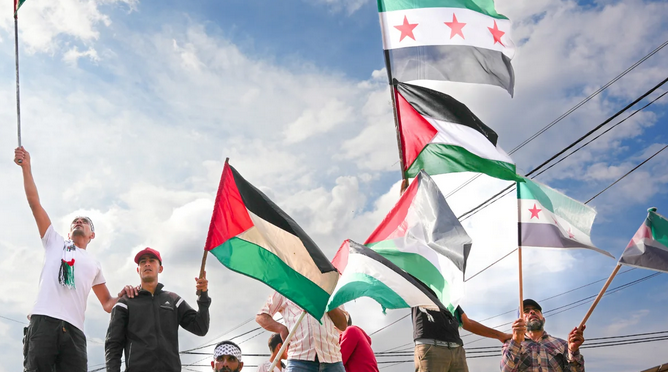
Iran and Israel: Same shit, different place, phoney war

Top: Palestinian children killed by Israeli bombs 5-7 August 2022. Bottom: Iranian children killed by regime from 20 September to 30 September 2022

By Michael Karadjis

On October 13, I read two news items next to each other:

“Iran’s resilient protest movement. Nearly a month after Mahsa Amini died while in the custody of Iran’s morality police, demonstrations have continued to shake nearly 20 cities, even as the government cracks down on protesters and stifles internet access. Human rights organizations estimate that the crackdowns have left nearly 190 people dead—28 of whom were children—while thousands more have been detained or wounded.” 

“Palestinian strikes. Israeli forces killed an 18-year-old Palestinian teenager named Osama Adawi in the West Bank on Wednesday. Adawi’s death is the latest in a spate of clashes between Israeli forces executing raids and Palestinian protesters; so far, over 100 Palestinians living in the West Bank have been killed this year. On Wednesday, Palestinian businesses in east Jerusalem went on strike to protest against the raids.” 

This was October 13, but it could have been literally any other day.

We read every day that Israel and Iran are arch-enemies, and, sure enough, they aren’t friends. Israel continually threatens – for decades – to bomb Iran, it regularly hits Iranian and Hezbollah military assets in neighbouring Syria, and its leaders fiercely campaign against any US attempt to revive the JCPOA or ‘Iran nuclear deal’, signed by Obama in 2015 but scrapped by Trump in 2018. For its part, Iranian leaders regularly make fiery denunciations of the Zionist regime, predictions of its immanent collapse, and somewhat laughable threats to help bring this about.

Yet both are monstrous regimes that deserve to be utterly condemned by anyone with a progressive bone in their body.

For the US and other western imperialist states, Israel’s crimes against humanity, massive violations of human rights, flagrant violation, for many decades, of the most basic rules of international law, its apartheid, its ongoing dispossession of the Palestinian people, are met with mild rebuke at best, full-scale encouragement at worst, but whatever the case, ongoing economic, diplomatic and military support and the absence of any kind of sanction; yet for the same powers, Iran’s crimes against humanity, massive violations of human rights, gender apartheid and the like deserve condemnation, economic sanctions and so on.

Unfortunately, this has led a certain section of the western left, especially among those who have a hollow and class-free conception of “anti-imperialism,” to simply reverse the hypocrisy of western leaders, by vigorously denouncing Israel (sometimes to the point of placing the Israel issue at the centre of world politics, in a dangerous tendency), while providing every kind of rationale for the actions of the Iranian theocratic despots, in some cases hailing the mullahs as “anti-imperialist,” and quite often appearing to be sucked in by the hollow support for Palestine expressed by the regime. Many of these people denounce today’s glorious uprising of long-oppressed Iranian women, daily confronted by the bloody regime’s bullets, as a CIA-orchestrated ‘regime-change’ operation or ‘colour revolution’, two of the counterrevolutionary tropes these “leftists” have adopted over the last two decades to condemn people fighting against oppressive and fascist regimes.

Internationalism, by contrast, demands 100 percent support and solidarity at all times to the popular masses fighting for their liberation against all oppressive regimes.       

The fact that both are monstrous regimes yet are engaged in hostility is no contradiction: there is no law that says “good” governments like each other, “bad” governments like each other, and conflict only occurs between “good” and “bad” ones, even if one were naïve enough to believe in such terms; while US president Biden recently claimed that the Ukraine conflict was part of a global conflict between democracy and authoritarianism, no serious person believes such fairy tales (and in any case, how would Biden, who wrongly sees Israel as a democracy, explain its steadfast refusal to provide Ukraine with any of its advanced missile defence equipment?). The world is not in some Manichean conflict between good and bad, and the very concept of good and bad governments is, for the most part, absurd.

Even if we use Biden’s “democracy versus authoritarianism” meme to distinguish between governments which currently are some kind of democracy and do not systematically repress, jail or kill political opponents and those that do (and ignore everything else, such as poor people dying in the US due to lack of health insurance, or state violence against the Black Lives Matter uprising), this would tell us nothing about alliances throughout the world: during the Cold War decades of 1945-1990, the ‘democratic’ US installed, financed, backed and armed dozens of brutal dictatorships throughout Latin America, Asia, the Middle East, Africa and even southern Europe. US support today to brutal dictatorships in Saudi Arabia, the UAE, Egypt, to the Israeli apartheid regime, to military coups in Honduras, Bolivia and elsewhere, tell us that ‘democracy’ and ‘dictatorship’ are not exports of like from a mother country. 

Comic-book explanations of the conflict

In other words, there is nothing unusual about two brutal regimes being enemies. But why Iran and Israel? One may well ask, since both Israel and Iran have a policy of uprooting and “cleansing” millions of Arabs (in Palestine, Lebanon, Iraq and Syria) as they strive to dominate the region, and since they are effectively separated from each other by the mass of largely Sunni Arab humanity that they both see as Untermenschen, why can they not be allies rather than competitors in this?

Hostility can have many causes; let’s first knock on the head the comic-book explanations. Some wide-eyed “anti-imperialists” believe that Iran, despite its class nature as a brutal capitalist tyranny, is somehow motivated by genuinely emancipatory, anti-imperialist intentions, and via Hezbollah aims to liberate Jerusalem and the Palestinian people. Others who are less sure about such motivations nevertheless believe this alleged Iranian quest to “liberate Palestine” is a remaining impact, via osmosis, of “the Iranian revolution” some half a century ago, somehow pressuring the mullah-fascists from below to engage in regional “liberation” moves. And the reactionaries and racists running Israel pretend to be in full agreement with these starry-eyed leftist admirers of reactionary mullahs, except rather than term it liberation of Palestine, they tell the world that the mullahs are, for reasons unknown, determined to “destroy Israel” and drive them into the sea.

Of course, all this is the purest of fantasy. The mullahs couldn’t care less if the Palestinians were exterminated, and all the bluster about Palestine is done from a safe distance. So unless any serious observer believes that the Iranian regime is either so emancipatory that it wants to liberate Palestine (while oppressing everywhere else it occupies), or so irrationally imperialistic that it aims, come what may, to conquer Israel through several countries in between and annex it to an Iranian empire, then we can now move beyond the realm of fantasy.

“Rivalry”?

The most common explanation for hostility between various capitalist powers is simply ‘rivalry’. Capitalism is built on competition; national capitalist classes rival each other; their state machines reflect this rivalry with policy. It is never as simple as that, but it is a good basis from which to start. However, state regimes also have to maintain support of their own populations, or at least consensus to rule; and this is achieved through hegemonic ideologies which can be based on ‘nation’, ‘race’, religion or other ideologies, which can take on a life of their own and not always correspond neatly to economic interests abroad. Let’s explore these concepts.

If we look at Israel and Iran and decide their conflict is based on ‘rivalry’ for domination of the Mideast region, there are some problems with a simplistic understanding of this.

If we begin by way of contrast, the region-wide conflict between Saudi Arabia and Iran would appear to have a firm basis in ‘rivalry’; both are medium-sized capitalist states in the same region (as is Turkey, which likewise rivals both); both claim to be ‘Islamic’ governments representing the hundreds of millions of Muslims in the region; and therefore, there is a logic to their rivalry, because a larger sphere of influence within the region for one or the other means more trade, more investment, more goods sold, more economic deals and links, more profit. We can say they are engaged in ‘sub-imperialist’ rivalry, which has taken on quite an active form in Iraq, Syria, Lebanon and Yemen in particular. The fact that one is led by a monarchy allied to the Sunni religious hierarchy and the other is run by the Shia religious hierarchy by no means determines who all their allies are; on the contrary, both act out of ‘national interests’, and countless examples can be given for this. However, it does give them a mobilizational arm when necessary, so a degree of sectarianism can be used when necessary to bolster support in some region or another against their competitor in their geopolitical rivalry.

But can we say the same of Israel and Iran? Israel as a colonial-settler state and mini-imperialist power is in the unusual position of being the absolutely leading economic power of the region (the only indisputably ‘First World’ economy), yet not being able to directly “rival” neighbouring capitalist classes in the region itself, because it is effectively locked out of it. High-tech Israeli capitalism is spread far and wide throughout the rest of the world instead. Unless Israel were ever to allow a just peace settlement with the Palestinians – something which essentially defies the very nature of Zionism – then Israeli trade and investment in the region will remain at its current absolutely negligible and in most cases non-existent level. It can therefore not be engaged in ‘rivalry’ with Iran (or Saudi Arabia or Turkey) at least in this common understanding of the term.

For example, despite having relations with Egypt, alone within the Arab world, for over four decades, Israeli exports to Egypt were under $100 million in 2016–2017 (0.1 per cent of total Israeli exports), and Israeli imports from Egypt were around $50 million a year at that time, a similar percentage; likewise, Israel’s share in Egypt’s total exports of goods in 2016 was 0.3 per cent, and its share in Egypt’s imports of goods was 0.1 per cent. Egypt is 39th in the world in value of Israeli trade ties. This is despite Egypt being a very large country directly bordering Israel. While trade has increased and there is potential for better economic relations via Mediterranean gas politics, none of this could be considered to be part of “rivalry” with Iran, or anyone else in the region; while Egypt and Iran have trade relations, they are geographically distant, trade is small-scale, and as a solidly Sunni country, not a potential part of any Iranian-dominated region. All the same points could be made about Jordan, Israel’s immediate neighbour, which established diplomatic relations with it in 1994: Israeli exports to Jordan around 2017 stood at some $50–100 million per year, about 0.1–0.2 per cent of total Israeli exports to the world, Jordan being Israel’s 51st largest trading partner!

Israeli trade and economic cooperation with the United Arab Emirates (UAE), by contrast, has shot up to $1.4 billion just in the first 7 months of 2022, following the establishment of diplomatic relations in 2020, and the free trade agreement signed this year, the first with any Arab country. Yet interestingly, the UAE also has multi-billion dollar trade ties with Iran, indeed the UAE is Iran’s second largest trading partner, and a major conduit for Iranian economic links with the world in the context of western sanctions. Indeed, despite the popular, but false, analysis in the mass media which suggests the Israel-UAE rapprochement was directed against Iran, the UAE is currently busy upgrading its relations with Iran. But it would take a brave person to decide that Israeli-Iranian conflict is due to “rivalry” merely for the small UAE market; on the contrary, the UAE excels precisely in having excellent relations with both.

Of course, Israel would like the opening provided by the UAE to extend to the major prize, the Saudi market, but currently the value of underhanded Saudi-Israeli trade is around $11,000 per year, basically a grain of sand on a beach in terms of economic value. And in any case, being the main actual rival to Iran in the region, Saudi Arabia’s negligible trade with Israel is hardly due to Iranian rivalry! Rather, while Saudi trade with Iran is valued at some fifty times the value of its trade with Israel, it is still only in the hundreds of thousands; in opposite fashion to the UAE, Saudi Arabia maintains only the most minimal relations, trade or otherwise, with both Israel and Iran (the decade-long daily excitable claims that Israel and the Saudis are forever on the verge of establishing relations notwithstanding). 

A map of Israeli exports to the world shows all this graphically: the entire Middle east is a huge black spot for Israeli exports, rivalled only by Greenland!

Ideological mobilisation

Rather, the essence of the ‘conflict’ – largely a ‘phoney war’ as will be discussed below – is rooted in hegemonic mobilisation: the Zionist and Iranian ethno-theocratic projects both need the “great enemy” of each other to justify themselves. The Iranian “threat” to Israel – whether the “liberatory” or the expansionist-genocidal – is an entirely manufactured threat, but the need for such a major “threat” is crucial to the ideological foundations of the late Zionist state, as it is likewise to the ‘Islamic Republic’ state.

Israel felt so unthreatened by Iran during Iran’s much more “revolutionary” era of the 1980s, just fresh from the revolution and with the firebrand Khomeini still in power, that it armed Iran in its war against Saddam Hussein’s Iraq and openly advocated Iranian victory, as is extremely well-documented. But following the US destruction of Iraq in 1991, Israel began to vocally declare Iran to be its worst enemy.

According to the article ‘The Forever Threat: The Imminent Attack on Iran That Will Never Happen’, Israel has been making noises about launching an imminent attack on Iran, often “within weeks,” since 1994. For example, on December 9, 1997, “The Times of London headline screamed, ‘Israel steps up plans for air attacks on Iran’. The article, written by Christopher Walker, reported on the myriad “options” Israel had in confronting what it deemed ‘Iran’s Russian-backed missile and nuclear weapon programme’.” The Forever Threat shows dozens of similar headlines from the past quarter century about Israel being ready to attack Iran any day now. When an Israeli attack on Iran is not just generally a possibility but is “imminent” in 1994, 1997, 2000, 2003, 2006, 2009, 2012, 2015 and onwards, we start to get what the title of the article means: it will (likely) never happen because there is no Iranian threat to Israel to require it.  

This continually repeated “imminent” threat, the permanent call on Israelis and the whole region to be on tenterhooks expecting Armageddon any time, the permanency of a state of advanced paranoia, xenophobia and existential “threat” to Israel and the Jews, serves a purpose: Israel may never attack, but the daily threats that it is always around the corner are their own goal.

For many years now, Zionist ideology has been in crisis. The success of the Boycott, Disinvestment and Sanctions (BDS) movement; the growing questioning of Israel’s savage treatment of the Palestinians; the obvious contradiction between being a “Jewish state” and democracy; support around the world for Palestinian statehood; are all manifestations of this.

But if Israel and “the Jews” are under existential threat, then Israel and its allies have something with which to homogenise Israeli and Jewish opinion about the need for a Jewish homeland. As the alleged “threat” of another Final Solution coming from the oppressed and terrorised Palestinian “terrorists” looks more and more ridiculous to rational people, what can rescue this charade better than a powerful regional state, with a regime that similarly relies heavily on bloated “anti-Zionist” rhetoric, allegedly developing a nuclear bomb with which to wipe out Israel? Israel had found itself the necessary “new Hitler.”

As for Iran, for how many decades has the “road to Jerusalem” gone through either Baghdad, or Damascus or some other unfortunate Arab capital over the bodies of tens of thousands of Arabs? Iran and its proxy forces can slaughter Arabs in Baghdad, in Ramadi, in Mosul, in Aleppo, in Homs, in Damascus, in Qaysar, and claim to be fighting the great battle for Jerusalem! [and an either ethically corrupt or criminally ignorant section of the western “left” can help spread this literally other-worldly propaganda]. The reactionary ‘Islamic Republic’ regime has also been in a long-term crisis of legitimacy, demonstrated by repeated popular upsurges over the last decade and a half, in every case met with bloody repression. The ideological clap-trap about allegedly being a ‘rejectionist’ state in relation to Palestine is key to the regime’s propaganda arsenal throughout the region, and among a section of its own people.

The Iranian regime of Ahmedinejad was particularly adept at pushing rhetoric to the limits and playing into the hands of Likudnik hawks and neo-con nutjobs. While it is true that his statement that Israel will “disappear from the hand of time” was deliberately mistranslated by Zionist and imperialist hacks to Israel will “be wiped off the face of the Earth,” this mistranslation was made more believable by other vile Ahmedinejad noises and actions: Israel could hardly believe its luck when he organised a Holocaust-denial conference and invited, among others, David Duke, former leader of the Ku Klux Klan. Perfect for Zionist homogenisation: a “holocaust denying regime wants to wipe Israel off the face of the earth and is building nuclear weapons to do it with!”

In reality, the geographic distance between Iran and Israel is precisely what makes this propaganda game safe for both. This was also the case for past reactionary Arab dictatorships claiming the ‘rejectionist’ mantle, namely Gaddafi’s Libya and Saddam Hussein’s Iraq; the further away, the louder you can bark. This has also been the case with Erdogan’s Turkey for much of the period since 2009.  

It was only the actual contiguity of a Lebanese Shiite population under brutal Zionist occupation in southern Lebanon for over two decades that led to the growth of Hezbollah and thus actual confrontation between Israel and an Iranian-backed force; this was a genuine national liberation struggle, where Iran just happened to be in the right place to be able to gain political credit from afar. But Israel was evicted from Lebanon in 2000 – 22 years ago – and as such Hezbollah has not the slightest interest (let alone ability) in using its position to “liberate Jerusalem” or even to fire a rocket; apart from the 2006 flare-up, the Israeli-Lebanese border has been particularly quiet.

However, the phoney “war” atmosphere requires Israeli strikes when Hezbollah or Iranian-backed forces inside Syria get within striking distance of the occupied Golan. Not because these forces want to use this position to “target Israel” – on the contrary, their presence has only ever been used to kill Syrian people – but because the entire Zionist case that Iran is out to destroy it would go up in smoke if Israel let them be when in “its vicinity” and nothing happened. The fact of the matter is that while Israel has struck Iranian assets in Syria hundreds of times (in open cooperation with Putin’s Russia, which controls Syria’s air defence system and allows all this …), neither Iran nor Hezbollah has ever initiated an attack on the occupied Golan, and possibly only twice have ever even returned fire.

It would certainly be difficult to see Israel’s bombing of Iranian and pro-Iranian targets in Syria as “rivalry” with Iran for influence – economic or otherwise – within Syria. On the contrary, while Israel and Iran agree on one thing – the preservation of the Assad regime, and the crushing of the anti-Assad decade-long uprising – Israel knows well it can never gain any support among the Syrian population – pro- or anti-Assad – as long as it occupies the Syrian Golan Heights. Despite bombing Iranian forces – Assad’s allies – Israel never attempted to aid the anti-Assad forces; there was not a singular instance where Israel bombed Assadist or even Iranian or Hezbollah forces while in active conflict with the opposition. And it is no coincidence that Israeli strikes on pro-Iranian forces have increased precisely as the threat to the regime from the largely defeated rebels has receded; as then Israeli Defence Minister, far-rightist Naftali Bennet put it, “Iran used to be an asset for the Syrians [ie, as long as it was useful in crushing the rebellion] … but now it’s a burden.” Similarly, the opposition has always emphasised the need to recover the stolen Golan and expressed its solidarity with Palestine. Rather, Israel’s key alliance within Syria has always been Assad’s most strategic backer, Putin’s Russia, the main actual rival of Iran for domination over the recovered Assadist state and its resources.

Strategic positioning and competition

Nevertheless, there may have been an element of quiet “rivalry” involved in bombing Hezbollah when looked at closely: for many years, Israel and Lebanon (with Hezbollah in the Lebanese government) have been engaged in hard bargaining over demarcating the gas fields in the Mediterranean Sea (and, ironically perhaps, Assad’s Syrian regime also has a demarcation dispute with Lebanon over the gas in the sea in Lebanon’s north).

Therefore, with the just-signed historic US-negotiated Israel-Lebanon maritime agreement – with a Lebanese government that includes Hezbollah, and led by Hezbollah-allied president Aoun – enabling demarcation of drilling rights in the gas fields of the Mediterranean Sea – there is reason to believe that Israel-Hezbollah “tensions” may relax; indeed, notably, the most recent Hezbollah threat of sabotage action was related directly to pressure on Israel’s position during the bargaining over this treaty. It may be too early to say, but it is notable that, while Israel struck Iranian and pro-Iranian targets in Syria at an unprecedented rate throughout 2022, as of late October there have been no more such attacks since September 17 – some six weeks – the maritime agreement, signed on October 11 and welcomed by Hezbollah and Syria as well as the two signing countries being a possible explanation.   

At a larger level, the ideological positioning, while driven by the requirements of internal hegemonic mobilisation, has also gained a life of its own as a strategic tool for Israel in the region, in Israel’s drive to open up more of the Arab market via avenues such as the Abraham Accords signed between Israel and the UAE, Bahrain and Morocco, further bolstering relations Israel already has with Egypt, Jordan and Oman, and attempting to drive open the Saudi and further Gulf markets. In particular, by drumming up the Iranian “threat,” Israel’s major military and “security” industries aim to profit via cooperation with the military and repressive forces of these regimes.

Ironically, however, that does not necessarily mean most of these regimes do feel “threatened” by Iran – only Saudi Arabia, Iran’s regional rival, with a large Shiite minority in the east, and Bahrain, where a Sunni monarchy rules over a disenfranchised Shiite majority, have an Iran problem, and while Bahrain has been in the forefront of rapprochement with Israel, the Saudis, as we have seen, are very much the rearguard, at most, of this move.

Rather, for the UAE, Egypt and Jordan, what they share with Saudi Arabia, Israel and the Assad regime is seeing the regional Muslim Brotherhood (sponsored by Qatar and the Erdogan regime in Turkey) as a strategic enemy: a movement which attempts to combine Islam and democracy, no matter how precariously or dishonestly, which was active throughout the Arab Spring, including in Syria and Egypt, and in Palestine takes the form of Hamas, is considered anathema. Military and security cooperation with Israel serve the purposes of internal and regional counterrevolution (something they have in common with Iran in fact), not just against the MB but against democratic upsurge more generally. But the bogey of a large and powerful state like Iran with a very loud mouth, large armed forces and a supposed nuclear threat makes much better propaganda for bolstering “security” cooperation and profiteering than the threat from below. So Israel needs to continually pose as a regional “anti-Iran” leader, the regional First World military hegemon that can offer “security.”

Indeed, it is hardly surprising that all the Arab regimes that have cozied up to Israel the last few years are identical to those who have cozied up to the Assad regime, re-established relations with both, or always had them: Egypt, the UAE, Jordan, Bahrain, Oman and Sudan, with the Saudis more quietly supporting from behind but refusing to openly budge on either. This fact renders all discussion of Middle East “camps” the nonsense they are, leftover ashes of what was perhaps a partial reality some half a century ago that many still live in: the regional counterrevolution is largely the same camp, with bumps at the edges.   

Longer term, it could be projected that Israel’s ideology of the phoney “Iran threat” could be related to a kind of future strategic competition between Israel and Iran: competition for this very position of regional cop as recognised by world imperialist powers. There is little doubt that Iran’s role in crushing the Syrian revolution, while the US looked on and did deals, and its role in defeating ISIS in Iraq in cooperation with the US, was widely appreciated, but the stripes gained were looked upon with apprehension by Israel. Of course, most readers would say this is far-fetched, which it is, for now: the mantle of regional cop, especially for US imperialism, clearly belongs to Israel. But the emergence of a powerful, relatively ‘modernised’, non-Arab state of 70 million people from imperialist sanctioned isolation to imperialist-blessed prominence, via the nuclear accord and its possible revival, cannot but be seen as a threat to its position by Israel in the longer term.

In this sense, Israeli leaders are not wrong that US-Iranian nuclear negotiations, and the possibility of a new deal, are an existential threat to Israel, but in a very different way to what they claim. If western imperialism’s need to bring Iranian capitalism more fully back into the world capitalist system leads to a deal that allows Iran to peacefully develop nuclear energy, then 30 years of Zionist bluster is out the window and finding a new “threat” of that magnitude will not be an easy task.

Tulsi Gabbard “finally” finds her political home on the hard right: Where she’s always been actually

Above: Gabbard and Syrian tyrant Bashar al-Assad; below, Gabbard and friends at Christians United for Israel conference

By Michael Karadjis

Dedicating an article to a particular US politician may seem overkill, but there are few American politicians that the ‘alt-left’ have lauded as much as reactionary, alt-rightist Tulsi Gabbard, former Democrat representative from Hawaii. For example, here is professional campist and apologist for mass murder, “journalist” Ben Norton, singing her praises back in 2019:

“Yeh I’ve been really impressed by Tulsi Gabbard … she’s really been hitting hard at the regime change war problem … Tulsi [her admirers are all on first name basis with Gabbard] is great because she has made this the key part of her platform.”

This is just one of hundreds, or thousands, of similar examples from the last decade or so. So no doubt they were impressed that Gabbard recently quit the Democratic Party, especially as she began by claiming they were led by an “elitist cabal of warmongers.” However, most of them quoting this – and many did – would have stopped there, embarrassed by what came after (though in many cases still not embarrassed enough to not cite her!). Let’s have a look at more of Gabbard’s resignation speech:

Gabbard resigns from “woke,” “anti-white,” “anti-God” Democratic Party

“I can no longer remain in today’s Democratic Party that is now under the complete control of an elitist cabal of warmongers driven by cowardly wokeness, who divide us by racializing every issue & stoke anti-white racism, actively work to undermine our God-given freedoms, are… hostile to people of faith & spirituality, demonize the police & protect criminals at the expense of law-abiding Americans, believe in open borders, weaponize the national security state to go after political opponents, and above all, dragging us ever closer to nuclear war.”

Have you ever seen a bigger right-wing dog-whistle while still making vague signals to the left? So, for Gabbard, the ruling class Democratic party is a hotbed of “anti-white racism”! Hostile to “people of faith”! “Undermines the police”! Believes in “open borders”! Yes, the alt-left, the campist-tankie left, can have her. Of course, none of this is new – anyone who looked knew that Tulsi Gabbard has been an out and out reactionary for years, well, always.

Unlike many, this was too much even for Norton, who now declares her “a right-wing sheepdog [who] cynically tries to lure anti-war people into the GOP.” Yeh, Ben, that’s what we said when you were singing her praises. Norton recently quit the red-brown propaganda-for-tyrants site, Grayzone, apparently because he felt his co-thinker, Max Blumenthal, was taking conspiracist thinking a little far with his conversion to Covidiocy. Will be interesting to see how Grayzone explains their idol’s talk about the dangers of “anti-white racism” and the like.

It’s rather obvious from her resignation which direction she is heading after the Democrats. Earlier this year, Gabbard was invited and spoke to the 2022 Conservative Political Action Conference (CPAC), where she spoke alongside Glenn Beck at the Ronald Reagan memorial dinner. She declared, not wrongly, that she finally found where she belonged, which helps us understand where her new “home” will be (where in reality it always was).

Gabbard: Apologist for genocidal Assad regime

Gabbard was good at hoodwinking the red-brown, tankie, campist “leftists” because they are not only easily fooled by definition, but also tend to be consciously and defiantly ignorant. One of the issues that really endeared them to Gabbard was her apologism for genocidal mass-murdering Syrian tyrant Bashar al-Assad, who she personally visited in 2017. Her explanation for this was that she was for peace, and therefore it was necessary to talk to everyone involved, including Assad. This was a very thin smokescreen, however, as she propagated almost all Assadist talking points.

She declared herself against an (actually non-existent) “US regime-change war” against Assad, leading tankies to see her as one of them, deciding she was “anti-war”, as in Norton’s quotes about “regime change” above. In reality of course, the only US bombing war in Syria since 2014 has been the air war against ISIS (which destroyed ISIS in Syria), but which also hit anti-Assad, anti-ISIS Islamist rebels, especially, from the first day, Jabhat-al-Nusra; this US intervention welcomed by the Assad regime. Far from being anti-war, Gabbard accused the US of not bombing them enough. She welcomed the onset of Russia’s terror bombing of Syria on behalf of Assad in 2015, claiming, falsely, that the “US has not been bombing al-Qaeda/al-Nusra in Syria” (the US bombed Nusra targets hundreds of times, killing large numbers of civilians in the process, and often enough, even mainstream anti-Assad rebels), and proceeding to state “but it’s mind-boggling that we protest Russia’s bombing of these terrorists,” despite the fact that the vast majority of Russia’s bombs, and Assad’s bombs, hit mainstream rebels, not “al-Qaeda.”  

Returning from her trip to Assad’s palace, Gabbard made videos calling for an end to the imaginary “US regime change war,” which showed vast footage of the massive, unending destruction of entire regions as far as they eye can see that Assad’s bombing had wrought, implicitly blaming it on the US, or on the anti-Assad rebels, who only had small arms: the cataclysmic destruction in the footage is clearly the work of an airforce and advanced missiles, possessed only the regime and Russia.

According to Gabbard, “If Assad is removed and overthrown, ISIS, al Qaeda, Al Nusra, these Islamic extremist groups will walk straight in and take over all of Syria … they will be even stronger,” sounding identical to Trump, Cruz, Gingrich, Bolton or any of the American and global hard right. She claimed “Their message [ie, the message of her Assad regime handlers!] to the American people was powerful and consistent: There is no difference between ‘moderate’ rebels and al-Qaeda (al-Nusra) or ISIS—they are all the same,” claiming it was “a war between terrorists under the command of groups like ISIS and al-Qaeda and the Syrian government.” This shameless grouping together of terrorists and the millions who rose up against Assad is the most typical Assadist talking point: anyone opposed to a regime of torture and mass murder can only be a jihadi. The fact that ISIS fought rebels far more than it ever fought the regime, and the regime also fought the rebels far more than it fought ISIS, and the regime regularly bombed the rebels whenever they were fighting ISIS, is irrelevant to crude propagandists for mass murder like Gabbard.

But of course tankies, campists and red-browns think someone is progressive and anti-war when they support a genocidal tyrant who has killed hundreds of thousands of people and destroyed entire towns and cities throughout his country. Well, each to their own I suppose, so for argument’s sake, let’s go with that.

With exceptions, most of these same tankies and campists and even many red-browns pretend to be very pro-Palestine (unlike the far-right ‘browns’ they bloc with who are overwhelmingly pro-Israel). It is their one alleged point of honour. If you point out massive repression by an Assad, Putin or Khameini, they can “what about Israel” you in response? “Why doesn’t the US stop Israel?” Since every genuine leftist has supported the Palestinian struggle their entire political lives, and has never stopped condemning the unconditional US support for the regime of occupation, apartheid and ethnic cleansing, this whataboutism is irrelevant and stupid, of course, but it gives them something to say. So, OK, let’s again go with that.

Gabbard: Hard Zionist

It therefore takes a very, very deliberate kind of ignorance to not know that Gabbard is also a hard Zionist (and of course there is zero contradiction between being a Zionist and an Assadist – virtually the entire global far-right achieve that, not just Gabbard). So then why do they extol someone who should be their enemy? Because she’s pro-Putin? Yeh well, so is Netanyahu! The bottom line is, her support for the Assad regime and Putin are far bigger priorities for the alt-left than the alt-left’s symbolic pro-Palestine views. Indeed, given Assad’s murder of thousands of Palestinians in Syria and his destruction of their camps, their support for Palestine while shilling for Assad is not only hypocritical, but also anti-Palestinian.

But let’s look at Gabbard’s well-known Zionism. Here is Gabbard at the Christians United for Israel convention, alongside John Hagee, Ted Cruz, Mike Huckabee, Rick Santorum and every other kind of hard US reactionary. Here she is in the far-right Breitbart, exclaiming  “Put yourself in Israel’s shoes”, as she defends staying for Netanyahu’s speech to the US Congress, where he was invited by the Republican Party rather than by the Obama US government, when nearly 60 Democrat reps boycotted. Gabbard stated that the US-Israel relationship “must rise above the political fray, as America continues to stand with Israel as her strongest ally.” During Israel’s genocidal Operation Protective Edge, Gabbard co-sponsored a congressional resolution that said that Israel exclusively “focused on terrorist targets” and that Israel “goes to extraordinary lengths to target only terrorist actors”!

Not surprisingly, she got a “Champion of Freedom” award at the Jewish Values Gala, held by the World Values Network, founded by Trump supporter Rabbi Shmuley Boteach. Here is a photo showing Gabbard with Shmuley and Miriam Adelson, the wife of Sheldon Adelson, another big Trump supporter who believes Palestinians are “a made-up people”.

In 2017, Gabbard co-sponsored H.Res.23, which supports the U.S. policy of vetoing “any one-sided or anti-Israel UN Security Council Resolutions that seek to impose a negotiated settlement on Israel and Palestine.” It also condemns boycott and divestment campaigns and sanctions that target Israel. Then in 2019, Gabbard voted for an AIPAC bill condemning Boycott, Divestment, and Sanctions (BDS).

Gabbard with some of her hard-line Zionist friends

Gabbard: Islamophobe extraordinaire and “hawk” on the “war on terror”

One thing Gabbard’s pro-Assad and pro-Israel stances have in common is that they both accord with the very Islamophobic and “war on terror” basis of her politics. Both the Assad regime and Israel leaders, when they mercilessly bomb civilian infrastructure, medical facilities, schools, refugee camps, anything really, and murder with impunity on a daily basis, claim they are targeting “radical Islamic terrorists.” The US and Russia claim the same in their imperialist wars.

Therefore, among other things, for Gabbard this also includes:

  • Being a hard-line supporter of Modi, the BJP and Hindutva chauvinism; Modi had been personally implicated in the murderous anti-Muslim riots in Gujarat in 2002, which killed around 1000 people. Due to this, for about a decade, the US had refused to give Modi a visa. For Gabbard, this was a “great blunder,” claiming “there was a lot of misinformation that surrounded the event in 2002.”
  • Loving bloody Egyptian tyrant al-Sisi (given that Sisi is allied to both Assad and Israel, this works well), who she visited in 2015, and declared “President el-Sisi has shown great courage and leadership in taking on this extreme Islamist ideology”

Left: Gabbard with India’s Hindu-chauvinist and pogromist leader Modi. Right: Gabbard with bloody Egyptian dictator al-Sisi.

The rest of her politics isn’t much different, even if she now claims to no longer be a homophobe, and one wonders how long that phase will last given the territory she is openly moving into. Her right-wing baiting about the danger of “anti-white racism” reveals a more reactionary Gabbard than even many of those aware of her real politics realised. For example, Gabbard claimed US could not possibly be a racist country, since Ahmaud Arbery’s killers were found guilty. That would certainly be news to the hundreds of African-Americans murdered by cops and vigilantes where the killers have gone free; apparently, Black Lives Matter was all about nothing.

Several years ago Gabbard refused to sign letter by 169 Democrats opposing far-rightist Steve Bannon being appointed appointed as Trump’s advisor; little wonder she has received praise from Bannon who claimed she “would fit perfectly [in the Trump administration] … She gets the foreign policy stuff, the Islamic terrorism stuff.” As well as praise from Nazis and white supremacists David Duke and Richard Spencer, from the leading right-wing economic/defence/security think-tank the American Enterprise Institute, from Fox News heavy-weight far-rightist Tucker Carlson, whose show Gabbard regularly appears on, really you name it, from almost anyone on the right.

So if tankie and campist leftists want to keep citing Gabbard of all people as an “anti-war” voice in support of Putin’s barbaric invasion of Ukraine or Assad’s genocidal reign of terror in Syria, please go for it: she suits you.

Gabbard on Tucker Carlson show on Russian TV

Ukraine war Sub-Imperialist positioning, not “anti-colonial consciousness,” behind the neutrality of reactionary elites in the Global South

BRICS leaders: “Anti-imperialist” vanguard, Orwell-style

By Michael Karadjis

Time and time again, we have been told that ‘the Global South’ – ie, the developing world consisting largely of former colonies – does not support Ukraine’s resistance to Russia’s barbaric colonial invasion, or is even supportive of Russia. According to this rendition of reality, support for Ukraine is entirely a project of the imperial West, and this very fact is all the more reason that former colonies of western imperialist states do not want to be on the side of their former colonial masters.

Quite apart from the problematic mathematics involved – 140 countries voted to condemn the Russian invasion, the vast majority of which are in the Global South, and only 5 voted against – there is a more significant problem here: the conflation of ruling classes, governments and often dictatorships with the people of these countries, as if people being gunned down by some regime of exploiters would automatically have the same opinions as their oppressors, because they’re all ‘Global Southerners’. While such a boringly pedestrian assumption is normal in mainstream mass media and bourgeois political discourse, it ought to be second nature to anyone proclaiming some kind of socialist or even vaguely left or progressive ideology that such discourse is inconceivable nonsense.

“Only white nations are supporting Ukraine, the black and brown peoples of the world refuse to support ‘NATO’s war’ against Russia” I have been informed by western leftists, assuming to be speaking on behalf of several billion people in several continents, when in fact only speaking on behalf of their torturers.

This essay will first look at the facts of who voted what and why, and will note the largely sub-imperial nature of major states which either abstained on voting to condemn Russia, or formally voted to condemn but were in other respects pro-Russian in practice; and then will compare this to the overwhelmingly anti-Russian and pro-Ukrainian views of their populations, belying the claims that these abstentions were “reflective” of alleged “anti-colonial” views among the peoples of the South. This will be done via examining a variety of surveys of popular opinion. While it is difficult to vouch for the validity and reliability of these surveys without much deeper research, nevertheless their variety itself, together with the largely similar results, suggests somewhat tentative conclusions can be drawn.

First, the facts

Before we look at what people actually think, let’s first establish the facts regarding the votes of these countries and the views of the governments and ruling elites, because the assertions are not even borne out on this level.

Like most myths, these assertions are based on bits and pieces of truths and half-truths. Both the UN General Assembly vote to condemn the Russian invasion in March, and the more recent one to condemn Russia’s outright theft of a fifth of Ukraine, were supported by over 140 countries and opposed by 5, while some 35 countries in each case abstained. Since nearly all the 30 or so ‘white’ nations of the Global North (European countries, North America, Australasia) voted to condemn, it means all of those who abstained were from the Global South – even if they were vastly outnumbered by the overwhelming majority of South countries who voted to condemn. Of the 5 who voted against both times, two were ‘white’ Global North countries – Russia and Belarus, of course – while 3 were from the South: Assad’s genocide-regime in Syria, which relies on Putin for its existence, the grotesque ‘Juche’ regime in North Korea, and, the first time, the extremely repressive dictatorship in Eritrea, and second time, Ortega’s turncoat regime in Nicaragua.

In other words, even just on this basis, we can say that, within the Global South, over 100 nations condemned the invasion and annexations, while three supported them.

However, it is also more complicated than that, because the reasons that countries vote in favour or abstain can have many dimensions; while, as we will see, some of those which abstained, such as Modi’s regime in India, did so because they actually sympathise with Moscow, many others may have had no such sympathy, but for diplomatic or economic reasons – associated with being relatively poor – felt they could not openly vote to condemn Russia, often due to some important economic relationship with Russia, or with China.

Meanwhile, the other core of truth is that it has only been western countries that have sent arms to Ukraine, and have activated economic sanctions on Russia, despite the overwhelming votes to condemn Russia’s invasion. However, this is hardly surprising for many reasons: the major arms suppliers (and producers) in any conflict are richer countries (western countries and Russia), and are wealthy enough to provide large quantities. It is also only countries of the Global North who can afford the pain to themselves of sanctions on a large country such as Russia, whereas in the South imposing sanctions would often mean impossible pain, especially given the importance of Russia in the global food, fertiliser and energy markets; while also endangering economic links and projects which they have built up with Russia, just as they have with the US and western countries; finally, the Ukraine war is in Europe, so it is logical that European nations have more of a direct stake than others, in the same way that African nations all opposed the Apartheid regime in South Africa and all Arab states give official support to Palestine.

The ambivalent sub-imperialist belt

While, as we will see, some abstaining countries are simple Russian neo-colonies under forms of violent occupation (eg, Mali, Central African Republic), there is a bloc of relatively powerful states that either abstained on all votes (China, India, Iran, South Africa), abstained on some votes (Brazil, United Arab Emirates, both in Security Council votes), or officially voted to condemn to satisfy their Washington connections, but in practice have acted in every possible way to demonstrate the importance they place upon their ties with Moscow and lack of commitment to their votes (Israel, Saudi Arabia and to some extent Turkey).

Putin with Saudi BFF Mohammed bin Salman: destroyer of Yemen laughs with destroyer of Syria and Ukraine

With the exception of Turkey, which has supplied Bakhtiar drones to Ukraine, none of the other “US allies” in the Middle East (Israel, UAE, Saudis) have either helped supply Ukraine with arms, or imposed sanctions on Russia. After the West imposed oil sanctions on Russia, driving the price of oil through the roof, the US aimed to get its Saudi and Gulf allies to increase oil supply to stabilise prices; at the time, Saudi and Emirati leaders reportedly “declined U.S. requests to speak to Mr. Biden.” Following Biden’s low-key July visit to Saudi Arabia in the hope of getting the Saudis on board, they responded in October by leading OPEC into cutting oil production by 2m barrels a day, keeping prices high to their own, and Russia’s, benefit. To double the insult, the Saudis rounded out the year with the lavish welcome to China’s Xi Jinping in December, signing a “strategic partnership.” As for Turkey, “not joining sanctions to keep diplomacy open” apparently includes agreeing to Russia’s plan to turn Turkey into a Russian gas hub, while blocking the NATO membership applications of Sweden and Finland.

In Israel’s case, former (and again current) far-right leader Benjamin Netanyahu long cultivated close ties with Putin, so not surprisingly, his equally ultra-rightist successor, prime minister Naftali Bennett, was the first “world leader” to make a high level visit to Moscow to meet Putin soon after the invasion. Bennett’s first statement affirmed Ukraine’s right to sovereignty, but made no mention of Russia. Following US pressure, foreign minister and more “centrist” Zionist Yair Lapid issued the official, half-hearted condemnation, but Bennett refused to mention Putin or Russia in subsequent statements, and issued a demand that his ministers say nothing; rejected Ukraine’s calls for arms, and promised to block any attempt by Baltic states to send Israeli-made arms to Ukraine. His equally fascistic minister Avigdor Lieberman later refused to condemn Russia following the Bucha massacre, claiming “I support first of all Israeli interests.” Israel also blocked the US from providing Israeli ‘iron dome’ missile-shield technology to Ukraine, as Russian missiles obliterate Ukraine. After Israel’s refusal of a US request to co-sponsor a UN Security Council move to put a motion to condemn Russia to the General Assembly caused rebuke from Washington, Israel voted in favour at the General Assembly, Bennett explaining that Russia understood Israel’s forced stand, and Russia affirmed this would not affect cooperation in Syria. When Lapid replaced Bennet as prime minister late in the year, he was more openly critical of Russia, but refused to supply weaponry. Meanwhile, Netanyahu’s far-right Likud opposition spent the year criticising the government for saying anything at all, and in its first statement, the new Netanyahu government promises to “speak less in public” about Ukraine.

These are not countries that have the excuse of being poor and hence having little bargaining power – Israel is an unquestionably ‘Northern’ economy, Saudi Arabia and the UAE are oil superpowers, and Turkey is a member of the OECD, and, for that matter, of NATO. Their actions are clearly choices: does this mean Israel, Saudi Arabia, the UAE and Turkey are an ‘anti-colonial’ vanguard? Alongside, within Europe itself, the far-right regime of Orban in Hungary, Putin’s best friend in NATO, which almost alone in Europe stands against sanctions on Russia and arms to Ukraine? And when we add other countries ruled by far-right reactionaries like Modi in India and Bolsonaro in Brazil, who are allied both to the US and to Putin’s Russia, we further see the problem with the alleged ‘anti-imperialist’ explanation for going soft on Russia.

We often hear that, despite the numbers in the UN votes, “the majority of the world” abstained and hence refused to condemn Moscow, because between them, China and India, make up two fifths of the world, so when we add other large abstaining countries such as Iran and Pakistan, as well as Brazil which, despite voting to condemn, has rejected sanctions while Bolsonaro declared his “deep solidarity” with Russia in Moscow on the eve of the invasion, we are covering more than half the world’s population.

But that’s where the nonsense peaks: as the mullah regime in Iran guns down hundreds of women and young people demonstrating against tyranny in the streets every day, we are asked to assume that those being shot, tortured, brutally oppressed, have the same opinion on Ukraine as the regime killing them. That Iranian Kurds, Arabs, Baluchis and other oppressed minorities have the same view as their oppressors. That the Muslim population of Gujarat must have the same view as Modi’s Hindu-chauvinist regime, where Modi himself was involved in the huge pogrom in that state back in 2002. That oppressed Indian women, Dalits and minorities all agree with the BJP’s votes in the UN, alongside the world’s largest population living in absolute poverty – yes, of course, they all must agree with the Indian petty-bourgeoisie aggressively proclaiming its pro-Moscow views on the Internet. That the millions in Xinjiang suffering under China’s regime of forced assimilation and cultural genocide must all agree with the regime imposing this upon them, alongside the hundreds of millions of China’s insecure ‘floating population’ of exploited workers, they of course must agree with their exploiters.

The sheer idiocy of such assumptions should stare anyone in the face. That such class-free analysis could ever be considered by anyone claiming left-wing or socialist politics simply underlines the ideological bankruptcy of much of the Old Left (ie, the degeneration of what was once the ‘New Left’).

Rather, what these countries and governments have in common – China, India, Brazil, South Africa, Iran, Turkey, Saudi Arabia, UAE and Israel – is their sub-imperialist (or in some cases arguably imperialist) nature. Far from their positions on the war reflecting any “anti-colonial” consciousness of their people (or reflecting their oppressed and exploited peoples at all), they rather reflect the geopolitical positioning, their global bargaining position, between US, European, Russian and Chinese imperialism, taking advantage of the war to assert their own sub-imperial interests, regional influence and conquests, and oppressive rule over internal and local colonies.

Yes: there is western hypocrisy! Yes, the world’s peoples remember colonialism!

OK, but are not some of the points being made valid in themselves? Of course, it is true that the western imperialist powers supporting Ukraine’s resistance to Russian occupation are hypocritical. None have the same view regarding Israel’s decades-long brutal and illegal occupation of Palestine, and the Golan, and its massive violation of the most elementary human rights of the Palestinians. While some European governments might offer more criticism compared to the unconditional and uncritical support for Israel by the US, there is never a hint of sanctions or breaking ties. We can name any number of other examples, such as Saudi Arabia’s monstrous bombing of Yemen, where western reactions can similarly range from condemnation to support, but even in the cases most condemned, there are no penalties.

The same goes for Russia’s previous actions: neither Putin’s slaughter of the Chechens, the horrific bombing of hospitals, schools, markets in Syria on behalf of Assad’s genocide regime, nor the 2014 annexation of Crimea, evoked the kind of reaction we see now in Ukraine.

Then there are conflicts in which huge numbers of people are killed, such as the two-year genocidal assault on Tigray by Ethiopia and Eritrea, killing 600,000 people, which both western governments and media treat with complete indifference. Not surprisingly, many Africans would have been offended when French minister of state, Chrysoula Zacharopoulou, demanded “solidarity from Africa” because of Russia’s “existential threat” to Europe.

And of course, there is the vastly different treatment of millions of Ukrainian refugees in Europe compared to that of refugees from Syria and elsewhere in the Middle East and Africa. 

In this sense we can say the Ukrainians are ‘lucky’ (if such a term can be used for a people being invaded and bombed) compared to others in terms of western support. Western powers act based on their own interests, just as Russia does, and this may rarely coincide with the interests of justice. It is not the fault of Ukrainian men, women and children getting bombed and killed in apartment blocks that the West is more supportive of them than of other struggles. They have a right to resist and to get aid from wherever its offered, as do all peoples fighting liberation and resistance wars.

But the argument that rejection of western hypocrisy is the reason for the ambivalent stance of many governments in the Global South is very problematic. Many of these ambivalent governments are violently oppressive, and don’t really care less about western hypocrisy or alleged ‘principles’; they are often leaders in hypocrisy themselves. In fact, often it is the very beneficiaries of western hypocrisy – such as those just mentioned above, Israel, Saudi Arabia, Ethiopia – which either abstained, rejected western sanctions or otherwise carried out actions that benefited Russia in practice; they have good relations with both imperialist blocs. As for the contention that their stance is a reflection of ‘anti-imperialist’ views among the people they oppress, there is little or no correspondence with popular opinion as will be demonstrated below.

A similar contention is that the ambivalent views of some South governments reflect anti-colonial sentiment: the western governments now supporting Ukraine’s resistance to Russian colonialism were previously the colonialists ruling over the peoples of the South. In itself, this could lead to sympathy for Ukrainians fighting the same anti-colonial fight they once did; but since Russian colonialism expanded across northern Eurasia, not in Africa, southern Asia or Latin America where other colonial rulers were, it may not be so obvious the southern peoples. But again, the idea that many of these reactionary, violent and pro-imperialist regimes are expressing anti-colonial principles is laughable.

What about the people of the South?

The idea that the views and UN votes of the collection of thuggish reactionary regimes listed above represent the views of the people they oppress is unlikely by definition, at least for anyone who understands the concept of class analysis. What is the evidence of any correspondence between the policies of this minority of southern governments and the alleged “anti-colonial” views of their people, which are allegedly expressed via supporting Russia’s colonial invasion of Ukraine?

Brazil

An interesting place to start may be Brazil; since both the outgoing, far-right Bolsonaro regime, and the incoming, soft-left, Lula administration, have been very partial to Putin and Russia’s viewpoint. Bolsonaro was always strongly allied to Putin (and to Trump), seeing both an ideological ally and an important trading partner. On the eve of Russia’s invasion of Ukraine in February, Bolsonaro turned up in Moscow to declare his “deep solidarity” with Russia! While his government went through the motions of voting to condemn the invasion in the General Assembly, Bolsonaro himself blasted that stand, and claimed Ukrainians “trusted a comedian with the fate of a nation.” Later, Brazil abstained in the UN Security Council vote in September to condemn the annexations. Meanwhile, as the West sanctioned Russia, Brazil-Russia trade ballooned. As for Lula, he criticised Russia’s invasion but claimed Ukraine was “as responsible” as Russia and had not tried enough to negotiate with the aggressor.

Yet, according to ‘Morning Consult’, “the share of Brazilian adults with a favorable view of Russia has plunged from 38% to 13% since the day before its Feb. 24 invasion of Ukraine, while the share with an unfavorable view has surged from 28% to 59%.” Meanwhile, 62 percent of Brazilians say they side with Ukraine, compared to only 6 percent who side with Russia. What this suggests is quite the opposite of “pressure from the masses” – both Bolsonaro and Lula, with differing ideological emphases, represent the views of the sub-imperialist BRICS ruling elite and the way it positions itself in the world, not at all the views of the Brazilian masses. As the 9th most unequal country on Earth according to 2023 Gini Index rankings, why would anyone expect the poverty-stricken masse or the Indigenous being destroyed in the Amazon to hold the same views as the elite?

There’s good reason to believe that this is the case throughout Latin America, “despite” (due to?) the strong anti-imperialist traditions throughout the region. Favourable views of Russia are higher in Mexico than in Brazil, yet a late February poll in Mexico showed that only 20 percent of Mexicans had a favourable view of Putin, and 60 percent an unfavourable view.

Putin and recently defeated Brazilian far-right co-thinker Jair Bolsonaro: Real men like us won’t allow the “the gays” and “liberals” to prevent us from destroying Ukraine and the Amazon

Southern Africa

From Brazil, we may jump to another BRICS stalwart which has abstained on the UN resolutions condemning Russia, namely South Africa. In explaining South Africa’s vote, almost every media article in the world has pointed to the “traditional ties” between the African National Congress, which led the fight against Apartheid, and the Soviet Union, pointing to Soviet support for the struggle. Perhaps the government’s vote reflects this popular love for Moscow due to this historic struggle? As if Putin’s Russia were the Soviet Union; Putin doesn’t think so. Ukraine, of course, was also in the Soviet Union.

But here’s the thing: according to a Gallup survey of Africans in 24 countries on their attitude to Russia conducted in 2021 (before the invasion), only 30 percent of South Africans had a positive view of Russia, the second lowest on the continent (the lowest was in Zambia). Even more interesting is the fact that the countries where people recorded lower support for the Russian leadership were mostly in the southern African region, eg, Tanzania (32%), Zimbabwe (39%), Namibia (40%), Mozambique (41%) – ie all countries which abstained, and are ruled by regimes associated with the Soviet-backed anti-colonial struggles in the 1970s and 1980s, connected to the anti-apartheid struggle in South Africa. Hence, where we may expect to see the highest support for Russia based on this ‘anti-colonial’ discourse, we see the lowest – by way of contrast, support for the Russian leadership in 2021 was largely between 50-70% throughout west Africa.     

Bear in mind that all these figures, high and low, were from 2021; drastic drops in support for Russia have been recorded in every part of the world since February 2022. Keep this in mind if 30 percent still sounds high. Also worth keeping in mind is that while approval of the Russian government was on average higher in Africa (42%) than globally (33%), this was nevertheless “lower than the approval ratings of the leadership of the U.S. (60%), China (52%) and Germany (49%)” – not sure how we fit the square “anti-imperialist” peg into this round hole! Also notable is that even the 42% average approval for Russia in 2021 was drastically down from 57% in 2011, in the decade since Russia’s global imperialist adventures have become more pronounced; we can be certain that 2022 has not helped.

This data also means that, despite the higher African average, the 30 percent approval in South Africa is below the 33 percent global average.

Therefore, we would probably need to draw the same conclusion about South Africa as about Brazil: far from representing the “anti-colonial” and “anti-apartheid” memories of the masses, the ANC government’s vote represents, once again, the views of the sub-imperialist BRICS ruling elite and the way it positions itself in the world. The working classes and the poor in all these countries where the regimes are now close to Russia – South Africa, Zimbabwe, Namibia, Mozambique etc – are brutally exploited by the capitalist classes that arose out of the ANC, ZANU-PF, Frelimo, SWAPO, the MPLA etc. In fact, South Africa is the most unequal country on Earth, based on 2023 Gini Index rankings, and Namibia, Mozambique, Angola and Zimbabwe are all in the top 15 most unequal (BRICS partner Brazil is number 9).

It is therefore hardly surprising that that many people in these countries share little in terms of views with the sub-imperialist South African or the other neo-colonial regimes tied to South African, Russian, Chinese – and western – imperialism. 

Western and northern Africa

What about the higher approval of the Russian leadership in western Africa? According to Eric Draitser, Russia gained support in parts of West Africa by moving in the last few years and ousting French imperialism from its dominant role there. This may well be true. According to the Gallup survey, 84 percent of people in Mali had confidence in Russia in 2021; while popular surveys under military dictatorships are highly suspect, it is quite possible that the figure was in fact at the higher end, perhaps like the more realistic 50-70 percent area (as in Guinea, Cameroon, Congo, Nigeria, Burkina Faso etc). Did Mali’s abstention, and those of the Central African Republic (CAR), and of a couple of other west African states (Guinea, Togo), represent the vanguard of anti-colonialism and this great surge of support for Russia replacing France?

The problem with one imperialist country replacing another is that initial welcome can easily become its opposite when the new power acts the same or worse. In the case of Mali and Central African Republic (CAR) in particular, the fact that this survey was before 2022 not only concerns the global crash in support for Russia following its invasion; it also concerns the Russian-backed dictatorships showing their horrifically brutal fangs in 2022.

Last November, the ‘All Eyes on Wagner’ group linked the Russian Wagner paramilitary force operating in Mali to at least 23 incidents of human rights abuse since the 2020 coup, but the biggest massacres took place in March 2022, when the Malian military, backed by Wagner, executed some 300 civilians in small groups over several days in the town of Moura.

Similarly, in the Central African Republic (CAR), Wagner mercenaries “enlisted to counter rebels since 2018 have abducted, tortured and killed people on an ‘unabated and unpunished’ basis,” according to a UN report, which also claimed a Russian company linked to Wagner “secured gold and diamond mining licenses.” But once again, it was in March 2022 when the brutality hit a peak, when Wagner mercenaries in the CAR carried out a series of massacres around the site of a gold mine in the Andaha region, killing more than 100 gold miners from Sudan, Chad, Niger and CAR.

Wagner began operating in Africa in 2017, invited initially by Sudanese tyrant Omar al-Bashir, who told Putin that Sudan was Russia’s “key to Africa”.  In Sudan, Wagner secured gold mining concessions, and this lucrative business then spread to other countries of the region. This led to fierce competition with French imperialism in west Africa, but Russia’s need for gold greatly increased following its invasion of Ukraine and imposition of western sanctions, a likely factor in the upturn on violent repression.

One wonders what the slaughtered villagers and gold-miners would think of the assertions floating around the western left that the abstention votes in the UN by their ruling Russian-backed dictators in Mali, CAR and Sudan represented their “anti-colonial” views, or simply the views of these dictators ruling Russian neo-colonies via the Nazi-linked Wagner plunderers and killers?

Meanwhile, another government which has twice abstained on these UN votes is that of Ethiopia, which has been waging a genocidal war against the people of Tigray for two years, killing some 600,000 people, a horrific crime ignored by the world. If its abstention also signifies a pro-Russian orientation, is it really the voice of anti-colonial liberation? When the regime also has “seemingly unconditional American praise and support”? Did someone ask if its victims got a vote on their killers’ UN vote? And its ally, the Eritrean dictatorship, which the Ethiopian regime invited into its country help it kill its own Tigrayan citizens because it knew it would do so with a vengeance, is the only African state to actually vote against the UN resolution in February; hardly surprising that the only country declaring itself 100 percent in the Russian camp is widely regarded as one of the world’s worst dictatorships, a one-man dictatorship of President Isaias Afewerki, “subjecting its population to widespread forced labor and conscription … with no legislature, no independent civil society organizations or media outlets, and no independent judiciary,” where elections have never been held since independence in 1993. 

In fact, while it may be drawing a slightly long bow, the claim in this Conversation article – that the minority of African states that abstained from condemning the Russian invasion or annexations are largely dictatorships (with the exception of South Africa), ie, the regimes most removed from any popular pressure, and vice versa – is not so far from the truth. Certainly there are exceptions – Egypt’s bloody al-Sisi dictatorship voted with the majority, but in fact it falls into the same camp as its Saudi and Emirati allies, ie, making the “correct” vote by Washington while doing everything to maintain its ties to Moscow; indeed, the long-planned construction of Egypt’s first nuclear power plant by Russia got underway in July.

India

As we know, Modi’s India, which has close ties to both Putin’s Russia and to the US – seeing its main rival to be China – abstained on the UN resolutions and has maintained strong ties with Russia. For Modi, this is not only about traditional Russia-India ties, playing Russia against China and, once again, the global positioning of a BRICS sub-imperialist bourgeoisie, but also – as with Bolsonaro in Brazil – deeply ideological, Modi’s Hindu-supremacist BJP being strongly aligned with Putin’s far-right international.

Putin hugs with far-right chauvinist Indian co-thinker Narendra Modi: friendly cooperation in empire-building; that “war on terror” stuff George Bush came up with been real useful along the way.

This ideological commitment to Russia is more entrenched the further to the right one goes. Shortly after the invasion was launched, members of extreme-right Hindu Sena demontsrated in support of Putin and the invasion. Demonstrators held signs reading “Russia, you fight, we are with you” and some called for an “undivided Russia.” Hindu Sena president Vishnu Gupta even advocated that India put “boots on the ground” to support Russia. Indeed, the concept of ‘Akhand Bharat’, “which envisions the entire Indian subcontinent, stretching from Afghanistan to Myanmar, as belonging to a single, “undivided” nation with India at its core,” is supported by many on the Hindu-chauvinist far-right, strongly reminiscent of the Putinite and Duginite views that former parts of the Russian Empire all belong to Russia.

As the head of a Hindu-supremacist regime that has engaged in open violence against Indian Muslims, and of a deeply socially-chauvinist regime in a country where billionaires today grow on trees while India boasts the greatest number of absolute poor in the world, it is surely extraordinary that many “leftists” and even “socialists” would claim that Modi’s pro-Putin politics is somehow representative of the anti-colonial traditions of Modi’s brutally oppressed and impoverished subjects. “Most of the world” abstained, we hear, not just from common clueless liberals, but from those professing a class analysis, because between them India and China already make up two-fifths of the world!

It is somewhat difficult to discern Indian views on the conflict, and in such a large and diverse country the likelihood of polls capturing much of value is small. From what we have though, an Ipsos poll conducted in May found that, on the one hand, 6 in 10 Indians supported India maintaining relations with Russia and opposed India imposing economic sanctions, yet the same poll found that 77% of Indians believed that the economic sanctions imposed by others were “an effective tactic for stopping the war” and 7 in 10 believe “doing nothing in Ukraine will embolden Russia to take the war to the rest of Europe and Asia.” In a Blackbox Research survey in March, only four per cent of Indian respondents said they had a positive image of Moscow (and only eight per cent in China), and 91 percent in India said they supported or sympathised with Ukraine (compared to an also surprisingly high 71 percent in China). Some 60 percent of Indians blamed Russia for the conflict, though only 10 percent in China did.

While difficult to know what all these polls prove, at face value they suggest that, despite some ambivalence, overall Indian people are more critical of Russia and sympathetic to Ukraine than the Modi regime. Where support for Russia and the government’s position seems apparently strong is on social media, probably representing largely upper middle class Indian views. It is interesting to see what their views are based on; but from this analysis, “anti-colonialist consciousness” does not even get a mention. Rather, it is all about the “historic ties” between India and Russia (ie, blatant geopolitics), the fact that Russia is India’s major arms supplier, and in order to stop Russia from bending too far towards China, which India sees as its chief sub-imperial rival, despite both being part of the ‘BRICS’ framework. And all those masses of advanced weaponry that India buys from Russia are not aimed at fighting … British colonialism, but China, Pakistan, the occupied Kashmiris and so on.

How ironic that India’s pro-Russian position on the war could be considered part of an “anti-colonial” or “anti-imperialist” position when the Russian weaponry, if aimed at China, is done so within the framework of India’s anti-China ‘Quad’ alliance with the US, Australia and Japan.

China

As noted above, “between them India and China already make up two-fifths of the world” is a hipster-leftist meme that implies the abstentions of the BJP and CCP regimes represent their entire exploited and oppressed populations. 

As with India, we don’t want to put too much store in surveys of relatively small numbers of people in a country of 1.4 billion; and in the case of China, discerning popular views is made more difficult by the almost total monopoly on media – including social media – by the regime; aside from North Korea, few countries in the world are as effective at suppressing independent social media as is China.

The Blackbox survey cited above for India also contains some alleged views from China. The survey found that a mere 8 percent of respondents had a positive image of Moscow, and a surprisingly high 71 percent in China said they supported or sympathised with Ukraine; on the other hand, only 10 percent of Chinese respondents blamed Russia for the conflict, dramatically lower than in India. What to make of this contradiction is unclear, especially given the context noted above, but we can make some general points.

Firstly, would it be logical to assume that the colonised Tibetan masses, or the largely Muslim, Turkic Uyghur, population of Xin Jiang, where a million people are subject to internment in forced assimilation facilities are likely to hold similar views to the Han-chauvinist regime? In a country which now boasts 1185 billionaires, more than the US, where “the net worth of the 153 members of China’s Parliament and its advisory body that it deems ‘super rich’ amounts to $650 billion,” how likely is it that the brutally exploited, permanently insecure, floating population of rural-to-urban-to-rural migrant workers – one fifth of China’s population upon whose backs China’s “miracle” has been built – would tend to agree with their exploiters? Or that the CCP bureaucracy would “reflect” their views?

Secondly, does anyone really believe that China’s policy – on one hand, abstaining in UN votes and blaming ‘NATO’, on the other, continually sending pointed signals that “the sovereignty and territorial integrity of all countries, including Ukraine, must be respected” – “reflects” anything other than the policy of an assertive new imperialist power? In his first trip abroad after the pandemic, to Kazakistan – a former Soviet republic with a large Russian minority – Chinese leader Xi Jinping offered “strong support to Kazakhstan in protecting its independence, sovereignty and territorial integrity.” Despite the Russian ‘alliance’, Russia is inevitably also an imperialist rival, and China prefers Russia in the position of vassal rather than equal, a position Putin has offered up on a plate with his disastrous Ukraine invasion. Kazakistan and the other central Asian states now see China, rather than Russia, as their key security guarantor. Xi’s major coup, the lavish state visit to Saudi Arabia in December, during which the two countries signed a “comprehensive strategic partnership agreement” and Chinese and Saudi firms signed 34 investment deals, represented a major move into traditional American and more recently Russian territory; China was confident enough to declare itself in support of mainstream Gulf Arab positions as against both Israeli and Iranian positions, while expecting no issues with its strong relations with both those states as well.  Xi declared the visit a “defining event in the history of Chinese-Arab relations.” Meanwhile, with Putin’s invasion leading to the rupture of the enormous Russian-German economic relationship and the collapse of Nordstream, Germany opened the way for a major Chinese shipping group to buy a large stake in the strategic port of Hamburg.

It would be foolhardy to confuse the clear and assertive policy choices of a rising imperialist power with some kind of ‘anti-colonial’ consciousness of ‘a fifth of the world’s population’.

Xi Jinping and MBS: Strategic partnership for anti-imperialism … err …

Iran

The mullah regime in Iran has, like China, consistently abstained on UN resolutions condemning Russia, while at the same time holding back from support for the invasion, which goes against Iran’s dogma of allegedly being against invasions (after its experience of being invaded by Iraq), especially when involving “great powers”, due to its own experience of being sanctioned by the US. We can leave aside the obvious hypocrisy here – ie, Iran’s massive interventions in Iraq and especially Syria, bolstering Assad’s genocide regime – because that is “explained” as “defending Syria,” whereas a blatant invasion cannot be explained away like that.

Unlike China, however, Iran has become more directly involved on Russia’s side in killing Ukrainian civilians with its supply of killer-drones to Russia.

Can Iran’s position be explained as a reflection of the “anti-imperialist consciousness” of the Iranian masses, due to decades of US bullying? In other words, does the position of the blood-drenched mullocracy “reflect” the views of ordinary Iranian people, such as the youth and women who have been out in the streets for months protesting the reactionary dictatorship, and who the regime has been gunning down and hanging? How likely is such an idea, at least to anyone with an inkling of class analysis?

Not much, it seems. According to a poll of 1014 people in June-July by the Center for International and Security Studies at Maryland (CISSM) and IranPoll, since the onset of Russia’s invasion, favourable views of Russia have dropped from a slight majority of 56% to a minority of 40%, while unfavouable views of Russia have surged from 42% to 57%, including 32% who now hold “a very unfavorable view.” This should not be seen as contradicting the fact that the vast majority still hold a highly unfavourable view of the US. While 28% chose an overriding statement that Russia had acted in legitimate self-defence, double that number, a clear majority of 55%, chose a statement that Russia is violating the principle that no country should invade another.  Specifically on who was to blame for the war, Russia and the West came out about equally, while very few blamed Ukraine.

Iran’s intervention via killer-drones thus goes against the mass of Iranian opinion, and has even led to high-level criticism, with thirty-five former Iranian diplomats issuing a call for Iran to declare neutrality, and strongly criticising this intervention. Iran itself claims the drones Russia is using were sent before the war began, and claims it has sent no new drones since – whatever the truth, it indicates how embarrassing Iran’s actual position is.

Far from representing “popular anti-imperialist opinion,” Iran’s pro-Russia intervention is a high-risk strategy adopted by a sub-imperial power. Like Saudi Arabia, Turkey, Egypt, Indonesia and Argentina, Iran is a BRICS candidate state, and it operates within this framework of sub-imperial rivalry. Iran hopes to swing Russia to its side in its shadow war with Israel in Syria; for years now, Russia, which operates Assad’s anti-aircraft system, has allowed Israel to bomb Iranian and Hezbollah positions as long as it avoids hitting the Syrian regime. Russia, for its part, in accepting Iranian drones, risks moving Israel to a pro-Ukrainian position.

Yet, to date, neither change has occurred. On the contrary, citing its Ukraine military needs, Russia withdrew its S-300 anti-aircraft system from Syria in August, seemingly leaving the field even more open to Israeli bombs, while also reportedly demanding Iranian forces leave western Syria (ie, the side closer to Israel). However, Israeli bombing has markedly declined in recent months, since the signing of its Mediterranean gas demarcation agreement with a Lebanese government which includes Hezbollah. And there are no signs yet of a change in the Israeli position, with Israel abstaining on a UN resolution calling for Russian reparations to Ukraine, and Ukraine voting in support of anti-Israel and pro-Palestine UN resolutions countless recent times.

Whatever the case with this interesting sub-imperial geopolitical positioning, it is clearly unrelated to the views of the Iranian regimes enemies, ie, its people, those being gunned down in the streets.

Iranian & Turkish despots Khameini & Erdogan with Putin: still more strategic alliances for … anti-imperialism!

Palestine

One country where we might expect the pervasive hypocrisy of western governments to be so overwhelming that a majority may adopt a pro-Russian position simply out of somewhat justified spite would be Palestine. While such a position would not be justified, it would be somewhat understandable and difficult for most of the world to criticise without further engaging in rank hypocrisy. It would be even more understandable given Ukrainian president Zelensky’s sickening pro-Israeli statements, which look all the more pathetic given Israel’s steadfast refusal to lend Ukraine a hand.

So when we read that in a poll conducted by the Palestinian Center for Public Opinion in April, the high figure of 32.3 percent of Palestinians believed Russia had a right to invade, we are perhaps not surprised. However, the problem is that a greater number – 40.2% – believed    that “Russia is waging an unjust war against its neighbour.” The poll of 1014 people was conducted with Palestinians living in the West Bank, including East Jerusalem, and Gaza Strip. In other words, although the western governments backing Ukraine with a host of advanced weaponry to resist the illegal and barbaric Russian invasion prefer to condemn every act of justified Palestinian resistance to the illegal and barbaric Israeli occupation and instead arm Israel to the teeth and give diplomatic cover to even its most flagrant violations, still the humanity of Palestine’s anti-colonial struggle shines through strongly enough for the largest part of the population to identify with another victim of a similar war of colonial dispossession and extermination. Western leftists need to remember that Palestinians are people, not just their ‘project’; they are just as capable as other people of weighing complex issues.

After all, Putin’s white nationalist regime is not exactly any great friend of the Palestinians, with Putin famously declaring “I support the struggle of Israel” during Israel’s 2014 Operation Protective Edge blitzkrieg against Gaza, which killed over 2,300 Palestinians while some 11,000 were wounded, including 3,374 children, of whom over 1,000 were left permanently disabled. From the time Russia began terror-bombing Syrian civilians to save Assad in 2015, Putin and Israeli prime minister and Likud leader, Zionist extremist Benjamin Netanyahu, never stopped having high level meetings – Netanyahu met with Putin more than with any other world leader. In 2018, Netanyahu was one of only two world leaders standing next to Putin in Red Square commemorating the 73rd anniversary of the Soviet defeat of Nazi Germany, alongside Serbia’s Alexander Vucic. Netanyahu even produced a massive billboard showing himself with Putin for the 2019 elections.

Putin and BFF Israeli leader Benjamin Netanyahu: Who else would you invite to the 60th anniversary of the Red Army’s victory than the ethnic cleanser of Palestine? Let’s shake on a little illegal occupation between friends

Ireland

While Ireland may not be conventionally seen as part of the ‘Global South’, it is after all a former colony, for hundreds of years, of Britain – indeed the ongoing British control of Ulster can be likened to the Donetsk and Luhansk ‘republics’ carved out of Ukraine by its former colonial master.

Sinn-Fein, Ireland’s largest party, with its history of resistance to British colonialism, has declared its unequivocal support for Ukraine’s resistance to Russian colonialism at its Ard Fheis (congress) on November 5, 2022, declaring that “The Ard Fheis unequivocally condemns any form of imperialism or colonial aggression; we oppose the denial of national self-determination and all violations of national sovereignty throughout the world, without exception; ee affirm that the rule of international law must be emphasized and reinforced, respectful of the exercise of national self-determination, sovereignty and democracy in all nations.” Sinn Fein therefore demands:

  • The total cessation of the war in Ukraine;
  • The complete restoration of the national sovereignty of Ukraine;
  • The immediate withdrawal of all Russian armed forces;
  • The maintenance of all political or economic sanctions until these objectives are achieved.

Sinn Fein’s democratic vote would seem to be more representative of the views of a formerly colonised people than abstentions by Modi’s violently chauvinist regime in India, its rival Pakistan, China’s one-party state carrying out forced assimilation against a million people in its internal colony Xinjiang, the bloody Iranian mullahs currently gunning down the women-led uprising, the brutal Wagner-backed dictatorships in Mali and CAR and the like. Also worth noting that “The Ard Fheis’s keynote speaker was Omar Bargouthi, a founder of the Boycott, Divestment and Sanctions movement (BDS), which Sinn Fein supports,” in other words, Sinn Fein are consistent in their approach.

Sinn Féin also “unequivocally condemn[ed] the illegal annexation of four regions in Ukraine by Russia,” calling it a “gross violation of international law.”

Comment on global surveys

The above relies on a somewhat eclectic variety of national or supranational surveys and it is difficult to vouch for the degree of validity and reliability without significantly deeper research. However, it is difficult to find any better tentative data, and certainly none at all that suggests any groundswell of support for Russia and its invasion, in the Global South of anywhere else. Despite their significant differences, every survey indicates that majorities around the world condemn the Russian invasion, are sympathetic to Ukraine and have a rather low opinion of Russia; they also all indicate quite strongly that, whatever the situation before 2022, approval of Russia and Putin has crashed everywhere in the world since the invasion.

This is also backed up by global surveys. For example, an Open Society survey carried out in 22 countries in July and August, covering 21,000 people, two thirds of whom live in the Global South, found “strong and widespread support” for the view that peace requires Russia to “withdraw from all parts of Ukrainian territory it currently controls.” Majorities in nearly all countries held this view, the exceptions being Senegal (46 percent), India (44 percent), Indonesia (30 percent), and Serbia (12 percent). Among the countries with the strongest support for this view were Kenya (81%), Nigeria (71%), Brazil (68%), Columbia (67%) – all higher than in the US, Japan, France and Germany – and South Africa (59%). Any difference between populations of the North and South were comprehensively absent.

A partial contrast was provided by an Ipsos survey of 19,000 people in 27 countries in March and April, but this focused not so much on attitudes but on what action should be taken, with questions related to sanctions, ‘getting involved militarily’, taking some kind of unspecified ‘action’, taking Ukrainian refugees and so on. In this case, it is not surprising that the higher levels of support for some kind of action were in Europe, and to a lesser extent the US. The Ukraine war is, after all, in Europe; and western countries can obviously better afford both military support, and withstanding the impact of sanctions, than can poorer countries. However, what confuse the ‘anti-imperialist’ argument in this case was that the countries where the largest numbers were against any kind of ‘action’ or ‘interference’ included Hungary, the European state led by the intensely far-right Orban government, Israel, widely considered an extreme outpost of western imperialism, the Saudi monarchy, often considered (somewhat incorrectly) as an unreconstructed US-client regime, and Turkey, a NATO member. Indeed, the assertion that “doing nothing in Ukraine will encourage Russia to take further military action” received the lowest support among the 27 countries in Israel and Hungary, the only countries voting below 50 percent for this view (compared to 71 percent in India, for example). Reality can be rather difficult for campist “thinking.”

Sub-imperialism

I wrote above, in relation to the relatively powerful states leading the abstention or otherwise ambivalent party on Russia’s horrific imperialist war of conquest against Ukraine:

“Rather, what these countries and governments have in common – China, India, Brazil, South Africa, Iran, Turkey, Saudi Arabia, UAE and Israel – is their sub-imperialist (or in some cases arguably imperialist) nature. Far from their positions on the war reflecting any “anti-colonial” consciousness of their people (or reflecting their oppressed and exploited peoples at all), they rather reflect the geopolitical positioning, their global bargaining position, between US, European, Russian and Chinese imperialism, taking advantage of the war to assert their own sub-imperial interests, regional influence and conquests, and oppressive rule over internal and local colonies.”

Patrick Bond , Ana Garcia , Miguel Borba describe “sub-imperial” powers as “featuring the super-exploitation of their working classes, predatory relations regarding their hinterlands, and collaboration (although tensioned) with imperialism, especially as intermediaries in the transfer of both surplus labor values and “free gifts of nature” (unequal ecological exchange) from South to North.” Bond cites John Smith that “dependent economies like Brazil seek to compensate for the drain of wealth to the imperialist centres by developing their own exploitative relationships with even more underdeveloped and peripheral neighbouring economies,” and David Harvey who notes that “each developing centre of capital accumulation sought out systematic spatio-temporal fixes for its own surplus capital by defining territorial spheres of influence.”

But by attempting to carve out such “territorial spheres of influence,” their collaboration with global imperialist powers will also be punctuated by bouts of competition, as their minor exploitative aspirations sometimes come into conflict with the exploitative needs of larger global powers. This “tensioned collaboration” with imperialism was called by leading dependency theorist Ruy Mauro Marini “antagonistic cooperation.” According to Harvey, as the opening of the global market “created openings” for new large regional states “to insert themselves into the global economy.” But “they then became competitors on the world stage.” Importantly, though, becoming (partial) competitors does not make them in any sense “anti-imperialist,” but, on the contrary, these larger centers of economic and military power within the Global South have “aspirations to follow Western expansionary precedents, using instruments of (corporate-oriented) multilateral power.”

It is not surprising that a moment of global crisis such as that ushered in by Russia’s invasion of Ukraine is precisely a perfect moment for a large string of sub-imperial powers to assert themselves, to position, to use the crisis to improve their bargaining position in relation to US and European imperialism – even those often most often considered “western allies” – and, at the same time, with now decrepit Russian, and also globally ascendant Chinese, imperialism; a moment when all are under pressure to do some kind of deal to get them onside.

While this is not the final word on the causes of the abstention and/or effective neutrality or even pro-Russian orientation of a large number of powerful ruling classes in the Global South, it is a far better explanation than the one which tries to claim the vast billions of people of the Global South as their “anti-colonial” project, alleging they are a multi-billion mass of group-think. In this alternative scenario, their ruling elites – those responsible for the “super-exploitation” of these working classes, and of the peoples in the “even more underdeveloped and peripheral neighbouring economies,” are merely reflecting this allegedly “anti-colonial” consciousness of those they oppress and exploit, who in turn naturally support this global stance of their oppressors and exploiters. As we have seen, this is not only inherently illogical, and in conflict with even the most basic concept of class analysis, but also at odds with most of the empirical evidence of popular opinion in the South.

Putin accuses the West of ‘Satanism’ to justify Russia’s colonial theft of 15 percent of Ukraine

by Michael Karadjis, October 2022

Ukrainian oblasts annexed by Russia

Interesting that in a 37-minute speech to justify Russia’s brazen annexation of four regions of Ukraine, Putin didn’t mention “Nazis” or “de-Nazification” once, these silly tropes that some gullible western lefties believed. Instead, it was all about the glories of 1000 years Imperial Russia, while appealing to the most reactionary segments of western society with a lot of mystical, religious, traditionalist nonsense like the following:

“They [ie, the western globalists] have already moved on to the radical denial of moral, religious, and family values. Let’s answer some very simple questions for ourselves. Now I would like to return to what I said and want to address also all citizens of the country – not just the colleagues that are in the hall – but all citizens of Russia: do we want to have here, in our country, in Russia, “parent number one, parent number two and parent number three” (they have completely lost it!) instead of mother and father? Do we want our schools to impose on our children, from their earliest days in school, perversions that lead to degradation and extinction? Do we want to drum into their heads the ideas that certain other genders exist along with women and men and to offer them gender reassignment surgery? Is that what we want for our country and our children? This is all unacceptable to us. We have a different future of our own. … This complete renunciation of what it means to be human, the overthrow of faith and traditional values, and the suppression of freedom are coming to resemble a “religion in reverse” – pure Satanism. Exposing false messiahs, Jesus Christ said in the Sermon on the Mount: “By their fruits ye shall know them.” These poisonous fruits are already obvious to people, and not only in our country but also in all countries, including many people in the West itself.”

Indeed, the West is guilty of ‘Satanism’ and all these crimes against traditional religion and morality, and therefore … Russia should annex 15 percent of Ukraine! Because these regions are allegedly populated by Russians (well, most of the population are not ethnic Russians, but the majority of the population have been violently expelled or massacred) and it is the great historic mission of the glorious Russian Nation to lead the Crusade against this moral degeneracy of western society. If Putin thus sounds like any typical far-right US Christian fundamentalist or Trumpist or 21st century European fascist it is no accident, nor is it anything new for anyone watching: Putin has positioned his regime as head of the global far-right for many years now. Not just all this ‘moral’ bullshit, but also on the question of race, nation and ‘civilisation’; for many years he has espoused a version of ‘Great Replacement’ theory, warning the white race and European and Christian culture that it was in danger of disappearing due to immigration of lots of non-Europeans into the European heartland. No wonder he dropped the crap about fighting “Nazis” in Ukraine; while it might have fooled some lefties, his main audience were and are the western far-right, who probably found it a little confusing, especially all those Nazis everywhere in the world who have been waving the Putin flag for years.

If Putin’s hard authoritarian but ‘parliamentary’ state is still far from fascist in its rule inside Russia (as opposed to its murderous colonial rule in Donbas), Putinism is, nevertheless, fascist ideologically. That’s why it’s no surprise that Putin here quotes a genuine historical Russian fascist, Ivan Ilyin, who Putin calls a “true patriot,” with a lot of mysticism about “the spiritual strength of the Russian people.” That’s why today’s leading Russian fascist high priest, Alexander Dugin, praised Putin’s speech to the sky, proclaiming “This is a manifesto of Tradition. I can’t imagine how profound the consequences are. It was an eschatological, religious speech”

This goes together well with the glorification of The Russian Nation and Empire, the centrepiece of his speech he continually returned to. “The battlefield to which destiny and history have called us is a battlefield for our people, for the great historical Russia. (Applause.) For the great historical Russia, for future generations, our children, grandchildren and great-grandchildren. We must protect them against enslavement and monstrous experiments that are designed to cripple their minds and souls.”

While we sometimes hear that Putin wants to restore the USSR, he made it abundantly clear he wanted nothing of the sort. After denouncing the ‘elites’ who dissolved it, he explained “But it doesn’t matter now. … Actually, Russia no longer needs it today; this isn’t our ambition. But there is nothing stronger than the determination of millions of people who, by their culture, religion, traditions, and language, consider themselves part of Russia, whose ancestors lived in a single country for centuries.” Of course, Putin liked the size and shape of the USSR, because it was a very large country where countless other nations and ethnicities were dominated by The Russian Nation; but that had already existed for centuries before the USSR as the Tsarist Russian Empire, Putin’s ideal, his speech full of glorification of Tsars like Catherine the Great, talk of ‘Novorossiya’, the Tsarist Empire’s name for its colonisation of Ukrainian lands, and so on. The Soviet Union, on the other hand, still contained the fiction of an equal union of republics, of peoples, in its name, and that is what Putin hates, has been railing against for years, the original sin of Lenin and the Bolsheviks in recognising the right of self-determination of Ukraine and the other subject peoples of the old Russian Empire, as Putin here denounces “the [Bolshevik] government quietly demarcated the borders of Soviet republics, acting behind the scenes after the 1917 revolution.”

It’s true that this hard right and medievalist ideological rant was peppered with nods to the western left and the former colonial world with his denunciations of western imperialism. Putin quite rightly denounces the West for “the worldwide slave trade, the genocide of Indian tribes in America, the plunder of India and Africa, the wars of England and France against China,” for the “exterminat[ion of] entire ethnic groups for the sake of grabbing land and resources” and so on. Yet he somehow manages to omit the fact that Tsarist Russia was in every sense a key participant in these centuries of colonial expansion, plunder and extermination; the fact that Russian colonialism expanded by land, subjugating nations and ethnicities from the Black Sea to the Caucasus, central Asia and Siberia, rather than by sea, is irrelevant. Indeed, in the 19th century Marx and Engels considered the Russian Empire to be at the very centre of reaction in Europe. Putin does complete somersaults with reality by imagining a centuries-old ‘Russophobia’ by some imaginary collective ‘West’ (for most of these centuries Britain and France were mainly at war with each other, and with other Western states, at least one of which was always aligned with Tsarist Russia) that allegedly wanted to make Russia one of its colonies, but Russia resisted this “by creating a strong centralised state,” ie that of the Tsars.

Indeed it is only due to this Russian colonialism, carried out by this “strong centralised state,” that Ukraine (’Novorossya’) came to be under Russian control (aided in the 20th century by Stalin’s Holodomor in the 1930s, when 4 million Ukrainians were starved to death while its borders were sealed to prevent the starving escaping); and it was only due to Russian colonisation of Crimea and dispossession of its Indigenous Tatar population, finalised once again by Stalin’s genocidal expulsion of the entire Tatar population in the 1940s, that Putin was even able to conduct the previous fake “referendum” under military occupation there in 2014.

Somehow, Putin thinks a good way to fight centuries of imperialism is to be ultra-imperialist, to invade a country and conquer great chunks of it; from the start, this war had nothing to do with NATO, with “Nazis” or any other such nonsense, but has been entirely a war of pure and simple imperialist conquest, of the Black Sea coastline with its vast natural resources and strategic position.

These new “referendums” again take place under brutal military occupation, where those who “vote” essentially have guns to their heads; when the majority of the population of Donbas have fled or been driven out and hence get no “vote” (indeed half the population was already in exile before February, having fled during Russia’s occupation of parts of Donbas in 2014-22); after the Russian military have savagely bombed the Donbas populations for months; where there was not a single instance of Donbas crowds welcoming the Russian invaders as “liberators”; where no polls over the last 8 years have ever shown significant support for joining Russia; where ethnic Russians were just over a third of the population in two of the regions, and considerably less in the other two; and and even then, there is no way of knowing what the actual votes were, even given these entirely manipulated and violent conditions – they are almost certainly pure concoctions, as are all “votes” in “referendums” and “elections” throughout the world under dictatorship, terror and occupation.

Yet some people who should know better have been giving this murderous farce and blatant land theft the benefit of the doubt. We are expected to believe that those that Russia has been bombing into oblivion for months just voted to join their torturer. No doubt, as per Putin, out of fear of the West’s Satanism and gender-bending practices

On the fantastic tale that “the Ukrainian army killed 14,000 ethnic Russians in Donbas between 2014 and 2022”

Cataclysmic destruction of Russian-speaking Ukrainian city Mariupol by Russian invasion; Putin claims, ironically, that his invasion aims to “liberate” these people from “genocide”.

By Michael Karadjis

We’ve all heard it time and time again. Whether it is an argument in support of Putin’s brutal invasion of Ukraine, or just as often, opposed to it but claiming both sides are equally at fault, we hear that that “the Ukrainian army killed 14,000 ethnic Russians in Donbas between 2014 and 2022.”

Here’s just one example among thousands of examples regurgitated, with never a simple fact-check, all over the left and right media: According to pro-Putin writer Max Parry, “For what the late Edward S. Herman called the ‘cruise missile Left,’ the 14,000 ethnic Russians killed in Donbass by the Ukrainian army since 2014 are ‘unworthy victims,’ as Herman and Noam Chomsky defined the notion in Manufacturing Consent.”

The purpose of this claim is to argue that, while Putin may have over-reacted by going all the way to invading, it was the Ukrainian army most at fault before the invasion. Even if it is admitted that Putin’s invasion is criminal and may have imperialist goals and is only using the plight of the Donbas Russians as an excuse, the claim is that this excuse is genuine.  

Therefore, even many of those who oppose the Russian invasion equally oppose the Ukrainian resistance, and in particular its receipt of arms, because if Ukraine gets the upper hand, it will just continue to do to the “ethnic Russians” what it was previously doing, the same as what Russia is now doing to “the Ukrainians.”

While not quite as colourful as Putin’s claim that Ukraine was committing “genocide” against the ethnic Russians in Donbas, these claims are nevertheless serious and merit clear examination.

…………………………………………………

Let’s look at the claim again:

“The Ukrainian army killed 14,000 ethnic Russians in Donbas between 2014 and 2022.”

Is any of this true?

Yes – the 14,000 figure. Yes, 14,000 were killed in the conflict in Donbas between 2014 and 2022. That’s a terrible figure, and of course many times that number were wounded, the entire region is a dead zone covered by landmines, and some 3.3 million people fled the region (ie before the millions who have fled Ukraine since the Russian invasion). But what of the rest?

“The Ukrainian army killed.”

Wrong – two sides were involved in the armed conflict – the Ukrainian army, alongside various irregular Ukrainian militia (often composed of people uprooted from their homes) on one side, and the Russia-backed and armed separatist militia of the two self-proclaimed ‘republics’ in eastern Donbas on the other, backed by Russian troops and mercenaries. Both sides shoot; both sides kill.

For example, according to a January 2015 report by Human Rights Watch, “On January 24, unguided rockets, probably launched from rebel-controlled territory, killed 29 civilians and 1 soldier in Mariupol and wounded more than 90 civilians. One rocket struck the courtyard of a school. On January 13, unguided rockets, also probably launched from rebel-controlled territory, killed 12 civilians and wounded 18 at a checkpoint near Volnovakha.” Don’t these 41 civilian lives count? What of the fact that, following the first Minsk Accord in September 2014, the ‘separatist’ militia immediately violated it by launching a 6-month battle, with hundreds of deaths, to seize the Donetsk airport from the government? How was that the Ukrainian army’s fault? What of the 298 people killed when the ‘separatists’ shot down a civilian airline in July 2014?

“ethnic Russians”

Ethnic Russians are a minority of around 38-39 percent of the population in Donbas, so it is unlikely that all or most killed are “ethnic Russians,” but that is not the point of this part of the assertion. The reason this fiction is inserted is to imply that people were killed “by the Ukrainian army” simply for being ethnic Russians, in a war of targeted ethnic extermination, rather than being victims of the cross-fire between the two sides shooting at each other.

But the other problem with the assertion is the implication that these were 14,000 “ethnic Russian” civilians. In reality, according to the UN Commission on Human Rights (UNCHR), the numbers killed in Donbas from 14 April 2014 to 31 December 2021were:

4,400 Ukrainian troops

6,500 Russia—owned separatist troops

3,404 civilians

So, let’s be clear: we are talking about 3,404 civilians, killed by both sides, over 2014-2021.

However, what about the last part:

“between 2014 and 2022.”

Well, yes, if we make the small change to 2014-2021, then this is correct in the abstract.

But the implication here is that there was a continual, ongoing bloody conflict (allegedly all caused by the Ukrainian army incessantly “shelling ethnic Russians”) right up to the Russian invasion. The invasion, in a sense, is simply the continuation of the ongoing bloodshed, at a perhaps slightly higher level; a reaction to it, even if perhaps an overreaction.

In reality, almost all the 14,000 deaths, including almost all the 3,404 civilians, were killed when the open conflict was raging from 2014 till the ceasefire in mid-2015 – that is, during a time when no-one seriously denies the direct involvement (ie, invasion) by the Russian army. Let’s just look at the OSCE Status Reports from 2016-2022.

The OSCE report ‘Civilian casualties in eastern Ukraine 2016’ shows there were 88 fatalities in 2016, including 37 from landmines, unexploded ordinance etc.

The OSCE report on civilian casualties covering 2017 to September 2020 shows 161 fatalities over those almost 4 years, of which the majority (81) were from landmines, unexploded ordinance etc. Note that both sides lay landmines; indeed, the UN has characterised the Donbas as one of the most mine-contaminated areas in the world.

The year by year figures were 87 fatalities in 2017, 43 in 2018, 19 in 2019, and 12 to September 2020.

The OSCE report as of 11 January 2021 reports “The total number of civilian casualties in 2020 stands at 128: 23 fatalities and 105 injuries.”

The OSCE Status Report as of 13 December 2021 reports “since the beginning of 2021, the SMM has confirmed 88 civilian casualties (16 fatalities and 72 injured)” in 2021.

Of these 16 fatalities in 2021, 11 were from the first half of 2021: according to the OSCE Status Report as of 14 June 2021, “Over the past two weeks, the SMM corroborated four civilian casualties, all injuries due to explosive objects. This brings the total number of civilian casualties that occurred since the beginning of 2021 to 37 (11 fatalities and 26 injuries). Again, the majority of the casualties (27) were due to mines, unexploded ordnance and other explosive objects.”

Meanwhile, the weekly OSCE Status Report as of 6 September 2021 reported “a fatality, bringing the total number of confirmed civilian casualties since the beginning of 2021 to 62 (15 fatalities and 47 injuries).” Hence, of the 5 fatalities in the second half of the year, 4 were before September.

From these three 2021 reports, we see a continual decline in fatalities in Donbas: 11 in January-June, 4 in June-September, 1 in September-December.

This trend continued into 2022. The OSCE Status Report as of 7 February 2022 reports “The Mission corroborated reports of a civilian casualty: a 56-year-old man suffering a leg injury as a result of small-arms fire on 29 January 2022 in the western part of non-government-controlled Oleksandrivka, Donetsk region. This is the first civilian casualty corroborated by the Mission in 2022.” In other words, to 7 February 2022, 2 weeks before the Russian invasion, there had been zero fatalities in Donbas in 2022.

Therefore, this is the trend in what Putin calls the “genocide” of the ethnic Russians in Donbas, even taking into account that the Russian-owned armed forces shoot and shell as much as do the Ukrainians, and that perhaps half if not the majority of deaths were due to landmines and unexploded ordinance, laid by both sides:

2016 – 88 deaths

2017 – 87 deaths

2018 – 43 deaths

2019 – 19 deaths

2020 – 23 deaths

2021 – 16 deaths, including:

– 11 deaths (Jan-June)

– 4 deaths (June-Sep)

– 1 death (Sep-Dec)

2022 – 0 deaths (before Russian invasion).

As we can see, the rate of death has continually declined until it reached zero. The Russian invasion, which resulted in thousands of deaths and untold injuries, destruction and dispossession, was “in response” (allegedly) to the zero deaths in Donbas in 2022.

The total number of civilian fatalities from 2016-2022 was therefore 276, about half due to landmines. Of course any number of deaths is far too many, and neither the Ukrainian side nor the Russia-owned side should be excused for violations and war crimes that resulted in civilian deaths.

But as there were 3,404 civilians killed from 2014 to 2022 before the Russian invasion, that means that 3128 of these (92%) occurred in 2014-15, when no serious observer denies the direct intervention of the Russian armed forces, mercenaries and heavy weapons in the conflict.

…………………………………………………………….

The aim of this is not to let the Ukrainian government and army off the hook. Both the Ukrainian army and the Russian-backed separatist militia have committed war crimes (mostly in 2014-15), all of which should be condemned.

There is also room for criticism of the post-2014 Ukrainian government’s virulent Ukrainian nationalism, as a major factor leading to opposition among parts of the Russian-speaking population in the east; the fact that the Maidan was confronted by an anti-Maidan in the east was in itself an entirely valid expression of democratic protest. What was not valid was the almost immediate militarisation of the anti-Maidan by Russian-backed militia, armed by Russia, involving the direct intervention of Russian armed forces, mercenaries and heavy weaponry, arbitrarily seizing control of town halls and chunks of eastern Ukraine.

Indeed, Russian FSB colonel Igor Girkin, known as Strelkov, one of the leaders of the first gang of far-right Russian paramilitaries in Donbas, has admitted that it was he who pulled the first trigger that led to war, stating that “if our unit had not crossed the border, everything would have ended as it did in Kharkiv and in Odesa.”

Simon Pirani argues that neither the Maidan nor the anti-Maidan should be stereotyped as reactionary as they often are by different people, and in fact the “social aspirations” of the two “were very close,” but “it was right-wing militia from Russia, and the Russian army, that militarised the conflict and suppressed the anti-Maidan’s social content.”

It is important to understand that the Donbas is ethnically mixed; according to the 2001 census, ethnic Ukrainians form 58% of the population of Luhansk and 56.9% of Donetsk; the ethnic Russian minority accounts for 39% and 38.2% of the two regions respectively. How ironic that Putin supporters justify the flagrant Russian annexation of Crimea by pointing to the 58% ethnic Russian majority there, when Ukrainians are the same size majority in Donbas! The ethnic Ukrainian population is then evenly divided between primary Ukrainian speakers and Russian speakers, but language does not equal ethnicity, and neither language nor ethnicity equal political opinion.

Surveys carried out in 2016 and 2019 by the Centre for East European and International Studies (ZOiS) in Berlin found that in the Russian-controlled parts of Donbas, some 45% of the population were in favour of joining Russia, the majority against. Of the majority against, some 30% supported some kind of autonomy, while a quarter wanted no special status. But in the Ukraine government controlled two-thirds of Donbas, while the same percentage (around 30%) favoured some kind of autonomy within Ukraine, the two-thirds majority favoured just being in Ukraine with no special status (almost none supported joining Russia). Even this should not be read to mean that, therefore, the chunks seized by the separatists are the regions most in favour of autonomy or separation – given the dispossession of literally half the Donbas population, it more likely means a degree of subsequent relocation between the two zones.

Hence neither ethnic composition nor opinion shows the two Donbas provinces are “Russian” regions that favour separation or even necessarily autonomy; they are very mixed in all aspects. The borders of the bits that have been seized therefore (the fake ‘republics’) are entirely arbitrary – there was no basis for these seizures in terms of any “act of self-determination;” and since the armed conflict took off after these seizures, neither can the seizures and the militarisation be justified as necessary armed defence against some violent wave of government repression of the anti-Maidan which had not taken place.

The foreign-backed militarisation of the anti-Maidan on the one hand polarised views on the edges, while on the other driving away the middle, including a large part of the original anti-Maidan civilian population; and the more the far-right and fascist Russian-backed, or indeed actual Russian, political figures and militia came to dominate these ‘republics’, imposing essentially totalitarian control and massively violating the human rights of the local population, the less this had anything to do with any genuine expression of valid opposition to the Ukrainian government’s policies. Alienation from this reality, combined with the war itself, led to literally half the population fleeing Donbas – 3.3 million of the original population of 6.6 million – either to other parts of Ukraine (the majority), or to Russia or Belarus.  

In this context, it was entirely expected that the Ukrainian armed forces would attempt to regain these regions conquered by separatist militia backed by a foreign power; and ‘valid’ in terms of international law, regardless of one’s views on how Ukraine conducted it. Of course, one may well criticise Ukraine’s reliance on purely military means to regain these regions with complex ethnic/regional issues, almost inevitable given that its virulent Ukrainian nationalist stance precluded a more political approach. But to lay the majority of blame on this military response rather than the foreign-backed military aggression it was responding to is hardly logical.

Whatever the case, and whatever one’s views on the relative responsibility of the two sides over these years, the continual and decisive reduction of fatalities, injuries and ceasefire violations between 2015 and 2022 – from 3128 civilian fatalities in 2014-2015 to 0 in early 2022 – puts the lie to not only Putin’s claim that his bloody invasion, with its countless thousands of deaths, millions uprooted and cataclysmic destruction, was in response to “genocide” of “ethnic Russians,” but also to the more subtle plague on both your houses case that the Ukrainian army was waging a relentless war against “ethnic Russians” in Donbas.

Putin’s conquest of southeast Ukraine: Vexed questions of ‘negotiations’, gotcha moments and real imperial interests

Russia’s conquests in southeast Ukraine: Putin’s expanded Russian empire (Source: Al Jazeera, May 12, 2022)

Sunday 22 May 2022, by KARADJIS Michael

As Ukraine continues to resist Russia’s horrific aggression and attempt to conquer and annex the south and east of the country, the quantity of arms being supplied to Ukraine by the United States and other western countries has steadily increased. As the country and people suffering from this naked imperialist aggression, the Ukrainians have every right to receive weapons from whoever wants to send them, regardless of the aims of those countries doing so, or the extraordinary hypocrisy of these imperialist powers.

However, much leftist commentary has increasingly seen this supply of arms as evidence of the war becoming a “proxy” war in which Ukraine, rather than fighting for its very existence, is essentially just acting as cat’s paw for an alleged US imperialist aim of waging “war against Russia,” perhaps even aiming to “Balkanise” Russia. A quick review of some left media just the last couple of days brings up an article that labels the Russian invasion of Ukraine a “U.S. war against Russia” which “threatens world peace;” while even in Socialist Worker, which strongly condemns the Russian invasion and certainly cannot be accused of softness on Putinism, we can read that “today any element of a war of liberation against Russian imperialism is wholly subsumed by, and subordinated to, Nato’s war on Russia.”

An important part of this discourse is the claim that supplying arms goes against the importance of “negotiations,”, which allegedly the US and western states are vetoing, along with the assertion that the US aim is to “weaken” Russia rather than just help Ukraine. Some of this is based on a number of ‘gotcha’ moments when one or another representative of the US ruling class said something a little out of line. Yet a serious analysis will demonstrate that these assumptions and alleged dichotomies have no basis in reality, and the more serious US imperial analysts highlight interests and fears that not only show the ‘gotcha’ moments have little to do with western policy, but ultimately state very similar fears to many of these leftist analysts regarding the potential for a dangerously destabilised Russia resulting from a loss of Russian ‘credibility’, and therefore advocate rather similar limits to US support and stress on negotiations.

‘Negotiations’ versus war?

Writing in Counterpunch on April 29, Richard Rubenstein asks: “If Putin now offered a ceasefire in order to negotiate the status of the Donbass republics and to assert other Russian needs and interests, would the U.S. and Ukraine be justified in refusing to talk in order to punish or “weaken” him?” And answers: “Of course not!”

There is just so much unreality in all these discussions that begin with such statements. “Would the US and Ukraine be justified”? The US and Ukraine are two different countries. What the US does is one thing, but Ukraine is under invasion and occupation. Ukraine is fighting for its existence. If it decides it wants to fight on in order to get as much of its country back as it can and to thus have a stronger position at the bargaining table, that is up to Ukraine, not the US or western leftists. If Ukraine decides it cannot handle the superior Russian firepower any longer and is forced to sign a ceasefire with humiliating conditions, that is up to Ukraine, not up to the US or western leftists. Ukraine’s decisions, in other words, should not be subject to the approval of either western imperialism or the western imperial left. Either way, we should simply demand Russia get out.

Now the first assumption in these endless articles spouting the wisdom of “ceasefire and negotiations” and of Rubenstein’s question above is that Russia is dying to negotiate, and has “reasonable” concerns, or as Rubenstein puts it, “other Russian needs and interests,” which apparently exist inside another sovereign state. I wonder if Rubenstein would seek to justify the ongoing US occupation of part of Cuba’s sovereign territory as due to “US needs and interests.” The related assumption is either that Ukraine is opposed to negotiating, or that many in Ukraine, perhaps Zelensky, would be ready to negotiate, but the US is opposed to negotiations or to any concessions to Russia, and is “banning” Ukraine from negotiating or compromising, or by pumping in arms, it is “encouraging” Ukraine to fight and not negotiate.

This scenario, however, is entirely fictional. No-one making these endless statements has ever presented any evidence whatsoever. They just make it up, because it fits their schema that this is a “proxy war” being waged by US imperialism, which is apparently using Ukraine and Ukrainian lives for its (the US’s) “war on Russia,” as opposed to the actual war of conquest being waged by Russian imperialism against its former colony that stares anyone in the face who wants to look.

It is a remarkably western-centric view, even for the always western-centric Manichean “anti-imperialist” left, to imagine that the millions of Ukrainians who have risen up at the grass-roots level in an extraordinary mobilisation to defend Ukraine’s right to exist as a state and nation are not doing so in their own interests but are merely being fooled into being “proxies” for US imperialism’s schemes.

Ukraine has been either negotiating, or offering to re-start negotiations, more or less continually. It should not be obliged to; Ukraine would be in its full rights to simply say Russian troops need to leave Ukraine and there is nothing to negotiate except the pace and logistics of that withdrawal. But it negotiates anyway because of the position it is in. So when western leftists demand Ukraine do something it is already doing, what they really mean is that Ukraine should surrender to Russia’s “reasonable” demands.

So they should come clean – what do these wise western sages demand that Ukraine do to satisfy Russia so that it will allegedly agree to a ceasefire and negotiations? For the most part, they demand Ukraine accepts Russia’s full program of Ukrainian surrender.

Even on paper, Russia’s demands for Ukrainian surrender – no right to join a security alliance of its choice, demilitarisation, recognition of Russia’s annexation of Crimea and of Donbas – look remarkably like Israel’s “reasonable” demands for Palestinian surrender, including recognition of annexation by force and the whole package. In both cases, justification for calling such maximum demands “reasonable” derives easily from the view that “there is no such thing as Palestine/Ukraine.” Just as western imperialist leaders reject one and support the other, the western imperial left do exactly the same but merely reverse them. In contrast, the Russian and Israeli leaders of small-scale imperialist states engaged in old-style conquest-imperialism have long had a healthy respect for each other’s projects.

Ukraine’s negotiating proposal: No NATO, no military solutions to occupied regions

But are these “reasonable” Russian demands even what Russia is really waging this war for?

Let’s take the NATO demand. It is hard to understand why anyone can still think that Russia launched this war due to its alleged “security concerns” about “NATO enlargement.” NATO enlargement took place in 1999-2004, when 10 countries joined, including the only three “on Russia’s borders,” ie, the three tiny Baltic states. The four that have been allowed into NATO at different moments in the last 18 years were small Balkan states nowhere near Russia, often after long and difficult processes.

Ukraine applied to join in 2008, and the accusation that the US is pushing to “expand” into Ukraine is based on the fact that NATO did not say “no” that year, as its charter prevents it saying no to any European country. Yet 14 years later, Ukraine has still not even been given a Membership Action Plan (MAP), to allow it to begin attempting to meet the conditions of membership. No serious observer thinks Ukraine has any chance of being admitted for many years or decades.

But in any case, Zelensky made the major concession on NATO in negotiations just a few weeks into the war. It’s full elaboration as a written proposal was on March 30. The first few points of the 10-point plan are as follows:

Proposal 1: Ukraine proclaims itself a neutral state, promising to remain nonaligned with any blocs and refrain from developing nuclear weapons — in exchange for international legal guarantees. Possible guarantor states include Russia, Great Britain, China, the United States, France, Turkey, Germany, Canada, Italy, Poland, and Israel, and other states would also be welcome to join the treaty.

Proposal 2: These international security guarantees for Ukraine would not extend to Crimea, Sevastopol, or certain areas of the Donbas [ie, the areas currently controlled by Kremlin stooges]. The parties to the agreement would need to define the boundaries of these regions or agree that each party understands these boundaries differently.

Proposal 3: Ukraine vows not to join any military coalitions or host any foreign military bases or troop contingents. Any international military exercises would be possible only with the consent of the guarantor-states. For their part, these guarantors confirm their intention to promote Ukraine’s membership in the European Union.

Note the second point also touches on Russia’s other surrender conditions. One of them, the Crimea issue, is further elaborated on in point 8:

Proposal 8: The parties’ desire to resolve issues related to Crimea and Sevastopol shall be committed to bilateral negotiations between Ukraine and Russia for a period of 15 years. Ukraine and Russia also pledge not to resolve these issues by military means and to continue diplomatic resolution efforts.

If anybody can find any evidence of US “rejection” of Ukraine’s plan, any attempt to “ban” Ukraine from making these concessions, please provide sources. Such evidence will not be forthcoming. In late April, during a Senate Foreign Relations Committee hearing, far-right Republican Senator Rand Paul accused the Biden administration of provoking the war by “beating the drums to admit Ukraine to NATO.” In his response, U.S. Secretary of State Antony Blinken stated that the White House would be open to an agreement that resulted in Ukraine becoming “an unaligned, neutral nation.” “We, Senator, are not going to be more Ukrainian than the Ukrainians. These are decisions for them to make,” Blinken told Paul. “Our purpose is to make sure that they have within their hands the ability to repel the Russian aggression and indeed to strengthen their hand at an eventual negotiating table,” he added. While he saw no sign Putin was ready to negotiate, he said “If he is and if the Ukrainians engage, we’ll support that.”

That is not because Biden or Blinken are great peaceniks or not imperialists. It is simply that the “no negotiations” position imputed to them by many excitable leftists is simply not a position that interests the main body of US imperialism (the odd talking head or armchair warrior notwithstanding).

As opposed to the imaginary and evidence-free view that Ukraine may want to negotiate but the West will not allow it to, others claim (just as wrongly) that Ukraine refuses to negotiate, but the US and the West must negotiate anyway. This is a rather odd demand – since Russia is not invading the US or western Europe, and they are not invading Russia, what exactly is the US supposed to negotiate about?

The point being, of course, that these “anti-imperialists” here reveal themselves as super-imperialists: they are demanding that the US and the West negotiate “on behalf of” Ukraine! So presumably, if the US or France “negotiates” with Putin for Ukraine to cede Crimea and Donbas to Russia, Ukraine should happily accept being divided up by imperialist powers, and this Kissingerian chessboard ‘realist’ geopolitics is now supposedly the essence of an emancipatory leftist position!

Is there a new US aim to “weaken Russia”?

On a related track, the statement by US Defence Secretary Lloyd Austin on April 25 that the US aims to “see Russia weakened to the degree that it can’t do these kinds of things that it has done in invading Ukraine” created great excitement. This is supposedly a declaration either of real, or new, US aims in this war. Now, even if interpreted this way, this would prove nothing about the war of resistance waged by the Ukrainian people against imperial Russia’s attempt to wipe them off the map. Obviously, US imperialism has its own reasons for aiding this resistance (indeed, providing large numbers of the very weapons that it not only did not provide to the anti-Assad Syrian rebellion, but actively blocked others from providing). But if the US aims to weaken Russia via supporting this Ukrainian resistance, that is not a choice made by Ukraine; Ukraine did not invade Russia to give the US an avenue to weaken Russia. Russia invaded Ukraine; if Ukraine’s resistance allows the US to weaken Russia by aiding it, Russia can thank Putin for that.

But in any case, the statement can mean virtually anything; Ukraine simply maintaining its right to existence, or to exist without suffering large territorial losses – a defeat of the aims of the Russian invasion – will weaken Russia. So anyone not advocating a Russian victory over Ukraine could also be considered to be in agreement with Austin. By providing any aid at all since Day 1, the US was helping “weaken Russia.”

Some proclaim that this was not the original US aim, but Austin’s statement heralded a “new” strategic turn in US policy. But if so, they need to explain what has changed in practice. Previously, they claim, the US was aiding the Ukrainian resistance with the aim of helping Ukraine resist the Russian invasion – for its own reasons, of course, but within these confines. Now the US is doing the same thing, aiding the Ukrainian resistance, but with the aim of weakening Russia. Pardon me for being confused about what has changed in practice.

A common claim is that by supplying arms to Ukraine, the US aims to drag out the war, so as to bog down and wear out Russia, the weakening of Russia being paid for by Ukrainian death and suffering. Social media is full of western leftist wits proclaiming “the US will fight Russia to the last drop of Ukrainian blood.” Apparently, the reason millions of Ukrainians are resisting the Russian invasion is not because they don’t want to be overrun by a brutal imperialist power, but because they are unconsciously acting against their own interests, dying for a US aim of weakening Russia. If only they knew what these brave and smart western lefties knew, that their real interests lie in accepting colonial oppression, occupation, massacre and dispossession.

The obvious question arising from this assertion that the US wants to drag out the war to weaken Russia is ‘how can the war end more quickly?’ On the one hand, the assertion could mean that by allowing Ukrainians to better resist Russian conquest, these western arms prevent the rapid end of the war via total Russian victory, with its attendant massacres and war crimes, imposition of a fascistic regime of repression, and annexation of a large part of Ukraine. If these leftists advocate a rapid end of the war via this conclusion, so it is not “dragged out,” they should say so openly and stop beating around the bush.

But if they do not mean this, the only other way for the war to end more quickly and not bog Russia down would be for a dramatic increase in the quantity and quality of arms deliveries to Ukraine, so that it could convincingly and quickly evict Russia from its territory; while Russia would still be somewhat weakened by defeat, at least the war would not drag on, and hence the alleged aim of getting Russia stuck there and drained would not be fulfilled. In that case they should be denouncing the US for not supplying Ukraine arms of sufficient quantity and quality to do this, but only enough to fight on but not win. But it is unlikely they mean this either.

So if the idea is not a rapid end to the war via crushing Russian victory, nor via Ukraine swiftly driving out the invader, then the statement has no meaning, it is merely a piece of cheap rhetoric.

But of course, as tankies become pacifists, it is back to demanding “ceasefire and negotiations.” No rapid Russian victory, no total Ukrainian victory, but also no dragging out the war, because as we know, “negotiations” can end the war. That always works, and no-one ever thought of it before.

All Ukraine has to do is surrender to Russia’s “reasonable demands,” leading to a satisfied Russia calling a ceasefire; or if not, the US must negotiate this surrender “on Ukraine’s behalf.” Leaving aside how much this Imperial Left stance contradicts leftist stances in virtually every other struggle by a nation and people against imperialist aggression, occupation and conquest, how realistic is this ‘strategy’ on its own terms?

Russia engaged in a war of old-style conquest imperialism

To answer this, how has Russia responded to Ukraine’s proposals in March, discussed above, for no NATO, for neutrality with security guarantees, no joining any military blocs, a 15-year negotiation on Crimea with no military solutions? With what we have seen since – the complete destruction of Mariupol, the Bucha massacre, all the rest of the horror since. The last thing Russia wanted was for Ukraine to call its bluff.

The problem is that this “anti-imperialist” left do not understand the nature of imperialism; or by claiming that Russia is not an imperialist power, but rather just a large capitalist power with average expansionist tendencies, they imagine the same imperialist logic does not apply.

Russia is engaged in a war of late 19th century style imperialist conquest. Obviously, it is not unique in the world as western media claims, we’ve had Israel, Indonesia, Morocco, Turkey and others engage in wars of conquest and annexation in recent decades, greeted by either western indifference, or avid western and especially US support. Pointing out western hypocrisy is politically important as we confront the onslaught of self-serving and laughable propaganda about the world being divided between “democracy and autocracy,” about there allegedly being a “rules-based international order” that no-one ever violated before Putin did, and so on. But fighting hypocrisy does not inform analysis of a concrete situation. These other cases are all of relatively small countries; the largest, Indonesia, was eventually defeated in East Timor (with the aid of a change in imperialist policy, indeed imperialist intervention in defence of east Timor), though not in West Papua. Turkey held back from formal annexation of northern Cyprus which it still occupies; and although it never faced western sanctions, its puppet ‘republic’ is not recognised by any country in the world. Obviously Israel/Palestine is the most globally consequential of these cases.

But this is the first time a major global imperialist power has engaged in 19th century-style ‘direct conquest’ imperialism since 1945. This is not a morality contest here, obviously the US invasion of Iraq was extraordinarily brutal and criminal, but the aim was not conquest as such; and of course both the US and Russia and others have engaged in massive and brutal “interventions” after being “invited in,” but once again this has not been about conquest as such. We need to wrap our heads around this fact.

In late April, Rustam Minnekayev, deputy commander of Russia’s central military district, stated that Russia planned to forge a land corridor between Crimea and Donbas in eastern Ukraine; this is rather obvious anyway – that is why Mariupol had to be conquered and destroyed, being right in the middle and a key port. These are of course Russian-speaking regions, where the ‘liberator of Russians’ slaughtered them. But he went on, noting that “control over the south of Ukraine is another way to Transdniestria, where there is also evidence that the Russian-speaking population is being oppressed.”

In other words, the entire south of Ukraine, its entire Black Sea coast, is Russian imperialism’s aim. Not only linking Donbas to Crimea, but also seizing Odessa and linking Crimea to the Russian-controlled fake ‘republic’ of Transdniestria, which Russia seized from Moldova decades ago (how amazing that a region under effective Russian control is also “oppressing” Russians now!). And if we take the more extreme ‘Eurasianist’ views into account, Moldova – a neutral state, like Ukraine, outside NATO – should probably also be worrying about its existence.

Of course, the enormous mobilisation of Ukrainian resistance has probably put the brakes on the more extreme Russian geographic aims – at this stage it looks like Russia will consolidate the Donbas to Crimea link conquest and will not have the capacity to venture beyond to Odessa – but that doesn’t alter the fact that these are Russia’s aims. And even just consolidating this part of the conquest locks Ukraine out from most of the Black Sea.

The evidence that Russia aims to annex its new conquests can be seen wherein “Russian officials have already moved to introduce the ruble currency, install proxy politicians in local governments, impose new school curriculums, reroute internet servers through Russia and cut the population off from Ukrainian broadcasts” in these conquered regions. Marat Khusnullin, Russia’s deputy prime minister for infrastructure, also stated that Russia intends “to charge Ukraine for electricity generated by the Ukrainian nuclear plant that Russian forces commandeered in the early weeks of the invasion.”

The Black Sea, of course is full of hydrocarbons. Let’s not make things too complicated. Russian imperialism wants them. It certainly doesn’t want its former colony to share any of them, and by cutting it off from most of its sea coast, can effectively blockade it into submission.

Where to now for US policy?

The opinions on where US policy is heading in response to this situation range from ‘the US will continue to escalate until it leads to war with Russia’ to ‘the US will cut a deal with Russia and sell out Ukraine’. The scenario involving the US pressuring Ukraine into making a compromise that is not fully just once it feels Russia has been weakened enough, rather than pushing for full victory, is just as possible, if not more, than the projections of it drifting into war with Russia. Whatever the case, it is clear that the US and other imperialist powers are supporting Ukraine for their own reasons and their interests are not identical.

What then are the US interests involved? Obviously, US imperialism has already ‘won’ due to Putin’s invasion: US ‘security’ hegemony over Europe is now stronger than at any time since the end of the Cold War, NATO is now adding new members, the many years of the Russian-German gas pipeline development have suddenly come to nothing. Obviously, US and western imperialism more generally does not want a Russian conquest of the entire Black Sea; and allowing Russia conquer much beyond where it already held in Ukraine before the invasion would not be good for US or NATO “credibility.” But once that drive is defeated, there may be little appetite to keep backing Ukraine.

The simple fact is that US imperialism has not been in any “war drive” against Russia, and has no interest in one. There were no signs of any US build-up against Russia before the war, and while relations have been tense since the annexation of Crimea in 2014, they have been relatively normal, including a great deal of cooperation in places like Syria. While a certain amount of anti-Russian rhetoric may have characterised some US statements in comparison to the more accommodating Franco-German approach, this can be understood as part of keeping NATO – its tool for hegemony in Europe – “relevant”, in particular among some of the more anti-Russian eastern European ruling elites (and even this had been wearing thin before Putin saved NATO – just a few months ago, a string of east European right-wing populist rulers were increasingly close to Moscow).

But it is important to not confuse this symbolic US-Russia “rivalry” – related to credibility, the size of the countries, military power, Cold War hangovers – to actual inter-imperialist competition. Their economies are just too different in both character and size for the US to see Putin’s hydro-carbon-based economic fiefdom as a serious global competitor – that award goes to rising, hyper-dynamic Chinese imperialism. And getting bogged down in Ukraine is not conducive to the US ‘pivot to Asia’ where its Chinese rival is based, though for this very reason it may be very much in China’s interests.

Yes, massive quantities of arms have gone to Ukraine, but there have also been clear limits: the US blocking of Poland from delivering warplanes for instance; and a no-fly zone has been placed off-limits by the US and the West from the outset.

One problem with confusing some rhetorical flourishes with US imperialist policy is that each of these ‘gotcha’ moments has been walked back by other US government figures. After Austin mentioned weakening Russia, Press Secretary Jen Psaki explained this simply meant “our objective to prevent that [Russia taking over Ukraine] from happening … but, yes, we are also looking to prevent them from expanding their efforts and President Putin’s objectives beyond that, too.” When Biden said that Putin shouldn’t remain in power, this was immediately hosed down by others in the US government. And when Rep. Seth Moulton stated “We’re not just at war to support the Ukrainians. We’re fundamentally at war, although somewhat through a proxy, with Russia,” White House spokesperson Andrew Bates responded “President Biden has been clear that U.S. forces are not and will not engage in a conflict with Russia. We are supporting the Ukrainian people as they defend their country.” Finally, in early May, the US government imposed new limits on the intelligence it shares with Ukraine.

Richard Haas, Thomas Friedman, Eliot Cohen: Voices from the US ruling class

Indeed, we can also find ‘gotcha’ moments of a different kind. On May 9, Biden expressed concern that Putin “doesn’t have a way out right now, and I’m trying to figure out what we do about that.”

This concern – to give Putin some “way out” to avoid the kind of destabilisation that could result from an outright defeat for Russia – is likely much closer to real US imperial interests that the imaginary spectre of the US aiming to “Balkanise Russia”, more likely the very thing everyone wants to avoid. Such concerns are consistent with those expressed in several pieces by leading US ruling class strategists in the serious media. While these strategists do not create US policy, the explanations they give for what US policy should be are not only logical, but also coincide with the very limits of Biden’s approach, and express a number of similar concerns.

The first of these is an article in Foreign Affairs by Richard Haas, President of the Council on Foreign Relations, who has served in various US governments since the late 1970s, including for Secretary of State Colin Powell in the Bush administration, as Director of Policy Planning for the US State Department from 2001 to 2003 during the lead-up to the Iraq war. So no lightweight. Haas begins:

“In principle, success from the West’s perspective can be defined as ending the war sooner rather than later, and on terms that Ukraine’s democratic government is prepared to accept. But just what are those terms? Will Ukraine seek to recover all the territory it has lost in the past two months? Will it require that Russian forces withdraw completely from the Donbas and Crimea? Will it demand the right to join the EU and NATO? Will it insist that all this be set forth in a formal document signed by Russia?

“The United States, the EU, and NATO need to discuss such questions with one another and with Ukraine now. … To be sure, the Ukrainians have every right to define their war aims. But so do the United States and Europe. Although Western interests overlap with Ukraine’s, they are broader, including nuclear stability with Russia and the ability to influence the trajectory of the Iranian and North Korean nuclear programs.

“It is also essential to take into account that Russia gets a vote. Although Putin initiated this war of choice, it will take more than just him to end it. He and Ukrainian President Volodymyr Zelensky will both have to consider what they require in the way of territory and terms to halt hostilities. They will also have to decide if they are prepared not only to order an end to the fighting but also to enter into and honor a peace agreement. Another complexity is that some aspects of any peace, such as the lifting of sanctions against Russia, would not be determined by Ukraine alone but would require the consent of others.”

Discussing several scenarios, Haas sees the scenario in which Ukrainian success reaches the point that it attempts to take back all territory seized since 2014, rather than only territory seized in 2022, as a destabilising outcome:

“… it is near impossible to imagine Putin accepting such an outcome, since it would surely threaten his political survival, and possibly even his physical survival. In desperation, he might try to widen the war through cyberattacks or attacks on one or more NATO countries. He might even resort to chemical or nuclear weapons. … Arguably, these aims are better left for a postconflict, or even a post-Putin, period in which the West could condition sanctions relief on Russia’s signing of a formal peace agreement. Such a pact might allow Ukraine to enjoy formal ties to the EU and security guarantees, even as it remained officially neutral and outside NATO. Russia, for its part, might agree to withdraw its forces from the entirety of the Donbas in exchange for international protections for the ethnic Russians living there. Crimea might gain some special status, with Moscow and Kyiv agreeing that its final status would be determined down the road.”

Discussing the lessons learned from the Cold War and the balance achieved which guaranteed peace (between the superpowers that is), Haas notes that these are consistent with the very limitations of Biden’s strategy:

“From the outset of the crisis, the United States made it clear that it would not place boots on the ground or establish a no-fly zone, since doing so could bring U.S. and Russian forces into direct contact and raise the risk of escalation. Instead, Washington and its NATO partners opted for an indirect strategy of providing arms, intelligence, and training to Ukraine while pressuring Russia with economic sanctions and diplomatic isolation.”

From here on “ … success for now could consist of a winding down of hostilities, with Russia possessing no more territory than it held before the recent invasion and continuing to refrain from using weapons of mass destruction. Over time, the West could employ a mix of sanctions and diplomacy in an effort to achieve a full Russian military withdrawal from Ukraine. Such success would be far from perfect, just preferable to the alternatives.”

The second piece was by long-term imperial columnist Thomas L Friedman in the May 6 New York Times. Like Haas, Friedman is no stranger to being hawkish when he believes such a stance is in US interests, but takes a similar view to what actual US interests are in this case.

He also warned that certain US actions “could be creating an opening for Putin to respond in ways that could dangerously widen this conflict — and drag the U.S. in deeper than it wants to be,” which is all the more dangerous given Putin’s unpredictability, and the fact that “Putin is running out of options for some kind of face-saving success on the ground — or even a face-saving off ramp.”

Moreover, for Friedman, the problem is not only Russia, as “President Volodymyr Zelensky of Ukraine has been trying to do the same thing from the start — to make Ukraine an immediate member of NATO or get Washington to forge a bilateral security pact with Kyiv” something Friedman clearly sees as against US interests.

Like Haas, he ultimately thinks that Biden has the right balance:

But my sense is that the Biden team is walking much more of a tightrope with Zelensky than it would appear to the eye — wanting to do everything possible to make sure he wins this war but doing so in a way that still keeps some distance between us and Ukraine’s leadership. That’s so Kyiv is not calling the shots and so we’ll not be embarrassed by messy Ukrainian politics in the war’s aftermath. The view of Biden and his team, according to my reporting, is that America needs to help Ukraine restore its sovereignty and beat the Russians back — but not let Ukraine turn itself into an American protectorate on the border of Russia. We need to stay laser-focused on what is our national interest and not stray in ways that lead to exposures and risks we don’t want.”

While much of the western left sees the US making Ukraine its ‘protectorate’, Friedman sees this as an evil Ukrainian plot which the US must be, and is, on guard against. “But we are dealing with some incredibly unstable elements, particularly a politically wounded Putin. Boasting about killing his generals and sinking his ships, or falling in love with Ukraine in ways that will get us enmeshed there forever, is the height of folly.”

Before moving to the third, more hawkish, piece, it is worth noting that the editorial in the May 19 New York Times makes similar points to Haas and Friedman. While stating that the US goal to help Ukraine rebuff Russian aggression “cannot shift,” nevertheless “in the end, it is still not in America’s best interest to plunge into an all-out war with Russia, even if a negotiated peace may require Ukraine to make some hard decisions.” The editorial warns that “a decisive military victory for Ukraine over Russia, in which Ukraine regains all the territory Russia has seized since 2014, is not a realistic goal. Though Russia’s planning and fighting have been surprisingly sloppy, Russia remains too strong, and Mr. Putin has invested too much personal prestige in the invasion to back down.” Therefore, “as the war continues, Mr. Biden should also make clear to President Volodymyr Zelensky and his people that there is a limit to how far the United States and NATO will confront Russia, and limits to the arms, money and political support they can muster.”

So, apart from the odd gaffe, it seems difficult to find serious US ruling class opinion saying what much of the left is claiming it is saying. Actually, they appear to saying remarkably similar things to each other! Perhaps we can find the evidence in a more serious hawk?

The third piece by Eliot A. Cohen, writing in The Atlantic on May 11, may be such an example. A professor at The Johns Hopkins University School of Advanced International Studies, former Counselor of the Department of State, former editor of The National Interest, the title of his book The Big Stick: The Limits of Soft Power and the Necessity of Military Force tells us his views on the use military power. Not surprisingly, therefore, this article is more hawkish in tone than those of Haas and Friedman.

Cohen does not necessarily insist Ukraine must take back all territory lost, but he argues that Ukraine must define what its objectives are and that US policy should recognise “it will be up to Ukraine to decide what it wishes to accomplish.” Having borne “the burdens of blood and sacrifice on a scale not seen since World War II” and with a cause “indisputably just,” Ukraine “has every right to decide what it can and cannot accept and strive for.” This is combined with the fact that Russia “has acted with unspeakable barbarity” and these “moral facts” should therefore “modify or even outweigh coolly geopolitical calculations of the European balance of power.” And when the war ends, western objectives should include helping to put Ukraine “in a condition to defeat further Russian aggression.”

Cohen is an unalloyed partisan of US imperialism, but, from this, obviously hypocritical, perspective, we can at least say there appears to be more respect for Ukraine’s self-determination than the more geopolitically-oriented views of Haas and Friedman, with their insistence on distinguishing the US from the Ukrainian interest.

Therefore, it is here we may expect to see some evidence of the alleged US imperialist desire to wage war on, to humiliate, or even ‘Balkanise’ Russia.

In reality, Cohen warns precisely about the dangers involved in Russia’s defeat. He does not want Russia defeated in Ukraine in order to bring it to its knees and humiliate or ‘Balkanise’ it; on the contrary, he argues that while Ukrainian victory is necessary for other reasons, the negative side-effects of this are nevertheless very much against US and western interests.

“But all of this leaves the problem of Russia. … If it is convulsed from within, it is less likely to be dominated by liberals (many of whom have fled the country) than by disgruntled nationalists. Putin may go, but his replacements are likely to come from similar backgrounds in the secret police or, possibly, the military.” And it will be “more than usually difficult to bring it back into a Eurasian order that it, and no one else, has attempted to destroy” with its “utterly unjustified” attack on Ukraine with “its exceptional brutality, the shamelessness of Russia’s lies and threats, and the grotesqueness of its claims to hegemony in the former Soviet states.”

The result will be “the hardest task of American statecraft going forward: dealing with a Russia reeling from defeat and humiliation, weakened but still dangerous.” Indeed, the old Cold Warrior even sees the old Soviet Union as a more “rationalist” enemy, whereas a defeat for Putinist Russia “will be much more like dealing with a rabid, wounded beast that claws and bites at itself as much as it does at others, in the grip not of a millennial ideology but a bizarre combination of nationalism and nihilism.”

Far from wanting to make “war on Russia”, Cohen thinks that apart from strengthening states on Russia’s borders, all the West will be able to do is “hope against hope that the new “sick man of Europe” will, somehow and against the odds, recover something like moral sanity.”

All US and western imperialist wars since 1945 have been against countries in regions of the former colonial world that they aimed to maintain domination of – from Indochina to Iraq and Afghanistan to Panama and Grenada and Nicaragua, and the current drone wars – and the list goes on. Quite simply, there has been no US “war drive” against Russia, not because the US does not engage in war drives, but because post-Soviet Russia has neither been an ideological enemy – quite the opposite – nor powerful enough to be a genuine imperialist rival.

On the contrary, it is Putin’s sudden resort to primitive conquest-imperialism that has thrown the established imperialist modus vivendi between the US, Europe and Russia to the woods, and the western reaction has been crisis management on the run. While the US has, naturally enough, taken full advantage of what Putin has offered them up on a plate by restoring unchallenged US hegemony in Europe via a strengthened NATO, the point is that this is the US goal in itself; there is no US or western interest in massive destabilisation, a huge black hole, in a gigantic country like Russia which, just a few months ago, was plenty lucrative for western capital, and was an integral part of the world capitalist economy.