Below is a reply I wrote to an old friend who asked some questions about Syria. He is far from being an Assadist, indeed he notes that Assad is a horrible dictator, and states that the Assad-Russia-Iran alliance should not be given any support at all. However, like a great many who don’t have time to read deeply on the issue, his view is partially informed by the simplistic geopolitics as presented in the mainstream media, and unfortunately, by much of the “alternative” media that should know better. I have decided to put my Facebook reply up here as an article because, in order to reply, I wrote a substantial summary of the Syria issue, both challenging the idea that geopolitics can be our main guide to analysing Syria, but also showing how much more complex the actual geopolitics of Syria is. In fact, these two aspects are related: it is precisely because of the fact that in Syria we are dealing with real social forces, with real revolution and counterrevolution, that the geopolitics is messy, because all the different imperialist and local reactionary states seek to crush, control, co-opt or divert the revolution in different ways, which end up having little to do with traditional “alliances”.
As initially a Facebook reply, I have not filled this article with referencing as I usually do; those who read my work know that everything I write is normally fully referenced, and most of what I write here has already been covered in countless articles on this site.
First, the question I am replying to:
“Give us some more backgound on this Mike. I see the US supporting Saudi Arabia and Israel. The Russians supporting Assad and Iran. Neither are right or supportable in any way. While Assad is a horrible dictator, at least some among the Syrian opposition are Jihadists, and not a good alternative. Let me know if this is not correct mate.”
My response:
I’m not sure how to summarise the last 7 years in one Facebook reply, but I’ll give it a go and provide you some links to articles on my site below.
The first thing is that Assad is not merely “a horrible dictator” like countless others; this is a tyrannical regime that has bombed every city and town in its country to pieces, including all the surrounding (ie, working class, semi-proletarian, semi-rural) suburbs of the capital, reduced its entire country to rubble, in its attempt to keep itself and its narrow oligarchic clique in power. I’m not sure when we’ve ever seen such massive and long-term use of an air-force by a regime against its own people; not that it is better when it is used this way against another country (eg the US in Vietnam), or people under occupation (eg, Israel in Gaza), or a secessionist part of a country; just that precisely this underlines the nature of the conflict in Syria: to the regime, the people are an enemy nation, to the people, the Assad clique is similar to a foreign occupation – even before it in fact became little more than the local sheriff for Russian imperialism and the Iranian theocracy. The last count of 470,000 killed was from January 2016, so we need to stop quoting this ancient figure as if no-one had been killed in the last two plus years; one can only imagine how high the figure must be by now. Half the population has been uprooted from their homes, including 5.5 million (a quarter of the Syrian population) outside Syria, mostly in massive concentrations in neighbouring Turkey, Lebanon and Jordan, a new al-Nakbah on a colossal scale.
The second thing I want to say is that there is a problem with method: while I disagree with your presentation of the geopolitics of the conflict (as I will outline below), even if I agreed, I think it is the wrong way to analyse Syria. The fundamental issue is that the Syrian people rose up against a bloodthirsty tyrant, who used massive murderous violence against them for months until some started taking arms to defend their demonstrations and their communities, and some troops began deciding to protect their brothers and sisters instead of killing them, ie, defecting, and formed the Free Syrian Army (FSA). After that the regime upped its violence to genocidal levels, and as you note, this also provoked a degree of Islamic extremism on the fringes of the anti-Assad movement as well (similar to what previously happened in the resistance to the US occupation of Iraq, in Palestine and so on). But the fundamental issue is the people’s uprising; the rebels merely arose as the armed reflection of it. But armed struggle in itself then creates its own issues, and so many rebel groups are often a very imperfect reflection of the uprising, which nevertheless continues behind armed conflict and is its beating heart. Overwhelmingly, the armed formations play a defensive role, defending the revolution-held towns against being overrun by the regime; there is no “military solution” by which they would ever be able to “take power” in their own name (any more than the democratic-secular Palestine we aspire to will come about by a military conquest of Tel Aviv by Hamas from Gaza), and indeed they have never claimed that is their aim. The aim of the military struggle is two-fold: firstly, as I pointed out, defensive, and secondly, to pressure the Assad regime into honest negotiations, from a better bargaining position. Therefore, exaggerated and often wildly inaccurate descriptions of the politics of the rebel leaderships (which in fact vary widely from democratic-secular to hard Islamist) have much less relevance than is often made out.
By the way, just on that question, when you say that at least part of the armed opposition are “jihadists”, I can only assume you mean Jabhat al-Nusra (now HTS) and ISIS – other Islamists range from very moderate to much harder but are not in any sense “jihadists”. Of these, only Nusra can be considered to be in any sense a part of the armed opposition, and even that has always been at an arm’s length. ISIS of course has nothing to do with the anti-Assad rebellion, rather it is an open enemy of it – it always fought the rebels much more than it fights Assad; and the rebels have fought ISIS much more than Assad ever has. In fact, for the first year and a half of ISIS in Syria (essentially an invasion from Iraq), from March 2013 to September 2014, the Assad regime barely touched it; rather, both Assad and ISIS overwhelmingly fought the rebels, often enough in tandem. In January 2014, the rebels launched a coordinated nationwide attack on ISIS, driving it out permanently from the whole of western Syria (and as they did, the regime stepped up its bombing of the rebels) and temporarily even from most of north-eastern Syria (briefly even from its capital Raqqa). ISIS only made a comeback in north-eastern Syria after it captured the entire US-supplied military arsenal of the US/Iran-backed Iraqi army, which ran away, in Mosul in June 2014.
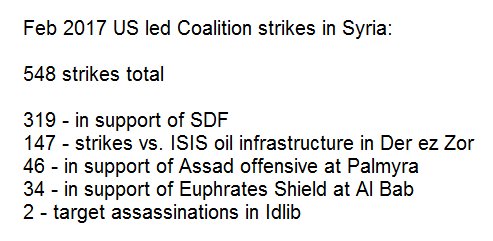
In September 2014, the US began bombing ISIS in Syria, and has been bombing them for 3.5 years, finally driving them almost completely from Syria late last year. However, the US also began bombing Nusra from Day One, and has since launched hundreds of strikes against Nusra. Nusra is a sectarian and reactionary organisation which the rebels will need to deal with in the time of their choosing, but is nothing remotely like ISIS, and is a little mouse compared to the genocidal Assad regime; and unlike ISIS, they are usually in areas adjacent to the rebel groups, so when the US bombs them, it effectively weakens the rebel front militarily against Assad. The rebels themselves often fight Nusra, in acts of resistance against their attempts to impose their reactionary program, and many liberated towns in rebel-held regions also resist Nusra encroachment. However, Nusra (unlike ISIS) focuses on fighting Assad, so when the US bombs Nusra, it is seen as an attack on the rebellion, and so it in fact boosts Nusra’s standing as a force seen to be resisting both Assad and US imperialism. Last March, the US bombed a mosque in Idlib, targeting Nusra, and killed 57 worshippers; this was just before the first ever US strike on the Assad regime, when it bombed a half-empty airbase in response to Assad’s use of chemical weapons; no civilians were killed in the strike on Assad. Yet the response of the fake western “anti-war” movement to the murderous strike on the mosque was, meh, whereas when Assad was struck for the first time ever, it rose up in horror. In any case, the US bombs have also struck mainstream Islamists and even the FSA many times.
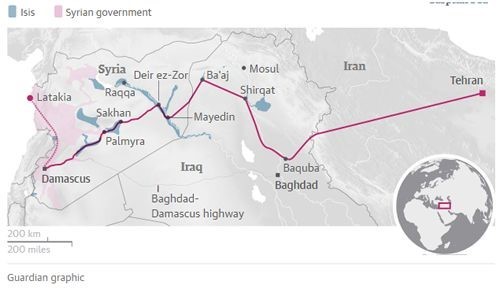
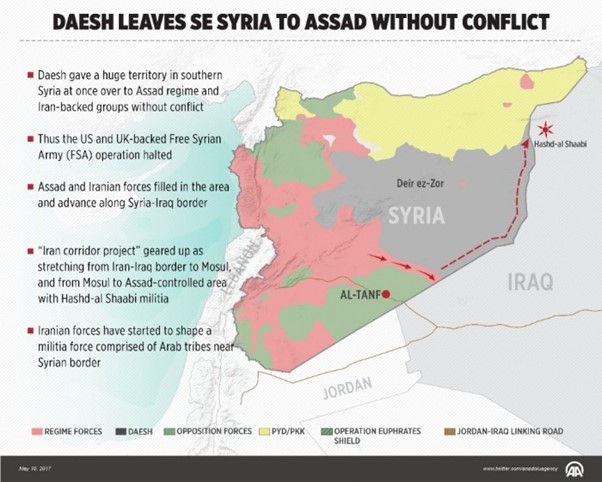
In fact, it was only after the US began bombing ISIS that the Assad regime also began bombing ISIS at all, in order to show it could be a partner of the US “war on terror” (officially Damascus welcomed the onset of US airstrikes); often enough they began bombing Raqqa, Deir Ezzor and other places in tandem. But it remained overwhelmingly a US war. It was only really in 2017 that Assad and Putin, having crushed rebel-held Aleppo, joined this US war on ISIS on a large scale, after the US had done most of the softening up. Assad has the US to thank for allowing him to re-take the east of the country from ISIS.
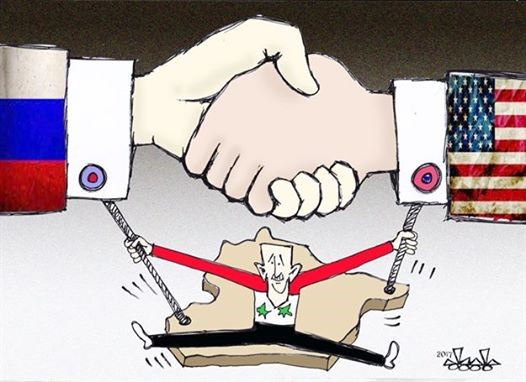
So, does the geopolitical take which you outlined (and I’m not blaming you for it – this is the simplistic way it is often presented in mainstream and “left” media) take into account that the US has actually been bombing Syria for years, just not bombing Assad, but rather bombing enemies (or in ISIS’ case, ‘frenemies’) of Assad, often enough in semi-alliance and at times in open coordination with Assad? Of course, the US war in eastern Syria has mostly been in alliance not so much with Assad directly (and never with the rebels), but overwhelmingly with the Kurdish-led YPG (ie, the PKK-connected Kurdish militia in Syria); the US chose them as a partner not out of love, but because the YPG prefers to only fight ISIS and not the Assad regime, which thus fits US policy perfectly. The US war on ISIS (and Nusra etc) has killed thousands of civilians, and destroyed 90% of the city of Raqqa, more or less completely. By contrast, this recent US strike on Assad’s chemical plants was over in an hour or so, killed zero civilians, and probably destroyed nothing much anyway, because Trump and Macron had tipped off their mate Putin who tipped off his mate Assad, days before, so the plants were almost certainly emptied (just like the airbase had been, that the US hit a year ago, after Assad’s chemical weapons attack last April). In short, the “anti”-war-o-sphere has been up in arms about this brief piece of elaborate theatre, warning about … “World War III”, while none of them ever had anything to say on the last 3.5 years of actual US war in Syria, including the slaughter of civilians, even the use of white phosphorus etc (needless to say it has had even less to say about the real war on Syria waged for years by Assad and Putin). That is not anti-war, or anti-imperialist, rather it is just pro-Assad, even those who do not claim to be. Otherwise, how can we explain this blatant contradiction?
So again, how can this overall US role fit with the geopolitics outlined above? Yes, the US is allied to Israel and to Saudi Arabia. So what? Yes, the Saudis used to support the Syrian opposition, for their own reasons; partly due to be their geopolitical-sectarian struggle for regional leadership with Iran; and partly because once Assad’s slaughter of mostly Sunni Syrians became a region-wide Nakbha, the supposed head of the Sunni Islamic world felt the need to take a stand or get swept aside by its Sunni jihadist enemies. However, it is unlikely that an absolute monarchy ever actually wanted a people’s victory over Assad (indeed, in the first 6 months of the uprising, the Saudi regime strongly supported Assad, as did Qatar and other Gulf monarchies); they wanted to pressure Assad to compromise, because his war on Syrians was causing massive destabilisation to the entire region. Since they launched their own bloody war on Yemen in 2015, however, the Saudis have shown far less enthusiasm for Syria, and over the last couple of years have essentially lost all interest in helping evict Assad, as is widely recognised.
But the Americans were much less enthusiastic than the Saudis even from the start (absurd leftist myths about “regime change” aside), and often held them back, sometimes blocking them from shipping any arms. Of course, the US also wanted some (milder) pressure on Assad to compromise (a little), and so their aims partly corresponded with Saudi aims; but the US’ main reason for doling out some arms with an eye-dropper to some select rebel groups was much more about co-opting them in order to divert them from fighting Assad into fighting ISIS only. Actually, it is not even clear how much the US has provided at all, despite the hype; for a time the issue was only what kind of arms and how much the US would allow the Saudis or Qatar to send and what and how much it blocked; when the US allowed the Saudis (or Qatar) to send more, that was often interpreted as US arms.
The main US role, apart from pushing rebels to quit fighting Assad in order to only fight ISIS, was to block, from 2012 till today, anyone – Saudis, Qatar, Turkey, former Libyan rebels, the black market – from sending defensive anti-aircraft weaponry to the rebels, in a war that has been, since 2012, overwhelmingly an air war. I’m not sure what one is to make of this elephant in the room – I see this as a much more decisive intervention than any other in the war, and I’m unsure why not many others see it the same way, including many anti-Assadists. Of course, anti-aircraft weapons are not a panacea to end all suffering, but the fundamental fact is that in the era of modern air-forces, it is very difficult for a revolution to resist; if the rebels had these decisive defensive weapons, it would not allow them to seize Damascus or any region where Assad has a support base, but it would allow the battle on the ground to be on a slightly more levelled playing field (the regime would still have overwhelming military superiority), without the overwhelming suffering caused to the rebels’ civilian base by Assad’s air-power.
We can romanticise the Vietnamese victory over US imperialism as much as we want, as long as we remember that at least when the Soviets were also doling out military “aid with an eye-dropper,” as we complained at the time, that at least the “eye-dropper” then allowed through decisive anti-aircraft weapons that the Vietnamese used to great effect, especially during Nixon’s horrific Christmas bombing of 1972, when the skies were filled with fireworks displays of exploding US warplanes.
As for Israel, it has never aided the rebels, and has since the outset adopted a rather standoffish, if not hostile stance towards them (and the rebels have never shown any interest in gaining Israeli support either, have always insisted that the Golan is Syrian, and rebel-held Syria erupted in anti-Trump demonstrations when he recognised Jerusalem as Israel’s “capital”). Israel prefers Assad keep power, but has been increasingly drawn in to attacking Iranian and Hezbollah targets in Syria. Of course, Iranian-backed forces and Hezbollah are major backers of the largely collapsed Syrian army; but Israel has tended to strike in a way narrowly focused on its own interests, taking on the nature of a parallel war. It has never targeted the regime or Iran or Hezbollah in the context of a battle with the rebels (and, to be fair, the rebels probably didn’t want it either); in fact, the one time Israel intervened directly in battle was in late 2017, near the Golan, when it prevented the rebels taking a town from the regime. After an Israeli strike on Iranian assets in January 2018 in central Syria, we saw the whole genocidal Assad bombing of Ghouta, killing 1700 people in 4 weeks, with “conventional” weapons of mass destruction rather than chemicals, and so there was not a peep out of Trump, the US, France, the UK etc, and neither was there another peep from Israel – this was of no concern at all. In fact, when Israel did just recently hit Iranian assets again in central Syria, it was after the end of the Ghouta battle, as if this bracketing of Assad’s decisive showdown with the Ghouta opposition, at both ends, was deliberately aimed at symbolising that this fight was of no concern to Israel at all, if not that it preferred Assad’s victory there.
This shows my problem with a discussion that says on one side is the US allied with Israel and Saudi Arabia and on the other is Russia and Iran allied to Assad!
Moreover, we should add that while Israel targets Iran, it has excellent relations with Assad’s other major backer, Russia, the imperialist state engaged in a massive air war against the Syrian people on behalf of the tyrant, much like the US in Vietnam or elsewhere. After Russia invaded, Putin and Netanyahu had so many high-level love fests that I lost count – Israel clearly saw the opportunity for Russia to replace Iran as Assad’s main backer; the reason this hasn’t (yet) come to pass is that Assad and Putin still need Iranian, and Iraqi and Afghan Shiite, and Hezbollah cannon fodder on the ground. Of course, Russia’s advanced anti-aircraft system that it provided to Assad and which it operates never downs Israeli warplanes that attack Iranian and Hezbollah targets, knowing full well that these strikes do little damage to Assad. And a major piece of US-Russian collaboration last year, involving Israel and Jordan, was the southwestern “de-confliction zone”, which while banning rebel moves against Damascus, also ensured that Iranian and allied forces were to be nowhere near the Golan (this obviously did not apply to Assad’s own forces).
Further to the geopolitical problem is that the US is also allied with the Egyptian dictatorship of al-Sisi, to Jordan, the United Arab Emirates, smaller Gulf sheikdoms like Bahrain, and to the Iraqi regime, which it installed via invasion and still provides massive military backing to. Yet Egypt, the UAE, Bahrain and Iraq are strongly pro-Assad, while Jordan has also been mending ties with the Assad regime had in any case cut off arms to the southern-based rebels in advance of Assad’s reconquest of the south in 2018.
To elaborate: Saudi Arabia helped overthrow the Muslim Brotherhood regime in Egypt in 2013; that regime had been supporting the Syrian uprising; despite the Saudis own support for the anti-Assad uprising, from the very start the new al-Sisi tyranny clearly identified Assad as a kindred-spirit, and sends not only arms but even fighter pilots to aid his regime. Egypt, Jordan and the UAE put out a joint statement when Russia began bombing Syria on behalf of Assad in 2015, welcoming the Russian intervention! Bahrain soon after put out its own statement welcoming Russia. By late 2018, the UAE and Jordan were the first Arab states to officially restore diplomatic relations with Assad, while Jordan also began signing border agreements with Assad; Egypt under Sisi had essentially retained relations anyway. So, Egypt, Jordan, UAE, Bahrain – the advance guard of Arab reaction reconciling with Assad; Egypt, Jordan, UAE, Bahrain – the advance guard reconciling with Israel, in much the same period. Coincidence? I think not. Contradiction? I think not. Different camps? I think we can see that that does not make sense here.
As for Iraq, the regime is a US-Iranian joint-venture, a gigantic hole in the geopolitical theory if ever there was one! The Iraqi regime has poured thousands, possibly tens of thousands, of Shiite sectarian militia into Syria to prop up Assad; if the US had not been actively arming the Iraqi regime and providing large scale military intervention to help it against ISIS, all those Iraqi forces would have been needed in Iraq. In a sense, the US directly aided the mass Iranian-Iraqi Shiite sectarian intervention in Syria.
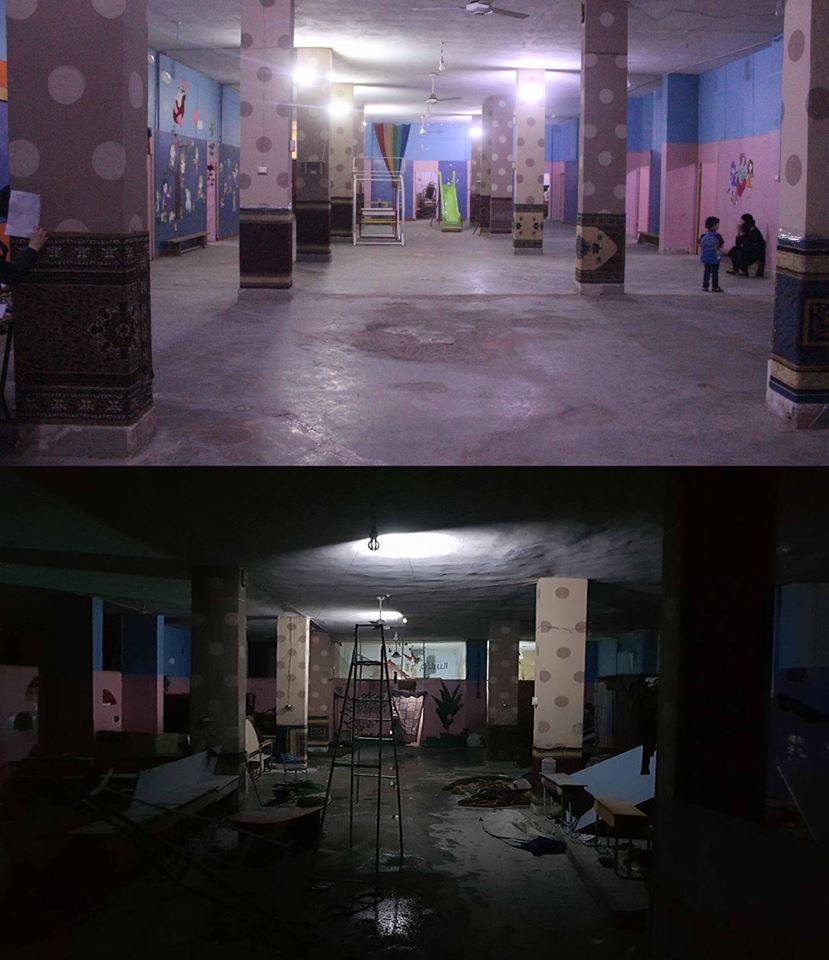
School basement used as underground bomb shelter, before and after bombed by Russian airforce on March 20 (Mohammed Abdullah)
By Michael Karadjis
In early April 2011, shortly after the start of the Syrian uprising on March 15, people poured into the streets in Ghouta, peacefully chanting “The people want the fall of the regime.” Watch this video, and see what happened next: this slaughter of peaceful protest throughout Syria continued for the next six months before some citizens began defending their protests with weapons, and some regime troops began to protect their brothers and sisters rather than kill them; thus was formed, organically from the struggle, the Free Syrian Army.
As the Assad regime, backed by Russian terror-bombing, today closes in on rebel-held East Ghouta, where 400,000 reside among the bombed-out ruins of this vast working-class district, it is important to consider what is at stake. As we will see, beyond the stick-figure style analysis in both the mainstream western media and, generally worse, in the woke “alternative” media, that speaks of a battle between the regime and “terrorists” or “militants” holding East Ghouta, the reality is that a powerful civil side to the revolution continues to exist, a Free Syrian Army also continues to exist alongside better-known Islamist brigades, and even the most odious of the Islamist brigades has been unable to completely dominate over the organs of the revolution, including the democratic local councils.
As we will see, what is at stake in the crushing of Ghouta are the hopes and dreams of millions of Syrians to live with basic freedoms without being saddled by one of the world’s most savage dictatorships.
The Assad-Putin Armageddon
Ghouta has been under horrific siege, with every conceivable weapon of mass destruction bar nuclear poured into the region, with an ongoing war against hospitals and medical centres, and with starvation used a key weapon, for some six years. However, the current offensive that began on February 18 is possibly the worst to date.
According to the Violations Documentation Centre (VDC), 1678 people were killed in East Ghouta in the four weeks between February 18 and March 17, of whom 91.4 percent were civilians, and 230 were children. By way of comparison, 1462 civilians were slaughtered by Israel in Gaza during the seven-week period of its ‘Operation Protective Edge’ massacre in 2014.
These horrendous figures are consistent with those of other monitoring bodies, for example, according to Doctors Without Borders (MSF):
“In the two weeks between the evening of 18 February to the evening of 3 March 2018, the medical data reveals 4,829 wounded and 1,005 dead – or 344 wounded and 71 dead per day. … Two of these facilities have yet to submit data for 3 March, so this is an underestimate. There are many other medical facilities in East Ghouta that are not supported by MSF, so the overall toll is significantly higher.”
If over 1000 killed in two weeks was an underestimate on March 3, by March 17 the MSF figures would be at least as high as those of the VDC, given death tolls of anything up to 100 on many days; for example, according to the Syrian Network for Human Rights, on March 7 alone, 93 were killed.
As much of the Ghouta population hides in underground shelters, the bloodthirsty Russian airforce is now using bunker-busters to penetrate these last havens. On March 20, the Russians bombed an underground school in Arbin, killing 15 children and two women. “They used a rocket which went through 3 floors & exploded in the basement.”
As Robin Yassin-Kassab wrote, rightly noting the whole world’s abandonment, and the loss of all humanity of the so-called “anti-imperialist” left:
“Do you remember how the American bombing of the Ameriyah shelter in Baghdad in 1991 became an image of imperialist evil? Today the Russians hit an underground school turned shelter in the Ghouta. Seventeen corpses have been pulled from the rubble so far. Almost all are women and children. At other times Assad drops chlorine – which is heavy and gathers in basements – to force the people up to the surface. Then Russia incinerates them with napalm. But none of these events will be fixed as images of imperialist evil. Nobody is even noticing.”
Mass starvation has been a weapon of this war since 2013. On 27 October 2017, the United Nations High Commissioner for Human Rights, Zeid Ra’ad Al Hussein, warned that “the deliberate starvation of civilians as a method of warfare constitutes a clear violation of international humanitarian law” and called for access of humanitarian workers to deliver aid to Ghouta. To date, however, the regime has barely allowed in any relief. The first 46-truck relief convoy that was allowed in on March 5 was stripped of 70 percent of its medical supplies by the regime, including trauma kits, surgical kits, insulin and other vital material, according to the World Health Organization.
As Mark Boothroyd writes, “the UN and World Food Programme (WFP) carried out over 257 air drops of food to Deir Ezzour, a regime controlled city in north eastern Syria that was besieged by ISIS from 2015-2017, yet the UN and WFP has carried out zero air drops” to any areas besieged by the regime, including Ghouta, despite the apocalyptic situation.
For those even remotely aware of this “outrageous, relentless mass casualty disaster” as MSF calls it, to continue providing horrific data would be redundant; only the most politically and morally corrupt are pretending otherwise in an effort to make an adversarial name for themselves. For good overall descriptions of the Ghouta conflict, the latest UN Human Rights Council report is a useful start; but the voices of those within Ghouta – for example here and here and here and here and here, or the many voices here, or this collection of voices from the wonderful Karam Foundation – provide a truly genuine account of the daily horror, a far better way of understanding the reality than listening to western-based conspiracist theorists and ritual apologists for murderous dictatorships.
At the same time, certain others who are well-aware of this tragedy draw an equals sign between “two sides” who both kill, focusing on some of the less savoury rebel groups in Ghouta. This article will show why this is an invalid way of looking at Ghouta.
Attacks out of Ghouta
Before moving on however, it is worth noting one valid point often made: the Ghouta rebels also sometimes kill civilians in regime-held Damascus by firing imprecise rockets into the city. According to the UN Human Rights Council report, the numbers killed by rebels in recent months is in the “dozens.” All killing of civilians, whether intentional or unintentional, should be vigorously condemned. Civilians, who include children, are not the enemy, are not responsible for the actions of regimes or of militias. In the spirit of the revolution for freedom against dictatorship, targeting civilians ought to be seen as not only morally wrong but also in fundamental conflict with that spirit.
Nonetheless, it is a hypocrisy of the tallest order when supporters of the Assad regime claim that their slaughter of thousands of civilians is in “defence” against the killing of some dozens by rebels. Chronologically it is sheer nonsense, given the years of siege, slaughter and starvation Ghouta has been subjected to; clearly these desperate acts of firing unguided rockets at Damascus are the misguided attempts at “defence” against the regime’s massacre. Even if the chronology were somewhat grey, it is sensational hypocrisy to accept the killing of thousands of civilians by an airforce and advanced weaponry as “defence” against the killing of dozens, but to not accept the reverse.
In all civil conflicts, civilians get killed on both sides. During Israel’s various Gaza massacres, for example, Hamas has similarly fired imprecise rockets into Israel which have sometimes killed civilians – at a similarly tiny rate compared to the civilians killed by Israel. In most cases of such desperate firing out of a besieged ghetto, supporters of human emancipation, while condemning any attack on civilians, do not put an equals sign between these acts and the systematic crimes of the massively armed oppressor. Not only are the numbers so vastly different, but it is this systematic mass violence that creates the overall atmosphere in which small-scale crimes from the side of the oppressed also take place. It is only in Syria that some who have always understood this have reversed their thinking and adopted “war on terror” justifications for mass killing.
“Terrorists” in Ghouta?
To listen to supporters of the regime, and their echo chamber in the western far-right and alt-left, Ghouta is full of “terrorists”, “al-Qaida” and “head-choppers.” Therefore, the regime has no choice but to bomb the region into oblivion.
Even many non-supporters of the regime buy into this grotesque propaganda. For example, in a recent exchange, I challenged a supporter of the Rojava Kurdish struggle on his assertion leftists “would be the first to be beheaded” if they were to enter Ghouta. Asking for a single instance of rebel beheading in Ghouta, his response was “Ghouta is full of all these al quaida [sic] and other headchopping organisations.”
On the one hand, even if there were a smidgeon of truth in this, it is difficult to see how anyone on the progressive side of politics could use this to justify this all-out slaughter of the civilian population. Surely this is the kind of argumentation that imperialist invaders and oppressive regimes have always used to justify slaughter. The Assadist justification for the slaughter in Ghouta is identical to the Zionist justification for the slaughter in Gaza, the American justification for Fallujah and elsewhere in Iraq, the Russian justification for Grozny, the Saudi justification for Yemen, the Turkish justification for its decades-long war on the Kurds in the east, and the list goes on.
This desire to justify the Assad regime by exaggerating the role of reactionary jihadists among the opposition also overlooks the detail that the Assad regime has slaughtered, gassed, starved, raped and tortured at a rate that leaves even the worst jihadists a very distant second. It is equivalent to defending the Nazi invasion of Greece in 1941 on the basis that Greece was then ruled by a dictatorship.
That said, there is no truth in these assertions whatsoever; the essentialist, racist labelling of a whole population as “head-choppers” is based on nothing other than prejudice.
The horrific practice of head-chopping is in fact an ISIS specialty; no rebel groups in Syria, not even the jihadist Jabhat al-Nusra/HTS, practice this method of killing. The only people who believe that ISIS is in Ghouta are those lacking the most elementary knowledge of the Syrian situation. When ISIS has come anywhere near Damascus, it has been decisively chased away by the Damascus rebels. This video, showing the way the Ghouta-based militia Jaysh al-Islam (JaI) deals with ISIS captives reveals a very brutal streak in JaI practice; even though the captives are ISIS, this action should be condemned. But it leaves no illusions that they have anything to do with ISIS.
The only other major force in Syria that practices beheading at times is the Assad regime, or otherwise similar acts such as cutting bodies into several pieces, but this is just run-of-the-mill activity for a regime which excels in horrific tortures and mutilations in its gulag.
If admitted that there is no ISIS, the accusation is that the Ghouta rebels are “al-Qaida”. By this they mean HTS, whose main component group, JFS, used to be Jabhat al-Nusra, then the Syrian branch of al-Qaida. JFS severed links with al-Qaida a year and a half ago, but remains a deeply reactionary, Sunni-sectarian organisation, which the rebels will need to deal with in their own time, such as when they do not need to fight for survival against an infinitely more murderous regime and invading imperialist powers.
In any case, no serious analyst believes there are more than a few hundred HTS fighters out of the twenty thousand or so fighters in Ghouta.
But even many of those who concede that the HTS presence is tiny note that one of the main rebel militia in Ghouta, Jaysh al-Islam (JaI), is just as bad. JaI certainly has a reactionary leadership, though it is a homegrown Islamist group with no links to global terrorism. But just who the other rebels are in East Ghouta, what the role of JaI is, how much power these rebel military formations have over the populations, who the civil resistance is, and what the term ‘revolution’ means in this context, are important questions if we want to go beyond a superficial analysis that says that “bad guys” run both sides of Damascus – as if the aim of the uprising were to place the JaI leader on the throne in Damascus.
Who are the rebels?
So, who are the rebel groups holding out in East Ghouta? There are two major rebel brigades, and a scattering of smaller groups. The two major forces are:
Jaysh al-Islam (‘Army of Islam’), a Salafist-led brigade formed in 2011 by Zahran Alloush, the son of a Saudi-based preacher, dominates the eastern-most region of East Ghouta, particularly the suburb of Douma. It is thought to have around 10,000 fighters or slightly higher. For a time Alloush specialised in very sectarian and anti-democratic language, but in the period before he was assassinated by a Russian airstrike, he had moderated much of this. JaI also engages in repressive practices against opposition. The famous Douma Four revolutionary activists – Razan Zeitouneh, Samira Al-Khalil, Wael Hammadeh and Nazem Hammadi – were kidnapped in late 2013 and have not been heard from since. Family and friends believe JaI was responsible; it denies the charge, but evidence strongly points towards its responsibility.
JaI’s unsavoury character is often cited not only by those justifying Assadist genocide against the Ghouta population, but also by many who condemn the regime’s slaughter of civilians. They say the presence of this militia indicates that we are not dealing with any revolutionary process in Ghouta; it is just a sectarian war where one side happens to be in a far more powerful position to carry out its murderous designs than the other. This omits the broader question of the relationship between these militias and the civil opposition and the people in a revolutionary situation, which will be examined below; but even on the level of armed militias, it leaves out the other most powerful brigade in Ghouta:
Faylaq al-Rahman (‘Rahman Brigade’), a large FSA military coalition, dominates the western side of Ghouta, closer to regime-held Syria, with some 8-9000 troops. FaR has clashed with JaI numerous times in the last few years, usually due to the latter’s attempts to dominate the region. Most of the big battles against the regime over the last year and a half have been led by FaR, including the big battles linking Jobar and Qaboun early last year, and in Harasta late last year. FaR is led by SAA defector Captain Abd al-Nasr Shmeir, who claims to be fighting for a non-sectarian future for Syria, stating he defected from the SAA in order to protect the people and “because he seeks a Syria that does not serve one sect.” FaR advocates a civil, democratic state.
It was formed in November 2013, as a fusion of several FSA brigades, including Shmeir’s original Liwa al-Bara, consisting of defecting SAA troops in Douma; then the FSA 1st Brigade based in Qaboun and Tishren districts, and the soft-Islamist Ajnad al-Sham Islamic Union, both fused into FaR in 2016. The latter was itself formed in November 2013, from five Islamist brigades, on the basis of a more moderate interpretation of Islam in line with traditional Damascene Islam, as an explicit rejection of JaI’s increasingly hard-line stance; Ajnad al-Sham makes explicit its goal of protecting minorities.
While JaI’s sectarian stance is often highlighted, neither the mainstream nor the woke “alternative” media note the opposite stances of the other major armed brigade in Ghouta. During last year’s offensive in Jobar and Qaboun, the FSA, and Faylaq al-Rahman itself, released statements declaring their commitment to “all laws of war”, specifically, avoiding civilians “of all religions and sects”, avoiding touching any places of worship or their “symbols” with “direct or indirect fire”, fair treatment of prisoners and the bodies of the dead “without insulting or abusing them” and working to secure and protect “medical personnel, civil defense crews and all humanitarian aid and media groups.”
Two minor brigades are the local branches of Ahrar al-Sham, which controls the suburb of Harasta and has about 1000 fighters, and of HTS, which has several hundred fighters. Ahrar al-Sham fought alongside FaR in the big battles against the regime last year, when JaI was little involved. HTS has been in conflict with both JaI and FaR.
In response to the spurious attempt to justify this latest massacre on an “al-Qaida” presence, Jaish al-Islam, Faylaq al-Rahman and Ahrar al-Sham offered to expel HTS’s small presence there, evacuating them within 15 days, in exchange for full implementation of the UNSC’s ceasefire resolution, a full end to bombing and full access to humanitarian aid. FaR spokesperson, Wael Olwan, last year offered to expel HTS to Idlib, but claims “the Russians did not let the evacuation happen.”
The question of arms and alleged foreign support
In the Assadist disinformation war, a common piece of discourse states that in Ghouta Assad is fighting a “US- and Saudi-armed terrorist insurgency at the gates of the capital,” often padded out with ironic statements calling JaI “moderate rebels.” Since those defending this genocide have no argument, they rely on such complete red-herrings.
The US has never provided arms to the Damascus brigades, and especially not to Jaysh al-Islam. The assertion of any US arming is just a bald-faced lie. Nor has the US, or any western government or media ever referred to JaI as “moderate” rebels, a label only ever used to refer to non-Islamist groups dedicated to a civil state (JaI’s main rival, the FSA Faylaq al-Rahman, could very deservedly be awarded this title). indeed US Defence Secretary John Kerry even referred to JaI (and Ahrar al-Sham) as “terrorist” groups. These Assadist attempts at irony are therefore simply stupid.
According to the pro-opposition news site Qasioun, the US recently warned the FSA Southern Front against attempting to end its ceasefire with the regime to help Ghouta. For anyone who understands why the once mighty Southern Front, with its 35,000 fighters, has effectively been at peace with the regime for two years, this should come as no surprise. It is well-known that the US imposed a number of “red-lines” on the Southern Front back in 2015, one of which was not to advance towards Damascus (one source even claimed the US threatened them with airstrikes if they did); soon after, all supplies to the Southern Front from regional states through the Jordan-based Military Operations Centre (MOC) dried up. The SF was informed that the US would only allow these (mainly the Saudis) to continue sending arms via the MOC if they fought ISIS only, and specifically not the regime (full details here).
Given the geographic isolation of the Damascus suburbs, the prevention of the SF – whose Daraa-based territories border on Jordan – from linking up with them could hardly be more counterrevolutionary; in late 2016, this led to the fall of the iconic revolutionary centres in south-west Damascus, Darayya and Moadamiya.
Trump could hardly make things clearer in any case, announcing in March, in the middle of one of the worst Assadist sieges in the war, that the only US interest in Syria is “to get rid of ISIS, and to go home.”
The question of Saudi support is more complex. Media reports often refer to JaI as “Saudi-backed” (and of FaR as “Qatari-backed) as a matter of course; a discerning reader would notice the complete absence of any attempt to back up these assertions with a shred of evidence. A google search on Saudi support to JaI will turn up a number of articles, all of which were from around October 2013. Even these articles provide precious little evidence of Saudi arms; rather, they claim that the conversion of Alloush’s former Liwa al-Islam (Islam Brigade) into Jaysh al-Islam (Islam Army) was a Saudi-backed manoeuvre attempting to curb the growing influence of the extremely anti-Saudi Jabhat al-Nusra.
JaI denies ever receiving Saudi weapons. In 2016, JaI spokesman Captain Islam Alloush, stated that “we in Jaish al-Islam have not received any Saudi military or logistic support. As far as we know, Saudi Arabia is involved in military support only through the international cooperation rooms, which in turn do not support Jaysh al-Islam.” “International cooperation rooms” means the MOC; it is true that Saudi support has gone through the MOC, and that the MOC has only ever armed the Southern Front (and even this has often been blocked by the US), and never sent anything to JaI. If there has been any Saudi support beyond the MOC, it has left no trails. In any case, JaI, despite its change to a more grandiose name, remains almost entirely based in Ghouta, which is encircled; the Saudis would need to fly in weapons to arm JaI.
It is also worth noting that, despite the common association with Saudi Arabia, largely due to the fact that Zahran Alloush’s father is a Saudi-based preacher, JaI and the Saudis have often been sharply at odds politically.[1]
Where then does JaI get its arms? In fact, apart from arms seizures from battle, both JaI and FaR have the advantage of operating in heavily industrial Ghouta, full of little workshops, where they have become very proficient at making the largely primitive arms they overwhelmingly possess, giving them a degree of independence of foreign backers. On the other hand, JaI’s power has almost certainly been boosted by finance from the Gulf, from mostly private Islamist sources in Saudi Arabia or Kuwait, rather than any regime.
Class and the uprising in the Damascus ‘suburbs’
If the above sketch of the armed formations shows that that they are not all Jaysh al-Islam, or not even all Islamist, nevertheless a major Islamist component of the uprising exists in Ghouta, as elsewhere in Syria. For many western observers, it seems that Islamists come from Mars, or from anywhere but Syria; or at least it indicates the influence of Saudi Arabia, Qatar, or Gulf-based Islamist networks. While some of these factors have had influence, these explanations avoid the most important place to look for a powerful, if relatively moderate, Islamist component to the uprising, armed and unarmed: Syria.
The “Damascus suburbs” which ring the east and south of the city – East Ghouta, including Douma, Harasta, Hamouriya, Saqba, Zamalka, Jobar, and further south towns such as Moadamiya and Darayya – have been major sites of the Syrian revolution from the beginning, under full control of opposition councils since 2012.
While the revolution always had a strong component of students, teachers, intellectuals, artists and other urban-based middle-class activists, alongside a heavily rural- and poor provincial-based uprising, the real motor was where the urban and rural worlds of Syria intersect: in the newer working class and poor suburbs and shanty-towns surrounding Damascus (and in east Aleppo city, crushed by Assad a year ago after five years under opposition control), composed of hundreds of thousands of relatively recent rural immigrants from the countryside.
Bashar Assad’s neo-liberalisation of the economy in the last decade before 2011 brought the political demand for democracy and the economic issues of the poor together to form a highly combustible revolutionary mix. As these policies facilitated the growth of an “obscenely wealthy and atrociously brutal neo-bourgeoisie,” according to Syrian intellectual and former political prisoner Yassin al-Haj Saleh, especially around the Assad family and its cronies, like Assad’s cousin Rami Makhlouf who controls some 60% of the economy through his holding companies, at the other end they impoverished the already poor. From the countryside – where peasants had benefited from the Baathist land reforms of the early 1960s – a vast human wave of poor peasants uprooted by these policies fled to the outskirts of the big cities and formed these vast semi-urban, semi-rural slums and shantytowns.
The class divide between regime and revolution was striking in both Damascus and Aleppo. Qadri Jamil, a former minister in Assad’s government who was one of his left window-dressers until sacked in 2013, claims to have long believed that Assad’s economic liberalisation would “lead to a social explosion,” noting it had left “44 percent of Syrians in poverty, and raised unemployment levels to 20 percent.” These policies, he claims, “destroyed local producers in places like the Damascus suburbs of Zamalka, Harasta and Douma — now centers of opposition” — while enriching the new elite. “All those towns whose names we are hearing now are similar to Detroit in America, so how one cannot expect to have resentments in their circles?”
By contrast, the central Damascus bourgeoisie and upper middle classes are of course the base of the Assadist regime – though countless others in central Damascus who don’t entirely belong to either “world” chafe under the totalitarian rule of the regime, including many with secret sympathies for the people of Ghouta, because that is the only place to be safe from Assad’s bombs, missiles, napalm, poison gas and starvation siege.
The division in Aleppo between regime and former opposition-controlled regions was a similar study in sociology. As a Syrian exile wrote who returned to her city:
“Aleppo today is cut in two distinct halves, as was Beirut. Whereas Beirut was divided along confessional lines, social classes separate the two Aleppos. In the East the Free Syrian Army rules over the poor, working-class neighbourhoods; in the West the regime controls the middle class and bourgeois parts of town.”
Islam, Class and Revolution
How does this relate to the question of Islam? Basically, at least some degree of ‘Islamism’ simply represents the traditional conservatism of the countryside and its reflection among the rural immigrants living in the regions ringing the cities. They were never “secular” in the sense of the Assadist elite; official state “secularism”, and the relatively middle-class lifestyle that went with it, was limited by the savage class structure of Assadist Syria. So while Qatar and Turkey tended to support many soft-Islamist brigades (though also FSA brigades) via their Muslim Brotherhood networks, it is important to understand that a certain level of mild political Islam was always going to be part of the mix, just as it is in Palestine with Hamas, in Iraq during the resistance to US occupation, and throughout the Middle East.
To help us understand this, this video shows us a protest by 500 women in Douma, all in veils, protesting when Assad’s security forces detained and tortured children and teenagers early in 2011. Many of these women had never before left their houses alone, but came out into the streets to demand their release. One of them explained (see video at 19.04 – 20.20):
“Sometimes I feel like a man working among men. There’s no more differentiation between men and women in Douma. On the contrary. Men now let women take care of the injured because they know better how to deal with them.”
While this may seem little from the perspective of western feminism, for the traditional Muslim women involved this was an important step; unless we understand the movement of real people where they are at, western observers are merely playing with concepts of “revolution,” or for that matter, women’s liberation.
These are the ordinary people who made the revolution. As Sam Hamad puts it: “Syrians are bearded Muslims. They are hijab-wearing women. They are in general quite poor and haven’t had access to western-style education. They aren’t all liberals and photogenic Good Arabs. Sorry. This belief obscures everything and reflects an internalised racism and Islamophobia. For the majority of the population, like Egyptians or Jordanians or Tunisians etc., their default point of orientation in life, coexisting with other points of belief, is their faith.”
Now, all that said, this does not entirely explain the presence of a particularly odious character in the form of Zahran Alloush, the late leader of Jaysh al-Islam. Some of these Islamist formations are strikingly moderate and committed to a civil state, while others are more hard-line, and JaI, though furiously anti-ISIS, is generally seen as on the hard-line end. But here’s where conjunctural factors come in. JaI was not set up as a cadre-based ‘jihadist’ group like Nusra (or even Ahrar al-Sham in its early years), with chapters all over the country dedicated to a particular system of thought; rather, it arose as a genuine anti-dictatorship movement based in the traditionalist working class region of Douma. One reason it ended up with someone like Alloush at its head was that Assad released Alloush, along with 1000 other jihadists, from his dungeons in mid-2011, at the very time he was arresting and jailing thousands of democratic activists, including from Douma. The vacuum of leadership created by Assad’s mass arrests and tortures was taken up by people like Alloush, who also had connections among Gulf Islamist circles.
Moreover, just as the most traditionalist areas tended be more ‘Islamist’, after the war began the most devastated areas were going to tend towards radicalisation. As a Palestinian friend in Sydney put it, this is the same reason Hamas is in Gaza, whereas Fatah is in relatively more comfortable (by occupation standards) in Ramallah; in similar vein, JaI arose in Douma, a kind of Syrian Gaza, except where Assad’s version of Israel’s ‘Operation Protective Edge’ goes on for years instead of weeks, an obvious breeding ground for more radical politics. While the current siege reaches cataclysmic proportions, mass killing and starvation has been the staple all along; for example, regime shelling killed 250 people in Douma in February 2015 alone, then on just one day, March 15, 83 were killed; in virtually any period over these years similar figures could be pulled out. As Gaza shows, reducing a slum to smashed up ruins tends to strengthen “Islamist” forces or anyone who can offer either “radical” action, or God, as some kind of alternative when the entire world has abandoned you.
The question of Jaysh al-Islam’s sectarianism
More significant than the extent of JaI’s ‘radical’ evolution was the vocal sectarianism of its leadership. Alloush made his most famous sectarian rant, promising to “cleanse” Damascus of Shiites and Alawites, in September 2013. More than any other speech or action in Syria outside the realms of Jabhat al-Nusra, this particular speech, coming from an Islamist with generally friendly relations to the mainstream opposition, was of almost decisive importance in helping cement the sectarian divide that Assad had deliberately and cunningly created; most Alawites who may have been hedging their bets, especially in the Damascus region, would likely have resigned themselves to putting up with Assad.
Alloush made this speech soon after the most devastating event Ghouta has suffered: Assad’s sarin massacre in August that year, just weeks earlier, which killed 1400 people, above all children, in various suburbs throughout Ghouta. While this hardly justifies a speech that virtually re-labels the democratic struggle as a sectarian war, context is hardly irrelevant: where a people are being literally smashed to pieces and starved to death by an Alawite-dominated military, which then uses chemical weapons and is granted licence by the world, the emergence of anti-Alawi sectarianism is surely no mystery. This was made worse a few months earlier, with the mass entry of Hezbollah into the war on Assad’s side, when this Lebanese Shiite-communalist militia played the decisive role in besieging, conquering, destroying and “cleansing” the strategic rebel-held Sunni town of Qaysar, in June 2013. Alloush’s appalling statements reflected a rise in Sunni sectarianism in the context of this onset of the invasion by the Shiite-sectarian international, of Nasrallah’s sectarian war.
A year and a half later, however, Alloush publicly retracted these views. Regarding co-existence with minorities, he said this has always been the situation in Syria, and “we are not seeking to impose our power on minorities, or to practice oppression against them”, including the Alawites who are “part of the Syrian people.” Alloush claimed his earlier statements were due to the pressure he lived under in Ghouta: “We are under siege. We all suffer psychological stress. When I was in prison and the jailer would come and torture prisoners, after he would leave prisoners would quarrel and beat each other.” Regarding democracy, which he had previously denounced, he claimed that if they succeed in toppling the regime, “we will leave it to the people to choose what form of state it wants.” In another interview later in 2015, he again said that Alawites “are not our enemy, they are victims of the regime.”
Of course, the damage had already been done, given that the damage was political, not that Alloush’s loud noises from the ghetto ever had any reality. We also have no way of knowing if this reincarnation was genuine. But the issue is not the personal honesty or otherwise of one individual, now dead; even when he was alive, the issue posed was never of Alloush taking Assad’s place on the throne. Nor was it ever an issue of JaI having the military capability to overrun central Damascus, still less the distant Alawite coast, to be able to carry out Alloush’s threats; to harbour such fantasies would be equivalent to imagining that Hamas may one day win a military struggle with Israel and rule over Jews in Tel Aviv.
Rather, the issue is that, regardless of the reason for this change, JaI was never Nusra, ie, was never a militia whose existence was defined by an ultra-sectarian ideology. As a vehicle for the local people to resist Assad’s attacks with arms, carrying out a sectarian war on Alawites had nothing to do with the reasons thousands joined the group. As one civil activist in Douma, hostile to JaI, explained: “All the young people join Jaysh el-Islam. This is not out of ideological belief or because they like Alloush, but because they need to fight and not wait around. Two years ago, we went from a partial siege to a total siege. The bombardments come from the heights of Ghouta Valley, and these missiles condition our daily life. The fighters are not all Salafists, or, rather, they are Salafists by circumstance.” As such, an idiosyncratic leader could flip this way or that without it changing much on the ground.
Jaysh al-Islam, repression and civil resistance
Actually, JaI is more a danger to the local Sunni population and the democratic revolutionaries of Ghouta than to out-of-touch Alawites; the disappearance of the Douma Four revolutionaries is a good example. Yet it should not be forgotten that before disappearing, these four were leaders of the fight against the Assad regime; whatever they may have thought of JaI, it already held the same powerful position in parts of Ghouta that it does today (indeed, the Violations Documentation Centre, which they had set up, was not shy about also reporting rebel violations). Moreover, since their disappearance, thousands of other democratic revolutionaries still continue to operate in various ways (as we will show below), including those who consider themselves the continuers of their work, often called the “Razan Zeitouneh network,” around the Local Coordinating Committee they had built, including the Violations Documentation Centre, the Douma Women’s Protection Centre and various health and educational activities. One such activist, named Hani, notes that the armed brigades cannot override Ghouta’s social dynamics: “… the women in the Razan network don’t give up. These types [eg, Alloush] are the new local despots. But they are not Bashar’s murderous forces.”
JaI, in other words, may often try to use repressive means, but it is limited by the very revolution all around it of which it is part, however deformed. Even JaI’s denial that it was involved in the disappearance of the four activists, and the secretive nature of the entire episode, reflects the fact that association with crimes against such outstanding revolutionaries would be met with rejection among the revolutionary masses. A comparison with the Assad regime’s practice of returning tortured and mutilated corpses of relatives, even children, to families following time in its dungeons is indicative of the contrast; the regime’s aim is precisely to terrorise, seeing, quite rightly, the mass of people as its enemies.
As a result, we have continually seen large demonstrations in Ghouta against JaI, and in the majority of cases, JaI forces do not attempt to repress them, though there certainly have been exceptions; and people also protest these attempts at repression. At times, JaI has also faced demonstrations against high prices caused by its alleged corruption and profiteering, such as the “hunger demonstrations” of late 2014. At this time, Douma residents also attacked the storage units of merchants who dominate the local food distribution business, and they identified Jaysh Islam with these merchants, in a particularly notable example of both the class nature of such “Islamist” leaderships and of the kind of “uninterrupted” revolutionary struggle that could result if the regime is ejected and the people are not dependent on the armed groups for elementary protection against the greater enemy. At the time, JaI guards did fire live ammunition at the rioters, but they fired back, and Ghouta’s Unified Judicial Council issued a statement warning against these JaI-backed “monopolists,” calling them “blood dealers” and partners of the regime in the siege on Ghouta. The council gave them a week to put the goods on the market at their previous prices. When someone then attempted to poison council members, the council made no bones about pointing the finger at JaI.
This back and forth between the dominant armed group, the people in the streets, and the Ghouta local council reveals a dynamic different to that pictured not only by enemies of the revolution, but also by some of its well-intentioned supporters, who condemn Assad’s slaughter of civilians but tend to see the Islamist hijacking of the revolution as a completed dead end. The reality of Ghouta is far greater than that of the armed groups that arose to defend it.
Ironically, this complexity has even been shown at times of some of JaI’s worst actions. On November 1, 2015, following a period of some of the most horrific bombing of the entire war, JaI attempted to force a pause in the bombing by publicly parading SAA prisoners of war, and their civilian wives and adult family members, in cages atop the backs of trucks, which were placed in public streets and squares in the city.
This followed an October 30 regime bombing of Douma, which killed at least 70 people and wounded 550, a mere spike within the daily slaughter. Earlier, on August 16, 112 were killed in the one day, again with some 550 wounded civilians, 40 percent of them children. The desire to do anything to protect local civilians form this daily devastation is more than understandable; the hypocrisy of those who condemn JaI’s action but not the regime’s mass killing, is beyond words available in the English language. That said, the use of prisoners in such a demeaning way – especially the civilians – was condemned by almost all pro-revolution activists, and organisations, and by most of the very people of Douma being battered by regime airstrikes.
According to the news site Syria Deeply, while opinions in Ghouta “varied drastically,” everyone they spoke to “agreed that the women and children should be immediately released ‘because Jaish al-Islam shouldn’t act like the regime’.” Moreover, “all of the sources” they spoke with “confirmed that cages were paraded around the city for two hours, before residents of the city convinced Jaish al-Islam militants to return the captives to their standard holdings.”
Needless to say, the damage had been done, with global focus on “caging people” rather than slaughtering them, and the revolution seen to demean itself as it demeaned civilians, but the point here is not to defend JaI; rather, to note again that its susceptibility to popular pressure.
This dynamic was revealed in an even more significant way in March 2017, when Jaysh al-Islam closed the ‘Rising for Freedom‘ Magazine, after some protestors stormed its office when it published an article which they deemed “blasphemous.” Taking advantage of this situation, JaI also banned five other local NGOs, none of which were connected to the magazine, including the Violations Documentation Center,The Day After: Supporting a Democratic Transition in Syria, Local Development and Small-Projects Support, and the Hurras Network for Child Protection, while even the LCC was allegedly ordered to cease operations. Eleven other local organisations joined the five in condemning the crackdown.
While this may have looked like the end of local democracy, several days later the judicial committee of Douma ordered the re-opening of all five organisations. Unfortunately, it maintained the closure of the magazine pending the court hearing, but protestors prevented the arrest of magazine staff. To compare JaI’s rule to Assad’s on the basis of this unsuccessful attempt to ban these organisations would be inherently self-defeating, since no such organisations would be allowed to exist in the first place under the Assad regime; their leaders would be in Assad’s torture archipelago.
The episode once again indicated the very complex nature of the relationship between armed militias formed out of crisis response to regime terror, the ongoing civil side of the uprising and its elected bodies, and the local population itself. At this point, it would be worth reviewing the main aspects of this civil resistance.
Elected Local Councils and Civil Opposition in Ghouta
Douma’s revolutionary democratic council was one of the earliest to rise to the task of running the region free of the Assadist regime, when the latter withdrew in October 2012. The Douma council has 19 offices, dealing with “water and electricity, health and education, agriculture, legal affairs, civil records, sanitation, subsidies, women’s affairs, employment, media and the cemetery.” After JaI took control of religious affairs in November 2014, it tried to also take control of the council, but soon gave up. “They knew they would fail if they put their sheikhs in charge,” says Taha, a then council member, who says most of the council’s members “are technocrats: engineers, lawyers, members of civil society.”
The council also became the location for the headquarters of the National Assembly of the Forces of the Revolution in East Ghouta, “a broad movement of political activists, civilians and rebels from 58 urban centres in the area with the purpose of creating a unified council for the entire East Ghouta region.”
While the council was originally formed by local consensus, given the difficulties of holding elections in a war-zone and the necessity of immediate administration, this gave way to elections which have become more democratic over time. A Supervisory Electoral Commission created by the National Assembly organised council elections in January 2014, electing 25 council members. These first elections were from general assemblies of the local communities, with some 26 local councils across Ghouta operating. The next step was to move on to full popular elections by secret ballot. The first such election took place in Arbin district in January 2016, followed by similar elections in Douma, al-Malihah, al-Abbadeh and Saqba during 2017.
According to the elected president of the local Saqba council, Mr. Yasser Obeed, election officials “were keen to ensure the necessary environment for voters, such as secret rooms and the prevention of outside influences that might change voters’ opinions. In addition, the stages of the elections were subject to oversight from the ballot, to the counting of votes, and to the final statistical process.” According to Robin Yassin-Kassab, in the Ghouta elections, militia leaders were not allowed to stand, though fighters were, but none were elected.
The 2017 elections were also notable for the participation of women. “For the first time since the start of the revolution, female candidates formed coalitions, fund-raised and campaigned among the people,” resulting in the nomination of 14 women for the educational, medical, economic and engineering sectors.
This participation of women, despite the presence of Salafist militias like JaI, was helped along by the widespread activities of civil society. “During 2016 and 2017, a number of activities were carried out in the city of Douma to empower women in the fields of education and work. This included activities by The Day After organization, which held forums and lectures on political diversity for women,” despite the site of the activities sometimes being subject to attack and the organisers being beaten. Another organisation, Women Now for Development, which provides opportunities for women to work on their own projects,” also conducted workshops on women’s rights which they believe contributed to increased women’s participation in the elections. Indeed, given the anti-woman politics of most Islamist groups, the large-scale participation of women in organsing the anti-Assad resistance in East Ghouta is outstanding.
Some 70 civil society organizations operate in East Ghouta, in sectors “including women empowerment, child care and protection, relief, skills training, advocacy, associative action, etc,” a part of the revolution related to, but separate from, the councils. These organisations are related to the entire network of civil society built up by people like Razan Zeitouneh around the Local Coordination Committees (LCC), which also organise anti-regime demonstrations and disseminate information about the revolution. At the Douma Women’s Protection Center, which she founded, over 300 women regularly distribute survival baskets; a member of the network named Madj recounts being involved in the creation of seven educational centers, which serve 200 to 250 children. These are just a few of the great range of activities taking place in Free Ghouta, despite the almost impossible situation of endless mass killing by the regime.
In the midst of this furious slaughter today, civil society organizations, activists, and leaders released a statement on March 18 demanding the UN and international community take action to save lives in Ghouta, to protect civil and humanitarian agencies and for the civil bloc to be included as a negotiating party. These people have stayed to the end. They are not staying to protect JaI, or because JaI is “using them as human shields”, the accusation used by every imperialist and oppressor regime as it rains death on civilians. On the contrary, the only reason the civilian population has put up with the likes of JaI is due to the desperate needs of defence against the tyrannical regime, but the civil society bloc speaks with its own voice.
A momentary aside in Idlib …
Before concluding, it is important to note that all the same caveats about the relationship between armed militias (whether HTS, Islamist or FSA), civil uprising and councils, and the revolutionary people applies to the other large region still under the control of the revolution, Idlib province and neighbouring parts of south and west Aleppo and northern Hama – also under devastating attack earlier this year. And that is despite the larger role played there by HTS, and its anti-democratic practices, including kidnappings, killings and torture of other oppositionists.
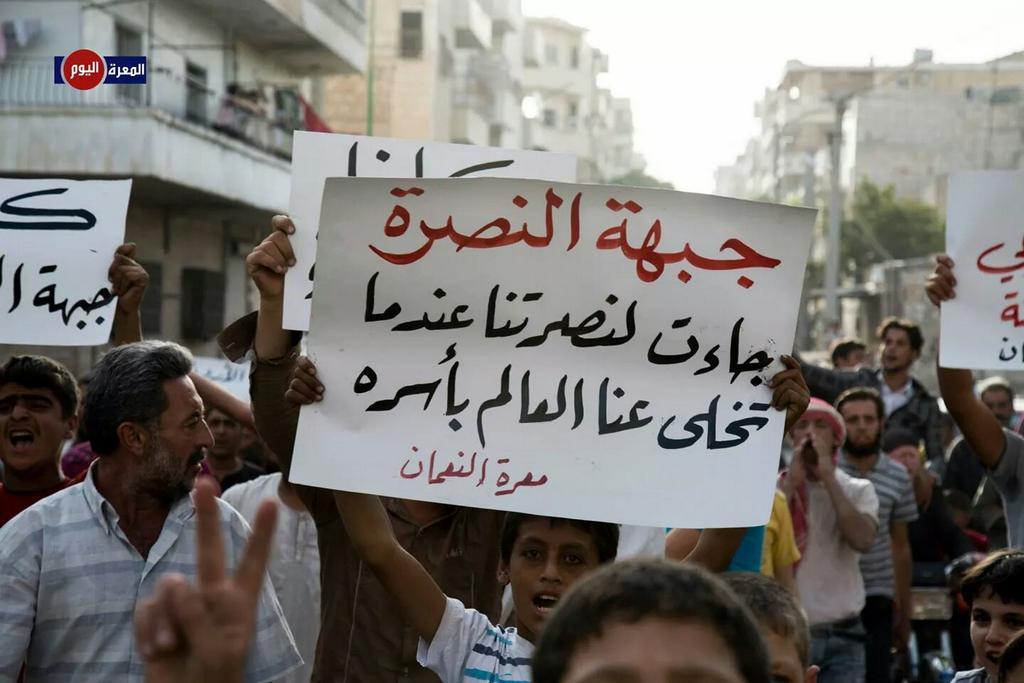
In fact, revolution-held towns such as Maraat al-Nuuman, Saraqeb, Karanbel, Atareb and others have continually resisted encroachment by HTS (and precisely such towns have been continually bombed by Assad and Russia). Meanwhile, local council elections were held in Idlib in early 2017 despite the HTS presence; and by this time, HTS rule itself had softened notably, including in terms of social restrictions, under the impact of popular pressure. In mid-2017, however, HTS was able to defeat its main rival, Ahrar al-Sham, but this had more to do with many town councils and FSA brigades not seeing Ahrar as their representative, and making separate deals for HTS to keep away; and some of this may have been due to lost credibility when Ahrar did not take part in the spring offensive against the regime in Hama (which both HTS and FSA brigades led), in turn related to Ahrar’s dependence on Turkey and the new geopolitical game Erdogan was playing with Putin. However, as this very victory then encouraged HTS’s tendency to act oppressively, the people continued to resist it in a great variety of ways; and their demonstrations are generally tolerated by HTS. Moreover, with a new offensive led by Ahrar al-Sham against HTS in early 2018, local people, regardless of their views on Ahrar, have seized the opportunity to throw off HTS rule; it has been driven out of some 30 towns across the province.
Once again, therefore, the defence of Greater Idlib against Assad must not be seen as a defence of HTS, or of the armed brigades in general, but of the people’s revolution.
The loss of Ghouta: A huge loss to democratic prospects
Therefore, Assad’s likely military crushing of Ghouta will represent a massive blow against the democratic aspirations of Syrians trying to resist the full re-imposition of tyranny; the stakes are far bigger than the defeat of some Islamist militia.
But the stakes are bigger also than the survival of Ghouta itself. One propaganda device of the pro-Assad camp is to depict this struggle as a defence of the people of central Damascus, and the Alawites of the even more distant Mediterranean coast, from being overrun by armed Ghouta-based brigades like JaI. Apart from the reality of defence being the other way around, the problem with this is that it depicts all-or-nothing military victory by one side or another to be the issue, a flagrantly dishonest portrayal of the struggle.
At least since 2012-13, no serious observer has considered a sweeping military victory of the armed opposition even remotely likely; as stated above, the likelihood of JaI “coming to power” in Damascus, given military realities, is equivalent to that of Hamas “coming to power” in Tel Aviv. What then is the military struggle about, apart from the obvious desire of people in rebel-held pockets to not be ruled by Assad?
For Assad to be overthrown by a full-scale revolutionary uprising, armed or unarmed, would have required the armed and unarmed opposition to have had the political capacity to win a decisive part of the Alawite minority away from the regime, to the perspective of a democratic, non-sectarian revolutionary solution. Despite the democratic and anti-sectarian slogans of the early uprising, Assad’s militarisation of the revolution inevitably led to deepening sectarian fissures among the people; bloodshed has that effect, even aside from the fact that Assad’s massacres also had a deliberate sectarian nature. The rise of organisations such as Nusra, and vile statements such as those of Alloush in 2013, closed the immediate possibility of such a united, nation-wide insurrection against Assad. While civil oppositionists, FSA brigades and the exile-based opposition leadership continued to issue democratic and anti-sectarian statements, this would have needed to be daily shouted from the rooftops to counter the actual trends that had taken hold due to Assad’s war.
This left two possible ways of ending the conflict: military or political. But Assad plunged the country into military conflict not only to poison the political atmosphere, but also because as long as the struggle was purely military, his regime could not lose: the regime’s overwhelming military superiority could never be broken. Even if the West and regional states had properly armed the FSA – for example with the needed anti-aircraft weapons that in fact the US went out of its way to block – that would not have resulted in military parity; it would simply have allowed the rebels to hold onto their own territory without all this civilian slaughter, and to advance into areas where they had a natural support base (eg more of Daraa, Hama and Homs provinces); anti-air weapons would not have helped the rebels conquer regions where the regime had its support base, such as central Damascus, western Aleppo, Tartous or Latakia.
In fact, all major actors, both regime (officially if not in practice) and opposition (except Nusra) and all regional and global actors have been committed to some form of “political solution” since the Geneva process began in 2012. This has always been understood to involve a ‘transitional’ administration replacing the Assad regime, including mutually agreed upon members of the opposition and of the regime, tasked with organising free elections. From the opposition’s standpoint, this would exclude Assad and his immediate circle of mass murderers; from that of regime supporters and religious minorities, it would exclude jihadists and sectarians.
In all joint declarations of the Syrian opposition – political, military and civil – including the ‘Islamist’ brigades (including JaI), the form of state envisaged following the transition is “a democratic pluralistic regime that represents all sectors of the Syrian society, with women playing an important role and with no discrimination against people regardless of their religious, denominational or ethnic backgrounds.” In 2016, he opposition Higher Negotiations Committee added that women must be represented “in all entities and institutions to be formed at a rate of 30 percent” while stressing that “the Kurdish cause shall be considered a national Syrian cause and action shall be taken to ensure their ethnic, linguistic, and cultural rights in the constitution.”
However, ceasefires, political arrangements and elections do not necessarily guarantee great steps forward for the people’s revolutionary dreams; this depends on the content of such stages. For the best outcome, the military balance on the ground is a decisive factor: it is the difference between a transitional political arrangement in which the opposition can demand the release of political prisoners, the end of sieges, be able to keep their weapons, to provide security and democratic governance to the areas they continue to control during the transition, and be able to hold meetings and demonstrations without being shot at, compared to one in which the regime is able to deny these basics: in other words, the difference between a ceasefire that leaves the door open to non-military revolutionary possibilities, and one that slams it fully shut, an Assadist regime without Assad – the preferred model of the imperialist powers and regional dictators (and they no longer insist even on the “without Assad” part).
Therefore, the crushing of Ghouta is not only a setback for democratic governance in Ghouta itself, but for the optimum balance of forces required for the future revival and success of the civil democratic revolutionary movement throughout Syria.
What can we do?
Many supporters of the Syrian people have advocated action such as dropping food and supplies to the besieged people, boycotting Russian airlines, or the coming World Cup in Russia, trying to get anti-aircraft weaponry to the rebels, a No Fly Zone, or other ideas. The complete disinterest of the “international community” in adopting even the least militaristic approaches – especially that of dropping food as they did in Deir Ezzor – should make clear enough what has been blatantly obvious for seven years: the western imperialist agenda has been for the crushing of the Syrian revolution, just via a different tactical approach to that of the Russian imperialist mass murder machine. While people should continue to take solidarity actions as long as the unbelievably steadfast people continue to resist, the military crushing of most of Ghouta is probably a matter of time.
Given the irrelevance, when not outright malevolence, of a large part of the western political left on the question of Syria (despite many honourable exceptions) – many having formed an alliance with the fascistic, neo-Nazi and white-supremacist far-right on this question – it is probably most helpful at this stage to support organisations more relevant to the cause of human emancipation today who are aiding the battered people in various exemplary ways:
[1] For example, Saudi Arabia was angry with the US for not attacking Syria in August 2013 following Assad’s chemical massacre; JaI, like all Islamist groups, vigorously opposed the US plans. Saudi Arabia had been part of training some pliant opposition cadre in Jordan alongside the US around that time; JaI condemned them as puppets. In response to the (bogus) US threat to attack Syria, Liwa al-Islam (JaI’s former name) declared:
“What matters to us is the question of: Who will America target its strike against? And why choose this particular time? The Assad regime has used chemical weapons dozens of times and the U.S. did not move a finger. Have they experienced a sudden awakening of conscience or do they feel that the jihadists are on the cusp of achieving a final victory, which will allow them to seize control over the country? This has driven the U.S. to act in the last 15 minutes to deliver the final blow to this tottering regime so it can present itself as a key player and impose its crew which it has been preparing for months to govern Syria.” “It’s crew, which it has been preparing for months” can only mean the Saudi-supported “crew” being prepared in Jordan.
Several months later Saudi Arabia came out strongly encouraging opposition political and military forces (who were deeply divided on the issue) to attend the US-Russia organized Geneva II negotiations with Assad in January 2014. JaI, by contrast, demanded that the Islamic Front coalition (of which JaI was a founding member) “put the participants of both parties in Geneva II [ie, both regime and opposition] on a Wanted list” (the Islamic Front itself declared participation at Geneva “treason”).
The deepening American intervention in Syria under the administration of president Donald Trump has been both far bloodier than that under Barack Obama, and also more openly on the side of the regime of Bashar Assad, as has been clarified by a number of recent official statements and changes.
Emphatic pro-Assad orientation of Trump regime
First was the recent declaration by Secretary of State Rex Tillerson that the only fight in Syria is with ISIS, that the US and Russia must work together on Syria, that Assad’s future is Russia’s issue and that the US is largely agnostic about “whether Assad goes or stays.” Tillerson also made one of the clearest statements to date that the US sees all forces fighting the Islamic State (ISIS/Daesh) as essentially allies and that it has no fight with Assad:
“Actors in Syria must remember that our fight is with ISIS. We call upon all parties, including the Syrian government and its allies, Syrian opposition forces, and Coalition forces carrying out the battle to defeat ISIS, to avoid conflict with one another and adhere to agreed geographical boundaries for military de-confliction and protocols for de-escalation.”
This was followed by Trump’s official ending of the long-dormant CIA program to arm and train some “vetted” anti-Assad rebels. In reality, this effort was only ever aimed at co-opting and taming the rebels anyway. The aims of the concurrent Pentagon program were more explicit: it would only arm and train rebels who agreed to drop the fight against Assad and only fight ISIS or Jabhat al-Nusra, and therefore it failed, since few rebels would agree to such conditions; as was quipped, it aimed to support only those rebels who do not rebel. While the CIA program, in contrast, is normally seen as more supportive of actual anti-Assad efforts, in reality it mainly differed in style; by initially supporting viable Free Syrian Army (FSA) brigades, once such groups were entrapped by an arms pipeline, the CIA was in a position to then pressure them to stop fighting Assad, thereby enlisting real forces for the US “war on terror” against ISIS and Nusra. Yet even the anti-Assad façade was too much for Trump: he considered it “dangerous and wasteful.”
Even worse, Trump also ended US “stabilisation” funding for civil society in regions outside Assad regime control. Trump declared “the United States has ended the ridiculous 230 Million Dollar yearly development payment to Syria,” referring to the Obama-era funding, which went to a vast array of local governance and civil society organisations which kept society running in the absence of the regime. To be clear: the Trump regime put an end to all US funding, no matter how minimal, to both the civil and military sides of the revolution.
Further, the nature of any US aid to Syrian rebels has now been clarified: to be successfully “vetted” as a condition to receive aid is now officially synonymous with not fighting Assad. US Central Command spokesman Major Josh Jacques explained: “vetted Syrian opposition groups all swear an oath to fight only ISIS.” This command was recently reinforced in the southeast desert, where the US has been arming and training two “vetted” brigades for the war against ISIS. This led to one of the brigades, Shohada al-Qaryatayn, cutting off its relationship with the US-led Coalition due to “pressure from the US-led coalition to stop the fighting against the Syrian Arab Army (SAA)” in rural Suweida, Damascus and Homs. Another Coalition spokesman, US Army Col. Ryan Dillon, noted that Shohada Al Quartyan wanted “to pursue other objectives,” and that not only would the Coalition cease support, but would also retrieve “the equipment we provided them to fight ISIS.” Indeed, if they did not return the weaponry the US has warned that it will bomb them
It is notable that this US trajectory has continued and deepened even as conflict between the US and Russia in the global arena has sharpened elsewhere. As the US Congress and Senate voted in late July, against Trump’s wishes, for new sanctions on Russia (for its alleged meddling in the 2016 US presidential election), and Russia retaliated with the expulsion of 755 of the 1,210 US diplomatic staff in the country, both sides made clear this would not affect cooperation in Syria. Putin stressed that the US-Russian brokered southern “de-escalation zone” had seen “concrete results” and that such coordination would continue. Meanwhile, a “new” US strategy was in the same week presented to the House and the Senate by Defence Secretary James Mattis, State Secretary Tillerson and Joint Chiefs of Staff Chairman Joseph F. Dunford Jr., conceding Assad’s control of Syria west of the Euphrates River and most of centre and south. Discussing “a proposal that we’re working on with the Russians right now,” Dunford (who has sometimes been referred to as a traditional military “hawk”), noted “my sense is that the Russians are as enthusiastic as we are to ensure that we can continue to take the campaign to ISIS.”This has now reached the point where US personnel are “bragging” about their cooperation with Moscow. “The Russians have been nothing but professional, cordial and disciplined,” according to Lt. Gen. Stephen Townsend, Iraq-based commander of the US-led anti-ISIS coalition.
This trajectory is consistent with Trump’s stated policy in the lead-up to his 2016 election as US president. Trump promised to work with Putin’s Russia in Syria, to an even greater degree than Obama and Kerry had, asserting the US should be on the same side as Russia and Assad in “fighting ISIS”, and said the US would cut off any meagre “support” still going to the anti-Assad opposition. These policies in fact represented more continuity than change, but did point to the more emphatic counterrevolutionary policy that has come to fruition.
Bombs on Assad – a change in direction?
However, within a number of months of Trump’s election, some events began to cast doubt on this trajectory. Above all, in contrast to the complete absence of any military clash between the US and Assad in the Obama years, the first half-year of Trump saw one regime airbase bombed, one regime warplane downed, and three minor hits on pro-Assad Iranian-led Iraqi militia in the southeast desert.
Various reasons were put forward for these clashes, and the apparent contradiction between this military activity and Trump’s stated goals, which some believed were heralds of an almost inevitable US drift into conflict with either Assad, Russia or Iran, if not all three, despite Trump’s predilections. Of these reasons, three stand out.
First, from the outset, many observers said that while Trump and some of his leading officials may be pro-Putin for various reasons, others were traditional Republican “hawks”, who were either very anti-Russia or anti-Iran and aimed to “re-assert” US strength against these traditional rivals. Either they would undermine Trump’s policy, or Trump himself would be won over to their views, given his own American nationalism and militarism.
Second, many point to the glaring contradiction between Trump’s pro-Putin, and essentially pro-Assad, position on the one hand, and his rabid anti-Iranian rhetoric on the other. Since Iran is just as crucial a backer of Assad as is Russia, unless he could get quick results trying to divide Russia and Iran on Syria, Trump would stumble into conflict with Assad via conflict with Iran.
Finally, from a different angle, many assert that the common desire of both global and regional powers to avoid the collapse of the Assad regime via an outright revolutionary victory was the main obstacle all along to these rivalries coming out into the open. Now that Assad has largely turned the tables on the armed opposition, with the revolutionary uprising as a whole subsiding, the only thing holding the various global and regional powers back from openly fighting each other has now been removed. Therefore, traditional rivalry between the various imperialist and regional powers will re-assert itself.
As an extension of this, we also see all of these rival powers, in continually changing “blocs,” involved as “allied rivals” in the mopping up operation against the Islamic State in eastern Syria, so when that is over, there will be even more of the corpse of Syria to fight over.
While all three explanations have merit, this piece will show that the reality of the deepening US intervention in Syria is much more in tune with Trump’s original pre-election views than the handful of clashes may superficially suggest, and that, therefore, these factors cannot adequately explain the evolving policy of the Trump administration.
Divisions within the Trump administration?
While the divisions over a great many issues in the Trump regime are hardly a secret, virtually none of this has ever been related to Syria policy.
What we can schematically call the ‘Trump side’ on the question of Putin and Assad has, in any case, always had a substantial presence, despite constant changes, from former chief advisor from the “alt-right”, Steve Bannon, with his ideological affinity for Putinism shared by Trump’s first National Security Advisor, Michael Flynn, an open Putinist stooge, and his deputy NSA KT McFarlane, who advocated Putin be given the Nobel peace prize; to Secretary of State Rex Tillerson with huge economic connections to Russian business, and others like Trump’s son Donald Jnr and son-in-law Jared Kushner with own Russian connections; and Trump’s Attorney-General, Jeff Sessions, who probably combines far right ideological leanings with his own Russian connections.
On the other side, it is often claimed that Defence Secretary James Mattis, Flynn’s replacement as National Security Advisor, HR McMaster, and others in the Defence/Security establishment are traditional Russia and/or Iran hawks; UN ambassador Nikki Haley is generally slotted in here. Trump also has strong support among a number of former leaders, like Newt Gingrich and Rudy Giuliani, who in their time were considered to be traditional Republican “Russia hawks.” Somewhat less convincingly, it is sometimes claimed that vice-president Mike Pence is more hawkish than Trump on Syria.
A left-wing version of this is has it that those leaders who represent the broader interests of US capital in its rivalry with Russian imperialism are in conflict with the narrow Russian-connected business interests of Trump’s circle.
Of course, many in the Defence/Security establishment and other traditional Republican circles may well be embarrassed by the somewhat shameless way in which the Trump coterie has indulged Putin. In reality, however, when we look at the stronger positions many of these leaders have expressed about Russia, it has been overwhelmingly about the East Europe-Ukraine-NATO theatre, not about Syria. For example, after Trump refused to clearly state his commitment to NATO’s Article 5, on mutual self-defence of members, during his Europe trip in May, Mattis stepped in to strongly endorse the article. In other words, there is no dispute that US-Russian rivalry exists and that many US leaders express more anti-Russian views than Trump, but it is virtually impossible to demonstrate that this has any bearing on Syria.
Mattis is a clear case: he has always opposed “no fly zone” plans over Syria, and he opposed Obama’s threat to strike Syria in 2013 over Assad’s chemical attack on East Ghouta, claiming it did not involve US interests, and more recently declared the time to support Syrian rebels fighting both Assad and ISIS “had passed.” In McMaster’s past statements there is little of note about Syria, but he came out with the most conciliatory statements after Trump’s strike on Assad’s airbase (see below). While Haley, conversely, came out with very anti-Assad statements at that point, just days earlier she had issued perhaps the most conciliatory statement towards Assad to date, just before his chemical attack at Khan Sheikhoun.
Coming from the Christian right camp, vice president Pence does not belong in this camp at all; the only reason some consider him ‘tougher’ on Assad was due to some remarks he made during last year’s vice-presidential debate, when put on the spot about the horror then taking place in Aleppo; even then went out of his way to stress he was only talking about civilian protection, not about confronting Assad. The Christian right on the whole is ideologically inclined to be as ‘Trumpist’ as Trump on Syria (former presidential candidate Ted Cruz being a good example).
As for past leaders now in the Trump camp, Gingrich strongly opposed Obama’s threat to strike Syria in 2013, declaring “both sides in Syria are bad. One side is a brutal dictator, and the other includes Islamists and terrorists who are dangerous already and who would be brutal in power if given the chance.” Giuliani reacted to Russia’s annexation of the Crimea by stating that unlike Obama, Putin is “what you call a leader,” and compared Trump-Putin to Reagan-Gorbachev. Even the idiosyncratically hawkish John Bolton, at one point being considered for a post in the Trump administration, opposes overthrowing Assad (which he says will bring “al-Qaida” to power), even while advocating “regime change” in Iran; and to block Iran, he advocates creating a “Sunnistan” in eastern Syria where ISIS is defeated, to be led by Kurdish forces, leaving western Syria (where the anti-Assad uprising was mostly taking place) to Assad; interestingly, very much the current de-facto US-Russian agreement (as will be explained below).
The various tendencies and increasingly new versions of the Trump regime can be described as a mix of right-wing ideologues with a fascination for Putin, leaders with Russian business connections, anti-Islam warriors and a group of ‘muscular realists’ in the defence and security establishment. While there are no liberal interventionists, nor are there any “neo-conservatives”, essentially a dead species; to the extent that they make background noise, they are divided on Syria in any case, with some such as Leslie Gelb and Daniel Pipes advocating alliance with Assad.
Therefore, there is no dissension within the Trump regime on Syria, and, aside from the odd permanent internal oppositionist such as John McCain, essentially none within the Republican Party as a whole.
Drifting into confrontation with Iran … in a very strange way?
The second issue, Trump’s fierce anti-Iranian rhetoric, is a clear example of the need to distinguish between “wars of rhetoric”, which have their own uses, and what is actually happening in the region. To date, little of the rhetoric appears to have any practical application whatsoever. Yes, Trump when visited Saudi Arabia he repeated the stock phrase that Iran was the number one supporter of “terrorism” in the region. This pleased his Saudi hosts and Trump scored a fabulous US arms deal.
Yet in terms of practical impact in the region, Trump’s visit was closely followed by Saudi Arabia and a group of allies (United Arab Emirates, Egypt, Bahrain and others) using Trump’s “anti-terrorist” endorsement to slap a siege on Qatar, a key supporter of the Syrian rebels who fight against Assad and Iranian interests in Syria.
This most major of all US military operations at present does not look a lot like a US-Iranian confrontation. These very same Iranian and Iran-backed Iraqi militias have been operating in Syria for years as death squads for the Assad regime, and given that the PMU is actually recognized as part of the Iraqi regime army, this effectively constitutes a pro-Assad invasion of Syria by some 20,000 troops of the US-backed Iraqi regime. While the US has been bombing Sunni jihadist forces in Syria for several years, again with a massive intensification the last few months under Trump (see below), these Shiite jihadist forces have never been hit. We will get to the significance or otherwise of the three small recent hits on them (out of 9000 US airstrikes) in the southwest desert below.
In Lebanon, Hezbollah’s close ally, the Christian rightist Michael Aoun, has recently taken over the presidency, backed by other traditional rightist forces. In recent weeks, the allied forces of the Lebanese Army and Hezbollah have launched a brutal military operation against Syrian refugees in Arsal, mostly Sunni refugees from Hezbollah’s sectarian cleansing of western Syria, where Hezbollah has created a “pure” region linking Damascus to Lebanon. Up to 18 refugees were shot, including an amputee shot in front of his family, in a Lebanese Army attack just before the onset of the larger operation; the army then arrested dozens, of whom between five and ten were tortured to death. Hezbollah has demanded the refugees be deported back to Syria, obviously not to the part it expelled them from, but probably to the new dumping ground/kill zone of Idlib. Now US Special Forces in Lebanon are operating on thê ground providing training and support to the Lebanese Armed Forces (LAF) working “in close proximity to Hezbollah” in the war against ISIS in the Syria-Lebanon border region. The LÀF is the 5th largest recipient of US arms in the world, and given the fact that Hezbollah has openly paraded American-made M113 armored personnel carriers on the Syrian battlefield, the possibility that the LAF is partially a conduit to the arming of Hezbollah seems highly plausible.
It is true that Trump is aiding the Saudi air war in Yemen, where the enemy is mostly the pro-Iranian Houthis allied to the forces of former dictator Saleh. But the US was already doing this under Obama. However, Trump has intensified the parallel US air war against villages controlled by Al-Qaida of the Arabian Peninsula (AQAP), not against Saleh-Houthis; there have been more than 80 strikes against AQAP since February, double the number of the whole of 2016. And like in Iraq and Syria, this has gone hand in hand with a significant rise in civilian killings. And now US special forces are on the ground supporting UAE troops in a major offensive against AQAP.
Thus the expected radical shift against Iranian interests simply has not materialized, and is unlikely to unless Trump decides to break with fourteen years of US policy in Iraq, the largest and most strategic of the countries discussed above.
Mattis was commonly referred to as an “Iran hawk” before the elections and he is also fond of the “world’s biggest supporter of terrorism” stock phrase. But when Trump was making noises about ripping up the Iran nuclear agreement, it was Mattis above all who insisted that this would not be done. He also stresses that change in Iran can only come about “internally,” differentiating himself from any “neoconservative” illusions that may still be around in some odd dejected pockets of the US foreign policy elite.
Given the grotesque crisis the Trump regime is in, it is not out of the question that Trump may at some stage decide to create some “war distraction” for the masses, by striking Iranian missile sites for example, “putting some meat into the rhetoric” when needed. The discussion above however suggests that if any such attack did take place, it would have little relation to current US policy in the region; the more detailed discussion below will show that it would have no relation to US Syria policy.
The fact that such a hypothetical strike would likely be driven by domestic “bread and circuses” concerns rather than any drift in US policy or “rivalry” with Iran is further suggested by the fact that it is precisely those imagined to be “hawks” in the security establishment who appear to be holding back a personally volatile Trump. In July, for the second time, Trump recertified Iran’s compliance with the 2015 nuclear deal, but this followed an hour-long meeting where “all of Trump’s major security advisers” – Tillerson, Mattis, McMaster, and Chairman of the Joint Chief of Staff, General Joseph Dunford – recommended recertification despite Trump spending “55 minutes of the meeting telling them he did not want to.” McMaster’s dismissal of leading Iran-hawk, Derek Harvey, from the NSC may also better underline the direction of the US government than a bunch of Trumpist rhetoric.
Inter-Imperialist Rivalry?
The third argument – that the creeping victory of Assad over the revolution removes an obstacle to all these global and regional rivals from clashing with one another – is more persuasive, and based on sound premises. Despite tactical differences on how to do it, destroying the revolution one way or another was one thing that united these various powers. Now, any clashes that may erupt would have even less connection with the question of revolution and counterrevolution than at any time before.
However, there are two points here. The first is that, yes, Assad has the upper hand in the military struggle against the revolutionary forces at present, but whether or not it is all over remains to be seen. The fact that the present reality does not yet indicate any approaching clash between rival global and regional powers may well indicate that the death forecasts are premature.
But even if for argument’s sake we say it is all over, this present reality indicates that while the end of the revolution would remove an obstacle to such clashes, it does not follow that such clashes are inevitable. There is, of course, always rivalry at some level between various imperialist and capitalist powers. But capitalist rivalry does not always lead to conflict; in reality this is only sometimes the case.
Of course, I have no crystal ball and events may prove this wrong. Mistakes, accidents, minor clashes over tiny bits of ground, conflicts over “credibility”, or the actions of wild cards, all have the potential to blow a situation out of control despite anyone’s intentions. And if my predictions are wrong, and the end of the Syrian revolution did lead to the Trump regime feeling free to launch an attack on Iran, for example, such a war should indeed be recognized as naked imperialist aggression with no connection to Iran’s bloody role in the crushing of the Syrian people, which the US has facilitated. At present, however, the current US role, as discussed in the section above, would appear to make this an unlikely eventuality.
The argument here is that there is no appetite for any serious conflict over Syria; there is little fundamental the powers would want to fight over anyway (conspiracist nonsense about “gas pipelines” notwithstanding); and that the main desire of imperialist and regional powers is to restore some kind of capitalist stability to the region, necessitating compromises. A Dayton-style regional deal is more on the cards than a new war.
Strikes on Assad: Entirely circumstantial
Furthermore, regarding the idea that the five or so clashes between the US and Assadist or pro-Assad forces indicate a new trend, a drift in the direction of some future war, I suggest that on the contrary they have all been entirely circumstantial. The only “trend” one might discern is a greater concern to enforce “red lines” than Obama showed, but even that is debatable. If anything, these minor clashes and clearer red lines are making the main game – all that is allowable within these “lines” – also much clearer: a US-Russia alliance, a victory for Assad, an enormous joint massacre within ISIS-held territory, a division of the spoils, and an abandonment of all pretenses of supporting any democratic transition in Syria.
It is also useful to place these five US-Assadist pinprick clashes in context; these first few months of the Trump regime have seen a far more massive intensification of the US war on ISIS, including a very dramatic rise in civilian casualties: the number of civilians killed by US bombing in Iraq and Syria in Trump’s first six months is now higher than the number of civilians killed in Obama’s eight years, including 472 killed by US airstrikes in Syria between May 23 and June 23 alone, the third month in a row that civilian casualties from US strikes topped even Assad’s toll. The figures for Iraq in particular are likely to be massive underestimates, with evidence of a death toll as high as 40,000 from the battle of Mosul; meanwhile, the real civilian toll from the decimation of Raqqa is likely to be much higher than current figures suggest, and by the time of writing in late August, enormous massacres are occurring daily, for example, 158 civilians killed between August 18 and 22.
From any human point of view, a comparison between the US bombing of a mosque in Idlib in March (allegedly targeting Nusra), where 57 worshippers were killed, and the US strike on the Assadist air base a few weeks later, highlights what a mundane event the second was, even ì only the second drew the ire of the alleged “anti-war” movement in the West.
So, while the five clashes with Assadist forces in six months might seem like a lot compared to none in six years, we are talking about microscopic numbers compared to the gigantic US assault on ISIS, on Nusra, on Idlib, Raqqa, Deir Ezzor and Mosul, and above all the civilian populations of these places. When these five strikes are placed alongside the actual war trend under Trump, it demonstrates that they are not indicative of any trend at all.
The Shariyat strike and its aftermath
Did the US bombing of Assad’s Shariyat airbase in April – the first US hit on Assad after nearly 8000 US strikes in Syria at that point – signify a new US policy?
Not even remotely. In the very weeks before Assad’s chemical massacre in Khan Sheikhoun, three prominent US leaders made Trump’s pro-Assad position even clearer. US UN representative Nikki Haley announced that the US was “no longer” (sic) focused on removing Assad “the way the previous administration was”; Tillerson used Assad’s very words, declaring that the “longer term status of president Assad will be decided by the Syrian people”; and White House spokesman Sean Spicer declared that “with respect to Assad, there is a political reality that we have to accept.”
When Assad took all this encouragement to mean that even sarin could be legitimised, the US had little choice but to strike Assad for the sake of its own “credibility.” The whole point of the US back-down on its “red line” in 2013, after Assad had slaughtered 1400 with sarin in East Ghouta, was that it was exchanged with the “victory” of getting Assad to remove all his sarin, an arrangement facilitated by Putin and Netanyahu. In demonstrating not only that he was still keeping some sarin despite the agreement, but also that he was willing to use it, Assad forced Trump to make a credibility strike, going against the very clear stated intentions of the entire Trump regime just days earlier.
One might say this shows that Trump at least enforces “red lines” more than Obama. But in reality, it was Obama’s deal with Assad and Putin that created the necessity of a strike this time: Assad had simply not used sarin again (at least in any large enough display to get media attention) during Obama’s reign, so we cannot make any assumptions about what may have happened (though of course Assad has used chlorine dozens of times under both Obama and Trump).
To soften the blow, Trump gave ample warning to Russia, who warned Assad, that the base would be hit. As a result, according to the Russians, some half a dozen clapped out warplanes were hit. By the following day, the base was again in use bombing Syrians around the country, and Khan Sheikhoun was again being bombed – just not with sarin.
The follow-up, again by all wings of the regime, clarified further that for Trump, this really was a one-off. Tillerson stressed the strike was entirely about sarin and warned “I would not in any way attempt to extrapolate that to a change in our policy or posture relative to our military activities in Syria today. There has been no change in that status.” Trump stressed that “we’re not going into Syria,” but the strike only occurred because of the use of chemical weapons “which they agreed not to use under the Obama administration, but they violated it.” In other words, the US had no interest in Assad’s continued use of his other weapons of mass destruction. Mattis stressed that tensions with Russia would “not spiral out of control,” and that “our military policy in Syria has not changed. Our priority remains the defeat of ISIS,” but Assad “should think long and hard” before using sarin again. McMaster, allegedly the most “hawkish” towards Russia, clarified that if there were to be any “regime change” in Syria, it would be carried out by Russia, not the US; that the US had no concern that the base was being used again the next day, as harming Assad’s military capacities was not the aim of the strike; and that the US goal remained defeating ISIS while it also desired “a significant change in the nature of the Assad regime and its behavior in particular.”
So, for all the thousands of pages that have been written about the US aiming for “regime change” in Syria, it turns out that the ‘hardest’ policy within the Trump regime, at the tensest moment, was for “regime character change” under Assad, facilitated by Russia.
The downing of an Assadist warplane
What then of the fact that the US shot down an Assadist warplane near Tabqa, in Raqqa province, on June 18, for the first time in the 6-year Syrian war – does this represent a new policy direction?
In fact, once again there was little change. For six years, the Assad regime has bombed cities and towns held by the rebels all over Syria, reduced everything to rubble, killed hundreds of thousands, and there has never been a US move to down a single Assadist warplane even to defend civilians, or schools, or hospitals, let alone rebel fighters. In fact there has been a US-enforced embargo on the supply of anti-aircraft weapons to the rebels, preventing them from doing it themselves as well. Both policies continue.
Yet as soon as Assad made the highly unusual move of attacking the Syrian Democratic Forces (SDF), the US-backed military and political front dominated by the Kurdish-led People’s Protection Units (YPG), the US shot down the Assadist plane.
The main reason the YPG/SDF has become the most strategic US ally in the conflict (the US providing wall-to-wall air cover for its operations, large numbers of US special forces, and several military bases) is that both the US and the SDF are focused entirely on defeating the Islamic State (ISIS) in eastern Syria, and neither have any interest whatsoever in fighting the Assad regime or supporting the anti-Assad rebellion. As the anti-Assad struggle is mostly centred in the more populated west of the country, the US and SDF/YPG just carry out their parallel war on ISIS in the east.
This means there is normally no reason for Assad to bomb the SDF/YPG. The attack this time came as the US/SDF were besieging the ISIS capital Raqqa, when Assad’s forces broke out of southeastern Aleppo to advance on Raqqa themselves. A conflict over the mopping up operation against ISIS. The US defence of its allies thus had no connection one way or another to the question of the anti-Assad revolution.
But even from the point of view of “red lines,” once again the action was set by the Obama administration, which announced its first and only No Fly Zone in Syria in the Kurdish-dominated parts of northern Syria known as ‘Rojava’, controlled by the YPG/SDF, in August last year. At that time, Assadist jets suddenly decided to do a little unprovoked bombing of the YPG in Hassakah, apparently just to remind the YPG who was boss.
The US warned the Assadist warplanes to keep away or they would get bombed. They ran away fast. They did not try again under Obama. Now they tried again under Trump, to see if Obama’s NFZ still applied. They learnt that it did. But bombing everywhere and everyone else in Syria continues, and Assad knows not to expect any problem from Trump with that.
The US Centcom statement on the downing of the warplane emphasised that its mission is only to defeat ISIS and that it has no interest whatsoever in fighting Assadist, Russian or pro-regime forces, but that it will defend itself or its “partner forces.”
Still, was this at least a sign of the growing conflict between the rival camps? Of course, the fact of a hit demonstrates that clashes can occur. That it has not re-occurred in that theatre is just as important; according to embedded journalist Robert Fisk, a “coordination centre” has been set up in the east to prevent “mistakes” between “Russian-backed and American-supported forces,” as “all sides are determined to avoid any military confrontation between Moscow and Washington.” As we will see below, this may also involve a US-Russia agreement on how to divide the spoils in the ISIS-held east.
The conflict in the southeast desert
The other three US hits between mid-May and early June, on Iranian-backed, pro-Assad Iraqi militia, all took place within a 55 square kilometer patch of desert around a US base in al-Tanf, a town wedged into the corner where the Syrian, Iraqi and Jordanian borders meet.
Do these three micro-hits in this tiny region signify that Trump is “taking up the Iranian threat to the region” and proving to the Saudis and others that he is on their side? What a laugh.
The US presence at al-Tanf began when the Pentagon set up the New Syrian Army (NSA) in 2015, as a brigade that would specifically fight ISIS only and not the regime. However, as such a fight does not attract many rebels, the NSA seemed to disappear. But in the meantime, the US and Jordan were putting enormous pressure on a real mass FSA formation – the powerful Southern Front – to stop fighting Assad and to only fight ISIS and Nusra. So while the southern front against Assad went quiet, the US quietly assembled two new brigades in al-Tanf, Maghawir al-Thawra (MaT), or the Commandos of the Revolution, and Shohada al-Quartayn. It is unclear whether they were previously part of the NSA, or former cadres of the Southern Front, but neither are currently members of the SF. They appear to have crossed into southeast Syria from Jordan, following CIA training and vetting to ensure they do not fight Assad (though as discussed above, Shohada al-Quartayn has now quit for precisely this reason).
Looking at a map, it is striking how distant al-Tanf is from the centres of revolutionary conflict in western Syria. And notably, while the headlines featured these microscopic clashes in the distant desert, the Assad regime was conducting a major murderous offensive against the revolutionary stronghold of Daraa in the southwest. There were of course no US hits over there to defend the FSA or the Daraa citizenry.
The US base at al-Tanf is where the Pentagon works with these brigades in its war on ISIS. To facilitate this work, it declared a 55 square kilometre zone around it as a “de-confliction zone” (in line with the de-confliction zone policy being pushed by Russia, Turkey and Iran). This meant there were to be no clashes between the US-backed forces and nearby pro-Assad forces, so that they could all focus on fighting ISIS.
All three strikes on the Iranian-backed forces have been inside this very small pocket of desert. In each case, the strikes only took place because the Iranian-backed forces were advancing against the US-backed forces rather than against ISIS.
In every case, the US-led Coalition’s ‘Operation Inherent Resolve’ released an almost identical statement, which stressed that although it had acted against these forces advancing towards the US base inside the zone, with seemingly hostile intent,
“The Coalition does not seek to fight the Syrian regime, Russian or pro-regime forces partnered with them. … The Coalition presence in Syria addresses the imminent threat ISIS poses globally, which is beyond the capability of the Syrian regime to address. … The garrison is a temporary Coalition location to train vetted forces to defeat ISIS and will not be vacated until ISIS is defeated. … Coalition forces are oriented on ISIS in the Euphrates Valley. The Coalition calls on all parties to focus their efforts in the same direction to defeat ISIS, our common enemy and the greatest threat to worldwide peace and security.”
This seems pretty clear. One might argue that this is just window-dressing, that really the US presence in al-Tanf is aimed precisely at fighting Iran. But in that case, would we not have seen more than three pin-prick strikes, and not only restricted to this tiny patch of desert in the furthest corner of Syria?
In any case, other events here revealed the limitations of US aims in that region.
First, when these US-backed brigades, or other FSA forces, have been operating outside the zone and are confronted by Assadist forces, the US has not helped them. In fact, Assad’s forces took advantage of the US and MaT focus on fighting ISIS only, and the continued US-Jordanian freeze on the Southern Front, to seize significant parts of the eastern Qalamoun and eastern Suweida regions from the rebels, but these brigades was not allowed to link with the FSA in east Qalamoun, with some reports claiming the US promised to cut their pay and arms if they did so:
“As opposition forces battled IS fighters farther east over the weekend, pro-regime soldiers attacked the overstretched desert rebels roughly 60km southwest of the ancient city of Palmyra, … The regime’s assault led to a swift victory. … On Monday, rebel sources told Syria Direct that the US-led coalition provides financial and logistical support for opposition forces to combat IS but stops short of funding the rebels to directly attack the regime. “The coalition is a partner of ours in the war against Daesh [the Islamic State], but when it comes to fighting the regime and its foreign militias, [the coalition] is not our partner,” Al-Baraa Fares, a MaT spokesman, explained.
Perhaps even more stunningly, the US has even given permission to the Assad regime to bomb inside its exclusion zone. On June 6, the Assad regime relayed a request to the US military via Russia to bomb the US-proxy forces inside the US-declared zone, because they were attacking Iranian-backed forces operating just inside the zone. So, even though the US itself demands these pro-Assad forces not enter the zone, it does not give permission for its own proxies to attack them, because it only supports them fighting ISIS. So the US gave permission to Assad to bomb its (the US’s) own proxies inside its own exclusion zone! Yet later that same day, when the Iranian-backed forces refused to leave and allegedly brought reinforcements in, the US made its third (and last) trike against them.
One reason commonly cited for the US stand in al-Tanf is that the Baghdad-Damascus Highway passes through the town, and the US is thereby blocking a direct Iranian connection, a “land bridge”, to Syria, which would effectively link Iran to Hezbollah in Lebanon by land. So, even if the strikes have been few, small and circumstantial, the very US presence here fulfils an important anti-Iranian outcome.
Another factor is that Jordan aims to have a ‘safe zone’ inside Syria along its borders once ISIS is driven away. Such a zone would enable refuges to stay rather than enter Jordan, and perhaps even allow Jordan to push refugees back into Syria. Therefore, it needs a strip of border free of regime or Iranian control.
While the real reason may be a mixture – or it may even be simply a convenient place for the US to train these forces in its fight against ISIS – the anti-Iranian reason is undermined by the fact that there remains a great expanse of Syria-Iraq borderland that Iranian, pro-Iranian Iraqi and Assadist forces can seize in order to form the land bridge. If we take out the small area around al-Tanf in the southeast corner, and the northern part of the Iraq-Syria border around Hassakah, controlled by the US-backed SDF, then we are left with the entire ISIS-controlled Deir-Ezzor province.
Now, just after the third strike, around June 10, it appears that Russia mediated, and persuaded the Iranian-backed forces to leave the Americans alone in al-Tanf. Pentagon spokesman Captain Jeff Davis claimed that Russia had been “very helpful” in calming down the situation near al-Tanf, by “communicat[ing] U.S. concerns to pro-Syrian government forces in the area.”
A defeat for Iran? Unclear, because Iranian-backed Iraqi militia leaders simply re-routed their land-bridge concept: as this map shows, its proposed route passes through Deir Ezzor province, via the border town of Abu Kamal and the heavily bombed – by the US and Assad in tandem – town of Mayadin.
But wait – this “re-routing” had already been declared in early May. Further, it was not being re-routed north from al-Tanf, but rather south from SDF-controlled Rojava. Perhaps Iranian-backed forces entering from Iraq had assumed they would be allowed through, due to the SDF’s sometimes dealing with Assad; but the SDF made clear that it would fight the PMU if it crossed the border into Rojava. But this suggests that al-Tanf was not the original land-bridge plan anyway, not the big deal it was made out: the micro-clashes appear to have been a mere test of waters, if not a distraction.
But then we read in countless articles that the US was aiming to seize Deir-Ezzor from ISIS and so this would likely be the scene of the great US-Assad or US-Iran show-down.
But then something else also happened on June 10: ISIS suddenly withdrew from “thousands of square meters of land” in a strip that connected Assad-controlled Palmyra with the Iraqi border, just north of al-Tanf; Assadist and Iranian-backed forces immediately filled the strip without a fight, reaching the Iraqi border, thereby cutting off the only possible land-route for US-backed forces to advance north between al-Tanf and and Abu Kamal in Deir-Ezzor province. We can see the problem on this map:
Surely now the US had to react, to prevent this new major step in the Iranian land-route project, to ensure “US-backed” forces can get Deir Ezzor? Well, not according to the Pentagon, which reacted: “We give them [FSA] training and equipment, and they fight against Daesh. That is all. We don’t help them to control an area or fight against the regime … our only focus is Daesh. We are not a part of their struggle against the regime.”
Meanwhile, Iranian-backed forces in Iraq (the PMU) had also reached the Syrian border near the southern end of Rojava, already on May 29. Having thus reached both sides of the border, the pro-Iranian forces are now poised to meet up. Not immediately – the Iraq-based forces are far north of the Syria-based forces, and what stands in between is ISIS-controlled Deir-Ezzor province.
So, as the “nightmare scenario” has almost arrived, will the US now fight tooth and nail to prevent the world’s “number one backer of terrorism” from forming its land bridge all the way from Tehran to Beirut? Meaning, specifically, the US must prevent the regime and Iran from seizing Deir-Ezzor from ISIS; even if now blocked by land, should the US be expected to use the SDF to advance south to prevent this from happening?
Leaving aside the fact that the Iranian-backed forces in Iraq are part of the US-backed Iraqi regime, a US-Iran joint venture, and that the US, Iran and these Iraqi forces have just been on the same side in a gigantic and extremely bloody war in Mosul; leaving aside the fact that the US and Assad have been bombing ISIS in Deir-Ezzor province in alliance, or at least in tandem, since November 2014, with manybloodymass casualty events, indeed that the US has protected the regime airport from ISIS siege; leaving aside the fact that US bombing directly helped Assad reconquer Palmyra earlier this year, and Palmyra is the regime’s gateway into Deir-Ezzor; surely, so the ideology goes, the US must now do everything to prevent the Iranian land-bridge.
Well, not quite.
On June 23, US-led Coalition spokesman Colonel Ryan Dillon explained that if the Assad regime or its allies “are making a concerted effort to move into ISIS-held areas” then “we absolutely have no problem with that.” Dillon said that “if they [ie, Assad regime] want to fight ISIS in Abu Kamal and they have the capacity to do so, then that would be welcomed. We as a coalition are not in the land-grab business. We are in the killing-ISIS business. That is what we want to do, and if the Syrian regime wants to do that and they’re going to put forth a concerted effort and show that they are doing just that in Abu Kamal or Deir el-Zour or elsewhere, that means that we don’t have to do that in those places.”
This could hardly be clearer; far from the US engaging in “rivalry” in resource-rich east Syria with the Assad regime, Russia or Iran, far from a great new alliance with “conservative Sunni states against Iran” and so on, especially in the most strategic province of Deir-Ezzor, rather, for the Pentagon, if Assad and allies take this region from ISIS, the US “doesn’t have to” go there. Why go there, when your allies are headed there anyway?
Still, it may be surmised that the Assad regime taking Deir Ezzor does not necessarily mean this Iranian presence remains long-term, with which to build their land-bridge (since the question here is not morality – the Assad regime is far more genocidal than Iran’s theocratic despots – but the geopolitical issue of Trump’s alleged desire to “stop Iran”). It may be that a deal is done, that the US does not oppose Assad reconquering the province, as long as Iran later leaves. And to ensure this, the key would be a greater involvement of Russia.
And exactly this has supposedly been discussed: a deal by which Assad allows the US and SDF to take Raqqa, while the US allows Assad and Russia to take Deir-Ezzor, with no mention of Iran. In light of indications of Russian-Iranian rivalry – even claims that Assad is under pressure from “pro-Russian factions in his ruling circle” to dump Hezbollah, as a means of weakening Iranian influence – such a deal is quite plausible.
Yet it is doubtful that even that would change very much. Assad’s armed forces are simply so weak that they are dependent on the tens of thousands of foreign Shiite jihadists coordinated by Iran, above all the 20,000 or so Iraqi PMU fighters. Further, even if all these pro-Iranian forces were excluded, as long as Assad remains allied to Iran and Iraq, then Assadist control of Deir Ezzor ensures a geographical link between Tehran and Beirut – unless Russian troops were to actively block the border.
In other words, all indications are that the land-bridge that was supposed to be a red line is essentially US policy.
There are even indications that the Pentagon may be planning to give up even al-Tanf to Assad and Iran, just keeping some desert near Jordan’s border and the northern SDF-controlled region, thus allowing the land-bridge to proceed along the Baghdad-Damascus highway. According to some sources, the US-backed units “could be airlifted over the regime forces and ISIS to a front line near al-Shaddadi, which is held by the Syrian Democratic Forces.” As CentCom spokesman Dillon explained, al-Tanf is a mere “temporary garrison” which will not see growth, “if anything, it will be in the opposite direction.” Given that one of the US-backed brigades has quit al-Tanf and the US alliance in order to fight Assad in south Syria, and two groups of fighters from MaT have gone the other way and joined Assad’s army, it may also be that the whole US operation from al-Tanf collapses due to its own contradictions. However, this may not go down well with Saudi Arabia, as we will discuss below.
‘De-escalation’ and counterrevolution
The American acquiescence with Assad’s control of Deir-Ezzor, while trying to hang onto al-Tanf, is connected to the “de-escalation zones” process initiated by Russia, Turkey and Iran, with the US, Jordan and Israel playing back-seat roles. The Assad regime has said little about them, despite both Russia and Iran being involved; it retains its “right” to violate them even when they are in its favour, continually bombing these zones. The opposition, by contrast, has from the start slammed the process as a form of partition of Syria, yet has been forced to take part in practice.
This process sets aside a number of opposition-controlled zones where the regime and rebels are to “de-escalate”, ie, freeze the battle lines. These various foreign powers would be guarantors of these local ceasefires; as Turkish presidential spokesman Ibrahim Kalin explained, the three countries are working on a plan to station their forces in these zones, suggesting that Russian and Turkish forces could be stationed in Idlib, Iranian and Russian troops around the Damascus region, and Jordanian and US forces in Daraa. Without going into detail, anyone who follows events in Syria closely will see from these ideas what a counterrevolutionary conception this is.
Initially, four zones were laid out: the rebel-held province of Idlib and adjoining parts of Aleppo and Hama provinces; a stretch of rebel-held territory in northern Homs; the remaining rebel-held Damascus suburbs; and rebel-held parts of the south, particularly Daraa. At this stage, however, all these fronts remain active and have only barely de-escalated; and even where the zones have officially been declared, the regime continues to bomb.
Meanwhile, the US added the southeast desert region around al-Tanf as another zone, because the rebels there are only to fight ISIS and not the regime. And to much fanfare, the US and Russia declared they had successfully negotiated a de-escalation zone in the southwest, the region adjoining the Israeli-occupied Golan Heights, involving Jordan and Israel. Russia has begun occupying this zone, as a guarantee to Israel that the regime’s return to the Golan “border”, which Israel is in principle in favour of, is not coupled with Iranian or Hezbollah presence; under the agreement, Iranian-backed forces have to keep out of this zone. Russia has also occupied rebel-held southern Daraa, and deployed its forces in the new de-escalation zone, negotiated via Assad’s Egyptian ally, in rebel-held East Ghouta, likewise signaling the regime’s return by stealth; and Egypt was again brought in to help broker the Homs de-escalation zone; this Egyptian involvement is a powerful link between the interests of Assad, Israel, Russia and Saudi Arabia.
In addition, the rebel-held region of northern and eastern Aleppo province where Turkish troops are present as part of the Euphrates Shield operation is effectively a de-escalation zone, as the rebels there only fight ISIS and are not permitted to confront the regime (and, at least in this case, it also means they are free from regime bombing); and the ‘Rojava’ region under SDF control and US protection, stretching from Manbij to Hassake (as well as the Russian-occupied Afrin pocket in the northwest corner) can also be considered such a zone, because it is likewise only at war with ISIS, and neither confronts, nor is bombed by, the regime.
At present there is much talk of a counterrevolutionary agreement between Russia, Turkey and the regime, directed at both the SDF in Afrin and HTS in Idlib. According to one scenario, Russia, which has troops protecting the SDF-held region of greater Afrin, would withdraw from some areas to allow Turkey to help its FSA allies to re-take the Arab-majority Menaq-Tal Rifaat region, which was conquered from the rebels by the YPG, with Russian airforce support, in early 2016. In exchange, Turkey would use this as passage into Idlib to attack HTS, and facilitate the entry of Russian troops into Idlib to occupy the “de-escalation zone” alongside Turkey. While the FSA would probably go along with recovering their occupied territories, it would be quite another thing if they were to go along with more ambitious Turkish plans to seize Kurdish-majority Afrin itself. It is also unclear whether the rebel groups working with Turkey in Idlib would go along with a frontal attack on HTS, if on behalf of an impending Russian occupation, regardless of their own ongoing conflict with HTS in Idlib. For its part, Russia has put it to the SDF that if it does not want to be conquered by Turkey, they need to allow a return of the regime to Afrin.
Meanwhile, while the US has not been bombing Idlib the last few months, as it focuses on the east, it is now using the HTS presence to justify any impending Russian attack on the province, despite Russia’s well-documented use of the “attacking al-Qaida” trope to bomb all Syrian rebels. “In the event of the hegemony of Nusra Front on Idlib, it would be difficult for the United States to convince the international parties not to take the necessary military measures,” State Department Syria official Michael Ratney stressed, warning rebel groups to move away from HTS before it was “too late”.
Much more could be said of what these zones and these various conflicts around their implementation mean for revolution and counterrevolution, but that would be beyond the scope of this piece. However, this ‘pacification’ program, in the context of the regime having the upper hand, is the prime means by which the global imperialist and local reactionary intervention aims both to extinguish the revolution and also “equitably” partition the spoils, partially in order to avoid the much warned about imminent conflict.
US policy in the east fits firmly into this context. Regarding the global imperialist powers, the US-Russian partition of Syria is reasonably clear: Russia, via its tool in Damascus, is in control of most of western Syria (“useful Syria”), and the US, with its allies (SDF) and proxies (MaT or others) controlling much of the east. Russia’s new 50-year agreement for its air base in Latakia, simply highlights the fact that the US has never appeared to have any objective of trying to eject Russia from its bases on the Mediterranean; other than in the most conspiracist literature, there has simply never been any suggestion that this had any relation to US Syria policy.
At the same time, it is quite true that this process is unlikely to be smooth, and that real regional rivalries and obstacles will hamper its easy execution.
While the thesis here downplays the idea of global imperialist conflict in Syria, and also the vague idea of “rivalry” between global and regional powers, a more solid case can be made regarding rivalry between these regional sub-imperialist powers of similar size themselves, especially Saudi Arabia, Iran and Turkey (with its Qatari ally).
Defeating ISIS in the Sunni east and replacing it with some kind of local Sunni-based authorities, without Iran, appears to be a fundamental Saudi interest, giving them some influence in post-revolution Syria. This coincides with its ally Jordan’s desire to have a “safe zone” on its border to keep out refugees. Thus the strip of desert along Jordan’s border currently controlled by US-backed militia, ending in al-Tanf, would appear to be a step along this path. But with apparent US acquiescence to regime control of strategic Deir-Ezzor, meaning the fulfilment of the Iranian land-bridge, a rather large gap is thus driven through the concept of a US-controlled east Syria where Saudi interests could balance Iran. Whether the proposed Russian occupation of a regime-controlled Deir-Ezzor would satisfy Saudi Arabia that Iran could be kept out seems uncertain, despite excellent Saudi-Russian relations. Interestingly though, this Saudi interest in the east, while the Saudi-led bloc feuds with Turkey’s ally Qatar, has created potential for an ideologically odd rapprochement between Saudi Arabia and the US’s SDF allies controlling the northern part of east Syria.
The issue of the Iranian land-bridge could also be undermined by other factors, above all the fact that both Deir Ezzor province, and the Iraqi side of the border opposite Deir-Ezzor, namely Anbar province, are overwhelmingly Sunni. The Iraqi regime and PMU will need to control Anbar to effectively link with an Assad-controlled Deir Ezzor, but Anbar was the heartland of the Sunni-led insurgency against the US occupation from 2003 onwards. How the locals will take to being ruled by sectarian Shiite forces remains to be seen, but that is connected to the entire question of what a post-ISIS Iraq will look like now that ISIS has been defeated. Moreover, the US ceding of Deir-Ezzor to Assad may be no guarantee of smooth sailing there either; Deir-Ezzor was an early centre of the anti-Assad uprising. The FSA’s Unified Military Council of Deir-Ezzor was founded on March 19 with the aim of unifying efforts to liberate Deir-Ezzor from both ISIS and the regime; important brigades formed by Deir Ezzor locals, such as Jaysh Assud Al-Sharqiyah, are operating in the southeast to block Assad’s advance into Deir Ezzor, which they claim will be liberated “by its sons.” Moreover, as the opposition site Enab Baladi Online explains, “the tribal population [of Deir-Ezor] have strong ties with Saudi Arabia, which sees control of the area as strategic to counterbalancing the Iranian Shiite influence.”
Other issues involving Israel, Hezbollah, Turkey and the Kurds have already been noted above. Yet whichever way we look at it, the overall US-Russia agreement appears to guarantee a chunk of Syria for everyone. Aside from the guaranteed US and Russian zones, Israel gets to keep its Golan theft, if not effectively extend it somewhat; Turkey gets to keep the Azaz to Jarablus strip, regardless of the fall-out of the current dealing in Afrin and Idlib; even if Iran does not get its land-bridge fully intact, it still gets to keep the “cleansed” Qalamoun region linking Damascus to Lebanon and to the Alawite coast and Homs, as long as its Hezbollah allies don’t venture too far south; and Jordan gets to effectively control a strip of pacified southeast Syrian desert as a buffer.
It goes without saying that such an arrangement may well break down, and that such unjust “peace” agreements are often creators of future wars. But we can also confidently say that the revolutionary wave that began in the Arab Spring is not over, despite its setbacks in Syria and elsewhere – see the current uprising in Morocco’s Rif for example – and will continue to threaten the “stability” enforced by the regional soft-partition being enacted. The various imperialist and local reactionary powers, however much some may hate each other, will continue to be confronted by situations which force them into unwritten alliance against the masses of the region.
The US administration has annexed the Syrian conflict to its own war on terror. It has tried to impose its battle on Syrians so that they will abandon their own battle against the tyrannical discriminatory Assadist junta. … [but] the war on terror is centred around the state; it is a statist conception of the world order which strengthens states and weakens communities, political organizations, social movements, and individuals… In the record of this endless fight against terrorism there has not been a single success, and thus far three countries have been devastated over its course (Afghanistan, Iraq and Syria).”1
– Yassin al-Haj Saleh, former Syrian Communist dissident who spent 16 years in Assad’s dungeons
Introduction
This article deals with a specific aspect of the US role in the Syrian conflict: its drive to co-opt the Free Syrian Army (FSA) into a proxy force to fight only the jihadist forces of Jabhat al-Nusra (now Jabhat Fatah al-Sham, or JFS) and the Islamic State (ISIS/Daesh), while giving up their fight against the Assad regime.
This reality sharply contrasts with the comic-book view widely expressed in tabloid journals of the mainstream, left and right, that alleges the Syrian rebellion against the dictatorship of Bashar Assad is a conspiracy involving both the US and al-Qaida, along with the Gulf states, Turkey, Israel, George Soros and many others.
In reality, the US and the al-Qaida spin-offs have been involved in Syria on opposite sides from the outset. It is a particularly bad case of “alternative news” when the US is depicted as “supporting” the forces it bombs in Syria – the Islamic State and Nusra/JFS (and often mainstream rebel groups2) – while supposedly “trying to overthrow” the Assad regime which is untouched by US bombing.
Both the US and Nusra/JFS are enemies of the Syrian revolution and the FSA; yet both act to undermine it through maintaining some kind of relationship with it. In this they play a different tactical role to the direct counterrevolutionary role of Russian imperialism and Iran, and also of the Islamic State.
But in this process of “soft” undermining of the revolution from within, the US and Nusra/JFS have been in radical conflict with each other, forcing the FSA and other rebels to walk a fine line, given the overwhelming military superiority of their enemy.
Overview: US policy on Syria
This story of deceit, conflict and betrayal involving the triangle US-FSA-Nusra is only one aspect of the US role in the Syrian conflict, so an overview of general US policy on Syria will be presented first.
Fundamentally, the US has always been hostile to the revolution, for the same reason imperialist powers generally oppose people’s uprisings against “stable” capitalist regimes that serve their interests. The starting point needs to be an understanding that the long-term, multi-faceted, all-encompassing Syrian uprising is a revolution, regardless of the limitations of political leadership; and even more so, when looking at where the revolution has been at its strongest, that class has been the more decisive factor than sect and other issues that often appear to superficially dominate.
Yassin al-Haj Saleh sums up the regime as “an obscenely wealthy and atrociously brutal neo-bourgeoisie, which has proved itself ready to destroy the country in order to remain in power forever”. Moreover, “in its relationship with its subjects, this regime reproduces the structure of imperial domination” which “is a thousand times more telling than any anti-imperialist rhetoric”.3
This is central to understanding the American view, which was highlighted when US State Secretary Hilary Clinton’s asserted that Bashar Assad was a “reformer”4 as Assad was gunning down peaceful protest in early 2011.
At the same time, the US has no special love for particular representatives of such a “brutal neo-bourgeoisie”, if in destroying its country it cannot crush the masses and instead only intensifies the revolutionary instability – the US assassination of its client, South Vietnamese dictator Ngo Diem in 1963 being a case in point. So eight months and thousands of deaths later, President Obama finally called on Assad to “step aside”.
This “Yemeni solution” – named after the arrangement in Yemen whereby former dictator Saleh ceded power to his deputy to preserve a cosmetically ‘reformed’ regime – was spelled out when US Defence Secretary Leon Panetta, in July 2012, stressed that when Assad leaves, “the best way to preserve stability is to maintain as much of the military and police as you can, along with security forces, and hope that they will transition to a democratic form of government”.5 This has been US policy from Geneva I and II through recent rounds in close cooperation with Russia, in which even Assad himself could remain in a “transitional” government.6
US leaders understood that Assad cannot completely crush the uprising, and if the FSA were crushed it could only lead to further growth of Islamist and jihadist formations to absorb the dispossessed Sunni majority, given the real divisions among the population and the exploitation of them by the regime.
For a reformed capitalist regime to stabilise the country for capitalist rule would therefore, in this context, require it to incorporate some conservative sections of opposition leadership. Therefore, the more ideologically heterogeneous sections of the opposition, such as the FSA, should not be crushed, but weakened enough to be susceptible to co-optation; the search was on for a Syrian Abbas.
Thus bare survival for the FSA was the purpose of US aid: and the minimal level of this aid demonstrated this: it was never even remotely of the quantity or quality necessary for the FSA to win even tactical victories on the ground (let alone win outright), or to allow a permanent “balance” with the regime.
Till late 2013, the US only provided non-lethal aid (which was regularly cut off),7 such as binoculars, radios, “ready-meals” and tents.8 When the CIA arrived on the Turkish and Jordanian borders in mid-2012, its role was blocking others from supplying the advanced weapons that the FSA needed,9 especially anti-tank and anti-aircraft weapons;10 often the US blocked any weapons getting to the FSA.11
The US embargo on anti-aircraft weapons remains today; given that Assad has been waging an air war since 2012, this is a fundamental aspect of US intervention; even when FSA groups tried to buy portable anti-aircraft missiles (manpads) on the black market, “somehow, the Americans found out and our purchase was blocked”.12
When the US finally began providing some “vetted” rebels with light arms in late 2013 – i.e. the kind of weaponry which they already manufactured or captured13 – reports of rebels being supplied 16 bullets a month exemplified the limited objectives of this “support”.14 As for the concurrent CIA training program, many rebels who already knew how to fight felt the main American interest was surveillance.15
The rest of the essay will look at the main purpose of this “aid” to some Syrian rebels: the main US aim has been to try to re-direct them away from fighting Assad into its own “war on terror” as a deliberate counter-revolutionary strategy.
Some background: the US-FSA-Nusra triangle of conflict
Two lines on the question of dealing with jihadism have been in conflict throughout the war.
The first is the Syrian revolutionary line. The rebels see the Assad regime as their main enemy, and believe attempting to defeat the jihadists without defeating Assad would be unsuccessful, because the regime is responsible for conditions leading to jihadism. However, they have clashed with Nusra/JFS throughout the conflict on their own terms, defending themselves or their communities against Nusra/JFS attacks. At the same time, they often cooperate militarily against the massively more powerful regime; and have refused US prodding to launch a frontal attack on Nusra/JFS, which they see as suicidal for the anti-Assad forces. However, the dramatically more violent terror against the Syrian people launched by ISIS led the rebels to make their own decision in late 2013 to launch an all-out frontal attack on it; but did not view this war as taking precedence over their war against the regime: they fight the dual counterrevolution.
The opposing US-backed line was the imperialist-Sawhat line, named after the Sunni militias recruited by the US in 2006-07 to defeat al-Qaida in Iraq. Mobilising Sunni fighters to fight Sunni jihadists was a positive step for the US compared to its previous reliance on Iranian-backed Shiites, which encouraged sectarian slaughter. However, the US-Iranian backed Shia-led regime dropped its promises to incorporate Sunni into the regime once al-Qaida was defeated, hence its negative connotations. In Syria, the Sawhat’s key differences with the revolutionary position are that, firstly, the US has pushed the FSA to launch a full frontal attack on Nusra as well as ISIS, and secondly, to gain US support even for their own war against ISIS, the US demands the rebels fight ISIS only and end their fight against the regime.
For most part the FSA has walked this fine line successfully – defensively fighting Nusra attacks, while rejecting US demands to launch a frontal offensive on Nusra, launching its own war against ISIS while rejecting US demands to stop fighting the regime – highlighting the absurdity of claims that the FSA is either a CIA or an al-Qaida front.
The FSA is the armed expression of the 2011 uprising, composed of troops who decided to protect fellow Syrians rather than killing them, and popular forces who armed themselves for protection against Assad’s violence. Its main goal is the overthrow of the Assad dictatorship. But the Islamic State set up its own murderous dictatorship which also must be overthrown. The problem with the US line – of fighting ISIS only – is that the very conditions that led to the rise of ISIS in eastern Syria and western Iraq – the large-scale political and social dispossession of Sunni Arabs by the Assad regime and its allied, US-backed Iraqi sectarian regime – are thereby entrenched. Syrian revolutionaries therefore see the overthrow of Assad as a prerequisite for the destruction of ISIS – the very reverse of the US strategy.
Sporadic early FSA clashes with Jabhat al-Nusra
To demonstrate this, we will first review the early clashes between the FSA and Nusra. The first main cause was when Nusra tried to capture FSA-controlled regions. In March 2013, for example, fighting broke out between the FSA-aligned Farouk Brigades and Nusra in Tal Abyad, as the latter attempted to seize the Turkish border post from the FSA.16
The other reason for clashes was to defend communities from Nusra, accompanied by popular demonstrations against theocratic repression. In Idlib, protests and clashes began in late 2012.17 In Raqqa, liberated in March 2013, demonstrations broke out against Nusra, including women’s demonstrations;18 heated discussions between FSA and Nusra cadres highlighted the tensions, but also the fact that Nusra was unable to forcibly impose its rule.19 When Nusra executed three captured military officers, local coordination committees organised demonstrations, chanting “Not Sunni and not Alawite, our revolution is for civil freedom”. In Kafranbel in Idlib, demonstrators raised a banner reading “Executions in Raqqa, and lashing in Saraqib. Who’s given you legitimacy to rule the people?” In Aleppo they chanted “The Sharia Committee has become the Air Force Intelligence”, or “What a shame, what a shame, shabbiha have become revolutionaries”.20
FSA units often went to the aid of protestors. In June 2013, in the Jabal al-Wastani region of Idlib, Nusra assassinated two civilians, accusing them of owning a bar, and tried to arrest someone they accused of working for the regime. Fighters from the National Unity Brigade of the FSA prevented them, and seven FSA battalions forced Nusra out. When Nusra tried to force a checkpoint in another village, they were arrested and barred them from the region.21
During a battle in the Damascus region, an FSA soldier got angry and cursed God. When a Nusra chief demanded he be charged with blasphemy, the local FSA battalion kicked Nusra out of the area. An FSA activist stated “If Nusra are going to be extremist, their services are not wanted”. In the village of Museifra in Daraa, Nusra executed a local man they accused of working for the regime. Civilians “surrounded the al-Nusra court with heavy weapons and forced the jihadists out of the village”. In in the village of Medineh, when a local was ordered to appear before a Nusra “sharia council”, he “drove his car by the relevant building and threw a bomb inside, killing five Nusra militants”.22
In September 2013, FSA units defeated Nusra in the eastern city of Abu Kamal. The ceasefire forced Nusra to expel foreign fighters, established that security would be handled by FSA-affiliated groups, prohibited Nusra checkpoints, and stipulated that a court order was required for house-raids, which could only be performed by FSA brigades. These clashes make nonsense of assertions that the FSA is part of a “jihadi” conspiracy. But they also revealed that Nusra was unable to impose its full control, and that it could be defeated. Following the Abu Kamal events, Nusra issued a two-page apology to the people of Abu Kamal!23
This was the start of a softening of Nusra views and actions. Nusra leader al-Jouliani “denounced transgressions by al-Nusra fighters and called for redressing how the civilians in Nusra-controlled areas are dealt with”.24 The context was the split between Nusra and the Islamic State of Iraq and al-Sham (ISIS) around mid-2013. Nusra’s most reactionary elements, and most foreign fighters, went with ISIS. Nusra’s relative moderation reflected the pressure of its mostly Syrian base, many of whom only joined Nusra due to its superior funds, arms and organisation compared to the FSA, rather than due to ideological commitment;25 many quit FSA units to join Nusra for these reasons. “If you join al-Nusra, there is always a gun for you but many of the FSA brigades can’t even provide bullets for their fighters”, according to a fighter in Idlib.26
In September 2013, the entire 11th Division of the FSA, based in Raqqa, joined the smaller, but better-armed Nusra branch, to better resist ISIS.27 When a rebel coalition led by this “Nusra”, stuffed with FSA ranks, briefly liberated Raqqa from ISIS in January 2014, they removed the black flags which ISIS had placed on the spires of Christian churches.28 In April 2014, this Raqqa Revolutionaries Brigade re-emerged from “Nusra”, and became the main FSA ally of the Kurdish People’s Protection Units (YPG) defending Kobani against ISIS.
This highlights the contradiction between the sectarian Nusra leadership and many of its ranks.
From mid-2013 until late 2014, FSA-Nusra clashes virtually ceased; both focused on fighting the regime, alongside various mainstream Islamist brigades.
US drive to turn FSA into the ‘Sawhat’ against Jabhat al-Nusra
These sporadic clashes with Nusra demonstrate that the FSA is not some “jihadi” organisation. But the other side of this equation was the policy being pushed by the US.
As shown above, the limited US “support” to the FSA demonstrated its hostility to the latter’s revolutionary objectives, but the US is also hostile to the jihadist forces. However, this hostility to the latter is used as cover for its hostility to the whole revolution. “We can’t send arms to the FSA because they might end up with the jihadists.” Yet when this becomes “we need to send some arms to FSA moderates to boost them against the jihadists”, such arms are severely inadequate.
What better way to deal with both than to prematurely set the “moderate” FSA against the jihadists, and let them kill each other, in the face of the regime’s overwhelming power, sapping the FSA’s revolutionary potential by turning it into a Syrian “Sawhat”?
When rebel commanders met US intelligence officers in late 2012 to discuss getting US arms, the US officers were only interested in discussing drone strikes on Nusra, and enlisting the rebels to join the attack. When the FSA members said that unity against Assad’s more powerful forces was paramount at present, the US officers replied: “We’d prefer you fight Al Nusra now, and then fight Assad’s army” [later].29 This has been the main condition on which the US has offered to send a few guns to select FSA units ever since.
The G8 communique in June 2013 made no mention of the regime but called for the expulsion from Syria of “al Qaida and any other non-state actors linked to terrorism”, while French president Francois Hollande demanded rebels expel “extremist” groups as a condition for getting any French arms.30
So, if the FSA’s clashes with Nusra showed it was not a “jihadist” organ, was it a “CIA” organ willing to carry out these US orders? Not at all: FSA clashes with Nusra had been on their own terms, and defensive in nature. According to FSA Colonel Akaidi, from the Aleppo military council, if the US wants to turn the FSA “into the Sahwat” and thus “help us so that we kill each other, then we don’t want their help”.31
The FSA wanted to avoid full-scale war with Nusra to prevent anti-Assad fighters killing each other in the context of Assad’s massive military superiority; the contradictory nature of many of Nusra’s anti-Assad ranks was another reason. It was Nusra that was provoking conflict with its reactionary consequences, while the US, from the opposite side, was also pushing for a full-scale confrontation.
Even when the US first listed Nusra as a “terrorist organisation” in December 2012, many Syrians took to the streets claiming “There is no terrorism in Syria except that of Assad”,32 though other revolution activists disapproved of slogans which could imply sympathy for Nusra. But their message was that, given Assad’s greater terror, the US could not tell them who their enemy was: hardly the message of CIA proxies.
Thus the imaginary US-FSA-al-Qaida conspiracy against Assad collapses on both sides.
The FSA and rebel war on ISIS
But the period of relative peace with Nusra was not the end of the FSA’s war on jihadism. While Nusra’s Syrian base acted to partially moderate its behaviour, the split had the opposite effect on ISIS, whose base among foreign jihadi fighters, whose very presence in Syria was dependent on their sponsor, facilitated its imposition of open terror.
While Nusra focused on fighting the regime, ISIS and the regime largely ignored each other to concentrate their fire on the rebels.33 The second half of 2013 saw a growing war as the FSA acted to defend the masses in liberated zones from ISIS attempts to impose theocratic tyranny.
From the outset, ISIS was far more brutal than Nusra, firing into demonstrations with live ammunition and brutally killing rebels.34 When ISIS assassinated senior FSA leader Kamal al-Hamami in Latakia on July 11 2013, the FSA declared “war” on ISIS.35 When it seized control of Raqqa, ISIS acted with wanton violence, leading the FSA Raqqa Revolutionaries Front to launch resistance.36 In August, ISIS drove the Ahfad al-Rasoul brigades out of Raqqa by destroying their headquarters with car bombs, and in September launched a campaign of “Purification of Filth“ aimed at destroying the FSA. Clashes erupted in Deir Ezzor; in Aleppo, where 44 fighters were killed in October; in Azaz, where the FSA Northern Storm resisted an ISIS drive to seize the border; and throughout the country.37
The survival of the revolution required decisive action. On January 2014, the major FSA and Islamist brigades launched a full-frontal war on ISIS throughout Syria,38 Significantly, this was triggered by nation-wide demonstrations against ISIS on January 3,39 calling ISIS “alien invaders” and demanding their expulsion.40 This was evidence of a continued link between the civil uprising and its military reflection.
Within weeks, the rebels had driven ISIS entirely from Idlib, Hama, Latakia and most of Aleppo, then in the east from Deir Ezzor and briefly even Raqqa, the biggest and most rapid defeat suffered by ISIS any time in the war. Western Syria has remained free of ISIS ever since.
Not only did the rebels achieve this without US air support, the Assad regime bombed them in support of ISIS, even helping ISIS reconquer towns it had been driven from.41 Areas that were untouched by regime bombs while under ISIS control were immediately subjected to regime bombing once under rebel control.42
After refusing to arm the FSA because jihadists who fight alongside the FSA might get their hands on the arms, now the US refused to arm the FSA because these jihadists might get their hands on the arms while fighting against the FSA! Although the FSA attacked ISIS with its own agenda, one might assume US leaders would be pleased it was doing what they had been demanding, yet the US was reluctant “to boost assistance to moderate groups battling ISIS until the fighting in northern Syria ends”.43
The New York Times explained that “neither of the two sides in the rebel fighting presents a particularly attractive face to Western policy makers”,44 while James Clapper, US director of national intelligence, asserted that Nusra, then aiding the rebels against ISIS, had aspirations to attack the US – an absurd proposition.45
An explanation more in keeping with US policy was that the US refused to aid the rebels even against ISIS unless the rebels dropped the fight against the regime.
This same pattern – Assad bombing to help ISIS against the rebels and the US refusing to aid the rebels against ISIS – continued when ISIS made a comeback in eastern Syria following its windfall of advanced US weaponry seized in Mosul in June. In June-July, rebels held out in the city of Deir Ezzor for weeks against an ISIS siege, during which the Assad regime bombed the rebels in tandem with ISIS, helping it seize the city.46
The US, already bombing ISIS in Iraq, refused to aid the Deir Ezzor rebels against ISIS. Yet, from the time conflict between the regime and ISIS over Deir Ezzor began in November 2014, the US has been bombing on the side of the regime.47
The myth that the CIA and Pentagon programs were in conflict
The secret CIA program of supplying light arms and “training” to “vetted” FSA groups from late 2013 is often contrasted to the $500 million Pentagon program, launched later in 2014, to equip an armed force to fight ISIS only and not the regime.
As we will see, the Pentagon’s “full Sawhat” collapsed: attracting anti-Assad fighters to a force banned from fighting Assad was a logical disaster.
The CIA program, by contrast, is usually presented as anti-Assad, aimed at helping the rebels exert military pressure on the regime. We even read that the CIA and Pentagon were working at cross purposes.
However, a closer look shows that this was façade: not only because the weapons were grossly inadequate for the purpose of pressuring a regime with such massively superior killing equipment, or for defending already held positions; but also because the purpose of the CIA’s co-optation was for a more round-about, yet more effective, route to the same destination as the absurd Pentagon program. The CIA understood the need to “sweeten up” viable rebel groups first before bending them into a viable Sawhat.
CIA’s TOW program: Helping fight Assad or same old Sawhat?
Once the rebel war on ISIS had reached its limits, the US did begin a program of tightly controlled delivery of “TOW” anti-tank guided missiles (ATGMs) to several of the “vetted” FSA groups who had defeated ISIS.
The delivery of TOWs does not prove the US is supplying them; most are supplied by Saudi Arabia from its own stocks.48 However, it is understood that the Saudis must have US permission to deliver US-made weapons, though the reality may be more tug-o-war at times.
This followed a two-year CIA-enforced embargo on US allies supplying anti-tank weapons to the rebels49 (meanwhile, the US has continued to vigorously maintain its embargo on anti-aircraft weapons).50 But the rebels’ increasing ability to capture anti-tank weapons from the regime anyway, 51 and use them effectively, pushed the US to change direction and instead try to take some control of this supply as a co-option tool (and the TOWs were less efficient than Russian-made Konkurs and Kornets which the rebels have captured).52
The first TOWs were delivered in April 2014, and the number of groups receiving TOWs soon spread to nine,53 though they only received “a few dozen TOW antitank missiles” between them, “resulting in a minimal effect on the battlefield”.54 By the end of the year it was down to only four groups,55 with few weapons actually being delivered to anyone.56 What occurred in between?
The large Idlib-based FSA coalition, the Syrian Revolutionaries Front (SRF), is often referred to as one of the “US-backed” TOW recipients. However, it was not on the initial list of groups receiving TOWs, and its leader, Jamal Maarouf, claimed “We have received lots of promises from the US, but so far nothing more”.57 The SRF, which had successfully driven ISIS from Idlib, was also dedicated to overthrowing Assad.
But while Maarouf’s “immediate group of fighters” did not receive TOWs, “some of the other factions who pledged allegiance to his front did”. An April video depicting cadre from an SRF component, the Ghab Wolves Brigade, training in the use of TOWs, helps explain why, when a fighter reveals: “The weapons are sent by the Americans…and they onlygive weapons to those who specifically fight ISIS. They are not giving us weapons to fight Assad, they give us weapons to fight ISIS”.58
In June 2014 Nusra suddenly ended the year-long truce and launched a murderous attack on the SRF in Idlib. In response, the SRF, Harakat Hazm and other local FSA groups (Division 13, Division 101, Fursan al-Haq, etc.) decided to “suspend any and all forms of cooperation and coordination with the Jabhat al Nusra”.59
However, there was a difference between not cooperating with Nusra and the US demand to wage war against it. The SRF stressed that “despite al-Nusra’s atrocities, the SRF has no intentionto carry weapons against al-Nusra, as it is busy fighting the Syrian regime”,60 thus refusing to become a Sawhat brigade.
The US initially had more faith in another northern FSA coalition, Harakat Hazm (some of whose member groups had quit the SRF), to which the first TOWs were delivered in April 2014. But the TOWs were few and far between, with shipments containing “only three or four missiles”, which were “no better than the Russian weapons” they captured from the SAA. Hazm leaders admitted to still fighting alongside Nusra, despite the declaration ending cooperation, since “the failure of the U.S. to deliver adequate weapons leaves them unable to refuse whatever allies come their way, including those with opposing politics”.61
Hazm was caught in a vice: the paucity of US support forced them to maintain some cooperation with Nusra; yet this cooperation was used by the US to wind down support.
The real goal of this US “support” was explained by a former Hazm member: “by September 2014 the United States started to pressure us to leave the battle field against Assad and to send all our forces to fight ISIS. We had no problem to go fight ISIS, but wouldn’t agree to stop fighting Assad. From then on, our relations with the Americans went from bad to worse and eventually they stopped backing us. When Jabhat al-Nusra attacked us, we had already lost all foreign support…because we dared to disobey the Americans”.62
US launches war on ISIS and Nusra and dumps FSA
The test came when the US-led Coalition started bombing ISIS in September; the US also bombed Nusra from the first day, even though Nusra, with all its faults and crimes, was not engaged in the kinds of near-genocidal activities that ISIS and the regime were. Since Nusra was based in many of the same regions as the rebels, US bombs hit other rebels, especially Ahrar al-Sham,63 and killed numerous civilians. The regime was untouched by US bombs, and welcomed the US intervention,64 collaborating with it via intelligence sharing65 and coordinated bombing.66
Now was the time for “US-backed” groups who had received handfuls of TOWs to aid the US in destroying the jihadists. Yet despite their own war against ISIS, and conflict with Nusra, they refused to endorse a campaign that targeted only these groups but not the regime.
Harakat Hazm issued a powerful statement condemning the US bombing as “a violation of national sovereignty and an attack on the revolution”.67 The SRF joined a dozen large FSA-linked and Islamist brigades and denounced the US air strikes as aiding Assad.68 Most FSA and rebel brigades denounced the US intervention.69
Failing this US proxy test, the FSA was excluded from the start from any voice in the US-led coalition to fight ISIS;70 John Allen, the general in charge of the coalition, confirmed that “there is no formal coordination with the FSA”,71 while Pentagon spokesman John Kirby declared the US does not “have a willing, capable, effective partner” in Syria.72 This lack of coordination led to near-strikes against the FSA.73
This was the background to the reports by late 2014 showing the US had virtually halted all support to the FSA.74
Nusra launches war on the FSA, US throws them under a bus
The US attack on Nusra also provides background to Nusra’s destruction of the SRF in Idlib in November and Harakat Hazm in in Aleppo in January 2015. Most Nusra cadres in Deir Ezzor had fled to Idlib following their defeat by ISIS in July; battle-hardened fighters, weapons and experience flooded in, suddenly making Idlib a new Nusra stronghold. But the SRF was a competitor in Idlib, and Nusra does not like competition.
The bombing led to a surge in support for Nusra, seen as the martyr of an unjust US attack that benefited Assad. In mass demonstrations throughout Aleppo, Idlib, and Homs, demonstrators chanted “We are all Nusra” or “Nusra came to support us when the world abandoned us”.75
Nusra used this surge in moral authority to turn on the SRF and Hazm. Its propaganda claimed that any groups that had accepted US weapons were US proxies. Despite their refusal to be the Sawhat, Nusra’s case was helped by the very vocal way in which the US advocated the FSA use its weapons against Nusra.
Demonstrations in support of the SRF broke out in the SRF heartland, with a strong role played by women,76 but Nusra’s martyr status neutralised opposition to Nusra’s attack elsewhere in Idlib. It also militated against the SRF putting up stiff resistance; it maintained its established policy to avoid soaking the province in fratricidal bloodshed.
Meanwhile, the winding down of US support meant that the SRF, Hazm and the FSA were in a weaker military position had they wanted to confront Nusra, while in a weaker position politically due to Nusra being bombed by what was seen as their US backer. As one FSA official put it, “We have a huge American flag our back but not a gun in our hand”.77
Faysal Itani sums up this US policy:
US airstrikes on JAN immediately produced a new and powerful rival to already vulnerable moderate forces. By striking JAN without sufficiently strengthening its moderate counterparts first, and promising (publicly, no less) to use them to fight JAN and not the regime, the United States made the opposition appear just threatening enough to provoke JAN, but not so threatening as to deter the jihadist group.78
State of the Free Syrian Army at the outset of 2015
Nusra’s crushing of the SRF and Harakat Hazm did not end the FSA in the north. There were other large FSA units in the Idlib and Aleppo regions (e.g. Division 13, Fursan al-Haq and others who formed the 5th Brigade coalition) and countless smaller units. In addition, there were various rebel groups with some kind of “Islamist” reference but were not “Salafist”, such as Jaysh al-Mujahideen, Jabhat al-Shamiya and the MB-linked Faylaq al-Sham.
The 10-20,000 SRF and Hazm troops did not just disappear. Many went to these other FSA groups; many Hazm cadre in Aleppo joined Jabhat al-Shamiya; some SRF cadre in Idlib joined an expanded Ahrar al-Sham (Nusra’s aggression against the SRF was condemned by Ahrar al-Sham leaders).79 Some SRF cadre deserted to Nusra at the outset, but even some cadre who had opposed Nusra’s takeover subsequently fought under Nusra purely as a powerful vehicle to keep fighting the regime, another indication of the fluidity of group membership.80
Relative strengths led to markedly different military coalitions. In Aleppo, the Fatah Halab (Aleppo Conquest) coalition of over 30 major brigades – FSA, soft-Islamist, and Ahrar al-Sham – excluded Nusra from membership. Nusra’s disagreements with other rebels led it to largely withdraw from northern Aleppo province and Aleppo city.81 Nusra remained in a strong position in south-west Aleppo bordering Idlib, but even there was continually challenged by popular protest, especially in towns such as al-Atarib.82
In contrast, Idlib now became Nusra’s main base. While it did not “rule” Idlib, the exclusion it faced in Aleppo was impossible. The new military coalition, Jaysh al-Fatah (Army of Conquest), comprised eight groups, of which Nusra and Ahrar al-Sham were the two largest. Others (Faylaq al-Sham, Ajnad al-Sham) were part of the ‘soft-Islamist’ middle; while Jaysh al-Sunna was a “non-ideological” brigade of Homsi exiles.83 In the string of major victories in early 2015 (Idlib city, Jush al-Shugr, etc.), the major FSA Idlib brigades (Division 13, Fursan al-Haq) fought alongside Jaysh al-Fatah, but were not members.
South of Idlib, FSA brigades were more prominent: in northern Latakia province, the FSA First Coastal brigade; in northern Hama, the FSA Nasr Brigades; in Homs, the new Homs Liberation Front.
US allies and proxies against ISIS: whoever does not fight Assad
When the US ground down its support to northern FSA groups in late 2014, it shifted its support in several directions. What these different forces had in common was that they did not fight Assad.
In the north, the Pentagon announced its $500 million plan to train and equip “vetted” individual rebels (rather than FSA units) to form a new force from scratch to fight ISIS.84 It collapsed in a heap. The vetting process reduced the initial 1200 fighters interested to 125, the rest either rejected by the US or quit. While more than willing to fight ISIS, they rejected the US demand that they sign a declaration pledging that their weapons would only be used against ISIS and not against the regime.85
Even worse, the Pentagon first engaged in a week of bombing Nusra in northern Syria before dispatching the first 54 fighters of “Division 30” into that very region.86 Not surprisingly, they were captured by Nusra. In a statement concerning the attack on Division 30, Nusra claimed the captured fighters admitted that their job was to fight Nusra “and other terrorist groups”, and accused them of spotting for the US air strikes.87
Of course, “confessing” while Nusra captives is hardly reliable, but the context makes these assertions plausible. They also blend with suspicions among Syrian rebels; several weeks earlier, the MB-connected Liwa al Haqq warned that “all the checkpoints need to inspect those coming from Turkey. There are stray dogs the Americans have finished training that will enter Syria soon. Their mission is spying and assassinations”.88
Whether this disaster was US incompetence or malice was the only question. One local activist noted that “sending in the 54 and then bombing JAN a few miles away from their positions – implying the 54 acted as spotters for the US Air Force – looks like constructing a case that “See, all our well-meant support is hopeless”, justifying the US abandonment of the FSA even for Sawhat purposes.89
Meanwhile, in the south, the US cobbled together the New Syrian Army. In November 2015, the NSA, backed by US air strikes, expelled ISIS from the al-Tanf border crossing with Iraq, releasing a video showing copious US weaponry. Later it launched a failed raid on Abu Kamal, where the going was tough, because many Deir Ezzor rebels “distrust its American backers”, especially because the NSA’s introductory video made no mention of fighting the regime.90
Meanwhile, while backing these toothless ventures, the Pentagon refused to provide air cover the FSA and allied rebel forces in their ongoing conflict with ISIS east of the strategic frontline rebel-held towns Mare and Tal Rifaat in northern Aleppo province. In June 2015, the Syrian air force bombed the rebels “assisting an Islamic State offensive on rebel-held areas”.91
Explaining why the US did not aid the rebels against ISIS, Pentagon spokesman Colonel Steven Warren said the rebels are not a “willing partner on the ground”.92 But according to the Syrian American Council, US officials gave “the astounding reason that aiding the rebels in Aleppo would hurt Assad, which would anger the Iranians, who might then turn up the heat on U.S. troops in Iraq”.93
However, a year later, the US did launch several air strikes in support of a new north Aleppo rebel brigade attacking ISIS. The Mu’tasim Brigade also became the first ever rebel brigade in Syria to receive airdropped weapons from the US, insignificant quantities. This US support is explained by the views of the brigade’s leader, Mu’tasim Abbas: “When extremist groups started festering in our society… We redirected our battles just to fighting ISIS and other extremists … Once we get rid of ISIS, then the regime will crumble”.94
However, by late 2014 the main US ally on the ground had shifted to the Kurdish-based Peoples Protection Units (YPG), led by the Democratic Union Party (PYD), already involved in its own war against ISIS in northeast Syria. In 2015, the US helped hammer together the Syrian Democratic Forces (SDF), consisting overwhelmingly of the YPG alongside small numbers of Arab fighters from rebel or non-rebel groups in northeast Syria.
Since late 2014, every YPG (and SDF) offensive against ISIS has been heavily backed by fully coordinated US air strikes; the YPG/SDF is the only group in Syria with the right to call in US air strikes; US arms have been dropped directly to them in the field; hundreds of US special forces have been sent in to work with them;95 and several US air bases have been built in their territory.96
The YPG/SDF are not US proxies. They have their own goals, centred around a Kurdish autonomy expanded into what they call a ‘democratic confederalist’ entity that incorporates non-Kurds and promises a revolutionary model for post-Assad Syria. It is not the aim of this essay to assess the realities of this project. The point is merely that the US and the YPG/SDF are currently allied as their interests have converged.
Spokespeople for both sides claim that the US provides air cover for the YPG/SDF because they are the “most effective” fighters against ISIS. They were indeed effective, especially when fighting to liberate Kurdish-populated territory from ISIS tyranny. However, as we saw above, the FSA/rebels drove ISIS out of the whole of western Syria without any US air strikes to aid them.
Thus both the FSA/rebels and the YPG/SDF have been effective fighters against ISIS, due to their real roots among the populations they represent. Both have done a much better job than the Assad regime, whose only victory against ISIS was the reconquest of Palmyra (after spectacularly losing it), with the aid of Russian air strikes; Assad then lost it again, and the second reconquest was carried out with the aid of both Russian and US air strikes.97
Rather, the issue is what the YPG/SDF has in common with the US proxy forces: it fights only ISIS, and not the Assad regime. In its case, this is their own decision; the Assad regime made a pragmatic deal with the PYD in 2012 to withdraw its forces from the three main concentrations of Kurdish-majority territory, leaving them to the PYD. This was not due to Assad’s love for Kurdish autonomy; it merely enabled Assad to concentrate his fire on revolutionary forces elsewhere; nor to any PYD love for Assad –not getting barrel-bombed like everyone else has its advantages.
Nevertheless, this policy of not fighting the Assad regime meant that the US condition imposed on ex-rebel proxies was already met by this far more significant fighting force of its own accord. Thus the US-PYD alliance makes war on ISIS in eastern Syria, while both can ignore Assad and Russia bombing the revolutionary populations in western Syria.
US subversion of the Southern Front
Though the main US shift, when it dumped the FSA in the north, went towards proxies or the YPG, another subtle shift was towards the real FSA in the south, the Southern Front, based in Daraa province. With 35,000 troops in over 50 brigades, the SF carried out a string of victories in in late 2014 and early 2015.
The SF’s democratic, secularist anti-sectarian politics,98 alongside its dominance over jihadist groups in the south, is often cited as the reason for this new US support, as the numbers of TOWs increased among SF groups, as they were drying up in the north.
However, like the abandoned SRF and Hazm, and unlike the YPG and the Pentagon proxies, the SF’s main enemy was the regime. Did this indicate actual US support for anti-Assad resistance in the south?
In mid-2015, the SF released a declaration rejecting “any military or [ideological] cooperation or rapprochement with the Al-Nusra Front or any takfiri [ideology] adopted by any group among the ranks of the Syrian rebels”,99 provoked by Nusra claiming “victories” that had been made by the SF. Like all Syrian rebels, the SF vigorously condemned the massacre of some 20 Druze in Idlib by a Nusra unit and announced “its readiness to protect Druze villages”.
However, this was well within FSA-revolution, rather than ‘Sawhat’, parameters. The SF made clear that ceasing cooperation with Nusra “is not a declaration of war” and would not “face off” with Nusra.100 So, like the SRF-Hazm-FSA non-cooperation statement in Idlib, and the exclusion of Nusra from Fatah Halab in Aleppo, this highlights the fine line the FSA tries to walk between the demands of the jihad and the demands of the Sawhat.
US support to the southern FSA, coordinated via the Military Operations Centre (MOC) in Amman, consisting mostly of US, Jordanian and Saudi intelligence officers, had not always been forthcoming. In May 2013, for example, MOC deliberately held back arms to rebels facing a strategic battle in the southern town Khirbet Ghazaleh, leading to its capture by Assad.101 Throughout summer 2013, the US failed to supply “a single rifle or bullet to the FSA in Daraa”, and “actively prevented deliveries” of Saudi arms and ammunition.102 It also involved training a group of people to maintain order in the event of a catastrophic collapse of the Assad regime, rather than to fight Assad.103
The new US interest in arming the SF was connected to the war on ISIS. Unlike the Pentagon shambles, the CIA wanted to work through viable military organisations, all of which were fighting the regime. The US strategy appears to have been to allow the SF to feel some victories, then once a level of dependence was created, turn on the screws.
After the SF’s string of victories in early 2015 (taking the Jordanian border crossing at Nasib, Sheik Miskeen, Nawa, the historic town of Bushra al-Sham, and regime base 52), the US and MOC imposed a series of “red lines”, where the SF was not to go.104 These included the central area of Daraa city, the neighbouring province Suweida, north towards the city of Sasa, and any attempt to link up with the rebel-held suburbs of Damascus.
SF offensives to take Daraa city, and the Thala airbase, were unsupported,105 or blocked.106 According to some reports, if the SF violated the “red line” against advancing towards Damascus, it would come under US attack.107
By mid-2015 the MOC had scaled back support for the SF,108 and use of TOWs trickled off in late 2015 “and totally vanished in the first two weeks of 2016”, though SF spokesman Isam El Rayyes denied this was new; rather “MOC-licensed resupplies have remained as low as they ever were”.109 Reports in early 2016 indicated that Jordan had “forced the Southern Front to halt all military actions”. The context included Jordan’s acquiescence with the Russian invasion, and indications that Jordan would be happy with the Assad regime re-taking the entire region from the SF.110
When the US and Russia jointly tasked Jordan with listing “terrorist” organisations to be excluded from talks, Jordan’s list included some 160 rebel groups.111
However, a full regime reconquest of Daraa would be a major undertaking; as long as the SF is held back by red lines and arms freezes, it posed no problem to the regime’s aim of destroying the main revolutionary centres there (East Ghouta, Moadamiya, Darayya, etc.).
The US-Jordan strategy involved the familiar Sawhat: in January 2016, MOC officials told the SF to stop attacking regime forces and instead focus their efforts on the jihadists, and fighting Nusra was even more important than fighting ISIS. If they did as demanded, they were promised new weaponry.112
In May, the MOC tasked some 4500 SF troops with driving ISIS-connected militia out of some pockets around Daraa, telling the SF it was “tired of your excuses” for “delaying” these operations, and warning it would cut cash flows until they scored victories over ISIS.113
In March 2016, the SF took part in the US-Russia facilitated nation-wide ceasefire. In reality, however, it was only a lull in bombing: so while the regime continued bombing at lower intensity – particularly in Aleppo and Darayya in the Damascus suburbs – “maintaining the ceasefire” became the new rationale for holding back the SF.
In May 2016, new US/MOC “red-lines” were set in a meeting with rebel groups from around the country, deeming the “destruction of military and security structures” in Syria a “red line”, and called on rebels, as part of a peace process, to “join the ranks of the Syrian Army in its fight against Jabhat al-Nusra and all armed groups that refuse to join the Army”.114
The betrayal of Darayya
In mid-2016 Assad’s troops marched into the iconic revolutionary town of Darayya, one of the key centres remaining wedded to the ideals of the 2011 uprising. Thousands of residents still remaining after years of bombing, starvation and dispossession, but also heroic resistance, were deported to other parts of Syria.
While 748 barrel bombs were dropped on Darayya in June 2016 alone,115 and the other Damascus suburbs were also being furiously bombed, besieged and starved, just a little to the south the once mighty Southern Front was forced to abide by the “ceasefire”.
Many popular forces demanded the SF reactivate the fronts against Assad. According to one pro-Islamist rebel declaration, “conspiracies against the Revolution can’t be foiled except by opening up the Damascus front. … And Deraa [i.e. the SF] won’t act except with a “white/soft coup” against the MOC”.116
How this US/MOC intervention against the SF betrayed Darayya is explained by this piece that appeared just a few weeks before the surrender:
[T]he MOC summoned leaders in the Southern Front for an emergency meeting in which they were warned against launching an offensive to seize Sheikh Maskin, a town lies along a motorway that run northward from Daraa’s provincial capital toward Damascus… The same month that the town fell into government hands, the MOC ordered the Southern Front to halt its operations against the Syrian regime in the Daraa province in order to focus its fight on ISIS-affiliated groups in the region.
[A]n official in Ahrar al-Sham issued a fiery warning to Free Syrian Army-affiliated rebels in southern Syria, saying they were culpable for the regime’s recent advances into the besieged western Damascus suburb of Darayya.117
Conclusion: CIA and Pentagon programs had same goal
To sum up, therefore, as with the CIA-program and the delivery of TOWs in the north, the much heralded CIA “support” to the once magnificent Southern Front turned out to be a long way round to the same goal as the Pentagon program: to end the rebel war against Assad and turn them into US proxies against the jihadists only. With results such as the crushing of two large FSA coalitions in the north, the demobilisation of the Southern Front, and the crushing of Darayya, the CIA program was more effectively counterrevolutionary than the Pentagon program, precisely because the latter could mobilise no significant forces (except the YPG) from the start.
So let’s lay to rest the myth of the “anti-Assad” CIA program being at odds with the anti-ISIS Pentagon program.
Return to the north: How does Euphrates Shield fit this picture?
Between the crushing of Darayya and the crushing of eastern Aleppo later that year, attention must swing back to the north. Does Turkey’s Euphrates Shield operation fall within the “Sawhat” strategy?
Turkey’s Erdogan regime had been one of the strongest supporters of the anti-Assad rebellion. While Turkey’s anti-Kurdish policy is usually given as a main objective of its intervention in Syria, this explains little. Erdogan had a very strong relationship with Assad until 2011, and Assad could be relied upon to crush Kurdish Rojava once he crushed the rest of the rebellion; and until mid-2015, Erdogan had been involved in a half-hearted “peace process” with the PKK anyway.
But Turkey could not sit by as millions of refugees from Assad’s slaughter poured across the border. Overwhelmed, Turkey’s government eventually decided that the cause of this massive instability needed to be removed. And a regime pushing a soft-Islamist discourse at home and regionally allied to the Muslim Brotherhood would lose credibility if it ignored Assad’s wholesale slaughter of mostly Syrian Sunnis.
Turkey initially put forward its plan to evict ISIS from Azaz to Jarablus in the northern Aleppo border region and set up a “safe zone” in mid-2015. Erdogan’s plan was partly to relieve the refugee burden by allowing refugees to settle, safe from air strikes, in northern Syria. However, his alliance with the rebels, who were to patrol the zone, meant that Turkey’s intervention threatened to go beyond its border issues, and provide back-up for the rebels war against the regime. Therefore this was rejected by the US, which insisted “there are no U.S. plans for a safe zone, a no-fly zone, an air-exclusionary zone, a humanitarian buffer zone or any other protected zone of any kind”.118
Yet in mid-2016, when Turkey launched the Euphrates Shield operation in alliance with FSA and Islamist militia to evict ISIS from the Azaz to Jarablus strip, it was supported by both US and even Russian airstrikes, even though its theoretically resolute anti-Assad policy clashed with both US and Russian objectives.119
Ironically, it was YPG actions that laid the basis of this US/Russian. In February 2016, the YPG seized a chunk of Arab-majority northern rural Aleppo from the FSA and rebel groups with the direct aid of Russian air cover, including the iconic revolutionary town of Tal Rifaat. This cut rebel-held eastern Aleppo city off from rebel-held northern Aleppo regions around Mare and Azaz and from the Turkish border.
So the Azaz-Mare rebels, squeezed between the Turkish border, the YPG to the west and south and ISIS-held northeast rural Aleppo, attacked east and seized the border town of al-Rai from ISIS.120 Turkey meanwhile had been gathering rebels across the border to drive ISIS from Jarablus.121 Turkey’s decision to evict ISIS from this zone thus coincided with the need of the Azaz-Mare rebels to break their isolation.
However, because the YPG was occupying Tal Rifaat, and ISIS held al-Bab, there was no route for the Turkey-FSA offensive to link up with and help defend fellow rebels in Aleppo city from Assad.
Therefore, as it had no way of fighting Assad, this FSA operation against ISIS could gain both US and Russian support, regardless of the rebels’ desires; they could support an “unintentional Sawhat”.
However, for Erdogan it may have been less unintentional. Following the botched coup attempt in mid-2016, the AKP began moving in a more conventional Turkish nationalist direction, symbolised by its new alliance with the far-right Turkish-chauvinist MHP. This push into northern Syria offered this nationalist consensus an influence in this heavily Turkmen-populated region, an opportunity to block the YPG’s threat to “link” its Kurdish cantons of Kobane and Afrin by seizing this non-Kurdish zone in between, and a potential zone to push Syrian refugees into122– while offering no danger of a clash with Assad.
This new Turkish policy made it easier for Erdogan to reconcile with Putin, and Turkey became a key partner, with Russia and Iran, in a new “peace process” launched in the Kazak capital Astana. For Russia, ensuring the process worked in the regime’s favour involved facilitating Assad’s victory in Aleppo, meaning the rebels entered the process drastically weakened.
The question then was whether Euphrates Shield weakened the rebels in the face of the decisive Aleppo showdown. One might argue that, given the Azaz-Mare rebels were already cut off from Aleppo, driving back ISIS was the best they could do, and did no harm to the Aleppo front.
However, Euphrates Shield not only involved the Azaz-Mare rebels, but also several thousand rebels Turkey had recruited from across its northwest border, from rebel-held Idlib and southwest rural Aleppo, while “60 percent of Turkmen fighters pulled out of Aleppo [city] in August to take part in Euphrates Shield”.123 This left east Aleppo drastically weakened when Assad reimposed total siege.
Accusations of Turkish betrayal came from various quarters. Abu Abd, the final leader of rebel forces in Aleppo city claimed that due to “the orders of the sponsor a lot of fighters from Aleppo left it to fight in the northern countryside;”124 Ahmed Hussein, from Ahrar al-Sham, noted that despite the regime’s “worst attack so far … we have not received any significant support to counter them;”125 while Abdul Ilah al-Fahed, the opposition National Coalition, claimed that “Aleppo’s fall was facilitated in an international agreement”.126
Possibly some of the rebels who moved north imagined that expelling ISIS from northeast Aleppo could open the front against Assad from the north. This would have required Euphrates Shield seizing al-Bab from ISIS, yet that operation only began once Aleppo was crushed. Whatever the subjective intentions of the rebels or Turkey, the effect was the same: Aleppo was abandoned.
Turkey was also abandoning traditional positions. Turkish leaders now stated their agreement with the US position that Assad could play a role in the “transitional government”,127 a point on which they had previously differed. During the siege, Turkish leaders repeated the demand made by the US 128 and Russia that the rebels “separate themselves” from JFS and expel it from Aleppo.129 Yet there were only 8-900 JFS fighters of the rebel force ten times that number in Aleppo, and were only inside the city at all due to their role in breaking Assad’s first siege of Aleppo from the outside. In the context of apocalyptic regime and Russia bombing, the demand to expel JFS was a demand on the rebels to weaken their own defences.
Clashes between Syrian rebels and HTS jihadists early 2017
In this context of Euphrates Shield, the crushing of Aleppo, Astana, the intensified US war on Nusra, and Donald Trump’s new pro-Putin US administration, new clashes erupted between different groups of rebels in Idlib and western Aleppo in early 2017.130 On one side was the new Hay’at Tahrir al-Sham (HTS) alliance, formed by JFS (which split from al-Qaida in mid-2016) and four small rebel groups. On the other were the majority of rebel groups, including Ahrar al-Sham, which expanded as six moderate Islamist brigades joined it,131 and the FSA.
These clashes did not last long; the need to avoid all-out conflict, in order to focus on Assad, the Russian and Iranian invaders and ISIS, reasserted itself. At the time, however, analyses of this conflict ranged from the idea that it represented a “new revolution against al-Qaida”,132 to the claim that HTS was leading a struggle against rebel leaderships trying to end the revolution in the service of Turkey, Russia and the US.133
As we have seen, the struggle against Nusra/JFS in Idlib both by the FSA/rebels and popular struggle has been ongoing, sharpening with Nusra attacks on demonstrations bearing the flag of the revolution and on FSA Division 13 early in 2016.134 This legacy lends legitimacy to the “new revolution” discourse.
Complicating this picture, however, was that Turkey’s Euphrates Shield operation was allied to a range of rebel groups most of whose Idlib chapters were in conflict with JFS, while Turkey was involved with the Astana process with Russia and Iran. Astana aimed to trap the opposition into accepting a “transitional” role for the Assad regime, while pushing them to turn all their guns against both ISIS and JFS: classic Sawhat.
After the Astana meeting of January 23-24, Russia, Turkey and Iran released a statement that “reiterate[d] their determination to fight jointly against ISIL/DAESH and Al-Nusra [i.e. JFS] and to separate from them armed opposition groups”.135 According to one source, this clause “transformed the positions held by al-Nusra into a cake that the regime forces and opposition factions are trying to annex”.136
However, while taking part in the discussions, the rebel leadership resisted capitulation at Astana. Stressing they “were not party to this agreement”, the FSA’s Osama Abu Zaid noted that the “three countries can sign any agreements they want to”.137
The opposition delegation “refused to talk about confrontation with Jabhat Fateh al-Sham in Syria, before removing the foreign, “Iraqi, Afghan and Iranian” militias from Syria”.138 Likewise, the Syrian Coalition stressed that only “areas controlled by the ISIS extremist group”, should be excluded from the ceasefire, i.e., not areas with JFS presence.139
The rebels also continued to reject any role for Assad in a “transitional” regime,140 and declared their aims at Astana were to achieve basic preconditions for real negotiations, including the release of captives and an end to regime sieges.141
However, caught in a bind, the rebels abided by the ceasefire for the sake of the civilian population, despite its terms legitimising regime, Russian and US attacks on JFS-controlled territory; yet the Assad regime refused to abide by any ceasefire, and continued to furiously bomb East Ghouta and Wadi Barada.142
Furthermore, some statements from the exile-based Syrian Coalition were less principled than the rebels’ positions. For example, in one statement the Coalition called for “the formation of an international coalition to oust all terrorist organizations from Syria”.143
JFS began its attacks on rebel groups that very week; either JFS believed it had to pre-emptively attack the rebels before they coveted its territory, or could use this clause as a pretext to attack its adversaries.
Astana was in full accord with the US position. Over December 2016 and January 2017 the US stepped up its war against JFS, killing hundreds their cadres,144 as well as allied fighters from the Nour ed-Din al-Zinki brigade,145 and plenty of civilians, though it also bombed Ahrar al-Sham, JFS’s main opponent.146
Along with being the main target of US bombing, JFS was also the only significant armed group that opposed the Turkish intervention and Astana process.147 Together with a small degree of moderation which has crept into its governance 148 and its discourse 149 since breaking with al-Qaida, this has allowed JFS to project itself as the only true “resistance” to Astana and capitulation.
Trump continues and intensifies the Obama-Kerry legacy
While Trump’s Syria policy shows much continuity with the Obama legacy, his open praise for Putin’s and Assad’s alleged “fight against ISIS” suggested an even greater counterrevolutionary role for the US.150
Under Trump, the bombing of JFS in Idlib and western Aleppo reached its most horrific point with the slaughter of some 57 worshippers in a mosque in western Aleppo 151– which Trump’s Russian friends defended as aimed at “terrorists”,152 while the nature of the “war on ISIS” was highlighted with massacre of dozens of displaced people in a school in Raqqa,153 and the mass killing of hundreds of civilians in Mosul.154 Meanwhile, the US role alongside Assad, Russia and Iran in the latest reconquest of Palmyra was widely reported;155 and a calculation US bombings in February from CentCom (i.e. the US-led Coalition bombing Syria) shows that while 60 percent were carried out in coordination with the SDF, most of the other 40 percent was in alliance with Assad in Deir Ezzor, Palmyra and Idlib, some 195 of the 548 strikes.156
Then in the very days before Assad’s chemical attack on Khan Sheikhoun, three prominent US leaders announced that the US was “no longer” (sic) focused on removing Assad, whose “longer term status will be decided by the Syrian people”, but is for now “a political reality that we have to accept”.157
Assad mistook this encouragement to mean that even the use of sarin would pass, resulting in the first ever US strike on the regime, on the airfield from where the sarin was launched. After this singular US “credibility” strike on Assad – following 7,899 strikes on anti-Assad targets – all wings of the US leadership scrambled to emphasise that it was a one-off, that “we’re not going into Syria”, that it was only in response to sarin, that the US had no interest in Assad’s continued use of his other weapons of mass destruction, that defeating ISIS remains the priority, that tensions with Russia would “not spiral out of control”,158 and that there was “no change in US policy”.159
National Security Advisor HR McMaster clarified that if there were any “regime change” it would be carried out by Russia, and that the US goal was limited to “a significant change in the nature of the Assad regime and its behavior in particular”.160
Conclusion
It is not surprising that key revolutionary centres that continually resist the jihadists – Ma’arrat al-Numan,161 Atareb,162 Kafranbel, Darayya and so on – centres where revolutionary councils have been most successful, have been continually targeted by regime airstrikes.
It is also not surprising that the US again cut off its meagre “support” to the rebels when the latest conflict erupted with JFS, allegedly “to ensure that supplies do not fall into extremist hands”.163 This may seem counterintuitive, given US pressure on the rebels to fight Nusra, but is logical when we remember that the rebels refused to drop the fight against Assad.
These facts indicate that both the US and Assad see the real revolution as the main threat, with “anti-jihadism” a useful propaganda device. But this regime, Russian and US bombing boosts the standing of JFS amid false ‘ceasefire’ processes. As Felix Legrand points out, “the very inverse dynamic” from that intended has resulted from these ceasefires, as Nusra/JFS “emerged indisputably strengthened from the failure of the agreement between the regime and the non-jihadist opposition”.164 Because Assad continues to slaughter through the ‘ceasefires’, when the rebels try, for good reason, to respect them, JFS gains points as the “true resistance”.
A genuine ceasefire, especially one based on a more positive relationship of forces than at present, would aid the democratic revolutionary forces, because the jihadists thrive on military struggle; every time there is some lull in the fighting, the masses return to the streets with the flag and slogans of the revolution. A revival of the civil movement would provide a chance to overcome the sectarian atmosphere; massive slaughter is not conducive to rebuilding harmony.
At this point, the military side of the struggle appears to be largely lost; the long-term US drive to divert the revolution to the “war on terror” and other forms of sabotage, and the undermining of the struggle by other alleged foreign “friends”, alongside the massive Russian and Iranian intervention and the rise of ISIS, have all led to this point.
Of course, there is no military “solution” (and the arguments that some Syrians fear certain rebel formations “taking power” in Damascus are as unreal as fears of Hamas emerging from Gaza to rule in Tel Aviv). However, the military balance on the ground is a decisive factor: it is the difference between a ceasefire leading to a political arrangement in which the opposition can demand the release of political prisoners, the end of sieges, keeping their weapons, providing security and democratic governance to the areas they control and so on, compared to one in which the regime is able to deny these basics: in other words, the difference between a ceasefire that leaves the door open to non-military revolutionary possibilities and one that slams it fully shut.
At the same time, the severe political limitations of the opposition leaderships are also crucial factors; the issue is not merely military. But it is beyond the scope of this article to analyse this question; the point here, however, is that the sabotage of the FSA’s military position has also had profoundly negative impacts on the relationship of political forces within the Syrian opposition. It imposes a false choice between total capitulation, dressed up as the only acceptable form of “moderate” politics (so reminiscent of Palestine), and nihilistic rejectionism and jihadism as the as the face of “continuing the struggle”.
Such an evolution of the political situation within the anti-Assad camp does not bode well for the revolutionary possibilities of a genuine ceasefire, even one based on a more favourable military balance than at present. However, from afar, we can do little but provide solidarity with both the military and political struggles that do presently continue, and not give up on the revolution while its sparks continue to rage throughout Syria, in some cases to amaze.
21 Bassma Kodmani and Felix Legrand, Empowering the Democratic Resistance in Syria, (pdf), Arab Reform Initiative, Beirut-Paris, September 2013, pp26-27, http://www.arab-reform.net/en/node/593.
34 Bassma Kodmani and Felix Legrand, Empowering the Democratic Resistance in Syria, (pdf), Arab Reform Initiative, Beirut-Paris, September 2013, p27, http://www.arab-reform.net/en/node/593.
62 Felix Legrand, Foreign Backers and the Marginalization of the Free Syrian Army, Arab Reform Initiative, 13 November 2016, http://www.arab-reform.net/en/node/1007.
79 Aron Lund, “‘Our Enemy Is Bashar al-Assad’: An Interview With Ahrar al-Sham’s Mohammed Talal Bazerbashi”, Carnegie Middle East Center, 12 November 2014, http://carnegie-mec.org/diwan/57201?lang=en.
107 @FreeDaraa11 – “Unconfirmed – We have Been Warned in the south by USA not to advance to Damascus otherwise they will attack FSA”, July 2015, http://imgur.com/a/oTwnu.
138 “The Opposition Delegation in Astana refuses to talk about “JFS” till Iran-backed militias Get out of #Syria”, Eldorar Alshamia, 23 January 2017, http://en.eldorar.com/node/4536.
140 “Jaysh Al-Mujahideen: We will not accept of al-Assad in a transitional phase”, Eldorar Alshamia, 10 January, 2017, http://en.eldorar.com/node/4375.
144 “Pentagon: We killed 250 members of al-Qaeda in Idlib since the beginning of this year”, Eldorar Alshamia, 21 January 2017, http://en.eldorar.com/node/4506.
Anderson claimed that Bashar Assad – who inherited his throne from his father – had been voted to power in an “election.”
By Michael Karadjis
On the evening of June 29, I went up against Dr. Tim Anderson, Australia’s most well-known and prolific propagandist for the murderous Syrian dictatorship of Bashar al-Assad, at the Gaelic Club’s Politics of the Pub evening. A packed house, and, as might be expected at a drinking gathering, stormy enough, the evening highlighted the severity of the challenge of reconstructing a viable, credible, emancipatory political left able to confront today’s neo-liberal capitalist disaster.
Some may well say the issue is “only Syria” and we shouldn’t generalize about the bad politics that some people have on only one issue. That is a valid enough point. Nevertheless, confronted with close to the greatest humanitarian catastrophe of our era – not just “any issue” – a dogged section of the western left has thrown overboard the politics of elementary human solidarity, without which, the bigger task I outlined above would appear to be a very long way away.
As usual, I had too much to say and didn’t get round to making a number of important points, particularly about the role of US imperialism, though I did get to it a little at the end, and in discussion. Some might say that is the most important issue, but given that the US has had very little to do with the dynamics of the Syrian revolution and counterrevolution, it quite simply is not – therefore I believe I was correct to focus more on the actual dynamics of what is going on in Syria rather than abstract geopolitical schemas and prejudices beloved by many western “analysts” who often couldn’t care less about what happens to real people.
Yassin al-Haj Saleh: Syria’s “internal First World” v the “black Syrians”
Before going on, I will first produce the lines I opened with, quoting Syrian Communist dissident Yassin al-Haj Saleh (who spent 16 years in Assadist torture chambers for holding an opinion), because he so eloquently sums up the political method I support on this issue:
“That Syrians have been subject to extreme Palestinization by a brutal, internal Israel, and that they are susceptible to political and physical annihilation, just like Palestinians, in fact lies outside the clueless, tasteless geopolitical approach of those detached anti-imperialists, who ignorantly bracket off politics, economics, culture, the social reality of the masses and the actual history of Syria.”
“This way of linking our conflict to one major global struggle, which is supposedly the only real one in the world, denies the autonomy of any other social and political struggle taking place in the world.
“The anti-imperialist comrade is with the revolutions in Tunisia and Egypt for the same reason that led him to “resist” alongside the Syrian regime. Whether in Tunisia, Egypt, or Syria, people are invisible, and their lives do not matter. We remain marginal to some other issue, the only one that matters: the struggle against imperialism (a struggle that, ironically, is also not being fought by these anti-imperialists, as I will argue below).
“The response to this discourse need not be to point out the truth, that the Assadist state is not against imperialism in any way whatsoever. First and foremost, the autonomy of our social and political struggles for democracy and social justice must be highlighted and separated out from this grand, abstract scheme.
“A better starting point would be to look at actual conflicts and actual relationships between conflicting parties. This could involve, for example, thinking about how the structure of a globally dominating Western first world has been re-enacted in our own countries, including Syria. We have an “internal first world” that is the Assadist political and economic elites, and a vulnerable internal third world, which the state is free to discipline, humiliate, and exterminate. The relationship between the first world of Assad and the third world of “black Syrians” perfectly explains Syria’s Palestinization.
“Only then would it be meaningful to state that there is nothing within the Assadist state that is truly anti-imperialist, even if we define imperialism as an essence nestled in the West.Nor is there anything popular, liberatory, nationalist, or third-worldly in the Syrian regime. There is only a fascist dynastic rule, whose history, which goes back to the 1970s, can be summed up as the formation of an obscenely wealthy and atrociously brutal neo-bourgeoisie, which has proved itself ready to destroy the country in order to remain in power forever.”
Support Assad?? Why not Pol Pot, the Taliban or ISIS?
As I then explained, this is what the Syrian revolution is about: the struggle against this “obscenely wealthy and atrociously brutal neo-bourgeoisie, which has reacted by destroying its country to remain in power forever.” By contrast, this ivory-tower anti-imperialism, which supports this monstrously repressive dictatorship as it bombs its entire to country to bits for six years, is the same kind that would support Pol Pot, or ISIS, or the Taliban, on the basis of alleged “anti-imperialism,” regardless of what they do to their own peoples.
However, I also pointed out the difference: Pol Pot and the Khmer Rouge did actually fight US imperialism for half a decade before coming to power (1970-75); the Taliban has actually been fighting US imperialism in Afghanistan for the last 17 years; and ISIS is also actually at war with US imperialism in Syria and Iraq. So while all this support the apologists are providing one of the most savage right-wing dictatorships on Earth is predicated upon this mythical “anti-imperialism”, as Saleh points out, not only is this method wrong, but in the specific case the rationale itself is false: the Assad regime has never resisted imperialism, and the US has never bombed Assad (until a few pinprick, militarily insignificant strikes recently, a needle in a haystack among the 9000 US strikes on non-Assadist forces in Syria).
Thus, on Assad, the ivory-tower anti-imperialists have got it wrong at both ends: to be really consistent in the mechanical, binary, amoeboid “anti-imperialism” they espouse, they should be supporting ISIS, not Assad.
Now, I said above that I focused on the actual dynamics in Syria, and didn’t get round to some of the things I wanted to say on the role of US imperialism; nevertheless, I did get to a number of aspects of the US role – the open support given to Assad by State Secretary Hillary Clinton at the onset of the Syrian uprising, when she called Assad a “reformer” and explained how this was different from the situation in Libya; the similar statements coming from the main Gulf states; the fact that Assad had never fought imperialism, and in particular in the last phase before 2011, Syria’s role as the favoured place for the US to send Islamist suspects for the best torture; the fact that the later call by Obama (after months of slaughter that was tearing the entire region apart) for Assad to “stand aside” had nothing to do with “regime change”, but rather was about regime preservation, with plenty of evidence provided; the fact that the main role of the US in relation to the Free Syrian Army and other rebels since 2012 has been to place spooks on the borders to prevent deliveries, by others, of ant-aircraft weapons to the rebels (in a war that has been overwhelmingly one of aerial slaughter since 2012); and the well-known fact for anyone who reads the news that that the US bombing war on Syria since mid-2014 has been overwhelmingly against ISIS, secondarily against Jabhat al-Nusra, and to some extent against other mainstream Islamist or even FSA rebels at times, not against Assad.
All of these points were ignored by Anderson and by all those supporting him either in question time or from the rowdy floor when I was speaking. Facts do not matter; when you have a semi-religious devotion to some bloodthirsty tyrant, facts and evidence are irrelevant.
On that note, to summarise the main thing I saw wrong with Anderson’s talk: he began by claiming I had largely ignored “the big picture”, and so he proceeded to give his version of what that was. The big picture included many points about the role of US imperialism in the world, the right of nations to run their own affairs and so on, issues that no-one in the room would necessarily disagree with in the abstract. As I pointed out privately to him later, all this “big picture” has little meaning without the “meat” of the “little picture” – in other words, if you cannot demonstrate that US imperialism has driven the entire Syrian movement against Assad from Day One, if you cannot demonstrate that there has been an active US intervention against Assad – then all the “big picture” is just a bunch of platitudes, with only the implication deliberately left hovering over the audience that the global role of US imperialism necessarily means it played a role in Syria that Anderson was not able to demonstrate it had.
As neither Anderson nor I were able to sum up due to time restraints (the chair understandably wanted to give more time to discussion from the audience), I was unable to respond to a number of issues he raised in his talk, so I will take the opportunity to do that now. Here were a number of points that stood out:
Fisk: New master of embedded journalism
Anderson brought up the issue of the gigantic Assadist massacre of hundreds of people in the FSA-controlled outer Damascus suburb of Darayya in 2012, noting that journalist Robert Fisk visited Darayya, interviewed locals, and found out that the FSA had committed this massacre of their own supporters and their own families (one wonders why then the regime had to endlessly barrel bomb Darayya for four years afterwards if the local people really saw the FSA as the enemy). Let’s get to the issue here: why did someone with an academic background cite Fisk, who rode into Darayya in a Syrian regime tank, and then went out “interviewing” the traumatized, terrorized locals in the presence of his regime handlers; yes, no doubt many of them knew what was good for their health and said the FSA did it (hell, so would you, especially if you had children). Fisk is someone who once upon a time rightly earned accolades for his progressive and often fearless journalism; that he now exemplifies “embedded journalism” to such an extraordinary degree is not something to be celebrated, still less to be used in argument by anyone who really wanted to know the facts. For the testimony of a real journalist, who managed to slip into Darayya without regime handlers, much better to read the account by Janine di Giovani.
The famous “DIA document”
Anderson also brought up the famous “US Defence Intelligence Agency document” that allegedly shows the US was openly supporting a “Salafist” rebellion against Assad in 2012 and that this paved the way for ISIS. Except that, once again, one would expect better from someone with his academic credentials. This scrappy document (http://www.judicialwatch.org/wp-content/uploads/2015/05/Pg.-291-Pgs.-287-293-JW-v-DOD-and-State-14-812-DOD-Release-2015-04-10-final-version11.pdf), brought out into the open by Trump’s first National Security Advisor, the right-wing spook Michael Flynn, tells us among other things that “THE POPULATION LIVING ON THE BORDER [ie, the Iraqi-Syrian border – MK] HAS A SOCIAL-TRIBAL STYLE, WHICH IS BOUND BY STRONG TRIBAL AND FAMILIAL MARITAL TIES.” Now, already this rather banal style, as Professor Gilbert Achcar has noted, “reads as if the report is based on loose talk by an “informant” and written by a novice.” To this we can add the other grammatical and spelling mistakes scattered throughout the document, which does not help the case that it is a DIA document. It even gets the name Jabhat al-Nusra wrong – calling it “Jaish al Nusra” – and wrongly translates it as “Victorious Army” – given the US intelligence focus on al-Qaida since 2001, these kinds of mistakes would be pretty embarrassing.
It is clear from reading the document that it is written by a source close to the Iraqi regime, which bridges being a US satellite derived from the US invasion, and being an Iranian satellite allied to the Assad regime. Therefore, it tends to talk with the same story as Assadists do, such as the vague assertions/accusations in the document about unnamed “western countries” supporting the opposition to Assad, supporting “Salafists” etc; but we can also see that this source does not think this is a good thing – the fact that the FSA had taken over parts of the Syrian-Iraqi border is presented as “a dangerous and serious threat” since the border is “not guarded by official elements” (ie, the Assad regime). And in the context of “the situation unravelling” the informant raises the “possibility of establishing a declared or undeclared Salafist principality in eastern Syria,” clearly seen as part of this “dangerous and serious threat,” with “dire consequences” including the possibility of AQI declaring an Islamic state across Syria and Iraq which would create a “grave danger” to Iraq’s unity! As Achcar states, this “NOT FINALLY EVALUATED INTELLIGENCE” is “actually just worthless rubbish of the kind the files of the “intelligence” services are full of.”
Where does ISIS get its US arms from again?
Anderson also claims that the fact US weapons have been found with ISIS is evidence that the microscopic amount of mostly small arms the US has sent the FSA (to try to tame them) have made their way to ISIS. He even dismissed suggestions that the US arms came from Iraq. Now that is a really tall order. Most people know that by far the worst ever leakage of arms to ISIS came from the US/Iran-backed Iraqi army. When ISIS seized Mosul in mid-2014 and the Iraqi army ran away, ISIS seized “large quantities of US-supplied humvees, tanks and armoured personnel carriers, and various small arms and light weapons and ammunition – enough to supply approximately three divisions in a conventional army (10,000 to 20,000 soldiers per division),” as well as $480 million. Iraqi prime minister Haider al-Abadi admitted to the loss of 2300 humvees! Masses of similar equipment was seized from Tikrit and a number of other Iraqi towns and military depots, and in particular in Ramadi in May 2015, when the Iraqi army abandoned “a half dozen tanks, a similar number of artillery pieces, a larger number of armored personnel carriers and about 100 wheeled vehicles like Humvees.” Actually, the Assad regime has also lost a significant amount of equipment to ISIS. When ISIS drove the regime from an airbase in al-Raqqa, Ayn Essa, along with the Tabqa air base in August 2014, ISIS captured MiG-21B fighter aircraft, helicopters, tanks, artillery (including SA-16 shoulder-fired anti- aircraft systems and AIM-9 Sidewinder missiles) and ammunition. Similar losses occurred at the Tadmur base in Palmyra. Whatever odd gun ISIS may have seized form the FSA is certainly irrelevant compared to all these windfalls!
Mass exodus from Aleppo
Regarding the fall of rebel-held eastern Aleppo after months and months of the most savage bombardment in the war in late 2016, Anderson claimed there were only 100,000 people left there, while most of the population lived in Assad-controlled western Aleppo. This was true by that time, but what he didn’t say was how many people used to live in eastern Aleppo. Still, he would probably claim they ran away from the rebels (or “al-Qaida groups” as he dishonestly calls everyone opposing Assad). If so, it is strange that 500,000 people fled eastern Aleppoin just the two months to mid-February 2014, from when Assad launched his new more massive barrel-bombing campaign there. Just by coincidence, Anderson was there in Syria shaking hands with Assad in his presidential palace as this was beginning in December 2013. The new groundswell of refugees from Aleppo, “emptying whole neighborhoods and creating what aid workers say is one of the largest refugee flows of the entire civil war … flooded the countryside, swelling populations in war-battered communities that are already short on space and food and pushing a new wave of refugees into Turkey,” many arriving in Kilkis, “this once-quiet border town, where Syrians now nearly outnumber the original 90,000 Turkish inhabitants.” Even more dramatically, some 200,000 people fled Aleppo in just one 48-hour period in mid-2012 as the regime escalated its bombing of the city.
Schoolgirls in Niqab: How still-life photography aids still-life analysis
Anderson is also very good with photographic “evidence”. For example, he showed a photo of schoolgirls in Idlib with their faces fully covered, showing what control of the city by Nusra meant for local women. Without being able to check the photo, I am unable to determine when and where it is, but I am prepared to take his word for it. Even then, I do not know if it is from Idlib city, where Nusra plays a prominent role but shares control with others, or from some town in a part of the province under full Nusra control (it obviously is not from the parts of Idlib where FSA and other anti-Nusra forces hold full control). But again, let’s say it is Idlib city.
Despite Anderson’s slanders against all Syrian rebels as “al-Qaida”, in fact while it plays a prominent role in Idlib, Nusra/JFS has hardly gone unchallenged: a number of brilliant articles recently have explored the resistance to Nusra/JFS in parts of Idlib province by civil, pro-revolution resistance and by the FSA and other rebels (see for example here, here and here). But perhaps even more interesting is the fact that the underlying emancipatory dynamic of the revolution – which may temporarily accept Nusra rules as the lesser evil to the regime due to the crisis military situation, but is in sharp conflict with Nusra’s repressive goals – has come out and undermined Nusra/JFS even where it previously held major sway, including in Idlib city and in the area of women’s clothing:
“When Nusra took control here in March 2015, Idlib entered a dark tunnel of deprivation. Public education deteriorated, the university was closed, and public debate was stifled. But since Nusra broke with Qaeda and changed its name, the city has become a lot more liveable.
“When Nusra first came to power, it had the upper hand, because it was the biggest group in the Fatah Army. People saw no choice but to accept its rules. They saw it as less dangerous than the regime and the lesser evil.
“But the rulers have adapted. They thought they could rule with the “iron and fire” of the age of the Prophet Muhammad. But no one wanted Nusra’s dress code, which required women to wear ankle-length cloaks and to give up makeup. …
“Now the authorities have concluded they cannot oppress the people of the whole city. So they cut back the restrictions. The process began when Nusra disengaged from Al Qaeda, and it continues. Early in November, the Fatah Army leadership met with the city’s elders. Nusra hard-liners wanted to reinstate the tough measures, but the elders opposed it and won. However, there was no public statement.
“The liberation extends to primary schools. Last year, schoolgirls had to dress Sharia-style starting in the fifth grade, with black niqabs covering the face, a long black cloak, and a hijab or veil. Last month I visited a local school and saw girls in colorful mantos (a short jacket reaching to the knees) and hijabs colored with embroidery. Some even had makeup.
“The women’s police used to patrol the streets in black cloaks and a niqab, an identity card on their breasts, a rifle on their backs. They would take names of women wearing colored dresses or makeup and order them to the city administration building for a course in Sharia-style dress. They would go to a woman’s home and warn the man of the house to keep her in line, implicitly threatening arrest if he didn’t. Now the women’s police are off the streets. I see women driving cars, which would have been impossible early in the summer. Shopkeepers no longer have to close their shops at prayer time. They don’t have to hire a woman to sell clothes to female customers.
“The easing extends even to the security sector. There are fewer checkpoints and fewer searches. Meanwhile, respect for the authorities has sunk. The Islamic police, in their black pants and white shirt with a police badge, operate the checkpoints on the highways and inside the city, on the public squares and at security headquarters. They were once a feared security force, but now they are weak, powerless, and simple men, most of whom joined Nusra to earn a salary.”
It is also worth noting that Jaish al-Fateh, the military coalition (which includes Nusra/JFS but also seven other brigades) which had governed Idlib city since its capture in March 2015, handed over power to an elected local council in early 2017. The head of the election commission, Muhammad Salim Khoder, said this occurred “after efforts by the people of the city to persuade Jaish al-Fateh to deliver the city’s administration for the people to elect a local council manages its affairs”.
Now despite the mindless slanders that will inevitably come my way for writing the above about Idlib, neither the successful resistance to Nusra in other Idlib towns, nor the handover to the elected council in Idlib city, nor the sharp softening of JFS restrictions on personal issues, mean that JFS has become “nice” or anything similar. Rather, they show that, unlike under the savage dictatorships of Assad and ISIS, struggle goes on in the revolution-controlled areas, even those where the presence of Nusra is relatively strong as in Idlib. The situation remains in flux; the above is no guarantee it won’t swing back the other way at some time. But thousands of people did not come into the streets, brave bullets and tanks and warplanes in order to create more repression, but just the opposite; they will put up with Nusra’s reactionary rules for a little time perhaps due precisely to the war situation, but the pressure, including from many of Nusra’s own rank and file, is to throw them off as soon as they can.
That is, if we want to look at dynamic processes in all their complexity; for some, however, an orientalist photo of schoolgirls in niqab at one moment in time might suffice to justify “left” Islamophobic and “war on terror” discourses.
Further on the question of Islamophobic images, at an earlier confrontation between myself and Anderson organized by the Northside Forum on June 10, Anderson showed the audience an image of half a dozen severed heads, which he claimed were not severed by ISIS but by “moderate rebels.” He did not specify which rebel group was allegedly responsible for each head, nor what the source of such an allegation was (almost certainly it was his usual source, the Assad regime). In fact his more general accusation here is simply false – while no-one denies that crimes have been committed by all sides in such a merciless conflict, the FSA and mainstream Islamist groups have simply not engaged in decapitation; in fact not even Nusra/JFS does – it is indeed an ISIS specialty. The reason the single case of (horrific) decapitation by some rogue members of an increasingly roguish rebel group in 2016 (al-Zinki) became known to everyone in the world was precisely because it was so unique. Actually, there are plentiful examples of decapitation by regime forces – usually the propaganda pics claim the severed heads are only of “ISIS” troops – something only the most extraordinarily naiive would take at face value. I’d wager that was probably the origin of the regime propaganda pics in Anderson’s presentation.
In 2017, some believe “free elections” occur in fascist dictatorships
Anderson also claimed that Assad had been “elected” at an “election” held in 2014, and from memory one of the questioners even asked why we shouldn’t accept the results of a free election. This is indeed a unique occasion in leftist history when people who have rejected oppression and repression all their lives, and made great efforts at understanding how even our own bourgeois democracy is deeply flawed, uphold an “election” farce run by a murderous dictatorship. Aside from the fact that the only candidates allowed to stand against Assad were two nobodies, allowed precisely because they were Assad clones (to be allowed to stand, the first condition was that a candidate must have the support of at least 35 members of the existing Baathist-dominated parliament, and so 21 of 23 were rejected); aside from the fact that “voters” had to bloody their thumb to stamp the electoral roll, and thus could be spotted at workplaces the following day if the evidence was absent (a possible death or disappearance certificate); aside from large parts of the country being outside regime control; aside from 5 million Syrians being in exile; aside from all of this and more, why would anyone assume that the figures released by the State Ministry of Truth (ie, the 73.4 percent participation rate and the 88.7 percent vote for Assad) mean anything at all? Is anyone able to check?
If we assume these figures are “true” (even taking into account the manipulation and other factors), then do we also accept that in every other “election” that Assad has called since 1971, he has received 99 percent of the vote? Why would anyone with a brain accept that? And if so, do you also accept that Zairean tyrant Mobutu received 99 percent in his 1970 election? That Saddam Hussein got 99 percent and 100 percent in his last two elections? That Mubarak always got 97 percent? That Enver Hoxha usually got around 100 percent?
Anderson claimed large numbers of Syrian refugees voted in Lebanon, though outside Assad state control, thus proving that participation was genuine. However, every media report referred to “tens of thousands” rushing the embassy in Lebanon to vote. Yes, that is a great many. But there are 1.1 million Syrian refugees in Lebanon, so do the maths – the “tens of thousands” probably do represent the actual level of support for Assad among Syrians in Lebanon. But in any case, the great majority were barred from voting even if they had wanted to: a law was passed that refugees who had fled Syria at checkpoints not controlled by the regime were not eligible to vote. I wonder which groups of refugees fled at regime-controlled checkpoints?
What a sad day for the left that it is even necessary for me to explain this.
The discussion and the noise
I will also note some highlights of the discussion.
On the whole, while the majority of the audience listened to both speakers and avoided too much interference, a small group of noisy Assadists near the front continually interrupted my talk and my responses to questions. But it was less the fact of these interjections than the content of them that was the problem. “You support ISIS”, for example, was a fairly typical piece of “discussion” from this group. “Al-Qaida and ISIS are funded/armed by the US” was another good one. Now, aside from the logical problem of how the US is “supporting” ISIS by bombing it for years (indeed slaughtering thousands of civilians in the process, which none of the Assadists were concerned about), while not bombing Assad, indeed often collaborating with Assad in joint bombing of ISIS, the other problem with this inane rubbish is – even if it were true, what does that have to do with anything? Since neither I nor any of my supporters in the room support either the US or ISIS, the intended target of the silly slogan is obscure.
One questioner asked why I said I “supported al-Qaida.” Of course, for anyone with ears and brains, it was fairly obvious that I said nothing of the sort. It didn’t matter – he was sure I must have meant it. What a waste of space.
When I claimed well over 90 percent of killing had been committed by the Assad regime and the Assad cheer squad made exasperated noises, I asked them – while my slides showed the Guernica that every town and city in Syria had been reduced to – “who has an airforce”? Of course my question meant, which side in Syria, the regime or the rebels. Who in other words has destroyed the entire country, and with it, been able to carry out truly large-scale slaughter (even leaving aside the regime’s industrial scale torture-to-death archipelago). The response from the peanut gallery? “Israel”. “The US.” So, “are you saying it was Israel that bombed all these cities in Syria to rubble?”, I asked. “Yes”, came the answer. Clearly a mob interested in discussion.
Anderson himself used some unusual expressions during discussion. For example, apparently it is now OK for leftists to refer to civilians massacred by aerial bombing as “collateral damage,” since such bombing, as always with the US, Israel, Russia etc, is allegedly aimed at “terrorists.” In Assad’s case, a rather gigantic amount of this “collateral damage” was thereby swept under the carpet. We’ve come a long way it seems. I also learnt that evening that the Arab Spring uprisings were a “western construction.”
One of the most sensible questions came from a Syrian refugee. He pointed to the photos Anderson had shown of Syrian people demonstrating in support of their great leader, and noted that anyone who lives in Syria is well aware of these staged farces – as a schoolkid he had been forced onto buses to go to such “spontaneous demonstrations” for example. Confronted by this piece of elementary knowledge (as with “election” circuses, most knowledgeable people know that dictatorships are good at staging “demonstrations” that support them), Anderson could not reject it; instead he said that as a kid in Australia, he was put on a bus to see the Queen of England when she visited. Even if we leave aside the differences – for example, in a dictatorship it is not only schoolkids but also workers from workplaces force-marched to these farces – it would be difficult to miss the irony of this response: I do not remember leftists, progressives or even remotely critical thinkers ever claiming that these staged circuses to greet the English queen were evidence of mass support for the monarchy.
The Syrian in question comes from Darayya, one of the outer Damascus suburbs controlled by the most democratic part of the revolutionary movement, bombed, besieged and starved by Assad for years until its forced surrender and the deportation of its people in 2016. A refugee in Australia who has abundant connections to people, including relatives, slaughtered by the Assad regime, a person profoundly opposed to all anti-democratic currents in Syria, he was slandered by Anderson as a “former jihadist fighter” in a subsequent facebook discussion about the evening.
Some discussion points about the end of the politics of solidarity
The first questioner referred to the message to Assad from the US government that week that it suspected he was preparing another chemical attack, and not to do it or he would again be punished, like after Assad’s horrific sarin attack on the village of Khan Sheiktoun in early April. He asked if this was a signal from the US to “al-Qaida” to “attack Assad.” While it was legitimate to ask what one made of the obscure US government statement, the way the question was asked allowed little in the way of a response. The facts as I presented them and which were never denied by Anderson are that the US has been bombing “al-Qaida”, or rather its former components, both Nusra/JFS and ISIS, for years now, essentially in alliance with Assad. The singular US credibility strike on Assad after Khan Sheikhtoun was surrounded both before and after by far more massive US bombing (than at any time in the war) of both Nusra/JFS and ISIS, and also by endless assurances by all wings of the Trump regime that the strike was a one-off only concerned with the use of sarin and nothing else; just why the Trump regime would want to deliberately fake an Assad sarin attack in order to strike it again is anybody’s guess -and the fact that nothing remotely of the sort has occurred (indeed US/Russia/Assad collaboration has increased in the weeks since) is evidence enough to me that the US warned Assad to not make another sarin attack precisely because it did suspect one and did not want to have to bomb him again!
But of course my assumption here is only based on this little thing called the facts. For the quite religious-like devotees of Assad that evening, such facts are irrelevant because they had all been working on the assumption that “everyone knows”, like they “know”, that Assad did not massacre children with sarin at Khan Sheikhtoun in April, just as he did not massacre hundreds of children in East Ghouta in 2013; they assume everyone “knows” that these were “false flags.” This is not the place to go into any of the massive quantities of evidence that Assad did indeed use sarin on both occasions.
But the fact that the questioner did not express any sympathy for the actual victims – disproportionately children – who suffered the particularly horrific death caused by sarin at the hands of their fascistic idol, but was only concerned with his grotesque conspiracies, is a clear enough example of the complete collapse of the politics of solidarity among this section of the left.
Another Assadist, one Elizabeth Tory, wanted to know our views on the “sanctions” imposed on the Assad regime by western countries such as Australia, which she claimed were causing suffering. She certainly has form to be talking about suffering. One was immediately reminded of Yassin al-Haj Saleh’s distinction between the internal first world in Syria and the world of the “black Syrians” who “the state is free to discipline, humiliate, and exterminate.” While her favourite oligarchic tyrant has besieged hundreds of thousands of people, pouring millions of tons of TNT into small towns while blocking exits and entrances and imposing a regime of mass starvation on these “black Syrians”, the appropriately named Tory is concerned with some alleged deprivation allegedly caused by some mild sanctions.
Once again, further evidence of the basic politics of solidarity down the toilet. One may as well be complaining about the sanctions on South Africa in the 1980s causing some deprivation among the white internal first world there, while the state massacred the downtrodden, hungry and disenfranchised black majority. And indeed I support BDS against Israel precisely because I would like to see our hypocritical western governments punish Israel and its internal first world for its ongoing occupation, slaughter and dispossession of the Palestinian people.
A third similar example, with a difference, was the discussion point raised by one Ruby Hamad, of Lebanese Alawite background. Her first point was that, as an Alawite, she objected to “all opposition to Salafism being called Islamophobia.” Since no-one had said anything so absurd, I asked her who she was referring to. She answered that I had said it, when I said Anderson’s ritual terming of everyone fighting Assad as “al-Qaida groups” was Islamophobic. In other words, her point was yet another example of people deciding to not learn anything from facts presented that evening, or at least to refer to them in order to refute them with evidence. The fact that “al-Qaida groups” (ie Nusra/JFS) make up an absolute minority of the anti-Assad rebellion, and that even “Salafists” in general are only one part of it, and that even among so-called “Salafists” there is enormous variation, is all irrelevant to those who have decided it is either “Assad or al-Qaida”.
Where she had a better point was in expressing the genuine fears of the Alawite part of the Syrian population about the outcome of the war. The fears of the Alawites are an extremely valid issue, which I will discuss in my final point below. For now though, I will risk censure by stating openly that I considered her contribution the third example of the end of solidarity. After years and years of slaughter, of hundreds of thousands of people, overwhelmingly Syrian Sunni, by a regime which is stuffed from the top, especially of the military-security apparatus which carries out this slaughter, by Alawites (often relatives of Assad), one thing Hamad could have done would have been to express some elementary solidarity with those actually being slaughtered like flies today, and for so many years. Not a word of sympathy or solidarity (though she did at least say she doesn’t support Assad “or any oppressive governments”), in a contribution aimed at garnering sympathy for possible future victims if the tables were to turn.
Without wanting to put too fine a point on it, how is this different to Israeli Jews fretting about how if they stopped endlessly slaughtering the Palestinians, one day the tables might turn and the Arabs would come and drive them “into the sea”?
That said, and I make no apologies for it, it is important to return to the issue of the fears of Alawites (or other religious minorities) and to the broader question of peace.
The final question of the evening: How to achieve peace
And that was the last question from the audience – from a Syrian who said he didn’t like any of the forces fighting on any side, and he would like to hear discussion of how to bring about peace. It was unfortunate that this question was right at the end of the night and there was no time for this at all – now that Assad has indeed “burnt the country” as his supporters promised to do in 2011, how to end the war is indeed the most crucial issue.
In fact, despite my time limitations, I made a point in my talk of stressing there is “no military solution” to the Syrian conflict, by which I meant both that it is militarily impossible for one side to totally prevail over the other, and that even if possible such a “solution” would not be democratic. I will just clarify both points.
Of course, the fact that the vastly outgunned rebels can never achieve full military victory over the regime is rather obvious (and I also made the point in my talk that fears some Syrians hold about certain rebel formations “taking power” in Damascus are as unreal as fears of Hamas militarily emerging from Gaza to rule in Tel Aviv). So let’s drop the “who is going to take over if Assad falls” talk (how about Syrians decide that rather than “anti-imperialist” westerners thinking it is their decision, with no apparent irony?); let’s drop the “there is no-one to replace Assad” (because just what Syrians need is another tyrannical dictator to rule them if Assad goes). On the other hand, it may be argued that the opposite – total Assadist victory – is possible given its overwhelming military superiority, but if so, it would be a pyrrhic victory, with the most brutally dispossessed part of the Sunni population potentially turning to jihadism and/or guerrilla struggle, millions of refugees (a quarter of the population) stranded in exile, while the regime continues to lose all semblance of independence to the various powers keeping it afloat.
As for why it would not be democratic, that goes without saying for an Assadist victory. However, as a rebel supporter, I have always believed that the rebels “seizing power” in a purely military victory, if it were even remotely possible, would not bring a very democratic outcome either (though it would be vastly superior to the regime). This is due to the sharp divisions among Syrians, in particular the alienation of many people among the religious minorities, and the majority of Alawites, along with many of the middle classes in the big cities, from the plebeian-based revolution. If a military advance on regime areas provoked a popular uprising against Assad among Alawites and others, that would be a different thing, and it would cut the ground from under the sectarian currents among the opposition; but the political limitations of the rebel leaderships have always made this unlikely, even in better times. By that, I do not mean all rebel leaderships are crazed Sunni sectarians – far from it, I gave a number of examples in my talk of anti-sectarian declarations from the FSA in various parts of the country and could give many more – but simply they have not prioritised this issue enough, or have not been able to, giving the pressing military needs of bare survival.
Moreover, Assad’s endless drive for full-scale military solution benefits the “uncompromising” jihadist fringes, especially the very sectarian Nusra/JFS. But my assessment does not depend only on the strength or otherwise of those like Nusra/JFS – civil war and massive bloodshed itself intensifies sectarian dynamics, and full-scale military victory would likely encourage a degree of sectarian “revenge” on the ground even if politically non-sectarian forces vastly prevail over the likes of Nusra. Just as there is no military solution in Israel/Palestine; just as Mandela understood the need for a transitional political arrangement to calm fears among white South Africans; so likewise, every political and military opposition formation in Syria, except Nusra/JFS, has long ago signed onto the concept of a transitional political arrangement, following a genuine ceasefire, involving delegates from both the opposition and from the regime (but not Assad’s immediate circle) to pave the way for elections.
Some examples of this include the 100 oppositionist delegates from a variety of political and military opposition groups (including the Syrian National Coalition, the National Coordination Committee, various FSA and Islamist rebel groups covering pretty much everyone except Nusra/JFS, and civil opposition groups, including a number of Alawites, Druze, Christians and Kurds), who met in the Saudi capital Riyadh in December 2015, who released their negotiating platform; the opposition’s Higher Negotiations Committee (HNC) Executive Framework for a Political Solution Based on the Geneva Communiqué, released in September 2016; and the Free Syrian Army Southern Front’s Statement on ‘The Transitional Phase’, released in December 2014. All these declarations and plans call for a civil state and a democratic, pluralistic society with full and equal rights for all religious and ethnic communities.
The fact that even those Islamist groups usually considered more hard-line (eg Ahrar al-Sham, Jaysh al-Islam) have supported these transition plans gives a better indication of the relationship of political forces, when able to calmly discuss political outcomes, than some of their more heated rhetoric, and their relative weight as long as the military struggle remains paramount, would superficially suggest.
Such a political process could only begin following a genuine ceasefire. Over the last year and a half, the opposition has agreed, a number of times, to negotiated ceasefires; in every case, the regime actively violates them, using some excuse of having to bomb “Nusra/JFS”, while in fact bombing all rebels and usually focusing on one particular place each time to crush while the “ceasefire” holds. It does this because it can, and the fact that these US-Russia “ceasefires” have always left Nusra/JFS out of them has given the regime the pretext; the FSA/rebels have attempted to respect these ceasefires for the sake of the long-suffering civilian population.
Yet despite these “ceasefires” only producing a relative lull in the regime bombing, it has been enough for the masses return to the streets around the country with the flag and slogans of the 2011 revolution. What this indicates is that a genuine ceasefire would aid the democratic revolutionary forces; a revival of the civil movement would provide a chance to overcome the sectarian atmosphere; massive slaughter is not conducive to rebuilding harmony. In contrast, jihadists like Nusra/JFS thrive on military struggle, and because the regime never truly abides by the ceasefires, the jihadists are able to present themselves as the only true ongoing resistance, presenting a genuine dilemma for the FSA and allied rebels.
However, until a genuine ceasefire leading to a political process can be achieved, the military balance on the ground remains a decisive factor: in other words, desiring peace is not simply a matter of one side unilaterally giving up to be jailed, disappeared, tortured and slaughtered by the dictatorship. If the opposition had been able to achieve a better military balance on the ground (eg, if they had been able to receive some more useful military aid than the crumbs thrown them by their “friends”), then they would be able to push for a ceasefire and political arrangement including the release of the tens of thousands of political prisoners, the end of regime sieges, the right of the FSA to keep their weapons and to provide security and democratic governance in the areas they control, as well as actually being able to keep control of more of the areas that are their natural support base. In contrast, a ceasefire in which the military balance gives the regime the upper hand would be able to deny these basics.
Note that I have used the term “political process” rather than the more popular “political solution.” There is no more of a “political solution” with the regime than there is a military solution; the only solution is revolutionary. But revolution is not only military struggle, especially such an exhausted and catastrophic one. The opposite kinds of ceasefire and political arrangement I have just outlined, based on different military balances, represent the difference between a ceasefire that leaves the door open to a renewal of the civil mass struggle and thus to non-military revolutionary possibilities, and one that slams the door fully shut.
… well, not quite, just the continuation of six years of genocidal war as Assad, Russia and the US pulverize Syria
US F-18 Super Hornets, which shot down Assadist warplane
By Michael Karadjis
For the first time in the 6-year Syrian war, the US shot down an Assadist warplane on June 18, in defence of its allies in the Syrian Democratic Forces (SDF), the US-backed military and political front dominated by the Kurdish-led People’s Protection Units (YPG). Assadist warplanes had carried out the highly unusual act of bombing the SDF in the town of Ja’Din, near Tabqa in Raqqa Province.
For most of the war, the Assad regime and the YPG/SDF have largely avoided militarily confronting each other. While not allies, neither are they enemies, and have at times collaborated in parts of the country when it suited, including the YPG’s assistance to Assad in the recent siege of rebel Aleppo.
In contrast, the YPG/SDF has become the largest and most strategic US ally in the conflict, as both the US and the SDF are focused entirely on defeating the Islamic State (ISIS) in eastern Syria. As neither have any interest in supporting the rebellion against the Assad dictatorship, a phenomenon overwhelmingly taking place in the more populated west of the country, they can get on with what is largely a parallel war elsewhere. Thus the US has provided the SDF with wall to wall air cover for all its operations since late 2014, has sent hundreds of US special forces to aid the SDF, and has set up a number of military bases in SDF-controlled territory.
The Obama administration announced its first and only No Fly Zone in Syria in the Kurdish-dominated parts of northern Syria known as ‘Rojava’, controlled by the YPG/SDF, in August 2016, when Assadist jets suddenly decided to do a little bombing of the YPG in Hassakah. Although the YPG had not done anything to provoke this attack, at times the regime likes to remind anyone outside its control who is boss.
While the regime pragmatically allows the SDF to run Rojava so that it can use all its resources to crush the Syrian uprising, it occasionally likes to remind the SDF that it is opposed to either any Kurdish autonomy, or to any ‘democratic confederalist’ project the SDF seeks to run in Rojava, and that as soon as the rest of the rebellion is crushed, it will come for them.
That time, last August, the US warned the Assadist warplanes to keep away or they would get bombed. They ran away fast.
Now they came back to test out the NFZ, so the US knocked a warplane out of the sky.
On the question of “World War III”
Last year during the US elections, Hillary Clinton, confronted with the daily genocidal slaughter carried out by the Assad regime against defenceless civilians throughout the length and breadth of rebel-held Syria, made some comments about examining the possibility of the US military – already involved in bombing enemies of Assad for two years at that point – also helping protect Syrian civilians against Assad’s warplanes through some kind of No Fly Zone.
Donald Trump opposed this idea and instead stressed his support for existing US policy, of only fighting ISIS and Jabhat al-Nusra. In fact, he went further, expressing the view that the US alliance with the Assad regime and Russia against the jihadists should be even more emphatic.
Much of the pro-Assad but allegedly “anti-war” movement, and even many genuine anti-war folk opposed to Assad, claimed that a vote for Clinton would be a vote for “World War III.” Two years of actual US bombing of Syria, which had already killed hundreds of civilians, was seen as no problem, and certainly not a cause for a single demonstration (as it was not directed against Assad); in contrast, imposing a No Fly Zone to protect civilians would mean shooting down Assadist warplanes, which could cause conflict with Assad’s Russian backers, and therefore “World War III.”
Even leftists well aware of how much of a far-right neo-liberal racist Trump was, how hard-wired he was into the entire global far-right, expressed the view that on this issue, Trump was, relatively speaking, the “peace candidate.” They said this despite the fact that Trump openly warned that he intended the sharply step up the bombing of anti-Assad targets in Syria; he was the “peace candidate” in comparison to “World War III” Clinton even though he promised to not just “bomb the shit out of” those he called the “terrorists,” but also to “kill their families.” Promises he has kept.
The soft-on-Trump left had not noticed that the US had already imposed a No Fly Zone over Rojava, which had not caused World War III. US airforce protection the YPG, who identify as leftists, was not considered an issue, but if the US were to protect ordinary Syrian civilians, and their schools, hospitals, markets, refugee camps and so on, living in rebel-controlled zones, from years of relentless massacre, that would have been considered the ultimate evil.
Thus, Old Left “anti-war” views on these issues had no relation one way or another with any principled opposition to US intervention anywhere; whether or not US intervention, bombing, special forces, military bases, slaughter of civilians and so on was a problem or not depended entirely on who the targets and/or the allies of the US intervention were.
It is the same again in this case. When the Assad regime, encouraged after the entire Trump cabinet made clear that even Obama’s tepid “opposition” to Assad was no longer US policy, went a little too far and dropped sarin on the north Syrian town of Khan Sheikhoun in April, and so the US launched a relatively harmless “credibility strike” against Assad’s Shariyat airbase, angry mobs launched “anti-war” protests throughout American cities. The previous 8000 US airstrikes against non-Assadist targets had gone unnoticed, despite the significant civilian toll; one with a zero civilian toll, against a military airbase, from where chemical weapons had been launched, created a strange anger.
Others declared that Trump had now “changed his policy,” despite the fact that Trump, Mattis, McMaster, Tillerson and every other US leader of note went out of their way to declare that they were “not going into Syria,” that there was no change of policy, that the strike was only about sarin and not about any of Assad’s other weapons of mass destruction that he uses daily on a massive scale, that the only US interest remained the defeat of ISIS, and so on and so forth.
Yet when the US shot down its first Assadist warplane, we get a stunned, and confused, silence. Anti-imperialists are not sure whether to support the “anti-imperialist” Assad regime – which tortured Islamist suspects for the US rendition program, joined the first US Gulf war against Iraq, invaded Lebanon at the behest of the Lebanese counterrevolution and carried out an enormous massacre against the Lebanese and Palestinian resistance at Tel al-Zaatar, kept Israel’s stolen Golan “border” stone cold quiet for 40 years, and regularly massacred Palestinians and tried to extinguish their movement – or to support the “anti-imperialist” YPG/SDF, the strategic partner of the US in Syria.
If, in an alternative universe, the US were for once to knock down an Assadist warplane slaughtering civilians in a rebel-held town, then of course all hell would break loose, we would again have demonstrations, declarations, “anti-war” statements etc. #MilitaryAirfieldsLivesMatter, apparently.
The ongoing slaughter in Daraa and Raqqa
Meanwhile the Assad regime has been pummeling Daraa, the birthplace of the revolution, with literally hundreds of barrel bombs for weeks on end now. According to the Syrian American Medical Society (SAMS) and Medicins du Monde already on June 7, “in recent days, the aerial bombardment campaign over Dara’a has intensified. According to reports from the ground, in the first five days of June, there have been approximately 330 direct fire activities, including air raids, explosive barrels, artillery, rockets, explosive cylinders, and explosive charges. These attacks have been carried out by the Syrian government and its allies, and represent a dramatic increase from the 165 aerial attacks which took place last month.”
Yet there is no US gun or bullet landing in the hands of FSA and allied rebels in Daraa defending their people against this genocide, let alone a downed warplane. Daraa, its civilians, its infrastructure, its symbolism as a centre of the most democratic part of the revolution, its unbelievable suffering, and unbelievable heroism, can all go to hell, but obviously the US considers the SDF to be a red line.
The US, in any case, is dong virtually the same thing to the ISIS “capital” Raqqa. As the SDF advances on Raqqa, US airstrikes (and SDF artillery) are creating what UN war crimes investigators described as a “staggering loss of civilian life.” The US is literally carpet bombing Raqqa, “destroying the town to save it.” The death toll from US strikes on Raqqa and neighbouring Deir Ezzor – where the US has been openly bombing in collaboration with the Assad regime since November 2014 – is so high that, for two months in a row, the civilian death toll from US strikes has been higher even than that of the Assad regime (and even in the previous month, the US toll was already higher than either the Russian or ISIS civilian toll). The monitoring site Airwars estimates the US-led Coalition is responsible for over 3000 civilian deaths in Syria, the vast majority in the last four months under Trump. The US has even used white phosphorus in its war on ISIS in Raqqa.
The anti-ISIS, anti-Assad resistance group ‘Raqqa is Being Slaughtered Silently’ released a statement declaring that Syria as we once knew it is has been “forever changed by the relentless brutality taking place across the country. The horrors happening now in the cities of Raqqa and Daraa are only met with utter silence – both international and local. For months now, the city of Raqqa has been exposed to a campaign of systematic destruction perpetrated by the International coalition and its local allies who are using a scorched earth policy to take control of the city. All violations against civilians receive little to no condemnation, as they are committed under the pretext of fighting ISIS.”
Yet this all appears to be a non-issue for the western anti-war movement.
Assad, Russia and Iran now decide YPG/SDF are “terrorists”
The Assad regime has sent out mixed signals about the YPG/SDF recently. One leader called them a branch of the so-called “Syrian Army”, while the recent declaration in the Russian state’s propaganda organ ‘Sputnik’ that the YPG/SDF are “terrorists like ISIS” quoted “Syrian expert” (ie, regime spokesperson) Husma Shaib, who explained that “we regard these forces as unlawful military formations which operate outside of the legal environment. They are the same as terrorist units like the al-Nusra Front and Daesh. The Syrian Democratic Forces do not coordinate their activities with the Syrian Army. We regard them as terrorists.”
This turn seems to be caused by rivalry over the mopping up operation against ISIS in the east: with the US-backed SDF advancing upon Raqqa, the Assadist army, backed by Hezbollah, recently broke out from southeast Aleppo and began advancing east as well, in a way that was, unusually, threatening towards SDF positions.
US: No quarrel with Assad as long as you’re just bombing civilians
The US Centcom statement on the downing of the warplane emphasised, as usual, that its mission is only to defeat ISIS and that it has no interest whatsoever in fighting Assadist, Russian or pro-regime forces (as is well-known), but that it will defend itself or its “partner forces.”
While the regime claimed it was bombing ISIS – in Taqba, which the SDF had liberated from ISIS months ago – this was rejected by the SDF. SDF spokesperson Brig. Gen. Talal Silo accused regime forces of launching “large-scale attacks using aircraft, artillery, and tanks” on the SDF in the Tabqa area.
The SDF v ISIS and the issue of ethical dilemmas
Given the nature of the Islamic state tyranny – a pale, yet nonetheless horrific, reflection of the Damascus-based tyranny – there can be little doubt that the SDF can only be a vast improvement, regardless of one’s view of the reality of the Rojava revolution. Actually, even if one fully accepted the loftiest claims about Rojava in its heartlands, it is doubtful that such a vision can be brought about via such frightening terror launched by the US airforce; it would be a first in the history of revolutions. Yet still, whatever turns out can hardly not be a vast improvement on ISIS.
And while the hypocrisy and selective solidarity of much of the anti-war movement and sections of the western left are an obvious target here, the decisions of the SDF in a difficult environment are not. That does not mean that seriously incorrect decisions should not be criticized; but gratuitous condemnation of the SDF as “US proxies” merely for accepting any level of US support against the ISIS terror regime should be avoided (notwithstanding the fact that the PYD leaders themselves rarely give the same latitude to the forced tactical decisions of the FSA and Syrian rebels, despite the qualitatively greater pressure they have been under for six years; and their western backers, who include some with a strong streak of left-orientalism, are often considerably worse).
But at a certain point, quantity becomes quality. The massive US/SDF war to liberate Raqqa has turned into such an enormous massacre of the Raqqa citizenry that, no matter how much one hates ISIS and naturally prefers the SDF to win, the severity of the political and ethical dilemma here can no longer be avoided with dishonest platitudes about the SDF “accepting some limited US aid” against ISIS and the like. It is difficult to see that much progressive content can survive this massive “military solution” and relentless, barbaric imperialist bombing. And to the extent that it does in some form, who is there to speak for the thousands killed, and their many thousands more relatives scarred for life as a result, and thousands more maimed?
Finally, as the SDF leaders are no doubt themselves aware, neither the Assad regime, Russia nor the US are ever going to be reliable allies, and so they will need to constantly watch their backs. Yet this means the only real ally of the Syrian Kurdish people are the Syrian Arab people. “Tactical” alliances by either Kurdish or Arab rebel leaderships that lead to significant bloodshed and betrayal between the two peoples have much more than “tactical” consequences. Neither side have been innocent on that score.
No “anti”-war movement has protested all this US bombing. No “anti”-imperialists have ever cared less about any of this. Because all these years of US bombing have been of opponents of Assad, have often been in direct collaboration with Assad, and have had the tacit support of the Syrian regime.
Then in recent months, under both the late Obama administration and Trump, this US role had become even clearer. From December, the US launched a more intense bombing campaign against Jabhat Fatah al-Sham in Idlib and western Aleppo, thus joining the Assadist and Russian slaughter from the skies in that region. Hundreds of JFS cadre were killed, and the bombings also hit other rebel groups at times. The US role alongside Assad, Russia and Iran in the latest reconquest of Palmyra was widely reported on. Calculating all US bombings in February from the US CentCom site (ie, the site of the US-led Coalition bombing Syria) shows that while 60 percent of US bombings were carried out in alliance with the Syrian Democratic Forces (SDF, mainly the Kurdish People’s Protection Units, YPG), most of the other 40 percent was in alliance with Assad in Deir Ezzor, Palmyra and Idlib, some 195 strikes of the 548 in total. And that was in a month when the bombing of Idlib was minimal, compared to January and March. Even in SDF-controlled Manbij, the US landed forces to patrol the region with Russian and Assad troops to block the Turkish-led FSA Euphrates Shield forces from advancing.
Then in the very days just before Assad’s monstrous chemical attack on Khan Sheikhoun, three prominent US leaders made Trump’s US policy even clearer, announcing that Assad should be allowed to stay. On March 23, US UN representative Nikki Haley announced that the US was “no longer” (sic) focused on removing Assad “the way the previous administration was”; the Russia-connected US Secretary of State, Rex Tillerson, used Assad’s very words on March 30, declaring that the “longer term status of president Assad will be decided by the Syrian people” – a would-be obvious statement, if one assumed Syrian people could hold a democratic election under a tyrannical dictatorship; and the foillowing day, White House spokesman Sean Spicer declared that “with respect to Assad, there is a political reality that we have to accept.” Of course this had long been unofficial US policy; and had even become partly official under Obama and Kerry when they agreed that Assad could continue to rule in an allegedly “transitional” regime following a political process. But the Trump team made this clear.
Then Assad goes and blows it by throwing sarin in their faces! The interesting issue is why Assad was stupid enough to do this, just days after he received so much explicit US support. Presumably, he was encouraged precisely by all this US verbal and actual military support, and so he decided to test the waters, to see if this meant that even sarin could now be re-normalised. But that just highlights the arrogance of power. The US was giving him everything; Obama’s “red line” against chemical weapons in 2013, and then his withdrawal from action, in the US-Russia-Israel deal that saw Assad’s chemical weapons removed, was saying to Assad you can use everything else except chemical weapons; and thus Assad did use everything else in the four years since, in unbelievable quantities, with complete US indifference, if not support. For Assad to then go and use the very weapons that the deal supposedly removed, and show off that he still has them, was simply impossible for the US to ignore in terms of its “credibility.” Assad was reading the messages correctly from this last week, that US leaders were encouraging him; he just read it wrongly that this could include sarin. Look at Nikki Haley, fuming in the UN; she had to fume, because three days earlier the same Nikki Haley had made the official announcement about Assad being good to continue ruling. Assad should have been more gracious about being kissed like that.
The US thus had no choice but to respond in some way for the sake of its alleged “credibility.” Many are claiming Trump is “taking advantage” of Assad’s action to launch a war, just because he likes war, to show what he is made of, to show that he did what Obama didn’t have the spine to do and so on, or alternatively that the strike aims to cover up Trump’s Russia connections that are under investigation at home, by showing he can stand up to the Russians, and so on. This is all a misunderstanding. Certainly, these may well be useful by-products of “taking action” for Trump. But they do not explain the action at all. No, Trump sent a bunch of missiles against the Assadist military facility responsible for the chemical attack, going against everything he wanted to do, and that his entire team wanted to do, as seen by their declarations in the very days beforehand, because Assad’s use of sarin had put US “credibility” at stake.
That is all from the point of view of US imperialism. But from the point of view of supporters of the Syrian revolution, and of liberation and humanity in general, can I ask in all honesty, what is the big deal? Why are 8000 strikes on opponents of Assad (and not only on ISIS), killing thousands of civilians, not “intervention,” yet when you finally get one strike against the biggest, most heavily armed and most highly dangerous terrorist group in Syria, the one currently occupying Damascus, after it slaughters dozens of children with chemical weapons, only that is considered “intervention,” that is supposedly something more significant, that is something we should protest. Really, what is the difference? Surely, if we oppose all US intervention on principle, then this particular bombing is nothing worse than all the other bombings against Anyone But Assad the last two and a half years; and if the left, on the whole, has not been actively demanding the end of US bombing of Syria – far from it – then surely we can say in as much as the US is already there, at least this particular bombing hit the most appropriate target to date.
Frankly, whoever has not been protesting the US bombing of Syria all along the last two and a half years, and who now suddenly protests this US “intervention” today, cannot in any sense be considered anti-war, or anti-imperialist, but simply an apologist for the Assad genocide-regime. As Joey Husseini Ayoub, who runs the excellent Hummus for Thought site, wrote, “For those who care, this is 7,899th US airstrikes in Syria since 2014. I don’t remember 7,898 waves of outrage or concern.”
And that is only noting the absence of protest against US bombings before this one. One might rightly criticise my post for focusing on these US crimes, terrible as they are, rather than the truly massive crimes against humanity that have been carried out by the Assadist regime, its airforce and torture chambers, and the Russian imperialist invader that backs it, the crimes that have left at least half a million dead and turned the entire country to rubble, even before this latest horrific atrocity. That is simply because I have been focusing on the issue of the inconsistency of those allegedly “opposing US imperialism,” indicating that this is entirely fake. But from the point of view of humanity, from the perspective of the part of the left that still believes in the politics of liberation, the malignancy of those “anti-imperialists” who only protest bombing now, but who have never protested the Assadist and Russian bombing, or in fact support this genocide, is far worse.
Meanwhile, while launching a singular “punishment” strike may have the potential to escalate beyond its purpose, this seems almost certainly not the intention of any wing of the Trump regime. As State Secretary Rex Tillerson explains, this punishment strike should not be confused with a US change of line on Syria:
“US Secretary of State Rex Tillerson said the attack showed the President “is willing to take decisive action when called for. ‘I would not in any way attempt to extrapolate that to a change in our policy or posture relative to our military activities in Syria today’, he said. ‘There has been no change in that status. I think it does demonstrate that President Trump is willing to act when governments and actors cross the line and cross the line on violating commitments they’ve made and cross the line in the most heinous of ways’.”
Two rival linking plans at expense of Daesh (Grey area on map) in northern Syria: Green – FSA/rebels, Yellow – YPG/SDF. Pink area underneath controlled by Assad regime. At time of writing, the distance between rebel-controlled territory beyond the towns of al-Rai and Jarabulus was only 10 km, as shown on map. Since then, they have fully linked and Daesh expelled from the border.
One week the United States rushed to the defence of its Kurdish allies, People’s Protection Units (YPG), when the Assad regime bombed them in Hasake; the following week many pro-YPG voices were accusing the same US of betrayal, for supporting Turkey’s intervention into Syria, with up to 5000 Free Syrian Army (FSA) troops, to expel ISIS from the border town of Jarabulus.
However, fickleness would not be a useful explanation of US behaviour. Rather, both events suggest that the outlines of a regional understanding on a reactionary solution to the Syrian crisis may be in the making. If this sounds conspiratorial, let me stress at the outset that none of it is set in concrete, much could change, and many of the players may be only half-pleased; nevertheless, the fact that states that appear at odds with each other conduct behind-the-scenes negotiations is hardly a huge revelation.
And above all, it is always important to keep in mind that when capitalist states half-back revolutions for their own geopolitical or other reasons, the aim is some kind of pressure or manoeuvre; it has always been the ultimate aim of all regional and global powers for the magnificent people’s uprising in Syria to be defeated, one way or another, even if via different routes.
Turkey: the AKP’s diplomatic back-flips
Some of this relates to the recent diplomatic back-flips of the Turkish government of Tayyip Erdogan and his ruling Justice and Development Party (AKP), a decisive supporter of the Syrian rebels. This includes Turkey’s widely publicised reconciliation with Russia and Israel (who themselves have been forming a very close alliance over the last year, with countless high-level visits between Putin and Netanyahu); the further strengthening of its relations with Iran (which have always remained strong despite backing opposite sides in Syria); and the declaration by prime minister Binali Yildarim (who recently replaced Ahmet Davutoglu) that Turkey is no longer opposed to a role for Assad in a “transitional” government consisting of elements of the regime and opposition, a position bringing Turkey into line with the position of the United States and in conflict with that of the Syrian opposition. Yildarim also recently stated that Turkey’s ties to Syria will “return to normal.”
US imposes first No Fly Zone in Syria: To defend Rojava
As is widely known, the YPG – connected to the Democratic Union Party (PYD) – and the Assad regime have had a long-term, pragmatic non-aggression pact, which sometimes breaks into minor conflict, and at other times leads to collaboration – including aiding in the recent siege of rebel Aleppo.
However, the ferocity of the latest clash in Hasaka was new; this was the first time Assad launched his airforce against the YPG; the airforce is normally dedicated to slaughtering the civilian population of rebel-held areas.
This may have been a message from Assad to Turkey, a response to Turkey’s own feelers. A senior AKP official recently noted that while Assad is a killer, “he does not support Kurdish autonomy … we’re backing the same policy.” This is true; despite YPG pragmatism, Assad has forcefully rejected Kurdish autonomy. And given the current rise in the Kurdish struggle in Iran, the prominent Turkish-Iranian meetings are most certainly anti-Kurdish in content; Iran may be acting as a link between Erdogan and Assad.
Both Russia and the US have been key backers of the YPG. From the outset of the Russian invasion last September, the PYD/YPG declared in favour of Russia bombing “jihadists” (even though in practice it mostly bombed mainstream rebels and very rarely ISIS). In return, Russian air strikes were employed to aid the Afrin YPG against the rebels in February, helping it seize a number of rebel-held, Arab-majority towns in northern Aleppo, including Tal Rifaat, an iconic centre of resistance to both Assad and ISIS. But Putin’s high-level reconciliation with Erdogan, while being Assad’s main backer even as he attacks the YPG, suggests Russia has dropped the YPG like a hot potato.
The US alliance with the YPG, however, is far more fundamental. The US has been the permanent air force for all anti-ISIS operations led by the YPG, and the Syrian Democratic Forces (SDF) alliance it leads which includes small non-Kurdish components, for two years now. The US has also fielded “special forces” to work with the YPG, and has set up its first military base in Syria in the eastern part of Rojava.
With so much invested in its SDF alliance, the US imposed its first No Fly Zone (NFZ) in Syria, over eastern Rojava. After Syrian SU-24 attack planes bombed the area on August 18, Pentagon spokesman Captain Jeff Davis warned that regime aircraft “would be well-advised not to do things that place them at risk,” as US warplanes intercepted regime jets. US Coalition aircraft confronted regime warplanes again the next day, which “encouraged” them “to depart the airspace without further incident,” Davis said.
As an aside, the ease with which the US effected this NFZ belies all the talk about an NFZ to protect civilians from Assad’s genocidal bombing leading to WWIII. Of course, most of the world won’t notice the imposition of this NFZ, as long as it is imposed by the US to protect US forces, or the YPG; it will certainly not be seen as any kind of “US intervention” by the western “anti-war movement,” any more than two years of bombing , with hundreds of civilian casualties, has been seen as such; a huge uproar against “US intervention” will only occur if the US, in some parallel universe, uses the forces already intervening in Syria to protect hospitals and schools from being blasted to bits in rebel-controlled areas.
But then again, the irrelevance of the dinosaur which calls itself an “anti-war movement” even while, in large part, shilling for one of the most brutal wars on civilians in modern history, is hardly new information. Its irrelevance to world politics today is richly deserved indeed.
Beyond ‘New Cold War’ nonsense: Regional alliance for counterrevolution
Recent discussion of an alleged “Russia-Turkey-Iran” understanding on Syria usually claims that Erdogan’s new tilt to Moscow was caused by the reticent support the US gave to Turkey’s government against the recent coup attempt, the US refusal to hand over Gulen, who Turkey blames for the coup, and the large-scale support the US gave the YPG/SDF in helping them expel ISIS from Manbij in northern Syria, not far south of the Turkish border.
However, the discourse that Turkey was thereby “moving towards Russia and away from the US on Syria” is based on the idea that the “Cold War” still exists. In Syria at least, the US and Russia see the Syrian conflict “fundamentally very similarly” as US Secretary of State John Kerry has made clear. While this does not exclude minor rivalry or tactical differences, in reality Turkey’s new position that Assad can remain “temporarily” means that Turkey has now reached the US position via coming half-way towards the Russian position.
This “Cold War” discourse fails to explain the prominent US-Russian negotiations to engage in joint bombing of Jabhat al-Nusra, which would almost inevitably mean bombing non-Nusra rebels as well, given the actual geography of the uprising. Indeed, there were even reports of the US-led Coalition bombing rebels in Aleppo during the recent siege.
In fact, the “Russia-Turkey-Iran” understanding is better seen as a “Russia-Turkey-Iran-US-Assad” understanding, with, of course, points of difference.
Part of this understanding is anti-Kurdish, though, as we saw in Hasake, this will be only partial in the US case, especially as it still wants to use the YPG for the potentially suicidal task of taking on ISIS in its capital Raqqa, due south of Kobani.
Another part of this understanding is anti-rebel, but this is only partial in Turkey’s case. Turkey allowed arms to flow to the rebels as they fought to successfully break Assad’s recent total siege of 300,000 people in Aleppo, which if unbroken would have led to catastrophe. This aspect does not entail aiding the regime in the impossible task of totally crushing the rebels, but rather in restricting them to current areas, forcing them to stop fighting the regime while using them only to fight ISIS or even Nusra, and pushing them into a deal with the regime that includes Assad “temporarily.”
This was the model the US has enforced on the politically moderate, but militarily tenacious, FSA Southern Front. The US held it back from advancing towards Damascus, thereby helping the regime force the surrender of the revolutionary town of Darraya. Thus, while outside the scope of this article, the surrender and ethnic cleansing of Darraya, and now a number of other small revolutionary centres, appears to be part of this same counterrevolutionary “tidying up” process.
The Turkish intervention in Jarabulus: Between liberation and slaughter
It was in this context that the US – while guaranteeing for now YPD-SDF rule over the territory it controls east of the Euphrates River (ie, from Kobani through to Hasake and Qamishle) – sought to “balance” between its Turkish and SDF allies by providing air support to Turkey’s direct intervention into Syria, along with 5000 FSA fighters from the Azaz-Mare and Idlib regions, to evict ISIS from the border town of Jarabulus.
The Turkish regime, of course, has its own aims in this operation, which may coincide at times with, but are distinct from, the aims of the Syrian rebels. And there are indications that FSA fighters are not unaware of the dangers of being entrapped by interests different to their own. However, it must be emphasised that these north Aleppo-based rebels, who have fought ISIS for years, acted in their own interests in liberating the Arab-majority town of Jarabulus.
Squeezed into the Azaz-Mare pocket in northern Aleppo since the Russian-Assad-YPG offensive in February which cut them off from Aleppo city, these rebels needed to expand their area of operation. Unnoticed by the world, they had just liberated – largely on their own – the important town of al-Rai on the Turkish border the previous week, in an offensive from Azaz eastward. By now seizing Jarabulus, they aim to link back to al-Rai and thereby Azaz, gaining full control of this section of the border from ISIS.
In both Manbijand Jarablus, video evidence showed the populations were relieved to be rid of ISIS tyranny (and in Manbij, of US bombing which had claimed hundreds of lives), despite the two different liberators.
Turkey has long said it would not allow the YPG to move west of the Euphrates river. To the east of the Euphrates is the iconic Kurdish town Kobani, which resisted a furious ISIS siege in late 2014, and the PYD/YPG/SDF controls the entire Turkish border from there to Hasake and Qamishle in the northeast (ie, the Kobani and Jazirah cantons of ‘Rojava’). Kobani itself, and much of the Hasake-Qamishle region, is majority Kurdish, and the Kurds have exercised their rightful autonomous rule there for a number of years, carrying out their own revolutionary process.
However, the Tal Abyad region in between Kobani and Hasake, which the SDF and US airforce liberated from ISIS in 2015, is majority-Arab; the defection just days ago of the main Tal Abyad-based FSA component of that operation, Liwa al-Tahrir, from the SDF, suggests the driving back of ISIS may reduce the need of FSA-connected rebels east of the Euphrates to remain under YPG domination.
The Arab-majority town of Jarabulus is opposite Kobani on the west side of the Euphrates. Arab-majority Manbij is also west of the Euphrates, but not on the border; several months ago Turkey accepted the large-scale US air support to the YPG/SDF offensive to expel ISIS from Manbij, on the condition that the YPG then returned east once Manbij was secured. This was understood to mean leaving Manbij to the Arab, non-YPG components of the SDF, in particular, to the ‘Manbij Military Council’.
After liberating Manbij, SDF forces called the ‘Jarabulus Military Council’ moved north and seized a number of villages from ISIS, with the ultimate aim of taking Jarabulus. Turkish and FSA troops pre-empted this, however, by seizing Jarabulus first. As a strategic Arab-majority border town, the fact that the FSA received direct support from Turkey in expelling ISIS is no different fundamentally to the SDF receiving direct support from the US in expelling ISIS from Manbij.
However, what happened next was much more concerning. While information is scarce on the ethnic composition of these small villages south of Jarabulus, and of the local people’s relationship to the SDF liberators, these are issues that need to be worked out by local Syrian forces – the FSA and the SDF – on their own, without the Turkish military playing a role. However, when the FSA began fighting these SDF forces south of Jarabulus, Turkey took a direct role. This almost immediately degenerated further, as the Turkish airforce began bombing these SDF-held villages, leading, as may be expected, to war crimes, such as the slaughter of 28 civilians in Amarinah on August 27.
It is crimes such as these that further drive wedges between Arabic and Kurdish civilians, and between liberation movements among both peoples, just as the far larger-scale YPG collaboration with the Russian Luftwaffe in February, in seizing non-Kurdish territory from the rebels, had already done. While the current clashes are not on that order, any participation by the Syrian rebels in a possible Turkish drive to seize Manbij would certainly reach the heights of the Tal Rifaat disaster (though the US appears to also oppose such a move).
Turkey claims it is fighting YPG fighters, who haven’t gone east; Kurdish leaders such as PYD official Nawaf Xelil have publicly agreed that moving east was the understanding, and claim they have done so, so Turkey is fighting the local SDF; whereas others have charged the US with “betrayal,” and YPG spokesman Redur Xelil rejected the demand to move east and denied leaving Manbij. Meanwhile US Vice president Biden, on a state visit to Turkey at the time, sought to please his Turkish hosts, warning the YPG that it would lose US support if it stayed west of the Euphrates.
Some of this appears to be sabre-rattling, for public consumption, or to test the waters; both Turkey and the PYD have ambitions beyond the agreed-upon terms. Turkish leaders talk about clearing “all terrorists” – ISIS and YPG – from the region, and many critics of the Turkish operation claim that Turkey’s real aim is to destroy ‘Rojava’. Any Turkish adventure to attack actual ‘Rojava’ – ie, the SDF-run, Kurdish-majority regions east of the Euphrates – should indeed be condemned, but is unlikely to occur on any scale (despite some border clashes around Kobani) because it will be strongly opposed by the US.
This re-focus appears to have occurred; on September 3, more Turkish tanks crossed over in to al-Rai, to aid the rebels who have captured about a dozen more villages from ISIS in the region, hoping to close the gap with Jarabulus. [And since the time of writing, Turkey and the FSA have linked al-Rai to Jarabulus and completely expelled ISIS from the border, an unquestionably positive thing].
The YPG’s plans to “link” to Afrin: A catastrophe well-avoided
The SDF had already alienated rebel supporters with its unilateral imposition of its system in Manbij, by scrapping the popularly-elected Manbij council which governed the city before ISIS seized Manbij in 2014. As reporter Haid Haid explains:, quoting Hassan Hamidi, an activist from Manbij:
“We really appreciate everything the SDF fighters did in order to push ISIS out of Manbij. But it seems that we are moving from one dictator to another. Manbij’s local council, which was elected to run the city, was uprooted by ISIS before and now it is dissolved by the SDF.”
Haid also quotes Mustafa al-Nifi, a local resident from Manbij:
“We were really hoping that the SDF would be able to share power with locals and allow them to govern themselves. However, it seems that it was a trick. Everything has been planned long in advance. They appointed people, who we do not know, to run the city. They also gave Manij a Kurdish name, which is ‘Mabuk’, and imposed a federal system on us. There is nothing left for us to decide.”
Haid notes that the PYD denies such accusations. “We are not imposing anything on anyone. We created a new local council and appointed people to run it temporarily, as it is difficult to organize elections in Manbij now,” said Kadar Biri, a member of the PYD party from Afrin. However, according to Haid, “although the creation of a local council was a positive step, imposing membership of the PYD’s choosing without coordinating with local notables, activists and members of the previous council has sent the wrong signals about the PYD’s commitment to inclusiveness and power-sharing with non-Kurdish communities in northern Syria.”
Further, according to leading spokesman on Kurdish issues, who is close to the PYD, Mutlu Civiroglu, the primary aim after taking Manbij was to “link” up with Kurdish Afrin in northwest Syria, by seizing the region in between (the PYD has been openly stating this was their goal for some time, eg, PYD co-chair Salih Muslim on July 3, PYD senior official Polat Can some months earlier). Indeed, some of the talk of US “betrayal” is simply sour grapes that Turkey’s intervention has blocked this “linking” project; and many of the assertions that Turkey is “destroying Rojava” or denying the right of “the Kurds” to have their united autonomous region are based on the disruption of this link.
However, most of the border region from Jarabulus to Azaz is ethnically non-Kurdish, mostly Arab and Turkmen, and the claim that the entire north is all ‘Rojava’ appears to be based on nothing more than the fact that the PYD has declared it to be so. In fact, the area unilaterally claimed as the ‘Rojava/North Syria Federation’ is triple the size of Kurdish majority regions, and double the size of the areas even where Kurds exist as minorities. This region has no ethnic, historic, geographic or cultural validity as a separate region.
To conquer these thousands of square kilometres of ethnically mixed, largely non-Kurdish, territory would be impossible without the support of either US or Russian air power. Both have decided, wisely, to avoid this, and there is zero validity in complaints about such an adventurous scheme not being supported. Indeed, if either imperialist power were to force through such an operation, it would lead to catastrophic loss of life, and an enormous new refugee outflux.
While Turkey’s own aims in preventing such a unified PYD-run state are of course anti-Kurdish and connected to its brutal war against its own Kurdish minority in southeast Turkey, it also just happens to coincide with the justifiable desire of the largely Arab and Turkmen rebels to liberate areas which are their natural support base.
On the other hand, the situation is not without its dangers. There are Kurdish minorities in this mixed region, in particular in some rural areas further away from the Turkish border strip (see the demographic map linked to above). If Turkey does not rapidly withdraw, or if the FSA fighters become too closely connected to the intervening Turkish forces, they could risk being drawn into conflict with their Kurdish brethren at the behest of an outside power.
US, Russia, Iran, Assad: Why it became OK, for now, to allow an FSA operation
Like the US, both Russia and Iran appear to have greenlighted the Jarabulus operation. While Russia has merely expressed “concern,” Iran initially remained “conspicuously silent,” while later suggesting that Turkey needs to move more quickly to complete its “anti-terrorist” actions in order to withdraw. Iranian sources have claimed that Turkey and Assad are coordinating through Iran.
While the Assad regime formally denounced a violation of its alleged “sovereignty,” Turkey claims to have informed it beforehand, with the deputy prime minister noting that “we believe Damascus is also bothered by what was happening in and around Manbij. They recently hit PYD targets.” Yildarim also suggested that Damascus understands that the PYD “has started to become a threat.” In the midst of the Jarabulus operation, Yildarim declared on September 2 “We have normalised our relations with Russia and Israel. Now, God willing, Turkey has taken a serious initiative to normalise relations with Egypt and Syria.”
However, the implication here that Assad may be secretly approving the Turkish operation, due to joint hostility to a Kurdish entity, has some holes in it. Most obviously, the fact that Turkey is working with the FSA, who are the very forces trying to overthrow his regime, regardless of his opposition to Kurdish autonomy.
Furthermore, the US support for this operation also comes with a question mark (and not only because Turkey apparently acted unilaterally at the last moment and upstaged US plans to exercise more control over the operation). To date, the central condition for US support to any rebels to fight ISIS has been the demand that they drop the fight against Assad – this was the case both with the ill-fated Division 30 in the north (indeed, the reason its numbers were so pathetically tiny), and the New Syrian Army in the southeast; while of course the SDF, the US’ favoured anti-ISIS force, mostly doesn’t fight Assad by definition. By contrast, while the Azaz-Mare-Tal Rifaat rebels have confronted ISIS in that region for years, they have never before received any substantial US support against ISIS (in fact, they normally get bombed by Assad whenever they fight ISIS in northern Aleppo).
Thus Erdogan’s push for a “safe zone” in northern Syria last year met out-of-hand US rejection, because the Syrian rebel groups who Erdogan wanted to let control it would have used it as a base to fight the regime. US State Department spokesman Mark Toner stressed “we’ve been pretty clear from the podium and elsewhere saying there’s no zone, no safe haven, we’re not talking about that here,” insisting it could only support an “ISIS-free zone” but not any kind of safe zone and certainly not one patrolled by the rebels.
But something important changed in February this year. By bombing the YPG/SDF into Tal Rifaat and other Arab-populated northern Aleppo regions, Russia cut the rebels in the Azaz-Mare pocket off from Aleppo city and thus effectively cut them off from the front against Assad. So now even though they want to fight Assad, and hardly any have made the pledge to drop that fight, effectively they can’t. So backing them to take over the Jarabulus-Azaz border strip became “safe” from the American point of view – and safer than previously from Assad’s view as well. How ironic that it was the YPG’s own eviction of the rebels in Tal Rifaat that has enabled US support for the Turkish operation that has blocked the YPG’s “linking” scheme!
Then there is a final reason why Assad may be grudgingly approving of Turkey launching an FSA-led operation against ISIS in the north: aside from the fighters from Azaz-Mare, the operation has also meant fighters from Idlib moving to a distant theatre rather than the key battleground of southern Aleppo. By early September, in the midst of the northern operation, the regime began a new determined attempt to re-impose the total siege that was broken several weeks ago in the truly magnificent operation by some 30 rebel groups working together [Update: since the time of writing, the full encirclement has been re-imposed]. This again raises theory popular among some pro-revolution circles: Assad allows Turkey to stop YPG in return for Turkey abandoning Aleppo rebels to Assad. Conspiracy theory? Perhaps. But not out of the question. And if true, catastrophic in its implications.
Changes in internal Turkish politics in relation to the safe zone
Turkey is overwhelmed by some 3 million Syrian refugees; the basis for much of the AKP’s opposition to Assad has been the need to remove the source of this massive instability, alongside the solidarity felt by much of the AKP’s moderate-‘Islamist’ base with these Syrian Arab refugees and their struggle – the same base which propelled the AKP to break Turkey’s decades of alliance with Israel and take up a pro-Palestine position. Ironically given the resurgence of the Kurdish war since 2015, this same moderate ‘Islamism’ had allowed the AKP to reach out to the Kurds in a way that the Kemalist Turkish-nationalist regimes had not done in 80 years, instituting important language and cultural reforms for the Kurdish minority and beginning a ‘peace process’ involving the PKK. Palestinians, Syrian Arab refugees and Kurds were all ‘Muslims’ after all, during the decade in which ‘Islam’ was temporarily elevated above ‘Turkishness’ as part of carrying out important changes in capitalist class rule in Turkey.
Erdogan’s regime needed to consolidate the new position in the state of the traditionalist Anatolian bourgeoisie that the AKP represented, after decades of playing second-fiddle to the big ‘secular’ Kemalist bourgeoisie. But once this new unwritten power-sharing arrangement was complete, the reconstitution of the Kemalist regime, albeit with slightly more ‘Islamist’ coloration, was on the order of the day. The contention that Erdogan’s increasingly repressive moves, since re-launching the war against the PKK and the Kurds in mid-2015, is part of setting up an ‘Islamic state’ is wide of the mark, and the contention that it is related to a new ‘Ottoman Empire’ is just Orientalism. The Kemalist Turkish national state is the vehicle through which the Turkish bourgeoisie rules.
In this context, Turkey can have its “safe zone” in northern Syria, that both prevents ‘Rojava’ from linking right across its southern border, and also allows a space for Turkey to transfer a section of its massive Syrian refugee population back into Syria. Indeed, Turkey aims to build whole “refugee cities” in the safe zone. Both aims allow for Erdogan to strengthen his new alliance with the opposition moderate (CHP) and right-wing (MHP) Turkish nationalists, both of whom despise Syrian refugees as much as they are hostile to the Kurdish struggle, and who have opposed Erdogan’s Syria policy from a pro-Assad angle; both support the current operation, as they can drive out refugees without the same “danger” of supporting the struggle against Assad as last year’s proposed zone entailed.
Yildarim’s statements on reconciliation with Syria since he replaced Davutoglu correspond closely with this general direction, as do Turkey’s increasing restrictions on the entry of Syrian refugees, which has led to a number of previously unthinkable brutal killings by Turkish border guards this year, and even the building of border walls.
Moreover, the strong ethnic Turkmen presence in this region also allows Turkey to attempt to control the safe zone via proxy ‘national’ forces, which gives Turkish nationalists an extra reason for intervening in this particular region. The relatively recent appearance of occasional pro-MHP fighters in Turkmen regions is connected to this new focus, following years of MHP opposition to the AKP’s anti-Assad policy.
Which rebel brigades are involved in the operation?
However, it remains a big question whether or not this will succeed. While the general analysis here indicates that the Assad regime may be, behind the scenes, generally part of this new consensus, this is only grudging, and Assad would also have reason to be nervous. Even if the analysis is correct that Turkey aims to hold the rebels in check within this zone, there is no guarantee that it will be able to control the significant rebel coalition now in operation in the region. The big majority of the FSA and rebel forces involved are neither ethnically Turkmen forces, nor specifically proxy forces in any other way. Most are genuine representatives of the Syrian revolutionary forces in the region. According to Charles Lister, who is someone who certainly knows what he is talking about, the groups involved in this Jarablus operation are:
Sultan Murad (ethnic Turkmen FSA brigade, now thought to be heavily infiltrated by Turkish nationalists)
Faylaq al-Sham (MB-aligned, very moderate; in Idlib it had been a member of the Jaysh al-Fatah coalition, but split away rejecting Nusra’s heavy influence in it)
Jabhat al-Shamiya (the ‘Levant Front’, a very moderate-Islamist coalition, which generally takes the FSA label, includes many former fighters from Liwa al-Tawhid, Jaysh al-Mujahideen etc; those who think there can only be moderate Christians but certainly not Muslims could look at this video made by them)
Nour al-Din al-Zinki (independent soft-Islamist, though recently roguish behaviour seems to have increased)
FSA 13th Division (who have led the multi-month fight against Nusra in Idlib that erupted during the mass demonstrations during the ceasefire earlier this year)
Suqor al-Jebel (FSA brigade from Idlib, formerly part of Syrian Revolutionaries Front, then the 5th Brigade)
Jaish al-Tahrir (ie, just defected from SDF, FSA from Tel Abyad)
Hamza Division (FSA coalition of 5 groups, set up in Mare to fight ISIS)
Jaish al-Nasr (FSA coalition of 16 groups, mostly in Hama and Idlib)
Mutassim Brigade (well-armed by US, includes some of the former Division 30 fighters who the US armed to fight ISIS only; this appears to be the only of these FSA brigades known to have accepted this US diktat to drop the fight against Assad)
Ahrar Tel Rifaat (ie, FSA fighters expelled by the Russian-YPG conquest of Tal Rifaat in February)
Liwa al-Fateh (Islamist, formerly part of Liwa al-Tawhid)
These last two were large FSA coalitions destroyed by Nusra in Idlib and Aleppo in late 2014-early 2015, some of whose commanders then took refuge in Turkey.
By no means can this collection be brushed aside as a “Turkish proxy force” (and as an aside, the commonly stated claim that Turkey backs Nusra is shown as obvious nonsense by the composition of this list). The very different reactions to Turkey’s intervention from revolution supporters reflect the fact that the final outcome will depend on the relationship of forces on the ground, regardless of varying motivations; the situation is fluid and contradictory.
Al-Bab
Even the fact that they are unable to fight Assad due to being cut off, as explained above, is a factor that can change. In particular, the fate of the very next big prize in the region – al-Bab, which is the last ISIS-controlled town in eastern Aleppo, away from the border, south of rebel-controlled al-Rai, west of SDF-controlled Manbij – is of critical importance. Both the rebel coalition and the SDF have indicated it is their next target; ISIS may try to hold onto it; and the regime may also try to take it, being just north of regime-controlled Aleppo. A catastrophic four-way contest is not out of the question.
Al-Bab’s fate probably depends on who the US and Russia will allow or facilitate to take it. Keeping the Turkish-backed rebels and the regime apart, which this analysis suggests is the plan, would require either ISIS remaining, or the SDF being allowed to take it, and thus establishing their “link” via occupied Tal Rifaat, but not on the Turkish border. But the momentum set in motion by Turkey’s action may make that unfeasible; and even if an ‘Assad-Erdogan Aleppo for Kurds’ deal is behind the events, it may not be easy for Turkey to hold back rebels who would be even more determined to take al-Bab, to pressure the regime from behind, if Assad’s full encirclement of Aleppo is re-imposed.
Conclusion: Necessity of people’s unity beyond ethnicity and sect
Of course, this is all very volatile, because no side comes out fully happy. But my conclusion remains that Turkey wants to cut an anti-Kurdish deal with Assad and Iran, with Russian backing, to include a Turkish-influenced ‘slice’ of the north; the US is in on it partly but won’t completely abandon the YPG, as long as it knows who is boss; and Turkey on its side won’t completely abandon the rebels, again, as long as they know who is boss.
The conflicts between Arab and Kurdish rebels, or between the FSA and its allies, and the YPG and its allies, and their pragmatic foreign connections, may not be responsible for this unwritten new reactionary alliance, but they most certainly facilitate it. Neither side is innocent in this regard – a long story in itself – but as a general statement, the current state of affairs underlines the necessity of finding a more cooperative relationship between forces fighting for liberation on the ground, of a more serious drive on all sides for Arab-Kurdish, and non-sectarian, unity in the struggle against tyranny and oppression in Syria
Above: Aleppo Free Syrian Army statement calls on “the honorable Kurds” in Efrin “to put pressure on those gangs to withdraw from those violated towns.”
by Michael Karadjis
This piece deals with an aspect that many involved in the Syrian issue have strong views on, and no doubt will make some very unhappy – the issue of the Kurdish Democratic Union Party (PYD) and its Peoples Protection Units (YPG) and their role in the current Russian-led Blitzkrieg against the Syrian rebels in Free Aleppo. As a long-time supporter of the Kurdish struggle for justice and self-determination, who formerly admired the PYD for the significant achievements it has made in Rojava, I had no interest in reaching such conclusions, but reality needs to be looked at in the face and analysed, not obscured by ideology and myths.
I welcome comments and discussion, and if that includes a reasonable amount of hate mail, that will indicate more about the haters than about my attempt at honest, if forthright, discussion of this important issue. All constructive criticism, even if harsh, will be seriously taken on board.
This piece is much too long, as much of it documents what exactly has been going on, and in particular which rebel groups are/were in control of various parts of Aleppo province that are under attack from the Russian-YPG alliance; both issues have been deliberately clouded by those defending this catastrophic course. Therefore, I have produced it more as a resource than an easy-reading essay.
…………………………………………………………………………………
Introduction
Once the Russian Reich began its all-out Blitzkrieg against the Syrian revolutionary forces in Aleppo on behalf of the Assad regime – a massacre that has involved massive displacement, with tens or hundreds of thousands fleeing north towards Turkey, and the large-scale, deliberate targeting of hospitals, schools and other basic civilian infrastructure – a most unwelcome development occurred, that has led to much heated debate among supporters of the Syrian revolution.
Namely, the Kurdish-based People’s Protection Units (YPG), based in the Kurdish canton of Efrin on the western side of Aleppo province, launched an all-out attack on the Free Syrian Army (FSA) and other rebels in Aleppo – ie, the very forces being bombed by the Russian imperialist onslaught – attacking and conquering rebel-held, Arab-majority towns throughout the region with the direct aid of Russian bombing.
Whatever the ups and downs in the relationship between the Syrian revolution as a whole and the ‘Rojava revolution’ before this point (and I believe both Syrian opposition and Kurdish leaderships can be faulted on many points), the only possible conclusion at this point is that the PYD/YPG has joined the counterrevolution on a massive scale, at its most murderous moment, the biggest knife that could possibly be put through any chances of Arab-Kurdish unity against the regime.
As many of the more progressive aspects of the Rojava revolution became apparent during 2014, I was as supportive and impressed as countless others were (though always holding back from the over-romanticisation of the process); I was also strongly supportive of what appeared to be a growing convergence between the YPG and the FSA during the defence of Kurdish Kobani against genocidal ISIS siege in late 2014.
Subjectively, therefore, I had no reason to want to reach such conclusions. However, for the Syrian revolution, the Russian imperialist Armageddon in Aleppo is every bit as decisive as Kobani’s resistance to the ISIS siege was for Rojava; yet, in contrast to the solidarity that the FSA extended to Kobani, the PYD has become a direct participant in the counterrevolutionary siege of Free Aleppo.
Of course, the YPG is a very small player in this act of mass homicide, whose major practitioners are Russia, Assad and Iran. Devoting an article to the role of the YPG does not suggest it bears the same level of responsibility. But these reactionary states do what reactionary states do; by contrast, when a supposedly revolutionary organisation claiming to be running a quasi-state on a radical-democratic basis joins the actions of imperialist invaders and the local fascist state, that deserves analysis.
One final point: Turkey. For months now, the Turkish regime has been waging its own war of terror against the Kurdish population in eastern Turkey, a brutal counterinsurgency against the PKK. Hundreds of civilians have been killed as the regime uses tanks, artillery and other heavy weaponry to terrorise the population into submission. Turkey, for its own reasons, is a main supporter of the anti-Assad rebellion in Syria. The difference in scale, is of course, phenomenal; Erdogan’s operation has been going on for months and has killed hundreds; Assad’s has been going on 5 years and has killed nearly half a million. Anyone with an ounce of human solidarity should have no trouble supporting the popular uprisings, and opposing regime counterinsurgencies, in both cases, regardless of issues of geopolitics or tactical alliances. Opponents of oppression do not see this as a contradiction.
The excuse of the PYD/YPG, that it is fighting “Turkish-backed groups,” is cynical in the extreme; if the YPG could employ US imperialism, which has committed far more crimes on a world scale than the Turkish regime, to help defend Kobani from ISIS, why is it wrong for the Syrian rebels to get essential help from Turkey against this gigantic genocidal assault? After all, if anyone has their backs to a wall, and tgus forced to get help fromm wherever they can, it is the Syrian rebels; by contrast, ‘Rojava’ has been untouched by Assad and is permanently protected by the US airforce. If Turkey were invading and bombing Kurdish Efrin and Syrian rebels were acting as ground troops and expelling the YPG from Kurdish areas, it should be vigorously condemned, yet this is not happening; the exact opposite of that is happening.
Background: PYD, YPG, SDF
The three main concentrations of Kurdish population in Syria, Efrin in northwest Aleppo province, Kobani in the far northeast of the province, and the larger Jazirah canton, including the city of Hasaka, in northeast Syria, have been ruled since mid-2012 by the PYD, a political party allied to the Kurdish Workers’ Party (PKK) in Turkey. The YPG, and its sister militia, the Women’s Protection Units (YPJ), are the armed forces led by the PYD, though theoretically other non-PYD elements participate as well. They have declared these regions to be ‘Rojava’, meaning West Kurdistan, but do not aim to separate from Syria to form an independent Kurdish state. Rather, their official policy is to promote “Democratic Confederalism” throughout Syria, whereby the current Kurdish-majority Rojava regions are a mere nucleus, which allow them to demonstrate their model.
Supporters claim this model is based on radical council-based grass-roots democracy, is strongly feminist, and is multi-ethnic and non-sectarian. Critics claim that while democracy may well thrive at the council level, all major decisions are made by the PYD, which rules a one-party state that represses political opposition. Nevertheless, there does seem to be genuine drive to empower women, which is far ahead of much of the region; while assessments of the multi-ethnic element are mixed, with constitutional aspects that appear very good combined very serious charges – disputed by the PYD – of large-scale mistreatment of Arabs in some areas where the YPG has driven out ISIS. It is beyond the scope of this piece to seriously discuss this issue.
In 2015, the ‘Syrian Democratic Forces (SDF) was set up as a front led by the PYD/YPG to incorporate some of its smallish non-Kurdish allies. Its aims speak only of fighting ISIS, not the regime, and it has been strongly backed by the US, which sees it as a useful vehicle via which to blunt Turkey’s objections to its military alliance with the YPG, while supporting an anti-ISIS force that makes no problem for the Assad regime, which the US aims to keep in power.
In the Jazirah region, the YPG’s main Arab ally in the SDF is the al-Sanadid militia, based among the Shammar tribe (which indirectly involves the YPG in inter-tribal rivalries in the region). While the Shammar have mostly been anti-regime, there are some indications that al-Sanadid itself has had regime connections in the past. Whatever the case, it was never an FSA-connected group.
In the Kobani-Raqqa region, the YPG was allied to a number of FSA groups in the defence of Kobani in late 2014, but the major local FSA group involved – the Raqqa Revolutionaries Brigade – has seriously fallen out with the YPG (http://syriadirect.org/news/tribes%E2%80%99-army-disbands-in-north-amidst-accusations-of-ypg-blockade/), and so the US has refused to arm it to liberate its Raqqa homeland (http://www.mcclatchydc.com/news/nation-world/world/article41559747.html); there are however a few smaller FSA groups (eg Northern Sun Brigade) still allied to the YPG in the SDF; and if this includes some representation from Arab opposition in tiny Jarablous, this could give some validity to a YPG-led move against the far eastern end of the ISIS-held border strip.
In Aleppo, the main non-YPG element of the SDF is Jaysh al-Thuwar, which seems to consist of a handful of ex-FSA fighters mainly motivated by vengeance against Nusra after the latter attacked and destroyed the FSA brigade Harakat Hazm in January 2015 (the vast majority of ex-Hazm cadres likewise detest Nusra, but continue to see the main enemies as Assad and ISIS and so joined other FSA brigades or the Shamiya Front in the region). In Idlib, Jaysh al-Thuwar/SDF seems to be essentially mythical.
‘Linking’ Kobane and Afrin: a reactionary irredentist plan
First I want to clarify something about the ethnic configuration of the region in question, which is very relevant in understanding the current conflict, and one reason for the PYD’s fateful decision. The PYD states that it plans to “link” the Kurdish canton of Efrin with the Kurdish canton of Kobane. Polat Can, a senior PYD official, recently stated that “We in the YPG have a strategic goal, to link Afrin with Kobani. We will do everything we can to achieve it” (http://www.mcclatchydc.com/news/nation-world/world/middle-east/article41559747.html).
Aleppo is a very large province, not just the large city that is its capital. The Kurdish majority cantons of Efrin and Kobani, both along the northern border with Turkey, are situated at the far west and the far east of Aleppo province respectively. Both are part of the PYD’s ‘Rojava’ state.
Enlarge the Aleppo section of it, and you can follow what I am talking about below:
Beginning in the north-west of the province, the green section is Kurdish Efrin
Next along the northern border is the yellow section, the heavily Arab-populated territory controlled by the rebels, currently under attack by the Russia/Assad/YPG alliance, beginning with a narrow neck on the Turkish border with the town of Azaz, just to the east of Efrin, and then widening out south of Azaz and forming the great bulk of western and southern Aleppo province (which then connects to rebel-held territory in neighbouring Idlib and northern Hama); this includes half the city of Aleppo itself (the other half is controlled by the regime, which is connected to a thin neck of territory further south, but it controls nothing north of the city).
Back north to the Turkish border, to the east of the rebel-controlled Azaz-Marea-Aleppo ‘vertical’ corridor begins ISIS-controlled eastern Aleppo province. The bluish-coloured western part of the ISIS-run border strip is heavily Turkmen-populated, one of the most Turkmen-populated parts of Syria;
Further east again, still under ISIS, is the Arab-populated Jarablus region, coloured yellow, on the west side of the Euphrates
Just to the east of Jarablus, across the Euphrates, is green-coloured Kurdish Kobani
Quite simply, therefore, the PYD/YPG has no god-given right to “link” separate Kurdish-majority regions by annexing Arab-majority and Turkmen-majority territory! Yes, there are other Kurdish—majority regions under ISIS control further south from the Turkish border, which the YPG has a right to seize (eg Manbij, south of Jarablus), but clearly the only “link” that can be established between Afrin and Kobani is one based on Arab-Kurdish-Turkmen solidarity (ie, the thing that is being blown to bits at the moment)
Turkey’s opposition to the PYD’s aim of “linking” Kobani and Efrin is, of course, based on Turkey’s anti-Kurdish interests; it does not follow, however, that just because Turkish nationalist motivations are bad, that Kurdish nationalist plans to ride roughshod over non-Kurdish populations are justified. Thus the opposition of the local rebels, based among the local peoples, to this PYD plan, while it happens to coincide with Turkey’s interests, is just in its own right.
The dangerously Kurdish chauvinist aim would, if carried out, lead to massive bloodshed; is this part of the aim of the current YPG offensive under Russian air cover? And if so, doesn’t this suggest that the rebels were right all along to be suspicious of the PYD’s motives?
As for Turkey itself, the regime has two separate motivations in its Syria policy; one is its reactionary anti-Kurdish interest, especially as it now wages its own war of terror against its Kurdish population in eastern Turkey; the other is its interest in getting rid of the source of the massive instability on its borders that has led to Turkey being overwhelmed by 2.5 million Syrian refugees, ie, the Assad regime. Thus the article cited above by Roy Gutman is not wrong where it says that one of Turkey’s reasons to oppose such a move is that it “fears that if the YPG seizes the corridor, millions more Syrian Arabs and Turkmens will flee to Turkey” (http://www.mcclatchydc.com/news/nation-world/world/middle-east/article41559747.html, though “millions” is certainly an exaggeration).
Moreover, as Leila al-Shami, co-author of ‘Burning Country’, puts it, the very “attempts to carve out a new state through linking the cantons” is in sharp contradiction to “the idea of democratic confederalism” which she says she “strongly supports” (https://leilashami.wordpress.com/2016/02/25/the-assault-on-aleppo/#more-368) – let alone when such a state is created via military conquest, Russian air power and destruction of the revolutionary councils of the Arab peoples living in this “link.”
The demand for “evidence” of Russia/YPG coordination
Faced with the reality of the YPG’s flagrant participation in the Russian-led Blitzkrieg, a number of Rojava-Firsters have been demanding “evidence.” I have some trouble understanding the demand, since it is all over the news that the YPG has been attacking and conquering these rebel-held towns; and also that Russia is bombing these rebel towns. I was therefore unsure whether this meant that some hadn’t been reading the news, or whether it was a demand for secret documents proving coordination; because, for example, maybe Russia and the YPG attacking the same towns at the same time was just coincidence. Since I don’t have such documents, and consider such coincidence unlikely, I have just put together some “evidence” for those who simply haven’t been watching.
First though, it is true that there were initial reports that a few villages had asked the rebels to leave, and for the YPG to take over, not out of love for the YPG, but so that they wouldn’t get bombed into oblivion by Russia. In these instances, we cannot fault the YPG. But the idea that this was the rule, rather than the exception, was soon belied by massive evidence of fighting and armed resistance to these YPG conquests by the local FSA defenders.
But then there are other excuses. The PYD’s Salih Muslim asks “Do they want the Nusra Front to stay there, or for the regime to come and occupy it?” This actually combines two excuses. First, he asserts that it is OK for the YPG to seize these towns (even with the help of Russian bombing) if they are run by Nusra (me: it still wouldn’t be); implying that they are mostly run by Nusra (me: they’re not, as we will see below), indeed, the YPG has a habit of calling whichever rebels it is fighting, or Russia is bombing, “Nusra.”
Second, he is claiming that it is OK for the YPG to conquer these towns while the Russians bomb them, because the YPG’s intentions are good; the Russians are bombing them anyway, and Assad will try to conquer them, so better we conquer them, even against local resistance, because we are preferable to the regime.
Yet if the YPG had stood in solidarity with the local rebel brigades and said “we will not conquer you, but if the regime comes, we will help defend you,” then they would have been able to keep Assad out – not to mention what it would have done for Arab-Kurdish solidarity.
An even more fantastic version of the events is given by İlham Ehmed, Co-President of the Syrian Democratic Council, the political body connected to the SDF, in an unfortunate article in Green Left Weekly (https://www.greenleft.org.au/node/61132). Repeating the disgusting slander that “the majority of the opposition forces in the region are loyal to Jabhat Al-Nusra,” and “are proxies with no political program, she added the further lie that this “is why they ran away after recent Russian bombardments”! Ehmed claimed that the YPG was therefore “trying to prevent the advance of regime forces by capturing the areas evacuated by jihadis.” So all the countless reports, and videos, of YPG fighting against local FSA and rebel forces as they conquer these towns under Russian bombs are just phantoms; the YPG is merely occupying empty towns. I’m sure Orwell would love to meet these folk.
Below is some evidence of the YPG-Russian attack on rebel towns, and of rebel resistance:
Syrian Observer reports on how the Aleppo province council “has been forced to leave its main base in the town of Hreitein and carry out its work from inside a tent east of the city of Azaz” after being attacked by Russian warplanes and “the advance of Assad’s forces,” but this was not the first displacement of the council, as it was preceded by the displacement from its previous base in the town of Deir al-Jamaal, which the Kurdish People’s Protection Units seized months ago, as a result of Russian aircraft targeting the base” (http://syrianobserver.com/EN/News/30611/Aleppo_Province_Council_Operating_Out_Tent_Near_Azaz).
“YPG and rebel factions have been protecting civilians as they travel from Azaz. But at the same time the YPG has launched attacks on Islamist and moderate rebel factions around Afrin, seeking to expand the Kurdish enclave. Russian airstrikes on Saturday helped Kurdish fighters alongside militiamen from Jaysh al-Thwar, a YPG Sunni Arab ally, to capture the strategic Tal Zinkah hill north of Aleppo,” and in the same article, PYD leader Salih Muslim is quoted as saying that “the Russian airstrikes are targeting terrorists, Ahrar al-Sham and Jabhat al-Nusra.”
“Russian warplanes, which have been essential to the Syrian regime’s progress in the north, bombed rebel positions around the Minagh airport Wednesday as battles raged between the SDF and rebels, reported pro-opposition Aleppo News Network Wednesday. A war journalist present at the airport front confirmed to Syria Direct that Russian planes had carried out 16 airstrikes Wednesday on rebel positions there. On Tuesday, the SDF took control of two villages and a military base on the outskirts of the Minagh military airport” (and captured the base on Wednesday).
The same article, also reports on the truce negotiated at the end of the December skirmishes between the FSA and the YPG/SDF, stipulating that “the FSA would not move towards Kurdish-controlled areas and vice-versa.” It is fairly obvious who broke that eminently sensible truce, as the article continues:
“This week’s incursion into rebel-held areas in northern Aleppo is the fourth truce violation between them and the Marea Operations Room, Mohammed Najem a-Din, correspondent with pro-opposition Smart News, told Syria Direct Wednesday. “The SDF and Jaish al-Thuwwar have taken advantage of rebels being busy fighting the regime on Nubl and Zahraa” in order to make gains into their territory, said Najem a-Din.”
“The Western-backed Syrian Democratic Forces achieved a significant military victory in the area of Tel Rifaat in the northern Aleppo countryside, seizing control of the village of Kafrnaya to its south … one day after they captured Ayn Daqnah, in an effort to blockade the town from three sides. The sources said that Russian warplanes had been providing covering fire for the SDF during its attempt to enter the town and attacked opposition positions with dozens of rockets and bombs.”
“With rebels under pressure from a regime-Russian-Iranian-Hezbollah offensive north of Aleppo city, Kurdish forces began advancing earlier this month into rebel areas, taking a series of villages and the town of Deir Jawad on the Turkish border. … Despite the Turkish intervention, the Kurdish forces are still advancing. They captured Ayn Daqna, east of Azaz, on Sunday. They also are continuing assaults on the important town of Tal Rifaat, having been repelled on Friday and Saturday. Russia is now openly supporting the Kurdish attacks with airstrikes — at least 15 were reported on Tal Rifaat on Sunday.”
Lucas report also noted that the media activist Ahmad Khatib “was killed in the fighting for Tal Rifaat,” as was his brother.
“Two doctors and an activist from the city of Tel Rifaat who left two days before the People’s Protection Unit (YPG), part of the Syrian Democratic Forces, took control of the town on 15 February, told Amnesty that all three health facilities – including a field hospital, a rehabilitation centre and a kidney dialysis centre – were directly targeted by missiles during the week of 8 February, just as the ground offensive on the town began. The attacks injured six members of the medical team and three civilian patients, leaving the population with no working medical facility. Doctor “Faraj” (his real name has been withheld for security reasons), who manages the field hospital, rehabilitation and kidney dialysis centre, told Amnesty:
“The Kurds started gaining control of some villages in the northern part of Aleppo Countryside at the beginning of February and they were advancing towards Tel Rifaat. As they approached, Russian and Syrian forces targeted medical facilities. As a result, the civilians injured from the indiscriminate shelling had to be transferred to the Syrian-Turkish border because the hospitals were no longer operational.”
“Moscow actually stepped up its barrage of missiles and cluster bombs targeting primarily rebel-held towns close to Aleppo and on their main supply route to Turkey. Russia has even coordinated its airstrikes with the Kurdish People’s Protection Units (YPG) militia, which captured towns and villages held by anti-Assad rebels after an intensive bombing campaign,” going on to give some stunning detail:
“In Tal Rifaat, a town of 30,000 that lies close to the main route from Turkey to Aleppo, Russian aircraft carried out an average 100 airstrikes a day this past weekend, emptying the town of its inhabitants and thousands of displaced, who fled to the Turkish border, according to humanitarian aid officials. The YPG captured the town on Monday.”
Gutman continues with the claim that:
“Faced with a manpower shortage, the Assad regime is relying on the Kurdish YPG to seize key real estate from rebels on the main route to Turkey.”
I mean, is all this what is meant by evidence? Or is this all just coincidence?
Meanwhile, there have been so many tweets/direct reports from the field of YPG attacks/conquests with Russian air support that I could fill pages with them, but hopefully the facts are now clear. Here’s a few:
Finally, Jim Rodney M points us to http://syria.liveuamap.com/en/time/01.02.2016, which shows the day to day events; he has been following it closely and says its shows “the SAA and allies pushed up through the east of Aleppo city while Russian bombers destroyed everything in their path. They met resistance all along the way but advanced to Nubl and Zahraa where they were then face to face with the YPG between Dayr Jamal and Mayer but instead of confronting each other they shared a battle line against free Syrians while the YPG advanced west under Russian air power taking town after town culminating in completely cutting Arab rebels off from Aleppo. … There is no other way to describe the events other than to say the YPG and the Assadi axis are allied with each other in a common assault against free Syrians.”
Meanwhile, the #Aleppo LCC reports on alleged meetings between SDF, Russian and Assad regime representatives in Efrin, and claims “The Russian side asserted to SDF intensifying the airstrikes on Azaz city and Aleppo northern suburb so SDF can advance and take over #Izaz city and #Tal_Rafaat town and Assad’s forces can advance toward Aleppo city,” as well as an earlier meeting where they allegedly agreed for the SDF to take the Menagh airbase: (https://www.facebook.com/LCCSY2011/posts/1720204668120076?fref=nf).
Which rebel groups control the towns under Russian/YPG attack?
The other main issue often arising in discussion is that of which rebel groups control the various parts of Aleppo now under attack.
For many Rojava-Firsters, this is a good excuse to support this counterrevolutionary action: “Oh, but that area is controlled by Nusra, so it’s good that the “democratic” forces are ejecting them” (even if with Russian air power – let me try that: Oh, but Iraq is run by Saddam Hussein, who is an extremely brutal tyrant, so of course we need to fight on the side of the US Blitzkrieg to unseat him, etc etc).
A particularly disgusting (and disappointing in the extreme, given the source) example of this was a tweet sent by the head of the leftist/Kurdish-based HDP in Turkey, Selahattin Demirtaş: “Davutoğlu says #Azez won’t fall. Who’s in Azez? Al Nusra and Ahrar ash-Sham. Rapists & people who sell women” (https://twitter.com/hdpenglish/status/701036280751247361).
Now the level of outright racism and dehumanisation in this tweet is unbelievable (so ordinary Arabic people don’t live there? Were the babies killed by Russian bombing of the maternity hospital there also rapists?); and of course it is also a lie that either Nusra or Ahrar al-Sham engage in a policy of rape (that would be the Assad regime) or sell women (ISIS), regardless of their other sins. But as we will see, it is also a lie about who is actually in control of Azaz.
………………………………………………………………………..
First, however, I disagree with the premise in any case. It is up to the local peoples to choose their political/military leaderships in revolutionary situations (in the same way as the PYD/YPG is in control of Kurdish regions), and to change them; and even if we dislike some of them, it is not up to an outside force; still less one operating with Russian air support, to forcefully eject them; and the ethnic factor in a military attack cannot be ignored, even if the SDF may theoretically be very good on the multi-ethnic issue.
And even in the case of Nusra, a group I detest, it is a new development in left-wing thinking that it is OK to be on the side of an invading imperialist power bombing the country to bits against even a reactionary local militia; in the conditions of this genocide from the sky, if even Nusra got its hands on good anti-aircraft missiles and shot dozens of Russian warplanes out of the sky it would be a victory for all humanity (and anyone wanted to now express outrage, kindly express it to children ripped to bits by Russian bombs in Aleppo).
In addition, most areas have been controlled by coalitions of rebel groups. Trying to single out areas allegedly controlled only by “Nusra” would be very frustrating; in general there is a loose military alliance between all the factions confronting the Assad regime/ISIS, necessary due to the overwhelming military superiority of those two (especially the regime), and their cooperation. Politically, Nusra tends to stand out on a limb compared to all other groups, but in military terms, it is entirely sensible for the FSA to reject the years-long US-prodding to wage war on Nusra now (though the FSA often finds itself clashing with Nusra *in defence* against Nusra transgressions). And in any case, as we’ll see below, Nusra has much less to do with the Aleppo fighting than is commonly made out.
But anyway, below is a little summary.
Azaz
First, on Azaz. In September 2013, ISIS seized Azaz from the ‘Northern Storm’ brigade of the Free Syrian Army. Before that, Northern Storm had put up a several-month resistance to furious ISIS siege, thereby also protecting PYD-controlled Afrin further west; the YPG did not lift a finger. But in January 2014, the FSA and other rebels drove ISIS out of the whole of western Syria (and temporarily much of eastern Syria), and so it was of course driven from Azaz. Since January 2014 Azaz has again been the major connection between the rebels and sources of funds, arms, trade, refuge etc in Turkey. That is why it is so crucial for the rebels to keep control of Azaz.
Since then, the main militia controlling it has again been FSA Northern Storm (Liwa Asifat al-Shamal (according to this well-researched article from January 2015: http://www.aymennjawad.org/15865/special-report-northern-storm-and-the-situation), just as it was before September 2013; therefore, the YPG has attacked, with the aid of Russian airstrikes on children’s hospitals, those who previously protected it. This article continues: “also present within Azaz town but lacking any governing authority is Syria’s al-Qa’ida affiliate Jabhat al-Nusra” (it runs a mosque), while Northern Storm “also solely controls the (nearby) town of Sawran” (http://www.aymennjawad.org/15865/special-report-northern-storm-and-the-situation).
Notably, despite long-term tension between Azaz and Efrin, there has also been significant cooperation, which underlined the potential, and the folly of the YPG’s siege of Azaz:
“However, there was some limited cooperation of convenience in the fight to drive ISIS out … Since Northern Storm returned to Azaz officially under the authority of Liwa al-Tawhid and the Islamic Front in Aleppo (now the Levant Front), there has been official neutrality despite suspicion that reinforcements come from Afrin to the regime-held Shi’a villages of Nubl and Zahara. Securing water from Afrin would therefore require greater outreach to the PYD, which may be one of the underlying reasons behind the agreement publicly announced in February (2015) between the PYD’s military wing the YPG and the Levant Front, stipulating a united judicial system, establishing joint Shari’a and da’wah offices in Aleppo and Afrin, and working together to crack down on crime. Of course, Jabhat al-Nusra is opposed to any such arrangements with the PYD/YPG, which it considers to be apostate entities” (http://www.joshualandis.com/blog/the-administration-of-the-local-council-in-azaz/).
Thus it seems we had FSA, Shamiya Front, and Ahrar al-Sham. The claim that “Nusra” was there at all now seems most likely to just be standard YPG propaganda. Leaving aside the FSA, these other two forces may be called ‘Islamists’; as Leila al-Shami explains, “the Islamists represent the conservative culture of rural Aleppo. They are comprised primarily of Aleppo’s sons, brothers and fathers” who “have strong local support” (https://leilashami.wordpress.com/2016/02/25/the-assault-on-aleppo/). However, they are two very different strads of ‘Islamist’. Ahrar al-Sham is a relatively hard-line Islamist militia, but as al-Shami says, genuinely based in the community, and moreover, it has continually condemned violations by Nusra (eg, see this vigorous condemnation of Nusra’s attack on the Druze in northern Idlib https://twitter.com/Charles_Lister/status/609449774673211392), and even clashed with it recently.
As for the Shamiya Front, while it can also be broadly described as ‘Islamist’, this is only true in the same sense that various Christian “liberation theology” movements could be described as “political Christian” (for those who immediately express outrage, I recommend quickly checking your pulse for Islamophobia levels). A coalition of starkly moderate, FSA-aligned ‘Islamists’ – nothing like Ahrar al-Sham or Jaysh Islam – who have all played leading roles in the war against ISIS, the Shamiya Front’s ‘Islamist’ credentials are best shown in this video where they treat ISIS prisoners to a mock execution, with a terrific ending: http://www.news.com.au/technology/syrian-rebel-brigade-al-shamiya-front-punk-isis-prisoners-with-mock-execution/news-story/a70b7280f010cccbd6a7136c03848e84.
Does an ‘Islamist’ group like this really deserve to be attacked by YPG/SDF thugs supported by Russian terror bombing?
Tel Rifaat
It is very difficult to get a clear idea of who exactly “controls” the iconic revolutionary town Tel Rifaat, if not simply a coalition like elsewhere. What we do know is that it was in Tel Rifaat that ISIS mastermind, Hajji Bakr, was killed by rebels as the anti-ISIS war began in earnest early January 2014; and his family was taken prisoner by Liwa al-Tawhid, the strikingly moderate ‘Islamist’ brigade that previously dominated Aleppo before breaking apart when its leader was killed by Assad. So ‘moderate’ in fact, that one former part of it, the Northern Sun Brigade, is now with SDF (so they have ‘Islamists’ too!), though most simply became Shamiya Front.
Tel Rifaat has seen months of demonstrations in support of the revolution, demanding that the revolutionary brigades unite to face their enemies (https://www.youtube.com/watch?v=1hEBtN-RK-Y), where the only flags we see are FSA flags; activists in Tel Rifaat released a statement demanding leaders resign to take responsibility for recent defeats , leading to the deputy commander of the Shamiya Front doing just that, in a small sign of grass-roots democracy in action (http://syriadirect.org/news/rebel-leader-resigns-amidst-aleppo-protests/). Not quite the kind of town that needs to be “liberated” by hundreds of Russian air strikes (as one of the sources I quoted above described).
Meanwhile, here is a charming video showing victorious YPG fighters (well, that is if you call victory by Russian air strikes a “victory” by the YPG) gloating over the bodies of FSA defenders of Tel Rifaat: https://www.facebook.com/BABAMAMABOBO/posts/1118834781494675
Mare (Marea)
In fact it is still uncertain whether or not Mare – another iconic revolutionary centre and the front-line in the war against ISIS – has fallen to the Russian-YPG offensive or not. Some days ago, YPG sources claimed that the local rebels had reached a deal with them. Of course this is possible – when confronted with the dilemma “do you want to let our Russian allies obliterate you, and Assad forces take over, or just give up and let us take over?” Which is hardly an argument that that YOG is carrying out a humanitarian operation. But in any case, FSA sources claim to still be in control.
Mare is run by the Mare Operations Room. According to the very reliable ‘archcivilians’ site (https://twitter.com/archicivilians/status/671741957706788864/photo/1), this consists of the Suqor al-Jabal Brigade (FSA, also known as the Falcons of Mount Zawiya Brigade, previously part of the 5th Corp), the Fursan al-Haq brigade (FSA, now fused with other FSA groups as the Northern Division), Liwa Ahrar al-Surya (FSA), the Fastaqim Kama Umirt Union (FSA), and Faylaq al-Sham, the Muslim Brotherhood connected brigade, also loosely associated with the FSA on the same ‘soft-Islamist’ wavelength as the Shamiya Front. A Wikipedia page adds the Shamiya Front, which would seem likely. Some sources (http://syrianobserver.com/EN/News/30384/Free_Syrian_Army_Expels_ISIS_from_Aleppo_Villages), add the Turkmen-based Sultan Murad Brigade (FSA), and some add Ahrar al-Sham, both of which also seem likely. No sources anywhere suggest Nusra.
It has been the Mare Operations Room that has been signing ceasefires with the YPG over the last 6 months of on and off skirmishes connected to the appearance of a handful of embittered ex-FSA fighters known as ‘Jaysh al-Thuwar’ (the main non-YPG component of the SDF in Aleppo). The last ceasefire in December called for neither side to cross into the other side’s territories (which Jaysh al-Thuwar had done in December, seizing four FSA-held towns, with Russian air support). It is pretty obvious who has now broken the ceasefire.
Much has also been written about the system of local councils in Aleppo, though years of barrel bombing have no doubt made these much less functional than they might be. However, this description of grass-roots struggle in Aleppo by Leila al-Shami gives a good picture of what is at stake:
“When we talk of ‘liberated areas’ it’s more than just rhetoric. Under threat in Aleppo are the different local councils which ensure the governance of each area and have kept providing services to the local population in the absence of the state. We are talking about more than 100 civil society organizations (the second largest concentration of active civil society groups anywhere in the country). These include some 28 free media groups, women’s organizations and emergency and relief organizations such as the Civil Defense Force. It also includes educational organizations such as Kesh Malek which provides non-ideological education for children, often in people’s basements, to ensure school continues under bombardment. Under Assad’s totalitarian state, independent civil society was non-existent and no independent media sources existed. But in Free Aleppo democracy is being practiced as the people themselves self-organize and run their communities” (https://leilashami.wordpress.com/2016/02/25/the-assault-on-aleppo/).
Where is Nusra?
It is interesting to note that, despite the constant refrain of “Nusra” being everywhere, this close reading of the sources suggests Nusra only has a secondary presence in Azaz, that it may or may not be represented at the Menagh base (and if it is, again in a very secondary role), that it does not exist in Mare or Tel Rifaat, and that in Aleppo it is the only militia excluded from the grand military coalition. Of course, Nusra does exist, and operates more on its own, as well as in a separate military front with Ahrar al-Sham (Ansar al-Saria, ie, Ahrar operates in both Fatah Halab and in Ansar al-Sharia); and appears to be more present further south, in southern Aleppo near its main base in Idlib.
But its relative absence is in fact no mystery: mid-last year, when Turkey began calling for a “safe zone” along the Turkish border to settle refugees, allegedly to include a Turkish-backed push by rebels to expel ISIS from the region between Azaz and Jarablus – a plan blocked by the US – Nusra was the only brigade in Aleppo to oppose this plan. Strikingly, for a group that is often bandied about as “Turkish-backed,” Nusra declared Turkey to be motivated only by its “national security interests” and not by Syrian interests, declaring it to be “not a strategic decision emanating from the free will of the armed factions,” though the rebels “have the ability to combat ISIS — if they unite through means sanctioned by sharia law… without seeking the help of international or regional forces” (https://now.mmedia.me/lb/en/NewsReports/565709-nusra-withdraws-from-turkey-border).
Therefore, Nusra announced its withdrawal from Azaz, Marea, Tel Rifaat and all the more northern and eastern regions, which have now been under attack (thus even the first link above, which in January 2015 said Nusra had a secondary presence in Azaz, may be old information).
In a later interview, Nusra chief Joulani explicitly declared that Turkey’s “national security” issue, which Nusra did not want to be involved with, was “the Kurds,” and clarified, that Nusra withdrew from northern Aleppo countryside not to ease the way for the Turkish zone as some had suggested, but because “we don’t see it permissible to fight ISIS under a Turkish or an international coalition air cover” (https://t.co/3gldQBYqY9).
(As an aside: Regardless of my very low opinion of Nusra, this declaration actually showed a strange political intelligence; much as I would be sympathetic to the reasons for the entire non-Nusra rebellion supporting such a Turkish move, it is interesting that the most reactionary organisation had the clearest understanding that Turkey would be acting in its own interests which do not necessarily coincide those of the Syrian masses. So calling Nusra a Turkish-backed group has no basis. And the fact that Nusra saw these Turkish interests, which it wanted no part of, as being anti-Kurdish, indicates that Nusra’s hostility to the PYD is more political (opposed to the PYD’s politics) and monopolistic (Nusra has attacked FSA brigades far more than it has attacked the YPG), rather than “anti-Kurdish” as such).
Conclusion: An attack on the Syrian revolution and possible suicide for Rojava revolution
It is difficult to call this turn of events anything other than an outright betrayal of the revolution by the YPG leadership, with likely catastrophic results for all concerned. Right now, the YPG is a direct participant in the catastrophe of the Arabic peoples of the Aleppo region and their revolution, in direct partnership with the Russian Blitzkrieg and therefore indirect (to be charitable) partnership with the fascist regime and its Iranian-led global sectarian invaders.
Tomorrow, this betrayal may also be catastrophic for the Kurdish civilians and their own revolution as well. While it is not unusual for nationalist leaderships to make decisions based on the narrow interests of their own nation (one would have expected better from an officially left leadership, but anyway), in this case it is short-sighted even from this narrow point of view. The Assadist representative at Geneva, Bashar al-Jaafari, made a point of telling the PYD that they should forget about autonomy or federalism, “take the idea of separating Syrian land out of your mind” … “we have said before our theme for these talks is Syrians in Syria and our precondition is to protect the unity of the land and Syrian nation” (http://rudaw.net/english/middleeast/syria/310120162). When you add to this a couple of recent regime bombings of the YPG, the regime is essentially laughing at the Kurdish leadership even as it declares that “these Syrian Kurds supported by the American administration are also supported by the Syrian government” – a “support” which goes for now as the YPG serves its purposes (http://www.trtworld.com/mea/assads-un-envoy-reveals-regime-support-for-pyd-49189), but certainly not for the day after.
Hence, the position now being implemented by the PYD/YPG in this conflict is crucial both to the future existence of the revolution as a whole, and to the Rojava revolution. Getting it wrong here can mean that all the stories of setting up a radical-democratic, non-sectarian, multi-ethnic, feminist model – and despite exaggerations and romanticisation, a certain amount of this is undoubtedly true – may shortly afterwards turn to dust. What has protected the Rojava revolution for three years, while it was untouched by Assad’s barrel bombs, ballistic missiles, sarin etc, so that this model could be built, was none other than the enormous sacrifice by the rest of the country, the Syrian revolution in Arab Syria, the blood of hundreds of thousands of people outside Rojava, who continually fought and died in the struggle against Assad (and whose similarly revolutionary-democratic councils were bombed into oblivion); they were a wall protecting Rojava, and the moment they fall, Assad, with mathematical precision, will turn Rojava into dust, with no-one left to help (I’m reminded of a poem by Martin Niemoller: http://allpoetry.com/First-They-Came-For-The-Communists). At that point, Assad and Erdogan may find they have less problems with each other than they thought.
The PYD appears to be relying on the idea that its current US and Russian sponsors will save it some autonomy due to their own interests, even if it means Assad, or an ‘Assad regime without Assad’, won’t be able to fully carry out the threat to “unify” the country. Nothing is out of the question. As SDF Co-President İlham Ehmed speaks of Syria being divided into three “federal regions,” with the northern one ruled by them (https://anfenglish.com/features/ehmed-three-federal-regions-will-be-formed-in-syria-part-ii), corresponding closely to the plan recently flagged by the US Rand Corporation (http://www.rand.org/pubs/perspectives/PE182.html), John Kerry now says that partition may be part of a ‘Plan B’ if a ceasefire cannot be achieved (http://www.theguardian.com/world/2016/feb/23/john-kerry-partition-syria-peace-talks?CMP=Share_AndroidApp_Gmail). Yet putting the PYD/SDF in charge of a “northern” federal unit outside that extends beyond ethnically Kurdish areas is not the same as Kurdish autonomy, and would instead turn it into a US-Russia-backed police force guarding a brutal occupation of land seen as occupied by the Sunni Arab majority there, not to mention by those millions driven from northern Syria in this gigantic Nakbah. WE are reminded of other dark events in Mideast history. Even then, I suspect this “solution” would be temporary while the post-Assadist state re-gathers its resources.
I have no interest in reaching these conclusions. I always supported the Rojava revolution along with the rest of the revolution, and despite disagreeing with many uncritical supporters of the PYD leadership and its views, I was willing to recognise the relatively politically advanced nature of the process in Rojava. Moreover, regardless of this process, I’ve always supported the right of self-determination for the Kurds throughout the region, including, if they choose, an independent state. But the leadership has made these decisions, and needs to be held accountable.
Responsibility of Arab and Kurdish leaderships for Arab-Kurdish disunity
It is true of course that the various opposition leaderships, both political and military, share responsibility, for not having taken a clear position in support of Kurdish national self-determination. The initial refusal of the exile-based Syrian opposition to agree to dropping the word “Arab” from “Syrian Arab Republic” was an important symbolic example. The opposition advocates general rights for Kurds and other minorities, and the Kurdish National Council (KNC) consisting of some 15 parties, is part of the Syrian National Coalition. When it officially joined the Coalition in 2013, a joint declaration was released in which the Coalition confirmed its commitment to “constitutional recognition of the Kurdish people’s national identity, considering the Kurdish affair an integral part of the general national cause in the country, the recognition of the national rights of the Kurdish people in the framework of the unity of the Syrian people and lands, the cancelation of all discriminatory politics, decrees and measures against Kurdish citizens, the treatment of their effects and repercussions, granting the victims compensation and returning rights to their rightful owners.”
Nevertheless, the KNC still fights within the Coalition for a clearer position on the issue. A crystal clear position in support of self-determination (as opposed to the emphasis on “the unity of the Syrian people and lands”), is essential to win national minorities such as the Kurds to the side of revolution. Significantly, however, the Syrian National Coordination Body for Democratic Change, to which the PYD has long been affiliated with, does not have no clearer position on the Kurdish issue than the Syrian National Coalition.
This is a longer-term discussion that needs to be had about the ultimate fate of the revolution. However, supporters of the Syrian revolution have rarely given their support on the basis that its various leaderships are politically advanced; the exile-based leaderships are conservative and bourgeois, and widely criticised by the revolutionaries on the ground; while the internal civil and military leaderships of the FSA and the LCCs etc are empirical revolutionaries who arose from the grass-roots, without strong traditions of political consciousness, crushed as political thought was for 40 years under the Assads. In contrast, the PYD leadership comes from a consciously left-socialist tradition, and one would therefore have expected a better approach than the treacherous one now being implemented.
Moreover, it is not even clear that the Kurdish masses – whatever suspicions they may rightly have about sections of the opposition – are necessarily in support of these current moves, or that their mistrust of the opposition is driving the PYD’s current actions (here is statement of a Kurdish FSA faction condemning the PYD’s actions: http://en.eldorar.com/node/1500). While the Kurds have been nationally oppressed in Syria – especially by the Assad regime – it has been the Sunni Arab majority that has suffered far and away the most over the last five years, subjected to massive slaughter and large-scale dispossession, while the Kurds in Rojava were left alone. In such circumstances, it is just as much the stance of the Kurdish leadership – especially a leftist Kurdish leadership – towards their Arab brothers and sisters that is crucial as is the reverse. Moreover, the position of the PYD leadership in relation to the uprising against Assad was unclear from the outset, and over time evolved into a “plague on both your houses” position, casting themselves as a third alternative, rather than seeing their role as providing a critical left perspective in support of the revolution.
Assad withdrew from the main Kurdish regions in late 2012 and handed them over to the PYD. Of course, Assad did not do this to support Kurdish autonomy, but to be able to focus on slaughtering the more immediate threat of the rest of the revolution; the PYD did not accept because it is pro-Assad, but because it saw the sense of building their own Rojava project rather than demanding to be barrel-bombed. They can hardly be condemned for the latter. However, this situation tended to harden this position of “third-force” neutrality, leading many oppositionists, rightly or wrongly, to see the PYD as a stalking horse for the regime, which often led to, mostly small-scale, clashes (as well as other instances of revolutionary cooperation).
While the PYD claims its Rojava project is multi-ethnic, and in some places this seems to be valid, the momentum of Arab-Kurdish joint demonstrations against the regime throughout 2011-2012 took place independently of the PYD (see this article to get a feel for this period: http://www.developmentperspectives.ie/serdar-ahmad-the-story-of-a-syrian-grassroots-leader/). Some have even argued that the separation of Rojava and its withdrawal from the anti-Assad struggle tended to dull this momentum, ironically enough. I have no information to sustain this view, but it is notable that when the PYD used repression against Kurdish opposition – most famously in Amuda in 2013 (http://www.syriauntold.com/en/2013/07/amuda-shouts-once-again-he-who-kills-his-people-is-a-traitor/) – it was directed against Kurdish activists with strong links to the wider revolutionary movement.
The rise of jihadist forces, first Nusra and then ISIS, led to further conflict, especially as these forces were based mostly in the north and east of the country, and thus tended to vie for some of the same regions, resources and border crossings as the PYD. In late 2013 in particular, they launched murderous attacks on the Kurds in the northeast. While the Syrian opposition did not endorse these jihadist attacks, some small rebel formations on the ground in eastern Syria found themselves stuck between the jihadists and the YPG, where local, conjunctural factors often played a role in deciding who was their chief opponent at the moment’ and in some cases local FSA groups seem to have taken an anti-YPG position. However, the simplistic assertion that “the FSA joined the jihadist attacks on the Kurds” in late 2013 is essentially slander, especially as the FSA was also already at war with ISIS in this period.
Considerable study would be required to ascertain the various errors made by both Arab and Kurdish leaderships. Yet ultimately, it is difficult to see the PYD’s current actions in Aleppo as mere “mistakes” of a revolutionary left leadership under extreme pressure of events, as has been put to me (and amusingly, the same people often tell me how wicked it is for the Syrian rebels to be receiving aid from the Erdogan regime in Turkey – as if it is not the rebels who are the ones under extraordinary, super-human, pressure, and for whom the opening to Turkey, and the little support they get via Azaz, is an absolute lifeline; talk about the pot calling the kettle black!).
How did the PYD arrive here?
No, the PYD’s current betrayal is rooted precisely in it not surpassing the bounds of being a nationalist force, despite the rhetoric. In particular, this is combined with the nature of large-scale decision-making in a one-party state, no matter how much power the democratic councils have in local decision-making. For example, the PYD has just banned the Kurdish publication ‘Rudaw’ from operating in Rojava, and “also banned journalists and freelancers from sending their work to Rudaw and warned all agencies and organizations to cut off all contacts with the media network” (http://rudaw.net/english/kurdistan/250220161). Was this act of political repression decided upon by local councils, with relevant information, discussing the issue across Rojava and coming to this decision? Or was it a ruling by some Political Committee of the PYD?
Further, it is my view that the road to becoming a ground force for Russia’s counterrevolutionary Blitzkrieg in Aleppo today was set by the evolution of the PYD/YPG into the main ground force for the US-led Coalition also bombing Syria.
The initial cooperation with the US, when the US airforce came in to bomb ISIS away from Kobani in late 2014, was undoubtedly necessary, when defence against the threat of ISIS subjugation and terror in Kobani was a question of survival. When FSA forces formed an alliance with the YPG for the defence of Kobani, this was also a high point of revolutionary unity between the Arab and Kurdish masses and their leaderships.
However, the US-YPG arrangement then turned into a long-term alliance, and not one for immediate defence as in Kobani, but one for offensive operations against ISIS. Much as the Islamic State is a monstrously reactionary state that needs to be overthrown, it is questionable that this can be achieved via the military actions of a nationalist Kurdish militia on the ground, completely reliant on US air strikes, where the Islamic State is based among Arabs. Since early 2015, every offensive operation by the YPG against ISIS relies on US air-strikes; these US bombings are netting an increasingly higher number of civilian casualties (even this week, the US bombed a bakery and killed 28 civilians in the town of Shadada in Hasaka region, at the onset of a YPG offensive against ISIS: http://www.orient-news.net/en/news_show/103136/0/US-led-coalition-jets-kill-civilians-in-Hasakah-countryside); the YPG is the only ground force sharing coordinates with the US; US special forces have arrived in Rojava and work with the YPG; and even a US airbase has been set up on Rojava soil.
This pattern of dependence on foreign imperialist powers thus emerged, along with a haughtiness, an arrogance, that comes with the idea that you will always be protected by powerful foreign states. This has now reached a tragic climax.
One final point: there is some talk that this move by the PYD is a “pro-Russian” move away from alliance with the US. It isn’t. This view relies too much on the “Cold War” myth, and ignores the “fundamental similarity” of US-Russian views on Syria, as John Kerry rightly put it – especially the studied, deliberate, cold US indifference to the current Russian-led slaughter of the revolutionary forces in Aleppo.
Is it really surprising that the very weeks that the YPG is acting as the Russian ground force in Aleppo, the US and YPG launch a new offensive in Hasaka region; that the SDF includes the logo of the US-led Coalition in their list of allied militias (https://twitter.com/defenseunits/status/700741630618370049); that US Government Counter Terrorism Center, which had linked the PKK and PYD in 2014, removed this reference in 2016 (https://twitter.com/Charles_Lister/status/701451967692845056); and that Brett McGurk, the US envoy to the anti-ISIS Coalition, paid an official visit to the PYD in Kobani “in what appeared to be the first official trip to Syrian territory for several years” by an official from the Obama administration, where he was presented with a plaque by YPG founding member, and former PKK member, Polat Can (http://www.nrttv.com/en/Details.aspx?Jimare=5199). Thus, the counterrevolutionary position currently adopted by the PYD is an embodiment of the US-Russia agreement on Syria, not a problem for their alleged “Cold War.”
Today we are watching bloody counterrevolution, imperialist barbarism, in its most naked form, most visibly in the combined Blitzkrieg against the people of Aleppo and its northern countryside being carried out by the invading Russian air force, the fascistic regime of Bashar Assad with his barrel bombs, the invading Iranian Revolutionary Guards and their imports including Iraqi Shiite-sectarian death squads, Hezbollah and various manipulated, impoverished Shia troops from Afghanistan and Pakistan, with ISIS to some extent, and the US-backed Kurdish YPG on a huge scale, opportunistically joining in from either side like vultures.
Meanwhile, much the same continues in the south, with people still starving to death, even as world attention has gone away, in the various towns surrounding Damascus that are being carpet-bombed by Assad and Russia, besieged and starved by Assad and Hezbollah. This scene from some apocalypse (https://www.facebook.com/photo.php?fbid=10153676629524823&set=gm.495267943990549&type=3&theatre) is actually between Moadamiyeh and Daraya; this picture of Hiroshima is actually what the regime has done to to the once beautiful city of Homs: https://www.facebook.com/Channel4News/videos/10153492613721939/?pnref=story. Further south, regime and Russian bombing continues day and night against the mighty, and starkly moderate, Southern Front of the FSA, which has had its already miserable level of “support” cut off by Jordan and the US; 150,000 people have been uprooted in the latest offensives.
“The bombs are falling so fast in Aleppo now that often rescuers don’t have time to reach victims between blasts. If the deadly explosions that struck on just one day last week had been evenly spaced, they would have struck every other minute around the clock.
“Sometimes there are so many airstrikes, we are just waiting and waiting at our headquarters, and the jets don’t leave the skies,” says Abdulrahman Alhassan, a 29-year-old former bank engineer from the city who coordinates “white helmet” rescue teams in the city.
“When at last we can’t see any more, we have to rush to all the sites to rescue people and evacuate them at once,” he said. On Friday, the group counted 900 airstrikes by government forces and their Russian backers, apparently throwing every weapon they have at the already devastated city.”
Of course, a bloody counterrevolution being carried out by a fascistic regime does not always involve “imperialist barbarism,” as I put it above; the Syrian regime has been doing the same for years before the Russian invasion. But as far as any foreign intervention by a world-class military power savaging a small country far from home goes, the current Russian invasion and terror bombing of Syria is second to only few.
However, Russian imperialism has been the chief armer of the regime with massive quantities of advanced weaponry for years, so there are no surprises here, and apart from our outrage, perhaps no need to dwell on the obvious (though if an anti-war movement existed in the West, calling for an end to this Russian barbarism would be its obvious aim; but alas).
US policy and the Oslo-style “peace process”
Yet it is the calculated indifference of the United States that stands out here; while this should not be a surprise, it is to those who still think the US was merely a weak and ineffective supporter of Syrian freedom. In fact, US Defence Secretary John Kerry was being completely truthful when he recently stated, not only that that the US does not support regime change in Syria (old news), but also that the US and Russia see the Syrian conflict “fundamentally very similarly” (http://abcnews.go.com/International/john-kerry-meets-russian-president-vladimir-putin-seek/story?id=35782171).
It may seem ironic that the current Russian Blitzkrieg is taking place in the shadow of the US-Russian driven Vienna/Geneva “peace process.” This process supposedly aimed to forge a ceasefire, and press a select group of oppositionists into a “transitional” government with the regime or parts of it, who would then jointly wage a war, supported by all the imperialist powers, against ISIS, Nusra and any other opposition forces declared to be “terrorists.”
However, while accepting negotiations for some kind of “political solution,” the Syrian opposition had some red lines. One was that, before real negotiations could begin, the regime needed to show some good faith by first implementing UN resolutions on lifting starvation sieges, stopping barrel bombing, releasing detainees and so on. Secondly, while the opposition was willing to begin negotiations with Assad, their bottom line for eventually agreeing to any political solution was that, at some point, Assad himself and his immediate entourage had to step down, so that the “transition” government they were to join would be formed with parts of the regime but not Assad himself.
However, the US, the UK, France and other western states began falling over each other to declare that Assad’s alleged “stepping down” can take place at the “end” of the “transition government” period rather than at the beginning; and then the length of this Assad-led “transition” kept getting lengthened beyond the “several months” initially discussed. This was made even more emphatic in an internal US State Department document which specified that Assad would continue to head the “transitional” regime, which the opposition was expected to join, until March 2017 (http://news.yahoo.com/apnewsbreak-us-sees-assad-staying-syria-until-march-081207181–politics.html); and then further, the US delivered new Russian-Iranian diktats to the opposition, moving from the concept of “transition” to that of the opposition forming a “national unity government” with Assad, while strongly rejecting the opposition’s conditions regarding sieges and so on.
According to Lina Sinjab, writing from the Geneva talks, a “US official was adamant that Secretary of State John Kerry wants to end the violence, and is determined to succeed. But everyone here thinks the opposite. Almost at every corner, you hear the same thought: The US has handed over Syria to the Russians for free” (http://www.bbc.com/news/world-middle-east-35490273). And as Assadist/Russian bombing continually increased throughout the “peace” conference, Kerry claimed on February 5 that “the Russians have made some constructive ideas about how a ceasefire in fact could be implemented” (http://www.todayszaman.com/world_kerry-says-in-talks-on-syria-ceasefire-will-know-in-days-if-possible_411600.html).
As reported on February 6, Syrian aid workers said Kerry told them on sidelines of the donor conference, after the Geneva “peace” talks broke down, that “the opposition will be decimated” and to expect 3 months of bombing, blaming the opposition for the Russian Blitzkrieg: “He said, ‘Don’t blame me – go and blame your opposition’” (http://www.middleeasteye.net/news/opposition-blame-syrian-bombing-kerry-tells-aid-workers-1808021537). Another source in the same article, who claimed to have been a liaison between the Syrian and American governments, said Kerry had passed the message on to Assad in October “that the US did not want him to be removed,” but that if he stopped barrel bombing, could “sell the story” to the public.
As Russia then launched into the current apocalyptic bombing of Aleppo, Kerry and Lavrov stitched together a “ceasefire,” which, however, would begin after a week, allowing plenty of time for Russia’s hundreds of strikes a day to perform maximum devastation in the meantime, while excluding all operations against ISIS, Nusra and “other terrorists” from the ceasefire. Since Russia and Assad declare everyone they bomb to be either ISIS, Nusra or “terrorists,” this ceasefire was simply a cover for the genocide to continue, while outlawing the rebels from shooting back!
Then as Russia and Assad responded to the “ceasefire” by stepping up their genocidal bombing of Aleppo, Kerry said this has to stop, but told the opposition to stop “whining” about it, telling them it won’t stop “by walking away from the table or not engaging” (https://twitter.com/USEmbassySyria/status/696046559486607360).
It may be objected that these are just statements, perhaps driven by diplomacy. However, statements have a context. In the context of such horrific crimes being committed by Russia as we speak; of the US pressuring its “allies” to cut off the miserable aid they had provided the rebels (see below); of the US pushing the opposition into a national unity government with Assad for one and a half years; in the context of US bombing never touching the regime or its death squad allies, but often hitting non-ISIS rebel targets; these “mere statements” represent policy, not diplomacy.
US “betrayal”?
Below I have attached what is one of the better commentaries in mainstream media in recent weeks on the so-called US “betrayal” of the Syrian people in the face of this bloodthirsty Russian-Assadist-Iranian Blitzkrieg on Aleppo.
Of course, its use of words like “betrayal,” and the idea that the US is “handing” Syria over to Russia and Iran (clearly the US is handing it to Assad) still reveal a hint of the grand illusion that perhaps “real” US interests would have been to act differently, or that the open US-Russia ad US-Iran collaboration in Syria somehow represents the US abandoning its own interests in favour of those of others.
Actually, the author only just still borders on these illusions – like any serious observer, the author can see that the facts have long ago depleted most illusions. The author writes for example “Washington seems oblivious to the simple truth that diplomacy has a cost, as does its failure — probably because this cost would be carried by the rebellion, for which the United States has little respect or care anyway.” He is right that the US has “little respect or care” (“none” would be more correct) for the rebellion, but this very fact makes the word “oblivious” at the beginning of the sentence meaningless. This author can at least be congratulated on showing 90 percent cynicism of basic US motives and positions on Syria throughout the conflict, and only 10 percent remaining illusions of the US being “oblivious” to its interests. Far ahead of most.
It is high time, in my opinion, to call a spade a spade. This has nothing to do with the fact that there has been no “US intervention,” still less a call for it. In fact, those constantly warning against “US intervention” wilfully ignore that the US has been bombing Syria for some 17 months, just that it bombs Anyone But Assad (see my article on who the US bombs: . https://mkaradjis.wordpress.com/2015/09/03/who-has-the-us-bombed-for-in-syria/).
At this point, it doesn’t even have that much to do with the many years of very active US intervention against the revolution, to ensure that no Syrian rebels, not even the most “moderate”, could get their hands on any anti-aircraft weapons, the major defensive need of the rebels since mid-2012 when massive airpower became the main form of regime aggression; with the fact that sympathetic regional states were blocked from sending them, and that the FSA was even blocked when it tried to get them from the black market. No, this is all well-established; as one tweet put it concisely, “the only consistent, thorough, well-implemented US Syrian policy is tracking hunting and stopping MANPADS from reaching any opposition group since 2012” (https://twitter.com/THE_47th/status/659114328012931072); and the criminality of denying such weapons as the rebels face such apocalyptic bombing right now is for all to see. But it is even more than that.
All the reports from recent weeks, if not months, tell of the US winding down, if not cutting off, the already pathetic level of “support” to some “vetted” rebels (or, put more correctly, of the US forcing Saudis, Qatar and Turkey to wind down or cut off their support). As the author notes in the article below: “In the south, the United States has demanded a decrease in weapons deliveries to the Southern Front, while in the north, the Turkey-based operations room is reportedly dormant.” According to Syrian National Coalition Khaled Khoja, external support for armed opposition factions in Syria came to a complete halt following the Vienna talks in October 2015 (http://www.alaraby.co.uk/english/indepth/2016/2/6/the-fate-of-the-syrian-opposition-left-without-support), while videographic evidence shows that use of Saudi-supplied TOW anti-tank weapons on the battlefield “had trickled off in the last months of 2015 and totally vanished in the first two weeks of 2016” (http://www.thedailybeast.com/articles/2016/02/05/are-u-s-missiles-taking-out-high-ranking-russian-military-officials.html).
So let’s call the spade by its name: the US is opposed to, and has always been opposed to, the Syrian revolution. Period. Things have worked out this way not because the US was “weak,” or “incoherent,” or endlessly (for 5 years) makes “mistakes,” or “bungled it,” or unwittingly “handed over victory” to someone opposed to US interests etc; no, things turned out this way, have been this way for five years, because it is US policy.
One final comment: The author says it is “ironic” that this international Blitzkrieg against Free Syria is occurring at the moment the US and UN have been organising the Oslo-style Geneva “peace process”. Here I’ll allow a little conspiratorial thinking currently prevalent among many Syrians, who have more right to be cynical than anyone. That the Geneva farce – such an obvious farce – was organised as a cover to politically disarm and distract and try to divide the Syrian rebellion while the “final military solution” was being planned all along.
What a difference a year makes in Syria. And the introduction of massive Russian airpower.
Last February, President Bashar al-Assad’s regime and its Shiite auxiliaries mounted a large-scale attempt to encircle Aleppo, the northern city divided between regime and rebels since 2012 and battered by the dictator’s barrel bombs. Islamist and non-Islamist mainstream rebels — to the surprise of those who have derided their performance, let alone their existence — repelled the offensive at the time. What followed was a string of rebel advances across the country, which weakened Assad so much that they triggered Moscow’s direct intervention in September, in concert with an Iranian surge of forces, to secure his survival.
Fast-forward a year. After a slow start — and despite wishful Western assessments that Moscow could not sustain a meaningful military effort abroad — the Russian campaign is finally delivering results for the Assad regime. This week, Russian airpower allowed Assad and his allied paramilitary forces to finally cut off the narrow, rebel-held “Azaz corridor” that links the Turkish border to the city of Aleppo. The city’s full encirclement is now a distinct possibility, with regime troops and Shiite fighters moving from the south, the west, and the north. Should the rebel-held parts of the city ultimately fall, it will be a dramatic victory for Assad and the greatest setback to the rebellion since the start of the uprising in 2011.
In parallel, Russia has put Syria’s neighbors on notice of the new rules of the game. Jordan was spooked into downgrading its help for the Southern Front, the main non-Islamist alliance in the south of the country, which has so far prevented extremist presence along its border. Turkey’s shooting down of a Russian military aircraft that crossed its airspace in November backfired: Moscow vengefully directed its firepower on Turkey’s rebel friends across Idlib and Aleppo provinces. Moscow also courted Syria’s Kurds, who found a new partner to play off the United States in their complex relations with Washington. And Russia has agreed to a temporary accommodation of Israel’s interests in southern Syria.
Inside Syria, and despite the polite wishes of Secretary of State John Kerry, the overwhelming majority of Russian strikes have hit non-Islamic State (IS) fighters. Indeed, Moscow and the Syrian regime are content to see the United States bear the lion’s share of the effort against the jihadi monster in the east, instead concentrating on mowing through the mainstream rebellion in western Syria. Their ultimate objective is to force the world to make an unconscionable choice between Assad and IS.
The regime is everywhere on the march. Early on, the rebels mounted a vigorous resistance, but the much-touted increase in anti-tank weaponry could only delay their losses as their weapons storages, command posts and fall-back positions were being pounded. Around Damascus, the unrelenting Russian pounding has bloodied rebel-held neighborhoods; in December, the strikes killed Zahran Alloush, the commander of the main Islamist militia there. In the south, Russia has fully backed the regime’s offensive in the region of Daraa, possibly debilitating the Southern Front. Rebel groups in Hama and Homs provinces have faced a vicious pounding that has largely neutralized them. Further north, a combination of Assad troops, Iranian Shiite militias, and Russian firepower dislodged the powerful Islamist rebel coalition Jaish Al-Fatah from Latakia province.
But it is the gains around Aleppo that represent the direst threat to the rebellion. One perverse consequence of cutting the Azaz corridor is that it plays into the hands of the al Qaeda-affiliate Jabhat Al-Nusra, since weapons supplies from Turkey would have to go through Idlib, where the jihadist movement is powerful. Idlib may well become the regime’s next target. The now-plausible rebel collapse in the Aleppo region could also send thousands of fighters dejected by their apparent abandonment into the arms of Nusra or IS.
The encirclement of Aleppo would also create a humanitarian disaster of such magnitude that it would eclipse the horrific sieges of Madaya and other stricken regions that have received the world’s (short-lived) attention. Tens of thousands of Aleppo residents are already fleeing toward Kilis, the Turkish town that sits across the border from Azaz. The humanitarian crisis, lest anyone still had any doubt, is a deliberate regime and Russian strategy to clear important areas of problematic residents — while paralyzing rebels, neighboring countries, Western states, and the United Nations.
Assad all along pursued a strategy of gradual escalation and desensitization that, sadly, worked well. Syrians already compare the international outcry and response to the IS’ siege of Kobane in 2014 to the world’s indifference to the current tragedy.
To complicate the situation even more, the regime’s advances could allow the Kurdish-dominated, American-favored Syrian Democratic Forces (SDF) to conquer the area currently held by the Free Syrian Army and Islamist militias between the Turkish border and the new regime front line north of the Shiite towns of Nubl and Zahra. This would pit the SDF against IS on two fronts: from the west, if the Kurds of Afrin canton seize Tal Rifaat, Azaz and surrounding areas, and from the east, where the YPG is toying with the idea of crossing the Euphrates River. An IS defeat there would seal the border with Turkey, meeting an important American objective.
The prospect of further Kurdish expansion has already alarmed Turkey. Over the summer, Ankara was hoping to establish a safe zone in this very area. It pressured Jabhat al-Nusra to withdraw and anointed its allies in Syria, including the prominent Islamist group Ahrar al-Sham, as its enforcers. True to its record of calculated dithering, President Barack Obama’s administration let the Turkish proposal hang until it could no longer be implemented. Turkey faces now an agonizing dilemma: watch and do nothing as a storm gathers on its border, or mount a direct intervention into Syria that would inevitably inflame its own Kurdish problem and pit it against both IS and an array of Assad-allied forces, including Russia.
Turkey and Saudi Arabia, the rebellion’s main supporters, are now bereft of options. No amount of weaponry is likely to change the balance of power. The introduction of anti-aircraft missiles was once a viable response against Assad’s air force, but neither country — suspecting that the United States is essentially quiescent to Moscow’s approach — is willing to escalate against President Vladimir Putin without cover.
Ironically, this momentous change in battlefield dynamics is occurring just as U.N. envoy Staffan de Mistura yet again pushes a diplomatic track in Geneva. But the developments on the ground threaten to derail the dapper diplomat’s peace scheme. Fairly or not, de Mistura is tainted by the fact that the United Nations is discredited in the eyes of many Syrians for theproblematic entanglements of its Damascus humanitarian arm with the regime. Despite U.N. resolutions, international assistance still does not reach those who need it most; in fact, aid has become yet another instrument of Assad’s warfare. Neither Kerry nor de Mistura are willing to seriously pressure Russia and Assad for fear of jeopardizing the stillborn Geneva talks.
Seemingly unfazed by this controversy, de Mistura’s top-down approach relies this time on an apparent U.S.-Russian convergence. At the heart of this exercise is Washington’s ever-lasting hope that Russian frustration with Assad would somehow translate into a willingness to push him out. However, whether Putin likes his Syrian counterpart has always been immaterial. The Russian president certainly has reservations about Assad, but judging by the conduct of his forces in Chechnya and now in Syria, these are about performance– not humanitarian principles or Assad’s legitimacy. For the time being, Moscow understands that without Assad, there is no regime in Damascus that can legitimize its intervention.
Ever since 2011, the United States has hidden behind the hope of a Russian shift and closed its eyes to Putin’s mischief to avoid the hard choices on Syria. When the Russian onslaught started, U.S. officials like Deputy Secretary of State Tony Blinken predicted a quagmire to justify Washington’s passivity. If Russia’s intervention was doomed to failure, after all, the United States was not on the hook to act.
Russia, however, has been not only been able to increase the tempo of its military operations, but also to justify the mounting cost. And contrary to some pundits, who hailed the Russian intervention as the best chance to check the expansion of IS, Washington knows all too well that the result of the Russian campaign is the strengthening of the jihadist group in central Syria in the short term. This is a price Washington seems willing to pay for the sake of keeping the Geneva process alive.
The bankruptcy of U.S. policy goes deeper. The United States has alreadyconceded key points about Assad’s future — concessions that Russia and the regime have been quick to pocket, while giving nothing in return. In the lead-up to and during the first days of the Geneva talks, it became clear that the United States is putting a lot more pressure on the opposition than it does on Russia, let alone Assad. Just as Russia escalates politically and militarily, the Obama administration is cynically de-escalating, and asking its allies to do so as well. This is weakening rebel groups that rely on supply networks that the U.S. oversees: In the south, the United States has demanded a decrease in weapons deliveries to the Southern Front, while in the north, the Turkey-based operations room is reportedly dormant.
The result is a widespread and understandable feeling of betrayal in the rebellion, whose U.S.-friendly elements are increasingly losing face within opposition circles. This could have the ironic effect of fragmenting the rebellion — after years of Western governments bemoaning the divisions between these very same groups.
It’s understandable for the United States to bank on a political process and urge the Syrian opposition to join this dialogue in good faith. But to do so while exposing the rebellion to the joint Assad-Russia-Iran onslaught and without contingency planning is simply nefarious. Washington seems oblivious to the simple truth that diplomacy has a cost, as does its failure — probably because this cost would carried by the rebellion, for which the United States has little respect or care anyway, and would be inherited by Obama’s successor.
The conditions are in place for a disastrous collapse of the Geneva talks — now delayed until late February — and a painful, bloody year in Syria. All actors understand that Obama, who has resisted any serious engagement in the country, is unlikely to change course now. And they all assume, probably rightly, that he is more interested in the appearance of a process than in spending any political capital over it. As a result, all the parties with a stake in Syria’s future are eyeing 2017, trying to position themselves for the new White House occupant. This guarantees brinksmanship, escalation, and more misery. 2016 is shaping up as the year during which Assad will lock in significant political and military gains.
Below is a compilation of Russian crimes against humanity in Syria, in early 2016 alone. The last few months of 2015 would show an equally horrific, and longer, toll. As I write, the United Nations has finally postponed its bogus Syria “peace” talks, even they finally recognising that holding a talk fest, while the state-terrorist group currently occupying Damascus, and its invading Russian backer, dramatically step up their already prolific level of mass murder, is not going to achieve anything.
“They are quite concretely attempting to destroy the nascent inner workings of Free Syria. Destroying the very functionality of liberty. Russia has been able to do it with brutal precision. The last major hospital in North Aleppo has been destroyed by the Russian air force. Filthy cowards. May they all die horribly.”
Very appropriate words. But of course, despite our justified anger, the cowards won’t all die horribly, just yet, not with the advantage of all that advanced mass-murder equipment they employ safely from the skies. Some will, of course: the ground troops, the cannon fodder. That is, what is today still called, farcically, the Syrian “Arab” Army: the army of Iranian Revolutionary Guards, Hezbollah traitors, Iraqi Shiite death squads, and countless dirt-poor Afghan Hazara and even Pakistani Shia, sent to Syria by the Iranian hang-man regime either by force, manipulation or lies.
Perhaps one reason why Israel has continually declared itself so happy about its alliance with Russia since Russia took the lead role in defending the Assad family’s power away from Iran, is that it kills two birds with the one stone: on the one hand, Israel’s asset in Damascus is defended just as well if not better, by a pro-Israeli ruler like Putin rather than someone who feels compelled to issue a lot of anti-Israel noise like Khameini; on the other, just in case some of these Khameini rabble, particularly a few Hezbollahis, were ever inclined to take the anti-Zionist rhetoric seriously, then using them as cannon-fodder keeps them busy, and buries plenty of them at the same time as they bury Syrian rebels and civilians. As they choose to be cannon-fodder for a gigantic Zionist-style Nakbah in Syria, they won’t be mourned.
But the Assadist and Russian cowards in the skies remain untouched. For now. But the struggle continues. For months and months of Russian carpet bombing, very little was achieved militarily, even as thousands of civilians were slaughtered. But ultimately, the superiority of Russian warplanes will wear down the resistance; and possibly now we may see a victory of Assadist/Russian air power over the people of northern Aleppo. We’ll see.
But even if so, this blood-drenched occupation will confront perhaps years of ongoing guerrilla struggle, during which many of these cowards will be picked off one by one, or blown to bits. The Assad family dynasty may think they can finish this via employing an invasion by the Russian superpower (I don’t really care whether one calls Russia “imperialist” or not in the circumstances; theoreticians may discuss that, but for now, the second major military power on Earth has been savaging a small country for months and months without a peep from those opposed to … “foreign intervention”). But if they think that, they will be entertaining the same illusions that the new Zionist state had in 1948; that it’s all over. Still isn’t.
Meanwhile, anyone on the left still putting up squeamish liberal arguments against the right of the Syrian rebels to receive *massive* quantities of *the best* anti-aircraft weapons (because manpads, which the US has meticulously blocked for years, would only be useful against the lower and slower flying Syrian helicopters barrel bombing the country to pieces for years, but not against this highly advanced Russian mass-murder equipment), from *anywhere* they can get them, *right now*, is a direct participant in this massive new Nakbah.
With no means of defending themselves and their communities against this gigantic aerial massacre, the one and only Russian killer-plane shot down was hit by Turkey a couple of months ago; regardless of Erdogan’s own crimes inside Turkey, I was amazed that when I wrote that the downing of this Russian plane was “one small victory for humanity” (https://mkaradjis.wordpress.com/2015/12/03/turkey-russia-spat-one-standard-for-murdered-syrian-children-another-for-the-warplanes-that-kill-them/), some leftists actually had the gall to condemn this stand. On the other hand, I was most pleased to see ‘Red Flag’, the newspaper of Australia’s Socialist Alternative, take a stand worthy of the left by publishing my article under the heading ‘One Small Victory for Humanity’ (https://www.facebook.com/thomas.tomtom1/posts/10153755391629250). Let there be many more.
Below I have put together a compilation of Russian war crimes from early 2016 alone as a ready reference for anyone remaining confused on this issue (the article on the downing of the Russian plan, just linked to above, begins with a summary of Russian war crimes in 2015, to add to this list).
Russian Drone Footage of their own bombing among the Apocalypse: Just look at this!
Drone view on battle in dead city Daraya, near Damascus:
Syrian Children’s Stories
Russia Is Bombing Syria’s Children: These Are Their Stories
Moscow claims its airstrikes target ISIS in Syria, but the reality on the ground is that hundreds of children, rebels, aid workers, and civilians have been killed. BuzzFeed News’ Borzou Daragahi talks to victims of Russia’s campaign.
More from Raqqa is Being Slaughtered Silently: Russian warplanes kill more than 100 civilians in 3 days in Raqqa, with hundreds injured, “their names are documented”: https://pbs.twimg.com/media/CZuA_JKXEAEdMvx.png
The public information office of the city Haritan || Witness during the work of the civil defence team out of the martyrs from under the rubble: https://youtu.be/wN2CxBrBWO4
And who Russia wanted to invite to Geneva as the Syrian “opposition”
One version of Russia’s 15-member “opposition” list. Includes people who assembled in Cairo late last year under auspices of Assad’s ally and fellow blood-thirsty tyrant al-Sisi.
4 members of the Kurdish PYD (OK, regardless of what one may think of the PYD, especially now as it praises the genocidal Russian bombing of Syria, the YPG obviously does represent a force that needs to be represented in any talks, though whether it can be defined as “opposition” is another question; the rest below, however, would appear to represent exactly nobody but themselves)
2 members of the Qamh movement (pro-Assad “authorized opposition,” including the Haytham Manna, who recently praised Assadist death-squad Hezbollah and told them that the Syrian rebels were “terrorists”)
2 members of the “loyal opposition” PCLF (the Moscow-based former Assad regime deputy PM Qadri Jamil and Mazeb Maghribiya )
1 member of the Peaceful Change Path Movement (pro-Russia “authorized opposition”
Randa Kassis, Paris-based Pro-Russia leader and probably only member of the Movement for a Pluralistic Society
Abbas Habib, general coordinator of the pro-Assad Council of Syrian Tribes’ leadership
Samir Aita, the Arabic editor of Le Monde Diplomatique
Rim Turkmani, a Syrian-born astrophysicist at Imperial College London
According to two articles attached below this post, a number of changes have been taking place in southern Syria, where the Southern Front (SF) of the Free Syrian Army (FSA) holds sway over much of Daraa and Quneitra provinces, and shares a border with Jordan, through which the US, Saudi Arabia and Jordan itself attempt to exercise sway over the situation.
The first article (https://now.mmedia.me/lb/en/NewsReports/566514-daraa-rebels-ordered-to-stop-fighting-syria-regime-report) claims that the Military Operations Room (MOC) in Amman, Jordan, through which these countries have contact with the SF, has ordered the SF to stop fighting the regime, and even to avoid the more patchy conflicts with ISIS (merely because ISIS has so little presence in the south), and instead to make war against Jabhat al-Nusra. The second article (http://www.mei.edu/content/article/has-jordan-acquiesced-assad-regime-offensive-southern-syria) describes how the Kingdom of Jordan, where the MOC is based, is coordinating with both the US and Russia, and has essentially acquiesced with the Assad regime’s current Russian-backed offensive to re-take the south; and that the US has cut off its already miserable “support” to the SF, a claim in accord with many other sources of late.
Who is the Southern Front
As is widely known by those seriously following Syria, the Southern Front (SF) of the FSA is perhaps the most clearly secular/anti-sectarian part of the anti-Assad resistance in the country. Its founding statement, in February 2014, declared:
“We are the farmers, the teachers, and the workers that you see every day. Many of us were among the soldiers who defected from a corrupt regime that had turned its weapons around to fight its own countrymen. We represent many classes but our goal is one: to topple the Assad regime and give Syria a chance at a better future. There is no room for sectarianism and extremism in our society, and they will find no room in Syria’s future. The Syrian people deserve the freedom to express their opinions and to work toward a better future. We are striving to create in Syria a government that represents the people and works for their interest. We are the Southern Front” (https://www.zamanalwsl.net/news/46545.html).
In order to try to control the SF’s movements and attempt to co-opt it in future, the US and Saudi Arabia have sent a certain amount of aid to the SF via the MOC in Jordan (more specifically, Saudi Arabia has often tried to send more, and the US has tended to restrict this as much as possible even at the best of times). Most of this “support” is nothing to write home about, especially when compared with the need, in confronting the massive arsenal of advanced killing equipment used by the Assad regime and continually re-supplied in enormous quantities by Russia and Iran, not to mention the actual Russian airforce and thousands of Iranian and allied troops.
However, it is the political purpose of such “support” that is the issue here; and this tends to become apparent whenever the SF starts winning.
After the SF made a string of victories in the south in early 2015, taking the last Jordanian border crossing at Nasib, the Sheik Miskeen and Nawa regions, the historic town of Bushra al-Sham and the decisive regime base 52 (corresponding to a similar string of victories by the rebels in the north in Idlib and Hama), the US and MOC imposed a series of “red lines” on the SF, where the SF was not to go. These reportedly included the central al-Mahata area of Daraa city (the regime-controlled capital of Daraa province, which is largely controlled by the SF), the neighbouring Druze-majority province Suweida, anywhere north towards the key city of Sasa, and any attempt to link up with the rebel-held outer suburbs of Damascus or to advance on Damascus itself (http://eaworldview.com/2015/08/syria-daily-regime-carries-out-another-mass-killing-in-douma/#daraa).
In other words, as elsewhere, the US did not want the regime to totally crush the SF, as this would leave the Sunni populations no alternative but to gravitate to the more Islamist or even jihadist militias; and also because the US hoped to use a weakened, and thus more dependent, SF in future as part of a ‘Sawha’ operation that would make peace with the regime and merely fight ISIS, or Nusra, or both, or even other Islamists; however, it also certainly did not want the SF to advance and threaten victory over Assad.
As we have seen with US attempts to turn some FSA-connected fighters into Sawha, there is never any success; the $500 million attempt to train and equip fighters to fight ISIS only, and give up the fight against Assad, netted about 100 fighters, who collapsed in a heap as soon as they entered Syria last year. This is because the whole point of the FSA’s existence is to overthrow the fascist regime.
Not that the FSA had any problem fighting ISIS; the FSA declared war on ISIS (and vice versa) in July 2013, and from January 2014 led other rebels in launching a nationwide coordinated attack on ISIS that drove it from the whole of western Syria, the most massive defeat for ISIS anywhere in Syria by anyone. But this was on their own initiative; they certainly never dropped the war on the regime, on the contrary the FSA recognised that the Assad regime and ISIS not only tended to collaborate with each other, but moreover were both enemies that needed to be defeated.
On the other hand, while the FSA has continually clashed with Nusra, this has mostly taken a defensive form; Nusra, unlike ISIS, has tended to direct most of its fore against the regime (and against ISIS), and has tended to be much more reticent about imposing the kind of furious theocratic repression that defines the Islamic State. Therefore, the FSA has long rejected the US diktat, active since 2012, to defer the fight against Assad and instead launch an all-out war against Nusra (http://www.thenational.ae/news/world/middle-east/americas-hidden-agenda-in-syrias-war).
The FSA well-understands that Nusra is a sectarian danger to the revolution that will need to be dealt with at a time of their own choosing, but with far more powerful and far more murderous enemies, they also understand that the US demand that it launch a premature attack on Nusra is merely an attempt to get the democratic and Islamist opponents of Assad to eliminate each other while the regime laughs.
Moreover, the Syrian composition of Nusra (unlike much of ISIS) means that a significant section of its ranks are only in Nusra due to its better arms, finance and organisation, and not due to ideological commitment; therefore, the continual US bombing of Nusra since 2014, while the mass-murdering regime remains untouched, is perceived by Syrians as an indirect attack on the revolution, regardless of their opinions on Nusra (see the condemnations of US air strikes by most FSA and rebel forces in 2014: https://mkaradjis.wordpress.com/2014/09/25/syrian-rebels-overwhelmingly-condemn-us-bombing-as-an-attack-on-revolution/).
SF walks fine line: No cooperation with Nusra, but no war with Nusra
In the case of the SF, unlike its FSA allies in the north, where conditions dictate they need to militarily collaborate with a range of Islamists, including even Nusra, the SF declared in 2015 that it would no longer coordinate even on a simple military level with Nusra, due to the fundamental ideological differences:
“[We] reject any military or [ideological] cooperation or rapprochement with the Al-Nusra Front or any takfiri [ideology] adopted by any group among the ranks of the Syrian rebels … [We] consider the Southern Front the only military [entity] representing the Syrian revolution in southern Syria” (https://now.mmedia.me/lb/en/NewsReports/565114-fsa-moves-against-nusra-in-south-syria).
FSA advisor Usama Abu Zeid explained the move as having a number of causes (http://eaworldview.com/2015/04/syria-interview-why-southern-rebels-distanced-themselves-from-jabhat-al-nusra/). First, the FSA said that “from a place of responsibility towards the nation,” Nusra needs to split with al-Qaida. Second, while “the Syrian revolution can absorb differences in ideas and opinions,” they must “fall within the framework of the national Syrian revolution” and thus “transnational agendas” must be rejected. Zeid also noted the tendency of Nusra to claim responsibility for SF victories, and foreign media played this up (whereas the same media tended to blame the SF when there were defeats).
“The Southern Front condemns in the strongest terms the horrible massacre that happened to our people in Luweiza in Idlib committed by the Nusra Front and considers it a crime committed against common living and Syrian diversity in general and announces its readiness to protect Druze villages in Idlib as an additional step to protect Syrian diversity and richness” (https://www.facebook.com/solidaysyria/photos/a.634790499897689.1073741830.625693980807341/913965731980163/?type=1).
However, in the same interview cited above, FSA advisor Usama Abu Zeid emphasised that it has no intention of going to war against Nusra, understanding who the main enemies are:
“Jabhat al-Nusra needs to understand that this is not a declaration of war. The FSA has exercised self-restraint in several situations, and has made the national interest and the gains of the Syrian revolution the top priority. The FSA has not taken upon itself the decision to face off [with Nusra]. Jabhat al-Nusra needs to understand that its connection to Al Qa’eda hurts the Syrian interest.”
This shows the fine line the “moderate” yet revolutionary militant SF has tried to walk.
The context: Regime aims to finish off southern resistance for Vienna “peace process”
This is the general background to the news we read in these two articles below, about the MOC ordering the SF to fight Nusra instead of Assad, and the US cutting “support.” The more specific context of these moves includes the increasingly savage Russian bombing all over the south (ie, of an area where ISIS does not exist) and of regime starvation sieges of the revolutionary towns and suburbs around Damascus.
The US knows it cannot use the proudly independent SF for its own purposes, and so it will only begin again to send some “support” if the SF turns itself into a US proxy to fight Nusra, and enters into alliance with the regime as part of the Vienna ‘peace process’, ie, enters into a “transitional” regime with elements of the regime, and as is now official US policy, these “elements” include Assad himself, and his immediate circle of henchmen – Assad will still head the “transitional” regime till mid-2017!
In this, the role of Jordan at the southern border is crucial – the Jordanian monarchy has placed itself as the go-between for the US and Russia, both of which it has excellent relations with; Jordan is essentially allied to the line of Egypt’s tyrannical regime of al-Sisi (pro-US, pro-Russia, pro-Assad). It was therefore no surprise that, tasked with drawing up a list of “terrorist” organisations to be excluded from the Vienna “peace process,” against whom all-out war is to be launched by the “transitional” regime and all foreign states currently bombing Syria, Jordan came up with a list of some 160 rebel groups, some half the anti-Assad insurgency (http://www.middleeasteye.net/news/jordan-presents-list-160-terrorist-groups-syria-international-council-2106399989)!
The betrayal of the SF and the question of “moderates”
One final comment about the search for Syrian “moderates.” Most supporters of the Syrian revolution hate the Orientalist way that western imperialists and the western left use this term to decide who are “good” and “bad” Syrians when they are fighting for their very survival against such a barbaric regime bombing its entire country to bits. One would not feel very “moderate” in such circumstances. If being “moderate” means responding to a fascist regime using every conceivable weapon bar nuclear against its people, by forming prayer groups and engaging in letter writing campaigns rather than shooting back, then sure there are few “moderates,” and who would want them.
However, “moderate” might also be used as a not-very-precise political identification. Thus, rebels who are politically “moderate” might either be politically secular, that is believe in full separation of church and state, and the setting up of a civil state, or, if Islamist, be only of the mildest kind, opposed to forcible imposition of so-called “Islamic law” and so on; and more generally, to support democracy, women’s rights, and equality for Syria’s various ethnic and religious groups. That is, “moderate” as opposed to advocates of theocratic repression. In this case, there are of course plenty of “moderates” fighting the regime in Syria (http://blogs.new.spectator.co.uk/2015/11/yes-there-are-70000-moderate-opposition-fighters-in-syria-heres-what-we-know-about-them), of which the SF is a prominent example, and of course they deserve our support.
Using this meaning, the only thing worse than hearing imperialist leaders complaining that there are hardly any “moderates” to support, and if you do arm them, they give their arms to the “extremists,” is listening to the imperial “left” criticising imperialist rulers for ever thinking there were any “moderates” at all, and agreeing that if they did exist, they would give their weapons to “jihadists”. Because, after all, the imperial left knows even better than the imperialist leaders that there can be “no good guys” in a place like Syria; everyone there, of course, is scum.
Unfortunately, finding many among the imperial left to be even more racist than imperialist rulers on this question is no longer surprising.
But what the incident with the failed US attempt to forge an anti-ISIS brigade that would not fight Assad, on one hand, and the betrayal of the genuine, powerful SF, on the other, reveal, is that finding politically “moderate” forces fighting the regime who are powerful enough is not really the problem it is made out to be. The problem is that for the US and other western states, “moderate” also means being ready to serve western “interests” rather than the interests of the Syrian revolution. And the FSA has never been “moderate” like this. Because this means ending the revolution and joining an Assadist regime, with or without Assad (and now it means explicitly with).
Explaining why the US was not arming the Syrian rebels back in 2013, chairman of the US Joint Chiefs of Staff, General Martin Dempsey, said that the Obama administration was opposed to “even limited” US military intervention in Syria as no side represented US interests (http://blogs.reuters.com/david-rohde/2013/08/22/a-moment-of-truth-in-damascus-and-washington): “Syria today is not about choosing between two sides but rather about choosing one among many sides… It is my belief that the side we choose must be ready to promote their interests and ours when the balance shifts in their favour. Today, they are not.”
The Amman-based Military Operations Center (MOC) directed Southern Front factions to focus their efforts against Al-Nusra Front.
BEIRUT – The Amman-based Military Operations Center (MOC) that helps coordinate rebel operations in southern Syria has ordered Free Syrian Army-affiliated factions to stop attacking regime forces and instead focus their efforts against the Nusra Front, according to a Lebanese daily.
Al-Akhbar reported that the MOC informed the commanders of several Southern Front coalition fighting forces—including the Omari Brigades, Youth of Sunnah Brigade, and Yarmouk Army— of the new strategy during a meeting January 8 in Amman.
“The goal of the meeting was to inform the armed groups of MOC’s new direction, the schedule for the coming period, and the types of support that [foreign backers] would provide the militants through the operations room,” security sources told the pro-Damascus newspaper in an article published Wednesday morning.
The sources added that the FSA-linked groups were told by Jordanian, US and British intelligence officials to “stop operations against the Syrian army and avoid periphery battles,” in reference to intermittent rounds of fighting between the rebels and ISIS-affiliated groups in southern Syria.
Instead, the Southern Front factions present in the Amman meeting—as well as the allied Army of Free Tribes group backed by Jordan—were instructed to concentrate on fighting both the Al-Nusra Front and Islamic Muthana Movement, which is close to the Al-Qaeda affiliate.
“The decision to liquidate the jihadists in the south has been taken,” the newspaper’s sources claimed.
The Amman meeting, as depicted by Al-Akbhar, would serve as the final blow to the Southern Front’s increasingly struggling efforts to fight regime forces in the Daraa Province.
The FSA-linked coalition had notched a series of stunning successes against government troops in the spring of 2015, however its campaigns ground down in the summer after the failure of the “Southern Storm” offensive to seize the provincial capital Daraa.
Reports began to emerge in September that the MOC had scaled back its support for the coalition, while rebels started complaining about a lack of assistance as their military successes dried up.
MOC promises new aid for new mission
Al-Akhbar claimed that the foreign powers operating the MOC promised rebels renewed aid in return for them agreeing to change tracks and launch a major campaign against Nusra.
“Each faction that joins the campaign will receive five tanks with full training for their crews as well as other incentives related to salaries and armament,” sources told the pro-Hezbollah daily.
The rebel leaders present in the Amman meeting all agreed to the MOC’s new plan, except the Youth of Sunnah Brigade chief, who eventually consented following further guarantees of support.
According to Al-Akhbar, the rebels were also promised training in a US-prepared base that will be staffed by military experts from Britain, Jordan and other Western states.
Russia-Jordan rapprochement
The MOC’s alleged decision comes within the context of “warming ties” between Amman and Moscow following Russia’s aerial intervention on behalf of the Bashar al-Assad regime.
On October 23, Russian Foreign Minister Sergei Lavrov announced in Vienna that his country and Amman had agreed to coordinate military actions in Syria with a “special working mechanism” based in the Jordanian capital.
A month later, Jordanian King Abdullah II met with Russian President Vladimir Putin in the Russian capital during a visit in which he said that the “only way of finding a political solution in Syria is with the strong role that both [Putin] and Russia play.”
Jordan was also tasked in November by Washington and Moscow with formulating a list of terrorist groups in the war-torn country that would be the target of mutually agreed upon airstrikes by the rival powers currently intervening in the conflict.
An unnamed source in the FSA’s Southern Front told Alaraby Aljadeed that coordination between the two countries would not bode well for rebels in the Daraa province.
“The Southern Front have been aware that the Jordanian authorities are in contact with Russia and possibly the Assad regime to coordinate some issues. But the [implementation] of these contracts may signal the start of a new phase, which could have negative implications,” he said in an interview with the London-based newspaper.
In a further sign that Jordan was shifting stances regarding the course of fighting in Daraa, Syrian National Security Bureau chief Ali Mamlouk allegedly recently visited Amman to discuss the border region.
Al-Quds al-Arabi reported in November that Mamlouk had met with high-ranking officials in Amman during his “important and secret” trip to discuss potential security issues.
The newspaper did not go into detail on what specific matters the Bashar al-Assad regime’s pointman broached, however it said they were related “by necessity” to southern Syria.
…………………………………………………………………………………………………………………………………
Has Jordan Acquiesced to Assad Regime Offensive in Southern Syria?
Jordan is yet to react publicly to a fresh land assault by Syrian regime forces, backed by Hezbollah and Iran’s Islamic Revolutionary Guard Corps fighters, against rebel-held towns in southern Syria. The land campaign was launched on December 28 with air support from Russian jets, and has been intensifying since. The governorate of Dara’a, and in particular the strategic town of Sheikh al-Maskeen, has been bombed by the Russian air force on a daily basis since the beginning of the year, in a bid to recapture territories from opposition forces in the south, along borders with Jordan, and in the southwest, close to the cease-fire lines with Israel.
The recent campaign aims at strengthening the bargaining position of the Damascus regime, and its Russian and Iranian allies, ahead of planned negotiations between the government and the opposition later this month.
Russia’s involvement in the campaign has raised questions about an earlier ‘understanding’ reached between King Abdullah of Jordan and President Vladimir Putin not to change the status quo in the south of Syria. The king had met Putin in Moscow on November 25, where it was reported that an agreement with the Kremlin was reached a month earlier to ensure “Russian bombing of targets in southern Syria, which borders the country, does not target Western-backed rebels known as the Southern Front—a grouping it supports as a buffer against the spread of hardline Islamist groups.”
That understanding was dubbed by Jordanian political analyst Mohammad Abu Rumman “a gentleman’s agreement.” He told this author that, according to that deal, Jordan had suspended the work of the Military Operations Command (MOC), an operations room staffed by Arab and Western military forces, including the United States, and “forced its biggest ally, the Southern Front, to halt all military actions.”
The Southern Front, which is largely made up of Free Syrian Army (FSA) fighters and other groups, including elements of Jabhat al-Nusra, had managed to push government forces back at least 30 miles to the north. Jordan has managed to build good working relations with the Southern Front in a bid to stem the flow of Syrian refugees and to create a buffer zone between the kingdom and Islamic State militants, also known as ISIS or Daesh.
The recent conflagration in Syria’s south may have triggered a fresh wave of refugees who are now stranded along the Jordan-Syria borders. Jordan’s State Minister for Information Mohammad al-Momani told AFP on January 11 that at least 16,000 Syrian refugees are now in make-shift camps near the border with Syria. Jordan has been criticized for not facilitating the passage of refugees, claiming that they have to go through security screening first.
Abu Rumman said that there are grounds for Jordan’s concerns regarding the latest military offensive in Dara’a. “There is clearly an Iranian-backed scheme to control southern Syria or at least the Houran plains, which could result in the fleeing of one million Syrians to Jordan,” he said. “Clearly this is a bold challenge to Jordan’s national security.” He added that Jordan’s silence reflects the state of confusion at the decision-making level.
But Sultan Hattab, a Jordanian political commentator, disagrees. He said that Jordan’s lack of response means that the kingdom has no problem with the government forces taking over the southern region. He said that “Jordan wants a safe zone in southern Syria and if the Syrian regime takes over then that goal will be met.” He added that such a development might even allow Syrian refugees in Jordan—numbering more than 1.5 million—to begin to return to Dara’a. “Jordan and Russia are coordinating and Amman must have been informed about the latest campaign,” Hattab said. The Russian intervention in Syria has changed Jordan’s perspective on developments inside that country, he added.
Fahd al-Khitan, a Jordanian political analyst, agreed with Hattab that Jordan and Russia are coordinating militarily, adding that Amman and Moscow “are in agreement over the future of southern Syria.” In his view, Jordan has no problem with the return of the regime to the south since “this could result in reconciliation between Amman and Damascus under Russian auspices.”Khitan added that Jordan must have received guarantees from Russia regarding possible changes in the balance of power in southern Syria.
But in spite of weeks of heavy bombing by Russia and bloody confrontations in Sheikh al-Maskeen, which lies on the Damascus-Amman highway, regime forces have not managed to expel opposition fighters or recapture the town. A spokesman for the Southern Front’s Seif al-Sham Brigades told the Financial Times on January 7 that southern Syria “was one of their last cards (MOC), the one area where there was still a functioning relationship between the rebels and the international community.”
Jordanian military expert Mazen al-Qadi blamed the Americans for “lacking a clear vision on Syria,” which has allowed the Russians to change the reality in southern Syria. He told the author that Jordan has managed its borders with Syria as best as it could—preventing the conflict from spreading into the kingdom and hosting hundreds of thousands of refugees at the same time. “But with the weakening of the U.S. position, which resulted in Washington halting weapons supplies from reaching the FSA, Jordan had to cope with such developments,” Qadi said. He said that the “rules of the game” have changed in Syria and it is Russia that is dictating the new rules.
The United States has not commented on the Russian-backed military offensive in southern Syria. King Abdullah, who is in Washington this week, has met with defense officials but news reports did not say if the latest developments in the south were discussed.
Abu Rumman said that Jordan’s perceptions of various aspects of the Syrian conflict have been pragmatic. “In all its dealings with the regime and some opposition groups, Amman maintained flexible relationships,” he said. “But all along it has kept a safety margin regarding its interests in southern Syria through alliances and understandings with the local community and the FSA. Now, with the latest offensives, such alliances and understandings are being tested,” he said.
Throughout the world, people have been shocked by the scenes of starving people in the Madaya concentration camp in southern Syria, besieged by the Assad regime and its allied death-squad Hezbollah (which has invaded Syria from Lebanon). Some 40,000 people are trapped, besieged and starved as a weapon of war by the dictatorship which has used every conceivable means to maintain its power over the last five years; people are reported to be eating grass, insects and cats and dogs.
Yet it appears that many leftists – ie, many opponents of exploitation, oppression and injustice, advocates of a “another world is possible” – believe the main task confronting us is once again to find whatever excuses, whatever obfuscation, whatever mitigation they can on behalf of the tyrannical fascist regime responsible.
Perhaps not unexpectedly, though, they are often as incompetent as they are mendacious. I am referring to a number of allegations about several false images that have published in some media. As examples, I will just use three links that were sent to a list-serve I am involved with, the GreenLeft Discussion Group:
From the Baathist organ El Akhbar: ‘Fake Images of Starvation in Madaya Surfing the Web’ http://el-akhbar.com/en/Fake-Images-Starvation-Madaya-53082/ (while obviously media connected to a fascist state is not leftist media, it is being spread by leftists)
Thus, even if every image published were fake – which would be a problem, certainly, and call into question motivations etc – it wouldn’t alter the facts of what is going on.
The issue of false images
Second, the overwhelming majority of images would appear to be genuine. According to chief official of the UN representative for the Office of Coordination of Humanitarian Affairs, Yacoub El Hillo, “It was at times difficult to determine whether what we were seeing was actually fabricated or exaggerated,” but after stepping foot in Madaya, he confirmed, “It is not. It is not. I am sad to say it is not. These are true stories coming out of Madaya” (http://mobile.abc.net.au/news/2016-01-12/united-nations-confirm-images-of-starving-children/7084492).
However, it is true that some images have been published which are not from Madaya, whether intentionally or otherwise. Given that the numbers of images coming out of this terrible war are probably in the millions, it is hardly surprising that fake images abound on all sides. The absolute experts on it are the regime and its armies of propaganda outlets, spin doctors, death squad allies and the Russian and Iranian Fox News equivalents. The difference is that, whereas in the case of Madaya, it appears a few fake images have slipped into the story of a genuine tragedy, the regime’s propagandists sometimes create “events” that are backed in their entirety by nothing other than fake images.
One good example was the ‘Adra massacre’ of late 2013. According to the Putinist spin machine RT, the militia Jaysh Islam, based in the bombed out, besieged, Gaza-Plus ghetto of East Ghoutta, invaded Adra, another Damascus suburb held by the regime, and carried out a particularly gruesome massacre of some 80 people of the largely minority (Christian and Alawite) population. The problem is that the entire “evidence” produced for this “massacre” was a bunch of images all of which were fake (see: http://lopforum.tumblr.com/post/70411153632/alleged-adra-massacre-collated-media).
In comparison with this level of dedication to manufacturing “facts” out of air, the relative handful of fake images produced about Madaya, a crisis that cannot be denied, simply does not compare (although such unprofessionalism and sloppiness is not alright – especially because it gives the tyrant-lovers an opening to divert attention from the real issue of mass starvation to their conspiracies and irrelevancies).
But now let’s look at the three stories by Assad-lovers who believe finding fault with the oppressed and terrorised is more important than condemning the oppressors and terrorisers.
The article ‘Madaya: BBC caught recycling footage from Yarmouk’ (https://thewallwillfall.wordpress.com/2016/01/11/madaya-bbc-caught-recycling-footage-from-yarmouk/) shows that the BBC used footage from the Yarmouk Palestinian camp in southern Damascus in June 2014 in a video about Madaya. Yes, clearly a mistake was made. The article shows both youtubes with the image of a young man shouting about the situation. However, on the Madaya video, this scene from Yarmouk lasts a total of two seconds. The rest would appear to be Madaya.
Why would the BBC deliberately fake one image for a mere two seconds, “to build the climate for war on Syria” as the Assadists would have us believe, when they have plenty of genuine footage, especially given that the genuine footage is so much more harrowing than a healthy-looking young man shouting? Surely this is just minor incompetence?
The Baathist el-Akhbar source (‘Fake Images of Starvation in Madaya Surfing the Web’ http://el-akhbar.com/en/Fake-Images-Starvation-Madaya-53082/) provides several images which were taken at other times. It begins with one about a smiling young girl which some twitter sites claimed is a Madaya resident:
“This photo that has gone viral on the web to win the world sympathy and turn it into a global condemnation of the Damascus government has been taken in Amman, the Jordanian capital, and belongs to a Syrian refugee covered in an al-Arabiya news channel report in January 2014, where she was called Syria’s Mona Liza.”
It is certainly incompetent to post a photo previously run in al-Arabiya and claim it is something else. But although Akhbar claims the photo has “gone viral,” I must say that I had not seen it until now on countless pages about the Madaya crisis. There have been a number of photos of starving people, including children, that have gone viral, but none of them that I’ve seen a lot of are among these handful of fakes.
One interesting general point about all this is that Akhbar shows that this one is from Jordan’s massive Zaatari refugee camp, which houses 100,000 who have fled Assad’s terror; the starving boy she is being juxtaposed against (the fake image claims they are the same person) is actually from East Ghoutta; another image of a starving man is from East Ghoutta; and a starving baby is also from Yarmouk. Incompetent, even deliberately, perhaps; but what these Baathist mouthpieces try to skip over is that the reason photos of starving children and adults can be found in Yarmouk and East Ghoutta is the same reason that abundant images are available from Madaya: yes, the Assad regime also bombs, besieges and starves East Ghoutta, Yarmouk, Moadamiyah, Daraya and countless other poverty-stricken southern communities which resist its rule.
For the apologists, mixing up which children are being starved to death by Assad is a much bigger crime than starving all of them to death. For East Ghoutta, Akhbar claims the man “died of cold, malnutrition and disease,” but of course it does not tell us why. With the baby in Yarmouk, it says “Palestinians have long been taken hostage by the ISIL and al-Nusra Front terrorists.” However, the photo was taken on March 31, 2014, according to Akhbar, yet ISIS did not invade the camp until April 2015! The starvation, as is well-known, was due to the long-term Assad-regime starvation siege on Yarmouk, nothing to with ISIS. Baathist organs are thus just as incompetent as those they are critiquing, and in this instance, far more malicious. Nevertheless, this Akhbar article at least has some real exposure, unlike 2 seconds of a 2 minute video, as in the first source.
The third source, Cunningham’s article (http://www.informationclearinghouse.info/article43915.htm), is mostly just his wild Baathist propaganda (he should at least be credited for his good imagination), but it does touch on the question of images, and gets it all wrong. Cunningham begins:
“Take the image of the malnourished little girl whom the BBC and the British Independent newspaper claimed was from the Syrian town of Madaya. Turns out the girl is from south Lebanon. Her name is Marianna Mazeh. The photo published widely this week by Western media is from three years ago … Turns out too that Marianna’s family are infuriated that her forlorn image is being circulated for propaganda purposes. “I live in Tayr Filsey [south Lebanon], not Madaya, and I am fine,” the little girl told Al Manar news agency.” [go to Cunningham’s article for embedded links].
Trouble is, the image that Cunningham shows at the BBC and Independent links – a baby in a hood that has indeed “gone viral” and is seen on a great many Madaya solidarity pages – is not the same image as the one that “Marianna” claims to be in his other link. “Marianna” in Lebanon claims to be the same smiling young girl that Akhbar claims is a Syrian refugee in Jordan – so while Cunnningham gets his images all wrong, Cunningham and Akhbar make rival claims about who the smiling girl is.
Cunningham assures us that “she is now aged seven and apparently has made a full recovery from her earlier emaciated condition,” noting “the reason for her previous illness is not clear.” Of course, the smiling girl photo was not of an emaciated girl with an illness.
Regarding the claim that “Syria’s Mona Liza” is actually “Marianna” from Lebanon, the link provided is a video of Marianna and her father speaking. Is it the same girl several years later? While not impossible for a face to change shape, it is unusual for eye colour to change from green to dark. At no time in the video does Marianna or her family show a photo of Marianna several years earlier, except a blurry one within a family photo, still less a copy of the actual photo which they claim to have taken.
Like much else on the Internet, therefore, the Baathist exercise in disproving either propaganda or incompetence turns out to be propaganda and incompetence. Meanwhile, Assad’s war against the southern communities goes on.
The Political Context
Around a million communities throughout Syria are currently under siege, and of 52 active sieges, 49 are imposed by the regime, 2 by rebels in Idlib (of the Shiite villages Foua and Kefraya) and one – Deir Ezzor – by both ISIS and the regime (https://breakthesieges.org/en).
The context of Assad’s starvation siege of Madaya is his stepped up war against the working-class communities around Damascus which have been in revolt against the regime since the outset, and stepped up Russian bombing all over the south (where, needless to say, Russia engages in its “war on ISIS” in a region where ISIS does not exist, like elsewhere). In the context of the current flurry of imperialist-driven “peace” discussions, the regime is going out of its way to consolidate its position with an all-out carpet-bombing and starve-till-you-submit campaign.
It is deeply ironic that the pro-Baathist propaganda machines claim the “propaganda” around Madaya is, yet again, you guessed it, part of some imaginary imperialist war-drive against the nice “elected, secular government” of Assad (a particularly egregious example of this pro-Baathist propaganda, oblivious to facts is this dreadful piece: (http://blackagendareport.com/madaya_victim_of_war_against_syria). These people, who presumably still haven’t noticed some 16 months of actual US bombing of Syria – bombing everyone except Assad – have reality turned on its head.
The US, European and Russian Vienna “peace process” aims to get the regime and selected opposition representatives to form a “transitional” authority, which would keep Assad in power till at least March 2017, after which “elections” would allegedly take place. The US has now explicitly accepted this timetable for Assad to remain in power another 14 months (http://news.yahoo.com/apnewsbreak-us-sees-assad-staying-syria-until-march-081207181–politics.html).
In the meantime, this “transitional” regime, and Russia, the US and various other countries currently bombing Syria, would together launch an all-out war against ISIS, Jabhat al-Nusra, and any other opposition militias deemed to be “terrorists” by these countries. An initial list drawn up by the Jordanian monarchy included the names of 160 rebel groups (http://www.middleeasteye.net/news/jordan-presents-list-160-terrorist-groups-syria-international-council-2106399989)!
In the initial discussions, the US and other western governments pushed for a 6-month “transition” period in which Assad would remain in power (note that even this 6 months, or even one day, was rejected out of hand by the every wing of the opposition, who agreed to negotiate with Assad only on the basis that he resign at the beginning, not end, of the transitional regime).
However, as analyst Scott Lucas explains, these earlier goals to get the process moving earlier (and finished earlier) were “ unlikely to be met amid disputes over which opposition and rebel groups are acceptable, continued Russian and regime bombing of opposition areas and assassination of rebel commanders, and Assad’s rejection of discussions until “terrorists” have been defeated” (http://eaworldview.com/2016/01/syria-daily-us-plan-assad-stays-until-march-2017-in-political-transition/).
Put another way, once the regime and Russia responded to these meekly put western proposals by continuing this bombing, assassinating, rejecting and so on, the US and the West decided, OK, let’s give Assad an extra year to finish bombing the opposition to bits, assassinating more leaders, starving more communities to death, torturing to death thousands more, and hence properly defeating all the troublesome “terrorists” (ie, everyone fighting Assad), who, after all, are no more loved by the US than they are by Assad and Russia.
In particular, given that the opposition rejects the US-EU-Russian blueprint for Assad to remain in power throughout the alleged “transition” period, it seems most likely that imperialist rulers have decided to look the other way while Assad bombs and starves their support base into submission; and so given this extra year or more by the “international community” to continue bombing all these “terrorists” (aged from under one to 100 or more), Assad is now going for broke to fulfill this international expectation.
Commenting on the delays by the UN and other international organisations, Ahmed Moadamaini, representative of the Coordination Committees of Moadamiyeh, another southern town under siege, claimed “quite frankly, today the street no longer trusts the United Nations and considers them partners in these crimes.” In reference to the international plan to keep Assad in power till 2017, Ahmed further noted that:
“After all this misery, we are sure that the UN, in one way or another, doesn’t want Assad to leave… so they do not make a move to stop this disaster taking place and to try him for war crimes.”
UN special envoy Staffan de Mistura claims this alleged “political solution” will be facilitated by “local ceasefires” in bombarded and besieged areas, but, according to reporter Imogen Lambert, “Syrians say that this forces them out of their homes and cities, and allows Assad to gain further ground in opposition-held regions,” giving as an example the Assad regime “issuing strongly worded threats to Moadamiyeh that the city will be annihilated if locals do not immediately evacuate, with sieges intended to put more pressure on locals to accept deals.”
For those less concerned with whitewashing fascist regimes and being apologists of the use of starvation as a war tactic, the slogan “drop food, not bombs” became a rallying cry:
Meanwhile, the international campaign over the starvation in Madaya did score an important success, in forcing the regime to allow the UN to bring in food, thus temporarily breaking the starvation siege. For all the nonsense talk about a “propaganda” campaign uses fake images to beat the war drums, the reality is that the campaign brought food to children’s stomachs (though of course this is only temporary and not nearly enough; people are still dying of starvation).
Meanwhile, a group of Lebanese Shiites published a document rejecting the siege and Hezbollah’s role in the war in Syria, rightly comparing the “siege logic” to tactics used by Israelis against Arabs and Palestinians for decades, and they condemned the sectarian displacement of population in Syria, declaring full solidarity with the Syrians demanding freedom. They reject Hezbollah’s claim to be acting on behalf of the Shia (https://twitter.com/mustafafahs/status/685527418040270848)
Madaya, and the rebel-besieged towns in Idlib
While a small victory has been won, it must be noted that this aid had been held up despite the UN knowing for some time how desperate the situation was. As the ‘Break the Sieges’ site (https://breakthesieges.org/en) explains:
“The UN is choosing not to deliver aid to the besieged areas in Syria without the Assad regime’s permission. This is permission the UN does not even need, since Security Council resolutions 2165, 2191 and 2258 authorise it to deliver aid without the regime’s consent. Unnecessary bureaucratic hurdles are being created as people starve, in some cases just a few minutes away from stockpiled aid.”
It seems that one reason for this was to appear so-called “even-handed,” by delaying aid to Madaya until its arrival could be synchronised with aid arriving in the besieged Shiite towns Fuaa and Kefraya in Idlib. While this may sound very fair, the reality was that people were starving to death in Madaya by the day, as delays continued, while this was not the case in Fuaa and Kefraya.
And here may be the place to say a few words about these sieges. The Baathist cheer squad has made much of these two sieges, claiming they allegedly don’t get the same coverage as the 49 sieges the regime is imposing on opposition communities.
Fuaa and Kefraya are not simply “Shiite villages;” they are armed regime outposts in opposition-controlled Idlib province. Surrounded by rebel-held territory, it is hardly surprising that the rebels launch offensives against regime-held territory. Irresponsible claims that they are targeted “because they are Shiite,” and the rebels of course “hate the Shia,” ignoring the fact that they are regime camps, are irresponsible. Moreover, one reason the rebels haven’t prioritised taking these towns, despite being vulnerable and completely surrounded, and instead have pushed south into (mostly Sunni) south Idlib and Hama province, is precisely because of opposition to the rebels within these towns.
However, what this has meant is that the rebels have tended to increase or reduce the pressure on these towns in response to greater or lesser regime pressure on besieged towns in the south, such as Zabadani and Madaya. By thus using them as bargaining chips, however, the rebel leadership is effectively locking in the sectarian logic pushed by the regime. A rebel leadership with a less sectarian outlook than some of the actors in Idlib (especially Nusra) would make genuine anti-sectarian overtures to the Shia communities in these two towns, like the deals they have done with small Alawite communities in neighbouring Hama (http://www.thenational.ae/opinion/comment/even-assads-supporters-are-baulking-now#full – notably, Nusra is less prominent in the Hama front, which is dominated by Ahrar al-Sham and the Free Syrian Army).
Actually, there is some evidence that non-Nusra rebels, even Ahrar al-Sham, have tried to resist the sectarian logic driven by the regime and its Iranian backers. Notably, during the negotiations to end the regime-Hezbollah siege of Zabadani (a town nearby Madaya) several months back, where Ahrar al-Sham negotiated on behalf of the Zabadani population directly with Iran, the Iranian-Hezbollah demand was for a complete population swap between Zabdani and Fuaa/Kefraya. Ahrar, backed by other rebel groups, rejected this plan for mutual sectarian cleansing.
That said, however, there is a difference between legitimate military offensives and actual siege. The difference is that in a siege, civilians are not allowed in and out to obtain food and so on, under threat of violence. If the Idlib rebels are imposing actual siege on Foua and Kefraya, then this must be condemned like all sieges (and of course, it is condemned by every international declaration on Syria; see Amnesty’s even-handed condemnation of both sides: https://t.co/eune0Fd7I8).
An important difference exists, however, related to the question of power in Syria. Only the Syrian regime has an airforce. Apart from using it to bomb the country back to the Stone Age, it also uses it to drop food – and arms – to the besieged communities in Idlib. This is one reason people are not starving in these two towns, though the situation is reportedly grim. In addition, the Syrian Red Cross entered Fuaa and Kefraya in December, with the rebels’ authorisation, and evacuated 450 wounded pro-Assad fighters and civilians as part of the final Zabadani deal (http://www.reuters.com/article/us-mideast-crisis-syria-evacuation-idUSKBN0UB0DE20151228).
Moreover, though further research may be necessary, evidence suggests that “the siege in the two Idlib towns apparently was a lot looser … “In Madaya, food prices have hit astronomical levels with rice costing a staggering $256 per kilogram, according to information collected by the Syrian American Medical Society. In Fuaa and Kefraya, rice cost $1.25 per kilogram prior to this week’s deliveries, while tomatoes cost under a dollar, and potatoes about 50 cents each, according to residents there who were in direct communication with besieged residents in Zabadani … Unlike Madaya, where the siege was enforced by snipers and landmines, some goods could apparently still reach the two Idlib villages” (http://foreignpolicy.com/2016/01/15/u-n-knew-for-months-madaya-was-starving-syria-assad/).
In contrast, it is not only in Madaya, but also in other towns besieged by Assad – towns that haven’t got a mention during the Madaya crisis, such as Moadamiyah – that people are dying of starvation. Thus the mantra of being “even-handedly” giving focus to rebel-besieged towns where no one is starving had the effect of keeping the focus away from other towns where they are.
All sieges must end. But when people are being deliberately starved to death, anyone claiming to believe in justice and to oppose oppression knows what the priorities are. ‘Drop food, not bombs’ to break the siege was a slogan that arose from genuine solidarity, and the very heart of the meaning of being ‘on the left’ is solidarity – if the word is to have any meaning at all.
The Russians have targeted the Free Syrian Army (FSA) nearly all the time, and have mostly bombed provinces with zero ISIS presence, except when slaughtering civilians in Raqqa; and all this to aid a fascist regime that has already been bombing its entire country into a moonscape for years; in just a three-week period in November, regime bombing killed 338 and injured 1607 people in an offensive in the sprawling Damascus outer suburbs of East Ghoutta alone (http://www.alaraby.co.uk/english/news/2015/11/20/syrian-regime-offensive-in-eastern-ghouta-has-killed-338), just one of many theatres of the war; an exterminationist regime.
As such there can be nothing but wild cheers from Syrians for the downing of a warplane that has been slaughtering their children. The fact that these weeks and weeks of the most grueling, the most overt, targeting of civilians by an invading army of a superpower has only resulted in a little chiding by Russia’s imperialist partners, and complete indifference (if not support) by the imperial left; yet when one of the warplanes engaged in this mass homicide comes down it is treated as a big deal; is testament to the sick morality of the imperialist world order, including some of those within it imagining they are not part of it.
But questions of celebration and hypocrisy aside, it is useful to look at some specifics here. And I do not mean the irrelevance of which side of the Syrian-Turkish border the Russian killer plane was technically flying in when shot down; that discussion assumes it had the right to be on the Syrian side of the border in the first place. “Anti-imperialists” who join in this imperialist discussion ought to take a look at a map, and notice that Syria in fact is not part of Russia; actually, it is a significant distance away. Therefore there’s little point in a discussion about who was technically right or wrong, since by any standard, Russia did not have the “right” to be flying around killing Syrian people in the first place.
If, for example, it were American warplanes flying around and carpet-bombing a country far from home – Iraq for example – and one got shot down right on the Iranian border, with a dispute over which set of square inches the plane was in, I imagine we would judge the American and the Iranian actions somewhat differently, and rightly so.
Some estimates of the flight across the border are higher. According to Telegraph Middle East correspondents Louisa Loveluck and Richard Spencer, “In recent days, thousands of civilians have fled over the border, saying they feared Russian bombing raids in support of regime forces” (http://www.vox.com/2015/11/24/9792830/russia-plane-turkmen).
One Turkish official, according to Turkey’s Hurriyet newspaper, declared that “Turkey won’t be indifferent to attacks targeting the life security of Turkmen” (http://www.vox.com/2015/11/24/9792830/russia-plane-turkmen) – indicating that the downing of the Russian plane may have had more to do with the context of this slaughter than with the boring “legal” formalities.
Most ethnic Turkmen brigades in Syria are affiliated to the Free Syrian Army (FSA), so it is not surprising that Russia has been bombing them, since the FSA has been Russia’s main target in its alleged intervention “against ISIS.” To state the obvious, the province the Russian plane was bombing, Latakia, has had no ISIS presence whatsoever since the FSA drove them out root and branch in early 2014 (when the FSA drove ISIS out of about half of Syria).
However, there are a couple of side issues raised by this incident. One was the shooting of one of the pilots who was parachuting to the ground after the plane was hit; the other was the fact that the fighter who shot him, Alparslan Çelik, was not an ethnic Turkman, but a Turkish fascist, the son of a Nationalist Movement Party (MHP) mayor (http://anfenglish.com/news/turkmen-commander-turns-out-to-be-turkish-nationalist).
The latter detail is somewhat odd, given that the MHP supports the Assad regime, as we will see below; but first let’s examine the shooting issue, and the state of Turkmen militias in Syria.
Shooting pilots – and a little digression about Vietnam
Decades ago, US Republican leader John McCain was flying around in an American warplane bombing and killing Vietnamese peasants, that is, engaged in the same kind of activities as the Russian airforce is in Syria. Vietnamese revolutionaries shot him down, using anti-aircraft weapons supplied by the Soviet Union – ie the kind of weapons denied to the Syrian revolutionaries by the US even after years of aerial genocide – and took him prisoner.
McCain spent time in the famous “Hanoi Hilton,” as American POWs nicknamed the main POW prison. For years McCain complained that his Vietnamese captors had tortured him (and as a result McCain, to his credit, was one of the few semi-neocon Republicans who was critical of the Bush regime’s practice of torturing Islamist prisoners, if inconsistently, unlike Bashar Assad who actively participated in the US “rendition” program). I have no real information on whether this was true or not; obviously, if true, then, like all torture it should be condemned.
Yet for anyone whose sympathies were with the oppressed, the terrorised, McCain’s alleged plight could garner little sympathy; when I lived in Vietnam for some years, a common retort by anti-war Americans now living in Vietnam – often working to help Vietnam overcome the ongoing legacies of US genocide such as Agent Orange and unexploded ordinance – regarding McCain’s whinging decades later, was that “he should be happy he wasn’t shot as a terrorist” as soon as he was captured.
Of course, the Vietnamese army, despite the genocide being inflicted on them for years by the US, did not do this; it did the right thing and kept him alive till the war ended. While someone bombing people from the sky arguably is an aerial terrorist, at the end of the day the individual remains an employee in uniform of the political, economic and military regime who sent him there on behalf of a ruling class that doesn’t put their own children in that kind of danger. But it would surely not be difficult to imagine the terrorised people below – whether in Vietnam then or Syria today – wanting to take the aerial terrorist apart.
So while the shooting down of a warplane is something I consider to be a humanitarian action (in pretty much all circumstances), the shooting of a parachuting pilot is to be condemned, and is considered a war crime. Notably, it violates stated policy of the Free Syrian Army and of the Syrian Coalition of Opposition and Revolutionary Forces (usually called “Syrian Coalition”, the exile-based political opposition leadership with which the FSA is vaguely associated with).
Therefore, it somewhat makes sense to find out that the action was carried out by a fascist from Turkey rather than a local Turkman FSA brigade. But that then raises the question of who are the Turkman brigades, and are they all, uniformly, a bunch of fascist ‘Grey Wolves’ as they are being slandered by various racists across the internet?
The Turkmen and their brigades
There were up to 200,000 Turkmen in Syria before the revolution, but the Assadist aerial slaughter has forced around 90 percent of them over the border into Turkey (a reasonable introduction to the Turkmen issue can be found at: http://www.vox.com/2015/11/24/9792830/russia-plane-turkmen). Turkmen have been involved in the revolution from the outset, in particular, their hostility to the fascistic “Arab” policy of the Baathist regime, which banned their language, being an important factor in addition to the fact that they are also Syrians rising against a dictatorship, like others.
There are many Turkmen brigades of various political shades. There are 8 Turkmen brigades listed as affiliated to the National Coalition (so in this sense we can broadly call them FSA): Sultan Mohamad Al Fatih Brigade, Sultan Suleiman Brigade, Seljuk Brigade, Sultan Selim Brigade, Anwar Al Haq Batallion, Sultan Murad Brigade, Ashab Al Yamin Brigade, Jabal Al Turkman Brigade (http://en.etilaf.org/coalition-components/national-blocks/turkman-component-of-the-syrian-national-coalition.html), along with various Turkmen political organisations which have seats in the Coalition’s parliament. They support the Coalition’s program of the unity of Syria with equal rights for all ethnic and religious minorities. These forces are also organised under the Turkish National Assembly (https://en.wikipedia.org/wiki/Syrian_Turkmen_Assembly), which has declared: “Regardless of any ethnic or religious identity, a future in which everybody can be able to live commonly under the identity of Syrian is targeted in the future of Syria” (http://www.hurriyetdailynews.com/Default.aspx?pageID=238&nid=36998).
Thus assertions that all Turkmen brigades are either ‘Grey Wolves” or creations of the Turkish regime’s MIT intelligence agency are irresponsible essentialist claims that deny that Turkmen are just as capable as anyone else of running their own organisations and having a variety of political views.
It is hardly surprising that the MHP, the main ultra-rightist, opposition party in Turkey, associated with the infamous Grey Wolves fascistic militia, would try to get involved and spread their Turko-chauvinist poison where ethnic Turkmen exist; they probably see such areas – especially northern Latakia – as part of a ‘Greater Turkey’, a view sharply at odds with the Turkmen organisations that have been in National Coalition since the outset. Possibly the shooting of the parachuting pilot may have been a deliberate stunt to gain some nationalist/extremist credibility among the Turkmen communities being massacred from on high.
However, this particular brigade is not representative of Turkmen fighters and brigades in Syria, and still less does it invalidate their struggle against the regime and their struggle to survive under regime and Russian bombing.
The MHP in Turkey: Send the refugees back to Assad!
The irony of the nationalistic MHP seeming to be onside with forces fighting the Russian invasion in a place where ethnic Turkmen exist is that in the bigger picture, the MHP calls for the expulsion of the 2 million Syrian refugees from Turkey and has supported Assad, and condemned the AKP’s anti-Assad Syria policy, since the outset!
Just before the mid-year Turkish elections, the MHP’s Gaziantep deputy candidate Ümit Özdağ tweeted regarding the Syrian refugees: “The 500,000 Syrians will go, 500,000 tourists will come to Gaziantep.” Talking to the Doğan Media Group right before the elections, the new MHP deputy said the MHP would start negotiations with Assad when they come to power in order to “cut the main logistics behind jihadists who are supported by the U.S.” (http://www.dailysabah.com/columns/merve-sebnem-oruc/2015/06/10/what-will-turkish-elections-bring-for-syrian-refugees).
“Jihadists supported by the US undermining Assad!” Sounds like the views of a lot of the imperial left!
Unfortunately, the mainstream Kemalist CHP are hardly better:
“The chairman of the Republican People’s Party (CHP), Kemal Kılıçdaroğlu, included an election promise in his campaign speeches, vowing that the CHP will send Syrians back to their homeland if his party comes to power. The CHP, which has supported the Assad regime and has not cut its relations with Damascus yet, has always accused the government of plotting against the Syrian regime. According to the CHP, Syrians were not actually refugees, but were brought to Turkey to destabilize the country.”
The MHP, in other words, not only supports Assad – except against the Turkmen – but has much ideologically in common with the Syrian Baath party. Just as German and French fascists might argue about Alsace-Lorraine, so Assad and the MHP might argue about Turkmen regions.
So while the AKP soft-Islamist regime has opportunistically moved closer to the MHP’s position on the Kurds over the last year (away from its own policy of the “peace process”), the essential difference between the contrasting rightist ideologies of nationalism/fascism and Islamism needs to be understood, to understand why the Islamist AKP can welcome 2 million Syrian Arabs as refugees, and be influenced enough by their catastrophe to want to oust Assad, whereas the ethno-chauvinist MHP wants to return the Arab untermenschen, who they denounce as either criminals or “jihadists”, to Assad’s tender mercies.
And of course none of that justifies the AKP’s own resumption of the Turkish state’s war against the Kurds, which seems at least in part to have been driven by the most narrowly opportunistic political concerns between the two Turkish elections. But beggars can’t be choosers – if Turkey, overwhelmed by 2 million refugees from the Syrian apocalypse, needs to get rid of Assad to help deal with this problem, so much the better for the Syrian rebels, as long as they don’t become mere tools for Turkish policy – something there is no evidence for.
Meanwhile, for Kurdish supporters finding a bad taste in their mouths if anything positive is said about any Turkish action, they might ponder how they would react if a Turkish warplane bombing Kurds in eastern Turkey were brought down by the PKK. Consistency has much to be said for it.
Conclusion
Of course this has been something of a digression from the issue here. Since the incident, Russia has taken revenge on the people of Syria by stepping up its terror, bombing intensively along the Turkish borders of Latakia, Idlib and Aleppo, all regions with zero ISIS presence, indeed it has launched an intensive bombing campaign against the Syrian rebels in the Azaz region of northern Aleppo, including bombing Turkish aid trucks (http://eaworldview.com/2015/11/syria-daily-russia-hits-back-with-bombing-of-turkish-aid-trucks/). Azaz is the one point in Aleppo where the Syrian rebels have a border crossing into Turkey, and where they are in confrontation with ISIS-held territory just to their east. In fact, while Russia has been bombing the rebels in Azaz in early December, ISIS has also been attacking them, and seized the town of Kafrah from the rebels, essentially under Russian air cover (https://now.mmedia.me/lb/en/NewsReports/566317-isis-advances-in-flashpoint-north-aleppo).
Let me just say that again for anyone *still* spouting nonsense about Russia “fighting ISIS” – Russia is bombing the anti-Assad, anti-ISIS rebels of northern Aleppo, those who have held the main confrontation line with ISIS in the region for two years, while ISIS is attacking those same rebels, with no Russian retaliation. Russia is bombing the rebels in concert with ISIS; but this should not be as surprising as it sounds, because the Assad regime has been doing precisely the same thing the last two years in that region.
Where this ends is unclear. The US is not making any noise about Russia’s Azaz campaign; several days ago, the US demanded that Turkey close its border, and some speculate that the aim now is to allow Russia to forcefully close the border, even if it means temporarily using ISIS, and choke off the rebels; then the US and Russia could join forces to remove ISIS from the border, without the complication of the FSA taking over, who would use it as a base to fight the regime (which ISIS in that region does not do). The picture should emerge more clearly in the next few days.
But to end where we began, with the issue of warplanes and civilian lives; there is a good argument that all air war is almost by definition a war crime. Even genuine concern for civilian life – something the Russian airforce clearly has none of – is almost never any guarantee. For years, Syrians have called for anti-aircraft weapons, to make their own DIY no-fly zone; for years well-known supplies of manpads, shoulder fired anti-aircrafts, have been blocked by the US, fearful that they may actually let the rebels win, which is against US policy, rather than merely hold a little ground. Even when rebels try to get manpads outside official channels, the US remains vigilant; “at least four major Syrian armed opposition groups have tried in recent years to independently purchase manpads on the black market,” according to conversations their leaders had with Charles Lister, yet “somehow, the Americans found out and our purchase was blocked” (http://www.huffingtonpost.com/charles-lister/russias-intervention-in-s_b_8350266.html?ir=Australia).
As one tweet put it concisely, “the only consistent, thorough, well-implemented US Syrian policy is tracking hunting and stopping MANPADS from reaching any opposition group since 2012” (https://twitter.com/THE_47th/status/659114328012931072).
And that’s why, just as when Vietnamese brought down American warplanes, when any Assadist or Russian warplane is shot down in Syria, it is one small victory for humanity.
As the gradual Russian build-up went ahead in Syria, bolstering the regime of Bashar Assad, we saw US leaders claiming to have some concerns, while fundamentally welcoming Russia as a new “constructive” ally in the allegedly “anti-terrorist” coalition. US Defense Secretary, John Kerry, declared Russia was largely engaged in “self-protection” of its forces already there (http://www.bbc.com/news/world-middle-east-34329961).
On September 30, this turned into flagrant aggression with devastating Russian airstrikes launched against the Free Syrian Army (FSA) in Homs, Hama, Idlib and Daraa – all major centres of the revolution, where there is no ISIS – killing dozens of civilians on the first day. In response, Kerry announced that “If Russia’s actions reflect a genuine commitment to defeat ISIL, we are prepared to welcome those efforts” (https://twitter.com/JohnKerry/status/649290920739926016), while issuing a joint statement with Russian FM Sergei Lavrov, about their mutual interest in “fighting ISIS” and the need for US and Russian air forces to “deconflict.” The US would agree to the Russian bombing “with conditions” (http://www.alaraby.co.uk/english/news/2015/9/30/us-agrees-to-conditional-russian-deployment-in-syria).
However, while the US position is hardly surprising to those of us closely watching Syria, some may have been more surprised by the even more emphatic welcome given to the Russian moves by Israel.
Israel’s Walla website stressed the importance of the coordination within electronic cyberspace, as “the Israeli navy is keen to ensure that the electronic activities of Russian aircrafts and ships do not have a negative impact on strategic Israeli submarines that are active opposite to the Syrian and Lebanese coasts,” which “carry out espionage operations and collect intelligence in addition to transporting special units that carry out operations” outside Israel’s borders (https://www.middleeastmonitor.com/articles/middle-east/21318-russian-israeli-coordination-in-syria-includes-air-sea-land-and-cyperspace).
Putin made good on his word just before Russian bombing began:
“Russian government officials made contact with Yossi Cohen, the national security adviser in the Prime Minister’s Office, as well as with senior figures in the Israeli defense establishment about an hour before the Russian attack, saying that Russian planes would shortly thereafter be bombing targets in Syria … In a briefing with reporters in New York after his meeting on Monday with U.S. President Barack Obama, Putin acknowledged that Israel has security interests in Syria, and that he respects this” (http://www.haaretz.com/news/diplomacy-defense/1.678247).
There can be little doubt about Israel’s hostility to the Syrian people’s uprising against the Assad tyranny when it offers such a degree of collaboration with the armed forces of the imperial state that has done more than anyone to bolster the Assad regime. Yet, Netanyahu’s rhetoric remains at least partly directed against Iran/Hezbollah as well. But isn’t Russia allied to Iran, they being the two key allies of Assad’s regime? So how to understand such contradictions?
Israel would not have reacted to a massive Iranian build-up in nearby Syria by making some polite rumblings of disquiet for a few days, and followed it with a trip of top IDF generals to Tehran to discuss aerial coordination and intelligence sharing, surely?
No, although before one declares that, on the contrary, Israel would have launched WWIII over that, let’s remember that there already has been a massive Iranian build-up in Syria over the last two years. Iran is the major occupying armed force in Syria, to the point that the Assad regime has almost become an Iranian colony. To the point, in fact, that there are open rifts within the regime over this, and probably even Assad himself feels the need for some room to manoeuvre (see this article on this question: http://www.spiegel.de/international/world/syria-leader-assad-seeks-russian-protection-from-ally-iran-a-1056263.html).
And, no, Israel hasn’t begun WWIII, but the massive Iranian build-up has been enough to shift Israel’s position from the solidly pro-Assad position it held in 2011-2013 to a more “both sides kill each other” position in 2013-2015, combined with taking potshots on Hezbollah forces when they operate in the far south, close to the Israeli-stolen Golan Heights (but quite pointedly, nowhere else in Syria).
Therefore, the marked contrast between Israel’s welcome of Russian intervention and its anti-Iran rhetoric tells us, once again, that Assad’s regime is not the problem for Israel.
Israel, Russia, Iran: Points of Agreement
Let me put it right out there in a way many people will say is just wrong: Iran, Russia and Israel have the same fundamental view on Syria.
Of course, Iran and Israel haven’t much looked like they do over 2013-2015. That’s because Israel and Iran have a clash over the broader region, which then gets partly played out in Syria when Iranian proxy forces (eg Hezbollah) get close to the stolen Golan, or when Iranian missiles are getting moved across Syria to Hezbollah in Lebanon. But that’s not really about Syria, or Assad, as such; that’s about Assad’s survival becoming increasingly dependent on the Iranian occupation.
So what do I mean the three countries, including two declared enemies, “agree” on Syria?
Basically, Plan A is that the the Assad regime must be preserved, and if possible restored to control over larger areas of Syria, as the power to look after their interests in Syria. These interests include, for Russia, its Mediterranean naval bases in Tartous on the north coast; for Iran, its connection to Hezbollah in Lebanon via the Qalamoun region between the Lebanese border and Damascus; for Israel, restoration of Assad to his role as best border cop protecting Israel’s control over the Golan.
More generally, all three are threatened by a revolutionary uprising dominated by the largely Sunni Arab masses of Syria, but then again, so are the Gulf states, Turkey, US imperialism etc, without such specific interests; and all three, like their mutual friend al-Sisi of Egypt, are particularly good at using “anti-jihadist” language to justify this stance.
However, if this is impossible, then Plan B calls for the creation of an Alawite-dominated statelet (even if unofficial), consisting of the heavily Alawite coastal provinces (Latakia and Tartous) through the Lebanese border region (Homs and the Qalamoun) down to Damascus. Such a sectarian partition would aim to keep the “great unwashed” Sunni masses of “jihadists” (ie, the worker-peasant Sunni Arab majority, the backbone of the revolution) at bay behind defensible lines.
Such a statelet would serve the key Iranian interest, which is centred on the Qalamoun, and the key Russian interest, which is centred on the coast. But if it didn’t reach beyond Damascus down to the Golan “border,” it would not be able to serve the key Israeli interest.
While Israel has relied on a pliable Assad to not fire a single shot on the stolen Golan for 40 years, and to prevent Palestinians or anyone else getting near the “border,” the reality now is that Assad is unable to re-take control of Daraa and Quneitra provinces (those adjoining the Golan); and he can only even try with the help of Iran/Hezbollah, in precisely the part of Syria Israel doesn’t want them, creating a clear dilemma for these two “non-allied allies.”
However, for Israel, this idea a sectarian Alawite statelet faced against the bulk of the Arab masses – similar to the sectarian Christian-dominated Lebanese state for decades, and similar to itself – has been a long-term option. For example, the Jerusalem Post in 2011 wrote that “the result would be the formation of a bloc of states in the western Levant which would share the common interest of avoiding Sunni domination. For the first time, Israel would have actual state allies in the region, as opposed to temporary peace treaties” (http://www.jpost.com/Features/In-Thespotlight/The-Alawites-and-Israel). This echoed a view expressed by US geopolitical strategist Robert Kaplan two decades earlier: (http://www.fairobserver.com/article/could-demise-assad-lead-israel-alawite-alliance).
And since Iranian domination of the region is proceeding on the basis of sectarian conflict, cutting out an Alawite-dominated statelet in part of Syria is precisely an Iranian plan as well. With the difference that, unlike Israel, Iran is actually able to make it happen, with its prominent role in the massive sectarian cleansing of the Qalamoun region which connects Damascus to the Lebanese border, and of the Homs province connecting this to the Alawite coast (and thus resulting in 1.1 million refugees in Lebanon). The role of Hezbollah in the recent two-month Assadist siege of Zabadani (http://www.syriauk.org/2015/08/the-cleansing-of-zabadani.html) – the first town liberated and run by the FSA in 2012 – and the role of Iran in leading “ceasefire” talks on behalf of the regime, that involved an exchange of populations – ie completion of the ethnic cleansing of Qalamoun – makes this Iranian strategy clear (http://english.palinfo.com/site/pages/details.aspx?itemid=73098).
Behind the Israel-Iran conflict
The problem being, of course, that this makes – *at least for now* – this cleansed statelet an Iranian rather than an Israeli asset. The “enmity” in this case expresses itself in competition over hegemony within such schemes of sectarian statelet creation.
However, one might still ask – if both Israel and Iran have a policy of uprooting and “cleansing” millions of Arabs as they strive to dominate the region, and since they are effectively separated from each other by the mass of largely Sunni Arab humanity that they both see as Untermenschen, why can they not be allies rather than competitors in this?
For some, that is easy: they believe, comic-book-style, that Iran, despite its class nature as a brutal capitalist tyranny, is motivated by anti-imperialist intentions, and aims to use Hezbollah to fire rockets on Israel until Jerusalem and the Palestinians are liberated (even those less sure about such motivations believe this Iranian quest for liberation is a remaining result of the “forever deepening and broadening Iranian revolution” some half a century or so ago). And the Netanyahu-type reactionary populists running Israel pretend to be in full agreement with these starry-eyed leftist admirers of reactionary mullahs. But now, moving beyond the realm of fantasy.
I’ve discussed this issue recently (https://mkaradjis.wordpress.com/2015/02/24/the-syrian-war-israel-hezbollah-and-the-us-iran-romance-is-israel-changing-its-view-on-the-war/), and my basic view is that the Zionist and Iranian theocratic projects both need the “great enemy” of each other to justify themselves. Israel couldn’t believe its luck when a nutty mullah like Ahmedinejad organised a Holocaust-denial conference and invited the KKK, and the same regime pushed a nuclear program. Perfect for Zionist homogenisation: a “holocaust denying regime wants to wipe Israel off the face of the earth and is building nuclear weapons to do it with!” Nothing quite like having a 4th Reich in the neighbourhood. As for Iran, well, for how many decades has the “road to Jerusalem” gone through either Baghdad, or Damascus or some other unfortunate Arab capital over the bodies of hundreds of thousands of Arabs?
In reality, their distance from each other is precisely what makes this propaganda game safe. It was only the actual contiguity of a Lebanese Shiite population under brutal Zionist occupation in southern Lebanon for two decades that led to the growth of Hezbollah and thus actual confrontation. But Israel was evicted from Lebanon in 2000 – 15 years ago – and as such Hezbollah has not the slightest interest in using its new Syrian presence (or even its Lebanese presence) to “liberate Jerusalem,” or even to fire a rocket. However, the propaganda “war atmosphere” requires occasional Israeli potshots when Hezbollah gets within striking distance of the Golan.
Actually, I believe there is another reason: there is a specific kind of strategic competition. Not the kind of competition that exists between Iran, Saudi Arabia and Turkey, who are all medium-level Muslim capitalist states who can actually compete for economic/ideological hegemony among the masses of the Mideast – Israel by its nature can only lose hands-down in that competition. No, competition for the position of regional cop as recognised by world imperialist powers, especially the US.
Now of course, most readers would say that is far-fetched, which it is, for now: that mantle currently belongs to Israel. But the emergence of a powerful non-Arab state of 70 million people from imperialist sanctioned isolation to imperialist-blessed prominence, via and since the nuclear accord, cannot but be seen as a threat to its position by Israel in the medium-term – if not to replace it, at least to rival it – especially as this rival gets stuck in its own corner of enmity to the Arab world via a Zionist-style program of sectarian cleansing.
But whatever the case, let’s just agree that Israel sees the Iranian-Hezbollah role in bolstering Assad differently to how it sees the Assad regime itself. Therefore: Enter Israel’s friend Russia to help deal with these dilemmas.
So, enter Russia
Enter Russia on the same side, as a balance against the regime’s Iranian dependence: Russia thus saves Israel from the dilemma of wanting to support Assad but not his Iranian benefactors (as this Foreign Affairs article, among many others, argues: https://www.foreignaffairs.com/articles/israel/2015-10-03/strange-bedfellows-syria). So we have a rather different reaction from Israel. Not only from the Zionist military/intelligence elite – which has been far less enthusiastic about playing Netanyahu’s strictly political anti-Iranian game of showmanship – but from showman Netanyahu himself.
What was Russia’s response to Netanyahu’s “concerns” that Iran was supplying Hezbollah with weapons and his fantasy that they might use the Russian presence to launch attacks on Israel from southern Syria?
Putin’s response was rather clear: According to Netanyahu, after telling Russia Israel would continue to strike Hezbollah targets if they “threaten” Israel, “there were no objections to our rights and to what I said.” Putin declared:
“All of Russia’s actions in the region will always be very responsible. We are aware of the shelling against Israel and we condemn all such shelling. … In regard to Syria, we know that the Syrian army is in a situation such that it is incapable of opening a new front. Our main goal is to defend the Syrian state. However, I understand your concern” (http://www.timesofisrael.com/russia-to-allow-israeli-strikes-on-syrian-arms-transfers-pm-says/).
Of course, there has been no shelling of “Israel;” except for one recent incident, the only shells that have fallen have been within the Israeli-stolen Golan Heights. Moreover, even these mere handful of times have mostly been accidental spill-overs of the conflict in southern Syria. Hezbollah hasn’t shelled Israel at all, except in January in response to Israel killing some of its members; Hezbollah is far too busy killing Syrians to indulge in any of that. Netanyahu lies for a reason, of course: he wants Israel to have full freedom of action within an undeclared zone close to the Golan. By agreeing with this lie, Putin gave him this.
And if Russia is giving Israel freedom of action in its zone of interest, we can be sure that Israel has promised Russia the same freedom of action over the rest of Syria, ie, playing a vanguard role in Assad’s bloody counterrevolution. Referring to Netanyahu’s meeting in Moscow, Zvi Magen, a former Israeli ambassador to Moscow, explained “Israel made clear to him (Putin) that we have no real problem with Assad, just with Iran and Hezbollah, and that message was understood” (http://www.economist.com/news/middle-east-and-africa/21669563-though-opposite-sides-syrian-conflict-binyamin-netanyahu-and-vladimir-putin-agree).
Actual Israeli interests
However, what of the fact that Russia is also coordinating with Iran in its current operation? Two points are worth considering here. First, while obviously preferring Russian to Iranian leadership in defence of Assad, is Israel necessarily hostile to Iranian/Hezbollah activity further north, away from the Golan? Secondly, even on the Golan, if I believe that Netanyahu’s expressed “fear” of Hezbollah rockets liberating Jerusalem, or even landing on the Golan at all, is a farce, then what is the Israeli interest in the south?
These two questions were more or less answered together by IDF spokesman Alon Ben-David in May:
“The Israeli military intelligence confirms that the Lebanese Hezbollah and the Iranian Revolutionary Guard’s ability to protect the Syrian regime has dramatically declined, making the Israeli military command more cautious of a sudden fall of the Syrian regime which will let battle-hardened jihadist groups rule near the Israeli border.”
This tells us that: further north from the Golan, Israel is essentially supportive of Iranian/Hezbollah action to defend the regime; and that Israel wants leeway in the south not only to carry out its current potshots at Hezbollah, but to be in a position to resist the dangerous future scenario of a fall of the Assad regime and the likelihood that any successor would be less amenable than Assad to continuing Israeli occupation (“battle-hardened jihadists” needs to be understood as code for any Syrians resisting occupation).
Moreover, as we saw when the Druze issue raised its head some months ago, Israeli interests in the south go beyond any immediate issues it may have with either Hezbollah or “battle-hardened jihadists.” Israeli propaganda then focused on threatening to intervene to “protect” the Druze in south Syria against Nusra, even “mulling the creation of a safe zone” – ie, a new Zionist land grab – “on the Syrian side of the Golan Heights in order to aid Druze refugees” (http://www.timesofisrael.com/israel-weighs-safe-zone-for-syrias-embattled-druze/).
A stance which raises yet another option for Israel if Syria comes apart: if an unofficial Alawite-Shiite statelet stretching from Damascus northwest to the coast can only be formed under Iranian rather than Israeli hegemony, Israeli could try to opt for its own sectarian project in the far south, focused on the Druze, thus forming a new “buffer region” to protect its 50-year Golan “buffer region.”
While that may be just speculation, it is clear that the wording of Israeli and Russian statements about their agreement strongly indicate that Israel’s key demand was freedom of movement in the south, and that Russia acquiesced with that.
Russian-Iranian rivalry and differences?
Which raises the further question of whether Moscow and Tehran are working together, or as rivals, in their support for Assad. Of course, reality is likely to be a combination of the two. There is little love lost between any of the regional or global powers on either “side,” all are rivals advancing their own capitalist interests in the region. While Saudi Arabia and Turkey may be both aiding the anti-Assad side, they are also bitter rivals (especially in conflict over the Turkish-supported Muslim Brotherhood); so likewise Russia and Iran have every reason to distrust one another.
Indeed, while Russia supported the US opening to Iran, in the long-term it cannot but be concerned about the possibility of a post-isolation Iran becoming more of an American partner, especially if the faction around Rafsanjani gains an upper hand. Much commentary has speculated that this is at least part of the motivation for both Russia and Israel to strengthen their own bonds.
One issue is that, while Russia is bolstering the regime along the coast where the Alawite population is concentrated and where Russia has naval bases, for Russia this is only a pragmatic step to strengthen the Russian position, but still with the ultimate aim of finding a deal that preserves – or creates – a stable bourgeois regime in Syria. To this end, the current Russian strengthening of the regime in its “natural” regions is not necessarily counterposed to a negotiated solution that could see Assad himself “transitioned” aside, and an ‘Assadist state without Assad’ forms a coalition with conservative sectors of the opposition leadership, ie, the US-favoured ‘Yemeni solution.’ However, Russia insists that for now, until the “defeat of ISIS” (by which it means the defeat of all Assad’s opponents), Assad must stay.
Both Egypt and Saudi Arabia fundamentally agree with this “conservative” position, for want of a better word. But on the one side, Egypt under al-Sisi’s bloody dictatorship is very close to the most pro-Assad Russian position, and it has welcomed the Russian invasion as a blow to “the spread of terrorism” (http://news.yahoo.com/egypt-says-russias-intervention-syria-counter-terrorism-222034415.html?soc_src=mediacontentstory&soc). In contrast, the Saudis are at the opposite end of the conservative spectrum, the most trenchantly opposed to any role for Assad, due to KSA’s role as official head of Sunni Islam and the thrashing it would get from anti-Saudi Sunni Islamist movements if it compromised on Assad himself.
On the other hand, Iran on the regime side, and Turkey and Qatar on the opposition side, have tended to be less “conservative” in as much as they have been willing to rely on a certain amount of controlled “mass” politics, the former with Hezbollah, the latter with the Muslim Brotherhood and other mainstream Syrian Islamists. Russia may find Iran’s sectarian project too potentially destabilising (see http://www.spiegel.de/international/world/syria-leader-assad-seeks-russian-protection-from-ally-iran-a-1056263.html for excellent discussion of this); what for Russia may be tactical, may be more strategic for Iran. Russian connections have also been mostly with the national Syrian Army rooted in the traditional state apparatus, Iran has built up its own sectarian Alawite-based militia, the National Defence Forces.
Israel straddles the two tendencies; while the preference would be for a conservative solution that restoes the regime right to the “border” to carry on its traditional role of border-guard, the recognition that this may be impossible makes Israel go for the best of both worlds via the Russian agreement: everywhere beyond the far south, Russia leads a war against the rebellion with the ultimate aim of a state-preserving conservative solution, while Israel is allowed to toy with its own partitionist solutions in the “buffer” region if it finds it necessary.
Admittedly this is speculative, and the two “tendencies” here should not be mistaken for hardened “positions,” but they can indicate tactical differences among the powers involved.
Israel’s shift back and forth on Assad
Washington’s one-year war, in which it has hit not only ISIS, but every other armed force in Syria except the Assad regime (https://mkaradjis.wordpress.com/2015/09/03/who-has-the-us-bombed-for-in-syria/), has seen the US and Assad’s barrel bombers share control of Syria’s skies. This is called bolstering the Assad regime without saying so. The difference with Russia is that it openly says and does so.
So it is hardly surprising that the US has largely welcomed Russia’s move, while being concerned about the loss of face and “credibility” that such bold actions by the rival superpower have caused. Over the 2013-2015 period, US and Russian positions on Syria have converged. In the first two years of the revolution, 2011-2013, while fundamental US policy was the same – preserve as much of the regime as possible by politely asking Assad to “step aside” – the anti-Assad rhetoric was influenced by the preferences of its Gulf and Turkish allies, and by the pro-Arab Spring pretences of the Obama administration.
The rise of ISIS from late 2013, by contrast, has allowed the more pro-Assad shift since then to be couched in traditional “anti-terrorist” rhetoric.
However, some may have been more surprised by the even more emphatic welcome given to Russia by Israel. If it had been in 2011-2013, there would have been no surprise; Israel’s then dominant view was resolutely pro-Assad (https://mkaradjis.wordpress.com/2014/01/03/israel-and-the-syrian-war/). Even the key move that highlights the US shift in September 2013 – the US pull-back from the alleged threat to launch strikes against Assad for his chemical attack – was the result of a deal with Assad to hand over his chemical weapons, in which both Putin and Netanyahu were involved (http://www.bloombergview.com/articles/2015-06-15/israel-helped-obama-skirt-red-line-on-syria).
But Israel soon after this “crossed-over” the US road in the opposite direction, turning up the rhetorical heat on Assad over 2013-2015. This occurred when it became clear that the new US accommodation with Assad was intertwined with the US move to relaunch negotiations with Iran, following the rise of the Rouhani pseudo-reformist leadership there – especially given that Assad was becoming increasingly dependent on Iran in the same period.
That is why the new Russian move to take leadership of the fight to defend the regime has allowed Israel to slip back into its more natural position. Writing in the Maariv newspaper, IDF spokesman Alon Ben-David quoted a source within the Israeli Joint Chiefs of Staff saying that “although no one in Israel can say this publicly and explicitly, the best option for Israel would be for the Assad regime to remain and for the internal fighting to continue for as long as possible” (https://www.middleeastmonitor.com/articles/middle-east/21318-russian-israeli-coordination-in-syria-includes-air-sea-land-and-cyperspace).
Meanwhile, also in Maariv, right wing writer Caroline Glick stressed that Israel must provide Russian with the necessary intelligence to help them in their fight against the mainstream Syrian opposition, which unlike ISIS actually threatens the Assad regime. She claimed the Russians will find “the appropriate way to pay Israel back for its help.” Israel’s former Foreign Minister, Tzipi Livni – of Operation Cast Lead fame – went one step further, claiming “the world looks at Iran and Hezbollah as legitimate partners in the confrontation against Daesh” (https://www.middleeastmonitor.com/news/middle-east/21466-israel-to-provide-russia-with-intelligence-about-syrian-opposition).
Statement by Syrian Opposition Coalition and 70 armed rebel factions on Russian aggression, Assad and “international community”
* Russian imperial aggression unites the Syrian opposition
Comment: The “icing on the cake”, if we can possibly use such language to describe Russia’s devastating aerial bombing of the Free Syrian Army and Syrian civilian population, is this tendency to unite the broad Syrian opposition, armed and unarmed, as Assad’s genocidal counterrevolutionary war morphs into a colonial war. Below is a statement by the Syrian Opposition Coalition and 70 armed rebel formations on the ground, a great many of which are not affiliated to the Coalition. The main points are:
* condemnation of Russia’s aggression
* rejection of any role for tyrant Assad, including in any “transitional” role as has been recently flagged by most imperialist leaders
* rejection of a recent UN initiative to form working groups to hammer out ceasefires etc – there is obviously no basis for such discussion now
* confirmation that they all ultimately support a “political solution” based on achieving the goals of the revolution, but such a political solution “must ensure that the current regime is not reproduced”, ie, a rejection of the western-backed “Yemeni solution” of an Assadist regime with Assad
* at the same time though, they “emphasize the need to preserve state institutions and prevent their disintegration”
* The “Syrian people have completely lost confidence in international community”
* Assad is responsible for the rise of ISIS and continues to collaborate with it
Before reproducing the full statement below, here are a number of other statements by revolutionary forces in Syria over the last few days, indicating the depth of resistance to this new colonial war and to western imperialist attempts to make them accept a “transitional” Assad.
For those on the left currently talking muddle-headedly, if with good intentions, about the need for all global and regional powers to “negotiate in good faith” etc – as if that hasn’t been going for years already – and imagining this to be an anti-imperialist critique, let me just explain why you have this wrong, in fact, on its head.
It is the western powers trying to bludgeon the Syrian resistance into accepting either a “transitional” Assad regime or an “Assad regime without Assad.” As can be seen here, it is the entirety of the Syrian revolution that rejects this. And of course there is another side that rejects any “negotiations in good faith” – the Assad regime, which just invited in Russia to bomb its country even more than it has done already! During the last major imperialist-sponsored negotiations, in Geneva in January 2014, only half the Syrian uprising even agreed to the imperialist demand that they turn up to negotiate with Assad; the rest furiously rejected this idea. Yet after the conference, Assad declared that all the rebel formations and individuals that *had* turned up to negotiate with him were on his “terrorist” list!
So what do all these good western-based anti-imperialist do, when two Syrian sides reject the good advice of most or all non-Syrian powers, and of themselves? How do you get the imperialists to force them together if they don’t want to be? And let’s say they do. And so there is some agreement hammered together by the various imperialists and leaders of both sides in Syria. OK, and then what happens when one or both sides in Syria violate the agreement? Do you get the US, Russia, Iran, Saudi Arabia, Turkey, France etc to act as an occupation force to forcibly prevent either side from violating the fruits of these negotiations?
It is up to the Syrian people, not global and regional powers and “anti-imperialists”. Here are some other important statements:
The Local Coordination Committees of Syria (LCCSy, the nationwide network of the ongoing civil uprising) “calls upon all revolutionary forces and factions to unite by any means and respond to the Russian aggression. Long live our Revolution for a free and democratic Syria” https://www.facebook.com/LCCSy/posts/1238711152822685?fref=nf
Al-Sham Front, consisting of 12 rebel brigades in Hama, where Russia is hitting hard, “condemns and deplores the Russian direct military aggression on Syrian territory, and we consider it a declaration of war against the Syrian people” http://en.eldorar.com/node/205
Homs Liberation Movement – some 100 FSA officers in Homs declare “that we have put all our strengths, means and expertise at the disposal of a unified operations room to confront the Russian and Iranian occupation and to clean Syria up from the abomination of criminal Bashar and his cronies” http://homs-l-m.com
FSA founder colonel Riad Al-As’ad called for “the unification of ranks in order to face Iranian and Russian invasions of our country” and for “the general full mobilization for the opening of all the fronts, north and south, east and west, in in order not to allow the invaders and Assad gangs to rest, ever.”
Syrian Coalition statement September 27: “We Revolted For Freedom and Dignity, and We Will Still Say “No” To Assad and His Gang”. Regarding western attempts to bludgeon them into accepting a “transitional” Assad, the statement continues “it is greatly astonishing how aggression and tyranny are regarded as pillars for this solution, and we condemn the ongoing attempts to re-market the murderous Assad regime and its head” http://en.etilaf.org/press/we-revolted-for-freedom-and-dignity-and-we-will-still-say-no-to-assad-and-his-gang.html
On Friday, 70 rebel factions and the Syrian National Coalition, in an emergency meeting following the start of Russian airstrikes, decided to end cooperation with UN envoy Staffan de Mistura’s initiative for “work groups” to study a resolution of the 4 1/2-year conflict.
The full statement:
________________________________________
Political offices of the undersigned rebel factions and the Syrian Coalition’s Political Committee held a meeting and thoroughly studied the proposals put forward by the UN envoy Staffan de Mistura, namely the “work groups” initiative. After in-depth reviewing of the regional and international reality engulfing the Syrian arena as well as recent sensitive developments with profound field and political influence — and out of our concern for the possibility of launching a new failed political process costing Syrians even more thousands of lives and more destruction to the remnants of the country’s infrastructure — we affirm the following points:
First: Participants in the meeting emphasize their commitment to reaching a political solution to achieve the goals of the revolution, preserve the identity of the Syrian people and end their suffering. This political process however must ensure that the current regime is not reproduced or that its head and pillars, whose hands are stained with the blood of Syrians, are given any role in the transitional political process or in Syria’s future.
Second: While forces of the revolution and the opposition have always dealt fully positively with the UN envoy despite the absence of any practical results on the ground, they emphasize they will continue to positively deal with the United Nations in order to achieve the interests of the Syrian people.
Third: The Syrian people have completely lost confidence in the ability of the international community to support their cause after five years of regime crimes committed against them with Iranian military support, Russian political coverage, and a legitimacy that the international community still insists on providing to the murderous regime. The current popular outrage must be taken into account in any political process which must be preceded by real steps to win the confidence of the Syrian people. The most important of these steps is to explicitly declare that the head of the regime and its pillars cannot be given any role to play in the political process.
Fourth: Bashar al-Assad has no place in any political process depending on the following legal and practical reasons:
*Bashar al-Assad inherited power in an entirely illegal way.
*Bashar al-Assad became a war criminal the moment he began killing Syrians who peacefully demanded their rights. He used illegal chemical weapons against innocent civilians. These crimes have been documented by neutral international organizations to prevent any doubt in the matter.
*Bashar al-Assad and his regime have shown utmost reluctance to engage in any political process, have not abided by any declared truces, and have shown non-cooperation with the international community purely with humanitarian issues. All of this has left him with no credibility or confidence.
*While Bashar al-Assad and his regime have failed in their alleged war against ISIS [the Islamic State] or to achieve any intellectual or field victory against this extremist organization, there is compelling evidence on full coordination between the two sides and the role Assad’s regime plays in the emergence of ISIS.
*Bashar al-Assad has opened the doors of Syria to foreign militias who commit the worst sectarian massacres at the same time as fueling sectarian rhetoric, which deprives him of any eligibility to participate in any political process that aims to unite the country.
*Finally, Bashar al-Assad has handed over Syria to Iranian and Russian invaders, thus committing an unforgivable act of betrayal to the country’s history, its future and dignity.
Fifth: We consider that dissolving the security agencies and the restructuring of the military institution directly responsible for killing Syrians an essential item for any political solution. This beleaguered and crumbling military institution has turned into sectarian militias led by Iran. It cannot therefore form the nucleus of a national army, nor can it be trusted by the Syrian people to restore security and stability to the country.
Sixth: The formation of a transitional governing body is a process of full transfer of power in which Bashar al-Assad and pillars of his regime have no place. We emphasize the need to preserve state institutions and prevent their disintegration as they belong to the Syrian people, and to prevent the country from sliding into more chaos.
*Seventh: We consider that proposing the “work groups” initiative ignores the majority of the relevant United Nations resolutions on Syria, particularly resolutions 2118, 2165 and 2139. This initiative is in fact a complicated political process that requires confidence-building between the Syrian people on the one hand and the party that will sponsor the political process, namely the United Nations. Confidence-building can only be achieved through the implementation of the above-mentioned UN resolutions that the Syrian regime has so far disabled them.
*Eighth: We consider that the “work groups” initiative in its current form and its unclear mechanisms provides the perfect environment to reproduce the regime. These “work groups” must instead be based on clear principles regarding standards for selecting the participants in these groups and the final vision for the solution.
Ninth: We condemn Russia’s direct military escalation in Syria and consider the Syrian regime fully responsible as it has turned Syria into a hotbed for foreign intervention. The silence of the international community also bears responsibility for this escalation and represents a point of no return in the relationship between the Syrian people and Russia. This escalation clearly shows that Russia is not serious or sincere in its commitment to the political process, and that it has never been a honest mediator but a party to the conflict and a key ally of the criminal regime.
Tenth: While forces of the revolution and its institutions reaffirm commitment to our people, we vow to exert the utmost efforts to close ranks and correct previous mistakes. We also vow that the revolution will remain faithful to its principles and the blood of its fallen heroes, and that we will strike a balance between achieving our objectives and safeguarding our fundamental principles. We also pledge to alleviate the suffering of our people, expedite victory and to dedicate our political and military capabilities for this purpose.
Accordingly, the “work groups” initiative in its current form is unacceptable neither practically nor legally process unless the above-mentioned points are taken into consideration and the ambiguities shaping the mechanisms of this initiative are resolved.
Right now we can see the criminality of the US/CIA deliberate blocking of large numbers of manpads (portable anti-aircraft weapons) in 2012, that were sent to Turkey from Libya for the Syrian rebels.
The demand for manpads is concrete: Manpads were in Turkey ready to be sent to the FSA and were blocked by the CIA intervention. That’s all on the record. You only have to read all the articles that Assadist trolls send around thinking they “prove” the US armed the FSA; all they prove is that the US did everything it could to limit and filter the numbers and quality of arms that others were trying to send, and to decide who could or couldn’t get the trickle that remained. And the main item blocked to all, including the most moderate, were the manpads.
Of course, we could already see the criminality of blocking these manpads the last 4 years under Assad’s genocidal bombing. It may have cost 100,000 lives.
But to turn this current brutal Russian aggression into Russia’s Vietnam will require good anti-aircraft weaponry. If before, many western peaceniks and nimby progressives were squeamish about the demand because they thought sending anti-aircraft weapons to rebels to help save the lives of thousands of Syrian civilians from Assad’s genocidal slaughter was “interference into the internal affairs of Syria” (sic??!!), then what new measly excuse can they come up with now that the Russian imperialist state, the major backer of Assad these 4 years, has launched a massive, devastating war of aggression against the people of Homs, Hama, Idlib, Daraa and other centres of the revolution – none of which have any ISIS since the FSA drove ISIS away from the entirety of populated western Syria in January 2014 – slaughtering civilians en masse while targeting the Free Syrian Army?
Well, no doubt the US, which has already essentially welcomed the Russian strikes as potentially “constructive,” if “with conditions”, will think of plenty of good reasons to continue blocking manpads and other useful weapons from the rebels (when not actually joining in the slaughter of non-ISIS rebels, as the US has also done plenty of), and no doubt some very wrongly-named “anti-imperialists” will continue to criticise the US for, in their imagination, not blocking the manpads enough (?? I’m only trying to guess their weasel words), or for not bombing alongside the Russians.
Now this has become a clear anti-colonial war, we need to demand: Let the Free Syrian Army get all the advanced weaponry they need, from whatever source wants to send them, above all masses of good quality anti-aircraft weapons!
3 thoughts on “Anti-aircraft weapons for the Free Syrian Army to fight Russian aerial massacre!”
MANPADS can’t hit SU-24, SU-25, and SU-34 unless the Russians are dumb enough to fly their planes below 20,000 feet. Only a no-fly zone can do the job here.
Keep in mind that there are in fact more advanced anti air weapons capable of downing at high altitude. MK has already stated it but here, for example:
Yes, but the concrete political point is the US blocking of manpads for years when they would have been useful, against the Assad regime, especially against its helicopters dropping barrel bombs. My article now calls for allowing the FSA to get “good quality anti-aircraft weapons”, ie of whatever type necessary to bring down Russian planes as well. Of course, the US will be even less likely to allow better quality anti-aircrafts than it was to allow manpads. But then again, less likely still to create a no-fly zone. They’ve had 4 years to create a no-fly zone; they’ve opposed it every step of the way; they’re hardly likely to impose one now that Russia is bombing; and also for us, now that Russia is bombing, a demand that the US impose a no-fly zone is a demand for US-Russian military conflict, which I don’t think anyone wants. Therefore I think the demand for facilitating the FSA getting the best anti-aircraft weapons remains the best demand. Moreover, I would concretise it and say, given the rebels control the Jordanian border and a section of the Turkish border, “Saudi Arabia, Qatar, Jordan, Turkey, say no to the US diktat, supply the resistance with the best weapons available, especially good quality anti-aircraft weapons.”
However, I will just focus a little on one of the key “contradictions” (a word loved in Higgins’ article) of the article: Higgins’ assertion that any time an imperialist power, such as the US, is involved militarily in a country, it automatically makes whoever the US is fighting against the good guy (if only momentarily), and anyone “on the US side,” however tactically, the bad guy, the reactionary.
This is virtually a caricature of the mechanical “anti-imperialist” line, yet it is meant to be serious. Strangely, however, for Higgins this means damning the Free Syrian Army (FSA) and other rebels as reactionary US proxies (if not representatives of feudalism), while giving support to the genocide regime of Bashar Assad. Even more strangely, Higgins sees the Kurdish People’s Protection Units (YPG) in Rojava as a ray of light. I say strangely, because such views are in flat contradiction to his premise about who is and isn’t tactically in league with the US.
Here I have assembled a simple set of facts about who has and who hasn’t been a recipient or beneficiary of US military intervention in Syria since September 2014. Some may take issue with what they see are some of the implications of this. Therefore, please see my discussion of this below the table.
Who has been hit by US airstrikes?
Islamic State (ISIS/Daesh) – well over 90 percent of the 9000 US-led airstrikes to date (number of airstrikes updated to July 2017)
Free Syrian Army (FSA) or mainstream rebels – at least half a dozen times, twice early in the US bombing were assumed to be “accidents;” (3) the third and most devastating time was deliberate and the US was unapologetic, the attack on Jaysh al-Sunna rebels in Atmeh in mid 2015 which also wiped out a family: http://eaworldview.com/2015/08/syria-feature-residents-grieve-as-us-finally-admits-airstrike-on-rebels-near-turkish-border/. More recently, reports of US bombings of rebels have become more commonplace: (4) Al Jazeera Arabic claimed in August 2016 that US F-16s “committed a massacre of civilians in the city of Aleppo, targeting a bridge on which refugees were escaping from ongoing bombardment by the Syrian regime and Russian airforces. Dozens of refugees have been reported killed. The targeted bridge was in an area recently taken by rebels from the regime during their recent campaign to break the siege of Aleppo, between the village of Khan Touman and the neighbourhood of Ramousa in South Aleppo (https://www.facebook.com/aljazeerachannel/videos/10154650225289893/). (5) Shortly before, during the same Assad/Russia siege of Aleppo, Orient News claimed that International Coalition aircraft took part in the siege, that heavy bombing by F-16 warplanes targeted vehicles, resulting in direct casualties (https://yallasouriya.wordpress.com/2016/07/28/syriadid-ic-participate-to-aleppo-blockade/). (6) According to ‘Halab Today’ (August 3, 2016), on one day there were 4 sorties over Aleppo by the US-led coalition aircraft which struck the rebels: “Counting about 125 aircraft raided the City yesterday, including a Russian warplane, 72 Syrian and four Alliance” (https://twitter.com/HalabTodayTV/status/760656520572960768). (7) On September 18, 2016, the US airforce bombed rebels near the town of Al-Rai in Aleppo, the reports coming hours after rebels belonging to an FSA brigade expelled US special forces from Al-Rai (https://www.facebook.com/SyriaSolidarityCampaign/posts/343013486041842). (8) In early 2017, the US bombed fighters from the Nour ed-Din al-Zinki brigade, but by then al-Zinki had been moving away from the FSA and mainstream rebels for some time and had joined the new JFS-led HTS coalition.
Who has NOT been hit by US airstrikes?
Assad regime
Global Shiite-jihadist forces fighting in Syria for Assad, including Iranian Revolutionary Guards, Hezbollah, Iraqi Shiite-sectarian death squads (with copious US arms from the US- and Iranian-backed Iraqi regime), and poor Shiite recruits (often forced recruits) from Afghanistan and Pakistan
YPG (widely reported and well-known, for nearly a year now, both in defensive and offensive operations).
54 US-trained proxy fighters who signed contract to only fight ISIS (and probably Nusra) and NOT to fight Assad. The saga of how the US got the numbers of its “train and equip” program down from 1200 already heavily “vetted” fighters to a mere 54, since all the rest refused the US demand that they NOT fight Assad, is here: http://eaworldview.com/2015/07/syria-daily-did-the-us-abandon-its-54-trained-rebels. Only now (early September 2014), has the US began some sporadic bombing ISIS in northeast Aleppo in concert with this new force on the ground.
Who has the US NOT bombed on behalf of?
FSA or other Syrian rebels: it is difficult to give links to something the US has simply NOT done. However, this article explains in a rather straightforward way why the US has refused to bomb ISIS in northeast Aleppo province where it confronts the rebels who control the west: because to hurt ISIS there would hurt Assad! (whose forces occupy the south of the province and are in strategic alliance with ISIS in this region, http://www.thedailybeast.com/articles/2015/05/31/key-rebels-ready-to-quit-u-s-fight-vs-isis.html).
Who does the US share intelligence with (directly)?
YPG (widely reported in media as being the only group that can until now).
54 US-trained proxy fighters who signed contract to only fight ISIS (and probably Nusra) and NOT to fight Assad (http://www.wsj.com/articles/pentagon-to-defend-new-syria-force-from-assad-regime-others-1438549937). Actually, even these proxies were sent in initially with no guarantee of air cover, but the US changed its mind after they were attacked by Nusra, who the US had been bombing right in that vicinity for a week.
Who does the US directly drop arms to?
YPG (“US military aircraft have dropped weapons, ammunition and medical supplies to Kurdish fighters battling Islamic State (IS) militants in the key Syrian town of Kobane … US Central Command said C-130 transport aircraft made “multiple” drops of supplies” http://www.bbc.com/news/world-middle-east-29684761)
Who has been aided by US ‘Special Forces’?
YPG
Who has provided the US with a military air-base on Syrian soil?
YPG
Who welcomed the onset of US bombing in September 2014?
As I said above, some may feel uncomfortable with the message from these facts. If supporters of the Assad regime, pretending to be “anti-imperialists,” feel uncomfortable, then so they should. However, some supporters of the YPG may also feel that, because facts show the YPG to be the main beneficiary of US airstrikes in Syria, in a more direct sense even than the Assad regime, that I am attacking the YPG.
However, this is not the case; while the PYD/YPG should indeed be as open to criticism as any other armed (or unarmed) group, the mistake here would be to assume that I follow the mechanical “anti-imperialist” mind-set, which says you automatically put a plus where the imperialists put a minus (and vice-versa); but of course I don’t.
So the fact that the US intervention, in a broad, overall sense, has mainly benefited the Assad regime is not the main reason we should condemn the Assad regime; fascist regimes that wage unlimited war against their peoples with “conventional” WMD for years ought to be condemned by the left as a matter of course. The underhanded US support for such a regime is a good reason, among others, to slam the general thrust of the US intervention; a general thrust that is, of course, entirely logical in terms of class interests.
On the other hand, while I certainly think the PYD/YPG’s growing alliance with and reliance upon the US is a matter of significant concern, in itself it is not a reason to damn them; this is a genuine Kurdish-based movement, which must be supported, or criticised, based on its own merits and actions; the direct US support for the YPG is being carried out for the US’s own reasons, which at this point in time happen to coincide with those of the YPG. So for the record, while I am somewhat ambivalent about the long-term, full-scale US bombing on behalf of the YPG’s offensive operations, and while I have a number of political issues with the PYD/YPG (indeed, as I would with most Syrian rebel formations), I certainly supported their victories on the ground against ISIS, even with US warplanes in the sky, however critically.
However, while the purpose here is therefore not to damn the PYD/YPG from a ridiculous “anti-imperialist” viewpoint, the reality of the facts ought to be a good antidote to the so-called “anti-imperialist” tendency to damn the Free Syrian Army (FSA) and other rebels as “proxies of US imperialism”. In other words, while the “anti-imperialists’” framework is rubbish, they at least have the responsibility to be consistent with their rubbish; so since a whole year of US bombing Syria has resulted in NOT ONE even “accidental” strike on the Assad regime, or on the YPG, it is the purest kind of Orwellianism for these good folk to continue to insist that their support for Assad and their hostility to everyone fighting Assad is based on “anti-imperialism”; because, clearly, it is not. It is simply based on support for a murderous fascist dictatorship, period.
To be consistent, these folk should now be giving most of their support to ISIS, plenty to Nusra, a little to other rebels, but should be damning the “collaborationist” Assad regime, and above all calling for the defeat of the “US-proxy” YPG by the “anti-imperialist” ISIS.
As for PYD/YPG supporters, those who also support the rest of the Syrian revolution, and don’t use such demagogic slogans to attack the FSA and other rebels, have no necessary contradiction; much else can be discussed, but at least no rank hypocrisy is involved.
However, around a year ago, when many initially discovered the Rojava revolution, it was somewhat noticeable that many leftists at first thought the PYD/YPG would be a useful “anti-imperialist” alternative to the allegedly “US-backed” Syrian rebels. This nonsense was based on the ancient history of the PKK and irrelevant past geopolitics of who was allegedly in a “bloc” with who and other such class-analysis-free fantasies. This was useful for those who had got cold feet with the Syrian revolution and were increasingly adopting a sectarian attitude towards it.
In fact, at the very outset of the US intervention in Syria, one side of their argument seemed justified; despite ISIS’ relentless advance against the YPG-held Kobani, for several weeks the US didn’t lift a finger; while bombing ISIS, and also Nusra, elsewhere in Syria, US leaders suggested defence of Kobani was of no strategic interest. (The other side of their schema, however, was proven immediately wrong: virtually all major rebel formations opposed the US bombing as an attack on the revolution, even though they had been in a furious war against ISIS for a year already).
Within weeks, however, things rapidly changed, as the US saw the symbolic usefulness of a victory against ISIS, by aiding an armed force that, however left-wing ideologically, posed no greater revolutionary danger in Syria as it had a long-term pragmatic ceasefire with the Assad regime. These people must therefore have been sorely disappointed by the turn of events; in rapidly finding that the heaviest US bombing anywhere since 2001 was concentrated on defence of the YPG against ISIS in Kobani; that this full-scale support with US airstrikes continued well beyond the defensive stage in late 2014 (when Kobani was indeed threatened by genocide), and right through the YPG offensive operations up to Tel Abyad and down even to Sarrin over a period of many months; that only the YPG can call in US airstrikes and give coordinates; that the US dropped weapons numerous times to the YPG right in the midst of battle; that the US has even killed civilians while bombing on behalf of the YPG, in one case a massacre of 50 civilians just south of Kobani; that US “special forces” are on the ground operating with the YPG (and with no-one else); and that the US has set up its first air-base in Syria in YPG-controlled territory in Rojava.
Imagine if the FSA had received this kind of full-scale military support from the US, against the fascist regime which has slaughtered so many more than ISIS that it makes ISIS look purely amateur by comparison. What would Higgins and other “anti-imperialists” say?
But leaving aside the Assadists, those PYD/YPG supporters who had initially attempted to adopt such an “anti-imperialist” position had to adapt their position. So what they did was either: (1) end up eating their words fast, and returning to more sensible nuanced anti-imperialism, “we don’t put a minus everywhere the US puts a plus” (welcome back to reality); or (2) deny reality, and pretend it is not all happening like it is, or that it is OK just in their unique case, because they are so unmistakably revolutionary and pure that US support cannot be any problem.
For Assadists, there was a different division: (1) some who pretended to support the PYD/YPG likewise denied reality; while (2) others decided to be “consistent” and blasted the YPG as imperialist proxies. Of course, such “consistency” is limited precisely because to be really consistent they would also have to denounce Assad, but US support for Assad was covert enough for them to hide from reality.
And so “anti-imperialism” comes full circle – wrong as it already was when used in this mechanical way, it simply turned into defence of a fascist regime and condemnation of its opposition, regardless of the fact that this put them in essential alliance with imperialism.
The pro-Assad Druze lynch-mob who pulled two wounded Syrians from an ambulance in the Israeli-occupied Golan Heights, and then proceeded to bash one and kill the other while the Israeli Defence Forces (IDF) looked on, justified their action with the claim that Israel is treating wounded fighters from the sectarian-jihadist group Jabhat al-Nusra.
As a Nusra unit had several weeks earlier killed 23 Druze in northern Idlib province, they and their supporters claimed to be concerned with the fate of the larger Druze communities in southern Syria, where a variety of Syrian rebel formations are in control, mostly the anti-sectarian Southern Front of the Free Syrian Army (FSA) but also Nusra. Though all revolutionary organisations in Syria had vigorously condemned the massacre, and even Nusra had officially condemned it and removed the commander (see my analysis at https://mkaradjis.wordpress.com/2015/06/15/revolutionary-forces-throughout-syria-condemn-nusras-massacre-of-druze-villagers/), understandably the Druze minority remain concerned and vigilant.
In reality, the actions of the killers chime in well with current propaganda among the Likud-led regime in Israel, which is threatening to intervene to “protect” the Druze in south Syria, even “mulling the creation of a safe zone” – ie, a new Zionist land grab – on the Syrian side of the Golan Heights in order to aid Druze refugees.” (http://www.timesofisrael.com/israel-weighs-safe-zone-for-syrias-embattled-druze/). Moreover, Syrian Druze condemned the murder as incompatible with Druze (http://syrianobserver.com/EN/News/29400/Druze_Community_Condemn_Golan_Heights_Ambulance_Attack); and really, imagine the Zionist army allowing a Palestinian mob to attack one of its ambulances and drag out patients and murder them: they would have slaughtered Palestinians before they got anywhere near it.
To top it off, it turned out that the murdered patient was FSA fighter Munthir Khalil from the Revolutionary Command Council in Quneitra and Golan (https://www.facebook.com/jwlanijana/photos/a.1504648763090664.1073741826.1504646789757528/1659290030959869/?type=1&theater), another name for the Military Council of Quneitra and Golan, from which Brigadier General Abdul-Ilah al-Bashir, last year appointed Chief of Staff of the Supreme Military Command of the FSA, comes from. This FSA brigade is also a member organisation of the FSA’s Southern Front which of course had vigorously denounced Nusra’s Druze massacre and offered protection; moreover, the Southern Front several months ago issued a declaration that there would be no further cooperation with Nusra at any level.
Who is promoting the fairy-tale?
Thus the “Israel supports Nusra” discourse had simply led to the murder of a member of the FSA. But where does this theory come from? A number of writers in recent months have come up with the proposition that Israel is in some kind of alliance with Nusra in the southern Syrian region bordering the Israeli-stolen Golan Heights.
According to Silverstein, evidence for this is that “It has built a camp to house fighters and their families on Israeli-held territory. It conducts regular meetings with Islamist commanders and provides military and other critical supplies to them,” and that “all of this is documented in written UN reports and images captured by journalists and activists on the armistice line (between Syria and Israel).”
Khalek also refers to these UN reports:
“The most egregious example of such aid in recent times has been Israel’s support for Jabhat al-Nusra, al-Qaida’s franchise in Syria, as witnessed by UN peacekeeping forces stationed in the occupied Golan Heights.”
Khalek, Silverstein and Winstanely would appear to be on good grounds for making these allegations, since the evidence is to be found in the reports of the UN forces stationed on the ceasefire line.
Except that you will not find such “evidence” in the relevant UN reports, as we will see.
The ‘evidence’ of Israel treating wounded Syrians
Before that, however, let’s note the other major piece of evidence for Israel’s “alliance with al-Qaida.” According to these writers, Israel has been providing medical treatment in Israeli hospitals for Nusra fighters from across the border.
Khalek explains:
The Wall Street Journalreported in March that Israel has been treating wounded al-Nusra fighters and then sending them back into the Golan to battle Hizballah and the Syrian army.”
That would seem powerful evidence. But the only problem is that the source for this “information” – the Wall Street Journal – didn’t say this. It merely reported that:
“An Israeli military official acknowledged that most of the rebels on the other side of the fence belong to Nusra but said that Israel offered medical help to anyone in need, without checking their identity. “We don’t ask who they are, we don’t do any screening…Once the treatment is done, we take them back to the border and they go on their way,” he said.”
Now, one may decide to complain about the medical help to people from across the border (whether fighters or civilians) if that is your view, but there is a big difference between not checking who they are and the assertion that they are Nusra fighters, let alone Khalek’s pure invention of the last part of the sentence about sending them back to fight Hezbollah..
Khalek also referred to the Vice News video that showed wounded Syrian fighters in an Israeli hospital, and says that “the narrator acknowledges that the fighters could be affiliated with al-Nusra.” But if the entire edifice of “Israel aiding al-Qaida” is based on the fact that someone says that, among the fighters, some “could be” Nusra because they don’t check, then that’s pretty shabby “evidence.” The doctors insist most patients are civilians, and among the fighters none are Nusra fighters. The narrator notes a patient with long hair who has his face turned because he didn’t want to be seen in an Israeli hospital, and suggests these two things suggest he may be from Nusra. The idea that non-jihadist fighters might also not have time for a haircut, and that many of them may be just as embarrassed to be shown in an Israeli hospital, is apparently lost on the narrator.
As for civilians, since the source for most of the hysteria appears to be one The Wall Street Journal article, this article notes that “a third of the 1,500 treated by Israel have been women and children,” that is, some 500 people; the EI article by Khalek quoting this adds “the rest have been fighters.” As I have no subscription to the WSJ article, I am unable to verify this, but the implication here seems to be that all those who are not “women and children” are by definition fighters (a not uncommon recipe for massive “collective punishment” of men by oppressive regimes and genocidaires over time). On the other hand, if we assume that male civilians also get wounded just as often as women and children, then the majority may well be civilians.
For some two years now, Israel has been bringing these wounded Syrian fighters and civilians to Israeli hospitals and dropping them back when they’re done. It is well to point to the hypocrisy of the Zionist state, that daily massacres Palestinians and even attacks their hospitals and ambulances and murders medical staff and patients, showing a nice face by providing this medical aid to Syrians who are the victims of similar Zionist-style butchery by the Baathist gang occupying Damascus.
It would be a similar level of hypocrisy to the Syrian regime treating wounded Palestinians in Syrian hospitals.
But denunciations of hypocrisy, while all very valid, rarely get us very far. Israel is doing this for purposes either of propaganda, or to attempt to influence, or co-opt, in whatever limited way it can, some of the wounded fighters or civilians.
Countless Israeli leaders, military officials, intelligence chiefs, strategists and others have declared their preference for the survival of the Assad regime over any of the alternatives on offer throughout this conflict, for good reason: the Assad regime fired not a single shot across the border of the Israeli-stolen Golan for 40 years, nor even organised symbolic actions near the border, nor even conducted any serious diplomatic offensive, and meanwhile regularly slaughtered Palestinian civilians and resistance fighters. However, the reality now is that the regime no longer controls Syria; in fact it is falling to bits.
None of the groups fighting the Assad regime, whether the secular nationalist Free Syrian Army, the various Islamist groups or Jabhat al-Nusra have ever shown any inkling whatsoever of wanting to have anything to do with Israel, and all of them insist the Golan is Syrian. In the circumstances of its reliable Assadist border-guard collapsing, the Zionist regime aims to try to influence some of the local fighters in the “border” region as best it can via providing medical support. After all, some variation of them will be in control there whether Israel likes it or not.
There is of course no indication thus far that this influencing will work; and meanwhile, someone with their arm blown off is hardly going to say no to a hospital bed.
But to suggest that this medical aid, and the tiny amounts of aid alleged by these writers to be seen in the UN reports, is the reason that rebels are holding the regime at bay in these southern regions, is entirely fanciful and suggests a complete lack of understanding of the realities on the ground. The UN reports show that the Syrian airforce bombs the region massively and continually; there is nothing in the UN reports suggesting any transfer of arms to the rebels, let alone the kinds of arms that would be necessary to fight such a regime.
Indeed, if it wanted to, Israel could tell the Assad regime that by bombing the region along the armistice line, it is breaking the terms of the 1974 UN ceasefire, but has never done so; indeed it could use this as an excuse to down the warplanes; failing that, if it actually wanted to aid the rebels’ fight it could supply them anti-aircraft missiles. Of course, there is nothing in the reports that suggest it has supplied even a single bullet, let alone anything useful.
So what then do these famous UN Observer Force reports say?
According to the Report of the Secretary-General on the United Nations Disengagement Observer Force for the period from 11 March to 28 May 2014 (http://www.un.org/en/ga/search/view_doc.asp?symbol=S/2014/401, “crossing of the ceasefire line (ie, into the area of separation) by civilians, primarily shepherds, was observed on an almost daily basis,” including “persons digging out and removing landmines” (the whole area is heavily mined). “On 19 and 22 May, IDF fired warning shots towards shepherds as they were crossing the ceasefire line.” “Frequent interacting” between “armed members of the opposition” and the IDF “across the ceasefire line” was reported, and it is clear in the report that this “interacting” was entirely concerned with transferring wounded patients to the IDF or the IDF returning treated patients. On one such occasion, the UN observed IDF “handing over two boxes to armed members of the opposition.”
From all the reports I read, this is the one and only time anything was handed over by the IDF to the armed oppositionists, and it was the sum total of two boxes, in the context of swapping wounded and treated patients (perhaps a patient’s clothes?). There is certainly no suggestion they were Nusra, in any case.
The next report (May 29-September 3) contains the usual list of shepherd crossings and swapping patients and nothing much else of interest.
“On 27 October, position 80 observed two IDF soldiers east of the technical fence returning from the direction of the Alpha line towards the technical fence. UNDOF observed IDF opening the technical fence gate and letting two individuals pass from the Bravo to the Alpha side. Following the evacuation of UNDOF personnel from position 85 on 28 August, UNDOF sporadically observed armed members of the opposition interacting with IDF across the ceasefire line in the vicinity of United Nations position 85.”
So we now have two individuals (apparently unarmed) pass through the separation fence. Khalek writes “unlike most fighters seen entering the Israeli side, these individuals were not wounded.” It is unknown why Khalek decided they were “fighters” – the UN report does not say this. And we again have sporadic “interactions” between some “armed members of the opposition” and IDF soldiers “across the ceasefire line,” the only difference with the other reports being that in this case it does not specify that this interaction involved transfer of wounded; discussing it perhaps?
According to the next report, from November 2014 to 3 March 2015 (http://www.securitycouncilreport.org/atf/cf/%7B65BFCF9B-6D27-4E9C-8CD3-CF6E4FF96FF9%7D/s_2015_177.pdf), there were a few crossings of the ceasefire line by “armed individuals” who “approached the technical fence and at times interacted with IDF across the ceasefire line” and “wounded individuals were handed over from the Bravo side to the Alpha side.” As in all such cases, there is no indication what, if any, faction they might be from.
According to Khalek, this report “notes that UN forces witnessed Israeli soldiers delivering material aid to armed Syrian opposition groups.” However, the report itself, indeed as she quotes it, says:
“During the evening of 20 January, in the area north of observation post 54, UNDOF observed two trucks crossing from the Bravo side to the Alpha side, where they were received by IDF personnel. The trucks were loaded with sacks before returning to the Bravo side.”
The report says “two trucks,” with no suggestion they are military trucks. Khalek says “armed opposition groups.” This is entirely her own invention. Silverstein is even more creative: “The UN observed the IDF unloading supplies in boxes at the armistice fence, which were then picked up by Islamist fighters.” Wow.
The report continues that “on at least four occasions in February, United Nations personnel at observation post 54 saw vehicles, including small trucks, crossing the ceasefire line from the Bravo side and approaching the technical fence.” Again, no indication that these “small trucks” were military vehicles or that they were being driven by fighters, and in these cases, no evidence of anything loaded onto them.
The report does mention that on one occasion, “several vehicles, including some with anti-aircraft guns mounted on the back, were seen parked next to the technical fence. Owing to the terrain, UNDOF could not observe whether interaction between individuals on the Alpha and the Bravo sides took place.” Thus on the only mention of a military vehicle there is no evidence of interaction. It would be interesting to know something about the “anti-aircraft guns.” As with the vast majority of rebel arms, almost certainly they have been captured from regime forces; there is no indication here that they came from across the border. If Israel had supplied them, one might expect them to be of a quality that might actually be useful, ie, actually shoot down warplanes; something which has never happened in the region.
Next, the report tells of a massive regime operation in February, including large-scale airstrikes, as a result of which “UNDOF observed approximately 300 civilians in total, mostly women and children, from the areas affected by the airstrikes move farther west into the area of separation in the vicinity of United Nations positions and the Israeli technical fence. After the air campaign ended, the individuals moved back east in the direction of their villages. The following day, while shelling continued, around 150 civilians, mostly women and children, moved into the vicinity of position 80.”
No doubt such continual airstrikes in the border region are a good reason that hundreds of women and children have been treated in Israeli hospitals.
The UN observers also note that “on 24 November, an exchange of fire took place between members of different armed groups in the vicinity of United Nations position 80. … On 27 November, United Nations personnel at position 80 once again observed an exchange of fire between members of different armed groups approximately 1 km from the position.”
The fact that the UN reports – not just this one, but also previous reports and following reports – speak of fighting between different armed opposition groups, casts further doubt on the proposition that Israel is allied to Nusra in the region, or that we can judge that most fighters in the region are Nusra just because Nusra seized the border post.
It is just as likely the opposite: that Israel may be providing some material support to non-Nusra fighters in the border region to keep Nusra at bay. According to Israeli Defense Minister Moshe Ya’alon, the IDF is providing assistance (heaters, blankets etc) to “Syrian border villages” on condition that “the more moderate militias in the border area keep radical militias away from the Israeli border” (http://www.haaretz.com/news/diplomacy-defense/1.632418). Even then however, to suggest that such assistance may include some light arms would be conjecture, because so far we still have no indication that any material aid (let alone arms) has been provided to any fighters, except two boxes.
“On 26 April, United Nations observation post 73 heard three explosions in the vicinity of an IDF position located west of the observation post and subsequently observed smoke west of the position and IDF air activity west of the Alpha line. Shortly thereafter, IDF informed UNDOF that they had killed four “terrorists” carrying “heavy equipment” who had crossed the Alpha line from an eastern direction as they approached an IDF position approximately 500 m north-west of observation post 73.”
Interesting. Who were the “terrorists” that the IDF killed?
The report goes on with the usual list of civilians, “mostly shepherds,” crossing the ceasefire line on an almost daily basis, of wounded people, sometimes on stretchers, being handed over across the line, of “two men (no indication that they were armed) being transported from an easterly direction on the Bravo side to a gate in the Israeli technical fence north of their location” and “the vehicles subsequently left the location without the two men” and so on. Nothing that could even be remotely connected to “Israel’s support to al-Nusra.”
The only interesting thing is a claim that, “on 19 May, United Nations personnel at observation post 51 observed three individuals from the Bravo side in a vehicle crossing the Alpha line. They collected about 50 mines, after which they left the location.” Who these “individuals” were is unclear.
Next, the report tells us of further intense fighting between armed groups that centred on the area of Al Qahtaniyah and its surroundings in the central part of the area of separation,” between 27 April and 5 May, but “the IDF did not retaliate to the spillover incidents,” except once when “UNDOF observed two tank rounds being fired from an area just south-east of Camp Ziouani on the Alpha side towards Al Qahtaniyah in the area of separation. The points of impact were not observed.”
However, unlike in the other reports, in this one there is some indication of who may have been fighting on this particular occasion. Noting that the UN “does not have the means to verify reports independently,” they claim that several sources suggested the clashes involved “a coalition of armed groups” including Nusra (I think about the only time Nusra is even mentioned in these reports, except for the taking of UN troops hostage), the Islamist group Ahrar al-Sham and forces from the Southern Front of the FSA, “attacked positions of the newly formed armed group Jaysh al-Jihad,” because Jaysh al-Jihad is linked to ISIS. The UN report indicates the rebel coalition defeated the ISIS front.
It was in the news that an ISIS front suddenly appeared in that region around this time, and, like everywhere in Syria, was attacked and defeated by rebels. Of course, there is no indication of Israeli support to Nusra or other rebels even when they are driving away ISIS. Of course, there is no indication of any Syrian regime attempt to expel the ISIS front.
The report also notes that during this fight against ISIS, “Syrian armed forces re-established control over Al Samdaniyah, in the central part of the area of separation, south of Al Baath, and occasionally targeted exposed high-value assets of the armed groups, destroying at least one tank.” As elsewhere in Syria during that period, and most periods, the appearance of ISIS tends to bolster the regime against the rebels.
However, this ISIS group was not there earlier, so the previously reported clashes between armed groups in the region could have been an entirely different line-up. The report also notes “occasional fighting between rival armed groups” after the defeat of ISIS, and in particular “friction growing between the Al-Nusra Front and the Yarmouk Martyrs Brigade.”
From what I can see in the reports, that’s it. As for Silverstein’s assertion that the “relevant UN reports” tell of Israel having built “a camp to house fighters and their families on Israeli-held territory” and that “it conducts regular meetings with Islamist commanders and provides military and other critical supplies to them,” unless I am blind this is entirely his invention.
What can we conclude from the UN reports?
To summarise the reports: a number of minor incidents were observed of apparently unarmed people crossing the separation line; members of armed groups crossed the line and “interacted” with the IDF, in most cases to hand wounded people over to the IDF for medical treatment, or the IDF handed back treated patients; on one such occasion the IDF also handed over two boxes; there was not a single other reference to anything received from across the line by any armed group; some apparently unarmed trucks crossed over, in one case bringing back some kind of supplies; there were constant clashes between armed groups; there is not a single specific mention of Nusra in any of this, except the one occasion when it allied with other rebels to defeat an ISIS-allied incursion.
It is from this, and from the fact that Israel does not check for Nusra membership cards when wounded people cross the line for treatment that many have declared “Israel is directly aiding al-Qaida.”
My conclusion from this is that Israel is aiding no one, though it is possible that some wounded FSA and Nusra fighters have been fixed up in an Israeli hospital.
If among this there has been some small-scale material aid (eg, let’s assume for argument’s sake that the civilian truck which brought back supplies later took them to a group of fighters), then Nusra was probably the least likely recipient. I want to stress, however, that this does not mean that I think Israel is aiding the FSA Southern Front, or that the Southern Front would want a bar of Israel any more than Nusra does; and since the “evidence” of Israel aiding anyone, as shown above, amounts to nothing at all, it would be pure slander to conclude that “Israel does not aid Nusra, but only the FSA.”
If it is true that Israel has “assisted villages near the border in exchange for keeping extremist Islamist groups (ie, Nusra) away from the border” (see above) then it should not be assumed that the local village militias in question are “FSA” any more than “Nusra.” They may simply be non-ideological village guards. In fact, this same article went on to slander a number of FSA groups in the region as “sleeper cells” for ISIS and suggested Israel would need to get more involved in Syria to counter them.
To her credit, Khalek appears to not support the Assad regime, despite her article being standard Assadist fare:
“While Assad’s policies, including the bombardments that have devastated cities and towns forcing millions to flee their homes, have contributed to the chaos and vacuum that has enabled extremist groups to flourish in some areas, Israel’s actions on behalf of those groups grant credence to his claim.”
It would seem logical to me that destroying entire cities and towns and forcing millions from their homes is of a somewhat more serious nature than things such as not checking the ID cards of wounded patients, allowing a couple of unarmed guys to cross the line and loading a civilian truck with supplies, in terms of these alleged “actions on behalf of” extremist groups.
Israel, Hezbollah, Nusra and the Golan
In terms of more general Israeli policy, these writers note that Israel has attacked Hezbollah positions a number of times, but has not attacked Nusra (or FSA) positions, indicating a preference for having these Syrian rebel formations, even Nusra, in the Golan region rather than Hezbollah.
As Silverstein correctly points out, this is not due to any real Israeli opposition to the Assad regime, but rather to Israel’s opposition to its Iranian and Hezbollah allies who have now intervened massively to artificially prop up the dying regime. This is true: as previously noted, Israel prefers the Assad regime to any of these irregular forces, but it no longer has that choice, and has a different view of Hezbollah than it has of the pliant Assad regime.
Khalek quotes retired Israeli Brigadier General Michael Herzog, a former chief of staff for Israel’s defense minister, that “Nusra are totally focused on the war in Syria and aren’t focused on us. But when Hizballah and Iran and others are pushing south, they are very much focused on us.”
It is certainly true that neither Nusra nor the FSA has set out to provoke an Israeli response by trying to prematurely liberate the Golan; they are “focused” on fighting the Syrian regime as this is the reason for their existence. At this moment, they would obviously be mad to provoke another genocidal regime at their back when they are busy fighting another one in front of them. Silverstein’s alternative suggestion that Nusra is not currently attacking Israel “due to the aid it offers them on the battlefield” is entirely fanciful, especially given the level of “evidence” for this “aid.”
In that sense, pragmatically, Israel can tolerate their presence in the region – at present – just as it was happy with the presence of a pliant Assad for 40 years. But not all Israeli leaders share Herzog’s view; the Zionist elite is deeply divided. For example, Brigadier General Itai Baron, the head of the Military Intelligence and Research Division of the Israeli Defense Forces (the second most senior position within Israel’s military intelligence establishment), said that “it is just a matter of time” before Syrian “Islamist” organisations, spearheaded by al-Nusra, “begin to target us from the Golan Plateau according to their radical ideology.” If they are not doing it yet it is only because they are busy confronting the Assad regime, but their ideology “clearly states that Damascus should be seized first and then they could proceed to liberating Jerusalem” (https://www.middleeastmonitor.com/articles/middle-east/16413-an-israeli-general-the-jihadists-will-set-the-golan-on-fire-against-us).
On the question of Hezbollah, where Herzog claims that Hezbollah is focused on Israel as it “pushes south,” in fact there is no reason to believe this. Actually, the whole purpose of Hezbollah’s adventure in Syria is to prop up the Assad regime, and so it is also “totally focused on the war in Syria.” Indeed, other leading Israeli strategists say the exact opposite of Herzog – ie, that Hezbollah’s focus on Syria means it won’t bother Israel (http://www.alaraby.co.uk/english/politics/e7600499-fc09-4b0c-b2db-2b57f6c3f6fa). In fact, from the outset, Hezbollah promised that Israel’s northern border would be “the safest place in the world” due to Hezbollah’s “focus” on Syria (http://www.haaretz.com/news/middle-east/1.580751). Silverstein’s assertion that Hezbollah “constantly probes in this sector and mounts attacks against Israeli forces” is entirely imaginary: in all its time in Syria, Hezbollah never attacked “Israeli forces” and never even responded to Israel’s sporadic attacks on it until its response to Israel’s killing of several of its cadres in January this year.
As for Khalek’s claim that Israel views “the destruction of Syria as an opportunity to incapacitate Hizballah in southern Lebanon by draining its resources in Syria” really makes no sense: it is Hezbollah that made the fateful decision to squander its cadres’ lives, resources and energy on slaughtering Syrians on behalf of some tyrant; Israel can be blamed for a lot of things, but certainly not for Nasrallah’s Syrian treachery. If Israel were to now take advantage of this weakness to destroy Hezbollah in south Lebanon or even to annex further parts of the still occupied Shebaa region, Hezbollah would have itself to blame.
Notably, none of the occasional Israeli strikes on Hezbollah have had any military significance, and on no occasion has Israel struck Hezbollah in the context of a battle with Nusra or the FSA; and the occasional strikes on Syrian regime forces have mostly been on warehouses suspected of transferring Iranian weapons to Hezbollah in Lebanon. Of course, it may well be surmised that Israel would prefer to not have two borders with Hezbollah and this may be a reason to keep it away from the Golan “border,” in case Israel ever launches an attack on Iran; however, as the famed Israeli attack on Iran is almost certainly just a massive propaganda exercise by the Zionist regime needing a “Third Reich” to justify its continued racist existence, and not something likely to happen (Israel has been threatening to bomb Iran “within weeks” for a quarter of a century), I tend to view the occasional pinprick strikes on Hezbollah within that propagandistic context.
In any case, Israel appears to view Iranian and Hezbollah activity in Syria somewhat favourably as long as it is further north from the Golan. In May, IDF spokesman Alon Ben-David noted that:
“The Israeli military intelligence confirms that the Lebanese Hezbollah and the Iranian Revolutionary Guard’s ability to protect the Syrian regime has dramatically declined, making the Israeli military command more cautious of a sudden fall of the Syrian regime which will let battle-hardened jihadist groups rule near the Israeli border.”
Even the analysis that Israel at this moment has a general preference for anyone on the anti-Iranian side, and thus prefers the opposition to Assad, is far from clear; rather there appears to be a sharp divide within the Israeli ruling class. For example, on January 14, Dan Halutz, former Chief of Staff of the Israeli Army, said that Assad was the least harmful choice in Syria, and that western powers “should strengthen the Syrian regime’s steadfastness in the face of its opponents.” If they allowed Assad to fall, “they would have committed the most egregious mistake” and this “would turn the region into a fertile ground for the jihadist groups with radical Islamic ideology, which will target Europe and Israel with their terrorist operations, in contrast to the Syrian regime which would never think of such steps if guaranteed to remain in power” (http://aranews.net/2015/01/assad-least-harmful-israeli-official/).
At the end of the day, the issue is not so much who might be providing microscopic amounts of material “aid” to who in rapidly changing circumstances and shifting interests, as what are the longer-term interests of Israel in the region.
For exactly the same reason that Israel was happy to live with a stable right-wing dictatorship on its stolen northern border for half a century, the worst thing for Zionist interests would be the establishment of a democratic, secular Syria as a result of an armed people’s uprising against that dictatorship. Whatever Zionist leaders might say, the threat of a southern alliance between the secular FSA Southern Front and the Druze communities of the south would be a nightmare for a state based on sectarian ethnic cleansing and ongoing apartheid.
As I analysed recently, this promise appeared to be close just on the eve of Nusra’s massacre of 23 Druze in northern Idlib several weeks ago. Nusra’s reactionary sectarian activities have allowed both the Assad dictatorship and the Zionist occupiers to pose as protectors of the “besieged” Druze minority, while the event itself naturally caused caution and consternation among the Druze, despite the vigorous condemnation of Nusra’s actions by the Southern Front and all other revolutionary forces in Syria.
It could be argued that precisely for this reason, the sectarian Zionist state may well secretly be happy with the growth of sectarian Sunni organisations like Nusra or even the more murderously sectarian ISIS – in the same way as the sectarian Syrian Alawi-centric regime has been dabbling with ISIS against the revolution for years.
The reality is, however, that it is nothing other than the genocidal slaughter unleashed by the Syrian regime, together with the betrayal of the democratic and secular revolutionary forces by western powers who have pretended to be sympathetic, that leads to the growth of mirror-image sectarian forces which sit uneasily within the armed opposition (Nusra) as well as those which are openly hostile to it (ISIS). Neither Israel nor the US would need to do a thing to help boost these forces.
But in any case, the fact that Israel may secretly prefer sectarianism to a democratic, secular Syria cannot be interpreted as support for such organisations which are also resolutely hostile to Israel and imperialism. Indeed, the part of Khalek’s article that shows some Israeli leaders cynically expressing the view that an ISIS-ruled Syria would enable Israel to gain international support for its annexation of the Golan, is clearly not a declaration of support for ISIS, but just the opposite. After all, Gilad Sharon “added that Israel could rely on the West’s so-called anti-ISIS coalition to defeat a victorious ISIS next door, allowing Israel to bask in its newly annexed territory without lifting a finger.”
Thus taking advantage of sectarians is not the same as supporting them or arming them. In any case the simple fact of the matter is the evidence, as above, is not there. Why then are people promoting a story that is based on nothing?
Unlike ISIS, Nusra fights mostly against the regime (and against ISIS) alongside other Syrian rebel groups. Therefore, this “Israel supports Nusra” fairy-story is not aimed at claiming that Israel is secretly aiding a sectarian diversion of the revolution, but, on the contrary, the aim is the same old warped conspiracy theory that the mighty Syrian revolution is just a conspiracy orchestrated by a US-Zionist-Gulf-Jihadist-Martian cabal bent on destroying the nice progressive “secular” regime of Assad. Quite deliberately, these writers conflate Nusra with the FSA and other rebels; the fact that the UN reports talk about, for example, handing two boxes to members of an “armed group” for these writers automatically means Nusra. Even when it was found out that the wounded fighter murdered by the Druze lynch-mob was in the FSA and not Nusra, these haters declare him an “Islamist” fighter, in order to be as dishonest as is humanly possible without still calling him “Nusra” – for them, Nusra, Islamists and FSA are all the same thing.
The entire fairy-tale of Israeli support to either Nusra or the FSA in the south is based on nothing. Stupid stories, however, can have deadly results.
The second week of June witnessed two major events concerning the relationship between the Druze religious minority and the Syrian revolution.
In northern Idlib province, where Druze have taken an active part in the recent liberation of the capital and from the Assad regime and the other string of stunning rebel victories (https://www.youtube.com/watch?v=WhdTobHYw94&feature=youtu.be), a provocation against a Druze house by a unit of the Sunni-jihadist group Jabhat al-Nusra – aligned to the main rebel groups in the province – led to a massacre of over 20 Druze.
The exact details are still unclear, but it seems it was either a purely gang-related action by the Nusra unit (a unit led by a Tunisian known to be a “hard-liner”) which had been dealing in property of people absent from the region, or at best, an attempt to use an empty house to settle displaced people, in both versions, an action rejected by neighbouring relatives of the absent owners. An argument developed into shots fired; then before mainstream rebel forces arrived to try to mediate, the Nusra unit shot over 20 of the Druze.
Here are some relevant accounts, for my money the EAWorldview account (the gang-land account) seems the most convincing, but none of them deny that the Nusra unit was responsible:
This crime was condemned by all other rebel groups in the north, including, importantly, all the major Islamist groups. Due to Nusra’s military prowess in the region, and the fact that it has focused most of its energy on fighting the regime and ISIS rather than oppressing and terrorising people like ISIS does, these secular Free Syrian Army (FSA) and Islamist rebels in Idlib have been in a military alliance with Nusra called Jaysh al-Fatah (Army of Conquest).
However, this pact, while deemed necessary given the massively greater military might of the regime and ISIS, has never been as smooth as western media and its leftist echo often makes out; in fact it was formed in March following months of clashes between Nusra and other rebel groups (since November 2014) and dozens of demonstrations against Nusra repression throughout the province (I have analysed this here: https://mkaradjis.wordpress.com/2014/11/08/as-nusra-plays-at-isis-lite-the-us-excels-as-assads-airforce/). Its formation, with Nusra in a minority, yet important, position within the front, reflects the results of this shake-out and the necessity of focusing for now on the greatest purveyor of violence in the country first.
(As an aside: when Nusra launched unilateral armed aggression against the largest FSA coalition in Idlib, the Syrian Revolutionaries Front, last November, many observers said the SRF was “corrupt,” they tax people at checkpoints (!!) and so on, whereas Nusra may not be an ideal choice but at least they’re clean! If the EA Worldview story above is correct, then these events would appear an issue of outright corruption, gangsterism, theft etc, anything but “clean.”)
Following the massacre of the Druze, five of the largest militias in Idlib (and members of the Jaysh a-Fatah coalition) – Ahrar al-Sham, the Sham Front, Ajnad al-Sham, Thuwar al-Sham and Fastaqm Kama Umrat – issued a statement condemning the killing of Druze, in a statement declaring that “Islam forbids spilling people’s blood whatever their sect is” (https://twitter.com/Charles_Lister/status/609449774673211392). The statement explicitly refers to “sons of the Druze sect,” and hails their “support for the Syrian revolution and giving refuge to the sons of their homeland who have fled from all areas of Idlib province under pressure of the bombing of the Assad regime and its criminal actions.” It then calls for neutral arbitration, and promises to coordinate with all other sects to prevent such a crime from reoccurring in “liberated areas.”
It is extremely significant that these five are mostly major Islamist brigades, with the first on the list (Ahrar al-Sham) often referred to as “hard-line” by a western media that hasn’t caught up with its evolution over the last two years (and indeed it has been bombed by the US twice since the intervention began last year and is officially slandered as a “terrorist” organisation by the US government). The stress on not spilling the blood “whatever the sect is” seems clear enough to me, and leftists should avoid painting every “Islamist” brigade with the “sectarian” brush if ignorant of the specifics of each case.
For other statements condemning the massacre by the FSA Southern Front, the Syrian Coalition and even by Nusra itself, see below.
Southern Front Advances to Druze Borders in the South
Meanwhile, in southern Daraa province, the magnificent Southern Front (SF) of the Free Syrian Army, following a string of equally stunning victories over the last few months (including the ancient town of Busra al-Sham and the last Jordanian border post), this week drove the regime out of Base 52, the second largest military base in the south – acquiring a large amount of military hardware in the process. This brought them to the border of the Druze-majority province of Suweida.
While in the north the secular FSA shares the stage with some large Islamist militias, in the south the 35,000 troops in the Southern Front, consisting of some 54 brigades, absolutely dominates the struggle, with only a few thousand each of Islamic Front and Nusra fighters. Moreover, while in the north they are forced to deal with the reality of Nusra, in the south the Southern Front several months ago issued a declaration that it would refuse any further cooperation with Nusra, whether on a military level or on the level of “political ideology,” while insisting this was also no “declaration of war” (http://eaworldview.com/2015/04/syria-interview-why-southern-rebels-distanced-themselves-from-jabhat-al-nusra/).
“Popular anger has existed towards the regime since the beginning of the revolution, however the forced conscription and death of hundreds of Druze from the Suwayda area in recent months pushed people over the limit. Druze men have been forced to fight alongside the regime in an unjust war against the Syrian people since the beginning of the uprising, however now it has gotten worse” (http://syriadirect.org/main/36-interviews/1946-defected-general-druze-do-not-represent-a-cog-in-the-regime-machine).
With the hollow regime once again running away when ISIS took Palmyra in the desert west of Suweida, the Druze know very well they cannot rely on the regime, indeed many suspect the regime would not even try, indeed that the regime aims to withdraw to defend the Damascus-Qalamoun-Homs-Alawite coast undeclared mini-state, and leave outlying regions like Suweida to ISIS (http://www.syrianobserver.com/EN/News/29276/Regime_Paves_Way_ISIS_Capture_Suweida). As such, there have been indications of a possible breakthrough of an FSA-Druze alliance in the south, an eminently logical development, given that it has only been the FSA and its allies that have been able to defeat ISIS throughout Syria.
It was in this enormously critical context that the massacre took place in Idlib in the north. Naturally, the Southern Front, which has continually issued strongly worded anti-sectarian statements about the nature of the struggle and the revolution (of course ignored by the imperialist media and its “anti-imperialist left” echo), vigorously condemned Nusra’s crime:
“The Southern Front condemns in the strongest terms the horrible massacre that happened to our people in Luweiza in Idlib committed by the Nusra Front and considers it a crime committed against common living and Syrian diversity in general and announces its readiness to protect Druze villages in Idlib as an additional step to protect Syrian diversity and richness” (https://www.facebook.com/solidaysyria/photos/a.634790499897689.1073741830.625693980807341/913965731980163/?type=1).
In a notable development, the Southern Front called a temporary halt to its offensive to seize the al-Thala airbase. The airbase is close to Base 52 and was the next obvious target; the FSA launched its attack several days ago, but Nusra’s crime came in the middle of it; the airbase borders Daraa and Suweida, and many of the defenders were local Druze. Given the conflicting views within Suweida, the FSA made a political decision specifically in light of Nusra’s actions to negotiate with the Druze first. Sources told EA Worldview (http://eaworldview.com/2015/06/syria-daily-kurds-and-rebels-close-on-islamic-state-in-key-town-on-turkish-border/) that the Southern Front “had orders to retreat for two reasons”:
The timing was bad, especially after Jabhat al-Nusra committed a massacre in Idlib, killing 23 Druze, given that most of the fighters defending al-Thala are Druze —- even though Jabhat al-Nusra is not participating in our offensive.
There have been negotiations with the Druze in the south to withdraw their people from the airbase. These negotiations were ongoing as the offensive started.
This decision shows a strongly political mode of thinking by the southern FSA leadership, indicating how seriously it takes its continuous declarations about the anti-sectarian nature of the Syrian revolution.
“As the Assad regime continues to kill more Syrians and rain more barrel bombs on rural Idlib, where dozens were killed, the Syrian people are deeply shocked by news of the death of dozens of Druze young men at the hands of elements of Al-Nusra Front in the village of Qalb Lawzeh of Mount Simmaq in rural Idlib. The killings occurred during an armed clash between elements of Al-Nusra Front and residents of the village following an attack launched by Al-Nusra.”
Of course, the Syrian Coalition has a hostile relationship with Nusra in general, but it is notable that the Coalition thanked other Islamist brigades which are also outside the Coalition and in general in disagreement with it. The statement correctly noted that
“Revolutionary forces operating in the area acted quickly to contain the situation and have contacted with concerned sides at home and abroad, thus foiling attempts to further fuel the situation. We cannot but commend the role played by some of these forces, for example, but not limited to, Ahrar al-Sham, Al Sham Corps and other rebel factions and the provincial council in coordination with the Syrian Coalition. These contacts succeeded in containing the situation and in preventing more bloodshed.”
The Coalition “further stresses its commitment to preserving the unity of the Syrian people and Syria’s demography, calling for protecting all components of the Syrian society and for ensuring they are not forced out of their homes. It also calls for achieving security in the areas of religious and ethnic minorities and for working out mechanisms to ward off all forms of strife and sedition.”
Back to the north, several days after the events, Nusra itself issued a condemnation of the killings, claiming that the unit in question had acted “in clear violation of the leadership’s views.” Claiming that it had immediately dispatched a committee to the village to “reassure the residents that what happened was unjustifiable,” Nusra promised that “everyone who was involved in this incident will be referred to an Islamic court and will be held accountable” (http://eaworldview.com/2015/06/syria-daily-kurds-and-rebels-close-on-islamic-state-in-key-town-on-turkish-border/#JAN).
Whether one decides this is genuine or merely a statement reflecting the pressure of the revolutionary masses and other revolutionary forces, Nusra’s statement itself indicates how incorrect it is to lump Nusra in the same camp as ISIS, as is done by the US (which regularly bombs Nusra) and the Assadists. And in particular it is up to the other militias in Idlib, which have condemned this crime, to see that Nusra carries through with its promise to hold the perpetrators accountable.
It is also significant that the massacre of 23 people by Nusra has been condemned by the entirety of the revolutionary forces in Syria, including by Nusra itself, whereas the fascist regime, which massacres 100-150 people every day¸ has of course never carried out a condemnation of itself. This is something for pro-Assadist leftists who like to carry on about “jihadi terrorists,” as well as those who see “a plague on both your houses,” ought to mull on.
On the other hand, while Nusra laying blame on an individual unit may seem straightforward enough, unfortunately the reality is somewhat different. In a recent interview with Al-Jazeera, Nusra Emir Abu Muhammad al Joulani, he tried to put on a moderate face by insisting that Nusra only fights those who fight for the regime, not ordinary civilians from non-Sunni minorities, stressing that “random Alawite non-combatants” have nothing to fear and that there are Druze villages right there in Idlib and they “are not being attacked but secured,” which he also offered to Alawites which reject the regime. However, he also said that “we’ve been calling them (the Druze) to Islam,” and specifically noted that Druze temples will not be tolerated, and that, only those Alawites and Druze who “abandon the regime and their beliefs” and “go back to Islam” become our “brothers.”
This once again highlights the fact that, while the fascist regime – which is responsible for around 95 percent of mass murder in Syria – and its ISIS mirror are the open enemies of the revolution, once the regime is defeated, the main “internal” threat to the revolution will be the more die-hard elements of Nusra.
It also once again underlines a key contradiction of the revolution in its military phase: forced to fight by a fascist regime which slaughtered peaceful protest, military struggle brings with it great political problems. To win against such a regime, with such enormous superiority in mass killing power, alliance with groups like Nusra are an empirical advantage, even necessity, at this stage; yet this very fact is a major political impediment to dealing with the key strategic political issue of the revolution: bridging the sectarian divide which the regime has deliberately created.
Zionist Manoeuvres?
Meanwhile, other actors outside may find the “”Druze question” just too much of a good opportunity; Israel appears interested in competing with Assad in the role of (bogus) “protector of minorities.” The fact that the Israeli-occupied Syrian Golan Heights is populated by Druze gives Israel a special interest. Aiming to use the jihadi (whether ISIS or Nusra) threat to the Druze to gain influence in Suweida, or to finally persuade the Druze in Golan that being “Israeli” is a better bet than being in a Syria where Assad’s “minority” state has collapsed, or to perhaps annex a further part of Syria, Israel is said to be “mulling the creation of a “safe zone” on the Syrian side of the Golan Heights in order to aid Druze refugees.” While Druze Zionist Council head Atta Farhat warned of an impending “holocaust” of Syrian Druze, Netanyahu urged US head of Joint Chiefs of Staff, General Martin Dempsey, to boost American aid to the Druze, and President Reuven Rivlin “told the general there is a “threat to the very existence of half a million Druze on the Mount of Druze” in Syria (http://www.timesofisrael.com/israel-weighs-safe-zone-for-syrias-embattled-druze/).
While ISIS and possibly Nusra may do their best (unintentionally) to help Israel pursue such a course, a southern non-sectarian FSA-Druze alliance, by contrast, might portend a future Syria that would have the exact opposite effect on the Druze in Golan to that which Israel intends. Whatever the small-scale manouvures, bits and pieces of evidence or non-evidence of miniscule aid by Israel to this or that group in the south against someone else within the military confrontation (or the absurd hype about Israeli hospitals looking after rebel patients), at the end of the day the worst thing for Israel would be a democratic secular non-sectarian Syria.
Of course, we all wait for “the truth.” The nickname “truth” has been used by every kind of religious organisation for centuries – indeed they all had opposing “truths.” Generations of Americans saw the reflection of their own imperialist leaders in Superman fighting for “truth, justice and the American way.” For decades Soviet citizens were told their leaders spoke only “the truth” in a newspaper by that name.
Milne, in other words, is in good company.
For an article that promises to show that the US “fuelled the rise of ISIS,” it begins, oddly enough, with a failed “terrorism” case in the UK that had zero to do with ISIS. Perhaps Milne was just making a separate point with this example, despite the title. But there is so much wrong with the “example” and Milne’s implications about it that the case is worth looking at in its own terms.
Milne writes that “on Monday the trial in London of a Swedish man, Bherlin Gildo, accused of terrorism in Syria, collapsed after it became clear British intelligence had been arming the same rebel groups the defendant was charged with supporting.” Further, the defence “argued that going ahead with the trial would have been an “affront to justice” when there was plenty of evidence the British state was itself providing “extensive support” to the armed Syrian opposition.”
Milne also claimed that alleged British aid to “the armed Syrian opposition” was not only non-lethal aid but also training, logistics and secret supply of “arms on a massive scale”.
Now, I agree with Milne that it would be absurd to send someone to prison “for doing what ministers and their security officials were up to themselves,” and indeed I am pleased that it is thus more difficult to prosecute people going to fight Assad’s tyranny on trumped up “terrorism” charges.
But Milne’s points here seem to be more about using the case (1) to claim that Britain and the US really were “massively arming” the Syrian rebellion, (2) to suggest that, if true, this would not be a good thing to do, and (3) to try to connect the alleged “terrorists” that he alleges Britain and the US were supporting to those that Gildo was fighting with, and both to the actual ISIS terrorists. In other words, making the case that any support to the great Syrian uprising against a fascist regime leads directly to support for ISIS; it’s the same thing. As Milne asserts: “American forces bomb one set of rebels while backing another in Syria.” Thus to Milne, both ISIS, and the Syrian rebels – who have done more to fight ISIS than anyone else in the region – are both “rebels.”
It therefore becomes a political issue. It is worth clarifying a number of points here: what exactly the court said; what these articles alleged about who the British government (or the US government, which Milne’s title refers to) was aiding at this time (2012), and the reality of this aid; who Gildo was alleged to be fighting for; and what any of these organisations have to do with “the rise of ISIS in Syria and Iraq.”
“The truth,” it turns out, is something based on “amalgam” theory taken to an absurd level. An example of amalgam theory would be to say, for example, that since the Cuban and Venezuelan revolutionary leftist governments, ISIS, al-Qaida, the Iranian regime, Hamas, the French National Front and a wing of the US paleao-right (Buchanan etc) are also vocally opposed to US intervention around the world, that they therefore must all be allied or have something in common.
What the court say in the Gildo case?
First of all, the role of a court of law was not to do in-depth research into who exactly was aiding who and how much and what relationship they had to each other and so on. While I have not read the court transcripts, Milne’s assertion that “it became clear” in the court that British intelligence “had been arming the same rebel groups” as Gildo was fighting for would seem highly unlikely because it flatly contradicts what is in all the media articles referred to. Rather, the Norton-Taylor article says that “Gildo’s defence lawyers” asserted this.
Milne simply made up the “it became clear” stuff.
And actually, when the defence lawyers are quoted in that article, it seems that even Norton-Taylor was simply being “journalistic” in using the term “the same rebel groups.” In reality, the article quotes defence counsel Henry Blaxland QC:
“If it is the case that HM government was actively involved in supporting armed resistance to the Assad regime at a time when the defendant was present in Syria and himself participating in such resistance it would be unconscionable to allow the prosecution to continue … “if government agencies, of which the prosecution is a part, are themselves involved in the use of force, in whatever way, it is our submission that would be an affront to justice to allow the prosecution to continue.”
So, nothing to do with “the same rebel groups” at all; on the contrary, merely the fact that both whoever M16 was allegedly supporting, and the group Gildo was in, were both part of the (broad, multi-faceted) “armed resistance” to Syria’s fascistic regime, if it involved some “use of force, in whatever way.”
Moreover, it is also not true that the defence lawyers, let alone the court, decided it was ‘clear” that British intelligence had been involved in these activities (after all, imagine if our courts decided what was “the truth” based on articles in the mass media); rather, what Gildo’s solicitor, Gareth Peirce, said was that:
“Given that there is a reasonable basis for believing that the British were themselves involved in the supply of arms, if that’s so, it would be an utter hypocrisy to prosecute someone who has been involved in the armed resistance.”
The CIA role in Turkey: preventing the Syrian rebels getting the arms they needed
The second question is who these articles alleged about who the British or US governments and intelligence agencies were aiding at this time, and the nature and quantity of this alleged aid.
Firstly, looking at the two New York Times articles mentioned, there is no mention of British intelligence. The allegations there are entirely about the CIA. A number of things are clear from these articles. First, that the role of the CIA officers, based in Turkey, was not to supply arms (“the Obama administration has said it is not providing arms to the rebels”), but rather to “help” those supplying arms “decide which Syrian opposition fighters across the border will receive arms.” Those allegedly supplying the arms were “a shadowy network of intermediaries including Syria’s Muslim Brotherhood and paid for by Turkey, Saudi Arabia and Qatar” (http://www.nytimes.com/2012/06/21/world/middleeast/cia-said-to-aid-in-steering-arms-to-syrian-rebels.html).
What was the nature of the decision-making “help”? According to the same New York Times article (June 21, 2012), “the C.I.A. officers have been in southern Turkey for several weeks, in part to help keep weapons out of the hands of fighters allied with Al Qaeda or other terrorist groups.”
Further details are in the March 24, 2013 New York Times (http://www.nytimes.com/2013/03/25/world/middleeast/arms-airlift-to-syrian-rebels-expands-with-cia-aid.html). This article gives details on very significant arms shipments from Qatar throughout 2012 and into 2013, and then later arms shipments from Saudi Arabia beginning at the end of 2012. The supply of arms to Syrian rebels by these two countries is a well-established fact.
Milne may have a problem with that; but Syrian victims of Assad’s genocidal slaughter, and for opponents of tyranny everywhere (myself included), their arming of the Syrian rebels, for their own reasons, might be seen as one of the few good things they do (and from this article, we see that the rebels on the ground, facing such a massive military machine as Assad’s, had a very different assessment of how significant these shipments were to western media claims). But this are not the issue here. The issue is the actual role of the CIA and who they were supporting.
According to the article, “Qatar has been an active arms supplier — so much so that the United States became concerned about some of the Islamist groups that Qatar has armed … The American government became involved, the former American official said, in part because there was a sense that other states would arm the rebels anyhow. The C.I.A. role in facilitating the shipments, he said, gave the United States a degree of influence over the process, including trying to steer weapons away from Islamist groups and persuading donors to withhold portable antiaircraft missiles … But the rebels were clamoring for even more weapons, continuing to assert that they lacked the firepower to fight a military armed with tanks, artillery, multiple rocket launchers and aircraft … Many were also complaining, saying they were hearing from arms donors that the Obama administration was limiting their supplies and blocking the distribution of the antiaircraft and anti-armor weapons they most sought.”
Regarding the Saudi shipments, which the US was allegedly more OK with, they were via Jordan and explicitly for rebels in the south. Even today, secular FSA forces have absolute dominance in the rebellion in the south; back at that time Islamist and definitely jihadist forces were next to completely absent there.
To summarise: the two NYT articles say nothing about British intelligence; do not tell us exactly which groups were being armed, but that the role of the CIA was to prevent weapons getting to “Islamist groups” or “fighters allied with al-Qaida;” they don’t say the US supplied arms but that it “limited supplies;” and specifically, that the CIA ensured the rebels could not get the only weapons of any use against Assad’s massive air war, manpads (portable anti-aircraft weapons).
Indeed, this last point turned out to be by far the most crucial result of this entire episode of US intervention: according to a report by Nour Malas in the Wall Street Journal (http://online.wsj.com/article/SB10000872396390443684104578062842929673074.html) “the Pentagon and CIA ramped up their presence on Turkey’s southern border” precisely after more weapons began to flow in to the rebels in mid-2012, especially small numbers of portable anti-aircraft weapons (Manpads), some from Libya, “smuggled into the country through the Turkish border”, others “supplied by militant Palestinian factions now supporting the Syrian uprising and smuggled in through the Lebanese border”, or some even bought from regime forces. “In July, the U.S. effectively halted the delivery of at least 18 Manpads sourced from Libya, even as the rebels pleaded for more effective antiaircraft missiles to counter regime airstrikes in Aleppo, people familiar with that delivery said.”
“Western (including British – MK) training of Syrian rebels is under way in Jordan in an effort to strengthen secular elements in the opposition as a bulwark against Islamic extremism, and to begin building security forces to maintain order in the event of Bashar al-Assad’s fall.” The alleged training was “focused on senior Syrian army officers who defected.”
The article says the UK Ministry of Defence denied providing military training to the rebels, but claimed instead they have been training the Jordanian military, but the Guardian had “been told” that British intelligence were providing the rebels “logistical and other advice in some form.”
There had been “no “green light” for the rebel forces being trained to be sent into Syria.” That is because their purpose was not to fight the regime. Rather, “they would be deployed if there were signs of a complete collapse of public services in the southern Syrian city of Daraa, which could trigger a million more Syrians seeking refuge in Jordan, which is reeling under the strain of accommodating the 320,000 who have already sought shelter there. The aim of sending western-trained rebels over the border would be to create a safe area for refugees on the Syrian side of the border, to prevent chaos and to provide a counterweight to al-Qaida-linked extremists who have become a powerful force in the north.”
Regarding Jordan’s interest in all this, the article noted that “for the first two years of the Syrian civil war, Jordan has sought to stay out of the fray, fearing a backlash from Damascus and an influx of extremists that would destabilise the precariously balanced kingdom.” However, there has been a tactical shift precisely because “Islamist forces have been gaining steam in the north and Jordan is keen to avoid that in the south. Having been very hands-off, they now see that they have to do something in the south.”
To sum up again: there was a British role in Jordan; it was explicitly to support “secular” groups and “defected Syrian army officers” in the south to balance them against the “Islamist” or “al-Qaida” forces gaining strength in the north; there was nothing whatsoever about supplying arms; and the purpose of training a small core of western-leaning military officers in Jordan was to help fill a catastrophic vacuum in case the Assad regime collapsed. There is a very clear fear of such a collapse in the article.
The other article mentioned (The Red Line and the Rat Linehttp://www.lrb.co.uk/v36/n08/seymour-m-hersh/the-red-line-and-the-rat-line) is Seymour Hersh’s widely discredited attempt to claim the Assad regime did not launch a chemical attack on rebel-held Damascus suburbs in August 2013 and that instead the rebels, supplied by Turkey, gassed their own children to death. Hersh’s entire story relies on the alleged testimony of an unnamed source in the US intelligence community. What it says on this “rat-line” issue likely has about the same amount of credibility. The significant addition to the above New York Times stories is Hersh’s assertion that “the CIA, with the support of MI6, was responsible for getting arms from Gaddafi’s arsenals into Syria.” Hersh is the only source that makes such a claim; but he is unable to verify it for us because the whole alleged agreement is in a secret annex to a Senate Intelligence Committee report that only a few people have ever seen. It is therefore difficult to know what to make of any of this.
For good measure, Hersh adds “many of those in Syria who ultimately received the weapons were jihadists, some of them affiliated with al-Qaida.” Of course he provides not a shred of evidence for this and it appears more a statement of ideology than fact. Ironically, he later notes that the US quit this rat-line because it got concerned that Turkey and Qatar were letting Islamists get some of the arms and even that, heaven forbid, some manpads may have got through to the rebels, at least in this instance agreeing with all other sources regarding the US view of Islamists.
From all these articles – and from a wealth of others I have read – I can say with confidence that Milne’s assertion that Britain had been involved in the secret supply of “arms on a massive scale” to Syrian rebels is entirely made up; actually no evidence of any arms being supplied by the US, let alone Britain, appears anywhere. But to the extent any kind of “training” or logistical help occurred, or to the extent that the US allowed other countries to supply a certain amount of light arms, in every case it was to some described as secular or defected Syrian military with the specific objective of blocking any Islamist forces, and especially al-Qaida.
The absolute discontinuity between the US, the FSA and Nusra
Now getting to the next main question: who is Gildo charged with joining in Syria? While it is difficult to get clear information, it seems “the group he had joined, Kataib al-Muhajireen, had gone on to work with Jabhat al-Nusra,” that is, the Syrian al-Qaida group (http://www.dailymail.co.uk/news/article-3105884/Terror-suspect-Bherlin-Gildo-freed-intelligence-services-refuse-hand-evidence.html). At that time, late 2012, Nusra was only just emerging from the shadows, till then mainly known for a string of car bombings. From the outset, its relationship with the mainstream rebels of the Free Syrian Army was difficult; a range of more moderate to hard-line Islamist militia stood between them, but on the whole were more closely allied with the FSA than with Nusra.
Clearly, the group Gildo joined was exactly the group that the US and UK were most concerned with attempting to thwart, with blocking arms from getting to, according to all the relevant articles. And in fact it went beyond this.
In late 2012, US officials met with FSA leaders, the latter trying to see if it was possible to get any US arms for their fight against the fascist regime. However, the Americans only seemed interested in getting information about Nusra, and then surprised the FSA with the demand that it turn its guns on Nusra if it wanted any US arms. When the FSA rebels said their current priority was fighting the regime, the US agents told them they had to fight Nusra now, and worry about the regime later (http://www.thenational.ae/news/world/middle-east/americas-hidden-agenda-in-syrias-war).
In the awkward world of anti-Syrian revolution conspiracy theory, the FSA and other Syrian rebels are “US-backed jihadists.” To deal with the “US-backed” part first, while they are entitled to try to get arms from whoever they can, it is notable that the FSA rejected this US condition for getting arms, understanding it to be what it was: not an expression of US preference for secular rebels, nor any honest move to arm them, but rather an attempt to get the democratic-secular and jihadist wings of the uprising to slaughter each other while the Assad regime laughs. And given that Nusra had already demonstrated some prowess in fighting the regime, and the US had provided nothing, when in December 2012 the US declared Nusra a terrorist organisation, demonstrations broke out in Syrian cities declaring “we are all Nusra” (http://www.dailystar.com.lb/News/Middle-East/2012/Dec-14/198527-syrian-protesters-slam-us-blacklisting-of-jihadist-group.ashx#axzz2F62w5Yns). And two years later, when the US began bombing ISIS, but also immediately bombed Nusra but left the regime alone to continue its mass murder, the FSA defended Nusra against US bombing and most major rebel groups condemned the US intervention as an attack on the revolution (https://mkaradjis.wordpress.com/2014/09/25/syrian-rebels-overwhelmingly-condemn-us-bombing-as-an-attack-on-revolution/). So much for the FSA being “US proxies” and so on.
However, did this slogan “we are all Nusra” prove the Syrian rebellion was all “jihadist”? In reality, this slogan was merely a declaration of rejection of US imperialism’s attempts to set conditions on the uprising. The reality was very different from the slogan; the first half of 2013 was continually punctured by FSA armed clashes with Nusra throughout Syria. But these were not attempts by the FSA to do the US bidding to launch an all-out offensive against Nusra; on the contrary, they were either defensive actions against Nusra attacks or actions to defend local people in revolutionary areas against Nusra attempts to impose theocratic repression.
For example, on June 19, 2013 in Jabal al-Wastani in Idlib, Nusra fighters assassinated two civilians in the village of al-Hamama, accusing of owning a bar, and tried to arrest someone, who they accused of working for the regime, in another village. Fighters from the National Unity Brigade of the FSA prevented their entry, telling them it was the court’s jurisdiction to investigate. The FSA then gathered 7 battalions and forced Nusra out of the area. Following this, ten brigades formed an alliance against the jihadists and when Nusra returned to try to force a checkpoint in another village on July 2, they were arrested (http://www.arab-reform.net/empowering-democratic-resistance-syria).
And so what we are left with from this attempt to impose amalgam theory to the US or British governments, the FSA and mainstream Syrian rebels, and al-Nusra, is exactly nothing.
What does any of this have to do with “the rise of ISIS”?
Yet even more intriguing is what any of this could possibly have to do with “the rise of ISIS.” Because whether we are talking about the FSA, Islamist rebels, or al-Nusra, all of them have played a prominent role in fighting ISIS – actually the most prominent role of any armed forces in either Syria or Iraq, and certainly far more prominent than the Assad regime.
Indeed, one reason why we could even talk about the FSA and Nusra fighting in the same trench, following the clashes in the first half of 2013, is precisely because the rise of ISIS forced all Syrian rebels together in order to fight to the death against the now double (and essentially allied) fascist threat of the Assad regime and ISIS.
ISIS was after all not part of any Syrian rebellion, but rather an invasion from across the Iraqi border – simply the new name of “al-Qaida in Iraq.” When it openly split with its Nusra child in mid-2013, it was a fairly straightforward result of the Syrianisation of the ranks of Nusra, as many rebels with no commitment to jihadist ideology joined an organisation with more arms and money, which it could get due to the open Iraqi border. This in turn somewhat moderated Nusra’s practice. By exactly the same token, as the split meant ISIS was now even more dominated by Iraqis and global-jihadists with no relationship to the Syrian masses, and owing their very existence in Syria to the organisation, ISIS’ practice moved from extremely repressive to openly barbaric.
Thus the FSA clashes with Nusra largely ended by mid-2013 but instead a more or less open war began with ISIS from at least July, especially following ISIS’ assassination of an FSA officer, the first of countless. In January 2014, all the mainstream Islamist groups, and Nusra, joined the FSA’s open offensive which drove ISIS out of the whole of western Syria and even significant parts of the east (even briefly Raqqa itself). Once again, this war was launched by the Syrian revolutionary forces based in their own decision-making regarding the threat posed by ISIS to the revolution; it had nothing whatever to do with following US encouragement or orders; they still saw their main enemy as the regime.
Given all this, what does either the alleged (extremely limited) western aid to the secular rebels, or Gildo’s membership of Nusra, have to do with the rise of ISIS, the enemy of both? And the answer again is absolutely nothing.
The famous DIA document
Of course this was rather a long way of answering one “example,” but that’s because such illogical “examples” are continually used to slander the magnificent Syrian people’s uprising as either an American plot or a jihadist war or, more commonly and absurdly, both. So I just wanted to get a few things established before dealing with the second part. Milne claims:
“A revealing light on how we got here has now been shone by a recently declassified secret US intelligence report, written in August 2012, which uncannily predicts – and effectively welcomes – the prospect of a “Salafist principality” in eastern Syria and an al-Qaida-controlled Islamic state in Syria and Iraq. In stark contrast to western claims at the time, the Defense Intelligence Agency (DIA) document identifies al-Qaida in Iraq (which became Isis) and fellow Salafists as the “major forces driving the insurgency in Syria” – and states that “western countries, the Gulf states and Turkey” were supporting the opposition’s efforts to take control of eastern Syria.”
Milne then comments that this is “pretty well exactly what happened two years later” … a year into the Syrian rebellion, the US and its allies weren’t only supporting and arming an opposition they knew to be dominated by extreme sectarian groups; they were prepared to countenance the creation of some sort of “Islamic state” – despite the “grave danger” to Iraq’s unity – as a Sunni buffer to weaken Syria.”
First I might just correct part of Milne’s presentation of the document. It does not exactly claim that al-Qaida in Iraq and “fellow Salafists” were the “major forces driving the insurgency in Syria.” It claims “the Salafist, the Muslim Brotherhood and AQI” are the major driving forces. But either way, what this tells us is that this is hardly the declaration of an “intelligence” organisation such as the DIA, which would know better than this. Dated August 2012, the rebellion was then overwhelmingly dominated by the FSA; several Islamist militia had been set up but were far from being the “driving force” at that stage; the Muslim Brotherhood was and is overwhelmingly an exile-based organisation, but even Qatar’s attempt to insert the MB into the rebellion only really began around mid-2012; and AQI was entirely marginal. Regardless of how one assesses the evolution of these factors later, there is simply no evidence in the factual record for such an assessment at that time.
So, if they could get it so wrong, what does this tell us?
It is first important to look at the actual document (http://www.judicialwatch.org/wp-content/uploads/2015/05/Pg.-291-Pgs.-287-293-JW-v-DOD-and-State-14-812-DOD-Release-2015-04-10-final-version11.pdf), and not word documents that have transcribed it. The first thing one will notice is that the first couple of pages, and sporadically elsewhere, are heavily “redacted,” that is, the DIA is protecting confidential sources. In other words this is not an expression of the DIA’s opinion, but “information” being given to the DIA by some source. Indeed, the second thing to notice is that it proclaims itself to be “information report: not finally evaluated intelligence;” one would think that was clear enough. A third noticeable aspect is the clear concern with the security of Iraq, with the Iraq-Syria border, and with the danger posed by the AQI.
This strongly suggests an informant from the Iraqi regime. And the interesting thing about the Iraqi regime is that it bridges being a US satellite derived from the US invasion and being an Iranian satellite allied to the Assad regime and which tends to talk with the same story, such as vague assertions about unnamed “western countries” supporting the “opposition.”
Incidentally, the idea that this vague claim about “western countries” supporting the “opposition” means US support for AQI is quite a stretch – it would indeed be interesting to see the US Defence Department declaring its support for al-Qaida; it is simply not what is being said.
Now even when we deal with what the (probably) Iraqi informant is telling the DIA, it doesn’t exactly say what Milne and the entire Assadophilic cybersphere wants it to say. Where the informant claims that opposition forces are trying to control eastern Syria (Hasake and Deir Ezzor) and that “western countries, the Gulf states and Turkey are supporting these efforts,” it is somewhat unclear if the informant is talking of the present or the future, since the grammar (like elsewhere in the “intelligence” document), is so bad: because this is listed under the sub-heading of “the future assumptions of the crisis,” where the first such “assumption” is the survival of the Assad regime, and the quote above is part of the second “future assumption” that the situation develops into “a proxy war.” In fact, in the text, the alleged support from western and other countries is also called a “hypothesis” and even this is based on the idea that “safe havens under international sheltering” will be set up – a weird “hypothesis” given the fact that this was never on the agenda of the US or other “western countries” and still isn’t.
Moreover when it comes to the effects on Iraq, the document expresses how alarmed the source is about this dangerous situation, a view almost certainly shared by the DIA. The fact that the FSA (the only time the document mentions it) had taken over parts of the Syrian-Iraqi border is presented as “a dangerous and serious threat” since the border is “not guarded by official elements” (ie, the Assad regime). And it is in the context of this dangerous situation, of “the situation unravelling,” that the informant raises the “possibility of establishing a declared or undeclared Salafist principality in eastern Syria” – from the context, the informant sees that as part of this “dangerous and serious threat,” rather than advocating such a possibility, indeed they go straight on to discuss the “dire consequences” of this, including the possibility of AQI declaring an Islamic state across Syria and Iraq which would create a “grave danger” to Iraq’s unity!
Small wonder then that when the US finally did intervene in Iraq and Syria in 2014, it was to bomb this Islamic State, even if Milne thinks the US is not bombing it enough. It must be so difficult for the Assadophilic “left” to see, day after day, that the US is not only not bombing the greatest purveyor of massive violence in the region – the Assad regime – but in addition is sharing intelligence with Assad, sometimes launching joint bombing of ISIS—ruled territories and civilians with Assad, and also bombing other, non-ISIS, opponents of Assad, especially Nusra, but also even the Islamic Front.
Comment by Gilbert Achcar:
My final point on the DIA document is to just quote a response from Gilbert Achcar:
Much surprised that an “intelligence” report would in the most banal way describe the geography and ethnography (THE POPULATION LIVING ON THE BORDER HAS A SOCIAL-TRIBAL STYLE, WHICH IS BOUND BY STRONG TRIBAL AND FAMILIAL MARITAL TIES) of the border area in a region that was under US occupation for nine years, and from which the US had completed withdrawal less than one year earlier. Reads as if the report is based on a loose talk by an “informant” and written by a novice.
The document formulates a *HYPOTHESIS*: OPPOSITION FORCES ARE TRYING TO CONTROL THE EASTERN AREAS (HASAKA AND DER ZOR), ADJACENT TO THE WESTERN IRAQI PROVINCES (MOSUL AND ANBAR), IN ADDITION TO NEIGHBORING TURKISH BORDERS. WESTERN COUNTRIES, THE GULF STATES AND TURKEY ARE SUPPORTING THESE EFFORTS. THIS HYPOTHESIS IS MOST LIKELY IN ACCORDANCE WITH THE DATA FROM RECENT EVENTS, WHICH WILL HELP PREPARE SAFE HAVENS UNDER INTERNATIONAL SHELTERING, SIMILAR TO WHAT TRANSPIRED IN LIBYA WHEN BENGHAZI WAS CHOSEN AS THE COMMAND CENTER OF THE TEMPORARY GOVERNMENT.
Since the *hypothesis* is predicated on the view that “Western countries” are preparing a repetition of the Libyan scenario, it is clear that the “informant” is closer to the opposite side (most probably, the Iraqi government) than to those to whom he (certainly not a she in the context!) attributes this intention.
It is against the backdrop of this much biased and flawed hypothesis-making that one should read the “sensational” statement: IF THE SITUATION UNRAVELS THERE IS THE POSSIBILITY OF ESTABLISHING A DECLARED OR UNDECLARED SALAFIST PRINCIPALITY IN EASTERN SYRIA (HASAKA AND DER ZOR), AND THIS IS EXACTLY WHAT THE SUPPORTING POWERS TO THE OPPOSITON WANT, IN ORDER TO ISOLATE THE SYRIAN REGIME, WHICH IS CONSIDERED THE STRATEGIC DEPTH OF THE SHJA EXPANSION (IRAQ AND IRAN).
The assumption that this is an Iraqi government source is confirmed by statements like this one: THE IRAQI BORDER GUARD FORCES ARE FACING A BORDER WITH SYRIA THAT IS NOT GUARDED BY OFFICIAL ELEMENTS WHICH PRESENTS A DANGEROUS AND SERIOUS THREAT.
Actually the whole document reads very clearly like one coming from a source from within the Iraqi government, or close to it. Basing “revelations” on this is like taking a “secret” report by a source close to the Syrian regime as a proof of what the Syrian opposition had in mind. No surprise that it is “NOT FINALLY EVALUATED INTELLIGENCE”. It is actually just worthless rubbish of the kind the files of the “intelligence” services are full of.
(end of Achcar’s comment)
Conclusion
ISIS of course is an arch-enemy of the Syrian revolution, so ironically enough, as a supporter of this revolution, it might actually serve my purposes to also go all conspiratorial and assert that “US imperialism created ISIS,” not to get at the Assad regime of course, but precisely in order to help Assad derail the uprising into a sectarian war. The reasons I oppose this conspiracism are two-fold. First, because I believe basing arguments on facts is better than writing endless bullshit, which should be a severe embarrassment to those on the left promoting it. Secondly, because most of this conspiracism is not motivated by showing that imperialist powers tried to derail the revolution by backing ISIS, but on the contrary, they want to claim that the US and the West “backed ISIS” in order to overthrow the Syrian tyranny, a laughable idea.
In particular, this leads them into these grossly dishonest and fact-free amalgam between ISIS and its arch-enemies among the Syrian revolutionary forces; and hence the continuous assertion, backed by the flimsiest of evidence or none at all, that the US and the West have backed other parts of the Syrian rebellion (something regarded to be bad) is also described as part of the how the West allegedly helped “fuel the rise of ISIS,” as if the FSA, the force in the region that has most successfully beat back ISIS, is in some way related to ISIS or gave rise to it. And all these forces, not only ISIS, or even Nusra, but all Syrian armed rebellion against the fascist regime are labelled “terrorists” by this “leftist” hasbarra, mimicking the very worst forms of imperialist and Zionist propaganda. This is particularly disgusting slander, especially considering that the big majority of ISIS victims have been Syrian rebel fighters.
Yes, the US created ISIS alright – by invading Iraq and launching an apocalyptic occupation and then bolstering a Shiite-sectarian regime allied with Iran which launched a sectarian war against the Sunni population – yes, this did bolster the most extreme Sunni sectarian forces among the Iraqi resistance, namely al-Qaida in Iraq which became ISIS. Many “anti—imperialists” are at least able to admit this part, because it puts direct blame on the US. Why is it so difficult to see that exactly the same dynamic occurred in Syria, not from some non-existent US invasion, but due to the similar apocalyptic sectarian war the Assad regime waged against the Syrian revolution and also specifically against the Sunni majority, precisely in order to turn the non-sectarian uprising into a sectarian war.
1. Even those handful of Syrian fighters (“rebels” is the wrong word since they are individuals, not actual Free Syrian Army groups) that the US has been trying to recruit to fight ISIS (nearly all actual rebels told the US to shove the very idea from the outset) are now rebelling and quitting. I guess, like a lot of pro-Assad “leftists” from the opposite angle, they also never bothered to read every announcement that has ever been made about the program from the outset: that it was very explicitly ONLY to fight ISIS and NOT the fascist regime (eg, see, for the 100th time, the actual CENTCOM announcement of the program: try to even find a mention of Assad: http://www.centcom.mil/en/news/articles/initial-class-of-syrian-opposition-forces-begin-training).
As the article below states: “The issue: the American government’s demand that the rebels can’t use any of their newfound battlefield prowess or U.S.-provided weaponry against the army of Bashar al-Assad or any of its manifold proxies and allies, which include Iranian-built militias such as Lebanese Hezbollah. They must only fight ISIS, Washington insists.”
And so since the rebels – who have done more to actually fight ISIS and drive it out of great chunks of Syria than have any other armed force in either Syria or Iraq – know that the main enemy remains the regime, which massacres around 100 people every day, and that in any case it is impossible to defeat a symptom (ISIS) without defeating the cause (Assad), they in their mass never signed up; and the US, always hostile to the actual revolutionary forces like the FSA, never tried to sign up actual FSA brigades, but rather tried to “vet” individual fighters to form a new US-puppet armed force from scratch. But now it is even many of these individual few hundred potential mercs that are quitting: I guess some people are slow.
2. Even more startlingly (not for me, of course, but for anyone who STILL doesn’t get that the US intervened in Syria as Assad’s airforce): Right now, as ISIS, from its base in northeastern Aleppo province, is attacking the revolutionary forces in Aleppo, the Assad regime’s warplanes are directly helping ISIS by bombing the rebels in Aleppo: http://eaworldview.com/2015/06/syria-daily-assads-bombs-aid-islamic-state-offensive-in-aleppo-province/.
So many rebels ask the US: OK, if you say you are here in Syria to defeat ISIS (even though in fact the US spent last week being Assad’s airforce by … bombing Nusra, which is allied to the rebels, in Aleppo …), then why don’t you strike ISIS now that it is besieging Aleppo, just like you bombed ISIS when it was besieging Kobane to help the YPG?
And then the punch-line: the grossly hypocritical and self-perpetuating answer we have come to expect from the US – we can’t help the rebels as long as they are allied with Nusra – was not the one used in this case. This time, the US did us one better: the US said, we can’t bomb ISIS to help the rebels, because if we help the rebels in Aleppo, that would hurt Assad:
“We were rebuffed for the astounding reason that aiding the rebels in Aleppo would hurt Assad, which would anger the Iranians, who might then turn up the heat on U.S. troops in Iraq.” Wow. The problem with helping rebels, even against ISIS, is that it would hurt Assad, and the bigger problem is this in turn would hurt Iran. But in my opinion, while the added on bit about not wanting to get on Iran’s bad side etc is no doubt valid in itself, the quote may as well have stopped with the word “Assad.” Let’s cut to the chase: the US is not bombing Syria to help the armed masses overthrow a capitalist dictatorship, but quite the opposite.
Assad is now ISIS’s airforce, at least in selected parts of Syria, and the US is Assad’s airforce. Conspiracy? Call it whatever you like, the facts have been in our faces all along, and especially since the US began bombing.
That doesn’t have to mean they love each other or that it is a dark and deliberate conspiracy. Counterrevolutionaries can also hate each other: the US does bomb ISIS in eastern Syria, where there are few rebels, and the Assad regime also began bombing ISIS out in the east (or at least bombing civilians in ISIS-ruled areas) after the US began bombing it, in order to show its worth to the bogus US “war on terror” (in the whole year before that, Assad’s warplanes never touched ISIS). The one thing none of them will do however is help the revolutionary masses to stave off one another. This last week or so we are seeing one of the rare moments when not just two (eg Assad and ISIS, or Assad and US) line up – that’s really, really old by now – but all three.
Some of us still use the language of class interests. While not a crystal ball, it generally seems to me to get things right – sometimes astonishingly so in the case of Syria.
They were ready to accept American guns and training. But a key rebel group can’t accept the Obama administration’s insistence that they lay off Syria’s dictator.
A centerpiece of the U.S. war plan against ISIS is in danger of collapsing. A key rebel commander and his men are ready to ready to pull out in frustration of the U.S. program to train a rebel army to beat back the terror group in Syria, The Daily Beast has learned.
The news comes as ISIS is marching on the suburbs of Aleppo, Syria’s second-largest city. Rebels currently fighting the jihadists there told The Daily Beast that the U.S.-led coalition isn’t even bothering to respond to their calls for airstrikes to stop the jihadist army.
Mustapha Sejari, one of the rebels already approved for the U.S. training program, told The Daily Beast that he and his 1,000 men are on the verge of withdrawing from the program. The issue: the American government’s demand that the rebels can’t use any of their newfound battlefield prowess or U.S.-provided weaponry against the army of Bashar al-Assad or any of its manifold proxies and allies, which include Iranian-built militias such as Lebanese Hezbollah. They must only fight ISIS, Washington insists.
“We submitted the names of 1,000 fighters for the program, but then we got this request to promise not to use any of our training against Assad,” Sejari, a founding member of the Revolutionary Command Council, said. “It was a Department of Defense liaison officer who relayed this condition to us orally, saying we’d have to sign a form. He told us, ‘We got this money from Congress for a program to fight ISIS only.’ This reason was not convincing for me. So we said no.”
“[My men] don’t want to be beholden to this policy because it can be used against them in Syria—that they’ve betrayed the revolution and now they’re just mercenaries for the coalition forces.” Sejari’s possible departure wouldn’t just mean the loss of a few fighters for the anti-ISIS army the U.S. is trying to assemble. It could mean a fracturing of the entire program—a cornerstone of the Obama administration’s plan to fight ISIS in Syria. (The Pentagon was unable to respond to requests to comment for this article.) “The train and equip program will be structurally impaired for as long as those taking part in it are asked to target jihadists first and the regime second,” Charlie Winter, an ISIS specialist at the London-based Quilliam Foundation, told The Daily Beast. “It would be naïve to think otherwise: no opposition group will take kindly to being told that they can only be assisted if they focus their efforts on ‘terrorists’ and not the regime that got Syria to this position in the first place.”
Even worse, Sejari added, is that by openly aligning with the United States as a counterterrorism proxy, his troops will have a bullseye painted on its back for all comers, al Qaeda, the regime, Iran and Hezbollah. That force, the al-Ezz Front, broke off from Saudi-backed umbrella opposition group that was routed by Jabhat al-Nusra, the al Qaeda affiliate, in northern Syria in March. “[My men] don’t want to be beholden to this policy because it can be used against them in Syria—that they’ve betrayed the revolution and now they’re just mercenaries for the coalition forces,” Sejari said.
Sejari has worked for years with the so-called “joint operations command” in Turkey, where the CIA and a host of Western and regional spy agencies have coordinated with vetted moderate rebels—sometimes arming them, although without the stifling proscription on whom they couldn’t fight. “In the past, we got some support through the [Western-backed] Friends of Syria group. Very small amounts. We were hoping there would be more support from the Americans,” Sefjari said.
“The American intelligence services have a fair idea who the good guys and bad guys are in Syria and they know which groups are fighting both extremism and dictatorship,” Sejari said. “If the Obama administration were sincere in putting an end to the suffering of the Syrian people, they could do that in three months.”
As approved by Congress, the Syrian train-and-equip program would be overseen not by intelligence officers but by the American military—definitely in Jordan and Turkey, and likely also in Saudi Arabia and in Qatar. But Ankara and Washington have never agreed on the remit of the mission, with Turkey insisting that these rebels be given air support given that they’ll be targets of the regime’s fighter jets and attack helicopters. Although U.S. Defense Secretary Ash Carter has floated the idea of American air support for the rebels publicly, the administration hasn’t committed to that and likely won’t. According to the Wall Street Journal, Obama worries that if any of his built-up Arab strike teams go after the regime in Syria, then Iran’s Revolutionary Guards Corps-Quds Force will instruct its Shia militias to turn their guns on U.S. personnel in Iraq.
The original goal was to graduate 5,000 battle-ready rebels per year, although the program has suffered numerous setbacks and delays since its inception. In early May, Carter told reporters at a Pentagon press conference that just 90 rebels were being put through the first round of training in Jordan. Col. Patrick Ryder, a spokesman for CENTCOM, claimed that 3,700 Syrians had volunteered in total, but of that number just 400 were approved with another 800 were being processed. This followed from an earlier announcement, in April, that Major General Michael Nagata, the man tapped by Obama spearhead train-and-equip, was stepping down for unknown reasons. It doesn’t inspire confidence, Sejari said, that he didn’t know who was in charge of the program he wants nothing to do with anymore. “We don’t know what happened to Gen. Nagata. No one tells us anything,” he added. Sejari said that even if he were to sign up, he doesn’t think the result would greatly alter the balance of power in Syria or further stated U.S. objectives.
“If anyone with any military knowledge examines this program, he will realize this program is not designed to make an impact or support the Syrian people. It will only contribute to dragging out this conflict much longer,” Sejari said. “We’ve been fighting for four years. Program, no program— we’ve been fighting for four years. If the Americans don’t change this precondition, we will carry on fighting.”
In another uninspiring development for the Levantine arm of the war, a major rebel commander has told The Daily Beast that no matter how hard he tries, he still cannot get the coalition’s attention for directing airstrikes against ISIS. And that’s allowing the jihadists to make major gains near the city of Aleppo, a stronghold of both moderate and Islamist rebels.
“We were hoping that we could work hand-in-hand with coalition forces to defeat ISIS and that the coalition would launch strikes against ISIS-held positions in northeast Aleppo. We called on them to do so,” Brig. Gen. Zaher al-Saket told The Daily Beast in a May 29 Skype interview.
Al-Saket defected from the Syrian Army in March 2013. He had been an officer in Assad’s chemical weapons division and today heads both the Aleppo Military Council and the Chemical Weapons Documentation Center, which compiles evidence of chlorine gas attacks perpetrated by his former comrades on Syrian civilians. “For the past 24 hours, numerous towns in the northern Aleppo suburbs have been under constant bombardment by Daesh,” al-Shaket said, using a derogatory name for ISIS. “The jihadists captured Sarwan, a key town, and is now advancing on two others including Marea, the nerve center for the rebel groups in Aleppo. The fall of Marea would severely weaken our capacity across the province. Hundreds of shells have rained on houses in Sawran and Marea. Ninety percent of the civilians in Marea had to flee to neighboring areas because their houses were destroyed. The terrorism carried out by ISIS is not very different from the terrorism being carried out by Assad.”
And in some ways, Assad’s Syria Arab Army (SAA) and ISIS are helping one another around Aleppo, where the regime is reported bombing rebel positions. “By attacking opposition positions around northern Aleppo, ISIS has granted the Assad regime a tactical opportunity, one that it has already begun exploiting,” Winter said. “This is not the first time the SAA and ISIS have benefited each other, and it will not be the last.”
For weeks, al-Saket has made numerous media appearances in Arabic-language outlets such as Al Jazeera and Orient TV calling for close coordination between his rebels and the coalition. He said he has precise coordinates for ISIS-controlled installations and materiel in towns such as Raei, Manbej, al-Bab in the Aleppo suburbs. But so far, no one from U.S. Central Command—the arm of the American military responsible for the Middle East—has reached out to him.
ISIS launched their assault on northern Aleppo before the weekend, apparently after it caught wind of a the Syrian opposition’s plan to retake the rest of the province from the Assad regime, putting it in control of key supply corridors currently trafficked by ISIS.
The rebels’ idea is to replicate the success of Jaysh al-Fateh, a consortium of Islamist and jihadist rebel groups, largely led by al-Nusra, which has had stunning successful in driving the regime out of Idlib province over the past month. Al-Saket said that while al-Nusra is not part of forces under his command, there was no denying that the al Qaeda franchise was also at war with ISIS in the province. “If ISIS is able to capture all the northern suburbs of Aleppo, that would mean they’d control the borders with Turkey. I don’t have to tell you what this means for the rebels.”
As al-Saket spoke to The Beast, he was interrupted by a fresh intelligence report from his field commanders saying that that white cars with blue covers were currently en route from Dabiq, an ISIS-controlled town in northern Aleppo, toward Hetemlat whence they’d no doubt proceed onto Marea. The cars were outfitted with explosives and driven by ISIS suicide bombers.
“The Syrian-American community asked the Obama dministration for airstrikes on ISIS near Marea many months ago,” complained Mohammed al-Ghanem, the senior political advisor for the Syrian American Council, a Washington, D.C.-based opposition group in constant contact with the Aleppo Military Council. “We were rebuffed for the astounding reason that aiding the rebels in Aleppo would hurt Assad, which would anger the Iranians, who might then turn up the heat on U.S. troops in Iraq. The rebels are the only ones who can fight ISIS in northern Syria—Assad forces are losing ground rather quickly now—so I hope President Obama will reconsider his willingness to compromise the ISIS fight for the sake of an Iran deal.”
“ISIS is a metastasizing threat, not just for Syria but for the world,” al-Saket agreed, before hanging up to tend to the incoming car bombs.
While my reasons for not responding were related to time and priorities, as it turned out precisely this passage of time has allowed us to better judge Tharappel’s premise in his title: the idea that the Syrian rebellion against Bashar Assad’s tyrannical sectarian regime is “imperialist-orchestrated bloodshed,” a view that allowed him to slander me as a “loyal servant of U.S. imperialism,” in the best traditions of the so-called “anti-imperialist” left.
Like the rest of this bogus “anti-imperialist” camp, he will have wilfully refused to look reality in the face ever since, and no doubt pretends that the last 8 months of *actual* imperialist intervention (unlike the imaginary one in August 2013) doesn’t exist. That is, the real intervention of US imperialism, with the full and open support of the Syrian regime, in collaborating with Assad in joint bombing expeditions against Raqqa civilians (nicknamed “against ISIS”); in actively bombing ISIS to defend the regime’s control over Deir Ezzor airport (so that regime can continue to use the airport to bomb children to bits all over Syria); in sharing intelligence with the regime; in mysteriously having US drones flying overhead just before regime bombings; in bombing not only ISIS but also Nusra and even the Islamic Front and sometimes even, mistakenly we assume, the FSA, anyone in Syria other than the regime; at the same time as the US is in an even more open joint war on the side of Iran and its proxy Iraqi regime and Shiite sectarian death squads against the Sunni population of Iraq.
Perhaps I could now respond and declare Tharappel and his ilk “loyal servants of U.S. imperialism,” but I don’t need to: for me, being a servant of a regime as fascistic and barbarous as that of Assad, which has turned the whole of Syria into a blood-drenched moonscape, was already damning enough long before the US-Assad alliance came out in the open, even when the “anti-imperialist” left actually had an argument, of sorts: fact is, I don’t share their logic, so I don’t feel the need to slander them for being anything other than they openly claim to be, ie, loyal servants of a savage capitalist tyranny.
So formalities out of the way, let’s get down to the content of Tharappel’s arguments.
My main contentions
The main part of his argument, on the sectarian or otherwise nature of the Syrian regime, is in fact a relatively coherent argument, and if he’d stuck to that as an empirical exercise, then I concede he has some good points, while some of mine could be seen as problematic. My argument was based on an analysis of the make-up of important parts of the regime, revealing the overwhelming domination of the Alawite element, and in particular, of the Assad family, and the connection of this largely Alawite, family-based elite with the country’s mega-capitalist oligarchy, both Alawite and Sunni.
Moreover, it is the open sectarian war waged against the Sunni masses by such a regime, including by irregular sectarian Alawite-based death squads, that is the main cause of the rise of sectarianism within sectors of the opposition and among significant sectors of the Sunni population. My view was that this cause was primary and overwhelming compared to the important, but secondary, role of sectors of the Gulf bourgeoisie (mostly the oppositional bourgeoisie rather than the regimes) in fomenting Sunni sectarian politics, which in turn has played into the hands of the regime and undermined the revolution.
Note that, when Tharappel writes that “according to Karadjis, the insurgent-led campaign of hatred and violence against Alawis is the government’s fault because it’s dominated by sectarian Alawis,” even if we ignore the sweeping nature of the slander against the vast and multi-layered uprising much of which was never sectarian, he is also only telling his readers the first half of my argument. The sectarian dynamic was not created because the regime is “dominated by sectarian Alawites,” but because this effectively Alawite-dominated “secular” regime launched an unlimited war against the Sunni populations for reasons of preserving a dictatorship, not because the Baathist criminals are ideologically “sectarian Alawites.”
In my view, the fundamentals of what I wrote were correct and are well-known. However, Tharappel makes a number of reasonable points in relation to the make-up of the regime and my argument.
The offending chart
First, he points out that the chart I base my claims on (http://www.washingtoninstitute.org/policy-analysis/view/all-the-tyrants-men-chipping-away-at-the-assad-regimes-core) was provided by the US think tank, the Washington Institute for Near East policy, which specialises in strategic concerns for US domination and US war-making in the Middle East. He implies that this may make the chart doubtful. Anything coming from such a source needs to be treated with caution, and if Tharappel had better information about its claims he could have provided it. As he didn’t, I suggest the data was broadly correct; “think tanks” do not exist to spread public propaganda to bullshit the masses; imperialism has different institutions, such as Fox News, for that purpose. Think tanks are aimed at readers and ideologues from the ruling class itself, and a certain level of accuracy –within their framework – is necessary for them to be of any use.
The chart, after all, was not something flashed all over the world via some screaming headline, but on the contrary, something one would need to dig hard to get hold of.
What then of the content? Tharappel writes that the chart “doesn’t actually specify what exactly is being mapped … it doesn’t provide any categories, it’s nothing more than a collection of some but not all military figures, cabinet ministers, and business people.” Since I used this chart to create some crude figures about the proportion of Alawites in the regime (eg, “some 10-15 per cent of the population, occupy some 72 per cent of the regime”), he derides this is as “incompetent and lazy” analysis.
I concede his point that one cannot tell exactly what the composition of the entire regime is based on this data, and therefore my precise-sounding figures were rather sweeping. However, a close look at the “some but not all” important posts makes it clear that these are of central importance to the regime, and the positions listed are the leading positions within these central areas, and therefore the data is not quite as anarchic as Tharappel suggests.
Absolute Alawite domination of the military-security apparatus
Moreover, as I wrote:
“Alawite elements are absolutely dominant within the military and security elements of the regime — including head of the Republican Guard, chief of staff of the armed forces, head of military intelligence, head of the air force intelligence, director of the National Security Bureau, head of presidential security.” Given that my main point was about the total war being waged against the Sunni masses by the military-security apparatus, Alawite domination of these sectors is the fundamental issue. In any case, the chart also shows a number of centrally important sections of the regime outside the military-security apparatus.
These are well-established facts and hardly controversial. In fact, according to Stratfor, quoted by Gilbert Achcar, “Some 80 percent of officers in the army are also believed to be Alawites. The military’s most elite division, the Republican Guard, led by the president’s younger brother Maher al Assad, is an all-Alawite force. Syria’s ground forces are organized in three corps (consisting of combined artillery, armor and mechanized infantry units). Two corps are led by Alawites.” Achcar continues: “Even though most of Syria’s air force pilots are Sunnis, most ground support crews are Alawites who control logistics, telecommunications and maintenance, thereby preventing potential Sunni air force dissenters from acting unilaterally. Syria’s air force intelligence, dominated by Alawites, is one of the strongest intelligence agencies within the security apparatus and has a core function of ensuring that Sunni pilots do not rebel against the regime” (http://www.opendemocracy.net/arab-awakening/gilbert-achcar/syrian-army-and-its-power-pyramid).[1]
Therefore, though not all areas of government are shown in the offending chart, if we find out that non-Alawites happen to run ministries concerned with health or local environment or roads etc, then surely Tharappel would agree that this would be largely irrelevant, especially when discussing a dictatorship? In other words, if this chart showing 23 Alawites compared to only five Sunni in top positions in these central parts of the government and state apparatus is not representative of other parts of government, this may be largely irrelevant.
Moreover, I also pointed out the direct connection between the Assad-family-based Alawite clique and the Syrian big bourgeoisie, “who absolutely dominate the economy.” I pointed out that they are connected to the regime via two main branches, “large companies (oil, banking, telecom etc.) connected via Alawite, and Assad-family connected, members of the regime” including Assad’s cousins, the Makhlouf family, and “big businesses connected via the “Sunni business elite” who are in turn connected by marriage to Maher al-Assad, the president’s brother and head of the Republican Guard.” This class connection between Alawite and Sunni mega-capitalists is the main “non-sectarian” aspect of the regime.
Tharappel comes up with what he considers a better set of figures: the sect-based composition of successive Syrian cabinets up to the mid-1990s averaged 68.37 percent Sunnis and 20.41 percent Alawites. He notes that no figures exist since then, and claims there is no reason to think this has changed in the last 20 years, but precisely this is entirely unclear given the data presented. Let us say that neither he nor I know this for sure. All we do know for sure is that, even if these figures have remained much the same, they are overruled precisely by the overwhelming Alawite domination of the military-security apparatus.
Still, he points out that the mere “overrepresentation of a particular sect” in a state’s institutions “doesn’t mean the state actively discriminates on the basis of sect, which is what the label “sectarian” would suggest.” This may or may not be true. But also a red herring, because neither my article, nor the main experts I quoted from, eg Thomas Pierret, made this claim. No, the Assad regime is not religious-sectarian like its Iranian and Iraqi allies. Its Baathist ideology truly is “secular,” in the same way, for example, as mainstream Zionism, and fascism, and American neo-conservatism, are secular. Rather, the long-term sect-based nature of the regime is due to the very nature of capitalist power in Syria (something not unusual for secular regimes, eg, the Sunni political domination in Baathist Iraq); and the post-2011 decision to wage a sectarian war was a cynical and diabolical political decision aimed at keeping the ruling clique in power, nothing to do with any ideological sectarianism.
And apart from the fact that this regime-imposed sectarian war is the main cause for the more general descent into sectarianism in Syria, the other relevant issue arising out of such absolute sect-domination of the state I pointed out in my original article, and I’ll repeat here, by again quoting Syria expert Thomas Pierret:
“The kin-based/sectarian nature of the military is what allows the regime to be not merely “repressive”, but to be able to wage a full-fledged war against its own population. Not against a neighboring state, an occupied people or a separatist minority, but against the majority of the population, including the inhabitants of the metropolitan area (i.e. Damascus and its suburbs). There are very few of such cases in modern history … No military that is reasonably representative of the population could do what the Syrian army did over the last two years, i.e. destroying most of the country’s major cities, including large parts of the capital. You need a sectarian or ethnic divide that separates the core of the military from the target population.” (http://angryarab.blogspot.com.au/2013/04/angry-arab-interviews-thomas-pierret-on.html).
And this remains clearer than ever: Pierret is correct – I cannot think of such a total war being waged by a ruling class against “its own” population rather than against “a neighbouring state, an occupied people or a separatist minority;” the medal for this remarkable achievement goes to the regime that the likes of Tharappel defend.
Sources of Alawite domination of the repressive apparatus
Tharappel continues that even “to the extent that Alawis are overrepresented in government, their power doesn’t stem from their Alawi heritage” – exactly true, my article after all stressed that elite power in Syria is as much “Assad-family based” as “Alawite” in general and no one suggested anything about “Alawite heritage” (??), and more importantly, that “their sect holds no official privileges, and they’re not economically better off than other Syrians.”
By and large I agree with this, and the fact that a great many Alawites are as poor as the bulk of Sunni who are in rebellion against the regime means we need to distinguish between this situation in Syria and the situation in Israel, for example. In the latter, although an Israeli working class exists, and we would need to distinguish between the actions of the ruling class and Israeli people in general, nevertheless we recognise that this is made difficult by the vast level of privilege which the Israeli Jewish population derives from the Zionist conquest of Palestine.
Generally speaking, the Israel situation is similar to that which previously existed in apartheid South Africa in terms of white privilege, while the Syrian situation is analogous to that that existed under Baathist rule in Iraq (or in reverse under Shiite sectarian rule now): Hussein-connected Sunnis dominated the state apparatus and a narrow clique derived great power and privilege from these positions, but the Iraqi Sunni then (and the Iraqi Shia today) are “not economically better off than other Iraqis.” Incidentally, I wonder if the average Shiite in Saudi Arabia or Kuwait is necessarily worse off than the average Sunni in those countries.
However, Syria expert Fabrice Balanche, noting that the initial uprising in 2011 aimed “to get rid of Assad, the state bureaucracy, the Baath Party, the intelligence services, and the general staff of the Syrian Arab Army,” that is, was at heart a democratic revolt against a repressive state, goes on to explain how this very fact could not help but tap an existing sectarian dynamic inherent in the Baathist set-up, because “all of these bodies are packed with Alawites, over 90 percent of whom work for the state” (http://carnegieendowment.org/syriaincrisis/?fa=58875). If this figure is roughly true, then, while certainly “working” for the state does not necessarily convey any kind of upper or even middle class status, it does clearly put the average Alawite in a relatively privileged position compared to the average Sunni, greatly complicating the central strategic task of the revolution of overcoming the sectarian divides.
Tharappel, however, has a theory as to why Alawites are “overrepresented in the military” (ie, why they *overwhelmingly* dominate among top military *leadership*, to put it honestly):
“Prior to Syria gaining independence in 1946, families who wished to exempt their boys from military conscription (under the French mandate) would have pay a fee, which many Alawis, being a generally poorer community, couldn’t afford to pay. Moreover many considered it a lucrative career option because the military in their eyes was one of the few meritocratic institutions they could join to get ahead in life, and one where they wouldn’t be discriminated against because of their beliefs. According to former President Hafez Al Assad’s biographer Patrick Seale, “young men from minority backgrounds made for the army in droves rather than for other professions because their families did not have the means to send them to university” (p. 38).”
He concludes that the more striking thing about the Syrian armed forces today is not “the overrepresentation of any particular sect,” but “rather its class character. After independence, young men from poorer rural backgrounds began swelling the ranks of the army whereas their urban counterparts were more likely to serve their two year term in the military before returning to more profitable careers in the cities.” Tharappel adds that “For someone who loves talking about class, Karadjis is unable or unwilling to recognise the elitist origins of anti Alawi sectarianism.”
There is so much in this loaded section that it is hard to know where to begin. Even if all this were true, one might well quip that some people live so far in the past that they believe they can analyse politics as if nothing has changed in the world in the last 50 or 70 years. British rulers, for example, promoted members of the Tamil minority to high positions in Sri Lanka to divide and rule; after independence, the new Sinhala dominated state actively oppressed Tamils for decades. Perhaps the Sinhala chauvinists refer back to the past in the same way Tharappel attempts to. Similar points could be made about north and south in Uganda, about Hutu and Tutsi in Rwanda and Burundi, about Greeks and Turks in Cyprus, about indigenous Fijians and Indians in Fiji and countless other places ruled by colonialism.
Thus even if entirely true, I’m not sure how the fact that poorer, marginalised Alawites joining the military back in French colonial times (up to 1945) would justify decades of absolute Alawite domination of the Baathist state, especially since the Assad coup in 1970. One might expect a modern state to try to overcome colonial legacies in 70 years. Speaking of “class,” one might wonder whether, even if anti-Alawite sectarianism had “elitist origins,” decades of incorporation of a highly disproportionate number of the Alawite minority into the ruling class via the military and state apparatus, while the overwhelming mass of Sunni are desperately poor peasants and slum-dwellers, might have changed the class arrangement?
“Out of the thirty-one officers whom Assad singled out between 1970 and 1997 for prominent or key posts in the armed forces, the elite military units, and the intelligence and security networks, no fewer than nineteen were drawn from his ‘Alawite sect, including eight from his own tribe and four others from his wife’s tribe; and of the latter twelve, as many as seven from kinsmen closely linked to him by ties of blood or marriage.…
“Apart from the special regime-shielding military formations, over which they had all along exclusive control, ‘Alawite generals commanded in 1973 only two out of the five regular army divisions but in 1985 no fewer than six – and in 1992 as many as seven – out of the nine divisions now constituting Syria’s regular army.”
In fact, while the early more leftist Baath regimes (1963-70) may have attracted a lot of Alawite support partially for the class reasons Tharappel claims, Achcar notes the irony that Assad’s right-wing coup in 1970 was more welcomed by many Sunni, ie, the Sunni mercantile elite, who he began the process of enriching. However, when Assad was confronted by the 1978-82 rebellion, his “dependence on his kinsmen and the Alawite brass and soldiery intensified and became the indispensable safeguard of his paramount power,” in other words, the beginning of the real effective sectarianisation of repressive forces’ officialdom was entirely about maintaining an elite in power and divorced in time and substance from class-related issues of earlier periods.
Nevertheless, returning to the issue of colonial legacies, is it possible that Tharappel is telling only part of the story? What about the part in which the French deliberately promoted the Alawite minority, in the same way as the British promoted certain minorities (or like the current Baathist regime continues to do), precisely in order to divide and rule, to have a bulwark against the Sunni Arab majority they ruled over?
According to Daniel Pipes, the Alawites adopted a pro-French attitude even before the French conquest of Damascus in July 1920. “The ‘Alawis … were dedicated to the French mandate and did not send a delegation to the [General] Syrian Congress.” Using French arms, they launched a rebellion against Prince Faysal, the Sunni Arab ruler of Syria in 1918-20. In 1919, French General Gouraud received a telegram from 73 ‘Alawi chiefs asking for “the establishment of an independent Nusayri union” under French protection. Following the establishment of French rule, the state of Latakia was set up in 1922, with legal autonomy. Alawis “turned out in large numbers when most Syrians boycotted the French-sponsored elections of January 1926. They provided a disproportionate number of soldiers to the government, forming about half the eight infantry battalions making up the Troupes Spéciales du Levant, serving as police, and supplying intelligence. As late as May 1945, the vast majority of Troupes Spéciales remained loyal to their French commanders. ‘Alawis broke up Sunni demonstrations, shut down strikes, and quelled rebellions” (http://www.danielpipes.org/191/the-alawi-capture-of-power-in-syria). We may not like Pipes (though not sure about Tharappel – Pipes began calling on the US to support Assad from 2013), but this historical article appears very well-referenced.
Moreover, the holes in the theory Tharappel proposes are obvious, even if it is undoubtedly based on a kernel of truth. Yes, the bulk of Alawites were extremely poor. But were the bulk of Sunni really wealthy enough for their families “to send them to university”? Why are poor Alawites being compared here with Sunni merchant families in the big cities? Tharappel imagines a rather skewed class structure in French-ruled colonial Syria, one in which the Alawite 10 percent of the population were the poor, and thus had to pursue military careers, while the Sunni 70 percent of the population were the middle and upper classes who sent their kids to university! How then did we get to the stage that the overwhelming bulk of the poor peasantry, and the urban poor on the city fringes, ie, the classes today engaged in the uprising against Assad regime, are Sunni? Did this vast wealthy university-going majority all become poor under Assad? If true, it would be quite an inditement of the regime!
More likely, however, the overwhelming majority of Sunni – the majority of the population – were also desperately poor back then. So his theory may well explain the differences between a certain social layer among Sunnis and Alawites in terms of middle class social advancement, but the overwhelming bulk of the Sunni peasantry are simply left out of this picture.
So why did the majority Sunni poor not also join the army like their poor Alawite cousins? On the one hand, it is likely that many did, but the French colonial rulers (like their Baathist inheritors) tended to promote Alawite (and minority) officers for divide and rule purposes; but on the other hand, a great many didn’t precisely for nationalist reasons; according to the same Patrick Seale, who Tharappel quotes extensively, Sunni landed families “being predominantly of nationalist sentiment, despised the army as a profession: to join it between the wars was to serve the French.”
Class, the peasantry, the Baath, the Brotherhood and western leftists stuck 50 years ago
Tharappel is on somewhat firmer ground when he discusses the class issues involved at the onset of the conflict between the Muslim Brotherhood and the first Baath governments after 1963:
“The Brotherhood ultimately represented the interests of the landed elites and merchant classes … the Brotherhood’s counterparts in Syria always clashed with the post-Baathist state for entirely reactionary reasons. In 1964, just a year after the Baath party had seized power … the Muslim Brotherhood began their first insurrection, and for what reason? According to Seale it began in the souks (bazaars or marketplaces) with “prayer-leaders, preaching inflammatory sermons against the secular, socialist Baath”, that the anger stemmed from “merchants, dreading the inroads of Baathist radicalism”, and that “country notables resented the rise of the minority upstarts and their humble Sunni allies” (from Patrick Seale’s book ‘Asad’, 1995, p. 92). The Hama elites backing the Brotherhood associated the Baathists with peasant uprisings, especially since prior to the land-reforms that followed the 1963 coup, four extremely wealthy (Sunni) families owned 91 of the 113 villages in the Hama region (Seale, 1995, p. 42).”
It is widely known that the MB at the time represented urban Sunni mercantile interests and the Baath became the party supported by the poor peasants (both Sunni and Alawite) via these land reforms. Similar events were occurring at that time in Iran; while the Shah was a much more reactionary figure than the early Baath, nevertheless, the onset of his top-down bourgeois-modernising reforms in the 1963 “White Revolution” brought about a reaction led by the alliance between the bazaar and the fundamentalist Shiite clergy and headed by Khomeini, which rejected land reforms and equal rights for women.
Most people understand that it was incorrect to see the Iranian revolution, 16 years later, led by these same reactionary forces, as a simple continuation of the 1963 revolt; they understand that social changes undermine traditional class patterns. The mullahs in 1979 still represented the same bazaar merchant class, but by then the more modern, imperialist-linked mega-capitalist class that had grown up via the patronage of the Shah regime was so dominant that the bazaar merchant-mullah alliance seemed positively small-scale and petty-bourgeois and were able to lead a vast worker-peasant uprising that overthrew the Shah. Of course, the problem of being saddled by this reactionary leadership became more obvious after the Shah was overthrown, but there was little point in the left standing aside from the masses; if they were to have any chance, they needed to be in the thick of it, trying to push forward the progressive demands of the masses and defending them against the reactionary moves of the new bourgeois-clerical state that tried to consolidate itself after 1979.
Unfortunately, as history showed, they were not strong enough and the reaction won the day, and thus today we see this reactionary mullah-state acting as the phalanx of counterrevolution across the northern part of the Middle East, especially in Syria. But I assume that is not a problem for people like Tharappel who think Iran, like its Assad ally, is a “resistance” state.
But the point here is that while most of the left could understand there had been some transformation in the mere 16 years between 1963 and 1979 in Iran, people like Tharappel imagine there to be no difference in the 50 years between 1963 and 2011 in Syria. Thus they are incapable of staring reality in the face; they tell you about the poor peasant base of the Baath in 1963, apparently clueless as to why since 2011 the revolt against Assad has above all been centred around the poor peasantry and their cousins among the first generation of urban poor on city fringes (many supporting organisations akin to the Muslim Brotherhood), while the big bourgeoisie in Damascus and Aleppo is now the main base of the Baath regime.
Indeed, already by 1979, as in Iran, there had been significant changes. On the one hand, there is no doubt that the Brotherhood’s base was still among urban mercantile interests; but the growth of the state-spawned big bourgeoisie had also come a long way. This change had begun slowly after Assad’s 1970 coup – a coup by the right-wing of the Baath Party – when a “corrective movement” against the ‘socialist’ 1960s was launched. “This new alliance strengthened over time thanks to the development of close relationships between high-ranking officials and some entrepreneurs. These relationships became so important that in 1982 Elisabeth Picard described the regime as a ‘military-mercantile’ complex – an alliance between an Alawite-dominated security apparatus (Army and Intelligence services) and some parts of the business community. The appeasement of the bourgeoisie and the co-optation of the representatives of the middle merchants and of the top layer of the commercial bourgeoisie, have lain at the core of Hafez’s strategy of consolidating the regime’s grip over the country” (http://crisisproject.org/syria-its-the-economy-stupid/).
This process, together with the weight of such a repressive state, had gone far enough for vast layers of the ordinary masses, and for a great variety of political forces, including among the left, to loosely align with the Brotherhood in a movement demanding democratic change in the late 1970s and early 1980s (this vast alliance is well-described in Merip Report No. 110, ‘Syria’s Troubles’, which I only have as hard copy). The ferocity of the regime’s repression, slaughtering tens of thousands of people in Hama and Homs in 1982, showed the regime well understood it was not merely confronting reactionary merchants and clerics. Nevertheless, the movement was of a very mixed character, with the bourgeoisie itself divided:
“When the Aleppo merchant community called for a nationwide strike in 1980, serious doubts were raised about the regime’s capacity to survive. At this moment, the Damascus merchants directly took sides with the regime and decided to keep their shops open. Despite the fact that this crisis was only overcome in 1982 with a military intervention and the shelling of Hama, killing over 20,000 people, the Damascus merchants’ spectacular support of the Ba’athist state in 1980 is said to have prevented the regime from collapsing (http://crisisproject.org/syria-its-the-economy-stupid/).
And these changes had already occurred within only 16 years after the Baath took power in 1963, yet the Tharppels write as if nothing continued to change in the next 30 years after that! Most analysts know that Bashar Assad’s neo-liberal transformations since the onset of this century radically changed the support bases of regime and opposition; cutting agricultural and other subsidies, launching industrial and agricultural privatisation, allowing renewed land concentration (ie reversing precisely what had gained the Baath peasant support in 1963), and countless other well-known moves drove poverty rates, especially rural rates, sky high. “Development” was concentrated in areas where state-connected capitalists could make a buck, leaving major rural-based cities – places where the uprising has been concentrated – to rot. Meanwhile, the rural disaster led to mass migration to city peripheries, another base of the uprising. These changes have been very well-documented, I hardly feel the need to give references; perhaps I would just recommend you reading anything by Bassam Chit, among countless others.
In a word, the poor rural dwellers had been transformed from the base of the Baath in 1963 to base of the anti-Baath uprising in 2011, but some still haven’t noticed; the big bourgeoisie of Damascus and Aleppo have become much bigger and largely transferred their allegiance from the traditionalist MB to the modernised, neo-liberal Baath; and a variety of grass-roots Islamist organisations, mostly of a moderate nature and sometimes tenuously connected to the MB (which as an organisation is mostly exile-based) have tended to express the social conservatism among the traditional layers of the poor peasantry and urban poor leading the uprising, layers who were never actually “secular” even when they were Baath supporters.
Needless to say, as in Iran long ago, many of these petty-bourgeois Islamist leaderships also pose political problems for the future, which the left and democratic forces and the masses will have to confront. One of the differences with Iran before 1979 is that organisations like Jabhat al-Nusra, and the Jaysh Islam group in Damascus, have already given a ‘heads up’ to the FSA and the democratic revolutionaries more generally, and so we see the latter walking a fine line between the necessary cooperation with groups like Nusra in fighting the regime, and continual FSA clashes with Nusra and demonstrations against Nusra’s actions amongst revolution-supporting populations. A recent popular revolt against Jaysh Islam (described below), indicated in a particularly clear way the kinds of class cleavages that we should expect more of if we were to see the regime’s overthrow.
Apologetics for the Assadist mega-capitalist plutocracy
On a side-point, Tharappel, in his odd attempt to give Bashar Assad’s neo-liberal disaster some ‘social’ characteristics, claims that the state economic sector still accounts for 40 percent of GDP, failing to note that this was considerably lower than that of Mubarak’s Egypt (supposedly 70 percent of GDP in the 1990s according to the World Bank, http://tinyurl.com/ptj22n), and many other countries (at a socialist conference in Turkey in the 1990s, I was told the state still held, officially, some 80-90 percent of industry, decades after the death of Ataturk, and with the Turkish military-state already a long-term NATO asset). The trajectory of all the state-centric bourgeois-nationalist regimes that arose in the Middle East (and elsewhere) in the 1950s and 1960s was that of consolidating a new bourgeoisie via the “middle class” elements (military officers, intellectuals etc) that took over the bourgeois state apparatus. There was never anything “socialist” about it – Nasserism led to Sadatism without a whimper. But what this also means is that figures such as “40%” or “70%” and so on often have little meaning, because the actual state of privatisation and even of sheer plunder of the state apparatus by these layers and their families and connected businesses is often well in advance of the official state of affairs.
And a good example of this outright plunder is precisely that of Assad’s first cousin, Rami Makhlouf, which my article showed was an example of direct connection between the mega-capitalist class and the military-security apparatus (and of course the extended tentacles of the ruling family). Rather than grapple with this reality, Tharappel chooses a side-point – my assertion that Makhlouf “controls 40-60 percent of the Syrian economy” – to claim this is an example of my “Alawi-phobic conspiracy.”
Tharappel questions what this figure means and suggests instead that as Makhlouf’s net worth is reportedly about $5 billion, we can say that he owns “roughly 6 percent of Syria’s GDP.”
OK, so let’s go with that for the moment. Australian GDP in 2014 was reported to be some US$1560 billion, while Forbes Asia estimated Gina Rinehart’s wealth in 2014 to be US$17.6 billion. This means the wealth of Australia’s richest person is about 1.3% of GDP, less than a quarter of the equivalent percentage of Syrian GDP he says is owned by Makhlouf. I think Tharappel knows what most leftists and socialists in Australia think about Rinehart and about a system that allows such sensational concentrations of wealth. Yet he draws no conclusions about this in relation to the economic system presided over by Makhlouf’s cousin, the Syrian tyrant. He merely thinks there might be some problem of “corruption.”
But of course the 60 percent figure does not mean personal wealth; “control” of the economy is estimated via the various holding companies that he has significant or dominant stakes in. According to the Financial Times,
“Mr Makhlouf controls as much as 60 per cent of the country’s economy through a complex web of holding companies. His business empire spans industries ranging from telecommunications, oil, gas and construction, to banking, airlines and retail. He even owns the country’s only duty free business as well as several private schools. This concentration of power, say bankers and economists, has made it almost impossible for outsiders to conduct business in Syria without his consent” (http://www.ft.com/intl/cms/s/0/e29a73f8-6b78-11e0-a53e-00144feab49a.html#axzz3Uq0sUEsa). Likewise Gilbert Achcar gives a good description of what this means in his excellent book, The People Want, see the page at http://tinyurl.com/q956w44.
Once again, we are left wondering how someone claiming to be a leftist can draw no conclusions about a system that allows a single individual (not to mention the dictator’s cousin) to control telecommunications, oil, gas, construction, banking, airlines, retail, duty free business and education, while also being directly connected to the repressive forces.
The ubiquitous sectarian war waged by the Assad regime from Day One
Returning to my *main* point – that the Syrian regime is responsible for the rise of sectarianism not simply because of its domination by one sect but because this sect-heavy regime has waged bloody sectarian warfare against the Sunni majority from Day One, both via the irregular Alawite death squads (Shabiha) and the regime’s destruction of entire Sunni cities, Tharappel attempts to discredit this, asserting:
“the three examples he cites to support this point, i.e. Houla, Bayda and Banyas, are ALL proven false flag attacks that were actually carried out by the so called “revolutionaries” the Imperial-Left love so much.”
Noone reading this can be sure why one story in one German bourgeois newspaper is the final word on this massacre. After all, why not the story in another German newspaper, Spiegel (http://www.spiegel.de/international/world/a-look-back-at-the-houla-massacre-in-syria-a-845854.html), that actually got reporters into the area, and completely debunked the Frankfurter Allegmaine Zeitung story, and conclusively showed that it was the regime that perpetrated this horror? Why not the final, greatly detailed, 102-page UN report on the massacre (http://www.theguardian.com/world/interactive/2012/aug/15/un-inquiry-syrian-arab-republic) that showed beyond a shadow of a doubt the regime’s responsibility? Never mind, supporters of some fascist regime have their preferred article, no matter how discredited it has since been.
“People hid in basements, and when the army arrived some were pulled out and killed outside; others were sprayed with machine-gun fire, Rashid says. “We had some informers who pointed out where opposition people were. They let the women run away but they shot the men one by one. In some cases, they went into the basement and killed old men and children – just because they were boys.” His wife’s four brothers and three nephews were among the victims.”
One of the most despicable things about this massacre is that, under relentless regime shelling for days, the FSA actually left the town on August 23, in the hope of sparing the local people the regime’s slaughter; once the FSA left, the regime’s killers went in, in a replay of the Sabra-Shatilla scenario.
Of course I will expect Tharappel and his ilk to reply that the FSA massacred their own families, and base this on a report by embedded “journalist” Robert Fisk, who rode into the town with Assad army units and “questioned” residents. While anyone with a brain would see that this was equivalent to riding into a Jewish death camp on a Nazi tank as far as validity of research goes, the fact that this low point for Fisk has been taken seriously by anyone is indicative of how low some of the standards of “journalism” have fallen with regard to Syria. Here is a good response to Fisk’s disastrous degeneration: http://qunfuz.com/2012/08/28/to-kill-and-to-walk-in-the-funeral-procession/
Stunningly, Tharappel even tries to link the massive slaughter of hundreds of Sunni villagers in Banias and Bayda, in Lattakia province, in May 2013 with the opposition, based entirely, it seems, on the identity of one family among these hundreds. This is quite an ambitious claim. UN investigators, for example, established that the Syrian regime and its Shabiha death squads were responsible for this massacre of up to, they claimed, 450 men, women and children – killed, as in all these other instances, in horrific ways which, ironically enough, would now be called being killed “ISIS-style” in an example of stunning historical amnesia (http://news.yahoo.com/syria-war-crimes-deepen-battle-territory-u-n-080613638.html). Human rights Watch also published a 68-page report showing the regime and Shabiha massacred around 250 people (167 in al-Bayda and 81 in Banyas, http://www.hrw.org/reports/2013/09/13/no-one-s-left-0). Of course, Tharappel might decide the entire HRW report was faked, because HRW would, in his opinion, be “biased” against his favourite tyranny, but in that case, he may have to be consistent and also dismiss HRW’s report several months later on the ISIS-led massacre of Alawite men, women and children in Latakia in August 2013.
Therefore, even if Tharappel is right that in the Tremesh massacre of 200 people in Hama, “the majority” of victims were “insurgents” rather than civilians, it is rather obvious that the list of large-scale massacres by the Shabiha regime is rather impressive anyway and fully backs my essential point in the article.
Even then, Tharappel’s own quote that the Battle of Tremseh was essentially “a lopsided fight between the army pursuing the opposition and activists and locals trying to defend the village” leaves plenty of room for ambiguity: of course, for supporters of bloody tyrants like Tharappel, “activists and locals trying to defend their village” are by definition armed “insurgents” that of course deserve to be mowed down; but this highlights the problems for those who support brutal counterinsurgency wars, not only in Syria but throughout the world: when people fight to defend their own villages against a bloody regime, the line between “civilian” and “guerrilla” is often unclear. The difference is that elsewhere in the world and in other conflicts, leftists instinctively know that, whereas Syria has created a whole oddball race of “left” reactionaries who place themselves on the other side.
Moreover, some of the massacres listed in the UN report just noted are not of such massive numbers as most being discussed here. For example, the UN investigators claim “six male farmers were executed when they approached troops to ask for access to their farms” in Al-Hamamiat, Hamah, on March 13, 2013; and, following the flight of most civilians, except the elderly, after heavy shelling of the Bab Amr neighbourhood in Homs, “on March 27, pro-government forces executed seven people of the Bzazi family. The dead were between the ages of 50 and 88 and included four women and three men.”
The point here is that, while much focus has been on the gigantic regime-shabiha massacres such as Houla, Bayda and Baniyas, too much focus on them (and people like Tharappel playing with “exposing” them), can overshadow the fact that the massacre of the Sunni population by the Shabiha regime was a far more widespread phenomenon from early 2012 onwards. Thus even though killings may be only of a dozen here and half a dozen there, not big enough to make Houla-style headlines, these small-scale massacres, village by village, slaughtering and burning, were ubiquitous across the length and breadth of Syria.
“Everywhere, residents described to Amnesty International repeated punitive raids by the state’s armed forces and militias, who swept into their town or village with dozens of tanks and armoured vehicles, in some cases backed up by combat helicopters, firing indiscriminately and targeting those trying to flee. At times, the army’s incursions came in the wake of attacks on government forces by armed opposition groups or clashes between the two sides. The outcome was the same in every case – a trail of death and destruction, much of it the result of deliberate and indiscriminate attacks.
“Everywhere, grieving families described to Amnesty International how their relatives had been taken away by soldiers and shot dead, often just a few metres from their front doors. In some cases, the bodies had then been set on fire in front of the terrified families. The mother quoted above had found her three sons burning outside her home. Another woman had found the remains of her 80-year-old husband among the ashes of her burned home after she was told by soldiers to look again for him in the house. Traumatized neighbours of a father of eight described how soldiers had dragged him to a nearby orchard, shot him in the legs and arm, shoved him into a small stone building, doused it with petrol and then set it alight, leaving the man to burn.”
Note the stress on burning – the extent to which victims have been burnt to death by Assadist death squads is truly shocking. When we consider how the ISIS burning of one Jordanian pilot (barbaric and horrific as it certainly was) got such huge international coverage, the idea that the western media is “biased against Assad” is shown to be as absurd as it always has been. More on the Syrian regime’s large-scale use of killing by fire: http://sn4hr.org/blog/2015/02/18/executions-burning.
Furthermore, as the war developed more into one using high tech slaughter, the towns and cities, or districts of cities, targeted for total demolition were also Sunni. As I quoted in my article from Syria expert Thomas Pierret:
“The problem is that many people do not even recognize the sectarian character of these atrocities, claiming that repression targets opponents from all sects, including Alawites. In fact ordinary repression does target opponents from all sects, but collective punishments (large-scale massacres, destruction of entire cities) are reserved for Sunnis” (http://angryarab.blogspot.com.au/2013/04/angry-arab-interviews-thomas-pierret-on.html).
While Pierret’s “destruction of entire cities” is usually thought of in terms of the Hiroshimas the regime has made of Homs, half of Aleppo, Damascus suburbs etc, it is important to note that destruction of whole towns and mass expulsion of whole populations also occurred in small towns (eg, al-Heffa in north-west Syria in June 2012, http://www.nytimes.com/2012/06/15/world/middleeast/monitors-report-vast-devastation-in-syrian-village.html?_r=3&), pointing again to the likelihood that the phenomenon was much more widespread across great expanses of Syria than was newsworthy enough to be reported.
It is not difficult to see how all this led to the sectarianisation of the conflict. And as I write, an excellent article has appeared in the New York Review of Books by Jonathan Littell which describes the process of regime-driven sectarian slaughter turning an anti-sectarian uprising into a sectarian war in Homs (http://www.nybooks.com/blogs/nyrblog/2015/mar/18/syrian-notebooks-what-happened-in-homs). Beginning with his arrival in Homs in January 2012, he reports “the people were still gathering daily to demonstrate—calling for the fall of the regime, loudly asserting their belief in democracy, in justice, and in a tolerant, open, multi-confessional society,” and notes that “The Free Syrian Army (FSA), made up mostly of army and secret services deserters disgusted by the repression, still believed its primary mission was defensive, to protect the opposition neighborhoods and the demonstrations from the regime snipers and the feared shabiha.”
However, he was able to document “the first deliberate sectarian massacre of the conflict, the murder with guns and knives of an entire Sunni family in the Nasihin neighborhood on the afternoon of January 26, 2012. Many more would follow, first of other families, then of entire Sunni communities in the village belt surrounding Homs to the West, in the foothills of the Jabal an-Nusayriyah, the so-called “Alawite mountain” from which the regime continues to draw its main support.”
He claims that “up to that point, as all our interlocutors kept repeating to us and as we witnessed in the demonstrations, the revolutionaries were doing everything in their power to prevent the descent into sectarian warfare,” and even with this massacre, the FSA response “was not to slaughter an Alawite family, but to attack the army checkpoints from which the murderers had come.” But by mid-2012 this was changing and Assad’s strategy was bearing fruit as “uncontrolled” rebel units were also carrying out sectarian massacres of Alawites.
But while creating this “uncontrolled” response was part of the strategy of “transforming a popular, broad-based, proletarian and peasant uprising into a sectarian civil war,” Littell claims the regime also wanted the real “terrorists and Islamic fanatics” that it labelled the opposition but which didn’t in fact exist; so, beyond the well-known release of jihadists in mid-2011, the regime “favoured the rise, throughout 2012, of the radical Islamist armed groups that would soon enter into conflict with the more secular FSA. When Da‘esh first began conquering territory in Syria, in January 2013, “they never fought the Damascus regime and only sought to extend their power over the territory freed by our units,” as an FSA fighter explained. “Before their arrival, we were bombed each day by the Syrian air force. After they took control of the region, the bombing immediately stopped.”
Role of “the Gulf”
All that said, my article did not say the Gulf has played a merely “peripheral” role in the promotion of sectarianism, as Tharappel “quotes” me; I argued it was secondary, and he knows that secondary does not mean peripheral. The introduction to my article raises the issue of “the sponsorship of parts of the resistance by Saudi Arabia, Qatar and other Gulf states, who are supposedly driven to divert the democratic struggle into a sectarian Sunni-Shia conflict in order that the democratic spirit of the Arab Spring does not reach their own tyrannical regimes” and says “this is certainly a factor.” However, my article did not aim to write about everything, but to balance this often “greatly exaggerated and misunderstood” factor. I give a fuller account of what I consider the role of the Gulf at https://mkaradjis.wordpress.com/2014/06/03/the-gulf-and-islamism-in-syria-myths-and-misconceptions/ .
In that article, I evaluate what I had previously written, that the Gulf was fomenting a mirror-image counterrevolution by promoting reactionary Islamist militias at the expense of the main opposition to the Assad regime, ie, the democratic secular FSA. My re-evaluation neither reduced the role reactionary Islamists, nor denied the dangerous level of sectarianism among the opposition, nor dropped the term mirror-image counterrevolution – I merely looked at facts and concluded that the Gulf states – especially Saudi Arabia – have played a smaller role than often assumed (though Qatar has played a significant role funding moderate Islamists), and the main role of the “Gulf” has been funding for anti-Saudi jihadist militias by the oppositionist big bourgeoisie in the Gulf, those who hate their own rulers as much as they hate the Assad regime:
“However, this side of the counterrevolution is led unambiguously by the formerly al-Qaida affiliated Islamic State of Iraq and Sham (ISIS), an organisation which is at war with all other parts of the resistance (secular, Islamist and even the more moderate al-Qaida affiliated Jabhat al-Nusra); which is widely suspected of being in cahoots with the regime; and which certainly has no connection with the Saudi and Gulf monarchies who rightly view al-Qaida as their mortal enemy.”
So all of Tharappel’s preaching about how bad the reactionary Sunni sectarian forces are is irrelevant; that is a given in my articles, but I simply demonstrate that the highest level of responsibility falls with the genocide-regime, a regime Tharappel fawns over.
Sunni sectarian militia
Tharappel is totally dishonest where he writes that “the leadership of the two most prominent insurgent fronts, namely ISIS and Jabhat Al Nusra, are openly sectarian.” As he well knows, no one in the Syrian opposition considers ISIS to be part of their struggle; all parts of the opposition, from secular through soft-Islamist and even harder Islamist consider ISIS an enemy alongside the regime, and most believe that the regime was in cahoots with ISIS until the US began bombing ISIS, at which point Assad sought to demonstrate his usefulness to the US “war on terror” by finally beginning to “bomb ISIS” (usually civilians in bakeries in Raqqa) in concert with the US.
In contrast, as my article pointed out, “the war currently (ie, January 2014) being launched against ISIS by the rest of the resistance” was “a very positive step in the direction” of the “relentless struggle against the influence of this destructive, reactionary sectarianism” which my article called for. As people who check know, this offensive by the FSA and allies drove ISIS out of Idlib, Aleppo, Hama, Homs, Latakia, Deir Ezzor and briefly even Raqqa, something never achieved by any other force against ISIS before or since.
Nusra is a different matter with a more complex relationship with the rest of the resistance, though of course he is right that it is “openly sectarian.” For my views on the contradictory nature of Nusra and the need for the FSA to struggle against it while not being sucked into the cynical US plans to have the FSA and Nusra kill each other for the benefit of the regime, see https://mkaradjis.wordpress.com/2014/11/08/as-nusra-plays-at-isis-lite-the-us-excels-as-assads-airforce/. However, he is wrong to claim only Nusra (let alone ISIS!) as the “most prominent” insurgent group.
Further, his implication that the rest of the rebellion and all “moderate” rebels can be represented by the views of the Jaysh Islam (JI) group, based in the bombed out Damascus slum Douma and led by sectarian nutter Zahran Alloush, is deeply cynical, aimed at fooling his readers who don’t have time to read up on the revolution.
One wouldn’t know for example that other member groups of the Islamic Front (of which Jaysh Islam is one member) are non- or anti-sectarian. For example, the main IF group in Aleppo, the moderate Liwa al-Tawhid, makes it its duty to protect local Christians against potential jihadist attack (http://www.dailystar.com.lb/News/Middle-East/2013/Sep-21/232025-christian-hostel-in-aleppo-has-own-view-of-jihadist-rebels.ashx#axzz2gfb4z1J2). Ahmed Issa, leader of Suquor al-Sham, the IF franchise in Idlib, declares he “welcomes an alliance with any movement or sect, including the Alawite sect, in order to achieve our goal which is to overthrow this regime” (https://www.academia.edu/5825228/Syrian_Jihadism). Even the original Islamic Front declaration, while full of plenty of questionable “Islamic law” kind of language, contained nothing specifically Sunni at all; and in any case, the Islamic Front is not all the Islamist militias in Syria, many of which (eg, Jaysh Mujahideen, which played a prominent role driving ISIS out of Aleppo, and the al-Ajnad Union in Damascus) are markedly more moderate than even the moderate parts of IF. Moreover, even the overly “Islamist” parts of the original IF declaration were effectively neutralised by the “Revolutionary Covenant” (signed in May 2014 by IF, Jaysh Mujahideen, al-Ajnad Union and other Islamist groups), which pledged support for human rights and the rule of law in a “multi-ethnic and multi-sectarian” Syria “without any sort of pressure or dictations” (http://justpaste.it/fi2u).
I don’t say all this because I want to play them up, or necessarily even trust all this – that is a question of balance of forces, the real views of the rank and file of these groups etc. However, we need to criticise what needs to be criticised, not paint everyone who is an “Islamist” with the same essentialist brush. Thus when we condemn someone like Alloush for his vile sectarianism we also need to recognise the anti-sectarianism among other Islamists, and give credit where due alongside condemnation where due.
Even in Alloush’s stronghold, the slums of Douma, context is hardly irrelevant to his sectarian rants. Reading Tharappel’s account one would not know that regime shelling killed 250 people in February alone, then on just one day, March 15, 83 were killed (http://eaworldview.com/2015/03/syria-daily-83-killed-on-sunday-as-regime-steps-up-bombardment-of-douma/, and this level of slaughter has been going on for years; or that the regime has imposed a long-term starvation blockade on Douma. The regime deliberately targets schools, medical units and marketplaces, and reportedly even uses vacuum bombs (http://www.vdc-sy.info/index.php/en/reports/1424225651#.VOVTYC6TWmX). As Gaza shows, reducing a slum to smashed up ruins, to Guernica, tends to strengthen “Islamist” forces or anyone who can offer either “radical” action, or God, as some kind of alternative when the entire world has abandoned you. Really, where a people are being literally smashed to pieces and starved to death by an Alawite-dominated military, we find anti-Alawi sectarianism? Why is this different to anti-Jewish views among many Palestinians?
Even JI’s rule in Douma itself has faced mass opposition from the revolutionary masses for corruption and profiteering – they demonstrate against both Alloush and Assad, with slogans like “who escapes from the regime army is killed by the tyranny of Islamic Front” (https://www.youtube.com/watch?v=0qmR97tklu0). Douma residents also attacked the storage units of merchants who dominate the local food distribution business to protest high prices, and they identified Jaysh Islam with these merchants (http://www.al-monitor.com/pulse/originals/2014/11/syria-douma-protest-jaish-al-islam.html), in a particularly notable example of both the class nature of certain “Islamist” leaderships and of the kind of “uninterrupted” revolutionary struggle we can hope for if the regime is ejected.
Tharappel’s final point, that “even in cases of alleged crimes by state forces, every effort is made by the state to downplay or deny them as its considered shameful, where the “revolutionaries” not only commit sectarian atrocities, they brag about them openly,” is too absurd to comment on, and since he provides no evidence, it is hardly my problem to disprove what has only been asserted as an odd slander.
What is rather obvious, however, is that he contradicts himself here: he has accused the Syrian rebels of carrying their own slaughters of their Sunni base in Houla, Banias and Badiya, yet in these cases the rebels (like everybody else) blame the regime, rather than “bragging about them.”
Note on Jay Tharappel. I have never met this person, and know nothing about him, except what I know from reading his constant apologetics for Baathist terror. But after I had already begun to write this response to his critique, I came across a strange facebook discussion. Tharappel had placed a meme, which he had presumably created, on a friend’s page, which used a photo of my face, from my facebook profile, with my name prominently written across it, and the out-of-context quote from an article of mine, that “much of the ranks of Nusra are decent revolutionaries.” Next to this he showed two pictures of Nusra pigs shooting women in the head for “adultery,” trying to associate my statement with these crimes. In my article he “quotes” from (https://mkaradjis.wordpress.com/2014/09/25/syrian-rebels-overwhelmingly-condemn-us-bombing-as-an-attack-on-revolution/), I wrote the following about Nusra, in the context of opposing the US imperialist bombing of Nusra on behalf of Tharappel’s genocide-regime, and of explaining the FSA’s condemnation of the US bombing: “Despite also being a sectarian organisation which the FSA will have to deal with in the future in its own time, based on its own decision-making, JaN (Nusra) has for the most part been fighting on the side of the FSA and the other rebels against both the Assad regime and ISIS … Despite the jihadist Nusra leadership, much of its ranks are decent revolutionaries, often former FSA cadre just going where the money and arms are.”
Really, the fact that many rebels have joined Nusra’s ranks due to its superior (Gulf-supplied) wealth, while having no commitment to its ideology, is so well-known as to be cliché. I’m hardly the first to note this. The implication that it is these ranks who carry out then kinds of crimes depicted is grossly misleading, to put it politely.
In a further article (https://mkaradjis.wordpress.com/2014/11/08/as-nusra-plays-at-isis-lite-the-us-excels-as-assads-airforce/), explaining how this US bombing of Nusra politically strengthened it and thus facilitated its renewed attacks on the FSA from November 2014, I wrote “This has meant that many former FSA fighters, or fighters with little ideological commitment that would otherwise have been in the FSA, have joined JaN, without supporting its reactionary Sunni sectarian ideology.” I pointed out that this often moderated Nusra on the ground (ie, where such troops are present), and gave the example of Nusra’s brief liberation Raqqa from ISIS in January 2014, when they liberated two churches and removed the black jihadist flags that ISIS had put on their spires – because JaN in Raqqa was by then largely composed of FSA entryists.” I also explained that these FSA had since quit Nusra: “… the FSA’s Raqqa Revolutionaries Brigade, which spent some 8 months inside Raqqa JaN before re-emerging in April (it is now also fighting in Kobane alongside the YPG against ISIS).”
Further, I write that though Nusra had changed following its split from ISIS in mid-2013), “it remained an anti-democratic, Sunni-sectarian organisation at the level of leadership and ideology.” Then further explaining the implications of the new change in late 2014, and its renewed attacks on the FSA, I wrote that, regardless of compromises in practice Nusra had made with the FSA over the year (mid-2013-late 2014), it “stands openly for a clerical regime which is explicitly Sunni-sectarian … its explicit view that Alawites and Shiites can only be offered oppression under its rule can only strengthen the attachment of these minorities to the regime …”
I then noted that, while Nusra had not for the most part been acting like ISIS in terms of religious repression, “an arrogant JaN ruling unchallenged” may well begin to impose such repression, and noted that in Idlib, where Nusra had just waged war against the FSA (November 2014), a Nusra “Islamic court in Darkoush execut(ed) a man and woman through stoning (https://t.co/TlrKDkEZOt),” in other words, I referred to precisely the kind of “moral repression” as in the two “adultery” killings Tharappel tries to pin on me (they took place, also in Idlib, in January 2015), which I clearly condemn and connect to this new anti-FSA turn of Nusra.
Tharappel knows very well I support the struggle of the FSA against Nusra, and the various anti-Nusra demonstrations that have broken out among pro-revolution populations throughout Syria, especially in Idlib and Damascus. As I said, I know nothing about this guy, but he is clearly aware of my actual views, since he must have quite an unhealthy obsession with me to go to the trouble of putting together this slanderous meme and plastering it around the internet, someone who needs to get a life. I would prefer to simply reply to his views, but since he chooses to engage this obsessive slander, I hope readers take into account the ethics of this person when assessing his pro-fascist views
In recent months, Israeli occupation forces in Syria’s Golan Heights have launched a number of attacks on either Syrian regime or allied Hezbollah military forces in the region, adding to a more sporadic stream of attacks since mid-2013.
Given that countless Israeli politicians, military leaders, intelligence officials and other strategists and spokespeople have continually stressed, since the onset of the Syrian conflict, that they saw the maintenance of the regime of Bashar Assad as preferable to any of the alternatives on offer – as I have documented in great detail at https://mkaradjis.wordpress.com/2014/01/03/israel-and-the-syrian-war/ – the recent spate of Israeli attacks raises the question of whether Israel has changed its position and now favours the defeat of Assad.
Likewise, if for much of the war Israel has pointedly done nothing of even a limited nature that could have helped the Syrian rebellion – as Noam Chomsky has shown (http://lb.boell.org/web/113-1317.html) – the question raised after the recent (January 2015) Israel-Hezbollah clash in southern Syria, combined with the greater role being played by Hezbollah in the Syrian conflict in that region bordering the Golan, is whether Israel is likely to enter the war, even on a small-scale level, ostensibly on the side of the Syrian rebels to help them defeat Hezbollah.
Geopolitics and oppression
Before continuing, I want to first underline that I reject the “geo-political anti-imperialist” line of analysis which sees the actual people’s struggles, even great struggles, liberation movements and revolutions, as nothing but proxies of great powers who deserve one’s support, or otherwise, depending on which imperialist or capitalist powers are allegedly giving some support, for their own reasons. Support for the historic Palestinian movement for national liberation and return and for the momentous struggle of the Syrian people against a tyranny which has launched one of the most violent counterrevolutionary wars in recent history, should be fundamental starting points for anyone on the left who professes to be concerned with justice and to oppose oppression. Therefore, if this article discusses “geopolitics,” it is from the point of view of understanding the rationale for the often contradictory actions of powerful capitalist states (in this case mostly Israel) and does not at all concern the level of support for the revolutionary masses.
By the same token, the question of Israel does assume a special importance in relation to Syria, both due to it being an illegal occupier of Syrian territory in the Golan, and due to its role as the historic oppressor and dispossessor of the Palestinian people, creating a huge moral dilemma for Arabic peoples if they are forced up against the wall enough to accept Israeli support. In fact, for the most part, the mutual solidarity of the ordinary Syrian and Palestinian peoples has been rather prominent throughout this 4-year struggle, and the spontaneous support to Syrian people suffering regime terror by the Palestinian refugees in Yarmouk camp, who live cheek by jowl with poor Syrians in that region and are often extended family, and the resulting genocidal 2-year siege of Yarmouk by the regime, has been a high point of this (if a low point for many of the so-called Palestinian “leaders”). Two recent articles consisting of interviews with a number of Yarmouk Palestinians are excellent reading on this issue (https://syriafreedomforever.wordpress.com/2015/02/12/voices-of-yarmouk-syria-and-palestine-a-common-struggle/ and http://mondoweiss.net/2015/02/words-residents-yarmouk).
The argument
Here I will argue here that these pin-prick Israeli attacks have been essentially irrelevant to the Syrian war, but that does not necessarily mean that there have been no changes, which have resulted from changes within the conflict itself. I will also argue that it is extremely unlikely that Israel will change its policy, in any major way, of not intervening in the war, but like all analysts, I have no crystal ball. Rather, by examining what Israel’s interests are, I believe the policy of non-intervention (and at base, the continued opposition to any decisive victory of the Syrian revolution) follows logically; at the same time however, an examination of how far the changes on the ground have come will help us understand what Israel may be after if it did intervene in a more significant way.
Three main issues need to be examined in terms of what may have changed on the ground.
Firstly, the continuation of the war itself, and therefore of Assad’s actual long-term loss of control of important areas of his country, reduces what precisely was always Assad’s advantage to Israel, ie, the control that a ruthless dictatorship was able to exercise gave it the ability, for 40 years, to act as guard for the Israeli occupation of Golan. Will this force Israel to look for plans B and C?
Second, while Israel, like the imperialist world as a whole, wants to see the defeat the Syrian revolution, we may look at the question of whether the armed forces arising out of the revolution in the south, near the Israeli border, have been so weakened, have their backs to the wall so hard, that on the one hand they pose no real threat of revolutionary victory, while on the other Israel may be able to opportunistically use them, in their desperation, to turn them into something they never have been, a new “South Lebanon Army”, an Israeli puppet force to keep either Nusra, or Hezbollah, away from the border.
Finally, the growing importance of Iran and Hezbollah to the very survival of Assad’s regime, which some argue has reached the point of Iranian colonisation of the regime; Israel has a different view of Iran and Hezbollah to its view of the Assad regime itself. How far has this come and how decisively would that change Israel’s view of the war? However, this final point raises the further issue of what really is behind Israel’s furious verbal obsession with Iran, something which I will argue is also not as straightforward as is often presented.
The Israeli attacks: What do they entail?
Let’s start with the recent Israeli attacks themselves: like earlier more occasional strikes, these have largely been pinprick operations, which fall into a number of categories.
First, in some cases, a Syrian rocket lands in the occupied Golan, almost certainly accidentally as a by-product of the war within Syria, and Israel ritually fires back, and it ends. Militarily irrelevant, this never involves military intervention against regime forces in actual battle with the rebellion, but is politically useful to both Zionist and Assad regimes (though I do not argue that this is a conspiracy to deliberately give Assad points; I generally don’t think decisions are made that way).
The second category of attacks, the overwhelming majority of attacks on Syrian military, both recently and around mid-2013, have been on warehouses or other bases involved in transporting Iranian rockets via Syria to Hezbollah in Lebanon. The Israeli attack on military warehouses and other installations at Damascus International Airport and the rural Damascus suburb of Dimas in early December 2014 fell into this category.
Israel has long insisted it would act to prevent long-range rockets getting to Hezbollah in Lebanon, where it has been in conflict with Hezbollah in the past; but by definition, such attacks are therefore irrelevant to the war in Syria, and until January 2015 Israel had not attacked Hezbollah in Syria. Indeed, by wasting its cadres, arms and resources in the war in Syria, Hezbollah is precisely much less of a problem to Israel than it allegedly was in the past, even in Lebanon itself.
Indeed, often after such attacks, Israeli leaders have gone out of their way to stress that the attack had no relation to policy in Syria; for example, in May 2013, following Israeli attacks on a warehouse with rockets destined for Hezbollah in Lebanon, Israel sought to persuade Assad that the air strikes “did not aim to weaken him in the face of a more than two-year-old rebellion”. According to veteran Israeli politician Tzachi Hanegbi, a confidant of Prime Minister Netanyahu, the government “aimed to avoid an increase in tension with Syria by making clear that if there is activity, it is only against Hezbollah, not against the Syrian regime” (http://worldnews.nbcnews.com/_news/2013/05/06/18079587-israel-to-syrias-assad-airstrikes-not-aimed-at-helping-rebels?lite).
One may claim he was being insincere. However, just why a roughneck regime like that of Netanyahu would feel the need to soft-talk to the Assad regime is anyone’s guess; in the circumstances, it seems best judged to be a frank statement of policy.
Likewise, after the December 2014 attack, Professor Eyal Zisser, an expert on Syria from the Moshe Dayan Center at Tel Aviv University, told The Jerusalem that “Israel’s policy is clear. It does not interfere in the war and has no interest to attack Bashar Assad and its army, or to topple the regime.” However “Israel took advantage several times in the past of Assad’s weakness and acted against arms shipments on their way from Syria to Hezbollah” (http://www.jpost.com/Arab-Israeli-Conflict/Israel-strikes-against-Syria-may-be-linked-to-Iranian-activity-383931).
Behind the targeted assassination of Hezbollah cadre in January
However, it is the third, and newest, kind of attack – namely Israel’s assassination of a number of prominent Hezbollah military leaders (and a prominent Iranian) inside the Syrian-held part of Golan in January 2015 – which raises most questions, especially when coming just after a spate of the other two types of attacks. Because in this case, it did not involve rockets going to Hezbollah in Lebanon, but rather, Hezbollah right there in Syria – where its only purpose is to bolster the Assad regime – was attacked.
Arguably, this does look more like an intervention against the Assadist/Hezbollah side of the Syrian war than any of the other attacks. And the fact that, for the first time, Hezbollah retaliated, and the two sides fired a few salvos at each other for a day or so, further strengthens this perception.
But while this may be indicative of a changing Israeli position (or a combination of a “searching” Israeli position and a division of Israeli opinions), a closer look at even this attack shows this is not that straightforward.
The attack itself was not on Hezbollah military units engaged in battle with Syrian rebels at the time. Militarily, it was again irrelevant. And while Hezbollah retaliating for once was big news, as expected the media scare about “impending war” blew over almost as soon as it began – once they’d each killed a couple of people, both sides made it clear they were satisfied and wanted to call it quits.
This is better called “shadow-boxing” or “political theatre” rather than fancy names like “impending war.” But if militarily irrelevant, the reason the Israeli attack was a big deal was because some of the Hezbollah and Iranian officials were big names. In other words, it was a targeted assassination. It seems that Israel simply could not resist when its intelligence services found a bunch of them gathered in one spot within Israel’s range.
But still, why assassinate them?
Sure, it has great symbolic and bravado functions for the Zionist regime to hit people who are official public enemies. Yet the debate inside the Zionist regime and media was not by any means all supportive, perhaps surprisingly. The fact that Netanyahu is up for election in March led to plenty of criticism of the nature and timing of the attack as an election-driven stunt that put people in northern Israel in unnecessary danger (the same charges were made in relation to the December attacks: http://www.timesofisrael.com/minister-blasts-claim-syria-strike-was-electioneering/).
But while no doubt relevant, factors such as cheap elections stunts rarely tell the whole story of such issues. While militarily irrelevant at the point of contact, the attack does weaken – even if only slightly – the Iranian-Hezbollah intervention to bolster Assad, because these officials were high-level intelligence and military cadre important in directing their Syrian campaign. They were not gathered in the Golan to plan an attack on the Israeli occupation, but to plan their ongoing Syrian counterrevolutionary war. Once again, does this point in the direction of a changing Zionist position on the war?
One argument might be that they *were* in fact planning an attack on the Israeli-occupied Golan, despite their main role in Syria being otherwise. A more extreme rendition of this states that Hezbollah’s primary aim remains anti-Zionist and it is using its defence of Assad as a cover to open another front against Israel from Syria.
Actually, this was essentially Israel’s claim. Netanyahu’s response to the accusation that it attacked the group (not officially claimed by Israel) was to state that Israel would do anything to defend Israel from attack etc, implying that’s what the gathering was aimed at. Plenty of starry-eyed Hezbollah-lovers on social media have made the same claim, and noted that the previous week, Nasrallah had threatened to retaliate if Israel attacks it.
On both the Zionist and pro-Hezbollah sides, this assertion would appear to be baseless propaganda, in both cases for obvious reasons. In fact, if Nasrallah’s talk about “retaliating” was serious, this would require an Israeli attack to retaliate to; a threat to retaliate is not a threat to attack. By following up on Nasrallah’s words within a few days and launching such a provocative attack on such senior Hezbollah figures, it appears as if Netanyahu’s aim was precisely to get a Hezbollah retaliation.
But if the Hezbollah meeting was not aimed at attacking Israel, we come back to the question of whether the Israeli attack was connected to the war in Syria.
The aim of Israel’s attack: torpedo the nuclear talks
In my view, the main reason of the Israeli attack was neither about an imaginary Hezbollah intention to attack, nor was it about the war in Syria (even if it gets mixed up in this), and nor was it merely a pre-election gimmick, but rather an attempt to influence more region-wide issues.
The big issue for Israel has been the ongoing nuclear talks between Iran and the six big powers, above all the US-Iran negotiations and the growing US-Iranian alignment in the region. While pre-election timing may play its role, the more direct aim was almost certainly to put a bullet through the US-Iran nuclear talks, to torpedo any possible agreement, or at least to declare to the US that Israel was not on board.
Is Israel’s view on the Syrian war changing? Some evidence against
While this conclusion doesn’t prove that Israel isn’t also changing its view on the Syrian conflict in a more anti-Assad direction, nor is it that clear that it is. As throughout the war, Israeli leaders are playing along two separate tracks that are sometimes contradictory, an internal Syrian track where the preference has mostly been for Assad, and a more regional track where Assad’s ally Iran is declared the main enemy. And so the discussion within Israel about the relative importance of these two tracks in forming the overall policy framework leads to different Zionist views on the conflict.
There are very good reasons to doubt that Israeli leaders, on the whole, are changing position on the specifically Syria track. For one thing, just before the January attack on Hezbollah, various prominent Israel officials had made quite opposite comments.
For example, on January 14, Dan Halutz, former Chief of Staff of the Israeli Army, told Israeli radio that Assad was the least harmful choice in Syria, and that western countries powers “should put their own interests and those of Israel at the forefront of their priorities” and therefore “should strengthen the Syrian regime’s steadfastness in the face of its opponents.” If they allowed Assad to fall, “they would have committed the most egregious mistake” and this “would turn the region into a fertile ground for the jihadist groups with radical Islamic ideology, which will target Europe and Israel with their terrorist operations, in contrast to the Syrian regime which would never think of such steps if guaranteed to remain in power” (http://web.archive.org/web/20150404135807/http://aranews.net/2015/01/assad-least-harmful-israeli-official/).
The same article also quotes Israeli military analyst, Roni Daniel, who, while discussing the current military coordination between the Syrian regime and the US-led international coalition, claimed that “Israel has demanded the coalition to expand the list of targets to include all Sunni jihadist organizations stationed in Syria” – where the undefined category “Sunni jihadist” is vague enough to mean opening up a large part of the Syrian anti-Assad rebellion to US aerial attack (which in fact is not so different to what the US has in fact done).
Several days later, Brigadier General Itai Baron, the head of the Military Intelligence and Research Division of the Israeli Defense Forces (the second most senior position within Israel’s military intelligence establishment), said that “it is just a matter of time” before Syrian “Islamist” organisations, spearheaded by al-Nusra, “begin to target us from the Golan Plateau according to their radical ideology.” If they are not doing it yet it is only because they are busy confronting the Assad regime, but their ideology “clearly states that Damascus should be seized first and then they could proceed to liberating Jerusalem” (https://www.middleeastmonitor.com/articles/middle-east/16413-an-israeli-general-the-jihadists-will-set-the-golan-on-fire-against-us).
A few weeks earlier, in late December, the head of Israeli military intelligence, Major General Hertzi Halevi, told the Knesset that the threat of a clash between Israeli troops and militants on the Golan border was rising and could erupt any time, in parallel to the rising threat from jihadists in the Sinai in the south (http://www.alaraby.co.uk/english/politics/e7600499-fc09-4b0c-b2db-2b57f6c3f6fa). The article noted that “observers in Israel do not think Israel and Hezbollah are keen to resume hostilities,” quoting Amir Rapaport, a veteran military affairs reporter, that Israel was keen to reduce tension on its Lebanese border and had “ceased attacks against Hezbollah, leaving Hezballah no excuse to attack Israel” (a statement which sounds odd in light of events several weeks later). Another military affairs reporter, Yoav Limor, also noted that Hezballah’s involvement in Syria made it less likely to attack Israel.
The fact that this spate of pro-Assad, anti-Syrian rebel and even “peace with Hezbollah” statements was followed by Israel’s attack on Hezbollah in mid-January could well suggest a split among the Zionist establishment on the question of Syria, which in reality is much more likely than a general shift in the Zionist position.
But a closer look also suggests that the majority of the more pro-Assad views are expressed by military and intelligence officials, while the more vigorously anti-Iranian statements – which can get translated into minor military acts in Syria that are against pro-Assad forces – come from the political establishment and those most concerned with public propaganda (including in light of approaching elections).
This division was even played out during the scandal of Netanyahu going to address the US Congress to campaign against the US-Iran nuclear talks without going through Obama. A less prominent side-show to this was that Mossad appeared to have “gone rogue”. According to Bloomberg, “The Israeli intelligence agency Mossad has broken ranks with Prime Minister Benjamin Netanyahu, telling U.S. officials and lawmakers that a new Iran sanctions bill in the U.S. Congress would tank the Iran nuclear negotiations … Evidence of the Israeli rift surfaced Wednesday when Secretary of State John Kerry said that an unnamed Israeli intelligence official had said the new sanctions bill would be “like throwing a grenade into the process.” But an initial warning from Israeli Mossad leaders was also delivered last week in Israel to a Congressional delegation — including Corker, Graham, McCain and fellow Republican John Barrasso; Democratic Senators Joe Donnelly and Tim Kaine; and independent Angus King — according to lawmakers who were present and staff members who were briefed on the exchange” (http://www.bloombergview.com/articles/2015-01-22/netanyahu-mossad-split-divides-u-s-congress-on-iran-sanctions).
Finally, in terms of action, it is important to note that the sporadic pinprick Israeli strikes have not been the whole picture, just the part that creates headlines. Behind the scenes, it is important to note that Israel has pointedly given permission for Assad to carry out aerial slaughter in the supposedly demilitarised zone along the border, including throughout this very period (see fpr example http://www.dw.de/israel-cooperating-with-assad-in-golan-heights/a-17904892). Of course, as an illegal occupier, Israel should have no veto over the actions of anyone in Syria, but since demilitarisation of the border region was expressly part of the 1974 ceasefire agreement that mandates each side to ask permission of the other to carry out military operations there, it is certainly significant that permission has been continually granted.
Does Assad’s loss of control make him less useful to Israel?
Let’s go back to the major reasons for Israeli preference for Assad: a powerful dictatorship was able to police the border with the Israeli-occupied Golan, making it the quietest of all “Israeli borders,” but Israel has no reason to trust either democratic-secular, Syrian nationalist, Islamist or jihadist forces in the opposition to maintain Assad’s slavish policy, and many reasons to expect the opposite. The same dictatorship regularly massacred Palestinian fighters, cadres and camps over the decades, whereas the natural alliance between Syrian people in revolt against the regime and their Palestinian neighbours and extended families in camps such as Yarmouk (under criminal starvation siege by the Assad regime for over a year) was not reassuring to the Zionist entity.
Thus, the loss of control by Assad has been continually cited as a major problem by Zionist officials who prefer Assad’s victory (my article cited at the beginning provides much evidence for this assertion). But there, of course, is precisely the problem: what has changed is that Assad has lost control of much of the border region, as well as large parts of Syria; Israel knows the regime cannot regain it easily. Certainly, as the regime tries, in vain, to regain lost ground, and the opposition fights back, but no one really wins, it is OK for Israel for the moment: as many have explained Israeli (and US) policy, both sides killing each other is not a bad situation.
Plans B and C?
However, it is also not a permanent preferable situation. If Israel decides that Assad is no longer capable of policing the border, it may need some plan B’s. While Israel has done nothing to boost the military strength of the Syrian rebels in the south and as shown above has allowed Assad to bomb in the demilitarised border zone, it is also sensible for Israel to search out potentially pliant rebel groups close to the border, by offering things such as hospital care for some wounded fighters, and some small non-lethal supplies. In one of history’s more sensationalist headlines, media reported that the UN observers in the Golan submitted to 15 members of Security Council a report on alleged contact between IDF officers and some armed Syrian fighters (http://www.dw.de/israel-cooperating-with-assad-in-golan-heights/a-17904892); the evidence presented was that the UN peacekeepers once saw an IDF guy handing over two boxes to some Syrian fighters, and that two apparently not-injured Syrian people entered Israel on October 27 . End of evidence.
The main reason for these small-scale contacts is not to boost the struggle against Assad, but rather to try to see if it can enlist some border units, when it becomes necessary, as Sawhat forces against al-Nusra in the region. According to a report in Haaretz, Israel has assisted villages near the border in exchange for keeping extremist Islamist groups away from the border (https://warsclerotic.wordpress.com/2014/12/21/israel-news-israeli-intervention-in-syria-looking-more-likely), though even this article slandered many FSA groups in the region as “sleeper cells” for ISIS and suggested Israel will need to get more involved in Syria to counter them. (Assertions that Israel has also aided Nusra, or coordinated with it, are of course just that – assertions, based, from what I can gather, on nothing at all).
All that said, is it possible that this may change, that at some point Israel may decide to throw its weight more decisively behind the southern wing of the FSA, to assist it against both Nusra but also against Hezbollah and hence pro-regime forces? It is a truism that there are no permanent friends or enemies in war; nevertheless, the issue is what would Israel or the southern FSA, get out of such an alliance.
For the FSA, the logic may seem simple; with the whole world betraying them, with their backs to the wall facing the regime waging unlimited war alongside thousands of Iranian, Iraqi, Lebanese and Afghan forces arrayed against them, desperation could meet Israeli opportunism; for Israel, if Assad can’t protect the border, maybe the FSA is “non-ideological” enough to be bought; and in any case, with “Syrian” army forces in the south now including large numbers from Hezbollah, Israel has a very different attitude towards them than towards the Syrian army itself. Could Israel thus use the FSA, in its desperation, and turn it into a new “South Lebanon Army”, an Israeli puppet force to keep either Nusra, or Hezbollah, away from the border?
Israel, of course, like the imperialist world as a whole, wants to see the defeat the Syrian revolution. But while the revolution has taken on armed struggle, revolution cannot be reduced to armed forces. If the revolutionary momentum has been lost and exhausted, and if the armed forces arising out of it in the south, near the Israeli border, have been so weakened, have their backs to the wall so hard, that they have no choice, then perhaps Israel could become their “saviour” and turn them into something they were not. And if so, then it makes sense to have allowed Assad to impose heavy defeats on the rebels precisely to make them more desperate and have less choice. It therefore cannot be ruled out that Israel may opportunistically decide to intervene to try to turn the FSA into its creature by “helping” it against the current massive Assad-Hezbollah-Iran-Iraq offensive.
All this, however, is a lot of “ifs.” For the most part, the southern FSA is not, at this point, in such desperate straits. A massive army of 35,000 Free Syrian Army – Southern Front troops (consisting of 54 brigades) and several thousand Islamists have been holding out very well and advancing against the regime, with no help from Israel, and without ever showing any desire to cooperate with Israel. Compared to the north, the FSA has been doing well in this region. A strong, active, independent FSA is not what Israel needs.
The simple reality is that Israel will find hardly anyone among the rebel forces willing to become dupes for the Zionist occupiers of Golan. While some rebels with their backs to the wall may have pragmatically taken some arms offered by Israel (not that there is much evidence even for that), and while wounded troops have accepted hospitalisation in Israel, there is absolutely no evidence of any rebels on the ground or leaders in any of the internal or exile-based leaderships that have ever offered Israel the Golan – the only thing that would make them politically preferable to the Assad regime which has been so slavishly pliant on that issue. So while Assad’s loss of control makes him less useful to Israel, small-scale attempts to coopt opposition elements appears to be not much of an alternative.
What is possible, therefore, is a Plan C stashed away somewhere. If Assad is no longer capable of policing the border and no one else is willing, could Zionist leaders decide at some point to invade and seize a new “buffer zone” to “protect” the Golan Heights “buffer zone” that Israel originally stole to “protect” itself? If so, a massively provocative strike like the one in January, could have aimed precisely at getting a Hezbollah response which could act as the excuse to show that Israel needs to do this invading, occupying and “buffering.”
Since the whole thing ended almost before it began, however, it appears that if this was behind the attack, it may just be a warning of possible futures, rather than an immediate plan.
The growth of Iranian colonisation of the regime
There is also another important thing that has changed. While Iran and Hezbollah have been on Assad’s side since the outset, and Iranian (and Russian) arms and money have been key to the regime’s survival, it is only since around mid-2013 that their role became more decisive on the ground itself inside Syria. First was Hezbollah’s massive invasion in mid-2013 (the first large-scale foreign invasion in the war) to spearhead the regime’s siege, destruction, conquest and “cleansing” of the strategic Sunni town of Qusayr, near the Lebanese border. In itself, far from the Israeli-occupied southern border, this did not appear to bother Israel. But as the months went on, the mass influx of Hezbollah, Iraqi Shiite sectarian death squads and Iranian “Revolutionary” Guards, coordinated from Tehran, and the training of Alawite paramilitary formations, such as the NDF, by Iranian forces, while Syrian Sunni conscripts are kept in the barracks, has essentially led to what many see as the Iranian colonisation of the regime. Indeed many recent regime offensives appear to be little more than Hezbollah and Iranian offensives (http://eaworldview.com/2015/02/syria-daily-hezbollah-iran-now-leading-assads-forces/), and the execution of 13 Syrian soldiers, including officers, by Iranian Revolutionary Guards (http://syriadirect.org/main/37-videos/1853-iran-dominates-regime-leadership-in-daraa), during the current offensive against the FSA in the south, provides rather dramatic symbolism of this change (according to another report, Hezbollah officers also executed 19 Syrian troops last week near Sanamein in Daraa, for failing to “carry out orders” https://twitter.com/Malcolmite/status/568475938658365440).
As noted above, Israeli policy on Syria has followed two contradictory tracks, a pro-Assad internal Syrian policy and an anti-Iran regional policy: Israel has always seen Assad on one hand, and Iran-Hezbollah on the other, in a different light. While the quotes above show that many serious military and intelligence officials have not fundamentally changed their views, there is little doubt that the Iranian colonisation of the regime will have changed the views of some sections of the Zionist regime, or at least shifted them along the spectrum in a more anti-Assad direction. The recent spate of small-scale clashes may reflect this, while their limited and contained nature may also reflect both the division within the regime and the hesitation among those sections which have shifted.
There is also the interesting question of “balance.” It seems somewhat ironic that during the first two years of the war the US appeared to have a stronger anti-Assad view than Israel, as it balanced between its more anti-Assad allies in the Gulf on one side and the seemingly pro-Assad Israel in the other; yet precisely since the US began to firmly shift to a more pro-Assad view, from around September 2013 with the US-Russia-Assad chemical pact and then further on with the war on ISIS, Israel began moving, at least verbally, in the opposite direction. In part this is again related to Iran: the US-Russia-Assad dealing formed a twin-track with the reopening of US-Iran negotiations with Rouhani coming to power.
But even more pragmatically, as the US is now dealing with ISIS and the “Sunni” side of Israel’s “enemies” in Syria, Israel may consider that it has less to worry about from them and so can concentrate on the strengthened pro-Iranian “enemy” forces in Syria.
Nevertheless, even if true – and my view is that it is only partially so – this still does not answer all questions. It may seem self-evident that Israel would be anti-Iran and thus shift position on Syria as Iranian influence grew there. But unless one has some great illusions in the “anti-imperialist” and “anti-Zionist” bombast of Iran’s conservative capitalist ruling class, then it is not self-evident at all. Is Iran actually a “threat” – whether military or political, reactionary or “revolutionary,” to Israel? Why would it be?
Certainly, many Arabs – especially Syrians and Iraqis! – would rightly consider the Iranian regime a deadly threat to their health and safety on an everyday basis, but this is clearly not an Israeli concern. However, the world is short of serious analysis of the Israeli stance. I mean, unless one really thinks Iran is about to develop a nuclear weapon – which is not as clear as is made out – or even if it did, that its one or two bombs would threaten the Zionist regime with its 300 nuclear warheads and advanced delivery systems – which I think is mad – then the entire Israeli pose needs analysis.
Why do Israeli leaders scream blue that they are under nuclear (or any) threat from Iran when clearly they are not? Above all, why would they be screaming that the US – ie, the very life-support for the Israeli apartheid entity as it violates every international law and human rights convention on a daily basis – is preparing a nuclear deal with Iran that would facilitate an Iranian nuclear threat to Israel? The idea makes little sense.
Some might claim that while Israel does not “fear” Iran, its furious language reflects Israel’s role as chief imperialist asset in the region, keeping war drums alive against Iran due to its “anti-imperialist” role in the region. There is of course one major hole in this argument that the western conspiracist and “anti-imperialist” left is silent on – it doesn’t sit well with the fact that US imperialism is essentially aligned to Iran across the vast expanse of Iraq, Syria, Lebanon and now even Yemen; that Israel protests precisely this alignment; and that the point of this latest Netanyahu mouthful – and I would argue the point of the assassination of leading Hezbollah cadres in southern Syria in January – was precisely to try to prevent the nuclear deal between the world’s leading imperialist power and an imaginary “anti-imperialist” Iran. So much for that silly old argument.
Why then does Israel oppose the current US and EU imperialist attempt to bring Iranian capitalism – a powerful regional capitalism with ultimately the same interest in capitalist restabilisation of the region as any other local capitalist class – back into the fold of the imperialist-led regional capitalist order? Because of the threat of Iranian bombast? But this is circular: Iran’s bombast is largely a product of being locked out of the imperialist-led regional order for many years, a form of pressure to be brought back in to its “rightful” place.
True, the initial reason for being locked out was as punishment for the Iranian revolution that overthrew a US-backed tyrant and sent shock waves through the region, but the new capitalist ruling class, using reactionary “Islamist” ideology and death squads crushed the genuinely revolutionary masses in rivers of blood within a few years. Since then, European imperialism has for the most part long ago actively re-engaged with Iran, but the lock-out by the dominant US arms-oil-dollar power in the region has continued largely as a US favour to the Gulf monarchies and powerful Gulf bourgeoisies who gained in stature as imperialist props when their powerful rival the Shah of Iran fell.
Therefore, it is not hard to see why Saudi Arabia and its Gulf allies are nervous about the current US-Iranian engagement. Gulf and Iranian capital (and Turkish capital) are direct regional rivals as “sub-imperialist” capitalisms, and so they now see fully reintegrating Iran as rivalry to their own enhanced status that will require some shuffling of the deck chairs. As they see it, Iranian domination or heavy influence in Iraq, Syria, Lebanon and Yemen, and US alignment with this in the interests of regional counterrevolution, has shifted things too far.
Israel, however, is not a “rival” of Iran (nor of the Gulf states). Israel as a colonial-settler state and mini-imperialist power is in the unusual position of being the absolutely dominant economic power of the region yet not being able to directly “rival” neighbouring capitalist classes in the region itself (high-tech Israeli capitalism is spread far and wide throughout the rest of the 3rd world instead): unless Israel were ever to allow a just peace settlement with the Palestinians – something which essentially defies the very nature of Zionism – then Israeli trade and investment in the region is absolutely minimal and in most parts non-existent.
Frankly, the Zionist project would be more threatened by the re-emergence of the Saudi peace plan of 2003, which gained the support of both Fatah and Hamas and every Arab state (except for Gaddafi’s Libya), than it is by a whole lot of bombast coming from distant Iran.
It is no accident that loud, rhetorically “rejectionist” voices have tended to come from regimes geographically distant enough to not have to do anything about it (Iran, Gaddafi’s Libya, Saddam’s Iraq) whereas the frontline states (Egypt, Syria, Jordan and Lebanon) have never harboured such a stance since the end of Nasserism.
Even Iran’s actual bothersome activities – the fact that it does manage to smuggle a handful of rockets to Hamas from a safe distance – are essentially carried out as one front in its pressure to be brought back into the imperialist-led system: pressure both on the US, and on the Saudi and Gulf rulers in the form of competition for regional “leadership.” We could expect a conservative capitalist ruling class to rein in such activity, as well as its bombast, if US imperialism successfully brought it back into the fold where it belongs; there seems little reason to believe, going on past record, that the US aims to make a deal with Iran to facilitate its arming of Hamas.
While Hamas is right to get arms from whoever it can (and had enough principles to break with Iran’s ally, the Assad regime, and identify with the revolution despite Iranian displeasure), these arms have not been decisive in the survival of Palestinian resistance, even militarily, and are hardly an “existential” threat to Israel let alone having any connection to the Iranian nuclear issue. While any arms are to be welcomed, for Iran they represent a minor sideshow, some political advertising, in comparison with its massive and decisive intervention as the vanguard of Syrian counterrevolution.
Is it because Israel “fears” Hezbollah?
OK, but some might say that Israel fears not Iran as such, but its proxy Hezbollah in Lebanon. Sure, Hezbollah is closer to home, and Israel has been in actual armed conflict with Hezbollah, unlike with Iran. So a strong Iran means a strong Hezbollah.
But does Israel really “fear” Hezbollah? No doubt Israel doesn’t like Hezbollah. After all, Hezbollah, back in the days when it actually was a resistance organisation (as opposed to a hired sectarian death squad for the Syrian Caligula regime), drove the Zionist occupation out of southern Lebanon in 2000. So Israel doesn’t like being humiliated in this way and no doubt holds a deep grudge. We cannot underestimate symbolic issues.
But while symbolism is important to explain an attitude, it would not explain that Israel actually “fears” an Iran-armed Hezbollah unless Israel plans to re-occupy southern Lebanon, which as far as I am aware is not the case.
And of course Israel was again defeated by Hezbollah when it made the foolish decision to try to invade Lebanon in 2006, giving Hezbollah true hero status in the Arab world with the battle of Bint Jbeil. But that invasion wasn’t aimed at reoccupying Lebanon. Hezbollah had kidnapped and killed some Israeli troops near the border of the occupied Shebaa Farms area. Israel “responded” by laying waste to the whole of Lebanon, causing epic destruction and killing some 1300 Lebanese people and displacing a million, in the usual savage Zionist fashion. It is true that the Farms are a small piece of Lebanon that Israel did not withdraw from. However, being only 22 square kilometres in size, it is now very difficult to justify, to the Lebanese people, border attacks to liberate it if the cost imposed by Israel is going to be of that magnitude.
In fact, Hezbollah leader Nasrallah himself made this point, stating after the war that “If there was even a 1 percent chance that the July 11 capturing operation would have led to a war like the one that happened, would you have done it? I would say no, absolutely not, for humanitarian, moral, social, security, military, and political reasons.” So therefore Hezbollah is unlikely to repeat such actions.
It is true that Hezbollah showed it had rockets that could hit deep into Israel, and so Israel could not get away with its mass murder scot-free. This was certainly a good thing. But despite Zionist and western media propaganda, there was simply no comparison between the massive death and destruction rained down on Lebanon by Israel and the largely psychological damage to Israel done by a bunch of Hezbollah rockets.
In other words, it would have been a pyrrhic victory at best for Hezbollah to say, “OK, we killed a couple of troops on the border, Israel destroyed the whole of Lebanon, but we got a few shots at them in Haifa too.” No, it was Israel’s megalomaniacal decision to invade to further punish Hezbollah that resulted in a defeat on the ground that revived Hezbollah’s hero status.
But again – that only means that Israel “fears” Hezbollah if it once again intends to invade Lebanon, which would seem unlikely. Even if Israel was to carry out a similarly enormous aerial “punishment,” and thus “fear” a small number of retaliatory rockets, this would only occur if Hezbollah again launched a border provocation. The argument is thus entirely circular.
Is Hezbollah interested in such conflict? Basically, the 2006 heroics have outlived their time. Hezbollah’s border with Israel has been stone-cold quiet ever since 2006 – some nine years now – perhaps not as quiet as the Assadist Syrian border with the Israeli-occupied Golan, but pretty quiet. Moreover, even as Hezbollah, under Iranian orders, plunged itself in to waste its resources, arms and cadres killing Syrian people on behalf of their murderous tormenter, Nasrallah explicitly promised Israel, via Russian minister Mikhail Bogdanov, a continuation of the quiet border:
“You can tell the Israelis that Lebanon’s southern borders are the safest place in the world because all of our attention is focused on what is happening in Syria,” said Nasrallah, confirming that Hezbollah “does not harbor any intention of taking any action against Israel,” according to Bogdanov (http://www.haaretz.com/news/middle-east/1.580751).
Indeed, if Hezbollah’s alleged “anti-imperialist” and “anti-Zionist” stance was still to have any meaning, beyond jargon to cover its increasing degeneration into an Assadist death squad, then surely the time to have sent a few rockets, or kidnapped a few Zionists, might have been to give a little solidarity to the Palestinians during the latest Zionist round of burning Gaza to the ground in summer 2014. Any chance of that? None. It seems Hezbollah was far too busy killing Syrians.
Even as Hezbollah now expands more into southern Syria, the idea that it will use this base to confront Israel – ie to do what it has not done from Lebanon for nine years – would need some evidence. The fact that it has been Israel which has provoked Hezbollah a number of times, yet Hezbollah never even responded until the latest, most provocative Israeli attack, suggests this has remained far from Hezbollah’s aim.
If Hezbollah hadn’t responded after such a provocation, its alleged “resistance” credentials may have gone from out the window, where they currently are, into the woods, lost forever. As a friend, Mahmoud, a Yarmouk Palestinian refugee in Sydney, recently explained, few organisations or leaders have ever seen their star fall as far as have Hezbollah and Nasrallah the last four years. From the heights of stardom, among Shiite and Sunni alike, for the 2006 confrontation with Israel, to being widely hated throughout the region for being a participant in the new Nakbah of millions of Syrian (and Palestinian) Sunni, Hezbollah really needed something to give it some fresh “resistance” credentials. Perhaps Israel’s provocation came at a good time – a couple of days of shadow-boxing not only aided the political front at home for Netanyahu but also allowed Hezbollah to dust off a few old ‘resistance” stripes and fool a few gullible western leftists.
And if nothing more comes of it, it may turn out that this clash was useful theatre to allow the Assad regime claim to be fighting the Zionist occupier of Golan as it advances, alongside its international Shiite sectarian brigades, against the FSA in the south (this appears to be what Interim Defense Minister of the Syrian Opposition Coalition and former FSA chief, Salim Idriss, is suggesting here: http://en.etilaf.org/all-news/local-news/idris-syria-is-coming-under-full-scale-iranian-invasion.html).
But if all this is so, if Hezbollah is not interested in confrontation with Israel, then why has Israel acted provocatively to Hezbollah? And if Hezbollah is not really the problem, it still brings us back to what the big deal is with Iran.
The manufactured Iranian “threat” – an essential device for Zionist ideology
What then is the great “Iranian threat” to Israel? I apologise if my explanation doesn’t dress up the Iran “revolution” regime enough or doesn’t seem based in any real concrete “threats” or anti-imperialist actions, which simply do not exist. In my view, it is an entirely manufactured threat, but the need for such a major “threat” to exist is crucial to the ideological foundations of the late Zionist state.
Israel felt so unthreatened by Iran during Iran’s much more “revolutionary” era of the 1980s, just fresh from the revolution and with the firebrand Khomeini still in power, that it armed Iran in its war against Saddam Hussein’s Iraq and openly advocated Iranian victory, as is extremely well-documented. But following the US destruction of Iraq in 1991, Israel began to vocally declare Iran to be its worst enemy.
For example, on December 9, 1997, “a The Times of London headline screamed, “Israel steps up plans for air attacks on Iran.” The article, written by Christopher Walker, reported on the myriad “options” Israel had in confronting what it deemed “Iran’s Russian-backed missile and nuclear weapon programme.””
The article is very well worth a look, because it shows dozens of headlines from the past quarter century about Israel being ready to attack Iran any day now.
When an Israeli attack on Iran is not just generally a possibility but is “imminent” in 1994, 1997, 2000, 2003, 2006, 2009, 2012 and 2015, we start to get what the title of the article means, “the imminent threat that will never happen.”
It will never happen because there is no Iranian threat to Israel. The article claims, and gives much evidence, that Iran is not making a bomb. But even if it were, its one or two bombs may well pose a threat to other Arabs but would be no threat to a nuclear power like Israel with its hundreds of nuclear bombs and state of the art delivery systems.
Which leads to the obvious conclusion that this continually repeated “imminent” threat to attack Iran, the permanent call on Israelis and the whole region to be on tenterhooks expecting Armageddon to arrive at any time, the permanency of a state of advanced paranoia, xenophobia and existential “threat” to Israel and the Jews, may be the purpose of these declarations of a coming attack on Iran: Israel may never attack, but the daily threats that it is always around the corner are their own goal.
For many years now, Zionist ideology has been in crisis. The success of the Boycott, Disinvestment and Sanctions (BDS) movement; the growing questioning of Israel’s savage treatment of the Palestinians; the obvious contradiction between being a “Jewish state” and democracy; support around the world for Palestinian statehood; are all manifestations of this.
But if Israel and “the Jews” are under alleged existential threat, then Israel and its allies have something with which to homogenise Israeli and Jewish opinion about the need for a Jewish homeland. As the alleged “threat” of another Final Solution coming from the oppressed and terrorised Palestinian “terrorists” looks more and more ridiculous to most rational people, what can rescue this charade better than a powerful regional state, with a regime that itself relies heavily on bloated “anti-Zionist” rhetoric, developing a nuclear bomb with which to allegedly wipe out Israel? Israel had found itself the necessary “new Hitler.”
The Iranian regime of Ahmedinejad was particularly adept at pushing rhetoric to the limits (like Israel, to bolster Iran’s own theocratic project) and playing right into the hands of Likudnik hawks and neo-con nutjobs. While it is true that his statement that Israel will “disappear from the hand of time” was deliberately mistranslated by Zionist and imperialist hacks to Israel will “be wiped off the face of the Earth,” this mistranslation was made more believable by other Ahmedinejad moves and noises, such as his hosting of a Holocaust-denial conference to which even American KKK types were invited.
So when a Holocaust-denying leader who has allegedly called for Israel to be eviscerated is allegedly developing nuclear weapons, this is a Godsend to Israel that it can scarcely avoid making full use of. Netanyahu’s claim that the US is allowing Iran to develop a bomb as an existential threat to Israel is little more than Netanyahu utilising the rhetorical device that is existentially crucial to Zionist ideology.
In that sense, Netanyahu is not wrong that US-Iranian nuclear negotiations, and above all the possibility of a deal, is an existential threat to Israel, but in a very different way to what he claims. If US imperialism’s need to bring Iranian capitalism more fully back into the world capitalist system with its “rightful” place in the region leads to a deal that allows Iran to peacefully develop nuclear energy, then 25 years of Zionist bluster is out the window and finding a new “threat” of that magnitude and importance will not be an easy task, let alone explaining that the entire time it was all a charade.
Indeed, if this is correct that the extreme Israeli reaction to the “threat” of the nuclear talks has a largely political purpose, then it is perhaps no surprise that some of same military-intelligence bloc that, as shown above, tended to be more pro-Assad, are also often less guided by rhetoric when it comes to Iran. For example, as noted above, Brigadier General Itai Baron, head of the Military Intelligence and Research Division of the Israeli Defense Forces, expressed more concern with the “danger” coming from Syrian opposition than the regime side; but he also appears more level-headed on the question of Iran.
So, when in November 2013 Iran signed a Joint Plan of Action with six world powers in Geneva, Netanyahu called this a “historic mistake”, which enabled “the most dangerous regime in the world” to get closer to “attaining the most dangerous weapon in the world;” whereas “Israel’s senior intelligence analyst, Brigadier-General Itai Brun, told a conference near Tel Aviv that Iran has so far abided by the interim agreement and added that he was cautiously optimistic about the future of the negotiations between Iran and the P5+1,” that he believed Iran appeared genuinely interested in an agreement to end its nuclear program (http://intelnews.org/tag/itai-brun/). The alleged defection of Mossad during Netanyahu’s recent stunt with the US Congress, explained above, also makes sense in this framework.