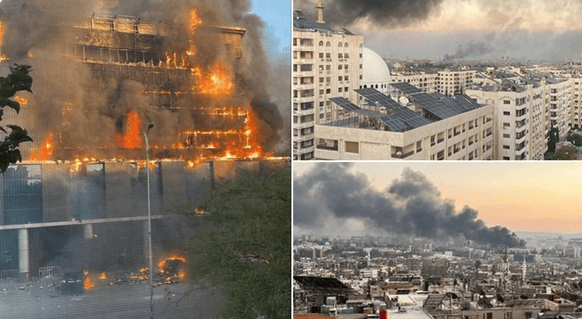
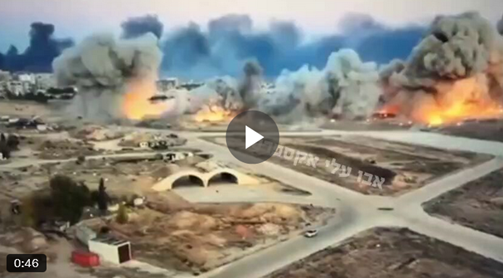
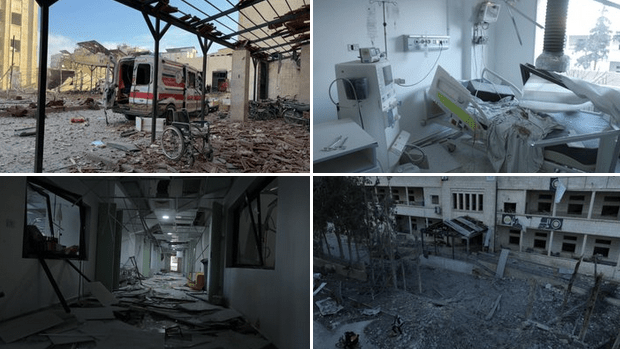
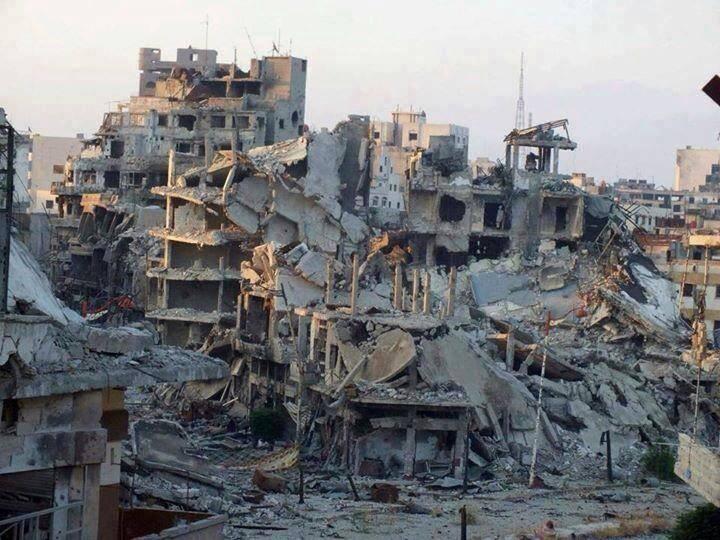
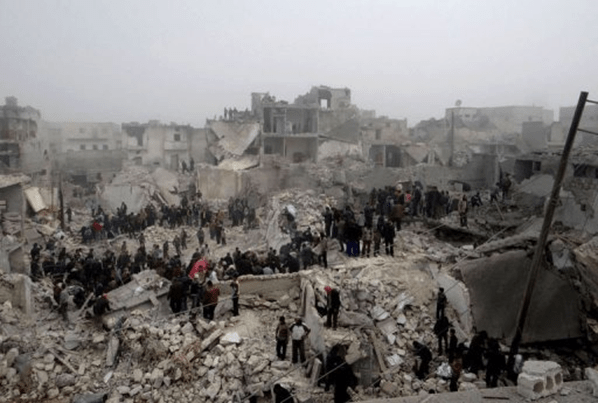
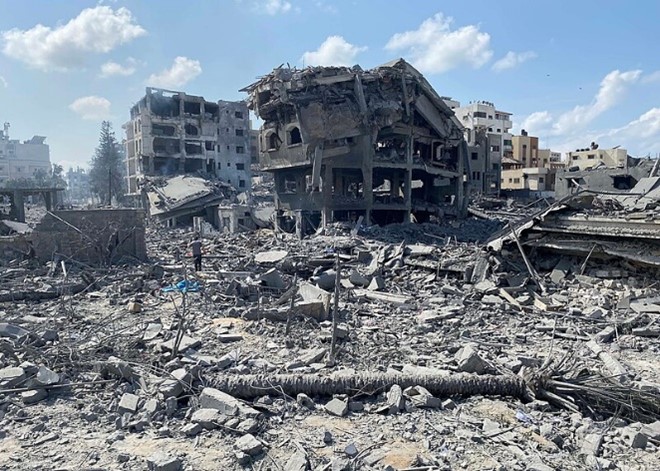
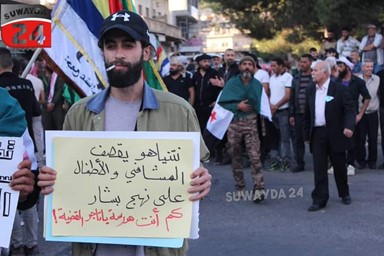
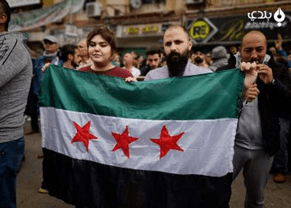
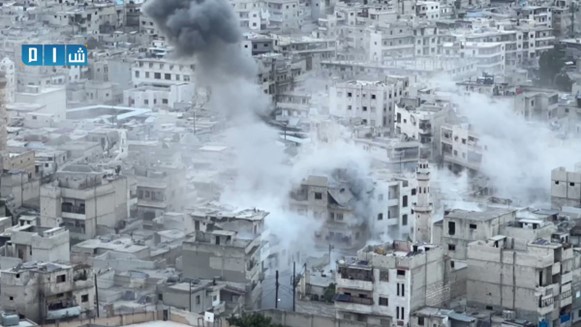
Air bases, weapons and defense systems, and intelligence and military buildings belonging to the former Syrian regime being destroyed.
by Michael Karadjis
It didn’t take long: from the moment the Assad regime collapsed and the rebels entered Damascus, Israel’s massive land and air attack began. As long as all these arms depots, military airports, intelligence centres, scientific research centres, air bases, air defence systems, ammunition manufacturing facilities, “small stockpiles of chemical weapons,” and Syria’s entire naval force were safely in the hands of the Assad regime, Israel never touched them. As Syrian revolutionary commentator Rami puts it, Israel has “known their location the whole time but felt safe knowing that they were in Assad’s hands, who uses them exclusively on Syrians,” and certainly never against Israel. “Now that Free Syrians are in control Israel panics and starts bombing them all,” in order to prevent, as countless Israeli leaders have declared, these weapons falling into the hands of the former rebels, who Israeli leaders have described as a “hostile entity.”
According to Ben Caspit writing for al-Monitor, since the rebels took control of Syria, “Israel says it has attacked some 500 regime targets, dropped 1,800 precision bombs, destroyed about half of Assad’s air force, much of the regime’s tanks and missile launch capabilities, 80% of its air defense systems, all its explosive UAVs and 90% of its radar systems as well as the chemical weapons still held in Syria.” The open source intelligence monitor OSINTdefender claims the IDF has eliminated some 70-80 percent of Syria’s military capacity, the locations including “anti-aircraft batteries, Syrian Air Force airfields, naval bases, and dozens of weapons production sites in Damascus, Homs, Tartus, Latakia, and Palmyra,” resulting in the destruction of “Scud Tactical-Ballistic Missiles, Cruise Missiles, Surface-to-Sea, Sea-to-Sea, Surface-to-Air and Surface-to-Surface Missiles, UAVs, Fighter Jets, Attack Helicopters, Ships, Radars, Tanks, Hangars, and more.”
“Israeli warplanes bombed the intelligence and customs buildings in the Syrian capital, Damascus.” The intelligence buildings? Wonder what deals between Israel and the Assad regime they did not want anyone to find there? The Golan sale, perhaps? The dealings between Israel and the Assad regime over Israel’s bombing of Iranian and Hezbollah targets? Indeed, it is feared that Israel may be destroying evidence against Assad that could be used by the new authorities to place charges against him in the International Criminal Court.
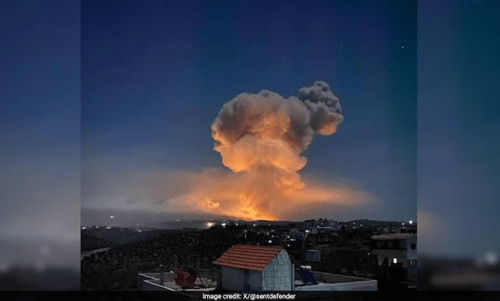
Israel then went right on to completely destroy Syria’s naval fleet, under the nose of Russia’s still present air and naval bases in Tartous and Latakia. The massive strikes Israel launched on Tartous on December 15 were described by the Syrian Observatory for Human Rights the “most violent strikes” in the region since 2012. A gigantic mushroom cloud fireball blew up over the region, “the explosion was so powerful that it was measured as a 3.1 magnitude earthquake on the seismic sensor.”
Mushroom cloud from massive Israeli bombardment of Tartous December 15.
Israel expands into the Golan
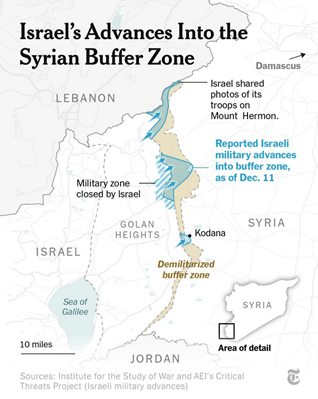
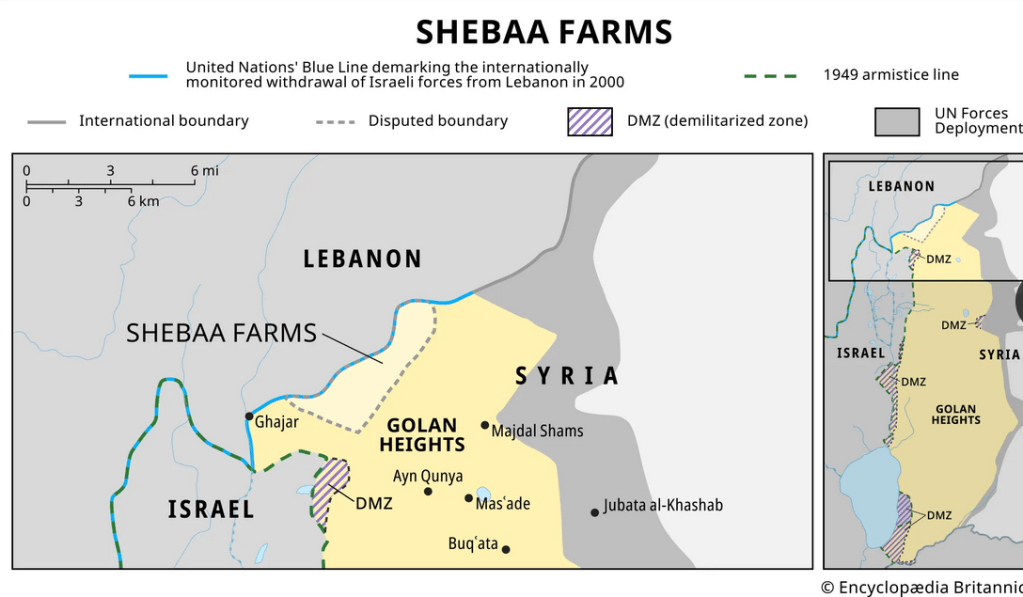
Israel has also invaded further into the Syrian-controlled side of the Golan to create a “buffer zone” (for its already Golan “buffer zone” 57-year occupation) against the Syrian rebel forces. While it is unclear exactly how much territory has been seized, this map from The New York Times shows the territory held by the IDF as of December 13.
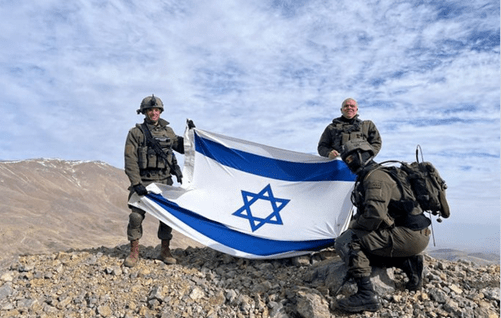
It is clear Israel intends to keep much of the new territory it has conquered. Defense Minister Israel Katz said the IDF would stay on “the Syrian side” of Mount Hermon “during the coming winter months as Israel aims to prevent the border region from falling into the wrong hands.” For Israel, a “temporary” stay has traditionally meant forever, as with the main part of Syria’s Golan Heights which Israel conquered in 1967 and illegally annexed in 1981. According to Ben Caspit writing for al-Monitor, a senior Israeli military source said that Israeli troops “will not retreat until the threat to Israel’s border is removed, which could take “between four days and four years.”
According to Al Jazeera’s Muntasir Abou Nabout, Israeli Defence Forces (IDF) have also destroyed roads, power lines, and water networks in Quneitra province (the Syrian-controlled side of the Golan) when people refused to evacuate. “Israeli tanks are now stationed in towns and villages in Syria’s southwest as the Israeli military expanded its occupation of the Syrian Golan Heights.”
In the villages of the al-Rafid region of Quneitra, Israel cut water and electricity to pressure the people to leave, but they refused, and demanded all weapons be handed over. According to one local interviewed by Aymenn Jawad Al-Tamimi, “no one knows what their aim is, but for sure they have created a new enemy in the future for themselves.” The local also claimed “they [the IDF] removed the people of the village of Rasm al-Rawadhi under threats, and they prevented those who left the village of al-Hamidiya from returning.”
The IDF also invaded Daraa province, troops deploying in Ma’aryah village in Al-Yarmouk Basin, “patrolling and searching some residents.” They also attempted to enter Abdeen village, “but the residents confronted them and prevented them from entering the village.”
Arab League condemns, US supports Israel; Russia hands over posts to Israel
On December 13, the Arab League strongly condemned this Israeli aggression, and separately Turkey, Qatar, Saudi Arabia Egypt and the UAE have issued strong statements.
Not surprisingly, the US has supported Israel’s aggression, National Security Adviser Sullivan claiming “what Israel is doing is trying to identify potential threats, both conventional and weapons of mass destruction, that could threaten Israel and, frankly, threaten others as well, and neutralize those threats,” as Israel destroys virtually the entire Syrian arsenal with its US-supplied weaponry. The US also supported Israel’s expansion into the Syrian Golan, US State Department spokesperson Matthew Miller explaining the collapse of the Assad regime “created a potential vacuum that could’ve been filled by terror organizations that threaten Israel.” Sure, he stressed that Israel’s stay should be “temporary,” but the world knows that US words mean nothing in relation to Israel’s actions – indeed Israel’s occupation of the rest of the Golan in 1967 was also supposed to be temporary.
Meanwhile, it was reported on December 9, just as the Israeli attack was mounting, that Russia, as it withdrew from the south, handed over to Israel two facilities in Daraa, and an observatory on Mount Tel Al-Hara. As Russian forces have been based in the Golan region since 2018 under a Putin-Trump-Netanyahu-Assad agreement to keep both Syrian rebels and Iran-backed forces away – to protect both the Assad regime and the Israeli occupation concurrently – this story rings likely.
Most memes did not go past Israeli propaganda such as Netanyahu’s claim that these events are a “direct result” of Israel’s military campaign against Iran and Hezbollah and his assertion that “this is a historic day in the history of the Middle East.” Sure, who wouldn’t want to feign happiness and try to take credit for the collapse of such a monstrous regime. More important however was what Netanyahu also said: “We gave the Israeli army the order to take over these positions to ensure that no hostile force embeds itself right next to the border of Israel.” On December 15, Netanyahu followed this up claiming that Israel’s actions in Syria were intended to “thwart the potential threats from Syria and to prevent the takeover of terrorist elements near our border”.
Katz also doubled down, declaring on December 15 that “The immediate risks to the country have not disappeared and the recent developments in Syria are increasing the intensity of the threat, despite the rebel leaders seeking to present a semblance of moderation.” On December 18, Israel’s deputy foreign minister Sharren Haskel described HTS as “wolves in sheep’s clothing” and stated “we are not going to be fooled by nice talk,” claiming “these rebel groups are in fact terrorist groups” and went on to remind about Jolani’s past al-Qaeda links.
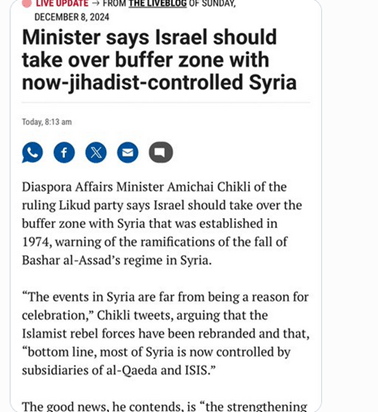
Likudist Diaspora Affairs Minister Amachai Chikli made the case more openly, stating that “the events in Syria are far from being a cause for celebration. Despite the rebranding of Hayat Tahrir al-Sham and its leader Ahmed al-Shara, the bottom line is that most of Syria is now under the control of affiliates of al-Qaeda and Daesh. The good news is the strengthening of the Kurds and the expansion of their control in the north-east of the country (Deir ez-Zor area). Operatively, Israel must renew its control at the height of the Hermon … we must not allow jihadists to establish themselves near our settlements.”
The Israeli calculus in the days before the fall
All of this was already discussed in the uncertain days between the first offensive that took Aleppo and the collapse of the regime ten days later. As we will see, Israeli leaders were not exactly “delighted,” as a somewhat unfortunate piece by Juan Cole claimed.
Israel has always supported the Assad regime against the opposition (see next section); this put it on the same side as its Iranian enemy, with the difference that it preferred the regime without Iran – hence Israel’s strong decade-long partnership with Russia starting with its 2015 intervention to save Assad; since then, the Israel-Russia agreement has allowed Israel to bomb Iranian and Hezbollah targets anywhere in Syria at will, and the world-class Russian S-400 air defence system will not touch them. But Israel always left the Assadist war machine intact.
Since Israel had just come through a war with Hezbollah, it could see the opportunity presented by Assad’s treachery to pressure Assad for more, ie, to completely cut the Iranian weapons transfers to Lebanon. During his November visit to Moscow, Netanyahu’s Strategic Affairs Minister Ron Dermer told his Russian hosts that Israel would propose to the US to lift or freeze sanctions on the Assad regime in exchange for any such efforts to prevent the flow of weapons to Hezbollah (indeed this demonstrates how outside of reality are the conspiracy theories that claim, with zero evidence, that Israel was somehow “behind” the HTS offensive that led to fall of Assad, whatever that even means).
As such, taken by surprise, like everyone else, by the rapid successes of the Syrian revolution, Israel tended to adopt a plague on both your houses view, ie, withholding support for Assad in order to pressure his regime for more in its moment of weakness, while warning of the dangers from the other side. Israeli foreign minister Gideon Saar’s view expressed on December 3 that “Israel doesn’t take sides” as “there is no good side there” was probably closest to the mainstream Israeli view. Saar also said that Israel should “explore ways to increase cooperation” with the Kurds, “we need to focus on their interests.”
On November 29, Netanyahu held a security consultation with “defence” chiefs. He was told that Hezbollah’s forces will now likely shift to Syria, “in order to defend the Assad regime,” which they assessed would “bolster the likelihood of the Israel-Lebanon ceasefire holding,” making these developments “appear to be positive” in the short-term, but “the collapse of the Assad regime would likely create chaos in which military threats against Israel would develop.” The first point, that the blows suffered by the Assad regime “forces all members of the axis to focus on another theater that is not Israel,” is likewise considered “a net positive for Israel” by Nadav Pollak, a former Israeli intelligence official at Reichman University in Israel. In other words, both sources suggest that Israel saw Iran and Hezbollah being in Syria, fighting for Assad, as a “positive” because they are thereby not focused on Israel.
Regarding the second point, the “military threats” which may arise, Channel 12, reporting that the meeting also raised concerns that “strategic capabilities” of the Assad regime, including “the remnants of [its] chemical weapons,” could fall into the jihadists’ hands, so the IDF “is said to be preparing for a scenario where Israel would be required to act,” ie to destroy this weaponry before it falls into rebel hands, which of course is exactly what has come to pass.
A number of prominent right-wing Israeli spokespeople or security spooks made the case for supporting Assad more forcefully. For example, on November 29, Dr. Yaron Friedman at the University of Haifa penned an article in Maariv claiming that HTS “controls internal terrorism over the entire province of Idlib” and “like Hamas,” receives the support of Turkey and Qatar. He notes that “the opposition consists mostly of Sunni fanatics from the Salafi Jihadi stream” who “look like Hamas terrorists.” He stressed that while “Assad is far from being Israel’s friend … he is the old and familiar enemy” under whom “Syria has not waged a war against Israel for more than fifty years,” while “Bashar al-Assad has not lifted a finger in favor of Hamas or Hezbollah since the beginning of the war in Gaza.” Therefore, “the Islamic opposition that aims to turn Syria into a center of global jihad is a much more dangerous enemy. The option of Syria under the rule of Assad under the auspices of Russia is still the least bad from Israel’s point of view.”
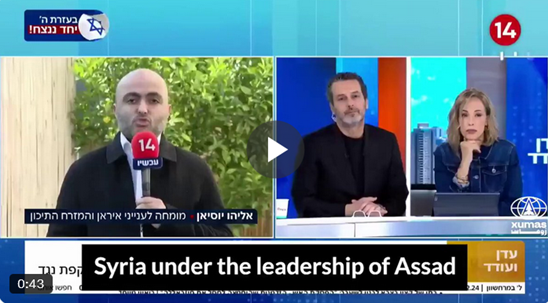
Eliyahu Yosian, former intelligence officer from Israel’s notorious Unit 8200 – suspected of being behind Israel’s massive cyber-terrorist attack on Hezbollah members pagers which blew off people’s faces and hands – explained on December 5, “Personally, I support Assad’s rule, because he is a weak enemy and a weak enemy serves our interests. No-ne can guarantee who will come after Assad’s fall.” He noted that Israel can attack in Syria “every so often in coordination with Russia and without any threat.” Therefore “We must support Assad’s existence.”
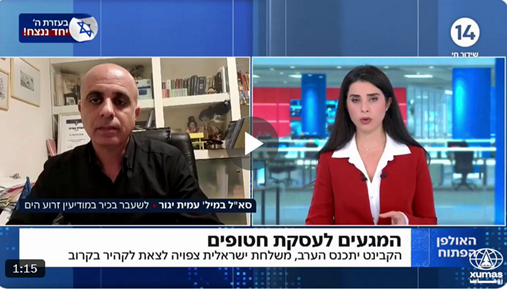
This view was put forcefully by Lt.-Col. Amit Yagur, another former senior intelligence officer (who had earlier called for Israel to “drive Iran out of Syria”). On December 6, he claimed that what the rebels had achieved constituted “a tectonic collapse of the Sykes-Pilot agreement, a major collapse of the foundations of the old order,” and therefore “we need to ensure there is a buffer zone between us and the Sunnis.” This buffer zone “could be fully secured by IDF officers,” which however was “less realistic,” or “guarded by forces of Assad’s regime,” which presumably he thought was more realistic, “so that we don’t end up with a shared border with these guys,” making reference to October 7.
Not all Zionist commentators held these views. Eyal Zisser of Tel Aviv University, explained that there are voices now challenging the “the traditional Israeli approach of preferring Assad — the devil we know,” with a view of delivering a blow to Iran by getting rid of the Assad regime. In fact, one of the problems for Israel was the same problem for Russia and Iran – if the despot you have relied on for decades to service your varied and even opposing interests can no longer maintain that “stability,” but on the contrary, his house collapses like a pack of cards, then continued support would not just be a bad investment, but be utterly pointless.
In this light, what is striking about all these views expressed above – even just days before the regime’s collapse – is how extraordinarily unrealistic they were; they all seemed to imagine that Assad still had a chance! Such blindness at such a late date suggests wilfulness, ie, Israel was so invested in the regime’s survival that it impossible to imagine it not being there, even if only running the buffer zone! Indeed, even Zisser notes of the move among some Zionists towards accepting Assad’s downfall as a defeat for Iran, “for the moment at least, the Israeli leadership is not considering such a possibility.”
Background: Israel and the Syrian revolution 2011-2018
Of course that does make them friends, but the “conflict” between Israel and Syria is quite simple: Israel seized Syria’s Golan in 1967 and has steadfastly refused to ever negotiate it back. That is not an Assad issue; it is a Syrian issue, the opposition has made continual statements on Syria’s right to use all legitimate means to regain the Golan. When asked if he would follow his close Arab allies – Egypt, UAE, Bahrain, Jordan – in establishing relations with Israel, Assad’s response noted only the Golan, avoiding mention of ‘resistance’ or Palestine: “Our position has been very clear since the beginning of the peace talks in the 1990s … We can establish normal relations with Israel only when we regain our land … Therefore, it is possible when Israel is ready, but it is not and it was never ready … Therefore, theoretically yes, but practically, so far the answer is no.” Assad, in other words, wanted to be Sadat, but Israel didn’t let him.
From 2012:
Israel’s intelligence chief, Major General Aviv Kochavi, “warned that “radical Islam” was gaining ground in Syria, saying the country was undergoing a process of “Iraqisation”, with militant and tribal factions controlling different sectors of the country”, and claiming there was “an ongoing flow of Al-Qaeda and global jihad activists into Syria”. He said that with the Assad regime weakening, “the Golan Heights could become an arena of activity against Israel, similar to the situation in Sinai, as a result of growing jihad movement in Syria.”
From 2013:
“Prime Minister Binyamin Netanyahu said Israel would erect a new security fence along its armistice line with Syria because “We know that on the other side of our border with Syria today, the Syrian army has moved away, and global jihad forces have moved in.” “We must therefore protect this border from infiltrations and terror, as we have successfully been doing along the Sinai border.”
“Israel’s military chief of staff has warned that some of the rebel forces trying to topple Syrian President Bashar al-Assad may soon turn their attention southward and attack Israeli settlements in the Golan Heights. We see terror organisations that are increasingly gaining footholds in the territory and they are fighting against Assad,” Lieutenant-General Benny Gantz said at a conference in Herzliya, north of Tel Aviv. “Guess what? We’ll be next in line.”
Israel also “worries that whoever comes out on top in the civil war will be a much more dangerous adversary” than Assad has ever been. “The military predicts all that (the 40-year peaceful border) will soon change as it prepares for the worst.” The region near the occupied Golan has become “a huge ungoverned area and inside an ungoverned area many, many players want to be inside and want to play their own role and to work for their own interests,” said Gal Hirsch, a reserve Israeli brigadier general, claiming Syria has now become “a big threat to Israel” over the last two years.
‘Israel’s Man in Damascus – Why Jerusalem Doesn’t Want the Assad Regime to Fall’ – heading in Foreign Affairs (May 10, 2013), article by Efraim Halevy, who served as chief of the Mossad from 1998 to 2002.
Israeli defence ministry strategist Amos Gilad stressed that while Israel “is prepared to resort to force to prevent advanced Syrian weapons reaching Hezbollah or jihadi rebels”, Israel was not interested in attacking Syria’s chemical weapons at present because “the good news is that this is under full control (of the Syrian government).”
[comment: as we can see, the Israeli view that chemical weapons were no problem in Assad’s hands but must be destroyed if he falls, being enacted now, goes way back]
From early 2015:
Dan Halutz, former Chief of Staff of the IDF, claimed that Assad was the least harmful choice in Syria, so western powers and Israel “should strengthen the Syrian regime’s steadfastness in the face of its opponents.” Allowing Assad to fall would be “the most egregious mistake.”
From 2015 (shortly before the Russian intervention to save Assad which Israel supported):
IDF spokesperson Alon Ben-David stated that “The Israeli military intelligence confirms that the Lebanese Hezbollah and the Iranian Revolutionary Guard’s ability to protect the Syrian regime has dramatically declined, making the Israeli military command more cautious of a sudden fall of the Syrian regime which will let battle-hardened jihadist groups rule near the Israeli border;” as a result, military intelligence services are “working on the **preparation of a list of targets** that are likely to be struck inside Syria, **after a possible fall of the Assad regime**.”
[two points: first, clearly, that “list of targets” has come in handy now that “the fall of the Assad regime” has come about; second, this also suggests that Israel was not against Iran and Hezbollah being in Syria as long as they were only defending Assad, rather than delivering missiles to Lebanon]
From 2015 (after onset of Russian intervention):
At the time when Israel is getting ready for the first coordination meeting with Russia over their joint intervention in Syria, Israeli military sources have confirmed the existence of consensus within Tel Aviv’s decision making circles over the importance of the continuation of the Assad regime. Military affairs commentator Alon Ben-David quoted a source within the Israeli Joint Chiefs of Staff as saying “the best option for Israel would be for the Assad regime to remain and for the internal fighting to continue for as long as possible.” In an article published in Maariv newspaper, the military source pointed out that the continuation of the Assad regime, which enjoys international recognition, relieves Israel of the burden of direct intervention and of deep involvement in the ongoing war. He noted that Israel agrees with both Russia and Iran on this matter.
Israel will provide Russia with intelligence information about opposition sites in Syria to facilitate Moscow’s military operations, Channel 2TV reported, noting that a delegation of Russian army officials will arrive in Israel to coordinate the military cooperation.
From 2017:
The ‘Begin-Sadat Centre’ think tank published an article claiming that as Israel is “surrounded by enemies,” it “needs those enemies to be led by strong, stable rulers who will control their armies and prevent both the firing on, and infiltrations into, Israeli territory,” noting that both Assads had always performed this role. The fact that “Syria is no longer able to function as a sovereign state … is bad for Israel” and therefore“a strong Syrian president with firm control over the state is a vital interest for Israel. Given the Islamist alternatives to his rule, Syria’s neighbours, including Israel, may well come to miss him as Syria is rapidly Lebanonised.”
From 2018 (as Assad regime re-took the south all the way to the Golan “border” with Israel from the rebels, with the support of Trump, Putin and Netanyahu):
In case this was not yet clear enough, at a July meeting with his US counterpart, Israeli Chief of Staff Lt. Gen. Gadi Eisenkot stressed that Israel will allow “only” Assad regime forces to occupy the Golan “border”.
After noting that “the Syrian front will be calmer with the return of the Assad rule,” the fascistic Lieberman stressed that “Israel prefers to see Syria returning to the situation before the civil war, with the central rule under Assad leadership.” Further, he noted that “we are not ruling anything out” regarding the possibility of Israel and the Assad regime establishing “some kind of relationship.”
It is clear from this summary that Israel’s attack today as soon as Assad was overthrown has been planned for years for precisely such a time precisely because Israel wanted his rule to continue.
Syria’s condemnation of Israel to UN Security Council – and demands that Syria “fight Israel”
In a joint letter to the UN Security Council and the UN General Assembly dated December 9, the new Syrian government stated that it “condemns in the strongest terms this Israeli aggression, which represents a serious violation of the 1974 Disengagement Agreement … It also constitutes a violation of the sovereignty of the Syrian Arab Republic, the unity and integrity of its territories, and contradicts the principles and Charter of the United Nations, the provisions of international law, and Security Council Resolutions 242, 338, and 497.” The letter then “renews its call on the United Nations and the Security Council to assume their responsibilities and take firm measures to compel Israel to immediately cease its ongoing attacks on Syrian territory, ensure that they are not repeated, and withdraw immediately.”
Much has been made of the fact that, while condemning the Israeli aggression in the UN, the new government has not been very vocal otherwise. There are also literal mountains of disinformation around in social media, in mindless memes and photoshop cut-up jobs, claiming the new government wants to “make peace” with Israel and so on (some useful rebuttals here). Many Assad-loving keyboard warriors are condemning the new government for not “fighting” the Israeli attack.
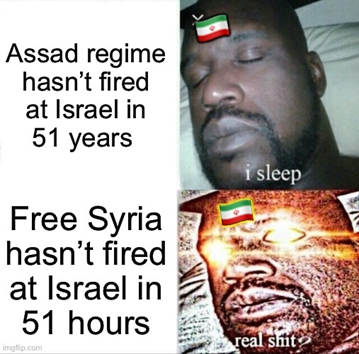
After 50 years of the Assad regime never firing a shot across the Golan demarcation line, these heroes now condemn a government for not “fighting Israel” in 10 days in power.
One might have noticed that the first thing Israel did was to destroy Syria’s entire military arsenal before it could do anything at all, a military arsenal that Assad never once used against the occupation regime. Presumably they expect Syria to fight the neighbouring genocidal military powerhouse, its warplanes and missiles, with sticks and stones.
As Jolani put it, quite logically, “the general exhaustion in Syria after years of war and conflict does not allow us to enter new conflicts.” That is not a call for a “peace” treaty with the occupation, but a statement of fact. The Syrian people have just come through a 14-year war against their own genocidal regime, the regime of Sednaya-Auschwitz, but these western keyboard heroes now believe that the only way the new Syrian government can show its mettle to them (since this is what is important) is by plunging into war with another genocidal regime.
What they might also consider is that while it is Russia that has been bombing the Syrian people for a decade, the new leadership came to an agreement with Russia that it could keep its naval base in Tartous for now, committing itself to not allowing it to be attacked! That’s because they don’t want conflict with that nuclear-armed genocidal power either. This follows HTS’s overtures to Russia earlier in the offensive, when it declared “the Syrian revolution has never been against any state or people, including Russia, calling on Russia “not to tie [its] interests to the Assad regime or the persona of Bashar, but rather with the Syrian people in its history, civilisation and future” as “ we consider [Russia] a potential partner in building a bright future for free Syria.” The government has also made direct contact with Iran, pledging to protect Shiite shrines, but also giving safe passage to exiting Iranian forces, despite their years of crimes in Syria.
If anything, Jolani’s statement that Syria is in no state to enter a new conflict just now due to exhaustion could well be interpreted by Israel as a medium-term threat. The statements by Israeli leaders justifying their aggression suggest that’s how they view it. Right now, the important thing is for Israeli aggression, destruction and occupation to end, and shooting your mouth off with jihadist slogans, where Israeli leaders and many world leaders and media keep reminding everyone of HTS’s distant past “al-Qaeda” links, would be extremely foolish. No doubt Israel would prefer they did, so it could then bomb Damascus and receive congratulations from its uncritical US backer.
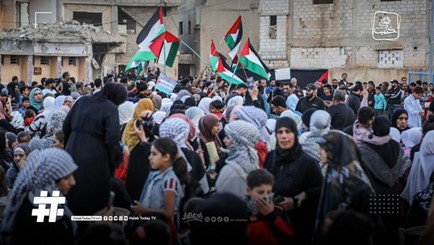
For the entire year since October 7, the Assad regime and Russia had bombed the liberated enclave of Idlib where HTS was ruling, under the cover of Gaza. The entire time, people in Idlib and other opposition-controlled regions were out demonstrating their support for Gaza, while being bombed. The charges against HTS in particular make even less sense, given its strong support for Hamas and for October 7, for better or worse. Jolani has also been filmed boasting that “after Damascus comes Jerusalem,” but of course this kind of rhetoric, so reminiscent of similar Iranian rhetoric, should be taken metaphorically. Yes, any new regime can sell out – there are no guarantees about anything – but if it did, it would face a Syrian population overwhelmingly pro-Palestinian, and there is little point in idle speculation now.
Rather, when Jolani says the focus right now is on stabilising the situation in Syria, this is completely logical. A fractured Syria, getting even more destroyed by foolishness, would have no ability to help Palestinians or to revive its place in the Arab world. More importantly, this is a very critical and dangerous time for the Syrian revolution, when putting a step wrong can have devastating consequences.
With Russia cutting off wheat supplies, Syria is looking for food; the search for literally hundreds of thousands missing is still going on, with the most horrific discoveries turning up in slaughterhouses like Sednaya; people are having to face the grim reality that the majority will not be found alive, as enormous mass graves are being discovered; hundreds of the released have lost their memories and their minds; basic services have had to be restored; the rush is on to preserve as much intelligence information as possible, before being stolen by looters or destroyed by Israeli bombs; the mass return of millions of Syrians has begun. This is what is important; this is what Israel is trying to disrupt with its aggression.
The way in which the Sunni-majority led revolution has made overtures to Christians, Shiites, Alawites, Druze and Kurds has to date been exceptional and has been key to the success of the revolution. The main fault line at present is in the northeast, largely controlled by the Kurdish-led Syrian Democratic Forces (SDF). Two things are happening. On the one hand, some of the Arab-majority regions within the SDF-run autonomous statelet have revolted against the SDF and joined the main body of Syrian governance, particularly in Deir Ezzor and Raqqa. On the other hand, Turkey, via its proxy SNA, is also attacking Kurdish regions aiming to destroy Kurdish self-rule; while Manbij, which they took from the SDF via a US-negotiated agreement, is a majority Arab city, they are now threatening to move on iconic Kurdish Kobani. To date, HTS has had a much better approach to the Kurdish question and to relations with the SDF than Turkey and the SNA have, but the future is uncertain.
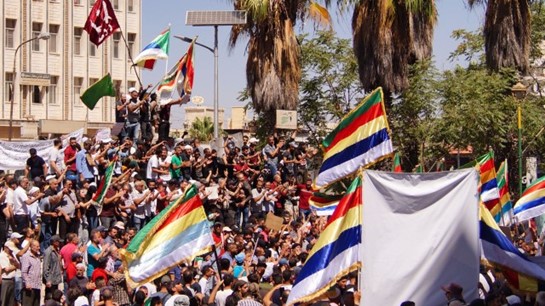
This Turkey-Kurdish question cannot be dealt with in this essay, but how the government deals with it is crucial to the revolution. Israel sees division as a means of entry, Israeli propaganda projecting the Druze and Kurds as Israel’s natural allies. As seen in some of the statements above from Israeli leaders such as Amachai Chikli and Gideon Saar, supporting “the Kurds” is promoted as a key Israeli geopolitical interest; meanwhile, Israel is trying to get the Druze in the Golan to join Israel. There are even fantastic ideas of a ‘Druze state’ in southern Suweida, and a Kurdish state in the east, forming a bridge to Iraqi Kurdistan, with an oil pipeline joining them to Israel; “by leveraging ties with the Syrian Druze and fostering collaboration with Israel’s Kurdish allies, the foundation for this corridor can begin to take shape,” claims the Jerusalem Post. Both the main Druze leadership in Suweida – a key part of the revolution – and the Druze spiritual leadership in Hader itself, along with the Kurdish SDF leadership, completely reject such ideas. But this demonstrates how an increased Turkish-SNA attack on the Kurds, or any step wrong by HTS on religious minorities such as the Druze, could be exploited by Syria’s enemies.
Israel’s interests
This example suggests one important Israeli interest – using the instability and moment of weakness of a revolution to make a land grab – no need to explain why the permanent ‘Greater Israel’ project would want to do that – and extending its hegemony into a chunk of the Arab region via “minorities.” However, this exploitation of minority issues is not only about fostering its influence, but also a means to undermine the revolution. There is no mystery about Israel wanting to do this: genocidal colonial settler-regimes like Israel – like other imperialist states – hate popular revolutions, especially in the Arab world. Not only did Israel have a good working relationship with the Assad regime as demonstrated above, but more generally the mutual existence of apartheid Israel and Arab dictatorships has always been symbiotic.
Many “left” Assad apologists, who are embarrassed that Israel has only attacked after the downfall of Assad, are trying to save face by saying “see, Assad’s fall makes Syria weak and Israel can do what it wants.” Think of that for a moment: it is an argument that people should not overthrow dictators, even genocidal ones, because when you make a revolution you get attacked by imperialist powers or other powerful reactionary states. Perhaps Russians should not have made a revolution because Russia first temporarily lost a great chunk of territory to the invading German army at Brest-Litovsk, and then had to face another 20 or so western armies of invasion. The argument is ludicrous, and counterrevolutionary.
Let’s look at three aspects that make Israel terrified of the Syrian revolution.
Concern about ‘jihadists’ and ‘terrorists’
The first, the most superficial, is the one that Israeli leaders promote, and is most useful for mass consumption: as seen in so many of the quotes above, Israel does not want “terrorists” or “jihadists” to get their hands on weapons that were previously safely in the hands of the Assad regime, because they might use them to launch attacks “on Israel” (or more likely, the occupied Golan). This cannot be dismissed out of hand. At an immediate level, Israel would have such a fear, especially in times of “chaos,” when a new government does not have clear control of all armed forces and so on.
But any such attacks would do nothing to help Syria, let alone Palestine, whatever the illusions in certain quarters. On the contrary, it would simply be grist in the mill of Zionist propaganda about being “under attack by terrorists” and allow Israel to destroy the whole of Syria, with full US support. Whatever the past rhetoric of HTS, the fact that it has pledged not to do that is entirely logical, especially in current circumstances, and politically defangs Israel’s arguments.
Threat of spread of uprising via regional Sunni Islamist populism
The second aspect is the regional Sunni ‘Islamist’ aspect, not meaning fanatical ‘jihadism’ but more the populist Muslim Brotherhood-type connections between these activists in Sunni majority countries Syria, Jordan, Egypt, Palestine and the Gulf. HTS’s marked ‘softening’ puts it more in this camp than anything related to its distant past al-Qaeda connections. The support given by Hamas – the Palestinian MB – to the Syrian revolution both in 2011-2018 and now flows quite organicially from these connections, as does the support given to Gaza by HTS and other Syrian rebel groups and a year of demonstrations in Idlib and northern Aleppo. The MB has been a major opposition force in Jordan, Egypt and elsewhere, and in Jordan in particular it has played a major role in mobilising against the Jordanian regime’s collaboration with Israel.
Put simply, a popular revolution in one Arab country may be just too good an example for people suffering under other Arab dictators whose relationships with Israel are more out in the open than the one it had with Assad, and these religious-political connections may facilitate this. The fact that the ‘Abrahams Accord’ countries (in its broadest sense, all who had relations with Israel) and the ‘Assad Accord’ countries were the same – Egypt, UAE, Bahrain, Jordan etc, with Saudi Arabia supportive but more reticent on both – can be best understood as both an alliance for counterrevolution generally, and an anti-MB alliance in particular. The overthrow of the Jordanian or Egyptian regimes in particular would be a huge boost to the Palestinian struggle.
In this light, we read that Israel’s Security Agency (Shin Bet) Director Ronen Bar and IDF Military Intelligence Directorate chief Maj. Gen. Shlomi Binder visited Jordan on December 13 to meet Maj. Gen. Ahmad Husni, director of Jordan’s General Intelligence Department, “amid concerns the unrest in Syria could spill over to the Hashemite Kingdom.” According to the Jewish News Syndicate, “Jerusalem is worried that the overthrow of the Assad regime by Syrian rebel factions including terrorist elements led by the Sunni Islamist group Hay’at Tahrir al-Sham could destabilize Jordan … The talks come against the backdrop of fears in Jerusalem that extremist groups in Jordan could try to replicate the swift ouster of Bashar Assad by attempting to remove King Abdullah II from power.”
According to the Jerusalem Post, “Arab diplomats have also expressed alarm over a potential “domino effect” in the region. … An Arab diplomat from the region said this week that authorities in Egypt, Jordan, and neighboring states are monitoring Syria closely. There is growing apprehension that the Syrian rebellion could inspire Islamist movements elsewhere.” Meanwhile, Anwar Gargash, an adviser to the UAE president, has stated that “the nature of the new forces, the affiliation with the [Muslim] Brotherhood, the affiliation with Al-Qaeda, I think these are all indicators that are quite worrying.”
In this light, the Biden administration has just asked Israel to approve U.S. military assistance to the Palestinian Authority’s security forces for a major operation they are conducting to regain control of Jenin in the West Bank. According to Axios, the PA “launched the operation out of fear that Islamist militants — emboldened after armed rebels took control of Syria — could try to overthrow the Palestinian Authority.” One Palestinian official said “It was a Syria effect. Abbas and his team were concerned that what happened in Aleppo and Damascus will inspire Palestinian Islamist groups,” also claiming that Egypt, Jordan and Saudi Arabia support the operation in Jenin to prevent “a Muslim-brotherhood style or an Iranian-funded takeover” of the PA.
At this stage it is unclear to what extent such ‘fears’ will eventuate, but these moves, visits, talks and statements suggest there is concern within the local ruling classes.
More dangerous threat of democratic, non-sectarian revolution to Zionist project
The third and most fundamental aspect is, once again, related to the spread of revolution, but not specifically the Sunni ‘Islamist’ connection. On the contrary, the extent to which the Syrian revolution can maintain its current popular, democratic and non-sectarian potential could have a dramatic impact on the region – including Israel. It was counterintuitive that a former Sunni jihadist organisation like HTS would lead with the outreach to Christians, Shiites, Alawites, Druze and Kurds, yet it happened. And while the complete hollowness of the regime was the main secret to the rapid success of the revolution, the other crucial ingredient was precisely this non-sectarian element; the descent into sectarianism, deliberately fostered by the Assad regime, was a crucial cause of the failure last time.
Israel’s bluster about being “the only democracy in the region,” while an obvious nonsense in relation to its subjected Palestinian population, holds some truth regarding the Israeli population. By being able to point at ugly dictatorships in the Arab and neighbouring Muslim world, Israeli leaders promote the idea that their anti-Israel agendas are the work of evil tyrants who want to drive out Jews. The fact that many are also run on a sectarian basis – including those are democratic such as Lebanon – further mirrors and is used to further justify Israel’s own racist, sectarian system.
The Arab Spring was the first region-wide attempt at democratic revolution, which however was largely destroyed. In 2019 there was a second round, in Iraq, Lebanon, Sudan and Algeria. What was very pronounced in the first three in particular was their specifically anti-sectarian content. In both Iraq and Lebanon, the movements against sectarian rule were put down, in Iraq brutally crushed by the ‘axis of resistance’ Shiite militia at a cost of hundreds of lives, while in Lebanon Hezbollah also used violence against the movement, thereby saving the rule of all the sectarian elites; in Sudan the democratic opening was overthrown by the military; a few years later, we also saw the Iranian regime crush its own ‘Women, Life, Freedom’ movement. All of this made the region safer for Israel’s own racist, sectarian project.
By contrast, the victory of democratic, non-sectarian forces in Lebanon, Iraq, Iran, Sudan and elsewhere would have represented a far larger political challenge to Zionism than harsh but hollow words from ugly regimes, which only facilitate Zionist siege ideology.
It may well be a struggle for the Syrian revolution to maintain the course; the mobilised Syrian revolutionary population will need to fight all attempts to restrict democratic space or to stir sectarianism tooth and nail. But if their struggle does succeed, a democratic, non-sectarian Syria could likewise have an electrifying regional impact.
Israel is trying its hardest to make sure it does not succeed.
The lightning victories of the Syrian rebel coalition over the Assad regime forces in northwest Syria over a vast area – followed in quick succession by equally rapid victories first in Hama and Homs in central Syria, then the uprisings in southern Daraa and Suweida and the collapse of the regime in Damascus itself – all within ten days – demonstrates the complete hollowness of the regime, based as it is on little more than naked military and police violence. The subsequent revelation to the world of the real level of horror in the Sednaya ‘slaughterhouse’ demonstrates the breathtaking reality of this; one is reminded of Tuol Sleng and Auschwitz. Regime defences simply collapsed everywhere, the rebels facing neither popular nor military resistance.
The Aleppo offensive
Within a day or so of the offensive launched on November 27, the rebels had not only taken vast areas of rural eastern and southern Idlib and western and southern Aleppo, but most of Aleppo city as well; even in the 2012-2016 period, the rebels only ever controlled half the city. By contrast, it had taken large-scale regime, Russian and Iranian offensives, with airpower, missiles and overwhelming military power, several years to conquer the half-city from the rebels. They then advanced south into northern Hama province, where it is now contesting the regime for Hama city.
Syrian social media accounts are full of scenes of joy as political prisoners are released, as people return to their towns and homes they were expelled from. As former mayor of East Aleppo Hagi Hassan writes, stressing the humanitarian aspects of the liberation, “The city’s liberation is allowing tens of thousands of families to return home after years of forced exile. These families, who lived in camps without essential needs, can now find a more stable and dignified life. … Hundreds of thousands of Syrians are still trapped in the regime’s jails, suffering unimaginable atrocities. The release of Aleppo has allowed the release of hundreds of prisoners, including women and children, marking an important step towards justice.” Fadel Abdul Ghany, of the Syrian Network of Human Rights, claimed that among the detainees and forcibly disappeared people who have been released were some who have been detained for 13 years, “and in one case a detainee that had spent 33 years in prison.”
According to Hassan Hassan and Michael Weiss, “events so far suggest HTS [the leading rebel faction] is behaving pragmatically. Its militants were dispatched right away to safeguard banks from looting. On the first night of its occupation, HTS turned off the electricity for factories, thereby affording civilian residences 16 hours of uninterrupted power, something they haven’t enjoyed since 2012. Similarly, Kareem Shaheen writes of “fascinating messages from Christian family/friends in Aleppo about the restoration of electricity and water, garbage collection (apparently the rebels are paying garbage collectors a 1.5 million SYP wage), bread everywhere, active market.”
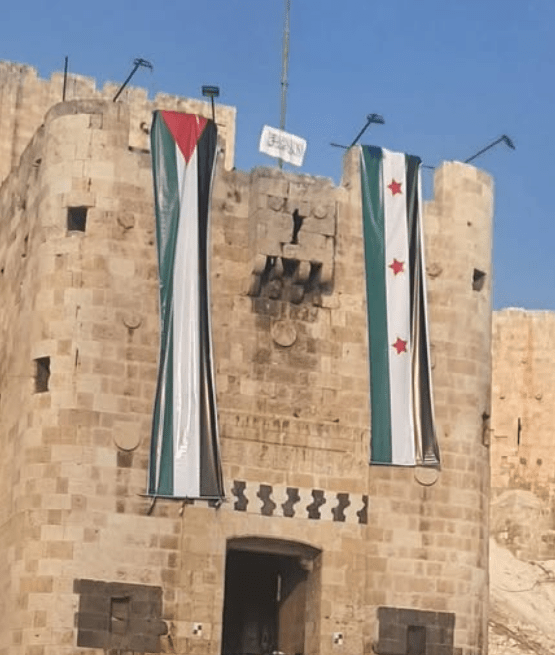
Aleppo citadel after liberation
Hagi Hassan also claims that “for the first time in years, the city knows some security. Infrastructure has been preserved, public institutions are functioning, and no civil rights violations have been reported since liberation,” stressing that “the military forces that have entered Aleppo have not committed any violations against civilians,” but rather, “they ensured their safety.” Another Syrian reporting from Aleppo, Marcelle Shehwaro, claims there have been violations, though “despite extensive networking around this issue, I’ve only been able to document three violations,” one an infamous Christmas tree incident, though she reports more serious violations between another rebel coalition, the Turkish-backed Syrian National Army (SNA), and the Kurdish-led Syrian Democratic Forces (SDF).
More seriously, Shehwaro noted that, apart from fear of regime and Russian airstrikes, the main fear at present is gun-related chaos, caused by the release of criminal prisoners in the rush to open jails to release political prisoners. However, she reports that “a complaints hotline was activated, and it appears the operations management room is taking this seriously so far. But this is far from a utopia.”
Importantly, she stresses regarding the head-scarf, given the radical Islamist ideology of some of the groups involved, “there are incidents happening related to being told, “Put a scarf on your head.” However, the scale is still very limited (compared to what might be expected). Wearing a hijab hasn’t yet become customary (and may God strengthen the women of Aleppo so it doesn’t become the norm). For now, women are still walking in the streets without hijabs—not as isolated acts of courage or rebellion, but simply because that’s how they dress.” However, she also stresses there should be no complacency on this.
She emphasises that both “alarmist narratives” and “reassuring narratives” should be avoided. This is sensible nuance for any such situation. Revolutions are typically depicted as unmitigated bloodbaths, or as heroic, romanticised utopias. No revolution in history has been one or the other. And from all the above, and more below, what I want to stress here is precisely that this is a revolution, a revival of the Syrian revolution which many considered crushed, warts and all, not simply a “military conquest by Islamists” as some have depicted.
Hagi Hassan notes that “Yes, Hayat Tahrir al-Cham [HTS] is present, but the true liberators of the city are its inhabitants, its youth who, exiled children, returned today as adults to liberate their city from the yoke of oppression.” Shehwaro also stresses the role of ordinary people:
“The grassroots Syrian effort is remarkable. Aleppo is boiling, inside and out. From bread to communications, burial initiatives, pressing the military to take responsibility for every issue that impacts civilians, supporting organizations, bolstering the Civil Defense’s presence in Aleppo, and tracking the conditions of children—there is extraordinary grassroots effort.”
On December 1, an example of such a popular initiative was the Initiative “People of Aleppo for the sake of the Homeland,” which congratulated the Syrian people for being freed from the regime, but made a list of people’s requests including advising “the brothers in military factions to fully discipline the instructions” of their leaders “not to engage in any violation,” recommending “the brothers in military factions to adhere to military fronts, cord holes, military barracks, and complete ban of any armed appearance among civilians,” while calling for “forming a civil administration from Aleppo’s competencies as a transition stage in preparation for the elections.”
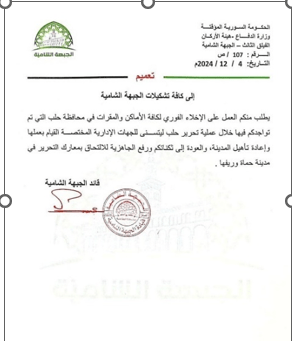
As if on cue, on December 4 HTS commander Abu Mohammed al-Jolani stated that “the city will be administered by a transitional body. All armed fighters, including HTS members, will be directed to leave civilian areas in the coming weeks, and government employees will be invited to resume their work.” Here is the order:
Jolani even suggested that that HTS may dissolve itself “in order to enable the full consolidation of civilian and military structures in new institutions that reflect the breadth of Syrian society.”
The rebel operations room also announced a total amnesty for Syrian regime troops, police and security forces in Aleppo, calling on them to submit their paperwork to receive their official clemency and identification cards.
And the surprise is that, after years of brutal suppression of the revolution, after the regime’s genocidal bloodbath of hundreds of thousands of people and its destruction of its own country with its airforce, after the degree of cooption of the popular uprising – either by the Turkish regime or by the hard-Islamist HTS now leading this operation – that such repression inevitably led to, we might have expected the results of a new offensive to be more retrograde, with more violations, more bloody, more divisive, than in the past. Yet so far, we can say that there were far, far more violations by rebel groups in Aleppo in the past compared to what is ensuing at present.
Before going on to look at the rebel forces involved, and then the wider geopolitical framework, it is worth looking at the question of “return” of thousands, and perhaps soon hundreds of thousands, to their homes, which was touched on above.
If we just consider the 7 million plus displaced Syrians in northwest Syria or Turkey (and not even the millions in Lebanon and Jordan), they come from all parts of Syria, including from a string of Sunni-majority towns around Damascus in the south that were ethnically cleansed via starvation sieges in 2015-17, but also from these very regions now being liberated in Idlib and Aleppo provinces, especially after the regime and Russia reconquered about half of these provinces from the opposition in 2018-2020, leading the population to flee. Now, as a result of this current offensive, all the historic revolutionary towns of the region – Saraqib, Maraat Al-Nouman, Khan Sheikun, KafrNabl – which were captured by the regime in this final stage, have been liberated.
Even for those most cynical of the current HTS leadership of the offensive, what we need to recognise is that this has the potential to be a Gigantic March of Return!
The offensive beginning on November 27 is being carried out by a wide coalition of rebel groups under the Military Operations Command, which arose from the Fath al-Mubeen Operations Room in Idlib. The leading force is the hard-line Islamist Hayat Tahrir al-Sham (HTS), while the other two major components are the National Front for Liberation (NFL) and Jaish al-Izzeh, both of which are independent ‘secular-nationalist’ Free Syrian Army (FSA) brigades, while the Islamist factions Ahrar al-Sham and Jabhat al-Shamiya also joined the offensive.
According to the New Arab, “participation of fighters from the secular nationalist Syrian National Army (SNA) factions, which is closely aligned with Turkey,” has been confirmed, but “while the SNA has supported the operation rhetorically, it has not officially confirmed its participation, which is likely due to the influence of Turkey.” That was written before the SNA did step in on November 30 with its own ‘Dawn of Freedom’ operations room (of which, more below), which at the outset was aimed more at the Kurdish-led SDF forces in northern Aleppo than at the regime.
Very broadly, we may divide the rebel groups in this region into three broad categories: HTS itself, which has become the dominant force in Idlib, and which dominates the Syrian Salvation Government (SSG); the factions of the SNA closest to Turkey, including both secular-nationalist and Islamist factions, which is dominant in parts of northern Aleppo province near the Turkish border, and which dominates the Syrian Interim Government (SIG); and organisations like Jaysh al-Izza which are independent, while the NFL, Ahrar al-Sham and Jabhat al-Shamiya have operated both as allies to the HTS-led command and as loose members or allies of the SNA, while maintaining operational independence.
Overwhelmingly, people join these groups not due to some ideological affiliation, which is more an obsession of western leftists, but to defend their liberated towns and regions from encroachment by the genocidal dictatorship. Who they join depends more on who is dominant in a certain region and thus can better effectively defend that region, who has money to pay wages and for better weaponry and so on. These people are mostly fighting in support of the original aims of the revolution, ie the overthrow of the dictatorship and the institution of a democratic Syria for all. What this means in practice is that, while the politics of the leaderships are not irrelevant, they are also not set in stone; to an extent they reflect the ideals and pressures of their fighting base.
And in a revolutionary situation such as this, many of these divisions break down again, are reconstituted along different lines; leaderships will try to dominate, but their need to keep leadership in a revolutionary struggle also means they will be carried by it. As seen above, popular initiatives play a big role. Even the question of government may end up having little to do with the two ‘governments’ discussed above which have ruled so long in their besieged de-facto statelets.
For example, one resident returning to the northern Aleppo town Tel Rifaat after “a forced absence of around 3205 days” was asked whether the town now will be run by the SSG or the SIG, after being liberated by “many of the Free Army’s factions.” He responded that “the people of the town of Tel Refaat have prior administrative experience, and they elect their council through a general commission composed of all the town’s families. This council administers the town’s affairs, whatever its affiliation.”
On the nature of HTS
Many observers are understandably nervous about both HTS, an authoritarian Islamist group which many years ago was affiliated with al-Qaida, and the SNA, given its control by Turkey and Turkey’s anti-Kurdish policy. There is no question that as a result of being bombed for years, driven into a corner, overwhelmed with displaced from all over Syria, and with virtually no support from anywhere in the world, the civil and military formations of the Syrian revolution have been heavily co-opted for years now, especially since the heavy defeats from 2018 onwards. In fact, all the famous revolution-held towns run by popular councils that continually resisted encroachment by HTS, such as Maraat al-Nuuman, Saraqeb, Karanbel, Atareb and others, were overrun by Assad in the final 2019-2020 offensives, removing important strength from the more independent sectors of the revolution.
People need to survive; and they need protection from the regime. Fighters need wages to feed their families. Western leftists often discuss these issues as if it were a market for different socialist and anarchist ideas on a western campus; it couldn’t be more different. In fact, there is much evidence that many of the fighters in HTS’s ranks today were previously fighters in FSA brigades that its predecessor, Jabhat al-Nusra, crushed at various times – they may not like it, but they still need to fight to regime. Nusra’s forces never constituted any more than 10 percent of the rebels’ armed forces; yet now HTS is overwhelmingly dominant, meaning the bulk of HTS fighters had no past in Nusra or al-Qaida.
HTS’s own rule in Idlib has been mixed to say the least. The leading cadre of HTS are mostly derived from the former Jabhat al-Nusra, which in 2012-2016 was affiliated to al-Qaida, a relationship it severed that year, before moving on to form HTS as a coalition with a number of other Islamist groups. On the whole, its rule is seen as repressive, if effective, but in practice this has gone back and forth. It has adopted a number of pragmatic positions, both in theory and in practice (eg in relation to social restrictions) since leaving the jihadist cloak behind. Part of this is simply due to the needs to running technocratic government effectively. On the whole HTS has tended not to use repression against popular protest, but it has been quite repressive against political opposition, probably more so than any other rebel group.
According to a recent report on Syria by the UN Human Rights Council:
“Starting in February [2024], unprecedentedly large protests, led by civilian activists and supported by military and religious figures, spread across HTS areas. Protestors called for the release of political and security detainees, for governance and socioeconomic reforms and for the removal of HTS leader Abu Mohammad Al-Julani. Demonstrations were triggered by reports of torture and ill-treatment of detainees by the HTS general security service, following months of arrest campaigns by HTS targeting their own members, as well as members of other armed groups and political parties, such as Hizb al-Tahrir.”
It notes that Jolani acknowledged the use of “prohibited and severe means of pressure on the detainees” and “pledged to investigate and to hold those responsible accountable.” It also noted that while demonstrations mostly proceeded without HTS state violence used against them, later HTS did begin using force against them.
Despite repressive rule and co-optation by both governments, the populations have engaged in mass popular demonstrations both against Turkey and against HTS at different times, suggesting that, while militarily defeated, the revolutionary masses still believe they have something to fight for and remain committed to the ideals which they rose up for in 2011. Indeed, while some of the demonstrations against HTS were simply against its attempt to impose its rule over areas it does not control, or against its repressive actions, others were against HTS attempting to open a trade connection with the regime; and similarly, the demonstrations against Turkey were against the growing convergence between Erdogan and Assad as they move to ‘bury the hatchet’. And now, just as repression and siege can lead to such co-optation, new revolutionary advances can again liberate popular energies.
It may well be that one of the secondary reasons for the offensive was indeed for HTS to attempt to break out of this increasing unpopularity. If so, there can be no doubt that the offensive has been massively popular, above all by allowing hundreds of thousands to return to their homes.
HTS overtures to Christians, Druze, Shiites, Alawites and Kurds
With this hardline past, it might therefore come as a surprise that HTS has actually come out with some very positive overtures towards the populations in the regions it is advancing into, and towards minority groups in particular, towards religious minorities – Christians, Druze, Shiites and even Alawites – and the ethnic Kurdish minority, despite previously bad relations with all five.
As the rebels advanced towards Aleppo, Jolani addressed his troops:
“We urge you to show mercy, kindness and gentleness towards the people in the city of Aleppo. Let your top priority be the preservation of their properties and lives, as well as ensuring the security of the city. Do not cut down trees, frighten children, or instil fear in our people of all sects [emphasis added]. Aleppo has always been – and continues to be – a crossroads of civilisations and cultures, with a long history of cultural and religious diversity. It is the heritage and present of all Syrians. Today is a day of compassion; whoever enters their home, closes their door, and refrains from hostility is safe. Whoever declares their defection from the criminal regime, lays down their weapon, and surrenders to the revolutionaries is also safe.”
This sounds nothing like the old Nusra, or like any kind of ‘Sunni jihadist’ organisation. Neither does the following declaration from Bashir Ali, Head of the Directorate of Minority Affairs, Department of Political Affairs, of the Syrian Salvation Government (SSG), made as the rebels advanced:
“As many regions are liberated from the criminal regime, I want to assure all minorities, including Christians, that their lives, property, places of worship and freedoms will be protected. … This is your city too, and you are free to stay and live here in freedom and dignity, knowing that your safety and rights are a priority to us just as all other Syrians.”
The Department issued another statement aimed specifically at two Shiite villages of Nubl and al-Zahara, to the north of Aleppo city:
“Out of faith on our part in the principles of the Syrian revolution that are based on justice and dignity, we affirm the necessity of protecting civilians and guarding their property and lives. In this context, we emphasise that the people of the localities of Nubl and al-Zahara’, like other Syrian civilians, must not be targeted or threatened in any way on the basis of sect or ethnic affiliation. We also call on the people of Nubl and al-Zahara’, and all the Syrian regions, not to stand alongside the criminal regime and aid it in killing the Syrian people and deepening its humanitarian suffering.”
Traditionally, Sunni jihadists like Nusra saw other Muslim sects like Shiites and Alawites as worse than Christians and Jews, as they were considered apostates in Islam; this statement was therefore very significant. Given the extreme divisions from the past (caused by both sides) however, it appears that many of the Shia in these two towns decided to leave, but those that have stayed are reporting that there has been no looting or revenge attacks by the rebels.
Perhaps even more stunning for a formation arising from a Sunni jihadist background, on December 5 HTS issued a statement proclaiming the Alawites to be an indispensable part of Syrian society, calling on them to abandon the Assad regime which it claims “hijacked” the Alawites to conduct a sectarian battle against the opposition:
An as the rebel offensive was approaching victory, Alawite leaders responded in kind:
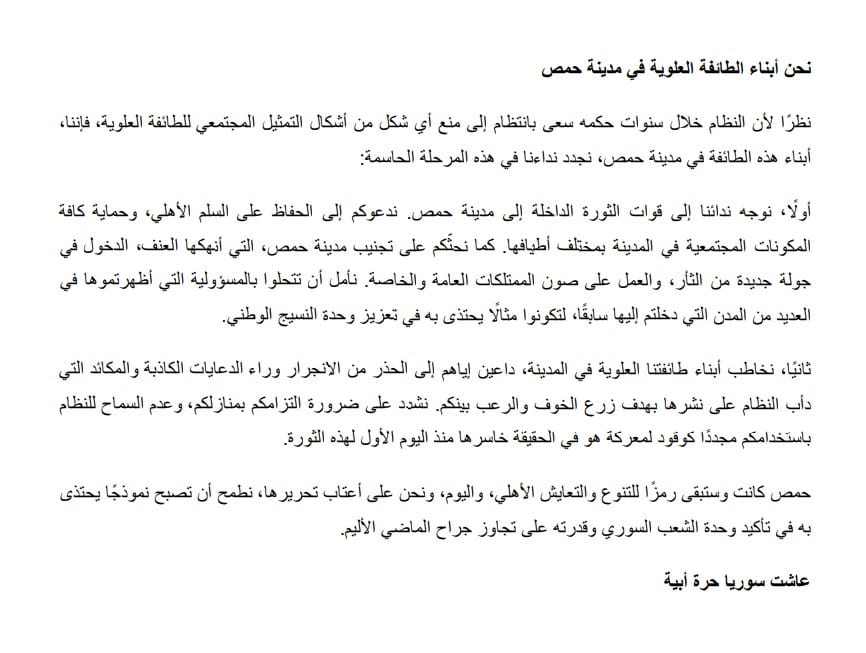
“Given that the regime, during its years of rule, has regularly sought to prevent any form of societal representation of the Alawite sect, we, the sons of this sect in the city of Homs, renew our call at this critical stage:
“First, we address our call to the revolutionary forces entering the city of Homs. We call on you to maintain civil peace and protect all societal components in the city with all their different spectra. We also urge you to spare the city of Homs, which has been exhausted by violence, from entering a new round of revenge, and to work to preserve public and private property. We hope that you will show the responsibility that you have shown in many cities that you have previously entered, to be an example to be followed in strengthening the unity of the national fabric.
“Secondly, we address our Alawite sect in the city, calling on them to beware of being drawn into the false propaganda and plots that the regime has been spreading with the aim of sowing fear and terror among you. We stress the need for you to stay in your homes, and not to allow the regime to use you again as fuel for a battle that it has in fact been losing since the first day of this revolution.
“Homs was and will remain a symbol of diversity and civil coexistence, and today, as we are on the verge of its liberation, we aspire for it to become a model to be emulated in affirming the unity of the Syrian people and their ability to overcome the wounds of the painful past.
“Long live a free and proud Syria.’ December 6, 2024 – Homs Media Center”
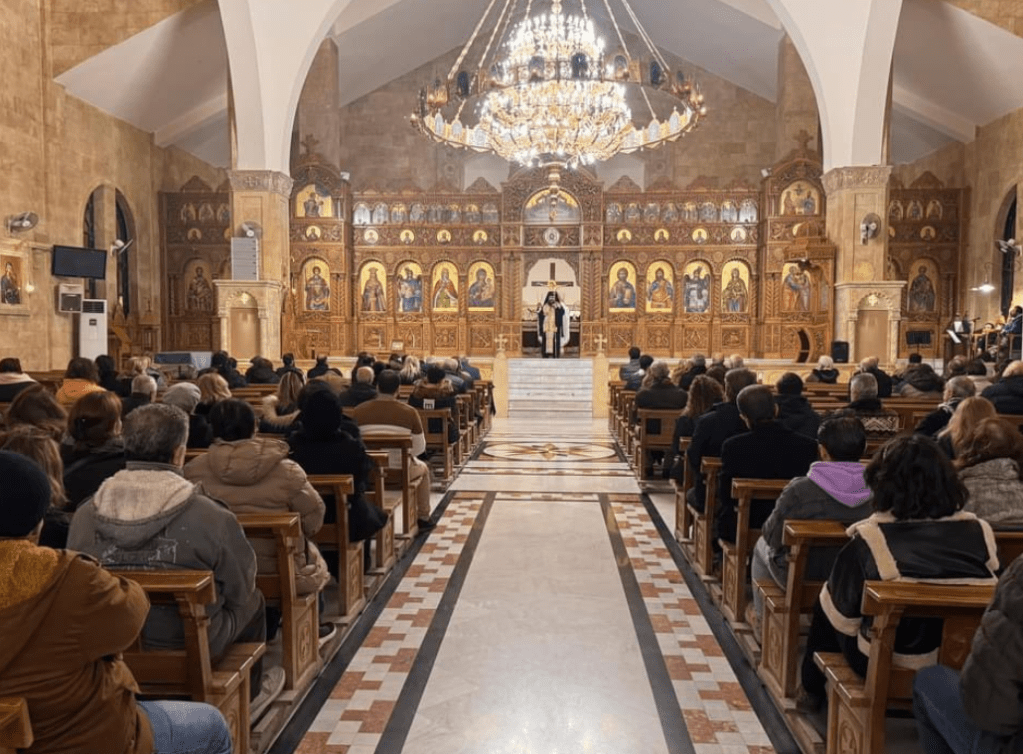
So far, reports from the ground suggest there have been very few violations, though of course some are inevitable in any war. Aleppo’s churches have continued their services and celebrations as normal this past week. Here is the first Sunday mass in Aleppo under Syrian rebels/HTS rule, for example:
However, as Syrian Christian Fadi Hallisso returning to Aleppo notes regarding the fears of many Christians, the assurances that the Islamic dress code will not be imposed on them and that there is no threat to their churches are “not helping at all,” because he claims, these are not the main concerns of Christians, but rather the fear of becoming second-class citizens in a new “Ottoman millet” system. Interestingly, Hallisso states that “the only way to reassure Christians in these circumstances is for Aleppo to be run by a civilian administration of the city’s notables after all armed groups retreat from the city” – ie, precisely what has just been announced by the rebel leadership.
The Arab-Kurdish issue in the current conflict
Marcelle Shehwaro claims that “the Arab-Kurdish situation is catastrophic” and that “the polarization is costing lives, displacement, and a lack of any civil structure with even a minimal level of mutual trust.” She blames both “sniper fire from the SDF that claims civilian lives daily,” and “displacement, abuse, and violations [of Kurds] by the National Army [SNA].” It is very important here to distinguish the SNA from HTS.
As the HTS-led coalition approached Aleppo, Turkiye initially ordered the SNA not to take part. This is likely because if Turkiye gave any green light to the offensive (see below), the aim was for a limited operation in the Idlib/Aleppo countryside to pressure Assad; by all accounts, Turkiye was as blindsided as everyone by the speed of the fall of the city. But when the city did fall to the rebels, the SDF moved into some eastern and northern parts of Aleppo that the regime had fled from, which then linked up Aleppo to the SDF-controlled Rojava statelet in northeast Syria, obviously not Turkiye’s plan.
Therefore, Turkiye the next day sent in the SNA with its own ‘Dawn of Freedom’ operation, which began seizing territory from the SDF – it is important to underline that this was an SNA, not an HTS, action, and should not be confused with the main rebel operation. This demonstrated Turkiye’s anti-Kurdish priorities (though the SNA has also since taken former Assadist territory).
However, even with the SNA’s anti-Kurdish policy, it is not as simple as “Turkey-SNA attacking the Kurds,” as much media, and the SDF, suggest, although there clearly have been violations. The problem is that the main areas of northern Aleppo province that the SNA first seized from the SDF – around the Tel Rifaat region – were not Kurdish regions at all, but Arab-majority regions which the SDF had dishonourably conquered from the rebels in early 2016 with Russian airforce backing, uprooting 100,000 people who have been living in tents in Azaz to the north ever since! For the tens of thousands of expelled residents, this is now a homecoming. However again, even this reality is altered by the fact that two years later, in 2018, Turkiye conquered Kurdish Afrin, northwest of Aleppo, so much of the Kurdish population there fled to these now empty homes in Tel Rifaat, and it is now these people having to flee again.
It is striking that HTS – a former jihadist group which, when its core was Nusra, tended to engage in conflict with the SDF more than any other rebel group – is now engaged in “back-channel dialogue and negotiations with the SDF” which are “far more constructive and effective than with the SNA itself.”
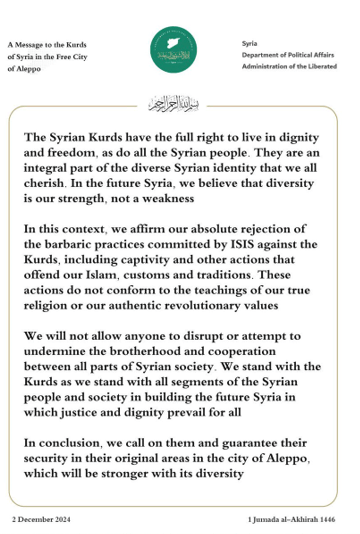
On December 1, HTS issued a statement telling the SDF that HTS’ fight was against the Syrian regime, not the SDF, promising to ensure the safety of Aleppo’s Kurds, and describing the Kurds as “an integral part of the diverse Syrian identity” who “have full rights to live in dignity and freedom,” calling on them to remain in Aleppo; notably also is HTS’s condemnation of “the barbaric practices committed by ISIS against the Kurds:”
HTS then called on the SDF to withdraw from Aleppo, promising to take care of civilians in the Kurdish-held neighborhoods, and offering safe passage to the SDF fighters, possibly to avert an SNA-SDF clash; and the SDF quietly withdrew from the parts of Aleppo it had taken, while remaining in the actual Kurdish-populated regions it had long controlled in Aleppo city, Sheikh Maqsoud and Ashrafiyeh, where they have the support of the population. Any attempt to drive them from here would be a massive violation. At the time of writing, the SDF still controls these two neighbourhoods, and much of the population has also remained.
Background: the evolution of HTS on minority issues
I don’t include all these quotes in order to suggest HTS will necessarily live up to all this, the future simply cannot be known; and the concerns that many Syrians have, including many who are ecstatic about the fall of the regime, are absolutely justified [indeed, some point precisely to what happened after the Iranian revolution of 1979]. Rather, the fact that HTS found it necessary to issue these statements is evidence at least of understanding what a revolutionary situation requires of it. The fact that so far it has been living up to this in practice is a very encouraging sign. Rather than declare in advance either that HTS will throw off all this “re-badging” once it has power and return to its dark past, or that it will surely lead a democratic utopia, it is better to cautiously watch and hope that the spread of the revolution continues to dilute HTS power and older HTS ideology; the broader it is, the more difficult it would be for a militia to put popular power back into a box.
However, the discourse stating that HTS is only saying all these things now to “re-badge” for western consumption to be taken off western “terrorism” lists and so on has the problem that very significant changes in relation to minorities have been taking place for a number of years now in Idlib. The oppression of the Druze minority under Nusra rule for example was particularly appalling; they were basically subjected a program of forced Sunnification, one of the ugliest features of Nusra rule.
However, as well-informed Syria-watcher Gregory Waters explains:
“ … the SSG has spent more than six years engaging with both the Christian and Druze communities in Idlib. An independent, region-wide administrative body was created to serve as a focal point for all communities, including those of minorities. Gradually, this body worked to address complaints and return the homes and farmland that had been seized by a variety of opposition groups in past years. This author has met with some of these community leaders, who told him that, while slow, significant progress has been made for their community in relation to security, property rights, economy, and religious discourse.”
This stepped up in 2022, when Jolani visited the Druze centre, Jabal al-Summaq, after which HTS began returning homes and land earlier seized; and visited Christian residents of Quniya, Yaqoubiya, and Jadida, which was followed by the reopening of the St. Anne Church in Yaqoubiya village, for the first time since the rebels entered Idlib in 2015, attended by dozens of people, and then another large mass at the Armenian Apostolic Church, a decade after it was closed.
Just as surprising has been HTS’s outreach to the Kurdish community. After taking over the Kurdish region of Afrin in 2022 from the SNA, HTS declared that it “confirms that the Arab and Kurdish people… or the displaced are the subject of our attention and appreciation, and we warn them against listening to the factional interests… We specifically mention the Kurdish brothers; they are the people of those areas and it is our duty to protect them and provide services to them.”
While this may sound like rhetoric, in March 2023, HTS confronted the SNA after five Kurdish civilians were killed by members of a Turkish-backed faction during a Nowruz celebration in the town of Jenderes. Jolani met with the residents and HTS forces deployed in the town and seized control of headquarters of the military police and the SNA’s Eastern Army, which was accused of the killings.
This outreach has even proceeded to discussions with the Kurdish-led Syrian Democratic Forces (SDF), HTS hosting several delegations from Hassakeh in 2023. An agreement for the SDF to supply oil to HTS-controlled refineries was reached (the SDF already has a large-scale agreement of this kind with the regime). Intriguingly, HTS also proposed participating in the SDF’s anti-ISIS fight, and for the establishment of a joint civilian administration between HTS and the SDF if HTS could gain control of areas currently held by the SNA!
Apart from the needs of technocratic government getting the better of ideology, the evolution of HTS’s Kurdish policy was also partly driven by its rivalry and clash of perspectives with the Turkish-backed SNA. As Turkey’s priorities turned more to confronting the SDF in Syria, it held back the rebels it controlled from confronting the Assad regime, and continually made overtures to the regime for a joint war against the SDF as a basis for restoring relations. HTS however, whatever its past clashes with the SDF, and also the more independent FSA militia groups, continued to see the conflict with the regime as having priority, and were furious with Turkiye’s attempts to reconcile with the regime. This created a cautious, low-level convergence between HTS and SDF priorities.
Why now? ‘Deterring’ regime’s year-long ‘aggression’ waited for Lebanon ceasefire
This offensive did not come out of the blue; by all accounts, the rebels have been planning this for up to a year. However, there was little expectation their offensive would be so successful; the name of the offensive – Operation Deter the Aggression – instead informs us of the original aim: to push back against over a year of renewed aggression, mostly by regime and Russian bombing, against the opposition-controlled regions of Idlib and Aleppo provinces in the northwest.
However, surprised by the rapidity of regime collapse, the aims then widened, to liberating as much territory from the regime as possible.
From the onset of Israel’s genocidal war in Gaza, the Assad regime, while maintaining complete quiet on its southern frontier with the Israeli-occupied Golan, used the cover of Gaza to step up the slaughter of opposition-controlled Idlib right from the start, a stunning example of this part of the ‘Axis of Resistance’ lacking a compass. According to the Syria Response Coordinators, “266 educational facilities in northwestern Syria have been put out of service over the past three years,” with attacks on schools sharply increasing over the last year, with 43 attacks between September 2023 and November 2024.
All this time, people in opposition-controlled Idlib and Aleppo have continually demonstrated in support of Gaza, with ongoing protests, seminars, donation drives etc Gaza (while the Assad regime bans pro-Palestine demonstrations). Assadist “resistance” to the Zionist onslaught was apparently carried out against this extremely pro-Palestine population of the northwest, demonstrating one of numerous examples of the use of phoney “resistance” language by repressive and reactionary regimes who in reality have no interest whatsoever in “resisting” Israel’s genocidal campaign.
People in Idlib have continually demonstrated in solidarity with Gaza, despite being under regime and Russian bombing themselves.
These attacks continued on a daily basis, systematically targeting villages, civilian infrastructure and agricultural zones, impacting some 55,000 families. This has led to new waves of displacement as people fled their homes to escape the bombardment; in late October, the Syrian Response Coordinators “recorded the forced displacement of over 1,843 people from 37 towns and villages in just 48 hours.” According to Ibrahim Al-Sayed speaking to the New Arab, about three-quarters of the residents of Sarmin have fled the town, which is “the largest displacement the city has experienced since the ceasefire agreement was signed in March 2020,” due to “daily artillery and missile shelling.”
It has been widely pointed out that Assad’s Iranian and Hezbollah backers have been weakened due to defeat in Lebanon by Israel. In reality, this makes little sense, and hardly explains the complete rout that the Assadist armed forces have undergone, the fact that virtually no Syrian soldier in the whole country considered it worth laying down his life to save the genocidal dictatorship. No amount of extra Iranian or Hezbollah reinforcement would have made any difference.
In reality, the connection is somewhat different: it is precisely the fact that Hezbollah had to stop being a counterrevolutionary force in Syria but rather return to its resistance origins in its own country Lebanon – ie, return to standing on the side of the region’s peoples resisting oppression – that allowed for similar developments in Syria, ie, the Syrian peoples’ offensive against the Assad regime. Hezbollah is, after all, a Lebanese organisation, and its raison d’etre is supposedly defence of southern Lebanon. It was not Hezbollah’s defeat in Lebanon, but rather its resistance in Lebanon, that meant it couldn’t protect Assad’s tyranny. If anything, its defeat ad the signing of a ceasefire could have freed it to send forces back to Syria, had it chosen to. Yes, Israel destroyed a lot of Hezbollah’s capacity in Lebanon, but that was rockets aimed at Israel; they were never used in Syria to defend Assad in the past, why would they be now? Hezbollah’s role in protecting Assad was essentially manpower. Even Israel’s destruction of a lot of Iranian capacity in Syria means largely the infrastructure involved in delivering weapons across Syria to Hezbollah.
Much has also been made of the fact that the rebel offensive began at almost the same time as the Lebanon ceasefire came into effect, as if the defeat of Hezbollah in southern Lebanon was the signal for the rebels to launch the attack, even leading to conspiracy theories that Israel greenlighted the attack. However, as demonstrated above, it is the regime that has been attacking the rebels for the past year rather than using its forces to open a front on the Golan to aid Palestine or even to aid its ally Hezbollah, while the rebels were trying to ‘deter’ this aggression. The question is rather why the rebels waited so long to deter regime aggression.
In fact, the rebels purposefully waited until the Lebanon ceasefire precisely so as not to be seen breaking any transit of arms between Iran and Lebanon across Syria while the war lasted. While the regime’s ongoing offensive made the necessity of their operation more and more acute, they were reluctant to wage it as long as the conflict continued. As Aaron Y. Zelin, senior fellow at The Washington Institute, explained, HTS waited for a ceasefire “because they did not want anything to do with Israel … HTS is against Israel, it has praised the October 7 attacks, it is for the Palestinian cause, Israel has nothing to do with what HTS is doing.”
According to Hadi al-Bahra, head of the exile-based opposition leadership, the Syrian National Coalition (SNC), plans for the offensive were a year old, but “the war on Gaza … then the war in Lebanon delayed it” because “it wouldn’t look good having the war in Lebanon at the same time they were fighting in Syria,” and therefore waited till the ceasefire. While the SNC itself has no control over the fighters (especially HTS, which is not part of the SNC), the article further notes that “Rebel commanders have separately said they feared if they had started their assault earlier, it might have looked like they were helping Israel, who was also battling Hezbollah.”
This also raises an interesting question about Hezbollah and Iranian intentions now. Hezbollah played a significant role in Assad’s counterrevolutionary genocide, acting as a proxy for the Iranian regime. Yet when it was in its existential struggle in Lebanon against Israel, the Assad regime did not lift a finger to help. The regime’s silence was stunning, it took it 48 hours to even issue a statement about the killing of Nasrallah. Meanwhile, the regime has been closing Hezbollah recruitment centres. Even in its statements on Lebanon it mostly didn’t mention Hezbollah.
Assad’s message to Hezbollah was: thanks for the help back then, was nice knowing you.
How likely then is it that Hezbollah or even Iran will send its own battered troops back to save Assad’s arse again? Hezbollah has already stated, diplomatically enough, that it has no plans to do so “at this stage,” while a Hezbollah spokesperson told Newsweek, comically enough, that “The Syrian Army does not need fighters. It can defend its land.” And this was probably an added incentive for any Hezbollah cadre who did happen to still be in Syria, and even other Iran-backed forces, to flee with the rest rather than stand and fight; and on the whole, there has been surprisingly little action by these Iran-led forces over the last week.
The other “why now” question relates to Russia. While Russian warplanes did bomb the advancing rebels, this was not at a very decisive level. Bombing civilians all year while the population remained largely passive was easy enough for a ramshackle bully state like Russia, but is less effective against an advancing revolution when not used in full force. Of course, some of this is due to Putin’s catastrophic invasion of Ukraine, where most of the Russian airforce is needed to bomb Ukraine in order to maintain its illegal conquest of one fifth of that country, while Putin had thought that Syria was pacified. But, as with the Iranians, there has not been much to show for even the Russian air capacity that is present in Syria, apart from stepping up barbaric attacks on the civilian infrastructure in Idlib, such as the bombing of five hospitals, including a maternity hospital and the university hospital.
But the relatively low profile of both Russian and Iranian backers in the defence of the regime also has two other causes: firstly, the collapse of regime defences itself means it is not just difficult but pointless to fight for a regime which will not fight for itself, indeed, as Mehdi Rahmati, a prominent Iranian analyst who advises officials on regional strategy put it, “Iran is starting to evacuate its forces and military personnel because we cannot fight as an advisory and support force if Syria’s army itself does not want to fight;” and secondly, it may also be related to frustration with the Assad regime itself, which in turn relates to their long-term work with Turkey on the Astana process.
The role of Turkiye
While Turkiye was a major backer of the rebels in the early years, by around 2016 it began prioritising its conflict with the SDF in Syria over support for the uprising. Its series of agreements with Russia and Iran under the Astana process between 2017-2020 to freeze the frontlines in the northwest can be seen in this context. While Turkiye guaranteed rebel compliance, Russia supposedly guaranteed regime compliance. With the frontline quiet – well, quite on the rebel side – Turkiye invaded northeast Syria in October 2019 to drive the SDF from the border region, with the acquiescence of Trump and Putin; the reliance of the rebels on Turkish protection of their remaining enclave allowed Turkiye to coopt some in the SNA to take part in this invasion. The invasion in turn forced the SDF to allow the regime to send troops into part of the ‘Rojava’ region they controlled, especially the border region, thus extending regime control in Syria.
But the reason Turkiye could not simply betray the rebels outright and allow full Assadist reconquest of the northwest in exchange for alliance with Assad against the SDF is because Turkiye already has 3.6 million Syrian refugees within its borders, the largest refugee population on Earth; allowing Assad to completely take all of Idlib and Aleppo provinces would lead to another few million refugees pouring in, at a time when Turkiye actually wants to try to send as many as possible back to Syria. Refugees will not return to regime-ruled Syria as long as Assad remains in power. Therefore, Turkiye has to maintain support a certain amount of territory remaining under opposition control, and has to continue to push Assad to open a dialogue with the opposition under the terms of the Astana process and of UN Resolution 2254, which calls for a Syrian-led ‘political solution’ process, because such a political process, based on compromise, could also open avenues for safe refugee return.
However, while Russia and Turkey, together with Iran, had agreed to certain frontlines in 2017 under the Astana dialogue, between 2018 and 2020 the regime launched several gigantic offensives which cut the region controlled by the opposition in half, losing all of western Aleppo province, southern Idlib province and the parts of northern Hama and Latakia it had controlled. This added an extra 1.4 million displaced people to the 2.2 million already under opposition control, now squeezed into half the area. While Turkish action finally put a stop to the Assadist offensive in early 2020, this could not be satisfactory for Turkey: how could it begin sending refugees back into Syria when the liberated region was smaller than before with even more displaced?
Despite this, the Erdogan regime has continued to push for normalisation with Assad for several years now, with proposals for launching a joint offensive against the SDF in the east, despite US forces stationed there who work with the SDF against any re-emergence of ISIS. Both Erdogan’s ultra-rightist ally, the Nationalist Movement Party (MHP), and the opposition Kemalist CHP, have been strongly pushing for normalisation with Assad, a joint war with Assad against the SDF, and expulsion of Syrian refugees, on the absurd grounds that peace with Assad would allow refugees to return! [Interestingly, a number of European countries, led by Italy’s far-right Meloni government and Austria’s FPO, have been pushing much the same line, that refugee return requires reconciliation with Assad, with Italy recently sending an envoy back to the Assad regime].
Erdogan better understands the contradiction between those two stands: that refugees cannot be sent back if there is no opposition-held territory, that the only way to send them back to Assad would be violently, causing enormous upheaval, and that either expanding opposition territory, or reaching the compromise ‘political solution’, or both, are essential requirements for sending back refugees. Yet Assad, while open to normalising with Turkiye, demands withdrawal of Turkish forces as a precondition – which would likely mean Assadist reconquest – and resists all pressure to engage with the political process of UN Res 2254.
This is why much speculation has it that Turkiye gave the green-light to the offensive, to pressure Assad on these issues.
However, on November 25, just days before the rebel offensive began, Turkish foreign minister Hakan Fidan stated that the withdrawal of Turkish troops was no longer conditional on either the regime reaching an agreement with the opposition, or the opening of the ‘political process’; seemingly, Turkiye was still making concessions to get the normalisation process happening. The fact that the offensive was led by HTS, rather than the SNA which Turkey initially held back, also suggests that Turkiye had nothing to do with the operation.
Others note however that several days after that statement, Fidan stated that Assad is clearly not interested in peace in Syria, so perhaps exasperation did lead to Turkey giving a green light to a “limited operation.” Either way, once the operation began, Turkiye could see its value in terms of pressuring Assad on the issues dividing them and returning non-regime territory to 2017 lines.
Since then, Turkish statements have been cautious. Erdogan has said nothing, while Fidan said that Turkiye had no involvement, declaring pointedly that “We will not initiate any action that could trigger a new wave of migration [from Syria to Turkiye],” and telling US Secretary of State Antony Blinken that Turkiye was “against any development that would increase instability in the region.” On November 29, the Turkish Ministry of Foreign Affairs issued a statement saying that “the clashes experienced in recent days have caused an undesirable increase in tension in the region. It is of great importance for Turkey not to cause new and greater instabilities and not to harm the civilian population.”
One might think, OK, this was not Turkiye’s plan, but if the offensive does lead to the overthrow of Assad, then refugees would be able to return, and Turkish influence extended all over Syria. However, Turkiye has no control over HTS, nor will it be able to control a Syria after a successful revolution. With its main goal still to “leverage[e] the situation to push Damascus and its allies toward negotiations” via pressure from Russia and Iran, and to jointly fight the SDF, the Turkish regime would prefer a more controlled situation. On December 2, Erdogan stressed “the Syrian regime must engage in a real political process to prevent the situation from getting worse,” and that unity, stability and territorial integrity of Syria are important for Turkey.
For HTS, on the other hand, the very threat of a Turkish agreement with Assad, Russia and Iran in which it would be sacrificed was probably another reason to launch the offensive, and the independence it has gained by going so well beyond Turkey’s limited plan will be jealously guarded.
Furthermore, there is also the possibility that Assad, with Russian and Iranian support, may launch a furious counteroffensive if the rebel advance does not stop; Russia has vital strategic interests on the Syrian coastal region, and Iran in parts of the centre and south, and it is unlikely they would give them up without a massive fight beyond a certain line. And if that happened, it could lead to a further refugee outflow into Turkey.
Both Russia and Iran appear to be bending towards the Turkish position, and indeed, frustration with Assad’s intransigence, which led to this explosion, could well be a reason for the lack of Russian and Iranian response. On December 1, Russia emphasised the importance of “coordinated efforts within the framework of the Astana Format with the involvement of Turkey.” On the same day Iran’s foreign minister Abbas Araqchi “held a joint press conference with his Turkish counterpart Hakan Fidan in Ankara, where both agreed that foreign ministers of Iran, Turkey and Russia should meet soon.” Both are rational enough to see that if they don’t try to salvage something through a political process, they may end up with nothing [update: somewhat comically, as Daraa and Suweida and Homs were falling, and hours before Assad and family fled and Damascus fell, and the whole of Syria was celebrating, that Astana meeting did place, with Russia, Turkiye and Iran demanding “an end to hostile activities” in Syria!].
An interesting side-point here is HTS’s unexpected November 29 appeal to Russia, aiming to neutralise support for the regime. While condemning Russia’s bombing, the Political Affairs Administration of the SSG affirmed that “the Syrian revolution has never been against any state or people, including Russia, and it is likewise not a party to what is happening in the Russia-Ukraine war, but rather it is a revolution that was started to liberate the Syrian people from … the criminal regime,” calling on Russia “not to tie [its] interests to the Assad regime or the persona of Bashar, but rather with the Syrian people in its history, civilisation and future” as “we consider [Russia] a potential partner in building a bright future for free Syria.”
Egypt, UAE, Jordan, Iraq: Go Assad!
As is well-known, three of the ‘Abraham Accords’ states – UAE, Bahrain and Sudan – restored relations with the Assad regime during much the same time period as they established relations with Israel, while Egypt, which has had relations with Israel for decades, also established strong relations with the Assad regime following the bloody military coup of al-Sisi in 2013.
Not surprisingly therefore, Egyptian Foreign Minister Badr Abdelatty reiterated Egypt’s support for “Syrian national institutions” to his Syrian counterpart, stressing “Syria’s vital role in fostering regional stability and combating terrorism.” Similarly, UAE President Sheikh Mohamed bin Zayed (MBZ) told al-Assad that his country “stands with the Syrian state and supports it in combating terrorism, extending its sovereignty, unifying its territories, and achieving stability.” MBZ also recently put forward the idea to US officials of lifting US sanctions on the Assad regime if it cut off Iran’s weapons routes to Lebanon (an idea also put forward by Netanyahu’s Strategic Affairs Minister Ron Dermer during his early November discussions with Russian leaders in Moscow). Jordanian King Abdullah II similarly said that “Jordan stands by the brothers in Syria and its territorial integrity, sovereignty and stability.” Prime Minister Mohammed Shia’ al-Sudani of the US-Iran joint-venture Iraqi regime also stressed that “Syria’s security and stability are closely linked to Iraq’s national security,” while a number of pro-Iranian Iraqi militia groups declared they are sending forces to Syria to bolster the regime – curiously after not having sent forces to aid their Hezbollah co-thinkers in Lebanon when under existential attack by Israel.
Juan Cole runs the often very useful ‘Informed Comment’ site, but like everyone, he has his areas of expertise … and not. One of the problems with Syria is the tendency of people who know little about it to make up for its alleged “complexity” by making sweeping statements and buying to crass stereotypes that they normally wouldn’t. In his first piece on this uprising, while correctly discussing the alliance of states like Egypt and UAE with Assad, he then proceeds, based on nothing at all, to claim “these anti-Iran forces include Israel, Saudi Arabia, Bahrain and Azerbaijan, and, outside the region, the United States. All are delighted at the news.” He then goes on to warn them that in reality, this may not be good news for them – as if they don’t already know, since they do not hold the view he so groundlessly ascribed to them!
Saudi Arabia was slower than its main allies (Egypt, UAE, Bahrain, Jordan) in restoring relations with Assad, just as it was with Israel. Despite constant media declarations that Saudi Arabia was about to normalise with Israel, it still hasn’t, but in the meantime it fully normalised with the Assad regime, and even with its great rival Iran, and it played the key role in getting Assad back into the Arab League in 2023. On December 2, Saudi leader MBS met with UAE leader MBZ, for the first time in years – their alliance has been replaced by rivalry – to discuss the Syria situation. There is little doubt MBS shares his partner’s concerns. As for Bahrain, it was one of the first Arab states to normalise with the Assad regime, just after UAE in late 2018, and like Egypt, UAE, Jordan and Israel, Bahrain welcomed the Russian intervention in 2015 to save Assad, as did Saudi Arabia secretly. Cole’s confident speculations are clearly baseless.
“In general, GCC states are supportive of the Assad regime and are firmly against it being challenged or indeed replaced by a coalition of Islamist and jihadi factions formerly associated with al-Qaeda,” according to Neil Quilliam, an associate fellow with Chatham House, while Andreas Krieg, of the defense studies department of King’s College London, stressed the angle of them protecting growing Gulf, especially Emirati, investment in Syria.
USA – rebels “terrorists”
As for the US, on November 30, National Security Council spokesperson Sean Savett released the following statement:
“… The Assad regime’s ongoing refusal to engage in the political process outlined in UNSCR 2254, and its reliance on Russia and Iran, created the conditions now unfolding, including the collapse of Assad regime lines in northwest Syria. At the same time, the United States has nothing to do with this offensive, which is led by Hay’at Tahrir al-Sham (HTS), a designated terrorist organization. [emphasis added]. The United States, together with its partners and allies, urge de-escalation, protection of civilians and minority groups, and a serious and credible political process that can end this civil war once and for all with a political settlement consistent with UNSCR 2254. We will also continue to fully defend and protect U.S. personnel and U.S. military positions, which remain essential to ensuring that ISIS can never again resurge in Syria.”
So, the opposition is terrorist, and we want de-escalation at a time it is winning. Doesn’t sound “delighted” to me. On December 2, the US, France, Germany and the UK released a joint statement urging “de-escalation,” claiming the current “escalation” underlines the need to return to the “political solution” outlined in UNSC Res 2254.
Israel: Collapse of Assad regime could lead to military threats
Israel has always supported the Assad regime against the opposition; throughout the Syrian conflict, Israeli leaders (political, military and intelligence) and think tankscontinually expressed their preference for the Assad regime prevailing against its opponents, and were especially appreciative of Assad’s decades of non-resistance on the occupied Golan frontier. This put it on the same side as its Iranian enemy, with the difference that it prefers the regime without Iran – hence Israel’s strong decade-long partnership with Russia starting with its 2015 intervention to save Assad; since then, the Israel-Russia agreement has allowed Israel to bomb Iranian and Hezbollah targets anywhere in Syria at will, and the world-class Russian S-400 air defence system will not touch them.
But since Israel has just come through a successful war against Hezbollah in Lebanon, and the Assad regime betrayed its ally, Israel can see the opportunity to put even more pressure on Assad, to completely cut the Iranian lines into Lebanon. As such, Israeli foreign minister Gideon Saar’s view that “Israel doesn’t take sides” as “there is no good side there” is probably closest to the mainstream at present. Saar also said that Israel should “explore ways to increase cooperation” with the Kurds, “we need to focus on their interests,” which also seems to be a common view in Israel.
On November 29, Netanyahu held a security consultation with “defence” chiefs. He was told that Hezbollah’s forces will now be shifted to Syria, “in order to defend the Assad regime,” which will bolster the likelihood of the Israel-Lebanon ceasefire holding, meaning that these developments “appear to be positive” in the short-term, but “the collapse of the Assad regime would likely create chaos in which military threats against Israel would develop.” Channel 12, reporting on the meeting, also claimed concerns were raised that “strategic capabilities” of the Assad regime, including “the remnants of [its] chemical weapons,” could fall into the jihadists’ hands, so the IDF “is said to be preparing for a scenario where Israel would be required to act,” ie to destroy this weaponry before it falls into rebel hands.
So, not exactly “delighted.” This raises the question of why Israel apparently has no problem with these chemical weapons currently being in the hands of the regime! As far back as 2013, Israeli defence ministry strategist Amos Gilad stressed that while Israel “is prepared to resort to force to prevent advanced Syrian weapons reaching Hezbollah or jihadi rebels”, Israel was not interested in attacking Syria’s chemical weapons at present because “the good news is that this is under full control (of the Syrian government).”
It is interesting that the first point, that the blows suffered by the Assad regime “forces all members of the axis to focus on another theater that is not Israel,” is likewise considered “a net positive for Israel” by Nadav Pollak, a former Israeli intelligence official at Reichman University in Israel. In other words, Iran and Hezbollah being in Syria, fighting for Assad, is no problem for Israel, as long as they are not focused on Israel. This corresponds to the times when Israel’s support to the Assad regime against the uprising was something stated openly by Israeli political, military and security chiefs, except for the Iranian factor – yet at times it was even let slip that Israel supported Iranian and Hezbollah actions as long as it was focused on support for Assad.
For example, in 2015, IDF spokesperson Alon Ben-David stated that “The Israeli military intelligence confirms that the Lebanese Hezbollah and the Iranian Revolutionary Guard’s ability to protect the Syrian regime has dramatically declined, making the Israeli military command more cautious of a sudden fall of the Syrian regime which will let battle-hardened jihadist groups rule near the Israeli border;” as a result, military intelligence services are “working on the preparation of a list of targets that are likely to be struck inside Syria, after a possible fall of the Assad regime” [clearly, that “list of targets” has come in handy now that “the fall of the Assad regime” has come about].
Other prominent spokespeople in the Israeli media include Dr. Yaron Friedman at the University of Haifa, who penned an article in Maariv which claimed that HTS “controls internal terrorism over the entire province of Idlib” and “like Hamas,” receives the support of Turkey and Qatar. He notes that “the opposition consists mostly of Sunni fanatics from the Salafi Jihadi stream” who “look like Hamas terrorists.” He stressed that while “Assad is far from being Israel’s friend … he is the old and familiar enemy” under whom “Syria has not waged a war against Israel for more than fifty years,” while “Bashar al-Assad has not lifted a finger in favor of Hamas or Hezbollah since the beginning of the war in Gaza.” Therefore, “the Islamic opposition that aims to turn Syria into a center of global jihad is a much more dangerous enemy. The option of Syria under the rule of Assad under the auspices of Russia is still the least bad from Israel’s point of view.”
“The collapse of the regime in Damascus would pose a threat to the whole region, including Israel,” according to Yehuda Balanga, at the Department of Middle Eastern Studies at Bar-Ilan University. Nevertheless, Eyal Zisser of Tel Aviv University, while largely agreeing, thinks there are voices now challenging the “the traditional Israeli approach of preferring Assad — the devil we know,” with a view of delivering a blow to Iran by getting rid of the Assad regime, but, “for the moment at least, the Israeli leadership is not considering such a possibility.”
One of the problems for Israel is the same as the problem for Russia and Iran – if the despot you have relied on for decades to service your varied and even opposing interests can no longer maintain that “stability,” but on the contrary, his house collapses like a pack of cards, then continued support would not just be be a bad investment, but be utterly pointless.
On possibility discussed is for Israel to invade and establish a “buffer zone” in southern Syria if the rebels take Homs. Apparently the Golan Heights is not enough of a “buffer” for Israel [update: this has come to be in a big way!]
With events moving rapidly, the rebels walked into Hama, again the regime simply melting away, with massive scenes of celebratory welcome by the population. Hama was where Hafez Assad slaughtered 40,000 people and bombed the city to suppress another uprising back in 1982, a dress rehearsal for the slaughter of hundreds of thousands and the bombing and destruction of all Syrian cities by the regime airforce during the 2011-2018 round.
For those who don’t know the significance of Hama falling to the rebels, this video is from Hama in 2011, when millions rose against Assad. As Syrian revolutionary Rami Jarrah says, “they were quickly silenced by Assad’s killing machine, these are the people who have just been liberated and this marks the end of the Assad regime.”
The rebels then moved onto Homs and again took it at lightning speed. Just as with Hama, we were warned that the rebels’ victory streak would finally meet resistance because, unlike the north, this is part of regime core areas, and there are more minority (Christian, Alawite and Ismaeli) populations in the region. Aaron Y. Zelin, senior fellow at The Washington Institute, claimed “we will see more hardened lines in the core areas where the regime is strongest,” referring to Tartous, Lattakia, Homs, Hama and Damascus. Even Exile-based Syrian opposition leader, Hadi al-Bahra, declared he was ready to start negotiations with Assad on December 4 [postscript: talk about being out of touch with the people he claims to be a leader of!].
No such luck for the regime. Homs had been a very important centre of the 2011 revolution, in fact was called the ‘cradle of the revolution’, though it is true that there was sectarian division, which however was deliberately created by the regime. The regime bombed the city to the ground, as we see here:
Here is what the regime had done to Homs by 2013. Really, a regime ‘core’ area? The regime popular here?
Meanwhile, former rebels in the southern province of Daraa launched a new front called the Houran Free Gathering, which stormed police stations and local intelligence headquarters, disarmed regime checkpoints, seized weapons, and launched attacks on regime troops.” On December 6, the Free Syrian Army (FSA) took control of the Nassib border crossing with Jordan for the first time since 2018, leading Jordan to close the border, and the same day, these FSA fighting groups announced the establishment of a Southern Operations Room for the south of the country. By December 7, the whole of Daraa had fallen.
Daraa had been the birthplace of the revolution in March 2011; here is some footage from Daraa then showing peaceful protest and massacre. The movement was galvanised in April following the regime kidnap, murder and mutilation of 13-year old Daraa child Hamza al-Khatib and torture of other children for writing anti-Assad graffiti. For several years, Daraa was controlled by the democratic-secular FSA Southern Front, containing some 35,000 troops at its height, in over 50 brigades, but as Assad’s forces rolled in in 2018, as part of a Trump-Putin-Netanyahu agreement, many fighting units underwent forced ‘reconciliation’ with the regime under Russian auspices. These fighters have now reemerged, thrown off their ‘reconciled’ uniforms and were joined by other people rising against the regime.
The neighbouring Druze province of Suweida was something of a prequel of the new revolution when the people rose against the dictatorship back in August 2023, which at the time also echoed around the country; now again people took to the streets and demanded the fall of the regime. On November 28, the ‘Local Forces in Suweida’ issued a statement supporting the “battles to regain the lands in northern Syria against the regime.” On December 1, the spiritual leader of the Druze community in Syria, Sheikh Hikmat Al-Hajri, declared that Syrians were “at a historic turning point to end the conflict and stop the killing machine of Syrians and those who caused their displacement and migration over the years,” vowing support for the “the right of the owners of the land to return to their lands” mentioning Aleppo, Idlib and parts of Hama.” Meanwhile, a Druze militia called the Syrian Brigade Party issued a statement calling on Druze soldiers to defect and return home to Suweida, and soon police station and governent buildings were seized. In coordination with neighbouring Daraa, Suweida was also under the control of the revolution by December 7.
In the east, the Arab-led Deir ez-Zour Military Council in the SDF launched the ‘Battle of Return’ and captured seven villages on the eastern side of the Euphrates from which regime militias had been launching daily attacks on the SDF. According to the SDF, this offensive was in “response to the appeals of local residents amid escalating threats from ISIS, which seeks to exploit the unfolding events in the western part of the country.” Now the SDF has taken control of the west side of Deir ez-Zour city from the regime and Iranian forces (it already controlled the east side).
By early December 8, the combined southern forces from Daraa and Suweida had entered Damascus. All the previously revolution-held towns of the southern and eastern Damascus – Darayya, Moademiya, Madaya, Rabadani, Ghouta and so on – once again fell to revolution, despite the expulsion of their populations to the northwest when they were defeated in 2016-18, and their repopulation by the regime with supporters, including many Iraqi and Pakistani Shia, in a sectarian engineering program, which clearly did not save the regime. Then Damascus itself fell to the southern revolutionaries.
That still left Tartous and Latakia, the two provinces of ‘the Alawite coast’, which were considered very unlikely to fall to the revolution, both due to it allegedly being the strongest base of the regime (some 80 percent of military and security officers were Alawite) but also because this is where Russia would most likely put its foot down to defend its naval bases and airbases. Nevertheless, they collapsed, and as Assad statues came down in Tartous and Latakia, the revolution declared “The city of Tartous has been liberated, we are here with our people from all sects, Christians, Alawites, Sunnis, Druze and Ismailis, the Syrian people are one, to our people in Tartous, work with us to build our country, we will present a model to be proud of”. As one Alawite who was previously in a pro-regime Alawite militia appealed:
“Do not blame us and do not resent us. We were deceived for 14 years. Our awful life was under the delusion that if he [Assad] lost authority, we would be massacred and slaughtered. Our life was filled with great fear about the prospect of our being subject to genocide if he left. No one ever told us that you [the insurgents] would enter in such a peaceful way and without bloodshed. By God we have never treated anyone on a sectarian basis, but rather with all humanity and love. We lost martyrs, and you lost martyrs. God have mercy on all the martyrs. And let’s work together to build a new, free Syria: one hand and one people in all its sects and religions. To the dustbins of history, oh traitor [Assad]!”
The regime disappeared into history in 10 days. The speed of collapse demonstrates that the regime’s base even in what were considered its core areas had disappeared, that no-one is willing to fight for a genocidal and uber-corrupt hereditary monarchy any longer, and the markedly positive attitude of the rebel leadership towards minorities – supposedly one of Assad’s bases – has removed the fear that the acceptance of the dictatorship rested upon. There will be many struggles ahead, but today is the day for Syrians and people fighting oppression the world over to celebrate one of the most decisive and popular revolutions ever.
The Israel-Lebanon ceasefire agreement, Al Jazeera
By Michael Karadjis
The Lebanese people can feel some relief now that Israeli bombing has stopped – well, mostly, despite ongoing violations – and they can move back to their wrecked towns and homes. It is a good thing Hezbollah agreed to the ceasefire because there is no more to be gained against such a violent enemy.
However, there should be no doubt that Israel has just won a smashing victory in Lebanon with its wanton brutality, despite the heroism of the fighters in the south that kept its ground invasion forces at bay.
Many observers claim this is a partial “victory” for Hezbollah and partial defeat for Israel; if these tracts merely aim at morale boosting, that is understandable, but this is not useful for cold analysis, which is badly required at this time. On the other hand, there have also been statements from Israeli leaders, not only on the far-right but even in the centre,and frm many ordinary Israelis interviewed, that this was a “defeat” for Israel and that Netanyahu gave up a chance to “destroy” Hezbollah. These statements are not only the opportunist words of oppositionists, but also an indictment of current Israeli society at large, which remains united to an unusually large degree around insatiable lust for war and killing, around the idea that any war that doesn’t result in total holocaust for the enemy is a defeat for Israel.
Let’s look at the outcome. The ceasefire is based on UN Resolution 1701 of 2006, ie the Lebanese army will move in Lebanon south of the Litani river to replace Hezbollah, which has remained there since 2006 in defiance of the resolution; implementation of this has been demanded by Israel since then; clearly a victory for the Israeli position.
Worse, now there is a direct US (and French) role, alongside the long-term UN role, in the implementation. Pretty obvious whose interests this serves.
Further, in a special US letter to Israel that is attached to this agreement, the US has given Israel an on-paper guarantee of its right to attack targets inside Lebanon for “defensive” reasons, and as we know, for Israel, everything is “defence.” While the Lebanese government and Hezbollah are obviously not signatories to this letter, they obviously know of it as it is the basis on which Israel agreed to sign.
Next, this also means the end of the so-called “unity of arenas”, meaning Hezbollah’s earlier assertion that it would only agree to a ceasefire if there were a ceasefire for Gaza also. Of course, this “unity” was in fact limited to Hezbollah on the south Lebanon border, and the Houthis’ Red Sea blockade, and had no real echo in the actions of the Iranian regime, let alone the Iraqi or Syrian regimes, or the Iraqi Shiite militia. But now even that largely symbolic solidarity – with a heavy price in Lebanese blood – on the Israel-Lebanon border “arena” has ended.
Hezbollah itself has had its communications network, much of its capacity and nearly all of its leadership and command destroyed, while Lebanon has once again been laid to waste, with some 4000 killed and a quarter of the population uprooted.
So, in what senses can it be claimed that it was also at least a partial Israeli defeat or Hezbollah victory?
First, if we think that Israel’s aim was to re-occupy or annex Lebanon south of Litani (or that it in effect became its aim as it became intoxicated with its rapid victory), then Hezbollah’s defeat of the invading forces can certainly be considered a victory. The sacrifice of the south Lebanese resistance was in any case heroic and effective. However, this was never spelt out as Israel’s aim, it even explicitly denied it at times; the idea was just dangled by the some of the Israeli uber-right, either as an ambit claim to be easy to withdraw from, or to be ‘oppositional’ in some cases. Hezbollah’s actual victory over Israeli occupation in 2000 still sets the terms, and I see no reason for Israel to want to return there. Israel sent in troops to aid in its destruction of Hezbollah assets rather than to occupy, in other words, if the conflict was not already there, I don’t think there would have been an invasion (the border was quiet for 17 years).
Second, some say the fact that Hezbollah is still standing is a victory, because Israeli leaders claimed they wanted to “destroy” Hezbollah. But like with the mythical “destruction of Hamas,” these leaders know themselves when they say it that they are talking nonsense, and that a guerilla force rooted in the population cannot be “destroyed,” merely weakened – and no-one seriously denies how much Hezbollah has been drastically weakened (or Gaza has been genocided). These fantastic aims are merely a cover to keep killing and destroying (this being the actual aim in Gaza).
Third, some Lebanese argue that Israel had aimed to divide and rule, by widespread killing and destruction, hoping to put the non-Shia Lebanese (Sunnis and especially Christians) against the Shia, who live in the south facing Israel and form the base of Hezbollah. It is fair to say that Israel failed to do this at a community level; in any case, recklessly murdering people en-masse was never going to gain Israel any friends, no matter what they thought of each other. Acts of solidarity across communities on the ground were very important.
However, I think Hezbollah has a hard job ahead explaining to Lebanese what exactly they achieved in any sphere, from their decision to begin strikes in solidarity with Gaza on October 8 last year, that warranted thousands killed and the country again turned to rubble. While solidarity itself is good, do most Lebanese people believe it was Hezbollah’s decision to make? What will they say? That they beat back an invasion that was not happening before the border was activated? How do they explain resisting 1701 for 17 years then suddenly signing on? How do they explain no ceasefire without Gaza then dropping this?
Of course, they were right to drop these conditions and sign on, because they correctly recognised the sacrifice of Lebanese blood was too great. But many will question then why they didn’t make their concession on these two fundamental points loud and clear weeks ago, when Israel suddenly turned on Lebanon in full force?
We also have the harsh reality that a year of largely symbolic attacks on military targets across the Israeli border – which from the outset were met by much more murderous Israeli attacks – made no difference to the genocide in Gaza. Sure, it kept some troops stationed in the north to bomb Lebanon, though it is doubtful they would have removed them in any case. But the Gaza genocide has hardly relied on troop numbers, but rather on massive destruction of virtually everything in Gaza using warplanes and missiles. So, while the Palestinians no doubt appreciated the solidarity, there is nothing concrete in Gaza to show for it. I’m not happy to say that, but it is what it is.
It is very important also that Israel has not let up in Gaza at all while it escalated in Lebanon, on the contrary, it has pretty much carried out the Generals Plan for the ethnic cleansing of northern Gaza to completion in the most barbaric fashion while the world was looking away at Lebanon. Whether we like it or not, this really does demonstrate the military power of Israel and belie the illusions many have had about the ability to militarily defeat it. So, on one hand, almost a year of small-scale Hezbollah attacks in the north of Israel made zero difference to the genocide in Gaza; then when Israel decided that it had decimated both Gaza, and Hamas, adequately to look elsewhere, it simply turned around and smashed Hezbollah’s capacity and leadership in about 10 days, then just kept wanton killing there more or less aimlessly because it could, yet all the while actually escalating its genocidal brutality in Gaza at the same time!
For the record, I don’t think destroying Lebanon or Hezbollah was ever a fundamental aim of Israel in this war (and still less is the Iran issue, which is essentially a spectacle/sideshow for the Zionist regime – and vice versa). I think Israeli leaders figured their state had to show its “deterrence” capabilities, with Hezbollah on its back for a year, so they turned around and demonstrated it with flying colours.
After all, what is Israel’s use to world imperialism if it cannot demonstrate “deterrence” to someone rudely firing on it, even if at a symbolic level? And while slaughtering in Lebanon a militia it claims is run by a brutal Iranian regime as “the head of the snake,” and global media can echo this nonsense, the real Israeli aims of completing the genocide in Gaza, total ethnic cleansing and annexation of the north of Gaza, and annexation of much of the West Bank, could go ahead with less coverage.
Incidentally, we heard for years that Hezbollah had “150,000 rockets aimed at Israel,” so it will not be a pushover like Hamas (actually, while I reject the idea that “the Palestinian fighters are winning” in a holocaust, I would say they have actually been much less of a pushover than Hezbollah ultimately). What happened to them? We’ve seen a few thousand. We’ve seen nothing remotely like capacity. I’m not condemning them for this, or saying they should or shouldn’t have used them fully. Maybe there are good arguments to not use them, to avoid “escalation”, though eventually that was not avoided. But if the … “axis resistance” concept was supposed to have something to do with Palestine, then wouldn’t full-scale genocide be precisely the time to use them? If not, when? What are they for? And if not for Palestine, then surely when Lebanon itself is under attack, and Hezbollah itself is being decapitated, would the time, right? So if not, what are they for? And whose decision would it have been to use them, or to not use them? Would it have been a sovereign decision of Hezbollah in Lebanon, or was it instead a decision to be made by the Iranian regime which sent them?
But Iran did not send them to Lebanon for the sake of Palestine, and apparently, not even for Lebanon or even Hezbollah. Oh, that’s right, the 150,000 missiles are just Iran’s forward defence, in case of an Israeli attack on its nuclear facilities, placed in someone else’s backyard, where those people cop it sweet from Israel. Let’s be clear: there was no way Iran was never going to waste these rockets on Palestine, which has purely a symbolic value for the mullahs, or on Hamas, which had defied it by correctly siding with the Syrian uprising, and which did not warn Iran of October 7, and apparently, there was no way they were going to waste them even on Hezbollah itself.
As the Israeli attack was rapidly escalating, leading to Nasrallah’s assassination, Iranian president Pezeshkian, speaking at the UN in New York, responded “We don’t want war [with Israel]… We want to live in peace.” Nasrallah was told “the timing isn’t right” for Iran to come to Hezbollah’s aid, which raises the somewhat obvious question of “when is”, for a regime forever parading its “resistance” credentials. Iranian foreign minister Abbas Araghchi claimed, laughably, that “Hezbollah is fully capable of defending itself independently” at the moment when its communications network, its launching capacity and most of its historic leadership were being destroyed.
Of course, the Assad regime in Syria never lifted a finger for Palestine – that has never happened historically, and so was not expected – but notably also didn’t lift a finger for Hezbollah just across the border, despite Hezbollah – in sharp contrast to Hamas – having come to the regime’s aid as it was brutally suppressing its people in another genocide. Assad waited three days to even make a statement about the killing of Nasrallah, and meanwhile the regime closed Hezbollah recruitment offices, while turning a blind eye to Israeli expansion inside the Syrian-controlled part of Golan to link up to its war in southern Lebanon. While Israeli-Russian meetings, in both Israel and Russia, have discussed a mechanism whereby the Assad regime prevents Iranian arms crossing to Lebanon for Hezbollah. Of course, Russia has no relation to any “axis of resistance” so cannot be accused of “betrayal,” while the Assad regime is also not a real “member” of the “axis” but rather a kind of semi-partner which kept one foot in (due to Israel refusing to negotiate on the occupied Syrian Golan), however, one with zero “resistance” credentials and with solid alliances also with the most pro-Israel Arab regimes (Egypt, UAE, Bahrain). Iran, however, is supposed to be the real thing, the head of the “axis.”
Let the reality sink in. Hezbollah fighters sacrificed on the ground, the Lebanese people paid with rivers of blood, but the alleged “axis” behind them was always a myth, and a catastrophic one. Even more catastrophic for the Palestinians, whose leadership apparently formed illusions, after reconciling with Iran the last few years, that someone was going to come to their aid in a decisive way, even despite Iran and Hezbollah telling them, honestly enough if indirectly, “now is not the right time” (ie, forget it). Perhaps Hamas imagined they would be shamed into action.
The worst defeat for Palestine since 1948 is not the “end of Palestine.” Palestinian people still live and so will find another means of struggle against the colonial, apartheid reality between the river and the sea. But this round is done, this ‘paradigm’ is done, and hopefully the illusions with it. No repressive capitalist states, whether labelled “resistant” or otherwise, are ever going to give a fig about the Palestinians while they brutally oppress their own peoples. Their relationship to Israel is symbiotic. Towards the new liberation struggle.
Chief of staff of Saudi Arabia’s armed forces Fayyad Al-Ruwaili meets his Iranian counterpart Mohammad Bagheri in Tehran to discuss defence ties, November 10.
by Michael Karadjis
Global media:
2005: “Israel and Saudi Arabia are approaching the establishment of diplomatic relations to counter Iran.”
2010: “Israel and Saudi Arabia are approaching the establishment of diplomatic relations to counter Iran.”
2012: “Israel and Saudi Arabia are approaching the establishment of diplomatic relations to counter Iran.”
2015: “Israel and Saudi Arabia are approaching the establishment of diplomatic relations to counter Iran.”
2017: “Israel and Saudi Arabia are approaching the establishment of diplomatic relations to counter Iran.”
2020: “Israel and Saudi Arabia are approaching the establishment of diplomatic relations to counter Iran.”
2022: “Israel and Saudi Arabia are approaching the establishment of diplomatic relations to counter Iran.”
And then …
March 2023: Saudi Arabia and Iran restore diplomatic relations, under Chinese auspices (still no sign of these famous Saudi-Israel relations)
After this: Ongoing Saudi-Israel normalisation discussions via the US: while Israel ruled by the most right-wing regime ever which would never even consider a Palestinian state, this is Saudi Arabia’s absolute condition for normalisation:
June 13, 2023: Saudi Arabia:Normalisation with Israel based on 2002 Arab Plan for full Israeli withdrawal to 1967 borders and establishment of Palestinian state “still on the table”:
Fahad Nazer, chief spokesman of the Saudi Embassy in Washington: “Saudi Arabia’s position on the Israeli-Palestinian conflict has been clear and has been consistent for many years. In fact, it was the late King Abdullah, who, way back in 2002, introduced what is now known as the Arab Peace Initiative at the Arab League Summit in Beirut in that year. And the proposal, the initiative, does offer Israel normalization with all members of the Arab states in return for a just and comprehensive peace with the Palestinians based on a two-state solution … that offer really still remains on the table,” the core issue of Palestinian rights is still a must before normalization can truly continue.
August 14, 2023: Saudi Arabia appoints ambassador to State of Palestine and attempts to put office in East Jerusalem (which is prevented by Israel):
Saudi Arabia has given its ambassador to Jordan, Nayef al-Sudairi, an extra portfolio of ambassador to Palestine in East Jerusalem. “He presented his credentials to Majid al-Khalidi, an adviser to Palestinian President Mahmoud Abbas. The Saudis did not coordinate this appointment with the Israelis … The Saudis may have hoped to open a consulate in East Jerusalem, but the current extremist government of Prime Minister Binyamin Netanyahu truculently batted away any such prospect, saying that al-Sudairi may meet as he pleases with officials of the Palestinian Authority, but he may not have an office in East Jerusalem.
Yes, with occasional vague statements meant such as MBS’ September 20 statement that “Every day, we get closer” to an agreement with Israel, as long as we “solve” the Palestinian issue in a way that “will ease the life of the Palestinians,” which has been widely cited to mean the above conditions were dropped. No doubt aimed at ‘testing the waters’ for betrayal. Yet same conditions re-stated firmly within days:
September 26, 2023: Saudi Arabia: 2002 Arab Peace Initiative for Palestinian state fundamental pillar of any agreement with Israel
Saudi ambassador to Jordan and Palestine, Nayef Al-Sudairi, told reporters in Ramallah his visit “reaffirms that the Palestinian cause and Palestine and the people of Palestine are of high and important status and that in the coming days there will be a chance for a bigger cooperation between Saudi Arabia and the state of Palestine. … the Arab initiative, which Saudi Arabia presented in 2002, is a fundamental pillar of any upcoming agreement.”
All the above was before October 7, 2023, which much fanfare has claimed hardened the Saudi position and prevented an alleged “imminent” Saudi-Israel normalisation. Statements afterwards may appear harder, but are fundamentally similar to those before; the idea of “imminence” seems highly questionable:
February 6, 2024: Saudi Arabia: No diplomatic relations with Israel without Palestinian state on 1967 borders with East Jerusalem as its capital:
Blinken: To normalise with Israel, Saudi Arabia requires “a clear, credible, time-bound path to the establishment of a Palestinian state.” Saudi Ministry of Foreign Affairs: There has been a “clear, credible, time-bound path to the establishment of a Palestinian state” for the past 30 years, called the Oslo Accords, which however has gone nowhere. “The Kingdom has communicated its firm position to the U.S. administration that there will be no diplomatic relations with Israel unless an independent Palestinian state is recognised on the 1967 borders with East Jerusalem as its capital.”
16 October, 2024: Saudi Arabia wants to permanently close chapter on differences with Iran:
Iranian President Masoud Pezeshkian: Islamic countries, including Saudi Arabia are “our brothers.” Saudi Foreign Minister Faisal bin Farhan: Saudi Arabia seeks to “permanently close the chapter on our differences [with Iran] and focus on resolving issues, developing relations as two friendly and brotherly countries”
October 19-20: Joint Saudi-Iranian naval exercises
November 11, 2024: Saudi Arabia denounces ‘genocide’ committed by Israel at Arab League and the Organisation of Islamic Conference which it organised:
Saudi Arabia’s crown prince Mohammed bin Salman at joint summit of the Arab League and the Organisation of Islamic Conference in Riyadh: “The kingdom reiterates its denunciation of the genocide perpetrated by Israel against the brotherly Palestinian people, which resulted in more than 150,000 martyrs, wounded and missing, the majority of whom are women and children … and the extension of aggressions on the brotherly Republic of Lebanon.”
A point of clarification: in outlining the plain facts of the matter above, I am not even remotely trying to put a good face on the uber-repressive Saudi monarchy, and still less the ‘modernising’ tyrant Crown Prince Mohammed bin Salman (MBS), who, as anyone who understands his politics knows, would probably sell his mother for any dirty deal with anyone if he thought he could get away with it. Principles simply don’t come into it with MBS. There are even rumours – denied by the Saudis – that MBS secretly met Netanyahu with American officials in Saudi Arabia in 2020, though nothing came of it.
In any case, since I am pointing to the growing Saudi-Iranian convergence, one might say that is not much better. The Iranian regime, for example, played a key role alongside Russian imperialism in drowning Syria in the blood of hundreds of thousands to keep the Assad family dictatorship in power, uprooting half the Syrian population; almost a third of Syrians remain in exile in the world’s largest ‘Nakbah’. But then, even that point falls flat because the Saudi monarchy is hardly better with its own multi-year barbaric air war in Yemen which has likewise led to hundreds of thousands of deaths; Saudi Arabia and Iran – both highly repressive, theocratic and misogynist regimes – suit each other, and suit Israel – so to be clear, we are talking here about interests, not principles or who is ‘better’.
In other words, good they are not warring with each other, but nothing to celebrate either: the Saudi-Iran convergence is a new counterrevolutionary alliance formed on the grave of the Arab Spring revolutions, which they both actively participated in drowning in blood.
Likewise, speaking of interests, I am not doubting that the Saudi ruling class can see great benefits of normalising with Israel, the wealthiest, most technologically advanced capitalist state in the region. The Saudis’ massive ‘Vision 2020’ modernising project can greatly benefit from Israeli trade and technology; and likewise the Saudi repressive forces can benefit from Israeli weapons technology, surveillance equipment and so on – which Arab ruling classes wouldn’t? And one widely touted impetus, the proposed India– Middle East–Europe Corridor’ (IMEC) – would bring significant infrastructure development to Saudi Arabia, yet virtually implies Saudi-Israeli normalisation, at least de facto.
Abraham Accords: Why not Saudis?
However, there are good reasons why some Arab ruling classes have normalised with Israel – Egypt in 1978, Jordan in 1994, then UAE, Bahrain, Sudan and Morocco in the Abraham Accords of 2010, and, effectively, Oman – while the majority, including Saudi Arabia, Qatar, Kuwait, Yemen, Iraq, Syria, Lebanon, Libya and Algeria – have not. Despite the fact that those who have normalised are more or less ‘Saudi allies’ in a loose sense, Saudi Arabia did not join the Abraham Accords. These accords gave Israel recognition from these states while the Palestinians got nothing in return. Why can’t Saudi Arabia do the same?
Principally, because Saudi Arabia is not just any Arab country, but the Custodian of the Two Holy Mosques of Mecca & Medina, and a state which projects itself as head of the entire Sunni Muslim world – these two related facts are central to the very legitimacy of the Saudi state. It would be no small thing for this state to recognise Israel while Jerusalem of all places, where the third Holy Mosque is located, remains under Israeli occupation; in fact the two things are virtually irreconcilable. Additionally, the 2002 Arab Peace Initiative for a sovereign Palestinian state with Jerusalem as its capital was precisely a Saudi initiative, signed in Riyadh; it is known interchangeably as the Saudi Peace Plan and so betrayal would in effect be a blow to its own prestige.
And this Saudi raison d’etre goes well beyond the autocratic regime. According to a report in The Atlantic, MBS told US State Secretary Blinken back in January that he “personally doesn’t care” about Palestine, but his people do – indeed, 96 percent of Saudis are opposed to normalising with Israel and believe those Arab states that have established ties should sever them. MBS was not kidding when he said that he does not want to end up like Jordanian King Abdullah I, assassinated in 1951, or Egyptian president Anwar Sadat, assassinated in 1981, in both cases for betrayal of Palestine.
The point here is not that Saudi Arabia is about to put up any active “resistance” to Israel’s ongoing occupation and genocide, but rather that official symbolism can be as necessary for regime survival as it is meaningless in practice. After all, the Iranian regime, which preaches “death to Israel” rhetoric, has offered no more “resistance” in practice to the Gaza genocide than have the Saudis; indeed the Iranian regime didn’t even lift a finger to assist its own proxy, Hezbollah, when it came under existential Israeli attack in October. So pointing out that a Saudi-Israeli deal is mostly in the realm of fantasy has nothing to do with illusions that the Saudi regime might actually do something to help Palestine.
The differing bases of Saudi-Iranian and Israeli-Iranian conflict
Meanwhile, the motivations for Saudi Arabia to push on with its detente with Iran are just as compelling as are those for detente with Israel, but currently without the same dangers. Indeed, if regional stability is essential for MBS’ Vision 2030 transformation project, then establishing relative peace with Iran is just as important as with Israel. Indeed, at this particular juncture, it is not hard to see that Israel’s actions are vastly more destabilising to the region than are Iran’s, which may have been different a decade ago. Moreover, despite the potential benefits of IMEC, the project may take decades to complete, and meanwhile Saudi Arabia can also see benefits of economic expansion into the Iran-Iraq-Syria space.
Far from being a US ‘proxy’ as sometimes depicted, the sub-imperial Saudi regime has built powerful political and economic relations with both Russia and China. Its partnership with Russia in OPEC+ goes back to 2016, as the two major oil exporters have coordinated on global supply and price issues; and just before this, Saudi Arabia’s flooding of the world oil market to force down prices is widely viewed as being aimed at US shale oil, as the US now joined these states as a major oil exporter and hence competitor for the first time; the Saudis again attacked US shale oil with an engineered price collapse in 2020. In contrast, following Russia’s invasion of Ukraine and US attempts to sanction Russia, the Saudis have snubbed Washington’s entreaties to increase supply; continual Saudi-Russian agreements to reduce supply, thus keeping prices high, have helped bankroll the Russian war. Meanwhile, following Chinese leader Xi’s lavish welcome in Riyadh in late 2022, where the two countries signed a “comprehensive strategic partnership agreement” and Chinese and Saudi firms signed 34 investment deals, Saudi-Chinese economic relations have boomed; these agreements partially align Saudi Arabia’s Vision 2030 with China’s Belt and Road Initiative. The Saudis have even agreed to trade oil to China in renminbi rather than the dollar – a potential future hole in the historic ‘petrodollar’ hegemony – although this has not proceeded very far yet. Saudi Arabia’s main ‘ally’ in terms of arms provision remains the US, of course, but it clearly has no interest in being boxed in by one potential future project, still less one imaginary ‘camp’; ‘proxy’ it definitely is not.
The ironic thing about the Israel-Iran tension escalating while the Saudi-Iran tension eases is that it is precisely the Saudi-Iran tension that had a real material reality, based on actual rivalry for domination of the Arab-Muslim region between these two sub-imperial giants. Their geopolitical/sectarian-coloured rivalry, which took on an active form in Iraq, Syria, Lebanon and Yemen in particular, was aimed at gaining a larger sphere of influence within the region for one or the other, which potentially meant more trade, more investment, more goods sold, more economic deals and links, more profit. Erdogan’s Turkey, using the Sunni Muslim Brotherhood as his tool, was the third sub-imperial rival of both. In addition, Saudi Arabia and Iran are both major oil exporters, and therefore rivals in this sphere as well – and rivals of both the US and Russia. As such, historic US sanctions on Iran, regardless of motivation, have benefited Saudi Arabia – and Russia.
The Israel-Iran hostility, by contrast, has no such basis, as Israel has zero potential for either popular legitimacy or even any serious economic penetration in that region (as I have explained in detail here); while high-tech Israeli capitalism is spread far and wide throughout the rest of the world, it is effectively locked out of this region, widely hated by the people, with very little trade taking place even with countries like Egypt and Jordan that normalised with it decades ago. It is not an oil competitor with Iran or Saudi Arabia, and neither country sells it anything (Israel’s oil mostly comes from Azerbaijan, Kazakhistan and Russia). But state regimes also have to maintain support of their own populations, or at least consensus to rule; and this is achieved through hegemonic ideologies which can be based on ‘nation’, ‘race’, religion or other ideologies, which can take on a life of their own and not always correspond neatly to economic interests abroad.
As such, the more symbolic Israel-Iran ‘conflict’ is rooted in hegemonic mobilisation: the Zionist and Iranian ethno-theocratic projects both need the “great enemy” of each other to justify themselves. The Iranian “threat” to Israel – whether in its “liberatory” face projected by the Iran-led so-called “resistance axis,” or its expansionist-genocidal face projected by Israel – is an entirely manufactured promise/threat, but the need for such a major “threat” is crucial to the ideological foundations of the late Zionist state, as it is likewise to the ‘Islamic Republic’ state, especially for influence in the mostly Sunni Arab region where it is somewhat of an outlier as a Persian-based and Shiite regime. Importantly, this great ideological ‘enmity’ is mediated by safe geographic distance.
Saudi motivations for Iran detente: Mutual exhaustion in rivalry
The reason for the Saudi-Iranian détente derives from the same material reality as did their regional rivalry; it reflects mutual exhaustion and the desire to now get on with peaceful capitalist expansion within the spheres of influence their decade of rivalry has defined. On Syria, Saudi Arabia effectively gave up its attempt to influence the anti-Assad uprising soon after it launched its bloody intervention in Yemen in 2015, and Russia likewise launched its bloody intervention to save Assad the same year, which Saudi leader MBS silently supported; the Saudis had been motivated more by rivalry with Iran, which backed Assad, and also with the Qatar-Turkey-Muslim Brotherhood axis, which backed the anti-Assad uprising, than genuine opposition to Assad, so Russia’s intervention to save Assad was seen as a means to getting an Assad regime less dominated by Iran – MBS’ secret support to Russian intervention thus coincided with the open support given to it by Israel, Egypt, the UAE, Jordan and Bahrain.
While the centre of their ‘hot’ rivalry then turned to Yemen, by 2022, both the 7-year Houthi attempt to conquer southern and eastern Yemen, and the Saudi attempt to reconquer northwest Yemen from the Houthis, had come to nothing, as the different governing bodies held on where they had their bases of support. This led to the ceasefire which has held from early 2022 to the present, and the Saudis have no interest in reigniting the war.
As for Iraq, there we have a regime dominated by Iranian-allied parties, where the Iranian-backed Shiite militia under the Popular Mobilisation Units (PMU) umbrella are part of the Iraqi armed forces, yet which withdrew its ambassador from Iran, and filed a complaint with the UN Security Council, when Iran attacked the Iraqi Kurdish region in January 2024, which just signed a defence pact with Saudi Arabia, and which still has US occupation troops on its soil and is an official out-of-area ‘NATO-partner’! A true joint-venture state! And since Iranian rivalry was the only real problem the Saudis had with Assad, patching it up with Iran also allowed them to join their Abraham Accords allies – who had re-established relations with Assad at much the same time they did with Israel – in re-establishing relations with the Assad regime and inviting Assad to the 2024 Arab League summit. Also worth noting is that the Arab League, led by Saudi Arabia, dropped its characterisation of Hezbollah as a “terrorist” entity in 2024.
It is interesting that their ‘hot’ rivalry coincided with the ‘hot’ period of the Arab Spring revolutionary uprisings. While Iran played the key role in smashing it in Syria and Iraq, Saudi Arabia the main role in Bahrain and Egypt, and both played awful roles in Yemen and Sudan (yet both, ironically, supported the overthrow of Gaddafi in Libya), they also both used the ferment to attempt to co-opt forces inimical to the other and compete in arming fellow tyrants to bend to their side in their rivalry. One may expect that the crushing of Spring would exacerbate rivalries, because what they had in common – hatred of popular revolt – had been put down. Yet in fact, the crushing of Spring also coincided with both the mutual exhaustion of their rivalry, and hence a counterrevolutionary convergence could be formed over the graves of hundreds of thousands of Arabs they buried.
To be clear: Saudi Arabia’s dedication to its new convergence with Iran does not in itself reduce its motivation to normalise with Israel, if Israel were ever to concede on the Palestinian state; on the contrary, creating ‘peace’ with both would seen by the Saudi rulers as the ultimate measure of their regional power. Yet this is precisely where Israel’s more symbolic, ideological mobilizational conflict with Iran becomes more intense: the idea that there can be peaceful coexistence with Iran, depicted as some kind of ‘Fourth Reich’ by Israel, cuts directly across this ideological picture. Furthermore, even though Israel cannot hope for any major economic penetration into the region as explained above, by drumming up the Iranian “threat,” Israel’s major military and “security” industries aim to profit via cooperation with the military and repressive forces of the Gulf regimes, including Saudi Arabia; Saudi/Gulf détente with Iran is not good for Israeli business.
Will this change with Trump?
All that said, it is not out of the question for things to change again – much speculation concerns the difference the newly elected Trump regime in the US will make. It has been pointed out that MBS was on better terms with Trump than with Biden, who in the beginning aimed to ‘shun’ Saudi Arabia’s viciously anti-democratic rulers, whereas Trump never made any pretences over ‘human rights’ concerns; and that the Abraham Accords were Trump’s legacy, so he may try to continue them with a vengeance.
However, Biden dropped all that ‘shunning’ stuff once he decided that extending the Abraham Accords to Saudi Arabia would become his legacy. And what conditioned his failure – an extremist Israeli government officially opposed to any concept of Palestinian state, combined with such a state being the key Saudi condition – remains the same under Trump. Even more, in fact, given that the Trump regime is essentially ideologically identical to the Netanyahu regime on the question of Israeli annexation of the West Bank – Biden at least made nods towards the ‘two-state’ concept. How would the Saudis reconcile recognising Israel with the politics of Trump’s Christian fundamentalist-messianic Zionist ambassador to Israel, Mike Huckabee – who believes there is no such thing as a Palestinian, and no such things as the West Bank – not to mention the rest of Trump’s assemblage of the most pro-Zionist administration in US history?
So Trump would have a job on his hands trying to push Saudi Arabia into the Abraham Accords, no matter how chummy he may be with MBS. Could he perhaps bribe MBS with enough money and weapons and promises of a ‘US security pact’ to convince him to recognise Israel with no Palestinian state and put his regime and life at risk? Could his radical anti-Iranian position perhaps get the Saudis to change tack, drop the Iranian détente and join a US attack on Iran in the hope of getting in a ‘knock-out punch’ against Iran that overcomes the mutual exhaustion that led to détente, to instead achieve more complete Saudi hegemony?
Perhaps; I don’t claim to be a seer. But there are good reasons to doubt such unlikely outcomes. In addition to the points above, there is also the fact that when push came to shove, Trump did not come to the party last round. In 2019, a massive Iranian attack (laughably attributed to the Houthis) on the Saudi oil industry put half of it offline, cut 5 percent of world crude production and led to the biggest spike in oil prices for decades; Trump’s response was, first, to declare the US was “locked and loaded” to respond, but the next day, that “I’m somebody that would like not to have war.” Nothing happened. So the same hawkish Trump who ripped up the JCPOA in deference to Israel, imposed “maximum pressure” sanctions on Iran and assassinated head of the Iranian Revolutionary Guard Corp, Qasem Soleimani, in Baghdad, now turned on his dovish face when it came to defending its Saudi ally. The Saudis, therefore, have every reason to consider him a bad investment.
Besides, it is unclear that is even the direction the highly unpredictable Trump regime will go. While giving 100 percent support to Israel for its maximal goals in Palestine appears a given, it should not be assumed that Trump will necessarily be as accommodating with regard to issues of a fundamentally secondary nature to Israel; and we should be clear that Iran is in this class, a symbolic, diversionary, mobilisational ‘issue’ for Israel rather than anything fundamental. In fact, these Iranian and Israeli attacks on each others’ soil this year have been about ‘demonstrating deterrence’ but had essentially nothing to do with Palestine.
So, on the one hand, the Wall Street Journal reports that Trump “plans to drastically increase sanctions on Iran and throttle its oil sales as part of an aggressive strategy to undercut Tehran’s support of violent Mideast proxies and its nuclear program,” and, when Biden pressured Israel to not hit Iran’s nuclear facilities in its October 26 air attack, Trump retorted “that’s the thing you want to hit right?”; while on the other, Trump has also said he aims to be “friendly” with Iran and opposed to any US involvement in ‘regime change’, his billionaire advisor Elon Musk met Iran’s UN ambassador in New York to discuss how to defuse tensions, and Trump said that the US “has to make a deal” with Iran, “because the consequences are impossible” – just a deal that Trump can somehow pass off as “better for the US” than the one he ripped up. His vice-president, JD Vance, was even more explicit, stating following Israel’s October 26 Iran strike that while this was a case of Israel legitimately defending itself, “sometimes we’re going to have overlapping interests, and sometimes we’re going to have distinct interests. And our interest very much is in not going to war with Iran.”
Even more intriguing is that Ron Dermer, a Netanyahu aide, told Trump and his Zionist nut-job son-in-law Jared Kushner that Israel aims to deliver a ceasefire in Lebanon in order to “gift something to Trump,” which strongly implies that Israel has been continuing its seemingly aimless and endless murderous rampage in Lebanon, long after calling Hezbollah’s bluff and wiping out most of its leadership, only to first embarrass Biden and help him lose the election, and then further so that a ceasefire coincides with Trump assuming the presidency as a “gift.” Though that may depend on whether or not the highly intoxicated Zionist regime decides that southern Lebanon is in fact ‘Israel’, and whether or not Trump will go that far or draw a line.
So perhaps Trump won’t even attempt to challenge the Saudi-Iranian relationship. And perhaps Israel, Saudi Arabia and Iran will all emerge victorious in their own right under a Trump regime, with only the Palestinians losing out. I‘m not putting money on it: Trump may well decide an attempt to destroy Iran will be his ‘legacy’, though I wouldn’t put money on that either. Even then it is highly doubtful the Saudis would be drawn into it, or into relations with Israel without at least a Palestinian mini-state to show for it.
There may seem an obvious contradiction between Trump’s calls for Israel to be allowed to “finish the job” in Gaza, and his statements that he wants Israel “end the war quickly,” both of which he has made over the last year or so. The easiest way to explain it is simply that he is a liar, simply says what his audience wants to hear, and is smart enough to word these statements vaguely enough so that they are open to interpretation. In that sense, the circle is easy to square: Trump wants to allow Israel to go even harder, as hard as humanly possible, in order to “finish the job” (ie genocide), and that way, he can “end the war quickly.” “Peace through strength” and all that.
However, there is another way of looking at this. Israel has already won the war in Gaza, we must regretfully admit, notwithstanding many illusions to the contrary. A recent UN report showed that Gaza had been set back 7 decades, while another claimed that it would take 350 years to rebuild to what was there before. It would take at least 14 years just to clear the 42 million tonnes of rubble. Everything necessary for human existence has been destroyed. Probably several hundred thousand over time, “by hook or by crook,” have crossed over into Egypt, and from there “to some other corner of the world,” according to Professor Norman Finkelstein, and can never return; the numbers of dead are estimated to be many times the official 43,000 count. Sure, Netanyahu has not been able to drive all 2.3 million Palestinians into Egypt as initially hoped because the Egyptian al-Sisi dictatorship hates Palestinians as much as Israel does, and so shows … “resistance” to the new Nakbah. And sure, the second plan, the currently under-implementation ‘Generals’ Plan’, to push everyone remaining in northern Gaza into the absurdly crowded south, across the Netzarim Corridor which cuts across the middle of Gaza that will remain occupied by Israeli troops, and hence annex the norther half, is not complete, but has been in operation for the last 6 weeks and there are only estimated to be 75-95,000 Palestinians remaining in the north, and they are under immediate threat of mass starvation; Israel now admits it will not allow anyone to return.
Just to clarify, we often hear that Israel has not achieved any of its “stated aims,” namely to “destroy Hamas” and get the hostages home, “all it has achieved is genocide.” Genocide, however, has been precisely Israel’s aim all along; the “stated aims” are just smokescreens. It never had anything to do with the absurd idea of “destroying Hamas”, because everyone, especially Israeli leaders, knows that a resistance movement cannot be “destroyed” as long as people are under brutal occupation; one might claim therefore that Israel is removing the people themselves in order to destroy the resistance movement based among them, but even that is putting things in reverse: the aim is to remove the people, and having a “stated aim” that is absurd and unachievable allows Israel to just keep on carrying out the actual aim. Though of course a resistance movement like Hamas can be drastically weakened, and this has been achieved, alongside its leadership being wiped out. As for the hostages, if returning them alive was the goal, Israel would have agreed to a ceasefire and hostage exchange long ago; no rational person thinks this can be achieved via genocidal bombing, which has already killed plenty of Israeli hostages.
Why then has Netanyahu resisted calls by a host of Israeli political leaders of the Zionist “centre” (who would not be “centre” anywhere else in the world, eg, hard war criminals like former prime minister Ehud Olmert), and, toothlessly, by Biden, to wind up the war – as Olmert assessed back in May that “we have seen a genuine, impressive and unprecedented victory” – and do a deal to get Israeli hostages back? Seems to me it has a lot to do with Netanyahu wanting to get Trump back into power. Keep the war and killing going, know that Biden/Harris will do nothing except issue statements of concern, Trump returns. Indeed, Trump even asked Netanyahu to not sign any ceasefire/hostage exchange deal before the US elections as it might ruin his election chances.
So, now that Trump has returned, well, kill a while longer, especially to complete the Generals Plan in northern Gaza, so by the time Trump assumes full office in late January, he will be able to say “OK Bibi, that’s enough for now,” and Bibi will (perhaps) be in a position to finally sign on to a ceasefire as he has “finished the job,” and Americans and the world see that Trump “ends the war”.
OK, but in that case, if Israel has indeed finished the job, why would it need to continue it just to help get Trump elected, because in that case, why would it even need Trump? Since Biden/Harris already quite happily let Israel “finish the job” as Trump requested of them, without even needing his requests?
Yes, absolutely, but Gaza is not the prize. For Israel, the prize is the West Bank, which is about 17 times the size of Gaza, despite having an almost similar number of people. Gaza needed to be destroyed, because it is a giant refugee camp from 1948 Israel; a living embodiment of the first Nakbah. In itself though, its value is limited, though of course Trump’s son-in-law, Jared Kushner, has stated that once the population is removed from Gaza by driving them into Egypt or the desert, it will be prime real estate as its “waterfront property could be very valuable.” But the West Bank is the real deal.
Netanyahu therefore has good reason to believe that Trump and his far-right team (and on the issue of Israel/Palestine, there is no difference between the Trumpist/nativist far-right and the neoconservative far-right in the Republican Party) will allow Israel to outright annex the West Bank, or at least annex about half of it, where the Israeli “settlers” and their settler-only highways, cutting up the Palestinian population centres, are located. Indeed, as soon as Trump’s election victory was announced, Netanyahu appointed an extreme right-wing supporter of West Bank “settlement,” Yechiel Leiter, as new Israeli ambassador to the US. Leiter has called for Israeli ‘sovereignty’ over the West Bank, and is a former member of the extreme right-wing Jewish Defense League, founded by Rabbi Meir Kahane, which was designated a terrorist organisation by the US and even by Israel in the 1990s; now Itamar Ben-Gvir, another Kahanist, is Netanyahu’s Minister of National Security.
Outright annexation of the West Bank, or the parts colonised by Israel, would leave the major Palestinian population centres as mere reservations, towns with no economy and no land, to rot, its people merely cheap labour at best for Israeli bosses. Of course, that is already the de facto situation, but if Netanyahu were to formally annex the region and Trump were to recognise it, then perhaps Trump and even Netanyahu may be happy to call these disconnected towns a “Palestinian state” and demand Palestinians accept this as the “deal of the century” if they really want “peace.”
Not that Biden, Harris and the Democrats would have done a thing to stop Netanyahu if his regime did go ahead an annex all or half the West Bank; but it is very unlikely that they would give it formal recognition. Throughout the past year, even while continuing to arm the genocide and allow Israel to cross every ‘red line’, Biden and his ministers have continually said that after Israel was done “defending itself,” there would need to be a settlement based on the “two-state solution,” that Palestinians also have some rights and so on. Of course, Biden’s “two-state solution” is not the international consensus two states, ie, based on a Palestinian state in all of the territory occupied by Israel in 1967 with Jerusalem as its capital; but nevertheless, any idea of “two states” with at least enough basis for the reactionary Arab states to sign on to is still based on the international legality of UN resolutions, rather than by formalising the violation of them as Netanyahu and Trump prefer. Even on Gaza, while allowing Israel to do everything, the Biden government has still said there can be no annexation or re-settlement of Gaza or part of it.
So, while it would do nothing if Israel formally annexed the West Bank, and would probably continue to arm Israel to the teeth anyway, a Harris-led government would however express a lot of “concern” about the move, declare that it does not help the “peace process,” tut-tut a lot about it, keep talking about the need for a half-baked “two state solution,” talk about “diplomacy” and “international law,” refuse to give it formal recognition. With Trump, Netanyahu doesn’t need to listen to such sermons; he gets full recognition of the annexation of the West Bank, and then everyone can blame the Palestinians for rejecting “the best ever offer.”
The global media unanimously and lazily claims that Hezbollah initiated “attacks on northern Israel” on October 8 (in response to Israel beginning its genocidal attack on Gaza), which Israel “responded” to. Yet strictly speaking, this is not correct.
On October 8, Hezbollah attacked Israeli military facilities in the Shebaa Farms, a piece of territory claimed by Lebanon under illegal Israeli occupation since 1967, not recognised as “Israel” by the UN or almost any country internationally (Israel’s claim, which the UN agrees with, that it is part of the illegally occupied Syrian Golan rather than of Lebanon hardly justifies Israel’s position!). Resistance to occupation is legal in international law. Indeed, alongside solidarity with the Palestinian resistance, Hezbollah also declared its operation was “On the path to liberate the remaining part of our occupied Lebanese land.” Hezbollah in other words did not attack Israel on October 8! Israel responded with attacks into Lebanon, thus Israel was the first to attack the other country’s sovereign territory, not Hezbollah.
The next day, October 9, Palestinian militants – not Hezbollah – based in southern Lebanon slipped across the Israeli border and killed an Israeli soldier, wounding several others; Hezbollah had no involvement. There are some half a million Palestinian refugees in southern Lebanon, who aim to return to their country; they will join a battle involving Palestine whether Hezbollah does or not (for example, as they did earlier, in April 2023, when Israel attacked the al-Aqsa mosque). Israel retaliated with a helicopter-gunship attack on Lebanon which killed three Hezbollah militants; Hezbollah then responded to these killings later that day with guided missiles aimed at Israeli command centres in northern Israel, the first actual attack by Hezbollah into Israeli territory, only after two Israeli attacks on Lebanon.
Following this, Hezbollah “calibrated its attacks in a way that [has] kept the violence largely contained to a narrow strip of territory at the border,” and initially at least, Israel did likewise. In December 2023, Andrea Tenenti, from the United Nations Interim Force in Lebanon (UNIFIL), said both Israel and Hezbollah “unfailingly accepted messages passed through UNIFIL in procedures designed to deescalate potentially dangerous misunderstandings.”
But if it was Israel that in fact struck first – twice – then on what basis can the claim be made that Israel had to “defend itself” against Hezbollah, which just wouldn’t stop its attacks over the border, by blowing up the whole of Lebanon? Who was responding to whom?
OK, one might say, that was the beginning, but Hezbollah has insisted since that it would keep up some level of attacks over the border until Israel agreed to a ceasefire in Gaza.
However, Israel’s responses became far bloodier over time: not only vastly disproportionate in sheer number, but also far more targeted at civilians; until September, Israel had launched 8313 attacks on Lebanon, to Hezbollah’s 1901 attacks on Israel; Israeli attacks had killed 752 Lebanese, including hundreds of civilians, to only 33 Israeli deaths, overwhelmingly military – a ratio of 23 to one! Israeli attacks had already displaced 90,000 Lebanese before the current massacre began in late September. In July, the BBC reported that over 60 percent of Lebanese border communities had suffered “some kind of damage as a result of Israeli air and artillery strikes,” and 3,200 buildings had been damaged; Human Rights Watch verified that Israel has used white phosphorus in its attacks on some parts of southern Lebanon.
So if you consider this data, the notion that it was Hezbollah insisting on attack while Israel merely defended itself makes little sense in practice – if Israel has been attacking Lebanon at a rate of over 4 times that of Hezbollah attacks on Israel (and with 23 times the numbers of deaths, indicating that Hezbollah mostly fired to make a statement and avoid casualties), then when was the moment that Hezbollah could have paused or stopped firing anyway if there is simply so much more Israeli firing at them all the time? The bare numbers suggest it was Hezbollah responding, not Israel.
Despite occasional flare-ups – in early January, in June and in August – when Hezbollah briefly responded more forcefully following Israel’s killing of top Hezbollah commanders – this pattern of low level tit-for-tat, with Israel’s attacks far more murderous and escalatory, continued through till late September.
OK, again, but perhaps Hezbollah could have agreed to a ceasefire, to end the attacks and discuss UN Resolution 1701 and so on at the last moment, in order to avoid being decapitated, and to help prevent Lebanese civilians being massacred by Israel’s savagery since last September.
Again, however, it appears that Nasrallah did agree to a “complete ceasefire” just hours before he was killed. There is no dishonour in recognising limitations, in recognising that the blood paid by innocent Lebanese civilians and children is just too high, that you have attempted to do what you can (and the reality is that Israel has essentially completed its genocidal goals in Gaza, with nothing Hezbollah has done making any difference).
But if Nasrallah agreed to it, why did Israel still proceed to kill him? Even if it “just had to” kill him as a war trophy, why continue the horrific war against the Lebanese people after that? Why continue the mass killing after the new Hezbollah leader, Naim Qassem, also said on October 8 that the organisation was supportive of the Lebanese government’s moves to reach such a ceasefire? If that’s what Israel wanted, wouldn’t it have paused to see what came of such negotiations?
In other words, Hezbollah’s alleged “refusal” to end its side of the conflict was never the issue – neither at the outset, as outlined above, nor during the year, given the reality of who was attacking who in practice, nor at the end, when these concessions are ignored and Israel continues to bomb, kill and invade. There was simply never a chance.
Think what you want of Hezbollah politically – the above is all separate to the question of whether or not Hezbollah was doing the “right” thing, whatever that may mean in the context of Israel’s holocaust against the Palestinian population of Gaza. Many argue that, regardless of who shot first, keeping up some level of fire at Israel in solidarity with Gaza was an honourable thing to do; many others, especially many Lebanese who may hate Israel but not like Hezbollah, argue that Hezbollah did not have the right to put Lebanese civilians in danger of the horrific Israeli “retaliation” now taking place; still others may argue that Hezbollah’s attacks were too symbolic, and that it should have attacks on a level that could have actually helped Gaza; others that it could not do this, as neither the Lebanese people, nor Hezbollah’s Iranian paymaster, wanted such escalation; some may argue that Hezbollah had already burnt too many bridges with non-Shia communities in Lebanon to be able to act, and be accepted, as a vanguard for Lebanon (or that it had committed vastly more crimes in Syria to be accepted by the Arab world more generally); while some might say that was precisely why it had to do something, symbolic or otherwise, to rescue its credibility, and whether it had successfully done so or not would also be debated.
More generally, some things are probably undeniable: that Hezbollah greatly overestimated its own strength, underestimated Israel’s immense power, technological advantage and ability to “do Gaza” on another country while still in Gaza itself, and overestimated the likelihood of its Iranian sponsor doing anything at all to defend it in its hour of need.
All of this is a valid discussion, which needs to be had, but is outside the question here. Right now, Hezbollah cadres on the ground – and others allied to it that have never been its political allies – is resisting Israel’s new invasion of southern Lebanon in its own country, while Israeli state terror has killed over 1200 Lebanese civilians; over 2000 Lebanese have been killed by Israeli attacks over the last year, 60 percent of them in the last week of September and first week of October 2024, and this includes 127 children, and, for good measure, by the beginning of October, 96 Syrian refugees, while it attacked and killed 24 in the Christian town Aitou in northern Lebanon far from the border, and has even bombed a town council and killed the local mayor. Some 1.2 million Lebanese have been forced to flee their homes – given that Lebanon’s population is only about 4 million, with up to 2 million Palestinian and Syrian refugees, this is around a quarter of the population.
What is the end-game? It appears that, intoxicated after having been able to essentially destroy Hezbollah’s communication networks, much of its launching capacity, and most of its command structure and leadership, all within about a week, Israel’s sights may be set on re-occupying, perhaps effectively annexing, Lebanon south of the Litani, until just recently only an idea entertained on the far-right fringes.
The Australian government, like a number of other western governments, lists Hezbollah as a “proscribed terrorist organisation.” This led to a great deal of hysteria among Australian politicians of both major right-wing parties and among talking heads throughout the monochrome Australian media after Hezbollah flags and photos of its dead leader, Hassan Nasrallah, were displayed by some of the crowd at last Sunday’s weekly rally against Israel’s Gaza genocide. The display of such symbols, aside from being illegal, allegedly causes great “distress” among Jewish-Australians, who do not feel “safe”, and all “antisemitism” must be rejected and so on and so forth.
Just as an aside on that rally: it is worth noting that from the beginning last October, organisers of the weekly rallies asked marchers not to bring symbols associated with proscribed “terrorist” organisations, for legal reasons, to prevent the rallies being closed down, while not making judgements on the politics of these organisations. However, it was to be expected that with emotions high just after Israel had killed about 1200 Lebanese people in around a week, sent over a million fleeing, and also killed Nasrallah, that some members of the Lebanese community who supported Hezbollah might bring Hezbollah symbols, and it would have been difficult for rally organisers to prevent this in the circumstances. However, it was not their choosing, and many at the rally, who were happy to rally for the Lebanese people as well as the Palestinians, were not so happy with the focus of part of the rally being turned to Nasrallah. But let’s get back to the point.
I hold no brief for Hezbollah, at all, as I will explain below, and much less for its reactionary Iranian paymaster. However, at this moment it is the Israeli state, backed by the Australian government and other western governments, that has carried out a virtual holocaust in Gaza over the last year, is actively stealing land and killing with impunity in the Palestinian West Bank while the world looks away, and has just carried out a devastatingly murderous attack on the neighbouring sovereign state of Lebanon, bombing entire city blocks in the capital Beirut with 2000 pound bombs in the process of killing a handful of Hezbollah leaders. If “terrorism” means killing civilians as part of a political action, then the Israeli regime is one of today’s arch-terrorists. However, let’s put that aside for the moment and classify that as “state terrorism,” and focus instead on the “terrorism” of non-state actors.
In that case, Hezbollah is not a “terrorist” organisation in any conventional sense. It is unclear why its flag should create “distress” among Jewish Australians. When has Hezbollah ever planted bombs in cafes or on buses, when has it shot up civilians in shopping malls, when has it specifically targeted Jews as Jews? This is quite simply not how Hezbollah has ever operated. The “terrorist” label therefore is simply driven by the political views of the US and Israeli states; it is worth looking at where it comes from.
The source of the bogus “terrorist” label: legitimate national resistance
The first source of the “terrorist” labeling was the US itself rather than Israel. Following the end of Israel’s horrific 1982 invasion of Lebanon, when it killed 20-30,000 Lebanese and Palestinians in an unprovoked 3-month Blitzkrieg, the entire time with the full support of the US government of Ronald Reagan, an agreement was signed for a Multi-National Force (MNF) consisting of US, French and Italian troops to move in and supervise the forced withdrawal of the Palestine Liberation Organisation (PLO), the goal of Israel’s war.
Given the total US support for Israel, much of Lebanon’s Muslim population viewed the “peace-keeping force” as occupiers. As soon as the PLO withdrew, Israel facilitated the slaughter of 2-3000 defenceless Palestinian civilians in the Sabra and Shatilla refugee camps by the right-wing Lebanese Christian Phalange/Lebanese Forces militia. In such conditions, the election, in an unfair sectarian system, of Phalangist leaders Bashir, then Amin, Gemayel to the presidency was rejected by Sunni, Shiite and Druze communities. Yet as civil war soon re-erupted around Beirut, the supposedly neutral US forces bombed Muslim and Druze forces in the nearby Shouf mountains. It was in these conditions that Iranian-inspired Shiite suicide bombers bombed the barracks of the MNF in October 1983, killing 241 U.S. and 58 French military personnel.
This killing of so many US troops is the origin of the particular US hatred of Hezbollah and its “terrorist” labelling. However, even if we exclude all the context above, there are two problems. First, regardless of one’s view of such an action as a method of struggle, “terrorism” refers to the targeting of civilians, not of military personnel, however one views their mission. Secondly, Hezbollah was not officially formed until 1985, and it is little more than conjecture that the shadowy pro-Iranian ‘Islamic Jihad’ (not to be confused with today’s Palestinian Islamic Jihad) group which claimed responsibility was a precursor of Hezbollah. Even according to Reagan’s Defence Secretary Caspar Weinberger, speaking in 2001, “we still do not have the actual knowledge of who did the bombing of the Marine barracks at the Beirut Airport, and we certainly didn’t then.”
The second source of the “terrorist” labeling is even more dishonest, stemming merely from Hezbollah’s leadership of the Lebanese national resistance against the Israeli military occupation of southern Lebanon, an entirely legitimate struggle. Following its 1982, Israel remained in occupation of southern Lebanon all the way up to Beirut, and so a national resistance movement began fighting to drive them out. By 1985, they had been driven from Beirut and much of the south, but remained in a significant swathe of territory closer to the Israeli border. While the resistance included a range of political forces, including leftists, nationalists and Islamists, from both Sunni and Shiite communities, ultimately the south is largely Shiite populated, and the Iran-backed Shiite Hezbollah became the dominant force. There were no Israel civilians in southern Lebanon; and Hezbollah never bombed Israeli civilians across the border. Israel merely regards legitimate resistance against its brutal military occupation to be “terrorism” in Lebanon just as it does in occupied Palestine.
Israel was driven from Lebanon by the resistance in 2000. However, it remained in a 25-square kilometre piece of land called the Shebaa Farms, which Lebanon claims but Israel says is part of the illegally-occupied Syrian Golan (as if that justifies the Israeli position!), and this is part of its justification for remaining a “resistance” militia separate to the Lebanese Armed Forces after 2000. When Hezbollah kidnapped some Israeli troops on the border in 2006 aimed at freeing several Lebanese prisoners in Israeli prisons and liberating this final piece of land, Israel unleashed massive bombing against Lebanon, killing 1500 people and devastating the country again. Nasrallah admitted its actions had been an error, and Hezbollah’s position looked very weak politically; then Israeli arrogance trumped common sense when it attempted a ground invasion, allowing Hezbollah to route the invaders as an on-the-ground resistance again, not only saving but boosting Hezbollah’s resistance credentials.
More generally, since the 1990s, Hezbollah has engaged in parliamentary elections and been part of coalition governments with parties representing other sectarian interests. That’s why even some countries that call the military wing of Hezbollah “terrorist” do not classify the political organisation as such. Far from challenging the sectarian system, Hezbollah has largely bought into it, and despite rhetoric about “the dispossessed,” has emerged as a key party of the Shiite bourgeoisie. Soon after its 2006 triumph, Hezbollah showed itself to be little different to any of the other sectarian militias in Lebanon, when it invaded mainly Sunni-populated West Beirut in 2008 and seized control from the Sunni Future Movement. And in 2019, when Lebanese from all backgrounds rose up against the sectarian system as a whole, targeting all historic sectarian leaders and warlords, Hezbollah came to the defence of the system by helping violently crush the movement.
Hezbollah becomes a state-terrorist partner of the Assad regime
Despite its close relationship to the Iranian dictatorship, Hezbollah had its own origins as a legitimate national resistance movement in a Lebanese context and cannot be viewed as a mere proxy. However, ultimately, Iran is its paymaster, and this side of the organisation came upfront following the outbreak of the April Spring uprisings in 2011. Its opposite views on Libya and Syria is instructive.
When the Libyan revolution began, both Iran and Hezbollah hailed the revolt against Gaddafi’s oppressive rule; despite the image of Iran and Libya being both anti-Israel “rejectionist” states (in both cases reflecting safe geographic distance from Israel, allowing lots of loud rhetoric from afar), there is a dispute going back decades, when Musa al-Sadr, the leader of the Lebanese Shiite movement Amal, disappeared while on a trip to Libya. Lebanon in 2011 was on the UN Security Council, and its vote in support of the UN resolution to dispatch a NATO operation against Gaddafi was decisive, a vote that Hezbollah had to give its support to. Following the 6-month NATO intervention, the rebellion triumphed, and when Gaddafi was killed, celebrations were organised in Iran and in Hezbollah-controlled Lebanese communities.
In contrast, when the people’s uprising began against the tyrannical Assad dictatorship in Syria, Iran sent forces in to support the regime, both its own ‘Revolutionary’ Guard forces, and Iranian-backed Iraqi, Afghan and Pakistani Shiite sectarian militia. This was necessitated by the defection of a large part of the Syrian army to the uprising, forming the Free Syrian Army (FSA). While the Assad regime’s own sectarian ‘Shabia’ death squads were the most notoriously bloody militia taking part in Assad’s sensationally brutal and bloody repression of the Syrian people, the Iranian-backed militia were not far behind.
There seems some evidence that Hezbollah was initially hesitant about Iran’s demand that it enter Syria. During the 2006 war, Syrians took in thousands of Hezbollah supporters and Lebanese Shiite refugees, seeing them as heroes. One of the places this occurred was in the town of Qaysar near the border, which was now in rebel hands. When Hezbollah decided to enter the war as an Iranian proxy, the first place it helped the regime smash the rebellion was in Qaysar.
The irony of supporting the uprising against Gaddafi, despite it being backed by a direct US and NATO armed intervention, while taking part in crushing the anti-Assad uprising, where there was never any US intervention against Assad (indeed the US actively blocked the rebels from receiving essential anti-aircraft weaponry from neighbouring states), is surely too great, when Hezbollah and Iran and their western “anti-imperialist” flunkeys justify their support for Assad’s perennially anti-Palestinian regime on the basis of … “anti-imperialism.”
If Hezbollah had merely taken a back-seat role out of necessity due to its Iranian paymaster, it would have been bad enough, but perhaps understandable. However, once in, it went in with a vengeance. Particularly in southwestern Syria, Hezbollah played a prominent role in the Assad regime’s starvation sieges of various rebel-held towns, especially in Madaya and Zabadani, as well in Aleppo in the north. According to al-Jazeera, “Zabadani and Madaya, both located near the capital Damascus, are besieged by the army of Syrian President Bashar al-Assad and allied fighters from Hezbollah, the Lebanese Shia group.” They even took part in the regime’s siege of the Palestinian Yarmouk camp south of Damascus. The largely Sunni and anti-Assad populations of these towns were eventually forced out and dispatched to a region of northern Syria still under rebel control.
According to an Amnesty report: “The Syrian government and allied militias destroyed local food supplies by burning agricultural fields in Daraya and Madaya. Amnesty International’s analysis of satellite imagery shows the massive decrease in agriculture over the years and an obvious dead zone around Daraya. ‘The government and Hezbollah forces burned the agricultural fields, just as a form of punishment, even though we couldn’t access them’, a former teacher in Madaya told Amnesty International.”
Therefore, while Hezbollah is no “terrorist” organisation in the manner meant by hypocritical western governments, it certainly was responsible for large-scale killing and starving of civilians in Syria (along with its Iranian paymaster). However, it did so in the service of the Syrian state machine; in other words, like Israel, and the Assad regime itself, Hezbollah engaged in state terrorism. But that is not what the West and Israel care about. Indeed, when Biden congratulated Netanyahu for killing Nasrallah, he claimed it was justice for Hezbollah’s “many victims, including thousands of Americans, Israelis, and Lebanese civilians,” whatever that may even mean (mostly US and Israeli occupation troops). He managed to not mention any victims from Syria, the country with the vast majority of its civilian victims!
The Assad regime is the most similar to Israel in the region in the degree of mass murder and devastation it uses against its population, with some 700,000 killed in the conflict, including at least 300,000 civilians, overwhelmingly victims of the regime, most cities destroyed by regime and Russian bombing, and an industrial-scale torture gulag. Hezbollah and Iran are so widely hated for their role in backing the regime that, despite Syrians in rebel-held zones demonstrating against Israel in support of Gaza for the entire year since October, there were expressions of joy when their former killers were killed. They did not thank Israel, but they viewed it as a conflict between two of their enemies, two occupiers of Syria, wishing ‘good luck’ to both. For Syrians, Hezbollah and Iran acted as the IDF in their towns.
One does not have to share this perspective to understand it. For Lebanese living under Israel’s terror bombing and massive devastation now, their reality is that, whether or not they love Hezbollah, at this moment most Lebanese are united against the Zionist killing machine. Moreover, for southern Shia, Hezbollah is the organisation that led the 18-year struggle for freedom from brutal Israeli occupation. From afar, we need to be able to understand both perspectives.
So, where is the “terrorism”? On the border?
Returning to now, the point is that “terrorism” is a meaningless label in the case of Hezbollah to justify massive Israeli state terrorism and the support to it given by our government. When asked if Lebanon had the same right to “defend itself” as he claimed Israel does, prime minister Anthony Albanese immediately responded “of course we regard Hezbollah to be a terrorist organisation.” This sleight of hand allows him and other leaders to simply avoid the issue of Israel’s massacres and its blatant violation of Lebanese sovereignty. “Terrorism” justifies all. It has extraordinarily sweeping use. “What else can Israel do?” when confronted by a “terrorist organisation” on its border?
Yet the border itself belies this labeling. In sharp contrast to its massacre of civilians in Syria when engaged in the regime’s state terror, Hezbollah’s cross-border attacks since October 8 have been meticulously aimed at Israeli military facilities. No-one can seriously deny that, and the data speaks for itself. In contrast, Israel’s attacks over Lebanon’s border (ie, before the flare-up in the last 2 weeks) have not only been vastly disproportionate in terms of sheer number, but also far more targeted at civilians; until September, Israel had launched 8313 attacks on Lebanon, to Hezbollah’s 1901 attacks on Israel; Israeli attacks had killed 752 Lebanese, including hundreds of civilians, to only 33 Israeli deaths, overwhelmingly military.
Think what you want of Hezbollah politically – but right now it is resisting Israel’s new invasion of southern Lebanon in its own country, while Israeli state terror has killed hundreds of Lebanese civilians; some 2000 Lebanese have been killed by Israeli attacks over the last year, 60 percent of them over the last two weeks, and this includes 127 children, and, for good measure, by the beginning of October, Israel had already killed 96 Syrian refugees (including 36 children) who are only in Lebanon in the first place to escape the atrocities of the Assad regime, which was aided by Hezbollah! Over 100,000 refugees have fled into Syria, both Lebanese and Syrian refugees – and the Syrian regime has already begun arrests. Christian and Sunni towns in the south have been bombed alongside the Shiite civilian population; mostly Sunni regions of Beirut are being devastated alongside the Shiite regions which are Hezbollah’s base. Israel did want to decapitate the Hezbollah leadership, to re-establish its “deterrent” power, but it is also waging a war on Lebanon and the Lebanese people.
To cite Syrian writer Robin Yassin-Kassab: “I oppose Hizbullah absolutely when it is murdering and expelling Syrians on Iran’s orders. And I support absolutely its legitimate resistance to genocidal Zionist fascism.”
On July 31, Ismail Haniyeh, the political leader of Hamas, was assassinated while in Tehran for the inauguration of new Iranian president Masoud Pezeshkian, which was also attended by some 70 delegations including from regional heavyweights Turkey, Egypt, Saudi Arabia and Qatar, as well as representatives from the European Union, China and Russia.
The brazen nature of the act, the violation of Iran’s sovereignty at such an important occasion, and the stature of Haniyeh in the region – as we will see, a voice of strategic moderation within Hamas with a long diplomatic presence in the region – led the 57-nation Organisation of the Islamic Conference (OIC), meeting in the Saudi capital Jeddah on August 7, condemned the attack, to declare it “holds Israel, the illegal occupying power, fully responsible for the heinous attack.” Saudi Arabia a declared it a “blatant violation of Iran’s sovereignty;” Qatar, where Haniyeh lived and Hamas headquarters are based, condemned the “heinous crime” and “shameful assassination;” Turkey’s President Erdogan condemned the “perfidious assassination” of his “brother” Haniyeh, who regularly visited Turkey, the state declaring a day of mourning.
Given the need for high security around a figure such as Haniyeh, he was sleeping in the most secure compound, where only a number of officials from the Iranian Revolutionary Guard were also located. Despite this, the assassins – presumed to be the Israeli secret police agency Mossad – were able to place an explosive in the room some months before, then set it off remotely once it was confirmed to them that Haniyeh was indeed there.
Such a feat is a severe humiliation to the Iranian regime, and has, not surprisingly, led to conspiracy theories that some part of the Iranian state apparatus conspired with Israel to kill Haniyeh; either due to nefarious collusion between the reactionary, semi-theocratic regional projects of Israel and the Iranian regime, who, from differing perspectives, benefit from keeping the region boiling as long as the necessary retaliation and counter-retaliation can be kept within certain limits; or due to hard-liners with the Iranian regime aiming to embarrass and disrupt the plans of the new ‘reformist’ Pezeshkian, whose stated aim was to try to re-open to the West and explore restoration of the Iran nuclear agreement which was scrapped by Trump in 2018. Interestingly, this would correspond to an Israeli aim, because “Israel prefers hardline leaders to maintain a monolithic view of the enemy,” its assassination in Tehran forcing the reformist Pezeshkian “into a corner.”
More likely, as with most events that lend themselves to such theories (eg the alleged attempted assassination of Trump), incompetence within the Iranian intelligence regime is the simple explanation, alongside the extraordinary skills of Israeli intelligence – skills, ironically enough, which apparently were comprehensively absent on October 7, to name another such event …
The killing of Haniyeh came just a day after Israel had killed Hezbollah’s top military commander in Lebanon, Fuad Shukr, in a residential building in a heavily populated south Beirut suburb, a bombing attack that also killed three women and two children, while 80 people were injured.
Israel hypocritically claimed that the Lebanon attack was in revenge for the rocket that killed 8 Syrian Druze children and teenagers in the Israeli-occupied Syrian Golan Heights on July 27, accusing Hezbollah of firing the rocket; Hezbollah denies this, and instead claims they were killed by Israeli anti-missile interceptors. The jury is still out on that (and either way, clearly killing Druze children was not the aim but a misfire), but given that most of this Druze community (including all the affected families) have all rejected Israel’s “offer” of citizenship for 57 years now, and they abused and insulted Netanyahu and his fascist finance minister Smotrich when they attempted to turn up and give ‘condolences’, and they made explicit they do not want to be part of anyone’s games and especially that no other children should die on their account, Israel’s alleged excuse for the attack is razor-thin.
While the circumstances were quite different – Israel gave no excuse for killing Haniyeh, indeed has not even formally admitted it, but considers the killing of any Hamas operative a matter of course – the timing of one straight after the other has led to a regional stand-off, with both Iran and Hezbollah declaring the need for some kind of face-saving retaliation, which many worry could spiral out of control into a regional conflict.
**********************
I will go on record here – like every other time similar headlines have dominated the news-world in recent decades – to say that a regional blow-out is extremely unlikely, as will be explained below; the more theatrical ‘threat of World War Three’ I consider too fantastic to warrant any serious commentary, except to suggest that those spouting this cliche of doom every time tensions increase in the region might do better to remember that it already is a world war for the Palestinian people, and these constant suggestions that it is really about all of us under threat from a “world war” mainly serves to belittle what is actually going on.
***********************
A reality check on who is “winning” and “losing” – based on Israel’s actual aims
The context of course is Israel’s 10-month genocidal operation in Gaza, which aims to make Gaza uninhabitable, kill or drive out as much of the population as possible, ensure that whoever remains will find life impossible, re-occupy the territory or at least part of it, while also annexing more and more of the occupied West Bank.
The stated aim of “destroying Hamas” is an absurd smokescreen: like them or not, resistance organisations like Hamas exist due to decades of brutal occupation. Given Israel’s apocalyptic slaughter since last October, ordinary Gazans join Hamas and other resistance groups simply for self-defence, simply to resist the genocidal invasion; the fact that polls at the same time show Hamas drastically losing political support in Gaza (and in 1948 Palestine, yet gaining it in the West Bank and among Palestinian refugees in Lebanon) demonstrates that it is precisely continuing invasion and occupation that necessitates Hamas as a fighting force, whereas a permanent ceasefire would open political space for ordinary Gazans to challenge its rule.
Therefore, since Hamas only exists because of the horrifically oppressed and terrorised population it exists within, “destroying Hamas” effectively means continuing the war until the Gazan population is destroyed, but of course that is precisely the point: this is the actual aim.
Of course, Israel’s victory is not complete, because it has not been able to push 2 million Gazans into Egypt, the ultimate aim. This is due to both extraordinary Palestinian resistance, and to the fact that the Egyptian al-Sisi dictatorship rejects this Nakbah for its own reasons: namely, it does not want Palestinians in Egypt because it hates them as much as Israel does. If one wants to describe a, let’s say, 80 percent Israeli victory – the total obliteration of Gaza, setting it back decades, making it uninhabitable – as a Palestinian “victory” and Israeli “defeat” because Palestinian resistance has prevented a 100 percent Israeli victory, so be it; that’s a question of one’s criteria. If the intention is to validate the Palestinian resistance, then I believe it is overwhelmingly validated anyway by its prevention of the worst, by its prevention of total Israeli victory.
But that does not alter the fact that compared to the pre-October 7 situation, the Palestinian situation in both Gaza and the West Bank, and inside Israel, has been set back so drastically it is difficult to fathom. If we look at who are the net winners and losers since October 7, it defies logic to claim that Palestine’s situation today represents a net victory. If a ceasefire today led to negotiations on some kind of settlement, the Palestinian bargaining position, from the ruins of Gaza, is drastically weaker. The pre-war blockade of Gaza would continue, probably with a vengeance, and in addition Israel would almost certainly retain some degree of direct occupation of Gaza, especially in the emptied north, a strip across the centre and perhaps even in a ‘buffer zone’.
Both the preferred one-state democratic solution, and any half-decent version of the two-state solution, as well as refugee return, are further away than ever. Yes, the global pro-Palestine movement is extraordinary (though it has also plateaued) and is contributing to a change of consciousness in the West which may have future impacts, but this is a reaction to Israel’s decision to carry out genocide; it was not brought about by October 7, but on the contrary, came about despite it. October itself led to a wave of sympathy to Israel which has sustained the wave of Zionist McCarthyism in the West and the steadfast support for Israel among western governments for 11 months, and to the most complete reactionary consolidation within Israel itself ever.
Israel’s genocidal war: Zionist ‘victory through ceasefire camp’ versus Zionist extermination camp
That said, Israeli society is also in a sustained crisis. Israel’s acute economic crisis, business bankruptcy (especially in tourism and hospitality), the emigration of large numbers of middle class specialists to live out the war in the Greek islands and elsewhere, including many essential for Israel’s high-tech industries, the lack of Palestinian labour upon which so labouring work relies, a small yet important number of BDS successes, a crisis within the armed forces with exhaustion of troops and difficulty replenishing them, and Israel’s gradual loss of international legitimacy (though very few governments have broken relations with it), especially with the ICJ and ICC rulings, are causes for enormous concern among the Zionist mainstream; and of much excitement among pro-Palestinian, anti-Zionist movements worldwide. These are the very real factors cited by many mainstream Zionists opposed to Netanyahu’s extremism on the one hand, and many pro-Palestinian voices unwilling to criticise the dominant Palestinian narrative on the impact of October 7 (and even more so, acolytes of the so-called “axis of resistance”) on the other.
Without wanting to downplay any of this real crisis Israel is in, overwhelmingly its causes stem from Israel’s ongoing genocidal war of choice itself. And the longer it continues, the more these crisis factors will be accentuated, the more the Israeli regime threatens to turn its victory in obliterating Gaza into the kind of ‘defeat’ being warned of, but a self-imposed one.
Therefore, precisely because Israel has been in fact the net winner to date, a varied bloc of Zionist leaders more rational than Netanyahu and his neonazi coalition partners Ben-Gvir and Smotrich believe that Israel’s victory would be better consolidated by agreeing to the US plan for a ceasefire (ie, the Biden ceasefire plan announced in May, laughably called ‘Israel’s ceasefire plan’ by Biden, which was accepted by Hamas but reject by Israel), rather than pushing on with the most extreme and probably fantastic plans to complete the ethnic cleansing of Gaza (with the alleged fantastic aim of “destroying Hamas”) and thereby making Israel even more of a regional and international pariah, accentuating the economic and other societal crises and thus suffering losses medium to longer-term.
The US goal of bringing about a ceasefire – while refusing to put any pressure on its Israeli client to agree to one – is not to undermine Israel or aid Palestine. Rather, in recognition of how difficult and destabilisingly murderous it would be to complete the Netanyahu-Smotrich-Ben-Gvir strategy, and how the hatred of the Arab masses for their rulers for doing nothing to prevent it could lead to new revolutionary uprisings and completely alienate even these regimes from the US, the Biden administration calls for the revival of an extremely limited version of what it disingenuously calls a ‘two-state solution’, to provide some kind of limited self-rule for remaining Palestinians in a series of reservations.
This has nothing to do with the actual two-state ‘solution’ on the table since the late 1970s, which has for many decades now been accepted by the Palestinian leadership, all Arab governments, most governments of the Global South and eastern Europe, and officially the European Union, rejected only by the US and Israel. That is, for a sovereign Palestinian state in the illegally occupied West Bank and Gaza, with illegally occupied East Jerusalem as its capital, and some solution for the Palestinian refugee population. This ‘solution’ only gives a Palestinian state 22 percent of Palestine while leaving 78 percent for Israel – obviously, anything but a fair arrangement – yet the PLO and all Arab states officially accepted it in 1982 at the Fez Summit (and unofficially even earlier), and have continually reaffirmed it (eg, at the PLO Congress in Algiers in 1988, the fateful acceptance of Oslo in 1994 based only on never-fulfilled Israeli promises, in the Arab Peace Plan in 2002 etc) in the hope that it could be a transition to something better via refugee return to Israel and democratisation of Israel itself.
When Biden however talks of a ‘two-state solution’, he means not including Jerusalem, the natural geographic and economic centre of the West Bank, which the Trump regime recognised as Israel’s “capital” in 2017 (a decision not rescinded by Biden), and not including most of the illegal Israeli “settlements” in the West Bank, which physically divide up the territory, and probably without the usual features of sovereignty, such as the right to its own armed forces, and with the right of Israel to veto virtually any decision made within such a Palestinian ‘state’; a Palestinian ‘state’ governed by “a matrix of surveillance, separation and control.”
But the US and ‘centrist’ Israeli supporters figure that, given Israel’s complete destruction of Palestinian society and all that is necessary to sustain human life in Gaza since October 7, the Palestinians will have little bargaining power, and hence the return of some kind of stability, the ability to live without hell raining on their heads at every moment, together with some kind of limited self-rule, may be accepted, even as a reprieve, by enough Palestinians for it to get the blessing – and participation – of the reactionary Arab rulers; while ceasefire would allow the return of Israeli captives and of a semblance of normality in Israeli society.
“After more than six months of hybrid warfare – in the air, on land and underground – it’s possible to conclude that the bulk of Hamas’ military power has been dismantled. Most of its rockets and launch sites have been destroyed and there has hardly been any rocket fire from the Gaza Strip for over four months … A considerable portion of Hamas fighters has been killed, an accomplishment that is highly significant. These are not just its frontline combatants, but also members of its command level.
“However, there is one goal we have not achieved yet – releasing the hostages. This goal was not at the center of Netanyahu’s attention from the start, and he has apparently thwarted several opportunities to expand understandings brokered between Israel and Hamas and proceed to a comprehensive deal that would release all the hostages. Rafah is not a crucial objective that would decide the outcome of the fighting between Israel and Hamas.
“Taking Rafah has no strategic significance as far as Israel’s vital interests are concerned. Netanyahu understands this, as do some senior military officers and retired officers. Destroying four additional Hamas battalions might have been the correct move had it been disconnected from the wider context of events. But such a manoeuvre would take months and involve many fatalities among our soldiers, kill thousands of uninvolved Palestinians and crush what remains of Israel’s international reputation.”
This is quite a good summary of the position of more rational ‘centrist’ Zionist leaders, including much of the military high command; Olmert is no dove, indeed his 2006 war against Lebanon, and then Operation Cast Lead in Gaza in 2008-9, give him good standing as a Zionist war criminal, but one with a strategic sense of how far to go, which more or less coincides with the position of Biden and the mainstream of US imperialism (a Trump regime in the US may be an altogether different thing).
In August, US officials concluded that Israel had “achieved all that it can militarily in Gaza,” that it “had severely set back Hamas but would never be able to completely eliminate the group,” that it had “done far more damage against Hamas than U.S. officials had predicted when the war began in October.” Continuing the war would only kill more civilians with no significant further setback to Hamas, while the other alleged Israeli objective – the return of hostages – could only be achieved via ceasefire, not militarily. “Hamas is largely depleted but not wiped out, and the Israelis may never achieve the total annihilation of Hamas,” according to former senior C.I.A. official Ralph Goff.
Needless to say, the Netanyahu regime rejects these conclusions, because its objectives are the obliteration and emptying of Gaza, the re-occupation and perhaps even settlement of Gaza, while continuing the war on Gaza also acts as a smokescreen for the more important Zionist objective, the ethnic cleansing and annexation of much or all of the West Bank, aside from Netanyahu’s personal reasons for continuing the war to avoid going to prison.
Palestinian unity gathering in Beijing
Meanwhile, on July 23, 14 Palestinian resistance organisations, including Fatah, Hamas, the Popular and Democratic Fronts for the Liberation of Palestine, Palestinian Islamic Jihad and others, gathered in Beijing and signed an agreement to end their schisms and form an interim national unity government for the Palestinian territories. The Beijing Declaration states that the Palestinian organisations agree to forge “a comprehensive Palestinian national unity that includes all Palestinian factions under the PLO framework, and to commit to the establishment of an independent Palestinian state with Jerusalem as its capital … with the help of Egypt, Algeria, China and Russia.”
China has long had very good relations with Israel, and is its second largest trading partner, but since the onset of the Gaza genocide relations have frayed, as China, like Russia, seeks to maintain and increase its influence in the region, exploiting deep alienation from the US’s total and unconditional support for Israel. To that end, China seeks an opening for a role in the negotiation process, not so much for a ceasefire, but for the post-conflict arrangement. By bringing all the major Palestinian factions together under its aegis, based on the moderate and UN-consensus proposition of a Palestinian state next to Israel, and getting Hamas to place itself within “the PLO framework,” China establishes itself as an important player, while still maintaining its relations with Israel.
A look at the list of countries who attended the China-Palestine conference and allegedly took part in some fashion – Egypt, Algeria, Saudi Arabia, Qatar, Jordan, Syria, Lebanon, Russia and Turkey – shows a rather obvious omission of a major state: Iran.
A common misconception in much pop geopolitics has been that there is a ‘Russia-China-Iran’ alliance against ‘the West’ (and even more fantastic version is an imaginary ‘Russia-China-Iran-Hamas alliance’!), and that their ‘alliance’ with Iran is the reason Russia and China have taken some distance from Israeli actions since October, despite their very close relations with Israel before that. In reality, both are doing something quite different: aligning themselves with the Arab and Muslim mainstream, conservative regimes of the regional capitalist classes who oppose the destabilising impacts of Zionist extremism while also aiming for some kind of regional deal that secures their thrones and allows for a ‘peace process’ with Israel. The two-state solution has always been their chief policy weapon.
For example, in December 2022, Chinese President Xi Jinping received a lavish welcome in the Saudi capital Riyadh from Saudi ruler Mohammed bin Salman, where he also met other leaders of the Gulf Cooperation Council (GCC) countries, signing a joint declaration which, on one hand, supported the joint Arab position on a Palestinian state next to Israel, and on the other, also supported the joint Arab position that the three islands the Shah of Iran seized from the UAE in 1971 were occupied Emirati territory, leading to Iran summoning the Chinese ambassador to protest. In July 2023, Russia signed a similar declaration with the GCC supporting the UAE’s claims, likewise earning Iranian rebuke, and in December 2023 the Russian envoy was once again summoned for a “strong protest” by the Iranian regime when Russia again signed a joint declaration with Arab states in support of the UAE. As a notable aside, Russia’s Syrian satrapy, the Assad regime, despite also been quasi-allied to Iran, also signed the Arab League Summit declaration which affirmed the sovereignty of its close UAE ally over the islands, earning a harsh lashing in the Iranian media.
Thus, far from the Russian and Chinese position on Gaza being due to some ‘Iranian alliance’, on the contrary, Iran’s total isolation from the West means they can take it for granted. Like Russian and Chinese imperialism, the mainstream Arab states have little use for the shrill, while hollow, rhetoric emanating from the Iranian theocracy, which aims to use such rhetoric, from a safe geographic distance, as a means of rivalry for regional influence with these other states, though their relations have improved markedly over the last few years. Indeed, previous to the Beijing gathering, China had earlier scored a major regional diplomatic victory by bringing together rivals Saudi Arabia and Iran to restore relations in Beijing in March 2023.
Meanwhile, the other state obviously left out of Beijing was Israel, which vigorously denounced the declaration. With the US on one side, supported by the EU, attempting to align with a more rational Zionist bloc to pressure Netanyahu on a ceasefire and hostage release agreement, and the Beijing-led Palestinian factions, together with the Arab and Muslim regional mainstream, heading up the opposing negotiating position, two states, or at least parts of the regimes of two states, had an interest in messing with the arrangement: the Netanyahu-Smotrich-Ben Gvir regime in Israel, and the Iranian regime, or at least parts of it oppose to Pezeshkian.
Who is Haniyeh and why assassinate him?
When Haniyeh was killed, prime minister Mohammed bin Abdulrahman Al-Thani of Qatar – where Haniyeh lived and the Hamas political leadership is based – made the obvious point, “How can mediation succeed when one party assassinates the negotiator on other side?” Qatar, along with Egypt, has been a key mediator in the talks involving Israel, Hamas and the US for ceasefire and hostage release.
Of course, al-Thani’s question provides the answer: that was precisely one of Israel’s key aims in assassinating Haniyeh. No ceasefire, Israel continues to obliterate Gaza and exterminate its people. But it wasn’t just the fact that Haniyeh was the key negotiator for Hamas in these talks; it is also related more broadly to who Haniyeh was: the face of relative political moderation and strategic sense within Hamas, precisely what Israel sees as a threat.
Israeli leaders hated Haniyeh so much they have also murdered a dozen or so members of Haniyeh’s family, including his three sons, grandchildren, and his sister by deliberately bombing their homes in Al-Shati refugee camp in Gaza. Cambodia’s infamous Khmer Rouge made this feudal idea of murdering entire families of people they didn’t like like famous, so it is fitting that a Pol Potist Israeli regime follows up.
While Israel might claim it killed a “terrorist” responsible for October 7 atrocities in Tehran, it is well-known that neither Haniyeh, nor anyone in the external, political leadership of Hamas, had any prior information about October 7. The internal military leadership in Gaza kept the operation top secret – for obvious reasons – among a very small group of people, and the head of Hamas in Gaza, widely held to be the key leader behind October 7, was Yahya Sinwar – who Hamas has appointed as political leader to replace Haniyeh! This is a decision Israel will be very pleased with, as we will discuss below, but first let’s look a little more at Haniyeh and why Israel would want him dead.
Haniyeh was born in 1963 in Gaza’s al-Shati refugee camp, to where his family had fled during the 1948 Nakbah, when Zionist forces destroyed their village, Al-Jura (in Ashkelon in today’s ‘Gaza pocket’ in Israel). He joined the Islamic Resistance Movement (Hamas) in Gaza in 1988, and in 1993 became dean of the Islamic University of Gaza. By the early 2000s he had emerged as a key leader of Hamas in Gaza, particularly after Israel’s assassination of both Hamas founder Sheikh Ahmed Yassin and his successor, Abdel-Aziz al-Rantissi a few weeks later, in 2004. In 2006 Haniyeh led the Hamas ticket in elections to the Palestinian Authority, which emerged victorious over rival Fatah, and Haniyeh became Palestinian prime minister, as well as overall leader of Hamas in Gaza.
In these years of the mid-2000s, Haniyeh was associated with a marked moderation in Hamas’ official positions, a maturing that moved it away from the more extreme aspects of its ideology and practice. Despite originating as a religious-sectarian militia whose 1987 charter was full of antisemitic prejudice, as an organisation first and foremost dedicated to the liberation of the Palestinian people, the realities of Palestinian society eventually had an impact on the movement. This was all the more so in the 1990s as Hamas became the key vehicle to which militant Palestinians – not necessarily attracted to political Islam as such – drifted towards following the Fatah leadership’s Oslo capitulation in 1994 (the collapse of the Soviet bloc had also severely impacted the attraction of the Palestinian left). While Hamas retained a modified version of its rightwing Islamist ideology and certainly remained distant from leftist or socialist thinking, from the mid-2000s at least it became more useful to analyse it as a bourgeois-nationalist, national-liberation movement, rather than primarily as a religious-sectarian outfit. Indeed, the 2006 Hamas election ticket included women and even Christians.
Hamas first renounced its horrific suicide bombing strategy in 2003, briefly resumed it when Israel’s killings shot up unabated, then ended it completely in 2005. While the famous ‘Hudna’, or ceasefire, proposal, had already been put forward by Sheikh Yassin in the late 1990s, it was under Haniyeh at this time that it took on more of a public life. Basically the Hudna is the same as the two-state proposal, but with long-term ceasefire replacing full peace with recognition. Hamas stated that the armed struggle was necessary to liberate the West Bank and Gaza, but if a Palestinian mini-state were established there with Jerusalem as its capital, Hamas would institute a 10-year ceasefire with Israel which could be extended to decades if Israel kept the peace, during which time civil struggle would continue for Palestinian freedom (including return) in Israel. This went hand in hand with statements by Haniyeh, his ally and head of the Hamas political bureau Khaled Mashal, and other Hamas leaders that their struggle was against Zionism and occupation, not against Jews, who they did not want to “drive into the sea,” and this was later instituted into their new political program. Even the question of recognising Israel was declared “a decision for the Palestinian people” in Hamas’ 2006 draft government program.
If Israel wanted ‘peace’ and a ‘moderate’ Hamas, it had it; but that was precisely the problem for Israeli leaders; Hamas was only useful for Israel as an ‘extremist’ pole which could justify continued Israeli rejectionism; Israel was so terrified of peace that it assassinated Hamas mediator Ahmed Jabari in 2012 just after he received the draft of a permanent truce agreement with Israel, which he had been negotiating with Israeli mediator Gershon Baskin. Israel’s reaction was to lock up Gaza, where Hamas dominated, in a 16-year land, sea and air blockade, which reduced Gaza to conditions the UN described as “unliveable,” while regularly bombing the extremely densely packed sealed ghetto to ash and killing thousands of civilians. All this aimed, among other things, at the political regression of Hamas to what extremist Israeli leaders preferred as a ‘war partner’; and maintaining the division of 1967 Palestine between Gaza ruled by Hamas and the West Bank ruled by the pathetic PA.
While the October 7 attack may suggest Israel had succeeded in its aim of leading Hamas back to ‘extremism’ on the ground in Gaza by 2023, at the political level the new Hamas charter noted above, instituted by the Haniyeh-Mashal leadership, was published in 2017, many years into the blockade. Even on the ground in Gaza, the attempt to march peacefully against blockade and for return in the great ‘March of Return’ in 2018-19 indicated Hamas was still open to political struggle; this was met with mass Israeli killings of hundreds of Gazans, including dozens of children, while over 30,000 were wounded, including 3000 children; perhaps this was one of the points of no return.
While I cannot pretend to be any expert on likely differences within the Hamas leadership, it is enough that Haniyeh was widely known for his ‘moderate’ political acumen, whereas Sinwar – whether rightly or wrongly – has been demonised by Israel as an uncompromising “terrorist” who wants nothing but the “destruction” of Israel. It is unlikely that even Sinwar planned for his fighters and others to commit atrocities on October 7 – in secret correspondence obtained by the Wall Street Journal, Sinwar allegedly claimed that “things went out of control … People got caught up in this, and that should not have happened.” But that does not matter; the picture created by Israel is what counts.
This was enough reason for Israel to want Haniyeh dead – basically an announcement that Israel had no use for a ‘peace partner’ – and to be ecstatic about Hamas’ decision to appoint Sinwar as new Hamas leader. For Israel, this appointment allows it to claim that there is no point in any ceasefire or negotiations, as Hamas can only be a ‘war partner’ with Sinwar at its head, justifying its continued genocide operation full throttle.
That may suggest Hamas made a serious mistake in choosing Sinwar. A non-Palestinian writer in a faraway land is not someone to be making such judgements about a Palestinian organisation, rather, it is interesting to consider possible reasons for this choice. There may be two aspects. First, while it gives Israel carte blanche, it is not unreasonable for Hamas, indeed most Palestinians, to conclude that Israel has already shown over 10 months that it has no intention of negotiating for a ceasefire honestly anyway; choosing Sinwar may be intended as a statement recognising this Israeli deception, a statement of defiance. Secondly, while Haniyeh is widely respected for his negotiating role, within Gaza there is reportedly much unease with Hamas leaders who live comfortably in Qatar while Palestinians in Gaza live through hell, as a result of Hamas actions on October 7. While this can be considered unfair on a number of grounds – it was not Haniyeh or the Qatar-based leaders responsible for October 7, and it is essential for any military force to have a political and negotiating team – nevertheless in the circumstances a choice was made of a leader living in Gaza.
Sinwar’s first statements since taking over do not reject negotiations; while refusing to turn up to the umpteenth US-led “negotiations” with Israel as it slaughters greater and greater numbers of civilians, Sinwar’s leadership instead demanded that Biden’s July ceasefire plan, which Hamas had accepted but Israel rejected, be enforced. This implies continuity. On the other hand, the apparent suicide bombing in Tel Aviv on August 18 (which only killed the attacker), and Hamas’ claim of responsibility, could indicate that a Sinwar-led Hamas has given up on the necessary political side of the struggle, but so far this has not been repeated.
Finally, there is the widespread suggestion within amateur mass-media Hamas Byzantinology that Sinwar is “close to Iran.” Haniyeh, by contrast, along with Meshaal and other key Hamas leaders in 2011 showed independence and defied Iran by taking the side of the Syrian people’s revolutionary uprising against the Assad tyranny. In Cairo’s al-Azhar mosque after the Arab Spring revolution in Egypt, Haniyeh said “I salute the Syrian people who seek freedom, democracy and reform,” the worshipers responding “God is great” and “Syria! Syria!” Hamas quit Syria, where it had been based, its offices were ransacked by the Syrian regime, and it moved to Qatar, its leaders sharing much of their time between Qatar and its geopolitical ally Turkey, the two chief supporters of the Syrian uprising. Iran reduced support to Hamas by half, though Deputy Chairman of Hamas’ political bureau, Musa Abu Marzouk, claimed in 2016 that “since 2009, we have not received anything from them [Iran] and everything they say is a lie, they didn’t contribute anything to us.” While Hamas attempted to maintain relations with Hezbollah, it demanded Hezbollah “withdraw its forces from Syria,” and direct its weapons “only at the Zionist enemy.” In 2016, Hamas first “congratulate[d] the steadfast Syrian people and its fighting and fastening factions on the breaking of the siege of the liberated areas in Aleppo the Venerable,” and then when Assad reconquered and destroyed that city, Hamas released a statement declaring “We are following with great pain … the horrific massacres, murders and genocide its [Aleppo’s] people are going through, and condemn it entirely.” There were even reports of Hamas training some Syrian rebel groups, from both regime and rebel sources, though Hamas denied it; fighters in the Palestinian Yarmouk camp connected to Hamas, Aknaf Beit al-Maqdis, fought on the side of the rebels.
With the crushing of the Syrian people by the end of last decade, Hamas and the Assad regime both came under massive pressure from Iran to restore formal relations with each other, Hamas probably given some vague promise of “uniting the fronts” in the event it come into serious conflict with Israel (which has not materialised). For both, it was a “cold” restoration; for Hamas, since it already had formal relations with other regimes that despise it, such as Egypt and Saudi Arabia, non-relations with Syria was an exception, so restoration was treated as a formality rather than an alliance; Assad was more resentful, accusing Hamas in August 2023 – 10 months after restoring relations – of “treachery and hypocrisy”, falsely asserting that Hamas “waved the flag of the French occupation of Syria” (Assad meant the flag of the Syrian revolution, Syria’s independence flag). Unlike Iran, Assad would have made no false promises to Hamas in this exchange, and in contrast to the at least symbolically ‘hot’ Israeli-Lebanese border, Syria’s ‘border’ with its Israeli-occupied Golan territory has remained quiet as always – as Netanyahu and countless other Israeli leaders have praised Assad for (by contrast, rebel-held regions have been continually demonstrating in solidarity with Gaza).
Incidentally, Haniyeh had background on the question of Assad and his history of collaboration with Israel. “As a student at the Islamic University of Gaza in late 1983, Haniyeh led a demonstration in support of PLO chairman Yasser Arafat while the latter was under siege” by the Syrian military, Syrian-backed Palestinian mutineers and the Israeli navy in Tripoli in northern Lebanon.
Clearly, while relations with Iran had been fully restored, Haniyeh represented an independent-minded Hamas leadership, which had defied Iran to support the Syrian people, and which could balance necessary relations with Iran with strong relations with Turkey and Qatar, and in later years even Egypt, and other forces in the region; while also being a leadership with political acumen on the Palestinian issue, something not needed by Iran. Sinwar by contrast is typically pictured as a “hard man” focused narrowly on the military confrontation with less interest in political strategy. While this may not be an accurate picture, to the extent it may be it could mean he is more focused on the Iran alliance due to illusions or at least hopes that Iran’s loud empty rhetoric and false promises may some day materialise as actual support; and he may be more useful to Iran in that sense, since its interest in Palestine has always been about regional influence, certainly not about Palestine winning. But I’d emphasise that this is largely speculative.
Will Iran retaliate?
The two issues – the ceasefire negotiations, and the threat of retaliation by Iran and Hezbollah for the Israeli killings on July 30-31 – have now come together, because Hezbollah will end the tit-for-tat with Israel if a ceasefire is signed, while Iran – in a quandry regarding how to retaliate – has implied that it may refrain from retaliating if a Gaza ceasefire goes into effect, its UN representative Amir Saeid Iravani asserting that, despite the need to retaliate, ceasefire and Israeli withdrawal from Gaza were Iran’s “top priorities.” This could act as a face-saver, even allow Iran claim ‘credit’ for facilitating a ceasefire; Iran’s UN mission stated “Iran will meticulously calibrate its response to prevent any potential negative consequences that could affect a possible ceasefire.”
Whether and how Iran may retaliate remains an open question, the regime remaining tight-lipped. Former CIA director and US CENTCOM Commander David Petraeus aptly sums up the situation, that a big blow-out is unlikely because neither Iran nor Israel really want a war and its catastrophic consequences: “I think [the Iranians] have to respond … this is an enormous blow to Iran’s honor … But I don’t think that Iran wants to get into a real direct back and forth war with Israel… And frankly, I don’t think Israel wants to get in a real full-on war with Hezbollah or with Iran.” The Israel-Iran ‘conflict’, after all, has always largely been symbolic and theatrical, mediated by safe geographic distance.
However, there are two problems. The first is that Iran arguably exhausted the possibilities of theatrical retaliation in April; and the second is that, while Petraeus is right that Israel does not want a war with Iran for itself, it may well want to provoke a conflict that could draw the US into war with Iran.
Although Israel had struck Iranian assets in Syria many times for years with zero Iranian retaliation, the bombing of its diplomatic compound in April was deliberately aimed at making it impossible for Iran to not retaliate. Israel’s aim was not, of course, to get itself into a two- or three-sided war that would weaken its main objective of destroying Gaza; rather, if massive Iranian retaliation forced the US into the conflict to ‘protect’ Israel, Israel could then subject Gaza to even greater barbarity in an attempt to complete the ethnic cleansing under the cover of a greater ‘regional conflagration’.
However, as neither Iran nor the US had any interest in playing Netanyahu’s game, Iran carried out a highly choreographed drone and missile attack with 72 hours warning to enable the US and others to help Israel shoot them all down; the US then told Israel to “take the win” and not retaliate hard, and Israel likewise carried out a theatrical response, while over the same weekend it killed another 160 Palestinians in Gaza while the world was distracted by theatre in the skies. The US, Israel and Iran all emerged with faces saved, Palestine covered with extra blood.
Following this, Iran declared that its action was entirely about self-defence, and that “the matter can be deemed concluded,” a message to any hopeful Palestinians as much as to Israel.
But Netanyahu is playing the same game, again carrying out an action – killing a guest at the president’s inauguration – that no state can fail to retaliate to. Former Israeli prime minister Olmert claims “The Ben Gvirs and the Smotrichs” are “yearning” for an Iranian response, as massive as possible, that will lead to a regional war they could use for ethnic cleansing, to “force out all the Palestinians from the territories.”
This puts Iran in a quandry; doing the same as last time, now that Israel has upped the ante, would be a climb-down showing Iran is out of options; yet doing something too big risks precisely playing Israel’s game and risks a US response. Trying to find a fine line in between while still saving face is a challenge. To make matters clear, the US has moved the aircraft carrier USS Abraham Lincoln, with its F-35C fighter jets, into the region, as well as a number of other warships and an additional squadron of Air Force F-22 fighter jets. The US does not want to play Netanyahu’s game, but if there were a large-scale Iranian attack, it would be compelled to defend its only real ally in the region.
According to one report, Iran’s new ‘reformist’ president Pezeshkian pleaded with Supreme Leader Ali Khamenei to not launch a direct attack on Israel, citing its disastrous impact on his presidency and the threat of escalation; from another perspective, the conservative Iranian Khorasan Daily argued that while a missile attack was appropriate in April, the circumstances are different this time; as this was an attack from inside Iran, Iran should respond via creating insecurity in Tel Aviv via one of its proxies, not from Iranian territory. Some western officials believe Iran may be reconsidering retaliation, both due to US pressure but also due to the nature of the attack – ie, via a concealed bomb – “perhaps prompting a different response.” From another angle, the long wait for Iranian retaliation has imposed a psychological cost on Israeli society; according to right-wing Israeli oppositionist Avigdor Lieberman, this itself is an achievement for Iran. Now Supreme Leader Khameini – who had initially ordered a direct attack on Israel as a response – has given his official blessing to Pezeshkian re-opening talks on a renewed nuclear treaty with the US, which would almost certainly mean any response has been shelved.
On August 5, Russian president Putin sent top advisor Sergei Shoigu to Iran allegedly to advise a “restrained” response and to avoid civilian casualties, but other sources claimed he brought a letter directly from Putin asking Iran to refrain from retaliating against Israel altogether, to allow Russia to mediate between the two countries. However, it is unclear what Russian mediation could achieve in the circumstances. Rather, there may be a different deal in the offing; while Iran has asked Russia to sell it Su-35 fighters, and received no response, the August 5 New York Times claimed Russia was sending air defense systems to Iran. Iran has been demanding Russia supply it the advanced S-400 air defence system (Russia only supplied Iran the older S-300 system in 2016, despite supplying S-400s to Turkey and offering them to Saudi Arabia and Egypt). Russia may be aiming to prevent Iranian retaliation with such a sweetener. If so, Putin may expect some Israeli favour in return, though since Israel has to date rejected US pressure to provide any weaponry to Ukraine for two and a half years, it is unclear how much more he can ask for. Meanwhile, Russian foreign minister Lavrov accused Israel of trying to provoke Iran, but declared that “Tehran would not succumb to such provocations”!
********************
Full circle “resistance”:
Iran to liberate Jerusalem!
Well, OK, no, we didn’t really mean that, but Iran will respond to Israel’s provocative killing of our guest in a way that will make Israel sorry!
Ah, no, we meant we will continue our resistance by not falling for such provocations, by not responding, as per Lavrov’s orders!
********************
Meanwhile, according to the Times of Israel, US officials have also warned Israel to not respond too strongly if and when the Iranian retaliation comes. “Don’t push it. Think carefully before you attack in return. The goal at the end of the day is not to lead to an all-out war,” was the alleged US message to Israel. Given that Israel only wants escalation if it brings the US in, the distinct desire of the US – as well as Iran – to avoid such an outcome likely means Israel’s planned escalation will fizzle out. Yet on the other hand, the US aim of pushing Israel into a ceasefire (while promising another $20 billion in weaponry!), with its new urgency dictated both the aim of heading off an Iranian response as well as the approach of US elections, is also likely to be frustrated, with Israeli rulers likely to use Sinwar’s rise or any other convenient event to justify continuation of the genocide.
So was that Hezbollah’s retaliation? Israel and Hezbollah both claim victory!
To complicate matters further, the killing of Shukr gave Hezbollah its own reasons to launch a face-saving retaliation bigger than the daily tit-for-tat; initial suggestions included carrying this out in conjunction with Iran’s retaliation, retaliating even if Iran doesn’t, or more fancifully, a coordinated attack on Israel by Iran, Hezbollah and the Houthis (the latter risking going beyond that fine line and bringing in the US). As usual, media frenzy led by cold warriors and Zionists and acolytes of some “resistance axis” alike a out “regional war” turned into much the same anti-climax as any time over the last few decades.
Could the almost simultaneous heightened attacks by Israel and Hezbollah on August 25 – when Israel allegedly pre-empted a massive Hezbollah attack by destroying hundreds of Hezbollah rocket launchers while Hezbollah fired 300 Katyusha rockets at 11 Israeli military sites – be Hezbollah’s face-saving retaliation for Shukr, with Israel saving face at the same moment, and thus both avoiding the problem of how to respond again to save face and so on and so on? While it would be conspiratorial to suggest collusion, it was almost too perfect. Both claimed hits, and both denied the hits claimed by the other. If Israel’s claim is true that it destroyed hundreds of rocket launchers and pre-empted more massive strikes, it can claim a big victory – it claimed Hezbollah suffered a “crushing blow” – yet Hezbollah claimed Israel hit “empty valleys.” Both said that’s all for now, and according to Reuters, “exchanged messages that neither wants to escalate further,” but both said there may be more at some unspecified time. Both claimed success. According to Nasrallah, “If the result is satisfactory, we will consider that the response process has been completed, and if the result is not sufficient, we will reserve the right to respond at a later time,” but since the operation was completed “as planned,” this means the former. He even told the 100,000 Lebanese “Let everyone relax. He who wants to go home, go home.”
And if Hezbollah’s retaliation is “completed,” could that be it for Iran as well, ie, Iran
has responded “through Hezbollah” rather than directly? Perhaps. If Iran’s response was “through Hezbollah,” it would indeed want it to be measured, as it did turn out. If its retaliation “through Hezbollah” had been massive, Iran could be accused of sacrificing hundreds of Lebanese lives while remaining unscathed. More importantly, a large enough Hezbollah response could elicit a massive Israeli attack on Hezbollah’s missile stocks, which Iran has built up as a form of ‘forward defence’ in the case of an Israeli attack on Iranian nuclear facilities; Iran has no interest in getting them wasted on behalf of a dead Hamas chief, or of Hamas or Palestine in general. Of course, neither does Israel really desire such a war, because Hezbollah’s thousands of advanced rockets raining on Israel would lead to enormous destruction and killing on both sides, unless it brought about US intervention.
Did the “resistance axis” inadvertently encourage Hamas into disaster, and did Hamas act on this basis?
As Palestinian professor Rashid Khalidi states, in response to Hamas’ likely expectation that Hezbollah would open up a second front, and that other Iran-backed militia, and perhaps Iran itself, may join the fight:
“Hamas was wrong to expect it. … It’s a perfect example of how little they understand of the world. For all their acumen in other respects, the leaders who organized this assault have what I would call tunnel vision. … But while it [the Lebanon-Israel border] may still explode into a full-scale war, so far it’s been tit for tat, very measured and controlled. This is a function of what anybody with eyes to see could have told the boys in the tunnels, which is that Iran did not invest in building up Hezbollah’s capabilities for the sake of Hamas. It did so in order to create a deterrent to protect Iran against Israel; that’s the only reason. The idea that Hezbollah and the Iranians would shoot every arrow in their quivers to support Hamas, in a war it started without warning its allies—it beggars belief that anybody could think that that would be the case. Iran is a nation state that has national interests, which are restricted to regime preservation, self-defence and raison d’état. You can talk about Islam, ideology and the ‘axis of resistance’ until you’re blue in the face. I will tell you: raison d’état, regime
protection—that’s what they care about, and that’s why they backed the build-up of Hezbollah’s capacity. And they’re not going to shoot that bolt. There was no possibility under any circumstances of their doing that to support Hamas.”
“Regime preservation,” “national interests” – in a word, Iran, like all the other regimes of the region, is a capitalist state run in the interests of its ruthlessly oppressive ruling class. States that bloodily repress their own working classes do not give a dime about the oppressed elsewhere, no matter what they proclaim. Yes, capitalist states can be rivals – though Iran-Israel “rivalry” has never had any substance (except arguably in Shiite southern Lebanon during Israel’s occupation till 2000), but rather has always been about ideological mobilisation of the base on both sides, to bolster their nationalist-theocratic projects, mediated by safe distance.
Khalidi is correct that Hamas gave Iran and Hezbollah no warning of its October 7 operation; they simply had nothing to do with it; after all, the Gaza-based Hamas military leadership did not even tell the outside-based Hamas political leadership; even the actual fighters who took part only learned the specifics some hours earlier. Indeed, Khameini’s excuse for not coming to Gaza’s aid was to tell Haniyeh in November that Hamas “gave us no warning, we will not enter the war on your behalf,” and some of the pro-Iran Iraqi Shiite militia allegedly made the same complaint. However, it appears likely that in the well-known meetings between Hamas, Hezbollah and Iranian Revolutionary Guard leaders earlier in 2023, Iran gave some kind of vague promise about “uniting the fronts” in the event of a conflict with Israel; Hamas apparently expected more from them. Hamas’ military commander Mohammed Deif’s October 7 call to “Our brothers in the Islamic resistance in Lebanon, Iran, Yemen, Iraq and Syria, this is the day when your resistance unites with your people in Palestine,” certainly suggests this.
If Hamas acted on the basis of this expectation, it was an error of catastrophic proportions. And if the Iran-led forces did give such deceitful assurances, then all the so-called “axis of resistance” has brought the Palestinian people is a facilitation of Zionist genocide, tens or perhaps hundreds of thousands of murdered Palestinians and the complete obliteration of Gaza, perhaps followed by the West Bank, while Iran is unscathed, and some symbolic actions of some Iranian allies have boosted Iran’s “axis of resistance” myth. As Khalidi once again puts it:
“Looking back over the past eight and a half months – at the cruel slaughter of civilians, the millions of people made homeless, the mass famine and disease induced by Israel – it is clear that this marks a new abyss into which the struggle over Palestine has sunk. While this phase reflects the underlying lineaments of previous ones in this hundred years’ war, its intensity is unique, and it has created deep, new traumas. There is no end to this carnage in sight, and there seems to be no viable path towards a lasting, sustainable resolution in Palestine.”
I think Khalidi is correct. Even Hamas’s al-Aqsa Brigades, in a message to the Muslim world speaking of its abandonment, shows a more realistic face than what we often hear, asking them “are you waiting for it to be said that Gaza has been destroyed and Islam has been extirpated from it? For indeed if the war continues for a long time, it will result- perhaps by God- in the vanishing of the creed and disappearance of the religion from a noble territory of the land of the Muslims.”
Of course, that does not mean that Israel’s smashing victory is cost-free for itself and its future – whether talking about its economic crisis, the crashing of its global legitimacy, or its lack of clear perspective of what to do with the Palestinians who stubbornly remain and their governance – nor does it mean it is complete, and nor does it mean that this situation is permanent. Indeed, Khalidi notes that “in spite of their overwhelming power, they [also] have put themselves in a hopeless strategic situation.” Still less does it mean that the noble Palestinian resistance inside Gaza is futile; no matter how obliterated Gaza is, it still makes a difference that the Palestinians have not been driven out, their continued existence among the ruins does represent potential hope for the future – even if their bargaining position in the short- to medium-term has been smashed – whereas full Nakbah could have meant the end of Palestine.
But to cite Khalidi yet again:
“ … ultimately, war is an extension of politics by other means, and they [Hamas] have not projected a clear, strategic, unified Palestinian political vision to the world. I don’t think people are saying these kinds of things, hard as they are to say. But they should be.”
“We’re not asking for much, just the fall of the regime.”
This is one of the slogans being raised in the wave of mass protests currently rocking Syria, in a stunning rebuke to the narrative that the 2011 revolution has been extinguished.
As Syrian activist Leila al-Shami puts it:
“These courageous women and men across the country have shown that the regime cannot bomb, starve, torture, gas and rape the Syrian people into submission. Despite everything they have been through, and in the absence of meaningful solidarity with their struggle, the dream of a free Syria is alive.”
From mid-August, from its epicentre in the southern Suwaida province, dominated by the Druze religious minority, the demonstrations have spread, first to neighbouring Daraa, where the 2011 revolution began, to Damascus towns and suburbs, to 55 locations in the south, and then to regime-held Aleppo in the north. The upsurge has even spread to the traditionally pro-Assad province of Latakia, heartland of the Alawite religious minority; leading to solidarity demonstrations in opposition-held Aleppo, Idlib, Azaz, al-Bab, Raqqa, Hassakah and Deir Ezzor.
The tradition of mass Friday protests, which began in 2011, has returned, with August 25 Friday protests throughout the country demanding “Accountability for Assad” and “We want the detainees!”, referring to the 130,000 people detained in Assad’s torture chambers or “disappeared,” often since 2011 or even longer. The next Friday, September 1, saw protests grow from hundreds to thousands. “Come on, leave Bashar!” thousands chanted in central Suwaida.
While the regime so far has avoided massive repression of the kind that it met the 2011 upsurge with, nevertheless there have been clashes and regime killings, particularly in the Damascus suburbs, Daraa and Aleppo. Following protests in the Daraa town of Nawa on August 21, when roads were blocked with burning tyres, the regime used gunfire and mortar shelling against protestors and local neighbourhoods. By the end of August, 57 civilians had been arrested just in Daraa, according to the Syrian Network for Human Rights.
Meanwhile, the regime and Russia continue to bomb opposition-controlled Idlib and regions of Aleppo in the northwest. On August 23, civilians were killed by Russian airstrikes which targeted a water station near the village of Arri; three days later, two schools were bombed.
The immediate trigger for the uprising was the regime’s drastic cuts to fuel subsidies which more than doubled the cost of fuel. Over 90 percent of the population already lives in poverty, and the continued rise in the cost of basic goods stands in sharp contrast to the obvious wealth of regime-linked cronies and capitalists. Rising fuel costs and the collapse of the Syrian currency make the cost of everyday goods and transport impossible. One sign held by a demonstrator read “a hungry people does not eat rocks, it eats its rulers.”
The protestors have no doubts about who is responsible: the regime which destroyed the country, its cities, its housing, hospitals, schools, water plants and other basic infrastructure, while refusing to reconcile with the peoples of the two regions outside its control, in the northwest and northeast, the latter including significant resources.
Does the current uprising have the potential to lead to a new chapter in the Syrian revolution which began in 2011? In fact, this is a continuation of that same revolution, and a rejection of the narrative that the regime crushed it.
Off course the regime largely defeated the military aspect of the revolution via massive bombing of population centres with cluster bombs, barrel bombs and missiles, widespread use of chlorine gas and even sarin, targeting of hospitals, schools, markets, bakeries, apartment buildings and refugee camps, turning Syrian cities into moonscapes, and the truly extraordinary scale of incarceration, torture and disappearance. With the aid of Russian bombing, Iranian-backed militia and US facilitation, the regime eventually recaptured most of the regions that had been taken by the armed opposition.
However, revolution was never synonymous with armed struggle. In the first six months of 2011, the upsurge was like now – mass peaceful demonstrations calling for the overthrow of the regime. From the first days they were met with massive repression, and this large-scale killing of protestors, and torture of those detained, drove the revolution forward. But this inevitably forced the movement to arm itself in self-defence, and the Free Syrian Army (FSA) arose, forcing the civil movement into the background.
Forcing the opposition to take up arms was a strategic decision for the regime, knowing the rebels could never match the regime’s killing machine.
Assad’s other weapon was sectarianism. Throughout 2012, the regime unleashed sectarian militia known as ‘shabiha’, based among Assad’s Alawite community, against Sunni Muslim towns and villages, where they would massacre dozens or hundreds of people, inflaming a sectarian response among part of the opposition, leading to the rise of specifically Islamist militias alongside the FSA. Later these included hard jihadist militia such as Jabhat al-Nusra, which was until 2016 affiliated to al-Qaida.
This allowed the regime to intensify repression by claiming the mantle of the US-led “war on terror,” and also allowed it to claim to be the protector of religious minorities – Christians, the Alawite population of the coast, and the Druze – against “jihadi terrorism,” a label it used for the entire opposition.
The entry of the Islamic State (ISIS) into Syria from Iraq with its barbaric reign of terror allowed the regime to further consolidate this discourse, even though both the regime and ISIS spent most of their energy fighting the FSA and other rebels rather than each other.
So can Assad use his two key weapons – massive repression, and sectarianism – to save his regime this time?
It may seem surprising that the regime has not so far fired into the crowds as in 2011 and beyond. Partly, the regime may simply hope for some steam to be let off before the movement subsides; knows from experience that extreme repression may be counterproductive.
But there is a specific aspect to this uprising that makes direct repression more risky for the regime: the fact that its epicentre is in the minority Druze region of Suweida. The Druze flag today flies next to the flag of the revolution. According to Leia al-Shami, the revolution flag was raised at the tomb of Sultan Prasha Al Atrash, a Druze hero of the anti-colonial struggle against France.
Not that Suweida was ever quiet or pro-regime. It witnessed many anti-regime outbreaks, but they were not aimed at overthrowing the regime. They broke out in opposition to moves by the regime to violate Suweida’s declared neutrality, by trying to recruit from the region or make the Druze fight the rebels. Druze leaders called on soldiers to desert the army, and opposed deployment of Assad’s military to Suweida, insisting only local troops protect the region from possible jihadist attack. Protests also erupted in 2015, when Wahid al-Balous, a leader the anti-Assad Sheiks for Dignity, was killed in a car bomb, which locals blamed on the regime.
On July 25, 2018, ISIS entered Suweida and carried out a horrific massacre of 273 Druze civilians. The night before, the checkpoints of the Syrian army around Suweida had been withdrawn, and electricity and telephone services cut off. This came just after Druze leaders rejected pressure to join the Russian-led 5th Corp in the region.
While the regime’s complicity only led to more hate for it, the very danger of ISIS played into the regime narrative of the Sunni extremist danger to minorities.
Therefore, now that the Druze are leading the uprising, the basis of the regime’s narrative is dust. And it will be even more so if the regime employed the kind of terror it used for years against the mostly Sunni-based uprising.
While Suwaida and (largely Sunni) Daraa have always had good relations, there is good reason for tension with Idlib in the northwest, currently ruled by the Salvation Front (HTS), a hard-Islamist coalition led by the what was once Jabhat al-Nusra, because Nusra harshly oppresses the small local Druze population there.
Red rose raised by a protester during a demonstration in Syria’s rebel-held northwestern city of Idlib on Aug. 25, 2023, in support of anti-government protests in the regime-controlled southern city of Suwayda. – ABDULAZIZ KETAZ/AFP via Getty Images https://tinyurl.com/55xmawad
The powerful show of two-way solidarity between the peoples of Suwaida and Idlib has the potential to pressure HTS to end its oppression of the Druze. In Idlib and neighbouring Atarib, Druze and Kurdish flags have been raised alongside the revolution flag.
The Druze are also a powerful minority in Lebanon, which has largely stood in solidarity with the anti-Assad uprising; this may limit the ability of the regime to use Lebanon’s Hezbollah against the Syrian Druze.
The largely Druze population in the Israeli-occupied Golan have also come out in the streets demanding the overthrow of Assad. “Oh Houran, we are with you until death,” chanted the people of the town Majdal Shams. The Golan Druze have never been reconciled with Israeli occupation, but have been divided between pro-Assad and pro-opposition sections of the population. So the Druze leadership of the Syrian uprising has the potential to link up with the anti-occupation movement there.
The Druze minority in Israel itself has traditionally been pro-Israel, but has become markedly more alienated since Netanyahu passed the 2018 law declaring Israeli the “nation-state” of the Jews. The anti-sectarian nature of the current uprising therefore has regional implications.
This also means that Assad cannot rely on even the Alawite heartland. Reportedly, 22 people have been arrested in Latakia following calls from within the Alawite community for Assad’s fall. One of them is Ayman Fares, who released a viral video blaming the regime for the disastrous economic situation, even accusing Assad and his wife Asma of stealing aid sent to earthquake victims. He was arrested trying to flee to Suwaida.
According to Robin Yassin-Kassab, “the regime tried to organise a pro-regime rally in Alawi-majority Tartus, but it didn’t work out. There were almost no volunteers, only a few rich kids in nice cars.”
Leaders of the other large minority, the Kurds, have also declared solidarity with the uprising. Both the Syrian Democratic Council (MSD) – which runs the Autonomous Administration of North Syria, outside regime control, affiliated with the Syrian Democratic Forces (SDF) – and the rival Kurdistan National Council, issued statements supporting the uprising. “The government in Damascus produces no solutions in the face of this dangerous situation at a time of widespread poverty, corruption, and economic crisis,” declared the MSD.
In 2011, Arabs and Kurds across the north joined together in the anti-Assad uprising. However, the Democratic Union Party (PYD), which dominate the MSD, took a similar neutral stance to the Suwaida Druze leadership, while carving out their own Kurdish space in the northeast. Once ISIS invaded, its main concern was defending themselves, entering a long-term alliance with the US air war on ISIS.
The common stance of the two Kurdish bodies again shows neutrality is not an option. In the case of the MSD, however, this has been complicated by an uprising of the Arab population of Deir Ezzor, an Arabic region under the control of the largely Kurdish SDF. The causes are complex, but the Deir Ezzor Arabs are very anti-Assad, suggesting the regime will not be able to exploit the situation.
This upsurge also features a striking presence of women playing leading roles. This is again reminiscent of 2011, but years of regime massacre, rape, torture and disappearance, and the descent into armed conflict, drove women from the frontlines – though, as Syrian activist Leila Nachawati notes, women remained “a fundamental part of the resistance, and they have continued to be in other elements of life since the civil disobedience movement of 2011.” Pointing to the prominent role of women, of the villages, and of local Bedouins, Suwaida writer Hafez Karkout states the current upsurge has “brought in new segments—all parts of society have gotten involved.”
All these factors point to a potentially even broader movement than in 2011, and one with the hindsight to avoid past mistakes. This makes it harder for the regime to crush with weaponry or sectarianism. But can it lead to the regime’s overthrow?
We have no crystal ball, and pessimism must be avoided at the moment when thousands are potentially putting their lives on the line. At the same time, it is important to note objective difficulties as well as the strengths.
In the view of the pro-opposition Syria TV, “the ongoing protests may continue and even intensify, but it’s unlikely they will culminate in a revolution like the one in 2011. The current Syrian population is burdened with profound pain, hunger, and loss.” While the outbreak has been sparked precisely by the regime’s economic measures driving the population further into poverty, nevertheless, a situation of near-destitution, combined with defeat and unimaginable trauma, are often not the best conditions for successful revolution; daily struggle for survival dominates.
The site adds, “a revolution typically requires the involvement of a middle class to lead it effectively, yet Assad systematically eliminated emerging leaders and depleted Syria of its potential future leaders.” Indeed the systematic destruction of the intelligentsia, activist leaders, teachers and anyone raising their head was deliberate regime policy; thousands more fled abroad. At the same time, new leaders can arise from movements such as this.
Swiss-Syrian researcher Joseph Daher claims that while “you have forms of solidarity from other cities,” the movement would only threaten the regime if “there were collaboration between (protesters in) different cities.” This again points to the need for coordination, difficult in conditions of harsh dictatorship and where so much of the previous leadership has been eliminated.
The working class and semi-proletarian suburbs and outskirts of the two major cities – centres of the revolution – have been devastated by years of regime bombing. Meanwhile, the more formal sectors of the working class are under totalitarian control and surveillance: while the regime has not yet met the protests with terror bombing, Syrians know what it means to be arrested, jailed or ‘disappeared’.
These are genuine obstacles; but the movement provides hope. Success and failure will also greatly depend on, and in turn impact, the region-wide movement for liberation that began in early 2011.
In horrible news on July 27, 12 young Druze, mostly children, in the Israeli-occupied Syrian Golan Heights were killed by rocket fire, while playing football in a sports ground. The first thing to say of course is, regardless of who turns out to be responsible, that this is horrific, and our thoughts are first with the children and their families and community. Children like these, and like the 15,000 children that Israel has massacred in Gaza over the last 10 months, should not have to be killed in wars.
Second, while Israel has blamed Hezbollah firing from southern Lebanon, and Hezbollah has categorically denied this, and instead blamed Israeli interceptor fire gone wrong, at this stage we just don’t know for sure. But whichever it turns out to be, one thing is certain: either way it was a mistake. The occupied Golan has not been a theatre in the conflict between Israel and a number of Lebanese and Palestinian groups in southern Lebanon, led by Hezbollah, over the last 10 months. That conflict has been restricted to the southern Lebanese border with northern Israel. The Israeli-occupied Golan is nearby, to the east of this area, but has not been part of the hostilities.
Therefore, given Hezbollah’s emphatic denials, and Israel’s well-known penchant for lying, Israel’s accusation that it was Hezbollah has to be taken with bucket-loads of salt until we get better information; and even if it does turn out to have been a misfired Hezbollah rocket, Israeli leaders’ current use of such a tragic mistake to threaten a far bigger tragedy by launching full-scale war on Lebanon and turning it “into Gaza” as these leaders so charmingly offer, has to be fought against tooth and nail.
All wings of the Israeli regime – from open neo-Nazis Ben-Gvir and Smotrich, through Netanyahu’s genocidal clique to alleged “centrist” but equally war-crazed Benny Gantz, have called for war on Lebanon. Israel has already attacked a number of towns throughout southern Lebanon as of July 28, but so far nothing out of the ordinary. Of course there has been a border conflict for 10 months now, but it has been largely well-contained on both sides, restricted to a small border region – though it must be said that while some 21 Israelis, mostly troops, have been killed in 1258 attacks on Israel, over 25 times that number, some 543 Lebanese, including about 100 civilians, have been killed in 6142 Israeli attacks on Lebanon, so it is rather obvious who is trying to escalate.
The Druze, a religiously defined community that are neither Muslim, Christian or Jewish, are the majority in the occupied Golan, and a minority population in Israel, Syria and Lebanon. It is important to first note what they are saying. The overwhelming message appears to be for everyone to leave them alone to their grief; according to Suweida24, a voice from the Syrian Druze community, “The families of the victims in Majdal Shams, in a frank position during the funeral ceremonies, rejected any political exploitation of their tragedy.”
Ghalib Saif, head of the Druze Initiative for Al-Risala, blamed Israel, claiming that “the missiles that fall on the Druze villages in the Golan and Galilee are Israeli interceptor missiles, and they always cause great damage to places and lives. We see every day the Iron Dome missiles miss their target and fall on us.” Lebanese Druze leader, Walid Jumblatt, condemned the targeting of civilians as unacceptable, whether in occupied Palestine, the occupied Golan Heights, or southern Lebanon; though an opponent of Hezbollah in Lebanese politics, in light of Hezbollah’s denials, he warned people in Lebanon and occupied Golan to be vigilant against “any slippage or incitement within the enemy’s [Israel’s] destructive project, calling for support to “the resistance and all resistance fighters” against any resurfacing “Israeli project,” ie, any attempt by Israel to re-occupy southern Lebanon. Notably, when Israeli government ministers, including the fascist-extremist Finance minister Smotrich, defied the community’s express requests that they keep away from the funeral and showed up anyway, they were jeered and sworn at, and Smotrich told frankly “Get out of here, you criminal. We don’t want you in the Golan.” Yasser Gadban, chairman of the Forum of Druze and Circassian Authorities, when demanding in writing they do not turn up, also requested “that you not turn a massacre event into a political event.” The following day Netanyahu also turned up uninvited, and was greeted with signs saying “War criminal” and “Down with the killing of children” and chants of “Killer! Killer!” and “You’re not welcome here!”
This total rejection of Israeli authorities should not be misconstrued as indicating support for Hezbollah. Sheikh Hikmat Salman Al-Hijri, of the United Druze Muslims sect in Syria, strongly condemned “the heinous crime perpetrated against the innocents and children in the peaceful village of Majdal Shams,” demanding “the prosecution of the criminal party” through international law, whoever it is found to be. Implicitly taking aim at both sides, he stated that “our children are neither training sites nor testing sites, our skies are not battlefields for anyone, nor the fulfillment of anyone’s goals through the blood of our children.” According to Suweida24, the position of the victims’ families and community is “is one of sadness, mourning and reverence, and we condemn the targeting of civilians everywhere, at all times and from any side.” Another resident they spoke to stated that “The two sides [Hezbollah and Israel] are in a war that has been raging since last year, and its rules and regulations are drawn in the blood of innocents in this wretched Middle East; the strong message regarding the threat to escalate the war in their name is “Leave us to grieve for our children, and we do not want the death of other children anywhere in this world.”
The Israel-Lebanon border conflict
While I certainly hold no brief for Hezbollah, at all, whose intervention in Syria as a tool of the Iranian theocracy’s support for Assad’s genocide regime in Syria was outrageous, where despite acting largely an Iranian tool, they played quite a generous role of their own in some of the regime-led slaughter of Syrian civilians as agents of this counterrevolution, and who also played a decisive role in saving all the sectarian Lebanese elites by using violence against Lebanon’s own anti-sectarian uprising in 2019, nevertheless, the conflict on the Israel-Lebanon border has its own dynamic which is very distinct from these two events.
Firstly, southern Lebanon was under direct Israeli occupation from 1978 to 2000, and though Israel withdrew then, the border has not been finally demarcated; Lebanon disputes certain areas, particularly the Shebaa Farms region. The fact that Israel and Lebanon (under a government including Hezbollah) just recently demarcated their sea borders (and hence borders of gas fields), in an agreement backed by Iran, demonstrates that there are potential ‘national’ issues involved here. Secondly, the hundreds of thousands of Palestinian refugees in southern Lebanon – refugees from 1948 Palestine (Israel) who cannot return – are a permanent factor in southern Lebanese politics, who would have taken action even if Hezbollah hadn’t (for example, in April 2023, Palestinian fighters in southern Lebanon had fired rockets at Israel in retaliation against Israel’s attack on the al-Aqsa mosque in Jerusalem, while Hezbollah remained quiet; Israel retaliated only against the Palestinians). In fact, southern Lebanon basically merges into northern Palestine. While the resistance to Israel’s long occupation in the south had involved an array of different parties and militias, it is not surprising that Hezbollah emerged as the leading party, given the overwhelmingly Shiite population of the region.
All these factors give the southern Lebanon-northern Israel region a specific character; thus while Hezbollah is the leading force in the current border skirmishes, this should not be seen as an essentially ‘Iranian-inspired’ conflict (if anything, Iran has tended to attempt to restrain Hezbollah). The battles against Israel have also involved the anti-Hezbollah al-Fajr Forces, of the Sunni organisation Jamaa al-Islamiya, which had supported the Syrian uprising, but sees the battle against Israel and in support of Gaza as primary, as well as Palestinian forces (including Hamas, who also fought against the Assad regime in Syria and thus were on the opposite side to Hezbollah there).
And in this conflict, as opposed to other, unrelated, conflicts, the Hezbollah-led side has not been targeting civilians, but rather Israeli military forces; this is a simple observation of the data. So there is no reason whatsoever for Hezbollah to suddenly decide to kill a dozen Syrian Druze children in a region that is not part of their conflict; in contrast to southern Lebanon, the Assad regime has kept the Golan ‘border’ dead silent (indeed, Israeli leaders’ and strategists’ continually-expressed preference for Assad to defeat the uprising was in part due to their trust in Assad keeping the ‘border’ that way; as Netanyahu stated as he, Trump and Putin connived to facilitate Assad’s reconquest of southern Syria in 2018, “We haven’t had a problem with the Assad regime, for 40 years not a single bullet was fired on the Golan Heights”).
There is even less reason for Hezbollah to want to kill Syrian Druze given that they are for the most part anti-Israel; indeed in June last year there were major anti-occupation disturbances involving thousands of Druze, with Israeli forces using tear gas, bullets and water cannon against them. Indeed the same Smotrich, who tried to turn up to the funeral, at the time released a statement welcoming the police attacks on the Druze, stressing there would be no “giving in to violence” by the occupation authorities.
Of course, none of this makes it impossible that the terrible mistake was made by Hezbollah rather than Israeli rocket fire.
Golan Heights: Sovereign Syrian land
Israeli leaders assertions that Hezbollah has just killed a dozen “Israeli” children are both incredibly hypocritical and bald-faced lies. Firstly, this occurred a day after Israel just killed another 30 civilians, mostly children, in an attack on a UN school in Gaza; this is the eighth time since 6 July that a school had been hit, leaving a total of more than 100 people dead. A genocidal regime which has killed 15,000 Palestinian children in Gaza – just one almost inconceivable fact within its Gaza holocaust – does not care about children’s lives, to state the obvious.
But just as importantly, these are not “Israeli” children. The Golan Heights is sovereign Syrian territory that was conquered in 1967 during Israel’s unprovoked aggression against all its neighbours, when it also conquered the Egyptian Sinai, and the Palestinian West Bank, Gaza and East Jerusalem. Some 130,000 people lived in the part of Golan conquered by Israel at the time, the vast majority Sunni Muslims, in 139 towns and villages; following Israeli conquest, nearly all were expelled or fled into Syria, and are still unable to return, leaving only 6396 people, mostly Druze, in four remaining villages. The now 20,000 Druze share the territory with some 25,000 Israeli colonists (“settlers”) in 30 illegal settlements. In 1981, Israel formally annexed the Golan (and East Jerusalem), ie, declared it simply part of Israel, in much the same way as Russia annexed Crimea, and later four eastern Ukrainian oblasts. Israeli rule in Golan is rejected by the UN and by every country in the world (and, for that matter, by the Syrian anti-Assad opposition as well as regime), with the sole exception of Donald Trump’s rogue US regime which recognised Israeli “sovereignty” while last in power (and the Biden regime has shamefully not reversed this).
The Golan Druze population have overwhelmingly remained loyal to their Syrian citizenship. While there has been incremental growth in recent years of some Druze accepting Israeli citizenship for very practical purposes (eg, otherwise they have no passports etc), still only 20 percent have done so; 80 percent still see themselves as Syrian citizens, as of 2022 data. This ratio is the same in this town, Majdam Shams, where this tragedy took place. And if some take Israeli citizenship for practical purposes, even this does not mean loyalty to Zionism or the Israeli occupation; for example, in local elections in Majdam Shams in 2018, of 12,000 residents, only 282 voted in local elections. Incidentally, loyalty to Syria has nothing to do with loyalty to the Syrian regime (the article linked in this paragraph seems to suggest this, though it may merely journalistic laziness); opinions among Golan Druze are divided between Syrian regime and opposition; indeed, during large-scale Druze-led protests against the Assad regime in 2020 in southern Syrian province Suweida, there were demonstrations among Golan Druze in support of their brothers and sisters on the other side of the Israeli-occupation boundary, and this occurred again during the Druze-led uprising against Assad in Suweida in mid-2023.
Finally there is the question of whether this was an Israeli “false flag” operation to justify war on Lebanon. This is probably unlikely; the fact is that convenient errors can occur. But it is awfully convenient. For months, Netanyahu, Smotrich and Ben-Gvir have been threatening to escalate the border conflict with Hezbollah into a full-scale war. While it may seem mad that they would want a two-front war (when to date Hezbollah’s actions have been largely symbolic and had no effect on Israel’s ability to carry out genocide in Gaza whatsoever) – and indeed it is quite likely that even this time it will once again blow over after some harsh rhetoric and mild escalation – there are other factors at play.
One is simply Netanyahu’s own stake in ongoing war – he knows that if the Gaza war winds down due to pressure for a ceasefire and hostage exchange, he is finished, and the high-level corruption charges against him may land him in jail, so ongoing war is a temporary saviour. More broadly, Israel’s already escalatory actions in Lebanon are widely seen as aiming to create a larger regional conflagration, to bring in both Iran and the US, so that the US, it hopes, could do its job for it keeping Lebanon, and perhaps Iran, busy, and Israel could then get on with and perhaps complete the genocide in Gaza under the cover of this much larger regional apocalypse; in other words, it is not that Israel wants to fight Hezbollah (and still less Iran), rather it wants the US to do that as a sideshow – Israel’s actual war remains the extermination of Palestine. To date, the Biden administration has shown no interest in being involved in this game, and has been working feverishly to bring about a new Israel-Lebanon borer agreement in which both sides could save face; even after Majdal Shams, the first statements by Blinken have been calling for restraint.
But it seems no coincidence that this new wave of loud Israeli aggressiveness towards Lebanon is taking place just after Netanyahu’s meeting with Trump, and after his speech to Congress was received with rapturous applause from US leaders on both sides, but especially from the fanatical Republican side. While some have mistakenly seen Trump’s ‘muscular realism’ as ‘isolationism’, this is both an error in general, but above all total myopia with regard to the Israel-Palestine conflict, where Trumpism and traditional ‘Reaganite’ or ‘neoconservative’ Republicanism are in total agreement in support of Israeli extremism. Consider Trump’s record in office: recognition of Israel’s annexation of East Jerusalem and Golan, moving the US embassy to East Jerusalem, declaring that the US no longer sees the occupied Palestinian territories as occupied, the ‘deal of the century’ which proposed to bring ‘peace’ to the region by giving Israel everything and Palestine nothing, cutting off funding for UNWRA etc.
Trump and co almost certainly gave Netanyahu to go-ahead for an invasion of, or at least a bigger attack on, of Lebanon. Of course, they are not in power, but creating a crisis for Biden-Harris before the US elections would be an added bonus, for Trump, and for Netanyahu who wants another Trump regime. While false flags and conspiracies are generally the least likely possibilities, this tragedy in the Golan has come at an incredibly fortuitous time for Netanyahu’s thugs.
“HUWARA, West Bank, Oct 6 (Reuters) – A Jewish settler killed a 19-year-old Palestinian during a settler attack on the occupied West Bank town of Huwara on Friday, the Palestinian Health Ministry said. Residents said a group of settlers had erected a tent in Huwara, held prayers and later marched through the town. Some of them were carrying arms and began vandalising shops and cars, they said. One of the settlers shot university student Labib Dumaidi, who later died of his wounds in hospital, the residents said.”
As this settler murder was a rather run-of-the mill event in occupied Palestine, clearly there was no “ceasefire” for Palestinians on October 6.
What they mean is that there was a ceasefire for Israelis on October 6, and before. Of course there has been no ceasefire for Palestinians since 1948, when they were ethnically cleansed from their homes and land to create a Jewish state on their land, at a cost of 15,000 Palestinians killed by Zionist terror gangs, something, understandably enough, they have never accepted; the process then continued after 1967 in complete international illegality (despite the lack of any international sanctions) in the West Bank, Jerusalem and Gaza; and has been ongoing ever since. And since these territories conquered in 1967 are recognised by international law to be under illegal occupation, then resistance, including armed resistance, of the occupied Palestinian people is recognised as their legal right; clearly, if another country is illegally occupying yours, there is by definition no “ceasefire.”
But since that begins a long way back, and is such a sweeping picture that many simply refuse to accept the reality that dispossession, occupation, ongoing land theft, apartheid and complete Israeli impunity over Palestinian life is no “ceasefire” and leads naturally to armed and civil resistance, let’s begin a little closer to the date, the last 20 years for example.
In the last 20 years, the number of Palestinian civilians killed (4331) is over 22 times the number of Israeli civilians (195) within this just war of resistance against occupation (much the same for total casualties, 6936 Palestinians versus 330 Israelis or 21 times); thus even if we make the caveat that the right of armed resistance does not give that resistance the right to target civilians, then Israel is 22 times more guilty than the Palestinian resistance of such violations, and needless to say killing thousands of Palestinian civilians does not make the period a “ceasefire” for them. Even during the Hamas suicide attacks in the early 2000s, the numbers of Palestinians killed was double, triple or quadruple the numbers of Israelis; and starting from 2004 when these attacks declined then ended completely in 2005, and thereafter, as the number of Israeli casualties reduced to close to zero, the number of Palestinians killed increased dramatically, as the first chart below shows:
These killings include such major Israeli atrocities in Gaza as Operation Cast Lead in 2008-2009, when Israel killed some 1400 Palestinians, 82 percent of whom were civilians, and as usual massively attacked human infrastructure, with egregious crimes including the killing of entire families, attacks on schools, use of white phosphorous, and killing of civilians carrying white flags; Operation Pillar of Defense in November 2012, which killed 167 Palestinians, “including at least 87 who did not take part in the hostilities, 32 of whom were minors;” Operation Protective Edge in 2014, when Israel killed 2250 Palestinians, two-thirds civilians, including 551 children, and injured 11,231, including 3,540 women and 3,436 children, mostly civilians, while in addition “118 UNRWA installations were damaged, including 83 schools and 10 health centres,” and “over 12,600 housing units were totally destroyed and almost 6,500 sustained severe damage,” while another 150,000 were rendered inhabitable, and 500,000 were internally displaced; Israel also massively attacked Gaza’s water and power infrastructure, with long-term consequences as the blockade made repairs almost impossible; the Great March of Return in 2018-19, when thousands of Palestinians daily rallied peacefully next to the Israel-Gaza fence and Israel’s response was to shoot to kill and maim, with 266 Palestinians massacred, including 50 children, while over 30,000 were wounded, including 3000 children, with special focus on the knees leading to a spike in amputations; 2021, which killed 261 people, including 67 children, wounded over 2,200, destroyed or damaged over 1770 housing units, while 290 water infrastructure “objects” were damaged, leading to “untreated sewage flowed into the streets, lakes, and sea.” And this is all in the context of the Israeli air-land-sea blockade of Gaza, the impact of which on Palestinians’ access to food, water, medical care and the ability to have any kind of economy has been widely documented, the UN describing Gaza under its impact as “unliveable.”
None of this suggests any “ceasefire” in the last 20 years before October 7. But once again, some may still find this too large a sweep to accept that the reality for Palestinians was anything but ceasefire. So, once again, let’s narrow the picture further, to just 2023.
Before October 7, 2023, 234 Palestinians had been killed by Israeli forces in the West Bank since the beginning of that year, and another none were killed by “settlers,” including 41 children. By the end of 2023, this figure had doubled to 507, including 81 children, making it “the deadliest year for Palestinians since the United Nations Office for the Coordination of Humanitarian Affairs (OCHA) began recording casualties in 2005.” This was up from 155 killed in 2022, already the highest figure since 2005. By August, the number of Palestinians injured with live ammunition in the West Bank stood at 683, more than double the 2012 figure of 307. There were an average of 95 monthly settler attacks on Palestinians in 2023, up from 71 in 2022.
Let’s look at some major cases of non-ceasefire from 2023.
On January 15, the IOF shot 14-year old Omar Khaled Lutfi Khmour in the head, killing him, in a pre-dawn raid on Dheisheh refugee camp in Bethlehem, the fourth child, and 14th Palestinian, to be killed already in the first two weeks of the year.
On January 26, the IOF invaded Jenin refugee camp, killing 10 Palestinians, including a 61-year old woman, and wounding another 20. Bottom of Form
An ambulance driver attempting to get to the wounded was shot at and prevented from approaching.
Ceasefire? Israeli forces raided the Jenin camp, January 2023 [Zain Jaafar/AFP]
On February 23, the IOF raided an apartment block in Nablus, killing 11 people, including a 72-year old, and wounding over one hundred civilians with gunshots, the IOF claiming to be hunting three resistance fighters. Video shows IOF killers shooting an unarmed man running away, and an Israeli military vehicle plowing into a crowd.
On March 16, the IOF killed 2 men and a 16-year old boy in Jenin by firing on their car; the three had been prisoners in occupation jails who were recently released, while another 14-year old boy who had been shot days earlier also died.
Ceasefire? Palestinian children inspect the rubble of their demolished school in Jib al-Dib.
On May 7, the IOF demolished the Palestinian primary school in Jib al-Dib, an “unrecognized village” near illegal Israeli “settlements” in Area C of the occupied West Bank. The school was attended by 40 children aged 6-10. Before the school was built, children in Jib al-Dib had to walk an hour each way to school. The school was constructed by the Palestinian Authority without the permission of the illegal occupation authorities, who reject around 99 percent of such requests in Area C. The EU, which had funded the project, condemned the demolition and said it was “appalled,” empty words Palestinians are used to hearing.
On May 9, the IOF attacked Gaza in a firefight with Palestinian resistance fighters; of the 33 killed, 13 were civilians, including “four girls, three boys, four women and two men,” according to the UN, while 6 were known to be fighters, the status of the remainder unconfirmed. Al Mezan, a Gaza-based human rights organisation, said the IOF had Israel “destroyed nearly 60 residential units, displacing almost 375 people, around a third of them children.” Israel also banned fuel for Gaza’s powerplant, forcing the closure of water treatment plants which caused 120,000 cubic meters of untreated wastewater to be discharged into the sea, while medical facilities and schools were also damaged by the strikes.
On May 22, extreme right-wing Minister of National Security Itamar Ben-Gvir stormed the al-Aqsa mosque in Jerusalem with dozens of Israeli settlers, guarded by Israeli cops, who also restricted entry to Palestinians. In early June Ben-Gvir called on illegal settlers to take over the territory and kill dozens, hundreds or thousands of Palestinians, as necessary.
On June 19, Israel again invaded the Jenin refugee camp, backed by air strikes from helicopter gunships for the first time in 20 years in the West Bank, killing 5 and injuring 91 Palestinians. Once again ambulances were attacked as they came to the rescue.
On July 3, the IDF again invaded the Jenin camp, with over 1,000 troops “backed up by Shin Bet intelligence agents, Magav border police, armed drones, helicopter gunships, armoured personnel carriers and armoured bulldozers,” killing 13 Palestinians and wounding over 100.
On August 4, these near-daily Israeli atrocities were becoming so blatant that even the US State Department used the terms “terror attack” and “violent extremism” to describe the murder of 19-year old Palestinian Qusai Jamal Maatan, near Ramallah, by settler fanatics who stormed his village.
According to the UN, “On 10 August, an Israeli undercover unit raided Nablus city, where an exchange of fire with Palestinians ensued, killing a 23-year-old Palestinian man. On 11 August, Israeli forces raided the Tulkarm Refugee Camp and shot and killed a 25-year-old Palestinian. At least three others were also injured, including two by live ammunition. According to a human rights organization, the man killed was not involved in the exchange of fire between Israeli forces and Palestinians. On 15 August, Israeli forces shot and killed two Palestinians including one 16-year-old child, during a search-and-arrest operation in Aqabet Jaber Camp Refugee Camp (Jericho).”
In the same report, the UN reported that “on 21 August, Palestinians demonstrated along Israel’s perimeter fence marking the 54th anniversary of burning Al-Aqsa Mosque. Palestinians burnt tires and threw stones and explosive devices towards the Israeli fence. Israeli forces shot live ammunition, rubber bullets and teargas canisters, injuring 19 Palestinians, including 12 children.”
On September 24, two Palestinians were killed when the IOF attacked Nour Shams Refugee Camp near Tulkarem in the northern West Bank.
And so on. These are just the killings – it would be difficult to document all the land seizures, destruction of housing and infrastructure, arbitrary arrests, home raids, endless harassment at checkpoints that have all been part of Palestinians’ daily lives for decades but which have increased sharply in 2023. In August 2023, the Norwegian Refugee Council produced a report on the forced displacement of Palestinians from their land which stated that “entire Palestinian communities [are] being wiped off the map.”
Obviously, none of this sounds much like “ceasefire.” And if even this picture of the whole of 2023 is still not convincing, let’s return to the beginning, to October 6:
“HUWARA, West Bank, Oct 6 (Reuters) – A Jewish settler killed a 19-year-old Palestinian during a settler attack on the occupied West Bank town of Huwara on Friday, the Palestinian Health Ministry said. Residents said a group of settlers had erected a tent in Huwara, held prayers and later marched through the town. Some of them were carrying arms and began vandalising shops and cars, they said. One of the settlers shot university student Labib Dumaidi, who later died of his wounds in hospital, the residents said.”
Obviously, both armed and civil resistance are justified against violent occupation, and when the occupier is killing you every day to facilitate ongoing land theft, you have every right to fire back. Far from October 7 breaking a “ceasefire,” it is clear from this brief summary that it was merely a continuation.
One might say that the right to armed resistance against a brutal, murderous occupation regime does not justify the likewise brutal large-scale slaughter of Israeli civilians as occurred on October 7, and most would agree [and it is a secondary question whether that was the intent of the al-Aqsa Flood operation on October 7, which goes against the evidence I am aware of, or rather was an unintended consequence as hundreds of brutalised-from-birth Palestinians broke out of the cage they were locked in all their lives and turned brutaliser]. But if we agree that civilians should not be killed in military operations, surely that applies over 20 times as much to the Israeli occupation regime for the two decades (at least) prior to October 7, given the data above? And given that Israel’s so-called “response” has killed 40-50 times as many Palestinians since October as Israelis who were killed on that day, let alone the deliberate destruction of everything necessary for human life in Gaza and Israel’s policy of deliberate starvation, then it should also apply dozens of times more to Israel?
October 7 was not the end of a ceasefire, it was a continuation of decades of anything other.
It is well-known that Israel’s Gaza genocide is principally enabled by the constant supply of tens of billions of dollars of killing equipment by the United States, making it the principle accomplice in the genocide, with Germany coming in a close second.
An important secondary question, however, is that of who continues to supply most of the state’s oil and coal (Israel has its own Mediterranean gas supplies) that keep the Israeli economy and war machine running. It may surprise some that the main culprits have been publicly critical of Israel’s actions, including BRICS members Russia, Brazil, Egypt and China, as well as some who have condemned Israel most furiously, such as BRICS member South Africa and, indirectly, Turkey.
According to S&P Global in late October 2023:
“With almost no domestic crude or condensate production, Israel has been importing around 300,000 b/d of crude this year to process at its two refineries in Haifa and Ashdod. Israel’s biggest source of oil is the Kazakh-sourced CPC Blend crude exported via Russia’s Black Sea port of Novorossiisk and Azeri Light which is shipped from Turkey’s Mediterranean port of Ceyhan. Together they accounted for over half of Israel’s crude imports this year” [emphasis added].
Map showing the routes of the BTC pipeline (red), through which Azeri oil reaches Israel via the Turkish port of Ceyhan, and the CPC pipeline (green), through which Kazak and Russian oil reaches Israel via the Russian Black Sea port of Novorossiysk
It is worth breaking this down a little more. First, even with regards to fuel, the US is also a supplier, mainly of refined JP-8 Jet Fuel for Israel’s killer jets, as part of US military aid to Israel; three tankers of jet fuel have arrived since October. Before the war, the only other form of refined fuel Israel imported was from BRICS member and rabid Israel-ally India, which supplied diesel, but this has fallen off, not due to good intentions, but rather due to the Red Sea blockade by AnsarAllah authorities in north Yemen. Regarding India, it is worth adding that an Indian-Israeli joint-venture has been producing Hermes 900 UAV attack drones and providing them to Israel; India has also been providing large numbers of rockets and explosives to Israel. Indian leader Modi is, of course, a close ally of his “dear friend” Vladimir Putin as he described him in his recent trip to Moscow.
Besides refined fuel, “Israel’s military requires significant quantities of diesel and gasoline for tanks and other military vehicles” which “is supplied by Israel’s refineries” in Ashdod and Haifa, which rely on imported crude oil. This is where Azeri, Russian-Kazak, Brazilian and Egyptian crude comes in, alongside growing supplies from Gabon/Nigeria.
Azerbaijan has been a major supplier of oil to Israel for many years, as part of a two-way arrangement in which Israel supplies Azerbaijan with guns. The basis of this cozy arrangement is Azerbaijan’s fraught relationship with neighbouring Iran; Azerbaijan’s three-decade autocrat Aliev runs a secular dictatorship, but as Azerbaijanis are largely Shiite, he fears the influence of Iran’s fundamentalist Shiism; while Iran itself includes a very large Azeri minority, and Iran in turn fears Azerbaijan’s potential influence there. Though this has not prevented some growing Iran-Azerbaijan cooperation, particularly on the International North-South Transport Corridor running from Russia, via Azerbaijan into Iran and out into the Indian Ocean to the Indian city Mumbai, nevertheless this arms for oil Israel-Azerbaijan arrangement has stood the test of time.
Israeli arms played a decisive role in facilitating Azerbaijan’s reconquest of the Armenian-populated Ngorno-Karabakh region in 2023, which led to the flight of 90 percent of the population.
The problem is that for landlocked Azerbaijan to get its oil to the Mediterranean Sea, it must go through Turkey via the BTC (Baku-Tsibilisi-Ceyhan) pipeline; while long ago a reliable ally of Israel under the Kemalist military, Erdogan’s Islamist AKP regime turned markedly anti-Israel and pro-Palestine since coming to power in 2003. But this did not prevent long-established, large-scale Turkish-Israeli trade from flourishing, indeed Turkey had been Israel’s fifth largest trading partner; and above all Azerbaijani oil has continued to flow through Turkey to Israel.
Erdogan’s regime finally put its money where its mouth is in May 2024, cutting off all Turkish trade with Israel. However, given the international agreements involved with Azeri oil and the BTC pipeline (BP is the major shareholder along with Equinor, Eni, Total, Exxon and the Azeri oil company, while the Turkish oil company TPAO only holds a 6.5 percent stake), Turkey would find it very difficult to prevent Azeri oil going through to Israel, without forcing a legal showdown and by all accounts this oil continues to flow to Israel.
As such, while Erdogan tells a gigantic state-organised march that Hamas is a “national liberation movement”, calls for a genocide trial for Netanyahu and claims there is “no difference between Netanyahu and Hitler,” while Turkey was the first country to formally join South Africa’s genocide case against Israel in the International Court of Justice (ICJ), and while finally ending trade relations, Azeri oil traversing Turkey still accounts for some 40 percent of Israel’s crude imports.
Kazakhistan, Russia and the CPC pipeline
The other major source of Israel’s crude imports has been from Kazakhistan, which, like Azerbaijan, is landlocked; in this case Russia takes the place of Turkey, with Kazakh oil entering the Black Sea at Russia’s port of Novorossiysk via the Caspian Pipeline Consortium (CPC). Israel also exports drones, precision rockets, radar systems and communications equipment to Kazakhistan, as well as the spyware technology of the NSO Group, with which the autocratic Kazakh regime infects the phones of dissidents. Kazakhistan is a close Russian ally and a member of the Shanghai Cooperation Organisation (SCO).
Notably, in contrast to Turkey, Russia is not merely a transit territory but the major investor and minor supplier itself. Some 44 percent of CPC shares are owned by Russian companies, above all the state-controlled, joint-stock company Transneft, the largest oil company in the world which alone owns a quarter of CPC, alongside Lukoil (12.5 percent) and Rosneft (7.5 percent); other shareholders include Chevron, Exxon, Shell, Eni and Kazakh oil companies (20 percent). Likewise, “CPC oil is a blend made up of oil from major fields in and around both the Kazakh and the Russian sections of the Caspian Sea, as well as smaller onshore fields in southern Russia. The majority is Kazakh, and cargoes are given either a Kazakh or a Russian certificate of origin in overall proportion to the amounts of oil that are shipped through the system from each country.”
As we see in the chart above, in July-September 2023, CPC supplied some 40 percent of Israel’s oil imports; while it has fluctuated since, in January 2024 it still accounted for some 40 percent of the total. The data shows that at least 600kt of Kazakh/Russian crude has been shipped to Israel since October via the CPC. This later chart based on data from Oil Change International, shows this has continued through 2024, the CPC supplying some 40 percent of Israel’s oil in March and 100 percent in June:
Despite Russia’s verbal criticism of Israel’s actions, the only unlikely danger to the CPC supply would be not Russian government policy but western sanctions on Russia over Ukraine (sanctions which Israel does not take part in), but “the importance of Caspian Sea oil and gas to US firms ExxonMobil and Chevron — and the lack of viable alternative export routes — has so far saved the CPC system from Western sanctions, and there is no reason to suspect that this will change in the near future.”
In addition, Russia also exports ‘dirty’ petroleum products to Israel, notably VGO fuel oil, which is upgraded into jet fuel (!) and diesel, and “this flow does not seem to have been affected by recent events, with four cargoes having reportedly arrived since 13 October 2023,” carrying 120 kt. Russian VGO has been impacted by EU sanctions, probably making the Israeli market for VGO even more important today.
Russia and the US have also been the main suppliers of processed oil products to Israel over the last year, on some months Russia ahead of the US, though both were surpassed by BRICS member Brazil in April:
Finally, Russia is also an important supplier of coal to Israel, exporting 247,500 mt to Israel in the first half of 2014, second only to Colombia, which in June banned coal exports; more on this below.
Interestingly, both Turkish and Russian trade with Israel was jointly highlighted on June 9 when the Turkish cargo vessel Yaf Horizon caught on fire in Haifa harbour. It was somewhat embarrassing because this was after Turkey’s trade ban, indicating that some Turkish companies have attempted to get around the ban (indeed some circumvent it by re-routing through Greece, which is currently strongly allied to Israel on an anti-Turkey platform). The vessel had first docked at Russia’s Novorossiysk port, where it picked up Russian iron or steel for export to Israel.
Where does Israel-Russia collaboration stand at present?
Of course, there ought to be nothing surprising about Russia supplying, and facilitating the supply of, oil to Israel, given the long-term close relationship between the two countries. During Israel’s ‘Operation Protective Edge’ Gaza blitzkrieg in 2014, which killed 2500 Palestinians, Putin declared “I support the struggle of Israel,” while Israel refused to join its western allies in condemning the 2014 Russian annexation of Crimea, abstaining in the UN and rejecting sanctions.
It was hardly surprising that Netanyahu’s equally ultra-rightist successor, and former ally, then prime minister Naftali Bennett, was the first ‘world leader’ to make a high level visit to Moscow to meet Putin after his invasion of Ukraine. Bennett’s first statement following Russia’s invasion merely affirmed Ukraine’s right to sovereignty, but made no mention of Russia. Following US pressure, foreign minister and ‘moderate’ Zionist Yair Lapid issued the official, half-hearted condemnation. Bennett then issued a demand that his ministers say nothing; rejected Ukraine’s calls for arms, blocked any attempt by third parties to send Israeli-made arms to Ukraine, and blocked the US from providing Israeli ‘iron dome’ missile shield technology to Ukraine. Despite two and a half years of pressure from Israel’s main ally, the US, Israel has still not sent a gun to Ukraine. Even in January 2024, Israel rejected US requests for it to supply some very old (supplied to Israel in the 1960s) anti-aircraft weaponry to the US for it to give to Ukraine. Not long before October 7, Russia announced the opening of its consular offices in West Jerusalem, which it had recognised as Israel’s capital several years earlier, despite that city’s illegal incorporation of East Jerusalem.
Following the onset of the Gaza genocide in October 2023 however, these powerful Russian-Israeli relations began to fray. The above demonstrates that this was not because of any problem with Israel as such, but rather was related to Russian-American rivalry. For nearly two years, the US, for its own imperial reasons, had led support for Ukraine’s legitimate struggle for self-determination against Russia’s illegal and barbaric war of aggression. Now it was Russia’s chance to turn the tables, criticising the US for its 100 percent support for Israel’s absolutely apocalyptic actions, showcasing Russia’s more “balanced” view of the Mideast crisis, blaming the US for not having brought about the ‘two-state solution’. While Putin’s target is the US rather than Israel as such, this discourse by definition means criticism of Israel, resulting in damage to Israeli-Russian relations.
While much analysis suggests this is due to the growing relationship between Russia and Iran (eg with Iranian provision of killer-drones for Moscow’s war in Ukraine), in reality Russia (and China) merely place themselves in the exact ‘Arab mainstream’ on these issues alongside their BRICS allies Egypt, Saudi Arabia, the UAE etc – recognition of Israel, calls for ‘two-state solution’, supporting UN ceasefire resolutions, condemnation of the October 7 attack as an “absolutely unacceptable terrorist attack against Israel,” demanding the unconditional release of all Israeli hostages, strong support for the collaborationist Palestinian Authority, refusal to join South Africa’s ICJ case against Israel and so on. Russia’s mild change of stance has not led to even one Israeli warplane being shot down by Russian-controlled air defence while attacking pro-Iran targets in Syria. Meanwhile, in contrast to the active Israel-Lebanon border, the Syria-Israel Golan demarcation line “remains conspicuously calm,” the Syrian regime having instructed its forces in the Golan “not to engage in any hostilities, including firing bullets or shells toward Israel.” To keep it that way, Russia has beefed up its forces along the Golan occupation line to ensure no stray Palestinian or Iran-backed forces cause any trouble.
Of course, the shallowness of Russia’s public criticism of Israel can be gleaned from some of the more serious Russian commentary, such as Foreign Minister Sergey Lavrov’s December 28 interview, in which he directly compared Russia’s and Israel’s campaigns in Ukraine and Gaza by using Russia’s Orwellian terms to describe its own invasion: “Prime Minister Benjamin Netanyahu announced that Hamas must be destroyed as a whole and as a military force. It sounds like demilitarisation. He also said that extremism must be eliminated in Gaza. It sounds like denazification.” He then went on to commend Netanyahu for not criticising Russia’s war in Ukraine.
In this light, Russia’s provision and facilitation of a major part of Israel’s oil and coal supplies should not be any surprise, but in case anyone were taken in by its newly critical position towards Israel, these material facts are a reminder of reality.
Iraq, Egypt and Brazil
Until April 2023, Iraq’s Kurdistan Regional Government was also an important oil exporter to Israel, again traversing Turkish territory to Ceyhan, but a legal dispute between the KRG and the Iraqi government halted this flow. The main sources making up for this loss have been Gabon and Nigeria, Brazil and Egypt.
BRICS member Brazil is another important supplier of crude to Israel, with two shipments totalling 260 kilotonnes delivered to Israel in December 2023, and February 2024. This crude was supplied from oil fields owned by Shell, TotalEnergies and Brazil’s Petrobras. This is despite the Lula government’s sharp criticism of Israeli actions, leading to the withdrawal of Brazil’s ambassador to Israel in late May and expression of support to South Africa’s genocide case against Israel in the International Court of Justice (ICJ), at one point Lula even calling the Israeli military campaign ‘genocide’.
Finally, Israel imports a small but regular amount of oil from its BRICS neighbour Egypt, via Sidi Kerir, near Alexandria, the terminus of the SUMED pipeline. Oil from BRICS members United Arab Emirates and Saudi Arabia, as well as Iraq, also feeds into this pipeline. Many might say, this is no surprise, Egypt being the first Arab state to recognise Israel, the irony being that many ‘anti-imperialist’ critics believe BRICS to be the answer to US imperialism – yet BRICS members Russia, China, India, Brazil, South Africa, United Arab Emirates and Ethiopia, like Egypt, all have long-term relations with Israel; only Saudi Arabia and Iran do not. Words are good, but oil profits are another thing.
Of course, it is certainly true that the al-Sisi dictatorship has collaborated with the Israeli blockade of Gaza for years, and now blocks Palestinians fleeing from Gaza not to prevent the new Nakbah, but because the regime hates Palestinians as much as Israel does. But alarmed by the impact Israel’s genocide on its borders was having on its own population, Egypt announced in May it was formally joining South Africa’s genocide case against Israel in the ICJ, alongside Turkey and Colombia. But of course, like the others, Egypt still draws the line at actually taking any concrete action.
Coal: Russia, China, South Africa to the rescue
On June 8, Colombia’s President Gustavo Petro announced that his country would suspend coal exports to Israel – Colombia had on average supplied about 50-60 percent of Israel’s coal. Israel had imported 1.4 million metric tons (mt) of thermal coal in 2024 to date, of which Colombia supplied 855,700 mt, or 60 percent of Israel’s coal imports.
But according to S&P Global Global Commodities at Sea data, Russia was next, exporting 247,500 mt to Israel in that period, fellow BRICS member South Africa next at 169,200 mt, then the US at 86,100 mt and BRICS member China with 53,000 mt. LSEG Data and Analytics shows slightly different but similarly revealing data, showing that Russia had exported nearly double that amount, some 512,000 mt, to Israel since October 7, South Africa 496,000 mt, while not revealing any Chinese coal exports:
This data from LSEG Data and Analytics, showing coal shipments to Israel in 2024, reveals the large role of Russian coal in sustaining Israel’s regime; unfortunately seems to show that Colombia’s boycott has not been put into practice as of July; does not show Chinese shipments as claimed by S&P Global, Source: https://docs.google.com/document/d/1rKdD_nWe5o4YQ3YYXUGkSsXQT4JO0DQ5cAxJ5OYyzeU/edit
As discussed above, there is nothing out of the ordinary in Russia’s case, but an intriguing incident may cast some light on what more may be happening below the surface. On June 12, the Houthis launched a small watercraft, drone and missile attack on the Greek-owned, Liberian-flagged vessel M.V Tutor, sinking it. The Tutor was, or had been, carrying 80,000 mt of Russian coal, loaded at Ust-Luga, near Saint Petersburg; it was on its way to India after traversing the Suez Canal. While the Houthis have not exactly been precise in their choice of attacks – they claim to only attack vessels trading with Israel, yet hits have included ships carrying grain to their ally, Iran, twice, and a Chinese ship carrying Russian oil to India – it is likely that even such hits are based on erroneous assumptions. What may have caused an attack on such a large shipment of Russian coal?
On this, Patrick Bond from the University of Johannesburg speculates that “This may be because MV Tutor had apparently stopped at Jordan’s Aqaba New Port, where it seems that coal can be quickly unloaded and transported, either up the Jordanian highway seven hours distant to cement factories where it serves as a fuel, OR perhaps across the nearby Israeli border at the Rabin Crossing, from where around four hours away by truck, the coal can be sent to storage depots next to the Rutenberg coal-fired power plant, which normally served by ships unloading directly at Ashdod. Next door, Ashkelon’s port has been closed because it’s just 4km from Jabalia in Gaza.”
South Africa, however, was widely commended for its genocide case against Israel at the International Court of Justice, but till now has also had extensive trade relations with Israel, exporting $350.9 million to Israel in 2022, of which 40 percent was coal, and as shown below, nearly 500,000 mt of coal since October:
To date there are no indications of steps being taken to end these coal supplies to Israel, and with the new governing coalition between the ANC and the pro-Zionist Democratic Alliance, this seems even less likely to change. This urgent appeal to South Africa to halt all coal exports to Israel issued by the Global Energy Embargo Coalitionprovides a great deal more information on this trading relationship with South Africa and Israel.
Thus despite its ICJ case, for South Africa, along with fellow applicants Egypt and Turkey (led by alleged anti-Israel zealot Erdogan), and more lukewarm critics of Israel’s current actions in Russia, China and Brazil (and of course pro-Israel India), the logic of capitalist commerce and profit-making speaks much louder than words – it is BRICS, after all, that we’re talking about.
US the primary facilitator of genocide, but what of BDS?
Of course, none of the above reduces the absolutely central role of US imperialism in the arming of Israel with billions of dollars worth of weaponry as genocide unfolds, indeed without the continual re-supply of ammunition and a vast array of weaponry the Zionist regime would have had to stop by now. The US supplies $3.8 billion dollars in weaponry to Israel every year, but since the Gaza war began vastly greater quantities of tank and artillery ammunition, bombs, rockets, and small arms have been sent. In February, the Senate approved another $14.5 billion in weaponry to Israel, then in April, Congress approved a further $26 billion in general aid to Israel, and in June Congress approved another $18 billion arms transfer to Israel to purchase dozens of Boeing Co. F-15 aircraft. Meanwhile, in March it was revealed that the US had sent over 100 “secret” weapons shipments to Israel, consisting of “precision-guided munitions, small diameter bombs, bunker busters, small arms (like firearms), and more,” which it could get away with as they fell just below the dollar value that requires Congressional approval. The head spins as all this US-supplied weaponry is used to slaughter tens of thousands of people and make Gaza unliveable by destroying everything necessary for human life.
The US, in other words, is as much involved in the genocide as Israel itself is; in the same way as it is Russia that is responsible for destroying Ukraine and for the Assad regime’s destruction of Syria, or again the US that was responsible for destroying Iraq, and so on.
That said, the Israeli economy is in crisis as a result of the war, and enormous pressure for it to stop could be exerted if major economies ended their trade relations with Israel, especially the trade that fuels its economy and war machine. Throughout much of the world, supporters of Palestine have pushed the campaign for Boycott, Disinvestment and Sanctions (BDS) on Israel, not just because of the current apocalypse, but against the apartheid regime and the illegal occupation more generally. How ironic that among these western pro-Palestine activists are some who push illusions in rival imperialisms such as Russia and China or who see BRICS more generally as some kind of alternative to US imperialism, yet all these states continue to supply oil and coal, as well as an array of other products, to the regime as it commits genocide, alongside major western oil companies involved in the CPC and BTC like BP, Chevron, ExxonMobil, Shell, Eni and TotalEnergies. If they all ended this trade, it could make a significant difference.
The fact that they have not, and show no signs of it, further accentuates the point that there are no geopolitical ‘camps’, ‘blocs’ or ‘axes’, as mainstream media and popular geopolitics writers, on both the right and left, are so fond of. Rather, all we have is global capitalism, the pigsty of global profit-making, where at times, all may be against all in their rivalry, with no relevance of any imaginary ‘camps’, and at other times, all are in it together.
Michael Karadjis explains how the recent interchange of missiles between Israel and Iran was an episode of theater distracting from the ongoing genocide in Gaza and leaving Israel more powerful.
How many Palestinians have Israel shot, bombed, and starved in the last week or so? Not a lot of it has been in the news, because we’ve been distractedby “bigger” theatre: a “regional” conflict may be brewing. Let’s observe and analyze this bigger picture, while remembering that the ongoing genocide in Gaza is the real issue here, not Israeli and Iranian fireworks.
At least 43 more Palestinians were killed and 62 others injured on April 13 in four Israeli massacres in Gaza. The next day another five Palestinians were killed “when the Israeli army shelled hundreds of displaced Palestinians trying to return to their homes in the northern Gaza Strip.” Meanwhile, as Al-Jazeera reported, in the West Bank in the same period, while drones flew overhead, mobs of Israeli settlers, backed by troops, spearheaded a large-scale attack on the village of al-Mughayyir, where they killed one Palestinian man and injured 25 others. Since then, settlers have attacked more towns and villages near Ramallah including Bukra, Deir Dubwan, and Kfar Malik.
This is the ongoing reality behind the theatrical scenes we have witnessed over the last week. While the world witnessed the performative deployment of great military hardware on both sides, as both proclaimed self-defense, there was no power to knock out Israeli planes bombing Palestinians; no discussion of Palestine’s right to defend itself.
The U.S. has been pleased that decades of Iranian-regime “anti-Zionist” bluster (aimed at internal and regional homogenization rather than at being taken seriously) amounted to nothing at all as Israel committed genocide in Gaza for six months. Despite Iranian leaders initially promising to back Palestinian resistance “until the liberation of Palestine and Al-Quds,” with one leader claiming an Israeli ground invasion of Gaza would “open that gates of hell,” in reality “the chasm between Iran’s bellicose rhetoric and relatively restrained action is even sharper in the current Gaza war” than in previous wars. Iranian supreme leader Ali Khamenei famously told Hamas chief Ismael Haniyeh in Tehran, that since Hamas “gave us no warning, we will not enter the war on your behalf,” allegedly demanding that Haniyeh silence Palestinian voices calling on Iran or Hezbollah to join the battle. In November, the U.S. allowed Iraq to transfer $10 billion it owed Iran in electricity payments in a sanctions waiver. According to The Economist, this was a reward to Iran for holding back its proxies after October 7.
However, Israeli leaders were less pleased. They were probably pleased in the first month or two, allowing them time to get on with the genocide. Yoav Gallant, Israel’s defense minister, boasted that “no one has come to [Hamas’s] aid – neither the Iranians nor Hizbullah.” But after that, Israeli leaders, or at least Netanyahu’s gang, appeared to want to escalate. For example, while the attacks and counter-attacks between Israel and Hezbollah on the Lebanese border were initially well-calibrated on both sides, restricted to a few kilometers, Israel soon upped the ante: While some twenty troops and civilians have been killed on the Israeli side, about 240 Hezbollah and other fighting cadre and forty Lebanese civilians had been killed by increasingly violent and reckless Israeli bombing by March. By late in 2023, Israel was escalating with targeted killings of leading Hezbollah cadre and Iranian Revolutionary Guards in Lebanon and Syria, which appeared to be aimed at getting a response.
For years, Israel has bombed Iranian and Hezbollah targets in Syria, but mostly they targeted weapons shipments, warehouses, and the like where Iran was transferring missiles to Hezbollah. These Israeli bombings were carried out with the facilitation of Syria’s Russian-controlled air defenses, an arrangement made through countless high-level meetings between then-best-friends Putin and Netanyahu, who over a decade met together more than any other two world leaders. Israel supported the Assad regime remaining in power, but without Iranian backing, and therefore welcomed Russia’s intervention on Assad’s behalf as an alternative. Russia and Iran jointly saved Assad, but then became rivals over domination of the Assadist corpse.
Yet over all these years of attacks, none of them were ever carried out in response to any imaginary Iranian or Hezbollah attacks on “Israel” (i.e., the Israeli-occupied Syrian Golan); the Israeli and Western propaganda that Israel attacks Iranian forces because they pose a “threat” to Israel was very theoretical indeed. In fact, only twice, in my close reading, was there even retaliation (once by Iran, in May 2018, once by Hezbollah, in January 2015), as against hundreds of Israeli attacks.
But only in the last six months has Israel progressed to these targeted killings of significant numbers of important Iranian or Hezbollah figures, but no matter how many were killed, even leading Revolutionary Guards, still there was zero retaliation from Iran. Following a series of suspiciously precise Israeli strikes killing around a dozen leading Iranian Revolutionary Guards in Syria in December and January, Iran’s response was to pull back the Guards from Syria to avoid getting pulled into the conflict.
How is Israel supposed to maintain a 30-year propaganda campaign, that it faces not just the brutally oppressed Palestinians, but behind them a large evil power bent on wiping out Israel and Jews (sometimes referred to as “the Fourth Reich”) allegedly dedicated to Israel’s destruction, when, for years, that power never does anything, not even as a response? And continues the same, no matter how much Israel has turned up the dial in recent months. Israel cultivates this propaganda not because it fears Iran – a laughable proposition for a nuclear-armed military and economic superpower – but because of its utility as a key ideological prop for the Zionist enterprise. In the same way, Iran plays the same propaganda game in relation to Israel. Just as Israel used this propaganda to justify the brutal oppression of Palestine, Iran used the same to mobilize supporters and death squads against opponents – mostly Sunni Muslims – in Iraq and Syria as it built its sub-imperial arc from Iran to the Mediterranean Sea.
While the world witnessed the performative deployment of great military hardware on both sides, as both proclaimed self-defense, there was no power to knock out Israeli planes bombing Palestinians; no discussion of Palestine’s right to defend itself.
But now in the context of its Gaza genocide and the mass global opposition that was confronting it, an Iranian response became especially important for Israel, because if Iran’s response were harsh enough, it may force the U.S. to enter the battle directly against Iran, and under the cover of such a region-wide conflagration, Israel could carry out its genocide in Gaza–and the West Bank–to completion. Israel’s crimes would become a mere sideshow compared to this “bigger picture,” and the world could be convinced that “poor little Israel” faces powerful enemies attacking it. So, it finally made the decision to hit the Iranian consulate in Syria, knowing Iran would now have no choice but to respond at some level or lose face completely.
At first, Iran said it held the U.S. responsible, a hint that the response might simply be that its Iraqi Shiite militia proxies go back to hitting U.S. bases in Iraq or Syria, something they stopped completely months ago (under Iranian regime pressure). Then the U.S. stressed that it was not “involved in any way whatsoever,” that it had received no advance warning from Israel (and was not happy about that), so Iran had better not hit U.S. forces. This was a hint that Iran should instead hit Israeli interests, somewhere. Then Iran hinted that its response would not be of an escalatory nature, and U.S. sources initially agreed that the response would be minor. But then we began to read in the media exactly what its response would be–a drone and missile attack on Israel from Iranian territory–somewhat more significant than initially expected. But the reason we could read about it was that Iran gave the U.S. 72 hours’ notice via various intermediaries–Oman, Iraq, Turkey, Saudi Arabia, the UAE, and Switzerland have all been mentioned–so that the U.S. and Israel would know exactly what was coming, giving them plenty of time to prepare. In real-time theatre, discussions were essentially going on in the media between the U.S. and Iran through these intermediaries over what was deemed to be within reasonable limits to avoid escalation and so on. The U.S. made it clear that if Iran hit Israel, U.S. support for Israel’s defense is “ironclad.”
Of course, this well-choreographed retaliation gave time for Israel, the U.S., the U.K., France, and even Jordan to be well-positioned to shoot down 99 percent of the 350 drones and missiles that Iran sent against Israel. Reportedly, some drones even had their lights on! Iran’s attack was aimed at an Israeli military base, not at civilians, as U.S. leaders confirmed. Iran then declared that the matter was “concluded”. Meanwhile, since the U.S.’s “ironclad” defense of Israel had indeed been successfully put into action, the U.S. therefore, did not need to do any more. Biden commended Israel on the success of its amazing air defense system–even though this may not have been the case if the U.S. and others had not helped–telling Israel, “You got a win. Take the win” and move on; Biden stressed that the U.S. would not support or participate in any offensive Israeli operations against Iran in retaliation.
Damage in Gaza, October 2023. Photo: Wikimedia Commons.
The U.K., France, Germany, and other Western countries all likewise called on Israel to avoid retaliating. Russia and China neither supported nor condemned Iran’s attack (just as the U.S., U.K., and France had refused to condemn Israel’s attack on the Iranian consulate in the UN) but expressed alarm about escalation and called for calm.
So, who won, lost, or came out even in this?
Iran and the U.S., for their own reasons, want to avoid escalation. Israel, for reasons explained above, wants to escalate, but not to fight Iran itself, but rather focus on smashing Gaza. For Israel, escalation means that the U.S. gets sucked into a war of non-choice with Iran while Israel gets on with killing the Palestinians, its real, not phantom, enemies. The U.S. has given Israel 100 percent of its support – despite occasional toothless hand-wringing – to Israel’s war of genocide in Gaza but has no interest in getting sucked into Netanyahu’s escalatory games. This reluctance is not out of pacifism; it’s just that it has much bigger issues with Russia in Ukraine and China in the South China Sea, and, as Obama’s Iran nuclear accord showed, the Democrats at least have a more rational understanding that Iranian capitalism merely wants a recognized place in the region and that the bluster, is, well, bluster.
From that perspective, Israel did gain a lot. Above all, the whole episode created a theatrical distraction from Gaza; it allowed Israel to get on with mass murder while the world’s attention was elsewhere; it covered Israel scuttling the latest negotiations of ceasefire and hostage release; and it demonstrated how efficient its defenses were. The fact that Iran chose a full frontal attack on Israel, rather than an equivalent act such as hitting an Israeli embassy somewhere, allows Israel to again play-act that it is up against a powerful “evil” regime that wants to destroy it. The episode assembled a collection of Western powers and even Jordan as a “defend Israel” coalition. The escalating criticisms of its monstrous war coming from various Western powers, even to some extent from Biden and the U.S. government, have now been blunted. Massive new arms deals with Israel and sanctions on Iran are the word from the U.S. and Western allies.
On the other hand, this is not quite enough for Netanyahu; it is not quite a regional conflagration. The limitations, and above all the choreography, of Iran’s harmless attack do nothing to bring in the U.S. to wage war on Iran; on the contrary, it allows the U.S. to preach restraint.
Iran also gained: It could say, we retaliated for the violation of our consulate, but we also acted responsibly. If Iran had not planned for all its drones and missiles to be shot down, then this would be a severe humiliation. But since that was precisely the plan, Iran simultaneously gained credibility and showed “responsibility.” It also demonstrated that it had had the potential to do damage if it had not given extensive warning, and clear notice to Israel that it no longer accepted the previous rules. It was also a useful exercise for Iran to “test out” Israeli air defense weaponry, though of course, Israel benefits in the same way.
Above all, the whole episode created a theatrical distraction from Gaza; it allowed Israel to get on with mass murder while the world’s attention was elsewhere; it covered Israel scuttling the latest negotiations of ceasefire and hostage release; and it demonstrated how efficient its defenses were.
But again, on the other hand, it can also be argued that Iran fell into Israel’s trap by retaliating, though it had little choice. While the planned results of its attack show restraint, just the fact that it chose a full-frontal attack from its territory as its method of retaliation has allowed the West to denounce “Iranian aggression” and step up support for Israel.
Arguably, the U.S. gained the most by being in a position to jointly choreograph, with Iran, the latter’s response through intermediaries and then play the decisive role in helping Israel shoot down all the Iranian hardware, it placed itself in a strong position. If its aim was to show it could defend Israel while avoiding escalation, it came out on top. While the U.S. tells Israel it should be happy to see how well its defenses performed, Israel knows its dependence on the U.S. has been displayed; this arguably puts the U.S. in a strong position to moderate Israel’s next steps.
Of course, the U.S. has continually criticized some aspects of Israel’s war while at every stage supplying Israel with the weapons to carry out its genocide, so no one should wager too much on the idea that the U.S. will not buckle if Israel were to choose a hard escalatory response. However, it appears that this has been avoided with yet another piece of elaborate theatre, this time by Israel.
Following Iran’s attack, Israel immediately announced that it had to respond and would “decide for itself” in a pointed snub to U.S. advice. As expected, the U.S. began to come around, U.S. leaders now claiming to understand that Israel “had to respond” in some way. So, the U.S. advised Israel to keep it non-escalatory. But if Israel’s response to Iran’s response was not proportionate or bigger, that would not be good for Israel’s credibility. Some Israeli leaders wanted to wage a massive attack on Iran. To prevent that, it appears that the U.S. came up with a deal to save Israel, Iran, and the region from escalation at the expense of the Palestinians.
According to Egyptian officials cited by The Times of Israel on Thursday, “The American administration showed acceptance of the plan previously presented by the occupation government regarding the military operation in Rafah, in exchange for not carrying out a large-scale attack against Iran” [emphasis added]. In other words, no retaliation has been replaced with no “large-scale” retaliation. This is all Israel has to promise in order for the U.S. to give its assent – thus far not clearly given – for Israel to launch its heralded attack on Rafah, where 1.5 million Palestinians have been driven, up against the border of Egypt, into which Israel would like to expel them.
On Friday, April 19, Israel launched its retaliation. Explosions were heard in the Iranian city of Isfahan. Israel did not explicitly report anything; Iran said the explosions were not missiles but the actions of its air defenses knocking out several drones; Iran said the event was so small that it is uncertain where the drones came from and speculated that it may have been an internal attack by “infiltrators” and indicated that it therefore had no plans to retaliate.
Before proclaiming this as a victory for Iran and a climb-down by Israel, by targeting Isfahan, where Iran has major sites of its nuclear program, without hitting them, Israel has shown that it can target them if it chooses to. Therefore, despite the small size of the action, it is an important implicit threat.
Iran wins; Israel wins; escalation is avoided (for now); the U.S. wins. But if the terms of the alleged deal are true, Palestine loses. Following Iran’s retaliatory attack, its UN mission declared it had been conducted “in response to the Zionist regime’s aggression against our diplomatic premises in Damascus” based on Article 51 of the UN Charter “pertaining to legitimate defense,” and therefore the matter can be deemed concluded.” This was not only a message to Israel, but also to Palestine; if, as expected, Israel now goes ahead with a savage attack on Rafah, backed by the U.S., Palestine is on its own.
Ruthlessly repressive capitalist dictatorships like Iran, Saudi Arabia, Egypt, Syria, the UAE, and so on have nothing to offer the Palestinian people and never have had – regardless of their rhetoric and whether they use hollow phrases like “resistance” in their titles or not. On one hand, none have ever done anything to aid Palestine; on the other, given their nature as active enemies of human emancipation, even if they did make bumbling attempts to live up to their rhetoric, it would tend to be counterproductive.
The entirely theatrical nature of the past week’s events merely highlights this fact graphically. Only the oppressed peoples of the region, when they next rise against their oppressors, can be real allies of Palestine. In the meantime, all solidarity with the Palestinian resistance in Rafah and throughout Gaza is essential to prevent Israel from using the past week’s events to further its genocidal project.
Opinions expressed in signed articles do not necessarily represent the views of the editors or the Tempest Collective. For more information, see “About Tempest Collective.”
Beginning on February 5, mass protests led by workers and retrenched former workers in the privatised factories, along with students and other citizens, have rocked most major industrial cities in Bosnia, notably Sarajevo, Tuzla, Zenica, Bihac and Mostar.
The state responded to initial protests with arrests, tear-gas and other forms of repression. In many cases peaceful protests turned violent; government buildings have been attacked, occupied, sometimes torched. Tens of thousands of protestors have demanded nothing less than the complete resignation of everyone at all levels of government from all parties, which they see as equally responsible for the massive multi-decade theft of people’s assets by the three wings of the nationalist oligarchy – Serb, Croat and Bosniak (Bosnian Muslim) – which have run Bosnia as their fiefdom since being granted it in the US-engineered Dayton Accord that ended the Bosnian war in 1995.
The main, if not only, form of theft that has sparked off the uprising is called privatisation. Mass lay-offs, new owners stripping assets and declaring formerly well-functioning state firms “bankrupt,” workers cheated of retrenchment packages, workers still at work not getting paid for months on end? Sound familiar? Some like to call it “illegal” or “corrupt” privatisation, but for millions of workers around the world it is just called privatisation, or bettter still, capitalism.
Perhaps not. But which workers’ revolution begins in some kind of pure form that can instantly be recognised?
Gordy’s otherwise excellent prose notwithstanding, he does neither himself nor the Bosnian working class much justice with this intrusion of cynicism. Whatever the current uprising is or is not, it is the largest mass outbreak of unalloyed class struggle revolt, untouched by nationalist poison, that we have seen in Bosnia since it was ripped to bits by Serbian and Croatian nationalists – ie, the new Serbian and Croatian bourgeoisie which had arisen on the corpse of Yugoslav “market socialism” – in the early 1990s.
And this is all the more significant given that the multi-ethnic Bosnian working class, in the great industrial centres of Bosniak-majority central Bosnia, was the living heart of the best traditions of multi-ethnic socialist Yugoslavia, and it is in these same centres that the current revolt has broken out.
“Return the factories to the workers”!
And their demands indicate that some of the most powerful aspects of the ideology of that Yugoslavia – workers’ self-management of the factories, and radical social equality – have resurfaced, perhaps never buried very too deeply in the consciousness of the people.
While the call for “a technical government, composed of expert, non-political, uncompromised members who have held no position at any level of government” may sound naiive to anyone that has experienced unelected, neo-liberal “technical” governments in Greece and Italy, the protestors see this as merely a temporary government to get them to elections, and moreover it would “be required to submit weekly plans and reports about its work” to “all interested citizens.”
This demand for such constant public oversight of the government – borne of the experience of decades of detached and arrogant rule by the three “ethnic” wings of the Bosnian oligarchy and suggesting a form of “people’s power” – already looks far in advance of these other so-called “technical” governments, and certainly coming from a different direction.
However, it is the social program the people demand of such a government that makes it day and night compared to these neo-liberal, anti-people governments. The third set of demands, regarding issues related to the privatization of the major former state companies that dominated the city’s economy (Dita, Polihem, Poliolhem, Gumara, and Konjuh), are that the government must:
§ Recognize the seniority and secure health insurance of the workers.
§ Process instances of economic crimes and all those involved in it
§ Confiscate illegally obtained property
§ Annul the privatization agreements
§ Prepare a revision of the privatization
§ Return the factories to the workersand put everything under the control of the public government in order to protect the public interest, and to start production in those factories where it is possible
After decades of neo-liberal onslaught, both in practice and at an ideological level, for a rising people to demand privatised factories be “returned to the workers” is an extraordinarily refreshing moment.
It should be remembered that even neo-liberals and free marketeers can pretend to get behind campaigns against “illegal” privatisations in order to safely steer them in their ideological direction – they claim all the problems are caused by the “corruption” of the process, or “lack of transparency” and that indeed the problem isn’t the free market, but that the market is allegedly still not free or “perfect” enough.
A demand for factories to be returned to the workers – ie, to their rightful owners – cuts across these neo-liberal illusions, doesn’t allow them the time of day.
Further demands include “equalizing the pay of government representatives with the pay of workers in the public and private sector” – a demand that has rarely been heard since Lenin wrote ‘State and Revolution’ in 1917 – as well as elimination of all kinds of special and additional payments to government representatives (eg, for sitting on committees etc) and “other irrational and unjustified forms of compensation beyond those that all employees have a right to.”
Similarly, in Sarajevo, citizens demanded, along with resignation of everyone in government from all parties, release of arrested demonstrators, an end to the “larceny of society cloaked in politics” and criminal prosecution of those responsible, that society begins “conversations and actions at all levels of government in order to establish a more socially just order for all social strata; and for all those whose human dignity and material basic needs have been endangered or destroyed by the transitional theft, corruption, nepotism, privatization of public resources, an economic model that favors the rich, and financial arrangements that have destroyed any hope for a society based on social justice and welfare” (http://www.jasminmujanovic.com/1/post/2014/02/the-demands-of-the-people-of-tuzla-sarajevo-english.html).
So while it may not yet be the “workers’ revolution” promised “in 1844,” it would be hard to disagree with Bosnian activist Emin Eminagić that this upsurge “could be the long-awaited opportunity to reintroduce the notion of class struggle into Bosnia and Herzegovina’s society, moving away from the nationalist imaginaries of political elites” (http://www.rosalux.rs/userfiles/files/Emin%20Eminagic_Tuzla%20protests.pdf). “We are hungry in three languages” explains a banner in demonstration in Zenica.
Background: The rise of bourgeois nationalism and the destruction of Bosnia
It is extremely significant that there has been no trace of nationalist poison in any of the demands of the rising people. Nationalism was a product of rising capitalism within the Socialist Federal Republic of Yugoslavia in the 1980s – the ideology of the rising bourgeoisie in the dominant nations, especially Serbia, Croatia and Slovenia – as they threw off the shackles of the Communist ideology, under the leadership of Broz Tito, of “Brotherhood and Unity,” ie, working-class solidarity between the various nations that made up the federation.
Bosnia was the hardest nut to crack, because while the five other republics within the Yugoslav Federation represented, however imperfectly, five different Yugoslav nations, Bosnia was the only fully multi-ethnic republic – a republic completely mixed between Serbs, Croats, Muslims (Bosniaks), “Yugoslavs” (ie, those of mixed birth or who chose not to use an ethnic identifier) and others – it was Yugoslavia itself writ small. And likewise, the working-class cities of central Bosnia were in turn Bosnia’s heart – where workers of all these ethnic groups worked in the same factories, lived in the same apartment blocks – how were the new nationalist bourgeoisies to divide them?
And yet divide them they – both these nationalist bourgeois cliques in neighbouring Serbia and Croatia, and the western imperialist powers – had to do; because a working class united across ethnic lines was not going to be much good for economic “reform,” ie, the privatisation/theft of what was then legally owned by the working class.
Especially when this Bosnian working class had such a militant history of class struggle. Indeed, it was none other than the miners in this thoroughly multi-ethnic city of Tuzla in northern Bosnia who organised collections and sent support to the heroic British miners’ strike of the 1980s. Not a tradition the British ruling class wanted to maintain at any rate; perhaps partly accounting for Tory-ruled Britain being the most solidly supportive of the demands of Serbian bourgeois nationalist leader, Slobodan Milosevic, to split up Bosnia into newly created, ethnically-cleansed statelets.
The problem with splitting Bosnia along ethnic lines being that people didn’t live in separate areas, but all together in cities, and in an interlocking, completely scattered patchwork in the countryside. Thus to create a “Serb Republic” within Bosnia as demanded by Milosevic, and likewise a smaller “Croat Republic” as demanded by his partner in crime, Franjo Tudjman of Croatia, required massive “ethnic cleansing,” in what became a euphemism for genocide.
And the main victims of this were the plurality of the Bosnian population who were at once the most scattered throughout Bosnia geographically, the most urban-based and proletarianised, and who did not have a national “fatherland” outside Bosnia to arm them to the teeth – namely, the Bosnian Muslims, and the mixed Bosnians.
And as the newly independent bourgeois states of Serbia and Croatia, via their massively armed local Bosnian proxies, began in April 1992 carving out their new “states” via ethnic cleansing, Britain and France enforced a criminal arms embargo on the Bosnian Republic, in violation of UN Article 51 on the right of UN-member states to armed self-defence, and in defiance of overwhelming votes in the UN General Assembly for this embargo to be lifted. Britain and France demanded nothing less than Bosnia’s surrender, its capitulation to one or the other of the unjust ethnic partition plans they continually proposed.
Bosnia’s multi-ethnic government – led by Bosniaks and anti-nationalist Serbs and Croats at all levels – rejected these demands for ethnic apartheid and recognition of ethnic cleansing. While massively outgunned, it attempted to hold on at least the Bosniak-majority regions (the few it could defend against massive ethnic cleansing) and the mixed working class cities of central Bosnia.
Once again, Tuzla, where the current revolt broke out, played a key role, alongside the capital Sarajevo, in maintaining a powerful multi-ethnic flavour for the resistance, not an easy task as over a million Bosniaks were driven into the small part of Bosnia still controlled by the government, from the 85 percent of the country which had been conquered and “cleansed” as Serb and Croat “republics.”
The Dayton republic of apartheid and dysfunction
In the end it was US intervention in late 1995 – following three and a half years of slaughter – that granted half of Bosnia as an ethnically cleansed “Serb Republic” (RS), though Serbs were only one third of Bosnians, to the regime of the right-wing Serb Democratic Party (SDS), which had led the ethnic cleansing; the timing would almost suggest this was a reward for the SDS-led army having just committed genocide in the Bosniak town of Srebrenica, which was included in RS seemingly just as a matter of course.
However, worried that granting a “Croat Republic” as well would leave a land-locked, poverty-stricken, revenge-seeking “Muslim state” in the heart of Europe, the US prevailed upon the Croat nationalists to accept a “Federation” with the Muslims in the other half.
As such, this US-engineered Dayton Accord was far from an equal document:
§ The Serb nationalists got what they had fought for, an ethnic republic in far more of the country than could conceivably be “theirs”; but they could claim they were short-changed by not being allowed to unite with Serbia.
§ The Croat nationalists were not only denied the “right” to unite with Croatia, but did not even get their own republic like the Serb nationalists, and so considered themselves short-changed; but given the weakness of the Bosniak people and of the Federation as a whole, Croatia felt it had gained the same effective suzerainty over half of Bosnia as Serbia had gained over the other half, and used this to promote Bosnian Croat interests.
§ The Bosniaks lost the war, in being forced to cede half the country to RS, with the sop that the other half could still be called a “Federation,” and so were now forced to play the same game, trying now to compete with the Croats to dominate the Federation, where they at least had the advantage of numbers.
Importantly, this “Federation” was no real concession to multi-ethnicity; not only had the damage been done, and rivers of blood divided these two populations (and both from the Serbs), but moreover the entire constitution of Bosnia was re-written to create ethnic quotas at every level of government, in both halves of the country, from the municipal level right up to the weak federal government. And levels there are: as Cerkez explains, “nearly 4 million people are governed by more than 150 ministries on four different levels of government.”
And on top of this morass of ethnic-based politics, an international overseer – the High Representative – was appointed to be the final arbiter of politics in Bosnia – and to represent the interests of western capital, the European Union, the International Monetary Fund and the World Bank as they attempted to push a neo-liberal economic “restructure” on to the battered country: such issues as overall economic direction were never to be up for popular vote.
And so in peace, the policy of national division became dominant; and so every political issue that arose could become diverted into the nationalist box; every election, at every level, became a forum for the ethnic bourgeoisie to try to grab more of the spoils while spouting ethnic lies to their impoverished and frightened constituencies, while in the end, to form governments, grotesque coalitions of ethnic-based parties came into being, often mutually hostile, but competing with another such unprincipled bloc, a recipe for permanent dysfunction.
So while the Bosnian Serb, Croat and now Muslim bourgeoisie stripped the economy and thieved the people’s assets – as required by neo-liberal “economic reform” – there could always be someone else to blame, another national group ready to take away the (unequal) “rights” they had all achieved at Dayton, in order to prevent the battered working people from putting the blame on their “own” thieving class.
Indeed the very lopsidedness of the Dayton set-up aggravated this ethnic politics. RS leaders could continually threaten to leave Bosnia and unite with Serbia, knowing full-well it was impossible; Bosniak leaders could threaten to try to get RS abolished, again knowing it was impossible, however morally correct it may seem in the abstract – in practice, as a form of threat, it could only act divisively now the deed was done; Croat leaders could threaten to split the Federation and form a third, Croat entity. And then they could each scare and homogenise their “own” people with these threats of what the other group might do.
Thus the significance now of today’s non-nationalist demands, not to mention ones which call for factories to be returned to the workers. In fact, this is not the first action cutting across ethnic lines – last June’s “Babylution” was a precursor, a brief multi-ethnic mass protest against the incredible dysfunction of a system in which parties and state agencies were unable to reach enough agreement to issue identity documents to babies, which led to the death of a child unable to cross the border for urgent medical treatment. But that brief moment has now been overshadowed by the current mass revolt.
Why is most revolt taking place in the Bosniak areas?
But a question then arises – why has the uprising largely taken place in the Federation, and even within the Federation, overwhelmingly among the Bosnian Muslims? In fact, it hasn’t been only Muslims – there have been smaller outbreaks in RS, particularly in its capital Banja Luka, and indeed the people of Prijedor put forward a similar list of demands to those in the Federation cities; and within the Federation, Mostar, a city divided between Muslims and Croats, has also been impacted. But overwhelmingly it is the case.
After all, the venality, the corruption and the theft have been no less obvious in RS than in the Federation; in fact the propensity of RS leader for many years now, Milorad Dodic, to farm out contracts to friends and connections is notorious. For example, the proceeds from the 2008 sale of RS Telecom were used to set up the Investment-Development Bank, supposedly to help citizens buy homes or small businesses to expand by lending at low interest rates, but most of its largest loans were given to “foreign-backed companies with offshore bank accounts and assets that exist only on paper,” largely companies with ties to Dodik himself or his regime, including $2.2-million loan for a business run by his son. Dodik himself personally signed off on all these loans (http://www.rferl.org/content/Banja_Luka_Bank_Controlled_By_PM_Hands_Out_Millions_To_Family_Allies/1807881.html).
At one level, the answer is easy: this is a working class uprising in the big industrial centres most impacted by neo-liberal “restructuring” and privatisation/theft; and Muslims dominate in these cities. Of the twenty largest cities and towns in Bosnia, fifteen are in the Federation.
There are however other factors. First, the RS is probably slightly better off at the level of functionality. In its great wisdom, the international overseers of Bosnia carried out a “decentralisation” of the Federation mid-last decade, splitting it into ten cantons, while leaving RS as one entity. Now, while “decentralisation” might sometimes be a good thing, in the circumstances all it meant was a decentralisation of the already cumbersome ethnic-based bureaucracy: a proliferation of the problem, with vast extra layer of competing “ethnic” bureaucracies now running lots of new governments.
But this “cohesiveness” of the RS, while better in some ways, is also based on the less democratic and more uniformly nationalist nature of RS; even the competition in the Federation between Bosniak and Croat parties, however venal, and the remnants of officially non-ethnic parties from the past, however unreal, offers some kind of break from the stultifying uniformity in RS. Even the differences between the different parties within RS are virtually non-existent, all based on the alleged need to “protect” the “Serb nation,” despite them getting the best deal from Dayton. It also means a more cohesive repressive apparatus.
Which leads to the main point: reactionary nationalism was always stronger among the Serbs and Croats, reflecting the real interests of their ethnic elites to try to carve out parts of Bosnia as their own and to link these to the outside “fatherlands.” This means that, despite the wear and tear, this nationalism still has something of a hold in their regions, enough to divert a section of the population.
Thus the reaction of RS leader Dodik to the uprising in the Federation and even its tentative spread to RS was to denounce the whole thing as a plot to abolish the RS; and while this may seem self-evidently absurd, when protestors turned up in the RS city Prijedor to make the same demands being made nation-wide, across the road a counter-demonstration raised hackneyed old nationalist slogans. Same in Belgrade in Serbia itself: one demonstration in solidarity with the Bosnian uprising, opposed by a counterdemonstration supporting war-criminal former general Mladic.
It is fascinating to read the anecdotes. Mirjana Culina, a 72-year-old woman from Prijedor, believed the upsurge in the Federation was aimed at RS. “I don’t know how. I don’t have explanation. I just feel it,” she said (http://www.balkaninsight.com/en/article/bosnian-serbs-cast-suspicious-eye-over-protests). As psychologist and activist Srdjan Puhalo explains:
“If such a thesis is repeated for years in almost all media in Republika Srpska, the fear is understandable. Such a narrative eventually produced paranoia – systematic and planned. I would even say such paranoia was produced by the authorities themselves because it is easy to direct public attention there than to solve the problems in the economy, the health system, education and such normal problems. Here is still easier to be poor and hungry then be traitor. Because if you are poor and hungry, you are at least not contemptible.”
In contrast, while the Bosniak elite inevitably became an eager player in the national game after Dayton, this nationalism was never more than skin-deep among the Bosniak masses, particularly in the industrial centres. As explained above, their survival as the most scattered and the most urbanised, yet also militarily and economically weakest, group required the maintenance of a multi-ethnic republic, meaning that even the aspiring Bosniak bourgeois elite had little use for nationalism which could only benefit its opponents.
Thus, when British and French and UN “diplomats” continually tried to force ethnic partition plans onto Bosnia during the war, drawn up in consultation with Serb and Croat nationalist warlords, the inclusion of a “Muslim” statelet alongside the Serb and Croat statelets was the aim of the Muslims’ enemies, not their own; a land-locked apartheid ghetto into which all the ethnically-cleansed Muslims from the rest of Bosnia could be driven into. Thus when the Bosniak leadership finally accepted such plans under the pressure of genocide, strangulation sieges, embargo etc, it was in the form of national capitulation, not a product of their own nationalism at all.
And so if this nationalism then became necessary and useful for the elite after 1995, it never had the same sway over the masses as elsewhere. Thus it is no accident that, imbued by less nationalist poison, the Bosniak workers have led the way back to the slogans of self-management and internationalism.
The collapse of Bosnia’s economy
Bosnia’s catastrophic economic situation, featuring some 40 percent unemployment and 57 percent youth unemployment did not come from nowhere, and the thieving of the triple-headed ethnic elite carries major blame. Emin Eminagić gives an example of the kind of pillage that privatisation involved, in the former state chemical factory Dita (http://www.rosalux.rs/userfiles/files/Emin%20Eminagic_Tuzla%20protests.pdf):
“In 2002, 59 percent of Dita’s capital was allegedly bought by the workers … (yet) this was dragged on until 2005, when Dita was bought up by a chemical company under the name of “Lora” which is under the ownership of Beohemija, a chemical conglomerate based in elgrade Serbia … According to the financial reports from 2010 Dita was already going dwnhill (yet this) was preceded by several years of great production … What actually happened between 2007 when the privatization took place and 2010/11 (the year that strike and protests occurred) remains a mystery. According to some workers, between 2009 and 2010, they were ordered to put salt into the chemical mixture the company used to make detergent which damaged the machines they used, thus slowly destroying actual production capacities of the company . … Until now, the workers are owed over 50 salaries, most of them cannot retire, as they are lacking several years of work service due to the privatization
process that had been dragged on since 2002.”
One has to imagine such examples multiplied manifold.
Yet while the ethnic-based oligarchies are to blame, their actions are only to be expected within the political order imposed by Dayton and an economic program driven through by the international caretakers dictated by the International Monetary Fund, the World Bank and the European Union.
The latest IMF austerity program, imposed five years ago, froze budgets, slashed wages and veterans’ benefits and sped up privatisation, massively driving down consumption and doubling public debt. Bosnia was already in deep economic crisis, and as per the norm, the IMF “cure” was to make matters worse, by forcing already battered working people to pay for the theft of the new capitalist elite.
The situation had been accentuated by the “free trade” policies imposed by the European Union as conditions for future membership, allowing foreign goods to pour in. As Andreja Zivkovic explains, “the economic model is based on opening up to foreign capital. Until 2008 foreign capital flows fed growth based on imports and consumer debt, but at the same time destroyed industry and created the present debt crisis. On the one hand, an overvalued currency pegged to the Euro enabled the borrowing needed to pay for imports; but on the other, it acted as a disincentive to investment in the real economy and made exports uncompetitive” (http://www.criticatac.ro/lefteast/break-with-dayton-bosnia).
In particular, free trade agreements with neighbouring, richer, Serbia and Croatia in 2001, negotiated by their ethnically-connected Bosnian elites and approved by the EU as a kind of “apprenticeship” for full free trade, proved disastrous. By 2004, Serbian and Croatian products were dominating the markets in the two halves of Bosnia – ironically, it was easier to trade “free” across the official Bosnian borders than for the two halves of Bosnia to trade with each other. With Serbian and Croatian capital also grabbing assets in the two halves – for example, the 2008 sale of RS Telecom to Serbian capital – one might say the two neighbours were seeing the economic fruits of their victory in the war.
As Bosnian agriculture collapsed under the weight of these imports, in 2005, hungry farmers from both sides of the divide set up a protest camp outside Sarajevo and camped there for many months – and were ignored.
At the time the IMF program was imposed in 2009, the somewhat more democratic environment in the Federation made it the centre of resistance. While RS had already carried out significant privatisation, the Federation was far behind; and meanwhile, benefits for disabled veterans were 10 times higher in the Federation than the pittance they were getting in RS, making massive cuts a centrepiece of the IMF program. The IMF demanded cuts of 207 million euros from the Federation’s budget, some 10 per cent of its entity, cantonal and municipal budgets, while RS had to cut 73 million euros.
Despite general strikes and massive veterans’ demonstrations in the Federation – veterans threatening “social revolution” – the IMF program was driven through in slightly amended form in June that year. Yet given the moral weight of the veterans – who had defended Bosnia through the darkest years – the Federation parliament then rejected the legislation to cut veterans’ benefits by 10 percent in October.
Ironically, the fact that the RS budget was at that point experiencing a one-off windfall from its Telecom privatisation helped the argument that the RS’s more successful privatisation was a good thing. Naturally, this could not be repeated as the state lost these constant revenues, and the effects of the ramping of privatisation in both entities since 2009 speaks for itself – including what happened to the proceeds of this privatisation, as explained above.
International intervention?
In this context, the threat by Valentin Inzko, the international “High Representative” or grand vizier of Bosnia, of intervention by EUFOR (European Union) troops “if the hooliganism continues” is entirely understandable from the point of view of the imperialist overlords and their system of neo-liberal pillage, gravely threatened by a horizontal, class-based uprising evoking the best of the socialist past. In this sense, the Bosnian workers are in the same boat as the Greek workers who have been resisting the catastrophe imposed on them by the same system.
This may come as a surprise to some liberals who see the international presence as a balance against the competing nationalist oligarchies. It is true that, given this ethnic partition and dysfunction, the international overseer may appear the only unifying factor. However, the Dayton constitution means the HR must work through these oligarchies, while trying to smooth over any serious division; ultimately, European and American capital, which the HR represents, has only these oligarchies to work with to maintain capitalist rule.
Thus when one faction or another of the ethnocracy steps too far out of line, threatening the entire Dayton order, they may be sanctioned or even sacked or jailed by the international vizier. This occurred, for example, in 2001, when then Croat member of the presidency, Ante Jelavic, and his Croat Democratic Party (HDZ), attempted to split the Federation by organising a referendum to set up a third, Croat, entity within Bosnia. He was sacked by High Representative Wolfgang Petritsch, while NATO-led Stabilization Force (SFOR) troops raided the Hercegovacka Bank, which he was using to finance the referendum, froze its accounts, seized documents and closed down most of its operations. Muslim and Serb leaders have similarly been sacked or threatened.
But these actions are, on one hand, exceptional, and on the other, they allow the ethnocracy to demagogically pose as the victims of foreign colonial rule and thus keep alive “ethnic” politics. This ultimate foreign sanction thus acts to prevent not only mature independent institutions, but also the development of a real democratic alternative to the ethnocracy.
The fact that these international sanctions don’t include action against the “regular” economic crimes that the nascent capitalist classes are expected to carry out in the neo-liberal EU is highlighted precisely by this threat of intervention against the working class uprising: the class interests of all wings of the oligarchy and international capital are paramount. “Valentin Inzko: Useless clown” reads one protest banner.
Of course the so-called “ethnic passions” were never only that in the first place, and even at their height represented the new class forces that were burying the corpse of “market socialism.” He is quite right, of course, that the last twenty years of “liberalism,” presumably meaning a mixture of the capitalist market with elite bourgeois democracy, has only perpetuated these “ethnic passions” rather than overcoming them.
How could it be otherwise? Despite the ascendancy of the ideology of singing the praises of “the market,” not just among reactionaries but also among most stripes of left-liberals ever since the collapse of the grotesque Stalinist aberrations of socialism around 1990, it is nothing but a system of ruthless dog-eat-dog competition for survival, however much it may be supplemented by band-aids, liberal anti-corruption wish-lists and chatter about “civil society” for the comfortable middle classes, while the working classes retrenched from and plundered by the “liberally” privatised enterprises are sent to hell.
This liberal ideology has had an unexpected staying power – countless times throughout the world what have begun as genuinely popular upsurges, featuring the same “radical demand for justice,” have been side-tracked into the liberal morass. As noted above, this often takes the form of explaining that the privatisation and neo-liberalism that are the targets of the upsurge would be perfectly fine if only they had less corruption, more “transparency,” more “accountability,” the involvement of “civil society” and so on. Rather than privatisation – ie, capitalism – itself being the problem, the problem is the incompleteness of the privatisation, its impurity, the fact that it is still mixed with “corrupt” state interests and the like.
As if there were another form of capitalism. As if their “pure” version even existed, let alone had any answers if it did.
In the case of Bosnia, the alleged problem is the “ethnic” corruption of the process. As if there is another way.
Slogans such as “return the factories to the workers” are declaring all this to be rubbish.
Does that mean it is impossible that this upsurge too can be diverted? Who would want to make such a brave prediction. In fact, even the “factories to the workers” slogan is more a specifically Tuzla phenomenon – while all the protest demands feature issues of radical social equality, right to work, reversal of thieving privatisation etc, only the Tuzla workers have put up this ultimate demand.
We can certainly say that the “ethnic” stranglehold over the militancy of Bosnian workers has been broken, and this is significant enough, and that some of their slogans point towards a more significant break with the logic of capitalism.
That this challenge has arisen in Bosnia is entirely logical. The Socialist Yugoslavia under Broz Tito had many of the faults of the other eastern European regimes, including being run by a massive privileged bureaucratic caste which repressed genuine opposition; and where it was different, in its “market” version of socialism, this was unable to escape the logic of break-neck competition, economic anarchy and unemployment that characterise “market capitalism.”
On the other side, however, Yugoslavia always had a more politically liberal atmosphere than elsewhere in the east, and above all its unique doctrine of “workers’ self-management” of the factories, and “social” property – the liberation of the means of production from bureaucratic control – is a powerful legacy that lives on in the consciousness of working people. A possibility, an image, of a different world (regardless of the fact that these worker self-managed enterprises at the time were undermined precisely by being thrown into the world of “the market”).
Thus it is not only the call for factories to the workers, but in particular the word “return” – they were ours, after all.
Nevertheless, even if the workers in Tuzla were to physically re-take control of their enterprises, this example would need to spread elsewhere in Bosnia, and indeed elsewhere in the Balkans, for it to have a chance of posing a new socially just order.
In Greece, for example, the lull in the movement against EU-IMF imposed socio-economic catastrophe that was experienced through 2013 was broken when the workers at Greek Radio-Television (ERT) took over their own enterprise when the regime tried to close it. It became a rallying point, a source of hope, an example of a different way. But after several months, it could no longer survive on its own.
Nevertheless, the movement for socialism needs such sparks to demonstrate that “another world is possible.” To again quote Zizek:
“Even if the protests gradually lose their power, they will remain a brief spark of hope, something like the enemy soldiers fraternising across the trenches in the first world war. Authentic emancipatory events always involve such ignoring of particular identities.”
This is well-said, with the necessary addition that the “spark of hope” we are speaking of here is not only this ignoring of “ethnic” identities but also the clear pointers towards a new emancipatory socio-economic order.
Indeed, due to this original sin, the Palestinians have no right to ever demand a return to this original partition or one closer to 50/50 (if the preferable one-state solution continues to evade them).
Logical right? Why don’t we try some other examples?
Russia has conquered and annexed about 20% of Ukraine. Not surprisingly, Ukraine does not agree and fights back, just like the Palestinians in 1948 rejected losing more than half of their country. So therefore, due to Ukraine’s rudeness in not accepting that might equals right, now Russia should annex 50% of Ukraine, and it will be Ukraine’s own fault.
In 1974, Turkey conquered 38% of Cyprus (ethnic Turkish Cypriots were 18% of the population, scattered throughout the island), and later declared this a ‘Turkish Republic of Northern Cyprus. Cyprus rejected this partition and continues to, so therefore Turkey has the right to annex about 60% of Cyprus as punishment for this affront.
After centuries of colonialism, Britain partitioned Ireland in 1922, generously allowing the Irish to have a full 5/6ths of their country, only keeping one sixth for the Empire. The Republic of Ireland never accepted this and in the 1960s through 1990s the nationalist population in the north fought to end the partition. Therefore, Britain certainly has the right to now conquer at least one third of Ireland as recompense for this rejection of British goodwill.
And if that is the correct punishment for merely rejecting the violent partition of one’s homeland, surely this principle should apply double or triple when a country outright invades or takes over another country? Iraq invaded Iran in 1980, so therefore Iran is surely entitled to about half of Iraq’s territory as compensation, right? France occupied Algeria, Italy occupied Libya and so on, therefore Algeria is entitled to half of France, and Libya is entitled to half of Italy, and so on and so forth, though we start getting confused about which side is the one that should get the compensation, maybe Algeria should be punished for rejecting the humane offer of French rule by having to pay France for independence; hang on, that’s exactly what happened to the people of Haiti after all.
Of course there is no point continuing with this absurdity; so why is it so commonly accepted that only the first case is not absurd?
The data and timeline are well-known. By 1947, about one third of the population of Palestine consisted of Jews, overwhelmingly those who had immigrated as part of the Zionist program in recent decades (but including a small number of Indigenous Jews), while two-thirds were Palestinian Arabs. What is wrong with a partition being imposed on the Indigenous Palestinians by foreign imperialist and other powers? One can easily think of three objections:
1.It was not the decision of the people who lived there; the principle of self-determination says that massive life-changing ‘solutions’ should not be imposed on people by outside powerful states;
2. It is normal for people to reject having their own country partitioned, no matter what the percentages, above all because the Palestinian people lived scattered all over Palestine, so a large part of their population would find themselves either ethnically cleansed or living under the rule of the proposed ‘Jewish state’; for the same reasons, partition was an unacceptable solution in countries like Cyprus and Bosnia, where the populations (Greek and Turkish Cypriots; Bosnian Serbs, Croats, Bosniaks [Muslims] and ‘Yugoslavs’ [mixed Bosnians]) lived scattered all over those lands.
3. Even if they had accepted the (bad) principle of partition, why would the Palestinians accept such an unfair partition, in which the one third Jewish population were awarded 56% of the land and the two thirds Palestinian population only 43% (with one percent the city of Jerusalem)? In which Palestinians would have been a majority of the population even in the ‘Jewish state’, ie a state they would have no rights in (much the same situation likewise existed for Greek Cypriots in the ‘Turkish’ Republic of Northern Cyprus and Bosnian Muslims in the ‘Serb’ Republic in Bosnia).
What is not widely known is that in 1946 the Arab governments had proposed an alternative plan to partition: a united democratic state where “all citizens would be represented in the guarantee of civil and political rights” where Jews would have a “permanent and secure position in the country with full participation in its political life on a footing of absolute equality with the Arabs.” The Zionist movement and its imperialist and Soviet backers rejected this in favour of a brutal and unequal partition, yet it is the Palestinians that should be punished by losing even more land.
The Nakbah that Israel launched following (and preceding) the Palestinian rejection of partition of their land involved massive ethnic cleansing, a string of some 70 horrific massacres and and the destruction of 530 towns and villages, killing 15,000 Palestinians; the 750,000 Palestinians ethnically cleansed were never allowed to return, despite UN Resolution 194 of 1948 which demands it; they and their descendants now number nearly 10 times that figure.
In response to the Nakbah, a number of semi-feudal Arab states made a weak attempt to protect the ‘Arab state’ by sending in troops; the Zionist assertions that the Nakbah was ‘in response’ to this ‘Arab invasion’ are belied by simply chronology: take the most well-known event in the Nakbah, the Zionist massacre of Deir Yassin in Jerusalem (in which estimates from 107 to 254 Palestinian civilians were slaughtered) as a key example; the date was April 9, 1948; the state of Israel was declared on May 14, 1948, and only after that did the Arab armies enter to the UN-assigned ‘Arab state’. That is when Israel conquered half of that ‘Arab state’ and expanded its rule to 78 percent of Palestine (while of the remaining 22 percent, the West Bank – including East Jerusalem – went under Jordanian control and Gaza under Egyptian control, both conquered by Israel in 1967).
While the only logical solution is a democratic state for all who live there, Jews, Christians, Muslims, Israelis, Palestinians, one person one vote, together with right of return of Palestinian refugees, the PLO program since 1948, it is the ‘two-state’ solution, whereby Israel keeps its 78% and a state of Palestine is established on the 22% ‘occupied territories’, that has international support (except the US and Israel). Since there are around 7.1 million Israeli Jews and 7.4 million Palestinians now living between the river and the sea (not including the Palestinian refugees), this ‘two-state solution’ is manifestly unjust, yet despite this it is Israel that has always rejected it, and the Palestinian leadership which has accepted it (if combined with return of refugees to the 78% ‘Israel’ with equal rights there) since the late 1970s (as I have documented here).
But in reality, given the roughly equal population numbers, if there were to be a two-state rather than one-state solution (if the latter is impossible to achieve in the short-term), surely a roughly 50/50 split – something closer to the 1947 plan but improved – would be manifestly fairer. Yet the completely just and logical Palestinian rejection of partition in 1947 is today cited as a Palestinian ‘original sin’ that can never be returned to as Israel naturally had the ‘right’ to violate UN Resolution 181 by seizing 78% of Palestine with gruesome violence and terrorism. Think about – where is the logic?
Israel “withdrew” from 6% of internationally-recognised Palestine, or 1.2% of historic Palestine; so small it is hard to see on a map, yet are expected to not resist the occupation of the rest of their country?
There are a number of problems with this. The first is widely noted by pro-Palestine advocates: that Israeli “withdrawal” was accompanied by placing Gaza under a land, sea and air blockade which prevented most goods and people form getting in or out, while Israel regularly bombed the territory, every few years in major near-genocidal operations, bombed its water and power plants, left the people undernourished and with access to only unclean water, shot at Palestinian fishing boats and so on; when a country has no control over its borders because it is blockaded by its “former” occupier, it remains occupied according to international law, not to mention common sense. And of course the devastating impacts of this blockade have been widely reported, with the United Nations reporting that Gaza was “unliveable” – imagine, that is before this current holocaust.
But there is a more fundamental reason why this is a stupid argument: Gaza is not a nation, or country or state. The nation is Palestine; the state, as recognised by the UN General Assembly and the vast majority of nations on Earth since the 1970s, covers the Palestinian territory occupied by Israel in 1967, namely West Bank and Gaza with its capital in East Jerusalem, one fifth of historic Palestine (for argument’s sake let’s leave aside for now the definition of Palestine as, well, all of Palestine, and the fact that 75 percent of ‘Gazans’ are actually refugees ethnically cleansed from ‘Israel’).
Now, the West Bank is 5655 square kilometres; Gaza is 365 square kilometres, meaning the internationally recognised state of Palestine is 6020 square kilometres; Gaza is therefore only around 6 percent of the Palestinian state (even though there are almost 3 million living in the West Bank and 2.3 million squeezed into Gaza). Again, let’s leave aside for now that since Israel itself is 22,770 square kilometres, Gaza is therefore only 1.2 percent of historic Palestine.
In other words, even if we leave aside the blockade and accept the Zionist premise that Israel withdrew from Gaza in 2005, it therefore “withdrew” from only 6 percent of the occupied state of Palestine (or 1.2 percent of historic Palestine). So, what would we expect a people to do when the colonial occupier leaves only 6 percent of their country? Would they just say, OK, sweet, let’s just get on with it, or would they use this space to continue to resist the ongoing occupation of the rest of their country?
Let’s imagine – in the 1950s, France had withdrawn from the town of Oran on the north Algerian coastline, and a tiny area around it, but maintained its occupation of 94 percent of Algeria. So, would the Algerians in Oran set up an independent ‘Republic of Oran’ and say stuff the rest of Algeria? Or would it have been a base for the independence struggle of the rest of Algeria? The answer is obvious. The idea that the allegedly ‘free’ Gazans would have just sat pretty while Israel continued to occupy, colonise, steal land and murder in the West Bank and Jerusalem is absurd, and offensive.
Israel “withdrew” from Gaza, if we ignore the blockade that made life unliveable, it did not withdraw from Palestine.
Take Ukraine. Russia is currently occupying around 20 percent of Ukraine. That means it is not occupying 80 percent of Ukraine. Putin expects Ukraine to just cop that, to sign a peace treaty allowing Russia to annex 20 percent of its land. Most people see that as self-evidently absurd and unjust. So Ukraine continues to resist. Why is it considered normal for Ukraine, 80 percent of which is unoccupied, to continue to resist Russian occupation of the 20 percent, but it is not considered normal for Palestine, in the 6 percent that was theoretically ‘unoccupied’, to continue to resist Israeli occupation of the 94 percent of Palestine?
There is actually a third thing wrong with the statement, since it implies that Hamas simply “fired rockets” willy nilly at Israel as if Israel was doing nothing wrong; and for argument’s sake, let’s leave aside both the blockade, and the continuing occupation 94 percent of the Palestinian state, both of which mean Palestinians in Gaza have the internationally recognised right to armed resistance. What it ignores is that after “withdrawal,” Israel continued to bomb Gaza whenever it felt like it. Now, it might be a standard Zionist argument, repeated inevitably in western media, that Israel only launched such bombs “in response” to Hamas rockets, leaving aside the fact that these Israeli bombings always killed far greater numbers of Palestinian civilians than the little home-made Hamas ‘rockets’ did Israelis (they mostly killed no-one). But anyone who believes that is simply a starry-eyed victim of propaganda. Do the research – just as often it was the other way around – Israel launches some targeted assassination and kills a dozen civilian “collateral” victims, Hamas responds with rockets.
Or, reflecting the unity of all of Palestine as noted above, Israel carries out some atrocity in the West Bank, or for example invades the al-Aqsa mosque in Jerusalem, so Hamas exercises its right to resist by launching some rockets from Gaza. Were these rockets effective, or always a good idea – perhaps not, tactics can be discussed, but when you live in a sealed-off prison you have few other options – but the idea that it was mostly Israel “responding” rather than the other way around is bald fiction.
Following the Israeli bombing of Iran’s Syrian consulate in April, Iran responded with a drone and missile attack on Israel with 72 hours notice, to ensure Israel and its allies were in place to shoot them all down. This highly choreographed response aimed to show the regime was both able and willing to stand up to Israel, but also able to act responsibly to avoid escalation. Iran’s UN mission then announced:
“Conducted on the strength of Article 51 of the UN Charter pertaining to legitimate defense, Iran’s military action was in response to the Zionist regime’s aggression against our diplomatic premises in Damascus; the matter can be deemed concluded.”
This was a clear message to the US and Israel that Iran has no interest in escalation. What was missed in most commentary was that it was also a clear message to Palestine: that despite decades of bluster about “destroying Israel,” in reality Iran acts to look after itself. Indeed, over the weekend that these theatrical fireworks were taking place, the death toll from Israel’s Gaza massacre increased by 160, but was barely news, while Zionist gangs launched one of their largest attacks on the West Bank for years.
Israel’s counter-strike was insignificant enough to allow Iran to see it as minor and thus end the cycle, while also acting as a warning of what could be in store if “matters” continued, with the strike close to Iran’s nuclear facilities. This all suggested that for Israel, too, matters were “concluded.”
But while for Israel and Iran that matter was “concluded,” in contrast “matters” have recently escalated on the Lebanese border, with Israel – or at least the Netanyahu regime – apparently gunning for escalation. While heads cooler than the bluster may well prevail on both sides, Israel’s aim would not appear to be to throw itself into a two-front war, but rather to try to draw the US into the conflict on its side, to enable it to complete its Gaza genocide under the cover of a much larger global crisis, something the Biden administration does not appear to be keen on happening.
Regardless, the somewhat different trajectories of the Iran incident and the south Lebanon situation both point to the so-called ‘Axis of Resistance’, which has for decades been purported to exist around Iran’s theocratic dictatorship. These Muslim or Arab states and movements allegedly were more ‘resistant’ to Israel and US imperialism than ‘non-resistant’ (or ‘accommodationist’) states. Who are members of this alleged ‘Axis’, what have they done in relation to the Gaza genocide, are they in fact more resistant, and if not, what is behind the rhetoric?
Contents
Introductory Section
Who are alleged members of the ‘Axis of Resistance’?
Test for the ‘Axis’: Israel’s Gaza genocide
Does any coherent ‘Axis’ alliance exist at all?
The other ‘resistant axis’? – Emerging united fronts for Palestine
Thesis
Section 2: Who’s doing what?
Syria’s Assad Regime: Continuity of decades of doing nothing
Iran: Chasm between bluster and passivity bigger than ever
‘Resistance’: Iran uses wonky compass to attack Iraq, Syria and Pakistan!
Iran-backed Iraqi militia: ‘Sideways’ tit-for-tat with US bases escalates; and ends
Hezbollah: Limited, but significant, action on Israel-Lebanon border
Yemen’s Houthis: Major front opens in the Red Sea
Section 3: Analysis: Motivations of action, inaction or bluster from ‘Resistance Axis’ members
Who are alleged members of the ‘Axis of Resistance’?
The ‘Axis of Resistance’ usually refers to:
the Shiite-theocratic dictatorship in Iran
the Hezbollah militia based among southern Lebanon’s Shiite population
Iranian-backed Iraqi Shiite militias operating in Iraq and Syria
the Zaydi-Shiite Houthis in Yemen
In a looser sense, the ‘Axis’ is sometimes said to also include:
the Shiite-dominated Iraqi regime – the umbrella grouping of Iraqi Shiite militia, the Popular Mobilisation Units (PMU), is officially part of the Iraqi armed forces, reducing the ‘space’ between regime and militia; yet the regime remains a US-Iran joint-venture (itself a challenge to the existence of any real ‘camps’), an official out-of-area ‘NATO-partner’
the Iran-backed, Alawi-led (but secular) Assad dictatorship in Syria, which however has a markedly non-‘resistant’ history, has slaughtered its own Palestinians, has strong relations with various ‘non-resistant’ Arab regimes, and the backing of Russia, which has strong relations with Israel and is anything but ‘resistant’ on Palestine
more shakily the Palestinian resistance movement Hamas, despite the mutual hostility between Hamas and the Assad regime; and despite the fact that Hamas is the only alleged ‘Axis’ member with a Sunni-Islamist identity, with strong ties to a different group of states (Turkey and Qatar) and the regional (Sunni) Muslim Brotherhood (MB); Palestine being under occupation, Hamas is the only alleged ‘Axis’ member that actually “resists” Israel by definition (regardless of one’s views of Hamas and its actions).
Being capitalist regimes which suppress their working people as violently as do their ‘non-resistant’ neighbours, obvious questions arising are “why would they be more resistant to Zionism and US imperialism, or interested in the liberation of Palestine, or of anyone?;” “are they in fact more resistant, or is it just bluster?,” leading to, “then why the bluster?”
Test for the ‘Axis’: Israel’s Gaza genocide
These questions have always been entirely theoretical. Every Israeli war against the Palestinians since the 1982 invasion of Lebanon, through all the Gaza massacre operations, has been confronted by a solid wall of Arab and Muslim regimes doing nothing, regardless of differences in rhetoric, or membership of whatever ‘resistance’ or ‘rejection’ front existed.
But even if we ignore this history, Israel’s openly declared, “textbook” case of genocide against the Palestinian people today, is an undeniable ‘test’ of the reality of an ‘Axis of Resistance’.
So how has the ‘Resistance Axis’ reacted to the Gaza genocide? If we mean the kind of action required to help the Palestinians resist genocide, the answer is nothing. This is not meant as a demagogic critique: there are real restraints (for both ‘Axis’ and ‘non-Axis’) to doing anything major, real reasons why ‘escalation’ is not in anyone’s interests, especially if it brought the US into the war on Israel’s side. However, these dangers are not new, so the purpose of decades of ‘resistance’ bluster, now exposed as hollow, needs to be understood.
However, if we mean any action, then the record is mixed.
To summarise:
the states not in the ‘Axis of Resistance’, eg Saudi Arabia, UAE, Egypt, Jordan etc, including the more ‘resistant’ non-Axis states Turkey and Qatar, have done nothing to aid the Palestinians.
Reactions of the ‘Axis of Resistance’ can be differentiated thus:
first, the repressive states Iran, Iraq and Syria have also done nothing, ie they have acted no differently to their ‘non-Axis’ neighbours and friends (indeed, the Assad regime reserves its attacks for the people in northwest Syria, the Golan ‘border’ quiet, while Iran has attacked targets in Syria, Iraq and Pakistan!)
secondly, the Iraqi Shiite militia intensified their low-level attacks on US bases in Iraq and Syria, a tit-for-tat ‘sideways’ conflict already existing independently of Gaza with different causes; and this ended in early 2024 under Iranian pressure;
third, actual fronts, at a low yet significant level, have opened on the Israel-Lebanon border by Hezbollah and allies, and by Yemen’s Houthis in the Red Sea.
Any detailed discussion of what occurred on October 7 and the role of Hamas in it is outside the scope of this essay. But however one assesses that day, clearly a gruesome massacre of hundreds (itself a symptom of decades of Israeli massacre, occupation and dispossession of vastly greater numbers of Palestinians, a mass prison break in which the brutalised turned brutaliser), cannot justify an exponentially greater massacre of tens of thousands of Palestinians, a full-scale genocide. Therefore, any concrete aid, no matter how ugly some of the forces supplying it may be, would be welcome. Neither the Hezbollah nor Houthi actions have had any impact on Israel’s ability to carry out genocide, indeed are largely of a nuisance value; nevertheless the symbolic solidarity is probably appreciated by many Palestinians in contrast with the moribund passivity of all states in the region, ‘resistant’ or otherwise.
The failure of the ‘Axis’ to act in response to genocide raises the question of whether Hamas based its decision to launch the October 7 counter-offensive, provoking Israel into this new Nakbah, on the assumption that the ‘Axis’ would join it in real action against Israel. Hamas’ military commander Mohammed Deif’s October 7 call to “Our brothers in the Islamic resistance in Lebanon, Iran, Yemen, Iraq and Syria, this is the day when your resistance unites with your people in Palestine,” suggests this. If so – and this remains unclear – such illusions were inconceivably misplaced and catastrophic for the Palestinian people.
Does any coherent ‘Axis’ alliance exist at all?
Before moving onto the main thesis explaining the ‘Axis’ mythology, a digression will be taken into the question of whether the ‘Axis’ exists as a coherent formation at all.
Iran’s Shiite fundamentalist theocracy is no more progressive than the Sunni fundamentalist theocracy partnering with the Saudi monarchy; they share, for example, top spots among the world’s leading executioners. And following decades of geopolitical-sectarian rivalry, the two recently restored diplomatic relations via Chinese mediation and have since maintained strong relations; both Iran and Saudi Arabia, alongside Egypt and the United Arab Emirates (UAE), which both have relations with Israel, recently joined the BRICS alliance of imperial and sub-imperial regimes headed by Russia and China. Unclear what ‘blocs’ or ‘camps’ or ‘axes’ have to do with anything in this paragraph!
Likewise, Assad’s secular tyranny in Syria is fundamentally similar to (though vastly more repressive than) its fellow secular tyrants in Egypt and the UAE, which share not only strong friendship with the Syrian regime but also the same anti-Islamist, ‘anti-terrorist’ justification for repression; Egypt and the UAE have supplied military support or intelligence training to Assad’s regime. Yet ‘campist’ thinking would decide Syria is ‘Russia-camp’ and Egypt/UAE ‘US camp’, despite Russia’s verystrong relationswithboth.
Syria’s Assad regime and Hamas have hated each other since Hamas supported the uprising against Assad in 2012. Hamas forces in Syria fought alongside the rebels, Hamas condemned Assad’s chemical attacks and it called Assad’s destruction of Aleppo ‘genocide’. The mutual contempt continues despite Iran pressuring them to restore relations in 2022; in August 2023, Assad accused Hamas of “treachery and hypocrisy”, falsely asserting that Hamas “waved the flag of the French occupation of Syria” (Assad meant the flag of the Syrian revolution, Syria’s independence flag). Assad’s alliance with Egypt’s al-Sisi and the UAE’s MBZ is partially built on common hostility to the Muslim Brotherhood (MB), which includes Hamas and sections of the anti-Assad rebellion. The Egypt-UAE alliance with Israel has the same basis; the fact that the UAE and Bahrain restored relations with Israel and Assad in the same period further problematises ‘Axis’ mythology. Who is ‘allied’ to whom, in which ‘axis’?
To further complicate ‘campist’ interpretations, Egypt – the most ‘non-resistant’ regional state given its decades-long relations with Israel – initially adopted a pro-Houthi line, the Houthis even receiving military supplies from Cairo; the Saudis temporarily cut off oil supplies to Egypt. This is despite the Saudi and UAE role in al-Sisi’s 2013 coup against Morsi’s MB Egyptian government – Egypt’s reasoning was precisely that Islah, the Yemeni MB, is a major part of the southern anti-Houthi resistance; Egypt sees the MB as a worse enemy than Iran-backed forces. As does the UAE; indeed, despite joining the Saudi war on the Houthis in 2015, just previously the UAE had aided the Houthi takeover of Sanaa; and despite being ‘on the same side’ as Islah after the intervention, UAE operatives carried out 160 assassinations in Yemen mostly against Islah cadre!
All these friendships, rapprochements, conflicts and contradictions listed here not only demonstrate the futility on ‘campist’ thinking generally, but also call into question whether the alleged ‘Axis’ constitutes a coherent group in any sense.
The other ‘resistant axis’? – Emerging united fronts for Palestine
Moreover, Erdogan’s Sunni-Islamist regime in Turkey, where many Hamas leaders live, is as prolific as Iran’s in terms of rhetoric, Erdogan telling a gigantic state-organised march that Hamas is a “national liberation movement”, calling for a genocide trial for Netanyahu, claiming there is “no difference between Netanyahu and Hitler” (despite maintaining significant trade with Israel!). Its ally Qatar is where the Hamas headquarters are located. Are Turkey, Qatar and the regional MB another ‘resistance axis’?
Let’s summarise some of the role of components of this ‘other axis’:
The population under the anti-Assad Syrian rebels in northwest Syria (which include MB-backed forces, though not only) have been constantly demonstrating in support of Gaza (much more than those under Assad’s decrepit regime);
An MB-aligned Sunni militia in Lebanon (Jamaa al-Islamiya) has joined its Hezbollah opponents in south Lebanon in militarily confronting Israel;
The Yemeni MB (Islah), on the frontlines resisting the Houthi siege of Taiz, is energetically pro-Gaza.
These facts demonstrate the centrality of Palestine to Mideast politics; while also making further nonsense of “Resistance Axis” and campist mythology. They also highlight the fact that different levels of action or inaction by ‘Axis’ members are connected with specific local realities in each case, rather than Iran pulling strings.
Thesis
To explain the different levels of action, inaction or ‘sideways’ action within the ‘Axis’, a common theme, both in western imperialist/Zionist discourse, and pro-‘Axis’ discourse, is that Iran pulls the strings, pushing Hezbollah, the Houthis and others into action as ‘proxies’. The western/Zionist discourse casts Iran as a villain in order to delegitimise Palestinian resistance, placing a big evil state behind it; the pro-Axis discourse casts Iran as anti-imperialist liberator, rationalising its inaction by casting it as the backbone of others’ actions.
Here a different thesis will be offered.
Far from pulling strings, Iran’s main role since October has been attempting to hold back the more active ‘Axis’ components to prevent ‘escalation’.
Each case of action (Lebanon, Yemen), inaction (Syria, Iran) or ‘sideways action’ (Iraqi militia) has been rooted in the concrete realities of each country, region and state/movement, rather than by membership of any ‘Axis’, still less due to being ‘proxies’ of Iran. For example, the back and forth relationship of Iraqi Shiite militia with the US military presence in Iraq; the existence of hundreds of thousands of Palestinian refugees in southern Lebanon, and the still not fully demarcated Israel-Lebanon border, after decades of Israeli occupation; and the Houthi movement’s desperate need for legitimacy, being globally and regionally unrecognised.
While all other cases of brutal repression in the region – often carried out by these allegedly ‘resistant’ forces – are of equal moral importance to Palestine, the Palestinian question maintains a certain centrality, due to the longevity of the crime against Palestine, but also because Israel, a western-established colonial-settler First World economy, is a continuation of direct colonialism in the region.
The connection between points 2 and 3: even enemies of ‘Axis of Resistance’ have joined the front in support of Palestine in Lebanon, Syria, Jordan etc; and their relationship to Palestine and Palestinians has been a factor in cases of both action and inaction of ‘Axis’ members, in combination with other local realities, in each case.
One might say: OK, but though Iran is (sensibly) restrained itself, it arms forces like Hezbollah and the Houthis who have taken some action. However, Iran, like Saudi Arabia, the UAE, Turkey etc, is a sub-imperialist power trying to cut out its ‘sphere of influence’ in the region; therefore it has supported and armed movements or states to build its sphere, regardless of their actions in relation to the US, Israel or Palestine. For example, the Assad regime and Iraqi Shiite forces have slaughteredPalestinians; the Yemen conflict where Iran armed the Houthis was unrelated to Palestine until now; Iran now arms Sudan which has recognised Israel as part of the Abraham Accords; Iran has a close relationship with Oman, a country that Netanyahu can openly visit; Iran itself invaded Iraq for six years while Israel was arming Iran! The only case that gave Iran some ‘resistance’ credentials was arming Hezbollah, which however was simply resisting actual Israeli occupation southern Lebanon, where Shiites happen to predominate.
What then is the purpose of the rhetoric? First, playing harder ‘anti-Zionist’ has helped Persian, Shiite Iran ideologically compete with its sub-imperial rivals in the largely Sunni Arab world; geographic distance has kept harsh rhetoric ‘safe’.
But just as importantly, ‘anti-imperialist’ bluster plays a homogenising role as the capitalist classes in Iran, Iraq, Syria and Lebanon mobilise certain plebeian elements to crush any genuine popular, democratic or anti-sectarian uprisings (ie, disembowelled ‘anti-imperialism’ plays a similar role to ‘socialism’ in Nazi ‘national socialism’). The decisive role played by the Iran-backed Shiite militia in crushing Iraq’s ant-sectarian uprising of 2019; of Hezbollah in crushing Lebanon’s similar anti-sectarian movement that year; of Iraqi militia, Hezbollah, Iranian ‘revolutionary’ guard and even Afghan Shiite sectarian forces in crushing Syria’s glorious uprising; of the Houthis in plunging the Yemeni Spring into civil war and Saudi intervention; alongside Iran’s crushing of its own ‘Women, Life, Freedom’ movement; have all made the region safer for Israel’s own racist, sectarian project; the victory of democratic, non-sectarian forces in Lebanon, Iraq, Syria, Iran etc would be a far worse threat to Israel than harsh but hollow words from ugly regimes, which only facilitate Zionist siege ideology. Not surprisingly, Israel has always preferred Arab dictators to democracy in the region.
The existence of Israel in its current apartheid form is itself a factor in the continued existence of the region’s dictatorial regimes; their mutual existence if symbiotic. Not coincidentally, the Middle East contains the largest number of dictatorships since the Cold War ended, when most African, Asian and Latin American capitalist dictatorships transitioned to imperfect parliamentary systems. A victory for a multi-ethnic, multi-confessional democracy in Palestine, the PLO program, would be anathema to the region’s dictatorships; Israel’s horrific oppression of the Arab and mostly Muslim people of Palestine provides a foreign ‘enemy’ that is useful for the region’s dictators to rationalise their repressive rule.
The essay will be divided into two sections. First, we will review what the components of the ‘Axis’ have or have not done in relation to Gaza. Following this there will be an extended analysis of each specific region/Axis component attempting to explain their actions, inaction, sideways action or rhetoric.
Section 2: Who’s doing what?
Syria’s Assad Regime: Continuity of decades of doing nothing
We might begin our review of action and inaction with Syria’s Assad regime, the most misplaced member of the ‘Axis of Resistance’.
In the first days after Israel launched its war on Gaza, “a number of mortars were launched toward northern Israel from Syria, falling in an open area” (“northern Israel” here refers to Syria’s Israeli-occupied Golan region). Israel retaliated with artillery strikes. According to the Washington Post, such attacks “are widely viewed as symbolic, rarely cause damage,” and “mostly fall in open fields.” This and similar incidents later in October were attributed either to a Palestinian faction, or to Hezbollah or Iranian-backed forces, not regime forces.
Following these first rumblings, the Golan demarcation line “remains conspicuously calm compared to the Israel-Lebanon front,” according to Syria-watcher Arun Lund. The Syrian regime, according to the Lebanese al-Modon, instructed its forces in the Golan “not to engage in any hostilities, including firing bullets or shells toward Israel.” Following this, Orient Net noted “a concerted effort” by Iranian militias, Hezbollah and allied Palestinian factions “to reduce their military presence in … the southern Syrian regions”, transferring personnel and equipment to “other fronts in the eastern region and the Badia”
In late October, the London-based Al-Quds al-Araby claimed the regime “conveyed its commitment not to expand the ongoing conflict in Gaza beyond its borders” to Russia, Iran, the UAE, Egypt and Hezbollah. Assad’s security advisor Ali Mamlouk “communicated the necessity of halting attacks” to the Iranian Revolutionary Guards. On November 8, pro-opposition Syria TV reported the regime had arrested three Palestinians in Yalda, south of Damascus, for organising a protest in solidarity with Gaza by some 100 Palestinians.
In early November Russian patrols returned to the Golan. Russian troops had arrived there to enforce Assad’s victory over the southern rebels and protect Israeli occupation in 2018, a deal involving Trump, Putin, Netanyahu and Assad, whereby both Syrian rebels and Iranian-backed factions would be distanced. They had recently left due to demands of the Ukraine war; the Syrian opposition site Enab Baladi notes “Russia’s abandonment of its positions in the region left a security vacuum that Iran later exploited.” Their return aims to reinvigorate the deal and keep pro-Iranian forces away, pushed by the UAE which has close relations with Israel and Assad. According to Syria TV, “Russia perceives the regional escalation as an opportunity to reclaim its role as a guarantor of Israel’s security,” partly to maintain Israel’s neutrality on Ukraine, where it has refused to follow US pressure to arm Ukraine.
According to Syrian analyst Ibrahim Hamidi, “the Syrian regime did not publicly endorse Hamas … did not host any public meetings with representatives from the movement. Damascus has ensured that regime-held areas have remained neutral in the escalating conflict between Iran-backed Iraqi militia and US forces in Syria … there haven’t been huge demonstrations in support of Palestine and Gaza in Damascus or other government-controlled areas, in stark contrast to other Arab capitals.” This also contrasts with widespread demonstrations in support of Gaza throughout opposition-held parts of Syria, where Netanyahu’s terror in Gaza is identified with Assad’s similar destruction of Syria. Assad’s thinly veiled “resistance” rhetoric has been used as cover to step up the slaughter of opposition-controlled Idlib in the northwest, even as Idlib demonstrates for Gaza, a stunning example of the ‘Axis of Resistance’ lacking a compass. The later section of this essay will provide an analysis of the Syrian position.
Iran: Chasm between bluster and passivity bigger than ever
Now let’s look at Iran, which, like Syria, is a state which has done nothing, but as the alleged centre of the ‘Axis’, may have gained some credibility for the actions of alleged junior members in Lebanon and Yemen.
The International Crisis Group assesses, “neither side, the U.S. and Israel, on one hand, and Iran and the groups it supports, on the other, appears to want a major regional escalation.” Analyst Samuel Ramani cites former foreign ministry official, Qasem Mohebali, claiming escalation would “endanger the security and national interests of Iran.”
Despite Iranian leaders initially promising to back Palestinian resistance “until the liberation of Palestine and Al-Quds,” Ramani claims “the chasm between Iran’s bellicose rhetoric and relatively restrained actions,” which mirrors its past responses, “is even sharper in the current Gaza war.” In October, deputy head of the IRGC, Ali Fadavi, laughably claimed Iran would launch a missile at Haifa “without hesitation,” even fantasising that “the resistance front’s shocks against the Zionist regime will continue until this ‘cancerous tumor’ is eradicated from the world map.” Iran initially warned that an Israeli ground invasion would be a red line for ‘Axis’ responses; Parliament Speaker Mohammad Baqer Qalibaf claimed this would “open that gates of hell.” The ground invasion started late October, with no changes whatsoever from Iran or the ‘Axis’. On October 15, Iran’s UN mission more coolly admitted Iranian armed forces wouldn’t intervene unless Israel attacked Iranian interests or citizens.
[Israeli regime circles do now appear to be pushing for escalation; they believe provoking Iran into a military response might draw the US in against Iran. This is not because Israel fears Iran – the laughable Iran bogey merely homogenising propaganda for the Zionist regime – but because a region-wide conflagration would provide cover for Israel to complete its genocidal aims in Gaza and the West Bank. More cautious Israeli circles are on the same page as the US and Iran on this question, but some extremely provocative Israeli actions – eg the April attack on Iran’s consulate in Syria – indicate the option remains on the table.]
Iran has sought to use the October 7 atrocities and Hamas’ lack of warning to justify inaction in the face of genocide following decades of “destroy Israel” bluster. Iranian foreign minister Hossein Amir-Abdollahian implicitly criticised Hamas, stating “Iran has never approved the killing of civilians” despite “our political support” for Palestinian liberation. A manifesto by Iranian religious scholars in October condemned killing of civilians by both Hamas and Israel. In November, Iranian leader Ali Khameini told Hamas leader Ismail Haniyeh that, since Hamas “gave us no warning, we will not enter the war on your behalf,” allegedly demanding Haniyeh silence Palestinian voices calling on Iran or Hezbollah to join the battle.
Of course, there is nothing wrong with Iran dissociating itself from atrocities against civilians (despite the stunning hypocrisy coming from the girl-killing and Assad-aiding mullahs), or from denying any role in October 7, which is undoubtedly true – just that these are mere excuses for inaction. But nor should we demagogically critique Iran’s lack of ‘escalatory’ action, which would be dangerous; but since such danger has always existed, the fact that Iran acts no differently to Egypt, Saudi Arabia, Syria etc in the face of genocide demonstrates that decades of ‘resistance’ discourse was only ever homogenising bluster.
Moreover, it is not merely inaction: Iran has continually tried to restrain its more active allies. For example, in October, a commander of the Iraqi Shiite militia front, the Popular Mobilization Units (PMU), claimed Iran does not want any armed factions involved in anti-Israel action as “the damage resulting … would be far greater than its benefit.” Following a series of suspiciously precise Israeli strikes killing a dozen leading Iranian Revolutionary Guards in Syria in December and January, Iran’s response was to pull back the Guards from Syria to avoid getting pulled into the conflict.
Following its January attack killing 3 US troops in Jordan, the pro-Iran Iraqi militia Kataib Hezbollah declared it would cease targeting US forces, noting pressure from both the Iraqi regime, and from Iran, “and wasn’t happy about it.” KH stated that Iran “often objects to the pressure and escalation” against US forces in Iraq and Syria. Iran had sent direct messages to KH to desist; the (likely accidental) killing of US troops was a line too far – the tit-for-tat attacks were supposed to be theatre. When the US responded by launching 85 strikes against Iraqi militia or Iranian Revolutionary Guard facilities and command centres in early February (“without aiming to decapitate the force’s leadership” by “telegraphing of the hit” in advance), Iran described this as a “strategic mistake” which will “increase tensions” in the region, “a threat to regional and international peace and security” which doesn’t address “the roots of the tension.” Not much room for “death to America” here!
Reports likewise suggest that Iran has counselled restraint on Hezbollah. According to the Washington Post, one Hezbollah member summarised Tehran’s message as “we are not keen on giving … Netanyahu any reason to launch a wider war on Lebanon or anywhere else.” When the idea arose in January that the Hezbollah-Israel confrontations might lead to border demarcation talks, Iranian Foreign Minister Hossein Amir-Abdollahian responded that “it is a domestic thing for Lebanese. We are not going to have any kind of interference.” There is also evidence that Iran is apprehensive about the scope of Houthi attacks on Red Sea shipping, in particular given its impacts on two key allies and trading partners, India and China, not to mention the fact that Houthi strikes even hit a ship bringing food to Iran.
Just pragmatism? Fine, but Iran and its allies had no such qualms for a decade slaughtering Syrian civilians for Assad’s genocide-regime. The contrast with its total inaction regarding its “great enemy” Israel during the current genocide is stunning. Meanwhile, we get an idea of these uses of “resistance” bluster as the Iranian regime used the cover of Gaza to execute 176 prisoners in just the two months following October 7. Moreover, Iran has shown that it can be very non-pragmatic regarding attacking virtually any country other than Israel.
“Resistance”: Iran uses wonky compass to attack Iraq, Syria and Pakistan!
Somewhat comically, Iran’s statement on the January US attacks on Iraqi militia called them a “violation of the sovereignty and territorial integrity of Iraq and Syria,” despite having just launched attacks on three of its neighbours, none with any relation to Israel or Gaza.
On January 15-16, Iran attacked sites in Iraq, Syria and Pakistan. In Syria, it claimed it hit ‘ISIS’ in Idlib, in response to the ISIS terrorist attack killing 100 Iranians on January 3; in Iraq’s Kurdistan region, it claimed it hit a ‘Mossad base’; and in Pakistan a site controlled by a Baloch militant organisation, Jaish al-Adl, which has carried out attacks in Iran’s oppressed Baloch region.
The reality was all quite different. The Syria attack – the first time Iran had attacked Syria with long-range missiles from its own territory – had nothing to do with ‘ISIS’. According to Enab Baladi, the Iranian missiles “fell in the village of Taltita in the northern countryside of Idlib, resulting in the destruction of a building formerly used as a medical point.” Here is a video of the site. According to the White Helmets, the building had been out of service for some time, and the attack only caused minor injuries to two civilians. The last militia in control of the area was the Turkistan Islamic Party (which had long abandoned it), which has nothing to do with ISIS; there has been no ISIS in opposition-controlled Idlib since the Syrian rebels drove ISIS out of Idlib, and all of western Syria, in early 2014 (during which time the Assad regime bombed the rebels, not ISIS). Naturally the Assad regime did not object to Iran’s attack, but regime air defences were triggered, indicating Iran did not even inform it.
The attack on Erbil, in Iraqi Kurdistan, was on the personal property of Iraqi Kurdish businessman Peshraw Dizayee, not a ‘Mossad base’. The strike killed Dizayee, his baby daughter, a visitor, and a housekeeper. Both Iraq and the Iraqi Kurdish authority rejected the assertion a Mossad base was there. The Iraqi regime – dominated by pro-Iran Shiite parties – condemned the attack, withdrew its ambassador from Iran, and filed a complaint with the UN Security Council. The Arab League also condemned the attack, supporting Iraq’s “legitimate right to affirm respect for its security and sovereignty.”
The attack on Pakistan may have hit Jaish al-Adl; Pakistan claims it killed two children, injured three others, and struck a mosque; Pakistan responded with a mirror-image attack on Iran targeting another Baloch militant organisation, the Baloch Liberation Army, which operates inside Pakistan’s oppressed Baloch region! Iran claimed the Pakistani strike also killed civilians. Iranian and Pakistani leaders then kissed and made up, stressed “brotherly relations,” and promised to better coordinate with each other to keep the oppressed Baloch people under their jackboot.
The point here is that, like Israel, Saudi Arabia, and Turkey, Iran is a sub-imperial capitalist power trying to cut out its own area of regional dominance, prepared to use violence against its neighbours, while protesting when they or their allies cop the same, just not much interested in using violence against the Zionist regime. Decades of ‘anti-Zionist’ bluster however can be useful in justifying attacks on its weaker neighbours.
Iran-backed Iraqi militia: ‘Sideways’ tit-for-tat with US bases escalates; and ends
The array of Iranian-backed Iraqi-Shiite armed militia, operating in Iraq and Syria, mostly arose following the US invasion of Iraq in 2003 (though some descended from long-term Iranian-backed groups opposing to Saddam Hussein); initially many were in league with the US-installed occupation authorities.
These militia later fought a brutal sectarian war against the Iraqi Sunni population, which was part responsible for the rise of ISIS from al-Qaida in Iraq, which also carried out numerous crimes against the Shiite population. When US troops returned to fight ISIS in mid-2014, they were once again allied with these Iran-backed militia. Meanwhile, as thousands of Iraqi Shiite militia poured into Syria to support to Assad’s dictatorship, the US began bombing ISIS there too in 2014, but in Syria the main US ally was the Kurdish-led, leftist Syrian Democratic Forces (SDF). But once ISIS was defeated, the US-Iran arrangement turned into rivalry, leading to low-level attacks and counter-attacks between US forces and Iraqi Shiite militia in Iraq and eastern Syria.
The Iraqi militia justified the significant upturn in the number of attacks on US bases in late 2023 as punishment for US support to Israel’s Gaza genocide, but the tit-for-tat game already existing was unelated to Palestine previously. This helps explain why, until the probably mistaken killing of 3 US troops in Jordan in early February, these strikes and counterstrikes had remained non-lethal and well-calibrated on both sides, the US responding “with relative restraint, launching a handful of punitive airstrikes, without apparent effect.”
Interviews with various militia leaders by al-Monitor in late October revealed “anger with Hamas over starting a unilateral conflict” – similar to the annoyance expressed by Iranian leaders. At this stage, these forces were “split in the decision to target US military bases,” only three factions joining an operations room set up by the powerful Kataib Hezbollah. According to one commander, “Hamas sought to drag all factions of the resistance axis into the battle and embarrass them, but all are aware of this and they are not ready for this.” Claiming an Israeli ground invasion would be a red line (which made little difference when it came), he said that even then “we will be at the command of Hezbollah, not Hamas.”
Kata’ib Hizbullah’s immediate announcement following the killing of three US troops – before US retaliation – that it was pausing its attacks on US forces further suggests this was unintended; yes, it was pressured by Iran and Iraq, but the particular action also crossed a line aimed at avoiding escalation. The major US reaction, attacking 86 Iraqi militia command control centres in Iraq and Syria, was considered inevitable. Factions such as Harakat al-Nujaba, which had rejected Kataib Hezbollah’s pause before the US retaliation, responded by joining the ceasefire.
Since then, all attacks have ceased; this alleged “front” is no longer. The fact that the only attack on a US base following US retaliation killed six Kurdish SDF fighters rather than US troops, further highlights that this “resistance” has little to do with Gaza, as will be discussed in the analysis section.
Hezbollah: Limited, but significant, action on Israel-Lebanon border
“Hezbollah too, was taken by surprise by Hamas’ devastating assault … its fighters were not even on alert in villages near the border … and had to be rapidly called up.” As one Hezbollah commander stated, “we woke up to a war.”
Nevertheless, unlike the Syrian and Iranian dictatorships, or the Iraqi militia’s ‘sideways’ battle, Hezbollah has been involved in small-scale attacks and counterattacks across the Israeli border. While the global media lazily claims that Hezbollah initiated “attacks on northern Israel” on October 8 which Israel “responded” to, strictly speaking this is not correct. On October 8, Hezbollah attacked Israeli military facilities in the Shebaa Farms, a piece of Lebanese territory under illegal Israeli occupation since 1967, not recognised as “Israel” by the international community. Resistance to occupation is legal in international law. Israel responded with attacks into Lebanon. The next day, October 9, Palestinian militants based in southern Lebanon slipped across the Israeli border and killed an Israeli soldier, wounding several others; Hezbollah denied involvement. Israel retaliated with a helicopter-gunship attack on Lebanon which killed three Hezbollah militants; Hezbollah responded to these killings later that day with guided missiles aimed at Israeli command centres in northern Israel, the first actual attack by Hezbollah into Israeli territory.
Since then, Hezbollah “has calibrated its attacks in a way that has kept the violence largely contained to a narrow strip of territory at the border,” and initially at least, Israel did likewise. Andrea Tenenti, from the United Nations Interim Force in Lebanon (UNIFIL), said both Israel and Hezbollah “unfailingly accepted messages passed through UNIFIL in procedures designed to deescalate potentially dangerous misunderstandings.”
Like Iran and Iraqi militia, Hezbollah’s initial red line for more serious action was an Israeli ground invasion; yet even before that came and went, Hezbollah had swapped this to Hamas being “on its last legs.” This gave Hezbollah lots of wiggle room; a former Israeli general assessed that Israel’s alleged aim of “destroying Hamas” could take 6-8 months, and given Israel’s real aim is the ethnic cleansing of Gaza, most analysts believing “destroying Hamas” to be meaningless, this could mean forever. Randa Slim at the Middle East Institute claims “as long as Hezbollah assesses that Hamas will be able to survive Israel’s onslaught,” it will avoid opening a serious front, but “it’s not clear if this Israeli objective is achievable.”
Despite the limits of conflict, it has forced Israel to keep some of its armed forces on the northern border (though it’s unlikely some troops wouldn’t have always remained there), and Israeli civilians have had to be temporarily relocated (to hotels with swimming pools).
Hamas leader Khaled Meshal’s October 16 statement thanking Hezbollah but noting “the battle requires more” indicated frustration that Hamas’ October 7 call for “resistance” on all Israel’s borders was being ignored. According to some sources “Hamas wanted Hezbollah to strike deeper into Israel with its massive arsenal of rockets.”
One early enigma was the absence of Hezbollah leader Hassan Nasrallah. Expectations were high when he finally spoke on November 3, which however merely produced a series of platitudes and “80 minutes of excuses.” Yoav Gallant, Israel’s defence minister, boasted that “no one has come to [Hamas’s] aid – neither the Iranians nor Hizbullah.”
Nasrallah also noted that Hamas had kept its October 7 attack a secret; more diplomatic than Iran or Iraqi factions, Nasrallah claimed this had ensured its success, but the statement nevertheless served the same purpose, an excuse for not using its rockets to aid Gaza.
Hezbollah’s January attack on Israeli army headquarters in Safed in northern Israel was specific, in response to Israel’s targeted assassination first of Hamas deputy Saleh al-Arouri in Beirut, and then of Hezbollah commander Wissam Tawil a few days later. Israel’s targeted assassinations of Hezbollah and Iranian Revolutionary Guard leaders, many inside Syria, appear aimed either at provoking a harsh response to create escalation, or simply demonstrating the emptiness of their rhetoric.
Following this brief flare-up, things returned to normal – except for another Nasrallah speech implying an Israel-Lebanon border deal may be in the offing, indicating other possible Hezbollah objectives, as will be discussed in the analysis section below.
Then in June another more serious flare-up occurred, again provoked by Israel’s assassination of top Hezbollah commander Taleb Abdallah, the highest level Hezbollah cadre killed since the conflict began, forcing Hezbollah to respond with the largest number of rockets fired in a single day since October, and then Israeli threats to launch a full-scale invasion.
Yemen’s Houthis: Major front opens in the Red Sea
Hezbollah’s significant but restrained activity was unexpectedly overshadowed by the Houthi quasi-authorities in north Yemen, who on December 9 announced they would target commercial ships in the Red Sea bound for Israel with drone and missile strikes (though ships not connected to Israel have also been hit). As of March, some 50 ships had been attacked.
As 10 percent of world trade passes through the Suez Canal, these attacks were highly significant. Israeli shipping costs increased by 250 percent, some insurers refusing to insure their vessels; revenues of Israel’s Eilat port were cut by 85 percent. Actually, Eilat only handles some 10 percent of Israel’s foreign trade, but imports of Chinese manufactured cars, accounting for 70 percent of Israel’s EV sales, go through Eilat.
This last point makes it ironic that the Houthis announced that Russian and Chinese ships would be spared, despite their strong trade relations with Israel. Russian trade with Israel does not go through the Red Sea, so this is not an issue. Russian ships use the Red Sea to trade with Asia, and reportedly shield ships of their ally India, despite India’s strong relations with Israel. China is much more affected; until January 7 Chinese ships were still going to Eilat, but then suspended trade through the Sea; major Chinese shipping lines such as COSCO are instead sending their ships around Africa to Europe, like countless other countries. Both Russia and China have called for an end to attacks on shipping, China also calling on Iran to pressure the Houthis to stop.
Trade through the Red Sea is down 40 percent, hence the biggest impact is not on Israel directly but on the profits of global shipping, oil and other companies. The route around Africa to Europe is adding 10,000 miles onto trips, to avoid not only attack but also galloping insurance costs. Following BP’s mid-December decision to re-route around Africa, four of the five biggest shipping companies followed suit, representing 53 percent of global container trade. Here is a list of companies avoiding the Red Sea. This is also causing hold-ups in supply chains, European car companies suspending production due to shortages of parts.
While none of this is having any impact on Israel’s genocidal resolve, their significance can hardly be doubted, especially in the face of a region otherwise doing nothing.
The US, UK and several other countries assembled a fleet to protect ships from these attacks; notably, many European countries did not take part (not even Germany), nor did any Gulf states except Bahrain. The US and UK launched dozens of attacks on Houthi bases in January, and many more since, but the Houthis have continued to strike vessels, expanding their targets to US and British vessels as a result. The Houthis say they will stop their attacks when Israel ends its genocidal campaign.
Section 3:Analysis: Motivations of action, inaction or bluster from ‘Resistance Axis’ members
The following sections will provide some analysis of these differing levels of action or inaction among purported members of the ‘Resistance Axis’. Too often, this alleged ‘Axis’ is treated by mainstream and campist-left media as inherently more ‘resistant’ to Israel and US interests. Iran is either the “head of the snake” according to neocon US and Israeli analysts – motivated by the need for a large ‘enemy’ state to justify imperial warmongering – or the head of “resistance” according to left campists. These discourses treat the lesser forces as Iranian proxies; therefore, even if Iran does nothing, the actions of Hezbollah or the Houthis are Iran-directed, meaning that Iran is engaged in ‘resistance’ to Israel’s genocidal war via its various tentacles. A different analysis will be offered below, based on the motivations of different forces in relation to their specific contexts in each case.
Syria: Analysis
This analysis will again begin with the least likely ‘Axis’ member, Assad’s Syrian Baathist dictatorship. When Bashar’s father, Hafez al-Assad, seized power in 1970, deposing a more left-wing version of the bourgeois-nationalist Baath Party, he immediately pulled back Syrian support from the Palestinian resistance in Jordan, giving them up to King Hussein’s Black September slaughter. The regime then joined Jordan and Egypt recognising UN Resolution 242, which rightly demanded Israeli withdrawal from the territories occupied in 1967 – West Bank, Gaza, the Syrian Golan and the Egyptian Sinai, but treated Palestinians as a mere refugee problem, with no reference to self-determination, and was therefore rejected by the Fatah leadership of the PLO (and by the previous Syrian leadership and a ‘rejection front’ of ‘radical’ Arab states). Assad’s Syria began as a member of the ‘accommodationist’ Arab front, not the alleged ‘resistant’ wing.
Of course, the ‘accommodationist’ Arab regimes wanted their own territory back, even attempting reconquest of their occupied territories in 1973. Israel defeated them, so they then focused on trying to recover their territory diplomatically. Henry Kissinger played a major role in encouraging Assad in this, with the unilateral Israel-Syria disengagement agreement of May 1974. By invading Lebanon in 1976 in support of the Phalangist rightwing in the Lebanese civil war, against the Palestinian-Muslim-leftist coalition, the Assad regime – backed by the US, Saudi Arabia and Israel – aimed to show its usefulness to regional counterrevolution. The Syrian regime’s role in the huge massacre of Palestinians at Tel al-Zataar demonstrated its total lack of any pro-Palestinian character.
In 1979 Israel returned the Sinai to Egypt, while Egypt recognised Israel and abandoned Palestine at the Camp David Accords; but having secured its southern border, Israel felt no pressure to do the same deal with Syria over the Golan; on the contrary, after these services rendered by Assad, Israel formally annexed the Golan in 1981, forcing the Syrian regime into an unfamiliar ‘resistance’ persona.
To understand the actions of the Assad dynasty (father and son), this inherent contradiction has always existed: on one hand, rightly wanting to regain its occupied territory, therefore lending its name to various ‘resistance’ blocs and allying with Iran’s mullahs; on the other, continually showing Israel and the West that it meant business and would happily betray the Earth for a Sadat moment if the Golan were returned.
The 1980s saw continual Syrian aggression against the PLO and Palestinians in Lebanon, as in its joint siege (along with Israel) of the PLO in Tripoli in 1983, and its decisive backing of the Lebanese Shiite ‘Amal’ militia which launched its year-long war in 1985-86 against the Palestinian refugee camps in Beirut; followed by Syria’s participation in the US war against Iraq in 1991, in exchange for US-backed Saudi partnership in co-running Lebanon (the Taif agreement); Assad’s participation in the US “war on terror” torture “renditions” of Islamist suspects in the 2000s; and negotiations with the US and Israel over the Golan in 1999-2000 and 2009-2011. Only Israeli intransigence has kept the vile regime posing as ‘resistant’.
When the United Arab Emirates (UAE) and Bahrain restored relations with the Assad regime and Israel concurrently (while Israel’s Egyptian ally had already turned pro-Assad following al-Sisi’s 2013 coup against the post-April Spring MB government), the question arose of Syria joining its allies in recognising Israel. Assad’s response noted only the Golan, avoiding mention of ‘resistance’ or Palestine: “Our position has been very clear since the beginning of the peace talks in the 1990s … We can establish normal relations with Israel only when we regain our land … Therefore, it is possible when Israel is ready, but it is not and it was never ready … Therefore, theoretically yes, but practically, so far the answer is no.”
This history and limited motivation explains the regime’s stance now. But is there any possibility of Assad’s passivity being rewarded? Syrian journalist Ibrahim Hamidi asks whether Assad is about to have his ‘Sadat moment’, not referring to Camp David, but to Sadat’s 1972 expulsion of Soviet troops to pave the way for his American alliance. In this case, Hamidi is referring to the Iranian forces in Syria.
Hamidi’s speculation draws from the strong relations Syria has with various Arab states (Egypt, UAE etc) which expanded to Saudi Arabia in 2023, followed by Assad’s invitation to the Arab League conference in April, the implication being these states could replace Iran in Syrian regime ‘security’. These states are also close to Russia, Assad’s main patron. The idea involves “al-Assad preventing Tehran from using Damascus Airport for the transport of Iranian arms and dismantling Iranian military depots situated alongside the facility. In exchange, Israel would stop targeting the airport.”
Hamidi notes that “relations between the Syrian and Iranian militaries have been strained after Israel’s targeted assassination of Iranian Revolutionary Guard leaders in Damascus,” including five guards on January 20. “Iranian “experts” and former officials [claim] that these assassinations could only have succeeded if Israel had infiltrated Syria’s security apparatus.” A February 1 Reuters report claims Guard leaders “had raised concerns with Syrian authorities that information leaks from within the Syrian security forces played a part in the recent lethal strikes,” suggesting an “intelligence breach.” Som alleged the breach came from Assad’s top security chief and liaison with regional Arab states, Ali Mamlouk.
However, a ‘Sadat moment’ is unlikely at present. Firstly, this would require Israel to return the Golan, but in its current triumphalist state, it does not feel pressured into returning anything, the “gift” of Assad’s passivity notwithstanding. Second, even if it were offered, the context of Israel’s Gaza genocide would not be conducive to anyone dealing with Israel at present. As such, the regime maintains its contradictory stance: keeping Iran and its allies as an implied pressure on Israel regarding its occupied territory, while ensuring they do nothing near the Golan, while strengthening its Saudi-UAE-Egyptian and Russian ties to balance Iran.
And the more support from regional reaction of all stripes the better, as reconquest of Syria’s northwest and northeast from anti-Assad forces is far more Assad’s immediate aim than the Golan. Therefore, the regime’s major ‘response’ to Gaza has been to use it as cover to turn its guns the opposite direction and intensify the ongoing massacre in the rebel-held northwest.
Iran: Analysis
What then of Iran: like Syria, its response has been to do nothing, while attempting to hold back its allies to avoid ‘escalation’. Nevertheless, even its cultivation of these forces, and its louder “anti-Zionist” rhetoric than neighbouring reactionary regimes, deserves some analysis.
In the 1979 Iranian revolution the US-backed dictatorship of the Shah was overthrown and the mullahs, led by Ayatollah Khomeini, elevated to power. Popular hatred of the US for backing the Shah’s tyranny was overwhelming; and reflecting the popular rejection of the Shah’s pro-Israel policy, the new regime handed Israel’s embassy to the PLO.
One interpretation of Iranian policy is that anti-American and anti-Zionist mass wave still impacts the reactionary regime, that “the revolution still lives” at base, keeping the ruling class in line. However, such a time has long ago passed; if anything, today the situation is reversed, popular rejection of the regime often leading to mistaken pro-Israeli views among sections of the population; state-sponsored demonstrations in support of Gaza have been modest in size (unlike the enormous gatherings of the 1980s); in one incident, Iranian football fans booed during a minute’s silence for Gaza. While Palestine may have corresponded to the feelings of the revolutionary masses, who remained in a mobilizational state for several years after 1979, the Islamist regime crushed the revolutionary masses inrivers of blood in the 1980s, so a different explanation is needed. This explanation is two-fold.
First, while the symbolism of Palestine was associated with revolution it was also used by clerical counterrevolution. Smashing the Iranian workers, women, leftists, liberals, Kurds and other oppressed nations required the mullahs using the mobilised ‘Islamist’ petty-bourgeoisie as a fascist-like weapon against the revolutionary masses; as with European fascism, to mobilise plebeian layers to do their dirty work of the bourgeoisie requires some populist ideological ‘glue’, with symbolic concessions to the masses. The ‘socialist’ element in ‘National-Socialism’ (Naziism) was entirely bogus, but by identifying ‘the Jews’ with rich capitalists stealing from ‘good German workers’ the Nazis shielded big German capital (overwhelmingly non-Jewish) while giving confused, disoriented German petty-bourgeoisie, battered by the Great Depression, the illusion they were fighting the rich and powerful while slaughtering workers and the left in street battles. For Khomeiniism, ‘anti-imperialism’ (the US as ‘Great Satan’) and the harmless quest for distant Jerusalem replace the Nazis’ ‘socialism’ as this populist glue.
The Iran-Iraq war of 1980-88 demonstrated how meaningless this was. Saddam Hussein’s Baathist tyranny (another anti-Israel ‘resistant’ regime) started this war by invading Iran, but from 1982 to 1988 the war became an attempted Iranian invasion of Iraq, Hussein suing for peace on the border in mid-1982. The mullahs’ six-year war, aimed at seizing the Iraqi port Basra, killing hundreds of thousands of Iranian and Iraqi workers, was pushed as a war against the US ‘Great Satan’ to ‘liberate Jerusalem’. Yet Israel was so unconcerned that it provided arms to Iran throughout the war – arms sent in trucks across Assad’s Syria and NATO-member Turkey – and openly advocated Iranian victory; the US armed both sides (US arms to Iran in the Iran-Contra Affair facilitated by Israel), wishing, according to Kissinger, for both sides to “lose.” Although the ability to mobilise vast reactionary forces has diminished, to maintain even the core of this ‘mobilised’ support still requires the bluster.
Secondly, the virulent ‘destroy Israel’ rhetoric also became useful to the new strategy of Iran – a sub-imperial capitalism emerging from its shell – competing with regional sub-imperial rivals like Saudi Arabia and Turkey. The Shah regime’s point of distinction with right-wing Arab regimes was its alliance with Israel, which made it the key ally of US imperialism. But while arms and money flowed as a result, this put it at odds with the Arab world, and the potential economic inroads in the region; the new Iranian regime reversed this by becoming rhetorically “the most” anti-Israel, competing with powerful Arab regimes for regional hegemony by trying to expose their timidity (a somewhat similar process began two decades later in Turkey with Erdogan and the ‘pro-Palestinian’ AKP). Meanwhile, the fiery rhetoric could remain safe and untested due to Iran’s geographic distance from Israel.
Iran’s need for some special quality is further heightened because the dominant nation in Iran is Persian, rather than Arab, and are mostly Shiite Muslim, while the vast majority in the Arab world are Sunni. While this cannot explain everything, capitalist ruling classes base their rule on the ‘nation’ (or religious community), for ideological and economic cohesion. It was not difficult for Iran to exploit sectarian Shiite identity in the Arab world, especially given the oppression Iraq’s Shiite majority faced under Hussein and the marginalisation of the Shiite plurality in Lebanon’s sectarian system, for example. But such a limited base of support within the vast Arab world would not satisfy Iran’s expansionist capitalism; expressing a vocally radical ‘support’ for the largely Sunni Palestinians, to rhetorically outdo Sunni-majority Arab regimes, was one ‘way in’.
Israel’s virulent anti-Iranian stance can be explained in similar terms. The fact that it armed Iran while ‘revolutionary’ firebrand Khomeini was in power yet has upped ‘Iranian threat’ rhetoric as more pragmatic Iranian leaders arose since the 1990s, suggests Israel does not actually feel ‘threatened’ by Iranian bluster. Rather, the Zionist project, based on the ongoing dispossession of the Palestinian people, finds the presence of a powerful ‘enemy’ state, a ‘Fourth Reich’, an ‘existential threat’, a useful tool for ideological homogenisation of the Israeli working class, in the same way as Iran’s theocratic project uses ‘liberate Jerusalem’ rhetoric. In the 1980s, this was Saddam Hussein’s Iraq, explaining Israel’s support to Iran, as Ariel Sharon declared; but following the US destruction of Iraq in 1991, Israel adopted Iran as its necessary demon. Once again, geographic distance means the rhetoric goes untested. Obama’s attempt to remove Iran from ‘enemy’ status via the JCPOA (Iran nuclear accord), while entirely rational from the perspective of US ruling class interests – the region’s biggest population, a great market for western capital, a regime playing its role in regional counterrevolution – was anathema to Israel’s need for a Fourth Reich.
Trump’s irrational decision to scrap the JCPOA was not motivated by US capitalist interests (except perhaps arms companies who profit from having a regional ‘enemy’) but by ideological interests similar to Israel’s – US imperialism’s use for a mythical ‘enemy’. Iran had served that purpose well since the 1979 starting point, and this corresponded to the views of Israel’s far-right Netanyahu regime which Trump was tightly allied to. But this move, leading to the reimposition of sanctions, froze Iran out of what it considered its rightful place as a major regional capitalist power, reincentivising ‘resistance’ rhetoric.
This double edge – fiery anti-Zionist rhetoric and safe geographic distance – is key to understanding Iran’s alleged ‘resistance’ role till today. But distance is an insufficient excuse when the Zionist regime conducts genocide; the question arises of what decades of fiery rhetoric were actually about. Hence both continual attempts to ‘avoid escalation’ while basking in credit by association for the actions of others – which, however, are rooted in their local realities. This puts a capitalist state – which has no interest in confronting imperialism, which rather wants its “rightful” place in the regional capitalist order recognised, but which does not wish to see its ‘credibility’ vanish – in quite a contradictory position.
Within this general scenario, there are also some specific factors in the current period which have encouraged Iran’s do-nothing approach.
First, while Biden’s attempts to restore the JCPOA were half-hearted, the US imperial interest in restoring some kind of working relationship with Iran in the interests of capitalist business and ‘stability’ remained. Over the year before October, the US and Iran had engaged in quiet negotiations for an ‘Iran deal lite’. In early August, they reached a deal for the US to unfreeze $6 billion in Iranian oil revenues (which the US had been preventing international banks from transferring to Iran) in exchange for Iran freeing five detained Americans.
According to the New York Times, “attacks on U.S. bases in Iraq and Syria diminished significantly” following the deal. The Economist reported that, in the half-year before October 7th, Iran “cut by two-thirds production of uranium enriched to 60% u-235,” stopped “harassing American shipping in the Strait of Hormuz” and “discourage[d] proxy attacks on American targets.” The US “turned a blind eye to trade in Iranian oil, which it subjects to sanctions,” Iranian oil exports soaring “from 300,000 barrels a day (b/d) in 2022 to more than 1.2m b/d today.”
However, following October 7, the US has withheld the $6 billion it agreed for Iran to access, implying Iran was responsible for Hamas’ action; despite since claiming to have no evidence of Iranian involvement, the funds have not been released. On the other hand, in November the US allowed Iraq to transfer $10 billion it owed Iran in electricity payments in another sanctions waiver. According to The Economist, this was a reward to Iran for holding back its proxies after Hamas’s attack. Clearly, Iran has an interest in continuing along this track.
Secondly, in the year preceding October 7, Iran had re-established ties with long-term regional rival Saudi Arabia, under Chinese auspices. Both remain committed to détente, the first meeting of the Saudi-Chinese-Iranian Tripartite Joint Committee taking place in Beijing in December at which both delegations “pledg[ed] their commitment to implementing the Beijing Agreement.” Iranian President Ebrahim Raisi’s first visit to Riyadh was in November. Iran therefore has less incentive to ‘expose’ Saudi Arabia on Palestine, indeed, escalation may threaten relations, especially if it impacts their new arrangements in Yemen (ceasefire), Syria (Saudi recognition of Assad), Lebanon or Iraq.
The Gaza genocide also means the rhetorical Saudi position is ‘harder’ on Israel. While western leaders entertain the idea of Saudi Arabia replicating its Iran détente with Israel, Saudi leaders emphasise this can only happen if a sovereign Palestinian state with Jerusalem as its capital is established; the Saudis forcefully re-stated this in February following US hinting they would settle for less. So rhetorically the two regimes are closer. While Saudi Arabia has done nothing to aid Gaza, it refused to join the US-led, anti-Houthi naval force; in response to US-UK strikes on the Houthis, it called for ‘de-escalation’; and it refused to allow the US-led coalition to use its airspace to attack the Houthis.
This Saudi-Iranian détente reflects mutual exhaustion in their regional rivalry. On Syria, Saudi Arabia long ago gave up its attempt to influence the anti-Assad uprising, soon after launching its intervention in Yemen in 2015, and the Russian intervention to save Assad the same year, which Saudi leader MBS silently supported (motivated more by rivalry with Qatar, Turkey and the MB than genuine opposition to Assad, the Saudis cautiously drew behind the Egypt-UAE pro-Assad/Putin position to ‘share’ Syria with Iran). Meanwhile, by 2022, both the 7-year Houthi attempt to conquer southern and eastern Yemen, and the Saudi attempt to reconquer north Yemen from the Houthis, had come to nothing, leading to ceasefire; the different governing bodies held on where they had their base of support.
This Saudi-Iran détente may involve other areas of convergence, given the rise of new sub-imperial rivals such as the Saudis’ erstwhile UAE ‘allies’ who back south Yemen secession against the Saudi-backed government! Iran has begun supplying arms to the repressive Sudanese military regime, engulfed in horrific conflict with its former ally, the paramilitary RSF, engaged in the genocidal subjugation of Darfur. While the UAE has been arming the RSF, its erstwhile Saudi and Egyptian allies support the regime. Now Iranian planes bringing arms to Sudan fly through Saudi airspace!
The Iranian-Saudi aim of mutually recognising separate spheres of influence (and some areas of shared influence) reduces Iran’s incentive to use ‘resistance’ rhetoric to compete with the Saudis; it may even incentivise pacifying the region so that as a respectable capitalist power it can properly dominate business in its sphere. The Economist, in an unauthored article likely representing editorial opinion in this flagship of British capitalism, suggests:
“Over time, some analysts hope, the regional restraint the country has shown since October 7th might become the norm. Iran might begin to prefer maintenance of the status quo to revolutionary chaos. Its regional satellites already have dominant roles in Iraq, Lebanon, Syria and Yemen; it might seek to consolidate rather than expand further.”
Such stabilisation would aid its vision of an ‘Iranian Silk Road’ from Iran to Lebanon, involving a railway connecting ports in southwestern Iran to Mediterranean Sea ports in Syria and Lebanon. This is “a strategic avenue for Iran to broaden and solidify its influence along the transportation route, essentially reshaping its political axis with Iraq, Syria, and Lebanon into a cohesive ‘geographical axis’,” according to Syria TV.
So much for Iran; what of the actions of its Shiite-based quasi-state allies in Lebanon, Iraq and Yemen? As shown above, Iran has tended to hold them back from the danger of “going rogue” by taking on Israel or the US “in ways that could severely damage the deterrent architecture” that Iran needs from them – while accepting the credit for them actually doing something. Those who see them as Iran’s “proxies” therefore believe Iran is fomenting at least limited action against Israel. But rather than “proxies,” as Sara Harmouch and Nakissa Jahanbani explain, “Iran provides resources and coordination, but each group maintains its own agenda and local support base, functioning more as partners than proxies,” and its relationship each member “is unique.”
Iraqi Shiite militia in Iraq and Syria: Analysis
The array of Iranian-backed Iraqi-Shiite militia operating in Iraq and Syria must be understood in the context of the devastating 2003 US invasion of Iraq, replacing Saddam Hussein’s brutal dictatorship with a US-controlled colonial regime. Naturally, this created an enormous armed resistance to US occupation; as US armed forces are still present in Iraq, it is hardly surprising that they come under attack, independent of anything happening in Gaza.
However, the relationship between resistance to US occupation and the Iranian-backed forces is not as straightforward as this introduction suggests.
These militia arose following the US invasion, though some descended from Iranian-backed paramilitary groups long opposed to Hussein. Initially many were in league with the US-installed occupation authorities, which reflected Iran’s position: while not thrilled at the US presence on its border, it was thrilled that the US had ousted its arch-enemy. This gave space for Iran to influence Iraq’s political regime, since Shiites are the majority in Iraq but had been frozen from power by Hussein’s dictatorship, based among a section of the Sunni minority. The most pro-Iranian forces – eg the Badr Brigades of the Supreme Council for Islamic Revolution in Iraq (SCIRI) – were then the most supportive of US occupation authorities; while “moderate” opposition leader, Ahmed Chalabi, who the US had groomed for power, was exposed to be concurrently an Iranian asset. The US-Iran joint-venture regime in Iraq was established, a mind-boggling problem for ‘Resistance Axis’ discourse.
Overwhelmingly, the anti-US resistance was led by Sunni-based forces, the Sunni now feeling frozen from power by the Iranian-backed Shiite authorities; but a more nationalist wing of the Shia, led by Moqtada al-Sadr, feeling the occupation jackboot, also began fighting the occupation from Basra, even carrying out joint actions with Sunni resistance, but al-Sadr’s ‘Mahdi’ movement was also the most independent of Iran.
Shiite-led collaboration with the US occupation led the Iraqi resistance into an increasingly Sunni-sectarian dead-end; amidst this chaos, al-Qaida in Iraq arose, and its horrendous crimes (eg bombings of Shiite mosques) helped lead to sectarian civil war by 2006, Iranian-led factions carrying out horrific crimes against the Sunni population.
Due to this sectarianisation, the Shiite leadership’s collaboration with US occupation, and Hussein’s symbolic support for the PLO, Hussein’s fall led to a surge in violent attacks against the 34,000 Palestinian refugees in Iraq by Shiite militia, reducing their numbers to a few thousand. This raises questions about today’s weaponisation of Palestine by these forces while carrying out an unrelated battle.
In 2008, the US signed a strategic agreement with pro-Iranian Prime Minister Nouri al-Maliki; in 2010 both the US and Iran backed Maliki against a non-sectarian challenger. Maliki’s repression against an April Spring-influenced civil Sunni-based democracy movement was the context of the rise of the Sunni extremist ISIS. When the US returned to fight ISIS in 2014, it again found itself in league with these Iran-backed Shiite militia, who organised themselves into a coalition called the Popular Mobilisation Units (PMU).
Meanwhile, thousands of Iraqi Shiite militia poured into Syria to engage in the slaughter as part of Iran’s support to Assad’s genocidal dictatorship. While the US sided neither with Assad nor the rebels, it began bombing ISIS in Syria in September 2014, but here its main ally was not Iran but the leftist, Kurdish-led Syrian Democratic Forces (SDF), who were also essentially neutral in the conflict between the regime and the rebels. So while the US was not specifically allied to the Iranian militia in Syria, once the Assad regime and its allies finally entered the war against ISIS in 2017-18 (after the US and SDF had done the hard work), they were again loosely allied, sometimes fighting in the same battles.
Later, following the 2018-19 defeat of the Syrian rebels (by Assad/Russia), and of ISIS (by the US/SDF in Syria, and US/Iran in Iraq), the arrangement between the US and Iran-backed forces exploded into rivalry over the turf. Thus, while it is true that these attacks on US bases greatly intensified after the Gaza war began, and the militia have linked this to Gaza, at base, this conflict is not about Palestine, but is a ‘sideways’ conflict with its own logic.
In Syria, the conflict today partly stems from Iranian support to Assad’s aim of retaking the northeast from the SDF, especially as this region contains Syria’s main oil fields. This puts Assad, Iran and Turkey in league against the US in the northeast (despite Turkey’s backing of anti-Assad rebels in the northwest).
In October 2023, the SDF-aligned North Press reported that the Iranian-backed Usud al-Uqaydat militia had crossed the Euphrates River “with other militants to fight the SDF.” SDF Commander Mazloum Abdi claimed the Iranian-backed militias “are not only attacking US bases” noting that “an Iranian kamikaze drone attacked an SDF ammunition depot in Deir Ezzor,” causing injuries and significant damage.
In Iraq, the US-Iran understanding died with Trump’s cancelation of the JCPOA and imposition of harsh anti-Iran sanctions to please Netanyahu, followed by his 2020 assassination of IGRC head Soleimani when he was on his way to negotiate détente with the Saudis. Thus begun the tit-for-tat strikes between US forces and these Iraqi Shiite militia.
Yet the Iraqi regime remains a fulcrum containing US-Iran conflict within their joint-venture. Following the assassination of Soleimani (and deputy PMU commander Abu Mahdi al-Muhandis), the Iraqi parliament voted for US troops to leave Iraq; but the vote was non-binding and the government never enforced it. Iraqi Prime Minister Mohammed al-Sudani, in January 2023, stated that Iraq still needs US troops. To complicate matters further, in 2017 the PMU became part of the Iraqi armed forces, meaning US troops are in Iraq at the behest of a government whose army includes militia attacking US bases! This in turn places limits on the actions these militia will take; hence the largely theatrical nature of the conflict.
Notably, following US retaliatory strikes on 86 Iraqi militia bases in mid-January for the Jordan mishap, all attacks ceased; this alleged “theatre” of “resistance” to Gaza genocide is no longer. But US assassination of militia leaders in Baghdad is an affront to sovereignty, leading the Iraqi government to renewed discussion of plans for US withdrawal. Interestingly, this corresponds to indications of US plans to withdraw from Iraq and Syria, for its own reasons, further highlighting the theatrical nature of the conflict, while suggesting another reason the attacks have stopped (aside from pressure from Iraq and Iran); the nationalist goal of removing US troops is more fundamental to this conflict than Gaza.
Before ceasing attacks, the main response to the US strikes was an attack in Syria killing six Kurdish SDF fighters but no US troops, further underlining how little this “resistance” is related to Gaza. They hit the US al-Omar base, where SDF commando units are trained. This Iran-backed attack on the SDF coincides with a larger-scale Turkish offensive against the SDF in northeast Syria – just as Assad spouts “anti-Zionist” rhetoric while using Gaza as cover to heavily bomb Idlib, Erdogan spouts louder “anti-Zionist” rhetoric to use Gaza as cover to heavily bomb the Kurds.
In similar vein, whatever the ‘anti-imperialist’ bluster spouted by Iran-backed Iraqi Shiite parties and militias, they played the decisive role in brutally crushing the anti-sectarian 2019 Iraq uprising, urged on by Khameini who reminded his Iraqi (and Lebanese) allies how Iran had crushed its own recent uprising; we need to understand that those who recently played tit-for-tat ‘pro-Gaza’ theatre with US troops are the murderers of the Iraqi people..
‘Anti-Zionist’ bluster, from Iran, Iraq, Turkey alike, can be useful for non-anti-Zionist purposes; counterrevolution, oppression and genocidal bombing ‘bounce off’ each other.
Hezbollah & southern Lebanon: Analysis
We now come to the Lebanese border and Yemen, where components of the alleged “Resistance Axis” have actually done something, in contrast to the passivity of repressive states and the Iraqi militia’s ‘sideways conflict’.
To understand both why Hezbollah has actually acted, and the limited, calibrated nature of it, we need to consider context: southern Lebanon was under Israeli occupation from 1978 until 2000; the south is mostly Shiite-populated, i.e. Hezbollah’s natural base. The Shia were not traditionally pro-Palestinian – in Israel’s 1982 invasion many welcomed the invaders to free themselves from alleged ‘PLO oppression’; in June 1982, Amal – the major Shiite communalist militia – “watched the Israeli tanks and troops roll up the coast.” Regardless of colourful discourse, the PLO was then heavily entrenched among the Sunni population, while the Shia were the most marginalised in Lebanon’s sectarian system, playing second fiddle to the Sunni, while Maronite Christians held the dominant position. Many marginalised Shiites may have also experienced the large Palestinian refugee population as competition for informal sector jobs; and their presence invited Israeli bombing.
However, the brutal reality of Israel’s larger occupation after 1982 changed the minds of the Shia; together with Sunni pockets in the south, they launched a resistance war against the occupation, led by two Communist Parties, Nasserite Sunni militia, the PLO, Amal, and the new Iran-backed Shiite militia Hezbollah. Having driven Israel from substantial parts of the south by 1985, however, the disparate forces had space to turn on each other. Above all, Amal, still mobilising the anti-Palestinian Shiite viewpoint despite also resisting Israel, launched a year-long murderous attack, backed by Syria’s Assad regime, against Palestinian camps in Beirut. At this point, the Iranian regime seized the opportunity to bypass Assad and Amal to promote Hezbollah as pro-Palestinian; Hezbollah did not fight Amal to protect the Palestinians, but condemned its aggression against them. Combined with violence by both Amal and Hezbollah against the Lebanese left, Hezbollah eventually emerged as the leading force in the resistance to Israeli occupation.
This benefited Iran’s “resistance” credentials; even while using Israeli arms to invade Iraq using “resistance to Zionism” bluster, now a genuine resistance against actual Israeli occupation existed in a Shiite-dominated region; almost by luck, Iran was positioned to gain from resistance led by its new Lebanese ally.
However, in 2000 Hezbollah won; Israel quit Lebanon. But in 1990, the US-backed Taif Accord had subjected Lebanon to a Saudi-Syrian condominium that forced all militia which had engaged in the 1975-1990 civil war to join the Lebanese army; only Hezbollah could keep its own militia due to its resistance role. Now that the job was done, why should it have rights not available to others, which effectively allowed Iran to control a militia in Lebanon?
Therefore, the myth arose that a “Resistance Axis” between Iran and Hezbollah, running through Iraq and Syria, was necessary to “resist” Israeli occupation, but with Israel gone, what defined this “resistance”? Few take seriously the pathological Zionist and Iranian discourse, that Iran builds Hezbollah so as to one day invade Israel to “liberate Jerusalem.” Leaving aside the question of whether these forces would “liberate” anything, and the sheer impossibility of such a fantasy, the obvious question, in class politics, is “why would they want to do that?” Either an oppressive Iranian regime, anathema to liberation everywhere, just happens to be truly dedicated to liberating Palestinians; or Iranian imperialism is so irrational that it imagines it can add Palestine to its empire. Perhaps better to accept the third option: that this is just homogenising ideological nonsense on both sides, with no reality to it.
So again, what now does Hezbollah’s “resistance” mean? And since Iran has no intention of “liberating Jerusalem,” what are its aims in bolstering Hezbollah? And to what extent does Hezbollah have its own aims, independent of Tehran?
Until October 8, the answer to the first question was nothing. In 2006, Hezbollah killed some Israeli border troops, allegedly aiming at ‘unfinished business’, namely a tiny piece of land, the Shebaa farms, which Israel still occupied. Israel laid waste to Lebanon, killed 1300 civilians, injured a million, destroyed years of post-war construction. Even Hezbollah leader Hassan Nasrallah said that if he’d known Israel would react this way, he would not have undertaken the operation. It was a disaster for Hezbollah, until Israel saved it by launching a ground invasion, enabling Hezbollah to actually be a resistance again, imposing a defeat upon the invader, momentarily rescuing its “resistance” credentials.
But this meant that Hezbollah could never do this again; Lebanese society does not accept having their children killed for Hezbollah games. From 2006 until 2023, the Israeli-Lebanese border remained stone quiet, yet Iran built Hezbollah into a force with some 150,000 missiles. But with the absence of any practical mission, this represented an existential crisis.
In 2013, Hezbollah, at Iran’s behest, sent troops into Syria to help Assad crush the Syrian uprising. For years, Hezbollah, alongside Iraqi-Shiite and Iranian forces, aided Assad’s butchery, sometimes playing a decisive role, e.g. in the starvation siege of the liberated southern town Madaya in 2015-16. Thousands of Hezbollah cadre returned dead. This did significant damage to Hezbollah’s image: doing nothing to fight for Palestine while killing fellow Muslims on behalf of a tyrannical regime. Nasrallah told Russian minister Mikhail Bogdanov to “tell the Israelis that Lebanon’s southern borders are the safest place in the world because all of our attention is focused on” Syria, as Hezbollah “does not harbor any intention of taking any action against Israel.”
In 2019, Hezbollah’s counterrevolutionary role was exposed in Lebanon itself; the Lebanese people had risen up against all sectarian warlords – Christian, Sunni, Shiite – and the system itself, and Hezbollah (and Amal) thugs attacked the protest camps. Meanwhile, the recent precipitous collapse of the Lebanese economy adds another reason for Lebanese people to not want war; even if one had illusions that Hezbollah aimed to “liberate Jerusalem,” the Lebanese reality makes any such adventure even more impossible than previously.
Why then does Iran build Hezbollah and keep it independent of the Lebanese armed forces? There are two main aspects.
The first is that Iran wants a Hezbollah with rockets that can hit Israel as an insurance policy against Israel’s forever threat to attack Iranian nuclear assets, a kind of ‘forward defence’; it is imperative that “Hezbollah’s capacity to launch a retaliatory or pre-emptive attack on Israel” is assured. If that happened, Israel would also visit horrific destruction on Hezbollah’s missile sites, while Hezbollah wasted these missiles on Israel. Therefore, Hezbollah’s role in the ‘Axis’ “is to preserve its deterrent capacity by avoiding an all-out war with Israel,” as Iran will not want “to sacrifice Hezbollah on the altar of Hamas.” Former Israeli military intelligence chief Amos Yadlin claims Nasrallah’s behaviour suggests “he still cares more about Lebanon and the need to protect Iran — and deter Israel from attacking its nuclear program — than he does about saving Hamas.” He will not “sacrifice Lebanon and destroy Beirut for the sake of Sunni Palestinians that started this war without consulting him.”
The second is broader, related to the Iran analysis above. We need to recall the reasons behind Iran’s rhetoric; the desire of a sub-imperialist regional power to cut out its own sphere of influence, where its leading role is recognised. Lebanon is access to the Mediterranean Sea; it is not difficult to understand why Iran would want a piece of Lebanon’s sectarian system as ‘its own’.
But now we must also consider is Hezbollah’s own objectives, separate to the Iran factor, related to Lebanon’s reality. Whatever it once was, Hezbollah has long ago become the main leadership of the Lebanese Shiite bourgeoisie, aiming to consolidate its place in Lebanon’s sectarian system. This position, combined with geographic and demographic factors, leads to specific kinds of action and inaction. Once again, there is more than one aspect.
Firstly, while 2006 demonstrated that full-scale war with Israel is not a good way to finalise the border issues with Israel, this unfinished business nevertheless remains. It is not only a Hezbollah issue, but Hezbollah dominates the south bordering Israel due to demography. In 2022 the US-negotiated Israel-Lebanon maritime agreement – with a Lebanese government that includes Hezbollah, led by Hezbollah-allied president Aoun – enabled demarcation of drilling rights in the Mediterranean Sea gas fields. It was welcomed by Iran, some analysts claiming it was essentially an Iranian deal with Israel. It led to a significant decline in Israeli attacks on pro-Iranian targets in Syria for some months. Could the calibrated conflict today result in a deal on the land border as well? It is not insignificant that Hezbollah’s opening shots on October 8 were not on “northern Israel,” as widely reported, at all, but on the occupied Lebanese Shebaa Farms, Hezbollah’s opening statement declaring it to be “On the path to liberate the remaining part of our occupied Lebanese land” as well as “in solidarity with the victorious Palestinian resistance.”
Following a brief January flare-up when Israel assassinated two leaders in Lebanon, Nasrallah’s speech added little, but hinted at negotiations on demarcating the border. Amos Hochstein, Biden’s energy adviser, had already been exploring border demarcation with Israel and Lebanon. Nasrallah’s language – “We are now faced with a historic opportunity to completely liberate every inch of our Lebanese land” – had a militant tone, but indicated the possibility of a deal focused on specifically Lebanese issues, that Hezbollah would be able to claim resulted from its “resistance.” Iran also stressed that this “is a domestic thing for the Lebanese.”
The second aspect specific to Lebanon’s reality is the presence of up to half a million Palestinian refugees, especially throughout southern Lebanon. If there was once a somewhat conflictual relationship between impoverished Shiites and Palestinians, and this turned to cooperation against occupation, this ongoing complexity remains a reality either way. Hezbollah kept the border quiet throughout 2006-2023, but the elephant in the room remains the large presence of Palestinians who aim to return to Palestine, who at times attempt attacks on Israel regardless of Hezbollah.
For example, following the Israeli attack on the Al-Aqsa mosque in April 2023, Hamas militants in Lebanon launched rockets on northern Israel. Hezbollah allegedly “passed messages to Israel through several international mediators that it wasn’t part of the attack and didn’t know about it,” which was accepted by Israeli intelligence. Israel responded with attacks on the Palestinians, not touching Hezbollah. Clearly, the Palestinian issue will not leave southern Lebanon as long as an enormous refugee population remains; they would not have remained quiet after October 7. Indeed, it is significant that the second attack from Lebanon, on October 9, following Hezbollah’s attack only on occupied Lebanese territory on October 8, was by Palestinian militants, not Hezbollah, to which Israel responded by attacking Lebanon and killing Hezbollah cadres.In this situation, Hezbollah’s “resistance” credentials would have looked hollow if it did not respond.
A final point is that resistance to Israel’s vastly disproportionate counter-attacks on Lebanon and solidarity with Palestinians has its own Lebanese logic. Alongside Hezbollah and Palestinian resistance forces, the resistance has been joined by the Al-Fajr Forces of the Sunni organization Jamaa al-Islamiyah (Lebanese Muslim Brotherhood). Based in Sunni pockets in the mostly Shiite south, Al-Fajr has also been firing rockets across the border. Al-Fajr is not an ally of Hezbollah in the Lebanese context, indeed it is aligned to Islamist forces in Syria’s anti-Assad uprising, but is closely connected to Hamas. According to Ali Abou Yassine from Jamaa al-Islamiya, this “does not mean that it is aligning itself with a foreign axis;” rather, as secretary-general Sheikh Mohammed Takkoush explains, they joined the battle “as a national, religious and moral duty … to defend our land and villages” and also “in support of our brothers in Gaza.” Their operations are “in coordination with Hamas, which coordinates with Hezbollah,” but direct cooperation with Hezbollah “is on the rise.” When Israel assassinated Hamas leader Saleh al-Arouri in Beirut on January 2, it also killed several Jamaa al-Islamiyah cadre, and more have been killed since.
This highlights the problem of seeing south Lebanon as an “Resistance Axis” issue. In its monstrous role in Syria Hezbollah acted as a tool of Iran’s counterrevolutionary regional role, but its current action (and its limitations) on the Israeli border cannot be adequately explained as acting as Iran’s pawn. When we take into account the border issue, the long history of Israeli occupation of southern Lebanon, and the huge Palestinian presence, Hezbollah becomes a more contradictory formation than the Iranian regime.
In any case, Israel’s current threats to escalate into a more full-scale war – which could well be rhetoric given the stakes involved on both sides – may have more to do with both the crisis the Netanyahu clique is in – the need for ongoing war to protect his power given the legal trouble he is otherwise in – as well as the desire in some Israeli circles to escalate as a means of bringing in the US, as discussed above.
Yemen: Analysis
While the actions of Yemen’s Houthi movement have been the most dramatic in this conflict, there is massive confusion about who the Houthis are, their relationship to Iran, whether they are synonymous with ‘Yemen’ – and we can add, why such a reactionary movement ends up showing the most active solidarity with Palestine.
Their actual name is AnsarAllah, a Zaydi Shiite communalist movement founded in the 1990s. The Zaydi account for about one third of Yemenis, most of who are Sunni Muslims; their main concentration is in the old republic of North Yemen, their main base around the city of Saada in the far north. The Houthis are a Zaydi family that founded and leads AnsarAllah. They claim descent from Mohammed, and AnsarAllah’s political ideology claims that only blood descendants of Mohammed (‘Sayyids’) can rule. This connects the Houthis to the ideology of the old Zaydi Imamate, which ruled Yemen as a religious monarchy for 1000 years until overthrown in the 1962 revolution in North Yemen, which established a civil republic. The Houthi family belongs to the same caste as the old Imams, also alleged Sayyids. AnsarAllah’s founder, Hussein al-Houthi, penned the Malazim, a 2000-page “blueprint for religious dictatorship – an updated version of the Imamate.”
The Houthi rulers celebrate September 21, the date of their 2014 coup that overthrew the Yemeni Spring government, as a public holiday “exceeding the festive displays on the anniversary of the September 26 republican revolution.” This connection between the two reactionary theocratic regimes separated by 52 years was highlighted by the Houthis’ attack and mass arrests on the September 26 celebrations in 2023.
Yet the militia which spearheaded the counterrevolution against the Yemeni Spring, ideologically descended from the monarchy overthrown by the 1962 revolution, is in the forefront of solidarity with Palestine.
The 1962 revolution was followed by a 5-year civil war in North Yemen between the Shiite Imamate (backed, ironically, by Saudi Arabia) and the republicans, backed by Egyptian nationalist leader Nasser. Concurrently, British ruled South Yemen, centred on the port of Aden, was undergoing an anti-colonial revolution; when the British quit in 1967, the Marxist Peoples Democratic Republic emerged, led by the Yemeni Socialist Party. So even though revolutionary republicans defeated the reactionary Imamate in North Yemen in 1968, they emerged as the more right-wing Yemen regime compared to Marxist South Yemen.
Republican North Yemen centre of power shifted to secular Zaydi and Sunni elites based in the capital, Sanaa; “the northern Sayyids were scorned as relics of a benighted theocratic era, and many fell into poverty,” their Saada base in the far north an economic backwater. Under growing Saudi influence, the regime of Ali Abdullah Saleh used Sunni Salafism as a weapon against ‘communism’ in the Cold War, and against militant Shiism following the Iranian revolution, despite Saleh himself being Zaydi; Salafists came to control North Yemen’s education system even in Zaydi regions. Thus when the Houthis arose in the early 1990s, despite their reactionary heritage, they were the voice of a now marginalised population.
In 1990 the two states merged, the North Yemeni elite dominating the old south and Saleh continuing to rule. From 2004, the Houthis fought six wars against Saleh’s regime, aimed at autonomy for the far north. Saleh responded with indiscriminate and brutal air and artillery strikes, allowing the Houthis to recruit from northern tribes beyond their base; his murder of their leader Hussein al-Houthi alienated many Zaydi beyond their ranks.
In 2011, Saleh was overthrown in the Yemeni Spring uprising. The coalition which overthrew him included the Houthis, the civil democratic movement, a reform wing of Saleh’s party (the General National Congress Party, GNCP), the Muslim Brotherhood (Islah), the Nasserites, the Yemeni Socialist Party, and the southern movement (Hirak), which wanted autonomy for the south. To curb the revolutionary dynamics, the Saudis and Gulf states pressured Saleh to hand power to his deputy, Mansour Hadi, while preserving the old state apparatus, the famous ‘Yemeni solution’.
While little changed at the top, the overthrow of dictatorship opened up politics for the masses, leading to struggle against Hadi’s unpopular IMF-imposed abolition of subsidies in 2014, bringing together most forces involved in the 2011 uprising. Some progressive changes ensued, for example, in 2013, women obtained 30 percent of the seats in the National Dialogue Conference (NDC), tasked with drafting a new constitution; they won agreement for a 30 percent quota in new government bodies or institutions.
The Houthis, however, had other ideas, as did Saleh. Despite being granted immunity for his 2011 killings of protestors and asylum in Saudi Arabia, Saleh aimed to regain power. Despite their past conflict, Saleh and the Houthis formed an alliance to overthrow Hadi’s government. In September 2014, the Houthi militia marched into Sanaa and seized power, enabled by the officer corp of the armed forces, still loyal to Saleh, who ordered them to stand aside. In February 2015, they ejected Hadi and formed a 10-person Supreme Political Council (5 appointed by the Houthis, 5 by Saleh). A large-scale crackdown on opposition ensued, with jailings, torture, disappearances and executions.
The alliance with Saleh gave the Houthis control over “entire brigade sets of tanks, artillery, and anti-aircraft weapons,” ballistic missiles, launchers, and national intelligence agencies. This enabled the Houthi-Saleh alliance to push south into Sunni territory where they had no base. The entire south and east (ie old South Yemen) and southern parts of old North Yemen (especially Taiz) rejected the coup and continued to support Hadi, as did most major parties, eg the Nasserite Unionist People’s Organisation, Islah (Muslim Brotherhood), Yemeni Socialist Party etc; Hadi took up residence in Aden, South Yemen’s old capital. The Houthi-Saleh invasion of the south faced large-scale resistance from the population, organised into Popular Resistance Committees (PRC’s).
As the Houthis besieged Taiz and Aden, and Saleh’s airforce bombed the city, Saudi Arabia and the UAE intervened in March 2015, with devastating bombing throughout Yemen, killing tens of thousands of civilians and massively destroying vital infrastructure. Despite the initial impetus of rescuing Aden and the south, where the intervention then had popular support, Saudi war aims involved the reconquest of the north from the Houthis. The devastating bombing of Sanaa drove its population – no fans of Houthi oppression – into nationalist rejection of the Saudis; the most heavily bombed part of Yemen was the Houthis’ natural base in Saada further north, distant from the southern frontlines; in May the Saudis declared the entire city of Saada a military target.
Two reactionary forces confronted each other – the sectarian Houthis trying to subjugate the non-Zaydi and non-sectarian populations of the south, aligned with the overthrown ancien regime, and the reactionary Saudi and UAE monarchies, stung by Saleh-Houthi messing up their ‘Yemeni Solution’, and fearful of Iranian influence. While the Houthis had every right to defend their homeland from Saudi terror-bombing – which they increasingly did with rockets targeting Saudi Arabia – the peoples of Taiz, Aden, Marib, the south and east also had every right to resist being subjugated by repressive Houthi-Saleh rule (whose rockets also slaughtered civilians). Aden was liberated, and Taiz soon after, but the Houthis have since maintained a blockade on roads leading into Taiz, an 8-year starvation siege, while the Saudis impose a starvation blockade on Yemen via the Red Sea, causing one of the world’s worst humanitarian disasters.
Later, a third reactionary force emerged as the UAE armed the southern secessionist Southern Transitional Council (STC), undermining the government they officially supported. Despite support among many southerners for South Yemen’s restoration, this implied abandoning parts of ‘North Yemen’ resisting the Houthis, eg Taiz and Marib; given the strength of Islah in that resistance, this suited the anti-MB UAE. This idea of leaving the north to the Houthis meant the UAE had little invested in the war, which it quit in 2019. While ending its role in the bombing was positive, the UAE’s aims were far from pacifist. UAE-backed forces waged a large-scale assassination campaign against political opponents in Yemen – overwhelmingly Islah cadre, supposed allies against the Houthis! Once the UAE had cut out a section of the coast near Aden and the island of Socotra, it had achieved its goal of extending its coastal empire, reaching from Yemen into Ethiopia and further in Africa. Meanwhile, other southern autonomists opposed to the UAE exploiting their cause formed the Southern National Salvation Council in 2019.
By 2022, the war was clearly stalemated; the Houthis could not conquer the south and east, and the Saudis could not drive the Houthis from the north; their bases held solid. A ceasefire has held since early 2022, and no-one wants renewal of war. In December 2023, amidst the Red Sea crisis, both sides re-stated their commitment to ceasefire and to a UN-led peace process. This ceasefire corresponds to the 2023 Saudi-Iranian detente; the two re-stated their commitment in December.
The point is that Yemenis are not facing the Gaza genocide at war with themselves, but in the midst of a strongly supported ceasefire. The Saudis may be nervous about Houthi actions, but they have not joined the US/UK-led anti-Houthi armada and have rejected allowing US-led attacks on the Houthis from Saudi airspace.
This is very important, because while the Houthis have initiated the strikes on ships, powerful solidarity with Palestine is a Yemen-wide cause with a long tradition which the Houthis are acting on. According to one Yemeni journalist, “Yemenis have put aside thinking and talking about their woes” to unite around Gaza. In October, the Foreign Ministry of the recognised (Saudi-backed) government condemned “the war crimes and genocide committed by the Israeli occupation against civilians in the Gaza Strip,” slamming the bombing of the Al Ahli Hospital as “a crime against humanity.” The journalist notes that “the Palestinian flag has been ubiquitous in multiple Yemeni cities over the past ten days. It can be seen over houses, government buildings, shops and cars.”
The oft-heard claim that the Houthis are an Iranian proxy is wide of the mark. Iran-Houthi links before 2014 had not been decisive; as we saw, it was the alliance with Saleh’s army that allowed the conquest of Sanaa, not small-scale Iranian arms. Iran advised the Houthis against seizing Sanaa in 2014-15 but they defied it. In early 2016, Houthi commander Youssef al-Fishi lashed out demanding Iranian officials “remain silent” and “stop exploiting” Yemen’s war for their own interests, following a prisoner exchange with Saudi Arabia and an Iranian leader’s claim that Iran is ready to help Yemen “in any possible level.” Iranian support for the Houthis did increase markedly after the Saudi intervention for geopolitical reasons, yet even now, US intelligence assesses that Iran is not directing the Houthis and played no role in their decision to attack shipping. Houthi leaders scoff at the idea they are acting at Iran’s behest, claiming to be acting on behalf of Yemen; they even scoff at Iran, Houthi spokesperson Abdelmalek al-Ejri telling The Atlantic that “our stance on Gaza is more advanced than anyone, even Iran. Iran was shocked that Ansar Allah had the guts to do what we did.”
Regarding Yemen’s long tradition of support for Palestine, we might say that about any Arab country, but Yemen’s anti-colonial war against British imperialism in the 1960s is only comparable to Algeria’s anti-colonial war against France; most Arab states didn’t go through such prolonged independence wars, which gave these peoples a special identification with Palestine regardless of political stance.
Left-wing South Yemen (ie, centre of anti-Houthi resistance today) developed a strong alliance with the PLO; but rightist North Yemen was also strongly pro-Palestine. In MERIP Report, Stacey Philbrick Yadav writes: “In 1971 … South Yemen allowed a Palestinian militant organization to attack an Israeli ship from its territory. During the 1973 October War, it closed the Bab al-Mandab strait to fuel bound for Israel. After the 1982 Israeli invasion of Lebanon, the two Yemens hosted more than one thousand displaced Palestine Liberation Organization (PLO) fighters and established military camps for them in Sana’a and Aden.” When Yemen united in 1990 under Saleh’s rightist North Yemen leadership, Yemen (alongside only Cuba) voted in the UN Security Council against the US-led war on Iraq, leading to hundreds of thousands of Yemeni workers being driven out of Saudi Arabia and the Gulf states (alongside Palestinian workers).
To South Yemeni leftists, North Yemeni right republicans and the Houthis, we can add Islah (Muslim Brotherhood). Despite being the main ongoing victim of Houthi aggression with the blockade of Taiz, their major base, Islah’s website is covered with pro-Palestine articles. For example, in an article comparing the Houthis to Israel, Ali Al-Jaradi writes that “Gaza and Palestine are a sacred issue for every Muslim and Arab,” while condemning the Houthis for mobilising fighters “in the name of Al-Aqsa Flood” in order to send them “to the fronts of the Coast, Al-Dhalea, Taiz, Marib and Shabwa” to fight Yemenis. Islah member Mukhtar Al-Rahbi, advisor to the Information Minister in Yemen’s recognised government, condemns “any Yemeni who stands with America, Britain, and the countries of the coalition to protect Zionist ships,” who “must review his Yemeniness and Arabism” as “these countries protect and support the terrorist Zionist entity.” While “we disagree internally on many issues” with the Houthis, “Palestine is our first issue and will remain so.”
While pro-Gaza demonstrations have been by far the biggest in the capital Sanaa, cities all over Yemen, in Houthi- and government-controlled regions, including Taiz, Aden, Hadramout, Marib, Saada, Ibb, Al-Hudaydah, and Almahra have seen massive protests against the bombing of Gaza. Regarding the gigantic Sanaa demonstrations, a great many will be Houthi supporters, but it is mistaken to assume the Sanaa population as a whole is pro-Houthi; after the Houthis seized Sanaa, there was a widespread crackdown on the civil movement; it is unlikely that the people who overthrew Saleh (and whom he massacred) were thrilled when he re-took power alongside a hard-line theocratic militia.
The Houthis’ Red Sea attacks help renew the compliance of Sanaa’s (and north Yemen’s) population, which was wearing thin during the two-year ceasefire. The Saudi bombing had given the Houthis some legitimacy to those under their rule as Yemeni fighters against the daily devastation meted out by hated Saudi Arabia, who thereby grudgingly tolerated their ghastly and well-documented repression. Amnesty International has “documented the cases of at least 75 journalists, human rights defenders, academics and others perceived as opponents or critics subjected to arbitrary arrest, torture and other ill-treatment, enforced disappearance, and unfair trials with recourse to the death penalty” since 2015. Well-known human rights defender, Fatima al-Arwali, was sentenced to death in December; she had no legal representation. In January 2024, Houthi courts condemned nine men to execution (by stoning or crucifixion), for homosexuality. Women’s rights are systematically violated. Thousands of child soldiers have been pressed into war.
Two years of ceasefire was not favorable for the Houthis; the malevolence of their rule stood naked, allowing opposition to raise its head. On September 26, thousands of Yemenis celebrated in the streets of Sanaa and other cities on the anniversary of the 1962 revolution, chanting pro-revolution slogans. The Houthis attacked them, confiscated flags and arrested hundreds. So the Red Sea attacks may have come just in time to save Houthi legitimacy; the US-UK strikes further boosted the Houthis with a new foreign enemy bombing them.
The Red Sea attacks also bring the Houthis widespread popularity throughout the region, a stark contrast to regional Arab and Muslim regimes. The logical counterpoint – “then why don’t others do something for Gaza to boost their credibility?” – has validity, but misses the issue that no government in the region (or the world) except Iran recognise the Houthis as the Yemeni government, despite ruling two thirds of the population (but less than one third of the area), so they are in dire need of a legitimacy-boost. As one imperialist analyst put it, the Houthis grabbed the opportunity of Gaza to make “a quite effective rebranding exercise,” transforming themfrom a “terror group destroying Yemen into an effective military outfit inflicting pain on the US in support of the Palestinians.”
This increased regional credibility also increases the Houthis bargaining power with the Saudis in peace talks, improving their “position in regional and domestic negotiations over the future of Yemen.” Houthi spokesperson Abdelmalek al-Ejri told The Atlantic, to the question of sharing power with the opposition, that “Abdulmalik al-Houthi will remain the supreme political authority in Yemen under any future government.” Whatever happens, it will be far more difficult for the Saudis to resume their bombing campaign.
Conclusion
At present, only the ongoing, almost super-human, Palestinian resistance is preventing the completion of Israel’s full genocidal new Nakbah. While any small-scale support, such as on the Lebanese border or in the Red Sea is welcome, it largely has a nuisance effect on Israel; its ability to wage genocide has been untouched. The conclusion that none of the regional repressive capitalist regimes, whether they fancy themselves as part of an ‘Axis of Resistance’ or otherwise, has anything to offer the Palestinian struggle, is both self-evident yet also wanting: given this reality, who can the Palestinians hope for as allies?
Obviously Palestinians have no illusions in the US, which, despite occasional hand-wringing, has demonstrated total commitment to Israel with endless billions in weaponry; Biden’s talk of ‘two-state solution’ in opposition to Netanyahu’s vision of an emptied Gaza means several non-sovereign bits of land, about half the 22 percent of Palestine that the internationally accepted two-state formula the state, not including the Palestinian capital Jerusalem (the illegal recognition of which as Israel’s “capital” by Trump has not been reversed by Biden), divided between massive chunks of territory colonised by murderous ‘settlers’ – a version of the Oslo fiasco that makes Oslo look good, a ‘Palestinian state’ where “carpet bombing is replaced by a matrix of surveillance, separation and control.” While beyond the scope of this piece, neither Russia nor China have anything to offer the Palestinians either.
The global pro-Palestine movement is the largest the world has seen ever, signalling a change in consciousness, especially among youth. The struggle to break US and western support for Israel, via this movement, via BDS and so on is crucial; however, this takes time, and many of the gains from such a movement will be in the future, while Gaza’s needs are immediate.
If a combination of the impacts of the global solidarity movement, Palestinian resistance in Gaza and small-scale actions from forces in the region manages to prevent the completion of the current Nakbah, that at least offers hope. Discussion of Palestinian “victory” and Israeli “defeat” in the context of the world’s worst genocide, already worse than that of 1948, is delusional; however, that does not in any way reduce the necessity of limiting Israel’s current victory as much as possible; a continuing Palestinian presence at any level among the smoking ruins still offers the potential to struggle for better.
However, there is a big difference between the military prevention of total Israeli victory and Palestinian liberation. There is good reason to see the vision of Palestine with equal rights for all people and the return of refugees as further away than ever since October 7. These assessments will be made in the coming period, no doubt with much debate.
The presence of a large number of brutally repressive capitalist regimes, including a number of sub-imperialist rivals, is not an environment conducive to liberation of Palestine, or of anywhere. Palestine’s fate is bound up with the fate of the region, and only a return of popular democratic revolution against these regimes offers hope for emancipation. The crushing of the April Spring revolution was much more fatal to Palestine than is widely appreciated; and key ‘Axis’ components played the decisive role in crushing it in Syria, and in the 2019 ‘second wave’ in Iraq and Lebanon (while Saudis/UAE the decisive role in Egypt and Bahrain, both ‘Axis’ and non-Axis did so in Yemen, and many are responsible for the chaos in Sudan and Libya). But change can be as rapid as it is at times slow; today’s popular upsurge in Jordan against the monarchy’s collaboration with Israel is an example of something that has the potential to change the equation. That may not seem immediately obvious, but Palestinian liberation cannot be achieved by military means alone, where the oppressor always has military superiority; while military resistance is essential, and even help from the devil may be necessary at times, there is no simple military strategy for full liberation, which requires political, emancipatory, revolutionary change in the region.
Israel’s current genocide-operation against the Palestinian population of Gaza (and potentially the West Bank if it can get away with it) recall the horrors of the neighbouring Assad dictatorship’s decade-long war of extermination against the rebellious Syrian people, where some 470,000 had been killed already by January 2016 (a figure which does not account for the last 7 years of killing!), Vladimir Putin’s horrific invasion of Ukraine, Saudi Arabia’s monstrous bombing of Yemen and a number of similar conflicts.
One can have a greater interest or connection to one or another, or a view that one may have more global significance than another, but none of that should cloud our responsibility to condemn all such wars replete with massive crimes against humanity, and to resolutely take the side of the populations doing what they can to resist these oppressors.
A typical Gazan ‘landscape’ today (or during any of Israel’s other half dozen or so monstrous ‘mowing the lawn’ operations in Gaza over the last 20 years) looks identical to a typical Syrian ‘landscape’ in Homs, Aleppo, Damascus suburbs and elsewhere in towns and cities throughout the country bombed into a moonscape by the Assad regime. As Daanish Faruqi writes in al-Jazeera, Israel is using the same tactics in Gaza as al-Assad employed in Syria, and indeed the same “anti-terrorist” propaganda arsenal.
Here are some examples. Which is Gaza and which is Syria?
Despite the common humanity of the victims and the common malevolence of the exterminators, the fact that two of the extermination wars noted above are or were backed by the United States while the other two are/were backed by (or carried out by) Russia has often led to the phenomenon of ‘campism’.
‘Campism’ sees the world divided into ‘camps’ of capitalist and imperialist powers and chooses which ‘camp’ they consider preferable. In doing so, ‘campists’ aim all their fire at the oppression and crimes carried out by the side they condemn, and actively engage in vile apologetics for the side they support. Internationalism by contrast always resolutely takes the side of the oppressed whenever they are in conflict with their oppressors no matter which ‘camp’ they allegedly belong to. Campism is not only morally and politically bankrupt, but as will be explained below, also based on a myth – because these alleged ‘camps’ do not actually exist, rather, global capitalism is one camp with a myriad over overlapping and contradictory rivalries which render campism meaningless even on its own terms.
One kind of ‘campist’ is the so-called ‘anti-imperialist’ campist. They have decided that US imperialism is the only or worst imperialism, and therefore, while they rightly condemn crimes against humanity carried out by the US or its allies (or what are deemed its allies) – Israel’s long-term genocidal campaign to erase the Palestinian people, the Saudi bombing of Yemen, the US invasion of Iraq and previous US wars and invasions throughout the world, US support to bloody juntas and so on – they tend to hold the complete opposite opinions when other imperialist countries (eg Russia), or states deemed, rightly or wrongly (usually wrongly), to be ‘anti-imperialist’, for example Milosevic’s Serbia in the 1990s or Assad’s Syria in the 2010s, fall out of US favour, becoming spokespeople for their genocidal crimes.
While all campaigns against war and oppression are necessarily united front campaigns – ie, campaigns where we march together with people we may disagree with on other issues – it is obviously disconcerting to be marching condemning Israel’s crimes against humanity and then noticing the participation of those you know have spent the last decade shilling for or denying the similar crimes against humanity of the Assad regime. Even if you do not think it is a big deal, consider how a Syrian refugee in the march feels watching this spectacle.
Many of the names of prominent shills are well-known, yet most marching for Palestine will know nothing of this history as they share their writings or soundbites on this issue: examples include British charlatan George Galloway, Max Blumenthal and the ‘Grayzone’ collective, Roger Waters, Caitlin Johnstone and countless others. Regarding the latter two, no-one should expect consistent analysis from a rock star or someone whose main ‘background’ appears to be astrology, but some like Blumenthal have done much serious work on the Palestine issue (and indeed Blumenthal was previously in the anti-Assad camp on Syria until the famous Moscow dinner he shared with Trump’s first National Security Advisor Michael Flynn).
The opposite campist is the liberal campist, and here we are not concerned with obvious right-wing liberals that are part of the western imperialist ruling class, but rather leftist and progressive liberals. They are rightly very concerned about crimes against humanity when carried out by a Putin, a Milosevic, an Assad, but get all bogged down when the crimes are being carried out by western imperialist states and their allies. This has blown up now with Israel’s horrifically genocidal war against the Palestinian people in Gaza – some progressive minded people who have been working to provide a left-wing understanding of support to Ukraine’s resistance to Russia’s horrific invasion have either critically taken Israel’s side or, more commonly, taken a ‘plague on both your houses’ view. And mainstream Ukrainian society, starting with president Zelensky, has swung strongly behind Israel.
However, this phenomenon is much less the case with the anti-Assad revolution in Syria, and its leftist supporters, who tend to equate the crimes against humanity of Assad and Israel. In the later part of this essay, some analysis on the stark contrast between the Syrian and Ukrainian cases will be offered, as well as the third, somewhat different again, case of the women-led Iranian uprising against the murderous mullah regime in that country.
But first we will begin with the most positive case of solidarity between the oppressed, rather than the absurdity and perfidity of both wings of campism: the solidarity with Palestine being expressed all over revolutionary Syria in opposition-controlled regions and among anti-Assad protestors in regime-controlled regions.
The Syrian revolution in solidarity with Palestine!
“Bashar and Netanyahu, the butchers of our time” reads the banner in this protest in Sweida, is one of the common themes of the demonstrations in revolutionary Syria in support of the people of Gaza. “Netanyahu is bombing hospitals and children following the school of Bashar” – another slogan raised in Sweida as shown below:
The significance of Sweida is that it has been the epicentre of the new upsurge of the Syrian revolution over the last few months, which has spread around the country. In particular, Sweida is home to the Druze religious minority, belying the Assad regime’s propaganda that it is the protector of “minorities” against “Sunni Islamic terrorism” as the regime attempts to define the opposition.
Solidarity in Sweida with Gaza has not prevented the people from continuing their uprising against the regime as we see in the image below and in this Video.
Meanwhile in neighbouring Daraa province, a key centre of the 2011 revolution until Assad’s reconquest (backed by the Netanyahu-Trump-Putin alliance) in 2018, which has also erupted in solidarity with Sweida, we likewise see solidarity with Gaza, as with these protests by Palestinians in Daraa camp:
Demonstrations in support of Gaza have spread throughout revolutionary Syria. For example, here in Idlib in the opposition-held northwest, protesting the Israeli hospital bombing in Gaza, raising Palestinian flags, as can be seen in this video; and in this demonstration of solidarity with Gaza from doctors of Idlib University Hospital, which was shelled by Assad some weeks earlier; or like these Idlib demonstrations in solidarity with Gaza:
And here; and in this video here, following Israel’s hospital massacre; or check out this massive TV screen in the heart of Idlib city in support of Gaza.
And then there’s the demonstrations in solidarity with Gaza throughout the rebel-controlled northwest, in towns throughout Idlib and Aleppo provinces, such as in the town of Atmeh in rural Idlib province, with Syrian revolution and Palestine flags, burning Israeli flags:
Angry demonstration in Atareb in western Aleppo province, in the very heart of the revolution in the north, condemning Israel’s terror attack on the hospital.
And in another iconic revolutionary centre, the city of Marea in northern Aleppo province:
And solidarity with Gaza also over in the east of the country, in Raqqa, the first full city taken by the Syrian rebels back in 2013 (before ISIS/Daesh seized it from them, and later the US and Kurdish-led SDF crushed ISIS).
This is only a sample of the pro-Palestine upsurge in anti-Assad Syria. Anyone who followed the Syrian revolutionary process knows the names of these towns and cities well; all well-known centres of the revolution.
This is not new. Syrian revolutionaries have identified with Palestine since the outset. The similarity between Assadist and Israeli genocidal bombings that leave entire cities a smoked ruins is too obvious. Here for example are some examples of protests against Trump’s recognition of Jerusalem as Israel’s “capital” in December 2017, demonstrations condemning this move and in solidarity with the Palestinians broke out all over opposition-controlled Syria, from Daraa through East Ghouta and south Damascus to Homs and Idlib and northern Aleppo. Here protesters in camps for displaced Syrians in northern Idlib hold signs stating “Sanaa, Baghdad, Beirut, Damascus are occupied by Iran, Jerusalem occupied by Israel”; and here Syrians and Palestinians are demonstrating in besieged southern Damascus against the Jerusalem decision, chanting “Oh shame, oh shame, We won’t sacrifice the Golan” and “We’ll sacrifice our blood & soul for Aqsa.”
And here are the Palestinian and the Syrian revolution flags painted on a wall in Kuftkharim in Idlib during May 2018, to show solidarity with Gaza during Israeli attacks at the time; the phrase “From Syria to Gaza, we share the same wound” is written on it.
And here is a mural in the town of Kafr Nabl, one of the key centres of the revolution in Idlib province, from back in 2015, with the Palestinian and Syrian revolution flags:
Clearly, these are not the kinds of people Israel was ever going to form an alliance with.
Declarations in support of Gaza by Syrian revolutionaries and the White Helmets
Back to the present, on November 11, 2023, 130 prominent pro-revolution Syrians released a statement in support of the Palestinian people that reflects these widely-held views in revolutionary Syria:
“We, Syrians united in the revolutionary struggle against the Assad regime and its imperialist sponsors, stand firmly and unequivocally with the Palestinian people in Gaza, the West Bank and across historic Palestine, in their fight for liberation from Israeli colonisation, occupation and apartheid.”
The statement included a little historical review:
“Whilst the Syrian people have always stood with the Palestinian cause, the Assad regime has used it as a rhetorical tool which, far from liberating Palestine, has instead led to increased oppression within Syria’s borders.
“During the 1967 war, as defence minister, Hafez al-Assad ordered the Syrian army to retreat from the Golan Heights before any Israeli troops had arrived. The Syrian Golan has been subject to brutal Israeli occupation and colonisation, severed from the Syrian homeland and intentionally marginalised by the Assad regime and wider region. The Golan Heights remain confined by Israeli colonisation, the genocidal Assad regime and geo-political schemes.
“When the Lebanese civil war erupted, Hafez al-Assad loudly declared Syria’s support for the Palestinian-Muslim-Leftist alliance against the pro-Israel Falangists. But when the Falangists appeared at risk of defeat in 1976, Assad ordered the Syrian army to intervene against the pro-Palestinian alliance. The Assad regime slaughtered up to 1500 Palestinian civilians in camps in Lebanon, most notably at Tel Za’atar.”
The statement noted that “when our revolution erupted, Syrians and Palestinians in Syria stood shoulder to shoulder. We worked together to supply food and medicine to besieged communities, to organise strikes and marches, and to build democratic alternatives to the murderous regime.” As a result of this cooperation, “the Assad regime attacked Palestinian camps as fiercely as it assaulted Syrian cities,” giving examples of the the Palestinian camp in Daraa and the Raml camp in Lattakia, alongside the devastating Assadist siege and destruction of the Palestinian Yarmouk camp. The statement cites the Action Group for Palestinians of Syria (AGPS) which has documented 4,048 Palestinians killed in Syria since 2011. “Of these, 614 died under torture in regime prisons and 205 died due to the siege on Yarmouk camp. Others were killed by regime bombing or execution by regime loyalists.”
The statement stresses the interconnectedness of our struggles, noting that Syrian solidarity with Palestine “comes from the shared experience of resistance to tyranny, a desire for freedom and self-determination, and the trauma of war.”
On October 19, the Syrian volunteer first-responder organisation, the White Helmets, released a statement “strongly condemn(ing) the egregious act committed by the Israeli occupation forces in bombing the al-Ahli Baptist Hospital in the Gaza Strip. This attack resulted in a horrifying massacre, claiming the lives of hundreds of innocent people. Such actions blatantly violate international law, international humanitarian law, and the most fundamental human principles.”
The statement also condemned “the deliberate targeting of civilian and medical facilities, along with first responders, medical personnel, rescue teams, and civil defence units” and “the policy of collectively punishing the people in the Gaza Strip, including their ongoing siege and the denial of basic necessities like water, food, medicine, healthcare, and fuel,” which “poses an imminent humanitarian catastrophe,” and “urgently call(s) upon all nations across the globe especially those actively involved in addressing this situation to intervene immediately to halt these violations and the collective punishment of the population.”
It should be noted that these heroes, who rescued thousands of people from the rubble following Assad’s and Putin’s bombing, losing hundreds of their own members in the process, were continually subject to the most despicable and baseless slanders by members of the Assadist “left” and far-right, including some of those now marching for Palestine. The slanders claimed they were either “CIA” or “al-Qaida.” The White Helmets clearly have more honour in their fingernails than all of these liars put together.
Assad “responds to Israel” … by bombing Idlib
What does the Assad regime, which tries, awkwardly, to posture as pro-Palestine, do in the face of all this? You probably guessed, it has used the cover of Israel’s slaughter in Gaza to step up its slaughter of the Syrian people. Obviously not to the extent of the years 2011-2019, when it bombed most towns and cities in Syria to Gaza-like ruins, because, after all, by 2019 it had completed most of its reconquest.
Nevertheless, we are seeing some of the heaviest bombing in several years, since Assad secured his throne. As the Syrian poster Rami Safadi put it, “Assad’s idea of fighting back at Israel is to bomb Syrian civilians in Idlib who he calls “Israeli agents,” as in this video:
According to an early November report, regime and Russian bombing had killed 66 civilians, including 23 children and 13 women, and left more than 270 people injured, with 79 children and 47 women among the casualties, during October, while 120,000 people had been newly displaced. The shelling “targeted dozens of public facilities and civilian homes in more than 70 cities and towns in northwestern Syria. This included the direct targeting of over 13 schools, more than seven medical facilities, five mosques, five camps, five popular markets, and four centers for the White Helmets. In addition to these, a center for women’s and family health, a power station, three water stations, and threee poultry farms were also affected by the shelling.”
Well-known Syrian revolutionary Rami Jarrah expresses his great pride in his people:
“Even with all the bombs raining down on the people of Idlib by Assad & Russia’s forces, even with all the silence, thousands of Syrians come out in solidarity with the people of Gaza. You who are safe, what is your excuse?
Of course, “the murderers bombing Idlib,” meaning the Assad regime, are hardly “on the same side” as Idlib, despite rhetoric. The Assad regime, after all, has killed more Palestinians than any other Arab regime, and until the current Gaza genocide, probably more in absolute numbers than Israel; while keeping the ‘border’ with Israeli-occupied Golan so quiet that it has been consistently praised by Israeli leaders. Even now, the contrast between the clashes on the Israel-Lebanon border and the quiet on the Golan ‘border’ is stark.
Nevertheless, the Iranian and pro-Iranian Hezbollah forces backing Assad have made more consistent pro-Palestine rhetoric than Assad has, without his murderous anti-Palestinian record, and hence do give the impression of being “on the same side.” As Jarrah says, this is consistent solidarity shining through from Syrian revolutionaries, despite other enemies of humanity appearing to be on the same side.
The bonds between the Syrian people and Palestine
But what are the bonds between the Palestinian and Syrian revolutions that bind to such an extent that anti-Assad Syria is “rallying on the same side as the murderers who are bombing Idlib” as Jarrah puts it, “on the same side” as Assadists and Khameinists loudly proclaiming their alleged solidarity with Palestine and even their laughable “resistance” credentials?
The first point to make is that Syria was a popular revolution, not simply a government with a problem with Israel, or in Ukraine’s case, a government with a problem with Russia. Revolutions by definition throw millions of people into active politics, in a way that leads to organic solidarity with other oppressed people. Their solidarity with Palestine, and their refusal to ever call for Israel’s “help” against Assad, was entirely natural. So was Israel’s refusal to ever offer help, and the great many statements by Israeli leaders and think-tanks that they preferred Assad remain in power compared to the victory of the revolution.
There are a number of points that can be made here regarding the long-term background:
The Assad regime has always been anti-Palestinian, from the invasion of Lebanon in 1976 to back the right-wing Phalange, leading to Syrian regime facilitation of the huge massacre of Palestinians at Tel al-Zaatar, to the regime’s intervention into the PLO in the early 1980s in an attempt to seize control of the organisation, leading to the joint Syrian-Israeli siege of the PLO in Palestinian refugee camps in northern Lebanon in 1983, and then Syrian regime facilitation of the one-year long war on the Palestinian camps south of Beirut by the Syrian proxy Amal militia in 1985-86.
The Assad regime’s “resistance” credentials are entirely bogus, even if measured by the already bogus standards of the Iranian theocracy’s alleged “resistance.” In 1971 the Assad regime joined Egypt and Jordan in recognising UN resolution 242, which while calling for Israeli withdrawal from territories occupied by Israel in 1967, made no mention of Palestinian self-determination, treating the Palestinians as a mere refugee problem (and for that reason was rejected by the PLO). The problem however was that once Israel had withdrawn from the Sinai and returned it to Egypt in exchange for the treacherous peace of Camp David in 1978, Israel now felt no pressure to also withdraw from the Golan – on the contrary, in the face of all Assad’s services, Israel annexed the Golan in 1981. With this slap in the face, the regime was forced into a “resistance” persona against its will.
Following the move by the consistently counterrevolutionary United Arab Emirates (UAE) to restore relations with both the Assad regime and Israel concurrently (followed in both cases by Bahrain, while Israel’s long-term ally, the Egyptian dictatorship, had already become pro-Assad following al-Sisi’s bloody coup in 2013, and the Jordanian monarchy was on the same dual wavelength), the obvious question arose of Syria joining these allies in the counterrevolutionary bloc. Assad’s response was that it would be entirely possible if Israel returned the Golan, with no mention of “resistance” or Palestine at all: “Our position has been very clear since the beginning of the peace talks in the 1990s … We can establish normal relations with Israel only when we regain our land … Therefore, it is possible when Israel is ready, but it is not and it was never ready… Therefore, theoretically yes, but practically, so far the answer is no.” Indeed, the Assad regime was involved in US-sponsored ‘land for peace’ negotiations with Israeli leaders in 1999-2000 and again in 2010-11 over the Golan.
Regarding the period since the 2011, much has been written about the solidarity between Palestinian refugees in Syria and ordinary Syrians engaged in struggle for dignity and human rights and meeting horrific repression from the regime; the facts of the matter were that they were neighbours, friends, family, and so solidarity was organic. This led quite naturally to the regime treating Palestinian camps like Yarmouk in the same way it treated neighbouring centres of resistance throughout south and east Damascus. The Action Group for Palestinians in Syria has documented some 4000 deaths of Palestinians at the hands of the Assad regime.
What else do they have in common?
The Palestinian Nakbah has now been joined by a Syrian version; the millions of Palestinian refugees spread around Jordan, Lebanon, Syria, Gaza, elsewhere in the region and the world now match the millions of Syrian refugees in Turkey, Jordan, Lebanon, northwest and northeast Syria, and elsewhere in the region and the world. In fact, the Assad regime only controls some 40 percent of Syrians – of a pre-war population of 23 million, 6.6 million are refugees; while an equivalent number are internally displaced, including nearly 3 million among a population of 5 million in opposition-controlled northwest Syria and 700,000 among a population of 3 million in SDF-controlled northwest Syria.
The Assad regime has passed laws (eg Law No. 10, 2018) to legally steal the property of refugees so that if they do return they will have nothing, while making return almost impossible anyway; this is equivalent to Israel stealing the property of Palestinians ethnically cleansed in 1948. Some regime leaders openly declare that Syria is better of having been cleansed of these millions, including a leading general who declared Syria would be better off with just 10 million supposedly “loyal” citizens rather than 30 million “vandals.”
The scale and nature of the genocidal bombing; it is hardly surprising that Israel and Syria have been the numbers one and two in the world for attacks on hospitals and other medical facilities.
Campism past and present
One may think it is straightforward that a leftist, a socialist, an anti-capitalist, would always be on the side of the people, of the oppressed, against the oppressors, the exploiters, the tyrants. Unfortunately, this is not so; since the end of the Cold War, an important wing of the western left began taking the side of tyrants, oppressors, regimes which carry out ethnic cleansing, regimes which represent ultra-wealthy capitalist plutocracies, even rising imperialist powers, as long as they had some kind of perceived conflict with US imperialism. While the internationalist left sees the two sides as oppressed versus oppressors, working people versus capitalist oligarchies, those fighting for liberation versus imperialist, sub-imperialist or neo-colonial oppressors, this campist left see the two ‘camps’ as those allied with US imperialism and everyone allegedly against US imperialism, even if often only rhetorically so, even rival imperialisms.
While in some ways this is a continuation of Cold War campism, in other respects it is worse. During the Cold War, many western socialists identified with the repressive regimes in the USSR, China and elsewhere who claimed to be ‘socialist’ and were ruled by parties called ‘Communist’. Many others, including the political tendency I was part of, rejected any identification of the ideals socialism with such vile anti-socialist dictatorships. However, one could argue there were ‘aspects of socialism’ – the nationalised economies did on the whole mean these societies had less socio-economic inequality, the irrationality of unemployment, endemic to capitalism, was largely absent, health and education were officially free and so on. This certainly did not justify the repressive rule of an unelected clique, let alone the times when it resulted in crimes against humanity. But for hundreds of millions suffering extreme poverty and exploitation in the capitalist ‘Third World’ brutally exploited by western imperialism, it often looked better; and even for those western leftists suffering from delusions, we should remember they lived before the age of the Internet; many honestly believed that the bad stories were just western propaganda, especially a layer of older socialist workers who grew up during the Great Depression and the subsequent role of the USSR in defeating Nazi Germany.
Regardless of how we judge all this, these factors became irrelevant following the collapse of bureaucratic state ‘socialism’ in the early 1990s. None of the regimes that modern-day campists have gone apologist for have even the slightest relation to socialism in theory or in practice; most in fact have a close relationship to fascism ideologically, and internally their repressive regimes defend new ruling classes which are every bit as vile, as exploitative, as any other, in some cases arguably more so. And their crimes against humanity are taking place in the world of the Internet where illusions in tyranny have essentially become irrelevant to common sense. To be feigning support with Palestine and other forms of resistance of to US-backed regimes while finding every excuse in the world for a genocidal tyrant like Assad or for Putin’s monstrous invasion and destruction of Ukraine means not only to abandon all principles, but also to do damage to the Palestinian cause.
Liberal campism and the Ukraine case
But this now brings us back to the liberal form of campism. It should go without saying that opposition to “anti-imperialist” campism must be just as resolutely opposed to any tendencies to abandon internationalism by becoming ‘reverse campists’, and to effectively turn themselves into a left shadow of western liberal imperialism.
When Israel launched its horrific Gaza operation following Hamas’ gruesome attack on October 7, Ukrainian president Zelensky went well beyond merely condemning the atrocities, responding with an absolutely effusive declaration of support for Israel, identifying Ukraine and Israel because “the only difference is that there is a terrorist organization that attacked Israel, and here is a terrorist state that attacked Ukraine” – as if the Israeli occupation of Palestine and all the decades of terror that have gone with it did not exist. Electronic billboards in Kyiv were lit with the Israeli flag. He even offered to visit Israel to declare support from there (which Israel turned down with a curt “not the right time”).
Zelensky claimed the world must unite “whenever someone takes women hostage and condemns the children of another nation.” However, he has had no words since then for the slaughter of 10,000 Palestinian children of the 23,000 killed as of December 9 in Gaza; according to the Save the Children charity, the number of children killed in Gaza in the first three weeks of Israel’s massacre surpassed the number of children killed in all global conflicts since 2019. While the greatest numbers of children were killed in Syria – the horrific figure of 30,000 over a decade – these figures for Gaza are for the last two months.
As for Zelensky’s care for women, the UN claims that two thirds of all those killed in Gaza have been women and children, and that “every day, 180 women are giving birth without water, painkillers, anaesthesia for Caesarean sections, electricity for incubators or medical supplies, … Mothers, meanwhile, mix baby formula with contaminated water — when they find it — and go without food so that their children can live another day.”
But the issue is not Zelensky – we defend the Ukrainian people against Russian aggression regardless of their political representatives, just as we defend the Palestinian people against Israeli occupation and dispossession regardless of the Fatah and Hamas misleaders. Zelensky was elected by the Ukrainian people and is their legitimate leader, but politically he is a representative of a neoliberal wing (and not a “fascist” wing as often claimed by campist leftists) of Ukrainian capitalism.
The problem was however that a significant number of pro-Ukraine progressives swung behind Zelensky and likewise claimed Israel and Ukraine were similar because both were “attacked.” But this was not just about following Zelensky – this was the result of illusions that had been built up over a period of time among many left progressives and liberals who had correctly condemned the crimes of Assad, of Putin, of the Iranian mullahs, perhaps earlier of Serbian nationalism. Some had begun to see the world through the prism that now Russian and Chinese imperialism were the big bad guys, who supported fellow authoritarian rulers everywhere (as if authoritarianism were an export) and violated international law; and conversely, that while US imperialism had a violent ‘past’ and was ‘inconsistent’, it now mostly supported ‘democracies’ since the end of the Cold War; and while its illegal invasion of Iraq was widely condemned, the US defeat there had led to its global weakening; so therefore the worst enemy was now the other ‘camp’.
This campism tended to accept US president Biden’s claim regarding Ukraine that the US is leading a global struggle for ‘democracy’ against ‘authoritarianism’. It is not, indeed it is not even ‘liberal’ imperialism given the number of reactionary autocracies or apartheid regimes US imperialism supports – fewer than during the Cold War when the US supported virtually every non-Communist dictatorship on Earth, but still a substantial number. Or to accepting the US claim that it is defending an imaginary ‘rules-based international order’ which countries like Russia or China want to violate – this is absurd as anyone knows who is only slightly familiar with issues such as unconditional US support for every Israeli violation of international law for decades, let alone its own constant violations and those of other allies.
It is impressive for example that while the US (like Russia, China, Israel, Saudi Arabia and other such paragons of ‘legality’) has refused to sign the Rome Statute which would make its illegal actions liable in the International Criminal Court (ICC), it has also used intense pressure to force governments which have signed it – eg, the government of Bosnia – to make an exception of US troops on its territory as part of the post-Bosnian war international peace-keeping force. “Rules-based order”? The US has never heard of one.
Israel’s monstrous war on Palestine since October 2023 should have given a rude shock to such illusions, but in some cases the opposite occurred. Initially, some who leaned towards Israel (not only Ukraine supporters) may have just been responding the Hamas massacre on October 7, but in most cases the fully genocidal nature of Israel’s “response” brought people back to balance. In some cases, liberal campists justify their stand because they rightly abhor some of Israel’s alleged enemies, such as Iran – a position morally as bankrupt as the opposing set of campists who support Palestine while shilling for the repression unleashed by that Iranian regime.
Why the difference between the Syrian and Ukrainian cases?
It is important to stress that this issue is not about “all Ukrainians,” of course, and we should acknowledge the brave stance of so many Ukrainian leftists who have insisted on solidarity with Palestine and on recognising the commonality of the struggles for justice and self-determination in Ukraine and Palestine. But while the similar declarations by Syrian activists coincide with the mood in revolutionary Syria, Ukrainian declarations seem to be largely at odds with mainstream Ukrainian society.
The first point to make is that while in Syria we are talking about a revolutionary upsurge from below, with all the organic solidarity that is endemic to it, in Ukraine’s case we are simply talking about a liberal capitalist government, thrust against its will into having to defend its territory from its rapacious neighbour. While that does not make their struggle any less just, it means the element of natural solidarity in a revolution tends to be eclipsed by more pragmatic concerns.
And the second point flows from this pragmatism; most people, whatever country they live in, are mainly motivated by wanting to stay alive, and hence to give support to whoever is giving support to them, whatever their reasons. And for Ukraine, this contrasts sharply with the case of the Syrian rebels. Since the horrific Russian invasion, it has been western countries, led by the US and the EU, who have provided billions in essential military and economic support, enabling Ukraine to defend itself; it is entirely “rational” therefore to identify with these powers.
While left analysts may well find this tasteless given our knowledge of what the US does elsewhere, and may even find it naïve given the possibility that Ukraine may be sold out by these very powers, it would be the height of the arrogance of comfort to “condemn” this rationality from afar. It does not necessarily mean that average Ukrainians have no sympathy for the plight of Palestine or no criticisms of Israeli conduct, but that on the whole they will tend to interpret this through a particular western-centric lens. It is not the fault of ordinary Ukrainians being bombed by Russia’s invading military that they are dependent on western support; no-one but Putin is responsible for any growth in support for the US or NATO among Ukrainians or other East Europeans.
While Israel’s pronounced lack of support to Ukraine may appear to make Ukrainian support for Israel seem irrational, it is the greater ideological orientation of the Ukrainian leadership of seeing itself as part of “the West” that leads to this support for Israel, which is also seen as part of “the West,” which is after all aggressively supporting Israel. Identifying with the western project called Israel is seen as a means of ensuring ongoing western and US support to Ukraine – something by no means certain.
In addition, while Israel has refused to arm Ukraine or sanction Russia, the Ukrainian government has an interest in pushing Israel into a more pro-Ukrainian position. This is above all because Ukraine desperately needs Israel’s ‘iron dome’ ant-missile technology, for protection against Russian missiles. Israel has banned other countries from sharing Israeli iron dome technology with Ukraine, but Ukraine obviously wants Israel to change this policy. It sees an opening now, when Putin, despite his long-term alliance with Israel and especially with Netanyahu, has since October 7 seen an opening to “play politics” by showcasing Russia as having a more “balanced” view of the Mideast crisis in comparison to the total US support to Israel. While Putin’s target is the US rather than Israel as such, the result has been to damage Russia’s relationship with Israel that Putin has cultivated over so many years.
There is simply no comparison with the situation in Syria. While the Assad regime had often posed as anti-West (mainly due to the Israeli occupation of the Golan) and, two years into the Syrian uprising the US did begin supplying a small trickle of light arms to select groups of Syrian rebels, the differences with Ukraine were stark. The clearest example is that, while Ukraine has been supplied with thousands of anti-aircraft missiles from the first months of war, including even “risky” shoulder-held manpads, which have enabled it to clear the skies of Russian warplanes, and later even modern anti-missile systems, in the case of Syria the US placed CIA agents on the Turkish and Jordanian borders from 2012 onwards to prevent regional statesfrom sending anti-aircraft weapons to the Syrian rebels. This is in a war that had overwhelmingly become a murderous air war launched by the Assad regime against its rebellious populations. This prohibition on anti-aircraft weaponry continued throughout the entire war, and is arguably one of the most decisive causes of Assad’s victory.
Even the light arms the US did eventually allow to get to the rebels were, quite deliberately, far too few to change the balance in their conflict with Assad, and were therefore aimed primarily at co-optation; they eventually came with a price, namely that the US demanded the rebels it armed only use the arms to fight ISIS as part of the US “war on terror” in Syria, and quit the fight against the Assad regime. Of course the Syrian rebels were happy to fight ISIS, which they had already been doing on a large scale with no US support, but they refused to drop the fight against the regime, which was not only the main enemy, but which they also saw as the cause of the rise of ISIS as a symptom of the murderous Assadist reality.
Furthermore, even if all this meant that a little aid came the rebels way via the US, the strongly pro-Assad position of Israel, as has been well-documented above (and below), meant there was simply never going to be any convincing ‘pro-West’ orientation within the Syrian rebellion, other than routine appeals, which mostly fell on deaf ears, to alleged western support to democracy and the like.
The main states supporting the Syrian rebels therefore were regional states, in particularly Qatar and Turkey, and for a time Saudi Arabia. Qatar and Turkey throughout this period were also among the strongest supporters of the Palestinian struggle, even if their aims were also a kind of co-optation, as both saw Syria and Palestine as two legs of their regional Muslim Brotherhood-based moderate Islamist strategy (they also supported for example the post-revolution Morsi government in Egypt, until overthrown by the military dictatorship of al-Sisi, who was backed by Saudi Arabia, the UAE, Israel and the Assad regime).
As such, the Syrian revolution, whatever guarded vocal western sympathy it may have attracted, was always connected to regional realities, especially given is place within the region-wide upsurge of the Arab Spring.
The case of Iran: ‘Neither Gaza nor Lebanon, I’ll give my life for Iran’?
To these contrasting Syrian and Ukrainian cases, we may add the case of the magnificent Iranian ‘Women, Life, Freedom’ (Jin Jiyan Azadî) uprising against the clerical dictatorship which has rocked Iran over the last year since the regime murder of Mahsa Amini, who regime thugs was not wearing her veil properly. On November 14, 250 Jin Jiyan Azadi activists released a statement in solidarity with the Palestinian people resisting Zionist slaughter. This is despite the fact that the regime killing them loudly proclaims its anti-Zionist credentials.
Likewise, from her prison cell, Iranian dissident and Nobel Prize winner, Narges Mohammadi, called for a ceasefire on November 2, denouncing “attacks on innocent people, hostage taking, killing of women, children & non-combatants ,targeting of hospitals, missile strikes on residential areas.”
However, the view of ordinary Iranians and the majority of the protest movement is less clear. On the one hand, like Syrians they are tied into the region in a way that Ukrainians are not; and like Syrians, they have been engaged in revolutionary activity which often opens people to solidarity with other struggling peoples. On the other hand they do not have the immediate connection to Palestine that Syrian people do and hence their main connection is via the discourse of the hated regime. In addition, the Iranian regime has made loud and aggressive-sounding “destroy Israel” noise central to its dominant “revolutionary” discourse for decades (a stand possible due to significant geographic distance from Israel) in a way that poses ‘Iran versus Israel’ as the dominant regional paradigm in popular understanding – despite them never having fought a war – which contrasts sharply with the more demonstratively bogus “anti-Zionism” of the Assad regime.
This has led to a significant degree of cynicism about the regime’s position and often therefore to a reaction against it among ordinary Iranians opposed to the regime. Pro-regime journalist Nasser Imani recently acknowledged that many Iranians “stand against whatever the Islamic Republic favors, and support whatever the Islamic Republic opposes.” We should be cautious in assuming that such stands are necessarily anti-Palestinian rather than simply anti-regime. However, it must be stressed that there is an additional problem in the Iranian case: attempting to ride on the back of the popular upsurge in Iran are a gaggle of supporters of the reactionary Iranian monarchy which was overthrown in 1979, and these pro-Shah forces are explicitly pro-Israel, aiming to revive the Israel-Iran alliance against the Arab world the dominated the decades of 1953-1979. Most of the Iranian protest movement reject any alignment with these monarchist forces, but they may exert a certain insidious influence.
“Neither Gaza, nor Lebanon: I’ll give my life for Iran” was a slogan raised in some earlier episodes of anti-regime uprising in Iran. While this sounds anti-internationalist, and no doubt for many the cynicism of the regime has led to such rejection of solidarity, for others it may more simply indicate rejection of the regime’s use of alleged solidarity with the struggles of those far away to justify its own repression at home. Notably, the regime has used the fog of its supposed Gaza solidarity to execute 176 prisoners in just the two months following October 7. In late November, this included “a Jin Jîyan Azadî protester, a Kurdish political prisoner, a political prisoner from the 1980s and another protester arrested during the mass protests of 2019.”
It is also important to point out that the slogan was first raised not during the current Gaza genocide nor even during the Mahsa Amini uprising since 2022, but during the mass uprising of 2017-18 (Iran has experienced continual periods of civil uprising since the 2009 ‘Green Revolution’). And at that time, the full slogan was “not Gaza, not Lebanon, my life for Iran” and “leave Syria, think about us.” This is very important because in calling on the regime to “leave Syria” they were raising an internationalist slogan, as the Iranian regime was directly playing a murderous counterrevolutionary role in aiding the Assad regime’s mass butchery in Syria, so akin to Israel’s Gaza operations. It could not be difficult for Iranian people to associate the regime’s monstrous actual role in Syria with its other symbolic “causes.”
This monstrous regime is no ally. Indeed, Iran has made very clear in any case that it will not come to the aid of Gaza, preferring to ideologically capitalise through the small-scale actions of Lebanese or Yemeni proxies or allies, knowing that any Israeli revenge will fall on them rather than Iran. More generally, the regime has gone out of its way to emphasise it does not want “escalation,” that it had no connection to Hamas’ actions on October 7, that it views attacking civilians negatively (quite a sensational claim for a regime that slaughters its own civilians, and Syrian civilians in huge numbers), and so on – all quite sensible things to say actually, but which also call into question what decades of “resistance” rhetoric were about if the Gaza genocide changes nothing; yet at the same time the regime manages to combine this with occasional bouts of sensationally hollow rhetoric, like its recent “threat” to block the Mediterranean Sea! But if a bloody dictatorship mainly uses someone else’s struggle and suffering to cover up its own killing at home, it is not an ally that the oppressed should ever expect anything of (and if, in an alternative reality, such an oppressive regime did enter the conflict, who would that help?).
As such, the cynicism of many Iranians towards the regime’s discourse cannot necessarily be dismissed as anti-Palestinian – but in any case, statements such as the one above are important in helping orient the Iranian anti-dictatorship movement.
Notably, despite Iranian rhetoric, Palestinians’ positive views on Iran remained stuck at around 30 percent in October 2023, no higher than in 2022, in contrast to 63 percent who viewed Iran either somewhat or very negatively, and then rose only to 35 percent by late November in the midst of Israel’s genocidal war.
The absurdity of campism: ‘Camps’ do not exist
A final note: even on its own premises, campism has no logic; as noted above, the alleged ‘camps’ do not exist, and therefore campism is nonsense as well as politically bankrupt. Some rulers who eventually fell out with US imperialism for tactical reasons, such as Milosevic, Assad and Putin, were at other times on excellent terms with it, and extensively collaborated; this even continued at a certain level when relations had soured; and too many states simply cannot be classified as being on any one ‘side’, even assuming these ‘sides’, meaning major powers, are always in conflict, itself a huge fallacy. Let’s consider some examples:
US ally Israel’s extensive collaboration with Russia in Syria, and more than decade-long Putin-Netanyahu love-fest in particular; Russia, in control of Syria’s air defence system, explicitly allowed Israel to bomb Iranian and Hezbollah targets for years. Yet Russia and Iran were considered to be in the same ‘camp’ backing Assad.
Israel’s past alliance with Serbian chauvinist leader Slobodan Milosevic and Serbian nationalism, when the US verbally opposed Milosevic; Israel was one of the few countries that kept the Bosnian Serb reactionaries armed
the strong support for the reactionary Russian-backed Assad regime from pro-US reactionary Arab regimes such as Egypt, Bahrain and the United Arab Emirates, who, incidentally, along with Jordan, welcomed the onset of Russian bombing of Syria to save Assad, as did Israel, of course
the close collaboration of the UAE with Russia and the Wagner paramilitary in a series of imperialist ventures in Africa
the fact that it is the exact same group of reactionary Arab states – UAE, Egypt, Bahrain, Sudan, Jordan – which have been leading Arab rapprochement with both Israel and the Assad regime in the same period
the close Saudi-Russian relationship in OPEC, which has continually resulted in production cuts, keeping prices high, since Russia’s invasion of Ukraine, despite continual US pressure on the Saudis to do the opposite
the burgeoning Gulf state-China relationship, symbolised by the lavish welcome to Chinese leader Xi Jinping in Riyadh followed some months later by China’s sponsorship of the Saudi-Iranian rapprochement
the fact that China’s Monroe Doctrine-style aggression in the South China Sea has as its main victim Vietnam, the very country that fought US imperialism to a standstill
the alliance of far-right rulers of sub-imperialist states India and Brazil, Modi and Bolsonaro, with both Russian and US imperialism, and in particular with both Trump and Putin; and the similar position of Hungary’s far-right Orban regime, Putin’s best friend in NATO, which, as an unwavering Israel ally as well, was also one of only four European countries and of 14 countries globally to vote No to the October 27 UN ceasefire vote.
The list is endless; it could make up an entire article, or even book; campism is as false in its own logic as it is morally and politically repugnant. But we will just end this with a note about Palestinian views. Surveys have shown that majorities in countries all over the world sympathise with Ukraine rather than Russia, including in countries throughout the Global South where many of the reactionary elites adopted a pro-Russian or ‘neutralist’ position due to their sub-imperial positioning. I have dealt with this here. Yet Palestinians might be one nation where we could expect the pervasive hypocrisy of western governments to be so overwhelming that a majority may adopt a pro-Russian position simply out of somewhat justified spite. It would be even more understandable given Zelensky’s pro-Israeli statements. Yet in a poll conducted by the Palestinian Center for Public Opinion in April 2022, the greatest number of Palestinians – 40.2 percent – believed that “Russia is waging an unjust war against its neighbour” (compared to the lower, but still understandably high, figure of 32.3 percent of Palestinians who believed Russia had a right to invade). This demonstrates the humanity of Palestine’s anti-colonial struggle is able to shine through and identify with another victim of colonial dispossession and extermination, despite the pervasive western hypocrisy. Western leftists need to remember that Palestinians are people, not just their ‘project’; they are just as capable as other people of weighing complex issues.
This slogan, raised at pro-Palestine demonstrations around the world, has attracted a great deal of ignorant criticism. In media commentary, on talk shows, the slogan is attacked as a call for “the destruction of Israel,” evidence that the Palestinians do not want peace and reject any compromise with Israel, or even more colourfully, a call for “genocide”, for “driving the Jews into the sea.”
The only Palestinian in the US Congress, Rashida Tlaib, was condemned in a vote by the majority of US “law”makers for using the slogan, while they actively encourage and facilitate an actual genocide against the Palestinians, as Tlaib had earlier noted. The censure resolution called the phrase “a genocidal call to violence to destroy the state of Israel and its people to replace it with a Palestinian state extending from the Jordan River to the Mediterranean Sea” [my emphasis]. Tlaib responded eloquently to this disgraceful slander here.
Similarly, Australian rightwing commentator Peta Credlin falsely asserted in the November 12 Daily Telegraph that “tens of thousands of Australians have been marching in favour of what would amount to a new Holocaust, the destruction of Israel and the expulsion of millions of Jews ‘from the river to the sea’.”
From the river to the sea refers to the entire historic area of Palestine, ie, from the Jordan River in the east to the Mediterranean Sea in the west. This entire area is currently ruled by Israel, either as ‘Israel proper’, as the occupied Palestinian West Bank, or as the besieged and sealed off Gaza concentration camp for Palestinians, currently being bombed to ash.
In other words, right now, the state of Israel, which is a state of the Jewish people (according to the ‘Declaration of Independence’, the Basic Laws and the nation-state law), rules ‘from the river to the sea’ as an apartheid state, according to Amnesty International, Human Rights Watch, the Israeli human rights organisation B’Tselem and even former Israeli ambassadors to Apartheid South Africa. Moreover, the view that Israel must rule everywhere from the river to the sea and not allow any Palestinian mini-state is engraved into the charter of prime minister Banjamin Netanyahu’s far-right Likud Party and all the other parties of the dominant Israeli right.
So, the first question is, do those critics of the slogan when raised by Palestinians also condemn the actual racist imposition of Israeli rule everywhere ‘from the river to the sea’, and do they recognise that long-term, incremental genocide against the Palestinian people has been the actual practice in this region for 75 years, and not a mere slogan?
And the second question is, given that the Palestinian people are Indigenous to this entire region between the river and the sea, and still live, despite Israeli efforts, in all parts of it, why are you offended by a slogan that calls for Palestinians living everywhere from the river to the sea to be “free”? Do you believe that Palestinians should only be free in some parts of Palestine, and slaves in other parts? Where do you recommend Palestinians not be free?
Is it really a difficult or genocidal concept that in no part of Palestine should Palestinians continue to be unfree, occupied, dispossessed, locked in bantustans, daily humiliated, starved, daily killed with impunity, and every couple of years massacred in large numbers and buried under rubble?
If you think that Palestinians everywhere being free requires Jews going “into the sea,” then you ought to both read up on the actual long-term program of the Palestinian liberation movement, as well as broadening your political horizons and imagination.
At the same time, if you merely think that Palestinians everywhere being free means “the destruction of Israel,” then perhaps you might want to define what you mean by “Israel” and what it is about Israel that may be “destroyed” by Palestinian freedom, because in a sense you are right – freedom for Palestinians from the river to the sea, equal rights for all inhabitants – Jews, Christians, Muslims, atheists, Israelis and Palestinians – would indeed “destroy” a sectarian state based explicitly on Jewish supremacy.
When black South Africans fought for freedom in South Africa, they did not specify that they should only be free in certain bantustans as defined by the apartheid authorities. Their victory for black freedom throughout every part of the land did indeed lead to the “destruction” of the white-supremacist apartheid state of South Africa, with the establishment of equal political rights for all; it did not require “genocide” of white South Africans by “driving them into the sea.”
The context of the discussion
Alright, I hear. But that is just some ideal, surely the reality is that when the Palestinians raise that slogan, they “really” mean Palestine all for themselves. “Where would the Israelis go?” I often hear, from so many who are not well-read on the last half-century’s history. And even if some admit that Israeli leaders are “just as bad,” that doesn’t matter; whether used by right-wing Israelis or Palestinian freedom fighters, the slogan rejects the holy grail of the … “two-state solution,” which, apparently, is “the only game in town.”
A few pointers on this, to be elaborated on below:
The “reality” is that it is the Palestinians who have always called for an equal democratic state everywhere ‘from the river to the sea’, since the 1960s, and it is Israeli leaders, of all political stripes, who have always rejected it.
The “two-state solution” – ie a division of the region ‘from the river to the sea’ into ‘Israel’ with 78 percent of the land and ‘Palestine’ with 22 percent of it – when the populations living there are roughly equal now, and even this does not include the millions of refugees from the 1948 Nakbah – is so self-evidently far from a just solution that I don’t see why it needs explaining; yet, despite that …
… it has been the Palestinian leadership that has long ago accepted the two-state scenario, in some form since the 1970s, whether as a stepping stone to the optimal solution, or a “solution” in itself, while it has been Israel that has always rejected it and actively worked to destroy any possibility of it.
Because even though it is a manifestly unfair proposal to Palestine, if combined with the right of return of Palestinian refugees to the ‘Israeli’ 78 percent of the land, and full equality for Palestinians who reside there (they are currently second-class citizens), it could still be a modified version of Palestinian freedom ‘from the river to the sea’; and any sovereign state of the Indigenous population with the name Palestine (as opposed to a string of semi-autonomous bantustans), even on a small area, still politically threatens the idea that the land belongs to Israel.
We also need to remember: there is no equality in all this discussion: Palestinians are the Indigenous people of all Palestine; Israel exists as a result of the colonial dispossession of the Palestinian people since 1948. Surely, it should not be up to the Palestinians to continually be forced to “accept” Israel’s, their coloniser’s, “right to exist” as a condition for Palestinian freedom or even as a condition for merely opening discussion of the possibility of an emasculated Palestinian mini-state; rather, it should be the colonising power prevailed upon to recognise the sovereignty of the Palestinian people in Palestine.
In the 1947 UN plan to partition Palestine, the one third of the population who were by then Jewish immigrants (alongside a small Indigenous Jewish population) were awarded 56 percent of the land; the two-thirds Palestinian majority were awarded 43 percent; and so naturally the Palestinians rejected this outrageous proposition. It is worthwhile noting that in 1946 the Arab governments had proposed an alternative plan: a united democratic state where “all citizens would be represented in the guarantee of civil and political rights” where Jews would have a “permanent and secure position in the country with full participation in its political life on a footing of absolute equality with the Arabs.”
Israel reacted with the 1948 Nakbah, or Palestinian catastrophe, carried out via massive ethnic cleansing, a string of horrific massacres and expulsions, and the destruction of 400 towns, during which the new state of Israel expanded its rule to 78 percent of Palestine, while of the remaining 22 percent, the West Bank went under Jordanian control and Gaza under Egyptian control. The 750,000 Palestinians ethnically cleansed were never allowed to return, despite UN Resolution 194 of 1948 which demands it; they and their descendants now number nearly 10 times that figure.
‘For a democratic, secular Palestine’ for Christians, Muslims and Jews – al-Fatah, 1969
After Israel attacked all its neighbours in 1967 and seized the West Bank (including East Jerusalem) and Gaza (as well as the Egyptian Sinai and the Syrian Golan), it created a new situation, by bringing all of historic Palestine together under one government – a government that did not represent them.
In the face of this, Yassir Arafat’s al-Fateh organisation, which had become the dominant faction within the Palestine Liberation Organisation (PLO), in January 1969 put forward the historic Palestinian program “for a progressive, democratic, secular Palestine in which Christian, Moslem and Jew will worship, work, live peacefully and enjoy equal rights.” This was adopted by the 5th Palestine National Council (PNC) in February 1969 as “an independent democratic society in Palestine for all Palestinians, Moslems, Christians and Jews.” These formulations meant for all of Palestine ‘from the river to the sea’. Counterposed to the Zionist program of Israeli Jewish supremacy for the river to the sea.
Then in May 1969, another of the PLO’s major organisations, the Democratic Front for the Liberation of Palestine, put forward a slightly different version of the same: ‘dismantling the Zionist entity and establishing a popular, democratic Palestinian state in which Arabs and Jews would live together without discrimination,” ie from the river to the sea, emphasising the two national groups rather than the three religions. Whichever way you look at it, a profoundly democratic solution.
This is the historic Palestinian program, never renounced; it is not recent, it is well over half a century old. The slander about Palestinians wanting to “drive the Jews into the sea” simply has no relation to anything. Try not to parrot it, unless you want to look like an ignoramus.
Given the brutal Israeli military occupation, armed struggle to achieve this democratic, secular Palestine was the natural recourse of the Palestinian resistance, as has always been the case in anti-colonial struggles, and is a right recognised by the UN.
However, in his speech to the United Nations General Assembly in 1974, PLO leader Yassir Arafat offered the “olive branch” as an alternative the “gun” as a road to achieve this vision, using the language of invitation to the Israeli Jewish population to walk together down the path of peace:
“ … Why therefore should I not dream and hope? For is not revolution the making real of dreams and hopes? So let us work together that my dream may be fulfilled, that I may return with my people out of exile, there in Palestine to live with this Jewish freedom-fighter and his partners, with this Arab priest and his brothers, in one democratic State where Christian, Jew and Muslim live in justice, equality and fraternity.
“Let us remember that the Jews of Europe and the United States have been known to lead the struggles for secularism and the separation of Church and State. They have also been known to fight against discrimination on religious grounds. How can they then refuse this humane paradigm for the Holy Land? How then can they continue to support the most fanatic, discriminatory and closed of nations in its policy?
“In my formal capacity as Chairman of the PLO and leader of the Palestinian revolution I proclaim before you that when we speak of our common hopes for the Palestine of tomorrow we include in our perspective all Jews now living in Palestine who choose to live with us there in peace and without discrimination.’
“In my formal capacity as Chairman of the PLO and leader of the Palestinian revolution I call upon Jews to turn away one by one from the illusory promises made to them by Zionist ideology and Israeli leadership. They are offering Jews perpetual bloodshed, endless war and continuous thraldom.
“We offer them the most generous solution, that we might live together in a framework of just peace in our democratic Palestine.”
He ended this Martin Luther King style speech announcing that “Today I have come bearing an olive branch and a freedom-fighter’s gun. Do not let the olive branch fall from my hand. I repeat: do not let the olive branch fall from my hand.”
Origins of the Palestinian mini-state strategy
But of course, power in today’s imperialist world being what it is, sometimes the oppressed learn that a degree of pragmatism is required, whether just or not. Israel and the United States rejected this idea of a democratic state with equal rights for all peoples of Israel/Palestine; and it was a tough sell to convince the majority of Israeli Jews, who were already privileged with an ethno-supremacist state to themselves in 80 percent of Palestine, to share it with the Palestinian people on a democratic basis as proposed by the PLO.
As a result, we saw the rise of the concept of a Palestinian mini-state established in any part of Palestine that could be liberated first. This was heralded by the DFLP, which in July 1971 called for the setting up of “a dependable, liberated fulcrum in the occupied territories that would ensure the continuity of the Palestinian revolution.” The PLO’s ‘10-Point Program’, accepted at the 12th Palestine National Council (PNC) meeting of June 1974, on the one hand, continued to reject UN Resolution 242 (signed by Egypt, Jordan and Syria) which treated the Palestinian issue merely as a refugee problem rather than one of national self-determination. However, some of the language did begin to hint that a mini-state could be accepted in part of Palestine as a phase in the struggle for the whole.
In particular, Point 2 reads:
“The Palestine Liberation Organization will employ all means, and first and foremost armed struggle, to liberate Palestinian territory and to establish the independent combatant national authority for the people over every part of Palestinian territory that is liberated. This will require further changes being effected in the balance of power in favor of our people and their struggle.”
Point 3 did emphasise that the PLO would reject any deal that forced it to recognise Israel or forfeit the right of return of Palestinian refugees or their right to self-determination; and Point 4 emphasised that “any step taken towards liberation is a step towards the realization of the Liberation Organization’s strategy of establishing the democratic Palestinian State specified in the resolutions of the previous Palestinian National Councils,” ie, a democratic, secular Palestine from the river to the sea.
However, since Point 2 noted that the struggle would be conducted by “all means,” even if armed struggle was then considered “first and foremost,” there was much to play with. The idea of establishing a Palestinian authority over any part of Palestine that can be liberated first was generally understood to mean the 22 percent of Palestine newly occupied by Israel in 1967, ie, the West Bank (including East Jerusalem) and Gaza; and it was clear that armed struggle was necessary to evict the illegal Israeli occupation from these territories; while the implication that other forms of struggle could be used came to be understood to mean that, if a Palestinian authority were established in the 1967 territories, then the ongoing struggle for the democratisation of the 78 percent ‘1948 Israel’, and for the right to return of Palestinian refugees ethnically cleansed in 1948 to all of Palestine, could take the road of civil and political resistance, negotiations, diplomatic struggle, over a longer period. So while full “peace” with Israel, “recognition” of Israel, was out of the question, effectively a long term truce could be established.
While all this is only implied in the 1974 program, the wording was necessarily a compromise between various PLO organisations. In practice, Arafat’s dominant al-Fatah organisation and PLO organisations allied to it (eg at that time, the DFLP) were interpreting this in the most generous way by the late 1970s (while a ‘Rejection Front’ of more radical PLO organisations opposed to any compromise also formed). The DFLP again pioneered the change in 1975 with its call for “a fully sovereign Palestinian nation-state under the leadership of the PLO” in the occupied territories, coupled with the right to return of refugees to all parts of Palestine. The 13th PNC of 1977 upgraded the “fighting authority” of the 12th PNC with Palestinians establishing “their own independent national State over their national soil.” In addition, the PNC emphasised “the importance of connecting and coordinating with the Jewish progressive and democratic forces inside and outside the occupied homeland, that struggle against Zionism.”
The PLO manoeuvrers with the ‘two-state solution’
But if even the most ‘moderate’ wing of the PLO still had its very strict red-lines (right of return, mini-state only a stage to full liberation and hence no recognition of ‘Israel’), soon after the mini-state direction was seized on by the Arab states, the Soviet Union and its allies and later by west European countries, and hardened into the two-state “solution”, which implied a permanent situation. In this view, if Israel allowed a Palestinian state to be set up in the 22 percent of Palestine legally deemed “occupied territories,” this should lead to mutual recognition between this large Israel and small Palestine, and the right of return of refugees to Israel itself was gradually downgraded – either to the return of “some” and “compensation” for others, or omitted altogether. This full-scale “two-state solution” could indeed be viewed as abandonment of Palestinian freedom “from the river to the sea.”
In between these two positions, the PLO-Fatah leadership knew it needed to diplomatically manoeuvre. Its position was essentially that if the Palestinian armed and diplomatic struggle could establish a democratic secular mini-state along with winning the right to return of refugees to the ‘Israel’ state, and a civil struggle within ‘Israel’ to end the ethnocratic, racist state and replace it with a democratic secular state succeeded, there would be no point having two democratic, secular states, so perhaps they would eventually form one; the return of refugees to Israel and “equality for Palestinian Arabs in Israel” will “eventually lead to an ultimate resolution of the Palestinian national question through the establishment of a single unified, democratic state on the entire land of Palestine, where equality will prevail between all citizens regardless of their ethnic, religious, or national backgrounds, including equality between the sexes.”
The co-existence of the two states with a truce but with civil struggle for democracy may even be a necessary stage to win sufficient numbers of the Israeli working classes away from the paranoia that Zionist ideology is based on.
Looking back, many liberals claim that the PLO’s gradual acceptance of some kind of two-state scenario was a welcome abandonment of ‘from the river to the sea’, so if anyone raises that slogan today they must be extremists aiming to ‘wipe out Israel’ etc; likewise, many left critics, including within the PLO, also saw it as a capitulation and a rejection of liberation from the river to the sea.
However, looked at in the way described above, the PLO’s gradual acceptance of a two-state transition phase was not an abandonment of Palestinian freedom From the River to the Sea; but the essential component is the maintenance of the right to return of refugees from 1948.
In January 1976, a resolution (S/11940) was put to the UN Security Council by a number of Global South states calling for an independent state in Palestine in the occupied territories following Israeli withdrawal and recognition of “all states in the area.” The PLO expressed support for this motion, which was vetoed by the US (France supported the resolution while the UK abstained). Likewise, the PLO looked favourably at UN General Assembly Resolution 35/207 in 1980, which alongside its annual calls for full Israeli withdrawal from territory occupied in 1967 and return of refugees, added support for the “establishment of its [the Palestinian people’s] independent state in Palestine.” The PLO also expressed support for similar proposals by Soviet leader Leonid Brezhnev in 1981, which included that Israeli withdrawal and the establishment of a Palestinian mini-state should result in “the safeguarding of the right of all States in the region to security, independent existence and development; the termination of the state of war and the establishment of peace between the Arab States and Israel.” These formulations left the 78 percent of Palestine to Israel (albeit with ongoing non-military struggle for democracy and refugee return). So this potentially massive concession sounds even less like “driving the Jews into the sea.”
Of course, Israel has always refused to withdraw from the occupied territories, and rejected any Palestinian state even in one inch of Palestine; and since the 1970s has gradually filled the West Bank with gun-toting, fanatic religious “settlers” (Israeli colonists) who steal large chunks of Palestinian land and murder with impunity, signifying Israel’s maximalist claim to the whole of Palestine. Indeed, it calls the West Bank ‘Judea and Samaria’, names for these regions from ancient Israeli history thousands of years ago. In 1980, Israel committed an act of international banditry when it formally annexed (as opposed to merely ‘occupying’) Palestinian East Jerusalem, which it had illegally seized in 1967 (it also annexed the Golan Heights in 1981, which is sovereign Syrian territory).
And since that time, Israel has been fully backed by the US in this arch-rejectionist position, even as most EU states have gradually adopted a two-state position; and both Israel and the US rejected any dealing with the PLO, which had been recognised by all Arab states (and by the UN General Assembly) as the “sole, legitimate representative” of the Palestinian people. While no country in the world recognised Israel’s annexation of East Jerusalem, or recognised it as Israel’s new “capital,” the Trump administration in the US finally made this highly illegal move in 2017, and the current Biden administration has not rescinded this gross violation of international law.
To re-state: since the late 1970s, Israel and the US have been the rejectionist states in relation to what became the international consensus, voted for overwhelmingly by the UN General Assembly every year, ie, that there should be a sovereign Palestine state with Jerusalem as its capital on 22 percent of Palestine – as if allowing the Indigenous people of their land a state on only one fifth of their land were some great generous concession to the Palestinians!
The Fez peace plan and the Palestinian Declaration of Independence
In 1982, following Israel’s horrifically murderous 3-month war against the Palestinians in Lebanon, the 12th Arab League Summit took place in the Saudi city Fez and put forward the Fez peace plan, for a Palestinian state in the West Bank and Gaza with East Jerusalem as its capital, in exchange for implicit Arab recognition of Israel in its legal borders (ie, 78 percent of Palestine), the statement including “guarantees of peace between all States of the region, including the independent Palestinian State.” It called for the “inalienable and imprescriptible national rights” of the Palestinians without explicitly calling for return, but added a call for “the indemnification of those who do not desire to return,” implying those who did desire to must be allowed to. The PLO, and every Arab state except Gaddafi’s Libya, signed on to the plan.
Of course, this was met with Israeli and US rejection, and Israel made this graphic by immediately organising and facilitating the Sabra-Shatilla massacre of 3000 Palestinian refugees in Lebanon, via its proxy far-right Lebanese Phalange (the massacre was led by Elie Hobeika, later head of the pro-Assad wing of the Phalange).
The Palestinian Declaration of Independence (written by Palestinian poet Mahmoud Darwish) was proclaimed by Yasser Arafat on 15 November 1988 in Algiers, at the conclusion of the 19th Palestine National Council (PNC) meeting which had adopted this declaration by overwhelming majority. Significantly, the declaration cites UN resolution 181 of 1947 which had originally partitioned Palestine into a 56 percent Jewish state and 43 percent Arab’ state, thereby implicitly recognising Israel. This could actually be interpreted as an advance on the mini-state idea in today’s conditions, a claim for 43 percent of Palestine (including right of return to the rest) would be a far more just solution than the mere 22 percent given the relative population numbers between Israelis and Palestinians from the river to the sea; in practice though it tended to mean a more forceful attempt to achieve recognised Palestinian sovereignty on the 22 percent deemed “occupied.” Notably, in the spirit still of 1969, the declaration referred to Palestine being the “land of the three monotheistic faiths.”
In the UN General Assembly, the Palestinian declaration of independence was acknowledged (Resolution 43/177) by the overwhelming majority of member-states, with just two voting against: the US and Israel.
This was a hopeful time: in late 1987, the first Palestinian Intifada had broken out; thousands of Palestinian youth confronted the Israeli occupation forces in the West Bank and Gaza with stones, but no guns; Israel of course reacted with mass murder. The world began to see a different Israel and Palestine. However, two world-historic events – the collapse of the East bloc and the USSR in 1989-1991, and Iraq’s invasion of Kuwait and the US-led war to defeat it in 1991, had catastrophic impacts on Palestine for reasons beyond the scope of this essay.
The fateful Oslo Accords
The result was further accommodation, despite the bold declaration of 1988; in 1993, the PLO/Fatah leadership accepted the Oslo process, involving recognition of Israel in exchange for a powerless Palestinian authority in just a fraction of the occupied territories from which Israel withdrew its troops (but not its overall control). Of course, this assumed this was only the first step, and that it would be followed by negotiations with Israel and the US over final borders, the status of Jerusalem, the question of refugees and so on, with the expectation that Israel would gradually withdraw from more and more of Palestine. In other words, the official PLO position was still for a Palestinian state in the full 22 percent; but whichever way one looks at it, it was a further massive concession to recognise Israel based entirely on trust.
While all former PLO support for the two-state scenario included the right of return of refugees to all Palestine/Israel – hence not necessarily contradicting ‘from the river to the sea’ – Oslo may be described as the first time the PLO/Fatah leadership effectively forfeited this. Of course, they continued to insist this was their policy, but by recognising Israel while the refugee issue was simply relegated to some future ‘final status’ talks, they were effectively relying on Israel’s good will on an issue Israel had always rejected.
Therefore those claiming now that the PLO had abandoned ‘from the river to the sea’ with the two-state ‘solution’, and that today it is only an ‘extremist’ or ‘Hamas’ slogan, are thereby glorifying the Oslo total capitulation as the model for peace. Importantly, Oslo was not only rejected by all other PLO components, but also met rejection from within Fatah, even from within the Fatah leadership. There is no doubt that the overwhelming consensus within the broader Palestinian liberation movement rejects the Oslo capitulation and continues to see Palestine as stretching from the river to the sea, whatever form it may take.
Of course, as many warned, Israel simply took full advantage, refusing to ever discuss any of these final status issues, and instead filling up the West Bank and Jerusalem with hundreds of thousands of illegal Israeli colonisers (now some 700,000) who have stolen half the territory and live like kings surrounding the separated, locked-in Palestinian bantustans where the Palestinian ‘Authority’ has zero real authority, where the people have zero rights within apartheid Israel, are constantly dispossessed, expelled, humiliated at checkpoints, and killed with impunity. It was this total and absolute Israeli betrayal of the false promises of Oslo that led directly to the outbreak of the second, much more violent, Intifada in 2000, and the rise of Hamas, a radical ‘Islamist’ formation outside of the PLO whose ideology and actions (initially its suicide bombings) would act to erode the PLO’s message of peace and co-existence since 1969 – to the advantage of the Israeli regime who used this as an ultra-hypocritical excuse to proclaim that it has no “partner in peace” from Palestine!
The ’Generous Offer’ charade of 2000
One important incident should be dealt with here: the claim often made by Zionists and their supporters that the PLO was offered “95 percent” of what they wanted by US president Clinton and Israeli Prime minister Ehud Barak in 2000, but Arafat “walked away” from this “generous offer” and instead instigated the second Intifada.
The first issue is whether Arafat would have had any right to accept “95 percent” of what was only 22 percent of Palestine, when half the population of the region were now Palestinians, and – as made clear by Barak – with no right of return of the millions of refugees from the 1948 Nakbah. Surely, by any sense of fairness, any territorial compromise should be from the side that owns 78 percent of ethnically cleansed Palestine.
Secondly, the 95 percent figure did not include East Jerusalem, the Dead Sea, the Jordan Valley or the Israeli settlements, meaning it was more like 70 percent of the occupied territories, or about 15 percent of Palestine.
Third, the omission in the eyes of the illegal occupation regime of annexed Palestinian East Jerusalem is crucial. Israel had proclaimed this city to be its eternal “undivided” capital, rejecting either dividing or even sharing East Jerusalem (the idea of East Jerusalem as a shared capital of two states has been raised in many peace proposals). For anyone who has read about the situation beyond surface level, or has been there, it is clear that East Jerusalem is not optional to a Palestinian state, it is the geographic, economic and cultural heart of the West Bank; all roads lead to Jerusalem. Omitting Jerusalem simply means bantustanisation. Besides, annexed East Jerusalem had been expanded by Israel to some 70 square kilometres, with surrounding Israeli settlements choking the city considered also off-limits to Palestine.
In fact, as Naseer Aruri, chancellor professor emeritus of political science at the University of Massachusetts, explains, “the myth of the “generous offer” consisted of four enclaves, bisected by illegally built colonial settlements and bypass roads for Jews only, that would have prevented the Palestinians from ever establishing a viable, independent and contiguous state in any area between the River Jordan and the Mediterranean Sea. Although the four cantons (northern West Bank, central West Bank, southern West Bank and Gaza) may have been called a “state”, the requirements of nation-states were sorely missing. It would have been a state without sovereignty, without geographic continuity and lacking control over its borders, airspace and economic and water resources. In fact, it would have consisted of 64 clusters as islands in the midst of Israel — a “state” existing within Israel, but not alongside Israel.”
Clearly, Clinton and Barak had aimed at Palestinian rejection of this appalling “offer.”
The Saudi-launched Arab Peace Plan of 2002, again endorsed by the entire Arab League including the PLO, essentially re-stated the Fez Plan, but this time made recognition of Israel explicit and declared the Arab-Israeli conflict would be “over” if Israel withdrew from the territories it occupied in 1967 (including the Syrian Golan Heights) and allowed a Palestinian state there with East Jerusalem as its capital. On refugees, it merely called for “a just solution to the Palestinian Refugee problem to be agreed upon in accordance with UN General Assembly Resolution 194.”
Of course, this was rejected by Israel and the US.
So clearly, decades later, Israel and the US are still the rejectionist states; the Palestinian leadership still officially aims for Palestinian freedom from the river to the sea in the most accommodating way possible; and in practice this is much worse, as the Fatah-led Palestinian Authority evolved under Oslo into little more than a tool of the Israeli occupation within the bantustans it is empowered to run, launching ‘security’ crackdowns on more militant Palestinian activists.
Hamas
But what then of Hamas? Surely Hamas – Islamic Resistance Movement – aims for an “Islamic Palestine’ and is therefore also a rejectionist force? A rejectionist force born of Israeli colonisation, dispossession and brutality and PA accommodation, but rejectionist nevertheless, and in a way that threatens the Israeli Jewish population. Its early rhetoric and actions and its charter certainly suggest this.
While this would need a separate article to deal with, it is important to note in this context that Hamas would hardly be the first resistance organisation on Earth which began ‘extreme’ and then accommodated to reality. Notably, when this Arab Peace Plan was put up at the next Arab League Summit at Riyadh in 2007, and again re-endorsed by all states, Hamas, which had been elected to head the Palestinian Authority, abstained but did not vote against (Israel again rejected it as a non-starter).
This vote was not in isolation. Hamas renounced its suicide bombing in 2003, then more decisively in 2005, defeated Fatah in nationwide elections in 2006 for the Palestinian Authority, and put forward the famous ‘Hudna’, or ceasefire, proposals. Basically the Hudna is the same as the two-state proposal, but with long-term ceasefire replacing full peace with recognition. Hamas stated that the armed struggle was necessary to liberate the West Bank and Gaza, but if a Palestinian mini-state were established there with Jerusalem as its capital, Hamas would institute a 10-year ceasefire with Israel which could be extended to decades if Israel kept the peace, during which time civil struggle would continue for Palestinian freedom (including return) in Israel. This went hand in hand with statements by major Hamas leaders that their struggle was with Zionism and occupation, not with Jews, who they did not want to “drive into the sea,” and this was later instituted into their new political program. Even the question of recognising Israel was declared “a decision for the Palestinian people” in Hamas’ 2006 draft government program.
But that was a problem for Israeli leaders; Hamas was only useful for Israel as an ‘extremist’ pole which could justify continued Israeli rejectionism; a more pragmatic Hamas was a disastrous problem for Israel; Israel was so terrified of peace that it assassinated Hamas mediator Ahmed Jabari just after he received the draft of a permanent truce agreement with Israel, which included mechanisms for maintaining the cease-fire, which he had been negotiating with Israeli mediator Gershon Baskin. Israel’s larger scale reaction was to lock up Gaza, where Hamas dominated, in a 16-year land, sea and air blockade, which reduced Gaza to conditions the UN described as “unliveable,” while regularly bombing the extremely densely packed sealed ghetto to ash and killing thousands of civilians. All this aimed, among other things, at the political regression of Hamas to what extremist Israeli leaders preferred as a ‘war partner’, an aim apparently achieved; and maintaining the division of 1967 Palestine between Gaza ruled by Hamas and the West Bank ruled by the pathetic PA. This nightmare situation also facilitated a more repressive Hamas-led internal regime in Gaza.
And the impacts of this reduction of Gaza to a bombed out concentration camp were evident in the gruesome violence that exploded into southern Israel on October 7, which has allowed Israel to attempt to carry out its actual long-term program: the complete ethnic cleansing of Gaza and the West Bank and achievement of the Likud program of Israeli supremacism from the river to the sea. Was this inevitable?
Gaza, the centrality of refugee return, and March of Return turning point
A likely turning point was the famous ‘March of Return’ movement in Gaza in 2018-2019. To understand this, it is important to revisit the key question of the right to return of Palestinian refugees. Perhaps Palestinians are “asking too much” to expect the right to return to 1948 Palestine (Israel) as well as a sovereign state in 22 percent of Palestine? In fact, the tiny figure of 22 percent can only be justified if the right to return is included. It is this above all allows acceptance of the two-state arrangement to still exist in the context of Palestinian freedom from the river to the sea (there is also the issue of the second-class citizenship of the Palestinian 20 percent of the population inside 1948 Israel).
And it is Gaza that highlights this more than anything. Even if we were, for arguments’ sake, to accept abrogation of UN resolution 194 and of elementary human rights according to which the right of refugees to return is non-negotiable, even if we were to ignore millions of Palestinian refugees in Lebanon, Syria, Jordan and elsewhere, the issue cannot be ignored in Gaza where it is central to understanding the disaster.
Talking about a Palestinian state in the West Bank “and the Gaza strip” represents a sharp imbalance. The West Bank is 5860 square kilometres; Gaza is 360 square kilometres; Gaza is therefore only around 6 percent of the occupied territories. Yet there are some 3 million Palestinians in the West Bank and 2.3 million in Gaza. The West Bank, if we include East Jerusalem, can be said to have some sense of viability as part of an independent state; but the Gaza “strip” does not.
Left, towns now in Israel that most Palestinians residing in Gaza were uprooted from in 1948; right, Gaza section of UN Partition of Palestine 1947, which, while unjust in principle and unfair percentage-wise, nevertheless still allowed for a Gaza region 2-3 times its current size and encompassing a large part of the main population centres.
This is not due to some accident; it is due to the fact that 80 percent of “Gazans” are not “Gazan”; they are refugees and their descendants who were expelled from what is now Israel in 1948. The towns and villages they were expelled from are largely those across the ‘border’ to the north and east of Gaza (indeed most within the borders of the proposed ‘Arab state’ in 1947 before Israel violated it). Such as those that were attacked on October 7. Palestinians in Gaza see the Israeli settlements in these regions as squatters on their stolen land. I don’t make this point to justify the horrific violence of that day, but it surely is one aspect of the causes of its fury, when those expelled from these regions broke out of the concentration camp.
Whatever one thinks of that fateful day – which in my view has been an unmitigated disaster for the Palestinian people, whatever the initial euphoria of ‘breaking the prison wall’ – it surely underlines the fact that return of refugees is not an added extra to the solution of the Palestine issue, but an essential component of it, unless the Palestinian state was to comprise some 50 percent of the land.
And this is where the March of Return comes in. In 2018-2019, thousands of Palestinians marched, with no guns in hand, against the wall that separates their prison from their lands inside Israel. These entirely peaceful mass demonstrations continued for a year, with the aim of telling the world, and the Israeli people, that ‘we are still here’. The response of the Zionist regime was to shoot to kill and maim; 266 Palestinians were massacred, including 50 children, while over 30,000 were wounded, including 3000 children. According to the UN, “in 2020, an estimated 10,400 people will suffer severe mental health problems in connection to the GMR demonstrations, and nearly 42,000 people will have mild to moderate problems. These figures include over 22,500 children.” It is stunning that this massive episode of Zionist terrorism has gone ignored.
It was almost certainly the point of no return.
Indigenous sovereignty in Australia ‘from coast to coast’
‘From the river to the sea Palestine will be free’ thus expresses the view that ‘Palestine’ exists in all parts of Palestine; the sovereignty of the Indigenous population cannot simply be abolished. Regardless of what ‘state’ arrangements are made in the interim or even permanently, a ‘border’ locking 2 million Palestinian refugees into the Gaza ‘strip’ or ‘enclave’ (ie ghetto) is not a border for Palestine. Palestine lives in Gaza, in the West Bank, in Jerusalem, in Israel (1948 Palestine) and in the diaspora, in their right to return, mostly to Israel.
Does that abolish the right of the Israeli nation, which despite its violent origins, also exists there now (especially since the majority of the population were born there after 1948)? Well, not according the PLO position since 1969 or to any of the international agreements Palestine has ever signed, as has been well demonstrated above. But there is also another way of looking at this, when we consider the struggles of Indigenous peoples in other colonial settler states.
I will use the example of Australia where I live. Just as the Zionist colonisation of Palestine was based on the myth that Palestine was “a land without a people for a people without a land,” so likewise the British colonisation of Australia was based on the myth of ‘terra nullius’, ie, empty land, not owned by anyone (a doctrine finally shot down by the Mabo High Court ruling of 1993).
The Aboriginal First Nations of Australia consider themselves to be ‘sovereign’ throughout Australia. Most left and progressive minded Australians and even much mainstream liberal opinion accepts this concept as meaning that ‘sovereignty was never ceded’, as we state in Acknowledgements to Country, and that the First Nations’ connection to their land is to all parts of their land, regardless of who now lives there and what political formations exist. Other than truly obscurantist reactionaries, no-one seriously believes the recognition of Aboriginal sovereignty means that they aim to “drive non-Indigenous Australians into the sea.”
Not that White Australia is particularly enlightened; in the recent referendum, 60 percent of Australians voted against a proposal from the Aboriginal nations to establish a purely advisory Indigenous ‘Voice’ to parliament in the constitution to partially represent their sovereignty. In any case, the struggle continues, with First Nations pushing for something better than the rejected, meek ‘Voice’ – for a Treaty between the sovereign First Nations and the sovereign Australian nation that arose from the colony. Many Aboriginal Australians were also opposed to the ‘Voice’ for the opposite reason to most white voters: because it was such a weak proposal; they see a Treaty guaranteeing more serious representation and self-determination over their own affairs.
The Uluru Statement from the Heart, signed by 250 First Nations delegates to the constitutional conference in Uluru, 2017.
The nationwide First Nations dialogue that took place at Uluru in central Australia in 2017, that called for the process of ‘Voice-Truth-Treaty’, put the question of sovereignty this way in its famous ‘Statement From the Heart’:
“Our Aboriginal and Torres Strait Islander tribes were the first sovereign Nations of the Australian continent and its adjacent islands, and possessed it under our own laws and customs. … This sovereignty is spiritual notion: the ancestral tie between the land, or ‘mother nature’, and the Aboriginal and Torres Strait Islander peoples who were born therefrom, remain attached thereto, and must one day return thither to be united with our ancestors. This link is the basis of the ownership of the soil, or better, of sovereignty. It has never been ceded or extinguished, and co-exists with the sovereignty of the Crown.”
For those reading from outside Australia: sovereignty of “the Crown” is the quaint white colonial Australian way of saying the current Australian state, which is still, despite 122 years of independence, officially under the grotesque feudal leftover that presides over a country on the other side of the world.
The sovereignty of the First Nations “co-exists” with that of “the Crown” everywhere in Australia, from coast to coast; their sovereignty does not only exist in some largely arid regions where they have won land rights struggles or in some regions with major concentrations of Aboriginal people.
The Uluru Statement From the Heart ends: “We invite you to walk with us in a movement of the Australian people for a better future.”
Yassir Arafat’s 1974 statement to the UN likewise includes “We offer them [Israeli Jews] the most generous solution, that we might live together in a framework of just peace in our democratic Palestine.”
Myths concocted by Putin shills, but widely believed even by well-intentioned peace activists, anti-imperialists and fence-sitters. This is a compilation of the various Myths in my Ukraine Myth series, all with their own links.
by Michael Karadjis
Below are a series of well-known assertions that have been spread about the situation in Ukraine since 2014. All of them are complete myths, as this review will demonstrate. Of course, this is not the only place these myths are demolished, but they are so widespread that the more they are shot down, the better. Because although they may have been invented by apologists for Putin’s war of neo-Tsarist conquest, unfortunately many of them are believed by a large number of western leftists, peace activists and fence-sitters, including many who are well-intentioned and who oppose Putin and simply want the war to end; believing myths that show that ‘both sides’ are at fault often provides some kind of psychological sustenance to these positions. While the Ukrainian government can certainly be criticised for many things, like any government can, there is simply no ‘two sides’ story in a blatant and horrifically brutal act of 19th century style imperialist conquest.
This list of myths is an ongoing project and new ones will be added as time permits. All suggestions welcome. To date, this is the list of myths that will be dealt with below, along with their specific links on this site:
Hundreds of thousands of people peacefully protesting in the streets against a malignant government is described, incredibly, as a ‘coup’
Myth 1:The Maidan uprising of 2014 was a “US-orchestrated coup.”
There was no “coup” in Ukraine in 2014, except in Crimea, Donetsk and Luhansk. When hundreds of thousands of Ukrainians marched in the streets in a sustained mobilisation over many months from November 2013 through February 2014 – against the uber-corrupt ruler, Victor Yanukovych – this is not the conventional definition of a ‘coup’, which normally refers to a conspiratorial action of a small but powerful group (eg, a section of the armed forces or other state forces) carrying out a rapid and violent ousting of a government; there are dozens of examples to choose from, for example the US-backed coups that ushered in bloody dictators like Pinochet in Chile, Suharto in Indonesia, Mobutu in Zaire, the Shah in Iran and the list is virtually endless – none of which look remotely like the popular uprising that took place in Ukraine.
Incidentally, since I called Yanukovych’s regime ‘uber-corrupt’, let’s just make an aside to back this up; we read that after his overthrow, “Ukrainian citizens who stormed his Mezhyhirya mansion discovered a palace of cartoonish opulence with guilded bathrooms, a private zoo, and a floating restaurant in the shape of a pirate ship. A good illustration of this extravagance is the $11 million he allegedly paid for a chandelier and his seven tablecloths worth a staggering $13,000.” Interesting the kinds of thieving capitalist rulers that some ‘socialists’ have come to defend in this era of ‘geopolitical’ rather than class analysis.
Yanukovych, like many unpopular despots, reacted first by bashing protestors with iron bars, then with a raft of anti-democratic anti-protest laws, then with guns, and hundreds were shot – but of course each upturn in repression only made the popular movement more determined to get rid of him, despite attempts by some of the opposition leadership in January-February 2014 to do a deal to allow him to stay as president until December 2014. In the end he made their deals pointless anyway, when he fled to Russia with his stolen billions (some estimates as high as $37 billion), following which on February 22 the entire Ukrainian parliament – every member, including every member of Yanukovych’s Party of Regions – voted to oust him as president.
If such a profoundly democratic process involving mass popular uprising and unanimous votes by a democratically-elected parliament constitute a “coup,” then logically we should be in favour of more ‘coups’.
For an excellent blow by blow account of the Ukrainian popular uprising of 2013-14, ‘Ukraine Diaries’ by Andrey Kurkov is a must. Some of it can be accessed at https://books.google.com.au/books?id=fbuUAwAAQBAJ&pg=PA3&source=gbs_toc_r&cad=3#v=onepage&q&f=false but buying the book would give you a fuller picture. Or better still, watch the amazing film, Winter on Fire at https://www.netflix.com/au/title/80031666, which covers the full 3 months of the uprising, the enormity of the demonstrations, the ongoing brutal repression – if after watching it you still think the events were a ‘coup’ rather than truly massive genuine revolution, then we’re speaking a different language.
It is a sad moment when “leftists” decide that massive popular street protests against reactionary capitalist rulers are a bad thing; they thereby reject everything they have claimed to stand for throughout their lives. Unless they think that people have no agency (and no rights to agency) and that these kinds of numbers can all be manipulated the CIA, Victoria Nuland, Hunter Biden etc. Were all these hundreds of thousands of people in the streets, and every member of parliament, personally bribed? That the US (or others) will always attempt to influence, to co-opt, a movement, is of course a given, but that is not a reason to oppose a popular uprising or mass mobilisation and hence essentially give support to a corrupt and repressive regime being overthrown.
‘Coup’ in this case seems to be just an updated version of the infamous term ‘colour revolution’, a nonsense concept invented by tankies who did not like watching the heroic Serbian working class overthrow bourgeois-nationalist butcher Milosevic in 2000, and so then extended its use to entirely different circumstances in Georgia in 2003 and different again in Ukraine in 2004. It is simply a term used for ‘popular uprising’ when it is one disapproved of by this sub-set of western lefties who assume they know what’s best for other peoples, and/or when the regime it is directed against is allied to Russian or Chinese (rather than US) imperialism or otherwise engages in some hollow “anti-imperialist” bluster.
The idea that the popular uprising was “US-orchestrated” stems from attempts by US rulers to co-opt it. One might say, ‘what business do US leaders have turning up to meet with protest leaders in another country?’ I agree – they should keep their noses out of it, just as should the Russians – but the point here is not the political morality of this – it is naïve to think powerful states don’t always try to coopt movements – but rather the fact that they had remarkably little to do with what eventuated, and simply did not have this power.
The main charge is that US advisors like Victoria Nuland played some role in choosing the caretaker who would temporarily become prime minister, after Yanukovych’s prime minister from his Party of Regions, Mykola Azarov, resigned on January 28 amidst the upsurge. Whether or not US advice was decisive in this choice of caretaker is hard to say; the idea is based on leaked correspondence involving Nuland and US ambassador Geoffrey Pyatt, where they did say they preferred the candidate (of three options), Arseniy Yatsenyuk, who was indeed the one subsequently chosen by the Ukrainian parliament as interim prime minister. Is it not possible that the Ukrainian parliament made its own decision that they preferred him of the three options?
Just out of interest though, for those with short attention spans who think jumbling together “coup”, the US, “fascists” and “banning Russian language” explains anything, it is worthwhile briefly looking at the interim leaders chosen. It is clear from Nuland’s leaked correspondence that that candidate she preferred as prime minister, Yatsenyuk, was one of the more liberal ones, as opposed to Oleh Tyahnybok, from the far-right fringe; as Pyatt notes, “we want to keep the moderate democrats together. The problem is going to be Tyahnybok and his guys.” For some reason, they also prefer Yatsenyuk over the other “moderate democrat,” Vitaly Klitschko; Nuland says “I don’t think Klitsch should go into the government. … I don’t think it’s a good idea,” and “what he (Yatsenyuk) needs is Klitsch and Tyahnybok on the outside.” Clearly, they want to keep the far-right out, but as for ‘Yats’ over ‘Klitsch’, the only clue is that Yatsenyuk was probably seen as more of a compromise candidate by Moscow, because Yanukovych had offered Yatsenyuk the prime-ministership on January 25 (before his own pm resigned!).
Indeed, in the same leak, Nuland and Pyatt also speak of the need for “some kind of outreach to Yanukovych.” So, far from the Nuland chat being part of a far-right, anti-Moscow coup, it appears that they preferred as interim pm the candidate who could best build bridges with Moscow. The only way I can read all this is that the famous ‘Nuland leak’ is about Nuland and the US government preferring to hatch a deal with Yanukovych, some kind of compromise government. After all, what most left conspiracists miss in all this is that Ukraine has both a president and a prime minister: Yanukovych was the president; the Nuland discussion did not concern his position at all, but rather who was going to be HIS interim prime minister! Unfortunately for Nuland, the US and the ‘moderate democrats’, the deal stitched together to keep Yanukovych in power till December with a new prime minister was rejected by the Ukrainian masses. US interference! Nuland advocates same interim prime minister for Yanukovych as does Yanukovych to aid the deal to him in power!
As for the interim president, Oleksandr Turchynov was appointed by the Ukrainian parliament on February 23 after it ousted Yanukovych the previous day, and there is no ‘Nuland story’ about this appointment. But did the ‘coup’ leaders (ie, the entire elected parliament) choose some rabid Russophobe to heighten tension with Moscow and with Russian-speakers in Ukraine? Well, when the post-Maidan interim government attempted to overturn the language law which Yanukovych had introduced in 2012, which gave Russian equal status to Ukrainian, this was vetoed by none other than interim president Turchynov. So, very much the moderate, the bridge-builder, trying to hold back the more virulent strains of west Ukrainian nationalism raising their head. Really, these pieces are not falling together very well for tankie fiction stories.
After all, the brief interim period was followed by presidential elections in May in which Ukrainians freely elected Petro Poroshenko; and parliamentary elections in October, in which a government was freely elected by Ukrainians, and chose Yatsenyuk, once again, to continue as prime minister (his party, the Peoples Front Party, received the highest number of popular votes, so I don’t think Victoria Nuland had anything to do with that). Tankies thus can make up stories about the US choosing the Ukrainian government, but what they really mean is that these fine people living in faraway lands disapprove of the choices democratically made by Ukrainians, and believe they have a right to demand they choose otherwise.
Regarding the parliamentary elections, the parties of Yatsenyuk and of Poroshenko received nearly half the votes between them and the majority of seats; the Opposition Bloc (ie, the renamed Party of Regions, which tankies will tell you was banned from standing) received 9.43 percent of the vote and 27 seats; while neither the fascist right (Svoboda and Right Sector, with 4.71 percent and 1.8 percent of votes respectively), nor the Communist Party of Ukraine (with 3.8 percent of votes) cleared the electoral threshold and thus got no seats.
As for Yanukovych, MPs from his own Party of Regions released a statement asserting “Ukraine was betrayed and people were set against each other. Full responsibility for this rests with Yanukovych and his entourage;” as for the allegedly ‘pro-Yanukovych’ populations of Donetsk and Luhansk oblasts, on the question of whether they consider Yanukovych “to be a legitimate President of Ukraine,” in an April 2014 survey only 32% and 28% respectively in Donetsk and Luhansk respectively said “rather” or “certainly yes” (and these were by far the biggest numbers in Ukraine), compared to 57-58% who said “rather” or “certainly no.” Western tankies are well alone on this one, of defending the born-to-rule rights of a murderous, hyper-corrupt multi-billionaire oligarch.
Myth 2: The new government in 2014 banned the Russian language
This is quite an entrenched myth. Claiming that Ukraine changed its language law to downgrade Russian language in 2014, or more colourfully that it banned the language, is a common tankie claim used to justify the Russian quasi-annexation of parts of Donetsk and Luhansk since 2014. Of course, the Russian language was not banned in 2014 nor any time since, and further, there was zero change in the language law in 2014; that did not occur until 2019.
As background, Ukrainian president Zekensky is a Russian-speaker, as are a significant proportion of Ukrainians, and indeed Zelensky was elected in 2019 largely on the votes of Russian-speakers. Russian speakers in eastern Ukraine have been the main victims of Russian mass-killing since February 2022, and have dominated the resistance to it. The famous/infamous Azov Regiment of the National Guard (often confused with the fascistic Azov Battalion which existed in 2014) is largely composed of Russian-speakers. According to a 2017 poll, 67.8% of Ukrainians “consider Ukrainian to be their native language, 13.8% claimed it to be Russian, whereas 17.4% declared that both languages are their native tongues.” However, while in western Ukraine, 92.8% are Ukrainian speakers and only 1.9% are Russian speakers, in eastern Ukraine 36.1% consider Ukrainian their language compared to 24.3% who declare Russian to be; in central regions, the figures are somewhat in between, but generally much closer to the western figures.
The 1996 constitution makes Ukrainian the only state language, indeed it says “state ensures the comprehensive development and functioning of the Ukrainian language in all spheres of social life throughout the entire territory of Ukraine.” However, there were strong protections for Russian and other minority languages, which can play an official role alongside Ukrainian in regions where these minorities are prominent. The constitution thus also states “the free development, use and defence of Russian and other languages of national minorities is guaranteed in Ukraine.”
All the language laws until 2012 were based on this well-balanced constitution. But in 2012, Yanukovych introduced a new language law which made Russian a ‘regional language’ with equal administrative status to Ukrainian wherever Russian was the language of at least 10 percent of the population, and other minority languages could have the same status. Since Russian is the language of over 10 percent in half the regions of Ukraine, this was quite wide-ranging. Many Ukrainians felt this tipped the balance too far.
So what did happen in 2014? Initially, after the fall of Yanukovych, the parliament attempted to rescind this new language law that Yanukovych had introduced just two years earlier, in 2012. The parliament’s aim in overturning this was to return to the previous law which had held sway ever since Ukrainian independence in the early 1990s, based on the 1996 constitution. As we saw, returning to the 1994-2012 linguistic framework was hardly a radical anti-Russian language step; it was merely the reversal of a recent radical change in the other direction. However, even this change did not take place, because it was vetoed by the caretaker president. Yanukovych’s radically pro-Russian 2012 law thus remained the law until 2019.
Therefore, leaving aside the blatant lie that Ukraine banned the Russian language and thus provoked a reaction from Russian-speakers in eastern Ukraine, in fact nothing at all happened to the rights of Russian-speakers in 2014, making the lie even worse. Now, of course, it may well be that just the attempt to change the law back to the original could have been a factor promoting mistrust of the new government by many Russian-speakers in eastern Ukraine; often it is not the actual content of a proposed change but the broader context, and this was the context of the newly assertive Ukrainian nationalism post-Maidan in reaction against Russian backing of Yanukovych and the immediate Russian annexation of Crimea and intervention into Donbas straight after his fall; this Ukrainian nationalism did include a virulent strain which was indeed alienating to many in the east. However, this point can be made without blatantly dishonest lies about what did happen.
It could well be argued that the Yanukovych law of 2012-14 was a better one, based on an abstract notion of complete equality of languages – even a broken clock can be right twice a day, and possibly for the wrong reasons. As a non-Ukrainian, I prefer not to get into that debate. The Ukrainian argument is based on the fact that Ukraine was a colony of Russia for hundreds of years, and the Ukrainian language was actively suppressed and discriminated against throughout that period (both under Tsarism and under Stalinism). There is also an important class aspect: Russian, the language of the colonial administration, came to dominate urban centres, even Kiev, while the villages were overwhelmingly Ukrainian-speaking; it was even considered shameful to speak Ukrainian in late Tsarist Russia, being a sign one was from the village, as rural-dwellers crowded into cities during industrialisation in the early 20th century. Therefore, Ukraine now has a right to promote its language as the national language; Russian-speakers should have the right to use their language, but it is the language of the coloniser which became dominant via colonisation and suppression. Which argument is correct? Both arguments have validity, and much depends on context and manner in which such laws are introduced and implemented. What can be said for certain, however, is that the Ukrainian constitution, and the pre-2012 law, are hardly unusual by global standards; on the contrary, they are the norm. They are even less unusual for former colonies – what of the attempts over many decades in Ireland to promote the Irish language at the expense of English, for example?
The new Language Law of 2019 did partially downgrade Russian, at the time against Zelensky’s opposition (Zelensky was just elected in 2019 with votes of Russian-speakers). This new law was pushed by the outgoing Poroshenko government as it more and more turned opportunistically to the nationalist right (ironically in 2014 Poroshenko, elected then with the votes of Russian-speakers and appealing to unity, claimed the parliament’s attempt to rescind the 2012 law was a grave mistake). This new language law made Ukrainian the only language of state throughout Ukraine. While the law is consistent with the Ukraine constitution which makes Ukrainian the official language, the constitution also has strong protections for Russian and other minority languages, especially in areas where they are the majority. The new law arguably downgrades the status of some of those protections. In schools, for example, Ukrainian is the language of instruction throughout the country; Russian can be learned in school as a language subject. However, in pre-school and primary school, Russian or other minority children can study in their own language, as the language of instruction, in addition to Ukrainian, but they cannot in high school. From an internationalist standpoint, this change is certainly regressive, but it is hardly unique for most of the world.
The new law makes Ukrainian the language of all official communication, ie in government operations, including local government. In itself, this is hardly unusual by world standards. Regarding the media, however, the law is highly regressive and certainly can be seen to violate the Ukrainian constitution. The law stipulates that any publications in Russian or other languages must be accompanied by a Ukrainian version, equivalent in content and volume, a draconian and impractical regulation. There are exceptions for Crimean Tatar language, and for languages of the EU, but not for Russian. While a former colony certainly has the right to promote the national language, doing so in a way that makes everyday life more difficult for speakers of other languages at a practical level violates their rights and divides the working classes.
However, it is the very essence of hypocrisy for Putinite shills to try to use this argument, even after 2019. What they miss is that this law only came in after years of its implementation in reverse in Russian-annexed Crimea. In 2015, Crimea made only Russian the language of school instruction, while allowing students to learn Ukrainian or Tatar as elective languages; in pre-school and primary school, instruction could also be in Ukrainian or Tatar in addition to Russian, but not in high school. It is almost as if the Ukrainian government plagiarised the Russian occupation government of Crimea’s law four years later! But the reality in Crimea is much worse than even this official downgrading; in reality, Ukrainian has been comprehensively eliminated from all Crimean schools and from all official society. One of the first acts of Russian-owned rulers in both Crimea and the Donbas was to replace multilingual signs with Russian only ones.
Likewise, in the Russia-owned Donbas statelets, almost immediately following their quasi-annexation in 2014, “the curricula have been altered to exclude the teaching of Ukrainian language and history, which makes it problematic to obtain State school diplomas,” according to a November 2014 report by the UN High Commission on Human Rights; in 2015, the curriculum was overhauled, with Ukrainian language lessons decreased from eight hours to two hours a week, while Russian language and literature lessons increased. Russia’s five-point grading system replaced Ukraine’s 12-point scheme. School leavers from then received Russian certificates with the Russian emblem, the two-headed eagle. In 2020, Russian was declared the only state language.
That does not justify the Ukrainian law of 2019 (which current president Zelensky opposed), but it is important to recognise that the chronology is in reverse: no change in 2014 in Ukraine, regressive change in late 2014 and 2015 in Donbas and Crimea under Russian occupation, followed years later by copy-cat regressive change in Ukraine – which however in no way ‘bans’ the Russian language’.
Myth 3: The Crimean people voted in a referendum to join Russia, which was an act of self-determination, and it rightfully belonged to Russia historically
Indigenous Crimean Tatars – victims of centuries of Russian colonialism and genocide – protest annexation by Russia in 2014
Russia’s flagrant annexation of the sovereign Ukrainian territory of Crimea in 2014 was the first annexation inside Europe since the (globally unrecognised) Turkish quasi-annexation of northern Cyprus, and in a league with only very few outright annexations globally – Israel’s annexation of Palestinian Jerusalem and the Syrian Golan, Morocco’s annexation of the Western Sahara, Indonesia’s annexation of Irian Jaya and later east Timor (until 1999) spring to mind. Yet Putin apologists have attempted to justify this act of Russian imperial expansionism as an act of self-determination by the ethnic Russian majority in Crimea (which frankly reminds one of Hitler’s claim to Sudetenland), or claim it was ‘always Russia’ and so on.
On February 27, 2014, just five days after the Ukraine parliament’s vote to oust Yanukovych, masked Russian troops invaded Crimea – sovereign Ukrainian territory – attacked government buildings, raised the Russian flag over them, forced out the democratically-elected Crimea autonomous state government, replaced it with stooges from the ultra-right ‘Russian Unity’ party, which had received 4 percent of the vote in the previous elections – surely all this is a coup, isn’t it? It is a textbook coup, combined with invasion. This foreign-installed junta in Crimea then carried out, under Russian military occupation, the illegal “referendum” to leave Ukraine and join Russia, within ten days after calling it. Only two options were presented in the fake “referendum,” neither of which included the status quo. Ukrainian media was closed down.
Of course, the junta declared that 97 percent had voted for joining Russia – the usual figure plucked out of the air by dictators who throw “election” circuses. Yet Putin’s own Human Rights Council claimed the real turnout was 30-50% of voters, and that only 50-60% of those voted to join Russia. Notably, in a February 8-18 2014 Ukraine-wide poll, only 41 percent of people in Crimea favoured joining Russia – and that was far higher than anywhere else in Ukraine; we are supposed to believe that this jumped from 41% to 97% in a month!
International observers – of course, the Russian-installed junta invited various far-right/fascist parties from Europe for this show, indeed the invitees list – the French National Front, Jobbik (Hungary), Attaka (Bulgaria), Austrian Freedom Party, Belgian Vlaams Belang, Italy’s Forza Italia and Lega Nord, and Poland’s Self-Defense – reads virtually like a roll-call of the European far-right. Fascist parties throughout Europe declared their support for Crimea being “reincorporated” into Russia, its rightful place in their view, believers in the restoration of empires after all.
From 100% of the population at Russian conquest in 1783, the Crimean Tatars became a minority 100 years later, but then were 100% deported by Stalin in 1944
The Crimean Tatars were the majority population of Crimea since the 11th century, and remained so long after Russian settler-colonialism began with Catherine the Great’s invasion in 1783. Not until around 1900 did these Russian settlers begin to outnumber the indigenous Tatar population, who also fled Russian oppression in their hundreds of thousands. However they remained some 40 percent of the population until 1944 when Stalin expelled every man, woman and child Tatar from Crimea – hundreds of thousands of people – into central Asia, a torturous journey during which one in three died along the way. While they have been allowed to return in recent decades, such mass displacement tends to have a semi-permanent effect, and numbers were only re-growing slowly, but continually, before this process was halted by annexation. In other words, the “left” (and far-right) assertion that, since 58 percent of the population of Crimea are ethnic Russians, annexation by Russia is an act of self-determination, is a declaration of support for the results of centuries of Tsarist colonialism and the Stalinist genocide.
An interesting comparison could be made to the current debate in Australia about an Indigenous ‘Voice’ to parliament, which will be subject to referendum later this year. While the tepid and powerless ‘voice’ on offer can well be criticised for its limitations, and indeed many Indigenous leaders prefer a ‘treaty-first’ approach which would recognise their sovereignty and cede some actual power to the Indigenous nations, the main opposition is coming from the right who are vigorously opposed to any even symbolic increase in Indigenous representation. From being once the sovereign owners of the whole of Australia, Indigenous Australians have been reduced, through colonisation and genocide, to only a few percent of the population.
So, using the same simple ‘majoritarian’ principles that many Putin apologists are now using to justify the result of the staged Crimea ‘referendum’ (even if we pretend for a moment that it was legitimate and not staged under military occupation) – that 58 percent of the Crimean population are ethnic Russians and so, if that’s what they want, so it should be – what would we say if the large Anglo-Australian majority here one fine day voted to be re-annexed to ‘Great’ Britain, and the 3 percent Indigenous Australian population were opposed? Should we say, well, the (former colons) Anglo-Australians are the majority, so it should be, like the (former colons) Russians in Crimea? Or would we say that Indigenous Australians should have some special constitutional right to not have their lands returned to some foreign colonial power? I suggest that the kind of constitutionally empowered real Indigenous voice via treaty that most on the Australian left are in favour of would indeed empower the Indigenous minority to reject such a move, and rightly so.
And, more generally, when there exists more than one constituent nation in a mixed region – in this case Russians, Ukrainians and Crimean Tatars – is ‘winner take all’ the democratic solution? Take Cyprus (a place I know something about …), with its 80 percent Greek Cypriot majority and 20 percent Turkish Cypriot minority. So if the majority of the majority Greek Cypriot community vote to be united with Greece, so that should be, right? Oh, wait a minute, they tried that, with the movement against British colonialism led by the right-wing and the Orthodox church, calling for ‘Enosis’ (union) with Greece (rather than an independent bi-national federation) … thereby alienating the Turkish minority, driving them into the hands of Turkey’s military regime which eventually invaded in 1974 and the rest is history. No solution in the divided island 50 years later. Or take Bosnia, with its 44 percent Bosniak (‘Muslim’), 30 percent Serb, 18 percent Croat and 8 percent ‘Yugoslav’ (ie too mixed to be anything else) population – no majority, but if the Serbs and Croats voted together for Bosnia to be divided between Serbia and Croatia and got a slight majority of votes, so that should happen despite the views of the other communities? Indeed, since Serb and Croat fascist leaders actually tried to do that militarily in 1992-95, they were in the right, were they? The Crimea ‘solution’, in other words, is the most utterly reactionary solution possible.
On a minor point, one of the justifications often heard from Putin shills is that Russia had to seize Crimea because it has a naval base in Sevastopol (and heaven forbid that an imperialist power should lose a military base in another country, say many on the western ‘left’). Yet the Russian military’s lease on Sevastopol does not expire until 2042.
Myth 4: There were popular uprisings of the ethnic Russian population of the Donbas, who established their own republics in an act of national self-determination
Putin offering to save Russian-speakers in Ukraine from the barbaric assault he is carrying out against them
In answering this, I just want to clarify where I’m coming from: I support the right of nations and peoples to self-determination, and see this as superior to any obsession with “sovereign borders,” which have always changed throughout history, both for good and bad reasons. For example, I support the struggle of the Chechen people for self-determination, including independence, from Russia if that is their choice; I don’t care about the “sovereign” borders of the inheritance of the Russian colonial empire. Ditto for Puerto Rico or Hawaii if they chose to break up the US empire’s “sovereign” borders. I supported the national liberation struggle of the Kosovar Albanians against Serbian oppression, of the Kurds against oppression in Iran, Iraq, Turkey and Syria, and so on: so why don’t I support the same self-determination of “the Russian people in Donbas”? Well, apart from the fact that even if there were such a struggle, it would currently be an irrelevant pawn for Russian imperial conquest, the more fundamental problem is that no such reality exists.
As we saw, almost immediately after Yanukovych fled to Russia (February 22, 2014), Russian forces invaded Crimea (February 27). Just as quickly after this, the first Russian forces, from the neo-Nazi Russian National Unity party, turned up in Donbas, alongside other far-right Russian paramilitary forces who had just helped conquer Crimea; the seizures of government buildings began almost immediately, launching coup d’etats against the very governments Donbas residents had recently elected, bringing to power Russian stooges and fascists in the two oblasts (provinces) Donetsk and Luhansk; indeed, the first coup was the six-day seizure of the Donetsk State Administration Building on March 1, when “a group of activists bestowed the titled of ‘People’s Governor of Donetsk’ on a local nationalist-socialist activist named Pavel Gubarev,” an RNU leader. Such a rapid march of events in itself belies the idea that Russia was only responding to grass-roots movements in these regions staging a popular movement against the new post-Maidan authorities in Ukraine; it looks much more like a planned Russian conquest.
The swastika of the Russian National Unity Party, the first fascist mob to seize power in the coup in Donetsk in March 2014
Let’s look at the three connected myths that make up this grander myth narrative.
Sub-Myth 1: ‘Ethnic Russian Donbas’
First, it is difficult to establish exactly what an ‘ethnic Russian’ is, as opposed to a Ukrainian who speaks Russian as a first language. Think of Irish, Welsh and Scottish who speak English as their first language, and try calling them ‘English’. See what happens. This is what occurs after centuries of colonialism, in both cases. Which in terms of ruthless Russification and physical destruction of the Ukrainian intelligentsia, was probably even worse under Stalin than under the Tsars, though there is not much to choose from between them.
If we go by people’s identity, according to the 2001 census, ethnic Ukrainians formed 58 percent of the population of Luhansk Oblast and 56.9 percent of Donetsk Oblast. Those identifying as ethnic Russians formed the largest minority, accounting for 39 percent and 38.2 percent of the two oblasts respectively. In other words, Ukrainians were the same size majority in Donbas as Russians were in Crimea – yet this (post-colonisation and genocide) Russian majority in Crimea is given as a reason by the same Putin apologists to justify Russian annexation there! Furthermore, much evidence suggests a marked decline in the population identifying as ethnic Russians rather than Russian-speaking Ukrainians: in a 2019 survey carried out by the Centre for East European and International Studies in Berlin, only 12 percent and 7 percent of the residents of the Russia-owned and government-controlled parts of Donbas respectively identified as ‘ethnic Russians’, while 21 percent and 12 percent respectively declared themselves ‘mixed Ukrainian and Russian’. The impact of Russian aggression since 2014 is likely the cause of this declining identification as ‘Russian’ – how ironic given that this Russian intervention is falsely justified as protecting these ‘ethnic Russians’! Indeed, the impact of the current war seems to be even greater, with even use of Russian language among many Ukrainians markedly declining as a political choice due to revulsion against the aggression.
Therefore, to claim that the setting up of ‘independent’ republics in 2014 in Donetsk and Luhansk, and their annexation by Russia in 2022 following fake ‘referenda’ under brutal military occupation, was “the right to self-determination of the ethnic Russian population of Donbas,” is a statement of extraordinary ignorance. The population of Donbas is divided between ethnic Russians, Ukrainians who speak Russian, and Ukrainians who speak Ukrainian.
Before moving on we should clarify: from 2014 to 2022 the Russian-owned forces only controlled some 40 percent of ‘Donbas’ (approximately the same in both Donetsk and Luhansk) while some 60 percent remained under Ukraine government control. So Russia has not just annexed the parts it formerly controlled, but the entire two oblasts, plus two others that it never had any control of (Kherson and Zaporizhzhya) and where there was never any support for Russia.
Sub-Myth 2: The population of Donbas, regardless of ethnicity, wanted self-determination for the region and were oriented more to Russia than to Ukraine
It is certainly true that neither ethnicity nor language tells us anything necessarily about the views of the Donbas residents; neither being an ethnic Russian nor Russian or Ukrainian speaking does not equal a particular political opinion; the opinions of people in all three groups, in both government-controlled and Russia-controlled parts of both oblasts, are mixed. But the data does not support the myth, but rather the opposite.
Two surveys carried out in April 2014 reveal very important information, by the Kyiv International Institute of Sociology (KIIS) and by the Pew Research Centre. In the KIIS survey, to the question ‘Do you support the idea, that your region should secede from Ukraine and join Russia?’, 27 percent in Donetsk and 30 percent in Luhansk answered either ‘rather’ or ‘certainly’ yes – while some 52 percent in both oblasts answered ‘rather’ or ‘certainly’ no. These minority ‘yes’ votes in Donetsk and Luhansk were the only of any significance in all of Ukraine. The Pew research showed similar results, with the question whether regions should be allowed to secede answered in the positive by only 18 percent in eastern Ukraine (and 4 percent in west Ukraine), and only 27 percent of Russian-speakers. The KIIS survey also asked if they were in favour of Russian troops entering the region, to which under 20 percent in both oblasts said yes while substantial majorities said no.
On the question ‘Do you consider Viktor Yanukovych to be a legitimate President of Ukraine?’, only 32% and 28% respectively in Donetsk and Luhansk respectively said rather or certainly yes (by far the biggest numbers in Ukraine), compared to 57-58% who said rather or certainly no. So much for the idea that the people of Donbas were angry that “their president” was deposed.
Larger numbers support some kind of autonomy or ‘special status’ within Ukraine, but with sharp differences in the two parts of Donbas. Surveys carried out in 2016 and 2019 by the Centre for East European and International Studies found that in the Russia-owned regions, some 45% of the population were in favour of joining Russia. Of the majority opposed, 30% supported some kind of autonomy and a quarter no special status. But in the government controlled two-thirds, while a similar 30% favoured some kind of autonomy within Ukraine, the two-thirds majority favoured just Ukraine with no special status; hardly any supported joining Russia. Therefore it is difficult to say whether the overall majority necessarily even favour autonomy. Even this does not necessarily mean that the chunks seized are the regions most in favour of autonomy or separation; given the dispossession of half the Donbas population (some 3.3 of the original 6.6 million people), it more likely means a degree of subsequent relocation between the two zones, while the millions in refuge simply don’t get a say in such surveys.
Therefore, both in Donetsk and Luhansk, in both government and Russian-controlled regions, and among the dispossessed, both ‘ethnicity’ and political opinion are very mixed, there is no ‘Russian’ region or specifically even ‘pro-Russia’ region; so the regions violently seized are entirely arbitrary and correspond to no movement for ‘self-determination’ or necessarily for anything.
Truth 1. There was a degree of alienation from the new government in parts of eastern Ukraine in 2014
This is not to deny that there was broadly a sense of alienation among many in eastern Ukraine from the direction taken by the new post-Yanukovych government, regardless of ‘ethnicity’ or language; there were also geographic and other factors, including more economic connection to Russia in the east. Specifically, the new Ukraine authorities, and even more so the empowered far-right minority, projected an assertive Ukrainian nationalism, and various largely symbolic actions drove this alienation. According to the Pew survey, while 60 percent in western Ukraine thought the new government had “a good influence on the way things are going in the country,” only 24 percent in eastern Ukraine agreed, and 67 percent there assessed this influence as “bad.” Similarly, 66 percent in western Ukraine thought only the Ukrainian language should have legal standing, while 73 percent in eastern Ukraine (and 86 percent of Russian-speakers) said both Russian and Ukrainian should be official languages, underlining the centrality of the language question – my Myth 2 details the comically false assertion that Russian language was downgraded or “banned” in 2014, but even the unsuccessful attempt to revise the language law in this context would have been a factor in this alienation.
But in itself, this is not remarkable: the dominance of certain political tendencies in different regions of a country due to complex combinations of history, culture, economics etc is not uncommon: think of northern and southern England, northern and southern Italy, regions of the US, Aegean Turkey and Anatolia etc. That does not mean that the peoples of such regions would welcome a foreign military intervention because a party perceived to favour a different region’s political proclivities were in power.
Sub-Myth 3: The Russian-backed seizure of power in parts of Donbas represented this alienation of the region’s population from the new government
There was certainly a valid political struggle that could have been waged by many people in the region against certain policies of the new government; the fact that the Maidan was initially confronted by an ‘anti-Maidan’ in the east was in itself a valid expression of popular dissent. What was not valid was the almost immediate militarisation of the anti-Maidan by Russian-backed, funded, trained and armed militia and direct intervention of Russian armed forces, mercenaries, tanks and other heavy weaponry, political operatives and fascists, arbitrarily seizing control of town halls and chunks of eastern Ukraine. Simon Pirani argues that while neither the Maidan nor the anti-Maidan should be stereotyped as reactionary, in fact the “social aspirations” of the two were similar, “it was right-wing militia from Russia, and the Russian army, that militarised the conflict and suppressed the anti-Maidan’s social content.”
The idea that this militarisation, seizing of buildings and coup d’etats were a natural reflection, extension, of the civil ‘anti-Maidan’ in the east is belied by the 2014 KIIS survey. On the question ‘Do you support actions of those, who with arms capture administrative buildings in your region?’, only 18 percent in Donetsk and 24 percent in Luhansk answered rather or certainly yes, while 72 percent and 68 percent respectively in those two allegedly ‘pro-Russian’ oblasts answered rather or certainly no!
I have heard it claimed that Donbas residents were alienated because the government they elected had been overthrown in Kyiv (as if the parliament, which deposed the president – one person – wasn’t also elected by them). But how does this sit with small armed groups launching coup d’etats in Donbas overthrowing the very regional government that Donbas residents had elected?
Nor can militarisation be justified as an act of self-defence against some violent wave of government repression of the anti-Maidan, as nothing of the sort had taken place: the coup d’detats, took place immediately after the deposing of Yanukovych; the armed conflict later.
John Reiman, in his excellent review of the Ukraine Diaries, cites some passages describing this very early intervention (ie, months before the generalised war):
“On March 9 for the first time Kurkov reports on the entry of Russian agents in Ukraine. And not just any Russians – members of the fascist Russian Unity Party (RNE). ‘The members of RNE, swastikas tattooed on their necks and arms, have no qualms about negotiating with Ukraine’s regional governments and making ultimatums…’ … On April 4, Kurkov reports that 15 Russian citizens had been arrested in Donetsk with 300 Kalashnikov assault rifles, a grenade launcher, ammunition and other military equipment. … On April 7, Kurkov reports the arrest of a Russian GRU agent, Roman Bannykh. The Ukraine government seized his telephone records, which revealed that he had been coordinating the actions of the separatists in Luhansk and Donetsk. … pro-Russian activists … walk around in combat uniform, with no badges or other signs of identification, carrying AK-100 assault rifles. The Ukrainian army does not possess those rifles but the Russian army does … Of the 117 Russian citizens arrested for having taken part in disturbances, at least ten are Russian secret service agents. … On April 21 … the separatists in Slovyansk attacked and pillaged the homes of gypsies in that city. Simultaneously, Nelya Shtepa was kidnapped. She was the former mayor of that city and had originally supported the separatists but broke with them because they were being manipulated by Russian secret service agents’.”
Indeed, Russian FSB colonel Igor Girkin, known as Strelkov, one of the leaders of the first gang of far-right Russian paramilitaries in Donbas, admitted that he pulled the first trigger that led to war, stating that “if our unit had not crossed the border, everything would have ended as it did in Kharkiv and in Odesa.”
Finally, regarding the so-called “referendums” that the coup authorities in Donetsk and Luhansk carried out in May 2014, Cathy Young writing in The Bulwark provides a useful anecdote which, as she says, by itself pretty much “tells the tale”:
“On May 7, Ukrainian intelligence released the audio of an intercepted phone call between Donetsk insurgent leader Dmytro Boitsov and far-right Russian nationalist Aleksandr Barkashov (the head, as it happens, of the aforementioned Russian National Unity). In the obscenity-laden exchange, Boitsov complains that the rebels are “not ready” to hold the referendum on May 11 as planned. Barkashov responds testily: “Just put in whatever you want. Write 99 percent. What, you’re going to fucking walk around collecting papers? Shit, are you fucked in the head or something?” “Ah. All right, I got it, I got it,” replies an audibly relieved Boitsov as it dawns on him that he and his pals are not expected to hold an actual referendum, just to produce results. Barkashov continues: “Just write that 99 percent—no, let’s say 89 percent, fuck it, voted for the Donetsk Republic. And that’s it, shit, we’re fucking done.”
I mean, it may as well have been a discussion between blood-drenched Syrian tyrant Bashar Assad and some ‘election’ henchman who thought the ‘election’ circus had to be taken at least partly seriously; hell, some western ‘lefties’ are so thick they even agree with their far-right allies that those ‘elections’ were genuine!
Young continues:
“By amazing coincidence, on May 11, the separatist “election commission” of Donetsk announced that 89 percent of the voters had chosen self-rule. As I have noted earlier, the first prime minister of the Donetsk People’s Republic, “political consultant” Aleksandr Borodai, was not only a citizen of Russia but a reputed officer in the FSB (the Federal Security Service, the KGB’s successor) with a long history of involvement in far-right, ultranationalist circles.”
Conclusion
By intervening and militarising a movement, swamping it from the get-go, forcibly seizing territory, Russia completely changed the nature of Ukrainian politics. From a Ukrainian perspective, Russia, the former colonial power and neighbouring superpower had engineered a violent military conflict, slicing up Ukraine in Crimea and Donbas, thereby completely overwhelming whatever democratic voices could have arisen among Russians or Russian-speakers and supporters, while likewise hardening the right-wing nationalist views of many Ukrainians now seeing a fight for their country’s very existence. This militarisation also strengthened far-right forces in Ukraine at the time because the Ukrainian armed forces were in disarray, and the far-right took the initiative on the military front.
Whatever original support the civil anti-Maidan may have had, it is hard to know what survived the Russian-led military intervention and coups. We know that 3.3 million people of the original 6.6 million have fled Donbass since then, the majority into other areas of Ukraine. We also know that many of the irregular Ukrainian militia on the frontlines in the Ukraine-government controlled two-thirds of Donbas are residents uprooted as a result of the conflict and blame the Russian intervention. The more the far-right and fascist Russian-backed, or indeed actual Russian political figures and militia came to dominate these ‘republics’, imposing essentially totalitarian control and massively violating the human rights of the local population, the less this had anything to do with any expression of opposition to the Ukrainian government’s policies.
Finally, one might rightly ask, does this even have any relevance now, with Russia heavily bombing and destroying Russian-speaking towns and cities in Donbas, including the complete decimation of Russian speaking Mariupol, and the massive rejection of Russian rule by these populations – has anyone seen a single welcoming party in eastern Ukraine for conquerors in the last year? It is almost certain that whatever lingering pro-Russia feeling that may have existed before 2022 has now largely collapsed. Indeed, the problem with this entire discussion, even as I write it, is the danger of implying that Russia’s monstrous war has anything to do with the rights of Russians or Russian-speakers in Donbas: if that were the case, there would have been no reason for Russia to advance an inch from the control it already exerted over 40 percent of Donbas where they perhaps had more support – what would have been the purpose of annexing the more anti-Russian parts of Donbas that had been in government control, let alone annexing the other two oblasts, let alone invading and savagely bombing the whole of Ukraine?
Before February 2022: Russian-backed forces only controlled about 40 percent of each of the two Donbas oblasts, Donetsk and Luhansk.
What Russia controlled in Ukraine by October 2022
Myth 5: The Ukrainian army bombed the Donbas for 8 years before the Russianinvasion, killing 14,000 ethnic Russians between 2014 and 2022.”
As I have already fully dealt with this before, this will merely be a summary of main points; the article provides the detail.
The purpose of this claim is to argue that, while Putin may have overreacted by going all the way to invading, it was the Ukrainian army most at fault before the invasion. Even if it is admitted that Putin’s invasion is criminal and may have imperialist goals and is only using the plight of the Donbas Russians as an excuse, the claim is that this excuse is genuine.
Is any of this true?
Yes – the 14,000 figure. Yes, 14,000 were killed in the conflict in Donbas between 2014 and 2022. That’s a terrible figure, and of course many times that number were wounded, the entire region is a dead zone covered by landmines, and some 3.3 million people fled the region (ie before the millions who have fled Ukraine since the Russian invasion). But what of the rest?
“The Ukrainian army killed.”
Wrong – two sides were involved in the armed conflict – the Ukrainian army, alongside various irregular Ukrainian militia (often composed of people uprooted from their homes) on one side, and the Russia-backed and armed separatist militia of the two self-proclaimed ‘republics’ in eastern Donbas on the other, backed by Russian troops and mercenaries. Both sides shoot; both sides kill.
For example, according to a January 2015 report by Human Rights Watch, “On January 24, unguided rockets, probably launched from rebel-controlled territory, killed 29 civilians and 1 soldier in Mariupol and wounded more than 90 civilians. One rocket struck the courtyard of a school. On January 13, unguided rockets, also probably launched from rebel-controlled territory, killed 12 civilians and wounded 18 at a checkpoint near Volnovakha.” Don’t these 41 civilian lives count? What of the fact that, following the first Minsk Accord in September 2014, the ‘separatist’ militia immediately violated it by launching a 6-month battle, with hundreds of deaths, to seize the Donetsk airport from the government? How was that the Ukrainian army’s fault? What of the 298 people killed when the ‘separatists’ shot down a civilian airline in July 2014?
“ethnic Russians”
Ethnic Russians are a minority of around 38-39 percent of the population in Donbas, so it is unlikely that all or most killed are “ethnic Russians,” but that is not the point of this part of the assertion. The reason this fiction is inserted is to imply that people were killed “by the Ukrainian army” simply for being ethnic Russians, in a war of targeted ethnic extermination, rather than being victims of the cross-fire between the two sides shooting at each other.
But the other problem with the assertion is the implication that these were 14,000 “ethnic Russian” civilians – after all, when you are fighting a military force, you don’t usually describe the ethnicity of the troops killed. For example, now, when the Russian and Ukrainian armies are in combat, no-one refers to the numbers of ‘ethnic Russians’ or ‘ethnic Ukrainians’ dying, when referring to military deaths. So it clearly means ‘ethnic Russian civilians’.
So, let’s be clear: we are talking about 3,404 civilians, killed by both sides, over 2014-2021. And these 3,404 civilians would have included ‘ethnic Russians’ and ‘ethnic Ukrainians’, who both live in Donbas.
However, what about the last part:
“between 2014 and 2022.”
Well, yes, if we make the small change to 2014-2021, then this is correct in the abstract.
But the implication here is that there was a continual, ongoing bloody conflict (allegedly all caused by the Ukrainian army incessantly “shelling ethnic Russians”) right up to the Russian invasion. The invasion, in a sense, is simply the continuation of the ongoing bloodshed, at a perhaps slightly higher level; a reaction to it, even if perhaps an overreaction.
In reality, almost all the 14,000 deaths, including almost all the 3,404 civilians, were killed when the open conflict was raging from 2014 till the ceasefire in mid-2015 – that is, during a time when no-one seriously denies the direct involvement (ie, invasion) by the Russian army. According to the OSCE Status Reports from 2016-2022, even taking into account that the Russian-owned armed forces shoot and shell as much as do the Ukrainians, and that perhaps half if not the majority of deaths were due to landmines and unexploded ordinance, laid by both sides, here are the numbers of deaths in the years before the Russian invasion:
2016 – 88 deaths
2017 – 87 deaths
2018 – 43 deaths
2019 – 19 deaths
2020 – 23 deaths
2021 – 16 deaths, including:
– 11 deaths (Jan-June)
– 4 deaths (June-Sep)
– 1 death (Sep-Dec)
2022 – 0 deaths (before Russian invasion).
As we can see, the rate of death continually declined until it reached zero. The Russian invasion, which resulted in thousands of deaths and untold injuries, destruction and dispossession, was “in response” (allegedly) to the zero deaths in Donbas in 2022.
The total number of civilian fatalities from 2016-2022 was therefore 276, about half due to landmines. Of course any number of deaths is far too many, and neither the Ukrainian side nor the Russia-owned side should be excused for violations and war crimes that resulted in civilian deaths.
But as there were 3,404 civilians killed from 2014 to 2022 before the Russian invasion, that means that 3128 of these (92%) occurred in 2014-15, when no serious observer denies the direct intervention of the Russian armed forces, mercenaries and heavy weapons in the conflict.
Up to half of civilian deaths in Donbas in 2014-22 were from landmines
Myth 6: The Minsk Accords offered a just way out of the crisis, Russia wanted to implement them, but the Ukrainian government refused to implement them, encouraged by the US.
These assertions are entirely fictional as will be shown, but they also raise a number of sub-points; first, there were two Minsk agreements, so what happened to the first?; what is the actual content of the Minsk II agreement?; how was it imposed on Ukraine?; and what is the evidence that it was Ukraine that blocked its implementation?
Following the first few months of armed conflict between the Ukrainian government and the Russian-backed militia in Donbas in mid-2014, the first Minsk agreement was signed between Ukraine, Russia and the Organization for Security and Co-operation in Europe (OSCE), as well as by the Russian-backed junta leaders who had seized power in parts of Donetsk and Luhansk oblasts (provinces), on 5 September 2014.
The main provisions were for
• an immediate ceasefire to be monitored by OSCE,
• “decentralisation of power, including through the adoption of the Ukrainian law “On temporary Order of Local Self-Governance in Particular Districts of Donetsk and Luhansk Oblasts”,”
• the permanent monitoring of the Ukrainian-Russian border by OSCE,
• release of all hostages and illegally detained persons,
• a law preventing the prosecution and punishment of people in connection with the conflict,
• “early local elections in accordance with the Ukrainian law “On temporary Order of Local Self-Governance in Particular Districts of Donetsk and Luhansk Oblasts”,” and
• the withdrawal of “illegal armed groups and military equipment as well as fighters and mercenaries from the territory of Ukraine.”
The Ukrainian government immediately carried out its side of the bargain by adopting the “Law on the Special Order of Local Self-Government in Certain Districts of the Donetsk and Lugansk Regions” on September 16. According to this law, this special status of self-government will be implemented in the districts of Donetsk and Lugansk controlled by the separatists at the time of the ceasefire. The law provides for the freedom of any language to be used and cross-border cooperation with Russia. Local elections were scheduled for the region in December.
However, the Minsk I Protocol was almost immediately violated in a massive way by the Russian-orchestrated ‘separatist’ militia, which launched an attack aimed at seizing the Donetsk airport, which was in the government-controlled part of Donetsk at the time of the ceasefire. This led to a 5-month battle in which the side launching the aggression was in open violation of the Protocol, and as it was a battle to control infrastructure, cannot in any way be excused as a battle to protect hypothetically endangered pro-Russian communities. They further violated the Minsk Protocol by holding their own “elections” in November outside the new Ukrainian special status law, under Russian military occupation, and without any of the other provisions of Minsk adhered to (eg, withdrawal of illegal armed groups, OSCE monitoring of the border etc). In January, the separatists took control of the airport, and also launched attacks on other government-controlled regions, including Mariupol, Debaltseve and Krematorsk, killing dozens of civilians.
So there is no ambiguity regarding Minsk I: Ukraine carried out the political requirements, but the Russia-owned militia massively violated both the political and above all the military agreements.
With large-scale support from direct intervention by Russian forces, the separatists and Russia were able to force a new Minsk agreement, Minsk II, on Ukraine. Minsk II, mediated by France and Germany, was signed on February 12 by Russia, Ukraine, OSCE and the separatist leaders.
Again, it was immediately violated by the Russian-orchestrated militia, who continued their attack on Debaltseve, unilaterally declaring it to be outside the agreement! Hundreds of Ukrainian troops had been holed up and besieged in the town for weeks. It fell to the separatists on February 18, a week after the agreement.
Was Minsk II a good agreement for Ukraine? Well, the first thing that must be noted is that it was imposed on Ukraine by military force, given the large scale and relatively open intervention of Russian forces (as opposed to just Russian-backed forces and Russian heavy weaponry) in the second phase of the Donbas war. Therefore, the way Ukraine “agreed” to it was an act of international injustice, imperialist imposition, so those blaming Ukraine for not implementing it are in effect siding with imperialist bullying.
That said, was Minsk II so much worse than Minsk I for Ukraine, and was it a fair and just agreement anyway, despite the way it was imposed?
1, 2, 3 ceasefire, withdrawal of heavy weapons by both parties at equal distances, security zones for heavy weaponry, monitoring and verification by OSCE
4. On the first day after the withdrawal, to begin a dialogue on the procedures for holding local elections in accordance with Ukrainian law and the Law of Ukraine “On a temporary order of local government in individual areas of the Donetsk and Luhansk regions” … no later than 30 days from the date of signing of this document, to adopt a resolution of the Verkhovna Rada of Ukraine with the specification of a territory subject to the special regime in accordance with the Law of Ukraine “On temporary order of local government in some regions of the Donetsk and Luhansk regions” based on the line set in a Minsk memorandum of September 19, 2014
5, 6 Pardons and amnesties, law prohibiting prosecution and punishment in connection with the conflict, release and exchange of hostages and illegally detained persons
9. Restoration of full control over the state border of Ukraine by Ukraine’s government throughout the whole conflict area, which should begin on the first day after the local elections and be completed after a comprehensive political settlement (local elections in individual areas of the Donetsk and Luhansk regions on the basis of the Law of Ukraine, and a constitutional reform) by the end of 2015, on condition of implementation of paragraph 11.
10. The withdrawal of all foreign armed forces, military equipment, as well as mercenaries from the territory of Ukraine under the supervision of the OSCE. Disarmament of all illegal groups.
11. Conducting constitutional reform in Ukraine, with the new constitution coming into force by the end of 2015, providing for decentralization as a key element (taking into account the characteristics of individual areas of the Donetsk and Luhansk regions, agreed with representatives of these areas), as well as the adoption of the permanent legislation on the special status of individual areas of the Donetsk and Luhansk regions
12. On the basis of the Law of Ukraine “On temporary order of local government in individual areas of Donetsk and Luhansk regions” the questions regarding local elections shall be discussed and agreed with the individual areas of the Donetsk and Luhansk regions in the framework of the Trilateral Contact Group. Elections will be held in compliance with the relevant standards of the OSCE with the monitoring by the OSCE ODIHR.
Minsk II appears more comprehensive than Minsk I, but in certain respects can be considered more disadvantageous to Ukraine; after all, Russia and its proxies did not continue the war for another 6 months for no gain. In addition, there is arguably confusion in the timeline, which allowed both sides to stall. It is generally thought that Ukraine stalled on the political aspects of Minsk, while Russia and proxies stalled on the military-security aspects.
For example, while Ukraine had already agreed to the special status provisions in Minsk I and had immediately passed the relevant legislation (and again, following Minsk II, the Rada (parliament) voted in the ‘special status’ laws for Donbas, Minsk II goes beyond in mandating Ukraine bring into force a “new constitution,” with “decentralisation as a key element.” Understandably, Ukrainians may well wonder why Russia, via military intervention inside Ukraine, has the right to impose a “new constitution” of a specific nature on Ukraine as a whole, as opposed to the provisions already agreed to regarding Donetsk and Luhansk.
If the United States had sent troops into Russian territory to “aid” the Chechens during Putin’s grizzly slaughter in Chechnya over 1999-2001, and then forced Russia to sign a ‘Minsk’ agreement according to which, not only would Chechnya have special status, but Russia had to write a whole new constitution based on the ‘decentralisation’ of the entire territory of Russia, I wonder how many of today’s ‘leftist’ Putin apologists would be demanding Russia ‘sign Minsk, the only road to peace’, and be praising the US for its desire for peace?
In addition, Minsk II says that Ukraine can only regain control over its sovereign border after the local elections have been held in Donbas, and can only be completed after this imposed “new constitution” comes into being. There is nothing remotely as sweeping as this in Minsk I.
However, Minsk II also says that all foreign armed forces, military equipment and mercenaries must leave Ukraine “under the supervision of the OSCE” and that all “illegal groups” must be disarmed. Yet this manifestly never happened. It definitely never happened “under the supervision of OSCE,” because OSCE continually reported over the years ahead evidence of Russian troops and military equipment entering Ukraine.
Indeed, at this point, we should probably demolish this particular sub-myth, because any reasonable person would have to admit that Ukraine could not carry out acts of ‘local self-governance’ in a region occupied by the army of a hostile neighbouring superpower; yet Russia denies its troops were there.
Sub-Myth: There were no Russian troops in Ukraine between the 2015 ceasefire and the 2022 invasion
OSCE had become quite open about its evidence of Russian troops and military equipment entering Ukraine by 2016. By the end of that year, the OSCE observer mission had observed “more than 30,000 individuals in military-style dress crossing just at the two checkpoints to which it has access. … Twenty uniformed persons crossed the border in a single bus with tinted windows in mid-October, according to Observer Mission reports. … On at least 27 different occasions, the Observer Mission has reported seeing funerary vehicles returning to Russia with a sign reading “Cargo 200” or “200,” a well-known code for Russian military casualties. … on June 10 [the Mission] observed the exhumation of a soldier in a Russian military uniform. … On October 17, at the Uspenka border crossing point, the SMM saw one black minivan with tinted windows and black military license plates enter separatist-held Ukraine from Russia, with two men in military-style dress on board.” In 2018 an OSCE drone even recorded footage of Russian military vehicles crossing into Ukraine.
Indeed, the evidence is simply overwhelming. For example, Paul Gregory writes that as of September 2016, the organization Cargo 200 had published “names, photos, addresses, and military records” of 167 troops “killed,” 187 “MIA,” 305 mercenaries “killed” and 796 “MIA.” But these are likely underestimates, as, for example, he continues, the Committee of [Russian] Soldiers’ Mothers “gather information from grieving families to arrive at casualty figures of up to 3,500 KIA [killed in action]” by 2016; the Committee was labelled a ‘foreign agent’ by the Russian Justice Ministry. Furthermore, “Young Russian soldiers in Ukraine routinely post pictures on vKontakte (a Russian version of Facebook) of themselves in Ukraine and identify their unit.”
Bellingcat further demolished the myth by demonstrating “that thousands of Russian soldiers have been awarded the highest honors of the Russian Federation for bravery/distinction in combat,” by gathering images of these medals that the soldiers posted on social media. “Bellingcat’s analysis shows 4,300 medals “For Distinction in Combat” awarded between July 11, 2014 and February 2016,” but this is only one of four kinds of medals awarded.
Unlike the issue of Ukraine regaining control of its border, there is no prior condition in Minsk II for the withdrawal of all foreign troops, mercenaries, equipment etc; therefore, Ukraine quite understandably interprets this refusal by Russia and its proxies to implement these provisions of Minsk as reason not to implement the local elections, despite having passed the legislation for it. Because no sovereign state would be prepared to hold local elections in a region of its country under the control of a hostile foreign military power, which also controls the local militia running the region.
Furthermore, how do we define “illegal groups” as described in this same article of Minsk II? To the Ukrainian government, the Russian armed and financed and often staffed armed militia in control of the parts of Donetsk and Luhansk not in its control are “illegal groups,” but they obviously don’t consider themselves to be, which is a problem of the text. Not that Ukraine has used this as a pretext, however.
The text also says that the regions where this ‘special status’ and hence local elections would be held would correspond to the ceasefire lines of September 2014, ie, when Minsk I was signed. But now the Russian proxies were in control of more territory, including the airport, Debaltseve etc. So while Minsk II calls for immediate ceasefire (ie, on the lines of February 2015), these lines are beyond those of September 2014, on which special status is to be based. So how does Ukraine carry out local elections when the separatist militia control areas beyond the assigned region?
Furthermore, Minsk II says that the local elections are to be held “with the monitoring of OSCE,” but it is unclear how OSCE can monitor a situation in which OSCE itself says a key provision of Minsk, namely withdrawal of all foreign forces and weapons, has not been carried out. In addition, it is unclear how Ukraine can carry out these local elections under its new special status law, as required by Minsk II, when both Russia and its proxy leaders in Donetsk and Luhansk rejected this new law. Finally, just two months after Minsk II was signed, the parts of Donetsk and Luhansk under Russian control held their own local “elections” anyway, neither under Ukrainian government law nor with OSCE monitoring, in outright violation of Minsk II.
For all these reasons, Ukraine not proceeding with the political side of Minsk (local elections under its special status legislation) is arguably completely justified; local elections carried out in such conditions would result in Russia essentially having a permanent place inside the Ukrainian polity. Or, at the very least, even if one accuses Ukraine of not carrying out Minsk II, they must at the same time accuse Russia of also not carrying out Minsk II. For its part, Russia simply claims it is not a signatory to Minsk II and is therefore not bound to it, claiming only the separatist leaders were signatories, but this is simply a lie: the signature of Russian ambassador to Ukraine, Mikhail Zurabov, can be clearly seen on the Minsk agreement, indeed on the Russian version of it. Check the last page with the signatures.
So, while both sides arguably stalled, and, in my view, the Ukrainian side justifiably so for the reasons above, what of anti-Ukrainian or pro-Putin writers who claim either that Zelensky began with a peace platform to implement Minsk II when elected in 2019 but “backed down” due to intimidation from the Ukrainian far-right, or that, even more blandly, Ukraine ultimately “rejected” it (often with the very colourful addition that Russia “wanted to implement it”)?
According to the first charge, after being elected in 2019 on a peace platform, Zelensky signed an agreement for the mutual pull-back of armed forces in order to facilitate the conditions for proceeding with Minsk (based on the new Steinmeier formula which Zelensky had signed onto), but when confronted by the refusal of the far-right and the Azov Regiment to pull back, so the story goes, he “backed down.”
“There had been an agreement [in late 2019] that there would be a troop disengagement at three points of what was then the line between Ukrainian forces and Russian/separatist forces in Donbas. Then people from around the Azov movement, and from the National Corps Party, staged a campaign there, at one of these points, presenting this disengagement as if it represented some kind of gain for the Kremlin, as if Ukrainian troops alone were called upon to withdraw and leave their positions. But this wasn’t what the disengagement required; it required both sides to pull back. But even in this case, which was so crucial for the right, where they tried to achieve their maximum mobilization for this activity, they didn’t succeed in achieving their point of view because Zelensky intervened personally. He traveled to that line of forces and engaged in heated discussions with some Azov members, and eventually Ukraine did carry out this disengagement, which was a prerequisite for resuming the meeting in the “Normandy Format” with France and Germany as mediators between Ukraine and Russia. So even in this case the right was unable to block governmental policy.”
Curiously, the pro-Putin voices often show a video of Zelensky being confronted by the far-rightists at the disengagement lines as evidence of him “backing down” and that the far-right call the shots in Ukraine despite their tiny size. In this video tweet, the pro-Putin clown Denis Rogatyuk writes “The fighter refuses [to lay down arms]. Zelensky is NOT running the show. The neo-nazis are.” I say curiously because the video shows the complete opposite: it shows Zelensky stood his ground. They backed down; as Billous explains, Zelensky did carry out the disengagement; and on December 19, the Ukrainian parliament yet again extended the Donbas special status legislation for another year.
Furthermore, if Zelensky had “backed down” to the far right, and instead decided on “NATO-backed” war to reclaim the Russian-controlled parts of Donbas as the tankie discourse goes, then wouldn’t we have seen an upturn in the fighting? Yet, as I demonstrated in my ‘Myth 5’, the numbers of people dying on the Donbas front quite sharply declined in 2019-2021 under Zelensky (and of course it was already well down in 2016-2018 compared to the hot war of 2014-15 when nearly all the 14,000 deaths (including 3404 civilian deaths) occurred. The total deaths in this conflict dropped to 19 in 2019 (from 43 in 2018) then 23 in 2020, 16 in 2021 (11 in the first half year and 5 in second half) and zero in 2022 before the invasion – and all this taking into account that the Russian-backed side are also responsible for these deaths, and that around half these figures are from landmines rather than shooting and shelling – the evidence suggests Zelensky did largely carry out his peace program. Sure doesn’t suggest much of a ‘NATO-backed offensive’.
On the final charge, that Ukraine actually “abandoned” or “rejected” the Minsk agreement, it is unclear if those making this common charge are simply saying the same, that Ukraine has yet to carry out certain provisions of it, for the reasons described above, but saying it in a more colourful and dishonest way; or if they really are claiming that at some point Ukraine formally renounced the agreement. Since I wouldn’t want to accuse Putin apologists of dishonesty, I will read it to mean what it does mean in English.
In which case, they should provide the source of the statement by the Ukrainian government. Anyone that watches or reads the news might remember that the ‘Normandy’ framework discussions between Ukraine, Russia, France and Germany had continued right up till the eve of Russia’s recognition of the “independence” of the two ‘republics’ it controlled just a few days before the invasion; these were discussions based on trying to negotiate Minsk II. Russia’s recognition and invasion buried the accords. So in its literal meaning, this continual charge is simply a lie.
In order to seem less of a liar, Jacques Baud, the former NATO military analyst turned Putin troll who was widely cited by the tankie left around the time of the invasion, put it this way: “But on February 11, in Berlin, after 9 hours of work, the meeting of the political advisers of the leaders of the “Normandy format” ends, without concrete result: the Ukrainians still and always refuse to apply the Accords of Minsk, apparently under pressure from the United States.” As “evidence” for this claim, he “cites” this article. But of course the article “cited” says no such thing; it reads “Reiterating Ukraine’s commitment to a political and diplomatic settlement of the ongoing tensions, Yermak said the country would continue to take measures to intensify the work of all existing negotiation formats in order to facilitate the peace process.”
Baud, in other words, just made it up. Those of us who are used to this are not surprised; those who are not, try to understand that pretty much all pro-Putin propaganda is of this level.
“The “People’s Republics” also formally adopted constitutions which claimed sovereignty over areas under Kiev’s control – again, in breach of Minsk 2. Over 800,000 inhabitants of the “People’s Republics” have been issued with Russian passports, i.e. Russian citizenship. Higher education institutions have adopted the curricula used in Russia. The Ukrainian language has been banned in schools. In addition to the replacement of Ukrainian television broadcasting by state-controlled Russian television channels, the Kremlin version of current affairs (and world history, in the form of the “Russian world”) is promoted by outlets of the Russian Centre organisation (Russian-state-funded) and the Russia-Donbass Integration Committee (also Russian-state-funded). Russian political parties are now active in the “People’s Republics” and contest elections there, especially the Just Russia Party, the Russian Communist Party, and Putin’s United Russia Party. Those inhabitants of the “People’s Republics” who have Russian citizenship also take part in Russian elections. Minsk 1 and Minsk 2 are dead.”
Myth 7: Russia and Ukraine were ready to sign a peace agreement in April 2022 whereby Ukraine would not join NATO, but then British prime minister Boris Johnston visited Kyiv and told Zelensky not to go ahead with it, after which Ukraine withdrew from the negotiations, scuttling this chance for peace.
This myth has taken on such a life of its own it has probably been re-published in almost every conceivable left and alt-right publication, not only the anti-Ukrainian ones. The tankie and conspiracist etherworld has been full of it, for example Jacobin’s pro-Putin propagandist Branco Marcetic here. Yet there is not an ounce of truth to it.
Of course, the Ukrainians have no agency; they just jump to the alleged commands of some foreign leader that shows up. Yet we don’t even know for sure what Johnston said; it was just a claim by one Ukrainian newspaper, allegedly from some unnamed sources close to Zelensky. Hell, anyone can say anything.
It is certainly true that there was a peace proposal on the table that involved Ukraine scrapping its bid to join NATO. In fact, that proposal was already on the table before the war even began. Ukraine accepted the proposal, but Putin rejected it, because, after all, Putin wanted to conquer Ukraine and restore the Russian Empire, as he openly stated that Ukraine had no right to exist as a separate entity to Russia; the NATO stuff as just a smokescreen, so he saw Ukraine’s acceptance of no NATO as a threat rather than an opportunity.
It is also true that there was a more detailed peace proposal on the table in late March-early April 2022, about a month into the war. Importantly, this was Ukraine’s 10-point peace proposal to Russia on March 29 2022; it was not just some ‘proposal’ floating around in the atmosphere, that some are accusing Ukraine of rejecting (rejecting its own proposal).
The 10 points included that Ukraine would no longer seek to join NATO, would not join any military alliance, that instead it would get sovereignty guarantees from a number of nations instead (including Russia), the statement that there was no military solution to the question of Crimea and the 40 percent of Donbas already occupied by Russia before February 2022, and therefore Russia would withdraw to these pre-February lines, the sovereignty guarantees would not even cover these regions until a solution was eventually arrived at via negotiations, and in the case of Crimea, the negotiations could last 15 years!
For what happened next, I am going to cite US Greens Party leader Howie Hawkins who put together a very clear outline based on easily available sources; above all what this shows is that Russia had already rejected the proposals two days before Johnston’s visit, and that despite horrific Russian massacres in the meantime, Zelensky remained open for negotiations. These facts may not fit with lots of peoples’ favourite conspiracy theory, but they are clearly on the record, so please argue against the facts, not against me or Howie Hawkins. Here is Howie:
…………………………………………………..
“The peace settlement on the table at the end of March provided for Russia to return to the pre-February 24 lands it held in the Donbass and Crimea, for Ukraine to be a neutral non-NATO country without nuclear weapons or foreign troops (the latter two provisions are already in the Ukrainian constitution) in return for a security guarantee treaty signed by the big powers, and for the status of the Donbas and Crimea to be determined over a number of years diplomatically, not militarily.
“According to a Reuters report, that basic proposal was on the table in the days before and just after the invasion, but Putin rejected it because he wanted to annex Ukraine, not just make it militarily neutral.
“Whether Johnson’s April 9 no negotiations message, attributed to unnamed sources in the Zelensky administration only by a single Ukrainian news source, represented the Collective West, as the report said he claimed, has never been confirmed by the US or other Western countries.
“In any case, three days later on April 12, Putin said the negotiations were at a “dead end.” “On April 27, the Financial Times reported in a story entitled, “Vladimir Putin abandons hopes of Ukraine deal and shifts to land-grab strategy,” that Putin had “lost interest in diplomatic efforts to end his war,” citing sources briefed on conversations with Putin.
“Meanwhile, Zelensky remained open to peace talks. At an April 25 press conference, Zelensky had said he is ready to hold peace talks and wishes to do so face-to-face with Putin. “He followed up on May 12, again calling for negotiations. “And again on June 8: Asked about talks with Russia which have been suspended since late March, Zelensky said that Ukraine has not changed his position. He said he maintains the view that war should be ended at the negotiating table. The Ukrainian President also stated that he was ready for direct talks with Vladimir Putin, adding that there was “nobody else to talk to” but the Russian president, news agency AFP reported.
“I think these statements by Putin and Lavrov show it was Russia that didn’t want a peace agreement that would make them retreat to the pre-Feb 24 contact line in late March. Russia was at its peak of territory held, although it was being defeated and about to retreat from Kiev and other northern oblasts.”
…………………………………………………
I would also add another aspect: even though it is clear from this that Zelensky didn’t abandon Ukraine’s own plan, but Lavrov and Putin rejected it, Ukraine would have been fully in its rights to reject it by mid-April, because Russia had given its own response to Ukraine’s generous offer in practice: by organising the Bucha massacre of some 400 Ukrainian civilians as it withdrew from the Kyiv region, and by continuing to besiege and level the city of Mariupol, from where it was then deporting tens of thousands of Ukrainians. Yet, amazingly enough, the sources here suggest it still remained open to a negotiated settlement.
It is also worth noting that in the months ahead, Zelensky continually insisted Ukraine would fight on until Russian forces were forced back to the pre-February 2022 (ie pre-invasion) lines, and then negotiate. For example, here in May he is still saying there can be negotiations, if Russia withdraws “from areas that it seized during the invasion,” as well as intends to negotiate on Crimea and Donbas, while noting that:
“With each new Bucha, with each new Mariupol, with each new city where there are dozens of dead people, cases of rape, with each new atrocity, the desire and the possibility to negotiate disappears, as well as the possibility of resolving this issue in a diplomatic manner.”
If by later in 2022 Zelensky’s statements hardened – since then Ukraine has insisted that all of Ukraine, including Crimea, must be liberated before a ceasefire – then this seems to me to be a sensible negotiating position after continuous Russian rejection, both on paper and more importantly in practice, of all and every Ukrainian proposal before then, including the March-April 2022 peace process.
As for Russia, since illegally annexing four Ukrainian oblasts (as well as Crimea) later in 2022, including two where there was never any support for joining Russia, its ‘negotiating position’ has been that Ukraine must first recognise this theft of five oblasts, of a fifth of its territory!
A further Ukraine Myth to be dealt with next is the big NATO question, ie, the idea that Russia was ‘provoked’ into a genocidal invasion of its neighbour, a non-NATO member, due to its ‘provocative’ unrequited wish to join NATO. But for now, it is obvious from Russia’s rejection of both the pre-invasion proposal for Ukraine to quit its NATO ambitions, and Ukraine’s more developed proposals for the same and more one month into the war, that Russia invaded Ukraine not because of any fear of NATO but rather, as Putin tells us himself, because he believes Ukraine has no right to exist.
Besides, imperialism is a real thing; Russian imperialism wants strategic control of the Black Sea, its resources and its sea lanes; ‘NATO’ is just a good excuse (and useful to bullshit gullible western leftists with), while restoration of the Russian Empire is the ideology to bullshit the Russian masses and consolidate the ruling class with.
Myth 8: Ukrainians are forced by the US and ‘the West’ to continue the war; most Ukrainians would happily trade territory for peace if they had a say
In Myth 7, I already dealt with the claim that Ukraine was “forced” by an alleged Boris Johnston statement to abandon peace talks, and demonstrated that Ukraine never abandoned the path of negotiations.
However, the more general idea that the war continues because the US (before Trump) and European leaders want it to, to grind down Russia, and they therefore use their sway over Ukraine to push it to take uncompromising positions which prolongs the war, remains widespread within a certain “left” discourse. According to this version, most Ukrainians would happily give up some or all of the Ukrainian territory that Russia has conquered in exchange for peace, but their leaders, puppets of the US, UK and EU, keep forcing them into the “meat grinder” over this little bit of borderland.
Before we get onto the main issues, it is worth just noting that if western powers were using Ukraine to grind down Russia by keeping the war going – ie continuing to fund Ukraine’s defence against illegal aggression and occupation – then surely Russia, if it did not want to be “ground down” like this, could withdraw from the illegally occupied territory, and end the war? But yes, simple logic like that is not as much fun as blaming the victim.
For the record, of course it is a legitimate argument that the war has gone on too long, that too many are getting killed, and that this can no longer be justified by the need to regain territory, and therefore Ukraine may be forced to make a compromise that is against its interests, due to Russia’s overwhelming military superiority. Liberation movements have many times been forced into such rotten compromises when the odds are overwhelmingly stacked against them. And if and when they do, supporters in the West would be completely out of order to “condemn” the victim for “capitulating;” in our solidarity, we would continue to condemn the aggressor as the cause of the rotten compromise, the imperial theft, but recognise the right of the oppressed nation, in this case Ukraine, to make its own decision.
And yes, some of the people I might partly disagree with do simply advocate this; they believe there is no alternative; Ukraine’s case is hopeless; being forced to give up territory is unjust, but a necessary pragmatic decision because the number of Ukrainian troops dying cannot be justified by keeping the territory. They don’t necessarily put the blame on Ukraine, the condemn the Russan invasion, but they think if Ukraine does make the rotten compromise now, it will only have to do so later, after countless more have been killed. And this article does not argue against these comrades; that is a valid position.
But when Ukraine has not made such a decision, surely it is just as out of order for people in the West to be “condemning” Ukraine for not making a rotten compromise, for not capitulating, for not agreeing to trade away its occupied territory, and the Ukrainian populations who live or use to live there, while making every excuse under the sun for Russia’s right to aggression, occupation and annexation. When it is not simply a pragmatic argument, like in the previous paragraph, but one that puts the blame on the occupied nation for the war continuing. Yet that is the view of a substantial part of the western left.
Let’s be clear on what kind of compromise Ukraine is being asked to make: Russia has annexed five Ukrainian oblasts – Crimea, Donetsk, Luhansk, Kerson and Zaporizhzhia. Crimea was annexed in 2014, Donetsk and Luhansk were invaded in 2014 but less than half occupied by 2022, while Kerson and Zaporizhzhia were not invaded until after the 2022 war began. Only later in 2022 did Russia formally annex these four oblasts, despite still not controlling all of Donetsk, Kherson or Zaporizhzhia.
Map shows how much of the five oblasts Russian troops currently occupy (red line shows the extent of Russian occupation)
The question is whether Ukraine should give up these 5 oblasts in their entirety, or all the sections of them currently under Russian control, or whatever was under Russian control in February 2022, in exchange for an end to the war. The five oblasts constitute about 20 percent of Ukraine’s sovereign territory. Look at the map: it almost completely cuts Ukraine off from the Black Sea, which, after all, is precisely one of the strategic aims of Russia’s imperialist war of conquest.
We should also be clear that Russia demands formal recognition of all these annexations, made by brute, illegal, military conquest, not simply long-term ceasefire. Take for example the Syrian Golan. Israel conquered the Golan in 1967, Syria made an attempt to regain it in 1973, and then in 1974, recognising the overwhelming odds, signed a long-term demarcation of forces agreement, whereby Israel remains in occupation of the Golan – which it later illegally annexed – and Syrian and Israeli troops were separated by a UN force, and Syria never again attempted to recover its territory – but neither the Assad regime nor the current post-Assad government recognise the annexation; every year, a UN Resolution reaffirms Syrian sovereignty.
To be clear: this kind of pragmatic arrangement is not on offer to Ukraine. In fact, for all those saying Ukraine should just negotiate over territory, and blaming it for not doing so, remember that from Russia’s viewpoint, there is nothing to negotiate: Putin’s regime demands recognition of Russia’s annexation of all five oblasts as a prior condition for negotiations to even begin!
So what do Ukrainians think of territorial compromise?
What the is the truth about the opinions of Ukrainians? Are they being forced by a Zelensky government acting as western “proxy” to fight rather than surrender territory? The easiest way to check is to do 5 minutes of research.
In 2022-23, a full 87 percent of Ukrainians rejected any territorial compromise. But after years of war, surely the figure has gone down? Yes, it has, but not by as much as might be expected.
According to a Gallup poll conducted in late 2024, around 52% of Ukrainians “would like to see their country negotiate an end to the war as soon as possible,” while only 38% “believe their country should keep fighting until victory.” Ten percent didn’t know or didn’t answer. This is a big change compared to previous years.
However, only 52% of this 52% agreed that “Ukraine should be open to making some territorial concessions as a part of a peace deal to end the war.” That is, only 27% of the population agree to even “some” territorial compromise.
Of the 38% who believe in “fighting till victory,” only 19% would agree to some territorial compromise (as the bar chart shows, 81% reject any territorial compromise); that is, only 7% of the population:
Add this to the 27% from the first group, and 34% of Ukrainians are now in favour of “some” territorial compromise. In contrast, around 51% of the population reject any territorial compromise.
These figures tie in well with another survey, by the Kyiv International Institute of Sociology (KIIS), from mid-2024, which found that 32% of Ukrainians were in favour of some territorial concessions, while 55% reject any compromise.
Now, while both surveys show a majority rejecting all territorial concessions, the majority is razor thin, even if the pro-concession group is considerably smaller. However, the devil here is in the details.
In the Gallup poll, as can be seen in the chart above, while 81% of Ukrainians wanting to “fight till victory” believe all territory must be recovered for this “victory, a full 96% believe that Ukraine must regain a substantial amount of territory: 9% want to regain all territory lost since the Russian invasion of 2022 (ie, all of Kherson and Zaporizhzhia and most of Luhansk), about half the occupied territory, while another 6% want to regain all four eastern oblasts but would be prepared to give up only Crimea.
If we were to add these people to those rejecting capitulation to Russia’s territorial demands, the number goes up to 56%, while those in favour drops to 29%.
But as the poll does not give similar breakdown data for the first group, ie the majority wanting a negotiated settlement, who agree to “some” territorial concessions, it is likely to also be the case that many of those who agree to “some” would reject ceding all territory. As such, the numbers rejecting the Russian demand to recognise all annexed territory as Russia’s is likely to rise to some two thirds; the number accepting to be a quarter at most.
Clearly, the vast majority are opposed to ceding all territory to Russia, so it is fiction that the Ukraine government does not represent the popular will. However, it is clear that the majority is declining, and the numbers supporting “some” territorial concession, while still a minority, are now substantial enough to suggest that some kind of compromise is possible for the sake of ending the war. But the problem remains that Russia’s starting point for beginning negotiations is Ukraine’s prior recognition of its annexation of all five oblasts, even the parts it does not control. This makes condemning the Ukrainian government or people for wanting endless war, seeing them as the party that needs to be pressured, is somewhat absurd.
NATO, security guarantees, and Trump
It is also important that Ukrainians in various polls (especially the KIIS poll) see security guarantees as just as an important an issue; if forced to make territorial concessions for peace, they do not want Russia to re-invade again in a few years. And most see NATO membership as the most certain form of security – it is rather obvious to them that Russia invaded a NATO non-member, while Sweden and Finland, the latter with a long border with Russia, have never been touched or threatened since joining NATO.
Yet for all this – and all the non-sequitirs from much of the left about prospective Ukrainian NATO membership being what “provoked” Russia’s invasion, the reality is that NATO membership was never on the cards for Ukraine, and Zelensky was always ready to trade that away – this was offered to Putin before his invasion, and he rejected it, since his aim was territorial conquest, not the NATO bogey; Ukraine again offered it in a formal peace plan a month into the war, to which Russia responded with the Bucha massacre and the complete obliteration of Mariupol (see Myth 7). If there is no NATO membership, Ukraine has been willing to accept other forms of tight security guarantees all along. But the NATO discussion will the topic of Myth 9.
A final note related to what Ukraine may have to compromise on: the problem with Trump’s blatant dealing with Putin over Ukraine’s head about Ukraine is not some pragmatic recognition that the war is a quagmire and requires negotiations and bad compromises; nor that the US wants to get out of Europe, focus elsewhere, and leave European problems to Europe. It is hilarious watching parts of the left cheer Trump – the guy who wants to expel two million Palestinians from Gaza – as a peacemaker!
Because if Trump simply wanted to launch a negotiation, he might have included Ukraine and Russia on equal terms rather than engaging in such blatant imperial carve-up; and he would not have given everything to Moscow in advance, he and his ministers declaring in advance of negotiations both that Ukraine will not recover its territory and that it will not join NATO and that the US will not be involved in any other security guarantees; Trump told Zelensky that he had “no cards,” as he had given all of Ukraine’s cards away to Russia before any negotiations begin. If that is not a blatantly pro-Putin action, I don’t know what is. And if he wanted the US out of Europe, it is strange that he invited Zelensky to the White House to get Ukraine to sign a colonial deal to hand over its mineral wealth to the US; Ukraine is in Europe.
It is no accident that Zelensky’s popularity in Ukraine shot up following the Trump-Vance ambush where he left without signing the colonial deal; because whatever else may be wrong with the Zelensky government – a neoliberal government that socialists would take issue with on many fronts – the stance of defending Ukraine’s self-determination against Russian imperialism remains one with significant majority support
This myth has taken on such a life of its own it has probably been re-published in almost every conceivable left and alt-right publication, not only the anti-Ukrainian ones. The tankie and conspiracist etherworld has been full of it, for example Jacobin’s pro-Putin propagandist Branco Marcetic here. Yet there is not an ounce of truth to it.
Of course, the Ukrainians have no agency; they just jump to the alleged commands of some foreign leader that shows up. Yet we don’t even know for sure what Johnston said; it was just a claim by one Ukrainian newspaper, allegedly from some unnamed sources close to Zelensky. Hell, anyone can say anything.
It is certainly true that there was a peace proposal on the table that involved Ukraine scrapping its bid to join NATO. In fact, that proposal was already on the table before the war even began. Ukraine accepted the proposal, but Putin rejected it, because, after all, Putin wanted to conquer Ukraine and restore the Russian Empire, as he openly stated that Ukraine had no right to exist as a separate entity to Russia; the NATO stuff as just a smokescreen, so he saw Ukraine’s acceptance of no NATO as a threat rather than an opportunity.
It is also true that there was a more detailed peace proposal on the table in late March-early April 2022, about a month into the war. Importantly, this was Ukraine’s 10-point peace proposal to Russia on March 29 2022; it was not just some ‘proposal’ floating around in the atmosphere, that some are accusing Ukraine of rejecting (rejecting its own proposal).
The 10 points included that Ukraine would no longer seek to join NATO, would not join any military alliance, that instead it would get sovereignty guarantees from a number of nations instead (including Russia), the statement that there was no military solution to the question of Crimea and the 40 percent of Donbas already occupied by Russia before February 2022, and therefore Russia would withdraw to these pre-February lines, the sovereignty guarantees would not even cover these regions until a solution was eventually arrived at via negotiations, and in the case of Crimea, the negotiations could last 15 years!
For what happened next, I am going to cite US Greens Party leader Howie Hawkins who put together a very clear outline based on easily available sources; above all what this shows is that Russia had already rejected the proposals two days before Johnston’s visit, and that despite horrific Russian massacres in the meantime, Zelensky remained open for negotiations. These facts may not fit with lots of peoples’ favourite conspiracy theory, but they are clearly on the record, so please argue against the facts, not against me or Howie Hawkins. Here is Howie:
…………………………………………………..
“The peace settlement on the table at the end of March provided for Russia to return to the pre-February 24 lands it held in the Donbass and Crimea, for Ukraine to be a neutral non-NATO country without nuclear weapons or foreign troops (the latter two provisions are already in the Ukrainian constitution) in return for a security guarantee treaty signed by the big powers, and for the status of the Donbas and Crimea to be determined over a number of years diplomatically, not militarily.
“According to a Reuters report, that basic proposal was on the table in the days before and just after the invasion, but Putin rejected it because he wanted to annex Ukraine, not just make it militarily neutral.
“Whether Johnson’s April 9 no negotiations message, attributed to unnamed sources in the Zelensky administration only by a single Ukrainian news source, represented the Collective West, as the report said he claimed, has never been confirmed by the US or other Western countries.
“In any case, three days later on April 12, Putin said the negotiations were at a “dead end.” “On April 27, the Financial Times reported in a story entitled, “Vladimir Putin abandons hopes of Ukraine deal and shifts to land-grab strategy,” that Putin had “lost interest in diplomatic efforts to end his war,” citing sources briefed on conversations with Putin.
“Meanwhile, Zelensky remained open to peace talks. At an April 25 press conference, Zelensky had said he is ready to hold peace talks and wishes to do so face-to-face with Putin. “He followed up on May 12, again calling for negotiations. “And again on June 8: Asked about talks with Russia which have been suspended since late March, Zelensky said that Ukraine has not changed his position. He said he maintains the view that war should be ended at the negotiating table. The Ukrainian President also stated that he was ready for direct talks with Vladimir Putin, adding that there was “nobody else to talk to” but the Russian president, news agency AFP reported.
“I think these statements by Putin and Lavrov show it was Russia that didn’t want a peace agreement that would make them retreat to the pre-Feb 24 contact line in late March. Russia was at its peak of territory held, although it was being defeated and about to retreat from Kiev and other northern oblasts.”
…………………………………………………
I would also add another aspect: even though it is clear from this that Zelensky didn’t abandon Ukraine’s own plan, but Lavrov and Putin rejected it, Ukraine would have been fully in its rights to reject it by mid-April, because Russia had given its own response to Ukraine’s generous offer in practice: by organising the Bucha massacre of some 400 Ukrainian civilians as it withdrew from the Kyiv region, and by continuing to besiege and level the city of Mariupol, from where it was then deporting tens of thousands of Ukrainians. Yet, amazingly enough, the sources here suggest it still remained open to a negotiated settlement.
It is also worth noting that in the months ahead, Zelensky continually insisted Ukraine would fight on until Russian forces were forced back to the pre-February 2022 (ie pre-invasion) lines, and then negotiate. For example, here in May he is still saying there can be negotiations, if Russia withdraws “from areas that it seized during the invasion,” as well as intends to negotiate on Crimea and Donbas, while noting that:
“With each new Bucha, with each new Mariupol, with each new city where there are dozens of dead people, cases of rape, with each new atrocity, the desire and the possibility to negotiate disappears, as well as the possibility of resolving this issue in a diplomatic manner.”
If by later in 2022 Zelensky’s statements hardened – since then Ukraine has insisted that all of Ukraine, including Crimea, must be liberated before a ceasefire – then this seems to me to be a sensible negotiating position after continuous Russian rejection, both on paper and more importantly in practice, of all and every Ukrainian proposal before then, including the March-April 2022 peace process.
As for Russia, since illegally annexing four Ukrainian oblasts (as well as Crimea) later in 2022, including two where there was never any support for joining Russia, its ‘negotiating position’ has been that Ukraine must first recognise this theft of five oblasts, of a fifth of its territory!
A further Ukraine Myth to be dealt with next is the big NATO question, ie, the idea that Russia was ‘provoked’ into a genocidal invasion of its neighbour, a non-NATO member, due to its ‘provocative’ unrequited wish to join NATO. But for now, it is obvious from Russia’s rejection of both the pre-invasion proposal for Ukraine to quit its NATO ambitions, and Ukraine’s more developed proposals for the same and more one month into the war, that Russia invaded Ukraine not because of any fear of NATO but rather, as Putin tells us himself, because he believes Ukraine has no right to exist.
Besides, imperialism is a real thing; Russian imperialism wants strategic control of the Black Sea, its resources and its sea lanes; ‘NATO’ is just a good excuse (and useful to bullshit gullible western leftists with), while restoration of the Russian Empire is the ideology to bullshit the Russian masses and consolidate the ruling class with.
These assertions are entirely fictional as will be shown, but they also raise a number of sub-points; first, there were two Minsk agreements, so what happened to the first?; what is the actual content of the Minsk II agreement?; how was it imposed on Ukraine?; and what is the evidence that it was Ukraine that blocked its implementation?
Following the first few months of armed conflict between the Ukrainian government and the Russian-backed militia in Donbas in mid-2014, the first Minsk agreement was signed between Ukraine, Russia and the Organization for Security and Co-operation in Europe (OSCE), as well as by the Russian-backed junta leaders who had seized power in parts of Donetsk and Luhansk oblasts (provinces), on 5 September 2014.
The main provisions were for
• an immediate ceasefire to be monitored by OSCE,
• “decentralisation of power, including through the adoption of the Ukrainian law “On temporary Order of Local Self-Governance in Particular Districts of Donetsk and Luhansk Oblasts”,”
• the permanent monitoring of the Ukrainian-Russian border by OSCE,
• release of all hostages and illegally detained persons,
• a law preventing the prosecution and punishment of people in connection with the conflict,
• “early local elections in accordance with the Ukrainian law “On temporary Order of Local Self-Governance in Particular Districts of Donetsk and Luhansk Oblasts”,” and
• the withdrawal of “illegal armed groups and military equipment as well as fighters and mercenaries from the territory of Ukraine.”
The Ukrainian government immediately carried out its side of the bargain by adopting the “Law on the Special Order of Local Self-Government in Certain Districts of the Donetsk and Lugansk Regions” on September 16. According to this law, this special status of self-government will be implemented in the districts of Donetsk and Lugansk controlled by the separatists at the time of the ceasefire. The law provides for the freedom of any language to be used and cross-border cooperation with Russia. Local elections were scheduled for the region in December.
However, the Minsk I Protocol was almost immediately violated in a massive way by the Russian-orchestrated ‘separatist’ militia, which launched an attack aimed at seizing the Donetsk airport, which was in the government-controlled part of Donetsk at the time of the ceasefire. This led to a 5-month battle in which the side launching the aggression was in open violation of the Protocol, and as it was a battle to control infrastructure, cannot in any way be excused as a battle to protect hypothetically endangered pro-Russian communities. They further violated the Minsk Protocol by holding their own “elections” in November outside the new Ukrainian special status law, under Russian military occupation, and without any of the other provisions of Minsk adhered to (eg, withdrawal of illegal armed groups, OSCE monitoring of the border etc). In January, the separatists took control of the airport, and also launched attacks on other government-controlled regions, including Mariupol, Debaltseve and Krematorsk, killing dozens of civilians.
So there is no ambiguity regarding Minsk I: Ukraine carried out the political requirements, but the Russia-owned militia massively violated both the political and above all the military agreements.
With large-scale support from direct intervention by Russian forces, the separatists and Russia were able to force a new Minsk agreement, Minsk II, on Ukraine. Minsk II, mediated by France and Germany, was signed on February 12 by Russia, Ukraine, OSCE and the separatist leaders.
Again, it was immediately violated by the Russian-orchestrated militia, who continued their attack on Debaltseve, unilaterally declaring it to be outside the agreement! Hundreds of Ukrainian troops had been holed up and besieged in the town for weeks. It fell to the separatists on February 18, a week after the agreement.
Was Minsk II a good agreement for Ukraine? Well, the first thing that must be noted is that it was imposed on Ukraine by military force, given the large scale and relatively open intervention of Russian forces (as opposed to just Russian-backed forces and Russian heavy weaponry) in the second phase of the Donbas war. Therefore, the way Ukraine “agreed” to it was an act of international injustice, imperialist imposition, so those blaming Ukraine for not implementing it are in effect siding with imperialist bullying.
That said, was Minsk II so much worse than Minsk I for Ukraine, and was it a fair and just agreement anyway, despite the way it was imposed?
1, 2, 3 ceasefire, withdrawal of heavy weapons by both parties at equal distances, security zones for heavy weaponry, monitoring and verification by OSCE
4. On the first day after the withdrawal, to begin a dialogue on the procedures for holding local elections in accordance with Ukrainian law and the Law of Ukraine “On a temporary order of local government in individual areas of the Donetsk and Luhansk regions” … no later than 30 days from the date of signing of this document, to adopt a resolution of the Verkhovna Rada of Ukraine with the specification of a territory subject to the special regime in accordance with the Law of Ukraine “On temporary order of local government in some regions of the Donetsk and Luhansk regions” based on the line set in a Minsk memorandum of September 19, 2014
5, 6 Pardons and amnesties, law prohibiting prosecution and punishment in connection with the conflict, release and exchange of hostages and illegally detained persons
9. Restoration of full control over the state border of Ukraine by Ukraine’s government throughout the whole conflict area, which should begin on the first day after the local elections and be completed after a comprehensive political settlement (local elections in individual areas of the Donetsk and Luhansk regions on the basis of the Law of Ukraine, and a constitutional reform) by the end of 2015, on condition of implementation of paragraph 11.
10. The withdrawal of all foreign armed forces, military equipment, as well as mercenaries from the territory of Ukraine under the supervision of the OSCE. Disarmament of all illegal groups.
11. Conducting constitutional reform in Ukraine, with the new constitution coming into force by the end of 2015, providing for decentralization as a key element (taking into account the characteristics of individual areas of the Donetsk and Luhansk regions, agreed with representatives of these areas), as well as the adoption of the permanent legislation on the special status of individual areas of the Donetsk and Luhansk regions
12. On the basis of the Law of Ukraine “On temporary order of local government in individual areas of Donetsk and Luhansk regions” the questions regarding local elections shall be discussed and agreed with the individual areas of the Donetsk and Luhansk regions in the framework of the Trilateral Contact Group. Elections will be held in compliance with the relevant standards of the OSCE with the monitoring by the OSCE ODIHR.
Minsk II appears more comprehensive than Minsk I, but in certain respects can be considered more disadvantageous to Ukraine; after all, Russia and its proxies did not continue the war for another 6 months for no gain. In addition, there is arguably confusion in the timeline, which allowed both sides to stall. It is generally thought that Ukraine stalled on the political aspects of Minsk, while Russia and proxies stalled on the military-security aspects.
For example, while Ukraine had already agreed to the special status provisions in Minsk I and had immediately passed the relevant legislation (and again, following Minsk II, the Rada (parliament) voted in the ‘special status’ laws for Donbas, Minsk II goes beyond in mandating Ukraine bring into force a “new constitution,” with “decentralisation as a key element.” Understandably, Ukrainians may well wonder why Russia, via military intervention inside Ukraine, has the right to impose a “new constitution” of a specific nature on Ukraine as a whole, as opposed to the provisions already agreed to regarding Donetsk and Luhansk.
If the United States had sent troops into Russian territory to “aid” the Chechens during Putin’s grizzly slaughter in Chechnya over 1999-2001, and then forced Russia to sign a ‘Minsk’ agreement according to which, not only would Chechnya have special status, but Russia had to write a whole new constitution based on the ‘decentralisation’ of the entire territory of Russia, I wonder how many of today’s ‘leftist’ Putin apologists would be demanding Russia ‘sign Minsk, the only road to peace’, and be praising the US for its desire for peace?
In addition, Minsk II says that Ukraine can only regain control over its sovereign border after the local elections have been held in Donbas, and can only be completed after this imposed “new constitution” comes into being. There is nothing remotely as sweeping as this in Minsk I.
However, Minsk II also says that all foreign armed forces, military equipment and mercenaries must leave Ukraine “under the supervision of the OSCE” and that all “illegal groups” must be disarmed. Yet this manifestly never happened. It definitely never happened “under the supervision of OSCE,” because OSCE continually reported over the years ahead evidence of Russian troops and military equipment entering Ukraine.
Indeed, at this point, we should probably demolish this particular sub-myth, because any reasonable person would have to admit that Ukraine could not carry out acts of ‘local self-governance’ in a region occupied by the army of a hostile neighbouring superpower; yet Russia denies its troops were there.
Sub-Myth: There were no Russian troops in Ukraine between the 2015 ceasefire and the 2022 invasion
OSCE had become quite open about its evidence of Russian troops and military equipment entering Ukraine by 2016. By the end of that year, the OSCE observer mission had observed “more than 30,000 individuals in military-style dress crossing just at the two checkpoints to which it has access. … Twenty uniformed persons crossed the border in a single bus with tinted windows in mid-October, according to Observer Mission reports. … On at least 27 different occasions, the Observer Mission has reported seeing funerary vehicles returning to Russia with a sign reading “Cargo 200” or “200,” a well-known code for Russian military casualties. … on June 10 [the Mission] observed the exhumation of a soldier in a Russian military uniform. … On October 17, at the Uspenka border crossing point, the SMM saw one black minivan with tinted windows and black military license plates enter separatist-held Ukraine from Russia, with two men in military-style dress on board.” In 2018 an OSCE drone even recorded footage of Russian military vehicles crossing into Ukraine.
Indeed, the evidence is simply overwhelming. For example, Paul Gregory writes that as of September 2016, the organization Cargo 200 had published “names, photos, addresses, and military records” of 167 troops “killed,” 187 “MIA,” 305 mercenaries “killed” and 796 “MIA.” But these are likely underestimates, as, for example, he continues, the Committee of [Russian] Soldiers’ Mothers “gather information from grieving families to arrive at casualty figures of up to 3,500 KIA [killed in action]” by 2016; the Committee was labelled a ‘foreign agent’ by the Russian Justice Ministry. Furthermore, “Young Russian soldiers in Ukraine routinely post pictures on vKontakte (a Russian version of Facebook) of themselves in Ukraine and identify their unit.”
Bellingcat further demolished the myth by demonstrating “that thousands of Russian soldiers have been awarded the highest honors of the Russian Federation for bravery/distinction in combat,” by gathering images of these medals that the soldiers posted on social media. “Bellingcat’s analysis shows 4,300 medals “For Distinction in Combat” awarded between July 11, 2014 and February 2016,” but this is only one of four kinds of medals awarded.
Unlike the issue of Ukraine regaining control of its border, there is no prior condition in Minsk II for the withdrawal of all foreign troops, mercenaries, equipment etc; therefore, Ukraine quite understandably interprets this refusal by Russia and its proxies to implement these provisions of Minsk as reason not to implement the local elections, despite having passed the legislation for it. Because no sovereign state would be prepared to hold local elections in a region of its country under the control of a hostile foreign military power, which also controls the local militia running the region.
Furthermore, how do we define “illegal groups” as described in this same article of Minsk II? To the Ukrainian government, the Russian armed and financed and often staffed armed militia in control of the parts of Donetsk and Luhansk not in its control are “illegal groups,” but they obviously don’t consider themselves to be, which is a problem of the text. Not that Ukraine has used this as a pretext, however.
The text also says that the regions where this ‘special status’ and hence local elections would be held would correspond to the ceasefire lines of September 2014, ie, when Minsk I was signed. But now the Russian proxies were in control of more territory, including the airport, Debaltseve etc. So while Minsk II calls for immediate ceasefire (ie, on the lines of February 2015), these lines are beyond those of September 2014, on which special status is to be based. So how does Ukraine carry out local elections when the separatist militia control areas beyond the assigned region?
Furthermore, Minsk II says that the local elections are to be held “with the monitoring of OSCE,” but it is unclear how OSCE can monitor a situation in which OSCE itself says a key provision of Minsk, namely withdrawal of all foreign forces and weapons, has not been carried out. In addition, it is unclear how Ukraine can carry out these local elections under its new special status law, as required by Minsk II, when both Russia and its proxy leaders in Donetsk and Luhansk rejected this new law. Finally, just two months after Minsk II was signed, the parts of Donetsk and Luhansk under Russian control held their own local “elections” anyway, neither under Ukrainian government law nor with OSCE monitoring, in outright violation of Minsk II.
For all these reasons, Ukraine not proceeding with the political side of Minsk (local elections under its special status legislation) is arguably completely justified; local elections carried out in such conditions would result in Russia essentially having a permanent place inside the Ukrainian polity. Or, at the very least, even if one accuses Ukraine of not carrying out Minsk II, they must at the same time accuse Russia of also not carrying out Minsk II. For its part, Russia simply claims it is not a signatory to Minsk II and is therefore not bound to it, claiming only the separatist leaders were signatories, but this is simply a lie: the signature of Russian ambassador to Ukraine, Mikhail Zurabov, can be clearly seen on the Minsk agreement, indeed on the Russian version of it. Check the last page with the signatures.
So, while both sides arguably stalled, and, in my view, the Ukrainian side justifiably so for the reasons above, what of anti-Ukrainian or pro-Putin writers who claim either that Zelensky began with a peace platform to implement Minsk II when elected in 2019 but “backed down” due to intimidation from the Ukrainian far-right, or that, even more blandly, Ukraine ultimately “rejected” it (often with the very colourful addition that Russia “wanted to implement it”)?
According to the first charge, after being elected in 2019 on a peace platform, Zelensky signed an agreement for the mutual pull-back of armed forces in order to facilitate the conditions for proceeding with Minsk (based on the new Steinmeier formula which Zelensky had signed onto), but when confronted by the refusal of the far-right and the Azov Regiment to pull back, so the story goes, he “backed down.”
“There had been an agreement [in late 2019] that there would be a troop disengagement at three points of what was then the line between Ukrainian forces and Russian/separatist forces in Donbas. Then people from around the Azov movement, and from the National Corps Party, staged a campaign there, at one of these points, presenting this disengagement as if it represented some kind of gain for the Kremlin, as if Ukrainian troops alone were called upon to withdraw and leave their positions. But this wasn’t what the disengagement required; it required both sides to pull back. But even in this case, which was so crucial for the right, where they tried to achieve their maximum mobilization for this activity, they didn’t succeed in achieving their point of view because Zelensky intervened personally. He traveled to that line of forces and engaged in heated discussions with some Azov members, and eventually Ukraine did carry out this disengagement, which was a prerequisite for resuming the meeting in the “Normandy Format” with France and Germany as mediators between Ukraine and Russia. So even in this case the right was unable to block governmental policy.”
Curiously, the pro-Putin voices often show a video of Zelensky being confronted by the far-rightists at the disengagement lines as evidence of him “backing down” and that the far-right call the shots in Ukraine despite their tiny size. In this video tweet, the pro-Putin clown Denis Rogatyuk writes “The fighter refuses [to lay down arms]. Zelensky is NOT running the show. The neo-nazis are.” I say curiously because the video shows the complete opposite: it shows Zelensky stood his ground. They backed down; as Billous explains, Zelensky did carry out the disengagement; and on December 19, the Ukrainian parliament yet again extended the Donbas special status legislation for another year.
Furthermore, if Zelensky had “backed down” to the far right, and instead decided on “NATO-backed” war to reclaim the Russian-controlled parts of Donbas as the tankie discourse goes, then wouldn’t we have seen an upturn in the fighting? Yet, as I demonstrated in my ‘Myth 5’, the numbers of people dying on the Donbas front quite sharply declined in 2019-2021 under Zelensky (and of course it was already well down in 2016-2018 compared to the hot war of 2014-15 when nearly all the 14,000 deaths (including 3404 civilian deaths) occurred. The total deaths in this conflict dropped to 19 in 2019 (from 43 in 2018) then 23 in 2020, 16 in 2021 (11 in the first half year and 5 in second half) and zero in 2022 before the invasion – and all this taking into account that the Russian-backed side are also responsible for these deaths, and that around half these figures are from landmines rather than shooting and shelling – the evidence suggests Zelensky did largely carry out his peace program. Sure doesn’t suggest much of a ‘NATO-backed offensive’.
On the final charge, that Ukraine actually “abandoned” or “rejected” the Minsk agreement, it is unclear if those making this common charge are simply saying the same, that Ukraine has yet to carry out certain provisions of it, for the reasons described above, but saying it in a more colourful and dishonest way; or if they really are claiming that at some point Ukraine formally renounced the agreement. Since I wouldn’t want to accuse Putin apologists of dishonesty, I will read it to mean what it does mean in English.
In which case, they should provide the source of the statement by the Ukrainian government. Anyone that watches or reads the news might remember that the ‘Normandy’ framework discussions between Ukraine, Russia, France and Germany had continued right up till the eve of Russia’s recognition of the “independence” of the two ‘republics’ it controlled just a few days before the invasion; these were discussions based on trying to negotiate Minsk II. Russia’s recognition and invasion buried the accords. So in its literal meaning, this continual charge is simply a lie.
In order to seem less of a liar, Jacques Baud, the former NATO military analyst turned Putin troll who was widely cited by the tankie left around the time of the invasion, put it this way: “But on February 11, in Berlin, after 9 hours of work, the meeting of the political advisers of the leaders of the “Normandy format” ends, without concrete result: the Ukrainians still and always refuse to apply the Accords of Minsk, apparently under pressure from the United States.” As “evidence” for this claim, he “cites” this article. But of course the article “cited” says no such thing; it reads “Reiterating Ukraine’s commitment to a political and diplomatic settlement of the ongoing tensions, Yermak said the country would continue to take measures to intensify the work of all existing negotiation formats in order to facilitate the peace process.”
Baud, in other words, just made it up. Those of us who are used to this are not surprised; those who are not, try to understand that pretty much all pro-Putin propaganda is of this level.
“The “People’s Republics” also formally adopted constitutions which claimed sovereignty over areas under Kiev’s control – again, in breach of Minsk 2. Over 800,000 inhabitants of the “People’s Republics” have been issued with Russian passports, i.e. Russian citizenship. Higher education institutions have adopted the curricula used in Russia. The Ukrainian language has been banned in schools. In addition to the replacement of Ukrainian television broadcasting by state-controlled Russian television channels, the Kremlin version of current affairs (and world history, in the form of the “Russian world”) is promoted by outlets of the Russian Centre organisation (Russian-state-funded) and the Russia-Donbass Integration Committee (also Russian-state-funded). Russian political parties are now active in the “People’s Republics” and contest elections there, especially the Just Russia Party, the Russian Communist Party, and Putin’s United Russia Party. Those inhabitants of the “People’s Republics” who have Russian citizenship also take part in Russian elections. Minsk 1 and Minsk 2 are dead.”
We’ve all heard it time and time again. Whether it is an argument in support of Putin’s brutal invasion of Ukraine, or just as often, opposed to it but claiming both sides are equally at fault, we hear that that “the Ukrainian army killed 14,000 ethnic Russians in Donbas between 2014 and 2022.”
Here’s just one example among thousands of examples regurgitated, with never a simple fact-check, all over the left and right media: According to pro-Putin writer Max Parry, “For what the late Edward S. Herman called the ‘cruise missile Left,’ the 14,000 ethnic Russians killed in Donbass by the Ukrainian army since 2014 are ‘unworthy victims,’ as Herman and Noam Chomsky defined the notion in Manufacturing Consent.”
The purpose of this claim is to argue that, while Putin may have over-reacted by going all the way to invading, it was the Ukrainian army most at fault before the invasion. Even if it is admitted that Putin’s invasion is criminal and may have imperialist goals and is only using the plight of the Donbas Russians as an excuse, the claim is that this excuse is genuine.
Therefore, even many of those who oppose the Russian invasion equally oppose the Ukrainian resistance, and in particular its receipt of arms, because if Ukraine gets the upper hand, it will just continue to do to the “ethnic Russians” what it was previously doing, the same as what Russia is now doing to “the Ukrainians.”
While not quite as colourful as Putin’s claim that Ukraine was committing “genocide” against the ethnic Russians in Donbas, these claims are nevertheless serious and merit clear examination.
…………………………………………………
Let’s look at the claim again:
“The Ukrainian army killed 14,000 ethnic Russians in Donbas between 2014 and 2022.”
Is any of this true?
Yes – the 14,000 figure. Yes, 14,000 were killed in the conflict in Donbas between 2014 and 2022. That’s a terrible figure, and of course many times that number were wounded, the entire region is a dead zone covered by landmines, and some 3.3 million people fled the region (ie before the millions who have fled Ukraine since the Russian invasion). But what of the rest?
“The Ukrainian army killed.”
Wrong – two sides were involved in the armed conflict – the Ukrainian army, alongside various irregular Ukrainian militia (often composed of people uprooted from their homes) on one side, and the Russia-backed and armed separatist militia of the two self-proclaimed ‘republics’ in eastern Donbas on the other, backed by Russian troops and mercenaries. Both sides shoot; both sides kill.
For example, according to a January 2015 report by Human Rights Watch, “On January 24, unguided rockets, probably launched from rebel-controlled territory, killed 29 civilians and 1 soldier in Mariupol and wounded more than 90 civilians. One rocket struck the courtyard of a school. On January 13, unguided rockets, also probably launched from rebel-controlled territory, killed 12 civilians and wounded 18 at a checkpoint near Volnovakha.” Don’t these 41 civilian lives count? What of the fact that, following the first Minsk Accord in September 2014, the ‘separatist’ militia immediately violated it by launching a 6-month battle, with hundreds of deaths, to seize the Donetsk airport from the government? How was that the Ukrainian army’s fault? What of the 298 people killed when the ‘separatists’ shot down a civilian airline in July 2014?
“ethnic Russians”
Ethnic Russians are a minority of around 38-39 percent of the population in Donbas, so it is unlikely that all or most killed are “ethnic Russians,” but that is not the point of this part of the assertion. The reason this fiction is inserted is to imply that people were killed “by the Ukrainian army” simply for being ethnic Russians, in a war of targeted ethnic extermination, rather than being victims of the cross-fire between the two sides shooting at each other.
So, let’s be clear: we are talking about 3,404 civilians, killed by both sides, over 2014-2021.
However, what about the last part:
“between 2014 and 2022.”
Well, yes, if we make the small change to 2014-2021, then this is correct in the abstract.
But the implication here is that there was a continual, ongoing bloody conflict (allegedly all caused by the Ukrainian army incessantly “shelling ethnic Russians”) right up to the Russian invasion. The invasion, in a sense, is simply the continuation of the ongoing bloodshed, at a perhaps slightly higher level; a reaction to it, even if perhaps an overreaction.
In reality, almost all the 14,000 deaths, including almost all the 3,404 civilians, were killed when the open conflict was raging from 2014 till the ceasefire in mid-2015 – that is, during a time when no-one seriously denies the direct involvement (ie, invasion) by the Russian army. Let’s just look at the OSCE Status Reports from 2016-2022.
The year by year figures were 87 fatalities in 2017, 43 in 2018, 19 in 2019, and 12 to September 2020.
The OSCE report as of 11 January 2021 reports “The total number of civilian casualties in 2020 stands at 128: 23 fatalities and 105 injuries.”
The OSCE Status Report as of 13 December 2021 reports “since the beginning of 2021, the SMM has confirmed 88 civilian casualties (16 fatalities and 72 injured)” in 2021.
Of these 16 fatalities in 2021, 11 were from the first half of 2021: according to the OSCE Status Report as of 14 June 2021, “Over the past two weeks, the SMM corroborated four civilian casualties, all injuries due to explosive objects. This brings the total number of civilian casualties that occurred since the beginning of 2021 to 37 (11 fatalities and 26 injuries). Again, the majority of the casualties (27) were due to mines, unexploded ordnance and other explosive objects.”
Meanwhile, the weekly OSCE Status Report as of 6 September 2021 reported “a fatality, bringing the total number of confirmed civilian casualties since the beginning of 2021 to 62 (15 fatalities and 47 injuries).” Hence, of the 5 fatalities in the second half of the year, 4 were before September.
From these three 2021 reports, we see a continual decline in fatalities in Donbas: 11 in January-June, 4 in June-September, 1 in September-December.
This trend continued into 2022. The OSCE Status Report as of 7 February 2022 reports “The Mission corroborated reports of a civilian casualty: a 56-year-old man suffering a leg injury as a result of small-arms fire on 29 January 2022 in the western part of non-government-controlled Oleksandrivka, Donetsk region. This is the first civilian casualty corroborated by the Mission in 2022.” In other words, to 7 February 2022, 2 weeks before the Russian invasion, there had been zero fatalities in Donbas in 2022.
Therefore, this is the trend in what Putin calls the “genocide” of the ethnic Russians in Donbas, even taking into account that the Russian-owned armed forces shoot and shell as much as do the Ukrainians, and that perhaps half if not the majority of deaths were due to landmines and unexploded ordinance, laid by both sides:
2016 – 88 deaths
2017 – 87 deaths
2018 – 43 deaths
2019 – 19 deaths
2020 – 23 deaths
2021 – 16 deaths, including:
– 11 deaths (Jan-June)
– 4 deaths (June-Sep)
– 1 death (Sep-Dec)
2022 – 0 deaths (before Russian invasion).
As we can see, the rate of death has continually declined until it reached zero. The Russian invasion, which resulted in thousands of deaths and untold injuries, destruction and dispossession, was “in response” (allegedly) to the zero deaths in Donbas in 2022.
The total number of civilian fatalities from 2016-2022 was therefore 276, about half due to landmines. Of course any number of deaths is far too many, and neither the Ukrainian side nor the Russia-owned side should be excused for violations and war crimes that resulted in civilian deaths.
But as there were 3,404 civilians killed from 2014 to 2022 before the Russian invasion, that means that 3128 of these (92%) occurred in 2014-15, when no serious observer denies the direct intervention of the Russian armed forces, mercenaries and heavy weapons in the conflict.
…………………………………………………………….
The aim of this is not to let the Ukrainian government and army off the hook. Both the Ukrainian army and the Russian-backed separatist militia have committed war crimes (mostly in 2014-15), all of which should be condemned.
There is also room for criticism of the post-2014 Ukrainian government’s virulent Ukrainian nationalism, as a major factor leading to opposition among parts of the Russian-speaking population in the east; the fact that the Maidan was confronted by an anti-Maidan in the east was in itself an entirely valid expression of democratic protest. What was not valid was the almost immediate militarisation of the anti-Maidan by Russian-backed militia, armed by Russia, involving the direct intervention of Russian armed forces, mercenaries and heavy weaponry, arbitrarily seizing control of town halls and chunks of eastern Ukraine.
Indeed, Russian FSB colonel Igor Girkin, known as Strelkov, one of the leaders of the first gang of far-right Russian paramilitaries in Donbas, has admitted that it was he who pulled the first trigger that led to war, stating that “if our unit had not crossed the border, everything would have ended as it did in Kharkiv and in Odesa.”
Simon Pirani argues that neither the Maidan nor the anti-Maidan should be stereotyped as reactionary as they often are by different people, and in fact the “social aspirations” of the two “were very close,” but “it was right-wing militia from Russia, and the Russian army, that militarised the conflict and suppressed the anti-Maidan’s social content.”
It is important to understand that the Donbas is ethnically mixed; according to the 2001 census, ethnic Ukrainians form 58% of the population of Luhansk and 56.9% of Donetsk; the ethnic Russian minority accounts for 39% and 38.2% of the two regions respectively. How ironic that Putin supporters justify the flagrant Russian annexation of Crimea by pointing to the 58% ethnic Russian majority there, when Ukrainians are the same size majority in Donbas! The ethnic Ukrainian population is then evenly divided between primary Ukrainian speakers and Russian speakers, but language does not equal ethnicity, and neither language nor ethnicity equal political opinion.
Surveys carried out in 2016 and 2019 by the Centre for East European and International Studies (ZOiS) in Berlin found that in the Russian-controlled parts of Donbas, some 45% of the population were in favour of joining Russia, the majority against. Of the majority against, some 30% supported some kind of autonomy, while a quarter wanted no special status. But in the Ukraine government controlled two-thirds of Donbas, while the same percentage (around 30%) favoured some kind of autonomy within Ukraine, the two-thirds majority favoured just being in Ukraine with no special status (almost none supported joining Russia). Even this should not be read to mean that, therefore, the chunks seized by the separatists are the regions most in favour of autonomy or separation – given the dispossession of literally half the Donbas population, it more likely means a degree of subsequent relocation between the two zones.
Hence neither ethnic composition nor opinion shows the two Donbas provinces are “Russian” regions that favour separation or even necessarily autonomy; they are very mixed in all aspects. The borders of the bits that have been seized therefore (the fake ‘republics’) are entirely arbitrary – there was no basis for these seizures in terms of any “act of self-determination;” and since the armed conflict took off after these seizures, neither can the seizures and the militarisation be justified as necessary armed defence against some violent wave of government repression of the anti-Maidan which had not taken place.
The foreign-backed militarisation of the anti-Maidan on the one hand polarised views on the edges, while on the other driving away the middle, including a large part of the original anti-Maidan civilian population; and the more the far-right and fascist Russian-backed, or indeed actual Russian, political figures and militia came to dominate these ‘republics’, imposing essentially totalitarian control and massively violating the human rights of the local population, the less this had anything to do with any genuine expression of valid opposition to the Ukrainian government’s policies. Alienation from this reality, combined with the war itself, led to literally half the population fleeing Donbas – 3.3 million of the original population of 6.6 million – either to other parts of Ukraine (the majority), or to Russia or Belarus.
In this context, it was entirely expected that the Ukrainian armed forces would attempt to regain these regions conquered by separatist militia backed by a foreign power; and ‘valid’ in terms of international law, regardless of one’s views on how Ukraine conducted it. Of course, one may well criticise Ukraine’s reliance on purely military means to regain these regions with complex ethnic/regional issues, almost inevitable given that its virulent Ukrainian nationalist stance precluded a more political approach. But to lay the majority of blame on this military response rather than the foreign-backed military aggression it was responding to is hardly logical.
Whatever the case, and whatever one’s views on the relative responsibility of the two sides over these years, the continual and decisive reduction of fatalities, injuries and ceasefire violations between 2015 and 2022 – from 3128 civilian fatalities in 2014-2015 to 0 in early 2022 – puts the lie to not only Putin’s claim that his bloody invasion, with its countless thousands of deaths, millions uprooted and cataclysmic destruction, was in response to “genocide” of “ethnic Russians,” but also to the more subtle plague on both your houses case that the Ukrainian army was waging a relentless war against “ethnic Russians” in Donbas
Up to half of civilian deaths in Donbas in 2014-22 were from landmines
Putin offering to save Russian-speakers in Ukraine from the barbaric assault he is carrying out against them
In answering this, I just want to clarify where I’m coming from: I support the right of nations and peoples to self-determination, and see this as superior to any obsession with “sovereign borders,” which have always changed throughout history, both for good and bad reasons. For example, I support the struggle of the Chechen people for self-determination, including independence, from Russia if that is their choice; I don’t care about the “sovereign” borders of the inheritance of the Russian colonial empire. Ditto for Puerto Rico or Hawaii if they chose to break up the US empire’s “sovereign” borders. I supported the national liberation struggle of the Kosovar Albanians against Serbian oppression, of the Kurds against oppression in Iran, Iraq, Turkey and Syria, and so on: so why don’t I support the same self-determination of “the Russian people in Donbas”? Well, apart from the fact that even if there were such a struggle, it would currently be an irrelevant pawn for Russian imperial conquest, the more fundamental problem is that no such reality exists.
As we saw, almost immediately after Yanukovych fled to Russia (February 22, 2014), Russian forces invaded Crimea (February 27). Just as quickly after this, the first Russian forces, from the neo-Nazi Russian National Unity party, turned up in Donbas, alongside other far-right Russian paramilitary forces who had just helped conquer Crimea; the seizures of government buildings began almost immediately, launching coup d’etats against the very governments Donbas residents had recently elected, bringing to power Russian stooges and fascists in the two oblasts (provinces) Donetsk and Luhansk; indeed, the first coup was the six-day seizure of the Donetsk State Administration Building on March 1, when “a group of activists bestowed the titled of ‘People’s Governor of Donetsk’ on a local nationalist-socialist activist named Pavel Gubarev,” an RNU leader. Such a rapid march of events in itself belies the idea that Russia was only responding to grass-roots movements in these regions staging a popular movement against the new post-Maidan authorities in Ukraine; it looks much more like a planned Russian conquest.
The swastika of the Russian National Unity Party, the first fascist mob to seize power in the coup in Donetsk in March 2014
Let’s look at the three connected myths that make up this grander myth narrative.
Sub-Myth 1: ‘Ethnic Russian Donbas’
First, it is difficult to establish exactly what an ‘ethnic Russian’ is, as opposed to a Ukrainian who speaks Russian as a first language. Think of Irish, Welsh and Scottish who speak English as their first language, and try calling them ‘English’. See what happens. This is what occurs after centuries of colonialism, in both cases. Which in terms of ruthless Russification and physical destruction of the Ukrainian intelligentsia, was probably even worse under Stalin than under the Tsars, though there is not much to choose from between them.
If we go by people’s identity, according to the 2001 census, ethnic Ukrainians formed 58 percent of the population of Luhansk Oblast and 56.9 percent of Donetsk Oblast. Those identifying as ethnic Russians formed the largest minority, accounting for 39 percent and 38.2 percent of the two oblasts respectively. In other words, Ukrainians were the same size majority in Donbas as Russians were in Crimea – yet this (post-colonisation and genocide) Russian majority in Crimea is given as a reason by the same Putin supporters to justify Russian annexation there! Furthermore, much evidence suggests a marked decline in the population identifying as ethnic Russians rather than Russian-speaking Ukrainians: in a 2019 survey carried out by the Centre for East European and International Studies in Berlin, only 12 percent and 7 percent of the residents of the Russia-owned and government-controlled parts of Donbas respectively identified as ‘ethnic Russians’, while 21 percent and 12 percent respectively declared themselves ‘mixed Ukrainian and Russian’. The impact of Russian aggression since 2014 is likely the cause of this declining identification as ‘Russian’ – how ironic given that this Russian intervention is falsely justified as protecting these ‘ethnic Russians’! Indeed, the impact of the current war seems to be even greater, with even use of Russian language among many Ukrainians markedly declining as a political choice due to revulsion against the aggression.
Therefore, to claim that the setting up of ‘independent’ republics in 2014 in Donetsk and Luhansk, and their annexation by Russia in 2022 following fake ‘referenda’ under brutal military occupation, was “the right to self-determination of the ethnic Russian population of Donbas,” is a statement of extraordinary ignorance. The population of Donbas is divided between ethnic Russians, Ukrainians who speak Russian, and Ukrainians who speak Ukrainian.
Before moving on we should clarify: from 2014 to 2022 the Russian-owned forces only controlled some 40 percent of ‘Donbas’ (approximately the same in both Donetsk and Luhansk) while some 60 percent remained under Ukraine government control. So Russia has not just annexed the parts it formerly controlled, but the entire two oblasts, plus two others that it never had any control of (Kherson and Zaporizhzhya) and where there was never any support for Russia.
Sub-Myth 2: The population of Donbas, regardless of ethnicity, wanted self-determination for the region and were oriented more to Russia than to Ukraine
It is certainly true that neither ethnicity nor language tells us anything necessarily about the views of the Donbas residents; neither being an ethnic Russian nor Russian- or Ukrainian-speaking equals a particular political opinion; the opinions of people in all three groups, in both government-controlled and Russia-controlled parts of both oblasts, are mixed. But whatever the case, the data does not support the myth, but rather the opposite.
Two surveys carried out in April 2014 reveal very important information, by the Kyiv International Institute of Sociology (KIIS) and by the Pew Research Centre. In the KIIS survey, to the question ‘Do you support the idea, that your region should secede from Ukraine and join Russia?’, 27 percent in Donetsk and 30 percent in Luhansk answered either ‘rather’ or ‘certainly’ yes – while some 52 percent in both oblasts answered ‘rather’ or ‘certainly’ no. These minority ‘yes’ votes in Donetsk and Luhansk were the only of any significance in all of Ukraine. The Pew research showed similar results, with the question whether regions should be allowed to secede answered in the positive by only 18 percent in eastern Ukraine (and 4 percent in west Ukraine), and only 27 percent of Russian-speakers. The KIIS survey also asked if they were in favour of Russian troops entering the region, to which under 20 percent in both oblasts said yes while substantial majorities said no.
On the question ‘Do you consider Viktor Yanukovych to be a legitimate President of Ukraine?’, only 32% and 28% respectively in Donetsk and Luhansk respectively said rather or certainly yes (by far the biggest numbers in Ukraine), compared to 57-58% who said rather or certainly no. So much for the idea that the people of Donbas were angry that “their president” was deposed.
Larger numbers support some kind of autonomy or ‘special status’ within Ukraine, but with sharp differences in the two parts of Donbas. Surveys carried out in 2016 and 2019 by the Centre for East European and International Studies found that in the Russia-owned regions, some 45% of the population were in favour of joining Russia. Of the majority opposed, 30% supported some kind of autonomy and a quarter no special status. But in the government controlled two-thirds, while a similar 30% favoured some kind of autonomy within Ukraine, the two-thirds majority favoured just Ukraine with no special status; hardly any supported joining Russia. Therefore it is difficult to say whether the overall majority necessarily even favour autonomy. Even this does not necessarily mean that the chunks seized are the regions most in favour of autonomy or separation; given the dispossession of half the Donbas population (some 3.3 of the original 6.6 million people), it more likely means a degree of subsequent relocation between the two zones, while the millions in refuge simply don’t get a say in such surveys.
Therefore, both in Donetsk and Luhansk, in both government and Russian-controlled regions, and among the dispossessed, both ‘ethnicity’ and political opinion are very mixed, there is no ‘Russian’ region or specifically even ‘pro-Russia’ region; so the regions violently seized are entirely arbitrary and correspond to no movement for ‘self-determination’ or necessarily for anything.
Truth 1. There was a degree of alienation from the new government in parts of eastern Ukraine in 2014
This is not to deny that there was broadly a sense of alienation among many in eastern Ukraine from the direction taken by the new post-Yanukovych government, regardless of ‘ethnicity’ or language; there were also geographic and other factors, including more economic connection to Russia in the east. Specifically, the new Ukraine authorities, and even more so the empowered far-right minority, projected an assertive Ukrainian nationalism, and various largely symbolic actions drove this alienation. According to the Pew survey, while 60 percent in western Ukraine thought the new government had “a good influence on the way things are going in the country,” only 24 percent in eastern Ukraine agreed, and 67 percent there assessed this influence as “bad.” Similarly, 66 percent in western Ukraine thought only the Ukrainian language should have legal standing, while 73 percent in eastern Ukraine (and 86 percent of Russian-speakers) said both Russian and Ukrainian should be official languages, underlining the centrality of the language question – my Myth 2 details the comically false assertion that Russian language was downgraded or “banned” in 2014, but even the unsuccessful attempt to revise the language law in this context would have been a factor in this alienation.
But in itself, this is not remarkable: the dominance of certain political tendencies in different regions of a country due to complex combinations of history, culture, economics etc is not uncommon: think of northern and southern England, northern and southern Italy, regions of the US, Aegean Turkey and Anatolia etc. That does not mean that the peoples of such regions would welcome a foreign military intervention because a party perceived to favour a different region’s political proclivities were in power.
Sub-Myth 3: The Russian-backed seizure of power in parts of Donbas represented this alienation of the region’s population from the new government
There was certainly a valid political struggle that could have been waged by many people in the region against certain policies of the new government; the fact that the Maidan was initially confronted by an ‘anti-Maidan’ in the east could in itself be seen as a valid expression of popular dissent. What was not valid was the almost immediate militarisation of the anti-Maidan by Russian-backed, funded, trained and armed militia and direct intervention of Russian armed forces, mercenaries, tanks and other heavy weaponry, political operatives and fascists, arbitrarily seizing control of town halls and chunks of eastern Ukraine. Simon Pirani argues that while neither the Maidan nor the anti-Maidan should be stereotyped as reactionary, in fact the “social aspirations” of the two were similar, “it was right-wing militia from Russia, and the Russian army, that militarised the conflict and suppressed the anti-Maidan’s social content.”
The idea that this militarisation, seizing of buildings and coup d’etats were a natural reflection, extension, of the civil ‘anti-Maidan’ in the east is belied by the 2014 KIIS survey. On the question ‘Do you support actions of those, who with arms capture administrative buildings in your region?’, only 18 percent in Donetsk and 24 percent in Luhansk answered rather or certainly yes, while 72 percent and 68 percent respectively in those two allegedly ‘pro-Russian’ oblasts answered rather or certainly no!
I have heard it claimed that Donbas residents were alienated because the government they elected had been overthrown in Kyiv (as if the parliament, which deposed the president – one person – wasn’t also elected by them). But how does this sit with small armed groups launching coup d’etats in Donbas overthrowing the very regional government that Donbas residents had elected?
Nor can militarisation be justified as an act of self-defence against some violent wave of government repression of the anti-Maidan, as nothing of the sort had taken place: the coup d’detats, took place immediately after the deposing of Yanukovych; the armed conflict later.
John Reiman, in his excellent review of the Ukraine Diaries, cites some passages describing this very early intervention (ie, months before the generalised war):
“On March 9 for the first time Kurkov reports on the entry of Russian agents in Ukraine. And not just any Russians – members of the fascist Russian Unity Party (RNE). ‘The members of RNE, swastikas tattooed on their necks and arms, have no qualms about negotiating with Ukraine’s regional governments and making ultimatums…’ … On April 4, Kurkov reports that 15 Russian citizens had been arrested in Donetsk with 300 Kalashnikov assault rifles, a grenade launcher, ammunition and other military equipment. … On April 7, Kurkov reports the arrest of a Russian GRU agent, Roman Bannykh. The Ukraine government seized his telephone records, which revealed that he had been coordinating the actions of the separatists in Luhansk and Donetsk. … pro-Russian activists … walk around in combat uniform, with no badges or other signs of identification, carrying AK-100 assault rifles. The Ukrainian army does not possess those rifles but the Russian army does … Of the 117 Russian citizens arrested for having taken part in disturbances, at least ten are Russian secret service agents. … On April 21 … the separatists in Slovyansk attacked and pillaged the homes of gypsies in that city. Simultaneously, Nelya Shtepa was kidnapped. She was the former mayor of that city and had originally supported the separatists but broke with them because they were being manipulated by Russian secret service agents’.”
Indeed, Russian FSB colonel Igor Girkin, known as Strelkov, one of the leaders of the first gang of far-right Russian paramilitaries in Donbas, admitted that he pulled the first trigger that led to war, stating that “if our unit had not crossed the border, everything would have ended as it did in Kharkiv and in Odesa.”
Finally, regarding the so-called “referendums” that the coup authorities in Donetsk and Luhansk carried out in May 2014, Cathy Young writing in The Bulwark provides a useful anecdote which, as she says, by itself pretty much “tells the tale”:
“On May 7, Ukrainian intelligence released the audio of an intercepted phone call between Donetsk insurgent leader Dmytro Boitsov and far-right Russian nationalist Aleksandr Barkashov (the head, as it happens, of the aforementioned Russian National Unity). In the obscenity-laden exchange, Boitsov complains that the rebels are “not ready” to hold the referendum on May 11 as planned. Barkashov responds testily: “Just put in whatever you want. Write 99 percent. What, you’re going to fucking walk around collecting papers? Shit, are you fucked in the head or something?” “Ah. All right, I got it, I got it,” replies an audibly relieved Boitsov as it dawns on him that he and his pals are not expected to hold an actual referendum, just to produce results. Barkashov continues: “Just write that 99 percent—no, let’s say 89 percent, fuck it, voted for the Donetsk Republic. And that’s it, shit, we’re fucking done.”
[I mean, it may as well have been a discussion between blood-drenched Syrian tyrant Bashar Assad and some ‘election’ henchman who thought the ‘election’ circus had to be taken at least partly seriously; hell, some western ‘lefties’ are so thick they even agree with their far-right allies that those ‘elections’ were genuine!]
Young continues:
“By amazing coincidence, on May 11, the separatist “election commission” of Donetsk announced that 89 percent of the voters had chosen self-rule. As I have noted earlier, the first prime minister of the Donetsk People’s Republic, “political consultant” Aleksandr Borodai, was not only a citizen of Russia but a reputed officer in the FSB (the Federal Security Service, the KGB’s successor) with a long history of involvement in far-right, ultranationalist circles.”
Conclusion
By intervening and militarising a movement, swamping it from the get-go, forcibly seizing territory, Russia completely changed the nature of Ukrainian politics. From a Ukrainian perspective, Russia, the former colonial power and neighbouring superpower had engineered a violent military conflict, slicing up Ukraine in Crimea and Donbas, thereby completely overwhelming whatever democratic voices could have arisen among Russians or Russian-speakers and supporters, while likewise hardening the right-wing nationalist views of many Ukrainians now seeing a fight for their country’s very existence. This militarisation also strengthened far-right forces in Ukraine at the time because the Ukrainian armed forces were in disarray, and the far-right took the initiative on the military front.
Whatever original support the civil anti-Maidan may have had, it is hard to know what survived the Russian-led military intervention and coups. We know that 3.3 million people of the original 6.6 million have fled Donbass since then, the majority into other areas of Ukraine. We also know that many of the irregular Ukrainian militia on the frontlines in the Ukraine-government controlled two-thirds of Donbas are residents uprooted as a result of the conflict and blame the Russian intervention. The more the far-right and fascist Russian-backed, or indeed actual Russian political figures and militia came to dominate these ‘republics’, imposing essentially totalitarian control and massively violating the human rights of the local population, the less this had anything to do with any expression of opposition to the Ukrainian government’s policies.
Finally, one might rightly ask, does this even have any relevance now, with Russia heavily bombing and destroying Russian-speaking towns and cities in Donbas, including the complete decimation of Russian speaking Mariupol, and the massive rejection of Russian rule by these populations – has anyone seen a single welcoming party in eastern Ukraine for conquerors in the last year? It is almost certain that whatever lingering pro-Russia feeling that may have existed before 2022 has now largely collapsed. Indeed, the problem with this entire discussion, even as I write it, is the danger of implying that Russia’s monstrous war has anything to do with the rights of Russians or Russian-speakers in Donbas: if that were the case, there would have been no reason for Russia to advance an inch from the control it already exerted over 40 percent of Donbas where they perhaps had more support – what would have been the purpose of annexing the more anti-Russian parts of Donbas that had been in government control, let alone annexing the other two oblasts, let alone invading and savagely bombing the whole of Ukraine?
Before February 2022: Russian-backed forces only controlled about 40 percent of each of the two Donbas oblasts, Donetsk and Luhansk.