By Michael Karadjis
Supporters of Palestine were impressed that Ansar Allah (the ‘Houthis’) ruling in north Yemen was virtually unique in the world in imposing a real cost on Israel during the Gaza genocide, with their Red Sea blockade. Given the additional fact that Saudi Arabia is run by a ruthlessly repressive monarchy that waged a near-genocidal war and blockade against north Yemen in 2015-22, the temptation to read the current Yemen conflict through a ‘heroic-evil’ lens may seem obvious.
But the Houthis’ current starvation siege of Taiz, Yemen’s third largest city, may have given you cause to reflect that this may not be so straightforward. Conflicts between reactionary regimes rarely involve such a cartoonish dilemma, as if backing football teams. Now the death in Houthi custody of a UN employee held arbitrarily since 2024 (like dozens of others), and the news – seemingly illogical but not unexpected among those who follow Yemen – that Israel’s main Arab ally – the United Arab Emirates (UAE) – has been providing the Houthis with targeting intelligence in Yemen, should provide even more cause to pause.
While the expression that “more than one thing can be true at the same time” is overused, the conflict in Yemen cannot be understood any other way. It is also true of the current Saudi role in the region, while the eruption of sub-imperial conflict between Saudi Arabia and the UAE adds another layer of confusing complexity, directly relevant to Yemen, which this essay aims to throw light on. Before going there, let’s clarify who is who in Yemen.
Who controls what in Yemen?
Compare these three maps:
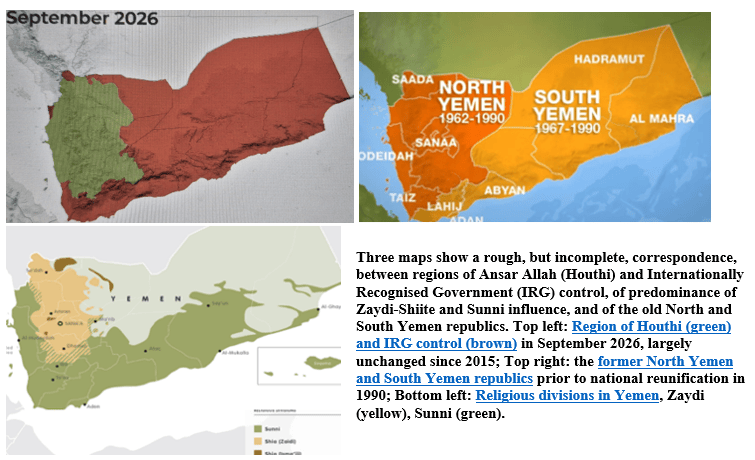
- The Zaydi-Shiite party and militia Ansar Allah (the ‘Houthis’) rules less than one third of Yemen’s territory, most of the territory of the former Yemen Arab Republic (YAR or ‘North Yemen’), while the internationally-recognised government (IRG) rules more than two thirds of Yemen in the south and east, including all the former Peoples Democratic Republic of Yemen (PDRY or ‘South Yemen’) and parts of the old ‘North’, especially the resisting regions of Taiz and Marib. These two Yemeni republics unified in 1990.
- On the other hand, the region controlled by Ansar Allah contains around two thirds of the population, while the IRG controls about one third. This is often cited to claim that the Houthis therefore form the ‘real’ Yemeni government – with the invalid assumption that those living under their rule chose them. However, this one third of Yemenis include Yemen’s second, third and fourth largest cities, namely Aden, Taiz and Marib; the largest, Sanaa, has been under Houthi control since their 2014 coup. The Houthis real base of support is further north, in the Zaydi region of Saada.
- While religion cannot explain the conflict, it has some relevance given that Ansar Allah is a theocratic entity which believes that only select Zaydi families who they believe are descended from the Prophet have the right to rule Yemen, even though Zaydi constitute only around one third of Yemenis, living in the north and centre of Houthi-controlled ‘north Yemen’; Sanaa itself has a mixed Zaydi-Sunni population; while all the south and east is heavily Sunni, including the frontline resistant regions at the southern and eastern ends of the old ‘North’, Taiz and Marib.
- Just on language: in using the term ‘internationally recognised government’ (IRG), I am just stating what is: the Saudi-backed government based in Aden is recognised by every country in the world with the sole exception of Iran, and by the UN Security Council, as Yemen’s government, as it has continuity with the government existing before the 2014 Houthi coup. I am not passing judgement on which is more ‘legitimate’; that is up to the people, and both governments have a certain lowish level of grudging popular legitimacy within their realms.
So what are some things that can be true at the same time?
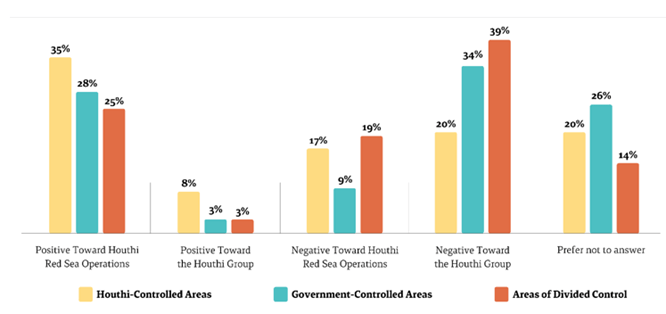
- Ansar Allah were virtually alone in the world in giving practical solidarity to Gaza during the genocide, blocking vessels travelling to and from the Israeli port Eilat on the Red Sea (Eilat only covered one tenth of Israeli maritime trade, still very significant, overwhelmingly Chinese EV’s – the Houthi blockade would have been irrelevant if the Chinese regime cared a hoot about Palestine). Palestinians will be eternally grateful for this. And polls show that the Houthis Red Sea blockade was popular with Yemenis in both parts of Yemen – far, far more popular than the Houthis are themselves as rulers – again, in both north and south:
- The same Ansar Allah is currently engaged in a criminal starvation siege of the people of the city of Taiz, Yemen’s third largest, who have resisted Houthi siege for 12 years. Already controlling the city’s northern and eastern exits, the Houthis recently seized the western exit to the coast when they seized the port of Mocha in September, and then the southern road to Aden, “pushing the city” according to Amnesty “to the brink of a severe humanitarian disaster … They [the Houthis] have blocked humanitarian aid, putting access to food, water, and healthcare for hundreds of thousands at grave risk.” Hospitals are close to collapse due to severe shortages of fuel, medicines, and oxygen, and are struggling to keep incubators running, threatening the lives of newborns. Some 347,000 children are deprived of their measles vaccines. struggle to keep incubators running. Calling the city and its 2-3 million defenders ‘Saudi-proxies’ is just the same crude propaganda as calling the Houthis ‘Iranian-proxies’. Acting in defence of Palestine as Israel imposed genocide and starvation does not give licence to impose horrific human suffering on fellow Yemenis, a point recently made by the Palestinian Scholars Association.
- The Houthis main foe, which is (ineffectively) defending the regions of Yemen resisting forcibly imposed Houthi rule, is Saudi Arabia, which between 2015 and 2022 engaged in a war of genocidal bombing and blockade, the World Organisation Against Torture (OMCT) claiming in 2022 that “the tens of thousands of civilians who die due to malnutrition, waterborne diseases, and the lack of access to healthcare” are the victims of “a combination of war crimes committed by the various sides, in which the naval blockade imposed by the Saudi-led Coalition plays a major role.” In December 2020, the United Nations recorded 131,000 deaths due to a lack of food, health services, and clean water, a crime against humanity which could barely be surpassed in scale by anything the Houthis have done or are now doing.
- Even during that time however Houthi sieges were responsible for part of this suffering; the Euro-Med Monitor in 2022 described the Houthi siege of Taiz as “collective punishment against civilians that may amount to a war crime,” as a result of which people “face a severe lack of basic humanitarian necessities, including food, water, and health care,” while countless civilians were also killed by Houthi missiles.
- The 5 million internally displaced (before the current conflict) are equally divided between the two parts of Yemen. Half fled the Houthi entity for the IRG, and 60 percent of these crowded into the besieged city of Marib, which grew from 240,000 to 3 million inhabitants, the overwhelming majority now being these displaced people, attempting to resist siege and capture by the entity from which they fled.
- The half displaced in the north did not flee there from the IRG, but rather are displaced within the north, having fled years of Saudi bombings of the countryside into larger urban centres.
- Saudi Arabia is ruled by an absolute monarchy that is one of the most repressive on Earth, with a rate of execution (356 in 2025) exceeded only by China (countless thousands) and Iran (2159), and until the social transformations of the last decade led by Crown Prince Mohammad bin-Salman (MBS) it was also one of the world’s most socially regressive. MBS’s changes have led to some positive reform in terms of women’s position for example, but the regime itself has become even more repressive than before; the sawing up of Saudi journalist and regime critic Jamal Khashoggi in 2018 is only the most well-known case. Its extraordinary brutality was highlighted by the savage killing of hundreds of Ethiopians attempting to cross the border from Yemen by Saudi border guards in 2023.
- The Ansar Allah regime in northern Yemen is also a frighteningly repressive and socially regressive regime (see this death sentence by crucifixion or stoning for nine people charged with homosexuality) whose rule is based on the divine right of a family allegedly descended from the Prophet to rule. In 2022, Amnesty International “documented the cases of at least 75 journalists, human rights defenders, academics and others perceived as opponents or critics who were subjected to arbitrary arrest, torture and other ill-treatment, enforced disappearance, and unfair trials with recourse to the death penalty.” Also, as of February 2026, 73 UN staff and dozens of other humanitarian workers remain under detention by Houthi authorities for no apparent reason, pointlessly exacerbating the humanitarian disaster.
- Of course, one may rightly say, yes both are ugly regimes, but Saudi Arabia has no right to intervene in the conflict in Yemen, a point well-made, especially given the way such Saudi ‘intervention’ worked in practice last round.
- However, that does not solve the problem of the conflict inside Yemen itself. The rulers of the two parts of Yemen have, broadly speaking, significant social base within the regions they control (more so opposition to being ruled by the other than enthusiasm for their own rulers), then ceasefire is the only supportable policy. But it is the Houthis who have expanded their territorial control since the conflict reignited in July, sending another 340,000 Yemenis fleeing the now Houthi-controlled southern Red Sea coast into IRG territory, while also renewing the sieges of Taiz and Marib.
While it may make know-nothing western ‘anti-imperialists’ feel good to describe the entire Yemeni population resisting being conquered by an arch-repressive theocratic entity as ‘Saudi-proxies’, this lack of human solidarity changes nothing if one wants to actually analyse based on the reality on the ground.
Historical legacy also contradictory
The historical legacy is also full of contradictions.
- The Ansar Allah regime is the updated version of the Zaydi Imamate, which ruled for 1000 years until overthrown in north Yemen by the 1962 revolution (south Yemen was then a British colony, and the people began their own anti-colonial revolution the following year). Like the Houthis, the Imams believed that only those allegedly descended from Mohammad (‘Sayyids’) should rule; the Houthi family are part of that same priestly-aristocratic caste as were the Imams.
- In the ensuing north Yemeni civil war (1962-68), Saudi Arabia backed the Zaydi-Shiite Imams as fellow reactionary divine-right rulers, while the ‘republicans’ – those defending the new civil state ushered in by the revolution – were backed by Egyptian ruler Nasser’s ‘anti-imperialist’ regime (though while undoubtedly the historically progressive side, we can’t ignore that Nasser’s murderous intervention included the use of chemical weapons).
- However, once the republicans prevailed in North Yemen by 1968, Saudi Arabia increasingly became protector of the republican, yet right-wing, government, as a barrier against the left-wing government arising then in South Yemen.
- Today Saudi Arabia stands on the opposite side, to where it did in the 1960s, to the Houthis’ modernised Imamate.
- The Houthis identify with their reactionary antecedents – every year they mass arrest Yemenis under their rule who come out to celebrate the 1962 revolution.
- The south Yemeni struggle against British rule came to be led by a Marxist party, and as the British withdrew in 1967, the new Peoples Democratic of Yemen in the south became the only officially ‘Communist” regime in the region, with an anti-imperialist foreign policy that featured strong support for Palestine.
- But that disappeared in 1990. While the Yemeni Socialist Party (YSP) – the inheritor of the legacy of the old PDRY regime – is part of the broad anti-Houthi coalition, and is a critical supporter of the IRG, it is not part of the UAE-backed ‘Southern Transitional Council’ (STC) which advocates secession of the South Yemen state. Back then, South Yemen proclaimed Marxist anti-imperialism and attempted to carry out a social transformation, however botched; today South Yemeni separatism has zero social content, representing only the UAE’s sub-imperialist quest for a mini-empire based on secession in Yemen, Somalia, Sudan and Libya.
The further contradictions in how the Yemen conflict arose
In 2012, Yemen’s edition of the ‘Arab Spring’ uprisings sweeping the region overthrew long-time dictator Ali Abdullah Saleh. To limit the uprising, the Saudi and Gulf rulers encouraged Saleh to step down and gain amnesty for his crimes, ceding the presidency to his deputy Mansour Hadi, the famous ‘Yemeni Solution’. Over the next two years, a National Dialogue process took place, involving all Yemeni parties, including the Houthis, the General National Congress Party (GNCP) of Saleh and now Hadi, the Muslim Brotherhood (Islah), the Nasserites, the Yemeni Socialist Party (YSP), and the southern movement (Hirak).
In the midst of this dialogue, the Houthis launched a coup and seized power in Sanaa in August 2014, with the support of the military high command still loyal to the ousted dictator Saleh. Despite having engaged in 7 wars against the Saleh regime, now the Houthis and Saleh formed an alliance to overthrow the new Arab Spring order. A 10-person Supreme Political Council (5 appointed by the Houthis, 5 by Saleh) took control. Even more intriguingly, Saleh engaged the UAE to assist the Houthi coup – the UAE saw Islah, which played a big role in Hadi’s government, as its chief enemy. To top it off, in October, the US air force gave direct air support to the Houthis as they fought al-Qaeda militants in central Yemen.
However, as the new Houthi-Saleh regime pushed south and east in 2015, besieging Taiz, Aden, and Marib, meeting furious local resistance, the UAE switched sides join Saudi Arabia in launching their devastating aerial war against Yemen. On the one hand, the peoples’ resistance in these centres was entirely legitimate. On the other, the Saudi-UAE ‘intervention’ was so recklessly murderous that at times it defied explanation, given that it was not even able to lift the sieges – despite furious resistance on the ground – let alone reconquer any Houthi-controlled territory, which they foolishly aimed at. Aden eventually drove back the Houthis, but they had arrived in the city after the onset of Saudi and Emirati bombing.
Aiming at reconquering Sanaa and the entire north is precisely what weakened their ability to lift the Houthi sieges, because the bombing covered the whole of Yemen rather than being focused on where it was required and arguably justified. For example, the Houthi stronghold of Saada in the far north became a virtual free fire zone for the Saudis, the most bombed part of Yemen, despite being distant from the frontlines, while bombing Sanaa only alienated the population in the capital which was otherwise averse to imposed Houthi-Saleh rule which ended their brief two years of freedom.
The UAE’s interests
In 2019 the UAE quit the war. Good – the ongoing Saudi terror bombing remaining as ineffective as it was horrific, but neither had anything to do with the UAE’s motives. The UAE had begun arming the secessionist Southern Transitional Council (STC), undermining the IRG, leading to military clashes in 2019. While many southerners did support a restored South Yemen as an alternative to the current disaster, there is nothing inherently progressive about the shape or size of the old South Yemen; splitting the Yemeni nation along arbitrary lines is reactionary, especially as proxy for a foreign power. Further below we will discuss the UAE’s interests in pursuing secession; for now, the war no longer served its purposes.
And it became clear that the UAE’s exit from the war was not motivated by pacifism. In the shadow of the war, between 2015 and 2018, UAE-backed forces waged a large-scale assassination campaign, killing some 160 political opponents in Yemen – overwhelmingly cadre of Islah, the Yemeni Muslim Brotherhood (MB), which was supposedly an ally against the Houthis, played a prominent role within the IRG, and whose cadre on the ground were the leading force in the resistance in Taiz and Marib. The UAE sees the MB, with its attempt to blend political Islam with democracy, as its arch-enemy, the main regional threat to Gulf thrones, especially since the MB had tried to ‘ride’ and coopt the Arab Spring, whereas the UAE’s preference was for crushing it. After the 2022 Saudi-Houthi ceasefire, the STC and other UAE-backed militia seized the capital of Shabwa province from Islah and drove it out.
An independent ‘South’ implied abandoning parts of ‘North Yemen’ resisting the Houthis, especially Taiz and Marib; and given Islah’s strength precisely in those regions, this suited the UAE. A strange convergence of interests between the Iran-backed Houthis and the UAE-backed STC against a Saudi-backed conception of a united Yemen ensued. ‘Houthis keep North Yemen and we keep South Yemen’. If the Houthis then crush the Islah-led pockets in the ‘north’ so much the better. As we saw, the UAE had initially aided the Houthi coup [as an aside, Egypt’s similarly extreme anti-MB al-Sisi dictatorship also maintained a pro-Houthi policy in 2015-16, even delivering arms to the Houthis].
Saudi interests
This does not make the Saudis the ‘good guys’, and not only because of the brutality of its intervention. While the Saudi goal of maintaining a united Yemen is arguably positive in the abstract, Saudi Arabia has historically aimed to keep Yemen weak and subordinate, seizing three northern Yemeni governates in 1934. Despite its small size, Yemen’s population is larger than Saudi Arabia’s, so a strong Yemen is not in Saudi interests. Division arguably suits the Saudis, but today both sides of a split Yemen would be run by its rivals, in a climate in which a conservative Saudi monarchy sees Israel, Iran and the UAE as revisionist powers destabilising the region. It thus aims to ensure a weakly united state under a Saudi guarantee.
But this raises the question of which social and political forces the Saudis can ally with on the ground. Leaving aside the Houthis and southern secessionists, there is Islah, the YSP, the Nasserites, the democratic movement arising from the Yemeni Spring, and Hadi’s wing of the GNCP. Regarding Islah, Saudi Arabia, like the UAE, bans the MB as ‘terrorist’, while the YSP, Nasserites and democratic movement are not the cup of tea of an absolute monarchy. However, Riyadh is more flexible than the UAE when need requires some kind of working relationship with the MB, and opposing the Houthis was such an example. As for president Hadi and his wing of the GNCP, the Saudis controlled him as a puppet living in Riyadh!
While the Saudis thus had to rely on forces such as Islah, along with various Salafist and ‘tribal’ forces, the murderous and devastating irrationality of Saudi bombing seems to be related precisely to the Saudi rulers distaste for all the indigenous forces on the ground, opponents, rivals or temporary ‘allies’. Whether split between two rivals or united under a weak regime, leaving Yemen devastated and dependent may have been a goal in itself.
The 2022 ceasefire and beyond
By 2022, the war was stalemated; the Houthis could not conquer the south and east, the Saudis could not drive the Houthis from the north; the bases of support on both sides held. A UN-negotiated ceasefire was signed in early 2022 and held until July this year. In December 2023, amidst the Houthis’ Red Sea blockade of Israel, both sides re-stated their commitment to a UN-led ‘roadmap’; Saudi delegations visited Sanaa, and Houthi delegations visited Riyadh. The UAE and its allies however were left out of the process.
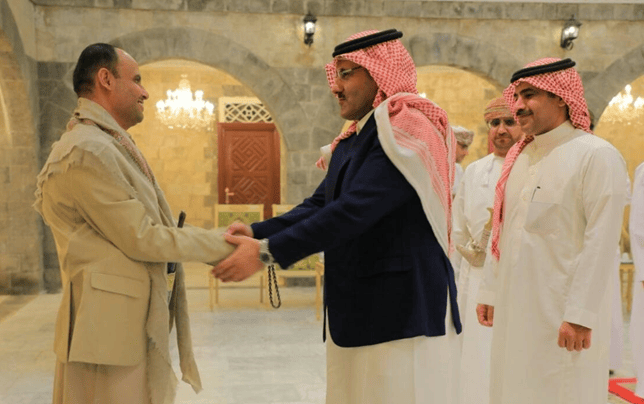
This ceasefire corresponded to the process leading to the March 2023 Saudi-Iranian normalisation agreement signed in Beijing, which in the next few years saw high level visits, joint naval exercises and basically a détente. When the US and UK assembled a fleet from a dozen countries in 2024 to protect ships from Houthi attacks during the Red Sea blockade, Saudi Arabia refused to join, or to allow US attacks on the Houthis from its soil. And when Trump did a separate deal with the Houthis in early 2025, sidelining Israel, it was revealed that the Saudis had encouraged Trump to do this deal.
This did not mean that the Saudis and Houthis became ‘friends’. But the regional situation had changed and now détente and ceasefire suited the agendas of both. Regional sub-imperial rivals Saudi Arabia and Iran had exhausted themselves in proxy conflict in Yemen, Syria, Iraq and elsewhere, so decided to let things sit to consolidate gains; a similar reconciliation was underway between the conservative Saudi-UAE-Egypt-Bahrain bloc and its Sunni rivals, Qatar and its sub-imperial ally Turkey, who had ‘ridden’ the regional revolutionary wave in populist manner via the Muslim Brotherhood; the Saudi-led blockade of Qatar was lifted.
By contrast, the Saudi-UAE-led bloc began to fray, not only in Yemen, but due to the Abraham Accords which the UAE and Bahrain signed with Israel (Egypt already had a peace treaty), while Saudi Arabia (like former rival Qatar) did not. While the Saudis showed some openness, they insisted they would only normalise with Israel if a Palestinian state were established with Jerusalem as its capital on all Palestinian territory occupied since 1967; the fact that the Saudis normalised with Iran rather than Israel was rather in-your-face, and even this conditional openness towards the Accords collapsed after October 7, 2023.
The capitalist transformation of the Gulf and the rising sub-imperial clash between Saudi Arabia and the UAE
This reflected the rise of Saudi Arabia and the UAE as regional powers undergoing rapid capitalist transformation. Many still imagine the Gulf states to be ‘sand and oil’ monarchies capable only of being US ‘puppets’, apparently ignorant of their radical transformation and capitalist modernisation over the last two decades, which has made them regional actors looking out for their own capitalist interests, which often conflict with Israel’s interests as much as those of Iran – and with each other’s – and now live in a world where China, the rising challenger to US imperial power, and other imperial powers like Russia, can help balance their relations with US imperialism.
In this context, Saudi Arabia and the UAE began finding the region too small for both their sub-imperial projects, especially now that the Saudis had made their peace with their major sub-imperial Turkish and Iranian rivals. Compared to these three giants, the UAE has a tiny land area, with one third the Saudi population, though with a higher per capita GDP. Just as tiny Qatar had to attach itself to a powerful Turkey to break out from Saudi domination of the Gulf the previous decade, the UAE now did the same, with Israel.
For the UAE the Abraham Accords were not only about Israeli technology and trade and not giving a damn about Palestine, but also about partnering with a fellow regional revisionist ‘Sparta’, as it cut its new mini-empire of ports, islands, coastlines from Yemen, through the Red Sea and into Africa and its mineral wealth via breaking countries apart; south Yemen secessionism was a minor copy of the massive, bloody break-up of Sudan engineered by the UAE via the genocidal Rapid Support Forces (RSF) in March 2023.
Saudi Arabia’s modernising transformation led it to see itself as a power in its own right rather than a dependent oil state trapped between Israeli and Iranian projects. MBS’s consolidation of power against the traditional princes and the Wahabi religious order initially led to some anti-Iranian convergence with Israel, junking sympathy for Palestine as part of the old order. MBS frankly stated that he did not care about Palestine; continued refusal to normalise with Israel was explained as due to the pro-Palestine sympathies of the Saudi population, and MBS not wishing to meet Sadat in hell too soon.
But this has subtly changed, as an assertive nationalism complemented religion as a guide while new Saudi Arabia was being constructed, and Israel turned into a genocidal pariah. Saudi Arabia, the guardian of the two Holy Mosques, and head of the Sunni world, cannot easily normalise with the country occupying the third Holy Mosque; that is now a question of national pride for the new religious-nationalist synthesis.
It was in Saudi Arabia in 1982 that the Fahd Plan was voted on by the entire Arab League, including the PLO, to recognise Israel if its withdrew from all territory occupied in 1967 and allowed a Palestinian state with Jerusalem as its capital, along with some symbolic settlement of the refugee issue; again in Saudi Arabia, 20 years later, the Arab Peace Plan offered the same deal, again with the support of the entire League. Saudi leaders have over the last few years repeated that this Palestinian state is the absolute condition for any normalisation with Israel so many times that it is virtually impossible to go back on without national humiliation.
And this not only puts it in conflict with a revisionist Israel, but also with Israel’s UAE ally ripping up the region; Saudi rejection of the Abraham Accords, in other words, is also rejection of the regional project these Accords have enabled. For MBS to carry out his grand projects, regional stability is a must; the Beijing-engineered accord with Iran and the end of the blockade on Qatar were essential to this. Just as Israel’s genocidal and expansionist actions led to it replacing Iran as the major regional destabilising force in Saudi and Gulf eyes, the actions of the similarly revisionist UAE likewise cut against the Saudi preference for sovereign borders and similar elements of regional stability.
The regional geopolitics on the eve of the Iran war
Before the onset of US-Israeli aggression against Iran, as the Saudi-UAE conflict blew up in December 2025-January 2026 with their open military clash in Yemen, two blocs of regional states outside the Iranian axis loosely coalesced:
- On one side is what Netanyahu called a ‘hexagonal alliance’ which he said includes Israel, India, Greece and Cyprus, along with unnamed “Arab, African and Asian states,” meaning at least the UAE and Ethiopia.
- On the other, the traditional alliance between Turkey and Qatar has now been joined by Saudi Arabia, which also has a defence treaty with Pakistan, and this alliance includes Somalia and the new Syria.
Netanyahu proclaimed that his ‘hexagonal’ alliance would confront not only “the radical Shia axis,” but also “the emerging radical Sunni axis.” Many Israeli leaders have made similar statements, especially as the power of Turkey’s Islamist-oriented Erdogan regime was enhanced after the fall of Assad. At a 2025 security conference, Israeli leaders asserted that a Syria run by Sunni Islamists allied to Turkey could pose a greater problem than the Iran axis. Hard-right Israeli diaspora affairs minister Amichai Chikli claimed that Turkey wants to create a “neo-Ottoman empire oriented toward Hamas and the Muslim Brotherhood,” and that “there is a direct link between the weakness of Iran and the dominance of Erdogan;” and far-right ‘oppositionist’ Naftali Bennet called Turkey “the new Iran” which is “trying to flip Saudi Arabia against us and establish a hostile Sunni axis that includes nuclear-armed Pakistan,” insisting that if elected he would declare Qatar an ‘enemy state’.
The main conflict zones were:
- Yemen. In late 2025, the UAE-backed STC seized parts of southern Yemen from the IRG, the Saudis bombed the UAE’s weapons supplies of weapons to the STC, and drove back the STC from regions it had seized; the STC stated that an independent South Yemen would recognise Israel and join the Abraham Accords.
- Israel became the first country to recognise Somaliland, a breakaway region of Somalia, which in turn recognised Israel with occupied Jerusalem as its capital. Emirati company DP World operates Somaliland’s main port in Berbera, where the UAE is building a military base. Ethiopia – which has strong relations with Israel and the UAE – signed an agreement with Somaliland giving Ethiopia access to its ports. Saudi Arabia, Turkey and Egypt stressed support for Somalia’s territorial integrity.
- The UAE uses a camp in Ethiopia to train the genocidal Rapid Support Forces (RSF) in Sudan, at war with the Sudanese Armed Forces (SAF) since 2023. The UAE (and initially Russia’s Wagner paramilitary) backs the RSF, which worked as a conduit for Emirati and Wagner interests exploiting Sudan’s gold and other minerals; Saudi Arabia, Turkey, Egypt and Iran back the SAF. Israeli voices call the SAF “terrorist” or “Muslim Brotherhood,” and the RSF has used Israeli arms and expressed support for Israel. Iranian planes carrying weapons to Sudan fly across Saudi airspace.
- Since the overthrow of Iran- and Egypt/UAE-backed Assad regime, Israel has undermined the new Syrian government, which it calls ‘terrorist’ and ‘jihadist’; an Israeli conference in 2025 advocated breaking Syria into ethno-sectarian cantons. Saudi Arabia, Qatar and Turkey want a unified Syria in order invest in a stable environment, and as a bridge between the Gulf and the Mediterranean that avoids Israel. Saudi Arabia declared that it wanted to replace Israel with Syria as the transit country for a fibre-optic cable, the East to Med Data Corridor (EMC), signed between Greece and the Saudis in 2022. In June, Turkey and Saudi Arabia signed agreements for an integrated railway connecting their countries via Syria, reviving the old Hejaz railway. Turkey’s Trade Minister Ömer Bolat meeting his Syrian counterpart stated “the reduction of Israel’s influence in the region … will bring economic prosperity, peace and stability to the Middle East, the Gulf and Türkiye’s southern borders.”
The US-Israel aggression against Iran
With the onset of US-Israeli aggression against Iran in early 2026, Iran began firing missiles and drones not only at Israel, but also at all the Gulf states – not only at US military bases there, but at their ports, airports, hotels, office blocks and energy infrastructure, in order to savage the regional and global economy to maximise the cost for the US continuing its aggression, the same reason Iran blocked the Strait of Hormuz.
In both cases, the Gulf states were the most impacted, despite Saudi Arabia, Qatar, Oman and even the UAE strongly pushing against a US war on Iran and barring their territory and airspace being used for it. But for Iran, the world economy, rather than these states as such, was the actual target, and they were collateral damage.
However, there was a difference – the UAE suffered 44% of all Iranian drone and missile attacks on the six states, and the second highest rate per capita (33 attacks per 100,000 population). Saudi Arabia received by far the lowest rate of attacks per capita (3 attacks per 100,000), and only one third the number of attacks compared to the UAE.
The UAE was Iran’s second-largest trading partner after China, so had reason to oppose the war on Iran, but war has its own logic. The Abrahams Accord not only boosted Israel-UAE trade, but also ‘security cooperation’. “The UAE is host to a lot of Israeli intelligence companies, arms companies,” giving Israel “an unofficial base” in UAE. From Iran’s perspective therefore, much UAE civilian infrastructure was suspect. Notably, Bahrain, the other Abrahams Accord state, suffered the highest per capita rate of Iranian strikes.
Opposing Saudi and UAE strategies during the Iran war
The pre-war Saudi-UAE geopolitical clash and this difference in receipt if Iranian strikes were reflected in their differing strategies in the first months of the war. For example:
- Israel sent its ‘Iron Dome’ missile defence shield to the UAE at the outset of the war.
- Netanyahu secretly visited the UAE during the war, as did the heads of Mossad and Shin Bet, the chief of staff, and almost the entire Israeli leadership.
- The UAE attempted to get Saudi Arabia and Qatar “to take part in a coordinated military response to Iran’s strikes and was left frustrated when they refused,” as they told the UAE it was “not their war.”
- With the onset of Iran’s strikes, the UAE “carried out dozens of airstrikes against Iran” from the first days, in direct coordination with the US and Israel; it played a direct role in Israel’s attack on Iran’s Asaluyeh petrochemical complex. Saudi Arabia “demanded the U.S. pressure the UAE to wind down its attacks.”
- The UAE did not welcome the April 7 ceasefire, and struck an oil refinery on Iran’s Laval Island after the ceasefire announcement.
- The UAE withdrew from the Saudi-led OPEC bloc of oil producing countries.
- The UAE and India signed a defence agreement during Modi’s visit to the UAE in May, building on the I2U2 partnership (India, Israel, UAE, US) established in 2022.
- The UAE abruptly demanded immediate full repayment of a long-term loan by Pakistan, apparently as revenge for Pakistan’s good relations with Iran.
Meanwhile, on the other side:
- Saudi Arabia called for a non-aggression pact between Iran and other regional states.
- Saudi ally Pakistan led the mediation between the US and Iran; Saudi Arabia, Qatar, Oman and Turkey pushed this strategy. This bloc thus became the ‘mediation camp’.
- When Pakistan secured the April 7 US-Iran ceasefire, prime minister Shehbaz Sharif thanked China, Saudi Arabia, Qatar and Turkey for helping bring it about, and thanked them again when the June MOU was signed.
- Trump had to abandon his May ‘Project Freedom’ operation to shepherd ships in the Gulf in defiance of Iran when Saudi Arabia barred the US from using its airbases or airspace for the operation. The US threatened to block delivery of interceptors to Saudi Arabia, causing a “major rift” with “the U.S. considering reducing its military footprint in Saudi Arabia.”
- Trump backed down from his July threat to bomb Iran at a World War II level after pressure from the Saudis (even after the renewal of the conflict with the Houthis); in September the Saudis and Qatar were pushing for compromise to return to the MOU; in October the Saudis were pushing Trump to avoid a new attack on Iran.
- China sold weaponry to the Gulf states during the war to help their defence from Iranian attack, while the US “depleted much of its inventory” of advanced interceptors” to protect Israel.
- Saudi Arabia rejected Trump’s comedic call on regional countries to join the Abraham Accords as part of an Iran deal, repeating that peace with Israel is contingent on an “irreversible pathway” to the establishment of a Palestinian state.
- Israel stepped up its aggression in southern Syria, killing the regions’ agriculture; it bombed a missile base in the north, claiming Turkish forces were deploying; Syria signed a defence pact with Saudi Arabia and is in talks to join the Mecca Alliance.
So, given this background, how did it happen that the pro-Iranian Houthis launched a huge escalation against Saudi Arabia, head of the mediation camp, since mid-year, while the Israel-aligned UAE has been partnering with them against the Saudis? This appears to make little sense. However, we need to remember that:
- The Houthis are not Tehran’s ‘proxies’; this is their own war, not Iran’s.
- The Houthis have their own Yemen-based issues and are taking advantage of the war to push them; since the Saudis expelled the UAE from Yemen in January, they have only the Saudis and the government they back to target, while the UAE now has more reasons to weaken the Saudis.
- Iran and the UAE also came to a new arrangement in the second half of 2026, though this is a parallel rather than causative to the Houthis’ escalation.
Three developments centred on Saudi Arabia around mid-year
It is worth noting that the blow-up in Yemen was only one of three mid-year developments centred on Saudi Arabia which provide some context:
- On July 13, the Saudi (or Saudi-backed IRG) airforce cratered Sanaa airport to prevent an Iranian plane landing with Houthi leaders returning from Khamenei’s funeral; it landed in Hodeida, also Houthi territory. Yet Saudi Arabia itself had sent a high-level delegation to Khamenei’s funeral, highlighting the ongoing Saudi-Iranian détente; but even this irony is trumped by the breathtaking stupidity of this action. This was cue for the Houthis to launch a massive, hugely disproportionate escalation against both Saudi Arabia and the Yemeni IRG, which the Saudis had not expected and are finding it difficult to escape from months later.
- On July 22, the US and Saudi Arabia announced an agreement to develop a Saudi nuclear industry with US investment and technology, including uranium enrichment on Saudi territory, without the usual IAEA regime of intrusive inspections. Given the US had launched its war on Iran allegedly to prevent it enriching on its soil – despite Iran agreeing to safeguards, limits, inspections etc – this was reckless even for Trump. Trump was accused of ‘giving in’ to the Saudis by not demanding they first normalise with Israel. However, the next day, Trump revealed this was precisely the point, declaring the deal was dependent on Saudi Arabia joining the Abraham Accords, also tweeting that it involves “no enrichment”!
- On August 7, Saudi Arabia, Pakistan and Turkey announced the ‘Mecca alliance’ military defence pact. Given Saudi Arabia’s clash with Israel-aligned UAE and the escalating Israel-Turkey conflict, the bloc is clearly counterposed to both Israeli and Iranian regional projects; it is also the ‘mediation bloc’ in the war. While they are broadly called ‘US allies’, Pakistan receives 80 percent of its weaponry from China. Pakistan deployed 8000 troops to Saudi Arabia, under their 2025 defence pact, plus a squadron of 16 JF-17 fighter jets jointly developed with China, and a Chinese HQ-9 air defence system – allowing Chinese deployment in Saudi Arabia, otherwise banned by the US under the F-35 program, through the Pakistani back door. Saudi Arabia is now using Chinese DF-15A ballistic missiles in Yemen. Both Turkey and Saudi Arabia have developed strategic relations with Russia and China; Saudi Arabia is China’s main oil supplier and has even began oil sales in Chinese Renminbi, an opening crack in ‘petrodollar’ hegemony.
So why did Yemen blow up?
The Houthis reacted ferociously to the attack on Sanaa airport, declaring a blockade on Saudi oil exports through the Bab al-Mandab Strait, bombing Saudi cities and oil facilities, and attacking the Yemeni government forces in strikes that killed dozens. Apart from token responses, the main Saudi response (before the September Houthi conquest of the south coast) was to quietly divert oil ships north through the Suez and the long route around Africa. Saudi Arabia clearly had not anticipated this reaction, likely expecting a token, proportionate Houthi attack on some Saudi asset, assuming the Houthis also wanted to keep the truce.
Did Saudi Arabia and Iran both go mad and decide to blow up their détente? More likely, neither intended this, but that the Houthis used the pretext the Saudis gave them to press their own Yemen-related demands.
Many claim the Houthis acted as Iran’s proxy, because closing the Bab al-Mandab alongside Hormuz could double the impact on the world economy. However, Iran was then using the threat to block the Strait if Trump actioned his threat to bomb Iranian civilian infrastructure. Trump did not get to that; Saudi Arabia pressured Trump not to. Why would Iran use its remaining card before such action took place, and aggravate a state trying to prevent it?
As for the Saudis, most likely the Yemeni IRG cratered Sanaa airport (it took responsibility), but it is unlikely they did so without Saudi permission. Yes, the Saudis and IRG had a long-term ban on non-Yemeni planes using the Houthi airport, without IRG coordination, especially Iranian planes, fearing weapons delivery. However, as the Saudis and Houthis were both at Khamenei’s funeral, and Saudi Arabia had a good arrangement in being able to avoid the Hormuz blockade by diverting oil exports to the Red Sea and out through the Bab al-Mandab, from where they had been exporting 5 million barrels a day and making more money than before due to higher oil prices, one might think they could just ‘let this one go’.
However, the Saudis believed that both the Iranian plane that earlier landed at Sanaa airport to pick up the Houthis (which was not prevented from landing) and this plane returning them were also carrying advanced weaponry, not to block the Strait now but to get prepared for when they may decide to. And the Saudis were determined to block such a plan. It seems likely the Saudis gave their Yemeni allies permission to ‘make a statement’ to prevent any import of Iranian weapons, expecting Iran to confine the Houthis to low-key retaliation.
Ansar Allah – Iranian proxies?
But as noted, the Houthis do not take instructions from Iran. Let’s look at some evidence:
- Iran advised the Houthis against seizing Sanaa in 2014-15, probably preferring more time for Iranian assets and influence to be established before a huge conflict arose, but the Houthis defied it. It was not small-scale (at that stage) Iranian arms that facilitated the Houthi coup, but the large-scale arms of the former Saleh regime collaborating with the Houthis, giving them control over “entire brigade sets of tanks, artillery, and anti-aircraft weapons,” ballistic missiles, launchers, and intelligence agencies.
- In 2016, Houthi commander Youssef al-Fishi demanded Iranian officials “remain silent” and “stop exploiting” Yemen’s war for their own interests,” following a prisoner exchange with Saudi Arabia and an Iranian leader’s claim that Iran is ready to help Yemen “in any possible level.”
- Iranian support for the Houthis did increase markedly after the Saudi intervention due to this forced increase in geopolitical competition, yet even after the onset of the Gaza genocide, US intelligence assessed that Iran was not directing the Houthis and played no role in their decision to attack shipping in support of Gaza.
- Houthi leaders scoff at the idea they were acting at Iran’s behest, and even scoff at Iran, Houthi spokesperson Abdelmalek al-Ejri telling The Atlantic that “our stance on Gaza is more advanced than anyone, even Iran. Iran was shocked that Ansar Allah had the guts to do what we did.” After all, what exactly did Iran do?
- Ansar Allah did not defend Iran following US-Israel aggression in February. They maintained the separate truce they had signed with the US in 2025, and though they restored the ban on Israeli shipping (they had ended it with the October 2025 Gaza ‘ceasefire’), they excluded Chinese vessels, China being by far the main country using the Red Sea for trade with Israel.
- The Houthis again met US officials in Oman after the onset of the new Yemen war and made clear US vessels (and in some reports, Israeli vessels) were not the target, only vessels of “the Saudi enemy.”
- At an ideological level, while the Houthis add ‘a curse on the Jews’ to their ‘death to America and Israel’ slogans, the Iranian leadership has largely avoided conflating anti-Israel and anti-Jewish messages in this way, to its credit.
All that said, the Houthis are allied to Iran, Iran provides their weaponry, and is ready to exploit any geopolitical gains they make with their actions. Ansar Allah is thus broadly part of Iran’s sub-imperial project, but an independent and sometimes troublesome part.
What then do the Houthis want?
Clearly then, this is Ansar Allah’s own campaign against Saudi Arabia in Yemen. They read Saudi Arabia’s vulnerable position stuck between the two Straits, and stuck between Abrahams Accord and Iranian pressure, and decided to use the stupid Saudi provocation to push for a more advantageous position inside Yemen with regard to the issues still dividing them, despite the 2022 ceasefire.
Pro-Houthi sources claim they blockade Saudi vessels to end the Saudi ‘blockade’, conjuring up images of the Saudi-driven humanitarian disaster before 2022. However, the ceasefire ended the Saudi naval blockade. What remains is the Saudi-led coalition searching occasional vessels in line with the UN Security Council arms embargo on Houthi authorities (UNSC Res. 2215, 2015). While this may hold up deliveries, there is no restriction on food, fuel, medicines or consumer goods entering Houthi ports. Between mid-2024 and mid-2025, Hodeida handled 270 shipments, Indonesia, Vietnam and Brazil being the top exporters.
But while there is no ‘blockade’, that is not the end of the story. With only Aden used as an international airport, most people entering or leaving the country from Houthi-controlled regions have to take road transport to Aden, though a regulated number of flights out of Sanaa are also allowed to Amman or Cairo. While the Saudis and IRG justify this on ‘security’ grounds, the Houthis have good grounds to demand equality for Sanaa airport; having multiple international airports is hardly unusual elsewhere.
But the main issue is the IRG’s control of Yemen’s revenue, trade and financial transactions, along with oil and gas deposits just happening to be in IRG territory; salaries from these national revenues have not been paid for civil servants in the north for years.
The Houthis escalation is aimed at pressuring for resolution of these issues, and frankly the Saudis could probably end the Houthi attacks if they were willing to hasten this outcome. These issues have been on the table for several years, via the UN-led ‘roadmap’ agreed to by the Saudis and Houthis in December 2023, the solutions agreed to in principle.
While the Houthis seizure the southern coastline, sending hundreds of thousands fleeing, and their criminal siege of Taiz, are outrageous actions, any claim that the Saudis therefore have no alternative but to resume their massive bombing misses the fact that there is a negotiated path if the Saudis and IRG expedited what they had already agreed to and recognised the reality that one third of Yemen will never be under their control, at least by military means.
A Houthi withdrawal from the newly conquered southern territories and ending their sieges in exchange for ending restrictions on Sanaa airport, sharing of oil revenues and payment of salaries of civil servants in all of Yemen from these revenues is the path out of this disaster. A broader political settlement to gradually reintegrate the parts of Yemen can only come about via ceasefire, mutual recognition of legitimacy and negotiated compromises.
Where does the UAE come into this?
As noted above, the UAE has been providing the Houthis with targeting intelligence on sites in Yemen. One may shrug, the enemy of my enemy is my friend; and since the Saudis drove out the UAE, it understandably seeks revenge.
However, its Israel connection hardly makes the UAE a natural Houthi ally, and in late 2025, the STC offered an independent South Yemen membership of the Abraham Accords; while Islah has organised pro-Gaza demonstrations in Taiz and elsewhere. Add the UAE’s hard line on Iran (compared to the Saudis) in early 2026, and a Houthi-UAE seems impossible.
After the US-Iran MOU collapsed in July and the US resumed bombing, Iranian ‘retaliation’ targeted Bahrain, Kuwait and Jordan, sparing both Saudi Arabia and the UAE. Sparing Saudi Arabia was consistent with early 2026, and with the geopolitical line-up, but sparing the UAE was total reversal. The UAE, by then also exhausted by US incoherence, decided to give Iran one thing it was demanding – the unfreezing of US assets – some $10-20 billion of which were held in the UAE, to avoid further Iranian ‘retaliation’ strikes. Iranian and Emirati leaders stated they wanted to “turn the page.”
However, as the Houthi actions follow their own Yemeni logic, this Iran-UAE page-turn is only parallel to the UAE-Houthi anti-Saudi understanding in Yemen. Yet this understanding on Yemen is even stranger given that not only have the Saudis been the mediating party in relation to Iran compared to the UAE, but this has also been the case inside Yemen itself.
As we saw, the Houthis aimed to hasten implementation of the UN-led ‘roadmap’ agreed to by the Saudis and Houthis, including measures addressing public-sector salaries, oil exports and revenues, and restrictions on Sana’a airport, but the UAE and STC have long been opposed to this roadmap altogether and to any concessions to the Houthis.
Saudi-Houthi discussion of the roadmap was revived in April 2026, followed by the largest IRG-Houthi prisoner exchange to date, indicating that relations were continuing to improve. However, the STC declared the sharing of oil and gas revenues (concentrated in southern Hadramawt and Shabwa governates), especially to cover the northern civil servant salaries, to be a red line. As the IRG announced a resumption of oil exports in July, aiming to direct proceeds toward paying salaries in all of Yemen, the STC mobilised to prevent this.
But while this demonstrates the ‘southern’ parochialism of the UAE-STC, the other side is the southern perception that the UN-led process largely consists of agreements at the top between Saudi Arabia and the Houthis, sidelining not only the STC, but even the IRG. Saudi Arabia was perceived to have tightened its grip “on areas outside Houthi control with the silent approval of the latter.” The Zionist MEMRI site claimed there was a Saudi-Houthi agreement to deploy Houthi forces along the Saudi border to fill the vacuum left by the STC.
So while the Houthis are attacking Saudi Arabia and the IRG because the roadmap has been slow in yielding results, at least they officially support the process; the UAE/STC is totally opposed. And until July, the 4-year Saudi-Houthi détente seemed only to be strengthening.
But the Houthi-UAE understanding makes ironic sense when we remember the UAE-STC project: restoring South Yemen. They oppose the UN roadmap for oil revenue sharing with the Houthis and payment of salaries precisely because they consider the oil to belong to their independent ‘South Yemen’ and therefore should not pay for anything in ‘another country’. But for exactly this reason, an independent South implies an independent North Yemen, legitimising the Houthi regime and abandoning resisting regions.
It was reported in April that the UAE was “aggressively” lobbying the White House to designate Islah a terrorist organisation – despite Islah taking one third of portfolios in the new Yemeni government established in February, a government rejected by the STC (STC-connected figures received 20 percent of portfolios, Hadi’s GPCC 14.3 percent, and the Yemeni Socialist Party 11.4 percent). This suggests it is near impossible for the UAE to reconcile with the IRG or Saudi interests in Yemen, regardless of the Houthi escalation.
Given Islah’s role in the Taiz, and the STC’s focus on ‘South Yemen’, it was widely believed among pro-Saudi sources that the rapid collapse of defences at the port of Mocha and further south in Taiz governate during the Houthis’ lightning September offensive was caused by betrayal by UAE-backed forces; a militia led by former dictator Saleh’s nephew, allied to the UAE after the Houthis turned on them, patrolled that region and fled the battle, while no help arrived from its STC allies further south. However, the reality may be less conspiratorial, and merely that these divisions prevented any unified command and control. Now with the Houthis approaching Aden, it is the STC accusing Saudi-backed forces of betrayal.
The centrality of Saudi Arabia and the battle for the kingdom
The more Saudi cities, airports and energy infrastructure come under sustained Houthi attack, the more the kingdom appears isolated, neither due to any wider support for the Houthis, nor to revulsion against the Saudis’ previous catastrophic role. Let’s look:
- When the Saudis asked the US for help against the Houthis, after the lightning Houthi conquest of the south coast in September, Trump laughed in their faces, stating the Houthis “called us, and they don’t want to fight us”, adding that they are “allowing most ships to pass,” the problem limited to “one country” (Saudi Arabia!), and that it would “work out very well”. I’m glad the US is not bombing Yemen, but what such demeaning dismissal of an ‘ally’ mean? Houthi Political Bureau member Mohamed al-Bukhaiti confirmed they were “not targeting the United States, or any other nation [including Israel?], in the strait, with the sole exception of the Saudi enemy.”
- Israel also showed little interest for several months, which suited Riyadh who wanted US but not Israeli support. But following the Riyadh airport massacre in October, Netanyahu offered the Saudis via the US to join the war on the Houthis. Saudi Arabia rejected this poisoned chalice. Trump’s belittling brush-off and Israel’s toxic offer are two sides of the coin: coming to Riyadh’s aid requires normalisation with Israel.
- Despite its intel sharing with the Houthis against the Saudi-backed IRG, the UAE has also offered to rejoin the fight against the Houthis; its conditions include Saudi acceptance of the STC – effectively, partition – and for Islah to be banned!
- Iran, claiming to have nothing to do with the conflict, offered to mediate between Saudi Arabia and the Houthis, Foreign Minister Abbas Araghchi regretting that neither responded. He offered “cooperation to bring the two sides’ positions closer together.” However, it was widely reported that IRGC advisors aided the Houthi conquest of the south coast, and senior Iranian leaders celebrated it.
- Saudi Arabia’s Mecca Alliance partners Turkey and Pakistan offered unspecified military or intelligence assistance to Riyadh against Houthi attacks, as did Syria and Egypt. It is unclear what this has meant in practice, and made clear that they would not intervene in Yemen itself.
It is odd to see the mighty Saudi kingdom, with its billions worth of US arms, being humiliated by Houthi drones and missiles, with apparently no real allies. Not that the US, Israel or the UAE (or even Iran) want the Houthis to completely defeat Saudi Arabia. But the picture suggests the Saudis current vulnerability – stuck between two blockaded straits, and between a Greater Israel project and a new Iranian hegemony in the Gulf – is being exploited by all sides to pressure Saudi Arabia in their direction. Quite frankly, Trump’s laughing at the Saudis is not just about “being Trump”; the Houthi escalation is seen as a useful tool.
That Saudi Arabia should be in the centre of these developments is hardly surprising. Unlike the other tiny Gulf principalities, the Saudi royal family heads a real country, one of the world’s largest oil producers, with a powerful military, and a diversifying economy, which geographically separates the regions where Israel and Iran exert domination. The importance which both Biden and Trump have placed on attempting to get Saudi Arabia into the Abraham Accords is easy to understand if we look at a map – the countries that signed on in 2020 include the microscopic island of Bahrain, the more powerful but still relatively small UAE, and Morocco, situated at the other end of north Africa. Without the powerful and strategically-placed Saudi kingdom, the Accords are a sideshow.
Consider the India-Middle East-Europe Economic Corridor (IMEC) announced in September 2023; the only stable route to get goods from India through Emirati ports to Europe was through Israel (which was not a signatory); getting them to Israeli ports requires a land route through the vast strategic Saudi landmass, there is no alternative land route. This implied some kind of Saudi relations with Israel. However, the fall of Assad, the end of the Syrian war and the opening and growing unification of Syria change the stakes. Growing Saudi-Qatari-Turkish economic links, road and rail projects, pipeline projects, a fibre-optic cable route, have avoided Israel via projected use of Syria’s ports as their outlet to the Mediterranean; Saudi Arabia “is seeking to sideline Israel” from IMEC “by rerouting the corridor through Syria instead.” Far-right ‘opposition’ leader Naftali Bennet’s charge that Turkey, Qatar and Pakistan are trying to ‘flip’ the Saudis into their ‘Sunni axis’ against Israel shows how important Israel sees trying to keep Saudi Arabia out of this bloc.
On May 9, former Saudi intelligence chief, Prince Turki al-Faisal, explained the Saudi stake in keeping out of the war, even as Iranian drones and missiles were striking the kingdom:
“Had the Israeli plan to ignite war between us [Saudis, Gulf states] and Iran succeeded, the region would have been plunged into ruin and destruction. Thousands of our sons and daughters would have been lost in a battle in which we had no stake. Israel would have succeeded in imposing its will on the region and remained the only actor in our surroundings.”
Al-Faisal did not make this statement as spokesperson for a pacifist kingdom, nor one averse to fight Iran by proxy when it served its interests, nor one that has ever lifted a finger to aid Palestine. Rather, the statement represents the rational outlook of the Saudi ruling class that is clear that its own interests do not lie in allowing Israel to be “the only actor” in the region.
While al-Faisal’s view, along with Saudi Arabia’s refusal to join the Abraham Accord without Palestinian statehood and its opposition to the UAE’s genocidal RSF project are relatively ‘better’ in a geopolitical sense than the UAE’s position, class-based anti-imperialist analyses must reject the idea that relative progressiveness can be measured based on a state’s relationship to Israel and Palestine; as Joseph Daher puts it, “The political nature of any actor … cannot be reduced to its foreign policy or its relationship with the United States and Israel at a particular moment.” Neither the reactionary Saudi kingdom (or allies such as Pakistan, see this bombing of an Afghan rehab clinic earlier this year, killing hundreds of people), nor the equally reactionary Iranian regime, with its even harder ‘anti-Zionist’ rhetoric, busily hanging dozens of youthful protestors from the January uprising (when it killed thousands) even as the US wages war against it, are one iota more ‘progressive’ than the UAE or other states directly part of Israel’s ‘hexagonal alliance’.
Fratricidal reactionary conflicts: a block to new popular uprisings, a boon to US and Israel
Unfortunately, what the Saudis resisted – in al-Faisal’s words – in the first half of 2026 has been undone in Yemen since July by the Houthis’ massive escalation, new conquests uprooting hundreds of thousands, and the starvation siege of Taiz, and by the Saudis, in their initial stupid provocation and later their resort to hundreds, perhaps thousands, of airstrikes rather than hastening agreements previously made.
Since the new conflict began, both the Houthis and the IRG have declared their goals to be the ‘liberation’ of all Yemen from the other side, a goal shown to be impossible over seven years, and by definition reactionary and anti-people. In early November, Saudi airstrikes killed nearly 40 people, mostly women and children, near Saana; in late October, Houthi rockets killed 18 civilians in Taiz; 33 civilians were killed and 58 wounded by Houthi attacks on Taiz over three days in November; around mid-November, Saudi airstrikes killed 15 and wounded 13 at a factory in Hodeidah. It is pointless to continue – hundreds have been killed, and both sides are responsible.
And while they furiously kill each other in Yemen, Greater Israel continues to consolidate its new power, continues to terrorise Gaza, the West Bank, Lebanon and Syria, with no-one to even pay it any attention. The Yemen war itself – rather than an imaginary ‘victory’ by either side – is directly in the interests of Israel.
Some imagine that the humiliation of the Saudi monarchy may lead to its collapse or overthrow. A belated extension of the Arab Spring to the largest Gulf monarchy would be richly deserved and would open up enormous possibilities for change in the region. It is however the least likely outcome of the current conflict. There is simply nothing even remotely progressive about any of the reactionary, repressive and regressive regimes or quasi-regimes in the region, and any imaginary ‘victory’ or ‘defeat’ of any of them offers nothing to the peoples of the region. The conflicts raging in the region around which the system of three alliances have very roughly coalesced – Saudi-UAE, Houthi-IRG, Iran-Gulf states, India-Pakistan, Pakistan-Afghanistan, Greece-Turkey, SAF-RSF in Sudan, Ethiopia-Somalia and so on – largely serve to mobilise reactionary nationalism and/or parochialism around the interests of one or another reactionary ruling class. This kind of ideological mobilisation is directly counterposed to the mobilisation of the masses to overthrow these reactionary regimes, the only road forward out of the crisis, the return of ‘Spring’. Their conflicts benefit Greater Israel, busy consolidating itself, and US imperialism, aiming to demonstrate the need for its ongoing ‘security cover’ and the wisdom of its Abraham Accords project, though a more quietly confident Chinese imperial rival may end up gaining at the expense of the latter’s sheer malevolence and incoherence.

